SmartState Center for Cancer Equity
Chanita Hughes Halbert, Ph.D.
Medical University of South Carolina
Endowed Chair, SmartState Center for Cancer Equity
Department of Psychiatry and Behavioral Sciences
Hollings Cancer Center
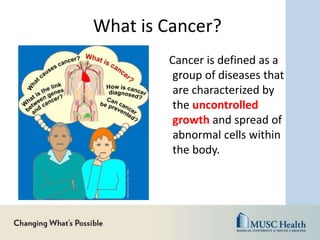
What is Cancer?
Cancer is defined as a
group of diseases that
are characterized by
the uncontrolled
growth and spread of
abnormal cells within
the body.
Cancer Facts and Figures
• 1,660,290 new cancer cases will be
diagnosed in 2014
• Cancer is the 2nd leading cause of death
• Cost for cancer care is $201.5 billion dollars
• Relative survival has increased to about 68%
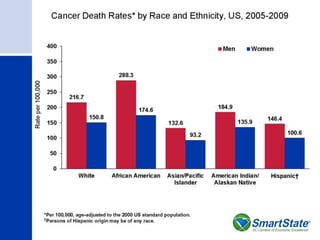
Cancer Death Rates* by Race and Ethnicity, US, 2005-2009
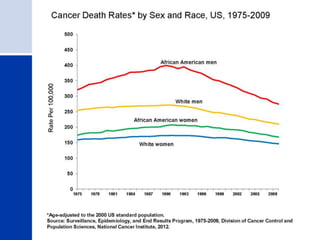
Cancer Death Rates* by Sex and Race, US, 1975-2009
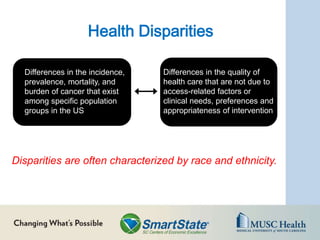
Health Disparities
Differences in the quality of
health care that are not due to
access-related factors or
clinical needs, preferences and
appropriateness of intervention
Differences in the incidence,
prevalence, mortality, and
burden of cancer that exist
among specific population
groups in the US
Disparities are often characterized by race and ethnicity.
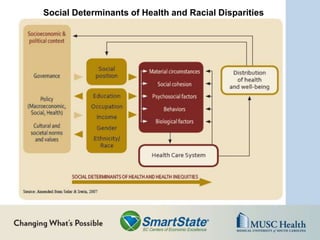
Social Determinants of Health and Racial Disparities
SmartState Center for Cancer Equity
• Enhance minority participation in clinical research on health promotion and
disease prevention and control.
• Increase access to and utilization of emerging technologies for health
promotion and prevention and control.
• Develop culturally tailored assessments and interventions to improve health
outcomes.
• Develop sustainable infrastructure for health promotion and disease prevention
and control in clinic and community settings.
Percent
PPRNet August 22-24, 2013 ©PPRNet 2013
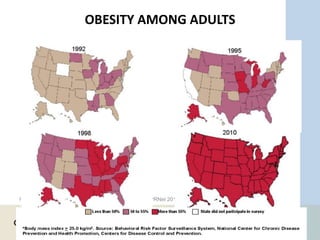
OBESITY AMONG ADULTS
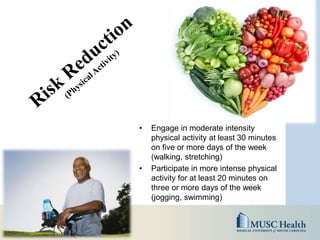
• Engage in moderate intensity
physical activity at least 30 minutes
on five or more days of the week
(walking, stretching)
• Participate in more intense physical
activity for at least 20 minutes on
three or more days of the week
(jogging, swimming)
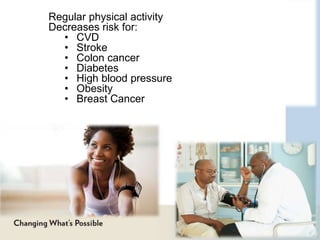
Regular physical activity
Decreases risk for:
• CVD
• Stroke
• Colon cancer
• Diabetes
• High blood pressure
• Obesity
• Breast Cancer
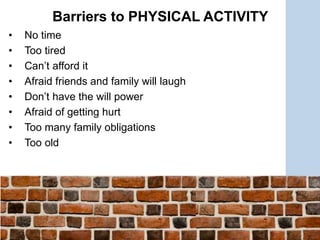
• No time
• Too tired
• Can’t afford it
• Afraid friends and family will laugh
• Don’t have the will power
• Afraid of getting hurt
• Too many family obligations
• Too old
Barriers to PHYSICAL ACTIVITY
• Find times of day that you can use for PA.
• Start a walking program with friends and family
• Exercise in 10-minute bouts
• Choose activities that fit your age, fitness level, skill level, and
health status.
WAYS TO OVERCOME PHYSICAL ACTIVITY
BARRIERS
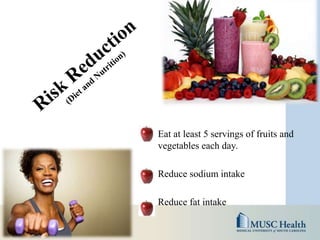
• Eat at least 5 servings of fruits and
vegetables each day.
• Reduce sodium intake
• Reduce fat intake
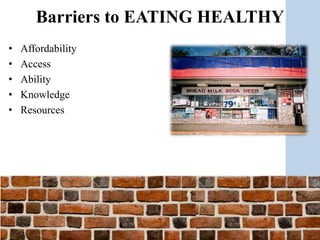
• Affordability
• Access
• Ability
• Knowledge
• Resources
Barriers to EATING HEALTHY
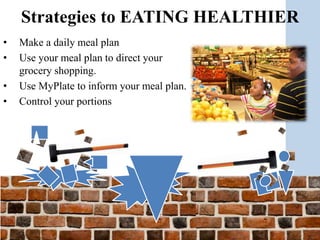
• Make a daily meal plan
• Use your meal plan to direct your
grocery shopping.
• Use MyPlate to inform your meal plan.
• Control your portions
Strategies to EATING HEALTHIER
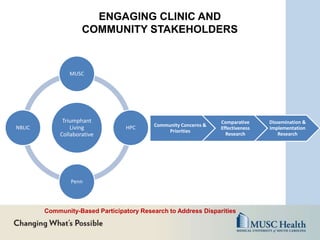
Community Concerns &
Priorities
Comparative
Effectiveness
Research
Dissemination &
Implementation
Research
Triumphant
Living
Collaborative
MUSC
HPC
Penn
NBLIC
ENGAGING CLINIC AND
COMMUNITY STAKEHOLDERS
Community-Based Participatory Research to Address Disparities
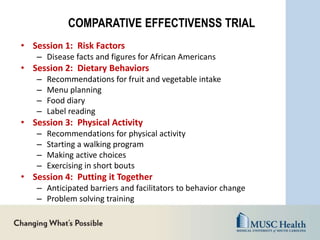
COMPARATIVE EFFECTIVENSS TRIAL
• Session 1: Risk Factors
– Disease facts and figures for African Americans
• Session 2: Dietary Behaviors
– Recommendations for fruit and vegetable intake
– Menu planning
– Food diary
– Label reading
• Session 3: Physical Activity
– Recommendations for physical activity
– Starting a walking program
– Making active choices
– Exercising in short bouts
• Session 4: Putting it Together
– Anticipated barriers and facilitators to behavior change
– Problem solving training
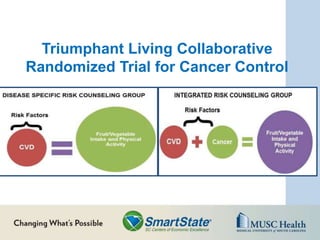
Triumphant Living Collaborative
Randomized Trial for Cancer Control
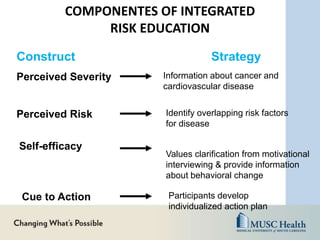
COMPONENTES OF INTEGRATED
RISK EDUCATION
Construct Strategy
Perceived Risk
Perceived Severity
Self-efficacy
Cue to Action
Information about cancer and
cardiovascular disease
Identify overlapping risk factors
for disease
Values clarification from motivational
interviewing & provide information
about behavioral change
Participants develop
individualized action plan
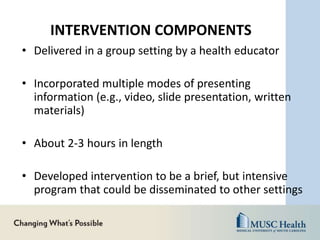
INTERVENTION COMPONENTS
• Delivered in a group setting by a health educator
• Incorporated multiple modes of presenting
information (e.g., video, slide presentation, written
materials)
• About 2-3 hours in length
• Developed intervention to be a brief, but intensive
program that could be disseminated to other settings
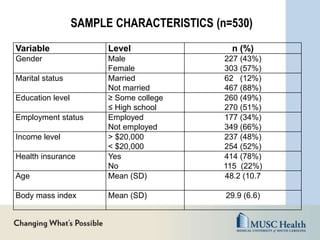
Variable Level n (%)
Gender Male
Female
227 (43%)
303 (57%)
Marital status Married
Not married
62 (12%)
467 (88%)
Education level ≥ Some college
≤ High school
260 (49%)
270 (51%)
Employment status Employed
Not employed
177 (34%)
349 (66%)
Income level > $20,000
< $20,000
237 (48%)
254 (52%)
Health insurance Yes
No
414 (78%)
115 (22%)
Age Mean (SD) 48.2 (10.7
Body mass index Mean (SD) 29.9 (6.6)
SAMPLE CHARACTERISTICS (n=530)
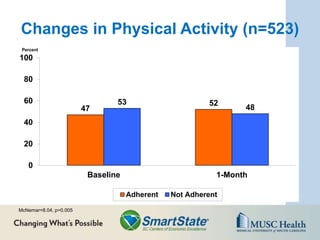
Changes in Physical Activity (n=523)
47
5253
48
0
20
40
60
80
100
Baseline 1-Month
Adherent Not Adherent
Percent
McNemar=8.04, p=0.005
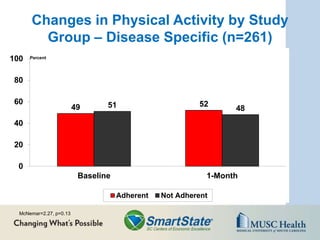
Changes in Physical Activity by Study
Group – Disease Specific (n=261)
49 5251 48
0
20
40
60
80
100
Baseline 1-Month
Adherent Not Adherent
Percent
McNemar=2.27, p=0.13
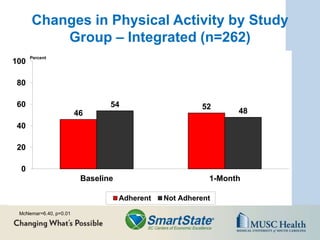
Changes in Physical Activity by Study
Group – Integrated (n=262)
46
5254
48
0
20
40
60
80
100
Baseline 1-Month
Adherent Not Adherent
Percent
McNemar=6.40, p=0.01
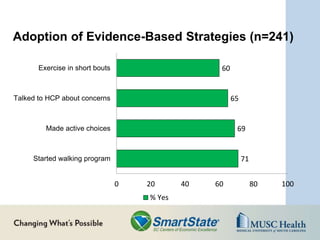
Adoption of Evidence-Based Strategies (n=241)
71
69
65
60
0 20 40 60 80 100
Started walking program
Made active choices
Talked to HCP about concerns
Exercise in short bouts
% Yes
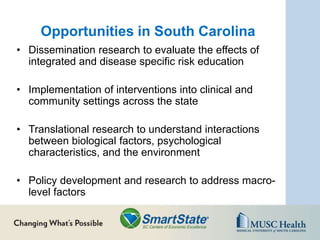
Opportunities in South Carolina
• Dissemination research to evaluate the effects of
integrated and disease specific risk education
• Implementation of interventions into clinical and
community settings across the state
• Translational research to understand interactions
between biological factors, psychological
characteristics, and the environment
• Policy development and research to address macro-
level factors

What is Cancer Equity?

  • 1.
    SmartState Center forCancer Equity Chanita Hughes Halbert, Ph.D. Medical University of South Carolina Endowed Chair, SmartState Center for Cancer Equity Department of Psychiatry and Behavioral Sciences Hollings Cancer Center
  • 2.
    What is Cancer? Canceris defined as a group of diseases that are characterized by the uncontrolled growth and spread of abnormal cells within the body.
  • 3.
    Cancer Facts andFigures • 1,660,290 new cancer cases will be diagnosed in 2014 • Cancer is the 2nd leading cause of death • Cost for cancer care is $201.5 billion dollars • Relative survival has increased to about 68%
  • 4.
    Cancer Death Rates*by Race and Ethnicity, US, 2005-2009
  • 5.
    Cancer Death Rates*by Sex and Race, US, 1975-2009
  • 6.
    Health Disparities Differences inthe quality of health care that are not due to access-related factors or clinical needs, preferences and appropriateness of intervention Differences in the incidence, prevalence, mortality, and burden of cancer that exist among specific population groups in the US Disparities are often characterized by race and ethnicity.
  • 7.
    Social Determinants ofHealth and Racial Disparities
  • 8.
    SmartState Center forCancer Equity • Enhance minority participation in clinical research on health promotion and disease prevention and control. • Increase access to and utilization of emerging technologies for health promotion and prevention and control. • Develop culturally tailored assessments and interventions to improve health outcomes. • Develop sustainable infrastructure for health promotion and disease prevention and control in clinic and community settings. Percent
  • 9.
    PPRNet August 22-24,2013 ©PPRNet 2013 OBESITY AMONG ADULTS
  • 10.
    • Engage inmoderate intensity physical activity at least 30 minutes on five or more days of the week (walking, stretching) • Participate in more intense physical activity for at least 20 minutes on three or more days of the week (jogging, swimming)
  • 11.
    Regular physical activity Decreasesrisk for: • CVD • Stroke • Colon cancer • Diabetes • High blood pressure • Obesity • Breast Cancer
  • 12.
    • No time •Too tired • Can’t afford it • Afraid friends and family will laugh • Don’t have the will power • Afraid of getting hurt • Too many family obligations • Too old Barriers to PHYSICAL ACTIVITY
  • 13.
    • Find timesof day that you can use for PA. • Start a walking program with friends and family • Exercise in 10-minute bouts • Choose activities that fit your age, fitness level, skill level, and health status. WAYS TO OVERCOME PHYSICAL ACTIVITY BARRIERS
  • 14.
    • Eat atleast 5 servings of fruits and vegetables each day. • Reduce sodium intake • Reduce fat intake
  • 15.
    • Affordability • Access •Ability • Knowledge • Resources Barriers to EATING HEALTHY
  • 16.
    • Make adaily meal plan • Use your meal plan to direct your grocery shopping. • Use MyPlate to inform your meal plan. • Control your portions Strategies to EATING HEALTHIER
  • 17.
    Community Concerns & Priorities Comparative Effectiveness Research Dissemination& Implementation Research Triumphant Living Collaborative MUSC HPC Penn NBLIC ENGAGING CLINIC AND COMMUNITY STAKEHOLDERS Community-Based Participatory Research to Address Disparities
  • 18.
    COMPARATIVE EFFECTIVENSS TRIAL •Session 1: Risk Factors – Disease facts and figures for African Americans • Session 2: Dietary Behaviors – Recommendations for fruit and vegetable intake – Menu planning – Food diary – Label reading • Session 3: Physical Activity – Recommendations for physical activity – Starting a walking program – Making active choices – Exercising in short bouts • Session 4: Putting it Together – Anticipated barriers and facilitators to behavior change – Problem solving training
  • 19.
  • 20.
    COMPONENTES OF INTEGRATED RISKEDUCATION Construct Strategy Perceived Risk Perceived Severity Self-efficacy Cue to Action Information about cancer and cardiovascular disease Identify overlapping risk factors for disease Values clarification from motivational interviewing & provide information about behavioral change Participants develop individualized action plan
  • 21.
    INTERVENTION COMPONENTS • Deliveredin a group setting by a health educator • Incorporated multiple modes of presenting information (e.g., video, slide presentation, written materials) • About 2-3 hours in length • Developed intervention to be a brief, but intensive program that could be disseminated to other settings
  • 22.
    Variable Level n(%) Gender Male Female 227 (43%) 303 (57%) Marital status Married Not married 62 (12%) 467 (88%) Education level ≥ Some college ≤ High school 260 (49%) 270 (51%) Employment status Employed Not employed 177 (34%) 349 (66%) Income level > $20,000 < $20,000 237 (48%) 254 (52%) Health insurance Yes No 414 (78%) 115 (22%) Age Mean (SD) 48.2 (10.7 Body mass index Mean (SD) 29.9 (6.6) SAMPLE CHARACTERISTICS (n=530)
  • 23.
    Changes in PhysicalActivity (n=523) 47 5253 48 0 20 40 60 80 100 Baseline 1-Month Adherent Not Adherent Percent McNemar=8.04, p=0.005
  • 24.
    Changes in PhysicalActivity by Study Group – Disease Specific (n=261) 49 5251 48 0 20 40 60 80 100 Baseline 1-Month Adherent Not Adherent Percent McNemar=2.27, p=0.13
  • 25.
    Changes in PhysicalActivity by Study Group – Integrated (n=262) 46 5254 48 0 20 40 60 80 100 Baseline 1-Month Adherent Not Adherent Percent McNemar=6.40, p=0.01
  • 26.
    Adoption of Evidence-BasedStrategies (n=241) 71 69 65 60 0 20 40 60 80 100 Started walking program Made active choices Talked to HCP about concerns Exercise in short bouts % Yes
  • 27.
    Opportunities in SouthCarolina • Dissemination research to evaluate the effects of integrated and disease specific risk education • Implementation of interventions into clinical and community settings across the state • Translational research to understand interactions between biological factors, psychological characteristics, and the environment • Policy development and research to address macro- level factors