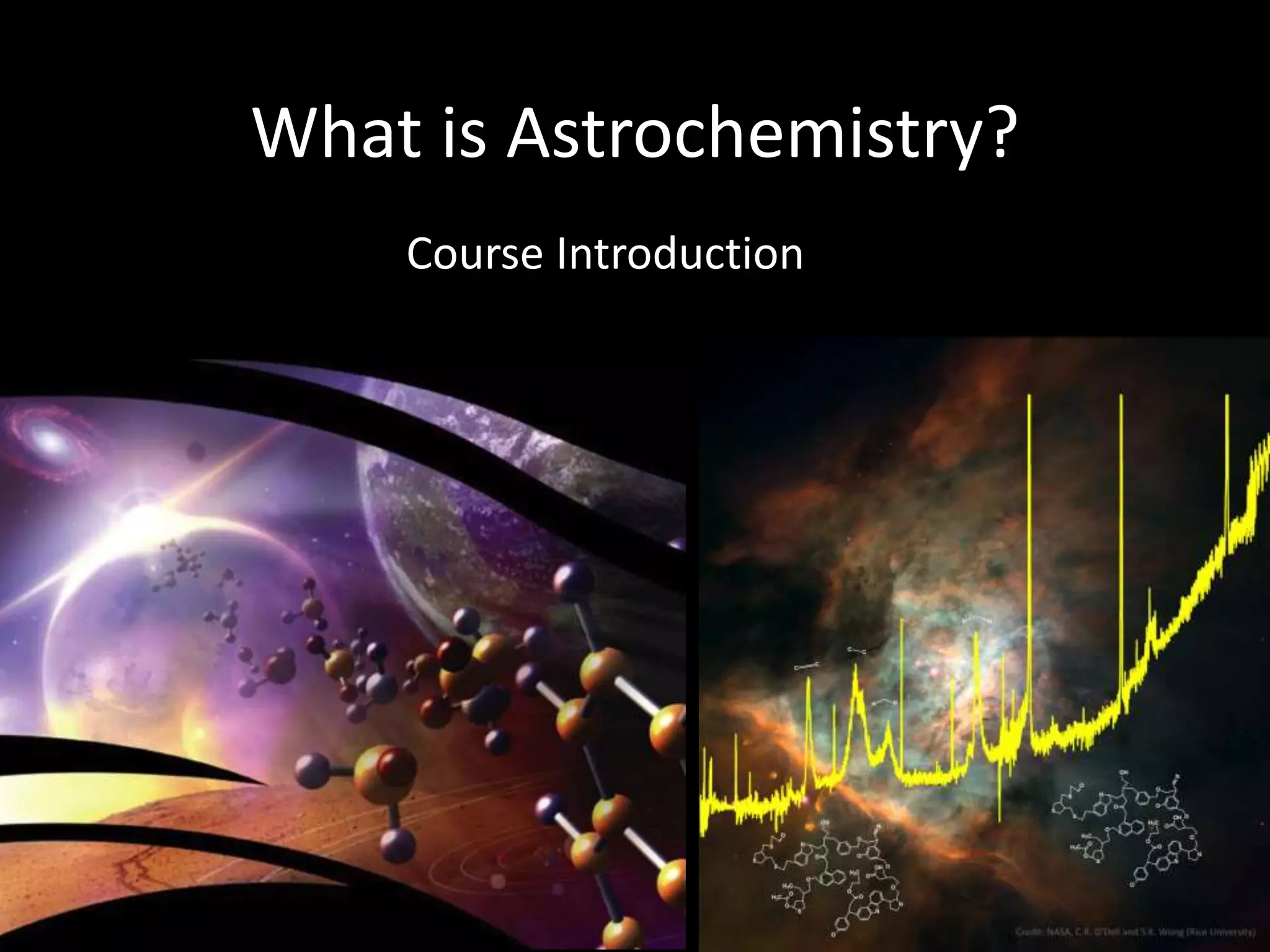
What is Astrochemistry?
Course Introduction
A FEW ITEMS BEFORE WE BEGIN
CHEM/EARTH SCI 4059/5059
Course Goal
• The goal of this course is to expose you, the
student, to the interdisciplinary field that is
Astrochemistry.
• You can expect to see topics that include, but
are not limited to
– Astronomy
– Biology
– Chemistry
– Earth and Planetary Science
– Physics
Disclaimer
• While this course is not a math course, many
of the topics included are best described using
mathematical formulas.
– To that end, a few of the lesson will have
significant mathematical portions.
– I have attempted to keep most of the math to an
algebra-based level, but some knowledge of
logarithms and exponentials is also required.
Reference Material
• In order to keep course
costs low, there is no
required book for this
course.
• For those wishing to
learn more, I have
provided a list of
suggested references in
a separate document
Note to Educators
• I have attempted to create a course that current
and future educators can pull information from for
their classes.
• Where appropriate, this includes details on how to
build and carry out various classroom
demonstrations.
• I am not liable for any complications that may arise
when recreating demonstrations, but urge anyone
attempting to recreate the demonstrations seen in
this course to review the safety materials with each
demonstration.
Note to Educators (cont.)
• While this course is my intellectual property, all
non-copyrighted material may be downloaded
and adapted for individual classroom and non-
profit use unless noted otherwise.
• Rights for the use of copyrighted material
should be obtained from the original creators.
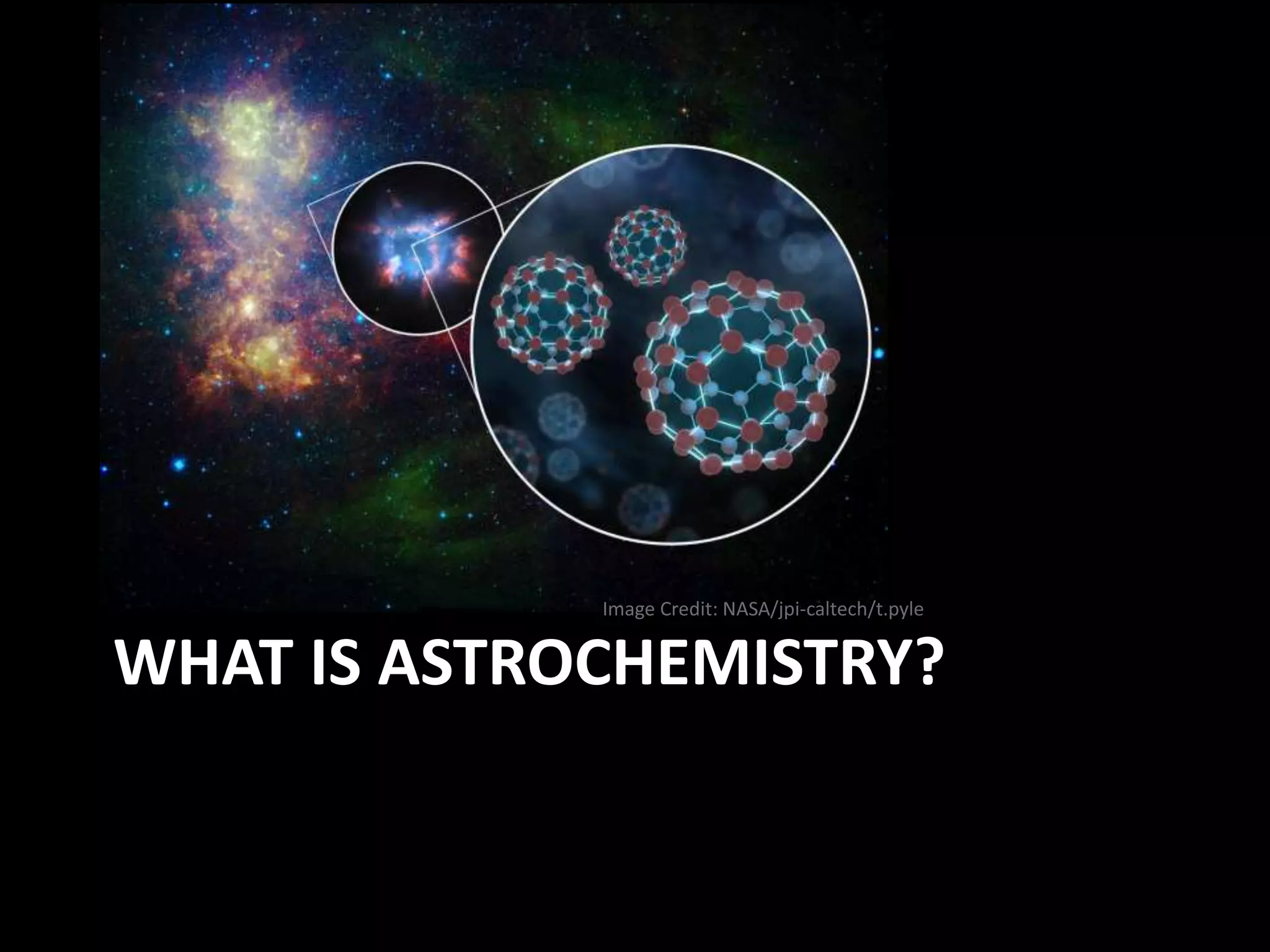
WHAT IS ASTROCHEMISTRY?
CHEM/EARTH SCI 4059/5059
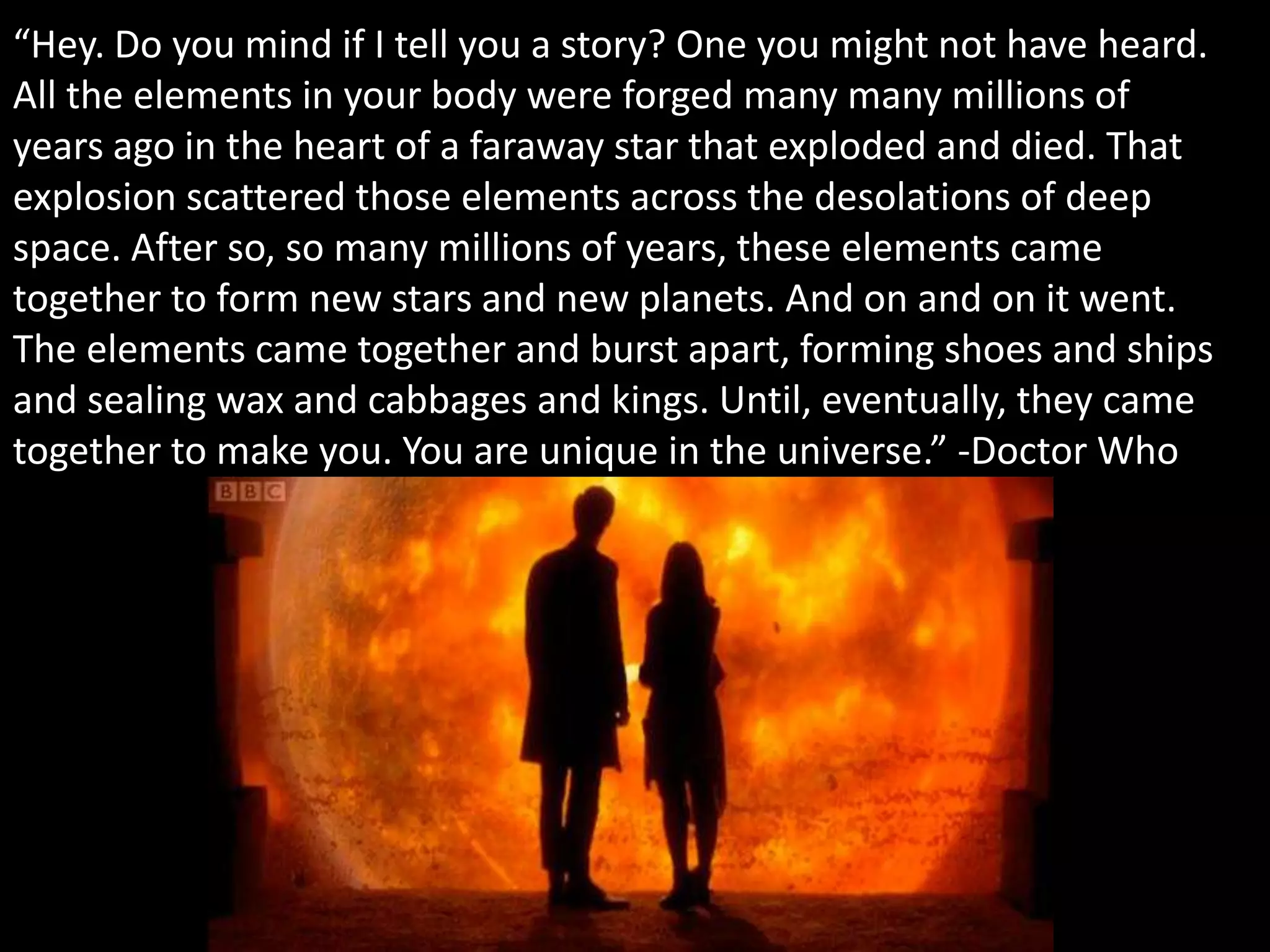
“Hey. Do you mind if I tell you a story? One you might not have heard.
All the elements in your body were forged many many millions of
years ago in the heart of a faraway star that exploded and died. That
explosion scattered those elements across the desolations of deep
space. After so, so many millions of years, these elements came
together to form new stars and new planets. And on and on it went.
The elements came together and burst apart, forming shoes and ships
and sealing wax and cabbages and kings. Until, eventually, they came
together to make you. You are unique in the universe.” -Doctor Who
LET’S START WITH SOME
DEFINITIONS
Physics
The science of
matter and energy
and of interactions
between the two
*This is a Venn Diagram
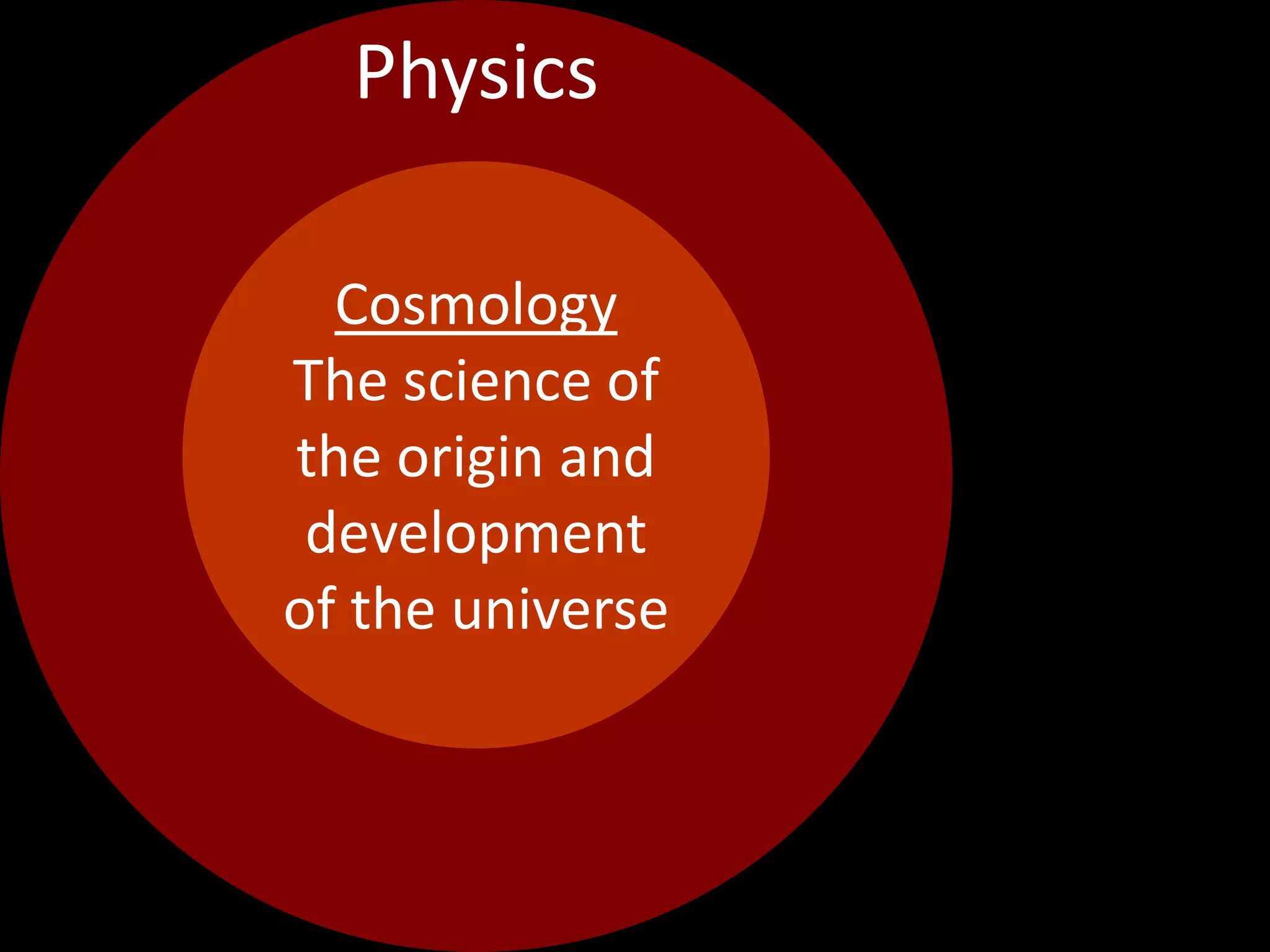
Physics
Cosmology
The science of
the origin and
development
of the universe
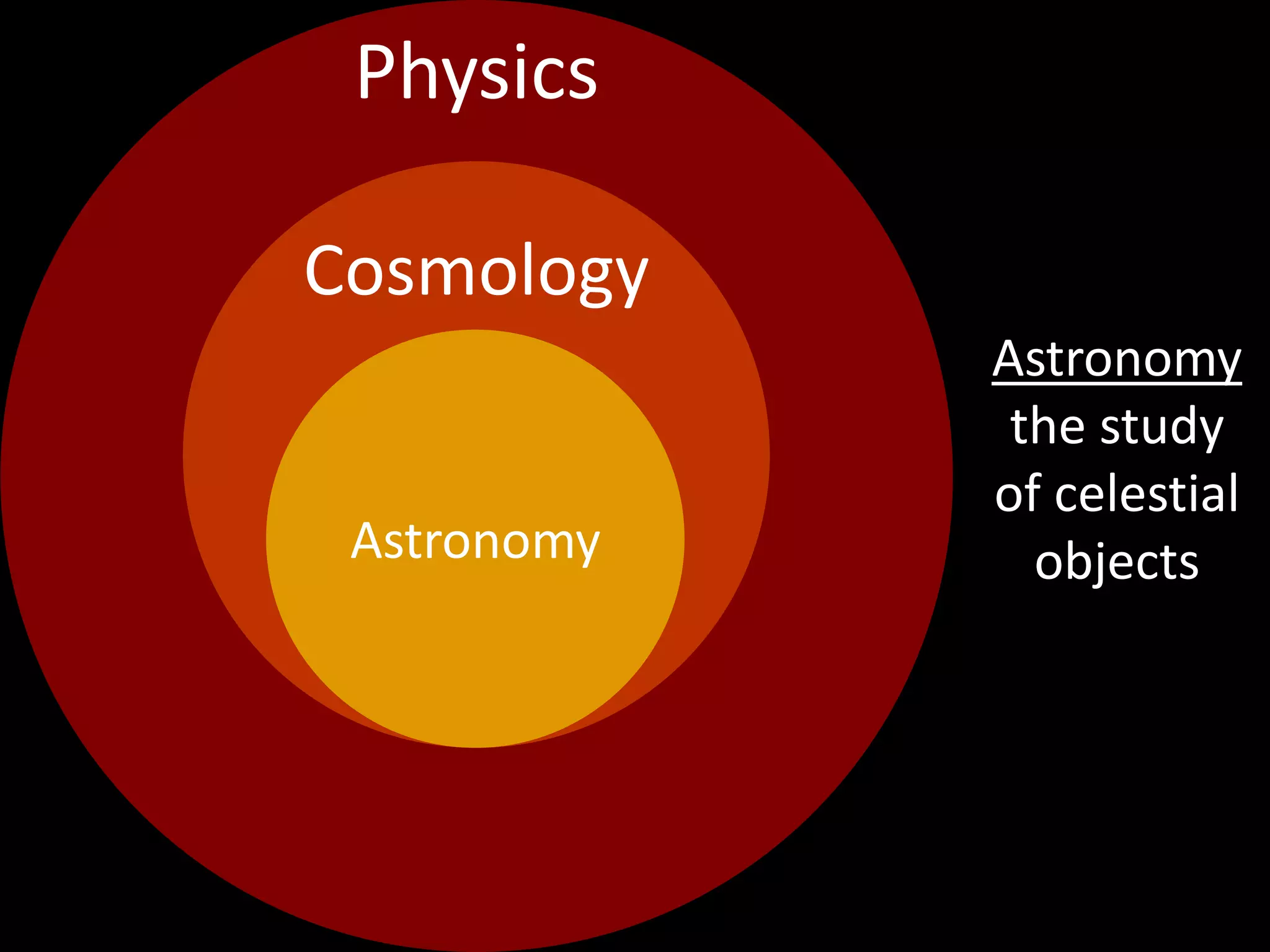
Physics
Cosmology
Astronomy
the study
of celestial
objectsAstronomy
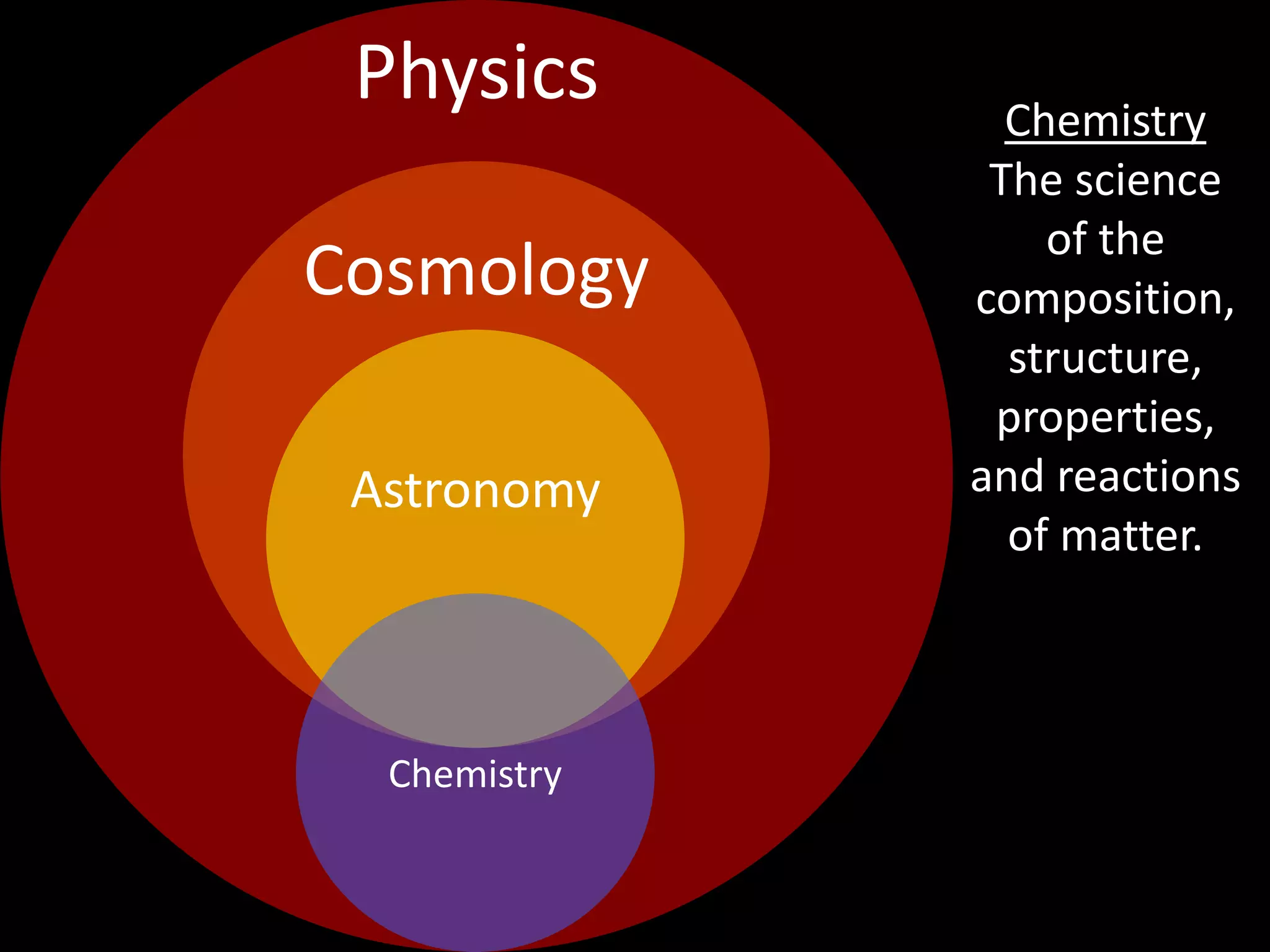
Physics Chemistry
The science
of the
composition,
structure,
properties,
and reactions
of matter.
Cosmology
Astronomy
Chemistry
Physics
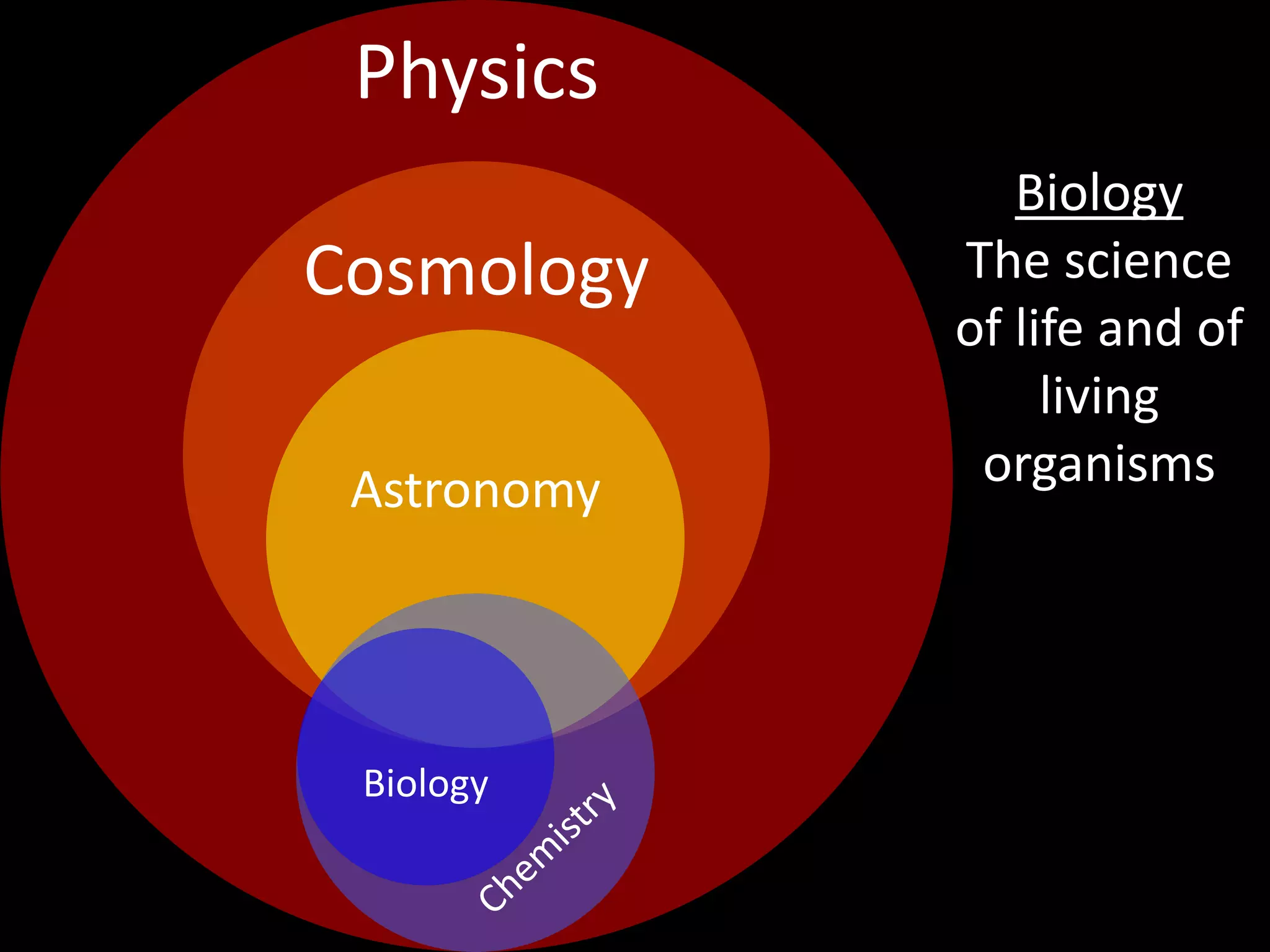
Biology
The science
of life and of
living
organisms
Cosmology
Astronomy
Biology
Physics
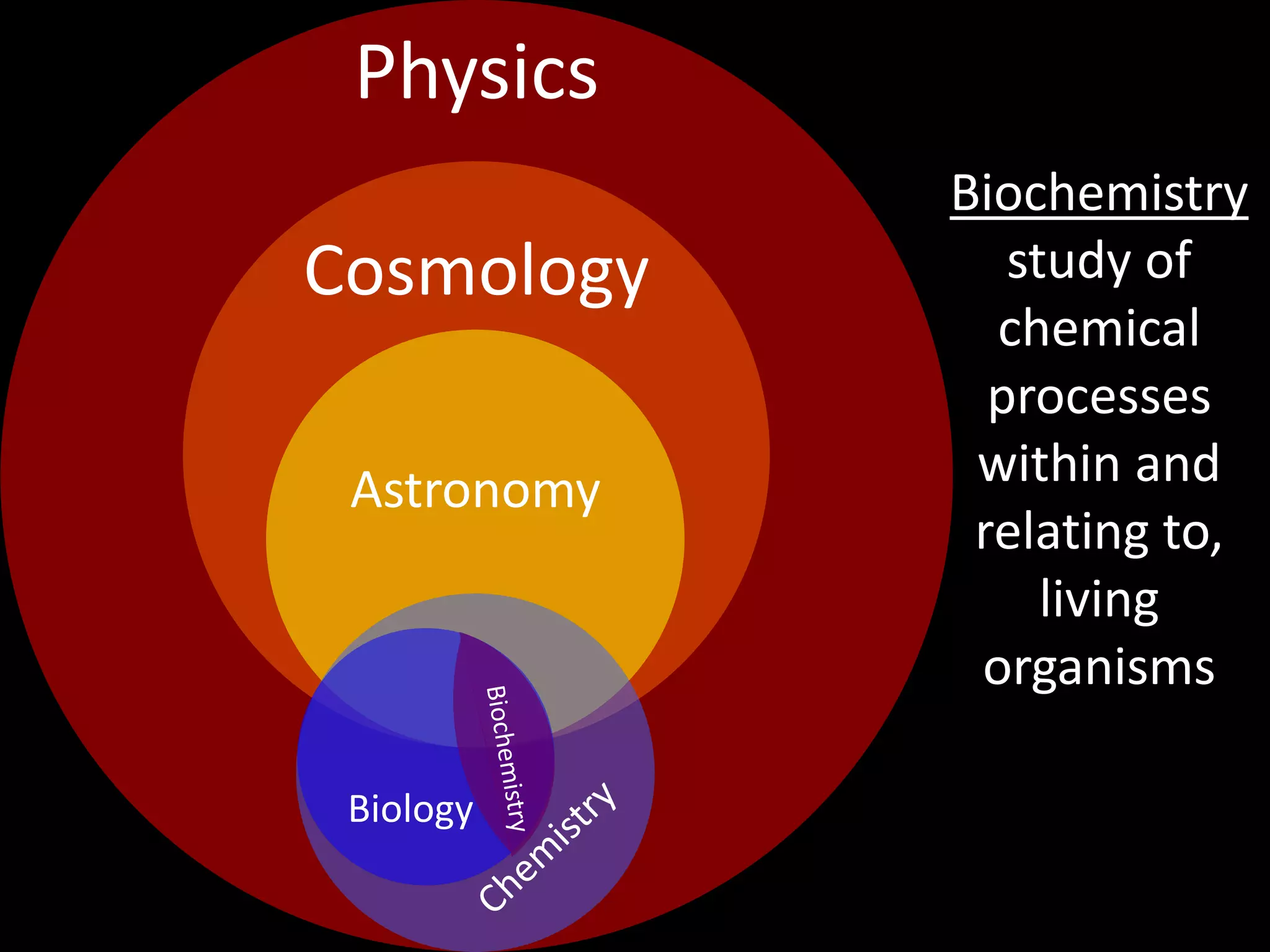
Biochemistry
study of
chemical
processes
within and
relating to,
living
organisms
Cosmology
Astronomy
Biology
Physics
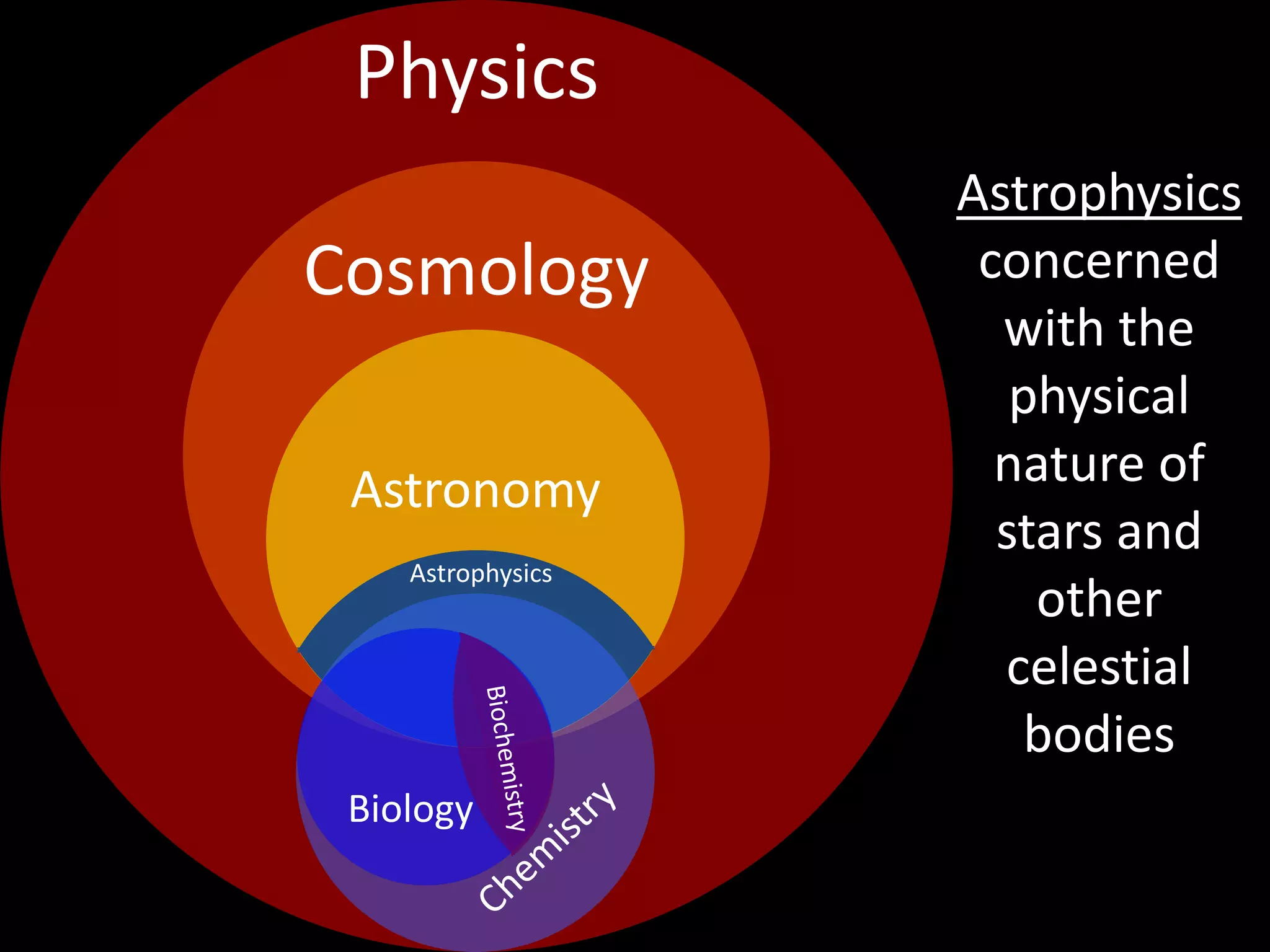
Astrophysics
concerned
with the
physical
nature of
stars and
other
celestial
bodies
Cosmology
Astronomy
Biology
Astrophysics
Physics
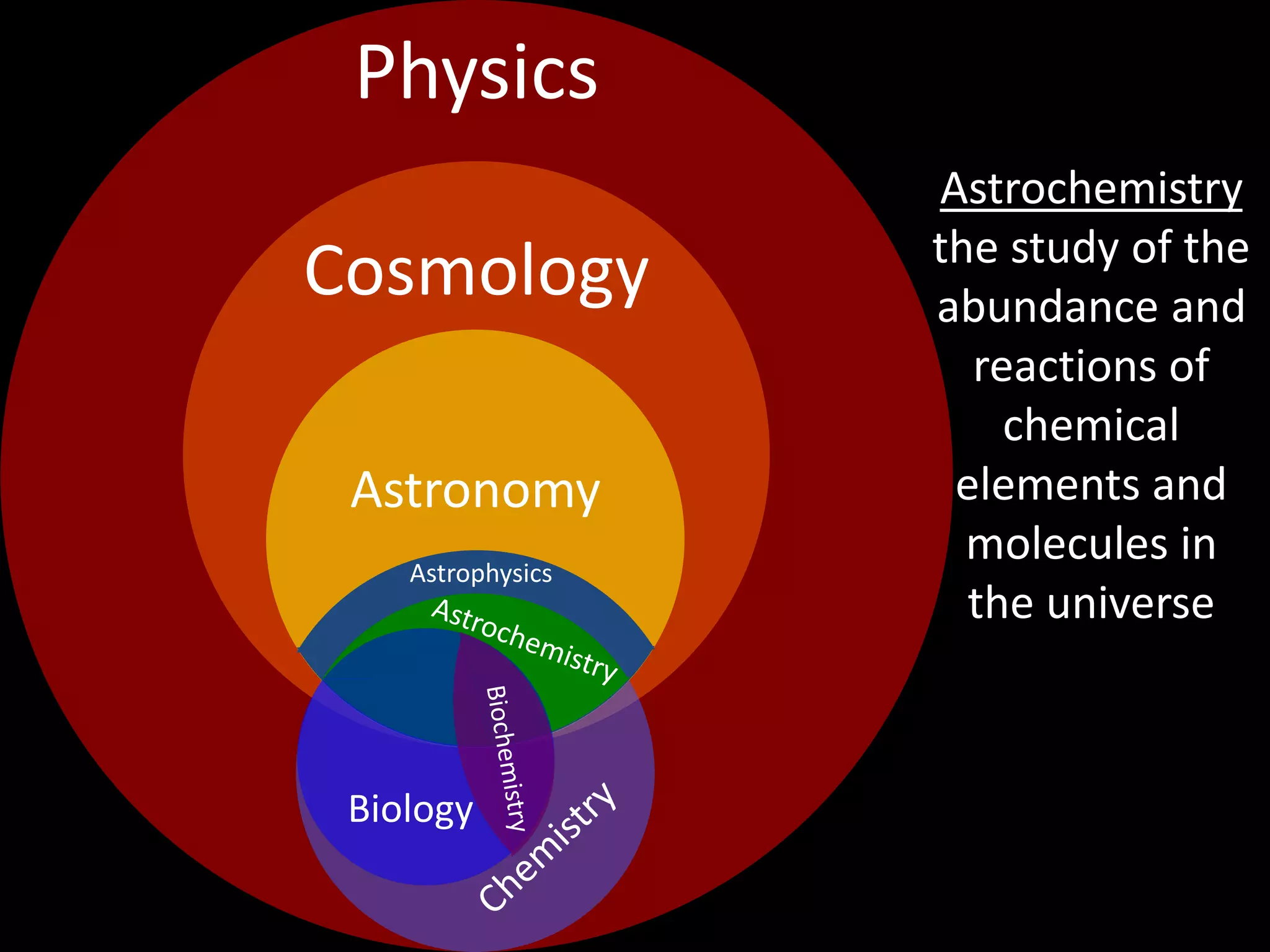
Astrochemistry
the study of the
abundance and
reactions of
chemical
elements and
molecules in
the universe
Cosmology
Astronomy
Biology
Astrophysics
Physics
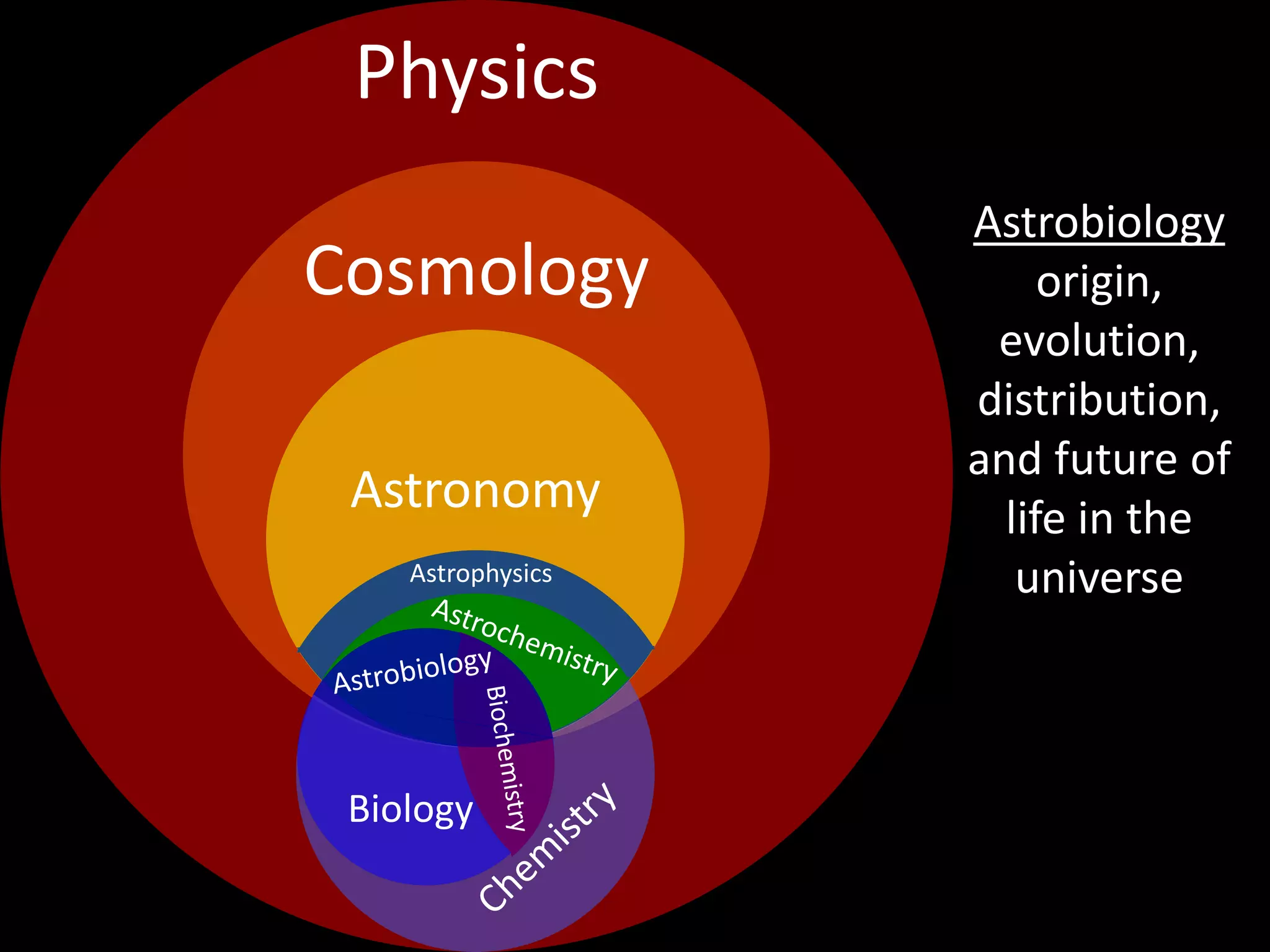
Astrobiology
origin,
evolution,
distribution,
and future of
life in the
universe
Cosmology
Astronomy
Biology
Astrophysics
Physics
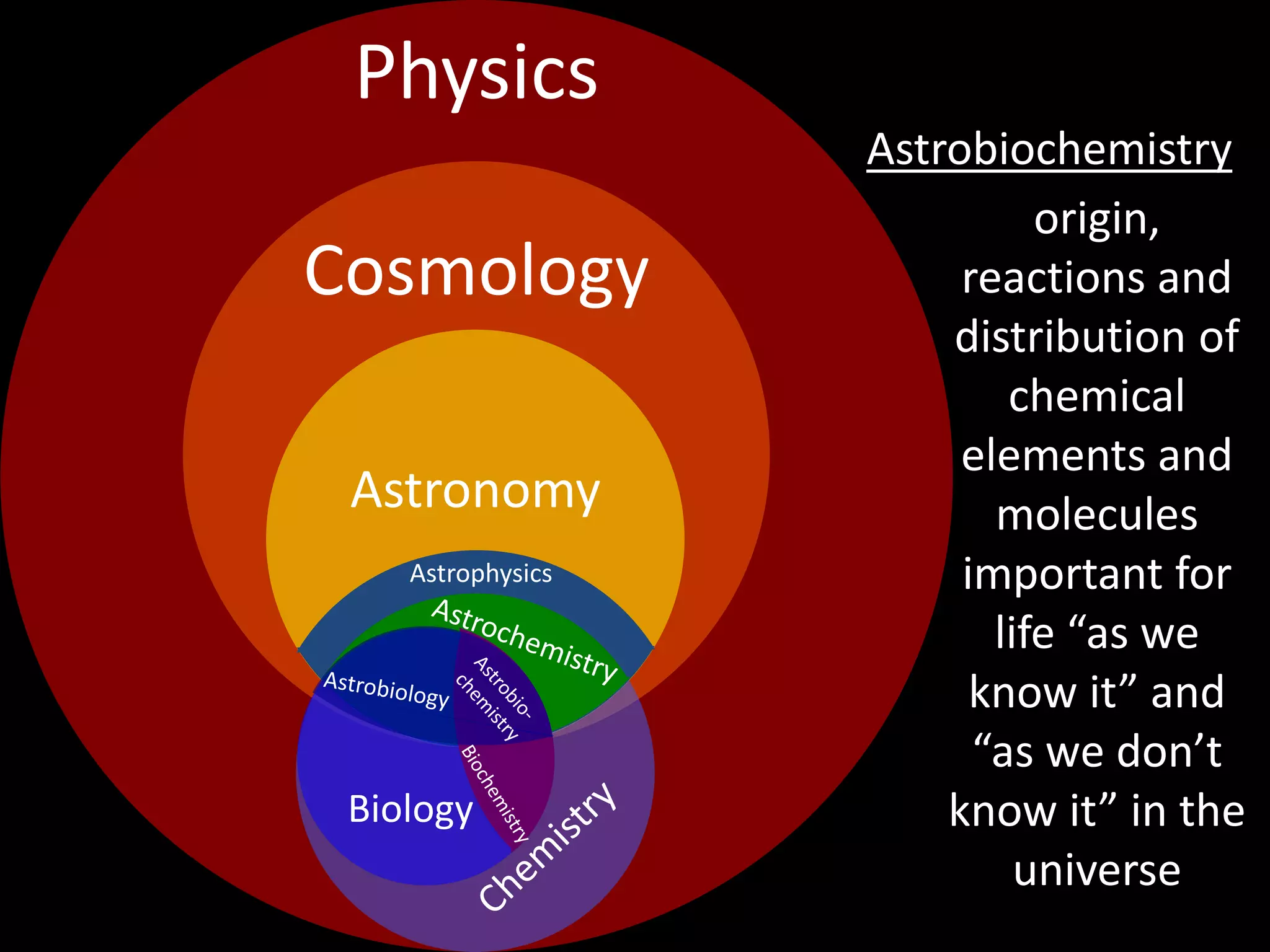
origin,
reactions and
distribution of
chemical
elements and
molecules
important for
life “as we
know it” and
“as we don’t
know it” in the
universe
Cosmology
Astronomy
Biology
Astrobiochemistry
Astrophysics
Clarification
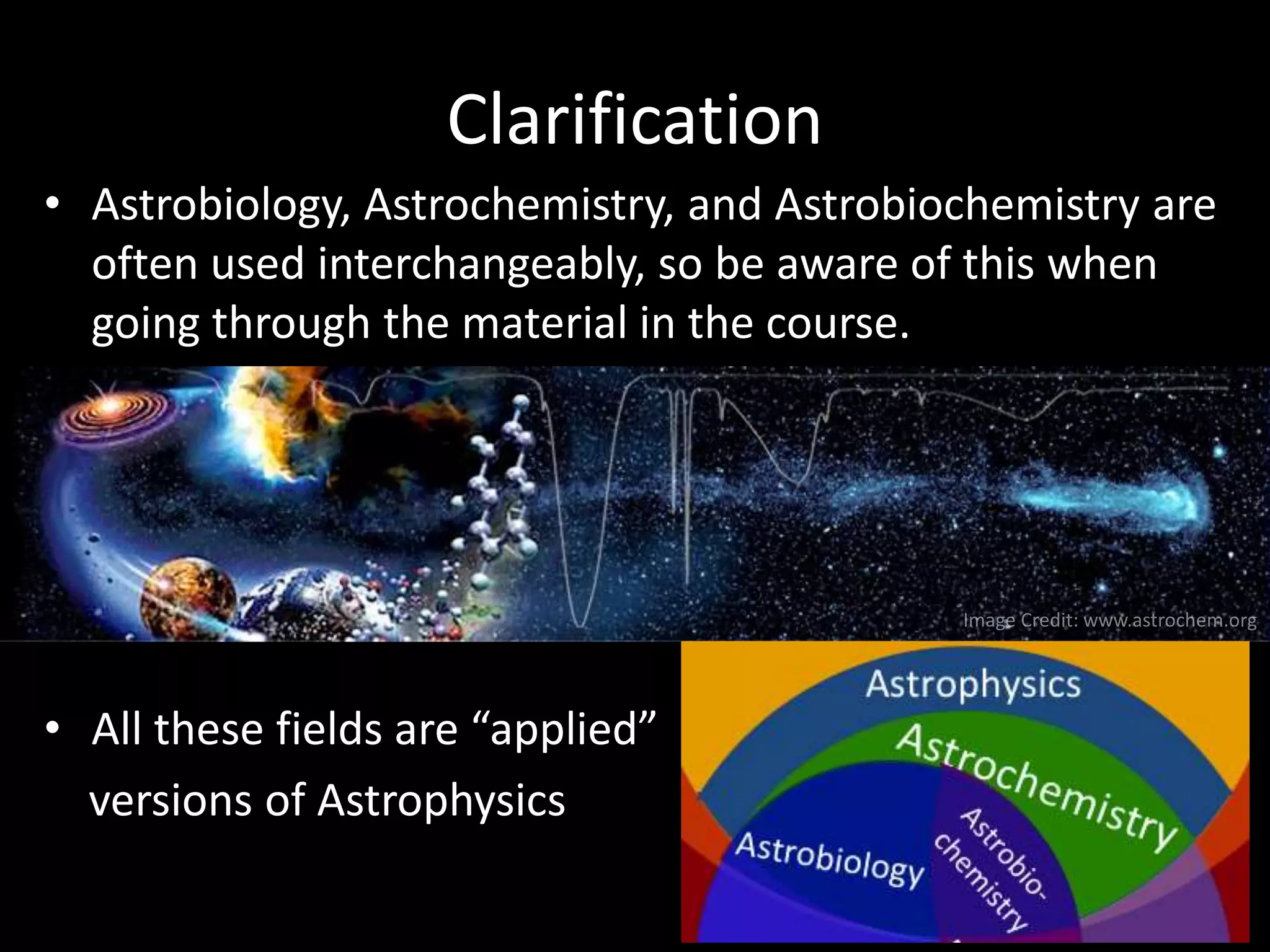
• Astrobiology, Astrochemistry, and Astrobiochemistry are
often used interchangeably, so be aware of this when
going through the material in the course.
• All these fields are “applied”
versions of Astrophysics
What does astrochemistry cover?
In the beginning there was….
Nothing?
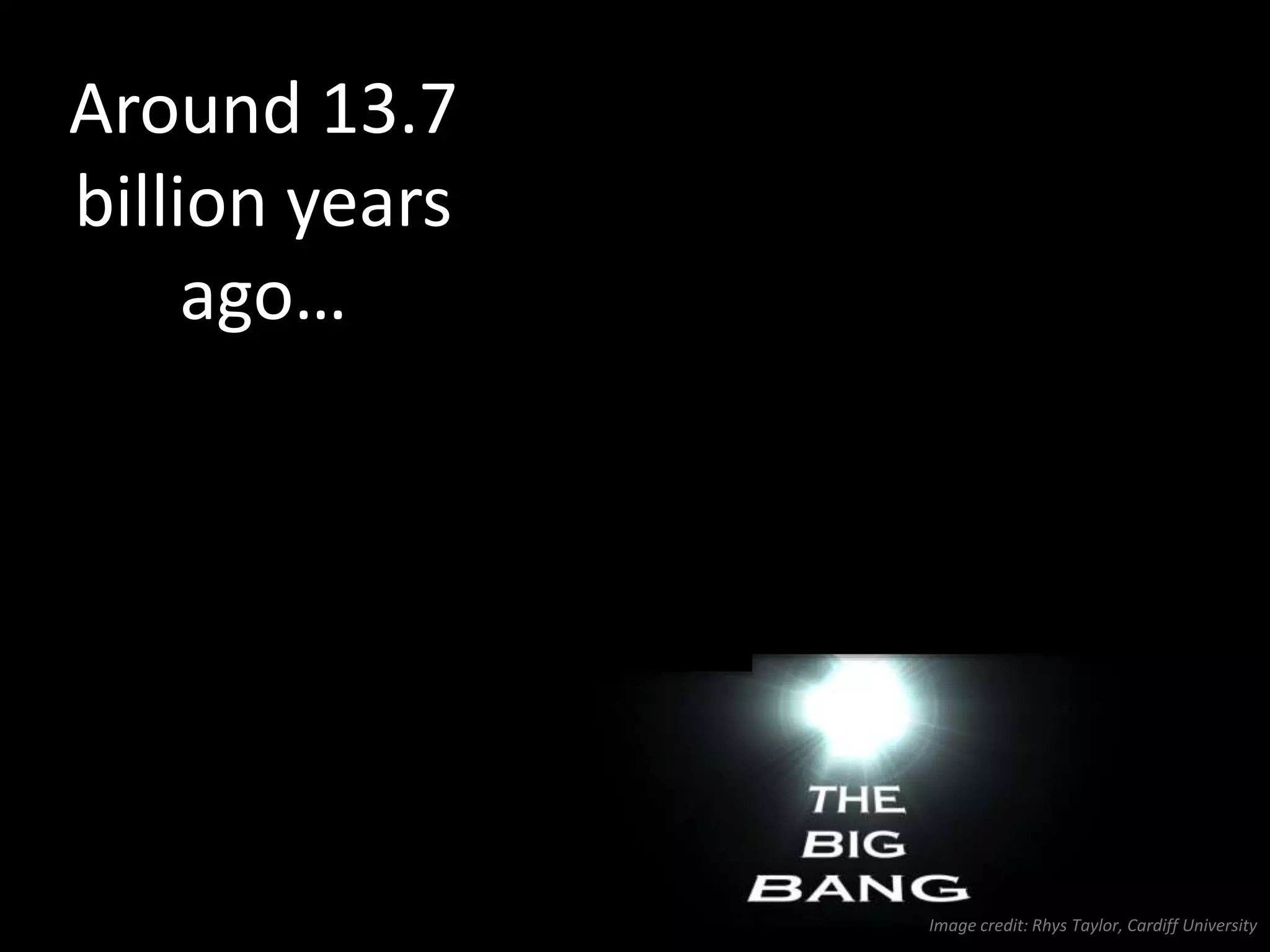
Around 13.7
billion years
ago…
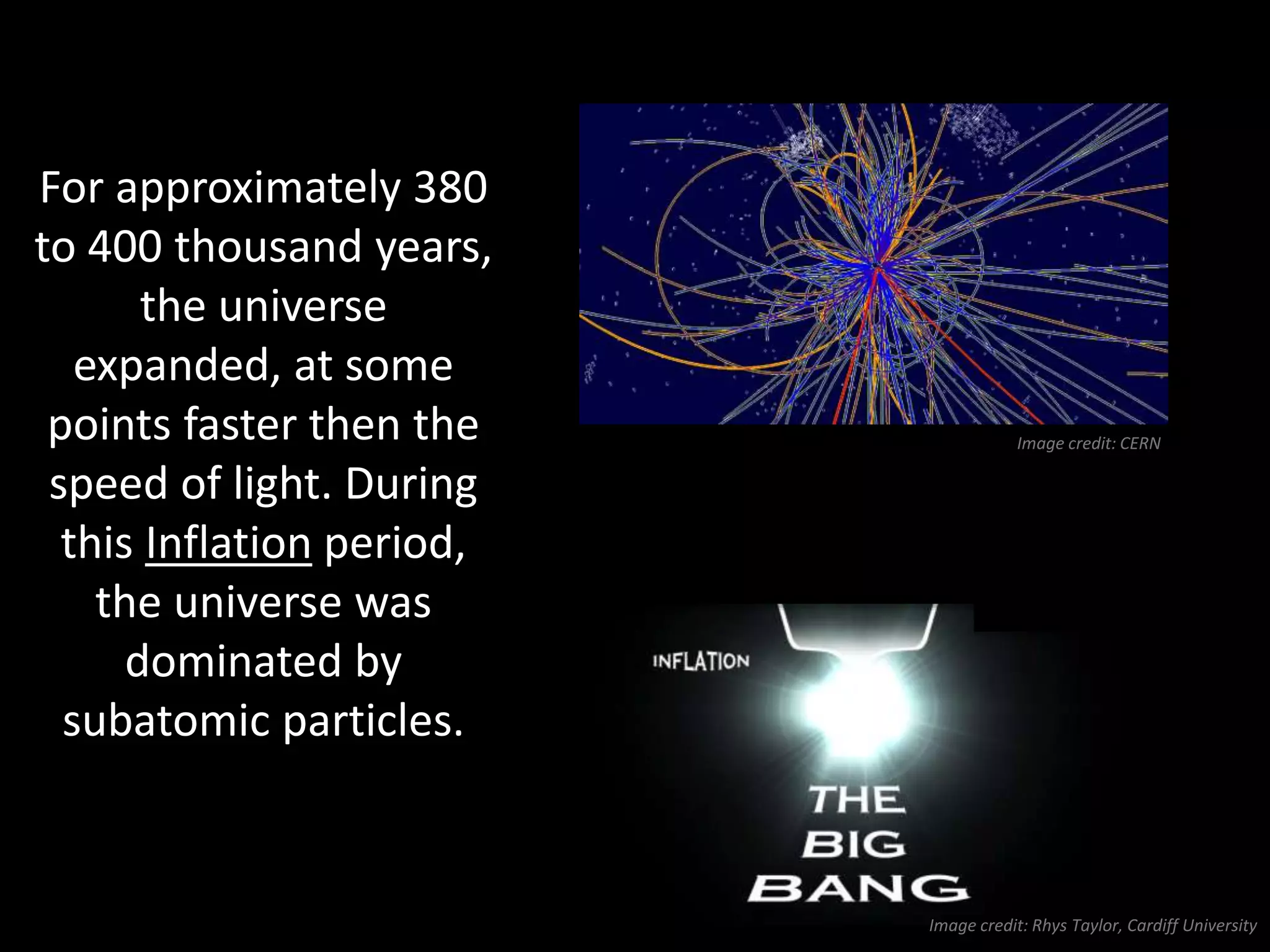
For approximately 380
to 400 thousand years,
the universe
expanded, at some
points faster then the
speed of light. During
this Inflation period,
the universe was
dominated by
subatomic particles.
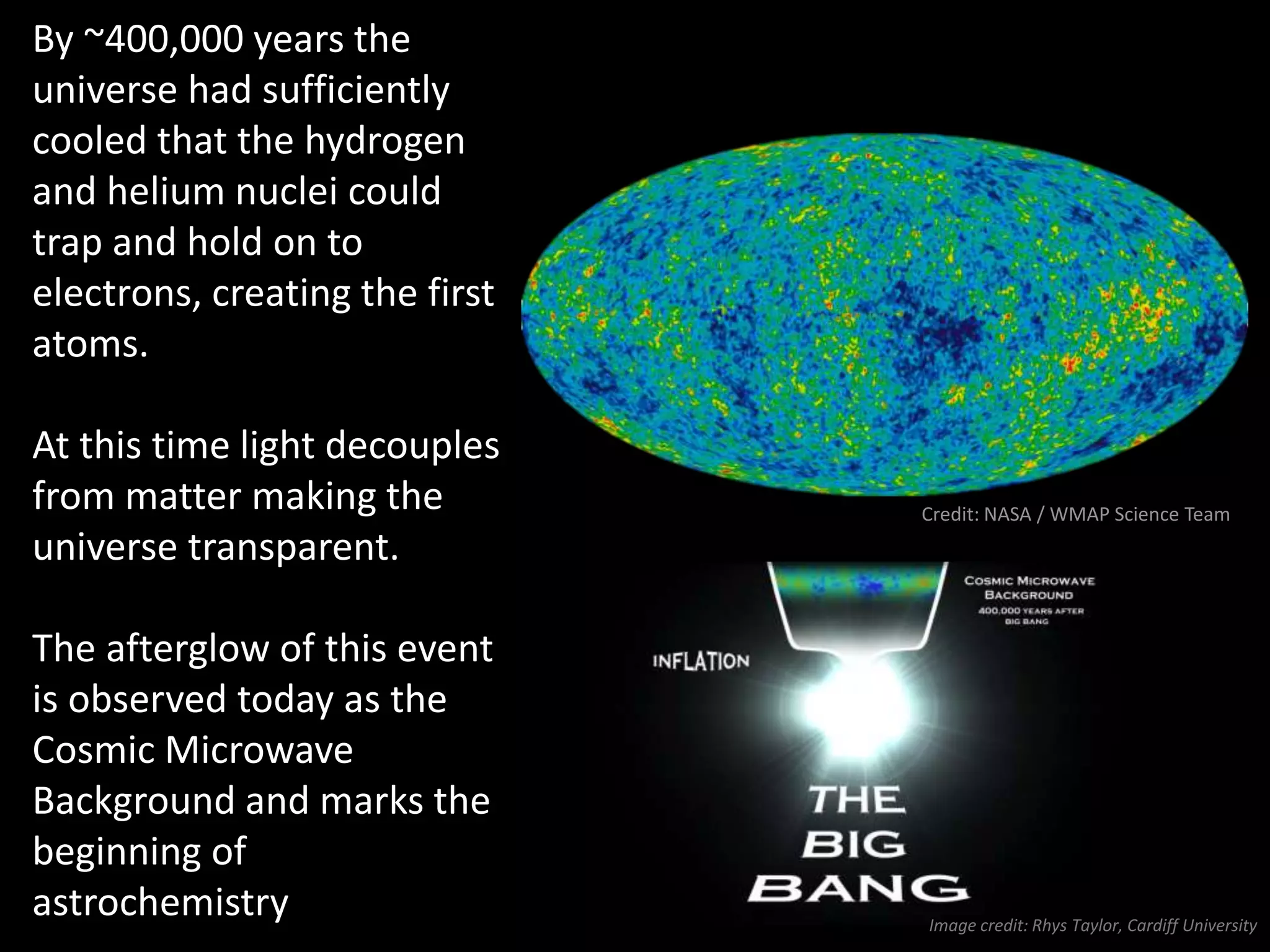
By ~400,000 years the
universe had sufficiently
cooled that the hydrogen
and helium nuclei could
trap and hold on to
electrons, creating the first
atoms.
At this time light decouples
from matter making the
universe transparent.
The afterglow of this event
is observed today as the
Cosmic Microwave
Background and marks the
beginning of
astrochemistry
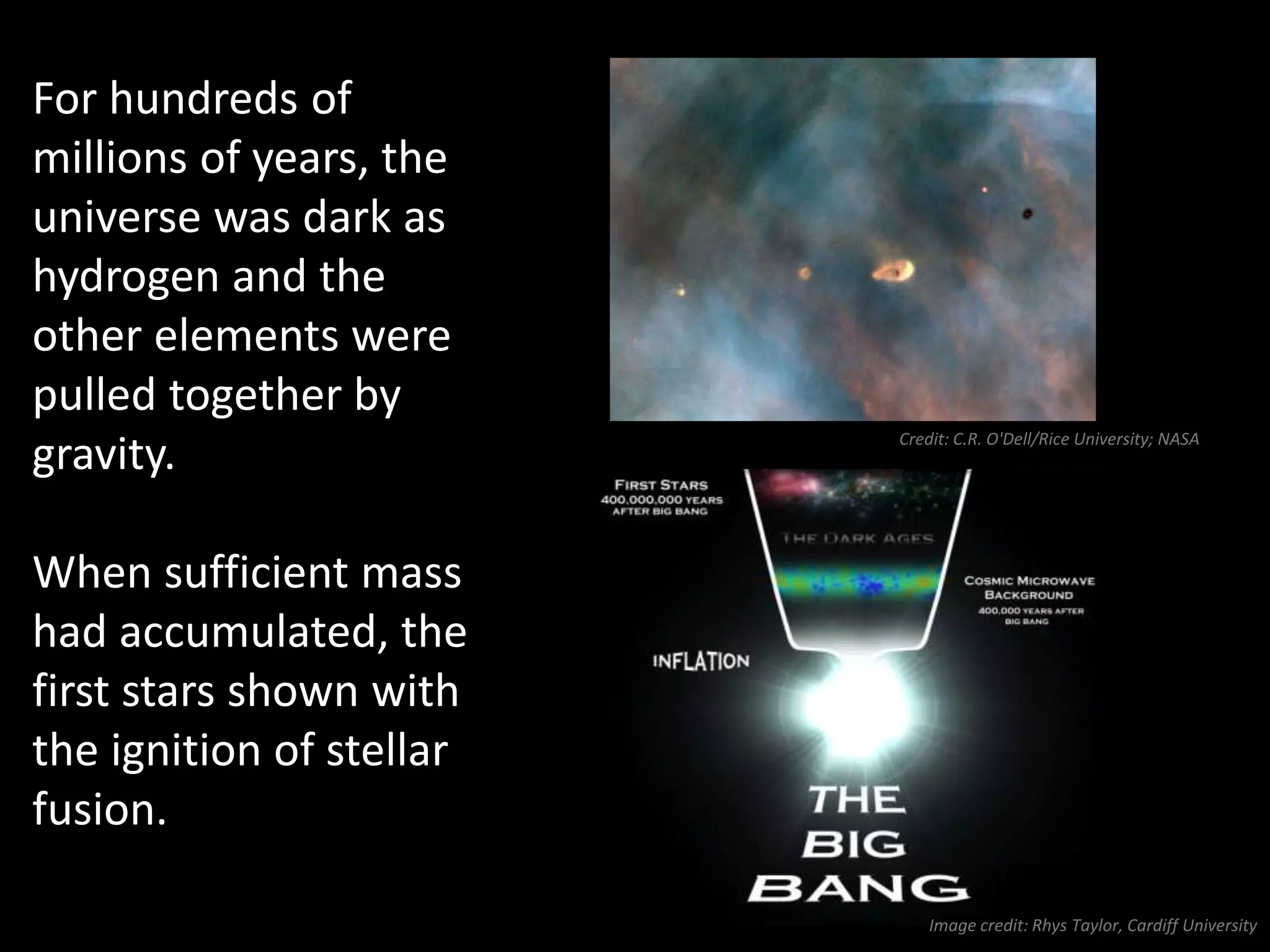
For hundreds of
millions of years, the
universe was dark as
hydrogen and the
other elements were
pulled together by
gravity.
When sufficient mass
had accumulated, the
first stars shown with
the ignition of stellar
fusion.
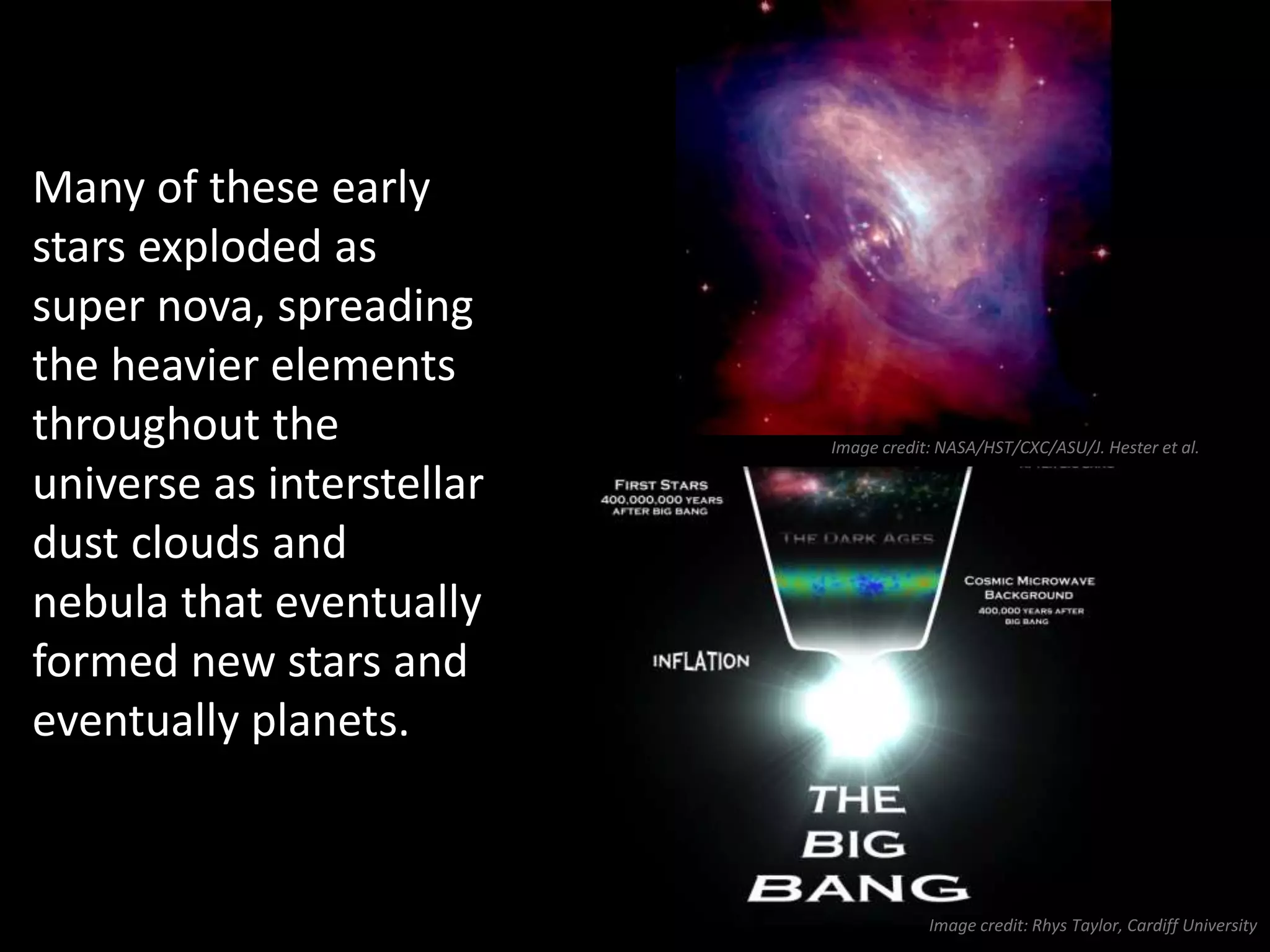
Many of these early
stars exploded as
super nova, spreading
the heavier elements
throughout the
universe as interstellar
dust clouds and
nebula that eventually
formed new stars and
eventually planets.
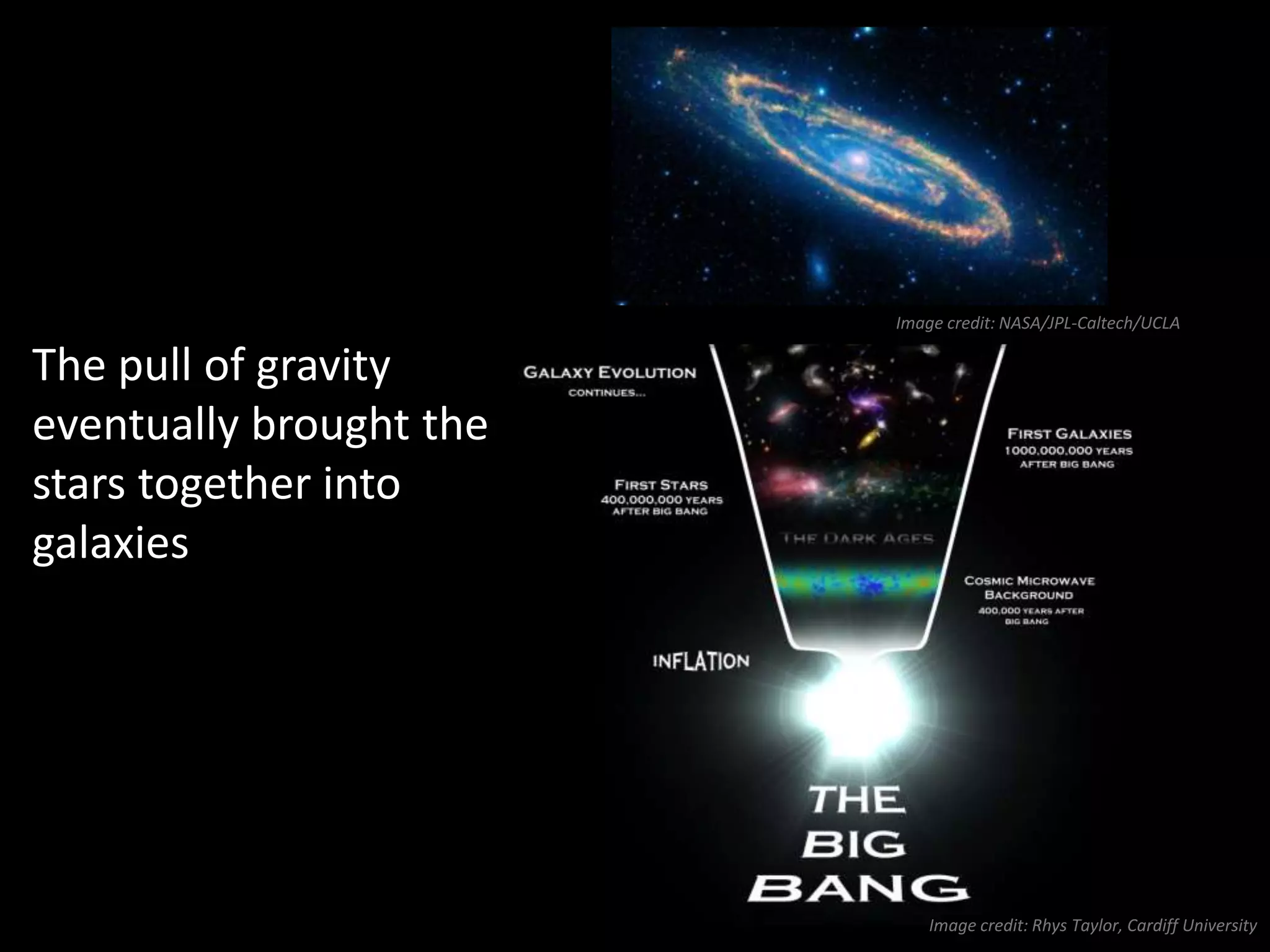
The pull of gravity
eventually brought the
stars together into
galaxies
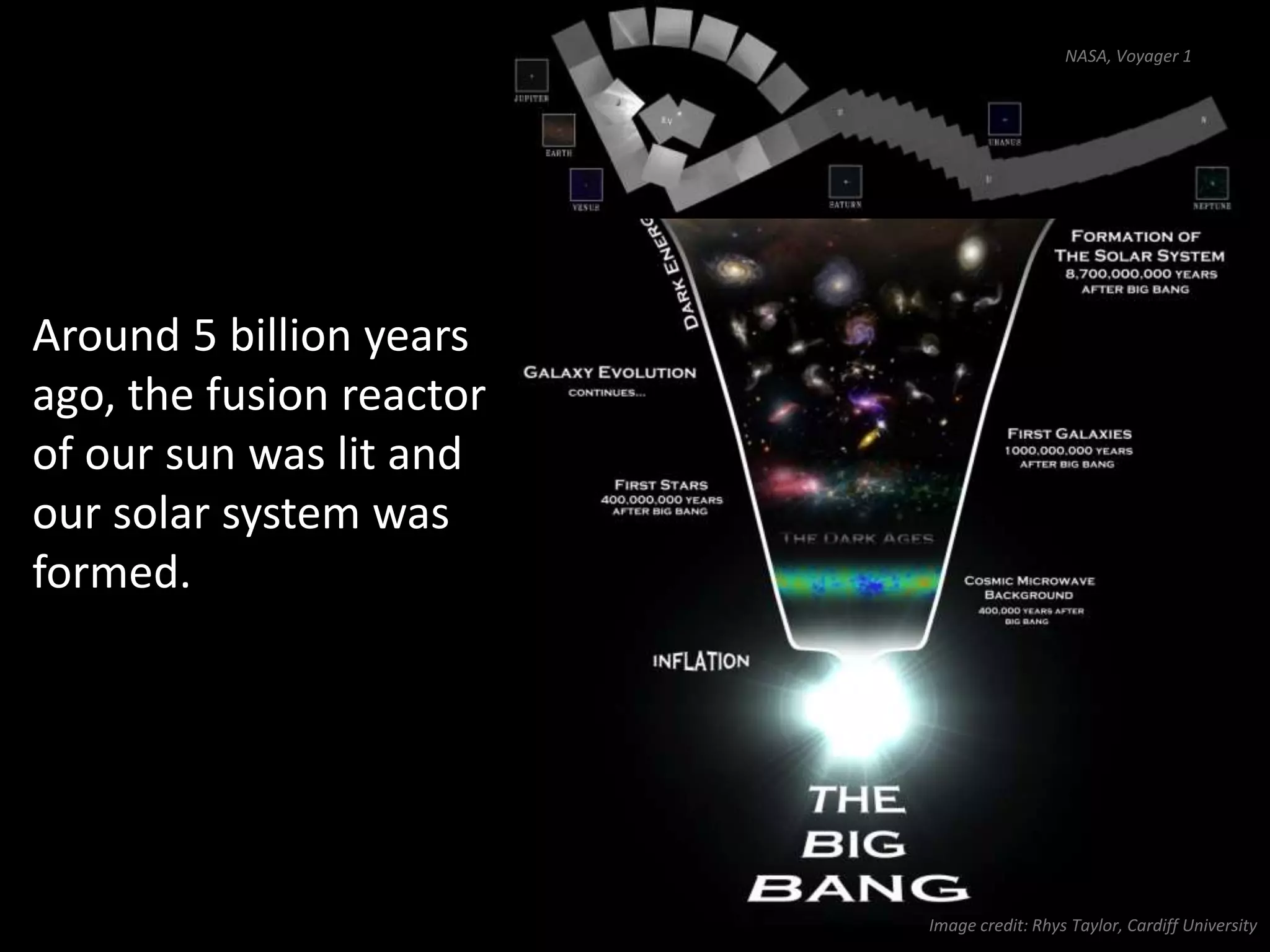
Around 5 billion years
ago, the fusion reactor
of our sun was lit and
our solar system was
formed.
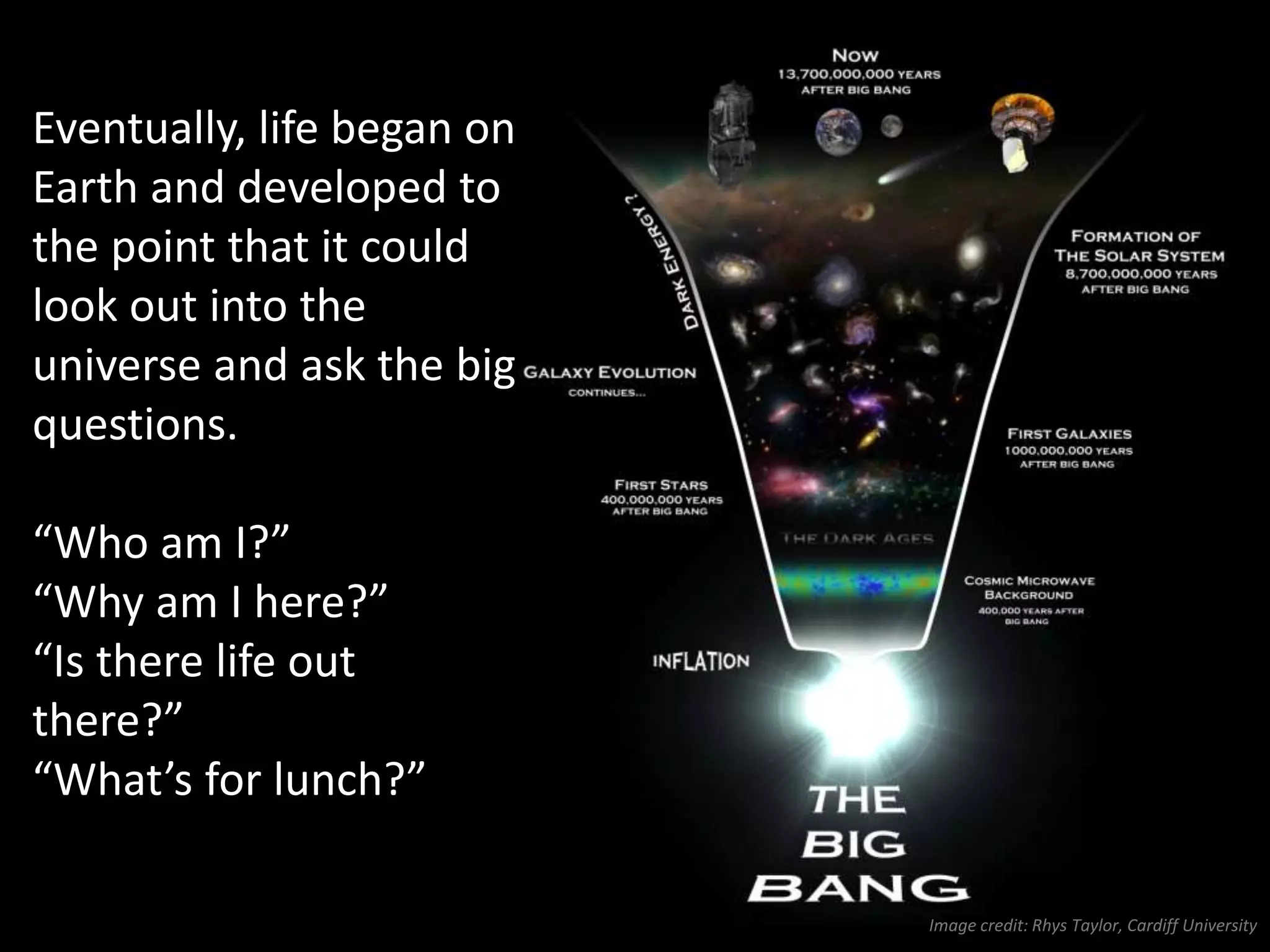
Eventually, life began on
Earth and developed to
the point that it could
look out into the
universe and ask the big
questions.
“Who am I?”
“Why am I here?”
“Is there life out
there?”
“What’s for lunch?”
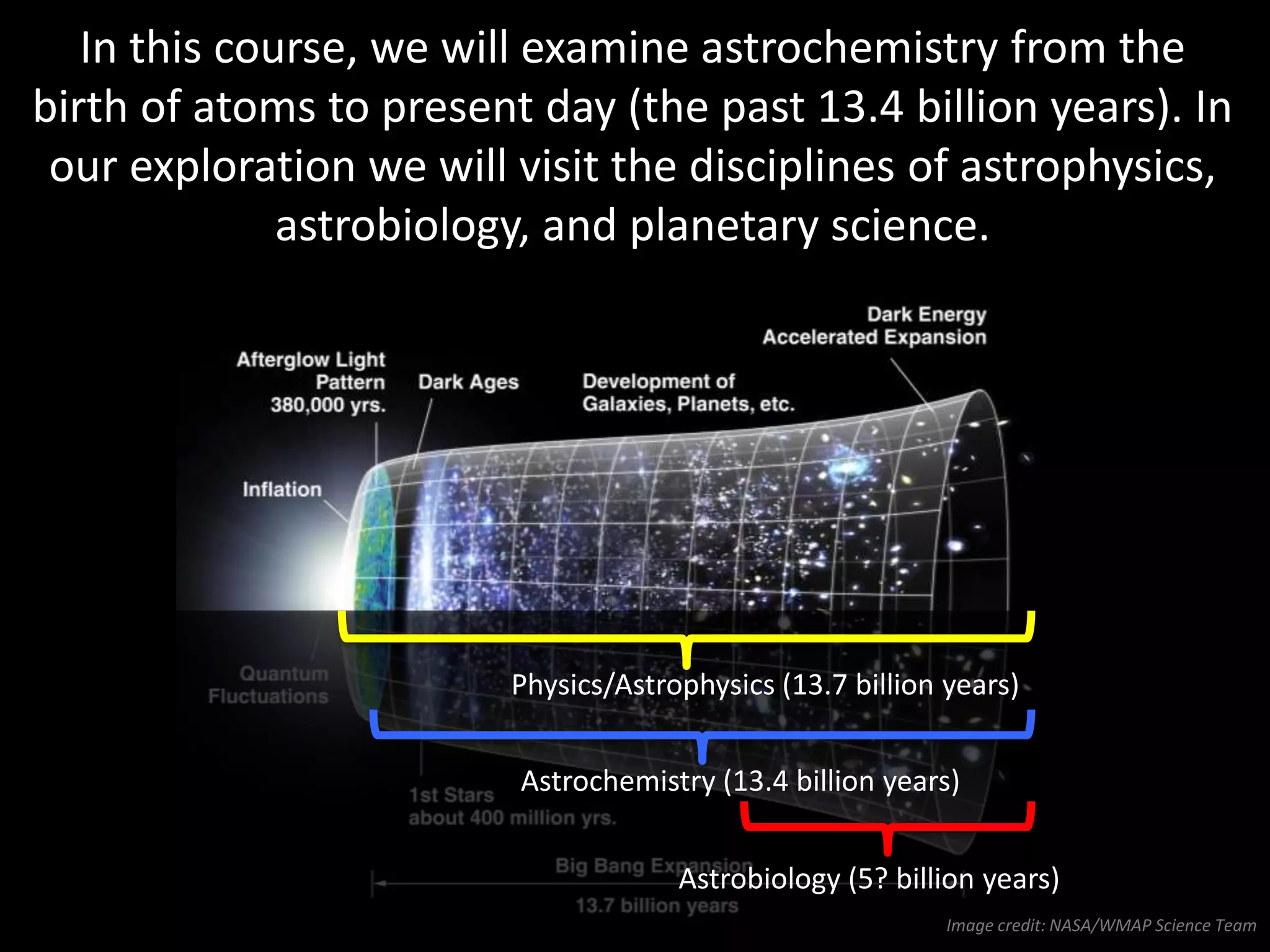
In this course, we will examine astrochemistry from the
birth of atoms to present day (the past 13.4 billion years). In
our exploration we will visit the disciplines of astrophysics,
astrobiology, and planetary science.
Physics/Astrophysics (13.7 billion years)
Astrochemistry (13.4 billion years)
Astrobiology (5? billion years)
Structure of the Course
• Unit 1: Let there be light
– Exploring the infant universe from the first atoms, to
the fusion furnaces of stars.
• Unit 2: Into the Void
– Exploring the chemistry between the stars, super cold,
super slow, but still facinating
• Unit 3: Bigger, Better, Older
– A look at planet formation and detecting planets
around other stars
• Unit 4: The Search for Terra Firma
– Chemistry and astrobiology in our own solar system.
Upcoming course highlights
• In addition to traditional coursework
– you will learn how to setup and do astrochemistry
demonstrations using simple, inexpensive
materials
– Live guest e-lectures from NASA scientists
Thursdays from 3-4 pm on adobe connect.
Hold on tight
This is going to be a whirlwind adventure. I
may or may not change the way you think
about the universe, but this class is
guaranteed to be a unique trip through
space and time.

What is Astrochemistry?

  • 1.
  • 2.
    A FEW ITEMSBEFORE WE BEGIN CHEM/EARTH SCI 4059/5059
  • 3.
    Course Goal • Thegoal of this course is to expose you, the student, to the interdisciplinary field that is Astrochemistry. • You can expect to see topics that include, but are not limited to – Astronomy – Biology – Chemistry – Earth and Planetary Science – Physics
  • 4.
    Disclaimer • While thiscourse is not a math course, many of the topics included are best described using mathematical formulas. – To that end, a few of the lesson will have significant mathematical portions. – I have attempted to keep most of the math to an algebra-based level, but some knowledge of logarithms and exponentials is also required.
  • 5.
    Reference Material • Inorder to keep course costs low, there is no required book for this course. • For those wishing to learn more, I have provided a list of suggested references in a separate document
  • 6.
    Note to Educators •I have attempted to create a course that current and future educators can pull information from for their classes. • Where appropriate, this includes details on how to build and carry out various classroom demonstrations. • I am not liable for any complications that may arise when recreating demonstrations, but urge anyone attempting to recreate the demonstrations seen in this course to review the safety materials with each demonstration.
  • 7.
    Note to Educators(cont.) • While this course is my intellectual property, all non-copyrighted material may be downloaded and adapted for individual classroom and non- profit use unless noted otherwise. • Rights for the use of copyrighted material should be obtained from the original creators.
  • 8.
  • 9.
    “Hey. Do youmind if I tell you a story? One you might not have heard. All the elements in your body were forged many many millions of years ago in the heart of a faraway star that exploded and died. That explosion scattered those elements across the desolations of deep space. After so, so many millions of years, these elements came together to form new stars and new planets. And on and on it went. The elements came together and burst apart, forming shoes and ships and sealing wax and cabbages and kings. Until, eventually, they came together to make you. You are unique in the universe.” -Doctor Who
  • 10.
    LET’S START WITHSOME DEFINITIONS
  • 11.
    Physics The science of matterand energy and of interactions between the two *This is a Venn Diagram
  • 12.
    Physics Cosmology The science of theorigin and development of the universe
  • 13.
  • 14.
    Physics Chemistry The science ofthe composition, structure, properties, and reactions of matter. Cosmology Astronomy Chemistry
  • 15.
    Physics Biology The science of lifeand of living organisms Cosmology Astronomy Biology
  • 16.
    Physics Biochemistry study of chemical processes within and relatingto, living organisms Cosmology Astronomy Biology
  • 17.
    Physics Astrophysics concerned with the physical nature of starsand other celestial bodies Cosmology Astronomy Biology Astrophysics
  • 18.
    Physics Astrochemistry the study ofthe abundance and reactions of chemical elements and molecules in the universe Cosmology Astronomy Biology Astrophysics
  • 19.
    Physics Astrobiology origin, evolution, distribution, and future of lifein the universe Cosmology Astronomy Biology Astrophysics
  • 20.
    Physics origin, reactions and distribution of chemical elementsand molecules important for life “as we know it” and “as we don’t know it” in the universe Cosmology Astronomy Biology Astrobiochemistry Astrophysics
  • 21.
    Clarification • Astrobiology, Astrochemistry,and Astrobiochemistry are often used interchangeably, so be aware of this when going through the material in the course. • All these fields are “applied” versions of Astrophysics
  • 22.
  • 23.
  • 24.
    In the beginningthere was…. Nothing?
  • 25.
  • 26.
    For approximately 380 to400 thousand years, the universe expanded, at some points faster then the speed of light. During this Inflation period, the universe was dominated by subatomic particles.
  • 27.
    By ~400,000 yearsthe universe had sufficiently cooled that the hydrogen and helium nuclei could trap and hold on to electrons, creating the first atoms. At this time light decouples from matter making the universe transparent. The afterglow of this event is observed today as the Cosmic Microwave Background and marks the beginning of astrochemistry
  • 28.
    For hundreds of millionsof years, the universe was dark as hydrogen and the other elements were pulled together by gravity. When sufficient mass had accumulated, the first stars shown with the ignition of stellar fusion.
  • 29.
    Many of theseearly stars exploded as super nova, spreading the heavier elements throughout the universe as interstellar dust clouds and nebula that eventually formed new stars and eventually planets.
  • 30.
    The pull ofgravity eventually brought the stars together into galaxies
  • 31.
    Around 5 billionyears ago, the fusion reactor of our sun was lit and our solar system was formed.
  • 32.
    Eventually, life beganon Earth and developed to the point that it could look out into the universe and ask the big questions. “Who am I?” “Why am I here?” “Is there life out there?” “What’s for lunch?”
  • 33.
    In this course,we will examine astrochemistry from the birth of atoms to present day (the past 13.4 billion years). In our exploration we will visit the disciplines of astrophysics, astrobiology, and planetary science. Physics/Astrophysics (13.7 billion years) Astrochemistry (13.4 billion years) Astrobiology (5? billion years)
  • 34.
    Structure of theCourse • Unit 1: Let there be light – Exploring the infant universe from the first atoms, to the fusion furnaces of stars. • Unit 2: Into the Void – Exploring the chemistry between the stars, super cold, super slow, but still facinating • Unit 3: Bigger, Better, Older – A look at planet formation and detecting planets around other stars • Unit 4: The Search for Terra Firma – Chemistry and astrobiology in our own solar system.
  • 35.
    Upcoming course highlights •In addition to traditional coursework – you will learn how to setup and do astrochemistry demonstrations using simple, inexpensive materials – Live guest e-lectures from NASA scientists Thursdays from 3-4 pm on adobe connect.
  • 36.
    Hold on tight Thisis going to be a whirlwind adventure. I may or may not change the way you think about the universe, but this class is guaranteed to be a unique trip through space and time.