Artificial
Intelligence
Introduction
2
 What is AI?
 Introduction to AI Levels?
 Types of Artificial Intelligence
 AI VS machine learning vs deep
learning
 Where is AI used?
 AI use cases
 Why is AI booming now?
 AI trend in 2020
01
Artificial Intelligence
Transforming the Nature of Work, Learning, and Learning to Work
Artificial intelligence (AI) is a popular branch of computer science that concerns with building “intelligent” smart machines
capable
of performing intelligent tasks.
With rapid advancements in deep learning and machine learning, the tech industry is transforming radically.
Artificial Intelligence
Machine
Learning
.
Deep Learning
3
Introduction to AI Levels?
Types of
Artificial
Intelligence
Artificial Narrow
Intelligence
4
Artificial Super
Intelligence
Artificial General
Intelligence
Artificial Intelligence
2020
2019
2018
65%
.
35%
.
2020 2019 2018
AI
AI
2016 2017 2018 2019 2020
Artificial intelligence (AI)
is a popular branch of computer
science that concerns with
building “intelligent” smart
machines capable of performing
intelligent tasks.
6
With rapid advancements in deep
learning and machine learning,
tech industry is transforming
radically.
Machine Learning
Machine learning is a type of AI that
enables machines to learn from data and
deliver predictive models.
The machine learning is not dependent
on any explicit programming but the
data fed into it. It is a complicated
process.
Based on the data you feed into
machine learning algorithm and the
training given to it, an output is
delivered.
A predictive algorithm will
create a predictive model.
This slide is 100%
editable. Adapt it to
your needs and
capture your
audience's attention.
7
This slide is 100% editable. Adapt it to your needs and capture your audience's
attention.
Deep Learning
Deep Learning is a subfield of
machine learning that is concerned
with algorithms inspired by the
brain's structure
&
functions known as artificial
neural networks
A computer model can be taught
using Deep Learning to run
classification actions using pictures,
texts or sounds as input
8
Where is AI
used?
Real-time
Operations
Management
Customer
Services
Risk
Management &
Analytics
Customer
Insight
Pricing &
Promotion
Predictive
Analytics
Customer
Experience
Supply
Chain
Knowledge
Creation
Research &
Development
Fraud
Detection
Human
Resources
9
This slide is 100% editable. Adapt it to your needs and capture your audience's
attention.
AI Usecase in HealthCare
AI and
Robotics
Training
Research
10
This slide is 100% editable. Adapt it to your needs and capture your audience's
attention.
Early Detection
Keeping Well
End of Life Care
Treatment Decision Making
Diagnosis
AI Use Cases in Human Resource
Recruiting
Dynamic Career
Sites
Smart Sourcing
Onboarding
Automated
Messages
Curated Videos
Learning
Curated
Training
Skill
Development
Engagement
HR Chatbot
Engagement
Surveys
11
This slide is 100% editable. Adapt it to your needs and capture your audience's
attention.
AI in Banking for Fraud Detection
Cardholder
Profiles
Postings
Payment System
Nonmonetary System
Analyst
Workstation
Payment and
Non-Monetary Transactions
8
Authorization System
Rules Definition
Configuration
Workstation
Case
Management
Database
Case Creation Module
Neural
Network Engine
Scoring Engine
Expert Authorization
Response Module
Expert Rules Base
6
Case Creation Rules
Execute
1 Auth
Request
Expert Rules Execute
3
4 Auth
Recommendation
22 Auth Request &
Score
5 Transaction & Score
7 Case Information
12
This slide is 100% editable. Adapt it to your needs and capture your audience's
attention.
AI in Supply Chain
16
Structured & Unstructured
Information
Regulator
y Data
B2B
Transactio
n Data
Inventor
y Data
Multimedi
a Data
Sensor
Data
Logistics
Data
Trading
Partner
Data
Social
Medi
a
Data
Digital Ecosystem Data Lake
Pervasive
Visibility
Proactive
Replenishment
Predictive
Maintenance
Secure Device
Maintenance
Ecosystem
Integration
Unified
Messaging
Actionable
Insights
IIOT – Securely Provisionally People, System and
Things
Secure Access Via Identity Management for Transient
Users
Procurement Manufacturing Customers Service
Logistics
Ai Chatbots in Healthcare
Search Engine
Users learn to
search for
information
Social Platforms
Like Facebook
connect users
online
14
Smartphones
Bring the
internet
online
Healthbots
Bring all of the above
together
for
healthcare use
cases
Artificial Intelligence
Self Learning machines
becomes smarter
the more they are
used
Messenger Apps
Lets users chat
anywhere, anytime
App Eco-system
Lets users download
and use apps easily
Why is AI booming
now?
8,097 7,540 7,336
4,680
4,201
3,714 3,655 3,564 3,169
2,000
0
4,000
6,000
8,000
Static Image Recognition,
Classification and
Tagging
Algorithm Trading
Strategy Performance
Management
Efficient, Scalable
Processing of Patient Data
Predictive Maintenance Object Identification, Text
Query of Images detection, classification,
tracking
Automated Geophysical Content Distribution on
Feature Detection Social Media
Object detection &
classification, avoidance,
navigation
24%
22%
27%
37%
36%
51%
60%
60%
66%
71%
0 20 40 60 80 100
HR/Workforce Management
Operational
Environment Monitoring Through External
Devices/Systems
Logistics & Supply
Chain Production
Floor Systems
Expediting Transactions
Fleet Mobile
External Communication
Customer Relation/Interaction (i.e.,
chatbots)
Security/Fraud
Global AI Revenue Forecast by 2025, Ranked by Use Case in millions US Dollar
Penetration of Artificial Intelligence Skills, by Country Organizations deploying AI, by Functional Areas
Unite
d
States
100% 92%
China
84%
Indi
a
54%
Israe
l
45%
German
y
15
10 AI Trend in 2020
Robotic Process
Automation
AI will make Healthcare more
Accurate
Data Modeling will move to the
Edge
AI will Come for
B2B
Ai-powered
Chatbots
AI In
Retail
Aerospace and Flight
Operations
Controlled by AI
AI Mediated Media and
Entertainment
Advanced
Cybersecurity
Automated Business
Process
“2020
AI Trends”
16
Machine
Learning
02
 What is Machine Learning?
 7 Steps of Machine learning
 Machine Learning vs. Traditional
Programming
 How does machine learning work?
 Machine learning Algorithms
 Machine learning use cases
 How to choose Machine Learning Algorithm
 Why to use decision tree algorithm learning
 Challenges and Limitations of Machine
learning
 Application of Machine learning
 Why is machine learning important?
20
Machine Learning
Traditional
Programming
Data
(Input
)
Program
Output
Data
(Input
)
Output
Machine
Learning
Program
Machine Learning is the result of General AI that involves developing machines
that can deliver results better than humans
Input Data:
Feed
Learner
Various
Data
Output Data:
Present Rules
“Learning”
Machine
Learning
System
18
7 Steps of Machine Learning
01
02
03
04
05
06
07
Choosing a Model
19
Training
Preparing that Data
Evaluation
Prediction
Gathering Data
Hyperparameter Tuning
Machine Learning vs. Traditional Programming
Prediction
Result
Compute
r
Dat
a
Handcrafte
d Model
Learning
Mode
l
Prediction
Result
New
Data
Mode
l
Sample
Data
Expected
Result
Compute
r
Compute
r
Traditional Modelling
Machine Learning
20
How does Machine Learning Work?
Collect Data
Collect data from hospitals,
health insurance
companies, social service
agencies, police and fire
dept.
Define Objectives
Identify, the problem
to be solved and
create a clear
objective.
21
Prepare Data
Preparing data is a
crucial step and involves
building workflows to
clean, match and blend
the data.
Select Algorithm
Depend on the problem to
be solved and the type of
data an appropriate
algorithm will be chosen.
Train Model
Data is fed as input and the
algorithm configured with
the required parameters. A
percent of the data can be
utilized to train the model.
Integrate Model
Publish the prepared
experiment as a web
service, so applications
can use the model.
Test Model
The remaining data is utilized to
test the model, for accuracy.
Depending on the results,
improvements, can be
performed in the “Train model’
and/or “Select Algorithm”
phases, iteratively.
Machine Learning Algorithms
 KNN
 Trees
 Logistic
Regression
 Naïve-Bayes
 SVM
Reinforcement
Categorical
Machine Learning
 Apriori
 FP-Growth
Associatio
n
Anlaysis
Hidden
Markov
Model
 SVD
 PCA
 K-means
Clusterin
g
Unsupervised
Regression
 Linear
 Polynomial
Decision Tree
Classificatio
n
Supervised
Random
Forest
Continuous
22
Machine Learning Use Cases
Energy Feedstock
& Utilities
 Power Usage Analytics
 Seismic Data Processing
 Your Text Here
 Smart Grid Management
 Energy Demand &
Supply
Optimization
Financial
Services
 Risk Analytics & Regulation
 Customer Segmentation
 Your Text Here
 Credit Worthiness
Evaluation
Travel
& Hospitality
 Aircraft Scheduling
 Dynamic Pricing
 Your Text Here
 Traffic Patterns &
Congestion
Management
Manufacturing
 Predictive
Maintenance
or Condition Monitoring
 Your Text Here
 Demand Forecasting
 Process Optimization
 Telematics
Retail
 Predictive
Inventory
Planning
 Recommendatio
n Engines
 Your Text Here
 Customer ROI &
Lifetime
Value
Healthcare &
Life Sciences
23
 Alerts & Diagnostics
from Real-time Patient
Data
 Your Text Here
 Predictive
Health
Management
 Healthcare
Provider
Sentiment Analysis
How to Choose Machine Learning Algorithm
What do you want to
do with your Data?
Algorithm Cheat Sheet
Additional Requirements Accuracy Linearity Number of
Parameters
Training Time Number of
Features
How to Select Machine Learning
Algorithms
24
Why use Decision Tree Machine Learning
Algorithm?
To Classify
Non-linear
Relationship between
Predictors &
Response
Linear
Relationship
between
Predictors &
Response
Use c4.5
Implementatio
n
Use Standard
Regression Tree
Responsible
Variable has only 2
Categories
Use Standard
Classification
here
Use c4.5
Implementatio
n
To Predict
Responsible
variable is
Continuous
Decision Trees
25
Response Variable
has Multiple
Categories
Challenges and Limitations of Machine learning
Advantages
Easily Identifies Trends and
Patterns
No Human Intervention
needed
Handling multi-
dimensional & multi-
variety Data
Continuous
Improvement
Wide
Applications
Data
Acquisitio
n
Time and
Resource
s
High
error-
Susceptibilit
y
Interpretatio
n
Results
Disadvantages
26
Application of Machine Learning
Automatic Language
Translation
Medical Diagnosis
Stock Market Trading
Online Fraud Detection
Virtual Personal Assistant
Email Spam and Malware Filtering
Self Driving Cars
Product Recommendations
Traffic Prediction
Speech Recognition
Image Recognition
27
Why is Machine Learning Important?
Phase 1 :
Learning
Training Data
Phase 2:
Prediction
 Precision/
recall
 Over fitting
 Test/cross
Validation data,
etc.
Error
Analysis
 Normalization
 Dimension Reduction
 Image Processing,
etc.
Pre-Processing
 Supervised
 Unsupervised
 Minimization,
etc.
Learning
Predicted Data
28
Prediction
New Data
Model
Deep Learning
03
 What is Deep Learning?
 Deep learning Process
 Classification of Neural Networks
 Types of Deep Learning Networks
 Feed-forward neural networks
 Recurrent neural networks (RNNs)
 Convolutional neural networks (CNN)
 Reinforcement Learning
 Examples of deep learning
applications
 Why is Deep Learning Important?
 Limitations of deep learning
32
What is Deep Learning?
Deep Learning is a subfield of machine learning that is concerned with algorithms inspired by the
brain's structure and functions known as artificial neural networks.
A computer model can be taught using Deep Learning to run classification actions using
pictures, texts or sounds as input.
Car
Not Car
Output
Input
Feature Extraction
+ Classification
What is Deep
Learning?
31
Deep Learning Process
Understand
the Problem
This slide is 100%
editable. Adapt it to
your needs and
capture your
audience's attention.
32
Identify
Data
This slide is 100%
editable. Adapt it to
your needs and
capture your
audience's attention.
Select Deep Learning
Algorithms
This slide is 100%
editable. Adapt it to
your needs and
capture your
audience's attention.
Training
the Model
This slide is 100%
editable. Adapt it to
your needs and
capture your
audience's attention.
Test the
Model
This slide is 100%
editable. Adapt it to
your needs and
capture your
audience's attention.
Classification of Neural Networks
Input Layer Hidden Layer Output Layer
x1
x2
xn
v11
v12
vpn
w11
w22
wmp
ym
y2
y1
V1n
1
2
p
w1p
1
33
2
m
Types of Deep Learning Networks
Artificial Neural Networks Used for Regression & Classification
Convolutional Neural Networks Used for Computer Vision
Supervised
Recurrent Neutral Networks Used for Time Series Analysis
Self-Organizing Maps Used for Feature Detection
Deep Boltzmann Machines Used for Recommendation Systems
Unsupervised
AutoEncoders Used for Recommendation Systems
Deep Learning
Models
Supervised
 Artificial Neural Networks (ANN)
 Convolutional Neural
Networks (CNN)
 Recurrent Neural Networks
(RNN)
Unsupervised
 Self Organizing Maps (SOM)
 Boltzmann Machines (BM)
 AutoEncoders (AE)
34
Feed-forward Neural Networks
Input Layer Hidden Layer Output Layer
Variable- #1
35
Variable- #2
Variable- #3
Variable- # 4
Output
Recurrent Neural Networks
(RNNs)
x1
x2
Input Layer
36
Recurrent Network
Output Layer
Hidden Layers
Convolutional Neural Networks (CNN)
Take Car = A1
37
Truck = B1 VAN = C1 Bicycle = D1 Rest all be Same
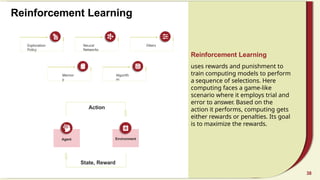
Reinforcement Learning
State, Reward
Action
Agent Environment
Exploration
Policy
Neural
Networks
Filters
Memor
y
Algorith
m
Reinforcement Learning
uses rewards and punishment to
train computing models to perform
a sequence of selections. Here
computing faces a game-like
scenario where it employs trial and
error to answer. Based on the
action it performs, computing gets
either rewards or penalties. Its goal
is to maximize the rewards.
38
Examples of Deep Learning Applications
Image
Recognitio
n
Natural
Language
Processing
Portfolio Management
& Prediction of Stock
Price Movements
Drug Discovery &
Better Diagnostics of
Diseases in Healthcare
Speech
Recognitio
n
Robots and Self
- Driving Cars
39
Why is Deep Learning Important?
Performance
Data
Deep Learning
Other Learning
Algorithms
40
Limitations of Deep Learning
Limitations of
Deep Learning
Amount of
Data
Statistical
Reasoning
41
Interpretability
Difference between
AI vs ML vs DL
04
 What is AI?
 What is ML?
 What is Deep Learning?
 Machine Learning Process
 Deep Learning Process
 Difference between Machine Learning and Deep
Learning
 Which is better to start AI,ML or Deep learning
44
Difference between AI vs ML vs DL
Machine
Learning
Ability to learn
without being
explicitly
programmed
Deep
Learnin
g
Learning based
on
deep neural
network
Artificial
Intelligence
Engineering of
making intelligent
machines and
programs
43
This slide is 100% editable. Adapt it to your needs and capture your audience's
attention.
What is
AI?
Artificial
Intelligence
Artificial
Intelligence
With rapid advancements in deep
learning and machine learning, the
tech industry is transforming
radically.
(AI) is a popular branch of computer
science that concerns with building
“intelligent” smart machines capable
of performing intelligent tasks.
44
This slide is 100% editable. Adapt it to your needs and capture your audience's
attention.
What is
ML?
Learns
Predicts
Improves
Machine
Learning
Ordinary
System
With
AI
Machine Learning
is a type of AI that enables machines to learn from data and deliver predictive models. The machine
learning is not dependent on any explicit programming but the data fed into it. It is a complicated process.
Based on the data you feed into machine learning algorithm and the training given to it, an output is
delivered. A predictive algorithm will create a predictive model.
Introduction to Machine learning
45
What is Deep Learning?
Artificial intelligence (AI) is a
popular branch of computer
science that concerns with
building “intelligent” smart
machines capable of performing
intelligent tasks.
With rapid advancements in
deep learning and machine
learning, the tech industry is
transforming radically.
46
This slide is 100% editable. Adapt it to your needs and capture your audience's
attention.
Machine Learning
Process
Data
Raw &
Training Data
Modelling
Candidate
& Final
Visualisation
Predictions
& Strategy
Data
Gathering
Data
Cleaning
Selecting
Right Algorithms
Building
Model & Finalising
Data Transformation
into Predictions
47
This slide is 100% editable. Adapt it to your needs and capture your audience's
attention.
Deep Learning Process
Test the
Model
48
Understand
the Problem
Identify Data
Select Deep Learning
Algorithm
Training the
Model
Difference between Machine Learning and Deep Learning
Inpu
t
Feature
Extractio
n
Classifica
-tion
Outpu
t
Car
Not Car
Inpu
t
Feature Extraction
+ Classification
Outpu
t
Car
Not Car
49
This slide is 100% editable. Adapt it to your needs and capture your audience's
attention.
Which is better to start AI,ML or DL?
Artificial Intelligence
Any Technique which enables computers to
mimic human behavior.
50
This slide is 100% editable. Adapt it to your needs and capture your audience's
attention.
Machine Learning
Subset of AI Techniques which use Statistical Methods
to Enable Machines to Improve with Experiences.
Deep Learning
Subset of ML which make the Computation of Multi-
layer Neural Networks Feasible.
01
02
03
Supervised
Machine
Learning
05
 Types of Machine Learning
 What is Supervised Machine Learning?
 How Supervised Learning Works
 Types of Supervised Machine Learning Algorithms
 Supervised vs. Unsupervised Machine learning
techniques
 Advantages of Supervised Learning:
 Disadvantages of Supervised Learning
53
Types of Machine Learning
Inputs
Training
Inputs
Makes Machine
Learn Explicitly
Data with Clearly
defined Output is given
Direct feedback is
given
Predicts
outcome/future
Resolves Classification
and Regression Problems
Supervised Learning Unsupervised Learning
Machine Understands the
data (Identifies Patterns/
Structures)
Evaluation is Qualitative
or Indirect
Does not
Predict/Find
anything Specific
Reinforcement Learning
An approach to
AI
Reward Based
Learning
Learning form +ve &
+ve Reinforcement
Machine Learns how to act
in a Certain Environment
To Maximize
Rewards
Inputs
Rewards
Outputs
52
This slide is 100% editable. Adapt it to your needs and capture your audience's
attention.
Outputs Outputs
What is Supervised Machine Learning?
Input Raw Data Output
Processing
Algorithm
Training
Data set
Desired
Output
Supervisor
Supervised Learning
53
This slide is 100% editable. Adapt it to your needs and capture your audience's
attention.
How Supervised Machine Learning works
Classification
Sorting Items into Categories
Regression
Identifying Real Values
(Dollars, Weight, etc.)
Label
“Group 1”
Machine
Step1
Provide the Machine Learning Algorithm
Categorized or “labeled” Input and Output
Data from to Learn
Group 1
Group 2
Mach
ine
Step2
Feed the Machine New, Unlabeled Information to
See if it Tags New Data Appropriately. If not,
Continue Refining the Algorithm
Types of Problems to which it’s Suited
54
This slide is 100% editable. Adapt it to your needs and capture your audience's
attention.
Types of Supervised Machine Learning Algorithms
Classification
 Fraud Detection
 Email Spam
Detection
 Diagnostics
 Image Classification.
Regression
 Risk
Assessment
 Score Prediction
Supervised
Learning
55
This slide is 100% editable. Adapt it to your needs and capture your audience's
attention.
Supervised vs. Unsupervised Machine Learning Techniques
V
S
Supervised Learning
Input & Output Data
 Classification
 Regression
Predictions &
Predictive Models
Unsupervised Learning
Input Data
 Clustering
 Association
Patterns / Structure
Discovery
56
This slide is 100% editable. Adapt it to your needs and capture your audience's
attention.
It allows you to be very specific about the definition of the labels. In other words, you'll
train the algorithm to differentiate different classes where you'll set a perfect decision
boundary.
You are ready to determine the amount of classes you would like to
possess.
57
This slide is 100% editable. Adapt it to your needs and capture your audience's
attention.
The input file is extremely documented and is
labeled.
The results produced by the supervised method are more accurate and reliable as compared
to the results produced by the unsupervised techniques of machine learning. this is often
mainly because the input file within the supervised algorithm is documented and labeled. this
is often a key difference between supervised and unsupervised learning.
The answers within the analysis and therefore the output of your algorithm are
likely to be known thanks to that each one the classes used are known.
Advantages of Supervised Learning
Advantages
Disadvantages of Supervised Learning
Supervised learning are often a posh method as compared with the
unsupervised method. The key reason is that you simply need to understand
alright and label the inputs in supervised learning.
58
This slide is 100% editable. Adapt it to your needs and capture your audience's
attention.
It doesn’t happen in real time while the unsupervised learning is about the
important time. this is often also a serious difference between supervised and
unsupervised learning. Supervised machine learning uses of-line analysis.
It is needed tons of computation time for
training.
If you've got a dynamic big and growing data, you're unsure of the labels to
predefine the principles. this will be a true challenge.
Unsupervised
Machine
Learning
06
 What is Unsupervised Learning?
 How Unsupervised Machine Learning
works
 Types of Unsupervised Learning
 Disadvantages of Unsupervised Learning
61
What is Unsupervised Learning?
Input Raw Data Output
Algorithm
Interpretation Processing
 Unknown output
 No Training Data
Set
Unsupervised Learning
60
This slide is 100% editable. Adapt it to your needs and capture your audience's
attention.
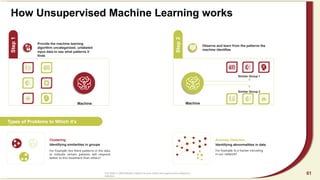
How Unsupervised Machine Learning works
Machine
Step
1
Provide the machine learning
algorithm uncategorized, unlabeled
input data to see what patterns it
finds
Similar Group 1
Similar Group 2
Machine
Step
2
Observe and learn from the patterns the
machine identifies
Types of Problems to Which it’s
Suited
Clustering
Identifying similarities in groups
For Example: Are there patterns in the data
to indicate certain patients will respond
better to this treatment than others?
Anomaly Detection
Identifying abnormalities in data
For Example: Is a hacker intruding
in our network?
61
This slide is 100% editable. Adapt it to your needs and capture your audience's
attention.
Types of Unsupervised Learning
Dimensionality
Reduction
 Text Mining
 Face Recognition
 Big Data
Visualization
 Image Recognition
Clustering
 Biology
 City Planning
 Targeted
Marketing
Unsupervised
Learning
62
This slide is 100% editable. Adapt it to your needs and capture your audience's
attention.
Disadvantages of Unsupervised Learning
You cannot get very specific about the definition of the info sorting and therefore the output.
This is often because the info utilized in unsupervised learning is labeled and not known. It's
employment of the machine to label and group the data before determining the hidden
patterns.
63
This slide is 100% editable. Adapt it to your needs and capture your audience's
attention.
Less accuracy of the results. This is often also because the input file isn't known and not
labeled by people beforehand , which suggests that the machine will got to do that alone.
The results of the analysis can't be ascertained. there's no prior knowledge within the
unsupervised method of machine learning. Additionally, the numbers of classes also are not
known. It results in the lack to determine the results generated by the analysis.
Reinforcement learning
07
 What is Unsupervised Learning?
 How Unsupervised Machine Learning
works
 Types of Unsupervised Learning
 Disadvantages of Unsupervised Learning
66
What is Reinforcement
Learning?
Reinforced
Response
Input
Input
Response
It’s a
mang
o
Feedback
Wrong!
It’s an
apple
Learns
Note
d
It’s an
Apple
65
This slide is 100% editable. Adapt it to your needs and capture your audience's
attention.
How Reinforcement Learning
Works?
Input Raw Data
Rewar
d
State
Selection
of
Algorith
m
Best
Action
Environment
Agent
Output
Reinforcement Learning
66
This slide is 100% editable. Adapt it to your needs and capture your audience's
attention.
Types of Reinforcement Learning
Gaming
Finance Sector
67
This slide is 100% editable. Adapt it to your needs and capture your audience's
attention.
Inventory Management
Robot Navigation
Manufacturing
Disadvantage of Reinforcement Learning
You cannot get very specific about the definition of the info sorting and therefore the output. this is often because the
info utilized in unsupervised learning is labeled and not known. it's employment of the machine to label and group the
data before determining the hidden patterns.
Less accuracy of the results. this is often also because the input file isn't known and not labeled by people
beforehand , which suggests that the machine will got to do that alone.
The results of the analysis can't be ascertained. There's no prior knowledge within the unsupervised method of machine
learning. Additionally, the numbers of classes also are not known. It results in the lack to determine the results generated
by the analysis Reinforcement learning as a framework is wrong in many various ways, but it's precisely this quality that
creates it useful.
Too much reinforcement learning can cause an overload of states which may diminish the
results.
Reinforcement learning isn't preferable to use for solving simple
problems
Reinforcement learning needs tons of knowledge and tons of computation. it's data-hungry. that's why it works
rather well in video games because one can play the sport again and again and again, so getting many data seems
feasible.
68
This slide is 100% editable. Adapt it to your needs and capture your audience's
attention.
Back Propagation
Neural Network in
AI
08
 Back Propagation Neural Network in
AI
 What is Artificial Neural Networks?
 What is Backpropagation?
 Why We Need Backpropagation?
 What is a Feed Forward Network?
 Types of Backpropagation Networks
 Best practice Backpropagation
71
Back Propagation Neural Network in AI
1 2
i1
i2 h
2
w1
b1 b2
net
out
70
This slide is 100% editable. Adapt it to your needs and capture your audience's
attention.
What is Artificial Neural Networks?
Feed-Forward
Network Output
Input Layer
Network Inputs
Hidden Layer
Back Propagation
Output Layer
71
This slide is 100% editable. Adapt it to your needs and capture your audience's
attention.
What is Backpropagation Neural Networking?
x
x
x
w
w
w
w
Difference in
Desired Values
1
Input Layer
Hidden
Layer(s)
1
3
Output Layer
5
Backprop Output
Layer
72
This slide is 100% editable. Adapt it to your needs and capture your audience's
attention.
Why We Need Backpropagation?
75
Most
prominent
advantages
of
Backpropagation
Are: Backpropagation is fast, simple
and straightforward to program.
It has no parameters to tune aside from
the numbers of input.
It is a typical method that generally works
well.
It doesn't need any special mention of the features
of the function to be learned.
It is a versatile method because it doesn't
require prior knowledge about the network.
What is a Feed Forward Network?
Input Layer
Hidden Layer
Output Layer
74
This slide is 100% editable. Adapt it to your needs and capture your audience's
attention.
Types of Backpropagation Networks
Static Back-propagation
Recurrent Backpropagation
75
This slide is 100% editable. Adapt it to your needs and capture your audience's
attention.
Static Back-propagation
It is one quite backpropagation network
which produces a mapping of a static input
for static output. it's useful to unravel static
classification issues like optical character
recognition.
Recurrent Backpropagation
Recurrent backpropagation is fed forward
until a hard and fast value is achieved. Then,
the error is computed and propagated
backward.
The main difference between both of those methods is: that the
mapping is rapid in static back-propagation while it's nonstatic
in recurrent backpropagation
Best Practice Backpropagation
A neural network is a group of connected it I/O units where
each connection features a weight related to its computer
programs.
76
Backpropagation is fast, simple
and straightforward to program.
A feedforward neural network is a
man- made neural network.
Backpropagation may be a short form for
"backward propagation of errors." it's a typical
method of coaching artificial neural networks.
Expert System in
Artificial Intelligence
09
 What is an Expert System?
 Examples of Expert Systems
 Characteristic of Expert System
 Components of the expert system
 Conventional System vs. Expert
system
 Human expert vs. expert system
 Benefits of expert systems
 Limitations of the expert system
 Applications of expert systems
79
Types of Deep Learning Networks
The Expert System in AI are computer applications. Also,
with the assistance of this development, we will solve
complex problems. it's level of human intelligence and
expertise
Knowledge
Base
Inference
Engine
User
Interface
User
(May not be an
expert)
Human Expert
Knowledge
Engineer
78
Examples of Expert
Systems
The Highest Level of Expertise
The expert system offers the very best level of experience. It
provides efficiency, accuracy and imaginative problem-solving.
Right on Time Reaction
An Expert System interacts during a very reasonable period of your time
with the user. the entire time must be but the time taken by an expert to
urge the foremost accurate solution for an equivalent problem
Good Reliability
The expert system must be reliable, and it must not make any an
error.
Flexible
It is significant that it remains flexible because it the is possessed by an
Expert
system.
Capable of Handling Challenging Decision & Problems
An expert system is capable of handling challenging decision problems
and delivering solutions.
Effective Mechanism
Expert System must have an efficient mechanism to
administer the compilation of the prevailing knowledge in it.
Expert System
Non-
expert
User
Knowledge
from an
expert
User
Interface
Inference
Engine
Knowledge
Base
79
Query
Advice
Characteristic of Expert System
High level Performance
The system must be capable of responding at A
level of competency adequate to or better than an
expert system within the field. the standard of the
recommendation given by the system should be
during a high level integrity and that the
performance ratio should be also very high
Domain Specificity
Expert systems are typically very domain specific.
For ex., a diagnostic expert system for
troubleshooting computers must actually perform
all the required data manipulation as a person's
expert would. The developer of such a system must
limit his or her scope of the system to only what's
needed to unravel the target problem. Special tools
or programming languages are often needed to
accomplish the
precise objectives of the system
Good Reliability
The expert system must be as reliable
as a person's expert
Adequate Response Time
The system should be designed
in such how that it's ready to
perform
within alittle amount of your time , like or better
than the time taken by a person's expert to
succeed in at a choice point. An expert system that
takes a year to succeed in a choice compared to a
person's expert’s time of 1 hour wouldn't be useful
Understandable
The system should be understandable i.e. be ready
to explain the steps of reasoning while executing.
The expert system should have an
evidence capability almost like the reasoning
ability of human experts
Use Symbolic
Representations
Expert systems use symbolic
representations for knowledge (rules,
networks or frames) and perform their
inference through symbolic computations
that closely resemble manipulations of
tongue
80
Components of the Expert System
Explanation
Inference Engine
Knowledge
Base
Acquisition Facility
User
Interface
Experts and
Knowledge
Engineers
Users
81
Conventional System vs. Expert System
vs
Knowledge domain break away
the mechanism processing
01
The program could
have made an error
02
Not necessarily need
all
the input/data
03
Changes within the rule
are often made with ease
04
The system can work only
with the rule as a tittle
05
Information and
processing combined during a
sequential file
01
The program isn't wrong 02
Need all the input file 03
Changes to the program
are
inconvenient
04
The system works if it's complete 05
82
Human Expert vs. Expert System
85
Human Experts (Artificial ) Expert
Systems
Permanen
t
Perishabl
e
Easy to Transfer
Difficult to
Transfer
Easy to
Document
Difficult to
Document
Affordable, costly to develop, but
cheap to operate
Expensive, especially top
notch
Add Your Text Here
Add Your Text Here
Benefits of Expert
Systems
01
Easy to Develop and
Modify the System
02
Fast
Response
03
Low
Accessibility Cost
04
Error Rate are Very
Low
05
Humans Emotions are not
Affected
84
Limitations of the Expert System
Don’t Have Decision Making Power Like
Humans
Expert System is not Widely used or
Tested It cant Deal with the Mixed
Knowledge There are Chances of Errors
Its Difficult to Maintain
Development Cost is
High
Not Able to Explain the Logic Behind the
85
This slide is 100% editable. Adapt it to your needs and capture your audience's
attention.
Applications of Expert
Systems
Medical domain
(Diagnosis
system, medical
operations
Process
Control
System
Finance/Commerce
(Stock market trading,
airline scheduling cargo
scheduling)
Warehousin
g
Optimizatio
n
Knowledge domain
(Finding out the
faults in vehicles,
computer)
Repairin
g
Monitorin
g
system
Design domain
(Camera lens
design,automobile
design)
Shipping
86
Good ideas start with
brainstorming Great ideas
start with coffee.
Coffee Break
87
Bar Chart
02 Product
This graph/chart is linked to excel, and changes
automatically based on data. Just left click on it
and select “Edit Data”.
01 Product
This graph/chart is linked to excel, and changes
automatically based on data. Just left click on it
and select “Edit Data”.
100
90
80
70
60
50
40
30
20
10
0
88
Jan Feb Mar Apr May Jun
Sales
(
in
USD
millions)
Year 2020
100%
Product
01
Product
02
Stacked Line With Markers
02 Product
This graph/chart is linked to excel, and changes
automatically based on data. Just left click on it
and select “Edit Data”.
01 Product
This graph/chart is linked to excel, and changes
automatically based on data. Just left click on it
and select “Edit Data”.
3628.4
89
3573.9
3484.0
3532.1
3740.3
3881.7
3528.4
3873.9
3584.0
3732.1
3640.3
3981.7
3400
3500
3600
3700
3800
3900
4000
4100
2015 2016 2017 2018 2019 2020
In
Millions
YEARS

artificialintelligencedata driven analytics23.pptx

  • 1.
  • 2.
    Introduction 2  What isAI?  Introduction to AI Levels?  Types of Artificial Intelligence  AI VS machine learning vs deep learning  Where is AI used?  AI use cases  Why is AI booming now?  AI trend in 2020 01
  • 3.
    Artificial Intelligence Transforming theNature of Work, Learning, and Learning to Work Artificial intelligence (AI) is a popular branch of computer science that concerns with building “intelligent” smart machines capable of performing intelligent tasks. With rapid advancements in deep learning and machine learning, the tech industry is transforming radically. Artificial Intelligence Machine Learning . Deep Learning 3
  • 4.
    Introduction to AILevels? Types of Artificial Intelligence Artificial Narrow Intelligence 4 Artificial Super Intelligence Artificial General Intelligence
  • 6.
    Artificial Intelligence 2020 2019 2018 65% . 35% . 2020 20192018 AI AI 2016 2017 2018 2019 2020 Artificial intelligence (AI) is a popular branch of computer science that concerns with building “intelligent” smart machines capable of performing intelligent tasks. 6 With rapid advancements in deep learning and machine learning, tech industry is transforming radically.
  • 7.
    Machine Learning Machine learningis a type of AI that enables machines to learn from data and deliver predictive models. The machine learning is not dependent on any explicit programming but the data fed into it. It is a complicated process. Based on the data you feed into machine learning algorithm and the training given to it, an output is delivered. A predictive algorithm will create a predictive model. This slide is 100% editable. Adapt it to your needs and capture your audience's attention. 7 This slide is 100% editable. Adapt it to your needs and capture your audience's attention.
  • 8.
    Deep Learning Deep Learningis a subfield of machine learning that is concerned with algorithms inspired by the brain's structure & functions known as artificial neural networks A computer model can be taught using Deep Learning to run classification actions using pictures, texts or sounds as input 8
  • 9.
    Where is AI used? Real-time Operations Management Customer Services Risk Management& Analytics Customer Insight Pricing & Promotion Predictive Analytics Customer Experience Supply Chain Knowledge Creation Research & Development Fraud Detection Human Resources 9 This slide is 100% editable. Adapt it to your needs and capture your audience's attention.
  • 10.
    AI Usecase inHealthCare AI and Robotics Training Research 10 This slide is 100% editable. Adapt it to your needs and capture your audience's attention. Early Detection Keeping Well End of Life Care Treatment Decision Making Diagnosis
  • 11.
    AI Use Casesin Human Resource Recruiting Dynamic Career Sites Smart Sourcing Onboarding Automated Messages Curated Videos Learning Curated Training Skill Development Engagement HR Chatbot Engagement Surveys 11 This slide is 100% editable. Adapt it to your needs and capture your audience's attention.
  • 12.
    AI in Bankingfor Fraud Detection Cardholder Profiles Postings Payment System Nonmonetary System Analyst Workstation Payment and Non-Monetary Transactions 8 Authorization System Rules Definition Configuration Workstation Case Management Database Case Creation Module Neural Network Engine Scoring Engine Expert Authorization Response Module Expert Rules Base 6 Case Creation Rules Execute 1 Auth Request Expert Rules Execute 3 4 Auth Recommendation 22 Auth Request & Score 5 Transaction & Score 7 Case Information 12 This slide is 100% editable. Adapt it to your needs and capture your audience's attention.
  • 13.
    AI in SupplyChain 16 Structured & Unstructured Information Regulator y Data B2B Transactio n Data Inventor y Data Multimedi a Data Sensor Data Logistics Data Trading Partner Data Social Medi a Data Digital Ecosystem Data Lake Pervasive Visibility Proactive Replenishment Predictive Maintenance Secure Device Maintenance Ecosystem Integration Unified Messaging Actionable Insights IIOT – Securely Provisionally People, System and Things Secure Access Via Identity Management for Transient Users Procurement Manufacturing Customers Service Logistics
  • 14.
    Ai Chatbots inHealthcare Search Engine Users learn to search for information Social Platforms Like Facebook connect users online 14 Smartphones Bring the internet online Healthbots Bring all of the above together for healthcare use cases Artificial Intelligence Self Learning machines becomes smarter the more they are used Messenger Apps Lets users chat anywhere, anytime App Eco-system Lets users download and use apps easily
  • 15.
    Why is AIbooming now? 8,097 7,540 7,336 4,680 4,201 3,714 3,655 3,564 3,169 2,000 0 4,000 6,000 8,000 Static Image Recognition, Classification and Tagging Algorithm Trading Strategy Performance Management Efficient, Scalable Processing of Patient Data Predictive Maintenance Object Identification, Text Query of Images detection, classification, tracking Automated Geophysical Content Distribution on Feature Detection Social Media Object detection & classification, avoidance, navigation 24% 22% 27% 37% 36% 51% 60% 60% 66% 71% 0 20 40 60 80 100 HR/Workforce Management Operational Environment Monitoring Through External Devices/Systems Logistics & Supply Chain Production Floor Systems Expediting Transactions Fleet Mobile External Communication Customer Relation/Interaction (i.e., chatbots) Security/Fraud Global AI Revenue Forecast by 2025, Ranked by Use Case in millions US Dollar Penetration of Artificial Intelligence Skills, by Country Organizations deploying AI, by Functional Areas Unite d States 100% 92% China 84% Indi a 54% Israe l 45% German y 15
  • 16.
    10 AI Trendin 2020 Robotic Process Automation AI will make Healthcare more Accurate Data Modeling will move to the Edge AI will Come for B2B Ai-powered Chatbots AI In Retail Aerospace and Flight Operations Controlled by AI AI Mediated Media and Entertainment Advanced Cybersecurity Automated Business Process “2020 AI Trends” 16
  • 17.
    Machine Learning 02  What isMachine Learning?  7 Steps of Machine learning  Machine Learning vs. Traditional Programming  How does machine learning work?  Machine learning Algorithms  Machine learning use cases  How to choose Machine Learning Algorithm  Why to use decision tree algorithm learning  Challenges and Limitations of Machine learning  Application of Machine learning  Why is machine learning important? 20
  • 18.
    Machine Learning Traditional Programming Data (Input ) Program Output Data (Input ) Output Machine Learning Program Machine Learningis the result of General AI that involves developing machines that can deliver results better than humans Input Data: Feed Learner Various Data Output Data: Present Rules “Learning” Machine Learning System 18
  • 19.
    7 Steps ofMachine Learning 01 02 03 04 05 06 07 Choosing a Model 19 Training Preparing that Data Evaluation Prediction Gathering Data Hyperparameter Tuning
  • 20.
    Machine Learning vs.Traditional Programming Prediction Result Compute r Dat a Handcrafte d Model Learning Mode l Prediction Result New Data Mode l Sample Data Expected Result Compute r Compute r Traditional Modelling Machine Learning 20
  • 21.
    How does MachineLearning Work? Collect Data Collect data from hospitals, health insurance companies, social service agencies, police and fire dept. Define Objectives Identify, the problem to be solved and create a clear objective. 21 Prepare Data Preparing data is a crucial step and involves building workflows to clean, match and blend the data. Select Algorithm Depend on the problem to be solved and the type of data an appropriate algorithm will be chosen. Train Model Data is fed as input and the algorithm configured with the required parameters. A percent of the data can be utilized to train the model. Integrate Model Publish the prepared experiment as a web service, so applications can use the model. Test Model The remaining data is utilized to test the model, for accuracy. Depending on the results, improvements, can be performed in the “Train model’ and/or “Select Algorithm” phases, iteratively.
  • 22.
    Machine Learning Algorithms KNN  Trees  Logistic Regression  Naïve-Bayes  SVM Reinforcement Categorical Machine Learning  Apriori  FP-Growth Associatio n Anlaysis Hidden Markov Model  SVD  PCA  K-means Clusterin g Unsupervised Regression  Linear  Polynomial Decision Tree Classificatio n Supervised Random Forest Continuous 22
  • 23.
    Machine Learning UseCases Energy Feedstock & Utilities  Power Usage Analytics  Seismic Data Processing  Your Text Here  Smart Grid Management  Energy Demand & Supply Optimization Financial Services  Risk Analytics & Regulation  Customer Segmentation  Your Text Here  Credit Worthiness Evaluation Travel & Hospitality  Aircraft Scheduling  Dynamic Pricing  Your Text Here  Traffic Patterns & Congestion Management Manufacturing  Predictive Maintenance or Condition Monitoring  Your Text Here  Demand Forecasting  Process Optimization  Telematics Retail  Predictive Inventory Planning  Recommendatio n Engines  Your Text Here  Customer ROI & Lifetime Value Healthcare & Life Sciences 23  Alerts & Diagnostics from Real-time Patient Data  Your Text Here  Predictive Health Management  Healthcare Provider Sentiment Analysis
  • 24.
    How to ChooseMachine Learning Algorithm What do you want to do with your Data? Algorithm Cheat Sheet Additional Requirements Accuracy Linearity Number of Parameters Training Time Number of Features How to Select Machine Learning Algorithms 24
  • 25.
    Why use DecisionTree Machine Learning Algorithm? To Classify Non-linear Relationship between Predictors & Response Linear Relationship between Predictors & Response Use c4.5 Implementatio n Use Standard Regression Tree Responsible Variable has only 2 Categories Use Standard Classification here Use c4.5 Implementatio n To Predict Responsible variable is Continuous Decision Trees 25 Response Variable has Multiple Categories
  • 26.
    Challenges and Limitationsof Machine learning Advantages Easily Identifies Trends and Patterns No Human Intervention needed Handling multi- dimensional & multi- variety Data Continuous Improvement Wide Applications Data Acquisitio n Time and Resource s High error- Susceptibilit y Interpretatio n Results Disadvantages 26
  • 27.
    Application of MachineLearning Automatic Language Translation Medical Diagnosis Stock Market Trading Online Fraud Detection Virtual Personal Assistant Email Spam and Malware Filtering Self Driving Cars Product Recommendations Traffic Prediction Speech Recognition Image Recognition 27
  • 28.
    Why is MachineLearning Important? Phase 1 : Learning Training Data Phase 2: Prediction  Precision/ recall  Over fitting  Test/cross Validation data, etc. Error Analysis  Normalization  Dimension Reduction  Image Processing, etc. Pre-Processing  Supervised  Unsupervised  Minimization, etc. Learning Predicted Data 28 Prediction New Data Model
  • 30.
    Deep Learning 03  Whatis Deep Learning?  Deep learning Process  Classification of Neural Networks  Types of Deep Learning Networks  Feed-forward neural networks  Recurrent neural networks (RNNs)  Convolutional neural networks (CNN)  Reinforcement Learning  Examples of deep learning applications  Why is Deep Learning Important?  Limitations of deep learning 32
  • 31.
    What is DeepLearning? Deep Learning is a subfield of machine learning that is concerned with algorithms inspired by the brain's structure and functions known as artificial neural networks. A computer model can be taught using Deep Learning to run classification actions using pictures, texts or sounds as input. Car Not Car Output Input Feature Extraction + Classification What is Deep Learning? 31
  • 32.
    Deep Learning Process Understand theProblem This slide is 100% editable. Adapt it to your needs and capture your audience's attention. 32 Identify Data This slide is 100% editable. Adapt it to your needs and capture your audience's attention. Select Deep Learning Algorithms This slide is 100% editable. Adapt it to your needs and capture your audience's attention. Training the Model This slide is 100% editable. Adapt it to your needs and capture your audience's attention. Test the Model This slide is 100% editable. Adapt it to your needs and capture your audience's attention.
  • 33.
    Classification of NeuralNetworks Input Layer Hidden Layer Output Layer x1 x2 xn v11 v12 vpn w11 w22 wmp ym y2 y1 V1n 1 2 p w1p 1 33 2 m
  • 34.
    Types of DeepLearning Networks Artificial Neural Networks Used for Regression & Classification Convolutional Neural Networks Used for Computer Vision Supervised Recurrent Neutral Networks Used for Time Series Analysis Self-Organizing Maps Used for Feature Detection Deep Boltzmann Machines Used for Recommendation Systems Unsupervised AutoEncoders Used for Recommendation Systems Deep Learning Models Supervised  Artificial Neural Networks (ANN)  Convolutional Neural Networks (CNN)  Recurrent Neural Networks (RNN) Unsupervised  Self Organizing Maps (SOM)  Boltzmann Machines (BM)  AutoEncoders (AE) 34
  • 35.
    Feed-forward Neural Networks InputLayer Hidden Layer Output Layer Variable- #1 35 Variable- #2 Variable- #3 Variable- # 4 Output
  • 36.
    Recurrent Neural Networks (RNNs) x1 x2 InputLayer 36 Recurrent Network Output Layer Hidden Layers
  • 37.
    Convolutional Neural Networks(CNN) Take Car = A1 37 Truck = B1 VAN = C1 Bicycle = D1 Rest all be Same
  • 38.
    Reinforcement Learning State, Reward Action AgentEnvironment Exploration Policy Neural Networks Filters Memor y Algorith m Reinforcement Learning uses rewards and punishment to train computing models to perform a sequence of selections. Here computing faces a game-like scenario where it employs trial and error to answer. Based on the action it performs, computing gets either rewards or penalties. Its goal is to maximize the rewards. 38
  • 39.
    Examples of DeepLearning Applications Image Recognitio n Natural Language Processing Portfolio Management & Prediction of Stock Price Movements Drug Discovery & Better Diagnostics of Diseases in Healthcare Speech Recognitio n Robots and Self - Driving Cars 39
  • 40.
    Why is DeepLearning Important? Performance Data Deep Learning Other Learning Algorithms 40
  • 41.
    Limitations of DeepLearning Limitations of Deep Learning Amount of Data Statistical Reasoning 41 Interpretability
  • 42.
    Difference between AI vsML vs DL 04  What is AI?  What is ML?  What is Deep Learning?  Machine Learning Process  Deep Learning Process  Difference between Machine Learning and Deep Learning  Which is better to start AI,ML or Deep learning 44
  • 43.
    Difference between AIvs ML vs DL Machine Learning Ability to learn without being explicitly programmed Deep Learnin g Learning based on deep neural network Artificial Intelligence Engineering of making intelligent machines and programs 43 This slide is 100% editable. Adapt it to your needs and capture your audience's attention.
  • 44.
    What is AI? Artificial Intelligence Artificial Intelligence With rapidadvancements in deep learning and machine learning, the tech industry is transforming radically. (AI) is a popular branch of computer science that concerns with building “intelligent” smart machines capable of performing intelligent tasks. 44 This slide is 100% editable. Adapt it to your needs and capture your audience's attention.
  • 45.
    What is ML? Learns Predicts Improves Machine Learning Ordinary System With AI Machine Learning isa type of AI that enables machines to learn from data and deliver predictive models. The machine learning is not dependent on any explicit programming but the data fed into it. It is a complicated process. Based on the data you feed into machine learning algorithm and the training given to it, an output is delivered. A predictive algorithm will create a predictive model. Introduction to Machine learning 45
  • 46.
    What is DeepLearning? Artificial intelligence (AI) is a popular branch of computer science that concerns with building “intelligent” smart machines capable of performing intelligent tasks. With rapid advancements in deep learning and machine learning, the tech industry is transforming radically. 46 This slide is 100% editable. Adapt it to your needs and capture your audience's attention.
  • 47.
    Machine Learning Process Data Raw & TrainingData Modelling Candidate & Final Visualisation Predictions & Strategy Data Gathering Data Cleaning Selecting Right Algorithms Building Model & Finalising Data Transformation into Predictions 47 This slide is 100% editable. Adapt it to your needs and capture your audience's attention.
  • 48.
    Deep Learning Process Testthe Model 48 Understand the Problem Identify Data Select Deep Learning Algorithm Training the Model
  • 49.
    Difference between MachineLearning and Deep Learning Inpu t Feature Extractio n Classifica -tion Outpu t Car Not Car Inpu t Feature Extraction + Classification Outpu t Car Not Car 49 This slide is 100% editable. Adapt it to your needs and capture your audience's attention.
  • 50.
    Which is betterto start AI,ML or DL? Artificial Intelligence Any Technique which enables computers to mimic human behavior. 50 This slide is 100% editable. Adapt it to your needs and capture your audience's attention. Machine Learning Subset of AI Techniques which use Statistical Methods to Enable Machines to Improve with Experiences. Deep Learning Subset of ML which make the Computation of Multi- layer Neural Networks Feasible. 01 02 03
  • 51.
    Supervised Machine Learning 05  Types ofMachine Learning  What is Supervised Machine Learning?  How Supervised Learning Works  Types of Supervised Machine Learning Algorithms  Supervised vs. Unsupervised Machine learning techniques  Advantages of Supervised Learning:  Disadvantages of Supervised Learning 53
  • 52.
    Types of MachineLearning Inputs Training Inputs Makes Machine Learn Explicitly Data with Clearly defined Output is given Direct feedback is given Predicts outcome/future Resolves Classification and Regression Problems Supervised Learning Unsupervised Learning Machine Understands the data (Identifies Patterns/ Structures) Evaluation is Qualitative or Indirect Does not Predict/Find anything Specific Reinforcement Learning An approach to AI Reward Based Learning Learning form +ve & +ve Reinforcement Machine Learns how to act in a Certain Environment To Maximize Rewards Inputs Rewards Outputs 52 This slide is 100% editable. Adapt it to your needs and capture your audience's attention. Outputs Outputs
  • 53.
    What is SupervisedMachine Learning? Input Raw Data Output Processing Algorithm Training Data set Desired Output Supervisor Supervised Learning 53 This slide is 100% editable. Adapt it to your needs and capture your audience's attention.
  • 54.
    How Supervised MachineLearning works Classification Sorting Items into Categories Regression Identifying Real Values (Dollars, Weight, etc.) Label “Group 1” Machine Step1 Provide the Machine Learning Algorithm Categorized or “labeled” Input and Output Data from to Learn Group 1 Group 2 Mach ine Step2 Feed the Machine New, Unlabeled Information to See if it Tags New Data Appropriately. If not, Continue Refining the Algorithm Types of Problems to which it’s Suited 54 This slide is 100% editable. Adapt it to your needs and capture your audience's attention.
  • 55.
    Types of SupervisedMachine Learning Algorithms Classification  Fraud Detection  Email Spam Detection  Diagnostics  Image Classification. Regression  Risk Assessment  Score Prediction Supervised Learning 55 This slide is 100% editable. Adapt it to your needs and capture your audience's attention.
  • 56.
    Supervised vs. UnsupervisedMachine Learning Techniques V S Supervised Learning Input & Output Data  Classification  Regression Predictions & Predictive Models Unsupervised Learning Input Data  Clustering  Association Patterns / Structure Discovery 56 This slide is 100% editable. Adapt it to your needs and capture your audience's attention.
  • 57.
    It allows youto be very specific about the definition of the labels. In other words, you'll train the algorithm to differentiate different classes where you'll set a perfect decision boundary. You are ready to determine the amount of classes you would like to possess. 57 This slide is 100% editable. Adapt it to your needs and capture your audience's attention. The input file is extremely documented and is labeled. The results produced by the supervised method are more accurate and reliable as compared to the results produced by the unsupervised techniques of machine learning. this is often mainly because the input file within the supervised algorithm is documented and labeled. this is often a key difference between supervised and unsupervised learning. The answers within the analysis and therefore the output of your algorithm are likely to be known thanks to that each one the classes used are known. Advantages of Supervised Learning Advantages
  • 58.
    Disadvantages of SupervisedLearning Supervised learning are often a posh method as compared with the unsupervised method. The key reason is that you simply need to understand alright and label the inputs in supervised learning. 58 This slide is 100% editable. Adapt it to your needs and capture your audience's attention. It doesn’t happen in real time while the unsupervised learning is about the important time. this is often also a serious difference between supervised and unsupervised learning. Supervised machine learning uses of-line analysis. It is needed tons of computation time for training. If you've got a dynamic big and growing data, you're unsure of the labels to predefine the principles. this will be a true challenge.
  • 59.
    Unsupervised Machine Learning 06  What isUnsupervised Learning?  How Unsupervised Machine Learning works  Types of Unsupervised Learning  Disadvantages of Unsupervised Learning 61
  • 60.
    What is UnsupervisedLearning? Input Raw Data Output Algorithm Interpretation Processing  Unknown output  No Training Data Set Unsupervised Learning 60 This slide is 100% editable. Adapt it to your needs and capture your audience's attention.
  • 61.
    How Unsupervised MachineLearning works Machine Step 1 Provide the machine learning algorithm uncategorized, unlabeled input data to see what patterns it finds Similar Group 1 Similar Group 2 Machine Step 2 Observe and learn from the patterns the machine identifies Types of Problems to Which it’s Suited Clustering Identifying similarities in groups For Example: Are there patterns in the data to indicate certain patients will respond better to this treatment than others? Anomaly Detection Identifying abnormalities in data For Example: Is a hacker intruding in our network? 61 This slide is 100% editable. Adapt it to your needs and capture your audience's attention.
  • 62.
    Types of UnsupervisedLearning Dimensionality Reduction  Text Mining  Face Recognition  Big Data Visualization  Image Recognition Clustering  Biology  City Planning  Targeted Marketing Unsupervised Learning 62 This slide is 100% editable. Adapt it to your needs and capture your audience's attention.
  • 63.
    Disadvantages of UnsupervisedLearning You cannot get very specific about the definition of the info sorting and therefore the output. This is often because the info utilized in unsupervised learning is labeled and not known. It's employment of the machine to label and group the data before determining the hidden patterns. 63 This slide is 100% editable. Adapt it to your needs and capture your audience's attention. Less accuracy of the results. This is often also because the input file isn't known and not labeled by people beforehand , which suggests that the machine will got to do that alone. The results of the analysis can't be ascertained. there's no prior knowledge within the unsupervised method of machine learning. Additionally, the numbers of classes also are not known. It results in the lack to determine the results generated by the analysis.
  • 64.
    Reinforcement learning 07  Whatis Unsupervised Learning?  How Unsupervised Machine Learning works  Types of Unsupervised Learning  Disadvantages of Unsupervised Learning 66
  • 65.
    What is Reinforcement Learning? Reinforced Response Input Input Response It’sa mang o Feedback Wrong! It’s an apple Learns Note d It’s an Apple 65 This slide is 100% editable. Adapt it to your needs and capture your audience's attention.
  • 66.
    How Reinforcement Learning Works? InputRaw Data Rewar d State Selection of Algorith m Best Action Environment Agent Output Reinforcement Learning 66 This slide is 100% editable. Adapt it to your needs and capture your audience's attention.
  • 67.
    Types of ReinforcementLearning Gaming Finance Sector 67 This slide is 100% editable. Adapt it to your needs and capture your audience's attention. Inventory Management Robot Navigation Manufacturing
  • 68.
    Disadvantage of ReinforcementLearning You cannot get very specific about the definition of the info sorting and therefore the output. this is often because the info utilized in unsupervised learning is labeled and not known. it's employment of the machine to label and group the data before determining the hidden patterns. Less accuracy of the results. this is often also because the input file isn't known and not labeled by people beforehand , which suggests that the machine will got to do that alone. The results of the analysis can't be ascertained. There's no prior knowledge within the unsupervised method of machine learning. Additionally, the numbers of classes also are not known. It results in the lack to determine the results generated by the analysis Reinforcement learning as a framework is wrong in many various ways, but it's precisely this quality that creates it useful. Too much reinforcement learning can cause an overload of states which may diminish the results. Reinforcement learning isn't preferable to use for solving simple problems Reinforcement learning needs tons of knowledge and tons of computation. it's data-hungry. that's why it works rather well in video games because one can play the sport again and again and again, so getting many data seems feasible. 68 This slide is 100% editable. Adapt it to your needs and capture your audience's attention.
  • 69.
    Back Propagation Neural Networkin AI 08  Back Propagation Neural Network in AI  What is Artificial Neural Networks?  What is Backpropagation?  Why We Need Backpropagation?  What is a Feed Forward Network?  Types of Backpropagation Networks  Best practice Backpropagation 71
  • 70.
    Back Propagation NeuralNetwork in AI 1 2 i1 i2 h 2 w1 b1 b2 net out 70 This slide is 100% editable. Adapt it to your needs and capture your audience's attention.
  • 71.
    What is ArtificialNeural Networks? Feed-Forward Network Output Input Layer Network Inputs Hidden Layer Back Propagation Output Layer 71 This slide is 100% editable. Adapt it to your needs and capture your audience's attention.
  • 72.
    What is BackpropagationNeural Networking? x x x w w w w Difference in Desired Values 1 Input Layer Hidden Layer(s) 1 3 Output Layer 5 Backprop Output Layer 72 This slide is 100% editable. Adapt it to your needs and capture your audience's attention.
  • 73.
    Why We NeedBackpropagation? 75 Most prominent advantages of Backpropagation Are: Backpropagation is fast, simple and straightforward to program. It has no parameters to tune aside from the numbers of input. It is a typical method that generally works well. It doesn't need any special mention of the features of the function to be learned. It is a versatile method because it doesn't require prior knowledge about the network.
  • 74.
    What is aFeed Forward Network? Input Layer Hidden Layer Output Layer 74 This slide is 100% editable. Adapt it to your needs and capture your audience's attention.
  • 75.
    Types of BackpropagationNetworks Static Back-propagation Recurrent Backpropagation 75 This slide is 100% editable. Adapt it to your needs and capture your audience's attention. Static Back-propagation It is one quite backpropagation network which produces a mapping of a static input for static output. it's useful to unravel static classification issues like optical character recognition. Recurrent Backpropagation Recurrent backpropagation is fed forward until a hard and fast value is achieved. Then, the error is computed and propagated backward. The main difference between both of those methods is: that the mapping is rapid in static back-propagation while it's nonstatic in recurrent backpropagation
  • 76.
    Best Practice Backpropagation Aneural network is a group of connected it I/O units where each connection features a weight related to its computer programs. 76 Backpropagation is fast, simple and straightforward to program. A feedforward neural network is a man- made neural network. Backpropagation may be a short form for "backward propagation of errors." it's a typical method of coaching artificial neural networks.
  • 77.
    Expert System in ArtificialIntelligence 09  What is an Expert System?  Examples of Expert Systems  Characteristic of Expert System  Components of the expert system  Conventional System vs. Expert system  Human expert vs. expert system  Benefits of expert systems  Limitations of the expert system  Applications of expert systems 79
  • 78.
    Types of DeepLearning Networks The Expert System in AI are computer applications. Also, with the assistance of this development, we will solve complex problems. it's level of human intelligence and expertise Knowledge Base Inference Engine User Interface User (May not be an expert) Human Expert Knowledge Engineer 78
  • 79.
    Examples of Expert Systems TheHighest Level of Expertise The expert system offers the very best level of experience. It provides efficiency, accuracy and imaginative problem-solving. Right on Time Reaction An Expert System interacts during a very reasonable period of your time with the user. the entire time must be but the time taken by an expert to urge the foremost accurate solution for an equivalent problem Good Reliability The expert system must be reliable, and it must not make any an error. Flexible It is significant that it remains flexible because it the is possessed by an Expert system. Capable of Handling Challenging Decision & Problems An expert system is capable of handling challenging decision problems and delivering solutions. Effective Mechanism Expert System must have an efficient mechanism to administer the compilation of the prevailing knowledge in it. Expert System Non- expert User Knowledge from an expert User Interface Inference Engine Knowledge Base 79 Query Advice
  • 80.
    Characteristic of ExpertSystem High level Performance The system must be capable of responding at A level of competency adequate to or better than an expert system within the field. the standard of the recommendation given by the system should be during a high level integrity and that the performance ratio should be also very high Domain Specificity Expert systems are typically very domain specific. For ex., a diagnostic expert system for troubleshooting computers must actually perform all the required data manipulation as a person's expert would. The developer of such a system must limit his or her scope of the system to only what's needed to unravel the target problem. Special tools or programming languages are often needed to accomplish the precise objectives of the system Good Reliability The expert system must be as reliable as a person's expert Adequate Response Time The system should be designed in such how that it's ready to perform within alittle amount of your time , like or better than the time taken by a person's expert to succeed in at a choice point. An expert system that takes a year to succeed in a choice compared to a person's expert’s time of 1 hour wouldn't be useful Understandable The system should be understandable i.e. be ready to explain the steps of reasoning while executing. The expert system should have an evidence capability almost like the reasoning ability of human experts Use Symbolic Representations Expert systems use symbolic representations for knowledge (rules, networks or frames) and perform their inference through symbolic computations that closely resemble manipulations of tongue 80
  • 81.
    Components of theExpert System Explanation Inference Engine Knowledge Base Acquisition Facility User Interface Experts and Knowledge Engineers Users 81
  • 82.
    Conventional System vs.Expert System vs Knowledge domain break away the mechanism processing 01 The program could have made an error 02 Not necessarily need all the input/data 03 Changes within the rule are often made with ease 04 The system can work only with the rule as a tittle 05 Information and processing combined during a sequential file 01 The program isn't wrong 02 Need all the input file 03 Changes to the program are inconvenient 04 The system works if it's complete 05 82
  • 83.
    Human Expert vs.Expert System 85 Human Experts (Artificial ) Expert Systems Permanen t Perishabl e Easy to Transfer Difficult to Transfer Easy to Document Difficult to Document Affordable, costly to develop, but cheap to operate Expensive, especially top notch Add Your Text Here Add Your Text Here
  • 84.
    Benefits of Expert Systems 01 Easyto Develop and Modify the System 02 Fast Response 03 Low Accessibility Cost 04 Error Rate are Very Low 05 Humans Emotions are not Affected 84
  • 85.
    Limitations of theExpert System Don’t Have Decision Making Power Like Humans Expert System is not Widely used or Tested It cant Deal with the Mixed Knowledge There are Chances of Errors Its Difficult to Maintain Development Cost is High Not Able to Explain the Logic Behind the 85 This slide is 100% editable. Adapt it to your needs and capture your audience's attention.
  • 86.
    Applications of Expert Systems Medicaldomain (Diagnosis system, medical operations Process Control System Finance/Commerce (Stock market trading, airline scheduling cargo scheduling) Warehousin g Optimizatio n Knowledge domain (Finding out the faults in vehicles, computer) Repairin g Monitorin g system Design domain (Camera lens design,automobile design) Shipping 86
  • 87.
    Good ideas startwith brainstorming Great ideas start with coffee. Coffee Break 87
  • 88.
    Bar Chart 02 Product Thisgraph/chart is linked to excel, and changes automatically based on data. Just left click on it and select “Edit Data”. 01 Product This graph/chart is linked to excel, and changes automatically based on data. Just left click on it and select “Edit Data”. 100 90 80 70 60 50 40 30 20 10 0 88 Jan Feb Mar Apr May Jun Sales ( in USD millions) Year 2020 100% Product 01 Product 02
  • 89.
    Stacked Line WithMarkers 02 Product This graph/chart is linked to excel, and changes automatically based on data. Just left click on it and select “Edit Data”. 01 Product This graph/chart is linked to excel, and changes automatically based on data. Just left click on it and select “Edit Data”. 3628.4 89 3573.9 3484.0 3532.1 3740.3 3881.7 3528.4 3873.9 3584.0 3732.1 3640.3 3981.7 3400 3500 3600 3700 3800 3900 4000 4100 2015 2016 2017 2018 2019 2020 In Millions YEARS