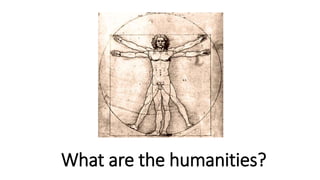
What are the humanities?
According to the 1965 National Foundation on the Arts and
the Humanities Act:
"The term 'humanities' includes, but is not limited to, the
study of the following: language, both modern and classical;
linguistics; literature; history; jurisprudence; philosophy;
archaeology; comparative religion; ethics; the history, criticism
and theory of the arts; those aspects of social sciences which
have humanistic content and employ humanistic methods;
and the study and application of the humanities to the human
environment with particular attention to reflecting our diverse
heritage, traditions, and history and to the relevance of the
humanities to the current conditions of national life."
Humanities include, but are not limited to:
language
linguistics
literature
history
jurisprudence
philosophy
archaeology
comparative religion
ethics
history, criticism and
theory of the arts
College of Science and Humanities
Anthropology
(Biology)
(Chemistry)
(Computer Science)
Criminal Justice and
Criminology
Economics
English
Geography
(Geological Sciences)
History
(Mathematical Sciences)
Modern Languages and
Classics
(Natural Resources and
Environmental
Management)
Philosophy and Religious
Studies
(Physics and Astronomy)
(Physiology and Health)
Science
Political Science
Psychological Science
Social Work
Sociology
(Speech Pathology and
Audiology)
Ball State Colleges
College of Applied Sciences and Technology
College of Architecture and Planning
Miller College of Business
College of Communication, Information, and Media
College of Fine Arts
Honors College
College of Sciences and Humanities
Teachers College
Honors 201 Goals
1. Accurately observe and reconstruct major ideas, philosophies, and
modes of thought of the Ancient World via texts, works of art, and
other artifacts
2. Explain how theory or context influences the use of artifacts in
generating new information and insights
3. Analyze and synthesize knowledge from multiple sources to
formulate new understandings of the major ideas, philosophies,
and modes of thought of the Ancient World
4. Compare new information to existing knowledge of the Ancient
World to identify consonance and dissonance
5. Form knowledge both independently and collaboratively within a
student centered, student driven, exploratory learning environment
6. Communicate their knowledge through well-crafted discussions,
writing, presentations, and projects
Goals (English translation)
What we try to do
1. Understand texts in the contexts of their own times and places
(1 &2).
2. Connect texts to ourselves, to our time and place (4).
How we work
1. Take texts apart to understand them better. Combine texts and
ideas to create new understanding. (3)
2. Work on your own. Collaborate with your peers. Focus on
student questions and projects. Value the process of exploring
ideas together. (5)
3. Discuss, write, present, create! (6)

What are the humanities?

  • 1.
    What are thehumanities?
  • 2.
    According to the1965 National Foundation on the Arts and the Humanities Act: "The term 'humanities' includes, but is not limited to, the study of the following: language, both modern and classical; linguistics; literature; history; jurisprudence; philosophy; archaeology; comparative religion; ethics; the history, criticism and theory of the arts; those aspects of social sciences which have humanistic content and employ humanistic methods; and the study and application of the humanities to the human environment with particular attention to reflecting our diverse heritage, traditions, and history and to the relevance of the humanities to the current conditions of national life."
  • 3.
    Humanities include, butare not limited to: language linguistics literature history jurisprudence philosophy archaeology comparative religion ethics history, criticism and theory of the arts
  • 4.
    College of Scienceand Humanities Anthropology (Biology) (Chemistry) (Computer Science) Criminal Justice and Criminology Economics English Geography (Geological Sciences) History (Mathematical Sciences) Modern Languages and Classics (Natural Resources and Environmental Management) Philosophy and Religious Studies (Physics and Astronomy) (Physiology and Health) Science Political Science Psychological Science Social Work Sociology (Speech Pathology and Audiology)
  • 5.
    Ball State Colleges Collegeof Applied Sciences and Technology College of Architecture and Planning Miller College of Business College of Communication, Information, and Media College of Fine Arts Honors College College of Sciences and Humanities Teachers College
  • 6.
    Honors 201 Goals 1.Accurately observe and reconstruct major ideas, philosophies, and modes of thought of the Ancient World via texts, works of art, and other artifacts 2. Explain how theory or context influences the use of artifacts in generating new information and insights 3. Analyze and synthesize knowledge from multiple sources to formulate new understandings of the major ideas, philosophies, and modes of thought of the Ancient World 4. Compare new information to existing knowledge of the Ancient World to identify consonance and dissonance 5. Form knowledge both independently and collaboratively within a student centered, student driven, exploratory learning environment 6. Communicate their knowledge through well-crafted discussions, writing, presentations, and projects
  • 7.
    Goals (English translation) Whatwe try to do 1. Understand texts in the contexts of their own times and places (1 &2). 2. Connect texts to ourselves, to our time and place (4). How we work 1. Take texts apart to understand them better. Combine texts and ideas to create new understanding. (3) 2. Work on your own. Collaborate with your peers. Focus on student questions and projects. Value the process of exploring ideas together. (5) 3. Discuss, write, present, create! (6)

Editor's Notes

  • #4 What do these things have in common?
  • #5 What is the difference between science and humanities? How do study science from a humanistic perspective?