What are Maturity Models?
by Marc-André Léger
Septembre 2018
Key concepts of maturity models
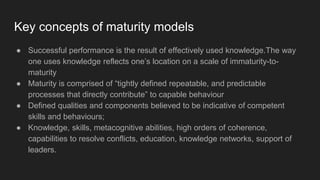
● Successful performance is the result of effectively used knowledge.The way
one uses knowledge reflects one’s location on a scale of immaturity-to-
maturity
● Maturity is comprised of “tightly defined repeatable, and predictable
processes that directly contribute” to capable behaviour
● Defined qualities and components believed to be indicative of competent
skills and behaviours;
● Knowledge, skills, metacognitive abilities, high orders of coherence,
capabilities to resolve conflicts, education, knowledge networks, support of
leaders.
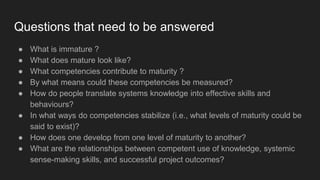
Questions that need to be answered
● What is immature ?
● What does mature look like?
● What competencies contribute to maturity ?
● By what means could these competencies be measured?
● How do people translate systems knowledge into effective skills and
behaviours?
● In what ways do competencies stabilize (i.e., what levels of maturity could be
said to exist)?
● How does one develop from one level of maturity to another?
● What are the relationships between competent use of knowledge, systemic
sense-making skills, and successful project outcomes?
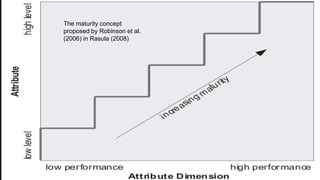
The maturity concept
proposed by Robinson et al.
(2006) in Rasula (2008)
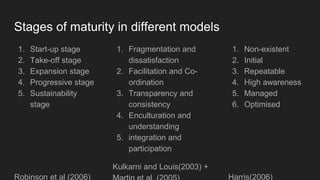
Stages of maturity in different models
1. Start-up stage
2. Take-off stage
3. Expansion stage
4. Progressive stage
5. Sustainability
stage
Robinson et al (2006)
1. Fragmentation and
dissatisfaction
2. Facilitation and Co-
ordination
3. Transparency and
consistency
4. Enculturation and
understanding
5. integration and
participation
Kulkarni and Louis(2003) +
1. Non-existent
2. Initial
3. Repeatable
4. High awareness
5. Managed
6. Optimised
Harris(2006)
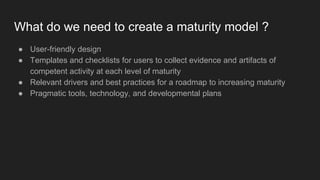
What do we need to create a maturity model ?
● User-friendly design
● Templates and checklists for users to collect evidence and artifacts of
competent activity at each level of maturity
● Relevant drivers and best practices for a roadmap to increasing maturity
● Pragmatic tools, technology, and developmental plans
Principle articles used
1. Buckle P. Maturity Models for Systems Thinking. Systems. 2018; 6(2):23.
2. Rašula, J., Bosilj Vukšić, V. & Indihar Štemberger, M. (2008). The Integrated
Knowledge Management Maturity Model. Zagreb International Review of
Economics & Business, 11 (2), 47-62. Retrieved from
https://hrcak.srce.hr/78659

What are maturity models

  • 1.
    What are MaturityModels? by Marc-André Léger Septembre 2018
  • 2.
    Key concepts ofmaturity models ● Successful performance is the result of effectively used knowledge.The way one uses knowledge reflects one’s location on a scale of immaturity-to- maturity ● Maturity is comprised of “tightly defined repeatable, and predictable processes that directly contribute” to capable behaviour ● Defined qualities and components believed to be indicative of competent skills and behaviours; ● Knowledge, skills, metacognitive abilities, high orders of coherence, capabilities to resolve conflicts, education, knowledge networks, support of leaders.
  • 3.
    Questions that needto be answered ● What is immature ? ● What does mature look like? ● What competencies contribute to maturity ? ● By what means could these competencies be measured? ● How do people translate systems knowledge into effective skills and behaviours? ● In what ways do competencies stabilize (i.e., what levels of maturity could be said to exist)? ● How does one develop from one level of maturity to another? ● What are the relationships between competent use of knowledge, systemic sense-making skills, and successful project outcomes?
  • 4.
    The maturity concept proposedby Robinson et al. (2006) in Rasula (2008)
  • 5.
    Stages of maturityin different models 1. Start-up stage 2. Take-off stage 3. Expansion stage 4. Progressive stage 5. Sustainability stage Robinson et al (2006) 1. Fragmentation and dissatisfaction 2. Facilitation and Co- ordination 3. Transparency and consistency 4. Enculturation and understanding 5. integration and participation Kulkarni and Louis(2003) + 1. Non-existent 2. Initial 3. Repeatable 4. High awareness 5. Managed 6. Optimised Harris(2006)
  • 6.
    What do weneed to create a maturity model ? ● User-friendly design ● Templates and checklists for users to collect evidence and artifacts of competent activity at each level of maturity ● Relevant drivers and best practices for a roadmap to increasing maturity ● Pragmatic tools, technology, and developmental plans
  • 7.
    Principle articles used 1.Buckle P. Maturity Models for Systems Thinking. Systems. 2018; 6(2):23. 2. Rašula, J., Bosilj Vukšić, V. & Indihar Štemberger, M. (2008). The Integrated Knowledge Management Maturity Model. Zagreb International Review of Economics & Business, 11 (2), 47-62. Retrieved from https://hrcak.srce.hr/78659