What's Your
Student Learning
or
Outcome Objective?
Presented
By
Jacki Lamoureux
&
Sharon Webster
September 24, 2013RILINK Workshop
Credits
All page numbers are references to RIDE’s
Rhode Island Support Professionals
Evaluation & Support System, ed 1
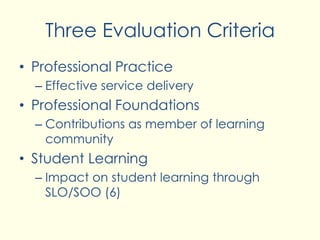
Three Evaluation Criteria
• Professional Practice
– Effective service delivery
• Professional Foundations
– Contributions as member of learning
community
• Student Learning
– Impact on student learning through
SLO/SOO (6)
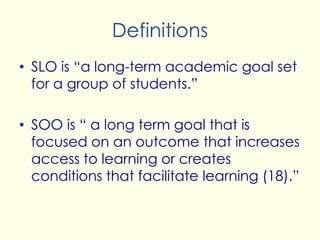
Definitions
• SLO is “a long-term academic goal set
for a group of students.”
• SOO is “ a long term goal that is
focused on an outcome that increases
access to learning or creates
conditions that facilitate learning (18).”
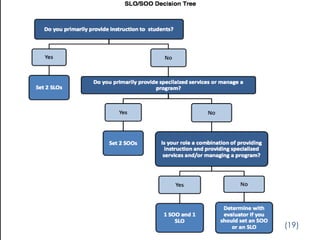
How do I decide
which student learning
objective
is right for me?
(19)
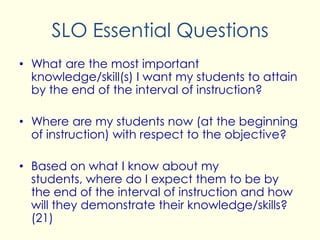
SLO Essential Questions
• What are the most important
knowledge/skill(s) I want my students to attain
by the end of the interval of instruction?
• Where are my students now (at the beginning
of instruction) with respect to the objective?
• Based on what I know about my
students, where do I expect them to be by
the end of the interval of instruction and how
will they demonstrate their knowledge/skills?
(21)
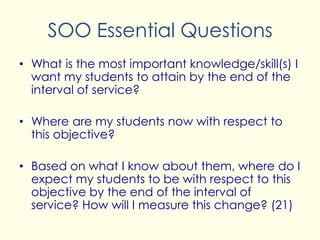
SOO Essential Questions
• What is the most important knowledge/skill(s) I
want my students to attain by the end of the
interval of service?
• Where are my students now with respect to
this objective?
• Based on what I know about them, where do I
expect my students to be with respect to this
objective by the end of the interval of
service? How will I measure this change? (21)
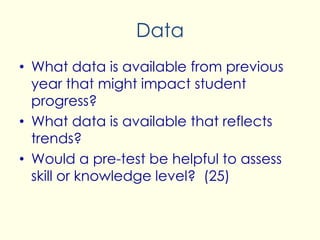
Data
• What data is available from previous
year that might impact student
progress?
• What data is available that reflects
trends?
• Would a pre-test be helpful to assess
skill or knowledge level? (25)
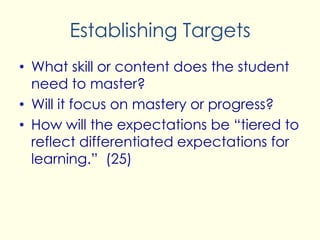
Establishing Targets
• What skill or content does the student
need to master?
• Will it focus on mastery or progress?
• How will the expectations be “tiered to
reflect differentiated expectations for
learning.” (25)
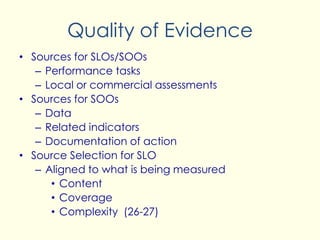
Quality of Evidence
• Sources for SLOs/SOOs
– Performance tasks
– Local or commercial assessments
• Sources for SOOs
– Data
– Related indicators
– Documentation of action
• Source Selection for SLO
– Aligned to what is being measured
• Content
• Coverage
• Complexity (26-27)

What

  • 1.
    What's Your Student Learning or OutcomeObjective? Presented By Jacki Lamoureux & Sharon Webster September 24, 2013RILINK Workshop
  • 2.
    Credits All page numbersare references to RIDE’s Rhode Island Support Professionals Evaluation & Support System, ed 1
  • 3.
    Three Evaluation Criteria •Professional Practice – Effective service delivery • Professional Foundations – Contributions as member of learning community • Student Learning – Impact on student learning through SLO/SOO (6)
  • 4.
    Definitions • SLO is“a long-term academic goal set for a group of students.” • SOO is “ a long term goal that is focused on an outcome that increases access to learning or creates conditions that facilitate learning (18).”
  • 5.
    How do Idecide which student learning objective is right for me?
  • 6.
  • 7.
    SLO Essential Questions •What are the most important knowledge/skill(s) I want my students to attain by the end of the interval of instruction? • Where are my students now (at the beginning of instruction) with respect to the objective? • Based on what I know about my students, where do I expect them to be by the end of the interval of instruction and how will they demonstrate their knowledge/skills? (21)
  • 8.
    SOO Essential Questions •What is the most important knowledge/skill(s) I want my students to attain by the end of the interval of service? • Where are my students now with respect to this objective? • Based on what I know about them, where do I expect my students to be with respect to this objective by the end of the interval of service? How will I measure this change? (21)
  • 9.
    Data • What datais available from previous year that might impact student progress? • What data is available that reflects trends? • Would a pre-test be helpful to assess skill or knowledge level? (25)
  • 10.
    Establishing Targets • Whatskill or content does the student need to master? • Will it focus on mastery or progress? • How will the expectations be “tiered to reflect differentiated expectations for learning.” (25)
  • 11.
    Quality of Evidence •Sources for SLOs/SOOs – Performance tasks – Local or commercial assessments • Sources for SOOs – Data – Related indicators – Documentation of action • Source Selection for SLO – Aligned to what is being measured • Content • Coverage • Complexity (26-27)

Editor's Notes