Social Media for Job Search and Career Development
Wharton Alumni Club Career Workshop
September 20, 2014Presented by Deni Kasrel
Power of the Network
Oy, so many networks…
You can be a detective
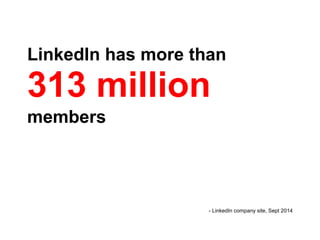
LinkedIn has more than
313 million
members
- LinkedIn company site, Sept 2014
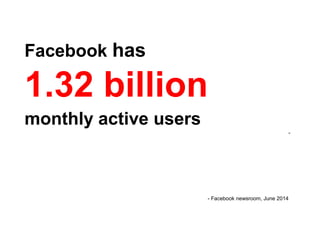
Facebook has
1.32 billion
monthly active users
-
- Facebook newsroom, June 2014
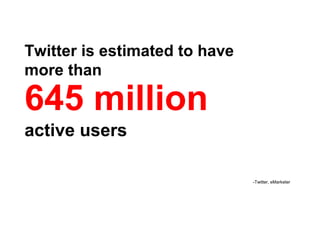
Twitter is estimated to have
more than
645 million
active users
-Twitter, eMarketer
The 3 Key Steps
1. Build Your Personal Brand
2. Build Your Network
3. Be Social
Build your personal brand
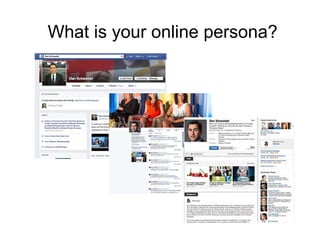
What is your online persona?
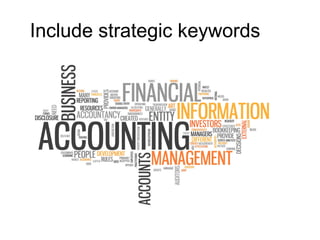
Include strategic keywords
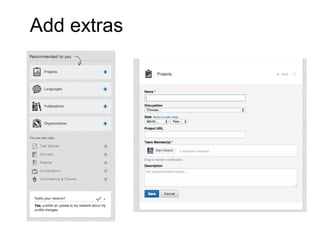
Add extras
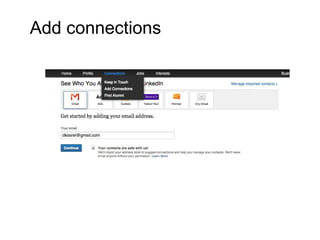
Add connections
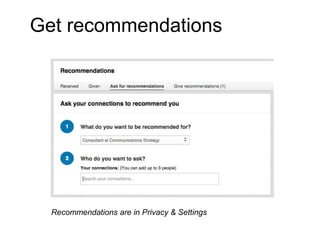
Get recommendations
Recommendations are in Privacy & Settings
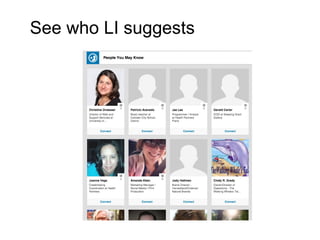
See who LI suggests
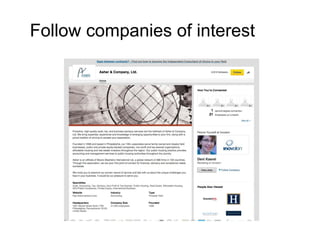
Follow companies of interest
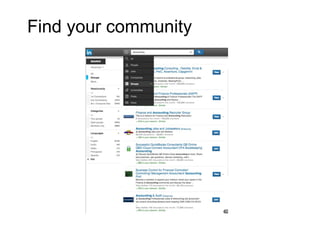
Find your community
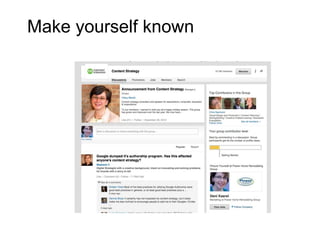
Make yourself known
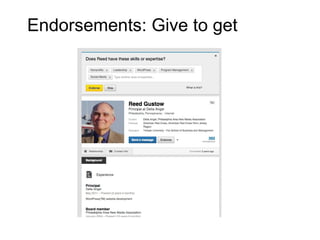
Endorsements: Give to get
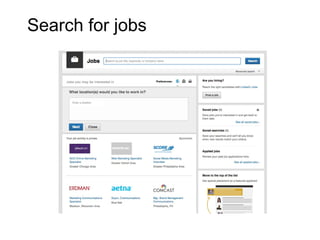
Search for jobs
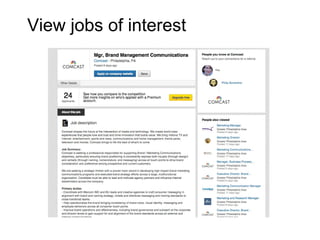
View jobs of interest
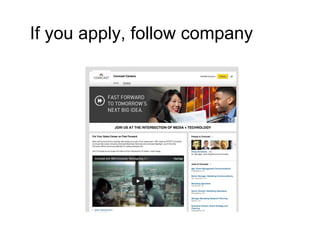
If you apply, follow company
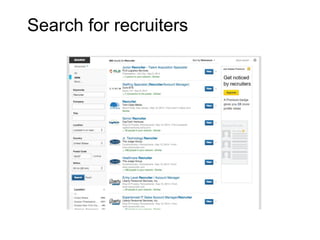
Search for recruiters
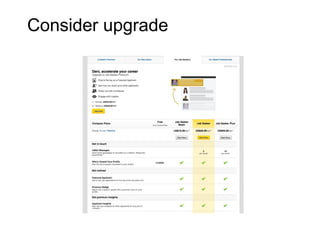
Consider upgrade
Twitter: Boost your brand
& find jobs
Why use Twitter?
• Open network
• You can have conversations with
anybody
• Instant feedback
• Power of the retweet
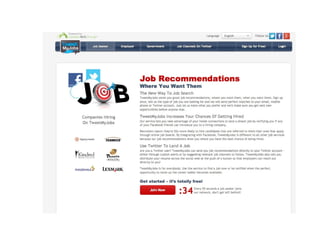
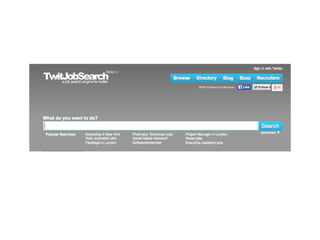
• Real-time job board
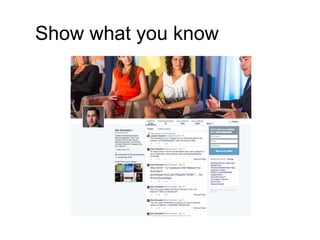
Show what you know
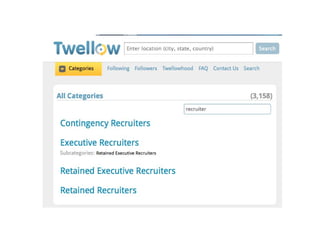
Get a dashboard
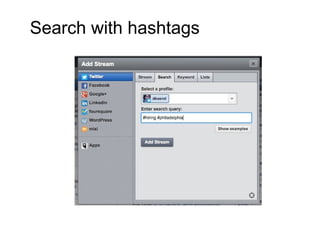
Search with hashtags
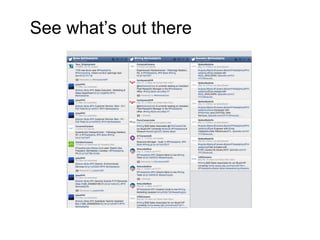
See what’s out there
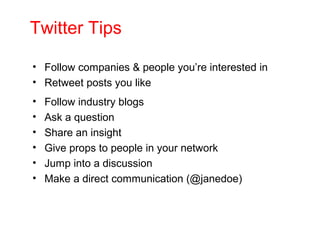
Twitter Tips
• Follow companies & people you’re interested in
• Retweet posts you like
• Follow industry blogs
• Ask a question
• Share an insight
• Give props to people in your network
• Jump into a discussion
• Make a direct communication (@janedoe)
Facebook: Not just for friends & family
Why Facebook?
• Most jobs come from referrals
• Frequently updated
• Most widely used
• Use it to learn more about a company
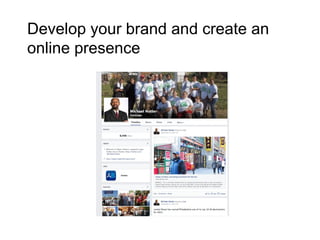
Develop your brand and create an
online presence
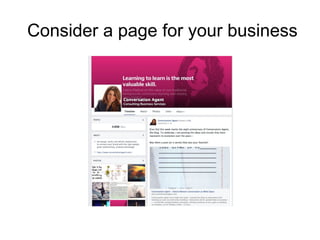
Consider a page for your business
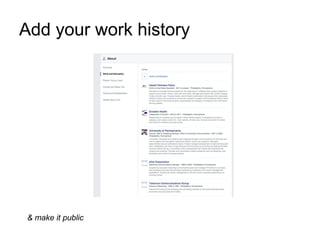
Add your work history
& make it public
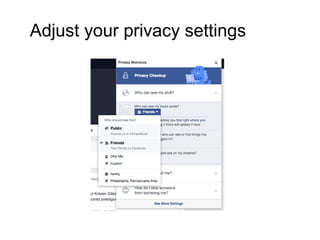
Adjust your privacy settings
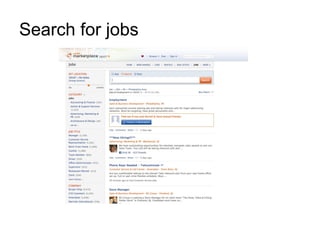
Search for jobs
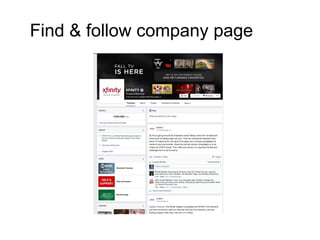
Find & follow company page
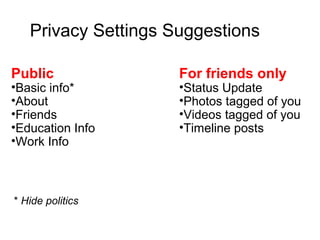
Privacy Settings Suggestions
Public
•Basic info*
•About
•Friends
•Education Info
•Work Info
For friends only
•Status Update
•Photos tagged of you
•Videos tagged of you
•Timeline posts
* Hide politics
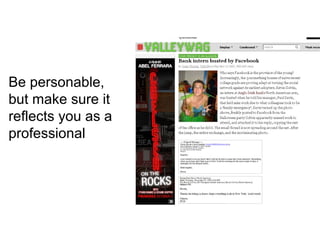
Be personable,
but make sure it
reflects you as a
professional
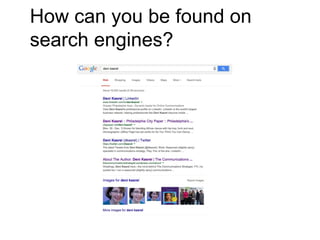
How can you be found on
search engines?
Clean up your online persona
48% use Google or other search engine to
research candidates
44% research candidate on Facebook
27% monitor the candidates activity on Twitter
23% review candidate’s posts on Yelp.com
and other rating sites
Career Builder Oct. 2013
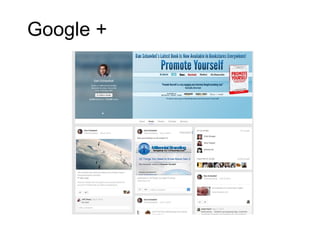
Google +
YouTube
Slideshare
Visual CV
Create your own website/blog
Remember these 3 steps…
1. Create Your Personal Brand
2. Build Your Network
3. Be Social
My contact Info
https://www.linkedin.com/in/denikasrel
https://twitter.com/dkasrel
http://thecommunicationsstrategist.com/

Social Media for Job Search and Career Development

Editor's Notes

  • #3 DK: To start, I’ll briefly explain what we mean by social networking. Well, it serves the same purpose as in-person networking, which is to connect with people to develop productive/useful relationships for employment or business purposes. Social networking does that same thing. But it happens online. Here’s where you can powercharge your job search, because it streamlines the networking process. You still want to meet with people in person, but social networking helps you make connections more efficiently. It’s been likened to the six degrees of separation. As indicated by this graphic, what’s great about it is, you can SEE the connections. And you can leverage your current connections to make new connections. Conversely, many people can see YOUR information in a way that both shows and tells who you are. You can create a profile, post your resume, share information, photos, videos to establish an online BRAND IDENTITY. And it’s all very interactive.
  • #4 There are hundreds of social networks and you only have so much time. You want to take a targeted approach. Start with the big three. Does anyone want to guess which ones they may be? [pause and see if anyone calls anything out]
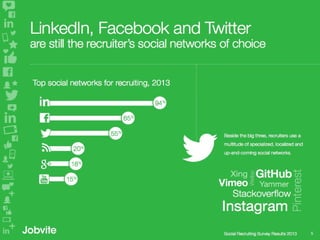
  • #5 So the big three are, Linkedin, Facebook and Twitter and as you can LinkedIn is pretty much a given.
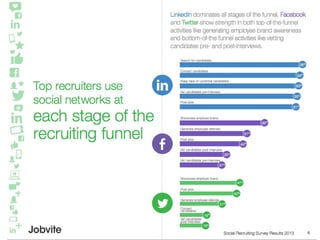
  • #6 Recruiters use the big three throughout their process. When reviewing job candidates, they use LinkedIn throughout the process, to find candidates and post jobs. Facebook and Twitter are used primarily to showcase the company brand, vet candidates and get referrals.
  • #7 In way, social media enables you to be a detective. Say you’re going to an informational interview or a job interview. You can look up the person you’ll be meeting with and get information on his or her background. It gives you a better idea of who THEY are. You can also find information on a company. Social networks provide access to job contacts, friends of those job contacts, and recruiters. So you can uncover a lot of information. But before we get to that, let’s look at how big the the big three really are.
  • #8 DK
  • #9 DK
  • #10 DK
  • #11 In order to succeed with social networking you need to have a plan of action. And if you only remember three things today The three main steps you need to take are: One, create your online brand identity Then, build your network And finally, you need to WORK your network. You need to BE SOCIAL.
  • #12 But before we get into the how, where and why of the big three, let’s take a minute to talk about the first step – establishing you online identity and your personal brand. There’s a lot of talk about branding yourself these days and the popularity of social media only makes it more important for you to put your best foot forward online. Dan Schwabel, author of Me 2.0, a book that talks about how we market ourselves to others. strong memorable something that reflects you at your best. What makes you stand out from a crowd. How can you be like the red tulip there? How do you stand out among the many millions of members of each social network? What is that thing you do, better than anyone else? Try to think of a brief sentence or even a catch phrase that describes you. And authenticity is key. You even want to think about how your brand translates visually and in the written word.
  • #13 Imagine you’re ABC, CBS, NBC – you have a single brand to promote but many different programs, multiple ways to distribute that brand Dan Schwabel A few brand basics: you want to: Share and show your expertise as much as possible through links to relevant articles, point of view on a certain subject matter in your field Follow other people in your industry and anyone else who can teach you how to spread your message. Choose an appropriate avatar headshot – not something of you wild at a party Publicize your brand-related successes and achievements. Help other people in your industry such as bloggers, Twitterers, colleagues, advice seekers, etc. Keep in mind that where you interact online also conveys messages about you, and then stick to the websites and communities that will help most in reaching your goals. Think about your email signature – make sure you have one and make sure it represents you, include your Twitter address in it. Once you’ve established your personal brand you’ll want to test it out People in your field should know who you are Someone who Googles your first and last name should be able to find out who you are. Now let’s dive into each one of the social networks    MORE [time check] Is your LinkedIn page just a quick snapshot of you and your work history? Do you have a photo? Do you have testimonials? Maybe you have a Facebook page but after you logged on a few times you rarely look at it except when it’s a friends birthday?. You haven’t written a summary in the bio or profile page. Maybe you have a Twitter page and you see these scrolling posts and wonder whats the bother? You haven’t been back since you first signed up. Let’s talk about why you can really mp up your online presence by taking advantage of what these sites can do for you
  • #14 We’ll start with the big kahuna for professional networking for job search and professional development.
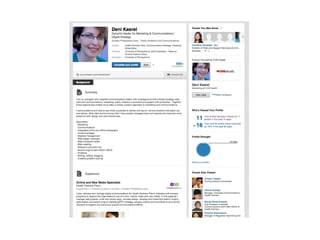
  • #15 To start you need to create to your profile. Be sure to complete all the main parts. This is how you are presenting yourself to potential employers – it’s like an online resume, but is also enhanced by ability to include documents, projects, links to your website. There ‘s step by step process, you fill in the blanks, most of which is self-explanatory. Be sure to use a professional-looking photo and at least while you are job hunting you want the same photo across all of your social networks, for the sake of consistency. Give yourself a headline - is automatically your last job displayed but you can change it to something else -- like brand manager for Fortune 500 company. Put something that describes your career - do NOT put “looking for a job” Summary summation of your experience and what you have to offer, think about what job you want and orient that way. Sell self here. Experience -- your job history Custom URL ,try and get one that is your name -- will help with search engine optimization. But may not be possible, someone else may already have it.
  • #16 Be sure to pepper your profile with keywords that a recruiter might use to look for someone to fill a job position in the area you’re looking for. Put keywords in your headline, summary, and work history. If not sure of keywords for your industry, look at job postings and see what terms are repeated.
  • #17 If you have them, embellish your profile with projects, list published articles and more. Don’t be shy, but be sure whatever you post is relevant to your career.
  • #18 You can import your contact from different applications Apple Mail
  • #19 Ask for recommendations Your boss (s) People who worked for you Other colleagues You can ask people from old jobs to give you a recommendation.
  • #20 Linke In will make suggestions based on your profile and connections. Note, you do not want to have a blank photo, you do not want to faceless.
  • #21 Search for and follow companies that you are interested in, for job hunt and/or general personal interest
  • #22 Search for and join groups that are in areas of interest Can be in your current field or one that you want to enter
  • #23 Start to develop your brand -- become a thought leader Start discussions -- good to phrase as a question, comment on other posts, share links to useful information. Remember to add to the conversation. Don’t just say good post – add another point of interest that shows off your ideas and knowledge. Can promote self here too -- say talented marketing manager, with looking for work in the Philadelphia area
  • #24 Along with recommendations, LinkedIn has endorsements. These will pop up at the top of your profile, for you connections. Start endorsing others in your network. The person will be notified of your endorsement, which will bring you top of mind to them and the person may endorse you in-kind.
  • #25 Can search for jobs -- use advanced search to fine tune your query for location Experience level Title Function Industry
  • #26 Review the results and see if anything is of interest. Look to see if you are connected to anyone at the company and see if you can leverage that connection.
  • #27 You can look up companies and get some information, either to see if you have an interest in working there, or to see how you’re connected.
  • #28 You can search for recruiters, again use the advanced search function
  • #29 You may want to consider upgrading your account when you are job searching. It’s a monthly fee and you can cancel once you find a job.
  • #30 Twitter is like a broadcast system - good way to publicize self Realtime Uncool to have page hidden - no point to it Can have multiple accounts on for self and one for biz purposes (not limited) Anyone can follow you Helps you get on someone’s radar who you want to approach but do not yet know -- my story about Beth Harte, I want to contact her but not know her, so following, she follows me, I RT and respond to some of her tweets -- a way in Can block if seems problematic (porno, spam) Promote blog Can see what topics are hot Tweet about your job search Link to your LI or Visual CV from your profile
  • #31 Unlike many social media sites, including LinkedIn or Facebook, Twitter is an open network. You can see other people’s tweets without having to have a reciprocal connection. That enables you to communicate with whomever you choose. But be prudent. Just like in real life, you want to be professional and not be pest. If you tweet that you are looking for a job, your network can easily retweet the message to their networks. They can also retweet any any of your tweets, which helps spread your brand to their networks. And Twitter can serve as a real-time job board, where recruiters post jobs.
  • #32 Instead of just putting personal musings, or
  • #40 Facebook is generally seen as the most personal of the social networks, enhancing existing friendships. Its more for people you already know, but you fairly quickly grow your network here, too.
  • #42 You will want to establish your brand here too and create an online presence. People tend to post more personal comments about their day/ their weekend,photos of their kids, a review of a good movie they just saw. But thats not to say it isn't a good place to find connections or a job. As you probably already know, you can recnonnect very easily with friends you haven’t seen in years and you never know who they know. Because of its centralized email, and because people tend to "hang out" on FB, you can really learn lot about other people. Conversations are everywhere, on people’s walls, in private messages, on event walls, on picture comments, ect.  The important thing is to have a strategy.  There is so much happening on Facebook, it can be overwhelming.  Stay focused.  What do you want to do with Facebook?  Is it to find a job? What kind of job? In a certain field? A certain position? Write it down on a post-it and stick it on your monitor, because Facebook can be quite distracting.
  • #43 You will want to establish your brand here too and create an online presence. People tend to post more personal comments about their day/ their weekend,photos of their kids, a review of a good movie they just saw. But thats not to say it isn't a good place to find connections or a job. As you probably already know, you can recnonnect very easily with friends you haven’t seen in years and you never know who they know. Because of its centralized email, and because people tend to "hang out" on FB, you can really learn lot about other people. Conversations are everywhere, on people’s walls, in private messages, on event walls, on picture comments, ect.  The important thing is to have a strategy.  There is so much happening on Facebook, it can be overwhelming.  Stay focused.  What do you want to do with Facebook?  Is it to find a job? What kind of job? In a certain field? A certain position? Write it down on a post-it and stick it on your monitor, because Facebook can be quite distracting.
  • #44 You can provide as much or as little as you want here. I’ve basically included an overall work history with small details. You don’t to do the full resume here, just the key highlights
  • #45 Control access and the image that you present. Remember that 45 percent of employers now screen applicants’ social media sites. Be careful about your statuses and how they reflect your character and professionalism. There are lots of stories out there of applicants not getting jobs because of the photos or status they had on their Facebook profile.
  • #46 You can provide as much or as little as you want here. I’ve basically included an overall work history with small details. You don’t to do the full resume here, just the key highlights
  • #47 Again it’s a good way to be a detective because you can get the latest news about the company, see other fans, really do your detective work
  • #48 If you’re concerned about this, simply make sure you control the access you give people you are not friends with.   That’s the benefit of Facebook, a lot more granular controls right down to whether they see just photos or your status updates etc   Organize your connections and keep track of who has what kind of access to your profile.
  • #49 If you can’t see it as the headline on the front page of newspaper, don’t write it
  • #50 When someone looks you up though a social engine you want them to be able to find you, and you want for the top links to be to your social network sites and other online profiles. Subject: RE: Miguel is now re-posting to 24 social networks...   I asked him why? Was it really valuable to post to 24 social networks Search engine optimization: Do a Google search on the keyword 'miggon' ... it's spectacular.
  • #56 Create Your own website – good idea to buy your name at GoDaddy or another site Register your own name as a domain name. If not available, use your personal brand name or some variation that won’t confuse people and will still reinforce your brand.
  • #57 Etc Create a social bookmarking account (e.g. on del.icio.us) specifically for articles related to your profession or interest, and then encourage people to help you find related arti cles. Arrange to have bios posted about yourself on Wikipedia, Knol, Squidoo and other user-generated media. Syndicate your blog in brand-related sites and networks. List your blog in pertinent website, blog and RSS directories. Exchange blogroll placements with industry bloggers.