The 2010 Women Grow Business Boot CampSponsored & hosted byNetwork Solutions and Steptoe & Johnson LLPJune 19, 2010, Washington, D.C.
Overview of ProgramCorporate Law Overview
Intellectual Property and Social MediaChoice of Legal Entity	Four basic forms of legal entity:Sole proprietorshipPartnershipCorporationLimited Liability Company
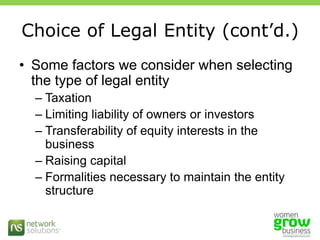
Choice of Legal Entity (cont’d.)Some factors we consider when selecting the type of legal entityTaxationLimiting liability of owners or investorsTransferability of equity interests in the businessRaising capitalFormalities necessary to maintain the entity structure
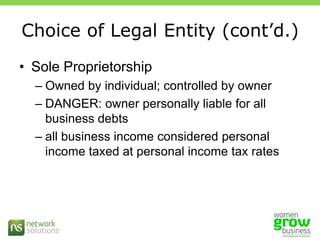
Choice of Legal Entity (cont’d.)Sole Proprietorship Owned by individual; controlled by ownerDANGER: owner personally liable for all business debtsall business income considered personal income taxed at personal income tax rates
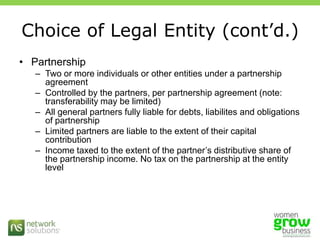
Choice of Legal Entity (cont’d.)PartnershipTwo or more individuals or other entities under a partnership agreementControlled by the partners, per partnership agreement (note: transferability may be limited)All general partners fully liable for debts, liabilites and obligations of partnershipLimited partners are liable to the extent of their capital contributionIncome taxed to the extent of the partner’s distributive share of the partnership income. No tax on the partnership at the entity level
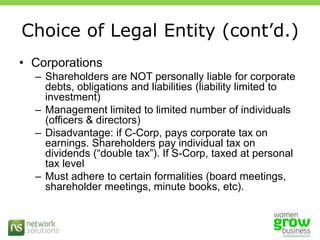
Choice of Legal Entity (cont’d.)CorporationsShareholders are NOT personally liable for corporate debts, obligations and liabilities (liability limited to investment)Management limited to limited number of individuals (officers & directors)Disadvantage: if C-Corp, pays corporate tax on earnings. Shareholders pay individual tax on dividends (“double tax”). If S-Corp, taxed at personal tax levelMust adhere to certain formalities (board meetings, shareholder meetings, minute books, etc).
Choice of Legal Entity (cont’d.)Limited Liability CompaniesNo member of an LLC is personally liable for the debts, liabilities or other obligations of the LLC. Owner’s liability limited to amount of capital contributedManagement may be centralized in certain membersLLC may elect partnership or corporate tax treatment for federal income tax purposesLLC may (if desired) limit the transfer of membership interests and substitution of new members per Operating AgreementNo formalities require to maintain LLC (of course, though, must create it formally)
Marketing Law BasicsCan Spam LawThe surveys from you indicated that the majority who are marketing use e-mail solicitationsBe aware of the Federal Can Spam LawYou MAY send unsolicitated commercial e-mails, provided you do so per the law
Marketing Law Basics (cont’d.)Under Can Spam – the key requirements are:no false or misleading headers no deceptive subject lines (“here’s the information you requested” – when not requested)include valid postal mailing address and company nameprovide working opt-out method and HONOR opt-outs no later than 10 business days (can’t charge a fee, ask for more than e-mail address, or require more than reply e-mail or visiting more than a single page on a website)identify as advertisement check your privacy policy to make sure being consistentFTC primarily enforces, penalties can be severe $$$$
Marketing Law Basics (cont’d.)Telemarketing – BEWAREThere are a host of federal and state laws restricting telemarketingRegulators/private parties can sue- $$Live calls: Feds: Existing customers can be called (3 mos for an inquiry/18 mos for a purchase), unless they tell you NOT to call – then you must remove them from your calling listProspects – do not call databases must be scrubbed first.  Calling hours – nothing before 8am, after 9pm, per feds (some states more restrictive)
Marketing Law Basics (cont’d.)Fax Marketingheavily regulated and very litigiousneed existing business relationship or prior express consent to fax unsolicited fax adsspecific opt-out language on fax – without it, separate violationmust promptly process opt-outs (within 30 days) best to seek counsel
Final Points Advise any employees to get any advertising initiatives approved by you or another responsible official – sometimes employees think there are being creative and “running with the ball.” This can lead to $$$ penalties, litigation costs, loss of goodwill, etc.Any lawsuit notices, threatening letters, investigations – PAY ATTENTION – do not ignore – defaults, annoyed regulators, etc.
Intellectual Propertyand Social MediaIntellectual Property Basics
Trademarks 101
Social Media for Small BusinessesIntellectual Property TypesTrademarks
Patents
Copyrights
Trade DressWhat is a Trademark?A trademark is a mark, name, word, or symbol used to identify goods and to distinguish them from competitors’ offeringsExample:  COACH® leather goodsA service mark is the same as a trademark, but identifies the origin or sources of servicesExample: DELTA® for air travel services
What is a Patent?Exclusive right to prevent others from making, using, selling or importing an invention in the United StatesExists for a limited time onlyAfter expiration, invention becomes part of public domain and can be made, used, or sold by anyone
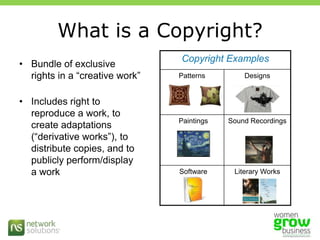
Copyright ExamplesBundle of exclusive rights in a “creative work”Includes right to reproduce a work, to create adaptations (“derivative works”), to distribute copies, and to publicly perform/display a workDesignsPatternsSound RecordingsPaintingsLiterary WorksSoftwareWhat is a Copyright?
What is Trade Dress?Overall look and feel of a product or its packagingSignifies to the consumer that it comes from a particular companySum-total of the appearance of the product or its packaging, including:TrademarksCopyrightsOther non-protectable design features
Trademarksand Domain NamesExamples of Trademarks
Importance of Trademarks in Business
Selecting a Trademark and Domain Name
Obtaining and Protecting Trademarks
Trademark and Domain Name Enforcement Basics
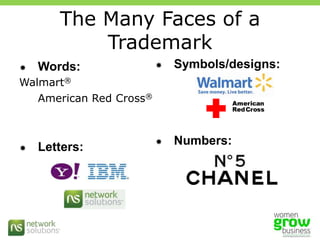
Proper Trademark UseSymbols/designs:
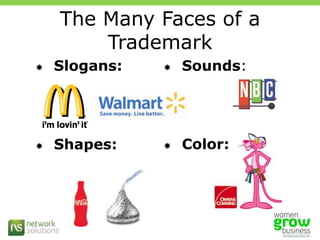
Numbers: The Many Faces of a TrademarkWords:Walmart®	American Red Cross®Letters:The Many Faces of a TrademarkSlogans:
Shapes:
Sounds:
Color:  Importance ofTrademarks in BusinessRepresent a company’s good will and reputation
Ensure that your customers and the public associate your brands with your business
Can be a company’s most valuable business assetChoosing a Trademark or Domain NameWhen choosing a trademark, consider whether the mark is available:
Is someone else using the same or a similar mark, especially for the same/similar goods or services?

"Legal Eagle" - presented by Michelle Cohen & Rachel Hofstatter at the #wgbiz Boot Camp

  • 1.
    The 2010 WomenGrow Business Boot CampSponsored & hosted byNetwork Solutions and Steptoe & Johnson LLPJune 19, 2010, Washington, D.C.
  • 2.
  • 3.
    Intellectual Property andSocial MediaChoice of Legal Entity Four basic forms of legal entity:Sole proprietorshipPartnershipCorporationLimited Liability Company
  • 4.
    Choice of LegalEntity (cont’d.)Some factors we consider when selecting the type of legal entityTaxationLimiting liability of owners or investorsTransferability of equity interests in the businessRaising capitalFormalities necessary to maintain the entity structure
  • 5.
    Choice of LegalEntity (cont’d.)Sole Proprietorship Owned by individual; controlled by ownerDANGER: owner personally liable for all business debtsall business income considered personal income taxed at personal income tax rates
  • 6.
    Choice of LegalEntity (cont’d.)PartnershipTwo or more individuals or other entities under a partnership agreementControlled by the partners, per partnership agreement (note: transferability may be limited)All general partners fully liable for debts, liabilites and obligations of partnershipLimited partners are liable to the extent of their capital contributionIncome taxed to the extent of the partner’s distributive share of the partnership income. No tax on the partnership at the entity level
  • 7.
    Choice of LegalEntity (cont’d.)CorporationsShareholders are NOT personally liable for corporate debts, obligations and liabilities (liability limited to investment)Management limited to limited number of individuals (officers & directors)Disadvantage: if C-Corp, pays corporate tax on earnings. Shareholders pay individual tax on dividends (“double tax”). If S-Corp, taxed at personal tax levelMust adhere to certain formalities (board meetings, shareholder meetings, minute books, etc).
  • 8.
    Choice of LegalEntity (cont’d.)Limited Liability CompaniesNo member of an LLC is personally liable for the debts, liabilities or other obligations of the LLC. Owner’s liability limited to amount of capital contributedManagement may be centralized in certain membersLLC may elect partnership or corporate tax treatment for federal income tax purposesLLC may (if desired) limit the transfer of membership interests and substitution of new members per Operating AgreementNo formalities require to maintain LLC (of course, though, must create it formally)
  • 9.
    Marketing Law BasicsCanSpam LawThe surveys from you indicated that the majority who are marketing use e-mail solicitationsBe aware of the Federal Can Spam LawYou MAY send unsolicitated commercial e-mails, provided you do so per the law
  • 10.
    Marketing Law Basics(cont’d.)Under Can Spam – the key requirements are:no false or misleading headers no deceptive subject lines (“here’s the information you requested” – when not requested)include valid postal mailing address and company nameprovide working opt-out method and HONOR opt-outs no later than 10 business days (can’t charge a fee, ask for more than e-mail address, or require more than reply e-mail or visiting more than a single page on a website)identify as advertisement check your privacy policy to make sure being consistentFTC primarily enforces, penalties can be severe $$$$
  • 11.
    Marketing Law Basics(cont’d.)Telemarketing – BEWAREThere are a host of federal and state laws restricting telemarketingRegulators/private parties can sue- $$Live calls: Feds: Existing customers can be called (3 mos for an inquiry/18 mos for a purchase), unless they tell you NOT to call – then you must remove them from your calling listProspects – do not call databases must be scrubbed first. Calling hours – nothing before 8am, after 9pm, per feds (some states more restrictive)
  • 12.
    Marketing Law Basics(cont’d.)Fax Marketingheavily regulated and very litigiousneed existing business relationship or prior express consent to fax unsolicited fax adsspecific opt-out language on fax – without it, separate violationmust promptly process opt-outs (within 30 days) best to seek counsel
  • 13.
    Final Points Adviseany employees to get any advertising initiatives approved by you or another responsible official – sometimes employees think there are being creative and “running with the ball.” This can lead to $$$ penalties, litigation costs, loss of goodwill, etc.Any lawsuit notices, threatening letters, investigations – PAY ATTENTION – do not ignore – defaults, annoyed regulators, etc.
  • 14.
    Intellectual Propertyand SocialMediaIntellectual Property Basics
  • 15.
  • 16.
    Social Media forSmall BusinessesIntellectual Property TypesTrademarks
  • 17.
  • 18.
  • 19.
    Trade DressWhat isa Trademark?A trademark is a mark, name, word, or symbol used to identify goods and to distinguish them from competitors’ offeringsExample: COACH® leather goodsA service mark is the same as a trademark, but identifies the origin or sources of servicesExample: DELTA® for air travel services
  • 20.
    What is aPatent?Exclusive right to prevent others from making, using, selling or importing an invention in the United StatesExists for a limited time onlyAfter expiration, invention becomes part of public domain and can be made, used, or sold by anyone
  • 21.
    Copyright ExamplesBundle ofexclusive rights in a “creative work”Includes right to reproduce a work, to create adaptations (“derivative works”), to distribute copies, and to publicly perform/display a workDesignsPatternsSound RecordingsPaintingsLiterary WorksSoftwareWhat is a Copyright?
  • 22.
    What is TradeDress?Overall look and feel of a product or its packagingSignifies to the consumer that it comes from a particular companySum-total of the appearance of the product or its packaging, including:TrademarksCopyrightsOther non-protectable design features
  • 23.
  • 24.
  • 25.
    Selecting a Trademarkand Domain Name
  • 26.
  • 27.
    Trademark and DomainName Enforcement Basics
  • 28.
  • 29.
    Numbers: The ManyFaces of a TrademarkWords:Walmart® American Red Cross®Letters:The Many Faces of a TrademarkSlogans:
  • 30.
  • 31.
  • 32.
    Color: ImportanceofTrademarks in BusinessRepresent a company’s good will and reputation
  • 33.
    Ensure that yourcustomers and the public associate your brands with your business
  • 34.
    Can be acompany’s most valuable business assetChoosing a Trademark or Domain NameWhen choosing a trademark, consider whether the mark is available:
  • 35.
    Is someone elseusing the same or a similar mark, especially for the same/similar goods or services?