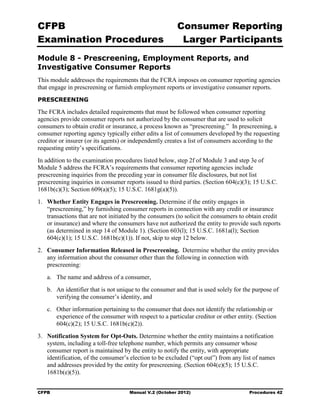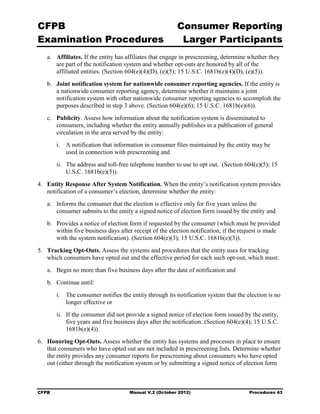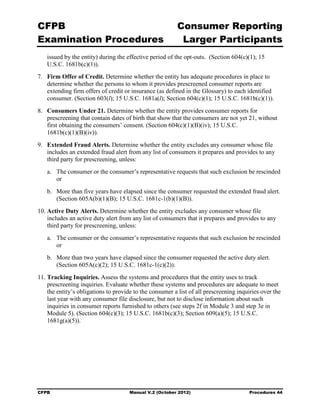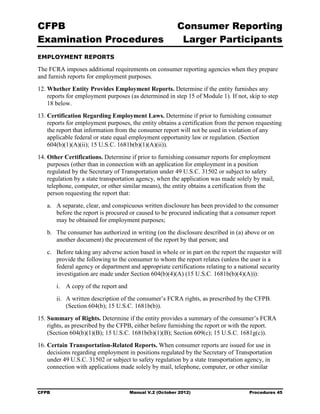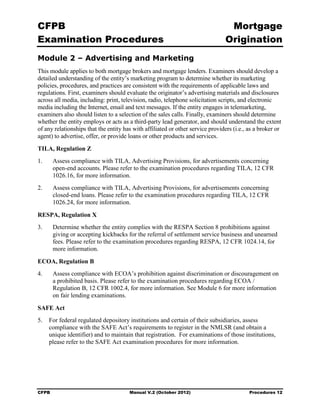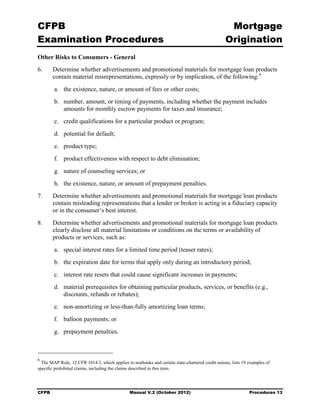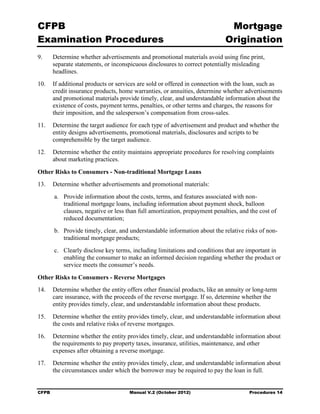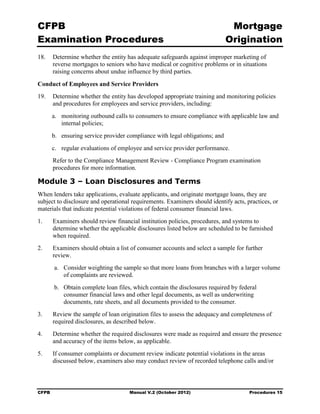
October 1, 2012

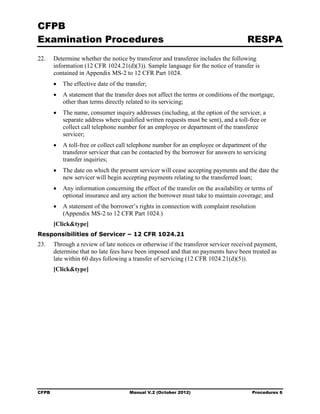
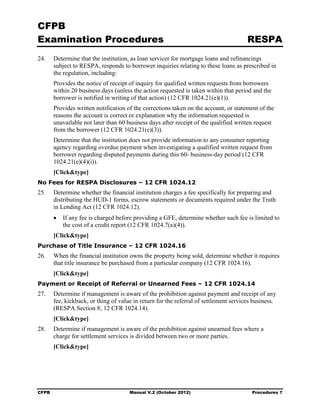
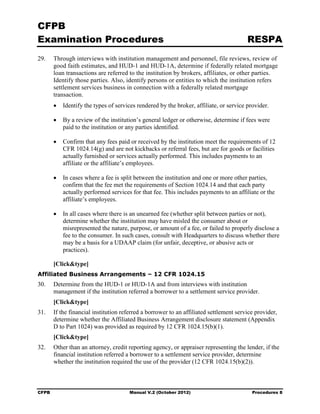
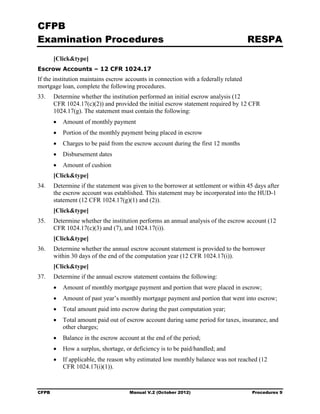
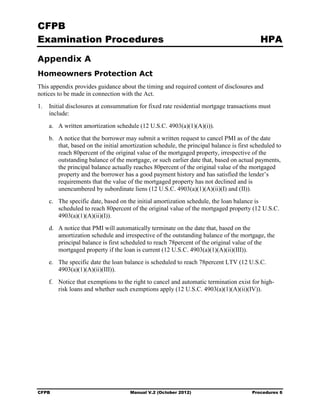
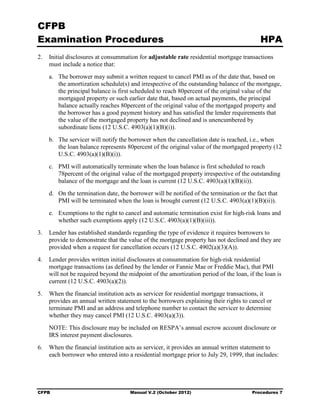
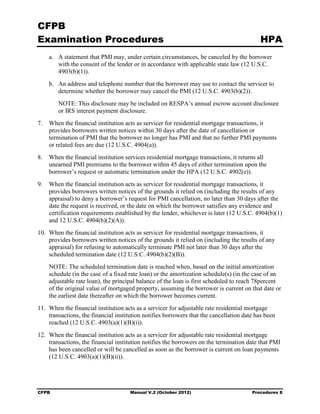
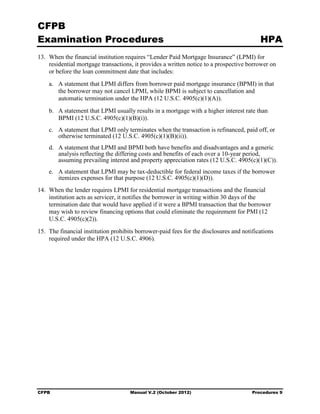
To the Reader:

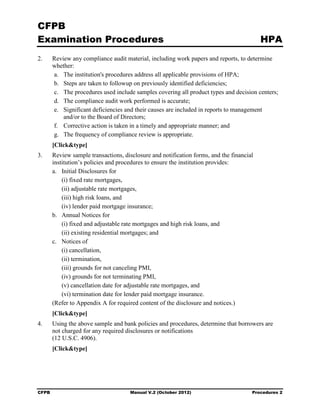
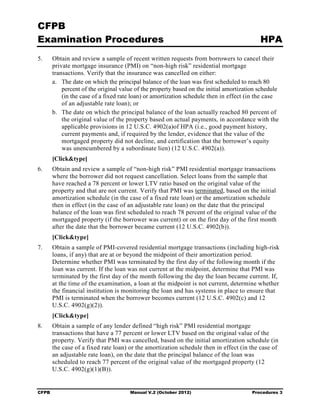
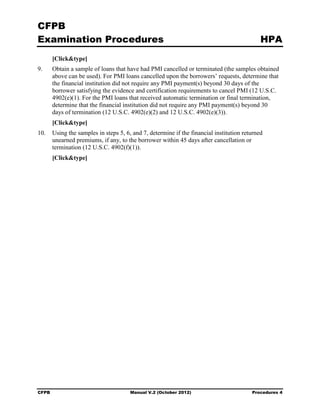
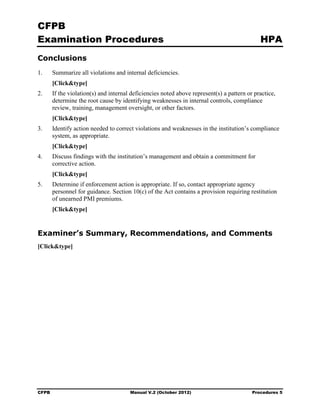
Today we are releasing Version 2 of the CFPB Supervision and Examination Manual, the guide
our examiners use in overseeing companies that provide consumer financial products and
services. Our manual, originally released in October 2011, describes how the CFPB supervises
and examines these providers and gives our examiners direction on how to determine if
companies are complying with consumer financial protection laws.

We updated the supervision manual to reflect the renumbering of the consumer financial
protection regulations for which the CFPB is responsible. The numbering conventions in the
Code of Federal Regulations (CFR) allow the reader to easily identify which regulations fall
under a particular agency’s responsibility. The renumbering incorporated throughout the manual
reflects the Dodd-Frank Act of 2010 transfer of rulemaking responsibility for many consumer
financial protection regulations from other Federal agencies to the CFPB. In December 2011, the
CFPB published its renumbered regulations in the Federal Register. The renumbered regulations
also included certain technical changes but no substantive changes. The CFPB’s renumbering
reflects the codification of its regulations in Title 12 (Banks and Banking), Chapter X (Bureau of
Consumer Financial Protection) of the CFR. For example, before July 21, 2011, the Federal
Reserve had rulemaking authority for the Home Mortgage Disclosure Act, which was codified in
Title 12, Chapter II (Federal Reserve System), Part 203. The CFPB’s implementing regulation
for the Home Mortgage Disclosure Act is now codified in Title 12, Chapter X, Part 1003.

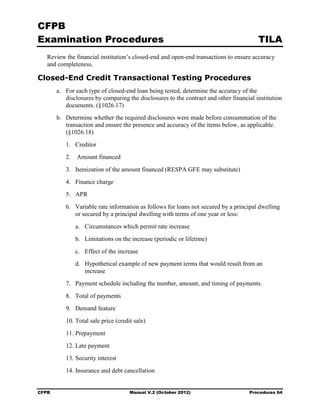
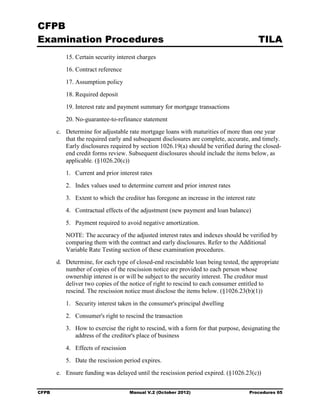
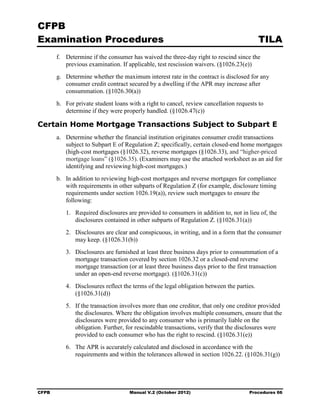
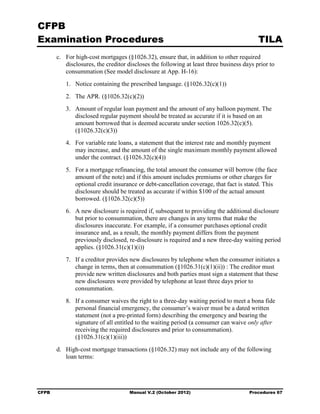
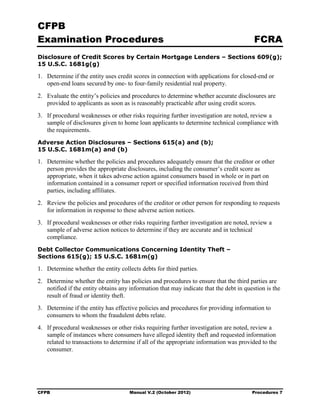
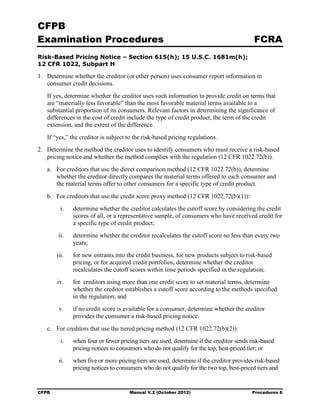
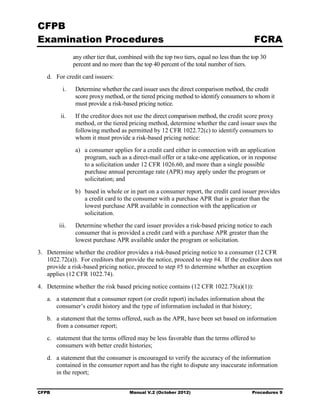
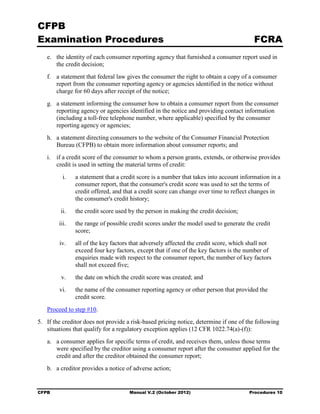
In addition to changes related to the renumbering of the CFPB regulations, the manual
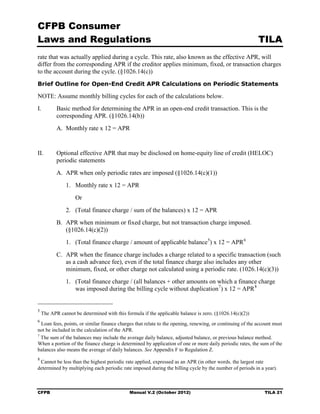
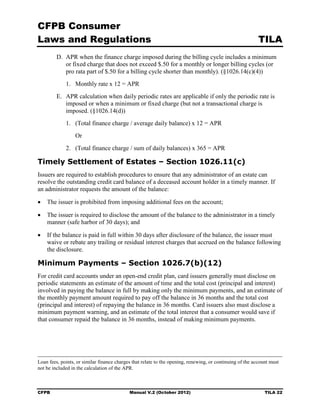
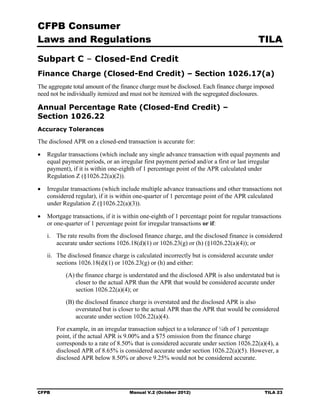
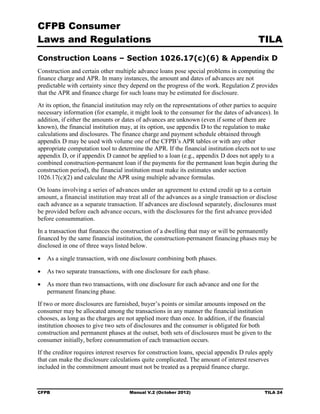
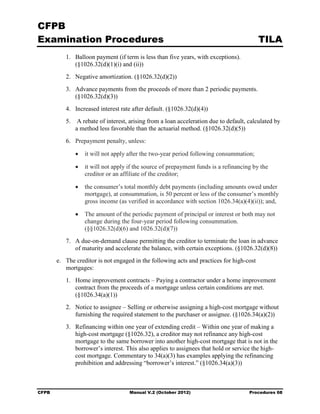
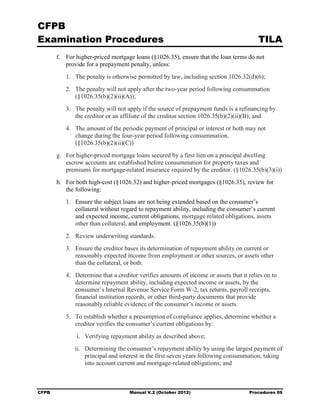
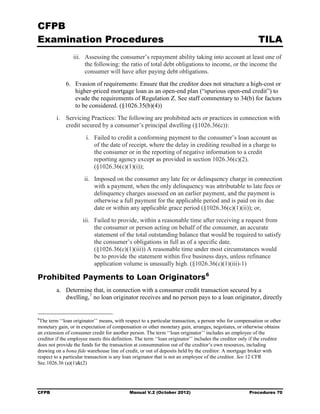
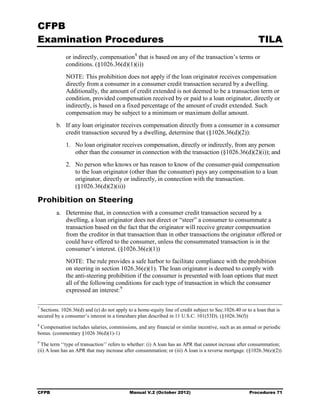
incorporates updated interagency examination procedures for the Truth in Lending Act (TILA)
and for the Fair Credit Reporting Act (FCRA), both of which were revised to reflect statutory
and regulatory changes. Specifically, changes to the TILA procedures include amendments to
TILA and its implementing Regulation Z pursuant to the Credit Card Accountability
Responsibility and Disclosure Act of 2009. Changes to the FCRA procedures include Dodd-
Frank Act amendments that require the disclosure of a credit score and related information when
a credit score is used in taking an adverse action or in risk-based pricing.

Finally, we updated the manual to incorporate:
   •	 new examination procedures released since the issuance of the manual in October 2011
        (covering mortgage origination; short-term, small-dollar lending; SAFE Act; and
        consumer reporting);
   •	 the June 21, 2012, Interagency Guidance on Mortgage Servicing Practices Concerning
        Military Homeowners with Permanent Change of Station Orders; and
   •	 technical corrections and formatting changes.

The CFPB welcomes feedback and suggestions from industry representatives and participants,
consumer groups, and members of the public. Comments may be sent to
CFPB_Supervision@CFPB.gov.
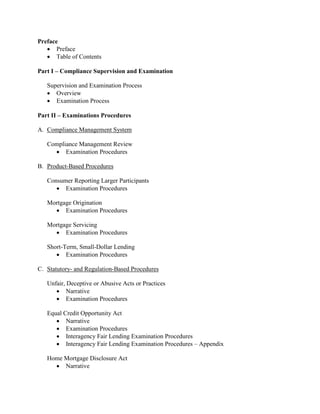
Preface
   • Preface
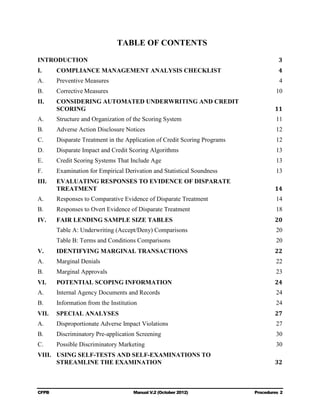
   • Table of Contents

Part I – Compliance Supervision and Examination

   Supervision and Examination Process
   • Overview
   • Examination Process

Part II – Examinations Procedures

A. Compliance Management System

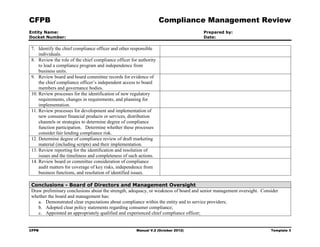
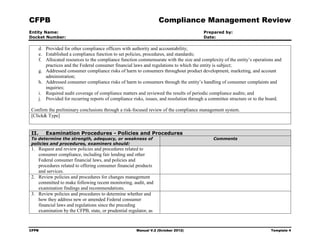
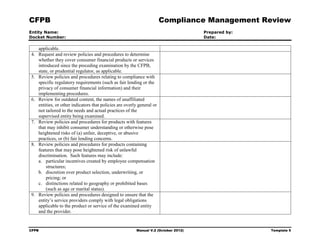
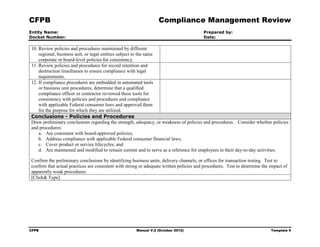
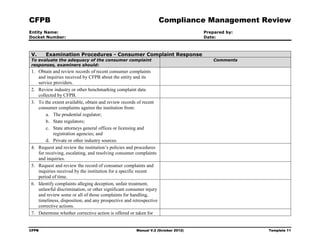
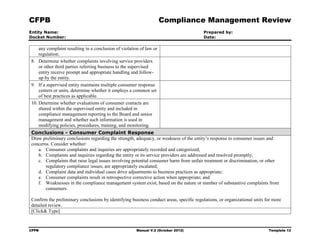
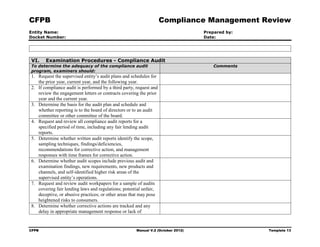
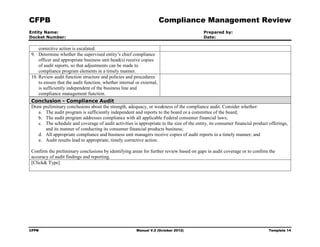
   Compliance Management Review
     • Examination Procedures

B. Product-Based Procedures

   Consumer Reporting Larger Participants
      • Examination Procedures

   Mortgage Origination
     • Examination Procedures

   Mortgage Servicing
     • Examination Procedures

   Short-Term, Small-Dollar Lending
      • Examination Procedures

C. Statutory- and Regulation-Based Procedures

   Unfair, Deceptive or Abusive Acts or Practices
      • Narrative
      • Examination Procedures

   Equal Credit Opportunity Act
      • Narrative
      • Examination Procedures
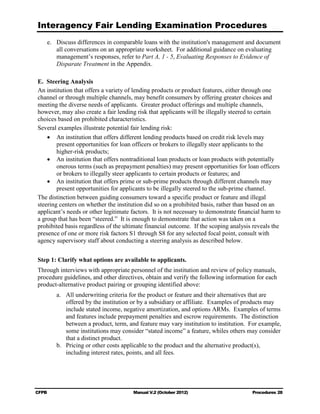
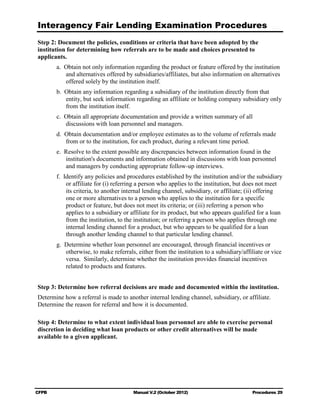
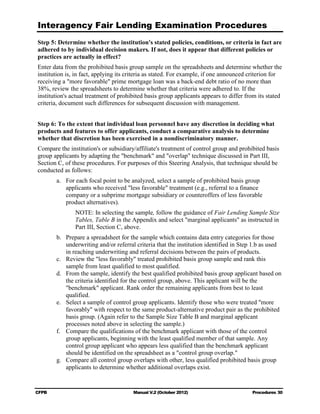
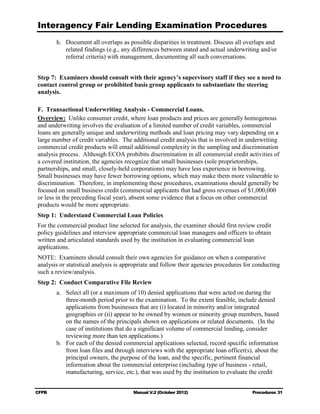
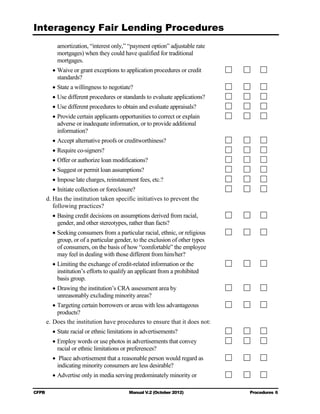
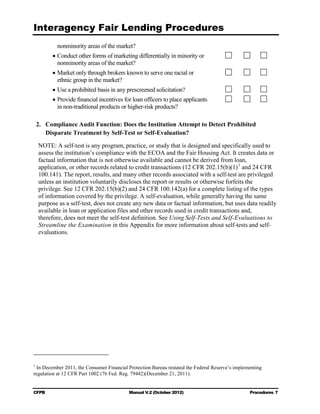
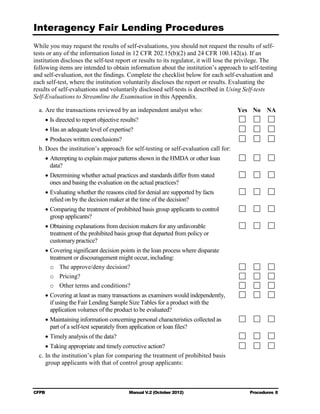
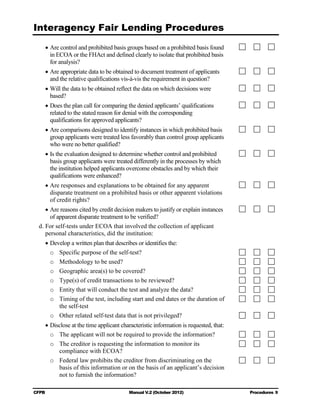
      • Interagency Fair Lending Examination Procedures
      • Interagency Fair Lending Examination Procedures – Appendix

   Home Mortgage Disclosure Act
     • Narrative
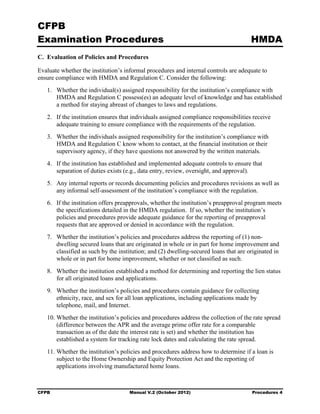
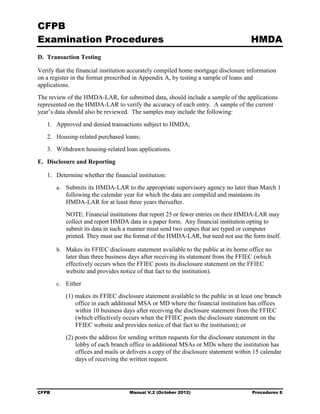
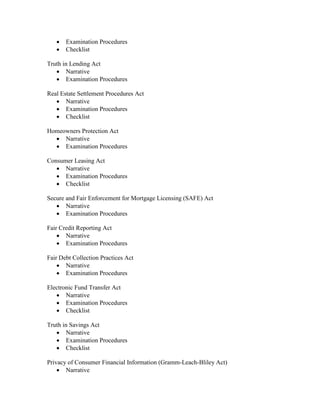
•   Examination Procedures
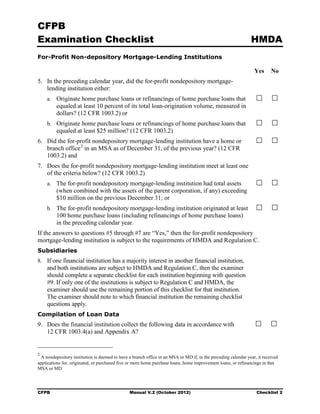
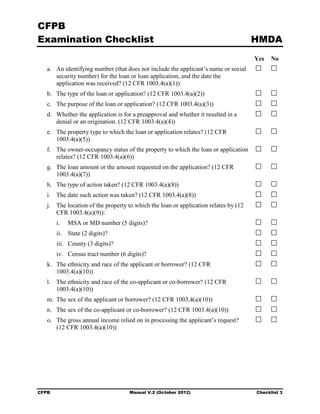
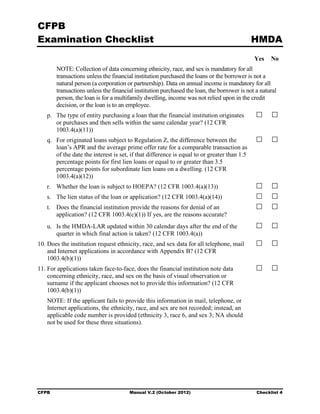
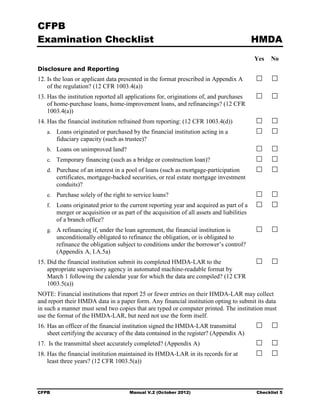
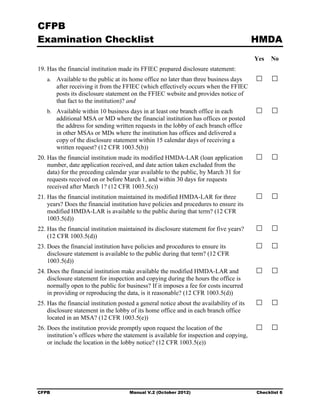
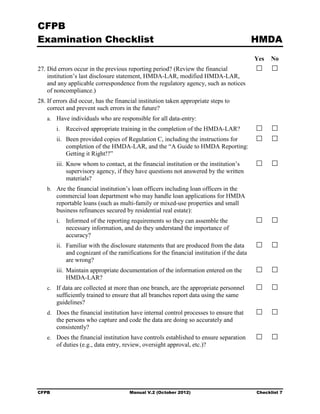
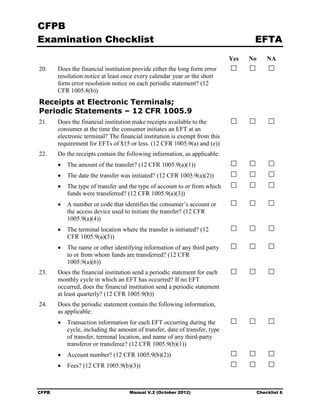
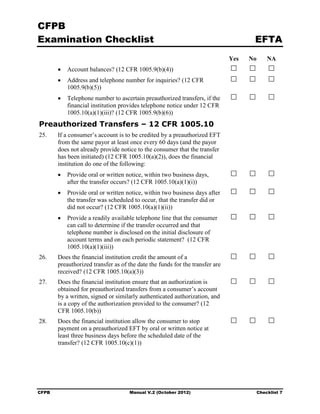
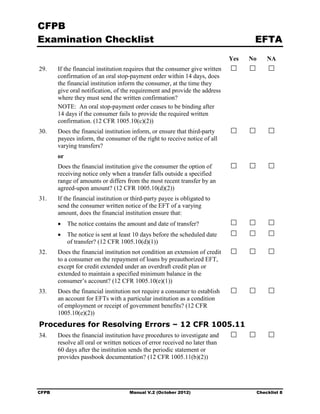
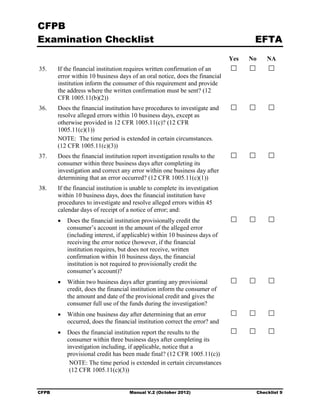
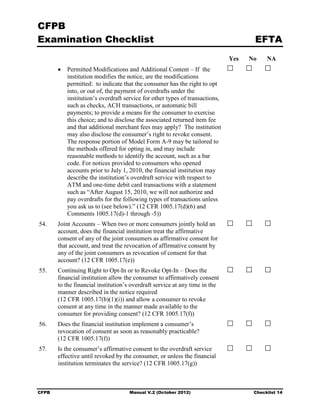
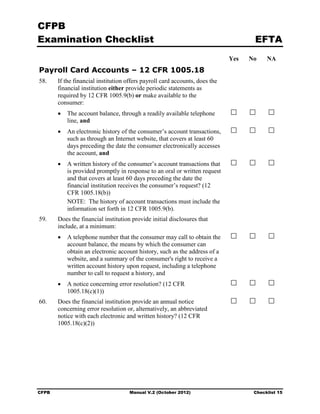
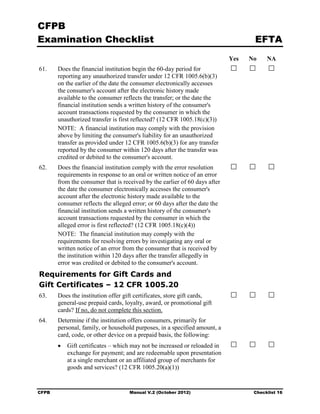
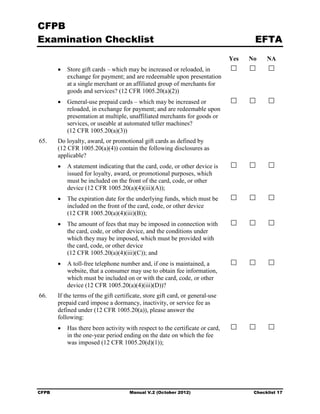
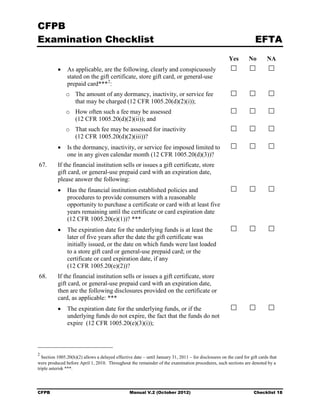
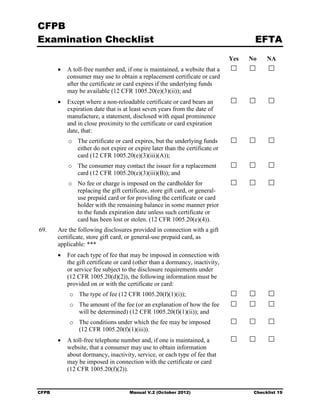
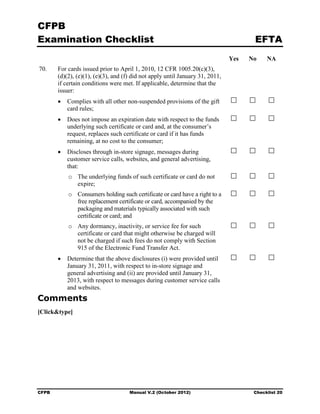
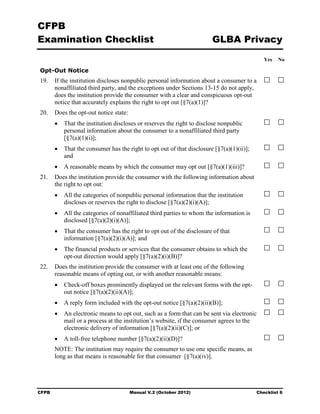
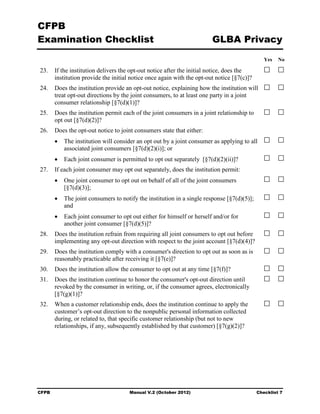
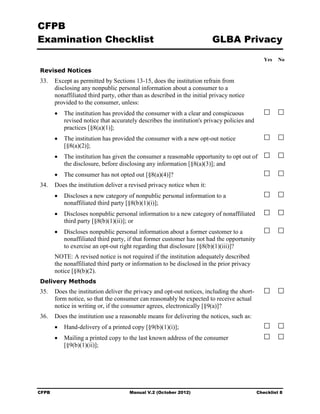
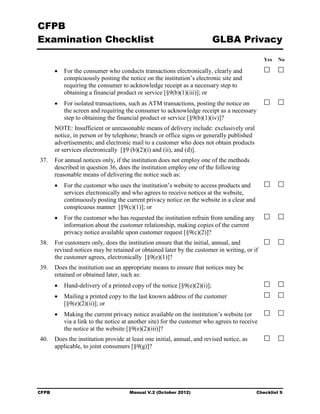
   •   Checklist

Truth in Lending Act
   • Narrative
   • Examination Procedures

Real Estate Settlement Procedures Act
   • Narrative
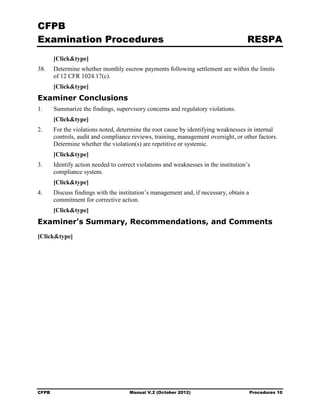
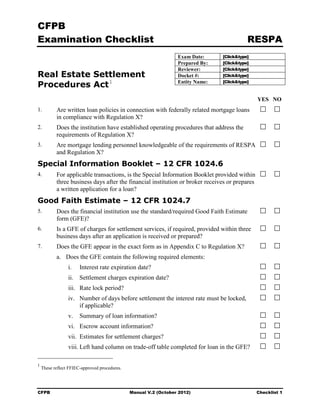
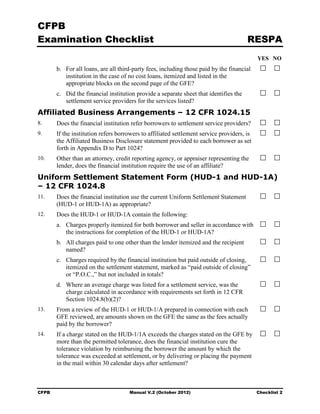
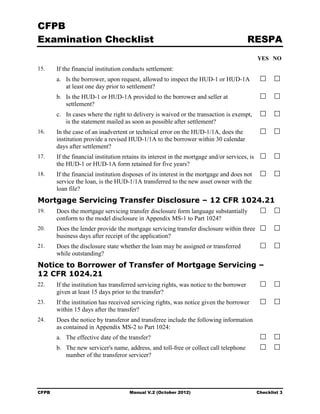
   • Examination Procedures
   • Checklist

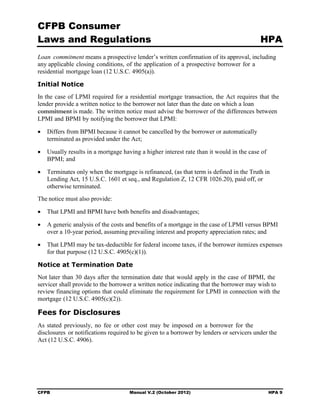
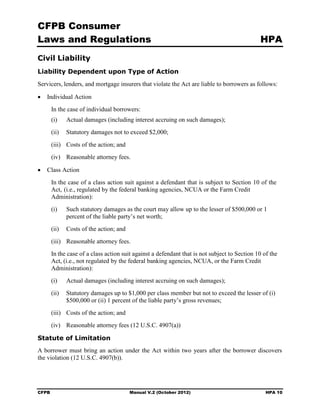
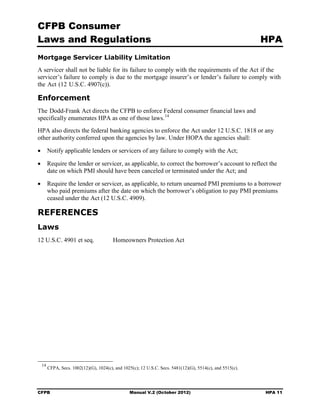
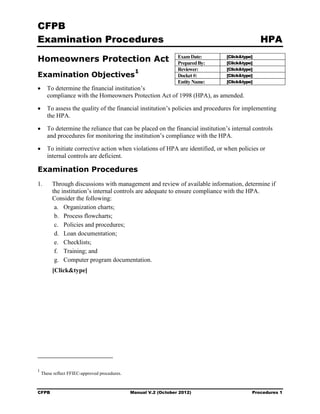
Homeowners Protection Act
  • Narrative
  • Examination Procedures

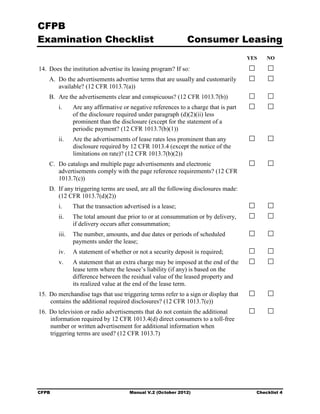
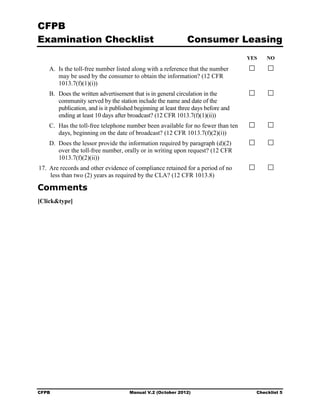
Consumer Leasing Act
   • Narrative
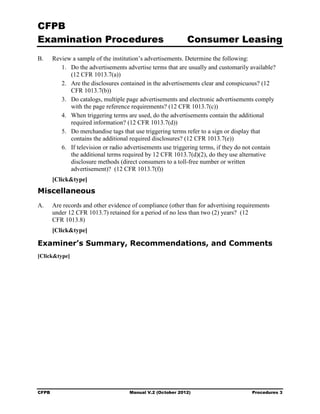
   • Examination Procedures
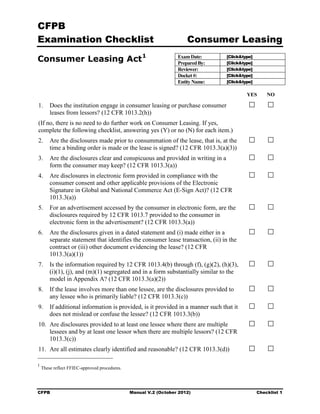
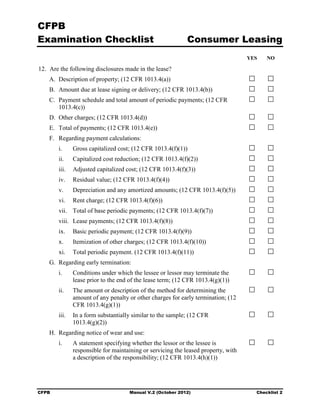
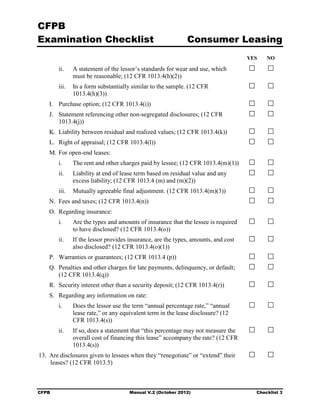
   • Checklist

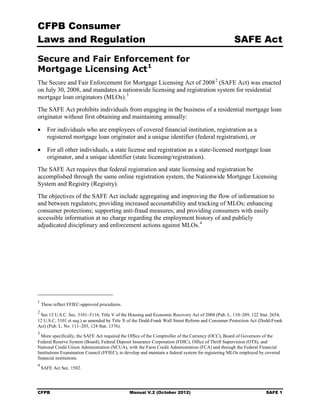
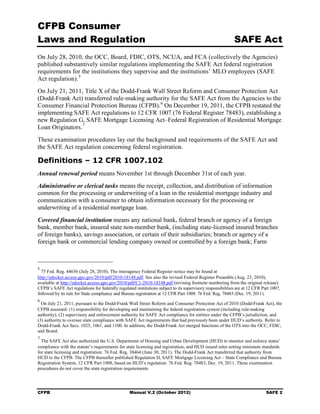
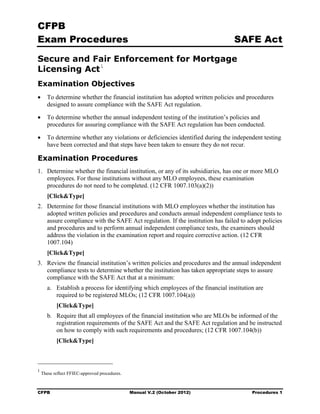
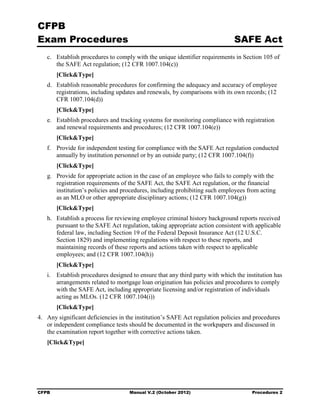
Secure and Fair Enforcement for Mortgage Licensing (SAFE) Act
   • Narrative
   • Examination Procedures

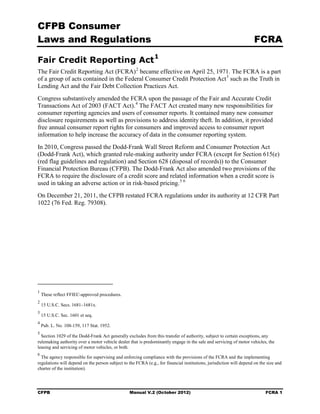
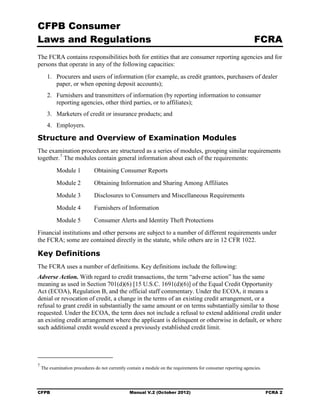
Fair Credit Reporting Act
    • Narrative
    • Examination Procedures

Fair Debt Collection Practices Act
    • Narrative
    • Examination Procedures

Electronic Fund Transfer Act
   • Narrative
   • Examination Procedures
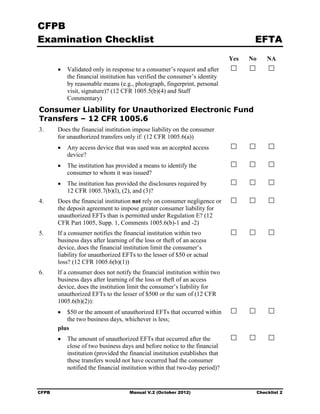
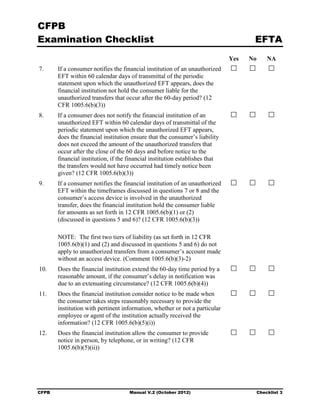
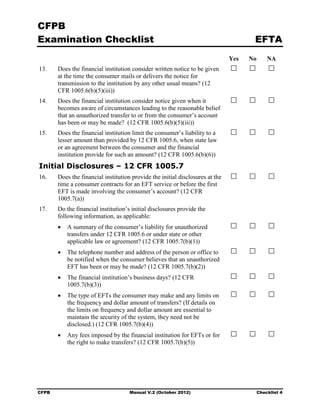
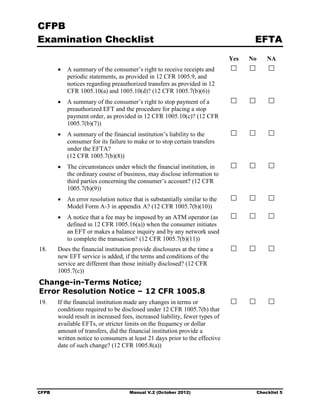
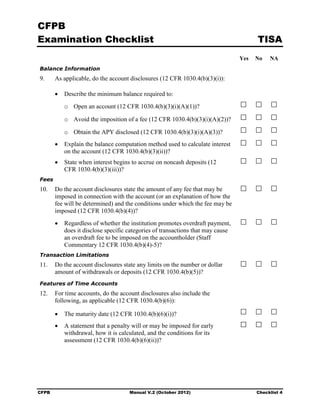
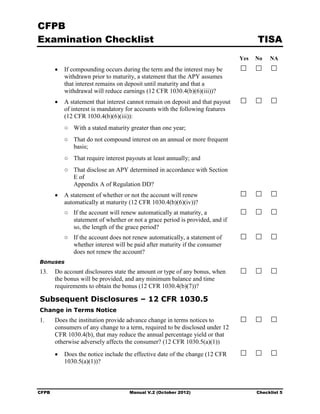
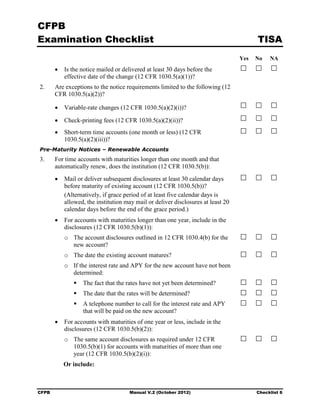
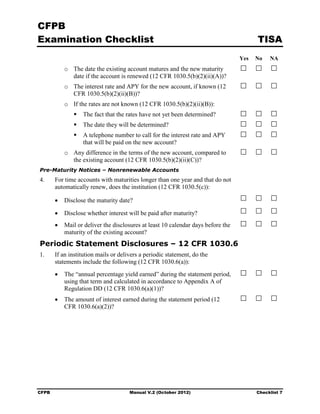
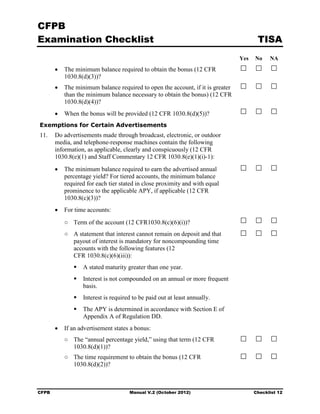
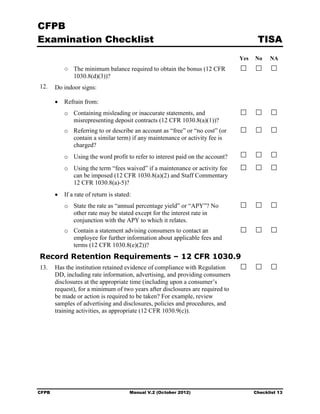
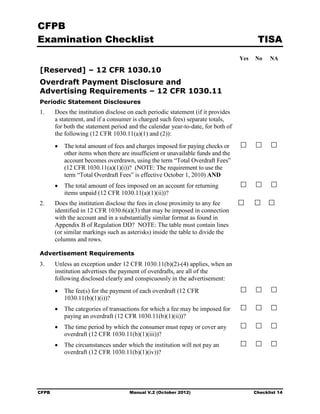
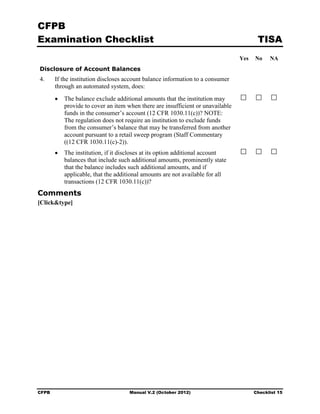
   • Checklist

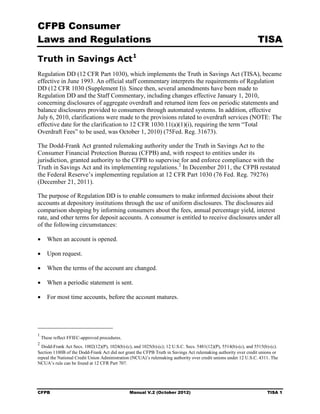
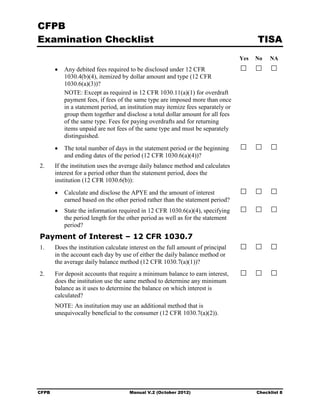
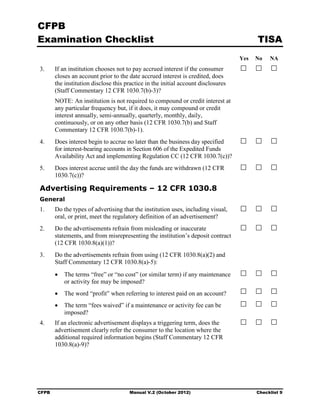
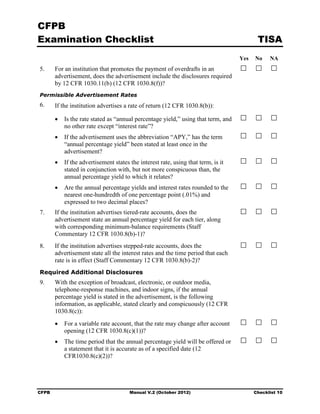
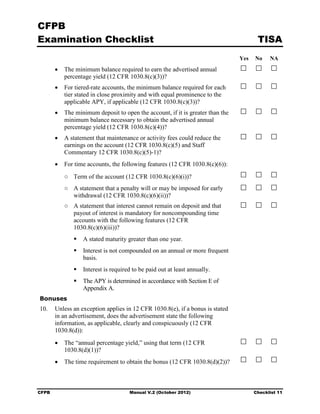
Truth in Savings Act
   • Narrative
   • Examination Procedures
   • Checklist

Privacy of Consumer Financial Information (Gramm-Leach-Bliley Act)
    • Narrative
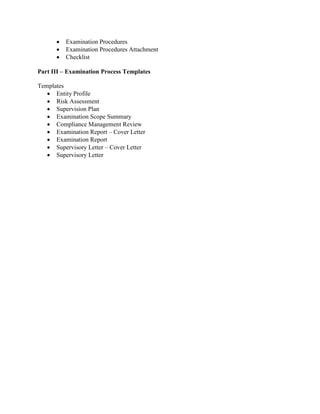
•   Examination Procedures
      •   Examination Procedures Attachment
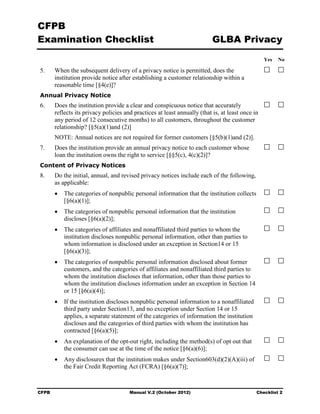
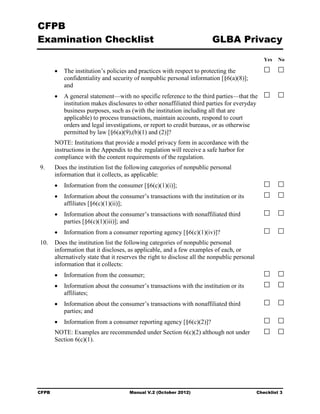
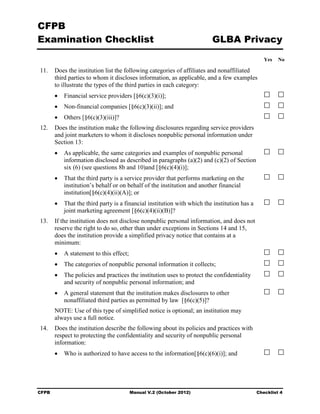
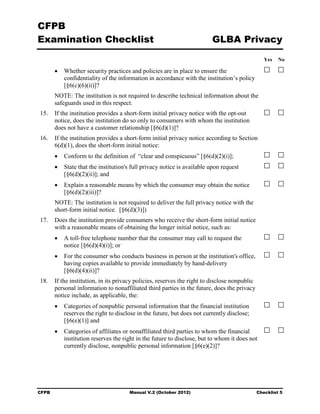
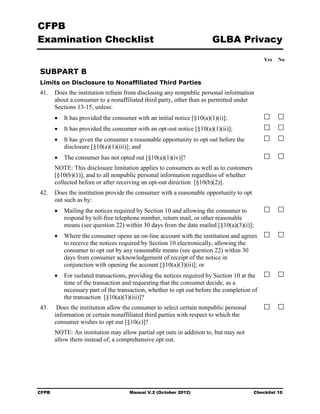
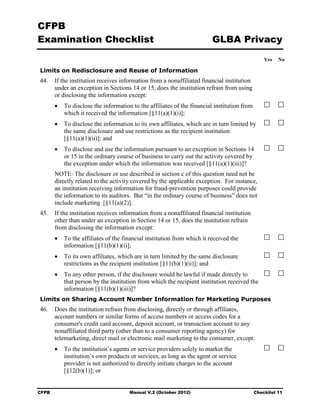
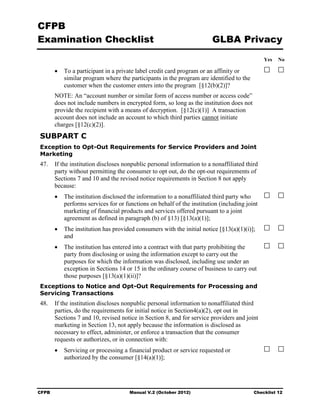
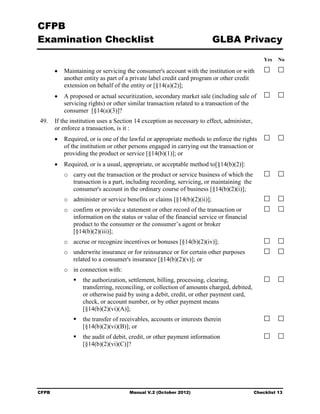
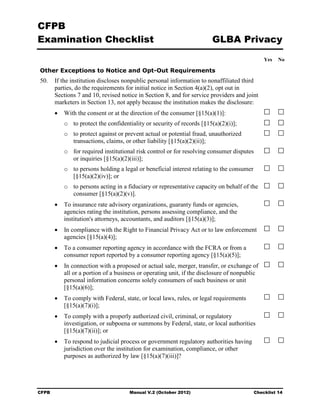
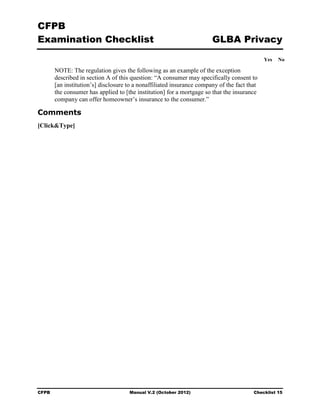
      •   Checklist

Part III – Examination Process Templates

Templates
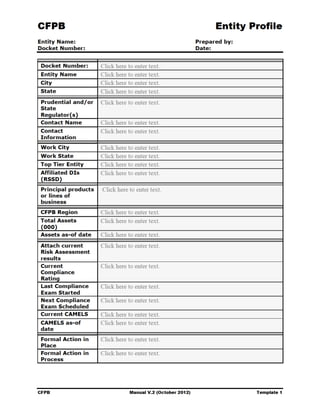
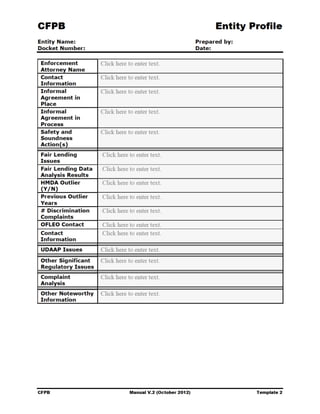
   • Entity Profile
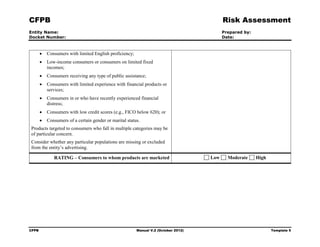
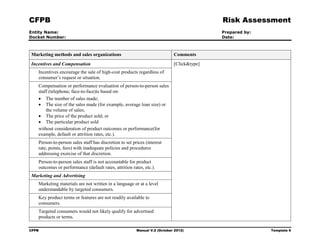
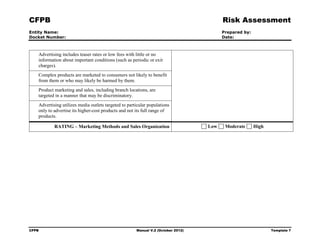
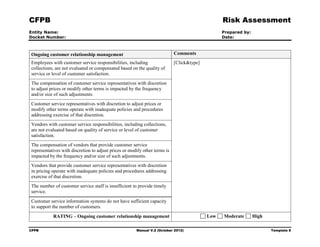
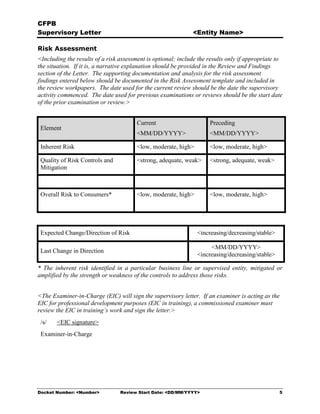
   • Risk Assessment
   • Supervision Plan
   • Examination Scope Summary
   • Compliance Management Review
   • Examination Report – Cover Letter
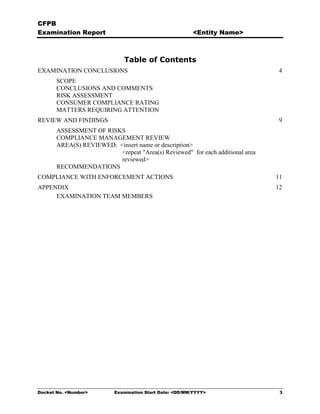
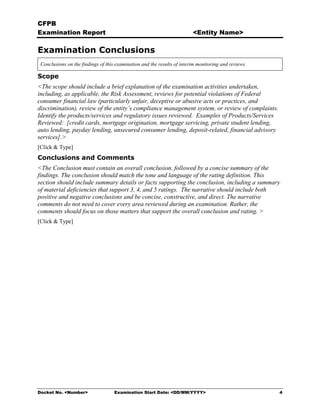
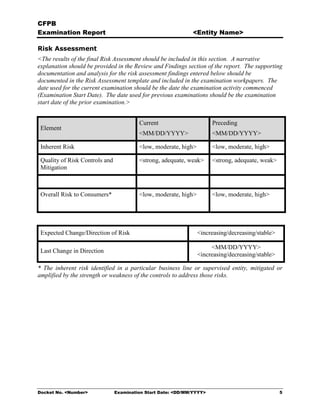
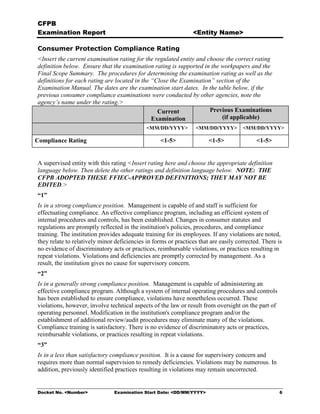
   • Examination Report
   • Supervisory Letter – Cover Letter
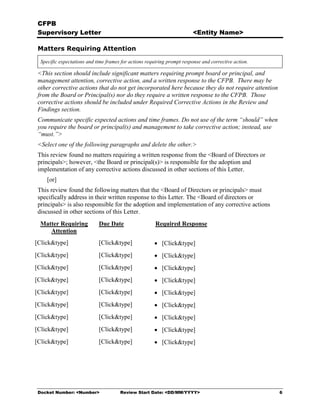
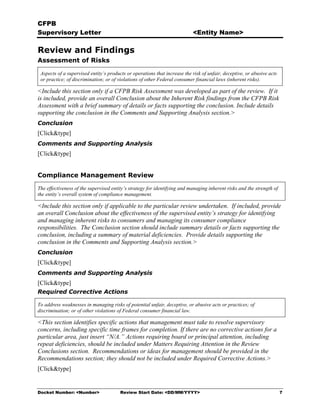
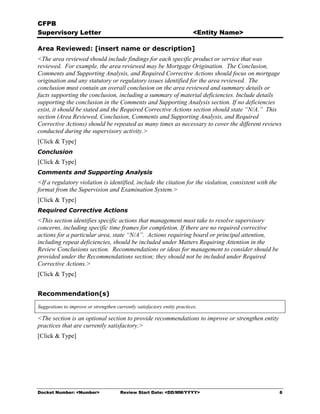
   • Supervisory Letter
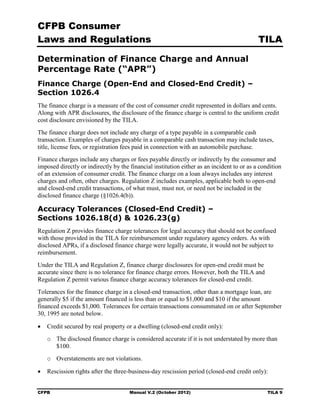
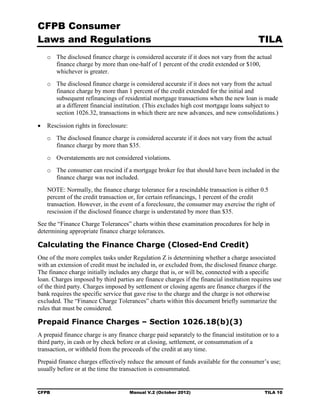
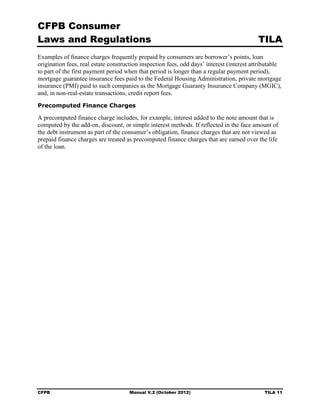
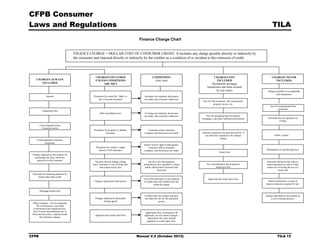
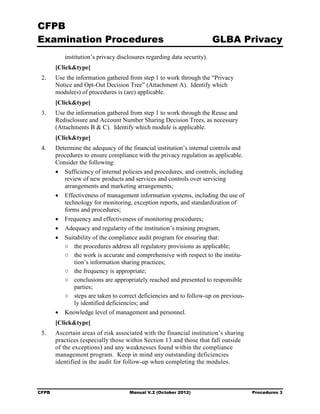
CFPB Supervision
and Examination Process                                                                                      Overview

Background
Title X of the Dodd-Frank Wall Street Reform and Consumer Protection Act of 2010 (the Act) 1
established the Consumer Financial Protection Bureau (CFPB) and authorizes it to supervise
certain consumer financial services companies and large depository institutions and their affiliates
for consumer protection purposes. 2 The Bureau’s purpose is set forth by Section 1021 of the Act:
            (a) PURPOSE.—The Bureau shall seek to implement and, where applicable, enforce
            Federal consumer financial law consistently for the purpose of ensuring that all
            consumers have access to markets for consumer financial products and services and
            that markets for consumer financial products and services are fair, transparent, and
            competitive. 3
Federal consumer financial law
Subject to the provisions of the Act, the CFPB has responsibility to implement, examine for
compliance with, and enforce “Federal consumer financial law.” 4 Those laws include, among
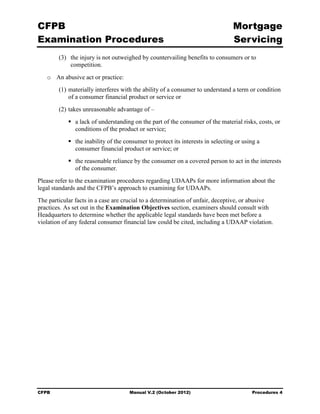
other things, Title X itself, which prohibits unfair, deceptive, or abusive acts and practices in
connection with consumer financial products and services, 5 and the following “enumerated
consumer laws” 6 and the implementing regulations. 7


1
    The Act can be found here: http://www.gpo.gov/fdsys/pkg/PLAW-111publ203/pdf/PLAW-111publ203.pdf.
2
  Sec. 1024 of the Act authorizes CFPB to supervise certain entities and individuals that engage in offering or providing a consumer
financial product or service and their service providers that are not covered by Secs. 1025 or 1026 of the Act. Specifically, Sec.
1024 applies to those entities and individuals who offer or provide mortgage-related products or services and payday and private
student loans as well as larger participants of other consumer financial service or product markets as defined by a CFPB rule, among
others, plus their service providers. Sec. 1025 authorizes CFPB to supervise those entities that are large insured depository
institutions and credit unions with more than $10 billion in total assets and all their affiliates (including subsidiaries), as well as
service providers for such entities. Sec. 1026 provides the prudential regulators with consumer compliance examination authority for
smaller depository institutions ($10 billion or less in total assets) not covered by Sec. 1025. The Bureau may, under Sec. 1026,
include its examiners on a sampling basis at examinations of smaller insured depository institutions to assess compliance with the
requirements of Federal consumer financial law. Under Sec. 1026, the Bureau has supervisory authority over a service provider to a
substantial number of smaller depository institutions. “Insured depository institutions” include banks and savings associations. Under
Sec. 1029, the Bureau may not exercise any authority over certain dealers predominantly engaged in the servicing and sale or leasing
of motor vehicles. For ease of reference for purposes of this manual, entities and individuals within the scope of Sec. 1024 are
referred to as “non-depository consumer financial service companies,” and those within the scope of Sec. 1025 are referred to as
“large depository institutions and their affiliates.” The following are referred to as “supervised entities”: (1) non-depository
consumer financial service companies and their service providers; (2) large insured depository institutions, large insured credit
unions, and their affiliates, as well as service providers to these entities; and (3) service providers to a substantial number of small
insured depository institutions or small insured credit unions.
3
    Emphasis added. See also Sec. 1021(b)(4).
4
    See Sec. 1002(14) for the definition of “Federal consumer financial law.”
5
    See Sec. 1036; see also 1031.
6
    See Sec. 1002(12). Parts of Title XIV of the Act are also designated as enumerated consumer laws. See Sec. 1400(b).
7
    See Sec. 1002(12).


CFPB                                               Manual V.2 (October 2012)                                              Overview 1
CFPB Supervision
and Examination Process                                                      Overview
•	 Alternative Mortgage Transaction Parity Act of 1982 (12 U.S.C. 3801 et seq.);

•	 Consumer Leasing Act of 1976 (15 U.S.C. 1667 et seq.);

•	 Electronic Fund Transfer Act (15 U.S.C. 1693 et seq.), except with respect to Section 920 of
   that Act;

•	 Equal Credit Opportunity Act (15 U.S.C. 1691et seq.);

•	 Fair Credit Billing Act (15 U.S.C. 1666 et seq.);

•	 Fair Credit Reporting Act (15 U.S.C. 1681et seq.), except with respect to Sections 615(e) and
   628 of that Act (15 U.S.C. 1681m(e), 1681w);

•	 Home Owners Protection Act of 1998 (12 U.S.C. 4901 et seq.);

•	 Fair Debt Collection Practices Act (15 U.S.C. 1692 et seq.);

•	 Subsections (b) through (f) of Section 43 of the Federal Deposit Insurance Act (12 U.S.C.
   1831t(b)–(f));

•	 Sections 502 through 509 of the Gramm-Leach-Bliley Act of 2009 [Privacy of Consumer
   Financial Information](15 U.S.C. 6802–6809) except for Section 505 as it applies to Section
   501(b);

•	 Home Mortgage Disclosure Act of 1975 (12 U.S.C. 2801 et seq.);

•	 Home Ownership and Equity Protection Act of 1994 (15 U.S.C. 1601 note);

•	 Real Estate Settlement Procedures Act of 1974 (12 U.S.C. 2601 et seq.);

•	 S.A.F.E. Mortgage Licensing Act of 2008 (12 U.S.C. 5101 et seq.);

•	 Truth in Lending Act (15 U.S.C. 1601 et seq.);

•	 Truth in Savings Act (12 U.S.C. 4301 et seq.);

•	 Section 626 of the Omnibus Appropriations Act of 2009, Public Law 111–8; and

•	 Interstate Land Sales Full Disclosure Act (15 U.S.C. 1701).


CFPB	                               Manual V.2 (October 2012)                         Overview 2
CFPB Supervision
and Examination Process                                                                                  Overview
In addition, the CFPB may enforce the following rules issued by the Federal Trade Commission:
•	 Telemarketing Sales Rule (16 CFR Part 310); 8

•	 Use of Prenotification Negative Option Plans (16 CFR Part 425);

•	 Rule Concerning Cooling-Off Period for Sales Made at Homes or at Certain Other Locations
   (16 CFR Part 429);

•	 Preservation of Consumers’ Claims and Defenses (16 CFR Part 433);

•	 Credit Practices (16 CFR Part 444);

•	 Mail or Telephone Order Merchandise (16 CFR Part 435);

•	 Disclosure Requirements and Prohibitions Concerning Franchising (16 CFR Part 436);

•	 Disclosure Requirements and Prohibitions Concerning Business Opportunities (16 CFR Part
   437).
Supervision and examination
The statutory frameworks for supervision of large depository institutions and their affiliates and
for non-depository consumer financial service companies are largely the same, 9 although the
supervision authority for each is found in separate sections of the Act. The frameworks include:
•	 The purpose of supervision, including examination, to:
      o assess compliance with Federal consumer financial laws, 

      o obtain information about activities and compliance systems or procedures, and 

      o	 detect and assess risks to consumers and to markets for consumer financial products and
         services;

•	 The requirement to coordinate with other Federal and state regulators; and

•	 The requirement to use where possible publicly available information and existing reports to
   Federal or state regulators pertaining to supervised entities.


8
    The CFPB may enforce the Telemarketing and Consumer Fraud and Abuse Prevention Act.
9
 Most of the differences in the grants of supervision and examination authority will not be relevant for examiners in their daily
work; supervised entities will be examined consistent with the applicable statutory provision.


CFPB	                                            Manual V.2 (October 2012)                                           Overview 3
CFPB Supervision
and Examination Process                                                                           Overview
Supervision and Examination Principles
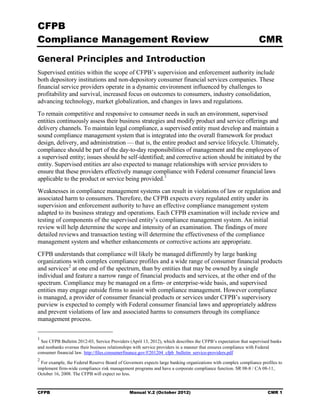
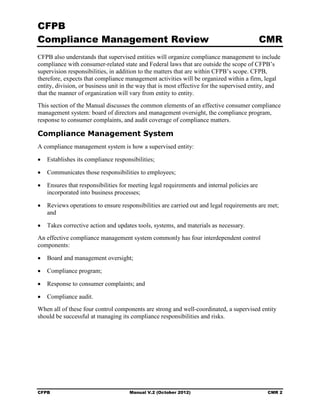
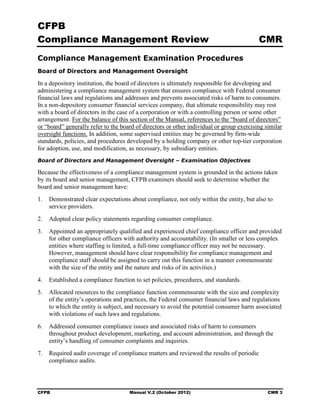
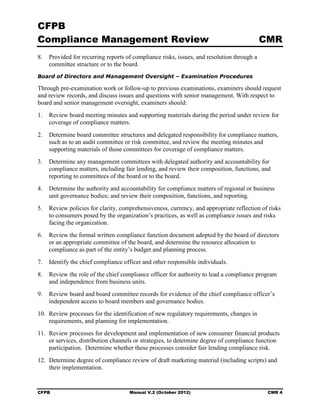
Three main principles guide the CFPB supervision process.
Focus on consumers
The CFPB will focus on risks to consumers when it evaluates the policies and practices of a
financial institution. We expect that institutions will offer consumer financial products and
services in accordance with Federal consumer financial laws and will maintain effective systems
and controls to manage their compliance responsibilities. As we conduct our reviews, we will
focus on an institution’s ability to detect, prevent, and correct practices that present a significant
risk of violating the law and causing consumer harm. 10
Data Driven
Like all CFPB activities, the supervision function rests firmly on analysis of available data about
the activities of entities it supervises, the markets in which they operate, and risks to consumers
posed by activities in these markets. Supervision staff (examiners and analysts) will use data
from a wide range of sources: data obtained from the entity and through direct observation
during monitoring and examination; information provided by the CFPB’s Research, Markets and
Regulations and Consumer Education and Engagement divisions, the Office of Fair Lending and
Equal Opportunity, the Enforcement division, Consumer Response Center, and Offices
addressing the special needs of students, Older Americans, Service members, and the
underserved; and other state and Federal regulatory agencies.
Consistency
The CFPB will supervise both depository institutions that offer a wide variety of consumer
financial products and services and non-depository consumer financial services companies that
offer one or more such products. In order to fulfill its statutory mandate to consistently enforce
Federal consumer financial law, the CFPB will apply consistent standards in its supervision of
both types of entities, to the extent possible. To help accomplish this, the CFPB will use the same
procedures to examine all supervised entities that offer the same types of consumer financial
products or services, or conduct similar activities.
Such consistency, however, does not dictate uniformity in supervisory expectations. While all of
the firms under our jurisdiction must follow the law, we understand that the means that they
employ to achieve that goal will – and likely should – differ. We recognize that large, complex
entities necessarily have different compliance oversight and management systems than smaller
entities or those offering a more limited number of products or services.


10
  The discussion of the Risk Assessment under Pre-examination Planning in this Manual describes more fully what the CFPB
means by risks or potential risks of consumer harm.


CFPB                                          Manual V.2 (October 2012)                                       Overview 4
CFPB Supervision
and Examination Process                                                                               Overview
Examination Scheduling
Non-depository consumer financial services companies will be identified for examination on the
basis of risks to consumers, including consideration of the company’s asset size, volume of
consumer financial transactions, extent of state oversight, and other factors determined relevant
by CFPB. Examinations will be coordinated with State and prudential regulators as applicable. 11
Regular examination schedules for large depository institutions and affiliates will depend on two
considerations: (1) an assessment of risks to consumers and (2) ensuring consistency with statutory
requirements that CFPB and prudential regulators coordinate the scheduling of examinations of
large depository institutions and affiliates and conduct “simultaneous” examinations of depository
institutions, as well as coordinating examinations with State regulators. 12
Supervised entities will generally be notified in advance of an upcoming examination.

General Description of Examinations
Examiners will coordinate throughout the supervision and examination process with Supervision
managers, and analysts, experts, and attorneys from Supervision, Research, Markets and
Regulations, the Office of General Counsel, and other CFPB divisions at Headquarters.
Supervision will work especially closely with the Office of Fair Lending and Equal Opportunity
(OFLEO) and the Enforcement division when reviewing fair lending compliance and evaluating
other potential violations of Federal consumer financial laws. In this Manual the coordination
process will generally be referred to as “consulting internally.” Alternatively, “Headquarters” will
be used to signify the involvement of multiple divisions or offices in addition to Supervision.
Specific examination procedures will be similar to those of the prudential and, in some instances,
State regulators. 13As appropriate and in accordance with CFPB policy, examiners and
Supervision managers will generally do the following in the course of an examination:

•	 Collect and review available information (from within the CFPB, from other Federal and
   state agencies, and from public sources), consistent with statutory requirements;

•	 Request and review supplementary documents and information from the entity to be
   examined;

•	 Develop and obtain internal approval for a preliminary risk focus and scope for the onsite
   portion of the examination;

•	 Go onsite to observe, conduct interviews, and review additional documents and information;

11
     See Sec. 1024(b)(3).
12
     See Sec. 1025(e).
13
  Prudential regulators refer to the Board of Governors of the Federal Reserve System, Federal Deposit Insurance Corporation,
National Credit Union Association, and Office of the Comptroller of the Currency.


CFPB	                                          Manual V.2 (October 2012)                                         Overview 5
CFPB Supervision
and Examination Process                                                          Overview
•	 Consult internally if the examination indicates potential unfair, deceptive, or abusive acts or
   practices; discrimination; or other violations of law;

•	 Draw preliminary conclusions about the regulated entity’s compliance management and its
   statutory and regulatory compliance;

•	 Consult internally about follow-up corrective actions that the institution should take, whether
   through informal agreement or a formal enforcement action, if warranted by findings;

•	 Draft the examination report;

•	 Obtain appropriate internal review and approval for the examination work and draft
   examination report;

•	 Share the draft report with the prudential regulator and obtain and consider any comments
   they may offer, consistent with statutory requirements; and

•	 After final internal clearance, finalize and transmit the report to the supervised entity.
During the examination, the Examiner in Charge will communicate with appropriate supervised
entity personnel about preliminary findings and conclusions. CFPB will seek cooperation from
the entity to correct any problems identified.
The CFPB considers all supervisory information, including examination reports and
ratings, highly confidential. Requirements for the handling of supervisory information not
only by CFPB employees, but also by supervised institutions are described in its regulation
on the Disclosure of Records and Information. 14
Detailed examination procedures are located in Part II of this Manual.

Examination Follow-up
How the CFPB addresses negative examination findings will depend, among other things, on the
individual facts and circumstances at issue. Whether informal supervisory measures or formal
enforcement action is necessary will depend on the type of problem(s) found and the severity of
harm to consumers. Self-correction will be encouraged, but some circumstances may
nevertheless be sufficiently serious to warrant a public enforcement action. With respect to large
depository institutions and their affiliates, CFPB will share draft examination reports and consult
with prudential regulators regarding supervisory action, consistent with statutory requirements. 15


14
     12 CFR Part 1070 (76 FR 45372) (July 28, 2011)).
15
     See Sec.1025(e).


CFPB	                                           Manual V.2 (October 2012)                  Overview 6
CFPB Supervision
and Examination Process                                                           Overview
Target and Horizontal Reviews
In addition to regularly scheduled examinations, CFPB expects to conduct Target and Horizontal
Reviews. Target Reviews will generally involve a single entity and will focus on a particular
situation such as significant volume of particular customer complaints or a specific concern that
has come to CFPB’s attention. Horizontal Reviews will look across multiple entities to examine
issues arising from particular products or practices and determine whether supervisory measures
or enforcement actions are needed.

Enforcement Authority
CFPB is authorized to conduct investigations to determine whether any person is, or has,
engaged in conduct that violates Federal consumer financial law. 16 Investigations may be
conducted jointly with other regulators, 17 and may include subpoenas or civil investigative
demands for testimony, responses to written questions, documents, or other materials. 18
CFPB may bring administrative enforcement proceedings 19 or civil actions in Federal district
court. 20 The Bureau can obtain “any appropriate legal or equitable relief with respect to a
violation of Federal consumer financial law,” including, but not limited to:

•      Rescission or reformation of contracts.

•      Refund of money or return of real property.

•      Restitution.

•      Disgorgement or compensation for unjust enrichment.

•      Payment of damages or other monetary relief.

•      Public notification regarding the violation.

•      Limits on the activities or functions of the person against whom the action is brought.

•      Civil monetary penalties (which can go either to victims or to financial education).
CFPB has no criminal enforcement authority.


16
     Sec. 1051
17
     Sec. 1052(a)
18
     Sec. 1052(b) and (c)
19
     Sec. 1053
20
     Sec. 1054


CFPB                                    Manual V.2 (October 2012)                             Overview 7
CFPB Supervision
and Examination Process                                                           Overview
Referral of Matters or Information to Other Agencies
Criminal Activity
In the course of their work, examiners may obtain evidence that a regulated entity or a customer
has engaged in conduct that may constitute a violation of Federal criminal law. The CFPB is
required by the Act 21 to refer such findings to the Department of Justice (DOJ) for further review
and action. Examiners who, during the course of conducting their examination duties, believe
they have found evidence of criminal conduct should consult internally to discuss their findings
and the appropriate next steps. Headquarters will handle referral of appropriate matters to DOJ.
Some examples of fact scenarios that may necessitate a referral to the DOJ include, but are not
limited to, the following:
•	 Based on documented information that the examiner has obtained, a regulated entity’s
    financial records are comprised of data that appear to be false.

•	 A regulated entity’s records or files show that it has direct business relationships with
   individuals or businesses based in a country that is the target of one or more types of United
   States government sanctions. (See sanctioned country lists at www.treasury.gov and
   www.state.gov.)

•	 A loan file or other type of file or record concerning a customer of a regulated entity contains
   one or more of the following documents that may indicate that the customer has engaged in
   potentially criminal conduct:
       o	 Bank statements that show that the customer has one or more bank accounts in a country
          that is a target of United States government sanctions. (See sanctioned country lists at
          www.treasury.gov and www.state.gov.)
       o	 Based on documented information in a loan file, (1) a loan application appears to contain
          false information, (2) an appraisal for real property appears to contain false information,
          or (3) a document used to verify loan eligibility appears to contain false information.
          (Documents used to verify loan eligibility include but are not limited to bank statements,
          Forms 1099, Forms W-2, and/or federal income tax returns.)

Tax Law Non-Compliance
The CFPB is also required under the Act to refer information identifying possible tax law non-
compliance to the Internal Revenue Service (IRS). 22 Examiners who, during the course of
conducting their examination duties, believe they have found evidence of tax law non-
compliance should consult internally about the appropriate next steps. Headquarters will handle
referral of matters to the IRS.

21
     See Sec. 1056
22
     See Secs. 1024(b)(6) and 1025(b)(5).


CFPB	                                       Manual V.2 (October 2012)                      Overview 8
CFPB Supervision
and Examination Process                                                             Overview
Some examples of fact scenarios that may necessitate a referral to the IRS include, but are not
limited to, the following:

•	 Based on documented information that the examiner has obtained, a regulated entity’s tax
   returns are comprised of data that appear false.

•	 A loan file or other type of file or record concerning a customer of a regulated entity contains
   one or more of the following documents that may indicate that the customer has failed to
   comply with the tax laws:
           o	 Documents used to verify loan eligibility that clearly document that the customer has
              substantially greater income than the income that the customer reported on Federal
              income tax returns. Documents used to verify loan eligibility include statements showing
              a customer’s investment portfolio, bank statements, and/or Forms 1099.

ECOA/pattern or practice
The Equal Credit Opportunity Act (ECOA) requires the CFPB to refer matters to DOJ whenever
the CFPB “has reason to believe that one or more creditors has engaged in a pattern or practice
of discouraging or denying applications for credit in violation of Section 1691(a)” of ECOA,
which states ECOA’s basic prohibitions against discrimination. 23 In matters that do not involve a
pattern or practice of discouragement or denial, the CFPB may refer the matter to the DOJ
whenever the agency has reason to believe that one or more creditors has violated Section
1691(a). 24 Headquarters will handle referral of appropriate matters to DOJ.

Matters not within the CFPB’s authority
When examiners find information that may indicate violations of law that are not within the
CFPB’s authority, the information will be passed on to the appropriate prudential, other Federal,
or state regulator. These situations will generally be handled by the Examiner in Charge, after
consulting internally.


23
     15 U.S.C. § 1691e(g).
24
     Id.


CFPB	                                      Manual V.2 (October 2012)                        Overview 9
CFPB Supervision
and Examination Process                                                                Overview
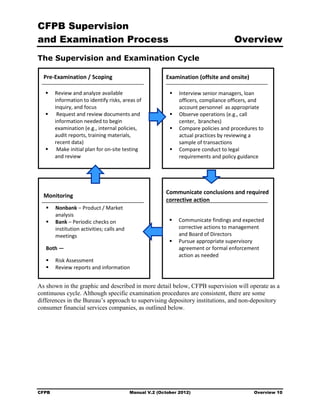
The Supervision and Examination Cycle


  Pre-Examination / Scoping                                Examination (offsite and onsite)

       Review and analyze available                            Interview senior managers, loan
        information to identify risks, areas of                  officers, compliance officers, and
        inquiry, and focus                                       account personnel as appropriate
        Request and review documents and                       Observe operations (e.g., call
        information needed to begin                              center, branches)
        examination (e.g., internal policies,                   Compare policies and procedures to
        audit reports, training materials,                       actual practices by reviewing a
        recent data)                                             sample of transactions
        Make initial plan for on-site testing                  Compare conduct to legal
        and review                                               requirements and policy guidance


                                                           Communicate conclusions and required
  Monitoring
                                                           corrective action
       Nonbank – Product / Market
        analysis
       Bank – Periodic checks on                               Communicate findings and expected
        institution activities; calls and
                       corrective actions to management
        meetings                                                 and Board of Directors

                                                                Pursue appropriate supervisory
   Both —	                                                       agreement or formal enforcement 

                                                                 action as needed

       Risk Assessment
       Review reports and information


As shown in the graphic and described in more detail below, CFPB supervision will operate as a
continuous cycle. Although specific examination procedures are consistent, there are some
differences in the Bureau’s approach to supervising depository institutions, and non-depository
consumer financial services companies, as outlined below.


CFPB	                                        Manual V.2 (October 2012)                         Overview 10
CFPB Supervision
and Examination Process                                                          Overview
Non-depository consumer financial services companies
The Nonbank Supervision Risk Analytics and Monitoring team (RAM) in Headquarters will
provide risk-based analysis of consumer financial markets and participants in the financial
marketplace to support the examination program. This team will acquire and analyze qualitative
and quantitative information and data pertaining to consumer financial product and service
markets to determine what industries and institutions pose the greatest risk to consumers. The
data will include external data, including, but not limited to, Home Mortgage Disclosure Act and
Home Affordable Modification Program data, institution and industry reports, state and Federal
reports of examination, and legal documents. It will also include CFPB-generated data, such as
complaints, reports of examination, and market and other reports. Using consumer risk indicators
for particular markets, RAM will provide a risk ranking of entities to program teams for use in
scheduling examinations. Once a particular examination is scheduled, the examination team will
follow the same general examination process used for all supervised entities, including
preparation of a Risk Assessment and an Examination Scope Summary. The Supervision Plan
template will generally not be used for non-depository consumer financial services companies.
These documents are described below and in Part II of this Manual.
Depository Institutions
Each large depository institution will be assigned a Lead Examiner who will, either individually
or with a team, monitor information about the entity and its affiliates. That information will be
collected in an Institution Profile and used as the basis for a Risk Assessment and a Supervision
Plan. The Lead Examiner may or may not be the Examiner in Charge of a particular examination
of the entity. The Institution Profile, Risk Assessment, and Supervision Plan will be updated as
appropriate with information gathered through regular monitoring as well as examinations.
Monitoring: The purpose of depository institution monitoring is to maintain reasonably current
information about the institution’s activities in order to determine whether changes in risks to
consumers or markets warrant a change in the CFPB Supervision Plan. Affiliated entities are
considered together. The frequency and depth of monitoring will vary depending on the
organization’s risk profile, but should be undertaken at least quarterly. As an initial matter, Lead
Examiners and their supervisors will agree on a monitoring schedule.


CFPB                                 Manual V.2 (October 2012)                           Overview 11
CFPB Supervision
and Examination Process                                                          Overview
Basic monitoring activities include:

•	 Reviewing supervisory and public information about the entity, such as:
   o	 Prudential and state regulator examination reports;
   o	 Community Reinvestment Act (CRA) performance evaluations;
   o	 Current enforcement actions;
   o	 Call report data;
   o	 Complaint data;
   o	 Home Mortgage Disclosure Act;
   o	 Home Affordable Modification Program Data;
   o	 SEC filings;
   o	 Licensing or registration information;
   o	 Reports from the entity to prudential or state regulators, if any;
   o	 CFPB research analyst reports; and
   o	 Institution website.
•	 Contacting the appropriate officer of the institution to discuss new products or services,
   events that may impact compliance management, and any questions raised by information
   reviewed by the Lead Examiner.

•	 Contacting the prudential regulator to discuss any recent events and any questions raised by
   supervisory or public information about the institution.

•	 Consulting internally.
After reviewing periodic monitoring information, the Lead Examiner should update the
Institution Profile, Risk Assessment, and Supervision Plan as appropriate.
Institution Profile: The Institution Profile contains summary information about a depository
institution and its affiliates and provides a quick reference guide. An Institution Profile template
is provided in Part III.
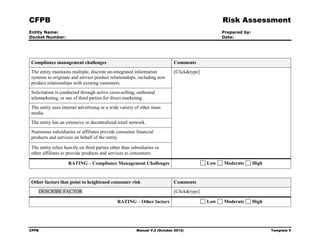
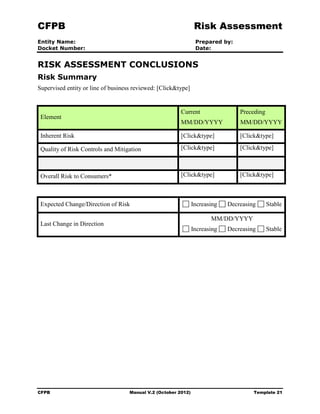
Risk Assessment: The Lead Examiner completes and periodically updates a Risk Assessment for
a large depository institution and its affiliates. The Risk Assessment may be the product of
multiple individual Risk Assessments of specific lines of business or companies. It provides the
basis for the Supervision Plan, which is the CFPB plan for supervising a depository institution
and its affiliates and for allocating supervision resources to the organization. The same risk
assessment process is also used to scope examinations, as discussed in Part II, where the process
is discussed in more detail. A Risk Assessment template is provided in Part III.


CFPB	                                  Manual V.2 (October 2012)                         Overview 12
CFPB Supervision
and Examination Process                                                         Overview
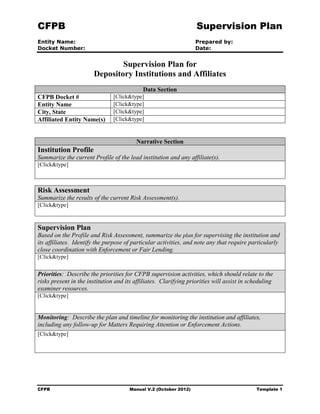
Supervision Plan: The Supervision Plan, which is based on the Institution Profile and Risk
Assessment, summarizes the plan for monitoring and examining the institution and its affiliates.
It describes the priorities for CFPB supervision activities to assist in allocating and scheduling
examiner resources. It describes the plan and timeline for monitoring the institution, including
any follow-up required for Matters Requiring Attention identified during examinations, other
supervisory measures, or enforcement actions. The minimum monitoring schedule is quarterly.
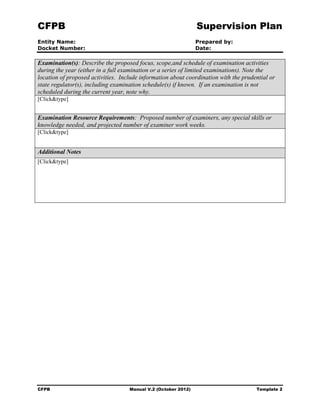
The Supervision Plan describes the proposed focus and scope of examination activities during
the year (either a full examination or a series of limited examinations); information about
scheduling coordination with the prudential and/or state regulators; and the proposed number of
examiners, deployment schedule, and any special skills or knowledge needed.
The Plan should be updated at least annually and may be updated at any time as a result of
changes in the Risk Assessment. A Supervision Plan template is provided in Part III.


CFPB                                 Manual V.2 (October 2012)                          Overview 13
CFPB Supervision
and Examination Process                                                      Examinations

Pre-Examination Planning
The goal of a risk-focused examination is to direct resources toward areas with higher degrees of
risk. CFPB examinations focus on risks of harm to consumers, including the risk a supervised
entity will not comply with Federal consumer financial law. The overall objective of pre-
examination planning is to collect information necessary to determine the examination’s scope,
resource needs, and work plan. This information allows the Examiner in Charge (EIC) or
designee and the examination team to plan and conduct its work both offsite and onsite during
the examination. The information available, timing, and order in which steps are performed may
vary by the type of examination or supervised entity.
Pre-examination planning consists of gathering available information and documents and
preparation of an examination Information Request. The examination Information Request is a
tailored list of information and documents that the supervised entity is asked to forward to CFPB
for offsite review or make available when the examiners arrive onsite. It may include a request
for an electronic data download. The pre-examination planning process will vary depending on
the size, complexity, business strategy, products, systems, and risk profile of a particular
supervised entity. This section provides a general overview of the process.
Gather Available Information
The EIC and examination team members collect information about a supervised entity from both
internal and external sources to aid in constructing the risk focus and scope of an examination.
Examiners should gather as much information as possible from within the CFPB, other regulatory
agencies, and third-party public sources, because the Bureau is required by statute to use, to the
fullest extent possible, information available from other agencies or reported publicly. 1
The following key documents and information are relevant to understanding a supervised entity
and its ability to manage its compliance responsibilities and risks to consumers. Not all
documents will necessarily be available for a particular entity.
From CFPB Internal Sources and Other Regulatory Agencies
•	     Monitoring information;
•	     Most recent Risk Assessment;
•	     Prior Scope Summary, Supervision Plan, or similar document produced by state or prudential
       regulator;
•	     Prior Examination Reports and supporting workpapers (internal and from Federal prudential
       regulator, state regulator(s), or other agency);


1
    See Dodd-Frank Act, Secs. 1024(b)(4) and 1025(a)(3).


CFPB	                                            Manual V.2 (October 2012)           Examinations 1
CFPB Supervision
and Examination Process                                                    Examinations
•	   Information about prior corrective actions (such as restitution) and responses to Examination
     Reports;
•	   Information on enforcement or other public actions (if applicable);
•	   Correspondence from prudential or state regulator(s) and CFPB correspondence files;
•	   State licensing information for the entity;
•	   Complaint information (internal, state, CFPB, other sources);
•	   FTC Consumer Sentinel database;
•	   Uniform Bank Performance Report (UBPR) and Call Reports;
•	   Previous years’ FFIEC Home Mortgage Disclosure Act Loan Application Registers (HMDA
     LARs);
•	   Home Affordable Modification Program data;
•	   Fair lending analysis;
•	   Office of the Comptroller of the Currency (OCC) Federal Housing Home Loan Data System
     (FHHLDS) report;
•	   Mortgage Call Report (MCR) from the Nationwide Mortgage Licensing System (NMLS); and
•	   Registration or licensing information for mortgage originators (Secure and Fair Enforcement
     for Mortgage Licensing Act (SAFE Act)
From Public Information or Third Parties
•	   Institution securities filings, its offered securitizations, and similar public records;
•	   Industry publications showing credit ratings, product performance, and areas of profitability;
•	   Newspaper articles, web postings, or blogs that raise examination related issues;
•	   Neighborhood Watch:
     http://portal.hud.gov/hudportal/HUD?src=/program_offices/housing/sfh/lender/nw_home;
•	   Vendor programs; and
•	   Content of the supervised entity’s website.
Before contacting the supervised entity to gather additional information, the EIC (or designee(s))
reviews the material gathered from these sources to help avoid duplicative requests. Of course, it
may still be necessary to verify or update the information or documents with the supervised
entity, but the burden of production will be reduced.


CFPB	                                   Manual V.2 (October 2012)                         Examinations 2
CFPB Supervision
and Examination Process                                                  Examinations
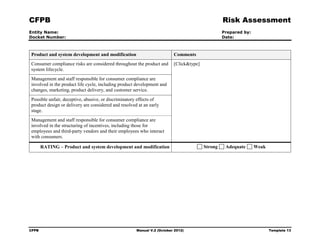
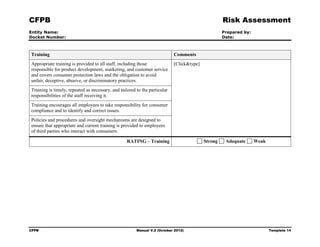
Update or Prepare the Risk Assessment
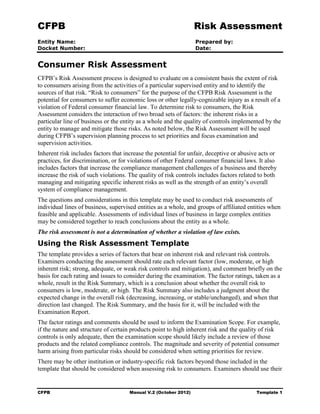
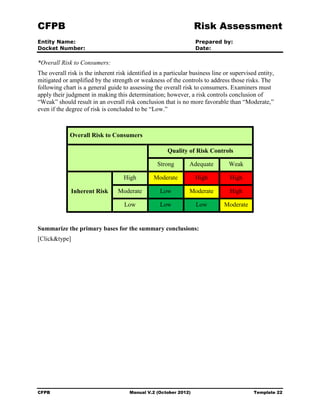
CFPB’s Risk Assessment is designed to evaluate on a consistent basis the extent of risk to
consumers arising from the activities of a supervised entity or particular lines of business within
it and to identify the sources of that risk. “Risk to consumers” for the purpose of the CFPB Risk
Assessment is the potential for consumers to suffer economic loss or other legally-cognizable
injury (e.g., invasion of privacy) from a violation of Federal consumer financial law. The risk
assessment includes factors related particularly to the potential for unfair, deceptive or abusive
practices, or discrimination. Two sets of factors interact to result in a finding that the overall risk
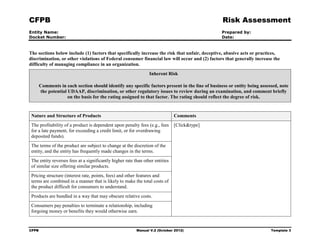
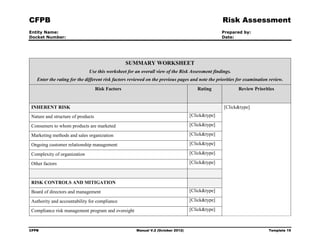
in a business or entity is low, moderate, or high. The first set of factors relate to the inherent risk
in the particular line of business or the entity overall. The second set of factors is the quality of
controls that manage and mitigate that risk. The Risk Assessment also includes a judgment,
based on current or recent information, about the expected change in the overall risk: decreasing,
increasing, or unchanged.
The CFPB uses the Risk Assessment described below, and presented as a template in Part III, to
develop its plan for supervising and examining large depository institutions and their affiliates
(the Supervision Plan), and to determine the focus of particular examinations. Risk Assessments
will be used to set priorities and focus examination and supervision activities.

Risk assessments are not used to reach conclusions about whether an entity has violated a
particular law or regulation.
The Lead Examiner completes or updates a Risk Assessment at least annually for a large
depository institution and its depository and non-depository affiliates. When evaluating the group
of entities as a whole, considerations include the extent to which these affiliates share or allocate
risk (such as when one entity purchases or services loans originated by another) and the ways in
which they manage risk under a corporate compliance program (quality of risk management).
CFPB’s Nonbank Supervision Risk Analytics and Monitoring unit and other Headquarters units,
including the Office of Fair Lending and Equal Opportunity, will collect data about and from
supervised non-depository consumer financial services companies in order to help define and
assess risk for purposes of examination prioritization. The examination team will perform a more
specific Risk Assessment as part of the pre-examination process.
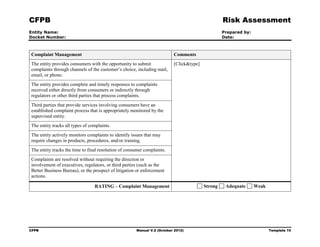
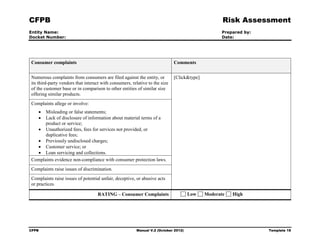
In undertaking a Risk Assessment, examiners should consider both the volume and the nature of
consumer complaints received by the entity or by regulatory bodies including the CFPB. In
addition to shedding important light on the extent and types of concerns of consumers utilizing
the entity’s consumer financial products or services, complaints may provide indications of
potential regulatory violations, including unfair, deceptive, or abusive acts or practices
(UDAAPs). How the entity handles complaints is also a key element in evaluating its compliance
management system.
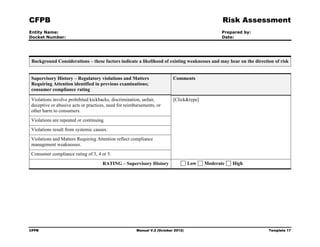
Regulatory violations or matters requiring attention identified in prior examinations by the CFPB
or by other regulatory agencies, including the prudential regulators, should also be considered
when assessing risk and planning an examination.


CFPB                                  Manual V.2 (October 2012)                         Examinations 3
CFPB Supervision
and Examination Process                                                                      Examinations
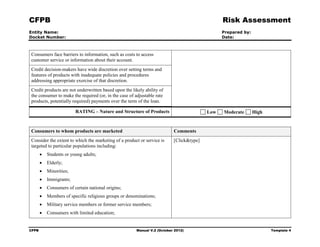
Inherent Risk
For markets which involve the sale of financial services products or services to consumers, the
key factors that are relevant in assessing risk are (i) the nature and structure of the products
offered, (ii) the consumer segments to which such products are offered, (iii) the methods of
selling the products, and (iv) the methods of managing the delivery of the products or services
and the ongoing relationship with the consumer. 2
Quality of Controls and Mitigation of Inherent Risk
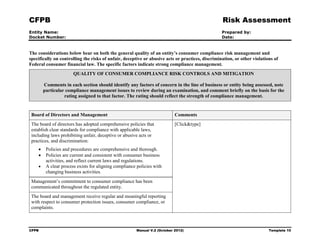
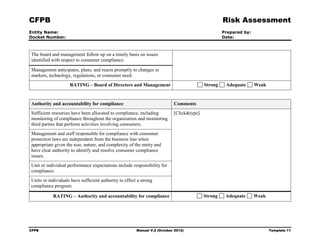
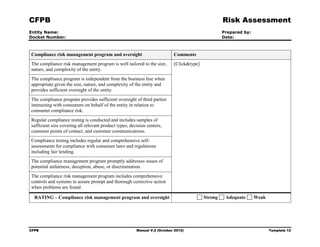
The second part of the Risk Assessment entails an evaluation of the extent to which the
institution has established controls to monitor and mitigate inherent risks to consumers. Some of
these controls will necessarily be established and assessed across the lines of business at the
institution or enterprise level, while others will operate at the line of business level to mitigate
identified risks.
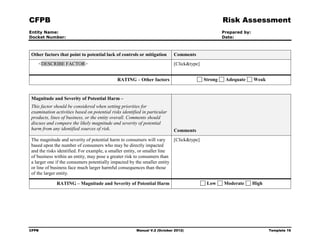
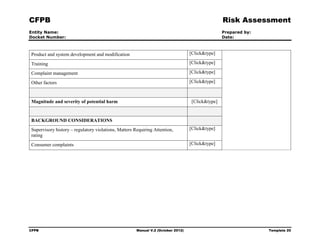
After risks are identified, the focus and priorities for examination or review activities will take
into account the number of consumers potentially harmed and the severity of that potential harm.
Expected Change/Direction of Risk
Finally, the Risk Assessment calls for a determination of the direction of risk at the entity:
increasing, decreasing, or stable. The direction determination should be based on the findings of
very recent reviews or the most recent examination, recent changes in entity structure, new
business strategy, monitoring information, or other information about prospective risk and risk
management. The date of the most recent change in the direction of risk should also be noted. An
institution that has been stable for a long time that suddenly changes will likely require a
different supervisory response than one that has been on the same trajectory for some time,
although both may be of serious concern.
A Risk Assessment template is provided in Part III.
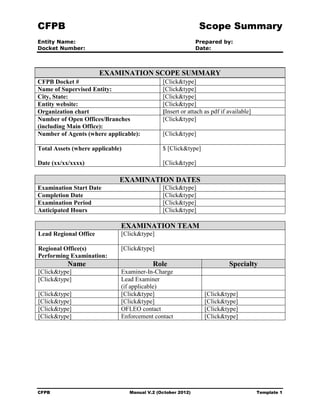
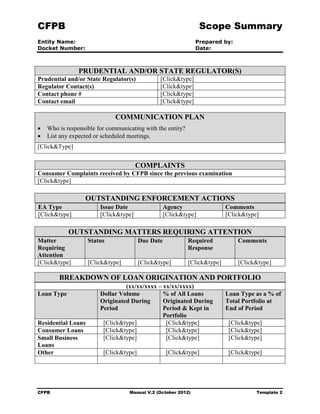
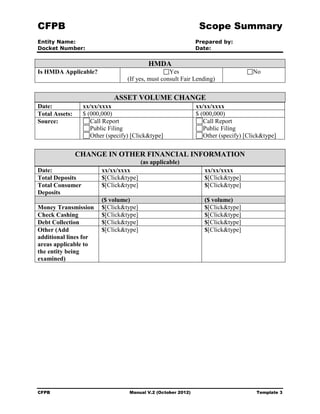
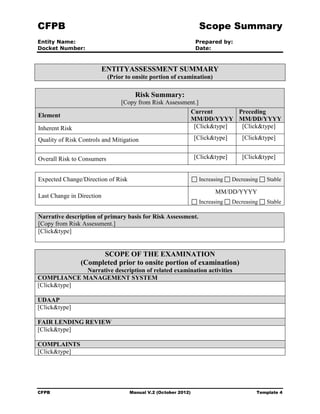
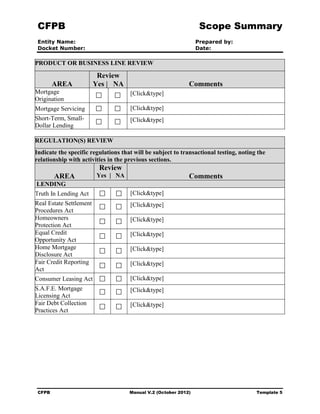
Develop a Scope Summary
The Scope Summary is based in large part on the conclusions of the Risk Assessment. The table
of risk conclusions from the Risk Assessment should be included in the Scope Summary.
The Examiner in Charge prepares the Scope Summary, which provides all members of the
examination team with a central point of reference throughout the examination. The initial Scope
Summary is based on internal consultation and a review of available information and documents
gathered prior to sending the Information Request to the supervised entity; the Summary is
developed after preparing the Risk Assessment.


2
  Some markets for consumer financial products or services operate on a business to business basis; this is true, for example, of
the credit reporting market and the collections market. The factors that are indicative of inherent risk in these markets will be
different from those in the business to consumer markets. Risk assessments for such businesses will be developed separately.


CFPB                                             Manual V.2 (October 2012)                                      Examinations 4
CFPB Supervision
and Examination Process                                                   Examinations
The initial Scope Summary addresses the following:
•	   The basis for the Risk Assessment; and
•	   Examination activities to be undertaken to review:
     o	   the compliance management system;
     o	   potential legal violations involving unfair, deceptive, or abusive practices;
     o	   fair lending compliance;
     o	   issues arising from complaints; and
     o	   specific regulatory compliance issues.
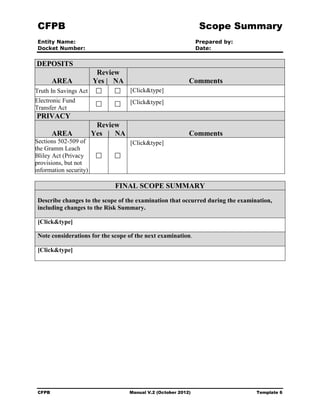
At the conclusion of the examination, the EIC updates the initial Scope Summary with the
following:
•	   Description of changes to the examination scope during the course of the examination, and
     reasons for such changes; and
•	   Recommendations for the scope of the following examination.
The initial Scope Summary, as well as any material changes to the scope of the examination during
the examination, should be approved in accordance with current CFPB requirements. The Scope
Summary is maintained with the examination records in the Supervision and Examination System.
A Scope Summary template is found in Part III and may be tailored to individual circumstances
as appropriate.
Contact the Entity to be Examined
For most full-scope examinations, the EIC, or designee, contacts the supervised entity’s
management approximately 60 days prior to the scheduled onsite date for the examination to
arrange either a telephone or in-person discussion of the examination Information Request. The
principal purpose of the discussion is to gather current information to ensure that the request is
tailored to what is necessary to properly conduct the examination of that particular institution.
The EIC or designee should also use the discussion to help determine whether certain
information needed for the examination should be sent to the examination team for review offsite
or held for onsite review. The discussion should include the timing of production and the
subsequent onsite examination. The EIC should use the discussions to apprise management about
who should be available to be interviewed during the onsite portion of the examination. If not
already known, the EIC should obtain information about the organization of the entity and where
it maintains certain operations for the purpose of deciding which operation centers and/or
branches the team will review.


CFPB	                                   Manual V.2 (October 2012)                         Examinations 5
CFPB Supervision
and Examination Process                                                Examinations
For depository institutions under a continuous examination schedule, periodic requests will
be necessary and the lead time may vary depending on the product, service, or regulation
being reviewed.
Early contact and review provides the EIC the opportunity to determine if specialized examiner
or other CFPB resources are needed for particular examination activities and then to obtain them.
A customizable Interview template is available in the Supervision and Examination System. It
may be used as a tool to help guide the discussion with the supervised entity and the subsequent
tailoring of the Information Request.
Prepare and Send the Information Request
After conducting the review and discussion outlined above, the EIC or designee will use the
monitoring information and any other relevant information to customize an Information
Request that includes only items that are pertinent to the examination of a particular entity. Not
all items will be relevant to every examination. In addition, the Information Request must
specify the review period when it requests information or documentation such as periodic
reports, ledgers, policies and procedures, and administrative changes, to avoid receiving data
not relevant to the examination.
The EIC or designee may provide the examination Information Request to entity management in
either hard copy or electronic format, although electronic is preferred, indicating where the
materials should be delivered and in what format. If at all possible, the requested materials
should be delivered to the CFPB electronically. Examiners should consult with their field
managers about what system should be used for secure requests and transmission of electronic
examination files. The timing of the request and the response date must ensure that entity staff
has sufficient time to assemble the requested information and the examination team has
sufficient time to adequately review the materials.
Contacting the supervised entity at least 60 days prior to the onsite date, whenever feasible, and
sending the examination information request as soon as possible thereafter will generally ensure
that staff of the supervised entity have sufficient time to properly gather and submit the response,
and that the examination team has time to conduct its offsite review. To the extent possible and
consistent with statutory requirements, coordinate the examination information request with the
prudential and state regulator(s) and keep them abreast of monitoring efforts, correspondence
with the supervised entity, and schedule planning.
The customizable Information Request template is available in the Supervision and
Examination System.


CFPB                                 Manual V.2 (October 2012)                       Examinations 6
CFPB Supervision
and Examination Process                                                 Examinations
Conduct the Examination
After receiving and reviewing the information and documents requested from the entity, the EIC
will determine the specific examination procedures to use during the onsite review and how to
deploy the examination team to conduct interviews, observations, transaction testing, and other
processes. Guided by the Risk Assessment, every examination must include a review of
compliance management, any potential unfair, deceptive, or abusive practices, and regulatory
compliance matters presenting risks to consumers. Every examination of lending must also
include a review for discrimination.
Available examination procedures are part of this Supervision / Examination Manual. Templates
should be downloaded from the Supervision and Examination System and used to create
workpapers.
Upon determining the onsite start date, the EIC should arrange an entrance meeting with the
appropriate member(s) of the supervised entity’s management. At the meeting, the EIC can
introduce the examination team, discuss generally the expected activities, clarify any questions
about arrangements for being onsite at the entity (such as building security, work space, etc.),
and set the tone for the examination.
Thereafter, the EIC should meet regularly with the entity point of contact to discuss interim
findings and examination progress. The EIC should also communicate regularly with his or her
point of contact at the entity’s prudential or state regulator(s).
Throughout the examination, the EIC should coordinate with his or her Field Manager regarding
internal consultation and review requirements and should provide progress reports as required.

Close the Examination
Closing Meeting
When the EIC determines that all onsite activities and internal CFPB consultations are complete, he
or she should meet with the supervised entity’s management to discuss the preliminary examination
findings, expected corrective actions, recommended rating, and next steps, if any. Management
should be reminded that supervisory information, including ratings, is confidential and should not be
shared except as allowed by CFPB regulation. Depending on the severity of the findings, other CFPB
representatives may attend this meeting as well. Management should be alerted if a meeting with the
board of directors or principals of the supervised entity will be required.
Entity management must be informed that examination findings, including compliance
ratings, are not final until internal CFPB reviews are conducted and, in the case of an insured
depository institution or affiliate, the prudential regulator has had the opportunity to review
and comment on the draft report.


CFPB                                 Manual V.2 (October 2012)                        Examinations 7
CFPB Supervision
and Examination Process                                                                      Examinations
Determine the Compliance Rating
The CFPB has adopted the FFIEC Uniform Consumer Compliance Rating System. 3 Under this
system, after an examination a supervised entity is assigned a confidential consumer compliance
rating based upon an evaluation of its present compliance with Federal consumer financial law
and the adequacy of its systems designed to ensure compliance on a continuing basis. The rating
system is based upon a scale of 1 through 5 in increasing order of supervisory concern. Thus, “1”
represents the highest rating and consequently the lowest level of supervisory concern, while “5”
represents the lowest, most critically deficient level of performance and therefore the highest
degree of supervisory concern. Each of the five ratings is described in greater detail below.
In assigning a consumer compliance rating, all relevant factors must be evaluated and weighed.
In general, these factors include the nature and extent of present compliance with Federal
consumer financial law, the commitment of management to compliance and its ability and
willingness to take the necessary steps to assure compliance, and the adequacy of systems,
including internal procedures, controls, and audit activities designed to ensure compliance on a
routine and consistent basis. The assignment of a compliance rating may incorporate other
factors that impact significantly the overall effectiveness of an institution's compliance efforts.
While each type of entity supervised by the CFPB has differences in its general business powers,
all generally are subject to the same Federal consumer financial laws covered by the rating
system. Thus, there is no need to evaluate different types of entities on specific criteria relating to
their particular industry. As a result, the assignment of a consumer compliance rating based on a
set of uniform criteria will help direct supervisory attention in an efficient and consistent manner
that does not depend solely upon the nature of the institution’s business. The primary purpose of
the uniform rating system is to help identify those institutions whose compliance with Federal
consumer financial law displays weaknesses requiring special supervisory attention and which
are cause for more than a normal degree of supervisory concern. To accomplish this objective,
the rating system identifies an initial category of institutions that have compliance deficiencies
that warrant more than normal supervisory concern. These institutions are not deemed to present
a significant risk of financial or other harm to consumers, but do require a higher than normal
level of supervisory attention. Institutions in this category are generally rated “3.” The rating
system also identifies certain institutions whose weaknesses are so severe that they may
represent a substantial or general disregard for the law. These institutions are, depending upon
nature and degree of their weaknesses, rated “4” or “5.”


3
    This description of the rating system is adapted for CFPB purposes from the 1980 FFIEC resolution adopting the rating system.


CFPB                                              Manual V.2 (October 2012)                                    Examinations 8
CFPB Supervision
and Examination Process                                                 Examinations
The uniform identification of institutions causing more than a normal degree of supervisory
concern will help ensure:
•	   That the degree of supervisory attention and the type of supervisory response are based upon
     the severity and nature of the institution's deficiencies;
•	   That supervisory attention and action are, to the extent possible, administered consistently,
     regardless of the type of institution or the identity of the supervising agency; and
•	   That appropriate supervisory action is taken with respect to those institutions whose
     compliance problems entail the greatest potential for financial or other harm to consumers.

Consumer Compliance Ratings
Consumer Compliance Ratings are defined and distinguished as follows:

One
An [entity] in this category is in a strong compliance position. Management is capable of and
staff is sufficient for effectuating compliance. An effective compliance program, including an
efficient system of internal procedures and controls, has been established. Changes in consumer
statutes and regulations are promptly reflected in the institution's policies, procedures, and
compliance training. The institution provides adequate training for its employees. If any
violations are noted they relate to relatively minor deficiencies in forms or practices that are
easily corrected. There is no evidence of discriminatory acts or practices, reimbursable
violations, or practices resulting in repeat violations. Violations and deficiencies are promptly
corrected by management. As a result, the institution gives no cause for supervisory concern.

Two
An [entity] in this category is in a generally strong compliance position. Management is capable
of administering an effective compliance program. Although a system of internal operating
procedures and controls has been established to ensure compliance, violations have nonetheless
occurred. These violations, however, involve technical aspects of the law or result from oversight
on the part of operating personnel. Modification in the institution's compliance program and/or
the establishment of additional review/audit procedures may eliminate many of the violations.
Compliance training is satisfactory. There is no evidence of discriminatory acts or practices,
reimbursable violations, or practices resulting in repeat violations.


CFPB	                                 Manual V.2 (October 2012)                       Examinations 9
CFPB Supervision
and Examination Process                                                 Examinations
Three
Generally, an [entity] in this category is in a less than satisfactory compliance position. It is a
cause for supervisory concern and requires more than normal supervision to remedy deficiencies.
Violations may be numerous. In addition, previously identified practices resulting in violations
may remain uncorrected. Overcharges, if present, involve a few consumers and are minimal in
amount. There is no evidence of discriminatory acts or practices. Although management may
have the ability to effectuate compliance, increased efforts are necessary. The numerous
violations discovered are an indication that management has not devoted sufficient time and
attention to consumer compliance. Operating procedures and controls have not proven effective
and require strengthening. This may be accomplished by, among other things, designating a
compliance officer and developing and implementing a comprehensive and effective compliance
program. By identifying an institution with marginal compliance early, additional supervisory
measures may be employed to eliminate violations and prevent further deterioration in the
institution's less-than-satisfactory compliance position.

Four
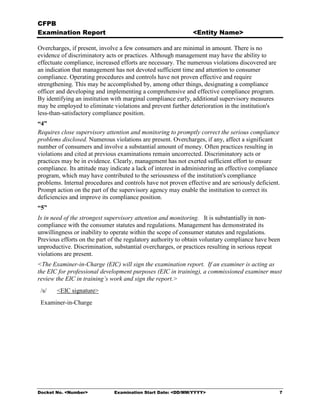
An [entity] in this category requires close supervisory attention and monitoring to promptly
correct the serious compliance problems disclosed. Numerous violations are present.
Overcharges, if any, affect a significant number of consumers and involve a substantial amount
of money. Often practices resulting in violations and cited at previous examinations remain
uncorrected. Discriminatory acts or practices may be in evidence. Clearly, management has not
exerted sufficient effort to ensure compliance. Its attitude may indicate a lack of interest in
administering an effective compliance program that may have contributed to the seriousness of
the institution's compliance problems. Internal procedures and controls have not proven effective
and are seriously deficient. Prompt action on the part of the supervisory agency may enable the
institution to correct its deficiencies and improve its compliance position.

Five
An [entity] in this category is in need of the strongest supervisory attention and monitoring. It is
substantially in non-compliance with the consumer statutes and regulations. Management has
demonstrated its unwillingness or inability to operate within the scope of consumer statutes and
regulations. Previous efforts on the part of the regulatory authority to obtain voluntary
compliance have been unproductive. Discrimination, substantial overcharges, or practices
resulting in serious repeat violations are present.


CFPB                                  Manual V.2 (October 2012)                      Examinations 10
CFPB Supervision
and Examination Process                                                   Examinations
Draft the Examination Report
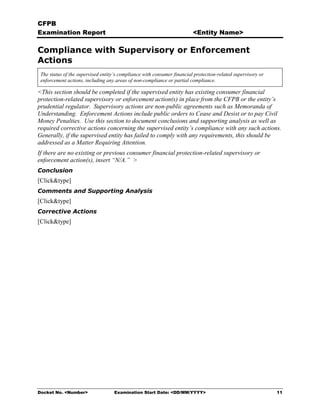
An Examination Report template is provided in Part III. Instructions are embedded in it.
The primary purpose of the report is to communicate examination findings to the board of
directors or principals and senior executives of a supervised entity. The report narrative should
be concise, constructive, and direct. The commentaries for stable 1-rated entities with low
consumer or compliance risk should be brief, while the commentaries for 2- through 5-rated
institutions and those with elevated or increasing risk should successively provide more support
and detail.
Comments should clearly cite statutory or regulatory violations and describe the basis for the
findings. This will ensure that the supervised entity understands the basis for the conclusions and
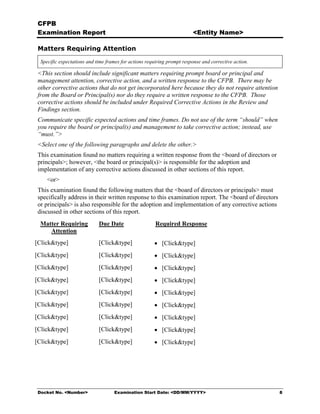
so that enforcement actions, if required, are well supported. Matters Requiring Attention and
Required Corrective Actions must include specific expectations and the expected time frame for
implementation.
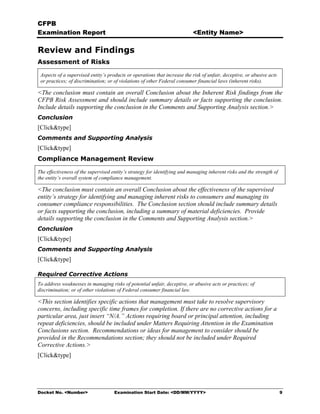
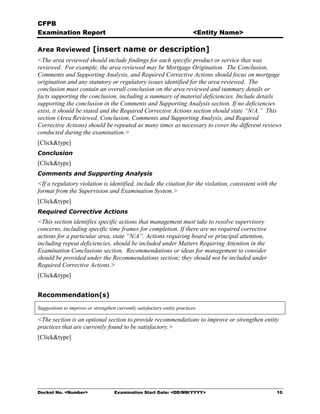
For each specific area reviewed, the narrative sections of the report have three parts: conclusion,
comments and supporting analysis, and required corrective actions:
•	   Conclusion – The Conclusion contains an overall conclusion followed by a concise summary
     of findings. The conclusion should match the tone and language of the rating definition. This
     section should include summary details or facts supporting the conclusion, including a
     summary of material deficiencies that support 3, 4, and 5 ratings. Avoid an overly detailed
     conclusion section. Include details supporting the conclusion in the Comments and
     Supporting Analysis section. Do not include cross-references within the Conclusion section.
•	   Comments and Supporting Analysis – Comments discuss major strengths and/or weaknesses
     to support the conclusions. Supporting Analysis is information that demonstrates
     conclusions.
•	   Required Corrective Actions – Required Corrective Actions identify actions that management
     needs to take to resolve supervisory concerns. They should include specific action
     requirements and time frames for completion. If there are no corrective actions for a
     particular area, just insert “N/A.”
If a finding is sufficiently serious to bring to the attention of the board of directors or principals
of an entity, the Required Corrective Action should be included in the Matters Requiring
Attention section of the Examination Conclusions. Include repeat deficiencies as Matters
Requiring Attention.
Suggestions or ideas for management to consider may be included in the Recommendations
section. The CFPB does not require follow-up for Recommendations; they are provided as
suggestions to improve already satisfactory operations.
The Examination Report comments should focus on those matters that support the overall
conclusion and rating; they do not need to cover every area reviewed during an examination.


CFPB	                                  Manual V.2 (October 2012)                        Examinations 11
CFPB Supervision
and Examination Process                                                 Examinations
Submit Examination Report for Review
After the Examination Report draft is complete, the EIC uploads it into the Supervision and
Examination System. The Field Manager or designee will review it and will obtain any other
reviews required by internal CFPB policy.
If the report concerns an insured depository institution, the draft must be shared with the
institution’s prudential regulator. 4 The regulator must be given a reasonable opportunity to
review and comment (not less than 30 days after the date of receipt of the report by the
prudential regulator). The CFPB must take into consideration any concerns raised by the
prudential regulator prior to issuing a final Examination Report or taking supervisory action. The
interagency comment process will be managed by the CFPB’s regional offices, with input from
CFPB headquarters as appropriate. If a conflict arises between the CFPB and the prudential
regulator regarding a proposed supervisory determination, regional and Headquarters
management will seek to resolve the issue as expeditiously as possible, with due regard for each
agency’s supervisory responsibilities.
If the report concerns other types of regulated entities, opportunities for comment by state
regulators will depend on whether CFPB is conducting joint or coordinated examinations with
the relevant state regulators. The comment process will also be handled by the regional offices.
Board of Directors or Principal(s) Meeting
The purpose of a meeting with a supervised entity’s board of directors or principal(s) is to
convey the findings of an examination directly to those individuals ultimately responsible for the
policies and procedures of the institution. Board meetings should be conducted after the closing
meeting with management, and should be attended by at least a quorum of directors or by the
entity principal(s). The EIC and appropriate CFPB management should attend. The board or
principals should be reminded that the examination report and rating are confidential and should
not be disclosed except as permitted by CFPB regulation. 5
A board or principal(s) meeting is required when one or more of the following circumstances are
present:
•      The proposed compliance rating is “3,” “4,” or “5”;
•      An informal supervisory agreement or formal enforcement action is recommended; or
•      The supervised entity’s management, board, or principal(s) requests such a meeting.
The meeting should be used to discuss examination findings, Matters Requiring Attention, and
expected corrective actions; advise the board or principal(s) of the recommended compliance
rating; and discuss any recommended enforcement actions.

4
    Dodd-Frank Act, Section 1025(e)(1)(C)
5
    See 12 CFR 1070.42


CFPB                                        Manual V.2 (October 2012)               Examinations 12
CFPB Supervision
and Examination Process                                               Examinations
The timing of a board or principal(s) meeting will depend on the specific situation, and the EIC
should work this out with his or her Field Manager, who will ensure the necessary internal
coordination. Meetings should be coordinated with Federal prudential and state examiners, and
planned for regularly scheduled meetings whenever possible.
Send the Examination Report
The EIC signs the final Examination Report. Regional office administrative staff will handle
transmission to the supervised entity.
Upload Final Examination Documents
At the conclusion of the examination, the EIC must finalize the Scope Summary, ensure all
workpapers are complete, and be certain that all required documents and information are
uploaded or entered into the Supervision and Examination System.
Examination Workpapers
During an examination, examiners collect and review information from the supervised entity to
reach conclusions about its practices, its compliance management, and its compliance with
specific laws and regulations. The records documenting the review are called workpapers.
Workpapers should contain sufficient information and supporting documents to explain – to a
knowledgeable reviewer – the basis for the examination conclusions.
Purposes of Workpapers
Examiners develop and maintain workpapers for three principal purposes:
•	   To provide a record of the work performed during the examination that supports findings or
     recommendations made during the examination;
•	   To maintain the evidence necessary to support supervisory agreements or formal
     enforcement actions; and
•	   To facilitate internal quality control reviews.
All information collected and all records created during the examination could potentially be
included in the workpapers. For example, if an examiner interviews a Real Estate Lending
Officer, the write-up of the interview notes becomes a workpaper. If the examiner also scans
pages of the supervised entity’s RESPA procedures manual to help illustrate deviations from
policy, the scanned pages should be included in the workpapers. Other examples of workpapers
include, but are not limited to:
•	   Completed CFPB Examination Procedures (downloadable templates that allow the examiner
     to enter narrative findings as they follow the procedures);
•	   Completed CFPB Checklists;


CFPB	                                  Manual V.2 (October 2012)                  Examinations 13
CFPB Supervision
and Examination Process                                               Examinations
•	   Other documents such as spreadsheets created during the examination;
•	   Documentation of staff and management interviews;
•	   Meeting agendas, attendance lists, and notes or minutes;
•	   Documentation of compliance research performed (e.g., legal opinions, regulation sections
     reviewed, regulatory alerts); and
•	   Scanned copies of material obtained from the supervised entity, such as policies, procedures,
     rate sheets, internal memos and reports, external audit reports, complaint letters.
Generally, workpapers should document or support the:
•	   Proposed scope of the examination and any changes to the scope during the course of the
     examination;
•	   Work performed during the examination (what you did);
•	   Sampling process used (how you did it);
•	   Findings and violations noted during the examination (what you found);
•	   Recommendations made (new and repeated);
•	   Communications with management regarding findings, corrective actions, and
     recommendations;
•	   Management’s response (oral and written) to findings and violations;
•	   Commitments made by management regarding corrective action, remediation, and financial
     relief;
•	   Changes to the Risk Assessment;
•	   Consumer Compliance Rating; and
•	   Changes to the Supervision Plan (where applicable).
The amount of supporting documentation from the entity’s records that is necessary to maintain
in the workpapers will depend on the particular situation. The general principle is that
examinations involving numerous problems in high-risk areas require especially thorough
documentation to support the conclusions reached and any potential supervisory measures or
enforcement action. Examination of areas of low risk and few problems normally require less
documentation.


CFPB	                                Manual V.2 (October 2012)                     Examinations 14
CFPB Supervision
and Examination Process                                                                  Examinations
Examiner in Charge Review and Signoff
The EIC is responsible for the adequacy of the workpapers created during the examination. Since
large team examinations require the EIC to delegate numerous specific areas of review to other
examiners, the EIC must track the:
•   Workpapers developed;
•   Responsible examination team member; and
•   EIC’s review and approval of the workpapers.
Workpapers that require additional analysis or support should be discussed with and returned to
the responsible examiner for further development. The Workpaper Table of Contents and EIC
Signoff document, found in the Supervision and Examination System, must be used to record the
EIC’s review and sign off on all workpapers developed during the examination. After the EIC
reviews and signs off on the workpapers, the Field Manager should also review and sign off on
their adequacy.
Electronic Format and Encryption
All workpapers and related documentation for the examination should be maintained in
electronic form. If the supervised entity is only able to provide a document in hard copy form,
the examiner should scan the document and return the original. Workpapers should be uploaded
to the Supervision and Examination System with the completed examination to be preserved as
part of the examination record and made available for future reference.
All electronic documents received from the supervised entity should be transmitted and
maintained on encrypted media. Examiners should be mindful at all times of the need to protect
personally identifiable information (e.g., names, social security numbers, account numbers) and
confidential supervisory information. Hard copies should not be left anywhere unattended (even
onsite at the entity), should not be removed from the examination site, and if printed while
working offsite, should be kept in a locked cabinet when not being used. Consult CFPB’s
Privacy and FOIA regulations and guidance for further information. 6
Quality Control Reviews
Workpapers will also be reviewed through an internal quality control process. Workpapers
should be sufficiently detailed so that an internal quality control reviewer will understand what
the examiner did, follow the logic of the examiner's analyses, and understand how the examiner
reached his or her conclusion(s). The level of documentation should be commensurate with the
risks and problems associated with the areas under review. (The optional Workpaper Checklist
can help ensure that workpapers are sufficient.)


6
 See Disclosure of Records and Information, 12 CFR Part 1070 (76 Fed. Reg. 45372 (July 28, 2011)), and any subsequent related
guidance that may be issued.


CFPB                                           Manual V.2 (October 2012)                                 Examinations 15
CFPB
Compliance Management Review                                                                                     CMR

General Principles and Introduction
Supervised entities within the scope of CFPB’s supervision and enforcement authority include
both depository institutions and non-depository consumer financial services companies. These
financial service providers operate in a dynamic environment influenced by challenges to
profitability and survival, increased focus on outcomes to consumers, industry consolidation,
advancing technology, market globalization, and changes in laws and regulations.
To remain competitive and responsive to consumer needs in such an environment, supervised
entities continuously assess their business strategies and modify product and service offerings and
delivery channels. To maintain legal compliance, a supervised entity must develop and maintain a
sound compliance management system that is integrated into the overall framework for product
design, delivery, and administration — that is, the entire product and service lifecycle. Ultimately,
compliance should be part of the day-to-day responsibilities of management and the employees of
a supervised entity; issues should be self-identified; and corrective action should be initiated by the
entity. Supervised entities are also expected to manage relationships with service providers to
ensure that these providers effectively manage compliance with Federal consumer financial laws
applicable to the product or service being provided. 1
Weaknesses in compliance management systems can result in violations of law or regulation and
associated harm to consumers. Therefore, the CFPB expects every regulated entity under its
supervision and enforcement authority to have an effective compliance management system
adapted to its business strategy and operations. Each CFPB examination will include review and
testing of components of the supervised entity’s compliance management system. An initial
review will help determine the scope and intensity of an examination. The findings of more
detailed reviews and transaction testing will determine the effectiveness of the compliance
management system and whether enhancements or corrective actions are appropriate.
CFPB understands that compliance will likely be managed differently by large banking
organizations with complex compliance profiles and a wide range of consumer financial products
and services 2 at one end of the spectrum, than by entities that may be owned by a single
individual and feature a narrow range of financial products and services, at the other end of the
spectrum. Compliance may be managed on a firm- or enterprise-wide basis, and supervised
entities may engage outside firms to assist with compliance management. However compliance
is managed, a provider of consumer financial products or services under CFPB’s supervisory
purview is expected to comply with Federal consumer financial laws and appropriately address
and prevent violations of law and associated harms to consumers through its compliance
management process.


1
  See CFPB Bulletin 2012-03, Service Providers (April 13, 2012), which describes the CFPB’s expectation that supervised banks
and nonbanks oversee their business relationships with service providers in a manner that ensures compliance with Federal
consumer financial law. http://files.consumerfinance.gov/f/201204 cfpb bulletin service-providers.pdf
2
  For example, the Federal Reserve Board of Governors expects large banking organizations with complex compliance profiles to
implement firm-wide compliance risk management programs and have a corporate compliance function. SR 08-8 / CA 08-11,
October 16, 2008. The CFPB will expect no less.


CFPB                                           Manual V.2 (October 2012)                                              CMR 1
CFPB
Compliance Management Review                                                                CMR
CFPB also understands that supervised entities will organize compliance management to include
compliance with consumer-related state and Federal laws that are outside the scope of CFPB’s
supervision responsibilities, in addition to the matters that are within CFPB’s scope. CFPB,
therefore, expects that compliance management activities will be organized within a firm, legal
entity, division, or business unit in the way that is most effective for the supervised entity, and
that the manner of organization will vary from entity to entity.
This section of the Manual discusses the common elements of an effective consumer compliance
management system: board of directors and management oversight, the compliance program,
response to consumer complaints, and audit coverage of compliance matters.

Compliance Management System
A compliance management system is how a supervised entity:

•	 Establishes its compliance responsibilities;

•	 Communicates those responsibilities to employees;

•	 Ensures that responsibilities for meeting legal requirements and internal policies are
   incorporated into business processes;

•	 Reviews operations to ensure responsibilities are carried out and legal requirements are met;
   and

•	 Takes corrective action and updates tools, systems, and materials as necessary.
An effective compliance management system commonly has four interdependent control
components:

•	 Board and management oversight;

•	 Compliance program;

•	 Response to consumer complaints; and

•	 Compliance audit.
When all of these four control components are strong and well-coordinated, a supervised entity
should be successful at managing its compliance responsibilities and risks.


CFPB	                                Manual V.2 (October 2012)                               CMR 2
CFPB
Compliance Management Review                                                              CMR
Compliance Management Examination Procedures
Board of Directors and Management Oversight

In a depository institution, the board of directors is ultimately responsible for developing and
administering a compliance management system that ensures compliance with Federal consumer
financial laws and regulations and addresses and prevents associated risks of harm to consumers.
In a non-depository consumer financial services company, that ultimate responsibility may rest
with a board of directors in the case of a corporation or with a controlling person or some other
arrangement. For the balance of this section of the Manual, references to the “board of directors”
or “board” generally refer to the board of directors or other individual or group exercising similar
oversight functions. In addition, some supervised entities may be governed by firm-wide
standards, policies, and procedures developed by a holding company or other top-tier corporation
for adoption, use, and modification, as necessary, by subsidiary entities.
Board of Directors and Management Oversight – Examination Objectives

Because the effectiveness of a compliance management system is grounded in the actions taken
by its board and senior management, CFPB examiners should seek to determine whether the
board and senior management have:
1.	 Demonstrated clear expectations about compliance, not only within the entity, but also to
    service providers.
2.	 Adopted clear policy statements regarding consumer compliance.
3.	 Appointed an appropriately qualified and experienced chief compliance officer and provided
    for other compliance officers with authority and accountability. (In smaller or less complex
    entities where staffing is limited, a full-time compliance officer may not be necessary.
    However, management should have clear responsibility for compliance management and
    compliance staff should be assigned to carry out this function in a manner commensurate
    with the size of the entity and the nature and risks of its activities.)
4.	 Established a compliance function to set policies, procedures, and standards.
5.	 Allocated resources to the compliance function commensurate with the size and complexity
    of the entity’s operations and practices, the Federal consumer financial laws and regulations
    to which the entity is subject, and necessary to avoid the potential consumer harm associated
    with violations of such laws and regulations.
6.	 Addressed consumer compliance issues and associated risks of harm to consumers
    throughout product development, marketing, and account administration, and through the
    entity’s handling of consumer complaints and inquiries.
7.	 Required audit coverage of compliance matters and reviewed the results of periodic
    compliance audits.


CFPB	                                Manual V.2 (October 2012)                                CMR 3
CFPB
Compliance Management Review                                                               CMR
8.	 Provided for recurring reports of compliance risks, issues, and resolution through a
    committee structure or to the board.
Board of Directors and Management Oversight – Examination Procedures

Through pre-examination work or follow-up to previous examinations, examiners should request
and review records, and discuss issues and questions with senior management. With respect to
board and senior management oversight, examiners should:
1.	 Review board meeting minutes and supporting materials during the period under review for
    coverage of compliance matters.
2.	 Determine board committee structures and delegated responsibility for compliance matters,
    such as to an audit committee or risk committee, and review the meeting minutes and
    supporting materials of those committees for coverage of compliance matters.
3.	 Determine any management committees with delegated authority and accountability for
    compliance matters, including fair lending, and review their composition, functions, and
    reporting to committees of the board or to the board.
4.	 Determine the authority and accountability for compliance matters of regional or business
    unit governance bodies; and review their composition, functions, and reporting.
5.	 Review policies for clarity, comprehensiveness, currency, and appropriate reflection of risks
    to consumers posed by the organization’s practices, as well as compliance issues and risks
    facing the organization.
6.	 Review the formal written compliance function document adopted by the board of directors
    or an appropriate committee of the board, and determine the resource allocation to
    compliance as part of the entity’s budget and planning process.
7.	 Identify the chief compliance officer and other responsible individuals.
8.	 Review the role of the chief compliance officer for authority to lead a compliance program
    and independence from business units.
9.	 Review board and board committee records for evidence of the chief compliance officer’s
    independent access to board members and governance bodies.
10. Review processes for the identification of new regulatory requirements, changes in
    requirements, and planning for implementation.
11. Review processes for development and implementation of new consumer financial products
    or services, distribution channels or strategies, to determine degree of compliance function
    participation. Determine whether these processes consider fair lending compliance risk.
12. Determine degree of compliance review of draft marketing material (including scripts) and
    their implementation.


CFPB	                               Manual V.2 (October 2012)                               CMR 4
CFPB
Compliance Management Review                                                             CMR
13. Review reporting for the identification and resolution of issues and the timeliness and
    completeness of such actions.
14. Review board or committee consideration of compliance audit matters for coverage of key
    risks, independence from business functions, and resolution of identified issues.
15. Draw preliminary conclusions about the strength, adequacy, or weakness of board and
    senior management oversight, subject to risk focused review and testing for compliance.
In the absence of a board of directors and board committee structure, the examiner should
determine that the person or group exercising similar oversight functions receives relevant
information about compliance and consumer protection matters and takes steps to ensure that the
key elements, resources, and individuals necessary for a compliance management system
commensurate with the supervised entity’s risk profile are in place and functioning.
Compliance Program

A sound compliance program is essential to the efficient and successful operation of the
supervised entity, much as a business plan. A compliance program includes the following
components:

•   Policies and procedures;

•   Training; and

•   Monitoring and corrective action.
A supervised entity should establish a formal, written compliance program, and that program
generally should be administered by a chief compliance officer. In addition to being a planned and
organized effort to guide the entity’s compliance activities, a written program represents an
essential source document that may serve as a training and reference tool for employees. A well
planned, implemented, and maintained compliance program will prevent or reduce regulatory
violations, protect consumers from non-compliance and associated harms, and help align business
strategies with outcomes. The examination objectives and procedures for the compliance program
are divided in this section of the Manual among the three components of a program.
Policies and Procedures – Examination Objectives

Compliance policies and procedures should be documented and in sufficient detail to implement
the board-approved policy documents. Overall, examiners should seek to determine whether
compliance policies and procedures:
1.	 Are consistent with board-approved policies.
2.	 Address compliance with applicable Federal consumer financial laws in a manner designed
    to prevent violations and to detect and prevent associated risks of harm to consumers.
3.	 Cover product or service lifecycles.


CFPB	                                Manual V.2 (October 2012)                                CMR 5
CFPB
Compliance Management Review                                                              CMR
4.	 Are maintained and modified to remain current and to serve as a reference for employees in
    their day-to-day activities.
Policies and Procedures – Examination Procedures

Examiners should request and review compliance policies and procedures and discuss elements
with compliance officers or other responsible officers and employees of the supervised entity, as
follows:
1.	 Request and review policies and procedures related to consumer compliance, including fair
    lending and other Federal consumer financial laws and policies and procedures related to
    offering consumer financial products and services.
2.	 Review policies and procedures for changes management committed to make following
    recent monitoring, audit, and examination findings and recommendations.
3.	 Review policies and procedures to determine whether and how they address new or
    amended Federal consumer financial laws and regulations since the preceding examination
    or since the most recent consumer compliance examination by a state or prudential
    regulator, if applicable, if this is CFPB’s first examination.
4.	 Request and review policies and procedures to determine whether they cover consumer
    financial products or services introduced since the preceding examination or since the most
    recent consumer compliance examination by a state or prudential regulator, if applicable, if
    this is CFPB’s first examination.
5.	 Review policies and procedures relating to compliance with specific regulatory requirements
    (such as fair lending or the privacy of consumer financial information) and their
    implementing procedures.
6.	 Review for outdated content, the names of unaffiliated entities, or other indicators that
    policies are overly general or not tailored to the needs and actual practices of the supervised
    entity being examined.
7.	 Review policies and procedures for products with features that may inhibit consumer
    understanding or otherwise pose heightened risks of (a) unfair, deceptive, or abusive
    practices, or (b) fair lending.
8.	 Review policies and procedures for products containing features that may pose heightened
    risk of unlawful discrimination. Such features may include:
   a. particular incentives created by employee compensation structures;
   b. discretion over product selection, underwriting, or pricing; or
   c. distinctions related to geography or prohibited bases (such as age or marital status).


CFPB	                                Manual V.2 (October 2012)                                 CMR 6
CFPB
Compliance Management Review                                                              CMR
9.	 Review policies and procedures designed to ensure that the entity’s service providers
    comply with legal obligations applicable to the product or service of the examined entity and
    the provider.
10. Review policies and procedures maintained by different regional, business unit, or legal
    entities subject to the same corporate or board-level policies for consistency.
11. Review policies and procedures for record retention and destruction timeframes to ensure
    compliance with legal requirements.
12. If compliance procedures are embedded in automated tools or business unit procedures,
    determine that a qualified compliance officer or contractor reviewed these tools for
    consistency with policies and procedures and compliance with applicable Federal consumer
    laws and approved them for the purpose for which they are utilized.
13. Draw preliminary conclusions regarding the strength, adequacy, or weakness of policies and
    procedures, and identify business units, delivery channels, or offices for transaction testing.
    Test to confirm that actual practices are consistent with strong or adequate written policies
    and procedures. Test to determine the impact of apparently weak procedures.
Training – Examination Objectives

Education of an entity’s board of directors, management, and staff is essential to maintaining an
effective compliance program. Board members should receive sufficient information to enable
them to understand the entity’s responsibilities and the commensurate resource requirements.
Management and staff should receive specific, comprehensive training that reinforces and helps
implement written policies and procedures. Requirements for compliance with Federal consumer
financial laws, including prohibitions against unlawful discrimination and unfair, deceptive, and
abusive acts and practices, should be incorporated into training for all relevant officers and
employees, including audit personnel. Examiners should seek to determine whether:
1.	 Compliance training is current, complete, directed to appropriate individuals based on their
    roles, effective, and commensurate with the size of the entity and nature and risks to
    consumers presented by its activities.
2.	 Training is consistent with policies and procedures and designed to reinforce those policies
    and procedures.
3.	 Compliance professionals have access to training that is necessary to administer a
    compliance program that is appropriate for that supervised entity and its business strategy
    and operations.


CFPB	                                Manual V.2 (October 2012)                               CMR 7
CFPB
Compliance Management Review                                                            CMR
Training – Examination Procedures

Examiners should request and review training records and interview management and staff as
appropriate to evaluate this element of the compliance program and to refine and focus the
examination. Examiners should:
1.	 Request and review the schedule, record of completion, and materials for recent compliance
    training of board members and executive officers.
2.	 Determine the involvement of compliance officer(s) in selecting, reviewing, or delivering
    training content.
3.	 Request and review policies, standards, schedules, and records of completion for
    compliance-specific training of compliance professionals, managers, and staff, and
    documents demonstrating that service providers who have consumer contact or compliance
    responsibilities are appropriately trained.
4.	 Request and review samples of the content of training materials and comprehension tests,
    including training related to fair lending, new regulatory requirements, new products or
    channels of distribution, and marketing (including scripts).
5.	 Request and review training developed as a result of management commitments to address
    monitoring, audit, or examination findings and recommendations or issues raised in
    consumer complaints and inquiries.
6.	 Determine whether the program is designed to provide training about the specific regulatory
    requirements relevant to the functions of particular positions for loan officers, such as the
    Truth in Lending Act and the Equal Credit Opportunity Act.
7.	 Review records of follow-up, escalation, and enforcement for units with training completion
    rates that do not meet the supervised entity’s standards or deadlines.
8.	 Request and review the supervised entity’s plans for additions, deletions, or modifications to
    compliance training over the next 12 months and any plans for changes to the overall
    training resources and compare actual training activities to prior plans.
9.	 Draw preliminary conclusions about the strength, adequacy, or weakness of the training
    element of the compliance program, and select lines of business, organizational units, or
    other areas for more detailed review and testing.
Monitoring and Corrective Action – Examination Objectives

Monitoring is a compliance program element that seeks, in an organized and risk-focused way, to
identify procedural or training weaknesses in an effort to provide for a high level of compliance
by promptly identifying and correcting weaknesses. Monitoring and testing is generally more
frequent and less formal than compliance audit coverage and reporting, may be carried out by the
business unit, and does not require the same level of independence from the business or


CFPB	                               Manual V.2 (October 2012)                               CMR 8
CFPB
Compliance Management Review                                                              CMR
compliance function that an audit program does. Examiners should evaluate monitoring and
audit programs to determine whether, considered together, they are adequate and comprehensive.
Examiners review of compliance monitoring and testing should determine whether:
1.	 Monitoring is scheduled and completed and leads to timely corrective actions where
    appropriate.
2.	 The supervised entity is determining that transactions and other consumer contacts are
    handled according to the entity’s policies and procedures.
3.	 Monitoring and testing consider the results of risk assessments or other guides for
    prioritizing reviews.
4.	 Monitoring addresses deficiencies identified in internal or external audits, and the board’s or
    management’s directives on resolving the deficiencies.
5.	 Findings are escalated to management and to the board of directors if appropriate.
Monitoring and Corrective Action – Examination Procedures

Examiners should review monitoring, testing, and corrective action reports; sample supporting
documents; and interview individuals responsible for compliance monitoring, testing, and
corrective action. Examiners should:
1.	 Determine the chief compliance officer’s role in the compliance monitoring element of the
    compliance program.
2.	 Request and review the monitoring and testing schedule for the current year or next 12
    months, and review the currency of reviews in process against the current schedule.
3.	 Request and review the risk assessments or other documents that led to the monitoring and
    testing program plan, including any fair lending risk assessments.
4.	 Discuss with the compliance officer or monitoring manager the coverage of service
    providers that have contact with consumers.
5.	 Determine whether and to what extent monitoring includes calculation tools, the content of
    consumer disclosures and notices, marketing materials, and scripts or guides for employee
    contacts with consumers.
6.	 Request and review all compliance monitoring, testing and corrective action reports
    completed during a specific period of time. Include reports related to fair lending
    compliance, such as fair lending “self-evaluations.” (But do not request reports of fair
    lending “self-tests” that meet the strict requirements set forth in 12 CFR 1002.15.)
7.	 Review reports for indications of systemic weaknesses, repeat violations of law and
    resulting risks or harms to consumers, or other matters of significant concern such as
    potential discriminatory effects of policies or procedures or particular business units with
    continuing or high levels of non-compliance.


CFPB	                                Manual V.2 (October 2012)                                 CMR 9
CFPB
Compliance Management Review                                                             CMR
8.	 Review a sample of reports and supporting documents covering potential unfair, deceptive,
    or discriminatory practices or related matters that pose heightened risks to consumers for
    thoroughness of review, accuracy of findings, and appropriateness of recommendations.
9.	 Determine whether monitoring results in corrective action that is timely and appropriate in
    size and scope.
10. Draw a preliminary conclusion regarding the strength, adequacy, or weakness of the
    monitoring and corrective action element of the compliance program, and select areas for
    further review either because of lack of coverage by the monitoring program or to confirm
    monitoring or corrective action findings.
Consumer Complaint Response

An effective compliance management system should ensure that a supervised entity is responsive
and responsible in handling consumer complaints and inquiries. Intelligence gathered from
consumer contacts should be organized, retained, and used as part of an institution’s compliance
management system.
Consumer Complaint Response – Examination Objectives

Examiners will consider consumer complaints to determine whether:
1.	 Consumer complaints and inquiries, regardless of where submitted, are appropriately
    recorded and categorized.
2.	 Complaints and inquiries, whether regarding the entity or its service providers, are addressed
    and resolved promptly.
3.	 Complaints that raise legal issues involving potential consumer harm from unfair treatment
    or discrimination, or other regulatory compliance issues, are appropriately escalated.
4.	 Complaint data and individual cases drive adjustments to business practices as appropriate.
5.	 Consumer complaints result in retrospective corrective action to correct the effects of the
    supervised entity’s actions when appropriate.
6.	 Weaknesses in the compliance management system exist, based on the nature or number of
    substantive complaints from consumers.
Consumer Complaint Response – Examination Procedures

Examiners should review records, interview management, and contact consumers if needed to
evaluate this consumer response component of the compliance management system. Examiners
should:
1.	 Obtain and review records of recent consumer complaints and inquiries received by CFPB
    about the entity and its service providers.


CFPB	                                Manual V.2 (October 2012)                              CMR 10
CFPB
Compliance Management Review                                                             CMR
2.	 Review industry or other benchmarking complaint data collected by CFPB.
3.	 To the extent available, obtain and review records of recent consumer complaints against the
    institution from the prudential regulator, from state regulators, from state attorneys general
    offices or licensing and registration agencies, and from private or other industry sources.
4.	 Request and review from the institution being examined its policies and procedures for
    receiving, escalating, and resolving consumer complaints and inquiries.
5.	 Request and review the record of consumer complaints and inquiries received by the
    institution for a specific recent period of time.
6.	 Identify complaints alleging deception, unfair treatment, unlawful discrimination, or other
    significant consumer injury; and review some or all of those complaints for handling,
    timeliness, disposition, and any prospective and retrospective corrective actions.
7.	 Determine whether corrective action is offered or taken for any complaint resulting in a
    conclusion of violation of law or regulation.
8.	 Determine whether complaints involving service providers or other third parties referring
    business to the supervised entity receive prompt and appropriate handling and follow-up by
    the entity.
9.	 If a supervised entity maintains multiple consumer response centers or units, determine
    whether it employs a common set of best practices as applicable.
10. Determine whether evaluations of consumer contacts are shared within the supervised entity
    and included in compliance management reporting to the Board and senior management, and
    whether such information is used in modifying policies, procedures, training, and monitoring.
11. Draw preliminary conclusions regarding the strength, adequacy, or weakness of the
    supervised entity’s response to consumer issues and concerns, and identify business conduct
    areas, specific regulations, or organizational units for more detailed review.
Compliance Audit

Audit coverage of compliance matters is the fourth component of an effective compliance
management system. The audit function should review an institution’s compliance with Federal
consumer financial laws and adherence to internal policies and procedures and be independent of
both the compliance program and business functions that include customer sales or service.
A compliance audit program provides a board of directors or its designated committees with a
determination of whether policies and standards adopted by the board to guide risk management
are being implemented to provide for the level of compliance and consumer protection established
by the board. The audit should also identify any significant gaps in board policies and standards.


CFPB	                                Manual V.2 (October 2012)                              CMR 11
CFPB
Compliance Management Review                                                              CMR
Compliance Audit – Examination Objectives

Examiners will seek to determine whether:
1.	 The audit program is sufficiently independent and reports to the board or a committee of the
    board.
2.	 The audit program addresses compliance with all applicable Federal consumer financial laws.
3.	 The schedule and coverage of audit activities is appropriate to the size of the entity, its
    consumer financial product offerings, and its manner of conducting its consumer financial
    products business.
4.	 All appropriate compliance and business unit managers receive copies of audit reports in a
    timely manner.
5.	 Audit results lead to appropriate, timely corrective action.
Compliance Audit – Examination Procedures

Examiners will review records of the compliance audit program and discuss the audit methods,
results, and reporting with audit managers. Examiners should:
1.	 Request the supervised entity’s audit plans and schedules for the prior year, current year,
    and the following year.
2.	 If compliance audit is performed by a third party, request and review the engagement letters
    or contracts covering the prior year and the current year.
3.	 Determine the basis for the audit plan and schedule and whether reporting is to the board of
    directors or to an audit committee or other committee of the board.
4.	    Request and review all compliance audit reports for a specified period of time, including
      any fair lending audit reports.
5.	 Determine whether written audit reports identify the scope, sampling techniques,
    findings/deficiencies, recommendations for corrective action, and management responses
    with time frames for corrective action.
6.	 Determine whether audit scopes include previous audit, and examination findings, new
    requirements, new products and channels, and self-identified higher risk areas of the
    supervised entity’s operations.
7.	 Request and review audit workpapers for a sample of audits covering fair lending laws and
    regulations; potential unfair, deceptive, or abusive practices; or other areas that may pose
    heightened risks to consumers.
8.	 Determine whether corrective actions are tracked and any delay in appropriate management
    response or lack of corrective action is escalated.


CFPB	                                 Manual V.2 (October 2012)                             CMR 12
CFPB
Compliance Management Review                                                              CMR
9.	 Determine whether the supervised entity’s chief compliance officer and appropriate business
    unit head(s) receive copies of audit reports, so that adjustments can be made to compliance
    program elements in a timely manner.
10. Review audit function structure and policies and procedures to ensure that the audit
    function, whether internal or external, is sufficiently independent of the business line and
    compliance management function.
11. Draw preliminary conclusions about the strength, adequacy, or weakness of the compliance
    audit component of the compliance management system, and identify areas for further review
    based on gaps in audit coverage or to confirm the accuracy of audit findings and reporting.


CFPB	                                Manual V.2 (October 2012)                              CMR 13
CFPB                                                     Consumer Reporting

Examination Procedures                                    Larger Participants


Examination Procedures
Consumer Reporting Agencies
These examination procedures are intended for use in examining larger participants in the
consumer reporting market. The procedures contain a series of modules, grouping similar
requirements together. Prior to using these procedures, examiners should complete a risk
assessment and scope memorandum. Depending on the scope, and in conjunction with the
compliance management system review procedures, each examination will cover one or more of
the following modules:
1. 	 Entity Business Model
2. 	 Accuracy of Information and Furnisher Relations
3. 	 Contents of Consumer Reports
4. 	 Permissible Purposes and Other User Issues
5. 	 Consumer File and Score Disclosures
6. 	 Consumer Inquiries, Complaints, and Disputes and the Reinvestigation Process
7. 	 Consumer Alerts and Identity Theft Provisions
8. 	 Prescreening, Employment Reports, and Investigative Consumer Reports
9. 	 Other Products and Services and Risks to Consumers

Examination Objectives
•	 To evaluate the quality of the regulated entity’s compliance management systems, including
   its internal controls and policies and procedures, related to its consumer reporting business.

•	 To identify acts or practices that materially increase the risk of violations of federal consumer
   financial law in connection with consumer reporting.

•	 To gather facts that help to determine whether a regulated entity engages in acts or practices
   that violate the requirements of federal consumer financial law.

•	 To determine, in accordance with CFPB internal consultation requirements, whether a
   violation of federal consumer financial law has occurred and whether further supervisory or
   enforcement actions are appropriate.


CFPB	                                Manual V.2 (October 2012)                         Procedures 1
CFPB                                                                        Consumer Reporting

Examination Procedures                                                       Larger Participants

Background
A consumer report contains information about a consumer, such as a credit history and other
transaction details. Lenders use one type of consumer report—commonly referred to as credit
reports—to assess borrower risk when evaluating applications for credit cards, home mortgage
loans, automobile loans, and other types of credit. Consumer reports also may be used for a
number of other purposes, such as to determine eligibility and pricing for other types of products
and services and other relationships. The consumer reporting market affects hundreds of millions
of consumers.
The Dodd-Frank Act (12 U.S.C. 5514(a)(1)(B)) gave the Consumer Financial Protection Bureau
(“CFPB”) supervisory authority over “larger participants” of markets for consumer financial
products or services, as the CFPB defines by rule. In July 2012, the CFPB finalized its larger
participant regulation in the market of consumer reporting (77 Fed. Reg. 42874). The rule, which
appears in 12 CFR Part 1090, and was published in the Federal Register on July 20, 2012, is
effective September 30, 2012. It provides that a nonbank covered person that offers or provides
consumer reporting is a larger participant of the consumer reporting market if the person’s
annual receipts resulting from consumer reporting are more than $7 million. (12 CFR
1090.104(b)). Under the regulation, “consumer reporting” includes different types of consumer
reporting entities, such as credit bureaus, resellers, specialty consumer reporting agencies, and
analyzers of consumer report information and other account information. (12 CFR
1090.104(a)(4); 77 Fed. Reg. at 42875, 42883-85).
These entities perform a variety of functions. For example, credit bureaus collect information,
including credit account information, items sent for collection, and public records such as
judgments and bankruptcies. Resellers purchase consumer information from one or more
consumer reporting agencies, typically provide further input to the consumer report (including by
merging files from multiple agencies or adding information from other data sources), and then
resell the report to lenders and other users. Specialty consumer reporting agencies primarily
collect and provide specific types of information that may be used to make eligibility decisions
for particular consumer financial products or services, such as payday loans or checking
accounts, or for decisions in other areas, such as employment or rental housing. Analyzers apply
statistical and other methods to consumer report information to facilitate the interpretation of that
information and its use in decisions regarding other products and services. For example, they
may develop and sell credit scoring services and products.
A key federal consumer financial law relevant specifically to the consumer reporting market is the
Fair Credit Reporting Act (“FCRA”) (15 U.S.C. 1681 et seq.). 1 The FCRA was enacted in 1971
and significantly amended in 1996, 2003, and 2010. Together with its implementing regulation,


1
  For clarity, these procedures refer to the FCRA by listing the section of the Act followed by the relevant section of Title 15 of
the U.S. Code (e.g., Section 603; 15 U.S.C. 1681a).


CFPB                                              Manual V.2 (October 2012)                                         Procedures 2
CFPB                                                                   Consumer Reporting

Examination Procedures                                                  Larger Participants

Regulation V, 2 it creates a regulatory framework for the furnishing, use, and disclosure of
information in reports associated with credit, insurance, employment, and other decisions made
about consumers. In doing so, it imposes a number of obligations on entities that qualify as
“consumer reporting agencies.” It also imposes obligations on persons who use consumer report
information (“users”) or furnish information to consumer reporting agencies (“furnishers”).
While there is considerable overlap, the definition of “consumer reporting” in the CFPB’s larger
participant rule does not mirror the FCRA’s definitions of “consumer report” or “consumer
reporting agency.” 3 As a result, an entity that is subject to the larger participant rule may or may
not be a “consumer reporting agency” for FCRA purposes. Module 1 includes procedures to
determine whether a particular larger participant is a “consumer reporting agency” and meets
other FCRA definitions. If a particular larger participant is determined not to be a “consumer
reporting agency” in Module 1, examiners should consult with Headquarters on the extent to
which the remaining modules apply to the entity being examined (since many presuppose the
existence of a consumer reporting agency) and on the extent to which other federal consumer
financial laws apply to the entity.
If a larger participant operates as a consumer reporting agency, the FCRA requires it to employ
reasonable procedures, in preparing consumer reports, to “assure maximum possible accuracy”
of the information concerning the individual about whom the report relates. (Section 607(b); 15
U.S.C. 1681e(b)). A consumer reporting agency may provide only consumer reports in specific
circumstances and must adopt reasonable procedures to ensure a consumer report is provided
only when the requester has a permissible purpose. (Section 604; 15 U.S.C. 1681b; Section
607(a); 15 U.S.C. 1681e(a)). Consumers have the right to access information in their files at
consumer reporting agencies and the right to dispute information and have it corrected if it is
found to be inaccurate. (Section 609(a); 15 U.S.C. 1681g(a); Section 611(a)(1); 15 U.S.C.
1681i(a)(1)). The FCRA provides consumers additional protections such as the opportunity to
elect not to receive prescreening offers and to request fraud and active duty alerts. (Section
604(e)(5); 15 U.S.C. 1681b(e)(5); Section 605A; 15 U.S.C. 1681c-1).
The FCRA also imposes special obligations on two types of consumer reporting agencies that
operate nationwide, known as “nationwide consumer reporting agencies” (Section 603(p); 15
U.S.C. 1681a(p)) and “nationwide specialty consumer reporting agencies” (Section 603(x); 15
U.S.C. 1681a(x)). For example, these nationwide agencies generally must provide consumers a
free file disclosure every twelve months upon request. (Section 612(a); 15 U.S.C. 1681j(a)).
In addition to complying with all applicable provisions of the FCRA, larger participants of the
consumer reporting market must comply with other applicable federal consumer financial laws.
For example, the Gramm-Leach-Bliley Act (GLBA) and its implementing regulation, Regulation


2
 Pursuant to its authority under the Dodd-Frank Act, the CFPB in late 2011 restated the FCRA’s implementing rules in
Regulation V, 12 CFR Part 1022.
3
    Compare 12 CFR 1090.104 with FCRA Section 603(d), (f); 15 U.S.C. 1681a(d), (f).


CFPB                                            Manual V.2 (October 2012)                                     Procedures 3
CFPB                                                                        Consumer Reporting

Examination Procedures                                                       Larger Participants

P, 4 govern how nonpublic personal information that financial institutions collect about consumers
can be shared with nonaffiliated third parties and what financial institutions must tell consumers
about their information-sharing practices. These provisions limit how consumer reporting agencies
can disclose to nonaffiliated third parties nonpublic personal information obtained from financial
institutions (such as credit header information 5) if the disclosure is not part of a consumer report.
(12 CFR 1016.11; see generally 65 Fed. Reg. 33646, 33668 (May 24, 2000)).
To carry out the objectives set forth in the Examination Objectives section, the examination
process also will include assessing other risks to consumers. These risks may include potentially
unfair, deceptive, or abusive acts or practices (UDAAPs). Please refer to the examination
procedures regarding UDAAPs in the CFPB examination manual for information about the legal
standards and the CFPB’s approach to examining for UDAAPs. The particular facts and
circumstances in a case are crucial to the determination of UDAAPs. As set out in the
Examination Objectives section, examiners should consult with Headquarters to determine
whether the applicable legal standards have been met before a violation of any federal consumer
financial law could be cited, including a UDAAP violation.

General Considerations
Completing the following examination modules will allow examiners to develop a thorough
understanding of the regulated entity’s practices and operations. To complete the modules,
examiners should obtain and review the following as applicable:

•	 Organizational charts and process flowcharts;

•	 Board minutes, annual reports, or the equivalent to the extent available;

•	 Relevant management reporting;

•	 Policies and procedures, including complaint monitoring procedures;

•	 Applications from prospective furnishers and users;

•	 Furnisher and user audit results;

•	 Samples of individual consumer reports, file disclosures, and disputes and responses to them,
   and other consumer reporting product outputs, notes, and disclosures;

•	 Telephone recordings;

•	 Operating and compliance checklists, worksheets, and review documents;

4
 In 2011, the CFPB restated various privacy regulations that had been issued by other federal agencies under the Gramm-Leach-
Bliley Act. The resulting Regulation P appears at 12 CFR Part 1016.
5
  “Credit header” information refers to basic information in a credit report that identifies the person who is the subject of the
report, such as name, variations of names, current and prior addresses, and phone numbers.


CFPB	                                             Manual V.2 (October 2012)                                           Procedures 4
CFPB                                                   Consumer Reporting

Examination Procedures                                  Larger Participants

•   Relevant computer program and system details;

•   Due diligence and monitoring procedures;

•   Compensation policies;

•   Historical examination information;

•   Audit and compliance reports, and management responses to findings;

•   Training programs and materials;

•   Third-party contracts, including agreements with furnishers and users; and

•   Advertisements, marketing research, and website information.
Depending on the scope of the examination, examiners should perform transaction testing using
sampling procedures, which may require use of a judgmental or statistical sample. Examiners
also should conduct interviews with management and staff to determine whether they understand
and consistently follow the policies, procedures, and regulatory requirements applicable to
consumer reporting and implement effective controls.
Examiners should review relevant consumer complaints in scoping and conducting
examinations, as appropriate. Examiners also may consider conducting user, furnisher, and/or
consumer interviews.


CFPB                                Manual V.2 (October 2012)                      Procedures 5
CFPB                                                      Consumer Reporting

Examination Procedures                                     Larger Participants

Examination Procedures
Module 1 - Entity Business Model
NATURE OF OPERATIONS FOR FCRA PURPOSES

Assess whether the entity operates as a “consumer reporting agency,” a “nationwide consumer
reporting agency,” a “nationwide specialty consumer reporting agency,” and/or a “reseller” for
FCRA purposes by making the following determinations:
1.	 Consumer Reporting Agency. Determine in consultation with Headquarters if the entity
    operates as a “consumer reporting agency.” (Section 603(f); 15 U.S.C. 1681a(f)). Definitions
    of “consumer reporting agency” and “consumer report” (including a list of items that are not
    “consumer reports”) are set forth in the Glossary. If the entity does not operate as a
    “consumer reporting agency,” contact Headquarters for instructions before proceeding with
    the remaining examination procedures.
2.	 Nationwide Consumer Reporting Agency. Determine in consultation with Headquarters
    whether the entity operates as a consumer reporting agency that compiles and maintains files
    on consumers on a nationwide basis (hereinafter a “nationwide consumer reporting agency”)
    by assessing whether it is a consumer reporting agency that regularly engages in the practice
    of assembling or evaluating, and maintaining, for the purpose of furnishing consumer reports
    to third parties bearing on a consumer’s credit worthiness, credit standing, or credit capacity,
    each of the following regarding consumers residing nationwide:
   a.	 Public record information and
   b.	 Credit account information from persons who furnish that information regularly and in
       the ordinary course of business. (Section 603(p); 15 U.S.C. 1681a(p)).
3.	 Circumvention or Evasion of Treatment as a Nationwide Consumer Reporting Agency. If
    the answer to step 2 above is no, assess whether the entity is circumventing or evading treatment
    as a nationwide consumer reporting agency by any means, including but not limited to:
   a.	 Corporate organization, reorganization, structure, or restructuring, including merger,
       acquisition, dissolution, divestiture, or asset sale of a consumer reporting agency (for
       example, by (1) restructuring operations so that certain data types are assembled and
       maintained only by a corporate affiliate or (2) restructuring so that corporate affiliates
       separately assemble and maintain all information on consumers residing in each state); or
   b.	 Maintaining or merging public record and credit account information in a manner that is
       substantially equivalent to that described in steps 2a and 2b above.
   If the entity is circumventing or evading treatment as a nationwide consumer reporting
   agency, assess whether the entity is in compliance with all obligations imposed upon
   nationwide consumer reporting agencies in reviewing the remaining modules. (15 U.S.C.
   1681x; 12 CFR 1022.140(c)).


CFPB	                                 Manual V.2 (October 2012)                          Procedures 6
CFPB                                                       Consumer Reporting

Examination Procedures                                      Larger Participants

4.	 Nationwide Specialty Consumer Reporting Agency. Determine in consultation with
    Headquarters whether the entity qualifies as a “nationwide specialty consumer reporting
    agency” by determining whether it is a consumer reporting agency that compiles and
    maintains files on consumers on a nationwide basis relating to:
   a.	 Medical records or payments,
   b.	 Residential or tenant history,
   c.	 Check writing history,
   d.	 Employment history, or
   e.	 Insurance claims. (Section 603(x); 15 U.S.C. 1681a(x)).
5.	 Reseller. Determine in consultation with Headquarters whether the entity operates as a
    “reseller” by determining whether it is a consumer reporting agency that:
   a.	 Assembles and merges information contained in the database of another consumer reporting
       agency or multiple consumer reporting agencies concerning any consumer for purposes of
       furnishing such information to any third party, to the extent of such activities; and
   b.	 Does not maintain a database of the assembled or merged information from which new
       consumer reports are produced. (Section 603(u); 15 U.S.C. 1681a(u)).
AFFILIATES AND OTHER THIRD-PARTY RELATIONSHIPS

6.	 Affiliates.
   a.	 Ascertain whether the entity is affiliated with any other entities.
   b.	 If so, determine:
        i.	 The identities of the affiliates,
        ii.	 The nature of their business activities, including whether any of the affiliates operate
             as consumer reporting agencies, and
        iii. The ownership and governance structure of the affiliates.
7.	 Service Providers. Determine whether the entity uses any service providers in conducting its
    consumer reporting business. If so:
   a.	 Identify who the service providers are, whether they are affiliated with the entity, and
       what services they perform, and
   b.	 Assess whether the entity:
        i. Requests and reviews the service providers’ policies, procedures, internal controls,
           and training materials to ensure that the service providers conduct appropriate


CFPB	                                   Manual V.2 (October 2012)                        Procedures 7
CFPB                                                      Consumer Reporting

Examination Procedures                                     Larger Participants

           training and oversight of employees or agents that have consumer contact or
           compliance responsibilities;
        ii.	 Includes in its contracts with its service providers clear expectations about
             compliance as well as appropriate and enforceable consequences for violating any
             compliance-related responsibilities;
        iii. Establishes internal controls and ongoing monitoring to determine whether its service
             providers are complying with federal consumer financial law; and
        iv. Takes prompt action to address fully any problems identified through the monitoring
            process, including terminating the relationship where appropriate. See CFPB Bulletin
            2012-03 (April 13, 2012).
INTERNAL STRUCTURE, CONTROLS, AND COMPLIANCE MANAGEMENT

8.	 Organizational Structure. Review the organizational chart to determine the reporting
    structure and the responsibilities of key managers for consumer reporting activities.
9.	 Staff Who Interact With Consumers. Review the qualifications, experience levels, and
    training programs that the company requires or uses for staff who interact with consumers.
10. Compliance Management Review. Review the entity’s general compliance management
    system using the compliance management review section of the CFPB examination manual.
CUSTOMER BASE AND PRODUCTS AND SERVICES OFFERED

11. Furnishers. If the entity assembles information about consumers, identify who furnishes the
    information to the entity (including, for example, by type of business or industry).
12. Users. If the entity provides consumer reports to third parties, identify the third parties that
    use reports from the entity (including, for example, by type of business or industry).
13. Specialization. Ascertain whether the entity specializes in collecting and reporting particular
    types of information and, if so, what types.
14. Prescreening. Determine if the entity engages in “prescreening,” by furnishing consumer
    reports (e.g., lists of consumers) in connection with any credit or insurance transactions that
    are not initiated by the consumers (to solicit the consumers to obtain credit or insurance) and
    where the consumers have not authorized the entity to provide such reports. (Section 603(l);
    15 U.S.C. 1681a(l); Section 604(c)(1); 15 U.S.C. 1681b(c)(1)). Prescreening is discussed
    further in Module 8.
15. Employment Reports. Determine if the entity furnishes any reports for employment
    purposes and, if so, to whom (including, for example, by type of business or industry).
    (Section 603(h); 15 U.S.C. 1681a(h); Section 604(b); 15 U.S.C. 1681b(b)). Employment
    reports are discussed further in Module 8.


CFPB	                                 Manual V.2 (October 2012)                           Procedures 8
CFPB                                                     Consumer Reporting

Examination Procedures                                    Larger Participants

16. Investigative Consumer Reports. Determine whether the entity provides any “investigative
    consumer reports.” (Section 603(e); 15 U.S.C. 1681a(e)). Investigative consumer reports are
    defined in the Glossary and discussed in Module 8.
17. Credit Scoring and Other Scoring Products.
   a.	 Determine whether the entity offers any credit scores to third parties. Refer to the 

       Glossary for the definition of “credit score” for these procedures.

   b.	 Determine whether the entity offers any other types of scoring products to third parties,
       such as insurance scores.
   c.	 If the answer to (a) or (b) above is yes, determine:
        i.	 What role the entity plays in developing or modifying the scores and scoring products,
        ii.	 Whether any other parties are involved in developing or modifying the scores and
             scoring products, and
        iii. To whom the scores and scoring products are offered and provided.
18. Other Products or Services. Ascertain whether the entity offers any types of products or
    services other than consumer reports and scoring products. If so, review all of these products
    and services and to whom they are offered and provided. Other products and services are
    discussed further in Module 9.
19. Relationship of FCRA and Non-FCRA Products and Services.
   a. Determine if the entity offers some products and services that are subject to the FCRA
      and other products and services that the entity does not treat as subject to the FCRA.
   b.	 If so, identify:
        i.	 All products and services that the entity treats as not subject to the FCRA,
        ii.	 The information sources and uses for such products, and
        iii. Any policies, practices, and procedures deployed by the entity to differentiate
             between the products and services that it treats as subject to the FCRA and those that
             it treats as not subject to the FCRA.
   c.	 For products that the entity deems not subject to the FCRA, identify the criteria relied on
       for treating each product as non-FCRA.
   d.	 Assess in consultation with Headquarters whether there are any products or services
       offered by the entity that constitute “consumer reports,” but that the entity is not treating
       as subject to the FCRA.
   e.	 Consult with Headquarters on whether any other federal consumer financial laws should
       be reviewed with respect to those products and services that are not subject to the FCRA.


CFPB	                                Manual V.2 (October 2012)                             Procedures 9
CFPB                                                     Consumer Reporting

Examination Procedures                                    Larger Participants

Module 2 - Accuracy of Information and Furnisher Relations
This module discusses the FCRA requirement that consumer reporting agencies employ
reasonable procedures in preparing consumer reports to assure maximum possible accuracy of
consumer information, as well as other FCRA requirements relating to dealings with furnishers.
Additional FCRA requirements related to accuracy are addressed in other modules (such as
Module 6, which addresses how disputes must be handled).
1.	 Reasonable Procedures to Ensure Maximum Possible Accuracy. Assess whether the entity
    follows reasonable procedures, in preparing a consumer report, to assure maximum possible
    accuracy of information concerning the individual to whom the report relates. (Section 607(b);
    15 U.S.C. 1681e(b)). In doing so, consider all relevant factors, including the following:
   a.	 Screening of furnishers. Determine what measures the entity uses to screen furnishers.
   b.	 Form and manner in which information is reported. Assess the steps the entity takes
       to ensure that information is furnished in a form and manner that minimizes the
       likelihood that the information may be incorrectly reflected in a consumer report.
       Consider, for example, whether the entity ensures that reported information:
        i.	 Includes appropriate identifying information about the consumer to whom it pertains,
        ii.	 Is furnished in a clearly understandable form and manner, and
        iii. Is furnished with a date specifying the time period to which the information pertains.
   c.	 Screening and matching of information from furnishers.
        i.	 Review procedures used by the entity to screen information received from furnishers
            for accuracy, including any audit procedures or other quality control measures.
            Identify relevant data quality metrics used by the entity. Assess how the entity
            responds if it receives poor quality data from a particular furnisher.
        ii.	 Review procedures used by the entity to match data to the appropriate consumer file.
   d.	 Measures to prevent duplicative tradelines on reports. Assess the measures utilized by
       the entity to ensure that reports do not include duplicative tradelines. Review, for
       example, what information the entity requires furnishers to provide—such as information
       to identify the original creditor for debts—before it accepts tradelines.
   e.	 Other measures to test accuracy. Review any other measures utilized by the entity to
       assess the accuracy of consumer information. Identify the nature of all such measures.
2.	 Notice of Furnisher Responsibilities. Determine whether the entity provides a notice of
    furnisher responsibilities under the FCRA to every person who regularly and in the ordinary
    course of business furnishes consumer information to the entity. (Section 607(d); 15 U.S.C.
    1681e(d)). Review the terms of the notice provided to determine whether it is substantially
    similar to the model notice in Appendix M to Regulation V (12 CFR Part 1022).


CFPB	                                Manual V.2 (October 2012)                        Procedures 10
CFPB                                                     Consumer Reporting

Examination Procedures                                    Larger Participants

Module 3 - Contents of Consumer Reports
This module addresses the FCRA’s requirements governing what consumer reporting agencies
must include in or exclude from consumer reports.
1.	 Required Information in Consumer Reports. Determine whether the entity includes the
    following required information in its consumer reports:
   a.	 Bankruptcy information. If the report identifies information regarding a case under
       Title 11 of the U.S. Code that involves the consumer:
        i.	 The chapter of Title 11 invoked (e.g., chapter 7, 11, etc.) if provided by the source of
            the information and
        ii.	 The fact that the bankruptcy action has been withdrawn before a final judgment, if the
             entity has received documentation so certifying. (Section 605(d)(1); 15 U.S.C.
             1681c(d)(1)).
   b.	 Voluntary closure of account. The fact that an account was voluntarily closed by the
       consumer, if the entity includes information related to the account in the report after
       receiving notification from the furnisher that the account was voluntarily closed. (Section
       605(e); 15 U.S.C. 1681c(e)).
   c.	 Inquiries as factor. If the entity provides a consumer report that contains any credit or
       other risk score or predictor on any consumer and a key factor that adversely affected
       such score or predictor was the number of inquiries, a clear and conspicuous statement
       that a key factor that adversely affected such score or predictor was the number of
       inquiries (unless the entity is a check services company, acting as such, to the extent that
       it is engaged in issuing authorizations for the purpose of approving or processing
       negotiable instruments, electronic fund transfers, or similar methods of payments).
       (Section 605(d)(2); 15 U.S.C. 1681c(d)(2)).
   d.	 Existence of a dispute. The fact that the consumer disputes information, if the entity
       includes disputed information in the report after receiving notification from a furnisher of
       the dispute. (Section 605(f); 15 U.S.C. 1681c(f)).
   e.	 Overdue child support obligations. Any information on the failure of the consumer to
       pay overdue support which:
        i. Is provided
           A. To the consumer reporting agency by a state or local child support enforcement
              agency; or
           B. To the consumer reporting agency and verified by any local, state, or federal
              government agency; and
        ii. Predates the report by seven years or less. (Section 622; 15 U.S.C. 1681s-1).


CFPB	                                 Manual V.2 (October 2012)                        Procedures 11
CFPB                                                        Consumer Reporting

Examination Procedures                                       Larger Participants

2.	 Prohibited Information in Consumer Reports. Determine whether the entity provides
    reports that include any of the following prohibited types of information.
   a.	 Previously deleted information. Determine whether the entity includes in consumer
       reports or in a consumer’s file information that was previously deleted from the
       consumer’s file (unless the information has been reinserted based on a certification from
       the furnisher that the information is complete and accurate). (Section 611(a)(5)(B)(i),
       (5)(C); 15 U.S.C. 1681i(a)(5)(B)(i), (5)(C)).
   b.	 Obsolete information. The FCRA prohibits the inclusion of the five types of information
       listed below in all reports except those reports used in connection with (1) credit
       transactions or life insurance underwriting that involve or may reasonably be expected to
       involve at least $150,000 or (2) individual employment decisions where the annual salary
       equals or may reasonably be expected to equal $75,000 or more. For all reports that do
       not fall within these two exemptions, determine whether the entity includes any of the
       following types of prohibited information:
        i.	 Cases under Title 11 or the Bankruptcy Act, if the date of entry of the order for relief
            or the date of adjudication is more than 10 years earlier than the date of the report;
        ii.	 Civil suits, civil judgments, and records of arrest, if:
            A. The governing statute of limitations had expired as of the date of the report and
            B. The date of entry is more than seven years before the date of the report;
        iii. Paid tax liens if the date of payment is more than seven years before the date of the
             report;
        iv. Accounts placed for collection or charged to profit and loss that are more than seven
            years old as of the date of the report, provided that:
            A. For delinquent accounts placed for collection, charged to profit and loss, or
               subjected to any similar action, the seven-year period begins 180 days after the
               date of delinquency that immediately preceded the collection activity, charge to
               profit and loss, or similar action, but
            B. Special triggering rules apply for reporting on Federal Family Education Loans,
               20 U.S.C. 1080a(f), and
            C. Information regarding the status of Perkins Loans may be reported until the loan
               is paid in full, 20 U.S.C. 1087cc(c)(3); or
        v.	 Any other adverse item of information (other than records of convictions of crimes)
            that is more than seven years old as of the date of the report. (Section 605(a)-(c); 15
            U.S.C. 1681c(a)-(c)).


CFPB	                                  Manual V.2 (October 2012)                       Procedures 12
CFPB                                                      Consumer Reporting

Examination Procedures                                     Larger Participants

   c.	 Medical contact information. Determine whether the entity includes the name, address,
       and telephone number of any medical information furnisher that has notified the agency
       of its status, other than under the following permitted circumstances:
        i.	 The name, address, and telephone number are restricted or reported using codes that
            do not identify, or provide information sufficient to infer, the specific provider or the
            nature of the services, products, or devices to a person other than the consumer or
        ii.	 The report is being provided to an insurance company for a purpose relating to
             engaging in the business of insurance other than property and casualty insurance.
             (Section 605(a)(6); 15 U.S.C. 1681c(a)(6)).
   d.	 Other prohibited medical information. Determine whether the entity provides
       consumer reports that contain any medical information about a consumer for employment
       purposes or in connection with a credit or insurance transaction, other than under any one
       of the following permitted circumstances:
        i.	 The information consists of medical contact information treated in the manner

            specified in 2c above;

        ii.	 If furnished in connection with an insurance transaction, the consumer affirmatively
             consented to the furnishing of the report;
        iii. If furnished for employment purposes or in connection with a credit transaction:
           A. The information is relevant to process or effect the employment or credit
              transaction and
           B. The consumer provided specific written consent for the furnishing of the report
              that describes in clear and conspicuous language the use for which the
              information will be furnished; or
        iv. The information pertains solely to transactions, accounts, or balances relating to debts
            arising from the receipt of medical services, products, or devises, where such
            information, other than account status or amounts, is restricted or reported using
            codes that do not identify, or do not provide information sufficient to infer, the
            specific provider or the nature of such services, products, or devices, as provided in
            step 2c above. (Section 604(g); 15 U.S.C. 1681b(g)).
   e.	 Information subject to an identity theft block. Determine whether the entity provides
       any consumer reports that include information that must be blocked pursuant to an
       identity theft block, as explained in steps 15-21 of Module 7. (Section 605B; 15 U.S.C.
       1681c-2).
   f.	 Prohibited information about prescreening inquiries. Determine whether the entity
       includes information about “credit or insurance transactions that are not initiated by the
       consumer” (which are typically related to prescreened offers) in consumer reports. This


CFPB	                                 Manual V.2 (October 2012)                         Procedures 13
CFPB                                                     Consumer Reporting

Examination Procedures                                    Larger Participants

        prohibition does not apply to disclosure to the consumer of such inquiries made no more
        than one year prior to the consumer’s request for a file disclosure. Note that the term
        “credit or insurance transactions that are not initiated by the consumer” does not include
        the use of a consumer report by a person with which the consumer has an account or
        insurance policy, for purposes of reviewing the account or insurance policy or collecting
        the account. (Section 603(m); 15 U.S.C. 1681a(m); Section 604(c)(3); 15 U.S.C.
        1681b(c)(3)).
   g.	 Prohibited disclosure of the fact that government has sought or obtained
       information for counterterrorism purposes.
        i.	 Determine whether the entity has disclosed, in a consumer report or in any other
            manner, any information indicating that the FBI has sought or obtained a consumer
            report or information identifying the consumer’s financial institutions. If so,
            determine whether prior to making the disclosure, the agency received a
            certification from an appropriate FBI official that disclosure may:
           A. Threaten national security;
           B. Interfere with a criminal, counterterrorism, or counterintelligence investigation;
           C. Interfere with diplomatic relations; or
           D. Endanger the life or physical safety of any person. (Section 626(d); 15 U.S.C.
              1681u(d)).
        ii.	 Determine whether the entity discloses, in a consumer report or in any other manner,
             any information indicating that a government agency that conducts investigations,
             intelligence or counterintelligence activities, or analysis related to international
             terrorism has sought or obtained access to a consumer report or other information in the
             consumer’s file. If so, determine whether prior to making the disclosure, the agency
             received a certification from an appropriate agency official that disclosure may:
           A. Threaten national security;
           B. Interfere with a criminal, counterterrorism, or counterintelligence investigation;
           C. Interfere with diplomatic relations; or
           D. Endanger the life or physical safety of any person. (Section 627(c); 15 U.S.C.
              1681v(c)).
   h.	 Adverse information from previously prepared investigative reports. If the entity
       prepares investigative consumer reports, determine whether any of its consumer reports
       include any adverse information from a previously-generated investigative consumer
       report (other than information that is a matter of public record). If so, determine whether:


CFPB	                                 Manual V.2 (October 2012)                        Procedures 14
CFPB                                                    Consumer Reporting

Examination Procedures                                   Larger Participants

        i.	 Such adverse information was verified in the process of preparing the subsequent
            consumer report or
        ii.	 The adverse information was received within the three-month period preceding the
             date the subsequent report was furnished. (Section 614; 15 U.S.C. 1681l).
3.	 Procedures Regarding Contents of Consumer Reports. Determine whether the entity
    maintains adequate procedures to meet the FCRA requirements regarding information that
    must be contained in or excluded from consumer reports (described in steps 1 and 2 above).
    Consider in particular the following:
   a.	 Whether the entity has reasonable procedures in place to ensure that required information
       about bankruptcies, voluntary closures of accounts, and inquiries as factors is included
       and that disputed information is marked as such, as described in step 1 above;
   b.	 Whether the entity uses reasonable procedures to ensure that information described in
       step 2b above is excluded from consumer reports once it is too old to be disclosed; and
   c.	 Whether the entity has reasonable procedures in place to protect medical contact

       information, as described in step 2c above. (Section 607(a); 15 U.S.C. 1681e(a)).

(Procedures to prevent the reappearance of deleted information are addressed in step 15 of
Module 6. Procedures related to identity theft and prescreening inquiries are discussed in step 1
of Module 7 and step 11 of Module 8, respectively.)


CFPB	                                Manual V.2 (October 2012)                       Procedures 15
CFPB                                                     Consumer Reporting

Examination Procedures                                    Larger Participants

Module 4 - Permissible Purposes and Other User Issues
This module discusses various requirements that the FCRA imposes on consumer reporting
agencies in their dealings with users of consumer reports. One such requirement is the obligation
to ensure that anyone to whom it furnishes a consumer report has a permissible purpose (as
detailed below) to obtain a report.
Examiners should note that reports made to governmental agencies that contain only identifying
information (i.e., name, address, former addresses, places of employment, or former places of
employment) are not subject to the permissible purpose requirement described below. (Section
608; 15 U.S.C. 1681f). The FCRA also requires certain disclosures, on proper certification, to the
FBI for counterintelligence purposes and to other governmental agencies for counterterrorism
purposes. (Section 626; 15 U.S.C. 1681u; Section 627; 15 U.S.C. 1681v).
1.	 Verification of Identity and Uses of Prospective Users. Determine whether the entity
    makes a reasonable effort to verify the identity of a new prospective user and the uses
    certified by such prospective user prior to furnishing a consumer report to the user. (Section
    607(a); 15 U.S.C. 1681e(a)). Determine the steps the entity takes to verify the uses certified
    by prospective users (such as onsite visits to the users’ places of business, checking the users’
    references, confirmation of applicants’ business identity, examining applications and
    supporting documentation supplied by applicants, or other methods, to detect suspect
    representations, discrepancies, illogical information, suspicious patterns, factual anomalies,
    and other indicia of unreliability).
2.	 Certification of Purposes. Determine whether the entity’s procedures require prospective
    users of consumer reports to:
   a.	 Identify themselves,
   b.	 Certify the purposes for which the information is sought, and
   c.	 Certify that the information will be used for no other purpose. (Section 607(a); 15 U.S.C.
       1681e(a)).
3.	 Reasonable Procedures Regarding Permissible Purposes. Determine whether the entity
    maintains reasonable procedures to ensure that, aside from the provision of consumer reports
    to government agencies in appropriate circumstances, consumer reports are furnished only in
    the following permissible circumstances:
   a.	 In response to a court order or federal grand jury subpoena.
   b.	 In accordance with the written instructions of the consumer.
   c.	 To a person that the entity has reason to believe intends to use the report as information
       for any of the following reasons:


CFPB	                                Manual V.2 (October 2012)                         Procedures 16
CFPB                                                     Consumer Reporting

Examination Procedures                                    Larger Participants

        i.	 In connection with a credit transaction involving the consumer on whom information
            is to be furnished and that involves (a) extending credit to the consumer, (b)
            reviewing an account of the consumer, or (c) collecting an account of the consumer;
        ii.	 For employment purposes;
        iii. In connection with the underwriting of insurance involving the consumer;
        iv. In connection with a determination of the consumer’s eligibility for a license or other
            benefit granted by a governmental instrumentality that is required by law to consider
            an applicant’s financial responsibility or status;
        v.	 As a potential investor or servicer, or current insurer, in connection with a valuation
            of, or an assessment of the credit or prepayment risks associated with, an existing
            credit obligation;
        vi.	 Otherwise has a legitimate business need for the information:
           A. In connection with a business transaction that the consumer initiates or
           B. To review an account to determine whether the consumer continues to meet the
              terms of the account.
        vii. To executive departments and agencies in connection with the issuance of
             government-sponsored individually billed travel charge cards.
   d.	 In response to a request by the head of a state or local child support enforcement agency
       (or authorized appointee) if the person making the request makes various certifications to
       the consumer reporting agency regarding the need to obtain the report.
   e.	 To an agency administering a state plan under 42 U.S.C. 654 to set an initial or modified
       child support award.
   f.	 To the Federal Deposit Insurance Corporation or the National Credit Union
       Administration in connection with its appointment or operation as a conservator, receiver,
       or liquidating agent for an insured depository institution or insured credit union or its
       resolution or liquidation of a failed or failing insured depository institution or insured
       credit union. (Section 604; 15 U.S.C. 1681b; Section 607(a); 15 U.S.C. 1681e(a)).
4.	 Reasonable Grounds for Belief That Information Will Be Misused. Determine whether
    the entity has furnished a consumer report to any person even though the entity had
    reasonable grounds for believing that the consumer report would not be used for one of the
    permissible purposes listed in step 3 above. (Section 607(a); 15 U.S.C. 1681e(a)).


CFPB	                                 Manual V.2 (October 2012)                        Procedures 17
CFPB                                                      Consumer Reporting

Examination Procedures                                     Larger Participants

5.	 Specific Permissible Use Issues for Consumer Reporting Agencies That Furnish
    Reports for Resale.
   a.	 Determine whether the entity provides reports to any person that seeks the report for
       purposes of reselling the report or any information in the report. (For purposes of this
       analysis and step 5b below, do not consider any reselling where the end-user is a federal
       agency or department that obtains the information in order to determine the consumer’s
       eligibility for access to classified information and that certifies that nondisclosure is
       required for the reasons set forth in Section 607(e)(3) (15 U.S.C. 1681e(e)(3)).)
   b.	 If the entity does furnish reports that are used for resale, determine whether the entity
       requires the reseller to disclose to the entity the following information:
        i.	 The identity of the end-user of the report (or information) and
        ii.	 Each permissible purpose for which the report is furnished to the end-user of the
             report (or information). (Section 604; 15 U.S.C. 1681b; Section 607(e); 15 U.S.C.
             1681e(e)).

6.	 Specific Permissible Use Issues for Entities that Resell Reports (or Information From
    Reports) Obtained From Other Consumer Reporting Agencies.
   a.	 Determine whether the entity obtains consumer reports from another consumer reporting
       agency for purposes of reselling the report or any information in the report. (For
       purposes of this analysis and step 6b below, do not consider any reselling where the end-
       user is a federal agency or department that obtains the information in order to determine
       the consumer’s eligibility for access to classified information and that certifies that
       nondisclosure is required for the reasons set forth in Section 607(e)(3) (15 U.S.C.
       1681e(e)(3)).)
   b.	 If so, consider the following with respect to the entity’s reselling activities:
        i.	 Determine whether the entity discloses to the originating consumer reporting agency:
           A. The identity of the end-user of the report or information and
           B. Each permissible purpose for which the report or information is furnished to the
              end-user. (Section 607(e)(1); 15 U.S.C. 1681e(e)(1)).
        ii.	 Assess whether the entity has established and complies with reasonable procedures
             designed to ensure that the report or information is resold only for a permissible
             purpose identified in step 3 above. Determine, for example, whether the entity
             requires each person to which the report or information is resold and that resells or
             provides the report or information to any other person to:
           A. Identify each end-user of the resold report or information,
           B. Certify each purpose for which the report or information will be used, and


CFPB	                                 Manual V.2 (October 2012)                           Procedures 18
CFPB                                                       Consumer Reporting

Examination Procedures                                      Larger Participants

            C. Certify that the report or information will be used for no other purpose. (Section
               607(e)(2)(A); 15 U.S.C. 1681e(e)(2)(A)).
        iii. Assess whether the entity makes reasonable efforts before reselling any report to
             verify the identifications and certifications referred to in step 6bii above. (Section
             607(e)(2)(B); 15 U.S.C. 1681e(e)(2)(B)).
7.	 Improper Limits on User Disclosures to Consumers. Determine whether the entity
    prohibits any user of its consumer reports from disclosing the report’s contents to the
    consumer, if adverse action against the consumer has been taken by the user based in whole
    or in part on the report. (Section 607(c); 15 U.S.C. 1681e(c)).
8.	 Required Notices to Users. Determine whether the entity provides users with a notice of
    their responsibilities under the FCRA. (Section 607(d); 15 U.S.C. 1681e(d)). Review the
    content of the notice provided to determine:
   a.	 Whether it is substantially similar to the content prescribed in Appendix N to Regulation
       V (12 CFR Part 1022) and
   b.	 Whether the information is clearly and prominently displayed.
9.	 Address Discrepancy Notices. If the entity is a nationwide consumer reporting agency,
    determine whether it notifies persons who request consumer reports of the existence of an
    address discrepancy in all instances when:
   a.	 A request includes an address for the consumer that substantially differs from the
       addresses in the consumer’s file and
   b.	 The entity provides a consumer report in response to the request. (Section 605(h); 15
       U.S.C. 1681c(h)).
10. Unauthorized disclosures by officers or employees. Determine whether the entity has
    policies and procedures in effect to ensure that officers and employees do not provide
    information concerning an individual from the agency’s files to a person not authorized to
    receive that information. (Section 620; 15 U.S.C. § 1681r).


CFPB	                                  Manual V.2 (October 2012)                          Procedures 19
CFPB                                                         Consumer Reporting

Examination Procedures                                        Larger Participants

Module 5 - Consumer File and Score Disclosures
This module assesses compliance with the FCRA provisions that require consumer reporting
agencies to give consumers access to their files and scores.

1.	 Identification Required for Consumer Disclosures.
   a.	 Determine whether the entity requires consumers to furnish proper identification in order
       to obtain disclosure of their files and/or scores. (Section 610(a)(1); 15 U.S.C.
       1681h(a)(1)).
   b.	 Assess whether the entity has developed and implemented reasonable requirements for
       the types of information consumers need to provide to constitute proof of identity.
       Evaluate whether the entity:
        i.	 Ensures that the information is sufficient to enable the entity to match consumers with
            their files and
        ii.	 Adjusts the information to be commensurate with an identifiable risk of harm arising
             from misidentifying the consumer. (For illustrative examples, see 12 CFR 1022.123.)
2.	 Statement of Rights to Be Provided With Disclosures. Determine whether the entity
    provides the following with each written file disclosure provided at the consumer’s request:
   a.	 A summary of rights that:
        i.	 Is substantially similar to the CFPB’s model summary in Appendix K to Regulation
            V (12 CFR Part 1022),
        ii.	 Has all information clearly and prominently displayed, and
        iii. Includes a description of:
           A. The right of a consumer to obtain a copy of a consumer report under Section
              609(a) (15 U.S.C. 1681g(a)) from each consumer reporting agency;
           B. The frequency and circumstances under which a consumer is entitled to receive a
              free consumer report under Section 612 (15 U.S.C. 1681j);
           C. The right of a consumer to dispute information in the consumer’s file under
              Section 611 (15 U.S.C. 1681i);
           D. The right of a consumer to obtain a credit score from a consumer reporting agency
              and a description of how to obtain a credit score;
           E. The method by which a consumer can contact, and obtain a free consumer report
              from, a nationwide consumer reporting agency; and


CFPB	                                     Manual V.2 (October 2012)                  Procedures 20
CFPB                                                     Consumer Reporting

Examination Procedures                                    Larger Participants

           F.	 The method by which a consumer can contact, and obtain a consumer report from,
               a nationwide specialty consumer reporting agency;
   b.	 In the case of a nationwide consumer reporting agency, a toll-free telephone number for
       the entity at which personnel are accessible to consumers during normal business hours;
   c.	 A list of all federal agencies responsible for enforcing the FCRA (with addresses and phone
       numbers), in a form that will assist the consumer in selecting the appropriate agency;
   d.	 A statement that the consumer may have additional rights under state law and that the
       consumer may wish to contact a state or local consumer protection agency or a state
       attorney general (or the equivalent thereof) to learn of those rights; and
   e.	 A statement that a consumer reporting agency is not required to remove accurate
       derogatory information from a consumer’s file, unless the information is outdated under
       Section 605 (15 U.S.C. 1681c) or cannot be verified. (Section 609(c)(1)-(2); 15 U.S.C.
       1681g(c)(1)-(2); 12 CFR Part 1022, Appendix K).
3.	 Information to Be Provided in Response to File Requests. Determine whether the entity
    clearly and accurately discloses the following to consumers upon request:
   a.	 All information in the consumer’s file at the time of the request, except—
        i.	 The entity must not disclose the first five digits of the consumer’s Social Security
            number (or similar identification number) if the consumer requests (after providing
            appropriate proof of identity) that they be truncated (as explained in step 1b above);
            and
        ii.	 The entity need not disclose any information concerning credit scores or any other
             risk scores or predictors relating to the consumer (except under the circumstances
             described in step 4 below).
   b.	 The sources of the information, except for sources acquired and used solely in preparing
       an investigative consumer report. (For disclosures required with respect to investigative
       consumer reports, see step 19 of Module 8.)
   c.	 The name or trade name written in full (and, if requested by the consumer, the address
       and telephone number) of each person that procured a consumer report (including all end-
       users, but not including certain federal government users for purposes related to classified
       information in national security investigations):
        i.	 For employment purposes, during the two-year period preceding the date of the
            request; or
        ii.	 For any other purpose, during the one-year period preceding the date of the request.
   d.	 The dates, original payees, and amounts of any checks that:


CFPB	                                Manual V.2 (October 2012)                         Procedures 21
CFPB                                                      Consumer Reporting

Examination Procedures                                     Larger Participants

        i.	 Are included in the file at the time of the disclosure and
        ii.	 Form the basis for any adverse characterization of the consumer.
   e.	 A record of all inquiries received by the entity during the 1-year period preceding the
       request that identified the consumer in connection with a credit or insurance transaction
       that was not initiated by the consumer.
   f.	 If the consumer requests a credit file and not a credit score, a statement that the consumer
       may request and obtain a credit score. (Section 609(a); 15 U.S.C. 1681g(a)).

4.	 Information to Be Provided in Response to Credit Score Requests.
   a.	 Determine whether the entity:
        i.	 Distributes any scores that are used in connection with residential real property loans
            or
        ii.	 Develops any scores that assist credit providers in understanding a consumer’s
             general credit behavior and predicting the consumer’s future credit behavior.
             (Section 609(f)(4); 15 U.S.C. 1681g(f)(4)).
        If the answers to (i) and (ii) above are both “no,” skip to step 5 below.
   b.	 Assess the entity’s handling of consumer requests for credit scores. Refer to the Glossary
       and step 17 of Module 1 for the definition of “credit score.” In evaluating the entity’s
       handling of consumer requests for credit scores, consider:
        i.	 Whether the entity provides the following information when a consumer requests a
            credit score:
           A. A statement indicating that the information and credit scoring model may be
              different than the credit score that may be used by the lender and
           B. A notice that includes:
               (1) The current credit score of the consumer or the most recent credit score of the
                   consumer that was previously calculated by the entity for a purpose related to
                   the extension of credit;
               (2) The range of possible credit scores under the model used;
               (3) All of the key factors (as defined in the Glossary) that adversely affected the
                   credit score of the consumer in the model used (not to exceed four factors,
                   except that if the number of inquiries is a key factor it must be included
                   without regard to the numerical limit);
               (4) The date on which the credit score was created; and


CFPB	                                 Manual V.2 (October 2012)                       Procedures 22
CFPB                                                      Consumer Reporting

Examination Procedures                                     Larger Participants

               (5) The name of the source that provided the credit score or credit file upon which
                   the credit score was created. (Section 609(f)(1), (f)(2)(B), (f)(7), (f)(9); 15
                   U.S.C. 1681g(f)(1), (f)(2)(B), (f)(7), (f)(9)).
        ii.	 Whether the entity provides a credit score that:
           A. Is derived from a credit scoring model that the entity distributes widely to users in
              connection with residential real property loans or
           B. Should assist the consumer in understanding the credit scoring assessment of the
              consumer’s credit behavior and predictions about the consumer’s future credit
              behavior. (Section 609(f)(7); 15 U.S.C. 1681g(f)(7)).
5.	 Explaining File and Score Disclosures. Evaluate whether the entity provides trained
    personnel to explain information in the disclosures to consumers described above. (Section
    610(c); 15 U.S.C. 1681h(c)).
6.	 Contact Information for Developer of Score or Methodology. When a consumer requests
    a credit score that the entity distributes but did not develop or modify, assess whether the
    entity provides the consumer with the name, address, and website for contacting the person
    or entity that developed the score or developed the methodology for the score. (Section
    609(f)(5); 15 U.S.C. 1681g(f)(5)).
7.	 Form of Disclosures. Determine whether the entity:
   a.	 Makes the disclosures described in steps 2, 3, 4, and 6 above in writing, unless the
       consumer authorizes another form (Section 610(a)(2), (b); 15 U.S.C. 1681h(a)(2), (b))
       and
   b.	 Allows a consumer obtaining a disclosure described above to be accompanied by one
       other person of his or her choosing who furnishes reasonable identification (Section
       610(d); 15 U.S.C. 1681h(d)).
8.	 Free Annual Reports. The FCRA requires nationwide consumer reporting agencies and
    nationwide specialty consumer reporting agencies to provide free annual reports if they have
    been in continuous operation for at least a year. Nationwide consumer reporting agencies
    must jointly operate a “centralized source” that consumers can use to obtain their free
    reports. Each nationwide specialty consumer reporting agency must make free reports
    available through a “streamlined process.”
   a. Who must provide free annual reports. Determine if the entity has an obligation to
      provide free annual reports in response to consumer requests by assessing whether:
        i.	 It has been furnishing consumer reports to third parties on a continuing basis with
            respect to consumers residing nationwide for the last 12 months and
        ii.	 It is a nationwide consumer reporting agency or a nationwide specialty consumer
             reporting agency (as determined in steps 2 and 4 of Module 1).


CFPB	                                 Manual V.2 (October 2012)                       Procedures 23
CFPB                                                      Consumer Reporting

Examination Procedures                                     Larger Participants

        If the answer to (i) or (ii) above is no, skip to step 9 below regarding free disclosures after
        adverse actions. (Section 612(a)(1)(A), (a)(4); 15 U.S.C. 1681j(a)(1)(A), (a)(4)).
   b.	 Basic compliance. Determine whether the entity provides all of the disclosures described
       in steps 2 and 3 above without charge to the consumer upon a consumer’s request once
       during any 12-month period. For nationwide consumer reporting agencies, this obligation
       applies only to requests made through the centralized source. (Section 612(a)(1)(A)-(B);
       15 U.S.C. 1681j(a)(1)(A)-(B)).
   c.	 Timeliness. Assess whether the entity provides free annual reports within the statutory
       timeframe, which is within 15 days after the date the request is received. (Section
       612(a)(2); 15 U.S.C. 1681j(a)(2)).
   d.	 Special requirements for nationwide consumer reporting agencies. If the entity is a
       nationwide consumer reporting agency, assess whether it meets the following
       requirements in addition to those described in (b) and (c) above:
        i.	 Ease of access. Determine whether the entity through the centralized source does the
            following when consumers seek information regarding their files with the entity:
           A. Makes available a standardized form for consumers to use when requesting an
              annual file disclosure request by mail or through the website;
           B. Provides information through the centralized source website and telephone
              number regarding how to make a request through the website, by a toll-free
              telephone number, and by a single mail address;
           C. Provides clear and easily understandable information and instructions, including:
               (1) Providing information on the progress of the consumer’s request;
               (2) Providing access on the website to a “help” or “frequently asked questions”
                   screen, which includes specific information that consumers might reasonably
                   need to request file disclosures, answers to questions that consumers might
                   reasonably ask, and instructions on how to file a complaint with the
                   centralized source and the CFPB;
               (3) If a consumer cannot be properly identified, notifying the consumer and
                   providing directions on how to complete the request, including what
                   additional information or documentation will be required to complete the
                   request, and how to submit such information; and
               (4) A statement indicating that the consumer has reached the website or telephone
                   number for ordering free annual credit reports as required by federal law. (12
                   CFR 1022.136(a)-(b)).
        ii.	 Collection of personally identifiable information. Determine whether the entity
             collects only as much personally identifiable information through the centralized


CFPB	                                 Manual V.2 (October 2012)                          Procedures 24
CFPB                                                      Consumer Reporting

Examination Procedures                                     Larger Participants

           source as is reasonably necessary to properly identify the consumer and to process the
           transaction(s) requested by the consumer. (12 CFR 1022.136(b)(2)(ii)).
        iii.	 Procedures to anticipate and respond to volume of consumers who request
              consumer reports from the centralized source. Determine whether the entity, in
              conjunction with the other nationwide consumer reporting agencies, has implemented
              reasonable procedures to anticipate, and respond to, the volume of consumers who use
              the centralized source to meet the requirements of 12 CFR 1022.136(b)(2)(i), (c), & (e).
        iv.	 Reports owned by an associated consumer reporting agency. Determine whether,
             in response to a consumer’s request (accompanied by proper identification) through
             the centralized source, the entity provides a file disclosure of every consumer report
             that the entity has the ability to provide to a third party relating to that consumer,
             regardless of whether the consumer report is owned by the entity or by an associated
             consumer reporting agency. (12 CFR 1022.136(d)).
        v.	 Advertising, marketing, or establishment of accounts. If any advertising or
            marketing for products or services or requests to establish accounts are done through
            the centralized source, determine whether:
           A. They are delayed until after the consumer has obtained his or her annual file
              disclosure and
           B. Any communications, instructions, or permitted advertising or marketing do not
              interfere with, detract from, contradict, or otherwise undermine the purpose of the
              centralized source. (12 CFR 1022.136(g)).
        vi.	 Conditions. Determine whether the centralized source requires consumers to set up
             an account or asks or requires consumers to agree to terms or conditions in
             connection with obtaining an annual file disclosure from the entity. (12 CFR
             1022.136(h)).
   e.	 Special requirements for nationwide specialty consumer reporting agencies. If the
       entity is a nationwide specialty consumer reporting agency, assess whether it meets the
       following requirements in addition to those described in 8b and 8c above:
        i.	 Streamlined process. Determine whether the entity has established a streamlined
            process for accepting and processing consumer requests for free annual disclosures
            that:
           A. Includes a toll-free telephone number that:
               (1) Allows consumers to request their disclosures;
               (2) Provides clear and prominent instructions for requesting disclosures by any
                   additional available request methods that do not interfere with, detract from,


CFPB	                                 Manual V.2 (October 2012)                         Procedures 25
CFPB                                                    Consumer Reporting

Examination Procedures                                   Larger Participants

                   contradict, or otherwise undermine the ability of consumers to obtain annual
                   file disclosures through the streamlined process;
               (3) Is published in conjunction with other published numbers for the entity; and
               (4) Is clearly and prominently posted on any website related to consumer
                   reporting that the entity owns or maintains, along with instructions for
                   requesting disclosures by any additional available request methods; and
           B. Provides clear and easily understandable information and instructions to
              consumers, including:
               (1) Providing information on the status of the consumer’s request;
               (2) For a website request method, providing access to a “help” or “frequently asked
                   questions” screen, which includes more specific information on how to order
                   file disclosures, answers to questions that consumers might reasonably ask, and
                   instructions on how to file a complaint with the entity and the CFPB; and
               (3) If a consumer cannot be properly identified, providing notice of that fact and
                   directions on how to complete the request, including what additional
                   information or documentation is required and how to submit it. (12 CFR
                   1022.137(a)).
        ii.	 Collection of personal information. Determine whether the entity collects only as
             much personal information as is reasonably necessary to properly identify the
             consumer. (12 CFR 1022.137(a)(2)(ii)).
        iii. Anticipating and responding to volume of consumers. Determine whether the
             entity has implemented reasonable procedures to anticipate, and respond to, the
             volume of consumers who will use the streamlined process to meet the requirements
             of 12 CFR 1022.137(a)(2)(i), (b), & (c).
        iv.	 Requests received through other methods. Determine whether the entity accepts
             consumer requests for annual file disclosures from consumers who use methods other
             than the streamlined process or instructs such consumers on how to use the
             streamlined process. (12 CFR 1022.137(e)).
   f.	 Handling of personally identifiable information. Determine whether the entity (or the
       centralized source) uses or discloses any personally identifiable information collected
       from a consumer because of the consumer’s request for an annual or other disclosure
       required by the FCRA from the entity that the consumer made through the centralized
       source or the streamlined process, for any reason other than the following:
        i.	 To provide the FCRA disclosure requested by the consumer;
        ii.	 To process a transaction requested by the consumer at the same time as the disclosure
             request;


CFPB	                                Manual V.2 (October 2012)                       Procedures 26
CFPB                                                        Consumer Reporting

Examination Procedures                                       Larger Participants

        iii. To comply with applicable legal requirements; or
        iv. To update personally identifiable information already maintained by the entity for the
            purpose of providing consumer reports, provided that the entity uses and discloses the
            updated personally identifiable information subject to the same legal restrictions that
            would apply to the information that is updated or replaced. (12 CFR 1022.136(f),
            1022.137(d)).
9.	 Free Disclosures After Adverse Action. Determine whether the entity complies with its
    obligation to provide a statement of rights and make the file disclosure described in steps 2
    and 3 above without charge to any consumer about whom it maintains a file if the consumer
    makes a request within 60 days after receiving either:
   a.	 An adverse action notice or
   b.	 A notification from a debt collection agency affiliated with the entity stating that the
       consumer’s credit rating may be or has been adversely affected. (Section 612(b); 15
       U.S.C. 1681j(b)).
10. Free Disclosures in Connection With Fraud Alerts. If the entity is a nationwide consumer
    reporting agency and inserts a fraud alert in the consumer’s file at the request of the
    consumer or the consumer’s representative, determine whether it:
   a.	 Discloses to the consumer that the consumer may request:
        i.	 A free file disclosure (in the case of an initial fraud alert) or
        ii.	 Two free file disclosures in the 12-month period beginning on the date of the fraud
             alert (in the case of an extended fraud alert); and
   b.	 Provides all disclosures described in steps 2 and 3 above without charge within three
       business days after the consumer requests the disclosure. (Section 605A(a)(2), (b)(2); 15
       U.S.C. 1681c-1(a)(2), (b)(2)).
11. Other Free Disclosures. Determine whether the entity makes all disclosures described in
    steps 2 and 3 above without charge to any consumer upon request once during any 12-month
    period if the consumer certifies in writing that the consumer:
   a.	 Is unemployed and intends to apply for employment in the 60-day period beginning on
       the date of the certification,
   b.	 Is a recipient of public welfare assistance, or
   c.	 Has reason to believe that the consumer’s file at the entity contains inaccurate 

       information due to fraud. (Section 612(c); 15 U.S.C. 1681j(c)).

12. Charges for Other File Disclosures. Determine whether any charges imposed by the entity
    for file disclosures not covered in steps 8 to 11 above are:


CFPB	                                  Manual V.2 (October 2012)                       Procedures 27
CFPB                                                     Consumer Reporting

Examination Procedures                                    Larger Participants

   a.	 Reasonable,
   b.	 Not in excess of the annually adjusted maximum amount ($11.50 as of January 2012),
       and
   c.	 Indicated to the consumer before the disclosure is made. (Section 612(f); 15 U.S.C.
       1681j(f)).
13. Charges for Credit Score Disclosures. Determine in consultation with Headquarters
    whether the fees charged by the entity for credit score disclosures are reasonable and fair.
    (Section 609(f)(8); 15 U.S.C. 1681g(f)(8)).
14. “Free” Disclosures in Exchange for Other Purchases.
   a.	 Determine whether the entity offers any file disclosures prepared by or obtained from,
       directly or indirectly, a nationwide consumer reporting agency that are represented, either
       expressly or by implication, to be available to the consumer at no cost if the consumer
       purchases a product or service or agrees to purchase a product or service subject to
       cancellation.
   b.	 If so, determine in consultation with Headquarters whether all such offers prominently
       include the disclosures required by 12 CFR 1022.138(b), as applicable, and comply with
       the general requirements of 12 CFR 1022.138(a)(3)(i)-(vi). Advertising issues are also
       addressed in Module 9.


CFPB	                                Manual V.2 (October 2012)                        Procedures 28
CFPB                                                   Consumer Reporting

Examination Procedures                                  Larger Participants

Module 6 - Consumer Inquiries, Complaints, and Disputes
and the Reinvestigation Process
This module addresses consumer inquiries, complaints, and disputes, as well as the investigation
procedures the FCRA requires a consumer reporting agency to follow if a consumer disputes the
completeness or accuracy of any item of information contained in his or her file. Compliance
management is addressed in Module 1 and in the compliance management review section of the
examination manual, and consumer file disclosure requests are discussed in detail in Module 5.
GENERAL PROCESSES

1.	 Channels for Consumers to Contact the Entity.
   a.	 Identify all channels the entity makes available for consumers to submit inquiries,
       complaints, and disputes, including telephone, physical locations, addresses for written
       submissions, websites, email addresses, and other Internet-based channels.
   b.	 Assess the effectiveness of each of these channels, including ease of access for
       consumers, wait times, and company responsiveness. Consider the limits, if any, that
       each channel places on the amount or type of information or documentation that
       consumers can submit in support of their dispute.
2.	 Toll-Free Number for Nationwide Consumer Reporting Agencies. If the entity is a
    nationwide consumer reporting agency, determine whether it has established a toll-free
    telephone number at which personnel are accessible to consumers during normal business
    hours. Assess the ease of accessing a live person, including hold times and call abandonment
    rates. (Section 609(c)(2)(B); 15 U.S.C. 1681g(c)(2)(B)).
3.	 Responsiveness and Training of Personnel. Assess the responsiveness and training of
    company personnel who handle consumer inquiries, complaints, and disputes. In doing so:
   a.	 Determine if staffing levels are sufficient for the volume of inquiries, complaints, and
       disputes. Assess whether assumptions used for staffing determinations are supported by
       analysis. (For procedures related to staffing levels for the centralized source and
       streamlined processes, see also steps 8d and 8e of Module 5).
   b.	 Consider response times and other performance metrics used by the entity.
   c.	 Assess the level of training provided or required for all staff that handle consumer
       inquiries, complaints, and disputes. (For procedures related to training of personnel who
       explain file disclosures, see step 5 of Module 5.)
4.	 Systems and Procedures Review.
   a.	 Evaluate the systems, procedures, and policies used by the entity for capturing, logging,
       categorizing, tracking, handling, investigating, and resolving consumer inquiries,
       disputes, and complaints. Assess whether these systems and procedures are adequate to


CFPB	                               Manual V.2 (October 2012)                       Procedures 29
CFPB                                                     Consumer Reporting

Examination Procedures                                    Larger Participants

        ensure compliance with the requirements identified in steps 5-25 below. Include in this
        review any systems and procedures used to communicate information to and from
        furnishers, users, and other consumer reporting agencies.
   b.	 Assess how the systems and procedures identify and handle:
        i.	 Patterns of complaints or disputes that suggest systematic problems and
        ii.	 Repeated complaints or disputes by the same consumer.
5.	 Handling of CFPB Complaints. If the entity is a nationwide consumer reporting agency,
    assess the following with respect to complaints it receives from the CFPB:
   a.	 Whether the entity reviews each such complaint to determine whether its legal
       obligations under the FCRA have been met (including any obligation imposed by an
       applicable court or administrative order);
   b.	 Whether it provides reports to the CFPB regarding the determinations of and actions
       taken in connection with its review of such complaints; and
   c.	 Whether it maintains, for a reasonable time period, records regarding the disposition of
       each such complaint. (Section 611(e)(3); 15 U.S.C. 1681i(e)(3)).
DISPUTES AND THE REINVESTIGATION PROCESS

Steps 6 to 21 below apply to consumer reporting agencies except those that operate only as
resellers (as defined in the Glossary and step 5 of Module 1). If the entity operates only as a
reseller, skip to steps 22 to 25 below.
6.	 Reasonable Reinvestigation. Determine whether the entity conducts a reasonable
    reinvestigation, free of charge, when a consumer notifies the entity (directly or through a
    reseller) that the consumer disputes the completeness or accuracy of any item of information
    contained in the consumer’s file at the entity. (Section 611(a)(1); 15 U.S.C. 1681i(a)(1)).
7.	 Termination of Frivolous or Irrelevant Reinvestigations. Assess the circumstances under
    which the entity declines to investigate a dispute on the grounds that it is frivolous or
    irrelevant. Determine:
   a.	 Whether the entity reasonably determines before terminating such a reinvestigation that
       the dispute by the consumer is frivolous or irrelevant (such as if a consumer fails to
       provide sufficient information to investigate the disputed information) and
   b.	 Whether the entity provides notice to the consumer within five business days after
       determining that a dispute is frivolous or irrelevant, by mail or other means authorized by
       the consumer, that:
        i.	 Includes the reasons for the determination and


CFPB	                                Manual V.2 (October 2012)                        Procedures 30
CFPB                                                     Consumer Reporting

Examination Procedures                                    Larger Participants

        ii.	 Identifies any information required to investigate the disputed information (the entity
             may identify this information by using a standardized form describing the general
             nature of such information). (Section 611(a)(3); 15 U.S.C. 1681i(a)(3)).
8.	 Review of All Relevant Information. Determine whether in conducting its reinvestigations
    the entity reviews and considers all relevant information submitted by the consumer within
    30 days after receiving the dispute from the consumer or reseller. (Section 611(a)(1)(A),
    (a)(4); 15 U.S.C. 1681i(a)(1)(A), (a)(4)). Review how the entity handles and uses
    attachments and other supplementary materials and text provided by the consumer in disputes
    submitted by mail, Internet, telephone, or other means.

9.	 Timely and Complete Notification to Furnisher.
   a.	 Determine whether within five business days after receiving notice of a dispute, the entity
       provides notification to the furnisher (other than in cases of “expedited dispute
       resolutions” described in step 19 below).
   b.	 Assess whether this notification includes all relevant information regarding the dispute
       that the entity has received from the consumer or reseller. (Section 611(a)(2)(A); 15
       U.S.C. 1681i(a)(2)(A)). In making this assessment:
        i.	 Consider disputes that come in through all of the different channels that consumers
            can use to lodge disputes.
        ii.	 Assess how information from attachments submitted by consumers is handled.
10. Update to Furnisher if Additional Information Received. If the entity receives additional
    information from the consumer or reseller after it provides the initial notification to the
    furnisher, but within thirty days after receiving the dispute, determine whether the entity
    provides such information to the furnisher (other than in cases of “expedited dispute
    resolutions” described in step 19 below). (Section 611(a)(2)(B); 15 U.S.C. 1681i(a)(2)(B)).
11. Time Limits for Completing Reinvestigation. For disputes that are not terminated as
    frivolous or irrelevant (see step 7 above), determine whether the entity completes the
    reinvestigation and records the current status or deletes the information before the applicable
    statutory deadline. The deadline is 30 days after the entity receives the notice from the
    consumer or reseller, except under the following two circumstances:
   a.	 The time can be extended up to 15 additional days if:
        i.	 The entity receives information from the consumer during the initial 30-day period
            that is relevant to the reinvestigation and
        ii.	 The disputed information is not found to be inaccurate or incomplete or unverifiable
             in the initial 30-day period (Section 611(a)(1); 15 U.S.C. 1681i(a)(1)); or


CFPB	                                 Manual V.2 (October 2012)                        Procedures 31
CFPB                                                     Consumer Reporting

Examination Procedures                                    Larger Participants

   b.	 The deadline is 45 days after receipt of the notice from the consumer or reseller if the
       dispute was sent after the consumer received an annual free report (Section 612(a)(3); 15
       U.S.C. 1681j(a)(3)).
12. Inaccurate, Incomplete, or Unverifiable Information. If information disputed by a
    consumer is found to be inaccurate, incomplete, or cannot be verified, determine if the entity:
   a.	 Promptly deletes the information from the consumer’s file, or modifies it as appropriate;
   b.	 Promptly notifies the furnisher that the information has been modified or deleted from the
       consumer’s file; and
   c.	 Ensures that the information is not reinserted into the consumer’s file unless the furnisher
       certifies that the information is complete and accurate. (Section 611(a)(5)(A),
       (a)(5)(B)(i); 15 U.S.C. 1681i(a)(5)(A), (a)(5)(B)(i)).
13. Handling of Disputes Related to Credit Scores Developed by Others. If the entity
    declines to process disputes relating to credit scores that were developed by another person or
    entity, confirm:
   a.	 That the entity did not itself develop or modify the scores and
   b.	 That the entity provides the consumer with the name and address and website for
       contacting the person or entity who developed the score or developed the methodology of
       the score. (Section 609(f)(5); 15 U.S.C. 1681g(f)(5)).
14. Reinsertion of Deleted Information. If information deleted from a consumer’s file through
    a reinvestigation is later reinserted in the file, determine whether the entity provides the
    consumer the following in writing within five business days of the reinsertion:
   a.	 A statement that the disputed information has been reinserted;
   b.	 The business name and address (and telephone number, if reasonably available) of any
       furnisher contacted by the entity or that contacted the entity in connection with the
       reinsertion of such information; and
   c.	 A notice that the consumer has the right to add a statement to the consumer’s file

       disputing the accuracy or completeness of the disputed information. (Section

       611(a)(5)(B); 15 U.S.C. 1681i(a)(5)(B)).

15. Procedures to Prevent Reappearance of Deleted Information. Assess whether the entity
    maintains reasonable procedures designed to prevent the reappearance in a consumer’s file,
    and in consumer reports, of information that is deleted based on a reinvestigation (other than
    information that is reinserted after the furnisher certifies that it is complete and accurate).
    (Section 611(a)(5)(C); 15 U.S.C. 1681i(a)(5)(C)). See also step 2a of Module 3, which
    addresses whether the entity actually has included previously deleted information in
    consumer reports.


CFPB	                                Manual V.2 (October 2012)                        Procedures 32
CFPB                                                    Consumer Reporting

Examination Procedures                                   Larger Participants

16. Automated System for Furnishers to Report Reinvestigation Results. If the entity is a
    nationwide consumer reporting agency, determine if it provides furnishers access to an
    automated system that allows them to report the results of a reinvestigation that finds
    incomplete or inaccurate information to other nationwide consumer reporting agencies.
    (Section 611(a)(5)(D); 15 U.S.C. 1681i(a)(5)(D)).
17. Notice to Consumer of Results of Reinvestigation. Determine if the entity provides written
    notice to a consumer (or the reseller, if the dispute was provided through a reseller) of the
    results of a reinvestigation, by mail or by any other means authorized by the consumer,
    within five business days after the completion of the reinvestigation (except in the case of
    “expedited resolutions” described in step 19 below). Determine whether, as part of this
    notice or in addition to this notice, the entity provides the following to the consumer in
    writing within the five-day period:
   a.	 A statement that the reinvestigation is completed;
   b.	 A consumer report based upon the consumer’s file as revised;
   c.	 A notice that, if requested by the consumer, a description of the procedure used to
       determine the information’s accuracy and completeness will be provided by the entity,
       including the business name and address of any furnisher contacted in connection with
       such information (with telephone number, if reasonably available);
   d.	 A notice that the consumer has the right to add a statement to the consumer's file

       disputing the information’s accuracy or completeness; and

   e.	 A notice that the consumer has the right to request that the entity furnish notifications
       regarding deletions or statements of dispute to certain users who have received reports
       containing the information. (Section 611(a)(6); 15 U.S.C. 1681i(a)(6)).
18. Description of Procedures Used. If a consumer requests a description of the procedures
    used, determine whether the entity provides such a description within 15 days after receiving
    the request (except in cases of “expedited dispute resolutions” described in step 19 below).
    (Section 611(a)(7); 15 U.S.C. 1681i(a)(7)).

19. Expedited Dispute Resolutions.
   a.	 Determine whether the entity engages in any “expedited dispute resolutions” in which it
       does not provide timely and complete notification or updates to the furnisher, does not
       provide written notice to the consumer of the results of the reinvestigation, and/or does
       not make available a description of the procedures used upon consumer request (per steps
       9, 10, 17, and 18 above).
   b.	 If so, determine whether for each of these “expedited dispute resolutions,” the entity:
        i.	 Deletes the disputed information within three business days after the date on which
            the entity receives notice of the dispute from the consumer,


CFPB	                                Manual V.2 (October 2012)                        Procedures 33
CFPB                                                      Consumer Reporting

Examination Procedures                                     Larger Participants

        ii.	 Provides prompt notice of the deletion to the consumer (or to the reseller, if the
             complaint came through a reseller) by telephone,
        iii. Provides written confirmation of the deletion and a revised consumer report, within
             five business days after making the deletion, and
        iv. Includes in the telephone notice described in 19bii above or in a written notice
            accompanying the confirmation and copy of the report described in 19biii above a
            statement of the consumer’s right to request that the entity notify certain prior users
            under Section 611(d) (15 U.S.C. 1681i(d)). (Section 611(a)(8); 15 U.S.C.
            1681i(a)(8)).

20. Statements of Dispute.
   a. If the reinvestigation does not resolve the dispute, determine whether the entity allows the
      consumer to file a brief statement setting forth the nature of the dispute. (Section 611(b);
      15 U.S.C. 1681i(b)).
   b. If the entity limits the length of such statements of dispute, determine whether:
        i. The entity allows the consumer up to at least 100 words and
        ii. The entity provides the consumer with assistance in writing a clear summary of the
            dispute. (Section 611(b); 15 U.S.C. 1681i(b)).
   c. In instances where consumers file statements of dispute:
        i. Determine whether the entity:
           A. Clearly notes in any subsequent reports containing the information in question
              that it is disputed by the consumer and
           B. Provides either the consumer’s statement or a codification or summary thereof
              that is clear and accurate.
        ii. If not, assess whether there are reasonable grounds for the entity to believe that the
            dispute is frivolous or irrelevant. (Section 611(c); 15 U.S.C. 1681i(c)).
21. Notification to Users of Deletions or Disputes. Review whether the entity notifies users
    upon consumer request of (1) any deletion of information which is found to be inaccurate or
    whose accuracy can no longer be verified or (2) any notation as to disputed information.
    Such notification must be provided to any person specifically designated by the consumer
    who has received a consumer report containing the deleted or disputed information:
   a.	 For employment purposes within the previous two years or
   b.	 For any other purpose within the previous six months. (Section 611(d); 15 U.S.C.
       1681i(d)).


CFPB	                                 Manual V.2 (October 2012)                         Procedures 34
CFPB                                                     Consumer Reporting

Examination Procedures                                    Larger Participants

RESELLER RESPONSIBILITIES REGARDING DISPUTES

The following procedures should be used to review a reseller’s conduct when the reseller
receives consumer disputes concerning the completeness or accuracy of information contained in
a consumer report produced by the reseller.
22. Assessment by Reseller. Determine whether the reseller determines whether the item of
    information is incomplete or inaccurate as a result of an act or omission of the reseller within
    five business days of receiving notice of a dispute from a consumer and without charge to the
    consumer. (Section 611(f)(2)(A); 15 U.S.C. 1681i(f)(2)(A)).
23. Timely Correction of Reseller Errors. When the reseller determines that disputed
    information is incomplete or inaccurate as a result of its own act or omission, determine
    whether the reseller corrects the information in the consumer report or deletes it within 20
    days after receiving the notice without charge to the consumer. (Section 611(f)(2)(B)(i); 15
    U.S.C. 1681i(f)(2)(B)(i)).

24. Notice to Consumer Reporting Agency That Produced Report.
   a.	 For instances where the reseller determines that the item of information is not incomplete
       or inaccurate as a result of its own acts or omissions, determine whether the reseller
       conveys notice of the dispute to each consumer reporting agency that provided the
       reseller with the information at issue without charge to the consumer.
   b.	 If so, determine:
        i.	 Whether the reseller includes with the notice all relevant information provided by the
            consumer and
        ii.	 Whether the reseller uses an address or a notification mechanism specified by the
             consumer reporting agency for such notices. (Section 611(f)(2)(B); 15 U.S.C.
             1681i(f)(2)(B)).
25. Conveyance of Reinvestigation Notices to Consumers. Determine whether the reseller
    immediately reconveys reinvestigation notices that it receives from the consumer reporting
    agency to the consumer, including any notice of a deletion by telephone. (Section 611(f)(3);
    15 U.S.C. 1681i(f)(3)).


CFPB	                                Manual V.2 (October 2012)                        Procedures 35
CFPB                                                       Consumer Reporting

Examination Procedures                                      Larger Participants

Module 7 - Consumer Alerts and Identity Theft Provisions
This Module addresses a number of requirements that the FCRA imposes on consumer reporting
agencies to address identity theft and to protect active duty military consumers, including fraud
and active duty alerts and blocking of reporting of information that stems from identity theft. In
addition to the procedures set out below, other modules also touch on identity protection issues –
including, for example, the requirement that consumer reporting agencies notify parties
requesting reports regarding address discrepancies (discussed in step 9 of Module 4).
POLICIES AND PROCEDURES

1.	 Review and assess the entity’s general policies and procedures governing how the entity
    responds when consumers assert that they are or have been a victim of fraud or identity theft.
    For policies and procedures specifically related to alerts, see step 5 below.
FRAUD AND ACTIVE DUTY ALERTS

2.	 Duty to Provide Contact Information. If the entity is not a nationwide consumer reporting
    agency, determine whether it explains to consumers who suspect they have been or are about
    to be a victim of fraud or a related crime (including identity theft) how to contact the CFPB
    and the nationwide consumer reporting agencies to obtain more detailed information and
    request alerts. (Section 605A(g); 15 U.S.C. 1681c-1(g)).
3.	 Reseller Responsibility to Reconvey Alerts. If the entity acts as a reseller (see step 5 of
    Module 1), determine whether it complies with its statutory obligation to include in its
    reports any fraud alert or active duty alert placed in the file of a consumer by another
    consumer reporting agency. (Section 605A(f); 15 U.S.C. 1681c-1(f)).
4.	 Applicability of Requirement to Include Alerts. The procedures in steps 5 to 12 below
    apply only to nationwide consumer reporting agencies. If the entity is not a nationwide
    consumer reporting agency, skip to step 13 below.
5.	 Specific Policies and Procedures Regarding Alerts. Determine whether the nationwide
    consumer reporting agency has established policies and procedures relating to fraud alerts
    and active duty alerts, including:
   a.	 Procedures that inform consumers of the availability of such alerts and
   b.	 Procedures that allow consumers to request initial, extended, or active duty alerts in a
       simple and easy manner, including by telephone. (Section 605A(d); 15 U.S.C. 1681c-1(d)).
6.	 Requirements for Alerts. Determine whether the nationwide consumer reporting agency
    includes an initial fraud alert, extended fraud alert, or active duty alert in a consumer’s file
    when the entity:
   a.	 Maintains a file on the consumer,
   b.	 Has received appropriate proof of the requester’s identity (see step 1b of Module 5), and


CFPB	                                 Manual V.2 (October 2012)                          Procedures 36
CFPB                                                                        Consumer Reporting

Examination Procedures                                                       Larger Participants

     c. Receives from the consumer (or an individual acting on behalf of or as a personal
        representative of a consumer):
          i. In the case of an initial fraud alert, a direct request that asserts in good faith a
             suspicion that the consumer has been or is about to become a victim of fraud or
             related crime, including identity theft;
          ii. In the case of an extended fraud alert, a direct request and an identity theft report (as
              defined in the Glossary); or
          iii. In the case of an active duty alert, a direct request from an active duty military
               consumer (or an individual acting on behalf of or as a personal representative of an
               active duty military consumer). (Section 605A(a)(1), (b)(1), (c); 15 U.S.C. 1681c-
               1(a)(1), (b)(1), (c)). An active duty military consumer means a consumer in military
               service who:
               A. Is on active duty6 or is a reservist performing duty under a call or order to active
                  duty under a provision of law referred to in 10 U.S.C. 101(a)(13), and
               B. Is assigned to service away from the usual duty station of the consumer. (Section
                  603(q)(1); 15 U.S.C. 1681(q)(1)).
7.	 Duration of Alerts. Determine whether the nationwide consumer reporting agency includes
    any fraud or active duty alert in the consumer’s file and provides the alert along with any
    credit score generated in using that file for:
     a.	 Not less than 90 days from the request date for initial fraud alerts,
     b.	 7 years from the request date for extended fraud alerts, and
     c.	 12 months from the request date for active duty alerts,
     unless the consumer or his or her representative requests that the alert be removed earlier and
     provides appropriate proof of the requester’s identity (see step 1b of Module 5). (Section
     605A(a)(1)(A), (b)(1)(A), (c)(1); 15 U.S.C. 1681c-1(a)(1)(A), (b)(1)(A), (c)(1); 12 CFR
     1022.121).

8.	 Referrals to and From Other Nationwide Consumer Reporting Agencies of Alerts.
     a.	 Determine whether the nationwide consumer reporting agency refers information
         regarding fraud alerts, extended fraud alerts, and active duty alerts to each of the other
         nationwide consumer reporting agencies and has appropriate referral procedures in place.


6
  The term “active duty” here means full-time duty in the active military service of the United States. This includes full-time
training duty, annual training duty, and attendance while in the active military service, at a school designated as a service school
by law or by the Secretary of the military department concerned. It does not include full-time National Guard duty. (10 U.S.C.
101(d)(1)).


CFPB	                                             Manual V.2 (October 2012)                                        Procedures 37
CFPB                                                     Consumer Reporting

Examination Procedures                                    Larger Participants

        (Section 605A(a)(1)(B), (b)(1)(C), (c)(3); 15 U.S.C. 1681c-1(a)(1)(B), (b)(1)(C), (c)(3);
        Section 621(f); 15 U.S.C. 1681s(f)).
   b.	 When the nationwide consumer reporting agency receives referrals of fraud alerts and
       active duty alerts from other nationwide consumer reporting agencies, determine whether
       it responds in the same way that it would if it received the request directly from the
       consumer. (Section 605A(e); 15 U.S.C. 1681c-1(e)).
9.	 Free Disclosures in Connection with Fraud Alerts. See step 10 of Module 5 for
    procedures regarding nationwide consumer reporting agencies’ obligation to provide upon
    request a free file disclosure in connection with an initial fraud alert or two free file
    disclosures in connection with an extended fraud alert and to disclose the consumer’s right to
    such disclosures. (Section 605A(a)(2), (b)(2); 15 U.S.C. 1681c-1(a)(2), (b)(2)).
10. Exclusion From Prescreening During Extended Fraud Alerts and Active Duty Alerts.
    See steps 9 and 10 of Module 8 for procedures relating to the requirement that nationwide
    consumer reporting agencies exclude consumers with extended fraud alerts and active duty
    alerts from prescreening lists for five or two years respectively, unless the consumer asks to
    be included. (Section 605A(b)(1)(B), (c)-(d); 15 U.S.C. 1681c-1(b)(1)(B), (c)-(d)).
11. Contents of Alerts. Determine whether the entity’s fraud alerts and active duty alerts:
   a.	 Notify all prospective consumer report users that the consumer may be the victim of
       fraud, including identity theft, or is an active duty military consumer, as applicable, and
   b.	 Are presented in a manner that facilitates clear and conspicuous view of such notification
       by any person requesting a consumer report about the consumer. (Section 603(q)(2); 15
       U.S.C. 1681a(q)(2)).

12. Notification in Alerts Regarding Credit Extensions.
   a.	 Determine whether each initial fraud alert, extended fraud alert, and active duty alert
       included in a file by the entity notifies prospective users that the consumer does not
       authorize establishment of any new credit plan or extension of credit in the consumer’s
       name (other than under an open-end credit plan), or issuance of an additional card on an
       existing credit account requested by the consumer, or any increase in credit limit on an
       existing credit account requested by the consumer, except under specific circumstances
       permitted by Section 605A(h); 15 U.S.C. 1681c-1(h).
   b.	 In the case of extended fraud alerts, determine whether each alert included by the entity
       also provides a telephone number or other reasonable contact method designated by the
       consumer. (Section 605A(h); 15 U.S.C. 1681c-1(h)).


CFPB	                                Manual V.2 (October 2012)                        Procedures 38
CFPB                                                     Consumer Reporting

Examination Procedures                                    Larger Participants

IDENTITY THEFT STATEMENT OF RIGHTS

The FCRA requires consumer reporting agencies under certain circumstances to provide a
summary of rights of identity theft victims that contains all of the information required by the
CFPB.
13. Who Receives a Statement of Rights. Determine if the entity provides a statement of rights
    to any consumer who expresses a belief to the entity that the consumer is a victim of fraud or
    identity theft involving credit, an electronic fund transfer, or an account or transaction at or
    with a financial institution or other creditor. (Section 609(d)(2); 15 U.S.C. 1681g(d)(2)).
14. Content and Format of Statement of Rights. Confirm that:
   a.	 The disclosures provided are substantially similar to the CFPB’s model summary in
       Appendix I to Regulation V, 12 CFR Part 1022, and
   b.	 All required information is clearly and prominently displayed. (Section 609(d); 15 U.S.C.
       1681g(d); 12 CFR Part 1022, Appendix I).
IDENTITY THEFT BLOCKING REQUIREMENT

Consumer reporting agencies must “block” the reporting of certain information resulting from an
alleged identity theft. Special rules apply to two different types of consumer reporting agencies.
15. Entities Subject to Different Blocking Requirements. Check services companies and
    resellers have different obligations than other consumer reporting agencies when consumers
    request an identity theft block. Determine if the entity is:
   a.	 A reseller (as determined in step 5 of Module 1) or
   b.	 A check services company acting as such that issues authorizations for the purpose of
       approving or processing negotiable instruments, electronic funds transfers, or similar
       methods of payment.
   If so, skip to step 19 (for resellers) or 20 (for check services companies) below. (Section
   605B(d)-(e); 15 U.S.C. 1681c-2(d)-(e)).
16. Blocking Requirement. Absent the circumstances described in step 17 below, determine
    whether the entity blocks the reporting of consumer file information that the consumer
    identifies as resulting from an alleged identity theft (other than in reports provided to a
    federal, state, or local law enforcement agency) within four business days after the entity
    receives:
   a.	 Appropriate proof of the identity of the consumer (see step 1b of Module 5),
   b.	 A copy of an identity theft report,
   c.	 The identification of such information by the consumer, and


CFPB	                                Manual V.2 (October 2012)                         Procedures 39
CFPB                                                    Consumer Reporting

Examination Procedures                                   Larger Participants

   d.	 A statement by the consumer that the information is not information relating to any
       transaction by the consumer. (Section 605B(a), (f); 15 U.S.C. 1681c-2(a), (f)).
17. Requirements If Declining to Block Information. The FCRA allows consumer reporting
    agencies to decline a block request or rescind a block under limited circumstances. If the
    entity declines to implement an identity theft block, or rescinds any identity theft block,
    assess whether it:
   a.	 Notifies the consumer promptly, in the same manner as consumers are notified of the
       reinsertion of previously-deleted information and
   b.	 Reasonably determines that:
        i.	 The information was blocked in error or a block was requested by the consumer in
            error;
        ii.	 The information was blocked, or a block was requested by the consumer, on the basis
             of a material misrepresentation of fact by the consumer relevant to the request to
             block; or
        iii. The consumer obtained possession of goods, services, or money as a result of the
             blocked transaction or transactions. (Section 605B(c); 15 U.S.C. 1681c-2(c)).
18. Notification to Furnishers of Identity Theft Block. Determine whether the entity promptly
    notifies the furnisher of information subject to an identity theft block request:
   a.	 That the information may be a result of identity theft,
   b.	 That an identity theft report has been filed,
   c.	 That a block has been requested, and
   d.	 Of the block’s effective dates. (Section 605B(b); 15 U.S.C. 1681c-2(b)).
19. Reseller Obligations. If the entity is a reseller, review how it responds when consumers
    request an identity theft block to determine if the reseller does the following:
   a.	 In instances where the reseller is not otherwise furnishing or reselling a consumer report
       concerning the information identified by the consumer at the time of the block request,
       determine if the reseller informs the consumer that the consumer may report the identity
       theft to the CFPB to obtain consumer information regarding identity theft.
   b.	 In instances where the consumer identifies to the entity information in the consumer’s file
       that resulted from identity theft and where the entity is a reseller of the identified
       information, determine if the reseller:
        i.	 Blocks any consumer report it maintains from subsequent use and


CFPB	                                Manual V.2 (October 2012)                       Procedures 40
CFPB                                                     Consumer Reporting

Examination Procedures                                    Larger Participants

        ii.	 Provides notice to the consumer of the file block, including the name, address, and
             telephone number of the consumer reporting agency from which the information was
             obtained. (Section 605B(d); 15 U.S.C. 1681c-2(d)).
20. Obligations of Check Services Company. If the entity is a check services company,
    determine whether it refrains from reporting to a nationwide consumer reporting agency any
    information that an identity theft report identifies as resulting from identity theft beginning
    four business days after the entity receives:
   a.	 Appropriate proof of the identity of the consumer (as explained in step 1b in Module 5),
   b.	 A copy of an identity theft report, and
   c.	 The consumer’s identification of such information. (Section 605B(e); 15 U.S.C. 1681c-
       2(e)).
21. Acceptance of Identity Theft Reports. If the entity asks for additional information or
    documentation before accepting an identity theft report in connection with a request for an
    extended fraud alert or for identity theft blocking, determine whether:
   a.	 The entity’s request is reasonable and made for the purpose of determining the validity of
       the alleged identity theft,
   b.	 The entity makes its request within 15 days after the later of the date it receives the copy
       of the report form or the request by the consumer for the extended fraud alert or for
       identity theft blocking, and
   c.	 The entity makes any supplemental requests for information or documentation and its
       final determination on the acceptance of the identity theft report by the statutory deadline,
       which is:
        i.	 15 days after its initial request for information or documentation or
        ii.	 If the entity receives any additional information or documentation on the eleventh day
             or later within the 15-day period, within five days after the date of receipt. (12 CFR
             1022.3(i)).


CFPB	                                 Manual V.2 (October 2012)                       Procedures 41
CFPB                                                    Consumer Reporting

Examination Procedures                                   Larger Participants

Module 8 - Prescreening, Employment Reports, and
Investigative Consumer Reports
This module addresses the requirements that the FCRA imposes on consumer reporting agencies
that engage in prescreening or furnish employment reports or investigative consumer reports.
PRESCREENING

The FCRA includes detailed requirements that must be followed when consumer reporting
agencies provide consumer reports not authorized by the consumer that are used to solicit
consumers to obtain credit or insurance, a process known as “prescreening.” In prescreening, a
consumer reporting agency typically either edits a list of consumers developed by the requesting
creditor or insurer (or its agents) or independently creates a list of consumers according to the
requesting entity’s specifications.
In addition to the examination procedures listed below, step 2f of Module 3 and step 3e of
Module 5 address the FCRA’s requirements that consumer reporting agencies include
prescreening inquiries from the preceding year in consumer file disclosures, but not list
prescreening inquiries in consumer reports issued to third parties. (Section 604(c)(3); 15 U.S.C.
1681b(c)(3); Section 609(a)(5); 15 U.S.C. 1681g(a)(5)).
1.	 Whether Entity Engages in Prescreening. Determine if the entity engages in
    “prescreening,” by furnishing consumer reports in connection with any credit or insurance
    transactions that are not initiated by the consumers (to solicit the consumers to obtain credit
    or insurance) and where the consumers have not authorized the entity to provide such reports
    (as determined in step 14 of Module 1). (Section 603(l); 15 U.S.C. 1681a(l); Section
    604(c)(1); 15 U.S.C. 1681b(c)(1)). If not, skip to step 12 below.
2.	 Consumer Information Released in Prescreening. Determine whether the entity provides
    any information about the consumer other than the following in connection with
    prescreening:
   a.	 The name and address of a consumer,
   b.	 An identifier that is not unique to the consumer and that is used solely for the purpose of
       verifying the consumer’s identity, and
   c.	 Other information pertaining to the consumer that does not identify the relationship or
       experience of the consumer with respect to a particular creditor or other entity. (Section
       604(c)(2); 15 U.S.C. 1681b(c)(2)).
3.	 Notification System for Opt-Outs. Determine whether the entity maintains a notification
    system, including a toll-free telephone number, which permits any consumer whose
    consumer report is maintained by the entity to notify the entity, with appropriate
    identification, of the consumer’s election to be excluded (“opt out”) from any list of names
    and addresses provided by the entity for prescreening. (Section 604(e)(5); 15 U.S.C.
    1681b(e)(5)).


CFPB	                                Manual V.2 (October 2012)                        Procedures 42
CFPB                                                      Consumer Reporting

Examination Procedures                                     Larger Participants

   a.	 Affiliates. If the entity has affiliates that engage in prescreening, determine whether they
       are part of the notification system and whether opt-outs are honored by all of the
       affiliated entities. (Section 604(e)(4)(D), (e)(5); 15 U.S.C. 1681b(e)(4)(D), (e)(5)).
   b.	 Joint notification system for nationwide consumer reporting agencies. If the entity is
       a nationwide consumer reporting agency, determine whether it maintains a joint
       notification system with other nationwide consumer reporting agencies to accomplish the
       purposes described in step 3 above. (Section 604(e)(6); 15 U.S.C. 1681b(e)(6)).
   c.	 Publicity. Assess how information about the notification system is disseminated to
       consumers, including whether the entity annually publishes in a publication of general
       circulation in the area served by the entity:
        i.	 A notification that information in consumer files maintained by the entity may be
            used in connection with prescreening and
        ii.	 The address and toll-free telephone number to use to opt out. (Section 604(e)(5); 15
             U.S.C. 1681b(e)(5)).
4.	 Entity Response After System Notification. When the entity’s notification system provides
    notification of a consumer’s election, determine whether the entity:
   a.	 Informs the consumer that the election is effective only for five years unless the
       consumer submits to the entity a signed notice of election form issued by the entity and
   b.	 Provides a notice of election form if requested by the consumer (which must be provided
       within five business days after receipt of the election notification, if the request is made
       with the system notification). (Section 604(e)(3); 15 U.S.C. 1681b(e)(3)).
5.	 Tracking Opt-Outs. Assess the systems and procedures that the entity uses for tracking
    which consumers have opted out and the effective period for each such opt-out, which must:
   a.	 Begin no more than five business days after the date of notification and
   b.	 Continue until:
        i.	 The consumer notifies the entity through its notification system that the election is no
            longer effective or
        ii.	 If the consumer did not provide a signed notice of election form issued by the entity,
             five years and five business days after the notification. (Section 604(e)(4); 15 U.S.C.
             1681b(e)(4)).
6.	 Honoring Opt-Outs. Assess whether the entity has systems and processes in place to ensure
    that consumers who have opted out are not included in prescreening lists. Determine whether
    the entity provides any consumer reports for prescreening about consumers who have opted
    out (either through the notification system or by submitting a signed notice of election form


CFPB	                                 Manual V.2 (October 2012)                        Procedures 43
CFPB                                                      Consumer Reporting

Examination Procedures                                     Larger Participants

   issued by the entity) during the effective period of the opt-outs. (Section 604(c)(1); 15
   U.S.C. 1681b(c)(1)).
7.	 Firm Offer of Credit. Determine whether the entity has adequate procedures in place to
    determine whether the persons to whom it provides prescreened consumer reports are
    extending firm offers of credit or insurance (as defined in the Glossary) to each identified
    consumer. (Section 603(l); 15 U.S.C. 1681a(l); Section 604(c)(1); 15 U.S.C. 1681b(c)(1)).
8.	 Consumers Under 21. Determine whether the entity provides consumer reports for
    prescreening that contain dates of birth that show that the consumers are not yet 21, without
    first obtaining the consumers’ consent. (Section 604(c)(1)(B)(iv); 15 U.S.C.
    1681b(c)(1)(B)(iv)).
9.	 Extended Fraud Alerts. Determine whether the entity excludes any consumer whose file
    includes an extended fraud alert from any list of consumers it prepares and provides to any
    third party for prescreening, unless:
   a.	 The consumer or the consumer’s representative requests that such exclusion be rescinded
       or
   b.	 More than five years have elapsed since the consumer requested the extended fraud alert.
       (Section 605A(b)(1)(B); 15 U.S.C. 1681c-1(b)(1)(B)).
10. Active Duty Alerts. Determine whether the entity excludes any consumer whose file
    includes an active duty alert from any list of consumers that it prepares and provides to any
    third party for prescreening, unless:
   a.	 The consumer or the consumer’s representative requests that such exclusion be rescinded
       or
   b.	 More than two years have elapsed since the consumer requested the active duty alert.
       (Section 605A(c)(2); 15 U.S.C. 1681c-1(c)(2)).
11. Tracking Inquiries. Assess the systems and procedures that the entity uses to track
    prescreening inquiries. Evaluate whether these systems and procedures are adequate to meet
    the entity’s obligations to provide to the consumer a list of all prescreening inquiries over the
    last year with any consumer file disclosure, but not to disclose information about such
    inquiries in consumer reports furnished to others (see steps 2f in Module 3 and step 3e in
    Module 5). (Section 604(c)(3); 15 U.S.C. 1681b(c)(3); Section 609(a)(5); 15 U.S.C.
    1681g(a)(5)).


CFPB	                                 Manual V.2 (October 2012)                        Procedures 44
CFPB                                                      Consumer Reporting

Examination Procedures                                     Larger Participants

EMPLOYMENT REPORTS

The FCRA imposes additional requirements on consumer reporting agencies when they prepare
and furnish reports for employment purposes.
12. Whether Entity Provides Employment Reports. Determine if the entity furnishes any
    reports for employment purposes (as determined in step 15 of Module 1). If not, skip to step
    18 below.
13. Certification Regarding Employment Laws. Determine if prior to furnishing consumer
    reports for employment purposes, the entity obtains a certification from the person requesting
    the report that information from the consumer report will not be used in violation of any
    applicable federal or state equal employment opportunity law or regulation. (Section
    604(b)(1)(A)(ii); 15 U.S.C. 1681b(b)(1)(A)(ii)).
14. Other Certifications. Determine if prior to furnishing consumer reports for employment
    purposes (other than in connection with an application for employment in a position
    regulated by the Secretary of Transportation under 49 U.S.C. 31502 or subject to safety
    regulation by a state transportation agency, when the application was made solely by mail,
    telephone, computer, or other similar means), the entity obtains a certification from the
    person requesting the report that:
   a.	 A separate, clear, and conspicuous written disclosure has been provided to the consumer
       before the report is procured or caused to be procured indicating that a consumer report
       may be obtained for employment purposes;
   b.	 The consumer has authorized in writing (on the disclosure described in (a) above or on
       another document) the procurement of the report by that person; and
   c.	 Before taking any adverse action based in whole or in part on the report the requester will
       provide the following to the consumer to whom the report relates (unless the user is a
       federal agency or department and appropriate certifications relating to a national security
       investigation are made under Section 604(b)(4)(A) (15 U.S.C. 1681b(b)(4)(A))):
        i.	 A copy of the report and
        ii.	 A written description of the consumer’s FCRA rights, as prescribed by the CFPB.
             (Section 604(b); 15 U.S.C. 1681b(b)).
15. Summary of Rights. Determine if the entity provides a summary of the consumer’s FCRA
    rights, as prescribed by the CFPB, either before furnishing the report or with the report.
    (Section 604(b)(1)(B); 15 U.S.C. 1681b(b)(1)(B); Section 609(c); 15 U.S.C. 1681g(c)).
16. Certain Transportation-Related Reports. When consumer reports are issued for use in
    decisions regarding employment in positions regulated by the Secretary of Transportation
    under 49 U.S.C. 31502 or subject to safety regulation by a state transportation agency, in
    connection with applications made solely by mail, telephone, computer, or other similar


CFPB	                                  Manual V.2 (October 2012)                    Procedures 45
CFPB                                                    Consumer Reporting

Examination Procedures                                   Larger Participants

   means, determine if prior to furnishing such reports, the entity obtains a certification from the
   person requesting the report that:
   a.	 The requester has provided to the consumer, by oral, written, or electronic means, notice
       that a consumer report may be obtained for employment purposes and a summary of the
       consumer’s rights under Section 615(a)(3); 15 U.S.C. 1681m(a)(3);
   b.	 The consumer has consented, orally, in writing, or electronically, to the procurement of
       the report by the requester;
   c.	 If the requester takes adverse action on the employment application based in whole or in
       part on the report, the requester will provide to the consumer to whom the report relates
       within three business days of taking such action, an oral, written, or electronic
       notification:
        i.	 That adverse action has been taken based in whole or in part on a consumer report
            received from a consumer reporting agency;
        ii.	 Of the name, address, and telephone number of the consumer reporting agency that
             furnished the consumer report (including a toll-free telephone number established by
             the entity if the entity is a nationwide consumer reporting agency);
        iii. That the consumer reporting agency did not make the decision to take the adverse
             action and is unable to provide to the consumer the specific reasons why the adverse
             action was taken; and
        iv. That the consumer may, upon providing proper identification, request a free copy of a
            report and may dispute with the consumer reporting agency the accuracy or
            completeness of any information in the report; and
   d.	 If the consumer requests a copy of the consumer report from the person after receiving
       the disclosure identified above, the person will send or provide to the consumer a copy of
       the report and a written description of the consumer’s FCRA rights, as prescribed by the
       CFPB, within three business days of receiving the consumer’s request, together with
       proper identification. (Section 604(b)(2)-(3); 15 U.S.C. 1681b(b)(2)-(3)).

17. Public Record Information for Employment Purposes.
   a.	 Determine whether the entity in preparing consumer reports for employment purposes
       compiles and reports items of information on consumers that are matters of public record
       and are likely to have an adverse effect upon a consumer’s ability to obtain employment
       (excluding any situations where the user is a federal agency or department and
       appropriate certifications relating to a national security investigation are made under
       Section 604(b)(4)(A) (15 U.S.C. 1681b(b)(4)(A))).
   b.	 If the answer is yes, determine whether the entity:


CFPB	                                Manual V.2 (October 2012)                        Procedures 46
CFPB                                                      Consumer Reporting

Examination Procedures                                     Larger Participants

        i. Notifies the consumer of the fact that public record information is being reported by
           the consumer reporting agency, together with the name and address of the person to
           whom such information is being reported, at the time that the public record
           information is reported to the user of the consumer report; or
        ii. Maintains strict procedures designed to ensure that whenever public record
            information that is likely to have an adverse effect on a consumer’s ability to obtain
            employment is reported, it is complete and up-to-date. For purposes of this paragraph,
            items of public record relating to arrests, indictments, convictions, suits, tax liens, and
            outstanding judgments are considered up-to-date if the current public record status of
            the item at the time of the report is reported. (Section 613; 15 U.S.C. 1681k).
INVESTIGATIVE CONSUMER REPORTS

The FCRA imposes additional requirements on consumer reporting agencies when they prepare
and furnish “investigative consumer reports.” The term “investigative consumer report” is
defined in the Glossary and is a type of consumer report that includes information obtained
through personal interviews with the consumer’s neighbors, friends, associates, or others.
In addition to the procedures listed below, step 2h in Module 3 addresses when adverse
information from investigative consumer reports can be included in subsequent consumer reports
under Section 614 (15 U.S.C. 1681l), and step 3b in Module 5 relates to information sources for
investigative consumer reports under Section 609 (15 U.S.C. 1681g).
18. Whether the Entity Furnishes Investigative Reports. Determine if the entity furnishes any
    investigative reports (as determined in step 16 of Module 1). If not, skip steps 19-20 below.
19. Certification From Person Requesting Report. Determine whether prior to preparing or
    furnishing investigative consumer reports, the entity obtains from the person requesting the
    report a certification that:
   a.	 Within three days after first requesting the report, the requester mailed or otherwise
       delivered a written disclosure to the consumer that
        i.	 Clearly and accurately discloses that an investigative consumer report including
            information as to his character, general reputation, personal characteristics, and mode
            of living, whichever are applicable, may be made, and
        ii.	 Includes a statement informing the consumer of his or her right to request the
             additional disclosures described below and a written summary of rights under Section
             609(c) (15 U.S.C. 1681g); and
   b.	 Upon written request made by the consumer within a reasonable period of time after the
       receipt of the disclosure mentioned above, the requester will make a complete and
       accurate disclosure of the nature and scope of the investigation requested, in writing
       mailed, or otherwise delivered, to the consumer within five days after the date the
       disclosure request was received or the date the report was first requested, whichever is


CFPB	                                 Manual V.2 (October 2012)                          Procedures 47
CFPB                                                    Consumer Reporting

Examination Procedures                                   Larger Participants

        later. (Section 606(a)(1)-(2); 15 U.S.C. 1681d(a)(1)-(2); Section 606(d)(1); 15 U.S.C.
        1681d(d)(1)).
20. Prohibited Activities. Determine whether the entity engages in any of the following
    prohibited activities:
   a.	 Inquiries that would violate employment law if made by an employer. Making an
       inquiry for the purpose of preparing an investigative consumer report for employment
       purposes if the making of the inquiry by an employer or prospective employer of the
       consumer would violate any applicable federal or state equal employment opportunity
       law or regulation. (Section 606(d)(2); 15 U.S.C. 1681d(d)(2)).
   b.	 Certain public record information. Furnishing an investigative consumer report that
       includes public record information relating to an arrest, indictment, conviction, civil
       judicial action, tax lien, or outstanding judgment, unless:
        i.	 The entity has verified the information’s accuracy during the 30-day period ending on
            the date the report is furnished or
        ii.	 The report is for employment purposes and complies with all of the requirements
             described in step 17 above. (Section 606(d)(3); 15 U.S.C. 1681d(d)(3)).
   c.	 Certain adverse information from personal interviews. Preparing or furnishing an
       investigative consumer report on a consumer that contains information that is adverse to
       the consumer’s interest and that is obtained through a personal interview with a neighbor,
       friend, or associate of the consumer or with another person with whom the consumer is
       acquainted or who has knowledge of such item of information, unless:
        i. The entity has followed reasonable procedures to obtain confirmation of the
           information from an additional source that has independent and direct knowledge of
           the information or
        ii. The person interviewed is the best possible source of the information. (Section
            606(d)(4); 15 U.S.C. 1681d(d)(4)).


CFPB	                                Manual V.2 (October 2012)                       Procedures 48
CFPB                                                      Consumer Reporting

Examination Procedures                                     Larger Participants

Module 9 - Other Products and Services and
Risks to Consumers
Larger participants of the consumer reporting market may provide consumer financial products
or services that are not covered in the preceding modules. Examiners should consider whether
any of the entity’s consumer financial products or services creates other risks to consumers. In
addition, products and services that are covered in Modules 2 to 8 may be subject to federal
consumer financial laws that are not specifically addressed in those modules, including the
prohibition on engaging in any unfair, deceptive, or abusive acts or practices. The advertising
and Gramm-Leach-Bliley privacy procedures below provide examples of the types of conduct to
identify. Please refer also to the UDAAP examination procedures in doing this review.
Examiners should consult with Headquarters to determine whether the applicable legal standards
have been met before citing any violation.
ADVERTISING ISSUES

1.	 Review any advertising and promotional materials prepared by or on behalf of the entity to
    market the entity’s products or services to consumers in any media or channel. Determine
    whether they contain any material misrepresentations, expressly or by implication, including
    of the following:
   a.	 The existence, nature, or amount of fees or other costs,
   b.	 The nature and benefits of the product or service advertised,
   c.	 The means by which to close or cancel an account, or
   d.	 Account terms.
   In doing this review, consider how the entity’s representations compare to its actual
   practices, including, for example, how companies close or cancel accounts based on
   consumer requests, especially for accounts that were part of a free trial or that involve
   automatic billing or renewal.
2.	 Determine whether advertisements and promotional materials directed to consumers in any
    media or channel clearly disclose all material limitations or conditions on the terms or
    availability of products or services marketed to consumers, such as:
   a.	 The expiration date for terms that apply only during an introductory period or
   b.	 Material prerequisites for obtaining particular products, services, or benefits (e.g., 

       discounts, refunds, or rebates).

3.	 Determine whether advertisements and promotional materials directed to consumers in any
    media or channel avoid using fine print, separate statements, or inconspicuous disclosures to
    correct potentially misleading headlines.


CFPB	                                Manual V.2 (October 2012)                          Procedures 49
CFPB                                                     Consumer Reporting

Examination Procedures                                    Larger Participants

4.	 If additional products or services are sold or offered in connection with products or services
    sold to consumers, determine if the entity ensures that:
   a.	 Marketing materials, including direct mail promotions, telemarketing scripts, internet and
       print ads, radio recordings, and television commercials, reflect the actual terms and
       conditions of the product and are not deceptive or misleading to consumers;
   b.	 Employee incentive or compensation programs tied to the sale and marketing of add-on
       products require adherence to company-specific program guidelines and do not create
       incentives for employees to provide inaccurate information about the products;
   c.	 Scripts and manuals used by the entity’s telemarketing and customer service centers:
        i.	 Direct the telemarketers and customer service representatives to accurately state the
            terms and conditions of the various products, including material limitations on
            eligibility for benefits;
        ii.	 Prohibit enrolling consumers in programs without clear affirmative consent to
             purchase the add-on product, obtained after the consumer has been informed of the
             terms and conditions;
        iii. Provide clear guidance as to the wording and appropriate use of rebuttal language and
             any limits on the number of times that the telemarketer or customer service
             representative may attempt to rebut the consumer's request for additional information
             or to decline the product; and
        iv. Where applicable, make clear to consumers that the purchase of add-on products is
            not required as a condition of obtaining the requested product or service, unless there
            is such a requirement;
   d.	 To the maximum extent practicable, telemarketers and customer service representatives
       do not deviate from approved scripts; and
   e.	 Cancellation requests are handled in a manner that is consistent with the product's actual
       terms and conditions and that does not mislead the consumer.
   See generally CFPB Bulletin 2012-06 (July 18, 2012). (For “free” file disclosures that
   require purchase of additional products or services, see also step 14 in Module 5).
5.	 For each product or service that the entity markets to consumers, assess whether the entity
    designs advertisements, promotional materials, disclosures, and scripts used in any media or
    channel to be comprehensible by the target audience.


CFPB	                                Manual V.2 (October 2012)                        Procedures 50
CFPB                                                     Consumer Reporting

Examination Procedures                                    Larger Participants

GRAMM-LEACH-BLILEY ACT/REGULATION P

6.	 For information that is not in or from a consumer report subject to the FCRA:
   a.	 Identify the types of consumer information that the entity shares with third parties (other
       than consumer reports subject to the FCRA) and any policies and procedures that the
       entity has in place governing such information sharing.
   b.	 Determine whether the entity discloses to nonaffiliated third parties nonpublic personal
       information that it receives from financial institutions (other than in the form of a
       consumer report subject to the FCRA). This could occur, for example, if a consumer
       reporting agency discloses credit header information obtained from a financial institution
       to nonaffiliated direct marketers or others that do not have a permissible purpose to
       obtain that information as part of a consumer report. If not, skip to step 7 below.
   c.	 If the answer to step 6b is yes, determine:
        i.	 Whether the originating financial institution provided notice to its customers of the
            sharing described in step 6b and gave them an opportunity to opt out and
        ii.	 Whether the redisclosure of the information by the entity under examination
             described in step 6b was done in a manner that was consistent with the originating
             financial institution’s privacy policy and any applicable consumer opt-out directions.
        If the answer to step 6ci or 6cii is no, consult with Headquarters regarding Gramm-
        Leach-Bliley Act/Regulation P limitations on reuse and redisclosure. (12 CFR 1016.11).
        For background on this topic, see 65 Fed. Reg. 33646, 33668 (May 24, 2000)).
7.	 Determine whether the entity’s privacy and information-sharing practices are otherwise
    consistent with the requirements of Sections 502 to 509 of the Gramm-Leach-Bliley Act (15
    U.S.C. 6802-09) and Regulation P (12 CFR Part 1016), to the extent they apply. Refer to the
    Privacy of Consumer Financial Information examination procedures for more information.


CFPB	                                Manual V.2 (October 2012)                        Procedures 51
CFPB                                                     Consumer Reporting

Examination Procedures                                    Larger Participants

GLOSSARY:
1.	 “Consumer reporting agency” is any person who, for monetary fees, dues, or on a
    cooperative nonprofit basis, regularly engages in whole or in part in the practice of
    assembling or evaluating consumer credit information or other information on consumers for
    the purpose of furnishing consumer reports to third parties, and who uses any means or
    facility of interstate commerce for the purpose of preparing or furnishing consumer reports.
    (Section 603(f); 15 U.S.C. 1681a(f)).
2.	 “Consumer report” is any written, oral, or other communication of any information by a
    consumer reporting agency that bears on a consumer’s credit worthiness, credit standing,
    credit capacity, character, general reputation, personal characteristics, or mode of living that
    is used or expected to be used or collected, in whole or in part, for the purpose of serving as a
    factor in establishing the consumer's eligibility for any of the following:
   a.	 Credit or insurance to be used primarily for personal, family, or household purposes.
   b.	 Employment purposes.
   c.	 Any other purpose authorized under Section 604 (15 U.S.C. 1681b). (Section 603(d); 15
       U.S.C. 1681a(d)).
   BUT the term “consumer report” does not include any of the following (except with respect
   to certain disclosures of medical information, as explained in Section 603(d)(3) (15 U.S.C.
   1681a(d)(3)) and Section 604(g)(3) (15 U.S.C. 1681b(g)(3)):
   a.	 Any report containing information solely about transactions or experiences between the
       consumer and the institution making the report.
   b.	 Any communication of that transaction or experience information among entities related
       by common ownership or affiliated by corporate control (for example, different
       institutions that are members of the same holding company or subsidiary companies of an
       insured institution).
   c.	 Communication of other information among persons related by common ownership or
       affiliated by corporate control if:
        i.	 It is clearly and conspicuously disclosed to the consumer that the information may be
            communicated among such persons; and
        ii.	 The consumer is given the opportunity, before the time that the information is
             communicated, to direct that the information not be communicated among such
             persons.
   d.	 Any authorization or approval of a specific extension of credit directly or indirectly by
       the issuer of a credit card or similar device.


CFPB	                                 Manual V.2 (October 2012)                        Procedures 52
CFPB                                                     Consumer Reporting

Examination Procedures                                    Larger Participants

   e.	 Any report in which a person who has been requested by a third party to make a specific
       extension of credit directly or indirectly to a consumer, such as a lender who has received
       a request from a broker, conveys his or her decision with respect to such a request, if the
       third party advises the consumer of the name and address of the person to whom the
       request was made, and such person makes the disclosures the consumer required under
       Section 615 (15 U.S.C. 1681m).
   f.	 A communication that meets the requirements of Section 603(o) (15 U.S.C. 1681a(o)) by
       a person who regularly performs employment procurement services.
   g.	 An employee investigation report of the specific type described in Section 603(y) (15
       U.S.C. 1681a(y)). (Section 603(d)(2); 15 U.S.C. 1681a(d)(2)).
3.	 “Credit score”:
   a.	 Means a numerical value or a categorization derived from a statistical tool or modeling
       system used by a person who makes or arranges a loan to predict the likelihood of certain
       credit behaviors, including default;
   b.	 But does not include –
        i.	 Any mortgage score or rating of an automated underwriting system that considers one
            or more factors in addition to credit information, including the loan to value ratio, the
            amount of down payment, or the financial assets of a consumer; or
        ii.	 Any other elements of the underwriting process or underwriting decision. (Section
             609(f)(2)(A)(ii); 15 U.S.C. 1681g(f)(2)(A)(ii)).
4.	 “Firm offer of credit or insurance” means an offer of credit or insurance that will be
    honored if the consumer is determined, based on information in a consumer report on the
    consumer, to meet the specific criteria used to select the consumer for the offer. Despite this
    general definition, the offer may be made conditional on one or more of the following:
   a.	 That the consumer must be found, based on information in the consumer's application, to
       meet specific criteria bearing on credit worthiness or insurability, as applicable. These
       specific criteria must be established:
        i.	 Before selection of the consumer for the offer and
        ii.	 For the purpose of determining whether to extend credit or insurance pursuant to the
             offer.
   b.	 That there must be a verification:
        i.	 That the consumer continues to meet the specific criteria used to select the consumer
            for the offer, by using information in a consumer report on the consumer, information
            in the consumer's application for the credit or insurance, or other information bearing
            on the credit worthiness or insurability of the consumer; or


CFPB	                                 Manual V.2 (October 2012)                        Procedures 53
CFPB                                                     Consumer Reporting

Examination Procedures                                    Larger Participants

        ii.	 Of the information in the consumer's application for the credit or insurance, to
             determine that the consumer meets the specific criteria bearing on credit worthiness
             or insurability.
   c.	 That the consumer must furnish any collateral that is a requirement for the extension of
       the credit or insurance. Such a requirement must be established before selection of the
       consumer for the offer of credit or insurance and must be disclosed to the consumer in the
       offer of credit or insurance. (Section 603(l); 15 U.S.C. 1681a(l)).
5.	 “Identity theft” means a fraud committed or attempted using the identifying information of
    another person without authority. (12 CFR 1022.3(h)).
6.	 “Identity theft report” means a report that alleges identity theft with as much specificity as
    the consumer can provide and that is a copy of an official valid report filed by the consumer
    with a law enforcement agency, the filing of which subjects the person filing the report to
    criminal penalties if the information is false, as well as any additional information or
    documentation that an information furnisher or consumer reporting agency reasonably
    requests to determine the validity of the alleged identity theft pursuant to the procedures set
    forth in the FCRA. (12 CFR 1022.3(i)).
7.	 “Investigative consumer reports” means consumer reports or portions thereof in which
    information on a consumer’s character, general reputation, personal characteristics, or mode
    of living is obtained through personal interviews with neighbors, friends, or associates of the
    consumer reported on or with others with whom he is acquainted or who may have
    knowledge concerning any such items of information. This does not include specific factual
    information on a consumer’s credit record obtained directly from a creditor of the consumer
    or from a consumer reporting agency when such information was obtained directly from a
    creditor of the consumer or from the consumer. (Section 603(e); 15 U.S.C. 1681a(e)).
8.	 “Key factors” means all relevant elements or reasons adversely affecting the credit score for
    the particular individual, listed in the order of their importance based on their effect on the
    credit score. (Section 609(f)(2)(B); 15 U.S.C. 1681g(f)(2)(B)).
9.	 “Nationwide consumer reporting agency” is a consumer reporting agency that regularly
    engages in the practice of assembling or evaluating and maintaining, for the purpose of
    furnishing consumer reports to third parties bearing on a consumer’s credit worthiness, credit
    standing, or credit capacity, each of the following regarding consumers residing nationwide:
   a.	 Public record information and
   b.	 Credit account information from persons who furnish that information regularly and in
       the ordinary course of business. (Section 603(p); 15 U.S.C. 1681a(p)).
10. “Nationwide specialty consumer reporting agency” is a consumer reporting agency that
    compiles and maintains files on consumers on a nationwide basis relating to:
   a.	 Medical records or payments,


CFPB	                                Manual V.2 (October 2012)                         Procedures 54
CFPB                                                       Consumer Reporting

Examination Procedures                                      Larger Participants

   b.	 Residential or tenant history,
   c.	 Check writing history,
   d.	 Employment history, or
   e.	 Insurance claims. (Section 603(x); 15 U.S.C. 1681a(x)).
11. “Reseller” is a consumer reporting agency that:
   a.	 Assembles and merges information contained in the database of another consumer
       reporting agency or multiple consumer reporting agencies concerning any consumer for
       purposes of furnishing such information to any third party, to the extent of such activities;
       and
   b.	 Does not maintain a database of the assembled or merged information from which new
       consumer reports are produced. (Section 603(u); 15 U.S.C. 1681a(u)).


CFPB	                                   Manual V.2 (October 2012)                       Procedures 55
CFPB                                                                          Mortgage 

Examination Procedures                                                       Origination


Mortgage Origination                                      Exam Date:
                                                          Prepared By:
                                                                            [Click&type]
                                                                            [Click&type]
                                                          Reviewer:         [Click&type]
These Mortgage Origination Examination                    Docket #:         [Click&type]
Procedures (“Procedures”) consist of modules              Entity Name:      [Click&type]
covering the various elements of the mortgage
origination process; each module identifies specific matters for review. Examiners will use the
Procedures in examinations of mortgage brokers and mortgage lenders. Before using the
Procedures, examiners should complete a risk assessment and examination scope memorandum
in accordance with general CFPB procedures. Depending on the scope, and in conjunction with
the compliance management system review, including consumer complaint review, each
examination will cover one or more of the following modules.
Module 1         Company Business Model
Module 2         Advertising and Marketing
Module 3         Loan Disclosures and Terms
Module 4         Underwriting, Appraisals, and Originator Compensation
Module 5         Closing
Module 6         Fair Lending
Module 7         Privacy

Examination Objectives
1.	     To assess the quality of a supervised entity’s compliance management systems in its
        mortgage origination business.
2.	     To identify acts or practices that materially increase the risk of violations of federal
        consumer financial law, and associated harm to consumers, in connection with mortgage
        origination.
3.	     To gather facts that help determine whether a supervised entity engages in acts or practices
        that are likely to violate federal consumer financial law in connection with mortgage
        origination.
4.	     To determine, in accordance with CFPB internal consultation requirements, whether a
        violation of a federal consumer financial law has occurred and whether further supervisory
        or enforcement actions are appropriate.


CFPB	                                 Manual V.2 (October 2012)                            Procedures 1
CFPB                                                                            Mortgage 

Examination Procedures                                                         Origination


Background
This section of the Procedures provides background on the mortgage business and the federal
consumer financial law requirements that apply.

A.      Mortgage Types
Residential mortgage loans offer a variety of features to meet differing consumer needs. The
length of a mortgage can vary from one year to 50 years, with a number of lengths available in
between. Interest rates can be fixed or adjustable. Some adjustable rate mortgage loans (ARMs)
are “hybrid,” having a fixed interest rate for a certain period of time and then changing to an
adjustable rate. Hybrid ARMs often are identified using two numbers, such as 5/1. The first
number identifies the number of years the interest rate will be fixed, and the second number
identifies the frequency with which the interest rate will adjust after the fixed interest rate period
ends. A “5/1” loan would have a fixed interest rate for five years, and then the interest rate would
adjust one time per year. Alternatively, the second number denotes the number of years the loan
will have an adjustable rate: in a “2/28 loan,” the loan would have a fixed interest rate for two
years, and then the interest rate would adjust periodically over the subsequent 28 years.
Most, but not all, loans are “fully amortizing,” meaning that the borrower pays down part of the
principal and the full amount of interest that is due each month so that at the end of the loan term,
the principal is paid off. Other loans might not amortize fully over their terms. An example is an
“interest-only” (I-O) loan, which requires the payment of only interest for a certain time period at
the beginning of the loan; after the initial period, the borrower either makes increased principal and
interest payments to amortize the principal over the remaining term or pays a large “balloon”
payment, usually at the end of the term. I-O loans can be fixed- or adjustable-rate. In addition, for a
period of time, payment option adjustable rate mortgages (“Pay Option ARMs” or “Option
Payment ARMs”) were offered to many consumers. These loans offer borrowers several payment
choices each month during the loan’s introductory period, including a minimum payment that is
less than the interest accruing and due on the principal each month. If the borrower chooses the
minimum payment option, the interest amount that remains unpaid each month is added to the loan
balance, so the principal amount owed by the borrower increases. This is known as negative
amortization. In addition, the loan is recast after the introductory period (typically five years), and
the borrower’s fully amortizing payments typically increase in order to repay the increased
principal and the interest rate due at the adjusted rate over the remaining loan term. Interest-only
loans and Pay Option ARMs often are called “non-traditional loans.”
Mortgage originators offer various mortgage products that may be classified in different ways,
such as:

     1. Purpose
     Mortgages often are categorized by whether they are used to purchase real property (called
     “purchase money loans”) or to refinance an existing loan (“refinances”). Refinance loans are
     sometimes “cash out” loans, made for more than the existing loan’s outstanding principal
     balance. The borrower receives the cash borrowed in excess of the amount necessary to pay off


CFPB                                  Manual V.2 (October 2012)                           Procedures 2
CFPB                                                                           Mortgage 

Examination Procedures                                                        Origination

      the existing loan. Another category is a “home equity” loan, in which the borrower can receive
      funds to use for any purpose by borrowing against home equity. Equity is the amount the
      property is currently worth, minus the outstanding principal balance of any other mortgage the
      consumer has. Reverse mortgages are available to older homeowners to borrow against the
      equity they have in their homes. (See below for fuller discussion of reverse mortgages.)

      2.	 Lien position
      Lien position determines which mortgage loan receives priority over other loans in the event
      of a foreclosure or bankruptcy. A mortgage that is in a first lien position, sometimes called a
      senior loan, has priority for payment over a mortgage in a junior lien position if there is a
      foreclosure or bankruptcy proceeding. The proceeds from the foreclosure sale are divided
      according to lien position. A “simultaneous second lien” is a second lien originated at the
      same time as a first lien mortgage, which may allow a consumer to borrow an amount that is
      100% of the value of the home. Sometimes lenders have allowed consumers to borrow an
      amount greater than the value of the property, although this practice is not common in
      today’s mortgage marketplace.

      3.	 Closed-end or open-end
      Most purchase money and refinance mortgages are considered “closed-end credit” under the
      Truth in Lending Act, generally consisting of installment financing where the amount
      borrowed and repayment schedule are set at the transaction’s outset. Closed-end mortgages
      can take first or junior lien positions.
      In contrast, home equity lines of credit (HELOCs) are “open-end credit,” extended to a
      consumer under a plan in which:

      •	 the creditor reasonably contemplates repeated transactions;

      •	 the credit line generally is made available to the consumer to the extent that any unpaid
         balance is repaid; and

      •	 the creditor may impose a finance charge from time to time on an outstanding unpaid
         balance. 1
      During the time while borrowers are able to draw down funds, they usually must pay a
      monthly interest charge on the outstanding balance. If the borrower owes funds after a fixed
      period of years, called the “draw period,” the consumer enters the “repayment period” and
      must pay off the outstanding balance in regular periodic payments of principal and interest.
      The repayment period is also a fixed term of years. HELOCs are often, but not always, in a
      junior lien position.


1
    12 CFR 1026.2(a)(20).


CFPB	                                  Manual V.2 (October 2012)                         Procedures 3
CFPB                                                                         Mortgage 

Examination Procedures                                                      Origination

   Depending upon the lender and the HELOC agreement, the consumer may have to pay back
   the entire outstanding balance as soon as the draw period ends. In these cases, there is no
   repayment period, just a balloon payment in the amount of the outstanding balance when the
   draw period ends. HELOCs usually have an adjustable interest rate that changes over time, so
   the consumer’s payments may not be the same from month to month.

   4. Reverse Mortgages
   A reverse mortgage is a special type of loan that allows homeowners 62 and older to borrow
   against the equity in their homes. It is called “reverse” because the consumer receives
   payments from the lender, without making loan payments to the lender. In exchange for
   borrowing the money and receiving these payments, the borrower grants a lien interest in the
   home in the favor of the lender. The lender charges interest each month and is paid off when
   the consumer leaves the home permanently. In taking out a reverse mortgage loan, a
   consumer can receive a lump-sum payment, regular monthly payments, or a line of credit.
   The consumer does not have to pay back the loan as long as he continues to live in the home,
   maintain it, and stay current on expenses like homeowner’s insurance and property taxes. If
   the consumer moves, passes away, or goes into assisted living or a nursing home on a long-
   term basis, the loan has to be paid off, usually by selling the house.
   The vast majority of reverse mortgages extended today are through the Home Equity
   Conversion Mortgage (HECM) program, which is the reverse mortgage product insured by
   the Federal Housing Administration.
   Because of the unique features of reverse mortgages, examiners should follow the procedures
   that are specific to reverse mortgages and be aware that other examination procedures may
   not apply to reverse mortgages.

   5. Conventional Lending
   Conventional lending generally refers to prime standardized mortgage products that are not
   government-backed loans (discussed below). Conventional loans can be “conforming” or
   “non-conforming.” Conventional conforming mortgages meet the underwriting and
   documentation standards set by the government sponsored enterprises (GSEs): Federal
   National Mortgage Association (Fannie Mae) and Federal Home Loan Mortgage Corporation
   (Freddie Mac). On the other hand, non-conforming mortgages have, among other attributes,
   principal balances that exceed the loan limits set by the GSEs. Loans that are larger than the
   limits set by the GSEs also are called jumbo mortgages.

   6. Subprime and Alt-A Lending
   Subprime mortgages carry interest rates higher than the rates of prime mortgages. A
   subprime mortgage is generally a higher cost loan that is meant to be offered to prospective
   borrowers with impaired credit records – those borrowers whose credit rating is “subprime.”
   The higher interest rate is intended to compensate the lender for accepting the greater risk in
   lending to such borrowers. Traditionally, “subprime” has been the riskiest lending category,


CFPB                                Manual V.2 (October 2012)                         Procedures 4
CFPB                                                                             Mortgage 

Examination Procedures                                                          Origination

     followed by “Alt-A,” or Alternative-A, and then A-paper, or “prime,” as the least risky. Alt-
     A borrowers may have prime credit, but some aspect of the loan makes it riskier.

     7. Governmental Support
     Government-backed lending includes mortgage lending that is insured by the Federal
     Housing Administration (FHA) or guaranteed by the U.S. Department of Veteran Affairs
     (VA). Government-supported loans generally offer terms similar to conventional loans, but
     these loans allow additional benefits such as smaller down payments, higher loan-to-value
     ratios (amount of loan as a proportion of the appraised value of the home), or lower interest
     rates. FHA loans also are available to consumers with lower credit scores who otherwise
     meet FHA underwriting standards. Generally, consumers that qualify for these loans must
     pay additional insurance or guarantee fees.

B.      Business of Mortgage Origination
Mortgage lending generally occurs through retail, wholesale, or correspondent lending channels.
Sometimes there are no clear lines of demarcation among the channels, as a participant may
operate in more than one of them. Each channel is described in more detail below.

     1. Retail Channel
     In the retail channel, the lender conducts the origination process directly with the consumer,
     either in person or through an online application. An employee of the lender, generally called
     a loan officer, solicits the loan, takes the application, and tracks the application through to the
     closing process.

     2. Wholesale Channel − Mortgage Brokers
     In the wholesale channel, a mortgage broker solicits the loan and takes the application from
     the consumer. Mortgage brokers are independent contractors and are not employees of the
     lender. The broker establishes relationships with multiple mortgage lenders and offers
     different mortgage loan products from these lenders. Mortgage brokers generally do not
     make underwriting decisions and do not actually fund the loans. In this channel, it is the
     mortgage lender that makes the underwriting decision, based on information provided by the
     broker. These mortgage lenders, called wholesale lenders, often are divisions of larger
     depository institutions. Generally, a wholesale lender requires a broker to enter into a
     wholesale lending agreement before the broker may originate loans on the lender’s behalf.
     In a variant of standard wholesale mortgage originations, some brokers “table fund” loans. In a
     table-funded transaction, the mortgage broker closes the loan as the lender of record and then
     assigns the loan to a purchaser at or immediately after the closing. The loan purchaser provides
     the funding for the loan, but the documents name the mortgage broker as the creditor.


CFPB                                   Manual V.2 (October 2012)                           Procedures 5
CFPB                                                                            Mortgage 

Examination Procedures                                                         Origination

     3.	 Correspondent Channel – Small Mortgage Lenders
     Correspondent lending, a hybrid of retail channel and wholesale channel lending, often
     features smaller institutions, acting as correspondent lenders. Correspondent lenders are the
     primary interface with consumers, conducting all steps in the mortgage origination process
     and funding their own loans. They generally originate and deliver loans pursuant to
     underwriting standards set by other lenders or investors, usually larger depository lenders,
     upon advance commitment on price. In addition to soliciting consumers directly,
     correspondent lenders may receive applications and mortgage documents from mortgage
     brokers and subsequently speak directly with the consumer. Generally, a wholesale lender
     requires a correspondent to enter into a written correspondent lending agreement before the
     correspondent may originate loans for sale to the wholesale lender.

C.      Federal Consumer Financial Law Requirements
Mortgage originators must comply with the following federal consumer financial laws:

•	 The Real Estate Settlement Procedures Act (RESPA) and its implementing regulation,
   Regulation X, require lenders or brokers, with respect to mortgage origination, to provide
   borrowers with disclosures regarding the nature and costs of the real estate settlement
   process. The Act also protects borrowers against certain abusive practices, such as kickbacks,
   and places requirements on the administration of, and limitations upon required deposits into,
   escrow accounts. The main disclosure requirements applicable at origination include:
     o	 Good Faith Estimate of settlement costs within three business days after application;
     o	 Disclosure of affiliated business arrangements;
     o	 An initial notice explaining whether the lender is likely to sell the servicing rights to the
        loan; and
     o	 A listing of the final settlement charges of borrowers and sellers on a prescribed
        settlement statement (HUD-1 or HUD-1A) that is provided at or before closing (and, at
        the borrower’s request and whether it is complete or not, must be available for inspection
        one business day before closing).

•	 The Truth in Lending Act (TILA) and its implementing regulation, Regulation Z, provide a
   uniform system for creditors’ disclosures of credit terms. In addition, they:
     o	 Impose certain advertising rules;
     o	 Require written disclosure and re-disclosure of certain loan terms;
     o	 Provide consumers with rescission rights in certain circumstances;
     o	 Delineate and prohibit certain unfair and deceptive mortgage lending practices;
     o	 Prohibit certain mortgage loan originator compensation structures;


CFPB	                                  Manual V.2 (October 2012)                          Procedures 6
CFPB                                                                                                 Mortgage 

Examination Procedures                                                                              Origination

     o	 Prohibit certain terms and practices in the origination of “higher-priced” loans and
        prohibit additional terms and practices on a subset of these loans known as “HOEPA
        loans;” and
     o	 Prohibit certain appraisal practices.

•	 The Equal Credit Opportunity Act (ECOA), and its implementing regulation, Regulation B,
   prohibit creditors from discriminating against any applicant with respect to any aspect of a
   credit transaction:
     o	 On the basis of race, color, religion, national origin, sex, marital status, or age (provided
        the applicant has the capacity to contract);
     o	 Because all or part of the applicant’s income derives from any public assistance program;
        or
     o	 Because the applicant has in good faith exercised any right under the Consumer Credit
        Protection Act.2
     Creditors also are prohibited from making any oral or written statement, in advertising or
     otherwise, to applicants or prospective applicants that would discourage on a prohibited basis
     a reasonable person from making or pursuing an application.
     In addition, ECOA and Regulation B require lenders to provide adverse action notices and
     appraisal reports to consumers.

•	 The Secure and Fair Enforcement for Mortgage Licensing Act of 2008 (SAFE Act)
   establishes requirements for registration and, when applicable, standards for licensing of
   individuals who are residential mortgage loan originators. The registration and licensing
   requirements are administered, in part, through the Nationwide Mortgage Licensing System
   and Registry (NMLSR). The SAFE Act and Regulation H require each mortgage loan
   originator who is not an employee of a federally regulated depository institution or certain
   subsidiaries of such an institution to obtain a state license, register with the NMLSR, obtain a
   unique identifier, and maintain the license and registration. In addition, the SAFE Act
   requires states to meet specific minimum standards for licensing and renewing licenses of
   state-licensed originators. State regulators are responsible for determining whether to grant
   licenses to loan originator applicants. Employees of depository institutions and certain
   subsidiaries of those institutions, as well as institutions regulated by the Farm Credit
   Administration, are subject to different requirements under the SAFE Act and Regulation G.
   Each such employee who acts as a residential mortgage loan originator must register through


2
   The Consumer Credit Protection Act, 15 U.S.C. 1601 et seq., is the collection of federal statutes that protects consumers when
applying for or receiving credit. The Act includes statutes that have dispute rights for consumers, such as the Fair Credit
Reporting Act. The ECOA prohibits discriminating against an applicant who has exercised a dispute right pursuant to one of the
statutes outlined in the Act.


CFPB	                                           Manual V.2 (October 2012)                                         Procedures 7
CFPB                                                                                          Mortgage 

Examination Procedures                                                                       Origination

    the NMLSR, obtain a unique identifier and provide it to consumers in certain circumstances,
    and maintain registration − but generally is not required to be licensed.

•	 The Home Mortgage Disclosure Act (HMDA) and its implementing regulation, Regulation
   C, require mortgage lenders that meet certain threshold conditions to collect, report to
   federal regulators, and disclose to the public certain data about applications for, and
   originations and purchases of, home purchase loans, home improvement loans, and
   refinancings for each calendar year. The data include information about the loan or
   application (e.g., loan amount, loan purpose, action taken), the applicant (e.g., sex,
   ethnicity and race), and the property (e.g., property type and geographic information such
   as state and metropolitan statistical area (MSA)).

•	 The Gramm-Leach-Bliley Act (GLB), through its implementing regulation, Regulation P,
   requires covered entities to provide privacy notices and limit information sharing in
   particular ways.

•	 The Fair Credit Reporting Act (FCRA) and its implementing regulation, Regulation V,
   impose disclosure and other requirements on mortgage lenders that obtain information from a
   consumer reporting agency to determine a consumer’s credit worthiness. These include the
   disclosure of credit score information, disclosure of adverse action, and disclosure of risk-
   based pricing.

•	 Mortgage Acts and Practices – Advertising Rule (MAP Rule), Regulation N, issued pursuant to
   the 2009 Omnibus Appropriations Act as clarified by the Credit Card Accountability
   Responsibility and Disclosure Act of 2009, applies only to non-depository mortgage lenders and
   state-chartered credit unions, as well as entities that market and advertise mortgage products but
   are not mortgage lenders, such as mortgage brokers, real estate brokers, advertising agencies,
   lead generators, and rate aggregators. The MAP Rule sets forth specific deceptive acts and
   practices in the advertising of mortgage loan products and prohibits misrepresentation in any
   commercial communication concerning terms of mortgage loan products. 3
These laws historically have been implemented by regulations published by one or more of seven
federal agencies, including the Federal Trade Commission, the Department of Housing and
Urban Development, the Board of Governors of the Federal Reserve System, and other
prudential regulators. The Dodd-Frank Act generally transferred these agencies’ rulemaking
authority under those laws to the Bureau, which has published new implementing regulations
under its authority, effective December 30, 2011. Citations to implementing regulations in this
manual are to the Bureau’s regulations. In examining an institution, however, formal citations for
any observed violations of regulatory requirements should be to the regulation that was in effect
at the time the cited act occurred.


3
  The MAP Rule became effective on August 19, 2011. Mortgage Acts and Practices – Advertising, 76 Fed. Reg. 43826 (July
22, 2011).


CFPB	                                        Manual V.2 (October 2012)                                    Procedures 8
CFPB                                                                               Mortgage 

Examination Procedures                                                            Origination

To carry out the objectives set forth in the Examination Objectives section, the examination
process also will include assessing other risks to consumers generally prohibited by the Dodd-
Frank Act. These risks may include potentially unfair, deceptive, or abusive acts or practices
(UDAAPs) with respect to mortgage originators’ interactions with consumers. 4 The standards the
CFPB will use in assessing UDAAPs are:
      o	 A representation, omission, act, or practice is deceptive when:
           (1) the representation, omission, act, or practice misleads or is likely to mislead the
               consumer;
           (2) the consumer’s interpretation of the representation, omission, act, or practice is
               reasonable under the circumstances; and
           (3) the misleading representation, omission, act, or practice is material.
      o	 An act or practice is unfair when:
           (1) it causes or is likely to cause substantial injury to consumers;
           (2) the injury is not reasonably avoidable by consumers; and
           (3) the injury is not outweighed by countervailing benefits to consumers or to
               competition.
      o	 An abusive act or practice:
           (1) materially interferes with the ability of a consumer to understand a term or condition
               of a consumer financial product or service; or
           (2) takes unreasonable advantage of –
                    a lack of understanding on the part of the consumer of the material risks, costs, or
                     conditions of the product or service;
                    the inability of the consumer to protect the interests of the consumer in selecting
                     or using a consumer financial product or service; or
                    the reasonable reliance by the consumer on a covered person to act in the interests
                     of the consumer.
Please refer to CFPB’s examination procedures regarding UDAAPs for more information about
the legal standards and the CFPB’s approach to examining for UDAAPs.
The particular facts in a case are crucial to a determination of unfair, deceptive, or abusive
practices. As set out in the Examination Objectives section, examiners should consult with

4
    Sec. 1036 of the Dodd Frank Act (July 21, 2010).


CFPB	                                           Manual V.2 (October 2012)                    Procedures 9
CFPB                                                                                              Mortgage 

Examination Procedures                                                                           Origination

Headquarters to determine whether the applicable legal standards have been met before a
violation of any federal consumer financial law could be cited, including a UDAAP violation.

General Considerations
Completing the following examination modules will allow examiners to develop a thorough
understanding of mortgage brokers’ and lenders’ practices and operations. To complete the
modules, examiners should obtain and review, as applicable, each entity’s: organizational charts
and process flowcharts; board minutes, annual reports, or the equivalent to the extent available;
relevant management reporting; policies and procedures; rate sheets; loan applications, loan
account documentation, notes, disclosures, and all other contents of loan underwriting and closing
files; operating checklists, worksheets, and review documents; relevant computer program and
system details; wholesale and correspondent lending agreements, due diligence and monitoring
procedures, and lending procedures; underwriting guidelines; compensation policies; historical
examination information; audit and compliance reports; management’s responses to findings;
training programs and materials; service provider contracts; 5 advertisements; and complaints.
Depending on the scope of the examination, examiners should perform transaction testing using
approved sampling procedures, which may require use of a judgmental or statistical sample.
Examiners also should conduct interviews with management and staff to determine whether they
understand and consistently follow the policies, procedures, and regulatory requirements
applicable to mortgage lending; manage change appropriately; and implement effective controls.
Examiners also should consider observing customer interactions and, if consumer complaints or
document review indicate potential concerns, interviewing customers.


5
 CFPB issued a bulletin highlighting its expectation that supervised banks and nonbanks oversee their business relationships
with service providers in a manner that ensures compliance with Federal consumer financial law. See CFPB Bulletin 2012-03,
Service Providers (April 13, 2012), http://files.consumerfinance.gov/f/201204_cfpb_bulletin_service-providers.pdf


CFPB                                           Manual V.2 (October 2012)                                     Procedures 10
CFPB                                                                               Mortgage 

Examination Procedures                                                            Origination


Examination Procedures
Module 1 – Company Business Model
Conduct initial interviews for all relevant departments.
1.    Determine the type of mortgage origination channel(s) used by the entity. Is the entity:

      •    Acting as a broker;
      •    Acting as a correspondent;
      •    Lending through a retail system;
      •    Lending through a wholesale or correspondent system; or
      •    Using a combination of these strategies?
2.	       Determine the funding source(s) that the entity uses.
3.	       Ascertain the product volume, mix, trends, and concentrations, including in any of the
          branches.
4.	       Review the organizational chart and reporting structure for mortgage loan origination to
          determine the reporting structure and responsibilities of key managers.
5.	       Determine whether the quality control (or audit, as applicable), underwriting, and appraisal
          functions operate independently of the production function (sales unit).
6.	       Review and list the types of products the entity offers. Determine whether the entity offers
          hybrid ARMs, interest-only loans, Payment Option ARMs, simultaneous second liens, Alt-
          A loans, or subprime loans. If the entity offers reverse mortgages, determine whether it
          offers HECMs and, if so, what percentage of the reverse mortgages originated are HECMs.
7.	       Review the qualifications, experience levels, and training programs for originators,
          processors, underwriters, closers, and the quality control (or audit, as applicable) staff.
8.	       Determine whether the entity uses service providers in conducting its business, such as
          mortgage brokers (if it is a lender), lead generators or affinity groups, business process
          outsourcing, processors, underwriters, appraisers, or insurers.
9.	       Review compensation arrangements, including incentive programs for employees and
          service providers.
10.	 Review the entity’s general compliance management system using the compliance
     management review section of the CFPB examination manual and its fair lending
     compliance management using Section A of the ECOA Examination Procedures if you
     have not already done so.


CFPB	                                     Manual V.2 (October 2012)                         Procedures 11
CFPB                                                                             Mortgage 

Examination Procedures                                                          Origination

Module 2 – Advertising and Marketing
This module applies to both mortgage brokers and mortgage lenders. Examiners should develop a
detailed understanding of the entity’s marketing program to determine whether its marketing
policies, procedures, and practices are consistent with the requirements of applicable laws and
regulations. First, examiners should evaluate the originator’s advertising materials and disclosures
across all media, including: print, television, radio, telephone solicitation scripts, and electronic
media including the Internet, email and text messages. If the entity engages in telemarketing,
examiners also should listen to a selection of the sales calls. Finally, examiners should determine
whether the entity employs or acts as a third-party lead generator, and should understand the extent
of any relationships that the entity has with affiliated or other service providers (i.e., as a broker or
agent) to advertise, offer, or provide loans or other products and services.
TILA, Regulation Z
1.	     Assess compliance with TILA, Advertising Provisions, for advertisements concerning
        open-end accounts. Please refer to the examination procedures regarding TILA, 12 CFR
        1026.16, for more information.
2.	     Assess compliance with TILA, Advertising Provisions, for advertisements concerning
        closed-end loans. Please refer to the examination procedures regarding TILA, 12 CFR
        1026.24, for more information.

RESPA, Regulation X
3.	     Determine whether the entity complies with the RESPA Section 8 prohibitions against
        giving or accepting kickbacks for the referral of settlement service business and unearned
        fees. Please refer to the examination procedures regarding RESPA, 12 CFR 1024.14, for
        more information.

ECOA, Regulation B
4.	     Assess compliance with ECOA’s prohibition against discrimination or discouragement on
        a prohibited basis. Please refer to the examination procedures regarding ECOA /
        Regulation B, 12 CFR 1002.4, for more information. See Module 6 for more information
        on fair lending examinations.

SAFE Act
5.	 For federal regulated depository institutions and certain of their subsidiaries, assess
    compliance with the SAFE Act’s requirements to register in the NMLSR (and obtain a
    unique identifier) and to maintain that registration. For examinations of those institutions,
    please refer to the SAFE Act examination procedures for more information.


CFPB	                                  Manual V.2 (October 2012)                           Procedures 12
CFPB                                                                                              Mortgage 

Examination Procedures                                                                           Origination

Other Risks to Consumers - General
6.	     Determine whether advertisements and promotional materials for mortgage loan products
        contain material misrepresentations, expressly or by implication, of the following: 6
        a.	 the existence, nature, or amount of fees or other costs;
        b.	 number, amount, or timing of payments, including whether the payment includes
            amounts for monthly escrow payments for taxes and insurance;
        c.	 credit qualifications for a particular product or program;
        d.	 potential for default;
        e.	 product type;
        f.	 product effectiveness with respect to debt elimination;
        g.	 nature of counseling services; or
        h.	 the existence, nature, or amount of prepayment penalties.
7.	     Determine whether advertisements and promotional materials for mortgage loan products
        contain misleading representations that a lender or broker is acting in a fiduciary capacity
        or in the consumer’s best interest.
8.	     Determine whether advertisements and promotional materials for mortgage loan products
        clearly disclose all material limitations or conditions on the terms or availability of
        products or services, such as:
        a.	 special interest rates for a limited time period (teaser rates);
        b.	 the expiration date for terms that apply only during an introductory period;
        c.	 interest rate resets that could cause significant increases in payments;
        d.	 material prerequisites for obtaining particular products, services, or benefits (e.g.,
            discounts, refunds or rebates);
        e.	 non-amortizing or less-than-fully amortizing loan terms;
        f.	 balloon payments; or
        g.	 prepayment penalties.


6
  The MAP Rule, 12 CFR 1014.3, which applies to nonbanks and certain state-chartered credit unions, lists 19 examples of
specific prohibited claims, including the claims described in this item.


CFPB	                                          Manual V.2 (October 2012)                                     Procedures 13
CFPB                                                                           Mortgage 

Examination Procedures                                                        Origination

9.	     Determine whether advertisements and promotional materials avoid using fine print,
        separate statements, or inconspicuous disclosures to correct potentially misleading
        headlines.
10.	 If additional products or services are sold or offered in connection with the loan, such as
     credit insurance products, home warranties, or annuities, determine whether advertisements
     and promotional materials provide timely, clear, and understandable information about the
     existence of costs, payment terms, penalties, or other terms and charges, the reasons for
     their imposition, and the salesperson’s compensation from cross-sales.
11.	 Determine the target audience for each type of advertisement and product and whether the
     entity designs advertisements, promotional materials, disclosures and scripts to be
     comprehensible by the target audience.
12.	 Determine whether the entity maintains appropriate procedures for resolving complaints
     about marketing practices.

Other Risks to Consumers - Non-traditional Mortgage Loans
13.	 Determine whether advertisements and promotional materials:
        a.	 Provide information about the costs, terms, and features associated with non-
            traditional mortgage loans, including information about payment shock, balloon
            clauses, negative or less than full amortization, prepayment penalties, and the cost of
            reduced documentation;
        b.	 Provide timely, clear, and understandable information about the relative risks of non-
            traditional mortgage products;
        c.	 Clearly disclose key terms, including limitations and conditions that are important in
            enabling the consumer to make an informed decision regarding whether the product or
            service meets the consumer’s needs.

Other Risks to Consumers - Reverse Mortgages
14.	 Determine whether the entity offers other financial products, like an annuity or long-term
     care insurance, with the proceeds of the reverse mortgage. If so, determine whether the
     entity provides timely, clear, and understandable information about these products.
15.	 Determine whether the entity provides timely, clear, and understandable information about
     the costs and relative risks of reverse mortgages.
16.	 Determine whether the entity provides timely, clear, and understandable information about
     the requirements to pay property taxes, insurance, utilities, maintenance, and other
     expenses after obtaining a reverse mortgage.
17.	 Determine whether the entity provides timely, clear, and understandable information about
     the circumstances under which the borrower may be required to pay the loan in full.


CFPB	                                 Manual V.2 (October 2012)                        Procedures 14
CFPB                                                                            Mortgage 

Examination Procedures                                                         Origination

18.	 Determine whether the entity has adequate safeguards against improper marketing of
     reverse mortgages to seniors who have medical or cognitive problems or in situations
     raising concerns about undue influence by third parties.

Conduct of Employees and Service Providers
19.	 Determine whether the entity has developed appropriate training and monitoring policies
     and procedures for employees and service providers, including:
        a.	 monitoring outbound calls to consumers to ensure compliance with applicable law and
            internal policies;
        b.	 ensuring service provider compliance with legal obligations; and
        c.	 regular evaluations of employee and service provider performance.
        Refer to the Compliance Management Review - Compliance Program examination
        procedures for more information.

Module 3 – Loan Disclosures and Terms
When lenders take applications, evaluate applicants, and originate mortgage loans, they are
subject to disclosure and operational requirements. Examiners should identify acts, practices, or
materials that indicate potential violations of federal consumer financial laws.
1.	     Examiners should review financial institution policies, procedures, and systems to
        determine whether the applicable disclosures listed below are scheduled to be furnished
        when required.
2.	     Examiners should obtain a list of consumer accounts and select a sample for further
        review.
        a.	 Consider weighting the sample so that more loans from branches with a larger volume
            of complaints are reviewed.
        b.	 Obtain complete loan files, which contain the disclosures required by federal
            consumer financial laws and other legal documents, as well as underwriting
            documents, rate sheets, and all documents provided to the consumer.
3.	     Review the sample of loan origination files to assess the adequacy and completeness of
        required disclosures, as described below.
4.	     Determine whether the required disclosures were made as required and ensure the presence
        and accuracy of the items below, as applicable.
5.	     If consumer complaints or document review indicate potential violations in the areas
        discussed below, examiners also may conduct review of recorded telephone calls and/or


CFPB	                                 Manual V.2 (October 2012)                       Procedures 15
CFPB                                                                         Mortgage 

Examination Procedures                                                      Origination

        complaints, if available, and interviews of consumers from the sample and ask questions
        relevant to each topic area below.

RESPA, Regulation X
Under RESPA and it implementing regulation, Regulation X, the lender/creditor is responsible
for providing the Good Faith Estimate (GFE) and the Settlement Cost Booklet. The regulations
permit the mortgage broker to provide the disclosures, but the lender must ascertain whether the
GFE has been provided. During an examination of a mortgage broker, examiners should
determine whether it has agreed to provide the GFE and Booklet and if so, whether it is doing so.
6.	     For mortgage lenders, determine whether the lender complies with RESPA Special
        Information Booklet Provisions. Please refer to the examination procedures regarding
        RESPA, 12 CFR 1024.6, for more information.
7.	     For mortgage lenders, determine whether the lender complies with RESPA GFE
        requirements. Please refer to the examination procedures regarding RESPA, 12 CFR
        1024.7, for more information.
8.	     For any person making a referral to an entity that is part of an affiliated business
        arrangement, determine whether the entity complies with RESPA requirements for
        affiliated business arrangements. Please refer to the examination procedures regarding
        RESPA, 12 CFR 1024.15, for more information.
9.	     Review the final settlement statement (HUD-1 or HUD-1A), and assess compliance with
        RESPA disclosure requirements and tolerance limits on settlement charges. Please refer to
        the examination procedures regarding RESPA, 12 CFR 1024.7, for more information.

TILA, Regulation Z
10.	 Assess compliance with TILA’s disclosure provisions, including appropriate disclosure of
     amount financed, annual percentage rate, and payment schedule or rate and payment
     summary table (as applicable). Please refer to the examination procedures regarding TILA,
     12 CFR 1026.4, 1026.5, 1026.40, and 1026.6 (open-end accounts) and 1026.4, 1026.17 –
     1026.20 (closed-end accounts), for more information.
11.	 Assess compliance with TILA disclosure provisions for appropriate calculation of finance
     charge and annual percentage rate. Please refer to the regulation and examination narrative
     and procedures regarding TILA, 12 CFR 1026.4 and 1026.14 (open-end accounts) and
     1026.4 and 1026.22 (closed-end accounts), for more information.


CFPB	                                 Manual V.2 (October 2012)                       Procedures 16
CFPB                                                                                                  Mortgage 

Examination Procedures                                                                               Origination

12.	 If the creditor originates high-cost mortgage loans, assess compliance with TILA
     provisions concerning those mortgage loans. 7 Please refer to the examination procedures
     regarding TILA, 12 CFR 1026.32 and 1026.34, for more information.
13.	 If the creditor originates reverse mortgage loans, assess compliance with TILA provisions
     concerning those loans. Please refer to the examination procedures regarding TILA, 12
     CFR 1026.33, for more information.
14.	 If the creditor originates higher-priced mortgage loans, assess compliance with TILA
     provisions concerning those. 8 Please refer to the examination procedures regarding TILA,
     12 CFR 1026.35, for more information.
15.	 Ensure that the creditor does not structure a high-cost or higher-priced mortgage loan as an
     open-end plan to evade the requirements of Regulation Z.
16.	 If the creditor originates high-cost mortgage loans, assess compliance with TILA and
     Regulation Z provisions concerning restrictions on prepayment penalties and required
     escrow account for property taxes and homeowners insurance, for high-cost, closed-end
     mortgages. Please refer to the examination procedures regarding Regulation Z, 12 CFR
     1026.32, for more information.

ECOA, Regulation B, Adverse Action Notices
17.	 Review loan files to determine whether ECOA adverse action notices were provided when
     required. Please refer to the examination procedures regarding Regulation B, 12 CFR
     1002.9, for more information.
18.	 Assess compliance with ECOA’s prohibition against discrimination or discouragement on
     a prohibited basis. Please refer to the examination procedures regarding ECOA /
     Regulation B, 12 CFR 1002.4, for more information. See Module 6 for more information
     on fair lending examinations.

FCRA, Regulation V

7
    A “high-cost” loan is a consumer credit transaction secured by the consumer’s principal dwelling, in which either:
• The APR at consummation will exceed by more than 8 percentage points for first-lien mortgage loans, or by more than 10
  percentage points for subordinate-lien mortgage loans, the yield on Treasury securities having comparable periods of maturity to
  the loan’s maturity (as of the 15th day of the month immediately preceding the month in which the application for the extension
  of credit is received by the creditor); or
• The total points and fees (as defined in the regulation) payable by the consumer at or before loan closing will exceed the greater
  of 8 percent of the total loan amount or $579 for the calendar year 2010. (This dollar amount is adjusted annually based on
  changes in the Consumer Price Index. See staff commentary to 12 CFR 1026.32(a)(1)(ii) for a historical list of dollar amount
  adjustments.)
8
  A “higher-priced” mortgage loan is a consumer credit transaction secured by the consumer’s principal dwelling with an APR
that exceeds the average prime offer rate for a comparable transaction as of the date the interest rate is set by: 1.5 or more
percentage points for loans secured by a first lien on a dwelling; or 3.5 or more percentage points for loans secured by a
subordinate lien on a dwelling.


CFPB	                                             Manual V.2 (October 2012)                                       Procedures 17
CFPB                                                                      Mortgage 

Examination Procedures                                                   Origination

19.	 Review the loan file to determine whether FCRA adverse action and risk-based pricing
     notices were provided when required. Please refer to the examination procedures regarding
     FCRA, 15 U.S.C. 1681m(a) and 12 CFR 1022.72, for more information.

Homeowners Protection Act
20.	 Determine whether the entity provided a notice to the borrower of the borrower’s ability to
     terminate private mortgage insurance. Please refer to the examination procedures regarding
     the Homeowners Protection Act for more information.

Other Risks to Consumers
21.	 Review the loan file to determine whether loan documentation, including income
     documentation, has been altered or forged. Any indications of fraud should be handled in
     accordance with CFPB internal consultation procedures, and examiners should refer them
     to other authorities, as appropriate.
22.	 Review policies and procedures regarding rate locks, and review the loan file to determine
     whether there are instances where consumers lose their rate locks prior to its expiration,
     resulting in their being placed in more expensive mortgage products, despite obtaining a
     rate lock and submitting all required documentation within required time frames.


CFPB	                               Manual V.2 (October 2012)                      Procedures 18
CFPB                                                                           Mortgage 

Examination Procedures                                                        Origination

Module 4 – Underwriting, Appraisals, and Originator
Compensation
Underwriting, appraisals, and originator compensation are important parts of the origination
process and important areas for review.
Underwriting

This section of the Procedures applies only to mortgage lenders, not mortgage brokers.

TILA, Regulation Z – High-cost or higher-priced mortgage loans
If the entity originates high-cost mortgage loans (12 CFR 1026.32) or higher-priced mortgage
loans (12 CFR 1026.35), assess compliance with provisions concerning the borrower’s
repayment ability for closed-end, high-cost mortgages, including required documentation of
income and assets. Please refer to the examination procedures regarding Regulation Z, 12 CFR
1026.32 and 1026.35, for more information.

Other Risks to Consumers
1.	     Review the mortgage lender’s underwriting policies and guidelines to determine whether
        they contain:
        a. Verifiable standards for qualifying borrowers, including ranges/limits for applicable
           debt-to-income (DTI) ratios, credit scores, and loan-to-value (LTV) ratios for the
           different loan products offered by the institution.
        b. Authenticated processes and bases for approving exceptions to underwriting standards.
        c. Standards and methods for determining, verifying, and documenting that the borrower
           has the ability to repay the loan.
2.	     Review communication logs or notes in the mortgage loan files, and interview sales and
        production staff of the mortgage lender or broker to determine the independence of
        underwriters from the sales or production unit, with an emphasis on any influence
        mortgage loan originators may have over underwriters.
3.	     Determine whether the compensation systems for underwriters (whether in-house or
        contracted) affects their incentives concerning the speed and quality of their underwriting.
4.	     If the lender offers non-traditional or subprime loan products:
        a. Determine if underwriting standards take adjusted payments into account in considering
           borrower ability to repay at expected payment change dates.
        b. If the lender offers loans that have two or more risky characteristics (called “risk
           layering”), determine whether risk layering is taken into account as part of the
           underwriting policies, whether any mitigating factors are required for approval, and


CFPB	                                  Manual V.2 (October 2012)                        Procedures 19
CFPB                                                                           Mortgage 

Examination Procedures                                                        Origination

             whether actual underwriting practices conform with policies. Risky characteristics are
             any of the following:

         •     Limited or no documentation of income, assets, and/or employment;

         •     Simultaneous second lien;

         •     Negative amortization, option payment, or interest-only features;

         •     Introductory rate 200 basis points or more below fully-indexed rate;

         •     Borrowers with subprime characteristics;

         •     No escrow for property taxes and homeowner’s insurance;

         •     Extended amortization period or extended loan terms; or

         •     Balloon clauses.
        c. Determine whether a customer is referred up to prime if he qualifies for prime and
           whether the referral is structured or framed to discourage the customer from applying
           for a prime loan.
5.	     Review the documentation used to make underwriting decisions, including applications,
        tax returns, verifications of income, assets, and employment, credit reports, and all other
        required documentation to determine that the entity complied with applicable underwriting
        policies and procedures and with regulatory requirements. If not, determine the reasons for
        and frequency of exceptions.
6.	     For loans made using automated underwriting systems, determine whether the originator
        entered the correct inputs and that all of the conditions on the feedback certificate were
        satisfied and documented before the loan was funded.
7.	     Confirm that the lender has an adequate quality assurance program both pre-funding and
        post-closing to detect and correct any violations of its underwriting policies.
8.	     Determine whether the lender has appropriate policies and procedures related to
        underwriting of loans to be sure that the borrower is able to repay without selling or
        refinancing and whether the lender is adhering to its policies.
9.	     Determine whether the lender frequently uses exceptions to override underwriting
        decisions in order to allow a greater volume of loans into the pipeline.
10.	 Review underwriting guidelines and use of exceptions for changes and deterioration in
     lending standards.


CFPB	                                   Manual V.2 (October 2012)                       Procedures 20
CFPB                                                                        Mortgage 

Examination Procedures                                                     Origination

ECOA
11.	 Assess compliance with ECOA’s prohibition against discrimination or discouragement on
     a prohibited basis. Please refer to the examination procedures regarding ECOA /
     Regulation B, 12 CFR 1002.4, for more information. See Module 6 for more information
     on fair lending examinations.
Appraisals

Review appraisal policies and procedures. Interview employees about their relationships with
independent third-party appraisers to determine whether there are conflicts of interest. Determine
whether the entity has an affiliated appraisal company or appraisal management company.

TILA, Regulation Z – Valuation Independence
12.	 Determine whether the lender complies with the Regulation Z requirements for valuation
     independence. Please refer to the examination procedures regarding Regulation Z, 12 CFR
     1026.42 for more information.

ECOA, Regulation B – Providing Appraisal Reports
13.	 Determine whether the regulated entity provides appraisals to applicants in accordance
     with Regulation B, 12 CFR 1002.14.
Other Risks to Consumers

14.	 Determine whether practices of the mortgage lender or its employees undermine appraisal
     independence.
15.	 Confirm that the entity maintains adequate oversight of the appraisers it uses (including
     termination where necessary) and safeguards against appraisal fraud.
Originator Compensation

Review compensation policies and procedures. Interview employees to assess the entity’s actual
compensation practices. Review loan files and originator compensation records to confirm that
the entity is complying with its applicable policies and procedures.

TILA, Regulation Z - Prohibited Payments to Loan Originators
16.	 Determine that, in connection with a consumer credit transaction secured by a dwelling, no
     loan originator receives and no person pays to a loan originator, directly or indirectly,
     compensation that is based on any of the transaction’s terms or conditions (12 CFR


CFPB	                               Manual V.2 (October 2012)                        Procedures 21
CFPB                                                                                                  Mortgage 

Examination Procedures                                                                               Origination

        1026.36(d)(1)(i)). 9 Please refer to the examination procedures regarding Regulation Z, 12
        CFR 1026.36(d)(1)(i) for more information.
17.	 If any loan originator receives compensation directly from a consumer in a consumer credit
     transaction secured by a dwelling, determine that (12 CFR 1026.36(d)(2)):
      a. No loan originator receives compensation, directly or indirectly, from any person other
         than the consumer in connection with the transaction (12 CFR 1026.36(d)(2)(i)); and
      b. No person who knows or has reason to know of the consumer-paid compensation to the
         loan originator (other than the consumer) pays any compensation to a loan originator,
         directly or indirectly, in connection with the transaction (12 CFR 1026.36(d)(2)(ii)).
         Please refer to the examination procedures regarding Regulation Z, 12 CFR
         1026.36(d)(2), for more information.

TILA, Regulation Z - Prohibition on Steering
18.	 Confirm that, in connection with a consumer credit transaction secured by a dwelling, a loan
     originator does not direct or “steer” a consumer to consummate a transaction based on the
     fact that the originator will receive greater compensation from the creditor in that transaction
     than in other transactions the originator offered or could have offered to the consumer, unless
     the consummated transaction is in the consumer’s interest (12 CFR 1026.36(e)(1)). The rule
     provides a safe harbor to facilitate compliance with the prohibition on steering in 12 CFR
     1026.36(e)(1). The loan originator is deemed to comply with the anti-steering prohibition if
     the consumer is presented with loan options that meet specific conditions for each type of
     transaction in which the consumer expressed an interest. Please refer to the examination
     procedures regarding Regulation Z, 12 CFR 1026. 36(e)(1), for more information.

ECOA
19.	 Assess compliance with ECOA’s prohibition against discrimination or discouragement on
     a prohibited basis. Please refer to the examination procedures regarding ECOA /
     Regulation B, 12 CFR 1002.4, for more information. See Module 6 for more information
     on fair lending examinations.


9
  This prohibition does not apply if the loan originator receives compensation directly from a consumer in a consumer credit
transaction secured by a dwelling. Additionally, the amount of credit extended is not deemed to be a transaction term or
condition, provided compensation received by or paid to a loan originator, directly or indirectly, is based on a fixed percentage of
the amount of credit extended. Such compensation may be subject to a minimum or maximum dollar amount.


CFPB	                                            Manual V.2 (October 2012)                                        Procedures 22
CFPB                                                                             Mortgage 

Examination Procedures                                                          Origination

Module 5 – Closing
In addition to making sure they comply with the disclosure requirements covered in Module 3 –
Mortgage Disclosures and Terms, lenders are responsible for the way their closings are
conducted. If consumer complaints or document review indicate potential violations in these
areas, examiners also may conduct interviews of consumers from the sample and ask questions
relevant to each topic area below.
1.	     Determine whether the entity has adopted written policies and procedures to ensure that all
        disclosures required to be provided to the borrower at or before closing, including the final
        TILA disclosure, HUD-1 (or HUD-1A), servicing transfer disclosure, PMI cancellation
        notice, and privacy and opt-out notices, were provided.
2.	     Determine whether the entity allows borrowers to choose their settlement agents or
        requires the borrowers to use any other settlement service provider (other than an attorney,
        credit reporting agency, or appraiser chosen by the entity to represent its interests in the
        transaction, all of which are permitted).
3.	     Review the sample of loan files to assess the entity’s closing procedures.
4.	     Determine whether the settlement agent established escrow accounts for taxes and
        insurance as required for higher-priced mortgages under Regulation Z, 12 CFR
        1026.35(b)(3). Please refer to the examination procedures regarding Regulation Z, 12 CFR
        1026.35(b)(3), for more information.
5.	     If escrow accounts were established, determine whether the borrower received an initial
        escrow account statement. Please refer to the examination procedures regarding RESPA,
        12 CFR 1024.17, for more information.
6.	     Determine whether each borrower received copies of the notice of the right to rescind
        required by Regulation Z for a loan secured by a principal dwelling. Please refer to the
        examination procedures regarding TILA, 12 CFR 1026.15 (open-end credit) and
        1026.23(b) (closed-end accounts), for more information.
7.	     Review policies or scripts that explain loan terms to consumers, in connection with loan
        closings, in a deceptive manner.
8.	     Determine whether the entity’s practices obscure or obfuscate key loan terms, fees, or
        provisions. Compare initial GFEs and TIL disclosures with final HUD-1 settlement
        statements and final TIL disclosures for any evidence of bait-and-switch tactics with
        respect to the interest rate, points, closing costs, or the loan product or loan features.
9.	     Review complaints and closing files for evidence of coercion of or fraud against the
        borrower at settlement.


CFPB	                                   Manual V.2 (October 2012)                         Procedures 23
CFPB                                                                          Mortgage 

Examination Procedures                                                       Origination

Module 6 – Fair Lending
The purpose of a fair lending examination is to determine whether the creditor discriminated on a
prohibited basis in any aspect of its credit operations. This includes examining whether any of the
creditor’s policies and procedures has an adverse impact on a prohibited basis, and is not supported
by a legitimate business need that cannot be met by a less discriminatory alternative. Most fair
lending examinations will involve requesting loan-level data and detailed information concerning
lending practices. Headquarters staff will perform statistical modeling and analysis based on entity-
specific information and data. Examiners are responsible for collecting and reviewing policies and
procedures, interviewing bank employees, and conducting comparative file reviews. Examiners
and Headquarters staff will work together to scope the fair lending examination.
For fair lending scoping and examination procedures, the CFPB is using the FFIEC Interagency
Fair Lending Examination Procedures which are referenced in Section B of the CFPB’s ECOA
Examination Program. When conducting a fair lending examination, consult and work with
Headquarters.

HMDA, Regulation C
HMDA data are used for fair lending examinations. See HMDA Examination Procedures.
Financial institutions routinely provide HMDA data on an annual basis as required by the statute.
The CFPB usually has this information, so it is not necessary to ask the regulated entity to
produce HMDA data. However, we will ask the entity to produce additional non-HMDA data
fields when conducting a fair lending examination.

ECOA, Regulation B
See Section B (Fair Lending Examination Procedures) of the ECOA Examination Procedures for
details.


CFPB                                 Manual V.2 (October 2012)                         Procedures 24
CFPB                                                                         Mortgage 

Examination Procedures                                                      Origination

Module 7 – Privacy
Financial institutions often sell and share consumer information. The main objectives for
evaluating privacy and information sharing are to ensure consumers’ non-public information is
protected as required by federal consumer financial law. Mortgage lenders and brokers must
adhere to disclosure requirements and information sharing restrictions under the Gramm-Leach
Bliley Act (GLBA) and its implementing regulation, Regulation P, as well as the FCRA and its
implementing regulation, Regulation V. These requirements generally are triggered at the start of
the customer relationship, depending on the information that entity is sharing or selling.

GLBA, Regulation P
GLBA and Regulation P govern the treatment of nonpublic personal information about
consumers by financial institutions and restrict the sharing of nonpublic personal information
with unaffiliated third parties. GLBA requires financial institutions to disclose their privacy
policies to consumers. GLBA also permits consumers to opt out of certain sharing practices.
1.	     Determine whether the entity’s information sharing practices are consistent with the
        requirements of the GLBA and implementing rule. Please refer to the examination
        procedures regarding Regulation P, 12 CFR 1016.4, for more information.

FCRA, Regulation V
FCRA’s privacy provisions cover information sharing among affiliates. In general, entities may
share customer transaction and experience information with affiliated entities. However, an
entity may not use information received from an affiliate to market its products or services to a
consumer, unless the consumer is given notice and a reasonable and simple method to opt out of
the making of such solicitations.
2.	     Assess compliance with FCRA’s affiliate marketing rule. Please refer to the examination
        procedures regarding Regulation V, 12 CFR 1022.20 – 1022.27, for more information.


CFPB	                                 Manual V.2 (October 2012)                       Procedures 25
CFPB                                                                            Mortgage 

Examination Procedures                                                          Servicing


Mortgage Servicing                                       Exam Date:
                                                         Prepared By:
                                                                            [Click&type]
                                                                            [Click&type]
                                                         Reviewer:          [Click&type]
After completing the risk assessment and                 Docket #:          [Click&type]
examination scoping, examiners should use these          Entity Name:       [Click&type]
procedures, in conjunction with the compliance
management system review procedures, to conduct a mortgage servicing examination. The
examination procedures contain a series of modules, grouping similar requirements together.
Depending on the scope, each examination will cover one or more of the following modules:
Routine Servicing
Module 1      Servicing Transfers, Loan Ownership Transfers, and Escrow Disclosures
Module 2      Payment Processing and Account Maintenance
Module 3      Customer Inquiries and Complaints
Module 4      Maintenance of Escrow Accounts and Insurance Products
Module 5      Credit Reporting
Module 6      Information Sharing and Privacy
Default Servicing
Module 7       Collections and Accounts in Bankruptcy
Module 8       Loss Mitigation
Foreclosure
Module 9       Foreclosures


Examination Objectives
1.	 To assess the quality of the regulated entity’s compliance risk management systems,
    including internal controls and policies and procedures, for preventing violations of federal
    consumer financial law in its mortgage servicing business.
2.	 To identify acts or practices that materially increase the risk of violations of federal consumer
    financial law in connection with mortgage servicing.
3.	 To gather facts that help determine whether a regulated entity engages in acts or practices
    that are likely to violate federal consumer financial law in connection with mortgage
    servicing.
4.	 To determine, in consultation with Headquarters, whether a violation of a federal consumer
    financial law has occurred and whether further supervisory or enforcement actions are
    appropriate.


CFPB	                                Manual V.2 (October 2012)                             Procedures 1
CFPB                                                                                                    Mortgage 

Examination Procedures                                                                                  Servicing

Background
A servicer may service loans on behalf of itself or an affiliate. It may service as a contractor of
the trustee where a mortgage is included in a mortgage-backed security, or it may service whole
loans for an outside third-party investor. 1 A servicer may sell the rights to service the loan
separately from any ownership transfers. This is because some entities have expertise in payment
processing and other servicing responsibilities, while others seek to invest in the underlying
mortgages. These procedures apply whether the servicer obtained the servicing rights from
another entity or the servicing responsibility is transferred within a company from the origination
platform to the servicing platform.
Servicers must comply with various laws to the extent that the law applies to the particular
servicer and its activities:

•	 The Real Estate Settlement Procedures Act (RESPA) and its implementing regulation,
   Regulation X, impose requirements for servicing transfers, written consumer inquiries, and
   escrow account maintenance.

•	 The Truth in Lending Act (TILA) and its implementing regulation, Regulation Z, generally
   impose requirements on owners for home mortgage ownership transfers. It also imposes
   requirements on servicers regarding crediting of payments, imposition of late fee and
   delinquency charges, and provision of payoff statements with respect to closed-end consumer
   credit transactions secured by a principal dwelling. For open-end mortgages, Regulation Z
   provisions related to payment crediting and error resolution apply to the extent that the
   servicer is a creditor.

•	 The Electronic Funds Transfer Act (EFTA) and its implementing regulation, Regulation E,
   impose requirements if servicers within the scope of coverage obtain electronic payments
   from borrowers.

•	 The Fair Debt Collection Practices Act (FDCPA) governs collection activities conducted by
   third-party collection agencies, as well as servicer collection activities if the servicer acquired
   the loan when it was already in default.

•	 The Homeowners Protection Act (HPA) limits private mortgage insurance that can be
   assessed on customer accounts.

•	 The Fair Credit Reporting Act (FCRA) requires servicers that furnish information to
   consumer reporting agencies to ensure the accuracy of data placed in the consumer reporting
   system. The FCRA also limits certain information sharing between company affiliates.


1
  If the owner is a separate entity, the servicer generally has contractual commitments to the owner of the loan. In the private
securitization market, the contracts generally are called Pooling and Servicing Agreements or PSAs. If a Fannie Mae or Freddie
Mac owns the loan, the commitments are set forth in the company’s seller/servicer guides.


CFPB	                                           Manual V.2 (October 2012)                                         Procedures 2
CFPB                                                                                                   Mortgage 

Examination Procedures                                                                                 Servicing

•	 The Gramm-Leach-Bliley Act (GLBA) requires servicers within the scope of coverage to
   provide privacy notices and limit information sharing in particular ways.

•	 The Equal Credit Opportunity Act (ECOA) and its implementing regulation, Regulation B,
   apply to those servicers that are creditors, such as those who participate in a credit decision
   about whether to approve a mortgage loan modification. The statute makes it unlawful to
   discriminate against any borrower with respect to any aspect of a credit transaction:
       o	 On the basis of race, color, religion, national origin, sex or marital status, or age

          (provided the applicant has the capacity to contract);

       o	 Because all or part of the applicant’s income derives from any public assistance program; or
       o	 Because the applicant has in good faith exercised any right under the Consumer Credit
          Protection Act. 2
To carry out the objectives set forth in the Examination Objectives section, the examination
process also will include assessing other risks to consumers that are not governed by specific
statutory or regulatory provisions. These risks may include potentially unfair, deceptive, or
abusive acts or practices (UDAAPs) with respect to servicers’ interactions with consumers. 3
Collecting information about risks to consumers, whether or not there are specific legal
guidelines addressing such risks, can help inform the Bureau’s policymaking. The standards the
CFPB will use in assessing UDAAPs are:
       o	   A representation, omission, act, or practice is deceptive when:
            (1)	 the representation, omission, act, or practice misleads or is likely to mislead the
                 consumer;
            (2)	 the consumer’s interpretation of the representation, omission, act, or practice is
                 reasonable under the circumstances; and
            (3)	 the misleading representation, omission, act, or practice is material.
       o	 An act or practice is unfair when:
            (1)	 it causes or is likely to cause substantial injury to consumers;
            (2)	 the injury is not reasonably avoidable by consumers; and


2
  The Consumer Credit Protection Act, 15 U.S.C. 1601 et seq., is the collection of federal statutes that protects consumers when
applying for or receiving credit. The Act includes statutes that have dispute rights for consumers, such as the Fair Credit
Reporting Act. The ECOA prohibits discriminating against an applicant who has exercised a dispute right pursuant to one of the
statutes outlined in the Act.
3
    Dodd-Frank Act, Sec. 1036, PL 111-203 (July 21, 2010).


CFPB	                                           Manual V.2 (October 2012)                                        Procedures 3
CFPB                                                                            Mortgage 

Examination Procedures                                                          Servicing

        (3)	 the injury is not outweighed by countervailing benefits to consumers or to
             competition.
   o An abusive act or practice:
        (1) materially interferes with the ability of a consumer to understand a term or condition
            of a consumer financial product or service or
        (2) takes unreasonable advantage of –
             a lack of understanding on the part of the consumer of the material risks, costs, or
              conditions of the product or service;
             the inability of the consumer to protect its interests in selecting or using a
              consumer financial product or service; or
             the reasonable reliance by the consumer on a covered person to act in the interests
              of the consumer.
Please refer to the examination procedures regarding UDAAPs for more information about the
legal standards and the CFPB’s approach to examining for UDAAPs.
The particular facts in a case are crucial to a determination of unfair, deceptive, or abusive
practices. As set out in the Examination Objectives section, examiners should consult with
Headquarters to determine whether the applicable legal standards have been met before a
violation of any federal consumer financial law could be cited, including a UDAAP violation.


CFPB	                                Manual V.2 (October 2012)                          Procedures 4
CFPB                                                                          Mortgage 

Examination Procedures                                                        Servicing


Module 1 – Servicing Transfers, Loan Ownership
Transfers, and Escrow Disclosures
Servicing Transfers
Examiners should engage in several steps to assess potential violations of law in connection with
servicing transfers, loan ownership transfers, and escrow disclosures. First, examiners should
review a sample of servicing records, from the servicer’s primary computer system, for loans
transferred within the previous year. Examiners also may need to review copies of the electronic
and paper documents transferred from the prior servicer. Additionally, they should review relevant
records outside the servicer’s primary computer system, such as copies of monthly statements sent
to consumers, copies of the RESPA disclosures, and evidence of delivery. If consumer complaints
or document review indicate potential violations in these areas, examiners also may conduct
interviews of consumers from the sample and ask questions relevant to each topic area below.
RESPA
   1.	 Assess compliance with RESPA, Notice of Transfer Provisions. Please refer to the
       examination procedures regarding RESPA, 12 CFR 1024.21, for more information.
        [Click&type]
FDCPA
   2.	 Assess compliance with FDCPA, Right to Validation Notice for Certain Consumers.
       Please refer to the examination procedures regarding FDCPA, 15 U.S.C. 1692g (a), for
       more information.
        [Click&type]
Other Risks to Consumers
   3.	 Determine whether the servicer conducts adequate due diligence in connection with
       acquiring servicing rights to ensure that it does not misrepresent amounts owed after
       transfer of account servicing.
        [Click&type]
   4.	 For loans subject to modification agreements and forbearance agreements:
           a.	 Determine that the servicer has received executed copies of prior servicers’
               modification agreements and forbearance agreements.
           b.	 Determine whether the servicer is properly applying, after transfer, payments due
               under a loan modification agreement or other payment modification to which the
               prior servicer agreed.
           c.	 Determine whether the servicer is charging amounts not due under a loan
               modification agreement or forbearance agreement.
        [Click&type]


CFPB	                                Manual V.2 (October 2012)                        Procedures 5
CFPB                                                                                              Mortgage 

Examination Procedures                                                                            Servicing

    5.	 For loans subject to negotiations related to modification agreements and forbearance
        agreements, determine whether the servicer receives adequate information about loan
        modifications or other foreclosure alternatives that were under discussion with the prior
        servicer. If the servicer does not receive system notes or other information documenting
        such discussions, assess and document the information that the servicer does receive.
         [Click&type]
Ownership Transfer
Regulation Z

Examiners should determine whether the servicer is required to transmit the loan ownership
transfer notice. The institution would have this obligation if (a) it owns any of the loans in the
servicing portfolio and (b) the loan is secured by the principal dwelling of the consumer. (12
CFR 1026.39(a)(1)). 4
To assess whether the servicer is complying with obligations under Regulation Z to notify
consumers of changes in the loan ownership, examiners should sample from the list of loans in
which the loan’s owner changed within the previous year. For the loans in the sample,
examiners should review copies of consumer disclosures regarding loan ownership and
evidence of delivery.
    6.	 Assess compliance with Regulation Z, Notice of Ownership Transfer Provision. Please
        refer to the examination procedures regarding Regulation Z, 12 CFR 1026.39, for more
        information.
         [Click&type]


4
  A servicer of a mortgage loan is not treated as an owner of the obligation if the servicer holds title to the loans, or
title is assigned to the servicer, solely for the administrative convenience of the servicer in servicing the obligation.

Contractually, the loan owner may have delegated the Regulation Z obligation to the servicer. Although the loan
owner cannot delegate its obligation under law, examiners should assess whether the servicer is fulfilling its
commitment, if applicable.


CFPB	                                         Manual V.2 (October 2012)                                    Procedures 6
CFPB                                                                          Mortgage 

Examination Procedures                                                        Servicing

Escrow Transfers
RESPA

To assess whether the servicer is complying with obligations under Regulation X to notify
consumers of changes in the escrow account requirements resulting from a transfer of servicing,
examiners should sample from the list of loans transferred within the previous year that included
escrow accounts. For the loans in the sample, examiners should review copies of consumer
disclosures regarding the escrow accounts and evidence of delivery.
   7.	 Assess compliance with RESPA, Escrow Transfer Provisions. Please refer to the
       examination procedures regarding RESPA, 12 CFR 1024.17, for more information.
        [Click&type]


CFPB	                               Manual V.2 (October 2012)                        Procedures 7
CFPB                                                                          Mortgage 

Examination Procedures                                                        Servicing


Module 2 – Payment Processing and Account
Maintenance
To assess payment posting and fee practices, examiners should review a sample of servicing
records. Examiners should begin by reviewing a sample of records from the servicer’s primary
record system; if potential problems are found, examiners should review copies of relevant
records outside the primary system, such as copies of monthly statements, copies of consumer
payment records, and copies of bills from vendors documenting any services related to the
consumer’s loan account. If consumer complaints or document review indicates potential
violations in these areas, examiners also may conduct interviews of consumers from the sample
and ask questions relevant to each topic area below.

Payment Processing
Regulation Z
        1.	 Assess compliance with Regulation Z, Payment Posting Provisions for closed-end
            accounts. Please refer to the examination procedures regarding Regulation Z, 12 CFR
            1026.36, for more information.
           [Click&type]
        2.	 Assess compliance with Regulation Z, Payment Posting Provisions for open-end
            mortgages. Please refer to the examination procedures regarding Regulation Z, 12 CFR
            1026.10, for more information.
           [Click&type]
Other Risks to Consumers – Payment Posting
        3.	 Assess how the servicer uses suspense accounts in the time period before the servicer
            has provided the customer notice that the contract has been declared in default and
            the remaining payments due under the contract have been accelerated.
        a.	 For loans that are not Daily Simple Interest Loans:
           i.	 Determine the circumstances under which the servicer places payments into a
               suspense account. Determine whether the servicer informs consumers of these
               actions in a timely, clear, and understandable manner.
               [Click&type]


CFPB	                                Manual V.2 (October 2012)                       Procedures 8
CFPB                                                                            Mortgage 

Examination Procedures                                                          Servicing

           ii.	 Determine the servicer’s practices in connection with crediting amounts held in a
                suspense account, including whether the servicer leaves money in the suspense
                account without assessing whether the consumer has cumulatively made a PITI
                payment and applying such a payment.
               [Click&type]
           iii. Determine the servicer’s practices in connection with the use of funds in a
                suspense account, including whether the servicer pays late fees or default-related
                fees from suspense accounts before crediting those funds towards the PITI
                payment.
               [Click&type]
           iv. Determine the circumstances under which the servicer sends back payments,
               including, if applicable, whether the servicer in a timely, clear, and
               understandable manner explains the reason a payment is sent back, and the future
               payment amount that would be accepted.
               [Click&type]
        b.	 For Daily Simple Interest Loans: Determine whether the servicer promptly accepts
            and applies all borrower payments, including cure payments, trial modification
            payments, and payments by or on behalf of a borrower in bankruptcy while the case is
            pending, as well as non-conforming payments.
           [Click&type]
        4.	 Determine whether the servicer credits payments toward principal and interest before
            it applies payments to fees and other charges.
           [Click&type]
Optional Products
ECOA

        5.	 Determine whether the servicer offers debt cancellation, debt suspension, or other
            similar additional products or services and, if so, which products and/or services the
            servicer offers.
           [Click&type]
        6.	 Determine whether each such optional product or service is offered and provided in a
            manner consistent with ECOA. Targeted marketing of these products on the basis of
            race, for example, may indicate an increased risk of potential ECOA violations and
            require further inquiry. In consultation with Headquarters, assess whether marketing
            is targeted on such a basis to particular consumers or in particular areas.
           [Click&type]


CFPB	                                Manual V.2 (October 2012)                         Procedures 9
CFPB                                                                            Mortgage 

Examination Procedures                                                          Servicing

Other Risks to Consumers

        7.	 Determine whether the servicer offers additional products or services (such as
            payment protection or credit protection) and, if so, which products and/or services the
            servicer offers.
           [Click&type]
        8.	 Review marketing materials, whether they are telemarketing scripts, direct mail, web-
            based, or other media, and determine whether each optional product’s costs and terms
            are clearly and prominently disclosed. If consumer complaints or document review
            indicates potential violations in these areas and the servicer engages in telemarketing,
            monitor call center activity, and statements of representatives marketing the products.
            If the servicer engages in web-based marketing, monitor Internet communications
            related to the marketing.
           [Click&type]
        9.	 Determine whether the servicer added on optional products or services without
            obtaining explicit authorization from the consumer. If the servicer obtains written
            authorization, review records of customers who received additional products or
            services to ensure that written authorization has been provided and retained.
           [Click&type]


CFPB	                                Manual V.2 (October 2012)                        Procedures 10
CFPB                                                                             Mortgage 

Examination Procedures                                                           Servicing

Fees
Other Risks to Consumers – Fees Imposed to Protect the Owner’s Security
Interest

        10. Determine the servicer’s practices in assessing attorney’s fees, property inspection
            fees, sheriff’s fees, publication fees, and other charges, including whether the servicer
            ensures that fees are only assessed when the activity or service actually takes place.
           a.	 Determine the servicer’s practices in assessing foreclosure attorney’s fees,
               including whether these fees are assessed in stages to ensure that the servicer does
               not charge the entire fee for a foreclosure at the initial stage of the foreclosure
               referral before all of the charged services have been rendered.
               [Click&type]
           b.	 Determine the servicer’s practices in connection with obtaining invoices for
               services rendered, for example determining whether it assesses charges when it
               has a valid invoice.
               [Click&type]
           c.	 Determine whether the servicer assesses charges for estimated fees in connection
               with the reinstatement or payoff of a loan in foreclosure, including, if applicable,
               whether it:
               1.	 Clearly and conspicuously explains the estimated fees; and
               2.	 For borrowers who reinstate or pay off the loan, (1) perform a timely
                   reconciliation of the fees paid to ensure that all fees assessed were imposed
                   for services that were valid and actually performed and (2) reimburses the
                   borrower in the event of any overpayment, within a reasonable time, using
                   reasonable efforts to update the borrower’s address.
               [Click&type]
           d.	 Determine whether the servicer or any of its affiliates impose mark-ups on any
               third-party fees or insurance products without performing administrative work,
               quality control, or providing other services consistent with the mark-up.
               [Click&type]
        11. Document the timing and frequency of fees, and determine whether the servicer has
            established reasonable intervals for repeat services.
           [Click&type]
Periodic Statements and Other Disclosures
Examiners must review the servicer’s policies, procedures, and systems to assess the adequacy of
periodic statements and whether applicable disclosures are furnished when required by
Regulation Z. Examiners also should review a sample of periodic statements.


CFPB	                                 Manual V.2 (October 2012)                        Procedures 11
CFPB                                                                          Mortgage 

Examination Procedures                                                        Servicing

Regulation Z
       12. Assess compliance with Regulation Z – Change in Term Disclosures for Open-End
           Mortgages. Please refer to the examination procedures regarding Regulation Z, 12
           CFR 1026.9, for more information.
          [Click&type]
       13. Assess compliance with Regulation Z – Periodic Statements for Open End
           Mortgages. Please refer to the examination procedures regarding Regulation Z, 12
           CFR 1026.7, for more information.
          [Click&type]
EFTA
       14. Assess compliance with EFTA – Electronic Payments. Please refer to the
           examination procedures regarding EFTA’s provisions on pre-authorized electronic
           transfers, 12 CFR 1005, for more information.
          [Click&type]
Other Risks to Consumers – Periodic Statements
       15. Review sample periodic statements to ensure that information provided is clear and
           understandable. If the servicer uses general categories such as “other fees,” determine
           whether the reason for the fee is otherwise made clear.
          [Click&type]
       16. Determine whether the servicer adequately informs the customer of the reason for
           any amounts due (particularly those other than PITI) in a timely manner.
          [Click&type]
       17. Determine whether the servicer has adequate controls and an adequate data integrity
           program to ensure that information about amounts due and the loan’s status that is
           communicated to consumers is accurate and contains all material information.
          [Click&type]
       18. Determine whether the factual assertions made in periodic statements and other
           communications to the borrower are accurate and contain all material information.
          [Click&type]
       19. For any adjustable rate mortgage, determine whether the monthly payment amount
           stated on a periodic statement after an interest rate change is consistent with the
           consumer’s obligations under the note.
          [Click&type]


CFPB                                Manual V.2 (October 2012)                        Procedures 12
CFPB                                                                        Mortgage 

Examination Procedures                                                      Servicing

Payoff Statements
Regulation Z – Payoff Statements

       20. Examiners should verify whether the servicer failed to provide, within a reasonable
           time after receiving a request from the consumer or person acting on behalf of the
           consumer, an accurate statement of the total outstanding balance that would be
           required to satisfy the consumer’s obligations in full as of a specific date. Please
           refer to the examination procedures regarding Regulation Z, 12 CFR 1026.36, for
           more information.
          [Click&type]
Other Risks to Consumers – Payoff Statements

       21. Determine whether, when calculating the payoff amount, the servicer includes late
           charges and fees owed in the payoff amount or instead deducts such fees and charges
           from the escrow account.
          [Click&type]
Treatment of Credit Balances
Regulation Z – Treatment of Credit Balances

       22. Assess compliance with Regulation Z – Treatment of Credit Balances. Please refer to
           the regulation and examination narrative and procedures regarding Regulation Z, 12
           CFR 1026.11 and 1026.21, for more information.
          [Click&type]
Treatment of Private Mortgage Insurance
Homeowners’ Protection Act of 1998

       23. Assess compliance with Homeowners’ Protection Act. Please refer to the
           examination procedures regarding the HPA, 12 U.S.C. 4902, for more information.
          [Click&type]


CFPB                               Manual V.2 (October 2012)                       Procedures 13
CFPB                                                                              Mortgage 

Examination Procedures                                                            Servicing


Module 3 – Customer Inquiries and Complaints
Examiners should review consumer complaints and call specific complaining consumers to
interview them regarding their experiences. Examiners should determine whether their
complaints were resolved adequately, and whether they were resolved in a timely manner.

RESPA – Responses to Qualified Written Requests
   1.	 Assess compliance with RESPA – Requirements Related to Responses to Qualified
       Written Requests. Please refer to the examination procedures regarding RESPA, 12 CFR
       1024.21(e), for more information.
        [Click&type]
Open-End Mortgages – Billing Errors
   2.	 Assess compliance with Regulation Z – Open-End Credit, Billing Errors Procedures.
       Please refer to the examination procedures regarding this regulation, 12 CFR 1026.13,
       for more information.
        [Click&type]
Other Risks to Consumers

   3.	 Identify all channels and physical locations the servicer provides for receipt of customer
       complaints and inquiries.
        [Click&type]
   4.	 Evaluate the comprehensiveness of systems, procedures, and/or flowcharts for capturing,
       logging, tracking, handling, and reporting complaints and their resolutions.
        [Click&type]
   5.	 Assess the effectiveness of any telephone line available for inquiries or complaints,
       including (a) whether it is toll-free, (b) the ease of accessing a live person, (c) the hold
       times, and (c) the call abandonment rates.
        [Click&type]
   6.	 Assess the effectiveness of other means available for inquiries or complaints, including
       written submissions and any online portal.
        [Click&type]
   7.	 Evaluate the servicer’s processes and speed for responses to consumer complaints.
       Review reports to management and the board of directors (or principals). Review the
       consumer complaint log(s), performance metrics, and exception/trend reports to
       determine whether consumer complaints are captured, correctly categorized, and are
       handled appropriately.
        [Click&type]


CFPB	                                 Manual V.2 (October 2012)                         Procedures 14
CFPB                                                                             Mortgage 

Examination Procedures                                                           Servicing

   8.	 Determine if staffing levels are sufficient for volume. Then determine whether
       assumptions used for staffing determinations are validated or supported by analysis.
        [Click&type]
   9.	 Listen to live calls and taped calls to assess the quality and training of call center
       personnel.
        [Click&type]


CFPB	                                 Manual V.2 (October 2012)                         Procedures 15
CFPB                                                                            Mortgage 

Examination Procedures                                                          Servicing


Module 4 – Maintenance of Escrow Accounts and
Insurance Products
Maintenance of Escrow
Examiners should obtain a sample of servicing records. For the loans in the sample, examiners
should assess whether the servicer is complying with the law in the areas listed below. If the file
review indicates potential risks, examiners also should conduct interviews of a sample of
consumers and staff, if appropriate, to assess consumer experiences with escrow accounts and
any force-placed insurance products.
Escrow Disclosures

   1.	 Assess compliance with RESPA – Escrow Disclosures. Please refer to the RESPA
       examination procedures, 12 CFR 1024.17, for more information.
        [Click&type]
Escrow Disbursement

   2.	 Assess compliance with RESPA – Escrow Disbursement. Please refer to the RESPA
       examination procedures, 12 CFR 1024.21, for more information.
        [Click&type]
Other Risks to Consumers

   3.	 Determine whether the customer incurred penalties or unnecessary charges in the event
       the servicer failed to make disbursements of escrow funds for insurance, taxes, and other
       charges with respect to the property in a timely manner.
        [Click&type]
   4.	 Evaluate whether the servicer has established adequate procedures to ensure customers
       are not improperly assessed force-placed insurance, including the servicer’s procedures
       for notifying customers that the servicer needs evidence of insurance coverage.
        [Click&type]
   5.	 Review the extent to which borrowers are provided with relevant information about
       force-placed insurance in a timely, accurate, and understandable manner. Review the
       servicer’s practices when borrowers fail to respond to such notices.
        [Click&type]
   6.	 Determine whether the servicer cancels force-placed insurance when the customer
       provides adequate evidence of existing and sufficient insurance coverage.
        [Click&type]


CFPB	                                Manual V.2 (October 2012)                        Procedures 16
CFPB                                                                         Mortgage 

Examination Procedures                                                       Servicing

   7.	 Determine whether the servicer refunds insurance premiums and any related fees that
       were assessed for force-placed insurance coverage that ran concurrent with the
       customer’s existing insurance coverage.
        [Click&type]
   8.	 Determine whether the servicer or any of its affiliates imposes mark-ups, or received
       commissions or other payments, related to any force-placed insurance products.
        [Click&type]


CFPB	                               Manual V.2 (October 2012)                       Procedures 17
CFPB                                                                        Mortgage 

Examination Procedures                                                      Servicing


Module 5 – Credit Reporting
Examiners should obtain a sample of loan servicing records. For the loans in the sample,
compare the information in the servicer’s system of record with the information reported to the
credit reporting agencies. If consumer complaints or document review indicates potential FCRA
violations, examiners also may conduct interviews of consumers from the sample.

FCRA Furnisher Requirements
   1.	 Assess compliance with FCRA Furnisher Requirements. Please refer to the FCRA
       examination procedures, 12 CFR 1022.40-43, for more information.
        [Click&type]


CFPB	                               Manual V.2 (October 2012)                      Procedures 18
CFPB                                                                     Mortgage 

Examination Procedures                                                   Servicing


Module 6 – Information Sharing and Privacy
Privacy Notices
   1.	 Assess compliance with Privacy of Consumer Financial Information Regulation that
       implements the GLBA. Please refer to the GLBA examination procedures, 12 CFR
       1016.4 and 1016.5, for more information.
        [Click&type]
Information Sharing With Affiliates
   2.	 Assess compliance with the FCRA Affiliate Marketing Rule. Please refer to the FCRA
       examination procedures, 12 CFR 1022.21, for more information.
        [Click&type]


CFPB	                             Manual V.2 (October 2012)                    Procedures 19
CFPB                                                                                                    Mortgage 

Examination Procedures                                                                                  Servicing


Module 7 – Collections and Accounts in Bankruptcy
Examiners should obtain a sample of servicing records of customers in default, including a
sufficient number of loans in which the consumer has filed for bankruptcy, to assess collection
practices. Examiners should obtain collection call records and listen to a sample of collection calls.
If consumer complaints or document review indicates potential violations in these areas, examiners
also may conduct interviews of consumers from the sample and ask questions relevant to each
topic area below. In connection with these steps, examiners should evaluate the following.
Under the FDCPA, a “debt collector” is defined as any person who regularly collects, or attempts
to collect, consumer debts for another person or institution or uses some name other than its own
when collecting its own consumer debts, with certain exceptions. The definition includes, for
example, an institution that regularly collects debts for an unrelated institution.
The debt collector definition has an exception that frequently applies to mortgage servicing: an
institution is not a debt collector under the FDCPA when it collects debts that were not in
default when they were obtained by the servicer. 5 Thus, a servicer that purchases the servicing
rights for a portfolio of loans will be a debt collector only for loans that were in “default” at the
time of the purchase. 6
Examiners should obtain a sample of collection call records and assess whether collectors
complied with the requirements listed in the FDCPA procedures. Examiners should also listen on
a sample of collection calls.

FDCPA
       1.	 Assess compliance with FDCPA. Please refer to the FDCPA examination procedures for
           more information.
            [Click&type]
Other Risks to Consumers
       2.	 Determine whether the servicer contacts borrowers in an appropriate manner:
                 a.	 Employees and third-party contractors clearly indicate to consumers that they are
                     calling about the collection of a debt.
                 b.	 Employees and third-party contractors do not disclose the existence of a
                     consumer’s debt to the public without the consent of the consumer, except as
                     permitted by law.


5
    15 U.S.C. 1692a (6)(F)(iii).
6
 The FDCPA itself does not contain a definition of the term “default.” The standard mortgage note states that the debt is in
default if the payment is even one day late.


CFPB	                                           Manual V.2 (October 2012)                                       Procedures 20
CFPB                                                                          Mortgage 

Examination Procedures                                                        Servicing

           c.	 The entity has policies on avoiding repeated telephone calls to consumers that
               annoy, abuse, or harass any person at the number called.
        [Click&type]
   3.	 Determine whether the servicer’s representatives make misrepresentations or use 

       deceptive means to collect debts.

        [Click&type]
   4.	 Determine whether collections staff transfer borrowers to loss mitigation staff, in
       accordance with the institution’s policies and procedures, to discuss loss mitigation
       alternatives.
        [Click&type]
Bankruptcy
Other Risks to Consumers

   5.	 If the servicer does not perform an annual escrow analysis because of the bankruptcy,
       determine whether the borrower is notified of any escrow account deficiency or shortage.
        [Click&type]
   6.	 For customers who have filed for bankruptcy, determine whether the servicer provides
       notice of fees or other amounts charged to the account to the debtor, the bankruptcy
       trustee, or the court during the pendency of the bankruptcy case.
        [Click&type]
   7.	 Determine whether payments received from a bankruptcy trustee are properly applied to
       the customer’s account.
        [Click&type]


CFPB	                               Manual V.2 (October 2012)                        Procedures 21
CFPB                                                                              Mortgage 

Examination Procedures                                                            Servicing


Module 8 – Loss Mitigation
Examiners should obtain a sample of servicing records of customers who are delinquent or at
imminent risk of default to assess loss mitigation activity. If consumer complaints or document
review indicates potential concerns in these areas, examiners also may conduct interviews of
consumers from the sample who sought loss mitigation in the prior year and ask questions
relevant to each topic area below.

ECOA
Disparate Treatment in Loss Mitigation

As discussed above, examiners should obtain a sample of servicing records of customers in
default or at imminent risk of default to assess loss mitigation activity. While conducting the
review of the servicer’s loss mitigation activities discussed above, examiners must be mindful of
activities that may indicate disparate treatment of consumers in violation of the ECOA on the
bases of race, color, religion, national origin, sex or marital status, or age (provided the applicant
has the capacity to contract); because all or part of the applicant’s income derives from any
public assistance program; or because the applicant has in good faith exercised any right under
the Consumer Credit Protection Act.
Examiners should:
   1.	 Determine whether the file documents indicate that decisions were made based upon any
       protected status.
        [Click&type]
   2.	 Determine whether there were clear policies and procedures for making loss mitigation
       decisions or whether there was broad employee discretion. If employees have discretion,
       determine whether the procedures, controls, and monitoring that govern the exercise of
       discretion are adequate.
        [Click&type]
   3. Assess policies and procedures for assessing fees, with a specific focus on discretion.
        [Click&type]
   4.	 Determine whether there were adequate processes and controls for policy exceptions and
       adequate documentation of decisions.
        [Click&type]
   5.	 Review complaints of discrimination and litigation alleging discrimination.
        [Click&type]
   6.	 Review any internal fair lending audits or reports.
        [Click&type]


CFPB	                                 Manual V.2 (October 2012)                         Procedures 22
CFPB                                                                            Mortgage 

Examination Procedures                                                          Servicing

Disparate Impact in Loss Mitigation

An examination of whether a servicer’s loss mitigation program results in adverse impact on the
basis of a protected class will rely on procedures outlined in the CFPB’s ECOA Examination
Program Manual and the Interagency Fair Lending Examination Procedures (IFLEP).
Examiners, in consultation with Headquarters, should:
   7.	 Obtain information sufficient to determine whether loss mitigation workouts have been
       provided to consumers in compliance with ECOA and Regulation B. For example, this
       may involve an analysis of the distribution of protected class members in the pool of
       delinquent borrowers versus the distribution of protected class members receiving a
       range of loss mitigation outcomes, including: reinstatement, repayment plan,
       forbearance, loan modification, short sale, deed-in-lieu, and foreclosure.
        [Click&type]
   8.	 Obtain information sufficient to determine whether loan modifications have been
       provided in compliance with ECOA and Regulation B. For example, this may involve an
       analysis of processing times and loan modification attributes including interest rate,
       principal, and monthly payment reductions for protected class members when compared
       to non-protected class members.
        [Click&type]
   9.	 Obtain information sufficient to determine whether the rate and timing of foreclosures
       are in compliance with ECOA and Regulation B. For example, this may include analysis
       of the representation of protected classes in the group of seriously delinquent borrowers
       versus their representation among borrowers who lose their homes to foreclosure.
        [Click&type]
To complete a disparate impact analysis of a servicer’s loss mitigation program, and determine
whether a facially neutral policy or practice that has an adverse effect on a protected class meets
a legitimate business need that cannot reasonably be achieved by a less discriminatory
alternative, refer to Section B of the CFPB’s Fair Lending Examination Procedures and consult
with Headquarters.


CFPB	                                Manual V.2 (October 2012)                        Procedures 23
CFPB                                                                              Mortgage 

Examination Procedures                                                            Servicing

Other Risks to Consumers
Application Process

   10. Determine whether information provided to consumers about loss mitigation alternatives
       is clear, prominent, and readily understandable.
        [Click&type]
   11. Determine whether the servicer is providing military homeowners who have informed
       the servicer that they have received military Permanent Change of Station orders with
       accurate, clear, and readily understandable information about available assistance options
       for which the consumer may qualify.
        [Click&type]
   12. Determine whether the servicer advises customers to stop payments in order to qualify
       for loss mitigation relief.
        [Click&type]
   13. Determine whether the servicer is providing customers with accurate information

       throughout the loss mitigation process.

        If there are consumer complaints or other indications that the servicer is not providing
        customers with accurate information throughout the process, evaluate the servicer’s
        practices in the following areas:
        a.	 Determine whether the servicer provides adequate methods for consumers to contact
            it for information about the loss mitigation process, and timely responds to those
            contacts.
           [Click&type]
        b.	 Determine whether the servicer adequately documents its contacts with consumers
            regarding loss mitigation. Appropriate documentation of oral contacts includes the
            dates of communications, names of contact person(s), and a summary of the
            conversation.
           [Click&type]
        c.	 If the servicer represents to consumers that it is accessible for intake of loss
            mitigation requests, including if it represents that it has a “single point of contact”
            system in place, evaluate whether consumers can readily access the servicer’s
            representatives and obtain complete responses.
           [Click&type]
        d.	 Determine whether the servicer has procedures in place to ensure all paperwork is
            collected and tracked in an efficient and reliable manner.
           [Click&type]


CFPB	                                 Manual V.2 (October 2012)                          Procedures 24
CFPB                                                                          Mortgage 

Examination Procedures                                                        Servicing

       e. Determine whether the servicer is providing customers with timely information on the
          status of loan modifications and other foreclosure alternatives.
          [Click&type]
       f. Determine whether the servicer is accurately applying its procedures for evaluating
          customers for foreclosure alternatives, including compliance with Home Affordable
          Modification Program requirements, if applicable.
          [Click&type]
       g. Determine whether any collection contacts occurring during the loss mitigation
          process acknowledge the loss mitigation process and avoid UDAAPs. In particular,
          determine whether collections staff transfer borrowers to loss mitigation staff, in
          accordance with the institution’s policies and procedures, to discuss loss mitigation
          alternatives.
          [Click&type]
       h. If the servicer denies the customer’s application for loan modification, determine
          whether it provides the customer with timely notice of rejection as well as the
          rationale and any other options that may be available to the consumer.
          [Click&type]
       i. Evaluate the servicer’s training programs for employees involved in the loan
          modification process.
          [Click&type]
   14. Determine whether the servicer discloses all fees associated with modifications in a
       timely, prominent, and understandable manner.
       [Click&type]
Consequences of Loss Mitigation

   15. Determine whether the servicer discloses any rescheduling of payments that may occur
       under an existing obligation in a clear, prominent, and understandable manner.
       [Click&type]
   16. Determine whether the servicer discloses any negative consequences that may occur as a
       result of the borrower’s failing to make payments during the loss mitigation process.
       [Click&type]
   17. Determine whether the servicer discloses any material negative consequences that may
       occur as a result of a completed loan modification (e.g., decreased credit score, income
       tax implications if principal reduction is offered, and any increase in monthly payment
       amount).
       [Click&type]


CFPB                                Manual V.2 (October 2012)                       Procedures 25
CFPB                                                                             Mortgage 

Examination Procedures                                                           Servicing

   18. Determine whether the servicer discloses future changes in the modified loan terms (e.g.,
       with respect to any principal forbearance or temporary interest rate reductions).
       [Click&type]
   19. Determine whether the servicer asks consumers to waive their legal rights under the
       Servicemembers Civil Relief Act or any other law as a prerequisite to the servicer either
       providing information to the consumer about available options or evaluating the
       consumer’s eligibility for assistance.
       [Click&type]
   20. Determine if the servicer includes any waiver of legal rights in its loan modification or
       other foreclosure alternative agreements.
       [Click&type]
Short Sales

   21. If the servicer is offering short sales as a loss mitigation tool, determine whether it
       provides clear, timely disclosures to the customer about the process.
       [Click&type]
   22. If the servicer demands deficiency payments upon agreeing to a short sale to recoup any
       principal not recovered through the short sale, determine whether the servicer discloses
       in a clear, prominent, and understandable manner that it or an investor will demand a
       deficiency payment or related cash contribution and the approximate amount of that
       deficiency.
       [Click&type]
Deeds-In-Lieu of Foreclosures

   23. If the servicer offers deeds-in-lieu of foreclosures, determine whether it provides clear,
       timely disclosures about requirements and cost to the customer.
       [Click&type]


CFPB                                 Manual V.2 (October 2012)                          Procedures 26
CFPB                                                                         Mortgage 

Examination Procedures                                                       Servicing


Module 9 – Foreclosures
Examiners should obtain a sample of servicing records of consumers whose loans have been
referred to foreclosure. For the loans in the sample, examiners should focus on whether the
consumer is in fact in default and whether all amounts due are correct. Examiners should review
amounts set forth in foreclosure affidavits, compare them to amounts recorded in the servicer’s
primary computer system, and compare them to all statements made in communications from the
borrower, including consumer complaints. Examiners also should review all complaints of
consumers whose loans were referred to foreclosure in the prior year. In reviewing foreclosure
practices, examiners should focus on the following areas:

ECOA
   1.	 See above, Module 8. Examiners should collect information sufficient to determine
       whether there has been disparate treatment discrimination in violation of the ECOA and
       Regulation B in the servicer’s foreclosure processing as part of the file review.
       Examiners should work with OFLEO to determine whether there has been disparate
       impact discrimination in foreclosure processing as part of the loss mitigation data
       analysis discussed above.
        [Click&type]
Other Risks to Consumers
Referrals to Foreclosure

   2.	 Evaluate the servicer’s process for determining whether to refer a loan to foreclosure.
       Determine whether the servicer has reviewed adequate information to confirm the
       borrower’s default, including the borrower’s loan history, notes in the servicing system
       regarding borrower communications, whether the borrower is entitled to protection from
       foreclosure under applicable law, and any complaints lodged with the servicer.
        [Click&type]
   3.	 Determine whether the servicer has referred to foreclosure, or foreclosed upon, any
       customer who is current or not seriously delinquent.
        [Click&type]


CFPB	                              Manual V.2 (October 2012)                       Procedures 27
CFPB                                                                         Mortgage 

Examination Procedures                                                       Servicing

Dual Tracking

   4.	 Determine whether the servicer has foreclosed on any customers paying on a trial
       modification agreement, permanent modification agreement, forbearance agreement, or
       other similar agreement.
        [Click&type]
   5.	 Determine whether the servicer has foreclosed on any customer with whom the servicer
       had agreed to a modification agreement, forbearance agreement, or other similar
       agreement, but the first payment was not yet due.
        [Click&type]
   6.	 Determine whether the servicer has proceeded with foreclosure without giving customers
       an adequate opportunity for consideration for a foreclosure alternative, or has foreclosed
       on any customer who has a modification or forbearance agreement request pending.
        [Click&type]
Accuracy of Filings

   7.	 Determine whether the factual assertions made in foreclosure documents filed by or on
       behalf of the financial institution are accurate and adequately supported by file
       documentation. Examiners should focus on whether the borrower is in default and
       statements regarding amounts owed.
        [Click&type]
   8.	 Determine whether affiants have reviewed adequate information to confirm the right to
       foreclose, including required ownership documentation.
        [Click&type]
   9.	 Determine under what circumstances the servicer files a lost note affidavit instead of
       filing the note in a foreclosure action.
        [Click&type]
Walkaways

   10. Evaluate the servicer’s process for informing consumers about changes in the foreclosure
       process, including decisions not to go forward.
        [Click&type]


CFPB	                               Manual V.2 (October 2012)                       Procedures 28
CFPB                                                                           Mortgage 

Examination Procedures                                                         Servicing


GLOSSARY
BPOs: broker price opinions, which provide estimates of the property value.
Consumer Reporting Agency: a person which, for monetary fees, dues, or on a cooperative
non-profit basis, regularly engages in whole or in part in the practice of assembling or evaluating
consumer credit information or other information on consumers for the purpose of furnishing
consumer reports to third parties, and which uses any means or facility of interstate commerce
for the purpose of preparing or furnishing consumer reports.
Daily Simple Interest Loan: any loan on which interest is calculated based on a daily accrual or
daily interest method. For these loans, if a consumer pays before the payment due date, the
amount of interest paid should decrease. If a consumer pays after the due date, the amount of
interest paid should increase.
Deed in Lieu of Foreclosure: a foreclosure alternative in which the consumer voluntarily transfers
the property title to the servicer in exchange for cancellation of the remainder of the debt.
Escrow Account: an account the servicer maintains to pay property taxes and insurance on
behalf of the borrower.
Forbearance: a foreclosure alternative in which the servicer reduces or suspends the customer’s
mortgage payments for an agreed period of time. At the end of that time, the consumer resumes
making the regular payments as well as a lump sum payment or additional monthly payments to
bring the loan current. Forbearance may be an option if the consumer’s income is reduced
temporarily and the mortgage is affordable.
Force-Placed Insurance: an insurance policy taken out by a lender or creditor when it
determines that a customer has breached the mortgage contract by failing to carry appropriate
insurance on the home that is collateral for the mortgage.
Foreclosure Trustee: an individual or company chosen to administer the assets of the
beneficiary and facilitate the foreclosure process.


CFPB                                 Manual V.2 (October 2012)                        Procedures 29
CFPB                                                                           Mortgage 

Examination Procedures                                                         Servicing

HAMP: The Home Affordable Modification Program (HAMP) is a temporary government
program encouraging certain loan modifications. HAMP modifications lower consumer’s
mortgage payment to 31 percent of verified monthly gross income.
   A consumer is eligible to apply for a HAMP modification if he: (a) occupies the house as his
   primary residence; (b) obtained the mortgage on or before January 1, 2009; (c) has a
   mortgage payment that is more than 31 percent of monthly gross income; (d) owes up to
   $729,750 on the home; (e) has a financial hardship and is either delinquent or in danger of
   falling behind; (f) has sufficient, documented income to support the modified payment; and
   (g) has not been convicted within the last ten years of felony larceny, theft, fraud or forgery,
   money laundering or tax evasion, in connection with a mortgage or real estate transaction.
   The list of servicers participating in HAMP is available at
   http://www.makinghomeaffordable.gov/get-assistance/contact-mortgage/Pages/default.aspx.
Loan Instruments: the promissory note and the security instrument that detail the rights and
obligations of the parties.
Loan Modification: a foreclosure alternative in which the servicer changes one or more of the
terms of the mortgage contract, typically to lower the monthly payments. Modifications may
include reducing the interest rate, extending the term of the loan, or adding missed payments to
the loan balance. A modification also may involve reducing the amount of money the consumer
owes by forgiving a portion of the mortgage debt, which is known as “principal forgiveness.”
Loss Mitigation: a process for considering alternatives to foreclosure when customers fall
behind on their mortgage payments or are at risk of default.
PITI Payment: principal, interest, taxes, and insurance payment
Promissory Note: a document that evidences the debt and the promise to repay.
Property Inspection Fees: fees for inspections of the property so that the servicer can make sure
that it is occupied and not abandoned.
Property Preservation Fees: fees for services purchased to maintain the property in good
condition and typically include lawn mowing, winterizing, and making repairs.
Proprietary Loan Modifications: loan modifications other than HAMP modifications. The
eligibility requirements and structure of these modifications depend on the servicer and the
investor that owns the particular loan.
Reinstatement: a process by which, after going into default, the customer pays the loan servicer
the entire past-due amount, plus any late fees or penalties, by an agreed date. This option may be
appropriate if the consumer’s problem paying the mortgage is temporary.
Repayment Plan: a foreclosure alternative in which the servicer allows the customer a fixed
amount of time to repay the amount he is behind by adding a portion of what is past due to the


CFPB                                 Manual V.2 (October 2012)                        Procedures 30
CFPB                                                                         Mortgage 

Examination Procedures                                                       Servicing

regular payment. This option may be appropriate if the consumer has missed a small number of
payments and can afford the mortgage.
Security Instrument: a document that evidences the lien on the property. Depending on the
state, the security instrument is called either a deed of trust or mortgage deed.
Short Sale: a foreclosure alternative in which the servicer allows the consumer to sell the home
for less than the mortgage balance before it forecloses on the property and may agree to forgive
any shortfall between the sale price and the mortgage balance.
Suspense Account: an account holding funds that are earmarked for — but not immediately
credited to — the consumer’s loan account. Also called an unapplied funds account.
Uniform Instruments: form instruments developed by Fannie Mae and Freddie Mac that are
used to document the large majority of mortgage loans.


CFPB                                Manual V.2 (October 2012)                       Procedures 31
CFPB                                                             Short-Term, 

Examination Procedures                                   Small-Dollar Lending 


Short-Term,                                              Exam Date:
                                                         Prepared By:
                                                                            [Click&type]
                                                                            [Click&type]
Small-Dollar Lending                                     Reviewer:          [Click&type]
                                                         Docket #:          [Click&type]
                                                                            [Click&type]
Commonly Known as                                        Entity Name:

Payday Lending
These examination procedures apply to the short-term, small-dollar credit market, commonly
known as payday lending. The procedures are comprised of modules covering a payday loan’s
lifecycle, and each module identifies relevant matters for review. Prior to using the procedures,
however, examiners should complete a risk assessment and examination scope memorandum.
Depending on the scope, and in conjunction with the compliance management system and
consumer complaint response review procedures, each examination will cover one or more of the
following modules:
1.   Marketing
2.   Application and Origination
3.   Payment Processing and Sustained Use
4.   Collections, Accounts in Default, and Consumer Reporting
5.   Service Provider Relationships


Examination Objectives
In consultation with headquarters:
1.	 To assess the quality of the regulated entity’s compliance risk management systems,
    including its internal controls and policies, for its payday lending business.
2.	 To identify acts or practices that materially increase the risk of violations of federal consumer
    financial laws in connection with payday lending.
3.	 To gather facts that help to determine whether a regulated entity engages in acts or practices
    that violate the requirements of federal consumer financial laws.
4.	 To determine if a violation of a federal consumer financial law has occurred and whether
    supervisory or enforcement actions are appropriate.


CFPB	                                Manual V.2 (October 2012)                             Procedures 1
CFPB                                                                                Short-Term, 

Examination Procedures                                                      Small-Dollar Lending 

Background
Lenders typically market payday loans to consumers as a means of bridging a cash-flow shortage
between pay or benefits checks. Payday loans generally have three features: the loans are small-
dollar; borrowers must repay loan proceeds quickly (i.e., they are short-term); and they require that
a borrower give lenders access to repayment through a claim on the borrower’s deposit account.
Other loan features vary. Although often structured to pay off in one balloon payment,
installment payments and interest-only payments are not unusual. Loans may be open-end or
closed-end, and although loans are commonly issued for terms under one month, others may
have terms for as long as six months. Loans may be disbursed in cash, on a prepaid card, through
the Automated Clearing House (“ACH”) network, or by check.
Most loans are for several hundred dollars and have finance charges of $15 to $20 per each $100
borrowed. For the two-week term typical of a payday loan, these fees equate to an Annual
Percentage Rate (“APR”) ranging from 391 percent to 521 percent. Loan amounts and finance
charges can vary due to factors including differences in state law.
Although lenders sometimes access third-party data about their customers, lenders generally do not
underwrite their applicants using traditional credit criteria. Because consumers provide lenders
with access to their bank accounts in advance — through, for example, a personal check in the
amount of the outstanding balance (i.e., loan amount and finance charge) owed — consumers
typically need only a regular source of income and a checking account in good standing to qualify.
If the consumer does not repay the loan in full by the due date, the loan agreement typically
permits the lender to deposit the consumer’s check to obtain payment. In the case of a web-
originated loan, the loan agreement typically preauthorizes repayment through an electronic debit
transaction (such as an ACH transaction). Store-front lenders may use ACH transactions as well.
Some banks market a payday loan variant they call an “advance” — a direct deposit advance, an
early access advance, a ready advance, or a checking account advance 1. A typical credit line is
$500 and costs $10 per $100 borrowed. To qualify for an advance, a consumer must have a
deposit account with the bank or credit union offering the advance and a recurring direct deposit
of funds into that deposit account. The loan and accompanying fee generally must be repaid
through the consumer’s next direct deposit of funds or within 35 days of the extension of credit.
Once repaid, the line is replenished, and consumers are able to obtain additional funds without
further application.


1
  For clarity, this product is neither an overdraft line of credit nor an overdraft service. An overdraft service means a service
under which a financial institution assesses a fee or charge on a consumer's account held by the institution for paying a
transaction (including a check or other item) when the consumer has insufficient or unavailable funds in the account.


CFPB                                              Manual V.2 (October 2012)                                           Procedures 2
CFPB                                                              Short-Term, 

Examination Procedures                                    Small-Dollar Lending 

Regardless of the channel used by lenders to conduct business — whether through a lead
generator, online, through a brick and mortar location, by mail, or by telephone — the following
federal consumer financial laws and regulations apply to payday loans:

   •	 The Truth in Lending Act (TILA) and its implementing regulation, Regulation Z, require
      lenders to disclose loan terms and Annual Percentage Rates. Regulation Z also requires
      lenders to provide advertising disclosures, credit payments properly, process credit
      balances in accordance with its requirements, and provide periodic disclosures. Note that
      the requirements for open-end and closed-end loans differ.

   •	 The Electronic Fund Transfer Act (EFTA) and its implementing regulation, Regulation E,
      protect consumers engaging in electronic fund transfers. Among other things, Regulation
      E prohibits lenders from requiring, as a condition of loan approval, a customer’s
      authorization for loan repayment through a recurring electronic funds transfer (EFT),
      except in limited circumstances.

   •	 The Fair Debt Collection Practices Act (FDCPA) governs collection activities conducted
      by: (1) third-party collection agencies collecting on behalf of lenders; (2) lenders
      collecting their own debt using an assumed name, to suggest that a third person is
      collecting or attempting to collect such debt; and (3) any collection agency that acquires
      the debt if the collector acquired the debt when it already was in default.

   •	 The Fair Credit Reporting Act (FCRA) and its implementing regulations require that
      furnishers of information to consumer reporting agencies ensure the accuracy of data
      placed in the consumer reporting system. Additionally, the FCRA prohibits the use of
      consumer reports for impermissible purposes, and it requires users of consumer reports to
      provide certain disclosures to consumers. The FCRA also limits certain information
      sharing between affiliated companies. Examiners should note that the FCRA’s
      implementing regulations may differ for depository and non-depository institutions.

   •	 The Gramm-Leach-Bliley Act (GLBA) and its implementing regulations prevent
      financial institutions from impermissibly sharing a consumer’s nonpublic personal
      information with third parties, and it requires that financial institutions disclose their
      privacy policies. Examiners should note that the GLBA’s implementing regulations may
      differ for depository and non-depository institutions.

   •	 The Equal Credit Opportunity Act (ECOA) and its implementing regulation, Regulation
      B, set forth requirements for accepting applications and providing notice of any adverse
      action, and they prohibit discrimination against any borrower with respect to any aspect
      of a credit transaction:
        o	 On the basis of race, color, religion, national origin, sex or marital status, or age
           (provided the applicant has the capacity to contract);
        o	 Because all or part of the applicant’s income derives from any public assistance
           program; or


CFPB	                                 Manual V.2 (October 2012)                           Procedures 3
CFPB                                                             Short-Term, 

Examination Procedures                                   Small-Dollar Lending 

        o	 Because the applicant has in good faith exercised any right under the Consumer
           Credit Protection Act.
To carry out the objectives set forth in the Examination Objectives section, examiners also
should assess other consumer risks, including potentially unfair, deceptive, or abusive acts or
practices (UDAAPs) with respect to lenders’ interactions with consumers. The standards the
CFPB will use in assessing UDAAPs are:
        o	 A representation, omission, act, or practice is deceptive when:
           (1) the representation, omission, act, or practice misleads or is likely to mislead the
               consumer;
           (2) the consumer’s interpretation of the representation, omission, act, or practice is
               reasonable under the circumstances; and
           (3) the misleading representation, omission, act, or practice is material.
        o	 An act or practice is unfair when:
           (1) it causes or is likely to cause substantial injury to consumers;
           (2) the injury is not reasonably avoidable by consumers; and
           (3) the injury is not outweighed by countervailing benefits to consumers or to
               competition.
        o	 An abusive act or practice:
           (1) materially interferes with the ability of a consumer to understand a term or
               condition of a consumer financial product or service; or
           (2) takes unreasonable advantage of –
                  a lack of understanding on the part of the consumer of the material risks,
                   costs, or conditions of the product or service;
                  the inability of the consumer to protect its interests in selecting or using a
                   consumer financial product or service; or
                  the reasonable reliance by the consumer on a covered person to act in the
                   interests of the consumer.
Refer to the examination procedures regarding UDAAPs for more information about the legal
standards and the CFPB’s approach to examining for UDAAPs. The particular facts and
circumstances in a case are crucial to the determination of UDAAPs. Examiners should consult
with headquarters to determine whether the applicable legal standards have been met before a
UDAAP violation is cited.


CFPB	                                Manual V.2 (October 2012)                           Procedures 4
CFPB                                                           Short-Term, 

Examination Procedures                                 Small-Dollar Lending 

General Considerations
Completing the following examination modules will allow examiners to develop a thorough
understanding of lenders’ practices and operations. To complete the modules, examiners should
obtain and review the following as applicable: organizational charts and process flowcharts;
board minutes, annual reports, or the equivalent to the extent available; relevant management
reporting, including aggregate loan data to the extent available; policies and procedures; price
structure; loan applications, loan account documentation, telephone recordings, notes, and
disclosures; operating checklists, worksheets, and review documents; relevant computer program
and system details; historical examination information; audit and compliance reports; training
programs and materials; service provider contracts; advertisements, marketing research, and
website information; and complaints.
Depending on the scope of the examination, examiners should perform transaction testing using
approved sampling procedures, which may require use of a judgmental or statistical sample.
Examiners should also conduct interviews with management and staff to determine whether they
understand and consistently follow the policies, procedures, and regulatory requirements
applicable to payday lending; manage change appropriately; and implement effective controls. In
consultation with headquarters, examiners may also consider using customer surveys.


CFPB                                Manual V.2 (October 2012)                       Procedures 5
CFPB                                                              Short-Term, 

Examination Procedures                                    Small-Dollar Lending 


Module 1 – Marketing
Examiners should develop a detailed understanding of the lender’s marketing program to
determine whether its marketing policies, procedures, and practices are consistent with the
requirements of applicable federal consumer financial laws and regulations.

•	 Identify a lender’s marketing targets and its methods for reaching those targets.

•	 Evaluate the lender’s advertising materials and disclosures across all media, including: print,
   television, radio, telephone solicitation scripts, and electronic media including the Internet,
   email, and text messages. The evaluation should include a review of advertising materials
   provided in languages other than English, the media used to distribute those materials, and a
   comparison to English language materials and media.

•	 Identify the practices and product features that are rewarded by any incentive compensation
   programs.

•	 Determine whether a lender employs or acts as a lead generator and the extent of any
   relationships that the lender has with affiliated or other third parties (e.g., as a broker or
   agent) to advertise, offer, or provide loans or other products and services.

Advertising Requirements
Truth in Lending Act/Regulation Z

1.	 Determine whether the loans being offered are closed end or open end.
2.	 Determine whether the lender’s advertisements are consistent with the requirements of
    Regulation Z. Examiners should conduct the advertising review by following the open-end
    and closed-end advertising procedures in the TILA examination procedures, as applicable,
    focusing carefully on whether advertisements contain triggering terms and include required
    statements, information, and disclosures.
Equal Credit Opportunity Act/Regulation B

1.	 Assess how the lender reaches its potential customers through its statements, advertising, or
    other marketing representations. Examiners should review:
   a.	 Marketing and advertising materials, including signs or other displays and prescreened
       solicitations;
   b.	 The criteria used to determine the potential recipients of the particular solicitation;
   c.	 Any scripts and interview forms used for sales and taking applications; and
   d.	 Product information used in discussing available types of credit with applicants.


CFPB	                                 Manual V.2 (October 2012)                           Procedures 6
CFPB                                                             Short-Term, 

Examination Procedures                                   Small-Dollar Lending 

Other Risks to Consumers

1.	 Assess whether the lender clearly and prominently discloses the material terms of the payday
    loan.
2.	 Determine whether the promotional materials clearly and prominently disclose any material
    limitations, conditions, or restrictions on the offer. This is of particular importance when the
    lender uses terms such as “rewards,” “discounts,” or “free.”
3.	 Assess (i) whether the lender clearly and prominently discloses the costs and any other
    material terms for any additional products marketed to the consumer (e.g., pre-paid debit card
    or credit insurance) in connection with the payday loan; and, (ii) whether the lender clearly
    and prominently discloses that the additional products are or are not required to obtain credit
    and are or are not considered in decisions to grant credit. If the cross-marketed product is
    mandatory, under the TILA, it may need to be disclosed in the APR. Refer to the TILA
    examination procedures for additional detail.
4.	 Determine whether the lender reviews or monitors recorded telephone calls, transcripts of
    online communication, and websites to ensure that advertising and solicitations comply with
    applicable federal consumer financial laws.

Compensation Practices
Evaluate compensation practices and programs. If the lender offers an incentive compensation
program, identify the products, product features, services, referrals, and sales goals or behaviors
that qualify for rewards under the program. Evaluate the quality and impact of controls on the
compensation program. Finally, in consultation with headquarters, assess whether the program
incentivizes behaviors or practices that result in heightened risk to consumers.

Lead Generation
Lenders both employ and are employed as lead generators, which are businesses that identify
potential borrowers for lenders. A lead generator typically charges lenders for its services and, in
some cases, may charge borrowers as well. Some lenders operate as lead generators when they
are unable to originate a particular loan — when, for example, they are not licensed to originate
loans in a particular state. In these instances, the lead generator will contract with another lender
that is able to make the loan.
When examining lenders, examiners should:
1.	 Identify whether the lender is, or uses, a lead generator and, as applicable, review the
    advertising materials of:
   a.	 Lead generators or brokers employed by the lender.
   b.	 The lender, in its capacity of lead generator or broker.


CFPB	                                 Manual V.2 (October 2012)                          Procedures 7
CFPB                                                            Short-Term, 

Examination Procedures                                  Small-Dollar Lending 

2.	 Determine whether the nature of the relationship between the parties is clearly disclosed,
    including whether the lead generator or broker represents to consumers that it is working on
    behalf of third-party organizations and whether the new lender is identified when referred to
    another party.
3.	 Determine whether the statements and representations made by a company on another’s
    behalf are accurate and non-deceptive.
4.	 Determine whether all fees for referred services are appropriately disclosed to consumers.
To the extent set forth in the scoping memorandum, examiners should further evaluate any
service provider relationships under the provisions of the vendor management, privacy, and
information sharing sections in the Service Provider Relationships Module.


CFPB	                                Manual V.2 (October 2012)                        Procedures 8
CFPB                                                            Short-Term, 

Examination Procedures                                  Small-Dollar Lending 


Module 2 – Application and Origination
When lenders take applications, evaluate applicants, and originate payday loans, they are subject
to the disclosure and other legal requirements discussed below. Examiners should identify acts,
practices, or materials that indicate potential violations of federal consumer financial laws and
regulations.

Equal Credit Opportunity Act/Regulation B
Examiners should use the CFPB’s ECOA examination procedures to assess the lender’s
compliance with requirements for taking applications, evaluating customer qualifications,
providing disclosures (i.e., adverse action), and extending and denying credit.

Fair Credit Reporting Act
As noted previously, lenders typically do not access traditional credit reporting agency data.
However, alternative third-party data providers may be consumer reporting agencies, as defined
by the FCRA. Lenders that obtain information from a consumer reporting agency to determine a
consumer’s credit worthiness must comply with the requirements of FCRA. When a lender does
not offer a loan or provides a loan on materially less favorable terms to a consumer (e.g.,
charging a higher interest rate) because of the consumer report information it obtains, the lender
must provide appropriate adverse action or risk-based pricing notices to the consumer.
Examiners should refer to the CFPB’s FCRA examination procedures for additional information.

Truth In Lending Act/Regulation Z
1.	 Determine whether the loans being offered are closed-end or open-end.
2.	 Determine whether the appropriate disclosures required for the loan type (i.e., disclosures for
    closed-end credit vs. open-end credit) are being provided by the lender. Examiners should
    use the TILA/Regulation Z examination procedures to evaluate the lender’s compliance with
    the open- and closed-end disclosure requirements of Regulation Z, as may be applicable
    depending on the products offered by the lender.
3.	 Examine the loan product to verify that the product being offered conforms to the lender’s
    representations or to determine if the lender has mischaracterized or misclassified its product
    and therefore is not complying with the proper set of requirements (e.g., the lender
    characterizes its loan product as closed-end where the product in fact is open-end, and the
    lender should be complying with TILA/Regulation Z’s requirements for open-end credit).
4.	 For refinanced loans, determine whether the appropriate disclosures are being provided by
    the lender.


CFPB	                                Manual V.2 (October 2012)                         Procedures 9
CFPB                                                            Short-Term, 

Examination Procedures                                  Small-Dollar Lending 

Electronic Fund Transfer Act/Regulation E
Depending on how the lender transfers funds to and from consumers, the lender may be required
to comply with the requirements of the EFTA. If the lender has established electronic fund
transfers from the borrower’s account, examiners should use the CFPB’s EFTA examination
procedures to review the extent to which the lender is complying with the EFTA.
1.	 Determine if the agreement contemplates or involves initiating an electronic fund transfer
    subject to EFTA/Regulation E (“EFT”). Consider if the lender is using methods subject to
    EFTA or using remotely-created checks or other non-EFT methods, which are not subject
    to EFTA.
2.	 Determine whether the EFT is a single or a recurring EFT that is a preauthorized electronic
    transfer. To qualify as a preauthorized electronic fund transfer, the transfer is one that is
    authorized in advance to recur at substantially regular intervals.
3.	 If the lender initiates preauthorized EFTs, assess the lender’s or financial institution’s
    compliance with the applicable advance authorization, disclosures, and other requirements
    relating to preauthorized electronic fund transfers under the EFTA and Regulation E.
   a.	 Does the lender obtain proper written authorization for preauthorized electronic fund
       transfers from a consumer’s account and provide a copy of the authorization to the
       consumer?
   b.	 Does the lender require compulsory use of EFTs and condition the extension of credit to
       consumers on the repayment of loans by preauthorized electronic debits?
        i.	 Examine the agreement for terms requiring that the borrower agree to electronic
            payment. Such terms may violate the EFTA’s prohibition on requiring repayment by
            means of preauthorized electronic fund transfers as a condition of the extension of
            credit, except as authorized.
        ii.	 Determine if the lender offers the borrower an option to pay using a non-EFT method
             of payment.
   c.	 Will the preauthorized transfers vary in amount? If so, does the payee or financial
       institution, prior to each transfer, provide reasonable advance notice to the consumer, in
       accordance with applicable regulations, of the amount to be transferred and the scheduled
       date of transfer?
4.	 If the loan agreement provides for a single or one-time EFT, assess whether the lender
    obtained authorization from the consumer to initiate an EFT.


CFPB	                                Manual V.2 (October 2012)                        Procedures 10
CFPB                                                             Short-Term, 

Examination Procedures                                   Small-Dollar Lending 

Other Risks to Consumers
1.	 Determine whether, in the application and origination process, the lender makes statements,
    representations, or claims, or provides information to consumers that may mislead the
    consumer regarding the cost, value, availability, cost savings, benefits, or terms of the
    product or service.
2.	 Determine whether the lender accurately and non-deceptively represents the amount of
    potential, approved, or useable credit that the consumer will receive.
3.	 Determine whether the lender clearly and prominently discloses its funds disbursement
    practices, including:
   a.	 Whether the lender clearly and prominently discloses all fees that the borrower might
       incur to gain access to loan funds. For example:
        i.	 If the lender disburses funds by check, does the lender disclose its check cashing fee?
        ii.	 If the lender disburses funds by prepaid debit card, does it disclose its ATM access
             fee?
4.	 Determine whether the lender offers additional products or services, either related or
    unrelated to the payday loan in connection with the payday loan. If yes:
   a.	 Determine whether the lender clearly and prominently discloses material terms of the
       optional product or service, including costs.
   b.	 Determine whether the lender receives and documents the consumer’s express

       authorization prior to adding optional products or services to the payday loan. 

   c.	 Review to ensure authorizations were provided and documented. Review methods of
       obtaining authorization to ensure that customer affirmatively selects product.
5.	 Determine whether the lender discloses its repayment and collection practices.
6.	 Determine whether the lender clearly and prominently discloses the consumer’s rights
    regarding payment methods.
7.	 In assessing application risks to consumers, examiners may find evidence of violations of –
    or an absence of compliance policies and procedures with respect to – other laws applicable
    to payday lending, such as the Military Lending Act. In these circumstances, examiners
    should identify such matters for possible referral to federal or state regulators or other
    appropriate action.


CFPB	                                Manual V.2 (October 2012)                         Procedures 11
CFPB                                                            Short-Term, 

Examination Procedures                                  Small-Dollar Lending 


Module 3 – Payment Processing and Sustained Use
As set forth in the examination scope memorandum, examiners should review a sample of
customer accounts for the following issues:

Truth In Lending Act/Regulation Z
1.	 Determine whether the loans being offered are closed-end or open-end.
2.	 Assess compliance, as applicable, with the open- or closed-end TILA requirements for
    payment processing, billing errors and inquiries, credit balances larger than $1, and
    periodic statements.

Electronic Fund Transfer Act/Regulation E
1.	 Determine whether the lender is complying with the appropriate disclosure requirements if
    the lender is converting check payments from borrowers to electronic fund transfers.
2.	 Determine whether the lender is complying with the appropriate disclosure requirements if
    the lender is collecting returned item fees by electronic fund transfer.

Sustained Use
When a borrower cannot repay a loan by its due date, lenders may allow the borrower to modify
or “roll over” the loan by paying an additional fee to extend the loan term. A lender may also
engage in a transaction in which a borrower uses the proceeds from a new loan to satisfy and pay
off an older loan. If these transaction types are prohibited by state law, a borrower may be asked
to repay one loan before opening a new loan. This is often called a back-to-back transaction. All
of these borrowing patterns may constitute sustained use. Note that in some instances, lenders
may allow borrowers to convert a balloon payment into an installment plan.
Examiners first should determine whether the lender offers any of the above options. If yes, then:
1.	 Determine whether the lender represents accurately and non-deceptively the payment options
    that will be available to borrowers.
2.	 Determine whether the lender provides borrowers with all available repayment options
    offered by the lender.
3.	 Determine whether the lender discloses clearly and prominently all fees and material terms
    associated with the sustained use transactions.
4.	 Determine whether the lender has policies and procedures related to sustained use of the loan
    product and whether the lender is adhering to its policies.
5.	 If a sequential transaction is considered a refinance, determine whether the lender provides
    loan disclosures as required by Regulation Z.


CFPB	                                Manual V.2 (October 2012)                        Procedures 12
CFPB                                                           Short-Term, 

Examination Procedures                                 Small-Dollar Lending 

6.	 If a consumer’s request for new terms is an application as defined by Regulation B,
    determine whether the lender’s practices are consistent with the application and disclosure
    requirements of Regulation B. Refer to the ECOA examination procedures for additional
    information.
7.	 Determine whether the lender monitors or limits a borrower’s usage of payday loans on an
    ongoing basis.
8.	 Determine whether the lender assesses income or other financial information to determine an
    applicant’s ability to repay a loan without modifying or refinancing the loan.

Other Risks to Consumers
1.	 Determine whether payments are applied properly.
2.	 Determine whether the lender informs consumers in a clear and timely manner about fees,
    penalties, or other charges that have been imposed and the reasons for their imposition.


CFPB	                               Manual V.2 (October 2012)                        Procedures 13
CFPB                                                             Short-Term, 

Examination Procedures                                   Small-Dollar Lending 


Module 4 – Collections, Accounts in Default, and
Consumer Reporting
A lender may collect a payday loan in default by directly engaging in collection activities on its
own behalf by assigning collection activity to third parties for a fee; or, by selling defaulted debts
to a third party. The FDCPA does not apply to a lender collecting debts on its own behalf and
under its own name. Practices that would otherwise violate the FDCPA, however, may be unfair,
deceptive, or abusive.
Fair Debt Collection Practices Act
Assess compliance with the FDCPA when the lender is engaging in debt collection practices
(e.g., they have purchased defaulted payday loans from another lender, or are using an assumed
name). Refer to the FDCPA examination procedures for additional information.
Fair Credit Reporting Act
1.	 Note that, although lenders typically do not obtain a consumer report at the application stage,
    they may obtain a report for collection purposes. If a lender obtains a consumer report in the
    collection process, assess the lender’s compliance with the FCRA. Refer to the FCRA
    examination procedures for additional information.
2.	 Lenders may choose to report information about a borrower to a consumer reporting agency.
    This may include providing information to a traditional credit bureau, but may also include
    providing information to another type of consumer reporting company (e.g., check
    verification firms). Reported information may include the number of outstanding loans, loan
    balances, and defaulted loan balances. Assess whether lenders maintain written policies and
    procedures regarding data accuracy, report information accurately, and have procedures in
    place to ensure that inquiries and complaints concerning reported data are appropriately
    resolved in accordance with FCRA requirements.
3.	 Assess compliance with the FCRA’s furnisher requirements. Refer to the FCRA examination
    procedures for more information.
Other Risks to Consumers
1.	 Determine whether the lender contacts borrowers in an appropriate manner by assessing whether:
   a.	 Employees and third-party contractors clearly disclose to consumers that they are

       contacting the consumer about the collection of a debt. 

   b.	 Employees and third-party contractors do not disclose the existence of a consumer’s debt to
       members of the public without the consent of the consumer, except as permitted by law.
   c.	 The lender has policies on avoiding repeated telephone calls that abuse or harass any
       person at the number called.
2.	 Determine whether the lender makes misrepresentations or uses other deceptive means to
    collect debts. Determine whether the lender has appropriate controls to prevent such practices.


CFPB	                                 Manual V.2 (October 2012)                         Procedures 14
CFPB                                                                             Short-Term, 

Examination Procedures                                                   Small-Dollar Lending 


Module 5 – Service Provider Relationships
Lenders sell and buy consumer information. Additionally, lenders often employ and may be
employed by third parties to perform services, from marketing and origination to servicing and
collection activities. The lender’s use of information in these contexts is subject to GLBA and its
implementing regulations, which primarily cover the sharing of nonpublic personal information
among third parties. GLBA requires financial institutions to disclose their privacy policies to
consumers and prohibits them from disclosing nonpublic personal information about a consumer
to certain third parties unless the institution satisfies notice and opt-out requirements. GLBA also
requires financial institutions to permit customers to opt out of certain sharing practices with
unaffiliated entities.
FCRA covers information sharing between affiliates (e.g., any company that controls, is
controlled by, or is under common control with another company). Generally, although financial
institutions may share customer transaction and experience information with affiliated entities,
an affiliated entity may not use that information for marketing purposes unless the consumer is
given notice and an opportunity to opt out and the consumer does not opt out.
Moreover, lenders may be responsible for the activities of service providers. Examiners should
ensure that such lenders appropriately manage their relationships with service providers. For more
information please refer to CFPB Bulletin 2012-03 (April 13, 2012) regarding service providers. 2

Gramm-Leach-Bliley Act and Fair Credit Reporting Act
Requirements
1.	 Examiners should assess a lender’s compliance with the GLBA examination procedures.
       a.	 Determine whether the lender’s information-sharing practices are consistent with the
           requirements of the GLBA.
       b.	 Determine whether the lender accurately and timely discloses its sharing practices to
           consumers and customers. (For example, a person who applies for a payday loan is a
           consumer. A person who obtains a payday loan is a customer.)
       c.	 Determine whether the lender properly manages opt-out requests.
2.	 Assess compliance with the FCRA’s affiliate marketing rule. Refer to the FCRA examination
    procedures for more information.


2
    http://files.consumerfinance.gov/f/201204 cfpb bulletin service-providers.pdf


CFPB	                                            Manual V.2 (October 2012)              Procedures 15
CFPB                                                            Short-Term, 

Examination Procedures                                  Small-Dollar Lending 

Vendor Management
Examiners should evaluate copies of any agreements between lenders and service providers
acting on behalf of the lender for purposes of assessing risks to consumers.
1.	 Evaluate whether the lender has compliance management controls for selecting and
    monitoring affiliates and/or service providers.
2.	 Evaluate whether the lender takes steps to ensure that the service providers it uses are
    licensed or registered to the extent required.
3.	 Evaluate whether the lender performs initial due diligence concerning the service providers’
    prior regulatory compliance history before entering into an agreement (i.e., determining the
    existence and extent of any prior enforcement actions against the service providers).
4.	 Evaluate whether the lender monitors the screening, hiring, and training practices of service
    providers employees who perform services on the lender’s behalf.
5.	 Evaluate whether the lender takes steps to ensure service providers compliance with the
    lender’s privacy policy with respect to data that the service providers receives from or on
    behalf of the lender.
6.	 Evaluate whether the lender reviews the internal or external audit reports covering service
    providers’ activities and whether the lender responds appropriately to identified concerns.


CFPB	                                Manual V.2 (October 2012)                        Procedures 16
CFPB Consumer
Laws and Regulations                                                                                          UDAAP
Unfair, Deceptive, or Abusive Acts or Practices
Unfair, deceptive, or abusive acts and practices (UDAAPs) can cause significant financial injury to
consumers, erode consumer confidence, and undermine the financial marketplace. Under the
Dodd-Frank Act, it is unlawful for any provider of consumer financial products or services or a
service provider to engage in any unfair, deceptive or abusive act or practice. 1 The Act also
provides CFPB with rule-making authority and, with respect to entities within its jurisdiction,
enforcement authority to prevent unfair, deceptive, or abusive acts or practices in connection with
any transaction with a consumer for a consumer financial product or service, or the offering of a
consumer financial product or service. 2 In addition, CFPB has supervisory authority for detecting
and assessing risks to consumers and to markets for consumer financial products and services. 3
As examiners review products or services, such as deposit products or lending activities, they
generally should identify the risks of harm to consumers that are particular to those activities.
Examiners also should review products that combine features and terms in a manner that can
increase the difficulty of consumer understanding of the overall costs or risks of the product and
the potential harm to the consumer associated with the product.
These examination procedures provide general guidance on:

•	 The principles of unfairness, deception, and abuse in the context of offering and providing
   consumer financial products and services;
•	 Assessing the risk that an institution’s practices may be unfair, deceptive, or abusive;
•	 Identifying unfair, deceptive or abusive acts or practices (including by providing examples of
   potentially unfair or deceptive acts and practices); and
•	 Understanding the interplay between unfair, deceptive, or abusive acts or practices and other
   consumer protection statutes.

Unfair Acts or Practices
The standard for unfairness in the Dodd-Frank Act is that an act or practice is unfair when:
(1) It causes or is likely to cause substantial injury to consumers;
(2) The injury is not reasonably avoidable by consumers; and


1
    Dodd-Frank Act, Title X, Subtitle C, Sec. 1036; PL 111-203 (July 21, 2010).
2
  Sec. 1031 of the Dodd-Frank Act. The principles of “unfair” and “deceptive” practices in the Act are similar to those under Sec.
5 of the Federal Trade Commission Act (FTC Act). The Federal Trade Commission (FTC) and federal banking regulators have
applied these standards through case law, official policy statements, guidance, examination procedures, and enforcement actions
that may inform CFPB.
3
    Dodd-Frank Act, Secs. 1024; 1025(b)(1); 1026(b) of the Act.


CFPB	                                            Manual V.2 (October 2012)                                             UDAAP 1
CFPB Consumer
Laws and Regulations                                                                                           UDAAP
(3) The injury is not outweighed by countervailing benefits to consumers or to competition. 4

       •    The act or practice must cause or be likely to cause substantial injury to consumers.
            Substantial injury usually involves monetary harm. Monetary harm includes, for
            example, costs or fees paid by consumers as a result of an unfair practice. 5An act or
            practice that causes a small amount of harm to a large number of people may be deemed
            to cause substantial injury.
            Actual injury is not required in every case. A significant risk of concrete harm is also
            sufficient. However, trivial or merely speculative harms are typically insufficient for a
            finding of substantial injury. Emotional impact and other more subjective types of harm
            also will not ordinarily amount to substantial injury. Nevertheless, in certain
            circumstances, such as unreasonable debt collection harassment, emotional impacts may
            amount to or contribute to substantial injury.

       •    Consumers must not be reasonably able to avoid the injury.
            An act or practice is not considered unfair if consumers may reasonably avoid injury.
            Consumers cannot reasonably avoid injury if the act or practice interferes with their
            ability to effectively make decisions or to take action to avoid injury. Normally the
            marketplace is self-correcting; it is governed by consumer choice and the ability of
            individual consumers to make their own private decisions without regulatory
            intervention. If material information about a product, such as pricing, is modified after, or
            withheld until after, the consumer has committed to purchasing the product; however, the
            consumer cannot reasonably avoid the injury. Moreover, consumers cannot avoid injury
            if they are coerced into purchasing unwanted products or services or if a transaction
            occurs without their knowledge or consent.
            A key question is not whether a consumer could have made a better choice. Rather, the
            question is whether an act or practice hinders a consumer’s decision-making. For
            example, not having access to important information could prevent consumers from
            comparing available alternatives, choosing those that are most desirable to them, and
            avoiding those that are inadequate or unsatisfactory. In addition, if almost all market
            participants engage in a practice, a consumer’s incentive to search elsewhere for better
            terms is reduced, and the practice may not be reasonably avoidable. 6
            The actions that a consumer is expected to take to avoid injury must be reasonable. While
            a consumer might avoid harm by hiring independent experts to test products in advance
            or by bringing legal claims for damages in every case of harm, these actions generally

4
  The standard for unfairness in the Dodd-Frank Act has the same three-part test as the FTC Act. This standard was first stated in
the FTC Policy Statement on Unfairness (Dec. 17, 1980), available at: http://www ftc.gov/bcp/policystmt/ad-unfair htm.
Congress later amended the FTC Act to include this specific standard in the Act itself. 15 U.S.C. § 45(n).
5
    FTC Policy Statement on Unfairness, at p. 3.
6
    See Credit Practices Rule, 49 Fed. Reg. 7740, 7746 (1984).


CFPB                                               Manual V.2 (October 2012)                                           UDAAP 2
CFPB Consumer
Laws and Regulations                                                                        UDAAP
         would be too expensive to be practical for individual consumers and, therefore, are not
         reasonable.

    •	 The injury must not be outweighed by countervailing benefits to consumers or

       competition.

       To be unfair, the act or practice must be injurious in its net effects — that is, the injury
       must not be outweighed by any offsetting consumer or competitive benefits that also are
       produced by the act or practice. Offsetting consumer or competitive benefits of an act or
       practice may include lower prices to the consumer or a wider availability of products and
       services resulting from competition.
         Costs that would be incurred for measures to prevent the injury also are taken into
         account in determining whether an act or practice is unfair. These costs may include the
         costs to the institution in taking preventive measures and the costs to society as a whole
         of any increased burden and similar matters.
Public policy, as established by statute, regulation, judicial decision, or agency determination,
may be considered with all other evidence to determine whether an act or practice is unfair.
However, public policy considerations by themselves may not serve as the primary basis for
determining that an act or practice is unfair.
Examples

The examples described below stem from federal enforcement actions. They provide insight into
practices that have been alleged to be unfair by other regulators and may inform CFPB’s
determinations. However, the particular facts in a case are crucial to a determination of unfairness.
It is important to bear in mind that a change in facts could change the appropriate determination.
Moreover, the brief summaries below do not present all of the material facts relevant to the
determinations in each case. The examples show how the unfairness standard may be applied.
Refusing to release lien after consumer makes final payment on a mortgage. 7 The FTC
brought an enforcement action against a mortgage company based on allegations, described below,
that repeatedly failed to release liens after consumers fully paid the amount due on their mortgages.

•	 Substantial injury. Consumer’s sustained economic injury when the mortgage servicer did
   not release the liens on their properties after the consumers had repaid the total amount due
   on the mortgages.

•	 Not outweighed by benefits. Countervailing benefits to competition or consumers did not
   result from the servicer’s alleged failure to appropriately service the mortgage loan and
   release the lien promptly.


7
 FTC v. Capital City Mortgage Corp., Civil No. 98 CV-237 (D.D.C. Feb. 2005), available at
http://www ftc.gov/opa/2005/02/capitalcity.shtm.


CFPB	                                         Manual V.2 (October 2012)                       UDAAP 3
CFPB Consumer
Laws and Regulations                                                                                   UDAAP
•	 Not reasonably avoidable. Consumers had no way to know in advance of obtaining the loan
   that the mortgage servicer would not release the lien after full payment. Moreover,
   consumers generally cannot avoid the harm caused by an improper practice of a mortgage
   servicer because the servicer is chosen by the owner of the loan, not the borrower. Thus,
   consumers cannot choose their loan servicer and cannot change loan servicers when they are
   dissatisfied with the quality of the loan servicing.
Dishonoring credit card convenience checks without notice. 8 The OTS and FDIC brought
enforcement actions against a credit card issuer that sent convenience checks with stated credit
limits and expiration dates to customers. For a significant percentage of consumers, the issuer
reduced credit lines after the checks were presented, and then the issuer dishonored the
consumers’ checks.

•	 Substantial injury. Customers paid returned-check fees and may have experienced a negative
   impact on credit history.

•	 Not outweighed by benefits. The card issuer later reduced credit limits based on credit
   reviews. Based on the particular facts involved in the case, the harm to consumers from the
   dishonored convenience checks outweighed any benefit of using new credit reviews.

•	 Not reasonably avoidable. Consumers reasonably relied on their existing credit limits and
   expiration dates on the checks when deciding to use them for a payment. Consumers had
   received no notice that the checks they used were being dishonored until they learned from
   the payees. Thus, consumers could not reasonably have avoided the injury.
Processing payments for companies engaged in fraudulent activities. 9 The OCC brought an
enforcement action in a case involving a bank that maintained deposit account relations with
telemarketers and payment processors, based on the following allegations. The telemarketers
regularly deposited large numbers of remotely created checks drawn against consumers’
accounts. A large percentage of the checks were not authorized by consumers. The bank failed to
establish appropriate policies and procedures to prevent, detect, or remedy such activities.

•	 Substantial injury. Consumers lost money from fraudulent checks created remotely and
   drawn against their accounts.

•	 Not outweighed by benefits. The cost to the bank of establishing a minimum level of due
   diligence, monitoring, and response procedures sufficient to remedy the problem would have
   been far less than the amount of injury to consumers that resulted from the bank’s avoiding
   those costs.


8
 In re American Express Bank, FSB (Cease and Desist Order WN-09-016, and Order of Assessment of a Civil Money Penalty for
$250,000, WN-09-017, June 29, 2009) OTS Docket No. 15648; In re American Express Centurion Bank, (Cease and Desist
Order, June 30, 2009) Docket FDIC-09-251b, available at http://www fdic.gov/news.
9
    In re Wachovia Bank, National Association, available at http://www.occ.treas.gov


CFPB	                                             Manual V.2 (October 2012)                                    UDAAP 4
CFPB Consumer
Laws and Regulations                                                                                     UDAAP
•	 Not reasonably avoidable. Consumers could not avoid the harm because the harm resulted
   principally from transactions to which the consumers had not consented.

Deceptive Acts or Practices
A representation, omission, actor practice is deceptive when
(1) The representation, omission, act, or practice misleads or is likely to mislead the consumer;
(2) The consumer’s interpretation of the representation, omission, act, or practice is reasonable
under the circumstances; and
(3) The misleading representation, omission, act, or practice is material. 10
     •	   There must be a representation, omission, act, or practice that misleads or is likely to
          mislead the consumer.
          Deception is not limited to situations in which a consumer has already been misled.
          Instead, an act or practice may be deceptive if it is likely to mislead consumers.
          It is necessary to evaluate an individual statement, representation, or omission not in
          isolation, but rather in the context of the entire advertisement, transaction, or course of
          dealing, to determine whether the overall net impression is misleading or deceptive. A
          representation may be an express or implied claim or promise, and it may be written or
          oral. If material information is necessary to prevent a consumer from being misled, it may
          be deceptive to omit that information.
          Written disclosures may be insufficient to correct a misleading statement or
          representation, particularly where the consumer is directed away from qualifying
          limitations in the text or is counseled that reading the disclosures is unnecessary.
          Likewise, oral or fine print disclosures or contract disclosures may be insufficient to cure
          a misleading headline or a prominent written representation. Similarly, a deceptive act or
          practice may not be cured by subsequent truthful disclosures.
          Acts or practices that may be deceptive include: making misleading cost or price claims;
          offering to provide a product or service that is not in fact available; using bait-and-switch
          techniques; omitting material limitations or conditions from an offer; or failing to provide
          the promised services.
          The FTC’s “four Ps” test can assist in the evaluation of whether a representation,
          omission, act, or practice is likely to mislead:
          o	 Is the statement prominent enough for the consumer to notice?


10
  See FTC Policy Statement on Deception, available at http://www.ftc.gov/bcp/policystmt/ad-decept.htm. Examiners should be
informed by the FTC’s standard for deception.


CFPB	                                         Manual V.2 (October 2012)                                          UDAAP 5
CFPB Consumer
Laws and Regulations                                                                                      UDAAP
         o	 Is the information presented in an easy-to-understand format that does not contradict
            other information in the package and at a time when the consumer’s attention is not
            distracted elsewhere?
         o	 Is the placement of the information in a location where consumers can be expected to
            look or hear?
         o	 Finally, is the information in close proximity to the claim it qualifies? 11

     •	 The representation, omission, act, or practice must be considered from the perspective
        of the reasonable consumer.
        In determining whether an act or practice is misleading, one also must consider whether the
        consumer’s interpretation of or reaction to the representation, omission, act, or practice is
        reasonable under the circumstances. In other words, whether an act or practice is deceptive
        depends on how a reasonable member of the target audience would interpret the
        representation. When representations or marketing practices target a specific audience, such
        as older Americans, young people, or financially distressed consumers, the communication
        must be reviewed from the point of view of a reasonable member of that group.
         Moreover, a representation may be deceptive if the majority of consumers in the target
         class do not share the consumer’s interpretation, so long as a significant minority of
         such consumers is misled. When a seller’s representation conveys more than one
         meaning to reasonable consumers, one of which is false, the seller is liable for the
         misleading interpretation.
         Exaggerated claims or “puffery,” however, are not deceptive if the claims would not be
         taken seriously by a reasonable consumer.

     •	 The representation, omission, or practice must be material.
        A representation, omission, act, or practice is material if it is likely to affect a consumer’s
        choice of, or conduct regarding, the product or service. Information that is important to
        consumers is material.
         Certain categories of information are presumed to be material. In general, information
         about the central characteristics of a product or service – such as costs, benefits, or
         restrictions on the use or availability – is presumed to be material. Express claims made
         with respect to a financial product or service are presumed material. Implied claims are
         presumed to be material when evidence shows that the institution intended to make the
         claim (even though intent to deceive is not necessary for deception to exist).


11
  FTC, Dot Com Disclosures, Information about On-Line Advertising, available at: http://business ftc.gov/documents/bus41-dot-
com-disclosures-information-about-online-advertising.pdf.


CFPB	                                         Manual V.2 (October 2012)                                           UDAAP 6
CFPB Consumer
Laws and Regulations                                                                                    UDAAP
         Claims made with knowledge that they are false are presumed to be material. Omissions
         will be presumed to be material when the financial institution knew or should have known
         that the consumer needed the omitted information to evaluate the product or service.
If a representation or claim is not presumed to be material, it still would be considered material if
there is evidence that it is likely to be considered important by consumers.
Examples

The examples described below stem from federal enforcement actions. They provide insight into
practices that have been alleged to be deceptive by other regulators and may inform CFPB’s
determinations. However, as with unfairness, the particular facts in a case are crucial to a
determination of deception. It is important to bear in mind that a change in facts could change the
appropriate determination. Moreover, the brief summaries below do not present all of the
material facts relevant to the determinations in each case. The examples show how the deception
standard may be applied.
Inadequate disclosure of material lease terms in television advertising. 12 The FTC brought
actions against vehicle leasing companies alleging that their television advertisements
represented that consumers could lease vehicles for “$0 down” when advertising a monthly lease
payment. However, the FTC alleged that the “blur” of “unreadable fine print” that flashed on the
screen at the end of the advertisement disclosed costs of at least $1,000. The settlements
prohibited the vehicle leasing companies from misrepresenting the amount consumers must pay
when signing the lease.
In addition, the FTC required that if the companies make any representation about the amounts
due at lease signing, or that there is “no down payment,” the companies must make an equally
prominent (readable and audible) disclosure of the total amount of all fees due when consumers
sign the lease.

•	 Representation or omission likely to mislead. The television advertisements featured
   prominent statements of “no money down” or “$0 down” at lease signing. The advertisement
   also contained, at the bottom of the screen, a “blur” of small print in which disclosures of
   various costs required by Regulation M (the Consumer Leasing Act) were made. The FTC
   alleged that the disclosures were inadequate because they were not clear, prominent, or
   audible to consumers.

•	 Reasonable consumer perspective. A reasonable consumer would believe that he did not have
   to put any money down and that all he owed was the regular monthly payment.

•	 Material representation. The stated “no money down” or “$0 down” plus the low monthly
   lease payment were material representations to consumers. The fact that the additional,


12
   In the matters of Mazda Motor of America, Inc.; Mitsubishi Motor Sales of America, Inc.; American Honda Motor Company,
Inc.; General Motors Corporation; American Isuzu Motors, Inc., available at http://www.ftc.gov/opa/1997/02/petapp09.shtm.


CFPB	                                         Manual V.2 (October 2012)                                         UDAAP 7
CFPB Consumer
Laws and Regulations                                                                                           UDAAP
     material costs were disclosed at signing of the lease did not cure the deceptive failure to
     disclose in the television advertising, the FTC claimed.
Misrepresentation about loan terms. 13 In 2004, the FTC sued a mortgage broker advertising
mortgage refinance loans at “3.5% fixed payment 30-year loan” or “3.5% fixed payment for 30
years,” implying that the offer was for a 30-year loan with a 3.5% fixed interest rate. Instead, the
FTC claimed that the broker offered adjustable rate mortgages (ARMs) with an option to pay
various amounts, including a minimum monthly payment that represented only a portion of the
required interest. As a result, unpaid interest was added to the principal of the loan, resulting in
negative amortization. 14

•	 Practice likely to mislead. The FTC claimed that the advertisements were misleading because
   they compared payments on a mortgage that fully amortized to payments on a non-
   amortizing loan with payments that increased after the first year. In addition, the FTC
   claimed that after application, the broker provided Truth in Lending Act (TILA) disclosures
   that misstated the annual percentage rate (APR) and that failed to state that the loan was a
   variable rate loan.

•	 Reasonable consumer perspective. It was reasonable for consumers to believe that they
   would obtain fixed-rate mortgages, based on the representations.

•	 Material representation. The representations were material because consumers relied on them
   when making the decision to refinance their fully amortizing 30-year fixed loans. As a result,
   the consumers ended up with adjustable rate mortgages that would negatively amortize if
   they made payments at the stated 3.5% payment rate.


13
   FTC v. Chase Financial Funding, Inc., No. SACV04-549 (C.D.Cal. 2004), Stipulated Preliminary Injunction, available at
http://www ftc.gov/os/caselist/0223287/0223287.shtm.
14
   In 2008, amendments to the Truth in Lending Act’s Regulation Z were adopted to prohibit certain advertising practices, such
as misleading advertising of fixed rates and payments, for credit secured by a dwelling. Similar practices could be identified as
deceptive in other product lines. See 73 Fed. Reg. 44522 (July 30, 2008) (promulgating 12 CFR 226.24), which has since been
recodified as 12 CFR 1026.24.


CFPB	                                            Manual V.2 (October 2012)                                             UDAAP 8
CFPB Consumer
Laws and Regulations                                                                   UDAAP
Abusive Acts or Practices
The Dodd-Frank Act makes it unlawful for any covered person or service provider to engage in
an “abusive act or practice.” 15 An abusive act or practice:

•	 Materially interferes with the ability of a consumer to understand a term or condition of a
   consumer financial product or service or

•	 Takes unreasonable advantage of:
       o	 A lack of understanding on the part of the consumer of the material risks, costs, or
          conditions of the product or service;
       o	 The inability of the consumer to protect its interests in selecting or using a consumer
          financial product or service; or
       o	 The reasonable reliance by the consumer on a covered person to act in the interests of the
          consumer.
Although abusive acts also may be unfair or deceptive, examiners should be aware that the legal
standards for abusive, unfair, and deceptive each are separate.

The Role of Consumer Complaints in Identifying Unfair,
Deceptive, or Abusive Acts or Practices
Consumer complaints play a key role in the detection of unfair, deceptive, or abusive practices.
Consumer complaints have been an essential source of information for examinations,
enforcement, and rule-making for regulators. As a general matter, consumer complaints can
indicate weaknesses in elements of the institution’s compliance management system, such as
training, internal controls, or monitoring.
While the absence of complaints does not ensure that unfair, deceptive, or abusive practices are
not occurring, complaints may be one indication of UDAAPs. For example, the presence of
complaints alleging that consumers did not understand the terms of a product or service may be a
red flag indicating that examiners should conduct a detailed review of the relevant practice. This
is especially true when numerous consumers make similar complaints about the same product or
service. Because the perspective of a reasonable consumer is one of the tests for evaluating
whether a representation, omission, act, or practice is potentially deceptive, consumer complaints
alleging misrepresentations or misunderstanding may provide a window into the perspective of
the reasonable consumer.
When reviewing complaints against an institution, examiners should consider complaints lodged
against subsidiaries, affiliates, and third parties regarding the products and services offered
through the institution or using the institution’s name. In particular, examiners should determine

15
     Dodd-Frank Act, Sec. 1036(a)(1)(B), 12 U.S.C. § 5536(a)(1)(B).


CFPB	                                           Manual V.2 (October 2012)                     UDAAP 9
CFPB Consumer
Laws and Regulations                                                                  UDAAP
whether an institution itself receives, monitors, and responds to complaints filed against
subsidiaries, affiliates, and third parties. Consumers can file complaints at a number of entities:
the institution itself, the Better Business Bureau, State Attorneys General, the FTC’s Consumer
Sentinel, the CFPB Consumer Response Center, other Federal and State agencies, or on-line
consumer complaint boards such as www.ripoffreport.com or www.complaints.com.

Analyzing Complaints
Analysis of consumer complaints may assist in the identification of potential unfair, deceptive, or
abusive practices. Examiners should consider the context and reliability of complaints; every
complaint does not indicate violation of law. When consumers repeatedly complain about an
institution’s product or service, however, examiners should flag the issue for possible further
review. Moreover, even a single substantive complaint may raise serious concerns that would
warrant further review. Complaints that allege, for example, misleading or false statements, or
missing disclosure information, may indicate possible unfair, deceptive, or abusive acts or
practices needing review.
Another area that could indicate potential unfair, deceptive, or abusive acts or practices is a high
volume of charge-backs or refunds for a product or service. While this information is relevant to
the consumer complaint analysis, it may not appear in the institution’s complaint records.

Relationship to Other Laws
An unfair, deceptive, or abusive act or practice may also violate other federal or state laws. For
example, pursuant to the TILA, creditors must “clearly and conspicuously” disclose the costs and
terms of credit. An act or practice that does not comply with these provisions of TILA may also
be unfair, deceptive, or abusive.
Conversely, a transaction that is in technical compliance with other federal or state laws may
nevertheless violate the prohibition against UDAAPs. For example, an advertisement may
comply with TILA’s requirements, but contain additional statements that are untrue or
misleading, and compliance with TILA’s disclosure requirements does not insulate the rest of the
advertisement from the possibility of being deceptive.


CFPB                                  Manual V.2 (October 2012)                            UDAAP 10
CFPB
Examination Procedures                                                               UDAAP

Unfair, Deceptive, or Abuse                              Exam Date:
                                                         Prepared By:
                                                                             [Click&type]
                                                                             [Click&type]
Acts and Practices                                       Reviewer:           [Click&type]
                                                         Docket #:           [Click&type]
                                                                             [Click&type]
Examination Objectives                                   Entity Name:

•	 To assess the quality of the regulated entity’s compliance risk management systems,
   including internal controls and policies and procedures, for avoiding unfair, deceptive, or
   abusive acts or practices (UDAAP).

•	 To identify acts or practices that materially increase the risk of consumers being treated in an
   unfair, deceptive, or abusive manner.

•	 To gather facts that help determine whether a regulated entity engages in acts or practices
   when offering or providing consumer financial products or services that are likely to be
   unfair, deceptive, or abusive.

•	 To determine, in consultation with Headquarters, whether an unfair, deceptive or abusive act
   or practice has occurred and whether further supervisory or enforcement actions are
   appropriate.

General Guidance
Based on the results of the risk assessment of the entity, examiners should review for potential
unfair, deceptive, or abusive acts or practices, taking into account an entity’s marketing
programs, product and service mix, customer base, and other factors, as appropriate. Even if the
risk assessment has not identified potential unfair, deceptive, or abusive acts or practices,
examiners should be alert throughout an examination for situations that warrant review.
1. Document Review
   a.	 To initially identify potential areas of UDAAP concerns, obtain and review copies of the
       following to the extent relevant to the examination:
   b. Training materials.
   c.	 Lists of products and services, including descriptions, fee structure, disclosures, notices,
       agreements, and periodic and account statements.
   d. Procedure manuals and written policies, including those for servicing and collections.
   e.	 Minutes of the meetings of the Board of Directors and of management committees,
       including those related to compliance.
   f. Internal control monitoring and auditing materials.
   g. Compensation arrangements, including incentive programs for employees and third parties.


CFPB	                                Manual V.2 (October 2012)                          Procedures 1
CFPB
Examination Procedures                                                               UDAAP
   h. Documentation related to new product development, including relevant meeting minutes
      of Board of Directors, and of compliance and new product committees.
   i. Marketing programs, advertisements, and other promotional material in all forms of
      media (including print, radio, television, telephone, Internet, or social media advertising).
   j. Scripts and recorded calls for telemarketing and collections.
   k. Organizational charts, including those related to affiliate relationships and work processes.
   l. Agreements with affiliates and third parties that interact with consumers on behalf of the
      entity.
   m. Consumer complaint files.
   n.	 Documentation related to software development and testing, as applicable.

Management and Policy-Related Examination Procedures
1.	 Identify potential UDAAP concerns by reviewing all relevant written policies and procedures,
    customer complaints received by the entity or by the CFPB, internal and external audit reports,
    statistical and management reports, and examination reports. Determine whether:
   a.	 The scope of the entity’s compliance audit includes a review of potential unfair,
       deceptive, or abusive acts or practices.
   b.	 The compliance audit work is performed consistent with the audit plan and scope.
   c.	 The frequency and depth of audit review is appropriate to the nature of the activities and
       size of the entity.
   d.	 Management and the Board of Directors are made aware of and review significant
       deficiencies and their causes.
   e.	 Management has taken corrective actions to followup on any identified deficiencies.
   f.	 The entity’s compliance programs ensure that policies are being followed through its
       sampling of relevant product types and decision centers, including sales, processing, and
       underwriting.
   g.	 The entity has a process to respond to consumer complaints in a timely manner and
       determine whether consumer complaints raise potential UDAAP concerns.
   h.	 The entity has been subject to any enforcement actions or has been investigated by a
       regulatory or law enforcement agency for violations of consumer protection laws or
       regulations that may indicate potential UDAAP concerns.

   [Click&type]


CFPB	                                Manual V.2 (October 2012)                         Procedures 2
CFPB
Examination Procedures                                                                UDAAP
2. 	 Through discussions with management and a review of available information, determine
     whether the entity’s internal controls are adequate to prevent unfair, deceptive or abusive acts
     or practices. Consider whether:
     a.	 The compliance management program includes measures aimed at avoiding unfair,
         deceptive, or abusive practices, including:
        o	 Organization charts and process flowcharts;
        o	 Policies and procedures; and
        o	 Monitoring and audit procedures.
   b.	 The entity conducts prior UDAAP reviews of advertising and promotional materials,
       including promotional materials and marketing scripts for new products.
   c.	 The entity evaluates initial and subsequent disclosures, including customer agreements
       and changes in terms, for potential UDAAP concerns.
   d.	 The entity reviews new products and changes in the terms and conditions of existing
       products for potential UDAAP concerns.
   e.	 The entity has a thorough process for receiving and responding to consumer complaints
       and has a process to receive complaints made to third parties, such as the Better Business
       Bureau or the CFPB.
   f.	 The entity evaluates servicing and collections for UDAAP concerns.
   g.	 The entity has established policies and controls relating to employee and third-party
       conduct, including:
        o	 Initial and ongoing training;
        o	 Performance reviews or audits;
        o	 Discipline policies and records of disciplinary actions;
        o	 Third-party agreements and contractual performance standards;
        o	 Compensation programs; and
        o	 Monitoring.
   h.	 The entity’s internal control processes are documented.
   i.	 Computer programs are tested and documented to ensure accurate and timely disclosures
       to consumers.

   [Click&type]


CFPB	                                 Manual V.2 (October 2012)                         Procedures 3
CFPB
Examination Procedures                                                               UDAAP
3. 	 Potential Areas for Transaction Testing
     Through a high-level assessment of the entity’s products, services, and customer base,
     identify areas for potential transaction testing. This process should determine whether:
   a.	 The entity does not underwrite a given credit product on the basis of ability to repay.
   b.	 A product’s profitability depends significantly on penalty fees or “back-end” rather than
       upfront fees.
   c.	 A product has high rates of repricing or other changes in terms.
   d.	 A product combines features and terms in a manner that can increase the difficulty of
       consumer understanding of the overall costs or risks of the product and the potential harm.
   e.	 Penalties are imposed on a customer when he terminates his relationship with the entity.
   f.	 Fees or other costs are imposed on a consumer to obtain information about his account.
   g.	 A product is targeted to particular populations, without appropriate tailoring of marketing,
       disclosures, and other materials designed to ensure understanding by the consumers.

   [Click&type]

Transaction-Related Examination Procedures
If upon conclusion of the management and policy-related examination procedures, procedural
weaknesses, or other UDAAP risks require further investigation, conduct transaction testing, as
necessary, using the following examination procedures. Use judgment in deciding to what extent
to sample individual products, services, or marketing programs. Increase the sample size to
achieve confidence that all aspects of the entity’s products and services are reviewed sufficiently.
Consult with Headquarters to obtain assistance with the sampling process.
1. 	 Marketing and Disclosures
     Through a review of marketing materials, customer agreements, and other disclosures,
     determine whether, before the consumer chooses to obtain the product or service:
     a.	 All representations are factually based.
   b.	 All materials describe clearly, prominently, and accurately:
        o	 costs, benefits, and other material terms of the products or services being offered;
        o	 related products or services being offered either as an option or required to obtained
           certain terms; and
        o	 material limitations or conditions on the terms or availability of products and
           services, such as time limitations for favorable rates, promotional features, expiration
           dates, prerequisites for obtaining particular products or services, or conditions for
           canceling services.


CFPB	                                Manual V.2 (October 2012)                          Procedures 4
CFPB
Examination Procedures                                                               UDAAP
   c.	 The customer’s attention is drawn to key terms, including limitations and conditions, that
       are important to enable the consumer to make an informed decision.
   d.	 All materials clearly and prominently disclose the fees, penalties, and other charges that
       may be imposed and the reason for the imposition.
   e.	 Contracts clearly inform customers of contract provisions that permit changes in terms
       and conditions of the product or service.
   f.	 All materials clearly communicate the costs, benefits, availability, and other terms in
       language that can be understood when products are targeted to particular populations,
       such as reverse mortgage loans for the elderly.
   g.	 Materials do not misrepresent costs, conditions, limitations, or other terms either

       affirmatively or by omission.

   h.	 The entity avoids advertising terms that are generally not available to the typical targeted
       consumer.

   [Click&type]
2. 	 Availability of Terms or Services as Advertised
     Evaluate whether product(s) and service(s) that consumers are receiving are consistent with the
     disclosures and policies. For each product and service being reviewed, select a sample that:
   a.	 Is sufficient in size to reach a supportable conclusion about such consistency;
   b.	 Includes, as appropriate, transactions from different origination and underwriting
       channels — for example, different geographical areas or different sectors of the entity’s
       organization structure; and
   c. Includes approved and/or denied accounts. 

   Determine whether:

   a.	 Consumers are reasonably able to obtain the products and services, including interest
       rates or rewards, as represented by the entity.
   b.	 Consumers receive the specific product or service that they request.
   c.	 Counter-offers clearly, prominently, and accurately explain the difference between the
       original product or services requested and the one being offered.
   d.	 Actual practices are consistent with stated policies, procedures, or account disclosures.

   [Click&type]


CFPB	                                Manual V.2 (October 2012)                           Procedures 5
CFPB
Examination Procedures                                                               UDAAP
3. 	 Availability of Actual Credit to the Consumer
     Evaluate whether the entity represents the amount of useable credit that the consumer will
     receive in a truthful way. Consider whether:
     a.	 The available credit is sufficient to allow the consumer to use the product as advertised
         and disclosed to the consumer.
   b.	 The fees and charges, typically imposed on the average targeted customer, both initially
       and throughout the term of the loan, remain in a range that does not prevent the
       availability of credit.
   c.	 The entity honors convenience checks when used by the customer in a manner consistent
       with introductory or promotional materials and disclosures.

   [Click&type]
4. 	 Employees and Third Parties Interacting with Consumers
     Evaluate how the entity monitors the activities of employees and third-party contractors,
     marketing sales personnel, vendors, and service providers to ensure they do not engage in
     unfair, deceptive, or abusive acts or practices with respect to consumer interactions.
     Interview employees and third parties, as appropriate. Specifically, consider whether:
   a.	 The entity ensures that employees and third parties who market or promote products or
       services are adequately trained so that they do not engage in unfair, deceptive, or abusive
       acts or practices.
   b.	 The entity conducts periodic evaluations or audits to check whether employees or third
       parties follow the entity’s training and procedures and has a disciplinary policy in place
       to deal withany deficiencies.
   c.	 The entity reviews compensation arrangements for employees, third-party contractors,
       and service providers to ensure that they do not create unintended incentives to engage in
       unfair, deceptive, or abusive acts or practices, particularly with respect to product sales,
       loan originations, and collections.
   d.	 Performance evaluation criteria do not create unintended incentives to engage in unfair,
       deceptive, or abusive acts or practices, including criteria for sales personnel based on
       sales volume, size, terms of sale, or account performance.
   e.	 The entity implements and maintains effective risk and supervisory controls to select and
       manage third-party contractors and service providers.

   [Click&type]


CFPB	                                Manual V.2 (October 2012)                          Procedures 6
CFPB
Examination Procedures                                                                 UDAAP
5. 	 Servicing and Collections
     Evaluate whether servicing and collections practices raise potential UDAAP concerns, by
     considering whether:
   a.	 The entity has policies detailing servicing and collections practices and has monitoring
       systems to prevent unfair, deceptive or abusive acts or practices.
   b.	 Call centers, either operated by the entity itself or by third parties, effectively respond to
       consumers’ calls.
   c.	 The entity ensures that employees and third party contractors:
        o	 represent fees or charges on periodic statements in a manner that is not misleading;
        o	 post and credit consumer payments in a timely manner;
        o	 apply payments in a manner that does not unnecessarily increase customer payments,
           without clear justification;
        o	 only charge customers for products and services, such as insurance or credit
           protection programs, that are specifically agreed to;
        o	 mail periodic statements in time to provide the consumer ample opportunity to avoid
           late payments; and
        o	 do not represent to consumers that they may pay less than the minimum amount
           without clearly and prominently disclosing any fees for paying the reduced amount.
   d.	 The entity has policies to ensure compliance with the standards under the Fair Debt
       Collections Practices Act to prevent abusive, deceptive, or unfair debt collection
       practices.
   e.	 Employees and third party contractors clearly indicate to consumers that they are calling
       about the collection of a debt.
   f.	 Employees and third party contractors do not disclose the existence of a consumer’s debt
       to the public without the consent of the consumer, except as permitted by law.
   g.	 The entity avoids repeated telephone calls to consumers that annoy, abuse, or harass any
       person at the number called.

   [Click&type]
6. 	 Interviews with Consumers
     If potential UDAAP issues are identified that would necessitate interviews with consumers,
     consult with regional management who will confer with Headquarters.

   [Click&type]


CFPB	                                 Manual V.2 (October 2012)                           Procedures 7
CFPB
Examination Procedures                         UDAAP
Examiner’s Summary, Recommendations, and Comments
[Click&type]


CFPB               Manual V.2 (October 2012)   Procedures 8
CFPB Consumer
Laws and Regulations                                                                                                 ECOA
Equal Credit Opportunity Act (ECOA)
The Equal Credit Opportunity Act (ECOA), which is implemented by Regulation B, applies to
all creditors. When originally enacted, ECOA gave the Federal Reserve Board responsibility for
prescribing the implementing regulation. The Dodd-Frank Wall Street Reform and Consumer
Protection Act of 2010 (Dodd-Frank Act) transferred this authority to the Consumer Financial
Protection Bureau (“CFPB” or “Bureau”). The Dodd-Frank Act granted rule-making authority
under ECOA to the CFPB and, with respect to entities within its jurisdiction, granted authority to
the CFPB to supervise for and enforce compliance with ECOA and its implementing
regulations. 1 In December 2011, the CFPB restated the Federal Reserve’s implementing
regulation at 12 CFR Part 1002 (76 Fed. Reg. 79442)(December 21, 2011).
The statute provides that its purpose is to require financial institutions and other firms engaged in
the extension of credit to “make credit equally available to all creditworthy customers without
regard to sex or marital status.” Moreover, the statute makes it unlawful for “any creditor to
discriminate against any applicant with respect to any aspect of a credit transaction (1) on the
basis of race, color, religion, national origin, sex or marital status, or age (provided the applicant
has the capacity to contract); (2) because all or part of the applicant’s income derives from any
public assistance program; or (3) because the applicant has in good faith exercised any right
under the Consumer Credit Protection Act.” The ECOA has two principal theories of liability:
disparate treatment and disparate impact. Disparate treatment occurs when a creditor treats an
applicant differently based on a prohibited basis such as race or national origin. 2 Disparate
impact occurs when a creditor employs facially neutral policies or practices that have an adverse
effect or impact on a protected class unless it meets a legitimate business need that cannot
reasonably be achieved as well by means that are less disparate in their impact. 3
In keeping with the broad reach of the statute’s prohibition, the regulation covers creditor
activities before, during, and after the extension of credit. A synopsis of some of the more
important points of Regulation B follows, and an examination program is provided for a more
thorough review.
For fair lending scoping and examination procedures, the CFPB is temporarily adopting the
FFIEC Interagency Fair Lending Examination Procedures that are referenced in the examination
program. However, in applying those procedures the CFPB takes into account that the Fair

1
 Sec.1071 of the Dodd-Frank Act added a new Sec. 704B to ECOA to require the collection of small business loan data.
Sec.1474 amended subsection 701(e) of ECOA to generally require creditors to provide applicants copies of written appraisals
and valuations developed in connection with the applicant’s application for a loan that is secured or would have been secured by
a first lien on a dwelling promptly upon completion. Those amendments will be reflected in this document at a later date once
they become effective.
2
 12 CFR Part 1002 Supp. I Sec. 1002.4(a)-1; 12 CFR Part 1002 Supp. I Sec. 1002.4(a)-1. “Disparate treatment” may be “overt”
(when the creditor openly discriminates on a prohibited basis) or it may be found through comparing the treatment of applicants
who receive different treatment for no discernable reason other than a prohibited basis. In the latter case, it is not necessary that
the creditor acts with any specific intent to discriminate.
3
    12 CFR Part 1002 Supp. I Sec. 1002.6(a)-2.


CFPB                                              Manual V.2 (October 2012)                                                 ECOA 1
CFPB Consumer
Laws and Regulations                                                                                                  ECOA
Housing Act (FHAct), 42 U.S.C. 3601 et seq., unlike ECOA, is not a “Federal consumer
financial law” as defined by the Dodd-Frank Act for which the CFPB has supervisory authority. 4

Applicability – 12 CFR 1002.2(e), 1002.2(f), 1002.2(j),
1002.2(l), 1002.2(m), and 1002.2(q)
Regulation B applies to all persons who, in the ordinary course of business, regularly participate
in the credit decision, including setting the terms of the credit. The term “creditor” includes a
creditor’s assignee, transferee, or subrogee who so participates. For purposes of discrimination or
discouragement, 12 CFR 1002.4(a) and (b), the term creditor also includes a person who, in the
ordinary course of business, regularly refers applicants or prospective applicants to creditors, or
selects or offers to select creditors to whom requests for credit may be made.
Regulation B’s prohibitions apply to every aspect of an applicant’s dealings with a creditor
regarding an application for credit or an existing extension of credit (including, but not limited
to: information requirements; investigation procedures; standards of creditworthiness; terms of
credit; furnishing of credit information; revocation, alteration, or termination of credit; and
collection procedures). The regulation defines “applicant” as any person who requests or who
has received an extension of credit from a creditor and includes any person who is or may
become contractually liable regarding an extension of credit. Under Regulation B, an
“application” means an oral or written request for an extension of credit made in accordance with
procedures used by a creditor for the type of credit requested. “Extension of credit” means “the
granting of credit in any form (including, but not limited to, credit granted in addition to any
existing credit [,] the refinancing or other renewal of credit...or the continuance of existing credit
without any special effort to collect at or after maturity).” Because the ECOA and Regulation B
prohibit discrimination in any aspect of a credit transaction, a creditor violates the statute and
regulation when discriminating against borrowers on a prohibited basis in approving or denying
loan modifications. Moreover, as the definition of credit includes the right granted by a creditor
to an applicant to defer payment of a debt, a loan modification is itself an extension of credit and
subject to ECOA and Regulation B. Examples of loan modifications that are extensions of credit
include, but are not limited to, the right to defer payment of a debt by capitalizing accrued
interest and certain escrow advances, reducing the interest rate, extending the loan term, and/or
providing for principal forbearance. 5


4
  In addition to potential ECOA violations, an examiner may identify potential violations of the FHAct through the course of an
examination. The FHAct prohibits discrimination in the sale, rental, and financing of dwellings, and in other housing-related
transactions, based on race, color, national origin, religion, sex, familial status (including children under the age of 18 living with
parents or legal custodians, pregnant women, and people securing custody of children under the age of 18), and handicap
(disability). The CFPB cooperates with the U.S. Department of Housing and Urban Development (HUD) to further the purposes
of the FHAct. If a potential FHAct violation is identified, the examiner must consult with Headquarters to determine whether a
referral to HUD or the U.S. Department of Justice and, if applicable, the creditor’s prudential regulator is appropriate.
5
  See Federal Reserve Board Consumer Affairs Letter 09-13 (December 4, 2009)
(http://www federalreserve.gov/boarddocs/caletters/2009/0913/caltr0913 htm).


CFPB                                               Manual V.2 (October 2012)                                                  ECOA 2
CFPB Consumer
Laws and Regulations                                                                    ECOA
Prohibited Practices – 12 CFR 1002.4
Regulation B contains two basic and comprehensive prohibitions against discriminatory lending
practices:

•	 A creditor shall not discriminate against an applicant on a prohibited basis regarding any
   aspect of a credit transaction.

•	 A creditor shall not make any oral or written statement, in advertising or otherwise, to
   applicants or prospective applicants that would discourage, on a prohibited basis, a
   reasonable person from making or pursuing an application.
Note that the regulation is concerned not only with the treatment of persons who have initiated
the application process, but also with lender behavior before the application is even taken.
Lending officers and employees must be careful to take no action that would, on a prohibited
basis, discourage a reasonable person from applying for a loan. For example, a creditor may not
advertise its credit services and practices in ways that would tend to encourage some types of
borrowers and discourage others on a prohibited basis. In addition, a creditor may not use
prescreening tactics likely to discourage potential applicants on a prohibited basis. Instructions to
loan officers or brokers to use scripts, rate quotes, or other means to discourage applicants from
applying for credit on a prohibited basis are also prohibited.
The prohibition against discouraging applicants applies to in-person oral and telephone inquiries
as well as to written applications. Lending officers must refrain from requesting prohibited
information in conversations with applicants during the pre-interview phase (that is, before the
application is taken) as well as when taking the written application.
To prevent discrimination in the credit-granting process, the regulation imposes a delicate
balance between the creditor’s need to know as much as possible about a prospective borrower
with the borrower’s right not to disclose information irrelevant to the credit transaction as well as
relevant information that is likely to be used in connection with discrimination on a prohibited
basis. To this end, the regulation addresses taking, evaluating, and acting on applications as well
as furnishing and maintaining credit information.

Electronic Disclosures – 12 CFR 1002.4(d)
Disclosures required to be given in writing may be provided to the applicant in electronic form,
generally subject to compliance with the consumer consent and other applicable provisions of the
Electronic Signatures in Global and National Commerce Act (E-Sign Act) (15 U.S.C. 7001 et seq.).

Rules for Taking Applications – 12 CFR 1002.5
Regulation B permits creditors to ask for any information in connection with a credit transaction,
so long as they avoid certain clearly defined areas set forth in 12 CFR 1002.5, which include
both the specific prohibited bases of discrimination and certain types of information that often
relates to discrimination on a prohibited basis.


CFPB	                                 Manual V.2 (October 2012)                               ECOA 3
CFPB Consumer
Laws and Regulations                                                                     ECOA
Applicant Characteristics

Creditors may not request or collect information about an applicant’s race, color, religion, national
origin, or sex. Exceptions to this rule generally involve situations in which the information is
necessary to test for compliance with fair lending rules or is required by a state or federal
regulatory agency or other government entity for a particular purpose, such as to determine
eligibility for a particular program. For example, a creditor may request prohibited information:

•	 In connection with a self-test being conducted by the creditor (provided that the self-test
   meets certain requirements) (12 CFR 1002.15);

•	 For monitoring purposes in relation to credit secured by real estate (12 CFR 1002.13; the
   Home Mortgage Disclosure Act, 12 U.S.C. 2801 (“HMDA”); Home Affordable Modification
   Program (“HAMP”)); or

•	 To determine an applicant’s eligibility for special-purpose credit programs (12 CFR
   1002.8(b), (c) and (d)).

Information about a Spouse or Former Spouse –
12 CFR 1002.5(c)
A creditor may not request information about an applicant’s spouse or former spouse except
under the following circumstances:

•	 The non-applicant spouse will be a permitted user of or joint obligor on the account. (NOTE:
   The term “permitted user” applies only to open-end accounts.)

•	 The non-applicant spouse will be contractually liable on the account.

•	 The applicant is relying on the spouse’s income, at least in part, as a source of repayment.

•	 The applicant resides in a community property state, or the property upon which the
   applicant is relying as a basis for repayment of the credit requested is located in such a state.

•	 The applicant is relying on alimony, child support, or separate maintenance income as a basis
   for obtaining the credit.


CFPB	                                 Manual V.2 (October 2012)                               ECOA 4
CFPB Consumer
Laws and Regulations                                                                     ECOA
Inquiries Concerning Marital Status –
12 CFR 1002.5(d)(1) and 1002.5(d)(3)
Individual Credit

When an applicant applies for individual credit, the creditor may not ask the applicant’s marital
status. There are two exceptions to this rule:

•	 If the credit transaction is to be secured, the creditor may ask the applicant’s marital status.
   (This information may be necessary to determine what would be required to gain access to
   the collateral in the event of default.)

•	 If the applicant either resides in a community property state or lists assets to support the debt
   that are located in such a state, the creditor may ask the applicant’s marital status. (In
   community property states, assets owned by a married individual may also be owned by the
   spouse, thus complicating the availability of assets to satisfy a debt in the event of default.)
Joint Credit

When a request for credit is joint (made by two or more individuals who will be primarily liable),
the creditor may ask the applicant’s marital status, regardless of whether the credit is to be secured
or unsecured, but may use only the terms “married,” “unmarried,” and “separated.” This
requirement applies to oral as well as written requests for marital status information. ‘‘Unmarried’’
may be defined to include divorced, widowed, or never married, but the application must not be
structured in such a way as to encourage the applicant to distinguish among these.

Alimony, Child Support, or Separate Maintenance Income –
12 CFR 1002.5(d)(2)
A creditor may ask if an applicant is receiving alimony, child support, or separate maintenance
payments. However, the creditor must first disclose to the applicant that such income need not be
revealed unless the applicant wishes to rely on that income in the determination of
creditworthiness. An appropriate notice to that effect must be given whenever the creditor makes
a general request concerning income and the source of that income. Therefore, a creditor either
must ask questions designed to solicit only information about specific income (for example,
“salary,” “wages,” “employment,” or other specified categories of income) or must state that
disclosure of alimony, child support, or separate maintenance payments is not required.

Residency and Immigration Status – 12 CFR 1002.5(e)
The creditor may inquire about the applicant’s permanent residence and immigration status in the
United States in determining creditworthiness.


CFPB	                                 Manual V.2 (October 2012)                                ECOA 5
CFPB Consumer
Laws and Regulations                                                                                         ECOA
Rules for Evaluating Applications – 12 CFR 1002.6
General Rule

A creditor may consider any information in evaluating applicants, so long as the use of the
information does not have the intent or the effect of discriminating against an applicant on a
prohibited basis. Generally, a creditor may not:

•	 Consider any of the prohibited bases, including age (providing the applicant is old enough,
   under state law, to enter into a binding contract) and the receipt of public assistance;

•	 Use child-bearing or child-rearing information, assumptions, or statistics to determine
   whether an applicant’s income may be interrupted or decreased;

•	 Consider whether there is a telephone listing in the applicant’s name (but the creditor may
   consider whether there is a telephone in the applicant’s home); or

•	 Discount or exclude part-time income from an applicant or the spouse of an applicant.
Systems for Analyzing Credit

Regulation B neither requires nor endorses any particular method of credit analysis. Creditors
may use traditional methods, such as judgmental systems that rely on a credit officer’s subjective
evaluation of an applicant’s creditworthiness, or they may use more-objective, statistically
developed techniques such as credit scoring.
Credit Scoring Systems

Section 1002.2(p) of Regulation B prescribes the standards that a credit scoring system must
meet to qualify as an ‘‘empirically derived, demonstrably and statistically sound, credit system.’’
All forms of credit analysis that do not meet the standards are automatically classified as
‘‘judgmental’’ systems. This distinction is important because creditors that use a ‘‘demonstrably
and statistically sound’’ system may take applicant age directly into account as a predictive
variable, 6 whereas judgmental systems may do so only to determine a pertinent element of
creditworthiness or to favor an elderly applicant.
Judgmental Evaluation Systems

Any system other than one that is empirically derived and demonstrably and statistically sound,
is a judgmental system (including any credit scoring system that does not meet the prescribed
technical standards). With limited exception, such a system may not take applicant age directly
into account in evaluating creditworthiness. The act and the regulation permit a creditor to
consider the applicant’s age for the purpose of evaluating other applicant information that has a


6
    This applies provided that the age of an elderly applicant is not assigned a negative factor or value.


CFPB	                                               Manual V.2 (October 2012)                                 ECOA 6
CFPB Consumer
Laws and Regulations                                                                                       ECOA
demonstrable relationship to creditworthiness. 7 Additionally, in any system of evaluating
creditworthiness, a creditor may consider the age of an elderly applicant to favor the applicant in
extending credit.

Rules for Extensions of Credit – 12 CFR 1002.7
Section 1002.7 of Regulation B provides a set of rules proscribing certain discriminatory
practices regarding the creation and continuation of credit accounts.
Signature Requirements

The primary purpose of the signature requirements is to permit creditworthy individuals
(particularly women) to obtain credit on their own. Two general rules apply:

•	 A creditor may not require a signature other than the applicant’s or joint applicant’s if under
   the creditor’s standards of creditworthiness the applicant qualifies for the amount and terms
   of the credit requested.

•	 A creditor has more latitude in seeking signatures on instruments necessary to reach property
   used as security, or in support of the customer’s creditworthiness, than it has in obtaining the
   signatures of persons other than the applicant on documents that establish the contractual
   obligation to repay.
When assessing the level of a creditor’s compliance with the signature requirements, examiners
should consult with the Examiner-in-Charge if any questions arise.
Special-Purpose Credit Programs – 12 CFR 1002.8
The ECOA and Regulation B allow creditors to establish special-purpose credit programs for
applicants who meet certain eligibility requirements. Generally, these programs target an
economically disadvantaged class of individuals and are authorized by federal or state law. Some
are offered by not-for-profit organizations that meet certain IRS guidelines, and some by for-
profit organizations that meet specific tests outlined in 12 CFR 1002.8.
Examiners are encouraged, if an issue arises regarding such a program, to consult with Headquarters.

Notifications – 12 CFR 1002.9
A creditor must notify an applicant of action taken on the applicant’s request for credit, whether
favorable or adverse, within 30 days after receiving a completed application. Notice of approval
may be expressly stated or implied (for example, the creditor may give the applicant the credit
card, money, property, or services for which the applicant applied).
Notification of adverse action taken on an existing account must also be made within 30 days.

7
 Judgmental systems may consider the amount and probable continuance of income. A planned reduction in income due to
retirement may, for example, be considered.


CFPB	                                         Manual V.2 (October 2012)                                          ECOA 7
CFPB Consumer
Laws and Regulations                                                                      ECOA
Under at least two circumstances, the creditor need not comply with the 30-day notification rule:

•	 The creditor must notify an applicant of adverse action within 90 days after making a
   counteroffer unless the applicant accepts or uses the credit during that time.

•	 The creditor may not have to notify an applicant of adverse action if the application was
   incomplete and the creditor sent the applicant a notice of incompleteness that met certain
   requirements set forth in 12 CFR 1002.9(c).

Adverse Action Notice – 12 CFR 1002.9(a)(2)
A notification of adverse action must be in writing and must contain certain information,
including the name and address of the creditor and the nature of the action that was taken. In
addition, the creditor must provide an ECOA notice that includes the identity of the federal
agency responsible for enforcing compliance with the act for that creditor. This notice is
generally included on the notification of adverse action. The creditor must also either provide the
applicant with the specific principal reason for the action taken or disclose that the applicant has
the right to request the reason(s) for denial within 60 days of receipt of the creditor’s notification,
along with the name, address, and telephone number of the person who can provide the specific
reason(s) for the adverse action. The reason may be given orally if the creditor also advises the
applicant of the right to obtain the reason in writing upon request.

Incomplete Applications – 12 CFR 1002.9(c)
When a creditor receives an incomplete application, it may send one of two alternative
notifications to the applicant. One is a notice of adverse action; the other is a notice of
incompleteness. The notice of incompleteness must be in writing and must specify the
information the creditor needs if it is to consider the application; it must also provide a
reasonable period of time for the applicant to furnish the missing information.

Applications Submitted Through a Third Party –
12 CFR 1002.9(g)
When more than one creditor is involved in a transaction and adverse action is taken with
respect to the application for credit by all the creditors involved, each creditor that took such
action must provide a notice of action taken. The notification may be given by a third party;
however, the notice must disclose the identity of each creditor on whose behalf the notice is
given. If one of the creditors approves the application, the creditors that took adverse action
need not provide notification.

Notification to Business Credit Applicants –
12 CFR 1002.9(a)(3)
The notification requirements for business credit applicants are different from those for
consumer credit applicants and are more extensive if the business had gross revenues of


CFPB	                                 Manual V.2 (October 2012)                                ECOA 8
CFPB Consumer
Laws and Regulations                                                                     ECOA
$1,000,000 or less in the preceding fiscal year. Extensions of trade credit, credit incident to a
factoring agreement, and similar types of credit are subject to the same rules as those that apply
to businesses that had gross revenues of more than $1,000,000.
Generally, a creditor must comply with the same notification requirements for business credit
applicants with gross revenues of $1,000,000 or less as it does for consumer credit applicants.
However, the creditor has more options when dealing with these business credit applicants. First,
the creditor may tell the business credit applicant orally of the action taken. Second, if the
creditor chooses to provide a notice informing the business credit applicant of the right to request
the reason for action taken, it may, rather than disclose the reason itself, provide the notice at the
time of application. If the creditor chooses to inform the applicant of the right to request a
reason, however, it must provide a disclosure with an ECOA notice that is in retainable form and
that gives the applicant the same information that must be provided to consumer credit applicants
when this option is used (see 12 CFR 1002.9(a)(2)(ii)). Finally, if the application was made
entirely over the phone, the creditor may provide an oral statement of action taken and of the
applicant’s right to a statement of reasons for adverse action.
The notification requirements for business credit applicants with gross revenues of more than
$1,000,000 are relatively simple. The creditor must notify the applicant of the action taken
within a reasonable time period. The notice may be oral or in writing; a written statement of the
reasons for adverse action and the ECOA notice need be provided only if the applicant makes a
written request within 60 days of the creditor’s notification of the action taken.

Designation of Accounts – 12 CFR 1002.10(a)
A creditor that furnishes credit information to a consumer reporting agency must designate:
•	 Any new account to reflect the participation of both spouses if the applicant’s spouse is
   permitted to use or is contractually liable on the account; and

•	 Any existing account to reflect the participation of both spouses within 90 days after
   receiving a written request to do so from one of the spouses.
If a creditor furnishes credit information to a consumer reporting agency, the creditor must
furnish the information in the name of the spouse about whom the information was requested.
Record Retention – 12 CFR 1002.12
Applications

In general, a creditor must preserve all written or recorded information connected with an
application for 25 months (12 months for business credit) after the date on which the creditor
informed the applicant of action taken on an application or of incompleteness of an application.


CFPB	                                 Manual V.2 (October 2012)                                ECOA 9
CFPB Consumer
Laws and Regulations                                                                        ECOA
Prohibited Information

A creditor may retain information in its files that it may not use in evaluating applications.
However, the information must have been obtained inadvertently or in accordance with federal
or state law or regulation.
Existing Accounts

A creditor must preserve any written or recorded information concerning adverse action on an
existing account as well as any written statement submitted by the applicant alleging a violation
of the ECOA or Regulation B. This evidence must be kept for 25 months (12 months for
business credit).
Prescreened Solicitations

The 25-month retention rule also applies when a creditor makes an offer of credit to potential
customers. In such cases, the creditor must retain for 25 months following the date of the
solicitation:

•   The text of any prescreened solicitation;

•   The list of criteria the creditor used to select potential recipients of the solicitation; and

•   Any correspondence related to complaints (formal or informal) about the solicitation.

Rules for Providing Appraisal Reports – 12 CFR 1002.14
Regulation B requires that creditors provide a copy of the appraisal report used in connection
with an application for credit to be secured by a lien on a dwelling. A creditor may provide the
copy either routinely (whether or not credit is granted or the application is withdrawn) or upon an
applicant’s written request. If the creditor provides an appraisal report only upon request, it must
inform the applicant in writing of the right to receive a copy of the report.

Incentives for Self-Testing and Self-Correction –
12 CFR 1002.15
A self-test, as discussed in 12 CFR 1002.15 of Regulation B, must meet two criteria. First, it
must be a program, practice, or study that a lender designs and uses specifically to determine the
extent or effectiveness of its compliance with the regulation. Second, the results of the self-test
must create data or factual information that is otherwise not available and cannot be derived from
loan or application files or other records related to credit transactions. The findings of a self-test
that is conducted voluntarily by a creditor and that meets the conditions set forth in 12 CFR
1002.15 are privileged against discovery or use by (1) a government agency in any examination
or investigation related to the ECOA or Regulation B or (2) a government agency or an applicant
in any legal proceeding involving an alleged violation of the ECOA or Regulation B. Privileged
information includes the report or results of the test; data or other information created by the test;
and any analysis, opinions, or conclusions regarding the results of the test.


CFPB                                   Manual V.2 (October 2012)                                ECOA 10
CFPB Consumer
Laws and Regulations                                                                     ECOA
To qualify for the privilege, appropriate corrective action is required when the results of a self-
test show that it is more likely than not that there has been a violation of the ECOA or
Regulation B. 8 The privilege does not cover information about whether a test was conducted; the
methodology, scope, time period, or dates covered by the test; loan or application files or other
business records; and information derived from such files and records, even if aggregated,
summarized, or reorganized.

Enforcement, Penalties, and Liabilities – 12 CFR 1002.16
In addition to actual damages, the Act provides for punitive damages of up to $10,000 in
individual lawsuits and up to the lesser of $500,000 or 1 percent of the creditor’s net worth in
class action suits. Successful complainants are also entitled to an award of court costs and
attorney’s fees.
A creditor is not liable for failure to comply with the notification requirements of 12 CFR 1002.9
or the reporting requirements of 12 CFR 1002.10 if the failure was caused by an inadvertent
error and the creditor, after discovering the error (1) corrects the error as soon as possible and (2)
begins compliance with the requirements of the regulation. ‘‘Inadvertent errors’’ include
mechanical, electronic, and clerical errors that the creditor can show (1) were not intentional and
(2) occurred despite the fact that the creditor maintains procedures reasonably adapted to avoid
such errors. Similarly, failure to comply with 12 CFR 1002.6(b)(6), 1002.12, and 1002.13 is not
considered a violation if it results from an inadvertent error and the creditor takes the corrective
action noted above. Errors involving 12 CFR 1002.12 and 1002.13 may be corrected
prospectively by the creditor.

REFERENCES
Laws
12 U.S.C. 1691 et seq.         Equal Credit Opportunity Act

Regulations
Consumer Financial Protection Bureau Regulation (12 CFR)

Part 1002                      Equal Credit Opportunity (Regulation B)


8
    12 CFR 1002.15(c)


CFPB                                  Manual V.2 (October 2012)                              ECOA 11
CFPB
Examination Procedures                                                                 ECOA

Equal Credit                                            Exam Date:
                                                        Prepared By:
                                                                            [Click&type]
                                                                            [Click&type]
Opportunity Act                                         Reviewer:           [Click&type]
                                                        Docket #:           [Click&type]
                                                                            [Click&type]
Examination Procedures                                  Entity Name:

•   To determine whether the creditor has established policies, procedures, and internal controls
    to ensure that it is in compliance with the Equal Credit Opportunity Act (ECOA) and its
    implementing Regulation B.

•   To determine whether the creditor discriminated against members of one or more protected
    classes in any aspect of its credit operations.

•   To determine whether the creditor is in compliance with those requirements of ECOA that
    are set forth in Regulation B.
NOTE: This document refers throughout to the Interagency Fair Lending Examination
Procedures (“IFLEP”). When applying those procedures, it is important to keep in mind that the
Fair Housing Act, unlike ECOA, is not a “Federal consumer financial law” for which the CFPB
has supervisory authority.

Section A: ECOA / REGULATION B COMPLIANCE
MANAGEMENT / RISK ASSESSMENT EXAMINATION
PROCEDURES
A. Examination Objective & Purpose
• To determine whether the creditor has established policies, procedures and internal controls
   to ensure that it is in compliance with the ECOA and Regulation B. The intensity and scope
   of the current ECOA / Regulation B examination will depend in part on the adequacy of the
   creditor’s compliance management program.

B. Examination Procedures
   1. Review the creditor’s overall compliance management program. Following the
      Compliance Management Review procedures in the CFPB’ Supervision/Examination
      Manual; verify that the ECOA and Regulation B compliance is effectively integrated into
      the creditor’s compliance management program.
    2. Consult Part II (“Compliance Management Review”) of the IFLEP and apply the
       Compliance Management Analysis Checklist in the IFLEP Appendix.
NOTE: When performing 1 and 2 above, pay special close attention to the creditor’s compliance
management policies and procedures with respect to the following:

•   Does any aspect of the creditor’s credit operations appear to vary by any of the prohibited
    bases? Examples: (i) The creditor establishes most of its branches in predominately non-


CFPB                                 Manual V.2 (October 2012)                         Procedures 1
CFPB
Examination Procedures                                                                     ECOA
    minority neighborhoods and does not have a presence in nearby minority neighborhoods; or
    (ii) Spanish and English advertisements emphasize different credit products.

•   Do the creditor’s underwriting or pricing guidelines contain any unusual criteria that could
    have a possibly negative disparate impact on a protected class? (e.g., underwriting or price
    models that use ZIP codes.

•   Are the creditor’s policies, procedures, or guidelines vague or unduly subjective with respect
    to (i) underwriting; (ii) pricing; (iii) referring applicants to subsidiaries, affiliates, or lending
    channels within the creditor; (iv) classifying applicants as “prime” or “sub-prime” borrowers;
    or (v) deciding what kinds of alternative loan products should be offered or recommended to
    applicants?

•   Does the creditor allow exceptions to its underwriting, pricing, or product recommendation
    policies and procedures to be made subjectively or without clear guidance? Even if the
    policies and procedures are clear, does the creditor make a large number of such exceptions?

•   Does the creditor give its employees significant discretion to decide what products to offer or
    the price to offer, including both interest rates and fees?

•   Does any employee receive incentives depending, directly or indirectly, on the terms or
    conditions of the credit product sold or the price (including both interest rates and fees)
    charged?

•   Does the creditor rely on third parties, such as brokers, for a significant part of its credit
    operations?
These factors create conditions under which the risk of fair lending violations may be increased.
Whether any particular factor constitutes a fair lending violation requires consideration of the
particular facts and circumstances at issue.
C. Examiner’s Compliance Management / Risk Assessment Examination Summary,
    Recommendation and Comments
[Click&type]


CFPB                                   Manual V.2 (October 2012)                            Procedures 2
CFPB
Examination Procedures                                                                                           ECOA
Section B: FAIR LENDING EXAMINATION PROCEDURES
A. Examination Objective & Purpose
• To determine whether the creditor discriminated against members of one or more protected
   classes in any aspect of its credit operations.

B. Pre-Examination Procedures – Data Request 1
   1. For mortgages, determine if the CFPB has received all the data typically used by
      creditors in pricing and underwriting decisions.2 If not, in consultation with
      Headquarters, request from the creditor all relevant data in electronic format.
       2. For non-mortgage products, in consultation with Headquarters, request from the creditor
          all relevant data in electronic format.
NOTE: It may take a significant amount of time for the creditor to produce data and for
Headquarters to review it. Data requests should be sent out as early as practicable to ensure the
incorporation of all analyses in the examination.

C. Pre-Examination Procedures – Scoping
No single fair lending examination can reasonably be expected to scrutinize every aspect of an
institution’s credit operations. The purpose of pre-examination scoping is to help examiners
target areas with the highest fair lending risk.
The examiners, together with Headquarters, should use statistical analyses whenever appropriate
to scope fair lending examinations in addition to following the procedures in Part I of the IFLEP
(“Examination Scope Guidelines”).
       1. Review any preliminary data screens provided by Headquarters to identify possible
          examination focal points. 3
       2. Review information from previous compliance examinations that could inform potential
          focal points of the current examination.
       3. Follow the steps in the Examination Scope Guidelines. Inform Headquarters of the
          information you gathered about the creditor. Consult Headquarters to determine what
          additional information would be helpful to improve data analyses and refine scoping.
       4. Together with Headquarters, finalize the scope and intensity of the fair lending
          examination.


1
    If it is decided that statistical methods will not be used in the examination, this step can be skipped.
2
  For some creditors, the CFPB routinely requests additional mortgage data fields beyond the HMDA data. For these creditors,
the examiners will likely not have to make any pre-examination mortgage data requests.
3
 A focal point is a combination of loan product(s), market(s), decision center(s), time frame and prohibited basis to be analyzed
during the fair lending examination.


CFPB                                                 Manual V.2 (October 2012)                                    Procedures 3
CFPB
Examination Procedures                                                                ECOA
D. Examination Procedures
The IFLEP’s examination procedures (Part III) are focused on conducting comparative file
reviews and not statistical analysis. It is important to supplement the IFLEP examination
procedures whenever statistical analysis is involved.
   1. When statistical analysis is not part of the examination, follow Part III of the IFLEP to
      examine the creditor. Working with Headquarters, assess possible violations, and follow
      Part IV of the IFLEP, Steps 1–3, when discussing results with the creditor and reviewing
      all responses.
   2. When statistical analysis is part of the examination, examiners should work closely with
      Headquarters to do the following:
       a. Follow Part III of the IFLEP to examine the creditor, including conducting
          comparative file reviews as appropriate.
       b. Integrate creditor-specific information into statistical models. Follow Part III.A of the
          IFLEP to verify the accuracy of the data. To the extent HMDA data is used, apply the
          HMDA / Regulation C examination procedures to verify data integrity. For non-
          mortgage data, consult with Headquarters on how to verify data integrity. If the most
          recent Compliance Management review indicates that the creditor does not have
          adequate policies and procedures in place to ensure data integrity, increase the sample
          size for the data verification.
       c. Assess possible violations, and follow Part IV of the IFLEP, Step 1, to discuss results
          with the creditor, including sharing our statistical analyses with the creditor and
          asking for comments and explanations.
       d. Review the creditor’s response. Follow Part IV of the IFLEP, Steps 2–3. If necessary,
          in consultation with Headquarters, refine our statistical models and re-analyze.
   3. Consult with Headquarters to reach the final conclusions. Follow Part IV of the IFLEP,
      Steps 4–5.
E. Examiner’s Fair Lending Examination Summary, Recommendation and Comments
[Click&type]


CFPB                                Manual V.2 (October 2012)                         Procedures 4
CFPB
Examination Procedures                                                                                         ECOA
Section C: REGULATION B EXAMINATION CHECKLIST
A. Examination Objective & Purpose
•   To determine whether the creditor is in compliance with those requirements of ECOA that
    are set forth in Regulation B.

B. Examination Procedures
The ECOA and its implementing Regulation B not only prohibit discrimination in credit
transactions, but also set forth additional requirements, such as requiring adverse action notices
in appropriate circumstances. Thus, not all items on the checklist relate to discrimination. Some
items on the checklist, however, do reflect a possible fair lending violation even though they are
not stated in those terms.
Accordingly, depending on the general risk profile of the creditor and the Section A Compliance
Management/Risk Assessment, not all items on the checklist need be included in every fair
lending exam. Examiners should consult with Headquarters to determine which sections of this
checklist should be completed in an examination.
The checklist, supporting documentation for any apparent violations, and management response
should be included in the work papers. In consultation with Headquarters, the Examiner-in-
Charge, and the Regional Manager, request that the management responsible for the transactions
provide a response on any apparent violations.
A “No” answer indicates a possible exception or deficiency and should be explained in the work
papers. 4 If a line item is not applicable within the area you are reviewing, indicate “NA.”


4
  If the violation of 12 CFR 1002.6(b)(6), 1002.9, 1002.10, 1002.12, or 1002.13 results from an inadvertent error, namely a
mechanical, electronic, or clerical error that the creditor demonstrates was not intentional and occurred notwithstanding the
maintenance of procedures reasonably adapted to avoid such errors, there is no violation. On discovering an inadvertent error
under 12 CFR 1002.9 and 1002.10, the creditor must correct it as soon as possible; inadvertent errors under 12 CFR 1002.12 and
1002.13 must be corrected prospectively. To determine whether an error is inadvertent, you should consult with the Examiner-
in-Charge.


CFPB                                           Manual V.2 (October 2012)                                       Procedures 5
CFPB
Examination Procedures                                                                                            ECOA
All citations are to Regulation B, 12 CFR Part 1002.
                                                                                   Yes No   Basis of Conclusion
 Prohibited Practices                                                                       [Click&type]
 Discrimination                                                                             [Click&type]
 See Section B: Fair Lending Examination Procedures                                         [Click&type]
 Discouragement                                                                             [Click&type]
 Obtain and review marketing and advertising materials (including signs or                  [Click&type]
 other displays), prescreened solicitations, and the criteria used to determine
 the potential recipients of the particular solicitation, scripts, and interview
 forms used for pre-application interviews and for taking applications, and
 rate sheets and product information used in discussing available types of
 credit with applicants. Conduct loan agent interviews to determine whether
 they show an understanding of the regulatory requirements.
 1.    Does the creditor not make any oral or written statements, in                        [Click&type]
       advertising or otherwise, to applicants or prospective applicants that
       would discourage on a prohibited basis a reasonable person from
       making or pursuing an application? (12 CFR 1002.4(b))
 2.    Does the creditor not use statements that the applicant should not                   [Click&type]
       bother to apply based on a prohibited basis (e.g., you shouldn’t bother
       to apply because you are retired)? (12 CFR Part 1002, Supp. I,
       Comment 1002.4(b)-1(i))
 3.    Does the creditor not use words, symbols, models or other forms of                   [Click&type]
       communication in advertising that express, imply, or suggest a
       discriminatory preference or a policy of exclusion in violation of the
       ECOA? (Comment 1002.4(b)-1(ii))
 4.    Does the creditor not use scripts that discourage applications on a                  [Click&type]
       prohibited basis? (Comment 1002.4(b)-1(iii))
 5.    Are the criteria used for prescreened solicitations not discriminatory               [Click&type]
       on a prohibited basis? (12 CFR 1002.4(a), (b))


CFPB                                                          Manual V.2 (October 2012)                           Procedures 6
CFPB
Examination Procedures                                                                                                                                                        ECOA
                                                                                                         Yes No        Basis of Conclusion
    6.    Does the text of any prescreened solicitations avoid statements that                                         [Click&type]
          would tend to discourage, on a prohibited basis, a reasonable person
          from making or pursuing an application? (12 CFR 1002.4(b))
    Rules for Taking Applications 5
    Obtain and review application forms (including scripts for telephone
    applications and screen shots of online applications), disclosures, a sample of
    loan files, 6 creditor policies and procedures and audits pertaining to the
    taking of applications, and training materials. Conduct loan officer interviews
    to determine whether they show an understanding of the regulatory
    requirements and that policies and procedures are consistently applied.
    7.    Does the creditor use written applications for credit that is primarily                                      [Click&type]
          for the purchase or refinancing of dwellings that are occupied or to be
          occupied by the applicant as a principal residence and where the credit
          will be secured by the dwellings? (12 CFR 1002.4(c), 1002.13(a))
    8.    If the creditor collects information (in addition to information required
          for government monitoring purposes, such as 12 CFR 1002.13,
          HMDA, and HAMP) on the race, color, religion, national origin, or
          sex of the applicant or any other person in connection with a credit
          transaction for purposes of a “self-test”:
          a. Does the creditor meet the “self-test” requirements of 12 CFR                                             [Click&type]
             1002.15 (see Checklist Items 70–71)?


5
  A creditor may obtain information that is otherwise restricted to determine eligibility for a special purpose program, as provided in 12 CFR 1002.8(b), (c), and (d). To the extent there
is an appropriately established and administered special purpose program under which any otherwise restricted information was requested, obtaining such information should not
constitute a violation, and Headquarters and the Examiner-in-Charge should be consulted.
6
   To the extent the institution maintains any information in its files that is prohibited by the ECOA or Regulation B for use in evaluating applications, that information may be retained if
it was obtained (a) prior to March 23, 1977; (b) from consumer reporting agencies, an applicant, or others without the specific request of the creditor; or (c) as required to monitor
compliance with the ECOA and Regulation B or other federal or state statutes or regulations. (12 CFR 1002.12(a))


CFPB                                                                          Manual V.2 (October 2012)                                                                      Procedures 7
CFPB
Examination Procedures                                                                                             ECOA
                                                                                    Yes No   Basis of Conclusion
       b. Does the creditor disclose to the applicant, orally or in writing,                 [Click&type]
          when requesting the information that: (1) the applicant is not
          required to provide the information; (2) the creditor is requesting
          the information to monitor its compliance with the federal
          ECOA; (3) Federal law prohibits the creditor from discriminating
          on the basis of this information, or on the basis of an applicant’s
          decision not to furnish the information; and (4) if applicable,
          certain information will be collected based on visual observation
          or surname if not provided by the applicant or other person? (12
          CFR 1002.5(b)(1))
9.     If a designation of title, such as Ms., Miss, Mrs., or Mr. is requested on            [Click&type]
       an application form, does the form disclose that such designation is
       optional, and does the application form otherwise use only terms that
       are neutral as to sex? (12 CFR 1002.5(b)(2))
10.    Does the creditor only request any information concerning the spouse
       or former spouse of an applicant when:
       a. The spouse will be permitted to use the account;                                   [Click&type]
       b. The spouse will be contractually liable on the account;                            [Click&type]
       c. The applicant is relying on the spouse’s income as a basis for                     [Click&type]
          repayment of the credit requested;
       d. The applicant resides in a community property state or is relying                  [Click&type]
          on property located in such a state as a basis for repayment of the
          credit requested; or
       e. The applicant is relying on alimony, child support, or separate                    [Click&type]
          maintenance payments from a spouse or former spouse as a basis
          for repayment of the credit requested? (12 CFR 1002.5(c)(2))


CFPB                                                          Manual V.2 (October 2012)                            Procedures 8
CFPB
Examination Procedures                                                                                             ECOA
                                                                                    Yes No   Basis of Conclusion
11.    In the case of applications for individual unsecured credit, does the                 [Click&type]
       creditor inquire about the applicant’s marital status only when the
       applicant resides in a community property state or is relying on
       property located in such a state as a basis for repayment of the credit
       requested? (12 CFR 1002.5(d)(1))
12.    In the case of applications for other than individual unsecured credit,               [Click&type]
       are the creditor’s inquiries into marital status limited to the terms
       “married,” “unmarried,” and “separated” (a creditor may explain that
       the category “unmarried” includes single, divorced, and widowed
       persons)? (12 CFR 1002.5(d)(1))
13.    If the creditor inquires whether income stated in an application is                   [Click&type]
       derived from alimony, child support, or separate maintenance
       payments, does the creditor also disclose to the applicant that such
       income need not be revealed if the applicant does not want the creditor
       to consider the information in determining the applicant’s
       creditworthiness? (12 CFR 1002.5(d)(2))
14.    Does the creditor not inquire about birth control practices, intentions               [Click&type]
       concerning the bearing or rearing of children, or capability to bear
       children? (A creditor may inquire about the number and ages of an
       applicant’s dependents or about dependent-related financial
       obligations or expenditures, provided such information is requested
       without regard to sex, marital status, or any other prohibited basis.) (12
       CFR 1002.5(d)(3))
Rules for Evaluating Applications
Obtain and review policies and procedures, training materials, a sample of
loan files, audits pertaining to evaluating, and pricing applications for credit
(including, but not limited to those regarding loan servicing, modifications,
collections, and loss mitigation), and information regarding statistical models
used in credit evaluations. Conduct loan underwriter interviews to determine
whether they show an understanding of the regulatory requirements and that
policies and procedures are consistently applied.


CFPB                                                          Manual V.2 (October 2012)                            Procedures 9
CFPB
Examination Procedures                                                                                            ECOA
                                                                                  Yes No   Basis of Conclusion
15.    To the extent that a creditor takes into account an applicant’s age
       (assuming that the applicant has the capacity to enter into a binding
       contract), determine whether the creditor uses age in an empirically
       derived, demonstrably and statistically sound, credit scoring system or
       a judgmental system. (12 CFR 1002.2(p))
       a. In an empirically derived, demonstrably and statistically sound,                 [Click&type]
          credit scoring system, is age a predictive variable and is the age of
          an elderly applicant (62 or older) not assigned a negative factor or
          value? (12 CFR 1002.6(b)(2)(ii))
       b. In a judgmental system of evaluating creditworthiness, is the                    [Click&type]
          applicant’s age considered only for the purpose of determining a
          pertinent element of creditworthiness? (12 CFR 1002.6(b)(2)(iii))
       c. Except as set forth in Checklist Item 15(b) above (use for pertinent             [Click&type]
          element of creditworthiness), in any system for evaluating
          creditworthiness, is the age of an applicant 62 or older considered
          only to favor him or her in extending credit? (12 CFR
          1002.6(b)(2)(iv))
16.    Does the creditor only take into account whether an applicant’s income              [Click&type]
       derives from any public assistance program in a judgmental system of
       evaluating creditworthiness and only for the purpose of determining a
       pertinent element of creditworthiness? (12 CFR 1002.6(b)(2)(iii))
17.    When evaluating creditworthiness, does the creditor not make                        [Click&type]
       assumptions or use aggregate statistics relating to the likelihood that
       any category of persons will bear or rear children or will, for that
       reason, receive diminished or interrupted income in the future? (12
       CFR 1002.6(b)(3))
18.    Does the creditor not take into account whether there is a telephone                [Click&type]
       listing in the name of an applicant for consumer credit? (12 CFR
       1002.6(b)(4))


CFPB                                                          Manual V.2 (October 2012)                          Procedures 10
CFPB
Examination Procedures                                                                                             ECOA
                                                                                   Yes No   Basis of Conclusion
19.    Does the creditor count, and not discount or exclude from                            [Click&type]
       consideration, the income of an applicant or the spouse of an applicant
       because of a prohibited basis? (12 CFR 1002.6(b)(5)) (A creditor may
       consider the amount and probable continuance of any income in
       evaluating an applicant’s creditworthiness.)
20.    Does the creditor consider income derived from part-time                             [Click&type]
       employment, alimony, child support, separate maintenance payments,
       retirement benefits, or public assistance on an individual basis, and not
       on the basis of aggregate statistics? (Comment 1002.6(b)(5)-1)
21.    Does the creditor count, and not discount or exclude from                            [Click&type]
       consideration, the income of an applicant or the spouse of an applicant
       because the income is derived from part-time employment, is an
       annuity, pension, or other retirement benefit, or comes from multiple
       income streams? (12 CFR 1002.6(b)(5), Comment 1002.6(b)(5)-4) (A
       creditor may consider the amount and probable continuance of any
       income in evaluating an applicant’s creditworthiness.)
22.    When an applicant relies on alimony, child support, or separate                      [Click&type]
       maintenance payments in applying for credit, does the creditor
       consider such payments as income to the extent that they are likely to
       be consistently made? (12 CFR 1002.6(b)(5))
23.    To the extent the creditor considers credit history in evaluating the                [Click&type]
       creditworthiness of similarly qualified applicants for a similar type and
       amount of credit, in evaluating an applicant’s creditworthiness, does
       the creditor consider:
       a. The credit history, when available, of accounts designated as                     [Click&type]
          accounts that the applicant and the applicant’s spouse are
          permitted to use or for which both are contractually liable? (12
          CFR 1002.6(b)(6)(i))


CFPB                                                         Manual V.2 (October 2012)                            Procedures 11
CFPB
Examination Procedures                                                                                            ECOA
                                                                                  Yes No   Basis of Conclusion
       b. On the applicant’s request, any information that the applicant may               [Click&type]
          present that tends to indicate the credit history being considered by
          the creditor does not accurately reflect the applicant’s
          creditworthiness? (12 CFR 1002.6(b)(6)(ii))
       c. On the applicant’s request, the credit history, when available, of               [Click&type]
          any account reported in the name of the applicant’s spouse or
          former spouse that the applicant can demonstrate accurately
          reflects the applicant’s creditworthiness? (12 CFR
          1002.6(b)(6)(iii))
24.    Does the creditor not deny credit in whole or in part based on the                  [Click&type]
       country an applicant is from? (Comment 1002.2(z)-2))
25.    Are married and unmarried applicants evaluated by the same                          [Click&type]
       standards? (12 CFR 1002.6(b)(8))
26.    In evaluating joint applicants, are joint applicants treated in the same            [Click&type]
       manner regardless of the existence, absence, or likelihood of a marital
       relationship between the parties? (12 CFR 1002.6(b)(8))
27.    Does the creditor not consider race, color, religion, or sex (or an                 [Click&type]
       applicant’s or other person’s decision not to provide the information)
       in any aspect of a credit transaction? (12 CFR 1002.6(b)(1), (9))
Rules for Extensions of Credit
Obtain and review policies and procedures, training materials, a sample of
loan files, closing instructions on a sample of loans, and audits pertaining to
extensions of credit (including, but not limited to signature requirements and
account management). Conduct loan officer and closing agent interviews to
determine whether they show an understanding of the regulatory
requirements and that policies and procedures are consistently applied.
28.    Does the creditor not refuse to grant an individual account to a                    [Click&type]
       creditworthy applicant on a prohibited basis? (12 CFR 1002.7(a))


CFPB                                                         Manual V.2 (October 2012)                           Procedures 12
CFPB
Examination Procedures                                                                                             ECOA
                                                                                   Yes No   Basis of Conclusion
29.    Does the creditor not refuse to allow an applicant to open or maintain               [Click&type]
       an account in a birth-given first name and a surname that is the
       applicant’s birth-given surname, the spouse’s surname, or a combined
       surname? (12 CFR 1002.7(b))
30.    With respect to applicants who are contractually liable on an existing               [Click&type]
       open-end account, does the creditor on the basis of the applicant’s
       reaching a certain age or retiring or on the basis of a change in the
       applicant’s name or marital status, not require reapplication (except as
       permitted by 12 CFR 1002.7(c)(2), see Checklist Item 31), change the
       terms of the account, or terminate the account, unless there is evidence
       of the applicant’s inability or unwillingness to repay? (12 CFR
       1002.7(c)(1))
31.    To the extent the creditor requires reapplication for an open-end
       account on the basis of a change in the marital status of an applicant
       who is contractually liable:
       a. Does it do so only when (1) the original credit granted was based                 [Click&type]
          in whole or in part on the income of the applicant’s spouse; and (2)
          the creditor has information available to it indicating that the
          applicant’s income may not support the amount of credit currently
          available; and
       b. Does it allow the account holder full access to the account under                 [Click&type]
          the existing contract terms while the reapplication is pending? (12
          CFR 1002.7(c)(2), Comment 1002.7(c)(2)-1)
32.    For joint applications, is there evidence of an intent to apply for joint            [Click&type]
       credit at the time of application? (The creditor shall not deem the
       submission of a joint financial statement or other evidence of jointly
       held assets as an application for joint credit.) (12 CFR 1002.7(d)(1),
       Comment 1002.7(d)(1)-3)


CFPB                                                           Manual V.2 (October 2012)                          Procedures 13
CFPB
Examination Procedures                                                                                             ECOA
                                                                                   Yes No   Basis of Conclusion
33.    Does the creditor allow an applicant who is individually creditworthy                [Click&type]
       to obtain credit without a spouse’s or other person’s signature (other
       than as a joint applicant)? (12 CFR 1002.7(d)(1), Comment
       1002.7(d)(1)-1)
34.    Does the creditor require a signature of an applicant’s spouse or other              [Click&type]
       person, other than a joint applicant, on any credit instrument in only
       the following circumstances and based only on existing forms of
       ownership and not on the possibility of a subsequent change
       (Comment 1002.7(d)(2)-1(i)):
       a. If an applicant requests unsecured credit and relies in part upon                 [Click&type]
          property that the applicant owns jointly with another person to
          satisfy the creditor’s standards of creditworthiness, the creditor
          requires the signature of the other person only on the instrument(s)
          necessary, or reasonably believed by the creditor to be necessary,
          under the law of the state in which the property is located, to enable
          the creditor to reach the property being relied upon in the event of
          the death or default of the applicant. (12 CFR 1002.7(d)(2))
       b. If a married applicant requests unsecured credit and resides in a                 [Click&type]
          community property state, or if the applicant is relying on property
          located in such a state, the creditor requires the signature of the
          spouse only on any instrument necessary, or reasonably believed
          by the creditor to be necessary, under applicable state law to make
          the community property available to satisfy the debt in the event of
          default and (1) applicable state law denies the applicant power to
          manage or control sufficient community property to qualify for the
          credit requested under the creditor’s standards of creditworthiness;
          and (2) the applicant does not have sufficient separate property to
          qualify for the credit requested without regard to community
          property. (12 CFR 1002.7(d)(3))


CFPB                                                          Manual V.2 (October 2012)                           Procedures 14
CFPB
Examination Procedures                                                                                             ECOA
                                                                                   Yes No   Basis of Conclusion
       c. If an applicant requests secured credit, the creditor requires the                [Click&type]
          signature of the applicant’s spouse or other person only on those
          instruments necessary, or reasonably believed by the creditor to be
          necessary, under applicable state law to make the property being
          offered as security available to satisfy the debt in the event of
          default (for example, an instrument to create a valid lien, pass
          clear title, waive inchoate rights, or assign earnings). (12 CFR
          1002.7(d)(4))
35.    Does the creditor refrain from routinely requiring a non-applicant joint             [Click&type]
       owner to sign an instrument (such as a quitclaim deed) that would
       result in the forfeiture of the joint owner’s interest in the property?
       (Comment 1002. 7(d)(2)-1(ii)(C))
36.    In those situations when under the creditor’s standards of                           [Click&type]
       creditworthiness, the personal liability of an additional party is
       necessary to support the credit requested, does the creditor allow the
       applicant to have either his or her spouse or someone other than his or
       her spouse to serve as the additional party? (12 CFR 1002.7(d)(5))
37.    If a borrower’s creditworthiness is reevaluated when a credit                        [Click&type]
       obligation is renewed, does the creditor determine whether an
       additional party is still warranted and, if not warranted, release the
       additional party? (Comment 1002.7(d)(5)-3)
38.    Does the creditor not refuse to extend credit and not terminate an                   [Click&type]
       account because credit life, health, accident, or disability insurance is
       not available because of the applicant’s age? (12 CFR 1002.7(e))
Special-Purpose Credit Programs
Inquire as to whether the creditor offers a special-purpose credit program.


CFPB                                                           Manual V.2 (October 2012)                          Procedures 15
CFPB
Examination Procedures                                                                                              ECOA
                                                                                    Yes No   Basis of Conclusion
39.    To the extent an issue arose regarding a special-purpose credit                       [Click&type]
       program, were the Examiner-in-Charge and Headquarters consulted?
       In the Basis of Conclusion section, describe the issue, the office (and
       person) consulted at Headquarters, and the resolution. If not
       applicable, please note in the Basis of Conclusion.
Notifications
Obtain and review policies and procedures, training materials, a sample of
loan files, and audits pertaining to notifications (including, but not limited to
those that pertain to prequalification and preapproval processes, incomplete
applications, counteroffers, loan modifications, and those that apply when
there are third parties or multiple creditors). Conduct loan officer interviews
to determine whether they show an understanding of the regulatory
requirements and that policies and procedures are consistently applied.
Consumer Credit
40.    With respect to consumer credit, the creditor appropriately notified
       applicants as follows:
       a. Within 30 days after receiving a completed application, the                        [Click&type]
          creditor notified applicants concerning the creditor’s approval of,
          counteroffer to, or adverse action on the application (unless the
          parties contemplated that the applicant would inquire about the
          status, the application was approved, and the applicant failed to
          inquire within 30 days after applying, in which case the creditor
          may treat the application as withdrawn). (12 CFR 1002.9(a)(1)(i)
          and 1002.9(e))


CFPB                                                           Manual V.2 (October 2012)                           Procedures 16
CFPB
Examination Procedures                                                                                                                                                       ECOA
                                                                                                         Yes No       Basis of Conclusion
          b. Within 30 days after taking adverse action on an incomplete                                              [Click&type]
             application, the creditor notified applicants of the adverse action in
             writing (unless written notice of incompleteness is provided within
             30 days of receipt of the incomplete application, specifying the
             information needed, designating a reasonable period of time for
             the applicant to provide the information, and informing the
             applicant that failure to provide the information requested will
             result in no further consideration being given to the application),
             (12 CFR 1002.9(a)(1)(ii) and 1002.9(c))
          c. Within 30 days after taking adverse action on an existing account,                                       [Click&type]
             the creditor notified applicants of the adverse action in writing; (12
             CFR 1002.9(a)(1)(iii))
          d. Within 90 days after notifying the applicant of a counteroffer, if                                       [Click&type]
             the applicant does not expressly accept or use the credit offered,
             the creditor notified applicants of the adverse action taken in
             writing (unless the counteroffer was accompanied by the notice of
             adverse action on the credit terms originally sought) (12 CFR
             1002.9(a)(1)(iv), Comment 1002.9(a)(1)-6)
    41.   With respect to consumer credit, the creditor’s notifications given to                                      [Click&type]
          an applicant when an adverse action is taken are in writing, capable of
          being retained, and contain all of the following:
          a. A statement of the action taken;                                                                         [Click&type]
          b. The name and address of the creditor;                                                                    [Click&type]
          c. A statement of the provisions of Section 701(a) of the ECOA;7                                            [Click&type]


7
  This statement must be substantially similar to the following: “The federal Equal Credit Opportunity Act prohibits creditors from discriminating against credit applicants on the
basis of race, color, religion, national origin, sex, marital status, age (provided the applicant has the capacity to enter into a binding contract); because all or part of the applicant’s
income derives from any public assistance program; or because the applicant has in good faith exercised any right under the Consumer Credit Protection Act. The federal agency
that administers compliance with this law concerning this creditor is [name and address as specified by the appropriate agency listed in appendix A of this regulation].” (12 CFR
1002.9(b)(1))


CFPB                                                                         Manual V.2 (October 2012)                                                                     Procedures 17
CFPB
Examination Procedures                                                                                           ECOA
                                                                                 Yes No   Basis of Conclusion
       d. The name and address of the federal agency that administers                     [Click&type]
          compliance with respect to the creditor; and
       e. Either:                                                                         [Click&type]
          i. A statement of specific reasons for the action taken that is
              specific and indicates the principal reason(s) for the adverse
              action (Statements that the adverse action was based on the
              creditor’s internal standards or policies or that the applicant,
              joint applicant, or similar party failed to achieve a qualifying
              score on the creditor’s credit scoring system are insufficient);
              or
          ii. A disclosure (which contains the name, address, and telephone
              number of the person or office from which the statement of
              reasons can be obtained) of the applicant’s right to a statement
              of specific reasons within 30 days, if the statement is
              requested within 60 days of the creditor’s notification (and if,
              the creditor chooses to provide the reasons orally, the creditor
              shall also disclose the applicant’s right to have them
              confirmed in writing within 30 days of receiving the
              applicant’s written request for confirmation). (12 CFR
              1002.4(d)(1) and 1002.9(a)(2), (b)(1), (b)(2))


CFPB                                                        Manual V.2 (October 2012)                           Procedures 18
CFPB
Examination Procedures                                                                                           ECOA
                                                                                 Yes No   Basis of Conclusion
Small Business Credit
42.    Except for transactions conducted entirely by phone, in connection
       with business credit for businesses with gross revenues of $1
       million or less in the preceding fiscal year or to start a new business
       (Comment 1002.9(a)(3)-1) (other than an extension of trade credit,
       credit incident to a factoring agreement, or other similar types of
       business credit):
       a. Within 30 days after receiving a completed application, the                     [Click&type]
          creditor notified applicants concerning the creditor’s approval of,
          counteroffer to, or adverse action on the application orally or in
          writing (unless the parties contemplated that the applicant would
          inquire about the status, the application was approved, and the
          applicant failed to inquire within 30 days after applying, in which
          case the creditor may treat the application as withdrawn). (12 CFR
          1002.9(a)(1)(i), 1002.9(e), and 1002.9(a)(3)(i)(A))
       b. Within 30 days after taking adverse action on an incomplete                     [Click&type]
          application, the creditor notified applicants of the adverse action
          orally or in writing (unless written notice of incompleteness is
          provided within 30 days of receipt of the incomplete application,
          specifying the information needed, designating a reasonable period
          of time for the applicant to provide the information, and informing
          the applicant that failure to provide the information requested will
          result in no further consideration being given to the application),
          (12 CFR 1002.9(a)(1)(ii), 1002.9(c)), and 1002.9(a)(3)(i)(A))
       c. Within 30 days after taking adverse action on an existing account,              [Click&type]
          the creditor notified applicants of the adverse action orally or in
          writing; (12 CFR 1002.9(a)(1)(iii) and 1002.9(a)(3)(i)(A))


CFPB                                                          Manual V.2 (October 2012)                         Procedures 19
CFPB
Examination Procedures                                                                                                ECOA
                                                                                      Yes No   Basis of Conclusion
          d. Within 90 days after notifying the applicant of a counteroffer, if                [Click&type]
             the applicant does not expressly accept or use the credit offered,
             the creditor notified applicants of the adverse action orally or in
             writing (unless the counteroffer was accompanied by the notice of
             adverse action on the credit terms originally sought) (12 CFR
             1002.9(a)(1)(iv), Comment 1002.9(a)(1)-6, and 12 CFR
             1002.9(a)(3)(i)(A))
    43.   Except for transactions conducted entirely by phone, in connection
          with business credit for businesses with gross revenues of $1 million
          or less in the preceding fiscal year or to start a new business
          (Comment 1002.9(a)(3)-1) (other than an extension of trade credit,
          credit incident to a factoring agreement, or other similar types of
          business credit), the creditor’s adverse action notices contained (orally
          or in writing):
          a. A statement of the action taken;                                                  [Click&type]
          b. The name and address of the creditor;                                             [Click&type]
                                                                              8
          c. A statement of the provisions of Section 701(a) of the ECOA;                      [Click&type]
          d. The name and address of the federal agency that administers                       [Click&type]
             compliance with respect to the creditor (namely, CFPB); and


8
     See supra note 7.


CFPB                                                             Manual V.2 (October 2012)                           Procedures 20
CFPB
Examination Procedures                                                                                               ECOA
                                                                                     Yes No   Basis of Conclusion
          e. Either:                                                                          [Click&type]
             i. A statement of specific reasons for the action taken (that is
                 specific and indicates the principal reason(s) for the adverse
                 action); or
             ii. Unless provided at the time of application, a written, capable
                 of being retained, disclosure (which contains the name,
                 address, telephone number of the person or office from which
                 the statement of reasons can be obtained, and, if given at the
                 time of application, a statement of the provisions of
                 Section 701(a) of the ECOA 9) of the applicant’s right to a
                 statement of specific reasons within 30 days, if the statement
                 is requested within 60 days of the creditor’s notification (and
                 if, the creditor chooses to provide the reasons orally, the
                 creditor shall also disclose the applicant’s right to have them
                 confirmed in writing within 30 days of receiving the
                 applicant’s written request for confirmation). (12 CFR
                 1002.9(a)(2), 1002.9(a)(3)(i)(A), 1002.9(a)(3)(i)(B), and
                 1002.9(b)(1))
    44.   With respect to applications made entirely by telephone in                          [Click&type]
          connection with business credit for businesses with gross revenues
          of $1 million or less in the preceding fiscal year or to start a new
          business (Comment 1002.9(a)(3)-1) (other than an extension of trade
          credit, credit incident to a factoring agreement, or other similar types
          of business credit), the creditor at least made an oral statement of the
          action taken and of the applicant’s right to a statement of reasons for
          adverse action. (12 CFR 1002.9(a)(3)(i)(C))


9
     See supra note 7.


CFPB                                                            Manual V.2 (October 2012)                           Procedures 21
CFPB
Examination Procedures                                                                                               ECOA
                                                                                     Yes No   Basis of Conclusion
 Large Business Credit
 45.     For businesses with gross revenues in excess of $1 million in the                    [Click&type]
         preceding fiscal year, or for extensions of trade credit, credit incident
         to a factoring agreement or other similar types of business credit, did
         the creditor at least:
         a. Communicate the notification of action taken within a reasonable
              time orally or in writing, and
         b. In response to an applicant’s written request for the reasons within
              60 days of the creditor’s notification, provide in writing the
              reasons for adverse action and a statement of the provisions of
              Section 701(a) of the ECOA 10? (12 CFR 1002.9(a)(3)(ii))
 All Credit Transactions                                                                      [Click&type]
 46.     Within 30 days after receiving an application that is incomplete                     [Click&type]
         regarding matters than an applicant can complete, does the creditor (a)
         notify the applicant of adverse action (in the manner appropriate for
         the type of credit – business or consumer), or (b) send a written notice
         to the applicant specifying the information needed, designating a
         reasonable period of time for the applicant to provide the information,
         and informing the applicant that failure to provide the information
         requested will result in no further consideration being given to the
         application? (Although the creditor may inform the applicant orally of
         the need for additional information, if the application remains
         incomplete it must provide either notice within the specified time
         period.) (12 CFR 1002.9(c))


10
     See supra note 7.


CFPB                                                           Manual V.2 (October 2012)                            Procedures 22
CFPB
Examination Procedures                                                                                              ECOA
                                                                                    Yes No   Basis of Conclusion
47.    When declining a request for a modification of a loan, does the                       [Click&type]
       creditor always provide an adverse action notice when the consumer is
       not delinquent or in default? (12 CFR 1002.9(a)(1); see Federal
       Reserve Board Consumer Affairs Letter 09-13 (December 4, 2009)
       (http://www.federalreserve.gov/boarddocs/caletters/2009/0913/caltr09
       13.htm).
48.    When an application involves multiple applicants, does the creditor                   [Click&type]
       provide notification of action to the primary applicant, when one is
       readily apparent? (12 CFR 1002.9(f))
49.    When an application is made on behalf of an applicant by a third party                [Click&type]
       to multiple creditors, including the creditor, and no credit is offered or
       if the applicant does not expressly accept or use the credit offered,
       does the creditor provide the appropriate adverse action notice either
       directly or through the third party (disclosing the identify of each
       creditor on whose behalf the notice is given)? (12 CFR 1002.9(g))
Designation of Accounts
Obtain and review policies and procedures, training materials, and audits
pertaining to the designation of accounts on furnishing them to credit
reporting agencies, as well as a sample of information reported to the credit
reporting agencies.
50.    To the extent the creditor furnishes consumer credit information, does                [Click&type]
       it designate any new account to reflect the participation of both
       spouses if the applicant’s spouse is permitted to use or is contractually
       liable on the account (other than as a guarantor, surety, endorser, or
       similar party) (12 CFR 1002.10(a), Comment 1002.10-1)


CFPB                                                          Manual V.2 (October 2012)                            Procedures 23
CFPB
Examination Procedures                                                                                             ECOA
                                                                                   Yes No   Basis of Conclusion
51.    To the extent the creditor furnishes consumer credit information, does               [Click&type]
       it designate any existing account to reflect the participation of both
       spouses if the applicant’s spouse is permitted to use or is contractually
       liable on the account (other than as a guarantor, surety, endorser, or
       similar party) within 90 days after receiving a written request to do so
       from one of the spouses? (12 CFR 1002.10(a), Comment 1002.10-1)
52.    To the extent the creditor furnishes consumer credit information to a                [Click&type]
       consumer reporting agency concerning accounts designated to reflect
       the participation of both spouses, does the creditor furnish the
       information in a manner that enables the consumer reporting agency to
       provide access to the information in the name of each spouse? (12
       CFR 1002.10(b), Comment 1002.10-1)
53.    To the extent the creditor furnishes consumer credit information in                  [Click&type]
       response to inquiries about accounts designated to reflect the
       participation of both spouses, does the creditor furnish the information
       in the name of the spouse about whom the information is requested?
       (12 CFR 1002.10(c), Comment 1002.10-1)


CFPB                                                          Manual V.2 (October 2012)                           Procedures 24
CFPB
Examination Procedures                                                                                              ECOA
                                                                                    Yes No   Basis of Conclusion
Record Retention
Obtain and review policies and procedures, training materials, audits, a
sample of loan files, relevant third-party contracts, and other records
required to be retained (e.g., information relating to prescreened offers of
credit and self-tests) that pertain to record retention (including but not
limited to record retention schedules, retention of documents relating to
prescreened offers of credit, and retention of documents relating to any self-
tests). Inquire into whether there is any enforcement action or investigation
involving the creditor.
54.    Does the creditor retain for 25 months (12 months for business credit                 [Click&type]
       regarding businesses with gross revenues of $1 million or less in the
       previous fiscal year, except an extension of trade credit, credit incident
       to a factoring agreement, or other similar types of business credit) after
       the date that the creditor notifies an applicant of action taken or of
       incompleteness, an original or copy of the following:
       a. The application and any other written or recorded information                      [Click&type]
          used in evaluating the application that is not returned to the
          applicant at the applicant’s request? (12 CFR 1002.12(b)(1)(i))
       b. Any information required to be obtained concerning characteristics                 [Click&type]
          of the applicant to monitor compliance with the ECOA and
          Regulation B or other similar law, such as the Home Mortgage
          Disclosure Act or Home Affordable Modification Program? (12
          CFR 1002.12(b)(1)(i))
       c. A copy of the notification of action taken, if written, or any                     [Click&type]
          notation or memorandum by the creditor, if made orally? (12 CFR
          1002.12(b)(1)(ii)(A))
       d. A statement of specific reasons for adverse action, if written, or                 [Click&type]
          any notation or memorandum by the creditor, if made orally? (12
          CFR 1002.12(b)(1)(ii)(B))


CFPB                                                          Manual V.2 (October 2012)                            Procedures 25
CFPB
Examination Procedures                                                                                              ECOA
                                                                                    Yes No   Basis of Conclusion
       e. Any written statement submitted by the applicant alleging a                        [Click&type]
          violation of the ECOA or Regulation B? (12 CFR
          1002.12(b)(1)(iii))
55.    Does the creditor retain for 25 months (12 months for business credit
       regarding businesses with gross revenues of $1 million or less in the
       previous fiscal year, except an extension of trade credit, credit incident
       to a factoring agreement, or other similar types of business credit) after
       the date that the creditor notifies an applicant of adverse action
       regarding an existing account, an original or copy of the following:
       a. Any written or recorded information concerning the adverse                         [Click&type]
          action? (12 CFR 1002.12(b)(2)(i))
       b. Any written statement submitted by the applicant alleging a                        [Click&type]
          violation of the ECOA or Regulation B? (12 CFR
          1002.12(b)(2)(ii))
56.    Does the creditor retain for 25 months (12 months for business credit                 [Click&type]
       regarding businesses with gross revenues of $1 million or less in the
       previous fiscal year, except an extension of trade credit, credit incident
       to a factoring agreement, or other similar types of business credit) after
       the date the creditor receives an application for which 1002.9’s
       notification requirements do not apply (e.g., when an application is
       expressly withdrawn, or an application is submitted to more than one
       creditor on behalf of the applicant, and the application is approved by
       one of the other creditors) all written or recorded information in its
       possession concerning the applicant, including any notation of action
       taken? (12 CFR 1002.12(b)(3), Comment 1002.12(b)(3)-1)


CFPB                                                          Manual V.2 (October 2012)                            Procedures 26
CFPB
Examination Procedures                                                                                              ECOA
                                                                                    Yes No   Basis of Conclusion
57.    If the creditor has actual notice that it is under investigation or is                [Click&type]
       subject to an enforcement proceeding for an alleged violation of the
       ECOA or Regulation B by the Attorney General of the United States
       or by the CFPB or other enforcement agency charged with monitoring
       the creditor’s compliance with the ECOA and Regulation B, or if it has
       been served with notice of an action filed pursuant to Section 706 of
       the ECOA, did the creditor retain the foregoing information identified
       in Checklist Items 54–56 until final disposition of the matter (unless an
       earlier time is allowed by order of the agency or court). (12 CFR
       1002.12(b)(4))
58.    For business credit from businesses with gross revenues of more than                  [Click&type]
       $1 million in the previous fiscal year, or an extension of trade credit,
       credit incident to a factoring agreement, or other similar types of
       business credit, does the creditor retain records for at least 60 days
       after notifying the applicant of the action taken, or for 12 months if the
       applicant requests in writing during the 60-day time period the reasons
       for adverse action or that records be retained? (12 CFR 1002.12(b)(5))
59.    If the creditor conducts a self-test pursuant to 12 CFR 1002.15:
       a. Does the creditor retain for 25 months after the self-test is                      [Click&type]
          completed, all written or recorded information about the self-test?
       b. If the creditor has actual notice that it is under investigation or is             [Click&type]
          subject to an enforcement proceeding for an alleged violation, or if
          it has been served with notice of a civil action, does the creditor
          retain the information until final disposition of the matter (unless
          an earlier time is allowed by the appropriate agency or court
          order)? (12 CFR 1002.12(b)(6))


CFPB                                                          Manual V.2 (October 2012)                            Procedures 27
CFPB
Examination Procedures                                                                                                                                       ECOA
                                                                                               Yes No      Basis of Conclusion
 60.    For prescreened solicitations, does the creditor retain for 25 months                              [Click&type]
        (12 months for business credit except regarding businesses with gross
        revenues of more than $1 million in the previous fiscal year, or an
        extension of trade credit, credit incident to a factoring agreement, or
        other similar types of business credit) after the date on which an offer
        of credit was made to potential customers: (a) the text of any
        prescreened solicitation; (b) the list of criteria the creditor used both to
        determine the potential recipients of the particular solicitation and to
        determine who will actually be offered credit; and (c) any
        correspondence related to complaints (formal or informal) about the
        solicitation? (12 CFR 1002.12(b)(7), Comment 1002.12(b)(7)-2)
 Information for Monitoring Purposes as to Applications from Natural
 Persons
 Obtain and review policies and procedures, training materials, a sample of
 loan files, quality control reports, and audits pertaining to information
 gathered for monitoring. Conduct loan officer interviews to determine
 whether they show an understanding of the regulatory requirements and that
 policies and procedures are consistently applied.
 61.    With respect to applications for credit that are primarily for the
        purchase or refinancing of dwellings (as defined in 12
        CFR 1002.13(a)(2)) that are occupied or to be occupied by the
        applicant as a principal residence where the credit will be secured by
        the dwelling, 11 does the creditor request (but not require) either on the
        application form or on a separate form that refers to the application (12
        CFR 1002.13(b)) the following information regarding the applicant:


11
   Examiners should ensure that the institution limits its requests for government monitoring information under this section to only these loans, except as permitted by 12
CFR 1002.5(a)&(b) (see Checklist Item 8) or as required by HMDA (reaching home purchase loans, home improvement loans, refinancings, and (optionally) home equity lines of
credit made in whole or in part for the purpose of home improvement or home purchase), or other governmental program or directive such as the Home Affordable Modification
Program (HAMP).


CFPB                                                                  Manual V.2 (October 2012)                                                            Procedures 28
CFPB
Examination Procedures                                                                                            ECOA
                                                                                  Yes No   Basis of Conclusion
       a. Ethnicity, using the categories “Hispanic or Latino,” and “Not                   [Click&type]
          Hispanic or Latino”; and race, using the categories “American
          Indian or Alaska Native,” “Asian,” “Black or African American,”
          “Native Hawaiian or Other Pacific Islander,” and “White,” and
          allowing applicants to select more than one racial designation? (12
          CFR 1002.13(a)(1)(i), Comment 1002.13(b)-1)
       b. Sex? (12 CFR 1002.13(a)(1)(ii))                                                  [Click&type]
       c. Marital status, using the categories married, unmarried, and                     [Click&type]
          separated? (12 CFR 1002.13(a)(1)(iii)
       d. Age? (12 CFR 1002.13(a)(1)(iv))                                                  [Click&type]
62.    If an applicant chooses not to provide the requested information or any             [Click&type]
       part of it, does the creditor note that on the monitoring form and note
       on the form, to the extent possible, the ethnicity, race, and sex of the
       applicant(s) on the basis of visual observation or surname? (12 CFR
       1002.13(b))
63.    If the creditor receives applications by mail, telephone, or electronic             [Click&type]
       media and it is not evident on the face of an application how it was
       received, does the creditor indicate on the form or other application
       record how it was received? (Comment 1002.13(b)-3(iii))
64.    Does the creditor inform applicant(s) (a) that the information regarding            [Click&type]
       ethnicity, race, sex, marital status, and age is being requested by the
       federal government for the purpose of monitoring compliance with
       federal statutes that prohibit creditors from discriminating against
       applicants on those bases; and (b) that if the applicant(s) chooses not
       to provide the information, the creditor is required to note the
       ethnicity, race and sex on the basis of visual observation or surname?
       (12 CFR 1002.13(c))


CFPB                                                          Manual V.2 (October 2012)                          Procedures 29
CFPB
Examination Procedures                                                                                                                                              ECOA
                                                                                                   Yes No       Basis of Conclusion
                         12
 Appraisal Reports
 Obtain and review policies and procedures, training materials, a sample of
 loan files, and audits pertaining to providing appraisal reports. Conduct
 loan officer interviews to determine whether they show an understanding of
 the regulatory requirements and that policies and procedures are
 consistently applied.
 65.    With respect to applications for credit to be secured by a lien on a                                    [Click&type]
        dwelling, does the creditor either:
        a. Routinely provide a copy of an appraisal report to an applicant
           (whether credit is granted or denied or the application is
           withdrawn); or
        b. Provide a copy upon an applicant’s written request and notify (at
           any time during the application process and no later than when the
           creditor provides notice of action taken) an applicant in writing of
           the right to receive a copy of the appraisal report, specifying (i)
           that the applicant’s request must be in writing, (ii) the creditor’s
           mailing address, and (iii) that the request must be received within
           90 days after the creditor provides notice of action taken on the
           application or 90 days after the application is withdrawn? (12
           CFR 1002.14(a))
 66.    Does the creditor mail or deliver a copy of the appraisal report                                        [Click&type]
        promptly (generally within 30 days) after the creditor receives the
        applicant’s request, receives the report, or receives reimbursement
        from the applicant for the report, whichever is last to occur? (12 CFR
        1002.14(a)(2)(ii))


12
  A creditor that is subject to the National Credit Union Administration regulations on making copies of appraisal reports available is not subject to these requirements (12 CFR
1002.14(b)).


CFPB                                                                     Manual V.2 (October 2012)                                                                Procedures 30
CFPB
Examination Procedures                                                                                              ECOA
                                                                                    Yes No   Basis of Conclusion
Disclosures
Obtain and review policies and procedures, training materials, and a
sample of loan files, audits related to disclosures, and disclosures.
67.    Are the creditor’s written disclosures that are required by Regulation B              [Click&type]
       clear, conspicuous, and except for those required by 12 CFR 1002.5
       (self-tests) and 1002.13 (monitoring), in a form the applicant can
       retain? (12 CFR 1002.4(d))
68.    Are those disclosures that are required to be in writing that are made in             [Click&type]
       electronic form provided in compliance with the consumer consent and
       other applicable provisions of the Electronic Signatures in Global and
       National Commerce (E-Sign) Act, where applicable? (12 CFR
       1002.4(d)(2))
69.    If an applicant accesses a credit application electronically from a place             [Click&type]
       other than the creditor’s office, did the creditor provide the disclosures
       in a timely manner on or with the application, namely in electronic
       form (such as with the applications form on its website)? (Comment
       1002.4(d)-2)


CFPB                                                          Manual V.2 (October 2012)                            Procedures 31
CFPB
Examination Procedures                                                                                               ECOA
                                                                                     Yes No   Basis of Conclusion
Voluntary Self-Tests
Identify whether the creditor purports to conduct self-tests. If so, request
and review information required to be maintained under 12
CFR 1002.12(b)(6), including but not limited to information regarding its
design and expected outputs, corrective actions, the methodology used or the
scope of the self-test, the time period covered by the self-test, the dates it was
conducted, and entities to whom it was disclosed.
70.    To the extent the creditor conducts voluntary self-tests:
       a. Is the program, practice or study (1) designed and used specifically                [Click&type]
          to determine the extent or effectiveness of the creditor’s
          compliance with the ECOA or Regulation B; and (2) resulting in
          data or factual information that is not available and cannot be
          derived from loan or application files or other records related to
          credit transactions; and
       b. Has the creditor taken or is it taking appropriate and timely                       [Click&type]
          corrective action when the self-test shows that it is more likely
          than not that a violation occurred (even though no violation has
          been formally adjudicated), namely action that is reasonably likely
          to remedy the cause and effect of a likely violation by identifying
          the policies and practices that are the likely cause of the violation
          and assessing the extent and scope of any violation? (12 CFR
          1002.15(a)(2), (b)(1), (c), Comment 1002.15(a)(2)-2)


CFPB                                                          Manual V.2 (October 2012)                             Procedures 32
CFPB
Examination Procedures                                                                                                ECOA
                                                                                      Yes No   Basis of Conclusion
71.    To the extent the creditor is claiming that the self-test privilege applies:
       a. Is the creditor providing information that is not privileged,                        [Click&type]
          including (a) information about whether the creditor conducted a
          self-test, the methodology used or the scope of the self-test, the
          time period covered by the self-test, or the dates it was conducted;
          (b) loan and application files or other business records related to
          credit transactions, and information derived from such files and
          records, even if the information has been aggregated, summarized,
          or reorganized to facilitate analysis; and (c) the creditor’s property
          appraisal reports, minutes of loan committee meetings, analysis
          performed as part of processing or underwriting a credit
          application, or other documents reflecting the basis for a decision
          to approve or deny an application, loan policies or procedures,
          underwriting standards, and broker compensation records? (12
          CFR 1002.15(b)(3), Comments 1002.15(b)(1)(ii)-2 and
          1002.15(b)(3)(ii)-1)
       b. Has the creditor not voluntarily disclosed any part of the report or                 [Click&type]
          results, or any other privileged information, as a self test, to an
          applicant, government agency, or the public? (12 CFR
          1002.15(d)(2)(i))
       c. Has the creditor not disclosed any part of the report or results, or                 [Click&type]
          any other information privileged as a self-test, as a defense to
          charges that the creditor has violated the ECOA or Regulation B?
          (12 CFR 1002.15(d)(2)(ii))
       d. Has the creditor produced written or recorded information about                      [Click&type]
          the self-test that is required to be retained by 12
          CFR 1002.12(b)(6)? (12 CFR 1002.15(d)(2)(iii))


CFPB                                                            Manual V.2 (October 2012)                            Procedures 33
CFPB
Examination Procedures                                                                                              ECOA
                                                                                    Yes No   Basis of Conclusion
       e. As applicable, has the creditor provided the self-test report, results,            [Click&type]
          and any other information privileged under Regulation B in order
          to determine a penalty or remedy for a violation of the ECOA or
          Regulation that has been adjudicated or admitted? (12 CFR
          1002.15(d)(3))


Examiner’s Overall Summary, Recommendations, and Comments
[Click&type]


CFPB                                                          Manual V.2 (October 2012)                            Procedures 34
__________________________________________________________________


                                  Office of the Comptroller of the Currency
                                     Federal Deposit Insurance Corporation
                                                          Federal Reserve Board
                                                      Office of Thrift Supervision
                                       National Credit Union Administration
__________________________________________________________________


                INTERAGENCY FAIR LENDING

                EXAMINATION PROCEDURES


                                                               August 2009


CFPB                      Manual V.2 (October 2012)                      Procedures 1
CONTENTS
INTRODUCTION                                                                                    3

PART I: EXAMINATION SCOPE GUIDELINES                                                            8

Background                                                                                      8

  Step One: Develop an Overview                                                                12

  Step Two: Identify Compliance Program Discrimination Risk Factors                            13

  Step Three: Review Residential Loan Products                                                 13

  Step Four: Identify Residential Lending Discrimination Risk Factors                          14

  Step Five: Organize and Focus Residential Risk Analysis                                      18

  Step Six: Identify Consumer Lending Discrimination Risk Factors                              19

  Step Seven: Identify Commercial Lending Discrimination Risk Factors                          19

  Step Eight: Complete the Scoping Process                                                     19

PART II: COMPLIANCE MANAGEMENT REVIEW                                                          21

PART III: EXAMINATION PROCEDURES                                                               22

  A. Verify Accuracy of Data                                                                   22

  B. Documenting Overt Evidence of Disparate Treatment                                         22

  C. Transactional Underwriting Analysis - Residential and Consumer Loans.                     23

  D. Analyzing Potential Disparities in Pricing and Other Terms and Conditions                 26

  E. Steering Analysis                                                                         28

  F. Transactional Underwriting Analysis - Commercial Loans.                                   31

  G. Analysis of Potential Discriminatory “Redlining”.                                         33

  H. Analysis of Potential Discriminatory Marketing Practices.                                 40

  I. Credit Scoring.                                                                           42

  J. Disparate Impact Issues.                                                                  42

PART IV: OBTAINING AND EVALUATING RESPONSES

FROM THE INSTITUTION AND CONCLUDING THE EXAMINATION                                            43

APPENDIX

        I.      Compliance Management Analysis Checklist
        II.     Considering Automated Underwriting and Credit Scoring
        III.    Evaluating Responses to Evidence of Disparate Treatment
        IV.     Fair Lending Sample Size Tables
        V.      Identifying Marginal Transactions
        VI.     Potential Scoping Information
        VII.    Special Analyses
        VIII.   Using Self-Tests and Self-Evaluations to Streamline the Examination


CFPB                                 Manual V.2 (October 2012)                        Procedures 2
Interagency Fair Lending Examination Procedures

INTRODUCTION
Overview of Fair Lending Laws and Regulations
This overview provides a basic and abbreviated discussion of federal fair lending laws and
regulations. It is adapted from the Interagency Policy Statement on Fair Lending issued in
March 1994.
1. Lending Discrimination Statutes and Regulations
The Equal Credit Opportunity Act (ECOA) prohibits discrimination in any aspect of a credit
transaction. It applies to any extension of credit, including extensions of credit to small
businesses, corporations, partnerships, and trusts.
The ECOA prohibits discrimination based on:
    •	   Race or color;
    •	   Religion;
    •	   National origin;
    •	   Sex;
    •	   Marital status;
    •	   Age (provided the applicant has the capacity to contract);
    •	   The applicant’s receipt of income derived from any public assistance program; or
    •	   The applicant’s exercise, in good faith, of any right under the Consumer Credit Protection
         Act.
The Federal Reserve Board’s Regulation B, found at 12 CFR Part 202, implements the
ECOA. 1 Regulation B describes lending acts and practices that are specifically prohibited,
permitted, or required. Official staff interpretations of the regulation are found in Supplement
I to 12 CFR part 202.
The Fair Housing Act (FHAct) prohibits discrimination in all aspects of "residential real-estate-
related transactions," including but not limited to:
    •	   Making loans to buy, build, repair, or improve a dwelling;
    •	   Purchasing real estate loans;
    •	   Selling, brokering, or appraising residential real estate; or
    •	   Selling or renting a dwelling.
The FHAct prohibits discrimination based on:
    •	 Race or color;
    •	 National origin;
    •	 Religion;
    •	 Sex;
    •	 Familial status (defined as children under the age of 18 living with a parent or legal
       custodian, pregnant women, and people securing custody of children under 18); or
    •	 Handicap.

1
 In December 2011, the Consumer Financial Protection Bureau restated the Federal Reserve’s implementing
regulation at 12 CFR Part 1002 (76 Fed. Reg. 79442)(December 21, 2011).


CFPB	                                      Manual V.2 (October 2012)                              Procedures 3
Interagency Fair Lending Examination Procedures
HUD’s regulations implementing the FHAct are found at 24 CFR Part 100. Because both the
FHAct and the ECOA apply to mortgage lending, lenders may not discriminate in mortgage
ending based on any of the prohibited factors in either list.
Under the ECOA, it is unlawful for a lender to discriminate on a prohibited basis in any aspect of
a credit transaction, and under both the ECOA and the FHAct, it is unlawful for a lender to
discriminate on a prohibited basis in a residential real-estate-related transaction. Under one or
both of these laws, a lender may not, because of a prohibited factor
    •	 Fail to provide information or services or provide different information or services
       regarding any aspect of the lending process, including credit availability, application
       procedures, or lending standards;
    •	 Discourage or selectively encourage applicants with respect to inquiries about or

       applications for credit;

    •	 Refuse to extend credit or use different standards in determining whether to extend credit;
    •	 Vary the terms of credit offered, including the amount, interest rate, duration, or type of
       loan;
    •	 Use different standards to evaluate collateral;
    •	 Treat a borrower differently in servicing a loan or invoking default remedies; or
    •	 Use different standards for pooling or packaging a loan in the secondary market.
A lender may not express, orally or in writing, a preference based on prohibited factors, or
indicate that it will treat applicants differently on a prohibited basis. A violation may still exist
even if a lender treated applicants equally.
A lender may not discriminate on a prohibited basis because of the characteristics of
    •	 An applicant, prospective applicant, or borrower;
    •	 A person associated with an applicant, prospective applicant, or borrower (for example, a
       co-applicant, spouse, business partner, or live-in aide); or
    •	 The present or prospective occupants of either the property to be financed or the
       characteristics of the neighborhood or other area where property to be financed is located.
Finally, the FHAct requires lenders to make reasonable accommodations for a person with
disabilities when such accommodations are necessary to afford the person an equal opportunity
to apply for credit.
2. 	Types of Lending Discrimination
The courts have recognized three methods of proof of lending discrimination under the ECOA
and the FHAct:
    •	 Overt evidence of disparate treatment;
    •	 Comparative evidence of disparate treatment;
    •	 Evidence of disparate impact.


CFPB	                                   Manual V.2 (October 2012)                          Procedures 4
Interagency Fair Lending Examination Procedures
Disparate Treatment
The existence of illegal disparate treatment may be established either by statements revealing
that a lender explicitly considered prohibited factors (overt evidence) or by differences in
treatment that are not fully explained by legitimate nondiscriminatory factors (comparative
evidence).
Overt Evidence of Disparate Treatment. There is overt evidence of discrimination when a lender
openly discriminates on a prohibited basis.
       Example: A lender offered a credit card with a limit of up to $750 for applicants aged 21-
       30 and $1,500 for applicants over 30. This policy violated the ECOA’s prohibition on
       discrimination based on age.
There is overt evidence of discrimination even when a lender expresses - but does not act on - a
discriminatory preference:
       Example: A lending officer told a customer, “We do not like to make home mortgages to
       Native Americans, but the law says we cannot discriminate and we have to comply with
       the law.” This statement violated the FHAct’s prohibition on statements expressing a
       discriminatory preference as well as Section 202.4(b) of Regulation B, which prohibits
       discouraging applicants on a prohibited basis.
Comparative Evidence of Disparate Treatment. Disparate treatment occurs when a lender treats a
credit applicant differently based on one of the prohibited bases. It does not require any showing
that the treatment was motivated by prejudice or a conscious intention to discriminate against a
person beyond the difference in treatment itself.
Disparate treatment may more likely occur in the treatment of applicants who are neither clearly
well-qualified nor clearly unqualified. Discrimination may more readily affect applicants in this
middle group for two reasons. First, if the applications are “close cases,” there is more room and
need for lender discretion. Second, whether or not an applicant qualifies may depend on the
level of assistance the lender provides the applicant in completing an application. The lender
may, for example, propose solutions to credit or other problems regarding an application,
identify compensating factors, and provide encouragement to the applicant. Lenders are under no
obligation to provide such assistance, but to the extent that they do, the assistance must be
provided in a nondiscriminatory way.
       Example: A non-minority couple applied for an automobile loan. The lender found
       adverse information in the couple’s credit report. The lender discussed the credit report
       with them and determined that the adverse information, a judgment against the couple,
       was incorrect because the judgment had been vacated. The non-minority couple was
       granted their loan. A minority couple applied for a similar loan with the same lender.
       Upon discovering adverse information in the minority couple’s credit report, the lender
       denied the loan application on the basis of the adverse information without giving the
       couple an opportunity to discuss the report.
The foregoing is an example of disparate treatment of similarly situated applicants, apparently
based on a prohibited factor, in the amount of assistance and information the lender provided.
If a lender has apparently treated similar applicants differently on the basis of a prohibited factor,
it must provide an explanation for the difference in treatment. If the lender's explanation is found


CFPB                                    Manual V.2 (October 2012)                         Procedures 5
Interagency Fair Lending Examination Procedures
to be not credible, the agency may find that the lender discriminated.
Redlining is a form of illegal disparate treatment in which a lender provides unequal access to
credit, or unequal terms of credit, because of the race, color, national origin, or other prohibited
characteristic(s) of the residents of the area in which the credit seeker resides or will reside or in
which the residential property to be mortgaged is located. Redlining may violate both the FHAct
and the ECOA.
Disparate Impact
When a lender applies a racially or otherwise neutral policy or practice equally to all credit
applicants, but the policy or practice disproportionately excludes or burdens certain persons on a
prohibited basis, the policy or practice is described as having a “disparate impact.”
       Example: A lender’s policy is not to extend loans for single family residences for less
       than $60,000. This policy has been in effect for 10 years. This minimum loan amount
       policy is shown to disproportionately exclude potential minority applicants from
       consideration because of their income levels or the value of the houses in the areas in
       which they live.
The fact that a policy or practice creates a disparity on a prohibited basis is not alone proof of a
violation. When an Agency finds that a lender’s policy or practice has a disparate impact, the
next step is to seek to determine whether the policy or practice is justified by “business
necessity.” The justification must be manifest and may not be hypothetical or speculative.
Factors that may be relevant to the justification could include cost and profitability. Even if a
policy or practice that has a disparate impact on a prohibited basis can be justified by business
necessity, it still may be found to be in violation if an alternative policy or practice could serve
the same purpose with less discriminatory effect. Finally, evidence of discriminatory intent is
not necessary to establish that a lender's adoption or implementation of a policy or practice that
has a disparate impact is in violation of the FHAct or ECOA.
These procedures do not call for examiners to plan examinations to identify or focus on potential
disparate impact issues. The guidance in this Introduction is intended to help examiners
recognize fair lending issues that may have a potential disparate impact. Guidance in the
Appendix to the Interagency Fair Lending Examination Procedures provides details on how to
obtain relevant information regarding such situations along with methods of evaluation, as
appropriate.
General Guidelines
These procedures are intended to be a basic and flexible framework to be used in the majority of
fair lending examinations conducted by the FFIEC agencies. They are also intended to guide
examiner judgment, not to supplant it. The procedures can be augmented by each agency as
necessary to ensure their effective implementation.
While these procedures apply to many examinations, agencies routinely use statistical analyses
or other specialized techniques in fair lending examinations to assist in evaluating whether a
prohibited basis was a factor in an institution’s credit decisions. Examiners should follow the
procedures provided by their respective agencies in these cases.
For a number of aspects of lending – for example, credit scoring and loan pricing – the “state of
the art” is more likely to be advanced if the agencies have some latitude to incorporate promising


CFPB                                    Manual V.2 (October 2012)                          Procedures 6
Interagency Fair Lending Examination Procedures
innovations. These interagency procedures provide for that latitude.
Any references in these procedures to options, judgment, etc., of “examiners” means discretion
within the limits provided by that examiner’s agency. An examiner should use these procedures
in conjunction with his or her own agency’s priorities, examination philosophy, and detailed
guidance for implementing these procedures. These procedures should not be interpreted as
providing an examiner greater latitude than his or her own agency would. For example, if an
agency’s policy is to review compliance management systems in all of its institutions, an
examiner for that agency must conduct such a review rather than interpret Part II of these
interagency procedures as leaving the review to the examiner’s option.
The procedures emphasize racial and national origin discrimination in residential transactions,
but the key principles are applicable to other prohibited bases and to nonresidential transactions.
Finally, these procedures focus on analyzing institution compliance with the broad,
nondiscrimination requirements of the ECOA and the FHAct. They do not address such explicit
or technical compliance provisions as the signature rules or adverse action notice requirements in
Sections 202.7 and 202.9, respectively, of Regulation B.


CFPB                                   Manual V.2 (October 2012)                         Procedures 7
Interagency Fair Lending Examination Procedures

                              PART I

                   EXAMINATION SCOPE GUIDELINES

Background
The scope of an examination encompasses the loan product(s), market(s), decision center(s),
time frame, and prohibited basis and control group(s) to be analyzed during the examination.
These procedures refer to each potential combination of those elements as a "focal point." Setting
the scope of an examination involves, first, identifying all of the potential focal points that
appear worthwhile to examine. Then, from among those, examiners select the focal point(s) that
will form the scope of the examination, based on risk factors, priorities established in these
procedures or by their respective agencies, the record from past examinations, and other relevant
guidance. This phase includes obtaining an overview of an institution’s compliance management
system as it relates to fair lending.
When selecting focal points for review, examiners may determine that the institution has
performed “self-tests” or “self-evaluations” related to specific lending products. The difference
between “self-tests” and “self-evaluations” is discussed in the Using Self-Tests and Self-
Evaluations to Streamline the Examination section of the Appendix. Institutions must share all
information regarding “self-evaluations” and certain limited information related to “self-tests.”
Institutions may choose to voluntarily disclose additional information about “self-tests.”
Examiners should make sure that institutions understand that voluntarily sharing the results of
self-tests will result in a loss of confidential status of these tests. Information from “self-
evaluations” or “self-tests” may allow the scoping to be streamlined. Refer to Using Self-Tests
and Self-Evaluations to Streamline the Examination in the Appendix for additional details.
Scoping may disclose the existence of circumstances – such as the use of credit scoring or a large
volume of residential lending – which, under an agency's policy, call for the use of regression
analysis or other statistical methods of identifying potential discrimination with respect to one or
more loan products. Where that is the case, the agency’s specialized procedures should be
employed for such loan products rather than the procedures set forth below.
Setting the intensity of an examination means determining the breadth and depth of the analysis
that will be conducted on the selected loan product(s). This process entails a more involved
analysis of the institution’s compliance risk management processes, particularly as they relate to
selected products, to reach an informed decision regarding how large a sample of files to review
in any transactional analyses performed and whether certain aspects of the credit process deserve
heightened scrutiny.
Part I of these procedures provides guidance on establishing the scope of the examination. Part II
(Compliance Management Review) provides guidance on determining the intensity of the
examination. There is naturally some interdependence between these two phases. Ultimately, the
scope and intensity of the examination will determine the record of performance that serves as
the foundation for agency conclusions about institutional compliance with fair lending
obligations. The examiner should employ these procedures to arrive at a well-reasoned and
practical conclusion about how to conduct a particular institution’s examination of fair lending
performance.
In certain cases where an agency already possesses information that provides examiners with


CFPB                                   Manual V.2 (October 2012)                        Procedures 8
Interagency Fair Lending Examination Procedures
guidance on priorities and risks for planning an upcoming examination, such information may
expedite the scoping process and make it unnecessary to carry out all of the steps below. For
example, the report of the previous fair lending examination may have included
recommendations for the focus of the next examination. However, examiners should validate
that the institution’s operational structure, product offerings, policies, and risks have not changed
since the prior examination before condensing the scoping process.
The scoping process can be performed either off-site, onsite, or both, depending on whatever is
determined appropriate and feasible. In the interest of minimizing burdens on both the
examination team and the institution, requests for information from the institution should be
carefully thought out so as to include only the information that will clearly be useful in the
examination process. Finally, any off-site information requests should be made sufficiently in
advance of the on-site schedule to permit institutions adequate time to assemble necessary
information and provide it to the examination team in a timely fashion. (See "Potential Scoping
Information" in the Appendix for guidance on additional information that the examiner might
wish to consider including in a request).
Examiners should focus the examination based on:
    •	 An understanding of the credit operations of the institution;
    •	 The risk that discriminatory conduct may occur in each area of those operations; and
    •	 The feasibility of developing a factually reliable record of an institution's performance
       and fair lending compliance in each area of those operations.
1. Understanding Credit Operations
Before evaluating the potential for discriminatory conduct, the examiner should review sufficient
information about the institution and its market to understand the credit operations of the
institution and the representation of prohibited basis group residents within the markets where
the institution does business. The level of detail to be obtained at this stage should be sufficient
to identify whether any of the risk factors in the steps below are present. Relevant background
information includes:
    •	 The types and terms of credit products offered, differentiating among broad categories of
       credit such as residential, consumer, or commercial, as well as product variations within
       such categories (fixed vs. variable, etc.);
    •	 Whether the institution has a special purpose credit program or other program that is
       specifically designed to assist certain under-served populations;
    •	 The volume of, or growth in, lending for each of the credit products offered;
    •	 The demographics (e.g., race, national origin, etc.) of the credit markets in which the
       institution is doing business;
    •	 The institution’s organization of its credit decision-making process, including
       identification of the delegation of separate lending authorities and the extent to which
       discretion in pricing or setting credit terms and conditions is delegated to various levels
       of managers, employees or independent brokers or dealers;
    •	 The institution’s loan officer or broker compensation program;
    •	 The types of relevant documentation/data that are available for various loan products and
       what is the relative quantity, quality and accessibility of such information (e.g., for which
       loan product(s) will the information available be most likely to support a sound and


CFPB	                                  Manual V.2 (October 2012)                          Procedures 9
Interagency Fair Lending Examination Procedures
       reliable fair lending analysis); and
    •	 The extent to which information requests can be readily organized and coordinated with
       other compliance examination components to reduce undue burden on the institution. (Do
       not request more information than the exam team can be expected to utilize during the
       anticipated course of the examination.)
In thinking about an institution’s credit markets, the examiner should recognize that these
markets may or may not coincide with an institution’s Community Reinvestment Act (CRA)
assessment area(s). Where appropriate, the examiner should review the demographics for a
broader geographic area than the assessment area.
Where an institution has multiple underwriting or loan processing centers or subsidiaries, each
with fully independent credit-granting authority, consider evaluating each center and/or
subsidiary separately, provided a sufficient number of loans exist to support a meaningful
analysis. In determining the scope of the examination for such institutions, examiners should
consider whether:
    •	 Subsidiaries should be examined. The agencies will hold a financial institution
       responsible for violations by its direct subsidiaries, but not typically for those by its
       affiliates (unless the affiliate has acted as the agent for the institution or the violation by
       the affiliate was known or should have been known to the institution before it became
       involved in the transaction or purchased the affiliate’s loans). When seeking to determine
       an institution’s relationship with affiliates that are not supervised financial institutions,
       limit the inquiry to what can be learned in the institution and do not contact the affiliate
       without prior consultation with agency staff.
    •	 The underwriting standards and procedures used in the entity being reviewed are used in
       related entities not scheduled for the planned examination. This will help examiners to
       recognize the potential scope of policy-based violations.
    •	 The portfolio consists of applications from a purchased institution. If so, for scoping
       purposes, examiners should consider the applications as if they were made to the
       purchasing institution. For comparison purposes, applications evaluated under the
       purchased institution’s standards should not be compared to applications evaluated under
       the purchasing institution’s standards.)
    •	 The portfolio includes purchased loans. If so, examiners should look for indications that
       the institution specified loans to purchase based on a prohibited factor or caused a
       prohibited factor to influence the origination process.
    •	 A complete decision can be made at one of the several underwriting or loan- processing
       centers, each with independent authority. In such a situation, it is best to conduct on-site
       a separate comparative analysis at each underwriting center. If covering multiple centers
       is not feasible during the planned examination, examiners should review their processes
       and internal controls to determine whether or not expanding the scope and/or length of
       the examination is justified.


CFPB	                                  Manual V.2 (October 2012)                         Procedures 10
Interagency Fair Lending Examination Procedures
    •	 Decision-making responsibility for a single transaction may involve more than one
       underwriting center. For example, an institution may have authority to decline mortgage
       applicants, but only the mortgage company subsidiary may approve them. In such a
       situation, examiners should learn which standards are applied in each entity and the
       location of records needed for the planned comparisons.
    •	 Applicants can be steered from the financial institution to the subsidiary or other lending
       channel and vice versa and what policies and procedures exist to monitor this practice.
    •	 Any third parties, such as brokers or contractors, are involved in the credit decision and
       how responsibility is allocated among them and the institution. The institution’s
       familiarity with third-party actions may be important, for an institution may be in
       violation if it participates in transactions in which it knew or reasonably ought to have
       known other parties were discriminating.
As part of understanding the financial institution’s own lending operations, it is also important to
understand any dealings the financial institution has with affiliated and non-affiliated mortgage
loan brokers and other third-party lenders.
These brokers may generate mortgage applications and originations solely for a specific financial
institution or may broadly gather loan applications for a variety of local, regional, or national
lenders. As a result, it is important to recognize what impact these mortgage brokers and other
third-party lender actions and application processing operations have on the lending operations
of a financial institution. Because brokers can be located anywhere in or out of the financial
institution’s primary lending or CRA assessment areas, it is important to evaluate broker activity
and fair lending compliance related to underwriting, terms and conditions, redlining, and
steering, each of which is covered in more depth in sections of these procedures. Examiners
should consult with their respective agencies for specific guidance regarding broker activity.
If the institution is large and geographically diverse, examiners should select only as many
markets or underwriting centers as can be reviewed readily in depth, rather than selecting
proportionally to cover every market. As needed, examiners should narrow the focus to the
Metropolitan Statistical Area (MSA) or underwriting center(s) that are determined to present the
highest discrimination risk. Examiners should use Loan Application Register (LAR) data
organized by underwriting center, if available. After calculating denial rates between the control
and prohibited basis groups for the underwriting centers, examiners should select the centers
with the highest fair lending risk. This approach would also be used when reviewing pricing or
other terms and conditions of approved applicants from the prohibited basis and control groups.
If underwriting centers have fewer than five racial or national origin denials, examiners should
not examine for racial discrimination in underwriting. Instead, they should shift the focus to
other loan products or prohibited bases or examination types, such as a pricing examination.
However, if examiners learn of other indications of risks that favor analyzing a prohibited basis
with fewer transactions than the minimum in the sample-size tables, they should consult with
their supervisory office on possible alternative methods of analysis. For example, there is strong
reason to examine a pattern in which almost all of 19 male borrowers received low rates, but
almost all of four female borrowers received high rates, even though the number of each group is
fewer than the stated minimum. Similarly, there would be strong reason to examine a pattern in
which almost all of 100 control group applicants were approved, but all four prohibited basis
group applicants were not, even though the number of prohibited basis denials was fewer than


CFPB	                                  Manual V.2 (October 2012)                        Procedures 11
Interagency Fair Lending Examination Procedures
five.
2. Evaluating the Potential for Discriminatory Conduct
Step One: Develop an Overview
Based on his or her understanding of the credit operations and product offerings of an institution,
an examiner should determine the nature and amount of information required for the scoping
process and should obtain and organize that information. No single examination can reasonably
be expected to evaluate compliance performance as to every prohibited basis, in every product,
or in every underwriting center or subsidiary of an institution. In addition to information gained
in the process of Understanding Credit Operations, above, the examiner should keep in mind the
following factors when selecting products for the scoping review:
    •	 Which products and prohibited bases were reviewed during the most recent prior
         examination(s), and conversely, which products and prohibited bases have not recently
         been reviewed?
    •	 Which prohibited basis groups make up a significant portion of the institution’s market
         for the different credit products offered?
    •	 Which products and prohibited basis groups the institution reviewed using either a
         voluntarily disclosed self-test or a self-evaluation?
Based on consideration of the foregoing factors, the examiner should request information for all
residential and other loan products considered appropriate for scoping in the current examination
cycle. In addition, wherever feasible, examiners should conduct preliminary interviews with the
institution’s key underwriting personnel and those involved with establishing the institution’s
pricing policies and practices.
Using the accumulated information, the examiner should evaluate the following, as applicable:
    •	 Underwriting guidelines, policies, and standards;
    •	 Descriptions of credit scoring systems, including a list of factors scored, cutoff scores,
       extent of validation, and any guidance for handling overrides and exceptions. (Refer to
       Part A of the Considering Automated Underwriting and Credit Scoring section of the
       Appendix for guidance);
    •	 Applicable pricing policies, risk-based pricing models, and guidance for exercising
       discretion over loan terms and conditions;
    •	 Descriptions of any compensation system, including whether compensation is related to
       loan production or pricing;
    •	 The institution’s formal and informal relationships with any finance companies, subprime
       mortgage or consumer lending entities, or similar institutions;
    •	 Loan application forms;
    •	 Home Mortgage Disclosure Act – Loan Application Register (HMDA-LAR) or loan
       registers and lists of declined applications;
    •	 Description(s) of databases maintained for loan product(s) to be reviewed;
    •	 Records detailing policy exceptions or overrides, exception reporting, and monitoring
       processes;
    •	 Copies of any consumer complaints alleging discrimination and related loan files;
    •	 Compliance program materials (particularly fair lending policies), training manuals,
       organization charts, as well as record keeping, monitoring protocols, and internal


CFPB	                                 Manual V.2 (October 2012)                        Procedures 12
Interagency Fair Lending Examination Procedures
       controls; and
    •	 Copies of any available marketing materials or descriptions of current or previous

       marketing plans or programs or pre-screened solicitations. 


Step Two: Identify Compliance Program Discrimination Risk Factors
Review information from agency examination work papers, institutional records, and any
available discussions with management representatives in sufficient detail to understand the
organization, staffing, training, recordkeeping, auditing, policies, and procedures of the
institution’s fair lending compliance systems. Review these systems and note the following risk
factors:
         C1. 	   Overall institution compliance record is weak.
         C2. 	   Prohibited basis monitoring information required by applicable laws and
                 regulations is nonexistent or incomplete.
         C3. 	   Data and/or recordkeeping problems compromised reliability of previous
                 examination reviews.
         C4. 	   Fair lending problems were previously found in one or more institution products
                 or in institution subsidiaries.
         C5. 	   The size, scope, and quality of the compliance management program, including
                 senior management’s involvement, designation of a compliance officer, and
                 staffing is materially inferior to programs customarily found in institutions of
                 similar size, market demographics, and credit complexity.
         C6. 	   The institution has not updated compliance policies and procedures to reflect
                 changes in law or in agency guidance.
         C7. 	   Fair lending training is nonexistent or weak.
Consider these risk factors and their impact on particular lending products and practices as you
conduct the product specific risk review during the scoping steps that follow. Where this review
identifies fair lending compliance system deficiencies, give them appropriate consideration as
part of the Compliance Management Review in Part II of these procedures.

Step Three: Review Residential Loan Products
Although home mortgages may not be the ultimate subject of every fair lending examination,
this product line must at least be considered in the course of scoping every institution that is
engaged in the residential lending market.
Divide home mortgage loans into the following groupings: home purchase, home improvement,
and refinancings. Subdivide those three groups further if an institution does a significant number
of any of the following types or forms of residential lending and consider them separately:
    •	   Government-insured loans;
    •	   Mobile home or manufactured housing loans;
    •	   Wholesale, indirect, and brokered loans; and
    •	   Portfolio lending (including portfolios of Fannie Mae/Freddie Mac rejections).


CFPB	                                   Manual V.2 (October 2012)                       Procedures 13
Interagency Fair Lending Examination Procedures
In addition, determine whether the institution offers any conventional “affordable” housing loan
programs special purpose credit programs or other programs that are specifically designed to
assist certain borrowers, such as under-served populations and whether their terms and
conditions make them incompatible with regular conventional loans for comparative purposes.
If so, consider them separately.
If previous examinations have demonstrated the following, then an examiner may limit the focus
of the current examination to alternative underwriting or processing centers or to other
residential products that have received less scrutiny in the past:
    •	 A strong fair lending compliance program;
    •	 No record of discriminatory transactions at particular decision centers or in particular
       residential products;
    •	 No indication of a significant change in personnel, operations or underwriting or pricing
       policies at those centers or in those residential products;
    •	 No unresolved fair lending complaints, administrative proceedings, litigation or similar
       factors; or
    •	 No discretion to set price or credit terms and conditions in particular decision centers or
       for particular residential products.

Step Four: Identify Residential Lending Discrimination Risk Factors
    •	 Review the lending policies, marketing plans, underwriting, appraisal and pricing
        guidelines, broker/agent agreements, and loan application forms for each residential loan
        product that represents an appreciable volume of, or displays noticeable growth in, the
        institution’s residential lending.
    •	 Review also any available data regarding the geographic distribution of the institution’s
        loan originations with respect to the race and national origin percentages of the census
        tracts within its assessment area or, if different, its residential loan product lending
        area(s).
    •	 Conduct interviews of loan officers and other employees or agents in the residential
        lending process concerning adherence to and understanding of the above policies and
        guidelines as well as any relevant operating practices.
    •	 In the course of conducting the foregoing inquiries, look for the following risk factors
        (factors are numbered alphanumerically to coincide with the type of factor, e.g., "O" for
        "overt"; "P" for "pricing", etc.).
NOTE: For risk factors below that are marked with an asterisk (*), examiners need not attempt to
calculate the indicated ratios for racial or national origin characteristics when the institution is
not an HMDA reporter. However, consideration should be given in such cases to whether or not
such calculations should be made based on gender or racial-ethnic surrogates.
Overt indicators of discrimination such as:
        O1. Including explicit prohibited basis identifiers in the institution’s written or oral
        policies and procedures (underwriting criteria, pricing standards, etc.).
        O2. Collecting information, conducting inquiries or imposing conditions contrary to
        express requirements of Regulation B.
        O3. Including variables in a credit scoring system that constitute a basis or factor


CFPB	                                   Manual V.2 (October 2012)                         Procedures 14
Interagency Fair Lending Examination Procedures
       prohibited by Regulation B or, for residential loan scoring systems, the FHAct. (If a
       credit scoring system scores age, refer to Part E of the Considering Automated
       Underwriting and Credit Scoring section of the Appendix.).
       O4. Statements made by the institution’s officers, employees, or agents that constitute an
       express or implicit indication that one or more such persons have engaged or do engage
       in discrimination on a prohibited basis in any aspect of a credit transaction.
       O5. Employee or institutional statements that evidence attitudes based on prohibited
       basis prejudices or stereotypes.
Indicators of potential disparate treatment in Underwriting such as:
       U1. *Substantial disparities among the approval/denial rates for applicants by monitored
       prohibited basis characteristic (especially within income categories).
       U2. *Substantial disparities among the application processing times for applicants by
       monitored prohibited basis characteristic (especially within denial reason groups).
       U3. *Substantially higher proportion of withdrawn/incomplete applications from
       prohibited basis group applicants than from other applicants.
       U4. Vague or unduly subjective underwriting criteria.
       U5. Lack of clear guidance on making exceptions to underwriting criteria, including
       credit scoring overrides.
       U6. Lack of clear loan file documentation regarding reasons for any exceptions to
       standard underwriting criteria, including credit scoring overrides.
       U7. Relatively high percentages of either exceptions to underwriting criteria or overrides
       of credit score cutoffs.
       U8. Loan officer or broker compensation based on loan volume (especially loans
       approved per period of time).
       U9. Consumer complaints alleging discrimination in loan processing or in
       approving/denying residential loans.
Indicators of potential disparate treatment in Pricing (interest rates, fees, or points) such as:
       P1. Financial incentives for loan officers or brokers to charge higher prices (including
       interest rates, fees, and points). Special attention should be given to situations where
       financial incentives are accompanied by broad pricing discretion (as in P2), such as
       through the use of overages or yield-spread premiums.
       P2. Presence of broad discretion in loan pricing (including interest rate, fees, and points),
       such as through overages, underages, or yield-spread premiums. Such discretion may be
       present even when institutions provide rate sheets and fees schedules if loan officers or
       brokers are permitted to deviate from those rates and fees without clear and objective
       criteria.
       P3. Use of risk-based pricing that is not based on objective criteria or applied
       consistently.
       P4. *Substantial disparities among prices being quoted or charged to applicants who


CFPB                                   Manual V.2 (October 2012)                          Procedures 15
Interagency Fair Lending Examination Procedures
            differ as to their monitored prohibited basis characteristics.
            P5. Consumer complaints alleging discrimination in residential loan pricing.
            P6. *In mortgage pricing, disparities in the incidence or rate spreads 2 of higher-priced
            lending by prohibited basis characteristics as reported in the HMDA data.
            P7. *A loan program that contains only borrowers from a prohibited basis group or has
            significant differences in the percentages of prohibited basis groups, especially in the
            absence of a Special Purpose Credit Program under ECOA.
Indicators of potential disparate treatment by Steering such as:
            S1. Lack of clear, objective, and consistently implemented standards for (i) referring
            applicants to subsidiaries, affiliates, or lending channels within the institution (ii)
            classifying applicants as “prime” or “sub-prime” borrowers or (iii) deciding what kinds of
            alternative loan products should be offered or recommended to applicants (product
            placement).
            S2. Financial incentives for loan officers or brokers to place applicants in nontraditional
            products (e.g., negative amortization, “interest only”, “payment option” adjustable rate
            mortgages) or higher cost products.
            S3. For an institution that offers different products based on credit risk levels, any
            significant differences in percentages of prohibited basis groups in each of the alternative
            loan product categories.
            S4. *Significant differences in the percentage of prohibited basis applicants in loan
            products or products with specific features relative to control group applicants. Special
            attention should be given to products and features that have potentially negative
            consequences for applicants (e.g., non-traditional mortgages, prepayment penalties, lack
            of escrow requirements, or credit life insurance).
            S5. *For an institution that has one or more sub-prime mortgage subsidiaries or affiliates,
            any significant differences, by loan product, in the percentage of prohibited basis
            applicants of the institution compared to the percentage of prohibited basis applicants of
            the subsidiary(ies) or affiliate(s).
            S6. *For an institution that has one or more lending channels that originate the same loan
            product, any significant differences in the percentage of prohibited basis applicants in one
            of the lending channels compared to the percentage of prohibited basis applicants of the
            other lending channel.
            S7. Consumer complaints alleging discrimination in residential loan pricing or product
            placement.
            S8. *For an institution with sub-prime mortgage subsidiaries, a concentration of those
            subsidiaries’ branches in minority areas relative to its other branches.
Indicators of potential discriminatory Redlining such as:
            R1. *Significant differences, as revealed in HMDA data, in the number of applications

2
    Regulation C, Section 203.4(a)(12).


CFPB                                        Manual V.2 (October 2012)                       Procedures 16
Interagency Fair Lending Examination Procedures
       received, withdrawn, approved not accepted, and closed for incompleteness or loans
       originated in those areas in the institution's market that have relatively high
       concentrations of minority group residents compared with areas with relatively low
       concentrations of minority residents.
       R2. *Significant differences between approval/denial rates for all applicants (minority
       and non-minority) in areas with relatively high concentrations of minority group residents
       compared with areas with relatively low concentrations of minority residents.
       R3. *Significant differences between denial rates based on insufficient collateral for
       applicants from areas with relatively high concentrations of minority residents and those
       areas with relatively low concentrations of minority residents.
       R4. * Significant differences in the number of originations of higher-priced loans or loans
       with potentially negative consequences for borrowers, (e.g., non-traditional mortgages,
       prepayment penalties, lack of escrow requirements) in areas with relatively high
       concentrations of minority residents compared with areas with relatively low
       concentrations of minority residents.
       R5. Other patterns of lending identified during the most recent CRA examination that
       differ by the concentration of minority residents.
       R6. Explicit demarcation of credit product markets that excludes MSAs, political
       subdivisions, census tracts, or other geographic areas within the institution's lending
       market or CRA assessment areas and having relatively high concentrations of minority
       residents.
       R7. Difference in services available or hours of operation at branch offices located in
       areas with concentrations of minority residents when compared to branch offices located
       in areas with concentrations of non-minority residents.
       R8. Policies on receipt and processing of applications, pricing, conditions, or appraisals
       and valuation, or on any other aspect of providing residential credit that vary between
       areas with relatively high concentrations of minority residents and those areas with
       relatively low concentrations of minority residents.
       R9. The institution’s CRA assessment area appears to have been drawn to exclude areas
       with relatively high concentrations of minority residents.
       R10. Employee statements that reflect an aversion to doing business in areas with
       relatively high concentrations of minority residents.
       R11. Complaints or other allegations by consumers or community representatives that
       the institution excludes or restricts access to credit for areas with relatively high
       concentrations of minority residents. Examiners should review complaints against the
       institution filed either with their agency or the institution; the CRA public comment file;
       community contact forms; and the responses to questions about redlining, discrimination,
       and discouragement of applications, and about meeting the needs of racial or national
       origin minorities, asked as part of obtaining local perspectives on the performance of
       financial institutions during prior CRA examinations.
       R12. An institution that has most of its branches in predominantly non-minority
       neighborhoods at the same time that the institution's sub-prime mortgage subsidiary has


CFPB                                  Manual V.2 (October 2012)                       Procedures 17
Interagency Fair Lending Examination Procedures
        branches which are located primarily in predominantly minority neighborhoods.


Indicators of potential disparate treatment in Marketing of residential products, such as:
        M1. Advertising patterns or practices that a reasonable person would believe indicate
        prohibited basis customers are less desirable.
        M2. Advertising only in media serving non-minority areas of the market.
        M3. Marketing through brokers or other agents that the institution knows (or has reason
        to know) would serve only one racial or ethnic group in the market.
        M4. Use of marketing programs or procedures for residential loan products that exclude
        one or more regions or geographies within the institution’s assessment or marketing area
        that have significantly higher percentages of minority group residents than does the
        remainder of the assessment or marketing area.
        M5. Using mailing or other distribution lists or other marketing techniques for pre-
        screened or other offerings of residential loan products that:
        •	 Explicitly exclude groups of prospective borrowers on a prohibited basis or
        •	 Exclude geographies (e.g., census tracts, ZIP codes) within the institution's marketing
            area that have significantly higher percentages of minority group residents than does
            the remainder of the marketing area.
        M6. *Proportion of prohibited basis applicants is significantly lower than that group's
        representation in the total population of the market area.
        M7. Consumer complaints alleging discrimination in advertising or marketing loans.

Step Five: Organize and Focus Residential Risk Analysis
Review the risk factors identified in Step 4 and, for each loan product that displays risk factors,
articulate the possible discriminatory effects encountered and organize the examination of those
loan products in accordance with the following guidance. For complex issues regarding these
factors, consult with agency supervisory staff.
    •	 Where overt evidence of discrimination, as described in factors O1-O5, has been found in
       connection with a product, document those findings as described in Part III, B, besides
       completing the remainder of the planned examination analysis.
    •	 Where any of the risk factors U1-U9 are present, consider conducting an underwriting
       comparative file analysis as described in Part III, C.
    •	 Where any of the risk factors P1-P7 are present, consider conducting a pricing

       comparative file analysis as described in Part III, D.

    •	 Where any of the risk factors S1-S8 are present, consider conducting a steering analysis
       as described in Part III, E.
    •	 Where any of the risk factors R1-R12 are present, consider conducting an analysis for
       redlining as described in Part III, G.
    •	 Where any of the risk factors M1-M7 are present, consider conducting a marketing
       analysis as described in Part III, H.
    •	 Where an institution uses age in any credit scoring system, consider conducting an


CFPB	                                  Manual V.2 (October 2012)                        Procedures 18
Interagency Fair Lending Examination Procedures
       examination analysis of that credit scoring system’s compliance with the requirements of
       Regulation B as described in Part III, I.

Step Six: Identify Consumer Lending Discrimination Risk Factors
For any consumer loan products selected in Step One for risk analysis, examiners should conduct
a risk factor review similar to that conducted for residential lending products in Steps Three
through Five, above. Examiners should consult with agency supervisory staff regarding the
potential use of surrogates to identify possible prohibited basis group individuals.
       NOTE: The term surrogate in this context refers to any factor related to a loan applicant
       that potentially identifies that applicant’s race, color, or other prohibited basis
       characteristic in instances where no direct evidence of that characteristic is available.
       Thus, in consumer lending, where monitoring data is generally unavailable, a Hispanic or
       Asian surname could constitute a surrogate for an applicant’s race or national origin
       because the examiner can assume that the institution (which can rebut the presumption)
       perceived the person to be Hispanic or Asian. Similarly, an applicant's given name could
       serve as a surrogate for his or her gender. A surrogate for a prohibited basis group
       characteristic may be used to set up a comparative analysis with control group applicants
       or borrowers.
Examiners should then follow the rules in Steps Three through Five, above, and identify the
possible discriminatory patterns encountered and consider examining those products determined
to have sufficient risk of discriminatory conduct.

Step Seven: Identify Commercial Lending Discrimination Risk Factors
Where an institution does a substantial amount of lending in the commercial lending market,
most notably small business lending, and the product has not recently been examined or the
underwriting standards have changed since the last examination of the product, the examiner
should consider conducting a risk factor review similar to that performed for residential lending
products, as feasible, given the limited information available. Such an analysis should generally
be limited to determining risk potential based on risk factors U4-U8; P1-P3; R5-R7; and M1-M3.
If the institution makes commercial loans insured by the Small Business Administration (SBA),
determine from agency supervisory staff whether SBA loan data (which codes race and other
factors) are available for the institution and evaluate those data pursuant to instructions
accompanying them.
For large institutions reporting small business loans for CRA purposes and where the institution
also voluntarily geocodes loan denials, look for material discrepancies in ratios of approval-to-
denial rates for applications in areas with high concentrations of minority residents compared to
areas with concentrations of non-minority residents.
Articulate the possible discriminatory patterns identified and consider further examining those
products determined to have sufficient risk of discriminatory conduct in accordance with the
procedures for commercial lending described in Part III, F.

Step Eight: Complete the Scoping Process


CFPB                                  Manual V.2 (October 2012)                       Procedures 19
Interagency Fair Lending Examination Procedures
To complete the scoping process, the examiner should review the results of the preceding steps
and select those focal points that warrant examination, based on the relative risk levels identified
above. In order to remain within the agency’s resource allowances, the examiner may need to
choose a smaller number of focal points from among all those selected on the basis of risk. In
such instances, set the scope by first, prioritizing focal points on the basis of (i) high number
and/or relative severity of risk factors; (ii) high data quality and other factors affecting the
likelihood of obtaining reliable examination results; (iii) high loan volume and the likelihood of
widespread risk to applicants and borrowers; and (iv) low quality of any compliance program
and, second, selecting for examination review as many focal points as resources permit.
Where the judgment process among competing focal points is a close call, information learned in
the phase of conducting the compliance management review can be used to further refine the
examiner’s choices.


CFPB                                   Manual V.2 (October 2012)                        Procedures 20
Interagency Fair Lending Examination Procedures

                             PART II

                 COMPLIANCE MANAGEMENT REVIEW

The Compliance Management Review enables the examination team to determine:
   •	 The intensity of the current examination based on an evaluation of the compliance

      management measures employed by an institution. 

   •	 The reliability of the institution’s practices and procedures for ensuring continued fair
      lending compliance.
Generally, the review should focus on:
    •	 Determining whether the policies and procedures of the institution enable management to
        prevent, or to identify and self-correct, illegal disparate treatment in the transactions that
        relate to the products and issues identified for further analysis under Part I of these
        procedures.
    •	 Obtaining a thorough understanding of the manner by which management addresses its
        fair lending responsibilities with respect to (a) the institution’s lending practices and
        standards, (b) training and other application-processing aids, (c) guidance to employees
        or agents in dealing with customers, and (d) its marketing or other promotion of products
        and services.
To conduct this review, examiners should consider institutional records and interviews with
appropriate management personnel in the lending, compliance, audit, and legal functions. The
examiner should also refer to the Compliance Management Analysis Checklist contained in the
Appendix to evaluate the strength of the compliance programs in terms of their capacity to
prevent, or to identify and self-correct, fair lending violations in connection with the products or
issues selected for analysis. Based on this evaluation:
    •	 Set the intensity of the transaction analysis by minimizing sample sizes within the
        guidelines established in Part III and the Fair Lending Sample Size Tables in the
        Appendix to the extent warranted by the strength and thoroughness of the compliance
        programs applicable to those focal points selected for examination.
    •	 Identify any compliance program or system deficiencies that merit correction or
        improvement and present these to management in accordance with Part IV of these
        procedures.
Where an institution performs a self-evaluation or has voluntarily disclosed the report or results
of a self-test of any product or issue that is within the scope of the examination and has been
selected for analysis pursuant to Part I of these procedures, examiners may streamline the
examination, consistent with agency guidance, provided the self-test or self-evaluation meets the
requirements set forth in Using Self-Tests and Self-Evaluations to Streamline the Examination
located in the Appendix.


CFPB	                                   Manual V.2 (October 2012)                         Procedures 21
Interagency Fair Lending Examination Procedures


                                 PART III

                         EXAMINATION PROCEDURES

Once the scope and intensity of the examination have been determined, assess the institution’s
fair lending performance by applying the appropriate procedures that follow to each of the
examination focal points already selected.

A.	 Verify Accuracy of Data
Prior to any analysis and preferably before the scoping process, examiners should assess the
accuracy of the data being reviewed. Data verifications should follow specific protocols
(sampling, size, etc.) intended to ensure the validity of the review. For example, where an
institution’s LAR data are relied upon, examiners should generally validate the accuracy of the
institution’s submitted data by selecting a sample of LAR entries and verifying that the
information noted on the LAR was reported according to instructions by comparing information
contained in the loan file for each sampled loan. If the LAR data are inconsistent with the
information contained in the loan files, depending on the nature of the errors, examiners may not
be able to proceed with a fair lending analysis until the LAR data have been corrected by the
institution. In cases where inaccuracies impede the examination, examiners should direct the
institution to take action to ensure data integrity (data scrubbing, monitoring, training, etc.).
NOTE: While the procedures refer to the use of HMDA data, other data sources should be
considered, especially in the case of non-HMDA reporters or institutions that originate loans, but
are not required to report them on an LAR.

B.	 Documenting Overt Evidence of Disparate Treatment
Where the scoping process or any other source identifies overt evidence of disparate treatment,
the examiner should assess the nature of the policy or statement and the extent of its impact on
affected applicants by conducting the following analysis
Step 1: Where the indicator(s) of overt discrimination are found in or based on a written
policy (for example, a credit scorecard) or communication, determine and document:
       a.	 The precise language of the apparently discriminatory policy or communication and
           the nature of the fair lending concerns that it raises;
       b.	 he institution’s stated purpose in adopting the policy or communication and the
           identity of the person on whose authority it was issued or adopted;
       c.	 How and when the policy or communication was put into effect;
       d.	 How widely the policy or communication was applied; and
       e.	 Whether and to what extent applicants were adversely affected by the policy or
           communication.
Step 2: Where any indicator of overt discrimination was an oral statement or unwritten
practice, determine and document:
        a.	 The precise nature of both the statement or practice and of the fair lending concerns
            that they raise;


CFPB	                                  Manual V.2 (October 2012)                       Procedures 22
Interagency Fair Lending Examination Procedures
       b.	 The identity of the persons making the statement or applying the practice and their
           descriptions of the reasons for it and the persons authorizing or directing the use of
           the statement or practice;
       c.	 How and when the statement or practice was disseminated or put into effect;
       d.	 How widely the statement or practice was disseminated or applied; and
       e.	 Whether and to what extent applicants were adversely affected by the statement or
           practice.
Assemble findings and supporting documentation for presentation to management in connection
with Part IV of these procedures.

C. Transactional Underwriting Analysis - Residential and Consumer Loans.
Step 1: Set Sample Size
       a.	 For each focal point selected for this analysis, two samples will be utilized: (i)
           prohibited basis group denials and (ii) control group approvals, both identified either
           directly from monitoring information in the case of residential loan applications or
           through the use of application data or surrogates in the case of consumer applications.
       b.	 Refer to Fair Lending Sample Size Tables, Table A in the Appendix and determine
           the size of the initial sample for each focal point, based on the number of prohibited
           basis group denials and the number of control group approvals by the institution
           during the 12 month (or calendar year) period of lending activity preceding the
           examination. In the event that the number of denials and/or approvals acted on
           during the preceding 12 month period substantially exceeds the maximum sample
           size shown in Table A, reduce the time period from which that sample is selected to a
           shorter period. (In doing so, make every effort to select a period in which the
           institution’s underwriting standards are most representative of those in effect during
           the full 12-month period preceding the examination.)
       c.	 If the number of prohibited basis group denials or control group approvals for a given
           focal point that were acted upon during the 12-month period referenced in 1.b.,
           above, do not meet the minimum standards set forth in the Sample Size Table,
           examiners need not attempt a transactional analysis for that focal point. Where other
           risk factors favor analyzing such a focal point, consult with agency supervisory staff
           on possible alternative methods of judgmental comparative analysis.
       d.	 If agency policy calls for a different approach to sampling (e.g., a form of statistical
           analysis, a mathematical formula, or an automated tool) for a limited class of
           institutions, examiners should follow that approach.
Step 2: Determine Sample Composition.
        a.	 To the extent the institution maintains records of loan outcomes resulting from
            exceptions to its credit underwriting standards or other policies (e.g., overrides to
            credit score cutoffs), request such records for both approvals and denials, sorted by
            loan product and branch or decision center, if the institution can do so. Include in the
            initial sample for each focal point all exceptions or overrides applicable to that focal
            point.
        b.	 Using HMDA/LAR data or, for consumer loans, comparable loan register data to the


CFPB	                                  Manual V.2 (October 2012)                        Procedures 23
Interagency Fair Lending Examination Procedures
           extent available, choose approved and denied applications based on selection criteria
           that will maximize the likelihood of finding marginal approved and denied applicants,
           as discussed below.
       c.	 To the extent that the above factors are inapplicable or other selection criteria are
           unavailable or do not facilitate selection of the entire sample size of files, complete
           the initial sample selection by making random file selections from the appropriate
           sample categories in the Sample Size Table.
Step 3: Compare Approved and Denied Applications
Overview: Although a creditor's written policies and procedures may appear to be
nondiscriminatory, lending personnel may interpret or apply policies in a discriminatory manner.
In order to detect any disparate treatment among applicants, the examiner should first eliminate
all but "marginal transactions" (see 3.b. below) from each selected focal point sample. Then, a
detailed profile of each marginal applicant's qualifications, the level of assistance received during
the application process, the reasons for denial, the loan terms, and other information should be
recorded on an Applicant Profile Spreadsheet. Once profiled, the examiner can compare the
target and control groups for evidence that similarly qualified applicants have been treated
differently as to either the institution's credit decision or the quality of assistance provided.
        a. Create Applicant Profile Spreadsheet
        Based upon the institution's written and/or articulated credit standards and loan policies,
        identify categories of data that should be recorded for each applicant and provide a field
        for each of these categories on a worksheet or computerized spreadsheet. Certain data
        (income, loan amount, debt, etc.) should always be included in the spreadsheet, while the
        other data selected will be tailored for each loan product and institution based on
        applicable underwriting criteria and such issues as branch location and underwriter.
        Where credit bureau scores and/or application scores are an element of the institution’s
        underwriting criteria (or where such information is regularly recorded in loan files,
        whether expressly used or not), include a data field for this information in the
        spreadsheet.
        In order to facilitate comparisons of the quality of assistance provided to target and
        control group applicants, respectively, every work sheet should provide a "comments"
        block appropriately labeled as the site for recording observations from the file or
        interviews regarding how an applicant was, or was not, assisted in overcoming credit
        deficiencies or otherwise qualifying for approval.

        b. 	Complete Applicant Profiles
        From the application files sample for each focal point, complete applicant profiles for
        selected denied and approved applications as follows:
        •	 A principal goal is to identify cases where similarly qualified prohibited basis and
            control group applicants had different credit outcomes, because the agencies have
            found that discrimination, including differences in granting assistance during the
            approval process, is more likely to occur with respect to applicants who are not either
            clearly qualified or unqualified, e.g., “marginal” applicants. The examiner-in-charge
            should, during the following steps, judgmentally select from the initial sample only


CFPB	                                  Manual V.2 (October 2012)                        Procedures 24
Interagency Fair Lending Examination Procedures
             those denied and approved applications which constitute marginal transactions. (See
             Appendix on Identifying Marginal Transactions for guidance.)
        •	   If few marginal control group applicants are identified from the initial sample, review
             additional files of approved control group applicants. This will either increase the
             number of marginal approvals or confirm that marginal approvals are so infrequent
             that the marginal denials are unlikely to involve disparate treatment.
        •	   The judgmental selection of both marginal-denied and marginal-approved applicant
             loan files should be done together, in a “back and forth” manner, to facilitate close
             matches and a more consistent definition of “marginal” between these two types of
             loan files.
        •	   Once the marginal files have been identified, the data elements called for on the
             profile spreadsheet are extracted or noted and entered.
        •	   While conducting the preceding step, the examiner should simultaneously look for
             and document on the spreadsheet any evidence found in marginal files regarding the
             following:
             •	 The extent of any assistance, including both affirmative aid and waivers or partial
                  waivers of credit policy provisions or requirements, that appears to have been
                  provided to marginal-approved control group applicants, which enabled them to
                  overcome one or more credit deficiencies, such as excessive debt-to-income ratios;
                  and
             •	 The extent to which marginal-denied target group applicants with similar deficiencies
                  were, or were not, provided similar affirmative aid, waivers, or other forms of
                  assistance.

        c. Review and Compare Profiles
        •	 For each focal point, review all marginal profiles to determine if the underwriter
           followed institution lending policies in denying applications and whether the
           reason(s) for denial were supported by facts documented in the loan file and properly
           disclosed to the applicant pursuant to Regulation B. If any (a) unexplained deviations
           from credit standards, (b) inaccurate reasons for denial, or (c) incorrect disclosures
           are noted, (whether in a judgmental underwriting system, a scored system, or a mixed
           system) the examiner should obtain an explanation from the underwriter and
           document the response on an appropriate workpaper.

             NOTE: In constructing the applicant profiles to be compared, examiners must adjust
             the facts compared so that assistance, waivers, or acts of discretion are treated
             consistently between applicants. For example, if a control group applicant's DTI ratio
             was lowered to 42% because the institution decided to include short-term overtime
             income, and a prohibited basis group applicant who was denied due to "insufficient
             income" would have had his ratio drop from 46% to 41% if his short-term overtime
             income had been considered, then the examiners should consider 41%, not 46%, in
             determining the benchmark.
        •	 For each reason for denial identified within the target group, rank the denied
           prohibited basis applicants, beginning with the applicant whose qualification(s)
           related to that reason for denial were least deficient. (The top-ranked denied


CFPB	                                   Manual V.2 (October 2012)                        Procedures 25
Interagency Fair Lending Examination Procedures
           applicant in each such ranking will be referred to below as the “benchmark”
           applicant.)
        •	 Compare each marginal control group approval to the benchmark applicant in each
           reason-for-denial ranking developed in step (b), above. If there are no approvals who
           are equally or less qualified, then there are no instances of disparate treatment for the
           institution to account for. For all such approvals that appear no better qualified than
           the denied benchmark applicant:
               •	 Identify the approved loan on the worksheet or spreadsheet as an “overlap
                    approval;” and
               •	 Compare that overlap approval with other marginal prohibited basis denials in
                    the ranking to determine whether additional overlaps exist. If so, identify all
                    overlapping approvals and denials as above.
        •	 Where the focal point involves use of a credit scoring system, the analysis for
           disparate treatment is similar to the procedures set forth in (c) above, and should
           focus primarily on overrides of the scoring system itself. For guidance on this type of
           analysis, refer to Considering Automated Underwriting and Credit Scoring, Part C, in
           the Appendix.


Step 4: If there is some evidence of violations in the underwriting process, but not enough
to clearly establish the existence of a pattern or practice, the examiner should expand the
sample as necessary to determine whether a pattern or practice does or does not exist.


Step 5: Discuss all findings resulting from the above comparisons with management and
document both the findings and all conversations on an appropriate worksheet.

D.	 Analyzing Potential Disparities in Pricing and Other Terms and Conditions
Depending on the intensity of the examination and the size of the borrower population to be
reviewed, the analysis of decisions on pricing and other terms and conditions may involve a
comparative file review, statistical analysis, a combination of the two, or other specialized
technique used by an agency. Each examination process assesses an institution’s credit-decision
standards and whether decisions on pricing and other terms and conditions are applied to
borrowers without regard to a prohibited basis.
The procedures below encompass the examination steps for a comparative file review.
Examiners should consult their own agency’s procedures for detailed guidance where
appropriate. For example, when file reviews are undertaken in conjunction with statistical
analysis, the guidance on specific sample sizes referenced below may not apply.


Step 1: Determine Sample Selection
Examiners may review data in its entirety or restrict their analysis to a sample depending on the
examination approach used and the quality of the institution’s compliance management system.
The Fair Lending Sample Size Tables in the Appendix provide general guidance about
appropriate sample sizes. Generally, the sample size should be based on the number of


CFPB	                                  Manual V.2 (October 2012)                       Procedures 26
Interagency Fair Lending Examination Procedures
prohibited basis group and control group originations for each focal point selected during the 12
months preceding the examination and the outcome of the compliance management system
analysis conducted in Part II. When possible, examiners should request specific loan files in
advance and request that the institution have them available for review at the start of the
examination.


Step 2: Determine Sample Composition and Create Applicant Profiles
Examiners should tailor their sample and subsequent analysis to the specific factors that the
institution considers when determining its pricing, terms, and conditions. For example, while
decisions on pricing and other terms and conditions are part of an institution’s underwriting
process, general underwriting criteria should not be used in the analysis if they are not relevant to
the term or condition to be reviewed. Additionally, consideration should be limited to factors
which examiners determine to be legitimate.
    a.	 While the period for review should be 12 months, prohibited basis group and control
        group borrowers should be grouped and reviewed around a range of dates during which
        the institution’s practices for the term or condition being reviewed were the same.
        Generally, examiners should use the loan origination date or the loan application date.
    b.	 Identify data to be analyzed for each focal point to be reviewed and record this
        information for each borrower on a spreadsheet to ensure a valid comparison regarding
        terms and conditions. For example, in certain cases, an institution may offer slightly
        differentiated products with significant pricing implications to borrowers. In these cases,
        it may be appropriate to group these procedures together for the purposes of evaluation.


Step 3: Review Terms and Conditions; Compare with Borrower Outcomes
    a.	 Review all loan terms and conditions (rates, points, fees, maturity variations, LTVs,
        collateral requirements, etc.) with special attention to those that are left, in whole or in
        part, to the discretion of loan officers or underwriters. For each such term or condition,
        identify (a) any prohibited basis group borrowers in the sample who appear to have been
        treated unfavorably with respect to that term or condition and (b) any control group
        borrowers who appear to have been treated favorably with respect to that term or
        condition. The examiner's analysis should be thoroughly documented in the workpapers.
    b.	 Identify from the sample universe any control group borrowers who appear to have been
        treated more favorably than one or more of the above-identified prohibited basis group
        borrowers and who have pricing or creditworthiness factors (under the institution’s
        standards) that are equal to or less favorable than the prohibited basis group borrowers.
    c.	 Obtain explanations from the appropriate loan officer or other employee for any 

        differences that exist and reanalyze the sample for evidence of discrimination.

    d.	 If there is some evidence of violations in the imposition of terms and conditions, but not
        enough to clearly establish the existence of a pattern or practice, the examiner should
        expand the sample as necessary to determine whether a pattern or practice does or does
        not exist.


CFPB	                                  Manual V.2 (October 2012)                         Procedures 27
Interagency Fair Lending Examination Procedures
    e.	 Discuss differences in comparable loans with the institution's management and document
        all conversations on an appropriate worksheet. For additional guidance on evaluating
        management’s responses, refer to Part A, 1 - 5, Evaluating Responses to Evidence of
        Disparate Treatment in the Appendix.

E. Steering Analysis
    	
An institution that offers a variety of lending products or product features, either through one
channel or through multiple channels, may benefit consumers by offering greater choices and
meeting the diverse needs of applicants. Greater product offerings and multiple channels,
however, may also create a fair lending risk that applicants will be illegally steered to certain
choices based on prohibited characteristics.
Several examples illustrate potential fair lending risk:
    •	 An institution that offers different lending products based on credit risk levels may
        present opportunities for loan officers or brokers to illegally steer applicants to the
        higher-risk products;
    •	 An institution that offers nontraditional loan products or loan products with potentially
        onerous terms (such as prepayment penalties) may present opportunities for loan officers
        or brokers to illegally steer applicants to certain products or features; and
    •	 An institution that offers prime or sub-prime products through different channels may
        present opportunities for applicants to be illegally steered to the sub-prime channel.
The distinction between guiding consumers toward a specific product or feature and illegal
steering centers on whether the institution did so on a prohibited basis, rather than based on an
applicant’s needs or other legitimate factors. It is not necessary to demonstrate financial harm to
a group that has been “steered.” It is enough to demonstrate that action was taken on a
prohibited basis regardless of the ultimate financial outcome. If the scoping analysis reveals the
presence of one or more risk factors S1 through S8 for any selected focal point, consult with
agency supervisory staff about conducting a steering analysis as described below.


Step 1: Clarify what options are available to applicants.
Through interviews with appropriate personnel of the institution and review of policy manuals,
procedure guidelines, and other directives, obtain and verify the following information for each
product-alternative product pairing or grouping identified above:
        a.	 All underwriting criteria for the product or feature and their alternatives that are
            offered by the institution or by a subsidiary or affiliate. Examples of products may
            include stated income, negative amortization, and options ARMs. Examples of terms
            and features include prepayment penalties and escrow requirements. The distinction
            between a product, term, and feature may vary institution to institution. For example,
            some institutions may consider “stated income” a feature, whiles others may consider
            that a distinct product.
        b.	 Pricing or other costs applicable to the product and the alternative product(s),
            including interest rates, points, and all fees.


CFPB	                                  Manual V.2 (October 2012)                       Procedures 28
Interagency Fair Lending Examination Procedures
Step 2: Document the policies, conditions or criteria that have been adopted by the
institution for determining how referrals are to be made and choices presented to
applicants.
        a. 	 btain not only information regarding the product or feature offered by the institution
           O
            and alternatives offered by subsidiaries/affiliates, but also information on alternatives
            offered solely by the institution itself.
        b.	 Obtain any information regarding a subsidiary of the institution directly from that
            entity, but seek information regarding an affiliate or holding company subsidiary only
            from the institution itself.
        c. 	 btain all appropriate documentation and provide a written summary of all
           O
            discussions with loan personnel and managers.
        d. 	Obtain documentation and/or employee estimates as to the volume of referrals made
            from or to the institution, for each product, during a relevant time period.
        e. 	 esolve to the extent possible any discrepancies between information found in the
           R
            institution's documents and information obtained in discussions with loan personnel
            and managers by conducting appropriate follow-up interviews.
        f. 	 dentify any policies and procedures established by the institution and/or the subsidiary
           I
             or affiliate for (i) referring a person who applies to the institution, but does not meet
             its criteria, to another internal lending channel, subsidiary, or affiliate; (ii) offering
             one or more alternatives to a person who applies to the institution for a specific
             product or feature, but does not meet its criteria; or (iii) referring a person who
             applies to a subsidiary or affiliate for its product, but who appears qualified for a loan
             from the institution, to the institution; or referring a person who applies through one
             internal lending channel for a product, but who appears to be qualified for a loan
             through another lending channel to that particular lending channel.
        g.	 Determine whether loan personnel are encouraged, through financial incentives or
            otherwise, to make referrals, either from the institution to a subsidiary/affiliate or vice
            versa. Similarly, determine whether the institution provides financial incentives
            related to products and features.


Step 3: Determine how referral decisions are made and documented within the institution.
Determine how a referral is made to another internal lending channel, subsidiary, or affiliate.
Determine the reason for referral and how it is documented.

Step 4: Determine to what extent individual loan personnel are able to exercise personal
discretion in deciding what loan products or other credit alternatives will be made
available to a given applicant.


CFPB	                                   Manual V.2 (October 2012)                         Procedures 29
Interagency Fair Lending Examination Procedures
Step 5: Determine whether the institution's stated policies, conditions, or criteria in fact are
adhered to by individual decision makers. If not, does it appear that different policies or
practices are actually in effect?
Enter data from the prohibited basis group sample on the spreadsheets and determine whether the
institution is, in fact, applying its criteria as stated. For example, if one announced criterion for
receiving a "more favorable" prime mortgage loan was a back-end debt ratio of no more than
38%, review the spreadsheets to determine whether that criteria were adhered to. If the
institution's actual treatment of prohibited basis group applicants appears to differ from its stated
criteria, document such differences for subsequent discussion with management.


Step 6: To the extent that individual loan personnel have any discretion in deciding what
products and features to offer applicants, conduct a comparative analysis to determine
whether that discretion has been exercised in a nondiscriminatory manner.
Compare the institution's or subsidiary/affiliate's treatment of control group and prohibited basis
group applicants by adapting the "benchmark" and "overlap" technique discussed in Part III,
Section C, of these procedures. For purposes of this Steering Analysis, that technique should be
conducted as follows:
        a.	 For each focal point to be analyzed, select a sample of prohibited basis group
            applicants who received "less favorable" treatment (e.g., referral to a finance
            company or a subprime mortgage subsidiary or counteroffers of less favorable
            product alternatives).
               NOTE: In selecting the sample, follow the guidance of Fair Lending Sample Size
               Tables, Table B in the Appendix and select "marginal applicants" as instructed in
               Part III, Section C, above.
        b.	 Prepare a spreadsheet for the sample which contains data entry categories for those
            underwriting and/or referral criteria that the institution identified in Step 1.b as used
            in reaching underwriting and referral decisions between the pairs of products.
        c.	 Review the "less favorably" treated prohibited basis group sample and rank this
            sample from least qualified to most qualified.
        d.	 From the sample, identify the best qualified prohibited basis group applicant based on
            the criteria identified for the control group, above. This applicant will be the
            "benchmark" applicant. Rank order the remaining applicants from best to least
            qualified.
        e.	 Select a sample of control group applicants. Identify those who were treated "more
            favorably" with respect to the same product-alternative product pair as the prohibited
            basis group. (Again refer to the Sample Size Table B and marginal applicant
            processes noted above in selecting the sample.)
        f.	 Compare the qualifications of the benchmark applicant with those of the control
            group applicants, beginning with the least qualified member of that sample. Any
            control group applicant who appears less qualified than the benchmark applicant
            should be identified on the spreadsheet as a "control group overlap."
        g.	 Compare all control group overlaps with other, less qualified prohibited basis group
            applicants to determine whether additional overlaps exist.


CFPB	                                  Manual V.2 (October 2012)                         Procedures 30
Interagency Fair Lending Examination Procedures
        h.	 Document all overlaps as possible disparities in treatment. Discuss all overlaps and
            related findings (e.g., any differences between stated and actual underwriting and/or
            referral criteria) with management, documenting all such conversations.


Step 7: Examiners should consult with their agency’s supervisory staff if they see a need to
contact control group or prohibited basis group applicants to substantiate the steering
analysis.

F. Transactional Underwriting Analysis - Commercial Loans.
Overview: Unlike consumer credit, where loan products and prices are generally homogenous
and underwriting involves the evaluation of a limited number of credit variables, commercial
loans are generally unique and underwriting methods and loan pricing may vary depending on a
large number of credit variables. The additional credit analysis that is involved in underwriting
commercial credit products will entail additional complexity in the sampling and discrimination
analysis process. Although ECOA prohibits discrimination in all commercial credit activities of
a covered institution, the agencies recognize that small businesses (sole proprietorships,
partnerships, and small, closely-held corporations) may have less experience in borrowing.
Small businesses may have fewer borrowing options, which may make them more vulnerable to
discrimination. Therefore, in implementing these procedures, examinations should generally be
focused on small business credit (commercial applicants that had gross revenues of $1,000,000
or less in the preceding fiscal year), absent some evidence that a focus on other commercial
products would be more appropriate.
Step 1: Understand Commercial Loan Policies
For the commercial product line selected for analysis, the examiner should first review credit
policy guidelines and interview appropriate commercial loan managers and officers to obtain
written and articulated standards used by the institution in evaluating commercial loan
applications.
NOTE: Examiners should consult their own agencies for guidance on when a comparative
analysis or statistical analysis is appropriate and follow their agencies procedures for conducting
such a review/analysis.
Step 2: Conduct Comparative File Review
        a.	 Select all (or a maximum of 10) denied applications that were acted on during the
            three-month period prior to the examination. To the extent feasible, include denied
            applications from businesses that are (i) located in minority and/or integrated
            geographies or (ii) appear to be owned by women or minority group members, based
            on the names of the principals shown on applications or related documents. (In the
            case of institutions that do a significant volume of commercial lending, consider
            reviewing more than ten applications.)
        b.	 For each of the denied commercial applications selected, record specific information
            from loan files and through interviews with the appropriate loan officer(s), about the
            principal owners, the purpose of the loan, and the specific, pertinent financial
            information about the commercial enterprise (including type of business - retail,
            manufacturing, service, etc.), that was used by the institution to evaluate the credit


CFPB	                                  Manual V.2 (October 2012)                       Procedures 31
Interagency Fair Lending Examination Procedures
              request. Maintenance or use of data that identifies prohibited basis characteristics of
              those involved with the business (either in approved or denied loan applications)
              should be evaluated as a potential violation of Regulation B.
        c.	   Select 10 approved loans that appear to be similar with regard to business type,
              purpose of loan, loan amount, loan terms, and type of collateral, as the denied loans
              sampled. For example, if the denied loan sample includes applications for lines of
              credit to cover inventory purchases for retail businesses, the examiner should select
              approved applications for lines of credit from retail businesses.
        d.	   For each approved commercial loan application selected, obtain and record
              information parallel to that obtained for denied applications.
        e.	   The examiner should first compare the credit criteria considered in the credit process
              for each of the approved and denied applications to established underwriting
              standards, rather than comparing files directly.
        f.	   The examiner should identify any deviations from credit standards for both approved
              and denied credit requests and differences in loan terms granted for approved credit
              requests.
        g.	   The examiner should discuss each instance where deviations from credit standards
              and terms were noted, but were not explained in the file, with the commercial credit
              underwriter. Each discussion should be documented.
Step 3: Conduct Targeted Sampling
        a.	 If deviations from credit standards or pricing are not sufficiently explained by other
            factors either documented in the credit file or the commercial underwriter was not
            able to provide a reasonable explanation, the examiner should determine if deviations
            were detrimental to any protected classes of applicants.
        b. 	 The examiner should consider employing the same techniques for determining race
             and gender characteristics of commercial applicants as those outlined in the consumer
             loan sampling procedures.
        c.	 If it is determined that there are members of one or more prohibited basis groups
            among commercial credit requests that were not underwritten according to established
            standards or received less favorable terms, the examiner should select additional
            commercial loans, where applicants are members of the same prohibited basis group
            and select similarly situated control group credit requests in order to determine
            whether there is a pattern or practice of discrimination. These additional files should
            be selected based on the specific applicant circumstance(s) that appeared to have been
            viewed differently by lending personnel on a prohibited basis.
        d. 	 If there are not enough similarly situated applicants for comparison in the original
             sample period to draw a reasonable conclusion, the examiner should expand the
             sample period. The expanded sample period should generally not go beyond the date
             of the prior examination.


Sampling Guidelines
        a.	 Generally, the task of selecting an appropriate expanded sample of prohibited basis
            and control group applications for commercial loans will require examiner judgment.


CFPB	                                    Manual V.2 (October 2012)                        Procedures 32
Interagency Fair Lending Examination Procedures
           The examiner should select a sample that is large enough to be able to draw a
           reasonable conclusion.
        b. 	 The examiner should first select from the applications that were acted on during the
             initial sample period, but were not included in the initial sample, and select
             applications from prior time periods as necessary.
        c.	 The expanded sample should include both approved and denied, prohibited basis and
            control group applications, where similar credit was requested by similar enterprises
            for similar purposes.

G. Analysis of Potential Discriminatory “Redlining”
Overview: For purposes of this analysis, traditional “redlining” is a form of illegal disparate
treatment in which an institution provides unequal access to credit, or unequal terms of credit,
because of the race, color, national origin, or other prohibited characteristic(s) of the residents of
the area in which the credit seeker resides or will reside or in which the residential property to be
mortgaged is located. Redlining may also include “reverse redlining,” the practice of targeting
certain borrowers or areas with less advantageous products or services based on prohibited
characteristics.
The redlining analysis may be applied to determine whether, on a prohibited basis:
   •	 An institution fails or refuses to extend credit in certain areas;
   •	 An institution targets certain borrowers or certain areas with less advantageous products;
   •	 An institution makes loans in such an area, but at a restricted level or upon less-favorable
       terms or conditions as compared to contrasting areas; or
   •	 An institution omits or excludes such an area from efforts to market residential loans or
       solicit customers for residential credit.
This guidance focuses on possible discrimination based on race or national origin. The same
analysis could be adapted to evaluate relative access to credit for areas of geographical
concentration on other prohibited bases – for example, age.
        NOTE: It is true that neither the Equal Credit Opportunity Act (ECOA) nor the Fair
        Housing Act (FHAct) specifically uses the term “redlining.” However, federal courts as
        well as agencies that have enforcement responsibilities for the FHAct have interpreted it
        as prohibiting institutions from having different marketing or lending practices for certain
        geographic areas, compared to others, where the purpose or effect of such differences
        would be to discriminate on a prohibited basis. Similarly, the ECOA would prohibit
        treating applicants for credit differently on the basis of differences in the racial or ethnic
        composition of their respective neighborhoods.
Like other forms of disparate treatment, redlining can be proven by overt or comparative
evidence. If any written or oral policy or statement of the institution (see risk factors R6-10 in
Part I, above) suggests that the institution links the racial or national origin character of an area
with any aspect of access to or terms of credit, the examiners should refer to the guidance in
Section B of this Part III, on documenting and evaluating overt evidence of discrimination.
Overt evidence includes not only explicit statements, but also any geographical terms used by the
institution that would, to a reasonable person familiar with the community in question, connote a


CFPB	                                   Manual V.2 (October 2012)                         Procedures 33
Interagency Fair Lending Examination Procedures
specific racial or national origin character. For example, if the principal information conveyed
by the phrase “north of 110th Street” is that the indicated area is principally occupied by
Hispanics, then a policy of not making credit available “north of 110th Street” is overt evidence
of potential redlining on the basis of national origin.
Overt evidence is relatively uncommon. Consequently, the redlining analysis usually will focus
on comparative evidence (similar to analyses of possible disparate treatment of individual
customers) in which the institution’s treatment of areas with contrasting racial or national origin
characters is compared.
When the scoping process (including consultation within an agency as called for by agency
procedures) indicates that a redlining analysis should be initiated, examiners should complete the
following steps of comparative analysis:
       1.	 Identify and delineate any areas within the institution’s CRA assessment area and
           reasonably expected market area for residential products that have a racial or national
           origin character;
        2.	 Determine whether any minority area identified in Step 1 appears to be excluded,
            under-served, selectively excluded from marketing efforts, or otherwise less-
            favorably treated in any way by the institution;
        3.	 Identify and delineate any areas within the institution’s CRA assessment area and
            reasonably expected market area for residential products that are non-minority in
            character and that the institution appears to treat more favorably;
        4.	 Identify the location of any minority areas located just outside the institution’s CRA
            assessment area and market area for residential products, such that the institution may
            be purposely avoiding such areas;
        5.	 Obtain the institution’s explanation for the apparent difference in treatment between
            the areas and evaluate whether it is credible and reasonable; and
        6.	 Obtain and evaluate other information that may support or contradict interpreting
            identified disparities to be the result of intentional illegal discrimination.
These steps are discussed in detail below.


Using information obtained during scoping
Although the six tasks listed are presented below as examination steps in the order given above,
examiners should recognize that a different order may be preferable in any given examination.
For example, the institution’s explanation (Step 5) for one of the policies or patterns in question
may already be documented in the CRA materials reviewed (Step 1) and the CRA examiners
may already have verified it, which may be sufficient for purposes of the redlining analysis.
As another example, as part of the scoping process, the examiners may have reviewed an
analysis of the geographic distribution of the institution’s loan originations with respect to the
racial and national origin composition of census tracts within its CRA assessment or residential
market area. Such analysis might have documented the existence of significant discrepancies
between areas, by degree of minority concentration, in loans originated (risk factor R1),
approval/denial rates (risk factor R2), and/or rates of denials because of insufficient collateral


CFPB	                                  Manual V.2 (October 2012)                        Procedures 34
Interagency Fair Lending Examination Procedures
(risk factor R3). In such a situation in which the scoping process has produced a reliable factual
record, the examiners could begin with Step 5 (obtaining an explanation) of the redlining
analysis below.
In contrast, when the scoping process only yields partial or questionable information or when the
risk factors on which the redlining analysis is based on complaints or allegations against the
institution, Steps 1-4 must be addressed.


Comparative analysis for redlining
Step 1: Identify and delineate any areas within the institution’s CRA assessment area and
reasonably expected market area for residential products that are of a racial or national
origin minority character.
         NOTE: The CRA assessment area can be a convenient unit for redlining analysis because
         information about it typically already is in hand. However, the CRA assessment area may be
         too limited. The redlining analysis focuses on the institution’s decisions about how much
         access to credit to provide to different geographical areas. The areas for which those
         decisions can best be compared are areas where the institution actually marketed and
         provided credit and where it could reasonably be expected to have marketed and provided
         credit. Some of those areas might be beyond or otherwise different from the CRA
         assessment area.
If there are no areas identifiable for their racial or national origin minority character within the
institution’s CRA assessment area or reasonably expected market area for residential products, a
redlining analysis is not appropriate. (If there is a substantial, but dispersed minority population,
potential disparate treatment can be evaluated by a routine comparative file review of applicants.)
This step may have been substantially completed during scoping, but unresolved matters may
remain. (For example, several community spokespersons may allege that the institution is redlining,
but disagree in defining the area.) The examiners should:
         a.	 Describe as precisely as possible why a specific area is recognized in the community
             (perceptions of residents, etc.) and/or is objectively identifiable (based on census or other
             data) as having a particular racial or national origin minority character.
             •	 The most obvious identifier is the predominant race or national origin of the residents
                 of the area. Examiners should document the percentages of racial or national origin
                 minorities residing within the census tracts that make up the area. Analyzing racial
                 and national origin concentrations in quartiles (such as 0 to <=25%, >25% to < =
                 50%, >50% to <= 75%, and >75%) or based on majority concentration (0 to <=50%,
                 and >50%) may be helpful. However, examiners should bear in mind that it is illegal
                 for the institution to consider a prohibited factor in any way. For example, an area or
                 neighborhood may only have a minority population of 20%, but if the area’s
                 concentration appears related to lending practices, it would be appropriate to use that
                 area’s level of concentration in the analysis. Contacts with community groups can be
                 helpful to learn whether there are such subtle features of racial or ethnic character
                 within a particular neighborhood.
             •	 Geographical groupings that are convenient for CRA may obscure racial patterns.
                 For example, an under-served, low-income, predominantly minority


CFPB	                                    Manual V.2 (October 2012)                           Procedures 35
Interagency Fair Lending Examination Procedures
                 neighborhood that lies within a larger low-income area that primarily consisted of
                 non-minority neighborhoods may seem adequately served when the entire low-
                 income area is analyzed as a unit. However, a racial pattern of underservice to
                 minority areas might be revealed if the low-income minority neighborhood shared
                 a border with an under-served, middle-income, minority area and those two
                 minority areas were grouped together for purposes of analysis.
        b. 	 Describe how the racial or national origin character changes across the suspected
             redlining area’s various boundaries.
        c.	 Document or estimate the demand for credit within the minority area. This may
             include the applicable demographics of the area, including the percentage of
             homeowners, the median house value, median family income, or the number of small
             businesses, etc. Review the institution’s non-originated loan applications from the
             suspected redlined areas. If available, review aggregate institution data for loans
             originated and applications received from the suspected redlined areas. Community
             contacts may also be helpful in determining the demand for such credit. If the
             minority area does not have a significant amount of demand for such credit, the area
             is not appropriate for a redlining analysis.


Step 2: Determine whether any minority area identified in Step 1 is excluded, under-
served, selectively excluded from marketing efforts, or otherwise less-favorably treated in
any way by the institution.
The examiners should begin with the risk factors identified during the scoping process. The
unfavorable treatment may have been substantially documented during scoping and needs only to
be finished in this step. If not, this step will verify and measure the extent to which HMDA data
show the minority areas identified in Step 1 to be under-served and/or how the institution's
explicit policies treat them less favorably.
        a.	 Review prior CRA lending test analyses to learn whether they have identified any
             excluded or otherwise under-served areas or other significant geographical disparities
             in the institution’s lending. Determine whether any of those are the minority areas
             identified in Step 1.
        b. 	 Learn from the institution itself whether, as a matter of policy, it treats any separate or
             distinct geographical areas within its marketing or service area differently from other
             areas. This may have been done completely or partially during scoping analysis
             related to risk factors R5-R9. The differences in treatment can be in marketing,
             products offered, branch operations (including the services provided and the hours of
             operation), appraisal practices, application processing, approval requirements,
             pricing, loan conditions, evaluation of collateral, or any other policy or practice
             materially related to access to credit. Determine whether any of those less-favored
             areas are the minority areas identified in Step 1.
        c.	 Obtain from the institution: (i) its reasons for such differences in policy, (ii) how the
             differences are implemented, and (iii) any specific conditions that must exist in an
             area for it to receive the particular treatment (more favorable or less favorable) that
             the institution has indicated.


CFPB	                                   Manual V.2 (October 2012)                          Procedures 36
Interagency Fair Lending Examination Procedures
Step 3: Identify and delineate any areas within the institution’s CRA assessment area and
       reasonably expected market area for residential products that are non-minority in
       character and that the institution appears to treat more favorably.
To the extent not already completed during scoping:
        a.	 Document the percentages of control group and of racial or national origin minorities
             residing within the census tract(s) that comprise(s) the non-minority area;
        b. 	 Document the nature of the housing stock in the area;
        c.	 Describe, to the extent known, how the institution’s practices, policies, or its rate of
             lending change from less- to more-favorable as one leaves the minority area at its
             various boundaries (Examiners should be particularly attentive to instances in which
             the boundaries between favored and disfavored areas deviate from boundaries the
             institution would reasonably be expected to follow, such as political boundaries or
             transportation barriers.); and
        d. 	 Examiners should particularly consider whether, within a large area that is composed
             predominantly of racial or national origin minority households, there are enclaves that
             are predominantly non-minority or whether, along the area’s borders, there are
             irregularities where the non-minority group is predominant. As part of the overall
             comparison, examiners should determine whether credit access within those small
             non-minority areas differs from credit access in the larger minority area.


Step 4: Identify the location of any minority areas just outside the institution’s CRA
assessment area and market area for residential products, such that the institution may be
purposely avoiding such areas.
Review the analysis from prior CRA examinations of whether the assessment area appears to
have been influenced by prohibited factors. If there are minority areas that the institution
excluded from the assessment area improperly, consider whether they ought to be included in the
redlining analysis. Analyze the institution’s reasonably expected market area in the same
manner.


Step 5: Obtain the institution’s explanation for the apparent difference in treatment
between the areas and evaluate whether it is credible and reasonable.
This step completes the comparative analysis by soliciting from the institution any additional
information not yet considered by the examiners that might show that there is a
nondiscriminatory explanation for the apparent disparate treatment based on race or ethnicity.
For each matter that requires explanation, provide the institution full information about what
differences appear to exist in how it treats minority and non-minority areas and how the
examiners reached their preliminary conclusions at this stage of the analysis.
        a.	 Evaluate whether the conditions identified by the institution in Step 2 as justifying more
            favorable treatment pursuant to institutional policy existed in minority neighborhoods
            that did not receive the favorable treatment called for by institutional policy. If there
            are minority areas for which those conditions existed, ask the institution to explain why
            the areas were treated differently despite the similar conditions.


CFPB	                                  Manual V.2 (October 2012)                         Procedures 37
Interagency Fair Lending Examination Procedures
        b. 	 Evaluate whether the conditions identified by the institution in Step 2 as justifying
             less favorable treatment pursuant to institutional policy existed in non-minority
             neighborhoods that received favorable treatment nevertheless. If there are non-
             minority areas for which those conditions existed, ask the institution to explain why
             those areas were treated differently, despite the similar conditions.
        c.	 Obtain explanations from the institution for any apparent differences in treatment
             observed by the examiners, but not called for by the institution’s policies
             •	 If the institution’s explanation cites any specific conditions in the non-minority
                 area(s) to justify more favorable treatment, determine whether the minority
                 area(s) identified in Step 1 satisfied those conditions. If there are minority areas
                 for which those conditions existed, ask the institution to explain why the areas
                 were treated differently despite the similar conditions.
             •	 If the institution’s explanation cites any specific conditions in the minority area(s)
                 to justify less favorable treatment, determine whether the non-minority area(s)
                 had those conditions. If there are non-minority areas for which those conditions
                 existed, ask the institution to explain why those areas were treated differently,
                 despite the similar conditions.
        d. 	 Evaluate the institution’s responses by applying appropriate principles selected from
             the Appendix on Evaluating Responses to Evidence of Disparate Treatment.


Step 6: Obtain and evaluate specific types of other information that may support or
contradict a finding of redlining.
As a legal matter, discriminatory intent can be inferred simply from the lack of a legitimate
explanation for clearly less-favorable treatment of racial or national origin minorities.
Nevertheless, if the institution’s explanations do not adequately account for a documented
difference in treatment, the examiners should consider additional information that might support
or contradict the interpretation that the difference in treatment constituted redlining.
        a.	 Comparative file review. If there was a comparative file review conducted in
            conjunction with the redlining examination, review the results; or if it is necessary
            and feasible to do so to clarify what appears to be discriminatory redlining, compare
            denied applications from within the suspected redlining area to approved applications
            from the contrasting area.
            •	 Learn whether there were any denials of fully qualified applicants from the
               suspected redlining area. If so, that may support the view that the institution was
               avoiding doing business in the area.
            •	 Learn whether the file review identified instances of illegal disparate treatment
               against applicants of the same race or national origin as the suspected redlining
               area. If so, that may support the view that the institution was avoiding doing
               business with applicants of that group, such as the residents of the suspected
               redlining area. Learn whether any such identified victims applied for transactions
               in the suspected redlining area.
            •	 If there are instances of either of the above, identify denied non-minority
               residents, if any, of the suspected redlining area and review their application files
               to learn whether they appear to have been treated in an irregular or less favorable


CFPB	                                   Manual V.2 (October 2012)                         Procedures 38
Interagency Fair Lending Examination Procedures
                way. If so, that may support the view that the character of the area rather than of
                the applicants themselves appears to have influenced the credit decisions.
                    •	 Review withdrawn and incomplete applications for the suspected redlining
                         area, if those can readily be identified from the HMDA-LAR, and learn
                         whether there are reliable indications that the institution discouraged those
                         applicants from applying. If so, that may support the view that the
                         institution was avoiding conducting business in the area and may
                         constitute evidence of a violation of Section 202.4(b) of Regulation B.
        Conversely, if the comparisons of individual transactions show that the institution treated
        minority and non-minority applicants within and outside the suspected redlining area
        similarly, that tends to contradict the conclusion that the institution avoided the areas
        because it had minority residents.
        b. 	 Interviews of third parties. The perspectives of third parties will have been taken into
             account to some degree through the review of available materials during scoping.
             Later in the examination, in appropriate circumstances, information from third parties
             may help determine whether the institution’s apparent differences in treatment of
             minority and non-minority areas constitute redlining.
           •	 Identify persons (such as housing or credit counselors, home improvement
                contractors, or real estate and mortgage brokers) who may have extensive
                experience dealing with credit applicants from the suspected redlined area.
           •	 After obtaining appropriate authorization and guidance from your agency,
                interview those persons to learn of their first-hand experiences related to:
                •	 Oral statements or written indications by an institution’s representatives that
                    loan applications from a suspected redlined area were discouraged;
                •	 Whether the institution treated applicants from the suspected redlining area as
                    called for in its own procedures (as the examiners understand them) and/or
                    whether it treated them similarly to applicants from non-minority areas (as the
                    examiners are familiar with those transactions);
                •	 Any unusual delays or irregularities in loan processing for transactions in the
                    suspected redlining area; and
                •	 Differences in the institution’s pricing, loan conditions, property valuation
                    practices, etc., in the suspected redlining area compared to contrasting areas.
        Also, learn from the third parties the names of any consumers they described as having
        experienced the questionable behavior recounted by the third party, and consider
        contacting those consumers.
        If third parties witnessed specific conduct by the institution that indicates the institution
        wanted to avoid business from the area or prohibited basis group in question, this would
        tend to support interpreting the difference in treatment as intended. Conversely, if third
        parties report proper treatment or positive actions toward such area or prohibited basis
        group, this would tend to contradict the view that the institution intended to discriminate.
        c.	 Marketing. A clear exclusion of the suspected redlining area from the institution’s
            marketing of residential loan products supports the view that the institution did not
            want to do business in the area. Marketing decisions are affirmative acts to include or
            exclude areas. Disparities in marketing between two areas may reveal that the


CFPB	                                   Manual V.2 (October 2012)                        Procedures 39
Interagency Fair Lending Examination Procedures
           institution prefers one to the other. If sufficiently stark and supported by other
           evidence, a difference in marketing to racially different areas could itself be treated as
           a redlining violation of the Fair Housing Act. Even below that level of difference,
           marketing patterns can support or contradict the view that disparities in lending
           practices were intentional.
             •	 Review materials that show how the institution has marketed in the suspected
                 redlined area and in non-minority areas. Begin with available CRA materials and
                 discuss the issues with CRA examiners, then review other materials as
                 appropriate. The materials may include, for example, the institution’s guidance
                 for the geographical distribution of pre-approved solicitations for credit cards or
                 home equity lines of credit, advertisements in local media or business or
                 telephone directories, business development calls to real estate brokers, and calls
                 by telemarketers.
        d. 	 Peer performance. Market share analysis and other comparisons to competitors are
             insufficient by themselves to prove that an institution engaged in illegal redlining. By
             the same token, an institution cannot justify its own failure to market or lend in an
             area by citing other institutions’ failures to lend or market there.
           However, an institution’s inactivity in an under-served area where its acknowledged
           competitors are active would tend to support the interpretation that it intends to avoid
           doing business in the area. Conversely, if it is as active as other institutions that
           would suggest that it intends to compete for, rather than avoid, business in the area.
            •	 Develop a list of the institution's competitors.
            •	 Learn the level of lending in the suspected redlining area by competitors. Check
                any public evaluations of similarly situated competitors obtained by the CRA
                examiners as part of evaluating the performance context or obtain such
                evaluations independently.
        e.	 Institution’s record. Request from the institution information about its overall record
            of serving or attempting to serve the racial or national origin minority group with
            which the suspected redlining area is identified. The record may reveal an intent to
            serve that group that tends to contradict the view that the institution intends to
            discriminate against the group.
NOTE: For any information that supports interpreting the situation as illegal discrimination,
obtain and evaluate an explanation from the institution as called for in Part IV. If the
institution’s explanation is that the disparate results are the consequence of a specific, neutral
policy or practice that the institution applies broadly, such as not making loans on homes below a
certain value, review the guidance in the Special Analyses section of the Appendix under
Disproportionate Adverse Impact Violations and consult agency managers.


H.	 Analysis of Potential Discriminatory Marketing Practices.
When scoping identifies significant risk factors (M1-M7) related to marketing, examiners should
consult their agency’s supervisory staff and experts about a possible marketing discrimination
analysis. If the supervisory staff agrees to proceed, the examiners should collect information as
follows:


CFPB	                                  Manual V.2 (October 2012)                        Procedures 40
Interagency Fair Lending Examination Procedures

Step 1: Identify the institution’s marketing initiatives.
a.	 Pre-approved solicitations
    •	 Determine whether the institution sends out pre-approved solicitations:
        •	 for home purchase loans;
        •	 for home improvement loans; and
        •	 for refinance loans.
    •	 Determine how the institution selects recipients for such solicitations:
        •	 learn from the institution its criteria for such selections; and
        •	 review any guidance or other information the institution provided credit-reporting
            companies or other companies that supply such lists.
b.	 Media Usage
    •	 Determine in which newspapers and broadcast media the institution advertises;
        •	 identify any racial or national origin identity associated with those media; and
        •	 determine whether those media focus on geographical communities of a particular
            racial or national origin character.
    •	 Learn the institution's strategies for geographic and demographic distribution 

        of advertisements. 

    •	 Obtain and review copies of the institution's printed advertising and promotional materials.
    •	 Determine what criteria the institution communicates to media about what is an attractive
       customer or an attractive area to cultivate business.
    •	 Determine whether advertising and marketing are the same to racial and national origin
       minority areas as compared to non-minority areas.
c.	 Self-produced promotional materials
    •	 Learn how the institution distributes its own promotional materials, both methods and
       geographical distribution; and
    •	 Learn what the institution regards as the target audience(s) for those materials.
d.	 Realtors, brokers, contractors, and other intermediaries
    •	 Determine whether the institution solicits business from specific realtors, brokers, home
       improvement contractors, and other conduits;
        •	 learn how the institution decides which intermediaries it will solicit;
        •	 identify the parties contacted and determine the distribution between minority and
           non-minority areas;
        •	 obtain and review the types of information the institution distributes to 

           intermediaries; and

        •	 determine how often the institution contacts intermediaries.


CFPB	                                  Manual V.2 (October 2012)                         Procedures 41
Interagency Fair Lending Examination Procedures
    •	 Determine what criteria the institution communicates to intermediaries about the type of
       customers it seeks or the nature of the geographic areas in which it wishes to do business.
e.	 Telemarketers or predictive dialer programs
    •	 Learn how the institution identifies which consumers to contact and whether the

       institution sets any parameters on how the list of consumers is compiled.


Step 2: Determine whether the institution's activities show a significantly lower level of
marketing effort toward minority areas or toward media or intermediaries that tend to
reach minority areas.


Step 3: If there is any such disparity, document the institution's explanation for it.
For additional guidance, refer to Part C of the Special Analyses section in the Appendix.
I. Credit Scoring.
If the scoping process results in the selection of a focal point that includes a credit or mortgage
scored loan product, refer to the Considering Automated Underwriting and Credit Scoring
section of the Appendix.
If the institution utilizes a credit scoring program which scores age for any loan product selected
for review in the scoping stage, either as the sole underwriting determinant or only as a guide to
making loan decisions, refer to Part E of the Considering Automated Underwriting and Credit
Scoring section of the Appendix.
J. 	Disparate Impact Issues.
These procedures have thus far focused primarily on examining comparative evidence for
possible unlawful disparate treatment. Disparate impact has been described briefly in the
Introduction. Whenever an examiner believes that a particular policy or practice of an institution
appears to have a disparate impact on a prohibited basis, the examiner should refer to Part A of
the Special Analyses section of the Appendix or consult with agency supervisory staff for further
guidance.


CFPB	                                  Manual V.2 (October 2012)                         Procedures 42
Interagency Fair Lending Examination Procedures

                      PART IV

    OBTAINING AND EVALUATING RESPONSES FROM THE

    INSTITUTION AND CONCLUDING THE EXAMINATION


Step 1: Present to the institution’s management for explanation:
a.	 Any overt evidence of disparate treatment on a prohibited basis.
b.	 All instances of apparent disparate treatment (e.g., overlaps) in either the underwriting of
    loans or in loan prices, terms, or conditions.
c.	 All instances of apparent disparate treatment in the form of discriminatory steering, redlining,
    or marketing policies or practices.
d.	 All instances where a denied prohibited basis applicant was not afforded the same level of
    assistance or the same benefit of discretion as an approved control group applicant who was
    no better qualified with regard to the reason for denial.
e.	 All instances where a prohibited basis applicant received conspicuously less favorable
    treatment by the institution than was customary from the institution or was required by the
    institution's policy.
f.	 Any statistically significant average difference in either the frequency or amount of pricing
    disparities between control group and prohibited basis group applicants.
g.	 Any evidence of neutral policies, procedures, or practices that appear to have a disparate
    impact or effect on a prohibited basis.
Explain that unless there are legitimate, nondiscriminatory explanations (or in the case of
disparate impact, a compelling business justification) for each of the preliminary findings of
discrimination identified in this Part, the agency could conclude that the institution is in violation
of the applicable fair lending laws.


Step 2: Document all responses that have been provided by the institution, not just its
“best” or “final” response. Document each discussion with dates, names, titles, questions,
responses, any information that supports or undercuts the institution's credibility, and any
other information that bears on the issues raised in the discussion(s).


CFPB	                                   Manual V.2 (October 2012)                        Procedures 43
Interagency Fair Lending Examination Procedures
Step 3: Evaluate whether the responses are consistent with previous statements,
information obtained from file review, documents, reasonable banking practices, and other
sources, and satisfy common-sense standards of logic and credibility.
a.	 Do not speculate or assume that the institution's decision-maker had specific intentions or
    considerations in mind when he or she took the actions being evaluated. Do not, for
    example, conclude that because you have noticed a legitimate, nondiscriminatory reason for a
    denial (such as an applicant’s credit weakness) that no discrimination occurred unless it is
    clear that, at the time of the denial, the institution actually based the denial on that reason.
b.	 Perform follow-up file reviews and comparative analyses, as necessary, to determine the
    accuracy and credibility of the institution’s explanations.
c.	 Refer to Evaluating Responses to Evidence of Disparate Treatment in the Appendix for
    guidance as to common types of responses.
d.	 Refer to the Disproportionate Adverse Impact Violations portion of the Special Analyses
    section of the Appendix for guidance on evaluating the institution's responses to apparent
    disparate impact.


Step 4: If, after completing Steps 1 - 3 above, you conclude that the institution has failed to
adequately demonstrate that one or more apparent violations had a legitimate
nondiscriminatory basis or were otherwise lawful, prepare a documented list or discussion
of violations, or a draft examination report, as prescribed by agency directives.


Step 5: Consult with agency supervisory staff regarding whether (a) any violations should
be referred to the Departments of Justice or Housing and Urban Development and (b)
enforcement action should be undertaken by your agency.


CFPB	                                  Manual V.2 (October 2012)                       Procedures 44
INTERAGENCY FAIR LENDING EXAMINATION

                   PROCEDURES


                   APPENDIX


CFPB               Manual V.2 (October 2012)   Procedures 1
TABLE OF CONTENTS
INTRODUCTION                                                                          3
I.	     COMPLIANCE MANAGEMENT ANALYSIS CHECKLIST                                      4

A.	     Preventive Measures                                                           4

B.	     Corrective Measures                                                          10

II.	    CONSIDERING AUTOMATED UNDERWRITING AND CREDIT

        SCORING                                                                      11

A.	     Structure and Organization of the Scoring System                             11

B.	     Adverse Action Disclosure Notices                                            12

C.	     Disparate Treatment in the Application of Credit Scoring Programs            12

D.	     Disparate Impact and Credit Scoring Algorithms                               13

E.	     Credit Scoring Systems That Include Age                                      13

F.	     Examination for Empirical Derivation and Statistical Soundness               13

III.	   EVALUATING RESPONSES TO EVIDENCE OF DISPARATE 

        TREATMENT                                                                    14

A.	     Responses to Comparative Evidence of Disparate Treatment                     14

B.	     Responses to Overt Evidence of Disparate Treatment                           18

IV.	    FAIR LENDING SAMPLE SIZE TABLES                                              20

        Table A: Underwriting (Accept/Deny) Comparisons                              20

        Table B: Terms and Conditions Comparisons                                    20

V.	     IDENTIFYING MARGINAL TRANSACTIONS                                            22

A.	     Marginal Denials                                                             22

B.	     Marginal Approvals                                                           23

VI.	    POTENTIAL SCOPING INFORMATION                                                24

A.	     Internal Agency Documents and Records                                        24

B.	     Information from the Institution                                             24

VII.	 SPECIAL ANALYSES                                                               27

A.	     Disproportionate Adverse Impact Violations                                   27

B.	     Discriminatory Pre-application Screening                                     30

C.	     Possible Discriminatory Marketing                                            30

VIII.	 USING SELF-TESTS AND SELF-EXAMINATIONS TO

       STREAMLINE THE EXAMINATION                                                    32


CFPB	                                 Manual V.2 (October 2012)             Procedures 2
Introduction
This Appendix offers a full range of information that might conceivably be brought to bear in an
examination. In that sense, it is a menu of resources to be considered and selected from, depending on
the nature and scope of the examination being conducted.


CFPB                                   Manual V.2 (October 2012)                          Procedures 3
Interagency Fair Lending Procedures


I.     Compliance Management Analysis Checklist
This checklist is for use in conjunction with Part II of these procedures as a device for examiners
to evaluate the strength of an institution’s compliance program in terms of its capacity to prevent
and to identify and self-correct fair lending violations in connection with the products or issues
selected for analysis. The checklist is not intended to be an absolute test of an institution’s
compliance management program. Programs containing all or most of the features described in
the list may nonetheless be flawed for other reasons; conversely, a compliance program that
encompasses only a portion of the factors listed below may nonetheless adequately support a
strong program under appropriate circumstances. In short, the examiner must exercise his or her
best judgment in utilizing this list and in assessing the overall quality of an institution’s efforts to
ensure fair lending compliance.
If the transactions within the proposed scope are covered by a listed preventive measure, and the
answer is “Yes,” check the box in the left column. You may then reduce the intensity (mainly
the sample size) of the planned comparative file review to the degree that the preventive
measures cover transactions within the proposed scope. Document your findings in sufficient
detail to justify any resulting reduction in the intensity of the examination.
You are not required to learn whether preventive measures apply to specific products outside the
proposed scope. However, if the information you have obtained shows that the measure is a
general practice of the institution, and thus applies to all loan products, check the box in the
second column in order to assist future examination planning.

A. Preventive Measures
Determine whether policies and procedures exist that tend to prevent illegal disparate treatment
in the transactions you plan to examine. There is no legal or agency requirement for institutions
to conduct these activities. The absence of any of these policies and practices is never, by itself,
a violation.


CFPB                                     Manual V.2 (October 2012)                          Procedures 4
Interagency Fair Lending Procedures

1. Lending Practices and Standards

       a. Principal policy issues                                                  YES   NO   NA
         • Are underwriting practices clear, objective and generally
           consistent with industry standards?
         • Is pricing within reasonably confined ranges with guidance
           linking variations to risk and/or cost factors?
         • Does management monitor the nature and frequency of
           exceptions to its standards?
         • Are denial reasons accurately and promptly communicated to
           unsuccessful applicants?
         • Are there clear and objective standards for referring applicants
           to (i) subsidiaries, affiliates, or other lending channels within the
           institution, (ii) classifying applicants as “prime” or subprime”
           borrowers, or (iii) deciding what kinds of alternative loan
           products should be offered or recommended to applicants?
         • Are loan officers required to document any deviation from the
           rate sheet?
          • Does management monitor consumer complaints alleging
            discrimination in loan pricing or underwriting?
       b. Do training, application-processing aids, and other guidance
          correctly and adequately describe:
         • Prohibited bases under ECOA, Regulation B, and the Fair
           Housing Act?
          • Other substantive credit access requirements of Regulation B
            (e.g., spousal signatures, improper inquiries, protected income)?
       c. Is it specifically communicated to employees that they must
          not, on a prohibited basis:
         • Refuse to deal with individuals inquiring about credit?
         • Discourage inquiries or applicants by delays, discourtesy, or
           other means.
         • Provide different, incomplete, or misleading information about
           the availability of loans, application requirements, and
           processing and approval standards or procedures (including
           selectively informing applicants about certain loan products
           while failing to inform them of alternatives)?
         • Encourage or more vigorously assist only certain inquirers or
           applicants?
         • Refer credit seekers to other institutions, more costly loan
           products, or potentially onerous features?
         • Refer credit seekers to nontraditional products (i.e., negative

CFPB                                       Manual V.2 (October 2012)                      Procedures 5
Interagency Fair Lending Procedures

            amortization, “interest only,” “payment option” adjustable rate
            mortgages) when they could have qualified for traditional
            mortgages.
          • Waive or grant exceptions to application procedures or credit
            standards?
          • State a willingness to negotiate?
          • Use different procedures or standards to evaluate applications?
          • Use different procedures to obtain and evaluate appraisals?
          • Provide certain applicants opportunities to correct or explain
            adverse or inadequate information, or to provide additional
            information?
          • Accept alternative proofs or creditworthiness?
          • Require co-signers?
          • Offer or authorize loan modifications?
          • Suggest or permit loan assumptions?
          • Impose late charges, reinstatement fees, etc.?
           • Initiate collection or foreclosure?
        d. Has the institution taken specific initiatives to prevent the
           following practices?
          • Basing credit decisions on assumptions derived from racial,

            gender, and other stereotypes, rather than facts?

          • Seeking consumers from a particular racial, ethnic, or religious
            group, or of a particular gender, to the exclusion of other types
            of consumers, on the basis of how “comfortable” the employee
            may feel in dealing with those different from him/her?
          • Limiting the exchange of credit-related information or the
            institution’s efforts to qualify an applicant from a prohibited
            basis group.
          • Drawing the institution’s CRA assessment area by

            unreasonably excluding minority areas?

           • Targeting certain borrowers or areas with less advantageous
             products?
        e. Does the institution have procedures to ensure that it does not:
          • State racial or ethnic limitations in advertisements?
          • Employ words or use photos in advertisements that convey

            racial or ethnic limitations or preferences?

          •	 Place advertisement that a reasonable person would regard as
            indicating minority consumers are less desirable?
          • Advertise only in media serving predominately minority or

CFPB	                                      Manual V.2 (October 2012)            Procedures 6
Interagency Fair Lending Procedures

           nonminority areas of the market?
         • Conduct other forms of marketing differentially in minority or

           nonminority areas of the market?

         • Market only through brokers known to serve one racial or

           ethnic group in the market?

         • Use a prohibited basis in any prescreened solicitation?
         • Provide financial incentives for loan officers to place applicants

           in non-traditional products or higher-risk products?


    2.	 Compliance Audit Function: Does the Institution Attempt to Detect Prohibited
        Disparate Treatment by Self-Test or Self-Evaluation?

    NOTE: A self-test is any program, practice, or study that is designed and specifically used to
    assess the institution’s compliance with the ECOA and the Fair Housing Act. It creates data or
    factual information that is not otherwise available and cannot be derived from loan,
    application, or other records related to credit transactions (12 CFR 202.15(b)(1) 1 and 24 CFR
    100.141). The report, results, and many other records associated with a self-test are privileged
    unless an institution voluntarily discloses the report or results or otherwise forfeits the
    privilege. See 12 CFR 202.15(b)(2) and 24 CFR 100.142(a) for a complete listing of the types
    of information covered by the privilege. A self-evaluation, while generally having the same
    purpose as a self-test, does not create any new data or factual information, but uses data readily
    available in loan or application files and other records used in credit transactions and,
    therefore, does not meet the self-test definition. See Using Self-Tests and Self-Evaluations to
    Streamline the Examination in this Appendix for more information about self-tests and self-
    evaluations.


1
  In December 2011, the Consumer Financial Protection Bureau restated the Federal Reserve’s implementing
regulation at 12 CFR Part 1002 (76 Fed. Reg. 79442)(December 21, 2011).


CFPB	                                      Manual V.2 (October 2012)                              Procedures 7
Interagency Fair Lending Procedures

While you may request the results of self-evaluations, you should not request the results of self-
tests or any of the information listed in 12 CFR 202.15(b)(2) and 24 CFR 100.142(a). If an
institution discloses the self-test report or results to its regulator, it will lose the privilege. The
following items are intended to obtain information about the institution’s approach to self-testing
and self-evaluation, not the findings. Complete the checklist below for each self-evaluation and
each self-test, where the institution voluntarily discloses the report or results. Evaluating the
results of self-evaluations and voluntarily disclosed self-tests is described in Using Self-tests
Self-Evaluations to Streamline the Examination in this Appendix.

  a. Are the transactions reviewed by an independent analyst who:                     Yes No      NA
       • Is directed to report objective results?
       • Has an adequate level of expertise?
     • Produces written conclusions?
  b. Does the institution’s approach for self-testing or self-evaluation call for:
       • Attempting to explain major patterns shown in the HMDA or other loan 

         data?

       • Determining whether actual practices and standards differ from stated

         ones and basing the evaluation on the actual practices?

       • Evaluating whether the reasons cited for denial are supported by facts

         relied on by the decision maker at the time of the decision?

       • Comparing the treatment of prohibited basis group applicants to control

         group applicants?

       • Obtaining explanations from decision makers for any unfavorable

         treatment of the prohibited basis group that departed from policy or

         customary practice?

       • Covering significant decision points in the loan process where disparate

         treatment or discouragement might occur, including:

         o The approve/deny decision?
         o Pricing?
         o Other terms and conditions?
       • Covering at least as many transactions as examiners would independently, 

         if using the Fair Lending Sample Size Tables for a product with the

         application volumes of the product to be evaluated?

       • Maintaining information concerning personal characteristics collected as

         part of a self-test separately from application or loan files?

       • Timely analysis of the data?
     • Taking appropriate and timely corrective action?
  c. In the institution’s plan for comparing the treatment of prohibited basis

     group applicants with that of control group applicants:


CFPB                                        Manual V.2 (October 2012)                      Procedures 8
Interagency Fair Lending Procedures

    • Are control and prohibited basis groups based on a prohibited basis found
      in ECOA or the FHAct and defined clearly to isolate that prohibited basis
      for analysis?
    • Are appropriate data to be obtained to document treatment of applicants
      and the relative qualifications vis-à-vis the requirement in question?
    • Will the data to be obtained reflect the data on which decisions were 

      based?

    • Does the plan call for comparing the denied applicants’ qualifications
      related to the stated reason for denial with the corresponding
      qualifications for approved applicants?
    • Are comparisons designed to identify instances in which prohibited basis
      group applicants were treated less favorably than control group applicants
      who were no better qualified?
    • Is the evaluation designed to determine whether control and prohibited
      basis group applicants were treated differently in the processes by which
      the institution helped applicants overcome obstacles and by which their
      qualifications were enhanced?
    • Are responses and explanations to be obtained for any apparent
      disparate treatment on a prohibited basis or other apparent violations
      of credit rights?
     • Are reasons cited by credit decision makers to justify or explain instances
       of apparent disparate treatment to be verified?
  d. For self-tests under ECOA that involved the collection of applicant
     personal characteristics, did the institution:
    • Develop a written plan that describes or identifies the:
      o	 Specific purpose of the self-test?
      o	 Methodology to be used?
      o	 Geographic area(s) to be covered?
      o	 Type(s) of credit transactions to be reviewed?
      o	 Entity that will conduct the test and analyze the data?
      o	 Timing of the test, including start and end dates or the duration of
         the self-test
      o	 Other related self-test data that is not privileged?
    • Disclose at the time applicant characteristic information is requested, that:
      o	 The applicant will not be required to provide the information?
      o	 The creditor is requesting the information to monitor its

         compliance with ECOA?

      o	 Federal law prohibits the creditor from discriminating on the
         basis of this information or on the basis of an applicant’s decision
         not to furnish the information?

CFPB	                                    Manual V.2 (October 2012)                    Procedures 9
Interagency Fair Lending Procedures

        o	 If applicable, certain information will be collected based on
           visual observation or surname if not provided by the applicant?
 B.     Corrective Measures
  a. Determine whether the institution has provisions to take appropriate
     corrective action and provide adequate relief to victims for any violations
     in the transactions you plan to review.
      • Who is to receive the results of a self-evaluation or voluntarily disclosed
        self-test?
      • What decision process is supposed to follow delivery of the information?
      • Is feedback to be given to staff whose actions are reviewed?
      • What types of corrective action may occur?
      • Are consumers to be:
        o	 Offered credit if they were improperly denied?
        o	 Compensated for any damages, both out of pocket and 

           compensatory?

        o	 Notified of their legal rights?
 b. 	 Other corrective action:
      • Are institutional policies or procedures that may have contributed to the
        discrimination to be corrected?
      • Are employees involved to be trained and/or disciplined?
      • Is the need for community outreach programs and/or changes in
        marketing strategy or loan products to better serve minority segments of
        the institution’s market to be considered?
      • Are audit and oversight systems to be improved in order to ensure there is
        not recurrence of any identified discrimination?


COMMENTS
[Click&type]


CFPB	                                     Manual V.2 (October 2012)                   Procedures 10
Interagency Fair Lending Procedures


II. Considering Automated Underwriting and Credit Scoring
These procedures are designed to help you in drawing and supporting fair lending conclusions in
situations involving automated underwriting or credit scoring risk factors.

A.      Structure and Organization of the Scoring System
Determine the utilization of credit scoring at the institution including:
1.	 For each customized credit scoring model or scorecard for any product, or for any credit
    scoring model used in connection with a product held in portfolio, identify and obtain:
    a.	 The number and inter-relationship of each model or scorecard applied to a particular
        product.
    b.	 The purposes for which each scorecard is employed (e.g., approval decision, set

        credit limits, set pricing, determine processing requirements, etc.).

    c.	 The developer of each scorecard used (e.g., in-house department, affiliate,

        independent vendor name) and describe the development population utilized. 

    d.	 The types of monitoring reports generated (including front-end, back-end, account
        management, and any disparate impact analyses), the frequency of generation, and
        recent copies of each.
    e.	 All policies applicable to the use of credit scoring.
    f.	 Training materials and programs on credit scoring for employees, agents, and brokers
        involved in any aspect of retail lending.
    g.	 Any action taken to revalidate or re-calibrate any model or scorecard used during the
        exam period and the reason(s) why.
    h.	 The number of all high-side and low-side overrides for each type of override 

        occurring during the exam period and any guidance given to employees on their

        ability to override.

    i.	 All cutoffs used for each scorecard throughout the examination period and the

        reasons for the cutoffs and any change made during the exam period.

    j.	 All variables scored by each product’s scorecard(s) and the values that each variable
        may take.
    k.	 The method used to select for disclosure those adverse action reasons arising from
        application of the model or scorecard.
2.	 For each judgmental underwriting system that includes as an underwriting criterion a
    standard credit bureau or secondary market credit score identify:
     a.	 The vendor of each credit score and any vendor recommendation or guidance on the
         usage of the score relied upon by the institution;
     b.	 The institution’s basis for using the particular bureau or secondary market score and
         the cutoff standards for each product’s underwriting system, and the reasons for any
         changes to the same during the exam period;
     c.	 The number of exceptions or overrides made to the credit score component of the
         underwriting criteria and the basis for those exceptions or overrides, including any
         guidance given to employees on their ability to depart from credit score underwriting
         standards, and;

CFPB	                                  Manual V.2 (October 2012)                      Procedures 11
Interagency Fair Lending Procedures

     d.	 Types of monitoring reports generated on the judgmental system or its credit scoring
         component (including front-end, back-end, differential processing, and disparate
         impact analysis), and the frequency of generation and recent copies of each.

B.      Adverse Action Disclosure Notices
Determine the methodology used to select the reasons why adverse action was taken on a credit
application denied on the basis of the applicant’s credit score. Compare the methodology used to
the examples recited in the Commentary to Regulation B and decide acceptability against that
standard. Identify any consumer requests for reconsideration of credit score denial reasons and
review the action taken by management for consistency across applicant groups.
Where a credit score is used to differentiate application processing and an applicant is denied for
failure to attain a judgmental underwriting standard that would not be applied if the applicant
had received a better credit score (thereby being considered in a different – presumably less
stringent – application processing group), ensure that the adverse action notice also discloses the
bases on which the applicant failed to attain the credit score required for consideration in the less
stringent processing group.

C. Disparate Treatment in the Application of Credit Scoring Programs
1.	 Determine what controls and policies management has implemented to ensure that the
    institution’s credit scoring models or credit score criteria are not applied in a
    discriminatory manner, in particular:
     a.	 Examine institution guidance on using the credit scoring system, on handling
         overrides, and on processing applicants and how well that guidance is understood and
         observed by the targeted employees and monitored for compliance by management;
         and
     b.	 Examine institution policies that permit overrides or that provide for different
         processing or underwriting requirements based on geographic identifiers or
         borrower score ranges to assure that they do not treat protected group applicants
         differently than other similarly situated applicants.
2.	 Evaluate whether any of the bases for granting credit to control group applicants who are
    low-side overrides are applicable to any prohibited basis denials whose credit score was
    equal to or greater than the lowest score among the low-side overrides. If such cases are
    identified, obtain and evaluate management’s reason for why such different treatment is
    not a fair lending violation.
3.	 Evaluate whether any of the bases for denying credit to any prohibited basis applicants
    who are high side overrides are applicable to any control group approvals whose credit
    score was equal to or less than the highest score among the prohibited basis high-side
    overrides. If such cases are identified, obtain and evaluate management’s reason for why
    such different treatment is not a fair lending violation.
4.	 If credit scores are used to segment applicants into groups that receive different
    processing or are required to meet additional underwriting requirements (e.g., “tiered risk
    underwriting”), perform a comparative file review, or confirm the results and adequacy


CFPB	                                  Manual V.2 (October 2012)                        Procedures 12
Interagency Fair Lending Procedures

   of management’s comparative file review, that evaluates whether all applicants within
   each group are treated equally.

D.	 Disparate Impact and Credit Scoring Algorithms
Consult with agency supervisory staff to assess potential disparate treatment issues relating to
the credit scoring algorithm.

E.	 Credit Scoring Systems That Include Age
Regulation B expressly requires the initial validation and periodic revalidation of a credit scoring
system that considers age. There are two ways a credit scoring system can consider age: 1) the
system can be split into different scorecards depending on the age of the applicant and 2) age
may be directly scored as a variable. Both features may be present in some systems. Regulation
B requires that all credit scoring systems that consider age in either of these ways must be
validated (in the language of the regulation, empirically derived, demonstrably and statistically
sound (EDDSS)).
1.	 Age-Split Scorecards: If a system is split into only two cards and one card covers a wide
    age range that encompasses elderly applicants (applicants 62 or older), the system is
    treated as considering, but not scoring, age. Typically, the younger scorecard in an age-
    split system is used for applicants under a specific age between 25 and 30. It de-
    emphasizes factors such as the number of trade lines and the length of employment and
    increases the negative weight of any derogatory information on the credit report. Systems
    such as these do not raise the issue of assigning a negative factor or value to the age of an
    elderly applicant. However, if age is directly scored as a variable (whether or not the
    system is age-split) or if elderly applicants are included in a card with a narrow age range
    in an age-split system, the system is treated as scoring age.
2.	 Scorecards that Score Age: If a scorecard scores age directly, in addition to meeting the
    EDDSS requirement, the creditor must ensure that the age of an elderly applicant is not
    assigned a negative factor or value. (See the staff commentary about 12 CFR 202.2(p)
    and 202.6(b)(2)). A negative factor or value means utilizing a factor, value, or weight
    that is less favorable than the creditor’s experience warrants or is less favorable than the
    factor, value, or weight assigned to the most favored age group below the age of 62 (12
    CFR 202.2(v)).

F.	 Examination for Empirical Derivation and Statistical
    Soundness
Regulation B requires credit scoring systems that use age to be empirically derived and
demonstrably and statistically sound. This means that they must fulfill the requirements of 12
CFR Section 202.2(p)(1)(i)(iv). Obtain documentation provided by the developer of the system
and consult your agency’s most recent guidance for making that determination.


CFPB	                                  Manual V.2 (October 2012)                        Procedures 13
Interagency Fair Lending Procedures


III. Evaluating Responses to Evidence of Disparate Treatment
A. Responses to Comparative Evidence of Disparate Treatment
The following are responses that an institution may offer – separately or in combination – to
attempt to explain that the appearance of illegal disparate treatment is misleading and that no
violation has in fact occurred. The responses, if true, may rebut the appearance of disparate
treatment. You must evaluate the validity and credibility of the responses.
1.	 The institution’s personnel were unaware of the prohibited basis identity of the
    applicant(s).
   If the institution claims to have been unaware of the prohibited basis identity (race, etc.) of
   an applicant or neighborhood, ask it to show that the application in question was processed in
   such a way that the institution’s staff could not have learned the prohibited basis identity of
   the applicant.
   If the product is one for which the institution maintains prohibited basis monitoring
   information, assume that all employees could have taken those facts into account. Assume
   the same when there was face-to-face contact between any employee and the consumer.
   If there are other facts about the application from which an ordinary person would have
   recognized the applicant’s prohibited basis identity (for example, the surname is an easily
   recognizable Hispanic one), assume that the institution’s staff drew the same conclusions. If the
   racial character of a community is in question, ask the institution to provide persuasive evidence
   why its staff would not know the racial character of any community in its service area.
2.	 The difference in treatment was justified by differences in the applicants (applicants not
    “similarly situated”).
   Ask the institution to account for the difference in treatment by pointing out a specific
   difference between the applicants’ qualifications or some factor not captured in the
   application, but that legitimately makes one applicant more or less attractive to the institution
   or some nonprohibited factor related to the processing of their applications. The difference
   identified by the institution must be one that is important enough to justify the difference in
   treatment in question, not a meaningless difference.
   The factors commonly cited to show that applicants are not similarly situated fall into two
   groups: those that can be evaluated by how consistently they are handled in other
   transactions, and those that cannot be evaluated in that way.
   a.	 Verifying “not similarly situated” explanations by consistency
        The appearance of disparate treatment remains if a factor cited by the institution to justify
        favorable treatment for a control group applicant also exists for an otherwise similar
        prohibited basis applicant who was treated unfavorably. Similarly, the appearance of
        disparate treatment remains if a factor cited by the institution to justify unfavorable
        treatment for a prohibited basis applicant also exists for a control group applicant that got


CFPB	                                  Manual V.2 (October 2012)                         Procedures 14
Interagency Fair Lending Procedures

        favorable treatment. If this is not so, ask the institution to document that the factor cited
        in its explanation was used consistently for control group and prohibited basis applicants.
        Among the responses that should be evaluated this way are:

        	 Consumer relationship. Ask the institution to document that a consumer

           relationship was also sometimes considered to the benefit of prohibited basis

           applicants and/or that its absence worked against control group consumers. 


        	 “Loan not saleable or insurable.” If file review is still in progress, be alert for
           loans approved despite the claimed fatal problem. At a minimum, ask the
           institution to be able to produce the text of the secondary market or insurer’s
           requirement in question.

        	 Difference in standards or procedures between branches or underwriters.
           Ask the institution to provide transactions documenting that each of the two
           branches or underwriters applied its standards or procedures consistently to both
           prohibited basis and control group applications it processed and that each served
           similar proportions of the prohibited basis group.

        	 Difference in applying the same standard (difference in “strictness”) between
           underwriters, branches, etc. Ask the institution to provide transactions
           documenting that the stricter employee, branch, etc., was strict for both prohibited
           basis and control group applicants and that the other was lenient for both and that
           each served similar proportions of the prohibited basis group. The best evidence
           of this would be prohibited basis applicants who received favorable treatment
           from the lenient branch and control group applicants who received less favorable
           treatment from the “strict” branch.

        	 Standards or procedures changed during period reviewed. Ask the institution
           to provide transactions documenting that during each period the standards were
           applied consistently to both prohibited basis and control group applicants.

        	 Employee misunderstood standard or procedure. Ask the institution to
           provide transactions documenting that the misunderstanding influenced both
           prohibited basis and control group applications. If that is not available, find no
           violation if the misunderstanding is a reasonable mistake.
   b. 	 Evaluating “not similarly situated” explanations by other means.
        If consistency cannot be evaluated, consider an explanation favorably even without
        examples of its consistent use if:

        	 The factor is documented to exist in (or be absent from) the transactions, as

           claimed by the institution.


        	 The factor is one a prudent institution would consider and is consistent with the
           institution’s policies and procedures.


CFPB	                                  Manual V.2 (October 2012)                        Procedures 15
Interagency Fair Lending Procedures

        	 File review found no evidence that the factor is applied selectively on a prohibited
           basis (in other words, the institution’s explanation is “not inconsistent with
           available information”).

        	 The institution’s description of the transaction is generally consistent and 

           reasonable.

        Some factors that may be impossible to compare for consistency are:

        	 Unusual underwriting standard. Ask the institution to show that the standard is
           prudent. If the standard is prudent and not inconsistent with other information,
           accept this explanation even though there is no documentation that it is used
           consistently.

        	 “Close calls.” The institution may claim that underwriters’ opposite decisions on
           similar applicants reflect legitimate discretion that you should not second guess.
           That is not an acceptable explanation for identical applicants with different
           results, but is acceptable when the applicants have differing strengths and
           weaknesses that different underwriters might reasonably weigh differently.
           However, do not accept the explanation if other files reveal that these “strengths”
           or “weaknesses” are counted or ignored selectively on a prohibited basis.

        	 “Character loan.” Expect the institution to identify a specific history or specific
           facts that make the applicant treated favorably a better risk than those treated less
           favorably.

        	 “Accommodation loan.” There are many legitimate reasons that may make a
           transaction appealing to an institution apart from the familiar qualifications
           demanded by the secondary market and insurers. For example, a consumer may
           be related to or referred by an important consumer, be a political or entertainment
           figure who would bring prestige to the institution, be an employee of an important
           business consumer, etc. It is not illegal discrimination to make a loan to an
           otherwise unqualified control group applicant who has such attributes while
           denying a loan to an otherwise similar prohibited basis applicant without them.
           However, be skeptical when the institution cites reasons for “accommodations”
           that an ordinary prudent institution would not value.

         “Gut feeling.” Be skeptical when institutions justify an approval or denial by a
          general perception or reaction to the consumer. Such a perception or reaction may
          be linked to a racial or other stereotype that legally must not influence credit
          decisions. Ask whether any specific event or fact generated the reaction. Often,
          the institution can cite something specific that made him or her confident or
          uncomfortable about the consumer. There is no discrimination if it is credible that
          the institution indeed considered such a factor and did not apply it selectively on a
          prohibited basis.
   c.	 Follow up consumer contacts


CFPB	                                  Manual V.2 (October 2012)                        Procedures 16
Interagency Fair Lending Procedures

        If the institution’s explanation of the handling of a particular transaction is based on
        consumer traits, actions, or desires not evident from the file, consider obtaining agency
        authorization to contact the consumer to verify the institution’s description. Such
        contacts need not be limited to possible victims of discrimination, but can include control
        group applicants or other witnesses.
3.	 The different results stemmed from an inadvertent error.
   If the institution claims an identified error such as miscalculation or misunderstanding
   caused the favorable or unfavorable result in question, evaluate whether the facts support the
   assertion that such an event occurred.
   If the institution claims an “unidentified error” caused the favorable or unfavorable result
   in question, expect the institution to provide evidence that discrimination is inconsistent with
   its demonstrated conduct, and therefore that discrimination is the less logical interpretation of
   the situation. Consider the context (as described below).
4.	 The apparent disparate treatment on a prohibited basis is a misleading portion of a larger
    pattern of random inconsistencies.
   Ask the institution to provide evidence that the unfavorable treatment is not limited to the
   prohibited basis group and that the favorable treatment is not limited to the control group.
   Without such examples, do not accept an institution’s unsupported claim that otherwise
   inexplicable differences in treatment are distributed randomly.
   If the institution can document that similarly situated prohibited basis applicants received the
   favorable treatment in question approximately as frequently and in comparable degree as
   the control group applicants, conclude there is no violation.
   NOTE: Transactions are relevant to “random inconsistency” only if they are “similarly
   situated” to those apparently treated unequally.
5.	 Loan terms and conditions.
   The same analyses described in the preceding sections with regard to decisions to approve or
   deny loans also apply to pricing differences. Risks and costs are legitimate considerations in
   setting prices and other terms and conditions of loan products. However, generalized
   reference by the institution to “cost factors” is insufficient to explain pricing differences.
   If the institution claims that specific borrowers received different terms or conditions
   because of cost or risk considerations, ask the institution to be able to identify specific risk
   or cost differences between them.
   If the institution claims that specific borrowers received different terms or conditions
   because they were not similarly situated as negotiators, consider whether application
   records might provide relevant evidence. If the records are not helpful, consider seeking
   authorization to contact consumers to learn whether the institution in fact behaved
   comparably toward prohibited basis and control group consumers. The contacts would be to
   learn such information as the institution’s opening quote of terms to the consumer and the
   progress of the negotiations.

CFPB	                                  Manual V.2 (October 2012)                       Procedures 17
Interagency Fair Lending Procedures

     If the institution responds that an average price difference between the control and prohibited
     basis groups is based on cost or risk factors, ask it to identify specific risk or cost differences
     between individual control group applicants with the lowest rates and prohibited basis group
     applicants with the highest that are significant enough to justify the pricing differences
     between them. If the distinguishing factors cited by the institution are legitimate and
     verifiable as described in the sections above, remove those applications from the average
     price calculation. If the average prices for the remaining control group and prohibited basis
     group members still differ more than minimally, consult with agency supervisory staff about
     further analysis. Findings or violations based on disparate treatment or disparate impact
     regarding cost or risk factors should be discussed with agency supervisory staff.

B.      Responses to Overt Evidence of Disparate Treatment
1. Descriptive references vs. lending considerations.
     A reference to race, gender, etc., does not constitute a violation if it is merely descriptive –
     for example, “the applicant was young.” In contrast, when the reference reveals that the
     prohibited factor influenced the institution’s decisions and/or consumer behavior, treat the
     situation as an apparent violation to which the institution must respond.
2. Personal opinions vs. lending considerations.
     If an employee involved with credit availability states unfavorable views regarding a racial
     group, gender, etc., but does not explicitly relate those views to credit decisions, review that
     employee’s credit decisions for possible disparate treatment of the prohibited basis group
     described unfavorably. If there are no instances of apparent disparate treatment, treat the
     employee’s views as permissible private opinions. Inform the institution that such views
     create a risk of future violations.
3. Stereotypes related to credit decisions.
     There is an apparent violation when a prohibited factor influences a credit decision through a
     stereotype related to creditworthiness, even if the action based on the stereotype seems well-
     intended – for example, a loan denial because “a single woman could not maintain a large
     house.” If the stereotyped beliefs are offered as “explanations” for unfavorable treatment,
     regard such unfavorable treatment as apparent illegal disparate treatment. If the stereotype is
     only a general observation unrelated to particular transactions, review that employee’s credit
     decisions for possible disparate treatment of the prohibited basis group in question. Inform
     the institution that such views create a risk of future violations.
4. Indirect reference to a prohibited factor.
     If negative views related to creditworthiness are described in nonprohibited terms, consider
     whether the terms would commonly be understood as surrogates for prohibited terms. If so,
     treat the situation as if explicit prohibited basis terms were used. For example, an
     institution’s statement that “It’s too risky to lend north of 110th Street” might be reasonably
     interpreted as a refusal to lend because of race if that portion of the institution’s lending area
     north of 110th Street were predominantly black and the area south white.
5. Lawful use of a prohibited factor
     a. Special Purpose Credit Program (SPCP).


CFPB                                     Manual V.2 (October 2012)                         Procedures 18
Interagency Fair Lending Procedures

        If an institution claims that its use of a prohibited factor is lawful because it is operating
        an SPCP, ask the institution to document that its program conforms to the requirements
        of Regulation B. An SPCP must be defined in a written plan that existed before the
        institution made any decisions on loan applications under the program. The written plan
        must:
        	 Demonstrate that the program will benefit persons who would otherwise be

           denied credit or receive credit on less favorable terms.

        	 State the time period the program will be in effect or when it will be re-evaluated.
        No provision of an SPCP should deprive people who are not part of the target group of
        rights or opportunities they otherwise would have. Qualified programs operating on an
        otherwise-prohibited basis will not be cited as a violation.
        NOTE: Advise the institution that an agency finding that a program is a lawful SPCP is
        not absolute security against legal challenge by private parties. Suggest that an institution
        concerned about legal challenge from other quarters use exclusions or limitations that are
        not prohibited by ECOA or the FHAct, such as “first-time home buyer.”
   b. 	 Second review program.
        Such programs are permissible if they do no more than ensure that lending standards are
        applied fairly and uniformly to all applicants. For example, it is permissible to review the
        proposed denial of applicants who are members of a prohibited basis group by
        comparing their applications to the approved applications of similarly qualified
        individuals who are in the control group to determine if the applications were evaluated
        consistently.
        Ask the institution to demonstrate that the program is a safety net that merely attempts to
        prevent discrimination, and does not involve underwriting terms or practices that are
        preferential on a prohibited basis.
        Statements indicating that the mission of the program is to apply different standards or
        efforts on behalf of a particular racial or other group constitute overt evidence of
        disparate treatment. Similarly, there is an apparent violation if comparative analysis of
        applicants who are processed through the second review and those who are not discloses
        dual standards related to the prohibited basis.
   c.	 Affirmative marketing/advertising program:
        Affirmative advertising and marketing efforts that do not involve application of different
        lending standards are permissible under both the ECOA and the FHAct. For example,
        special outreach to a minority community would be permissible.


CFPB	                                   Manual V.2 (October 2012)                          Procedures 19
Interagency Fair Lending Procedures


IV. Fair Lending Sample Size Tables

Table A: Underwriting (Accept/Deny) Comparisons


                     Sample 1                                             Sample 2
           Prohibited Basis Denials                               Control Group Approvals


 Number of
 Denials or     5 - 50   51 - 150     > 150             20 - 50         51 – 250         > 250
 Approvals

 Minimum to
                 All       51           75                20               51             100
  review:

                                                    5x prohibited     5x prohibited   5x prohibited
  Maximum
                 50        100         150          basis sample      basis sample    basis sample
  to review:
                                                     (up to 50)        (up to 125)     (up to 300)


Table B: Terms and Conditions Comparisons


                      Sample 1                                            Sample 2
                 Prohibited Basis Approvals                       Control Group Approvals


 Number of
                5-25     26 - 100     > 100             20 -50          51 – 250         > 250
 Approvals

 Minimum to
                 All       26           50                20               40              60
  review:

                                                    5x prohibited     5x prohibited   5x prohibited
  Maximum
                 25        50           75          basis sample      basis sample    basis sample
  to review:
                                                     (up to 50)        (up to 75)      (up to 100)


See Explanatory Notes on following page.


CFPB                                Manual V.2 (October 2012)                         Procedures 20
Interagency Fair Lending Procedures

Explanatory Notes to Sample Size Tables
1.	 Examiners should not follow Table B when conducting a pricing review that involves a
    regression analysis. Consult with agency supervisory staff for specific protocol in these
    cases.
2.	 When performing both underwriting and terms and conditions comparisons, use the same
    control group approval sample for both tasks.
3.	 If there are fewer than five prohibited basis denials or 20 control group approvals, refer to
    “Sample Size” instructions in the procedures.
4.	 “Minimum” and “maximum” sample sizes: select a sample size between the minimum and
    maximum numbers identified above. Examiners should base the size of their review on the
    level of risk identified during the preplanning and scoping procedures. Once the sample size
    has been determined, select individual transactions judgmentally. Refer to procedures.
5.	 If two prohibited basis groups (e.g., black and Hispanic) are being compared against one
    control group, select a control group that is five times greater than the larger prohibited basis
    group sample, up to the maximum.
6.	 Where the institution’s discrimination risk profile identifies significant discrepancies in
    withdrawal/incomplete activity between control and prohibited basis groups or where the
    number of marginal prohibited basis group files available for sampling is small, an examiner
    may consider supplementing samples by applying the following rules:

   •	 If prohibited basis group withdrawals/incompletes occur after the applicant has
      received an offer of credit that includes pricing terms, this is a reporting error under
      Regulation C (the institution should have reported the application as approved, but
      not accepted) and therefore these applications should be included as prohibited basis
      group approvals in a terms and conditions comparative file analysis.

   •	 If prohibited basis group incompletes occur due to lack of an applicant response with
      respect to an item that would give rise to a denial reason, then include them as denials
      for that reason when conducting an underwriting comparative file analysis.


CFPB	                                  Manual V.2 (October 2012)                         Procedures 21
Interagency Fair Lending Procedures


V. Identifying Marginal Transactions
These procedures are intended to assist an examiner in identifying denied and approved
applications that were not either clearly qualified or unqualified, i.e., marginal transactions.

A. Marginal Denials
Denied applications with any or all the following characteristics are “marginal.” Such denials are
compared to marginal approved applications. Marginal denied applications include those that:

•	 Were close to satisfying the requirement that the adverse action notice said was the reason
   for denial.

•	 Were denied by the institution’s rigid interpretation of inconsequential processing
   requirements.

•	 Were denied quickly for a reason that normally would take a longer time for an underwriter
   to evaluate.

•	 Involved an unfavorable subjective evaluation of facts that another person might reasonably
   have interpreted more favorably (for example, whether late payments actually showed a
   “pattern” or whether an explanation for a break in employment was “credible”).

•	 Resulted from the institution’s failure to take reasonable steps to obtain necessary
   information.

•	 Received unfavorable treatment as the result of a departure from customary practices or
   stated policies. For example, if it is the institution’s stated policy to request an explanation of
   derogatory credit information, a failure to do so for a prohibited basis applicant would be a
   departure from customary practices or stated policies even if the derogatory information
   seems to be egregious.

•	 Were similar to an approved control group applicant who received unusual consideration or
   service, but were not provided such consideration or service.

•	 Received unfavorable treatment (for example, were denied or given various conditions or
   more processing obstacles), but appeared fully to meet the institution’s stated requirements
   for favorable treatment (for example, approval on the terms sought).

•	 Received unfavorable treatment related to a policy or practice that was vague, and/or the file
   lacked documentation on the applicant’s qualifications related to the reason for denial or
   other factor.

•	 Met common secondary market or industry standards even though failing to meet the
   institution’s more rigid standards.

•	 Had a strength that a prudent institution might believe outweighed the weaknesses cited as
   the basis for denial.


CFPB	                                   Manual V.2 (October 2012)                        Procedures 22
Interagency Fair Lending Procedures

•	 Had a history of previously meeting a monthly housing obligation equivalent to or higher
   than the proposed debt.

•	 Were denied for an apparently “serious” deficiency that might easily have been overcome.
   For example, an applicant’s total debt ratio of 50 percent might appear grossly to exceed the
   institutions guideline of 36 percent, but this may in fact be easily corrected if the application
   lists assets to pay off sufficient nonhousing debts to reduce the ratio to the guideline, or if the
   institution were to count excluded part-time earnings described in the application.

B.      Marginal Approvals
Approved applications with any or all of the following characteristics are “marginal.” Such
approvals are compared to marginal denied approved applications. Marginal approvals include
those:

•	 Whose qualifications satisfied the institution’s stated standard, but very narrowly.

•	 That bypassed stated processing requirements (such as verifications or deadlines).
     o For which stated creditworthiness requirements were relaxed or waived.

•	 That, if the institution’s own standards are not clear, fell short of common secondary market
   or industry lending standards.

•	 That a prudent conservative institution might have denied.

•	 Whose qualifications were raised to a qualifying level by assistance, proposals,
   counteroffers, favorable characterizations, or questionable qualifications, etc.

•	 That in any way received unusual service or consideration that facilitated obtaining the
   credit.


CFPB	                                   Manual V.2 (October 2012)                        Procedures 23
Interagency Fair Lending Procedures


VI. Potential Scoping Information
As part of the scoping process described in Part I of the procedures, you will need to gather
documents and information to sufficiently identify their focal points for review. Below is a list of
suggested information that you may wish to gather internally, as well as from the institution itself.

A. Internal Agency Documents and Records
1.	 Previous examination reports and related work papers for the most recent
    Compliance/CRA and Safety and Soundness Examinations.
2.	 Complaint Information.
3.	 Demographic data for the institution’s community.
Comment: The examiner should obtain the most recent agency demographic data for
information on the characteristics of the institution’s assessment/market areas.

B.      Information from the Institution
Comment: Prior to beginning a compliance examination, the examiner should request the
institution to provide the information outlined below. This request should be made far
enough in advance of the on-site phase of the examination to facilitate compliance by the
institution. In some institutions, the examiner may not be able to review some of this
information until the on-site examination. The examiner should generally request only
those items that correspond to the product(s) and time period(s) being examined.
1.	 Institution’s Compliance Program. (For examinations that will include analysis of the
    institution’s compliance program.)
     a.	 Organization charts identifying those individuals who have lending responsibilities or
         compliance, HMDA, or CRA responsibilities, together with job descriptions for each
         position.
     b.	 Lists of any pending litigation or administrative proceedings concerning fair lending
         matters.
     c.	 Results of self-evaluations or self-tests (where the institution chooses to share the self-
         test results), and copies of audit or compliance reviews of the institution’s program for
         compliance with fair lending laws and regulations, including both internal and
         independent audits.
         NOTE: The request should advise the institution that it is not required to disclose the
         report or results of any self-tests of the type protected under amendments to ECOA and
         the FHAct programs.
     d.	 Complaint file.
     e.	 Any written or printed statements describing the institution’s fair lending policies and/or
         procedures.


CFPB	                                    Manual V.2 (October 2012)                        Procedures 24
Interagency Fair Lending Procedures

   f.	 Training materials related to fair lending issues including records of attendance.
   g.	 Records detailing policy exceptions or overrides, exception reporting, and monitoring
       processes.

2.	 Lending Policies / Loan Volume
   a.	 Internal underwriting guidelines and lending policies for all consumer and commercial
       loan products.
        Comment: If guidelines or policies differ by branch or other geographic location, request
        copies of each variation.
   b.	 A description of any credit scoring system(s) in use now or during the exam period.
        Comment: Inquire as to whether a vendor or in-house system is used; the date of the last
        verification; the factors relied on to construct any in-house system; and, if applicable, any
        judgmental criteria used in conjunction with the scoring system.
   c.	 Pricing policies for each loan product, and for both direct and indirect loans.
        Comment: The institution should be specifically asked whether its pricing policies for
        any loan products include the use of “overages”. The request should also ask whether the
        institution offers any “subprime” loan products or otherwise uses any form of risk-
        based pricing. A similar inquiry should be made regarding the use of any cost-based
        pricing. If any of these three forms are or have been in use since the last exam, the
        institution should provide pricing policy and practice details for each affected product,
        including the institution’s criteria for differentiating between each risk or cost level and
        any policies regarding overages. Regarding indirect lending, the institution should be
        asked to provide any forms of agreement (including compensation) with brokers/dealers,
        together with a description of the roles that both the institution and the dealer/broker play
        in each stage of the lending process.
   d.	 A description of each form of compensation plan for all lending personnel and managers.
   e.	 Advertising copy for all loan products.
   f.	 The most recent HMDA LAR, including unreported data if available.
        Comment: The integrity of the institution’s HMDA LAR data should be verified prior to
        the pre-examination analysis.
   g.	 Any existing loan registers for each non-HMDA loan product.
        Comment: Loan registers for the three-month period preceding the date of the
        examination, together with any available lists of declined loan applicants for the same
        period should be requested. Registers or lists should contain, to the extent available, the
        complete name and address of loan applicants and applicable loan terms, including loan
        amount, interest rate, fees, repayment schedule, and collateral codes.


CFPB	                                  Manual V.2 (October 2012)                         Procedures 25
Interagency Fair Lending Procedures

   h.	 A description of any application or loan-level databases maintained, including a
       description of all data fields within the database or that can be linked at the loan level.
   i.	 Forms used in the application and credit evaluation process for each loan product.
        Comment: At a minimum, this request should include all types of credit applications,
        forms requesting financial information, underwriter worksheets, any form used for the
        collection of monitoring information, and any quality control or second-review forms or
        worksheets.
   j. 	 Lists of service providers.
        Comment: Service providers may include: brokers, realtors, real estate developers,
        appraisers, underwriters, home improvement contractors, and private mortgage insurance
        companies. Request the full name and address and geographic area served by each
        provider. Also request documentation of any fair lending requirements imposed on, or
        commitments required of, any of the institution’s service providers.
   k. 	 Addresses of any Internet site(s).
        Comment: Internet “home pages” or similar sites that an institution may have on the
        Internet may provide information concerning the availability of credit, or means for
        obtaining it. All such information must comply with the nondiscrimination requirements
        of the fair lending laws. In view of the increasing capability to conduct transactions on
        the Internet, it is extremely important for examiners to review an institution’s Internet
        sites to ensure that all of the information or procedures set forth therein are in compliance
        with any applicable provisions of the fair lending statutes and regulations.

3.	 Community Information
   a.	 Demographic information prepared or used by the institution.
   b.	 Any fair lending complaints received and institution responses thereto.


CFPB	                                  Manual V.2 (October 2012)                         Procedures 26
Interagency Fair Lending Procedures


VII.     Special Analyses
These procedures are intended to assist examiners who encounter disproportionate adverse
impact violations, discriminatory pre-application screening and possible discriminatory
marketing.

A. Disproportionate Adverse Impact Violations
When all five conditions below exist, consult within your agency to determine whether to
present the situation to the institution and solicit the institution’s response. Note that condition 5
can be satisfied by either of two alternatives.
The contacts between examiners and institutions described in this section are information-
gathering contacts within the context of the examination and are not intended to serve as the
formal notices and opportunities for response that an agency’s enforcement process might
provide. Also, the five conditions are not intended as authoritative statements of the legal
elements of a disproportionate adverse impact proof of discrimination; they are paraphrases
intended to give you practical guidance on situations that call for more scrutiny and on what
additional information is relevant.
NOTE: Even if it appears likely that a policy or criterion causes a disproportionate adverse
impact on a prohibited basis (condition 3), consult agency supervisory staff if the policy or
criterion is obviously related to predicting creditworthiness and is used in a way that is
commensurate with its relationship to creditworthiness or is obviously related to some other
basic aspect of prudent lending, and there appears to be no equally effective alternative for it.
Examples are reliance on credit reports or use of debt-to-income ratio in a way that appears
consistent with industry standards and with a prudent evaluation of credit risk.

Conditions
1.	 A specific policy or criterion is involved.
   The policy or criterion suspected of producing a disproportionate adverse impact on a
   prohibited basis should be clear enough that the nature of action to correct the situation can
   be determined.
   NOTE: Gross HMDA denial or approval rate disparities are not appropriate for
   disproportionate adverse impact analysis because they typically cannot be attributed to a
   specific policy or criterion.
2.	 The policy or criterion on its stated terms is neutral for prohibited bases.
3.	 The policy or criterion falls disproportionately on applicants or borrowers in a prohibited
    basis group.
   The difference between the rate at which prohibited basis group members are harmed or
   excluded by the policy or criterion and the rate for control group members must be large
   enough that it is unlikely that it could have occurred by chance. If there is reason to suspect a
   significant disproportionate adverse impact may exist, consult with agency supervisory staff,
   as appropriate.


CFPB	                                   Manual V.2 (October 2012)                         Procedures 27
Interagency Fair Lending Procedures

4.	 There is a causal relationship between the policy or criterion and the adverse result.
   The link between the policy or criterion and the harmful or exclusionary effect must not be
   speculative. It must be clear that changing or terminating the policy or criterion would reduce
   the disproportion in the adverse result.
5.	 Either a or b:
   a.	 The policy or criterion has no clear rationale, appears to exist merely for convenience
       or to avoid a minimal expense, or is far removed from common sense or standard
       industry underwriting considerations or lending practices.
        The legal doctrine of disproportionate adverse impact provides that the policy or criterion
        that causes the impact must be justified by “business necessity” if the institution is to avoid
        a violation. There is very little authoritative legal interpretation of that term with regard to
        lending, but that should not stop examiners from making the preliminary inquiries called
        for in these procedures. For example, the rationale is generally not clear for basing credit
        decisions on factors such as location of residence, income level (per se rather than relative
        to debt), and accounts with a finance company. If prohibited basis group applicants were
        denied loans more frequently than control group applicants because they failed an
        institution’s minimum income requirement, it would appear that the first four conditions
        plus 5a existed; therefore, the examiners should consult within your agency about
        obtaining the institution’s response, as described in the next section below.
   b.	 Alternatively, even if there is a sound justification for the policy, it appears that there
       may be an equally effective alternative for accomplishing the same objective with a
       smaller disproportionate adverse impact.
        The law does not require an institution to abandon a policy or criterion that is clearly the
        most effective method of accomplishing a legitimate business objective. However, if an
        alternative that is approximately equally effective is available that would cause a less
        severe impact, the policy or criterion in question will be a violation.
        At any stage of the analysis of possible disproportionate adverse impact, if there appears
        to be such an alternative, and the first four conditions exist, consult within the agency
        how to evaluate whether the alternative would be equally effective and would cause a
        less severe impact. If the conclusion is that it would, solicit a response from the
        institution, as described in the next section.


CFPB	                                   Manual V.2 (October 2012)                          Procedures 28
Interagency Fair Lending Procedures

Obtaining the institution’s response
If the first four conditions plus either 5a or 5b appear to exist, consult with agency supervisory
staff about whether and how to inform the institution of the situation and solicit the institution’s
business justification. The communication with the institution may include the following:

   •	 The specific neutral policy or criterion that appears to cause a disproportionate adverse
      impact.

   •	 How the examiners learned about the policy.

   •	 How widely the examiners understand it to be implemented.

   •	 How strictly they understand it to be applied.

   •	 The prohibited basis on which the impact occurs.

   •	 The magnitude of the impact.

   •	 The nature of the injury to individuals.

   •	 The data from which the impact was computed.
The communication should request that the institution provide any information supporting the
business justification for the policy and request that the institution describe any alternatives it
considered before adopting the policy or criterion at issue.

Evaluating and following up on the response
The analyses of “business necessity” and “less discriminatory alternative” tend to converge
because of the close relationship of the questions of what purpose the policy or criterion serves
and whether it is the most effective means to accomplish that purpose.
Evaluate whether the institution’s response persuasively contradicts the existence of the
significant disparity or establishes a business justification. Consult with agency supervisory staff
as appropriate.


CFPB	                                   Manual V.2 (October 2012)                        Procedures 29
Interagency Fair Lending Procedures

B.      Discriminatory Pre-application Screening
Obtain an explanation for any:

•	 Withdrawals by applicants in prohibited basis groups without documentation of
   consumer intent to withdraw.

•	 Denials of applicants in prohibited basis groups without any documentation of applicant
   qualifications; or

•	 On a prohibited basis, selectively quoting unfavorable terms (for example, high fees or
   down payment requirements) to prospective applicants, or quoting unfavorable terms to
   all prospective applicants but waiving such terms for control group applicants. (Evidence
   of this might be found in withdrawn or incomplete files.)

•	 Delays between application and action dates on a prohibited basis.
If the institution cannot explain the situations, examiners should consider obtaining authorization
from their agency to contact the consumers to verify the institution’s description of the
transactions. Information from the consumer may help determine whether a violation occurred.
In some instances, such as possible “prescreening” of applicants by institution personnel, the
results of the procedures discussed so far, including interviews with consumers, may be
inconclusive in determining whether a violation has occurred. In those cases, examiners should,
if authorized by their agency, consult with agency supervisory staff regarding the possible use of
“testers” who would pose as apparently similarly situated applicants, differing only as to race or
other applicable prohibited basis characteristic, to determine and compare how the institution
treats them in the application process.

C. Possible Discriminatory Marketing
1.	 Obtain full documentation of the nature and extent, together with management’s
    explanation, of any:

     •	 Prohibited basis limitations stated in advertisements.

     •	 Code words in advertisements that convey prohibited limitations.

     •	 Advertising patterns or practices that a reasonable person would believe indicate
        prohibited basis consumers are less desirable or are only eligible for certain products.
2.	 Obtain full documentation as to the nature and extent, together with management’s
    explanation, for any situation in which the institution, despite the availability of other
    options in the market:

     •	 Advertises only in media serving either minority or nonminority areas of the market.

     •	 Markets through brokers or other agents that the institution knows, or could reasonably
        be expected to know, to serve only one racial or ethnic group in the market.


CFPB	                                   Manual V.2 (October 2012)                        Procedures 30
Interagency Fair Lending Procedures

   •	 Utilizes mailing or other distribution lists or other marketing techniques for prescreened
      or other offerings of residential loan products* that:

        	 Explicitly exclude groups of prospective borrowers on a prohibited basis;

        	 Exclude geographies (e.g., census tracts, ZIP codes, etc.) within the institution’s
           marketing area that have demonstrably higher percentages of minority group
           residents than does the remainder of the marketing area, but which have income
           and other credit-related characteristics similar to the geographies that were
           targeted for marketing; or

        	 Offer different products to such geographies, especially if subprime products are
           primarily marketed to racial or ethnic minorities.
           *NOTE: Pre-screened solicitation of potential applicants on a prohibited basis
           does not violate ECOA. Such solicitations are, however, covered by the FHAct.
           Consequently, analysis of this form of potential marketing discrimination should
           be limited to residential loan products.
3.	 Evaluate management’s response particularly with regard to the credibility of any
    nondiscriminatory reasons offered as explanations for any of the foregoing practices.
    Refer to the Evaluating Responses to Evidence of Disparate Treatment section in this
    Appendix for guidance.


CFPB	                                  Manual V.2 (October 2012)                       Procedures 31
Interagency Fair Lending Procedures


VIII.	 Using Self-Tests and Self-Examinations to Streamline the
       Examination
Institutions may find it advantageous to conduct self-tests or self-evaluations to measure or
monitor their compliance with ECOA and Regulation B. A self-test is any program, practice, or
study that is designed and specifically used to assess the institution’s compliance with fair
lending laws that creates data not available or derived from loan, application, or other records
related to credit transactions (12 CFR 202.15(b)(1) and 24 CFR 100.140-100.148). For example,
using testers to determine whether there is disparate treatment in the pre-application stage of
credit shopping may constitute a self-test. The information set forth in 12 CFR 202.15(b)(2) and
24 CFR 100.142(a) is privileged unless an institution voluntarily discloses the report or results or
otherwise forfeits the privilege. A self-evaluation, while generally having the same purpose as a
self-test, does not create any new data or factual information, but uses data readily available in
loan or application files and other records used in credit transactions and, therefore, does not
meet the self-test definition.
Examiners should not request any information privileged under 12 CFR 202.15(b)(2) and 24
CFR 100.142(a), related to self-tests. If the institution discloses the results of any self-tests, or
has performed any self-evaluations, and examiners can confirm the reliability and
appropriateness of the self-tests or -evaluations (or even parts of them), they need not repeat
those tasks.
NOTE: When the term self-evaluation is used below, it is meant to include self-tests where the
institution has voluntarily disclosed the report or results.
If the institution has performed a self-evaluation of any of the product(s) selected for
examination, obtain a copy thereof and proceed through the remaining steps of this section on
Streamlining the Examination.
Determine whether the research and analysis of the planned examination would duplicate the
institution’s own efforts. If the answers to Questions A and B below are both Yes, each
successive Yes answer to Questions C through L indicates that the institution’s work up to that
point can serve as a basis for eliminating examination steps.
If the answer to either Question A or B2 is No, the self-evaluation cannot serve as a basis for
eliminating examination steps. However, you should still consider the self-evaluation to the
degree possible in light of the remaining questions and communicate the findings to the
institution so that it can improve its self-evaluation process.


CFPB	                                   Manual V.2 (October 2012)                          Procedures 32
Interagency Fair Lending Procedures

   A. Did the transactions covered by the self-evaluation occur not longer than two years
      ago prior to the examination? If the self-evaluation covered more than two years
      prior to the examination, incorporate only results from transactions in the most recent
      two years.
   B. Did it cover the same product, prohibited basis, decision center, and stage of the
      lending process (for example, underwriting, setting of loan terms) as the planned
      examination?
   C. Did the self-evaluation include comparative file review?
        NOTE: One type of “comparative file review” is statistical modeling to determine
        whether similar control group and prohibited basis group applicants were treated
        similarly. If an institution offers self-evaluation results based on a statistical model,
        consult appropriately within your agency.
   D. Were control and prohibited basis groups defined accurately and consistently with
      ECOA and/or the FHAct?
   E. Were the transactions selected for the self-evaluation chosen so as to focus on
      marginal applicants or, in the alternative, selected randomly?
   F.	 Were the data analyzed (whether abstracted from files or obtained from electronic
       databases) accurate? Were those data actually relied on by the credit decision makers
       at the time of the decisions?
        To answer these two questions and Question G for the institution’s control group sample
        and each of its prohibited basis group samples, request to review 10 percent (but not
        more than 50 for each group) of the transactions covered by the self-evaluation. For
        example, if the institution’s self-evaluation reviewed 250 control group and 75 prohibited
        basis transactions, plan to verify the data for 25 control group and seven prohibited basis
        transactions.
   G. Did the 10 percent sample reviewed for Question F also show that consumer
      assistance and institution judgment that assisted or enabled applicants to qualify were
      recorded systematically and accurately and were compared for differences on any
      prohibited bases?
   H. Were prohibited basis group applicants’ qualifications related to the underwriting
      factor in question compared to corresponding qualifications of control group
      approvals? Specifically, for self-evaluations of approve/deny decisions, were the
      denied applicants’ qualifications related to the stated reason for denial compared to
      the corresponding qualifications for approved applicants?
   I.	 Did the self-evaluation sample cover at least as many transactions at the initial stage
       of review as examiners would initially have reviewed using the sampling guidance in
       these procedures?
        If the institution’s samples are significantly smaller than those in the sampling guidance
        but its methodology otherwise is sound, review additional transactions until the numbers

CFPB	                                   Manual V.2 (October 2012)                         Procedures 33
Interagency Fair Lending Procedures

        of reviewed control group and prohibited basis group transactions equal the minimums
        for the initial stage of review in the sampling guidance.
   J.	 Did the self-evaluation identify instances in which prohibited basis group applicants
       were treated less favorably than control group applicants who were no better
       qualified?
   K. Were explanations solicited for such instances from the persons responsible for the
      decisions?
   L.	 Were the reasons cited by credit decision makers to justify or explain instances of
       apparent disparate treatment supported by legitimate, persuasive facts or reasoning?
If the questions above are answered Yes, incorporate the findings of the self-evaluation (whether
supporting compliance or violations) into the examination findings. Indicate that those findings
are based on verified data from the institution’s self-evaluation. In addition, consult
appropriately within your agency regarding whether or not to conduct corroborative file analyses
in addition to those performed by the institution.
If not all of the questions in the section above are answered Yes, resume the examination
procedures at the point where the institution’s reliable work would not be duplicated. In other
words, use the reliable portion of the self-evaluation and correspondingly reduce independent
comparative file review by examiners. For example, if the institution conducted a comparative
file review that compared applicants’ qualifications without taking account of the reasons they
were denied, the examiners could use the qualification data abstracted by the institution (if
accurate), but would have to construct independent comparisons structured around the reasons
for denial.


CFPB	                                 Manual V.2 (October 2012)                      Procedures 34
CFPB Consumer
Laws and Regulations                                                                                       HMDA

Home Mortgage Disclosure Act
                                                                         1


The Home Mortgage Disclosure Act (HMDA) was enacted by the Congress in 1975 and is
implemented by Regulation C (12 CFR Part 1003). 2 The period of 1988 through 1992 saw
substantial changes to HMDA. Especially significant were the amendments to the act resulting
from the Financial Institutions Reform, Recovery, and Enforcement Act of 1989 (FIRREA).
Coverage was expanded in the FIRREA amendments to include many independent nondepository
mortgage lenders, in addition to the previously covered banks, savings associations, and credit
unions. Coverage of independent mortgage bankers was further expanded effective January 1,
1993, with the implementation of amendments contained in the Federal Deposit Insurance
Corporation Improvement Act of 1991 (FDICIA). For a more detailed discussion of the history of
HMDA, see the FFIEC’s website at www.ffiec.gov/hmda/history2.htm.
HMDA grew out of public concern over credit shortages in certain urban neighborhoods. The
Congress believed that some financial institutions had contributed to the decline of some
geographic areas by their failure to provide adequate home financing to qualified applicants on
reasonable terms and conditions. Thus, one purpose of HMDA and Regulation C is to provide
the public with information that will help show whether financial institutions are serving the
housing credit needs of the neighborhoods and communities in which they are located. A second
purpose is to aid public officials in targeting public investments from the private sector to areas
where they are needed. Finally, the FIRREA amendments of 1989 require the collection and
disclosure of data about applicant and borrower characteristics to assist in identifying possible
discriminatory lending patterns and enforcing antidiscrimination statutes.
As the name implies, HMDA is a disclosure law that relies upon public scrutiny for its
effectiveness. It does not prohibit any specific activity of lenders, and it does not establish a
quota system of mortgage loans to be made in any Metropolitan Statistical Area (MSA) or other
geographic area as defined by the Office of Management and Budget.
Financial institutions must report data regarding loan originations, applications, and loan
purchases, as well as requests under a preapproval program (as defined in 12 CFR 1003.2) if the
preapproval request is denied or results in the origination of a home purchase loan. HMDA
requires lenders to report the ethnicity, race, gender, and gross income of mortgage applicants
and borrowers. Lenders must also report information regarding the pricing of the loan and
whether the loan is subject to the Home Ownership and Equity Protection Act, 15 U.S.C. 1639.
Additionally, lenders must identify the type of purchaser for mortgage loans that they sell. The
Dodd-Frank Act requires that the CFPB amend Regulation C to require the reporting of


1
    These reflect FFIEC-approved procedures.
2
  Dodd-Frank Act, Pub. L. No. 111-203, Secs. 1001–1100H, 124 Stat. 1955, 1955-2113 (2010), granted HMDA rulemaking,
supervision, and enforcement authority to the Consumer Financial Protection Bureau (CFPB). Before the CFPB, the Federal
Reserve Board had rulemaking authority for Regulation C. In December 2011, the CFPB restated the Federal Reserve’s
implementing regulation at 12 CFR 1003 (76 Fed. Reg. 78465)(December 19, 2011).


CFPB                                           Manual V.2 (October 2012)                                          HMDA 1
CFPB Consumer
Laws and Regulations                                                                                        HMDA
additional data fields. Financial institutions will be required to comply with the additional
reporting requirements after those amendments are finalized.
Regulation C requires institutions to report lending data to their supervisory agencies on a loan-
by-loan and application-by-application basis by way of a “register” reporting format. The
supervisory agencies, through the Federal Financial Institutions Examination Council (FFIEC),
compile this information in the form of individual disclosure statements for each institution, and
in the form of aggregate reports for all covered institutions within each MSA. In addition, the
FFIEC produces other aggregate reports that show lending patterns by median age of homes and
by the central city or non-central city location of the property. The public may obtain the
individual disclosures and aggregate reports from the FFIEC or from central depositories located
in each MSA. Individual disclosure statements may also be obtained from financial institutions.

Applicability
The regulation covers two categories of financial institutions. The first category is a “depository
institution,” which the regulation defines as a bank, savings association, or a credit union that
meets the following criteria:

•	 On the preceding December 31, had assets in excess of the annually published asset
   threshold;

•	 On the preceding December 31, had a home or branch office in an MSA;

•	 In the preceding calendar year, originated at least one first-lien home purchase loan (or a
   refinancing of such loan) on a one-to-four-family dwelling; and

•	 Meets one of the following criteria:
       (1) the institution is federally insured or regulated;
       (2) the mortgage loan referred to is federally guaranteed, insured, or supplemented; or
       (3) the institution intended to sell the loan to Fannie Mae or Freddie Mac.
The second category is a for-profit, nondepository “mortgage lending institution.” A
nondepository mortgage lending institution is covered if:

•	 In the preceding calendar year, it originated home purchase loans (including refinancings of
   home purchase loans) that either: (1) equaled ten percent or more of its loan origination
   volume, measured in dollars; or (2) equaled $25 million or more;

•	 On the preceding December 31, had a home or branch office in an MSA 3; and


3
    The institution may or may not have a physical presence in the MSA per 12 CFR 1003.2 of Regulation C.


CFPB	                                           Manual V.2 (October 2012)                                    HMDA 2
CFPB Consumer
Laws and Regulations                                                                     HMDA
•	 Either: (1) on the preceding December 31, had total assets of more than $10 million, counting
   the assets of any parent corporation; or (2) in the preceding calendar year, originated at least
   100 home purchase loans, or refinancings of home purchase loans.
For purposes of this discussion and the examination procedures, the term “financial institution”
will signify both a depository and a nondepository institution.
The definition of mortgage lending institution changed over time. It now covers mortgage
lending subsidiaries and independent mortgage companies. Mortgage lending subsidiaries are
treated as distinct entities from their “parent,” and must file separate reports with their parent’s
supervisory agency.
The CFPB may exempt from Regulation C state-chartered or state-licensed financial institutions
if they are covered by a substantially similar state law that contains adequate provision for
enforcement by the state. As of January 1, 2009, no exemptions are in effect.

Compilation of Loan Data
For each calendar year, a financial institution must report data regarding its applications,
originations, and purchases of home purchase loans, home improvement loans, and refinancings.
Loans secured by real estate that are neither refinancings nor made for home purchase or home
improvements are not reported. Data must also be given for loan applications that did not result in
originations: applications approved by the institution but not accepted by the applicant, denied,
withdrawn, or closed for incompleteness. Required reporting also includes certain denials of
requests for preapproval of a home purchase loan under a program in which a lender issues a
written commitment to lend to a creditworthy borrower up to a specific amount for a specific time.
Loan Information
For each application or loan, institutions are required to identify the purpose (home purchase,
home improvement, or refinancing), lien status, and whether the property relating to the loan or
loan application is to be owner-occupied as a principal dwelling. As defined by Regulation C, a
home purchase loan is a loan secured by a dwelling and made for the purpose of purchasing that
(or another) dwelling. A dwelling is a residential structure that may or may not be attached to
real property, located in a state, the District of Columbia or the Commonwealth of Puerto Rico. It
includes an individual condominium or cooperative unit, a mobile or manufactured home, and a
multifamily structure such as an apartment building. A home improvement loan is defined by the
regulation as one that is at least in part for the purpose of repairing, rehabilitating, remodeling or
improving a dwelling or the real property on which the dwelling is located. Home improvement
loans not secured by a dwelling should be reported only if the institution classifies the loan as a
home improvement loan, and dwelling secured home improvement loans should be reported
without regard to classification. Finally, a refinancing is defined as a transaction in which a new
obligation satisfies and replaces an existing obligation by the same borrower. For coverage
purposes (i.e., to determine whether or not an institution is covered by HMDA), the existing
obligation must be a home purchase loan and both the new and existing obligation must be


CFPB	                                 Manual V.2 (October 2012)                                HMDA 3
CFPB Consumer
Laws and Regulations                                                                                                 HMDA
secured by first liens on dwellings. For reporting purposes, both the existing obligation and the
new obligations must be secured by liens on dwellings.
In addition, the regulation requires financial institutions to identify the following general loan
types: conventional, FHA-insured, VA-guaranteed, and FSA/RHS guaranteed. Institutions must
report the property type as a one-to-four family dwelling, multifamily dwelling, or manufactured
housing. The amount of the loan or loan application, application date, action date, and the type of
action taken must also be reported.
Property Location
Certain geographic location information must be reported by financial institutions for loans on,
and applications for, properties in any MSA where the institution has a home or branch office. 4
This geographic data is optional for loans on properties located outside these MSAs or outside
any MSA, except in the case of large financial institutions subject to additional data reporting
requirements under the Community Reinvestment Act (CRA). The geographic information
consists of the MSA or MD number, state and county codes, and the census tract number of the
property to which the loan or loan application relates.
Large institutions subject to both the CRA and HMDA must collect and report geographic
information for all loans and applications (whether located in an MSA or not), not just for
loans and applications relating to property in MSAs where the institution has a home or
branch office. 5 Under the CRA, a large institution is a bank or savings association that has
assets of $1 billion or more.
Applicant Information
In addition, institutions must report data regarding the ethnicity, race, sex, and annual income of
applicants for applications and originated loans; reporting these data is optional for purchased
loans. Information regarding the ethnicity, race, and the sex of the borrower or applicant must be
requested by the lender, including for applications made entirely by telephone, mail, or Internet.
If the information is not provided by the applicant and if the application is submitted in person,
the lender is required to note the information on the basis of visual observation or surname.
Regulation C contains a model form that can be used for the collection of data on ethnicity, race,
and sex. Alternatively, the form used to obtain monitoring information under 12 CFR 1002.13 of
Regulation B (Equal Credit Opportunity) may be used.
If an institution originates or purchases a loan and then sells it in the same calendar year, it must
report the type of entity that purchased the loan. Except in the case of large secondary market
purchasers such as Fannie Mae and Freddie Mac, the exact purchaser need not be identified. For
example, an institution may indicate that it had sold a loan to a bank, without identifying the
particular bank.

4
    In the case of an MSA divided into Metropolitan Divisions (MDs), the relevant unit for this purpose is the MD.
5
    In a county with less than 30,000 in population, the institution may enter NA.


CFPB                                               Manual V.2 (October 2012)                                          HMDA 4
CFPB Consumer
Laws and Regulations                                                                                               HMDA
Pricing-Related Data
Institutions must report the rate spread between the annual percentage rate (APR) and the
average prime offer rate for a comparable transaction as of the date the interest rate is set, if the
spread is equal to or greater than 1.5 percentage points for first-lien loans, or equal to or greater
than 3.5 percentage points for subordinate-lien loans. The rate-spread reporting is required only
on originations of home purchase loans, dwelling-secured home improvement loans, and
refinancings. The following are excluded from the rate-spread reporting requirement: (1)
applications that are incomplete, withdrawn, denied, or approved but not accepted; (2) purchased
loans; (3) home-improvement loans not secured by a dwelling; (4) assumptions; (5) home equity
lines of credit; and (6) loans not subject to Regulation Z. To determine the applicable rate spread,
the financial institution may use the table published on the FFIEC’s website
(www.ffiec.gov/hmda) entitled “Average Prime Offer Rates Tables.”
Lenders must also report whether the loan is subject to the Home Ownership and Equity
Protection Act (HOEPA), 15 U.S.C. 1639. A loan becomes subject to HOEPA when the APR or
the points and fees on the loan exceed the HOEPA triggers. (Additional information on HOEPA
coverage is found in the FFIEC Truth in Lending Act and HOEPA examination procedures.)
Lenders must also report the lien status of the loan or application (first lien, subordinate lien, or
not secured by a lien on a dwelling).
Optional Data
Finally, under HMDA financial institutions may report the reasons for denying a loan
application. 6 Institutions may also choose to report certain requests for pre-approval that are
approved by the institution but not accepted by the applicant and home equity lines of credit
made in whole or in part for the purpose of home improvement or home purchase.
Excluded Data
A financial institution should not report loan data for:

•	 Loans originated or purchased by the institution acting as trustee or in some other fiduciary
   capacity;

•	 Loans on unimproved land;

•	 Temporary financing (such as bridge or construction loans);

•	 The purchase of an interest in a pool of loans (such as mortgage-participation certificates);


6
  Financial institutions regulated by the OCC, including subsidiaries of national banks and savings associations, are required to
provide reasons for denials. Credit unions regulated by the NCUA are also required to provide reasons for denial. These
requirements are imposed by the respective prudential regulator for these institutions pursuant to laws within their jurisdiction.
Apparent violations of these requirements should be referred to the applicable prudential regulator.


CFPB	                                            Manual V.2 (October 2012)                                                HMDA 5
CFPB Consumer
Laws and Regulations                                                                   HMDA
•	 The purchase of mortgage loan servicing rights; or

•	 Loans originated prior to the current reporting year and acquired as part of a merger or
   acquisition or acquisition of all the assets and liabilities of a branch office.

Reporting Format
Financial institutions are required to record data regarding each application for, and each
origination and purchase of, home purchase loans, home improvement loans, and refinancings on
a Loan/Application Register, also known as the HMDA-LAR. Financial institutions are also
required to record data regarding requests under a preapproval program (as defined in 12 CFR
1003.2), but only if the preapproval request is denied or results in the origination of a home
purchase loan. Transactions are to be reported for the year in which final action was taken. If a
loan application is pending at the end of the calendar year, it will be reported on the HMDA-
LAR for the following year, when the final disposition is made. Loans originated or purchased
during the calendar year must be reported for the calendar year of origination even if they were
subsequently sold.
The HMDA-LAR is accompanied by a listing of codes to be used for each entry on the form.
Detailed instructions and guidance on the requirements for the register are contained in
Appendix A to Regulation C. Additional information is available in the FFIEC publication, “A
Guide to HMDA Reporting: Getting it Right!” and on the FFIEC website.
Financial institutions must record data on their HMDA-LAR within 30 calendar days of the end
of the calendar quarter in which final action was taken. Financial institutions, however, have
flexibility in determining how to maintain the HMDA-LAR since the entries need not be grouped
in any prescribed fashion. For example, an institution could record home purchase loans on one
HMDA-LAR and home improvement loans on another; alternatively, both types of loans could
be reported on one register. Similarly, separate registers may be kept at each branch office, or a
single register may be maintained at a centralized location for the entire institution. These
separate registers must be combined into one consolidated register when submitted to the
relevant supervisory agency.
For each calendar year, a financial institution must submit to its supervisory agency its HMDA-
LAR, accompanied by a Transmittal Sheet. Unless it has 25 or fewer reportable transactions, an
institution is required to submit its data in automated form. For registers submitted in paper form,
two copies must be mailed to the institution’s supervisory agency. For both automated and hard-
copy submissions, the layout of the register that is used must conform exactly to that of the
register published by the Consumer Financial Protection Bureau as Appendix A to Regulation C.
The HMDA-LAR must be submitted to the financial institution’s regulatory agency by March 1
following the calendar year covered by the data. The FFIEC then will produce a disclosure
statement for each institution, cross-tabulating the individual loan data in various groupings, as
well as an aggregate report for each MSA. The FFIEC posts these disclosure statements at
www.ffiec.gov/hmda. Disclosure statements are no longer mailed to financial institutions.


CFPB	                                Manual V.2 (October 2012)                              HMDA 6
CFPB Consumer
Laws and Regulations                                                                    HMDA

Disclosure
As the result of amendments to HMDA incorporated within the Housing and Community
Development Act of 1992, an institution must make its disclosure statement available to the
public at its home office within three business days after it is posted on the FFIEC website. An
institution must also either (1) make its disclosure statement available to the public in at least one
branch office in each additional MSA or MD where it has offices within 10 business days of its
posting on the FFIEC website, or (2) post the address for requests in each branch office in each
additional MSA or MD where it has offices, and send the disclosure statement within 15 calendar
days after receiving a written request.
Also, an institution must make its loan application register available to the public after deleting
the following fields: application or loan number, date application received, and date of action
taken. These deletions are required to protect the privacy interests of applicants and borrowers.
The modified HMDA-LAR for a given year must be publicly available by March 31 of the
following year for requests received on or before March 1, and within 30 days for requests
received after March 1.
The FFIEC also produces aggregate tables to illustrate the lending activity of all covered financial
institutions in each MSA or MD. These tables and the individual disclosure statements are
available on the FFIEC website, www.ffiec.gov/hmda, and through central depositories, such as
libraries, in each MSA or MD. A list of the depositories is also available on the FFIEC website.
A financial institution must retain its full (unmodified) HMDA-LAR for at least three years for
examination purposes. It must also be prepared to make each modified HMDA-LAR available
for three years and each FFIEC disclosure statement available for five years. Institutions may
impose reasonable fees for costs incurred in providing or producing the data for public release.
Finally, institutions must post a notice at their home office and at each branch in an MSA, to
advise the public of the availability of the disclosure statements.


CFPB                                  Manual V.2 (October 2012)                               HMDA 7
CFPB Consumer
Laws and Regulations                                                                     HMDA

Enforcement
As set forth in Section 305 of HMDA (12 U.S.C. 2804), 7 compliance with the act and regulation is
enforced by the CFPB, Office of the Comptroller of the Currency, the Board of Governors of the
Federal Reserve System, the Federal Deposit Insurance Corporation, the National Credit Union
Administration, and the U.S. Department of Housing and Urban Development. Administrative
sanctions, including civil money penalties, may be imposed by the supervisory agencies.
An error in compiling or recording loan data is not a violation of the act or the regulation if it
was unintentional and occurred despite the maintenance of procedures reasonably adopted to
avoid such errors.

REFERENCES
Laws
12 U.S.C. 2801 et seq.                 Home Mortgage Disclosure Act

Regulations
Consumer Financial Protection Bureau Regulations (12 CFR)

Part 1003                              Home Mortgage Disclosure (Regulation C)


7
    As amended by Dodd-Frank Act, Sec. 1094, 124 Stat. 2097-2101 (2010).


CFPB                                           Manual V.2 (October 2012)                       HMDA 8
CFPB
Examination Procedures                                                                          HMDA

Home Mortgage                                                     Exam Date:
                                                                  Prepared By:
                                                                                 [Click&type]
                                                                                 [Click&type]
Disclosure Act 1                                                  Reviewer:      [Click&type]
                                                                  Docket #:      [Click&type]
                                                                                 [Click&type]
Examination Objectives                                            Entity Name:

•	 To appraise the quality of the financial institution’s compliance risk management system to
   ensure compliance with the Home Mortgage Disclosure Act (HMDA) and Regulation C.

•	 To determine the reliance that can be placed on the financial institution’s compliance risk
   management system, including internal controls, policies, procedures, and compliance review
   and audit functions for the Home Mortgage Disclosure Act and Regulation C.

•      To determine the accuracy and timeliness of the financial institution’s submitted HMDA-LAR.

•	 To initiate corrective action when policies or internal controls are deficient, or when
   violations of law or regulation are identified.

Examination Procedures
A. Initial Procedures

       1.	 If the financial institution is a depository institution, determine whether it is subject to the
           requirements of HMDA and Regulation C by checking if the regulatory criteria addressed
           in 12 CFR 1003.2 are met.

           [Click&type]
       2.	 If the financial institution is a for-profit nondepository mortgage-lending institution,
           determine whether it is subject to the requirements of HMDA and Regulation C by
           checking if the regulatory criteria addressed in 12 CFR 1003.2 are met.

           [Click&type]
       3.	 If there were any mergers or acquisitions since January 1, of the preceding calendar year,
           determine whether all required HMDA data for the acquired financial institutions were
           reported separately or in consolidation. Examination procedures that follow concerning
           accuracy and disclosure also apply to an acquired financial institution’s data, even if
           separately reported. Use the following rules to decide if transactions by either institution
           during the year of the merger must be reported.
           a.	 If neither institution was required to report under HMDA that year the merged
               institution does not have to report transactions that occurred during the year of the
               merger. Data collection should begin on January 1, of the following calendar year.

1
    These reflect FFIEC-approved procedures.


CFPB	                                          Manual V.2 (October 2012)                        Procedures 1
CFPB
Examination Procedures                                                                    HMDA
        b.	 If a reporting institution merged with a non-reporting institution, and the reporting
            institution is the surviving institution, for the year of the merger, data collection is
            required for the reporting institution’s transactions; data collection is optional for the
            transactions handled in offices of the previously exempt non-reporting institution.
        c.	 If a reporting institution merged with a non-reporting institution, and the non-
            reporting institution is the surviving institution, or a new institution is formed, for the
            year of the merger, data collection is required for the reporting institution for
            transactions that occurred prior to the merger; data collection is optional for
            transactions that occurred after the merger date.
        d.	 If both institutions were HMDA reporters, data collection is required for the entire
            year of the merger. The merged institution may file either a consolidated submission
            or separate submissions.

        [Click&type]
NOTE: If HMDA and Regulation C are applicable, then the following examination procedures
should be performed separately for the financial institution and any of its majority-owned
mortgage subsidiaries. Complete a separate checklist for each institution subject to HMDA and
Regulation C. Also, when determining whether a financial institution is subject to HMDA, the
examiner should remain cognizant of any newly created MSAs and changes in MSA boundaries,
including counties that may have been added or deleted from an MSA, thus causing a financial
institution either to become a new HMDA reporter or no longer be a HMDA reporter. Refer to
the FFIEC’s website and to the booklet, “A Guide to HMDA Reporting: Getting It Right!” This
can be a source of reference, as it lists counties in an MSA by state.

B. Evaluation of Compliance Management

Examiners should obtain information necessary to make a reasonable assessment regarding the
institution’s ability to collect data regarding applications for, and originations and purchases of,
home purchase loans, home improvement loans, and refinancings for each calendar year in
accordance with the requirements of the HMDA and Regulation C.
Examiners should determine, through a review of written policies, internal controls, the HMDA
Loan Application Register (HMDA-LAR), and discussions with management, whether the
financial institution adopted and implemented comprehensive procedures to ensure adequate
compilation of home mortgage disclosure information in accordance with 12 CFR 1003.4(a)-(e).
During your review of the financial institution’s system for maintaining compliance with HMDA
and Regulation C obtain and review policies and procedures along with any applicable audit and
compliance program materials to determine whether:
   1.	 Policies and procedures as well as training are adequate, on an ongoing basis, to ensure
       compliance with the Home Mortgage Disclosure Act and Regulation C.


CFPB	                                  Manual V.2 (October 2012)                           Procedures 2
CFPB
Examination Procedures                                                                HMDA
   2.	 Internal review procedures and audit schedules comprehensively cover all of the pertinent
       regulatory requirements associated with HMDA and Regulation C.
   3.	 The audits or internal analysis performed include a reasonable amount of transactional
       analysis, written reports that detail findings and recommendations for corrective actions.
   4.	 Internal reviews include any regulatory changes that may have occurred since the prior
       examination.
   5.	 The financial institution has assigned one or more individuals responsibility for oversight,
       data update, and data entry, along with timeliness of the financial institution’s data
       submission. Also determine whether the Board of Directors is informed of the results of
       all analyses.
   6.	 The individuals who have been assigned responsibility for data entry receive appropriate
       training in the completion of the HMDA-LAR and receive copies of Regulation C,
       Instructions for Completion of the HMDA-LAR (Appendix A), the Staff Commentary to
       Regulation C, and the FFIEC’s “Guide to HMDA Reporting: Getting it Right!” in a
       timely manner.
   7.	 The institution has ensured effective corrective action in response to previously identified
       deficiencies.
   8.	 The financial institution performs HMDA-LAR volume analysis from year-to-year to
       detect increases or decreases in activity for possible omissions of data.
   9.	 The financial institution maintains documentation for those loans it packages and sells to
       other institutions.

   [Click&type]


CFPB	                               Manual V.2 (October 2012)                         Procedures 3
CFPB
Examination Procedures                                                                 HMDA
C. Evaluation of Policies and Procedures

Evaluate whether the institution’s informal procedures and internal controls are adequate to
ensure compliance with HMDA and Regulation C. Consider the following:
   1.	 Whether the individual(s) assigned responsibility for the institution’s compliance with
       HMDA and Regulation C possess(es) an adequate level of knowledge and has established
       a method for staying abreast of changes to laws and regulations.
   2.	 If the institution ensures that individuals assigned compliance responsibilities receive
       adequate training to ensure compliance with the requirements of the regulation.
   3.	 Whether the individuals assigned responsibility for the institution’s compliance with
       HMDA and Regulation C know whom to contact, at the financial institution or their
       supervisory agency, if they have questions not answered by the written materials.
   4.	 If the institution has established and implemented adequate controls to ensure that

       separation of duties exists (e.g., data entry, review, oversight, and approval). 

   5.	 Any internal reports or records documenting policies and procedures revisions as well as
       any informal self-assessment of the institution’s compliance with the regulation.
   6.	 If the institution offers preapprovals, whether the institution’s preapproval program meets
       the specifications detailed in the HMDA regulation. If so, whether the institution’s
       policies and procedures provide adequate guidance for the reporting of preapproval
       requests that are approved or denied in accordance with the regulation.
   7.	 Whether the institution’s policies and procedures address the reporting of (1) non-
       dwelling secured loans that are originated in whole or in part for home improvement and
       classified as such by the institution; and (2) dwelling-secured loans that are originated in
       whole or in part for home improvement, whether or not classified as such.
   8.	 Whether the institution established a method for determining and reporting the lien status
       for all originated loans and applications.
   9.	 Whether the institution’s policies and procedures contain guidance for collecting

       ethnicity, race, and sex for all loan applications, including applications made by

       telephone, mail, and Internet.

   10. Whether the institution’s policies and procedures address the collection of the rate spread
       (difference between the APR and the average prime offer rate for a comparable
       transaction as of the date the interest rate is set) and whether the institution has
       established a system for tracking rate lock dates and calculating the rate spread.
   11. Whether the institution’s policies and procedures address how to determine if a loan is
       subject to the Home Ownership and Equity Protection Act and the reporting of
       applications involving manufactured home loans.


CFPB	                                Manual V.2 (October 2012)                         Procedures 4
CFPB
Examination Procedures                                                                 HMDA
   12. Whether the HMDA-LAR is updated within 30 days after the end of each calendar
       quarter.
   13. Whether data are collected at all branches, and if so, whether the appropriate personnel
       are sufficiently trained to ensure that all branches are reporting data under the same
       guidelines.
   14. Whether the financial institution’s loan officers, including loan officers in the commercial
       loan department who may handle loan applications reportable under HMDA (including
       loans and applications for multi-family or mixed-use properties and small business
       refinances secured by residential real estate), are informed of the reporting requirements
       necessary to assemble the information.
   15. Whether the Board of Directors has established an independent review of the policies,
       procedures, and HMDA data to ensure compliance and accuracy, and is advised each
       year of the accuracy and timeliness of the financial institution’s data submissions.
   16. What procedures the institution has put in place to comply with the requirement to submit
       data in machine-readable form and whether the institution has some mechanism in place
       to ensure the accuracy of the data that are submitted in machine-readable form.
   17. Whether the financial institution’s loan officers are familiar with the disclosure, reporting
       and retention requirements associated with the loan application registers and the FFIEC
       public disclosure statements.
   18. Whether the financial institution’s loan officers are familiar with the disclosure
       statements that will be produced from the data.
   19. Whether the financial institution’s loan officers are aware that civil money penalties may
       be imposed when an institution has submitted erroneous data and has not established
       adequate procedures to ensure the accuracy of the data.
   20. Whether the financial institution’s loan officers are aware that correction and
       resubmission of erroneous data may be required when data are incorrectly reported for at
       least 5 percent of the loan application records.

       [Click&type]


CFPB                                 Manual V.2 (October 2012)                         Procedures 5
CFPB
Examination Procedures                                                               HMDA
D. Transaction Testing

Verify that the financial institution accurately compiled home mortgage disclosure information
on a register in the format prescribed in Appendix A, by testing a sample of loans and
applications.
The review of the HMDA-LAR, for submitted data, should include a sample of the applications
represented on the HMDA-LAR to verify the accuracy of each entry. A sample of the current
year’s data should also be reviewed. The samples may include the following:
   1.	 Approved and denied transactions subject to HMDA;
   2.	 Housing-related purchased loans;
   3.	 Withdrawn housing-related loan applications.

E. Disclosure and Reporting

   1.	 Determine whether the financial institution:
        a.	 Submits its HMDA-LAR to the appropriate supervisory agency no later than March 1
           following the calendar year for which the data are compiled and maintains its
           HMDA-LAR for at least three years thereafter.
           NOTE: Financial institutions that report 25 or fewer entries on their HMDA-LAR may
           collect and report HMDA data in a paper form. Any financial institution opting to
           submit its data in such a manner must send two copies that are typed or computer
           printed. They must use the format of the HMDA-LAR, but need not use the form itself.

        b.	 Makes its FFIEC disclosure statement available to the public at its home office no
           later than three business days after receiving its statement from the FFIEC (which
           effectively occurs when the FFIEC posts its disclosure statement on the FFIEC
           website and provides notice of that fact to the institution).
        c.	 Either

           (1) makes its FFIEC disclosure statement available to the public in at least one branch
               office in each additional MSA or MD where the financial institution has offices
               within 10 business days after receiving the disclosure statement from the FFIEC
               (which effectively occurs when the FFIEC posts the disclosure statement on the
               FFIEC website and provides notice of that fact to the institution); or
           (2) posts the address for sending written requests for the disclosure statement in the
               lobby of each branch office in additional MSAs or MDs where the institution has
               offices and mails or delivers a copy of the disclosure statement within 15 calendar
               days of receiving the written request.


CFPB	                                Manual V.2 (October 2012)                        Procedures 6
CFPB
Examination Procedures                                                                 HMDA
        d.	 Makes its modified HMDA-LAR (loan application number, date application received,
           and date action taken excluded from the data) available to the public by March 31, for
           requests received on or before March 1, and within 30 days for requests received after
           March 1.
        e.	 Maintains its modified HMDA-LAR for three years and its disclosure statement for
           five years and has policies and procedures to ensure its modified HMDA-LAR and
           disclosure statement are available to the public during those terms.
        f.	 Makes available the modified HMDA-LAR and disclosure statement for inspection
           and copying during the hours the office is normally open to the public for business.
           If it imposes a fee for costs incurred in providing or reproducing the data, the fee is
           reasonable.
        g.	 Posts a general notice about the availability of its HMDA data in the lobby of its
           home office and of each branch office located in an MSA.
        h.	 Provides promptly upon request the location of the institution’s offices where the
           statement is available for inspection and copying, or includes the location in the
           lobby notice.

        [Click&type]
   2.	 If the financial institution has a subsidiary covered by HMDA, determine that the
       subsidiary completed a separate HMDA-LAR and either submitted it directly or through
       its parent to the parent’s supervisory agency.

        [Click&type]
   3.	 Determine that the HMDA-LAR transmittal sheet is accurately completed and that an
       officer of the financial institution signed and certified to the accuracy of the data
       contained in their register. See Appendix A.
        NOTE: If the HMDA-LAR was submitted via the Internet, this signature should be
        retained on file at the institution.

        [Click&type]
   4.	 Review the financial institution’s last disclosure statement, HMDA-LAR, modified
       HMDA-LAR, and any applicable correspondence, such as notices of noncompliance.
       Determine what errors occurred during the previous reporting period. If errors did occur,
       determine what steps the financial institution took to correct and prevent such errors in
       the future.

        [Click&type]
   5.	 Determine if the financial institution has the necessary tools to compile the geographic
       information.


CFPB	                                Manual V.2 (October 2012)                         Procedures 7
CFPB
Examination Procedures                                                                                HMDA
            a.	 Determine if the financial institution uses the U.S. Census Bureau’s Census Tract
                 Street Address Lookup Resources for 2010, the Census Bureau’s 2000 Census Tract
                 Outline Maps, 2 LandView 6 equivalent materials available from the Census Bureau
                 or from a private publisher, or an automated geocoding system in order to obtain the
                 proper census tract numbers.
            b.	 If the financial institution relies on outside assistance to obtain the census tract
                 numbers (for example, private “geocoding” services or real estate appraisals), verify
                 that adequate procedures are in place to ensure that the census tract numbers are
                 obtained in instances where they are not provided by the outside source. For
                 example, if the financial institution usually uses property appraisals to determine
                 census tract numbers, it must have procedures to obtain this information if an
                 appraisal is not received; such as in cases where a loan application is denied before an
                 appraisal is made.
            c.	 Verify that the financial institution has taken steps to ensure that the provider of
                 outside services is using the appropriate 2000 Census Bureau data.
            d.	 Verify that the financial institution uses current MSA and MD definitions to
                 determine the appropriate MSA and MD numbers and boundaries. MSA definitions
                 and numbers (and state and county codes) are available from the supervisory agency,
                 the Office of Management and Budget, or the FFIEC’s publication “A Guide to
                 HMDA Reporting: Getting it Right!”

            [Click&type]
       6.	 For banks required to report data on small-business, small-farm, and community
           development lending under the CRA, verify that they also collect accurate data on
           property located outside MSAs or MDs in which the institution has a home or branch
           office, or outside any MSAs or MDs.

            [Click&type]


2
    Once the 2010 versions are available, the financial institution should use the latest versions.


CFPB	                                               Manual V.2 (October 2012)                         Procedures 8
CFPB
Examination Procedures                                                               HMDA
Examination Conclusions

1.	 Summarize the findings, supervisory concerns, and regulatory violations.

   [Click&type]
2.	 For the violations noted, determine the root cause by identifying weaknesses in internal
    controls, audit and compliance reviews, training, management oversight, or other factors;
    also, determine whether the violation(s) are repetitive or systemic.

   [Click&type]
3.	 Identify action needed to correct violations and weaknesses in the institution’s compliance
    system.

   [Click&type]
4.	 Discuss findings with the institution’s management and obtain a commitment for corrective
    action.

   [Click&type]


CFPB	                               Manual V.2 (October 2012)                         Procedures 9
CFPB
Examination Checklist                                                                       HMDA

Home Mortgage 
                                                   Exam Date:     [Click&type]
                                                                  Prepared By:   [Click&type]
Disclosure Act 1
                                                 Reviewer:      [Click&type]
                                                                  Docket #:      [Click&type]
Applicability                                                     Entity Name:   [Click&type]

Depository Institutions
                                                                                                Yes   No
    1.	 Is the depository institution a bank or credit union that originated in the

        preceding calendar year at least one home purchase loan (or refinancing of a

        home purchase loan) secured by a first lien on a one-to-four family dwelling?

        (12 CFR 1003.2)

    2. Does the depository institution meet at least one of the criteria below?
        a.	 The depository institution is a federally insured or regulated institution 

             (12 CFR 1003.2);

        b.	 The depository institution originated a mortgage loan (reference checklist

             question #1) that was insured, guaranteed, or supplemented by a federal

             agency (12 CFR 1003.2); or

        c.	 The depository institution originated a mortgage loan (reference checklist

             question #1) intending to sell it to Fannie Mae or Freddie Mac (12 CFR

             1003.2). 

    3.	 Did the depository institution have either a home or branch office in an MSA

        on December 31, of the preceding calendar year? (12 CFR 1003.2)

    4.	 On the preceding December 31, did the depository institution have assets in 

        excess of the asset threshold that is adjusted annually and published annually

        by the Consumer Financial Protection Bureau? (12 CFR 1003.2)


If the answers to checklist questions #1 through #4 are “Yes,” then the depository institution is
subject to the requirements of HMDA and Regulation C, and the examiner should complete the
remaining portion of the checklist.


1
    These reflect FFIEC-approved procedures.


CFPB	                                          Manual V.2 (October 2012)                        Checklist 1
CFPB
Examination Checklist                                                                                           HMDA
For-Profit Non-depository Mortgage-Lending Institutions

                                                                                                                  Yes      No
5.	 In the preceding calendar year, did the for-profit nondepository mortgage-
    lending institution either:
    a.	 Originate home purchase loans or refinancings of home purchase loans that

         equaled at least 10 percent of its total loan-origination volume, measured in

         dollars? (12 CFR 1003.2) or

    b.	 Originate home purchase loans or refinancings of home purchase loans that

         equaled at least $25 million? (12 CFR 1003.2)

6.	 Did the for-profit nondepository mortgage-lending institution have a home or
    branch office 2 in an MSA as of December 31, of the previous year? (12 CFR
    1003.2) and
7.	 Does the for-profit nondepository mortgage-lending institution meet at least one
    of the criteria below? (12 CFR 1003.2)
    a.	 The for-profit nondepository mortgage-lending institution had total assets

         (when combined with the assets of the parent corporation, if any) exceeding

         $10 million on the previous December 31; or 

    b.	 The for-profit nondepository mortgage-lending institution originated at least 

         100 home purchase loans (including refinancings of home purchase loans)

         in the preceding calendar year.

If the answers to questions #5 through #7 are “Yes,” then the for-profit nondepository
mortgage-lending institution is subject to the requirements of HMDA and Regulation C.
Subsidiaries
8.	 If one financial institution has a majority interest in another financial institution,
    and both institutions are subject to HMDA and Regulation C, then the examiner
    should complete a separate checklist for each institution beginning with question
    #9. If only one of the institutions is subject to Regulation C and HMDA, the
    examiner should use the remaining portion of this checklist for that institution.
    The examiner should note to which financial institution the remaining checklist
    questions apply.
Compilation of Loan Data
9.	 Does the financial institution collect the following data in accordance with
    12 CFR 1003.4(a) and Appendix A?


2
  A nondepository institution is deemed to have a branch office in an MSA or MD if, in the preceding calendar year, it received
applications for, originated, or purchased five or more home purchase loans, home improvement loans, or refinancings in that
MSA or MD.


CFPB	                                           Manual V.2 (October 2012)                                          Checklist 2
CFPB
Examination Checklist                                                                 HMDA
                                                                                      Yes   No
   a.	 An identifying number (that does not include the applicant’s name or social
       security number) for the loan or loan application, and the date the
       application was received? (12 CFR 1003.4(a)(1))
   b. The type of the loan or application? (12 CFR 1003.4(a)(2))
   c. The purpose of the loan or application? (12 CFR 1003.4(a)(3))
   d.	 Whether the application is for a preapproval and whether it resulted in a
       denial or an origination. (12 CFR 1003.4(a)(4))
   e.	 The property type to which the loan or application relates? (12 CFR
       1003.4(a)(5))
   f.	 The owner-occupancy status of the property to which the loan or application
       relates? (12 CFR 1003.4(a)(6))
   g.	 The loan amount or the amount requested on the application? (12 CFR
       1003.4(a)(7))
   h. The type of action taken? (12 CFR 1003.4(a)(8))
   i. The date such action was taken? (12 CFR 1003.4(a)(8))
   j.	 The location of the property to which the loan or application relates by (12
       CFR 1003.4(a)(9)):
        i.   MSA or MD number (5 digits)?
        ii. State (2 digits)?
        iii. County (3 digits)?
        iv. Census tract number (6 digits)?
   k.	 The ethnicity and race of the applicant or borrower? (12 CFR
       1003.4(a)(10))
   l.	 The ethnicity and race of the co-applicant or co-borrower? (12 CFR
       1003.4(a)(10))
   m. The sex of the applicant or borrower? (12 CFR 1003.4(a)(10))
   n. The sex of the co-applicant or co-borrower? (12 CFR 1003.4(a)(10))
   o.	 The gross annual income relied on in processing the applicant’s request?
       (12 CFR 1003.4(a)(10))


CFPB	                               Manual V.2 (October 2012)                         Checklist 3
CFPB
Examination Checklist                                                                          HMDA
                                                                                               Yes   No
        NOTE: Collection of data concerning ethnicity, race, and sex is mandatory for all
        transactions unless the financial institution purchased the loans or the borrower is not a
        natural person (a corporation or partnership). Data on annual income is mandatory for all
        transactions unless the financial institution purchased the loan, the borrower is not a natural
        person, the loan is for a multifamily dwelling, income was not relied upon in the credit
        decision, or the loan is to an employee.
   p.	 The type of entity purchasing a loan that the financial institution originates

       or purchases and then sells within the same calendar year? (12 CFR

       1003.4(a)(11))

   q.	 For originated loans subject to Regulation Z, the difference between the 

       loan’s APR and the average prime offer rate for a comparable transaction as

       of the date the interest is set, if that difference is equal to or greater than 1.5 

       percentage points for first lien loans or equal to or greater than 3.5 

       percentage points for subordinate lien loans on a dwelling. (12 CFR

       1003.4(a)(12))

   r. Whether the loan is subject to HOEPA? (12 CFR 1003.4(a)(13))
   s. The lien status of the loan or application? (12 CFR 1003.4(a)(14))
   t.	 Does the financial institution provide the reasons for denial of an 

       application? (12 CFR 1003.4(c)(1)) If yes, are the reasons accurate?

   u.	 Is the HMDA-LAR updated within 30 calendar days after the end of the

       quarter in which final action is taken? (12 CFR 1003.4(a))

10. Does the institution request ethnicity, race, and sex data for all telephone, mail
    and Internet applications in accordance with Appendix B? (12 CFR
    1003.4(b)(1))
11. For applications taken face-to-face, does the financial institution note data
    concerning ethnicity, race, and sex on the basis of visual observation or
    surname if the applicant chooses not to provide this information? (12 CFR
    1003.4(b)(1))
   NOTE: If the applicant fails to provide this information in mail, telephone, or

   Internet applications, the ethnicity, race, and sex are not recorded; instead, an 

   applicable code number is provided (ethnicity 3, race 6, and sex 3; NA should 

   not be used for these three situations). 


CFPB	                                  Manual V.2 (October 2012)                               Checklist 4
CFPB
Examination Checklist                                                                       HMDA
                                                                                            Yes   No
Disclosure and Reporting
12. Is the loan or applicant data presented in the format prescribed in Appendix A
    of the regulation? (12 CFR 1003.4(a))
13. Has the institution reported all applications for, originations of, and purchases
    of home-purchase loans, home-improvement loans, and refinancings? (12 CFR
    1003.4(a))
14. Has the financial institution refrained from reporting: (12 CFR 1003.4(d))
   a. Loans originated or purchased by the financial institution acting in a
        fiduciary capacity (such as trustee)?
   b. Loans on unimproved land?
   c. Temporary financing (such as a bridge or construction loan)?
   d. Purchase of an interest in a pool of loans (such as mortgage-participation
        certificates, mortgage-backed securities, or real estate mortgage investment
        conduits)?
   e. Purchase solely of the right to service loans?
   f.   Loans originated prior to the current reporting year and acquired as part of a
        merger or acquisition or as part of the acquisition of all assets and liabilities
        of a branch office?
   g. A refinancing if, under the loan agreement, the financial institution is
        unconditionally obligated to refinance the obligation, or is obligated to
        refinance the obligation subject to conditions under the borrower’s control?
        (Appendix A, I.A.5a)
15. Did the financial institution submit its completed HMDA-LAR to the
    appropriate supervisory agency in automated machine-readable format by
    March 1 following the calendar year for which the data are compiled? (12 CFR
    1003.5(a))
NOTE: Financial institutions that report 25 or fewer entries on their HMDA-LAR may collect
and report their HMDA data in a paper form. Any financial institution opting to submit its data
in such a manner must send two copies that are typed or computer printed. The institution must
use the format of the HMDA-LAR, but need not use the form itself.
16. Has an officer of the financial institution signed the HMDA-LAR transmittal
    sheet certifying the accuracy of the data contained in the register? (Appendix A)
17. Is the transmittal sheet accurately completed? (Appendix A)
18. Has the financial institution maintained its HMDA-LAR in its records for at
    least three years? (12 CFR 1003.5(a))


CFPB                                  Manual V.2 (October 2012)                             Checklist 5
CFPB
Examination Checklist                                                                     HMDA
                                                                                          Yes   No
19. Has the financial institution made its FFIEC prepared disclosure statement:
   a. Available to the public at its home office no later than three business days
       after receiving it from the FFIEC (which effectively occurs when the FFIEC
       posts its disclosure statement on the FFIEC website and provides notice of
       that fact to the institution)? and
   b. Available within 10 business days in at least one branch office in each
       additional MSA or MD where the financial institution has offices or posted
       the address for sending written requests in the lobby of each branch office
       in other MSAs or MDs where the institution has offices and delivered a
       copy of the disclosure statement within 15 calendar days of receiving a
       written request? (12 CFR 1003.5(b))
20. Has the financial institution made its modified HMDA-LAR (loan application
    number, date application received, and date action taken excluded from the
    data) for the preceding calendar year available to the public, by March 31 for
    requests received on or before March 1, and within 30 days for requests
    received after March 1? (12 CFR 1003.5(c))
21. Has the financial institution maintained its modified HMDA-LAR for three
    years? Does the financial institution have policies and procedures to ensure its
    modified HMDA-LAR is available to the public during that term? (12 CFR
    1003.5(d))
22. Has the financial institution maintained its disclosure statement for five years?
    (12 CFR 1003.5(d))
23. Does the financial institution have policies and procedures to ensure its
    disclosure statement is available to the public during that term? (12 CFR
    1003.5(d))
24. Does the financial institution make available the modified HMDA-LAR and
    disclosure statement for inspection and copying during the hours the office is
    normally open to the public for business? If it imposes a fee for costs incurred
    in providing or reproducing the data, is it reasonable? (12 CFR 1003.5(d))
25. Has the financial institution posted a general notice about the availability of its
    disclosure statement in the lobby of its home office and in each branch office
    located in an MSA? (12 CFR 1003.5(e))
26. Does the institution provide promptly upon request the location of the
    institution’s offices where the statement is available for inspection and copying,
    or include the location in the lobby notice? (12 CFR 1003.5(e))


CFPB                                  Manual V.2 (October 2012)                           Checklist 6
CFPB
Examination Checklist                                                                     HMDA
                                                                                          Yes   No
27. Did errors occur in the previous reporting period? (Review the financial
    institution’s last disclosure statement, HMDA-LAR, modified HMDA-LAR,
    and any applicable correspondence from the regulatory agency, such as notices
    of noncompliance.)
28. If errors did occur, has the financial institution taken appropriate steps to
    correct and prevent such errors in the future?
   a. Have individuals who are responsible for all data-entry:
       i. Received appropriate training in the completion of the HMDA-LAR?
       ii. Been provided copies of Regulation C, including the instructions for
           completion of the HMDA-LAR, and the “A Guide to HMDA Reporting:
           Getting it Right!?”
       iii. Know whom to contact, at the financial institution or the institution’s
            supervisory agency, if they have questions not answered by the written
            materials?
   b. Are the financial institution’s loan officers including loan officers in the
       commercial loan department who may handle loan applications for HMDA
       reportable loans (such as multi-family or mixed-use properties and small
       business refinances secured by residential real estate):
       i. Informed of the reporting requirements so they can assemble the
          necessary information, and do they understand the importance of
          accuracy?
       ii. Familiar with the disclosure statements that are produced from the data
           and cognizant of the ramifications for the financial institution if the data
           are wrong?
       iii. Maintain appropriate documentation of the information entered on the
            HMDA-LAR?
   c. If data are collected at more than one branch, are the appropriate personnel
       sufficiently trained to ensure that all branches report data using the same
       guidelines?
   d. Does the financial institution have internal control processes to ensure that
       the persons who capture and code the data are doing so accurately and
       consistently?
   e. Does the financial institution have controls established to ensure separation
       of duties (e.g., data entry, review, oversight approval, etc.)?


CFPB                                  Manual V.2 (October 2012)                           Checklist 7
CFPB Consumer
Laws and Regulations                                                                         TILA

Truth in Lending Act 1
The Truth in Lending Act (TILA), 15 U.S.C. 1601 et seq., was enacted on May 29, 1968, as title
I of the Consumer Credit Protection Act (Pub. L. 90-321). The TILA, implemented by
Regulation Z (12 CFR 1026), became effective July 1, 1969.
The TILA was first amended in 1970 to prohibit unsolicited credit cards. Additional major
amendments to the TILA and Regulation Z were made by the Fair Credit Billing Act of 1974, the
Consumer Leasing Act of 1976, the Truth in Lending Simplification and Reform Act of 1980,
the Fair Credit and Charge Card Disclosure Act of 1988, the Home Equity Loan Consumer
Protection Act of 1988.
Regulation Z also was amended to implement section 1204 of the Competitive Equality Banking
Act of 1987, and in 1988, to include adjustable rate mortgage loan disclosure requirements. All
consumer leasing provisions were deleted from Regulation Z in 1981 and transferred to
Regulation M (12 CFR 1013).
The Home Ownership and Equity Protection Act of 1994 amended the TILA. The law imposed
new disclosure requirements and substantive limitations on certain closed-end mortgage loans
bearing rates or fees above a certain percentage or amount. The law also included new disclosure
requirements to assist consumers in comparing the costs and other material considerations
involved in a reverse mortgage transaction and authorized the Federal Reserve Board to prohibit
specific acts and practices in connection with mortgage transactions.
The TILA amendments of 1995 dealt primarily with tolerances for real estate secured credit.
Regulation Z was amended on September 14, 1996 to incorporate changes to the TILA.
Specifically, the revisions limit lenders’ liability for disclosure errors in real estate secured loans
consummated after September 30, 1995. The Economic Growth and Regulatory Paperwork
Reduction Act of 1996 further amended the TILA. The amendments were made to simplify and
improve disclosures related to credit transactions.
The Electronic Signatures in Global and National Commerce Act (the E-Sign Act), 15 U.S.C.
7001 et seq., was enacted in 2000 and did not require implementing regulations. On November 9,
2007, the amendments to Regulation Z and the official staff commentary were issued to simplify
the regulation and provide guidance on the electronic delivery of disclosures consistent with the
E-Sign Act.
In July 2008, Regulation Z was amended to protect consumers in the mortgage market from
unfair, abusive, or deceptive lending and servicing practices. Specifically, the change applied
protections to a newly defined category of “higher-priced mortgages” that includes virtually all
closed-end subprime loans secured by a consumer’s principal dwelling. The revisions also
applied new protections to mortgage loans secured by a dwelling, regardless of loan price, and
required the delivery of early disclosures for more types of transactions. The revisions also

1
    These reflect FFIEC-approved procedures.


CFPB                                           Manual V.2 (October 2012)                         TILA 1
CFPB Consumer
Laws and Regulations                                                                      TILA
banned several advertising practices deemed deceptive or misleading. The Mortgage Disclosure
Improvement Act of 2008 (MDIA) broadened and added to the requirements of the Board’s July
2008 final rule by requiring early truth-in-lending disclosures for more types of transactions and
by adding a waiting period between the time when disclosures are given and consummation of
the transaction. In 2009, Regulation Z was amended to address those provisions. The MDIA also
requires disclosure of payment examples if the loan’s interest rate or payments can change, as
well as disclosure of a statement that there is no guarantee the consumer will be able to refinance
in the future. In 2010, Regulation Z was amended to address these provisions, which became
effective on January 30, 2011.
In December 2008, the Board adopted two final rules pertaining to open-end (not home-secured)
credit. The first rule involved Regulation Z revisions and made comprehensive changes applicable
to several disclosures required for: applications and solicitations, new accounts, periodic
statements, change in terms notifications, and advertisements. The second was a rule published
under the Federal Trade Commission (FTC) Act and was issued jointly with the Office of Thrift
Supervision and the National Credit Union Administration. It sought to protect consumers from
unfair acts or practices with respect to consumer credit card accounts. Before these rules became
effective, however, the Credit Card Accountability Responsibility and Disclosure Act of 2009
(Credit CARD Act) amended the TILA and established a number of new requirements for open-
end consumer credit plans. Several provisions of the Credit CARD Act are similar to provisions in
the Board’s December 2008 TILA revisions and the joint FTC Act rule, but other portions of the
Credit CARD Act address practices or mandate disclosures that were not addressed in these rules.
In light of the Credit CARD Act, the Board, NCUA, and OTS withdrew the substantive
requirements of the joint FTC Act rule. On July 1, 2010, compliance with the provisions of the
Board’s rule that were not impacted by the Credit CARD Act became effective.
The Credit CARD Act provisions became effective in three stages. The provisions effective first
(August 20, 2009) required creditors to increase the amount of notice consumers receive before the
rate on a credit card account is increased or a significant change is made to the account’s terms.
These amendments also allowed consumers to reject such increases and changes by informing the
creditor before the increase or change goes into effect. The provisions effective next (February 22,
2010) involved rules regarding interest rate increases, over-the-limit transactions, and student
cards. Finally, the provisions effective last (August 22, 2010) addressed the reasonableness and
proportionality of penalty fees and charges and re-evaluation of rate increases.
In 2009, Regulation Z was amended following the passage of the Higher Education Opportunity
Act (HEOA) by adding disclosure and timing requirements that apply to lenders making private
education loans.
In 2009, the Helping Families Save Their Homes Act amended the TILA to establish a new
requirement for notifying consumers of the sale or transfer of their mortgage loans. The
purchaser or assignee that acquires the loan must provide the required disclosures no later than
30 days after the date on which it acquired the loan.
In 2010, the Board further amended Regulation Z to prohibit payment to a loan originator that is
based on the terms or conditions of the loan, other than the amount of credit extended. The


CFPB                                 Manual V.2 (October 2012)                                TILA 2
CFPB Consumer
Laws and Regulations                                                                                TILA
amendment applies to mortgage brokers and the companies that employ them, as well as to
mortgage loan officers employed by depository institutions and other lenders. In addition, the
amendment prohibits a loan originator from directing or “steering” a consumer to a loan that is
not in the consumer’s interest to increase the loan originator’s compensation. Separately, the
Dodd-Frank Wall Street Reform and Consumer Protection Act (Dodd-Frank Act) amended the
TILA to include several provisions that protect the integrity of the appraisal process when a
consumer’s home is securing the loan. The rule also requires that appraisers receive customary
and reasonable payments for their services. The appraiser and loan originator compensation
requirements became effective on April 1, 2011.
The Dodd-Frank Act granted rulemaking authority under the TILA to the Consumer Financial
Protection Bureau (CFPB). 2

Format of Regulation Z
The disclosure rules creditors must follow differ depending on whether the creditor is offering
open-end credit, such as credit cards or home-equity lines, or closed-end credit, such as car loans
or mortgages.
Subpart A (sections 1026.1 through 1026.4) of the regulation provides general information that
applies to open-end and closed-end credit transactions. It sets forth definitions and stipulates
which transactions are covered and which are exempt from the regulation. It also contains the
rules for determining which fees are finance charges.
Subpart B (sections 1026.5 through 1026.16) relates to open-end credit. It contains rules on
account-opening disclosures and periodic statements. It also describes special rules that apply to
credit card transactions, treatment of payments and credit balances, procedures for resolving credit
billing errors, annual percentage rate calculations, rescission requirements, and advertising.
Subpart C (sections 1026.17 through 1026.24) relates to closed-end credit. It contains rules on
disclosures, treatment of credit balances, annual percentage rate calculations, rescission
requirements, and advertising.
Subpart D (sections 1026.25 through 1026.30) contain rules on oral disclosures, disclosures
in languages other than English, record retention, effect on state laws, state exemptions, and
rate limitations.
Subpart E (sections 1026.31 through 1026.45) contains special rules for certain mortgage
transactions. It contains rules on certain disclosures and provides limitations for closed-end loans
that have rates or fees above specified amounts and disclosure requirements for home equity
plans. It contains requirements for reverse mortgage transactions. It provides for additional
prohibitions for specific acts and practices in connection with an extension of credit secured by a
dwelling. Finally, it contains rules on valuation independence requirements.

2
  Dodd-Frank Act §§1002(12)(O), 1022(b), 1024(b)-(c), and 1025(b)-(c); 12 U.S.C. §§5481(12)(O), 5512, 5514(b)­
(c), and 5515(b)-(c).


CFPB                                      Manual V.2 (October 2012)                                      TILA 3
CFPB Consumer
Laws and Regulations                                                                      TILA
Subpart F (sections 1026.46 through 1026.48) relates to private education loans. It contains rules
on disclosures, limitations on changes in terms after approval, the right to cancel the loan, and
limitations on co-branding in the marketing of private education loans.
Subpart G (sections 1026.51 through 1026.60) relates to credit card accounts under an open-end
(not home-secured) consumer credit plan (except for § 1026.57(c), which applies to all open-end
credit plans). This subpart contains rules regarding credit and charge card application and
solicitation disclosures. It also contains rules on evaluation of a consumer’s ability to make the
required payments under the terms of an account, limits the fees that a consumer can be required to
pay, and contains rules on allocation of payments in excess of the minimum payment. It also sets
forth certain limitations on the imposition of finance charges as the result of a loss of a grace
period, and on increases in annual percentage rates, fees, and charges for credit card accounts,
including the reevaluation of rate increases. This subpart prohibits the assessment of fees or
charges for over-the-limit transactions unless the consumer affirmatively consents to the creditor’s
payment of over-the-limit transactions. This subpart also sets forth rules for reporting and
marketing of college student open-end credit. Finally, it sets forth requirements for the Internet
posting of credit card accounts under an open-end (not home-secured) consumer credit plan.
Several appendices contain information such as the procedures for determinations about state
laws, state exemptions and issuance of official interpretations, special rules for certain kinds of
credit plans, and the rules for computing annual percentage rates in closed-end credit transactions
and total-annual-loan-cost rates for reverse mortgage transactions.
Official staff interpretations of the regulation are published in a commentary. Good faith
compliance with the commentary protects creditors from civil liability under the TILA. In
addition, the commentary includes more detailed information on disclosures or other actions
required of creditors. It is virtually impossible to comply with Regulation Z without reference to
and reliance on the commentary.
NOTE: The following narrative does not discuss all the sections of Regulation Z, but rather
highlights only certain sections of the regulation and the TILA.


CFPB                                 Manual V.2 (October 2012)                                TILA 4
CFPB Consumer
Laws and Regulations                                                                     TILA

Subpart A – General
Purpose of the TILA and Regulation Z
The TILA is intended to ensure that credit terms are disclosed in a meaningful way so consumers
can compare credit terms more readily and knowledgeably. Before its enactment, consumers
were faced with a bewildering array of credit terms and rates. It was difficult to compare loans
because they were seldom presented in the same format. Now, all creditors must use the same
credit terminology and expressions of rates. In addition to providing a uniform system for
disclosures, the act:

•	 Protects consumers against inaccurate and unfair credit billing and credit card practices;

•	 Provides consumers with rescission rights;

•	 Provides for rate caps on certain dwelling-secured loans;

•	 Imposes limitations on home equity lines of credit and certain closed-end home mortgages;
   and

•	 Delineates and prohibits unfair or deceptive mortgage lending practices.
The TILA and Regulation Z do not, however, tell financial institutions how much interest they
may charge or whether they must grant a consumer a loan.

Summary of Coverage Considerations –
Sections 1026.1 & 1026.2
Lenders must carefully consider several factors when deciding whether a loan requires Truth in
Lending disclosures or is subject to other Regulation Z requirements. The coverage
considerations under Regulation Z are addressed in more detail in the commentary to Regulation
Z. For example, broad coverage considerations are included under section 1026.1(c) of the
regulation and relevant definitions appear in section 1026.2.

Exempt Transactions – Section 1026.3
The following transactions are exempt from Regulation Z:

•	 Credit extended primarily for a business, commercial, or agricultural purpose;

•	 Credit extended to other than a natural person (including credit to government agencies or
   instrumentalities);


CFPB	                                Manual V.2 (October 2012)                              TILA 5
CFPB Consumer
Laws and Regulations                                                                                  TILA
•	 Credit in excess of $50 thousand not secured by real property or by personal property used or
   expected to be used as the principal dwelling of the consumer; 3

•	 Public utility credit;

•	 Credit extended by a broker-dealer registered with the Securities and Exchange Commission
   (SEC) or the Commodity Futures Trading Commission (CFTC), involving securities or
   commodities accounts;

•	 Home fuel budget plans not subject to a finance charge; and

•	 Certain student loan programs.
However, when a credit card is involved, generally exempt credit (e.g., business purpose credit)
is subject to the requirements that govern the issuance of credit cards and liability for their
unauthorized use. Credit cards must not be issued on an unsolicited basis and, if a credit card is
lost or stolen, the cardholder must not be held liable for more than $50 for the unauthorized use
of the card. (Comment 3-1)
When determining whether credit is for consumer purposes, the creditor must evaluate all of the
following:

•	 Any statement obtained from the consumer describing the purpose of the proceeds.
    o	 For example, a statement that the proceeds will be used for a vacation trip would indicate
       a consumer purpose.
    o	 If the loan has a mixed-purpose (e.g., proceeds will be used to buy a car that will be used
       for personal and business purposes), the lender must look to the primary purpose of the
       loan to decide whether disclosures are necessary. A statement of purpose from the
       consumer will help the lender make that decision.
    o	 A checked box indicating that the loan is for a business purpose, absent any
       documentation showing the intended use of the proceeds could be insufficient evidence
       that the loan did not have a consumer purpose.

•	 The consumer’s primary occupation and how it relates to the use of the proceeds. The higher
   the correlation between the consumer’s occupation and the property purchased from the loan
   proceeds, the greater the likelihood that the loan has a business purpose. For example,
   proceeds used to purchase dental supplies for a dentist would indicate a business purpose.


3
 The Dodd-Frank Act requires that this threshold be adjusted annually by any annual percentage increase in the
Consumer Price Index for Urban Wage Earners and Clerical Workers (CPI-W). Accordingly, based on the annual
percentage increase in the CPI-W as of June 1, 2011, the exemption threshold increased from $50,000 to $51,800,
effective January 1, 2012.


CFPB	                                     Manual V.2 (October 2012)                                       TILA 6
CFPB Consumer
Laws and Regulations                                                                       TILA
•	 Personal management of the assets purchased from proceeds. The lower the degree of the
   borrower’s personal involvement in the management of the investment or enterprise
   purchased by the loan proceeds, the less likely the loan will have a business purpose. For
   example, money borrowed to purchase stock in an automobile company by an individual who
   does not work for that company would indicate a personal investment and a consumer
   purpose.

•	 The size of the transaction. The larger the size of the transaction, the more likely the loan will
   have a business purpose. For example, if the loan is for a $5,000,000 real estate transaction,
   that might indicate a business purpose.

•	 The amount of income derived from the property acquired by the loan proceeds relative to
   the borrower’s total income. The lesser the income derived from the acquired property, the
   more likely the loan will have a consumer purpose. For example, if the borrower has an
   annual salary of $100,000 and receives about $500 in annual dividends from the acquired
   property, that would indicate a consumer purpose.
All five factors must be evaluated before the lender can conclude that disclosures are not
necessary. Normally, no one factor, by itself, is sufficient reason to determine the applicability of
Regulation Z. In any event, the financial institution may routinely furnish disclosures to the
consumer. Disclosure under such circumstances does not control whether the transaction is
covered, but can assure protection to the financial institution and compliance with the law.


CFPB	                                 Manual V.2 (October 2012)                                TILA 7
CFPB Consumer
Laws and Regulations                                                                        TILA

Determination of Finance Charge and Annual
Percentage Rate (“APR”)
Finance Charge (Open-End and Closed-End Credit) –
Section 1026.4
The finance charge is a measure of the cost of consumer credit represented in dollars and cents.
Along with APR disclosures, the disclosure of the finance charge is central to the uniform credit
cost disclosure envisioned by the TILA.
The finance charge does not include any charge of a type payable in a comparable cash
transaction. Examples of charges payable in a comparable cash transaction may include taxes,
title, license fees, or registration fees paid in connection with an automobile purchase.
Finance charges include any charges or fees payable directly or indirectly by the consumer and
imposed directly or indirectly by the financial institution either as an incident to or as a condition
of an extension of consumer credit. The finance charge on a loan always includes any interest
charges and often, other charges. Regulation Z includes examples, applicable both to open-end
and closed-end credit transactions, of what must, must not, or need not be included in the
disclosed finance charge (§1026.4(b)).

Accuracy Tolerances (Closed-End Credit) –
Sections 1026.18(d) & 1026.23(g)
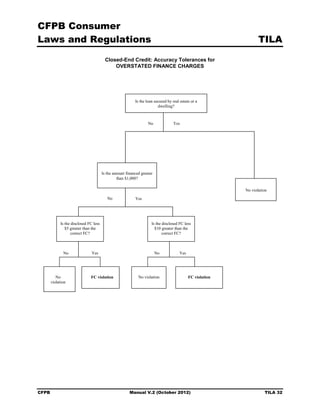
Regulation Z provides finance charge tolerances for legal accuracy that should not be confused
with those provided in the TILA for reimbursement under regulatory agency orders. As with
disclosed APRs, if a disclosed finance charge were legally accurate, it would not be subject to
reimbursement.
Under the TILA and Regulation Z, finance charge disclosures for open-end credit must be
accurate since there is no tolerance for finance charge errors. However, both the TILA and
Regulation Z permit various finance charge accuracy tolerances for closed-end credit.
Tolerances for the finance charge in a closed-end transaction, other than a mortgage loan, are
generally $5 if the amount financed is less than or equal to $1,000 and $10 if the amount
financed exceeds $1,000. Tolerances for certain transactions consummated on or after September
30, 1995 are noted below.

•	 Credit secured by real property or a dwelling (closed-end credit only):
   o	 The disclosed finance charge is considered accurate if it is not understated by more than
      $100.
   o	 Overstatements are not violations.

•	 Rescission rights after the three-business-day rescission period (closed-end credit only):


CFPB	                                 Manual V.2 (October 2012)                                 TILA 9
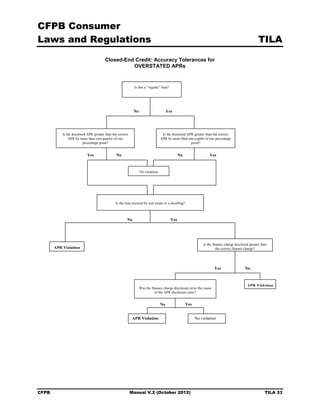
CFPB Consumer
Laws and Regulations                                                                      TILA
   o	 The disclosed finance charge is considered accurate if it does not vary from the actual
      finance charge by more than one-half of 1 percent of the credit extended or $100,
      whichever is greater.
   o	 The disclosed finance charge is considered accurate if it does not vary from the actual
      finance charge by more than 1 percent of the credit extended for the initial and
      subsequent refinancings of residential mortgage transactions when the new loan is made
      at a different financial institution. (This excludes high cost mortgage loans subject to
      section 1026.32, transactions in which there are new advances, and new consolidations.)

•	 Rescission rights in foreclosure:
   o	 The disclosed finance charge is considered accurate if it does not vary from the actual
      finance charge by more than $35.
   o	 Overstatements are not considered violations.
   o	 The consumer can rescind if a mortgage broker fee that should have been included in the
      finance charge was not included.
   NOTE: Normally, the finance charge tolerance for a rescindable transaction is either 0.5
   percent of the credit transaction or, for certain refinancings, 1 percent of the credit
   transaction. However, in the event of a foreclosure, the consumer may exercise the right of
   rescission if the disclosed finance charge is understated by more than $35.
See the “Finance Charge Tolerances” charts within these examination procedures for help in
determining appropriate finance charge tolerances.

Calculating the Finance Charge (Closed-End Credit)
One of the more complex tasks under Regulation Z is determining whether a charge associated
with an extension of credit must be included in, or excluded from, the disclosed finance charge.
The finance charge initially includes any charge that is, or will be, connected with a specific
loan. Charges imposed by third parties are finance charges if the financial institution requires use
of the third party. Charges imposed by settlement or closing agents are finance charges if the
bank requires the specific service that gave rise to the charge and the charge is not otherwise
excluded. The “Finance Charge Tolerances” charts within this document briefly summarize the
rules that must be considered.

Prepaid Finance Charges – Section 1026.18(b)(3)
A prepaid finance charge is any finance charge paid separately to the financial institution or to a
third party, in cash or by check before or at closing, settlement, or consummation of a
transaction, or withheld from the proceeds of the credit at any time.
Prepaid finance charges effectively reduce the amount of funds available for the consumer’s use;
usually before or at the time the transaction is consummated.


CFPB	                                  Manual V.2 (October 2012)                             TILA 10
CFPB Consumer
Laws and Regulations                                                                       TILA
Examples of finance charges frequently prepaid by consumers are borrower’s points, loan
origination fees, real estate construction inspection fees, odd days’ interest (interest attributable
to part of the first payment period when that period is longer than a regular payment period),
mortgage guarantee insurance fees paid to the Federal Housing Administration, private mortgage
insurance (PMI) paid to such companies as the Mortgage Guaranty Insurance Company (MGIC),
and, in non-real-estate transactions, credit report fees.
Precomputed Finance Charges

A precomputed finance charge includes, for example, interest added to the note amount that is
computed by the add-on, discount, or simple interest methods. If reflected in the face amount of
the debt instrument as part of the consumer’s obligation, finance charges that are not viewed as
prepaid finance charges are treated as precomputed finance charges that are earned over the life
of the loan.


CFPB                                  Manual V.2 (October 2012)                               TILA 11
CFPB Consumer
Laws and Regulations                                                                                                                                                                             TILA
                                                                                                 Finance Charge Chart


                                         FINANCE CHARGE = DOLLAR COST OF CONSUMER CREDIT: It includes any charge payable directly or indirectly by
                                         the consumer and imposed directly or indirectly by the creditor as a condition of or incident to the extension of credit.


                                                        CHARGES INCLUDED                                    CONDITIONS                                 CHARGES NOT                               CHARGES NEVER
     CHARGES ALWAYS                                     UNLESS CONDITIONS                                    (Any loan)                                   INCLUDED                                 INCLUDED
        INCLUDED                                            ARE MET                                                                                  (Residential mortgage
                                                                                                                                                 transactions and loans secured
                                                                                                                                                          by real estate)                    Charges payable in a comparable
                                                                                                                                                                                                    cash transaction
               Interest                                Premiums for credit life, A&H, or            Insurance not required, disclosures
                                                           loss of income insurance                 are made, and consumer authorizes
                                                                                                                                            Fees for title insurance, title examination,
                                                                                                                                                       property survey, etc
                                                                                                                                                                                               Fees for unanticipated late
                                                                                                                                                                                                       payments
           Transaction fees
                                                             Debt cancellation fees                 Coverage not required, disclosures
                                                                                                    are made, and consumer authorizes          Fees for preparing loan documents,
                                                                                                                                            mortgages, and other settlement documents        Overdraft fees not agreed to in
                                                                                                                                                                                                        writing
        Loan origination fees
          Consumer points
                                                       Premiums for property or liability              Consumer selects insurance
                                                                 insurance                          company and disclosures are made        Amounts required to be paid into escrow, if
                                                                                                                                              not otherwise included in the finance                 Seller’s points
                                                                                                                                                             charge
     Credit guarantee insurance
             premiums
                                                                                                    Insurer waives right of subrogation,
                                                         Premiums for vendor’s single                   consumer selects insurance
                                                            interest (VSI) insurance                company, and disclosures are made                                                       Participation or membership fees
                                                                                                                                                             Notary fees
 Charges imposed on the creditor for
   purchasing the loan, which are
     passed on to the consumer
                                                        Security interest charges (filing              The fee is for lien purposes,                                                        Discount offered by the seller to
                                                      fees), insurance in lieu of filing fees      prescribed by law, payable to a third        Pre-consummation flood and pest             induce payment by cash or other
                                                              and certain notary fees               public official and is itemized and                 inspection fees                     means not involving the use of a
                                                                                                                 disclosed                                                                            credit card
 Discounts for inducing payment by
      means other than credit
                                                                                                   Use of the third party is not required        Appraisal and credit report fees
                                                       Charges imposed by third parties            to obtain loan and creditor does not                                                      Interest forfeited as a result of
                                                                                                             retain the charge                                                             interest reduction required by law

        Mortgage broker fees
                                                                                                    Creditor does not require and does                                                     Charges absorbed by the creditor as
                                                        Charges imposed by third-party              not retain the fee for the particular                                                       a cost of doing business
                                                                closing agents                                     service
 Other examples: Fee for preparing
     TILA disclosures; real estate
  construction loan inspection fees;
  fees for post-consummation tax or                                                                  Application fees, if charged to all
 flood service policy; required credit                  Appraisal and credit report fees            applicants, are not finance charges
         life insurance charges                                                                       Application fees may include
                                                                                                      appraisal or credit report fees


CFPB                                                                                            Manual V.2 (October 2012)                                                                             TILA 12
CFPB Consumer
Laws and Regulations                                                                      TILA
Instructions for the Finance Charge Chart

The finance charge initially includes any charge that is, or will be, connected with a specific
loan. Charges imposed by third parties are finance charges if the creditor requires use of the third
party. Charges imposed on the consumer by a settlement agent are finance charges only if the
creditor requires the particular services for which the settlement agent is charging the borrower
and the charge is not otherwise excluded from the finance charge.
Immediately below the finance charge definition, the chart presents five captions applicable to
determining whether a loan related charge is a finance charge.
The first caption is charges always included. This category focuses on specific charges given in
the regulation or commentary as examples of finance charges.
The second caption, charges included unless conditions are met, focuses on charges that must be
included in the finance charge unless the creditor meets specific disclosure or other conditions to
exclude the charges from the finance charge.
The third caption, conditions, focuses on the conditions that need to be met if the charges
identified to the left of the conditions are permitted to be excluded from the finance charge.
Although most charges under the second caption may be included in the finance charge at the
creditor’s option, third-party charges and application fees (listed last under the third caption)
must be excluded from the finance charge if the relevant conditions are met. However, inclusion
of appraisal and credit report charges as part of the application fee is optional.
The fourth caption, charges not included, identifies fees or charges that are not included in the
finance charge under conditions identified by the caption. If the credit transaction is secured by
real property or the loan is a residential mortgage transaction, the charges identified in the
column, if they are bona fide and reasonable in amount, must be excluded from the finance
charge. For example, if a consumer loan is secured by a vacant lot or commercial real estate, any
appraisal fees connected with the loan must not be included in the finance charge.
The fifth caption, charges never included, lists specific charges provided by the regulation as
examples of those that automatically are not finance charges (e.g., fees for unanticipated late
payments).


CFPB                                 Manual V.2 (October 2012)                               TILA 13
CFPB Consumer
Laws and Regulations                                                                          TILA
Annual Percentage Rate Definition – Section 1026.22
(Closed-End Credit)
Credit costs may vary depending on the interest rate, the amount of the loan and other charges,
the timing and amounts of advances, and the repayment schedule. The APR, which must be
disclosed in nearly all consumer credit transactions, is designed to take into account all relevant
factors and to provide a uniform measure for comparing the cost of various credit transactions.
The APR is a measure of the cost of credit, expressed as a nominal yearly rate. It relates the
amount and timing of value received by the consumer to the amount and timing of payments made.
The disclosure of the APR is central to the uniform credit cost disclosure envisioned by the TILA.
The value of a closed-end credit APR must be disclosed as a single rate only, whether the loan
has a single interest rate, a variable interest rate, a discounted variable interest rate, or graduated
payments based on separate interest rates (step rates), and it must appear with the segregated
disclosures. Segregated disclosures are grouped together and do not contain any information not
directly related to the disclosures required under section 1026.18.
Since an APR measures the total cost of credit, including costs such as transaction charges or
premiums for credit guarantee insurance, it is not an “interest” rate, as that term is generally
used. APR calculations do not rely on definitions of interest in state law and often include
charges, such as a commitment fee paid by the consumer, that are not viewed by some state
usury statutes as interest. Conversely, an APR might not include a charge, such as a credit report
fee in a real property transaction, which some state laws might view as interest for usury
purposes. Furthermore, measuring the timing of value received and of payments made, which is
essential if APR calculations are to be accurate, must be consistent with parameters under
Regulation Z.
The APR is often considered to be the finance charge expressed as a percentage. However, two
loans could require the same finance charge and still have different APRs because of differing
values of the amount financed or of payment schedules. For example, the APR is 12 percent on a
loan with an amount financed of $5,000 and 36 equal monthly payments of $166.07 each. It is
13.26 percent on a loan with an amount financed of $4,500 and 35 equal monthly payments of
$152.18 each and final payment of $152.22. In both cases the finance charge is $978.52. The
APRs on these example loans are not the same because an APR does not only reflect the finance
charge. It relates the amount and timing of value received by the consumer to the amount and
timing of payments made.
The APR is a function of:

•	 The amount financed, which is not necessarily equivalent to the loan amount. For example, if
   the consumer must pay at closing a separate 1 percent loan origination fee (prepaid finance
   charge) on a $100,000 residential mortgage loan, the loan amount is $100,000, but the
   amount financed would be $100,000 less the $1,000 loan fee, or $99,000.


CFPB	                                  Manual V.2 (October 2012)                                TILA 14
CFPB Consumer
Laws and Regulations                                                                       TILA
•	 The finance charge, which is not necessarily equivalent to the total interest amount (interest is
   not defined by Regulation Z, but rather is defined by state or other federal law). For example:
   ○	 If the consumer must pay a $25 credit report fee for an auto loan, the fee must be
      included in the finance charge. The finance charge in that case is the sum of the interest
      on the loan (i.e., interest generated by the application of a percentage rate against the loan
      amount) plus the $25 credit report fee.
   ○	 If the consumer must pay a $25 credit report fee for a home improvement loan secured by
      real property, the credit report fee must be excluded from the finance charge. The finance
      charge in that case would be only the interest on the loan.

•	 The payment schedule, which does not necessarily include only principal and interest (P + I)
   payments. For example:
   ○	 If the consumer borrows $2,500 for a vacation trip at 14 percent simple interest per
      annum and repays that amount with 25 equal monthly payments beginning one month
      from consummation of the transaction, the monthly P + I payment will be $115.87, if all
      months are considered equal, and the amount financed would be $2,500. If the
      consumer’s payments are increased by $2.00 a month to pay a non-financed $50 loan fee
      during the life of the loan, the amount financed would remain at $2,500 but the payment
      schedule would be increased to $117.87 a month, the finance charge would increase by
      $50, and there would be a corresponding increase in the APR. This would be the case
      whether or not state law defines the $50 loan fee as interest.
   ○	 If the loan above has 55 days to the first payment and the consumer prepays interest at
      consummation ($24.31 to cover the first 25 days), the amount financed would be $2,500 ­
      $24.31, or $2,475.69. Although the amount financed has been reduced to reflect the
      consumer’s reduced use of available funds at consummation, the time interval during
      which the consumer has use of the $2,475.69, 55 days to the first payment, has not
      changed. Since the first payment period exceeds the limitations of the regulation’s minor
      irregularities provisions (see §1026.17(c)(4)), it may not be treated as regular. In
      calculating the APR, the first payment period must not be reduced by 25 days (i.e., the
      first payment period may not be treated as one month).
Financial institutions may, if permitted by state or other law, precompute interest by applying a
rate against a loan balance using a simple interest, add-on, discount or some other method, and
may earn interest using a simple interest accrual system, the Rule of 78’s (if permitted by law) or
some other method. Unless the financial institution’s internal interest earnings and accrual
methods involve a simple interest rate based on a 360-day year that is applied over actual days
(even that is important only for determining the accuracy of the payment schedule), it is not
relevant in calculating an APR, since an APR is not an interest rate (as that term is commonly
used under state or other law). Since the APR normally need not rely on the internal accrual
systems of a bank, it always may be computed after the loan terms have been agreed upon (as
long as it is disclosed before actual consummation of the transaction).


CFPB	                                 Manual V.2 (October 2012)                               TILA 15
CFPB Consumer
Laws and Regulations                                                                         TILA
Special Requirements for Calculating the Finance Charge and APR

Proper calculation of the finance charge and APR are of primary importance. The regulation
requires that the terms “finance charge” and “annual percentage rate” be disclosed more
conspicuously than any other required disclosure, subject to limited exceptions. The finance
charge and APR, more than any other disclosures, enable consumers to understand the cost of the
credit and to comparison shop for credit. A creditor’s failure to disclose those values accurately
can result in significant monetary damages to the creditor, either from a class action lawsuit or
from a regulatory agency’s order to reimburse consumers for violations of law.
If an APR or finance charge is disclosed incorrectly, the error is not, in itself, a violation of the
regulation if:

•	 The error resulted from a corresponding error in a calculation tool used in good faith by the
   financial institution.

•	 Upon discovery of the error, the financial institution promptly discontinues use of that
   calculation tool for disclosure purposes.

•	 The financial institution notifies the CFPB in writing of the error in the calculation tool.
When a financial institution claims a calculation tool was used in good faith, the financial
institution assumes a reasonable degree of responsibility for ensuring that the tool in question
provides the accuracy required by the regulation. For example, the financial institution might
verify the results obtained using the tool by comparing those results to the figures obtained by
using another calculation tool. The financial institution might also verify that the tool, if it is
designed to operate under the actuarial method, produces figures similar to those provided by the
examples in appendix J to the regulation. The calculation tool should be checked for accuracy
before it is first used and periodically thereafter.

Subpart B – Open-End Credit
Time of Disclosures (Periodic Statements) –
Section 1026.5(b)
For credit card accounts under an open-end (not home-secured) consumer credit plan, creditors
must adopt reasonable procedures designed to ensure that periodic statements are mailed or
delivered at least 21 days prior to the payment due date disclosed on the periodic statement and
that payments are not treated as late for any purpose if they are received within 21 days after
mailing or delivery of the statement. In addition, for all open-end consumer credit accounts with
grace periods, creditors must adopt reasonable procedures designed to ensure that periodic
statements are mailed or delivered at least 21 days prior to the date on which a grace period (if
any) expires and that finance charges are not imposed as a result of the loss of a grace period if a
payment is received within 21 days after mailing or delivery of a statement. For purposes of this
requirement, a “grace period” is defined as a period within which any credit extended may be
repaid without incurring a finance charge due to a periodic interest rate. For non-credit card


CFPB	                                  Manual V.2 (October 2012)                                TILA 16
CFPB Consumer
Laws and Regulations                                                                     TILA
open-end consumer plans without a grace period, creditors must adopt reasonable policies and
procedures designed to ensure that periodic statements are mailed or delivered at least 14 days
prior to the date on which the required minimum periodic payment is due. Moreover, the creditor
must adopt reasonable policies and procedures to ensure that it does not treat as late a required
minimum periodic payment received by the creditor within 14 days after it has mailed or
delivered the periodic statement.

Subsequent Disclosures (Open-End Credit) –
Section 1026.9
For open-end, not home-secured credit, the following applies:

Creditors are required to provide consumers with 45 days’ advance written notice of rate
increases and other significant changes to the terms of their credit card account agreements. The
list of “significant changes” includes most fees and other terms that a consumer should be aware
of before use of the account. Examples of such fees and terms include:

•	 Penalty fees;

•	 Transaction fees;

•	 Fees imposed for the issuance or availability of the open-end plan;

•	 Grace period; and

•   Balance computation method. 

Changes that do not require advance notice include:


•	 Reductions of finance charges;


•	 Termination of account privileges resulting from an agreement involving a court proceeding;


•	 The change is an increase in an APR upon expiration of a specified period of time previously
   disclosed in writing;

•	 The change applies to increases in variable APRs that change according to an index not
   under the card issuer’s control; and

•	 Rate increases due to the completion of, or failure of a consumer to comply with, the terms of
   a workout or temporary hardship arrangement, if those terms are disclosed prior to
   commencement of the arrangement.
A creditor may suspend account privileges, terminate an account, or lower the credit limit
without notice. However, a creditor that lowers the credit limit may not impose an over limit fee
or penalty rate as a result of exceeding the new credit limit without a 45-day advance notice that
the credit limit has been reduced.


CFPB	                                Manual V.2 (October 2012)                              TILA 17
CFPB Consumer
Laws and Regulations                                                                        TILA
For significant changes in terms (with the exception of rate changes, increases in the minimum
payment, certain changes in the balance computation method, and when the change results from
the consumer’s failure to make a required minimum periodic payment within 60 days after the
due date), a creditor must also provide consumers the right to reject the change. If the consumer
does reject the change prior to the effective date, the creditor may not apply the change to the
account (§1026.9(h)(2)(i)).
In addition, when a consumer rejects a change or increase, the creditor must not:

•	 Impose a fee or charge or treat the account as in default solely as a result of the rejection; or

•	 Require repayment of the balance on the account using a method that is less beneficial to the
   consumer than one of the following methods: (1) the method of repayment prior to the
   rejection; (2) an amortization period of not less than five years from the date of rejection; or
   (3) a minimum periodic payment that includes a percentage of the balance that is not more
   than twice the percentage included prior to the date of rejection.

Finance Charge (Open-End Credit) – Sections 1026.6(a)(1)
& 1026.6(b)(3)
Each finance charge imposed must be individually itemized. The aggregate total amount of the
finance charge need not be disclosed.
Determining the Balance and Computing the Finance Charge

The examiner must know how to compute the balance to which the periodic rate is applied.
Common methods used are the previous balance method, the daily balance method, and the
average daily balance method, which are described as follows:

•	 Previous balance method. The balance on which the periodic finance charge is computed is
   based on the balance outstanding at the start of the billing cycle. The periodic rate is
   multiplied by this balance to compute the finance charge.

•	 Daily balance method. A daily periodic rate is applied to either the balance on each day in the
   cycle or the sum of the balances on each of the days in the cycle. If a daily periodic rate is
   multiplied by the balance on each day in the billing cycle, the finance charge is the sum of
   the products. If the daily periodic rate is multiplied by the sum of all the daily balances, the
   result is the finance charge.

•	 Average daily balance method. The average daily balance is the sum of the daily balances
   (either including or excluding current transactions) divided by the number of days in the
   billing cycle. A periodic rate is then multiplied by the average daily balance to determine the
   finance charge. If the periodic rate is a daily one, the product of the rate multiplied by the
   average balance is multiplied by the number of days in the cycle.


CFPB	                                 Manual V.2 (October 2012)                               TILA 18
CFPB Consumer
Laws and Regulations                                                                       TILA
In addition to those common methods, financial institutions have other ways of calculating the
balance to which the periodic rate is applied. By reading the financial institution’s explanation,
the examiner should be able to calculate the balance to which the periodic rate was applied. In
some cases, the examiner may need to obtain additional information from the financial institution
to verify the explanation disclosed. Any inability to understand the disclosed explanation should
be discussed with management, who should be reminded of Regulation Z’s requirement that
disclosures be clear and conspicuous.
When a balance is determined without first deducting all credits and payments made during the
billing cycle, that fact and the amount of the credits and payments must be disclosed.
If the financial institution uses the daily balance method and applies a single daily periodic rate,
disclosure of the balance to which the rate was applied may be stated as any of the following:

•	 A balance for each day in the billing cycle. The daily periodic rate is multiplied by the
   balance on each day and the sum of the products is the finance charge.

•	 A balance for each day in the billing cycle on which the balance in the account changes. The
   finance charge is figured by the same method as discussed previously, but the statement
   shows the balance only for those days on which the balance changed.

•	 The sum of the daily balances during the billing cycle. The balance on which the finance
   charge is computed is the sum of all the daily balances in the billing cycle. The daily periodic
   rate is multiplied by that balance to determine the finance charge.

•	 The average daily balance during the billing cycle. If this is stated, the financial institution
   may, at its option, explain that the average daily balance is or can be multiplied by the
   number of days in the billing cycle and the periodic rate applied to the product to determine
   the amount of interest.
If the financial institution uses the daily balance method, but applies two or more daily
periodic rates, the sum of the daily balances may not be used. Acceptable ways of disclosing
the balances include:

•	 A balance for each day in the billing cycle;

•	 A balance for each day in the billing cycle on which the balance in the account changes; or

•	 Two or more average daily balances. If the average daily balances are stated, the financial
   institution may, at its option, explain that interest is or may be determined by 1) multiplying
   each of the average daily balances by the number of days in the billing cycle (or if the daily
   rate varied during the cycle), 2) by multiplying each of the results by the applicable daily
   periodic rate, and 3) adding these products together.
In explaining the method used to find the balance on which the finance charge is computed, the
financial institution need not reveal how it allocates payments or credits. That information may be
disclosed as additional information, but all required information must be clear and conspicuous.


CFPB	                                 Manual V.2 (October 2012)                                TILA 19
CFPB Consumer
Laws and Regulations                                                                                      TILA
NOTE: Section 1026.54 prohibits a credit card issuer from calculating finance charges based on
balances for days in previous billing cycles as a result of the loss of a grace period (a practice
sometimes referred to as “double-cycle billing”).
Finance Charge Resulting from Two or More Periodic Rates

Some financial institutions use more than one periodic rate in computing the finance charge. For
example, one rate may apply to balances up to a certain amount and another rate to balances
more than that amount. If two or more periodic rates apply, the financial institution must disclose
all rates and conditions. The range of balances to which each rate applies also must be disclosed.
It is not necessary, however, to break the finance charge into separate components based on the
different rates.

Annual Percentage Rate (Open-End Credit)
The disclosed APR on an open-end credit account is accurate if it is within one-eighth of one
percentage point of the APR calculated under Regulation Z.

Determination of APR – Section 1026.14
The basic method for determining the APR in open-end credit transactions involves multiplying
each periodic rate by the number of periods in a year. This method is used in all types of open-
end disclosures, including:

•   The corresponding APR in the initial disclosures;

•   The corresponding APR on periodic statements;

•   The APR in early disclosures for credit card accounts;

•   The APR in early disclosures for home-equity plans;

•   The APR in advertising; and

•   The APR in oral disclosures.
The corresponding APR is prospective and it does not involve any particular finance charge or
periodic balance.
A second method of calculating the APR is the quotient method. At a creditor’s option, the
quotient method may be disclosed on periodic statements for home-equity plans subject to
section 1026.40 (“HELOCs”). 4 The quotient method reflects the annualized equivalent of the

4
  If a creditor does not disclose the effective (or quotient method) APR on a HELOC periodic statement, it must
instead disclose the charges (fees and interest) imposed as provided in section 1026.7(a). However, an annual
percentage rate that differs from the rate that would otherwise apply and is offered only for a promotional period
need not be disclosed except in periods in which the offered rate is actually applied under section 1026.7(a)(4).


CFPB                                        Manual V.2 (October 2012)                                        TILA 20
CFPB Consumer
Laws and Regulations                                                                                      TILA
rate that was actually applied during a cycle. This rate, also known as the effective APR, will
differ from the corresponding APR if the creditor applies minimum, fixed, or transaction charges
to the account during the cycle. (§1026.14(c))
Brief Outline for Open-End Credit APR Calculations on Periodic Statements

NOTE: Assume monthly billing cycles for each of the calculations below.
I.	        Basic method for determining the APR in an open-end credit transaction. This is the
           corresponding APR. (§1026.14(b))
           A. Monthly rate x 12 = APR


II.	       Optional effective APR that may be disclosed on home-equity line of credit (HELOC)
           periodic statements
           A. APR when only periodic rates are imposed (§1026.14(c)(1))
               1.	 Monthly rate x 12 = APR

                    Or

               2.	 (Total finance charge / sum of the balances) x 12 = APR
           B. APR when minimum or fixed charge, but not transaction charge imposed.
              (§1026.14(c)(2))
               1. (Total finance charge / amount of applicable balance 5) x 12 = APR 6
           C. APR when the finance charge includes a charge related to a specific transaction (such
              as a cash advance fee), even if the total finance charge also includes any other
              minimum, fixed, or other charge not calculated using a periodic rate. (1026.14(c)(3))
               1.	 (Total finance charge / (all balances + other amounts on which a finance charge
                   was imposed during the billing cycle without duplication 7) x 12 = APR 8


5
    The APR cannot be determined with this formula if the applicable balance is zero. (§1026.14(c)(2))
6
  Loan fees, points, or similar finance charges that relate to the opening, renewing, or continuing of the account must
not be included in the calculation of the APR.

7
  The sum of the balances may include the average daily balance, adjusted balance, or previous balance method.

When a portion of the finance charge is determined by application of one or more daily periodic rates, the sum of the 

balances also means the average of daily balances. See Appendix F to Regulation Z.

8
 Cannot be less than the highest periodic rate applied, expressed as an APR (in other words. the largest rate 

determined by multiplying each periodic rate imposed during the billing cycle by the number of periods in a year).


CFPB	                                        Manual V.2 (October 2012)                                       TILA 21
CFPB Consumer
Laws and Regulations                                                                                       TILA
         D. APR when the finance charge imposed during the billing cycle includes a minimum
            or fixed charge that does not exceed $.50 for a monthly or longer billing cycles (or
            pro rata part of $.50 for a billing cycle shorter than monthly). (§1026.14(c)(4))
             1.	 Monthly rate x 12 = APR
         E. APR calculation when daily periodic rates are applicable if only the periodic rate is
            imposed or when a minimum or fixed charge (but not a transactional charge is
            imposed. (§1026.14(d))
             1.	 (Total finance charge / average daily balance) x 12 = APR
                  Or
             2.	 (Total finance charge / sum of daily balances) x 365 = APR

Timely Settlement of Estates – Section 1026.11(c)
Issuers are required to establish procedures to ensure that any administrator of an estate can
resolve the outstanding credit card balance of a deceased account holder in a timely manner. If
an administrator requests the amount of the balance:

•	 The issuer is prohibited from imposing additional fees on the account;

•	 The issuer is required to disclose the amount of the balance to the administrator in a timely
   manner (safe harbor of 30 days); and

•	 If the balance is paid in full within 30 days after disclosure of the balance, the issuer must
   waive or rebate any trailing or residual interest charges that accrued on the balance following
   the disclosure.

Minimum Payments – Section 1026.7(b)(12)
For credit card accounts under an open-end credit plan, card issuers generally must disclose on
periodic statements an estimate of the amount of time and the total cost (principal and interest)
involved in paying the balance in full by making only the minimum payments, and an estimate of
the monthly payment amount required to pay off the balance in 36 months and the total cost
(principal and interest) of repaying the balance in 36 months. Card issuers also must disclose a
minimum payment warning, and an estimate of the total interest that a consumer would save if
that consumer repaid the balance in 36 months, instead of making minimum payments.


Loan fees, points, or similar finance charges that relate to the opening, renewing, or continuing of the account must
not be included in the calculation of the APR.


CFPB	                                       Manual V.2 (October 2012)                                         TILA 22
CFPB Consumer
Laws and Regulations                                                                     TILA

Subpart C – Closed-End Credit
Finance Charge (Closed-End Credit) – Section 1026.17(a)
The aggregate total amount of the finance charge must be disclosed. Each finance charge imposed
need not be individually itemized and must not be itemized with the segregated disclosures.

Annual Percentage Rate (Closed-End Credit) –
Section 1026.22
Accuracy Tolerances

The disclosed APR on a closed-end transaction is accurate for:

•	 Regular transactions (which include any single advance transaction with equal payments and
   equal payment periods, or an irregular first payment period and/or a first or last irregular
   payment), if it is within one-eighth of 1 percentage point of the APR calculated under
   Regulation Z (§1026.22(a)(2)).

•	 Irregular transactions (which include multiple advance transactions and other transactions not
   considered regular), if it is within one-quarter of 1 percentage point of the APR calculated
   under Regulation Z (§1026.22(a)(3)).

•	 Mortgage transactions, if it is within one-eighth of 1 percentage point for regular transactions
   or one-quarter of 1 percentage point for irregular transactions or if:
   i.	 The rate results from the disclosed finance charge, and the disclosed finance is considered
       accurate under sections 1026.18(d)(1) or 1026.23(g) or (h) (§1026.22(a)(4)); or
   ii.	 The disclosed finance charge is calculated incorrectly but is considered accurate under
        sections 1026.18(d)(1) or 1026.23(g) or (h) and either:
           (A) the finance charge is understated and the disclosed APR is also understated but is
               closer to the actual APR than the APR that would be considered accurate under
               section 1026.22(a)(4); or
           (B) the disclosed finance charge is overstated and the disclosed APR is also
               overstated but is closer to the actual APR than the APR that would be considered
               accurate under section 1026.22(a)(4).
        For example, in an irregular transaction subject to a tolerance of ¼th of 1 percentage
        point, if the actual APR is 9.00% and a $75 omission from the finance charge
        corresponds to a rate of 8.50% that is considered accurate under section 1026.22(a)(4), a
        disclosed APR of 8.65% is considered accurate under section 1026.22(a)(5). However, a
        disclosed APR below 8.50% or above 9.25% would not be considered accurate.


CFPB	                                Manual V.2 (October 2012)                              TILA 23
CFPB Consumer
Laws and Regulations                                                                       TILA
Construction Loans – Section 1026.17(c)(6) & Appendix D
Construction and certain other multiple advance loans pose special problems in computing the
finance charge and APR. In many instances, the amount and dates of advances are not
predictable with certainty since they depend on the progress of the work. Regulation Z provides
that the APR and finance charge for such loans may be estimated for disclosure.
At its option, the financial institution may rely on the representations of other parties to acquire
necessary information (for example, it might look to the consumer for the dates of advances). In
addition, if either the amounts or dates of advances are unknown (even if some of them are
known), the financial institution may, at its option, use appendix D to the regulation to make
calculations and disclosures. The finance charge and payment schedule obtained through
appendix D may be used with volume one of the CFPB’s APR tables or with any other
appropriate computation tool to determine the APR. If the financial institution elects not to use
appendix D, or if appendix D cannot be applied to a loan (e.g., appendix D does not apply to a
combined construction-permanent loan if the payments for the permanent loan begin during the
construction period), the financial institution must make its estimates under section
1026.17(c)(2) and calculate the APR using multiple advance formulas.
On loans involving a series of advances under an agreement to extend credit up to a certain
amount, a financial institution may treat all of the advances as a single transaction or disclose
each advance as a separate transaction. If advances are disclosed separately, disclosures must
be provided before each advance occurs, with the disclosures for the first advance provided
before consummation.
In a transaction that finances the construction of a dwelling that may or will be permanently
financed by the same financial institution, the construction-permanent financing phases may be
disclosed in one of three ways listed below.

•	 As a single transaction, with one disclosure combining both phases.

•	 As two separate transactions, with one disclosure for each phase.

•	 As more than two transactions, with one disclosure for each advance and one for the
   permanent financing phase.
If two or more disclosures are furnished, buyer’s points or similar amounts imposed on the
consumer may be allocated among the transactions in any manner the financial institution
chooses, as long as the charges are not applied more than once. In addition, if the financial
institution chooses to give two sets of disclosures and the consumer is obligated for both
construction and permanent phases at the outset, both sets of disclosures must be given to the
consumer initially, before consummation of each transaction occurs.
If the creditor requires interest reserves for construction loans, special appendix D rules apply
that can make the disclosure calculations quite complicated. The amount of interest reserves
included in the commitment amount must not be treated as a prepaid finance charge.


CFPB	                                 Manual V.2 (October 2012)                               TILA 24
CFPB Consumer
Laws and Regulations                                                                      TILA
If the lender uses appendix D for construction-only loans with required interest reserves, the
lender must estimate construction interest using the interest reserve formula in appendix D. The
lender’s own interest reserve values must be completely disregarded for disclosure purposes.
If the lender uses appendix D for combination construction-permanent loans, the calculations can
be much more complex. Appendix D is used to estimate the construction interest, which is then
measured against the lender’s contractual interest reserves.
If the interest reserve portion of the lender’s contractual commitment amount exceeds the
amount of construction interest estimated under appendix D, the excess value is considered part
of the amount financed if the lender has contracted to disburse those amounts whether they
ultimately are needed to pay for accrued construction interest. If the lender will not disburse the
excess amount if it is not needed to pay for accrued construction interest, the excess amount must
be ignored for disclosure purposes.

Calculating the Annual Percentage Rate – Section 1026.22
The APR must be determined under one of the following:

•	 The actuarial method, which is defined by Regulation Z and explained in appendix J to the
   regulation.

•	 The U.S. Rule, which is permitted by Regulation Z and briefly explained in appendix J to the
   regulation. The U.S. Rule is an accrual method that seems to have first surfaced officially in
   an early nineteenth century United States Supreme Court case, Story v. Livingston, 38 U.S.
   359 (1839).
Whichever method is used by the financial institution, the rate calculated will be accurate if it is
able to “amortize” the amount financed while it generates the finance charge under the accrual
method selected. Financial institutions also may rely on minor irregularities and accuracy
tolerances in the regulation, both of which effectively permit somewhat imprecise, but still legal,
APRs to be disclosed.

360-Day and 365-Day Years – Section 1026.17(c)(3)
Confusion often arises over whether to use the 360-day or 365-day year in computing interest,
particularly when the finance charge is computed by applying a daily rate to an unpaid balance.
Many single payment loans or loans payable on demand are in this category. There are also loans
in this category that call for periodic installment payments. Regulation Z does not require the use
of one method of interest computation in preference to another (although state law may). It does,
however, permit financial institutions to disregard the fact that months have different numbers of
days when calculating and making disclosures. This means financial institutions may base their
disclosures on calculation tools that assume all months have an equal number of days, even if
their practice is to take account of the variations in months to collect interest.


CFPB	                                Manual V.2 (October 2012)                               TILA 25
CFPB Consumer
Laws and Regulations                                                                        TILA
For example, a financial institution may calculate disclosures using a financial calculator based
on a 360-day year with 30-day months, when, in fact, it collects interest by applying a factor of
1/365 of the annual interest rate to actual days.
Disclosure violations may occur, however, when a financial institution applies a daily interest
factor based on a 360-day year to the actual number of days between payments. In those
situations, the financial institution must disclose the higher values of the finance charge, the
APR, and the payment schedule resulting from this practice.
For example, a 12 percent simple interest rate divided by 360 days results in a daily rate of
.033333 percent. If no charges are imposed except interest, and the amount financed is the same
as the loan amount, applying the daily rate on a daily basis for a 365-day year on a $10,000 one
year, single payment, unsecured loan results in an APR of 12.17 percent (.033333% x 365 =
12.17%), and a finance charge of $1,216.67. There would be a violation if the APR were
disclosed as 12 percent or if the finance charge were disclosed as $1,200 (12% x $10,000).
However, if there are no other charges except interest, the application of a 360-day year daily
rate over 365 days on a regular loan would not result in an APR in excess of the one eighth of
one percentage point APR tolerance unless the nominal interest rate is greater than 9 percent. For
irregular loans, with one-quarter of 1 percentage point APR tolerance, the nominal interest rate
would have to be greater than 18 percent to exceed the tolerance.

Variable Rate Information – Section 1026.18(f) &
Commentary to Section 1026.17(c)
If the terms of the legal obligation allow the financial institution, after consummation of the
transaction, to increase the APR, the financial institution must furnish the consumer with certain
information on variable rates. Graduated payment mortgages and step-rate transactions without a
variable rate feature are not considered variable rate transactions. In addition, variable rate
disclosures are not applicable to rate increases resulting from delinquency, default, assumption,
acceleration, or transfer of the collateral.
Some of the more important transaction-specific variable rate disclosure requirements follow.

•	 Disclosures for variable rate loans must be given for the full term of the transaction and must
   be based on the terms in effect at the time of consummation.

•	 If the variable rate transaction includes either a seller buy-down that is reflected in a contract
   or a consumer buy-down, the disclosed APR should be a composite rate based on the lower
   rate for the buy-down period and the rate that is the basis for the variable rate feature for the
   remainder of the term.

•	 If the initial rate is not determined by the index or formula used to make later interest rate
   adjustments, as in a discounted variable rate transaction, the disclosed APR must reflect a
   composite rate based on the initial rate for as long as it is applied and, for the remainder of


CFPB	                                 Manual V.2 (October 2012)                               TILA 26
CFPB Consumer
Laws and Regulations                                                                        TILA
   the term, the rate that would have been applied using the index or formula at the time of
   consummation (i.e., the fully indexed rate).
   ○	 If a loan contains a rate or payment cap that would prevent the initial rate or payment, at
      the time of the adjustment, from changing to the fully indexed rate, the effect of that rate
      or payment cap needs to be reflected in the disclosures.
   ○	 The index at consummation need not be used if the contract provides a delay in the
      implementation of changes in an index value (e.g., the contract indicates that future rate
      changes are based on the index value in effect for some specified period, like 45 days
      before the change date). Instead, the financial institution may use any rate from the date
      of consummation back to the beginning of the specified period (e.g., during the previous
      45-day period).

•	 If the initial interest rate is set according to the index or formula used for later adjustments,
   but is set at a value as of a date before consummation, disclosures should be based on the
   initial interest rate, even though the index may have changed by the consummation date.
For variable-rate loans that are not secured by the consumer’s principal dwelling or that are
secured by the consumer’s principal dwelling but have a term of one year or less, creditors must
disclose the circumstances under which the rate may increase, any limitations on the increase, the
effect of an increase, and an example of the payment terms that would result from an increase.
(§1026.18(f)(1))
For variable-rate consumer loans secured by the consumer’s principal dwelling and having a
maturity of more than one year, creditors must state that the loan has a variable-rate feature and
that the disclosures were previously given. (§1026.18(f)(2)) Extensive disclosures about the loan
program are provided when consumers apply for such a loan (§1026.19(b)), and throughout the
loan term when the rate or payment amount is changed (§1026.20(c)).

Payment Schedule – Section 1026.18(g)
The disclosed payment schedule must reflect all components of the finance charge. It includes all
payments scheduled to repay loan principal, interest on the loan, and any other finance charge
payable by the consumer after consummation of the transaction.
However, any finance charge paid separately before or at consummation (e.g., odd days’ interest)
is not part of the payment schedule. It is a prepaid finance charge that must be reflected as a
reduction in the value of the amount financed.
At the creditor’s option, the payment schedule may include amounts beyond the amount financed
and finance charge (e.g., certain insurance premiums or real estate escrow amounts such as taxes
added to payments). However, when calculating the APR, the creditor must disregard such amounts.
If the obligation is a renewable balloon payment instrument that unconditionally obligates the
financial institution to renew the short-term loan at the consumer’s option or to renew the loan
subject to conditions within the consumer’s control, the payment schedule must be disclosed


CFPB	                                 Manual V.2 (October 2012)                                TILA 27
CFPB Consumer
Laws and Regulations                                                                       TILA
using the longer term of the renewal period or periods. The long-term loan must be disclosed
with a variable rate feature.
If there are no renewal conditions or if the financial institution guarantees to renew the obligation
in a refinancing, the payment schedule must be disclosed using the shorter balloon payment term.
The short-term loan must be disclosed as a fixed rate loan, unless it contains a variable rate
feature during the initial loan term.

Amount Financed – Section 1026.18(b)
Definition – The amount financed is the net amount of credit extended for the consumer’s use. It
should not be assumed that the amount financed under the regulation is equivalent to the note
amount, proceeds, or principal amount of the loan. The amount financed normally equals the
total of payments less the finance charge.
To calculate the amount financed, all amounts and charges connected with the transaction, either
paid separately or included in the note amount, must first be identified. Any prepaid,
precomputed, or other finance charge must then be determined.
The amount financed must not include any finance charges. If finance charges have been
included in the obligation (either prepaid or precomputed), they must be subtracted from the face
amount of the obligation when determining the amount financed. The resulting value must be
reduced further by an amount equal to any prepaid finance charge paid separately. The final
resulting value is the amount financed.
When calculating the amount financed, finance charges (whether in the note amount or paid
separately) should not be subtracted more than once from the total amount of an obligation.
Charges not in the note amount and not included in the finance charge (e.g., an appraisal fee paid
separately in cash on a real estate loan) are not required to be disclosed under Regulation Z and
must not be included in the amount financed.
In a multiple advance construction loan, proceeds placed in a temporary escrow account and
awaiting disbursement in draws to the developer are not considered part of the amount financed
until actually disbursed. Thus, if the entire commitment amount is disbursed into the lender’s
escrow account, the lender must not base disclosures on the assumption that all funds were
disbursed immediately, even if the lender pays interest on the escrowed funds.

Required Deposit – Section 1026.18(r)
A required deposit, with certain exceptions, is one that the financial institution requires the
consumer to maintain as a condition of the specific credit transaction. It can include a
compensating balance or a deposit balance that secures the loan. The effect of a required deposit
is not reflected in the APR. Also, a required deposit is not a finance charge since it is eventually
released to the consumer. A deposit that earns at least 5 percent per year need not be considered
a required deposit.


CFPB                                  Manual V.2 (October 2012)                              TILA 28
CFPB Consumer
Laws and Regulations                                                                       TILA
Calculating the Amount Financed
A consumer signs a note secured by real property in the amount of $5,435. The note amount
includes $5,000 in proceeds disbursed to the consumer, $400 in precomputed interest, $25 paid
to a credit reporting agency for a credit report, and a $10 service charge. Additionally, the
consumer pays a $50 loan fee separately in cash at consummation. The consumer has no other
debt with the financial institution. The amount financed is $4,975.
The amount financed may be calculated by first subtracting all finance charges included in the
note amount ($5,435 - $400 - $10 = $5,025). The $25 credit report fee is not a finance charge
because the loan is secured by real property. The $5,025 is further reduced by the amount of
prepaid finance charges paid separately, for an amount financed of $5,025 - $50 = $4,975. The
answer is the same whether finance charges included in the obligation are considered prepaid or
precomputed finance charges.
The financial institution may treat the $10 service charge as an addition to the loan amount and
not as a prepaid finance charge. If it does, the loan principal would be $5,000. The $5,000 loan
principal does not include either the $400 or the $10 precomputed finance charge in the note.
The loan principal is increased by other amounts that are financed which are not part of the
finance charge (the $25 credit report fee) and reduced by any prepaid finance charges (the $50
loan fee, not the $10 service charge) to arrive at the amount financed of $5,000 + $25 - $50 =
$4,975.

Other Calculations
The financial institution may treat the $10 service charge as a prepaid finance charge. If it does,
the loan principal would be $5,010. The $5,010 loan principal does not include the $400
precomputed finance charge. The loan principal is increased by other amounts that are financed
which are not part of the finance charge (the $25 credit report fee) and reduced by any prepaid
finance charges (the $50 loan fee and the $10 service charge withheld from loan proceeds) to
arrive at the same amount financed of $5,010 + $25 - $50- $10 = $4,975.


CFPB                                 Manual V.2 (October 2012)                               TILA 29
CFPB Consumer
Laws and Regulations                                                                                                                         TILA
                               Closed-End Credit: Accuracy and Reimbursement Tolerances for

                                           UNDERSTATED FINANCE CHARGES


                                                                      Is the loan secured by real estate or a
                                                                                    dwelling?


                                                                                      No         Yes


                                    Is the amount financed greater
                                             than $1,000?
                                                                                                                        Is the disclosed FC understated
                                            No          Yes                                                              by more than $100 (or $200 if
                                                                                                                           the loan originated before
                                                                                                                                    9/30/95)?
            Is the disclosed FC                                          Is the disclosed FC
         understated by more than                                     understated by more than
                    $5?                                                          $10?
                                                                                                                               No          Yes
                Ye        No                                               No           Yes


                                                                                                                    No violation              FC Violation
 FC violation                               No violation                                   FC violation


                                              Is the loan
                                             term greater
                                                than 10
                                                 years?


                                            No          Yes

                                                                      Is the loan a
                                                                      regular loan?

                                                                     No         Yes


                                       Is the disclosed FC plus the FC            Is the disclosed FC plus the FC
                                       reimbursement tolerance (based             reimbursement tolerance (based
                                       on a one-quarter of 1 percentage           on a one-eighth of 1 percentage
                                       point APR tolerance) less than             point APR tolerance) less than
                                       the correct FC?                            the correct FC?

                                                   Ye         No                        No         Yes


                                                                     No reimbursement


                                                                        Subject to
                                                                     reimbursement


CFPB                                                                 Manual V.2 (October 2012)                                                    TILA 31
CFPB Consumer
Laws and Regulations                                                                                             TILA

                                         Closed-End Credit: Accuracy Tolerances for

                                             OVERSTATED FINANCE CHARGES


                                                          Is the loan secured by real estate or a
                                                                        dwelling?


                                                                  No             Yes


                                       Is the amount financed greater
                                                than $1,000?

                                                                                                          No violation
                                          No              Yes


            Is the disclosed FC less                                Is the disclosed FC less
               $5 greater than the                                    $10 greater than the
                   correct FC?                                             correct FC?


              No               Yes                                      No           Yes


          No                  FC violation                  No violation                   FC violation
       violation


CFPB                                                   Manual V.2 (October 2012)                                    TILA 32
CFPB Consumer
Laws and Regulations                                                                                                                                TILA

                                        Closed-End Credit: Accuracy Tolerances for

                                                  OVERSTATED APRs


                                                             Is this a “regular” loan?


                                                            No                       Yes


           Is the disclosed APR greater than the correct                         Is the disclosed APR greater than the correct
               APR by more than one-quarter of one                              APR by more than one-eighth of one percentage
                         percentage point?                                                          point?


                           Yes                 No                                              No                 Yes


                                                                 No violation


                                               Is the loan secured by real estate or a dwelling?


                                                       No                                Yes


                                                                                                              Is the finance charge disclosed greater than
       APR Violation                                                                                                   the correct finance charge?


                                                                                                                     Yes                  No


                                                                                                                                            APR Violation
                                                                 Was the finance charge disclosure error the cause
                                                                           of the APR disclosure error?


                                                                                No                  Yes


                                                            APR Violation                                 No violation


CFPB                                                       Manual V.2 (October 2012)                                                                    TILA 33
CFPB Consumer
Laws and Regulations                                                                                                                                 TILA

         Closed-End Credit: Accuracy and Reimbursement Tolerances for

                             UNDERSTATED APRs


                                            Is the loan a “regular” loan?


                                              No                  Yes


            Is the disclosed APR understated by                        Is the disclosed APR understated by
           more than one-quarter of one percentage                          more than one-eighth of one
                            point?                                               percentage point?

                       Ye         No                                             No            Yes


                                                     No violation


                                    Is the loan secured by real estate or a dwelling?

                                                 No               Ye


                                                                                             Is the finance charge understated by more than:
                                                                                             • $100 if the loan originated on or after 9/30/95?
                                                                                             • $200 if the loan originated before 9/30/95?


       APR violation                                                                           No                  Yes


                                              Was the finance charge disclosure error the cause of
                                              the APR disclosure error?

                                                                                                                                APR violation
                                                             No           Yes


                                     APR violation                                         No violation


                                                     Is the loan term greater than 10 years?


                                                              No                Yes


                                                                            Is the loan a “regular” loan?


                                                                                      No          Ye


                                           Is the disclosed APR understated by                               Is the disclosed APR understated by
                                          more than one-quarter of one percentage                           more than one-eighth of one percentage
                                                           point?                                                            point?
                                                       Yes          No                                               No            Yes


                                                                                      No reimbursement


                                                                                 Subject to reimbursement


CFPB                                           Manual V.2 (October 2012)                                                                              TILA 34
CFPB Consumer
Laws and Regulations                                                                       TILA
Refinancings – Section 1026.20
When an obligation is satisfied and replaced by a new obligation to the original financial
institution (or a holder or servicer of the original obligation) and is undertaken by the same
consumer, it must be treated as a refinancing for which a complete set of new disclosures must
be furnished. A refinancing may involve the consolidation of several existing obligations,
disbursement of new money to the consumer, or the rescheduling of payments under an existing
obligation. In any form, the new obligation must completely replace the earlier one to be
considered a refinancing under the regulation. The finance charge on the new disclosure must
include any unearned portion of the old finance charge that is not credited to the existing
obligation. (§1026.20(a))
The following transactions are not considered refinancings even if the existing obligation is
satisfied and replaced by a new obligation undertaken by the same consumer:

•	 A renewal of an obligation with a single payment of principal and interest or with periodic
   interest payments and a final payment of principal with no change in the original terms.

•	 An APR reduction with a corresponding change in the payment schedule.

•	 An agreement involving a court proceeding.

•	 Changes in credit terms arising from the consumer’s default or delinquency.

•	 The renewal of optional insurance purchased by the consumer and added to an existing
   transaction, if required disclosures were provided for the initial purchase of the insurance.
However, even if it is not accomplished by the cancellation of the old obligation and substitution
of a new one, a new transaction subject to new disclosures results if the financial institution:

•	 Increases the rate based on a variable rate feature that was not previously disclosed; or

•	 Adds a variable rate feature to the obligation.
If, at the time a loan is renewed, the rate is increased, the increase is not considered a variable
rate feature. It is the cost of renewal, similar to a flat fee, as long as the new rate remains fixed
during the remaining life of the loan. If the original debt is not canceled in connection with such
a renewal, the regulation does not require new disclosures. Also, changing the index of a variable
rate transaction to a comparable index is not considered adding a variable rate feature to the
obligation.


CFPB	                                 Manual V.2 (October 2012)                                TILA 35
CFPB Consumer
Laws and Regulations                                                                      TILA
Advertising – Sections 1026.16 & 1026.24
The regulation requires that loan product advertisements provide accurate and balanced
information, in a clear and conspicuous manner, about rates, monthly payments, and other loan
features. The advertising rules ban several deceptive or misleading advertising practices,
including representations that a rate or payment is “fixed” when in fact it can change.
Advertising Rules for Open-End Plans – Section 1026.16

If an advertisement for credit states specific credit terms, it must state only those terms that
actually are or will be arranged or offered by the creditor. If any finance charges or other charges
are set forth in an advertisement, the advertisement must also clearly and conspicuously state the
following:

•	 Any minimum, fixed, transaction, activity or similar charge that is a finance charge under
   section 1026.4 that could be imposed;

•	 Any periodic rate that may be applied expressed as an APR as determined under section
   1026.14(b). If the plan provides for a variable periodic rate, that fact must be disclosed; and

•	 Any membership or participation fee that could be imposed.
If any finance charges or other charge or payment terms are set forth, affirmatively or negatively,
in an advertisement for a home-equity plan subject to the requirements of section 1026.40, the
advertisement also must clearly and conspicuously set forth the following:

•	 Any loan fee that is a percentage of the credit limit under the plan and an estimate of any
   other fees imposed for opening the plan, stated as a single dollar amount or a reasonable
   range;

•	 Any periodic rate used to compute the finance charge, expressed as an APR as determined
   under section 1026.14(b); and

•	 The maximum APR that may be imposed in a variable-rate plan.
Regulation Z’s open-end home-equity plan advertising rules include a clear and conspicuous
standard for home-equity plan advertisements, consistent with the approach taken in the
advertising rules for consumer leases under Regulation M. Commentary provisions clarify how
the clear and conspicuous standard applies to advertisements of home-equity plans with
promotional rates or payments, and to Internet, television, and oral advertisements of home-
equity plans. The regulation allows alternative disclosures for television and radio
advertisements for home-equity plans. The regulation also requires that advertisements
adequately disclose not only promotional plan terms, but also the rates or payments that will
apply over the term of the plan.


CFPB	                                Manual V.2 (October 2012)                               TILA 36
CFPB Consumer
Laws and Regulations                                                                        TILA
Regulation Z also contains provisions implementing the Bankruptcy Abuse Prevention and
Consumer Protection Act of 2005, which requires disclosure of the tax implications of certain
home-equity plans.
Closed-End Advertising – Section 1026.24

If an advertisement for credit states specific credit terms, it must state only those terms that
actually are or will be arranged or offered by the creditor.
Disclosures required by this section must be made “clearly and conspicuously.” To meet this
standard in general, credit terms need not be printed in a certain type size nor appear in any
particular place in the advertisement. For advertisements for credit secured by a dwelling, a clear
and conspicuous disclosure means that the required information is disclosed with equal
prominence and in close proximity to the advertised rates or payments triggering the required
disclosures.
If an advertisement states a rate of finance charge, it must state the rate as an “annual percentage
rate,” using that term. If the APR may be increased after consummation, the advertisement must
state that fact.
If an advertisement is for credit not secured by a dwelling, the advertisement must not state any
other rate, except that a simple annual rate or periodic rate that is applied to an unpaid balance
may be stated in conjunction with, but not more conspicuously than, the APR.
If an advertisement is for credit secured by a dwelling, the advertisement must not state any other
rate, except that a simple annual rate that is applied to an unpaid balance may be stated in
conjunction with, but not more conspicuously than, the APR. That is, an advertisement for credit
secured by a dwelling may not state a periodic rate, other than a simple annual rate, that is
applied to an unpaid balance.
“Triggering terms” - The following are triggering terms that require additional disclosures:

•	 The amount or percentage of any down payment;

•	 The number of payments or period of repayment;

•	 The amount of any payment; and

•	 The amount of any finance charge.
An advertisement stating a triggering term must also state the following terms as applicable:

•	 The amount or percentage of any down payment;

•	 The terms of repayment, which reflect the repayment obligations over the full term of the
   loan, including any balloon payment; and


CFPB	                                 Manual V.2 (October 2012)                                TILA 37
CFPB Consumer
Laws and Regulations                                                                      TILA
•	 The “annual percentage rate,” using that term, and, if the rate may be increased after
   consummation, that fact.
For any advertisement secured by a dwelling, other than television or radio advertisements, that
states a simple annual rate of interest and more than one simple annual rate of interest will apply
over the term of the advertised loan, the advertisement must state in a clear and conspicuous
manner:

•	 Each simple rate of interest that will apply. In variable-rate transactions, a rate determined by
   adding an index and margin must be disclosed based on a reasonably current index and
   margin.

•	 The period of time during which each simple annual rate of interest will apply.

•	 The APR for the loan.
The regulation prohibits the following seven deceptive or misleading acts or practices in
advertisements for closed-end mortgage loans:

•	 Stating that rates or payments for loans are “fixed” when those rates or payments can vary
   without adequately disclosing that the interest rate or payment amounts are “fixed” only for a
   limited period of time, rather than for the full term of the loan;

•	 Making comparisons between actual or hypothetical credit payments or rates and any
   payment or rate available under the advertised product that are not available for the full term
   of the loan, with certain exceptions for advertisements for variable rate products;

•	 Characterizing the products offered as “government loan programs,” “government-supported
   loans,” or otherwise endorsed or sponsored by a federal or state government entity even
   though the advertised products are not government-supported or -sponsored loans;

•	 Displaying the name of the consumer’s current mortgage lender, unless the advertisement
   also prominently discloses that the advertisement is from a mortgage lender not affiliated
   with the consumer’s current lender;

•	 Making claims of debt elimination if the product advertised would merely replace one debt
   obligation with another;

•	 Creating a false impression that the mortgage broker or lender is a “counselor” for the
   consumer; and

•	 In foreign-language advertisements, providing certain information, such as a low
   introductory “teaser” rate, in a foreign language, while providing required disclosures only in
   English.


CFPB	                                Manual V.2 (October 2012)                               TILA 38
CFPB Consumer
Laws and Regulations                                                                                               TILA

Subpart D – Miscellaneous
Civil Liability - TILA Sections 130 and 131

If a creditor fails to comply with any requirements of the TILA, other than with the advertising
provisions of chapter 3, it may be held liable to the consumer for

•	 actual damage, and.

•	 cost of any successful legal action together with reasonable attorney’s fees.
The creditor also may be held liable for any of the following:

•	 In an individual action, twice the amount of the finance charge involved.

•	 In an individual action relating to an open-end credit transaction that is not secured by real
   property or a dwelling, twice the amount of the finance charge involved, with a minimum of
   $500 and a maximum of $5,000 or such higher amount as may be appropriate in the case of
   an established pattern or practice of such failure.

•	 In an individual action relating to a closed-end credit transaction secured by real property or
   a dwelling, not less than $400 and not more than $4,000.

•	 In a class action, such amount as the court may allow (with no minimum recovery for each
   class member). However, the total amount of recovery in any class actions arising out of the
   same failure to comply by the same creditor cannot be more than $500,000 9 or 1 percent of
   the creditor’s net worth, whichever is less.
A creditor that fails to comply with section 129 of TILA, 15 U.S.C. §1639, (requirements for
certain mortgages which include high-cost mortgage loans under 1026.32(a)) may be held liable
to the consumer for all finance charges and fees paid by the consumer unless the creditor
demonstrates that the failure was not material. Generally, civil actions that may be brought
against a creditor may be maintained against any assignee of the creditor only if the violation is
apparent on the face of the disclosure statement or other documents assigned, except where the
assignment was involuntary. For high-cost mortgage loans (under section 1026.32(a)), any
subsequent purchaser or assignee is subject to all claims and defenses that the consumer could
assert against the creditor, unless the assignee demonstrates that it could not reasonably have
determined that the loan was a high-cost mortgage loan subject to section 1026.32.
In specified circumstances, the creditor or assignee has no liability if it corrects identified errors
within 60 days of discovering the errors and prior to the institution of a civil action or the receipt
of written notice of the error from the obligor. Additionally, a creditor and assignee will not be


9
 Effective January 21, 2013, this dollar figure changes to $1,000,000. See Pub. L. 111-203, approved July 21, 2010; 124 Stat.
2153, §1416. (http://www.gpo.gov/fdsys/pkg/PLAW-111publ203/pdf/PLAW-111publ203.pdf);


CFPB	                                           Manual V.2 (October 2012)                                             TILA 39
CFPB Consumer
Laws and Regulations                                                                      TILA
liable for bona fide errors that occurred despite the maintenance of procedures reasonably
adapted to avoid any such error.
Refer to Sections 130 and 131 of TILA for more information.

Criminal Liability – TILA Section 112
Anyone who willingly and knowingly fails to comply with any requirement of the TILA will be
fined not more than $5,000 or imprisoned not more than one year, or both.

Administrative Actions – TILA Section 108
The TILA authorizes federal regulatory agencies to require financial institutions to make
monetary and other adjustments to the consumers’ accounts when the true finance charge or APR
exceeds the disclosed finance charge or APR by more than a specified accuracy tolerance. That
authorization extends to unintentional errors, including isolated violations (e.g., an error that
occurred only once or errors, often without a common cause, that occurred infrequently and
randomly).
Under certain circumstances, the TILA requires federal regulatory agencies to order financial
institutions to reimburse consumers when understatement of the APR or finance charge involves:

•	 Patterns or practices of violations (e.g., errors that occurred, often with a common cause,
   consistently or frequently, reflecting a pattern with a specific type or types of consumer
   credit).

•	 Gross negligence.

•	 Willful noncompliance intended to mislead the person to whom the credit was extended.
Any proceeding that may be brought by a regulatory agency against a creditor may be
maintained against any assignee of the creditor if the violation is apparent on the face of the
disclosure statement or other documents assigned, except where the assignment was involuntary
under section 131 (15 U.S.C. 1641).

Relationship to State Law – TILA Section 111
State laws providing rights, responsibilities, or procedures for consumers or financial institutions
for consumer credit contracts may be:

•	 Preempted by federal law;

•	 Not preempted by federal law; or

•	 Substituted in lieu of the TILA and Regulation Z requirements.


CFPB	                                Manual V.2 (October 2012)                               TILA 40
CFPB Consumer
Laws and Regulations                                                                      TILA
State law provisions are preempted to the extent that they contradict the requirements in the
following chapters of the TILA and the implementing sections of Regulation Z:

•	 Chapter 1, “General Provisions,” which contains definitions and acceptable methods for
   determining finance charges and annual percentage rates.

•	 Chapter 2, “Credit Transactions,” which contains disclosure requirements, rescission rights,
   and certain credit card provisions.

•	 Chapter 3, “Credit Advertising,” which contains consumer credit advertising rules and APR
   oral disclosure requirements.
For example, a state law would be preempted if it required a bank to use the terms “nominal
annual interest rate” in lieu of “annual percentage rate.”
Conversely, state law provisions are generally not preempted under federal law if they call for,
without contradicting chapters 1, 2, or 3 of the TILA or the implementing sections of Regulation
Z, either of the following:

•	 Disclosure of information not otherwise required. A state law that requires disclosure of the
   minimum periodic payment for open-end credit, for example, would not be preempted
   because it does not contradict federal law.

•	 Disclosures more detailed than those required. A state law that requires itemization of the
   amount financed, for example, would not be preempted, unless it contradicts federal law by
   requiring the itemization to appear with the disclosure of the amount financed in the
   segregated closed-end credit disclosures.
The relationship between state law and chapter 4 of the TILA (“Credit Billing”) involves two
parts. The first part is concerned with sections 161 (correction of billing errors) and 162
(regulation of credit reports) of the act; the second part addresses the remaining sections of
chapter 4.
State law provisions are preempted if they differ from the rights, responsibilities, or procedures
contained in sections 161 or 162. An exception is made, however, for state law that allows a
consumer to inquire about an account and requires the bank to respond to such inquiry beyond
the time limits provided by federal law. Such a state law would not be preempted for the extra
time period.
State law provisions are preempted if they result in violations of sections 163 through 171 of
chapter 4. For example, a state law that allows the card issuer to offset the consumer’s credit-
card indebtedness against funds held by the card issuer would be preempted, since it would
violate 12 CFR 1026.12(d). Conversely, a state law that requires periodic statements to be sent
more than 14 days before the end of a free-ride period would not be preempted, since no
violation of federal law is involved.


CFPB	                                Manual V.2 (October 2012)                               TILA 41
CFPB Consumer
Laws and Regulations                                                                       TILA
A bank, state, or other interested party may ask the CFPB to determine whether state law
contradicts chapters 1 through 3 of the TILA or Regulation Z. They also may ask if the state law is
different from, or would result in violations of, chapter 4 of the TILA and the implementing
provisions of Regulation Z. If the CFPB determines that a disclosure required by state law (other
than a requirement relating to the finance charge, APR, or the disclosures required under section
1026.32) is substantially the same in meaning as a disclosure required under the act or Regulation
Z, generally creditors in that state may make the state disclosure in lieu of the federal disclosure.

Subpart E – Special Rules for Certain Home
Mortgage Transactions
General Rules – Section 1026.31
The requirements and limitations of this subpart are in addition to and not in lieu of those
contained in other subparts of Regulation Z. The disclosures for high cost and reverse mortgage
transactions must be made clearly and conspicuously in writing, in a form that the consumer may
keep and in compliance with specific timing requirements.

Credit Subject to – Section 1026.32
The requirements of this section apply to a consumer credit transaction secured by the
consumer’s principal dwelling, in which either:

•	 The APR at consummation will exceed by more than 8 percentage points for first-lien
   mortgage loans, or by more than 10 percentage points for subordinate-lien mortgage loans,
   the yield on Treasury securities having comparable periods of maturity to the loan’s maturity
   (as of the 15th day of the month immediately preceding the month in which the application
   for the extension of credit is received by the creditor); or

•	 The total points and fees (see definition below) payable by the consumer at or before loan
   closing will exceed the greater of eight percent of the total loan amount or $611 for the
   calendar year 2012. This dollar amount is adjusted annually based on changes in the
   Consumer Price Index. See staff commentary to 1026.32(a)(1)(ii) for a historical list of dollar
   amount adjustments. (§1026.32(a)(1))
Exemptions to the Requirements of 1026.32:

•	 Residential mortgage transactions (generally purchase money mortgages);

•	 Reverse mortgage transactions subject to section 1026.33; or

•	 Open-end credit plans subject to Subpart B of Regulation Z.


CFPB	                                 Manual V.2 (October 2012)                               TILA 42
CFPB Consumer
Laws and Regulations                                                                      TILA
Points and fees include the following:

•	 All items required to be disclosed under section 1026.4(a) and (b), except interest or the
   time-price differential;

•	 All compensation paid to mortgage brokers; and

•	 All items listed in section 1026.4(c)(7), other than amounts held for future taxes, unless all of
   the following conditions are met:
   ○	 The charge is reasonable;
   ○	 The creditor receives no direct or indirect compensation in connection with the charge;
      and
   ○	 The charge is not paid to an affiliate of the creditor; and

•	 Premiums or other charges paid at or before closing whether paid in cash or financed, for
   optional credit life, accident, health, or loss-of-income insurance, and other debt-protection
   or debt cancellation products written in connection with the credit transaction.
   (§1026.32(b)(1))

Prohibited Acts or Practices in Connection with Credit
Subject to Section 1026.32 – Section 1026.34
Among other requirements, a creditor extending mortgage credit subject to section 1026.32
(“high-cost” mortgage loans) must not make such loans based on the value of the consumer’s
collateral without regard to the consumer’s repayment ability as of consummation, including
mortgage-related obligations (§1026.34(a)(4)).

•	 Mortgage-related obligations are expected property taxes, premiums for mortgage-related
   insurance required by the creditor, and similar expenses (§1026.34(a)(4)(i)).

•	 A creditor must also verify amounts of income or assets that it relies on to determine
   repayment ability using tax returns, payroll receipts, financial institution records, or other
   third-party documents that provide reasonably reliable evidence of the consumer’s income or
   assets (§1026.34(a)(4)(ii)).

•	 A creditor must also verify the consumer’s current obligations. (§1026.34(a)(4)(ii)(C))
A presumption of compliance is available for some transactions, but only if the creditor:

•	 Verifies the consumer’s repayment ability as required;

•	 Determines the consumer’s repayment ability using the largest payment of principal and
   interest scheduled in the first seven years following consummation and taking into account
   current obligations and mortgage-related obligations; and


CFPB	                                Manual V.2 (October 2012)                               TILA 43
CFPB Consumer
Laws and Regulations                                                                       TILA
•	 Assesses the consumer’s repayment ability taking into account either the ratio of total debts
   to income or the income the consumer will have after paying debt obligations
   (§1026.34(a)(4)(iii)).
For high-cost mortgage loans, the regulation prohibits the imposition of prepayment penalties
under certain circumstances, and in no case may a penalty be imposed after two years following
consummation.
The regulation prohibits prepayment penalties at any time for high-cost mortgage if:

•	 Other applicable law (e.g., state law) prohibits such penalty;

•	 The penalty applies where the source of the prepayment funds is a refinancing by the same
   mortgage lender or an affiliate;

•	 The consumer’s mortgage payment can change during the first four years of the loan term
   (applicable only to loans originated on or after October 1, 2009); or,

•	 The consumer’s total monthly debt payments (at consummation), including amounts owed
   under the mortgage, exceed 50 percent of the consumer’s monthly gross income.
The regulation prohibits creditors from structuring a home-secured loan as an open-end plan to
evade these requirements.

Reverse Mortgages – Section 1026.33
A reverse mortgage is a non-recourse transaction secured by the consumer’s principal dwelling
which ties repayment (other than upon default) to the homeowner’s death or permanent move
from, or transfer of the title of, the home.

Higher-Priced Mortgage Loans – Section 1026.35
A mortgage loan subject to section 1026.35 (“higher-priced mortgage loan”) is a consumer
credit transaction secured by the consumer’s principal dwelling with an APR that exceeds the
average prime offer rate for a comparable transaction as of the date the interest rate is set by:

•	 1.5 or more percentage points for loans secured by a first lien on a dwelling, or

•	 3.5 or more percentage points for loans secured by a subordinate lien on a dwelling.
Average prime offer rate means an APR that is derived from average interest rates, points, and
other loan pricing terms currently offered to consumers by a representative sample of creditors
for mortgage transactions that have low-risk pricing characteristics. The CFPB publishes average
prime offer rates for a broad range of types of transactions in a table updated at least weekly, as
well as the methodology it uses to derive these rates. These rates are available on the website of
the Federal Financial Institutions Examination Council.


CFPB	                                Manual V.2 (October 2012)                               TILA 44
CFPB Consumer
Laws and Regulations                                                                      TILA
A higher-priced mortgage loan does not include:

•	 a transaction to finance the initial construction of a dwelling,

•	 a temporary “bridge” loan with a term of 12 months or less,

•	 a reverse mortgage subject to section 1026.33, or

•	 a home equity line of credit subject to section 1026.40.
Additionally, creditors extending higher-priced mortgages must verify a consumer’s ability to
pay, consistent with the requirements for high-cost mortgages under section 1026.34, referenced
above. (§1026.35(b))
The regulation prohibits prepayment penalties at any time for higher-priced mortgage loans if:

•	 Other applicable law (e.g., state law) prohibits such penalty;

•	 The penalty will apply after the two-year period following consummation;

•	 The source of the prepayment funds is a refinancing by the same mortgage lender or an
   affiliate; or,

•	 The consumer’s mortgage payment can change during the first four years of the loan term.
The regulation prohibits creditors from structuring a home-secured loan as an open-end plan to
evade these requirements.
With few exceptions, a creditor may not extend a higher-priced mortgage loan, including a high-
cost mortgage loan that also meets the definition of a higher-priced mortgage loan, secured by a
first lien on a principal dwelling unless an escrow account is established before consummation
for payment of property taxes and premiums for mortgage-related insurance required by the
creditor. The exceptions involve loans secured by shares in a cooperative or condominium units
where the condominium association has an obligation to maintain a master insurance policy.
Additionally, a “jumbo” loan secured by a first lien is not subject to the escrow requirement
unless its APR rate exceeds the average prime offer rate for a comparable transaction as of the
date the interest rate is set by 2.5 or more percentage points. A “jumbo” loan is a transaction with
a principal obligation at consummation that exceeds the limit in effect for the maximum principal
obligation eligible for purchase by Freddie Mac. (§1026.35(b)(3)(v))
A creditor may allow a consumer to cancel the escrow account one year after consummation if a
consumer’s written cancellation request is received no earlier than 365 days after consummation.


CFPB	                                 Manual V.2 (October 2012)                             TILA 45
CFPB Consumer
Laws and Regulations                                                                     TILA
Prohibited Acts or Practices in Connection with Credit
Secured by a Consumer’s Dwelling – Section 1026.36
Loan Servicing Practices

Companies that service mortgage loans are prohibited from engaging in certain practices, such as
pyramiding late fees. In addition, servicers are required to credit consumers’ loan payments as of
the date of receipt and provide a payoff statement within a reasonable time of request.
Specifically, for a consumer credit transaction secured by a consumer’s principal dwelling, a
loan servicer cannot:

•	 Fail, with limited exception, to credit a payment to the consumer’s loan account as of the date
   of receipt;

•	 Impose on the consumer any late fee or delinquency charge in connection with a timely
   payment made in full, when the only delinquency is attributable to late fees or delinquency
   charges assessed on an earlier payment; or

•	 Fail to provide, within a reasonable time after receiving a request from the consumer or person
   acting on behalf of the consumer, an accurate statement of the total outstanding balance that
   would be required to satisfy the consumer’s obligations in full as of a specific date.

Loan Originator Compensation
To protect borrowers in the residential mortgage market, certain unfair practices relating to
compensation of mortgage brokers and other loan originators are prohibited.
The term ‘‘loan originator’’ means, with respect to a particular transaction, a person who for
compensation or other monetary gain, or in expectation of compensation or other monetary gain,
arranges, negotiates, or otherwise obtains an extension of consumer credit for another person.
Loan originators include mortgage broker companies, including those companies that close loans
in their own names in table-funded transactions, and loan officers and other employees of
creditors that originate loans. Creditors are not considered to be loan originators unless they use
table funding, otherwise fail to provide the funds for the transaction out of the creditor’s own
resources (including a bona fide warehouse line of credit), or function as a mortgage broker in
the transaction.
Loan originators cannot:

•	 Receive, and no person can pay directly or indirectly, compensation based on a loan’s terms
   or conditions other than the loan amount (and then only provided that such compensation is
   based on a fixed percentage of the loan amount);

•	 Receive compensation, directly or indirectly, from a creditor or another party for a loan when
   a consumer directly pays the loan originator’s compensation; or


CFPB	                                Manual V.2 (October 2012)                              TILA 46
CFPB Consumer
Laws and Regulations                                                                                          TILA
•	 Direct or “steer” a consumer to a loan t`hat is not in a consumer’s interest to increase the loan
   originator’s compensation.
NOTE: In addition to the requirements that loan originators cannot receive compensation from a
creditor or another party when a consumer directly pays the loan originator, 1026.36(d)(2)(ii)
prohibits a person from compensating a loan originator when that person “knows or has reason to
know” that the consumer has paid compensation to the loan originator.
A loan originator can obtain a “safe harbor” for compliance with the anti-steering requirement
(but not the compensation provisions) by obtaining loan options from a significant number of the
creditors with which the loan originator regularly does business and, for each loan type in which
the consumer has expressed interest, presenting the consumer with loan options for which the
loan originator believes in good faith the consumer likely qualifies, that include all of the
following:
1)	 The loan with the lowest interest rate;
2)	 The loan with the lowest interest rate without any risky features (such as prepayment
    penalties, negative amortization, or a balloon payment in the first seven years); and
3)	 The loan with the lowest total dollar amount for origination points or fees and discount
    points.
The loan originator compensation provisions do not apply to open-end home-equity lines of
credit or to loans secured by a consumer’s interest in a time-share plan.

Notification of Sale or Transfer of Mortgage Loans –
Section 1026.39
Notice of new owner – No later than 30 calendar days after the date on which a mortgage loan is
acquired by or otherwise sold, assigned, or otherwise transferred 10 to a third party, the “covered
person” 11 shall notify the consumer clearly and conspicuously in writing, in a form that the
consumer may keep, of such transfer and include:

•	 Identification of the loan that was sold, assigned, or otherwise transferred;

•	 Name, address, and telephone number of the covered person ;
10
  The date of transfer to the covered person may, at the covered person’s option, be either the date of acquisition
recognized in the books and records of the acquiring party or the date of transfer recognized in the books and
records of the transferring party.
11
   A “covered person” means any person, as defined in 12 CFR 1026.2(a)(22), that becomes the owner of an existing
mortgage loan by acquiring legal title to the debt obligation, whether through a purchase, assignment, or other
transfer, and who acquires more than one mortgage loan in any 12-month period. For purposes of this section, a
servicer of a mortgage loan shall not be treated as the owner of the obligation if the servicer holds title to the loan or
it is assigned to the servicer solely for the administrative convenience of the servicer in servicing the obligation. See
12 CFR 1026.39(a)(1).


CFPB	                                        Manual V.2 (October 2012)                                           TILA 47
CFPB Consumer
Laws and Regulations                                                                       TILA
•	 Date of transfer;

•	 Name, address, and telephone number of an agent or party having authority, on behalf of the
   covered person, to receive notice of the right to rescind and resolve issues concerning the
   consumer’s payments on the mortgage loan;

•	 Location where transfer of ownership of the debt to the covered person is or may be recorded
   in public records or, alternatively, that the transfer of ownership has not been recorded in
   public records at the time the disclosure is provided; and

•	 At the option of the covered person, any other information regarding the transaction.
This notice of sale or transfer must be provided for any consumer credit transaction that is
secured by the principal dwelling of a consumer. Thus, it applies to both closed-end mortgage
loans and open-end home equity lines of credit. This notification is required of the covered
person even if the loan servicer remains the same.
Regulation Z also establishes special rules regarding the delivery of the notice when there is
more than one covered person. In a joint acquisition of a loan, the covered persons must provide
a single disclosure that lists the contact information for all covered persons. However, if one of
the covered persons is authorized to receive a notice of rescission and to resolve issues
concerning the consumer’s payments, the disclosure may state contact information only for that
covered person. In addition, if the multiple covered persons each acquire a partial interest in the
loan pursuant to separate and unrelated agreements, they may provide either a single notice or
separate notices. Finally, if a covered person acquires a loan and subsequently transfers it to
another covered person, a single notice may be provided on behalf of both of them, as long as the
notice satisfies the timing and content requirements with respect to each of them.
In addition, there are three exceptions to the notice requirement to provide the notice of sale or
transfer:

•	 The covered person sells, assigns, or otherwise transfers legal title to the mortgage loan on
   or before the 30th calendar day following the date of transfer on which it acquired the
   mortgage loan;

•	 The mortgage loan is transferred to the covered person in connection with a repurchase
   agreement that obligates the transferring party to repurchase the mortgage loan (unless the
   transferring party does not repurchase the mortgage loan); or

•	 The covered person acquires only a partial interest in the mortgage loan and the agent or
   party authorized to receive the consumer’s rescission notice and resolve issues concerning
   the consumer’s payments on the mortgage loan does not change as a result of that transfer.


CFPB	                                Manual V.2 (October 2012)                               TILA 48
CFPB Consumer
Laws and Regulations                                                                                      TILA
Valuation Independence – Section 1026.42
Regulation Z seeks to ensure that real estate appraisers, and others preparing valuations, are free
to use their independent professional judgment in assigning home values without influence or
pressure from those with interests in the transactions. Regulation Z also seeks to ensure that
appraisers receive customary and reasonable payments for their services. Regulation Z’s
valuation rules apply to creditors and settlement services providers for consumer credit
transactions secured by the consumer’s principal dwelling (“covered transaction”) and includes
several provisions that protect the integrity of the appraisal process when a consumer’s principal
dwelling is securing the loan. In general, the rule prohibits “covered persons” from engaging in
coercion, bribery, and other similar actions designed to cause anyone who prepares a valuation to
base the value of the property on factors other than the person’s independent judgment. 12 More
specifically, Regulation Z:

•	 Prohibits coercion and other similar actions designed to cause appraisers to base the
   appraised value of properties on factors other than their independent judgment;

•	 Prohibits appraisers and appraisal management companies hired by lenders from having
   financial or other interests in the properties or the credit transactions;

•	 Prohibits creditors from extending credit based on appraisals if they know beforehand of
   violations involving appraiser coercion or conflicts of interest, unless the creditors determine
   that the values of the properties are not materially misstated;

•	 Prohibits a person that prepares a valuation from materially misrepresenting the value of the
   consumer’s principal dwelling, and prohibits a covered person other than the person that
   prepares valuations from materially altering a valuation. A misrepresentation or alteration is
   material if it is likely to significantly affect the value assigned to the consumer’s principal
   dwelling;

•	 Prohibits any covered person from falsifying a valuation or inducing a misrepresentation,
   falsification, or alteration of value;

•	 Requires that creditors or settlement service providers that have information about appraiser
   misconduct file reports with the appropriate state licensing authorities if the misconduct is
   material (i.e., likely to significantly affect the value assigned to the consumer’s principal
   dwelling; and


12
   This section applies to any consumer credit transaction secured by the consumer's principal dwelling. A ``covered
person'' means a creditor with respect to a covered transaction or a person that provides ``settlement services,'' as
defined in 12 U.S.C. 2602(3) and implementing regulations, in connection with a covered transaction. A ``covered
transaction'' means an extension of consumer credit that is or will be secured by the consumer's principal dwelling,
as defined in 12 CFR 1026.2(a)(19).


CFPB	                                       Manual V.2 (October 2012)                                        TILA 49
CFPB Consumer
Laws and Regulations                                                                      TILA
•	 Requires the payment of reasonable and customary compensation to appraisers who are not
   employees of the creditors or of the appraisal management companies hired by the creditors.

Subpart F – Special Rules for Private Education
Loans
Special Disclosure Requirements for Private Education
Loans – Section 1026.46
The disclosures required under Subpart F apply only to private education loans. Except where
specifically provided otherwise, the requirements and limitations of Subpart F are in addition to
the requirements of the other subparts of Regulation Z.
A private education loan means an extension of credit that:

•	 Is not made, insured, or guaranteed under title IV of the Higher Education Act of 1965;

•	 Is extended to a consumer expressly, in whole or part, for postsecondary educational
   expenses, regardless of whether the loan is provided by the educational institution that the
   student attends; and

•	 Does not include open-end credit or any loan that is secured by real property or a dwelling.
A private education loan does not include an extension of credit in which the covered
educational institution is the creditor if:

•	 The term of the extension of credit is 90 days or less, or

•	 An interest rate will not be applied to the credit balance and the term of the extension of
   credit is one year or less, even if the credit is payable in more than four installments.

Content of Disclosures – Section 1026.47
Disclosure Requirements

This section establishes the content that a creditor must include in its disclosures to a consumer
at three different stages in the private education loan origination process:
1)	 Application or Solicitation Disclosures – With any application or solicitation;
2)	 Approval Disclosures – With any notice of approval of the private education loan; and
3)	 Final Disclosures – After the consumer accepts the loan. In addition, section 1026.48(d)
    requires that the disclosures must be provided at least three business days prior to
    disbursement of the loan funds.


CFPB	                                Manual V.2 (October 2012)                               TILA 50
CFPB Consumer
Laws and Regulations                                                                       TILA
Rights of the Consumer

The creditor must disclose that, if approved for the loan, the consumer has the right to accept the
loan on the terms approved for up to 30 calendar days. The disclosure must inform the consumer
that the rate and terms of the loan will not change during this period, except for changes to the
rate based on adjustments to the index used for the loan and other changes permitted by law. The
creditor must disclose that the consumer also has the right to cancel the loan, without penalty,
until midnight of the third business day following the date on which the consumer receives the
final disclosures.

Limitations on Private Educational Loans –
Section 1026.48
This section contains rules and limitations on private education loans, including:
1)	 A prohibition on co-branding in the marketing of private education loans;
2)	 Rules governing the 30-day acceptance period and three business-day cancellation period and
    prohibition on disbursement of loan proceeds until the cancellation period has expired;
3)	 The requirement that the creditor obtain a self-certification form from the consumer before
    consummation; and
4)	 The requirement that creditors in preferred lender arrangements provide certain information
    to covered educational institutions.
Co-Branding Prohibited

Regulation Z prohibits creditors from using the name, emblem, mascot, or logo of a covered
institution (or other words, pictures, or symbols readily identified with a covered institution) in
the marketing of private education loans in a way that implies endorsement by the educational
institution. Marketing that refers to an educational institution does not imply endorsement if the
marketing includes a clear and conspicuous disclosure that is equally prominent and closely
proximate to the reference to the institution that the educational institution does not endorse the
creditor’s loans, and that the creditor is not affiliated with the educational institution. There is
also an exception in cases where the educational institution actually does endorse the creditor’s
loans, but the marketing must make a clear and conspicuous disclosure that is equally prominent
and closely proximate to the reference to the institution that the creditor, and not the educational
institution, is making the loan.


CFPB	                                Manual V.2 (October 2012)                               TILA 51
CFPB Consumer
Laws and Regulations                                                                          TILA

Subpart G - Special Rules Applicable To Credit Card
Accounts and Open-End Credit Offered To College
Students
Evaluation of the Consumer’s Ability to Pay –
Section 1026.51
Regulation Z requires credit card issuers to consider a consumer’s independent ability to pay
before opening a new credit card account or increasing the credit limit for an existing credit card
account. Additionally, the rule provides specific requirements that must be met before opening a
new credit card account or increasing the credit limit on an existing account when the consumer
is under the age of 21.
When evaluating a consumer’s ability to pay, credit card issuers must perform a review of a
consumer’s independent income or assets and current obligations. Creditors are permitted,
however, to rely on information provided by the consumer. The rule does not require issuers to
verify a consumer’s statements; a creditor may base its determination of ability to repay on facts
and circumstances known to the card issuer (Comment 51(a)(1)(i)-2). A card issuer may also
consider information obtained through any empirically derived, demonstrably and statistically
sound model that reasonably estimates a consumer’s income or assets.
The rule also requires that issuers consider at least one of the following:

•	 The ratio of debt obligations to income;

•	 The ratio of debt obligations to assets; or

•	 The income the consumer will have after paying debt obligations (i.e., residual income).
The rule also provides that it would be unreasonable for an issuer not to review any information
about a consumer’s income, assets, or current obligations, or to issue a credit card to a consumer
who does not have any income or assets.
Because credit card accounts typically require consumers to make a minimum monthly payment
that is a percentage of the total balance (plus, in some cases, accrued interest and fees), creditors
are required to consider the consumer’s ability to make the required minimum payments. Card
issuers must also establish and maintain reasonable written policies and procedures to consider a
consumer’s income or assets and current obligations. Because the minimum payment is unknown
at account opening, the rule requires that creditors use a reasonable method to estimate a
consumer’s minimum payment. The regulation provides a safe harbor for issuers to estimate the
required minimum periodic payment if the card issuer:
1.	 Assumes utilization, from the first day of the billing cycle, of the full credit line that the
    issuer is considering offering to the consumer; and


CFPB	                                  Manual V.2 (October 2012)                                TILA 52
CFPB Consumer
Laws and Regulations                                                                       TILA
2.	 Uses a minimum payment formula employed by the issuer for the product the issuer is
    considering offering to the consumer or, in the case of an existing account, the minimum
    payment formula that currently applies to that account, provided that:
   (a) If the minimum payment formula includes interest charges, the card issuer estimates
       those charges using an interest rate that the issuer is considering offering to the consumer
       for purchases or, in the case of an existing account, the interest rate that currently applies
       to purchases; and
   (b) If the applicable minimum payment formula includes mandatory fees, the card issuer
       must assume that such fees have been charged to the account.

Specific Requirements for Underage Consumers –
Section 1026.51(b)(1)
Regulation Z prohibits the issuance of a credit card to a consumer who has not attained the age of
21 unless the consumer has submitted a written application and the creditor has:

•	 Information indicating that the underage consumer has an independent ability to make the
   required minimum payments on the account; or

•	 The signature of a cosigner, guarantor, or joint applicant who has attained the age of 21, who
   has the means to repay debts incurred by the underage consumer in connection with the
   account, and who assumes joint liability for all debts or secondary liability for any debts
   incurred before the underage consumer attains 21 years of age.
If the account is opened based on a cosigner’s ability to pay, the issuer must also obtain written
consent from the cosigner before increasing the credit limit.

Limitations of Fees – Section 1026.52
Limitations on Fees During First Year After Account Opening –
Section 1026.52(a)

During the first year after account opening, issuers are prohibited from requiring consumers to
pay fees (other than fees for late payments, returned payments, and exceeding the credit limit)
that in the aggregate exceed 25 percent of the initial credit limit in effect when the account is
opened. An account is considered open no earlier than the date on which the account may first be
used by the consumer to engage in transactions.
NOTE: On September 23, 2011, a federal district court issued a preliminary injunction affecting
§ 1026.52(a). See First Premier Bank, et al. v. United States Consumer Financial Protection
Bureau, et al., 819 F. Supp. 2d 906 (D.S.D. Sept. 23, 2011). In light of this litigation, the CFPB
has proposed amendments to Regulation Z, withdrawing a provision of the rule that includes fees
assessed to consumers prior to account opening in the 25 percent limitation. The Agencies will
not count fees paid prior to account opening toward the 25 percent limitation.


CFPB	                                Manual V.2 (October 2012)                                TILA 53
CFPB Consumer
Laws and Regulations                                                                       TILA
Limitations on Penalty Fees – Section 1026.52(b)

TILA requires that penalty fees imposed by card issuers be reasonable and proportional to the
violation of the account terms. Among other things, the regulation prohibits credit card issuers
from charging a penalty fee of more than $25 for paying late or otherwise violating the account’s
terms for the first violation (or $35 for an additional violation of the same type during the same
billing cycle or one of the next six billing cycles) unless the issuer determines that a higher fee
represents a reasonable proportion of the costs it incurs as a result of that type of violation and
reevaluates that determination at least once every 12 months.
Credit card issuers are banned from charging penalty fees that exceed the dollar amount
associated with the consumer’s violation of the terms or other requirements of the credit card
account. For example, card issuers are no longer permitted to charge a $39 fee when a consumer
is late making a $20 minimum payment. Instead, in this example, the fee cannot exceed $20. The
regulation also bans imposition of penalty fees when there is no dollar amount associated with
the violation, such as “inactivity” fees based on the consumer’s failure to use the account to
make new purchases. It also prohibits issuers from charging multiple penalty fees based on a
single late payment or other violation of the account terms.

Payment Allocation – Section 1026.53
When different rates apply to different balances on a credit card account, issuers are generally
required to allocate payments in excess of the minimum payment first to the balance with the
highest APR and any remaining portion to the other balances in descending order based on the
applicable APR.
For deferred interest programs, however, issuers must allocate excess payments first to the
deferred interest balance during the last two billing cycles of the deferred interest period. In
addition, during a deferred interest period, issuers are permitted (but not required) to allocate
excess payments in the manner requested by the consumer.
For accounts with secured balances, issuers are permitted (but not required) to allocate excess
payments to the secured balance if requested by the consumer.

Double-Cycle Billing and Partial Grace Period –
Section 1026.54
Issuers are generally prohibited from imposing finance charges on balances for days in previous
billing cycles as a result of the loss of a grace period. In addition, when a consumer pays some,
but not all, of a balance prior to the expiration of a grace period, an issuer is prohibited from
imposing finance charges on the portion of the balance that has been repaid.


CFPB                                  Manual V.2 (October 2012)                               TILA 54
CFPB Consumer
Laws and Regulations                                                                           TILA
Restrictions on Applying Increased Rates to Existing
Balances and Increasing Certain Fees and Charges –
Section 1026.55
Unless an exception applies, a card issuer must not increase an annual percentage rate or a fee or
charge required to be disclosed under sections 1026.6(b)(2)(ii), (b)(2)(iii), or (b)(2)(xii) on a
credit card account. There are some general exceptions to the prohibition against applying
increased rates to existing balances and increasing certain fees or charges:

•	 A temporary or promotional rate or temporary fee or charge that lasts at least six months, and
   that is required to be disclosed under sections 1026.6(b)(2)(ii), (b)(2)(iii), or (b)(2)(xii),
   provided that the card issuer complied with applicable disclosure requirements. Fees and
   charges required to be disclosed under sections 1026.6(b)(2)(ii), (b)(2)(iii), or (b)(2)(xii) are
   periodic fees for issuance or availability of an open-end plan (such as an annual fee); a fixed
   finance charge (and any minimum interest charge) that exceeds $1; or a charge for required
   insurance, debt cancellation, or debt suspension;

•	 The rate is increased due to the operation of an index available to the general public and not
   under the card issuer’s control (i.e., the rate is a variable rate);

•	 The minimum payment has not been received within 60 days after the due date, provided that
   the card issuer complied with applicable disclosure requirements and adheres to certain
   requirements when a series of on time payment
Cfpb manual v2 102012

Cfpb manual v2 102012

  • 2.
    October 1, 2012 Tothe Reader: Today we are releasing Version 2 of the CFPB Supervision and Examination Manual, the guide our examiners use in overseeing companies that provide consumer financial products and services. Our manual, originally released in October 2011, describes how the CFPB supervises and examines these providers and gives our examiners direction on how to determine if companies are complying with consumer financial protection laws. We updated the supervision manual to reflect the renumbering of the consumer financial protection regulations for which the CFPB is responsible. The numbering conventions in the Code of Federal Regulations (CFR) allow the reader to easily identify which regulations fall under a particular agency’s responsibility. The renumbering incorporated throughout the manual reflects the Dodd-Frank Act of 2010 transfer of rulemaking responsibility for many consumer financial protection regulations from other Federal agencies to the CFPB. In December 2011, the CFPB published its renumbered regulations in the Federal Register. The renumbered regulations also included certain technical changes but no substantive changes. The CFPB’s renumbering reflects the codification of its regulations in Title 12 (Banks and Banking), Chapter X (Bureau of Consumer Financial Protection) of the CFR. For example, before July 21, 2011, the Federal Reserve had rulemaking authority for the Home Mortgage Disclosure Act, which was codified in Title 12, Chapter II (Federal Reserve System), Part 203. The CFPB’s implementing regulation for the Home Mortgage Disclosure Act is now codified in Title 12, Chapter X, Part 1003. In addition to changes related to the renumbering of the CFPB regulations, the manual incorporates updated interagency examination procedures for the Truth in Lending Act (TILA) and for the Fair Credit Reporting Act (FCRA), both of which were revised to reflect statutory and regulatory changes. Specifically, changes to the TILA procedures include amendments to TILA and its implementing Regulation Z pursuant to the Credit Card Accountability Responsibility and Disclosure Act of 2009. Changes to the FCRA procedures include Dodd- Frank Act amendments that require the disclosure of a credit score and related information when a credit score is used in taking an adverse action or in risk-based pricing. Finally, we updated the manual to incorporate: • new examination procedures released since the issuance of the manual in October 2011 (covering mortgage origination; short-term, small-dollar lending; SAFE Act; and consumer reporting); • the June 21, 2012, Interagency Guidance on Mortgage Servicing Practices Concerning Military Homeowners with Permanent Change of Station Orders; and • technical corrections and formatting changes. The CFPB welcomes feedback and suggestions from industry representatives and participants, consumer groups, and members of the public. Comments may be sent to CFPB_Supervision@CFPB.gov.
  • 3.
    Preface • Preface • Table of Contents Part I – Compliance Supervision and Examination Supervision and Examination Process • Overview • Examination Process Part II – Examinations Procedures A. Compliance Management System Compliance Management Review • Examination Procedures B. Product-Based Procedures Consumer Reporting Larger Participants • Examination Procedures Mortgage Origination • Examination Procedures Mortgage Servicing • Examination Procedures Short-Term, Small-Dollar Lending • Examination Procedures C. Statutory- and Regulation-Based Procedures Unfair, Deceptive or Abusive Acts or Practices • Narrative • Examination Procedures Equal Credit Opportunity Act • Narrative • Examination Procedures • Interagency Fair Lending Examination Procedures • Interagency Fair Lending Examination Procedures – Appendix Home Mortgage Disclosure Act • Narrative
  • 4.
    Examination Procedures • Checklist Truth in Lending Act • Narrative • Examination Procedures Real Estate Settlement Procedures Act • Narrative • Examination Procedures • Checklist Homeowners Protection Act • Narrative • Examination Procedures Consumer Leasing Act • Narrative • Examination Procedures • Checklist Secure and Fair Enforcement for Mortgage Licensing (SAFE) Act • Narrative • Examination Procedures Fair Credit Reporting Act • Narrative • Examination Procedures Fair Debt Collection Practices Act • Narrative • Examination Procedures Electronic Fund Transfer Act • Narrative • Examination Procedures • Checklist Truth in Savings Act • Narrative • Examination Procedures • Checklist Privacy of Consumer Financial Information (Gramm-Leach-Bliley Act) • Narrative
  • 5.
    Examination Procedures • Examination Procedures Attachment • Checklist Part III – Examination Process Templates Templates • Entity Profile • Risk Assessment • Supervision Plan • Examination Scope Summary • Compliance Management Review • Examination Report – Cover Letter • Examination Report • Supervisory Letter – Cover Letter • Supervisory Letter
  • 6.
    CFPB Supervision and ExaminationProcess Overview Background Title X of the Dodd-Frank Wall Street Reform and Consumer Protection Act of 2010 (the Act) 1 established the Consumer Financial Protection Bureau (CFPB) and authorizes it to supervise certain consumer financial services companies and large depository institutions and their affiliates for consumer protection purposes. 2 The Bureau’s purpose is set forth by Section 1021 of the Act: (a) PURPOSE.—The Bureau shall seek to implement and, where applicable, enforce Federal consumer financial law consistently for the purpose of ensuring that all consumers have access to markets for consumer financial products and services and that markets for consumer financial products and services are fair, transparent, and competitive. 3 Federal consumer financial law Subject to the provisions of the Act, the CFPB has responsibility to implement, examine for compliance with, and enforce “Federal consumer financial law.” 4 Those laws include, among other things, Title X itself, which prohibits unfair, deceptive, or abusive acts and practices in connection with consumer financial products and services, 5 and the following “enumerated consumer laws” 6 and the implementing regulations. 7 1 The Act can be found here: http://www.gpo.gov/fdsys/pkg/PLAW-111publ203/pdf/PLAW-111publ203.pdf. 2 Sec. 1024 of the Act authorizes CFPB to supervise certain entities and individuals that engage in offering or providing a consumer financial product or service and their service providers that are not covered by Secs. 1025 or 1026 of the Act. Specifically, Sec. 1024 applies to those entities and individuals who offer or provide mortgage-related products or services and payday and private student loans as well as larger participants of other consumer financial service or product markets as defined by a CFPB rule, among others, plus their service providers. Sec. 1025 authorizes CFPB to supervise those entities that are large insured depository institutions and credit unions with more than $10 billion in total assets and all their affiliates (including subsidiaries), as well as service providers for such entities. Sec. 1026 provides the prudential regulators with consumer compliance examination authority for smaller depository institutions ($10 billion or less in total assets) not covered by Sec. 1025. The Bureau may, under Sec. 1026, include its examiners on a sampling basis at examinations of smaller insured depository institutions to assess compliance with the requirements of Federal consumer financial law. Under Sec. 1026, the Bureau has supervisory authority over a service provider to a substantial number of smaller depository institutions. “Insured depository institutions” include banks and savings associations. Under Sec. 1029, the Bureau may not exercise any authority over certain dealers predominantly engaged in the servicing and sale or leasing of motor vehicles. For ease of reference for purposes of this manual, entities and individuals within the scope of Sec. 1024 are referred to as “non-depository consumer financial service companies,” and those within the scope of Sec. 1025 are referred to as “large depository institutions and their affiliates.” The following are referred to as “supervised entities”: (1) non-depository consumer financial service companies and their service providers; (2) large insured depository institutions, large insured credit unions, and their affiliates, as well as service providers to these entities; and (3) service providers to a substantial number of small insured depository institutions or small insured credit unions. 3 Emphasis added. See also Sec. 1021(b)(4). 4 See Sec. 1002(14) for the definition of “Federal consumer financial law.” 5 See Sec. 1036; see also 1031. 6 See Sec. 1002(12). Parts of Title XIV of the Act are also designated as enumerated consumer laws. See Sec. 1400(b). 7 See Sec. 1002(12). CFPB Manual V.2 (October 2012) Overview 1
  • 7.
    CFPB Supervision and ExaminationProcess Overview • Alternative Mortgage Transaction Parity Act of 1982 (12 U.S.C. 3801 et seq.); • Consumer Leasing Act of 1976 (15 U.S.C. 1667 et seq.); • Electronic Fund Transfer Act (15 U.S.C. 1693 et seq.), except with respect to Section 920 of that Act; • Equal Credit Opportunity Act (15 U.S.C. 1691et seq.); • Fair Credit Billing Act (15 U.S.C. 1666 et seq.); • Fair Credit Reporting Act (15 U.S.C. 1681et seq.), except with respect to Sections 615(e) and 628 of that Act (15 U.S.C. 1681m(e), 1681w); • Home Owners Protection Act of 1998 (12 U.S.C. 4901 et seq.); • Fair Debt Collection Practices Act (15 U.S.C. 1692 et seq.); • Subsections (b) through (f) of Section 43 of the Federal Deposit Insurance Act (12 U.S.C. 1831t(b)–(f)); • Sections 502 through 509 of the Gramm-Leach-Bliley Act of 2009 [Privacy of Consumer Financial Information](15 U.S.C. 6802–6809) except for Section 505 as it applies to Section 501(b); • Home Mortgage Disclosure Act of 1975 (12 U.S.C. 2801 et seq.); • Home Ownership and Equity Protection Act of 1994 (15 U.S.C. 1601 note); • Real Estate Settlement Procedures Act of 1974 (12 U.S.C. 2601 et seq.); • S.A.F.E. Mortgage Licensing Act of 2008 (12 U.S.C. 5101 et seq.); • Truth in Lending Act (15 U.S.C. 1601 et seq.); • Truth in Savings Act (12 U.S.C. 4301 et seq.); • Section 626 of the Omnibus Appropriations Act of 2009, Public Law 111–8; and • Interstate Land Sales Full Disclosure Act (15 U.S.C. 1701). CFPB Manual V.2 (October 2012) Overview 2
  • 8.
    CFPB Supervision and ExaminationProcess Overview In addition, the CFPB may enforce the following rules issued by the Federal Trade Commission: • Telemarketing Sales Rule (16 CFR Part 310); 8 • Use of Prenotification Negative Option Plans (16 CFR Part 425); • Rule Concerning Cooling-Off Period for Sales Made at Homes or at Certain Other Locations (16 CFR Part 429); • Preservation of Consumers’ Claims and Defenses (16 CFR Part 433); • Credit Practices (16 CFR Part 444); • Mail or Telephone Order Merchandise (16 CFR Part 435); • Disclosure Requirements and Prohibitions Concerning Franchising (16 CFR Part 436); • Disclosure Requirements and Prohibitions Concerning Business Opportunities (16 CFR Part 437). Supervision and examination The statutory frameworks for supervision of large depository institutions and their affiliates and for non-depository consumer financial service companies are largely the same, 9 although the supervision authority for each is found in separate sections of the Act. The frameworks include: • The purpose of supervision, including examination, to: o assess compliance with Federal consumer financial laws, o obtain information about activities and compliance systems or procedures, and o detect and assess risks to consumers and to markets for consumer financial products and services; • The requirement to coordinate with other Federal and state regulators; and • The requirement to use where possible publicly available information and existing reports to Federal or state regulators pertaining to supervised entities. 8 The CFPB may enforce the Telemarketing and Consumer Fraud and Abuse Prevention Act. 9 Most of the differences in the grants of supervision and examination authority will not be relevant for examiners in their daily work; supervised entities will be examined consistent with the applicable statutory provision. CFPB Manual V.2 (October 2012) Overview 3
  • 9.
    CFPB Supervision and ExaminationProcess Overview Supervision and Examination Principles Three main principles guide the CFPB supervision process. Focus on consumers The CFPB will focus on risks to consumers when it evaluates the policies and practices of a financial institution. We expect that institutions will offer consumer financial products and services in accordance with Federal consumer financial laws and will maintain effective systems and controls to manage their compliance responsibilities. As we conduct our reviews, we will focus on an institution’s ability to detect, prevent, and correct practices that present a significant risk of violating the law and causing consumer harm. 10 Data Driven Like all CFPB activities, the supervision function rests firmly on analysis of available data about the activities of entities it supervises, the markets in which they operate, and risks to consumers posed by activities in these markets. Supervision staff (examiners and analysts) will use data from a wide range of sources: data obtained from the entity and through direct observation during monitoring and examination; information provided by the CFPB’s Research, Markets and Regulations and Consumer Education and Engagement divisions, the Office of Fair Lending and Equal Opportunity, the Enforcement division, Consumer Response Center, and Offices addressing the special needs of students, Older Americans, Service members, and the underserved; and other state and Federal regulatory agencies. Consistency The CFPB will supervise both depository institutions that offer a wide variety of consumer financial products and services and non-depository consumer financial services companies that offer one or more such products. In order to fulfill its statutory mandate to consistently enforce Federal consumer financial law, the CFPB will apply consistent standards in its supervision of both types of entities, to the extent possible. To help accomplish this, the CFPB will use the same procedures to examine all supervised entities that offer the same types of consumer financial products or services, or conduct similar activities. Such consistency, however, does not dictate uniformity in supervisory expectations. While all of the firms under our jurisdiction must follow the law, we understand that the means that they employ to achieve that goal will – and likely should – differ. We recognize that large, complex entities necessarily have different compliance oversight and management systems than smaller entities or those offering a more limited number of products or services. 10 The discussion of the Risk Assessment under Pre-examination Planning in this Manual describes more fully what the CFPB means by risks or potential risks of consumer harm. CFPB Manual V.2 (October 2012) Overview 4
  • 10.
    CFPB Supervision and ExaminationProcess Overview Examination Scheduling Non-depository consumer financial services companies will be identified for examination on the basis of risks to consumers, including consideration of the company’s asset size, volume of consumer financial transactions, extent of state oversight, and other factors determined relevant by CFPB. Examinations will be coordinated with State and prudential regulators as applicable. 11 Regular examination schedules for large depository institutions and affiliates will depend on two considerations: (1) an assessment of risks to consumers and (2) ensuring consistency with statutory requirements that CFPB and prudential regulators coordinate the scheduling of examinations of large depository institutions and affiliates and conduct “simultaneous” examinations of depository institutions, as well as coordinating examinations with State regulators. 12 Supervised entities will generally be notified in advance of an upcoming examination. General Description of Examinations Examiners will coordinate throughout the supervision and examination process with Supervision managers, and analysts, experts, and attorneys from Supervision, Research, Markets and Regulations, the Office of General Counsel, and other CFPB divisions at Headquarters. Supervision will work especially closely with the Office of Fair Lending and Equal Opportunity (OFLEO) and the Enforcement division when reviewing fair lending compliance and evaluating other potential violations of Federal consumer financial laws. In this Manual the coordination process will generally be referred to as “consulting internally.” Alternatively, “Headquarters” will be used to signify the involvement of multiple divisions or offices in addition to Supervision. Specific examination procedures will be similar to those of the prudential and, in some instances, State regulators. 13As appropriate and in accordance with CFPB policy, examiners and Supervision managers will generally do the following in the course of an examination: • Collect and review available information (from within the CFPB, from other Federal and state agencies, and from public sources), consistent with statutory requirements; • Request and review supplementary documents and information from the entity to be examined; • Develop and obtain internal approval for a preliminary risk focus and scope for the onsite portion of the examination; • Go onsite to observe, conduct interviews, and review additional documents and information; 11 See Sec. 1024(b)(3). 12 See Sec. 1025(e). 13 Prudential regulators refer to the Board of Governors of the Federal Reserve System, Federal Deposit Insurance Corporation, National Credit Union Association, and Office of the Comptroller of the Currency. CFPB Manual V.2 (October 2012) Overview 5
  • 11.
    CFPB Supervision and ExaminationProcess Overview • Consult internally if the examination indicates potential unfair, deceptive, or abusive acts or practices; discrimination; or other violations of law; • Draw preliminary conclusions about the regulated entity’s compliance management and its statutory and regulatory compliance; • Consult internally about follow-up corrective actions that the institution should take, whether through informal agreement or a formal enforcement action, if warranted by findings; • Draft the examination report; • Obtain appropriate internal review and approval for the examination work and draft examination report; • Share the draft report with the prudential regulator and obtain and consider any comments they may offer, consistent with statutory requirements; and • After final internal clearance, finalize and transmit the report to the supervised entity. During the examination, the Examiner in Charge will communicate with appropriate supervised entity personnel about preliminary findings and conclusions. CFPB will seek cooperation from the entity to correct any problems identified. The CFPB considers all supervisory information, including examination reports and ratings, highly confidential. Requirements for the handling of supervisory information not only by CFPB employees, but also by supervised institutions are described in its regulation on the Disclosure of Records and Information. 14 Detailed examination procedures are located in Part II of this Manual. Examination Follow-up How the CFPB addresses negative examination findings will depend, among other things, on the individual facts and circumstances at issue. Whether informal supervisory measures or formal enforcement action is necessary will depend on the type of problem(s) found and the severity of harm to consumers. Self-correction will be encouraged, but some circumstances may nevertheless be sufficiently serious to warrant a public enforcement action. With respect to large depository institutions and their affiliates, CFPB will share draft examination reports and consult with prudential regulators regarding supervisory action, consistent with statutory requirements. 15 14 12 CFR Part 1070 (76 FR 45372) (July 28, 2011)). 15 See Sec.1025(e). CFPB Manual V.2 (October 2012) Overview 6
  • 12.
    CFPB Supervision and ExaminationProcess Overview Target and Horizontal Reviews In addition to regularly scheduled examinations, CFPB expects to conduct Target and Horizontal Reviews. Target Reviews will generally involve a single entity and will focus on a particular situation such as significant volume of particular customer complaints or a specific concern that has come to CFPB’s attention. Horizontal Reviews will look across multiple entities to examine issues arising from particular products or practices and determine whether supervisory measures or enforcement actions are needed. Enforcement Authority CFPB is authorized to conduct investigations to determine whether any person is, or has, engaged in conduct that violates Federal consumer financial law. 16 Investigations may be conducted jointly with other regulators, 17 and may include subpoenas or civil investigative demands for testimony, responses to written questions, documents, or other materials. 18 CFPB may bring administrative enforcement proceedings 19 or civil actions in Federal district court. 20 The Bureau can obtain “any appropriate legal or equitable relief with respect to a violation of Federal consumer financial law,” including, but not limited to: • Rescission or reformation of contracts. • Refund of money or return of real property. • Restitution. • Disgorgement or compensation for unjust enrichment. • Payment of damages or other monetary relief. • Public notification regarding the violation. • Limits on the activities or functions of the person against whom the action is brought. • Civil monetary penalties (which can go either to victims or to financial education). CFPB has no criminal enforcement authority. 16 Sec. 1051 17 Sec. 1052(a) 18 Sec. 1052(b) and (c) 19 Sec. 1053 20 Sec. 1054 CFPB Manual V.2 (October 2012) Overview 7
  • 13.
    CFPB Supervision and ExaminationProcess Overview Referral of Matters or Information to Other Agencies Criminal Activity In the course of their work, examiners may obtain evidence that a regulated entity or a customer has engaged in conduct that may constitute a violation of Federal criminal law. The CFPB is required by the Act 21 to refer such findings to the Department of Justice (DOJ) for further review and action. Examiners who, during the course of conducting their examination duties, believe they have found evidence of criminal conduct should consult internally to discuss their findings and the appropriate next steps. Headquarters will handle referral of appropriate matters to DOJ. Some examples of fact scenarios that may necessitate a referral to the DOJ include, but are not limited to, the following: • Based on documented information that the examiner has obtained, a regulated entity’s financial records are comprised of data that appear to be false. • A regulated entity’s records or files show that it has direct business relationships with individuals or businesses based in a country that is the target of one or more types of United States government sanctions. (See sanctioned country lists at www.treasury.gov and www.state.gov.) • A loan file or other type of file or record concerning a customer of a regulated entity contains one or more of the following documents that may indicate that the customer has engaged in potentially criminal conduct: o Bank statements that show that the customer has one or more bank accounts in a country that is a target of United States government sanctions. (See sanctioned country lists at www.treasury.gov and www.state.gov.) o Based on documented information in a loan file, (1) a loan application appears to contain false information, (2) an appraisal for real property appears to contain false information, or (3) a document used to verify loan eligibility appears to contain false information. (Documents used to verify loan eligibility include but are not limited to bank statements, Forms 1099, Forms W-2, and/or federal income tax returns.) Tax Law Non-Compliance The CFPB is also required under the Act to refer information identifying possible tax law non- compliance to the Internal Revenue Service (IRS). 22 Examiners who, during the course of conducting their examination duties, believe they have found evidence of tax law non- compliance should consult internally about the appropriate next steps. Headquarters will handle referral of matters to the IRS. 21 See Sec. 1056 22 See Secs. 1024(b)(6) and 1025(b)(5). CFPB Manual V.2 (October 2012) Overview 8
  • 14.
    CFPB Supervision and ExaminationProcess Overview Some examples of fact scenarios that may necessitate a referral to the IRS include, but are not limited to, the following: • Based on documented information that the examiner has obtained, a regulated entity’s tax returns are comprised of data that appear false. • A loan file or other type of file or record concerning a customer of a regulated entity contains one or more of the following documents that may indicate that the customer has failed to comply with the tax laws: o Documents used to verify loan eligibility that clearly document that the customer has substantially greater income than the income that the customer reported on Federal income tax returns. Documents used to verify loan eligibility include statements showing a customer’s investment portfolio, bank statements, and/or Forms 1099. ECOA/pattern or practice The Equal Credit Opportunity Act (ECOA) requires the CFPB to refer matters to DOJ whenever the CFPB “has reason to believe that one or more creditors has engaged in a pattern or practice of discouraging or denying applications for credit in violation of Section 1691(a)” of ECOA, which states ECOA’s basic prohibitions against discrimination. 23 In matters that do not involve a pattern or practice of discouragement or denial, the CFPB may refer the matter to the DOJ whenever the agency has reason to believe that one or more creditors has violated Section 1691(a). 24 Headquarters will handle referral of appropriate matters to DOJ. Matters not within the CFPB’s authority When examiners find information that may indicate violations of law that are not within the CFPB’s authority, the information will be passed on to the appropriate prudential, other Federal, or state regulator. These situations will generally be handled by the Examiner in Charge, after consulting internally. 23 15 U.S.C. § 1691e(g). 24 Id. CFPB Manual V.2 (October 2012) Overview 9
  • 15.
    CFPB Supervision and ExaminationProcess Overview The Supervision and Examination Cycle Pre-Examination / Scoping Examination (offsite and onsite)  Review and analyze available  Interview senior managers, loan information to identify risks, areas of officers, compliance officers, and inquiry, and focus account personnel as appropriate  Request and review documents and  Observe operations (e.g., call information needed to begin center, branches) examination (e.g., internal policies,  Compare policies and procedures to audit reports, training materials, actual practices by reviewing a recent data) sample of transactions  Make initial plan for on-site testing  Compare conduct to legal and review requirements and policy guidance Communicate conclusions and required Monitoring corrective action  Nonbank – Product / Market analysis  Bank – Periodic checks on  Communicate findings and expected institution activities; calls and corrective actions to management meetings and Board of Directors  Pursue appropriate supervisory Both — agreement or formal enforcement action as needed  Risk Assessment  Review reports and information As shown in the graphic and described in more detail below, CFPB supervision will operate as a continuous cycle. Although specific examination procedures are consistent, there are some differences in the Bureau’s approach to supervising depository institutions, and non-depository consumer financial services companies, as outlined below. CFPB Manual V.2 (October 2012) Overview 10
  • 16.
    CFPB Supervision and ExaminationProcess Overview Non-depository consumer financial services companies The Nonbank Supervision Risk Analytics and Monitoring team (RAM) in Headquarters will provide risk-based analysis of consumer financial markets and participants in the financial marketplace to support the examination program. This team will acquire and analyze qualitative and quantitative information and data pertaining to consumer financial product and service markets to determine what industries and institutions pose the greatest risk to consumers. The data will include external data, including, but not limited to, Home Mortgage Disclosure Act and Home Affordable Modification Program data, institution and industry reports, state and Federal reports of examination, and legal documents. It will also include CFPB-generated data, such as complaints, reports of examination, and market and other reports. Using consumer risk indicators for particular markets, RAM will provide a risk ranking of entities to program teams for use in scheduling examinations. Once a particular examination is scheduled, the examination team will follow the same general examination process used for all supervised entities, including preparation of a Risk Assessment and an Examination Scope Summary. The Supervision Plan template will generally not be used for non-depository consumer financial services companies. These documents are described below and in Part II of this Manual. Depository Institutions Each large depository institution will be assigned a Lead Examiner who will, either individually or with a team, monitor information about the entity and its affiliates. That information will be collected in an Institution Profile and used as the basis for a Risk Assessment and a Supervision Plan. The Lead Examiner may or may not be the Examiner in Charge of a particular examination of the entity. The Institution Profile, Risk Assessment, and Supervision Plan will be updated as appropriate with information gathered through regular monitoring as well as examinations. Monitoring: The purpose of depository institution monitoring is to maintain reasonably current information about the institution’s activities in order to determine whether changes in risks to consumers or markets warrant a change in the CFPB Supervision Plan. Affiliated entities are considered together. The frequency and depth of monitoring will vary depending on the organization’s risk profile, but should be undertaken at least quarterly. As an initial matter, Lead Examiners and their supervisors will agree on a monitoring schedule. CFPB Manual V.2 (October 2012) Overview 11
  • 17.
    CFPB Supervision and ExaminationProcess Overview Basic monitoring activities include: • Reviewing supervisory and public information about the entity, such as: o Prudential and state regulator examination reports; o Community Reinvestment Act (CRA) performance evaluations; o Current enforcement actions; o Call report data; o Complaint data; o Home Mortgage Disclosure Act; o Home Affordable Modification Program Data; o SEC filings; o Licensing or registration information; o Reports from the entity to prudential or state regulators, if any; o CFPB research analyst reports; and o Institution website. • Contacting the appropriate officer of the institution to discuss new products or services, events that may impact compliance management, and any questions raised by information reviewed by the Lead Examiner. • Contacting the prudential regulator to discuss any recent events and any questions raised by supervisory or public information about the institution. • Consulting internally. After reviewing periodic monitoring information, the Lead Examiner should update the Institution Profile, Risk Assessment, and Supervision Plan as appropriate. Institution Profile: The Institution Profile contains summary information about a depository institution and its affiliates and provides a quick reference guide. An Institution Profile template is provided in Part III. Risk Assessment: The Lead Examiner completes and periodically updates a Risk Assessment for a large depository institution and its affiliates. The Risk Assessment may be the product of multiple individual Risk Assessments of specific lines of business or companies. It provides the basis for the Supervision Plan, which is the CFPB plan for supervising a depository institution and its affiliates and for allocating supervision resources to the organization. The same risk assessment process is also used to scope examinations, as discussed in Part II, where the process is discussed in more detail. A Risk Assessment template is provided in Part III. CFPB Manual V.2 (October 2012) Overview 12
  • 18.
    CFPB Supervision and ExaminationProcess Overview Supervision Plan: The Supervision Plan, which is based on the Institution Profile and Risk Assessment, summarizes the plan for monitoring and examining the institution and its affiliates. It describes the priorities for CFPB supervision activities to assist in allocating and scheduling examiner resources. It describes the plan and timeline for monitoring the institution, including any follow-up required for Matters Requiring Attention identified during examinations, other supervisory measures, or enforcement actions. The minimum monitoring schedule is quarterly. The Supervision Plan describes the proposed focus and scope of examination activities during the year (either a full examination or a series of limited examinations); information about scheduling coordination with the prudential and/or state regulators; and the proposed number of examiners, deployment schedule, and any special skills or knowledge needed. The Plan should be updated at least annually and may be updated at any time as a result of changes in the Risk Assessment. A Supervision Plan template is provided in Part III. CFPB Manual V.2 (October 2012) Overview 13
  • 19.
    CFPB Supervision and ExaminationProcess Examinations Pre-Examination Planning The goal of a risk-focused examination is to direct resources toward areas with higher degrees of risk. CFPB examinations focus on risks of harm to consumers, including the risk a supervised entity will not comply with Federal consumer financial law. The overall objective of pre- examination planning is to collect information necessary to determine the examination’s scope, resource needs, and work plan. This information allows the Examiner in Charge (EIC) or designee and the examination team to plan and conduct its work both offsite and onsite during the examination. The information available, timing, and order in which steps are performed may vary by the type of examination or supervised entity. Pre-examination planning consists of gathering available information and documents and preparation of an examination Information Request. The examination Information Request is a tailored list of information and documents that the supervised entity is asked to forward to CFPB for offsite review or make available when the examiners arrive onsite. It may include a request for an electronic data download. The pre-examination planning process will vary depending on the size, complexity, business strategy, products, systems, and risk profile of a particular supervised entity. This section provides a general overview of the process. Gather Available Information The EIC and examination team members collect information about a supervised entity from both internal and external sources to aid in constructing the risk focus and scope of an examination. Examiners should gather as much information as possible from within the CFPB, other regulatory agencies, and third-party public sources, because the Bureau is required by statute to use, to the fullest extent possible, information available from other agencies or reported publicly. 1 The following key documents and information are relevant to understanding a supervised entity and its ability to manage its compliance responsibilities and risks to consumers. Not all documents will necessarily be available for a particular entity. From CFPB Internal Sources and Other Regulatory Agencies • Monitoring information; • Most recent Risk Assessment; • Prior Scope Summary, Supervision Plan, or similar document produced by state or prudential regulator; • Prior Examination Reports and supporting workpapers (internal and from Federal prudential regulator, state regulator(s), or other agency); 1 See Dodd-Frank Act, Secs. 1024(b)(4) and 1025(a)(3). CFPB Manual V.2 (October 2012) Examinations 1
  • 20.
    CFPB Supervision and ExaminationProcess Examinations • Information about prior corrective actions (such as restitution) and responses to Examination Reports; • Information on enforcement or other public actions (if applicable); • Correspondence from prudential or state regulator(s) and CFPB correspondence files; • State licensing information for the entity; • Complaint information (internal, state, CFPB, other sources); • FTC Consumer Sentinel database; • Uniform Bank Performance Report (UBPR) and Call Reports; • Previous years’ FFIEC Home Mortgage Disclosure Act Loan Application Registers (HMDA LARs); • Home Affordable Modification Program data; • Fair lending analysis; • Office of the Comptroller of the Currency (OCC) Federal Housing Home Loan Data System (FHHLDS) report; • Mortgage Call Report (MCR) from the Nationwide Mortgage Licensing System (NMLS); and • Registration or licensing information for mortgage originators (Secure and Fair Enforcement for Mortgage Licensing Act (SAFE Act) From Public Information or Third Parties • Institution securities filings, its offered securitizations, and similar public records; • Industry publications showing credit ratings, product performance, and areas of profitability; • Newspaper articles, web postings, or blogs that raise examination related issues; • Neighborhood Watch: http://portal.hud.gov/hudportal/HUD?src=/program_offices/housing/sfh/lender/nw_home; • Vendor programs; and • Content of the supervised entity’s website. Before contacting the supervised entity to gather additional information, the EIC (or designee(s)) reviews the material gathered from these sources to help avoid duplicative requests. Of course, it may still be necessary to verify or update the information or documents with the supervised entity, but the burden of production will be reduced. CFPB Manual V.2 (October 2012) Examinations 2
  • 21.
    CFPB Supervision and ExaminationProcess Examinations Update or Prepare the Risk Assessment CFPB’s Risk Assessment is designed to evaluate on a consistent basis the extent of risk to consumers arising from the activities of a supervised entity or particular lines of business within it and to identify the sources of that risk. “Risk to consumers” for the purpose of the CFPB Risk Assessment is the potential for consumers to suffer economic loss or other legally-cognizable injury (e.g., invasion of privacy) from a violation of Federal consumer financial law. The risk assessment includes factors related particularly to the potential for unfair, deceptive or abusive practices, or discrimination. Two sets of factors interact to result in a finding that the overall risk in a business or entity is low, moderate, or high. The first set of factors relate to the inherent risk in the particular line of business or the entity overall. The second set of factors is the quality of controls that manage and mitigate that risk. The Risk Assessment also includes a judgment, based on current or recent information, about the expected change in the overall risk: decreasing, increasing, or unchanged. The CFPB uses the Risk Assessment described below, and presented as a template in Part III, to develop its plan for supervising and examining large depository institutions and their affiliates (the Supervision Plan), and to determine the focus of particular examinations. Risk Assessments will be used to set priorities and focus examination and supervision activities. Risk assessments are not used to reach conclusions about whether an entity has violated a particular law or regulation. The Lead Examiner completes or updates a Risk Assessment at least annually for a large depository institution and its depository and non-depository affiliates. When evaluating the group of entities as a whole, considerations include the extent to which these affiliates share or allocate risk (such as when one entity purchases or services loans originated by another) and the ways in which they manage risk under a corporate compliance program (quality of risk management). CFPB’s Nonbank Supervision Risk Analytics and Monitoring unit and other Headquarters units, including the Office of Fair Lending and Equal Opportunity, will collect data about and from supervised non-depository consumer financial services companies in order to help define and assess risk for purposes of examination prioritization. The examination team will perform a more specific Risk Assessment as part of the pre-examination process. In undertaking a Risk Assessment, examiners should consider both the volume and the nature of consumer complaints received by the entity or by regulatory bodies including the CFPB. In addition to shedding important light on the extent and types of concerns of consumers utilizing the entity’s consumer financial products or services, complaints may provide indications of potential regulatory violations, including unfair, deceptive, or abusive acts or practices (UDAAPs). How the entity handles complaints is also a key element in evaluating its compliance management system. Regulatory violations or matters requiring attention identified in prior examinations by the CFPB or by other regulatory agencies, including the prudential regulators, should also be considered when assessing risk and planning an examination. CFPB Manual V.2 (October 2012) Examinations 3
  • 22.
    CFPB Supervision and ExaminationProcess Examinations Inherent Risk For markets which involve the sale of financial services products or services to consumers, the key factors that are relevant in assessing risk are (i) the nature and structure of the products offered, (ii) the consumer segments to which such products are offered, (iii) the methods of selling the products, and (iv) the methods of managing the delivery of the products or services and the ongoing relationship with the consumer. 2 Quality of Controls and Mitigation of Inherent Risk The second part of the Risk Assessment entails an evaluation of the extent to which the institution has established controls to monitor and mitigate inherent risks to consumers. Some of these controls will necessarily be established and assessed across the lines of business at the institution or enterprise level, while others will operate at the line of business level to mitigate identified risks. After risks are identified, the focus and priorities for examination or review activities will take into account the number of consumers potentially harmed and the severity of that potential harm. Expected Change/Direction of Risk Finally, the Risk Assessment calls for a determination of the direction of risk at the entity: increasing, decreasing, or stable. The direction determination should be based on the findings of very recent reviews or the most recent examination, recent changes in entity structure, new business strategy, monitoring information, or other information about prospective risk and risk management. The date of the most recent change in the direction of risk should also be noted. An institution that has been stable for a long time that suddenly changes will likely require a different supervisory response than one that has been on the same trajectory for some time, although both may be of serious concern. A Risk Assessment template is provided in Part III. Develop a Scope Summary The Scope Summary is based in large part on the conclusions of the Risk Assessment. The table of risk conclusions from the Risk Assessment should be included in the Scope Summary. The Examiner in Charge prepares the Scope Summary, which provides all members of the examination team with a central point of reference throughout the examination. The initial Scope Summary is based on internal consultation and a review of available information and documents gathered prior to sending the Information Request to the supervised entity; the Summary is developed after preparing the Risk Assessment. 2 Some markets for consumer financial products or services operate on a business to business basis; this is true, for example, of the credit reporting market and the collections market. The factors that are indicative of inherent risk in these markets will be different from those in the business to consumer markets. Risk assessments for such businesses will be developed separately. CFPB Manual V.2 (October 2012) Examinations 4
  • 23.
    CFPB Supervision and ExaminationProcess Examinations The initial Scope Summary addresses the following: • The basis for the Risk Assessment; and • Examination activities to be undertaken to review: o the compliance management system; o potential legal violations involving unfair, deceptive, or abusive practices; o fair lending compliance; o issues arising from complaints; and o specific regulatory compliance issues. At the conclusion of the examination, the EIC updates the initial Scope Summary with the following: • Description of changes to the examination scope during the course of the examination, and reasons for such changes; and • Recommendations for the scope of the following examination. The initial Scope Summary, as well as any material changes to the scope of the examination during the examination, should be approved in accordance with current CFPB requirements. The Scope Summary is maintained with the examination records in the Supervision and Examination System. A Scope Summary template is found in Part III and may be tailored to individual circumstances as appropriate. Contact the Entity to be Examined For most full-scope examinations, the EIC, or designee, contacts the supervised entity’s management approximately 60 days prior to the scheduled onsite date for the examination to arrange either a telephone or in-person discussion of the examination Information Request. The principal purpose of the discussion is to gather current information to ensure that the request is tailored to what is necessary to properly conduct the examination of that particular institution. The EIC or designee should also use the discussion to help determine whether certain information needed for the examination should be sent to the examination team for review offsite or held for onsite review. The discussion should include the timing of production and the subsequent onsite examination. The EIC should use the discussions to apprise management about who should be available to be interviewed during the onsite portion of the examination. If not already known, the EIC should obtain information about the organization of the entity and where it maintains certain operations for the purpose of deciding which operation centers and/or branches the team will review. CFPB Manual V.2 (October 2012) Examinations 5
  • 24.
    CFPB Supervision and ExaminationProcess Examinations For depository institutions under a continuous examination schedule, periodic requests will be necessary and the lead time may vary depending on the product, service, or regulation being reviewed. Early contact and review provides the EIC the opportunity to determine if specialized examiner or other CFPB resources are needed for particular examination activities and then to obtain them. A customizable Interview template is available in the Supervision and Examination System. It may be used as a tool to help guide the discussion with the supervised entity and the subsequent tailoring of the Information Request. Prepare and Send the Information Request After conducting the review and discussion outlined above, the EIC or designee will use the monitoring information and any other relevant information to customize an Information Request that includes only items that are pertinent to the examination of a particular entity. Not all items will be relevant to every examination. In addition, the Information Request must specify the review period when it requests information or documentation such as periodic reports, ledgers, policies and procedures, and administrative changes, to avoid receiving data not relevant to the examination. The EIC or designee may provide the examination Information Request to entity management in either hard copy or electronic format, although electronic is preferred, indicating where the materials should be delivered and in what format. If at all possible, the requested materials should be delivered to the CFPB electronically. Examiners should consult with their field managers about what system should be used for secure requests and transmission of electronic examination files. The timing of the request and the response date must ensure that entity staff has sufficient time to assemble the requested information and the examination team has sufficient time to adequately review the materials. Contacting the supervised entity at least 60 days prior to the onsite date, whenever feasible, and sending the examination information request as soon as possible thereafter will generally ensure that staff of the supervised entity have sufficient time to properly gather and submit the response, and that the examination team has time to conduct its offsite review. To the extent possible and consistent with statutory requirements, coordinate the examination information request with the prudential and state regulator(s) and keep them abreast of monitoring efforts, correspondence with the supervised entity, and schedule planning. The customizable Information Request template is available in the Supervision and Examination System. CFPB Manual V.2 (October 2012) Examinations 6
  • 25.
    CFPB Supervision and ExaminationProcess Examinations Conduct the Examination After receiving and reviewing the information and documents requested from the entity, the EIC will determine the specific examination procedures to use during the onsite review and how to deploy the examination team to conduct interviews, observations, transaction testing, and other processes. Guided by the Risk Assessment, every examination must include a review of compliance management, any potential unfair, deceptive, or abusive practices, and regulatory compliance matters presenting risks to consumers. Every examination of lending must also include a review for discrimination. Available examination procedures are part of this Supervision / Examination Manual. Templates should be downloaded from the Supervision and Examination System and used to create workpapers. Upon determining the onsite start date, the EIC should arrange an entrance meeting with the appropriate member(s) of the supervised entity’s management. At the meeting, the EIC can introduce the examination team, discuss generally the expected activities, clarify any questions about arrangements for being onsite at the entity (such as building security, work space, etc.), and set the tone for the examination. Thereafter, the EIC should meet regularly with the entity point of contact to discuss interim findings and examination progress. The EIC should also communicate regularly with his or her point of contact at the entity’s prudential or state regulator(s). Throughout the examination, the EIC should coordinate with his or her Field Manager regarding internal consultation and review requirements and should provide progress reports as required. Close the Examination Closing Meeting When the EIC determines that all onsite activities and internal CFPB consultations are complete, he or she should meet with the supervised entity’s management to discuss the preliminary examination findings, expected corrective actions, recommended rating, and next steps, if any. Management should be reminded that supervisory information, including ratings, is confidential and should not be shared except as allowed by CFPB regulation. Depending on the severity of the findings, other CFPB representatives may attend this meeting as well. Management should be alerted if a meeting with the board of directors or principals of the supervised entity will be required. Entity management must be informed that examination findings, including compliance ratings, are not final until internal CFPB reviews are conducted and, in the case of an insured depository institution or affiliate, the prudential regulator has had the opportunity to review and comment on the draft report. CFPB Manual V.2 (October 2012) Examinations 7
  • 26.
    CFPB Supervision and ExaminationProcess Examinations Determine the Compliance Rating The CFPB has adopted the FFIEC Uniform Consumer Compliance Rating System. 3 Under this system, after an examination a supervised entity is assigned a confidential consumer compliance rating based upon an evaluation of its present compliance with Federal consumer financial law and the adequacy of its systems designed to ensure compliance on a continuing basis. The rating system is based upon a scale of 1 through 5 in increasing order of supervisory concern. Thus, “1” represents the highest rating and consequently the lowest level of supervisory concern, while “5” represents the lowest, most critically deficient level of performance and therefore the highest degree of supervisory concern. Each of the five ratings is described in greater detail below. In assigning a consumer compliance rating, all relevant factors must be evaluated and weighed. In general, these factors include the nature and extent of present compliance with Federal consumer financial law, the commitment of management to compliance and its ability and willingness to take the necessary steps to assure compliance, and the adequacy of systems, including internal procedures, controls, and audit activities designed to ensure compliance on a routine and consistent basis. The assignment of a compliance rating may incorporate other factors that impact significantly the overall effectiveness of an institution's compliance efforts. While each type of entity supervised by the CFPB has differences in its general business powers, all generally are subject to the same Federal consumer financial laws covered by the rating system. Thus, there is no need to evaluate different types of entities on specific criteria relating to their particular industry. As a result, the assignment of a consumer compliance rating based on a set of uniform criteria will help direct supervisory attention in an efficient and consistent manner that does not depend solely upon the nature of the institution’s business. The primary purpose of the uniform rating system is to help identify those institutions whose compliance with Federal consumer financial law displays weaknesses requiring special supervisory attention and which are cause for more than a normal degree of supervisory concern. To accomplish this objective, the rating system identifies an initial category of institutions that have compliance deficiencies that warrant more than normal supervisory concern. These institutions are not deemed to present a significant risk of financial or other harm to consumers, but do require a higher than normal level of supervisory attention. Institutions in this category are generally rated “3.” The rating system also identifies certain institutions whose weaknesses are so severe that they may represent a substantial or general disregard for the law. These institutions are, depending upon nature and degree of their weaknesses, rated “4” or “5.” 3 This description of the rating system is adapted for CFPB purposes from the 1980 FFIEC resolution adopting the rating system. CFPB Manual V.2 (October 2012) Examinations 8
  • 27.
    CFPB Supervision and ExaminationProcess Examinations The uniform identification of institutions causing more than a normal degree of supervisory concern will help ensure: • That the degree of supervisory attention and the type of supervisory response are based upon the severity and nature of the institution's deficiencies; • That supervisory attention and action are, to the extent possible, administered consistently, regardless of the type of institution or the identity of the supervising agency; and • That appropriate supervisory action is taken with respect to those institutions whose compliance problems entail the greatest potential for financial or other harm to consumers. Consumer Compliance Ratings Consumer Compliance Ratings are defined and distinguished as follows: One An [entity] in this category is in a strong compliance position. Management is capable of and staff is sufficient for effectuating compliance. An effective compliance program, including an efficient system of internal procedures and controls, has been established. Changes in consumer statutes and regulations are promptly reflected in the institution's policies, procedures, and compliance training. The institution provides adequate training for its employees. If any violations are noted they relate to relatively minor deficiencies in forms or practices that are easily corrected. There is no evidence of discriminatory acts or practices, reimbursable violations, or practices resulting in repeat violations. Violations and deficiencies are promptly corrected by management. As a result, the institution gives no cause for supervisory concern. Two An [entity] in this category is in a generally strong compliance position. Management is capable of administering an effective compliance program. Although a system of internal operating procedures and controls has been established to ensure compliance, violations have nonetheless occurred. These violations, however, involve technical aspects of the law or result from oversight on the part of operating personnel. Modification in the institution's compliance program and/or the establishment of additional review/audit procedures may eliminate many of the violations. Compliance training is satisfactory. There is no evidence of discriminatory acts or practices, reimbursable violations, or practices resulting in repeat violations. CFPB Manual V.2 (October 2012) Examinations 9
  • 28.
    CFPB Supervision and ExaminationProcess Examinations Three Generally, an [entity] in this category is in a less than satisfactory compliance position. It is a cause for supervisory concern and requires more than normal supervision to remedy deficiencies. Violations may be numerous. In addition, previously identified practices resulting in violations may remain uncorrected. Overcharges, if present, involve a few consumers and are minimal in amount. There is no evidence of discriminatory acts or practices. Although management may have the ability to effectuate compliance, increased efforts are necessary. The numerous violations discovered are an indication that management has not devoted sufficient time and attention to consumer compliance. Operating procedures and controls have not proven effective and require strengthening. This may be accomplished by, among other things, designating a compliance officer and developing and implementing a comprehensive and effective compliance program. By identifying an institution with marginal compliance early, additional supervisory measures may be employed to eliminate violations and prevent further deterioration in the institution's less-than-satisfactory compliance position. Four An [entity] in this category requires close supervisory attention and monitoring to promptly correct the serious compliance problems disclosed. Numerous violations are present. Overcharges, if any, affect a significant number of consumers and involve a substantial amount of money. Often practices resulting in violations and cited at previous examinations remain uncorrected. Discriminatory acts or practices may be in evidence. Clearly, management has not exerted sufficient effort to ensure compliance. Its attitude may indicate a lack of interest in administering an effective compliance program that may have contributed to the seriousness of the institution's compliance problems. Internal procedures and controls have not proven effective and are seriously deficient. Prompt action on the part of the supervisory agency may enable the institution to correct its deficiencies and improve its compliance position. Five An [entity] in this category is in need of the strongest supervisory attention and monitoring. It is substantially in non-compliance with the consumer statutes and regulations. Management has demonstrated its unwillingness or inability to operate within the scope of consumer statutes and regulations. Previous efforts on the part of the regulatory authority to obtain voluntary compliance have been unproductive. Discrimination, substantial overcharges, or practices resulting in serious repeat violations are present. CFPB Manual V.2 (October 2012) Examinations 10
  • 29.
    CFPB Supervision and ExaminationProcess Examinations Draft the Examination Report An Examination Report template is provided in Part III. Instructions are embedded in it. The primary purpose of the report is to communicate examination findings to the board of directors or principals and senior executives of a supervised entity. The report narrative should be concise, constructive, and direct. The commentaries for stable 1-rated entities with low consumer or compliance risk should be brief, while the commentaries for 2- through 5-rated institutions and those with elevated or increasing risk should successively provide more support and detail. Comments should clearly cite statutory or regulatory violations and describe the basis for the findings. This will ensure that the supervised entity understands the basis for the conclusions and so that enforcement actions, if required, are well supported. Matters Requiring Attention and Required Corrective Actions must include specific expectations and the expected time frame for implementation. For each specific area reviewed, the narrative sections of the report have three parts: conclusion, comments and supporting analysis, and required corrective actions: • Conclusion – The Conclusion contains an overall conclusion followed by a concise summary of findings. The conclusion should match the tone and language of the rating definition. This section should include summary details or facts supporting the conclusion, including a summary of material deficiencies that support 3, 4, and 5 ratings. Avoid an overly detailed conclusion section. Include details supporting the conclusion in the Comments and Supporting Analysis section. Do not include cross-references within the Conclusion section. • Comments and Supporting Analysis – Comments discuss major strengths and/or weaknesses to support the conclusions. Supporting Analysis is information that demonstrates conclusions. • Required Corrective Actions – Required Corrective Actions identify actions that management needs to take to resolve supervisory concerns. They should include specific action requirements and time frames for completion. If there are no corrective actions for a particular area, just insert “N/A.” If a finding is sufficiently serious to bring to the attention of the board of directors or principals of an entity, the Required Corrective Action should be included in the Matters Requiring Attention section of the Examination Conclusions. Include repeat deficiencies as Matters Requiring Attention. Suggestions or ideas for management to consider may be included in the Recommendations section. The CFPB does not require follow-up for Recommendations; they are provided as suggestions to improve already satisfactory operations. The Examination Report comments should focus on those matters that support the overall conclusion and rating; they do not need to cover every area reviewed during an examination. CFPB Manual V.2 (October 2012) Examinations 11
  • 30.
    CFPB Supervision and ExaminationProcess Examinations Submit Examination Report for Review After the Examination Report draft is complete, the EIC uploads it into the Supervision and Examination System. The Field Manager or designee will review it and will obtain any other reviews required by internal CFPB policy. If the report concerns an insured depository institution, the draft must be shared with the institution’s prudential regulator. 4 The regulator must be given a reasonable opportunity to review and comment (not less than 30 days after the date of receipt of the report by the prudential regulator). The CFPB must take into consideration any concerns raised by the prudential regulator prior to issuing a final Examination Report or taking supervisory action. The interagency comment process will be managed by the CFPB’s regional offices, with input from CFPB headquarters as appropriate. If a conflict arises between the CFPB and the prudential regulator regarding a proposed supervisory determination, regional and Headquarters management will seek to resolve the issue as expeditiously as possible, with due regard for each agency’s supervisory responsibilities. If the report concerns other types of regulated entities, opportunities for comment by state regulators will depend on whether CFPB is conducting joint or coordinated examinations with the relevant state regulators. The comment process will also be handled by the regional offices. Board of Directors or Principal(s) Meeting The purpose of a meeting with a supervised entity’s board of directors or principal(s) is to convey the findings of an examination directly to those individuals ultimately responsible for the policies and procedures of the institution. Board meetings should be conducted after the closing meeting with management, and should be attended by at least a quorum of directors or by the entity principal(s). The EIC and appropriate CFPB management should attend. The board or principals should be reminded that the examination report and rating are confidential and should not be disclosed except as permitted by CFPB regulation. 5 A board or principal(s) meeting is required when one or more of the following circumstances are present: • The proposed compliance rating is “3,” “4,” or “5”; • An informal supervisory agreement or formal enforcement action is recommended; or • The supervised entity’s management, board, or principal(s) requests such a meeting. The meeting should be used to discuss examination findings, Matters Requiring Attention, and expected corrective actions; advise the board or principal(s) of the recommended compliance rating; and discuss any recommended enforcement actions. 4 Dodd-Frank Act, Section 1025(e)(1)(C) 5 See 12 CFR 1070.42 CFPB Manual V.2 (October 2012) Examinations 12
  • 31.
    CFPB Supervision and ExaminationProcess Examinations The timing of a board or principal(s) meeting will depend on the specific situation, and the EIC should work this out with his or her Field Manager, who will ensure the necessary internal coordination. Meetings should be coordinated with Federal prudential and state examiners, and planned for regularly scheduled meetings whenever possible. Send the Examination Report The EIC signs the final Examination Report. Regional office administrative staff will handle transmission to the supervised entity. Upload Final Examination Documents At the conclusion of the examination, the EIC must finalize the Scope Summary, ensure all workpapers are complete, and be certain that all required documents and information are uploaded or entered into the Supervision and Examination System. Examination Workpapers During an examination, examiners collect and review information from the supervised entity to reach conclusions about its practices, its compliance management, and its compliance with specific laws and regulations. The records documenting the review are called workpapers. Workpapers should contain sufficient information and supporting documents to explain – to a knowledgeable reviewer – the basis for the examination conclusions. Purposes of Workpapers Examiners develop and maintain workpapers for three principal purposes: • To provide a record of the work performed during the examination that supports findings or recommendations made during the examination; • To maintain the evidence necessary to support supervisory agreements or formal enforcement actions; and • To facilitate internal quality control reviews. All information collected and all records created during the examination could potentially be included in the workpapers. For example, if an examiner interviews a Real Estate Lending Officer, the write-up of the interview notes becomes a workpaper. If the examiner also scans pages of the supervised entity’s RESPA procedures manual to help illustrate deviations from policy, the scanned pages should be included in the workpapers. Other examples of workpapers include, but are not limited to: • Completed CFPB Examination Procedures (downloadable templates that allow the examiner to enter narrative findings as they follow the procedures); • Completed CFPB Checklists; CFPB Manual V.2 (October 2012) Examinations 13
  • 32.
    CFPB Supervision and ExaminationProcess Examinations • Other documents such as spreadsheets created during the examination; • Documentation of staff and management interviews; • Meeting agendas, attendance lists, and notes or minutes; • Documentation of compliance research performed (e.g., legal opinions, regulation sections reviewed, regulatory alerts); and • Scanned copies of material obtained from the supervised entity, such as policies, procedures, rate sheets, internal memos and reports, external audit reports, complaint letters. Generally, workpapers should document or support the: • Proposed scope of the examination and any changes to the scope during the course of the examination; • Work performed during the examination (what you did); • Sampling process used (how you did it); • Findings and violations noted during the examination (what you found); • Recommendations made (new and repeated); • Communications with management regarding findings, corrective actions, and recommendations; • Management’s response (oral and written) to findings and violations; • Commitments made by management regarding corrective action, remediation, and financial relief; • Changes to the Risk Assessment; • Consumer Compliance Rating; and • Changes to the Supervision Plan (where applicable). The amount of supporting documentation from the entity’s records that is necessary to maintain in the workpapers will depend on the particular situation. The general principle is that examinations involving numerous problems in high-risk areas require especially thorough documentation to support the conclusions reached and any potential supervisory measures or enforcement action. Examination of areas of low risk and few problems normally require less documentation. CFPB Manual V.2 (October 2012) Examinations 14
  • 33.
    CFPB Supervision and ExaminationProcess Examinations Examiner in Charge Review and Signoff The EIC is responsible for the adequacy of the workpapers created during the examination. Since large team examinations require the EIC to delegate numerous specific areas of review to other examiners, the EIC must track the: • Workpapers developed; • Responsible examination team member; and • EIC’s review and approval of the workpapers. Workpapers that require additional analysis or support should be discussed with and returned to the responsible examiner for further development. The Workpaper Table of Contents and EIC Signoff document, found in the Supervision and Examination System, must be used to record the EIC’s review and sign off on all workpapers developed during the examination. After the EIC reviews and signs off on the workpapers, the Field Manager should also review and sign off on their adequacy. Electronic Format and Encryption All workpapers and related documentation for the examination should be maintained in electronic form. If the supervised entity is only able to provide a document in hard copy form, the examiner should scan the document and return the original. Workpapers should be uploaded to the Supervision and Examination System with the completed examination to be preserved as part of the examination record and made available for future reference. All electronic documents received from the supervised entity should be transmitted and maintained on encrypted media. Examiners should be mindful at all times of the need to protect personally identifiable information (e.g., names, social security numbers, account numbers) and confidential supervisory information. Hard copies should not be left anywhere unattended (even onsite at the entity), should not be removed from the examination site, and if printed while working offsite, should be kept in a locked cabinet when not being used. Consult CFPB’s Privacy and FOIA regulations and guidance for further information. 6 Quality Control Reviews Workpapers will also be reviewed through an internal quality control process. Workpapers should be sufficiently detailed so that an internal quality control reviewer will understand what the examiner did, follow the logic of the examiner's analyses, and understand how the examiner reached his or her conclusion(s). The level of documentation should be commensurate with the risks and problems associated with the areas under review. (The optional Workpaper Checklist can help ensure that workpapers are sufficient.) 6 See Disclosure of Records and Information, 12 CFR Part 1070 (76 Fed. Reg. 45372 (July 28, 2011)), and any subsequent related guidance that may be issued. CFPB Manual V.2 (October 2012) Examinations 15
  • 34.
    CFPB Compliance Management Review CMR General Principles and Introduction Supervised entities within the scope of CFPB’s supervision and enforcement authority include both depository institutions and non-depository consumer financial services companies. These financial service providers operate in a dynamic environment influenced by challenges to profitability and survival, increased focus on outcomes to consumers, industry consolidation, advancing technology, market globalization, and changes in laws and regulations. To remain competitive and responsive to consumer needs in such an environment, supervised entities continuously assess their business strategies and modify product and service offerings and delivery channels. To maintain legal compliance, a supervised entity must develop and maintain a sound compliance management system that is integrated into the overall framework for product design, delivery, and administration — that is, the entire product and service lifecycle. Ultimately, compliance should be part of the day-to-day responsibilities of management and the employees of a supervised entity; issues should be self-identified; and corrective action should be initiated by the entity. Supervised entities are also expected to manage relationships with service providers to ensure that these providers effectively manage compliance with Federal consumer financial laws applicable to the product or service being provided. 1 Weaknesses in compliance management systems can result in violations of law or regulation and associated harm to consumers. Therefore, the CFPB expects every regulated entity under its supervision and enforcement authority to have an effective compliance management system adapted to its business strategy and operations. Each CFPB examination will include review and testing of components of the supervised entity’s compliance management system. An initial review will help determine the scope and intensity of an examination. The findings of more detailed reviews and transaction testing will determine the effectiveness of the compliance management system and whether enhancements or corrective actions are appropriate. CFPB understands that compliance will likely be managed differently by large banking organizations with complex compliance profiles and a wide range of consumer financial products and services 2 at one end of the spectrum, than by entities that may be owned by a single individual and feature a narrow range of financial products and services, at the other end of the spectrum. Compliance may be managed on a firm- or enterprise-wide basis, and supervised entities may engage outside firms to assist with compliance management. However compliance is managed, a provider of consumer financial products or services under CFPB’s supervisory purview is expected to comply with Federal consumer financial laws and appropriately address and prevent violations of law and associated harms to consumers through its compliance management process. 1 See CFPB Bulletin 2012-03, Service Providers (April 13, 2012), which describes the CFPB’s expectation that supervised banks and nonbanks oversee their business relationships with service providers in a manner that ensures compliance with Federal consumer financial law. http://files.consumerfinance.gov/f/201204 cfpb bulletin service-providers.pdf 2 For example, the Federal Reserve Board of Governors expects large banking organizations with complex compliance profiles to implement firm-wide compliance risk management programs and have a corporate compliance function. SR 08-8 / CA 08-11, October 16, 2008. The CFPB will expect no less. CFPB Manual V.2 (October 2012) CMR 1
  • 35.
    CFPB Compliance Management Review CMR CFPB also understands that supervised entities will organize compliance management to include compliance with consumer-related state and Federal laws that are outside the scope of CFPB’s supervision responsibilities, in addition to the matters that are within CFPB’s scope. CFPB, therefore, expects that compliance management activities will be organized within a firm, legal entity, division, or business unit in the way that is most effective for the supervised entity, and that the manner of organization will vary from entity to entity. This section of the Manual discusses the common elements of an effective consumer compliance management system: board of directors and management oversight, the compliance program, response to consumer complaints, and audit coverage of compliance matters. Compliance Management System A compliance management system is how a supervised entity: • Establishes its compliance responsibilities; • Communicates those responsibilities to employees; • Ensures that responsibilities for meeting legal requirements and internal policies are incorporated into business processes; • Reviews operations to ensure responsibilities are carried out and legal requirements are met; and • Takes corrective action and updates tools, systems, and materials as necessary. An effective compliance management system commonly has four interdependent control components: • Board and management oversight; • Compliance program; • Response to consumer complaints; and • Compliance audit. When all of these four control components are strong and well-coordinated, a supervised entity should be successful at managing its compliance responsibilities and risks. CFPB Manual V.2 (October 2012) CMR 2
  • 36.
    CFPB Compliance Management Review CMR Compliance Management Examination Procedures Board of Directors and Management Oversight In a depository institution, the board of directors is ultimately responsible for developing and administering a compliance management system that ensures compliance with Federal consumer financial laws and regulations and addresses and prevents associated risks of harm to consumers. In a non-depository consumer financial services company, that ultimate responsibility may rest with a board of directors in the case of a corporation or with a controlling person or some other arrangement. For the balance of this section of the Manual, references to the “board of directors” or “board” generally refer to the board of directors or other individual or group exercising similar oversight functions. In addition, some supervised entities may be governed by firm-wide standards, policies, and procedures developed by a holding company or other top-tier corporation for adoption, use, and modification, as necessary, by subsidiary entities. Board of Directors and Management Oversight – Examination Objectives Because the effectiveness of a compliance management system is grounded in the actions taken by its board and senior management, CFPB examiners should seek to determine whether the board and senior management have: 1. Demonstrated clear expectations about compliance, not only within the entity, but also to service providers. 2. Adopted clear policy statements regarding consumer compliance. 3. Appointed an appropriately qualified and experienced chief compliance officer and provided for other compliance officers with authority and accountability. (In smaller or less complex entities where staffing is limited, a full-time compliance officer may not be necessary. However, management should have clear responsibility for compliance management and compliance staff should be assigned to carry out this function in a manner commensurate with the size of the entity and the nature and risks of its activities.) 4. Established a compliance function to set policies, procedures, and standards. 5. Allocated resources to the compliance function commensurate with the size and complexity of the entity’s operations and practices, the Federal consumer financial laws and regulations to which the entity is subject, and necessary to avoid the potential consumer harm associated with violations of such laws and regulations. 6. Addressed consumer compliance issues and associated risks of harm to consumers throughout product development, marketing, and account administration, and through the entity’s handling of consumer complaints and inquiries. 7. Required audit coverage of compliance matters and reviewed the results of periodic compliance audits. CFPB Manual V.2 (October 2012) CMR 3
  • 37.
    CFPB Compliance Management Review CMR 8. Provided for recurring reports of compliance risks, issues, and resolution through a committee structure or to the board. Board of Directors and Management Oversight – Examination Procedures Through pre-examination work or follow-up to previous examinations, examiners should request and review records, and discuss issues and questions with senior management. With respect to board and senior management oversight, examiners should: 1. Review board meeting minutes and supporting materials during the period under review for coverage of compliance matters. 2. Determine board committee structures and delegated responsibility for compliance matters, such as to an audit committee or risk committee, and review the meeting minutes and supporting materials of those committees for coverage of compliance matters. 3. Determine any management committees with delegated authority and accountability for compliance matters, including fair lending, and review their composition, functions, and reporting to committees of the board or to the board. 4. Determine the authority and accountability for compliance matters of regional or business unit governance bodies; and review their composition, functions, and reporting. 5. Review policies for clarity, comprehensiveness, currency, and appropriate reflection of risks to consumers posed by the organization’s practices, as well as compliance issues and risks facing the organization. 6. Review the formal written compliance function document adopted by the board of directors or an appropriate committee of the board, and determine the resource allocation to compliance as part of the entity’s budget and planning process. 7. Identify the chief compliance officer and other responsible individuals. 8. Review the role of the chief compliance officer for authority to lead a compliance program and independence from business units. 9. Review board and board committee records for evidence of the chief compliance officer’s independent access to board members and governance bodies. 10. Review processes for the identification of new regulatory requirements, changes in requirements, and planning for implementation. 11. Review processes for development and implementation of new consumer financial products or services, distribution channels or strategies, to determine degree of compliance function participation. Determine whether these processes consider fair lending compliance risk. 12. Determine degree of compliance review of draft marketing material (including scripts) and their implementation. CFPB Manual V.2 (October 2012) CMR 4
  • 38.
    CFPB Compliance Management Review CMR 13. Review reporting for the identification and resolution of issues and the timeliness and completeness of such actions. 14. Review board or committee consideration of compliance audit matters for coverage of key risks, independence from business functions, and resolution of identified issues. 15. Draw preliminary conclusions about the strength, adequacy, or weakness of board and senior management oversight, subject to risk focused review and testing for compliance. In the absence of a board of directors and board committee structure, the examiner should determine that the person or group exercising similar oversight functions receives relevant information about compliance and consumer protection matters and takes steps to ensure that the key elements, resources, and individuals necessary for a compliance management system commensurate with the supervised entity’s risk profile are in place and functioning. Compliance Program A sound compliance program is essential to the efficient and successful operation of the supervised entity, much as a business plan. A compliance program includes the following components: • Policies and procedures; • Training; and • Monitoring and corrective action. A supervised entity should establish a formal, written compliance program, and that program generally should be administered by a chief compliance officer. In addition to being a planned and organized effort to guide the entity’s compliance activities, a written program represents an essential source document that may serve as a training and reference tool for employees. A well planned, implemented, and maintained compliance program will prevent or reduce regulatory violations, protect consumers from non-compliance and associated harms, and help align business strategies with outcomes. The examination objectives and procedures for the compliance program are divided in this section of the Manual among the three components of a program. Policies and Procedures – Examination Objectives Compliance policies and procedures should be documented and in sufficient detail to implement the board-approved policy documents. Overall, examiners should seek to determine whether compliance policies and procedures: 1. Are consistent with board-approved policies. 2. Address compliance with applicable Federal consumer financial laws in a manner designed to prevent violations and to detect and prevent associated risks of harm to consumers. 3. Cover product or service lifecycles. CFPB Manual V.2 (October 2012) CMR 5
  • 39.
    CFPB Compliance Management Review CMR 4. Are maintained and modified to remain current and to serve as a reference for employees in their day-to-day activities. Policies and Procedures – Examination Procedures Examiners should request and review compliance policies and procedures and discuss elements with compliance officers or other responsible officers and employees of the supervised entity, as follows: 1. Request and review policies and procedures related to consumer compliance, including fair lending and other Federal consumer financial laws and policies and procedures related to offering consumer financial products and services. 2. Review policies and procedures for changes management committed to make following recent monitoring, audit, and examination findings and recommendations. 3. Review policies and procedures to determine whether and how they address new or amended Federal consumer financial laws and regulations since the preceding examination or since the most recent consumer compliance examination by a state or prudential regulator, if applicable, if this is CFPB’s first examination. 4. Request and review policies and procedures to determine whether they cover consumer financial products or services introduced since the preceding examination or since the most recent consumer compliance examination by a state or prudential regulator, if applicable, if this is CFPB’s first examination. 5. Review policies and procedures relating to compliance with specific regulatory requirements (such as fair lending or the privacy of consumer financial information) and their implementing procedures. 6. Review for outdated content, the names of unaffiliated entities, or other indicators that policies are overly general or not tailored to the needs and actual practices of the supervised entity being examined. 7. Review policies and procedures for products with features that may inhibit consumer understanding or otherwise pose heightened risks of (a) unfair, deceptive, or abusive practices, or (b) fair lending. 8. Review policies and procedures for products containing features that may pose heightened risk of unlawful discrimination. Such features may include: a. particular incentives created by employee compensation structures; b. discretion over product selection, underwriting, or pricing; or c. distinctions related to geography or prohibited bases (such as age or marital status). CFPB Manual V.2 (October 2012) CMR 6
  • 40.
    CFPB Compliance Management Review CMR 9. Review policies and procedures designed to ensure that the entity’s service providers comply with legal obligations applicable to the product or service of the examined entity and the provider. 10. Review policies and procedures maintained by different regional, business unit, or legal entities subject to the same corporate or board-level policies for consistency. 11. Review policies and procedures for record retention and destruction timeframes to ensure compliance with legal requirements. 12. If compliance procedures are embedded in automated tools or business unit procedures, determine that a qualified compliance officer or contractor reviewed these tools for consistency with policies and procedures and compliance with applicable Federal consumer laws and approved them for the purpose for which they are utilized. 13. Draw preliminary conclusions regarding the strength, adequacy, or weakness of policies and procedures, and identify business units, delivery channels, or offices for transaction testing. Test to confirm that actual practices are consistent with strong or adequate written policies and procedures. Test to determine the impact of apparently weak procedures. Training – Examination Objectives Education of an entity’s board of directors, management, and staff is essential to maintaining an effective compliance program. Board members should receive sufficient information to enable them to understand the entity’s responsibilities and the commensurate resource requirements. Management and staff should receive specific, comprehensive training that reinforces and helps implement written policies and procedures. Requirements for compliance with Federal consumer financial laws, including prohibitions against unlawful discrimination and unfair, deceptive, and abusive acts and practices, should be incorporated into training for all relevant officers and employees, including audit personnel. Examiners should seek to determine whether: 1. Compliance training is current, complete, directed to appropriate individuals based on their roles, effective, and commensurate with the size of the entity and nature and risks to consumers presented by its activities. 2. Training is consistent with policies and procedures and designed to reinforce those policies and procedures. 3. Compliance professionals have access to training that is necessary to administer a compliance program that is appropriate for that supervised entity and its business strategy and operations. CFPB Manual V.2 (October 2012) CMR 7
  • 41.
    CFPB Compliance Management Review CMR Training – Examination Procedures Examiners should request and review training records and interview management and staff as appropriate to evaluate this element of the compliance program and to refine and focus the examination. Examiners should: 1. Request and review the schedule, record of completion, and materials for recent compliance training of board members and executive officers. 2. Determine the involvement of compliance officer(s) in selecting, reviewing, or delivering training content. 3. Request and review policies, standards, schedules, and records of completion for compliance-specific training of compliance professionals, managers, and staff, and documents demonstrating that service providers who have consumer contact or compliance responsibilities are appropriately trained. 4. Request and review samples of the content of training materials and comprehension tests, including training related to fair lending, new regulatory requirements, new products or channels of distribution, and marketing (including scripts). 5. Request and review training developed as a result of management commitments to address monitoring, audit, or examination findings and recommendations or issues raised in consumer complaints and inquiries. 6. Determine whether the program is designed to provide training about the specific regulatory requirements relevant to the functions of particular positions for loan officers, such as the Truth in Lending Act and the Equal Credit Opportunity Act. 7. Review records of follow-up, escalation, and enforcement for units with training completion rates that do not meet the supervised entity’s standards or deadlines. 8. Request and review the supervised entity’s plans for additions, deletions, or modifications to compliance training over the next 12 months and any plans for changes to the overall training resources and compare actual training activities to prior plans. 9. Draw preliminary conclusions about the strength, adequacy, or weakness of the training element of the compliance program, and select lines of business, organizational units, or other areas for more detailed review and testing. Monitoring and Corrective Action – Examination Objectives Monitoring is a compliance program element that seeks, in an organized and risk-focused way, to identify procedural or training weaknesses in an effort to provide for a high level of compliance by promptly identifying and correcting weaknesses. Monitoring and testing is generally more frequent and less formal than compliance audit coverage and reporting, may be carried out by the business unit, and does not require the same level of independence from the business or CFPB Manual V.2 (October 2012) CMR 8
  • 42.
    CFPB Compliance Management Review CMR compliance function that an audit program does. Examiners should evaluate monitoring and audit programs to determine whether, considered together, they are adequate and comprehensive. Examiners review of compliance monitoring and testing should determine whether: 1. Monitoring is scheduled and completed and leads to timely corrective actions where appropriate. 2. The supervised entity is determining that transactions and other consumer contacts are handled according to the entity’s policies and procedures. 3. Monitoring and testing consider the results of risk assessments or other guides for prioritizing reviews. 4. Monitoring addresses deficiencies identified in internal or external audits, and the board’s or management’s directives on resolving the deficiencies. 5. Findings are escalated to management and to the board of directors if appropriate. Monitoring and Corrective Action – Examination Procedures Examiners should review monitoring, testing, and corrective action reports; sample supporting documents; and interview individuals responsible for compliance monitoring, testing, and corrective action. Examiners should: 1. Determine the chief compliance officer’s role in the compliance monitoring element of the compliance program. 2. Request and review the monitoring and testing schedule for the current year or next 12 months, and review the currency of reviews in process against the current schedule. 3. Request and review the risk assessments or other documents that led to the monitoring and testing program plan, including any fair lending risk assessments. 4. Discuss with the compliance officer or monitoring manager the coverage of service providers that have contact with consumers. 5. Determine whether and to what extent monitoring includes calculation tools, the content of consumer disclosures and notices, marketing materials, and scripts or guides for employee contacts with consumers. 6. Request and review all compliance monitoring, testing and corrective action reports completed during a specific period of time. Include reports related to fair lending compliance, such as fair lending “self-evaluations.” (But do not request reports of fair lending “self-tests” that meet the strict requirements set forth in 12 CFR 1002.15.) 7. Review reports for indications of systemic weaknesses, repeat violations of law and resulting risks or harms to consumers, or other matters of significant concern such as potential discriminatory effects of policies or procedures or particular business units with continuing or high levels of non-compliance. CFPB Manual V.2 (October 2012) CMR 9
  • 43.
    CFPB Compliance Management Review CMR 8. Review a sample of reports and supporting documents covering potential unfair, deceptive, or discriminatory practices or related matters that pose heightened risks to consumers for thoroughness of review, accuracy of findings, and appropriateness of recommendations. 9. Determine whether monitoring results in corrective action that is timely and appropriate in size and scope. 10. Draw a preliminary conclusion regarding the strength, adequacy, or weakness of the monitoring and corrective action element of the compliance program, and select areas for further review either because of lack of coverage by the monitoring program or to confirm monitoring or corrective action findings. Consumer Complaint Response An effective compliance management system should ensure that a supervised entity is responsive and responsible in handling consumer complaints and inquiries. Intelligence gathered from consumer contacts should be organized, retained, and used as part of an institution’s compliance management system. Consumer Complaint Response – Examination Objectives Examiners will consider consumer complaints to determine whether: 1. Consumer complaints and inquiries, regardless of where submitted, are appropriately recorded and categorized. 2. Complaints and inquiries, whether regarding the entity or its service providers, are addressed and resolved promptly. 3. Complaints that raise legal issues involving potential consumer harm from unfair treatment or discrimination, or other regulatory compliance issues, are appropriately escalated. 4. Complaint data and individual cases drive adjustments to business practices as appropriate. 5. Consumer complaints result in retrospective corrective action to correct the effects of the supervised entity’s actions when appropriate. 6. Weaknesses in the compliance management system exist, based on the nature or number of substantive complaints from consumers. Consumer Complaint Response – Examination Procedures Examiners should review records, interview management, and contact consumers if needed to evaluate this consumer response component of the compliance management system. Examiners should: 1. Obtain and review records of recent consumer complaints and inquiries received by CFPB about the entity and its service providers. CFPB Manual V.2 (October 2012) CMR 10
  • 44.
    CFPB Compliance Management Review CMR 2. Review industry or other benchmarking complaint data collected by CFPB. 3. To the extent available, obtain and review records of recent consumer complaints against the institution from the prudential regulator, from state regulators, from state attorneys general offices or licensing and registration agencies, and from private or other industry sources. 4. Request and review from the institution being examined its policies and procedures for receiving, escalating, and resolving consumer complaints and inquiries. 5. Request and review the record of consumer complaints and inquiries received by the institution for a specific recent period of time. 6. Identify complaints alleging deception, unfair treatment, unlawful discrimination, or other significant consumer injury; and review some or all of those complaints for handling, timeliness, disposition, and any prospective and retrospective corrective actions. 7. Determine whether corrective action is offered or taken for any complaint resulting in a conclusion of violation of law or regulation. 8. Determine whether complaints involving service providers or other third parties referring business to the supervised entity receive prompt and appropriate handling and follow-up by the entity. 9. If a supervised entity maintains multiple consumer response centers or units, determine whether it employs a common set of best practices as applicable. 10. Determine whether evaluations of consumer contacts are shared within the supervised entity and included in compliance management reporting to the Board and senior management, and whether such information is used in modifying policies, procedures, training, and monitoring. 11. Draw preliminary conclusions regarding the strength, adequacy, or weakness of the supervised entity’s response to consumer issues and concerns, and identify business conduct areas, specific regulations, or organizational units for more detailed review. Compliance Audit Audit coverage of compliance matters is the fourth component of an effective compliance management system. The audit function should review an institution’s compliance with Federal consumer financial laws and adherence to internal policies and procedures and be independent of both the compliance program and business functions that include customer sales or service. A compliance audit program provides a board of directors or its designated committees with a determination of whether policies and standards adopted by the board to guide risk management are being implemented to provide for the level of compliance and consumer protection established by the board. The audit should also identify any significant gaps in board policies and standards. CFPB Manual V.2 (October 2012) CMR 11
  • 45.
    CFPB Compliance Management Review CMR Compliance Audit – Examination Objectives Examiners will seek to determine whether: 1. The audit program is sufficiently independent and reports to the board or a committee of the board. 2. The audit program addresses compliance with all applicable Federal consumer financial laws. 3. The schedule and coverage of audit activities is appropriate to the size of the entity, its consumer financial product offerings, and its manner of conducting its consumer financial products business. 4. All appropriate compliance and business unit managers receive copies of audit reports in a timely manner. 5. Audit results lead to appropriate, timely corrective action. Compliance Audit – Examination Procedures Examiners will review records of the compliance audit program and discuss the audit methods, results, and reporting with audit managers. Examiners should: 1. Request the supervised entity’s audit plans and schedules for the prior year, current year, and the following year. 2. If compliance audit is performed by a third party, request and review the engagement letters or contracts covering the prior year and the current year. 3. Determine the basis for the audit plan and schedule and whether reporting is to the board of directors or to an audit committee or other committee of the board. 4. Request and review all compliance audit reports for a specified period of time, including any fair lending audit reports. 5. Determine whether written audit reports identify the scope, sampling techniques, findings/deficiencies, recommendations for corrective action, and management responses with time frames for corrective action. 6. Determine whether audit scopes include previous audit, and examination findings, new requirements, new products and channels, and self-identified higher risk areas of the supervised entity’s operations. 7. Request and review audit workpapers for a sample of audits covering fair lending laws and regulations; potential unfair, deceptive, or abusive practices; or other areas that may pose heightened risks to consumers. 8. Determine whether corrective actions are tracked and any delay in appropriate management response or lack of corrective action is escalated. CFPB Manual V.2 (October 2012) CMR 12
  • 46.
    CFPB Compliance Management Review CMR 9. Determine whether the supervised entity’s chief compliance officer and appropriate business unit head(s) receive copies of audit reports, so that adjustments can be made to compliance program elements in a timely manner. 10. Review audit function structure and policies and procedures to ensure that the audit function, whether internal or external, is sufficiently independent of the business line and compliance management function. 11. Draw preliminary conclusions about the strength, adequacy, or weakness of the compliance audit component of the compliance management system, and identify areas for further review based on gaps in audit coverage or to confirm the accuracy of audit findings and reporting. CFPB Manual V.2 (October 2012) CMR 13
  • 47.
    CFPB Consumer Reporting Examination Procedures Larger Participants Examination Procedures Consumer Reporting Agencies These examination procedures are intended for use in examining larger participants in the consumer reporting market. The procedures contain a series of modules, grouping similar requirements together. Prior to using these procedures, examiners should complete a risk assessment and scope memorandum. Depending on the scope, and in conjunction with the compliance management system review procedures, each examination will cover one or more of the following modules: 1. Entity Business Model 2. Accuracy of Information and Furnisher Relations 3. Contents of Consumer Reports 4. Permissible Purposes and Other User Issues 5. Consumer File and Score Disclosures 6. Consumer Inquiries, Complaints, and Disputes and the Reinvestigation Process 7. Consumer Alerts and Identity Theft Provisions 8. Prescreening, Employment Reports, and Investigative Consumer Reports 9. Other Products and Services and Risks to Consumers Examination Objectives • To evaluate the quality of the regulated entity’s compliance management systems, including its internal controls and policies and procedures, related to its consumer reporting business. • To identify acts or practices that materially increase the risk of violations of federal consumer financial law in connection with consumer reporting. • To gather facts that help to determine whether a regulated entity engages in acts or practices that violate the requirements of federal consumer financial law. • To determine, in accordance with CFPB internal consultation requirements, whether a violation of federal consumer financial law has occurred and whether further supervisory or enforcement actions are appropriate. CFPB Manual V.2 (October 2012) Procedures 1
  • 48.
    CFPB Consumer Reporting Examination Procedures Larger Participants Background A consumer report contains information about a consumer, such as a credit history and other transaction details. Lenders use one type of consumer report—commonly referred to as credit reports—to assess borrower risk when evaluating applications for credit cards, home mortgage loans, automobile loans, and other types of credit. Consumer reports also may be used for a number of other purposes, such as to determine eligibility and pricing for other types of products and services and other relationships. The consumer reporting market affects hundreds of millions of consumers. The Dodd-Frank Act (12 U.S.C. 5514(a)(1)(B)) gave the Consumer Financial Protection Bureau (“CFPB”) supervisory authority over “larger participants” of markets for consumer financial products or services, as the CFPB defines by rule. In July 2012, the CFPB finalized its larger participant regulation in the market of consumer reporting (77 Fed. Reg. 42874). The rule, which appears in 12 CFR Part 1090, and was published in the Federal Register on July 20, 2012, is effective September 30, 2012. It provides that a nonbank covered person that offers or provides consumer reporting is a larger participant of the consumer reporting market if the person’s annual receipts resulting from consumer reporting are more than $7 million. (12 CFR 1090.104(b)). Under the regulation, “consumer reporting” includes different types of consumer reporting entities, such as credit bureaus, resellers, specialty consumer reporting agencies, and analyzers of consumer report information and other account information. (12 CFR 1090.104(a)(4); 77 Fed. Reg. at 42875, 42883-85). These entities perform a variety of functions. For example, credit bureaus collect information, including credit account information, items sent for collection, and public records such as judgments and bankruptcies. Resellers purchase consumer information from one or more consumer reporting agencies, typically provide further input to the consumer report (including by merging files from multiple agencies or adding information from other data sources), and then resell the report to lenders and other users. Specialty consumer reporting agencies primarily collect and provide specific types of information that may be used to make eligibility decisions for particular consumer financial products or services, such as payday loans or checking accounts, or for decisions in other areas, such as employment or rental housing. Analyzers apply statistical and other methods to consumer report information to facilitate the interpretation of that information and its use in decisions regarding other products and services. For example, they may develop and sell credit scoring services and products. A key federal consumer financial law relevant specifically to the consumer reporting market is the Fair Credit Reporting Act (“FCRA”) (15 U.S.C. 1681 et seq.). 1 The FCRA was enacted in 1971 and significantly amended in 1996, 2003, and 2010. Together with its implementing regulation, 1 For clarity, these procedures refer to the FCRA by listing the section of the Act followed by the relevant section of Title 15 of the U.S. Code (e.g., Section 603; 15 U.S.C. 1681a). CFPB Manual V.2 (October 2012) Procedures 2
  • 49.
    CFPB Consumer Reporting Examination Procedures Larger Participants Regulation V, 2 it creates a regulatory framework for the furnishing, use, and disclosure of information in reports associated with credit, insurance, employment, and other decisions made about consumers. In doing so, it imposes a number of obligations on entities that qualify as “consumer reporting agencies.” It also imposes obligations on persons who use consumer report information (“users”) or furnish information to consumer reporting agencies (“furnishers”). While there is considerable overlap, the definition of “consumer reporting” in the CFPB’s larger participant rule does not mirror the FCRA’s definitions of “consumer report” or “consumer reporting agency.” 3 As a result, an entity that is subject to the larger participant rule may or may not be a “consumer reporting agency” for FCRA purposes. Module 1 includes procedures to determine whether a particular larger participant is a “consumer reporting agency” and meets other FCRA definitions. If a particular larger participant is determined not to be a “consumer reporting agency” in Module 1, examiners should consult with Headquarters on the extent to which the remaining modules apply to the entity being examined (since many presuppose the existence of a consumer reporting agency) and on the extent to which other federal consumer financial laws apply to the entity. If a larger participant operates as a consumer reporting agency, the FCRA requires it to employ reasonable procedures, in preparing consumer reports, to “assure maximum possible accuracy” of the information concerning the individual about whom the report relates. (Section 607(b); 15 U.S.C. 1681e(b)). A consumer reporting agency may provide only consumer reports in specific circumstances and must adopt reasonable procedures to ensure a consumer report is provided only when the requester has a permissible purpose. (Section 604; 15 U.S.C. 1681b; Section 607(a); 15 U.S.C. 1681e(a)). Consumers have the right to access information in their files at consumer reporting agencies and the right to dispute information and have it corrected if it is found to be inaccurate. (Section 609(a); 15 U.S.C. 1681g(a); Section 611(a)(1); 15 U.S.C. 1681i(a)(1)). The FCRA provides consumers additional protections such as the opportunity to elect not to receive prescreening offers and to request fraud and active duty alerts. (Section 604(e)(5); 15 U.S.C. 1681b(e)(5); Section 605A; 15 U.S.C. 1681c-1). The FCRA also imposes special obligations on two types of consumer reporting agencies that operate nationwide, known as “nationwide consumer reporting agencies” (Section 603(p); 15 U.S.C. 1681a(p)) and “nationwide specialty consumer reporting agencies” (Section 603(x); 15 U.S.C. 1681a(x)). For example, these nationwide agencies generally must provide consumers a free file disclosure every twelve months upon request. (Section 612(a); 15 U.S.C. 1681j(a)). In addition to complying with all applicable provisions of the FCRA, larger participants of the consumer reporting market must comply with other applicable federal consumer financial laws. For example, the Gramm-Leach-Bliley Act (GLBA) and its implementing regulation, Regulation 2 Pursuant to its authority under the Dodd-Frank Act, the CFPB in late 2011 restated the FCRA’s implementing rules in Regulation V, 12 CFR Part 1022. 3 Compare 12 CFR 1090.104 with FCRA Section 603(d), (f); 15 U.S.C. 1681a(d), (f). CFPB Manual V.2 (October 2012) Procedures 3
  • 50.
    CFPB Consumer Reporting Examination Procedures Larger Participants P, 4 govern how nonpublic personal information that financial institutions collect about consumers can be shared with nonaffiliated third parties and what financial institutions must tell consumers about their information-sharing practices. These provisions limit how consumer reporting agencies can disclose to nonaffiliated third parties nonpublic personal information obtained from financial institutions (such as credit header information 5) if the disclosure is not part of a consumer report. (12 CFR 1016.11; see generally 65 Fed. Reg. 33646, 33668 (May 24, 2000)). To carry out the objectives set forth in the Examination Objectives section, the examination process also will include assessing other risks to consumers. These risks may include potentially unfair, deceptive, or abusive acts or practices (UDAAPs). Please refer to the examination procedures regarding UDAAPs in the CFPB examination manual for information about the legal standards and the CFPB’s approach to examining for UDAAPs. The particular facts and circumstances in a case are crucial to the determination of UDAAPs. As set out in the Examination Objectives section, examiners should consult with Headquarters to determine whether the applicable legal standards have been met before a violation of any federal consumer financial law could be cited, including a UDAAP violation. General Considerations Completing the following examination modules will allow examiners to develop a thorough understanding of the regulated entity’s practices and operations. To complete the modules, examiners should obtain and review the following as applicable: • Organizational charts and process flowcharts; • Board minutes, annual reports, or the equivalent to the extent available; • Relevant management reporting; • Policies and procedures, including complaint monitoring procedures; • Applications from prospective furnishers and users; • Furnisher and user audit results; • Samples of individual consumer reports, file disclosures, and disputes and responses to them, and other consumer reporting product outputs, notes, and disclosures; • Telephone recordings; • Operating and compliance checklists, worksheets, and review documents; 4 In 2011, the CFPB restated various privacy regulations that had been issued by other federal agencies under the Gramm-Leach- Bliley Act. The resulting Regulation P appears at 12 CFR Part 1016. 5 “Credit header” information refers to basic information in a credit report that identifies the person who is the subject of the report, such as name, variations of names, current and prior addresses, and phone numbers. CFPB Manual V.2 (October 2012) Procedures 4
  • 51.
    CFPB Consumer Reporting Examination Procedures Larger Participants • Relevant computer program and system details; • Due diligence and monitoring procedures; • Compensation policies; • Historical examination information; • Audit and compliance reports, and management responses to findings; • Training programs and materials; • Third-party contracts, including agreements with furnishers and users; and • Advertisements, marketing research, and website information. Depending on the scope of the examination, examiners should perform transaction testing using sampling procedures, which may require use of a judgmental or statistical sample. Examiners also should conduct interviews with management and staff to determine whether they understand and consistently follow the policies, procedures, and regulatory requirements applicable to consumer reporting and implement effective controls. Examiners should review relevant consumer complaints in scoping and conducting examinations, as appropriate. Examiners also may consider conducting user, furnisher, and/or consumer interviews. CFPB Manual V.2 (October 2012) Procedures 5
  • 52.
    CFPB Consumer Reporting Examination Procedures Larger Participants Examination Procedures Module 1 - Entity Business Model NATURE OF OPERATIONS FOR FCRA PURPOSES Assess whether the entity operates as a “consumer reporting agency,” a “nationwide consumer reporting agency,” a “nationwide specialty consumer reporting agency,” and/or a “reseller” for FCRA purposes by making the following determinations: 1. Consumer Reporting Agency. Determine in consultation with Headquarters if the entity operates as a “consumer reporting agency.” (Section 603(f); 15 U.S.C. 1681a(f)). Definitions of “consumer reporting agency” and “consumer report” (including a list of items that are not “consumer reports”) are set forth in the Glossary. If the entity does not operate as a “consumer reporting agency,” contact Headquarters for instructions before proceeding with the remaining examination procedures. 2. Nationwide Consumer Reporting Agency. Determine in consultation with Headquarters whether the entity operates as a consumer reporting agency that compiles and maintains files on consumers on a nationwide basis (hereinafter a “nationwide consumer reporting agency”) by assessing whether it is a consumer reporting agency that regularly engages in the practice of assembling or evaluating, and maintaining, for the purpose of furnishing consumer reports to third parties bearing on a consumer’s credit worthiness, credit standing, or credit capacity, each of the following regarding consumers residing nationwide: a. Public record information and b. Credit account information from persons who furnish that information regularly and in the ordinary course of business. (Section 603(p); 15 U.S.C. 1681a(p)). 3. Circumvention or Evasion of Treatment as a Nationwide Consumer Reporting Agency. If the answer to step 2 above is no, assess whether the entity is circumventing or evading treatment as a nationwide consumer reporting agency by any means, including but not limited to: a. Corporate organization, reorganization, structure, or restructuring, including merger, acquisition, dissolution, divestiture, or asset sale of a consumer reporting agency (for example, by (1) restructuring operations so that certain data types are assembled and maintained only by a corporate affiliate or (2) restructuring so that corporate affiliates separately assemble and maintain all information on consumers residing in each state); or b. Maintaining or merging public record and credit account information in a manner that is substantially equivalent to that described in steps 2a and 2b above. If the entity is circumventing or evading treatment as a nationwide consumer reporting agency, assess whether the entity is in compliance with all obligations imposed upon nationwide consumer reporting agencies in reviewing the remaining modules. (15 U.S.C. 1681x; 12 CFR 1022.140(c)). CFPB Manual V.2 (October 2012) Procedures 6
  • 53.
    CFPB Consumer Reporting Examination Procedures Larger Participants 4. Nationwide Specialty Consumer Reporting Agency. Determine in consultation with Headquarters whether the entity qualifies as a “nationwide specialty consumer reporting agency” by determining whether it is a consumer reporting agency that compiles and maintains files on consumers on a nationwide basis relating to: a. Medical records or payments, b. Residential or tenant history, c. Check writing history, d. Employment history, or e. Insurance claims. (Section 603(x); 15 U.S.C. 1681a(x)). 5. Reseller. Determine in consultation with Headquarters whether the entity operates as a “reseller” by determining whether it is a consumer reporting agency that: a. Assembles and merges information contained in the database of another consumer reporting agency or multiple consumer reporting agencies concerning any consumer for purposes of furnishing such information to any third party, to the extent of such activities; and b. Does not maintain a database of the assembled or merged information from which new consumer reports are produced. (Section 603(u); 15 U.S.C. 1681a(u)). AFFILIATES AND OTHER THIRD-PARTY RELATIONSHIPS 6. Affiliates. a. Ascertain whether the entity is affiliated with any other entities. b. If so, determine: i. The identities of the affiliates, ii. The nature of their business activities, including whether any of the affiliates operate as consumer reporting agencies, and iii. The ownership and governance structure of the affiliates. 7. Service Providers. Determine whether the entity uses any service providers in conducting its consumer reporting business. If so: a. Identify who the service providers are, whether they are affiliated with the entity, and what services they perform, and b. Assess whether the entity: i. Requests and reviews the service providers’ policies, procedures, internal controls, and training materials to ensure that the service providers conduct appropriate CFPB Manual V.2 (October 2012) Procedures 7
  • 54.
    CFPB Consumer Reporting Examination Procedures Larger Participants training and oversight of employees or agents that have consumer contact or compliance responsibilities; ii. Includes in its contracts with its service providers clear expectations about compliance as well as appropriate and enforceable consequences for violating any compliance-related responsibilities; iii. Establishes internal controls and ongoing monitoring to determine whether its service providers are complying with federal consumer financial law; and iv. Takes prompt action to address fully any problems identified through the monitoring process, including terminating the relationship where appropriate. See CFPB Bulletin 2012-03 (April 13, 2012). INTERNAL STRUCTURE, CONTROLS, AND COMPLIANCE MANAGEMENT 8. Organizational Structure. Review the organizational chart to determine the reporting structure and the responsibilities of key managers for consumer reporting activities. 9. Staff Who Interact With Consumers. Review the qualifications, experience levels, and training programs that the company requires or uses for staff who interact with consumers. 10. Compliance Management Review. Review the entity’s general compliance management system using the compliance management review section of the CFPB examination manual. CUSTOMER BASE AND PRODUCTS AND SERVICES OFFERED 11. Furnishers. If the entity assembles information about consumers, identify who furnishes the information to the entity (including, for example, by type of business or industry). 12. Users. If the entity provides consumer reports to third parties, identify the third parties that use reports from the entity (including, for example, by type of business or industry). 13. Specialization. Ascertain whether the entity specializes in collecting and reporting particular types of information and, if so, what types. 14. Prescreening. Determine if the entity engages in “prescreening,” by furnishing consumer reports (e.g., lists of consumers) in connection with any credit or insurance transactions that are not initiated by the consumers (to solicit the consumers to obtain credit or insurance) and where the consumers have not authorized the entity to provide such reports. (Section 603(l); 15 U.S.C. 1681a(l); Section 604(c)(1); 15 U.S.C. 1681b(c)(1)). Prescreening is discussed further in Module 8. 15. Employment Reports. Determine if the entity furnishes any reports for employment purposes and, if so, to whom (including, for example, by type of business or industry). (Section 603(h); 15 U.S.C. 1681a(h); Section 604(b); 15 U.S.C. 1681b(b)). Employment reports are discussed further in Module 8. CFPB Manual V.2 (October 2012) Procedures 8
  • 55.
    CFPB Consumer Reporting Examination Procedures Larger Participants 16. Investigative Consumer Reports. Determine whether the entity provides any “investigative consumer reports.” (Section 603(e); 15 U.S.C. 1681a(e)). Investigative consumer reports are defined in the Glossary and discussed in Module 8. 17. Credit Scoring and Other Scoring Products. a. Determine whether the entity offers any credit scores to third parties. Refer to the Glossary for the definition of “credit score” for these procedures. b. Determine whether the entity offers any other types of scoring products to third parties, such as insurance scores. c. If the answer to (a) or (b) above is yes, determine: i. What role the entity plays in developing or modifying the scores and scoring products, ii. Whether any other parties are involved in developing or modifying the scores and scoring products, and iii. To whom the scores and scoring products are offered and provided. 18. Other Products or Services. Ascertain whether the entity offers any types of products or services other than consumer reports and scoring products. If so, review all of these products and services and to whom they are offered and provided. Other products and services are discussed further in Module 9. 19. Relationship of FCRA and Non-FCRA Products and Services. a. Determine if the entity offers some products and services that are subject to the FCRA and other products and services that the entity does not treat as subject to the FCRA. b. If so, identify: i. All products and services that the entity treats as not subject to the FCRA, ii. The information sources and uses for such products, and iii. Any policies, practices, and procedures deployed by the entity to differentiate between the products and services that it treats as subject to the FCRA and those that it treats as not subject to the FCRA. c. For products that the entity deems not subject to the FCRA, identify the criteria relied on for treating each product as non-FCRA. d. Assess in consultation with Headquarters whether there are any products or services offered by the entity that constitute “consumer reports,” but that the entity is not treating as subject to the FCRA. e. Consult with Headquarters on whether any other federal consumer financial laws should be reviewed with respect to those products and services that are not subject to the FCRA. CFPB Manual V.2 (October 2012) Procedures 9
  • 56.
    CFPB Consumer Reporting Examination Procedures Larger Participants Module 2 - Accuracy of Information and Furnisher Relations This module discusses the FCRA requirement that consumer reporting agencies employ reasonable procedures in preparing consumer reports to assure maximum possible accuracy of consumer information, as well as other FCRA requirements relating to dealings with furnishers. Additional FCRA requirements related to accuracy are addressed in other modules (such as Module 6, which addresses how disputes must be handled). 1. Reasonable Procedures to Ensure Maximum Possible Accuracy. Assess whether the entity follows reasonable procedures, in preparing a consumer report, to assure maximum possible accuracy of information concerning the individual to whom the report relates. (Section 607(b); 15 U.S.C. 1681e(b)). In doing so, consider all relevant factors, including the following: a. Screening of furnishers. Determine what measures the entity uses to screen furnishers. b. Form and manner in which information is reported. Assess the steps the entity takes to ensure that information is furnished in a form and manner that minimizes the likelihood that the information may be incorrectly reflected in a consumer report. Consider, for example, whether the entity ensures that reported information: i. Includes appropriate identifying information about the consumer to whom it pertains, ii. Is furnished in a clearly understandable form and manner, and iii. Is furnished with a date specifying the time period to which the information pertains. c. Screening and matching of information from furnishers. i. Review procedures used by the entity to screen information received from furnishers for accuracy, including any audit procedures or other quality control measures. Identify relevant data quality metrics used by the entity. Assess how the entity responds if it receives poor quality data from a particular furnisher. ii. Review procedures used by the entity to match data to the appropriate consumer file. d. Measures to prevent duplicative tradelines on reports. Assess the measures utilized by the entity to ensure that reports do not include duplicative tradelines. Review, for example, what information the entity requires furnishers to provide—such as information to identify the original creditor for debts—before it accepts tradelines. e. Other measures to test accuracy. Review any other measures utilized by the entity to assess the accuracy of consumer information. Identify the nature of all such measures. 2. Notice of Furnisher Responsibilities. Determine whether the entity provides a notice of furnisher responsibilities under the FCRA to every person who regularly and in the ordinary course of business furnishes consumer information to the entity. (Section 607(d); 15 U.S.C. 1681e(d)). Review the terms of the notice provided to determine whether it is substantially similar to the model notice in Appendix M to Regulation V (12 CFR Part 1022). CFPB Manual V.2 (October 2012) Procedures 10
  • 57.
    CFPB Consumer Reporting Examination Procedures Larger Participants Module 3 - Contents of Consumer Reports This module addresses the FCRA’s requirements governing what consumer reporting agencies must include in or exclude from consumer reports. 1. Required Information in Consumer Reports. Determine whether the entity includes the following required information in its consumer reports: a. Bankruptcy information. If the report identifies information regarding a case under Title 11 of the U.S. Code that involves the consumer: i. The chapter of Title 11 invoked (e.g., chapter 7, 11, etc.) if provided by the source of the information and ii. The fact that the bankruptcy action has been withdrawn before a final judgment, if the entity has received documentation so certifying. (Section 605(d)(1); 15 U.S.C. 1681c(d)(1)). b. Voluntary closure of account. The fact that an account was voluntarily closed by the consumer, if the entity includes information related to the account in the report after receiving notification from the furnisher that the account was voluntarily closed. (Section 605(e); 15 U.S.C. 1681c(e)). c. Inquiries as factor. If the entity provides a consumer report that contains any credit or other risk score or predictor on any consumer and a key factor that adversely affected such score or predictor was the number of inquiries, a clear and conspicuous statement that a key factor that adversely affected such score or predictor was the number of inquiries (unless the entity is a check services company, acting as such, to the extent that it is engaged in issuing authorizations for the purpose of approving or processing negotiable instruments, electronic fund transfers, or similar methods of payments). (Section 605(d)(2); 15 U.S.C. 1681c(d)(2)). d. Existence of a dispute. The fact that the consumer disputes information, if the entity includes disputed information in the report after receiving notification from a furnisher of the dispute. (Section 605(f); 15 U.S.C. 1681c(f)). e. Overdue child support obligations. Any information on the failure of the consumer to pay overdue support which: i. Is provided A. To the consumer reporting agency by a state or local child support enforcement agency; or B. To the consumer reporting agency and verified by any local, state, or federal government agency; and ii. Predates the report by seven years or less. (Section 622; 15 U.S.C. 1681s-1). CFPB Manual V.2 (October 2012) Procedures 11
  • 58.
    CFPB Consumer Reporting Examination Procedures Larger Participants 2. Prohibited Information in Consumer Reports. Determine whether the entity provides reports that include any of the following prohibited types of information. a. Previously deleted information. Determine whether the entity includes in consumer reports or in a consumer’s file information that was previously deleted from the consumer’s file (unless the information has been reinserted based on a certification from the furnisher that the information is complete and accurate). (Section 611(a)(5)(B)(i), (5)(C); 15 U.S.C. 1681i(a)(5)(B)(i), (5)(C)). b. Obsolete information. The FCRA prohibits the inclusion of the five types of information listed below in all reports except those reports used in connection with (1) credit transactions or life insurance underwriting that involve or may reasonably be expected to involve at least $150,000 or (2) individual employment decisions where the annual salary equals or may reasonably be expected to equal $75,000 or more. For all reports that do not fall within these two exemptions, determine whether the entity includes any of the following types of prohibited information: i. Cases under Title 11 or the Bankruptcy Act, if the date of entry of the order for relief or the date of adjudication is more than 10 years earlier than the date of the report; ii. Civil suits, civil judgments, and records of arrest, if: A. The governing statute of limitations had expired as of the date of the report and B. The date of entry is more than seven years before the date of the report; iii. Paid tax liens if the date of payment is more than seven years before the date of the report; iv. Accounts placed for collection or charged to profit and loss that are more than seven years old as of the date of the report, provided that: A. For delinquent accounts placed for collection, charged to profit and loss, or subjected to any similar action, the seven-year period begins 180 days after the date of delinquency that immediately preceded the collection activity, charge to profit and loss, or similar action, but B. Special triggering rules apply for reporting on Federal Family Education Loans, 20 U.S.C. 1080a(f), and C. Information regarding the status of Perkins Loans may be reported until the loan is paid in full, 20 U.S.C. 1087cc(c)(3); or v. Any other adverse item of information (other than records of convictions of crimes) that is more than seven years old as of the date of the report. (Section 605(a)-(c); 15 U.S.C. 1681c(a)-(c)). CFPB Manual V.2 (October 2012) Procedures 12
  • 59.
    CFPB Consumer Reporting Examination Procedures Larger Participants c. Medical contact information. Determine whether the entity includes the name, address, and telephone number of any medical information furnisher that has notified the agency of its status, other than under the following permitted circumstances: i. The name, address, and telephone number are restricted or reported using codes that do not identify, or provide information sufficient to infer, the specific provider or the nature of the services, products, or devices to a person other than the consumer or ii. The report is being provided to an insurance company for a purpose relating to engaging in the business of insurance other than property and casualty insurance. (Section 605(a)(6); 15 U.S.C. 1681c(a)(6)). d. Other prohibited medical information. Determine whether the entity provides consumer reports that contain any medical information about a consumer for employment purposes or in connection with a credit or insurance transaction, other than under any one of the following permitted circumstances: i. The information consists of medical contact information treated in the manner specified in 2c above; ii. If furnished in connection with an insurance transaction, the consumer affirmatively consented to the furnishing of the report; iii. If furnished for employment purposes or in connection with a credit transaction: A. The information is relevant to process or effect the employment or credit transaction and B. The consumer provided specific written consent for the furnishing of the report that describes in clear and conspicuous language the use for which the information will be furnished; or iv. The information pertains solely to transactions, accounts, or balances relating to debts arising from the receipt of medical services, products, or devises, where such information, other than account status or amounts, is restricted or reported using codes that do not identify, or do not provide information sufficient to infer, the specific provider or the nature of such services, products, or devices, as provided in step 2c above. (Section 604(g); 15 U.S.C. 1681b(g)). e. Information subject to an identity theft block. Determine whether the entity provides any consumer reports that include information that must be blocked pursuant to an identity theft block, as explained in steps 15-21 of Module 7. (Section 605B; 15 U.S.C. 1681c-2). f. Prohibited information about prescreening inquiries. Determine whether the entity includes information about “credit or insurance transactions that are not initiated by the consumer” (which are typically related to prescreened offers) in consumer reports. This CFPB Manual V.2 (October 2012) Procedures 13
  • 60.
    CFPB Consumer Reporting Examination Procedures Larger Participants prohibition does not apply to disclosure to the consumer of such inquiries made no more than one year prior to the consumer’s request for a file disclosure. Note that the term “credit or insurance transactions that are not initiated by the consumer” does not include the use of a consumer report by a person with which the consumer has an account or insurance policy, for purposes of reviewing the account or insurance policy or collecting the account. (Section 603(m); 15 U.S.C. 1681a(m); Section 604(c)(3); 15 U.S.C. 1681b(c)(3)). g. Prohibited disclosure of the fact that government has sought or obtained information for counterterrorism purposes. i. Determine whether the entity has disclosed, in a consumer report or in any other manner, any information indicating that the FBI has sought or obtained a consumer report or information identifying the consumer’s financial institutions. If so, determine whether prior to making the disclosure, the agency received a certification from an appropriate FBI official that disclosure may: A. Threaten national security; B. Interfere with a criminal, counterterrorism, or counterintelligence investigation; C. Interfere with diplomatic relations; or D. Endanger the life or physical safety of any person. (Section 626(d); 15 U.S.C. 1681u(d)). ii. Determine whether the entity discloses, in a consumer report or in any other manner, any information indicating that a government agency that conducts investigations, intelligence or counterintelligence activities, or analysis related to international terrorism has sought or obtained access to a consumer report or other information in the consumer’s file. If so, determine whether prior to making the disclosure, the agency received a certification from an appropriate agency official that disclosure may: A. Threaten national security; B. Interfere with a criminal, counterterrorism, or counterintelligence investigation; C. Interfere with diplomatic relations; or D. Endanger the life or physical safety of any person. (Section 627(c); 15 U.S.C. 1681v(c)). h. Adverse information from previously prepared investigative reports. If the entity prepares investigative consumer reports, determine whether any of its consumer reports include any adverse information from a previously-generated investigative consumer report (other than information that is a matter of public record). If so, determine whether: CFPB Manual V.2 (October 2012) Procedures 14
  • 61.
    CFPB Consumer Reporting Examination Procedures Larger Participants i. Such adverse information was verified in the process of preparing the subsequent consumer report or ii. The adverse information was received within the three-month period preceding the date the subsequent report was furnished. (Section 614; 15 U.S.C. 1681l). 3. Procedures Regarding Contents of Consumer Reports. Determine whether the entity maintains adequate procedures to meet the FCRA requirements regarding information that must be contained in or excluded from consumer reports (described in steps 1 and 2 above). Consider in particular the following: a. Whether the entity has reasonable procedures in place to ensure that required information about bankruptcies, voluntary closures of accounts, and inquiries as factors is included and that disputed information is marked as such, as described in step 1 above; b. Whether the entity uses reasonable procedures to ensure that information described in step 2b above is excluded from consumer reports once it is too old to be disclosed; and c. Whether the entity has reasonable procedures in place to protect medical contact information, as described in step 2c above. (Section 607(a); 15 U.S.C. 1681e(a)). (Procedures to prevent the reappearance of deleted information are addressed in step 15 of Module 6. Procedures related to identity theft and prescreening inquiries are discussed in step 1 of Module 7 and step 11 of Module 8, respectively.) CFPB Manual V.2 (October 2012) Procedures 15
  • 62.
    CFPB Consumer Reporting Examination Procedures Larger Participants Module 4 - Permissible Purposes and Other User Issues This module discusses various requirements that the FCRA imposes on consumer reporting agencies in their dealings with users of consumer reports. One such requirement is the obligation to ensure that anyone to whom it furnishes a consumer report has a permissible purpose (as detailed below) to obtain a report. Examiners should note that reports made to governmental agencies that contain only identifying information (i.e., name, address, former addresses, places of employment, or former places of employment) are not subject to the permissible purpose requirement described below. (Section 608; 15 U.S.C. 1681f). The FCRA also requires certain disclosures, on proper certification, to the FBI for counterintelligence purposes and to other governmental agencies for counterterrorism purposes. (Section 626; 15 U.S.C. 1681u; Section 627; 15 U.S.C. 1681v). 1. Verification of Identity and Uses of Prospective Users. Determine whether the entity makes a reasonable effort to verify the identity of a new prospective user and the uses certified by such prospective user prior to furnishing a consumer report to the user. (Section 607(a); 15 U.S.C. 1681e(a)). Determine the steps the entity takes to verify the uses certified by prospective users (such as onsite visits to the users’ places of business, checking the users’ references, confirmation of applicants’ business identity, examining applications and supporting documentation supplied by applicants, or other methods, to detect suspect representations, discrepancies, illogical information, suspicious patterns, factual anomalies, and other indicia of unreliability). 2. Certification of Purposes. Determine whether the entity’s procedures require prospective users of consumer reports to: a. Identify themselves, b. Certify the purposes for which the information is sought, and c. Certify that the information will be used for no other purpose. (Section 607(a); 15 U.S.C. 1681e(a)). 3. Reasonable Procedures Regarding Permissible Purposes. Determine whether the entity maintains reasonable procedures to ensure that, aside from the provision of consumer reports to government agencies in appropriate circumstances, consumer reports are furnished only in the following permissible circumstances: a. In response to a court order or federal grand jury subpoena. b. In accordance with the written instructions of the consumer. c. To a person that the entity has reason to believe intends to use the report as information for any of the following reasons: CFPB Manual V.2 (October 2012) Procedures 16
  • 63.
    CFPB Consumer Reporting Examination Procedures Larger Participants i. In connection with a credit transaction involving the consumer on whom information is to be furnished and that involves (a) extending credit to the consumer, (b) reviewing an account of the consumer, or (c) collecting an account of the consumer; ii. For employment purposes; iii. In connection with the underwriting of insurance involving the consumer; iv. In connection with a determination of the consumer’s eligibility for a license or other benefit granted by a governmental instrumentality that is required by law to consider an applicant’s financial responsibility or status; v. As a potential investor or servicer, or current insurer, in connection with a valuation of, or an assessment of the credit or prepayment risks associated with, an existing credit obligation; vi. Otherwise has a legitimate business need for the information: A. In connection with a business transaction that the consumer initiates or B. To review an account to determine whether the consumer continues to meet the terms of the account. vii. To executive departments and agencies in connection with the issuance of government-sponsored individually billed travel charge cards. d. In response to a request by the head of a state or local child support enforcement agency (or authorized appointee) if the person making the request makes various certifications to the consumer reporting agency regarding the need to obtain the report. e. To an agency administering a state plan under 42 U.S.C. 654 to set an initial or modified child support award. f. To the Federal Deposit Insurance Corporation or the National Credit Union Administration in connection with its appointment or operation as a conservator, receiver, or liquidating agent for an insured depository institution or insured credit union or its resolution or liquidation of a failed or failing insured depository institution or insured credit union. (Section 604; 15 U.S.C. 1681b; Section 607(a); 15 U.S.C. 1681e(a)). 4. Reasonable Grounds for Belief That Information Will Be Misused. Determine whether the entity has furnished a consumer report to any person even though the entity had reasonable grounds for believing that the consumer report would not be used for one of the permissible purposes listed in step 3 above. (Section 607(a); 15 U.S.C. 1681e(a)). CFPB Manual V.2 (October 2012) Procedures 17
  • 64.
    CFPB Consumer Reporting Examination Procedures Larger Participants 5. Specific Permissible Use Issues for Consumer Reporting Agencies That Furnish Reports for Resale. a. Determine whether the entity provides reports to any person that seeks the report for purposes of reselling the report or any information in the report. (For purposes of this analysis and step 5b below, do not consider any reselling where the end-user is a federal agency or department that obtains the information in order to determine the consumer’s eligibility for access to classified information and that certifies that nondisclosure is required for the reasons set forth in Section 607(e)(3) (15 U.S.C. 1681e(e)(3)).) b. If the entity does furnish reports that are used for resale, determine whether the entity requires the reseller to disclose to the entity the following information: i. The identity of the end-user of the report (or information) and ii. Each permissible purpose for which the report is furnished to the end-user of the report (or information). (Section 604; 15 U.S.C. 1681b; Section 607(e); 15 U.S.C. 1681e(e)). 6. Specific Permissible Use Issues for Entities that Resell Reports (or Information From Reports) Obtained From Other Consumer Reporting Agencies. a. Determine whether the entity obtains consumer reports from another consumer reporting agency for purposes of reselling the report or any information in the report. (For purposes of this analysis and step 6b below, do not consider any reselling where the end- user is a federal agency or department that obtains the information in order to determine the consumer’s eligibility for access to classified information and that certifies that nondisclosure is required for the reasons set forth in Section 607(e)(3) (15 U.S.C. 1681e(e)(3)).) b. If so, consider the following with respect to the entity’s reselling activities: i. Determine whether the entity discloses to the originating consumer reporting agency: A. The identity of the end-user of the report or information and B. Each permissible purpose for which the report or information is furnished to the end-user. (Section 607(e)(1); 15 U.S.C. 1681e(e)(1)). ii. Assess whether the entity has established and complies with reasonable procedures designed to ensure that the report or information is resold only for a permissible purpose identified in step 3 above. Determine, for example, whether the entity requires each person to which the report or information is resold and that resells or provides the report or information to any other person to: A. Identify each end-user of the resold report or information, B. Certify each purpose for which the report or information will be used, and CFPB Manual V.2 (October 2012) Procedures 18
  • 65.
    CFPB Consumer Reporting Examination Procedures Larger Participants C. Certify that the report or information will be used for no other purpose. (Section 607(e)(2)(A); 15 U.S.C. 1681e(e)(2)(A)). iii. Assess whether the entity makes reasonable efforts before reselling any report to verify the identifications and certifications referred to in step 6bii above. (Section 607(e)(2)(B); 15 U.S.C. 1681e(e)(2)(B)). 7. Improper Limits on User Disclosures to Consumers. Determine whether the entity prohibits any user of its consumer reports from disclosing the report’s contents to the consumer, if adverse action against the consumer has been taken by the user based in whole or in part on the report. (Section 607(c); 15 U.S.C. 1681e(c)). 8. Required Notices to Users. Determine whether the entity provides users with a notice of their responsibilities under the FCRA. (Section 607(d); 15 U.S.C. 1681e(d)). Review the content of the notice provided to determine: a. Whether it is substantially similar to the content prescribed in Appendix N to Regulation V (12 CFR Part 1022) and b. Whether the information is clearly and prominently displayed. 9. Address Discrepancy Notices. If the entity is a nationwide consumer reporting agency, determine whether it notifies persons who request consumer reports of the existence of an address discrepancy in all instances when: a. A request includes an address for the consumer that substantially differs from the addresses in the consumer’s file and b. The entity provides a consumer report in response to the request. (Section 605(h); 15 U.S.C. 1681c(h)). 10. Unauthorized disclosures by officers or employees. Determine whether the entity has policies and procedures in effect to ensure that officers and employees do not provide information concerning an individual from the agency’s files to a person not authorized to receive that information. (Section 620; 15 U.S.C. § 1681r). CFPB Manual V.2 (October 2012) Procedures 19
  • 66.
    CFPB Consumer Reporting Examination Procedures Larger Participants Module 5 - Consumer File and Score Disclosures This module assesses compliance with the FCRA provisions that require consumer reporting agencies to give consumers access to their files and scores. 1. Identification Required for Consumer Disclosures. a. Determine whether the entity requires consumers to furnish proper identification in order to obtain disclosure of their files and/or scores. (Section 610(a)(1); 15 U.S.C. 1681h(a)(1)). b. Assess whether the entity has developed and implemented reasonable requirements for the types of information consumers need to provide to constitute proof of identity. Evaluate whether the entity: i. Ensures that the information is sufficient to enable the entity to match consumers with their files and ii. Adjusts the information to be commensurate with an identifiable risk of harm arising from misidentifying the consumer. (For illustrative examples, see 12 CFR 1022.123.) 2. Statement of Rights to Be Provided With Disclosures. Determine whether the entity provides the following with each written file disclosure provided at the consumer’s request: a. A summary of rights that: i. Is substantially similar to the CFPB’s model summary in Appendix K to Regulation V (12 CFR Part 1022), ii. Has all information clearly and prominently displayed, and iii. Includes a description of: A. The right of a consumer to obtain a copy of a consumer report under Section 609(a) (15 U.S.C. 1681g(a)) from each consumer reporting agency; B. The frequency and circumstances under which a consumer is entitled to receive a free consumer report under Section 612 (15 U.S.C. 1681j); C. The right of a consumer to dispute information in the consumer’s file under Section 611 (15 U.S.C. 1681i); D. The right of a consumer to obtain a credit score from a consumer reporting agency and a description of how to obtain a credit score; E. The method by which a consumer can contact, and obtain a free consumer report from, a nationwide consumer reporting agency; and CFPB Manual V.2 (October 2012) Procedures 20
  • 67.
    CFPB Consumer Reporting Examination Procedures Larger Participants F. The method by which a consumer can contact, and obtain a consumer report from, a nationwide specialty consumer reporting agency; b. In the case of a nationwide consumer reporting agency, a toll-free telephone number for the entity at which personnel are accessible to consumers during normal business hours; c. A list of all federal agencies responsible for enforcing the FCRA (with addresses and phone numbers), in a form that will assist the consumer in selecting the appropriate agency; d. A statement that the consumer may have additional rights under state law and that the consumer may wish to contact a state or local consumer protection agency or a state attorney general (or the equivalent thereof) to learn of those rights; and e. A statement that a consumer reporting agency is not required to remove accurate derogatory information from a consumer’s file, unless the information is outdated under Section 605 (15 U.S.C. 1681c) or cannot be verified. (Section 609(c)(1)-(2); 15 U.S.C. 1681g(c)(1)-(2); 12 CFR Part 1022, Appendix K). 3. Information to Be Provided in Response to File Requests. Determine whether the entity clearly and accurately discloses the following to consumers upon request: a. All information in the consumer’s file at the time of the request, except— i. The entity must not disclose the first five digits of the consumer’s Social Security number (or similar identification number) if the consumer requests (after providing appropriate proof of identity) that they be truncated (as explained in step 1b above); and ii. The entity need not disclose any information concerning credit scores or any other risk scores or predictors relating to the consumer (except under the circumstances described in step 4 below). b. The sources of the information, except for sources acquired and used solely in preparing an investigative consumer report. (For disclosures required with respect to investigative consumer reports, see step 19 of Module 8.) c. The name or trade name written in full (and, if requested by the consumer, the address and telephone number) of each person that procured a consumer report (including all end- users, but not including certain federal government users for purposes related to classified information in national security investigations): i. For employment purposes, during the two-year period preceding the date of the request; or ii. For any other purpose, during the one-year period preceding the date of the request. d. The dates, original payees, and amounts of any checks that: CFPB Manual V.2 (October 2012) Procedures 21
  • 68.
    CFPB Consumer Reporting Examination Procedures Larger Participants i. Are included in the file at the time of the disclosure and ii. Form the basis for any adverse characterization of the consumer. e. A record of all inquiries received by the entity during the 1-year period preceding the request that identified the consumer in connection with a credit or insurance transaction that was not initiated by the consumer. f. If the consumer requests a credit file and not a credit score, a statement that the consumer may request and obtain a credit score. (Section 609(a); 15 U.S.C. 1681g(a)). 4. Information to Be Provided in Response to Credit Score Requests. a. Determine whether the entity: i. Distributes any scores that are used in connection with residential real property loans or ii. Develops any scores that assist credit providers in understanding a consumer’s general credit behavior and predicting the consumer’s future credit behavior. (Section 609(f)(4); 15 U.S.C. 1681g(f)(4)). If the answers to (i) and (ii) above are both “no,” skip to step 5 below. b. Assess the entity’s handling of consumer requests for credit scores. Refer to the Glossary and step 17 of Module 1 for the definition of “credit score.” In evaluating the entity’s handling of consumer requests for credit scores, consider: i. Whether the entity provides the following information when a consumer requests a credit score: A. A statement indicating that the information and credit scoring model may be different than the credit score that may be used by the lender and B. A notice that includes: (1) The current credit score of the consumer or the most recent credit score of the consumer that was previously calculated by the entity for a purpose related to the extension of credit; (2) The range of possible credit scores under the model used; (3) All of the key factors (as defined in the Glossary) that adversely affected the credit score of the consumer in the model used (not to exceed four factors, except that if the number of inquiries is a key factor it must be included without regard to the numerical limit); (4) The date on which the credit score was created; and CFPB Manual V.2 (October 2012) Procedures 22
  • 69.
    CFPB Consumer Reporting Examination Procedures Larger Participants (5) The name of the source that provided the credit score or credit file upon which the credit score was created. (Section 609(f)(1), (f)(2)(B), (f)(7), (f)(9); 15 U.S.C. 1681g(f)(1), (f)(2)(B), (f)(7), (f)(9)). ii. Whether the entity provides a credit score that: A. Is derived from a credit scoring model that the entity distributes widely to users in connection with residential real property loans or B. Should assist the consumer in understanding the credit scoring assessment of the consumer’s credit behavior and predictions about the consumer’s future credit behavior. (Section 609(f)(7); 15 U.S.C. 1681g(f)(7)). 5. Explaining File and Score Disclosures. Evaluate whether the entity provides trained personnel to explain information in the disclosures to consumers described above. (Section 610(c); 15 U.S.C. 1681h(c)). 6. Contact Information for Developer of Score or Methodology. When a consumer requests a credit score that the entity distributes but did not develop or modify, assess whether the entity provides the consumer with the name, address, and website for contacting the person or entity that developed the score or developed the methodology for the score. (Section 609(f)(5); 15 U.S.C. 1681g(f)(5)). 7. Form of Disclosures. Determine whether the entity: a. Makes the disclosures described in steps 2, 3, 4, and 6 above in writing, unless the consumer authorizes another form (Section 610(a)(2), (b); 15 U.S.C. 1681h(a)(2), (b)) and b. Allows a consumer obtaining a disclosure described above to be accompanied by one other person of his or her choosing who furnishes reasonable identification (Section 610(d); 15 U.S.C. 1681h(d)). 8. Free Annual Reports. The FCRA requires nationwide consumer reporting agencies and nationwide specialty consumer reporting agencies to provide free annual reports if they have been in continuous operation for at least a year. Nationwide consumer reporting agencies must jointly operate a “centralized source” that consumers can use to obtain their free reports. Each nationwide specialty consumer reporting agency must make free reports available through a “streamlined process.” a. Who must provide free annual reports. Determine if the entity has an obligation to provide free annual reports in response to consumer requests by assessing whether: i. It has been furnishing consumer reports to third parties on a continuing basis with respect to consumers residing nationwide for the last 12 months and ii. It is a nationwide consumer reporting agency or a nationwide specialty consumer reporting agency (as determined in steps 2 and 4 of Module 1). CFPB Manual V.2 (October 2012) Procedures 23
  • 70.
    CFPB Consumer Reporting Examination Procedures Larger Participants If the answer to (i) or (ii) above is no, skip to step 9 below regarding free disclosures after adverse actions. (Section 612(a)(1)(A), (a)(4); 15 U.S.C. 1681j(a)(1)(A), (a)(4)). b. Basic compliance. Determine whether the entity provides all of the disclosures described in steps 2 and 3 above without charge to the consumer upon a consumer’s request once during any 12-month period. For nationwide consumer reporting agencies, this obligation applies only to requests made through the centralized source. (Section 612(a)(1)(A)-(B); 15 U.S.C. 1681j(a)(1)(A)-(B)). c. Timeliness. Assess whether the entity provides free annual reports within the statutory timeframe, which is within 15 days after the date the request is received. (Section 612(a)(2); 15 U.S.C. 1681j(a)(2)). d. Special requirements for nationwide consumer reporting agencies. If the entity is a nationwide consumer reporting agency, assess whether it meets the following requirements in addition to those described in (b) and (c) above: i. Ease of access. Determine whether the entity through the centralized source does the following when consumers seek information regarding their files with the entity: A. Makes available a standardized form for consumers to use when requesting an annual file disclosure request by mail or through the website; B. Provides information through the centralized source website and telephone number regarding how to make a request through the website, by a toll-free telephone number, and by a single mail address; C. Provides clear and easily understandable information and instructions, including: (1) Providing information on the progress of the consumer’s request; (2) Providing access on the website to a “help” or “frequently asked questions” screen, which includes specific information that consumers might reasonably need to request file disclosures, answers to questions that consumers might reasonably ask, and instructions on how to file a complaint with the centralized source and the CFPB; (3) If a consumer cannot be properly identified, notifying the consumer and providing directions on how to complete the request, including what additional information or documentation will be required to complete the request, and how to submit such information; and (4) A statement indicating that the consumer has reached the website or telephone number for ordering free annual credit reports as required by federal law. (12 CFR 1022.136(a)-(b)). ii. Collection of personally identifiable information. Determine whether the entity collects only as much personally identifiable information through the centralized CFPB Manual V.2 (October 2012) Procedures 24
  • 71.
    CFPB Consumer Reporting Examination Procedures Larger Participants source as is reasonably necessary to properly identify the consumer and to process the transaction(s) requested by the consumer. (12 CFR 1022.136(b)(2)(ii)). iii. Procedures to anticipate and respond to volume of consumers who request consumer reports from the centralized source. Determine whether the entity, in conjunction with the other nationwide consumer reporting agencies, has implemented reasonable procedures to anticipate, and respond to, the volume of consumers who use the centralized source to meet the requirements of 12 CFR 1022.136(b)(2)(i), (c), & (e). iv. Reports owned by an associated consumer reporting agency. Determine whether, in response to a consumer’s request (accompanied by proper identification) through the centralized source, the entity provides a file disclosure of every consumer report that the entity has the ability to provide to a third party relating to that consumer, regardless of whether the consumer report is owned by the entity or by an associated consumer reporting agency. (12 CFR 1022.136(d)). v. Advertising, marketing, or establishment of accounts. If any advertising or marketing for products or services or requests to establish accounts are done through the centralized source, determine whether: A. They are delayed until after the consumer has obtained his or her annual file disclosure and B. Any communications, instructions, or permitted advertising or marketing do not interfere with, detract from, contradict, or otherwise undermine the purpose of the centralized source. (12 CFR 1022.136(g)). vi. Conditions. Determine whether the centralized source requires consumers to set up an account or asks or requires consumers to agree to terms or conditions in connection with obtaining an annual file disclosure from the entity. (12 CFR 1022.136(h)). e. Special requirements for nationwide specialty consumer reporting agencies. If the entity is a nationwide specialty consumer reporting agency, assess whether it meets the following requirements in addition to those described in 8b and 8c above: i. Streamlined process. Determine whether the entity has established a streamlined process for accepting and processing consumer requests for free annual disclosures that: A. Includes a toll-free telephone number that: (1) Allows consumers to request their disclosures; (2) Provides clear and prominent instructions for requesting disclosures by any additional available request methods that do not interfere with, detract from, CFPB Manual V.2 (October 2012) Procedures 25
  • 72.
    CFPB Consumer Reporting Examination Procedures Larger Participants contradict, or otherwise undermine the ability of consumers to obtain annual file disclosures through the streamlined process; (3) Is published in conjunction with other published numbers for the entity; and (4) Is clearly and prominently posted on any website related to consumer reporting that the entity owns or maintains, along with instructions for requesting disclosures by any additional available request methods; and B. Provides clear and easily understandable information and instructions to consumers, including: (1) Providing information on the status of the consumer’s request; (2) For a website request method, providing access to a “help” or “frequently asked questions” screen, which includes more specific information on how to order file disclosures, answers to questions that consumers might reasonably ask, and instructions on how to file a complaint with the entity and the CFPB; and (3) If a consumer cannot be properly identified, providing notice of that fact and directions on how to complete the request, including what additional information or documentation is required and how to submit it. (12 CFR 1022.137(a)). ii. Collection of personal information. Determine whether the entity collects only as much personal information as is reasonably necessary to properly identify the consumer. (12 CFR 1022.137(a)(2)(ii)). iii. Anticipating and responding to volume of consumers. Determine whether the entity has implemented reasonable procedures to anticipate, and respond to, the volume of consumers who will use the streamlined process to meet the requirements of 12 CFR 1022.137(a)(2)(i), (b), & (c). iv. Requests received through other methods. Determine whether the entity accepts consumer requests for annual file disclosures from consumers who use methods other than the streamlined process or instructs such consumers on how to use the streamlined process. (12 CFR 1022.137(e)). f. Handling of personally identifiable information. Determine whether the entity (or the centralized source) uses or discloses any personally identifiable information collected from a consumer because of the consumer’s request for an annual or other disclosure required by the FCRA from the entity that the consumer made through the centralized source or the streamlined process, for any reason other than the following: i. To provide the FCRA disclosure requested by the consumer; ii. To process a transaction requested by the consumer at the same time as the disclosure request; CFPB Manual V.2 (October 2012) Procedures 26
  • 73.
    CFPB Consumer Reporting Examination Procedures Larger Participants iii. To comply with applicable legal requirements; or iv. To update personally identifiable information already maintained by the entity for the purpose of providing consumer reports, provided that the entity uses and discloses the updated personally identifiable information subject to the same legal restrictions that would apply to the information that is updated or replaced. (12 CFR 1022.136(f), 1022.137(d)). 9. Free Disclosures After Adverse Action. Determine whether the entity complies with its obligation to provide a statement of rights and make the file disclosure described in steps 2 and 3 above without charge to any consumer about whom it maintains a file if the consumer makes a request within 60 days after receiving either: a. An adverse action notice or b. A notification from a debt collection agency affiliated with the entity stating that the consumer’s credit rating may be or has been adversely affected. (Section 612(b); 15 U.S.C. 1681j(b)). 10. Free Disclosures in Connection With Fraud Alerts. If the entity is a nationwide consumer reporting agency and inserts a fraud alert in the consumer’s file at the request of the consumer or the consumer’s representative, determine whether it: a. Discloses to the consumer that the consumer may request: i. A free file disclosure (in the case of an initial fraud alert) or ii. Two free file disclosures in the 12-month period beginning on the date of the fraud alert (in the case of an extended fraud alert); and b. Provides all disclosures described in steps 2 and 3 above without charge within three business days after the consumer requests the disclosure. (Section 605A(a)(2), (b)(2); 15 U.S.C. 1681c-1(a)(2), (b)(2)). 11. Other Free Disclosures. Determine whether the entity makes all disclosures described in steps 2 and 3 above without charge to any consumer upon request once during any 12-month period if the consumer certifies in writing that the consumer: a. Is unemployed and intends to apply for employment in the 60-day period beginning on the date of the certification, b. Is a recipient of public welfare assistance, or c. Has reason to believe that the consumer’s file at the entity contains inaccurate information due to fraud. (Section 612(c); 15 U.S.C. 1681j(c)). 12. Charges for Other File Disclosures. Determine whether any charges imposed by the entity for file disclosures not covered in steps 8 to 11 above are: CFPB Manual V.2 (October 2012) Procedures 27
  • 74.
    CFPB Consumer Reporting Examination Procedures Larger Participants a. Reasonable, b. Not in excess of the annually adjusted maximum amount ($11.50 as of January 2012), and c. Indicated to the consumer before the disclosure is made. (Section 612(f); 15 U.S.C. 1681j(f)). 13. Charges for Credit Score Disclosures. Determine in consultation with Headquarters whether the fees charged by the entity for credit score disclosures are reasonable and fair. (Section 609(f)(8); 15 U.S.C. 1681g(f)(8)). 14. “Free” Disclosures in Exchange for Other Purchases. a. Determine whether the entity offers any file disclosures prepared by or obtained from, directly or indirectly, a nationwide consumer reporting agency that are represented, either expressly or by implication, to be available to the consumer at no cost if the consumer purchases a product or service or agrees to purchase a product or service subject to cancellation. b. If so, determine in consultation with Headquarters whether all such offers prominently include the disclosures required by 12 CFR 1022.138(b), as applicable, and comply with the general requirements of 12 CFR 1022.138(a)(3)(i)-(vi). Advertising issues are also addressed in Module 9. CFPB Manual V.2 (October 2012) Procedures 28
  • 75.
    CFPB Consumer Reporting Examination Procedures Larger Participants Module 6 - Consumer Inquiries, Complaints, and Disputes and the Reinvestigation Process This module addresses consumer inquiries, complaints, and disputes, as well as the investigation procedures the FCRA requires a consumer reporting agency to follow if a consumer disputes the completeness or accuracy of any item of information contained in his or her file. Compliance management is addressed in Module 1 and in the compliance management review section of the examination manual, and consumer file disclosure requests are discussed in detail in Module 5. GENERAL PROCESSES 1. Channels for Consumers to Contact the Entity. a. Identify all channels the entity makes available for consumers to submit inquiries, complaints, and disputes, including telephone, physical locations, addresses for written submissions, websites, email addresses, and other Internet-based channels. b. Assess the effectiveness of each of these channels, including ease of access for consumers, wait times, and company responsiveness. Consider the limits, if any, that each channel places on the amount or type of information or documentation that consumers can submit in support of their dispute. 2. Toll-Free Number for Nationwide Consumer Reporting Agencies. If the entity is a nationwide consumer reporting agency, determine whether it has established a toll-free telephone number at which personnel are accessible to consumers during normal business hours. Assess the ease of accessing a live person, including hold times and call abandonment rates. (Section 609(c)(2)(B); 15 U.S.C. 1681g(c)(2)(B)). 3. Responsiveness and Training of Personnel. Assess the responsiveness and training of company personnel who handle consumer inquiries, complaints, and disputes. In doing so: a. Determine if staffing levels are sufficient for the volume of inquiries, complaints, and disputes. Assess whether assumptions used for staffing determinations are supported by analysis. (For procedures related to staffing levels for the centralized source and streamlined processes, see also steps 8d and 8e of Module 5). b. Consider response times and other performance metrics used by the entity. c. Assess the level of training provided or required for all staff that handle consumer inquiries, complaints, and disputes. (For procedures related to training of personnel who explain file disclosures, see step 5 of Module 5.) 4. Systems and Procedures Review. a. Evaluate the systems, procedures, and policies used by the entity for capturing, logging, categorizing, tracking, handling, investigating, and resolving consumer inquiries, disputes, and complaints. Assess whether these systems and procedures are adequate to CFPB Manual V.2 (October 2012) Procedures 29
  • 76.
    CFPB Consumer Reporting Examination Procedures Larger Participants ensure compliance with the requirements identified in steps 5-25 below. Include in this review any systems and procedures used to communicate information to and from furnishers, users, and other consumer reporting agencies. b. Assess how the systems and procedures identify and handle: i. Patterns of complaints or disputes that suggest systematic problems and ii. Repeated complaints or disputes by the same consumer. 5. Handling of CFPB Complaints. If the entity is a nationwide consumer reporting agency, assess the following with respect to complaints it receives from the CFPB: a. Whether the entity reviews each such complaint to determine whether its legal obligations under the FCRA have been met (including any obligation imposed by an applicable court or administrative order); b. Whether it provides reports to the CFPB regarding the determinations of and actions taken in connection with its review of such complaints; and c. Whether it maintains, for a reasonable time period, records regarding the disposition of each such complaint. (Section 611(e)(3); 15 U.S.C. 1681i(e)(3)). DISPUTES AND THE REINVESTIGATION PROCESS Steps 6 to 21 below apply to consumer reporting agencies except those that operate only as resellers (as defined in the Glossary and step 5 of Module 1). If the entity operates only as a reseller, skip to steps 22 to 25 below. 6. Reasonable Reinvestigation. Determine whether the entity conducts a reasonable reinvestigation, free of charge, when a consumer notifies the entity (directly or through a reseller) that the consumer disputes the completeness or accuracy of any item of information contained in the consumer’s file at the entity. (Section 611(a)(1); 15 U.S.C. 1681i(a)(1)). 7. Termination of Frivolous or Irrelevant Reinvestigations. Assess the circumstances under which the entity declines to investigate a dispute on the grounds that it is frivolous or irrelevant. Determine: a. Whether the entity reasonably determines before terminating such a reinvestigation that the dispute by the consumer is frivolous or irrelevant (such as if a consumer fails to provide sufficient information to investigate the disputed information) and b. Whether the entity provides notice to the consumer within five business days after determining that a dispute is frivolous or irrelevant, by mail or other means authorized by the consumer, that: i. Includes the reasons for the determination and CFPB Manual V.2 (October 2012) Procedures 30
  • 77.
    CFPB Consumer Reporting Examination Procedures Larger Participants ii. Identifies any information required to investigate the disputed information (the entity may identify this information by using a standardized form describing the general nature of such information). (Section 611(a)(3); 15 U.S.C. 1681i(a)(3)). 8. Review of All Relevant Information. Determine whether in conducting its reinvestigations the entity reviews and considers all relevant information submitted by the consumer within 30 days after receiving the dispute from the consumer or reseller. (Section 611(a)(1)(A), (a)(4); 15 U.S.C. 1681i(a)(1)(A), (a)(4)). Review how the entity handles and uses attachments and other supplementary materials and text provided by the consumer in disputes submitted by mail, Internet, telephone, or other means. 9. Timely and Complete Notification to Furnisher. a. Determine whether within five business days after receiving notice of a dispute, the entity provides notification to the furnisher (other than in cases of “expedited dispute resolutions” described in step 19 below). b. Assess whether this notification includes all relevant information regarding the dispute that the entity has received from the consumer or reseller. (Section 611(a)(2)(A); 15 U.S.C. 1681i(a)(2)(A)). In making this assessment: i. Consider disputes that come in through all of the different channels that consumers can use to lodge disputes. ii. Assess how information from attachments submitted by consumers is handled. 10. Update to Furnisher if Additional Information Received. If the entity receives additional information from the consumer or reseller after it provides the initial notification to the furnisher, but within thirty days after receiving the dispute, determine whether the entity provides such information to the furnisher (other than in cases of “expedited dispute resolutions” described in step 19 below). (Section 611(a)(2)(B); 15 U.S.C. 1681i(a)(2)(B)). 11. Time Limits for Completing Reinvestigation. For disputes that are not terminated as frivolous or irrelevant (see step 7 above), determine whether the entity completes the reinvestigation and records the current status or deletes the information before the applicable statutory deadline. The deadline is 30 days after the entity receives the notice from the consumer or reseller, except under the following two circumstances: a. The time can be extended up to 15 additional days if: i. The entity receives information from the consumer during the initial 30-day period that is relevant to the reinvestigation and ii. The disputed information is not found to be inaccurate or incomplete or unverifiable in the initial 30-day period (Section 611(a)(1); 15 U.S.C. 1681i(a)(1)); or CFPB Manual V.2 (October 2012) Procedures 31
  • 78.
    CFPB Consumer Reporting Examination Procedures Larger Participants b. The deadline is 45 days after receipt of the notice from the consumer or reseller if the dispute was sent after the consumer received an annual free report (Section 612(a)(3); 15 U.S.C. 1681j(a)(3)). 12. Inaccurate, Incomplete, or Unverifiable Information. If information disputed by a consumer is found to be inaccurate, incomplete, or cannot be verified, determine if the entity: a. Promptly deletes the information from the consumer’s file, or modifies it as appropriate; b. Promptly notifies the furnisher that the information has been modified or deleted from the consumer’s file; and c. Ensures that the information is not reinserted into the consumer’s file unless the furnisher certifies that the information is complete and accurate. (Section 611(a)(5)(A), (a)(5)(B)(i); 15 U.S.C. 1681i(a)(5)(A), (a)(5)(B)(i)). 13. Handling of Disputes Related to Credit Scores Developed by Others. If the entity declines to process disputes relating to credit scores that were developed by another person or entity, confirm: a. That the entity did not itself develop or modify the scores and b. That the entity provides the consumer with the name and address and website for contacting the person or entity who developed the score or developed the methodology of the score. (Section 609(f)(5); 15 U.S.C. 1681g(f)(5)). 14. Reinsertion of Deleted Information. If information deleted from a consumer’s file through a reinvestigation is later reinserted in the file, determine whether the entity provides the consumer the following in writing within five business days of the reinsertion: a. A statement that the disputed information has been reinserted; b. The business name and address (and telephone number, if reasonably available) of any furnisher contacted by the entity or that contacted the entity in connection with the reinsertion of such information; and c. A notice that the consumer has the right to add a statement to the consumer’s file disputing the accuracy or completeness of the disputed information. (Section 611(a)(5)(B); 15 U.S.C. 1681i(a)(5)(B)). 15. Procedures to Prevent Reappearance of Deleted Information. Assess whether the entity maintains reasonable procedures designed to prevent the reappearance in a consumer’s file, and in consumer reports, of information that is deleted based on a reinvestigation (other than information that is reinserted after the furnisher certifies that it is complete and accurate). (Section 611(a)(5)(C); 15 U.S.C. 1681i(a)(5)(C)). See also step 2a of Module 3, which addresses whether the entity actually has included previously deleted information in consumer reports. CFPB Manual V.2 (October 2012) Procedures 32
  • 79.
    CFPB Consumer Reporting Examination Procedures Larger Participants 16. Automated System for Furnishers to Report Reinvestigation Results. If the entity is a nationwide consumer reporting agency, determine if it provides furnishers access to an automated system that allows them to report the results of a reinvestigation that finds incomplete or inaccurate information to other nationwide consumer reporting agencies. (Section 611(a)(5)(D); 15 U.S.C. 1681i(a)(5)(D)). 17. Notice to Consumer of Results of Reinvestigation. Determine if the entity provides written notice to a consumer (or the reseller, if the dispute was provided through a reseller) of the results of a reinvestigation, by mail or by any other means authorized by the consumer, within five business days after the completion of the reinvestigation (except in the case of “expedited resolutions” described in step 19 below). Determine whether, as part of this notice or in addition to this notice, the entity provides the following to the consumer in writing within the five-day period: a. A statement that the reinvestigation is completed; b. A consumer report based upon the consumer’s file as revised; c. A notice that, if requested by the consumer, a description of the procedure used to determine the information’s accuracy and completeness will be provided by the entity, including the business name and address of any furnisher contacted in connection with such information (with telephone number, if reasonably available); d. A notice that the consumer has the right to add a statement to the consumer's file disputing the information’s accuracy or completeness; and e. A notice that the consumer has the right to request that the entity furnish notifications regarding deletions or statements of dispute to certain users who have received reports containing the information. (Section 611(a)(6); 15 U.S.C. 1681i(a)(6)). 18. Description of Procedures Used. If a consumer requests a description of the procedures used, determine whether the entity provides such a description within 15 days after receiving the request (except in cases of “expedited dispute resolutions” described in step 19 below). (Section 611(a)(7); 15 U.S.C. 1681i(a)(7)). 19. Expedited Dispute Resolutions. a. Determine whether the entity engages in any “expedited dispute resolutions” in which it does not provide timely and complete notification or updates to the furnisher, does not provide written notice to the consumer of the results of the reinvestigation, and/or does not make available a description of the procedures used upon consumer request (per steps 9, 10, 17, and 18 above). b. If so, determine whether for each of these “expedited dispute resolutions,” the entity: i. Deletes the disputed information within three business days after the date on which the entity receives notice of the dispute from the consumer, CFPB Manual V.2 (October 2012) Procedures 33
  • 80.
    CFPB Consumer Reporting Examination Procedures Larger Participants ii. Provides prompt notice of the deletion to the consumer (or to the reseller, if the complaint came through a reseller) by telephone, iii. Provides written confirmation of the deletion and a revised consumer report, within five business days after making the deletion, and iv. Includes in the telephone notice described in 19bii above or in a written notice accompanying the confirmation and copy of the report described in 19biii above a statement of the consumer’s right to request that the entity notify certain prior users under Section 611(d) (15 U.S.C. 1681i(d)). (Section 611(a)(8); 15 U.S.C. 1681i(a)(8)). 20. Statements of Dispute. a. If the reinvestigation does not resolve the dispute, determine whether the entity allows the consumer to file a brief statement setting forth the nature of the dispute. (Section 611(b); 15 U.S.C. 1681i(b)). b. If the entity limits the length of such statements of dispute, determine whether: i. The entity allows the consumer up to at least 100 words and ii. The entity provides the consumer with assistance in writing a clear summary of the dispute. (Section 611(b); 15 U.S.C. 1681i(b)). c. In instances where consumers file statements of dispute: i. Determine whether the entity: A. Clearly notes in any subsequent reports containing the information in question that it is disputed by the consumer and B. Provides either the consumer’s statement or a codification or summary thereof that is clear and accurate. ii. If not, assess whether there are reasonable grounds for the entity to believe that the dispute is frivolous or irrelevant. (Section 611(c); 15 U.S.C. 1681i(c)). 21. Notification to Users of Deletions or Disputes. Review whether the entity notifies users upon consumer request of (1) any deletion of information which is found to be inaccurate or whose accuracy can no longer be verified or (2) any notation as to disputed information. Such notification must be provided to any person specifically designated by the consumer who has received a consumer report containing the deleted or disputed information: a. For employment purposes within the previous two years or b. For any other purpose within the previous six months. (Section 611(d); 15 U.S.C. 1681i(d)). CFPB Manual V.2 (October 2012) Procedures 34
  • 81.
    CFPB Consumer Reporting Examination Procedures Larger Participants RESELLER RESPONSIBILITIES REGARDING DISPUTES The following procedures should be used to review a reseller’s conduct when the reseller receives consumer disputes concerning the completeness or accuracy of information contained in a consumer report produced by the reseller. 22. Assessment by Reseller. Determine whether the reseller determines whether the item of information is incomplete or inaccurate as a result of an act or omission of the reseller within five business days of receiving notice of a dispute from a consumer and without charge to the consumer. (Section 611(f)(2)(A); 15 U.S.C. 1681i(f)(2)(A)). 23. Timely Correction of Reseller Errors. When the reseller determines that disputed information is incomplete or inaccurate as a result of its own act or omission, determine whether the reseller corrects the information in the consumer report or deletes it within 20 days after receiving the notice without charge to the consumer. (Section 611(f)(2)(B)(i); 15 U.S.C. 1681i(f)(2)(B)(i)). 24. Notice to Consumer Reporting Agency That Produced Report. a. For instances where the reseller determines that the item of information is not incomplete or inaccurate as a result of its own acts or omissions, determine whether the reseller conveys notice of the dispute to each consumer reporting agency that provided the reseller with the information at issue without charge to the consumer. b. If so, determine: i. Whether the reseller includes with the notice all relevant information provided by the consumer and ii. Whether the reseller uses an address or a notification mechanism specified by the consumer reporting agency for such notices. (Section 611(f)(2)(B); 15 U.S.C. 1681i(f)(2)(B)). 25. Conveyance of Reinvestigation Notices to Consumers. Determine whether the reseller immediately reconveys reinvestigation notices that it receives from the consumer reporting agency to the consumer, including any notice of a deletion by telephone. (Section 611(f)(3); 15 U.S.C. 1681i(f)(3)). CFPB Manual V.2 (October 2012) Procedures 35
  • 82.
    CFPB Consumer Reporting Examination Procedures Larger Participants Module 7 - Consumer Alerts and Identity Theft Provisions This Module addresses a number of requirements that the FCRA imposes on consumer reporting agencies to address identity theft and to protect active duty military consumers, including fraud and active duty alerts and blocking of reporting of information that stems from identity theft. In addition to the procedures set out below, other modules also touch on identity protection issues – including, for example, the requirement that consumer reporting agencies notify parties requesting reports regarding address discrepancies (discussed in step 9 of Module 4). POLICIES AND PROCEDURES 1. Review and assess the entity’s general policies and procedures governing how the entity responds when consumers assert that they are or have been a victim of fraud or identity theft. For policies and procedures specifically related to alerts, see step 5 below. FRAUD AND ACTIVE DUTY ALERTS 2. Duty to Provide Contact Information. If the entity is not a nationwide consumer reporting agency, determine whether it explains to consumers who suspect they have been or are about to be a victim of fraud or a related crime (including identity theft) how to contact the CFPB and the nationwide consumer reporting agencies to obtain more detailed information and request alerts. (Section 605A(g); 15 U.S.C. 1681c-1(g)). 3. Reseller Responsibility to Reconvey Alerts. If the entity acts as a reseller (see step 5 of Module 1), determine whether it complies with its statutory obligation to include in its reports any fraud alert or active duty alert placed in the file of a consumer by another consumer reporting agency. (Section 605A(f); 15 U.S.C. 1681c-1(f)). 4. Applicability of Requirement to Include Alerts. The procedures in steps 5 to 12 below apply only to nationwide consumer reporting agencies. If the entity is not a nationwide consumer reporting agency, skip to step 13 below. 5. Specific Policies and Procedures Regarding Alerts. Determine whether the nationwide consumer reporting agency has established policies and procedures relating to fraud alerts and active duty alerts, including: a. Procedures that inform consumers of the availability of such alerts and b. Procedures that allow consumers to request initial, extended, or active duty alerts in a simple and easy manner, including by telephone. (Section 605A(d); 15 U.S.C. 1681c-1(d)). 6. Requirements for Alerts. Determine whether the nationwide consumer reporting agency includes an initial fraud alert, extended fraud alert, or active duty alert in a consumer’s file when the entity: a. Maintains a file on the consumer, b. Has received appropriate proof of the requester’s identity (see step 1b of Module 5), and CFPB Manual V.2 (October 2012) Procedures 36
  • 83.
    CFPB Consumer Reporting Examination Procedures Larger Participants c. Receives from the consumer (or an individual acting on behalf of or as a personal representative of a consumer): i. In the case of an initial fraud alert, a direct request that asserts in good faith a suspicion that the consumer has been or is about to become a victim of fraud or related crime, including identity theft; ii. In the case of an extended fraud alert, a direct request and an identity theft report (as defined in the Glossary); or iii. In the case of an active duty alert, a direct request from an active duty military consumer (or an individual acting on behalf of or as a personal representative of an active duty military consumer). (Section 605A(a)(1), (b)(1), (c); 15 U.S.C. 1681c- 1(a)(1), (b)(1), (c)). An active duty military consumer means a consumer in military service who: A. Is on active duty6 or is a reservist performing duty under a call or order to active duty under a provision of law referred to in 10 U.S.C. 101(a)(13), and B. Is assigned to service away from the usual duty station of the consumer. (Section 603(q)(1); 15 U.S.C. 1681(q)(1)). 7. Duration of Alerts. Determine whether the nationwide consumer reporting agency includes any fraud or active duty alert in the consumer’s file and provides the alert along with any credit score generated in using that file for: a. Not less than 90 days from the request date for initial fraud alerts, b. 7 years from the request date for extended fraud alerts, and c. 12 months from the request date for active duty alerts, unless the consumer or his or her representative requests that the alert be removed earlier and provides appropriate proof of the requester’s identity (see step 1b of Module 5). (Section 605A(a)(1)(A), (b)(1)(A), (c)(1); 15 U.S.C. 1681c-1(a)(1)(A), (b)(1)(A), (c)(1); 12 CFR 1022.121). 8. Referrals to and From Other Nationwide Consumer Reporting Agencies of Alerts. a. Determine whether the nationwide consumer reporting agency refers information regarding fraud alerts, extended fraud alerts, and active duty alerts to each of the other nationwide consumer reporting agencies and has appropriate referral procedures in place. 6 The term “active duty” here means full-time duty in the active military service of the United States. This includes full-time training duty, annual training duty, and attendance while in the active military service, at a school designated as a service school by law or by the Secretary of the military department concerned. It does not include full-time National Guard duty. (10 U.S.C. 101(d)(1)). CFPB Manual V.2 (October 2012) Procedures 37
  • 84.
    CFPB Consumer Reporting Examination Procedures Larger Participants (Section 605A(a)(1)(B), (b)(1)(C), (c)(3); 15 U.S.C. 1681c-1(a)(1)(B), (b)(1)(C), (c)(3); Section 621(f); 15 U.S.C. 1681s(f)). b. When the nationwide consumer reporting agency receives referrals of fraud alerts and active duty alerts from other nationwide consumer reporting agencies, determine whether it responds in the same way that it would if it received the request directly from the consumer. (Section 605A(e); 15 U.S.C. 1681c-1(e)). 9. Free Disclosures in Connection with Fraud Alerts. See step 10 of Module 5 for procedures regarding nationwide consumer reporting agencies’ obligation to provide upon request a free file disclosure in connection with an initial fraud alert or two free file disclosures in connection with an extended fraud alert and to disclose the consumer’s right to such disclosures. (Section 605A(a)(2), (b)(2); 15 U.S.C. 1681c-1(a)(2), (b)(2)). 10. Exclusion From Prescreening During Extended Fraud Alerts and Active Duty Alerts. See steps 9 and 10 of Module 8 for procedures relating to the requirement that nationwide consumer reporting agencies exclude consumers with extended fraud alerts and active duty alerts from prescreening lists for five or two years respectively, unless the consumer asks to be included. (Section 605A(b)(1)(B), (c)-(d); 15 U.S.C. 1681c-1(b)(1)(B), (c)-(d)). 11. Contents of Alerts. Determine whether the entity’s fraud alerts and active duty alerts: a. Notify all prospective consumer report users that the consumer may be the victim of fraud, including identity theft, or is an active duty military consumer, as applicable, and b. Are presented in a manner that facilitates clear and conspicuous view of such notification by any person requesting a consumer report about the consumer. (Section 603(q)(2); 15 U.S.C. 1681a(q)(2)). 12. Notification in Alerts Regarding Credit Extensions. a. Determine whether each initial fraud alert, extended fraud alert, and active duty alert included in a file by the entity notifies prospective users that the consumer does not authorize establishment of any new credit plan or extension of credit in the consumer’s name (other than under an open-end credit plan), or issuance of an additional card on an existing credit account requested by the consumer, or any increase in credit limit on an existing credit account requested by the consumer, except under specific circumstances permitted by Section 605A(h); 15 U.S.C. 1681c-1(h). b. In the case of extended fraud alerts, determine whether each alert included by the entity also provides a telephone number or other reasonable contact method designated by the consumer. (Section 605A(h); 15 U.S.C. 1681c-1(h)). CFPB Manual V.2 (October 2012) Procedures 38
  • 85.
    CFPB Consumer Reporting Examination Procedures Larger Participants IDENTITY THEFT STATEMENT OF RIGHTS The FCRA requires consumer reporting agencies under certain circumstances to provide a summary of rights of identity theft victims that contains all of the information required by the CFPB. 13. Who Receives a Statement of Rights. Determine if the entity provides a statement of rights to any consumer who expresses a belief to the entity that the consumer is a victim of fraud or identity theft involving credit, an electronic fund transfer, or an account or transaction at or with a financial institution or other creditor. (Section 609(d)(2); 15 U.S.C. 1681g(d)(2)). 14. Content and Format of Statement of Rights. Confirm that: a. The disclosures provided are substantially similar to the CFPB’s model summary in Appendix I to Regulation V, 12 CFR Part 1022, and b. All required information is clearly and prominently displayed. (Section 609(d); 15 U.S.C. 1681g(d); 12 CFR Part 1022, Appendix I). IDENTITY THEFT BLOCKING REQUIREMENT Consumer reporting agencies must “block” the reporting of certain information resulting from an alleged identity theft. Special rules apply to two different types of consumer reporting agencies. 15. Entities Subject to Different Blocking Requirements. Check services companies and resellers have different obligations than other consumer reporting agencies when consumers request an identity theft block. Determine if the entity is: a. A reseller (as determined in step 5 of Module 1) or b. A check services company acting as such that issues authorizations for the purpose of approving or processing negotiable instruments, electronic funds transfers, or similar methods of payment. If so, skip to step 19 (for resellers) or 20 (for check services companies) below. (Section 605B(d)-(e); 15 U.S.C. 1681c-2(d)-(e)). 16. Blocking Requirement. Absent the circumstances described in step 17 below, determine whether the entity blocks the reporting of consumer file information that the consumer identifies as resulting from an alleged identity theft (other than in reports provided to a federal, state, or local law enforcement agency) within four business days after the entity receives: a. Appropriate proof of the identity of the consumer (see step 1b of Module 5), b. A copy of an identity theft report, c. The identification of such information by the consumer, and CFPB Manual V.2 (October 2012) Procedures 39
  • 86.
    CFPB Consumer Reporting Examination Procedures Larger Participants d. A statement by the consumer that the information is not information relating to any transaction by the consumer. (Section 605B(a), (f); 15 U.S.C. 1681c-2(a), (f)). 17. Requirements If Declining to Block Information. The FCRA allows consumer reporting agencies to decline a block request or rescind a block under limited circumstances. If the entity declines to implement an identity theft block, or rescinds any identity theft block, assess whether it: a. Notifies the consumer promptly, in the same manner as consumers are notified of the reinsertion of previously-deleted information and b. Reasonably determines that: i. The information was blocked in error or a block was requested by the consumer in error; ii. The information was blocked, or a block was requested by the consumer, on the basis of a material misrepresentation of fact by the consumer relevant to the request to block; or iii. The consumer obtained possession of goods, services, or money as a result of the blocked transaction or transactions. (Section 605B(c); 15 U.S.C. 1681c-2(c)). 18. Notification to Furnishers of Identity Theft Block. Determine whether the entity promptly notifies the furnisher of information subject to an identity theft block request: a. That the information may be a result of identity theft, b. That an identity theft report has been filed, c. That a block has been requested, and d. Of the block’s effective dates. (Section 605B(b); 15 U.S.C. 1681c-2(b)). 19. Reseller Obligations. If the entity is a reseller, review how it responds when consumers request an identity theft block to determine if the reseller does the following: a. In instances where the reseller is not otherwise furnishing or reselling a consumer report concerning the information identified by the consumer at the time of the block request, determine if the reseller informs the consumer that the consumer may report the identity theft to the CFPB to obtain consumer information regarding identity theft. b. In instances where the consumer identifies to the entity information in the consumer’s file that resulted from identity theft and where the entity is a reseller of the identified information, determine if the reseller: i. Blocks any consumer report it maintains from subsequent use and CFPB Manual V.2 (October 2012) Procedures 40
  • 87.
    CFPB Consumer Reporting Examination Procedures Larger Participants ii. Provides notice to the consumer of the file block, including the name, address, and telephone number of the consumer reporting agency from which the information was obtained. (Section 605B(d); 15 U.S.C. 1681c-2(d)). 20. Obligations of Check Services Company. If the entity is a check services company, determine whether it refrains from reporting to a nationwide consumer reporting agency any information that an identity theft report identifies as resulting from identity theft beginning four business days after the entity receives: a. Appropriate proof of the identity of the consumer (as explained in step 1b in Module 5), b. A copy of an identity theft report, and c. The consumer’s identification of such information. (Section 605B(e); 15 U.S.C. 1681c- 2(e)). 21. Acceptance of Identity Theft Reports. If the entity asks for additional information or documentation before accepting an identity theft report in connection with a request for an extended fraud alert or for identity theft blocking, determine whether: a. The entity’s request is reasonable and made for the purpose of determining the validity of the alleged identity theft, b. The entity makes its request within 15 days after the later of the date it receives the copy of the report form or the request by the consumer for the extended fraud alert or for identity theft blocking, and c. The entity makes any supplemental requests for information or documentation and its final determination on the acceptance of the identity theft report by the statutory deadline, which is: i. 15 days after its initial request for information or documentation or ii. If the entity receives any additional information or documentation on the eleventh day or later within the 15-day period, within five days after the date of receipt. (12 CFR 1022.3(i)). CFPB Manual V.2 (October 2012) Procedures 41
  • 88.
    CFPB Consumer Reporting Examination Procedures Larger Participants Module 8 - Prescreening, Employment Reports, and Investigative Consumer Reports This module addresses the requirements that the FCRA imposes on consumer reporting agencies that engage in prescreening or furnish employment reports or investigative consumer reports. PRESCREENING The FCRA includes detailed requirements that must be followed when consumer reporting agencies provide consumer reports not authorized by the consumer that are used to solicit consumers to obtain credit or insurance, a process known as “prescreening.” In prescreening, a consumer reporting agency typically either edits a list of consumers developed by the requesting creditor or insurer (or its agents) or independently creates a list of consumers according to the requesting entity’s specifications. In addition to the examination procedures listed below, step 2f of Module 3 and step 3e of Module 5 address the FCRA’s requirements that consumer reporting agencies include prescreening inquiries from the preceding year in consumer file disclosures, but not list prescreening inquiries in consumer reports issued to third parties. (Section 604(c)(3); 15 U.S.C. 1681b(c)(3); Section 609(a)(5); 15 U.S.C. 1681g(a)(5)). 1. Whether Entity Engages in Prescreening. Determine if the entity engages in “prescreening,” by furnishing consumer reports in connection with any credit or insurance transactions that are not initiated by the consumers (to solicit the consumers to obtain credit or insurance) and where the consumers have not authorized the entity to provide such reports (as determined in step 14 of Module 1). (Section 603(l); 15 U.S.C. 1681a(l); Section 604(c)(1); 15 U.S.C. 1681b(c)(1)). If not, skip to step 12 below. 2. Consumer Information Released in Prescreening. Determine whether the entity provides any information about the consumer other than the following in connection with prescreening: a. The name and address of a consumer, b. An identifier that is not unique to the consumer and that is used solely for the purpose of verifying the consumer’s identity, and c. Other information pertaining to the consumer that does not identify the relationship or experience of the consumer with respect to a particular creditor or other entity. (Section 604(c)(2); 15 U.S.C. 1681b(c)(2)). 3. Notification System for Opt-Outs. Determine whether the entity maintains a notification system, including a toll-free telephone number, which permits any consumer whose consumer report is maintained by the entity to notify the entity, with appropriate identification, of the consumer’s election to be excluded (“opt out”) from any list of names and addresses provided by the entity for prescreening. (Section 604(e)(5); 15 U.S.C. 1681b(e)(5)). CFPB Manual V.2 (October 2012) Procedures 42
  • 89.
    CFPB Consumer Reporting Examination Procedures Larger Participants a. Affiliates. If the entity has affiliates that engage in prescreening, determine whether they are part of the notification system and whether opt-outs are honored by all of the affiliated entities. (Section 604(e)(4)(D), (e)(5); 15 U.S.C. 1681b(e)(4)(D), (e)(5)). b. Joint notification system for nationwide consumer reporting agencies. If the entity is a nationwide consumer reporting agency, determine whether it maintains a joint notification system with other nationwide consumer reporting agencies to accomplish the purposes described in step 3 above. (Section 604(e)(6); 15 U.S.C. 1681b(e)(6)). c. Publicity. Assess how information about the notification system is disseminated to consumers, including whether the entity annually publishes in a publication of general circulation in the area served by the entity: i. A notification that information in consumer files maintained by the entity may be used in connection with prescreening and ii. The address and toll-free telephone number to use to opt out. (Section 604(e)(5); 15 U.S.C. 1681b(e)(5)). 4. Entity Response After System Notification. When the entity’s notification system provides notification of a consumer’s election, determine whether the entity: a. Informs the consumer that the election is effective only for five years unless the consumer submits to the entity a signed notice of election form issued by the entity and b. Provides a notice of election form if requested by the consumer (which must be provided within five business days after receipt of the election notification, if the request is made with the system notification). (Section 604(e)(3); 15 U.S.C. 1681b(e)(3)). 5. Tracking Opt-Outs. Assess the systems and procedures that the entity uses for tracking which consumers have opted out and the effective period for each such opt-out, which must: a. Begin no more than five business days after the date of notification and b. Continue until: i. The consumer notifies the entity through its notification system that the election is no longer effective or ii. If the consumer did not provide a signed notice of election form issued by the entity, five years and five business days after the notification. (Section 604(e)(4); 15 U.S.C. 1681b(e)(4)). 6. Honoring Opt-Outs. Assess whether the entity has systems and processes in place to ensure that consumers who have opted out are not included in prescreening lists. Determine whether the entity provides any consumer reports for prescreening about consumers who have opted out (either through the notification system or by submitting a signed notice of election form CFPB Manual V.2 (October 2012) Procedures 43
  • 90.
    CFPB Consumer Reporting Examination Procedures Larger Participants issued by the entity) during the effective period of the opt-outs. (Section 604(c)(1); 15 U.S.C. 1681b(c)(1)). 7. Firm Offer of Credit. Determine whether the entity has adequate procedures in place to determine whether the persons to whom it provides prescreened consumer reports are extending firm offers of credit or insurance (as defined in the Glossary) to each identified consumer. (Section 603(l); 15 U.S.C. 1681a(l); Section 604(c)(1); 15 U.S.C. 1681b(c)(1)). 8. Consumers Under 21. Determine whether the entity provides consumer reports for prescreening that contain dates of birth that show that the consumers are not yet 21, without first obtaining the consumers’ consent. (Section 604(c)(1)(B)(iv); 15 U.S.C. 1681b(c)(1)(B)(iv)). 9. Extended Fraud Alerts. Determine whether the entity excludes any consumer whose file includes an extended fraud alert from any list of consumers it prepares and provides to any third party for prescreening, unless: a. The consumer or the consumer’s representative requests that such exclusion be rescinded or b. More than five years have elapsed since the consumer requested the extended fraud alert. (Section 605A(b)(1)(B); 15 U.S.C. 1681c-1(b)(1)(B)). 10. Active Duty Alerts. Determine whether the entity excludes any consumer whose file includes an active duty alert from any list of consumers that it prepares and provides to any third party for prescreening, unless: a. The consumer or the consumer’s representative requests that such exclusion be rescinded or b. More than two years have elapsed since the consumer requested the active duty alert. (Section 605A(c)(2); 15 U.S.C. 1681c-1(c)(2)). 11. Tracking Inquiries. Assess the systems and procedures that the entity uses to track prescreening inquiries. Evaluate whether these systems and procedures are adequate to meet the entity’s obligations to provide to the consumer a list of all prescreening inquiries over the last year with any consumer file disclosure, but not to disclose information about such inquiries in consumer reports furnished to others (see steps 2f in Module 3 and step 3e in Module 5). (Section 604(c)(3); 15 U.S.C. 1681b(c)(3); Section 609(a)(5); 15 U.S.C. 1681g(a)(5)). CFPB Manual V.2 (October 2012) Procedures 44
  • 91.
    CFPB Consumer Reporting Examination Procedures Larger Participants EMPLOYMENT REPORTS The FCRA imposes additional requirements on consumer reporting agencies when they prepare and furnish reports for employment purposes. 12. Whether Entity Provides Employment Reports. Determine if the entity furnishes any reports for employment purposes (as determined in step 15 of Module 1). If not, skip to step 18 below. 13. Certification Regarding Employment Laws. Determine if prior to furnishing consumer reports for employment purposes, the entity obtains a certification from the person requesting the report that information from the consumer report will not be used in violation of any applicable federal or state equal employment opportunity law or regulation. (Section 604(b)(1)(A)(ii); 15 U.S.C. 1681b(b)(1)(A)(ii)). 14. Other Certifications. Determine if prior to furnishing consumer reports for employment purposes (other than in connection with an application for employment in a position regulated by the Secretary of Transportation under 49 U.S.C. 31502 or subject to safety regulation by a state transportation agency, when the application was made solely by mail, telephone, computer, or other similar means), the entity obtains a certification from the person requesting the report that: a. A separate, clear, and conspicuous written disclosure has been provided to the consumer before the report is procured or caused to be procured indicating that a consumer report may be obtained for employment purposes; b. The consumer has authorized in writing (on the disclosure described in (a) above or on another document) the procurement of the report by that person; and c. Before taking any adverse action based in whole or in part on the report the requester will provide the following to the consumer to whom the report relates (unless the user is a federal agency or department and appropriate certifications relating to a national security investigation are made under Section 604(b)(4)(A) (15 U.S.C. 1681b(b)(4)(A))): i. A copy of the report and ii. A written description of the consumer’s FCRA rights, as prescribed by the CFPB. (Section 604(b); 15 U.S.C. 1681b(b)). 15. Summary of Rights. Determine if the entity provides a summary of the consumer’s FCRA rights, as prescribed by the CFPB, either before furnishing the report or with the report. (Section 604(b)(1)(B); 15 U.S.C. 1681b(b)(1)(B); Section 609(c); 15 U.S.C. 1681g(c)). 16. Certain Transportation-Related Reports. When consumer reports are issued for use in decisions regarding employment in positions regulated by the Secretary of Transportation under 49 U.S.C. 31502 or subject to safety regulation by a state transportation agency, in connection with applications made solely by mail, telephone, computer, or other similar CFPB Manual V.2 (October 2012) Procedures 45
  • 92.
    CFPB Consumer Reporting Examination Procedures Larger Participants means, determine if prior to furnishing such reports, the entity obtains a certification from the person requesting the report that: a. The requester has provided to the consumer, by oral, written, or electronic means, notice that a consumer report may be obtained for employment purposes and a summary of the consumer’s rights under Section 615(a)(3); 15 U.S.C. 1681m(a)(3); b. The consumer has consented, orally, in writing, or electronically, to the procurement of the report by the requester; c. If the requester takes adverse action on the employment application based in whole or in part on the report, the requester will provide to the consumer to whom the report relates within three business days of taking such action, an oral, written, or electronic notification: i. That adverse action has been taken based in whole or in part on a consumer report received from a consumer reporting agency; ii. Of the name, address, and telephone number of the consumer reporting agency that furnished the consumer report (including a toll-free telephone number established by the entity if the entity is a nationwide consumer reporting agency); iii. That the consumer reporting agency did not make the decision to take the adverse action and is unable to provide to the consumer the specific reasons why the adverse action was taken; and iv. That the consumer may, upon providing proper identification, request a free copy of a report and may dispute with the consumer reporting agency the accuracy or completeness of any information in the report; and d. If the consumer requests a copy of the consumer report from the person after receiving the disclosure identified above, the person will send or provide to the consumer a copy of the report and a written description of the consumer’s FCRA rights, as prescribed by the CFPB, within three business days of receiving the consumer’s request, together with proper identification. (Section 604(b)(2)-(3); 15 U.S.C. 1681b(b)(2)-(3)). 17. Public Record Information for Employment Purposes. a. Determine whether the entity in preparing consumer reports for employment purposes compiles and reports items of information on consumers that are matters of public record and are likely to have an adverse effect upon a consumer’s ability to obtain employment (excluding any situations where the user is a federal agency or department and appropriate certifications relating to a national security investigation are made under Section 604(b)(4)(A) (15 U.S.C. 1681b(b)(4)(A))). b. If the answer is yes, determine whether the entity: CFPB Manual V.2 (October 2012) Procedures 46
  • 93.
    CFPB Consumer Reporting Examination Procedures Larger Participants i. Notifies the consumer of the fact that public record information is being reported by the consumer reporting agency, together with the name and address of the person to whom such information is being reported, at the time that the public record information is reported to the user of the consumer report; or ii. Maintains strict procedures designed to ensure that whenever public record information that is likely to have an adverse effect on a consumer’s ability to obtain employment is reported, it is complete and up-to-date. For purposes of this paragraph, items of public record relating to arrests, indictments, convictions, suits, tax liens, and outstanding judgments are considered up-to-date if the current public record status of the item at the time of the report is reported. (Section 613; 15 U.S.C. 1681k). INVESTIGATIVE CONSUMER REPORTS The FCRA imposes additional requirements on consumer reporting agencies when they prepare and furnish “investigative consumer reports.” The term “investigative consumer report” is defined in the Glossary and is a type of consumer report that includes information obtained through personal interviews with the consumer’s neighbors, friends, associates, or others. In addition to the procedures listed below, step 2h in Module 3 addresses when adverse information from investigative consumer reports can be included in subsequent consumer reports under Section 614 (15 U.S.C. 1681l), and step 3b in Module 5 relates to information sources for investigative consumer reports under Section 609 (15 U.S.C. 1681g). 18. Whether the Entity Furnishes Investigative Reports. Determine if the entity furnishes any investigative reports (as determined in step 16 of Module 1). If not, skip steps 19-20 below. 19. Certification From Person Requesting Report. Determine whether prior to preparing or furnishing investigative consumer reports, the entity obtains from the person requesting the report a certification that: a. Within three days after first requesting the report, the requester mailed or otherwise delivered a written disclosure to the consumer that i. Clearly and accurately discloses that an investigative consumer report including information as to his character, general reputation, personal characteristics, and mode of living, whichever are applicable, may be made, and ii. Includes a statement informing the consumer of his or her right to request the additional disclosures described below and a written summary of rights under Section 609(c) (15 U.S.C. 1681g); and b. Upon written request made by the consumer within a reasonable period of time after the receipt of the disclosure mentioned above, the requester will make a complete and accurate disclosure of the nature and scope of the investigation requested, in writing mailed, or otherwise delivered, to the consumer within five days after the date the disclosure request was received or the date the report was first requested, whichever is CFPB Manual V.2 (October 2012) Procedures 47
  • 94.
    CFPB Consumer Reporting Examination Procedures Larger Participants later. (Section 606(a)(1)-(2); 15 U.S.C. 1681d(a)(1)-(2); Section 606(d)(1); 15 U.S.C. 1681d(d)(1)). 20. Prohibited Activities. Determine whether the entity engages in any of the following prohibited activities: a. Inquiries that would violate employment law if made by an employer. Making an inquiry for the purpose of preparing an investigative consumer report for employment purposes if the making of the inquiry by an employer or prospective employer of the consumer would violate any applicable federal or state equal employment opportunity law or regulation. (Section 606(d)(2); 15 U.S.C. 1681d(d)(2)). b. Certain public record information. Furnishing an investigative consumer report that includes public record information relating to an arrest, indictment, conviction, civil judicial action, tax lien, or outstanding judgment, unless: i. The entity has verified the information’s accuracy during the 30-day period ending on the date the report is furnished or ii. The report is for employment purposes and complies with all of the requirements described in step 17 above. (Section 606(d)(3); 15 U.S.C. 1681d(d)(3)). c. Certain adverse information from personal interviews. Preparing or furnishing an investigative consumer report on a consumer that contains information that is adverse to the consumer’s interest and that is obtained through a personal interview with a neighbor, friend, or associate of the consumer or with another person with whom the consumer is acquainted or who has knowledge of such item of information, unless: i. The entity has followed reasonable procedures to obtain confirmation of the information from an additional source that has independent and direct knowledge of the information or ii. The person interviewed is the best possible source of the information. (Section 606(d)(4); 15 U.S.C. 1681d(d)(4)). CFPB Manual V.2 (October 2012) Procedures 48
  • 95.
    CFPB Consumer Reporting Examination Procedures Larger Participants Module 9 - Other Products and Services and Risks to Consumers Larger participants of the consumer reporting market may provide consumer financial products or services that are not covered in the preceding modules. Examiners should consider whether any of the entity’s consumer financial products or services creates other risks to consumers. In addition, products and services that are covered in Modules 2 to 8 may be subject to federal consumer financial laws that are not specifically addressed in those modules, including the prohibition on engaging in any unfair, deceptive, or abusive acts or practices. The advertising and Gramm-Leach-Bliley privacy procedures below provide examples of the types of conduct to identify. Please refer also to the UDAAP examination procedures in doing this review. Examiners should consult with Headquarters to determine whether the applicable legal standards have been met before citing any violation. ADVERTISING ISSUES 1. Review any advertising and promotional materials prepared by or on behalf of the entity to market the entity’s products or services to consumers in any media or channel. Determine whether they contain any material misrepresentations, expressly or by implication, including of the following: a. The existence, nature, or amount of fees or other costs, b. The nature and benefits of the product or service advertised, c. The means by which to close or cancel an account, or d. Account terms. In doing this review, consider how the entity’s representations compare to its actual practices, including, for example, how companies close or cancel accounts based on consumer requests, especially for accounts that were part of a free trial or that involve automatic billing or renewal. 2. Determine whether advertisements and promotional materials directed to consumers in any media or channel clearly disclose all material limitations or conditions on the terms or availability of products or services marketed to consumers, such as: a. The expiration date for terms that apply only during an introductory period or b. Material prerequisites for obtaining particular products, services, or benefits (e.g., discounts, refunds, or rebates). 3. Determine whether advertisements and promotional materials directed to consumers in any media or channel avoid using fine print, separate statements, or inconspicuous disclosures to correct potentially misleading headlines. CFPB Manual V.2 (October 2012) Procedures 49
  • 96.
    CFPB Consumer Reporting Examination Procedures Larger Participants 4. If additional products or services are sold or offered in connection with products or services sold to consumers, determine if the entity ensures that: a. Marketing materials, including direct mail promotions, telemarketing scripts, internet and print ads, radio recordings, and television commercials, reflect the actual terms and conditions of the product and are not deceptive or misleading to consumers; b. Employee incentive or compensation programs tied to the sale and marketing of add-on products require adherence to company-specific program guidelines and do not create incentives for employees to provide inaccurate information about the products; c. Scripts and manuals used by the entity’s telemarketing and customer service centers: i. Direct the telemarketers and customer service representatives to accurately state the terms and conditions of the various products, including material limitations on eligibility for benefits; ii. Prohibit enrolling consumers in programs without clear affirmative consent to purchase the add-on product, obtained after the consumer has been informed of the terms and conditions; iii. Provide clear guidance as to the wording and appropriate use of rebuttal language and any limits on the number of times that the telemarketer or customer service representative may attempt to rebut the consumer's request for additional information or to decline the product; and iv. Where applicable, make clear to consumers that the purchase of add-on products is not required as a condition of obtaining the requested product or service, unless there is such a requirement; d. To the maximum extent practicable, telemarketers and customer service representatives do not deviate from approved scripts; and e. Cancellation requests are handled in a manner that is consistent with the product's actual terms and conditions and that does not mislead the consumer. See generally CFPB Bulletin 2012-06 (July 18, 2012). (For “free” file disclosures that require purchase of additional products or services, see also step 14 in Module 5). 5. For each product or service that the entity markets to consumers, assess whether the entity designs advertisements, promotional materials, disclosures, and scripts used in any media or channel to be comprehensible by the target audience. CFPB Manual V.2 (October 2012) Procedures 50
  • 97.
    CFPB Consumer Reporting Examination Procedures Larger Participants GRAMM-LEACH-BLILEY ACT/REGULATION P 6. For information that is not in or from a consumer report subject to the FCRA: a. Identify the types of consumer information that the entity shares with third parties (other than consumer reports subject to the FCRA) and any policies and procedures that the entity has in place governing such information sharing. b. Determine whether the entity discloses to nonaffiliated third parties nonpublic personal information that it receives from financial institutions (other than in the form of a consumer report subject to the FCRA). This could occur, for example, if a consumer reporting agency discloses credit header information obtained from a financial institution to nonaffiliated direct marketers or others that do not have a permissible purpose to obtain that information as part of a consumer report. If not, skip to step 7 below. c. If the answer to step 6b is yes, determine: i. Whether the originating financial institution provided notice to its customers of the sharing described in step 6b and gave them an opportunity to opt out and ii. Whether the redisclosure of the information by the entity under examination described in step 6b was done in a manner that was consistent with the originating financial institution’s privacy policy and any applicable consumer opt-out directions. If the answer to step 6ci or 6cii is no, consult with Headquarters regarding Gramm- Leach-Bliley Act/Regulation P limitations on reuse and redisclosure. (12 CFR 1016.11). For background on this topic, see 65 Fed. Reg. 33646, 33668 (May 24, 2000)). 7. Determine whether the entity’s privacy and information-sharing practices are otherwise consistent with the requirements of Sections 502 to 509 of the Gramm-Leach-Bliley Act (15 U.S.C. 6802-09) and Regulation P (12 CFR Part 1016), to the extent they apply. Refer to the Privacy of Consumer Financial Information examination procedures for more information. CFPB Manual V.2 (October 2012) Procedures 51
  • 98.
    CFPB Consumer Reporting Examination Procedures Larger Participants GLOSSARY: 1. “Consumer reporting agency” is any person who, for monetary fees, dues, or on a cooperative nonprofit basis, regularly engages in whole or in part in the practice of assembling or evaluating consumer credit information or other information on consumers for the purpose of furnishing consumer reports to third parties, and who uses any means or facility of interstate commerce for the purpose of preparing or furnishing consumer reports. (Section 603(f); 15 U.S.C. 1681a(f)). 2. “Consumer report” is any written, oral, or other communication of any information by a consumer reporting agency that bears on a consumer’s credit worthiness, credit standing, credit capacity, character, general reputation, personal characteristics, or mode of living that is used or expected to be used or collected, in whole or in part, for the purpose of serving as a factor in establishing the consumer's eligibility for any of the following: a. Credit or insurance to be used primarily for personal, family, or household purposes. b. Employment purposes. c. Any other purpose authorized under Section 604 (15 U.S.C. 1681b). (Section 603(d); 15 U.S.C. 1681a(d)). BUT the term “consumer report” does not include any of the following (except with respect to certain disclosures of medical information, as explained in Section 603(d)(3) (15 U.S.C. 1681a(d)(3)) and Section 604(g)(3) (15 U.S.C. 1681b(g)(3)): a. Any report containing information solely about transactions or experiences between the consumer and the institution making the report. b. Any communication of that transaction or experience information among entities related by common ownership or affiliated by corporate control (for example, different institutions that are members of the same holding company or subsidiary companies of an insured institution). c. Communication of other information among persons related by common ownership or affiliated by corporate control if: i. It is clearly and conspicuously disclosed to the consumer that the information may be communicated among such persons; and ii. The consumer is given the opportunity, before the time that the information is communicated, to direct that the information not be communicated among such persons. d. Any authorization or approval of a specific extension of credit directly or indirectly by the issuer of a credit card or similar device. CFPB Manual V.2 (October 2012) Procedures 52
  • 99.
    CFPB Consumer Reporting Examination Procedures Larger Participants e. Any report in which a person who has been requested by a third party to make a specific extension of credit directly or indirectly to a consumer, such as a lender who has received a request from a broker, conveys his or her decision with respect to such a request, if the third party advises the consumer of the name and address of the person to whom the request was made, and such person makes the disclosures the consumer required under Section 615 (15 U.S.C. 1681m). f. A communication that meets the requirements of Section 603(o) (15 U.S.C. 1681a(o)) by a person who regularly performs employment procurement services. g. An employee investigation report of the specific type described in Section 603(y) (15 U.S.C. 1681a(y)). (Section 603(d)(2); 15 U.S.C. 1681a(d)(2)). 3. “Credit score”: a. Means a numerical value or a categorization derived from a statistical tool or modeling system used by a person who makes or arranges a loan to predict the likelihood of certain credit behaviors, including default; b. But does not include – i. Any mortgage score or rating of an automated underwriting system that considers one or more factors in addition to credit information, including the loan to value ratio, the amount of down payment, or the financial assets of a consumer; or ii. Any other elements of the underwriting process or underwriting decision. (Section 609(f)(2)(A)(ii); 15 U.S.C. 1681g(f)(2)(A)(ii)). 4. “Firm offer of credit or insurance” means an offer of credit or insurance that will be honored if the consumer is determined, based on information in a consumer report on the consumer, to meet the specific criteria used to select the consumer for the offer. Despite this general definition, the offer may be made conditional on one or more of the following: a. That the consumer must be found, based on information in the consumer's application, to meet specific criteria bearing on credit worthiness or insurability, as applicable. These specific criteria must be established: i. Before selection of the consumer for the offer and ii. For the purpose of determining whether to extend credit or insurance pursuant to the offer. b. That there must be a verification: i. That the consumer continues to meet the specific criteria used to select the consumer for the offer, by using information in a consumer report on the consumer, information in the consumer's application for the credit or insurance, or other information bearing on the credit worthiness or insurability of the consumer; or CFPB Manual V.2 (October 2012) Procedures 53
  • 100.
    CFPB Consumer Reporting Examination Procedures Larger Participants ii. Of the information in the consumer's application for the credit or insurance, to determine that the consumer meets the specific criteria bearing on credit worthiness or insurability. c. That the consumer must furnish any collateral that is a requirement for the extension of the credit or insurance. Such a requirement must be established before selection of the consumer for the offer of credit or insurance and must be disclosed to the consumer in the offer of credit or insurance. (Section 603(l); 15 U.S.C. 1681a(l)). 5. “Identity theft” means a fraud committed or attempted using the identifying information of another person without authority. (12 CFR 1022.3(h)). 6. “Identity theft report” means a report that alleges identity theft with as much specificity as the consumer can provide and that is a copy of an official valid report filed by the consumer with a law enforcement agency, the filing of which subjects the person filing the report to criminal penalties if the information is false, as well as any additional information or documentation that an information furnisher or consumer reporting agency reasonably requests to determine the validity of the alleged identity theft pursuant to the procedures set forth in the FCRA. (12 CFR 1022.3(i)). 7. “Investigative consumer reports” means consumer reports or portions thereof in which information on a consumer’s character, general reputation, personal characteristics, or mode of living is obtained through personal interviews with neighbors, friends, or associates of the consumer reported on or with others with whom he is acquainted or who may have knowledge concerning any such items of information. This does not include specific factual information on a consumer’s credit record obtained directly from a creditor of the consumer or from a consumer reporting agency when such information was obtained directly from a creditor of the consumer or from the consumer. (Section 603(e); 15 U.S.C. 1681a(e)). 8. “Key factors” means all relevant elements or reasons adversely affecting the credit score for the particular individual, listed in the order of their importance based on their effect on the credit score. (Section 609(f)(2)(B); 15 U.S.C. 1681g(f)(2)(B)). 9. “Nationwide consumer reporting agency” is a consumer reporting agency that regularly engages in the practice of assembling or evaluating and maintaining, for the purpose of furnishing consumer reports to third parties bearing on a consumer’s credit worthiness, credit standing, or credit capacity, each of the following regarding consumers residing nationwide: a. Public record information and b. Credit account information from persons who furnish that information regularly and in the ordinary course of business. (Section 603(p); 15 U.S.C. 1681a(p)). 10. “Nationwide specialty consumer reporting agency” is a consumer reporting agency that compiles and maintains files on consumers on a nationwide basis relating to: a. Medical records or payments, CFPB Manual V.2 (October 2012) Procedures 54
  • 101.
    CFPB Consumer Reporting Examination Procedures Larger Participants b. Residential or tenant history, c. Check writing history, d. Employment history, or e. Insurance claims. (Section 603(x); 15 U.S.C. 1681a(x)). 11. “Reseller” is a consumer reporting agency that: a. Assembles and merges information contained in the database of another consumer reporting agency or multiple consumer reporting agencies concerning any consumer for purposes of furnishing such information to any third party, to the extent of such activities; and b. Does not maintain a database of the assembled or merged information from which new consumer reports are produced. (Section 603(u); 15 U.S.C. 1681a(u)). CFPB Manual V.2 (October 2012) Procedures 55
  • 102.
    CFPB Mortgage Examination Procedures Origination Mortgage Origination Exam Date: Prepared By: [Click&type] [Click&type] Reviewer: [Click&type] These Mortgage Origination Examination Docket #: [Click&type] Procedures (“Procedures”) consist of modules Entity Name: [Click&type] covering the various elements of the mortgage origination process; each module identifies specific matters for review. Examiners will use the Procedures in examinations of mortgage brokers and mortgage lenders. Before using the Procedures, examiners should complete a risk assessment and examination scope memorandum in accordance with general CFPB procedures. Depending on the scope, and in conjunction with the compliance management system review, including consumer complaint review, each examination will cover one or more of the following modules. Module 1 Company Business Model Module 2 Advertising and Marketing Module 3 Loan Disclosures and Terms Module 4 Underwriting, Appraisals, and Originator Compensation Module 5 Closing Module 6 Fair Lending Module 7 Privacy Examination Objectives 1. To assess the quality of a supervised entity’s compliance management systems in its mortgage origination business. 2. To identify acts or practices that materially increase the risk of violations of federal consumer financial law, and associated harm to consumers, in connection with mortgage origination. 3. To gather facts that help determine whether a supervised entity engages in acts or practices that are likely to violate federal consumer financial law in connection with mortgage origination. 4. To determine, in accordance with CFPB internal consultation requirements, whether a violation of a federal consumer financial law has occurred and whether further supervisory or enforcement actions are appropriate. CFPB Manual V.2 (October 2012) Procedures 1
  • 103.
    CFPB Mortgage Examination Procedures Origination Background This section of the Procedures provides background on the mortgage business and the federal consumer financial law requirements that apply. A. Mortgage Types Residential mortgage loans offer a variety of features to meet differing consumer needs. The length of a mortgage can vary from one year to 50 years, with a number of lengths available in between. Interest rates can be fixed or adjustable. Some adjustable rate mortgage loans (ARMs) are “hybrid,” having a fixed interest rate for a certain period of time and then changing to an adjustable rate. Hybrid ARMs often are identified using two numbers, such as 5/1. The first number identifies the number of years the interest rate will be fixed, and the second number identifies the frequency with which the interest rate will adjust after the fixed interest rate period ends. A “5/1” loan would have a fixed interest rate for five years, and then the interest rate would adjust one time per year. Alternatively, the second number denotes the number of years the loan will have an adjustable rate: in a “2/28 loan,” the loan would have a fixed interest rate for two years, and then the interest rate would adjust periodically over the subsequent 28 years. Most, but not all, loans are “fully amortizing,” meaning that the borrower pays down part of the principal and the full amount of interest that is due each month so that at the end of the loan term, the principal is paid off. Other loans might not amortize fully over their terms. An example is an “interest-only” (I-O) loan, which requires the payment of only interest for a certain time period at the beginning of the loan; after the initial period, the borrower either makes increased principal and interest payments to amortize the principal over the remaining term or pays a large “balloon” payment, usually at the end of the term. I-O loans can be fixed- or adjustable-rate. In addition, for a period of time, payment option adjustable rate mortgages (“Pay Option ARMs” or “Option Payment ARMs”) were offered to many consumers. These loans offer borrowers several payment choices each month during the loan’s introductory period, including a minimum payment that is less than the interest accruing and due on the principal each month. If the borrower chooses the minimum payment option, the interest amount that remains unpaid each month is added to the loan balance, so the principal amount owed by the borrower increases. This is known as negative amortization. In addition, the loan is recast after the introductory period (typically five years), and the borrower’s fully amortizing payments typically increase in order to repay the increased principal and the interest rate due at the adjusted rate over the remaining loan term. Interest-only loans and Pay Option ARMs often are called “non-traditional loans.” Mortgage originators offer various mortgage products that may be classified in different ways, such as: 1. Purpose Mortgages often are categorized by whether they are used to purchase real property (called “purchase money loans”) or to refinance an existing loan (“refinances”). Refinance loans are sometimes “cash out” loans, made for more than the existing loan’s outstanding principal balance. The borrower receives the cash borrowed in excess of the amount necessary to pay off CFPB Manual V.2 (October 2012) Procedures 2
  • 104.
    CFPB Mortgage Examination Procedures Origination the existing loan. Another category is a “home equity” loan, in which the borrower can receive funds to use for any purpose by borrowing against home equity. Equity is the amount the property is currently worth, minus the outstanding principal balance of any other mortgage the consumer has. Reverse mortgages are available to older homeowners to borrow against the equity they have in their homes. (See below for fuller discussion of reverse mortgages.) 2. Lien position Lien position determines which mortgage loan receives priority over other loans in the event of a foreclosure or bankruptcy. A mortgage that is in a first lien position, sometimes called a senior loan, has priority for payment over a mortgage in a junior lien position if there is a foreclosure or bankruptcy proceeding. The proceeds from the foreclosure sale are divided according to lien position. A “simultaneous second lien” is a second lien originated at the same time as a first lien mortgage, which may allow a consumer to borrow an amount that is 100% of the value of the home. Sometimes lenders have allowed consumers to borrow an amount greater than the value of the property, although this practice is not common in today’s mortgage marketplace. 3. Closed-end or open-end Most purchase money and refinance mortgages are considered “closed-end credit” under the Truth in Lending Act, generally consisting of installment financing where the amount borrowed and repayment schedule are set at the transaction’s outset. Closed-end mortgages can take first or junior lien positions. In contrast, home equity lines of credit (HELOCs) are “open-end credit,” extended to a consumer under a plan in which: • the creditor reasonably contemplates repeated transactions; • the credit line generally is made available to the consumer to the extent that any unpaid balance is repaid; and • the creditor may impose a finance charge from time to time on an outstanding unpaid balance. 1 During the time while borrowers are able to draw down funds, they usually must pay a monthly interest charge on the outstanding balance. If the borrower owes funds after a fixed period of years, called the “draw period,” the consumer enters the “repayment period” and must pay off the outstanding balance in regular periodic payments of principal and interest. The repayment period is also a fixed term of years. HELOCs are often, but not always, in a junior lien position. 1 12 CFR 1026.2(a)(20). CFPB Manual V.2 (October 2012) Procedures 3
  • 105.
    CFPB Mortgage Examination Procedures Origination Depending upon the lender and the HELOC agreement, the consumer may have to pay back the entire outstanding balance as soon as the draw period ends. In these cases, there is no repayment period, just a balloon payment in the amount of the outstanding balance when the draw period ends. HELOCs usually have an adjustable interest rate that changes over time, so the consumer’s payments may not be the same from month to month. 4. Reverse Mortgages A reverse mortgage is a special type of loan that allows homeowners 62 and older to borrow against the equity in their homes. It is called “reverse” because the consumer receives payments from the lender, without making loan payments to the lender. In exchange for borrowing the money and receiving these payments, the borrower grants a lien interest in the home in the favor of the lender. The lender charges interest each month and is paid off when the consumer leaves the home permanently. In taking out a reverse mortgage loan, a consumer can receive a lump-sum payment, regular monthly payments, or a line of credit. The consumer does not have to pay back the loan as long as he continues to live in the home, maintain it, and stay current on expenses like homeowner’s insurance and property taxes. If the consumer moves, passes away, or goes into assisted living or a nursing home on a long- term basis, the loan has to be paid off, usually by selling the house. The vast majority of reverse mortgages extended today are through the Home Equity Conversion Mortgage (HECM) program, which is the reverse mortgage product insured by the Federal Housing Administration. Because of the unique features of reverse mortgages, examiners should follow the procedures that are specific to reverse mortgages and be aware that other examination procedures may not apply to reverse mortgages. 5. Conventional Lending Conventional lending generally refers to prime standardized mortgage products that are not government-backed loans (discussed below). Conventional loans can be “conforming” or “non-conforming.” Conventional conforming mortgages meet the underwriting and documentation standards set by the government sponsored enterprises (GSEs): Federal National Mortgage Association (Fannie Mae) and Federal Home Loan Mortgage Corporation (Freddie Mac). On the other hand, non-conforming mortgages have, among other attributes, principal balances that exceed the loan limits set by the GSEs. Loans that are larger than the limits set by the GSEs also are called jumbo mortgages. 6. Subprime and Alt-A Lending Subprime mortgages carry interest rates higher than the rates of prime mortgages. A subprime mortgage is generally a higher cost loan that is meant to be offered to prospective borrowers with impaired credit records – those borrowers whose credit rating is “subprime.” The higher interest rate is intended to compensate the lender for accepting the greater risk in lending to such borrowers. Traditionally, “subprime” has been the riskiest lending category, CFPB Manual V.2 (October 2012) Procedures 4
  • 106.
    CFPB Mortgage Examination Procedures Origination followed by “Alt-A,” or Alternative-A, and then A-paper, or “prime,” as the least risky. Alt- A borrowers may have prime credit, but some aspect of the loan makes it riskier. 7. Governmental Support Government-backed lending includes mortgage lending that is insured by the Federal Housing Administration (FHA) or guaranteed by the U.S. Department of Veteran Affairs (VA). Government-supported loans generally offer terms similar to conventional loans, but these loans allow additional benefits such as smaller down payments, higher loan-to-value ratios (amount of loan as a proportion of the appraised value of the home), or lower interest rates. FHA loans also are available to consumers with lower credit scores who otherwise meet FHA underwriting standards. Generally, consumers that qualify for these loans must pay additional insurance or guarantee fees. B. Business of Mortgage Origination Mortgage lending generally occurs through retail, wholesale, or correspondent lending channels. Sometimes there are no clear lines of demarcation among the channels, as a participant may operate in more than one of them. Each channel is described in more detail below. 1. Retail Channel In the retail channel, the lender conducts the origination process directly with the consumer, either in person or through an online application. An employee of the lender, generally called a loan officer, solicits the loan, takes the application, and tracks the application through to the closing process. 2. Wholesale Channel − Mortgage Brokers In the wholesale channel, a mortgage broker solicits the loan and takes the application from the consumer. Mortgage brokers are independent contractors and are not employees of the lender. The broker establishes relationships with multiple mortgage lenders and offers different mortgage loan products from these lenders. Mortgage brokers generally do not make underwriting decisions and do not actually fund the loans. In this channel, it is the mortgage lender that makes the underwriting decision, based on information provided by the broker. These mortgage lenders, called wholesale lenders, often are divisions of larger depository institutions. Generally, a wholesale lender requires a broker to enter into a wholesale lending agreement before the broker may originate loans on the lender’s behalf. In a variant of standard wholesale mortgage originations, some brokers “table fund” loans. In a table-funded transaction, the mortgage broker closes the loan as the lender of record and then assigns the loan to a purchaser at or immediately after the closing. The loan purchaser provides the funding for the loan, but the documents name the mortgage broker as the creditor. CFPB Manual V.2 (October 2012) Procedures 5
  • 107.
    CFPB Mortgage Examination Procedures Origination 3. Correspondent Channel – Small Mortgage Lenders Correspondent lending, a hybrid of retail channel and wholesale channel lending, often features smaller institutions, acting as correspondent lenders. Correspondent lenders are the primary interface with consumers, conducting all steps in the mortgage origination process and funding their own loans. They generally originate and deliver loans pursuant to underwriting standards set by other lenders or investors, usually larger depository lenders, upon advance commitment on price. In addition to soliciting consumers directly, correspondent lenders may receive applications and mortgage documents from mortgage brokers and subsequently speak directly with the consumer. Generally, a wholesale lender requires a correspondent to enter into a written correspondent lending agreement before the correspondent may originate loans for sale to the wholesale lender. C. Federal Consumer Financial Law Requirements Mortgage originators must comply with the following federal consumer financial laws: • The Real Estate Settlement Procedures Act (RESPA) and its implementing regulation, Regulation X, require lenders or brokers, with respect to mortgage origination, to provide borrowers with disclosures regarding the nature and costs of the real estate settlement process. The Act also protects borrowers against certain abusive practices, such as kickbacks, and places requirements on the administration of, and limitations upon required deposits into, escrow accounts. The main disclosure requirements applicable at origination include: o Good Faith Estimate of settlement costs within three business days after application; o Disclosure of affiliated business arrangements; o An initial notice explaining whether the lender is likely to sell the servicing rights to the loan; and o A listing of the final settlement charges of borrowers and sellers on a prescribed settlement statement (HUD-1 or HUD-1A) that is provided at or before closing (and, at the borrower’s request and whether it is complete or not, must be available for inspection one business day before closing). • The Truth in Lending Act (TILA) and its implementing regulation, Regulation Z, provide a uniform system for creditors’ disclosures of credit terms. In addition, they: o Impose certain advertising rules; o Require written disclosure and re-disclosure of certain loan terms; o Provide consumers with rescission rights in certain circumstances; o Delineate and prohibit certain unfair and deceptive mortgage lending practices; o Prohibit certain mortgage loan originator compensation structures; CFPB Manual V.2 (October 2012) Procedures 6
  • 108.
    CFPB Mortgage Examination Procedures Origination o Prohibit certain terms and practices in the origination of “higher-priced” loans and prohibit additional terms and practices on a subset of these loans known as “HOEPA loans;” and o Prohibit certain appraisal practices. • The Equal Credit Opportunity Act (ECOA), and its implementing regulation, Regulation B, prohibit creditors from discriminating against any applicant with respect to any aspect of a credit transaction: o On the basis of race, color, religion, national origin, sex, marital status, or age (provided the applicant has the capacity to contract); o Because all or part of the applicant’s income derives from any public assistance program; or o Because the applicant has in good faith exercised any right under the Consumer Credit Protection Act.2 Creditors also are prohibited from making any oral or written statement, in advertising or otherwise, to applicants or prospective applicants that would discourage on a prohibited basis a reasonable person from making or pursuing an application. In addition, ECOA and Regulation B require lenders to provide adverse action notices and appraisal reports to consumers. • The Secure and Fair Enforcement for Mortgage Licensing Act of 2008 (SAFE Act) establishes requirements for registration and, when applicable, standards for licensing of individuals who are residential mortgage loan originators. The registration and licensing requirements are administered, in part, through the Nationwide Mortgage Licensing System and Registry (NMLSR). The SAFE Act and Regulation H require each mortgage loan originator who is not an employee of a federally regulated depository institution or certain subsidiaries of such an institution to obtain a state license, register with the NMLSR, obtain a unique identifier, and maintain the license and registration. In addition, the SAFE Act requires states to meet specific minimum standards for licensing and renewing licenses of state-licensed originators. State regulators are responsible for determining whether to grant licenses to loan originator applicants. Employees of depository institutions and certain subsidiaries of those institutions, as well as institutions regulated by the Farm Credit Administration, are subject to different requirements under the SAFE Act and Regulation G. Each such employee who acts as a residential mortgage loan originator must register through 2 The Consumer Credit Protection Act, 15 U.S.C. 1601 et seq., is the collection of federal statutes that protects consumers when applying for or receiving credit. The Act includes statutes that have dispute rights for consumers, such as the Fair Credit Reporting Act. The ECOA prohibits discriminating against an applicant who has exercised a dispute right pursuant to one of the statutes outlined in the Act. CFPB Manual V.2 (October 2012) Procedures 7
  • 109.
    CFPB Mortgage Examination Procedures Origination the NMLSR, obtain a unique identifier and provide it to consumers in certain circumstances, and maintain registration − but generally is not required to be licensed. • The Home Mortgage Disclosure Act (HMDA) and its implementing regulation, Regulation C, require mortgage lenders that meet certain threshold conditions to collect, report to federal regulators, and disclose to the public certain data about applications for, and originations and purchases of, home purchase loans, home improvement loans, and refinancings for each calendar year. The data include information about the loan or application (e.g., loan amount, loan purpose, action taken), the applicant (e.g., sex, ethnicity and race), and the property (e.g., property type and geographic information such as state and metropolitan statistical area (MSA)). • The Gramm-Leach-Bliley Act (GLB), through its implementing regulation, Regulation P, requires covered entities to provide privacy notices and limit information sharing in particular ways. • The Fair Credit Reporting Act (FCRA) and its implementing regulation, Regulation V, impose disclosure and other requirements on mortgage lenders that obtain information from a consumer reporting agency to determine a consumer’s credit worthiness. These include the disclosure of credit score information, disclosure of adverse action, and disclosure of risk- based pricing. • Mortgage Acts and Practices – Advertising Rule (MAP Rule), Regulation N, issued pursuant to the 2009 Omnibus Appropriations Act as clarified by the Credit Card Accountability Responsibility and Disclosure Act of 2009, applies only to non-depository mortgage lenders and state-chartered credit unions, as well as entities that market and advertise mortgage products but are not mortgage lenders, such as mortgage brokers, real estate brokers, advertising agencies, lead generators, and rate aggregators. The MAP Rule sets forth specific deceptive acts and practices in the advertising of mortgage loan products and prohibits misrepresentation in any commercial communication concerning terms of mortgage loan products. 3 These laws historically have been implemented by regulations published by one or more of seven federal agencies, including the Federal Trade Commission, the Department of Housing and Urban Development, the Board of Governors of the Federal Reserve System, and other prudential regulators. The Dodd-Frank Act generally transferred these agencies’ rulemaking authority under those laws to the Bureau, which has published new implementing regulations under its authority, effective December 30, 2011. Citations to implementing regulations in this manual are to the Bureau’s regulations. In examining an institution, however, formal citations for any observed violations of regulatory requirements should be to the regulation that was in effect at the time the cited act occurred. 3 The MAP Rule became effective on August 19, 2011. Mortgage Acts and Practices – Advertising, 76 Fed. Reg. 43826 (July 22, 2011). CFPB Manual V.2 (October 2012) Procedures 8
  • 110.
    CFPB Mortgage Examination Procedures Origination To carry out the objectives set forth in the Examination Objectives section, the examination process also will include assessing other risks to consumers generally prohibited by the Dodd- Frank Act. These risks may include potentially unfair, deceptive, or abusive acts or practices (UDAAPs) with respect to mortgage originators’ interactions with consumers. 4 The standards the CFPB will use in assessing UDAAPs are: o A representation, omission, act, or practice is deceptive when: (1) the representation, omission, act, or practice misleads or is likely to mislead the consumer; (2) the consumer’s interpretation of the representation, omission, act, or practice is reasonable under the circumstances; and (3) the misleading representation, omission, act, or practice is material. o An act or practice is unfair when: (1) it causes or is likely to cause substantial injury to consumers; (2) the injury is not reasonably avoidable by consumers; and (3) the injury is not outweighed by countervailing benefits to consumers or to competition. o An abusive act or practice: (1) materially interferes with the ability of a consumer to understand a term or condition of a consumer financial product or service; or (2) takes unreasonable advantage of –  a lack of understanding on the part of the consumer of the material risks, costs, or conditions of the product or service;  the inability of the consumer to protect the interests of the consumer in selecting or using a consumer financial product or service; or  the reasonable reliance by the consumer on a covered person to act in the interests of the consumer. Please refer to CFPB’s examination procedures regarding UDAAPs for more information about the legal standards and the CFPB’s approach to examining for UDAAPs. The particular facts in a case are crucial to a determination of unfair, deceptive, or abusive practices. As set out in the Examination Objectives section, examiners should consult with 4 Sec. 1036 of the Dodd Frank Act (July 21, 2010). CFPB Manual V.2 (October 2012) Procedures 9
  • 111.
    CFPB Mortgage Examination Procedures Origination Headquarters to determine whether the applicable legal standards have been met before a violation of any federal consumer financial law could be cited, including a UDAAP violation. General Considerations Completing the following examination modules will allow examiners to develop a thorough understanding of mortgage brokers’ and lenders’ practices and operations. To complete the modules, examiners should obtain and review, as applicable, each entity’s: organizational charts and process flowcharts; board minutes, annual reports, or the equivalent to the extent available; relevant management reporting; policies and procedures; rate sheets; loan applications, loan account documentation, notes, disclosures, and all other contents of loan underwriting and closing files; operating checklists, worksheets, and review documents; relevant computer program and system details; wholesale and correspondent lending agreements, due diligence and monitoring procedures, and lending procedures; underwriting guidelines; compensation policies; historical examination information; audit and compliance reports; management’s responses to findings; training programs and materials; service provider contracts; 5 advertisements; and complaints. Depending on the scope of the examination, examiners should perform transaction testing using approved sampling procedures, which may require use of a judgmental or statistical sample. Examiners also should conduct interviews with management and staff to determine whether they understand and consistently follow the policies, procedures, and regulatory requirements applicable to mortgage lending; manage change appropriately; and implement effective controls. Examiners also should consider observing customer interactions and, if consumer complaints or document review indicate potential concerns, interviewing customers. 5 CFPB issued a bulletin highlighting its expectation that supervised banks and nonbanks oversee their business relationships with service providers in a manner that ensures compliance with Federal consumer financial law. See CFPB Bulletin 2012-03, Service Providers (April 13, 2012), http://files.consumerfinance.gov/f/201204_cfpb_bulletin_service-providers.pdf CFPB Manual V.2 (October 2012) Procedures 10
  • 112.
    CFPB Mortgage Examination Procedures Origination Examination Procedures Module 1 – Company Business Model Conduct initial interviews for all relevant departments. 1. Determine the type of mortgage origination channel(s) used by the entity. Is the entity: • Acting as a broker; • Acting as a correspondent; • Lending through a retail system; • Lending through a wholesale or correspondent system; or • Using a combination of these strategies? 2. Determine the funding source(s) that the entity uses. 3. Ascertain the product volume, mix, trends, and concentrations, including in any of the branches. 4. Review the organizational chart and reporting structure for mortgage loan origination to determine the reporting structure and responsibilities of key managers. 5. Determine whether the quality control (or audit, as applicable), underwriting, and appraisal functions operate independently of the production function (sales unit). 6. Review and list the types of products the entity offers. Determine whether the entity offers hybrid ARMs, interest-only loans, Payment Option ARMs, simultaneous second liens, Alt- A loans, or subprime loans. If the entity offers reverse mortgages, determine whether it offers HECMs and, if so, what percentage of the reverse mortgages originated are HECMs. 7. Review the qualifications, experience levels, and training programs for originators, processors, underwriters, closers, and the quality control (or audit, as applicable) staff. 8. Determine whether the entity uses service providers in conducting its business, such as mortgage brokers (if it is a lender), lead generators or affinity groups, business process outsourcing, processors, underwriters, appraisers, or insurers. 9. Review compensation arrangements, including incentive programs for employees and service providers. 10. Review the entity’s general compliance management system using the compliance management review section of the CFPB examination manual and its fair lending compliance management using Section A of the ECOA Examination Procedures if you have not already done so. CFPB Manual V.2 (October 2012) Procedures 11
  • 113.
    CFPB Mortgage Examination Procedures Origination Module 2 – Advertising and Marketing This module applies to both mortgage brokers and mortgage lenders. Examiners should develop a detailed understanding of the entity’s marketing program to determine whether its marketing policies, procedures, and practices are consistent with the requirements of applicable laws and regulations. First, examiners should evaluate the originator’s advertising materials and disclosures across all media, including: print, television, radio, telephone solicitation scripts, and electronic media including the Internet, email and text messages. If the entity engages in telemarketing, examiners also should listen to a selection of the sales calls. Finally, examiners should determine whether the entity employs or acts as a third-party lead generator, and should understand the extent of any relationships that the entity has with affiliated or other service providers (i.e., as a broker or agent) to advertise, offer, or provide loans or other products and services. TILA, Regulation Z 1. Assess compliance with TILA, Advertising Provisions, for advertisements concerning open-end accounts. Please refer to the examination procedures regarding TILA, 12 CFR 1026.16, for more information. 2. Assess compliance with TILA, Advertising Provisions, for advertisements concerning closed-end loans. Please refer to the examination procedures regarding TILA, 12 CFR 1026.24, for more information. RESPA, Regulation X 3. Determine whether the entity complies with the RESPA Section 8 prohibitions against giving or accepting kickbacks for the referral of settlement service business and unearned fees. Please refer to the examination procedures regarding RESPA, 12 CFR 1024.14, for more information. ECOA, Regulation B 4. Assess compliance with ECOA’s prohibition against discrimination or discouragement on a prohibited basis. Please refer to the examination procedures regarding ECOA / Regulation B, 12 CFR 1002.4, for more information. See Module 6 for more information on fair lending examinations. SAFE Act 5. For federal regulated depository institutions and certain of their subsidiaries, assess compliance with the SAFE Act’s requirements to register in the NMLSR (and obtain a unique identifier) and to maintain that registration. For examinations of those institutions, please refer to the SAFE Act examination procedures for more information. CFPB Manual V.2 (October 2012) Procedures 12
  • 114.
    CFPB Mortgage Examination Procedures Origination Other Risks to Consumers - General 6. Determine whether advertisements and promotional materials for mortgage loan products contain material misrepresentations, expressly or by implication, of the following: 6 a. the existence, nature, or amount of fees or other costs; b. number, amount, or timing of payments, including whether the payment includes amounts for monthly escrow payments for taxes and insurance; c. credit qualifications for a particular product or program; d. potential for default; e. product type; f. product effectiveness with respect to debt elimination; g. nature of counseling services; or h. the existence, nature, or amount of prepayment penalties. 7. Determine whether advertisements and promotional materials for mortgage loan products contain misleading representations that a lender or broker is acting in a fiduciary capacity or in the consumer’s best interest. 8. Determine whether advertisements and promotional materials for mortgage loan products clearly disclose all material limitations or conditions on the terms or availability of products or services, such as: a. special interest rates for a limited time period (teaser rates); b. the expiration date for terms that apply only during an introductory period; c. interest rate resets that could cause significant increases in payments; d. material prerequisites for obtaining particular products, services, or benefits (e.g., discounts, refunds or rebates); e. non-amortizing or less-than-fully amortizing loan terms; f. balloon payments; or g. prepayment penalties. 6 The MAP Rule, 12 CFR 1014.3, which applies to nonbanks and certain state-chartered credit unions, lists 19 examples of specific prohibited claims, including the claims described in this item. CFPB Manual V.2 (October 2012) Procedures 13
  • 115.
    CFPB Mortgage Examination Procedures Origination 9. Determine whether advertisements and promotional materials avoid using fine print, separate statements, or inconspicuous disclosures to correct potentially misleading headlines. 10. If additional products or services are sold or offered in connection with the loan, such as credit insurance products, home warranties, or annuities, determine whether advertisements and promotional materials provide timely, clear, and understandable information about the existence of costs, payment terms, penalties, or other terms and charges, the reasons for their imposition, and the salesperson’s compensation from cross-sales. 11. Determine the target audience for each type of advertisement and product and whether the entity designs advertisements, promotional materials, disclosures and scripts to be comprehensible by the target audience. 12. Determine whether the entity maintains appropriate procedures for resolving complaints about marketing practices. Other Risks to Consumers - Non-traditional Mortgage Loans 13. Determine whether advertisements and promotional materials: a. Provide information about the costs, terms, and features associated with non- traditional mortgage loans, including information about payment shock, balloon clauses, negative or less than full amortization, prepayment penalties, and the cost of reduced documentation; b. Provide timely, clear, and understandable information about the relative risks of non- traditional mortgage products; c. Clearly disclose key terms, including limitations and conditions that are important in enabling the consumer to make an informed decision regarding whether the product or service meets the consumer’s needs. Other Risks to Consumers - Reverse Mortgages 14. Determine whether the entity offers other financial products, like an annuity or long-term care insurance, with the proceeds of the reverse mortgage. If so, determine whether the entity provides timely, clear, and understandable information about these products. 15. Determine whether the entity provides timely, clear, and understandable information about the costs and relative risks of reverse mortgages. 16. Determine whether the entity provides timely, clear, and understandable information about the requirements to pay property taxes, insurance, utilities, maintenance, and other expenses after obtaining a reverse mortgage. 17. Determine whether the entity provides timely, clear, and understandable information about the circumstances under which the borrower may be required to pay the loan in full. CFPB Manual V.2 (October 2012) Procedures 14
  • 116.
    CFPB Mortgage Examination Procedures Origination 18. Determine whether the entity has adequate safeguards against improper marketing of reverse mortgages to seniors who have medical or cognitive problems or in situations raising concerns about undue influence by third parties. Conduct of Employees and Service Providers 19. Determine whether the entity has developed appropriate training and monitoring policies and procedures for employees and service providers, including: a. monitoring outbound calls to consumers to ensure compliance with applicable law and internal policies; b. ensuring service provider compliance with legal obligations; and c. regular evaluations of employee and service provider performance. Refer to the Compliance Management Review - Compliance Program examination procedures for more information. Module 3 – Loan Disclosures and Terms When lenders take applications, evaluate applicants, and originate mortgage loans, they are subject to disclosure and operational requirements. Examiners should identify acts, practices, or materials that indicate potential violations of federal consumer financial laws. 1. Examiners should review financial institution policies, procedures, and systems to determine whether the applicable disclosures listed below are scheduled to be furnished when required. 2. Examiners should obtain a list of consumer accounts and select a sample for further review. a. Consider weighting the sample so that more loans from branches with a larger volume of complaints are reviewed. b. Obtain complete loan files, which contain the disclosures required by federal consumer financial laws and other legal documents, as well as underwriting documents, rate sheets, and all documents provided to the consumer. 3. Review the sample of loan origination files to assess the adequacy and completeness of required disclosures, as described below. 4. Determine whether the required disclosures were made as required and ensure the presence and accuracy of the items below, as applicable. 5. If consumer complaints or document review indicate potential violations in the areas discussed below, examiners also may conduct review of recorded telephone calls and/or CFPB Manual V.2 (October 2012) Procedures 15
  • 117.
    CFPB Mortgage Examination Procedures Origination complaints, if available, and interviews of consumers from the sample and ask questions relevant to each topic area below. RESPA, Regulation X Under RESPA and it implementing regulation, Regulation X, the lender/creditor is responsible for providing the Good Faith Estimate (GFE) and the Settlement Cost Booklet. The regulations permit the mortgage broker to provide the disclosures, but the lender must ascertain whether the GFE has been provided. During an examination of a mortgage broker, examiners should determine whether it has agreed to provide the GFE and Booklet and if so, whether it is doing so. 6. For mortgage lenders, determine whether the lender complies with RESPA Special Information Booklet Provisions. Please refer to the examination procedures regarding RESPA, 12 CFR 1024.6, for more information. 7. For mortgage lenders, determine whether the lender complies with RESPA GFE requirements. Please refer to the examination procedures regarding RESPA, 12 CFR 1024.7, for more information. 8. For any person making a referral to an entity that is part of an affiliated business arrangement, determine whether the entity complies with RESPA requirements for affiliated business arrangements. Please refer to the examination procedures regarding RESPA, 12 CFR 1024.15, for more information. 9. Review the final settlement statement (HUD-1 or HUD-1A), and assess compliance with RESPA disclosure requirements and tolerance limits on settlement charges. Please refer to the examination procedures regarding RESPA, 12 CFR 1024.7, for more information. TILA, Regulation Z 10. Assess compliance with TILA’s disclosure provisions, including appropriate disclosure of amount financed, annual percentage rate, and payment schedule or rate and payment summary table (as applicable). Please refer to the examination procedures regarding TILA, 12 CFR 1026.4, 1026.5, 1026.40, and 1026.6 (open-end accounts) and 1026.4, 1026.17 – 1026.20 (closed-end accounts), for more information. 11. Assess compliance with TILA disclosure provisions for appropriate calculation of finance charge and annual percentage rate. Please refer to the regulation and examination narrative and procedures regarding TILA, 12 CFR 1026.4 and 1026.14 (open-end accounts) and 1026.4 and 1026.22 (closed-end accounts), for more information. CFPB Manual V.2 (October 2012) Procedures 16
  • 118.
    CFPB Mortgage Examination Procedures Origination 12. If the creditor originates high-cost mortgage loans, assess compliance with TILA provisions concerning those mortgage loans. 7 Please refer to the examination procedures regarding TILA, 12 CFR 1026.32 and 1026.34, for more information. 13. If the creditor originates reverse mortgage loans, assess compliance with TILA provisions concerning those loans. Please refer to the examination procedures regarding TILA, 12 CFR 1026.33, for more information. 14. If the creditor originates higher-priced mortgage loans, assess compliance with TILA provisions concerning those. 8 Please refer to the examination procedures regarding TILA, 12 CFR 1026.35, for more information. 15. Ensure that the creditor does not structure a high-cost or higher-priced mortgage loan as an open-end plan to evade the requirements of Regulation Z. 16. If the creditor originates high-cost mortgage loans, assess compliance with TILA and Regulation Z provisions concerning restrictions on prepayment penalties and required escrow account for property taxes and homeowners insurance, for high-cost, closed-end mortgages. Please refer to the examination procedures regarding Regulation Z, 12 CFR 1026.32, for more information. ECOA, Regulation B, Adverse Action Notices 17. Review loan files to determine whether ECOA adverse action notices were provided when required. Please refer to the examination procedures regarding Regulation B, 12 CFR 1002.9, for more information. 18. Assess compliance with ECOA’s prohibition against discrimination or discouragement on a prohibited basis. Please refer to the examination procedures regarding ECOA / Regulation B, 12 CFR 1002.4, for more information. See Module 6 for more information on fair lending examinations. FCRA, Regulation V 7 A “high-cost” loan is a consumer credit transaction secured by the consumer’s principal dwelling, in which either: • The APR at consummation will exceed by more than 8 percentage points for first-lien mortgage loans, or by more than 10 percentage points for subordinate-lien mortgage loans, the yield on Treasury securities having comparable periods of maturity to the loan’s maturity (as of the 15th day of the month immediately preceding the month in which the application for the extension of credit is received by the creditor); or • The total points and fees (as defined in the regulation) payable by the consumer at or before loan closing will exceed the greater of 8 percent of the total loan amount or $579 for the calendar year 2010. (This dollar amount is adjusted annually based on changes in the Consumer Price Index. See staff commentary to 12 CFR 1026.32(a)(1)(ii) for a historical list of dollar amount adjustments.) 8 A “higher-priced” mortgage loan is a consumer credit transaction secured by the consumer’s principal dwelling with an APR that exceeds the average prime offer rate for a comparable transaction as of the date the interest rate is set by: 1.5 or more percentage points for loans secured by a first lien on a dwelling; or 3.5 or more percentage points for loans secured by a subordinate lien on a dwelling. CFPB Manual V.2 (October 2012) Procedures 17
  • 119.
    CFPB Mortgage Examination Procedures Origination 19. Review the loan file to determine whether FCRA adverse action and risk-based pricing notices were provided when required. Please refer to the examination procedures regarding FCRA, 15 U.S.C. 1681m(a) and 12 CFR 1022.72, for more information. Homeowners Protection Act 20. Determine whether the entity provided a notice to the borrower of the borrower’s ability to terminate private mortgage insurance. Please refer to the examination procedures regarding the Homeowners Protection Act for more information. Other Risks to Consumers 21. Review the loan file to determine whether loan documentation, including income documentation, has been altered or forged. Any indications of fraud should be handled in accordance with CFPB internal consultation procedures, and examiners should refer them to other authorities, as appropriate. 22. Review policies and procedures regarding rate locks, and review the loan file to determine whether there are instances where consumers lose their rate locks prior to its expiration, resulting in their being placed in more expensive mortgage products, despite obtaining a rate lock and submitting all required documentation within required time frames. CFPB Manual V.2 (October 2012) Procedures 18
  • 120.
    CFPB Mortgage Examination Procedures Origination Module 4 – Underwriting, Appraisals, and Originator Compensation Underwriting, appraisals, and originator compensation are important parts of the origination process and important areas for review. Underwriting This section of the Procedures applies only to mortgage lenders, not mortgage brokers. TILA, Regulation Z – High-cost or higher-priced mortgage loans If the entity originates high-cost mortgage loans (12 CFR 1026.32) or higher-priced mortgage loans (12 CFR 1026.35), assess compliance with provisions concerning the borrower’s repayment ability for closed-end, high-cost mortgages, including required documentation of income and assets. Please refer to the examination procedures regarding Regulation Z, 12 CFR 1026.32 and 1026.35, for more information. Other Risks to Consumers 1. Review the mortgage lender’s underwriting policies and guidelines to determine whether they contain: a. Verifiable standards for qualifying borrowers, including ranges/limits for applicable debt-to-income (DTI) ratios, credit scores, and loan-to-value (LTV) ratios for the different loan products offered by the institution. b. Authenticated processes and bases for approving exceptions to underwriting standards. c. Standards and methods for determining, verifying, and documenting that the borrower has the ability to repay the loan. 2. Review communication logs or notes in the mortgage loan files, and interview sales and production staff of the mortgage lender or broker to determine the independence of underwriters from the sales or production unit, with an emphasis on any influence mortgage loan originators may have over underwriters. 3. Determine whether the compensation systems for underwriters (whether in-house or contracted) affects their incentives concerning the speed and quality of their underwriting. 4. If the lender offers non-traditional or subprime loan products: a. Determine if underwriting standards take adjusted payments into account in considering borrower ability to repay at expected payment change dates. b. If the lender offers loans that have two or more risky characteristics (called “risk layering”), determine whether risk layering is taken into account as part of the underwriting policies, whether any mitigating factors are required for approval, and CFPB Manual V.2 (October 2012) Procedures 19
  • 121.
    CFPB Mortgage Examination Procedures Origination whether actual underwriting practices conform with policies. Risky characteristics are any of the following: • Limited or no documentation of income, assets, and/or employment; • Simultaneous second lien; • Negative amortization, option payment, or interest-only features; • Introductory rate 200 basis points or more below fully-indexed rate; • Borrowers with subprime characteristics; • No escrow for property taxes and homeowner’s insurance; • Extended amortization period or extended loan terms; or • Balloon clauses. c. Determine whether a customer is referred up to prime if he qualifies for prime and whether the referral is structured or framed to discourage the customer from applying for a prime loan. 5. Review the documentation used to make underwriting decisions, including applications, tax returns, verifications of income, assets, and employment, credit reports, and all other required documentation to determine that the entity complied with applicable underwriting policies and procedures and with regulatory requirements. If not, determine the reasons for and frequency of exceptions. 6. For loans made using automated underwriting systems, determine whether the originator entered the correct inputs and that all of the conditions on the feedback certificate were satisfied and documented before the loan was funded. 7. Confirm that the lender has an adequate quality assurance program both pre-funding and post-closing to detect and correct any violations of its underwriting policies. 8. Determine whether the lender has appropriate policies and procedures related to underwriting of loans to be sure that the borrower is able to repay without selling or refinancing and whether the lender is adhering to its policies. 9. Determine whether the lender frequently uses exceptions to override underwriting decisions in order to allow a greater volume of loans into the pipeline. 10. Review underwriting guidelines and use of exceptions for changes and deterioration in lending standards. CFPB Manual V.2 (October 2012) Procedures 20
  • 122.
    CFPB Mortgage Examination Procedures Origination ECOA 11. Assess compliance with ECOA’s prohibition against discrimination or discouragement on a prohibited basis. Please refer to the examination procedures regarding ECOA / Regulation B, 12 CFR 1002.4, for more information. See Module 6 for more information on fair lending examinations. Appraisals Review appraisal policies and procedures. Interview employees about their relationships with independent third-party appraisers to determine whether there are conflicts of interest. Determine whether the entity has an affiliated appraisal company or appraisal management company. TILA, Regulation Z – Valuation Independence 12. Determine whether the lender complies with the Regulation Z requirements for valuation independence. Please refer to the examination procedures regarding Regulation Z, 12 CFR 1026.42 for more information. ECOA, Regulation B – Providing Appraisal Reports 13. Determine whether the regulated entity provides appraisals to applicants in accordance with Regulation B, 12 CFR 1002.14. Other Risks to Consumers 14. Determine whether practices of the mortgage lender or its employees undermine appraisal independence. 15. Confirm that the entity maintains adequate oversight of the appraisers it uses (including termination where necessary) and safeguards against appraisal fraud. Originator Compensation Review compensation policies and procedures. Interview employees to assess the entity’s actual compensation practices. Review loan files and originator compensation records to confirm that the entity is complying with its applicable policies and procedures. TILA, Regulation Z - Prohibited Payments to Loan Originators 16. Determine that, in connection with a consumer credit transaction secured by a dwelling, no loan originator receives and no person pays to a loan originator, directly or indirectly, compensation that is based on any of the transaction’s terms or conditions (12 CFR CFPB Manual V.2 (October 2012) Procedures 21
  • 123.
    CFPB Mortgage Examination Procedures Origination 1026.36(d)(1)(i)). 9 Please refer to the examination procedures regarding Regulation Z, 12 CFR 1026.36(d)(1)(i) for more information. 17. If any loan originator receives compensation directly from a consumer in a consumer credit transaction secured by a dwelling, determine that (12 CFR 1026.36(d)(2)): a. No loan originator receives compensation, directly or indirectly, from any person other than the consumer in connection with the transaction (12 CFR 1026.36(d)(2)(i)); and b. No person who knows or has reason to know of the consumer-paid compensation to the loan originator (other than the consumer) pays any compensation to a loan originator, directly or indirectly, in connection with the transaction (12 CFR 1026.36(d)(2)(ii)). Please refer to the examination procedures regarding Regulation Z, 12 CFR 1026.36(d)(2), for more information. TILA, Regulation Z - Prohibition on Steering 18. Confirm that, in connection with a consumer credit transaction secured by a dwelling, a loan originator does not direct or “steer” a consumer to consummate a transaction based on the fact that the originator will receive greater compensation from the creditor in that transaction than in other transactions the originator offered or could have offered to the consumer, unless the consummated transaction is in the consumer’s interest (12 CFR 1026.36(e)(1)). The rule provides a safe harbor to facilitate compliance with the prohibition on steering in 12 CFR 1026.36(e)(1). The loan originator is deemed to comply with the anti-steering prohibition if the consumer is presented with loan options that meet specific conditions for each type of transaction in which the consumer expressed an interest. Please refer to the examination procedures regarding Regulation Z, 12 CFR 1026. 36(e)(1), for more information. ECOA 19. Assess compliance with ECOA’s prohibition against discrimination or discouragement on a prohibited basis. Please refer to the examination procedures regarding ECOA / Regulation B, 12 CFR 1002.4, for more information. See Module 6 for more information on fair lending examinations. 9 This prohibition does not apply if the loan originator receives compensation directly from a consumer in a consumer credit transaction secured by a dwelling. Additionally, the amount of credit extended is not deemed to be a transaction term or condition, provided compensation received by or paid to a loan originator, directly or indirectly, is based on a fixed percentage of the amount of credit extended. Such compensation may be subject to a minimum or maximum dollar amount. CFPB Manual V.2 (October 2012) Procedures 22
  • 124.
    CFPB Mortgage Examination Procedures Origination Module 5 – Closing In addition to making sure they comply with the disclosure requirements covered in Module 3 – Mortgage Disclosures and Terms, lenders are responsible for the way their closings are conducted. If consumer complaints or document review indicate potential violations in these areas, examiners also may conduct interviews of consumers from the sample and ask questions relevant to each topic area below. 1. Determine whether the entity has adopted written policies and procedures to ensure that all disclosures required to be provided to the borrower at or before closing, including the final TILA disclosure, HUD-1 (or HUD-1A), servicing transfer disclosure, PMI cancellation notice, and privacy and opt-out notices, were provided. 2. Determine whether the entity allows borrowers to choose their settlement agents or requires the borrowers to use any other settlement service provider (other than an attorney, credit reporting agency, or appraiser chosen by the entity to represent its interests in the transaction, all of which are permitted). 3. Review the sample of loan files to assess the entity’s closing procedures. 4. Determine whether the settlement agent established escrow accounts for taxes and insurance as required for higher-priced mortgages under Regulation Z, 12 CFR 1026.35(b)(3). Please refer to the examination procedures regarding Regulation Z, 12 CFR 1026.35(b)(3), for more information. 5. If escrow accounts were established, determine whether the borrower received an initial escrow account statement. Please refer to the examination procedures regarding RESPA, 12 CFR 1024.17, for more information. 6. Determine whether each borrower received copies of the notice of the right to rescind required by Regulation Z for a loan secured by a principal dwelling. Please refer to the examination procedures regarding TILA, 12 CFR 1026.15 (open-end credit) and 1026.23(b) (closed-end accounts), for more information. 7. Review policies or scripts that explain loan terms to consumers, in connection with loan closings, in a deceptive manner. 8. Determine whether the entity’s practices obscure or obfuscate key loan terms, fees, or provisions. Compare initial GFEs and TIL disclosures with final HUD-1 settlement statements and final TIL disclosures for any evidence of bait-and-switch tactics with respect to the interest rate, points, closing costs, or the loan product or loan features. 9. Review complaints and closing files for evidence of coercion of or fraud against the borrower at settlement. CFPB Manual V.2 (October 2012) Procedures 23
  • 125.
    CFPB Mortgage Examination Procedures Origination Module 6 – Fair Lending The purpose of a fair lending examination is to determine whether the creditor discriminated on a prohibited basis in any aspect of its credit operations. This includes examining whether any of the creditor’s policies and procedures has an adverse impact on a prohibited basis, and is not supported by a legitimate business need that cannot be met by a less discriminatory alternative. Most fair lending examinations will involve requesting loan-level data and detailed information concerning lending practices. Headquarters staff will perform statistical modeling and analysis based on entity- specific information and data. Examiners are responsible for collecting and reviewing policies and procedures, interviewing bank employees, and conducting comparative file reviews. Examiners and Headquarters staff will work together to scope the fair lending examination. For fair lending scoping and examination procedures, the CFPB is using the FFIEC Interagency Fair Lending Examination Procedures which are referenced in Section B of the CFPB’s ECOA Examination Program. When conducting a fair lending examination, consult and work with Headquarters. HMDA, Regulation C HMDA data are used for fair lending examinations. See HMDA Examination Procedures. Financial institutions routinely provide HMDA data on an annual basis as required by the statute. The CFPB usually has this information, so it is not necessary to ask the regulated entity to produce HMDA data. However, we will ask the entity to produce additional non-HMDA data fields when conducting a fair lending examination. ECOA, Regulation B See Section B (Fair Lending Examination Procedures) of the ECOA Examination Procedures for details. CFPB Manual V.2 (October 2012) Procedures 24
  • 126.
    CFPB Mortgage Examination Procedures Origination Module 7 – Privacy Financial institutions often sell and share consumer information. The main objectives for evaluating privacy and information sharing are to ensure consumers’ non-public information is protected as required by federal consumer financial law. Mortgage lenders and brokers must adhere to disclosure requirements and information sharing restrictions under the Gramm-Leach Bliley Act (GLBA) and its implementing regulation, Regulation P, as well as the FCRA and its implementing regulation, Regulation V. These requirements generally are triggered at the start of the customer relationship, depending on the information that entity is sharing or selling. GLBA, Regulation P GLBA and Regulation P govern the treatment of nonpublic personal information about consumers by financial institutions and restrict the sharing of nonpublic personal information with unaffiliated third parties. GLBA requires financial institutions to disclose their privacy policies to consumers. GLBA also permits consumers to opt out of certain sharing practices. 1. Determine whether the entity’s information sharing practices are consistent with the requirements of the GLBA and implementing rule. Please refer to the examination procedures regarding Regulation P, 12 CFR 1016.4, for more information. FCRA, Regulation V FCRA’s privacy provisions cover information sharing among affiliates. In general, entities may share customer transaction and experience information with affiliated entities. However, an entity may not use information received from an affiliate to market its products or services to a consumer, unless the consumer is given notice and a reasonable and simple method to opt out of the making of such solicitations. 2. Assess compliance with FCRA’s affiliate marketing rule. Please refer to the examination procedures regarding Regulation V, 12 CFR 1022.20 – 1022.27, for more information. CFPB Manual V.2 (October 2012) Procedures 25
  • 127.
    CFPB Mortgage Examination Procedures Servicing Mortgage Servicing Exam Date: Prepared By: [Click&type] [Click&type] Reviewer: [Click&type] After completing the risk assessment and Docket #: [Click&type] examination scoping, examiners should use these Entity Name: [Click&type] procedures, in conjunction with the compliance management system review procedures, to conduct a mortgage servicing examination. The examination procedures contain a series of modules, grouping similar requirements together. Depending on the scope, each examination will cover one or more of the following modules: Routine Servicing Module 1 Servicing Transfers, Loan Ownership Transfers, and Escrow Disclosures Module 2 Payment Processing and Account Maintenance Module 3 Customer Inquiries and Complaints Module 4 Maintenance of Escrow Accounts and Insurance Products Module 5 Credit Reporting Module 6 Information Sharing and Privacy Default Servicing Module 7 Collections and Accounts in Bankruptcy Module 8 Loss Mitigation Foreclosure Module 9 Foreclosures Examination Objectives 1. To assess the quality of the regulated entity’s compliance risk management systems, including internal controls and policies and procedures, for preventing violations of federal consumer financial law in its mortgage servicing business. 2. To identify acts or practices that materially increase the risk of violations of federal consumer financial law in connection with mortgage servicing. 3. To gather facts that help determine whether a regulated entity engages in acts or practices that are likely to violate federal consumer financial law in connection with mortgage servicing. 4. To determine, in consultation with Headquarters, whether a violation of a federal consumer financial law has occurred and whether further supervisory or enforcement actions are appropriate. CFPB Manual V.2 (October 2012) Procedures 1
  • 128.
    CFPB Mortgage Examination Procedures Servicing Background A servicer may service loans on behalf of itself or an affiliate. It may service as a contractor of the trustee where a mortgage is included in a mortgage-backed security, or it may service whole loans for an outside third-party investor. 1 A servicer may sell the rights to service the loan separately from any ownership transfers. This is because some entities have expertise in payment processing and other servicing responsibilities, while others seek to invest in the underlying mortgages. These procedures apply whether the servicer obtained the servicing rights from another entity or the servicing responsibility is transferred within a company from the origination platform to the servicing platform. Servicers must comply with various laws to the extent that the law applies to the particular servicer and its activities: • The Real Estate Settlement Procedures Act (RESPA) and its implementing regulation, Regulation X, impose requirements for servicing transfers, written consumer inquiries, and escrow account maintenance. • The Truth in Lending Act (TILA) and its implementing regulation, Regulation Z, generally impose requirements on owners for home mortgage ownership transfers. It also imposes requirements on servicers regarding crediting of payments, imposition of late fee and delinquency charges, and provision of payoff statements with respect to closed-end consumer credit transactions secured by a principal dwelling. For open-end mortgages, Regulation Z provisions related to payment crediting and error resolution apply to the extent that the servicer is a creditor. • The Electronic Funds Transfer Act (EFTA) and its implementing regulation, Regulation E, impose requirements if servicers within the scope of coverage obtain electronic payments from borrowers. • The Fair Debt Collection Practices Act (FDCPA) governs collection activities conducted by third-party collection agencies, as well as servicer collection activities if the servicer acquired the loan when it was already in default. • The Homeowners Protection Act (HPA) limits private mortgage insurance that can be assessed on customer accounts. • The Fair Credit Reporting Act (FCRA) requires servicers that furnish information to consumer reporting agencies to ensure the accuracy of data placed in the consumer reporting system. The FCRA also limits certain information sharing between company affiliates. 1 If the owner is a separate entity, the servicer generally has contractual commitments to the owner of the loan. In the private securitization market, the contracts generally are called Pooling and Servicing Agreements or PSAs. If a Fannie Mae or Freddie Mac owns the loan, the commitments are set forth in the company’s seller/servicer guides. CFPB Manual V.2 (October 2012) Procedures 2
  • 129.
    CFPB Mortgage Examination Procedures Servicing • The Gramm-Leach-Bliley Act (GLBA) requires servicers within the scope of coverage to provide privacy notices and limit information sharing in particular ways. • The Equal Credit Opportunity Act (ECOA) and its implementing regulation, Regulation B, apply to those servicers that are creditors, such as those who participate in a credit decision about whether to approve a mortgage loan modification. The statute makes it unlawful to discriminate against any borrower with respect to any aspect of a credit transaction: o On the basis of race, color, religion, national origin, sex or marital status, or age (provided the applicant has the capacity to contract); o Because all or part of the applicant’s income derives from any public assistance program; or o Because the applicant has in good faith exercised any right under the Consumer Credit Protection Act. 2 To carry out the objectives set forth in the Examination Objectives section, the examination process also will include assessing other risks to consumers that are not governed by specific statutory or regulatory provisions. These risks may include potentially unfair, deceptive, or abusive acts or practices (UDAAPs) with respect to servicers’ interactions with consumers. 3 Collecting information about risks to consumers, whether or not there are specific legal guidelines addressing such risks, can help inform the Bureau’s policymaking. The standards the CFPB will use in assessing UDAAPs are: o A representation, omission, act, or practice is deceptive when: (1) the representation, omission, act, or practice misleads or is likely to mislead the consumer; (2) the consumer’s interpretation of the representation, omission, act, or practice is reasonable under the circumstances; and (3) the misleading representation, omission, act, or practice is material. o An act or practice is unfair when: (1) it causes or is likely to cause substantial injury to consumers; (2) the injury is not reasonably avoidable by consumers; and 2 The Consumer Credit Protection Act, 15 U.S.C. 1601 et seq., is the collection of federal statutes that protects consumers when applying for or receiving credit. The Act includes statutes that have dispute rights for consumers, such as the Fair Credit Reporting Act. The ECOA prohibits discriminating against an applicant who has exercised a dispute right pursuant to one of the statutes outlined in the Act. 3 Dodd-Frank Act, Sec. 1036, PL 111-203 (July 21, 2010). CFPB Manual V.2 (October 2012) Procedures 3
  • 130.
    CFPB Mortgage Examination Procedures Servicing (3) the injury is not outweighed by countervailing benefits to consumers or to competition. o An abusive act or practice: (1) materially interferes with the ability of a consumer to understand a term or condition of a consumer financial product or service or (2) takes unreasonable advantage of –  a lack of understanding on the part of the consumer of the material risks, costs, or conditions of the product or service;  the inability of the consumer to protect its interests in selecting or using a consumer financial product or service; or  the reasonable reliance by the consumer on a covered person to act in the interests of the consumer. Please refer to the examination procedures regarding UDAAPs for more information about the legal standards and the CFPB’s approach to examining for UDAAPs. The particular facts in a case are crucial to a determination of unfair, deceptive, or abusive practices. As set out in the Examination Objectives section, examiners should consult with Headquarters to determine whether the applicable legal standards have been met before a violation of any federal consumer financial law could be cited, including a UDAAP violation. CFPB Manual V.2 (October 2012) Procedures 4
  • 131.
    CFPB Mortgage Examination Procedures Servicing Module 1 – Servicing Transfers, Loan Ownership Transfers, and Escrow Disclosures Servicing Transfers Examiners should engage in several steps to assess potential violations of law in connection with servicing transfers, loan ownership transfers, and escrow disclosures. First, examiners should review a sample of servicing records, from the servicer’s primary computer system, for loans transferred within the previous year. Examiners also may need to review copies of the electronic and paper documents transferred from the prior servicer. Additionally, they should review relevant records outside the servicer’s primary computer system, such as copies of monthly statements sent to consumers, copies of the RESPA disclosures, and evidence of delivery. If consumer complaints or document review indicate potential violations in these areas, examiners also may conduct interviews of consumers from the sample and ask questions relevant to each topic area below. RESPA 1. Assess compliance with RESPA, Notice of Transfer Provisions. Please refer to the examination procedures regarding RESPA, 12 CFR 1024.21, for more information. [Click&type] FDCPA 2. Assess compliance with FDCPA, Right to Validation Notice for Certain Consumers. Please refer to the examination procedures regarding FDCPA, 15 U.S.C. 1692g (a), for more information. [Click&type] Other Risks to Consumers 3. Determine whether the servicer conducts adequate due diligence in connection with acquiring servicing rights to ensure that it does not misrepresent amounts owed after transfer of account servicing. [Click&type] 4. For loans subject to modification agreements and forbearance agreements: a. Determine that the servicer has received executed copies of prior servicers’ modification agreements and forbearance agreements. b. Determine whether the servicer is properly applying, after transfer, payments due under a loan modification agreement or other payment modification to which the prior servicer agreed. c. Determine whether the servicer is charging amounts not due under a loan modification agreement or forbearance agreement. [Click&type] CFPB Manual V.2 (October 2012) Procedures 5
  • 132.
    CFPB Mortgage Examination Procedures Servicing 5. For loans subject to negotiations related to modification agreements and forbearance agreements, determine whether the servicer receives adequate information about loan modifications or other foreclosure alternatives that were under discussion with the prior servicer. If the servicer does not receive system notes or other information documenting such discussions, assess and document the information that the servicer does receive. [Click&type] Ownership Transfer Regulation Z Examiners should determine whether the servicer is required to transmit the loan ownership transfer notice. The institution would have this obligation if (a) it owns any of the loans in the servicing portfolio and (b) the loan is secured by the principal dwelling of the consumer. (12 CFR 1026.39(a)(1)). 4 To assess whether the servicer is complying with obligations under Regulation Z to notify consumers of changes in the loan ownership, examiners should sample from the list of loans in which the loan’s owner changed within the previous year. For the loans in the sample, examiners should review copies of consumer disclosures regarding loan ownership and evidence of delivery. 6. Assess compliance with Regulation Z, Notice of Ownership Transfer Provision. Please refer to the examination procedures regarding Regulation Z, 12 CFR 1026.39, for more information. [Click&type] 4 A servicer of a mortgage loan is not treated as an owner of the obligation if the servicer holds title to the loans, or title is assigned to the servicer, solely for the administrative convenience of the servicer in servicing the obligation. Contractually, the loan owner may have delegated the Regulation Z obligation to the servicer. Although the loan owner cannot delegate its obligation under law, examiners should assess whether the servicer is fulfilling its commitment, if applicable. CFPB Manual V.2 (October 2012) Procedures 6
  • 133.
    CFPB Mortgage Examination Procedures Servicing Escrow Transfers RESPA To assess whether the servicer is complying with obligations under Regulation X to notify consumers of changes in the escrow account requirements resulting from a transfer of servicing, examiners should sample from the list of loans transferred within the previous year that included escrow accounts. For the loans in the sample, examiners should review copies of consumer disclosures regarding the escrow accounts and evidence of delivery. 7. Assess compliance with RESPA, Escrow Transfer Provisions. Please refer to the examination procedures regarding RESPA, 12 CFR 1024.17, for more information. [Click&type] CFPB Manual V.2 (October 2012) Procedures 7
  • 134.
    CFPB Mortgage Examination Procedures Servicing Module 2 – Payment Processing and Account Maintenance To assess payment posting and fee practices, examiners should review a sample of servicing records. Examiners should begin by reviewing a sample of records from the servicer’s primary record system; if potential problems are found, examiners should review copies of relevant records outside the primary system, such as copies of monthly statements, copies of consumer payment records, and copies of bills from vendors documenting any services related to the consumer’s loan account. If consumer complaints or document review indicates potential violations in these areas, examiners also may conduct interviews of consumers from the sample and ask questions relevant to each topic area below. Payment Processing Regulation Z 1. Assess compliance with Regulation Z, Payment Posting Provisions for closed-end accounts. Please refer to the examination procedures regarding Regulation Z, 12 CFR 1026.36, for more information. [Click&type] 2. Assess compliance with Regulation Z, Payment Posting Provisions for open-end mortgages. Please refer to the examination procedures regarding Regulation Z, 12 CFR 1026.10, for more information. [Click&type] Other Risks to Consumers – Payment Posting 3. Assess how the servicer uses suspense accounts in the time period before the servicer has provided the customer notice that the contract has been declared in default and the remaining payments due under the contract have been accelerated. a. For loans that are not Daily Simple Interest Loans: i. Determine the circumstances under which the servicer places payments into a suspense account. Determine whether the servicer informs consumers of these actions in a timely, clear, and understandable manner. [Click&type] CFPB Manual V.2 (October 2012) Procedures 8
  • 135.
    CFPB Mortgage Examination Procedures Servicing ii. Determine the servicer’s practices in connection with crediting amounts held in a suspense account, including whether the servicer leaves money in the suspense account without assessing whether the consumer has cumulatively made a PITI payment and applying such a payment. [Click&type] iii. Determine the servicer’s practices in connection with the use of funds in a suspense account, including whether the servicer pays late fees or default-related fees from suspense accounts before crediting those funds towards the PITI payment. [Click&type] iv. Determine the circumstances under which the servicer sends back payments, including, if applicable, whether the servicer in a timely, clear, and understandable manner explains the reason a payment is sent back, and the future payment amount that would be accepted. [Click&type] b. For Daily Simple Interest Loans: Determine whether the servicer promptly accepts and applies all borrower payments, including cure payments, trial modification payments, and payments by or on behalf of a borrower in bankruptcy while the case is pending, as well as non-conforming payments. [Click&type] 4. Determine whether the servicer credits payments toward principal and interest before it applies payments to fees and other charges. [Click&type] Optional Products ECOA 5. Determine whether the servicer offers debt cancellation, debt suspension, or other similar additional products or services and, if so, which products and/or services the servicer offers. [Click&type] 6. Determine whether each such optional product or service is offered and provided in a manner consistent with ECOA. Targeted marketing of these products on the basis of race, for example, may indicate an increased risk of potential ECOA violations and require further inquiry. In consultation with Headquarters, assess whether marketing is targeted on such a basis to particular consumers or in particular areas. [Click&type] CFPB Manual V.2 (October 2012) Procedures 9
  • 136.
    CFPB Mortgage Examination Procedures Servicing Other Risks to Consumers 7. Determine whether the servicer offers additional products or services (such as payment protection or credit protection) and, if so, which products and/or services the servicer offers. [Click&type] 8. Review marketing materials, whether they are telemarketing scripts, direct mail, web- based, or other media, and determine whether each optional product’s costs and terms are clearly and prominently disclosed. If consumer complaints or document review indicates potential violations in these areas and the servicer engages in telemarketing, monitor call center activity, and statements of representatives marketing the products. If the servicer engages in web-based marketing, monitor Internet communications related to the marketing. [Click&type] 9. Determine whether the servicer added on optional products or services without obtaining explicit authorization from the consumer. If the servicer obtains written authorization, review records of customers who received additional products or services to ensure that written authorization has been provided and retained. [Click&type] CFPB Manual V.2 (October 2012) Procedures 10
  • 137.
    CFPB Mortgage Examination Procedures Servicing Fees Other Risks to Consumers – Fees Imposed to Protect the Owner’s Security Interest 10. Determine the servicer’s practices in assessing attorney’s fees, property inspection fees, sheriff’s fees, publication fees, and other charges, including whether the servicer ensures that fees are only assessed when the activity or service actually takes place. a. Determine the servicer’s practices in assessing foreclosure attorney’s fees, including whether these fees are assessed in stages to ensure that the servicer does not charge the entire fee for a foreclosure at the initial stage of the foreclosure referral before all of the charged services have been rendered. [Click&type] b. Determine the servicer’s practices in connection with obtaining invoices for services rendered, for example determining whether it assesses charges when it has a valid invoice. [Click&type] c. Determine whether the servicer assesses charges for estimated fees in connection with the reinstatement or payoff of a loan in foreclosure, including, if applicable, whether it: 1. Clearly and conspicuously explains the estimated fees; and 2. For borrowers who reinstate or pay off the loan, (1) perform a timely reconciliation of the fees paid to ensure that all fees assessed were imposed for services that were valid and actually performed and (2) reimburses the borrower in the event of any overpayment, within a reasonable time, using reasonable efforts to update the borrower’s address. [Click&type] d. Determine whether the servicer or any of its affiliates impose mark-ups on any third-party fees or insurance products without performing administrative work, quality control, or providing other services consistent with the mark-up. [Click&type] 11. Document the timing and frequency of fees, and determine whether the servicer has established reasonable intervals for repeat services. [Click&type] Periodic Statements and Other Disclosures Examiners must review the servicer’s policies, procedures, and systems to assess the adequacy of periodic statements and whether applicable disclosures are furnished when required by Regulation Z. Examiners also should review a sample of periodic statements. CFPB Manual V.2 (October 2012) Procedures 11
  • 138.
    CFPB Mortgage Examination Procedures Servicing Regulation Z 12. Assess compliance with Regulation Z – Change in Term Disclosures for Open-End Mortgages. Please refer to the examination procedures regarding Regulation Z, 12 CFR 1026.9, for more information. [Click&type] 13. Assess compliance with Regulation Z – Periodic Statements for Open End Mortgages. Please refer to the examination procedures regarding Regulation Z, 12 CFR 1026.7, for more information. [Click&type] EFTA 14. Assess compliance with EFTA – Electronic Payments. Please refer to the examination procedures regarding EFTA’s provisions on pre-authorized electronic transfers, 12 CFR 1005, for more information. [Click&type] Other Risks to Consumers – Periodic Statements 15. Review sample periodic statements to ensure that information provided is clear and understandable. If the servicer uses general categories such as “other fees,” determine whether the reason for the fee is otherwise made clear. [Click&type] 16. Determine whether the servicer adequately informs the customer of the reason for any amounts due (particularly those other than PITI) in a timely manner. [Click&type] 17. Determine whether the servicer has adequate controls and an adequate data integrity program to ensure that information about amounts due and the loan’s status that is communicated to consumers is accurate and contains all material information. [Click&type] 18. Determine whether the factual assertions made in periodic statements and other communications to the borrower are accurate and contain all material information. [Click&type] 19. For any adjustable rate mortgage, determine whether the monthly payment amount stated on a periodic statement after an interest rate change is consistent with the consumer’s obligations under the note. [Click&type] CFPB Manual V.2 (October 2012) Procedures 12
  • 139.
    CFPB Mortgage Examination Procedures Servicing Payoff Statements Regulation Z – Payoff Statements 20. Examiners should verify whether the servicer failed to provide, within a reasonable time after receiving a request from the consumer or person acting on behalf of the consumer, an accurate statement of the total outstanding balance that would be required to satisfy the consumer’s obligations in full as of a specific date. Please refer to the examination procedures regarding Regulation Z, 12 CFR 1026.36, for more information. [Click&type] Other Risks to Consumers – Payoff Statements 21. Determine whether, when calculating the payoff amount, the servicer includes late charges and fees owed in the payoff amount or instead deducts such fees and charges from the escrow account. [Click&type] Treatment of Credit Balances Regulation Z – Treatment of Credit Balances 22. Assess compliance with Regulation Z – Treatment of Credit Balances. Please refer to the regulation and examination narrative and procedures regarding Regulation Z, 12 CFR 1026.11 and 1026.21, for more information. [Click&type] Treatment of Private Mortgage Insurance Homeowners’ Protection Act of 1998 23. Assess compliance with Homeowners’ Protection Act. Please refer to the examination procedures regarding the HPA, 12 U.S.C. 4902, for more information. [Click&type] CFPB Manual V.2 (October 2012) Procedures 13
  • 140.
    CFPB Mortgage Examination Procedures Servicing Module 3 – Customer Inquiries and Complaints Examiners should review consumer complaints and call specific complaining consumers to interview them regarding their experiences. Examiners should determine whether their complaints were resolved adequately, and whether they were resolved in a timely manner. RESPA – Responses to Qualified Written Requests 1. Assess compliance with RESPA – Requirements Related to Responses to Qualified Written Requests. Please refer to the examination procedures regarding RESPA, 12 CFR 1024.21(e), for more information. [Click&type] Open-End Mortgages – Billing Errors 2. Assess compliance with Regulation Z – Open-End Credit, Billing Errors Procedures. Please refer to the examination procedures regarding this regulation, 12 CFR 1026.13, for more information. [Click&type] Other Risks to Consumers 3. Identify all channels and physical locations the servicer provides for receipt of customer complaints and inquiries. [Click&type] 4. Evaluate the comprehensiveness of systems, procedures, and/or flowcharts for capturing, logging, tracking, handling, and reporting complaints and their resolutions. [Click&type] 5. Assess the effectiveness of any telephone line available for inquiries or complaints, including (a) whether it is toll-free, (b) the ease of accessing a live person, (c) the hold times, and (c) the call abandonment rates. [Click&type] 6. Assess the effectiveness of other means available for inquiries or complaints, including written submissions and any online portal. [Click&type] 7. Evaluate the servicer’s processes and speed for responses to consumer complaints. Review reports to management and the board of directors (or principals). Review the consumer complaint log(s), performance metrics, and exception/trend reports to determine whether consumer complaints are captured, correctly categorized, and are handled appropriately. [Click&type] CFPB Manual V.2 (October 2012) Procedures 14
  • 141.
    CFPB Mortgage Examination Procedures Servicing 8. Determine if staffing levels are sufficient for volume. Then determine whether assumptions used for staffing determinations are validated or supported by analysis. [Click&type] 9. Listen to live calls and taped calls to assess the quality and training of call center personnel. [Click&type] CFPB Manual V.2 (October 2012) Procedures 15
  • 142.
    CFPB Mortgage Examination Procedures Servicing Module 4 – Maintenance of Escrow Accounts and Insurance Products Maintenance of Escrow Examiners should obtain a sample of servicing records. For the loans in the sample, examiners should assess whether the servicer is complying with the law in the areas listed below. If the file review indicates potential risks, examiners also should conduct interviews of a sample of consumers and staff, if appropriate, to assess consumer experiences with escrow accounts and any force-placed insurance products. Escrow Disclosures 1. Assess compliance with RESPA – Escrow Disclosures. Please refer to the RESPA examination procedures, 12 CFR 1024.17, for more information. [Click&type] Escrow Disbursement 2. Assess compliance with RESPA – Escrow Disbursement. Please refer to the RESPA examination procedures, 12 CFR 1024.21, for more information. [Click&type] Other Risks to Consumers 3. Determine whether the customer incurred penalties or unnecessary charges in the event the servicer failed to make disbursements of escrow funds for insurance, taxes, and other charges with respect to the property in a timely manner. [Click&type] 4. Evaluate whether the servicer has established adequate procedures to ensure customers are not improperly assessed force-placed insurance, including the servicer’s procedures for notifying customers that the servicer needs evidence of insurance coverage. [Click&type] 5. Review the extent to which borrowers are provided with relevant information about force-placed insurance in a timely, accurate, and understandable manner. Review the servicer’s practices when borrowers fail to respond to such notices. [Click&type] 6. Determine whether the servicer cancels force-placed insurance when the customer provides adequate evidence of existing and sufficient insurance coverage. [Click&type] CFPB Manual V.2 (October 2012) Procedures 16
  • 143.
    CFPB Mortgage Examination Procedures Servicing 7. Determine whether the servicer refunds insurance premiums and any related fees that were assessed for force-placed insurance coverage that ran concurrent with the customer’s existing insurance coverage. [Click&type] 8. Determine whether the servicer or any of its affiliates imposes mark-ups, or received commissions or other payments, related to any force-placed insurance products. [Click&type] CFPB Manual V.2 (October 2012) Procedures 17
  • 144.
    CFPB Mortgage Examination Procedures Servicing Module 5 – Credit Reporting Examiners should obtain a sample of loan servicing records. For the loans in the sample, compare the information in the servicer’s system of record with the information reported to the credit reporting agencies. If consumer complaints or document review indicates potential FCRA violations, examiners also may conduct interviews of consumers from the sample. FCRA Furnisher Requirements 1. Assess compliance with FCRA Furnisher Requirements. Please refer to the FCRA examination procedures, 12 CFR 1022.40-43, for more information. [Click&type] CFPB Manual V.2 (October 2012) Procedures 18
  • 145.
    CFPB Mortgage Examination Procedures Servicing Module 6 – Information Sharing and Privacy Privacy Notices 1. Assess compliance with Privacy of Consumer Financial Information Regulation that implements the GLBA. Please refer to the GLBA examination procedures, 12 CFR 1016.4 and 1016.5, for more information. [Click&type] Information Sharing With Affiliates 2. Assess compliance with the FCRA Affiliate Marketing Rule. Please refer to the FCRA examination procedures, 12 CFR 1022.21, for more information. [Click&type] CFPB Manual V.2 (October 2012) Procedures 19
  • 146.
    CFPB Mortgage Examination Procedures Servicing Module 7 – Collections and Accounts in Bankruptcy Examiners should obtain a sample of servicing records of customers in default, including a sufficient number of loans in which the consumer has filed for bankruptcy, to assess collection practices. Examiners should obtain collection call records and listen to a sample of collection calls. If consumer complaints or document review indicates potential violations in these areas, examiners also may conduct interviews of consumers from the sample and ask questions relevant to each topic area below. In connection with these steps, examiners should evaluate the following. Under the FDCPA, a “debt collector” is defined as any person who regularly collects, or attempts to collect, consumer debts for another person or institution or uses some name other than its own when collecting its own consumer debts, with certain exceptions. The definition includes, for example, an institution that regularly collects debts for an unrelated institution. The debt collector definition has an exception that frequently applies to mortgage servicing: an institution is not a debt collector under the FDCPA when it collects debts that were not in default when they were obtained by the servicer. 5 Thus, a servicer that purchases the servicing rights for a portfolio of loans will be a debt collector only for loans that were in “default” at the time of the purchase. 6 Examiners should obtain a sample of collection call records and assess whether collectors complied with the requirements listed in the FDCPA procedures. Examiners should also listen on a sample of collection calls. FDCPA 1. Assess compliance with FDCPA. Please refer to the FDCPA examination procedures for more information. [Click&type] Other Risks to Consumers 2. Determine whether the servicer contacts borrowers in an appropriate manner: a. Employees and third-party contractors clearly indicate to consumers that they are calling about the collection of a debt. b. Employees and third-party contractors do not disclose the existence of a consumer’s debt to the public without the consent of the consumer, except as permitted by law. 5 15 U.S.C. 1692a (6)(F)(iii). 6 The FDCPA itself does not contain a definition of the term “default.” The standard mortgage note states that the debt is in default if the payment is even one day late. CFPB Manual V.2 (October 2012) Procedures 20
  • 147.
    CFPB Mortgage Examination Procedures Servicing c. The entity has policies on avoiding repeated telephone calls to consumers that annoy, abuse, or harass any person at the number called. [Click&type] 3. Determine whether the servicer’s representatives make misrepresentations or use deceptive means to collect debts. [Click&type] 4. Determine whether collections staff transfer borrowers to loss mitigation staff, in accordance with the institution’s policies and procedures, to discuss loss mitigation alternatives. [Click&type] Bankruptcy Other Risks to Consumers 5. If the servicer does not perform an annual escrow analysis because of the bankruptcy, determine whether the borrower is notified of any escrow account deficiency or shortage. [Click&type] 6. For customers who have filed for bankruptcy, determine whether the servicer provides notice of fees or other amounts charged to the account to the debtor, the bankruptcy trustee, or the court during the pendency of the bankruptcy case. [Click&type] 7. Determine whether payments received from a bankruptcy trustee are properly applied to the customer’s account. [Click&type] CFPB Manual V.2 (October 2012) Procedures 21
  • 148.
    CFPB Mortgage Examination Procedures Servicing Module 8 – Loss Mitigation Examiners should obtain a sample of servicing records of customers who are delinquent or at imminent risk of default to assess loss mitigation activity. If consumer complaints or document review indicates potential concerns in these areas, examiners also may conduct interviews of consumers from the sample who sought loss mitigation in the prior year and ask questions relevant to each topic area below. ECOA Disparate Treatment in Loss Mitigation As discussed above, examiners should obtain a sample of servicing records of customers in default or at imminent risk of default to assess loss mitigation activity. While conducting the review of the servicer’s loss mitigation activities discussed above, examiners must be mindful of activities that may indicate disparate treatment of consumers in violation of the ECOA on the bases of race, color, religion, national origin, sex or marital status, or age (provided the applicant has the capacity to contract); because all or part of the applicant’s income derives from any public assistance program; or because the applicant has in good faith exercised any right under the Consumer Credit Protection Act. Examiners should: 1. Determine whether the file documents indicate that decisions were made based upon any protected status. [Click&type] 2. Determine whether there were clear policies and procedures for making loss mitigation decisions or whether there was broad employee discretion. If employees have discretion, determine whether the procedures, controls, and monitoring that govern the exercise of discretion are adequate. [Click&type] 3. Assess policies and procedures for assessing fees, with a specific focus on discretion. [Click&type] 4. Determine whether there were adequate processes and controls for policy exceptions and adequate documentation of decisions. [Click&type] 5. Review complaints of discrimination and litigation alleging discrimination. [Click&type] 6. Review any internal fair lending audits or reports. [Click&type] CFPB Manual V.2 (October 2012) Procedures 22
  • 149.
    CFPB Mortgage Examination Procedures Servicing Disparate Impact in Loss Mitigation An examination of whether a servicer’s loss mitigation program results in adverse impact on the basis of a protected class will rely on procedures outlined in the CFPB’s ECOA Examination Program Manual and the Interagency Fair Lending Examination Procedures (IFLEP). Examiners, in consultation with Headquarters, should: 7. Obtain information sufficient to determine whether loss mitigation workouts have been provided to consumers in compliance with ECOA and Regulation B. For example, this may involve an analysis of the distribution of protected class members in the pool of delinquent borrowers versus the distribution of protected class members receiving a range of loss mitigation outcomes, including: reinstatement, repayment plan, forbearance, loan modification, short sale, deed-in-lieu, and foreclosure. [Click&type] 8. Obtain information sufficient to determine whether loan modifications have been provided in compliance with ECOA and Regulation B. For example, this may involve an analysis of processing times and loan modification attributes including interest rate, principal, and monthly payment reductions for protected class members when compared to non-protected class members. [Click&type] 9. Obtain information sufficient to determine whether the rate and timing of foreclosures are in compliance with ECOA and Regulation B. For example, this may include analysis of the representation of protected classes in the group of seriously delinquent borrowers versus their representation among borrowers who lose their homes to foreclosure. [Click&type] To complete a disparate impact analysis of a servicer’s loss mitigation program, and determine whether a facially neutral policy or practice that has an adverse effect on a protected class meets a legitimate business need that cannot reasonably be achieved by a less discriminatory alternative, refer to Section B of the CFPB’s Fair Lending Examination Procedures and consult with Headquarters. CFPB Manual V.2 (October 2012) Procedures 23
  • 150.
    CFPB Mortgage Examination Procedures Servicing Other Risks to Consumers Application Process 10. Determine whether information provided to consumers about loss mitigation alternatives is clear, prominent, and readily understandable. [Click&type] 11. Determine whether the servicer is providing military homeowners who have informed the servicer that they have received military Permanent Change of Station orders with accurate, clear, and readily understandable information about available assistance options for which the consumer may qualify. [Click&type] 12. Determine whether the servicer advises customers to stop payments in order to qualify for loss mitigation relief. [Click&type] 13. Determine whether the servicer is providing customers with accurate information throughout the loss mitigation process. If there are consumer complaints or other indications that the servicer is not providing customers with accurate information throughout the process, evaluate the servicer’s practices in the following areas: a. Determine whether the servicer provides adequate methods for consumers to contact it for information about the loss mitigation process, and timely responds to those contacts. [Click&type] b. Determine whether the servicer adequately documents its contacts with consumers regarding loss mitigation. Appropriate documentation of oral contacts includes the dates of communications, names of contact person(s), and a summary of the conversation. [Click&type] c. If the servicer represents to consumers that it is accessible for intake of loss mitigation requests, including if it represents that it has a “single point of contact” system in place, evaluate whether consumers can readily access the servicer’s representatives and obtain complete responses. [Click&type] d. Determine whether the servicer has procedures in place to ensure all paperwork is collected and tracked in an efficient and reliable manner. [Click&type] CFPB Manual V.2 (October 2012) Procedures 24
  • 151.
    CFPB Mortgage Examination Procedures Servicing e. Determine whether the servicer is providing customers with timely information on the status of loan modifications and other foreclosure alternatives. [Click&type] f. Determine whether the servicer is accurately applying its procedures for evaluating customers for foreclosure alternatives, including compliance with Home Affordable Modification Program requirements, if applicable. [Click&type] g. Determine whether any collection contacts occurring during the loss mitigation process acknowledge the loss mitigation process and avoid UDAAPs. In particular, determine whether collections staff transfer borrowers to loss mitigation staff, in accordance with the institution’s policies and procedures, to discuss loss mitigation alternatives. [Click&type] h. If the servicer denies the customer’s application for loan modification, determine whether it provides the customer with timely notice of rejection as well as the rationale and any other options that may be available to the consumer. [Click&type] i. Evaluate the servicer’s training programs for employees involved in the loan modification process. [Click&type] 14. Determine whether the servicer discloses all fees associated with modifications in a timely, prominent, and understandable manner. [Click&type] Consequences of Loss Mitigation 15. Determine whether the servicer discloses any rescheduling of payments that may occur under an existing obligation in a clear, prominent, and understandable manner. [Click&type] 16. Determine whether the servicer discloses any negative consequences that may occur as a result of the borrower’s failing to make payments during the loss mitigation process. [Click&type] 17. Determine whether the servicer discloses any material negative consequences that may occur as a result of a completed loan modification (e.g., decreased credit score, income tax implications if principal reduction is offered, and any increase in monthly payment amount). [Click&type] CFPB Manual V.2 (October 2012) Procedures 25
  • 152.
    CFPB Mortgage Examination Procedures Servicing 18. Determine whether the servicer discloses future changes in the modified loan terms (e.g., with respect to any principal forbearance or temporary interest rate reductions). [Click&type] 19. Determine whether the servicer asks consumers to waive their legal rights under the Servicemembers Civil Relief Act or any other law as a prerequisite to the servicer either providing information to the consumer about available options or evaluating the consumer’s eligibility for assistance. [Click&type] 20. Determine if the servicer includes any waiver of legal rights in its loan modification or other foreclosure alternative agreements. [Click&type] Short Sales 21. If the servicer is offering short sales as a loss mitigation tool, determine whether it provides clear, timely disclosures to the customer about the process. [Click&type] 22. If the servicer demands deficiency payments upon agreeing to a short sale to recoup any principal not recovered through the short sale, determine whether the servicer discloses in a clear, prominent, and understandable manner that it or an investor will demand a deficiency payment or related cash contribution and the approximate amount of that deficiency. [Click&type] Deeds-In-Lieu of Foreclosures 23. If the servicer offers deeds-in-lieu of foreclosures, determine whether it provides clear, timely disclosures about requirements and cost to the customer. [Click&type] CFPB Manual V.2 (October 2012) Procedures 26
  • 153.
    CFPB Mortgage Examination Procedures Servicing Module 9 – Foreclosures Examiners should obtain a sample of servicing records of consumers whose loans have been referred to foreclosure. For the loans in the sample, examiners should focus on whether the consumer is in fact in default and whether all amounts due are correct. Examiners should review amounts set forth in foreclosure affidavits, compare them to amounts recorded in the servicer’s primary computer system, and compare them to all statements made in communications from the borrower, including consumer complaints. Examiners also should review all complaints of consumers whose loans were referred to foreclosure in the prior year. In reviewing foreclosure practices, examiners should focus on the following areas: ECOA 1. See above, Module 8. Examiners should collect information sufficient to determine whether there has been disparate treatment discrimination in violation of the ECOA and Regulation B in the servicer’s foreclosure processing as part of the file review. Examiners should work with OFLEO to determine whether there has been disparate impact discrimination in foreclosure processing as part of the loss mitigation data analysis discussed above. [Click&type] Other Risks to Consumers Referrals to Foreclosure 2. Evaluate the servicer’s process for determining whether to refer a loan to foreclosure. Determine whether the servicer has reviewed adequate information to confirm the borrower’s default, including the borrower’s loan history, notes in the servicing system regarding borrower communications, whether the borrower is entitled to protection from foreclosure under applicable law, and any complaints lodged with the servicer. [Click&type] 3. Determine whether the servicer has referred to foreclosure, or foreclosed upon, any customer who is current or not seriously delinquent. [Click&type] CFPB Manual V.2 (October 2012) Procedures 27
  • 154.
    CFPB Mortgage Examination Procedures Servicing Dual Tracking 4. Determine whether the servicer has foreclosed on any customers paying on a trial modification agreement, permanent modification agreement, forbearance agreement, or other similar agreement. [Click&type] 5. Determine whether the servicer has foreclosed on any customer with whom the servicer had agreed to a modification agreement, forbearance agreement, or other similar agreement, but the first payment was not yet due. [Click&type] 6. Determine whether the servicer has proceeded with foreclosure without giving customers an adequate opportunity for consideration for a foreclosure alternative, or has foreclosed on any customer who has a modification or forbearance agreement request pending. [Click&type] Accuracy of Filings 7. Determine whether the factual assertions made in foreclosure documents filed by or on behalf of the financial institution are accurate and adequately supported by file documentation. Examiners should focus on whether the borrower is in default and statements regarding amounts owed. [Click&type] 8. Determine whether affiants have reviewed adequate information to confirm the right to foreclose, including required ownership documentation. [Click&type] 9. Determine under what circumstances the servicer files a lost note affidavit instead of filing the note in a foreclosure action. [Click&type] Walkaways 10. Evaluate the servicer’s process for informing consumers about changes in the foreclosure process, including decisions not to go forward. [Click&type] CFPB Manual V.2 (October 2012) Procedures 28
  • 155.
    CFPB Mortgage Examination Procedures Servicing GLOSSARY BPOs: broker price opinions, which provide estimates of the property value. Consumer Reporting Agency: a person which, for monetary fees, dues, or on a cooperative non-profit basis, regularly engages in whole or in part in the practice of assembling or evaluating consumer credit information or other information on consumers for the purpose of furnishing consumer reports to third parties, and which uses any means or facility of interstate commerce for the purpose of preparing or furnishing consumer reports. Daily Simple Interest Loan: any loan on which interest is calculated based on a daily accrual or daily interest method. For these loans, if a consumer pays before the payment due date, the amount of interest paid should decrease. If a consumer pays after the due date, the amount of interest paid should increase. Deed in Lieu of Foreclosure: a foreclosure alternative in which the consumer voluntarily transfers the property title to the servicer in exchange for cancellation of the remainder of the debt. Escrow Account: an account the servicer maintains to pay property taxes and insurance on behalf of the borrower. Forbearance: a foreclosure alternative in which the servicer reduces or suspends the customer’s mortgage payments for an agreed period of time. At the end of that time, the consumer resumes making the regular payments as well as a lump sum payment or additional monthly payments to bring the loan current. Forbearance may be an option if the consumer’s income is reduced temporarily and the mortgage is affordable. Force-Placed Insurance: an insurance policy taken out by a lender or creditor when it determines that a customer has breached the mortgage contract by failing to carry appropriate insurance on the home that is collateral for the mortgage. Foreclosure Trustee: an individual or company chosen to administer the assets of the beneficiary and facilitate the foreclosure process. CFPB Manual V.2 (October 2012) Procedures 29
  • 156.
    CFPB Mortgage Examination Procedures Servicing HAMP: The Home Affordable Modification Program (HAMP) is a temporary government program encouraging certain loan modifications. HAMP modifications lower consumer’s mortgage payment to 31 percent of verified monthly gross income. A consumer is eligible to apply for a HAMP modification if he: (a) occupies the house as his primary residence; (b) obtained the mortgage on or before January 1, 2009; (c) has a mortgage payment that is more than 31 percent of monthly gross income; (d) owes up to $729,750 on the home; (e) has a financial hardship and is either delinquent or in danger of falling behind; (f) has sufficient, documented income to support the modified payment; and (g) has not been convicted within the last ten years of felony larceny, theft, fraud or forgery, money laundering or tax evasion, in connection with a mortgage or real estate transaction. The list of servicers participating in HAMP is available at http://www.makinghomeaffordable.gov/get-assistance/contact-mortgage/Pages/default.aspx. Loan Instruments: the promissory note and the security instrument that detail the rights and obligations of the parties. Loan Modification: a foreclosure alternative in which the servicer changes one or more of the terms of the mortgage contract, typically to lower the monthly payments. Modifications may include reducing the interest rate, extending the term of the loan, or adding missed payments to the loan balance. A modification also may involve reducing the amount of money the consumer owes by forgiving a portion of the mortgage debt, which is known as “principal forgiveness.” Loss Mitigation: a process for considering alternatives to foreclosure when customers fall behind on their mortgage payments or are at risk of default. PITI Payment: principal, interest, taxes, and insurance payment Promissory Note: a document that evidences the debt and the promise to repay. Property Inspection Fees: fees for inspections of the property so that the servicer can make sure that it is occupied and not abandoned. Property Preservation Fees: fees for services purchased to maintain the property in good condition and typically include lawn mowing, winterizing, and making repairs. Proprietary Loan Modifications: loan modifications other than HAMP modifications. The eligibility requirements and structure of these modifications depend on the servicer and the investor that owns the particular loan. Reinstatement: a process by which, after going into default, the customer pays the loan servicer the entire past-due amount, plus any late fees or penalties, by an agreed date. This option may be appropriate if the consumer’s problem paying the mortgage is temporary. Repayment Plan: a foreclosure alternative in which the servicer allows the customer a fixed amount of time to repay the amount he is behind by adding a portion of what is past due to the CFPB Manual V.2 (October 2012) Procedures 30
  • 157.
    CFPB Mortgage Examination Procedures Servicing regular payment. This option may be appropriate if the consumer has missed a small number of payments and can afford the mortgage. Security Instrument: a document that evidences the lien on the property. Depending on the state, the security instrument is called either a deed of trust or mortgage deed. Short Sale: a foreclosure alternative in which the servicer allows the consumer to sell the home for less than the mortgage balance before it forecloses on the property and may agree to forgive any shortfall between the sale price and the mortgage balance. Suspense Account: an account holding funds that are earmarked for — but not immediately credited to — the consumer’s loan account. Also called an unapplied funds account. Uniform Instruments: form instruments developed by Fannie Mae and Freddie Mac that are used to document the large majority of mortgage loans. CFPB Manual V.2 (October 2012) Procedures 31
  • 158.
    CFPB Short-Term, Examination Procedures Small-Dollar Lending Short-Term, Exam Date: Prepared By: [Click&type] [Click&type] Small-Dollar Lending Reviewer: [Click&type] Docket #: [Click&type] [Click&type] Commonly Known as Entity Name: Payday Lending These examination procedures apply to the short-term, small-dollar credit market, commonly known as payday lending. The procedures are comprised of modules covering a payday loan’s lifecycle, and each module identifies relevant matters for review. Prior to using the procedures, however, examiners should complete a risk assessment and examination scope memorandum. Depending on the scope, and in conjunction with the compliance management system and consumer complaint response review procedures, each examination will cover one or more of the following modules: 1. Marketing 2. Application and Origination 3. Payment Processing and Sustained Use 4. Collections, Accounts in Default, and Consumer Reporting 5. Service Provider Relationships Examination Objectives In consultation with headquarters: 1. To assess the quality of the regulated entity’s compliance risk management systems, including its internal controls and policies, for its payday lending business. 2. To identify acts or practices that materially increase the risk of violations of federal consumer financial laws in connection with payday lending. 3. To gather facts that help to determine whether a regulated entity engages in acts or practices that violate the requirements of federal consumer financial laws. 4. To determine if a violation of a federal consumer financial law has occurred and whether supervisory or enforcement actions are appropriate. CFPB Manual V.2 (October 2012) Procedures 1
  • 159.
    CFPB Short-Term, Examination Procedures Small-Dollar Lending Background Lenders typically market payday loans to consumers as a means of bridging a cash-flow shortage between pay or benefits checks. Payday loans generally have three features: the loans are small- dollar; borrowers must repay loan proceeds quickly (i.e., they are short-term); and they require that a borrower give lenders access to repayment through a claim on the borrower’s deposit account. Other loan features vary. Although often structured to pay off in one balloon payment, installment payments and interest-only payments are not unusual. Loans may be open-end or closed-end, and although loans are commonly issued for terms under one month, others may have terms for as long as six months. Loans may be disbursed in cash, on a prepaid card, through the Automated Clearing House (“ACH”) network, or by check. Most loans are for several hundred dollars and have finance charges of $15 to $20 per each $100 borrowed. For the two-week term typical of a payday loan, these fees equate to an Annual Percentage Rate (“APR”) ranging from 391 percent to 521 percent. Loan amounts and finance charges can vary due to factors including differences in state law. Although lenders sometimes access third-party data about their customers, lenders generally do not underwrite their applicants using traditional credit criteria. Because consumers provide lenders with access to their bank accounts in advance — through, for example, a personal check in the amount of the outstanding balance (i.e., loan amount and finance charge) owed — consumers typically need only a regular source of income and a checking account in good standing to qualify. If the consumer does not repay the loan in full by the due date, the loan agreement typically permits the lender to deposit the consumer’s check to obtain payment. In the case of a web- originated loan, the loan agreement typically preauthorizes repayment through an electronic debit transaction (such as an ACH transaction). Store-front lenders may use ACH transactions as well. Some banks market a payday loan variant they call an “advance” — a direct deposit advance, an early access advance, a ready advance, or a checking account advance 1. A typical credit line is $500 and costs $10 per $100 borrowed. To qualify for an advance, a consumer must have a deposit account with the bank or credit union offering the advance and a recurring direct deposit of funds into that deposit account. The loan and accompanying fee generally must be repaid through the consumer’s next direct deposit of funds or within 35 days of the extension of credit. Once repaid, the line is replenished, and consumers are able to obtain additional funds without further application. 1 For clarity, this product is neither an overdraft line of credit nor an overdraft service. An overdraft service means a service under which a financial institution assesses a fee or charge on a consumer's account held by the institution for paying a transaction (including a check or other item) when the consumer has insufficient or unavailable funds in the account. CFPB Manual V.2 (October 2012) Procedures 2
  • 160.
    CFPB Short-Term, Examination Procedures Small-Dollar Lending Regardless of the channel used by lenders to conduct business — whether through a lead generator, online, through a brick and mortar location, by mail, or by telephone — the following federal consumer financial laws and regulations apply to payday loans: • The Truth in Lending Act (TILA) and its implementing regulation, Regulation Z, require lenders to disclose loan terms and Annual Percentage Rates. Regulation Z also requires lenders to provide advertising disclosures, credit payments properly, process credit balances in accordance with its requirements, and provide periodic disclosures. Note that the requirements for open-end and closed-end loans differ. • The Electronic Fund Transfer Act (EFTA) and its implementing regulation, Regulation E, protect consumers engaging in electronic fund transfers. Among other things, Regulation E prohibits lenders from requiring, as a condition of loan approval, a customer’s authorization for loan repayment through a recurring electronic funds transfer (EFT), except in limited circumstances. • The Fair Debt Collection Practices Act (FDCPA) governs collection activities conducted by: (1) third-party collection agencies collecting on behalf of lenders; (2) lenders collecting their own debt using an assumed name, to suggest that a third person is collecting or attempting to collect such debt; and (3) any collection agency that acquires the debt if the collector acquired the debt when it already was in default. • The Fair Credit Reporting Act (FCRA) and its implementing regulations require that furnishers of information to consumer reporting agencies ensure the accuracy of data placed in the consumer reporting system. Additionally, the FCRA prohibits the use of consumer reports for impermissible purposes, and it requires users of consumer reports to provide certain disclosures to consumers. The FCRA also limits certain information sharing between affiliated companies. Examiners should note that the FCRA’s implementing regulations may differ for depository and non-depository institutions. • The Gramm-Leach-Bliley Act (GLBA) and its implementing regulations prevent financial institutions from impermissibly sharing a consumer’s nonpublic personal information with third parties, and it requires that financial institutions disclose their privacy policies. Examiners should note that the GLBA’s implementing regulations may differ for depository and non-depository institutions. • The Equal Credit Opportunity Act (ECOA) and its implementing regulation, Regulation B, set forth requirements for accepting applications and providing notice of any adverse action, and they prohibit discrimination against any borrower with respect to any aspect of a credit transaction: o On the basis of race, color, religion, national origin, sex or marital status, or age (provided the applicant has the capacity to contract); o Because all or part of the applicant’s income derives from any public assistance program; or CFPB Manual V.2 (October 2012) Procedures 3
  • 161.
    CFPB Short-Term, Examination Procedures Small-Dollar Lending o Because the applicant has in good faith exercised any right under the Consumer Credit Protection Act. To carry out the objectives set forth in the Examination Objectives section, examiners also should assess other consumer risks, including potentially unfair, deceptive, or abusive acts or practices (UDAAPs) with respect to lenders’ interactions with consumers. The standards the CFPB will use in assessing UDAAPs are: o A representation, omission, act, or practice is deceptive when: (1) the representation, omission, act, or practice misleads or is likely to mislead the consumer; (2) the consumer’s interpretation of the representation, omission, act, or practice is reasonable under the circumstances; and (3) the misleading representation, omission, act, or practice is material. o An act or practice is unfair when: (1) it causes or is likely to cause substantial injury to consumers; (2) the injury is not reasonably avoidable by consumers; and (3) the injury is not outweighed by countervailing benefits to consumers or to competition. o An abusive act or practice: (1) materially interferes with the ability of a consumer to understand a term or condition of a consumer financial product or service; or (2) takes unreasonable advantage of –  a lack of understanding on the part of the consumer of the material risks, costs, or conditions of the product or service;  the inability of the consumer to protect its interests in selecting or using a consumer financial product or service; or  the reasonable reliance by the consumer on a covered person to act in the interests of the consumer. Refer to the examination procedures regarding UDAAPs for more information about the legal standards and the CFPB’s approach to examining for UDAAPs. The particular facts and circumstances in a case are crucial to the determination of UDAAPs. Examiners should consult with headquarters to determine whether the applicable legal standards have been met before a UDAAP violation is cited. CFPB Manual V.2 (October 2012) Procedures 4
  • 162.
    CFPB Short-Term, Examination Procedures Small-Dollar Lending General Considerations Completing the following examination modules will allow examiners to develop a thorough understanding of lenders’ practices and operations. To complete the modules, examiners should obtain and review the following as applicable: organizational charts and process flowcharts; board minutes, annual reports, or the equivalent to the extent available; relevant management reporting, including aggregate loan data to the extent available; policies and procedures; price structure; loan applications, loan account documentation, telephone recordings, notes, and disclosures; operating checklists, worksheets, and review documents; relevant computer program and system details; historical examination information; audit and compliance reports; training programs and materials; service provider contracts; advertisements, marketing research, and website information; and complaints. Depending on the scope of the examination, examiners should perform transaction testing using approved sampling procedures, which may require use of a judgmental or statistical sample. Examiners should also conduct interviews with management and staff to determine whether they understand and consistently follow the policies, procedures, and regulatory requirements applicable to payday lending; manage change appropriately; and implement effective controls. In consultation with headquarters, examiners may also consider using customer surveys. CFPB Manual V.2 (October 2012) Procedures 5
  • 163.
    CFPB Short-Term, Examination Procedures Small-Dollar Lending Module 1 – Marketing Examiners should develop a detailed understanding of the lender’s marketing program to determine whether its marketing policies, procedures, and practices are consistent with the requirements of applicable federal consumer financial laws and regulations. • Identify a lender’s marketing targets and its methods for reaching those targets. • Evaluate the lender’s advertising materials and disclosures across all media, including: print, television, radio, telephone solicitation scripts, and electronic media including the Internet, email, and text messages. The evaluation should include a review of advertising materials provided in languages other than English, the media used to distribute those materials, and a comparison to English language materials and media. • Identify the practices and product features that are rewarded by any incentive compensation programs. • Determine whether a lender employs or acts as a lead generator and the extent of any relationships that the lender has with affiliated or other third parties (e.g., as a broker or agent) to advertise, offer, or provide loans or other products and services. Advertising Requirements Truth in Lending Act/Regulation Z 1. Determine whether the loans being offered are closed end or open end. 2. Determine whether the lender’s advertisements are consistent with the requirements of Regulation Z. Examiners should conduct the advertising review by following the open-end and closed-end advertising procedures in the TILA examination procedures, as applicable, focusing carefully on whether advertisements contain triggering terms and include required statements, information, and disclosures. Equal Credit Opportunity Act/Regulation B 1. Assess how the lender reaches its potential customers through its statements, advertising, or other marketing representations. Examiners should review: a. Marketing and advertising materials, including signs or other displays and prescreened solicitations; b. The criteria used to determine the potential recipients of the particular solicitation; c. Any scripts and interview forms used for sales and taking applications; and d. Product information used in discussing available types of credit with applicants. CFPB Manual V.2 (October 2012) Procedures 6
  • 164.
    CFPB Short-Term, Examination Procedures Small-Dollar Lending Other Risks to Consumers 1. Assess whether the lender clearly and prominently discloses the material terms of the payday loan. 2. Determine whether the promotional materials clearly and prominently disclose any material limitations, conditions, or restrictions on the offer. This is of particular importance when the lender uses terms such as “rewards,” “discounts,” or “free.” 3. Assess (i) whether the lender clearly and prominently discloses the costs and any other material terms for any additional products marketed to the consumer (e.g., pre-paid debit card or credit insurance) in connection with the payday loan; and, (ii) whether the lender clearly and prominently discloses that the additional products are or are not required to obtain credit and are or are not considered in decisions to grant credit. If the cross-marketed product is mandatory, under the TILA, it may need to be disclosed in the APR. Refer to the TILA examination procedures for additional detail. 4. Determine whether the lender reviews or monitors recorded telephone calls, transcripts of online communication, and websites to ensure that advertising and solicitations comply with applicable federal consumer financial laws. Compensation Practices Evaluate compensation practices and programs. If the lender offers an incentive compensation program, identify the products, product features, services, referrals, and sales goals or behaviors that qualify for rewards under the program. Evaluate the quality and impact of controls on the compensation program. Finally, in consultation with headquarters, assess whether the program incentivizes behaviors or practices that result in heightened risk to consumers. Lead Generation Lenders both employ and are employed as lead generators, which are businesses that identify potential borrowers for lenders. A lead generator typically charges lenders for its services and, in some cases, may charge borrowers as well. Some lenders operate as lead generators when they are unable to originate a particular loan — when, for example, they are not licensed to originate loans in a particular state. In these instances, the lead generator will contract with another lender that is able to make the loan. When examining lenders, examiners should: 1. Identify whether the lender is, or uses, a lead generator and, as applicable, review the advertising materials of: a. Lead generators or brokers employed by the lender. b. The lender, in its capacity of lead generator or broker. CFPB Manual V.2 (October 2012) Procedures 7
  • 165.
    CFPB Short-Term, Examination Procedures Small-Dollar Lending 2. Determine whether the nature of the relationship between the parties is clearly disclosed, including whether the lead generator or broker represents to consumers that it is working on behalf of third-party organizations and whether the new lender is identified when referred to another party. 3. Determine whether the statements and representations made by a company on another’s behalf are accurate and non-deceptive. 4. Determine whether all fees for referred services are appropriately disclosed to consumers. To the extent set forth in the scoping memorandum, examiners should further evaluate any service provider relationships under the provisions of the vendor management, privacy, and information sharing sections in the Service Provider Relationships Module. CFPB Manual V.2 (October 2012) Procedures 8
  • 166.
    CFPB Short-Term, Examination Procedures Small-Dollar Lending Module 2 – Application and Origination When lenders take applications, evaluate applicants, and originate payday loans, they are subject to the disclosure and other legal requirements discussed below. Examiners should identify acts, practices, or materials that indicate potential violations of federal consumer financial laws and regulations. Equal Credit Opportunity Act/Regulation B Examiners should use the CFPB’s ECOA examination procedures to assess the lender’s compliance with requirements for taking applications, evaluating customer qualifications, providing disclosures (i.e., adverse action), and extending and denying credit. Fair Credit Reporting Act As noted previously, lenders typically do not access traditional credit reporting agency data. However, alternative third-party data providers may be consumer reporting agencies, as defined by the FCRA. Lenders that obtain information from a consumer reporting agency to determine a consumer’s credit worthiness must comply with the requirements of FCRA. When a lender does not offer a loan or provides a loan on materially less favorable terms to a consumer (e.g., charging a higher interest rate) because of the consumer report information it obtains, the lender must provide appropriate adverse action or risk-based pricing notices to the consumer. Examiners should refer to the CFPB’s FCRA examination procedures for additional information. Truth In Lending Act/Regulation Z 1. Determine whether the loans being offered are closed-end or open-end. 2. Determine whether the appropriate disclosures required for the loan type (i.e., disclosures for closed-end credit vs. open-end credit) are being provided by the lender. Examiners should use the TILA/Regulation Z examination procedures to evaluate the lender’s compliance with the open- and closed-end disclosure requirements of Regulation Z, as may be applicable depending on the products offered by the lender. 3. Examine the loan product to verify that the product being offered conforms to the lender’s representations or to determine if the lender has mischaracterized or misclassified its product and therefore is not complying with the proper set of requirements (e.g., the lender characterizes its loan product as closed-end where the product in fact is open-end, and the lender should be complying with TILA/Regulation Z’s requirements for open-end credit). 4. For refinanced loans, determine whether the appropriate disclosures are being provided by the lender. CFPB Manual V.2 (October 2012) Procedures 9
  • 167.
    CFPB Short-Term, Examination Procedures Small-Dollar Lending Electronic Fund Transfer Act/Regulation E Depending on how the lender transfers funds to and from consumers, the lender may be required to comply with the requirements of the EFTA. If the lender has established electronic fund transfers from the borrower’s account, examiners should use the CFPB’s EFTA examination procedures to review the extent to which the lender is complying with the EFTA. 1. Determine if the agreement contemplates or involves initiating an electronic fund transfer subject to EFTA/Regulation E (“EFT”). Consider if the lender is using methods subject to EFTA or using remotely-created checks or other non-EFT methods, which are not subject to EFTA. 2. Determine whether the EFT is a single or a recurring EFT that is a preauthorized electronic transfer. To qualify as a preauthorized electronic fund transfer, the transfer is one that is authorized in advance to recur at substantially regular intervals. 3. If the lender initiates preauthorized EFTs, assess the lender’s or financial institution’s compliance with the applicable advance authorization, disclosures, and other requirements relating to preauthorized electronic fund transfers under the EFTA and Regulation E. a. Does the lender obtain proper written authorization for preauthorized electronic fund transfers from a consumer’s account and provide a copy of the authorization to the consumer? b. Does the lender require compulsory use of EFTs and condition the extension of credit to consumers on the repayment of loans by preauthorized electronic debits? i. Examine the agreement for terms requiring that the borrower agree to electronic payment. Such terms may violate the EFTA’s prohibition on requiring repayment by means of preauthorized electronic fund transfers as a condition of the extension of credit, except as authorized. ii. Determine if the lender offers the borrower an option to pay using a non-EFT method of payment. c. Will the preauthorized transfers vary in amount? If so, does the payee or financial institution, prior to each transfer, provide reasonable advance notice to the consumer, in accordance with applicable regulations, of the amount to be transferred and the scheduled date of transfer? 4. If the loan agreement provides for a single or one-time EFT, assess whether the lender obtained authorization from the consumer to initiate an EFT. CFPB Manual V.2 (October 2012) Procedures 10
  • 168.
    CFPB Short-Term, Examination Procedures Small-Dollar Lending Other Risks to Consumers 1. Determine whether, in the application and origination process, the lender makes statements, representations, or claims, or provides information to consumers that may mislead the consumer regarding the cost, value, availability, cost savings, benefits, or terms of the product or service. 2. Determine whether the lender accurately and non-deceptively represents the amount of potential, approved, or useable credit that the consumer will receive. 3. Determine whether the lender clearly and prominently discloses its funds disbursement practices, including: a. Whether the lender clearly and prominently discloses all fees that the borrower might incur to gain access to loan funds. For example: i. If the lender disburses funds by check, does the lender disclose its check cashing fee? ii. If the lender disburses funds by prepaid debit card, does it disclose its ATM access fee? 4. Determine whether the lender offers additional products or services, either related or unrelated to the payday loan in connection with the payday loan. If yes: a. Determine whether the lender clearly and prominently discloses material terms of the optional product or service, including costs. b. Determine whether the lender receives and documents the consumer’s express authorization prior to adding optional products or services to the payday loan. c. Review to ensure authorizations were provided and documented. Review methods of obtaining authorization to ensure that customer affirmatively selects product. 5. Determine whether the lender discloses its repayment and collection practices. 6. Determine whether the lender clearly and prominently discloses the consumer’s rights regarding payment methods. 7. In assessing application risks to consumers, examiners may find evidence of violations of – or an absence of compliance policies and procedures with respect to – other laws applicable to payday lending, such as the Military Lending Act. In these circumstances, examiners should identify such matters for possible referral to federal or state regulators or other appropriate action. CFPB Manual V.2 (October 2012) Procedures 11
  • 169.
    CFPB Short-Term, Examination Procedures Small-Dollar Lending Module 3 – Payment Processing and Sustained Use As set forth in the examination scope memorandum, examiners should review a sample of customer accounts for the following issues: Truth In Lending Act/Regulation Z 1. Determine whether the loans being offered are closed-end or open-end. 2. Assess compliance, as applicable, with the open- or closed-end TILA requirements for payment processing, billing errors and inquiries, credit balances larger than $1, and periodic statements. Electronic Fund Transfer Act/Regulation E 1. Determine whether the lender is complying with the appropriate disclosure requirements if the lender is converting check payments from borrowers to electronic fund transfers. 2. Determine whether the lender is complying with the appropriate disclosure requirements if the lender is collecting returned item fees by electronic fund transfer. Sustained Use When a borrower cannot repay a loan by its due date, lenders may allow the borrower to modify or “roll over” the loan by paying an additional fee to extend the loan term. A lender may also engage in a transaction in which a borrower uses the proceeds from a new loan to satisfy and pay off an older loan. If these transaction types are prohibited by state law, a borrower may be asked to repay one loan before opening a new loan. This is often called a back-to-back transaction. All of these borrowing patterns may constitute sustained use. Note that in some instances, lenders may allow borrowers to convert a balloon payment into an installment plan. Examiners first should determine whether the lender offers any of the above options. If yes, then: 1. Determine whether the lender represents accurately and non-deceptively the payment options that will be available to borrowers. 2. Determine whether the lender provides borrowers with all available repayment options offered by the lender. 3. Determine whether the lender discloses clearly and prominently all fees and material terms associated with the sustained use transactions. 4. Determine whether the lender has policies and procedures related to sustained use of the loan product and whether the lender is adhering to its policies. 5. If a sequential transaction is considered a refinance, determine whether the lender provides loan disclosures as required by Regulation Z. CFPB Manual V.2 (October 2012) Procedures 12
  • 170.
    CFPB Short-Term, Examination Procedures Small-Dollar Lending 6. If a consumer’s request for new terms is an application as defined by Regulation B, determine whether the lender’s practices are consistent with the application and disclosure requirements of Regulation B. Refer to the ECOA examination procedures for additional information. 7. Determine whether the lender monitors or limits a borrower’s usage of payday loans on an ongoing basis. 8. Determine whether the lender assesses income or other financial information to determine an applicant’s ability to repay a loan without modifying or refinancing the loan. Other Risks to Consumers 1. Determine whether payments are applied properly. 2. Determine whether the lender informs consumers in a clear and timely manner about fees, penalties, or other charges that have been imposed and the reasons for their imposition. CFPB Manual V.2 (October 2012) Procedures 13
  • 171.
    CFPB Short-Term, Examination Procedures Small-Dollar Lending Module 4 – Collections, Accounts in Default, and Consumer Reporting A lender may collect a payday loan in default by directly engaging in collection activities on its own behalf by assigning collection activity to third parties for a fee; or, by selling defaulted debts to a third party. The FDCPA does not apply to a lender collecting debts on its own behalf and under its own name. Practices that would otherwise violate the FDCPA, however, may be unfair, deceptive, or abusive. Fair Debt Collection Practices Act Assess compliance with the FDCPA when the lender is engaging in debt collection practices (e.g., they have purchased defaulted payday loans from another lender, or are using an assumed name). Refer to the FDCPA examination procedures for additional information. Fair Credit Reporting Act 1. Note that, although lenders typically do not obtain a consumer report at the application stage, they may obtain a report for collection purposes. If a lender obtains a consumer report in the collection process, assess the lender’s compliance with the FCRA. Refer to the FCRA examination procedures for additional information. 2. Lenders may choose to report information about a borrower to a consumer reporting agency. This may include providing information to a traditional credit bureau, but may also include providing information to another type of consumer reporting company (e.g., check verification firms). Reported information may include the number of outstanding loans, loan balances, and defaulted loan balances. Assess whether lenders maintain written policies and procedures regarding data accuracy, report information accurately, and have procedures in place to ensure that inquiries and complaints concerning reported data are appropriately resolved in accordance with FCRA requirements. 3. Assess compliance with the FCRA’s furnisher requirements. Refer to the FCRA examination procedures for more information. Other Risks to Consumers 1. Determine whether the lender contacts borrowers in an appropriate manner by assessing whether: a. Employees and third-party contractors clearly disclose to consumers that they are contacting the consumer about the collection of a debt. b. Employees and third-party contractors do not disclose the existence of a consumer’s debt to members of the public without the consent of the consumer, except as permitted by law. c. The lender has policies on avoiding repeated telephone calls that abuse or harass any person at the number called. 2. Determine whether the lender makes misrepresentations or uses other deceptive means to collect debts. Determine whether the lender has appropriate controls to prevent such practices. CFPB Manual V.2 (October 2012) Procedures 14
  • 172.
    CFPB Short-Term, Examination Procedures Small-Dollar Lending Module 5 – Service Provider Relationships Lenders sell and buy consumer information. Additionally, lenders often employ and may be employed by third parties to perform services, from marketing and origination to servicing and collection activities. The lender’s use of information in these contexts is subject to GLBA and its implementing regulations, which primarily cover the sharing of nonpublic personal information among third parties. GLBA requires financial institutions to disclose their privacy policies to consumers and prohibits them from disclosing nonpublic personal information about a consumer to certain third parties unless the institution satisfies notice and opt-out requirements. GLBA also requires financial institutions to permit customers to opt out of certain sharing practices with unaffiliated entities. FCRA covers information sharing between affiliates (e.g., any company that controls, is controlled by, or is under common control with another company). Generally, although financial institutions may share customer transaction and experience information with affiliated entities, an affiliated entity may not use that information for marketing purposes unless the consumer is given notice and an opportunity to opt out and the consumer does not opt out. Moreover, lenders may be responsible for the activities of service providers. Examiners should ensure that such lenders appropriately manage their relationships with service providers. For more information please refer to CFPB Bulletin 2012-03 (April 13, 2012) regarding service providers. 2 Gramm-Leach-Bliley Act and Fair Credit Reporting Act Requirements 1. Examiners should assess a lender’s compliance with the GLBA examination procedures. a. Determine whether the lender’s information-sharing practices are consistent with the requirements of the GLBA. b. Determine whether the lender accurately and timely discloses its sharing practices to consumers and customers. (For example, a person who applies for a payday loan is a consumer. A person who obtains a payday loan is a customer.) c. Determine whether the lender properly manages opt-out requests. 2. Assess compliance with the FCRA’s affiliate marketing rule. Refer to the FCRA examination procedures for more information. 2 http://files.consumerfinance.gov/f/201204 cfpb bulletin service-providers.pdf CFPB Manual V.2 (October 2012) Procedures 15
  • 173.
    CFPB Short-Term, Examination Procedures Small-Dollar Lending Vendor Management Examiners should evaluate copies of any agreements between lenders and service providers acting on behalf of the lender for purposes of assessing risks to consumers. 1. Evaluate whether the lender has compliance management controls for selecting and monitoring affiliates and/or service providers. 2. Evaluate whether the lender takes steps to ensure that the service providers it uses are licensed or registered to the extent required. 3. Evaluate whether the lender performs initial due diligence concerning the service providers’ prior regulatory compliance history before entering into an agreement (i.e., determining the existence and extent of any prior enforcement actions against the service providers). 4. Evaluate whether the lender monitors the screening, hiring, and training practices of service providers employees who perform services on the lender’s behalf. 5. Evaluate whether the lender takes steps to ensure service providers compliance with the lender’s privacy policy with respect to data that the service providers receives from or on behalf of the lender. 6. Evaluate whether the lender reviews the internal or external audit reports covering service providers’ activities and whether the lender responds appropriately to identified concerns. CFPB Manual V.2 (October 2012) Procedures 16
  • 174.
    CFPB Consumer Laws andRegulations UDAAP Unfair, Deceptive, or Abusive Acts or Practices Unfair, deceptive, or abusive acts and practices (UDAAPs) can cause significant financial injury to consumers, erode consumer confidence, and undermine the financial marketplace. Under the Dodd-Frank Act, it is unlawful for any provider of consumer financial products or services or a service provider to engage in any unfair, deceptive or abusive act or practice. 1 The Act also provides CFPB with rule-making authority and, with respect to entities within its jurisdiction, enforcement authority to prevent unfair, deceptive, or abusive acts or practices in connection with any transaction with a consumer for a consumer financial product or service, or the offering of a consumer financial product or service. 2 In addition, CFPB has supervisory authority for detecting and assessing risks to consumers and to markets for consumer financial products and services. 3 As examiners review products or services, such as deposit products or lending activities, they generally should identify the risks of harm to consumers that are particular to those activities. Examiners also should review products that combine features and terms in a manner that can increase the difficulty of consumer understanding of the overall costs or risks of the product and the potential harm to the consumer associated with the product. These examination procedures provide general guidance on: • The principles of unfairness, deception, and abuse in the context of offering and providing consumer financial products and services; • Assessing the risk that an institution’s practices may be unfair, deceptive, or abusive; • Identifying unfair, deceptive or abusive acts or practices (including by providing examples of potentially unfair or deceptive acts and practices); and • Understanding the interplay between unfair, deceptive, or abusive acts or practices and other consumer protection statutes. Unfair Acts or Practices The standard for unfairness in the Dodd-Frank Act is that an act or practice is unfair when: (1) It causes or is likely to cause substantial injury to consumers; (2) The injury is not reasonably avoidable by consumers; and 1 Dodd-Frank Act, Title X, Subtitle C, Sec. 1036; PL 111-203 (July 21, 2010). 2 Sec. 1031 of the Dodd-Frank Act. The principles of “unfair” and “deceptive” practices in the Act are similar to those under Sec. 5 of the Federal Trade Commission Act (FTC Act). The Federal Trade Commission (FTC) and federal banking regulators have applied these standards through case law, official policy statements, guidance, examination procedures, and enforcement actions that may inform CFPB. 3 Dodd-Frank Act, Secs. 1024; 1025(b)(1); 1026(b) of the Act. CFPB Manual V.2 (October 2012) UDAAP 1
  • 175.
    CFPB Consumer Laws andRegulations UDAAP (3) The injury is not outweighed by countervailing benefits to consumers or to competition. 4 • The act or practice must cause or be likely to cause substantial injury to consumers. Substantial injury usually involves monetary harm. Monetary harm includes, for example, costs or fees paid by consumers as a result of an unfair practice. 5An act or practice that causes a small amount of harm to a large number of people may be deemed to cause substantial injury. Actual injury is not required in every case. A significant risk of concrete harm is also sufficient. However, trivial or merely speculative harms are typically insufficient for a finding of substantial injury. Emotional impact and other more subjective types of harm also will not ordinarily amount to substantial injury. Nevertheless, in certain circumstances, such as unreasonable debt collection harassment, emotional impacts may amount to or contribute to substantial injury. • Consumers must not be reasonably able to avoid the injury. An act or practice is not considered unfair if consumers may reasonably avoid injury. Consumers cannot reasonably avoid injury if the act or practice interferes with their ability to effectively make decisions or to take action to avoid injury. Normally the marketplace is self-correcting; it is governed by consumer choice and the ability of individual consumers to make their own private decisions without regulatory intervention. If material information about a product, such as pricing, is modified after, or withheld until after, the consumer has committed to purchasing the product; however, the consumer cannot reasonably avoid the injury. Moreover, consumers cannot avoid injury if they are coerced into purchasing unwanted products or services or if a transaction occurs without their knowledge or consent. A key question is not whether a consumer could have made a better choice. Rather, the question is whether an act or practice hinders a consumer’s decision-making. For example, not having access to important information could prevent consumers from comparing available alternatives, choosing those that are most desirable to them, and avoiding those that are inadequate or unsatisfactory. In addition, if almost all market participants engage in a practice, a consumer’s incentive to search elsewhere for better terms is reduced, and the practice may not be reasonably avoidable. 6 The actions that a consumer is expected to take to avoid injury must be reasonable. While a consumer might avoid harm by hiring independent experts to test products in advance or by bringing legal claims for damages in every case of harm, these actions generally 4 The standard for unfairness in the Dodd-Frank Act has the same three-part test as the FTC Act. This standard was first stated in the FTC Policy Statement on Unfairness (Dec. 17, 1980), available at: http://www ftc.gov/bcp/policystmt/ad-unfair htm. Congress later amended the FTC Act to include this specific standard in the Act itself. 15 U.S.C. § 45(n). 5 FTC Policy Statement on Unfairness, at p. 3. 6 See Credit Practices Rule, 49 Fed. Reg. 7740, 7746 (1984). CFPB Manual V.2 (October 2012) UDAAP 2
  • 176.
    CFPB Consumer Laws andRegulations UDAAP would be too expensive to be practical for individual consumers and, therefore, are not reasonable. • The injury must not be outweighed by countervailing benefits to consumers or competition. To be unfair, the act or practice must be injurious in its net effects — that is, the injury must not be outweighed by any offsetting consumer or competitive benefits that also are produced by the act or practice. Offsetting consumer or competitive benefits of an act or practice may include lower prices to the consumer or a wider availability of products and services resulting from competition. Costs that would be incurred for measures to prevent the injury also are taken into account in determining whether an act or practice is unfair. These costs may include the costs to the institution in taking preventive measures and the costs to society as a whole of any increased burden and similar matters. Public policy, as established by statute, regulation, judicial decision, or agency determination, may be considered with all other evidence to determine whether an act or practice is unfair. However, public policy considerations by themselves may not serve as the primary basis for determining that an act or practice is unfair. Examples The examples described below stem from federal enforcement actions. They provide insight into practices that have been alleged to be unfair by other regulators and may inform CFPB’s determinations. However, the particular facts in a case are crucial to a determination of unfairness. It is important to bear in mind that a change in facts could change the appropriate determination. Moreover, the brief summaries below do not present all of the material facts relevant to the determinations in each case. The examples show how the unfairness standard may be applied. Refusing to release lien after consumer makes final payment on a mortgage. 7 The FTC brought an enforcement action against a mortgage company based on allegations, described below, that repeatedly failed to release liens after consumers fully paid the amount due on their mortgages. • Substantial injury. Consumer’s sustained economic injury when the mortgage servicer did not release the liens on their properties after the consumers had repaid the total amount due on the mortgages. • Not outweighed by benefits. Countervailing benefits to competition or consumers did not result from the servicer’s alleged failure to appropriately service the mortgage loan and release the lien promptly. 7 FTC v. Capital City Mortgage Corp., Civil No. 98 CV-237 (D.D.C. Feb. 2005), available at http://www ftc.gov/opa/2005/02/capitalcity.shtm. CFPB Manual V.2 (October 2012) UDAAP 3
  • 177.
    CFPB Consumer Laws andRegulations UDAAP • Not reasonably avoidable. Consumers had no way to know in advance of obtaining the loan that the mortgage servicer would not release the lien after full payment. Moreover, consumers generally cannot avoid the harm caused by an improper practice of a mortgage servicer because the servicer is chosen by the owner of the loan, not the borrower. Thus, consumers cannot choose their loan servicer and cannot change loan servicers when they are dissatisfied with the quality of the loan servicing. Dishonoring credit card convenience checks without notice. 8 The OTS and FDIC brought enforcement actions against a credit card issuer that sent convenience checks with stated credit limits and expiration dates to customers. For a significant percentage of consumers, the issuer reduced credit lines after the checks were presented, and then the issuer dishonored the consumers’ checks. • Substantial injury. Customers paid returned-check fees and may have experienced a negative impact on credit history. • Not outweighed by benefits. The card issuer later reduced credit limits based on credit reviews. Based on the particular facts involved in the case, the harm to consumers from the dishonored convenience checks outweighed any benefit of using new credit reviews. • Not reasonably avoidable. Consumers reasonably relied on their existing credit limits and expiration dates on the checks when deciding to use them for a payment. Consumers had received no notice that the checks they used were being dishonored until they learned from the payees. Thus, consumers could not reasonably have avoided the injury. Processing payments for companies engaged in fraudulent activities. 9 The OCC brought an enforcement action in a case involving a bank that maintained deposit account relations with telemarketers and payment processors, based on the following allegations. The telemarketers regularly deposited large numbers of remotely created checks drawn against consumers’ accounts. A large percentage of the checks were not authorized by consumers. The bank failed to establish appropriate policies and procedures to prevent, detect, or remedy such activities. • Substantial injury. Consumers lost money from fraudulent checks created remotely and drawn against their accounts. • Not outweighed by benefits. The cost to the bank of establishing a minimum level of due diligence, monitoring, and response procedures sufficient to remedy the problem would have been far less than the amount of injury to consumers that resulted from the bank’s avoiding those costs. 8 In re American Express Bank, FSB (Cease and Desist Order WN-09-016, and Order of Assessment of a Civil Money Penalty for $250,000, WN-09-017, June 29, 2009) OTS Docket No. 15648; In re American Express Centurion Bank, (Cease and Desist Order, June 30, 2009) Docket FDIC-09-251b, available at http://www fdic.gov/news. 9 In re Wachovia Bank, National Association, available at http://www.occ.treas.gov CFPB Manual V.2 (October 2012) UDAAP 4
  • 178.
    CFPB Consumer Laws andRegulations UDAAP • Not reasonably avoidable. Consumers could not avoid the harm because the harm resulted principally from transactions to which the consumers had not consented. Deceptive Acts or Practices A representation, omission, actor practice is deceptive when (1) The representation, omission, act, or practice misleads or is likely to mislead the consumer; (2) The consumer’s interpretation of the representation, omission, act, or practice is reasonable under the circumstances; and (3) The misleading representation, omission, act, or practice is material. 10 • There must be a representation, omission, act, or practice that misleads or is likely to mislead the consumer. Deception is not limited to situations in which a consumer has already been misled. Instead, an act or practice may be deceptive if it is likely to mislead consumers. It is necessary to evaluate an individual statement, representation, or omission not in isolation, but rather in the context of the entire advertisement, transaction, or course of dealing, to determine whether the overall net impression is misleading or deceptive. A representation may be an express or implied claim or promise, and it may be written or oral. If material information is necessary to prevent a consumer from being misled, it may be deceptive to omit that information. Written disclosures may be insufficient to correct a misleading statement or representation, particularly where the consumer is directed away from qualifying limitations in the text or is counseled that reading the disclosures is unnecessary. Likewise, oral or fine print disclosures or contract disclosures may be insufficient to cure a misleading headline or a prominent written representation. Similarly, a deceptive act or practice may not be cured by subsequent truthful disclosures. Acts or practices that may be deceptive include: making misleading cost or price claims; offering to provide a product or service that is not in fact available; using bait-and-switch techniques; omitting material limitations or conditions from an offer; or failing to provide the promised services. The FTC’s “four Ps” test can assist in the evaluation of whether a representation, omission, act, or practice is likely to mislead: o Is the statement prominent enough for the consumer to notice? 10 See FTC Policy Statement on Deception, available at http://www.ftc.gov/bcp/policystmt/ad-decept.htm. Examiners should be informed by the FTC’s standard for deception. CFPB Manual V.2 (October 2012) UDAAP 5
  • 179.
    CFPB Consumer Laws andRegulations UDAAP o Is the information presented in an easy-to-understand format that does not contradict other information in the package and at a time when the consumer’s attention is not distracted elsewhere? o Is the placement of the information in a location where consumers can be expected to look or hear? o Finally, is the information in close proximity to the claim it qualifies? 11 • The representation, omission, act, or practice must be considered from the perspective of the reasonable consumer. In determining whether an act or practice is misleading, one also must consider whether the consumer’s interpretation of or reaction to the representation, omission, act, or practice is reasonable under the circumstances. In other words, whether an act or practice is deceptive depends on how a reasonable member of the target audience would interpret the representation. When representations or marketing practices target a specific audience, such as older Americans, young people, or financially distressed consumers, the communication must be reviewed from the point of view of a reasonable member of that group. Moreover, a representation may be deceptive if the majority of consumers in the target class do not share the consumer’s interpretation, so long as a significant minority of such consumers is misled. When a seller’s representation conveys more than one meaning to reasonable consumers, one of which is false, the seller is liable for the misleading interpretation. Exaggerated claims or “puffery,” however, are not deceptive if the claims would not be taken seriously by a reasonable consumer. • The representation, omission, or practice must be material. A representation, omission, act, or practice is material if it is likely to affect a consumer’s choice of, or conduct regarding, the product or service. Information that is important to consumers is material. Certain categories of information are presumed to be material. In general, information about the central characteristics of a product or service – such as costs, benefits, or restrictions on the use or availability – is presumed to be material. Express claims made with respect to a financial product or service are presumed material. Implied claims are presumed to be material when evidence shows that the institution intended to make the claim (even though intent to deceive is not necessary for deception to exist). 11 FTC, Dot Com Disclosures, Information about On-Line Advertising, available at: http://business ftc.gov/documents/bus41-dot- com-disclosures-information-about-online-advertising.pdf. CFPB Manual V.2 (October 2012) UDAAP 6
  • 180.
    CFPB Consumer Laws andRegulations UDAAP Claims made with knowledge that they are false are presumed to be material. Omissions will be presumed to be material when the financial institution knew or should have known that the consumer needed the omitted information to evaluate the product or service. If a representation or claim is not presumed to be material, it still would be considered material if there is evidence that it is likely to be considered important by consumers. Examples The examples described below stem from federal enforcement actions. They provide insight into practices that have been alleged to be deceptive by other regulators and may inform CFPB’s determinations. However, as with unfairness, the particular facts in a case are crucial to a determination of deception. It is important to bear in mind that a change in facts could change the appropriate determination. Moreover, the brief summaries below do not present all of the material facts relevant to the determinations in each case. The examples show how the deception standard may be applied. Inadequate disclosure of material lease terms in television advertising. 12 The FTC brought actions against vehicle leasing companies alleging that their television advertisements represented that consumers could lease vehicles for “$0 down” when advertising a monthly lease payment. However, the FTC alleged that the “blur” of “unreadable fine print” that flashed on the screen at the end of the advertisement disclosed costs of at least $1,000. The settlements prohibited the vehicle leasing companies from misrepresenting the amount consumers must pay when signing the lease. In addition, the FTC required that if the companies make any representation about the amounts due at lease signing, or that there is “no down payment,” the companies must make an equally prominent (readable and audible) disclosure of the total amount of all fees due when consumers sign the lease. • Representation or omission likely to mislead. The television advertisements featured prominent statements of “no money down” or “$0 down” at lease signing. The advertisement also contained, at the bottom of the screen, a “blur” of small print in which disclosures of various costs required by Regulation M (the Consumer Leasing Act) were made. The FTC alleged that the disclosures were inadequate because they were not clear, prominent, or audible to consumers. • Reasonable consumer perspective. A reasonable consumer would believe that he did not have to put any money down and that all he owed was the regular monthly payment. • Material representation. The stated “no money down” or “$0 down” plus the low monthly lease payment were material representations to consumers. The fact that the additional, 12 In the matters of Mazda Motor of America, Inc.; Mitsubishi Motor Sales of America, Inc.; American Honda Motor Company, Inc.; General Motors Corporation; American Isuzu Motors, Inc., available at http://www.ftc.gov/opa/1997/02/petapp09.shtm. CFPB Manual V.2 (October 2012) UDAAP 7
  • 181.
    CFPB Consumer Laws andRegulations UDAAP material costs were disclosed at signing of the lease did not cure the deceptive failure to disclose in the television advertising, the FTC claimed. Misrepresentation about loan terms. 13 In 2004, the FTC sued a mortgage broker advertising mortgage refinance loans at “3.5% fixed payment 30-year loan” or “3.5% fixed payment for 30 years,” implying that the offer was for a 30-year loan with a 3.5% fixed interest rate. Instead, the FTC claimed that the broker offered adjustable rate mortgages (ARMs) with an option to pay various amounts, including a minimum monthly payment that represented only a portion of the required interest. As a result, unpaid interest was added to the principal of the loan, resulting in negative amortization. 14 • Practice likely to mislead. The FTC claimed that the advertisements were misleading because they compared payments on a mortgage that fully amortized to payments on a non- amortizing loan with payments that increased after the first year. In addition, the FTC claimed that after application, the broker provided Truth in Lending Act (TILA) disclosures that misstated the annual percentage rate (APR) and that failed to state that the loan was a variable rate loan. • Reasonable consumer perspective. It was reasonable for consumers to believe that they would obtain fixed-rate mortgages, based on the representations. • Material representation. The representations were material because consumers relied on them when making the decision to refinance their fully amortizing 30-year fixed loans. As a result, the consumers ended up with adjustable rate mortgages that would negatively amortize if they made payments at the stated 3.5% payment rate. 13 FTC v. Chase Financial Funding, Inc., No. SACV04-549 (C.D.Cal. 2004), Stipulated Preliminary Injunction, available at http://www ftc.gov/os/caselist/0223287/0223287.shtm. 14 In 2008, amendments to the Truth in Lending Act’s Regulation Z were adopted to prohibit certain advertising practices, such as misleading advertising of fixed rates and payments, for credit secured by a dwelling. Similar practices could be identified as deceptive in other product lines. See 73 Fed. Reg. 44522 (July 30, 2008) (promulgating 12 CFR 226.24), which has since been recodified as 12 CFR 1026.24. CFPB Manual V.2 (October 2012) UDAAP 8
  • 182.
    CFPB Consumer Laws andRegulations UDAAP Abusive Acts or Practices The Dodd-Frank Act makes it unlawful for any covered person or service provider to engage in an “abusive act or practice.” 15 An abusive act or practice: • Materially interferes with the ability of a consumer to understand a term or condition of a consumer financial product or service or • Takes unreasonable advantage of: o A lack of understanding on the part of the consumer of the material risks, costs, or conditions of the product or service; o The inability of the consumer to protect its interests in selecting or using a consumer financial product or service; or o The reasonable reliance by the consumer on a covered person to act in the interests of the consumer. Although abusive acts also may be unfair or deceptive, examiners should be aware that the legal standards for abusive, unfair, and deceptive each are separate. The Role of Consumer Complaints in Identifying Unfair, Deceptive, or Abusive Acts or Practices Consumer complaints play a key role in the detection of unfair, deceptive, or abusive practices. Consumer complaints have been an essential source of information for examinations, enforcement, and rule-making for regulators. As a general matter, consumer complaints can indicate weaknesses in elements of the institution’s compliance management system, such as training, internal controls, or monitoring. While the absence of complaints does not ensure that unfair, deceptive, or abusive practices are not occurring, complaints may be one indication of UDAAPs. For example, the presence of complaints alleging that consumers did not understand the terms of a product or service may be a red flag indicating that examiners should conduct a detailed review of the relevant practice. This is especially true when numerous consumers make similar complaints about the same product or service. Because the perspective of a reasonable consumer is one of the tests for evaluating whether a representation, omission, act, or practice is potentially deceptive, consumer complaints alleging misrepresentations or misunderstanding may provide a window into the perspective of the reasonable consumer. When reviewing complaints against an institution, examiners should consider complaints lodged against subsidiaries, affiliates, and third parties regarding the products and services offered through the institution or using the institution’s name. In particular, examiners should determine 15 Dodd-Frank Act, Sec. 1036(a)(1)(B), 12 U.S.C. § 5536(a)(1)(B). CFPB Manual V.2 (October 2012) UDAAP 9
  • 183.
    CFPB Consumer Laws andRegulations UDAAP whether an institution itself receives, monitors, and responds to complaints filed against subsidiaries, affiliates, and third parties. Consumers can file complaints at a number of entities: the institution itself, the Better Business Bureau, State Attorneys General, the FTC’s Consumer Sentinel, the CFPB Consumer Response Center, other Federal and State agencies, or on-line consumer complaint boards such as www.ripoffreport.com or www.complaints.com. Analyzing Complaints Analysis of consumer complaints may assist in the identification of potential unfair, deceptive, or abusive practices. Examiners should consider the context and reliability of complaints; every complaint does not indicate violation of law. When consumers repeatedly complain about an institution’s product or service, however, examiners should flag the issue for possible further review. Moreover, even a single substantive complaint may raise serious concerns that would warrant further review. Complaints that allege, for example, misleading or false statements, or missing disclosure information, may indicate possible unfair, deceptive, or abusive acts or practices needing review. Another area that could indicate potential unfair, deceptive, or abusive acts or practices is a high volume of charge-backs or refunds for a product or service. While this information is relevant to the consumer complaint analysis, it may not appear in the institution’s complaint records. Relationship to Other Laws An unfair, deceptive, or abusive act or practice may also violate other federal or state laws. For example, pursuant to the TILA, creditors must “clearly and conspicuously” disclose the costs and terms of credit. An act or practice that does not comply with these provisions of TILA may also be unfair, deceptive, or abusive. Conversely, a transaction that is in technical compliance with other federal or state laws may nevertheless violate the prohibition against UDAAPs. For example, an advertisement may comply with TILA’s requirements, but contain additional statements that are untrue or misleading, and compliance with TILA’s disclosure requirements does not insulate the rest of the advertisement from the possibility of being deceptive. CFPB Manual V.2 (October 2012) UDAAP 10
  • 184.
    CFPB Examination Procedures UDAAP Unfair, Deceptive, or Abuse Exam Date: Prepared By: [Click&type] [Click&type] Acts and Practices Reviewer: [Click&type] Docket #: [Click&type] [Click&type] Examination Objectives Entity Name: • To assess the quality of the regulated entity’s compliance risk management systems, including internal controls and policies and procedures, for avoiding unfair, deceptive, or abusive acts or practices (UDAAP). • To identify acts or practices that materially increase the risk of consumers being treated in an unfair, deceptive, or abusive manner. • To gather facts that help determine whether a regulated entity engages in acts or practices when offering or providing consumer financial products or services that are likely to be unfair, deceptive, or abusive. • To determine, in consultation with Headquarters, whether an unfair, deceptive or abusive act or practice has occurred and whether further supervisory or enforcement actions are appropriate. General Guidance Based on the results of the risk assessment of the entity, examiners should review for potential unfair, deceptive, or abusive acts or practices, taking into account an entity’s marketing programs, product and service mix, customer base, and other factors, as appropriate. Even if the risk assessment has not identified potential unfair, deceptive, or abusive acts or practices, examiners should be alert throughout an examination for situations that warrant review. 1. Document Review a. To initially identify potential areas of UDAAP concerns, obtain and review copies of the following to the extent relevant to the examination: b. Training materials. c. Lists of products and services, including descriptions, fee structure, disclosures, notices, agreements, and periodic and account statements. d. Procedure manuals and written policies, including those for servicing and collections. e. Minutes of the meetings of the Board of Directors and of management committees, including those related to compliance. f. Internal control monitoring and auditing materials. g. Compensation arrangements, including incentive programs for employees and third parties. CFPB Manual V.2 (October 2012) Procedures 1
  • 185.
    CFPB Examination Procedures UDAAP h. Documentation related to new product development, including relevant meeting minutes of Board of Directors, and of compliance and new product committees. i. Marketing programs, advertisements, and other promotional material in all forms of media (including print, radio, television, telephone, Internet, or social media advertising). j. Scripts and recorded calls for telemarketing and collections. k. Organizational charts, including those related to affiliate relationships and work processes. l. Agreements with affiliates and third parties that interact with consumers on behalf of the entity. m. Consumer complaint files. n. Documentation related to software development and testing, as applicable. Management and Policy-Related Examination Procedures 1. Identify potential UDAAP concerns by reviewing all relevant written policies and procedures, customer complaints received by the entity or by the CFPB, internal and external audit reports, statistical and management reports, and examination reports. Determine whether: a. The scope of the entity’s compliance audit includes a review of potential unfair, deceptive, or abusive acts or practices. b. The compliance audit work is performed consistent with the audit plan and scope. c. The frequency and depth of audit review is appropriate to the nature of the activities and size of the entity. d. Management and the Board of Directors are made aware of and review significant deficiencies and their causes. e. Management has taken corrective actions to followup on any identified deficiencies. f. The entity’s compliance programs ensure that policies are being followed through its sampling of relevant product types and decision centers, including sales, processing, and underwriting. g. The entity has a process to respond to consumer complaints in a timely manner and determine whether consumer complaints raise potential UDAAP concerns. h. The entity has been subject to any enforcement actions or has been investigated by a regulatory or law enforcement agency for violations of consumer protection laws or regulations that may indicate potential UDAAP concerns. [Click&type] CFPB Manual V.2 (October 2012) Procedures 2
  • 186.
    CFPB Examination Procedures UDAAP 2. Through discussions with management and a review of available information, determine whether the entity’s internal controls are adequate to prevent unfair, deceptive or abusive acts or practices. Consider whether: a. The compliance management program includes measures aimed at avoiding unfair, deceptive, or abusive practices, including: o Organization charts and process flowcharts; o Policies and procedures; and o Monitoring and audit procedures. b. The entity conducts prior UDAAP reviews of advertising and promotional materials, including promotional materials and marketing scripts for new products. c. The entity evaluates initial and subsequent disclosures, including customer agreements and changes in terms, for potential UDAAP concerns. d. The entity reviews new products and changes in the terms and conditions of existing products for potential UDAAP concerns. e. The entity has a thorough process for receiving and responding to consumer complaints and has a process to receive complaints made to third parties, such as the Better Business Bureau or the CFPB. f. The entity evaluates servicing and collections for UDAAP concerns. g. The entity has established policies and controls relating to employee and third-party conduct, including: o Initial and ongoing training; o Performance reviews or audits; o Discipline policies and records of disciplinary actions; o Third-party agreements and contractual performance standards; o Compensation programs; and o Monitoring. h. The entity’s internal control processes are documented. i. Computer programs are tested and documented to ensure accurate and timely disclosures to consumers. [Click&type] CFPB Manual V.2 (October 2012) Procedures 3
  • 187.
    CFPB Examination Procedures UDAAP 3. Potential Areas for Transaction Testing Through a high-level assessment of the entity’s products, services, and customer base, identify areas for potential transaction testing. This process should determine whether: a. The entity does not underwrite a given credit product on the basis of ability to repay. b. A product’s profitability depends significantly on penalty fees or “back-end” rather than upfront fees. c. A product has high rates of repricing or other changes in terms. d. A product combines features and terms in a manner that can increase the difficulty of consumer understanding of the overall costs or risks of the product and the potential harm. e. Penalties are imposed on a customer when he terminates his relationship with the entity. f. Fees or other costs are imposed on a consumer to obtain information about his account. g. A product is targeted to particular populations, without appropriate tailoring of marketing, disclosures, and other materials designed to ensure understanding by the consumers. [Click&type] Transaction-Related Examination Procedures If upon conclusion of the management and policy-related examination procedures, procedural weaknesses, or other UDAAP risks require further investigation, conduct transaction testing, as necessary, using the following examination procedures. Use judgment in deciding to what extent to sample individual products, services, or marketing programs. Increase the sample size to achieve confidence that all aspects of the entity’s products and services are reviewed sufficiently. Consult with Headquarters to obtain assistance with the sampling process. 1. Marketing and Disclosures Through a review of marketing materials, customer agreements, and other disclosures, determine whether, before the consumer chooses to obtain the product or service: a. All representations are factually based. b. All materials describe clearly, prominently, and accurately: o costs, benefits, and other material terms of the products or services being offered; o related products or services being offered either as an option or required to obtained certain terms; and o material limitations or conditions on the terms or availability of products and services, such as time limitations for favorable rates, promotional features, expiration dates, prerequisites for obtaining particular products or services, or conditions for canceling services. CFPB Manual V.2 (October 2012) Procedures 4
  • 188.
    CFPB Examination Procedures UDAAP c. The customer’s attention is drawn to key terms, including limitations and conditions, that are important to enable the consumer to make an informed decision. d. All materials clearly and prominently disclose the fees, penalties, and other charges that may be imposed and the reason for the imposition. e. Contracts clearly inform customers of contract provisions that permit changes in terms and conditions of the product or service. f. All materials clearly communicate the costs, benefits, availability, and other terms in language that can be understood when products are targeted to particular populations, such as reverse mortgage loans for the elderly. g. Materials do not misrepresent costs, conditions, limitations, or other terms either affirmatively or by omission. h. The entity avoids advertising terms that are generally not available to the typical targeted consumer. [Click&type] 2. Availability of Terms or Services as Advertised Evaluate whether product(s) and service(s) that consumers are receiving are consistent with the disclosures and policies. For each product and service being reviewed, select a sample that: a. Is sufficient in size to reach a supportable conclusion about such consistency; b. Includes, as appropriate, transactions from different origination and underwriting channels — for example, different geographical areas or different sectors of the entity’s organization structure; and c. Includes approved and/or denied accounts. Determine whether: a. Consumers are reasonably able to obtain the products and services, including interest rates or rewards, as represented by the entity. b. Consumers receive the specific product or service that they request. c. Counter-offers clearly, prominently, and accurately explain the difference between the original product or services requested and the one being offered. d. Actual practices are consistent with stated policies, procedures, or account disclosures. [Click&type] CFPB Manual V.2 (October 2012) Procedures 5
  • 189.
    CFPB Examination Procedures UDAAP 3. Availability of Actual Credit to the Consumer Evaluate whether the entity represents the amount of useable credit that the consumer will receive in a truthful way. Consider whether: a. The available credit is sufficient to allow the consumer to use the product as advertised and disclosed to the consumer. b. The fees and charges, typically imposed on the average targeted customer, both initially and throughout the term of the loan, remain in a range that does not prevent the availability of credit. c. The entity honors convenience checks when used by the customer in a manner consistent with introductory or promotional materials and disclosures. [Click&type] 4. Employees and Third Parties Interacting with Consumers Evaluate how the entity monitors the activities of employees and third-party contractors, marketing sales personnel, vendors, and service providers to ensure they do not engage in unfair, deceptive, or abusive acts or practices with respect to consumer interactions. Interview employees and third parties, as appropriate. Specifically, consider whether: a. The entity ensures that employees and third parties who market or promote products or services are adequately trained so that they do not engage in unfair, deceptive, or abusive acts or practices. b. The entity conducts periodic evaluations or audits to check whether employees or third parties follow the entity’s training and procedures and has a disciplinary policy in place to deal withany deficiencies. c. The entity reviews compensation arrangements for employees, third-party contractors, and service providers to ensure that they do not create unintended incentives to engage in unfair, deceptive, or abusive acts or practices, particularly with respect to product sales, loan originations, and collections. d. Performance evaluation criteria do not create unintended incentives to engage in unfair, deceptive, or abusive acts or practices, including criteria for sales personnel based on sales volume, size, terms of sale, or account performance. e. The entity implements and maintains effective risk and supervisory controls to select and manage third-party contractors and service providers. [Click&type] CFPB Manual V.2 (October 2012) Procedures 6
  • 190.
    CFPB Examination Procedures UDAAP 5. Servicing and Collections Evaluate whether servicing and collections practices raise potential UDAAP concerns, by considering whether: a. The entity has policies detailing servicing and collections practices and has monitoring systems to prevent unfair, deceptive or abusive acts or practices. b. Call centers, either operated by the entity itself or by third parties, effectively respond to consumers’ calls. c. The entity ensures that employees and third party contractors: o represent fees or charges on periodic statements in a manner that is not misleading; o post and credit consumer payments in a timely manner; o apply payments in a manner that does not unnecessarily increase customer payments, without clear justification; o only charge customers for products and services, such as insurance or credit protection programs, that are specifically agreed to; o mail periodic statements in time to provide the consumer ample opportunity to avoid late payments; and o do not represent to consumers that they may pay less than the minimum amount without clearly and prominently disclosing any fees for paying the reduced amount. d. The entity has policies to ensure compliance with the standards under the Fair Debt Collections Practices Act to prevent abusive, deceptive, or unfair debt collection practices. e. Employees and third party contractors clearly indicate to consumers that they are calling about the collection of a debt. f. Employees and third party contractors do not disclose the existence of a consumer’s debt to the public without the consent of the consumer, except as permitted by law. g. The entity avoids repeated telephone calls to consumers that annoy, abuse, or harass any person at the number called. [Click&type] 6. Interviews with Consumers If potential UDAAP issues are identified that would necessitate interviews with consumers, consult with regional management who will confer with Headquarters. [Click&type] CFPB Manual V.2 (October 2012) Procedures 7
  • 191.
    CFPB Examination Procedures UDAAP Examiner’s Summary, Recommendations, and Comments [Click&type] CFPB Manual V.2 (October 2012) Procedures 8
  • 192.
    CFPB Consumer Laws andRegulations ECOA Equal Credit Opportunity Act (ECOA) The Equal Credit Opportunity Act (ECOA), which is implemented by Regulation B, applies to all creditors. When originally enacted, ECOA gave the Federal Reserve Board responsibility for prescribing the implementing regulation. The Dodd-Frank Wall Street Reform and Consumer Protection Act of 2010 (Dodd-Frank Act) transferred this authority to the Consumer Financial Protection Bureau (“CFPB” or “Bureau”). The Dodd-Frank Act granted rule-making authority under ECOA to the CFPB and, with respect to entities within its jurisdiction, granted authority to the CFPB to supervise for and enforce compliance with ECOA and its implementing regulations. 1 In December 2011, the CFPB restated the Federal Reserve’s implementing regulation at 12 CFR Part 1002 (76 Fed. Reg. 79442)(December 21, 2011). The statute provides that its purpose is to require financial institutions and other firms engaged in the extension of credit to “make credit equally available to all creditworthy customers without regard to sex or marital status.” Moreover, the statute makes it unlawful for “any creditor to discriminate against any applicant with respect to any aspect of a credit transaction (1) on the basis of race, color, religion, national origin, sex or marital status, or age (provided the applicant has the capacity to contract); (2) because all or part of the applicant’s income derives from any public assistance program; or (3) because the applicant has in good faith exercised any right under the Consumer Credit Protection Act.” The ECOA has two principal theories of liability: disparate treatment and disparate impact. Disparate treatment occurs when a creditor treats an applicant differently based on a prohibited basis such as race or national origin. 2 Disparate impact occurs when a creditor employs facially neutral policies or practices that have an adverse effect or impact on a protected class unless it meets a legitimate business need that cannot reasonably be achieved as well by means that are less disparate in their impact. 3 In keeping with the broad reach of the statute’s prohibition, the regulation covers creditor activities before, during, and after the extension of credit. A synopsis of some of the more important points of Regulation B follows, and an examination program is provided for a more thorough review. For fair lending scoping and examination procedures, the CFPB is temporarily adopting the FFIEC Interagency Fair Lending Examination Procedures that are referenced in the examination program. However, in applying those procedures the CFPB takes into account that the Fair 1 Sec.1071 of the Dodd-Frank Act added a new Sec. 704B to ECOA to require the collection of small business loan data. Sec.1474 amended subsection 701(e) of ECOA to generally require creditors to provide applicants copies of written appraisals and valuations developed in connection with the applicant’s application for a loan that is secured or would have been secured by a first lien on a dwelling promptly upon completion. Those amendments will be reflected in this document at a later date once they become effective. 2 12 CFR Part 1002 Supp. I Sec. 1002.4(a)-1; 12 CFR Part 1002 Supp. I Sec. 1002.4(a)-1. “Disparate treatment” may be “overt” (when the creditor openly discriminates on a prohibited basis) or it may be found through comparing the treatment of applicants who receive different treatment for no discernable reason other than a prohibited basis. In the latter case, it is not necessary that the creditor acts with any specific intent to discriminate. 3 12 CFR Part 1002 Supp. I Sec. 1002.6(a)-2. CFPB Manual V.2 (October 2012) ECOA 1
  • 193.
    CFPB Consumer Laws andRegulations ECOA Housing Act (FHAct), 42 U.S.C. 3601 et seq., unlike ECOA, is not a “Federal consumer financial law” as defined by the Dodd-Frank Act for which the CFPB has supervisory authority. 4 Applicability – 12 CFR 1002.2(e), 1002.2(f), 1002.2(j), 1002.2(l), 1002.2(m), and 1002.2(q) Regulation B applies to all persons who, in the ordinary course of business, regularly participate in the credit decision, including setting the terms of the credit. The term “creditor” includes a creditor’s assignee, transferee, or subrogee who so participates. For purposes of discrimination or discouragement, 12 CFR 1002.4(a) and (b), the term creditor also includes a person who, in the ordinary course of business, regularly refers applicants or prospective applicants to creditors, or selects or offers to select creditors to whom requests for credit may be made. Regulation B’s prohibitions apply to every aspect of an applicant’s dealings with a creditor regarding an application for credit or an existing extension of credit (including, but not limited to: information requirements; investigation procedures; standards of creditworthiness; terms of credit; furnishing of credit information; revocation, alteration, or termination of credit; and collection procedures). The regulation defines “applicant” as any person who requests or who has received an extension of credit from a creditor and includes any person who is or may become contractually liable regarding an extension of credit. Under Regulation B, an “application” means an oral or written request for an extension of credit made in accordance with procedures used by a creditor for the type of credit requested. “Extension of credit” means “the granting of credit in any form (including, but not limited to, credit granted in addition to any existing credit [,] the refinancing or other renewal of credit...or the continuance of existing credit without any special effort to collect at or after maturity).” Because the ECOA and Regulation B prohibit discrimination in any aspect of a credit transaction, a creditor violates the statute and regulation when discriminating against borrowers on a prohibited basis in approving or denying loan modifications. Moreover, as the definition of credit includes the right granted by a creditor to an applicant to defer payment of a debt, a loan modification is itself an extension of credit and subject to ECOA and Regulation B. Examples of loan modifications that are extensions of credit include, but are not limited to, the right to defer payment of a debt by capitalizing accrued interest and certain escrow advances, reducing the interest rate, extending the loan term, and/or providing for principal forbearance. 5 4 In addition to potential ECOA violations, an examiner may identify potential violations of the FHAct through the course of an examination. The FHAct prohibits discrimination in the sale, rental, and financing of dwellings, and in other housing-related transactions, based on race, color, national origin, religion, sex, familial status (including children under the age of 18 living with parents or legal custodians, pregnant women, and people securing custody of children under the age of 18), and handicap (disability). The CFPB cooperates with the U.S. Department of Housing and Urban Development (HUD) to further the purposes of the FHAct. If a potential FHAct violation is identified, the examiner must consult with Headquarters to determine whether a referral to HUD or the U.S. Department of Justice and, if applicable, the creditor’s prudential regulator is appropriate. 5 See Federal Reserve Board Consumer Affairs Letter 09-13 (December 4, 2009) (http://www federalreserve.gov/boarddocs/caletters/2009/0913/caltr0913 htm). CFPB Manual V.2 (October 2012) ECOA 2
  • 194.
    CFPB Consumer Laws andRegulations ECOA Prohibited Practices – 12 CFR 1002.4 Regulation B contains two basic and comprehensive prohibitions against discriminatory lending practices: • A creditor shall not discriminate against an applicant on a prohibited basis regarding any aspect of a credit transaction. • A creditor shall not make any oral or written statement, in advertising or otherwise, to applicants or prospective applicants that would discourage, on a prohibited basis, a reasonable person from making or pursuing an application. Note that the regulation is concerned not only with the treatment of persons who have initiated the application process, but also with lender behavior before the application is even taken. Lending officers and employees must be careful to take no action that would, on a prohibited basis, discourage a reasonable person from applying for a loan. For example, a creditor may not advertise its credit services and practices in ways that would tend to encourage some types of borrowers and discourage others on a prohibited basis. In addition, a creditor may not use prescreening tactics likely to discourage potential applicants on a prohibited basis. Instructions to loan officers or brokers to use scripts, rate quotes, or other means to discourage applicants from applying for credit on a prohibited basis are also prohibited. The prohibition against discouraging applicants applies to in-person oral and telephone inquiries as well as to written applications. Lending officers must refrain from requesting prohibited information in conversations with applicants during the pre-interview phase (that is, before the application is taken) as well as when taking the written application. To prevent discrimination in the credit-granting process, the regulation imposes a delicate balance between the creditor’s need to know as much as possible about a prospective borrower with the borrower’s right not to disclose information irrelevant to the credit transaction as well as relevant information that is likely to be used in connection with discrimination on a prohibited basis. To this end, the regulation addresses taking, evaluating, and acting on applications as well as furnishing and maintaining credit information. Electronic Disclosures – 12 CFR 1002.4(d) Disclosures required to be given in writing may be provided to the applicant in electronic form, generally subject to compliance with the consumer consent and other applicable provisions of the Electronic Signatures in Global and National Commerce Act (E-Sign Act) (15 U.S.C. 7001 et seq.). Rules for Taking Applications – 12 CFR 1002.5 Regulation B permits creditors to ask for any information in connection with a credit transaction, so long as they avoid certain clearly defined areas set forth in 12 CFR 1002.5, which include both the specific prohibited bases of discrimination and certain types of information that often relates to discrimination on a prohibited basis. CFPB Manual V.2 (October 2012) ECOA 3
  • 195.
    CFPB Consumer Laws andRegulations ECOA Applicant Characteristics Creditors may not request or collect information about an applicant’s race, color, religion, national origin, or sex. Exceptions to this rule generally involve situations in which the information is necessary to test for compliance with fair lending rules or is required by a state or federal regulatory agency or other government entity for a particular purpose, such as to determine eligibility for a particular program. For example, a creditor may request prohibited information: • In connection with a self-test being conducted by the creditor (provided that the self-test meets certain requirements) (12 CFR 1002.15); • For monitoring purposes in relation to credit secured by real estate (12 CFR 1002.13; the Home Mortgage Disclosure Act, 12 U.S.C. 2801 (“HMDA”); Home Affordable Modification Program (“HAMP”)); or • To determine an applicant’s eligibility for special-purpose credit programs (12 CFR 1002.8(b), (c) and (d)). Information about a Spouse or Former Spouse – 12 CFR 1002.5(c) A creditor may not request information about an applicant’s spouse or former spouse except under the following circumstances: • The non-applicant spouse will be a permitted user of or joint obligor on the account. (NOTE: The term “permitted user” applies only to open-end accounts.) • The non-applicant spouse will be contractually liable on the account. • The applicant is relying on the spouse’s income, at least in part, as a source of repayment. • The applicant resides in a community property state, or the property upon which the applicant is relying as a basis for repayment of the credit requested is located in such a state. • The applicant is relying on alimony, child support, or separate maintenance income as a basis for obtaining the credit. CFPB Manual V.2 (October 2012) ECOA 4
  • 196.
    CFPB Consumer Laws andRegulations ECOA Inquiries Concerning Marital Status – 12 CFR 1002.5(d)(1) and 1002.5(d)(3) Individual Credit When an applicant applies for individual credit, the creditor may not ask the applicant’s marital status. There are two exceptions to this rule: • If the credit transaction is to be secured, the creditor may ask the applicant’s marital status. (This information may be necessary to determine what would be required to gain access to the collateral in the event of default.) • If the applicant either resides in a community property state or lists assets to support the debt that are located in such a state, the creditor may ask the applicant’s marital status. (In community property states, assets owned by a married individual may also be owned by the spouse, thus complicating the availability of assets to satisfy a debt in the event of default.) Joint Credit When a request for credit is joint (made by two or more individuals who will be primarily liable), the creditor may ask the applicant’s marital status, regardless of whether the credit is to be secured or unsecured, but may use only the terms “married,” “unmarried,” and “separated.” This requirement applies to oral as well as written requests for marital status information. ‘‘Unmarried’’ may be defined to include divorced, widowed, or never married, but the application must not be structured in such a way as to encourage the applicant to distinguish among these. Alimony, Child Support, or Separate Maintenance Income – 12 CFR 1002.5(d)(2) A creditor may ask if an applicant is receiving alimony, child support, or separate maintenance payments. However, the creditor must first disclose to the applicant that such income need not be revealed unless the applicant wishes to rely on that income in the determination of creditworthiness. An appropriate notice to that effect must be given whenever the creditor makes a general request concerning income and the source of that income. Therefore, a creditor either must ask questions designed to solicit only information about specific income (for example, “salary,” “wages,” “employment,” or other specified categories of income) or must state that disclosure of alimony, child support, or separate maintenance payments is not required. Residency and Immigration Status – 12 CFR 1002.5(e) The creditor may inquire about the applicant’s permanent residence and immigration status in the United States in determining creditworthiness. CFPB Manual V.2 (October 2012) ECOA 5
  • 197.
    CFPB Consumer Laws andRegulations ECOA Rules for Evaluating Applications – 12 CFR 1002.6 General Rule A creditor may consider any information in evaluating applicants, so long as the use of the information does not have the intent or the effect of discriminating against an applicant on a prohibited basis. Generally, a creditor may not: • Consider any of the prohibited bases, including age (providing the applicant is old enough, under state law, to enter into a binding contract) and the receipt of public assistance; • Use child-bearing or child-rearing information, assumptions, or statistics to determine whether an applicant’s income may be interrupted or decreased; • Consider whether there is a telephone listing in the applicant’s name (but the creditor may consider whether there is a telephone in the applicant’s home); or • Discount or exclude part-time income from an applicant or the spouse of an applicant. Systems for Analyzing Credit Regulation B neither requires nor endorses any particular method of credit analysis. Creditors may use traditional methods, such as judgmental systems that rely on a credit officer’s subjective evaluation of an applicant’s creditworthiness, or they may use more-objective, statistically developed techniques such as credit scoring. Credit Scoring Systems Section 1002.2(p) of Regulation B prescribes the standards that a credit scoring system must meet to qualify as an ‘‘empirically derived, demonstrably and statistically sound, credit system.’’ All forms of credit analysis that do not meet the standards are automatically classified as ‘‘judgmental’’ systems. This distinction is important because creditors that use a ‘‘demonstrably and statistically sound’’ system may take applicant age directly into account as a predictive variable, 6 whereas judgmental systems may do so only to determine a pertinent element of creditworthiness or to favor an elderly applicant. Judgmental Evaluation Systems Any system other than one that is empirically derived and demonstrably and statistically sound, is a judgmental system (including any credit scoring system that does not meet the prescribed technical standards). With limited exception, such a system may not take applicant age directly into account in evaluating creditworthiness. The act and the regulation permit a creditor to consider the applicant’s age for the purpose of evaluating other applicant information that has a 6 This applies provided that the age of an elderly applicant is not assigned a negative factor or value. CFPB Manual V.2 (October 2012) ECOA 6
  • 198.
    CFPB Consumer Laws andRegulations ECOA demonstrable relationship to creditworthiness. 7 Additionally, in any system of evaluating creditworthiness, a creditor may consider the age of an elderly applicant to favor the applicant in extending credit. Rules for Extensions of Credit – 12 CFR 1002.7 Section 1002.7 of Regulation B provides a set of rules proscribing certain discriminatory practices regarding the creation and continuation of credit accounts. Signature Requirements The primary purpose of the signature requirements is to permit creditworthy individuals (particularly women) to obtain credit on their own. Two general rules apply: • A creditor may not require a signature other than the applicant’s or joint applicant’s if under the creditor’s standards of creditworthiness the applicant qualifies for the amount and terms of the credit requested. • A creditor has more latitude in seeking signatures on instruments necessary to reach property used as security, or in support of the customer’s creditworthiness, than it has in obtaining the signatures of persons other than the applicant on documents that establish the contractual obligation to repay. When assessing the level of a creditor’s compliance with the signature requirements, examiners should consult with the Examiner-in-Charge if any questions arise. Special-Purpose Credit Programs – 12 CFR 1002.8 The ECOA and Regulation B allow creditors to establish special-purpose credit programs for applicants who meet certain eligibility requirements. Generally, these programs target an economically disadvantaged class of individuals and are authorized by federal or state law. Some are offered by not-for-profit organizations that meet certain IRS guidelines, and some by for- profit organizations that meet specific tests outlined in 12 CFR 1002.8. Examiners are encouraged, if an issue arises regarding such a program, to consult with Headquarters. Notifications – 12 CFR 1002.9 A creditor must notify an applicant of action taken on the applicant’s request for credit, whether favorable or adverse, within 30 days after receiving a completed application. Notice of approval may be expressly stated or implied (for example, the creditor may give the applicant the credit card, money, property, or services for which the applicant applied). Notification of adverse action taken on an existing account must also be made within 30 days. 7 Judgmental systems may consider the amount and probable continuance of income. A planned reduction in income due to retirement may, for example, be considered. CFPB Manual V.2 (October 2012) ECOA 7
  • 199.
    CFPB Consumer Laws andRegulations ECOA Under at least two circumstances, the creditor need not comply with the 30-day notification rule: • The creditor must notify an applicant of adverse action within 90 days after making a counteroffer unless the applicant accepts or uses the credit during that time. • The creditor may not have to notify an applicant of adverse action if the application was incomplete and the creditor sent the applicant a notice of incompleteness that met certain requirements set forth in 12 CFR 1002.9(c). Adverse Action Notice – 12 CFR 1002.9(a)(2) A notification of adverse action must be in writing and must contain certain information, including the name and address of the creditor and the nature of the action that was taken. In addition, the creditor must provide an ECOA notice that includes the identity of the federal agency responsible for enforcing compliance with the act for that creditor. This notice is generally included on the notification of adverse action. The creditor must also either provide the applicant with the specific principal reason for the action taken or disclose that the applicant has the right to request the reason(s) for denial within 60 days of receipt of the creditor’s notification, along with the name, address, and telephone number of the person who can provide the specific reason(s) for the adverse action. The reason may be given orally if the creditor also advises the applicant of the right to obtain the reason in writing upon request. Incomplete Applications – 12 CFR 1002.9(c) When a creditor receives an incomplete application, it may send one of two alternative notifications to the applicant. One is a notice of adverse action; the other is a notice of incompleteness. The notice of incompleteness must be in writing and must specify the information the creditor needs if it is to consider the application; it must also provide a reasonable period of time for the applicant to furnish the missing information. Applications Submitted Through a Third Party – 12 CFR 1002.9(g) When more than one creditor is involved in a transaction and adverse action is taken with respect to the application for credit by all the creditors involved, each creditor that took such action must provide a notice of action taken. The notification may be given by a third party; however, the notice must disclose the identity of each creditor on whose behalf the notice is given. If one of the creditors approves the application, the creditors that took adverse action need not provide notification. Notification to Business Credit Applicants – 12 CFR 1002.9(a)(3) The notification requirements for business credit applicants are different from those for consumer credit applicants and are more extensive if the business had gross revenues of CFPB Manual V.2 (October 2012) ECOA 8
  • 200.
    CFPB Consumer Laws andRegulations ECOA $1,000,000 or less in the preceding fiscal year. Extensions of trade credit, credit incident to a factoring agreement, and similar types of credit are subject to the same rules as those that apply to businesses that had gross revenues of more than $1,000,000. Generally, a creditor must comply with the same notification requirements for business credit applicants with gross revenues of $1,000,000 or less as it does for consumer credit applicants. However, the creditor has more options when dealing with these business credit applicants. First, the creditor may tell the business credit applicant orally of the action taken. Second, if the creditor chooses to provide a notice informing the business credit applicant of the right to request the reason for action taken, it may, rather than disclose the reason itself, provide the notice at the time of application. If the creditor chooses to inform the applicant of the right to request a reason, however, it must provide a disclosure with an ECOA notice that is in retainable form and that gives the applicant the same information that must be provided to consumer credit applicants when this option is used (see 12 CFR 1002.9(a)(2)(ii)). Finally, if the application was made entirely over the phone, the creditor may provide an oral statement of action taken and of the applicant’s right to a statement of reasons for adverse action. The notification requirements for business credit applicants with gross revenues of more than $1,000,000 are relatively simple. The creditor must notify the applicant of the action taken within a reasonable time period. The notice may be oral or in writing; a written statement of the reasons for adverse action and the ECOA notice need be provided only if the applicant makes a written request within 60 days of the creditor’s notification of the action taken. Designation of Accounts – 12 CFR 1002.10(a) A creditor that furnishes credit information to a consumer reporting agency must designate: • Any new account to reflect the participation of both spouses if the applicant’s spouse is permitted to use or is contractually liable on the account; and • Any existing account to reflect the participation of both spouses within 90 days after receiving a written request to do so from one of the spouses. If a creditor furnishes credit information to a consumer reporting agency, the creditor must furnish the information in the name of the spouse about whom the information was requested. Record Retention – 12 CFR 1002.12 Applications In general, a creditor must preserve all written or recorded information connected with an application for 25 months (12 months for business credit) after the date on which the creditor informed the applicant of action taken on an application or of incompleteness of an application. CFPB Manual V.2 (October 2012) ECOA 9
  • 201.
    CFPB Consumer Laws andRegulations ECOA Prohibited Information A creditor may retain information in its files that it may not use in evaluating applications. However, the information must have been obtained inadvertently or in accordance with federal or state law or regulation. Existing Accounts A creditor must preserve any written or recorded information concerning adverse action on an existing account as well as any written statement submitted by the applicant alleging a violation of the ECOA or Regulation B. This evidence must be kept for 25 months (12 months for business credit). Prescreened Solicitations The 25-month retention rule also applies when a creditor makes an offer of credit to potential customers. In such cases, the creditor must retain for 25 months following the date of the solicitation: • The text of any prescreened solicitation; • The list of criteria the creditor used to select potential recipients of the solicitation; and • Any correspondence related to complaints (formal or informal) about the solicitation. Rules for Providing Appraisal Reports – 12 CFR 1002.14 Regulation B requires that creditors provide a copy of the appraisal report used in connection with an application for credit to be secured by a lien on a dwelling. A creditor may provide the copy either routinely (whether or not credit is granted or the application is withdrawn) or upon an applicant’s written request. If the creditor provides an appraisal report only upon request, it must inform the applicant in writing of the right to receive a copy of the report. Incentives for Self-Testing and Self-Correction – 12 CFR 1002.15 A self-test, as discussed in 12 CFR 1002.15 of Regulation B, must meet two criteria. First, it must be a program, practice, or study that a lender designs and uses specifically to determine the extent or effectiveness of its compliance with the regulation. Second, the results of the self-test must create data or factual information that is otherwise not available and cannot be derived from loan or application files or other records related to credit transactions. The findings of a self-test that is conducted voluntarily by a creditor and that meets the conditions set forth in 12 CFR 1002.15 are privileged against discovery or use by (1) a government agency in any examination or investigation related to the ECOA or Regulation B or (2) a government agency or an applicant in any legal proceeding involving an alleged violation of the ECOA or Regulation B. Privileged information includes the report or results of the test; data or other information created by the test; and any analysis, opinions, or conclusions regarding the results of the test. CFPB Manual V.2 (October 2012) ECOA 10
  • 202.
    CFPB Consumer Laws andRegulations ECOA To qualify for the privilege, appropriate corrective action is required when the results of a self- test show that it is more likely than not that there has been a violation of the ECOA or Regulation B. 8 The privilege does not cover information about whether a test was conducted; the methodology, scope, time period, or dates covered by the test; loan or application files or other business records; and information derived from such files and records, even if aggregated, summarized, or reorganized. Enforcement, Penalties, and Liabilities – 12 CFR 1002.16 In addition to actual damages, the Act provides for punitive damages of up to $10,000 in individual lawsuits and up to the lesser of $500,000 or 1 percent of the creditor’s net worth in class action suits. Successful complainants are also entitled to an award of court costs and attorney’s fees. A creditor is not liable for failure to comply with the notification requirements of 12 CFR 1002.9 or the reporting requirements of 12 CFR 1002.10 if the failure was caused by an inadvertent error and the creditor, after discovering the error (1) corrects the error as soon as possible and (2) begins compliance with the requirements of the regulation. ‘‘Inadvertent errors’’ include mechanical, electronic, and clerical errors that the creditor can show (1) were not intentional and (2) occurred despite the fact that the creditor maintains procedures reasonably adapted to avoid such errors. Similarly, failure to comply with 12 CFR 1002.6(b)(6), 1002.12, and 1002.13 is not considered a violation if it results from an inadvertent error and the creditor takes the corrective action noted above. Errors involving 12 CFR 1002.12 and 1002.13 may be corrected prospectively by the creditor. REFERENCES Laws 12 U.S.C. 1691 et seq. Equal Credit Opportunity Act Regulations Consumer Financial Protection Bureau Regulation (12 CFR) Part 1002 Equal Credit Opportunity (Regulation B) 8 12 CFR 1002.15(c) CFPB Manual V.2 (October 2012) ECOA 11
  • 203.
    CFPB Examination Procedures ECOA Equal Credit Exam Date: Prepared By: [Click&type] [Click&type] Opportunity Act Reviewer: [Click&type] Docket #: [Click&type] [Click&type] Examination Procedures Entity Name: • To determine whether the creditor has established policies, procedures, and internal controls to ensure that it is in compliance with the Equal Credit Opportunity Act (ECOA) and its implementing Regulation B. • To determine whether the creditor discriminated against members of one or more protected classes in any aspect of its credit operations. • To determine whether the creditor is in compliance with those requirements of ECOA that are set forth in Regulation B. NOTE: This document refers throughout to the Interagency Fair Lending Examination Procedures (“IFLEP”). When applying those procedures, it is important to keep in mind that the Fair Housing Act, unlike ECOA, is not a “Federal consumer financial law” for which the CFPB has supervisory authority. Section A: ECOA / REGULATION B COMPLIANCE MANAGEMENT / RISK ASSESSMENT EXAMINATION PROCEDURES A. Examination Objective & Purpose • To determine whether the creditor has established policies, procedures and internal controls to ensure that it is in compliance with the ECOA and Regulation B. The intensity and scope of the current ECOA / Regulation B examination will depend in part on the adequacy of the creditor’s compliance management program. B. Examination Procedures 1. Review the creditor’s overall compliance management program. Following the Compliance Management Review procedures in the CFPB’ Supervision/Examination Manual; verify that the ECOA and Regulation B compliance is effectively integrated into the creditor’s compliance management program. 2. Consult Part II (“Compliance Management Review”) of the IFLEP and apply the Compliance Management Analysis Checklist in the IFLEP Appendix. NOTE: When performing 1 and 2 above, pay special close attention to the creditor’s compliance management policies and procedures with respect to the following: • Does any aspect of the creditor’s credit operations appear to vary by any of the prohibited bases? Examples: (i) The creditor establishes most of its branches in predominately non- CFPB Manual V.2 (October 2012) Procedures 1
  • 204.
    CFPB Examination Procedures ECOA minority neighborhoods and does not have a presence in nearby minority neighborhoods; or (ii) Spanish and English advertisements emphasize different credit products. • Do the creditor’s underwriting or pricing guidelines contain any unusual criteria that could have a possibly negative disparate impact on a protected class? (e.g., underwriting or price models that use ZIP codes. • Are the creditor’s policies, procedures, or guidelines vague or unduly subjective with respect to (i) underwriting; (ii) pricing; (iii) referring applicants to subsidiaries, affiliates, or lending channels within the creditor; (iv) classifying applicants as “prime” or “sub-prime” borrowers; or (v) deciding what kinds of alternative loan products should be offered or recommended to applicants? • Does the creditor allow exceptions to its underwriting, pricing, or product recommendation policies and procedures to be made subjectively or without clear guidance? Even if the policies and procedures are clear, does the creditor make a large number of such exceptions? • Does the creditor give its employees significant discretion to decide what products to offer or the price to offer, including both interest rates and fees? • Does any employee receive incentives depending, directly or indirectly, on the terms or conditions of the credit product sold or the price (including both interest rates and fees) charged? • Does the creditor rely on third parties, such as brokers, for a significant part of its credit operations? These factors create conditions under which the risk of fair lending violations may be increased. Whether any particular factor constitutes a fair lending violation requires consideration of the particular facts and circumstances at issue. C. Examiner’s Compliance Management / Risk Assessment Examination Summary, Recommendation and Comments [Click&type] CFPB Manual V.2 (October 2012) Procedures 2
  • 205.
    CFPB Examination Procedures ECOA Section B: FAIR LENDING EXAMINATION PROCEDURES A. Examination Objective & Purpose • To determine whether the creditor discriminated against members of one or more protected classes in any aspect of its credit operations. B. Pre-Examination Procedures – Data Request 1 1. For mortgages, determine if the CFPB has received all the data typically used by creditors in pricing and underwriting decisions.2 If not, in consultation with Headquarters, request from the creditor all relevant data in electronic format. 2. For non-mortgage products, in consultation with Headquarters, request from the creditor all relevant data in electronic format. NOTE: It may take a significant amount of time for the creditor to produce data and for Headquarters to review it. Data requests should be sent out as early as practicable to ensure the incorporation of all analyses in the examination. C. Pre-Examination Procedures – Scoping No single fair lending examination can reasonably be expected to scrutinize every aspect of an institution’s credit operations. The purpose of pre-examination scoping is to help examiners target areas with the highest fair lending risk. The examiners, together with Headquarters, should use statistical analyses whenever appropriate to scope fair lending examinations in addition to following the procedures in Part I of the IFLEP (“Examination Scope Guidelines”). 1. Review any preliminary data screens provided by Headquarters to identify possible examination focal points. 3 2. Review information from previous compliance examinations that could inform potential focal points of the current examination. 3. Follow the steps in the Examination Scope Guidelines. Inform Headquarters of the information you gathered about the creditor. Consult Headquarters to determine what additional information would be helpful to improve data analyses and refine scoping. 4. Together with Headquarters, finalize the scope and intensity of the fair lending examination. 1 If it is decided that statistical methods will not be used in the examination, this step can be skipped. 2 For some creditors, the CFPB routinely requests additional mortgage data fields beyond the HMDA data. For these creditors, the examiners will likely not have to make any pre-examination mortgage data requests. 3 A focal point is a combination of loan product(s), market(s), decision center(s), time frame and prohibited basis to be analyzed during the fair lending examination. CFPB Manual V.2 (October 2012) Procedures 3
  • 206.
    CFPB Examination Procedures ECOA D. Examination Procedures The IFLEP’s examination procedures (Part III) are focused on conducting comparative file reviews and not statistical analysis. It is important to supplement the IFLEP examination procedures whenever statistical analysis is involved. 1. When statistical analysis is not part of the examination, follow Part III of the IFLEP to examine the creditor. Working with Headquarters, assess possible violations, and follow Part IV of the IFLEP, Steps 1–3, when discussing results with the creditor and reviewing all responses. 2. When statistical analysis is part of the examination, examiners should work closely with Headquarters to do the following: a. Follow Part III of the IFLEP to examine the creditor, including conducting comparative file reviews as appropriate. b. Integrate creditor-specific information into statistical models. Follow Part III.A of the IFLEP to verify the accuracy of the data. To the extent HMDA data is used, apply the HMDA / Regulation C examination procedures to verify data integrity. For non- mortgage data, consult with Headquarters on how to verify data integrity. If the most recent Compliance Management review indicates that the creditor does not have adequate policies and procedures in place to ensure data integrity, increase the sample size for the data verification. c. Assess possible violations, and follow Part IV of the IFLEP, Step 1, to discuss results with the creditor, including sharing our statistical analyses with the creditor and asking for comments and explanations. d. Review the creditor’s response. Follow Part IV of the IFLEP, Steps 2–3. If necessary, in consultation with Headquarters, refine our statistical models and re-analyze. 3. Consult with Headquarters to reach the final conclusions. Follow Part IV of the IFLEP, Steps 4–5. E. Examiner’s Fair Lending Examination Summary, Recommendation and Comments [Click&type] CFPB Manual V.2 (October 2012) Procedures 4
  • 207.
    CFPB Examination Procedures ECOA Section C: REGULATION B EXAMINATION CHECKLIST A. Examination Objective & Purpose • To determine whether the creditor is in compliance with those requirements of ECOA that are set forth in Regulation B. B. Examination Procedures The ECOA and its implementing Regulation B not only prohibit discrimination in credit transactions, but also set forth additional requirements, such as requiring adverse action notices in appropriate circumstances. Thus, not all items on the checklist relate to discrimination. Some items on the checklist, however, do reflect a possible fair lending violation even though they are not stated in those terms. Accordingly, depending on the general risk profile of the creditor and the Section A Compliance Management/Risk Assessment, not all items on the checklist need be included in every fair lending exam. Examiners should consult with Headquarters to determine which sections of this checklist should be completed in an examination. The checklist, supporting documentation for any apparent violations, and management response should be included in the work papers. In consultation with Headquarters, the Examiner-in- Charge, and the Regional Manager, request that the management responsible for the transactions provide a response on any apparent violations. A “No” answer indicates a possible exception or deficiency and should be explained in the work papers. 4 If a line item is not applicable within the area you are reviewing, indicate “NA.” 4 If the violation of 12 CFR 1002.6(b)(6), 1002.9, 1002.10, 1002.12, or 1002.13 results from an inadvertent error, namely a mechanical, electronic, or clerical error that the creditor demonstrates was not intentional and occurred notwithstanding the maintenance of procedures reasonably adapted to avoid such errors, there is no violation. On discovering an inadvertent error under 12 CFR 1002.9 and 1002.10, the creditor must correct it as soon as possible; inadvertent errors under 12 CFR 1002.12 and 1002.13 must be corrected prospectively. To determine whether an error is inadvertent, you should consult with the Examiner- in-Charge. CFPB Manual V.2 (October 2012) Procedures 5
  • 208.
    CFPB Examination Procedures ECOA All citations are to Regulation B, 12 CFR Part 1002. Yes No Basis of Conclusion Prohibited Practices [Click&type] Discrimination [Click&type] See Section B: Fair Lending Examination Procedures [Click&type] Discouragement [Click&type] Obtain and review marketing and advertising materials (including signs or [Click&type] other displays), prescreened solicitations, and the criteria used to determine the potential recipients of the particular solicitation, scripts, and interview forms used for pre-application interviews and for taking applications, and rate sheets and product information used in discussing available types of credit with applicants. Conduct loan agent interviews to determine whether they show an understanding of the regulatory requirements. 1. Does the creditor not make any oral or written statements, in [Click&type] advertising or otherwise, to applicants or prospective applicants that would discourage on a prohibited basis a reasonable person from making or pursuing an application? (12 CFR 1002.4(b)) 2. Does the creditor not use statements that the applicant should not [Click&type] bother to apply based on a prohibited basis (e.g., you shouldn’t bother to apply because you are retired)? (12 CFR Part 1002, Supp. I, Comment 1002.4(b)-1(i)) 3. Does the creditor not use words, symbols, models or other forms of [Click&type] communication in advertising that express, imply, or suggest a discriminatory preference or a policy of exclusion in violation of the ECOA? (Comment 1002.4(b)-1(ii)) 4. Does the creditor not use scripts that discourage applications on a [Click&type] prohibited basis? (Comment 1002.4(b)-1(iii)) 5. Are the criteria used for prescreened solicitations not discriminatory [Click&type] on a prohibited basis? (12 CFR 1002.4(a), (b)) CFPB Manual V.2 (October 2012) Procedures 6
  • 209.
    CFPB Examination Procedures ECOA Yes No Basis of Conclusion 6. Does the text of any prescreened solicitations avoid statements that [Click&type] would tend to discourage, on a prohibited basis, a reasonable person from making or pursuing an application? (12 CFR 1002.4(b)) Rules for Taking Applications 5 Obtain and review application forms (including scripts for telephone applications and screen shots of online applications), disclosures, a sample of loan files, 6 creditor policies and procedures and audits pertaining to the taking of applications, and training materials. Conduct loan officer interviews to determine whether they show an understanding of the regulatory requirements and that policies and procedures are consistently applied. 7. Does the creditor use written applications for credit that is primarily [Click&type] for the purchase or refinancing of dwellings that are occupied or to be occupied by the applicant as a principal residence and where the credit will be secured by the dwellings? (12 CFR 1002.4(c), 1002.13(a)) 8. If the creditor collects information (in addition to information required for government monitoring purposes, such as 12 CFR 1002.13, HMDA, and HAMP) on the race, color, religion, national origin, or sex of the applicant or any other person in connection with a credit transaction for purposes of a “self-test”: a. Does the creditor meet the “self-test” requirements of 12 CFR [Click&type] 1002.15 (see Checklist Items 70–71)? 5 A creditor may obtain information that is otherwise restricted to determine eligibility for a special purpose program, as provided in 12 CFR 1002.8(b), (c), and (d). To the extent there is an appropriately established and administered special purpose program under which any otherwise restricted information was requested, obtaining such information should not constitute a violation, and Headquarters and the Examiner-in-Charge should be consulted. 6 To the extent the institution maintains any information in its files that is prohibited by the ECOA or Regulation B for use in evaluating applications, that information may be retained if it was obtained (a) prior to March 23, 1977; (b) from consumer reporting agencies, an applicant, or others without the specific request of the creditor; or (c) as required to monitor compliance with the ECOA and Regulation B or other federal or state statutes or regulations. (12 CFR 1002.12(a)) CFPB Manual V.2 (October 2012) Procedures 7
  • 210.
    CFPB Examination Procedures ECOA Yes No Basis of Conclusion b. Does the creditor disclose to the applicant, orally or in writing, [Click&type] when requesting the information that: (1) the applicant is not required to provide the information; (2) the creditor is requesting the information to monitor its compliance with the federal ECOA; (3) Federal law prohibits the creditor from discriminating on the basis of this information, or on the basis of an applicant’s decision not to furnish the information; and (4) if applicable, certain information will be collected based on visual observation or surname if not provided by the applicant or other person? (12 CFR 1002.5(b)(1)) 9. If a designation of title, such as Ms., Miss, Mrs., or Mr. is requested on [Click&type] an application form, does the form disclose that such designation is optional, and does the application form otherwise use only terms that are neutral as to sex? (12 CFR 1002.5(b)(2)) 10. Does the creditor only request any information concerning the spouse or former spouse of an applicant when: a. The spouse will be permitted to use the account; [Click&type] b. The spouse will be contractually liable on the account; [Click&type] c. The applicant is relying on the spouse’s income as a basis for [Click&type] repayment of the credit requested; d. The applicant resides in a community property state or is relying [Click&type] on property located in such a state as a basis for repayment of the credit requested; or e. The applicant is relying on alimony, child support, or separate [Click&type] maintenance payments from a spouse or former spouse as a basis for repayment of the credit requested? (12 CFR 1002.5(c)(2)) CFPB Manual V.2 (October 2012) Procedures 8
  • 211.
    CFPB Examination Procedures ECOA Yes No Basis of Conclusion 11. In the case of applications for individual unsecured credit, does the [Click&type] creditor inquire about the applicant’s marital status only when the applicant resides in a community property state or is relying on property located in such a state as a basis for repayment of the credit requested? (12 CFR 1002.5(d)(1)) 12. In the case of applications for other than individual unsecured credit, [Click&type] are the creditor’s inquiries into marital status limited to the terms “married,” “unmarried,” and “separated” (a creditor may explain that the category “unmarried” includes single, divorced, and widowed persons)? (12 CFR 1002.5(d)(1)) 13. If the creditor inquires whether income stated in an application is [Click&type] derived from alimony, child support, or separate maintenance payments, does the creditor also disclose to the applicant that such income need not be revealed if the applicant does not want the creditor to consider the information in determining the applicant’s creditworthiness? (12 CFR 1002.5(d)(2)) 14. Does the creditor not inquire about birth control practices, intentions [Click&type] concerning the bearing or rearing of children, or capability to bear children? (A creditor may inquire about the number and ages of an applicant’s dependents or about dependent-related financial obligations or expenditures, provided such information is requested without regard to sex, marital status, or any other prohibited basis.) (12 CFR 1002.5(d)(3)) Rules for Evaluating Applications Obtain and review policies and procedures, training materials, a sample of loan files, audits pertaining to evaluating, and pricing applications for credit (including, but not limited to those regarding loan servicing, modifications, collections, and loss mitigation), and information regarding statistical models used in credit evaluations. Conduct loan underwriter interviews to determine whether they show an understanding of the regulatory requirements and that policies and procedures are consistently applied. CFPB Manual V.2 (October 2012) Procedures 9
  • 212.
    CFPB Examination Procedures ECOA Yes No Basis of Conclusion 15. To the extent that a creditor takes into account an applicant’s age (assuming that the applicant has the capacity to enter into a binding contract), determine whether the creditor uses age in an empirically derived, demonstrably and statistically sound, credit scoring system or a judgmental system. (12 CFR 1002.2(p)) a. In an empirically derived, demonstrably and statistically sound, [Click&type] credit scoring system, is age a predictive variable and is the age of an elderly applicant (62 or older) not assigned a negative factor or value? (12 CFR 1002.6(b)(2)(ii)) b. In a judgmental system of evaluating creditworthiness, is the [Click&type] applicant’s age considered only for the purpose of determining a pertinent element of creditworthiness? (12 CFR 1002.6(b)(2)(iii)) c. Except as set forth in Checklist Item 15(b) above (use for pertinent [Click&type] element of creditworthiness), in any system for evaluating creditworthiness, is the age of an applicant 62 or older considered only to favor him or her in extending credit? (12 CFR 1002.6(b)(2)(iv)) 16. Does the creditor only take into account whether an applicant’s income [Click&type] derives from any public assistance program in a judgmental system of evaluating creditworthiness and only for the purpose of determining a pertinent element of creditworthiness? (12 CFR 1002.6(b)(2)(iii)) 17. When evaluating creditworthiness, does the creditor not make [Click&type] assumptions or use aggregate statistics relating to the likelihood that any category of persons will bear or rear children or will, for that reason, receive diminished or interrupted income in the future? (12 CFR 1002.6(b)(3)) 18. Does the creditor not take into account whether there is a telephone [Click&type] listing in the name of an applicant for consumer credit? (12 CFR 1002.6(b)(4)) CFPB Manual V.2 (October 2012) Procedures 10
  • 213.
    CFPB Examination Procedures ECOA Yes No Basis of Conclusion 19. Does the creditor count, and not discount or exclude from [Click&type] consideration, the income of an applicant or the spouse of an applicant because of a prohibited basis? (12 CFR 1002.6(b)(5)) (A creditor may consider the amount and probable continuance of any income in evaluating an applicant’s creditworthiness.) 20. Does the creditor consider income derived from part-time [Click&type] employment, alimony, child support, separate maintenance payments, retirement benefits, or public assistance on an individual basis, and not on the basis of aggregate statistics? (Comment 1002.6(b)(5)-1) 21. Does the creditor count, and not discount or exclude from [Click&type] consideration, the income of an applicant or the spouse of an applicant because the income is derived from part-time employment, is an annuity, pension, or other retirement benefit, or comes from multiple income streams? (12 CFR 1002.6(b)(5), Comment 1002.6(b)(5)-4) (A creditor may consider the amount and probable continuance of any income in evaluating an applicant’s creditworthiness.) 22. When an applicant relies on alimony, child support, or separate [Click&type] maintenance payments in applying for credit, does the creditor consider such payments as income to the extent that they are likely to be consistently made? (12 CFR 1002.6(b)(5)) 23. To the extent the creditor considers credit history in evaluating the [Click&type] creditworthiness of similarly qualified applicants for a similar type and amount of credit, in evaluating an applicant’s creditworthiness, does the creditor consider: a. The credit history, when available, of accounts designated as [Click&type] accounts that the applicant and the applicant’s spouse are permitted to use or for which both are contractually liable? (12 CFR 1002.6(b)(6)(i)) CFPB Manual V.2 (October 2012) Procedures 11
  • 214.
    CFPB Examination Procedures ECOA Yes No Basis of Conclusion b. On the applicant’s request, any information that the applicant may [Click&type] present that tends to indicate the credit history being considered by the creditor does not accurately reflect the applicant’s creditworthiness? (12 CFR 1002.6(b)(6)(ii)) c. On the applicant’s request, the credit history, when available, of [Click&type] any account reported in the name of the applicant’s spouse or former spouse that the applicant can demonstrate accurately reflects the applicant’s creditworthiness? (12 CFR 1002.6(b)(6)(iii)) 24. Does the creditor not deny credit in whole or in part based on the [Click&type] country an applicant is from? (Comment 1002.2(z)-2)) 25. Are married and unmarried applicants evaluated by the same [Click&type] standards? (12 CFR 1002.6(b)(8)) 26. In evaluating joint applicants, are joint applicants treated in the same [Click&type] manner regardless of the existence, absence, or likelihood of a marital relationship between the parties? (12 CFR 1002.6(b)(8)) 27. Does the creditor not consider race, color, religion, or sex (or an [Click&type] applicant’s or other person’s decision not to provide the information) in any aspect of a credit transaction? (12 CFR 1002.6(b)(1), (9)) Rules for Extensions of Credit Obtain and review policies and procedures, training materials, a sample of loan files, closing instructions on a sample of loans, and audits pertaining to extensions of credit (including, but not limited to signature requirements and account management). Conduct loan officer and closing agent interviews to determine whether they show an understanding of the regulatory requirements and that policies and procedures are consistently applied. 28. Does the creditor not refuse to grant an individual account to a [Click&type] creditworthy applicant on a prohibited basis? (12 CFR 1002.7(a)) CFPB Manual V.2 (October 2012) Procedures 12
  • 215.
    CFPB Examination Procedures ECOA Yes No Basis of Conclusion 29. Does the creditor not refuse to allow an applicant to open or maintain [Click&type] an account in a birth-given first name and a surname that is the applicant’s birth-given surname, the spouse’s surname, or a combined surname? (12 CFR 1002.7(b)) 30. With respect to applicants who are contractually liable on an existing [Click&type] open-end account, does the creditor on the basis of the applicant’s reaching a certain age or retiring or on the basis of a change in the applicant’s name or marital status, not require reapplication (except as permitted by 12 CFR 1002.7(c)(2), see Checklist Item 31), change the terms of the account, or terminate the account, unless there is evidence of the applicant’s inability or unwillingness to repay? (12 CFR 1002.7(c)(1)) 31. To the extent the creditor requires reapplication for an open-end account on the basis of a change in the marital status of an applicant who is contractually liable: a. Does it do so only when (1) the original credit granted was based [Click&type] in whole or in part on the income of the applicant’s spouse; and (2) the creditor has information available to it indicating that the applicant’s income may not support the amount of credit currently available; and b. Does it allow the account holder full access to the account under [Click&type] the existing contract terms while the reapplication is pending? (12 CFR 1002.7(c)(2), Comment 1002.7(c)(2)-1) 32. For joint applications, is there evidence of an intent to apply for joint [Click&type] credit at the time of application? (The creditor shall not deem the submission of a joint financial statement or other evidence of jointly held assets as an application for joint credit.) (12 CFR 1002.7(d)(1), Comment 1002.7(d)(1)-3) CFPB Manual V.2 (October 2012) Procedures 13
  • 216.
    CFPB Examination Procedures ECOA Yes No Basis of Conclusion 33. Does the creditor allow an applicant who is individually creditworthy [Click&type] to obtain credit without a spouse’s or other person’s signature (other than as a joint applicant)? (12 CFR 1002.7(d)(1), Comment 1002.7(d)(1)-1) 34. Does the creditor require a signature of an applicant’s spouse or other [Click&type] person, other than a joint applicant, on any credit instrument in only the following circumstances and based only on existing forms of ownership and not on the possibility of a subsequent change (Comment 1002.7(d)(2)-1(i)): a. If an applicant requests unsecured credit and relies in part upon [Click&type] property that the applicant owns jointly with another person to satisfy the creditor’s standards of creditworthiness, the creditor requires the signature of the other person only on the instrument(s) necessary, or reasonably believed by the creditor to be necessary, under the law of the state in which the property is located, to enable the creditor to reach the property being relied upon in the event of the death or default of the applicant. (12 CFR 1002.7(d)(2)) b. If a married applicant requests unsecured credit and resides in a [Click&type] community property state, or if the applicant is relying on property located in such a state, the creditor requires the signature of the spouse only on any instrument necessary, or reasonably believed by the creditor to be necessary, under applicable state law to make the community property available to satisfy the debt in the event of default and (1) applicable state law denies the applicant power to manage or control sufficient community property to qualify for the credit requested under the creditor’s standards of creditworthiness; and (2) the applicant does not have sufficient separate property to qualify for the credit requested without regard to community property. (12 CFR 1002.7(d)(3)) CFPB Manual V.2 (October 2012) Procedures 14
  • 217.
    CFPB Examination Procedures ECOA Yes No Basis of Conclusion c. If an applicant requests secured credit, the creditor requires the [Click&type] signature of the applicant’s spouse or other person only on those instruments necessary, or reasonably believed by the creditor to be necessary, under applicable state law to make the property being offered as security available to satisfy the debt in the event of default (for example, an instrument to create a valid lien, pass clear title, waive inchoate rights, or assign earnings). (12 CFR 1002.7(d)(4)) 35. Does the creditor refrain from routinely requiring a non-applicant joint [Click&type] owner to sign an instrument (such as a quitclaim deed) that would result in the forfeiture of the joint owner’s interest in the property? (Comment 1002. 7(d)(2)-1(ii)(C)) 36. In those situations when under the creditor’s standards of [Click&type] creditworthiness, the personal liability of an additional party is necessary to support the credit requested, does the creditor allow the applicant to have either his or her spouse or someone other than his or her spouse to serve as the additional party? (12 CFR 1002.7(d)(5)) 37. If a borrower’s creditworthiness is reevaluated when a credit [Click&type] obligation is renewed, does the creditor determine whether an additional party is still warranted and, if not warranted, release the additional party? (Comment 1002.7(d)(5)-3) 38. Does the creditor not refuse to extend credit and not terminate an [Click&type] account because credit life, health, accident, or disability insurance is not available because of the applicant’s age? (12 CFR 1002.7(e)) Special-Purpose Credit Programs Inquire as to whether the creditor offers a special-purpose credit program. CFPB Manual V.2 (October 2012) Procedures 15
  • 218.
    CFPB Examination Procedures ECOA Yes No Basis of Conclusion 39. To the extent an issue arose regarding a special-purpose credit [Click&type] program, were the Examiner-in-Charge and Headquarters consulted? In the Basis of Conclusion section, describe the issue, the office (and person) consulted at Headquarters, and the resolution. If not applicable, please note in the Basis of Conclusion. Notifications Obtain and review policies and procedures, training materials, a sample of loan files, and audits pertaining to notifications (including, but not limited to those that pertain to prequalification and preapproval processes, incomplete applications, counteroffers, loan modifications, and those that apply when there are third parties or multiple creditors). Conduct loan officer interviews to determine whether they show an understanding of the regulatory requirements and that policies and procedures are consistently applied. Consumer Credit 40. With respect to consumer credit, the creditor appropriately notified applicants as follows: a. Within 30 days after receiving a completed application, the [Click&type] creditor notified applicants concerning the creditor’s approval of, counteroffer to, or adverse action on the application (unless the parties contemplated that the applicant would inquire about the status, the application was approved, and the applicant failed to inquire within 30 days after applying, in which case the creditor may treat the application as withdrawn). (12 CFR 1002.9(a)(1)(i) and 1002.9(e)) CFPB Manual V.2 (October 2012) Procedures 16
  • 219.
    CFPB Examination Procedures ECOA Yes No Basis of Conclusion b. Within 30 days after taking adverse action on an incomplete [Click&type] application, the creditor notified applicants of the adverse action in writing (unless written notice of incompleteness is provided within 30 days of receipt of the incomplete application, specifying the information needed, designating a reasonable period of time for the applicant to provide the information, and informing the applicant that failure to provide the information requested will result in no further consideration being given to the application), (12 CFR 1002.9(a)(1)(ii) and 1002.9(c)) c. Within 30 days after taking adverse action on an existing account, [Click&type] the creditor notified applicants of the adverse action in writing; (12 CFR 1002.9(a)(1)(iii)) d. Within 90 days after notifying the applicant of a counteroffer, if [Click&type] the applicant does not expressly accept or use the credit offered, the creditor notified applicants of the adverse action taken in writing (unless the counteroffer was accompanied by the notice of adverse action on the credit terms originally sought) (12 CFR 1002.9(a)(1)(iv), Comment 1002.9(a)(1)-6) 41. With respect to consumer credit, the creditor’s notifications given to [Click&type] an applicant when an adverse action is taken are in writing, capable of being retained, and contain all of the following: a. A statement of the action taken; [Click&type] b. The name and address of the creditor; [Click&type] c. A statement of the provisions of Section 701(a) of the ECOA;7 [Click&type] 7 This statement must be substantially similar to the following: “The federal Equal Credit Opportunity Act prohibits creditors from discriminating against credit applicants on the basis of race, color, religion, national origin, sex, marital status, age (provided the applicant has the capacity to enter into a binding contract); because all or part of the applicant’s income derives from any public assistance program; or because the applicant has in good faith exercised any right under the Consumer Credit Protection Act. The federal agency that administers compliance with this law concerning this creditor is [name and address as specified by the appropriate agency listed in appendix A of this regulation].” (12 CFR 1002.9(b)(1)) CFPB Manual V.2 (October 2012) Procedures 17
  • 220.
    CFPB Examination Procedures ECOA Yes No Basis of Conclusion d. The name and address of the federal agency that administers [Click&type] compliance with respect to the creditor; and e. Either: [Click&type] i. A statement of specific reasons for the action taken that is specific and indicates the principal reason(s) for the adverse action (Statements that the adverse action was based on the creditor’s internal standards or policies or that the applicant, joint applicant, or similar party failed to achieve a qualifying score on the creditor’s credit scoring system are insufficient); or ii. A disclosure (which contains the name, address, and telephone number of the person or office from which the statement of reasons can be obtained) of the applicant’s right to a statement of specific reasons within 30 days, if the statement is requested within 60 days of the creditor’s notification (and if, the creditor chooses to provide the reasons orally, the creditor shall also disclose the applicant’s right to have them confirmed in writing within 30 days of receiving the applicant’s written request for confirmation). (12 CFR 1002.4(d)(1) and 1002.9(a)(2), (b)(1), (b)(2)) CFPB Manual V.2 (October 2012) Procedures 18
  • 221.
    CFPB Examination Procedures ECOA Yes No Basis of Conclusion Small Business Credit 42. Except for transactions conducted entirely by phone, in connection with business credit for businesses with gross revenues of $1 million or less in the preceding fiscal year or to start a new business (Comment 1002.9(a)(3)-1) (other than an extension of trade credit, credit incident to a factoring agreement, or other similar types of business credit): a. Within 30 days after receiving a completed application, the [Click&type] creditor notified applicants concerning the creditor’s approval of, counteroffer to, or adverse action on the application orally or in writing (unless the parties contemplated that the applicant would inquire about the status, the application was approved, and the applicant failed to inquire within 30 days after applying, in which case the creditor may treat the application as withdrawn). (12 CFR 1002.9(a)(1)(i), 1002.9(e), and 1002.9(a)(3)(i)(A)) b. Within 30 days after taking adverse action on an incomplete [Click&type] application, the creditor notified applicants of the adverse action orally or in writing (unless written notice of incompleteness is provided within 30 days of receipt of the incomplete application, specifying the information needed, designating a reasonable period of time for the applicant to provide the information, and informing the applicant that failure to provide the information requested will result in no further consideration being given to the application), (12 CFR 1002.9(a)(1)(ii), 1002.9(c)), and 1002.9(a)(3)(i)(A)) c. Within 30 days after taking adverse action on an existing account, [Click&type] the creditor notified applicants of the adverse action orally or in writing; (12 CFR 1002.9(a)(1)(iii) and 1002.9(a)(3)(i)(A)) CFPB Manual V.2 (October 2012) Procedures 19
  • 222.
    CFPB Examination Procedures ECOA Yes No Basis of Conclusion d. Within 90 days after notifying the applicant of a counteroffer, if [Click&type] the applicant does not expressly accept or use the credit offered, the creditor notified applicants of the adverse action orally or in writing (unless the counteroffer was accompanied by the notice of adverse action on the credit terms originally sought) (12 CFR 1002.9(a)(1)(iv), Comment 1002.9(a)(1)-6, and 12 CFR 1002.9(a)(3)(i)(A)) 43. Except for transactions conducted entirely by phone, in connection with business credit for businesses with gross revenues of $1 million or less in the preceding fiscal year or to start a new business (Comment 1002.9(a)(3)-1) (other than an extension of trade credit, credit incident to a factoring agreement, or other similar types of business credit), the creditor’s adverse action notices contained (orally or in writing): a. A statement of the action taken; [Click&type] b. The name and address of the creditor; [Click&type] 8 c. A statement of the provisions of Section 701(a) of the ECOA; [Click&type] d. The name and address of the federal agency that administers [Click&type] compliance with respect to the creditor (namely, CFPB); and 8 See supra note 7. CFPB Manual V.2 (October 2012) Procedures 20
  • 223.
    CFPB Examination Procedures ECOA Yes No Basis of Conclusion e. Either: [Click&type] i. A statement of specific reasons for the action taken (that is specific and indicates the principal reason(s) for the adverse action); or ii. Unless provided at the time of application, a written, capable of being retained, disclosure (which contains the name, address, telephone number of the person or office from which the statement of reasons can be obtained, and, if given at the time of application, a statement of the provisions of Section 701(a) of the ECOA 9) of the applicant’s right to a statement of specific reasons within 30 days, if the statement is requested within 60 days of the creditor’s notification (and if, the creditor chooses to provide the reasons orally, the creditor shall also disclose the applicant’s right to have them confirmed in writing within 30 days of receiving the applicant’s written request for confirmation). (12 CFR 1002.9(a)(2), 1002.9(a)(3)(i)(A), 1002.9(a)(3)(i)(B), and 1002.9(b)(1)) 44. With respect to applications made entirely by telephone in [Click&type] connection with business credit for businesses with gross revenues of $1 million or less in the preceding fiscal year or to start a new business (Comment 1002.9(a)(3)-1) (other than an extension of trade credit, credit incident to a factoring agreement, or other similar types of business credit), the creditor at least made an oral statement of the action taken and of the applicant’s right to a statement of reasons for adverse action. (12 CFR 1002.9(a)(3)(i)(C)) 9 See supra note 7. CFPB Manual V.2 (October 2012) Procedures 21
  • 224.
    CFPB Examination Procedures ECOA Yes No Basis of Conclusion Large Business Credit 45. For businesses with gross revenues in excess of $1 million in the [Click&type] preceding fiscal year, or for extensions of trade credit, credit incident to a factoring agreement or other similar types of business credit, did the creditor at least: a. Communicate the notification of action taken within a reasonable time orally or in writing, and b. In response to an applicant’s written request for the reasons within 60 days of the creditor’s notification, provide in writing the reasons for adverse action and a statement of the provisions of Section 701(a) of the ECOA 10? (12 CFR 1002.9(a)(3)(ii)) All Credit Transactions [Click&type] 46. Within 30 days after receiving an application that is incomplete [Click&type] regarding matters than an applicant can complete, does the creditor (a) notify the applicant of adverse action (in the manner appropriate for the type of credit – business or consumer), or (b) send a written notice to the applicant specifying the information needed, designating a reasonable period of time for the applicant to provide the information, and informing the applicant that failure to provide the information requested will result in no further consideration being given to the application? (Although the creditor may inform the applicant orally of the need for additional information, if the application remains incomplete it must provide either notice within the specified time period.) (12 CFR 1002.9(c)) 10 See supra note 7. CFPB Manual V.2 (October 2012) Procedures 22
  • 225.
    CFPB Examination Procedures ECOA Yes No Basis of Conclusion 47. When declining a request for a modification of a loan, does the [Click&type] creditor always provide an adverse action notice when the consumer is not delinquent or in default? (12 CFR 1002.9(a)(1); see Federal Reserve Board Consumer Affairs Letter 09-13 (December 4, 2009) (http://www.federalreserve.gov/boarddocs/caletters/2009/0913/caltr09 13.htm). 48. When an application involves multiple applicants, does the creditor [Click&type] provide notification of action to the primary applicant, when one is readily apparent? (12 CFR 1002.9(f)) 49. When an application is made on behalf of an applicant by a third party [Click&type] to multiple creditors, including the creditor, and no credit is offered or if the applicant does not expressly accept or use the credit offered, does the creditor provide the appropriate adverse action notice either directly or through the third party (disclosing the identify of each creditor on whose behalf the notice is given)? (12 CFR 1002.9(g)) Designation of Accounts Obtain and review policies and procedures, training materials, and audits pertaining to the designation of accounts on furnishing them to credit reporting agencies, as well as a sample of information reported to the credit reporting agencies. 50. To the extent the creditor furnishes consumer credit information, does [Click&type] it designate any new account to reflect the participation of both spouses if the applicant’s spouse is permitted to use or is contractually liable on the account (other than as a guarantor, surety, endorser, or similar party) (12 CFR 1002.10(a), Comment 1002.10-1) CFPB Manual V.2 (October 2012) Procedures 23
  • 226.
    CFPB Examination Procedures ECOA Yes No Basis of Conclusion 51. To the extent the creditor furnishes consumer credit information, does [Click&type] it designate any existing account to reflect the participation of both spouses if the applicant’s spouse is permitted to use or is contractually liable on the account (other than as a guarantor, surety, endorser, or similar party) within 90 days after receiving a written request to do so from one of the spouses? (12 CFR 1002.10(a), Comment 1002.10-1) 52. To the extent the creditor furnishes consumer credit information to a [Click&type] consumer reporting agency concerning accounts designated to reflect the participation of both spouses, does the creditor furnish the information in a manner that enables the consumer reporting agency to provide access to the information in the name of each spouse? (12 CFR 1002.10(b), Comment 1002.10-1) 53. To the extent the creditor furnishes consumer credit information in [Click&type] response to inquiries about accounts designated to reflect the participation of both spouses, does the creditor furnish the information in the name of the spouse about whom the information is requested? (12 CFR 1002.10(c), Comment 1002.10-1) CFPB Manual V.2 (October 2012) Procedures 24
  • 227.
    CFPB Examination Procedures ECOA Yes No Basis of Conclusion Record Retention Obtain and review policies and procedures, training materials, audits, a sample of loan files, relevant third-party contracts, and other records required to be retained (e.g., information relating to prescreened offers of credit and self-tests) that pertain to record retention (including but not limited to record retention schedules, retention of documents relating to prescreened offers of credit, and retention of documents relating to any self- tests). Inquire into whether there is any enforcement action or investigation involving the creditor. 54. Does the creditor retain for 25 months (12 months for business credit [Click&type] regarding businesses with gross revenues of $1 million or less in the previous fiscal year, except an extension of trade credit, credit incident to a factoring agreement, or other similar types of business credit) after the date that the creditor notifies an applicant of action taken or of incompleteness, an original or copy of the following: a. The application and any other written or recorded information [Click&type] used in evaluating the application that is not returned to the applicant at the applicant’s request? (12 CFR 1002.12(b)(1)(i)) b. Any information required to be obtained concerning characteristics [Click&type] of the applicant to monitor compliance with the ECOA and Regulation B or other similar law, such as the Home Mortgage Disclosure Act or Home Affordable Modification Program? (12 CFR 1002.12(b)(1)(i)) c. A copy of the notification of action taken, if written, or any [Click&type] notation or memorandum by the creditor, if made orally? (12 CFR 1002.12(b)(1)(ii)(A)) d. A statement of specific reasons for adverse action, if written, or [Click&type] any notation or memorandum by the creditor, if made orally? (12 CFR 1002.12(b)(1)(ii)(B)) CFPB Manual V.2 (October 2012) Procedures 25
  • 228.
    CFPB Examination Procedures ECOA Yes No Basis of Conclusion e. Any written statement submitted by the applicant alleging a [Click&type] violation of the ECOA or Regulation B? (12 CFR 1002.12(b)(1)(iii)) 55. Does the creditor retain for 25 months (12 months for business credit regarding businesses with gross revenues of $1 million or less in the previous fiscal year, except an extension of trade credit, credit incident to a factoring agreement, or other similar types of business credit) after the date that the creditor notifies an applicant of adverse action regarding an existing account, an original or copy of the following: a. Any written or recorded information concerning the adverse [Click&type] action? (12 CFR 1002.12(b)(2)(i)) b. Any written statement submitted by the applicant alleging a [Click&type] violation of the ECOA or Regulation B? (12 CFR 1002.12(b)(2)(ii)) 56. Does the creditor retain for 25 months (12 months for business credit [Click&type] regarding businesses with gross revenues of $1 million or less in the previous fiscal year, except an extension of trade credit, credit incident to a factoring agreement, or other similar types of business credit) after the date the creditor receives an application for which 1002.9’s notification requirements do not apply (e.g., when an application is expressly withdrawn, or an application is submitted to more than one creditor on behalf of the applicant, and the application is approved by one of the other creditors) all written or recorded information in its possession concerning the applicant, including any notation of action taken? (12 CFR 1002.12(b)(3), Comment 1002.12(b)(3)-1) CFPB Manual V.2 (October 2012) Procedures 26
  • 229.
    CFPB Examination Procedures ECOA Yes No Basis of Conclusion 57. If the creditor has actual notice that it is under investigation or is [Click&type] subject to an enforcement proceeding for an alleged violation of the ECOA or Regulation B by the Attorney General of the United States or by the CFPB or other enforcement agency charged with monitoring the creditor’s compliance with the ECOA and Regulation B, or if it has been served with notice of an action filed pursuant to Section 706 of the ECOA, did the creditor retain the foregoing information identified in Checklist Items 54–56 until final disposition of the matter (unless an earlier time is allowed by order of the agency or court). (12 CFR 1002.12(b)(4)) 58. For business credit from businesses with gross revenues of more than [Click&type] $1 million in the previous fiscal year, or an extension of trade credit, credit incident to a factoring agreement, or other similar types of business credit, does the creditor retain records for at least 60 days after notifying the applicant of the action taken, or for 12 months if the applicant requests in writing during the 60-day time period the reasons for adverse action or that records be retained? (12 CFR 1002.12(b)(5)) 59. If the creditor conducts a self-test pursuant to 12 CFR 1002.15: a. Does the creditor retain for 25 months after the self-test is [Click&type] completed, all written or recorded information about the self-test? b. If the creditor has actual notice that it is under investigation or is [Click&type] subject to an enforcement proceeding for an alleged violation, or if it has been served with notice of a civil action, does the creditor retain the information until final disposition of the matter (unless an earlier time is allowed by the appropriate agency or court order)? (12 CFR 1002.12(b)(6)) CFPB Manual V.2 (October 2012) Procedures 27
  • 230.
    CFPB Examination Procedures ECOA Yes No Basis of Conclusion 60. For prescreened solicitations, does the creditor retain for 25 months [Click&type] (12 months for business credit except regarding businesses with gross revenues of more than $1 million in the previous fiscal year, or an extension of trade credit, credit incident to a factoring agreement, or other similar types of business credit) after the date on which an offer of credit was made to potential customers: (a) the text of any prescreened solicitation; (b) the list of criteria the creditor used both to determine the potential recipients of the particular solicitation and to determine who will actually be offered credit; and (c) any correspondence related to complaints (formal or informal) about the solicitation? (12 CFR 1002.12(b)(7), Comment 1002.12(b)(7)-2) Information for Monitoring Purposes as to Applications from Natural Persons Obtain and review policies and procedures, training materials, a sample of loan files, quality control reports, and audits pertaining to information gathered for monitoring. Conduct loan officer interviews to determine whether they show an understanding of the regulatory requirements and that policies and procedures are consistently applied. 61. With respect to applications for credit that are primarily for the purchase or refinancing of dwellings (as defined in 12 CFR 1002.13(a)(2)) that are occupied or to be occupied by the applicant as a principal residence where the credit will be secured by the dwelling, 11 does the creditor request (but not require) either on the application form or on a separate form that refers to the application (12 CFR 1002.13(b)) the following information regarding the applicant: 11 Examiners should ensure that the institution limits its requests for government monitoring information under this section to only these loans, except as permitted by 12 CFR 1002.5(a)&(b) (see Checklist Item 8) or as required by HMDA (reaching home purchase loans, home improvement loans, refinancings, and (optionally) home equity lines of credit made in whole or in part for the purpose of home improvement or home purchase), or other governmental program or directive such as the Home Affordable Modification Program (HAMP). CFPB Manual V.2 (October 2012) Procedures 28
  • 231.
    CFPB Examination Procedures ECOA Yes No Basis of Conclusion a. Ethnicity, using the categories “Hispanic or Latino,” and “Not [Click&type] Hispanic or Latino”; and race, using the categories “American Indian or Alaska Native,” “Asian,” “Black or African American,” “Native Hawaiian or Other Pacific Islander,” and “White,” and allowing applicants to select more than one racial designation? (12 CFR 1002.13(a)(1)(i), Comment 1002.13(b)-1) b. Sex? (12 CFR 1002.13(a)(1)(ii)) [Click&type] c. Marital status, using the categories married, unmarried, and [Click&type] separated? (12 CFR 1002.13(a)(1)(iii) d. Age? (12 CFR 1002.13(a)(1)(iv)) [Click&type] 62. If an applicant chooses not to provide the requested information or any [Click&type] part of it, does the creditor note that on the monitoring form and note on the form, to the extent possible, the ethnicity, race, and sex of the applicant(s) on the basis of visual observation or surname? (12 CFR 1002.13(b)) 63. If the creditor receives applications by mail, telephone, or electronic [Click&type] media and it is not evident on the face of an application how it was received, does the creditor indicate on the form or other application record how it was received? (Comment 1002.13(b)-3(iii)) 64. Does the creditor inform applicant(s) (a) that the information regarding [Click&type] ethnicity, race, sex, marital status, and age is being requested by the federal government for the purpose of monitoring compliance with federal statutes that prohibit creditors from discriminating against applicants on those bases; and (b) that if the applicant(s) chooses not to provide the information, the creditor is required to note the ethnicity, race and sex on the basis of visual observation or surname? (12 CFR 1002.13(c)) CFPB Manual V.2 (October 2012) Procedures 29
  • 232.
    CFPB Examination Procedures ECOA Yes No Basis of Conclusion 12 Appraisal Reports Obtain and review policies and procedures, training materials, a sample of loan files, and audits pertaining to providing appraisal reports. Conduct loan officer interviews to determine whether they show an understanding of the regulatory requirements and that policies and procedures are consistently applied. 65. With respect to applications for credit to be secured by a lien on a [Click&type] dwelling, does the creditor either: a. Routinely provide a copy of an appraisal report to an applicant (whether credit is granted or denied or the application is withdrawn); or b. Provide a copy upon an applicant’s written request and notify (at any time during the application process and no later than when the creditor provides notice of action taken) an applicant in writing of the right to receive a copy of the appraisal report, specifying (i) that the applicant’s request must be in writing, (ii) the creditor’s mailing address, and (iii) that the request must be received within 90 days after the creditor provides notice of action taken on the application or 90 days after the application is withdrawn? (12 CFR 1002.14(a)) 66. Does the creditor mail or deliver a copy of the appraisal report [Click&type] promptly (generally within 30 days) after the creditor receives the applicant’s request, receives the report, or receives reimbursement from the applicant for the report, whichever is last to occur? (12 CFR 1002.14(a)(2)(ii)) 12 A creditor that is subject to the National Credit Union Administration regulations on making copies of appraisal reports available is not subject to these requirements (12 CFR 1002.14(b)). CFPB Manual V.2 (October 2012) Procedures 30
  • 233.
    CFPB Examination Procedures ECOA Yes No Basis of Conclusion Disclosures Obtain and review policies and procedures, training materials, and a sample of loan files, audits related to disclosures, and disclosures. 67. Are the creditor’s written disclosures that are required by Regulation B [Click&type] clear, conspicuous, and except for those required by 12 CFR 1002.5 (self-tests) and 1002.13 (monitoring), in a form the applicant can retain? (12 CFR 1002.4(d)) 68. Are those disclosures that are required to be in writing that are made in [Click&type] electronic form provided in compliance with the consumer consent and other applicable provisions of the Electronic Signatures in Global and National Commerce (E-Sign) Act, where applicable? (12 CFR 1002.4(d)(2)) 69. If an applicant accesses a credit application electronically from a place [Click&type] other than the creditor’s office, did the creditor provide the disclosures in a timely manner on or with the application, namely in electronic form (such as with the applications form on its website)? (Comment 1002.4(d)-2) CFPB Manual V.2 (October 2012) Procedures 31
  • 234.
    CFPB Examination Procedures ECOA Yes No Basis of Conclusion Voluntary Self-Tests Identify whether the creditor purports to conduct self-tests. If so, request and review information required to be maintained under 12 CFR 1002.12(b)(6), including but not limited to information regarding its design and expected outputs, corrective actions, the methodology used or the scope of the self-test, the time period covered by the self-test, the dates it was conducted, and entities to whom it was disclosed. 70. To the extent the creditor conducts voluntary self-tests: a. Is the program, practice or study (1) designed and used specifically [Click&type] to determine the extent or effectiveness of the creditor’s compliance with the ECOA or Regulation B; and (2) resulting in data or factual information that is not available and cannot be derived from loan or application files or other records related to credit transactions; and b. Has the creditor taken or is it taking appropriate and timely [Click&type] corrective action when the self-test shows that it is more likely than not that a violation occurred (even though no violation has been formally adjudicated), namely action that is reasonably likely to remedy the cause and effect of a likely violation by identifying the policies and practices that are the likely cause of the violation and assessing the extent and scope of any violation? (12 CFR 1002.15(a)(2), (b)(1), (c), Comment 1002.15(a)(2)-2) CFPB Manual V.2 (October 2012) Procedures 32
  • 235.
    CFPB Examination Procedures ECOA Yes No Basis of Conclusion 71. To the extent the creditor is claiming that the self-test privilege applies: a. Is the creditor providing information that is not privileged, [Click&type] including (a) information about whether the creditor conducted a self-test, the methodology used or the scope of the self-test, the time period covered by the self-test, or the dates it was conducted; (b) loan and application files or other business records related to credit transactions, and information derived from such files and records, even if the information has been aggregated, summarized, or reorganized to facilitate analysis; and (c) the creditor’s property appraisal reports, minutes of loan committee meetings, analysis performed as part of processing or underwriting a credit application, or other documents reflecting the basis for a decision to approve or deny an application, loan policies or procedures, underwriting standards, and broker compensation records? (12 CFR 1002.15(b)(3), Comments 1002.15(b)(1)(ii)-2 and 1002.15(b)(3)(ii)-1) b. Has the creditor not voluntarily disclosed any part of the report or [Click&type] results, or any other privileged information, as a self test, to an applicant, government agency, or the public? (12 CFR 1002.15(d)(2)(i)) c. Has the creditor not disclosed any part of the report or results, or [Click&type] any other information privileged as a self-test, as a defense to charges that the creditor has violated the ECOA or Regulation B? (12 CFR 1002.15(d)(2)(ii)) d. Has the creditor produced written or recorded information about [Click&type] the self-test that is required to be retained by 12 CFR 1002.12(b)(6)? (12 CFR 1002.15(d)(2)(iii)) CFPB Manual V.2 (October 2012) Procedures 33
  • 236.
    CFPB Examination Procedures ECOA Yes No Basis of Conclusion e. As applicable, has the creditor provided the self-test report, results, [Click&type] and any other information privileged under Regulation B in order to determine a penalty or remedy for a violation of the ECOA or Regulation that has been adjudicated or admitted? (12 CFR 1002.15(d)(3)) Examiner’s Overall Summary, Recommendations, and Comments [Click&type] CFPB Manual V.2 (October 2012) Procedures 34
  • 237.
    __________________________________________________________________ Office of the Comptroller of the Currency Federal Deposit Insurance Corporation Federal Reserve Board Office of Thrift Supervision National Credit Union Administration __________________________________________________________________ INTERAGENCY FAIR LENDING EXAMINATION PROCEDURES August 2009 CFPB Manual V.2 (October 2012) Procedures 1
  • 238.
    CONTENTS INTRODUCTION 3 PART I: EXAMINATION SCOPE GUIDELINES 8 Background 8 Step One: Develop an Overview 12 Step Two: Identify Compliance Program Discrimination Risk Factors 13 Step Three: Review Residential Loan Products 13 Step Four: Identify Residential Lending Discrimination Risk Factors 14 Step Five: Organize and Focus Residential Risk Analysis 18 Step Six: Identify Consumer Lending Discrimination Risk Factors 19 Step Seven: Identify Commercial Lending Discrimination Risk Factors 19 Step Eight: Complete the Scoping Process 19 PART II: COMPLIANCE MANAGEMENT REVIEW 21 PART III: EXAMINATION PROCEDURES 22 A. Verify Accuracy of Data 22 B. Documenting Overt Evidence of Disparate Treatment 22 C. Transactional Underwriting Analysis - Residential and Consumer Loans. 23 D. Analyzing Potential Disparities in Pricing and Other Terms and Conditions 26 E. Steering Analysis 28 F. Transactional Underwriting Analysis - Commercial Loans. 31 G. Analysis of Potential Discriminatory “Redlining”. 33 H. Analysis of Potential Discriminatory Marketing Practices. 40 I. Credit Scoring. 42 J. Disparate Impact Issues. 42 PART IV: OBTAINING AND EVALUATING RESPONSES FROM THE INSTITUTION AND CONCLUDING THE EXAMINATION 43 APPENDIX I. Compliance Management Analysis Checklist II. Considering Automated Underwriting and Credit Scoring III. Evaluating Responses to Evidence of Disparate Treatment IV. Fair Lending Sample Size Tables V. Identifying Marginal Transactions VI. Potential Scoping Information VII. Special Analyses VIII. Using Self-Tests and Self-Evaluations to Streamline the Examination CFPB Manual V.2 (October 2012) Procedures 2
  • 239.
    Interagency Fair LendingExamination Procedures INTRODUCTION Overview of Fair Lending Laws and Regulations This overview provides a basic and abbreviated discussion of federal fair lending laws and regulations. It is adapted from the Interagency Policy Statement on Fair Lending issued in March 1994. 1. Lending Discrimination Statutes and Regulations The Equal Credit Opportunity Act (ECOA) prohibits discrimination in any aspect of a credit transaction. It applies to any extension of credit, including extensions of credit to small businesses, corporations, partnerships, and trusts. The ECOA prohibits discrimination based on: • Race or color; • Religion; • National origin; • Sex; • Marital status; • Age (provided the applicant has the capacity to contract); • The applicant’s receipt of income derived from any public assistance program; or • The applicant’s exercise, in good faith, of any right under the Consumer Credit Protection Act. The Federal Reserve Board’s Regulation B, found at 12 CFR Part 202, implements the ECOA. 1 Regulation B describes lending acts and practices that are specifically prohibited, permitted, or required. Official staff interpretations of the regulation are found in Supplement I to 12 CFR part 202. The Fair Housing Act (FHAct) prohibits discrimination in all aspects of "residential real-estate- related transactions," including but not limited to: • Making loans to buy, build, repair, or improve a dwelling; • Purchasing real estate loans; • Selling, brokering, or appraising residential real estate; or • Selling or renting a dwelling. The FHAct prohibits discrimination based on: • Race or color; • National origin; • Religion; • Sex; • Familial status (defined as children under the age of 18 living with a parent or legal custodian, pregnant women, and people securing custody of children under 18); or • Handicap. 1 In December 2011, the Consumer Financial Protection Bureau restated the Federal Reserve’s implementing regulation at 12 CFR Part 1002 (76 Fed. Reg. 79442)(December 21, 2011). CFPB Manual V.2 (October 2012) Procedures 3
  • 240.
    Interagency Fair LendingExamination Procedures HUD’s regulations implementing the FHAct are found at 24 CFR Part 100. Because both the FHAct and the ECOA apply to mortgage lending, lenders may not discriminate in mortgage ending based on any of the prohibited factors in either list. Under the ECOA, it is unlawful for a lender to discriminate on a prohibited basis in any aspect of a credit transaction, and under both the ECOA and the FHAct, it is unlawful for a lender to discriminate on a prohibited basis in a residential real-estate-related transaction. Under one or both of these laws, a lender may not, because of a prohibited factor • Fail to provide information or services or provide different information or services regarding any aspect of the lending process, including credit availability, application procedures, or lending standards; • Discourage or selectively encourage applicants with respect to inquiries about or applications for credit; • Refuse to extend credit or use different standards in determining whether to extend credit; • Vary the terms of credit offered, including the amount, interest rate, duration, or type of loan; • Use different standards to evaluate collateral; • Treat a borrower differently in servicing a loan or invoking default remedies; or • Use different standards for pooling or packaging a loan in the secondary market. A lender may not express, orally or in writing, a preference based on prohibited factors, or indicate that it will treat applicants differently on a prohibited basis. A violation may still exist even if a lender treated applicants equally. A lender may not discriminate on a prohibited basis because of the characteristics of • An applicant, prospective applicant, or borrower; • A person associated with an applicant, prospective applicant, or borrower (for example, a co-applicant, spouse, business partner, or live-in aide); or • The present or prospective occupants of either the property to be financed or the characteristics of the neighborhood or other area where property to be financed is located. Finally, the FHAct requires lenders to make reasonable accommodations for a person with disabilities when such accommodations are necessary to afford the person an equal opportunity to apply for credit. 2. Types of Lending Discrimination The courts have recognized three methods of proof of lending discrimination under the ECOA and the FHAct: • Overt evidence of disparate treatment; • Comparative evidence of disparate treatment; • Evidence of disparate impact. CFPB Manual V.2 (October 2012) Procedures 4
  • 241.
    Interagency Fair LendingExamination Procedures Disparate Treatment The existence of illegal disparate treatment may be established either by statements revealing that a lender explicitly considered prohibited factors (overt evidence) or by differences in treatment that are not fully explained by legitimate nondiscriminatory factors (comparative evidence). Overt Evidence of Disparate Treatment. There is overt evidence of discrimination when a lender openly discriminates on a prohibited basis. Example: A lender offered a credit card with a limit of up to $750 for applicants aged 21- 30 and $1,500 for applicants over 30. This policy violated the ECOA’s prohibition on discrimination based on age. There is overt evidence of discrimination even when a lender expresses - but does not act on - a discriminatory preference: Example: A lending officer told a customer, “We do not like to make home mortgages to Native Americans, but the law says we cannot discriminate and we have to comply with the law.” This statement violated the FHAct’s prohibition on statements expressing a discriminatory preference as well as Section 202.4(b) of Regulation B, which prohibits discouraging applicants on a prohibited basis. Comparative Evidence of Disparate Treatment. Disparate treatment occurs when a lender treats a credit applicant differently based on one of the prohibited bases. It does not require any showing that the treatment was motivated by prejudice or a conscious intention to discriminate against a person beyond the difference in treatment itself. Disparate treatment may more likely occur in the treatment of applicants who are neither clearly well-qualified nor clearly unqualified. Discrimination may more readily affect applicants in this middle group for two reasons. First, if the applications are “close cases,” there is more room and need for lender discretion. Second, whether or not an applicant qualifies may depend on the level of assistance the lender provides the applicant in completing an application. The lender may, for example, propose solutions to credit or other problems regarding an application, identify compensating factors, and provide encouragement to the applicant. Lenders are under no obligation to provide such assistance, but to the extent that they do, the assistance must be provided in a nondiscriminatory way. Example: A non-minority couple applied for an automobile loan. The lender found adverse information in the couple’s credit report. The lender discussed the credit report with them and determined that the adverse information, a judgment against the couple, was incorrect because the judgment had been vacated. The non-minority couple was granted their loan. A minority couple applied for a similar loan with the same lender. Upon discovering adverse information in the minority couple’s credit report, the lender denied the loan application on the basis of the adverse information without giving the couple an opportunity to discuss the report. The foregoing is an example of disparate treatment of similarly situated applicants, apparently based on a prohibited factor, in the amount of assistance and information the lender provided. If a lender has apparently treated similar applicants differently on the basis of a prohibited factor, it must provide an explanation for the difference in treatment. If the lender's explanation is found CFPB Manual V.2 (October 2012) Procedures 5
  • 242.
    Interagency Fair LendingExamination Procedures to be not credible, the agency may find that the lender discriminated. Redlining is a form of illegal disparate treatment in which a lender provides unequal access to credit, or unequal terms of credit, because of the race, color, national origin, or other prohibited characteristic(s) of the residents of the area in which the credit seeker resides or will reside or in which the residential property to be mortgaged is located. Redlining may violate both the FHAct and the ECOA. Disparate Impact When a lender applies a racially or otherwise neutral policy or practice equally to all credit applicants, but the policy or practice disproportionately excludes or burdens certain persons on a prohibited basis, the policy or practice is described as having a “disparate impact.” Example: A lender’s policy is not to extend loans for single family residences for less than $60,000. This policy has been in effect for 10 years. This minimum loan amount policy is shown to disproportionately exclude potential minority applicants from consideration because of their income levels or the value of the houses in the areas in which they live. The fact that a policy or practice creates a disparity on a prohibited basis is not alone proof of a violation. When an Agency finds that a lender’s policy or practice has a disparate impact, the next step is to seek to determine whether the policy or practice is justified by “business necessity.” The justification must be manifest and may not be hypothetical or speculative. Factors that may be relevant to the justification could include cost and profitability. Even if a policy or practice that has a disparate impact on a prohibited basis can be justified by business necessity, it still may be found to be in violation if an alternative policy or practice could serve the same purpose with less discriminatory effect. Finally, evidence of discriminatory intent is not necessary to establish that a lender's adoption or implementation of a policy or practice that has a disparate impact is in violation of the FHAct or ECOA. These procedures do not call for examiners to plan examinations to identify or focus on potential disparate impact issues. The guidance in this Introduction is intended to help examiners recognize fair lending issues that may have a potential disparate impact. Guidance in the Appendix to the Interagency Fair Lending Examination Procedures provides details on how to obtain relevant information regarding such situations along with methods of evaluation, as appropriate. General Guidelines These procedures are intended to be a basic and flexible framework to be used in the majority of fair lending examinations conducted by the FFIEC agencies. They are also intended to guide examiner judgment, not to supplant it. The procedures can be augmented by each agency as necessary to ensure their effective implementation. While these procedures apply to many examinations, agencies routinely use statistical analyses or other specialized techniques in fair lending examinations to assist in evaluating whether a prohibited basis was a factor in an institution’s credit decisions. Examiners should follow the procedures provided by their respective agencies in these cases. For a number of aspects of lending – for example, credit scoring and loan pricing – the “state of the art” is more likely to be advanced if the agencies have some latitude to incorporate promising CFPB Manual V.2 (October 2012) Procedures 6
  • 243.
    Interagency Fair LendingExamination Procedures innovations. These interagency procedures provide for that latitude. Any references in these procedures to options, judgment, etc., of “examiners” means discretion within the limits provided by that examiner’s agency. An examiner should use these procedures in conjunction with his or her own agency’s priorities, examination philosophy, and detailed guidance for implementing these procedures. These procedures should not be interpreted as providing an examiner greater latitude than his or her own agency would. For example, if an agency’s policy is to review compliance management systems in all of its institutions, an examiner for that agency must conduct such a review rather than interpret Part II of these interagency procedures as leaving the review to the examiner’s option. The procedures emphasize racial and national origin discrimination in residential transactions, but the key principles are applicable to other prohibited bases and to nonresidential transactions. Finally, these procedures focus on analyzing institution compliance with the broad, nondiscrimination requirements of the ECOA and the FHAct. They do not address such explicit or technical compliance provisions as the signature rules or adverse action notice requirements in Sections 202.7 and 202.9, respectively, of Regulation B. CFPB Manual V.2 (October 2012) Procedures 7
  • 244.
    Interagency Fair LendingExamination Procedures PART I EXAMINATION SCOPE GUIDELINES Background The scope of an examination encompasses the loan product(s), market(s), decision center(s), time frame, and prohibited basis and control group(s) to be analyzed during the examination. These procedures refer to each potential combination of those elements as a "focal point." Setting the scope of an examination involves, first, identifying all of the potential focal points that appear worthwhile to examine. Then, from among those, examiners select the focal point(s) that will form the scope of the examination, based on risk factors, priorities established in these procedures or by their respective agencies, the record from past examinations, and other relevant guidance. This phase includes obtaining an overview of an institution’s compliance management system as it relates to fair lending. When selecting focal points for review, examiners may determine that the institution has performed “self-tests” or “self-evaluations” related to specific lending products. The difference between “self-tests” and “self-evaluations” is discussed in the Using Self-Tests and Self- Evaluations to Streamline the Examination section of the Appendix. Institutions must share all information regarding “self-evaluations” and certain limited information related to “self-tests.” Institutions may choose to voluntarily disclose additional information about “self-tests.” Examiners should make sure that institutions understand that voluntarily sharing the results of self-tests will result in a loss of confidential status of these tests. Information from “self- evaluations” or “self-tests” may allow the scoping to be streamlined. Refer to Using Self-Tests and Self-Evaluations to Streamline the Examination in the Appendix for additional details. Scoping may disclose the existence of circumstances – such as the use of credit scoring or a large volume of residential lending – which, under an agency's policy, call for the use of regression analysis or other statistical methods of identifying potential discrimination with respect to one or more loan products. Where that is the case, the agency’s specialized procedures should be employed for such loan products rather than the procedures set forth below. Setting the intensity of an examination means determining the breadth and depth of the analysis that will be conducted on the selected loan product(s). This process entails a more involved analysis of the institution’s compliance risk management processes, particularly as they relate to selected products, to reach an informed decision regarding how large a sample of files to review in any transactional analyses performed and whether certain aspects of the credit process deserve heightened scrutiny. Part I of these procedures provides guidance on establishing the scope of the examination. Part II (Compliance Management Review) provides guidance on determining the intensity of the examination. There is naturally some interdependence between these two phases. Ultimately, the scope and intensity of the examination will determine the record of performance that serves as the foundation for agency conclusions about institutional compliance with fair lending obligations. The examiner should employ these procedures to arrive at a well-reasoned and practical conclusion about how to conduct a particular institution’s examination of fair lending performance. In certain cases where an agency already possesses information that provides examiners with CFPB Manual V.2 (October 2012) Procedures 8
  • 245.
    Interagency Fair LendingExamination Procedures guidance on priorities and risks for planning an upcoming examination, such information may expedite the scoping process and make it unnecessary to carry out all of the steps below. For example, the report of the previous fair lending examination may have included recommendations for the focus of the next examination. However, examiners should validate that the institution’s operational structure, product offerings, policies, and risks have not changed since the prior examination before condensing the scoping process. The scoping process can be performed either off-site, onsite, or both, depending on whatever is determined appropriate and feasible. In the interest of minimizing burdens on both the examination team and the institution, requests for information from the institution should be carefully thought out so as to include only the information that will clearly be useful in the examination process. Finally, any off-site information requests should be made sufficiently in advance of the on-site schedule to permit institutions adequate time to assemble necessary information and provide it to the examination team in a timely fashion. (See "Potential Scoping Information" in the Appendix for guidance on additional information that the examiner might wish to consider including in a request). Examiners should focus the examination based on: • An understanding of the credit operations of the institution; • The risk that discriminatory conduct may occur in each area of those operations; and • The feasibility of developing a factually reliable record of an institution's performance and fair lending compliance in each area of those operations. 1. Understanding Credit Operations Before evaluating the potential for discriminatory conduct, the examiner should review sufficient information about the institution and its market to understand the credit operations of the institution and the representation of prohibited basis group residents within the markets where the institution does business. The level of detail to be obtained at this stage should be sufficient to identify whether any of the risk factors in the steps below are present. Relevant background information includes: • The types and terms of credit products offered, differentiating among broad categories of credit such as residential, consumer, or commercial, as well as product variations within such categories (fixed vs. variable, etc.); • Whether the institution has a special purpose credit program or other program that is specifically designed to assist certain under-served populations; • The volume of, or growth in, lending for each of the credit products offered; • The demographics (e.g., race, national origin, etc.) of the credit markets in which the institution is doing business; • The institution’s organization of its credit decision-making process, including identification of the delegation of separate lending authorities and the extent to which discretion in pricing or setting credit terms and conditions is delegated to various levels of managers, employees or independent brokers or dealers; • The institution’s loan officer or broker compensation program; • The types of relevant documentation/data that are available for various loan products and what is the relative quantity, quality and accessibility of such information (e.g., for which loan product(s) will the information available be most likely to support a sound and CFPB Manual V.2 (October 2012) Procedures 9
  • 246.
    Interagency Fair LendingExamination Procedures reliable fair lending analysis); and • The extent to which information requests can be readily organized and coordinated with other compliance examination components to reduce undue burden on the institution. (Do not request more information than the exam team can be expected to utilize during the anticipated course of the examination.) In thinking about an institution’s credit markets, the examiner should recognize that these markets may or may not coincide with an institution’s Community Reinvestment Act (CRA) assessment area(s). Where appropriate, the examiner should review the demographics for a broader geographic area than the assessment area. Where an institution has multiple underwriting or loan processing centers or subsidiaries, each with fully independent credit-granting authority, consider evaluating each center and/or subsidiary separately, provided a sufficient number of loans exist to support a meaningful analysis. In determining the scope of the examination for such institutions, examiners should consider whether: • Subsidiaries should be examined. The agencies will hold a financial institution responsible for violations by its direct subsidiaries, but not typically for those by its affiliates (unless the affiliate has acted as the agent for the institution or the violation by the affiliate was known or should have been known to the institution before it became involved in the transaction or purchased the affiliate’s loans). When seeking to determine an institution’s relationship with affiliates that are not supervised financial institutions, limit the inquiry to what can be learned in the institution and do not contact the affiliate without prior consultation with agency staff. • The underwriting standards and procedures used in the entity being reviewed are used in related entities not scheduled for the planned examination. This will help examiners to recognize the potential scope of policy-based violations. • The portfolio consists of applications from a purchased institution. If so, for scoping purposes, examiners should consider the applications as if they were made to the purchasing institution. For comparison purposes, applications evaluated under the purchased institution’s standards should not be compared to applications evaluated under the purchasing institution’s standards.) • The portfolio includes purchased loans. If so, examiners should look for indications that the institution specified loans to purchase based on a prohibited factor or caused a prohibited factor to influence the origination process. • A complete decision can be made at one of the several underwriting or loan- processing centers, each with independent authority. In such a situation, it is best to conduct on-site a separate comparative analysis at each underwriting center. If covering multiple centers is not feasible during the planned examination, examiners should review their processes and internal controls to determine whether or not expanding the scope and/or length of the examination is justified. CFPB Manual V.2 (October 2012) Procedures 10
  • 247.
    Interagency Fair LendingExamination Procedures • Decision-making responsibility for a single transaction may involve more than one underwriting center. For example, an institution may have authority to decline mortgage applicants, but only the mortgage company subsidiary may approve them. In such a situation, examiners should learn which standards are applied in each entity and the location of records needed for the planned comparisons. • Applicants can be steered from the financial institution to the subsidiary or other lending channel and vice versa and what policies and procedures exist to monitor this practice. • Any third parties, such as brokers or contractors, are involved in the credit decision and how responsibility is allocated among them and the institution. The institution’s familiarity with third-party actions may be important, for an institution may be in violation if it participates in transactions in which it knew or reasonably ought to have known other parties were discriminating. As part of understanding the financial institution’s own lending operations, it is also important to understand any dealings the financial institution has with affiliated and non-affiliated mortgage loan brokers and other third-party lenders. These brokers may generate mortgage applications and originations solely for a specific financial institution or may broadly gather loan applications for a variety of local, regional, or national lenders. As a result, it is important to recognize what impact these mortgage brokers and other third-party lender actions and application processing operations have on the lending operations of a financial institution. Because brokers can be located anywhere in or out of the financial institution’s primary lending or CRA assessment areas, it is important to evaluate broker activity and fair lending compliance related to underwriting, terms and conditions, redlining, and steering, each of which is covered in more depth in sections of these procedures. Examiners should consult with their respective agencies for specific guidance regarding broker activity. If the institution is large and geographically diverse, examiners should select only as many markets or underwriting centers as can be reviewed readily in depth, rather than selecting proportionally to cover every market. As needed, examiners should narrow the focus to the Metropolitan Statistical Area (MSA) or underwriting center(s) that are determined to present the highest discrimination risk. Examiners should use Loan Application Register (LAR) data organized by underwriting center, if available. After calculating denial rates between the control and prohibited basis groups for the underwriting centers, examiners should select the centers with the highest fair lending risk. This approach would also be used when reviewing pricing or other terms and conditions of approved applicants from the prohibited basis and control groups. If underwriting centers have fewer than five racial or national origin denials, examiners should not examine for racial discrimination in underwriting. Instead, they should shift the focus to other loan products or prohibited bases or examination types, such as a pricing examination. However, if examiners learn of other indications of risks that favor analyzing a prohibited basis with fewer transactions than the minimum in the sample-size tables, they should consult with their supervisory office on possible alternative methods of analysis. For example, there is strong reason to examine a pattern in which almost all of 19 male borrowers received low rates, but almost all of four female borrowers received high rates, even though the number of each group is fewer than the stated minimum. Similarly, there would be strong reason to examine a pattern in which almost all of 100 control group applicants were approved, but all four prohibited basis group applicants were not, even though the number of prohibited basis denials was fewer than CFPB Manual V.2 (October 2012) Procedures 11
  • 248.
    Interagency Fair LendingExamination Procedures five. 2. Evaluating the Potential for Discriminatory Conduct Step One: Develop an Overview Based on his or her understanding of the credit operations and product offerings of an institution, an examiner should determine the nature and amount of information required for the scoping process and should obtain and organize that information. No single examination can reasonably be expected to evaluate compliance performance as to every prohibited basis, in every product, or in every underwriting center or subsidiary of an institution. In addition to information gained in the process of Understanding Credit Operations, above, the examiner should keep in mind the following factors when selecting products for the scoping review: • Which products and prohibited bases were reviewed during the most recent prior examination(s), and conversely, which products and prohibited bases have not recently been reviewed? • Which prohibited basis groups make up a significant portion of the institution’s market for the different credit products offered? • Which products and prohibited basis groups the institution reviewed using either a voluntarily disclosed self-test or a self-evaluation? Based on consideration of the foregoing factors, the examiner should request information for all residential and other loan products considered appropriate for scoping in the current examination cycle. In addition, wherever feasible, examiners should conduct preliminary interviews with the institution’s key underwriting personnel and those involved with establishing the institution’s pricing policies and practices. Using the accumulated information, the examiner should evaluate the following, as applicable: • Underwriting guidelines, policies, and standards; • Descriptions of credit scoring systems, including a list of factors scored, cutoff scores, extent of validation, and any guidance for handling overrides and exceptions. (Refer to Part A of the Considering Automated Underwriting and Credit Scoring section of the Appendix for guidance); • Applicable pricing policies, risk-based pricing models, and guidance for exercising discretion over loan terms and conditions; • Descriptions of any compensation system, including whether compensation is related to loan production or pricing; • The institution’s formal and informal relationships with any finance companies, subprime mortgage or consumer lending entities, or similar institutions; • Loan application forms; • Home Mortgage Disclosure Act – Loan Application Register (HMDA-LAR) or loan registers and lists of declined applications; • Description(s) of databases maintained for loan product(s) to be reviewed; • Records detailing policy exceptions or overrides, exception reporting, and monitoring processes; • Copies of any consumer complaints alleging discrimination and related loan files; • Compliance program materials (particularly fair lending policies), training manuals, organization charts, as well as record keeping, monitoring protocols, and internal CFPB Manual V.2 (October 2012) Procedures 12
  • 249.
    Interagency Fair LendingExamination Procedures controls; and • Copies of any available marketing materials or descriptions of current or previous marketing plans or programs or pre-screened solicitations. Step Two: Identify Compliance Program Discrimination Risk Factors Review information from agency examination work papers, institutional records, and any available discussions with management representatives in sufficient detail to understand the organization, staffing, training, recordkeeping, auditing, policies, and procedures of the institution’s fair lending compliance systems. Review these systems and note the following risk factors: C1. Overall institution compliance record is weak. C2. Prohibited basis monitoring information required by applicable laws and regulations is nonexistent or incomplete. C3. Data and/or recordkeeping problems compromised reliability of previous examination reviews. C4. Fair lending problems were previously found in one or more institution products or in institution subsidiaries. C5. The size, scope, and quality of the compliance management program, including senior management’s involvement, designation of a compliance officer, and staffing is materially inferior to programs customarily found in institutions of similar size, market demographics, and credit complexity. C6. The institution has not updated compliance policies and procedures to reflect changes in law or in agency guidance. C7. Fair lending training is nonexistent or weak. Consider these risk factors and their impact on particular lending products and practices as you conduct the product specific risk review during the scoping steps that follow. Where this review identifies fair lending compliance system deficiencies, give them appropriate consideration as part of the Compliance Management Review in Part II of these procedures. Step Three: Review Residential Loan Products Although home mortgages may not be the ultimate subject of every fair lending examination, this product line must at least be considered in the course of scoping every institution that is engaged in the residential lending market. Divide home mortgage loans into the following groupings: home purchase, home improvement, and refinancings. Subdivide those three groups further if an institution does a significant number of any of the following types or forms of residential lending and consider them separately: • Government-insured loans; • Mobile home or manufactured housing loans; • Wholesale, indirect, and brokered loans; and • Portfolio lending (including portfolios of Fannie Mae/Freddie Mac rejections). CFPB Manual V.2 (October 2012) Procedures 13
  • 250.
    Interagency Fair LendingExamination Procedures In addition, determine whether the institution offers any conventional “affordable” housing loan programs special purpose credit programs or other programs that are specifically designed to assist certain borrowers, such as under-served populations and whether their terms and conditions make them incompatible with regular conventional loans for comparative purposes. If so, consider them separately. If previous examinations have demonstrated the following, then an examiner may limit the focus of the current examination to alternative underwriting or processing centers or to other residential products that have received less scrutiny in the past: • A strong fair lending compliance program; • No record of discriminatory transactions at particular decision centers or in particular residential products; • No indication of a significant change in personnel, operations or underwriting or pricing policies at those centers or in those residential products; • No unresolved fair lending complaints, administrative proceedings, litigation or similar factors; or • No discretion to set price or credit terms and conditions in particular decision centers or for particular residential products. Step Four: Identify Residential Lending Discrimination Risk Factors • Review the lending policies, marketing plans, underwriting, appraisal and pricing guidelines, broker/agent agreements, and loan application forms for each residential loan product that represents an appreciable volume of, or displays noticeable growth in, the institution’s residential lending. • Review also any available data regarding the geographic distribution of the institution’s loan originations with respect to the race and national origin percentages of the census tracts within its assessment area or, if different, its residential loan product lending area(s). • Conduct interviews of loan officers and other employees or agents in the residential lending process concerning adherence to and understanding of the above policies and guidelines as well as any relevant operating practices. • In the course of conducting the foregoing inquiries, look for the following risk factors (factors are numbered alphanumerically to coincide with the type of factor, e.g., "O" for "overt"; "P" for "pricing", etc.). NOTE: For risk factors below that are marked with an asterisk (*), examiners need not attempt to calculate the indicated ratios for racial or national origin characteristics when the institution is not an HMDA reporter. However, consideration should be given in such cases to whether or not such calculations should be made based on gender or racial-ethnic surrogates. Overt indicators of discrimination such as: O1. Including explicit prohibited basis identifiers in the institution’s written or oral policies and procedures (underwriting criteria, pricing standards, etc.). O2. Collecting information, conducting inquiries or imposing conditions contrary to express requirements of Regulation B. O3. Including variables in a credit scoring system that constitute a basis or factor CFPB Manual V.2 (October 2012) Procedures 14
  • 251.
    Interagency Fair LendingExamination Procedures prohibited by Regulation B or, for residential loan scoring systems, the FHAct. (If a credit scoring system scores age, refer to Part E of the Considering Automated Underwriting and Credit Scoring section of the Appendix.). O4. Statements made by the institution’s officers, employees, or agents that constitute an express or implicit indication that one or more such persons have engaged or do engage in discrimination on a prohibited basis in any aspect of a credit transaction. O5. Employee or institutional statements that evidence attitudes based on prohibited basis prejudices or stereotypes. Indicators of potential disparate treatment in Underwriting such as: U1. *Substantial disparities among the approval/denial rates for applicants by monitored prohibited basis characteristic (especially within income categories). U2. *Substantial disparities among the application processing times for applicants by monitored prohibited basis characteristic (especially within denial reason groups). U3. *Substantially higher proportion of withdrawn/incomplete applications from prohibited basis group applicants than from other applicants. U4. Vague or unduly subjective underwriting criteria. U5. Lack of clear guidance on making exceptions to underwriting criteria, including credit scoring overrides. U6. Lack of clear loan file documentation regarding reasons for any exceptions to standard underwriting criteria, including credit scoring overrides. U7. Relatively high percentages of either exceptions to underwriting criteria or overrides of credit score cutoffs. U8. Loan officer or broker compensation based on loan volume (especially loans approved per period of time). U9. Consumer complaints alleging discrimination in loan processing or in approving/denying residential loans. Indicators of potential disparate treatment in Pricing (interest rates, fees, or points) such as: P1. Financial incentives for loan officers or brokers to charge higher prices (including interest rates, fees, and points). Special attention should be given to situations where financial incentives are accompanied by broad pricing discretion (as in P2), such as through the use of overages or yield-spread premiums. P2. Presence of broad discretion in loan pricing (including interest rate, fees, and points), such as through overages, underages, or yield-spread premiums. Such discretion may be present even when institutions provide rate sheets and fees schedules if loan officers or brokers are permitted to deviate from those rates and fees without clear and objective criteria. P3. Use of risk-based pricing that is not based on objective criteria or applied consistently. P4. *Substantial disparities among prices being quoted or charged to applicants who CFPB Manual V.2 (October 2012) Procedures 15
  • 252.
    Interagency Fair LendingExamination Procedures differ as to their monitored prohibited basis characteristics. P5. Consumer complaints alleging discrimination in residential loan pricing. P6. *In mortgage pricing, disparities in the incidence or rate spreads 2 of higher-priced lending by prohibited basis characteristics as reported in the HMDA data. P7. *A loan program that contains only borrowers from a prohibited basis group or has significant differences in the percentages of prohibited basis groups, especially in the absence of a Special Purpose Credit Program under ECOA. Indicators of potential disparate treatment by Steering such as: S1. Lack of clear, objective, and consistently implemented standards for (i) referring applicants to subsidiaries, affiliates, or lending channels within the institution (ii) classifying applicants as “prime” or “sub-prime” borrowers or (iii) deciding what kinds of alternative loan products should be offered or recommended to applicants (product placement). S2. Financial incentives for loan officers or brokers to place applicants in nontraditional products (e.g., negative amortization, “interest only”, “payment option” adjustable rate mortgages) or higher cost products. S3. For an institution that offers different products based on credit risk levels, any significant differences in percentages of prohibited basis groups in each of the alternative loan product categories. S4. *Significant differences in the percentage of prohibited basis applicants in loan products or products with specific features relative to control group applicants. Special attention should be given to products and features that have potentially negative consequences for applicants (e.g., non-traditional mortgages, prepayment penalties, lack of escrow requirements, or credit life insurance). S5. *For an institution that has one or more sub-prime mortgage subsidiaries or affiliates, any significant differences, by loan product, in the percentage of prohibited basis applicants of the institution compared to the percentage of prohibited basis applicants of the subsidiary(ies) or affiliate(s). S6. *For an institution that has one or more lending channels that originate the same loan product, any significant differences in the percentage of prohibited basis applicants in one of the lending channels compared to the percentage of prohibited basis applicants of the other lending channel. S7. Consumer complaints alleging discrimination in residential loan pricing or product placement. S8. *For an institution with sub-prime mortgage subsidiaries, a concentration of those subsidiaries’ branches in minority areas relative to its other branches. Indicators of potential discriminatory Redlining such as: R1. *Significant differences, as revealed in HMDA data, in the number of applications 2 Regulation C, Section 203.4(a)(12). CFPB Manual V.2 (October 2012) Procedures 16
  • 253.
    Interagency Fair LendingExamination Procedures received, withdrawn, approved not accepted, and closed for incompleteness or loans originated in those areas in the institution's market that have relatively high concentrations of minority group residents compared with areas with relatively low concentrations of minority residents. R2. *Significant differences between approval/denial rates for all applicants (minority and non-minority) in areas with relatively high concentrations of minority group residents compared with areas with relatively low concentrations of minority residents. R3. *Significant differences between denial rates based on insufficient collateral for applicants from areas with relatively high concentrations of minority residents and those areas with relatively low concentrations of minority residents. R4. * Significant differences in the number of originations of higher-priced loans or loans with potentially negative consequences for borrowers, (e.g., non-traditional mortgages, prepayment penalties, lack of escrow requirements) in areas with relatively high concentrations of minority residents compared with areas with relatively low concentrations of minority residents. R5. Other patterns of lending identified during the most recent CRA examination that differ by the concentration of minority residents. R6. Explicit demarcation of credit product markets that excludes MSAs, political subdivisions, census tracts, or other geographic areas within the institution's lending market or CRA assessment areas and having relatively high concentrations of minority residents. R7. Difference in services available or hours of operation at branch offices located in areas with concentrations of minority residents when compared to branch offices located in areas with concentrations of non-minority residents. R8. Policies on receipt and processing of applications, pricing, conditions, or appraisals and valuation, or on any other aspect of providing residential credit that vary between areas with relatively high concentrations of minority residents and those areas with relatively low concentrations of minority residents. R9. The institution’s CRA assessment area appears to have been drawn to exclude areas with relatively high concentrations of minority residents. R10. Employee statements that reflect an aversion to doing business in areas with relatively high concentrations of minority residents. R11. Complaints or other allegations by consumers or community representatives that the institution excludes or restricts access to credit for areas with relatively high concentrations of minority residents. Examiners should review complaints against the institution filed either with their agency or the institution; the CRA public comment file; community contact forms; and the responses to questions about redlining, discrimination, and discouragement of applications, and about meeting the needs of racial or national origin minorities, asked as part of obtaining local perspectives on the performance of financial institutions during prior CRA examinations. R12. An institution that has most of its branches in predominantly non-minority neighborhoods at the same time that the institution's sub-prime mortgage subsidiary has CFPB Manual V.2 (October 2012) Procedures 17
  • 254.
    Interagency Fair LendingExamination Procedures branches which are located primarily in predominantly minority neighborhoods. Indicators of potential disparate treatment in Marketing of residential products, such as: M1. Advertising patterns or practices that a reasonable person would believe indicate prohibited basis customers are less desirable. M2. Advertising only in media serving non-minority areas of the market. M3. Marketing through brokers or other agents that the institution knows (or has reason to know) would serve only one racial or ethnic group in the market. M4. Use of marketing programs or procedures for residential loan products that exclude one or more regions or geographies within the institution’s assessment or marketing area that have significantly higher percentages of minority group residents than does the remainder of the assessment or marketing area. M5. Using mailing or other distribution lists or other marketing techniques for pre- screened or other offerings of residential loan products that: • Explicitly exclude groups of prospective borrowers on a prohibited basis or • Exclude geographies (e.g., census tracts, ZIP codes) within the institution's marketing area that have significantly higher percentages of minority group residents than does the remainder of the marketing area. M6. *Proportion of prohibited basis applicants is significantly lower than that group's representation in the total population of the market area. M7. Consumer complaints alleging discrimination in advertising or marketing loans. Step Five: Organize and Focus Residential Risk Analysis Review the risk factors identified in Step 4 and, for each loan product that displays risk factors, articulate the possible discriminatory effects encountered and organize the examination of those loan products in accordance with the following guidance. For complex issues regarding these factors, consult with agency supervisory staff. • Where overt evidence of discrimination, as described in factors O1-O5, has been found in connection with a product, document those findings as described in Part III, B, besides completing the remainder of the planned examination analysis. • Where any of the risk factors U1-U9 are present, consider conducting an underwriting comparative file analysis as described in Part III, C. • Where any of the risk factors P1-P7 are present, consider conducting a pricing comparative file analysis as described in Part III, D. • Where any of the risk factors S1-S8 are present, consider conducting a steering analysis as described in Part III, E. • Where any of the risk factors R1-R12 are present, consider conducting an analysis for redlining as described in Part III, G. • Where any of the risk factors M1-M7 are present, consider conducting a marketing analysis as described in Part III, H. • Where an institution uses age in any credit scoring system, consider conducting an CFPB Manual V.2 (October 2012) Procedures 18
  • 255.
    Interagency Fair LendingExamination Procedures examination analysis of that credit scoring system’s compliance with the requirements of Regulation B as described in Part III, I. Step Six: Identify Consumer Lending Discrimination Risk Factors For any consumer loan products selected in Step One for risk analysis, examiners should conduct a risk factor review similar to that conducted for residential lending products in Steps Three through Five, above. Examiners should consult with agency supervisory staff regarding the potential use of surrogates to identify possible prohibited basis group individuals. NOTE: The term surrogate in this context refers to any factor related to a loan applicant that potentially identifies that applicant’s race, color, or other prohibited basis characteristic in instances where no direct evidence of that characteristic is available. Thus, in consumer lending, where monitoring data is generally unavailable, a Hispanic or Asian surname could constitute a surrogate for an applicant’s race or national origin because the examiner can assume that the institution (which can rebut the presumption) perceived the person to be Hispanic or Asian. Similarly, an applicant's given name could serve as a surrogate for his or her gender. A surrogate for a prohibited basis group characteristic may be used to set up a comparative analysis with control group applicants or borrowers. Examiners should then follow the rules in Steps Three through Five, above, and identify the possible discriminatory patterns encountered and consider examining those products determined to have sufficient risk of discriminatory conduct. Step Seven: Identify Commercial Lending Discrimination Risk Factors Where an institution does a substantial amount of lending in the commercial lending market, most notably small business lending, and the product has not recently been examined or the underwriting standards have changed since the last examination of the product, the examiner should consider conducting a risk factor review similar to that performed for residential lending products, as feasible, given the limited information available. Such an analysis should generally be limited to determining risk potential based on risk factors U4-U8; P1-P3; R5-R7; and M1-M3. If the institution makes commercial loans insured by the Small Business Administration (SBA), determine from agency supervisory staff whether SBA loan data (which codes race and other factors) are available for the institution and evaluate those data pursuant to instructions accompanying them. For large institutions reporting small business loans for CRA purposes and where the institution also voluntarily geocodes loan denials, look for material discrepancies in ratios of approval-to- denial rates for applications in areas with high concentrations of minority residents compared to areas with concentrations of non-minority residents. Articulate the possible discriminatory patterns identified and consider further examining those products determined to have sufficient risk of discriminatory conduct in accordance with the procedures for commercial lending described in Part III, F. Step Eight: Complete the Scoping Process CFPB Manual V.2 (October 2012) Procedures 19
  • 256.
    Interagency Fair LendingExamination Procedures To complete the scoping process, the examiner should review the results of the preceding steps and select those focal points that warrant examination, based on the relative risk levels identified above. In order to remain within the agency’s resource allowances, the examiner may need to choose a smaller number of focal points from among all those selected on the basis of risk. In such instances, set the scope by first, prioritizing focal points on the basis of (i) high number and/or relative severity of risk factors; (ii) high data quality and other factors affecting the likelihood of obtaining reliable examination results; (iii) high loan volume and the likelihood of widespread risk to applicants and borrowers; and (iv) low quality of any compliance program and, second, selecting for examination review as many focal points as resources permit. Where the judgment process among competing focal points is a close call, information learned in the phase of conducting the compliance management review can be used to further refine the examiner’s choices. CFPB Manual V.2 (October 2012) Procedures 20
  • 257.
    Interagency Fair LendingExamination Procedures PART II COMPLIANCE MANAGEMENT REVIEW The Compliance Management Review enables the examination team to determine: • The intensity of the current examination based on an evaluation of the compliance management measures employed by an institution. • The reliability of the institution’s practices and procedures for ensuring continued fair lending compliance. Generally, the review should focus on: • Determining whether the policies and procedures of the institution enable management to prevent, or to identify and self-correct, illegal disparate treatment in the transactions that relate to the products and issues identified for further analysis under Part I of these procedures. • Obtaining a thorough understanding of the manner by which management addresses its fair lending responsibilities with respect to (a) the institution’s lending practices and standards, (b) training and other application-processing aids, (c) guidance to employees or agents in dealing with customers, and (d) its marketing or other promotion of products and services. To conduct this review, examiners should consider institutional records and interviews with appropriate management personnel in the lending, compliance, audit, and legal functions. The examiner should also refer to the Compliance Management Analysis Checklist contained in the Appendix to evaluate the strength of the compliance programs in terms of their capacity to prevent, or to identify and self-correct, fair lending violations in connection with the products or issues selected for analysis. Based on this evaluation: • Set the intensity of the transaction analysis by minimizing sample sizes within the guidelines established in Part III and the Fair Lending Sample Size Tables in the Appendix to the extent warranted by the strength and thoroughness of the compliance programs applicable to those focal points selected for examination. • Identify any compliance program or system deficiencies that merit correction or improvement and present these to management in accordance with Part IV of these procedures. Where an institution performs a self-evaluation or has voluntarily disclosed the report or results of a self-test of any product or issue that is within the scope of the examination and has been selected for analysis pursuant to Part I of these procedures, examiners may streamline the examination, consistent with agency guidance, provided the self-test or self-evaluation meets the requirements set forth in Using Self-Tests and Self-Evaluations to Streamline the Examination located in the Appendix. CFPB Manual V.2 (October 2012) Procedures 21
  • 258.
    Interagency Fair LendingExamination Procedures PART III EXAMINATION PROCEDURES Once the scope and intensity of the examination have been determined, assess the institution’s fair lending performance by applying the appropriate procedures that follow to each of the examination focal points already selected. A. Verify Accuracy of Data Prior to any analysis and preferably before the scoping process, examiners should assess the accuracy of the data being reviewed. Data verifications should follow specific protocols (sampling, size, etc.) intended to ensure the validity of the review. For example, where an institution’s LAR data are relied upon, examiners should generally validate the accuracy of the institution’s submitted data by selecting a sample of LAR entries and verifying that the information noted on the LAR was reported according to instructions by comparing information contained in the loan file for each sampled loan. If the LAR data are inconsistent with the information contained in the loan files, depending on the nature of the errors, examiners may not be able to proceed with a fair lending analysis until the LAR data have been corrected by the institution. In cases where inaccuracies impede the examination, examiners should direct the institution to take action to ensure data integrity (data scrubbing, monitoring, training, etc.). NOTE: While the procedures refer to the use of HMDA data, other data sources should be considered, especially in the case of non-HMDA reporters or institutions that originate loans, but are not required to report them on an LAR. B. Documenting Overt Evidence of Disparate Treatment Where the scoping process or any other source identifies overt evidence of disparate treatment, the examiner should assess the nature of the policy or statement and the extent of its impact on affected applicants by conducting the following analysis Step 1: Where the indicator(s) of overt discrimination are found in or based on a written policy (for example, a credit scorecard) or communication, determine and document: a. The precise language of the apparently discriminatory policy or communication and the nature of the fair lending concerns that it raises; b. he institution’s stated purpose in adopting the policy or communication and the identity of the person on whose authority it was issued or adopted; c. How and when the policy or communication was put into effect; d. How widely the policy or communication was applied; and e. Whether and to what extent applicants were adversely affected by the policy or communication. Step 2: Where any indicator of overt discrimination was an oral statement or unwritten practice, determine and document: a. The precise nature of both the statement or practice and of the fair lending concerns that they raise; CFPB Manual V.2 (October 2012) Procedures 22
  • 259.
    Interagency Fair LendingExamination Procedures b. The identity of the persons making the statement or applying the practice and their descriptions of the reasons for it and the persons authorizing or directing the use of the statement or practice; c. How and when the statement or practice was disseminated or put into effect; d. How widely the statement or practice was disseminated or applied; and e. Whether and to what extent applicants were adversely affected by the statement or practice. Assemble findings and supporting documentation for presentation to management in connection with Part IV of these procedures. C. Transactional Underwriting Analysis - Residential and Consumer Loans. Step 1: Set Sample Size a. For each focal point selected for this analysis, two samples will be utilized: (i) prohibited basis group denials and (ii) control group approvals, both identified either directly from monitoring information in the case of residential loan applications or through the use of application data or surrogates in the case of consumer applications. b. Refer to Fair Lending Sample Size Tables, Table A in the Appendix and determine the size of the initial sample for each focal point, based on the number of prohibited basis group denials and the number of control group approvals by the institution during the 12 month (or calendar year) period of lending activity preceding the examination. In the event that the number of denials and/or approvals acted on during the preceding 12 month period substantially exceeds the maximum sample size shown in Table A, reduce the time period from which that sample is selected to a shorter period. (In doing so, make every effort to select a period in which the institution’s underwriting standards are most representative of those in effect during the full 12-month period preceding the examination.) c. If the number of prohibited basis group denials or control group approvals for a given focal point that were acted upon during the 12-month period referenced in 1.b., above, do not meet the minimum standards set forth in the Sample Size Table, examiners need not attempt a transactional analysis for that focal point. Where other risk factors favor analyzing such a focal point, consult with agency supervisory staff on possible alternative methods of judgmental comparative analysis. d. If agency policy calls for a different approach to sampling (e.g., a form of statistical analysis, a mathematical formula, or an automated tool) for a limited class of institutions, examiners should follow that approach. Step 2: Determine Sample Composition. a. To the extent the institution maintains records of loan outcomes resulting from exceptions to its credit underwriting standards or other policies (e.g., overrides to credit score cutoffs), request such records for both approvals and denials, sorted by loan product and branch or decision center, if the institution can do so. Include in the initial sample for each focal point all exceptions or overrides applicable to that focal point. b. Using HMDA/LAR data or, for consumer loans, comparable loan register data to the CFPB Manual V.2 (October 2012) Procedures 23
  • 260.
    Interagency Fair LendingExamination Procedures extent available, choose approved and denied applications based on selection criteria that will maximize the likelihood of finding marginal approved and denied applicants, as discussed below. c. To the extent that the above factors are inapplicable or other selection criteria are unavailable or do not facilitate selection of the entire sample size of files, complete the initial sample selection by making random file selections from the appropriate sample categories in the Sample Size Table. Step 3: Compare Approved and Denied Applications Overview: Although a creditor's written policies and procedures may appear to be nondiscriminatory, lending personnel may interpret or apply policies in a discriminatory manner. In order to detect any disparate treatment among applicants, the examiner should first eliminate all but "marginal transactions" (see 3.b. below) from each selected focal point sample. Then, a detailed profile of each marginal applicant's qualifications, the level of assistance received during the application process, the reasons for denial, the loan terms, and other information should be recorded on an Applicant Profile Spreadsheet. Once profiled, the examiner can compare the target and control groups for evidence that similarly qualified applicants have been treated differently as to either the institution's credit decision or the quality of assistance provided. a. Create Applicant Profile Spreadsheet Based upon the institution's written and/or articulated credit standards and loan policies, identify categories of data that should be recorded for each applicant and provide a field for each of these categories on a worksheet or computerized spreadsheet. Certain data (income, loan amount, debt, etc.) should always be included in the spreadsheet, while the other data selected will be tailored for each loan product and institution based on applicable underwriting criteria and such issues as branch location and underwriter. Where credit bureau scores and/or application scores are an element of the institution’s underwriting criteria (or where such information is regularly recorded in loan files, whether expressly used or not), include a data field for this information in the spreadsheet. In order to facilitate comparisons of the quality of assistance provided to target and control group applicants, respectively, every work sheet should provide a "comments" block appropriately labeled as the site for recording observations from the file or interviews regarding how an applicant was, or was not, assisted in overcoming credit deficiencies or otherwise qualifying for approval. b. Complete Applicant Profiles From the application files sample for each focal point, complete applicant profiles for selected denied and approved applications as follows: • A principal goal is to identify cases where similarly qualified prohibited basis and control group applicants had different credit outcomes, because the agencies have found that discrimination, including differences in granting assistance during the approval process, is more likely to occur with respect to applicants who are not either clearly qualified or unqualified, e.g., “marginal” applicants. The examiner-in-charge should, during the following steps, judgmentally select from the initial sample only CFPB Manual V.2 (October 2012) Procedures 24
  • 261.
    Interagency Fair LendingExamination Procedures those denied and approved applications which constitute marginal transactions. (See Appendix on Identifying Marginal Transactions for guidance.) • If few marginal control group applicants are identified from the initial sample, review additional files of approved control group applicants. This will either increase the number of marginal approvals or confirm that marginal approvals are so infrequent that the marginal denials are unlikely to involve disparate treatment. • The judgmental selection of both marginal-denied and marginal-approved applicant loan files should be done together, in a “back and forth” manner, to facilitate close matches and a more consistent definition of “marginal” between these two types of loan files. • Once the marginal files have been identified, the data elements called for on the profile spreadsheet are extracted or noted and entered. • While conducting the preceding step, the examiner should simultaneously look for and document on the spreadsheet any evidence found in marginal files regarding the following: • The extent of any assistance, including both affirmative aid and waivers or partial waivers of credit policy provisions or requirements, that appears to have been provided to marginal-approved control group applicants, which enabled them to overcome one or more credit deficiencies, such as excessive debt-to-income ratios; and • The extent to which marginal-denied target group applicants with similar deficiencies were, or were not, provided similar affirmative aid, waivers, or other forms of assistance. c. Review and Compare Profiles • For each focal point, review all marginal profiles to determine if the underwriter followed institution lending policies in denying applications and whether the reason(s) for denial were supported by facts documented in the loan file and properly disclosed to the applicant pursuant to Regulation B. If any (a) unexplained deviations from credit standards, (b) inaccurate reasons for denial, or (c) incorrect disclosures are noted, (whether in a judgmental underwriting system, a scored system, or a mixed system) the examiner should obtain an explanation from the underwriter and document the response on an appropriate workpaper. NOTE: In constructing the applicant profiles to be compared, examiners must adjust the facts compared so that assistance, waivers, or acts of discretion are treated consistently between applicants. For example, if a control group applicant's DTI ratio was lowered to 42% because the institution decided to include short-term overtime income, and a prohibited basis group applicant who was denied due to "insufficient income" would have had his ratio drop from 46% to 41% if his short-term overtime income had been considered, then the examiners should consider 41%, not 46%, in determining the benchmark. • For each reason for denial identified within the target group, rank the denied prohibited basis applicants, beginning with the applicant whose qualification(s) related to that reason for denial were least deficient. (The top-ranked denied CFPB Manual V.2 (October 2012) Procedures 25
  • 262.
    Interagency Fair LendingExamination Procedures applicant in each such ranking will be referred to below as the “benchmark” applicant.) • Compare each marginal control group approval to the benchmark applicant in each reason-for-denial ranking developed in step (b), above. If there are no approvals who are equally or less qualified, then there are no instances of disparate treatment for the institution to account for. For all such approvals that appear no better qualified than the denied benchmark applicant: • Identify the approved loan on the worksheet or spreadsheet as an “overlap approval;” and • Compare that overlap approval with other marginal prohibited basis denials in the ranking to determine whether additional overlaps exist. If so, identify all overlapping approvals and denials as above. • Where the focal point involves use of a credit scoring system, the analysis for disparate treatment is similar to the procedures set forth in (c) above, and should focus primarily on overrides of the scoring system itself. For guidance on this type of analysis, refer to Considering Automated Underwriting and Credit Scoring, Part C, in the Appendix. Step 4: If there is some evidence of violations in the underwriting process, but not enough to clearly establish the existence of a pattern or practice, the examiner should expand the sample as necessary to determine whether a pattern or practice does or does not exist. Step 5: Discuss all findings resulting from the above comparisons with management and document both the findings and all conversations on an appropriate worksheet. D. Analyzing Potential Disparities in Pricing and Other Terms and Conditions Depending on the intensity of the examination and the size of the borrower population to be reviewed, the analysis of decisions on pricing and other terms and conditions may involve a comparative file review, statistical analysis, a combination of the two, or other specialized technique used by an agency. Each examination process assesses an institution’s credit-decision standards and whether decisions on pricing and other terms and conditions are applied to borrowers without regard to a prohibited basis. The procedures below encompass the examination steps for a comparative file review. Examiners should consult their own agency’s procedures for detailed guidance where appropriate. For example, when file reviews are undertaken in conjunction with statistical analysis, the guidance on specific sample sizes referenced below may not apply. Step 1: Determine Sample Selection Examiners may review data in its entirety or restrict their analysis to a sample depending on the examination approach used and the quality of the institution’s compliance management system. The Fair Lending Sample Size Tables in the Appendix provide general guidance about appropriate sample sizes. Generally, the sample size should be based on the number of CFPB Manual V.2 (October 2012) Procedures 26
  • 263.
    Interagency Fair LendingExamination Procedures prohibited basis group and control group originations for each focal point selected during the 12 months preceding the examination and the outcome of the compliance management system analysis conducted in Part II. When possible, examiners should request specific loan files in advance and request that the institution have them available for review at the start of the examination. Step 2: Determine Sample Composition and Create Applicant Profiles Examiners should tailor their sample and subsequent analysis to the specific factors that the institution considers when determining its pricing, terms, and conditions. For example, while decisions on pricing and other terms and conditions are part of an institution’s underwriting process, general underwriting criteria should not be used in the analysis if they are not relevant to the term or condition to be reviewed. Additionally, consideration should be limited to factors which examiners determine to be legitimate. a. While the period for review should be 12 months, prohibited basis group and control group borrowers should be grouped and reviewed around a range of dates during which the institution’s practices for the term or condition being reviewed were the same. Generally, examiners should use the loan origination date or the loan application date. b. Identify data to be analyzed for each focal point to be reviewed and record this information for each borrower on a spreadsheet to ensure a valid comparison regarding terms and conditions. For example, in certain cases, an institution may offer slightly differentiated products with significant pricing implications to borrowers. In these cases, it may be appropriate to group these procedures together for the purposes of evaluation. Step 3: Review Terms and Conditions; Compare with Borrower Outcomes a. Review all loan terms and conditions (rates, points, fees, maturity variations, LTVs, collateral requirements, etc.) with special attention to those that are left, in whole or in part, to the discretion of loan officers or underwriters. For each such term or condition, identify (a) any prohibited basis group borrowers in the sample who appear to have been treated unfavorably with respect to that term or condition and (b) any control group borrowers who appear to have been treated favorably with respect to that term or condition. The examiner's analysis should be thoroughly documented in the workpapers. b. Identify from the sample universe any control group borrowers who appear to have been treated more favorably than one or more of the above-identified prohibited basis group borrowers and who have pricing or creditworthiness factors (under the institution’s standards) that are equal to or less favorable than the prohibited basis group borrowers. c. Obtain explanations from the appropriate loan officer or other employee for any differences that exist and reanalyze the sample for evidence of discrimination. d. If there is some evidence of violations in the imposition of terms and conditions, but not enough to clearly establish the existence of a pattern or practice, the examiner should expand the sample as necessary to determine whether a pattern or practice does or does not exist. CFPB Manual V.2 (October 2012) Procedures 27
  • 264.
    Interagency Fair LendingExamination Procedures e. Discuss differences in comparable loans with the institution's management and document all conversations on an appropriate worksheet. For additional guidance on evaluating management’s responses, refer to Part A, 1 - 5, Evaluating Responses to Evidence of Disparate Treatment in the Appendix. E. Steering Analysis An institution that offers a variety of lending products or product features, either through one channel or through multiple channels, may benefit consumers by offering greater choices and meeting the diverse needs of applicants. Greater product offerings and multiple channels, however, may also create a fair lending risk that applicants will be illegally steered to certain choices based on prohibited characteristics. Several examples illustrate potential fair lending risk: • An institution that offers different lending products based on credit risk levels may present opportunities for loan officers or brokers to illegally steer applicants to the higher-risk products; • An institution that offers nontraditional loan products or loan products with potentially onerous terms (such as prepayment penalties) may present opportunities for loan officers or brokers to illegally steer applicants to certain products or features; and • An institution that offers prime or sub-prime products through different channels may present opportunities for applicants to be illegally steered to the sub-prime channel. The distinction between guiding consumers toward a specific product or feature and illegal steering centers on whether the institution did so on a prohibited basis, rather than based on an applicant’s needs or other legitimate factors. It is not necessary to demonstrate financial harm to a group that has been “steered.” It is enough to demonstrate that action was taken on a prohibited basis regardless of the ultimate financial outcome. If the scoping analysis reveals the presence of one or more risk factors S1 through S8 for any selected focal point, consult with agency supervisory staff about conducting a steering analysis as described below. Step 1: Clarify what options are available to applicants. Through interviews with appropriate personnel of the institution and review of policy manuals, procedure guidelines, and other directives, obtain and verify the following information for each product-alternative product pairing or grouping identified above: a. All underwriting criteria for the product or feature and their alternatives that are offered by the institution or by a subsidiary or affiliate. Examples of products may include stated income, negative amortization, and options ARMs. Examples of terms and features include prepayment penalties and escrow requirements. The distinction between a product, term, and feature may vary institution to institution. For example, some institutions may consider “stated income” a feature, whiles others may consider that a distinct product. b. Pricing or other costs applicable to the product and the alternative product(s), including interest rates, points, and all fees. CFPB Manual V.2 (October 2012) Procedures 28
  • 265.
    Interagency Fair LendingExamination Procedures Step 2: Document the policies, conditions or criteria that have been adopted by the institution for determining how referrals are to be made and choices presented to applicants. a. btain not only information regarding the product or feature offered by the institution O and alternatives offered by subsidiaries/affiliates, but also information on alternatives offered solely by the institution itself. b. Obtain any information regarding a subsidiary of the institution directly from that entity, but seek information regarding an affiliate or holding company subsidiary only from the institution itself. c. btain all appropriate documentation and provide a written summary of all O discussions with loan personnel and managers. d. Obtain documentation and/or employee estimates as to the volume of referrals made from or to the institution, for each product, during a relevant time period. e. esolve to the extent possible any discrepancies between information found in the R institution's documents and information obtained in discussions with loan personnel and managers by conducting appropriate follow-up interviews. f. dentify any policies and procedures established by the institution and/or the subsidiary I or affiliate for (i) referring a person who applies to the institution, but does not meet its criteria, to another internal lending channel, subsidiary, or affiliate; (ii) offering one or more alternatives to a person who applies to the institution for a specific product or feature, but does not meet its criteria; or (iii) referring a person who applies to a subsidiary or affiliate for its product, but who appears qualified for a loan from the institution, to the institution; or referring a person who applies through one internal lending channel for a product, but who appears to be qualified for a loan through another lending channel to that particular lending channel. g. Determine whether loan personnel are encouraged, through financial incentives or otherwise, to make referrals, either from the institution to a subsidiary/affiliate or vice versa. Similarly, determine whether the institution provides financial incentives related to products and features. Step 3: Determine how referral decisions are made and documented within the institution. Determine how a referral is made to another internal lending channel, subsidiary, or affiliate. Determine the reason for referral and how it is documented. Step 4: Determine to what extent individual loan personnel are able to exercise personal discretion in deciding what loan products or other credit alternatives will be made available to a given applicant. CFPB Manual V.2 (October 2012) Procedures 29
  • 266.
    Interagency Fair LendingExamination Procedures Step 5: Determine whether the institution's stated policies, conditions, or criteria in fact are adhered to by individual decision makers. If not, does it appear that different policies or practices are actually in effect? Enter data from the prohibited basis group sample on the spreadsheets and determine whether the institution is, in fact, applying its criteria as stated. For example, if one announced criterion for receiving a "more favorable" prime mortgage loan was a back-end debt ratio of no more than 38%, review the spreadsheets to determine whether that criteria were adhered to. If the institution's actual treatment of prohibited basis group applicants appears to differ from its stated criteria, document such differences for subsequent discussion with management. Step 6: To the extent that individual loan personnel have any discretion in deciding what products and features to offer applicants, conduct a comparative analysis to determine whether that discretion has been exercised in a nondiscriminatory manner. Compare the institution's or subsidiary/affiliate's treatment of control group and prohibited basis group applicants by adapting the "benchmark" and "overlap" technique discussed in Part III, Section C, of these procedures. For purposes of this Steering Analysis, that technique should be conducted as follows: a. For each focal point to be analyzed, select a sample of prohibited basis group applicants who received "less favorable" treatment (e.g., referral to a finance company or a subprime mortgage subsidiary or counteroffers of less favorable product alternatives). NOTE: In selecting the sample, follow the guidance of Fair Lending Sample Size Tables, Table B in the Appendix and select "marginal applicants" as instructed in Part III, Section C, above. b. Prepare a spreadsheet for the sample which contains data entry categories for those underwriting and/or referral criteria that the institution identified in Step 1.b as used in reaching underwriting and referral decisions between the pairs of products. c. Review the "less favorably" treated prohibited basis group sample and rank this sample from least qualified to most qualified. d. From the sample, identify the best qualified prohibited basis group applicant based on the criteria identified for the control group, above. This applicant will be the "benchmark" applicant. Rank order the remaining applicants from best to least qualified. e. Select a sample of control group applicants. Identify those who were treated "more favorably" with respect to the same product-alternative product pair as the prohibited basis group. (Again refer to the Sample Size Table B and marginal applicant processes noted above in selecting the sample.) f. Compare the qualifications of the benchmark applicant with those of the control group applicants, beginning with the least qualified member of that sample. Any control group applicant who appears less qualified than the benchmark applicant should be identified on the spreadsheet as a "control group overlap." g. Compare all control group overlaps with other, less qualified prohibited basis group applicants to determine whether additional overlaps exist. CFPB Manual V.2 (October 2012) Procedures 30
  • 267.
    Interagency Fair LendingExamination Procedures h. Document all overlaps as possible disparities in treatment. Discuss all overlaps and related findings (e.g., any differences between stated and actual underwriting and/or referral criteria) with management, documenting all such conversations. Step 7: Examiners should consult with their agency’s supervisory staff if they see a need to contact control group or prohibited basis group applicants to substantiate the steering analysis. F. Transactional Underwriting Analysis - Commercial Loans. Overview: Unlike consumer credit, where loan products and prices are generally homogenous and underwriting involves the evaluation of a limited number of credit variables, commercial loans are generally unique and underwriting methods and loan pricing may vary depending on a large number of credit variables. The additional credit analysis that is involved in underwriting commercial credit products will entail additional complexity in the sampling and discrimination analysis process. Although ECOA prohibits discrimination in all commercial credit activities of a covered institution, the agencies recognize that small businesses (sole proprietorships, partnerships, and small, closely-held corporations) may have less experience in borrowing. Small businesses may have fewer borrowing options, which may make them more vulnerable to discrimination. Therefore, in implementing these procedures, examinations should generally be focused on small business credit (commercial applicants that had gross revenues of $1,000,000 or less in the preceding fiscal year), absent some evidence that a focus on other commercial products would be more appropriate. Step 1: Understand Commercial Loan Policies For the commercial product line selected for analysis, the examiner should first review credit policy guidelines and interview appropriate commercial loan managers and officers to obtain written and articulated standards used by the institution in evaluating commercial loan applications. NOTE: Examiners should consult their own agencies for guidance on when a comparative analysis or statistical analysis is appropriate and follow their agencies procedures for conducting such a review/analysis. Step 2: Conduct Comparative File Review a. Select all (or a maximum of 10) denied applications that were acted on during the three-month period prior to the examination. To the extent feasible, include denied applications from businesses that are (i) located in minority and/or integrated geographies or (ii) appear to be owned by women or minority group members, based on the names of the principals shown on applications or related documents. (In the case of institutions that do a significant volume of commercial lending, consider reviewing more than ten applications.) b. For each of the denied commercial applications selected, record specific information from loan files and through interviews with the appropriate loan officer(s), about the principal owners, the purpose of the loan, and the specific, pertinent financial information about the commercial enterprise (including type of business - retail, manufacturing, service, etc.), that was used by the institution to evaluate the credit CFPB Manual V.2 (October 2012) Procedures 31
  • 268.
    Interagency Fair LendingExamination Procedures request. Maintenance or use of data that identifies prohibited basis characteristics of those involved with the business (either in approved or denied loan applications) should be evaluated as a potential violation of Regulation B. c. Select 10 approved loans that appear to be similar with regard to business type, purpose of loan, loan amount, loan terms, and type of collateral, as the denied loans sampled. For example, if the denied loan sample includes applications for lines of credit to cover inventory purchases for retail businesses, the examiner should select approved applications for lines of credit from retail businesses. d. For each approved commercial loan application selected, obtain and record information parallel to that obtained for denied applications. e. The examiner should first compare the credit criteria considered in the credit process for each of the approved and denied applications to established underwriting standards, rather than comparing files directly. f. The examiner should identify any deviations from credit standards for both approved and denied credit requests and differences in loan terms granted for approved credit requests. g. The examiner should discuss each instance where deviations from credit standards and terms were noted, but were not explained in the file, with the commercial credit underwriter. Each discussion should be documented. Step 3: Conduct Targeted Sampling a. If deviations from credit standards or pricing are not sufficiently explained by other factors either documented in the credit file or the commercial underwriter was not able to provide a reasonable explanation, the examiner should determine if deviations were detrimental to any protected classes of applicants. b. The examiner should consider employing the same techniques for determining race and gender characteristics of commercial applicants as those outlined in the consumer loan sampling procedures. c. If it is determined that there are members of one or more prohibited basis groups among commercial credit requests that were not underwritten according to established standards or received less favorable terms, the examiner should select additional commercial loans, where applicants are members of the same prohibited basis group and select similarly situated control group credit requests in order to determine whether there is a pattern or practice of discrimination. These additional files should be selected based on the specific applicant circumstance(s) that appeared to have been viewed differently by lending personnel on a prohibited basis. d. If there are not enough similarly situated applicants for comparison in the original sample period to draw a reasonable conclusion, the examiner should expand the sample period. The expanded sample period should generally not go beyond the date of the prior examination. Sampling Guidelines a. Generally, the task of selecting an appropriate expanded sample of prohibited basis and control group applications for commercial loans will require examiner judgment. CFPB Manual V.2 (October 2012) Procedures 32
  • 269.
    Interagency Fair LendingExamination Procedures The examiner should select a sample that is large enough to be able to draw a reasonable conclusion. b. The examiner should first select from the applications that were acted on during the initial sample period, but were not included in the initial sample, and select applications from prior time periods as necessary. c. The expanded sample should include both approved and denied, prohibited basis and control group applications, where similar credit was requested by similar enterprises for similar purposes. G. Analysis of Potential Discriminatory “Redlining” Overview: For purposes of this analysis, traditional “redlining” is a form of illegal disparate treatment in which an institution provides unequal access to credit, or unequal terms of credit, because of the race, color, national origin, or other prohibited characteristic(s) of the residents of the area in which the credit seeker resides or will reside or in which the residential property to be mortgaged is located. Redlining may also include “reverse redlining,” the practice of targeting certain borrowers or areas with less advantageous products or services based on prohibited characteristics. The redlining analysis may be applied to determine whether, on a prohibited basis: • An institution fails or refuses to extend credit in certain areas; • An institution targets certain borrowers or certain areas with less advantageous products; • An institution makes loans in such an area, but at a restricted level or upon less-favorable terms or conditions as compared to contrasting areas; or • An institution omits or excludes such an area from efforts to market residential loans or solicit customers for residential credit. This guidance focuses on possible discrimination based on race or national origin. The same analysis could be adapted to evaluate relative access to credit for areas of geographical concentration on other prohibited bases – for example, age. NOTE: It is true that neither the Equal Credit Opportunity Act (ECOA) nor the Fair Housing Act (FHAct) specifically uses the term “redlining.” However, federal courts as well as agencies that have enforcement responsibilities for the FHAct have interpreted it as prohibiting institutions from having different marketing or lending practices for certain geographic areas, compared to others, where the purpose or effect of such differences would be to discriminate on a prohibited basis. Similarly, the ECOA would prohibit treating applicants for credit differently on the basis of differences in the racial or ethnic composition of their respective neighborhoods. Like other forms of disparate treatment, redlining can be proven by overt or comparative evidence. If any written or oral policy or statement of the institution (see risk factors R6-10 in Part I, above) suggests that the institution links the racial or national origin character of an area with any aspect of access to or terms of credit, the examiners should refer to the guidance in Section B of this Part III, on documenting and evaluating overt evidence of discrimination. Overt evidence includes not only explicit statements, but also any geographical terms used by the institution that would, to a reasonable person familiar with the community in question, connote a CFPB Manual V.2 (October 2012) Procedures 33
  • 270.
    Interagency Fair LendingExamination Procedures specific racial or national origin character. For example, if the principal information conveyed by the phrase “north of 110th Street” is that the indicated area is principally occupied by Hispanics, then a policy of not making credit available “north of 110th Street” is overt evidence of potential redlining on the basis of national origin. Overt evidence is relatively uncommon. Consequently, the redlining analysis usually will focus on comparative evidence (similar to analyses of possible disparate treatment of individual customers) in which the institution’s treatment of areas with contrasting racial or national origin characters is compared. When the scoping process (including consultation within an agency as called for by agency procedures) indicates that a redlining analysis should be initiated, examiners should complete the following steps of comparative analysis: 1. Identify and delineate any areas within the institution’s CRA assessment area and reasonably expected market area for residential products that have a racial or national origin character; 2. Determine whether any minority area identified in Step 1 appears to be excluded, under-served, selectively excluded from marketing efforts, or otherwise less- favorably treated in any way by the institution; 3. Identify and delineate any areas within the institution’s CRA assessment area and reasonably expected market area for residential products that are non-minority in character and that the institution appears to treat more favorably; 4. Identify the location of any minority areas located just outside the institution’s CRA assessment area and market area for residential products, such that the institution may be purposely avoiding such areas; 5. Obtain the institution’s explanation for the apparent difference in treatment between the areas and evaluate whether it is credible and reasonable; and 6. Obtain and evaluate other information that may support or contradict interpreting identified disparities to be the result of intentional illegal discrimination. These steps are discussed in detail below. Using information obtained during scoping Although the six tasks listed are presented below as examination steps in the order given above, examiners should recognize that a different order may be preferable in any given examination. For example, the institution’s explanation (Step 5) for one of the policies or patterns in question may already be documented in the CRA materials reviewed (Step 1) and the CRA examiners may already have verified it, which may be sufficient for purposes of the redlining analysis. As another example, as part of the scoping process, the examiners may have reviewed an analysis of the geographic distribution of the institution’s loan originations with respect to the racial and national origin composition of census tracts within its CRA assessment or residential market area. Such analysis might have documented the existence of significant discrepancies between areas, by degree of minority concentration, in loans originated (risk factor R1), approval/denial rates (risk factor R2), and/or rates of denials because of insufficient collateral CFPB Manual V.2 (October 2012) Procedures 34
  • 271.
    Interagency Fair LendingExamination Procedures (risk factor R3). In such a situation in which the scoping process has produced a reliable factual record, the examiners could begin with Step 5 (obtaining an explanation) of the redlining analysis below. In contrast, when the scoping process only yields partial or questionable information or when the risk factors on which the redlining analysis is based on complaints or allegations against the institution, Steps 1-4 must be addressed. Comparative analysis for redlining Step 1: Identify and delineate any areas within the institution’s CRA assessment area and reasonably expected market area for residential products that are of a racial or national origin minority character. NOTE: The CRA assessment area can be a convenient unit for redlining analysis because information about it typically already is in hand. However, the CRA assessment area may be too limited. The redlining analysis focuses on the institution’s decisions about how much access to credit to provide to different geographical areas. The areas for which those decisions can best be compared are areas where the institution actually marketed and provided credit and where it could reasonably be expected to have marketed and provided credit. Some of those areas might be beyond or otherwise different from the CRA assessment area. If there are no areas identifiable for their racial or national origin minority character within the institution’s CRA assessment area or reasonably expected market area for residential products, a redlining analysis is not appropriate. (If there is a substantial, but dispersed minority population, potential disparate treatment can be evaluated by a routine comparative file review of applicants.) This step may have been substantially completed during scoping, but unresolved matters may remain. (For example, several community spokespersons may allege that the institution is redlining, but disagree in defining the area.) The examiners should: a. Describe as precisely as possible why a specific area is recognized in the community (perceptions of residents, etc.) and/or is objectively identifiable (based on census or other data) as having a particular racial or national origin minority character. • The most obvious identifier is the predominant race or national origin of the residents of the area. Examiners should document the percentages of racial or national origin minorities residing within the census tracts that make up the area. Analyzing racial and national origin concentrations in quartiles (such as 0 to <=25%, >25% to < = 50%, >50% to <= 75%, and >75%) or based on majority concentration (0 to <=50%, and >50%) may be helpful. However, examiners should bear in mind that it is illegal for the institution to consider a prohibited factor in any way. For example, an area or neighborhood may only have a minority population of 20%, but if the area’s concentration appears related to lending practices, it would be appropriate to use that area’s level of concentration in the analysis. Contacts with community groups can be helpful to learn whether there are such subtle features of racial or ethnic character within a particular neighborhood. • Geographical groupings that are convenient for CRA may obscure racial patterns. For example, an under-served, low-income, predominantly minority CFPB Manual V.2 (October 2012) Procedures 35
  • 272.
    Interagency Fair LendingExamination Procedures neighborhood that lies within a larger low-income area that primarily consisted of non-minority neighborhoods may seem adequately served when the entire low- income area is analyzed as a unit. However, a racial pattern of underservice to minority areas might be revealed if the low-income minority neighborhood shared a border with an under-served, middle-income, minority area and those two minority areas were grouped together for purposes of analysis. b. Describe how the racial or national origin character changes across the suspected redlining area’s various boundaries. c. Document or estimate the demand for credit within the minority area. This may include the applicable demographics of the area, including the percentage of homeowners, the median house value, median family income, or the number of small businesses, etc. Review the institution’s non-originated loan applications from the suspected redlined areas. If available, review aggregate institution data for loans originated and applications received from the suspected redlined areas. Community contacts may also be helpful in determining the demand for such credit. If the minority area does not have a significant amount of demand for such credit, the area is not appropriate for a redlining analysis. Step 2: Determine whether any minority area identified in Step 1 is excluded, under- served, selectively excluded from marketing efforts, or otherwise less-favorably treated in any way by the institution. The examiners should begin with the risk factors identified during the scoping process. The unfavorable treatment may have been substantially documented during scoping and needs only to be finished in this step. If not, this step will verify and measure the extent to which HMDA data show the minority areas identified in Step 1 to be under-served and/or how the institution's explicit policies treat them less favorably. a. Review prior CRA lending test analyses to learn whether they have identified any excluded or otherwise under-served areas or other significant geographical disparities in the institution’s lending. Determine whether any of those are the minority areas identified in Step 1. b. Learn from the institution itself whether, as a matter of policy, it treats any separate or distinct geographical areas within its marketing or service area differently from other areas. This may have been done completely or partially during scoping analysis related to risk factors R5-R9. The differences in treatment can be in marketing, products offered, branch operations (including the services provided and the hours of operation), appraisal practices, application processing, approval requirements, pricing, loan conditions, evaluation of collateral, or any other policy or practice materially related to access to credit. Determine whether any of those less-favored areas are the minority areas identified in Step 1. c. Obtain from the institution: (i) its reasons for such differences in policy, (ii) how the differences are implemented, and (iii) any specific conditions that must exist in an area for it to receive the particular treatment (more favorable or less favorable) that the institution has indicated. CFPB Manual V.2 (October 2012) Procedures 36
  • 273.
    Interagency Fair LendingExamination Procedures Step 3: Identify and delineate any areas within the institution’s CRA assessment area and reasonably expected market area for residential products that are non-minority in character and that the institution appears to treat more favorably. To the extent not already completed during scoping: a. Document the percentages of control group and of racial or national origin minorities residing within the census tract(s) that comprise(s) the non-minority area; b. Document the nature of the housing stock in the area; c. Describe, to the extent known, how the institution’s practices, policies, or its rate of lending change from less- to more-favorable as one leaves the minority area at its various boundaries (Examiners should be particularly attentive to instances in which the boundaries between favored and disfavored areas deviate from boundaries the institution would reasonably be expected to follow, such as political boundaries or transportation barriers.); and d. Examiners should particularly consider whether, within a large area that is composed predominantly of racial or national origin minority households, there are enclaves that are predominantly non-minority or whether, along the area’s borders, there are irregularities where the non-minority group is predominant. As part of the overall comparison, examiners should determine whether credit access within those small non-minority areas differs from credit access in the larger minority area. Step 4: Identify the location of any minority areas just outside the institution’s CRA assessment area and market area for residential products, such that the institution may be purposely avoiding such areas. Review the analysis from prior CRA examinations of whether the assessment area appears to have been influenced by prohibited factors. If there are minority areas that the institution excluded from the assessment area improperly, consider whether they ought to be included in the redlining analysis. Analyze the institution’s reasonably expected market area in the same manner. Step 5: Obtain the institution’s explanation for the apparent difference in treatment between the areas and evaluate whether it is credible and reasonable. This step completes the comparative analysis by soliciting from the institution any additional information not yet considered by the examiners that might show that there is a nondiscriminatory explanation for the apparent disparate treatment based on race or ethnicity. For each matter that requires explanation, provide the institution full information about what differences appear to exist in how it treats minority and non-minority areas and how the examiners reached their preliminary conclusions at this stage of the analysis. a. Evaluate whether the conditions identified by the institution in Step 2 as justifying more favorable treatment pursuant to institutional policy existed in minority neighborhoods that did not receive the favorable treatment called for by institutional policy. If there are minority areas for which those conditions existed, ask the institution to explain why the areas were treated differently despite the similar conditions. CFPB Manual V.2 (October 2012) Procedures 37
  • 274.
    Interagency Fair LendingExamination Procedures b. Evaluate whether the conditions identified by the institution in Step 2 as justifying less favorable treatment pursuant to institutional policy existed in non-minority neighborhoods that received favorable treatment nevertheless. If there are non- minority areas for which those conditions existed, ask the institution to explain why those areas were treated differently, despite the similar conditions. c. Obtain explanations from the institution for any apparent differences in treatment observed by the examiners, but not called for by the institution’s policies • If the institution’s explanation cites any specific conditions in the non-minority area(s) to justify more favorable treatment, determine whether the minority area(s) identified in Step 1 satisfied those conditions. If there are minority areas for which those conditions existed, ask the institution to explain why the areas were treated differently despite the similar conditions. • If the institution’s explanation cites any specific conditions in the minority area(s) to justify less favorable treatment, determine whether the non-minority area(s) had those conditions. If there are non-minority areas for which those conditions existed, ask the institution to explain why those areas were treated differently, despite the similar conditions. d. Evaluate the institution’s responses by applying appropriate principles selected from the Appendix on Evaluating Responses to Evidence of Disparate Treatment. Step 6: Obtain and evaluate specific types of other information that may support or contradict a finding of redlining. As a legal matter, discriminatory intent can be inferred simply from the lack of a legitimate explanation for clearly less-favorable treatment of racial or national origin minorities. Nevertheless, if the institution’s explanations do not adequately account for a documented difference in treatment, the examiners should consider additional information that might support or contradict the interpretation that the difference in treatment constituted redlining. a. Comparative file review. If there was a comparative file review conducted in conjunction with the redlining examination, review the results; or if it is necessary and feasible to do so to clarify what appears to be discriminatory redlining, compare denied applications from within the suspected redlining area to approved applications from the contrasting area. • Learn whether there were any denials of fully qualified applicants from the suspected redlining area. If so, that may support the view that the institution was avoiding doing business in the area. • Learn whether the file review identified instances of illegal disparate treatment against applicants of the same race or national origin as the suspected redlining area. If so, that may support the view that the institution was avoiding doing business with applicants of that group, such as the residents of the suspected redlining area. Learn whether any such identified victims applied for transactions in the suspected redlining area. • If there are instances of either of the above, identify denied non-minority residents, if any, of the suspected redlining area and review their application files to learn whether they appear to have been treated in an irregular or less favorable CFPB Manual V.2 (October 2012) Procedures 38
  • 275.
    Interagency Fair LendingExamination Procedures way. If so, that may support the view that the character of the area rather than of the applicants themselves appears to have influenced the credit decisions. • Review withdrawn and incomplete applications for the suspected redlining area, if those can readily be identified from the HMDA-LAR, and learn whether there are reliable indications that the institution discouraged those applicants from applying. If so, that may support the view that the institution was avoiding conducting business in the area and may constitute evidence of a violation of Section 202.4(b) of Regulation B. Conversely, if the comparisons of individual transactions show that the institution treated minority and non-minority applicants within and outside the suspected redlining area similarly, that tends to contradict the conclusion that the institution avoided the areas because it had minority residents. b. Interviews of third parties. The perspectives of third parties will have been taken into account to some degree through the review of available materials during scoping. Later in the examination, in appropriate circumstances, information from third parties may help determine whether the institution’s apparent differences in treatment of minority and non-minority areas constitute redlining. • Identify persons (such as housing or credit counselors, home improvement contractors, or real estate and mortgage brokers) who may have extensive experience dealing with credit applicants from the suspected redlined area. • After obtaining appropriate authorization and guidance from your agency, interview those persons to learn of their first-hand experiences related to: • Oral statements or written indications by an institution’s representatives that loan applications from a suspected redlined area were discouraged; • Whether the institution treated applicants from the suspected redlining area as called for in its own procedures (as the examiners understand them) and/or whether it treated them similarly to applicants from non-minority areas (as the examiners are familiar with those transactions); • Any unusual delays or irregularities in loan processing for transactions in the suspected redlining area; and • Differences in the institution’s pricing, loan conditions, property valuation practices, etc., in the suspected redlining area compared to contrasting areas. Also, learn from the third parties the names of any consumers they described as having experienced the questionable behavior recounted by the third party, and consider contacting those consumers. If third parties witnessed specific conduct by the institution that indicates the institution wanted to avoid business from the area or prohibited basis group in question, this would tend to support interpreting the difference in treatment as intended. Conversely, if third parties report proper treatment or positive actions toward such area or prohibited basis group, this would tend to contradict the view that the institution intended to discriminate. c. Marketing. A clear exclusion of the suspected redlining area from the institution’s marketing of residential loan products supports the view that the institution did not want to do business in the area. Marketing decisions are affirmative acts to include or exclude areas. Disparities in marketing between two areas may reveal that the CFPB Manual V.2 (October 2012) Procedures 39
  • 276.
    Interagency Fair LendingExamination Procedures institution prefers one to the other. If sufficiently stark and supported by other evidence, a difference in marketing to racially different areas could itself be treated as a redlining violation of the Fair Housing Act. Even below that level of difference, marketing patterns can support or contradict the view that disparities in lending practices were intentional. • Review materials that show how the institution has marketed in the suspected redlined area and in non-minority areas. Begin with available CRA materials and discuss the issues with CRA examiners, then review other materials as appropriate. The materials may include, for example, the institution’s guidance for the geographical distribution of pre-approved solicitations for credit cards or home equity lines of credit, advertisements in local media or business or telephone directories, business development calls to real estate brokers, and calls by telemarketers. d. Peer performance. Market share analysis and other comparisons to competitors are insufficient by themselves to prove that an institution engaged in illegal redlining. By the same token, an institution cannot justify its own failure to market or lend in an area by citing other institutions’ failures to lend or market there. However, an institution’s inactivity in an under-served area where its acknowledged competitors are active would tend to support the interpretation that it intends to avoid doing business in the area. Conversely, if it is as active as other institutions that would suggest that it intends to compete for, rather than avoid, business in the area. • Develop a list of the institution's competitors. • Learn the level of lending in the suspected redlining area by competitors. Check any public evaluations of similarly situated competitors obtained by the CRA examiners as part of evaluating the performance context or obtain such evaluations independently. e. Institution’s record. Request from the institution information about its overall record of serving or attempting to serve the racial or national origin minority group with which the suspected redlining area is identified. The record may reveal an intent to serve that group that tends to contradict the view that the institution intends to discriminate against the group. NOTE: For any information that supports interpreting the situation as illegal discrimination, obtain and evaluate an explanation from the institution as called for in Part IV. If the institution’s explanation is that the disparate results are the consequence of a specific, neutral policy or practice that the institution applies broadly, such as not making loans on homes below a certain value, review the guidance in the Special Analyses section of the Appendix under Disproportionate Adverse Impact Violations and consult agency managers. H. Analysis of Potential Discriminatory Marketing Practices. When scoping identifies significant risk factors (M1-M7) related to marketing, examiners should consult their agency’s supervisory staff and experts about a possible marketing discrimination analysis. If the supervisory staff agrees to proceed, the examiners should collect information as follows: CFPB Manual V.2 (October 2012) Procedures 40
  • 277.
    Interagency Fair LendingExamination Procedures Step 1: Identify the institution’s marketing initiatives. a. Pre-approved solicitations • Determine whether the institution sends out pre-approved solicitations: • for home purchase loans; • for home improvement loans; and • for refinance loans. • Determine how the institution selects recipients for such solicitations: • learn from the institution its criteria for such selections; and • review any guidance or other information the institution provided credit-reporting companies or other companies that supply such lists. b. Media Usage • Determine in which newspapers and broadcast media the institution advertises; • identify any racial or national origin identity associated with those media; and • determine whether those media focus on geographical communities of a particular racial or national origin character. • Learn the institution's strategies for geographic and demographic distribution of advertisements. • Obtain and review copies of the institution's printed advertising and promotional materials. • Determine what criteria the institution communicates to media about what is an attractive customer or an attractive area to cultivate business. • Determine whether advertising and marketing are the same to racial and national origin minority areas as compared to non-minority areas. c. Self-produced promotional materials • Learn how the institution distributes its own promotional materials, both methods and geographical distribution; and • Learn what the institution regards as the target audience(s) for those materials. d. Realtors, brokers, contractors, and other intermediaries • Determine whether the institution solicits business from specific realtors, brokers, home improvement contractors, and other conduits; • learn how the institution decides which intermediaries it will solicit; • identify the parties contacted and determine the distribution between minority and non-minority areas; • obtain and review the types of information the institution distributes to intermediaries; and • determine how often the institution contacts intermediaries. CFPB Manual V.2 (October 2012) Procedures 41
  • 278.
    Interagency Fair LendingExamination Procedures • Determine what criteria the institution communicates to intermediaries about the type of customers it seeks or the nature of the geographic areas in which it wishes to do business. e. Telemarketers or predictive dialer programs • Learn how the institution identifies which consumers to contact and whether the institution sets any parameters on how the list of consumers is compiled. Step 2: Determine whether the institution's activities show a significantly lower level of marketing effort toward minority areas or toward media or intermediaries that tend to reach minority areas. Step 3: If there is any such disparity, document the institution's explanation for it. For additional guidance, refer to Part C of the Special Analyses section in the Appendix. I. Credit Scoring. If the scoping process results in the selection of a focal point that includes a credit or mortgage scored loan product, refer to the Considering Automated Underwriting and Credit Scoring section of the Appendix. If the institution utilizes a credit scoring program which scores age for any loan product selected for review in the scoping stage, either as the sole underwriting determinant or only as a guide to making loan decisions, refer to Part E of the Considering Automated Underwriting and Credit Scoring section of the Appendix. J. Disparate Impact Issues. These procedures have thus far focused primarily on examining comparative evidence for possible unlawful disparate treatment. Disparate impact has been described briefly in the Introduction. Whenever an examiner believes that a particular policy or practice of an institution appears to have a disparate impact on a prohibited basis, the examiner should refer to Part A of the Special Analyses section of the Appendix or consult with agency supervisory staff for further guidance. CFPB Manual V.2 (October 2012) Procedures 42
  • 279.
    Interagency Fair LendingExamination Procedures PART IV OBTAINING AND EVALUATING RESPONSES FROM THE INSTITUTION AND CONCLUDING THE EXAMINATION Step 1: Present to the institution’s management for explanation: a. Any overt evidence of disparate treatment on a prohibited basis. b. All instances of apparent disparate treatment (e.g., overlaps) in either the underwriting of loans or in loan prices, terms, or conditions. c. All instances of apparent disparate treatment in the form of discriminatory steering, redlining, or marketing policies or practices. d. All instances where a denied prohibited basis applicant was not afforded the same level of assistance or the same benefit of discretion as an approved control group applicant who was no better qualified with regard to the reason for denial. e. All instances where a prohibited basis applicant received conspicuously less favorable treatment by the institution than was customary from the institution or was required by the institution's policy. f. Any statistically significant average difference in either the frequency or amount of pricing disparities between control group and prohibited basis group applicants. g. Any evidence of neutral policies, procedures, or practices that appear to have a disparate impact or effect on a prohibited basis. Explain that unless there are legitimate, nondiscriminatory explanations (or in the case of disparate impact, a compelling business justification) for each of the preliminary findings of discrimination identified in this Part, the agency could conclude that the institution is in violation of the applicable fair lending laws. Step 2: Document all responses that have been provided by the institution, not just its “best” or “final” response. Document each discussion with dates, names, titles, questions, responses, any information that supports or undercuts the institution's credibility, and any other information that bears on the issues raised in the discussion(s). CFPB Manual V.2 (October 2012) Procedures 43
  • 280.
    Interagency Fair LendingExamination Procedures Step 3: Evaluate whether the responses are consistent with previous statements, information obtained from file review, documents, reasonable banking practices, and other sources, and satisfy common-sense standards of logic and credibility. a. Do not speculate or assume that the institution's decision-maker had specific intentions or considerations in mind when he or she took the actions being evaluated. Do not, for example, conclude that because you have noticed a legitimate, nondiscriminatory reason for a denial (such as an applicant’s credit weakness) that no discrimination occurred unless it is clear that, at the time of the denial, the institution actually based the denial on that reason. b. Perform follow-up file reviews and comparative analyses, as necessary, to determine the accuracy and credibility of the institution’s explanations. c. Refer to Evaluating Responses to Evidence of Disparate Treatment in the Appendix for guidance as to common types of responses. d. Refer to the Disproportionate Adverse Impact Violations portion of the Special Analyses section of the Appendix for guidance on evaluating the institution's responses to apparent disparate impact. Step 4: If, after completing Steps 1 - 3 above, you conclude that the institution has failed to adequately demonstrate that one or more apparent violations had a legitimate nondiscriminatory basis or were otherwise lawful, prepare a documented list or discussion of violations, or a draft examination report, as prescribed by agency directives. Step 5: Consult with agency supervisory staff regarding whether (a) any violations should be referred to the Departments of Justice or Housing and Urban Development and (b) enforcement action should be undertaken by your agency. CFPB Manual V.2 (October 2012) Procedures 44
  • 281.
    INTERAGENCY FAIR LENDINGEXAMINATION PROCEDURES APPENDIX CFPB Manual V.2 (October 2012) Procedures 1
  • 282.
    TABLE OF CONTENTS INTRODUCTION 3 I. COMPLIANCE MANAGEMENT ANALYSIS CHECKLIST 4 A. Preventive Measures 4 B. Corrective Measures 10 II. CONSIDERING AUTOMATED UNDERWRITING AND CREDIT SCORING 11 A. Structure and Organization of the Scoring System 11 B. Adverse Action Disclosure Notices 12 C. Disparate Treatment in the Application of Credit Scoring Programs 12 D. Disparate Impact and Credit Scoring Algorithms 13 E. Credit Scoring Systems That Include Age 13 F. Examination for Empirical Derivation and Statistical Soundness 13 III. EVALUATING RESPONSES TO EVIDENCE OF DISPARATE TREATMENT 14 A. Responses to Comparative Evidence of Disparate Treatment 14 B. Responses to Overt Evidence of Disparate Treatment 18 IV. FAIR LENDING SAMPLE SIZE TABLES 20 Table A: Underwriting (Accept/Deny) Comparisons 20 Table B: Terms and Conditions Comparisons 20 V. IDENTIFYING MARGINAL TRANSACTIONS 22 A. Marginal Denials 22 B. Marginal Approvals 23 VI. POTENTIAL SCOPING INFORMATION 24 A. Internal Agency Documents and Records 24 B. Information from the Institution 24 VII. SPECIAL ANALYSES 27 A. Disproportionate Adverse Impact Violations 27 B. Discriminatory Pre-application Screening 30 C. Possible Discriminatory Marketing 30 VIII. USING SELF-TESTS AND SELF-EXAMINATIONS TO STREAMLINE THE EXAMINATION 32 CFPB Manual V.2 (October 2012) Procedures 2
  • 283.
    Introduction This Appendix offersa full range of information that might conceivably be brought to bear in an examination. In that sense, it is a menu of resources to be considered and selected from, depending on the nature and scope of the examination being conducted. CFPB Manual V.2 (October 2012) Procedures 3
  • 284.
    Interagency Fair LendingProcedures I. Compliance Management Analysis Checklist This checklist is for use in conjunction with Part II of these procedures as a device for examiners to evaluate the strength of an institution’s compliance program in terms of its capacity to prevent and to identify and self-correct fair lending violations in connection with the products or issues selected for analysis. The checklist is not intended to be an absolute test of an institution’s compliance management program. Programs containing all or most of the features described in the list may nonetheless be flawed for other reasons; conversely, a compliance program that encompasses only a portion of the factors listed below may nonetheless adequately support a strong program under appropriate circumstances. In short, the examiner must exercise his or her best judgment in utilizing this list and in assessing the overall quality of an institution’s efforts to ensure fair lending compliance. If the transactions within the proposed scope are covered by a listed preventive measure, and the answer is “Yes,” check the box in the left column. You may then reduce the intensity (mainly the sample size) of the planned comparative file review to the degree that the preventive measures cover transactions within the proposed scope. Document your findings in sufficient detail to justify any resulting reduction in the intensity of the examination. You are not required to learn whether preventive measures apply to specific products outside the proposed scope. However, if the information you have obtained shows that the measure is a general practice of the institution, and thus applies to all loan products, check the box in the second column in order to assist future examination planning. A. Preventive Measures Determine whether policies and procedures exist that tend to prevent illegal disparate treatment in the transactions you plan to examine. There is no legal or agency requirement for institutions to conduct these activities. The absence of any of these policies and practices is never, by itself, a violation. CFPB Manual V.2 (October 2012) Procedures 4
  • 285.
    Interagency Fair LendingProcedures 1. Lending Practices and Standards a. Principal policy issues YES NO NA • Are underwriting practices clear, objective and generally consistent with industry standards? • Is pricing within reasonably confined ranges with guidance linking variations to risk and/or cost factors? • Does management monitor the nature and frequency of exceptions to its standards? • Are denial reasons accurately and promptly communicated to unsuccessful applicants? • Are there clear and objective standards for referring applicants to (i) subsidiaries, affiliates, or other lending channels within the institution, (ii) classifying applicants as “prime” or subprime” borrowers, or (iii) deciding what kinds of alternative loan products should be offered or recommended to applicants? • Are loan officers required to document any deviation from the rate sheet? • Does management monitor consumer complaints alleging discrimination in loan pricing or underwriting? b. Do training, application-processing aids, and other guidance correctly and adequately describe: • Prohibited bases under ECOA, Regulation B, and the Fair Housing Act? • Other substantive credit access requirements of Regulation B (e.g., spousal signatures, improper inquiries, protected income)? c. Is it specifically communicated to employees that they must not, on a prohibited basis: • Refuse to deal with individuals inquiring about credit? • Discourage inquiries or applicants by delays, discourtesy, or other means. • Provide different, incomplete, or misleading information about the availability of loans, application requirements, and processing and approval standards or procedures (including selectively informing applicants about certain loan products while failing to inform them of alternatives)? • Encourage or more vigorously assist only certain inquirers or applicants? • Refer credit seekers to other institutions, more costly loan products, or potentially onerous features? • Refer credit seekers to nontraditional products (i.e., negative CFPB Manual V.2 (October 2012) Procedures 5
  • 286.
    Interagency Fair LendingProcedures amortization, “interest only,” “payment option” adjustable rate mortgages) when they could have qualified for traditional mortgages. • Waive or grant exceptions to application procedures or credit standards? • State a willingness to negotiate? • Use different procedures or standards to evaluate applications? • Use different procedures to obtain and evaluate appraisals? • Provide certain applicants opportunities to correct or explain adverse or inadequate information, or to provide additional information? • Accept alternative proofs or creditworthiness? • Require co-signers? • Offer or authorize loan modifications? • Suggest or permit loan assumptions? • Impose late charges, reinstatement fees, etc.? • Initiate collection or foreclosure? d. Has the institution taken specific initiatives to prevent the following practices? • Basing credit decisions on assumptions derived from racial, gender, and other stereotypes, rather than facts? • Seeking consumers from a particular racial, ethnic, or religious group, or of a particular gender, to the exclusion of other types of consumers, on the basis of how “comfortable” the employee may feel in dealing with those different from him/her? • Limiting the exchange of credit-related information or the institution’s efforts to qualify an applicant from a prohibited basis group. • Drawing the institution’s CRA assessment area by unreasonably excluding minority areas? • Targeting certain borrowers or areas with less advantageous products? e. Does the institution have procedures to ensure that it does not: • State racial or ethnic limitations in advertisements? • Employ words or use photos in advertisements that convey racial or ethnic limitations or preferences? • Place advertisement that a reasonable person would regard as indicating minority consumers are less desirable? • Advertise only in media serving predominately minority or CFPB Manual V.2 (October 2012) Procedures 6
  • 287.
    Interagency Fair LendingProcedures nonminority areas of the market? • Conduct other forms of marketing differentially in minority or nonminority areas of the market? • Market only through brokers known to serve one racial or ethnic group in the market? • Use a prohibited basis in any prescreened solicitation? • Provide financial incentives for loan officers to place applicants in non-traditional products or higher-risk products? 2. Compliance Audit Function: Does the Institution Attempt to Detect Prohibited Disparate Treatment by Self-Test or Self-Evaluation? NOTE: A self-test is any program, practice, or study that is designed and specifically used to assess the institution’s compliance with the ECOA and the Fair Housing Act. It creates data or factual information that is not otherwise available and cannot be derived from loan, application, or other records related to credit transactions (12 CFR 202.15(b)(1) 1 and 24 CFR 100.141). The report, results, and many other records associated with a self-test are privileged unless an institution voluntarily discloses the report or results or otherwise forfeits the privilege. See 12 CFR 202.15(b)(2) and 24 CFR 100.142(a) for a complete listing of the types of information covered by the privilege. A self-evaluation, while generally having the same purpose as a self-test, does not create any new data or factual information, but uses data readily available in loan or application files and other records used in credit transactions and, therefore, does not meet the self-test definition. See Using Self-Tests and Self-Evaluations to Streamline the Examination in this Appendix for more information about self-tests and self- evaluations. 1 In December 2011, the Consumer Financial Protection Bureau restated the Federal Reserve’s implementing regulation at 12 CFR Part 1002 (76 Fed. Reg. 79442)(December 21, 2011). CFPB Manual V.2 (October 2012) Procedures 7
  • 288.
    Interagency Fair LendingProcedures While you may request the results of self-evaluations, you should not request the results of self- tests or any of the information listed in 12 CFR 202.15(b)(2) and 24 CFR 100.142(a). If an institution discloses the self-test report or results to its regulator, it will lose the privilege. The following items are intended to obtain information about the institution’s approach to self-testing and self-evaluation, not the findings. Complete the checklist below for each self-evaluation and each self-test, where the institution voluntarily discloses the report or results. Evaluating the results of self-evaluations and voluntarily disclosed self-tests is described in Using Self-tests Self-Evaluations to Streamline the Examination in this Appendix. a. Are the transactions reviewed by an independent analyst who: Yes No NA • Is directed to report objective results? • Has an adequate level of expertise? • Produces written conclusions? b. Does the institution’s approach for self-testing or self-evaluation call for: • Attempting to explain major patterns shown in the HMDA or other loan data? • Determining whether actual practices and standards differ from stated ones and basing the evaluation on the actual practices? • Evaluating whether the reasons cited for denial are supported by facts relied on by the decision maker at the time of the decision? • Comparing the treatment of prohibited basis group applicants to control group applicants? • Obtaining explanations from decision makers for any unfavorable treatment of the prohibited basis group that departed from policy or customary practice? • Covering significant decision points in the loan process where disparate treatment or discouragement might occur, including: o The approve/deny decision? o Pricing? o Other terms and conditions? • Covering at least as many transactions as examiners would independently, if using the Fair Lending Sample Size Tables for a product with the application volumes of the product to be evaluated? • Maintaining information concerning personal characteristics collected as part of a self-test separately from application or loan files? • Timely analysis of the data? • Taking appropriate and timely corrective action? c. In the institution’s plan for comparing the treatment of prohibited basis group applicants with that of control group applicants: CFPB Manual V.2 (October 2012) Procedures 8
  • 289.
    Interagency Fair LendingProcedures • Are control and prohibited basis groups based on a prohibited basis found in ECOA or the FHAct and defined clearly to isolate that prohibited basis for analysis? • Are appropriate data to be obtained to document treatment of applicants and the relative qualifications vis-à-vis the requirement in question? • Will the data to be obtained reflect the data on which decisions were based? • Does the plan call for comparing the denied applicants’ qualifications related to the stated reason for denial with the corresponding qualifications for approved applicants? • Are comparisons designed to identify instances in which prohibited basis group applicants were treated less favorably than control group applicants who were no better qualified? • Is the evaluation designed to determine whether control and prohibited basis group applicants were treated differently in the processes by which the institution helped applicants overcome obstacles and by which their qualifications were enhanced? • Are responses and explanations to be obtained for any apparent disparate treatment on a prohibited basis or other apparent violations of credit rights? • Are reasons cited by credit decision makers to justify or explain instances of apparent disparate treatment to be verified? d. For self-tests under ECOA that involved the collection of applicant personal characteristics, did the institution: • Develop a written plan that describes or identifies the: o Specific purpose of the self-test? o Methodology to be used? o Geographic area(s) to be covered? o Type(s) of credit transactions to be reviewed? o Entity that will conduct the test and analyze the data? o Timing of the test, including start and end dates or the duration of the self-test o Other related self-test data that is not privileged? • Disclose at the time applicant characteristic information is requested, that: o The applicant will not be required to provide the information? o The creditor is requesting the information to monitor its compliance with ECOA? o Federal law prohibits the creditor from discriminating on the basis of this information or on the basis of an applicant’s decision not to furnish the information? CFPB Manual V.2 (October 2012) Procedures 9
  • 290.
    Interagency Fair LendingProcedures o If applicable, certain information will be collected based on visual observation or surname if not provided by the applicant? B. Corrective Measures a. Determine whether the institution has provisions to take appropriate corrective action and provide adequate relief to victims for any violations in the transactions you plan to review. • Who is to receive the results of a self-evaluation or voluntarily disclosed self-test? • What decision process is supposed to follow delivery of the information? • Is feedback to be given to staff whose actions are reviewed? • What types of corrective action may occur? • Are consumers to be: o Offered credit if they were improperly denied? o Compensated for any damages, both out of pocket and compensatory? o Notified of their legal rights? b. Other corrective action: • Are institutional policies or procedures that may have contributed to the discrimination to be corrected? • Are employees involved to be trained and/or disciplined? • Is the need for community outreach programs and/or changes in marketing strategy or loan products to better serve minority segments of the institution’s market to be considered? • Are audit and oversight systems to be improved in order to ensure there is not recurrence of any identified discrimination? COMMENTS [Click&type] CFPB Manual V.2 (October 2012) Procedures 10
  • 291.
    Interagency Fair LendingProcedures II. Considering Automated Underwriting and Credit Scoring These procedures are designed to help you in drawing and supporting fair lending conclusions in situations involving automated underwriting or credit scoring risk factors. A. Structure and Organization of the Scoring System Determine the utilization of credit scoring at the institution including: 1. For each customized credit scoring model or scorecard for any product, or for any credit scoring model used in connection with a product held in portfolio, identify and obtain: a. The number and inter-relationship of each model or scorecard applied to a particular product. b. The purposes for which each scorecard is employed (e.g., approval decision, set credit limits, set pricing, determine processing requirements, etc.). c. The developer of each scorecard used (e.g., in-house department, affiliate, independent vendor name) and describe the development population utilized. d. The types of monitoring reports generated (including front-end, back-end, account management, and any disparate impact analyses), the frequency of generation, and recent copies of each. e. All policies applicable to the use of credit scoring. f. Training materials and programs on credit scoring for employees, agents, and brokers involved in any aspect of retail lending. g. Any action taken to revalidate or re-calibrate any model or scorecard used during the exam period and the reason(s) why. h. The number of all high-side and low-side overrides for each type of override occurring during the exam period and any guidance given to employees on their ability to override. i. All cutoffs used for each scorecard throughout the examination period and the reasons for the cutoffs and any change made during the exam period. j. All variables scored by each product’s scorecard(s) and the values that each variable may take. k. The method used to select for disclosure those adverse action reasons arising from application of the model or scorecard. 2. For each judgmental underwriting system that includes as an underwriting criterion a standard credit bureau or secondary market credit score identify: a. The vendor of each credit score and any vendor recommendation or guidance on the usage of the score relied upon by the institution; b. The institution’s basis for using the particular bureau or secondary market score and the cutoff standards for each product’s underwriting system, and the reasons for any changes to the same during the exam period; c. The number of exceptions or overrides made to the credit score component of the underwriting criteria and the basis for those exceptions or overrides, including any guidance given to employees on their ability to depart from credit score underwriting standards, and; CFPB Manual V.2 (October 2012) Procedures 11
  • 292.
    Interagency Fair LendingProcedures d. Types of monitoring reports generated on the judgmental system or its credit scoring component (including front-end, back-end, differential processing, and disparate impact analysis), and the frequency of generation and recent copies of each. B. Adverse Action Disclosure Notices Determine the methodology used to select the reasons why adverse action was taken on a credit application denied on the basis of the applicant’s credit score. Compare the methodology used to the examples recited in the Commentary to Regulation B and decide acceptability against that standard. Identify any consumer requests for reconsideration of credit score denial reasons and review the action taken by management for consistency across applicant groups. Where a credit score is used to differentiate application processing and an applicant is denied for failure to attain a judgmental underwriting standard that would not be applied if the applicant had received a better credit score (thereby being considered in a different – presumably less stringent – application processing group), ensure that the adverse action notice also discloses the bases on which the applicant failed to attain the credit score required for consideration in the less stringent processing group. C. Disparate Treatment in the Application of Credit Scoring Programs 1. Determine what controls and policies management has implemented to ensure that the institution’s credit scoring models or credit score criteria are not applied in a discriminatory manner, in particular: a. Examine institution guidance on using the credit scoring system, on handling overrides, and on processing applicants and how well that guidance is understood and observed by the targeted employees and monitored for compliance by management; and b. Examine institution policies that permit overrides or that provide for different processing or underwriting requirements based on geographic identifiers or borrower score ranges to assure that they do not treat protected group applicants differently than other similarly situated applicants. 2. Evaluate whether any of the bases for granting credit to control group applicants who are low-side overrides are applicable to any prohibited basis denials whose credit score was equal to or greater than the lowest score among the low-side overrides. If such cases are identified, obtain and evaluate management’s reason for why such different treatment is not a fair lending violation. 3. Evaluate whether any of the bases for denying credit to any prohibited basis applicants who are high side overrides are applicable to any control group approvals whose credit score was equal to or less than the highest score among the prohibited basis high-side overrides. If such cases are identified, obtain and evaluate management’s reason for why such different treatment is not a fair lending violation. 4. If credit scores are used to segment applicants into groups that receive different processing or are required to meet additional underwriting requirements (e.g., “tiered risk underwriting”), perform a comparative file review, or confirm the results and adequacy CFPB Manual V.2 (October 2012) Procedures 12
  • 293.
    Interagency Fair LendingProcedures of management’s comparative file review, that evaluates whether all applicants within each group are treated equally. D. Disparate Impact and Credit Scoring Algorithms Consult with agency supervisory staff to assess potential disparate treatment issues relating to the credit scoring algorithm. E. Credit Scoring Systems That Include Age Regulation B expressly requires the initial validation and periodic revalidation of a credit scoring system that considers age. There are two ways a credit scoring system can consider age: 1) the system can be split into different scorecards depending on the age of the applicant and 2) age may be directly scored as a variable. Both features may be present in some systems. Regulation B requires that all credit scoring systems that consider age in either of these ways must be validated (in the language of the regulation, empirically derived, demonstrably and statistically sound (EDDSS)). 1. Age-Split Scorecards: If a system is split into only two cards and one card covers a wide age range that encompasses elderly applicants (applicants 62 or older), the system is treated as considering, but not scoring, age. Typically, the younger scorecard in an age- split system is used for applicants under a specific age between 25 and 30. It de- emphasizes factors such as the number of trade lines and the length of employment and increases the negative weight of any derogatory information on the credit report. Systems such as these do not raise the issue of assigning a negative factor or value to the age of an elderly applicant. However, if age is directly scored as a variable (whether or not the system is age-split) or if elderly applicants are included in a card with a narrow age range in an age-split system, the system is treated as scoring age. 2. Scorecards that Score Age: If a scorecard scores age directly, in addition to meeting the EDDSS requirement, the creditor must ensure that the age of an elderly applicant is not assigned a negative factor or value. (See the staff commentary about 12 CFR 202.2(p) and 202.6(b)(2)). A negative factor or value means utilizing a factor, value, or weight that is less favorable than the creditor’s experience warrants or is less favorable than the factor, value, or weight assigned to the most favored age group below the age of 62 (12 CFR 202.2(v)). F. Examination for Empirical Derivation and Statistical Soundness Regulation B requires credit scoring systems that use age to be empirically derived and demonstrably and statistically sound. This means that they must fulfill the requirements of 12 CFR Section 202.2(p)(1)(i)(iv). Obtain documentation provided by the developer of the system and consult your agency’s most recent guidance for making that determination. CFPB Manual V.2 (October 2012) Procedures 13
  • 294.
    Interagency Fair LendingProcedures III. Evaluating Responses to Evidence of Disparate Treatment A. Responses to Comparative Evidence of Disparate Treatment The following are responses that an institution may offer – separately or in combination – to attempt to explain that the appearance of illegal disparate treatment is misleading and that no violation has in fact occurred. The responses, if true, may rebut the appearance of disparate treatment. You must evaluate the validity and credibility of the responses. 1. The institution’s personnel were unaware of the prohibited basis identity of the applicant(s). If the institution claims to have been unaware of the prohibited basis identity (race, etc.) of an applicant or neighborhood, ask it to show that the application in question was processed in such a way that the institution’s staff could not have learned the prohibited basis identity of the applicant. If the product is one for which the institution maintains prohibited basis monitoring information, assume that all employees could have taken those facts into account. Assume the same when there was face-to-face contact between any employee and the consumer. If there are other facts about the application from which an ordinary person would have recognized the applicant’s prohibited basis identity (for example, the surname is an easily recognizable Hispanic one), assume that the institution’s staff drew the same conclusions. If the racial character of a community is in question, ask the institution to provide persuasive evidence why its staff would not know the racial character of any community in its service area. 2. The difference in treatment was justified by differences in the applicants (applicants not “similarly situated”). Ask the institution to account for the difference in treatment by pointing out a specific difference between the applicants’ qualifications or some factor not captured in the application, but that legitimately makes one applicant more or less attractive to the institution or some nonprohibited factor related to the processing of their applications. The difference identified by the institution must be one that is important enough to justify the difference in treatment in question, not a meaningless difference. The factors commonly cited to show that applicants are not similarly situated fall into two groups: those that can be evaluated by how consistently they are handled in other transactions, and those that cannot be evaluated in that way. a. Verifying “not similarly situated” explanations by consistency The appearance of disparate treatment remains if a factor cited by the institution to justify favorable treatment for a control group applicant also exists for an otherwise similar prohibited basis applicant who was treated unfavorably. Similarly, the appearance of disparate treatment remains if a factor cited by the institution to justify unfavorable treatment for a prohibited basis applicant also exists for a control group applicant that got CFPB Manual V.2 (October 2012) Procedures 14
  • 295.
    Interagency Fair LendingProcedures favorable treatment. If this is not so, ask the institution to document that the factor cited in its explanation was used consistently for control group and prohibited basis applicants. Among the responses that should be evaluated this way are:  Consumer relationship. Ask the institution to document that a consumer relationship was also sometimes considered to the benefit of prohibited basis applicants and/or that its absence worked against control group consumers.  “Loan not saleable or insurable.” If file review is still in progress, be alert for loans approved despite the claimed fatal problem. At a minimum, ask the institution to be able to produce the text of the secondary market or insurer’s requirement in question.  Difference in standards or procedures between branches or underwriters. Ask the institution to provide transactions documenting that each of the two branches or underwriters applied its standards or procedures consistently to both prohibited basis and control group applications it processed and that each served similar proportions of the prohibited basis group.  Difference in applying the same standard (difference in “strictness”) between underwriters, branches, etc. Ask the institution to provide transactions documenting that the stricter employee, branch, etc., was strict for both prohibited basis and control group applicants and that the other was lenient for both and that each served similar proportions of the prohibited basis group. The best evidence of this would be prohibited basis applicants who received favorable treatment from the lenient branch and control group applicants who received less favorable treatment from the “strict” branch.  Standards or procedures changed during period reviewed. Ask the institution to provide transactions documenting that during each period the standards were applied consistently to both prohibited basis and control group applicants.  Employee misunderstood standard or procedure. Ask the institution to provide transactions documenting that the misunderstanding influenced both prohibited basis and control group applications. If that is not available, find no violation if the misunderstanding is a reasonable mistake. b. Evaluating “not similarly situated” explanations by other means. If consistency cannot be evaluated, consider an explanation favorably even without examples of its consistent use if:  The factor is documented to exist in (or be absent from) the transactions, as claimed by the institution.  The factor is one a prudent institution would consider and is consistent with the institution’s policies and procedures. CFPB Manual V.2 (October 2012) Procedures 15
  • 296.
    Interagency Fair LendingProcedures  File review found no evidence that the factor is applied selectively on a prohibited basis (in other words, the institution’s explanation is “not inconsistent with available information”).  The institution’s description of the transaction is generally consistent and reasonable. Some factors that may be impossible to compare for consistency are:  Unusual underwriting standard. Ask the institution to show that the standard is prudent. If the standard is prudent and not inconsistent with other information, accept this explanation even though there is no documentation that it is used consistently.  “Close calls.” The institution may claim that underwriters’ opposite decisions on similar applicants reflect legitimate discretion that you should not second guess. That is not an acceptable explanation for identical applicants with different results, but is acceptable when the applicants have differing strengths and weaknesses that different underwriters might reasonably weigh differently. However, do not accept the explanation if other files reveal that these “strengths” or “weaknesses” are counted or ignored selectively on a prohibited basis.  “Character loan.” Expect the institution to identify a specific history or specific facts that make the applicant treated favorably a better risk than those treated less favorably.  “Accommodation loan.” There are many legitimate reasons that may make a transaction appealing to an institution apart from the familiar qualifications demanded by the secondary market and insurers. For example, a consumer may be related to or referred by an important consumer, be a political or entertainment figure who would bring prestige to the institution, be an employee of an important business consumer, etc. It is not illegal discrimination to make a loan to an otherwise unqualified control group applicant who has such attributes while denying a loan to an otherwise similar prohibited basis applicant without them. However, be skeptical when the institution cites reasons for “accommodations” that an ordinary prudent institution would not value.  “Gut feeling.” Be skeptical when institutions justify an approval or denial by a general perception or reaction to the consumer. Such a perception or reaction may be linked to a racial or other stereotype that legally must not influence credit decisions. Ask whether any specific event or fact generated the reaction. Often, the institution can cite something specific that made him or her confident or uncomfortable about the consumer. There is no discrimination if it is credible that the institution indeed considered such a factor and did not apply it selectively on a prohibited basis. c. Follow up consumer contacts CFPB Manual V.2 (October 2012) Procedures 16
  • 297.
    Interagency Fair LendingProcedures If the institution’s explanation of the handling of a particular transaction is based on consumer traits, actions, or desires not evident from the file, consider obtaining agency authorization to contact the consumer to verify the institution’s description. Such contacts need not be limited to possible victims of discrimination, but can include control group applicants or other witnesses. 3. The different results stemmed from an inadvertent error. If the institution claims an identified error such as miscalculation or misunderstanding caused the favorable or unfavorable result in question, evaluate whether the facts support the assertion that such an event occurred. If the institution claims an “unidentified error” caused the favorable or unfavorable result in question, expect the institution to provide evidence that discrimination is inconsistent with its demonstrated conduct, and therefore that discrimination is the less logical interpretation of the situation. Consider the context (as described below). 4. The apparent disparate treatment on a prohibited basis is a misleading portion of a larger pattern of random inconsistencies. Ask the institution to provide evidence that the unfavorable treatment is not limited to the prohibited basis group and that the favorable treatment is not limited to the control group. Without such examples, do not accept an institution’s unsupported claim that otherwise inexplicable differences in treatment are distributed randomly. If the institution can document that similarly situated prohibited basis applicants received the favorable treatment in question approximately as frequently and in comparable degree as the control group applicants, conclude there is no violation. NOTE: Transactions are relevant to “random inconsistency” only if they are “similarly situated” to those apparently treated unequally. 5. Loan terms and conditions. The same analyses described in the preceding sections with regard to decisions to approve or deny loans also apply to pricing differences. Risks and costs are legitimate considerations in setting prices and other terms and conditions of loan products. However, generalized reference by the institution to “cost factors” is insufficient to explain pricing differences. If the institution claims that specific borrowers received different terms or conditions because of cost or risk considerations, ask the institution to be able to identify specific risk or cost differences between them. If the institution claims that specific borrowers received different terms or conditions because they were not similarly situated as negotiators, consider whether application records might provide relevant evidence. If the records are not helpful, consider seeking authorization to contact consumers to learn whether the institution in fact behaved comparably toward prohibited basis and control group consumers. The contacts would be to learn such information as the institution’s opening quote of terms to the consumer and the progress of the negotiations. CFPB Manual V.2 (October 2012) Procedures 17
  • 298.
    Interagency Fair LendingProcedures If the institution responds that an average price difference between the control and prohibited basis groups is based on cost or risk factors, ask it to identify specific risk or cost differences between individual control group applicants with the lowest rates and prohibited basis group applicants with the highest that are significant enough to justify the pricing differences between them. If the distinguishing factors cited by the institution are legitimate and verifiable as described in the sections above, remove those applications from the average price calculation. If the average prices for the remaining control group and prohibited basis group members still differ more than minimally, consult with agency supervisory staff about further analysis. Findings or violations based on disparate treatment or disparate impact regarding cost or risk factors should be discussed with agency supervisory staff. B. Responses to Overt Evidence of Disparate Treatment 1. Descriptive references vs. lending considerations. A reference to race, gender, etc., does not constitute a violation if it is merely descriptive – for example, “the applicant was young.” In contrast, when the reference reveals that the prohibited factor influenced the institution’s decisions and/or consumer behavior, treat the situation as an apparent violation to which the institution must respond. 2. Personal opinions vs. lending considerations. If an employee involved with credit availability states unfavorable views regarding a racial group, gender, etc., but does not explicitly relate those views to credit decisions, review that employee’s credit decisions for possible disparate treatment of the prohibited basis group described unfavorably. If there are no instances of apparent disparate treatment, treat the employee’s views as permissible private opinions. Inform the institution that such views create a risk of future violations. 3. Stereotypes related to credit decisions. There is an apparent violation when a prohibited factor influences a credit decision through a stereotype related to creditworthiness, even if the action based on the stereotype seems well- intended – for example, a loan denial because “a single woman could not maintain a large house.” If the stereotyped beliefs are offered as “explanations” for unfavorable treatment, regard such unfavorable treatment as apparent illegal disparate treatment. If the stereotype is only a general observation unrelated to particular transactions, review that employee’s credit decisions for possible disparate treatment of the prohibited basis group in question. Inform the institution that such views create a risk of future violations. 4. Indirect reference to a prohibited factor. If negative views related to creditworthiness are described in nonprohibited terms, consider whether the terms would commonly be understood as surrogates for prohibited terms. If so, treat the situation as if explicit prohibited basis terms were used. For example, an institution’s statement that “It’s too risky to lend north of 110th Street” might be reasonably interpreted as a refusal to lend because of race if that portion of the institution’s lending area north of 110th Street were predominantly black and the area south white. 5. Lawful use of a prohibited factor a. Special Purpose Credit Program (SPCP). CFPB Manual V.2 (October 2012) Procedures 18
  • 299.
    Interagency Fair LendingProcedures If an institution claims that its use of a prohibited factor is lawful because it is operating an SPCP, ask the institution to document that its program conforms to the requirements of Regulation B. An SPCP must be defined in a written plan that existed before the institution made any decisions on loan applications under the program. The written plan must:  Demonstrate that the program will benefit persons who would otherwise be denied credit or receive credit on less favorable terms.  State the time period the program will be in effect or when it will be re-evaluated. No provision of an SPCP should deprive people who are not part of the target group of rights or opportunities they otherwise would have. Qualified programs operating on an otherwise-prohibited basis will not be cited as a violation. NOTE: Advise the institution that an agency finding that a program is a lawful SPCP is not absolute security against legal challenge by private parties. Suggest that an institution concerned about legal challenge from other quarters use exclusions or limitations that are not prohibited by ECOA or the FHAct, such as “first-time home buyer.” b. Second review program. Such programs are permissible if they do no more than ensure that lending standards are applied fairly and uniformly to all applicants. For example, it is permissible to review the proposed denial of applicants who are members of a prohibited basis group by comparing their applications to the approved applications of similarly qualified individuals who are in the control group to determine if the applications were evaluated consistently. Ask the institution to demonstrate that the program is a safety net that merely attempts to prevent discrimination, and does not involve underwriting terms or practices that are preferential on a prohibited basis. Statements indicating that the mission of the program is to apply different standards or efforts on behalf of a particular racial or other group constitute overt evidence of disparate treatment. Similarly, there is an apparent violation if comparative analysis of applicants who are processed through the second review and those who are not discloses dual standards related to the prohibited basis. c. Affirmative marketing/advertising program: Affirmative advertising and marketing efforts that do not involve application of different lending standards are permissible under both the ECOA and the FHAct. For example, special outreach to a minority community would be permissible. CFPB Manual V.2 (October 2012) Procedures 19
  • 300.
    Interagency Fair LendingProcedures IV. Fair Lending Sample Size Tables Table A: Underwriting (Accept/Deny) Comparisons Sample 1 Sample 2 Prohibited Basis Denials Control Group Approvals Number of Denials or 5 - 50 51 - 150 > 150 20 - 50 51 – 250 > 250 Approvals Minimum to All 51 75 20 51 100 review: 5x prohibited 5x prohibited 5x prohibited Maximum 50 100 150 basis sample basis sample basis sample to review: (up to 50) (up to 125) (up to 300) Table B: Terms and Conditions Comparisons Sample 1 Sample 2 Prohibited Basis Approvals Control Group Approvals Number of 5-25 26 - 100 > 100 20 -50 51 – 250 > 250 Approvals Minimum to All 26 50 20 40 60 review: 5x prohibited 5x prohibited 5x prohibited Maximum 25 50 75 basis sample basis sample basis sample to review: (up to 50) (up to 75) (up to 100) See Explanatory Notes on following page. CFPB Manual V.2 (October 2012) Procedures 20
  • 301.
    Interagency Fair LendingProcedures Explanatory Notes to Sample Size Tables 1. Examiners should not follow Table B when conducting a pricing review that involves a regression analysis. Consult with agency supervisory staff for specific protocol in these cases. 2. When performing both underwriting and terms and conditions comparisons, use the same control group approval sample for both tasks. 3. If there are fewer than five prohibited basis denials or 20 control group approvals, refer to “Sample Size” instructions in the procedures. 4. “Minimum” and “maximum” sample sizes: select a sample size between the minimum and maximum numbers identified above. Examiners should base the size of their review on the level of risk identified during the preplanning and scoping procedures. Once the sample size has been determined, select individual transactions judgmentally. Refer to procedures. 5. If two prohibited basis groups (e.g., black and Hispanic) are being compared against one control group, select a control group that is five times greater than the larger prohibited basis group sample, up to the maximum. 6. Where the institution’s discrimination risk profile identifies significant discrepancies in withdrawal/incomplete activity between control and prohibited basis groups or where the number of marginal prohibited basis group files available for sampling is small, an examiner may consider supplementing samples by applying the following rules: • If prohibited basis group withdrawals/incompletes occur after the applicant has received an offer of credit that includes pricing terms, this is a reporting error under Regulation C (the institution should have reported the application as approved, but not accepted) and therefore these applications should be included as prohibited basis group approvals in a terms and conditions comparative file analysis. • If prohibited basis group incompletes occur due to lack of an applicant response with respect to an item that would give rise to a denial reason, then include them as denials for that reason when conducting an underwriting comparative file analysis. CFPB Manual V.2 (October 2012) Procedures 21
  • 302.
    Interagency Fair LendingProcedures V. Identifying Marginal Transactions These procedures are intended to assist an examiner in identifying denied and approved applications that were not either clearly qualified or unqualified, i.e., marginal transactions. A. Marginal Denials Denied applications with any or all the following characteristics are “marginal.” Such denials are compared to marginal approved applications. Marginal denied applications include those that: • Were close to satisfying the requirement that the adverse action notice said was the reason for denial. • Were denied by the institution’s rigid interpretation of inconsequential processing requirements. • Were denied quickly for a reason that normally would take a longer time for an underwriter to evaluate. • Involved an unfavorable subjective evaluation of facts that another person might reasonably have interpreted more favorably (for example, whether late payments actually showed a “pattern” or whether an explanation for a break in employment was “credible”). • Resulted from the institution’s failure to take reasonable steps to obtain necessary information. • Received unfavorable treatment as the result of a departure from customary practices or stated policies. For example, if it is the institution’s stated policy to request an explanation of derogatory credit information, a failure to do so for a prohibited basis applicant would be a departure from customary practices or stated policies even if the derogatory information seems to be egregious. • Were similar to an approved control group applicant who received unusual consideration or service, but were not provided such consideration or service. • Received unfavorable treatment (for example, were denied or given various conditions or more processing obstacles), but appeared fully to meet the institution’s stated requirements for favorable treatment (for example, approval on the terms sought). • Received unfavorable treatment related to a policy or practice that was vague, and/or the file lacked documentation on the applicant’s qualifications related to the reason for denial or other factor. • Met common secondary market or industry standards even though failing to meet the institution’s more rigid standards. • Had a strength that a prudent institution might believe outweighed the weaknesses cited as the basis for denial. CFPB Manual V.2 (October 2012) Procedures 22
  • 303.
    Interagency Fair LendingProcedures • Had a history of previously meeting a monthly housing obligation equivalent to or higher than the proposed debt. • Were denied for an apparently “serious” deficiency that might easily have been overcome. For example, an applicant’s total debt ratio of 50 percent might appear grossly to exceed the institutions guideline of 36 percent, but this may in fact be easily corrected if the application lists assets to pay off sufficient nonhousing debts to reduce the ratio to the guideline, or if the institution were to count excluded part-time earnings described in the application. B. Marginal Approvals Approved applications with any or all of the following characteristics are “marginal.” Such approvals are compared to marginal denied approved applications. Marginal approvals include those: • Whose qualifications satisfied the institution’s stated standard, but very narrowly. • That bypassed stated processing requirements (such as verifications or deadlines). o For which stated creditworthiness requirements were relaxed or waived. • That, if the institution’s own standards are not clear, fell short of common secondary market or industry lending standards. • That a prudent conservative institution might have denied. • Whose qualifications were raised to a qualifying level by assistance, proposals, counteroffers, favorable characterizations, or questionable qualifications, etc. • That in any way received unusual service or consideration that facilitated obtaining the credit. CFPB Manual V.2 (October 2012) Procedures 23
  • 304.
    Interagency Fair LendingProcedures VI. Potential Scoping Information As part of the scoping process described in Part I of the procedures, you will need to gather documents and information to sufficiently identify their focal points for review. Below is a list of suggested information that you may wish to gather internally, as well as from the institution itself. A. Internal Agency Documents and Records 1. Previous examination reports and related work papers for the most recent Compliance/CRA and Safety and Soundness Examinations. 2. Complaint Information. 3. Demographic data for the institution’s community. Comment: The examiner should obtain the most recent agency demographic data for information on the characteristics of the institution’s assessment/market areas. B. Information from the Institution Comment: Prior to beginning a compliance examination, the examiner should request the institution to provide the information outlined below. This request should be made far enough in advance of the on-site phase of the examination to facilitate compliance by the institution. In some institutions, the examiner may not be able to review some of this information until the on-site examination. The examiner should generally request only those items that correspond to the product(s) and time period(s) being examined. 1. Institution’s Compliance Program. (For examinations that will include analysis of the institution’s compliance program.) a. Organization charts identifying those individuals who have lending responsibilities or compliance, HMDA, or CRA responsibilities, together with job descriptions for each position. b. Lists of any pending litigation or administrative proceedings concerning fair lending matters. c. Results of self-evaluations or self-tests (where the institution chooses to share the self- test results), and copies of audit or compliance reviews of the institution’s program for compliance with fair lending laws and regulations, including both internal and independent audits. NOTE: The request should advise the institution that it is not required to disclose the report or results of any self-tests of the type protected under amendments to ECOA and the FHAct programs. d. Complaint file. e. Any written or printed statements describing the institution’s fair lending policies and/or procedures. CFPB Manual V.2 (October 2012) Procedures 24
  • 305.
    Interagency Fair LendingProcedures f. Training materials related to fair lending issues including records of attendance. g. Records detailing policy exceptions or overrides, exception reporting, and monitoring processes. 2. Lending Policies / Loan Volume a. Internal underwriting guidelines and lending policies for all consumer and commercial loan products. Comment: If guidelines or policies differ by branch or other geographic location, request copies of each variation. b. A description of any credit scoring system(s) in use now or during the exam period. Comment: Inquire as to whether a vendor or in-house system is used; the date of the last verification; the factors relied on to construct any in-house system; and, if applicable, any judgmental criteria used in conjunction with the scoring system. c. Pricing policies for each loan product, and for both direct and indirect loans. Comment: The institution should be specifically asked whether its pricing policies for any loan products include the use of “overages”. The request should also ask whether the institution offers any “subprime” loan products or otherwise uses any form of risk- based pricing. A similar inquiry should be made regarding the use of any cost-based pricing. If any of these three forms are or have been in use since the last exam, the institution should provide pricing policy and practice details for each affected product, including the institution’s criteria for differentiating between each risk or cost level and any policies regarding overages. Regarding indirect lending, the institution should be asked to provide any forms of agreement (including compensation) with brokers/dealers, together with a description of the roles that both the institution and the dealer/broker play in each stage of the lending process. d. A description of each form of compensation plan for all lending personnel and managers. e. Advertising copy for all loan products. f. The most recent HMDA LAR, including unreported data if available. Comment: The integrity of the institution’s HMDA LAR data should be verified prior to the pre-examination analysis. g. Any existing loan registers for each non-HMDA loan product. Comment: Loan registers for the three-month period preceding the date of the examination, together with any available lists of declined loan applicants for the same period should be requested. Registers or lists should contain, to the extent available, the complete name and address of loan applicants and applicable loan terms, including loan amount, interest rate, fees, repayment schedule, and collateral codes. CFPB Manual V.2 (October 2012) Procedures 25
  • 306.
    Interagency Fair LendingProcedures h. A description of any application or loan-level databases maintained, including a description of all data fields within the database or that can be linked at the loan level. i. Forms used in the application and credit evaluation process for each loan product. Comment: At a minimum, this request should include all types of credit applications, forms requesting financial information, underwriter worksheets, any form used for the collection of monitoring information, and any quality control or second-review forms or worksheets. j. Lists of service providers. Comment: Service providers may include: brokers, realtors, real estate developers, appraisers, underwriters, home improvement contractors, and private mortgage insurance companies. Request the full name and address and geographic area served by each provider. Also request documentation of any fair lending requirements imposed on, or commitments required of, any of the institution’s service providers. k. Addresses of any Internet site(s). Comment: Internet “home pages” or similar sites that an institution may have on the Internet may provide information concerning the availability of credit, or means for obtaining it. All such information must comply with the nondiscrimination requirements of the fair lending laws. In view of the increasing capability to conduct transactions on the Internet, it is extremely important for examiners to review an institution’s Internet sites to ensure that all of the information or procedures set forth therein are in compliance with any applicable provisions of the fair lending statutes and regulations. 3. Community Information a. Demographic information prepared or used by the institution. b. Any fair lending complaints received and institution responses thereto. CFPB Manual V.2 (October 2012) Procedures 26
  • 307.
    Interagency Fair LendingProcedures VII. Special Analyses These procedures are intended to assist examiners who encounter disproportionate adverse impact violations, discriminatory pre-application screening and possible discriminatory marketing. A. Disproportionate Adverse Impact Violations When all five conditions below exist, consult within your agency to determine whether to present the situation to the institution and solicit the institution’s response. Note that condition 5 can be satisfied by either of two alternatives. The contacts between examiners and institutions described in this section are information- gathering contacts within the context of the examination and are not intended to serve as the formal notices and opportunities for response that an agency’s enforcement process might provide. Also, the five conditions are not intended as authoritative statements of the legal elements of a disproportionate adverse impact proof of discrimination; they are paraphrases intended to give you practical guidance on situations that call for more scrutiny and on what additional information is relevant. NOTE: Even if it appears likely that a policy or criterion causes a disproportionate adverse impact on a prohibited basis (condition 3), consult agency supervisory staff if the policy or criterion is obviously related to predicting creditworthiness and is used in a way that is commensurate with its relationship to creditworthiness or is obviously related to some other basic aspect of prudent lending, and there appears to be no equally effective alternative for it. Examples are reliance on credit reports or use of debt-to-income ratio in a way that appears consistent with industry standards and with a prudent evaluation of credit risk. Conditions 1. A specific policy or criterion is involved. The policy or criterion suspected of producing a disproportionate adverse impact on a prohibited basis should be clear enough that the nature of action to correct the situation can be determined. NOTE: Gross HMDA denial or approval rate disparities are not appropriate for disproportionate adverse impact analysis because they typically cannot be attributed to a specific policy or criterion. 2. The policy or criterion on its stated terms is neutral for prohibited bases. 3. The policy or criterion falls disproportionately on applicants or borrowers in a prohibited basis group. The difference between the rate at which prohibited basis group members are harmed or excluded by the policy or criterion and the rate for control group members must be large enough that it is unlikely that it could have occurred by chance. If there is reason to suspect a significant disproportionate adverse impact may exist, consult with agency supervisory staff, as appropriate. CFPB Manual V.2 (October 2012) Procedures 27
  • 308.
    Interagency Fair LendingProcedures 4. There is a causal relationship between the policy or criterion and the adverse result. The link between the policy or criterion and the harmful or exclusionary effect must not be speculative. It must be clear that changing or terminating the policy or criterion would reduce the disproportion in the adverse result. 5. Either a or b: a. The policy or criterion has no clear rationale, appears to exist merely for convenience or to avoid a minimal expense, or is far removed from common sense or standard industry underwriting considerations or lending practices. The legal doctrine of disproportionate adverse impact provides that the policy or criterion that causes the impact must be justified by “business necessity” if the institution is to avoid a violation. There is very little authoritative legal interpretation of that term with regard to lending, but that should not stop examiners from making the preliminary inquiries called for in these procedures. For example, the rationale is generally not clear for basing credit decisions on factors such as location of residence, income level (per se rather than relative to debt), and accounts with a finance company. If prohibited basis group applicants were denied loans more frequently than control group applicants because they failed an institution’s minimum income requirement, it would appear that the first four conditions plus 5a existed; therefore, the examiners should consult within your agency about obtaining the institution’s response, as described in the next section below. b. Alternatively, even if there is a sound justification for the policy, it appears that there may be an equally effective alternative for accomplishing the same objective with a smaller disproportionate adverse impact. The law does not require an institution to abandon a policy or criterion that is clearly the most effective method of accomplishing a legitimate business objective. However, if an alternative that is approximately equally effective is available that would cause a less severe impact, the policy or criterion in question will be a violation. At any stage of the analysis of possible disproportionate adverse impact, if there appears to be such an alternative, and the first four conditions exist, consult within the agency how to evaluate whether the alternative would be equally effective and would cause a less severe impact. If the conclusion is that it would, solicit a response from the institution, as described in the next section. CFPB Manual V.2 (October 2012) Procedures 28
  • 309.
    Interagency Fair LendingProcedures Obtaining the institution’s response If the first four conditions plus either 5a or 5b appear to exist, consult with agency supervisory staff about whether and how to inform the institution of the situation and solicit the institution’s business justification. The communication with the institution may include the following: • The specific neutral policy or criterion that appears to cause a disproportionate adverse impact. • How the examiners learned about the policy. • How widely the examiners understand it to be implemented. • How strictly they understand it to be applied. • The prohibited basis on which the impact occurs. • The magnitude of the impact. • The nature of the injury to individuals. • The data from which the impact was computed. The communication should request that the institution provide any information supporting the business justification for the policy and request that the institution describe any alternatives it considered before adopting the policy or criterion at issue. Evaluating and following up on the response The analyses of “business necessity” and “less discriminatory alternative” tend to converge because of the close relationship of the questions of what purpose the policy or criterion serves and whether it is the most effective means to accomplish that purpose. Evaluate whether the institution’s response persuasively contradicts the existence of the significant disparity or establishes a business justification. Consult with agency supervisory staff as appropriate. CFPB Manual V.2 (October 2012) Procedures 29
  • 310.
    Interagency Fair LendingProcedures B. Discriminatory Pre-application Screening Obtain an explanation for any: • Withdrawals by applicants in prohibited basis groups without documentation of consumer intent to withdraw. • Denials of applicants in prohibited basis groups without any documentation of applicant qualifications; or • On a prohibited basis, selectively quoting unfavorable terms (for example, high fees or down payment requirements) to prospective applicants, or quoting unfavorable terms to all prospective applicants but waiving such terms for control group applicants. (Evidence of this might be found in withdrawn or incomplete files.) • Delays between application and action dates on a prohibited basis. If the institution cannot explain the situations, examiners should consider obtaining authorization from their agency to contact the consumers to verify the institution’s description of the transactions. Information from the consumer may help determine whether a violation occurred. In some instances, such as possible “prescreening” of applicants by institution personnel, the results of the procedures discussed so far, including interviews with consumers, may be inconclusive in determining whether a violation has occurred. In those cases, examiners should, if authorized by their agency, consult with agency supervisory staff regarding the possible use of “testers” who would pose as apparently similarly situated applicants, differing only as to race or other applicable prohibited basis characteristic, to determine and compare how the institution treats them in the application process. C. Possible Discriminatory Marketing 1. Obtain full documentation of the nature and extent, together with management’s explanation, of any: • Prohibited basis limitations stated in advertisements. • Code words in advertisements that convey prohibited limitations. • Advertising patterns or practices that a reasonable person would believe indicate prohibited basis consumers are less desirable or are only eligible for certain products. 2. Obtain full documentation as to the nature and extent, together with management’s explanation, for any situation in which the institution, despite the availability of other options in the market: • Advertises only in media serving either minority or nonminority areas of the market. • Markets through brokers or other agents that the institution knows, or could reasonably be expected to know, to serve only one racial or ethnic group in the market. CFPB Manual V.2 (October 2012) Procedures 30
  • 311.
    Interagency Fair LendingProcedures • Utilizes mailing or other distribution lists or other marketing techniques for prescreened or other offerings of residential loan products* that:  Explicitly exclude groups of prospective borrowers on a prohibited basis;  Exclude geographies (e.g., census tracts, ZIP codes, etc.) within the institution’s marketing area that have demonstrably higher percentages of minority group residents than does the remainder of the marketing area, but which have income and other credit-related characteristics similar to the geographies that were targeted for marketing; or  Offer different products to such geographies, especially if subprime products are primarily marketed to racial or ethnic minorities. *NOTE: Pre-screened solicitation of potential applicants on a prohibited basis does not violate ECOA. Such solicitations are, however, covered by the FHAct. Consequently, analysis of this form of potential marketing discrimination should be limited to residential loan products. 3. Evaluate management’s response particularly with regard to the credibility of any nondiscriminatory reasons offered as explanations for any of the foregoing practices. Refer to the Evaluating Responses to Evidence of Disparate Treatment section in this Appendix for guidance. CFPB Manual V.2 (October 2012) Procedures 31
  • 312.
    Interagency Fair LendingProcedures VIII. Using Self-Tests and Self-Examinations to Streamline the Examination Institutions may find it advantageous to conduct self-tests or self-evaluations to measure or monitor their compliance with ECOA and Regulation B. A self-test is any program, practice, or study that is designed and specifically used to assess the institution’s compliance with fair lending laws that creates data not available or derived from loan, application, or other records related to credit transactions (12 CFR 202.15(b)(1) and 24 CFR 100.140-100.148). For example, using testers to determine whether there is disparate treatment in the pre-application stage of credit shopping may constitute a self-test. The information set forth in 12 CFR 202.15(b)(2) and 24 CFR 100.142(a) is privileged unless an institution voluntarily discloses the report or results or otherwise forfeits the privilege. A self-evaluation, while generally having the same purpose as a self-test, does not create any new data or factual information, but uses data readily available in loan or application files and other records used in credit transactions and, therefore, does not meet the self-test definition. Examiners should not request any information privileged under 12 CFR 202.15(b)(2) and 24 CFR 100.142(a), related to self-tests. If the institution discloses the results of any self-tests, or has performed any self-evaluations, and examiners can confirm the reliability and appropriateness of the self-tests or -evaluations (or even parts of them), they need not repeat those tasks. NOTE: When the term self-evaluation is used below, it is meant to include self-tests where the institution has voluntarily disclosed the report or results. If the institution has performed a self-evaluation of any of the product(s) selected for examination, obtain a copy thereof and proceed through the remaining steps of this section on Streamlining the Examination. Determine whether the research and analysis of the planned examination would duplicate the institution’s own efforts. If the answers to Questions A and B below are both Yes, each successive Yes answer to Questions C through L indicates that the institution’s work up to that point can serve as a basis for eliminating examination steps. If the answer to either Question A or B2 is No, the self-evaluation cannot serve as a basis for eliminating examination steps. However, you should still consider the self-evaluation to the degree possible in light of the remaining questions and communicate the findings to the institution so that it can improve its self-evaluation process. CFPB Manual V.2 (October 2012) Procedures 32
  • 313.
    Interagency Fair LendingProcedures A. Did the transactions covered by the self-evaluation occur not longer than two years ago prior to the examination? If the self-evaluation covered more than two years prior to the examination, incorporate only results from transactions in the most recent two years. B. Did it cover the same product, prohibited basis, decision center, and stage of the lending process (for example, underwriting, setting of loan terms) as the planned examination? C. Did the self-evaluation include comparative file review? NOTE: One type of “comparative file review” is statistical modeling to determine whether similar control group and prohibited basis group applicants were treated similarly. If an institution offers self-evaluation results based on a statistical model, consult appropriately within your agency. D. Were control and prohibited basis groups defined accurately and consistently with ECOA and/or the FHAct? E. Were the transactions selected for the self-evaluation chosen so as to focus on marginal applicants or, in the alternative, selected randomly? F. Were the data analyzed (whether abstracted from files or obtained from electronic databases) accurate? Were those data actually relied on by the credit decision makers at the time of the decisions? To answer these two questions and Question G for the institution’s control group sample and each of its prohibited basis group samples, request to review 10 percent (but not more than 50 for each group) of the transactions covered by the self-evaluation. For example, if the institution’s self-evaluation reviewed 250 control group and 75 prohibited basis transactions, plan to verify the data for 25 control group and seven prohibited basis transactions. G. Did the 10 percent sample reviewed for Question F also show that consumer assistance and institution judgment that assisted or enabled applicants to qualify were recorded systematically and accurately and were compared for differences on any prohibited bases? H. Were prohibited basis group applicants’ qualifications related to the underwriting factor in question compared to corresponding qualifications of control group approvals? Specifically, for self-evaluations of approve/deny decisions, were the denied applicants’ qualifications related to the stated reason for denial compared to the corresponding qualifications for approved applicants? I. Did the self-evaluation sample cover at least as many transactions at the initial stage of review as examiners would initially have reviewed using the sampling guidance in these procedures? If the institution’s samples are significantly smaller than those in the sampling guidance but its methodology otherwise is sound, review additional transactions until the numbers CFPB Manual V.2 (October 2012) Procedures 33
  • 314.
    Interagency Fair LendingProcedures of reviewed control group and prohibited basis group transactions equal the minimums for the initial stage of review in the sampling guidance. J. Did the self-evaluation identify instances in which prohibited basis group applicants were treated less favorably than control group applicants who were no better qualified? K. Were explanations solicited for such instances from the persons responsible for the decisions? L. Were the reasons cited by credit decision makers to justify or explain instances of apparent disparate treatment supported by legitimate, persuasive facts or reasoning? If the questions above are answered Yes, incorporate the findings of the self-evaluation (whether supporting compliance or violations) into the examination findings. Indicate that those findings are based on verified data from the institution’s self-evaluation. In addition, consult appropriately within your agency regarding whether or not to conduct corroborative file analyses in addition to those performed by the institution. If not all of the questions in the section above are answered Yes, resume the examination procedures at the point where the institution’s reliable work would not be duplicated. In other words, use the reliable portion of the self-evaluation and correspondingly reduce independent comparative file review by examiners. For example, if the institution conducted a comparative file review that compared applicants’ qualifications without taking account of the reasons they were denied, the examiners could use the qualification data abstracted by the institution (if accurate), but would have to construct independent comparisons structured around the reasons for denial. CFPB Manual V.2 (October 2012) Procedures 34
  • 315.
    CFPB Consumer Laws andRegulations HMDA Home Mortgage Disclosure Act 1 The Home Mortgage Disclosure Act (HMDA) was enacted by the Congress in 1975 and is implemented by Regulation C (12 CFR Part 1003). 2 The period of 1988 through 1992 saw substantial changes to HMDA. Especially significant were the amendments to the act resulting from the Financial Institutions Reform, Recovery, and Enforcement Act of 1989 (FIRREA). Coverage was expanded in the FIRREA amendments to include many independent nondepository mortgage lenders, in addition to the previously covered banks, savings associations, and credit unions. Coverage of independent mortgage bankers was further expanded effective January 1, 1993, with the implementation of amendments contained in the Federal Deposit Insurance Corporation Improvement Act of 1991 (FDICIA). For a more detailed discussion of the history of HMDA, see the FFIEC’s website at www.ffiec.gov/hmda/history2.htm. HMDA grew out of public concern over credit shortages in certain urban neighborhoods. The Congress believed that some financial institutions had contributed to the decline of some geographic areas by their failure to provide adequate home financing to qualified applicants on reasonable terms and conditions. Thus, one purpose of HMDA and Regulation C is to provide the public with information that will help show whether financial institutions are serving the housing credit needs of the neighborhoods and communities in which they are located. A second purpose is to aid public officials in targeting public investments from the private sector to areas where they are needed. Finally, the FIRREA amendments of 1989 require the collection and disclosure of data about applicant and borrower characteristics to assist in identifying possible discriminatory lending patterns and enforcing antidiscrimination statutes. As the name implies, HMDA is a disclosure law that relies upon public scrutiny for its effectiveness. It does not prohibit any specific activity of lenders, and it does not establish a quota system of mortgage loans to be made in any Metropolitan Statistical Area (MSA) or other geographic area as defined by the Office of Management and Budget. Financial institutions must report data regarding loan originations, applications, and loan purchases, as well as requests under a preapproval program (as defined in 12 CFR 1003.2) if the preapproval request is denied or results in the origination of a home purchase loan. HMDA requires lenders to report the ethnicity, race, gender, and gross income of mortgage applicants and borrowers. Lenders must also report information regarding the pricing of the loan and whether the loan is subject to the Home Ownership and Equity Protection Act, 15 U.S.C. 1639. Additionally, lenders must identify the type of purchaser for mortgage loans that they sell. The Dodd-Frank Act requires that the CFPB amend Regulation C to require the reporting of 1 These reflect FFIEC-approved procedures. 2 Dodd-Frank Act, Pub. L. No. 111-203, Secs. 1001–1100H, 124 Stat. 1955, 1955-2113 (2010), granted HMDA rulemaking, supervision, and enforcement authority to the Consumer Financial Protection Bureau (CFPB). Before the CFPB, the Federal Reserve Board had rulemaking authority for Regulation C. In December 2011, the CFPB restated the Federal Reserve’s implementing regulation at 12 CFR 1003 (76 Fed. Reg. 78465)(December 19, 2011). CFPB Manual V.2 (October 2012) HMDA 1
  • 316.
    CFPB Consumer Laws andRegulations HMDA additional data fields. Financial institutions will be required to comply with the additional reporting requirements after those amendments are finalized. Regulation C requires institutions to report lending data to their supervisory agencies on a loan- by-loan and application-by-application basis by way of a “register” reporting format. The supervisory agencies, through the Federal Financial Institutions Examination Council (FFIEC), compile this information in the form of individual disclosure statements for each institution, and in the form of aggregate reports for all covered institutions within each MSA. In addition, the FFIEC produces other aggregate reports that show lending patterns by median age of homes and by the central city or non-central city location of the property. The public may obtain the individual disclosures and aggregate reports from the FFIEC or from central depositories located in each MSA. Individual disclosure statements may also be obtained from financial institutions. Applicability The regulation covers two categories of financial institutions. The first category is a “depository institution,” which the regulation defines as a bank, savings association, or a credit union that meets the following criteria: • On the preceding December 31, had assets in excess of the annually published asset threshold; • On the preceding December 31, had a home or branch office in an MSA; • In the preceding calendar year, originated at least one first-lien home purchase loan (or a refinancing of such loan) on a one-to-four-family dwelling; and • Meets one of the following criteria: (1) the institution is federally insured or regulated; (2) the mortgage loan referred to is federally guaranteed, insured, or supplemented; or (3) the institution intended to sell the loan to Fannie Mae or Freddie Mac. The second category is a for-profit, nondepository “mortgage lending institution.” A nondepository mortgage lending institution is covered if: • In the preceding calendar year, it originated home purchase loans (including refinancings of home purchase loans) that either: (1) equaled ten percent or more of its loan origination volume, measured in dollars; or (2) equaled $25 million or more; • On the preceding December 31, had a home or branch office in an MSA 3; and 3 The institution may or may not have a physical presence in the MSA per 12 CFR 1003.2 of Regulation C. CFPB Manual V.2 (October 2012) HMDA 2
  • 317.
    CFPB Consumer Laws andRegulations HMDA • Either: (1) on the preceding December 31, had total assets of more than $10 million, counting the assets of any parent corporation; or (2) in the preceding calendar year, originated at least 100 home purchase loans, or refinancings of home purchase loans. For purposes of this discussion and the examination procedures, the term “financial institution” will signify both a depository and a nondepository institution. The definition of mortgage lending institution changed over time. It now covers mortgage lending subsidiaries and independent mortgage companies. Mortgage lending subsidiaries are treated as distinct entities from their “parent,” and must file separate reports with their parent’s supervisory agency. The CFPB may exempt from Regulation C state-chartered or state-licensed financial institutions if they are covered by a substantially similar state law that contains adequate provision for enforcement by the state. As of January 1, 2009, no exemptions are in effect. Compilation of Loan Data For each calendar year, a financial institution must report data regarding its applications, originations, and purchases of home purchase loans, home improvement loans, and refinancings. Loans secured by real estate that are neither refinancings nor made for home purchase or home improvements are not reported. Data must also be given for loan applications that did not result in originations: applications approved by the institution but not accepted by the applicant, denied, withdrawn, or closed for incompleteness. Required reporting also includes certain denials of requests for preapproval of a home purchase loan under a program in which a lender issues a written commitment to lend to a creditworthy borrower up to a specific amount for a specific time. Loan Information For each application or loan, institutions are required to identify the purpose (home purchase, home improvement, or refinancing), lien status, and whether the property relating to the loan or loan application is to be owner-occupied as a principal dwelling. As defined by Regulation C, a home purchase loan is a loan secured by a dwelling and made for the purpose of purchasing that (or another) dwelling. A dwelling is a residential structure that may or may not be attached to real property, located in a state, the District of Columbia or the Commonwealth of Puerto Rico. It includes an individual condominium or cooperative unit, a mobile or manufactured home, and a multifamily structure such as an apartment building. A home improvement loan is defined by the regulation as one that is at least in part for the purpose of repairing, rehabilitating, remodeling or improving a dwelling or the real property on which the dwelling is located. Home improvement loans not secured by a dwelling should be reported only if the institution classifies the loan as a home improvement loan, and dwelling secured home improvement loans should be reported without regard to classification. Finally, a refinancing is defined as a transaction in which a new obligation satisfies and replaces an existing obligation by the same borrower. For coverage purposes (i.e., to determine whether or not an institution is covered by HMDA), the existing obligation must be a home purchase loan and both the new and existing obligation must be CFPB Manual V.2 (October 2012) HMDA 3
  • 318.
    CFPB Consumer Laws andRegulations HMDA secured by first liens on dwellings. For reporting purposes, both the existing obligation and the new obligations must be secured by liens on dwellings. In addition, the regulation requires financial institutions to identify the following general loan types: conventional, FHA-insured, VA-guaranteed, and FSA/RHS guaranteed. Institutions must report the property type as a one-to-four family dwelling, multifamily dwelling, or manufactured housing. The amount of the loan or loan application, application date, action date, and the type of action taken must also be reported. Property Location Certain geographic location information must be reported by financial institutions for loans on, and applications for, properties in any MSA where the institution has a home or branch office. 4 This geographic data is optional for loans on properties located outside these MSAs or outside any MSA, except in the case of large financial institutions subject to additional data reporting requirements under the Community Reinvestment Act (CRA). The geographic information consists of the MSA or MD number, state and county codes, and the census tract number of the property to which the loan or loan application relates. Large institutions subject to both the CRA and HMDA must collect and report geographic information for all loans and applications (whether located in an MSA or not), not just for loans and applications relating to property in MSAs where the institution has a home or branch office. 5 Under the CRA, a large institution is a bank or savings association that has assets of $1 billion or more. Applicant Information In addition, institutions must report data regarding the ethnicity, race, sex, and annual income of applicants for applications and originated loans; reporting these data is optional for purchased loans. Information regarding the ethnicity, race, and the sex of the borrower or applicant must be requested by the lender, including for applications made entirely by telephone, mail, or Internet. If the information is not provided by the applicant and if the application is submitted in person, the lender is required to note the information on the basis of visual observation or surname. Regulation C contains a model form that can be used for the collection of data on ethnicity, race, and sex. Alternatively, the form used to obtain monitoring information under 12 CFR 1002.13 of Regulation B (Equal Credit Opportunity) may be used. If an institution originates or purchases a loan and then sells it in the same calendar year, it must report the type of entity that purchased the loan. Except in the case of large secondary market purchasers such as Fannie Mae and Freddie Mac, the exact purchaser need not be identified. For example, an institution may indicate that it had sold a loan to a bank, without identifying the particular bank. 4 In the case of an MSA divided into Metropolitan Divisions (MDs), the relevant unit for this purpose is the MD. 5 In a county with less than 30,000 in population, the institution may enter NA. CFPB Manual V.2 (October 2012) HMDA 4
  • 319.
    CFPB Consumer Laws andRegulations HMDA Pricing-Related Data Institutions must report the rate spread between the annual percentage rate (APR) and the average prime offer rate for a comparable transaction as of the date the interest rate is set, if the spread is equal to or greater than 1.5 percentage points for first-lien loans, or equal to or greater than 3.5 percentage points for subordinate-lien loans. The rate-spread reporting is required only on originations of home purchase loans, dwelling-secured home improvement loans, and refinancings. The following are excluded from the rate-spread reporting requirement: (1) applications that are incomplete, withdrawn, denied, or approved but not accepted; (2) purchased loans; (3) home-improvement loans not secured by a dwelling; (4) assumptions; (5) home equity lines of credit; and (6) loans not subject to Regulation Z. To determine the applicable rate spread, the financial institution may use the table published on the FFIEC’s website (www.ffiec.gov/hmda) entitled “Average Prime Offer Rates Tables.” Lenders must also report whether the loan is subject to the Home Ownership and Equity Protection Act (HOEPA), 15 U.S.C. 1639. A loan becomes subject to HOEPA when the APR or the points and fees on the loan exceed the HOEPA triggers. (Additional information on HOEPA coverage is found in the FFIEC Truth in Lending Act and HOEPA examination procedures.) Lenders must also report the lien status of the loan or application (first lien, subordinate lien, or not secured by a lien on a dwelling). Optional Data Finally, under HMDA financial institutions may report the reasons for denying a loan application. 6 Institutions may also choose to report certain requests for pre-approval that are approved by the institution but not accepted by the applicant and home equity lines of credit made in whole or in part for the purpose of home improvement or home purchase. Excluded Data A financial institution should not report loan data for: • Loans originated or purchased by the institution acting as trustee or in some other fiduciary capacity; • Loans on unimproved land; • Temporary financing (such as bridge or construction loans); • The purchase of an interest in a pool of loans (such as mortgage-participation certificates); 6 Financial institutions regulated by the OCC, including subsidiaries of national banks and savings associations, are required to provide reasons for denials. Credit unions regulated by the NCUA are also required to provide reasons for denial. These requirements are imposed by the respective prudential regulator for these institutions pursuant to laws within their jurisdiction. Apparent violations of these requirements should be referred to the applicable prudential regulator. CFPB Manual V.2 (October 2012) HMDA 5
  • 320.
    CFPB Consumer Laws andRegulations HMDA • The purchase of mortgage loan servicing rights; or • Loans originated prior to the current reporting year and acquired as part of a merger or acquisition or acquisition of all the assets and liabilities of a branch office. Reporting Format Financial institutions are required to record data regarding each application for, and each origination and purchase of, home purchase loans, home improvement loans, and refinancings on a Loan/Application Register, also known as the HMDA-LAR. Financial institutions are also required to record data regarding requests under a preapproval program (as defined in 12 CFR 1003.2), but only if the preapproval request is denied or results in the origination of a home purchase loan. Transactions are to be reported for the year in which final action was taken. If a loan application is pending at the end of the calendar year, it will be reported on the HMDA- LAR for the following year, when the final disposition is made. Loans originated or purchased during the calendar year must be reported for the calendar year of origination even if they were subsequently sold. The HMDA-LAR is accompanied by a listing of codes to be used for each entry on the form. Detailed instructions and guidance on the requirements for the register are contained in Appendix A to Regulation C. Additional information is available in the FFIEC publication, “A Guide to HMDA Reporting: Getting it Right!” and on the FFIEC website. Financial institutions must record data on their HMDA-LAR within 30 calendar days of the end of the calendar quarter in which final action was taken. Financial institutions, however, have flexibility in determining how to maintain the HMDA-LAR since the entries need not be grouped in any prescribed fashion. For example, an institution could record home purchase loans on one HMDA-LAR and home improvement loans on another; alternatively, both types of loans could be reported on one register. Similarly, separate registers may be kept at each branch office, or a single register may be maintained at a centralized location for the entire institution. These separate registers must be combined into one consolidated register when submitted to the relevant supervisory agency. For each calendar year, a financial institution must submit to its supervisory agency its HMDA- LAR, accompanied by a Transmittal Sheet. Unless it has 25 or fewer reportable transactions, an institution is required to submit its data in automated form. For registers submitted in paper form, two copies must be mailed to the institution’s supervisory agency. For both automated and hard- copy submissions, the layout of the register that is used must conform exactly to that of the register published by the Consumer Financial Protection Bureau as Appendix A to Regulation C. The HMDA-LAR must be submitted to the financial institution’s regulatory agency by March 1 following the calendar year covered by the data. The FFIEC then will produce a disclosure statement for each institution, cross-tabulating the individual loan data in various groupings, as well as an aggregate report for each MSA. The FFIEC posts these disclosure statements at www.ffiec.gov/hmda. Disclosure statements are no longer mailed to financial institutions. CFPB Manual V.2 (October 2012) HMDA 6
  • 321.
    CFPB Consumer Laws andRegulations HMDA Disclosure As the result of amendments to HMDA incorporated within the Housing and Community Development Act of 1992, an institution must make its disclosure statement available to the public at its home office within three business days after it is posted on the FFIEC website. An institution must also either (1) make its disclosure statement available to the public in at least one branch office in each additional MSA or MD where it has offices within 10 business days of its posting on the FFIEC website, or (2) post the address for requests in each branch office in each additional MSA or MD where it has offices, and send the disclosure statement within 15 calendar days after receiving a written request. Also, an institution must make its loan application register available to the public after deleting the following fields: application or loan number, date application received, and date of action taken. These deletions are required to protect the privacy interests of applicants and borrowers. The modified HMDA-LAR for a given year must be publicly available by March 31 of the following year for requests received on or before March 1, and within 30 days for requests received after March 1. The FFIEC also produces aggregate tables to illustrate the lending activity of all covered financial institutions in each MSA or MD. These tables and the individual disclosure statements are available on the FFIEC website, www.ffiec.gov/hmda, and through central depositories, such as libraries, in each MSA or MD. A list of the depositories is also available on the FFIEC website. A financial institution must retain its full (unmodified) HMDA-LAR for at least three years for examination purposes. It must also be prepared to make each modified HMDA-LAR available for three years and each FFIEC disclosure statement available for five years. Institutions may impose reasonable fees for costs incurred in providing or producing the data for public release. Finally, institutions must post a notice at their home office and at each branch in an MSA, to advise the public of the availability of the disclosure statements. CFPB Manual V.2 (October 2012) HMDA 7
  • 322.
    CFPB Consumer Laws andRegulations HMDA Enforcement As set forth in Section 305 of HMDA (12 U.S.C. 2804), 7 compliance with the act and regulation is enforced by the CFPB, Office of the Comptroller of the Currency, the Board of Governors of the Federal Reserve System, the Federal Deposit Insurance Corporation, the National Credit Union Administration, and the U.S. Department of Housing and Urban Development. Administrative sanctions, including civil money penalties, may be imposed by the supervisory agencies. An error in compiling or recording loan data is not a violation of the act or the regulation if it was unintentional and occurred despite the maintenance of procedures reasonably adopted to avoid such errors. REFERENCES Laws 12 U.S.C. 2801 et seq. Home Mortgage Disclosure Act Regulations Consumer Financial Protection Bureau Regulations (12 CFR) Part 1003 Home Mortgage Disclosure (Regulation C) 7 As amended by Dodd-Frank Act, Sec. 1094, 124 Stat. 2097-2101 (2010). CFPB Manual V.2 (October 2012) HMDA 8
  • 323.
    CFPB Examination Procedures HMDA Home Mortgage Exam Date: Prepared By: [Click&type] [Click&type] Disclosure Act 1 Reviewer: [Click&type] Docket #: [Click&type] [Click&type] Examination Objectives Entity Name: • To appraise the quality of the financial institution’s compliance risk management system to ensure compliance with the Home Mortgage Disclosure Act (HMDA) and Regulation C. • To determine the reliance that can be placed on the financial institution’s compliance risk management system, including internal controls, policies, procedures, and compliance review and audit functions for the Home Mortgage Disclosure Act and Regulation C. • To determine the accuracy and timeliness of the financial institution’s submitted HMDA-LAR. • To initiate corrective action when policies or internal controls are deficient, or when violations of law or regulation are identified. Examination Procedures A. Initial Procedures 1. If the financial institution is a depository institution, determine whether it is subject to the requirements of HMDA and Regulation C by checking if the regulatory criteria addressed in 12 CFR 1003.2 are met. [Click&type] 2. If the financial institution is a for-profit nondepository mortgage-lending institution, determine whether it is subject to the requirements of HMDA and Regulation C by checking if the regulatory criteria addressed in 12 CFR 1003.2 are met. [Click&type] 3. If there were any mergers or acquisitions since January 1, of the preceding calendar year, determine whether all required HMDA data for the acquired financial institutions were reported separately or in consolidation. Examination procedures that follow concerning accuracy and disclosure also apply to an acquired financial institution’s data, even if separately reported. Use the following rules to decide if transactions by either institution during the year of the merger must be reported. a. If neither institution was required to report under HMDA that year the merged institution does not have to report transactions that occurred during the year of the merger. Data collection should begin on January 1, of the following calendar year. 1 These reflect FFIEC-approved procedures. CFPB Manual V.2 (October 2012) Procedures 1
  • 324.
    CFPB Examination Procedures HMDA b. If a reporting institution merged with a non-reporting institution, and the reporting institution is the surviving institution, for the year of the merger, data collection is required for the reporting institution’s transactions; data collection is optional for the transactions handled in offices of the previously exempt non-reporting institution. c. If a reporting institution merged with a non-reporting institution, and the non- reporting institution is the surviving institution, or a new institution is formed, for the year of the merger, data collection is required for the reporting institution for transactions that occurred prior to the merger; data collection is optional for transactions that occurred after the merger date. d. If both institutions were HMDA reporters, data collection is required for the entire year of the merger. The merged institution may file either a consolidated submission or separate submissions. [Click&type] NOTE: If HMDA and Regulation C are applicable, then the following examination procedures should be performed separately for the financial institution and any of its majority-owned mortgage subsidiaries. Complete a separate checklist for each institution subject to HMDA and Regulation C. Also, when determining whether a financial institution is subject to HMDA, the examiner should remain cognizant of any newly created MSAs and changes in MSA boundaries, including counties that may have been added or deleted from an MSA, thus causing a financial institution either to become a new HMDA reporter or no longer be a HMDA reporter. Refer to the FFIEC’s website and to the booklet, “A Guide to HMDA Reporting: Getting It Right!” This can be a source of reference, as it lists counties in an MSA by state. B. Evaluation of Compliance Management Examiners should obtain information necessary to make a reasonable assessment regarding the institution’s ability to collect data regarding applications for, and originations and purchases of, home purchase loans, home improvement loans, and refinancings for each calendar year in accordance with the requirements of the HMDA and Regulation C. Examiners should determine, through a review of written policies, internal controls, the HMDA Loan Application Register (HMDA-LAR), and discussions with management, whether the financial institution adopted and implemented comprehensive procedures to ensure adequate compilation of home mortgage disclosure information in accordance with 12 CFR 1003.4(a)-(e). During your review of the financial institution’s system for maintaining compliance with HMDA and Regulation C obtain and review policies and procedures along with any applicable audit and compliance program materials to determine whether: 1. Policies and procedures as well as training are adequate, on an ongoing basis, to ensure compliance with the Home Mortgage Disclosure Act and Regulation C. CFPB Manual V.2 (October 2012) Procedures 2
  • 325.
    CFPB Examination Procedures HMDA 2. Internal review procedures and audit schedules comprehensively cover all of the pertinent regulatory requirements associated with HMDA and Regulation C. 3. The audits or internal analysis performed include a reasonable amount of transactional analysis, written reports that detail findings and recommendations for corrective actions. 4. Internal reviews include any regulatory changes that may have occurred since the prior examination. 5. The financial institution has assigned one or more individuals responsibility for oversight, data update, and data entry, along with timeliness of the financial institution’s data submission. Also determine whether the Board of Directors is informed of the results of all analyses. 6. The individuals who have been assigned responsibility for data entry receive appropriate training in the completion of the HMDA-LAR and receive copies of Regulation C, Instructions for Completion of the HMDA-LAR (Appendix A), the Staff Commentary to Regulation C, and the FFIEC’s “Guide to HMDA Reporting: Getting it Right!” in a timely manner. 7. The institution has ensured effective corrective action in response to previously identified deficiencies. 8. The financial institution performs HMDA-LAR volume analysis from year-to-year to detect increases or decreases in activity for possible omissions of data. 9. The financial institution maintains documentation for those loans it packages and sells to other institutions. [Click&type] CFPB Manual V.2 (October 2012) Procedures 3
  • 326.
    CFPB Examination Procedures HMDA C. Evaluation of Policies and Procedures Evaluate whether the institution’s informal procedures and internal controls are adequate to ensure compliance with HMDA and Regulation C. Consider the following: 1. Whether the individual(s) assigned responsibility for the institution’s compliance with HMDA and Regulation C possess(es) an adequate level of knowledge and has established a method for staying abreast of changes to laws and regulations. 2. If the institution ensures that individuals assigned compliance responsibilities receive adequate training to ensure compliance with the requirements of the regulation. 3. Whether the individuals assigned responsibility for the institution’s compliance with HMDA and Regulation C know whom to contact, at the financial institution or their supervisory agency, if they have questions not answered by the written materials. 4. If the institution has established and implemented adequate controls to ensure that separation of duties exists (e.g., data entry, review, oversight, and approval). 5. Any internal reports or records documenting policies and procedures revisions as well as any informal self-assessment of the institution’s compliance with the regulation. 6. If the institution offers preapprovals, whether the institution’s preapproval program meets the specifications detailed in the HMDA regulation. If so, whether the institution’s policies and procedures provide adequate guidance for the reporting of preapproval requests that are approved or denied in accordance with the regulation. 7. Whether the institution’s policies and procedures address the reporting of (1) non- dwelling secured loans that are originated in whole or in part for home improvement and classified as such by the institution; and (2) dwelling-secured loans that are originated in whole or in part for home improvement, whether or not classified as such. 8. Whether the institution established a method for determining and reporting the lien status for all originated loans and applications. 9. Whether the institution’s policies and procedures contain guidance for collecting ethnicity, race, and sex for all loan applications, including applications made by telephone, mail, and Internet. 10. Whether the institution’s policies and procedures address the collection of the rate spread (difference between the APR and the average prime offer rate for a comparable transaction as of the date the interest rate is set) and whether the institution has established a system for tracking rate lock dates and calculating the rate spread. 11. Whether the institution’s policies and procedures address how to determine if a loan is subject to the Home Ownership and Equity Protection Act and the reporting of applications involving manufactured home loans. CFPB Manual V.2 (October 2012) Procedures 4
  • 327.
    CFPB Examination Procedures HMDA 12. Whether the HMDA-LAR is updated within 30 days after the end of each calendar quarter. 13. Whether data are collected at all branches, and if so, whether the appropriate personnel are sufficiently trained to ensure that all branches are reporting data under the same guidelines. 14. Whether the financial institution’s loan officers, including loan officers in the commercial loan department who may handle loan applications reportable under HMDA (including loans and applications for multi-family or mixed-use properties and small business refinances secured by residential real estate), are informed of the reporting requirements necessary to assemble the information. 15. Whether the Board of Directors has established an independent review of the policies, procedures, and HMDA data to ensure compliance and accuracy, and is advised each year of the accuracy and timeliness of the financial institution’s data submissions. 16. What procedures the institution has put in place to comply with the requirement to submit data in machine-readable form and whether the institution has some mechanism in place to ensure the accuracy of the data that are submitted in machine-readable form. 17. Whether the financial institution’s loan officers are familiar with the disclosure, reporting and retention requirements associated with the loan application registers and the FFIEC public disclosure statements. 18. Whether the financial institution’s loan officers are familiar with the disclosure statements that will be produced from the data. 19. Whether the financial institution’s loan officers are aware that civil money penalties may be imposed when an institution has submitted erroneous data and has not established adequate procedures to ensure the accuracy of the data. 20. Whether the financial institution’s loan officers are aware that correction and resubmission of erroneous data may be required when data are incorrectly reported for at least 5 percent of the loan application records. [Click&type] CFPB Manual V.2 (October 2012) Procedures 5
  • 328.
    CFPB Examination Procedures HMDA D. Transaction Testing Verify that the financial institution accurately compiled home mortgage disclosure information on a register in the format prescribed in Appendix A, by testing a sample of loans and applications. The review of the HMDA-LAR, for submitted data, should include a sample of the applications represented on the HMDA-LAR to verify the accuracy of each entry. A sample of the current year’s data should also be reviewed. The samples may include the following: 1. Approved and denied transactions subject to HMDA; 2. Housing-related purchased loans; 3. Withdrawn housing-related loan applications. E. Disclosure and Reporting 1. Determine whether the financial institution: a. Submits its HMDA-LAR to the appropriate supervisory agency no later than March 1 following the calendar year for which the data are compiled and maintains its HMDA-LAR for at least three years thereafter. NOTE: Financial institutions that report 25 or fewer entries on their HMDA-LAR may collect and report HMDA data in a paper form. Any financial institution opting to submit its data in such a manner must send two copies that are typed or computer printed. They must use the format of the HMDA-LAR, but need not use the form itself. b. Makes its FFIEC disclosure statement available to the public at its home office no later than three business days after receiving its statement from the FFIEC (which effectively occurs when the FFIEC posts its disclosure statement on the FFIEC website and provides notice of that fact to the institution). c. Either (1) makes its FFIEC disclosure statement available to the public in at least one branch office in each additional MSA or MD where the financial institution has offices within 10 business days after receiving the disclosure statement from the FFIEC (which effectively occurs when the FFIEC posts the disclosure statement on the FFIEC website and provides notice of that fact to the institution); or (2) posts the address for sending written requests for the disclosure statement in the lobby of each branch office in additional MSAs or MDs where the institution has offices and mails or delivers a copy of the disclosure statement within 15 calendar days of receiving the written request. CFPB Manual V.2 (October 2012) Procedures 6
  • 329.
    CFPB Examination Procedures HMDA d. Makes its modified HMDA-LAR (loan application number, date application received, and date action taken excluded from the data) available to the public by March 31, for requests received on or before March 1, and within 30 days for requests received after March 1. e. Maintains its modified HMDA-LAR for three years and its disclosure statement for five years and has policies and procedures to ensure its modified HMDA-LAR and disclosure statement are available to the public during those terms. f. Makes available the modified HMDA-LAR and disclosure statement for inspection and copying during the hours the office is normally open to the public for business. If it imposes a fee for costs incurred in providing or reproducing the data, the fee is reasonable. g. Posts a general notice about the availability of its HMDA data in the lobby of its home office and of each branch office located in an MSA. h. Provides promptly upon request the location of the institution’s offices where the statement is available for inspection and copying, or includes the location in the lobby notice. [Click&type] 2. If the financial institution has a subsidiary covered by HMDA, determine that the subsidiary completed a separate HMDA-LAR and either submitted it directly or through its parent to the parent’s supervisory agency. [Click&type] 3. Determine that the HMDA-LAR transmittal sheet is accurately completed and that an officer of the financial institution signed and certified to the accuracy of the data contained in their register. See Appendix A. NOTE: If the HMDA-LAR was submitted via the Internet, this signature should be retained on file at the institution. [Click&type] 4. Review the financial institution’s last disclosure statement, HMDA-LAR, modified HMDA-LAR, and any applicable correspondence, such as notices of noncompliance. Determine what errors occurred during the previous reporting period. If errors did occur, determine what steps the financial institution took to correct and prevent such errors in the future. [Click&type] 5. Determine if the financial institution has the necessary tools to compile the geographic information. CFPB Manual V.2 (October 2012) Procedures 7
  • 330.
    CFPB Examination Procedures HMDA a. Determine if the financial institution uses the U.S. Census Bureau’s Census Tract Street Address Lookup Resources for 2010, the Census Bureau’s 2000 Census Tract Outline Maps, 2 LandView 6 equivalent materials available from the Census Bureau or from a private publisher, or an automated geocoding system in order to obtain the proper census tract numbers. b. If the financial institution relies on outside assistance to obtain the census tract numbers (for example, private “geocoding” services or real estate appraisals), verify that adequate procedures are in place to ensure that the census tract numbers are obtained in instances where they are not provided by the outside source. For example, if the financial institution usually uses property appraisals to determine census tract numbers, it must have procedures to obtain this information if an appraisal is not received; such as in cases where a loan application is denied before an appraisal is made. c. Verify that the financial institution has taken steps to ensure that the provider of outside services is using the appropriate 2000 Census Bureau data. d. Verify that the financial institution uses current MSA and MD definitions to determine the appropriate MSA and MD numbers and boundaries. MSA definitions and numbers (and state and county codes) are available from the supervisory agency, the Office of Management and Budget, or the FFIEC’s publication “A Guide to HMDA Reporting: Getting it Right!” [Click&type] 6. For banks required to report data on small-business, small-farm, and community development lending under the CRA, verify that they also collect accurate data on property located outside MSAs or MDs in which the institution has a home or branch office, or outside any MSAs or MDs. [Click&type] 2 Once the 2010 versions are available, the financial institution should use the latest versions. CFPB Manual V.2 (October 2012) Procedures 8
  • 331.
    CFPB Examination Procedures HMDA Examination Conclusions 1. Summarize the findings, supervisory concerns, and regulatory violations. [Click&type] 2. For the violations noted, determine the root cause by identifying weaknesses in internal controls, audit and compliance reviews, training, management oversight, or other factors; also, determine whether the violation(s) are repetitive or systemic. [Click&type] 3. Identify action needed to correct violations and weaknesses in the institution’s compliance system. [Click&type] 4. Discuss findings with the institution’s management and obtain a commitment for corrective action. [Click&type] CFPB Manual V.2 (October 2012) Procedures 9
  • 332.
    CFPB Examination Checklist HMDA Home Mortgage Exam Date: [Click&type] Prepared By: [Click&type] Disclosure Act 1 Reviewer: [Click&type] Docket #: [Click&type] Applicability Entity Name: [Click&type] Depository Institutions Yes No 1. Is the depository institution a bank or credit union that originated in the preceding calendar year at least one home purchase loan (or refinancing of a home purchase loan) secured by a first lien on a one-to-four family dwelling? (12 CFR 1003.2) 2. Does the depository institution meet at least one of the criteria below? a. The depository institution is a federally insured or regulated institution (12 CFR 1003.2); b. The depository institution originated a mortgage loan (reference checklist question #1) that was insured, guaranteed, or supplemented by a federal agency (12 CFR 1003.2); or c. The depository institution originated a mortgage loan (reference checklist question #1) intending to sell it to Fannie Mae or Freddie Mac (12 CFR 1003.2). 3. Did the depository institution have either a home or branch office in an MSA on December 31, of the preceding calendar year? (12 CFR 1003.2) 4. On the preceding December 31, did the depository institution have assets in excess of the asset threshold that is adjusted annually and published annually by the Consumer Financial Protection Bureau? (12 CFR 1003.2) If the answers to checklist questions #1 through #4 are “Yes,” then the depository institution is subject to the requirements of HMDA and Regulation C, and the examiner should complete the remaining portion of the checklist. 1 These reflect FFIEC-approved procedures. CFPB Manual V.2 (October 2012) Checklist 1
  • 333.
    CFPB Examination Checklist HMDA For-Profit Non-depository Mortgage-Lending Institutions Yes No 5. In the preceding calendar year, did the for-profit nondepository mortgage- lending institution either: a. Originate home purchase loans or refinancings of home purchase loans that equaled at least 10 percent of its total loan-origination volume, measured in dollars? (12 CFR 1003.2) or b. Originate home purchase loans or refinancings of home purchase loans that equaled at least $25 million? (12 CFR 1003.2) 6. Did the for-profit nondepository mortgage-lending institution have a home or branch office 2 in an MSA as of December 31, of the previous year? (12 CFR 1003.2) and 7. Does the for-profit nondepository mortgage-lending institution meet at least one of the criteria below? (12 CFR 1003.2) a. The for-profit nondepository mortgage-lending institution had total assets (when combined with the assets of the parent corporation, if any) exceeding $10 million on the previous December 31; or b. The for-profit nondepository mortgage-lending institution originated at least 100 home purchase loans (including refinancings of home purchase loans) in the preceding calendar year. If the answers to questions #5 through #7 are “Yes,” then the for-profit nondepository mortgage-lending institution is subject to the requirements of HMDA and Regulation C. Subsidiaries 8. If one financial institution has a majority interest in another financial institution, and both institutions are subject to HMDA and Regulation C, then the examiner should complete a separate checklist for each institution beginning with question #9. If only one of the institutions is subject to Regulation C and HMDA, the examiner should use the remaining portion of this checklist for that institution. The examiner should note to which financial institution the remaining checklist questions apply. Compilation of Loan Data 9. Does the financial institution collect the following data in accordance with 12 CFR 1003.4(a) and Appendix A? 2 A nondepository institution is deemed to have a branch office in an MSA or MD if, in the preceding calendar year, it received applications for, originated, or purchased five or more home purchase loans, home improvement loans, or refinancings in that MSA or MD. CFPB Manual V.2 (October 2012) Checklist 2
  • 334.
    CFPB Examination Checklist HMDA Yes No a. An identifying number (that does not include the applicant’s name or social security number) for the loan or loan application, and the date the application was received? (12 CFR 1003.4(a)(1)) b. The type of the loan or application? (12 CFR 1003.4(a)(2)) c. The purpose of the loan or application? (12 CFR 1003.4(a)(3)) d. Whether the application is for a preapproval and whether it resulted in a denial or an origination. (12 CFR 1003.4(a)(4)) e. The property type to which the loan or application relates? (12 CFR 1003.4(a)(5)) f. The owner-occupancy status of the property to which the loan or application relates? (12 CFR 1003.4(a)(6)) g. The loan amount or the amount requested on the application? (12 CFR 1003.4(a)(7)) h. The type of action taken? (12 CFR 1003.4(a)(8)) i. The date such action was taken? (12 CFR 1003.4(a)(8)) j. The location of the property to which the loan or application relates by (12 CFR 1003.4(a)(9)): i. MSA or MD number (5 digits)? ii. State (2 digits)? iii. County (3 digits)? iv. Census tract number (6 digits)? k. The ethnicity and race of the applicant or borrower? (12 CFR 1003.4(a)(10)) l. The ethnicity and race of the co-applicant or co-borrower? (12 CFR 1003.4(a)(10)) m. The sex of the applicant or borrower? (12 CFR 1003.4(a)(10)) n. The sex of the co-applicant or co-borrower? (12 CFR 1003.4(a)(10)) o. The gross annual income relied on in processing the applicant’s request? (12 CFR 1003.4(a)(10)) CFPB Manual V.2 (October 2012) Checklist 3
  • 335.
    CFPB Examination Checklist HMDA Yes No NOTE: Collection of data concerning ethnicity, race, and sex is mandatory for all transactions unless the financial institution purchased the loans or the borrower is not a natural person (a corporation or partnership). Data on annual income is mandatory for all transactions unless the financial institution purchased the loan, the borrower is not a natural person, the loan is for a multifamily dwelling, income was not relied upon in the credit decision, or the loan is to an employee. p. The type of entity purchasing a loan that the financial institution originates or purchases and then sells within the same calendar year? (12 CFR 1003.4(a)(11)) q. For originated loans subject to Regulation Z, the difference between the loan’s APR and the average prime offer rate for a comparable transaction as of the date the interest is set, if that difference is equal to or greater than 1.5 percentage points for first lien loans or equal to or greater than 3.5 percentage points for subordinate lien loans on a dwelling. (12 CFR 1003.4(a)(12)) r. Whether the loan is subject to HOEPA? (12 CFR 1003.4(a)(13)) s. The lien status of the loan or application? (12 CFR 1003.4(a)(14)) t. Does the financial institution provide the reasons for denial of an application? (12 CFR 1003.4(c)(1)) If yes, are the reasons accurate? u. Is the HMDA-LAR updated within 30 calendar days after the end of the quarter in which final action is taken? (12 CFR 1003.4(a)) 10. Does the institution request ethnicity, race, and sex data for all telephone, mail and Internet applications in accordance with Appendix B? (12 CFR 1003.4(b)(1)) 11. For applications taken face-to-face, does the financial institution note data concerning ethnicity, race, and sex on the basis of visual observation or surname if the applicant chooses not to provide this information? (12 CFR 1003.4(b)(1)) NOTE: If the applicant fails to provide this information in mail, telephone, or Internet applications, the ethnicity, race, and sex are not recorded; instead, an applicable code number is provided (ethnicity 3, race 6, and sex 3; NA should not be used for these three situations). CFPB Manual V.2 (October 2012) Checklist 4
  • 336.
    CFPB Examination Checklist HMDA Yes No Disclosure and Reporting 12. Is the loan or applicant data presented in the format prescribed in Appendix A of the regulation? (12 CFR 1003.4(a)) 13. Has the institution reported all applications for, originations of, and purchases of home-purchase loans, home-improvement loans, and refinancings? (12 CFR 1003.4(a)) 14. Has the financial institution refrained from reporting: (12 CFR 1003.4(d)) a. Loans originated or purchased by the financial institution acting in a fiduciary capacity (such as trustee)? b. Loans on unimproved land? c. Temporary financing (such as a bridge or construction loan)? d. Purchase of an interest in a pool of loans (such as mortgage-participation certificates, mortgage-backed securities, or real estate mortgage investment conduits)? e. Purchase solely of the right to service loans? f. Loans originated prior to the current reporting year and acquired as part of a merger or acquisition or as part of the acquisition of all assets and liabilities of a branch office? g. A refinancing if, under the loan agreement, the financial institution is unconditionally obligated to refinance the obligation, or is obligated to refinance the obligation subject to conditions under the borrower’s control? (Appendix A, I.A.5a) 15. Did the financial institution submit its completed HMDA-LAR to the appropriate supervisory agency in automated machine-readable format by March 1 following the calendar year for which the data are compiled? (12 CFR 1003.5(a)) NOTE: Financial institutions that report 25 or fewer entries on their HMDA-LAR may collect and report their HMDA data in a paper form. Any financial institution opting to submit its data in such a manner must send two copies that are typed or computer printed. The institution must use the format of the HMDA-LAR, but need not use the form itself. 16. Has an officer of the financial institution signed the HMDA-LAR transmittal sheet certifying the accuracy of the data contained in the register? (Appendix A) 17. Is the transmittal sheet accurately completed? (Appendix A) 18. Has the financial institution maintained its HMDA-LAR in its records for at least three years? (12 CFR 1003.5(a)) CFPB Manual V.2 (October 2012) Checklist 5
  • 337.
    CFPB Examination Checklist HMDA Yes No 19. Has the financial institution made its FFIEC prepared disclosure statement: a. Available to the public at its home office no later than three business days after receiving it from the FFIEC (which effectively occurs when the FFIEC posts its disclosure statement on the FFIEC website and provides notice of that fact to the institution)? and b. Available within 10 business days in at least one branch office in each additional MSA or MD where the financial institution has offices or posted the address for sending written requests in the lobby of each branch office in other MSAs or MDs where the institution has offices and delivered a copy of the disclosure statement within 15 calendar days of receiving a written request? (12 CFR 1003.5(b)) 20. Has the financial institution made its modified HMDA-LAR (loan application number, date application received, and date action taken excluded from the data) for the preceding calendar year available to the public, by March 31 for requests received on or before March 1, and within 30 days for requests received after March 1? (12 CFR 1003.5(c)) 21. Has the financial institution maintained its modified HMDA-LAR for three years? Does the financial institution have policies and procedures to ensure its modified HMDA-LAR is available to the public during that term? (12 CFR 1003.5(d)) 22. Has the financial institution maintained its disclosure statement for five years? (12 CFR 1003.5(d)) 23. Does the financial institution have policies and procedures to ensure its disclosure statement is available to the public during that term? (12 CFR 1003.5(d)) 24. Does the financial institution make available the modified HMDA-LAR and disclosure statement for inspection and copying during the hours the office is normally open to the public for business? If it imposes a fee for costs incurred in providing or reproducing the data, is it reasonable? (12 CFR 1003.5(d)) 25. Has the financial institution posted a general notice about the availability of its disclosure statement in the lobby of its home office and in each branch office located in an MSA? (12 CFR 1003.5(e)) 26. Does the institution provide promptly upon request the location of the institution’s offices where the statement is available for inspection and copying, or include the location in the lobby notice? (12 CFR 1003.5(e)) CFPB Manual V.2 (October 2012) Checklist 6
  • 338.
    CFPB Examination Checklist HMDA Yes No 27. Did errors occur in the previous reporting period? (Review the financial institution’s last disclosure statement, HMDA-LAR, modified HMDA-LAR, and any applicable correspondence from the regulatory agency, such as notices of noncompliance.) 28. If errors did occur, has the financial institution taken appropriate steps to correct and prevent such errors in the future? a. Have individuals who are responsible for all data-entry: i. Received appropriate training in the completion of the HMDA-LAR? ii. Been provided copies of Regulation C, including the instructions for completion of the HMDA-LAR, and the “A Guide to HMDA Reporting: Getting it Right!?” iii. Know whom to contact, at the financial institution or the institution’s supervisory agency, if they have questions not answered by the written materials? b. Are the financial institution’s loan officers including loan officers in the commercial loan department who may handle loan applications for HMDA reportable loans (such as multi-family or mixed-use properties and small business refinances secured by residential real estate): i. Informed of the reporting requirements so they can assemble the necessary information, and do they understand the importance of accuracy? ii. Familiar with the disclosure statements that are produced from the data and cognizant of the ramifications for the financial institution if the data are wrong? iii. Maintain appropriate documentation of the information entered on the HMDA-LAR? c. If data are collected at more than one branch, are the appropriate personnel sufficiently trained to ensure that all branches report data using the same guidelines? d. Does the financial institution have internal control processes to ensure that the persons who capture and code the data are doing so accurately and consistently? e. Does the financial institution have controls established to ensure separation of duties (e.g., data entry, review, oversight approval, etc.)? CFPB Manual V.2 (October 2012) Checklist 7
  • 339.
    CFPB Consumer Laws andRegulations TILA Truth in Lending Act 1 The Truth in Lending Act (TILA), 15 U.S.C. 1601 et seq., was enacted on May 29, 1968, as title I of the Consumer Credit Protection Act (Pub. L. 90-321). The TILA, implemented by Regulation Z (12 CFR 1026), became effective July 1, 1969. The TILA was first amended in 1970 to prohibit unsolicited credit cards. Additional major amendments to the TILA and Regulation Z were made by the Fair Credit Billing Act of 1974, the Consumer Leasing Act of 1976, the Truth in Lending Simplification and Reform Act of 1980, the Fair Credit and Charge Card Disclosure Act of 1988, the Home Equity Loan Consumer Protection Act of 1988. Regulation Z also was amended to implement section 1204 of the Competitive Equality Banking Act of 1987, and in 1988, to include adjustable rate mortgage loan disclosure requirements. All consumer leasing provisions were deleted from Regulation Z in 1981 and transferred to Regulation M (12 CFR 1013). The Home Ownership and Equity Protection Act of 1994 amended the TILA. The law imposed new disclosure requirements and substantive limitations on certain closed-end mortgage loans bearing rates or fees above a certain percentage or amount. The law also included new disclosure requirements to assist consumers in comparing the costs and other material considerations involved in a reverse mortgage transaction and authorized the Federal Reserve Board to prohibit specific acts and practices in connection with mortgage transactions. The TILA amendments of 1995 dealt primarily with tolerances for real estate secured credit. Regulation Z was amended on September 14, 1996 to incorporate changes to the TILA. Specifically, the revisions limit lenders’ liability for disclosure errors in real estate secured loans consummated after September 30, 1995. The Economic Growth and Regulatory Paperwork Reduction Act of 1996 further amended the TILA. The amendments were made to simplify and improve disclosures related to credit transactions. The Electronic Signatures in Global and National Commerce Act (the E-Sign Act), 15 U.S.C. 7001 et seq., was enacted in 2000 and did not require implementing regulations. On November 9, 2007, the amendments to Regulation Z and the official staff commentary were issued to simplify the regulation and provide guidance on the electronic delivery of disclosures consistent with the E-Sign Act. In July 2008, Regulation Z was amended to protect consumers in the mortgage market from unfair, abusive, or deceptive lending and servicing practices. Specifically, the change applied protections to a newly defined category of “higher-priced mortgages” that includes virtually all closed-end subprime loans secured by a consumer’s principal dwelling. The revisions also applied new protections to mortgage loans secured by a dwelling, regardless of loan price, and required the delivery of early disclosures for more types of transactions. The revisions also 1 These reflect FFIEC-approved procedures. CFPB Manual V.2 (October 2012) TILA 1
  • 340.
    CFPB Consumer Laws andRegulations TILA banned several advertising practices deemed deceptive or misleading. The Mortgage Disclosure Improvement Act of 2008 (MDIA) broadened and added to the requirements of the Board’s July 2008 final rule by requiring early truth-in-lending disclosures for more types of transactions and by adding a waiting period between the time when disclosures are given and consummation of the transaction. In 2009, Regulation Z was amended to address those provisions. The MDIA also requires disclosure of payment examples if the loan’s interest rate or payments can change, as well as disclosure of a statement that there is no guarantee the consumer will be able to refinance in the future. In 2010, Regulation Z was amended to address these provisions, which became effective on January 30, 2011. In December 2008, the Board adopted two final rules pertaining to open-end (not home-secured) credit. The first rule involved Regulation Z revisions and made comprehensive changes applicable to several disclosures required for: applications and solicitations, new accounts, periodic statements, change in terms notifications, and advertisements. The second was a rule published under the Federal Trade Commission (FTC) Act and was issued jointly with the Office of Thrift Supervision and the National Credit Union Administration. It sought to protect consumers from unfair acts or practices with respect to consumer credit card accounts. Before these rules became effective, however, the Credit Card Accountability Responsibility and Disclosure Act of 2009 (Credit CARD Act) amended the TILA and established a number of new requirements for open- end consumer credit plans. Several provisions of the Credit CARD Act are similar to provisions in the Board’s December 2008 TILA revisions and the joint FTC Act rule, but other portions of the Credit CARD Act address practices or mandate disclosures that were not addressed in these rules. In light of the Credit CARD Act, the Board, NCUA, and OTS withdrew the substantive requirements of the joint FTC Act rule. On July 1, 2010, compliance with the provisions of the Board’s rule that were not impacted by the Credit CARD Act became effective. The Credit CARD Act provisions became effective in three stages. The provisions effective first (August 20, 2009) required creditors to increase the amount of notice consumers receive before the rate on a credit card account is increased or a significant change is made to the account’s terms. These amendments also allowed consumers to reject such increases and changes by informing the creditor before the increase or change goes into effect. The provisions effective next (February 22, 2010) involved rules regarding interest rate increases, over-the-limit transactions, and student cards. Finally, the provisions effective last (August 22, 2010) addressed the reasonableness and proportionality of penalty fees and charges and re-evaluation of rate increases. In 2009, Regulation Z was amended following the passage of the Higher Education Opportunity Act (HEOA) by adding disclosure and timing requirements that apply to lenders making private education loans. In 2009, the Helping Families Save Their Homes Act amended the TILA to establish a new requirement for notifying consumers of the sale or transfer of their mortgage loans. The purchaser or assignee that acquires the loan must provide the required disclosures no later than 30 days after the date on which it acquired the loan. In 2010, the Board further amended Regulation Z to prohibit payment to a loan originator that is based on the terms or conditions of the loan, other than the amount of credit extended. The CFPB Manual V.2 (October 2012) TILA 2
  • 341.
    CFPB Consumer Laws andRegulations TILA amendment applies to mortgage brokers and the companies that employ them, as well as to mortgage loan officers employed by depository institutions and other lenders. In addition, the amendment prohibits a loan originator from directing or “steering” a consumer to a loan that is not in the consumer’s interest to increase the loan originator’s compensation. Separately, the Dodd-Frank Wall Street Reform and Consumer Protection Act (Dodd-Frank Act) amended the TILA to include several provisions that protect the integrity of the appraisal process when a consumer’s home is securing the loan. The rule also requires that appraisers receive customary and reasonable payments for their services. The appraiser and loan originator compensation requirements became effective on April 1, 2011. The Dodd-Frank Act granted rulemaking authority under the TILA to the Consumer Financial Protection Bureau (CFPB). 2 Format of Regulation Z The disclosure rules creditors must follow differ depending on whether the creditor is offering open-end credit, such as credit cards or home-equity lines, or closed-end credit, such as car loans or mortgages. Subpart A (sections 1026.1 through 1026.4) of the regulation provides general information that applies to open-end and closed-end credit transactions. It sets forth definitions and stipulates which transactions are covered and which are exempt from the regulation. It also contains the rules for determining which fees are finance charges. Subpart B (sections 1026.5 through 1026.16) relates to open-end credit. It contains rules on account-opening disclosures and periodic statements. It also describes special rules that apply to credit card transactions, treatment of payments and credit balances, procedures for resolving credit billing errors, annual percentage rate calculations, rescission requirements, and advertising. Subpart C (sections 1026.17 through 1026.24) relates to closed-end credit. It contains rules on disclosures, treatment of credit balances, annual percentage rate calculations, rescission requirements, and advertising. Subpart D (sections 1026.25 through 1026.30) contain rules on oral disclosures, disclosures in languages other than English, record retention, effect on state laws, state exemptions, and rate limitations. Subpart E (sections 1026.31 through 1026.45) contains special rules for certain mortgage transactions. It contains rules on certain disclosures and provides limitations for closed-end loans that have rates or fees above specified amounts and disclosure requirements for home equity plans. It contains requirements for reverse mortgage transactions. It provides for additional prohibitions for specific acts and practices in connection with an extension of credit secured by a dwelling. Finally, it contains rules on valuation independence requirements. 2 Dodd-Frank Act §§1002(12)(O), 1022(b), 1024(b)-(c), and 1025(b)-(c); 12 U.S.C. §§5481(12)(O), 5512, 5514(b)­ (c), and 5515(b)-(c). CFPB Manual V.2 (October 2012) TILA 3
  • 342.
    CFPB Consumer Laws andRegulations TILA Subpart F (sections 1026.46 through 1026.48) relates to private education loans. It contains rules on disclosures, limitations on changes in terms after approval, the right to cancel the loan, and limitations on co-branding in the marketing of private education loans. Subpart G (sections 1026.51 through 1026.60) relates to credit card accounts under an open-end (not home-secured) consumer credit plan (except for § 1026.57(c), which applies to all open-end credit plans). This subpart contains rules regarding credit and charge card application and solicitation disclosures. It also contains rules on evaluation of a consumer’s ability to make the required payments under the terms of an account, limits the fees that a consumer can be required to pay, and contains rules on allocation of payments in excess of the minimum payment. It also sets forth certain limitations on the imposition of finance charges as the result of a loss of a grace period, and on increases in annual percentage rates, fees, and charges for credit card accounts, including the reevaluation of rate increases. This subpart prohibits the assessment of fees or charges for over-the-limit transactions unless the consumer affirmatively consents to the creditor’s payment of over-the-limit transactions. This subpart also sets forth rules for reporting and marketing of college student open-end credit. Finally, it sets forth requirements for the Internet posting of credit card accounts under an open-end (not home-secured) consumer credit plan. Several appendices contain information such as the procedures for determinations about state laws, state exemptions and issuance of official interpretations, special rules for certain kinds of credit plans, and the rules for computing annual percentage rates in closed-end credit transactions and total-annual-loan-cost rates for reverse mortgage transactions. Official staff interpretations of the regulation are published in a commentary. Good faith compliance with the commentary protects creditors from civil liability under the TILA. In addition, the commentary includes more detailed information on disclosures or other actions required of creditors. It is virtually impossible to comply with Regulation Z without reference to and reliance on the commentary. NOTE: The following narrative does not discuss all the sections of Regulation Z, but rather highlights only certain sections of the regulation and the TILA. CFPB Manual V.2 (October 2012) TILA 4
  • 343.
    CFPB Consumer Laws andRegulations TILA Subpart A – General Purpose of the TILA and Regulation Z The TILA is intended to ensure that credit terms are disclosed in a meaningful way so consumers can compare credit terms more readily and knowledgeably. Before its enactment, consumers were faced with a bewildering array of credit terms and rates. It was difficult to compare loans because they were seldom presented in the same format. Now, all creditors must use the same credit terminology and expressions of rates. In addition to providing a uniform system for disclosures, the act: • Protects consumers against inaccurate and unfair credit billing and credit card practices; • Provides consumers with rescission rights; • Provides for rate caps on certain dwelling-secured loans; • Imposes limitations on home equity lines of credit and certain closed-end home mortgages; and • Delineates and prohibits unfair or deceptive mortgage lending practices. The TILA and Regulation Z do not, however, tell financial institutions how much interest they may charge or whether they must grant a consumer a loan. Summary of Coverage Considerations – Sections 1026.1 & 1026.2 Lenders must carefully consider several factors when deciding whether a loan requires Truth in Lending disclosures or is subject to other Regulation Z requirements. The coverage considerations under Regulation Z are addressed in more detail in the commentary to Regulation Z. For example, broad coverage considerations are included under section 1026.1(c) of the regulation and relevant definitions appear in section 1026.2. Exempt Transactions – Section 1026.3 The following transactions are exempt from Regulation Z: • Credit extended primarily for a business, commercial, or agricultural purpose; • Credit extended to other than a natural person (including credit to government agencies or instrumentalities); CFPB Manual V.2 (October 2012) TILA 5
  • 344.
    CFPB Consumer Laws andRegulations TILA • Credit in excess of $50 thousand not secured by real property or by personal property used or expected to be used as the principal dwelling of the consumer; 3 • Public utility credit; • Credit extended by a broker-dealer registered with the Securities and Exchange Commission (SEC) or the Commodity Futures Trading Commission (CFTC), involving securities or commodities accounts; • Home fuel budget plans not subject to a finance charge; and • Certain student loan programs. However, when a credit card is involved, generally exempt credit (e.g., business purpose credit) is subject to the requirements that govern the issuance of credit cards and liability for their unauthorized use. Credit cards must not be issued on an unsolicited basis and, if a credit card is lost or stolen, the cardholder must not be held liable for more than $50 for the unauthorized use of the card. (Comment 3-1) When determining whether credit is for consumer purposes, the creditor must evaluate all of the following: • Any statement obtained from the consumer describing the purpose of the proceeds. o For example, a statement that the proceeds will be used for a vacation trip would indicate a consumer purpose. o If the loan has a mixed-purpose (e.g., proceeds will be used to buy a car that will be used for personal and business purposes), the lender must look to the primary purpose of the loan to decide whether disclosures are necessary. A statement of purpose from the consumer will help the lender make that decision. o A checked box indicating that the loan is for a business purpose, absent any documentation showing the intended use of the proceeds could be insufficient evidence that the loan did not have a consumer purpose. • The consumer’s primary occupation and how it relates to the use of the proceeds. The higher the correlation between the consumer’s occupation and the property purchased from the loan proceeds, the greater the likelihood that the loan has a business purpose. For example, proceeds used to purchase dental supplies for a dentist would indicate a business purpose. 3 The Dodd-Frank Act requires that this threshold be adjusted annually by any annual percentage increase in the Consumer Price Index for Urban Wage Earners and Clerical Workers (CPI-W). Accordingly, based on the annual percentage increase in the CPI-W as of June 1, 2011, the exemption threshold increased from $50,000 to $51,800, effective January 1, 2012. CFPB Manual V.2 (October 2012) TILA 6
  • 345.
    CFPB Consumer Laws andRegulations TILA • Personal management of the assets purchased from proceeds. The lower the degree of the borrower’s personal involvement in the management of the investment or enterprise purchased by the loan proceeds, the less likely the loan will have a business purpose. For example, money borrowed to purchase stock in an automobile company by an individual who does not work for that company would indicate a personal investment and a consumer purpose. • The size of the transaction. The larger the size of the transaction, the more likely the loan will have a business purpose. For example, if the loan is for a $5,000,000 real estate transaction, that might indicate a business purpose. • The amount of income derived from the property acquired by the loan proceeds relative to the borrower’s total income. The lesser the income derived from the acquired property, the more likely the loan will have a consumer purpose. For example, if the borrower has an annual salary of $100,000 and receives about $500 in annual dividends from the acquired property, that would indicate a consumer purpose. All five factors must be evaluated before the lender can conclude that disclosures are not necessary. Normally, no one factor, by itself, is sufficient reason to determine the applicability of Regulation Z. In any event, the financial institution may routinely furnish disclosures to the consumer. Disclosure under such circumstances does not control whether the transaction is covered, but can assure protection to the financial institution and compliance with the law. CFPB Manual V.2 (October 2012) TILA 7
  • 347.
    CFPB Consumer Laws andRegulations TILA Determination of Finance Charge and Annual Percentage Rate (“APR”) Finance Charge (Open-End and Closed-End Credit) – Section 1026.4 The finance charge is a measure of the cost of consumer credit represented in dollars and cents. Along with APR disclosures, the disclosure of the finance charge is central to the uniform credit cost disclosure envisioned by the TILA. The finance charge does not include any charge of a type payable in a comparable cash transaction. Examples of charges payable in a comparable cash transaction may include taxes, title, license fees, or registration fees paid in connection with an automobile purchase. Finance charges include any charges or fees payable directly or indirectly by the consumer and imposed directly or indirectly by the financial institution either as an incident to or as a condition of an extension of consumer credit. The finance charge on a loan always includes any interest charges and often, other charges. Regulation Z includes examples, applicable both to open-end and closed-end credit transactions, of what must, must not, or need not be included in the disclosed finance charge (§1026.4(b)). Accuracy Tolerances (Closed-End Credit) – Sections 1026.18(d) & 1026.23(g) Regulation Z provides finance charge tolerances for legal accuracy that should not be confused with those provided in the TILA for reimbursement under regulatory agency orders. As with disclosed APRs, if a disclosed finance charge were legally accurate, it would not be subject to reimbursement. Under the TILA and Regulation Z, finance charge disclosures for open-end credit must be accurate since there is no tolerance for finance charge errors. However, both the TILA and Regulation Z permit various finance charge accuracy tolerances for closed-end credit. Tolerances for the finance charge in a closed-end transaction, other than a mortgage loan, are generally $5 if the amount financed is less than or equal to $1,000 and $10 if the amount financed exceeds $1,000. Tolerances for certain transactions consummated on or after September 30, 1995 are noted below. • Credit secured by real property or a dwelling (closed-end credit only): o The disclosed finance charge is considered accurate if it is not understated by more than $100. o Overstatements are not violations. • Rescission rights after the three-business-day rescission period (closed-end credit only): CFPB Manual V.2 (October 2012) TILA 9
  • 348.
    CFPB Consumer Laws andRegulations TILA o The disclosed finance charge is considered accurate if it does not vary from the actual finance charge by more than one-half of 1 percent of the credit extended or $100, whichever is greater. o The disclosed finance charge is considered accurate if it does not vary from the actual finance charge by more than 1 percent of the credit extended for the initial and subsequent refinancings of residential mortgage transactions when the new loan is made at a different financial institution. (This excludes high cost mortgage loans subject to section 1026.32, transactions in which there are new advances, and new consolidations.) • Rescission rights in foreclosure: o The disclosed finance charge is considered accurate if it does not vary from the actual finance charge by more than $35. o Overstatements are not considered violations. o The consumer can rescind if a mortgage broker fee that should have been included in the finance charge was not included. NOTE: Normally, the finance charge tolerance for a rescindable transaction is either 0.5 percent of the credit transaction or, for certain refinancings, 1 percent of the credit transaction. However, in the event of a foreclosure, the consumer may exercise the right of rescission if the disclosed finance charge is understated by more than $35. See the “Finance Charge Tolerances” charts within these examination procedures for help in determining appropriate finance charge tolerances. Calculating the Finance Charge (Closed-End Credit) One of the more complex tasks under Regulation Z is determining whether a charge associated with an extension of credit must be included in, or excluded from, the disclosed finance charge. The finance charge initially includes any charge that is, or will be, connected with a specific loan. Charges imposed by third parties are finance charges if the financial institution requires use of the third party. Charges imposed by settlement or closing agents are finance charges if the bank requires the specific service that gave rise to the charge and the charge is not otherwise excluded. The “Finance Charge Tolerances” charts within this document briefly summarize the rules that must be considered. Prepaid Finance Charges – Section 1026.18(b)(3) A prepaid finance charge is any finance charge paid separately to the financial institution or to a third party, in cash or by check before or at closing, settlement, or consummation of a transaction, or withheld from the proceeds of the credit at any time. Prepaid finance charges effectively reduce the amount of funds available for the consumer’s use; usually before or at the time the transaction is consummated. CFPB Manual V.2 (October 2012) TILA 10
  • 349.
    CFPB Consumer Laws andRegulations TILA Examples of finance charges frequently prepaid by consumers are borrower’s points, loan origination fees, real estate construction inspection fees, odd days’ interest (interest attributable to part of the first payment period when that period is longer than a regular payment period), mortgage guarantee insurance fees paid to the Federal Housing Administration, private mortgage insurance (PMI) paid to such companies as the Mortgage Guaranty Insurance Company (MGIC), and, in non-real-estate transactions, credit report fees. Precomputed Finance Charges A precomputed finance charge includes, for example, interest added to the note amount that is computed by the add-on, discount, or simple interest methods. If reflected in the face amount of the debt instrument as part of the consumer’s obligation, finance charges that are not viewed as prepaid finance charges are treated as precomputed finance charges that are earned over the life of the loan. CFPB Manual V.2 (October 2012) TILA 11
  • 350.
    CFPB Consumer Laws andRegulations TILA Finance Charge Chart FINANCE CHARGE = DOLLAR COST OF CONSUMER CREDIT: It includes any charge payable directly or indirectly by the consumer and imposed directly or indirectly by the creditor as a condition of or incident to the extension of credit. CHARGES INCLUDED CONDITIONS CHARGES NOT CHARGES NEVER CHARGES ALWAYS UNLESS CONDITIONS (Any loan) INCLUDED INCLUDED INCLUDED ARE MET (Residential mortgage transactions and loans secured by real estate) Charges payable in a comparable cash transaction Interest Premiums for credit life, A&H, or Insurance not required, disclosures loss of income insurance are made, and consumer authorizes Fees for title insurance, title examination, property survey, etc Fees for unanticipated late payments Transaction fees Debt cancellation fees Coverage not required, disclosures are made, and consumer authorizes Fees for preparing loan documents, mortgages, and other settlement documents Overdraft fees not agreed to in writing Loan origination fees Consumer points Premiums for property or liability Consumer selects insurance insurance company and disclosures are made Amounts required to be paid into escrow, if not otherwise included in the finance Seller’s points charge Credit guarantee insurance premiums Insurer waives right of subrogation, Premiums for vendor’s single consumer selects insurance interest (VSI) insurance company, and disclosures are made Participation or membership fees Notary fees Charges imposed on the creditor for purchasing the loan, which are passed on to the consumer Security interest charges (filing The fee is for lien purposes, Discount offered by the seller to fees), insurance in lieu of filing fees prescribed by law, payable to a third Pre-consummation flood and pest induce payment by cash or other and certain notary fees public official and is itemized and inspection fees means not involving the use of a disclosed credit card Discounts for inducing payment by means other than credit Use of the third party is not required Appraisal and credit report fees Charges imposed by third parties to obtain loan and creditor does not Interest forfeited as a result of retain the charge interest reduction required by law Mortgage broker fees Creditor does not require and does Charges absorbed by the creditor as Charges imposed by third-party not retain the fee for the particular a cost of doing business closing agents service Other examples: Fee for preparing TILA disclosures; real estate construction loan inspection fees; fees for post-consummation tax or Application fees, if charged to all flood service policy; required credit Appraisal and credit report fees applicants, are not finance charges life insurance charges Application fees may include appraisal or credit report fees CFPB Manual V.2 (October 2012) TILA 12
  • 351.
    CFPB Consumer Laws andRegulations TILA Instructions for the Finance Charge Chart The finance charge initially includes any charge that is, or will be, connected with a specific loan. Charges imposed by third parties are finance charges if the creditor requires use of the third party. Charges imposed on the consumer by a settlement agent are finance charges only if the creditor requires the particular services for which the settlement agent is charging the borrower and the charge is not otherwise excluded from the finance charge. Immediately below the finance charge definition, the chart presents five captions applicable to determining whether a loan related charge is a finance charge. The first caption is charges always included. This category focuses on specific charges given in the regulation or commentary as examples of finance charges. The second caption, charges included unless conditions are met, focuses on charges that must be included in the finance charge unless the creditor meets specific disclosure or other conditions to exclude the charges from the finance charge. The third caption, conditions, focuses on the conditions that need to be met if the charges identified to the left of the conditions are permitted to be excluded from the finance charge. Although most charges under the second caption may be included in the finance charge at the creditor’s option, third-party charges and application fees (listed last under the third caption) must be excluded from the finance charge if the relevant conditions are met. However, inclusion of appraisal and credit report charges as part of the application fee is optional. The fourth caption, charges not included, identifies fees or charges that are not included in the finance charge under conditions identified by the caption. If the credit transaction is secured by real property or the loan is a residential mortgage transaction, the charges identified in the column, if they are bona fide and reasonable in amount, must be excluded from the finance charge. For example, if a consumer loan is secured by a vacant lot or commercial real estate, any appraisal fees connected with the loan must not be included in the finance charge. The fifth caption, charges never included, lists specific charges provided by the regulation as examples of those that automatically are not finance charges (e.g., fees for unanticipated late payments). CFPB Manual V.2 (October 2012) TILA 13
  • 352.
    CFPB Consumer Laws andRegulations TILA Annual Percentage Rate Definition – Section 1026.22 (Closed-End Credit) Credit costs may vary depending on the interest rate, the amount of the loan and other charges, the timing and amounts of advances, and the repayment schedule. The APR, which must be disclosed in nearly all consumer credit transactions, is designed to take into account all relevant factors and to provide a uniform measure for comparing the cost of various credit transactions. The APR is a measure of the cost of credit, expressed as a nominal yearly rate. It relates the amount and timing of value received by the consumer to the amount and timing of payments made. The disclosure of the APR is central to the uniform credit cost disclosure envisioned by the TILA. The value of a closed-end credit APR must be disclosed as a single rate only, whether the loan has a single interest rate, a variable interest rate, a discounted variable interest rate, or graduated payments based on separate interest rates (step rates), and it must appear with the segregated disclosures. Segregated disclosures are grouped together and do not contain any information not directly related to the disclosures required under section 1026.18. Since an APR measures the total cost of credit, including costs such as transaction charges or premiums for credit guarantee insurance, it is not an “interest” rate, as that term is generally used. APR calculations do not rely on definitions of interest in state law and often include charges, such as a commitment fee paid by the consumer, that are not viewed by some state usury statutes as interest. Conversely, an APR might not include a charge, such as a credit report fee in a real property transaction, which some state laws might view as interest for usury purposes. Furthermore, measuring the timing of value received and of payments made, which is essential if APR calculations are to be accurate, must be consistent with parameters under Regulation Z. The APR is often considered to be the finance charge expressed as a percentage. However, two loans could require the same finance charge and still have different APRs because of differing values of the amount financed or of payment schedules. For example, the APR is 12 percent on a loan with an amount financed of $5,000 and 36 equal monthly payments of $166.07 each. It is 13.26 percent on a loan with an amount financed of $4,500 and 35 equal monthly payments of $152.18 each and final payment of $152.22. In both cases the finance charge is $978.52. The APRs on these example loans are not the same because an APR does not only reflect the finance charge. It relates the amount and timing of value received by the consumer to the amount and timing of payments made. The APR is a function of: • The amount financed, which is not necessarily equivalent to the loan amount. For example, if the consumer must pay at closing a separate 1 percent loan origination fee (prepaid finance charge) on a $100,000 residential mortgage loan, the loan amount is $100,000, but the amount financed would be $100,000 less the $1,000 loan fee, or $99,000. CFPB Manual V.2 (October 2012) TILA 14
  • 353.
    CFPB Consumer Laws andRegulations TILA • The finance charge, which is not necessarily equivalent to the total interest amount (interest is not defined by Regulation Z, but rather is defined by state or other federal law). For example: ○ If the consumer must pay a $25 credit report fee for an auto loan, the fee must be included in the finance charge. The finance charge in that case is the sum of the interest on the loan (i.e., interest generated by the application of a percentage rate against the loan amount) plus the $25 credit report fee. ○ If the consumer must pay a $25 credit report fee for a home improvement loan secured by real property, the credit report fee must be excluded from the finance charge. The finance charge in that case would be only the interest on the loan. • The payment schedule, which does not necessarily include only principal and interest (P + I) payments. For example: ○ If the consumer borrows $2,500 for a vacation trip at 14 percent simple interest per annum and repays that amount with 25 equal monthly payments beginning one month from consummation of the transaction, the monthly P + I payment will be $115.87, if all months are considered equal, and the amount financed would be $2,500. If the consumer’s payments are increased by $2.00 a month to pay a non-financed $50 loan fee during the life of the loan, the amount financed would remain at $2,500 but the payment schedule would be increased to $117.87 a month, the finance charge would increase by $50, and there would be a corresponding increase in the APR. This would be the case whether or not state law defines the $50 loan fee as interest. ○ If the loan above has 55 days to the first payment and the consumer prepays interest at consummation ($24.31 to cover the first 25 days), the amount financed would be $2,500 ­ $24.31, or $2,475.69. Although the amount financed has been reduced to reflect the consumer’s reduced use of available funds at consummation, the time interval during which the consumer has use of the $2,475.69, 55 days to the first payment, has not changed. Since the first payment period exceeds the limitations of the regulation’s minor irregularities provisions (see §1026.17(c)(4)), it may not be treated as regular. In calculating the APR, the first payment period must not be reduced by 25 days (i.e., the first payment period may not be treated as one month). Financial institutions may, if permitted by state or other law, precompute interest by applying a rate against a loan balance using a simple interest, add-on, discount or some other method, and may earn interest using a simple interest accrual system, the Rule of 78’s (if permitted by law) or some other method. Unless the financial institution’s internal interest earnings and accrual methods involve a simple interest rate based on a 360-day year that is applied over actual days (even that is important only for determining the accuracy of the payment schedule), it is not relevant in calculating an APR, since an APR is not an interest rate (as that term is commonly used under state or other law). Since the APR normally need not rely on the internal accrual systems of a bank, it always may be computed after the loan terms have been agreed upon (as long as it is disclosed before actual consummation of the transaction). CFPB Manual V.2 (October 2012) TILA 15
  • 354.
    CFPB Consumer Laws andRegulations TILA Special Requirements for Calculating the Finance Charge and APR Proper calculation of the finance charge and APR are of primary importance. The regulation requires that the terms “finance charge” and “annual percentage rate” be disclosed more conspicuously than any other required disclosure, subject to limited exceptions. The finance charge and APR, more than any other disclosures, enable consumers to understand the cost of the credit and to comparison shop for credit. A creditor’s failure to disclose those values accurately can result in significant monetary damages to the creditor, either from a class action lawsuit or from a regulatory agency’s order to reimburse consumers for violations of law. If an APR or finance charge is disclosed incorrectly, the error is not, in itself, a violation of the regulation if: • The error resulted from a corresponding error in a calculation tool used in good faith by the financial institution. • Upon discovery of the error, the financial institution promptly discontinues use of that calculation tool for disclosure purposes. • The financial institution notifies the CFPB in writing of the error in the calculation tool. When a financial institution claims a calculation tool was used in good faith, the financial institution assumes a reasonable degree of responsibility for ensuring that the tool in question provides the accuracy required by the regulation. For example, the financial institution might verify the results obtained using the tool by comparing those results to the figures obtained by using another calculation tool. The financial institution might also verify that the tool, if it is designed to operate under the actuarial method, produces figures similar to those provided by the examples in appendix J to the regulation. The calculation tool should be checked for accuracy before it is first used and periodically thereafter. Subpart B – Open-End Credit Time of Disclosures (Periodic Statements) – Section 1026.5(b) For credit card accounts under an open-end (not home-secured) consumer credit plan, creditors must adopt reasonable procedures designed to ensure that periodic statements are mailed or delivered at least 21 days prior to the payment due date disclosed on the periodic statement and that payments are not treated as late for any purpose if they are received within 21 days after mailing or delivery of the statement. In addition, for all open-end consumer credit accounts with grace periods, creditors must adopt reasonable procedures designed to ensure that periodic statements are mailed or delivered at least 21 days prior to the date on which a grace period (if any) expires and that finance charges are not imposed as a result of the loss of a grace period if a payment is received within 21 days after mailing or delivery of a statement. For purposes of this requirement, a “grace period” is defined as a period within which any credit extended may be repaid without incurring a finance charge due to a periodic interest rate. For non-credit card CFPB Manual V.2 (October 2012) TILA 16
  • 355.
    CFPB Consumer Laws andRegulations TILA open-end consumer plans without a grace period, creditors must adopt reasonable policies and procedures designed to ensure that periodic statements are mailed or delivered at least 14 days prior to the date on which the required minimum periodic payment is due. Moreover, the creditor must adopt reasonable policies and procedures to ensure that it does not treat as late a required minimum periodic payment received by the creditor within 14 days after it has mailed or delivered the periodic statement. Subsequent Disclosures (Open-End Credit) – Section 1026.9 For open-end, not home-secured credit, the following applies: Creditors are required to provide consumers with 45 days’ advance written notice of rate increases and other significant changes to the terms of their credit card account agreements. The list of “significant changes” includes most fees and other terms that a consumer should be aware of before use of the account. Examples of such fees and terms include: • Penalty fees; • Transaction fees; • Fees imposed for the issuance or availability of the open-end plan; • Grace period; and • Balance computation method. Changes that do not require advance notice include: • Reductions of finance charges; • Termination of account privileges resulting from an agreement involving a court proceeding; • The change is an increase in an APR upon expiration of a specified period of time previously disclosed in writing; • The change applies to increases in variable APRs that change according to an index not under the card issuer’s control; and • Rate increases due to the completion of, or failure of a consumer to comply with, the terms of a workout or temporary hardship arrangement, if those terms are disclosed prior to commencement of the arrangement. A creditor may suspend account privileges, terminate an account, or lower the credit limit without notice. However, a creditor that lowers the credit limit may not impose an over limit fee or penalty rate as a result of exceeding the new credit limit without a 45-day advance notice that the credit limit has been reduced. CFPB Manual V.2 (October 2012) TILA 17
  • 356.
    CFPB Consumer Laws andRegulations TILA For significant changes in terms (with the exception of rate changes, increases in the minimum payment, certain changes in the balance computation method, and when the change results from the consumer’s failure to make a required minimum periodic payment within 60 days after the due date), a creditor must also provide consumers the right to reject the change. If the consumer does reject the change prior to the effective date, the creditor may not apply the change to the account (§1026.9(h)(2)(i)). In addition, when a consumer rejects a change or increase, the creditor must not: • Impose a fee or charge or treat the account as in default solely as a result of the rejection; or • Require repayment of the balance on the account using a method that is less beneficial to the consumer than one of the following methods: (1) the method of repayment prior to the rejection; (2) an amortization period of not less than five years from the date of rejection; or (3) a minimum periodic payment that includes a percentage of the balance that is not more than twice the percentage included prior to the date of rejection. Finance Charge (Open-End Credit) – Sections 1026.6(a)(1) & 1026.6(b)(3) Each finance charge imposed must be individually itemized. The aggregate total amount of the finance charge need not be disclosed. Determining the Balance and Computing the Finance Charge The examiner must know how to compute the balance to which the periodic rate is applied. Common methods used are the previous balance method, the daily balance method, and the average daily balance method, which are described as follows: • Previous balance method. The balance on which the periodic finance charge is computed is based on the balance outstanding at the start of the billing cycle. The periodic rate is multiplied by this balance to compute the finance charge. • Daily balance method. A daily periodic rate is applied to either the balance on each day in the cycle or the sum of the balances on each of the days in the cycle. If a daily periodic rate is multiplied by the balance on each day in the billing cycle, the finance charge is the sum of the products. If the daily periodic rate is multiplied by the sum of all the daily balances, the result is the finance charge. • Average daily balance method. The average daily balance is the sum of the daily balances (either including or excluding current transactions) divided by the number of days in the billing cycle. A periodic rate is then multiplied by the average daily balance to determine the finance charge. If the periodic rate is a daily one, the product of the rate multiplied by the average balance is multiplied by the number of days in the cycle. CFPB Manual V.2 (October 2012) TILA 18
  • 357.
    CFPB Consumer Laws andRegulations TILA In addition to those common methods, financial institutions have other ways of calculating the balance to which the periodic rate is applied. By reading the financial institution’s explanation, the examiner should be able to calculate the balance to which the periodic rate was applied. In some cases, the examiner may need to obtain additional information from the financial institution to verify the explanation disclosed. Any inability to understand the disclosed explanation should be discussed with management, who should be reminded of Regulation Z’s requirement that disclosures be clear and conspicuous. When a balance is determined without first deducting all credits and payments made during the billing cycle, that fact and the amount of the credits and payments must be disclosed. If the financial institution uses the daily balance method and applies a single daily periodic rate, disclosure of the balance to which the rate was applied may be stated as any of the following: • A balance for each day in the billing cycle. The daily periodic rate is multiplied by the balance on each day and the sum of the products is the finance charge. • A balance for each day in the billing cycle on which the balance in the account changes. The finance charge is figured by the same method as discussed previously, but the statement shows the balance only for those days on which the balance changed. • The sum of the daily balances during the billing cycle. The balance on which the finance charge is computed is the sum of all the daily balances in the billing cycle. The daily periodic rate is multiplied by that balance to determine the finance charge. • The average daily balance during the billing cycle. If this is stated, the financial institution may, at its option, explain that the average daily balance is or can be multiplied by the number of days in the billing cycle and the periodic rate applied to the product to determine the amount of interest. If the financial institution uses the daily balance method, but applies two or more daily periodic rates, the sum of the daily balances may not be used. Acceptable ways of disclosing the balances include: • A balance for each day in the billing cycle; • A balance for each day in the billing cycle on which the balance in the account changes; or • Two or more average daily balances. If the average daily balances are stated, the financial institution may, at its option, explain that interest is or may be determined by 1) multiplying each of the average daily balances by the number of days in the billing cycle (or if the daily rate varied during the cycle), 2) by multiplying each of the results by the applicable daily periodic rate, and 3) adding these products together. In explaining the method used to find the balance on which the finance charge is computed, the financial institution need not reveal how it allocates payments or credits. That information may be disclosed as additional information, but all required information must be clear and conspicuous. CFPB Manual V.2 (October 2012) TILA 19
  • 358.
    CFPB Consumer Laws andRegulations TILA NOTE: Section 1026.54 prohibits a credit card issuer from calculating finance charges based on balances for days in previous billing cycles as a result of the loss of a grace period (a practice sometimes referred to as “double-cycle billing”). Finance Charge Resulting from Two or More Periodic Rates Some financial institutions use more than one periodic rate in computing the finance charge. For example, one rate may apply to balances up to a certain amount and another rate to balances more than that amount. If two or more periodic rates apply, the financial institution must disclose all rates and conditions. The range of balances to which each rate applies also must be disclosed. It is not necessary, however, to break the finance charge into separate components based on the different rates. Annual Percentage Rate (Open-End Credit) The disclosed APR on an open-end credit account is accurate if it is within one-eighth of one percentage point of the APR calculated under Regulation Z. Determination of APR – Section 1026.14 The basic method for determining the APR in open-end credit transactions involves multiplying each periodic rate by the number of periods in a year. This method is used in all types of open- end disclosures, including: • The corresponding APR in the initial disclosures; • The corresponding APR on periodic statements; • The APR in early disclosures for credit card accounts; • The APR in early disclosures for home-equity plans; • The APR in advertising; and • The APR in oral disclosures. The corresponding APR is prospective and it does not involve any particular finance charge or periodic balance. A second method of calculating the APR is the quotient method. At a creditor’s option, the quotient method may be disclosed on periodic statements for home-equity plans subject to section 1026.40 (“HELOCs”). 4 The quotient method reflects the annualized equivalent of the 4 If a creditor does not disclose the effective (or quotient method) APR on a HELOC periodic statement, it must instead disclose the charges (fees and interest) imposed as provided in section 1026.7(a). However, an annual percentage rate that differs from the rate that would otherwise apply and is offered only for a promotional period need not be disclosed except in periods in which the offered rate is actually applied under section 1026.7(a)(4). CFPB Manual V.2 (October 2012) TILA 20
  • 359.
    CFPB Consumer Laws andRegulations TILA rate that was actually applied during a cycle. This rate, also known as the effective APR, will differ from the corresponding APR if the creditor applies minimum, fixed, or transaction charges to the account during the cycle. (§1026.14(c)) Brief Outline for Open-End Credit APR Calculations on Periodic Statements NOTE: Assume monthly billing cycles for each of the calculations below. I. Basic method for determining the APR in an open-end credit transaction. This is the corresponding APR. (§1026.14(b)) A. Monthly rate x 12 = APR II. Optional effective APR that may be disclosed on home-equity line of credit (HELOC) periodic statements A. APR when only periodic rates are imposed (§1026.14(c)(1)) 1. Monthly rate x 12 = APR Or 2. (Total finance charge / sum of the balances) x 12 = APR B. APR when minimum or fixed charge, but not transaction charge imposed. (§1026.14(c)(2)) 1. (Total finance charge / amount of applicable balance 5) x 12 = APR 6 C. APR when the finance charge includes a charge related to a specific transaction (such as a cash advance fee), even if the total finance charge also includes any other minimum, fixed, or other charge not calculated using a periodic rate. (1026.14(c)(3)) 1. (Total finance charge / (all balances + other amounts on which a finance charge was imposed during the billing cycle without duplication 7) x 12 = APR 8 5 The APR cannot be determined with this formula if the applicable balance is zero. (§1026.14(c)(2)) 6 Loan fees, points, or similar finance charges that relate to the opening, renewing, or continuing of the account must not be included in the calculation of the APR. 7 The sum of the balances may include the average daily balance, adjusted balance, or previous balance method. When a portion of the finance charge is determined by application of one or more daily periodic rates, the sum of the balances also means the average of daily balances. See Appendix F to Regulation Z. 8 Cannot be less than the highest periodic rate applied, expressed as an APR (in other words. the largest rate determined by multiplying each periodic rate imposed during the billing cycle by the number of periods in a year). CFPB Manual V.2 (October 2012) TILA 21
  • 360.
    CFPB Consumer Laws andRegulations TILA D. APR when the finance charge imposed during the billing cycle includes a minimum or fixed charge that does not exceed $.50 for a monthly or longer billing cycles (or pro rata part of $.50 for a billing cycle shorter than monthly). (§1026.14(c)(4)) 1. Monthly rate x 12 = APR E. APR calculation when daily periodic rates are applicable if only the periodic rate is imposed or when a minimum or fixed charge (but not a transactional charge is imposed. (§1026.14(d)) 1. (Total finance charge / average daily balance) x 12 = APR Or 2. (Total finance charge / sum of daily balances) x 365 = APR Timely Settlement of Estates – Section 1026.11(c) Issuers are required to establish procedures to ensure that any administrator of an estate can resolve the outstanding credit card balance of a deceased account holder in a timely manner. If an administrator requests the amount of the balance: • The issuer is prohibited from imposing additional fees on the account; • The issuer is required to disclose the amount of the balance to the administrator in a timely manner (safe harbor of 30 days); and • If the balance is paid in full within 30 days after disclosure of the balance, the issuer must waive or rebate any trailing or residual interest charges that accrued on the balance following the disclosure. Minimum Payments – Section 1026.7(b)(12) For credit card accounts under an open-end credit plan, card issuers generally must disclose on periodic statements an estimate of the amount of time and the total cost (principal and interest) involved in paying the balance in full by making only the minimum payments, and an estimate of the monthly payment amount required to pay off the balance in 36 months and the total cost (principal and interest) of repaying the balance in 36 months. Card issuers also must disclose a minimum payment warning, and an estimate of the total interest that a consumer would save if that consumer repaid the balance in 36 months, instead of making minimum payments. Loan fees, points, or similar finance charges that relate to the opening, renewing, or continuing of the account must not be included in the calculation of the APR. CFPB Manual V.2 (October 2012) TILA 22
  • 361.
    CFPB Consumer Laws andRegulations TILA Subpart C – Closed-End Credit Finance Charge (Closed-End Credit) – Section 1026.17(a) The aggregate total amount of the finance charge must be disclosed. Each finance charge imposed need not be individually itemized and must not be itemized with the segregated disclosures. Annual Percentage Rate (Closed-End Credit) – Section 1026.22 Accuracy Tolerances The disclosed APR on a closed-end transaction is accurate for: • Regular transactions (which include any single advance transaction with equal payments and equal payment periods, or an irregular first payment period and/or a first or last irregular payment), if it is within one-eighth of 1 percentage point of the APR calculated under Regulation Z (§1026.22(a)(2)). • Irregular transactions (which include multiple advance transactions and other transactions not considered regular), if it is within one-quarter of 1 percentage point of the APR calculated under Regulation Z (§1026.22(a)(3)). • Mortgage transactions, if it is within one-eighth of 1 percentage point for regular transactions or one-quarter of 1 percentage point for irregular transactions or if: i. The rate results from the disclosed finance charge, and the disclosed finance is considered accurate under sections 1026.18(d)(1) or 1026.23(g) or (h) (§1026.22(a)(4)); or ii. The disclosed finance charge is calculated incorrectly but is considered accurate under sections 1026.18(d)(1) or 1026.23(g) or (h) and either: (A) the finance charge is understated and the disclosed APR is also understated but is closer to the actual APR than the APR that would be considered accurate under section 1026.22(a)(4); or (B) the disclosed finance charge is overstated and the disclosed APR is also overstated but is closer to the actual APR than the APR that would be considered accurate under section 1026.22(a)(4). For example, in an irregular transaction subject to a tolerance of ¼th of 1 percentage point, if the actual APR is 9.00% and a $75 omission from the finance charge corresponds to a rate of 8.50% that is considered accurate under section 1026.22(a)(4), a disclosed APR of 8.65% is considered accurate under section 1026.22(a)(5). However, a disclosed APR below 8.50% or above 9.25% would not be considered accurate. CFPB Manual V.2 (October 2012) TILA 23
  • 362.
    CFPB Consumer Laws andRegulations TILA Construction Loans – Section 1026.17(c)(6) & Appendix D Construction and certain other multiple advance loans pose special problems in computing the finance charge and APR. In many instances, the amount and dates of advances are not predictable with certainty since they depend on the progress of the work. Regulation Z provides that the APR and finance charge for such loans may be estimated for disclosure. At its option, the financial institution may rely on the representations of other parties to acquire necessary information (for example, it might look to the consumer for the dates of advances). In addition, if either the amounts or dates of advances are unknown (even if some of them are known), the financial institution may, at its option, use appendix D to the regulation to make calculations and disclosures. The finance charge and payment schedule obtained through appendix D may be used with volume one of the CFPB’s APR tables or with any other appropriate computation tool to determine the APR. If the financial institution elects not to use appendix D, or if appendix D cannot be applied to a loan (e.g., appendix D does not apply to a combined construction-permanent loan if the payments for the permanent loan begin during the construction period), the financial institution must make its estimates under section 1026.17(c)(2) and calculate the APR using multiple advance formulas. On loans involving a series of advances under an agreement to extend credit up to a certain amount, a financial institution may treat all of the advances as a single transaction or disclose each advance as a separate transaction. If advances are disclosed separately, disclosures must be provided before each advance occurs, with the disclosures for the first advance provided before consummation. In a transaction that finances the construction of a dwelling that may or will be permanently financed by the same financial institution, the construction-permanent financing phases may be disclosed in one of three ways listed below. • As a single transaction, with one disclosure combining both phases. • As two separate transactions, with one disclosure for each phase. • As more than two transactions, with one disclosure for each advance and one for the permanent financing phase. If two or more disclosures are furnished, buyer’s points or similar amounts imposed on the consumer may be allocated among the transactions in any manner the financial institution chooses, as long as the charges are not applied more than once. In addition, if the financial institution chooses to give two sets of disclosures and the consumer is obligated for both construction and permanent phases at the outset, both sets of disclosures must be given to the consumer initially, before consummation of each transaction occurs. If the creditor requires interest reserves for construction loans, special appendix D rules apply that can make the disclosure calculations quite complicated. The amount of interest reserves included in the commitment amount must not be treated as a prepaid finance charge. CFPB Manual V.2 (October 2012) TILA 24
  • 363.
    CFPB Consumer Laws andRegulations TILA If the lender uses appendix D for construction-only loans with required interest reserves, the lender must estimate construction interest using the interest reserve formula in appendix D. The lender’s own interest reserve values must be completely disregarded for disclosure purposes. If the lender uses appendix D for combination construction-permanent loans, the calculations can be much more complex. Appendix D is used to estimate the construction interest, which is then measured against the lender’s contractual interest reserves. If the interest reserve portion of the lender’s contractual commitment amount exceeds the amount of construction interest estimated under appendix D, the excess value is considered part of the amount financed if the lender has contracted to disburse those amounts whether they ultimately are needed to pay for accrued construction interest. If the lender will not disburse the excess amount if it is not needed to pay for accrued construction interest, the excess amount must be ignored for disclosure purposes. Calculating the Annual Percentage Rate – Section 1026.22 The APR must be determined under one of the following: • The actuarial method, which is defined by Regulation Z and explained in appendix J to the regulation. • The U.S. Rule, which is permitted by Regulation Z and briefly explained in appendix J to the regulation. The U.S. Rule is an accrual method that seems to have first surfaced officially in an early nineteenth century United States Supreme Court case, Story v. Livingston, 38 U.S. 359 (1839). Whichever method is used by the financial institution, the rate calculated will be accurate if it is able to “amortize” the amount financed while it generates the finance charge under the accrual method selected. Financial institutions also may rely on minor irregularities and accuracy tolerances in the regulation, both of which effectively permit somewhat imprecise, but still legal, APRs to be disclosed. 360-Day and 365-Day Years – Section 1026.17(c)(3) Confusion often arises over whether to use the 360-day or 365-day year in computing interest, particularly when the finance charge is computed by applying a daily rate to an unpaid balance. Many single payment loans or loans payable on demand are in this category. There are also loans in this category that call for periodic installment payments. Regulation Z does not require the use of one method of interest computation in preference to another (although state law may). It does, however, permit financial institutions to disregard the fact that months have different numbers of days when calculating and making disclosures. This means financial institutions may base their disclosures on calculation tools that assume all months have an equal number of days, even if their practice is to take account of the variations in months to collect interest. CFPB Manual V.2 (October 2012) TILA 25
  • 364.
    CFPB Consumer Laws andRegulations TILA For example, a financial institution may calculate disclosures using a financial calculator based on a 360-day year with 30-day months, when, in fact, it collects interest by applying a factor of 1/365 of the annual interest rate to actual days. Disclosure violations may occur, however, when a financial institution applies a daily interest factor based on a 360-day year to the actual number of days between payments. In those situations, the financial institution must disclose the higher values of the finance charge, the APR, and the payment schedule resulting from this practice. For example, a 12 percent simple interest rate divided by 360 days results in a daily rate of .033333 percent. If no charges are imposed except interest, and the amount financed is the same as the loan amount, applying the daily rate on a daily basis for a 365-day year on a $10,000 one year, single payment, unsecured loan results in an APR of 12.17 percent (.033333% x 365 = 12.17%), and a finance charge of $1,216.67. There would be a violation if the APR were disclosed as 12 percent or if the finance charge were disclosed as $1,200 (12% x $10,000). However, if there are no other charges except interest, the application of a 360-day year daily rate over 365 days on a regular loan would not result in an APR in excess of the one eighth of one percentage point APR tolerance unless the nominal interest rate is greater than 9 percent. For irregular loans, with one-quarter of 1 percentage point APR tolerance, the nominal interest rate would have to be greater than 18 percent to exceed the tolerance. Variable Rate Information – Section 1026.18(f) & Commentary to Section 1026.17(c) If the terms of the legal obligation allow the financial institution, after consummation of the transaction, to increase the APR, the financial institution must furnish the consumer with certain information on variable rates. Graduated payment mortgages and step-rate transactions without a variable rate feature are not considered variable rate transactions. In addition, variable rate disclosures are not applicable to rate increases resulting from delinquency, default, assumption, acceleration, or transfer of the collateral. Some of the more important transaction-specific variable rate disclosure requirements follow. • Disclosures for variable rate loans must be given for the full term of the transaction and must be based on the terms in effect at the time of consummation. • If the variable rate transaction includes either a seller buy-down that is reflected in a contract or a consumer buy-down, the disclosed APR should be a composite rate based on the lower rate for the buy-down period and the rate that is the basis for the variable rate feature for the remainder of the term. • If the initial rate is not determined by the index or formula used to make later interest rate adjustments, as in a discounted variable rate transaction, the disclosed APR must reflect a composite rate based on the initial rate for as long as it is applied and, for the remainder of CFPB Manual V.2 (October 2012) TILA 26
  • 365.
    CFPB Consumer Laws andRegulations TILA the term, the rate that would have been applied using the index or formula at the time of consummation (i.e., the fully indexed rate). ○ If a loan contains a rate or payment cap that would prevent the initial rate or payment, at the time of the adjustment, from changing to the fully indexed rate, the effect of that rate or payment cap needs to be reflected in the disclosures. ○ The index at consummation need not be used if the contract provides a delay in the implementation of changes in an index value (e.g., the contract indicates that future rate changes are based on the index value in effect for some specified period, like 45 days before the change date). Instead, the financial institution may use any rate from the date of consummation back to the beginning of the specified period (e.g., during the previous 45-day period). • If the initial interest rate is set according to the index or formula used for later adjustments, but is set at a value as of a date before consummation, disclosures should be based on the initial interest rate, even though the index may have changed by the consummation date. For variable-rate loans that are not secured by the consumer’s principal dwelling or that are secured by the consumer’s principal dwelling but have a term of one year or less, creditors must disclose the circumstances under which the rate may increase, any limitations on the increase, the effect of an increase, and an example of the payment terms that would result from an increase. (§1026.18(f)(1)) For variable-rate consumer loans secured by the consumer’s principal dwelling and having a maturity of more than one year, creditors must state that the loan has a variable-rate feature and that the disclosures were previously given. (§1026.18(f)(2)) Extensive disclosures about the loan program are provided when consumers apply for such a loan (§1026.19(b)), and throughout the loan term when the rate or payment amount is changed (§1026.20(c)). Payment Schedule – Section 1026.18(g) The disclosed payment schedule must reflect all components of the finance charge. It includes all payments scheduled to repay loan principal, interest on the loan, and any other finance charge payable by the consumer after consummation of the transaction. However, any finance charge paid separately before or at consummation (e.g., odd days’ interest) is not part of the payment schedule. It is a prepaid finance charge that must be reflected as a reduction in the value of the amount financed. At the creditor’s option, the payment schedule may include amounts beyond the amount financed and finance charge (e.g., certain insurance premiums or real estate escrow amounts such as taxes added to payments). However, when calculating the APR, the creditor must disregard such amounts. If the obligation is a renewable balloon payment instrument that unconditionally obligates the financial institution to renew the short-term loan at the consumer’s option or to renew the loan subject to conditions within the consumer’s control, the payment schedule must be disclosed CFPB Manual V.2 (October 2012) TILA 27
  • 366.
    CFPB Consumer Laws andRegulations TILA using the longer term of the renewal period or periods. The long-term loan must be disclosed with a variable rate feature. If there are no renewal conditions or if the financial institution guarantees to renew the obligation in a refinancing, the payment schedule must be disclosed using the shorter balloon payment term. The short-term loan must be disclosed as a fixed rate loan, unless it contains a variable rate feature during the initial loan term. Amount Financed – Section 1026.18(b) Definition – The amount financed is the net amount of credit extended for the consumer’s use. It should not be assumed that the amount financed under the regulation is equivalent to the note amount, proceeds, or principal amount of the loan. The amount financed normally equals the total of payments less the finance charge. To calculate the amount financed, all amounts and charges connected with the transaction, either paid separately or included in the note amount, must first be identified. Any prepaid, precomputed, or other finance charge must then be determined. The amount financed must not include any finance charges. If finance charges have been included in the obligation (either prepaid or precomputed), they must be subtracted from the face amount of the obligation when determining the amount financed. The resulting value must be reduced further by an amount equal to any prepaid finance charge paid separately. The final resulting value is the amount financed. When calculating the amount financed, finance charges (whether in the note amount or paid separately) should not be subtracted more than once from the total amount of an obligation. Charges not in the note amount and not included in the finance charge (e.g., an appraisal fee paid separately in cash on a real estate loan) are not required to be disclosed under Regulation Z and must not be included in the amount financed. In a multiple advance construction loan, proceeds placed in a temporary escrow account and awaiting disbursement in draws to the developer are not considered part of the amount financed until actually disbursed. Thus, if the entire commitment amount is disbursed into the lender’s escrow account, the lender must not base disclosures on the assumption that all funds were disbursed immediately, even if the lender pays interest on the escrowed funds. Required Deposit – Section 1026.18(r) A required deposit, with certain exceptions, is one that the financial institution requires the consumer to maintain as a condition of the specific credit transaction. It can include a compensating balance or a deposit balance that secures the loan. The effect of a required deposit is not reflected in the APR. Also, a required deposit is not a finance charge since it is eventually released to the consumer. A deposit that earns at least 5 percent per year need not be considered a required deposit. CFPB Manual V.2 (October 2012) TILA 28
  • 367.
    CFPB Consumer Laws andRegulations TILA Calculating the Amount Financed A consumer signs a note secured by real property in the amount of $5,435. The note amount includes $5,000 in proceeds disbursed to the consumer, $400 in precomputed interest, $25 paid to a credit reporting agency for a credit report, and a $10 service charge. Additionally, the consumer pays a $50 loan fee separately in cash at consummation. The consumer has no other debt with the financial institution. The amount financed is $4,975. The amount financed may be calculated by first subtracting all finance charges included in the note amount ($5,435 - $400 - $10 = $5,025). The $25 credit report fee is not a finance charge because the loan is secured by real property. The $5,025 is further reduced by the amount of prepaid finance charges paid separately, for an amount financed of $5,025 - $50 = $4,975. The answer is the same whether finance charges included in the obligation are considered prepaid or precomputed finance charges. The financial institution may treat the $10 service charge as an addition to the loan amount and not as a prepaid finance charge. If it does, the loan principal would be $5,000. The $5,000 loan principal does not include either the $400 or the $10 precomputed finance charge in the note. The loan principal is increased by other amounts that are financed which are not part of the finance charge (the $25 credit report fee) and reduced by any prepaid finance charges (the $50 loan fee, not the $10 service charge) to arrive at the amount financed of $5,000 + $25 - $50 = $4,975. Other Calculations The financial institution may treat the $10 service charge as a prepaid finance charge. If it does, the loan principal would be $5,010. The $5,010 loan principal does not include the $400 precomputed finance charge. The loan principal is increased by other amounts that are financed which are not part of the finance charge (the $25 credit report fee) and reduced by any prepaid finance charges (the $50 loan fee and the $10 service charge withheld from loan proceeds) to arrive at the same amount financed of $5,010 + $25 - $50- $10 = $4,975. CFPB Manual V.2 (October 2012) TILA 29
  • 369.
    CFPB Consumer Laws andRegulations TILA Closed-End Credit: Accuracy and Reimbursement Tolerances for UNDERSTATED FINANCE CHARGES Is the loan secured by real estate or a dwelling? No Yes Is the amount financed greater than $1,000? Is the disclosed FC understated No Yes by more than $100 (or $200 if the loan originated before 9/30/95)? Is the disclosed FC Is the disclosed FC understated by more than understated by more than $5? $10? No Yes Ye No No Yes No violation FC Violation FC violation No violation FC violation Is the loan term greater than 10 years? No Yes Is the loan a regular loan? No Yes Is the disclosed FC plus the FC Is the disclosed FC plus the FC reimbursement tolerance (based reimbursement tolerance (based on a one-quarter of 1 percentage on a one-eighth of 1 percentage point APR tolerance) less than point APR tolerance) less than the correct FC? the correct FC? Ye No No Yes No reimbursement Subject to reimbursement CFPB Manual V.2 (October 2012) TILA 31
  • 370.
    CFPB Consumer Laws andRegulations TILA Closed-End Credit: Accuracy Tolerances for OVERSTATED FINANCE CHARGES Is the loan secured by real estate or a dwelling? No Yes Is the amount financed greater than $1,000? No violation No Yes Is the disclosed FC less Is the disclosed FC less $5 greater than the $10 greater than the correct FC? correct FC? No Yes No Yes No FC violation No violation FC violation violation CFPB Manual V.2 (October 2012) TILA 32
  • 371.
    CFPB Consumer Laws andRegulations TILA Closed-End Credit: Accuracy Tolerances for OVERSTATED APRs Is this a “regular” loan? No Yes Is the disclosed APR greater than the correct Is the disclosed APR greater than the correct APR by more than one-quarter of one APR by more than one-eighth of one percentage percentage point? point? Yes No No Yes No violation Is the loan secured by real estate or a dwelling? No Yes Is the finance charge disclosed greater than APR Violation the correct finance charge? Yes No APR Violation Was the finance charge disclosure error the cause of the APR disclosure error? No Yes APR Violation No violation CFPB Manual V.2 (October 2012) TILA 33
  • 372.
    CFPB Consumer Laws andRegulations TILA Closed-End Credit: Accuracy and Reimbursement Tolerances for UNDERSTATED APRs Is the loan a “regular” loan? No Yes Is the disclosed APR understated by Is the disclosed APR understated by more than one-quarter of one percentage more than one-eighth of one point? percentage point? Ye No No Yes No violation Is the loan secured by real estate or a dwelling? No Ye Is the finance charge understated by more than: • $100 if the loan originated on or after 9/30/95? • $200 if the loan originated before 9/30/95? APR violation No Yes Was the finance charge disclosure error the cause of the APR disclosure error? APR violation No Yes APR violation No violation Is the loan term greater than 10 years? No Yes Is the loan a “regular” loan? No Ye Is the disclosed APR understated by Is the disclosed APR understated by more than one-quarter of one percentage more than one-eighth of one percentage point? point? Yes No No Yes No reimbursement Subject to reimbursement CFPB Manual V.2 (October 2012) TILA 34
  • 373.
    CFPB Consumer Laws andRegulations TILA Refinancings – Section 1026.20 When an obligation is satisfied and replaced by a new obligation to the original financial institution (or a holder or servicer of the original obligation) and is undertaken by the same consumer, it must be treated as a refinancing for which a complete set of new disclosures must be furnished. A refinancing may involve the consolidation of several existing obligations, disbursement of new money to the consumer, or the rescheduling of payments under an existing obligation. In any form, the new obligation must completely replace the earlier one to be considered a refinancing under the regulation. The finance charge on the new disclosure must include any unearned portion of the old finance charge that is not credited to the existing obligation. (§1026.20(a)) The following transactions are not considered refinancings even if the existing obligation is satisfied and replaced by a new obligation undertaken by the same consumer: • A renewal of an obligation with a single payment of principal and interest or with periodic interest payments and a final payment of principal with no change in the original terms. • An APR reduction with a corresponding change in the payment schedule. • An agreement involving a court proceeding. • Changes in credit terms arising from the consumer’s default or delinquency. • The renewal of optional insurance purchased by the consumer and added to an existing transaction, if required disclosures were provided for the initial purchase of the insurance. However, even if it is not accomplished by the cancellation of the old obligation and substitution of a new one, a new transaction subject to new disclosures results if the financial institution: • Increases the rate based on a variable rate feature that was not previously disclosed; or • Adds a variable rate feature to the obligation. If, at the time a loan is renewed, the rate is increased, the increase is not considered a variable rate feature. It is the cost of renewal, similar to a flat fee, as long as the new rate remains fixed during the remaining life of the loan. If the original debt is not canceled in connection with such a renewal, the regulation does not require new disclosures. Also, changing the index of a variable rate transaction to a comparable index is not considered adding a variable rate feature to the obligation. CFPB Manual V.2 (October 2012) TILA 35
  • 374.
    CFPB Consumer Laws andRegulations TILA Advertising – Sections 1026.16 & 1026.24 The regulation requires that loan product advertisements provide accurate and balanced information, in a clear and conspicuous manner, about rates, monthly payments, and other loan features. The advertising rules ban several deceptive or misleading advertising practices, including representations that a rate or payment is “fixed” when in fact it can change. Advertising Rules for Open-End Plans – Section 1026.16 If an advertisement for credit states specific credit terms, it must state only those terms that actually are or will be arranged or offered by the creditor. If any finance charges or other charges are set forth in an advertisement, the advertisement must also clearly and conspicuously state the following: • Any minimum, fixed, transaction, activity or similar charge that is a finance charge under section 1026.4 that could be imposed; • Any periodic rate that may be applied expressed as an APR as determined under section 1026.14(b). If the plan provides for a variable periodic rate, that fact must be disclosed; and • Any membership or participation fee that could be imposed. If any finance charges or other charge or payment terms are set forth, affirmatively or negatively, in an advertisement for a home-equity plan subject to the requirements of section 1026.40, the advertisement also must clearly and conspicuously set forth the following: • Any loan fee that is a percentage of the credit limit under the plan and an estimate of any other fees imposed for opening the plan, stated as a single dollar amount or a reasonable range; • Any periodic rate used to compute the finance charge, expressed as an APR as determined under section 1026.14(b); and • The maximum APR that may be imposed in a variable-rate plan. Regulation Z’s open-end home-equity plan advertising rules include a clear and conspicuous standard for home-equity plan advertisements, consistent with the approach taken in the advertising rules for consumer leases under Regulation M. Commentary provisions clarify how the clear and conspicuous standard applies to advertisements of home-equity plans with promotional rates or payments, and to Internet, television, and oral advertisements of home- equity plans. The regulation allows alternative disclosures for television and radio advertisements for home-equity plans. The regulation also requires that advertisements adequately disclose not only promotional plan terms, but also the rates or payments that will apply over the term of the plan. CFPB Manual V.2 (October 2012) TILA 36
  • 375.
    CFPB Consumer Laws andRegulations TILA Regulation Z also contains provisions implementing the Bankruptcy Abuse Prevention and Consumer Protection Act of 2005, which requires disclosure of the tax implications of certain home-equity plans. Closed-End Advertising – Section 1026.24 If an advertisement for credit states specific credit terms, it must state only those terms that actually are or will be arranged or offered by the creditor. Disclosures required by this section must be made “clearly and conspicuously.” To meet this standard in general, credit terms need not be printed in a certain type size nor appear in any particular place in the advertisement. For advertisements for credit secured by a dwelling, a clear and conspicuous disclosure means that the required information is disclosed with equal prominence and in close proximity to the advertised rates or payments triggering the required disclosures. If an advertisement states a rate of finance charge, it must state the rate as an “annual percentage rate,” using that term. If the APR may be increased after consummation, the advertisement must state that fact. If an advertisement is for credit not secured by a dwelling, the advertisement must not state any other rate, except that a simple annual rate or periodic rate that is applied to an unpaid balance may be stated in conjunction with, but not more conspicuously than, the APR. If an advertisement is for credit secured by a dwelling, the advertisement must not state any other rate, except that a simple annual rate that is applied to an unpaid balance may be stated in conjunction with, but not more conspicuously than, the APR. That is, an advertisement for credit secured by a dwelling may not state a periodic rate, other than a simple annual rate, that is applied to an unpaid balance. “Triggering terms” - The following are triggering terms that require additional disclosures: • The amount or percentage of any down payment; • The number of payments or period of repayment; • The amount of any payment; and • The amount of any finance charge. An advertisement stating a triggering term must also state the following terms as applicable: • The amount or percentage of any down payment; • The terms of repayment, which reflect the repayment obligations over the full term of the loan, including any balloon payment; and CFPB Manual V.2 (October 2012) TILA 37
  • 376.
    CFPB Consumer Laws andRegulations TILA • The “annual percentage rate,” using that term, and, if the rate may be increased after consummation, that fact. For any advertisement secured by a dwelling, other than television or radio advertisements, that states a simple annual rate of interest and more than one simple annual rate of interest will apply over the term of the advertised loan, the advertisement must state in a clear and conspicuous manner: • Each simple rate of interest that will apply. In variable-rate transactions, a rate determined by adding an index and margin must be disclosed based on a reasonably current index and margin. • The period of time during which each simple annual rate of interest will apply. • The APR for the loan. The regulation prohibits the following seven deceptive or misleading acts or practices in advertisements for closed-end mortgage loans: • Stating that rates or payments for loans are “fixed” when those rates or payments can vary without adequately disclosing that the interest rate or payment amounts are “fixed” only for a limited period of time, rather than for the full term of the loan; • Making comparisons between actual or hypothetical credit payments or rates and any payment or rate available under the advertised product that are not available for the full term of the loan, with certain exceptions for advertisements for variable rate products; • Characterizing the products offered as “government loan programs,” “government-supported loans,” or otherwise endorsed or sponsored by a federal or state government entity even though the advertised products are not government-supported or -sponsored loans; • Displaying the name of the consumer’s current mortgage lender, unless the advertisement also prominently discloses that the advertisement is from a mortgage lender not affiliated with the consumer’s current lender; • Making claims of debt elimination if the product advertised would merely replace one debt obligation with another; • Creating a false impression that the mortgage broker or lender is a “counselor” for the consumer; and • In foreign-language advertisements, providing certain information, such as a low introductory “teaser” rate, in a foreign language, while providing required disclosures only in English. CFPB Manual V.2 (October 2012) TILA 38
  • 377.
    CFPB Consumer Laws andRegulations TILA Subpart D – Miscellaneous Civil Liability - TILA Sections 130 and 131 If a creditor fails to comply with any requirements of the TILA, other than with the advertising provisions of chapter 3, it may be held liable to the consumer for • actual damage, and. • cost of any successful legal action together with reasonable attorney’s fees. The creditor also may be held liable for any of the following: • In an individual action, twice the amount of the finance charge involved. • In an individual action relating to an open-end credit transaction that is not secured by real property or a dwelling, twice the amount of the finance charge involved, with a minimum of $500 and a maximum of $5,000 or such higher amount as may be appropriate in the case of an established pattern or practice of such failure. • In an individual action relating to a closed-end credit transaction secured by real property or a dwelling, not less than $400 and not more than $4,000. • In a class action, such amount as the court may allow (with no minimum recovery for each class member). However, the total amount of recovery in any class actions arising out of the same failure to comply by the same creditor cannot be more than $500,000 9 or 1 percent of the creditor’s net worth, whichever is less. A creditor that fails to comply with section 129 of TILA, 15 U.S.C. §1639, (requirements for certain mortgages which include high-cost mortgage loans under 1026.32(a)) may be held liable to the consumer for all finance charges and fees paid by the consumer unless the creditor demonstrates that the failure was not material. Generally, civil actions that may be brought against a creditor may be maintained against any assignee of the creditor only if the violation is apparent on the face of the disclosure statement or other documents assigned, except where the assignment was involuntary. For high-cost mortgage loans (under section 1026.32(a)), any subsequent purchaser or assignee is subject to all claims and defenses that the consumer could assert against the creditor, unless the assignee demonstrates that it could not reasonably have determined that the loan was a high-cost mortgage loan subject to section 1026.32. In specified circumstances, the creditor or assignee has no liability if it corrects identified errors within 60 days of discovering the errors and prior to the institution of a civil action or the receipt of written notice of the error from the obligor. Additionally, a creditor and assignee will not be 9 Effective January 21, 2013, this dollar figure changes to $1,000,000. See Pub. L. 111-203, approved July 21, 2010; 124 Stat. 2153, §1416. (http://www.gpo.gov/fdsys/pkg/PLAW-111publ203/pdf/PLAW-111publ203.pdf); CFPB Manual V.2 (October 2012) TILA 39
  • 378.
    CFPB Consumer Laws andRegulations TILA liable for bona fide errors that occurred despite the maintenance of procedures reasonably adapted to avoid any such error. Refer to Sections 130 and 131 of TILA for more information. Criminal Liability – TILA Section 112 Anyone who willingly and knowingly fails to comply with any requirement of the TILA will be fined not more than $5,000 or imprisoned not more than one year, or both. Administrative Actions – TILA Section 108 The TILA authorizes federal regulatory agencies to require financial institutions to make monetary and other adjustments to the consumers’ accounts when the true finance charge or APR exceeds the disclosed finance charge or APR by more than a specified accuracy tolerance. That authorization extends to unintentional errors, including isolated violations (e.g., an error that occurred only once or errors, often without a common cause, that occurred infrequently and randomly). Under certain circumstances, the TILA requires federal regulatory agencies to order financial institutions to reimburse consumers when understatement of the APR or finance charge involves: • Patterns or practices of violations (e.g., errors that occurred, often with a common cause, consistently or frequently, reflecting a pattern with a specific type or types of consumer credit). • Gross negligence. • Willful noncompliance intended to mislead the person to whom the credit was extended. Any proceeding that may be brought by a regulatory agency against a creditor may be maintained against any assignee of the creditor if the violation is apparent on the face of the disclosure statement or other documents assigned, except where the assignment was involuntary under section 131 (15 U.S.C. 1641). Relationship to State Law – TILA Section 111 State laws providing rights, responsibilities, or procedures for consumers or financial institutions for consumer credit contracts may be: • Preempted by federal law; • Not preempted by federal law; or • Substituted in lieu of the TILA and Regulation Z requirements. CFPB Manual V.2 (October 2012) TILA 40
  • 379.
    CFPB Consumer Laws andRegulations TILA State law provisions are preempted to the extent that they contradict the requirements in the following chapters of the TILA and the implementing sections of Regulation Z: • Chapter 1, “General Provisions,” which contains definitions and acceptable methods for determining finance charges and annual percentage rates. • Chapter 2, “Credit Transactions,” which contains disclosure requirements, rescission rights, and certain credit card provisions. • Chapter 3, “Credit Advertising,” which contains consumer credit advertising rules and APR oral disclosure requirements. For example, a state law would be preempted if it required a bank to use the terms “nominal annual interest rate” in lieu of “annual percentage rate.” Conversely, state law provisions are generally not preempted under federal law if they call for, without contradicting chapters 1, 2, or 3 of the TILA or the implementing sections of Regulation Z, either of the following: • Disclosure of information not otherwise required. A state law that requires disclosure of the minimum periodic payment for open-end credit, for example, would not be preempted because it does not contradict federal law. • Disclosures more detailed than those required. A state law that requires itemization of the amount financed, for example, would not be preempted, unless it contradicts federal law by requiring the itemization to appear with the disclosure of the amount financed in the segregated closed-end credit disclosures. The relationship between state law and chapter 4 of the TILA (“Credit Billing”) involves two parts. The first part is concerned with sections 161 (correction of billing errors) and 162 (regulation of credit reports) of the act; the second part addresses the remaining sections of chapter 4. State law provisions are preempted if they differ from the rights, responsibilities, or procedures contained in sections 161 or 162. An exception is made, however, for state law that allows a consumer to inquire about an account and requires the bank to respond to such inquiry beyond the time limits provided by federal law. Such a state law would not be preempted for the extra time period. State law provisions are preempted if they result in violations of sections 163 through 171 of chapter 4. For example, a state law that allows the card issuer to offset the consumer’s credit- card indebtedness against funds held by the card issuer would be preempted, since it would violate 12 CFR 1026.12(d). Conversely, a state law that requires periodic statements to be sent more than 14 days before the end of a free-ride period would not be preempted, since no violation of federal law is involved. CFPB Manual V.2 (October 2012) TILA 41
  • 380.
    CFPB Consumer Laws andRegulations TILA A bank, state, or other interested party may ask the CFPB to determine whether state law contradicts chapters 1 through 3 of the TILA or Regulation Z. They also may ask if the state law is different from, or would result in violations of, chapter 4 of the TILA and the implementing provisions of Regulation Z. If the CFPB determines that a disclosure required by state law (other than a requirement relating to the finance charge, APR, or the disclosures required under section 1026.32) is substantially the same in meaning as a disclosure required under the act or Regulation Z, generally creditors in that state may make the state disclosure in lieu of the federal disclosure. Subpart E – Special Rules for Certain Home Mortgage Transactions General Rules – Section 1026.31 The requirements and limitations of this subpart are in addition to and not in lieu of those contained in other subparts of Regulation Z. The disclosures for high cost and reverse mortgage transactions must be made clearly and conspicuously in writing, in a form that the consumer may keep and in compliance with specific timing requirements. Credit Subject to – Section 1026.32 The requirements of this section apply to a consumer credit transaction secured by the consumer’s principal dwelling, in which either: • The APR at consummation will exceed by more than 8 percentage points for first-lien mortgage loans, or by more than 10 percentage points for subordinate-lien mortgage loans, the yield on Treasury securities having comparable periods of maturity to the loan’s maturity (as of the 15th day of the month immediately preceding the month in which the application for the extension of credit is received by the creditor); or • The total points and fees (see definition below) payable by the consumer at or before loan closing will exceed the greater of eight percent of the total loan amount or $611 for the calendar year 2012. This dollar amount is adjusted annually based on changes in the Consumer Price Index. See staff commentary to 1026.32(a)(1)(ii) for a historical list of dollar amount adjustments. (§1026.32(a)(1)) Exemptions to the Requirements of 1026.32: • Residential mortgage transactions (generally purchase money mortgages); • Reverse mortgage transactions subject to section 1026.33; or • Open-end credit plans subject to Subpart B of Regulation Z. CFPB Manual V.2 (October 2012) TILA 42
  • 381.
    CFPB Consumer Laws andRegulations TILA Points and fees include the following: • All items required to be disclosed under section 1026.4(a) and (b), except interest or the time-price differential; • All compensation paid to mortgage brokers; and • All items listed in section 1026.4(c)(7), other than amounts held for future taxes, unless all of the following conditions are met: ○ The charge is reasonable; ○ The creditor receives no direct or indirect compensation in connection with the charge; and ○ The charge is not paid to an affiliate of the creditor; and • Premiums or other charges paid at or before closing whether paid in cash or financed, for optional credit life, accident, health, or loss-of-income insurance, and other debt-protection or debt cancellation products written in connection with the credit transaction. (§1026.32(b)(1)) Prohibited Acts or Practices in Connection with Credit Subject to Section 1026.32 – Section 1026.34 Among other requirements, a creditor extending mortgage credit subject to section 1026.32 (“high-cost” mortgage loans) must not make such loans based on the value of the consumer’s collateral without regard to the consumer’s repayment ability as of consummation, including mortgage-related obligations (§1026.34(a)(4)). • Mortgage-related obligations are expected property taxes, premiums for mortgage-related insurance required by the creditor, and similar expenses (§1026.34(a)(4)(i)). • A creditor must also verify amounts of income or assets that it relies on to determine repayment ability using tax returns, payroll receipts, financial institution records, or other third-party documents that provide reasonably reliable evidence of the consumer’s income or assets (§1026.34(a)(4)(ii)). • A creditor must also verify the consumer’s current obligations. (§1026.34(a)(4)(ii)(C)) A presumption of compliance is available for some transactions, but only if the creditor: • Verifies the consumer’s repayment ability as required; • Determines the consumer’s repayment ability using the largest payment of principal and interest scheduled in the first seven years following consummation and taking into account current obligations and mortgage-related obligations; and CFPB Manual V.2 (October 2012) TILA 43
  • 382.
    CFPB Consumer Laws andRegulations TILA • Assesses the consumer’s repayment ability taking into account either the ratio of total debts to income or the income the consumer will have after paying debt obligations (§1026.34(a)(4)(iii)). For high-cost mortgage loans, the regulation prohibits the imposition of prepayment penalties under certain circumstances, and in no case may a penalty be imposed after two years following consummation. The regulation prohibits prepayment penalties at any time for high-cost mortgage if: • Other applicable law (e.g., state law) prohibits such penalty; • The penalty applies where the source of the prepayment funds is a refinancing by the same mortgage lender or an affiliate; • The consumer’s mortgage payment can change during the first four years of the loan term (applicable only to loans originated on or after October 1, 2009); or, • The consumer’s total monthly debt payments (at consummation), including amounts owed under the mortgage, exceed 50 percent of the consumer’s monthly gross income. The regulation prohibits creditors from structuring a home-secured loan as an open-end plan to evade these requirements. Reverse Mortgages – Section 1026.33 A reverse mortgage is a non-recourse transaction secured by the consumer’s principal dwelling which ties repayment (other than upon default) to the homeowner’s death or permanent move from, or transfer of the title of, the home. Higher-Priced Mortgage Loans – Section 1026.35 A mortgage loan subject to section 1026.35 (“higher-priced mortgage loan”) is a consumer credit transaction secured by the consumer’s principal dwelling with an APR that exceeds the average prime offer rate for a comparable transaction as of the date the interest rate is set by: • 1.5 or more percentage points for loans secured by a first lien on a dwelling, or • 3.5 or more percentage points for loans secured by a subordinate lien on a dwelling. Average prime offer rate means an APR that is derived from average interest rates, points, and other loan pricing terms currently offered to consumers by a representative sample of creditors for mortgage transactions that have low-risk pricing characteristics. The CFPB publishes average prime offer rates for a broad range of types of transactions in a table updated at least weekly, as well as the methodology it uses to derive these rates. These rates are available on the website of the Federal Financial Institutions Examination Council. CFPB Manual V.2 (October 2012) TILA 44
  • 383.
    CFPB Consumer Laws andRegulations TILA A higher-priced mortgage loan does not include: • a transaction to finance the initial construction of a dwelling, • a temporary “bridge” loan with a term of 12 months or less, • a reverse mortgage subject to section 1026.33, or • a home equity line of credit subject to section 1026.40. Additionally, creditors extending higher-priced mortgages must verify a consumer’s ability to pay, consistent with the requirements for high-cost mortgages under section 1026.34, referenced above. (§1026.35(b)) The regulation prohibits prepayment penalties at any time for higher-priced mortgage loans if: • Other applicable law (e.g., state law) prohibits such penalty; • The penalty will apply after the two-year period following consummation; • The source of the prepayment funds is a refinancing by the same mortgage lender or an affiliate; or, • The consumer’s mortgage payment can change during the first four years of the loan term. The regulation prohibits creditors from structuring a home-secured loan as an open-end plan to evade these requirements. With few exceptions, a creditor may not extend a higher-priced mortgage loan, including a high- cost mortgage loan that also meets the definition of a higher-priced mortgage loan, secured by a first lien on a principal dwelling unless an escrow account is established before consummation for payment of property taxes and premiums for mortgage-related insurance required by the creditor. The exceptions involve loans secured by shares in a cooperative or condominium units where the condominium association has an obligation to maintain a master insurance policy. Additionally, a “jumbo” loan secured by a first lien is not subject to the escrow requirement unless its APR rate exceeds the average prime offer rate for a comparable transaction as of the date the interest rate is set by 2.5 or more percentage points. A “jumbo” loan is a transaction with a principal obligation at consummation that exceeds the limit in effect for the maximum principal obligation eligible for purchase by Freddie Mac. (§1026.35(b)(3)(v)) A creditor may allow a consumer to cancel the escrow account one year after consummation if a consumer’s written cancellation request is received no earlier than 365 days after consummation. CFPB Manual V.2 (October 2012) TILA 45
  • 384.
    CFPB Consumer Laws andRegulations TILA Prohibited Acts or Practices in Connection with Credit Secured by a Consumer’s Dwelling – Section 1026.36 Loan Servicing Practices Companies that service mortgage loans are prohibited from engaging in certain practices, such as pyramiding late fees. In addition, servicers are required to credit consumers’ loan payments as of the date of receipt and provide a payoff statement within a reasonable time of request. Specifically, for a consumer credit transaction secured by a consumer’s principal dwelling, a loan servicer cannot: • Fail, with limited exception, to credit a payment to the consumer’s loan account as of the date of receipt; • Impose on the consumer any late fee or delinquency charge in connection with a timely payment made in full, when the only delinquency is attributable to late fees or delinquency charges assessed on an earlier payment; or • Fail to provide, within a reasonable time after receiving a request from the consumer or person acting on behalf of the consumer, an accurate statement of the total outstanding balance that would be required to satisfy the consumer’s obligations in full as of a specific date. Loan Originator Compensation To protect borrowers in the residential mortgage market, certain unfair practices relating to compensation of mortgage brokers and other loan originators are prohibited. The term ‘‘loan originator’’ means, with respect to a particular transaction, a person who for compensation or other monetary gain, or in expectation of compensation or other monetary gain, arranges, negotiates, or otherwise obtains an extension of consumer credit for another person. Loan originators include mortgage broker companies, including those companies that close loans in their own names in table-funded transactions, and loan officers and other employees of creditors that originate loans. Creditors are not considered to be loan originators unless they use table funding, otherwise fail to provide the funds for the transaction out of the creditor’s own resources (including a bona fide warehouse line of credit), or function as a mortgage broker in the transaction. Loan originators cannot: • Receive, and no person can pay directly or indirectly, compensation based on a loan’s terms or conditions other than the loan amount (and then only provided that such compensation is based on a fixed percentage of the loan amount); • Receive compensation, directly or indirectly, from a creditor or another party for a loan when a consumer directly pays the loan originator’s compensation; or CFPB Manual V.2 (October 2012) TILA 46
  • 385.
    CFPB Consumer Laws andRegulations TILA • Direct or “steer” a consumer to a loan t`hat is not in a consumer’s interest to increase the loan originator’s compensation. NOTE: In addition to the requirements that loan originators cannot receive compensation from a creditor or another party when a consumer directly pays the loan originator, 1026.36(d)(2)(ii) prohibits a person from compensating a loan originator when that person “knows or has reason to know” that the consumer has paid compensation to the loan originator. A loan originator can obtain a “safe harbor” for compliance with the anti-steering requirement (but not the compensation provisions) by obtaining loan options from a significant number of the creditors with which the loan originator regularly does business and, for each loan type in which the consumer has expressed interest, presenting the consumer with loan options for which the loan originator believes in good faith the consumer likely qualifies, that include all of the following: 1) The loan with the lowest interest rate; 2) The loan with the lowest interest rate without any risky features (such as prepayment penalties, negative amortization, or a balloon payment in the first seven years); and 3) The loan with the lowest total dollar amount for origination points or fees and discount points. The loan originator compensation provisions do not apply to open-end home-equity lines of credit or to loans secured by a consumer’s interest in a time-share plan. Notification of Sale or Transfer of Mortgage Loans – Section 1026.39 Notice of new owner – No later than 30 calendar days after the date on which a mortgage loan is acquired by or otherwise sold, assigned, or otherwise transferred 10 to a third party, the “covered person” 11 shall notify the consumer clearly and conspicuously in writing, in a form that the consumer may keep, of such transfer and include: • Identification of the loan that was sold, assigned, or otherwise transferred; • Name, address, and telephone number of the covered person ; 10 The date of transfer to the covered person may, at the covered person’s option, be either the date of acquisition recognized in the books and records of the acquiring party or the date of transfer recognized in the books and records of the transferring party. 11 A “covered person” means any person, as defined in 12 CFR 1026.2(a)(22), that becomes the owner of an existing mortgage loan by acquiring legal title to the debt obligation, whether through a purchase, assignment, or other transfer, and who acquires more than one mortgage loan in any 12-month period. For purposes of this section, a servicer of a mortgage loan shall not be treated as the owner of the obligation if the servicer holds title to the loan or it is assigned to the servicer solely for the administrative convenience of the servicer in servicing the obligation. See 12 CFR 1026.39(a)(1). CFPB Manual V.2 (October 2012) TILA 47
  • 386.
    CFPB Consumer Laws andRegulations TILA • Date of transfer; • Name, address, and telephone number of an agent or party having authority, on behalf of the covered person, to receive notice of the right to rescind and resolve issues concerning the consumer’s payments on the mortgage loan; • Location where transfer of ownership of the debt to the covered person is or may be recorded in public records or, alternatively, that the transfer of ownership has not been recorded in public records at the time the disclosure is provided; and • At the option of the covered person, any other information regarding the transaction. This notice of sale or transfer must be provided for any consumer credit transaction that is secured by the principal dwelling of a consumer. Thus, it applies to both closed-end mortgage loans and open-end home equity lines of credit. This notification is required of the covered person even if the loan servicer remains the same. Regulation Z also establishes special rules regarding the delivery of the notice when there is more than one covered person. In a joint acquisition of a loan, the covered persons must provide a single disclosure that lists the contact information for all covered persons. However, if one of the covered persons is authorized to receive a notice of rescission and to resolve issues concerning the consumer’s payments, the disclosure may state contact information only for that covered person. In addition, if the multiple covered persons each acquire a partial interest in the loan pursuant to separate and unrelated agreements, they may provide either a single notice or separate notices. Finally, if a covered person acquires a loan and subsequently transfers it to another covered person, a single notice may be provided on behalf of both of them, as long as the notice satisfies the timing and content requirements with respect to each of them. In addition, there are three exceptions to the notice requirement to provide the notice of sale or transfer: • The covered person sells, assigns, or otherwise transfers legal title to the mortgage loan on or before the 30th calendar day following the date of transfer on which it acquired the mortgage loan; • The mortgage loan is transferred to the covered person in connection with a repurchase agreement that obligates the transferring party to repurchase the mortgage loan (unless the transferring party does not repurchase the mortgage loan); or • The covered person acquires only a partial interest in the mortgage loan and the agent or party authorized to receive the consumer’s rescission notice and resolve issues concerning the consumer’s payments on the mortgage loan does not change as a result of that transfer. CFPB Manual V.2 (October 2012) TILA 48
  • 387.
    CFPB Consumer Laws andRegulations TILA Valuation Independence – Section 1026.42 Regulation Z seeks to ensure that real estate appraisers, and others preparing valuations, are free to use their independent professional judgment in assigning home values without influence or pressure from those with interests in the transactions. Regulation Z also seeks to ensure that appraisers receive customary and reasonable payments for their services. Regulation Z’s valuation rules apply to creditors and settlement services providers for consumer credit transactions secured by the consumer’s principal dwelling (“covered transaction”) and includes several provisions that protect the integrity of the appraisal process when a consumer’s principal dwelling is securing the loan. In general, the rule prohibits “covered persons” from engaging in coercion, bribery, and other similar actions designed to cause anyone who prepares a valuation to base the value of the property on factors other than the person’s independent judgment. 12 More specifically, Regulation Z: • Prohibits coercion and other similar actions designed to cause appraisers to base the appraised value of properties on factors other than their independent judgment; • Prohibits appraisers and appraisal management companies hired by lenders from having financial or other interests in the properties or the credit transactions; • Prohibits creditors from extending credit based on appraisals if they know beforehand of violations involving appraiser coercion or conflicts of interest, unless the creditors determine that the values of the properties are not materially misstated; • Prohibits a person that prepares a valuation from materially misrepresenting the value of the consumer’s principal dwelling, and prohibits a covered person other than the person that prepares valuations from materially altering a valuation. A misrepresentation or alteration is material if it is likely to significantly affect the value assigned to the consumer’s principal dwelling; • Prohibits any covered person from falsifying a valuation or inducing a misrepresentation, falsification, or alteration of value; • Requires that creditors or settlement service providers that have information about appraiser misconduct file reports with the appropriate state licensing authorities if the misconduct is material (i.e., likely to significantly affect the value assigned to the consumer’s principal dwelling; and 12 This section applies to any consumer credit transaction secured by the consumer's principal dwelling. A ``covered person'' means a creditor with respect to a covered transaction or a person that provides ``settlement services,'' as defined in 12 U.S.C. 2602(3) and implementing regulations, in connection with a covered transaction. A ``covered transaction'' means an extension of consumer credit that is or will be secured by the consumer's principal dwelling, as defined in 12 CFR 1026.2(a)(19). CFPB Manual V.2 (October 2012) TILA 49
  • 388.
    CFPB Consumer Laws andRegulations TILA • Requires the payment of reasonable and customary compensation to appraisers who are not employees of the creditors or of the appraisal management companies hired by the creditors. Subpart F – Special Rules for Private Education Loans Special Disclosure Requirements for Private Education Loans – Section 1026.46 The disclosures required under Subpart F apply only to private education loans. Except where specifically provided otherwise, the requirements and limitations of Subpart F are in addition to the requirements of the other subparts of Regulation Z. A private education loan means an extension of credit that: • Is not made, insured, or guaranteed under title IV of the Higher Education Act of 1965; • Is extended to a consumer expressly, in whole or part, for postsecondary educational expenses, regardless of whether the loan is provided by the educational institution that the student attends; and • Does not include open-end credit or any loan that is secured by real property or a dwelling. A private education loan does not include an extension of credit in which the covered educational institution is the creditor if: • The term of the extension of credit is 90 days or less, or • An interest rate will not be applied to the credit balance and the term of the extension of credit is one year or less, even if the credit is payable in more than four installments. Content of Disclosures – Section 1026.47 Disclosure Requirements This section establishes the content that a creditor must include in its disclosures to a consumer at three different stages in the private education loan origination process: 1) Application or Solicitation Disclosures – With any application or solicitation; 2) Approval Disclosures – With any notice of approval of the private education loan; and 3) Final Disclosures – After the consumer accepts the loan. In addition, section 1026.48(d) requires that the disclosures must be provided at least three business days prior to disbursement of the loan funds. CFPB Manual V.2 (October 2012) TILA 50
  • 389.
    CFPB Consumer Laws andRegulations TILA Rights of the Consumer The creditor must disclose that, if approved for the loan, the consumer has the right to accept the loan on the terms approved for up to 30 calendar days. The disclosure must inform the consumer that the rate and terms of the loan will not change during this period, except for changes to the rate based on adjustments to the index used for the loan and other changes permitted by law. The creditor must disclose that the consumer also has the right to cancel the loan, without penalty, until midnight of the third business day following the date on which the consumer receives the final disclosures. Limitations on Private Educational Loans – Section 1026.48 This section contains rules and limitations on private education loans, including: 1) A prohibition on co-branding in the marketing of private education loans; 2) Rules governing the 30-day acceptance period and three business-day cancellation period and prohibition on disbursement of loan proceeds until the cancellation period has expired; 3) The requirement that the creditor obtain a self-certification form from the consumer before consummation; and 4) The requirement that creditors in preferred lender arrangements provide certain information to covered educational institutions. Co-Branding Prohibited Regulation Z prohibits creditors from using the name, emblem, mascot, or logo of a covered institution (or other words, pictures, or symbols readily identified with a covered institution) in the marketing of private education loans in a way that implies endorsement by the educational institution. Marketing that refers to an educational institution does not imply endorsement if the marketing includes a clear and conspicuous disclosure that is equally prominent and closely proximate to the reference to the institution that the educational institution does not endorse the creditor’s loans, and that the creditor is not affiliated with the educational institution. There is also an exception in cases where the educational institution actually does endorse the creditor’s loans, but the marketing must make a clear and conspicuous disclosure that is equally prominent and closely proximate to the reference to the institution that the creditor, and not the educational institution, is making the loan. CFPB Manual V.2 (October 2012) TILA 51
  • 390.
    CFPB Consumer Laws andRegulations TILA Subpart G - Special Rules Applicable To Credit Card Accounts and Open-End Credit Offered To College Students Evaluation of the Consumer’s Ability to Pay – Section 1026.51 Regulation Z requires credit card issuers to consider a consumer’s independent ability to pay before opening a new credit card account or increasing the credit limit for an existing credit card account. Additionally, the rule provides specific requirements that must be met before opening a new credit card account or increasing the credit limit on an existing account when the consumer is under the age of 21. When evaluating a consumer’s ability to pay, credit card issuers must perform a review of a consumer’s independent income or assets and current obligations. Creditors are permitted, however, to rely on information provided by the consumer. The rule does not require issuers to verify a consumer’s statements; a creditor may base its determination of ability to repay on facts and circumstances known to the card issuer (Comment 51(a)(1)(i)-2). A card issuer may also consider information obtained through any empirically derived, demonstrably and statistically sound model that reasonably estimates a consumer’s income or assets. The rule also requires that issuers consider at least one of the following: • The ratio of debt obligations to income; • The ratio of debt obligations to assets; or • The income the consumer will have after paying debt obligations (i.e., residual income). The rule also provides that it would be unreasonable for an issuer not to review any information about a consumer’s income, assets, or current obligations, or to issue a credit card to a consumer who does not have any income or assets. Because credit card accounts typically require consumers to make a minimum monthly payment that is a percentage of the total balance (plus, in some cases, accrued interest and fees), creditors are required to consider the consumer’s ability to make the required minimum payments. Card issuers must also establish and maintain reasonable written policies and procedures to consider a consumer’s income or assets and current obligations. Because the minimum payment is unknown at account opening, the rule requires that creditors use a reasonable method to estimate a consumer’s minimum payment. The regulation provides a safe harbor for issuers to estimate the required minimum periodic payment if the card issuer: 1. Assumes utilization, from the first day of the billing cycle, of the full credit line that the issuer is considering offering to the consumer; and CFPB Manual V.2 (October 2012) TILA 52
  • 391.
    CFPB Consumer Laws andRegulations TILA 2. Uses a minimum payment formula employed by the issuer for the product the issuer is considering offering to the consumer or, in the case of an existing account, the minimum payment formula that currently applies to that account, provided that: (a) If the minimum payment formula includes interest charges, the card issuer estimates those charges using an interest rate that the issuer is considering offering to the consumer for purchases or, in the case of an existing account, the interest rate that currently applies to purchases; and (b) If the applicable minimum payment formula includes mandatory fees, the card issuer must assume that such fees have been charged to the account. Specific Requirements for Underage Consumers – Section 1026.51(b)(1) Regulation Z prohibits the issuance of a credit card to a consumer who has not attained the age of 21 unless the consumer has submitted a written application and the creditor has: • Information indicating that the underage consumer has an independent ability to make the required minimum payments on the account; or • The signature of a cosigner, guarantor, or joint applicant who has attained the age of 21, who has the means to repay debts incurred by the underage consumer in connection with the account, and who assumes joint liability for all debts or secondary liability for any debts incurred before the underage consumer attains 21 years of age. If the account is opened based on a cosigner’s ability to pay, the issuer must also obtain written consent from the cosigner before increasing the credit limit. Limitations of Fees – Section 1026.52 Limitations on Fees During First Year After Account Opening – Section 1026.52(a) During the first year after account opening, issuers are prohibited from requiring consumers to pay fees (other than fees for late payments, returned payments, and exceeding the credit limit) that in the aggregate exceed 25 percent of the initial credit limit in effect when the account is opened. An account is considered open no earlier than the date on which the account may first be used by the consumer to engage in transactions. NOTE: On September 23, 2011, a federal district court issued a preliminary injunction affecting § 1026.52(a). See First Premier Bank, et al. v. United States Consumer Financial Protection Bureau, et al., 819 F. Supp. 2d 906 (D.S.D. Sept. 23, 2011). In light of this litigation, the CFPB has proposed amendments to Regulation Z, withdrawing a provision of the rule that includes fees assessed to consumers prior to account opening in the 25 percent limitation. The Agencies will not count fees paid prior to account opening toward the 25 percent limitation. CFPB Manual V.2 (October 2012) TILA 53
  • 392.
    CFPB Consumer Laws andRegulations TILA Limitations on Penalty Fees – Section 1026.52(b) TILA requires that penalty fees imposed by card issuers be reasonable and proportional to the violation of the account terms. Among other things, the regulation prohibits credit card issuers from charging a penalty fee of more than $25 for paying late or otherwise violating the account’s terms for the first violation (or $35 for an additional violation of the same type during the same billing cycle or one of the next six billing cycles) unless the issuer determines that a higher fee represents a reasonable proportion of the costs it incurs as a result of that type of violation and reevaluates that determination at least once every 12 months. Credit card issuers are banned from charging penalty fees that exceed the dollar amount associated with the consumer’s violation of the terms or other requirements of the credit card account. For example, card issuers are no longer permitted to charge a $39 fee when a consumer is late making a $20 minimum payment. Instead, in this example, the fee cannot exceed $20. The regulation also bans imposition of penalty fees when there is no dollar amount associated with the violation, such as “inactivity” fees based on the consumer’s failure to use the account to make new purchases. It also prohibits issuers from charging multiple penalty fees based on a single late payment or other violation of the account terms. Payment Allocation – Section 1026.53 When different rates apply to different balances on a credit card account, issuers are generally required to allocate payments in excess of the minimum payment first to the balance with the highest APR and any remaining portion to the other balances in descending order based on the applicable APR. For deferred interest programs, however, issuers must allocate excess payments first to the deferred interest balance during the last two billing cycles of the deferred interest period. In addition, during a deferred interest period, issuers are permitted (but not required) to allocate excess payments in the manner requested by the consumer. For accounts with secured balances, issuers are permitted (but not required) to allocate excess payments to the secured balance if requested by the consumer. Double-Cycle Billing and Partial Grace Period – Section 1026.54 Issuers are generally prohibited from imposing finance charges on balances for days in previous billing cycles as a result of the loss of a grace period. In addition, when a consumer pays some, but not all, of a balance prior to the expiration of a grace period, an issuer is prohibited from imposing finance charges on the portion of the balance that has been repaid. CFPB Manual V.2 (October 2012) TILA 54
  • 393.
    CFPB Consumer Laws andRegulations TILA Restrictions on Applying Increased Rates to Existing Balances and Increasing Certain Fees and Charges – Section 1026.55 Unless an exception applies, a card issuer must not increase an annual percentage rate or a fee or charge required to be disclosed under sections 1026.6(b)(2)(ii), (b)(2)(iii), or (b)(2)(xii) on a credit card account. There are some general exceptions to the prohibition against applying increased rates to existing balances and increasing certain fees or charges: • A temporary or promotional rate or temporary fee or charge that lasts at least six months, and that is required to be disclosed under sections 1026.6(b)(2)(ii), (b)(2)(iii), or (b)(2)(xii), provided that the card issuer complied with applicable disclosure requirements. Fees and charges required to be disclosed under sections 1026.6(b)(2)(ii), (b)(2)(iii), or (b)(2)(xii) are periodic fees for issuance or availability of an open-end plan (such as an annual fee); a fixed finance charge (and any minimum interest charge) that exceeds $1; or a charge for required insurance, debt cancellation, or debt suspension; • The rate is increased due to the operation of an index available to the general public and not under the card issuer’s control (i.e., the rate is a variable rate); • The minimum payment has not been received within 60 days after the due date, provided that the card issuer complied with applicable disclosure requirements and adheres to certain requirements when a series of on time payment