WEX
The Writer‟s Express
Level C / Book 3
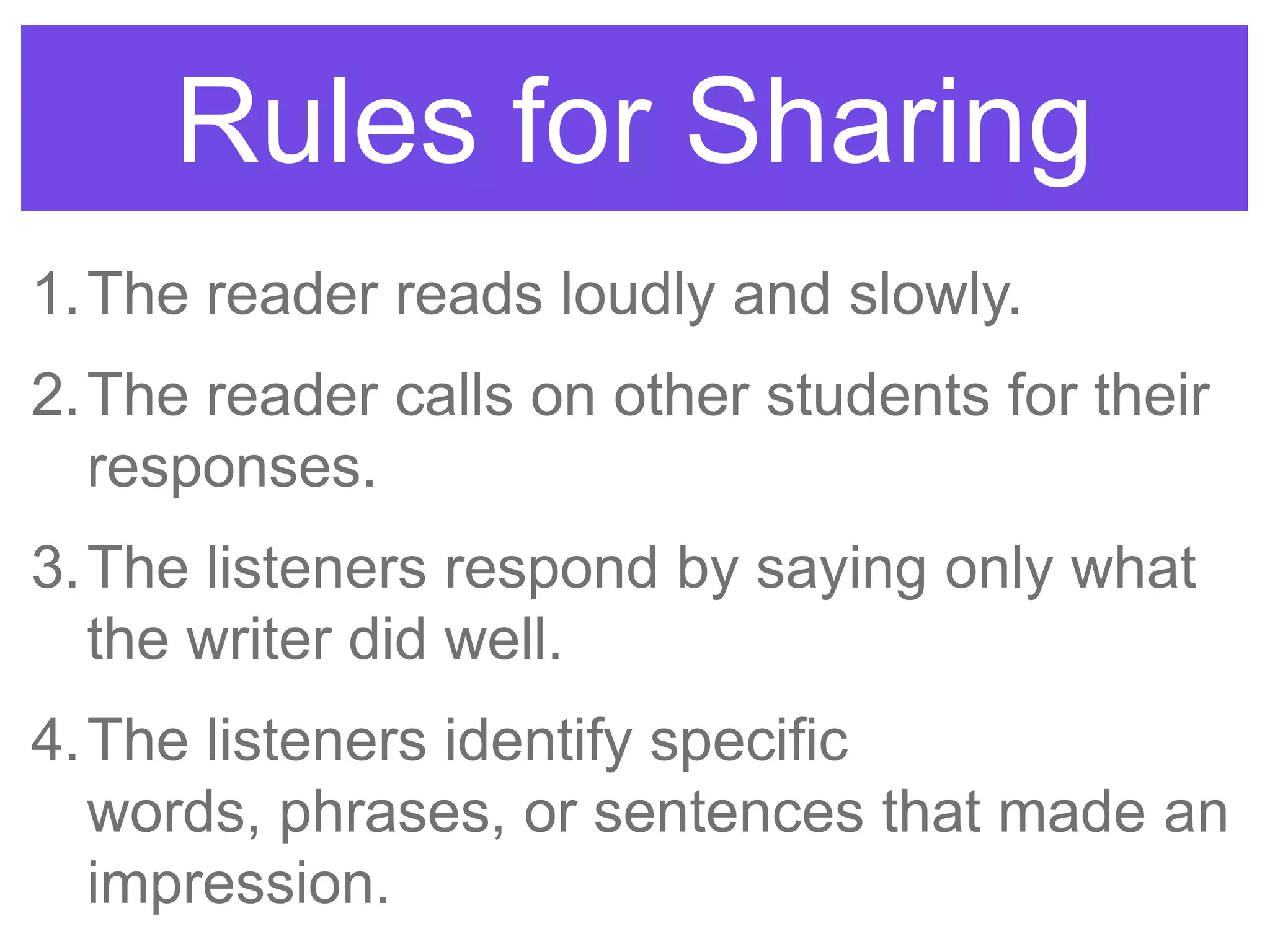
Rules for Sharing
1.The reader reads loudly and slowly.
2.The reader calls on other students for their
responses.
3.The listeners respond by saying only what
the writer did well.
4.The listeners identify specific
words, phrases, or sentences that made an
impression.
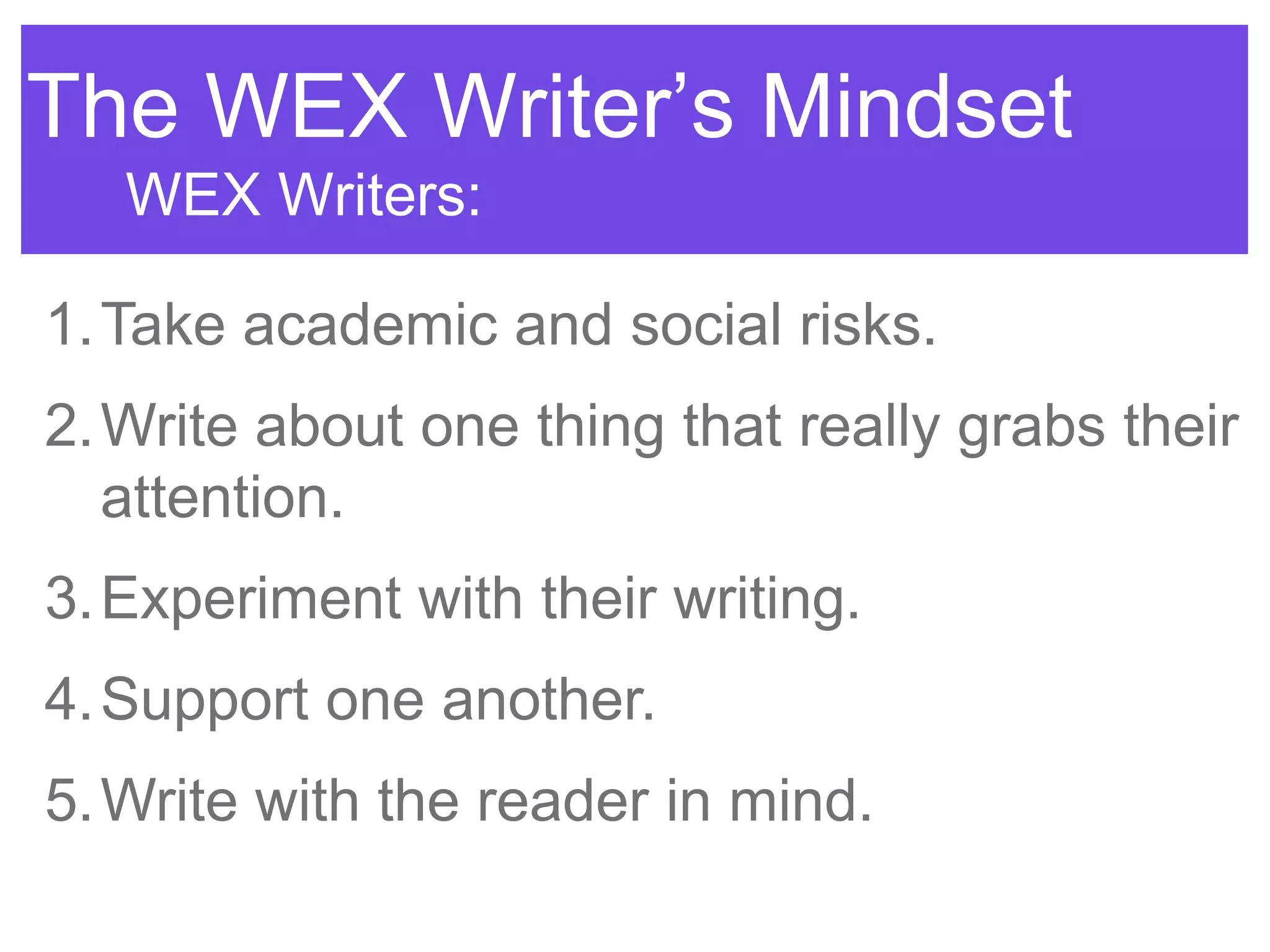
The WEX Writer‟s Mindset
WEX Writers:
1.Take academic and social risks.
2.Write about one thing that really grabs their
attention.
3.Experiment with their writing.
4.Support one another.
5.Write with the reader in mind.
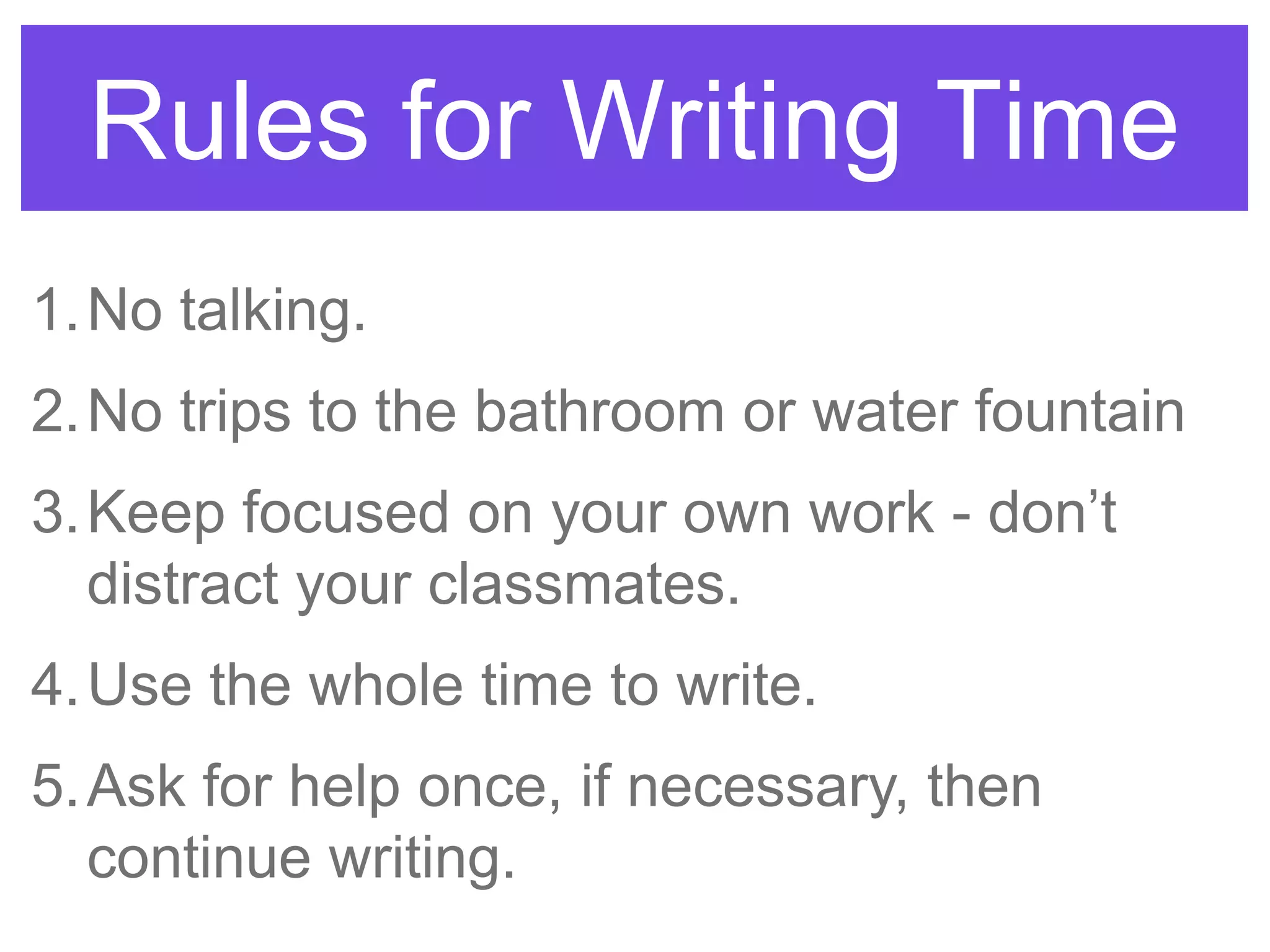
Rules for Writing Time
1.No talking.
2.No trips to the bathroom or water fountain
3.Keep focused on your own work - don‟t
distract your classmates.
4.Use the whole time to write.
5.Ask for help once, if necessary, then
continue writing.
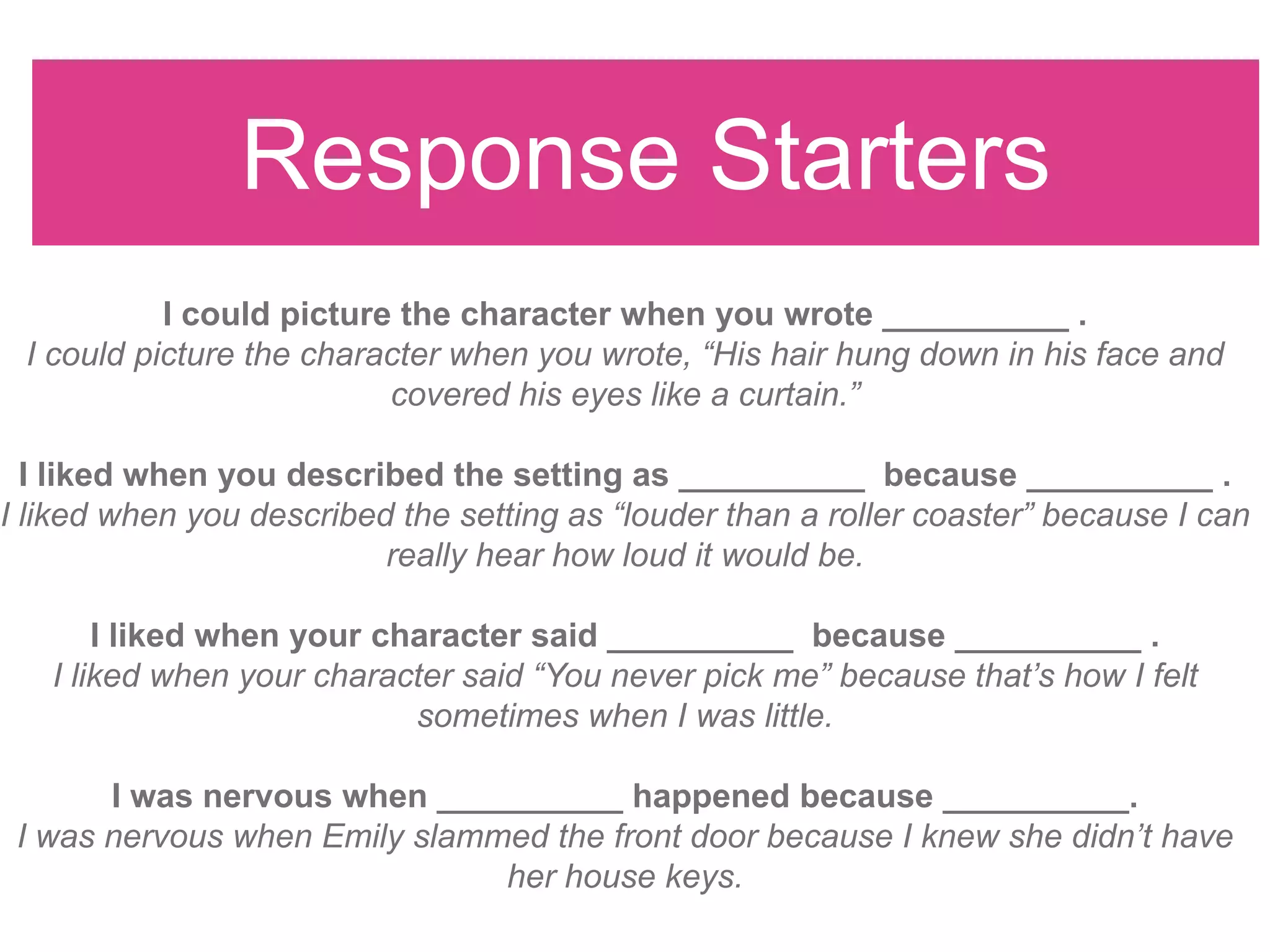
Response Starters
I could picture the character when you wrote __________ .
I could picture the character when you wrote, “His hair hung down in his face and
covered his eyes like a curtain.”
I liked when you described the setting as __________ because __________ .
I liked when you described the setting as “louder than a roller coaster” because I can
really hear how loud it would be.
I liked when your character said __________ because __________ .
I liked when your character said “You never pick me” because that’s how I felt
sometimes when I was little.
I was nervous when __________ happened because __________.
I was nervous when Emily slammed the front door because I knew she didn’t have
her house keys.
Unit One
Creating a Believable Character
Lesson One
Using Observations to Create a Character
Photo
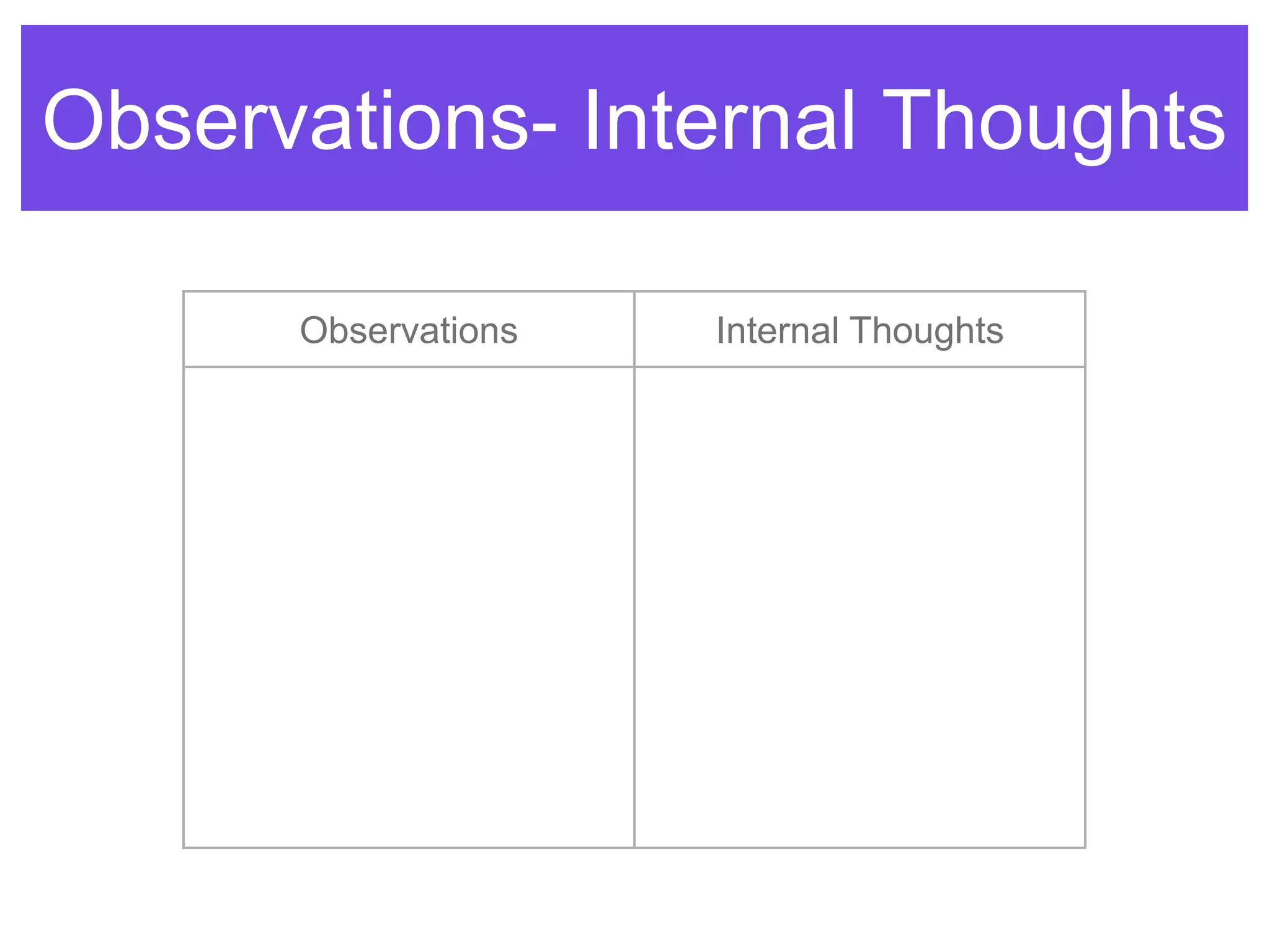
Observations- Internal Thoughts
Observations Internal Thoughts
What to Do #1
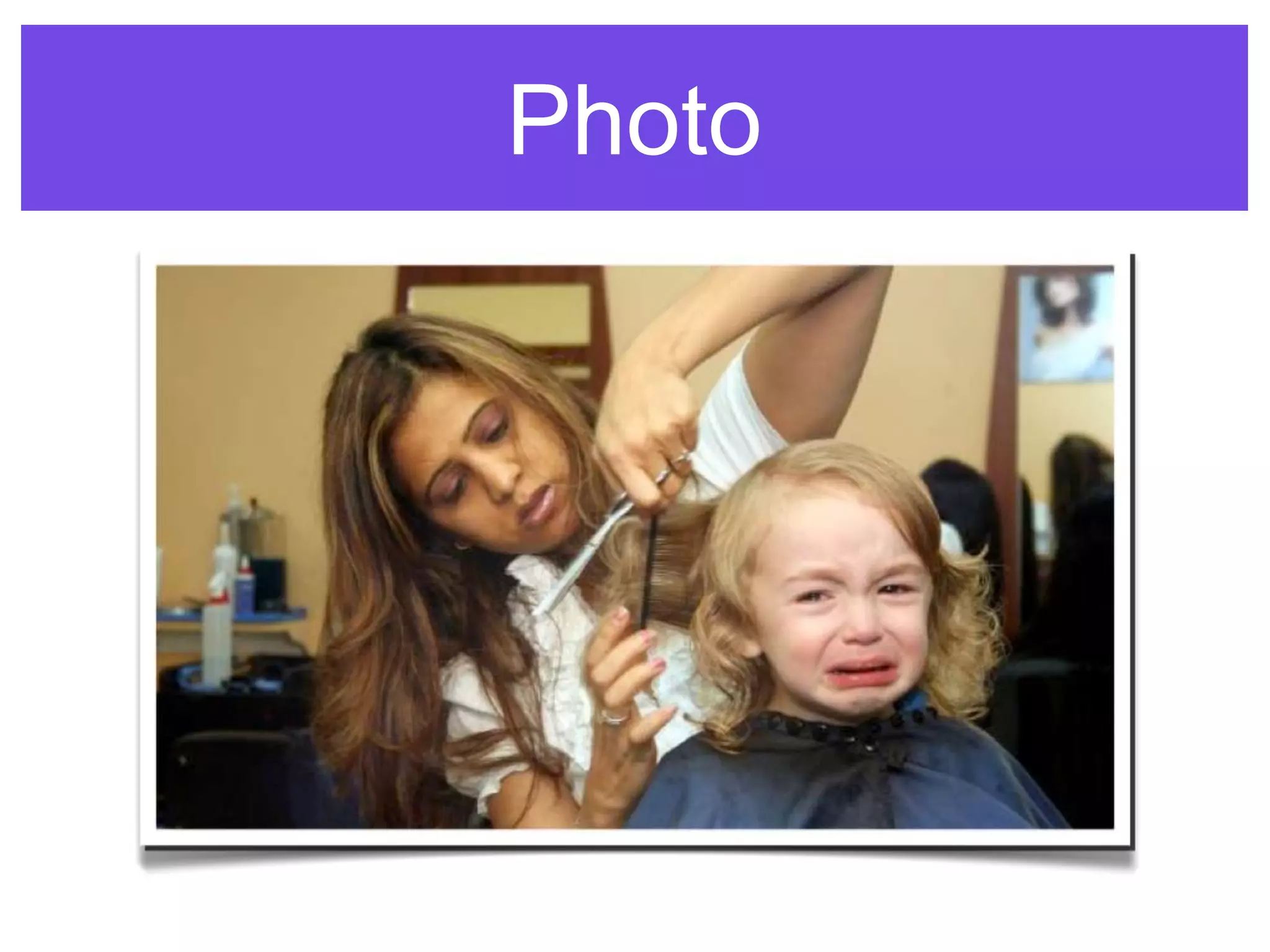
1. Look at the photo. On your chart under the
heading “Observations,” write down what you
observe. Think about the setting, the action, the
situation of the photo, as well as the person or
people in the photo.
2. Choose one person in your photo. What do you
think that person is thinking? Write down three
internal thoughts under the heading “Internal
Thoughts.”
What to Do #2
1. Circle one of the internal thoughts on your chart.
2. Draw a line from the circled internal thought to any
observation(s)-- no more than three for now-- that led you to
create the internal thought.
3. Write 2-3 sentences explaining why or how those details from
the photos made you think of that internal thought for your
character.
Lesson Two
Getting to Know Your Character
What to Do:
1. Listen to the situation.
2. Write 3-5 sentences that show what your character
does, says, thinks, and feels in this situation.
3. Repeat with a new situation.
Situation: ______________________________
Lesson Three
Putting a Character into a Mundane Situation
Mundane Situations
“Mundane” means common, run-of-the-mill. It describes the kinds of
things we might do each day.
(write in as a class,
save for another
lesson).
Examples:
Extraordinary/Uncommon Situations
Examples:(write in
and save)
In-Between Situations
Examples:(write in
and save)
What to Do:
1. Think about what your character‟s daily life is like.
2. Write down three mundane situations that your
character might experience during the evening. Feel free
to use one of the situations from the class list.
Verbal Warm-Up
Raise your hand if you wrote down a mundane situation that is a
chore.
Raise your hand if you wrote down a mundane situation that you
often find yourself in.
Raise your hand if you wrote down a mundane situation your
character would probably be in every day.
Raise your hand if you wrote down a mundane situation that usually
happens at home.
Writing Prompt
Pick one of the three mundane
situations you wrote down, and put your
character in that moment. Use showing
details, strong verbs, and dialogue to
describe how your character acts.
Lesson Four
Identifying the Parts of Speech
Definitions of Parts of Speech
The Complete Subject is who or what the sentence is
about. It includes the main noun and the words that
describe the noun.
The Complete Predicate tells what the subject is doing.
It includes a verb and all the words that tell about the
action.
The old man frequently napped on the park bench.
Examples:
A delicious dinner sat on the table.
Subject/Predicate Match Game
1. Divide the class into two groups:
a subject group and a predicate group.
2. Hand out a blank strip of paper to each student.
3. Each student needs to write a complete subject or
complete predicate on his or her strip of
paper, depending on what group he or she is in.
4. Students in the predicate group to write their verbs in
the PAST tense.
What to Do #1
1. Find four matches for your complete predicate/subject.
If you have a complete subject, you need to find four
complete predicates. If you have a complete
predicate, you need to find four complete subjects.
2. Two of your sentences should make perfect sense.
The other two should be perfectly silly.
3. Write the sentences in your journal. All of them must be
grammatically correct.
What to Do #2
Mundane Situation: ___________________
Write 3-5 sentences that show what your character does,
says, thinks, and feels in this situation.
Lesson Five
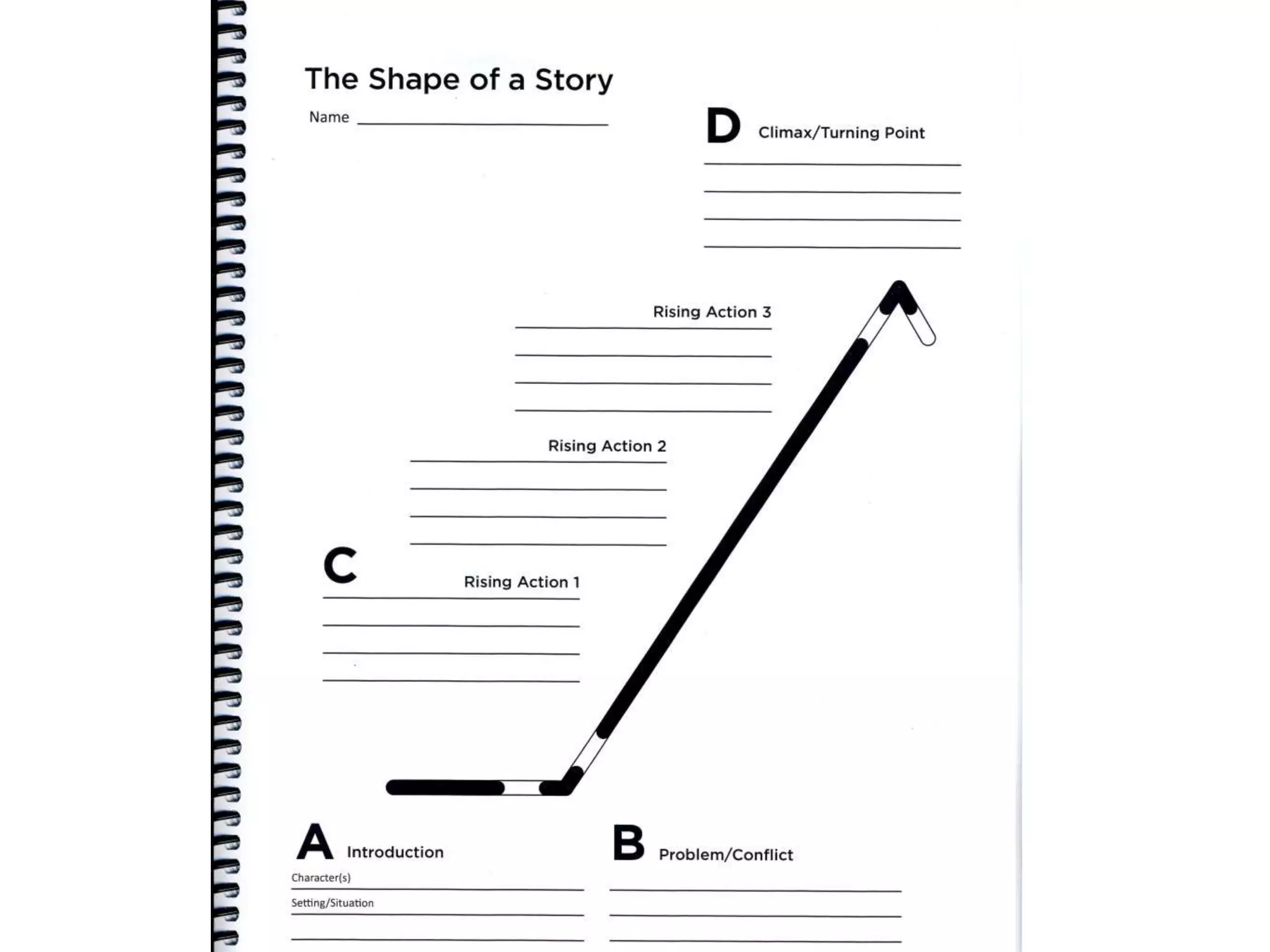
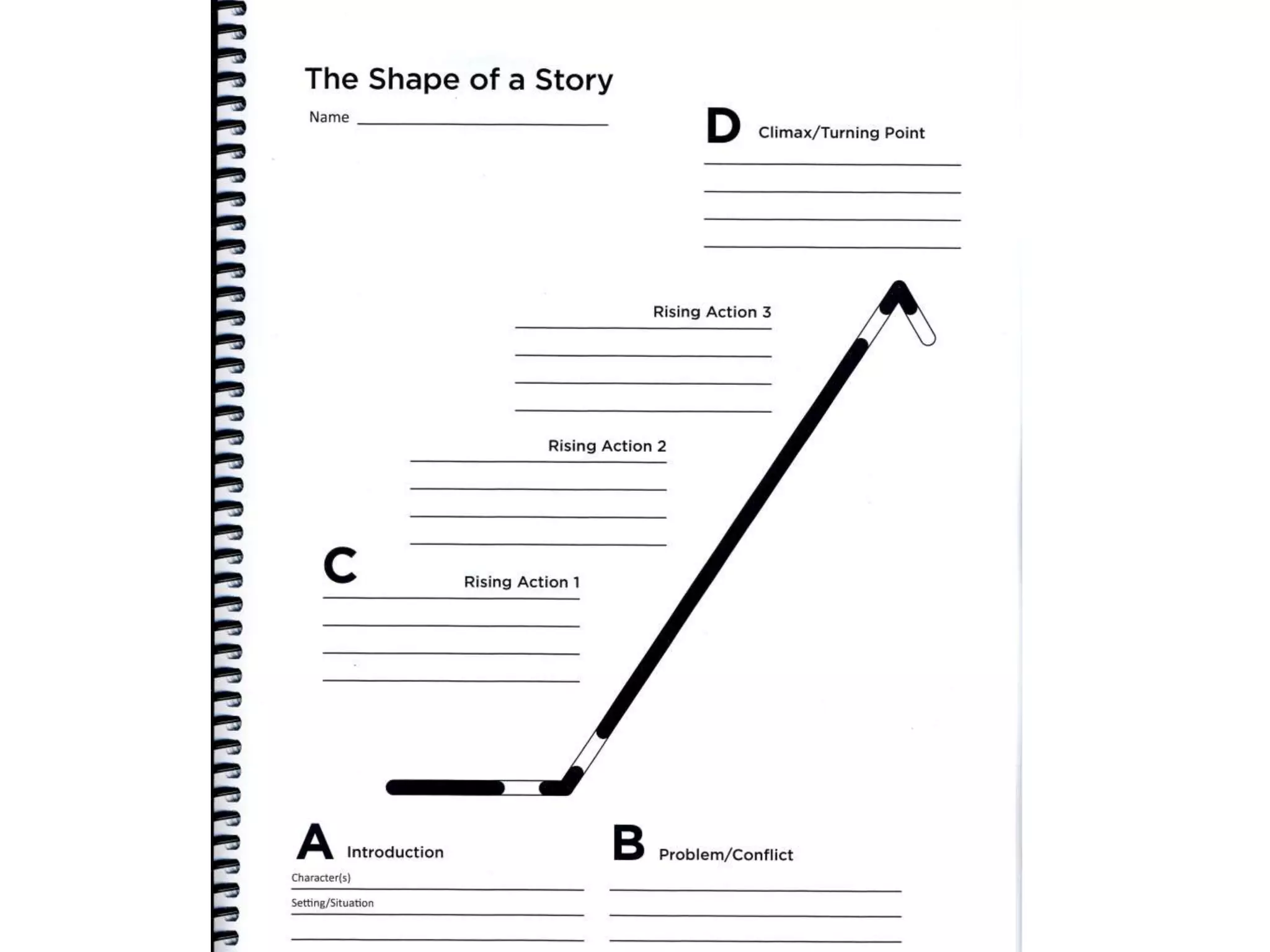
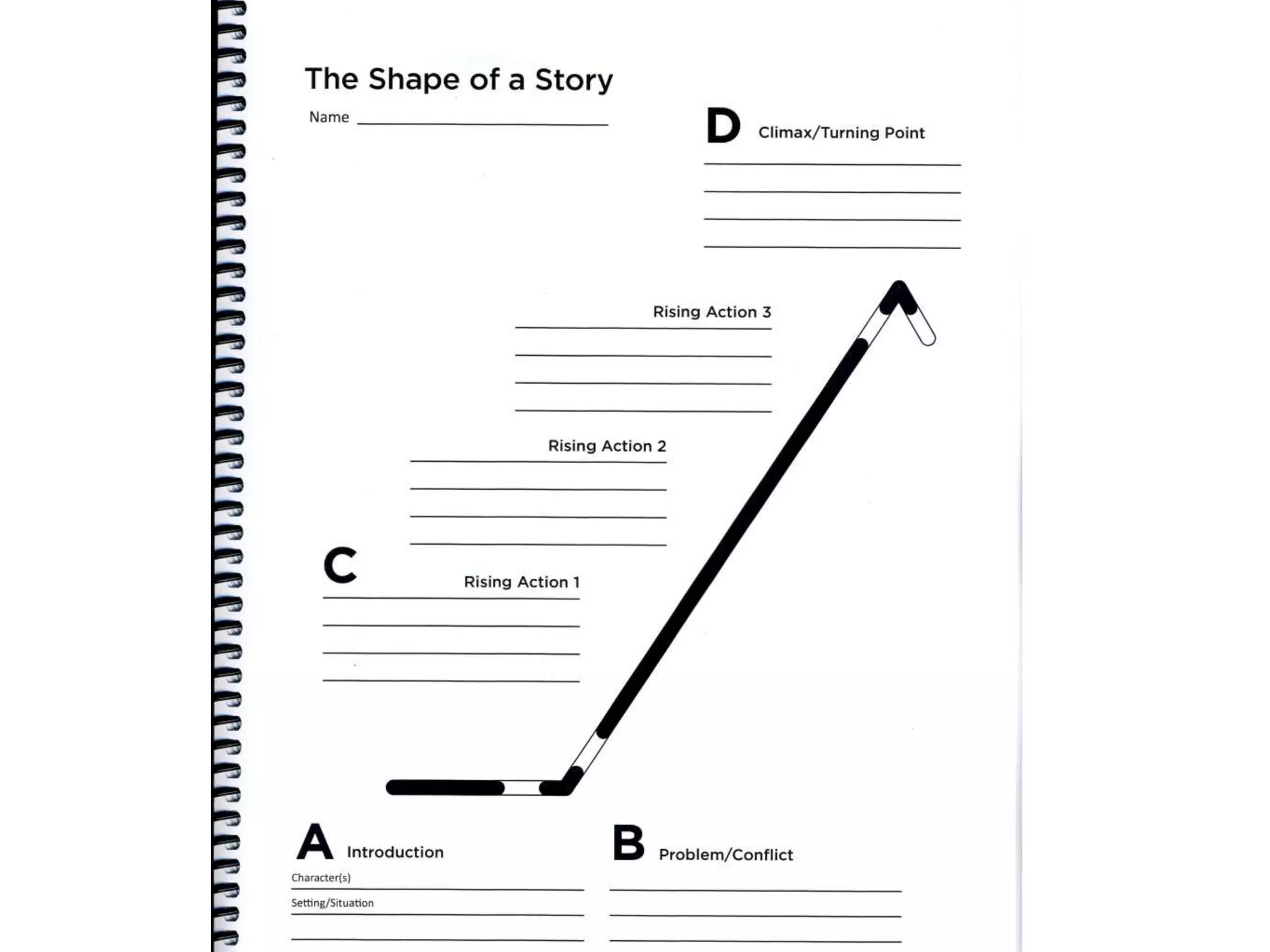
Shape of a Story
Revision Assignment
1. Find the journal entry you wrote for Lesson 3 and look
at the mundane situation you put your character in.
2. Underline the details you wrote that provide
information about your character and the setting of the
situation.
3. Add two more sentences that give more details about
your character and the setting of the situation.
Revision Assignment
Lesson Six
Creating a Believable Problem
What to Do:
1. FInd the journal entry you wrote for Lesson 3 and look
at the mundane situation you put your character in.
2. Write down three different believable problems your
character might encounter in this situation.
Verbal Warm-Up
Raise your hand if one of your problems involves another
character.
Raise your hand if one of your problems would make you
mad.
Raise your hand if one of your problems is one you‟ve
faced before.
Raise your hand if you can imagine your character facing
one of these problems.
Raise your hand if you like one of the problems more
than the others.
Writing Prompt
Choose one believable problem
from the list you made. Describe
the moment when your character
faces this problem.
Lesson Seven
Creating a Rising Action
What to Do:
1. Look back at the problem you created for your
character in the last lesson.
2. Come up with three events that will gradually worsen
your characters problem or create tension in your story.
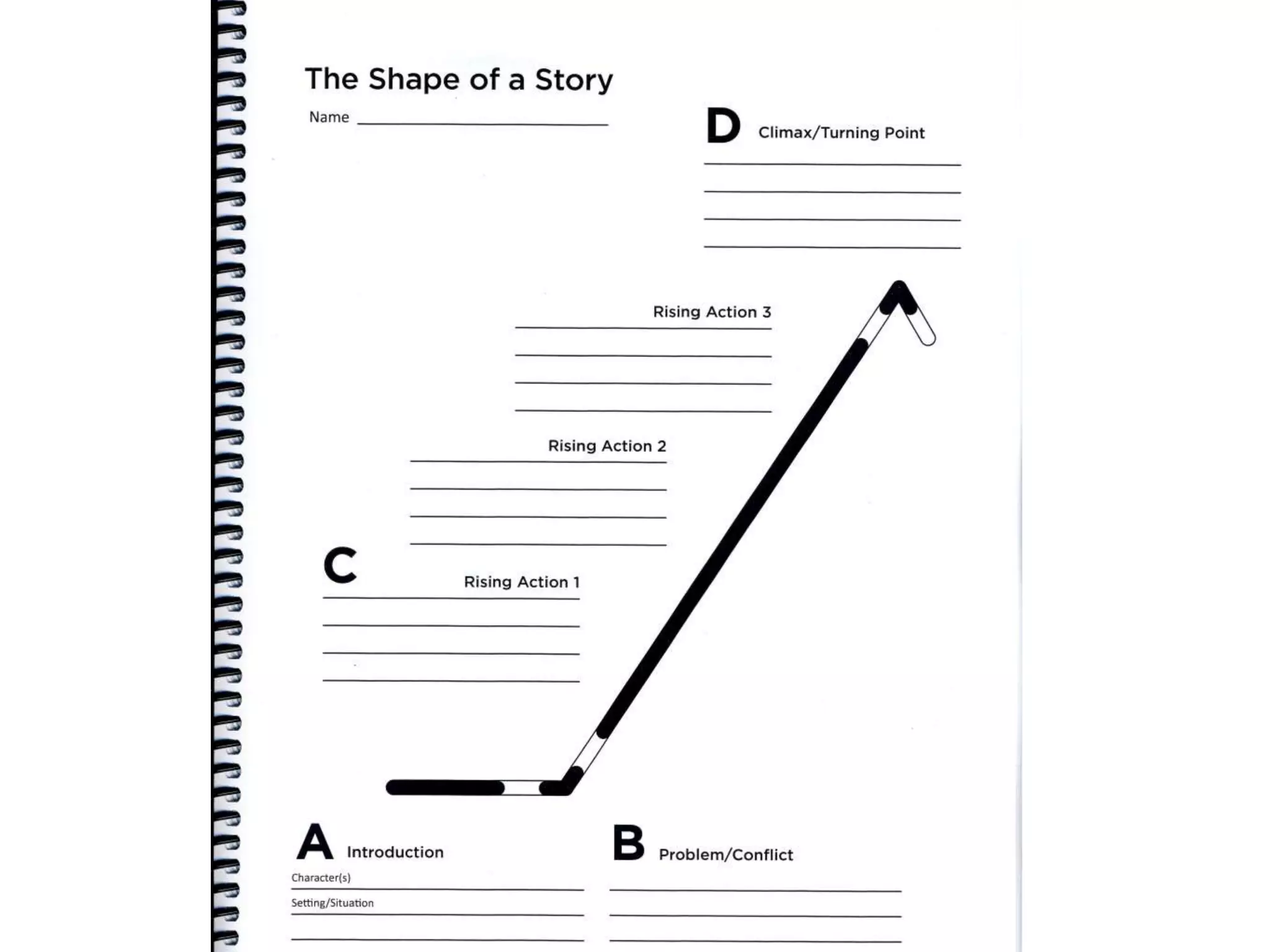
3. Fill this information in on your Shape of a Story chart.
Verbal Warm-Up
Raise your hand if you think your character will expect
the first event in the rising action.
Raise your hand if you think your character will be
surprised by the first even tin the rising action.
Raise your hand if the order of events in your rising
action makes the problem worse than before.
Writing Prompt
Put your character into the first
event of your rising action. Be sure
to show how your character acts
and feels during this event.
Lesson Eight
Replacing Adverbs with Strong Verbs
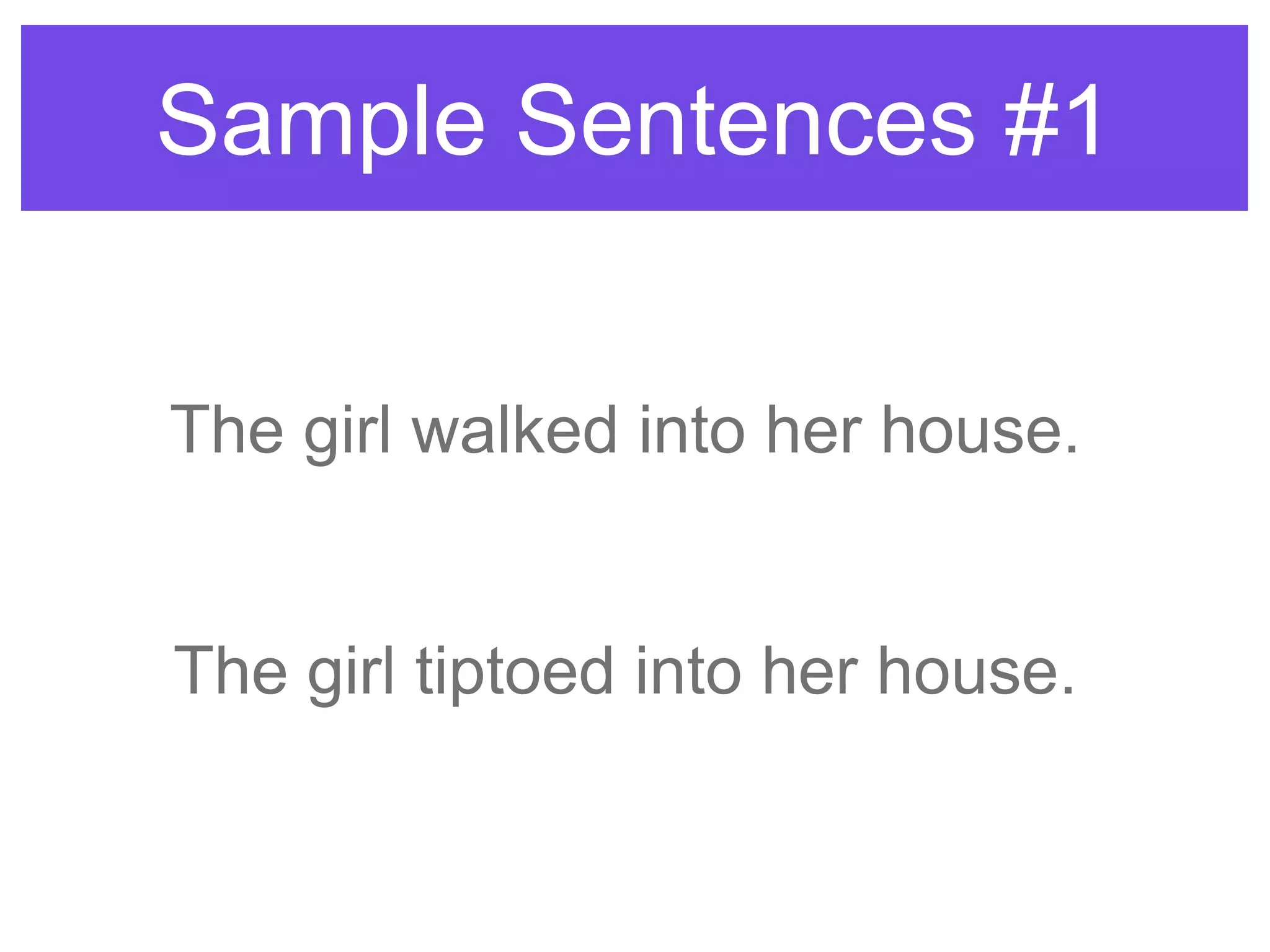
Sample Sentences #1
The girl walked into her house.
The girl tiptoed into her house.
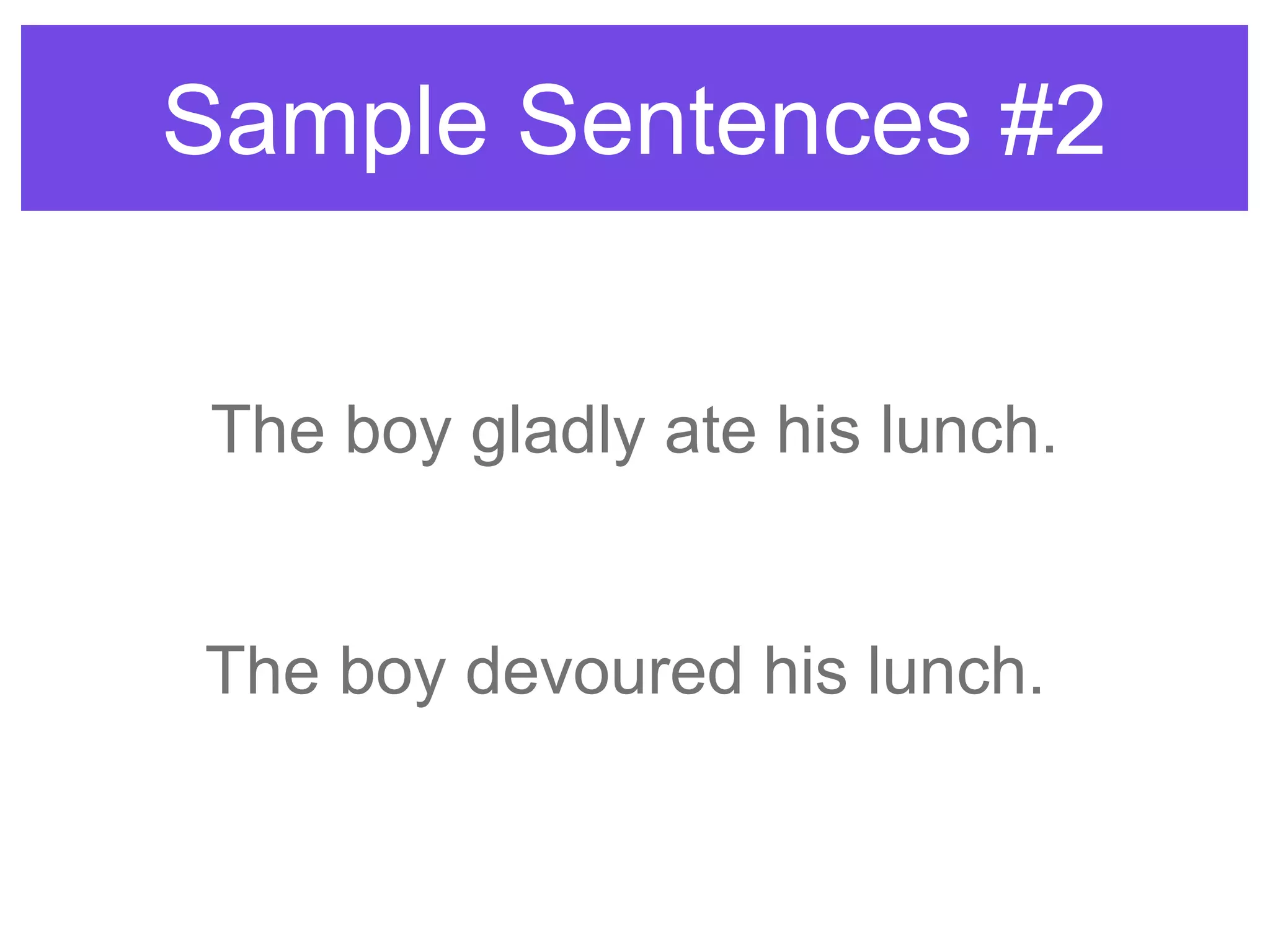
Sample Sentences #2
The boy gladly ate his lunch.
The boy devoured his lunch.
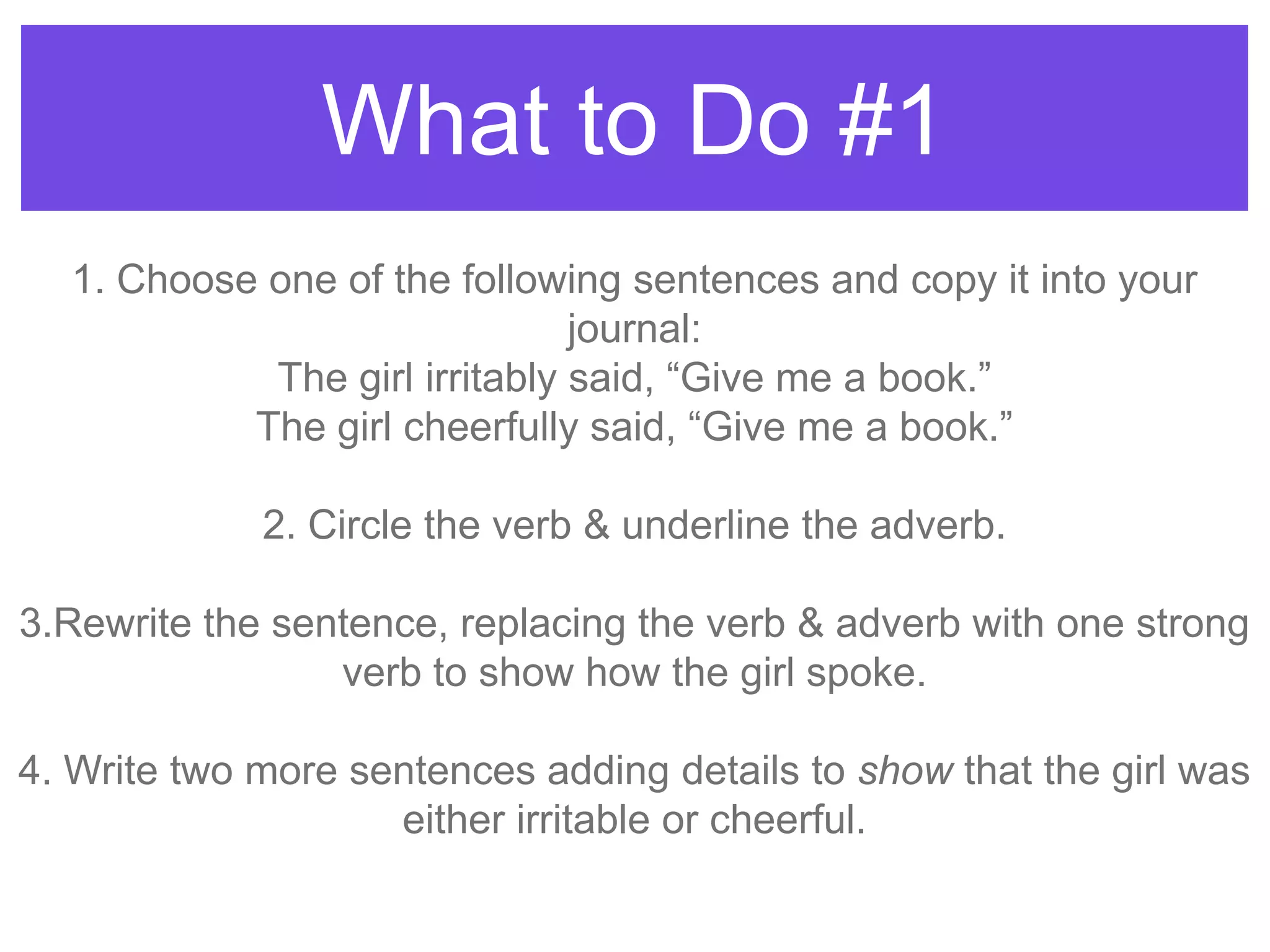
What to Do #1
1. Choose one of the following sentences and copy it into your
journal:
The girl irritably said, “Give me a book.”
The girl cheerfully said, “Give me a book.”
2. Circle the verb & underline the adverb.
3.Rewrite the sentence, replacing the verb & adverb with one strong
verb to show how the girl spoke.
4. Write two more sentences adding details to show that the girl was
either irritable or cheerful.
What to Do #2
The Mundane Situation:
_______________________
Write 3-5 sentences that show what your
character does, says, thinks, and feels in the
situation.
Unit Two
Experimenting With a Second Character
Lesson Nine
Using Observations to Create a Character
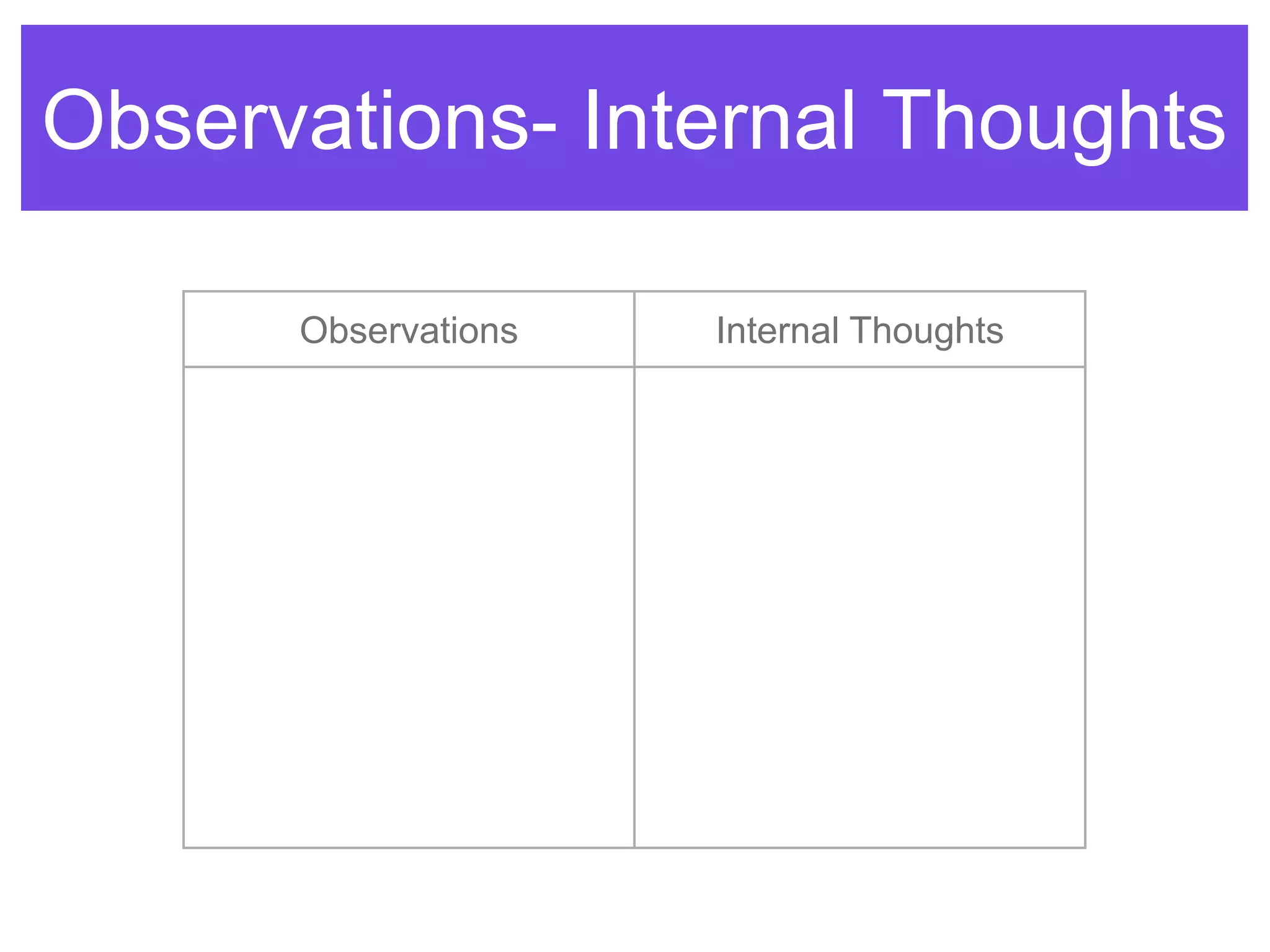
Observations- Internal Thoughts
Observations Internal Thoughts
What to Do #1
1. Look at your photo. On your chart under the heading
“Observations,” write down what you observe. Think
about the setting, the action, and the situation of the
photo, as well as the person or people in the photo.
2. Choose one person in your photo. What do you think
that person is thinking? Write down three internal
thoughts under the heading “Internal Thoughts.”
What to Do #2
1. Circle one of the internal thoughts on your chart.
2. Draw a line from the circled internal thought to any
observation(s)-- no more than three for now-- that led you
to create the internal thought.
3. Write 2-3 sentences explaining why or how those
details from the photos made you think of that internal
thought for your character.
Lesson Ten
Putting a Character into a Mundane Situation
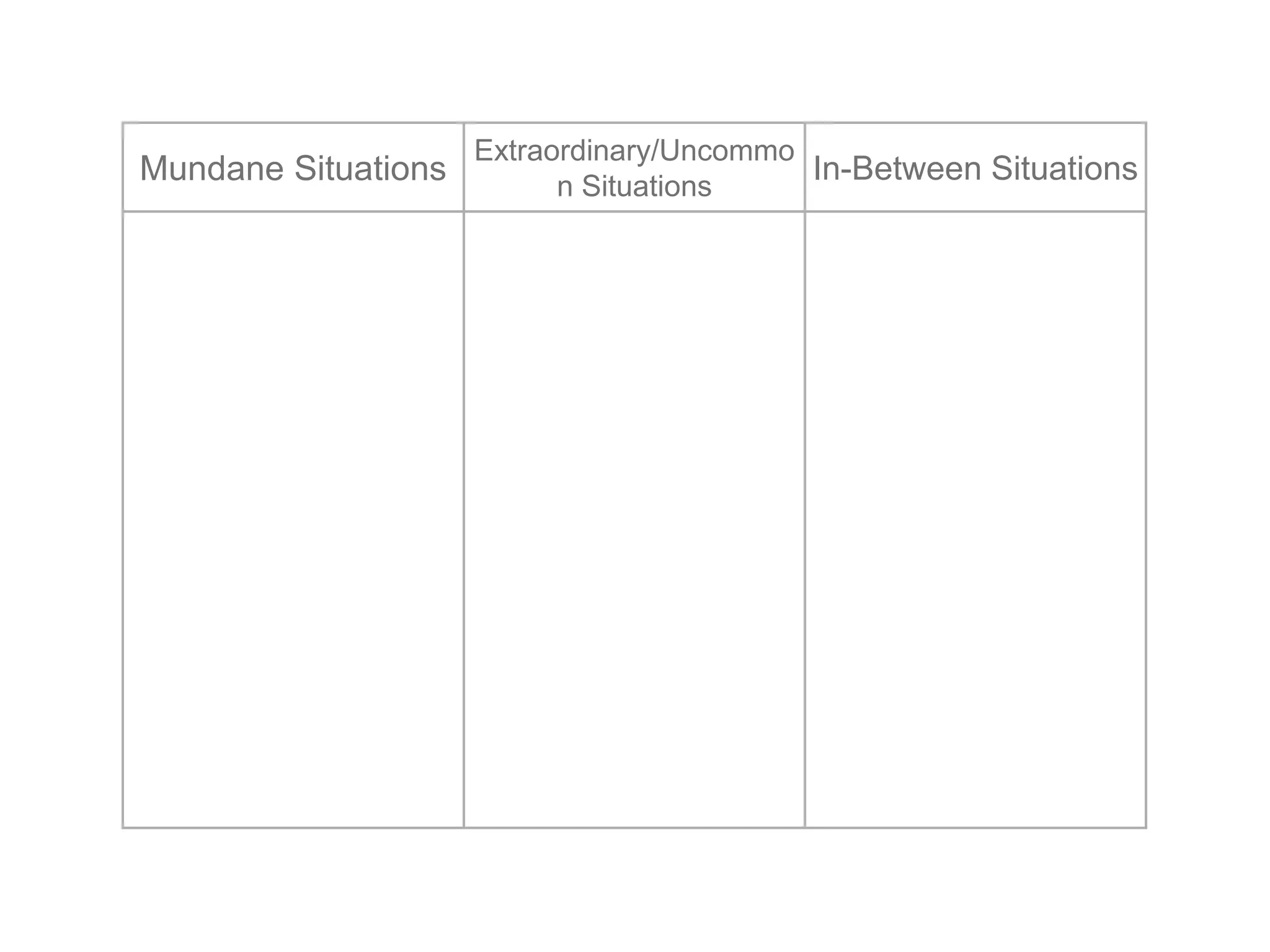
Mundane Situations
Extraordinary/Uncommo
n Situations
In-Between Situations
What to Do:
1. Think about what your character‟s daily life is like.
2. Write down three mundane situations that your
character might experience at home. Feel free to use one
of the situations from the class list.
Verbal Warm-Up
Raise your hand if you wrote down a mundane situation
that is fun.
Raise your hand if you wrote down a mundane situation
that you often find yourself in.
Raise your hand if you wrote down a mundane situation
your character would do by him or herself.
Raise your hand if you wrote down a mundane situation
that usually happens in the morning.
Writing Prompt
Pick one of the three mundane
situations you wrote down, and put your
character in that moment. Use showing
details, strong verbs, and dialogue to
describe how your character acts.
Lesson Eleven
Using Dialogue to Show Character
Sample Sentences #1
Clara slammed the front door and stomped
into my room. She flung herself onto my
bed and turned to the wall.
Sample Sentences #2
Clara slammed the front door and stomped into my
room screeching, “I hate my little brother!” She
flung herself onto my bed and cried, “He is such a
pest and I think my parents love him more than
me.”
Sample Sentences #3
“I hate my little brother!” Clara screeched, slamming
the front door and stomping into my room.
“Oh no. Here we go again,” I thought.
Revision Assignment
1. Go back to the mundane situation you wrote in your
journal during the last lesson.
2. Find a spot to add 2-4 lines of dialogue that show how
your character is feeling.
Revision Assignment
Verbal Warm-Up
Raise your hand if you can picture your character oversleeping.
Raise your hand if you can picture your character missing the bus.
Raise your hand if you can picture your character losing track of
time.
Raise your hand if you can picture someone waiting for your
character.
Raise your hand if you can picture your character having to wait for
someone.
Writing Prompt
Write about a moment when your character
was late for something.
Lesson Twelve
Punctuating and Formatting Dialogue
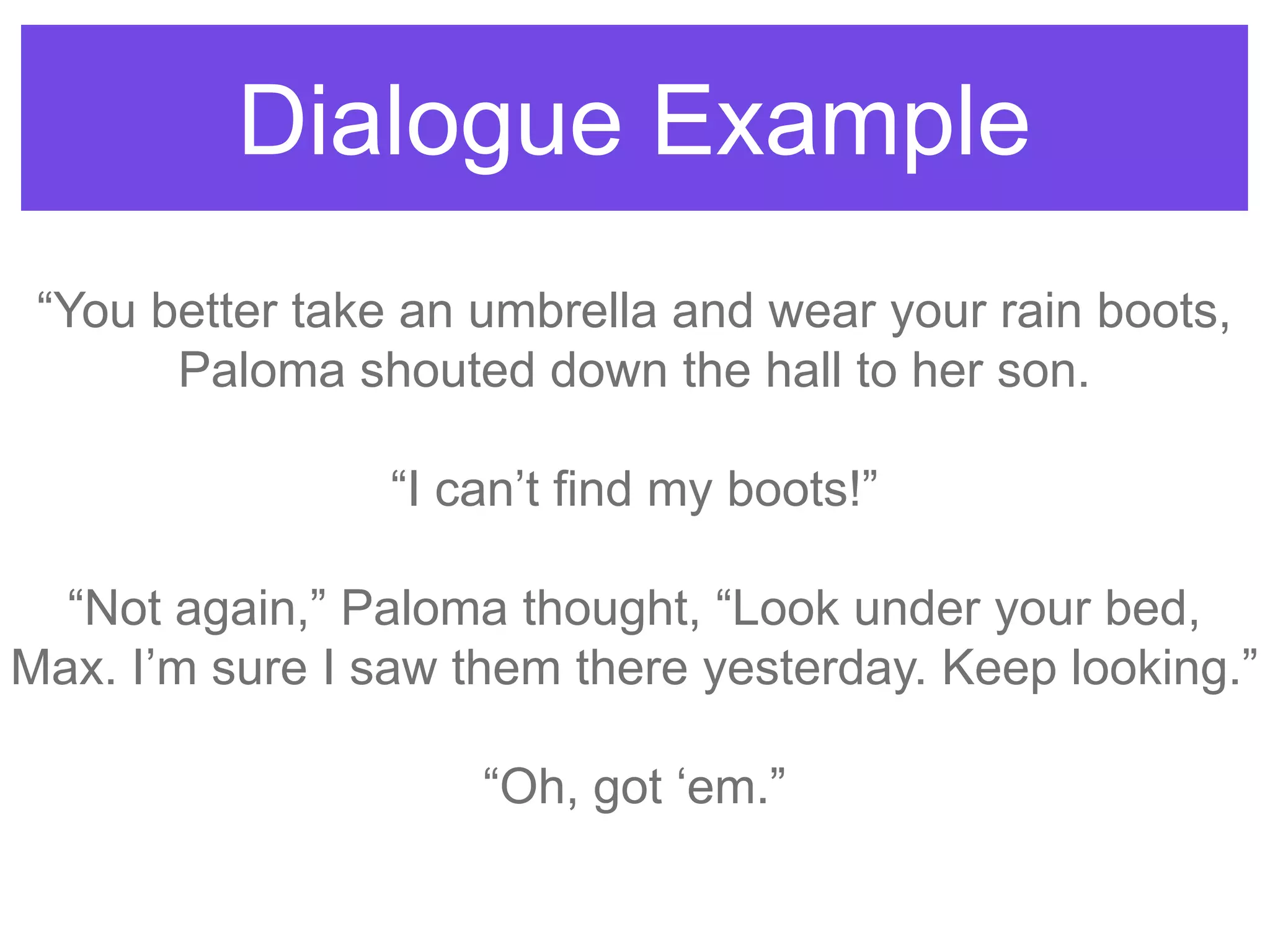
Dialogue Example
“You better take an umbrella and wear your rain boots,
Paloma shouted down the hall to her son.
“I can‟t find my boots!”
“Not again,” Paloma thought, “Look under your bed,
Max. I‟m sure I saw them there yesterday. Keep looking.”
“Oh, got „em.”
What to Do:
Read the following conversation & format the dialogue
correctly, using punctuation and new paragraphs to show
who‟s talking when:
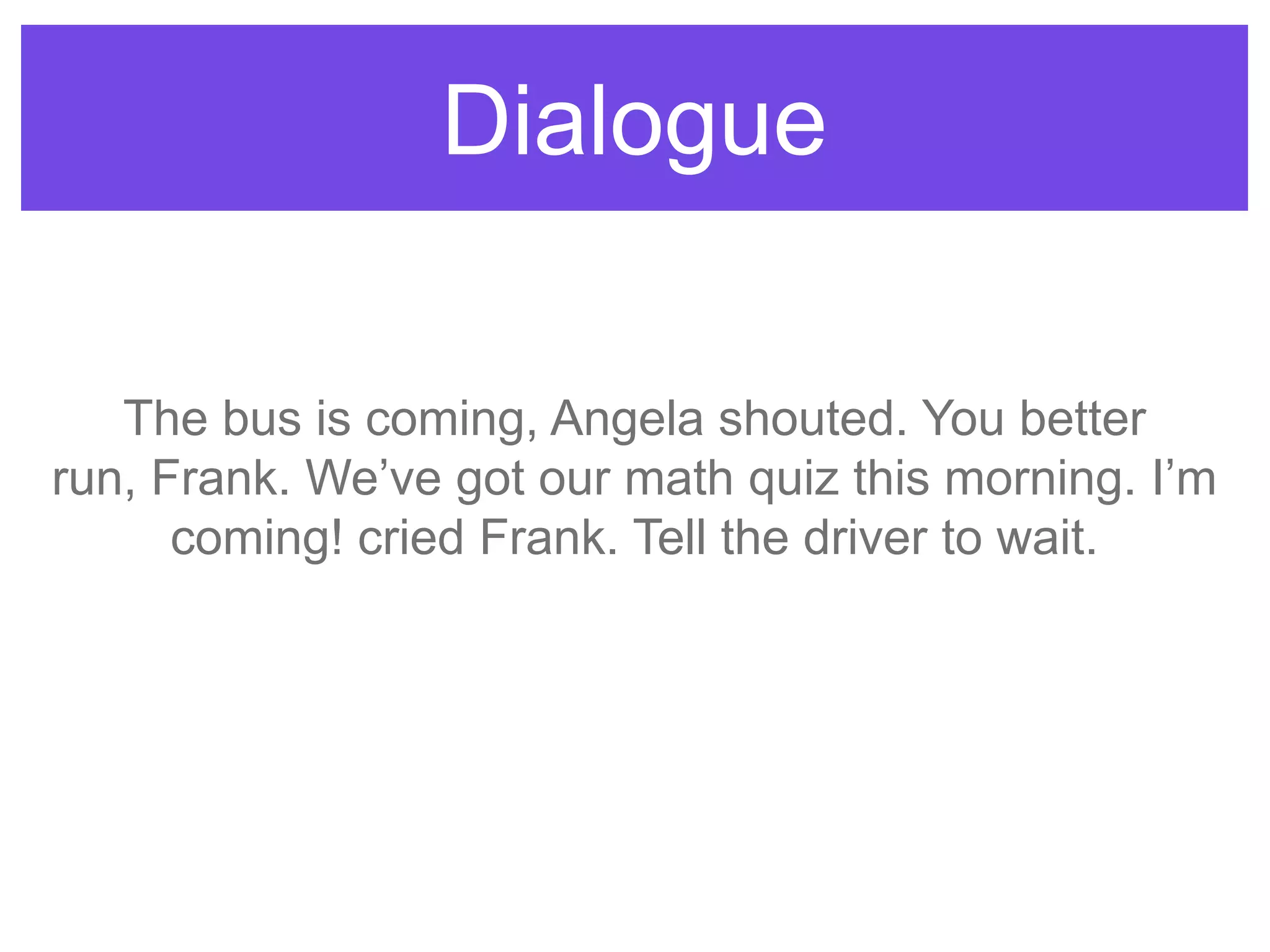
Dialogue
The bus is coming, Angela shouted. You better
run, Frank. We‟ve got our math quiz this morning. I‟m
coming! cried Frank. Tell the driver to wait.
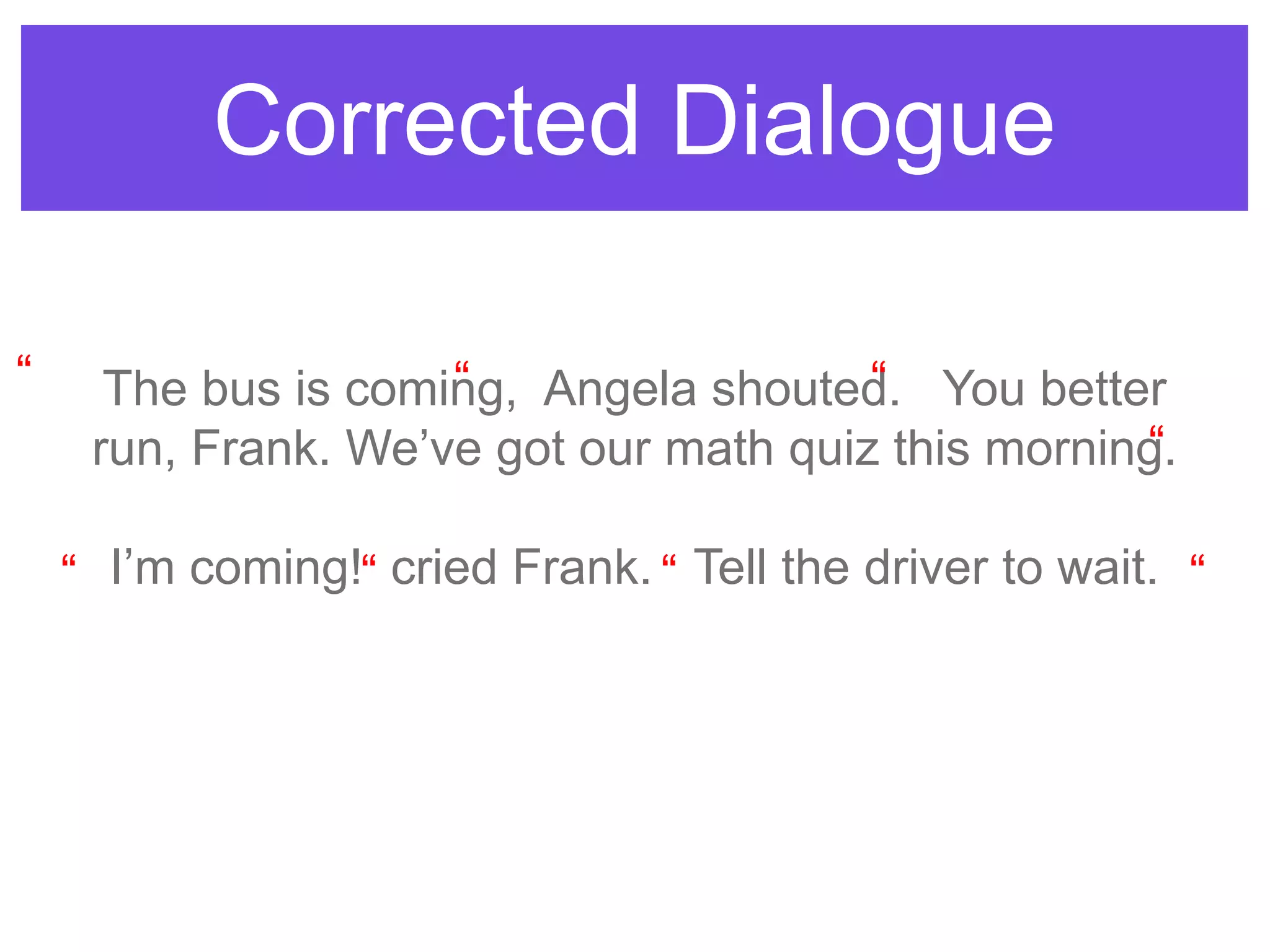
Corrected Dialogue
The bus is coming, Angela shouted. You better
run, Frank. We‟ve got our math quiz this morning.
I‟m coming! cried Frank. Tell the driver to wait.
“ “ “
“
“ “ “ “
Verbal Warm-Up
Picture your character in your mind.
Raise your hand if you can picture one of your
character‟s friends.
Raise your hand if you can picture your characters family.
Raise your hand if you can think of something that would
make your character laugh.
Writing Prompt
Write about a funny conversation your
character had with a friend or family member.
Include dialogue (both your character‟s words
and other characters‟ words) to show what was
happening.
Lesson Thirteen
Shape of a Story
Revision Assignment
1. Find the journal entry you wrote for Lesson 10 and look
at the mundane situation you put your character in.
2. Underline the details that give information about your
character and the setting of the situation.
3. Add two or more sentences that give more details
about your character and the setting.
Revision Assignment
Lesson Fourteen
Creating a Believable Problem
What to Do:
1. Find the journal entry you wrote for Lesson 10
and look at the mundane situation you put your
character in.
2. Write down three different believable problems
your character might encounter in this situation.
Verbal Warm-Up
Raise your hand if one of your character‟s problems happens in the
morning.
Raise your hand if one of your character‟s problems happens at school.
Raise your hand if one of your character‟s problems has happened to
you.
Raise your hand if one of the problems makes your character frustrated.
Raise your hand if you like one of the problems more than the others.
Writing Prompt
Choose one believable problem from the
list you just made. Describe the moment
when your character faces this problem.
Lesson Fifteen
Creating Rising Action
What to Do:
1. Look back at the problem you created for your
character in the last lesson.
2. Come up with three events that will gradually worsen
your character‟s problem or create tension on your story.
3. Fill this information in on your Shape of a Story chart.
Verbal Warm-Up
Raise your hand if you think the first event in your rising
action will happen really quickly.
Raise your hand if you know what your character will be
thinking as things get worse.
Raise your hand if the order of events in your rising action
makes the problem worse than before.
Writing Prompt
Put your character into the first event of
your rising action. Be sure to show how
your character acts and feels during this
event.
Lesson Sixteen
Using Dialogue to Show Character
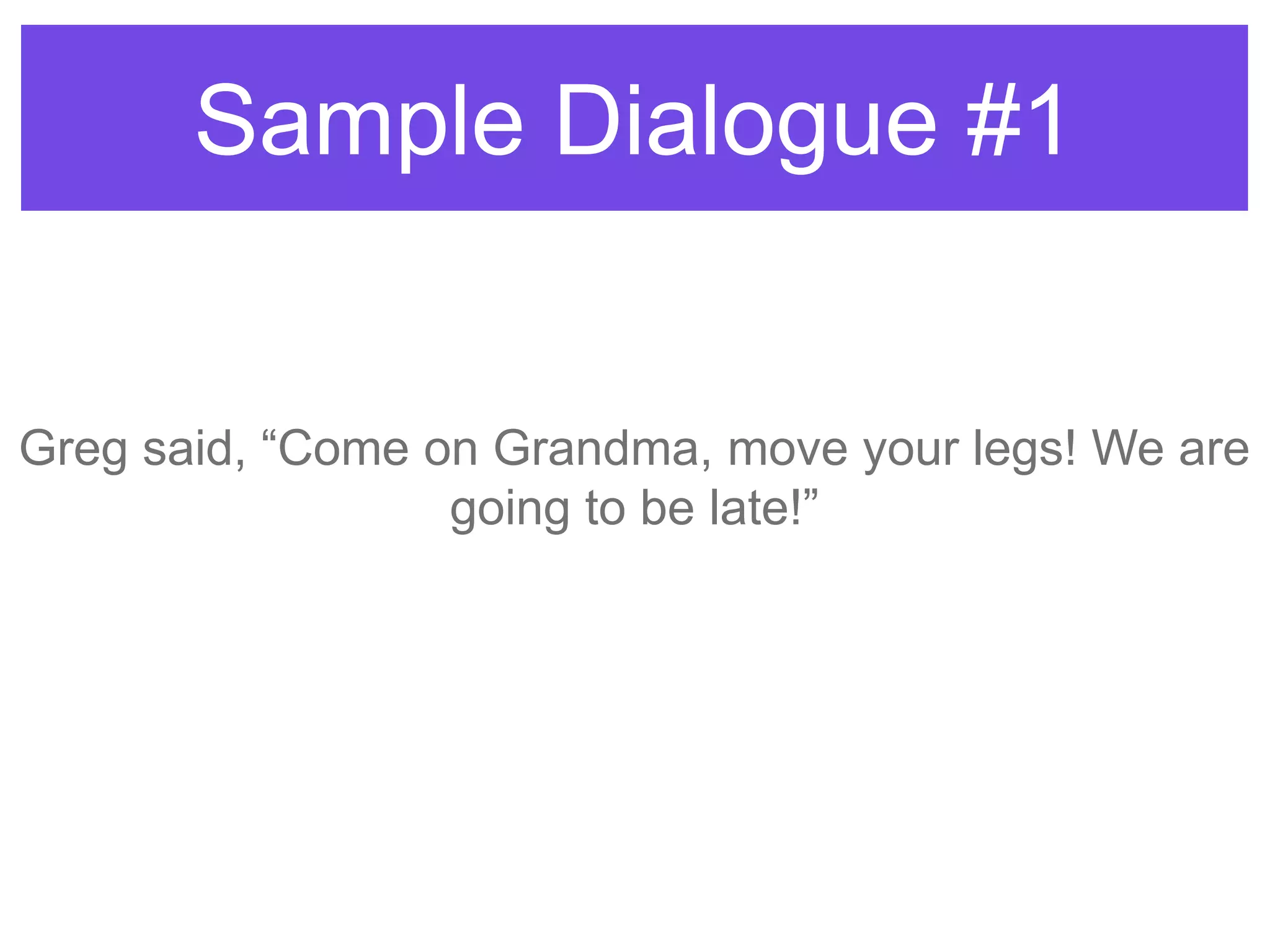
Sample Dialogue #1
Greg said, “Come on Grandma, move your legs! We are
going to be late!”
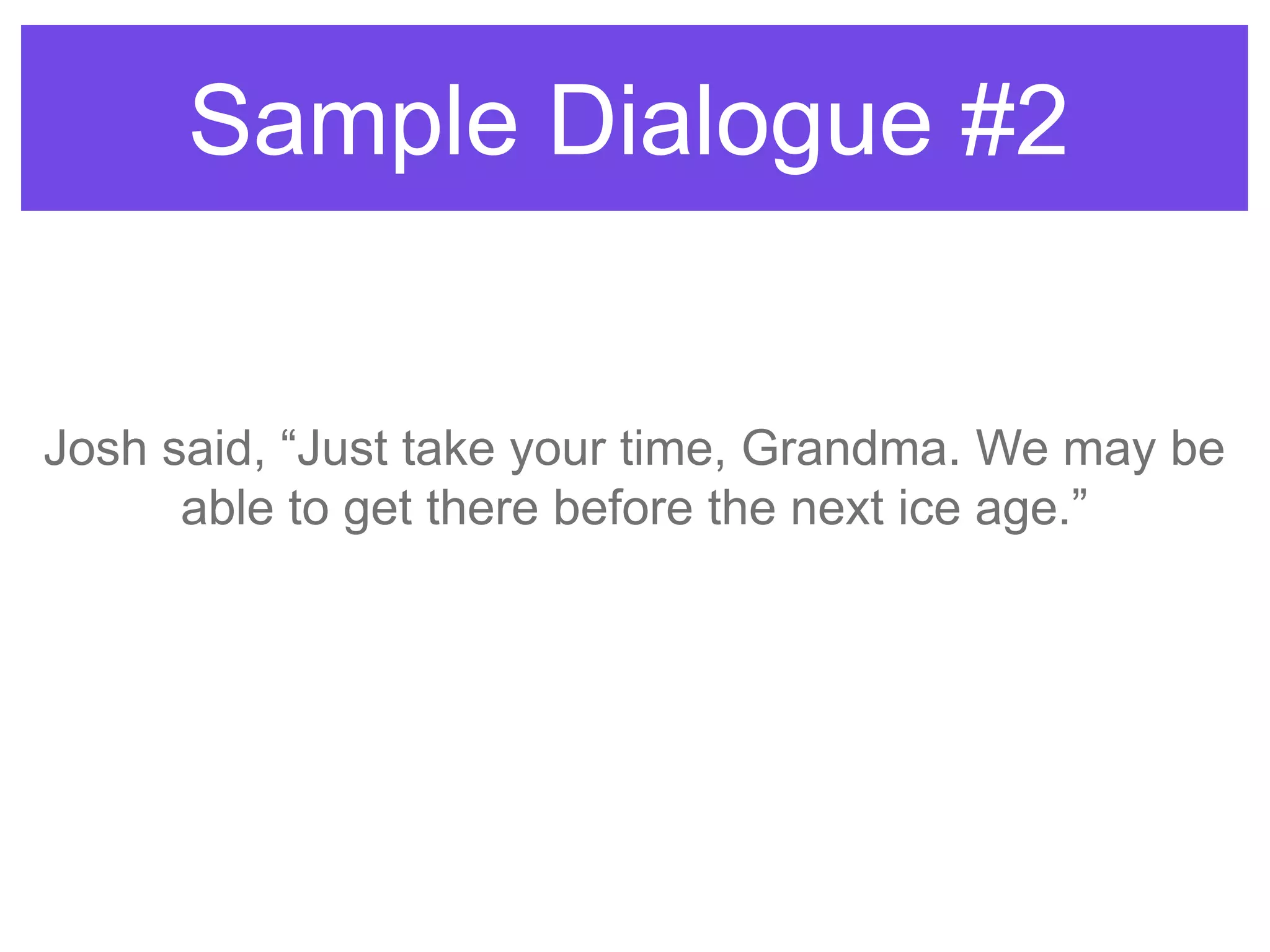
Sample Dialogue #2
Josh said, “Just take your time, Grandma. We may be
able to get there before the next ice age.”
Sample Dialogue #3
Larry said, “No hurry, Grandma. Don‟t worry, we have
plenty of time to get to the store.”
What to Do:
1. Listen to the following situation:
Lori and Mae are sisters. Lori is older than Mae. Lori is
playing with a toy and Mae takes it from her.
2. Write 2-4 lines of a dialogue that show how the
characters are feeling. Don‟t forget to use quotation
marks around what the characters say.
Revision Assignment
1. Go back to the rising action you wrote in your journal
during the last lesson.
2. Find a spot to add 2-4 lines of dialogue that show how
your character is feeling.
Revision Assignment
Lesson Seventeen
Punctuating and Formatting Dialogue
Dialogue Example
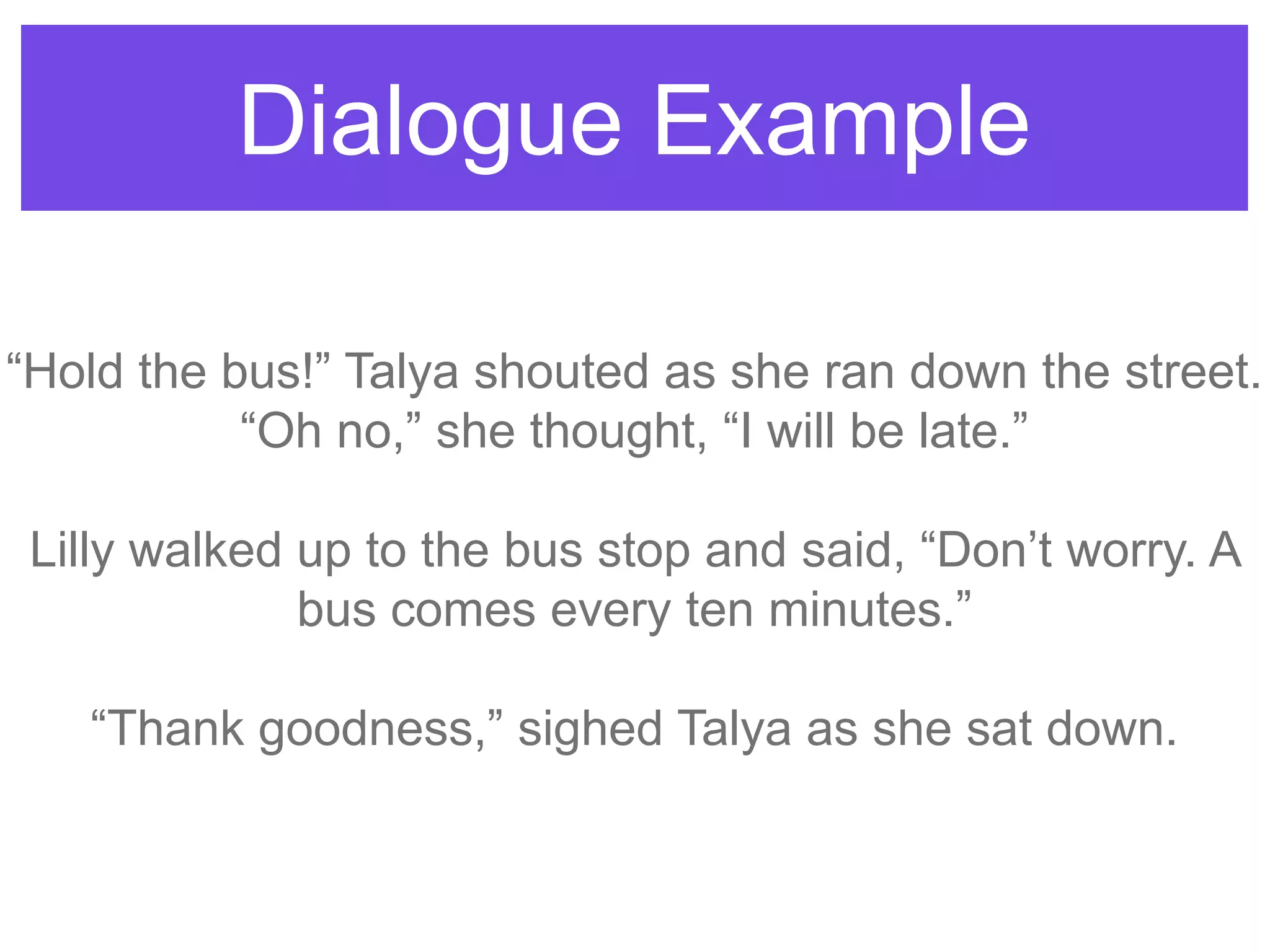
“Hold the bus!” Talya shouted as she ran down the street.
“Oh no,” she thought, “I will be late.”
Lilly walked up to the bus stop and said, “Don‟t worry. A
bus comes every ten minutes.”
“Thank goodness,” sighed Talya as she sat down.
What to Do:
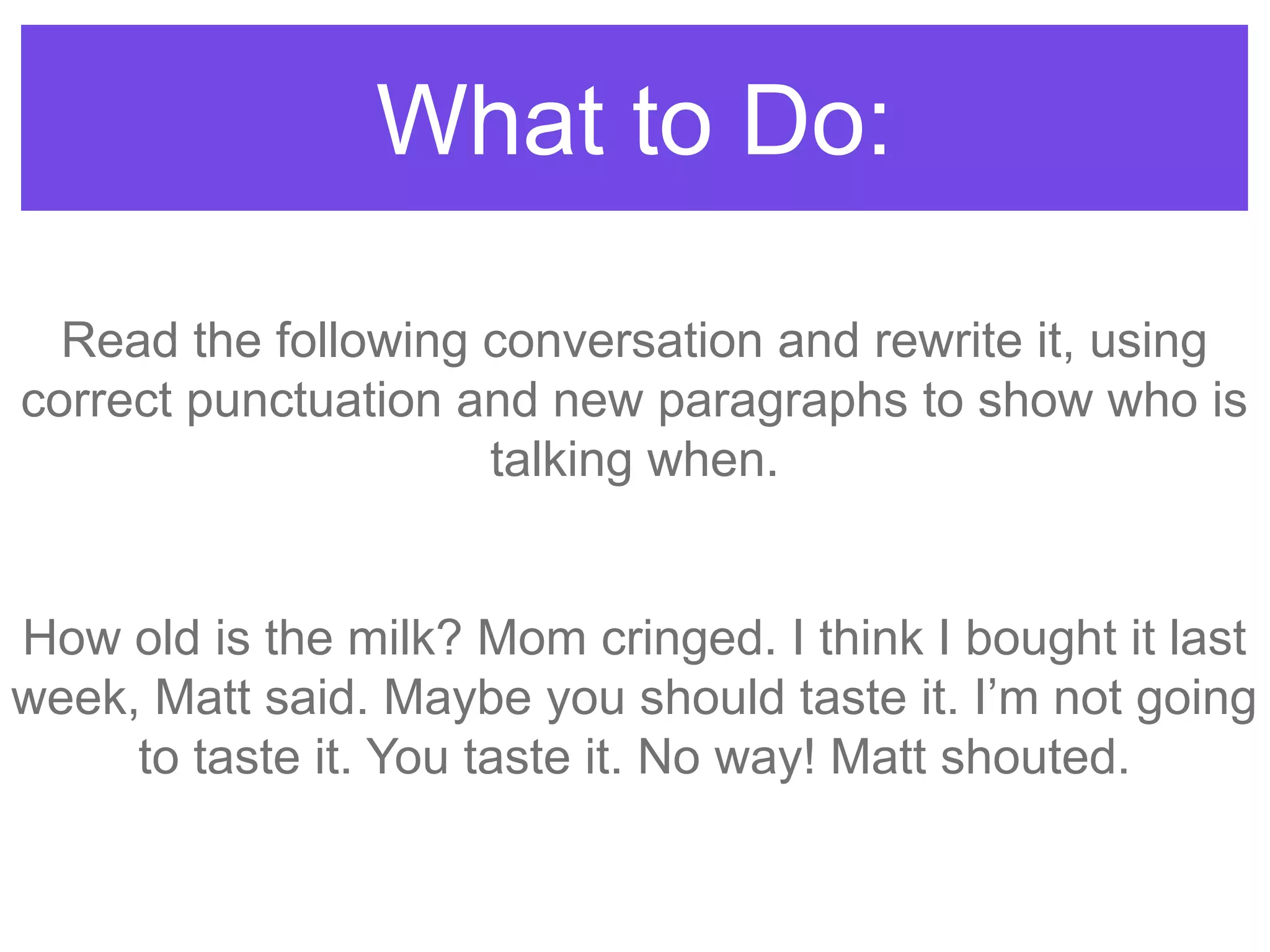
Read the following conversation and rewrite it, using
correct punctuation and new paragraphs to show who is
talking when.
How old is the milk? Mom cringed. I think I bought it last
week, Matt said. Maybe you should taste it. I‟m not going
to taste it. You taste it. No way! Matt shouted.
Corrected Dialogue
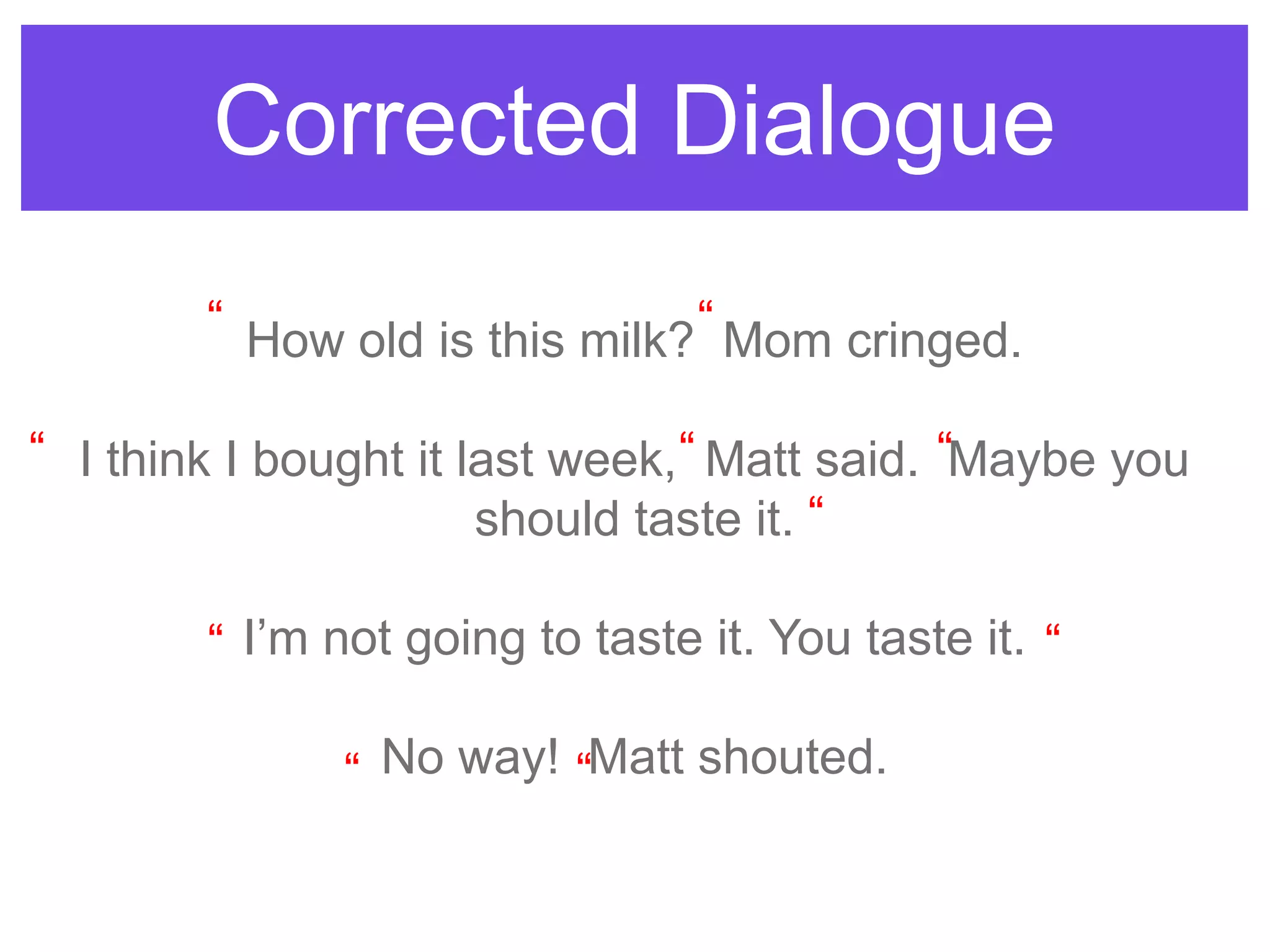
How old is this milk? Mom cringed.
I think I bought it last week, Matt said. Maybe you
should taste it.
I‟m not going to taste it. You taste it.
No way! Matt shouted.
“ “
“ “ “
“
“
“
“
“ “
Verbal Warm-Up
Picture your character eating lunch in a cafeteria.
Raise your hand if your character brought his or her own lunch.
Raise your hand if your character eats the same lunch every
day.
Raise your hand if your character really enjoyed eating lunch.
Raise your hand if your character ate lunch with another person.
Writing Prompt
Write about a conversation your character
had at lunch. Include both your
character‟s words and other characters‟
words to show what was happening.
Unit Three
Writing a Short Story
Lesson Eighteen
Choosing a Storyline
What to Do #1
1. Reread your two mundane situation journal entries
(Lessons 3 & 10)
2. Choose the one that seems most believable and/or the
one that has the character you like the best, and mark that
entry with a sticky note.
3. Reread your problem entries (Lessons 6 & 14) and rising
action entries (Lessons 7 & 15) that go with the mundane
situation that you just chose and mark those entries with
sticky notes.
What to Do #2
1. Review your Shape of a Story chart for the
story you chose.
2. In your journal, write your second rising action
event.
Lesson Nineteen
Using Paragraphs to Distinguish Moments
Definition of a Paragraph
A paragraph is a block of indented text that
contains a distinct moment of narration or
dialogue. New paragraphs often show a change
in time, a change in place, a change in emotion,
or a change in who‟s speaking.
Indenting Example
“I want a toy train, a pony, and a video
game!” Tina told the mall Santa.
“Whoa, that‟s a lot of things,” Tina‟s mom
said, looking embarrassed.
What to Do #1
1. Reread the Paragraphing Sample to yourself.
2. As you read, write the paragraph symbol
( ) at the beginning of any sentence that
introduces a new moment, place, emotion, or
speaker. These are sentences that the writer
should indent so that they become the start of a
new paragraph.
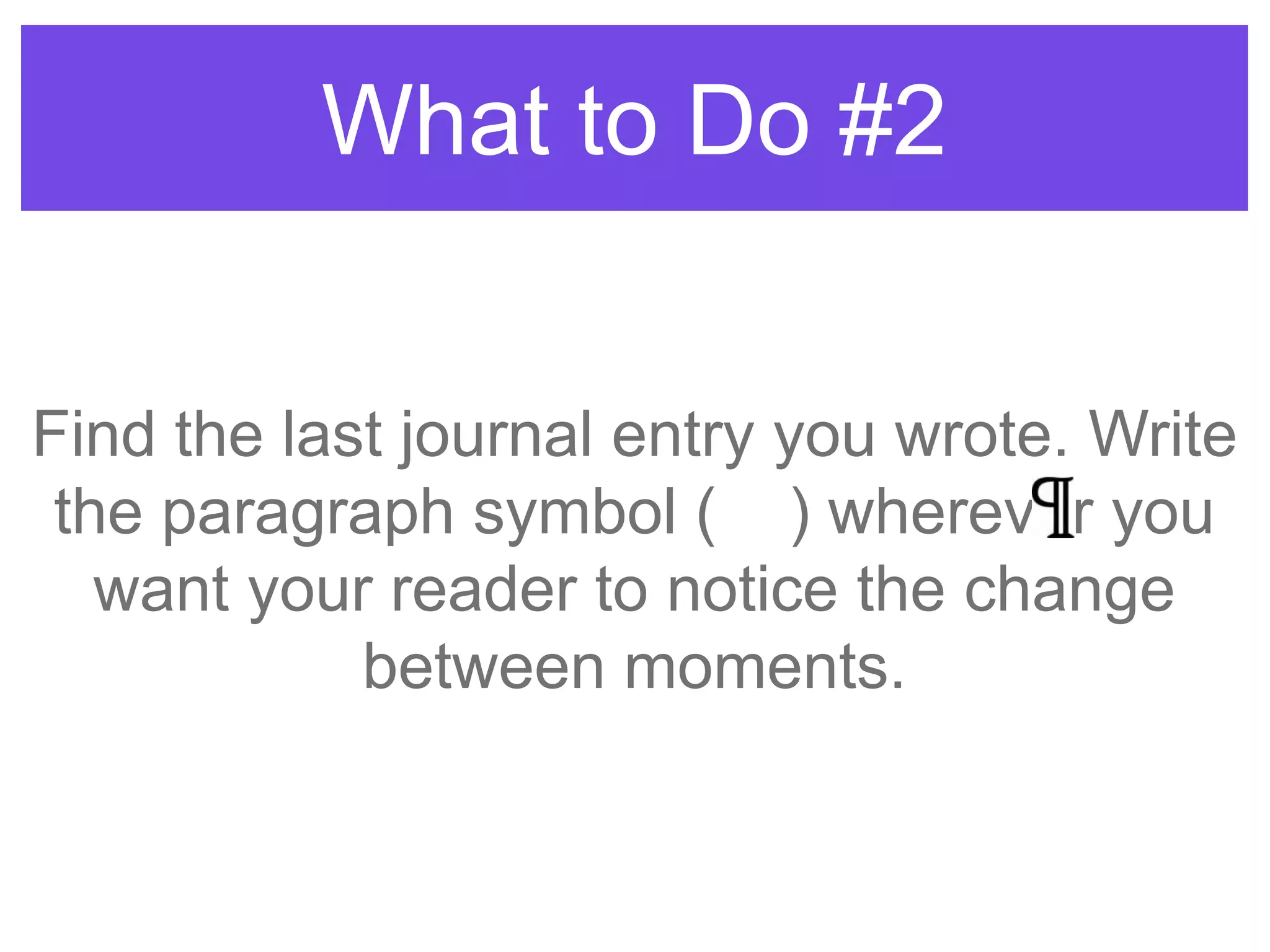
What to Do #2
Find the last journal entry you wrote. Write
the paragraph symbol ( ) wherever you
want your reader to notice the change
between moments.
Lesson Twenty
Structuring a Short Story
What to Do #1
Arrange your photocopies so that they fall
in order of events, with the introduction at
the top of the pile. Use the Shape of a
Story chart as a guide.
Writing Prompt
1. Find your list of the three events that form your
rising action.
2. Put your character into the third event of your
rising action.
3. When you‟re done, write your turning point in 2-3
sentences.
Lesson Twenty-One
Revising to Show
Revision Assignment #1
1. Choose a moment from your problem or
rising action.
2. Add showing details to this moment.
Revision Assignment
Revision Assignment #2
1. Choose a second moment from your rising
action or from your turning point.
2. Add showing details to this moment.
Revision Assignment #2
Lesson Twenty-Two
Revising Dialogue
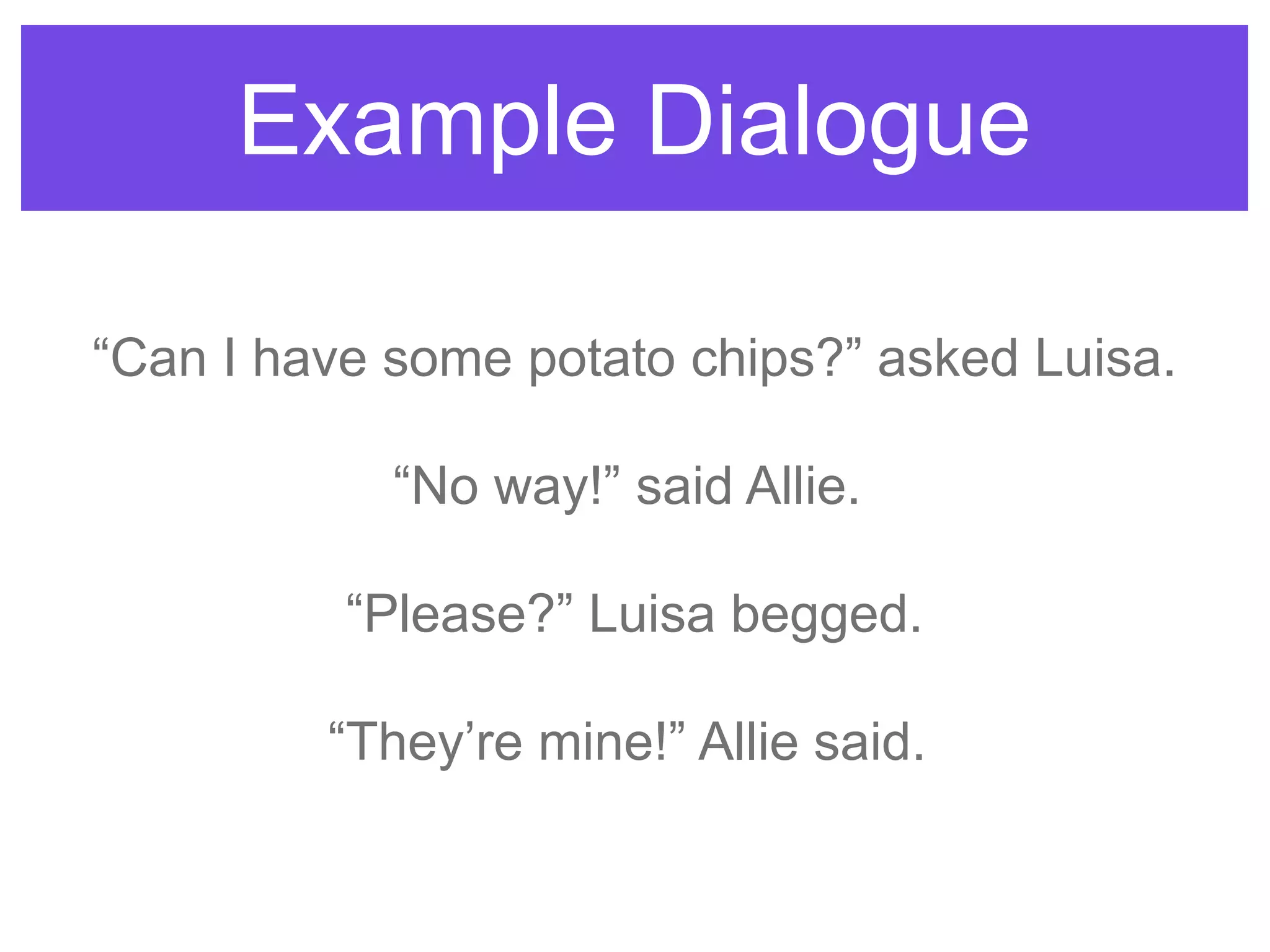
Example Dialogue
“Can I have some potato chips?” asked Luisa.
“No way!” said Allie.
“Please?” Luisa begged.
“They‟re mine!” Allie said.
Revision Assignment
1. Find a place in your story where you use
dialogue.
2. Make the dialogue more informative &
interesting to the reader by adding showing
details.
3. Repeat the same steps with another passage
of dialogue.
Revision Assignment
Lesson Twenty-Three
Editing & Writing the Final Draft
What to Do:
1. Copy the following two sentences into your journal.
- What flavor fluoride would you like asked the dentist Chocolate
or strawberry Chocolate I replied hoping this time the toothpaste
might actually taste like dessert
- You walk too fast panted my brother as we carried our sleds
up the snowy hill Don‟t go down before I get there I won‟t I
promised rushing up to the top
2. Use your colored pen or pencil to add quotation marks and
punctuation to the sentences.
Revision Assignment
1. Read your draft to yourself softly & slowly.
2. Use your colored pen or pencil to make corrections. Pay
special attention to capitalization, punctuation, and dialogue.
3. Read through the entire draft to make sure you found and
corrected all the errors.
4. When you‟re ready, neatly rewrite or type your final draft!

Wex book 3

  • 1.
  • 2.
    Rules for Sharing 1.Thereader reads loudly and slowly. 2.The reader calls on other students for their responses. 3.The listeners respond by saying only what the writer did well. 4.The listeners identify specific words, phrases, or sentences that made an impression.
  • 3.
    The WEX Writer‟sMindset WEX Writers: 1.Take academic and social risks. 2.Write about one thing that really grabs their attention. 3.Experiment with their writing. 4.Support one another. 5.Write with the reader in mind.
  • 4.
    Rules for WritingTime 1.No talking. 2.No trips to the bathroom or water fountain 3.Keep focused on your own work - don‟t distract your classmates. 4.Use the whole time to write. 5.Ask for help once, if necessary, then continue writing.
  • 5.
    Response Starters I couldpicture the character when you wrote __________ . I could picture the character when you wrote, “His hair hung down in his face and covered his eyes like a curtain.” I liked when you described the setting as __________ because __________ . I liked when you described the setting as “louder than a roller coaster” because I can really hear how loud it would be. I liked when your character said __________ because __________ . I liked when your character said “You never pick me” because that’s how I felt sometimes when I was little. I was nervous when __________ happened because __________. I was nervous when Emily slammed the front door because I knew she didn’t have her house keys.
  • 6.
    Unit One Creating aBelievable Character
  • 7.
    Lesson One Using Observationsto Create a Character
  • 8.
  • 9.
  • 10.
    What to Do#1 1. Look at the photo. On your chart under the heading “Observations,” write down what you observe. Think about the setting, the action, the situation of the photo, as well as the person or people in the photo. 2. Choose one person in your photo. What do you think that person is thinking? Write down three internal thoughts under the heading “Internal Thoughts.”
  • 11.
    What to Do#2 1. Circle one of the internal thoughts on your chart. 2. Draw a line from the circled internal thought to any observation(s)-- no more than three for now-- that led you to create the internal thought. 3. Write 2-3 sentences explaining why or how those details from the photos made you think of that internal thought for your character.
  • 12.
    Lesson Two Getting toKnow Your Character
  • 13.
    What to Do: 1.Listen to the situation. 2. Write 3-5 sentences that show what your character does, says, thinks, and feels in this situation. 3. Repeat with a new situation. Situation: ______________________________
  • 14.
    Lesson Three Putting aCharacter into a Mundane Situation
  • 15.
    Mundane Situations “Mundane” meanscommon, run-of-the-mill. It describes the kinds of things we might do each day. (write in as a class, save for another lesson). Examples:
  • 16.
  • 17.
  • 18.
    What to Do: 1.Think about what your character‟s daily life is like. 2. Write down three mundane situations that your character might experience during the evening. Feel free to use one of the situations from the class list.
  • 19.
    Verbal Warm-Up Raise yourhand if you wrote down a mundane situation that is a chore. Raise your hand if you wrote down a mundane situation that you often find yourself in. Raise your hand if you wrote down a mundane situation your character would probably be in every day. Raise your hand if you wrote down a mundane situation that usually happens at home.
  • 20.
    Writing Prompt Pick oneof the three mundane situations you wrote down, and put your character in that moment. Use showing details, strong verbs, and dialogue to describe how your character acts.
  • 21.
  • 22.
    Definitions of Partsof Speech The Complete Subject is who or what the sentence is about. It includes the main noun and the words that describe the noun. The Complete Predicate tells what the subject is doing. It includes a verb and all the words that tell about the action.
  • 23.
    The old manfrequently napped on the park bench. Examples: A delicious dinner sat on the table.
  • 24.
    Subject/Predicate Match Game 1.Divide the class into two groups: a subject group and a predicate group. 2. Hand out a blank strip of paper to each student. 3. Each student needs to write a complete subject or complete predicate on his or her strip of paper, depending on what group he or she is in. 4. Students in the predicate group to write their verbs in the PAST tense.
  • 25.
    What to Do#1 1. Find four matches for your complete predicate/subject. If you have a complete subject, you need to find four complete predicates. If you have a complete predicate, you need to find four complete subjects. 2. Two of your sentences should make perfect sense. The other two should be perfectly silly. 3. Write the sentences in your journal. All of them must be grammatically correct.
  • 26.
    What to Do#2 Mundane Situation: ___________________ Write 3-5 sentences that show what your character does, says, thinks, and feels in this situation.
  • 27.
  • 29.
    Revision Assignment 1. Findthe journal entry you wrote for Lesson 3 and look at the mundane situation you put your character in. 2. Underline the details you wrote that provide information about your character and the setting of the situation. 3. Add two more sentences that give more details about your character and the setting of the situation. Revision Assignment
  • 30.
    Lesson Six Creating aBelievable Problem
  • 31.
    What to Do: 1.FInd the journal entry you wrote for Lesson 3 and look at the mundane situation you put your character in. 2. Write down three different believable problems your character might encounter in this situation.
  • 32.
    Verbal Warm-Up Raise yourhand if one of your problems involves another character. Raise your hand if one of your problems would make you mad. Raise your hand if one of your problems is one you‟ve faced before. Raise your hand if you can imagine your character facing one of these problems. Raise your hand if you like one of the problems more than the others.
  • 33.
    Writing Prompt Choose onebelievable problem from the list you made. Describe the moment when your character faces this problem.
  • 34.
  • 36.
    What to Do: 1.Look back at the problem you created for your character in the last lesson. 2. Come up with three events that will gradually worsen your characters problem or create tension in your story. 3. Fill this information in on your Shape of a Story chart.
  • 37.
    Verbal Warm-Up Raise yourhand if you think your character will expect the first event in the rising action. Raise your hand if you think your character will be surprised by the first even tin the rising action. Raise your hand if the order of events in your rising action makes the problem worse than before.
  • 38.
    Writing Prompt Put yourcharacter into the first event of your rising action. Be sure to show how your character acts and feels during this event.
  • 39.
  • 40.
    Sample Sentences #1 Thegirl walked into her house. The girl tiptoed into her house.
  • 41.
    Sample Sentences #2 Theboy gladly ate his lunch. The boy devoured his lunch.
  • 42.
    What to Do#1 1. Choose one of the following sentences and copy it into your journal: The girl irritably said, “Give me a book.” The girl cheerfully said, “Give me a book.” 2. Circle the verb & underline the adverb. 3.Rewrite the sentence, replacing the verb & adverb with one strong verb to show how the girl spoke. 4. Write two more sentences adding details to show that the girl was either irritable or cheerful.
  • 43.
    What to Do#2 The Mundane Situation: _______________________ Write 3-5 sentences that show what your character does, says, thinks, and feels in the situation.
  • 44.
    Unit Two Experimenting Witha Second Character
  • 45.
    Lesson Nine Using Observationsto Create a Character
  • 46.
  • 47.
    What to Do#1 1. Look at your photo. On your chart under the heading “Observations,” write down what you observe. Think about the setting, the action, and the situation of the photo, as well as the person or people in the photo. 2. Choose one person in your photo. What do you think that person is thinking? Write down three internal thoughts under the heading “Internal Thoughts.”
  • 48.
    What to Do#2 1. Circle one of the internal thoughts on your chart. 2. Draw a line from the circled internal thought to any observation(s)-- no more than three for now-- that led you to create the internal thought. 3. Write 2-3 sentences explaining why or how those details from the photos made you think of that internal thought for your character.
  • 49.
    Lesson Ten Putting aCharacter into a Mundane Situation
  • 50.
  • 51.
    What to Do: 1.Think about what your character‟s daily life is like. 2. Write down three mundane situations that your character might experience at home. Feel free to use one of the situations from the class list.
  • 52.
    Verbal Warm-Up Raise yourhand if you wrote down a mundane situation that is fun. Raise your hand if you wrote down a mundane situation that you often find yourself in. Raise your hand if you wrote down a mundane situation your character would do by him or herself. Raise your hand if you wrote down a mundane situation that usually happens in the morning.
  • 53.
    Writing Prompt Pick oneof the three mundane situations you wrote down, and put your character in that moment. Use showing details, strong verbs, and dialogue to describe how your character acts.
  • 54.
  • 55.
    Sample Sentences #1 Claraslammed the front door and stomped into my room. She flung herself onto my bed and turned to the wall.
  • 56.
    Sample Sentences #2 Claraslammed the front door and stomped into my room screeching, “I hate my little brother!” She flung herself onto my bed and cried, “He is such a pest and I think my parents love him more than me.”
  • 57.
    Sample Sentences #3 “Ihate my little brother!” Clara screeched, slamming the front door and stomping into my room. “Oh no. Here we go again,” I thought.
  • 58.
    Revision Assignment 1. Goback to the mundane situation you wrote in your journal during the last lesson. 2. Find a spot to add 2-4 lines of dialogue that show how your character is feeling. Revision Assignment
  • 59.
    Verbal Warm-Up Raise yourhand if you can picture your character oversleeping. Raise your hand if you can picture your character missing the bus. Raise your hand if you can picture your character losing track of time. Raise your hand if you can picture someone waiting for your character. Raise your hand if you can picture your character having to wait for someone.
  • 60.
    Writing Prompt Write abouta moment when your character was late for something.
  • 61.
    Lesson Twelve Punctuating andFormatting Dialogue
  • 62.
    Dialogue Example “You bettertake an umbrella and wear your rain boots, Paloma shouted down the hall to her son. “I can‟t find my boots!” “Not again,” Paloma thought, “Look under your bed, Max. I‟m sure I saw them there yesterday. Keep looking.” “Oh, got „em.”
  • 63.
    What to Do: Readthe following conversation & format the dialogue correctly, using punctuation and new paragraphs to show who‟s talking when:
  • 64.
    Dialogue The bus iscoming, Angela shouted. You better run, Frank. We‟ve got our math quiz this morning. I‟m coming! cried Frank. Tell the driver to wait.
  • 65.
    Corrected Dialogue The busis coming, Angela shouted. You better run, Frank. We‟ve got our math quiz this morning. I‟m coming! cried Frank. Tell the driver to wait. “ “ “ “ “ “ “ “
  • 66.
    Verbal Warm-Up Picture yourcharacter in your mind. Raise your hand if you can picture one of your character‟s friends. Raise your hand if you can picture your characters family. Raise your hand if you can think of something that would make your character laugh.
  • 67.
    Writing Prompt Write abouta funny conversation your character had with a friend or family member. Include dialogue (both your character‟s words and other characters‟ words) to show what was happening.
  • 68.
  • 70.
    Revision Assignment 1. Findthe journal entry you wrote for Lesson 10 and look at the mundane situation you put your character in. 2. Underline the details that give information about your character and the setting of the situation. 3. Add two or more sentences that give more details about your character and the setting. Revision Assignment
  • 71.
    Lesson Fourteen Creating aBelievable Problem
  • 72.
    What to Do: 1.Find the journal entry you wrote for Lesson 10 and look at the mundane situation you put your character in. 2. Write down three different believable problems your character might encounter in this situation.
  • 73.
    Verbal Warm-Up Raise yourhand if one of your character‟s problems happens in the morning. Raise your hand if one of your character‟s problems happens at school. Raise your hand if one of your character‟s problems has happened to you. Raise your hand if one of the problems makes your character frustrated. Raise your hand if you like one of the problems more than the others.
  • 74.
    Writing Prompt Choose onebelievable problem from the list you just made. Describe the moment when your character faces this problem.
  • 75.
  • 77.
    What to Do: 1.Look back at the problem you created for your character in the last lesson. 2. Come up with three events that will gradually worsen your character‟s problem or create tension on your story. 3. Fill this information in on your Shape of a Story chart.
  • 78.
    Verbal Warm-Up Raise yourhand if you think the first event in your rising action will happen really quickly. Raise your hand if you know what your character will be thinking as things get worse. Raise your hand if the order of events in your rising action makes the problem worse than before.
  • 79.
    Writing Prompt Put yourcharacter into the first event of your rising action. Be sure to show how your character acts and feels during this event.
  • 80.
  • 81.
    Sample Dialogue #1 Gregsaid, “Come on Grandma, move your legs! We are going to be late!”
  • 82.
    Sample Dialogue #2 Joshsaid, “Just take your time, Grandma. We may be able to get there before the next ice age.”
  • 83.
    Sample Dialogue #3 Larrysaid, “No hurry, Grandma. Don‟t worry, we have plenty of time to get to the store.”
  • 84.
    What to Do: 1.Listen to the following situation: Lori and Mae are sisters. Lori is older than Mae. Lori is playing with a toy and Mae takes it from her. 2. Write 2-4 lines of a dialogue that show how the characters are feeling. Don‟t forget to use quotation marks around what the characters say.
  • 85.
    Revision Assignment 1. Goback to the rising action you wrote in your journal during the last lesson. 2. Find a spot to add 2-4 lines of dialogue that show how your character is feeling. Revision Assignment
  • 86.
  • 87.
    Dialogue Example “Hold thebus!” Talya shouted as she ran down the street. “Oh no,” she thought, “I will be late.” Lilly walked up to the bus stop and said, “Don‟t worry. A bus comes every ten minutes.” “Thank goodness,” sighed Talya as she sat down.
  • 88.
    What to Do: Readthe following conversation and rewrite it, using correct punctuation and new paragraphs to show who is talking when. How old is the milk? Mom cringed. I think I bought it last week, Matt said. Maybe you should taste it. I‟m not going to taste it. You taste it. No way! Matt shouted.
  • 89.
    Corrected Dialogue How oldis this milk? Mom cringed. I think I bought it last week, Matt said. Maybe you should taste it. I‟m not going to taste it. You taste it. No way! Matt shouted. “ “ “ “ “ “ “ “ “ “ “
  • 90.
    Verbal Warm-Up Picture yourcharacter eating lunch in a cafeteria. Raise your hand if your character brought his or her own lunch. Raise your hand if your character eats the same lunch every day. Raise your hand if your character really enjoyed eating lunch. Raise your hand if your character ate lunch with another person.
  • 91.
    Writing Prompt Write abouta conversation your character had at lunch. Include both your character‟s words and other characters‟ words to show what was happening.
  • 92.
  • 93.
  • 94.
    What to Do#1 1. Reread your two mundane situation journal entries (Lessons 3 & 10) 2. Choose the one that seems most believable and/or the one that has the character you like the best, and mark that entry with a sticky note. 3. Reread your problem entries (Lessons 6 & 14) and rising action entries (Lessons 7 & 15) that go with the mundane situation that you just chose and mark those entries with sticky notes.
  • 95.
    What to Do#2 1. Review your Shape of a Story chart for the story you chose. 2. In your journal, write your second rising action event.
  • 96.
    Lesson Nineteen Using Paragraphsto Distinguish Moments
  • 97.
    Definition of aParagraph A paragraph is a block of indented text that contains a distinct moment of narration or dialogue. New paragraphs often show a change in time, a change in place, a change in emotion, or a change in who‟s speaking.
  • 98.
    Indenting Example “I wanta toy train, a pony, and a video game!” Tina told the mall Santa. “Whoa, that‟s a lot of things,” Tina‟s mom said, looking embarrassed.
  • 99.
    What to Do#1 1. Reread the Paragraphing Sample to yourself. 2. As you read, write the paragraph symbol ( ) at the beginning of any sentence that introduces a new moment, place, emotion, or speaker. These are sentences that the writer should indent so that they become the start of a new paragraph.
  • 100.
    What to Do#2 Find the last journal entry you wrote. Write the paragraph symbol ( ) wherever you want your reader to notice the change between moments.
  • 101.
  • 102.
    What to Do#1 Arrange your photocopies so that they fall in order of events, with the introduction at the top of the pile. Use the Shape of a Story chart as a guide.
  • 103.
    Writing Prompt 1. Findyour list of the three events that form your rising action. 2. Put your character into the third event of your rising action. 3. When you‟re done, write your turning point in 2-3 sentences.
  • 104.
  • 105.
    Revision Assignment #1 1.Choose a moment from your problem or rising action. 2. Add showing details to this moment. Revision Assignment
  • 106.
    Revision Assignment #2 1.Choose a second moment from your rising action or from your turning point. 2. Add showing details to this moment. Revision Assignment #2
  • 107.
  • 108.
    Example Dialogue “Can Ihave some potato chips?” asked Luisa. “No way!” said Allie. “Please?” Luisa begged. “They‟re mine!” Allie said.
  • 109.
    Revision Assignment 1. Finda place in your story where you use dialogue. 2. Make the dialogue more informative & interesting to the reader by adding showing details. 3. Repeat the same steps with another passage of dialogue. Revision Assignment
  • 110.
    Lesson Twenty-Three Editing &Writing the Final Draft
  • 111.
    What to Do: 1.Copy the following two sentences into your journal. - What flavor fluoride would you like asked the dentist Chocolate or strawberry Chocolate I replied hoping this time the toothpaste might actually taste like dessert - You walk too fast panted my brother as we carried our sleds up the snowy hill Don‟t go down before I get there I won‟t I promised rushing up to the top 2. Use your colored pen or pencil to add quotation marks and punctuation to the sentences.
  • 112.
    Revision Assignment 1. Readyour draft to yourself softly & slowly. 2. Use your colored pen or pencil to make corrections. Pay special attention to capitalization, punctuation, and dialogue. 3. Read through the entire draft to make sure you found and corrected all the errors. 4. When you‟re ready, neatly rewrite or type your final draft!