OPE Storytelling Workshop
Journeys in Health Care
Creating the arc of a story
Hook, line & sinker
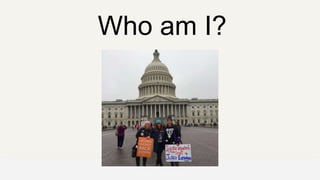
Who am I?
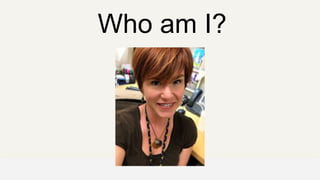
Who am I?
OFFICE OF PATIENT EXPERIENCE
Who am I?
OFFICE OF PATIENT EXPERIENCE
Who am I?
OFFICE OF PATIENT EXPERIENCE
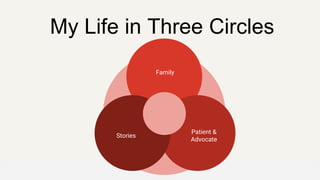
My Life in Three Circles
OFFICE OF PATIENT EXPERIENCE
Family
Patient &
Advocate
Stories
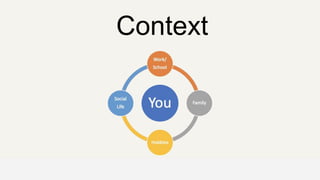
Context
OFFICE OF PATIENT EXPERIENCE
Open Your Minds
Silent Brainstorming: Your Focal Point
1. Imagine a scene. Where might this story begin for you? Is there a
particularly challenging moment that carries significance? What about a
moment of triumph?
2. What is the result? Where are you now? Some of the best stories are
written from back to front.
3. What about where you began? What does your life look like before
this journey began?
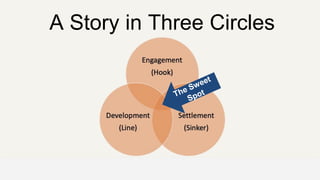
A Story in Three Circles
OFFICE OF PATIENT EXPERIENCE
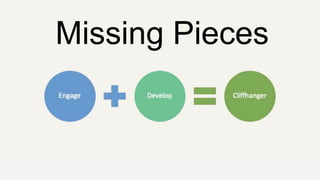
Missing Pieces
OFFICE OF PATIENT EXPERIENCE
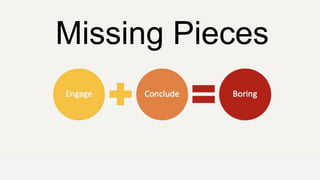
Missing Pieces
OFFICE OF PATIENT EXPERIENCE
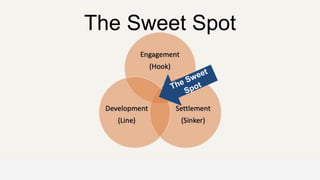
The Sweet Spot
OFFICE OF PATIENT EXPERIENCE
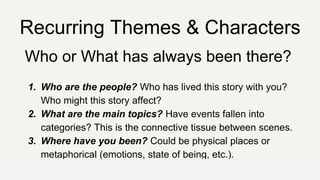
Recurring Themes & Characters
Who or What has always been there?
1. Who are the people? Who has lived this story with you?
Who might this story affect?
2. What are the main topics? Have events fallen into
categories? This is the connective tissue between scenes.
3. Where have you been? Could be physical places or
metaphorical (emotions, state of being, etc.).
OFFICE OF PATIENT EXPERIENCE
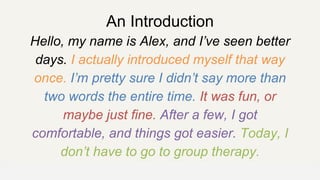
An Introduction
Hello, my name is Alex, and I’ve seen better
days. I actually introduced myself that way
once. I’m pretty sure I didn’t say more than
two words the entire time. It was fun, or
maybe just fine. After a few, I got
comfortable, and things got easier. Today, I
don’t have to go to group therapy.
OFFICE OF PATIENT EXPERIENCE
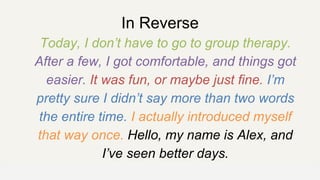
In Reverse
Today, I don’t have to go to group therapy.
After a few, I got comfortable, and things got
easier. It was fun, or maybe just fine. I’m
pretty sure I didn’t say more than two words
the entire time. I actually introduced myself
that way once. Hello, my name is Alex, and
I’ve seen better days.
OFFICE OF PATIENT EXPERIENCE
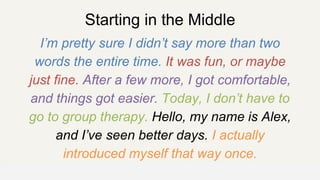
Starting in the Middle
I’m pretty sure I didn’t say more than two
words the entire time. It was fun, or maybe
just fine. After a few more, I got comfortable,
and things got easier. Today, I don’t have to
go to group therapy. Hello, my name is Alex,
and I’ve seen better days. I actually
introduced myself that way once.
OFFICE OF PATIENT EXPERIENCE
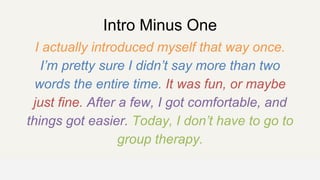
Intro Minus One
I actually introduced myself that way once.
I’m pretty sure I didn’t say more than two
words the entire time. It was fun, or maybe
just fine. After a few, I got comfortable, and
things got easier. Today, I don’t have to go to
group therapy.
OFFICE OF PATIENT EXPERIENCE
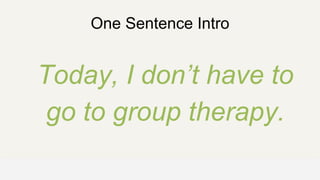
One Sentence Intro
Today, I don’t have to
go to group therapy.
OFFICE OF PATIENT EXPERIENCE
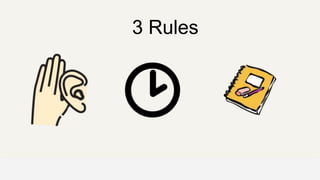
3 Rules
OFFICE OF PATIENT EXPERIENCE
Takeaway Points
1. Engagement + Development + Settlement = Balance. You
can shift between any of the three, but you need each in equal
proportions for your story to have meaning.
2. Order Matters. You can totally reshape a story using the same
content with order alone. What you say last is what the audience
will remember.
3. Have a Plan. Everyone needs something different, but everyone
needs something. Script and/or have a plan that works for you.
OFFICE OF PATIENT EXPERIENCE
From Journeys in Health Care Event
Elements
&
Action
Story Elements & Choices: The 6 Ws
● What
● Why
● Who
● When
● Where
● How
Image Credit:
https://www.flickr.com/photos/rosefirerising/4383376875/
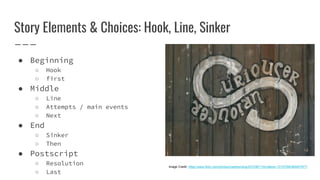
Story Elements & Choices: Hook, Line, Sinker
● Beginning
○ Hook
○ first
● Middle
○ Line
○ Attempts / main events
○ Next
● End
○ Sinker
○ Then
● Postscript
○ Resolution
○ Last
Image Credit: https://www.flickr.com/photos/rosefirerising/437038713/in/album-72157594360457977/
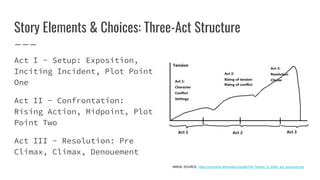
Story Elements & Choices: Three-Act Structure
Act I - Setup: Exposition,
Inciting Incident, Plot Point
One
Act II - Confrontation:
Rising Action, Midpoint, Plot
Point Two
Act III - Resolution: Pre
Climax, Climax, Denouement
IMAGE SOURCE: https://commons.wikimedia.org/wiki/File:Tension_of_three_act_structure.png
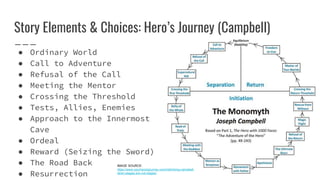
Story Elements & Choices: Hero’s Journey (Campbell)
● Ordinary World
● Call to Adventure
● Refusal of the Call
● Meeting the Mentor
● Crossing the Threshold
● Tests, Allies, Enemies
● Approach to the Innermost
Cave
● Ordeal
● Reward (Seizing the Sword)
● The Road Back
● Resurrection
IMAGE SOURCE:
https://www.yourheroicjourney.com/rethinking-campbell-
when-stages-are-not-stages/
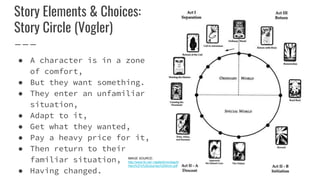
Story Elements & Choices:
Story Circle (Vogler)
● A character is in a zone
of comfort,
● But they want something.
● They enter an unfamiliar
situation,
● Adapt to it,
● Get what they wanted,
● Pay a heavy price for it,
● Then return to their
familiar situation,
● Having changed.
IMAGE SOURCE:
http://www.tlu.ee/~rajaleid/montaazh/
Hero%27s%20Journey%20Arch.pdf
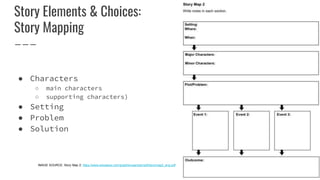
Story Elements & Choices:
Story Mapping
● Characters
○ main characters
○ supporting characters)
● Setting
● Problem
● Solution
IMAGE SOURCE: Story Map 2: https://www.eduplace.com/graphicorganizer/pdf/storymap2_eng.pdf
6 Word Stories
http://www.sixwordstories.net
Story Setting (Where: 2 minutes)
What are the locations where the story happens?
● Does the story move from place to place?
● How many different places?
● Are there locations that are clearly essential to the
story?
● What are the main locations?
○ Clinic, home, job, …
○ Can you simplify these? For home, what is more important — the
kitchen, living room, bedroom …
Story Setting (When: 2 minutes)
How long does your story take? Minutes, hours, days, weeks,
months, years, generations?
● What are the most important events in the story? Do they
happen around the same time, or are they spread out over a
span of time? Is there one event that stands out as most
important?
● Does the story make more sense sequentially, or does it
feel like it needs to bounce from one pivot event to
another?
Story Setting (When: 2 minutes)
Story Characters (5 minutes)
Who are the people in the story?
● Does the story move from place to place?
● How many different places?
● Are there locations that are clearly essential to the
story?
● What are the main locations?
○ Clinic, home, job, …
○ Can you simplify these? For home, what is more important — the
kitchen, living room, bedroom …
Story Characters (5 minutes)
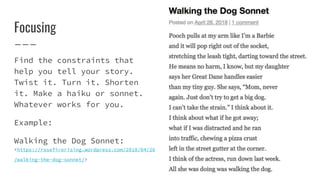
Focusing
Find the constraints that
help you tell your story.
Twist it. Turn it. Shorten
it. Make a haiku or sonnet.
Whatever works for you.
Example:
Walking the Dog Sonnet:
<https://rosefirerising.wordpress.com/2018/04/26
/walking-the-dog-sonnet/>
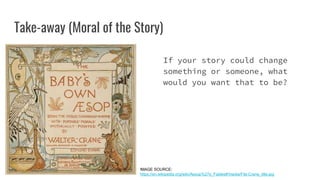
Take-away (Moral of the Story)
If your story could change
something or someone, what
would you want that to be?
IMAGE SOURCE:
https://en.wikipedia.org/wiki/Aesop%27s_Fables#/media/File:Crane_title.jpg
Editing scene by scene:
It’s all in the details!
Breaking through!
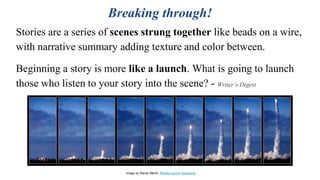
Stories are a series of scenes strung together like beads on a wire,
with narrative summary adding texture and color between.
Beginning a story is more like a launch. What is going to launch
those who listen to your story into the scene? - Writer’s Digest
Image by Randy Merrill, Rocket Launch Sequence
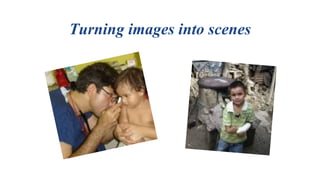
Turning images into scenes
Bird by Bird
“Thirty years ago my brother, ten years old at the time, was trying
to get a report on birds written that he’d had three months to write.
It was due the next day. He was at the kitchen table close to tears,
surrounded by binder paper and pencils and unopened books on
birds, immobilized by the hugeness of the task. My father sat beside
him, put his arm around my brother’s shoulder, and said, ‘Bird by
bird, buddy. Just take it bird by bird.'”
- Anne Lamott
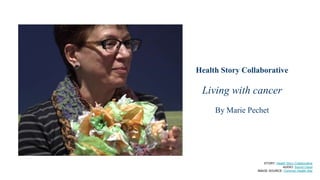
Health Story Collaborative
Living with cancer
By Marie Pechet
STORY: Health Story Collaborative
AUDIO: Sound Cloud
IMAGE SOURCE: Common Health Site
What images did Marie start with?
What other images did she turn into scenes?
From those images, what sensory details do you remember?
What points of dialogue did Marie include?
Any anecdotes?
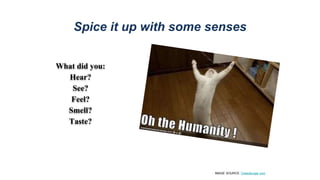
Spice it up with some senses
What did you:
Hear?
See?
Feel?
Smell?
Taste?
IMAGE SOURCE: Cheezburger.com
We are complex beings.
Every day, we contend with internal,
external, relationship, and spiritual conflicts.
Layer facts with how you felt.
“It’s really not what transpired that makes a good
story,” says Margot Leitman. “It’s about how you felt
about what transpired.”
- Margot Leitman, Long Story Short: The Only Storytelling Guide You’ll Ever Need
IMAGE SOURCE: Pixabay.com
Details are the difference between good stuff and
great stuff — Stephen Brewster.
IMAGE SOURCE: Dennis Gingerich Posts
Details in their various forms
Concrete details:
A. The bull ran toward me.
B. The angry black bull charged me.
Sensory details (imagery):
A. My car is red.
B. I drive a candy-apple red car.
Adding details through dialogue:
A. He didn’t think he was going to make it.
B. He said, “I don’t think I am going to make it, man.”
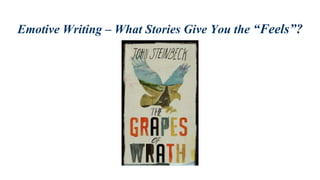
Emotive Writing – What Stories Give You the “Feels”?
John Steinbeck: Grapes of
Wrath (book cover)
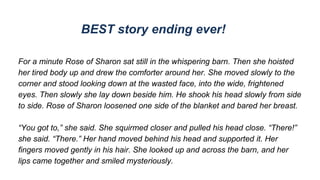
BEST story ending ever!
For a minute Rose of Sharon sat still in the whispering barn. Then she hoisted
her tired body up and drew the comforter around her. She moved slowly to the
corner and stood looking down at the wasted face, into the wide, frightened
eyes. Then slowly she lay down beside him. He shook his head slowly from side
to side. Rose of Sharon loosened one side of the blanket and bared her breast.
“You got to,” she said. She squirmed closer and pulled his head close. “There!”
she said. “There.” Her hand moved behind his head and supported it. Her
fingers moved gently in his hair. She looked up and across the barn, and her
lips came together and smiled mysteriously.
Remember Oral Storytelling is:
Not just oral.
Not a pitch, comedy special or rant.
Timing, pauses, and sometimes even silence.
About tone.
Memorized (write notes & then lose the notes).
Takes Practice.
Michigan Med Orientations & Stories that Illustrate Staff:
Treating you with respect & empathy.
Treating you as more than a patient - connecting.
Communicating in a way that works for you.
Listening.
Doing something proactively to assist you.
Keeping you informed and sharing resources.
Taking ownership of a mistake.
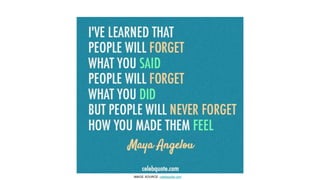
IMAGE SOURCE: celebquote.com
Resources
Story Map 2: https://www.eduplace.com/graphicorganizer/pdf/storymap2_eng.pdf
Other graphic organizers:
http://www.shbooval.qld.edu.au/learning/Documents/Reading%20graphic%20organisers.pdf
Reedsy:
● Story Structure: Three Models for Your Book https://blog.reedsy.com/story-structure/
● The Dan Harmon Story Circle: What Authors Can Learn from Rick and Morty
https://blog.reedsy.com/dan-harmon-story-circle/
● How to Write a Novel Using The Three Act Structure https://blog.reedsy.com/three-act-
structure/
Dan Wells. Story Structure.
https://www.youtube.com/watch?v=KcmiqQ9NpPE&list=PLC430F6A783A88697
McCloud, Scott. Making Comics: Storytelling Secrets of Comics, Manga, and Graphic Novels.
Thank You
IMAGE SOURCE: https://www.flickr.com/photos/rosefirerising/443240885

Storytelling workshop for orientations

  • 1.
  • 2.
    Creating the arcof a story Hook, line & sinker
  • 3.
  • 4.
    Who am I? OFFICEOF PATIENT EXPERIENCE
  • 5.
    Who am I? OFFICEOF PATIENT EXPERIENCE
  • 6.
    Who am I? OFFICEOF PATIENT EXPERIENCE
  • 7.
    My Life inThree Circles OFFICE OF PATIENT EXPERIENCE Family Patient & Advocate Stories
  • 8.
  • 9.
    Open Your Minds SilentBrainstorming: Your Focal Point 1. Imagine a scene. Where might this story begin for you? Is there a particularly challenging moment that carries significance? What about a moment of triumph? 2. What is the result? Where are you now? Some of the best stories are written from back to front. 3. What about where you began? What does your life look like before this journey began?
  • 10.
    A Story inThree Circles OFFICE OF PATIENT EXPERIENCE
  • 11.
    Missing Pieces OFFICE OFPATIENT EXPERIENCE
  • 12.
    Missing Pieces OFFICE OFPATIENT EXPERIENCE
  • 13.
    The Sweet Spot OFFICEOF PATIENT EXPERIENCE
  • 14.
    Recurring Themes &Characters Who or What has always been there? 1. Who are the people? Who has lived this story with you? Who might this story affect? 2. What are the main topics? Have events fallen into categories? This is the connective tissue between scenes. 3. Where have you been? Could be physical places or metaphorical (emotions, state of being, etc.). OFFICE OF PATIENT EXPERIENCE
  • 15.
    An Introduction Hello, myname is Alex, and I’ve seen better days. I actually introduced myself that way once. I’m pretty sure I didn’t say more than two words the entire time. It was fun, or maybe just fine. After a few, I got comfortable, and things got easier. Today, I don’t have to go to group therapy. OFFICE OF PATIENT EXPERIENCE
  • 16.
    In Reverse Today, Idon’t have to go to group therapy. After a few, I got comfortable, and things got easier. It was fun, or maybe just fine. I’m pretty sure I didn’t say more than two words the entire time. I actually introduced myself that way once. Hello, my name is Alex, and I’ve seen better days. OFFICE OF PATIENT EXPERIENCE
  • 17.
    Starting in theMiddle I’m pretty sure I didn’t say more than two words the entire time. It was fun, or maybe just fine. After a few more, I got comfortable, and things got easier. Today, I don’t have to go to group therapy. Hello, my name is Alex, and I’ve seen better days. I actually introduced myself that way once. OFFICE OF PATIENT EXPERIENCE
  • 18.
    Intro Minus One Iactually introduced myself that way once. I’m pretty sure I didn’t say more than two words the entire time. It was fun, or maybe just fine. After a few, I got comfortable, and things got easier. Today, I don’t have to go to group therapy. OFFICE OF PATIENT EXPERIENCE
  • 19.
    One Sentence Intro Today,I don’t have to go to group therapy. OFFICE OF PATIENT EXPERIENCE
  • 20.
    3 Rules OFFICE OFPATIENT EXPERIENCE
  • 21.
    Takeaway Points 1. Engagement+ Development + Settlement = Balance. You can shift between any of the three, but you need each in equal proportions for your story to have meaning. 2. Order Matters. You can totally reshape a story using the same content with order alone. What you say last is what the audience will remember. 3. Have a Plan. Everyone needs something different, but everyone needs something. Script and/or have a plan that works for you. OFFICE OF PATIENT EXPERIENCE
  • 22.
    From Journeys inHealth Care Event
  • 23.
  • 24.
    Story Elements &Choices: The 6 Ws ● What ● Why ● Who ● When ● Where ● How Image Credit: https://www.flickr.com/photos/rosefirerising/4383376875/
  • 25.
    Story Elements &Choices: Hook, Line, Sinker ● Beginning ○ Hook ○ first ● Middle ○ Line ○ Attempts / main events ○ Next ● End ○ Sinker ○ Then ● Postscript ○ Resolution ○ Last Image Credit: https://www.flickr.com/photos/rosefirerising/437038713/in/album-72157594360457977/
  • 26.
    Story Elements &Choices: Three-Act Structure Act I - Setup: Exposition, Inciting Incident, Plot Point One Act II - Confrontation: Rising Action, Midpoint, Plot Point Two Act III - Resolution: Pre Climax, Climax, Denouement IMAGE SOURCE: https://commons.wikimedia.org/wiki/File:Tension_of_three_act_structure.png
  • 27.
    Story Elements &Choices: Hero’s Journey (Campbell) ● Ordinary World ● Call to Adventure ● Refusal of the Call ● Meeting the Mentor ● Crossing the Threshold ● Tests, Allies, Enemies ● Approach to the Innermost Cave ● Ordeal ● Reward (Seizing the Sword) ● The Road Back ● Resurrection IMAGE SOURCE: https://www.yourheroicjourney.com/rethinking-campbell- when-stages-are-not-stages/
  • 28.
    Story Elements &Choices: Story Circle (Vogler) ● A character is in a zone of comfort, ● But they want something. ● They enter an unfamiliar situation, ● Adapt to it, ● Get what they wanted, ● Pay a heavy price for it, ● Then return to their familiar situation, ● Having changed. IMAGE SOURCE: http://www.tlu.ee/~rajaleid/montaazh/ Hero%27s%20Journey%20Arch.pdf
  • 29.
    Story Elements &Choices: Story Mapping ● Characters ○ main characters ○ supporting characters) ● Setting ● Problem ● Solution IMAGE SOURCE: Story Map 2: https://www.eduplace.com/graphicorganizer/pdf/storymap2_eng.pdf
  • 30.
  • 31.
    Story Setting (Where:2 minutes) What are the locations where the story happens? ● Does the story move from place to place? ● How many different places? ● Are there locations that are clearly essential to the story? ● What are the main locations? ○ Clinic, home, job, … ○ Can you simplify these? For home, what is more important — the kitchen, living room, bedroom …
  • 32.
    Story Setting (When:2 minutes) How long does your story take? Minutes, hours, days, weeks, months, years, generations? ● What are the most important events in the story? Do they happen around the same time, or are they spread out over a span of time? Is there one event that stands out as most important? ● Does the story make more sense sequentially, or does it feel like it needs to bounce from one pivot event to another?
  • 33.
  • 34.
    Story Characters (5minutes) Who are the people in the story? ● Does the story move from place to place? ● How many different places? ● Are there locations that are clearly essential to the story? ● What are the main locations? ○ Clinic, home, job, … ○ Can you simplify these? For home, what is more important — the kitchen, living room, bedroom …
  • 35.
  • 36.
    Focusing Find the constraintsthat help you tell your story. Twist it. Turn it. Shorten it. Make a haiku or sonnet. Whatever works for you. Example: Walking the Dog Sonnet: <https://rosefirerising.wordpress.com/2018/04/26 /walking-the-dog-sonnet/>
  • 37.
    Take-away (Moral ofthe Story) If your story could change something or someone, what would you want that to be? IMAGE SOURCE: https://en.wikipedia.org/wiki/Aesop%27s_Fables#/media/File:Crane_title.jpg
  • 38.
    Editing scene byscene: It’s all in the details!
  • 39.
    Breaking through! Stories area series of scenes strung together like beads on a wire, with narrative summary adding texture and color between. Beginning a story is more like a launch. What is going to launch those who listen to your story into the scene? - Writer’s Digest Image by Randy Merrill, Rocket Launch Sequence
  • 40.
  • 41.
    Bird by Bird “Thirtyyears ago my brother, ten years old at the time, was trying to get a report on birds written that he’d had three months to write. It was due the next day. He was at the kitchen table close to tears, surrounded by binder paper and pencils and unopened books on birds, immobilized by the hugeness of the task. My father sat beside him, put his arm around my brother’s shoulder, and said, ‘Bird by bird, buddy. Just take it bird by bird.'” - Anne Lamott
  • 42.
    Health Story Collaborative Livingwith cancer By Marie Pechet STORY: Health Story Collaborative AUDIO: Sound Cloud IMAGE SOURCE: Common Health Site
  • 43.
    What images didMarie start with? What other images did she turn into scenes? From those images, what sensory details do you remember? What points of dialogue did Marie include? Any anecdotes?
  • 44.
    Spice it upwith some senses What did you: Hear? See? Feel? Smell? Taste? IMAGE SOURCE: Cheezburger.com
  • 45.
    We are complexbeings. Every day, we contend with internal, external, relationship, and spiritual conflicts. Layer facts with how you felt. “It’s really not what transpired that makes a good story,” says Margot Leitman. “It’s about how you felt about what transpired.” - Margot Leitman, Long Story Short: The Only Storytelling Guide You’ll Ever Need IMAGE SOURCE: Pixabay.com
  • 46.
    Details are thedifference between good stuff and great stuff — Stephen Brewster. IMAGE SOURCE: Dennis Gingerich Posts
  • 47.
    Details in theirvarious forms Concrete details: A. The bull ran toward me. B. The angry black bull charged me. Sensory details (imagery): A. My car is red. B. I drive a candy-apple red car. Adding details through dialogue: A. He didn’t think he was going to make it. B. He said, “I don’t think I am going to make it, man.”
  • 48.
    Emotive Writing –What Stories Give You the “Feels”? John Steinbeck: Grapes of Wrath (book cover)
  • 49.
    BEST story endingever! For a minute Rose of Sharon sat still in the whispering barn. Then she hoisted her tired body up and drew the comforter around her. She moved slowly to the corner and stood looking down at the wasted face, into the wide, frightened eyes. Then slowly she lay down beside him. He shook his head slowly from side to side. Rose of Sharon loosened one side of the blanket and bared her breast. “You got to,” she said. She squirmed closer and pulled his head close. “There!” she said. “There.” Her hand moved behind his head and supported it. Her fingers moved gently in his hair. She looked up and across the barn, and her lips came together and smiled mysteriously.
  • 50.
    Remember Oral Storytellingis: Not just oral. Not a pitch, comedy special or rant. Timing, pauses, and sometimes even silence. About tone. Memorized (write notes & then lose the notes). Takes Practice.
  • 51.
    Michigan Med Orientations& Stories that Illustrate Staff: Treating you with respect & empathy. Treating you as more than a patient - connecting. Communicating in a way that works for you. Listening. Doing something proactively to assist you. Keeping you informed and sharing resources. Taking ownership of a mistake.
  • 52.
  • 53.
    Resources Story Map 2:https://www.eduplace.com/graphicorganizer/pdf/storymap2_eng.pdf Other graphic organizers: http://www.shbooval.qld.edu.au/learning/Documents/Reading%20graphic%20organisers.pdf Reedsy: ● Story Structure: Three Models for Your Book https://blog.reedsy.com/story-structure/ ● The Dan Harmon Story Circle: What Authors Can Learn from Rick and Morty https://blog.reedsy.com/dan-harmon-story-circle/ ● How to Write a Novel Using The Three Act Structure https://blog.reedsy.com/three-act- structure/ Dan Wells. Story Structure. https://www.youtube.com/watch?v=KcmiqQ9NpPE&list=PLC430F6A783A88697 McCloud, Scott. Making Comics: Storytelling Secrets of Comics, Manga, and Graphic Novels.
  • 54.
    Thank You IMAGE SOURCE:https://www.flickr.com/photos/rosefirerising/443240885