“Good Health Records”
   The Foundation of Consistent,
Effective Dairy Health Management
      John R. Wenz DVM, MS


          www.goodhealthrecords.com
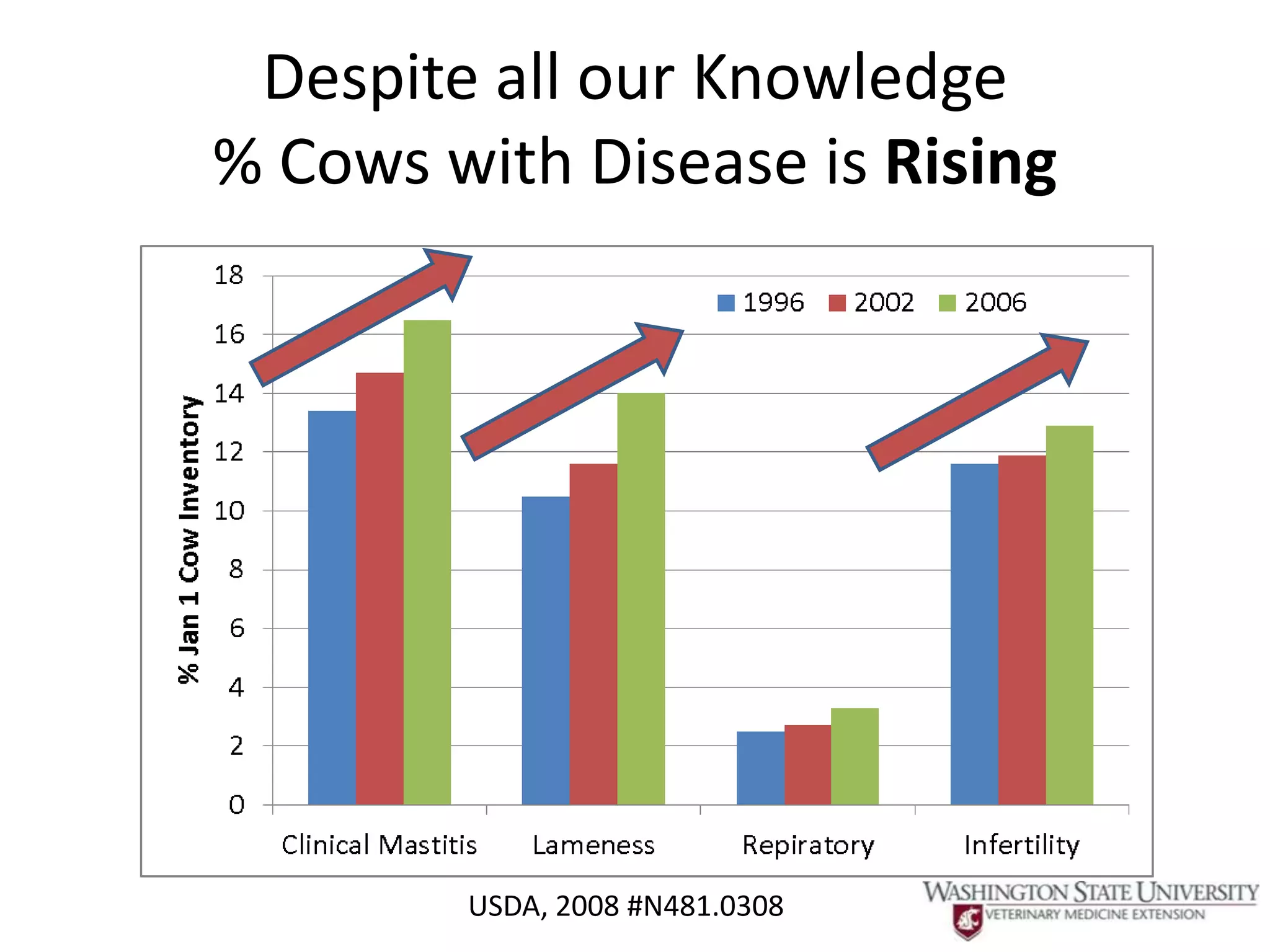
Despite all our Knowledge
% Cows with Disease is Rising


        USDA, 2008 #N481.0308
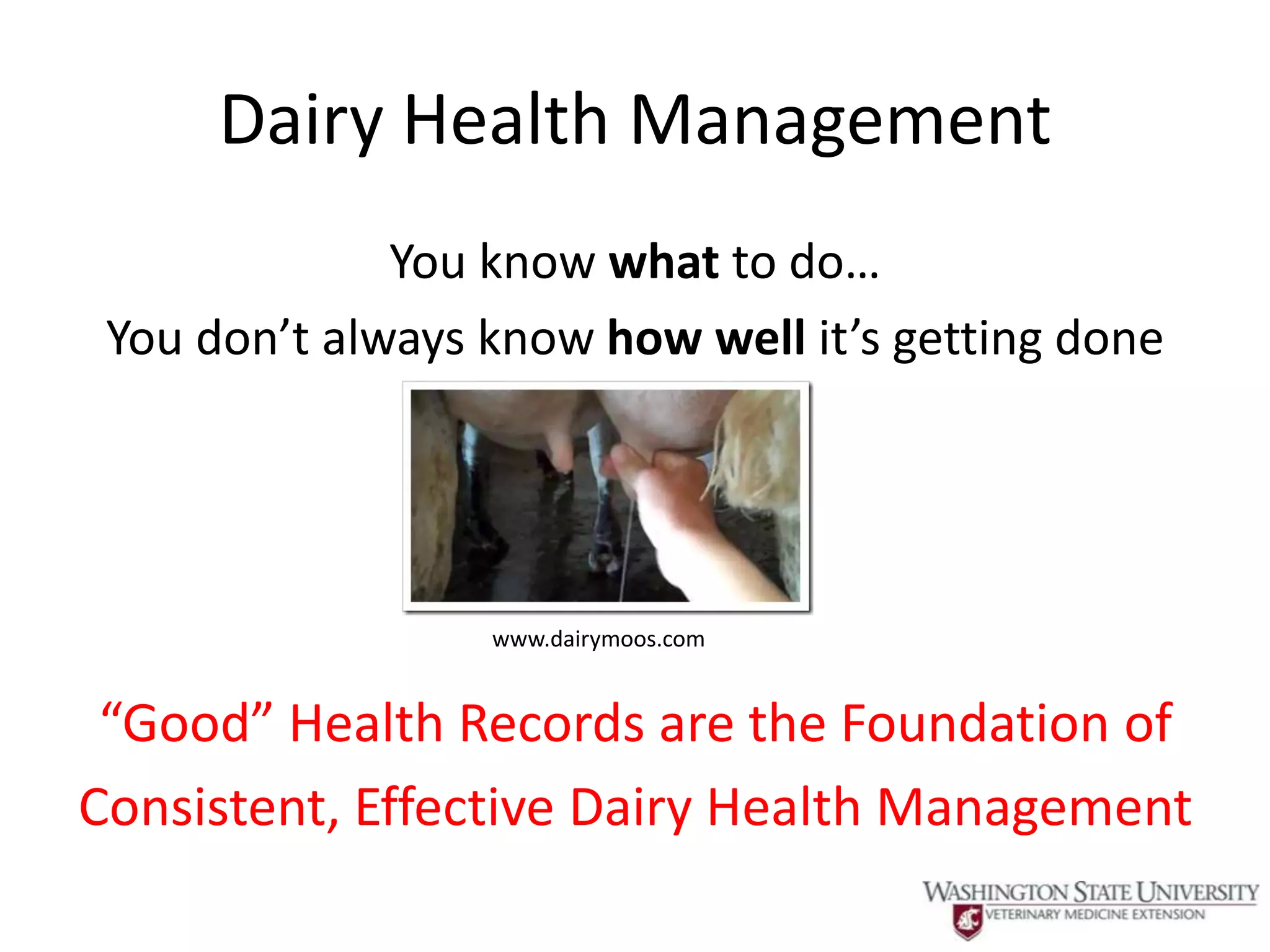
Dairy Health Management
              You know what to do…
 You don’t always know how well it’s getting done


                  www.dairymoos.com


 “Good” Health Records are the Foundation of
Consistent, Effective Dairy Health Management
Good Health Records Program
in WA and ID

• Survey Dairy Producers (243)
• Develop Software to Evaluate Outcomes
• Demonstration Herd Project (43 herds)
  Dr. Sarah Giebel
  – Impact of Standardized Health Records
     • Time for recordkeeping
     • Importance of Feedback
     • Value
Dairy Health Record Quality is Poor
• Lack Accuracy and Consistency needed for
  efficient summary and analysis
     Kelton et al., 1998; LeBlanc et al., 2006;
     Appuhamy et al., 2007; Wenz and Giebel, 2012


• “…many health record entries are focused on
  treatment, rather than diagnosis...”
                      Nordlund and Cook, 2004
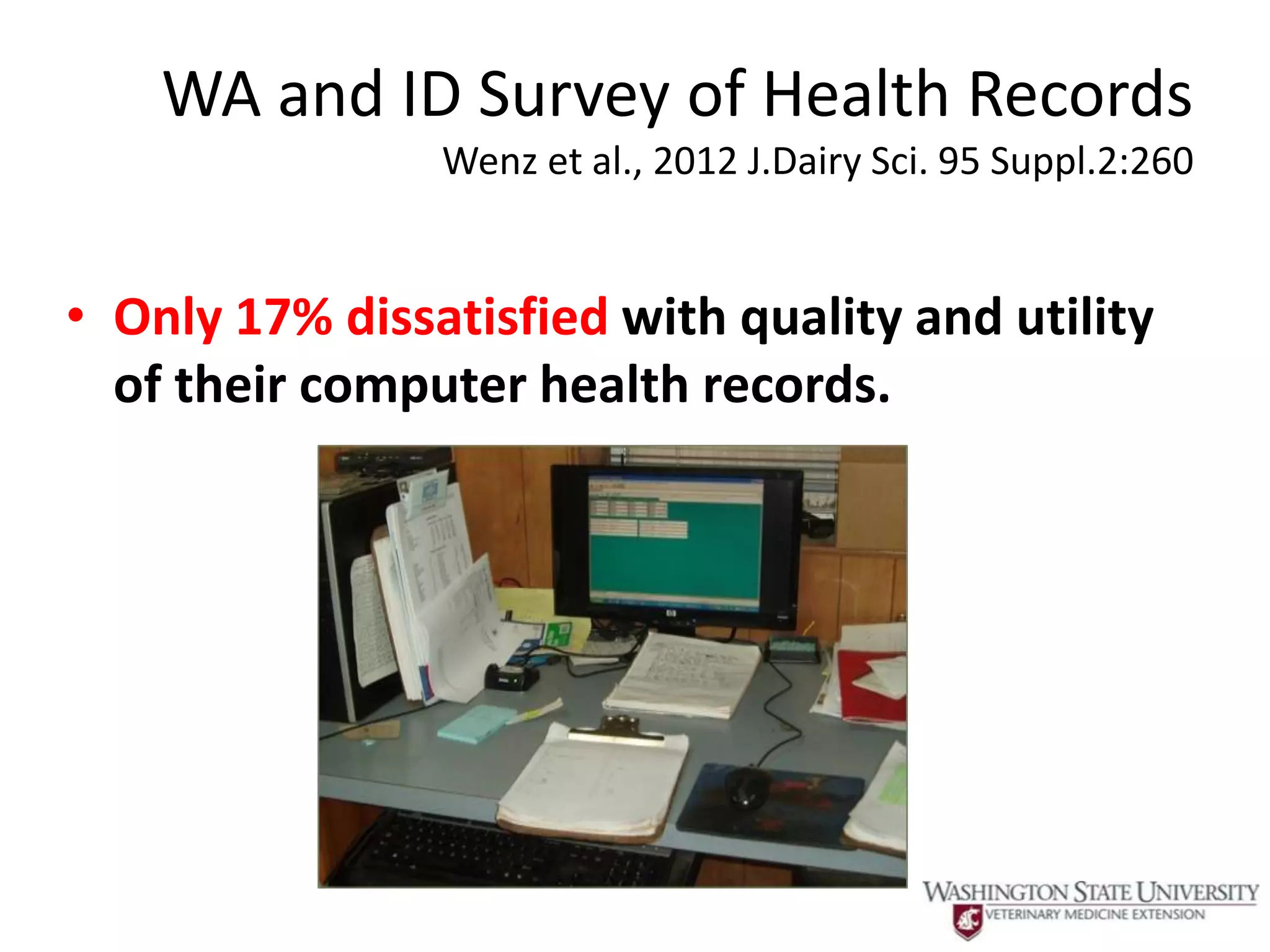
WA and ID Survey of Health Records
                Wenz et al., 2012 J.Dairy Sci. 95 Suppl.2:260


• Only 17% dissatisfied with quality and utility
  of their computer health records.
Perception of Health Record Quality is
       Based on Intended Use
• producers generally utilize individual animal
  data, whereas practitioners … are more
  concerned with herd summary information”
  (Etherington et al., 1995)


• Health Records are USER – DEFINED Why?
• Variable Disease Definitions
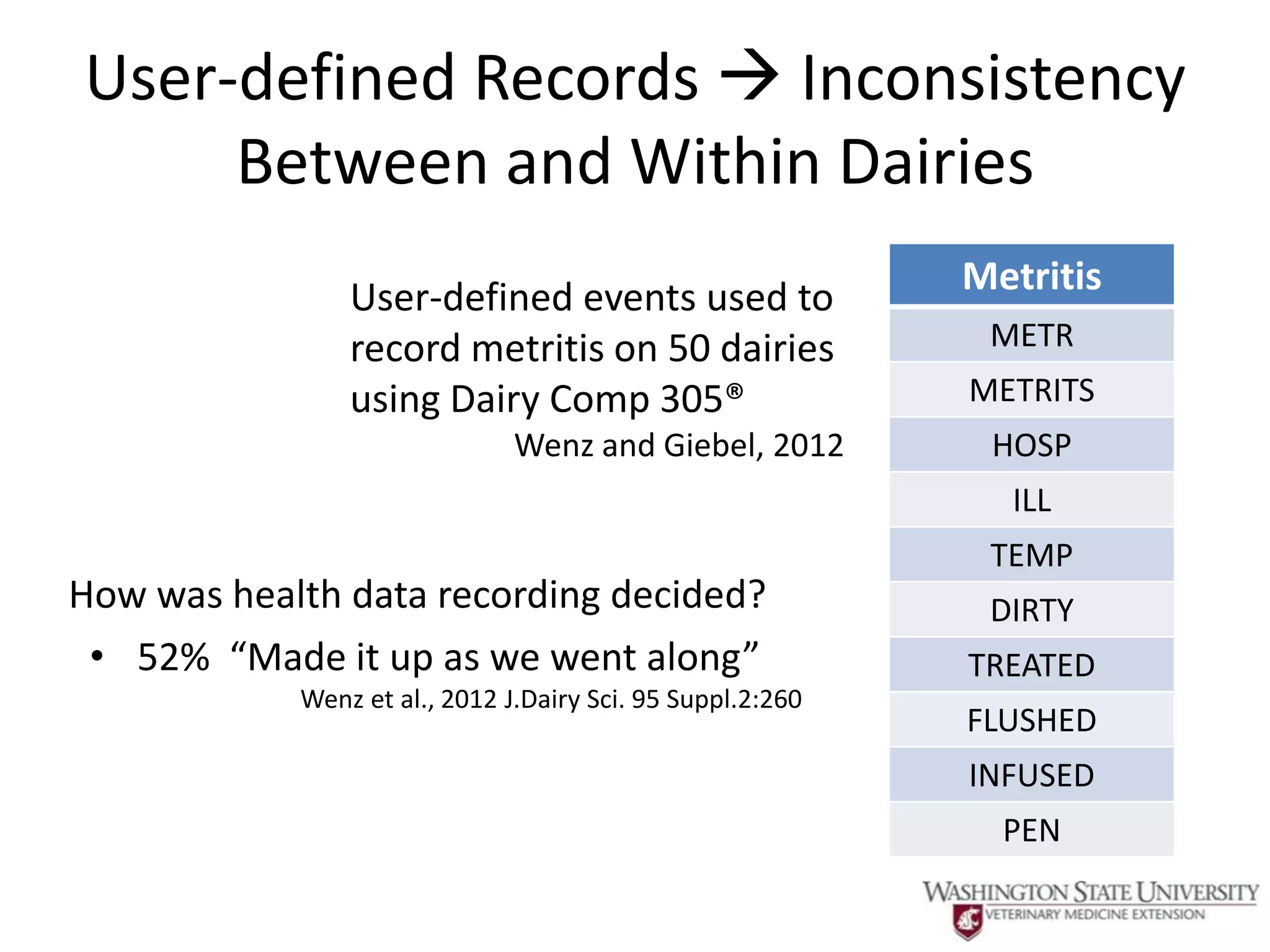
User-defined Records  Inconsistency
     Between and Within Dairies
                                                            Metritis
                User-defined events used to
                record metritis on 50 dairies                METR
                using Dairy Comp 305®                       METRITS
                               Wenz and Giebel, 2012         HOSP
                                                              ILL
                                                             TEMP
How was health data recording decided?                       DIRTY
 • 52% “Made it up as we went along”                        TREATED
            Wenz et al., 2012 J.Dairy Sci. 95 Suppl.2:260
                                                            FLUSHED
                                                            INFUSED
                                                              PEN
The PMO Provides a Standard for
          Complete Treatment Records
•    Identity of animal(s) treated
•    Date(s) of treatment
•    Drug(s) administered
•    Dosage administered
•    Milk discard time; and
•    Withdrawal time prior to slaughter
•    Disease being treated (Not in PMO)*
•    Who administered treatments (Not in PMO)

    *But, Ailment treated is determined when a
     residue violation is investigated
3+4
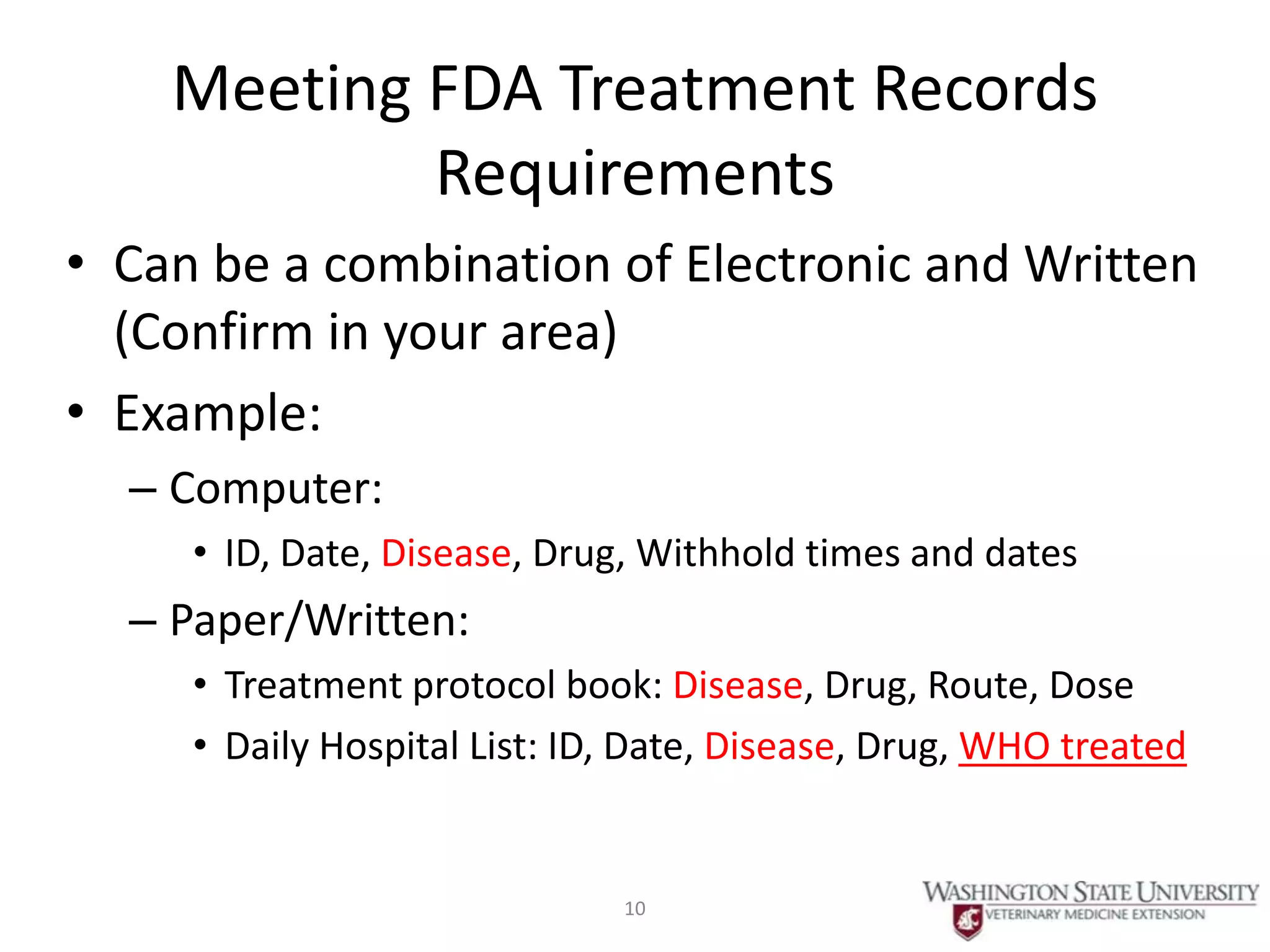
       Meeting FDA Treatment Records
               Requirements
 • Can be a combination of Electronic and Written
   (Confirm in your area)
 • Example:
      – Computer:
        • ID, Date, Disease, Drug, Withhold times and dates
      – Paper/Written:
        • Treatment protocol book: Disease, Drug, Route, Dose
        • Daily Hospital List: ID, Date, Disease, Drug, WHO treated


                                 10
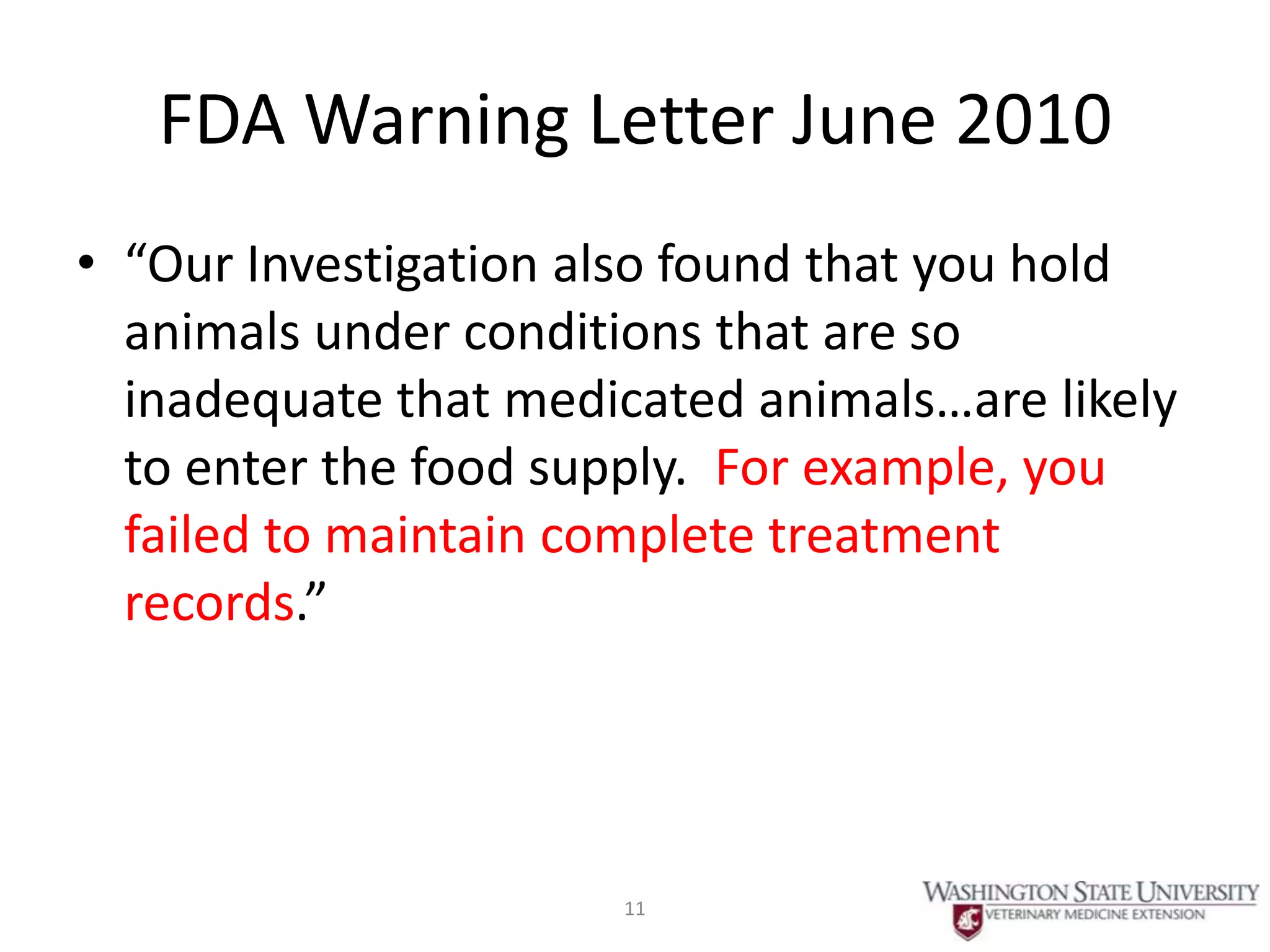
FDA Warning Letter June 2010
• “Our Investigation also found that you hold
  animals under conditions that are so
  inadequate that medicated animals…are likely
  to enter the food supply. For example, you
  failed to maintain complete treatment
  records.”


                      11
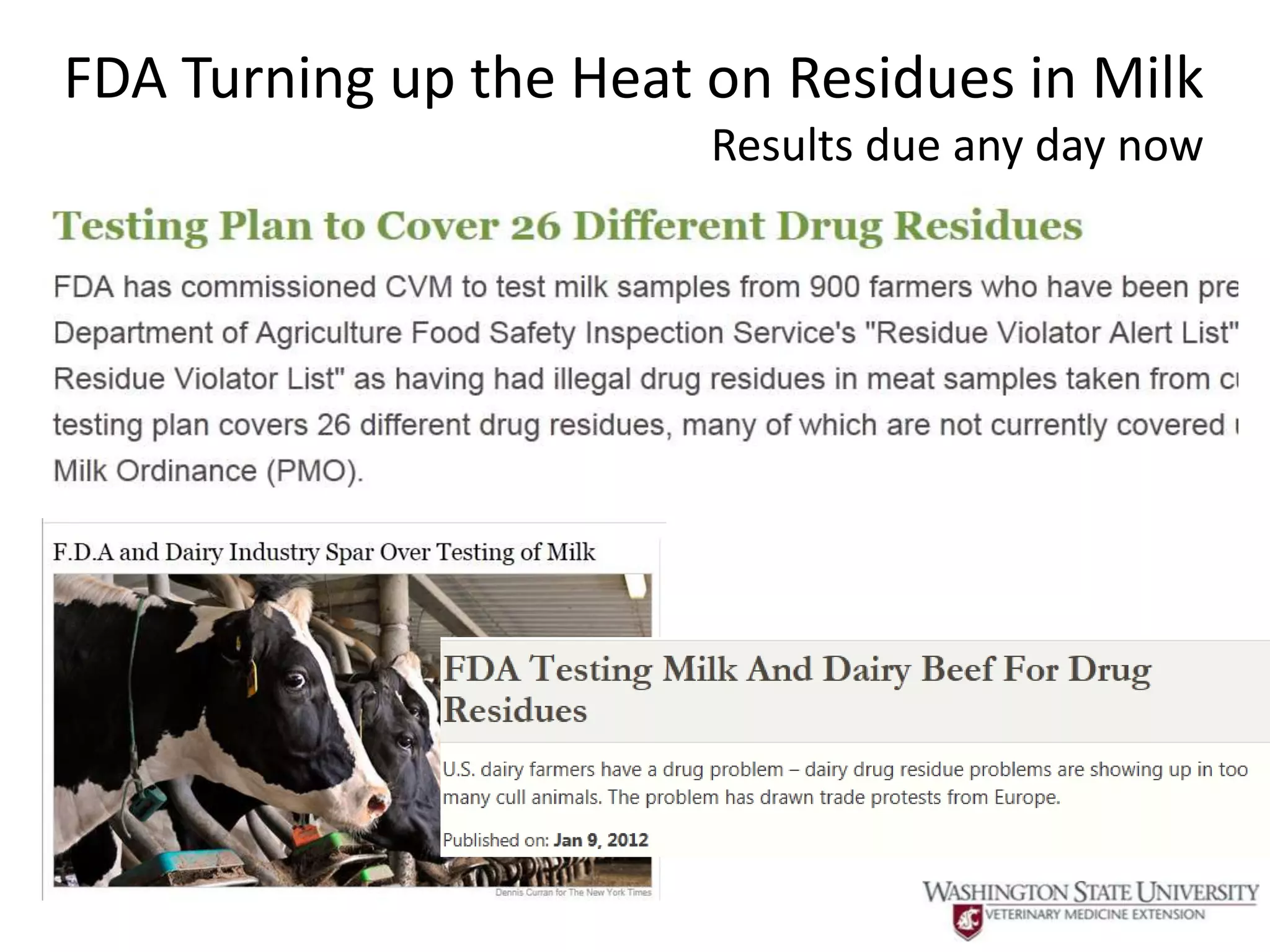
FDA Turning up the Heat on Residues in Milk
                        Results due any day now
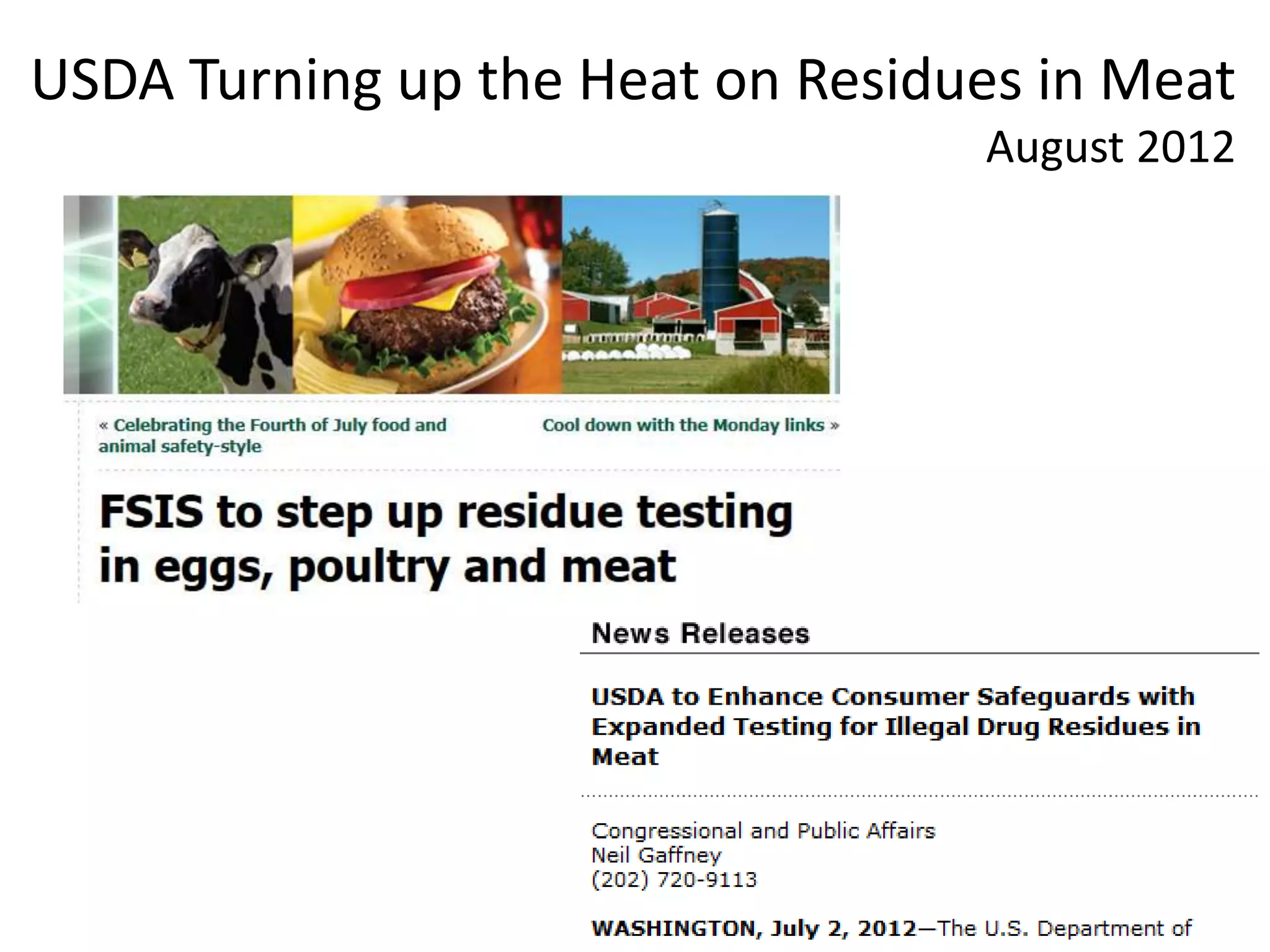
USDA Turning up the Heat on Residues in Meat
                                  August 2012
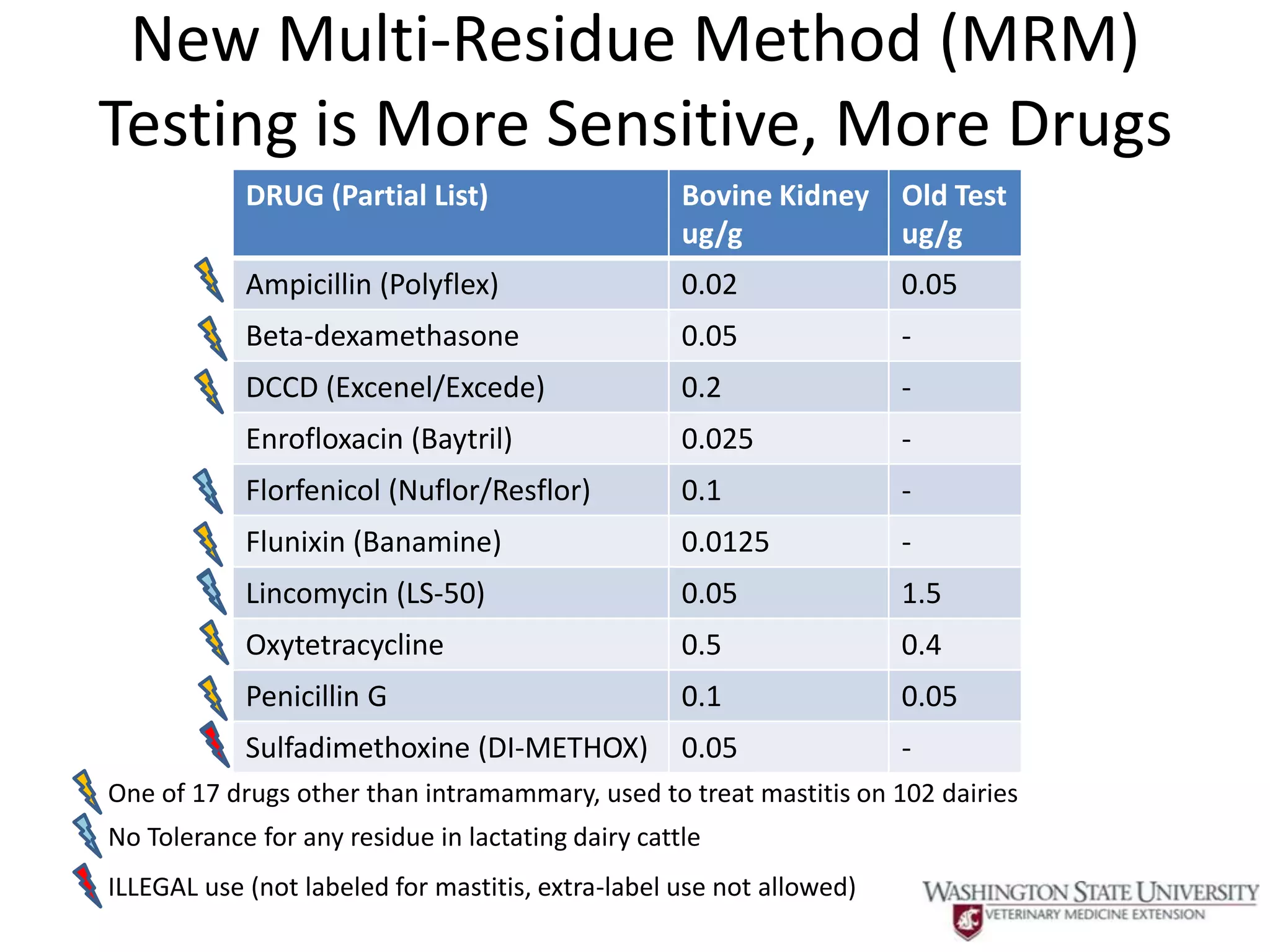
New Multi-Residue Method (MRM)
Testing is More Sensitive, More Drugs
            DRUG (Partial List)                     Bovine Kidney     Old Test
                                                    ug/g              ug/g
            Ampicillin (Polyflex)                   0.02              0.05
            Beta-dexamethasone                      0.05              -
            DCCD (Excenel/Excede)                   0.2               -
            Enrofloxacin (Baytril)                  0.025             -
            Florfenicol (Nuflor/Resflor)            0.1               -
            Flunixin (Banamine)                     0.0125            -
            Lincomycin (LS-50)                      0.05              1.5
            Oxytetracycline                         0.5               0.4
            Penicillin G                            0.1               0.05
            Sulfadimethoxine (DI-METHOX)            0.05              -
One of 17 drugs other than intramammary, used to treat mastitis on 102 dairies
No Tolerance for any residue in lactating dairy cattle
ILLEGAL use (not labeled for mastitis, extra-label use not allowed)
“Creative” drug use is fostered by
misconceptions of the uninformed
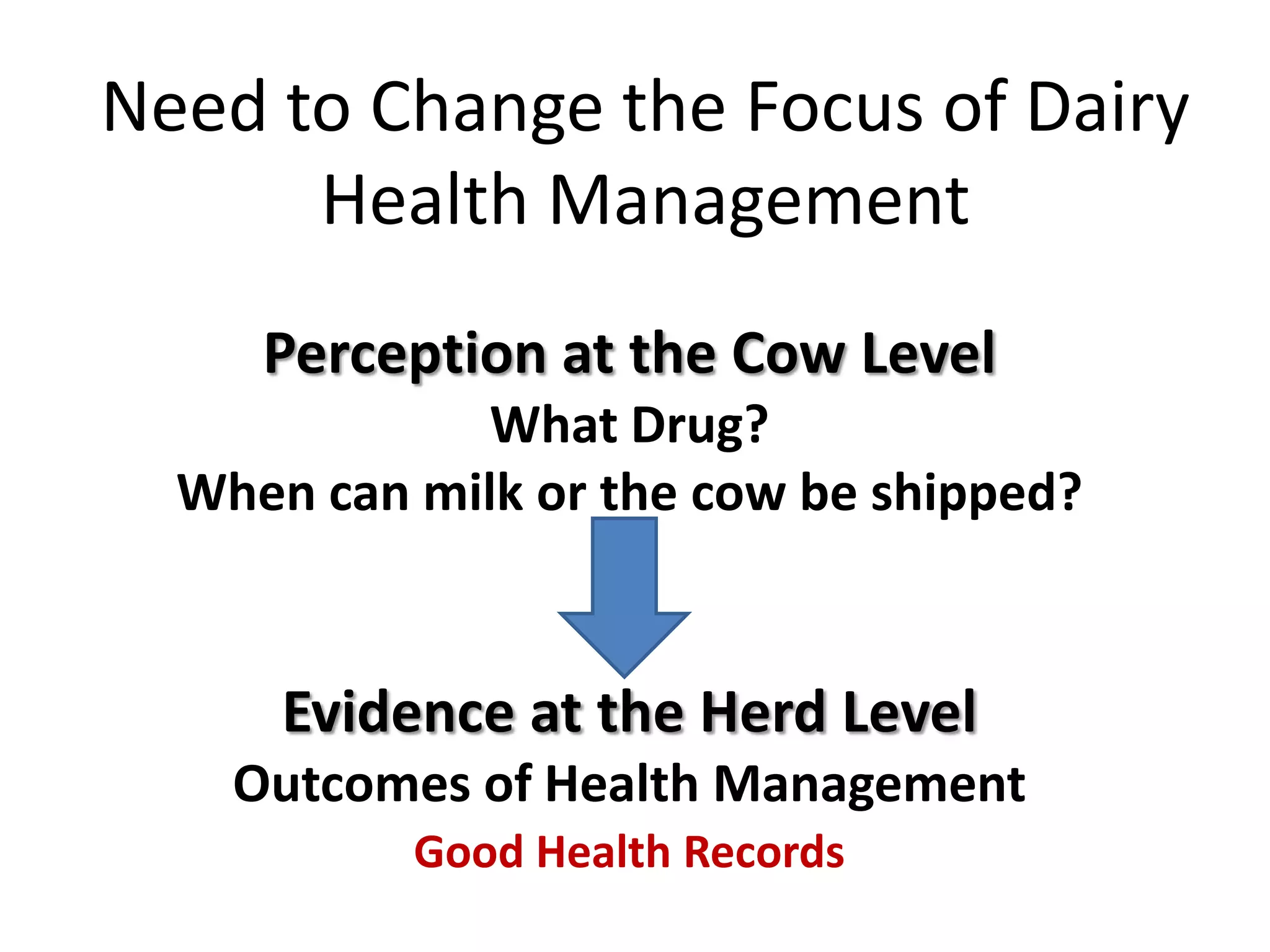
Need to Change the Focus of Dairy
      Health Management
     Perception at the Cow Level
              What Drug?
  When can milk or the cow be shipped?


      Evidence at the Herd Level
    Outcomes of Health Management
           Good Health Records
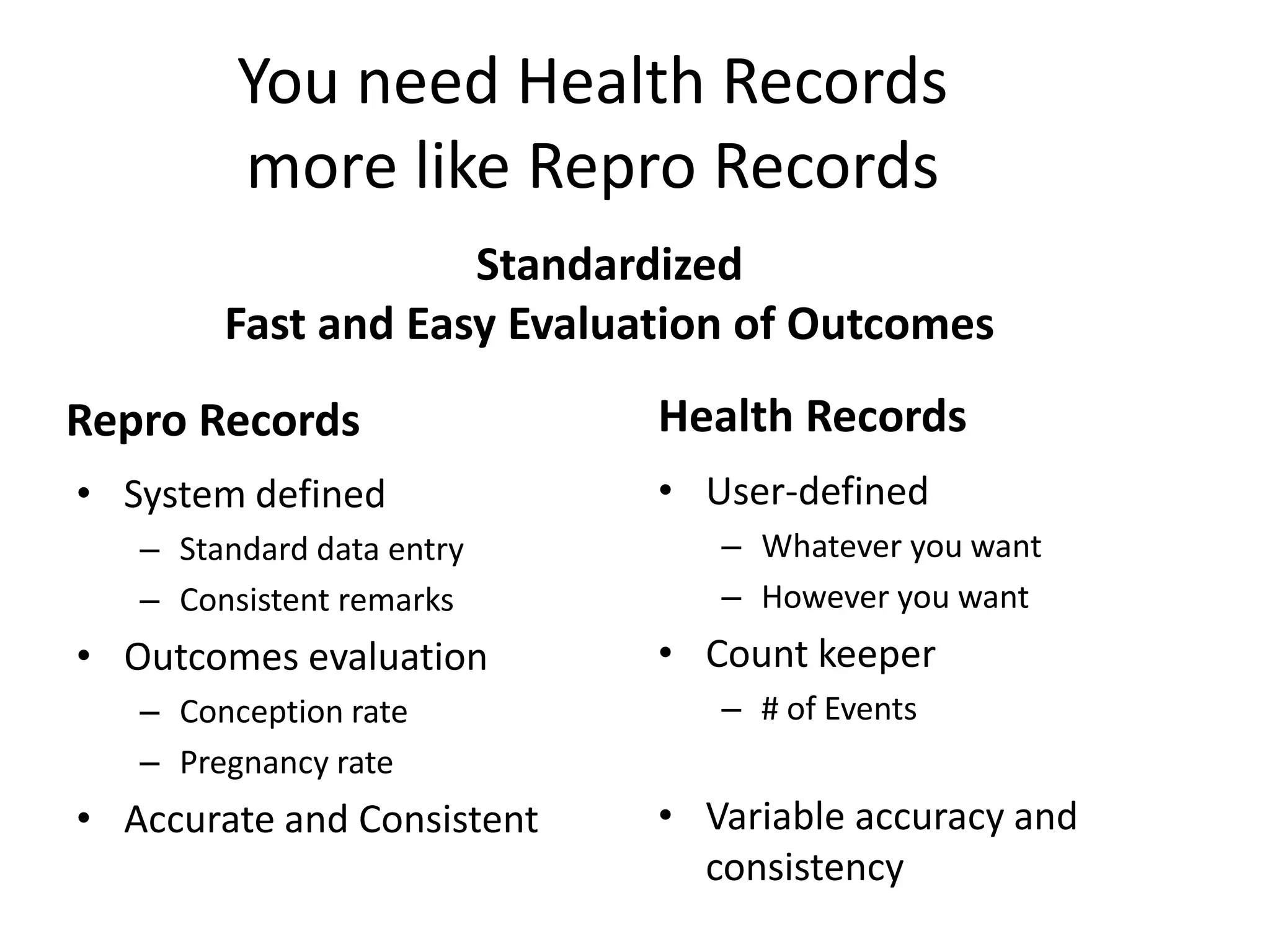
You need Health Records
         more like Repro Records
                    Standardized
        Fast and Easy Evaluation of Outcomes
Repro Records               Health Records
• System defined            • User-defined
   – Standard data entry       – Whatever you want
   – Consistent remarks        – However you want
• Outcomes evaluation       • Count keeper
   – Conception rate           – # of Events
   – Pregnancy rate
• Accurate and Consistent   • Variable accuracy and
                              consistency
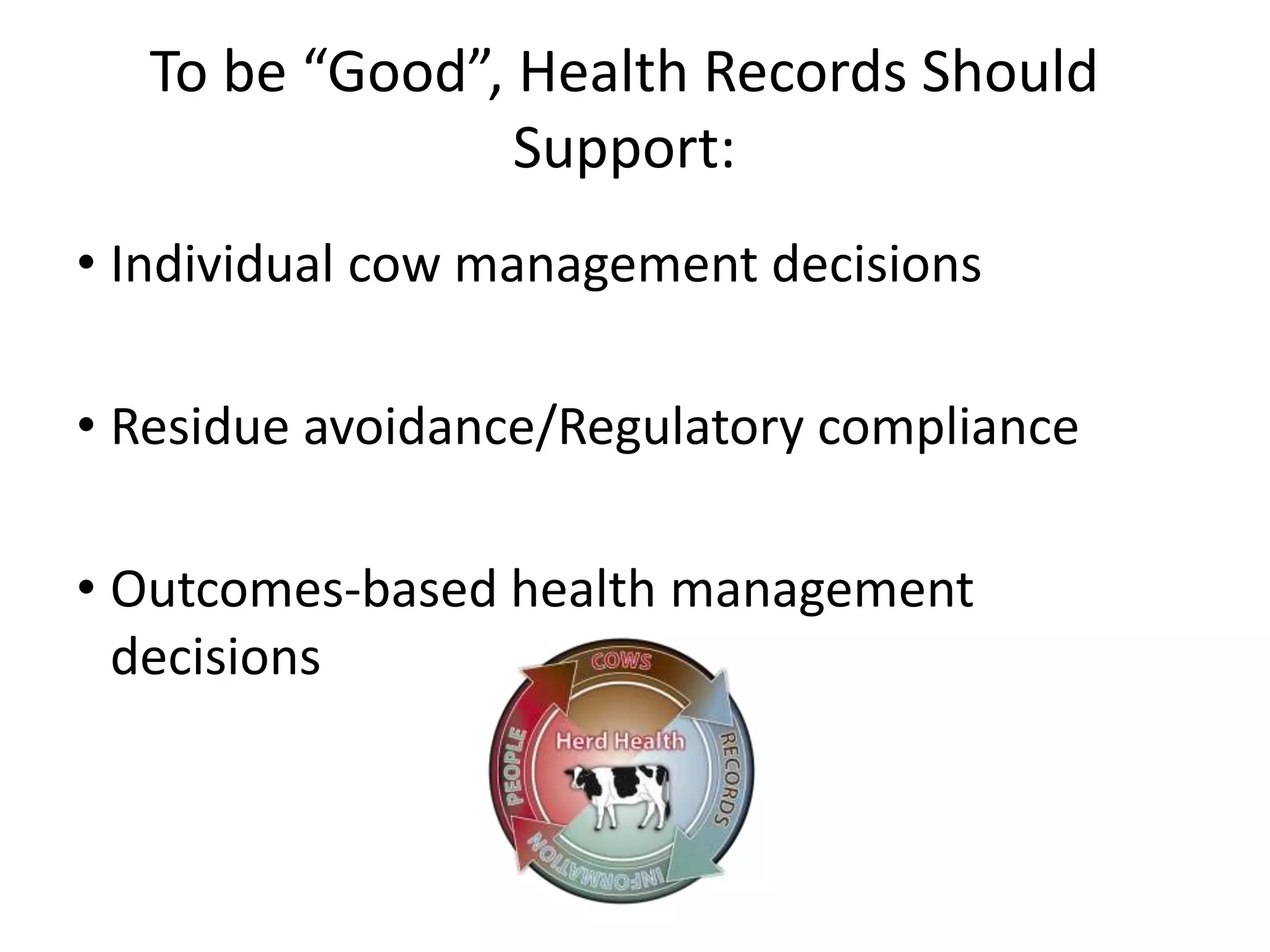
To be “Good”, Health Records Should
                Support:
• Individual cow management decisions

• Residue avoidance/Regulatory compliance

• Outcomes-based health management
  decisions
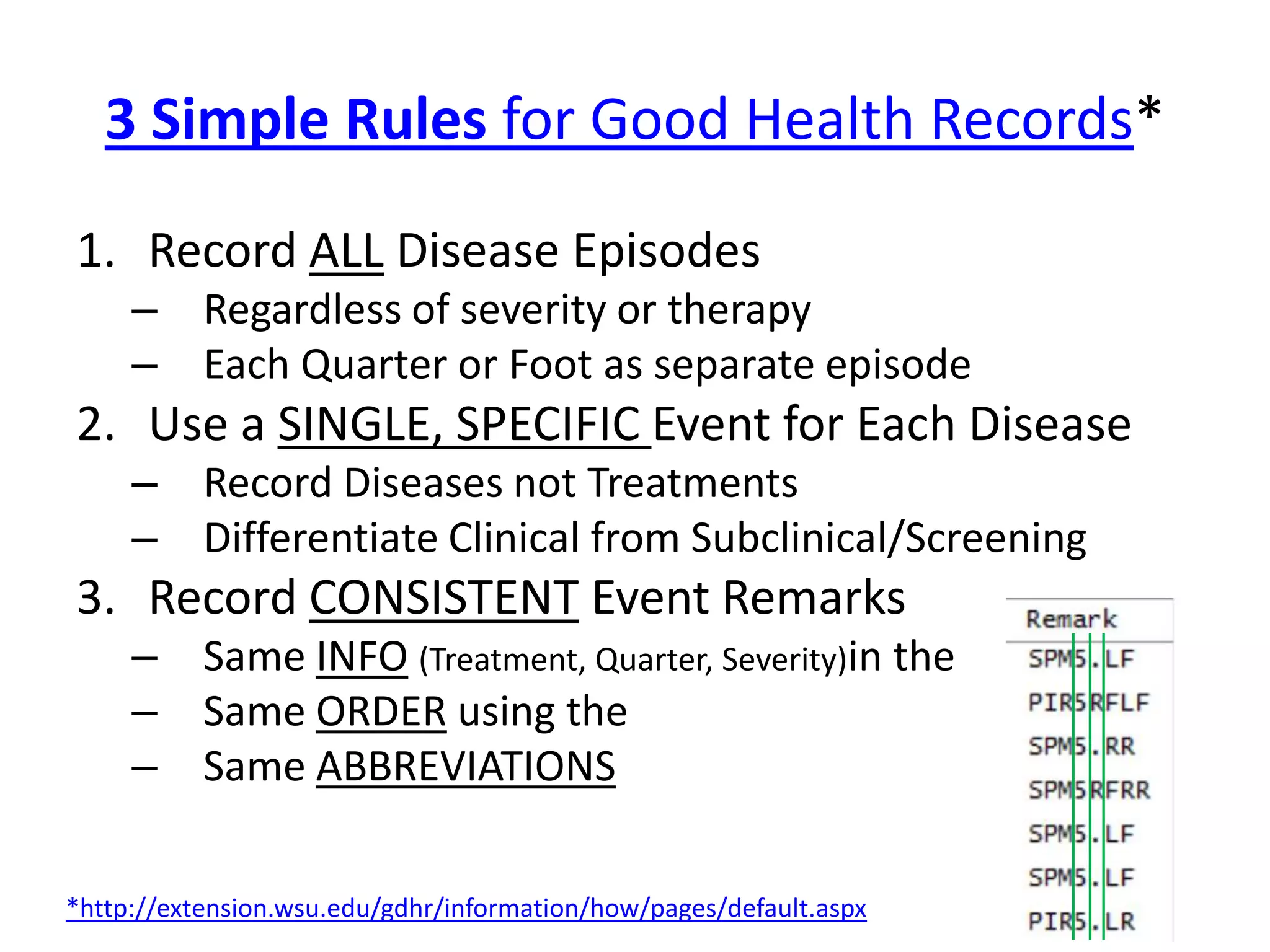
3 Simple Rules for Good Health Records*

1. Record ALL Disease Episodes
     – Regardless of severity or therapy
     – Each Quarter or Foot as separate episode
2. Use a SINGLE, SPECIFIC Event for Each Disease
     – Record Diseases not Treatments
     – Differentiate Clinical from Subclinical/Screening
3. Record CONSISTENT Event Remarks
     – Same INFO (Treatment, Quarter, Severity)in the
     – Same ORDER using the
     – Same ABBREVIATIONS

*http://extension.wsu.edu/gdhr/information/how/pages/default.aspx
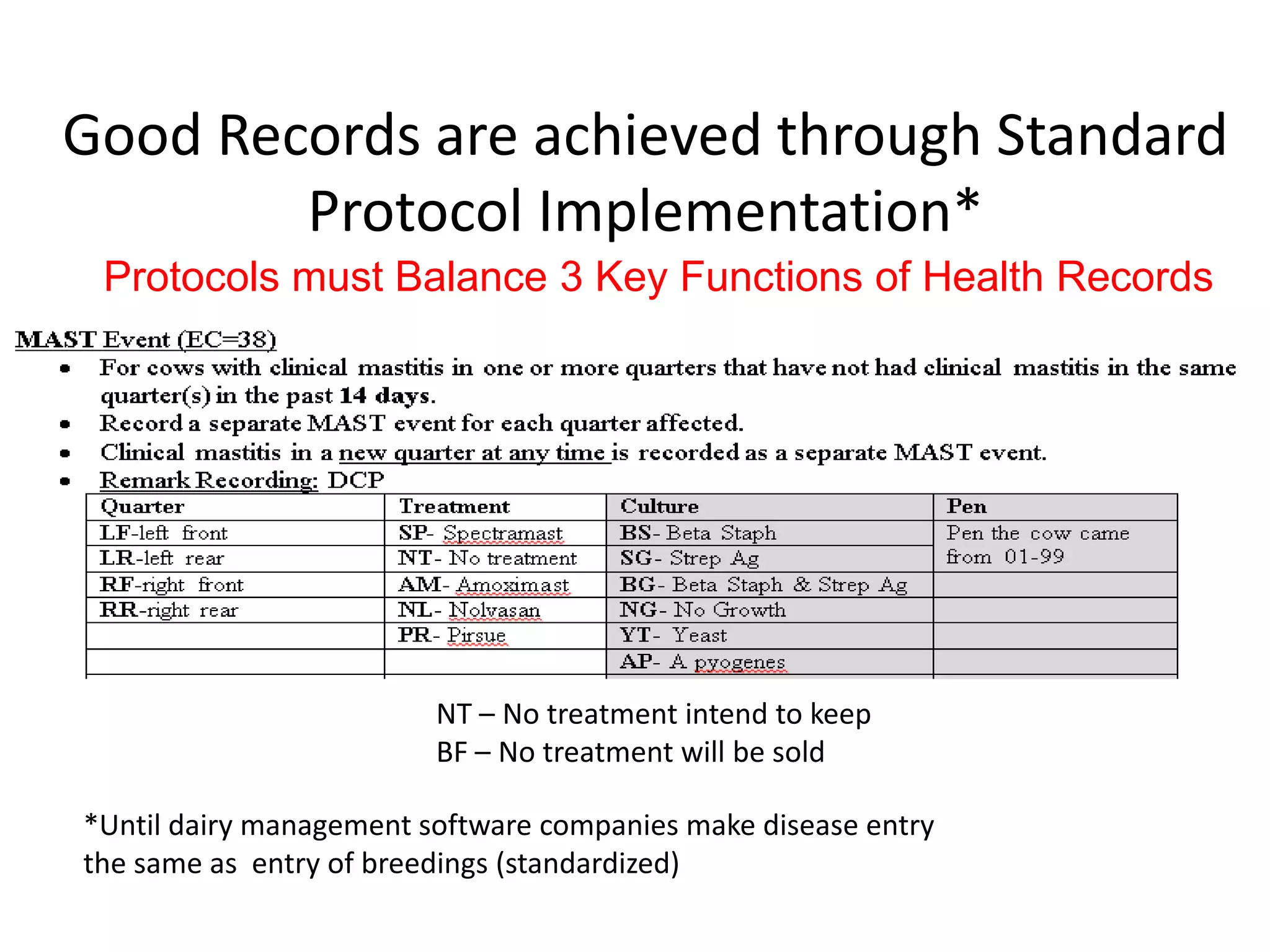
Good Records are achieved through Standard
        Protocol Implementation*
 Protocols must Balance 3 Key Functions of Health Records


                         NT – No treatment intend to keep
                         BF – No treatment will be sold

*Until dairy management software companies make disease entry
the same as entry of breedings (standardized)
Keeping Good Health Records
        Doesn’t Take Longer
                Time Budget Analysis
           Time to Capture and Enter Data
 Before and After Standard Protocol Implementation…
                     Capture                       Entry
Increase             4.5% (1/22)                   22.2% (4/18)
Decrease or
                     95.5% (21/22) 77.8% (14/18)
No Change
           Giebel et al., 2012 JDS 95 Suppl. 2:9
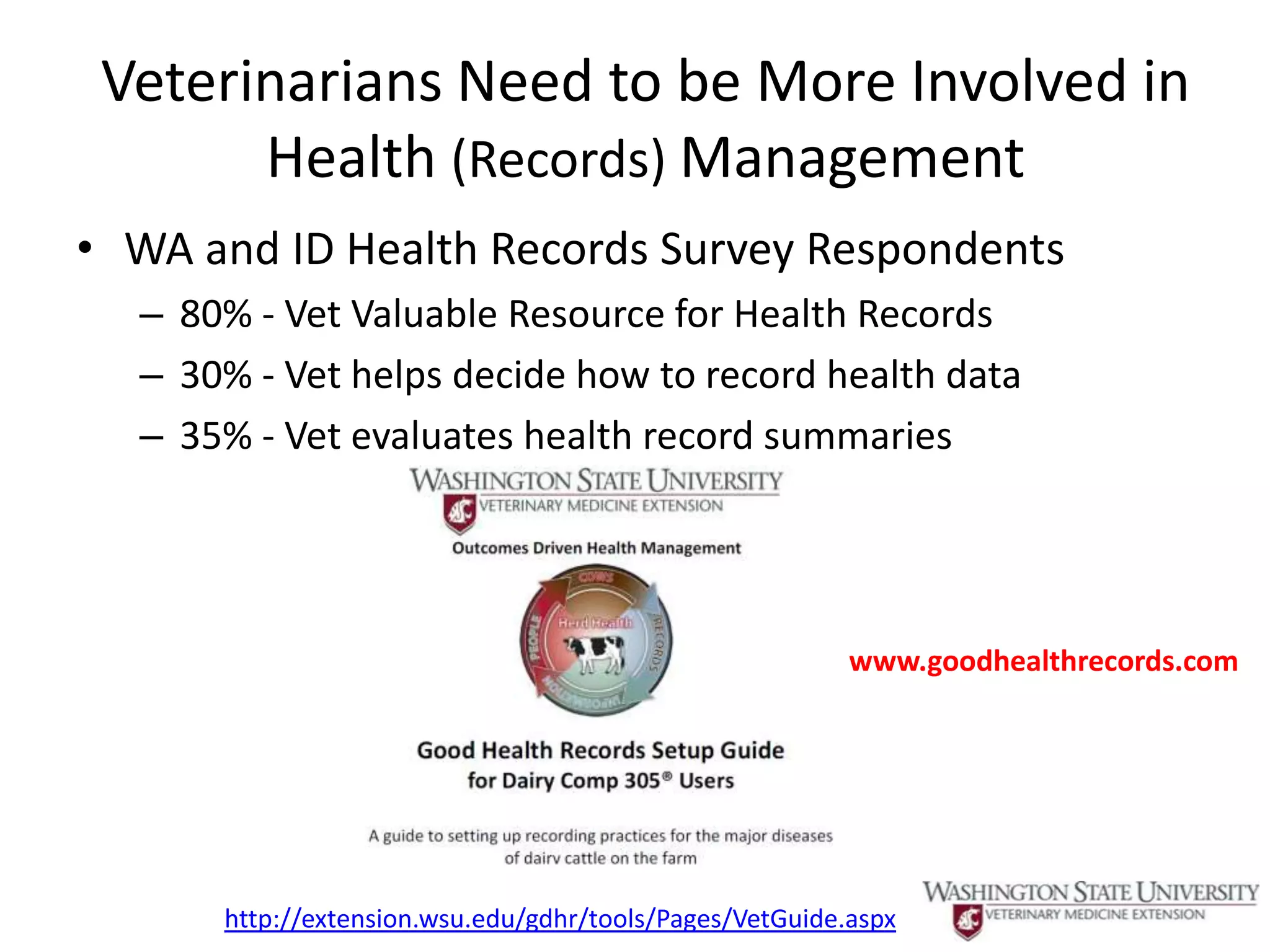
Veterinarians Need to be More Involved in
       Health (Records) Management
• WA and ID Health Records Survey Respondents
  – 80% - Vet Valuable Resource for Health Records
  – 30% - Vet helps decide how to record health data
  – 35% - Vet evaluates health record summaries


                                                         www.goodhealthrecords.com


      http://extension.wsu.edu/gdhr/tools/Pages/VetGuide.aspx
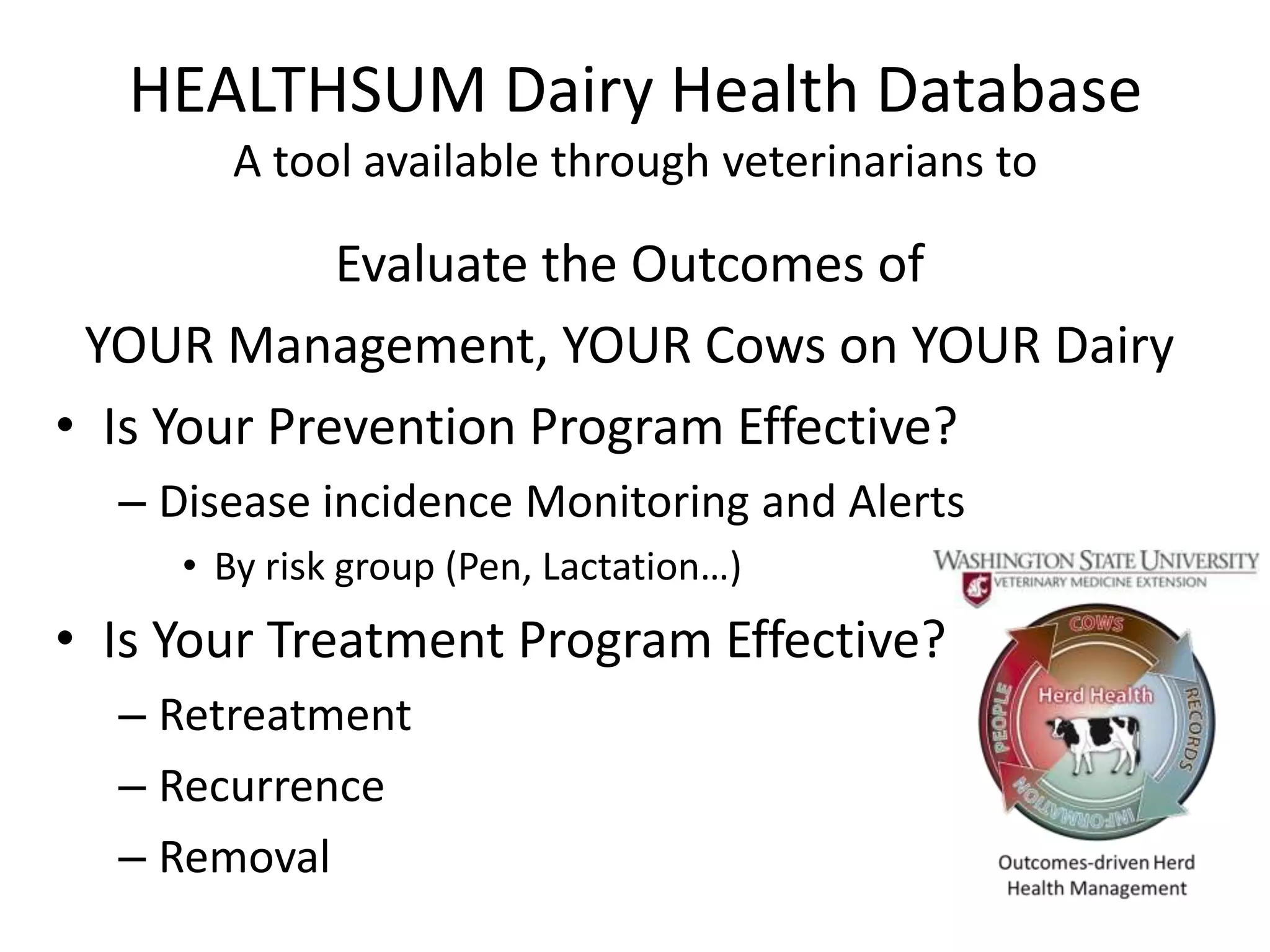
HEALTHSUM Dairy Health Database
       A tool available through veterinarians to

             Evaluate the Outcomes of
 YOUR Management, YOUR Cows on YOUR Dairy
• Is Your Prevention Program Effective?
  – Disease incidence Monitoring and Alerts
     • By risk group (Pen, Lactation…)
• Is Your Treatment Program Effective?
  – Retreatment
  – Recurrence
  – Removal
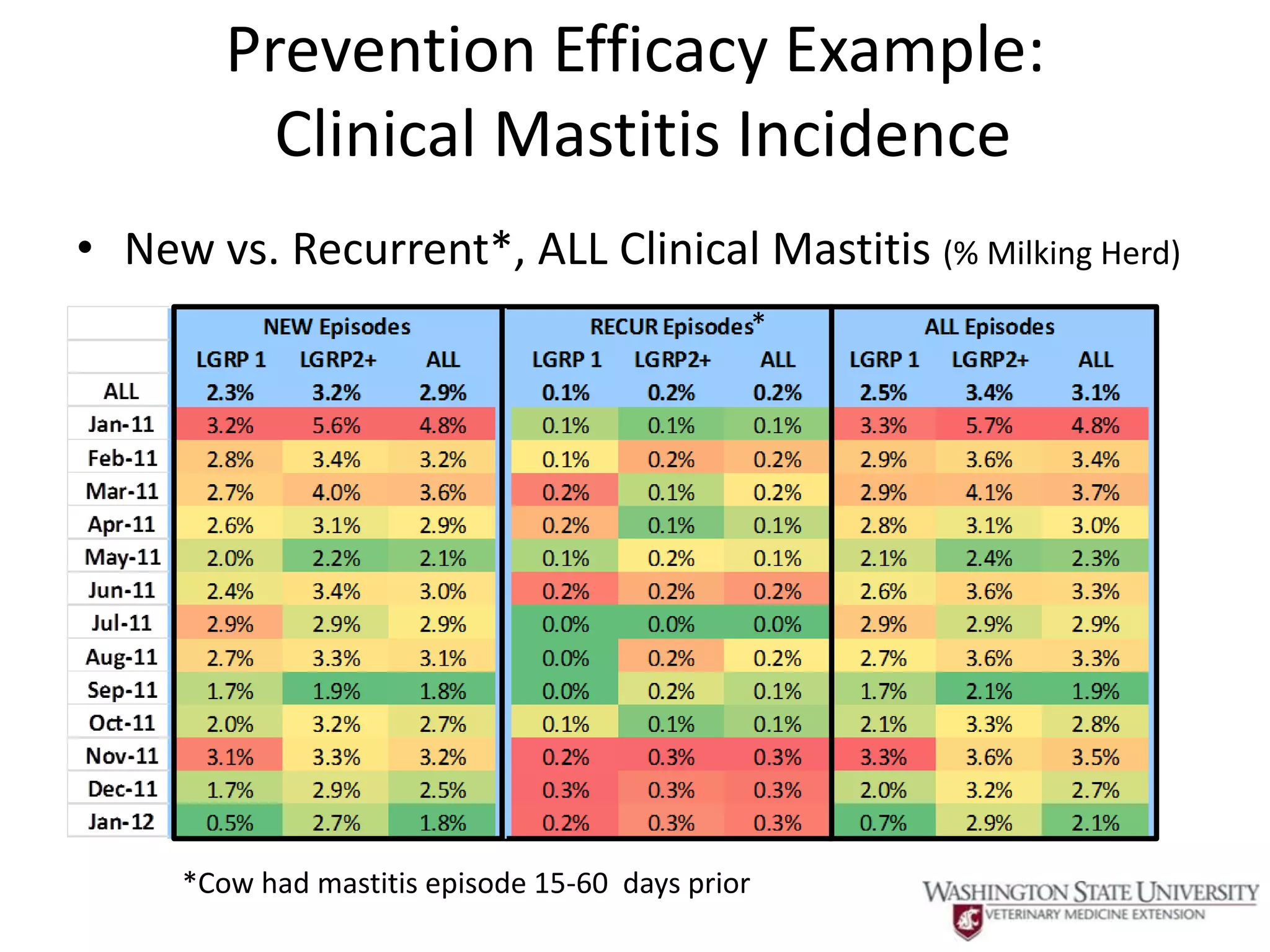
Prevention Efficacy Example:
          Clinical Mastitis Incidence
• New vs. Recurrent*, ALL Clinical Mastitis (% Milking Herd)
                                                  *


     *Cow had mastitis episode 15-60 days prior
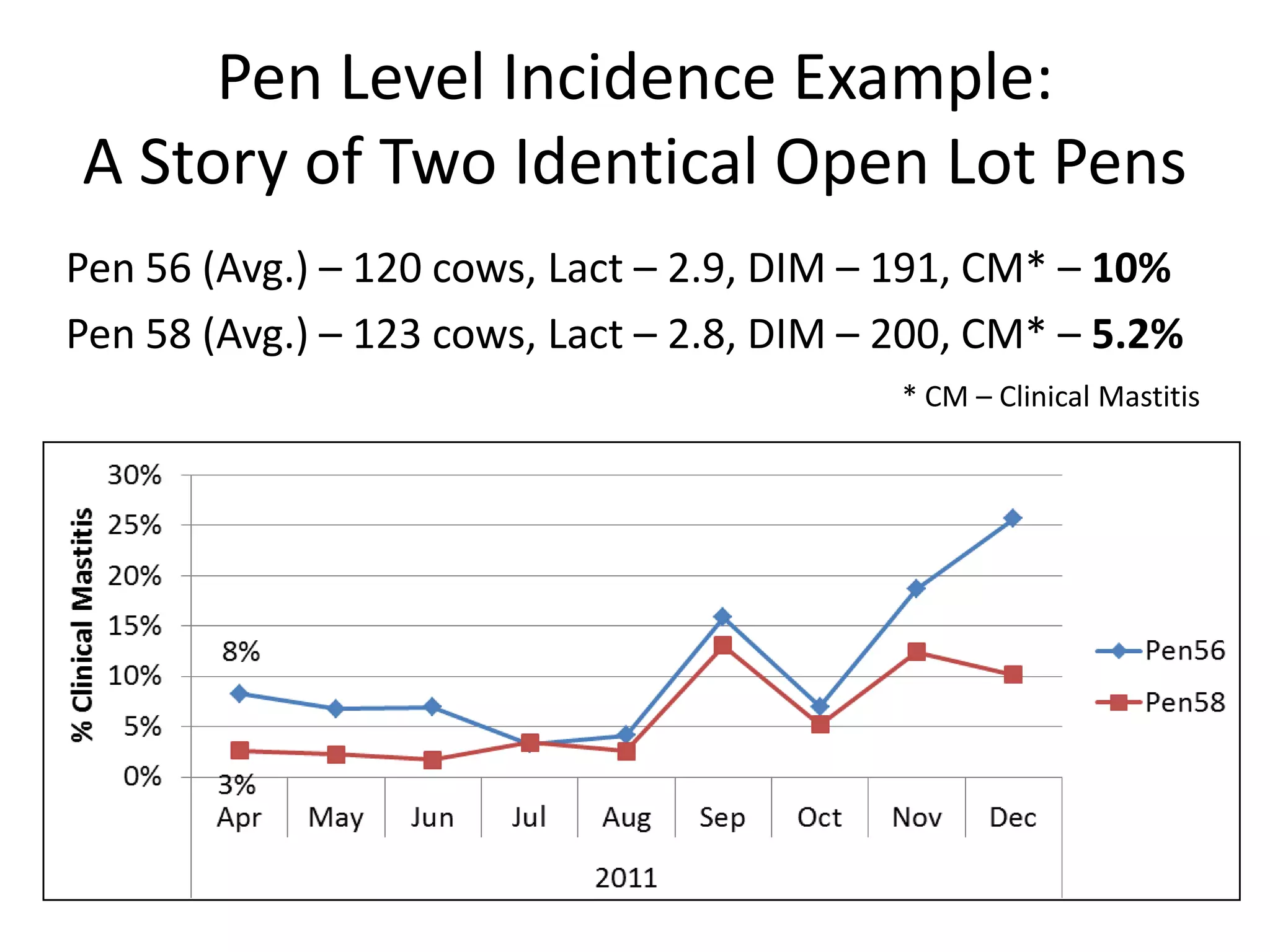
Pen Level Incidence Example:
A Story of Two Identical Open Lot Pens
Pen 56 (Avg.) – 120 cows, Lact – 2.9, DIM – 191, CM* – 10%
Pen 58 (Avg.) – 123 cows, Lact – 2.8, DIM – 200, CM* – 5.2%
                                            * CM – Clinical Mastitis
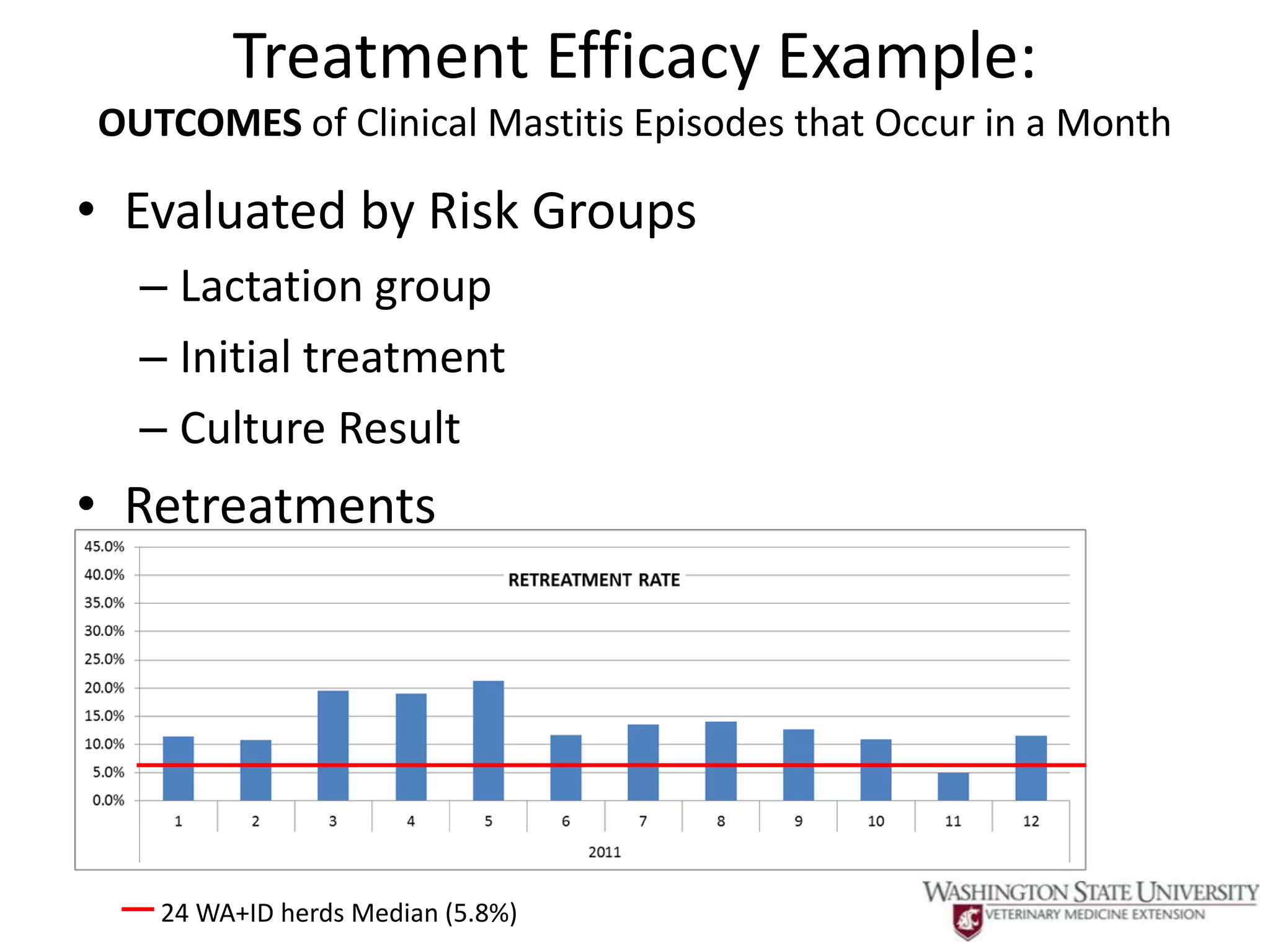
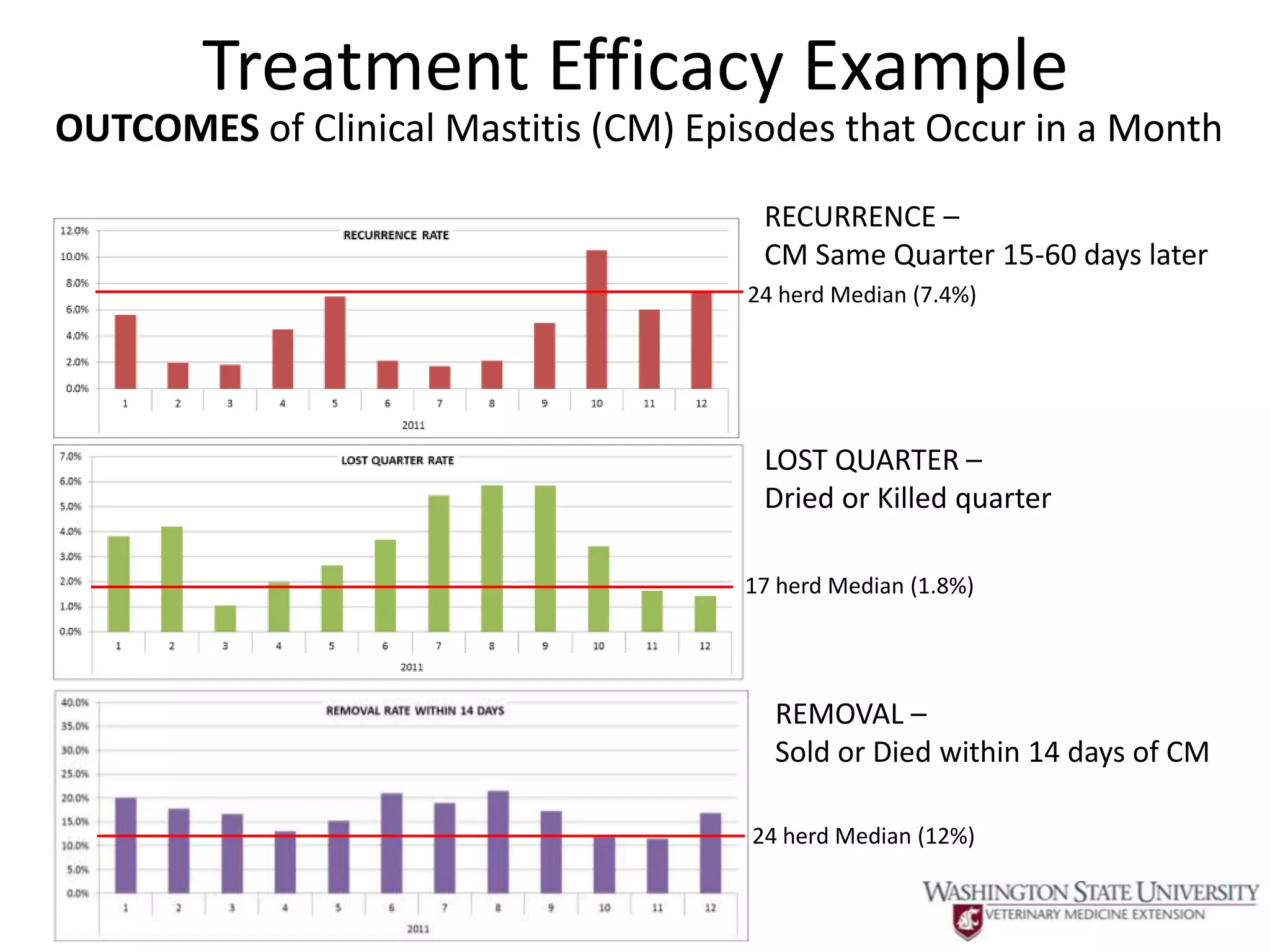
Treatment Efficacy Example:
OUTCOMES of Clinical Mastitis Episodes that Occur in a Month

• Evaluated by Risk Groups
  – Lactation group
  – Initial treatment
  – Culture Result
• Retreatments


   24 WA+ID herds Median (5.8%)
Treatment Efficacy Example
OUTCOMES of Clinical Mastitis (CM) Episodes that Occur in a Month

                                       RECURRENCE –
                                       CM Same Quarter 15-60 days later
                                      24 herd Median (7.4%)


                                       LOST QUARTER –
                                       Dried or Killed quarter

                                      17 herd Median (1.8%)


                                        REMOVAL –
                                        Sold or Died within 14 days of CM

                                      24 herd Median (12%)
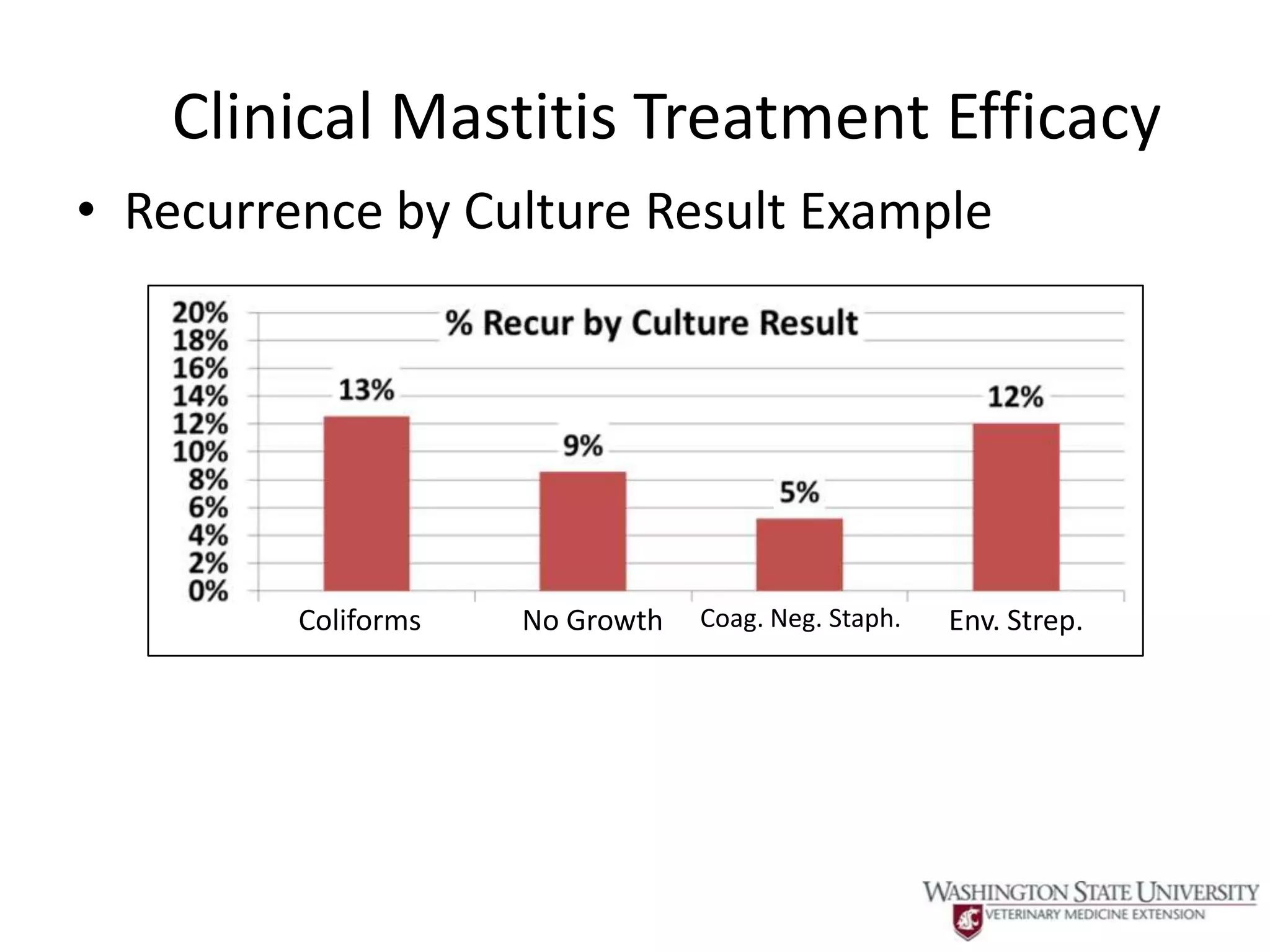
Clinical Mastitis Treatment Efficacy
• Recurrence by Culture Result Example


         Coliforms   No Growth   Coag. Neg. Staph.   Env. Strep.
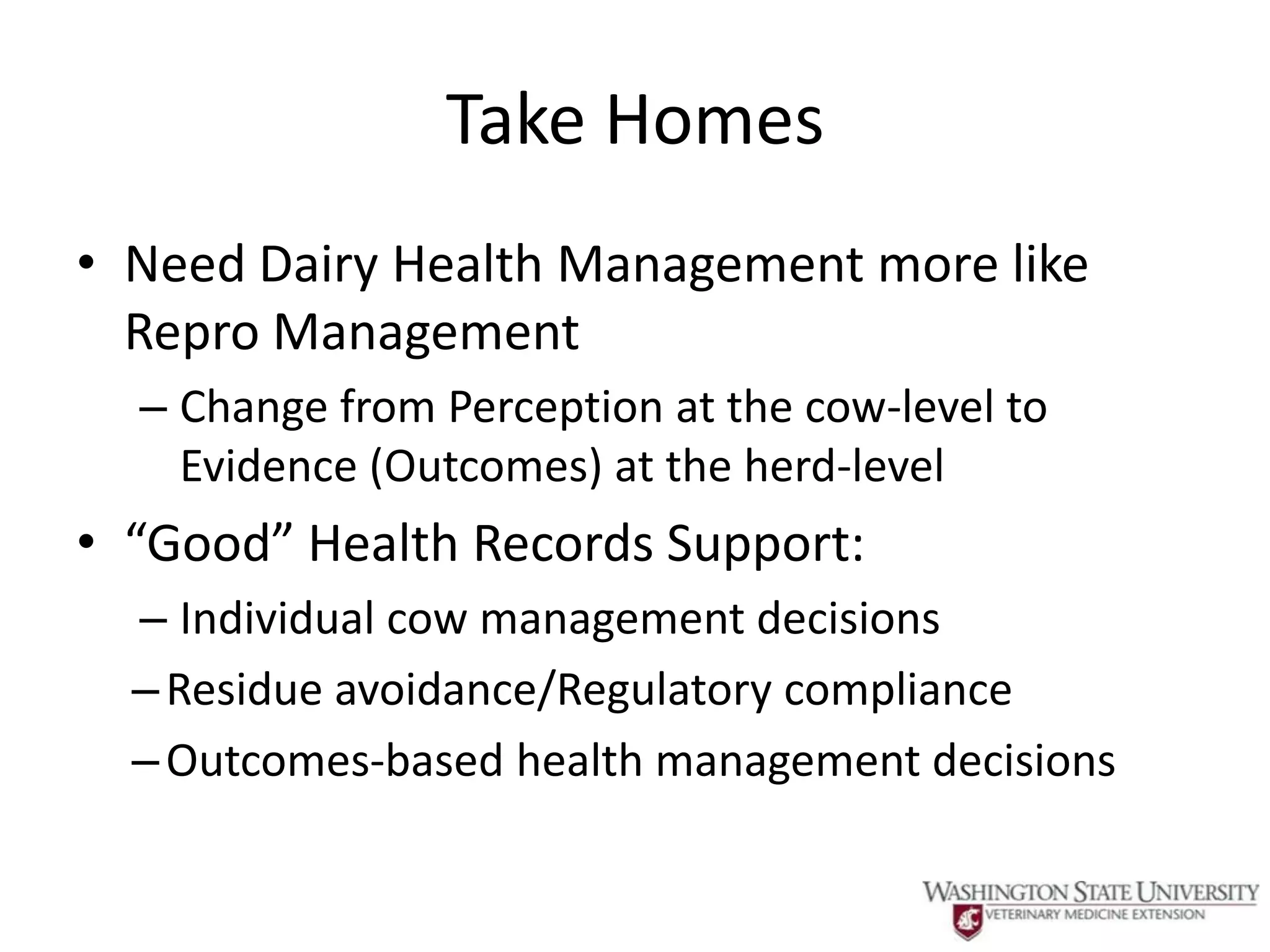
Take Homes
• Need Dairy Health Management more like
  Repro Management
  – Change from Perception at the cow-level to
    Evidence (Outcomes) at the herd-level
• “Good” Health Records Support:
  – Individual cow management decisions
  – Residue avoidance/Regulatory compliance
  – Outcomes-based health management decisions
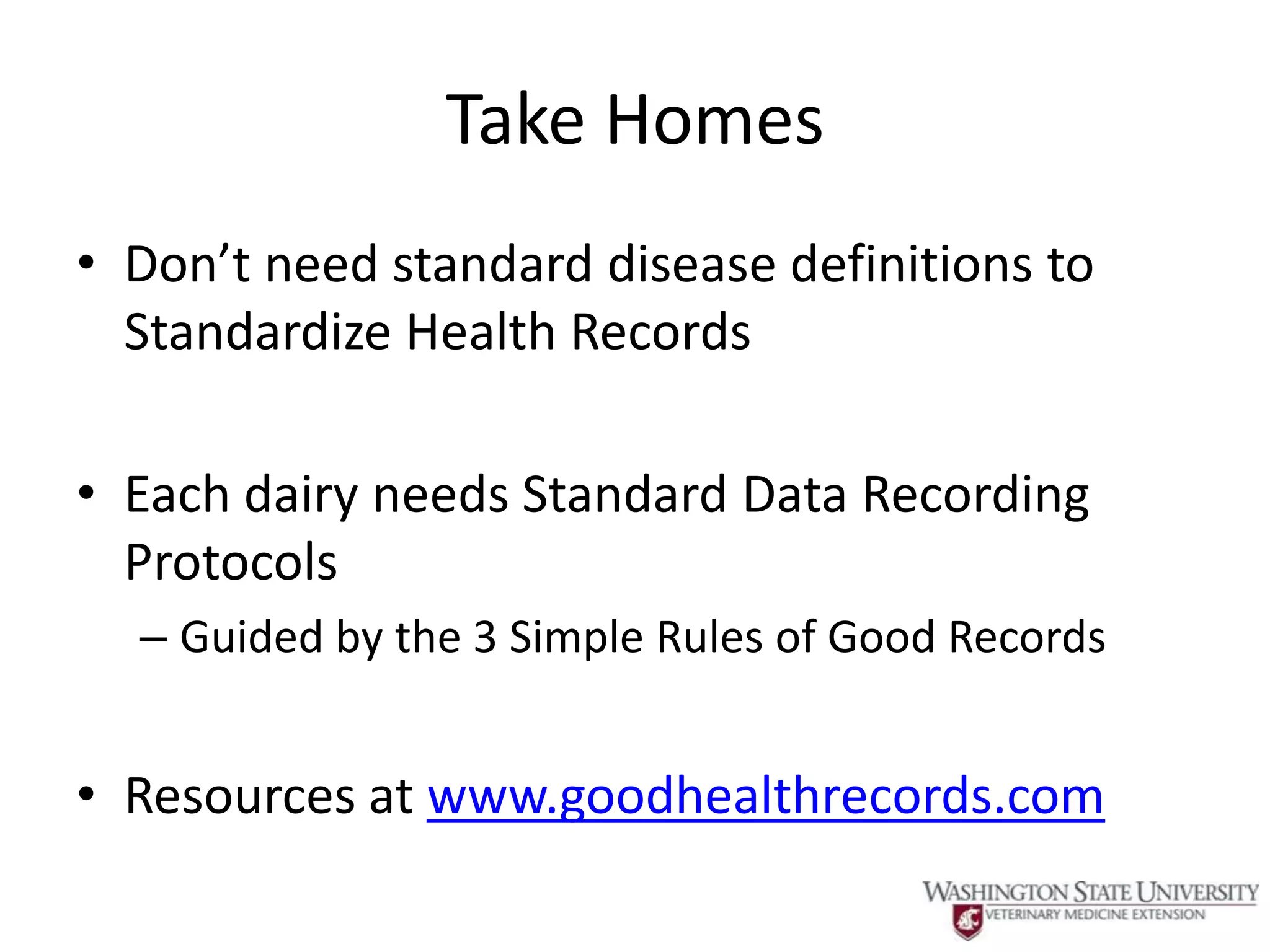
Take Homes
• Don’t need standard disease definitions to
  Standardize Health Records

• Each dairy needs Standard Data Recording
  Protocols
  – Guided by the 3 Simple Rules of Good Records


• Resources at www.goodhealthrecords.com
Questions?
• Acknowledgements
  – USDA NIFA for Funding
  – WA and ID Dairies and Veterinarians
  – Dr. Sarah Giebel and Sandy Poisson
  – Drs. Dale Moore, Chris Schneider, David
    Galligan, Ray Jussuame


           www.goodhealthrecords.com

Good Health Records: The Foundation of Consistent, Effective Dairy Health Management- Dr. John Wenz

  • 1.
    “Good Health Records” The Foundation of Consistent, Effective Dairy Health Management John R. Wenz DVM, MS www.goodhealthrecords.com
  • 2.
    Despite all ourKnowledge % Cows with Disease is Rising USDA, 2008 #N481.0308
  • 3.
    Dairy Health Management You know what to do… You don’t always know how well it’s getting done www.dairymoos.com “Good” Health Records are the Foundation of Consistent, Effective Dairy Health Management
  • 4.
    Good Health RecordsProgram in WA and ID • Survey Dairy Producers (243) • Develop Software to Evaluate Outcomes • Demonstration Herd Project (43 herds) Dr. Sarah Giebel – Impact of Standardized Health Records • Time for recordkeeping • Importance of Feedback • Value
  • 5.
    Dairy Health RecordQuality is Poor • Lack Accuracy and Consistency needed for efficient summary and analysis Kelton et al., 1998; LeBlanc et al., 2006; Appuhamy et al., 2007; Wenz and Giebel, 2012 • “…many health record entries are focused on treatment, rather than diagnosis...” Nordlund and Cook, 2004
  • 6.
    WA and IDSurvey of Health Records Wenz et al., 2012 J.Dairy Sci. 95 Suppl.2:260 • Only 17% dissatisfied with quality and utility of their computer health records.
  • 7.
    Perception of HealthRecord Quality is Based on Intended Use • producers generally utilize individual animal data, whereas practitioners … are more concerned with herd summary information” (Etherington et al., 1995) • Health Records are USER – DEFINED Why? • Variable Disease Definitions
  • 8.
    User-defined Records Inconsistency Between and Within Dairies Metritis User-defined events used to record metritis on 50 dairies METR using Dairy Comp 305® METRITS Wenz and Giebel, 2012 HOSP ILL TEMP How was health data recording decided? DIRTY • 52% “Made it up as we went along” TREATED Wenz et al., 2012 J.Dairy Sci. 95 Suppl.2:260 FLUSHED INFUSED PEN
  • 9.
    The PMO Providesa Standard for Complete Treatment Records • Identity of animal(s) treated • Date(s) of treatment • Drug(s) administered • Dosage administered • Milk discard time; and • Withdrawal time prior to slaughter • Disease being treated (Not in PMO)* • Who administered treatments (Not in PMO) *But, Ailment treated is determined when a residue violation is investigated
  • 10.
    3+4 Meeting FDA Treatment Records Requirements • Can be a combination of Electronic and Written (Confirm in your area) • Example: – Computer: • ID, Date, Disease, Drug, Withhold times and dates – Paper/Written: • Treatment protocol book: Disease, Drug, Route, Dose • Daily Hospital List: ID, Date, Disease, Drug, WHO treated 10
  • 11.
    FDA Warning LetterJune 2010 • “Our Investigation also found that you hold animals under conditions that are so inadequate that medicated animals…are likely to enter the food supply. For example, you failed to maintain complete treatment records.” 11
  • 12.
    FDA Turning upthe Heat on Residues in Milk Results due any day now
  • 13.
    USDA Turning upthe Heat on Residues in Meat August 2012
  • 14.
    New Multi-Residue Method(MRM) Testing is More Sensitive, More Drugs DRUG (Partial List) Bovine Kidney Old Test ug/g ug/g Ampicillin (Polyflex) 0.02 0.05 Beta-dexamethasone 0.05 - DCCD (Excenel/Excede) 0.2 - Enrofloxacin (Baytril) 0.025 - Florfenicol (Nuflor/Resflor) 0.1 - Flunixin (Banamine) 0.0125 - Lincomycin (LS-50) 0.05 1.5 Oxytetracycline 0.5 0.4 Penicillin G 0.1 0.05 Sulfadimethoxine (DI-METHOX) 0.05 - One of 17 drugs other than intramammary, used to treat mastitis on 102 dairies No Tolerance for any residue in lactating dairy cattle ILLEGAL use (not labeled for mastitis, extra-label use not allowed)
  • 15.
    “Creative” drug useis fostered by misconceptions of the uninformed
  • 16.
    Need to Changethe Focus of Dairy Health Management Perception at the Cow Level What Drug? When can milk or the cow be shipped? Evidence at the Herd Level Outcomes of Health Management Good Health Records
  • 17.
    You need HealthRecords more like Repro Records Standardized Fast and Easy Evaluation of Outcomes Repro Records Health Records • System defined • User-defined – Standard data entry – Whatever you want – Consistent remarks – However you want • Outcomes evaluation • Count keeper – Conception rate – # of Events – Pregnancy rate • Accurate and Consistent • Variable accuracy and consistency
  • 18.
    To be “Good”,Health Records Should Support: • Individual cow management decisions • Residue avoidance/Regulatory compliance • Outcomes-based health management decisions
  • 19.
    3 Simple Rulesfor Good Health Records* 1. Record ALL Disease Episodes – Regardless of severity or therapy – Each Quarter or Foot as separate episode 2. Use a SINGLE, SPECIFIC Event for Each Disease – Record Diseases not Treatments – Differentiate Clinical from Subclinical/Screening 3. Record CONSISTENT Event Remarks – Same INFO (Treatment, Quarter, Severity)in the – Same ORDER using the – Same ABBREVIATIONS *http://extension.wsu.edu/gdhr/information/how/pages/default.aspx
  • 20.
    Good Records areachieved through Standard Protocol Implementation* Protocols must Balance 3 Key Functions of Health Records NT – No treatment intend to keep BF – No treatment will be sold *Until dairy management software companies make disease entry the same as entry of breedings (standardized)
  • 21.
    Keeping Good HealthRecords Doesn’t Take Longer Time Budget Analysis Time to Capture and Enter Data Before and After Standard Protocol Implementation… Capture Entry Increase 4.5% (1/22) 22.2% (4/18) Decrease or 95.5% (21/22) 77.8% (14/18) No Change Giebel et al., 2012 JDS 95 Suppl. 2:9
  • 22.
    Veterinarians Need tobe More Involved in Health (Records) Management • WA and ID Health Records Survey Respondents – 80% - Vet Valuable Resource for Health Records – 30% - Vet helps decide how to record health data – 35% - Vet evaluates health record summaries www.goodhealthrecords.com http://extension.wsu.edu/gdhr/tools/Pages/VetGuide.aspx
  • 23.
    HEALTHSUM Dairy HealthDatabase A tool available through veterinarians to Evaluate the Outcomes of YOUR Management, YOUR Cows on YOUR Dairy • Is Your Prevention Program Effective? – Disease incidence Monitoring and Alerts • By risk group (Pen, Lactation…) • Is Your Treatment Program Effective? – Retreatment – Recurrence – Removal
  • 24.
    Prevention Efficacy Example: Clinical Mastitis Incidence • New vs. Recurrent*, ALL Clinical Mastitis (% Milking Herd) * *Cow had mastitis episode 15-60 days prior
  • 25.
    Pen Level IncidenceExample: A Story of Two Identical Open Lot Pens Pen 56 (Avg.) – 120 cows, Lact – 2.9, DIM – 191, CM* – 10% Pen 58 (Avg.) – 123 cows, Lact – 2.8, DIM – 200, CM* – 5.2% * CM – Clinical Mastitis
  • 26.
    Treatment Efficacy Example: OUTCOMESof Clinical Mastitis Episodes that Occur in a Month • Evaluated by Risk Groups – Lactation group – Initial treatment – Culture Result • Retreatments 24 WA+ID herds Median (5.8%)
  • 27.
    Treatment Efficacy Example OUTCOMESof Clinical Mastitis (CM) Episodes that Occur in a Month RECURRENCE – CM Same Quarter 15-60 days later 24 herd Median (7.4%) LOST QUARTER – Dried or Killed quarter 17 herd Median (1.8%) REMOVAL – Sold or Died within 14 days of CM 24 herd Median (12%)
  • 28.
    Clinical Mastitis TreatmentEfficacy • Recurrence by Culture Result Example Coliforms No Growth Coag. Neg. Staph. Env. Strep.
  • 29.
    Take Homes • NeedDairy Health Management more like Repro Management – Change from Perception at the cow-level to Evidence (Outcomes) at the herd-level • “Good” Health Records Support: – Individual cow management decisions – Residue avoidance/Regulatory compliance – Outcomes-based health management decisions
  • 30.
    Take Homes • Don’tneed standard disease definitions to Standardize Health Records • Each dairy needs Standard Data Recording Protocols – Guided by the 3 Simple Rules of Good Records • Resources at www.goodhealthrecords.com
  • 31.
    Questions? • Acknowledgements – USDA NIFA for Funding – WA and ID Dairies and Veterinarians – Dr. Sarah Giebel and Sandy Poisson – Drs. Dale Moore, Chris Schneider, David Galligan, Ray Jussuame www.goodhealthrecords.com

Editor's Notes

  • #12 Most common refrain on Warning Letters. “you failed to maintain complete treatment records”.The Residue Avoidance Handbook and the PMO provide treatment record requirements, but I think the form used by the person investigating a residue violation is the most informative