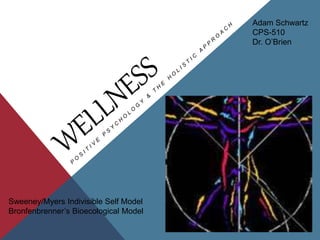
Adam Schwartz 
CPS-510 
Dr. O’Brien 
Sweeney/Myers Indivisible Self Model 
Bronfenbrenner’s Bioecological Model
ALL CLIENTS EXIST AS… 
• People in relation (to others) 
• People within a Community 
• Individuals in a Social Context 
Not Primarily As An Individual Afflicted 
with A Pathology
WHY WELLNESS SHOULD MATTER TO COUNSELORS 
“What makes professional 
counselors unique from their 
peers in other mental health 
disciplines is their , ‘wellness,’ 
orientation. While trained to 
understand pathology and 
mental illness, professional 
counselors take a preventative 
approach to helping people and 
are trained to use counseling 
treatment interventions, which 
include principles of 
development, wellness, and 
pathology that reflect a 
pluralistic society.” 
A M E R I C A N C O U N S E L I N G 
A S S O C . ‘ 0 3 
C O U N S E L I N G 
C O N C E R N S A N D I S S U E S 
• Mental 
disorders 
• Addiction 
• Lifestyle 
Concerns 
• Family Issues 
• Career Issues 
• Crises 
Intervention 
• Grief and Loss 
• Personal 
Growth 
Gladding & Newsome.(2010). Clinical 
Mental Health Counseling in Community 
and Agency Settings. Pearson Ed., Press 
Pgs. (25-29)
WELLNESS IS AN ACTIVE PROCESS OF 
BECOMING AWARE OF AND MAKING CHOICES 
TOWARD A MORE SUCCESSFUL EXISTENCE. 
http://definitionofwellness.com/
REFRAMING THE LANGUAGE OF HELPING 
Use of The Strength and Resource Oriented Model 
Story - Positive Asset - Restory – Action 
• Exploration of Concerns 
• Recognition of client resources and strengths 
• Reframing a strategy for change 
• Putting this strategy into action 
Represents a shift away from the 
Pathology model of Counseling
SOCIAL CONTEXTS 
(EXTERNAL MODEL) 
Individual 
Local – Family, Neighborhood, & 
Community 
Institutional – Education, Religion 
Government, Business 
Global – Politics, Culture, Global 
Events, Media, Environment 
Chronometrical – Perpetual, 
Positive, Purposeful 
Sweeney and Myers. (2004). 
Developing Strategies for 
Helpers (2nd Ed., pp. 39-68). 
Amherst, MA; Mircotraining. 
Illustrates the ways in which the individual relates proximally within the confines 
and contexts of his/her environment and culture in order to either develop increased 
or diminished wellness.
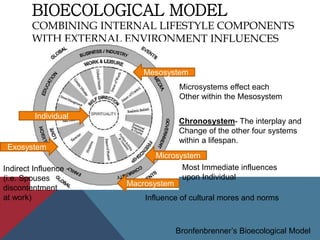
BIOECOLOGICAL MODEL 
COMBINING INTERNAL LIFESTYLE COMPONENTS 
WITH EXTERNAL ENVIRONMENT INFLUENCES 
Individual 
Mesosystem 
Microsystems effect each 
Other within the Mesosystem 
Chronosystem- The interplay and 
Change of the other four systems 
within a lifespan. 
Microsystem 
Most Immediate influences 
upon Individual 
Exosystem 
Indirect Influence 
(i.e. Spouses 
discontentment 
at work) 
Macrosystem 
Influence of cultural mores and norms 
Bronfenbrenner’s Bioecological Model
SWEENEY AND MYERS (2004) 
INDIVISIBLE SELF MODEL 
The 
Creative 
Self 
(Cognition, 
Emotion, 
Vocation) 
The 
Indivisible 
Self 
The 
Coping 
Self 
(Leisure, 
Self-Worth, 
Beliefs) 
The 
Social 
Self 
(Friendship, 
Love) 
The 
Essential 
Self 
(Spiritual, 
Gender, 
Cultural, Self 
Care) 
The 
Physical 
Self 
(Exercise, 
Nutrition) 
Sweeney and Myers. (2004). Developing Strategies 
for Helpers (2nd Ed., pp. 39-68). 
Amherst, MA; Mircotraining 
Illustrates the ways in which the intra-personal self, the self in relation to others, 
the self within the community, and the self within a social context indivisibly 
unite in order to establish a sense of wellness along a continuum.
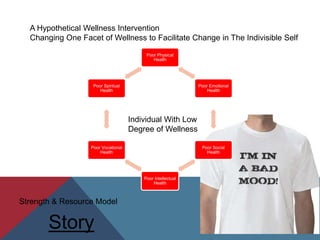
A Hypothetical Wellness Intervention 
Changing One Facet of Wellness to Facilitate Change in The Indivisible Self 
Poor Physical 
Health 
Poor Emotional 
Health 
Poor Social 
Health 
Poor Intellectual 
Health 
Poor Spiritual 
Health 
Poor Vocational 
Health 
Individual With Low 
Degree of Wellness 
Strength & Resource Model 
Story
WELLNESS INTERVENTION- PHYSICAL 
Strategy 
• Referral to a nutritionist 
• Implementation of 20 minutes moderate walking on five or more days/week 
• Decrease in stimulant use and improved sleep hygiene 
Improved 
Nutrition 
Increased 
Exercise 
Better 
Quality of 
Sleep 
Physical 
Wellness 
Improvement 
Positive Asset
CHANGING THE ROLE OF EXERCISE, NUTRITION, AND SLEEP 
IN WELLNESS 
H I G H D I E T A R Y F A T 
A N D C A L O R I E 
C O N S U M P T I O N A N D 
I N C O N S I S T E N T 
E X E R C I S E W I T H P O O R 
S L E E P H A B I T S 
1. Raised blood Pressure 
and Heart Disease. 
2. Links to Cancers such as 
Breast and Colon 
3. Obesity and Type II 
Diabetes 
4. Liver and Gallbladder 
disease 
5. Sleep and Digestive 
Disorders 
M O D E R A T E D I E T A R Y 
F A T C O N S U M P T I O N 
A N D R E G U L A R 
( 5 X ’ S / W E E K L Y ) 
E X E R C I S E W I T H 
I M P R O V E D S L E E P 
H Y G I E N E 
1. Limitation of Respiratory 
Illness 
2. Improved Immunology 
3. Reduced risks for certain 
Cancers , Heart Disease, 
and Diabetes 
4. Reduced stress, anxiety, 
and depression through 
release of Endorphins 
(Dopamine, 
Norepinephrine, 
Serotonin) 
Berk. (2008). Exploring Lifespan 
Development. Pearson Ed., Press 
Pgs. (345-348)
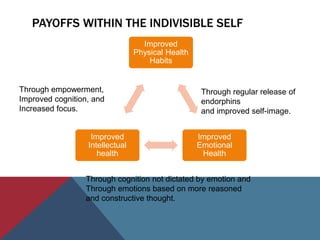
PAYOFFS WITHIN THE INDIVISIBLE SELF 
Improved 
Physical Health 
Habits 
Improved 
Emotional 
Health 
Improved 
Intellectual 
health 
Through regular release of 
endorphins 
and improved self-image. 
Through empowerment, 
Improved cognition, and 
Increased focus. 
Through cognition not dictated by emotion and 
Through emotions based on more reasoned 
and constructive thought.
CASCADING EFFECT WITHIN THE WELLNESS 
WHEEL 
Improved 
Physical Health 
Poor Spiritual 
Health 
Improved 
Intellectual 
Health 
Poor Social 
Health 
Poor Vocational 
Health 
Improved 
Emotional 
Health 
Restory
EFFECTS ON VOCATIONAL, SOCIAL, AND ESSENTIAL 
SELVES WHICH ARE INDIVISIBLE PARTS OF THE WHOLE 
Improved 
Physical Health 
Improving 
Vocational 
Health 
Improved 
Intellectual 
Health 
Improving 
Social Health 
Improving 
Essential Health 
Improved 
Emotional 
health 
Through better ability to relate to others 
interpersonally. 
Through better 
decision making & 
increased productivity. 
Through increased 
optimism and increasing 
comfort with emotions. 
Action
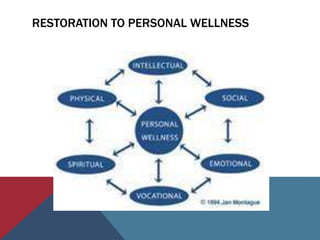
RESTORATION TO PERSONAL WELLNESS
HYPOTHETICAL CASE SUMMARY 
• Able to improve all areas contributing to wellness by intervening in a 
single area. Intervening In more than one area would most likely yield 
even faster tangible results. 
• Area we chose to intervene in was arbitrary. Could have intervened 
intellectually using REBT, or emotionally using stress reduction and 
coping techniques. 
• We worked from the individual outward, could have looked at outside 
sources contributing to limited wellness such as career dissatisfaction, 
marital issues, or existential angst and made an appropriate 
intervention using the corresponding counseling or therapy. 
• Once one or more areas improves the cascading effect should have 
been similar, regardless of the starting point.
Sources Cited 
Sweeney and Myers. (2004). Developing 
Strategies for Helpers (2nd Ed., pp. 39-68). 
Amherst, MA; Mircotraining 
Berk. (2008). Exploring Lifespan 
Development. Pearson Ed., Press 
Pgs. (345-348) 
Gladding & Newsome.(2010). Clinical 
Mental Health Counseling in Community 
and Agency Settings. Pearson Ed., Press 
Pgs. (25-29)

Wellness

  • 1.
    Adam Schwartz CPS-510 Dr. O’Brien Sweeney/Myers Indivisible Self Model Bronfenbrenner’s Bioecological Model
  • 2.
    ALL CLIENTS EXISTAS… • People in relation (to others) • People within a Community • Individuals in a Social Context Not Primarily As An Individual Afflicted with A Pathology
  • 3.
    WHY WELLNESS SHOULDMATTER TO COUNSELORS “What makes professional counselors unique from their peers in other mental health disciplines is their , ‘wellness,’ orientation. While trained to understand pathology and mental illness, professional counselors take a preventative approach to helping people and are trained to use counseling treatment interventions, which include principles of development, wellness, and pathology that reflect a pluralistic society.” A M E R I C A N C O U N S E L I N G A S S O C . ‘ 0 3 C O U N S E L I N G C O N C E R N S A N D I S S U E S • Mental disorders • Addiction • Lifestyle Concerns • Family Issues • Career Issues • Crises Intervention • Grief and Loss • Personal Growth Gladding & Newsome.(2010). Clinical Mental Health Counseling in Community and Agency Settings. Pearson Ed., Press Pgs. (25-29)
  • 4.
    WELLNESS IS ANACTIVE PROCESS OF BECOMING AWARE OF AND MAKING CHOICES TOWARD A MORE SUCCESSFUL EXISTENCE. http://definitionofwellness.com/
  • 5.
    REFRAMING THE LANGUAGEOF HELPING Use of The Strength and Resource Oriented Model Story - Positive Asset - Restory – Action • Exploration of Concerns • Recognition of client resources and strengths • Reframing a strategy for change • Putting this strategy into action Represents a shift away from the Pathology model of Counseling
  • 6.
    SOCIAL CONTEXTS (EXTERNALMODEL) Individual Local – Family, Neighborhood, & Community Institutional – Education, Religion Government, Business Global – Politics, Culture, Global Events, Media, Environment Chronometrical – Perpetual, Positive, Purposeful Sweeney and Myers. (2004). Developing Strategies for Helpers (2nd Ed., pp. 39-68). Amherst, MA; Mircotraining. Illustrates the ways in which the individual relates proximally within the confines and contexts of his/her environment and culture in order to either develop increased or diminished wellness.
  • 7.
    BIOECOLOGICAL MODEL COMBININGINTERNAL LIFESTYLE COMPONENTS WITH EXTERNAL ENVIRONMENT INFLUENCES Individual Mesosystem Microsystems effect each Other within the Mesosystem Chronosystem- The interplay and Change of the other four systems within a lifespan. Microsystem Most Immediate influences upon Individual Exosystem Indirect Influence (i.e. Spouses discontentment at work) Macrosystem Influence of cultural mores and norms Bronfenbrenner’s Bioecological Model
  • 8.
    SWEENEY AND MYERS(2004) INDIVISIBLE SELF MODEL The Creative Self (Cognition, Emotion, Vocation) The Indivisible Self The Coping Self (Leisure, Self-Worth, Beliefs) The Social Self (Friendship, Love) The Essential Self (Spiritual, Gender, Cultural, Self Care) The Physical Self (Exercise, Nutrition) Sweeney and Myers. (2004). Developing Strategies for Helpers (2nd Ed., pp. 39-68). Amherst, MA; Mircotraining Illustrates the ways in which the intra-personal self, the self in relation to others, the self within the community, and the self within a social context indivisibly unite in order to establish a sense of wellness along a continuum.
  • 9.
    A Hypothetical WellnessIntervention Changing One Facet of Wellness to Facilitate Change in The Indivisible Self Poor Physical Health Poor Emotional Health Poor Social Health Poor Intellectual Health Poor Spiritual Health Poor Vocational Health Individual With Low Degree of Wellness Strength & Resource Model Story
  • 10.
    WELLNESS INTERVENTION- PHYSICAL Strategy • Referral to a nutritionist • Implementation of 20 minutes moderate walking on five or more days/week • Decrease in stimulant use and improved sleep hygiene Improved Nutrition Increased Exercise Better Quality of Sleep Physical Wellness Improvement Positive Asset
  • 11.
    CHANGING THE ROLEOF EXERCISE, NUTRITION, AND SLEEP IN WELLNESS H I G H D I E T A R Y F A T A N D C A L O R I E C O N S U M P T I O N A N D I N C O N S I S T E N T E X E R C I S E W I T H P O O R S L E E P H A B I T S 1. Raised blood Pressure and Heart Disease. 2. Links to Cancers such as Breast and Colon 3. Obesity and Type II Diabetes 4. Liver and Gallbladder disease 5. Sleep and Digestive Disorders M O D E R A T E D I E T A R Y F A T C O N S U M P T I O N A N D R E G U L A R ( 5 X ’ S / W E E K L Y ) E X E R C I S E W I T H I M P R O V E D S L E E P H Y G I E N E 1. Limitation of Respiratory Illness 2. Improved Immunology 3. Reduced risks for certain Cancers , Heart Disease, and Diabetes 4. Reduced stress, anxiety, and depression through release of Endorphins (Dopamine, Norepinephrine, Serotonin) Berk. (2008). Exploring Lifespan Development. Pearson Ed., Press Pgs. (345-348)
  • 12.
    PAYOFFS WITHIN THEINDIVISIBLE SELF Improved Physical Health Habits Improved Emotional Health Improved Intellectual health Through regular release of endorphins and improved self-image. Through empowerment, Improved cognition, and Increased focus. Through cognition not dictated by emotion and Through emotions based on more reasoned and constructive thought.
  • 13.
    CASCADING EFFECT WITHINTHE WELLNESS WHEEL Improved Physical Health Poor Spiritual Health Improved Intellectual Health Poor Social Health Poor Vocational Health Improved Emotional Health Restory
  • 14.
    EFFECTS ON VOCATIONAL,SOCIAL, AND ESSENTIAL SELVES WHICH ARE INDIVISIBLE PARTS OF THE WHOLE Improved Physical Health Improving Vocational Health Improved Intellectual Health Improving Social Health Improving Essential Health Improved Emotional health Through better ability to relate to others interpersonally. Through better decision making & increased productivity. Through increased optimism and increasing comfort with emotions. Action
  • 15.
  • 16.
    HYPOTHETICAL CASE SUMMARY • Able to improve all areas contributing to wellness by intervening in a single area. Intervening In more than one area would most likely yield even faster tangible results. • Area we chose to intervene in was arbitrary. Could have intervened intellectually using REBT, or emotionally using stress reduction and coping techniques. • We worked from the individual outward, could have looked at outside sources contributing to limited wellness such as career dissatisfaction, marital issues, or existential angst and made an appropriate intervention using the corresponding counseling or therapy. • Once one or more areas improves the cascading effect should have been similar, regardless of the starting point.
  • 18.
    Sources Cited Sweeneyand Myers. (2004). Developing Strategies for Helpers (2nd Ed., pp. 39-68). Amherst, MA; Mircotraining Berk. (2008). Exploring Lifespan Development. Pearson Ed., Press Pgs. (345-348) Gladding & Newsome.(2010). Clinical Mental Health Counseling in Community and Agency Settings. Pearson Ed., Press Pgs. (25-29)