Breathing Space: the
impact on local authorities
Deven Ghelani
Policy in Practice
www.policyinpractice.co.uk
● The context for debt and collections in the UK
● What is Breathing Space?
● The impact on council tax collection
● Our findings for the GLA
● The case for early intervention: ReImagine Debt
Agenda
www.policyinpractice.co.uk
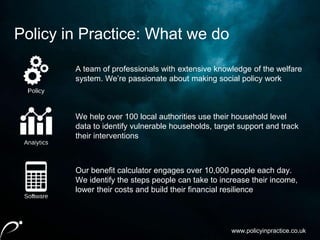
A team of professionals with extensive knowledge of the welfare
system. We’re passionate about making social policy work
We help over 100 local authorities use their household level
data to identify vulnerable households, target support and track
their interventions
Our benefit calculator engages over 10,000 people each day.
We identify the steps people can take to increase their income,
lower their costs and build their financial resilience
Policy in Practice: What we do
www.policyinpractice.co.uk
Source: The Money Charity
Extent of personal debt
www.policyinpractice.co.uk
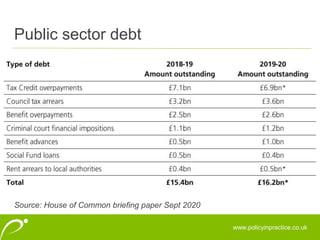
Source: House of Common briefing paper Sept 2020
Public sector debt
www.policyinpractice.co.uk
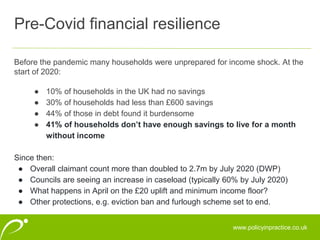
Before the pandemic many households were unprepared for income shock. At the
start of 2020:
● 10% of households in the UK had no savings
● 30% of households had less than £600 savings
● 44% of those in debt found it burdensome
● 41% of households don’t have enough savings to live for a month
without income
Since then:
● Overall claimant count more than doubled to 2.7m by July 2020 (DWP)
● Councils are seeing an increase in caseload (typically 60% by July 2020)
● What happens in April on the £20 uplift and minimum income floor?
● Other protections, e.g. eviction ban and furlough scheme set to end.
Pre-Covid financial resilience
www.policyinpractice.co.uk
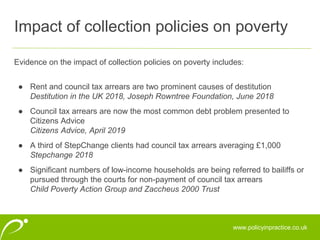
Evidence on the impact of collection policies on poverty includes:
● Rent and council tax arrears are two prominent causes of destitution
Destitution in the UK 2018, Joseph Rowntree Foundation, June 2018
● Council tax arrears are now the most common debt problem presented to
Citizens Advice
Citizens Advice, April 2019
● A third of StepChange clients had council tax arrears averaging £1,000
Stepchange 2018
● Significant numbers of low-income households are being referred to bailiffs or
pursued through the courts for non-payment of council tax arrears
Child Poverty Action Group and Zaccheus 2000 Trust
Impact of collection policies on poverty
www.policyinpractice.co.uk
● Treasury Select Committee described the debt collection practices of some
public authorities as ‘worst in class’ (2018)
● By 2020, the Joseph Rowntree Foundation (JRF), the New Policy Institute
(NPI), and the debt charity StepChange have made representations to the
Mayor of London around CT debt collection practices.
● The government established the Cabinet Office Fairness Group, bringing
central and local government, the debt advice sector, and the debt collection
industry together and established Fairness Principles, which are aligned to
FCA guidelines on Treating Customers Fairly.
● April 2019, MHCLG signalled an intention to engage with charities, debt
advice organisations and local authorities on changes to improve the current
council tax collection system
Calls for action
www.policyinpractice.co.uk
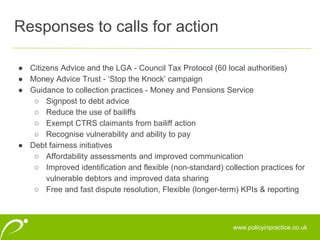
● Citizens Advice and the LGA - Council Tax Protocol (60 local authorities)
● Money Advice Trust - ‘Stop the Knock’ campaign
● Guidance to collection practices - Money and Pensions Service
○ Signpost to debt advice
○ Reduce the use of bailiffs
○ Exempt CTRS claimants from bailiff action
○ Recognise vulnerability and ability to pay
● Debt fairness initiatives
○ Affordability assessments and improved communication
○ Improved identification and flexible (non-standard) collection practices for
vulnerable debtors and improved data sharing
○ Free and fast dispute resolution, Flexible (longer-term) KPIs & reporting
Responses to calls for action
www.policyinpractice.co.uk
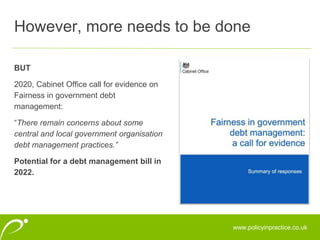
BUT
2020, Cabinet Office call for evidence on
Fairness in government debt
management:
“There remain concerns about some
central and local government organisation
debt management practices.”
Potential for a debt management bill in
2022.
However, more needs to be done
www.policyinpractice.co.uk
In 2015 we wrote a paper for the Financial Inclusion
Commission on Scotland’s Debt Arrangement
Scheme (DAS), introduced in 2004 and revised in
2007 and 2011.
● 6 weeks of breathing space
● 30% of all arrangements after seven years
● Payment holidays, Financial Capability and
One Payment to all creditors
● Income expenditure assessment
Our main recommendation was that the UK
government introduce legislation to introduce a
similar scheme across the UK.
Our work on Breathing Space
www.policyinpractice.co.uk
What is Breathing Space?
Aims:
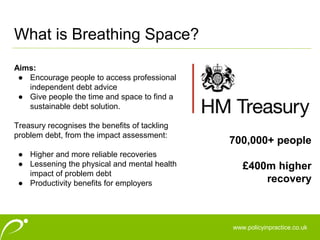
● Encourage people to access professional
independent debt advice
● Give people the time and space to find a
sustainable debt solution.
Treasury recognises the benefits of tackling
problem debt, from the impact assessment:
● Higher and more reliable recoveries
● Lessening the physical and mental health
impact of problem debt
● Productivity benefits for employers
700,000+ people
£400m higher
recovery
www.policyinpractice.co.uk
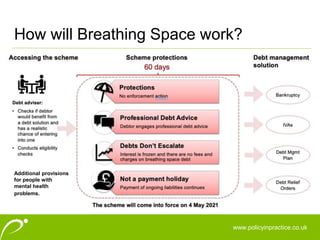
How will Breathing Space work?
Additional provisions
for people with
mental health
problems.
www.policyinpractice.co.uk
A reasonable search of records to identify the moratorium debt and any other
debts.
● Freeze interest, fees, penalties and charges
● Stop enforcement action
● Stop action by appointed agents
● Notify a debt advisor that the above actions have been done
Where creditors fail to comply any action they take is null and void.
What are creditors obligations?
www.policyinpractice.co.uk
Council tax and Universal Credit debts are included in breathing space.
Council Tax
● Councils want full year council tax liability to come under breathing space.
● When a council tax payment is missed, council can add the full years amount
to the debt, however not all councils do this immediately.
● If you are notified, you can’t add to debts already incurred.
Universal Credit
● Universal Credit debts won’t be included for another 18 months, this is dues
to the technical timescales to implement the appropriate system.
● Universal Credit advance repayments are not counted as a debt and do not
fall under breathing space.
Council tax and Universal Credit debt
www.policyinpractice.co.uk
Desk-based research with one workshop - surveys interrupted by lockdown
● Around 67% of London boroughs explicitly state that they take account of
vulnerability, at some stage, in determining action on collection of arrears.
● Most (82%) London boroughs take account of ability to pay and undertake
affordability assessments.
● 8 (out of 32) London boroughs had signed up to the Citizens Advice/Local
Government Association voluntary protocol of good practice.
● All councils follow standard procedures for collection with about half having
some form of breathing space arrangement.
● All but one London boroughs use bailiffs as part of their enforcement
activities.
Council tax collection policies
www.policyinpractice.co.uk
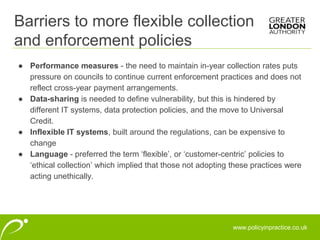
● Performance measures - the need to maintain in-year collection rates puts
pressure on councils to continue current enforcement practices and does not
reflect cross-year payment arrangements.
● Data-sharing is needed to define vulnerability, but this is hindered by
different IT systems, data protection policies, and the move to Universal
Credit.
● Inflexible IT systems, built around the regulations, can be expensive to
change
● Language - preferred the term ‘flexible’, or ‘customer-centric’ policies to
‘ethical collection’ which implied that those not adopting these practices were
acting unethically.
Barriers to more flexible collection
and enforcement policies
www.policyinpractice.co.uk
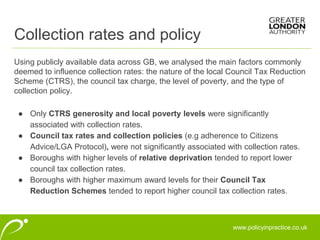
Using publicly available data across GB, we analysed the main factors commonly
deemed to influence collection rates: the nature of the local Council Tax Reduction
Scheme (CTRS), the council tax charge, the level of poverty, and the type of
collection policy.
● Only CTRS generosity and local poverty levels were significantly
associated with collection rates.
● Council tax rates and collection policies (e.g adherence to Citizens
Advice/LGA Protocol), were not significantly associated with collection rates.
● Boroughs with higher levels of relative deprivation tended to report lower
council tax collection rates.
● Boroughs with higher maximum award levels for their Council Tax
Reduction Schemes tended to report higher council tax collection rates.
Collection rates and policy
www.policyinpractice.co.uk
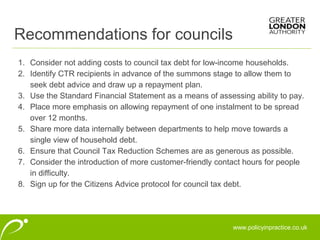
1. Consider not adding costs to council tax debt for low-income households.
2. Identify CTR recipients in advance of the summons stage to allow them to
seek debt advice and draw up a repayment plan.
3. Use the Standard Financial Statement as a means of assessing ability to pay.
4. Place more emphasis on allowing repayment of one instalment to be spread
over 12 months.
5. Share more data internally between departments to help move towards a
single view of household debt.
6. Ensure that Council Tax Reduction Schemes are as generous as possible.
7. Consider the introduction of more customer-friendly contact hours for people
in difficulty.
8. Sign up for the Citizens Advice protocol for council tax debt.
Recommendations for councils
www.policyinpractice.co.uk
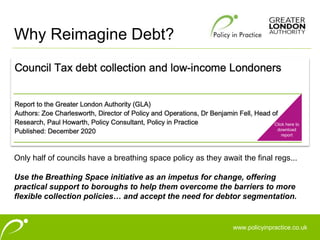
Only half of councils have a breathing space policy as they await the final regs...
Use the Breathing Space initiative as an impetus for change, offering
practical support to boroughs to help them overcome the barriers to more
flexible collection policies… and accept the need for debtor segmentation.
Why Reimagine Debt?
Click here to
download
report
www.policyinpractice.co.uk
Breathing Space is still too late
The case for a preventative approach:
Re-Imagine Debt
www.policyinpractice.co.uk/reimagine-debt
Full details at www.policyinpractice.co.uk/reimagine-debt
www.policyinpractice.co.uk
Background to Reimagine Debt project
In 2018 the Government launched the cross-departmental Reimagine Debt
programme, led by the Cabinet Office and two pilot local authorities.
● Proactive, preventative and holistic debt interventions with residents
● Improve how money owed to local and central government is collected
In phase one of the project, Newcastle and Barking and Dagenham councils each
manually pooled debt data on 39 families and offered them holistic debt guidance.
To make the case for scaling the pilot, the Cabinet Office asked Policy in Practice
to show how administrative data could help deliver preventative support to
thousands of families and evaluate its impact.
www.policyinpractice.co.uk/reimagine-debt
www.policyinpractice.co.uk
Proactive and holistic debt interventions can ... help people to
get back on their feet and have a more stable life.
Debt is almost always a symptom of a deeper challenge.
We would achieve more by focusing on getting people out of
debt, than on getting debt out of people.
The business case is also compelling, with breathing space
being introduce the earlier debt problems are identified and
tackled the better the outcomes for all parties.
Why is proactive support important?
www.policyinpractice.co.uk/reimagine-debt
www.policyinpractice.co.uk
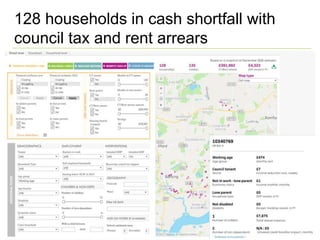
128 households in cash shortfall with
council tax and rent arrears
www.policyinpractice.co.uk/reimagine-debt
www.policyinpractice.co.uk
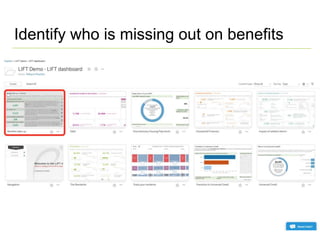
Identify who is missing out on benefits
www.policyinpractice.co.uk/reimagine-debt
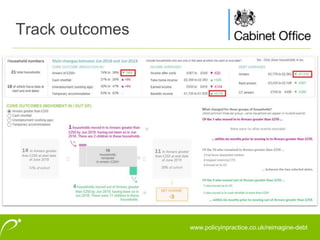
Track outcomes
www.policyinpractice.co.uk/reimagine-debt
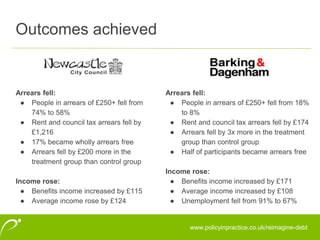
Outcomes achieved
www.policyinpractice.co.uk/reimagine-debt
Arrears fell:
● People in arrears of £250+ fell from
74% to 58%
● Rent and council tax arrears fell by
£1,216
● 17% became wholly arrears free
● Arrears fell by £200 more in the
treatment group than control group
Income rose:
● Benefits income increased by £115
● Average income rose by £124
Arrears fell:
● People in arrears of £250+ fell from 18%
to 8%
● Rent and council tax arrears fell by £174
● Arrears fell by 3x more in the treatment
group than control group
● Half of participants became arrears free
Income rose:
● Benefits income increased by £171
● Average income increased by £108
● Unemployment fell from 91% to 67%
www.policyinpractice.co.uk
What are you doing proactively to
● identify people in arrears
● boost their income
● reduce their costs
● and make the case for early intervention?
● LIFT was able to track 90% of households, and 70% of them for a full year:
Arrears fell and the councils had a positive impact on other outcomes.
● Arrears in the treatment group fell by more than the control group, and other
outcomes (arrears, employment, income) improved.
COVID-19 and collections
Thank you
www.policyinpractice.co.uk
Invest in early intervention to reduce future demand
Deven Ghelani
Director and Founder
deven@policyinpractice.co.uk
07863 560677
hello@policyinpractice.co.uk
0330 0889242
www.policyinpractice.co.uk
In May 2021, councils will be required to introduce the government’s ‘Breathing
Space initiative for those with problem debt. The objectives are to:
● Encourage people to access timely debt advice
● Protect debtors from creditor action to give time and space to engage with
debt advisors
How it works
● 60 day protection from enforcement action with interest frozen
● A statutory debt repayment plan to repay debts in a manageable timetable
● During the period of the plan they will have legal protection from creditors
● Additional protection for those with mental health issues
Breathing Space

Breathing space: the impact on local authorities

  • 1.
    Breathing Space: the impacton local authorities Deven Ghelani Policy in Practice
  • 2.
    www.policyinpractice.co.uk ● The contextfor debt and collections in the UK ● What is Breathing Space? ● The impact on council tax collection ● Our findings for the GLA ● The case for early intervention: ReImagine Debt Agenda
  • 3.
    www.policyinpractice.co.uk A team ofprofessionals with extensive knowledge of the welfare system. We’re passionate about making social policy work We help over 100 local authorities use their household level data to identify vulnerable households, target support and track their interventions Our benefit calculator engages over 10,000 people each day. We identify the steps people can take to increase their income, lower their costs and build their financial resilience Policy in Practice: What we do
  • 4.
    www.policyinpractice.co.uk Source: The MoneyCharity Extent of personal debt
  • 5.
    www.policyinpractice.co.uk Source: House ofCommon briefing paper Sept 2020 Public sector debt
  • 6.
    www.policyinpractice.co.uk Before the pandemicmany households were unprepared for income shock. At the start of 2020: ● 10% of households in the UK had no savings ● 30% of households had less than £600 savings ● 44% of those in debt found it burdensome ● 41% of households don’t have enough savings to live for a month without income Since then: ● Overall claimant count more than doubled to 2.7m by July 2020 (DWP) ● Councils are seeing an increase in caseload (typically 60% by July 2020) ● What happens in April on the £20 uplift and minimum income floor? ● Other protections, e.g. eviction ban and furlough scheme set to end. Pre-Covid financial resilience
  • 7.
    www.policyinpractice.co.uk Evidence on theimpact of collection policies on poverty includes: ● Rent and council tax arrears are two prominent causes of destitution Destitution in the UK 2018, Joseph Rowntree Foundation, June 2018 ● Council tax arrears are now the most common debt problem presented to Citizens Advice Citizens Advice, April 2019 ● A third of StepChange clients had council tax arrears averaging £1,000 Stepchange 2018 ● Significant numbers of low-income households are being referred to bailiffs or pursued through the courts for non-payment of council tax arrears Child Poverty Action Group and Zaccheus 2000 Trust Impact of collection policies on poverty
  • 8.
    www.policyinpractice.co.uk ● Treasury SelectCommittee described the debt collection practices of some public authorities as ‘worst in class’ (2018) ● By 2020, the Joseph Rowntree Foundation (JRF), the New Policy Institute (NPI), and the debt charity StepChange have made representations to the Mayor of London around CT debt collection practices. ● The government established the Cabinet Office Fairness Group, bringing central and local government, the debt advice sector, and the debt collection industry together and established Fairness Principles, which are aligned to FCA guidelines on Treating Customers Fairly. ● April 2019, MHCLG signalled an intention to engage with charities, debt advice organisations and local authorities on changes to improve the current council tax collection system Calls for action
  • 9.
    www.policyinpractice.co.uk ● Citizens Adviceand the LGA - Council Tax Protocol (60 local authorities) ● Money Advice Trust - ‘Stop the Knock’ campaign ● Guidance to collection practices - Money and Pensions Service ○ Signpost to debt advice ○ Reduce the use of bailiffs ○ Exempt CTRS claimants from bailiff action ○ Recognise vulnerability and ability to pay ● Debt fairness initiatives ○ Affordability assessments and improved communication ○ Improved identification and flexible (non-standard) collection practices for vulnerable debtors and improved data sharing ○ Free and fast dispute resolution, Flexible (longer-term) KPIs & reporting Responses to calls for action
  • 10.
    www.policyinpractice.co.uk BUT 2020, Cabinet Officecall for evidence on Fairness in government debt management: “There remain concerns about some central and local government organisation debt management practices.” Potential for a debt management bill in 2022. However, more needs to be done
  • 11.
    www.policyinpractice.co.uk In 2015 wewrote a paper for the Financial Inclusion Commission on Scotland’s Debt Arrangement Scheme (DAS), introduced in 2004 and revised in 2007 and 2011. ● 6 weeks of breathing space ● 30% of all arrangements after seven years ● Payment holidays, Financial Capability and One Payment to all creditors ● Income expenditure assessment Our main recommendation was that the UK government introduce legislation to introduce a similar scheme across the UK. Our work on Breathing Space
  • 12.
    www.policyinpractice.co.uk What is BreathingSpace? Aims: ● Encourage people to access professional independent debt advice ● Give people the time and space to find a sustainable debt solution. Treasury recognises the benefits of tackling problem debt, from the impact assessment: ● Higher and more reliable recoveries ● Lessening the physical and mental health impact of problem debt ● Productivity benefits for employers 700,000+ people £400m higher recovery
  • 13.
    www.policyinpractice.co.uk How will BreathingSpace work? Additional provisions for people with mental health problems.
  • 14.
    www.policyinpractice.co.uk A reasonable searchof records to identify the moratorium debt and any other debts. ● Freeze interest, fees, penalties and charges ● Stop enforcement action ● Stop action by appointed agents ● Notify a debt advisor that the above actions have been done Where creditors fail to comply any action they take is null and void. What are creditors obligations?
  • 15.
    www.policyinpractice.co.uk Council tax andUniversal Credit debts are included in breathing space. Council Tax ● Councils want full year council tax liability to come under breathing space. ● When a council tax payment is missed, council can add the full years amount to the debt, however not all councils do this immediately. ● If you are notified, you can’t add to debts already incurred. Universal Credit ● Universal Credit debts won’t be included for another 18 months, this is dues to the technical timescales to implement the appropriate system. ● Universal Credit advance repayments are not counted as a debt and do not fall under breathing space. Council tax and Universal Credit debt
  • 16.
    www.policyinpractice.co.uk Desk-based research withone workshop - surveys interrupted by lockdown ● Around 67% of London boroughs explicitly state that they take account of vulnerability, at some stage, in determining action on collection of arrears. ● Most (82%) London boroughs take account of ability to pay and undertake affordability assessments. ● 8 (out of 32) London boroughs had signed up to the Citizens Advice/Local Government Association voluntary protocol of good practice. ● All councils follow standard procedures for collection with about half having some form of breathing space arrangement. ● All but one London boroughs use bailiffs as part of their enforcement activities. Council tax collection policies
  • 17.
    www.policyinpractice.co.uk ● Performance measures- the need to maintain in-year collection rates puts pressure on councils to continue current enforcement practices and does not reflect cross-year payment arrangements. ● Data-sharing is needed to define vulnerability, but this is hindered by different IT systems, data protection policies, and the move to Universal Credit. ● Inflexible IT systems, built around the regulations, can be expensive to change ● Language - preferred the term ‘flexible’, or ‘customer-centric’ policies to ‘ethical collection’ which implied that those not adopting these practices were acting unethically. Barriers to more flexible collection and enforcement policies
  • 18.
    www.policyinpractice.co.uk Using publicly availabledata across GB, we analysed the main factors commonly deemed to influence collection rates: the nature of the local Council Tax Reduction Scheme (CTRS), the council tax charge, the level of poverty, and the type of collection policy. ● Only CTRS generosity and local poverty levels were significantly associated with collection rates. ● Council tax rates and collection policies (e.g adherence to Citizens Advice/LGA Protocol), were not significantly associated with collection rates. ● Boroughs with higher levels of relative deprivation tended to report lower council tax collection rates. ● Boroughs with higher maximum award levels for their Council Tax Reduction Schemes tended to report higher council tax collection rates. Collection rates and policy
  • 19.
    www.policyinpractice.co.uk 1. Consider notadding costs to council tax debt for low-income households. 2. Identify CTR recipients in advance of the summons stage to allow them to seek debt advice and draw up a repayment plan. 3. Use the Standard Financial Statement as a means of assessing ability to pay. 4. Place more emphasis on allowing repayment of one instalment to be spread over 12 months. 5. Share more data internally between departments to help move towards a single view of household debt. 6. Ensure that Council Tax Reduction Schemes are as generous as possible. 7. Consider the introduction of more customer-friendly contact hours for people in difficulty. 8. Sign up for the Citizens Advice protocol for council tax debt. Recommendations for councils
  • 20.
    www.policyinpractice.co.uk Only half ofcouncils have a breathing space policy as they await the final regs... Use the Breathing Space initiative as an impetus for change, offering practical support to boroughs to help them overcome the barriers to more flexible collection policies… and accept the need for debtor segmentation. Why Reimagine Debt? Click here to download report
  • 21.
    www.policyinpractice.co.uk Breathing Space isstill too late The case for a preventative approach: Re-Imagine Debt www.policyinpractice.co.uk/reimagine-debt Full details at www.policyinpractice.co.uk/reimagine-debt
  • 22.
    www.policyinpractice.co.uk Background to ReimagineDebt project In 2018 the Government launched the cross-departmental Reimagine Debt programme, led by the Cabinet Office and two pilot local authorities. ● Proactive, preventative and holistic debt interventions with residents ● Improve how money owed to local and central government is collected In phase one of the project, Newcastle and Barking and Dagenham councils each manually pooled debt data on 39 families and offered them holistic debt guidance. To make the case for scaling the pilot, the Cabinet Office asked Policy in Practice to show how administrative data could help deliver preventative support to thousands of families and evaluate its impact. www.policyinpractice.co.uk/reimagine-debt
  • 23.
    www.policyinpractice.co.uk Proactive and holisticdebt interventions can ... help people to get back on their feet and have a more stable life. Debt is almost always a symptom of a deeper challenge. We would achieve more by focusing on getting people out of debt, than on getting debt out of people. The business case is also compelling, with breathing space being introduce the earlier debt problems are identified and tackled the better the outcomes for all parties. Why is proactive support important? www.policyinpractice.co.uk/reimagine-debt
  • 24.
    www.policyinpractice.co.uk 128 households incash shortfall with council tax and rent arrears www.policyinpractice.co.uk/reimagine-debt
  • 25.
    www.policyinpractice.co.uk Identify who ismissing out on benefits www.policyinpractice.co.uk/reimagine-debt
  • 26.
  • 27.
    Outcomes achieved www.policyinpractice.co.uk/reimagine-debt Arrears fell: ●People in arrears of £250+ fell from 74% to 58% ● Rent and council tax arrears fell by £1,216 ● 17% became wholly arrears free ● Arrears fell by £200 more in the treatment group than control group Income rose: ● Benefits income increased by £115 ● Average income rose by £124 Arrears fell: ● People in arrears of £250+ fell from 18% to 8% ● Rent and council tax arrears fell by £174 ● Arrears fell by 3x more in the treatment group than control group ● Half of participants became arrears free Income rose: ● Benefits income increased by £171 ● Average income increased by £108 ● Unemployment fell from 91% to 67%
  • 28.
    www.policyinpractice.co.uk What are youdoing proactively to ● identify people in arrears ● boost their income ● reduce their costs ● and make the case for early intervention? ● LIFT was able to track 90% of households, and 70% of them for a full year: Arrears fell and the councils had a positive impact on other outcomes. ● Arrears in the treatment group fell by more than the control group, and other outcomes (arrears, employment, income) improved. COVID-19 and collections
  • 29.
    Thank you www.policyinpractice.co.uk Invest inearly intervention to reduce future demand Deven Ghelani Director and Founder deven@policyinpractice.co.uk 07863 560677 hello@policyinpractice.co.uk 0330 0889242
  • 30.
    www.policyinpractice.co.uk In May 2021,councils will be required to introduce the government’s ‘Breathing Space initiative for those with problem debt. The objectives are to: ● Encourage people to access timely debt advice ● Protect debtors from creditor action to give time and space to engage with debt advisors How it works ● 60 day protection from enforcement action with interest frozen ● A statutory debt repayment plan to repay debts in a manageable timetable ● During the period of the plan they will have legal protection from creditors ● Additional protection for those with mental health issues Breathing Space

Editor's Notes

  • #2 Set the scene (using intro slides from Jan webinar) Understanding the context: debt in the UK Extend of personal debt Public sector debt Household problem debt Pre-Covid financial resilience Calls for action Responses to calls for action However, more needs to be done Focus on public sector debt collection Breathing Space
  • #3 Flexibility - claim CTR & stop enforcement action & income maximisation to drive engagement. In Wales, people don’t claim CTR because of fear of enforcement (reputation / overpayment) Debts owing under UC are going in 18 months later (when the technology comes in) Rent arrears - if you don’t sort the root problem, homelessness could still arise Sort out negative budgets… Advances do not count as debts. Target discretionary funds - proactive
  • #15 Covid payment plan - agreed with creditor directly Referral from registered independent debt advisors
  • #21 Only half of respondents had a breathing space policy. Awaiting regulations, particularly on whether the council can register to give independent debt advice. The Government’s introduction of a “breathing space” provision in 2021 will necessitate a change in council’s collection practices and an acceptance of the need for debtor segmentation.
  • #22 Policy in Practice was asked by the Cabinet Office to support of a cross-departmental project on the management and collection of local and central government debt. Building on the successful ‘Reimagine Debt’ pilot, the project as a whole sought to understand the role of data to generate a consolidated household-level view of debt. Consolidated debt data, placed in the context of a household’s wider economic circumstances, can create a culture of holistic, proactive and effective service delivery across local & central government. Part 1 of this presentation shows the benefits of holistic debt guidance, based on pooled data on 39 families Phase 2 shows how this approach can be scaled to deliver benefits to the public.
  • #23 Policy in Practice was asked by the Cabinet Office to support of a cross-departmental project on the management and collection of local and central government debt. Building on the successful ‘Reimagine Debt’ pilot, the project as a whole sought to understand the role of data to generate a consolidated household-level view of debt. Consolidated debt data, placed in the context of a household’s wider economic circumstances, can create a culture of holistic, proactive and effective service delivery across local & central government. Part 1 of this presentation shows the benefits of holistic debt guidance, based on pooled data on 39 families Phase 2 shows how this approach can be scaled to deliver benefits to the public.
  • #27  5. Payment holidays: Mortgage payment holidays will continue. Up to 6 months total, · Payment holidays will continue for credit cards, car finance, personal loans . Up to 6 months in total, Enforcement of eviction is suspended for 6 months
  • #28  5. Payment holidays: Mortgage payment holidays will continue. Up to 6 months total, · Payment holidays will continue for credit cards, car finance, personal loans . Up to 6 months in total, Enforcement of eviction is suspended for 6 months