The Road Home A National Approach to Reducing Homelessness March 2009
Structure of Presentation White Paper on Homelessness: what it says Background on new environment in Commonwealth / State relations Implementing the White Paper, what states will do, what the Commonwealth will do Questions and Answers
The White Paper -  The Road Home In Australia, no one should be homeless Reducing homelessness is everyone’s responsibility Need to take action now Once in a generation opportunity to reduce homelessness.
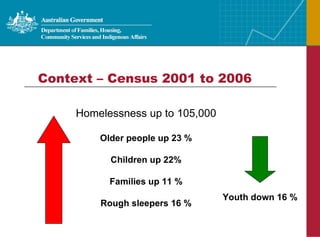
Context – Census 2001 to 2006     Homelessness up to 105,000 Older people up 23 % Children up 22% Families up 11 % Rough sleepers 16 % Youth down 16 %
Short term factors impacting on Homelessness are: Demographic shifts Rising unemployment Economic outlook Building of over 20,000 new affordable housing  Lag time in delivering national reforms. Short term context
Pathways to homelessness  Financial stress, housing crisis and poverty Family breakdown, particularly driven by domestic violence Poorly managed life transitions, particularly from child protection system, prison, or mental health care services Untreated mental health and/or substance abuse issues leading to loss of housing, education, employment, family and other relationships.
Vision An Australia where fewer people are homeless and where people who do become homeless are helped to find permanent accommodation and the support they need to stabilise their lives.
Vision Homelessness is  everyone’s responsibility . Need sustained long-term effort by all levels of government, business and not-for-profit sector Need tailored measures for different groups – children, older people, Indigenous, etc Significant role for mainstream services Fewer become homeless and those who do get help quickly.
Overall Goals by 2020 Halve overall homelessness provide supported accommodation to all rough sleepers who seek it.
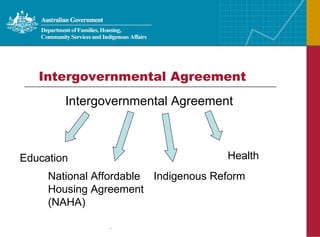
Intergovernmental Agreement Intergovernmental Agreement National Affordable Housing Agreement (NAHA) Education Health Indigenous Reform
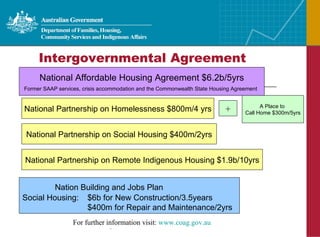
Intergovernmental Agreement National Partnership on Remote Indigenous Housing $1.9b/10yrs + For further information visit:  www.coag.gov.au A Place to  Call Home $300m/5yrs National Affordable Housing Agreement $6.2b/5yrs Former SAAP services, crisis accommodation and the Commonwealth State Housing Agreement   National Partnership on Social Housing $400m/2yrs National Partnership on Homelessness $800m/4 yrs Nation Building and Jobs Plan Social Housing:  $6b for New Construction/3.5years $400m for Repair and Maintenance/2yrs
COAG Reform Council  Transparent Reporting Schedule C of Intergovernmental Agreement Our independent data agencies  Australian Bureau of Statistics (ABS) Australian Institute of Housing and Welfare (AIHW)  Performance indicators stipulated in each National Partnership
Interim  Targets by 2013 Reduce homelessness by 20 per cent Reduce primary homelessness by 25 per cent Reduce people repeating seeking specialist homelessness services by 25 per cent.
Core Outputs Implementation of the A Place to Call Home initiative; Street to home initiatives for chronic homeless people (rough sleepers); Support for private and public tenants to help sustain their tenancies, including through tenancy support, advocacy, case management, financial counselling and referral services; and Assistance for people leaving child protection services, correctional and health facilities, to access and maintain stable, affordable housing - ‘no exits into homelessness’
Additional Outputs Support services and accommodation to assist older people who are homeless or at risk of homelessness; Services to assist people who are homeless with substance abuse, to secure or maintain stable accommodation; Services to assist people who are homeless with mental health issues to secure or maintain stable accommodation; Support to assist young people to secure or maintain sustainable accommodation and to re-engage with family, school and work; Improvements in service coordination and provision;
Additional Outputs Support for women and children experiencing domestic and family violence to stay safely in their home; Assistance for people who are homeless, including families with children, to stabilise their situation and achieve sustainable housing; Outreach programs to connect rough sleepers to long-term housing and health services; National, State and rural (inc. remote) homelessness action plans to assist people who are homeless in areas identified as having high rates of homelessness
Support for children who are homeless or at risk of homelessness including to maintain contact with the education system; Legal services provided to people who are homeless or at risk of homelessness as a result of legal issues including family violence, tenancy or debt; and Workforce development and career progression for workers in homelessness services Additional Outputs
Key Strategies to 2020 Key strategies to focus government effort and investment: Turning off the Tap :  intervene early to stop people becoming homeless Improving and expanding services : to ensure quality services  Breaking the cycle : addressing the causes and quickly moving people from the crisis system with the support.
Turning off the tap Homelessness can be prevented Prevention and early intervention are the most effective and efficient ways Specific responses are required for different groups.
Turning off the tap – first steps Commonwealth Over 20,000 public houses will built Deliver additional community based mental health services Increased Centrelink services  Automatic rent payments from Centrelink benefits  Regulate tenancy databases and review tenancy laws Implement the National Plan to Reduce Violence against Women and their Children and the National Child Protection Framework.
Improving and expanding services Commonwealth Improve collaboration between specialist and mainstream services Review relationship between Centrelink and employment services Develop quality standards and service charters Commonwealth may introduce flexible funding for services Shift service focus to outcomes: stable long-term housing, jobs and training Improve service integration through better IT systems Enact new legislation building on the existing  SAAP Act 1994 Develop a national homelessness research agenda and database.
Breaking the cycle – first steps Commonwealth Increase affordable housing by over 20,000 houses Build 50,000 more homes for low, moderate income earners (National Rental Affordability Scheme) Provide 90 Centrelink Community Engagement Officers Conduct pilots to co-locate housing services in Centrelink  Reform employment services to help job seekers who are homeless Provide more aged care places and support for older people who are homeless  Increase legal services and voting and civic participation
Breaking the cycle – Joint first steps Commonwealth and state and territory need to provide long term support - more specialist supported accommodation Up to 2,700 more homes for homeless or supported accommodation (APTCH and Social Housing) Up to 4,200 new houses, upgrade 4,800 existing houses in remote Indigenous communities.
White Paper – Implementation Changed Commonwealth-State financial relations through National Agreements on Homelessness, Social Housing, Remote Indigenous Housing State and territory governments responsible for service delivery and implementing the 50 identified actions in the White Paper States to have more flexibility to spend funds on initiatives to suit their individual jurisdictions Commonwealth to work in close partnership with states on their Implementation Plans for the new Agreements and closely monitor their performance.
White Paper – Governance   Prime Minister’s  Council on Homelessness  to drive reforms Establishment of Bea Miles Foundation to partner business Agreed Implementation Plans with States and Territories based on outputs and performance  COAG Reform Council to analyse and report annually Ministerial Councils responsible for implementation State / territory regional and local plans and coordination committees New legislation with accreditation to ensure quality services and support.
Questions?

White Paper implementation presentation - FaHCSIA

  • 1.
    The Road HomeA National Approach to Reducing Homelessness March 2009
  • 2.
    Structure of PresentationWhite Paper on Homelessness: what it says Background on new environment in Commonwealth / State relations Implementing the White Paper, what states will do, what the Commonwealth will do Questions and Answers
  • 3.
    The White Paper- The Road Home In Australia, no one should be homeless Reducing homelessness is everyone’s responsibility Need to take action now Once in a generation opportunity to reduce homelessness.
  • 4.
    Context – Census2001 to 2006   Homelessness up to 105,000 Older people up 23 % Children up 22% Families up 11 % Rough sleepers 16 % Youth down 16 %
  • 5.
    Short term factorsimpacting on Homelessness are: Demographic shifts Rising unemployment Economic outlook Building of over 20,000 new affordable housing Lag time in delivering national reforms. Short term context
  • 6.
    Pathways to homelessness Financial stress, housing crisis and poverty Family breakdown, particularly driven by domestic violence Poorly managed life transitions, particularly from child protection system, prison, or mental health care services Untreated mental health and/or substance abuse issues leading to loss of housing, education, employment, family and other relationships.
  • 7.
    Vision An Australiawhere fewer people are homeless and where people who do become homeless are helped to find permanent accommodation and the support they need to stabilise their lives.
  • 8.
    Vision Homelessness is everyone’s responsibility . Need sustained long-term effort by all levels of government, business and not-for-profit sector Need tailored measures for different groups – children, older people, Indigenous, etc Significant role for mainstream services Fewer become homeless and those who do get help quickly.
  • 9.
    Overall Goals by2020 Halve overall homelessness provide supported accommodation to all rough sleepers who seek it.
  • 10.
    Intergovernmental Agreement IntergovernmentalAgreement National Affordable Housing Agreement (NAHA) Education Health Indigenous Reform
  • 11.
    Intergovernmental Agreement NationalPartnership on Remote Indigenous Housing $1.9b/10yrs + For further information visit: www.coag.gov.au A Place to Call Home $300m/5yrs National Affordable Housing Agreement $6.2b/5yrs Former SAAP services, crisis accommodation and the Commonwealth State Housing Agreement National Partnership on Social Housing $400m/2yrs National Partnership on Homelessness $800m/4 yrs Nation Building and Jobs Plan Social Housing: $6b for New Construction/3.5years $400m for Repair and Maintenance/2yrs
  • 12.
    COAG Reform Council Transparent Reporting Schedule C of Intergovernmental Agreement Our independent data agencies Australian Bureau of Statistics (ABS) Australian Institute of Housing and Welfare (AIHW) Performance indicators stipulated in each National Partnership
  • 13.
    Interim Targetsby 2013 Reduce homelessness by 20 per cent Reduce primary homelessness by 25 per cent Reduce people repeating seeking specialist homelessness services by 25 per cent.
  • 14.
    Core Outputs Implementationof the A Place to Call Home initiative; Street to home initiatives for chronic homeless people (rough sleepers); Support for private and public tenants to help sustain their tenancies, including through tenancy support, advocacy, case management, financial counselling and referral services; and Assistance for people leaving child protection services, correctional and health facilities, to access and maintain stable, affordable housing - ‘no exits into homelessness’
  • 15.
    Additional Outputs Supportservices and accommodation to assist older people who are homeless or at risk of homelessness; Services to assist people who are homeless with substance abuse, to secure or maintain stable accommodation; Services to assist people who are homeless with mental health issues to secure or maintain stable accommodation; Support to assist young people to secure or maintain sustainable accommodation and to re-engage with family, school and work; Improvements in service coordination and provision;
  • 16.
    Additional Outputs Supportfor women and children experiencing domestic and family violence to stay safely in their home; Assistance for people who are homeless, including families with children, to stabilise their situation and achieve sustainable housing; Outreach programs to connect rough sleepers to long-term housing and health services; National, State and rural (inc. remote) homelessness action plans to assist people who are homeless in areas identified as having high rates of homelessness
  • 17.
    Support for childrenwho are homeless or at risk of homelessness including to maintain contact with the education system; Legal services provided to people who are homeless or at risk of homelessness as a result of legal issues including family violence, tenancy or debt; and Workforce development and career progression for workers in homelessness services Additional Outputs
  • 18.
    Key Strategies to2020 Key strategies to focus government effort and investment: Turning off the Tap : intervene early to stop people becoming homeless Improving and expanding services : to ensure quality services Breaking the cycle : addressing the causes and quickly moving people from the crisis system with the support.
  • 19.
    Turning off thetap Homelessness can be prevented Prevention and early intervention are the most effective and efficient ways Specific responses are required for different groups.
  • 20.
    Turning off thetap – first steps Commonwealth Over 20,000 public houses will built Deliver additional community based mental health services Increased Centrelink services Automatic rent payments from Centrelink benefits Regulate tenancy databases and review tenancy laws Implement the National Plan to Reduce Violence against Women and their Children and the National Child Protection Framework.
  • 21.
    Improving and expandingservices Commonwealth Improve collaboration between specialist and mainstream services Review relationship between Centrelink and employment services Develop quality standards and service charters Commonwealth may introduce flexible funding for services Shift service focus to outcomes: stable long-term housing, jobs and training Improve service integration through better IT systems Enact new legislation building on the existing SAAP Act 1994 Develop a national homelessness research agenda and database.
  • 22.
    Breaking the cycle– first steps Commonwealth Increase affordable housing by over 20,000 houses Build 50,000 more homes for low, moderate income earners (National Rental Affordability Scheme) Provide 90 Centrelink Community Engagement Officers Conduct pilots to co-locate housing services in Centrelink Reform employment services to help job seekers who are homeless Provide more aged care places and support for older people who are homeless Increase legal services and voting and civic participation
  • 23.
    Breaking the cycle– Joint first steps Commonwealth and state and territory need to provide long term support - more specialist supported accommodation Up to 2,700 more homes for homeless or supported accommodation (APTCH and Social Housing) Up to 4,200 new houses, upgrade 4,800 existing houses in remote Indigenous communities.
  • 24.
    White Paper –Implementation Changed Commonwealth-State financial relations through National Agreements on Homelessness, Social Housing, Remote Indigenous Housing State and territory governments responsible for service delivery and implementing the 50 identified actions in the White Paper States to have more flexibility to spend funds on initiatives to suit their individual jurisdictions Commonwealth to work in close partnership with states on their Implementation Plans for the new Agreements and closely monitor their performance.
  • 25.
    White Paper –Governance Prime Minister’s Council on Homelessness to drive reforms Establishment of Bea Miles Foundation to partner business Agreed Implementation Plans with States and Territories based on outputs and performance COAG Reform Council to analyse and report annually Ministerial Councils responsible for implementation State / territory regional and local plans and coordination committees New legislation with accreditation to ensure quality services and support.
  • 26.