New Hampshire Developmental Services System   Present and Future Challenges
Intent Of The Forum The State is facing a  severe  funding shortage Projected to last for awhile It is likely that our service system will be affected Individuals, families, providers, area agencies, BDS, DDHS and local communities BDS and area agencies are soliciting input, ideas and suggestions regarding how we may  collectively  deal with the difficulties we are facing
Intent Of The Forum An opportunity to consider creating changes that are more effective with respect to Desired service outcomes and  Cost   A chance to imagine how: The service system may operate in the future It may support individuals and their families  Resources can be used in more effective ways
Fiscal Conditions And Challenges
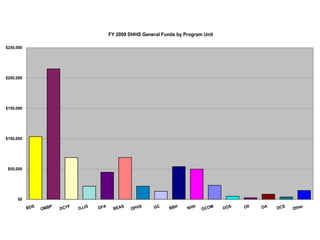
Fiscal Year 2009 [July 1, 2008 - June 30, 2009]  The State budget has $5,2 billion  in Total Funds $1,6 billion  in General Funds (GF) DHHS was assigned the largest share of the $1.6B General Funds $713M  of the $1.6B About  44%  of the total General Funds [The next largest GF portion is only 11% of the state total]
 
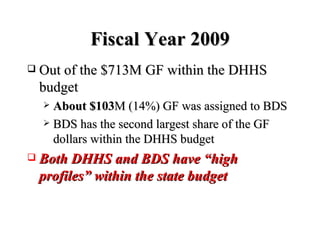
Fiscal Year 2009 Out of the $713M GF within the DHHS budget About $103 M (14%) GF was assigned to BDS BDS has the second largest share of the GF dollars within the DHHS budget Both DHHS and BDS have “high profiles” within the state budget
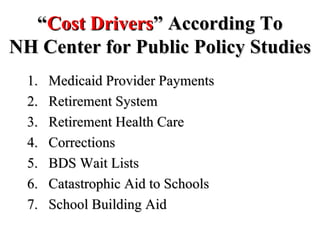
“ Cost Drivers ” According To NH Center for Public Policy Studies Medicaid Provider Payments Retirement System Retirement Health Care  Corrections BDS Wait Lists Catastrophic Aid to Schools School Building Aid
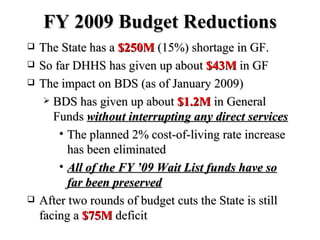
FY 2009 Budget Reductions The State has a  $250M  (15%) shortage in GF. So far DHHS has given up about  $43M  in GF The impact on BDS (as of January 2009)  BDS has given up about  $1.2M  in General Funds  without interrupting any direct services The planned 2% cost-of-living rate increase has been eliminated All of the FY ’09 Wait List funds have so far been preserved After two rounds of budget cuts the State is still facing a  $75M  deficit
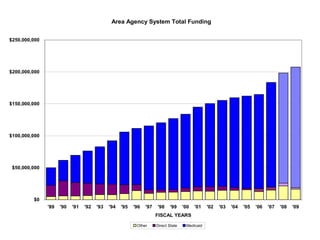
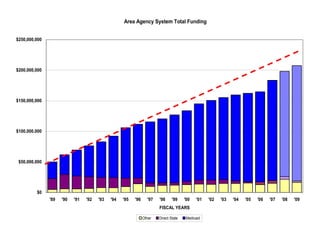
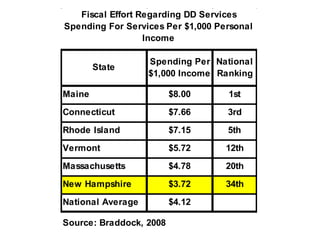
Historical Financial Perspective On The Current System


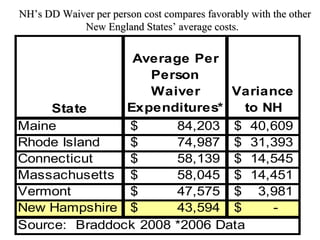
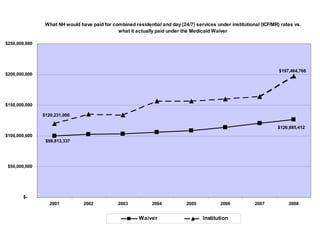
NH’s DD Waiver per person cost compares favorably with the other New England States’ average costs.
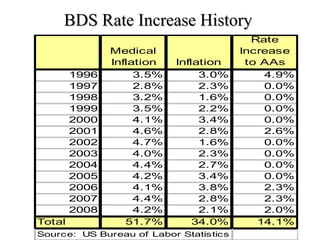
BDS Rate Increase History
Future Challenges
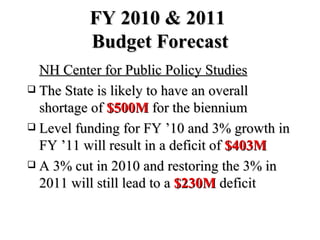
FY 2010 & 2011  Budget Forecast NH Center for Public Policy Studies   The State is likely to have an overall shortage of  $500M  for the biennium Level funding for FY ’10 and 3% growth in FY ’11 will result in a deficit of  $403M   A 3% cut in 2010 and restoring the 3% in 2011 will still lead to a  $230M  deficit
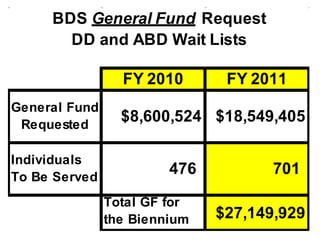
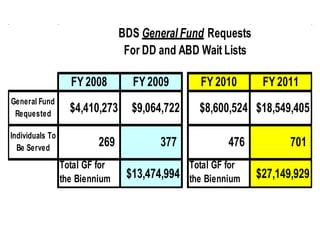
BDS Request For FY 2010 & 2011 [ In Comparison To The 2009 Budget ]   Fiscal Year 2010 Increase of about  $25M  in General  Funds $50M in total funds (state and federal) Fiscal Year 2011 Increase of about  $40M  in General  Funds $80M in total funds (state and federal)
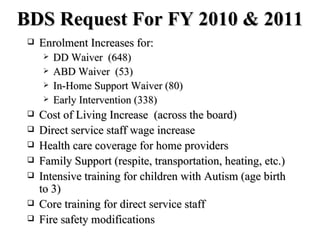
BDS Request For FY 2010 & 2011 Enrolment Increases for: DD Waiver  (648) ABD Waiver  (53) In-Home Support Waiver (80) Early Intervention (338) Cost of Living Increase  (across the board)  Direct service staff wage increase Health care coverage for home providers Family Support (respite, transportation, heating, etc.) Intensive training for children with Autism (age birth to 3) Core training for direct service staff Fire safety modifications
 
 
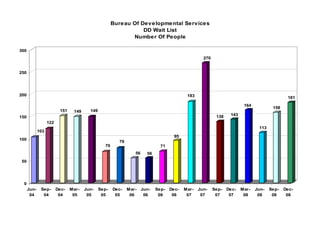
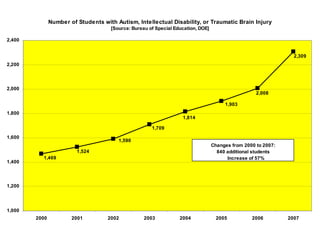
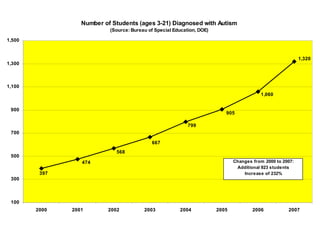
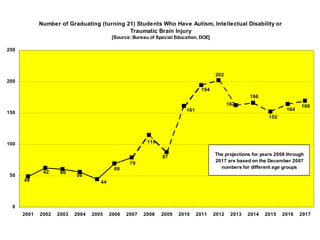
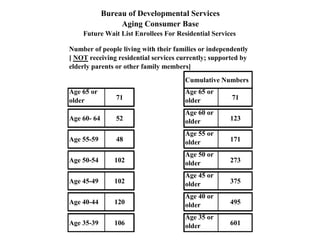
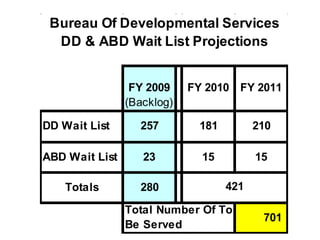
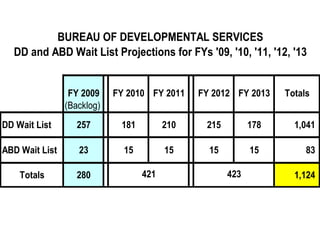
Reasons For Increases In The  Wait List Numbers?


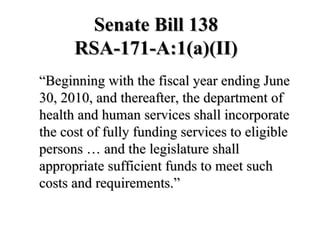
Senate Bill 138 RSA-171-A:1(a)(II) “Beginning with the fiscal year ending June 30, 2010, and thereafter, the department of health and human services shall incorporate the cost of fully funding services to eligible persons … and the legislature shall appropriate sufficient funds to meet such costs and requirements.”
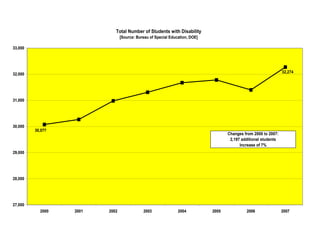
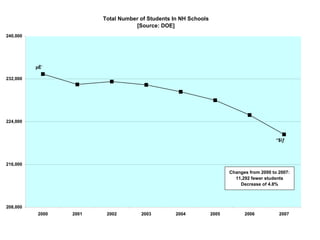
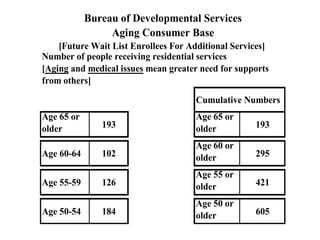
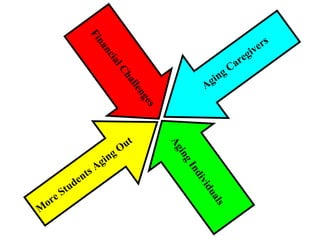
Aging Caregivers More Students Aging Out Aging Individuals Financial   Challenges
 

Overview of Budget Challenge

  • 1.
    New Hampshire DevelopmentalServices System Present and Future Challenges
  • 2.
    Intent Of TheForum The State is facing a severe funding shortage Projected to last for awhile It is likely that our service system will be affected Individuals, families, providers, area agencies, BDS, DDHS and local communities BDS and area agencies are soliciting input, ideas and suggestions regarding how we may collectively deal with the difficulties we are facing
  • 3.
    Intent Of TheForum An opportunity to consider creating changes that are more effective with respect to Desired service outcomes and Cost A chance to imagine how: The service system may operate in the future It may support individuals and their families Resources can be used in more effective ways
  • 4.
  • 5.
    Fiscal Year 2009[July 1, 2008 - June 30, 2009] The State budget has $5,2 billion in Total Funds $1,6 billion in General Funds (GF) DHHS was assigned the largest share of the $1.6B General Funds $713M of the $1.6B About 44% of the total General Funds [The next largest GF portion is only 11% of the state total]
  • 6.
  • 7.
    Fiscal Year 2009Out of the $713M GF within the DHHS budget About $103 M (14%) GF was assigned to BDS BDS has the second largest share of the GF dollars within the DHHS budget Both DHHS and BDS have “high profiles” within the state budget
  • 8.
    “ Cost Drivers” According To NH Center for Public Policy Studies Medicaid Provider Payments Retirement System Retirement Health Care Corrections BDS Wait Lists Catastrophic Aid to Schools School Building Aid
  • 9.
    FY 2009 BudgetReductions The State has a $250M (15%) shortage in GF. So far DHHS has given up about $43M in GF The impact on BDS (as of January 2009) BDS has given up about $1.2M in General Funds without interrupting any direct services The planned 2% cost-of-living rate increase has been eliminated All of the FY ’09 Wait List funds have so far been preserved After two rounds of budget cuts the State is still facing a $75M deficit
  • 10.
    Historical Financial PerspectiveOn The Current System
  • 11.
  • 12.
  • 13.
  • 14.
    NH’s DD Waiverper person cost compares favorably with the other New England States’ average costs.
  • 15.
  • 16.
  • 17.
    FY 2010 &2011 Budget Forecast NH Center for Public Policy Studies The State is likely to have an overall shortage of $500M for the biennium Level funding for FY ’10 and 3% growth in FY ’11 will result in a deficit of $403M A 3% cut in 2010 and restoring the 3% in 2011 will still lead to a $230M deficit
  • 18.
    BDS Request ForFY 2010 & 2011 [ In Comparison To The 2009 Budget ] Fiscal Year 2010 Increase of about $25M in General Funds $50M in total funds (state and federal) Fiscal Year 2011 Increase of about $40M in General Funds $80M in total funds (state and federal)
  • 19.
    BDS Request ForFY 2010 & 2011 Enrolment Increases for: DD Waiver (648) ABD Waiver (53) In-Home Support Waiver (80) Early Intervention (338) Cost of Living Increase (across the board) Direct service staff wage increase Health care coverage for home providers Family Support (respite, transportation, heating, etc.) Intensive training for children with Autism (age birth to 3) Core training for direct service staff Fire safety modifications
  • 20.
  • 21.
  • 22.
    Reasons For IncreasesIn The Wait List Numbers?
  • 23.
  • 24.
  • 25.
  • 26.
  • 27.
  • 28.
  • 29.
  • 30.
  • 31.
  • 32.
  • 33.
    Senate Bill 138RSA-171-A:1(a)(II) “Beginning with the fiscal year ending June 30, 2010, and thereafter, the department of health and human services shall incorporate the cost of fully funding services to eligible persons … and the legislature shall appropriate sufficient funds to meet such costs and requirements.”
  • 34.
    Aging Caregivers MoreStudents Aging Out Aging Individuals Financial Challenges
  • 35.