Basics of MechanicalEngineering Lab
20ME15
Presented By:
Vinayaka G.P & Akshay S Bhat
Department of Mechanical
Engineering
Vidyavardhaka College of
Engineering, Mysuru
Introduction to Welding
•Welding is a fabrication process whereby two or more parts are fused
together by means of heat, pressure or both forming a join as the parts
cool.
• Welding is usually used on metals and thermoplastics.
• This technique was discovered during efforts to manipulate iron into
useful shapes.
• Welded blades were developed in the 1st millennium CE, the most
famous being those produced by Arab armorers at Damascus, Syria.
• The first real attempt to adopt welding processes on a wide scale was
made during World War I.
• By 1916 the oxyacetylene process was well developed, and the welding
techniques employed then are still used.
4.
Fusion Welding
• Fusionwelding
a) It is a non-pressure welding process and is the most
common welding method.
b) Fusion welding is a process of welding by melting one or
both of a base material and a filler material.
c) This welding doesn’t involve application of pressure.
d) It’s a liquid state welding process.
e) Arc welding, Gas welding and thermite welding are the
commonly used fusion welding techniques.
5.
Electric Arc Welding
WORKINGPRINCIPLE
a) When the voltage applied to two spatially separated electrodes is
gradually increased, the air insulation finally breaks and current
flows between the electrodes, emitting bright light and high heat
at the same time.
b) The positive voltage is applied to the electrode (welding
rod/wire) and negative voltage is applied to the base material.
This makes an arc occur from the base material to the electrode.
c) The output current of the arc is about 5 to 1,000 A and the output
voltage is about 8 to 40 V. The temperature of the arc is about
5,000°C to 20,000°C. he melting temperature of iron is about
1,500°C. Consequently, the base material and electrode are heated
to a high temperature and fuse together.
6.
Arc welding Machines
a)Both AC and DC are used for arc welding.
b) Step down transformers are used for AC arc welding. The
transformers receive the AC supply between 200 and 440V and
transforms it into the required low voltage in the range of 80 to 100V.
A high current of 100A to 400A will be suitable for arc welding.
c) In DC welding the workpiece is connected to the positive pole of the
DC generator and the electrode to the negative pole in order to melt
greater mass of metal in the base materials. The polarity is reversed
when less heat is required.
d) No option of change of poles is available in AC arc welding as they
change in every cycle.
7.
Arc welding Electrodes
•The two types of electrodes used in Arc welding are:
1. Consumable Electrodes
2. Non-Consumable Electrodes
CONSUMABLE ELECTRODES
• These electrodes melt along with the workpieces and fill the joint. The consumable
electrodes can either be COATED or BARE.
Bare Consumable Electrodes:
• When the bare electrodes are used, globules of the molten metal while passing from the
electrodes absorb O2 and N2 from the atmospheric air to from non-metallic compounds that
get trapped in the solidifying weld metal and thereby decreasing the strength of the joint.
• Bare electrodes are used in welding Manganese steels, Wrought iron and Mild steels.
• They are usually in the form wires (steel or alloy steel).
8.
Arc welding Electrodes
CoatedConsumable electrodes
a) A wire covered with metal oxides and silicates and used as a filler-metal
electrode in arc welding.
b) Also known as covered electrode.
c) The electrode is coated in a metal mixture called flux, which gives off gases
as it decomposes to prevent weld contamination, introduces deoxidizers to
purify the weld, causes weld-protecting slag to form, improves the arc
stability, and provides alloying elements to improve the weld quality.
d) Coatings for the electrodes normally consist of a mixture of mineral
silicates, oxides, fluorides, carbonates, hydrocarbons, and powdered metal
alloys.
9.
Soldering
• Soldering isa method of joining similar or dissimilar metals by
means of a filler metal whose liquidus temperature is below 450°C.
• Though soldering obtains a good joint between the two plates, the
strength of the joint is limited by the strength of the filler metal
used. Soldering is normally used for obtaining a neat leak proof
joint or a low resistance electrical joint.
• The soldered joints are not suitable for high temperature service
because of the low melting temperatures of the filler metals used.
• To remove the oxides from joint surfaces and to prevent the filler
metal from oxidising, fluxes are generally used in soldering.
• Rosin and rosin plus alcohol based fluxes are least active type and
are generally used for electrical soldering work.
10.
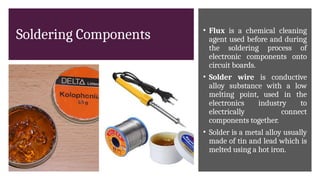
Soldering Components •Flux is a chemical cleaning
agent used before and during
the soldering process of
electronic components onto
circuit boards.
• Solder wire is conductive
alloy substance with a low
melting point, used in the
electronics industry to
electrically connect
components together.
• Solder is a metal alloy usually
made of tin and lead which is
melted using a hot iron.