Week 8:
Motivating Employees
Monash
Business &
Economics
2
 1. Draw a mind map of week 7’s topic
– Define leadership
– Earlier theories of leadership
– Fiedler’s contingency leadership theories
– Contemporary view to leadership
– Five sources of power
 2. Grade Week 7’s self-reflections
 3. Any Qs?
Block 1. Mind map, self-reflections and
inquiries
− Define leaders and leadership
− Differentiate between trait, behavioural and
contingency theories of leadership, identifying the
context in which these theories were developed
− Investigate the need for and value of team leadership
− Explore sources from which leaders derive power
− Understand some of the issues pertaining to
leadership in the 21st century
Last week: Functions of Management (L)
– Define motivation
– Understand the difference between content (what) and
process(how) theories of motivation
– Consider money as a motivation tool
– Explore current issues in motivation
– Identify what leaders and managers can do in practice
to motivate their employees
This week: Motivating employees
5
 Google…searching for? (pp.641-642)
 https://www.google.com/about/careers/lifeatgoogle/working-at-google-
new-york.html
 In groups of 3-4, develop & justify your answers for:
1. What school of thought on human motivation best explains Google’s current strategy of
motivating its large workforce?
2. What would it be like to work at Google? Is the work environment created by Google
attractive to you as a potential recruit?
3. How is Google using money as a motivator? Has it been successful with its current
strategy on the use of money as a motivator?
4. Despite the best efforts of Google it is struggling to retain some of its most talented
employees. Why is that?
5. What are the biggest challenge facing Google in motivating its current employees as well
as retaining their most skilled employees?
6. If you were in charge of managing and motivating a group of employees at Google, how
would you keep your employees motivated?
Block 2. Illustrative case study
6
 Part A: Motivation Exercise
1. Are the group selections more reflective of motivators or hygiene factors?
2. What implications do the class findings raise for students in terms of their future careers?
 Part B: Class discussion on motivating culturally diverse employees
Staff engagement in the Asia-Pacific region, P. 613
1. How is motivation practiced and understood in your country of origin?
2. Do the four theories we covered in the lecture accurately explain how people are
motivated in your culture?
Block 3. Class activity
7
 Short Answer Question (5 marks each)
1. Discuss the motivation implications of equity theory;
2. Briefly explain the challenges managers face in motivating unique
groups of workers.
Block 4: Exam preparation
8
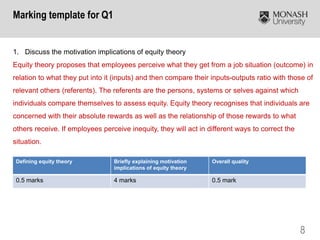
1. Discuss the motivation implications of equity theory
Equity theory proposes that employees perceive what they get from a job situation (outcome) in
relation to what they put into it (inputs) and then compare their inputs-outputs ratio with those of
relevant others (referents). The referents are the persons, systems or selves against which
individuals compare themselves to assess equity. Equity theory recognises that individuals are
concerned with their absolute rewards as well as the relationship of those rewards to what
others receive. If employees perceive inequity, they will act in different ways to correct the
situation.
Marking template for Q1
Defining equity theory Briefly explaining motivation
implications of equity theory
Overall quality
0.5 marks 4 marks 0.5 mark
9
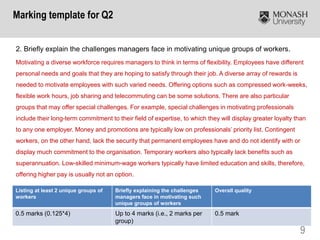
2. Briefly explain the challenges managers face in motivating unique groups of workers.
Motivating a diverse workforce requires managers to think in terms of flexibility. Employees have different
personal needs and goals that they are hoping to satisfy through their job. A diverse array of rewards is
needed to motivate employees with such varied needs. Offering options such as compressed work-weeks,
flexible work hours, job sharing and telecommuting can be some solutions. There are also particular
groups that may offer special challenges. For example, special challenges in motivating professionals
include their long-term commitment to their field of expertise, to which they will display greater loyalty than
to any one employer. Money and promotions are typically low on professionals’ priority list. Contingent
workers, on the other hand, lack the security that permanent employees have and do not identify with or
display much commitment to the organisation. Temporary workers also typically lack benefits such as
superannuation. Low-skilled minimum-wage workers typically have limited education and skills, therefore,
offering higher pay is usually not an option.
Marking template for Q2
Listing at least 2 unique groups of
workers
Briefly explaining the challenges
managers face in motivating such
unique groups of workers
Overall quality
0.5 marks (0.125*4) Up to 4 marks (i.e., 2 marks per
group)
0.5 mark
10
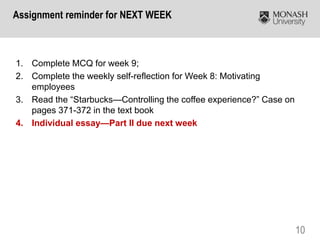
1. Complete MCQ for week 9;
2. Complete the weekly self-reflection for Week 8: Motivating
employees
3. Read the “Starbucks—Controlling the coffee experience?” Case on
pages 371-372 in the text book
4. Individual essay—Part II due next week
Assignment reminder for NEXT WEEK

Week8 Introduction to management

  • 1.
  • 2.
    2  1. Drawa mind map of week 7’s topic – Define leadership – Earlier theories of leadership – Fiedler’s contingency leadership theories – Contemporary view to leadership – Five sources of power  2. Grade Week 7’s self-reflections  3. Any Qs? Block 1. Mind map, self-reflections and inquiries
  • 3.
    − Define leadersand leadership − Differentiate between trait, behavioural and contingency theories of leadership, identifying the context in which these theories were developed − Investigate the need for and value of team leadership − Explore sources from which leaders derive power − Understand some of the issues pertaining to leadership in the 21st century Last week: Functions of Management (L)
  • 4.
    – Define motivation –Understand the difference between content (what) and process(how) theories of motivation – Consider money as a motivation tool – Explore current issues in motivation – Identify what leaders and managers can do in practice to motivate their employees This week: Motivating employees
  • 5.
    5  Google…searching for?(pp.641-642)  https://www.google.com/about/careers/lifeatgoogle/working-at-google- new-york.html  In groups of 3-4, develop & justify your answers for: 1. What school of thought on human motivation best explains Google’s current strategy of motivating its large workforce? 2. What would it be like to work at Google? Is the work environment created by Google attractive to you as a potential recruit? 3. How is Google using money as a motivator? Has it been successful with its current strategy on the use of money as a motivator? 4. Despite the best efforts of Google it is struggling to retain some of its most talented employees. Why is that? 5. What are the biggest challenge facing Google in motivating its current employees as well as retaining their most skilled employees? 6. If you were in charge of managing and motivating a group of employees at Google, how would you keep your employees motivated? Block 2. Illustrative case study
  • 6.
    6  Part A:Motivation Exercise 1. Are the group selections more reflective of motivators or hygiene factors? 2. What implications do the class findings raise for students in terms of their future careers?  Part B: Class discussion on motivating culturally diverse employees Staff engagement in the Asia-Pacific region, P. 613 1. How is motivation practiced and understood in your country of origin? 2. Do the four theories we covered in the lecture accurately explain how people are motivated in your culture? Block 3. Class activity
  • 7.
    7  Short AnswerQuestion (5 marks each) 1. Discuss the motivation implications of equity theory; 2. Briefly explain the challenges managers face in motivating unique groups of workers. Block 4: Exam preparation
  • 8.
    8 1. Discuss themotivation implications of equity theory Equity theory proposes that employees perceive what they get from a job situation (outcome) in relation to what they put into it (inputs) and then compare their inputs-outputs ratio with those of relevant others (referents). The referents are the persons, systems or selves against which individuals compare themselves to assess equity. Equity theory recognises that individuals are concerned with their absolute rewards as well as the relationship of those rewards to what others receive. If employees perceive inequity, they will act in different ways to correct the situation. Marking template for Q1 Defining equity theory Briefly explaining motivation implications of equity theory Overall quality 0.5 marks 4 marks 0.5 mark
  • 9.
    9 2. Briefly explainthe challenges managers face in motivating unique groups of workers. Motivating a diverse workforce requires managers to think in terms of flexibility. Employees have different personal needs and goals that they are hoping to satisfy through their job. A diverse array of rewards is needed to motivate employees with such varied needs. Offering options such as compressed work-weeks, flexible work hours, job sharing and telecommuting can be some solutions. There are also particular groups that may offer special challenges. For example, special challenges in motivating professionals include their long-term commitment to their field of expertise, to which they will display greater loyalty than to any one employer. Money and promotions are typically low on professionals’ priority list. Contingent workers, on the other hand, lack the security that permanent employees have and do not identify with or display much commitment to the organisation. Temporary workers also typically lack benefits such as superannuation. Low-skilled minimum-wage workers typically have limited education and skills, therefore, offering higher pay is usually not an option. Marking template for Q2 Listing at least 2 unique groups of workers Briefly explaining the challenges managers face in motivating such unique groups of workers Overall quality 0.5 marks (0.125*4) Up to 4 marks (i.e., 2 marks per group) 0.5 mark
  • 10.
    10 1. Complete MCQfor week 9; 2. Complete the weekly self-reflection for Week 8: Motivating employees 3. Read the “Starbucks—Controlling the coffee experience?” Case on pages 371-372 in the text book 4. Individual essay—Part II due next week Assignment reminder for NEXT WEEK