Ms. Sherey Setenta
23 August, 2022
• ¼ sheet of paper
• ballpen
• notebook for taking down notes
• Identify the general
pattern of a scientific
investigation and
enhance students'
spelling and
vocabulary words;
• Perform various
activities to
demonstrate an
understanding of the
concepts; and
• Realize the use of a
scientific approach in
dealing with a problem
and in any observable
phenomenon.
1.How often do you go to
church with your family
or friends? Are you
familiar with this old
church in Kawit?
2) On your way to the Mary
Magdalene Church together
with a friend, you noticed
that your wallet is missing,
what would be your initial
reaction?
3) What must you do to find
your missing wallet?
1) Science Process Skills
2) Manipulative Skills
Research activities follow a general pattern that will bring
you convenience in dealing with research and in your day-
to-day activities.
1. Observation
 Researchers make use of
their senses around them
to spot problem
areas.
2. Identification of a Problem
 Researchers develop a
question that is answerable
by how and why.
3. Information Gathering of
Preliminary Data
 Read books, magazines,
use the internet for
related websites, or ask
professionals to learn
about the effect or area of
study.
4. Formulation of Hypothesis
 Identifying variables is
necessary before you can
make a hypothesis.
 Hypothesis is an educated
guess about the
relationships between
independent and
dependent variables.
Example:
A scientist hypothesizes that the
temperature at which an ostrich’s
egg is incubated will determine
whether the ostrich will be male or
female. What is the independent
variable of this experiment?
5. Experimentation
 Design an experiment to test
each hypothesis.
 Make a step-by-step list of
what you will do to answer
each question. This list is
called Experimental
Procedure.
5. Experimentation
 Recording of the results is
necessary like data, graph, and
description of the observed
outcome.
Three Types of Variables
1) Independent variable – is a
manipulated factor that
intentionally varied by the
experimenter (the x-axis).
Three Types of Variables
2) Dependent variable – is a
responding factor that may change
as a result of changes made in the
independent variable (the y-axis).
Three Types of Variables
3) Control group – serves as the
standard comparison in all
experiments. It is exposed to the
same conditions as the experimental
group except for the variable being
tested.
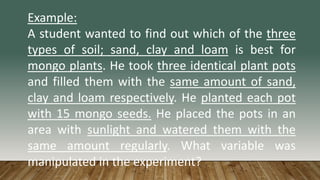
Example:
A student wanted to find out which of the three
types of soil; sand, clay and loam is best for
mongo plants. He took three identical plant pots
and filled them with the same amount of sand,
clay and loam respectively. He planted each pot
with 15 mongo seeds. He placed the pots in an
area with sunlight and watered them with the
same amount regularly. What variable was
manipulated in the experiment?
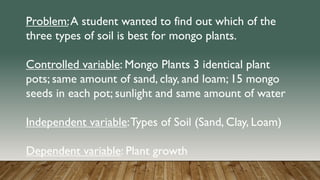
Problem:A student wanted to find out which of the
three types of soil is best for mongo plants.
Controlled variable: Mongo Plants 3 identical plant
pots; same amount of sand, clay, and loam; 15 mongo
seeds in each pot; sunlight and same amount of water
Independent variable:Types of Soil (Sand, Clay, Loam)
Dependent variable: Plant growth
6. Gathering Data and
Interpreting Results
 Record what happened
 Presented in the form of a
table of processed numerical
data or graphs.
7. Draw Conclusion
 Is your hypothesis correct?
• If your hypothesis is not
correct, what could be the
answer to your question?
7. Draw Conclusion
• Summarize any difficulties
or problems you had
experimenting
with.
• Do you need to change the
procedure and repeat your
experiment?
7. Draw Conclusion
• What would you do
differently next time?
• List other things you learned
• If your hypothesis is not correct, what
could be the answer to your question?
• Summarize any difficulties or problems
you had experimenting with.
7. Draw conclusion
Research activities follow a general pattern that will bring
you convenience in dealing with research and in your day-
to-day activities.
• Do you need to change the procedure
and repeat your experiment?
• What would you do differently next
time?
• List other things you learned
7. Draw conclusion
Research activities follow a general pattern that will bring
you convenience in dealing with research and in your day-
to-day activities.
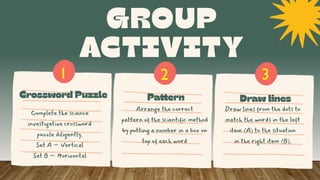
Complete the science
investigative crossword
puzzle diligently.
Set A – Vertical
Set B – Horizontal
Arrange the correct
pattern of the scientific method
by putting a number in a box on
top of each word
1 2 3
Draw lines from the dots to
match the words in the left
item (A) to the situation
in the right item (B).
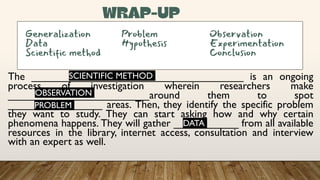
The ____________________________________ is an ongoing
process of investigation wherein researchers make
________________________around them to spot
________________ areas. Then, they identify the specific problem
they want to study. They can start asking how and why certain
phenomena happens. They will gather ___________ from all available
resources in the library, internet access, consultation and interview
with an expert as well.
Generalization Problem Observation
Data Hypothesis Experimentation
Scientific method Conclusion
SCIENTIFIC METHOD
OBSERVATION
PROBLEM
DATA
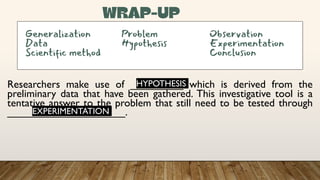
Researchers make use of _________ which is derived from the
preliminary data that have been gathered. This investigative tool is a
tentative answer to the problem that still need to be tested through
____________________.
Generalization Problem Observation
Data Hypothesis Experimentation
Scientific method Conclusion
HYPOTHESIS
EXPERIMENTATION
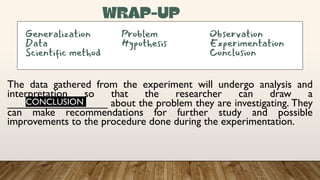
The data gathered from the experiment will undergo analysis and
interpretation so that the researcher can draw a
_________________ about the problem they are investigating. They
can make recommendations for further study and possible
improvements to the procedure done during the experimentation.
Generalization Problem Observation
Data Hypothesis Experimentation
Scientific method Conclusion
CONCLUSION

Week-1-Day-2-Scientific-Investigation.pptx

  • 1.
  • 3.
    • ¼ sheetof paper • ballpen • notebook for taking down notes
  • 5.
    • Identify thegeneral pattern of a scientific investigation and enhance students' spelling and vocabulary words;
  • 6.
    • Perform various activitiesto demonstrate an understanding of the concepts; and
  • 7.
    • Realize theuse of a scientific approach in dealing with a problem and in any observable phenomenon.
  • 9.
    1.How often doyou go to church with your family or friends? Are you familiar with this old church in Kawit?
  • 10.
    2) On yourway to the Mary Magdalene Church together with a friend, you noticed that your wallet is missing, what would be your initial reaction?
  • 11.
    3) What mustyou do to find your missing wallet?
  • 12.
    1) Science ProcessSkills 2) Manipulative Skills
  • 13.
    Research activities followa general pattern that will bring you convenience in dealing with research and in your day- to-day activities. 1. Observation  Researchers make use of their senses around them to spot problem areas.
  • 14.
    2. Identification ofa Problem  Researchers develop a question that is answerable by how and why.
  • 15.
    3. Information Gatheringof Preliminary Data  Read books, magazines, use the internet for related websites, or ask professionals to learn about the effect or area of study.
  • 16.
    4. Formulation ofHypothesis  Identifying variables is necessary before you can make a hypothesis.  Hypothesis is an educated guess about the relationships between independent and dependent variables.
  • 17.
    Example: A scientist hypothesizesthat the temperature at which an ostrich’s egg is incubated will determine whether the ostrich will be male or female. What is the independent variable of this experiment?
  • 18.
    5. Experimentation  Designan experiment to test each hypothesis.  Make a step-by-step list of what you will do to answer each question. This list is called Experimental Procedure.
  • 19.
    5. Experimentation  Recordingof the results is necessary like data, graph, and description of the observed outcome.
  • 20.
    Three Types ofVariables 1) Independent variable – is a manipulated factor that intentionally varied by the experimenter (the x-axis).
  • 21.
    Three Types ofVariables 2) Dependent variable – is a responding factor that may change as a result of changes made in the independent variable (the y-axis).
  • 22.
    Three Types ofVariables 3) Control group – serves as the standard comparison in all experiments. It is exposed to the same conditions as the experimental group except for the variable being tested.
  • 23.
    Example: A student wantedto find out which of the three types of soil; sand, clay and loam is best for mongo plants. He took three identical plant pots and filled them with the same amount of sand, clay and loam respectively. He planted each pot with 15 mongo seeds. He placed the pots in an area with sunlight and watered them with the same amount regularly. What variable was manipulated in the experiment?
  • 24.
    Problem:A student wantedto find out which of the three types of soil is best for mongo plants. Controlled variable: Mongo Plants 3 identical plant pots; same amount of sand, clay, and loam; 15 mongo seeds in each pot; sunlight and same amount of water Independent variable:Types of Soil (Sand, Clay, Loam) Dependent variable: Plant growth
  • 25.
    6. Gathering Dataand Interpreting Results  Record what happened  Presented in the form of a table of processed numerical data or graphs.
  • 26.
    7. Draw Conclusion Is your hypothesis correct? • If your hypothesis is not correct, what could be the answer to your question?
  • 27.
    7. Draw Conclusion •Summarize any difficulties or problems you had experimenting with. • Do you need to change the procedure and repeat your experiment?
  • 28.
    7. Draw Conclusion •What would you do differently next time? • List other things you learned
  • 29.
    • If yourhypothesis is not correct, what could be the answer to your question? • Summarize any difficulties or problems you had experimenting with. 7. Draw conclusion Research activities follow a general pattern that will bring you convenience in dealing with research and in your day- to-day activities.
  • 30.
    • Do youneed to change the procedure and repeat your experiment? • What would you do differently next time? • List other things you learned 7. Draw conclusion Research activities follow a general pattern that will bring you convenience in dealing with research and in your day- to-day activities.
  • 31.
    Complete the science investigativecrossword puzzle diligently. Set A – Vertical Set B – Horizontal Arrange the correct pattern of the scientific method by putting a number in a box on top of each word 1 2 3 Draw lines from the dots to match the words in the left item (A) to the situation in the right item (B).
  • 32.
    The ____________________________________ isan ongoing process of investigation wherein researchers make ________________________around them to spot ________________ areas. Then, they identify the specific problem they want to study. They can start asking how and why certain phenomena happens. They will gather ___________ from all available resources in the library, internet access, consultation and interview with an expert as well. Generalization Problem Observation Data Hypothesis Experimentation Scientific method Conclusion SCIENTIFIC METHOD OBSERVATION PROBLEM DATA
  • 33.
    Researchers make useof _________ which is derived from the preliminary data that have been gathered. This investigative tool is a tentative answer to the problem that still need to be tested through ____________________. Generalization Problem Observation Data Hypothesis Experimentation Scientific method Conclusion HYPOTHESIS EXPERIMENTATION
  • 34.
    The data gatheredfrom the experiment will undergo analysis and interpretation so that the researcher can draw a _________________ about the problem they are investigating. They can make recommendations for further study and possible improvements to the procedure done during the experimentation. Generalization Problem Observation Data Hypothesis Experimentation Scientific method Conclusion CONCLUSION