Lecture 23
Encounter in Depth and Conclusion
Xuan ‘Silvia’ Zhang
Washington University in St. Louis
http://classes.engineering.wustl.edu/ese461/
Some Final Administrative Stuff
2
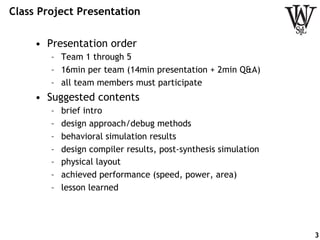
Class Project Presentation
•  Presentation order
–  Team 1 through 5
–  16min per team (14min presentation + 2min Q&A)
–  all team members must participate
•  Suggested contents
–  brief intro
–  design approach/debug methods
–  behavioral simulation results
–  design compiler results, post-synthesis simulation
–  physical layout
–  achieved performance (speed, power, area)
–  lesson learned
3
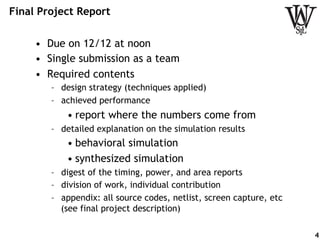
Final Project Report
•  Due on 12/12 at noon
•  Single submission as a team
•  Required contents
–  design strategy (techniques applied)
–  achieved performance
• report where the numbers come from
–  detailed explanation on the simulation results
• behavioral simulation
• synthesized simulation
–  digest of the timing, power, and area reports
–  division of work, individual contribution
–  appendix: all source codes, netlist, screen capture, etc
(see final project description)
4
Course Evaluation
•  Appreciate your feedback
•  Start on today
•  Please complete by December 12th
•  Will account for 3 points in the final grade
5
Encounter in Depth
6
Chapter 4: Data Preparation
•  Technology file
–  design rules and physical library: .LEF
•  I/O assignment
–  manually create I/O assignment file
•  Timing libraries
–  .lib
•  Timing constraints
–  .sdc (write_sdc)
•  Check designs
–  checkDesign
7
Chapter 5: Importing and Exporting Designs
•  Prepare the netlist
–  synthesized netlist with unique cell types (.syn.v)
•  Begin with LEF and Verilog
–  page 123
•  Load config files
–  loadConfig
•  Save and restore designs
•  Import and export design data
–  floorplan, I/O, etc.
•  Convert to GDSII
–  setStreamOutMode
8
Chapter 12: Floorplanning the Design
Chapter 13: Power Planning and Routing
•  Utilization
•  Edit Pins
–  use the Pin Editor: spreading pins, spacing
•  Resize and Rotate
•  Add core ring
–  core ring, block ring
•  Add stripes
–  core area, over block area
•  Global net connections
–  globalNetConnect –type pgpin –pin pin_name –all -
override
9
Chapter 15: Placing the Design
•  Prepare for placement
–  checkDesign, checkPlace
–  timeDesign –prePlace
–  createObstruct (no need)
–  planDesign or manual place and fix hard blocks
•  Add well-tap and end-cap cells
•  Place standard cells
–  placeDesign
–  setPlaceMode
•  Check Placement
–  checkPlace
10
Chapter 16: Synthesizing Clock Trees
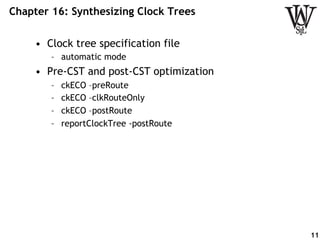
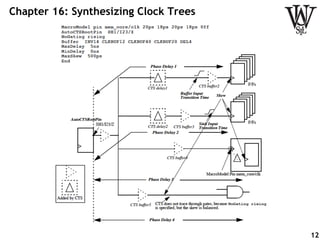
•  Clock tree specification file
–  automatic mode
•  Pre-CST and post-CST optimization
–  ckECO –preRoute
–  ckECO –clkRouteOnly
–  ckECO –postRoute
–  reportClockTree -postRoute
11
Chapter 16: Synthesizing Clock Trees
12
Chapter 20: Using the NanoRoute Router
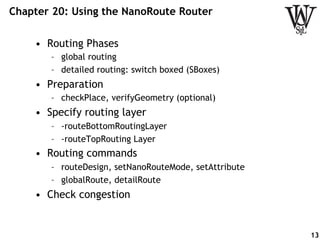
•  Routing Phases
–  global routing
–  detailed routing: switch boxed (SBoxes)
•  Preparation
–  checkPlace, verifyGeometry (optional)
•  Specify routing layer
–  -routeBottomRoutingLayer
–  -routeTopRouting Layer
•  Routing commands
–  routeDesign, setNanoRouteMode, setAttribute
–  globalRoute, detailRoute
•  Check congestion
13
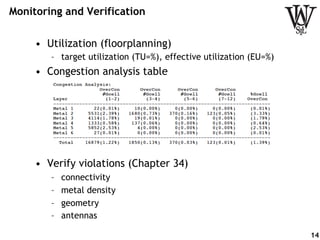
Monitoring and Verification
•  Utilization (floorplanning)
–  target utilization (TU=%), effective utilization (EU=%)
•  Congestion analysis table
•  Verify violations (Chapter 34)
–  connectivity
–  metal density
–  geometry
–  antennas
14
Conclusion
15
Topics Covered
•  Technology and Methods
–  digital binary logic, Moore’s Law
–  level of abstraction -> design automation principles
•  Design Flow
–  Algorithmic and architecture optimization
–  Synthesis: power, area, timing constraints
–  Static Timing Analysis
–  Physical Design: floorplan, place and route
•  Languages and Tools
–  Verilog, Tcl
–  Synopsys VCS (Verilog Simulation)
–  Synopsys Design Compiler (Netlist Synthesis)
–  Cadence SOC Encounter (Physical Design)
16
17
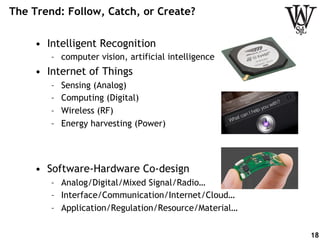
The Trend: Follow, Catch, or Create?
•  Intelligent Recognition
–  computer vision, artificial intelligence
•  Internet of Things
–  Sensing (Analog)
–  Computing (Digital)
–  Wireless (RF)
–  Energy harvesting (Power)
•  Software-Hardware Co-design
–  Analog/Digital/Mixed Signal/Radio…
–  Interface/Communication/Internet/Cloud…
–  Application/Regulation/Resource/Material…
18
ESE 566A: Modern System-on-Chip Design
•  Advanced topics
–  system-on-chip
–  software/hardware partition
–  high-level synthesis
–  reliability, resilience, security
•  More Project-centric
•  More open-ended and research-oriented
19
Research Theme (XZ Group)
•  Problem
–  designing micro-scale autonomous systems with
enhanced security and resilience.
•  Approach
–  co-design of algorithm, computer architecture,
circuits, and sensing and actuation mechanisms.
•  Projects
–  reconfigurable deep learning hardware
–  energy-efficient software-assisted power delivery
–  verifiable hardware against side-channel attack
–  sensor-fusion chip for vision-based robotic control
–  analog-coprocessor to speed up scientific computing
–  novel devices for non-reciprocal energy transfer
20
Questions?
Comments?
Discussion?
21

week15a.pdf

  • 1.
    Lecture 23 Encounter inDepth and Conclusion Xuan ‘Silvia’ Zhang Washington University in St. Louis http://classes.engineering.wustl.edu/ese461/
  • 2.
  • 3.
    Class Project Presentation • Presentation order –  Team 1 through 5 –  16min per team (14min presentation + 2min Q&A) –  all team members must participate •  Suggested contents –  brief intro –  design approach/debug methods –  behavioral simulation results –  design compiler results, post-synthesis simulation –  physical layout –  achieved performance (speed, power, area) –  lesson learned 3
  • 4.
    Final Project Report • Due on 12/12 at noon •  Single submission as a team •  Required contents –  design strategy (techniques applied) –  achieved performance • report where the numbers come from –  detailed explanation on the simulation results • behavioral simulation • synthesized simulation –  digest of the timing, power, and area reports –  division of work, individual contribution –  appendix: all source codes, netlist, screen capture, etc (see final project description) 4
  • 5.
    Course Evaluation •  Appreciateyour feedback •  Start on today •  Please complete by December 12th •  Will account for 3 points in the final grade 5
  • 6.
  • 7.
    Chapter 4: DataPreparation •  Technology file –  design rules and physical library: .LEF •  I/O assignment –  manually create I/O assignment file •  Timing libraries –  .lib •  Timing constraints –  .sdc (write_sdc) •  Check designs –  checkDesign 7
  • 8.
    Chapter 5: Importingand Exporting Designs •  Prepare the netlist –  synthesized netlist with unique cell types (.syn.v) •  Begin with LEF and Verilog –  page 123 •  Load config files –  loadConfig •  Save and restore designs •  Import and export design data –  floorplan, I/O, etc. •  Convert to GDSII –  setStreamOutMode 8
  • 9.
    Chapter 12: Floorplanningthe Design Chapter 13: Power Planning and Routing •  Utilization •  Edit Pins –  use the Pin Editor: spreading pins, spacing •  Resize and Rotate •  Add core ring –  core ring, block ring •  Add stripes –  core area, over block area •  Global net connections –  globalNetConnect –type pgpin –pin pin_name –all - override 9
  • 10.
    Chapter 15: Placingthe Design •  Prepare for placement –  checkDesign, checkPlace –  timeDesign –prePlace –  createObstruct (no need) –  planDesign or manual place and fix hard blocks •  Add well-tap and end-cap cells •  Place standard cells –  placeDesign –  setPlaceMode •  Check Placement –  checkPlace 10
  • 11.
    Chapter 16: SynthesizingClock Trees •  Clock tree specification file –  automatic mode •  Pre-CST and post-CST optimization –  ckECO –preRoute –  ckECO –clkRouteOnly –  ckECO –postRoute –  reportClockTree -postRoute 11
  • 12.
  • 13.
    Chapter 20: Usingthe NanoRoute Router •  Routing Phases –  global routing –  detailed routing: switch boxed (SBoxes) •  Preparation –  checkPlace, verifyGeometry (optional) •  Specify routing layer –  -routeBottomRoutingLayer –  -routeTopRouting Layer •  Routing commands –  routeDesign, setNanoRouteMode, setAttribute –  globalRoute, detailRoute •  Check congestion 13
  • 14.
    Monitoring and Verification • Utilization (floorplanning) –  target utilization (TU=%), effective utilization (EU=%) •  Congestion analysis table •  Verify violations (Chapter 34) –  connectivity –  metal density –  geometry –  antennas 14
  • 15.
  • 16.
    Topics Covered •  Technologyand Methods –  digital binary logic, Moore’s Law –  level of abstraction -> design automation principles •  Design Flow –  Algorithmic and architecture optimization –  Synthesis: power, area, timing constraints –  Static Timing Analysis –  Physical Design: floorplan, place and route •  Languages and Tools –  Verilog, Tcl –  Synopsys VCS (Verilog Simulation) –  Synopsys Design Compiler (Netlist Synthesis) –  Cadence SOC Encounter (Physical Design) 16
  • 17.
  • 18.
    The Trend: Follow,Catch, or Create? •  Intelligent Recognition –  computer vision, artificial intelligence •  Internet of Things –  Sensing (Analog) –  Computing (Digital) –  Wireless (RF) –  Energy harvesting (Power) •  Software-Hardware Co-design –  Analog/Digital/Mixed Signal/Radio… –  Interface/Communication/Internet/Cloud… –  Application/Regulation/Resource/Material… 18
  • 19.
    ESE 566A: ModernSystem-on-Chip Design •  Advanced topics –  system-on-chip –  software/hardware partition –  high-level synthesis –  reliability, resilience, security •  More Project-centric •  More open-ended and research-oriented 19
  • 20.
    Research Theme (XZGroup) •  Problem –  designing micro-scale autonomous systems with enhanced security and resilience. •  Approach –  co-design of algorithm, computer architecture, circuits, and sensing and actuation mechanisms. •  Projects –  reconfigurable deep learning hardware –  energy-efficient software-assisted power delivery –  verifiable hardware against side-channel attack –  sensor-fusion chip for vision-based robotic control –  analog-coprocessor to speed up scientific computing –  novel devices for non-reciprocal energy transfer 20
  • 21.