SOLUTION
LESSON OBJECTIVES
By the end of this lesson the students should be able to;
1. Define solution
2. Differentiate between concentrated and diluted
solution
3. Prepare solutions with different concentration
4. Solve simple calculations
DEFINITION OF SOLUTION
This is a mixture of solute and solvent, i.e, Solute + Solvent = Solution
It can be homogeneous with a uniform composition, e.g, an
unsaturated solution of a sodium chloride, or heterogeneous with
non-uniform composition like an unsaturated solution of the same
salt.
Solution is defined as a homogeneous mixture of two or more
chemical substances. The state of matter of a solution may be solid,
liquid or gaseous.
• For example, common salt in water (liquid solution), air (gaseous
solution), alloys (solid solution), etc.
COMPONENTS OF A SOLUTION
• Solute
• This is a substance that dissolves in a solvent to form a
solution. It can be solid, liquid or gas. Examples include
common salt, sugar, copper (II) tetraoxosulphate (VI) etc.
• Solvent
• This is a substance that dissolves a solute to form a
solution. It can be liquid or gas. Examples are water,
ethanol, benzene etc.
AQUEOUS SOLUTIONS AND NON-AQUEOUS SOLUTIONS
• Aqueous solutions
• Solutions that contain water as the solvent are called aqueous
solutions. For example, sugar in water, carbon dioxide in
water, etc.
• Non-aqueous solutions
• Solutions that contain a solvent other than water are called
non-aqueous solutions. Ether, benzene, petrol, carbon
tetrachloride etc., are some common solvents.
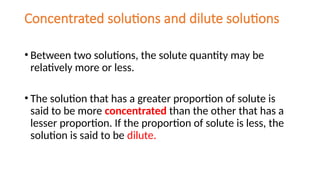
Concentrated solutions and dilute solutions
• Between two solutions, the solute quantity may be
relatively more or less.
• The solution that has a greater proportion of solute is
said to be more concentrated than the other that has a
lesser proportion. If the proportion of solute is less, the
solution is said to be dilute.
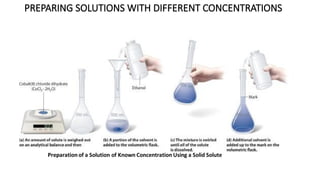
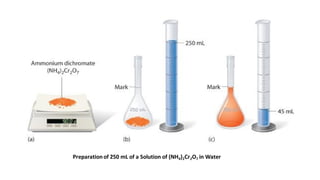
PREPARING SOLUTIONS WITH DIFFERENT CONCENTRATIONS
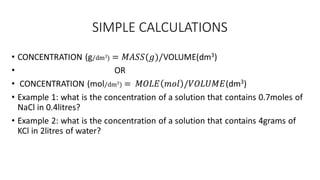
SIMPLE CALCULATIONS
•
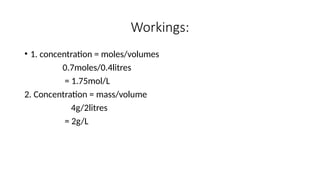
Workings:
• 1. concentration = moles/volumes
0.7moles/0.4litres
= 1.75mol/L
2. Concentration = mass/volume
4g/2litres
= 2g/L
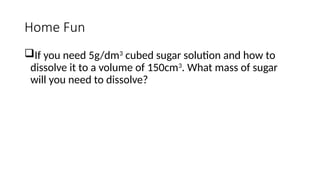
Home Fun
If you need 5g/dm3
cubed sugar solution and how to
dissolve it to a volume of 150cm3
. What mass of sugar
will you need to dissolve?

week1 year8chem junior secondary school note .pptx

  • 1.
  • 2.
    LESSON OBJECTIVES By theend of this lesson the students should be able to; 1. Define solution 2. Differentiate between concentrated and diluted solution 3. Prepare solutions with different concentration 4. Solve simple calculations
  • 3.
    DEFINITION OF SOLUTION Thisis a mixture of solute and solvent, i.e, Solute + Solvent = Solution It can be homogeneous with a uniform composition, e.g, an unsaturated solution of a sodium chloride, or heterogeneous with non-uniform composition like an unsaturated solution of the same salt. Solution is defined as a homogeneous mixture of two or more chemical substances. The state of matter of a solution may be solid, liquid or gaseous. • For example, common salt in water (liquid solution), air (gaseous solution), alloys (solid solution), etc.
  • 4.
    COMPONENTS OF ASOLUTION • Solute • This is a substance that dissolves in a solvent to form a solution. It can be solid, liquid or gas. Examples include common salt, sugar, copper (II) tetraoxosulphate (VI) etc. • Solvent • This is a substance that dissolves a solute to form a solution. It can be liquid or gas. Examples are water, ethanol, benzene etc.
  • 5.
    AQUEOUS SOLUTIONS ANDNON-AQUEOUS SOLUTIONS • Aqueous solutions • Solutions that contain water as the solvent are called aqueous solutions. For example, sugar in water, carbon dioxide in water, etc. • Non-aqueous solutions • Solutions that contain a solvent other than water are called non-aqueous solutions. Ether, benzene, petrol, carbon tetrachloride etc., are some common solvents.
  • 6.
    Concentrated solutions anddilute solutions • Between two solutions, the solute quantity may be relatively more or less. • The solution that has a greater proportion of solute is said to be more concentrated than the other that has a lesser proportion. If the proportion of solute is less, the solution is said to be dilute.

  • 7.
    PREPARING SOLUTIONS WITHDIFFERENT CONCENTRATIONS
  • 9.
  • 10.
    Workings: • 1. concentration= moles/volumes 0.7moles/0.4litres = 1.75mol/L 2. Concentration = mass/volume 4g/2litres = 2g/L
  • 11.
    Home Fun If youneed 5g/dm3 cubed sugar solution and how to dissolve it to a volume of 150cm3 . What mass of sugar will you need to dissolve?