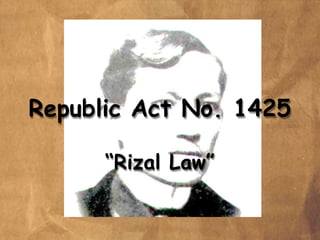
Republic Act No. 1425
“Rizal Law”
Rizal Bill (1956)
• Proposed by Claro M. Recto
and Jose P. Laurel
• Mandating schools to offer
a course on Rizal’s life,
works and writings
• Met intense opposition
from the Catholic church
Rizal Bill (1956)
 April 3, 1956 – Senate Bill no. 438
(AN ACT TO MAKE NOLI ME
TANGERE AND EL
FILIBUSTERISMO COMPULSORY
READING MATTER IN ALL
PUBLIC AND PRIVATE
COLLEGES AND UNIVERSITIES
AND FOR OTHER PURPOSES)
“Noli Me Tangere and El
Filibusterismo must be read by all
Filipinos. They must be taken to
heart, for in their pages we see
ourselves as in a mirror, our defects
as well as our strength, our virtues as
well as our vices. Only then would we
become conscious as a people, and so
learn to prepare ourselves for painful
sacrifices that ultimately lead to
self-reliance, self-respect, and
freedom (Laurel, Jr., 131).
Arguments in the bill…
1.The bill was an attempt to discredit the Catholic
religion
2.Inimical to the tenets of the faith to which 170
lines in Noli Me Tangere and 50 lines in El
Filibusterismo were offensive to the Church
doctrine.
3.The bill might divide the nation
4.Compulsion to read something against one's faith
impaired freedom of speech and religious
freedom.
“Rizal did not pretend to teach religion or
theology when he wrote those books. He aimed
at inculcating civic consciousness in the
Filipinos, national dignity, personal pride, and
patriotism...but while he criticized and ridiculed
the unworthy behavior of certain ministers of
the church, he made exceptions in favor of the
worthy ones, like the Dominican friar, Padre
Fernandez, and the virtuous native priest, Padre
Florentino, and the Jesuits in general (Laurel,
Jr., 132-133). “
• Catholic schools threatened
because of communist and
anti-Catholic Recto and
Laurel
• Archbishop of Manila, Rufino
Santos, requested Recto
to only require the
“expurgated” version of
Rizal’s two novels
• However, the priests who opposed
the passage of the bill
threatened the persons behind
the bill and might to be
considered as “heretic.”
• Those who opposed the Rizal Bill
painted Recto as communist and anti-
Catholic. According to Abinales and
Amoroso (2005), the Church feared
the bill would violate freedom of
conscience and religion.
In the same way the opposition
threatened them by mentioning that the
schools handled by the Catholic Church
might be closed if the bill will be
converted into law. Even so, Recto and
Laurel countered the statement by
saying that if that were to happen,
schools would be “nationalized” and the
government would convert these schools
into Government-ruled institutions.
“The people who would eliminate
the books of Rizal from the
schools…would bot out from our
minds the memory of the national
hero…this is not a fight against
Recto but a fight against
Rizal…now that Rizal is dead and
they can no longer attempt at his
life, they are attempting to blot
out his memory.”
Senators who opposed the bill:
1. Francisco “Soc” Rodrigo
2. Mariano Cuenco
3. Decoroso Rosales
Groups who opposed the bill:
1. Catholic Action of the Philippines
2. Congregation of the Mission
3. Knights of Columbus
4. Catholic Teachers Guild
Groups who supported the bill:
1. Veteranos de la Revolucion
2. Alagad ni Rizal
3. Freemasons
4. Knights of Rizal
Rizal Law (R.A. 1425)
“An Act to Include in the Curricula of
All Public and Private Schools, Colleges
and Universities Courses on the Life,
Works and Writings of Jose Rizal,
particularly Noli Me Tangere and El
Filibusterismo, Authorizing the Printing
and Distribution thereof, and for Other
Purposes.”
• Enacted on June 12, 1956
• Co-written by Jose P. Laurel
and mentioned the aims of
the law:
1. to rededicate the ideals
of freedom and nationalism
2. to pay tribute to
Rizal’s efforts
3. to gain inspiring source
of patriotism from his
works
• Fidel Ramos directed CHEd
and DECS to fully implement
the law through CMO No.
247 in 1994
• CMO No. 3 was issued to
enforce strictly the law in
1995
Important points of R.A. 1425
• WHEREAS, today, more than any other
period of our history, there is a need for
a re-dedication to the ideals of freedom
and nationalism for which our heroes lived
and died;
• WHEREAS, it is meet that in honoring
them, particularly the national hero and
patriot, Jose Rizal, we remember with
special fondness and devotion their lives
and works that have shaped the national
character;
• WHEREAS, the life, works and writing of
Jose Rizal, particularly his novels Noli
Me Tangere and El Filibusterismo, are a
constant and inspiring source of
patriotism with which the minds of the
youth, especially during their formative
and decisive years in school, should be
suffused;
• WHEREAS, all educational institutions are
under the supervision of, and subject to
regulation by the State, and all schools
are enjoined to develop moral character,
personal discipline, civic conscience and
to teach the duties of citizenship;
Sections from R.A. 1425
SECTION 1. Courses on the life, works
and writings of Jose Rizal, particularly his
novel Noli Me Tangere and El
Filibusterismo, shall be included in the
curricula of all schools, colleges and
universities, public or private: Provided,
That in the collegiate courses, the original or
unexpurgated editions of the Noli Me
Tangere and El Filibusterismo or their
English translation shall be used as basic
texts.
SECTION 2. It shall be obligatory on all
schools, colleges and universities to keep
in their libraries an adequate number of
copies of the original and unexpurgated
editions of the Noli Me Tangere and El
Filibusterismo, as well as of Rizal’s other
works and biography. The said
unexpurgated editions of the Noli Me
Tangere and El Filibusterismo or their
translations in English as well as other
writings of Rizal shall be included in the list
of approved books for required reading in all
public or private schools, colleges and
universities.
• SECTION 3. The Board of National
Education shall cause the translation
of the Noli Me Tangere and El
Filibusterismo, as well as other
writings of Jose Rizal into English,
Tagalog and the principal Philippine
dialects; cause them to be printed in
cheap, popular editions; and cause them
to be distributed, free of charge, to
persons desiring to read them, through
the Purok organizations and Barrio
Councils throughout the country.
SECTION 4. Nothing in this Act shall
be construed as amendment or repealing
section nine hundred twenty-seven of
the Administrative Code, prohibiting the
discussion of religious doctrines by public
school teachers and other person engaged
in any public school.
SECTION 5. The sum of three hundred
thousand pesos is hereby authorized to
be appropriated out of any fund not
otherwise appropriated in the National
Treasury to carry out the purposes of
this Act.
Significance of R.A. 1425
• It provides insights on how to deal
with current problems;
• It helps to understand better
ourselves as Filipinos;
• It teaches nationalism;
• It provides various essential life
lessons; and
• It serves as a worthwhile inspiration
to every Filipino
“Our misfortunes are our own fault, let us
blame nobody else for them. But as long
as the Filipino people do not have
sufficient vigour to proclaim, head held
high and chest bared, their right to a life
their own in human society and to
guarantee it with their sacrifices, with
their very blood if necessary. Why give
them independence? What is the use of
independence if the slaves of today, will
become the tyrants of tomorrow? And no
doubt they will, because whoever submits
to tyranny, loves it!”
-Padre Florentino (El Filibusterismo, 1891)

Week 2 RA 1425.pptx

  • 1.
    Republic Act No.1425 “Rizal Law”
  • 2.
    Rizal Bill (1956) •Proposed by Claro M. Recto and Jose P. Laurel • Mandating schools to offer a course on Rizal’s life, works and writings • Met intense opposition from the Catholic church
  • 3.
    Rizal Bill (1956) April 3, 1956 – Senate Bill no. 438 (AN ACT TO MAKE NOLI ME TANGERE AND EL FILIBUSTERISMO COMPULSORY READING MATTER IN ALL PUBLIC AND PRIVATE COLLEGES AND UNIVERSITIES AND FOR OTHER PURPOSES)
  • 4.
    “Noli Me Tangereand El Filibusterismo must be read by all Filipinos. They must be taken to heart, for in their pages we see ourselves as in a mirror, our defects as well as our strength, our virtues as well as our vices. Only then would we become conscious as a people, and so learn to prepare ourselves for painful sacrifices that ultimately lead to self-reliance, self-respect, and freedom (Laurel, Jr., 131).
  • 6.
    Arguments in thebill… 1.The bill was an attempt to discredit the Catholic religion 2.Inimical to the tenets of the faith to which 170 lines in Noli Me Tangere and 50 lines in El Filibusterismo were offensive to the Church doctrine. 3.The bill might divide the nation 4.Compulsion to read something against one's faith impaired freedom of speech and religious freedom.
  • 7.
    “Rizal did notpretend to teach religion or theology when he wrote those books. He aimed at inculcating civic consciousness in the Filipinos, national dignity, personal pride, and patriotism...but while he criticized and ridiculed the unworthy behavior of certain ministers of the church, he made exceptions in favor of the worthy ones, like the Dominican friar, Padre Fernandez, and the virtuous native priest, Padre Florentino, and the Jesuits in general (Laurel, Jr., 132-133). “
  • 8.
    • Catholic schoolsthreatened because of communist and anti-Catholic Recto and Laurel • Archbishop of Manila, Rufino Santos, requested Recto to only require the “expurgated” version of Rizal’s two novels
  • 9.
    • However, thepriests who opposed the passage of the bill threatened the persons behind the bill and might to be considered as “heretic.” • Those who opposed the Rizal Bill painted Recto as communist and anti- Catholic. According to Abinales and Amoroso (2005), the Church feared the bill would violate freedom of conscience and religion.
  • 10.
    In the sameway the opposition threatened them by mentioning that the schools handled by the Catholic Church might be closed if the bill will be converted into law. Even so, Recto and Laurel countered the statement by saying that if that were to happen, schools would be “nationalized” and the government would convert these schools into Government-ruled institutions.
  • 11.
    “The people whowould eliminate the books of Rizal from the schools…would bot out from our minds the memory of the national hero…this is not a fight against Recto but a fight against Rizal…now that Rizal is dead and they can no longer attempt at his life, they are attempting to blot out his memory.”
  • 12.
    Senators who opposedthe bill: 1. Francisco “Soc” Rodrigo 2. Mariano Cuenco 3. Decoroso Rosales Groups who opposed the bill: 1. Catholic Action of the Philippines 2. Congregation of the Mission 3. Knights of Columbus 4. Catholic Teachers Guild
  • 13.
    Groups who supportedthe bill: 1. Veteranos de la Revolucion 2. Alagad ni Rizal 3. Freemasons 4. Knights of Rizal
  • 15.
    Rizal Law (R.A.1425) “An Act to Include in the Curricula of All Public and Private Schools, Colleges and Universities Courses on the Life, Works and Writings of Jose Rizal, particularly Noli Me Tangere and El Filibusterismo, Authorizing the Printing and Distribution thereof, and for Other Purposes.”
  • 16.
    • Enacted onJune 12, 1956 • Co-written by Jose P. Laurel and mentioned the aims of the law: 1. to rededicate the ideals of freedom and nationalism 2. to pay tribute to Rizal’s efforts 3. to gain inspiring source of patriotism from his works
  • 17.
    • Fidel Ramosdirected CHEd and DECS to fully implement the law through CMO No. 247 in 1994 • CMO No. 3 was issued to enforce strictly the law in 1995
  • 18.
    Important points ofR.A. 1425 • WHEREAS, today, more than any other period of our history, there is a need for a re-dedication to the ideals of freedom and nationalism for which our heroes lived and died; • WHEREAS, it is meet that in honoring them, particularly the national hero and patriot, Jose Rizal, we remember with special fondness and devotion their lives and works that have shaped the national character;
  • 19.
    • WHEREAS, thelife, works and writing of Jose Rizal, particularly his novels Noli Me Tangere and El Filibusterismo, are a constant and inspiring source of patriotism with which the minds of the youth, especially during their formative and decisive years in school, should be suffused; • WHEREAS, all educational institutions are under the supervision of, and subject to regulation by the State, and all schools are enjoined to develop moral character, personal discipline, civic conscience and to teach the duties of citizenship;
  • 20.
    Sections from R.A.1425 SECTION 1. Courses on the life, works and writings of Jose Rizal, particularly his novel Noli Me Tangere and El Filibusterismo, shall be included in the curricula of all schools, colleges and universities, public or private: Provided, That in the collegiate courses, the original or unexpurgated editions of the Noli Me Tangere and El Filibusterismo or their English translation shall be used as basic texts.
  • 21.
    SECTION 2. Itshall be obligatory on all schools, colleges and universities to keep in their libraries an adequate number of copies of the original and unexpurgated editions of the Noli Me Tangere and El Filibusterismo, as well as of Rizal’s other works and biography. The said unexpurgated editions of the Noli Me Tangere and El Filibusterismo or their translations in English as well as other writings of Rizal shall be included in the list of approved books for required reading in all public or private schools, colleges and universities.
  • 22.
    • SECTION 3.The Board of National Education shall cause the translation of the Noli Me Tangere and El Filibusterismo, as well as other writings of Jose Rizal into English, Tagalog and the principal Philippine dialects; cause them to be printed in cheap, popular editions; and cause them to be distributed, free of charge, to persons desiring to read them, through the Purok organizations and Barrio Councils throughout the country.
  • 23.
    SECTION 4. Nothingin this Act shall be construed as amendment or repealing section nine hundred twenty-seven of the Administrative Code, prohibiting the discussion of religious doctrines by public school teachers and other person engaged in any public school. SECTION 5. The sum of three hundred thousand pesos is hereby authorized to be appropriated out of any fund not otherwise appropriated in the National Treasury to carry out the purposes of this Act.
  • 24.
    Significance of R.A.1425 • It provides insights on how to deal with current problems; • It helps to understand better ourselves as Filipinos; • It teaches nationalism; • It provides various essential life lessons; and • It serves as a worthwhile inspiration to every Filipino
  • 27.
    “Our misfortunes areour own fault, let us blame nobody else for them. But as long as the Filipino people do not have sufficient vigour to proclaim, head held high and chest bared, their right to a life their own in human society and to guarantee it with their sacrifices, with their very blood if necessary. Why give them independence? What is the use of independence if the slaves of today, will become the tyrants of tomorrow? And no doubt they will, because whoever submits to tyranny, loves it!” -Padre Florentino (El Filibusterismo, 1891)

Editor's Notes

  • #5 Senator laurel
  • #9 the legislators, especially Recto, agreed to the condition of watering down the morally offensive parts of Rizal's novels before they were taught to schools. Manila Archbishop Rufino Santos penned an impassioned pastoral letter protesting the bill. 
  • #10 HERETICS a baptized member of the Roman Catholic Church who refuses to acknowledge or accept a revealed truth
  • #27 Carlos Botong Francisco