📌INTENDED LEARNING OUTCOMES
2
Understand the concept of global cities and
its characteristics;
Identify the various global cities and the
indices upon which they are measured; and
Analyze the demographic transition theory
What is Global City?
▫ Also called “power city”, “world city” or “alpha city”
▫ Global cities are major nodes in the interconnected
systems of information and money, and the wealth
that they capture is intimately related to the
specialized businesses that facilitate those flows.
3
Globalization as Spatial Phenomenon
4
• Based on places
• Global cities are integral to globalization as it is essential to these
global cities
General Characteristics of Global Cities
5
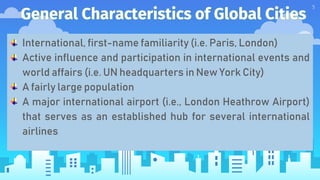
International, first-name familiarity (i.e. Paris, London)
Active influence and participation in international events and
world affairs (i.e. UN headquarters in New York City)
A fairly large population
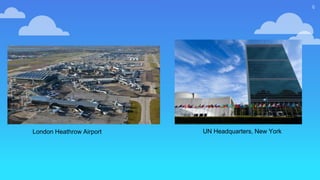
A major international airport (i.e., London Heathrow Airport)
that serves as an established hub for several international
airlines
6
London Heathrow Airport UN Headquarters, New York
General Characteristics of Global Cities
7
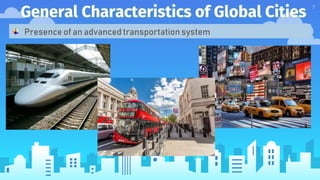
Presence of an advanced transportationsystem
General Characteristics of Global Cities
8
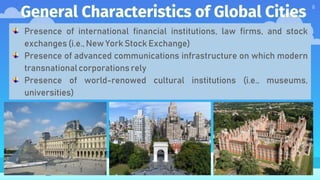
Presence of international financial institutions, law firms, and stock
exchanges (i.e.,New York Stock Exchange)
Presence of advanced communications infrastructure on which modern
transnationalcorporations rely
Presence of world-renowed cultural institutions (i.e., museums,
universities)
General Characteristics of Global Cities
9
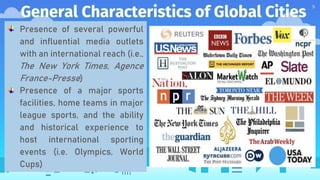
Presence of several powerful
and influential media outlets
with an international reach (i.e.,
The New York Times, Agence
France-Presse)
Presence of a major sports
facilities, home teams in major
league sports, and the ability
and historical experience to
host international sporting
events (i.e. Olympics, World
Cups)
Identification of Global Cities
10
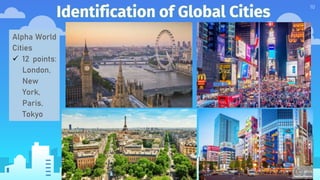
Alpha World
Cities
 12 points:
London,
New
York,
Paris,
Tokyo
Identification of Global Cities
11
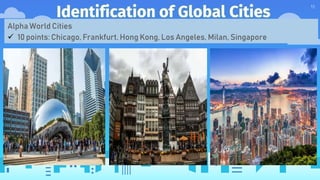
Alpha World Cities
 10 points: Chicago, Frankfurt, Hong Kong, Los Angeles, Milan, Singapore
Identification of Global Cities
12
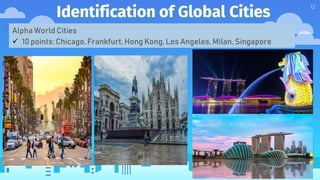
Alpha World Cities
 10 points: Chicago, Frankfurt, Hong Kong, Los Angeles, Milan, Singapore
Identification of Global Cities
13
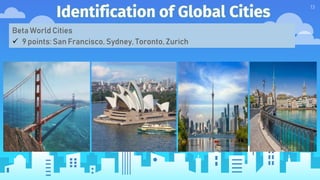
Beta World Cities
 9 points: San Francisco, Sydney, Toronto, Zurich
Identification of Global Cities
14
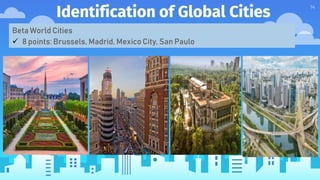
Beta World Cities
 8 points: Brussels, Madrid, Mexico City, San Paulo
Identification of Global Cities
15
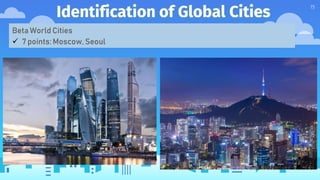
Beta World Cities
 7 points: Moscow, Seoul
Identification of Global Cities
16
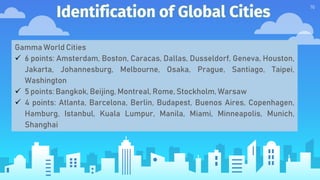
Gamma World Cities
 6 points: Amsterdam, Boston, Caracas, Dallas, Dusseldorf, Geneva, Houston,
Jakarta, Johannesburg, Melbourne, Osaka, Prague, Santiago, Taipei,
Washington
 5 points: Bangkok, Beijing, Montreal, Rome, Stockholm, Warsaw
 4 points: Atlanta, Barcelona, Berlin, Budapest, Buenos Aires, Copenhagen,
Hamburg, Istanbul, Kuala Lumpur, Manila, Miami, Minneapolis, Munich,
Shanghai
Global City Index
17
1. Business activity – presence of headquarters, services firms, number of
international conferences, value of goods through ports and airports
2. Human capital – size of foreign-born population, quality of universities,
number of international schools, internationalstudent population
3. Information exchange – accessibility of major TV news, number of
international news bureaus
4. Cultural experience – number of sporting events, museums, performing arts
venues
5. Political engagement – number of embassies, consulates, international
organizations, political conferences
Global Power City Index
18
1. Economy – refers to market attractiveness, economic vitality, business
environment, regulations, and risk
2. Research and development – refers to research background, readiness for
accepting and supporting researches, and research achievement
3. Cultural interaction – refers to trendsetting potential, accommodation
environment, dining and shopping, and volume of interaction
4. Livability – refers to working environment, cost of living, security and safety,
and life support functions
5. Environment – refers to ecology, pollution, and natural environment
6. Accessibility – refers to international transport infrastructure and inner city
transportationinfrastructure
Hello!
I am Jayden Smith
I am here because I love to give presentations.
You can find me at @username
19
Global Demography
20
21
What is Demography?
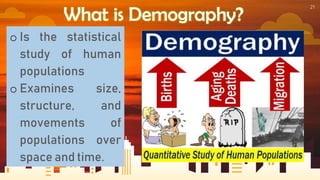
o Is the statistical
study of human
populations
o Examines size,
structure, and
movements of
populations over
space and time.
22
What is Population?
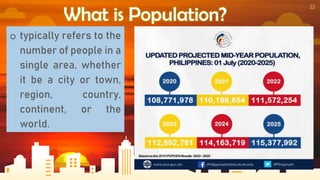
o typically refers to the
number of people in a
single area, whether
it be a city or town,
region, country,
continent, or the
world.
23
Demography
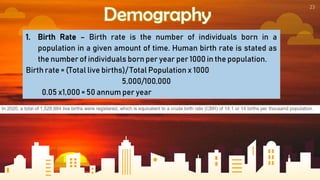
1. Birth Rate – Birth rate is the number of individuals born in a
population in a given amount of time. Human birth rate is stated as
the number of individuals born per year per 1000 in the population.
Birth rate = (Total live births)/ Total Population x 1000
5,000/100,000
0.05 x1,000 = 50 annum per year
24
Demography
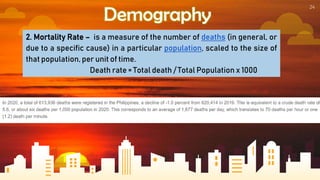
2. Mortality Rate – is a measure of the number of deaths (in general, or
due to a specific cause) in a particular population, scaled to the size of
that population, per unit of time.
Death rate = Total death / Total Population x 1000
25
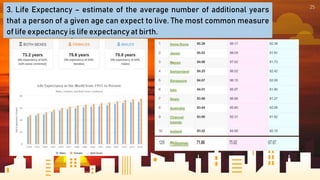
3. Life Expectancy – estimate of the average number of additional years
that a person of a given age can expect to live. The most common measure
of life expectancy is life expectancy at birth.
26
Demography
4. Fertility Rate – total number of children borne by a woman at a point of time during
her child-bearing age (15-45 years). Family size depends upon
 Duration of marriage
 Education of people
 Contraception method
 Socio economic status
27
Demography
4. Fertility Rate – total number of children borne by a woman at a point of time during
her child-bearing age (15-45 years). Family size depends upon
 Duration of marriage
 Education of people
 Contraception method
 Socio economic status
SlidesCarnival icons are editable shapes.
This means that you can:
● Resize them without losing quality.
● Change fill color and opacity.
● Change line color, width and style.
Isn’t that nice? :)
Examples:
28
Now you can use any emoji as an icon!
And of course it resizes without losing quality and you can change the color.
How? Follow Google instructions
https://twitter.com/googledocs/status/730087240156643328
✋👆👉👍👤👦👧👨👩👪💃🏃💑❤😂
😉😋😒😭👶😸🐟🍒🍔💣📌📖🔨🎃🎈
🎨🏈🏰🌏🔌🔑 and many more...
😉
29

MODULE 6.pptx

  • 2.
    📌INTENDED LEARNING OUTCOMES 2 Understandthe concept of global cities and its characteristics; Identify the various global cities and the indices upon which they are measured; and Analyze the demographic transition theory
  • 3.
    What is GlobalCity? ▫ Also called “power city”, “world city” or “alpha city” ▫ Global cities are major nodes in the interconnected systems of information and money, and the wealth that they capture is intimately related to the specialized businesses that facilitate those flows. 3
  • 4.
    Globalization as SpatialPhenomenon 4 • Based on places • Global cities are integral to globalization as it is essential to these global cities
  • 5.
    General Characteristics ofGlobal Cities 5 International, first-name familiarity (i.e. Paris, London) Active influence and participation in international events and world affairs (i.e. UN headquarters in New York City) A fairly large population A major international airport (i.e., London Heathrow Airport) that serves as an established hub for several international airlines
  • 6.
    6 London Heathrow AirportUN Headquarters, New York
  • 7.
    General Characteristics ofGlobal Cities 7 Presence of an advanced transportationsystem
  • 8.
    General Characteristics ofGlobal Cities 8 Presence of international financial institutions, law firms, and stock exchanges (i.e.,New York Stock Exchange) Presence of advanced communications infrastructure on which modern transnationalcorporations rely Presence of world-renowed cultural institutions (i.e., museums, universities)
  • 9.
    General Characteristics ofGlobal Cities 9 Presence of several powerful and influential media outlets with an international reach (i.e., The New York Times, Agence France-Presse) Presence of a major sports facilities, home teams in major league sports, and the ability and historical experience to host international sporting events (i.e. Olympics, World Cups)
  • 10.
    Identification of GlobalCities 10 Alpha World Cities  12 points: London, New York, Paris, Tokyo
  • 11.
    Identification of GlobalCities 11 Alpha World Cities  10 points: Chicago, Frankfurt, Hong Kong, Los Angeles, Milan, Singapore
  • 12.
    Identification of GlobalCities 12 Alpha World Cities  10 points: Chicago, Frankfurt, Hong Kong, Los Angeles, Milan, Singapore
  • 13.
    Identification of GlobalCities 13 Beta World Cities  9 points: San Francisco, Sydney, Toronto, Zurich
  • 14.
    Identification of GlobalCities 14 Beta World Cities  8 points: Brussels, Madrid, Mexico City, San Paulo
  • 15.
    Identification of GlobalCities 15 Beta World Cities  7 points: Moscow, Seoul
  • 16.
    Identification of GlobalCities 16 Gamma World Cities  6 points: Amsterdam, Boston, Caracas, Dallas, Dusseldorf, Geneva, Houston, Jakarta, Johannesburg, Melbourne, Osaka, Prague, Santiago, Taipei, Washington  5 points: Bangkok, Beijing, Montreal, Rome, Stockholm, Warsaw  4 points: Atlanta, Barcelona, Berlin, Budapest, Buenos Aires, Copenhagen, Hamburg, Istanbul, Kuala Lumpur, Manila, Miami, Minneapolis, Munich, Shanghai
  • 17.
    Global City Index 17 1.Business activity – presence of headquarters, services firms, number of international conferences, value of goods through ports and airports 2. Human capital – size of foreign-born population, quality of universities, number of international schools, internationalstudent population 3. Information exchange – accessibility of major TV news, number of international news bureaus 4. Cultural experience – number of sporting events, museums, performing arts venues 5. Political engagement – number of embassies, consulates, international organizations, political conferences
  • 18.
    Global Power CityIndex 18 1. Economy – refers to market attractiveness, economic vitality, business environment, regulations, and risk 2. Research and development – refers to research background, readiness for accepting and supporting researches, and research achievement 3. Cultural interaction – refers to trendsetting potential, accommodation environment, dining and shopping, and volume of interaction 4. Livability – refers to working environment, cost of living, security and safety, and life support functions 5. Environment – refers to ecology, pollution, and natural environment 6. Accessibility – refers to international transport infrastructure and inner city transportationinfrastructure
  • 19.
    Hello! I am JaydenSmith I am here because I love to give presentations. You can find me at @username 19
  • 20.
  • 21.
    21 What is Demography? oIs the statistical study of human populations o Examines size, structure, and movements of populations over space and time.
  • 22.
    22 What is Population? otypically refers to the number of people in a single area, whether it be a city or town, region, country, continent, or the world.
  • 23.
    23 Demography 1. Birth Rate– Birth rate is the number of individuals born in a population in a given amount of time. Human birth rate is stated as the number of individuals born per year per 1000 in the population. Birth rate = (Total live births)/ Total Population x 1000 5,000/100,000 0.05 x1,000 = 50 annum per year
  • 24.
    24 Demography 2. Mortality Rate– is a measure of the number of deaths (in general, or due to a specific cause) in a particular population, scaled to the size of that population, per unit of time. Death rate = Total death / Total Population x 1000
  • 25.
    25 3. Life Expectancy– estimate of the average number of additional years that a person of a given age can expect to live. The most common measure of life expectancy is life expectancy at birth.
  • 26.
    26 Demography 4. Fertility Rate– total number of children borne by a woman at a point of time during her child-bearing age (15-45 years). Family size depends upon  Duration of marriage  Education of people  Contraception method  Socio economic status
  • 27.
    27 Demography 4. Fertility Rate– total number of children borne by a woman at a point of time during her child-bearing age (15-45 years). Family size depends upon  Duration of marriage  Education of people  Contraception method  Socio economic status
  • 28.
    SlidesCarnival icons areeditable shapes. This means that you can: ● Resize them without losing quality. ● Change fill color and opacity. ● Change line color, width and style. Isn’t that nice? :) Examples: 28
  • 29.
    Now you canuse any emoji as an icon! And of course it resizes without losing quality and you can change the color. How? Follow Google instructions https://twitter.com/googledocs/status/730087240156643328 ✋👆👉👍👤👦👧👨👩👪💃🏃💑❤😂 😉😋😒😭👶😸🐟🍒🍔💣📌📖🔨🎃🎈 🎨🏈🏰🌏🔌🔑 and many more... 😉 29

Editor's Notes

  • #5 Eiffel Tower = tourist New York = stock market
  • #6 18m NYC, 2.14m paris
  • #8 Eiffel Tower = tourist New York = stock market
  • #9 The Louvre Paris, France New York University University of London
  • #10 Eiffel Tower = tourist New York = stock market
  • #11 Saskia Sassen book the global city three global cities n
  • #12 Chicago, Illinois = Chicago Loop Frankfurt, Germany = Romerberg Hong Kong = Disneyland, Tian Tan Buddha Milan
  • #13 Los Angeles = Hollywood, Star Milan = Milan Cathedral (art and architecture) Singapore = Merlion, Marina Bay
  • #14 San Francisco = Golden Gate Bridge Sydney= Opera House Toronto = Cn Tower Zurich, Switzerland = financial capital of Switzerland, Medieval Time square
  • #15 Brussels, Belguim = historical and architectural Madrid = historical buildings Mexico City = economic and cultural Chapultepec Castle San Paulo, Brazil = home to monuments, parks
  • #16 Moscow, Russia = industrial, cultural, scientific Evolution Tower Seoul = N Seoul Tower