Midterm Lad Report 7
Midterm Lab Report
Introduction
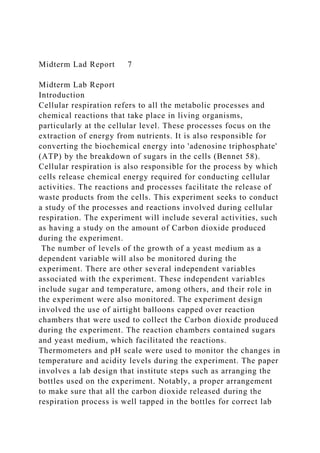
Cellular respiration refers to all the metabolic processes and
chemical reactions that take place in living organisms,
particularly at the cellular level. These processes focus on the
extraction of energy from nutrients. It is also responsible for
converting the biochemical energy into 'adenosine triphosphate'
(ATP) by the breakdown of sugars in the cells (Bennet 58).
Cellular respiration is also responsible for the process by which
cells release chemical energy required for conducting cellular
activities. The reactions and processes facilitate the release of
waste products from the cells. This experiment seeks to conduct
a study of the processes and reactions involved during cellular
respiration. The experiment will include several activities, such
as having a study on the amount of Carbon dioxide produced
during the experiment.
The number of levels of the growth of a yeast medium as a
dependent variable will also be monitored during the
experiment. There are other several independent variables
associated with the experiment. These independent variables
include sugar and temperature, among others, and their role in
the experiment were also monitored. The experiment design
involved the use of airtight balloons capped over reaction
chambers that were used to collect the Carbon dioxide produced
during the experiment. The reaction chambers contained sugars
and yeast medium, which facilitated the reactions.
Thermometers and pH scale were used to monitor the changes in
temperature and acidity levels during the experiment. The paper
involves a lab design that institute steps such as arranging the
bottles used on the experiment. Notably, a proper arrangement
to make sure that all the carbon dioxide released during the
respiration process is well tapped in the bottles for correct lab
results
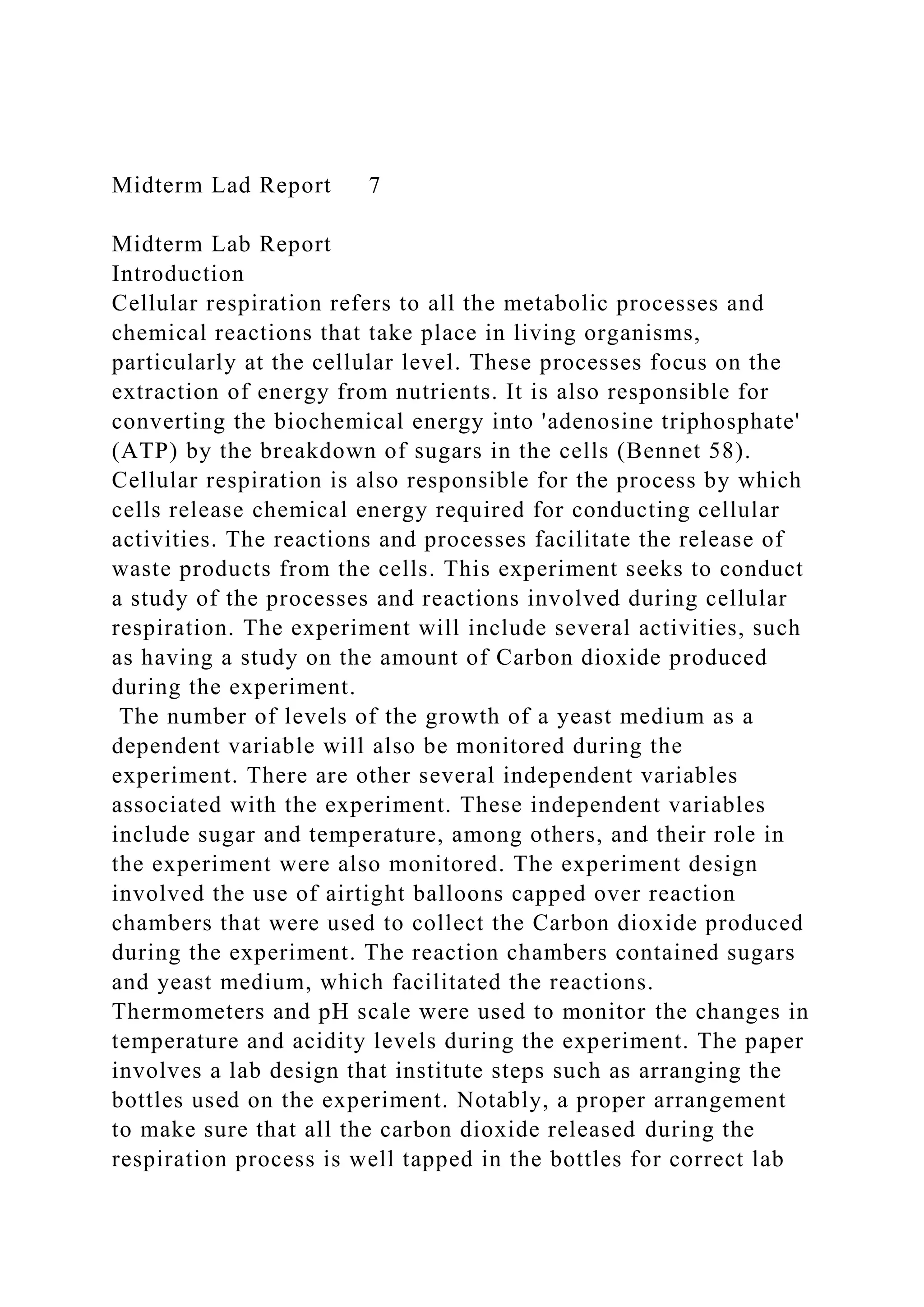
Methodology
The actual procedure for experimenting involved taking
measurements and recording of all observations made during the
experiment. For accurate results, measures were taken three
times, and a mean measurement was calculated and recorded.
Winzler asserts that the mean obtained from the measurements
should be used to calculate the standard deviation, which in turn
facilitated the calculation of uncertainty (276). Below are the
steps for conducting the experiment. It is essential to read the
instructions carefully safety and accuracy during the
experiment. Notably, all the lab and experiment results were
well observed and thus making sure that there are limited errors
in the whole process.
Consequently, all the steps required in the lab report were also
clearly followed to help in getting the correct data and even not
to affect the whole experiment process. The experiment
involved setting the apparatus as per the set standard and the
requirement. As per this concept, all the apparatus were set in a
proper way to avoid vague results. Notably, to get the correct
measurement and results, it is important to follow all the
process required on the lab report. Conversely, following the
entire set standard on the experiment requirement, it plays an
important role in making sure that the results which got on the
control experiment are not the same as a result got on the real
experiment. For this purpose, it becomes more than easy to
separate the two experiments and get the best yeast respiration
results.
The use of a control experiment was also included in the whole
result to make sure that all the results obtained from the
experiment are per the set conditions and the experiment result
expectations. Correctly assemble all the equipment and
materials necessary for the environment in a clean and safe
place. Consider the alternative conditions which might be
needed in the experiment. Make sure to use a clean and dry
apparatus. Put a ¼ cup of water in each bottle. The water should
be identical in quantity and quality. Record the independent
variables. The height of the yeast solution should not be
measured until the steps below are done.
You will notice that the first and second bottles have similar
conditions. Use bottle six for any experiment that you choose.
Alter the conditions of one independent variable while keeping
the rest constant. Notably, as per Winzler argument, you can try
different substances for sugar while maintaining the quantity of
ammonia (263). Heat all the bottles uniformly. Recap all the
bottles and shake the bottles enough for equal distribution of
yeast in the solution. Use the balloons to replace the caps on the
bottles tightly. Carefully measure and record the height of the
yeast. Add water into the pot so that its depth is slightly deeper
than that of the yeast solutions. Position the thermometer and
heat the pot to about 110F. During heating, regulate the heat to
have a constant temperature of 110F. Leave Bottle 1 at room
temperature. Place the Bottles 2-5 into the water bath and try to
maintain a constant temperature in the range of 110F and 120F
for 20 minutes. Bottle 6 might or might not be placed in the
bath, as you wish. Remove the bottles from the bath and quickly
record the observations volumes of balloons and growth of the
yeast. Record the observations as large, medium, small, and
none for volume and much, moderate, little, and none for
growth.
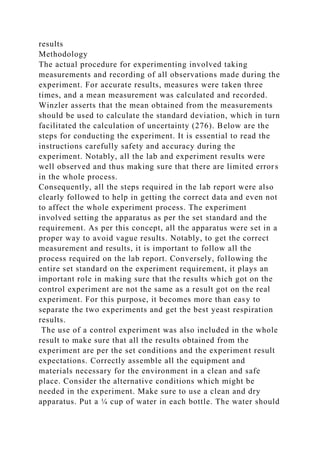
Results
After organizing and setting up the apparatus for the
experiment environment, the experiment was conducted for
approximately twenty minutes. The experiment involved six
bottles. After heating for twenty minutes, the observations were
recorded as follows. There was a significant increase in the
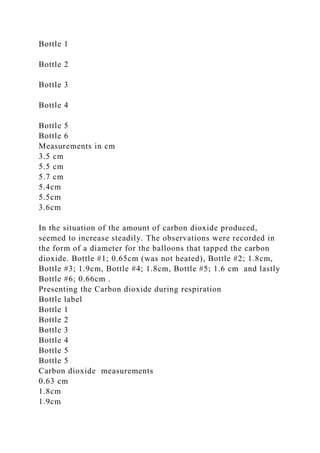
growth of the yeast medium. Bottle #1; 3.5cm was not heated,
Bottle #2; 5.5cm, Bottle #3; 5.7cm, Bottle #4; 5.4cm, Bottle #5;
5.5cm and lastly Bottle #6; 3.6cm.
Labeling the bottles chart
Bottles labeled
Bottle 1
Bottle 2
Bottle 3
Bottle 4
Bottle 5
Bottle 6
Measurements in cm
3.5 cm
5.5 cm
5.7 cm
5.4cm
5.5cm
3.6cm
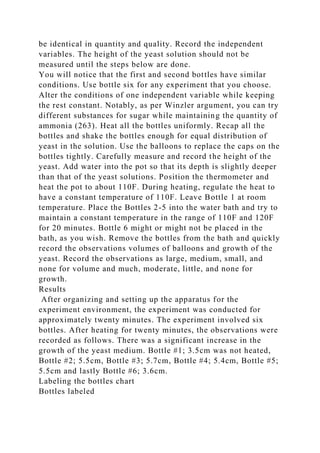
In the situation of the amount of carbon dioxide produced,
seemed to increase steadily. The observations were recorded in
the form of a diameter for the balloons that tapped the carbon
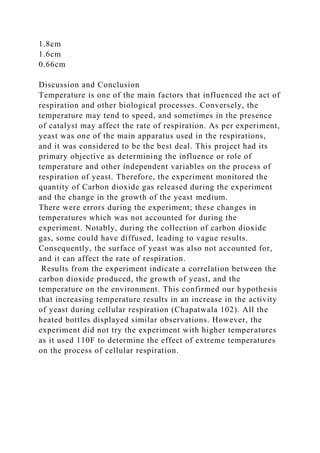
dioxide. Bottle #1; 0.65cm (was not heated), Bottle #2; 1.8cm,
Bottle #3; 1.9cm, Bottle #4; 1.8cm, Bottle #5; 1.6 cm and lastly
Bottle #6; 0.66cm .
Presenting the Carbon dioxide during respiration
Bottle label
Bottle 1
Bottle 2
Bottle 3
Bottle 4
Bottle 5
Bottle 5
Carbon dioxide measurements
0.63 cm
1.8cm
1.9cm
1.8cm
1.6cm
0.66cm
Discussion and Conclusion
Temperature is one of the main factors that influenced the act of
respiration and other biological processes. Conversely, the
temperature may tend to speed, and sometimes in the presence
of catalyst may affect the rate of respiration. As per experiment,
yeast was one of the main apparatus used in the respirations,
and it was considered to be the best deal. This project had its
primary objective as determining the influence or role of
temperature and other independent variables on the process of
respiration of yeast. Therefore, the experiment monitored the
quantity of Carbon dioxide gas released during the experiment
and the change in the growth of the yeast medium.
There were errors during the experiment; these changes in
temperatures which was not accounted for during the
experiment. Notably, during the collection of carbon dioxide
gas, some could have diffused, leading to vague results.
Consequently, the surface of yeast was also not accounted for,
and it can affect the rate of respiration.
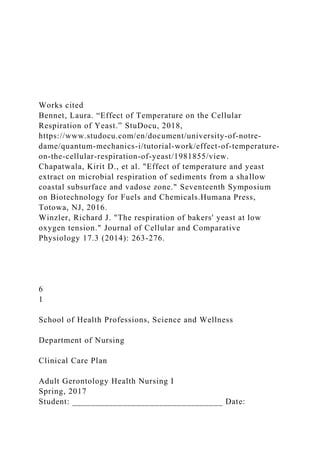
Results from the experiment indicate a correlation between the
carbon dioxide produced, the growth of yeast, and the
temperature on the environment. This confirmed our hypothesis
that increasing temperature results in an increase in the activity
of yeast during cellular respiration (Chapatwala 102). All the
heated bottles displayed similar observations. However, the
experiment did not try the experiment with higher temperatures
as it used 110F to determine the effect of extreme temperatures
on the process of cellular respiration.
Works cited
Bennet, Laura. “Effect of Temperature on the Cellular
Respiration of Yeast.” StuDocu, 2018,
https://www.studocu.com/en/document/university-of-notre-
dame/quantum-mechanics-i/tutorial-work/effect-of-temperature-
on-the-cellular-respiration-of-yeast/1981855/view.
Chapatwala, Kirit D., et al. "Effect of temperature and yeast
extract on microbial respiration of sediments from a shallow
coastal subsurface and vadose zone." Seventeenth Symposium
on Biotechnology for Fuels and Chemicals.Humana Press,
Totowa, NJ, 2016.
Winzler, Richard J. "The respiration of bakers' yeast at low
oxygen tension." Journal of Cellular and Comparative
Physiology 17.3 (2014): 263-276.
6
1
School of Health Professions, Science and Wellness
Department of Nursing
Clinical Care Plan
Adult Gerontology Health Nursing I
Spring, 2017
Student: _________________________________ Date:
______________________________
Instructor: ______________________________ Clinical
Course: ______________________
Client’s Initials: ___________ Age: _________ Sex: ________
Room#: ________________
Date of Admission: ________________ Date of Care:
_____________________________
Present Medical Diagnoses:
____________________________________________________
Present Surgery (if applicable): _____________________
Date of Surgery: ______________
Allergies: __________________________
Height: ________
Weight: _________
Code Status: ________________________
Section I
General Data
(Points 5)
Chief Complaint:
History of Present Illness (Detailed):
Past Medical/Surgical History:
Social History:
Family History of Illness:
Immunization History:
Description of Procedures (Surgeries) Performed this
Admission:
Section II
Pathophysiology
(Points 10)
In this section, the student must address a description of the
disease process including etiology, pathophysiology, signs and
symptoms and standard treatment including medication, surgery,
etc. (This section should be used to describe the textbook
explanation of the disease and compare it with the patient’s
picture of his/her disease condition. Attach a reference page at
the end of care plan )
Section III
Assessment
(Points 20)
Physical Assessment:
General Appearance
Neurosensory
Psychosocial
Cardiovascular
Respiratory
Gastrointestinal
Genitourinary
Musculoskeletal
Integumentary
Incisions
Drains
Diet/Nutrition
IVs
Vital Signs
Intake and Output
Pain assessment (include reassessment)
Fall Risk Assessment (include score)
Pressure Ulcer Risk Assessment (include score)
Section IV
Diagnostic Data
(Points 10)
Diagnostic Tests
Patient’s value
Normal Range
Inference(why is this patients value abnormal)
Section V
Treatment and procedures
List all interventions/nursing actions dependent (physician
initiated) and independent (nursing initiated) performed during
your clinical experience.
(Points 10)
Interventions
Rationale
Section VI
Teaching and Health Promotion
(Points 5)
List client’s teaching Needs/Knowledge Deficits, such as
teaching about a new diet, reasons for being NPO, reasons for
wearing elastic stockings, etc.
1)
2)
3)
4)
5)
Section VII
(Points 5)
List of Nursing Diagnoses Use your assessment, the client’s
medications and history to write your diagnoses. Actual and
Potential deficits and wellness diagnoses are expected. Your
nursing diagnoses must be substantiated by your client’s signs
and symptoms. (List the nursing diagnosis in order of priority.)
1)
2)
3)
4)
Section VIII
Medications
(Points 10)
Medication Sheet
Medication Dose
Brand/
Generic Name
Mechanism of Action/Indication for Use
Contraindication
Adverse Effects/Side Effects
Nursing Implications
Outcomes
Safe Dose
(yes or no)
Why is your client on the drug?
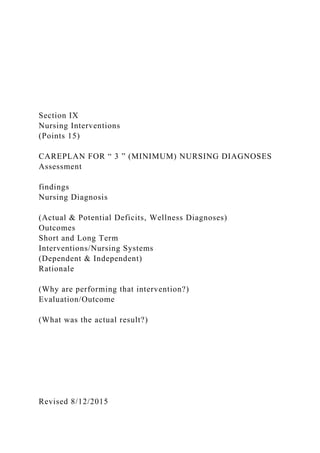
Section IX
Nursing Interventions
(Points 15)
CAREPLAN FOR “ 3 ” (MINIMUM) NURSING DIAGNOSES
Assessment
findings
Nursing Diagnosis
(Actual & Potential Deficits, Wellness Diagnoses)
Outcomes
Short and Long Term
Interventions/Nursing Systems
(Dependent & Independent)
Rationale
(Why are performing that intervention?)
Evaluation/Outcome
(What was the actual result?)
Revised 8/12/2015
Midterm Lad Report     7Midterm Lab ReportIntroductionCell.docx

Midterm Lad Report 7Midterm Lab ReportIntroductionCell.docx

  • 1.
    Midterm Lad Report7 Midterm Lab Report Introduction Cellular respiration refers to all the metabolic processes and chemical reactions that take place in living organisms, particularly at the cellular level. These processes focus on the extraction of energy from nutrients. It is also responsible for converting the biochemical energy into 'adenosine triphosphate' (ATP) by the breakdown of sugars in the cells (Bennet 58). Cellular respiration is also responsible for the process by which cells release chemical energy required for conducting cellular activities. The reactions and processes facilitate the release of waste products from the cells. This experiment seeks to conduct a study of the processes and reactions involved during cellular respiration. The experiment will include several activities, such as having a study on the amount of Carbon dioxide produced during the experiment. The number of levels of the growth of a yeast medium as a dependent variable will also be monitored during the experiment. There are other several independent variables associated with the experiment. These independent variables include sugar and temperature, among others, and their role in the experiment were also monitored. The experiment design involved the use of airtight balloons capped over reaction chambers that were used to collect the Carbon dioxide produced during the experiment. The reaction chambers contained sugars and yeast medium, which facilitated the reactions. Thermometers and pH scale were used to monitor the changes in temperature and acidity levels during the experiment. The paper involves a lab design that institute steps such as arranging the bottles used on the experiment. Notably, a proper arrangement to make sure that all the carbon dioxide released during the respiration process is well tapped in the bottles for correct lab
  • 2.
    results Methodology The actual procedurefor experimenting involved taking measurements and recording of all observations made during the experiment. For accurate results, measures were taken three times, and a mean measurement was calculated and recorded. Winzler asserts that the mean obtained from the measurements should be used to calculate the standard deviation, which in turn facilitated the calculation of uncertainty (276). Below are the steps for conducting the experiment. It is essential to read the instructions carefully safety and accuracy during the experiment. Notably, all the lab and experiment results were well observed and thus making sure that there are limited errors in the whole process. Consequently, all the steps required in the lab report were also clearly followed to help in getting the correct data and even not to affect the whole experiment process. The experiment involved setting the apparatus as per the set standard and the requirement. As per this concept, all the apparatus were set in a proper way to avoid vague results. Notably, to get the correct measurement and results, it is important to follow all the process required on the lab report. Conversely, following the entire set standard on the experiment requirement, it plays an important role in making sure that the results which got on the control experiment are not the same as a result got on the real experiment. For this purpose, it becomes more than easy to separate the two experiments and get the best yeast respiration results. The use of a control experiment was also included in the whole result to make sure that all the results obtained from the experiment are per the set conditions and the experiment result expectations. Correctly assemble all the equipment and materials necessary for the environment in a clean and safe place. Consider the alternative conditions which might be needed in the experiment. Make sure to use a clean and dry apparatus. Put a ¼ cup of water in each bottle. The water should
  • 3.
    be identical inquantity and quality. Record the independent variables. The height of the yeast solution should not be measured until the steps below are done. You will notice that the first and second bottles have similar conditions. Use bottle six for any experiment that you choose. Alter the conditions of one independent variable while keeping the rest constant. Notably, as per Winzler argument, you can try different substances for sugar while maintaining the quantity of ammonia (263). Heat all the bottles uniformly. Recap all the bottles and shake the bottles enough for equal distribution of yeast in the solution. Use the balloons to replace the caps on the bottles tightly. Carefully measure and record the height of the yeast. Add water into the pot so that its depth is slightly deeper than that of the yeast solutions. Position the thermometer and heat the pot to about 110F. During heating, regulate the heat to have a constant temperature of 110F. Leave Bottle 1 at room temperature. Place the Bottles 2-5 into the water bath and try to maintain a constant temperature in the range of 110F and 120F for 20 minutes. Bottle 6 might or might not be placed in the bath, as you wish. Remove the bottles from the bath and quickly record the observations volumes of balloons and growth of the yeast. Record the observations as large, medium, small, and none for volume and much, moderate, little, and none for growth. Results After organizing and setting up the apparatus for the experiment environment, the experiment was conducted for approximately twenty minutes. The experiment involved six bottles. After heating for twenty minutes, the observations were recorded as follows. There was a significant increase in the growth of the yeast medium. Bottle #1; 3.5cm was not heated, Bottle #2; 5.5cm, Bottle #3; 5.7cm, Bottle #4; 5.4cm, Bottle #5; 5.5cm and lastly Bottle #6; 3.6cm. Labeling the bottles chart Bottles labeled
  • 4.
    Bottle 1 Bottle 2 Bottle3 Bottle 4 Bottle 5 Bottle 6 Measurements in cm 3.5 cm 5.5 cm 5.7 cm 5.4cm 5.5cm 3.6cm In the situation of the amount of carbon dioxide produced, seemed to increase steadily. The observations were recorded in the form of a diameter for the balloons that tapped the carbon dioxide. Bottle #1; 0.65cm (was not heated), Bottle #2; 1.8cm, Bottle #3; 1.9cm, Bottle #4; 1.8cm, Bottle #5; 1.6 cm and lastly Bottle #6; 0.66cm . Presenting the Carbon dioxide during respiration Bottle label Bottle 1 Bottle 2 Bottle 3 Bottle 4 Bottle 5 Bottle 5 Carbon dioxide measurements 0.63 cm 1.8cm 1.9cm
  • 5.
    1.8cm 1.6cm 0.66cm Discussion and Conclusion Temperatureis one of the main factors that influenced the act of respiration and other biological processes. Conversely, the temperature may tend to speed, and sometimes in the presence of catalyst may affect the rate of respiration. As per experiment, yeast was one of the main apparatus used in the respirations, and it was considered to be the best deal. This project had its primary objective as determining the influence or role of temperature and other independent variables on the process of respiration of yeast. Therefore, the experiment monitored the quantity of Carbon dioxide gas released during the experiment and the change in the growth of the yeast medium. There were errors during the experiment; these changes in temperatures which was not accounted for during the experiment. Notably, during the collection of carbon dioxide gas, some could have diffused, leading to vague results. Consequently, the surface of yeast was also not accounted for, and it can affect the rate of respiration. Results from the experiment indicate a correlation between the carbon dioxide produced, the growth of yeast, and the temperature on the environment. This confirmed our hypothesis that increasing temperature results in an increase in the activity of yeast during cellular respiration (Chapatwala 102). All the heated bottles displayed similar observations. However, the experiment did not try the experiment with higher temperatures as it used 110F to determine the effect of extreme temperatures on the process of cellular respiration.
  • 6.
    Works cited Bennet, Laura.“Effect of Temperature on the Cellular Respiration of Yeast.” StuDocu, 2018, https://www.studocu.com/en/document/university-of-notre- dame/quantum-mechanics-i/tutorial-work/effect-of-temperature- on-the-cellular-respiration-of-yeast/1981855/view. Chapatwala, Kirit D., et al. "Effect of temperature and yeast extract on microbial respiration of sediments from a shallow coastal subsurface and vadose zone." Seventeenth Symposium on Biotechnology for Fuels and Chemicals.Humana Press, Totowa, NJ, 2016. Winzler, Richard J. "The respiration of bakers' yeast at low oxygen tension." Journal of Cellular and Comparative Physiology 17.3 (2014): 263-276. 6 1 School of Health Professions, Science and Wellness Department of Nursing Clinical Care Plan Adult Gerontology Health Nursing I Spring, 2017 Student: _________________________________ Date:
  • 7.
    ______________________________ Instructor: ______________________________ Clinical Course:______________________ Client’s Initials: ___________ Age: _________ Sex: ________ Room#: ________________ Date of Admission: ________________ Date of Care: _____________________________ Present Medical Diagnoses: ____________________________________________________ Present Surgery (if applicable): _____________________ Date of Surgery: ______________ Allergies: __________________________ Height: ________ Weight: _________ Code Status: ________________________ Section I General Data (Points 5) Chief Complaint: History of Present Illness (Detailed): Past Medical/Surgical History: Social History: Family History of Illness: Immunization History: Description of Procedures (Surgeries) Performed this Admission: Section II Pathophysiology (Points 10) In this section, the student must address a description of the
  • 8.
    disease process includingetiology, pathophysiology, signs and symptoms and standard treatment including medication, surgery, etc. (This section should be used to describe the textbook explanation of the disease and compare it with the patient’s picture of his/her disease condition. Attach a reference page at the end of care plan ) Section III Assessment (Points 20) Physical Assessment: General Appearance Neurosensory Psychosocial Cardiovascular Respiratory Gastrointestinal Genitourinary Musculoskeletal Integumentary Incisions Drains Diet/Nutrition IVs
  • 9.
    Vital Signs Intake andOutput Pain assessment (include reassessment) Fall Risk Assessment (include score) Pressure Ulcer Risk Assessment (include score) Section IV Diagnostic Data (Points 10) Diagnostic Tests Patient’s value Normal Range Inference(why is this patients value abnormal)
  • 10.
    Section V Treatment andprocedures List all interventions/nursing actions dependent (physician initiated) and independent (nursing initiated) performed during
  • 11.
    your clinical experience. (Points10) Interventions Rationale Section VI Teaching and Health Promotion (Points 5) List client’s teaching Needs/Knowledge Deficits, such as teaching about a new diet, reasons for being NPO, reasons for wearing elastic stockings, etc. 1) 2) 3) 4) 5)
  • 12.
    Section VII (Points 5) Listof Nursing Diagnoses Use your assessment, the client’s medications and history to write your diagnoses. Actual and Potential deficits and wellness diagnoses are expected. Your nursing diagnoses must be substantiated by your client’s signs and symptoms. (List the nursing diagnosis in order of priority.) 1) 2) 3) 4) Section VIII Medications (Points 10) Medication Sheet Medication Dose Brand/ Generic Name Mechanism of Action/Indication for Use Contraindication Adverse Effects/Side Effects Nursing Implications Outcomes Safe Dose (yes or no) Why is your client on the drug?
  • 13.
    Section IX Nursing Interventions (Points15) CAREPLAN FOR “ 3 ” (MINIMUM) NURSING DIAGNOSES Assessment findings Nursing Diagnosis (Actual & Potential Deficits, Wellness Diagnoses) Outcomes Short and Long Term Interventions/Nursing Systems (Dependent & Independent) Rationale (Why are performing that intervention?) Evaluation/Outcome (What was the actual result?) Revised 8/12/2015