Legal Forms of Businesses
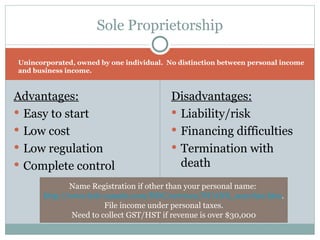
Unincorporated, owned by one individual.  No distinction between personal income and business income. Advantages: Easy to start Low cost Low regulation Complete control Disadvantages: Liability/risk Financing difficulties Termination with death Sole Proprietorship Name Registration if other than your personal name:  http://www.bdc-canada.com/BDC/services/NUANS_searches.htm . File income under personal taxes. Need to collect GST/HST if revenue is over $30,000
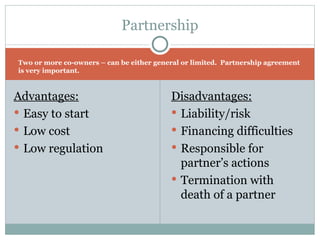
Two or more co-owners – can be either general or limited.  Partnership agreement is very important.  Advantages: Easy to start Low cost Low regulation Disadvantages: Liability/risk Financing difficulties Responsible for partner’s actions Termination with death of a partner Partnership
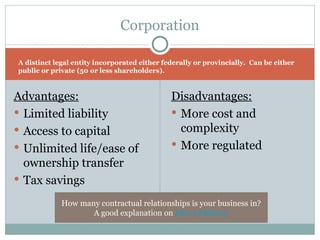
A distinct legal entity incorporated either federally or provincially.  Can be either public or private (50 or less shareholders).  Advantages: Limited liability Access to capital Unlimited life/ease of ownership transfer Tax savings Disadvantages: More cost and complexity More regulated Corporation How many contractual relationships is your business in? A good explanation on  Idea 2 Delivery
Not-for-Profit Organizations Public benefit or member benefit Must incorporate to be legally recognized as a nonprofit Registered under provincial legislation Board of Directors is a legal requirement Not necessarily a charity – cannot issue receipts All resources are directed to furthering their objects (purposes) Limited to what is written in its objects
The Business Plan
How does it all come together? Executive Summary Business Strategy Marketing Strategy Operational Plan Financial Forecasts Other Information
Business Strategy Team & Ownership Structure Industry Environment Positioning/Competitive Advantage Growth Plan SWOT Analysis (include as an appendix)
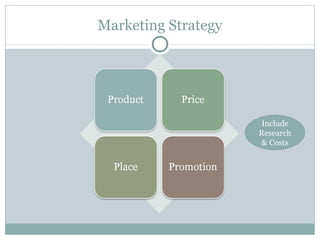
Marketing Strategy Include Research & Costs
Operational Requirements for next 3-5 years Equipment Facilities IT Requirements Business structure Management Human Resources – training, hiring, needs, etc.
Financial One-time & operating expenses Cash flow and income statements for first year Balance sheets Break even point Financing needed More guidelines at  RBC Example at BDC
Financing
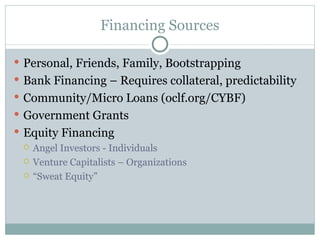
Financing Sources Personal, Friends, Family, Bootstrapping Bank Financing – Requires collateral, predictability Community/Micro Loans (oclf.org/CYBF) Government Grants Equity Financing Angel Investors - Individuals Venture Capitalists – Organizations “ Sweat Equity”
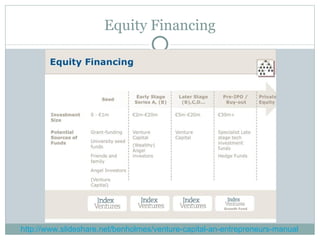
Equity Financing http://www.slideshare.net/benholmes/venture-capital-an-entrepreneurs-manual
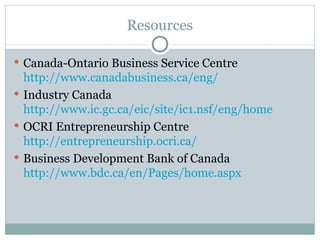
Resources Canada-Ontario Business Service Centre  http://www.canadabusiness.ca/eng/   Industry Canada  http://www.ic.gc.ca/eic/site/ic1.nsf/eng/home OCRI Entrepreneurship Centre  http://entrepreneurship.ocri.ca/ Business Development Bank of Canada  http://www.bdc.ca/en/Pages/home.aspx

Week 12

  • 1.
    Legal Forms ofBusinesses
  • 2.
    Unincorporated, owned byone individual. No distinction between personal income and business income. Advantages: Easy to start Low cost Low regulation Complete control Disadvantages: Liability/risk Financing difficulties Termination with death Sole Proprietorship Name Registration if other than your personal name: http://www.bdc-canada.com/BDC/services/NUANS_searches.htm . File income under personal taxes. Need to collect GST/HST if revenue is over $30,000
  • 3.
    Two or moreco-owners – can be either general or limited. Partnership agreement is very important. Advantages: Easy to start Low cost Low regulation Disadvantages: Liability/risk Financing difficulties Responsible for partner’s actions Termination with death of a partner Partnership
  • 4.
    A distinct legalentity incorporated either federally or provincially. Can be either public or private (50 or less shareholders). Advantages: Limited liability Access to capital Unlimited life/ease of ownership transfer Tax savings Disadvantages: More cost and complexity More regulated Corporation How many contractual relationships is your business in? A good explanation on Idea 2 Delivery
  • 5.
    Not-for-Profit Organizations Publicbenefit or member benefit Must incorporate to be legally recognized as a nonprofit Registered under provincial legislation Board of Directors is a legal requirement Not necessarily a charity – cannot issue receipts All resources are directed to furthering their objects (purposes) Limited to what is written in its objects
  • 6.
  • 7.
    How does itall come together? Executive Summary Business Strategy Marketing Strategy Operational Plan Financial Forecasts Other Information
  • 8.
    Business Strategy Team& Ownership Structure Industry Environment Positioning/Competitive Advantage Growth Plan SWOT Analysis (include as an appendix)
  • 9.
  • 10.
    Operational Requirements fornext 3-5 years Equipment Facilities IT Requirements Business structure Management Human Resources – training, hiring, needs, etc.
  • 11.
    Financial One-time &operating expenses Cash flow and income statements for first year Balance sheets Break even point Financing needed More guidelines at RBC Example at BDC
  • 12.
  • 13.
    Financing Sources Personal,Friends, Family, Bootstrapping Bank Financing – Requires collateral, predictability Community/Micro Loans (oclf.org/CYBF) Government Grants Equity Financing Angel Investors - Individuals Venture Capitalists – Organizations “ Sweat Equity”
  • 14.
  • 15.
    Resources Canada-Ontario BusinessService Centre http://www.canadabusiness.ca/eng/ Industry Canada http://www.ic.gc.ca/eic/site/ic1.nsf/eng/home OCRI Entrepreneurship Centre http://entrepreneurship.ocri.ca/ Business Development Bank of Canada http://www.bdc.ca/en/Pages/home.aspx