Securities and Exchange  Commission Filings Strictly Financials Jan. 3, 2012 Strictly Financials
Donald W. Reynolds National Center For Business Journalism At Arizona State University  Strictly Financials
James K. Gentry, Ph.D. Clyde M. Reed Teaching Professor School of Journalism and Mass Communications University of Kansas [email_address] Strictly Financials
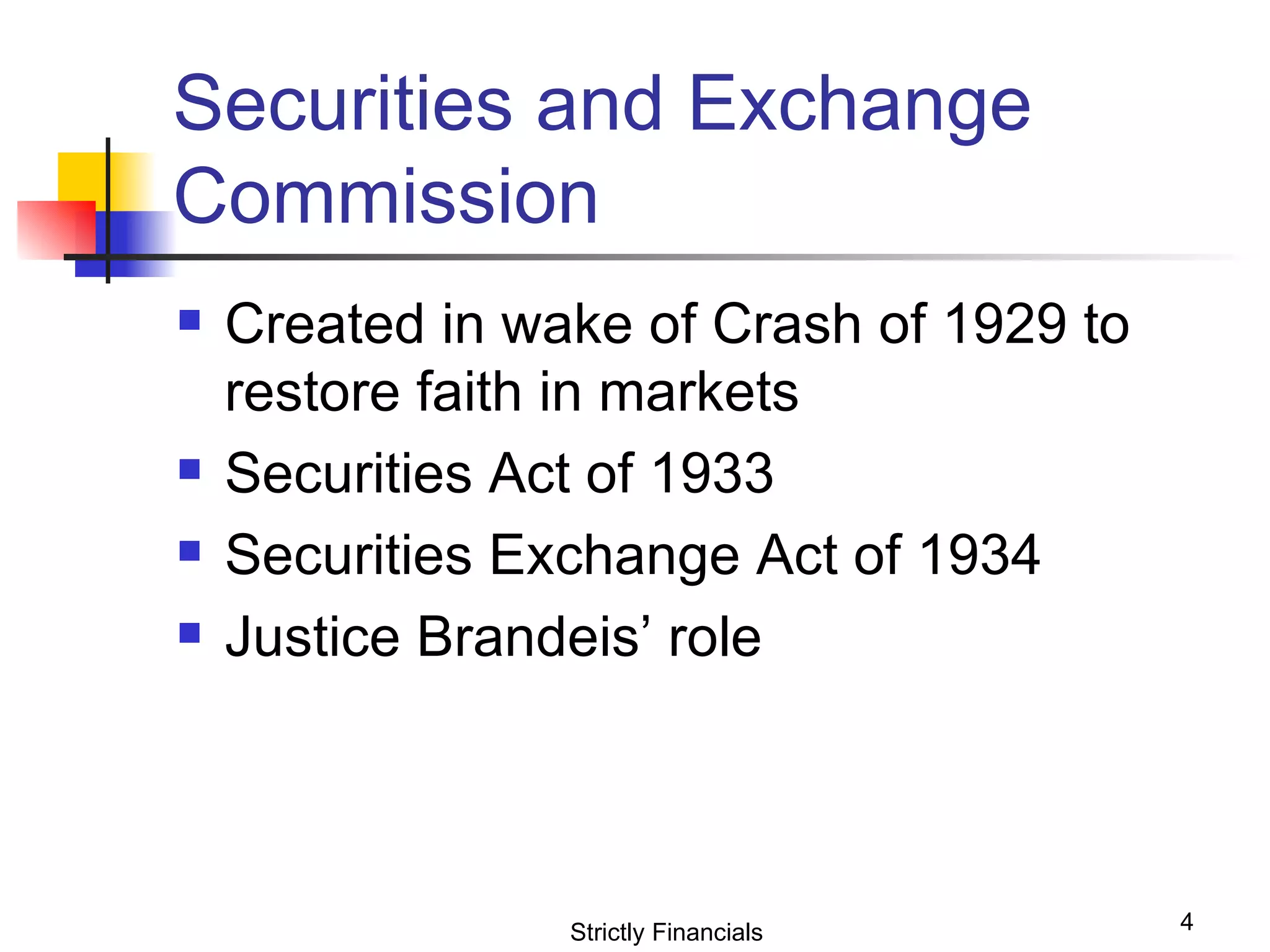
Securities and Exchange Commission Created in wake of Crash of 1929 to restore faith in markets Securities Act of 1933 Securities Exchange Act of 1934 Justice Brandeis’ role Strictly Financials
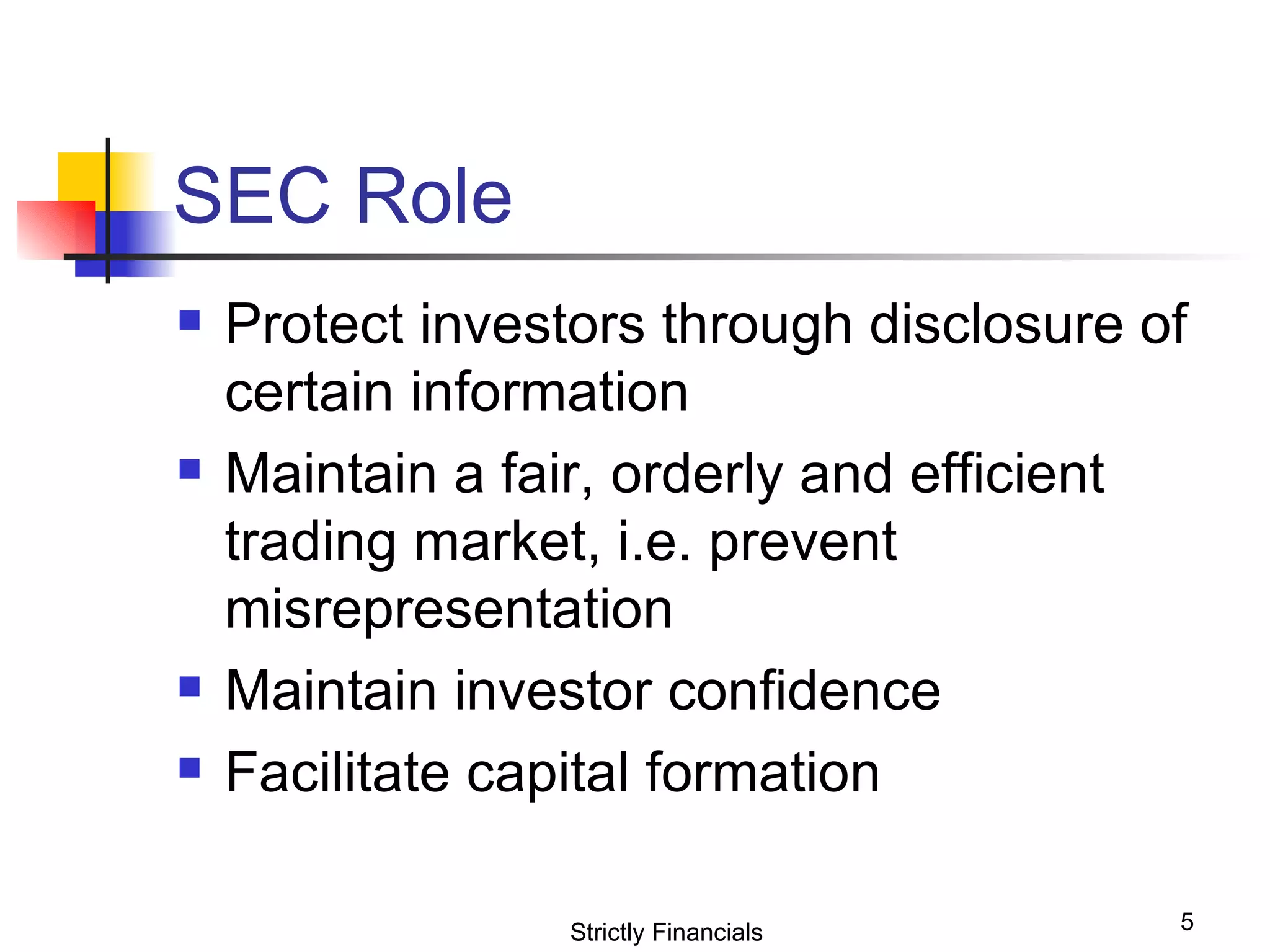
SEC Role Protect investors through disclosure of certain information Maintain a fair, orderly and efficient trading market, i.e. prevent misrepresentation Maintain investor confidence  Facilitate capital formation Strictly Financials
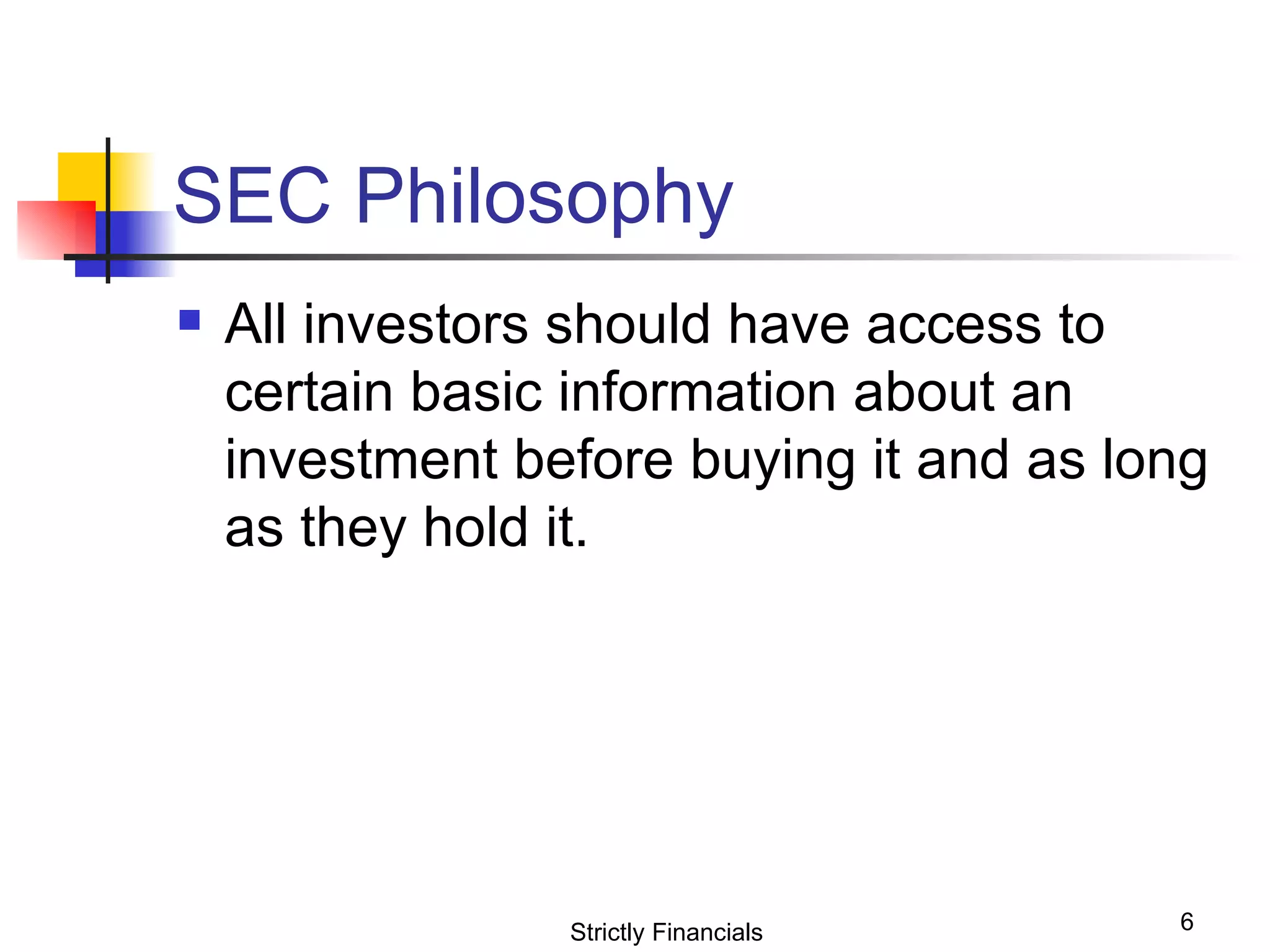
SEC Philosophy All investors should have access to certain basic information about an investment before buying it and as long as they hold it.  Strictly Financials
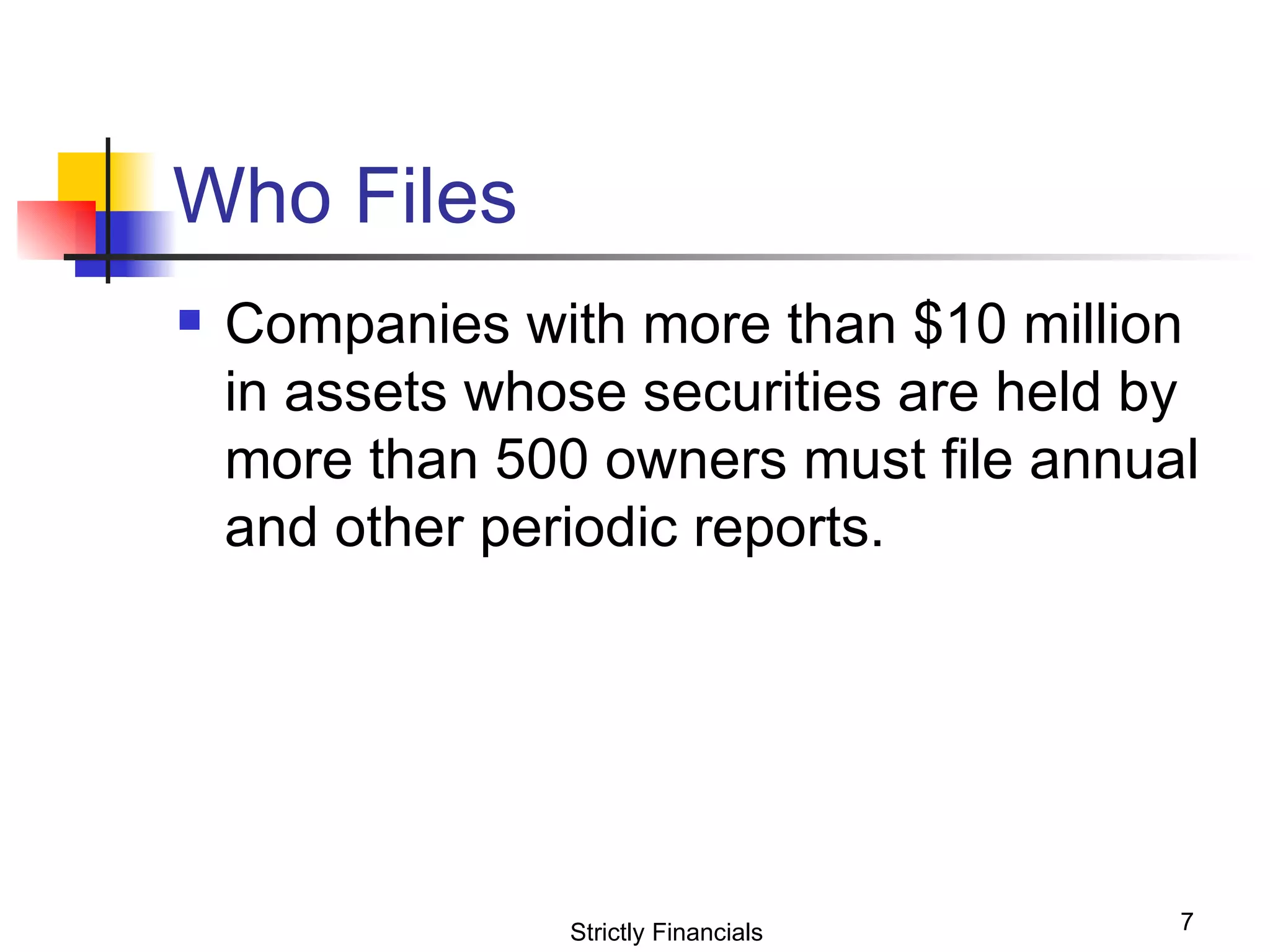
Who Files Companies with more than $10 million in assets whose securities are held by more than 500 owners must file annual and other periodic reports. Strictly Financials
Accessing SEC Documents Finance.yahoo, other financial sites Company websites SEC:  www.sec.gov SEC Filings and Forms (EDGAR) www.sec.gov/edgar.shtml EDGAR: Electronic Data Gathering, Analysis and Retrieval System Strictly Financials
Key SEC Documents 10-K 8-K 10-Q Proxy statement Prospectus Form 13-D Form 4 Strictly Financials
Form 10-K or Annual Report Historically, had been filed within 90 days after end of company fiscal year Today, 60, 75 or 90 days after fiscal year ends, depending on company’s public float Extensive financial data, including income statement, balance sheet and statement of cash flows Strictly Financials
Form 10-K (cont.) Extensive company information Auditor’s report MD&A or Management Discussion and Analysis Extensive footnotes  Strictly Financials
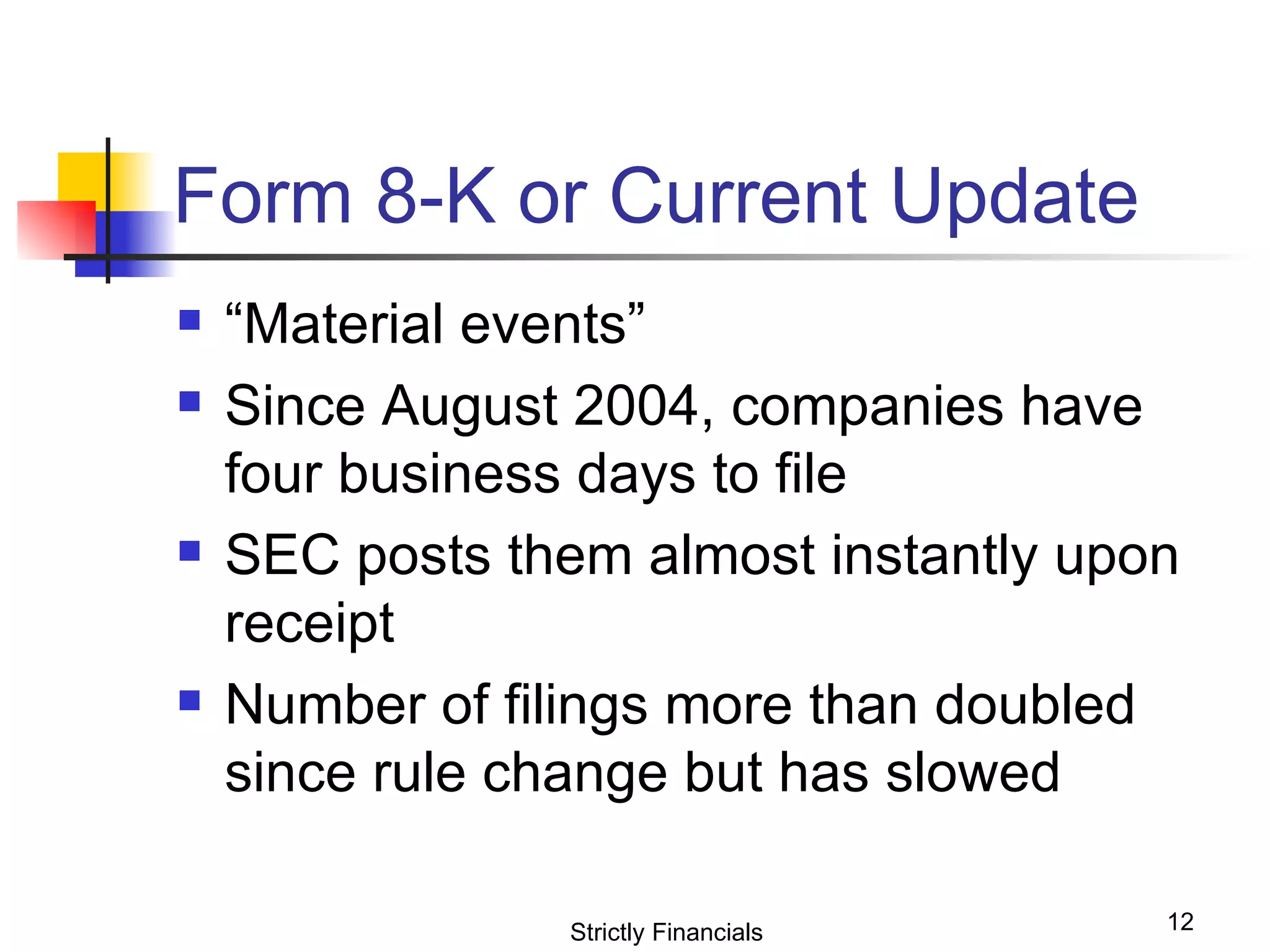
Form 8-K or Current Update “ Material events” Since August 2004, companies have four business days to file SEC posts them almost instantly upon receipt Number of filings more than doubled since rule change but has slowed Strictly Financials
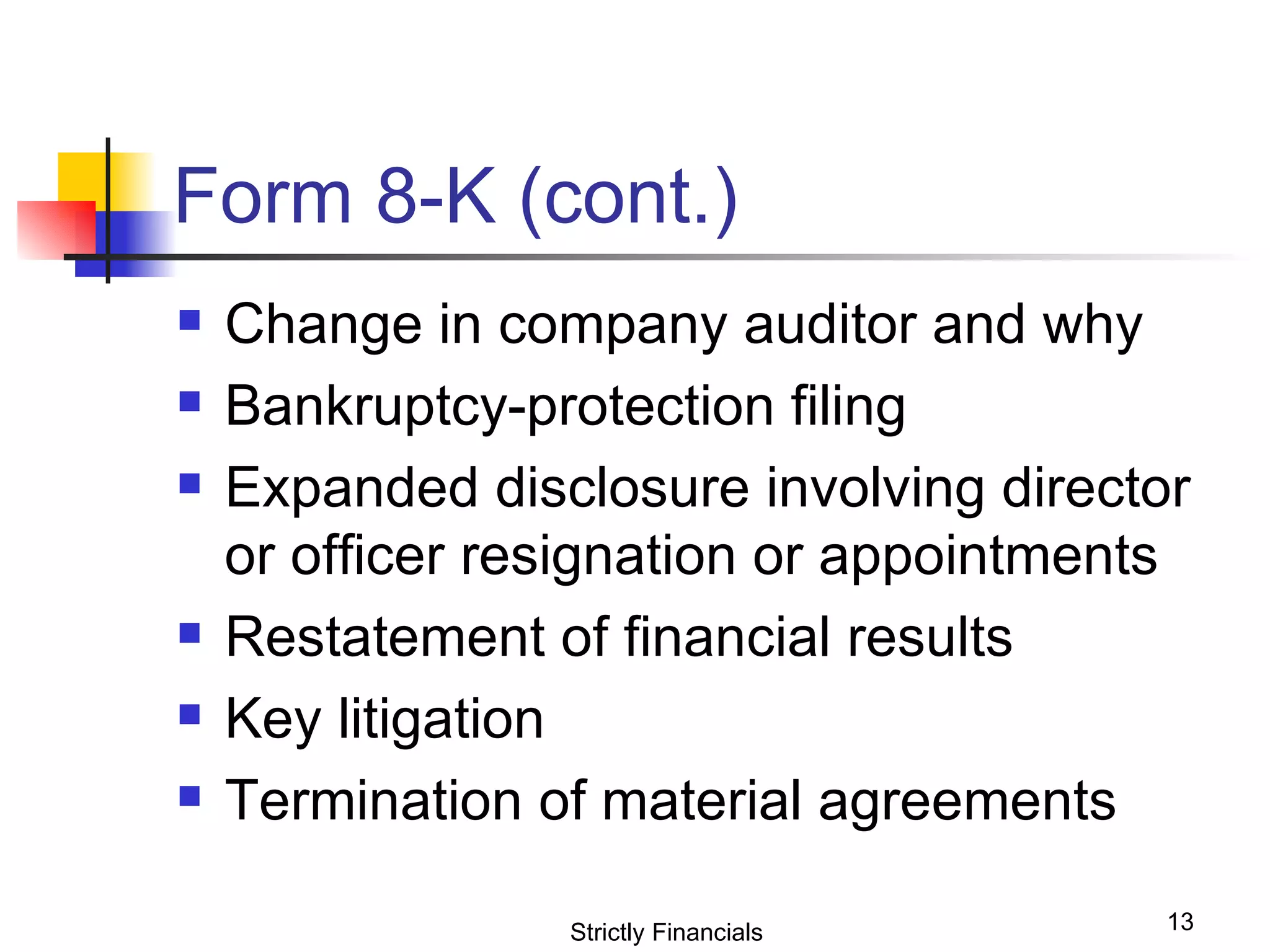
Form 8-K (cont.) Change in company auditor and why Bankruptcy-protection filing Expanded disclosure involving director or officer resignation or appointments Restatement of financial results Key litigation Termination of material agreements Strictly Financials
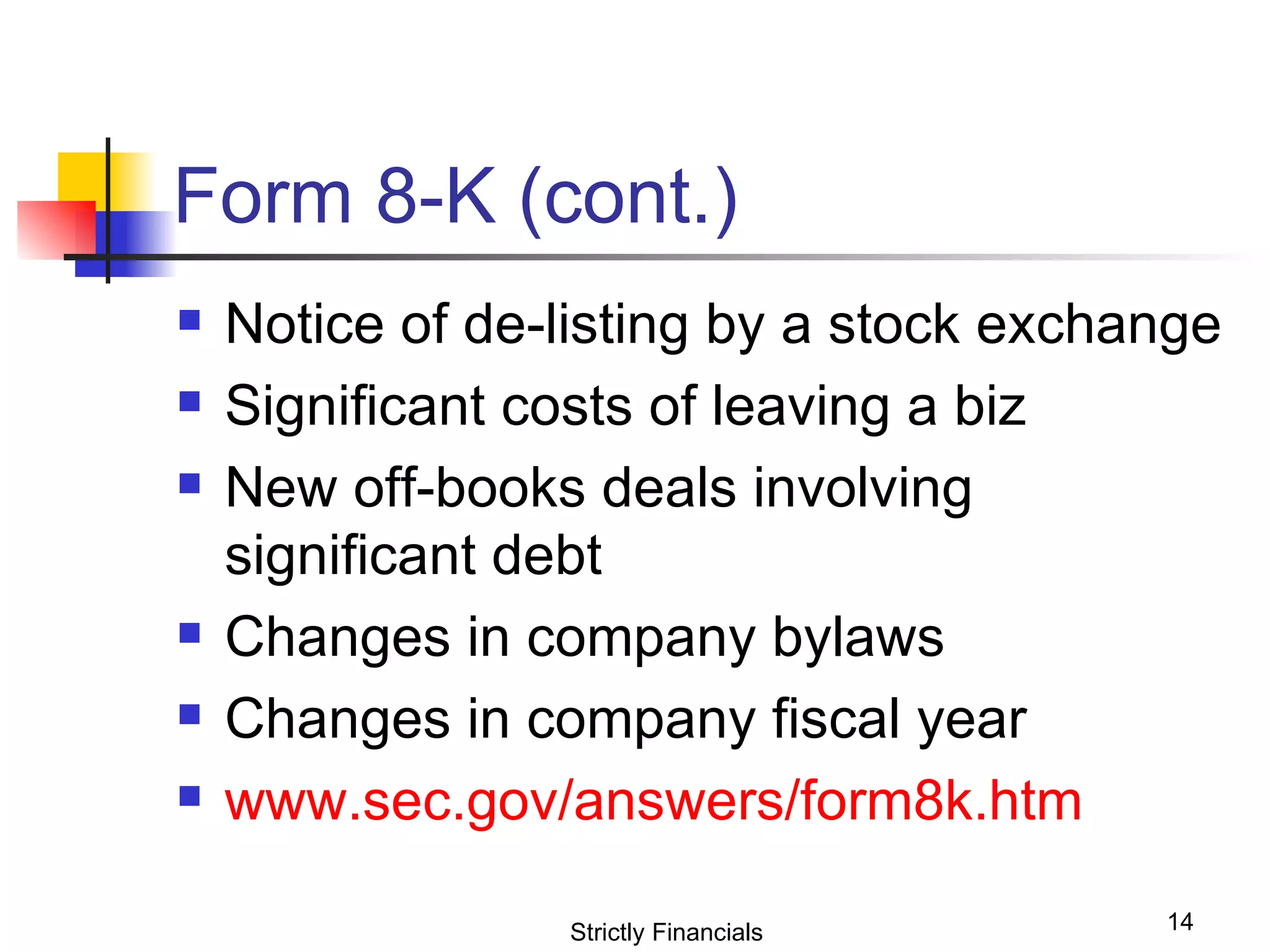
Form 8-K (cont.) Notice of de-listing by a stock exchange Significant costs of leaving a biz New off-books deals involving significant debt Changes in company bylaws Changes in company fiscal year www.sec.gov/answers/form8k.htm Strictly Financials
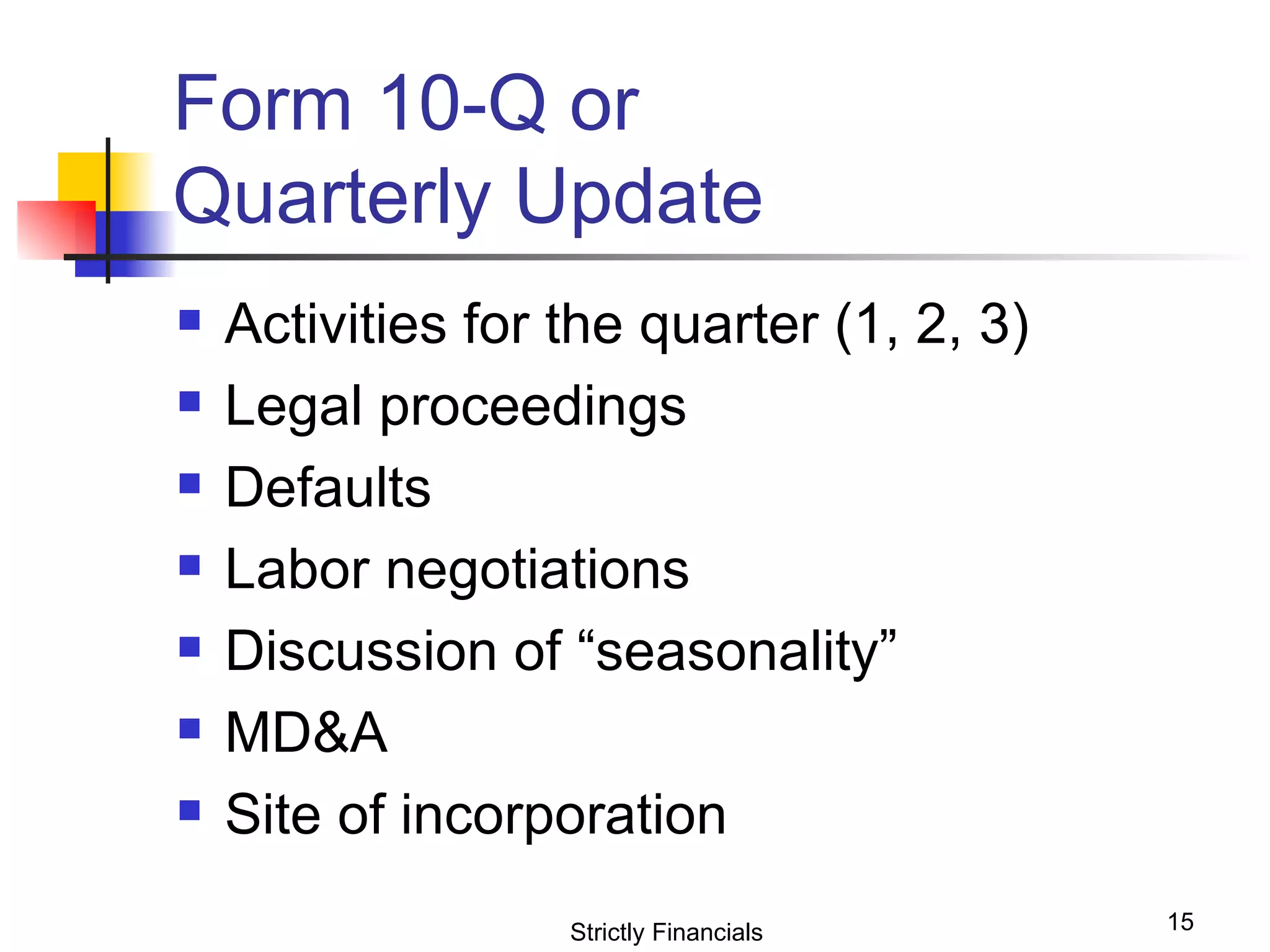
Form 10-Q or  Quarterly Update Activities for the quarter (1, 2, 3) Legal proceedings Defaults Labor negotiations Discussion of “seasonality”  MD&A Site of incorporation  Strictly Financials
Form 10-Q (cont.) Many companies file 8-K with earnings release “ Material facts” must be in the 10-Q that might not be included in the 10-K Key point: Unaudited Strictly Financials
Form 14 or Proxy Statement Information regarding upcoming annual meeting Matters to be voted on at meeting Executive compensation Information on board members Shareholder proposals Major shareholders Strictly Financials
Form S-1 or Registration Statement Also called prospectus Going public or selling new shares Financing, use of proceeds “ Risk factors” Part I and Part II “ Red herring” Strictly Financials
Form S-1 (cont.) Look at exhibits, which may include the CEO’s employment contract or a list of the company’s real estate around the world Strictly Financials
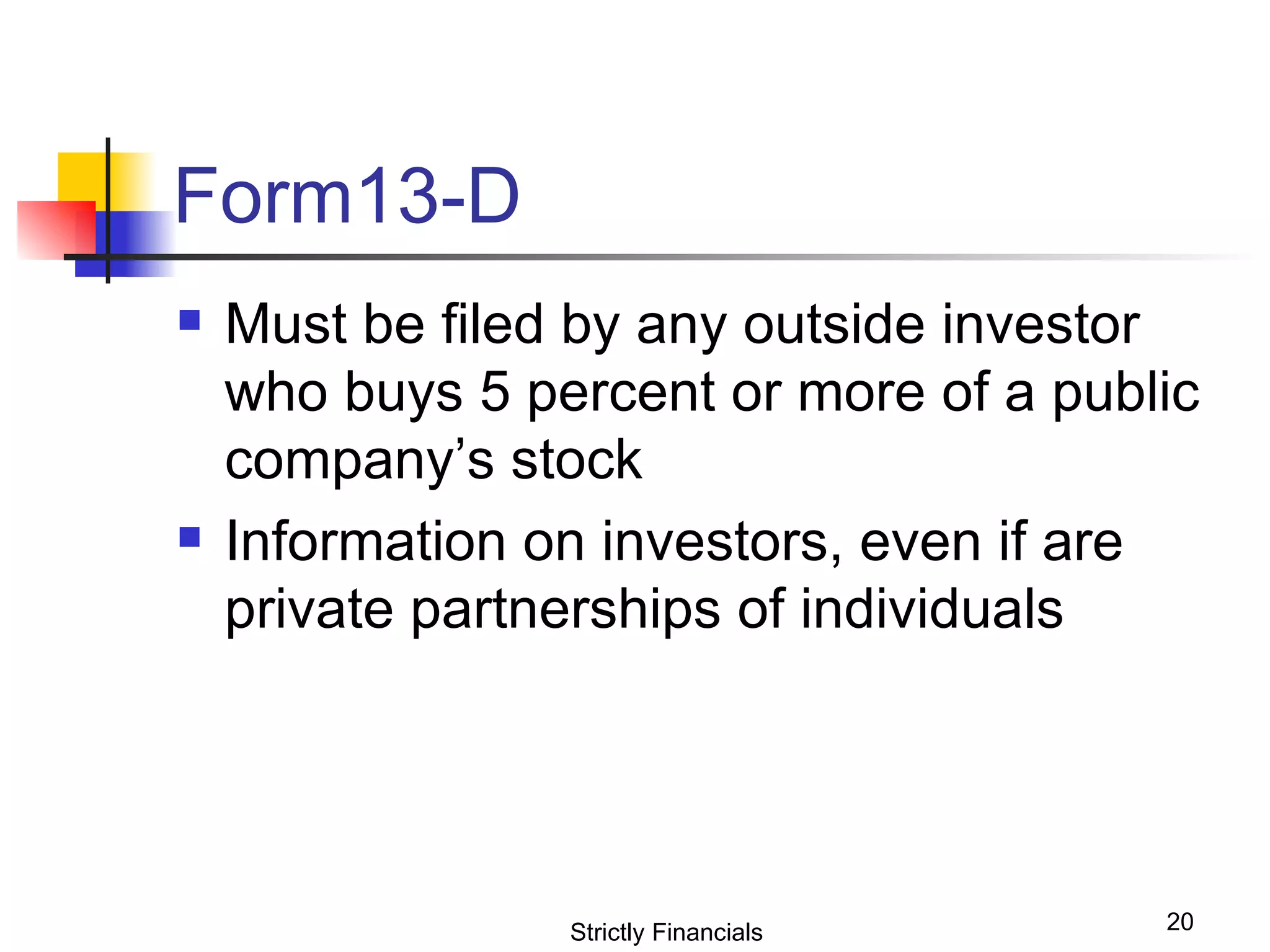
Form13-D Must be filed by any outside investor who buys 5 percent or more of a public company’s stock  Information on investors, even if are private partnerships of individuals Strictly Financials
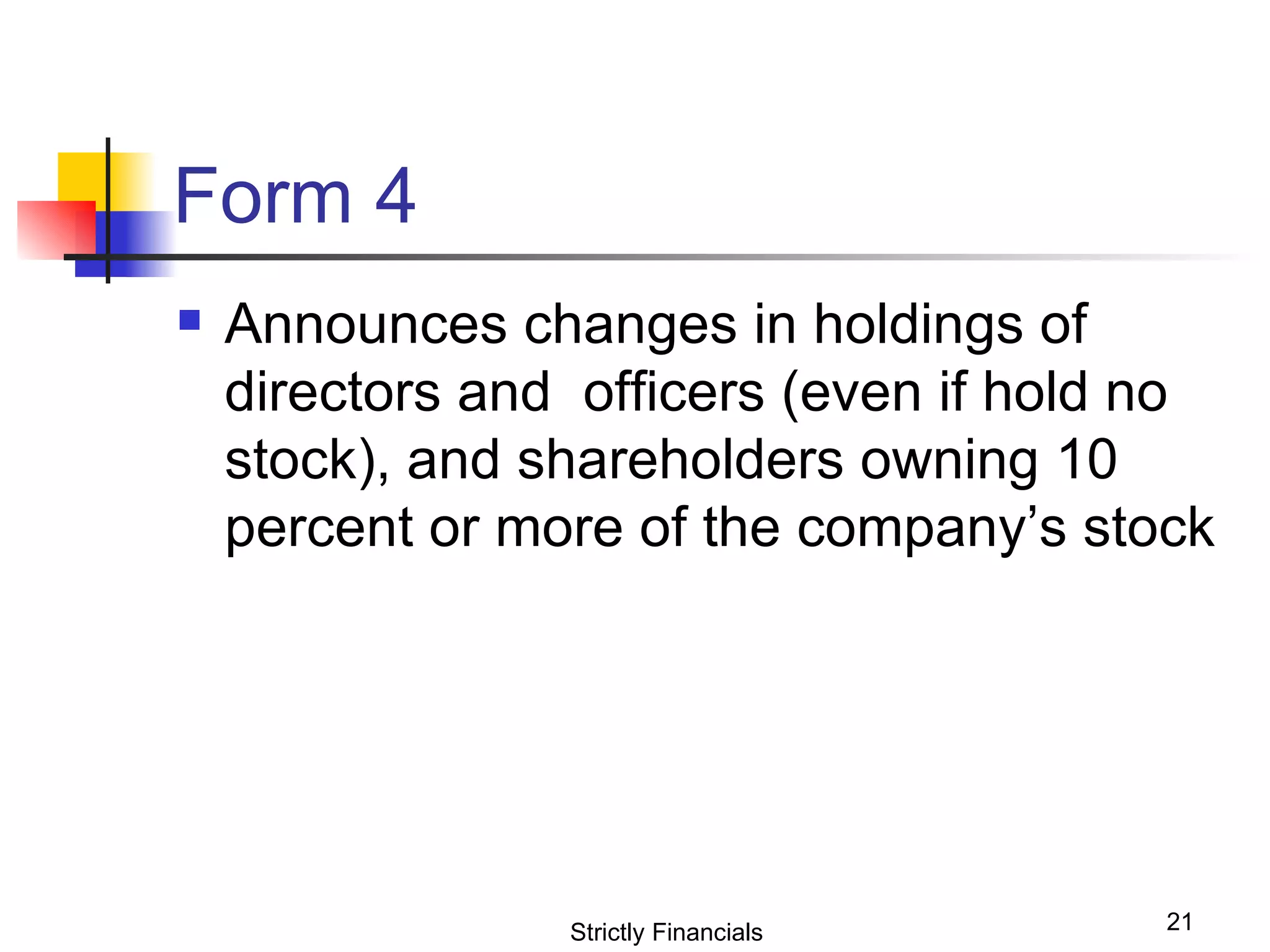
Form 4 Announces changes in holdings of directors and  officers (even if hold no stock), and shareholders owning 10 percent or more of the company’s stock Strictly Financials
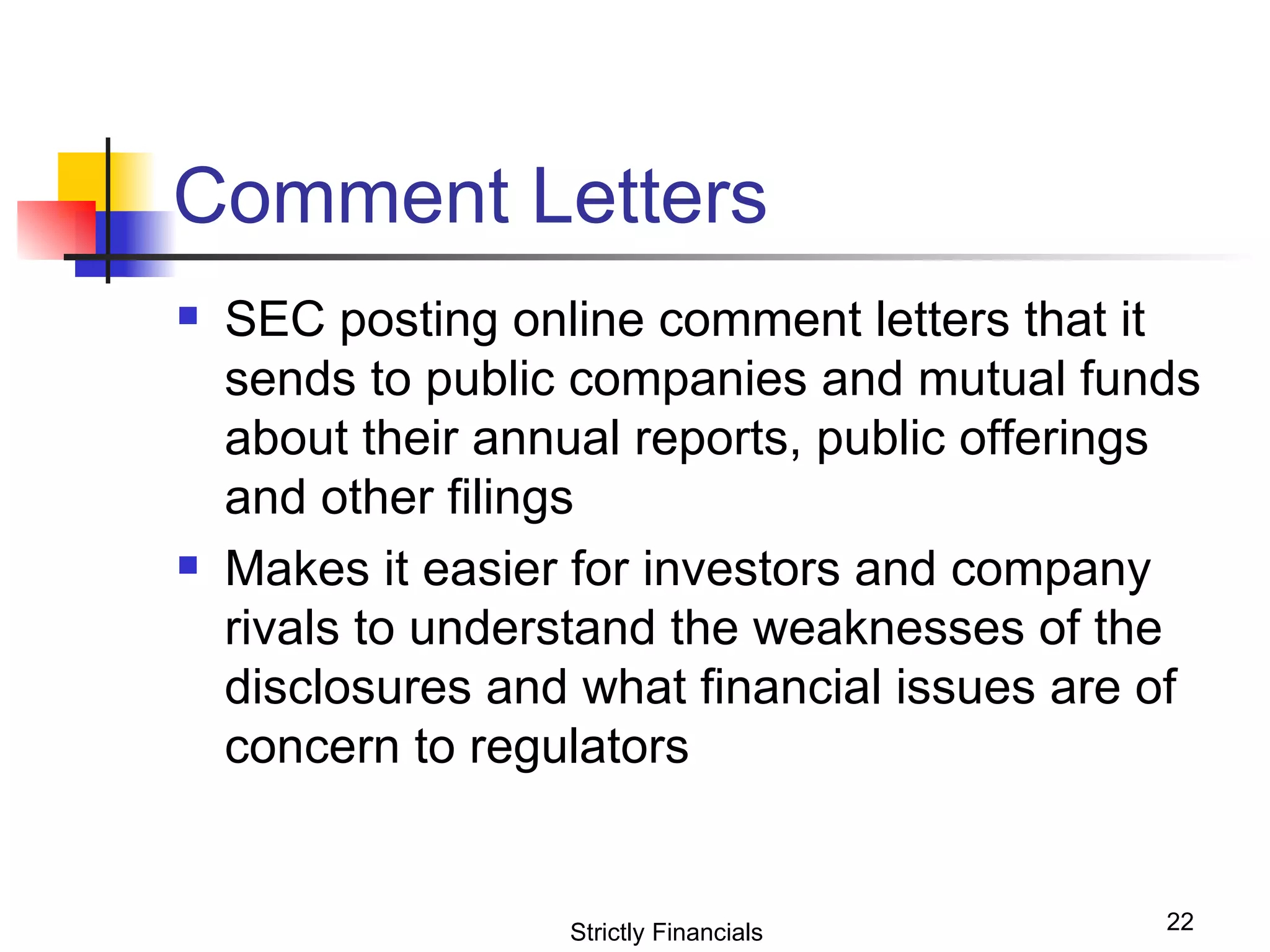
Comment Letters SEC posting online comment letters that it sends to public companies and mutual funds about their annual reports, public offerings and other filings Makes it easier for investors and company rivals to understand the weaknesses of the disclosures and what financial issues are of concern to regulators Strictly Financials
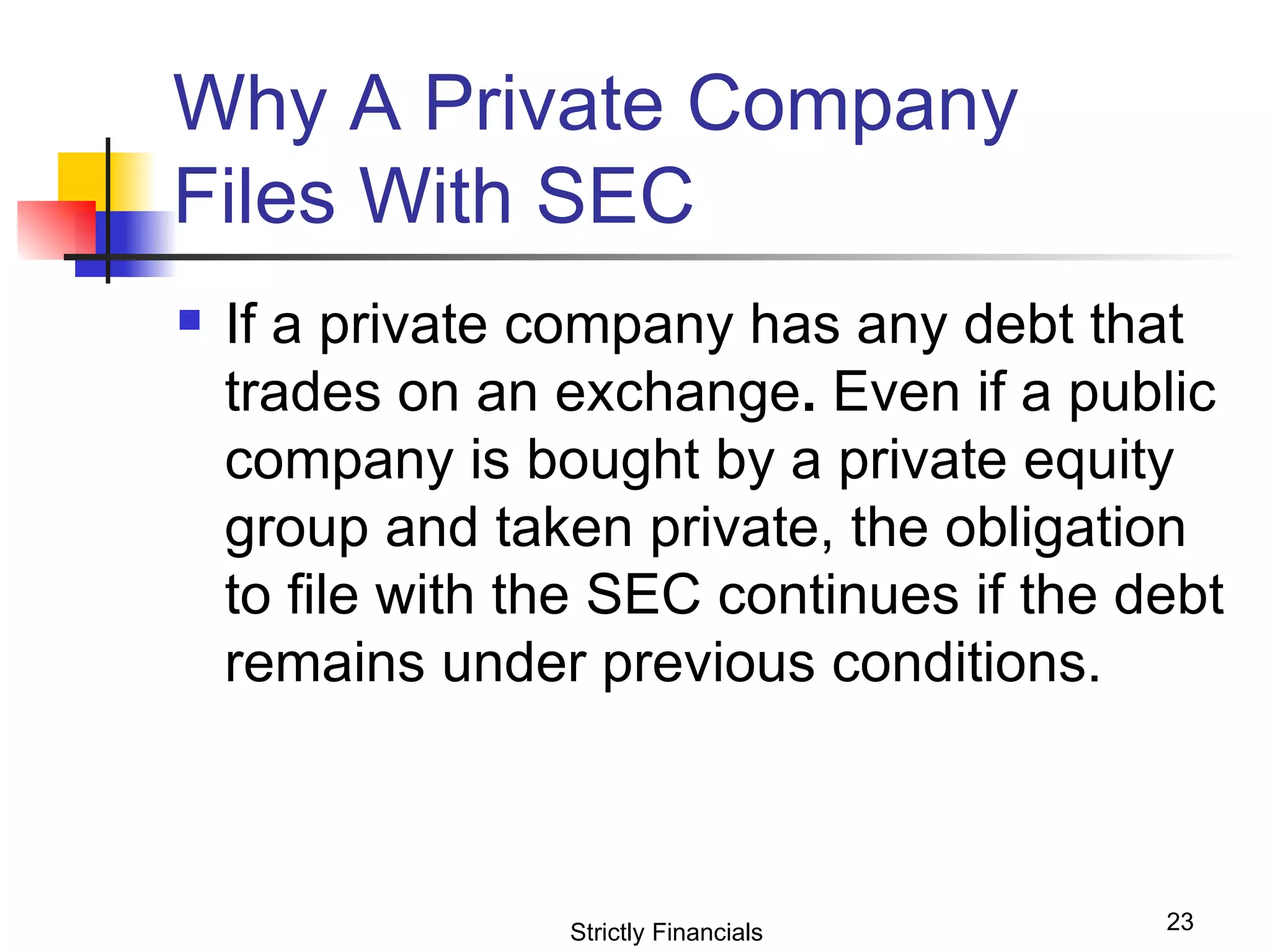
Why A Private Company  Files With SEC  If a private company has any debt that trades on an exchange .  Even if a public company is bought by a private equity group and taken private, the obligation to file with the SEC continues if the debt remains under previous conditions. Strictly Financials
Why A Private Company  Files With SEC  If the debt was issued on a registration statement and is held by more than 500 holders of record, even if it is not traded on an exchange. Obligation continues until the number of shareholders of record falls below 300. Strictly Financials
Why A Private Company  Files With SEC  If a company sold bonds or notes as part of a contract sale and the buyer said the company must file with the SEC until the bonds are retired .  Most common reason. Strictly Financials
SEC Commissioners Mary Schapiro, D, Chairman Daniel Gallagher, R, Commissioner Troy Paredes, R, Commissioner Luis Aguilar, D, Commissioner Elisse Walter, D, Commissioner Strictly Financials
SEC Commissioners (cont.) Serve five-year terms Appointed by the president No more than three from the same political party Strictly Financials
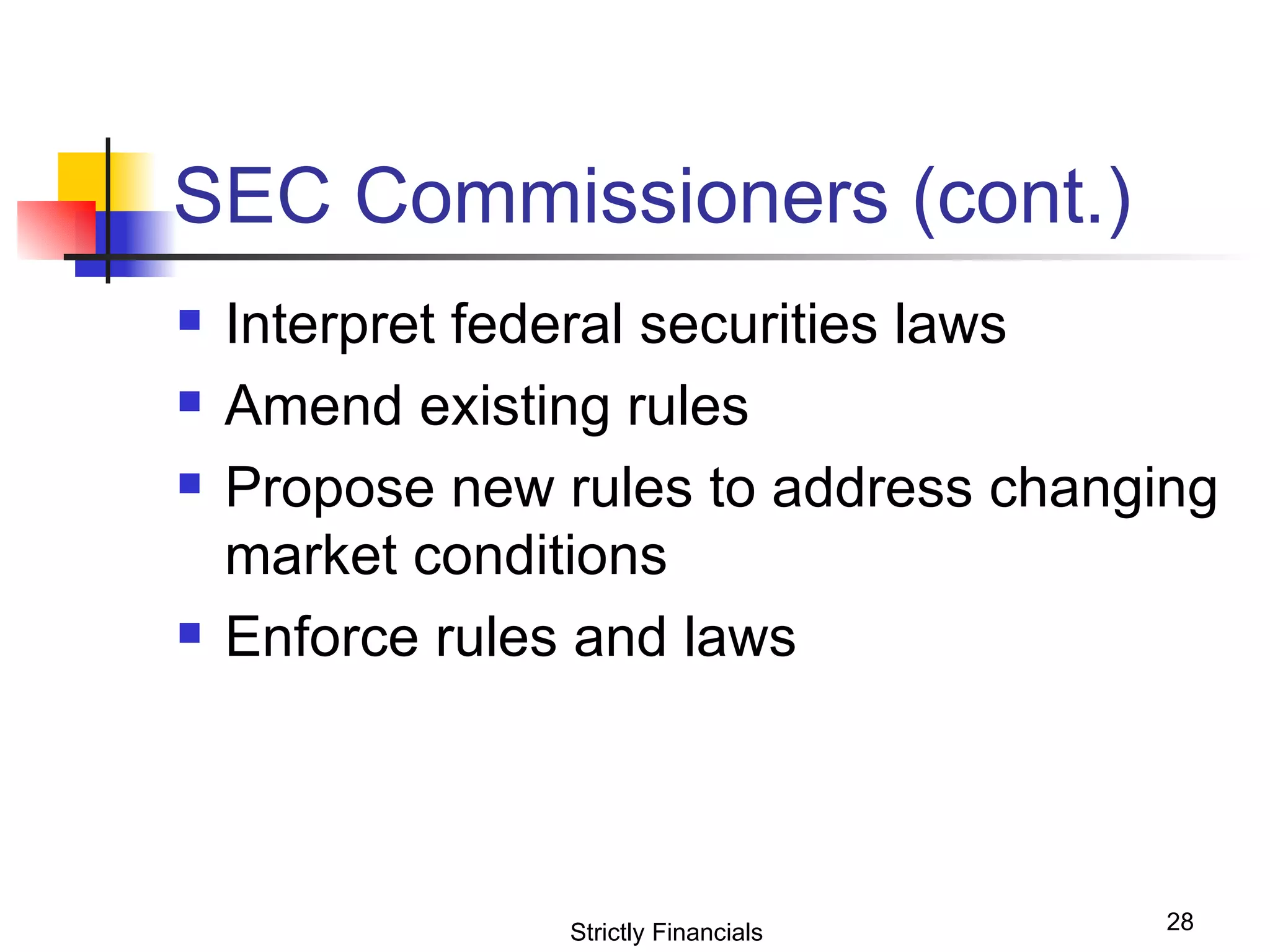
SEC Commissioners (cont.) Interpret federal securities laws Amend existing rules Propose new rules to address changing market conditions Enforce rules and laws Strictly Financials
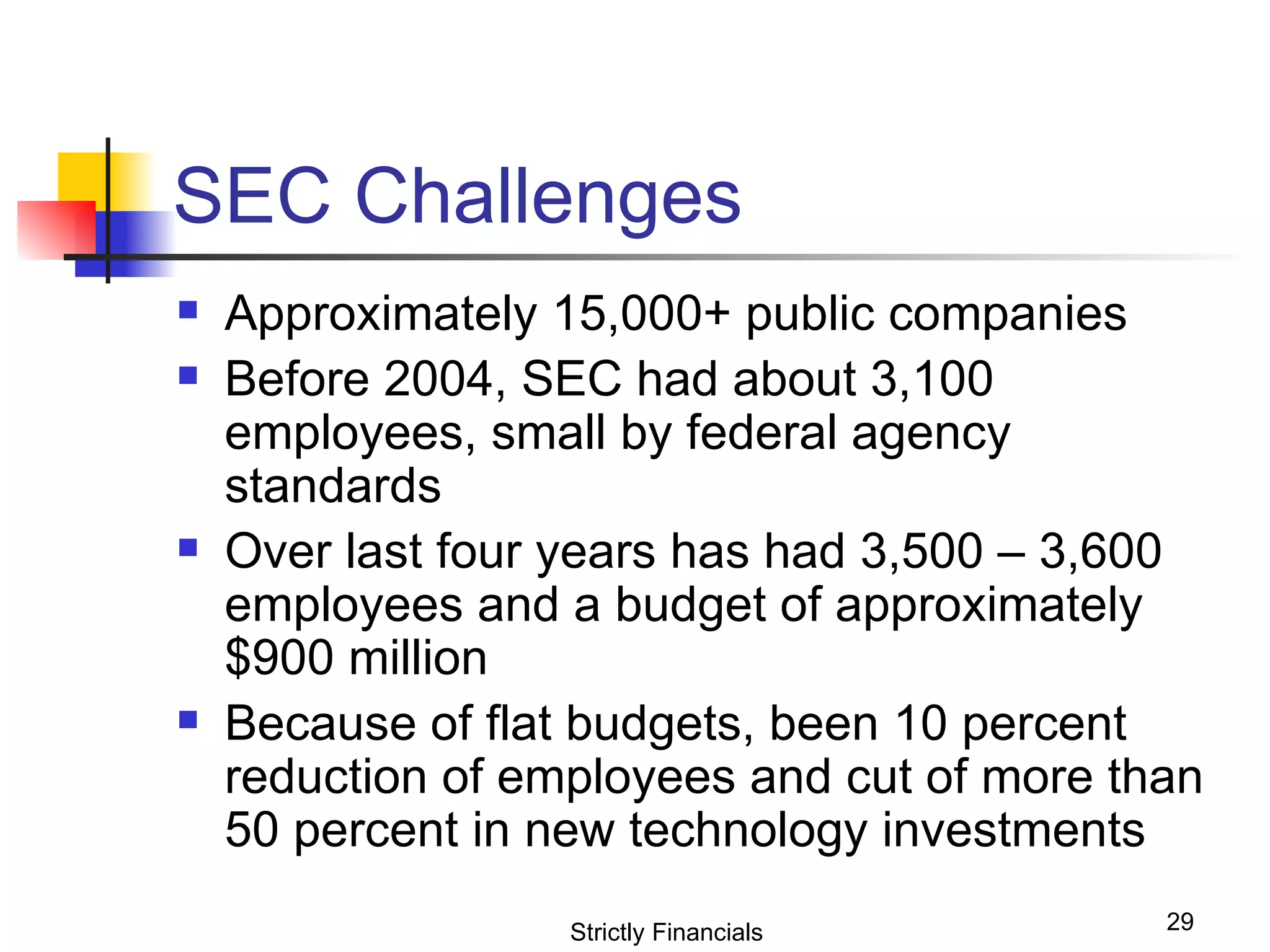
SEC Challenges Approximately 15,000+ public companies Before 2004, SEC had about 3,100  employees, small by federal agency standards Over last four years has had 3,500 – 3,600 employees and a budget of approximately $900 million Because of flat budgets, been 10 percent reduction of employees and cut of more than 50 percent in new technology investments Strictly Financials
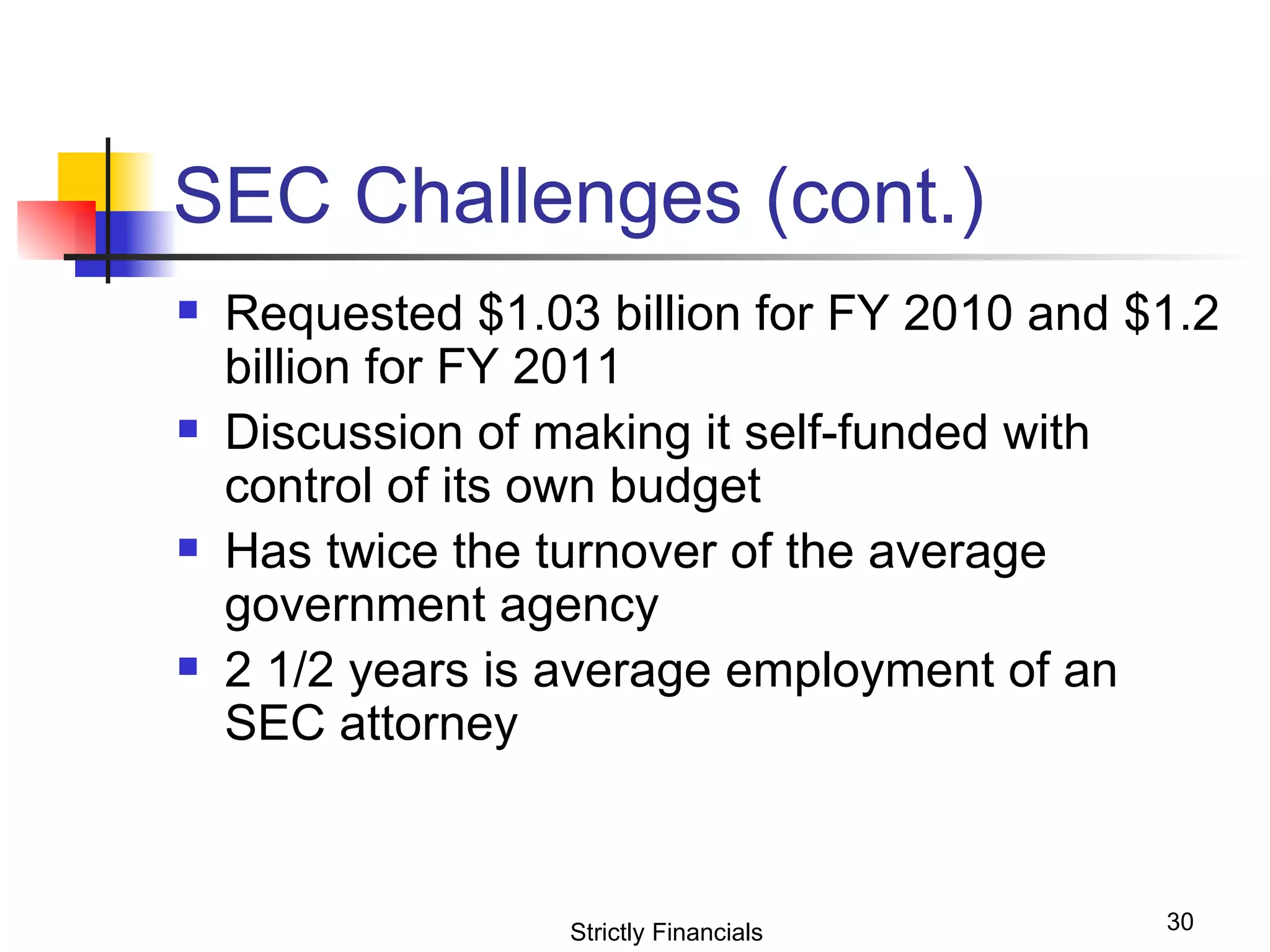
SEC Challenges (cont.) Requested $1.03 billion for FY 2010 and $1.2 billion for FY 2011 Discussion of making it self-funded with control of its own budget Has twice the turnover of the average government agency 2 1/2 years is average employment of an SEC attorney Strictly Financials
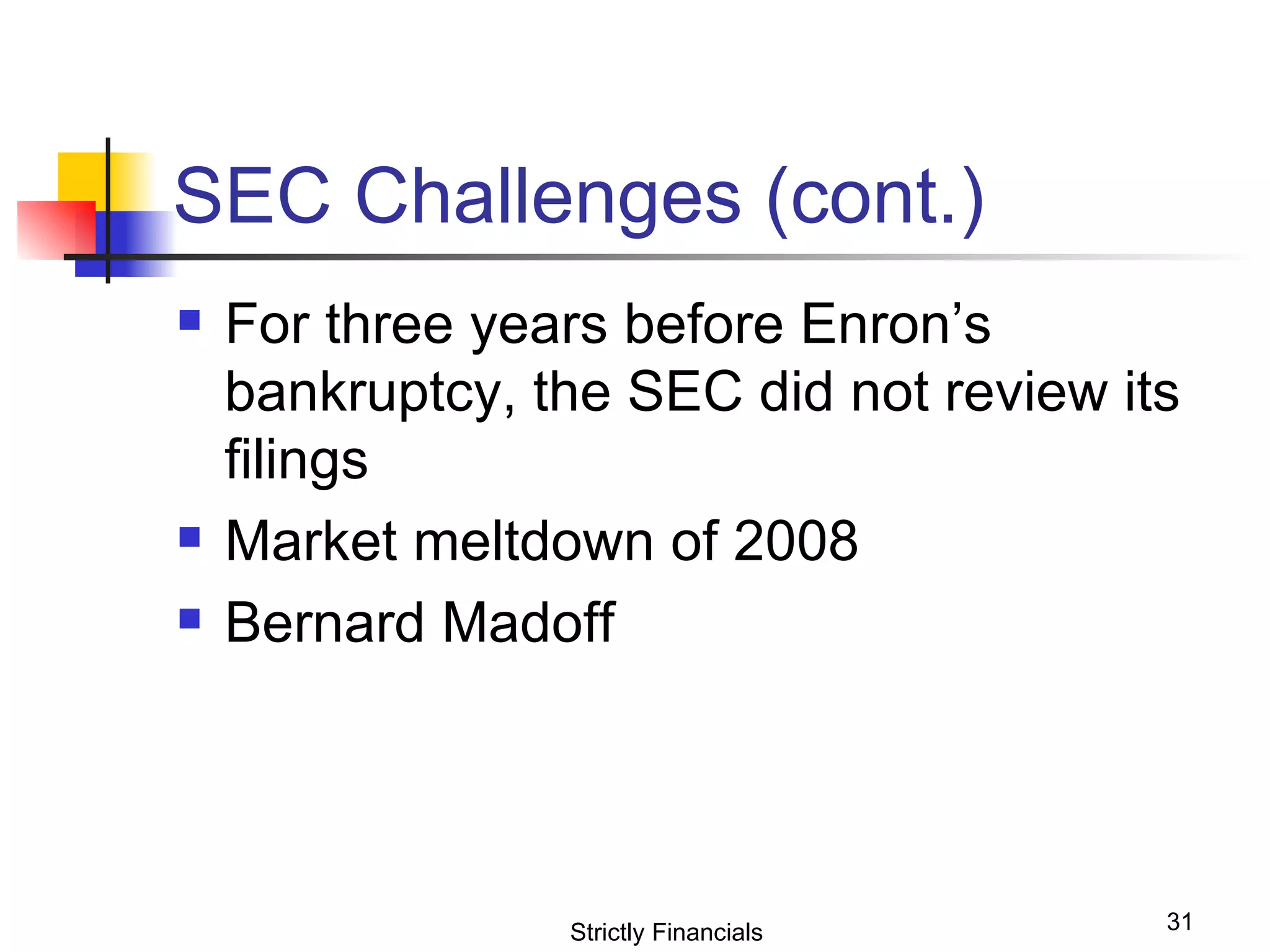
SEC Challenges (cont.) For three years before Enron’s bankruptcy, the SEC did not review its filings Market meltdown of 2008 Bernard Madoff Strictly Financials
SEC Revolving Door In summer 2004: Enforcement division manager to partner in major law firm (white-collar defense) Regional director to partner in major law firm (white-collar defense) Deputy director, investment management, to major bank (compliance) Associate director to major law firm (securities practice) Strictly Financials
SEC Uncertain Future XBRL – eXtensible Business Reporting Language  Frustration with its performance Legislative self-righteousness Various proposals for restructuring oversight Strictly Financials

SEC Filings by Jimmy Gentry

  • 1.
    Securities and Exchange Commission Filings Strictly Financials Jan. 3, 2012 Strictly Financials
  • 2.
    Donald W. ReynoldsNational Center For Business Journalism At Arizona State University Strictly Financials
  • 3.
    James K. Gentry,Ph.D. Clyde M. Reed Teaching Professor School of Journalism and Mass Communications University of Kansas [email_address] Strictly Financials
  • 4.
    Securities and ExchangeCommission Created in wake of Crash of 1929 to restore faith in markets Securities Act of 1933 Securities Exchange Act of 1934 Justice Brandeis’ role Strictly Financials
  • 5.
    SEC Role Protectinvestors through disclosure of certain information Maintain a fair, orderly and efficient trading market, i.e. prevent misrepresentation Maintain investor confidence Facilitate capital formation Strictly Financials
  • 6.
    SEC Philosophy Allinvestors should have access to certain basic information about an investment before buying it and as long as they hold it. Strictly Financials
  • 7.
    Who Files Companieswith more than $10 million in assets whose securities are held by more than 500 owners must file annual and other periodic reports. Strictly Financials
  • 8.
    Accessing SEC DocumentsFinance.yahoo, other financial sites Company websites SEC: www.sec.gov SEC Filings and Forms (EDGAR) www.sec.gov/edgar.shtml EDGAR: Electronic Data Gathering, Analysis and Retrieval System Strictly Financials
  • 9.
    Key SEC Documents10-K 8-K 10-Q Proxy statement Prospectus Form 13-D Form 4 Strictly Financials
  • 10.
    Form 10-K orAnnual Report Historically, had been filed within 90 days after end of company fiscal year Today, 60, 75 or 90 days after fiscal year ends, depending on company’s public float Extensive financial data, including income statement, balance sheet and statement of cash flows Strictly Financials
  • 11.
    Form 10-K (cont.)Extensive company information Auditor’s report MD&A or Management Discussion and Analysis Extensive footnotes Strictly Financials
  • 12.
    Form 8-K orCurrent Update “ Material events” Since August 2004, companies have four business days to file SEC posts them almost instantly upon receipt Number of filings more than doubled since rule change but has slowed Strictly Financials
  • 13.
    Form 8-K (cont.)Change in company auditor and why Bankruptcy-protection filing Expanded disclosure involving director or officer resignation or appointments Restatement of financial results Key litigation Termination of material agreements Strictly Financials
  • 14.
    Form 8-K (cont.)Notice of de-listing by a stock exchange Significant costs of leaving a biz New off-books deals involving significant debt Changes in company bylaws Changes in company fiscal year www.sec.gov/answers/form8k.htm Strictly Financials
  • 15.
    Form 10-Q or Quarterly Update Activities for the quarter (1, 2, 3) Legal proceedings Defaults Labor negotiations Discussion of “seasonality” MD&A Site of incorporation Strictly Financials
  • 16.
    Form 10-Q (cont.)Many companies file 8-K with earnings release “ Material facts” must be in the 10-Q that might not be included in the 10-K Key point: Unaudited Strictly Financials
  • 17.
    Form 14 orProxy Statement Information regarding upcoming annual meeting Matters to be voted on at meeting Executive compensation Information on board members Shareholder proposals Major shareholders Strictly Financials
  • 18.
    Form S-1 orRegistration Statement Also called prospectus Going public or selling new shares Financing, use of proceeds “ Risk factors” Part I and Part II “ Red herring” Strictly Financials
  • 19.
    Form S-1 (cont.)Look at exhibits, which may include the CEO’s employment contract or a list of the company’s real estate around the world Strictly Financials
  • 20.
    Form13-D Must befiled by any outside investor who buys 5 percent or more of a public company’s stock Information on investors, even if are private partnerships of individuals Strictly Financials
  • 21.
    Form 4 Announceschanges in holdings of directors and officers (even if hold no stock), and shareholders owning 10 percent or more of the company’s stock Strictly Financials
  • 22.
    Comment Letters SECposting online comment letters that it sends to public companies and mutual funds about their annual reports, public offerings and other filings Makes it easier for investors and company rivals to understand the weaknesses of the disclosures and what financial issues are of concern to regulators Strictly Financials
  • 23.
    Why A PrivateCompany Files With SEC If a private company has any debt that trades on an exchange . Even if a public company is bought by a private equity group and taken private, the obligation to file with the SEC continues if the debt remains under previous conditions. Strictly Financials
  • 24.
    Why A PrivateCompany Files With SEC If the debt was issued on a registration statement and is held by more than 500 holders of record, even if it is not traded on an exchange. Obligation continues until the number of shareholders of record falls below 300. Strictly Financials
  • 25.
    Why A PrivateCompany Files With SEC If a company sold bonds or notes as part of a contract sale and the buyer said the company must file with the SEC until the bonds are retired . Most common reason. Strictly Financials
  • 26.
    SEC Commissioners MarySchapiro, D, Chairman Daniel Gallagher, R, Commissioner Troy Paredes, R, Commissioner Luis Aguilar, D, Commissioner Elisse Walter, D, Commissioner Strictly Financials
  • 27.
    SEC Commissioners (cont.)Serve five-year terms Appointed by the president No more than three from the same political party Strictly Financials
  • 28.
    SEC Commissioners (cont.)Interpret federal securities laws Amend existing rules Propose new rules to address changing market conditions Enforce rules and laws Strictly Financials
  • 29.
    SEC Challenges Approximately15,000+ public companies Before 2004, SEC had about 3,100 employees, small by federal agency standards Over last four years has had 3,500 – 3,600 employees and a budget of approximately $900 million Because of flat budgets, been 10 percent reduction of employees and cut of more than 50 percent in new technology investments Strictly Financials
  • 30.
    SEC Challenges (cont.)Requested $1.03 billion for FY 2010 and $1.2 billion for FY 2011 Discussion of making it self-funded with control of its own budget Has twice the turnover of the average government agency 2 1/2 years is average employment of an SEC attorney Strictly Financials
  • 31.
    SEC Challenges (cont.)For three years before Enron’s bankruptcy, the SEC did not review its filings Market meltdown of 2008 Bernard Madoff Strictly Financials
  • 32.
    SEC Revolving DoorIn summer 2004: Enforcement division manager to partner in major law firm (white-collar defense) Regional director to partner in major law firm (white-collar defense) Deputy director, investment management, to major bank (compliance) Associate director to major law firm (securities practice) Strictly Financials
  • 33.
    SEC Uncertain FutureXBRL – eXtensible Business Reporting Language Frustration with its performance Legislative self-righteousness Various proposals for restructuring oversight Strictly Financials