2023 Academic Year
2nd Bimester
ENTREPRENEURIAL INNOVATION
(BUST08015)
SETTING UPA BUSINESS
Topics to be covered:
• Meaning and Definition of Business
• Objectives of Business
• Influence on Business
• Forms of Business organization
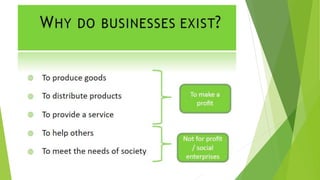
• Why do Business Exist
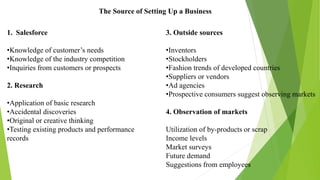
• The Source of Setting Up a Business
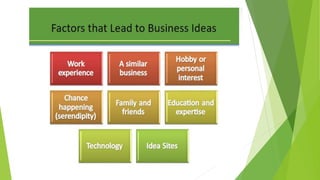
• Factors That leads to Business Ideas
• How to Setting Up a Business
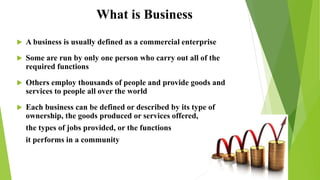
What is Business
 A business is usually defined as a commercial enterprise
 Some are run by only one person who carry out all of the
required functions
 Others employ thousands of people and provide goods and
services to people all over the world
 Each business can be defined or described by its type of
ownership, the goods produced or services offered,
the types of jobs provided, or the functions
it performs in a community
DEFINITION OF BUSINESS
Various authors have defined business in different ways. Some of them are quoted below:
“Business is the exchange of goods, services, or money for mutual benefit or
profit.” – Skinner and Ivancevich
“Business may be defined as any form of commercial activity to satisfy the
economic wants of people at a profit.” – Keith Davis
“Business is any enterprise engaged in production and distribution of goods for
sale in a market or rendering services for a price.”- Professor Owen.
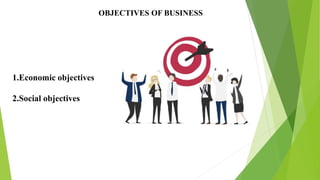
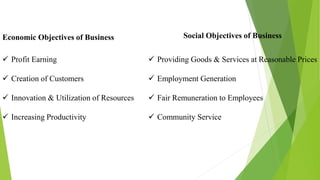
OBJECTIVES OF BUSINESS
1.Economic objectives
2.Social objectives
Economic Objectives of Business
 Profit Earning
 Creation of Customers
 Innovation & Utilization of Resources
 Increasing Productivity
Social Objectives of Business
 Providing Goods & Services at Reasonable Prices
 Employment Generation
 Fair Remuneration to Employees
 Community Service
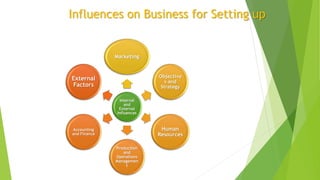
Influences on Business for Setting up
Internal
and
External
Influences
Marketing
Objective
s and
Strategy
Human
Resources
Production
and
Operations
Managemen
t
Accounting
and Finance
External
Factors
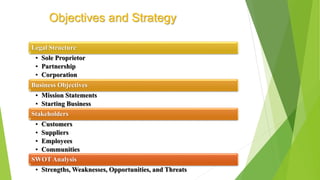
Objectives and Strategy
Legal Structure
• Sole Proprietor
• Partnership
• Corporation
Business Objectives
• Mission Statements
• Starting Business
Stakeholders
• Customers
• Suppliers
• Employees
• Communities
SWOT Analysis
• Strengths, Weaknesses, Opportunities, and Threats
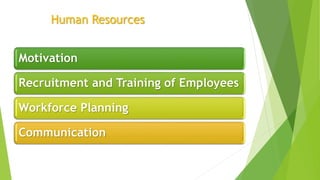
Human Resources
Motivation
Recruitment and Training of Employees
Workforce Planning
Communication
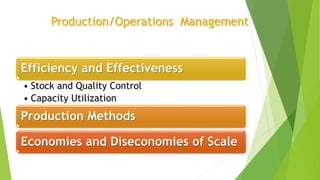
Production/Operations Management
Efficiency and Effectiveness
• Stock and Quality Control
• Capacity Utilization
Production Methods
Economies and Diseconomies of Scale
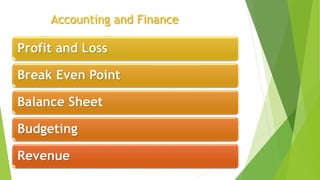
Accounting and Finance
Profit and Loss
Break Even Point
Balance Sheet
Budgeting
Revenue
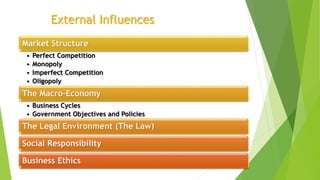
External Influences
Market Structure
• Perfect Competition
• Monopoly
• Imperfect Competition
• Oligopoly
The Macro-Economy
• Business Cycles
• Government Objectives and Policies
The Legal Environment (The Law)
Social Responsibility
Business Ethics
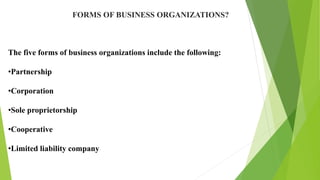
FORMS OF BUSINESS ORGANIZATIONS?
The five forms of business organizations include the following:
•Partnership
•Corporation
•Sole proprietorship
•Cooperative
•Limited liability company
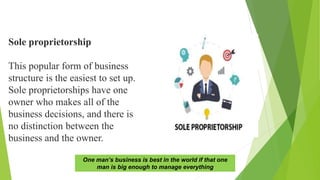
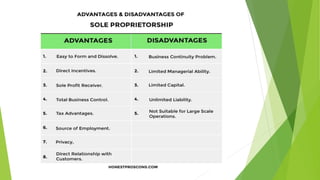
Sole proprietorship
This popular form of business
structure is the easiest to set up.
Sole proprietorships have one
owner who makes all of the
business decisions, and there is
no distinction between the
business and the owner.
One man’s business is best in the world if that one
man is big enough to manage everything
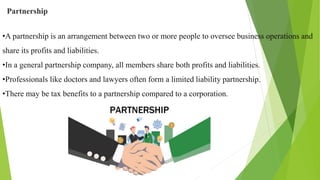
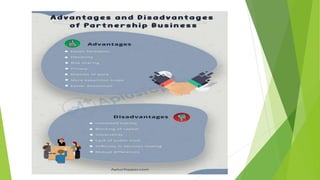
Partnership
•A partnership is an arrangement between two or more people to oversee business operations and
share its profits and liabilities.
•In a general partnership company, all members share both profits and liabilities.
•Professionals like doctors and lawyers often form a limited liability partnership.
•There may be tax benefits to a partnership compared to a corporation.
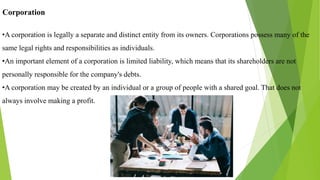
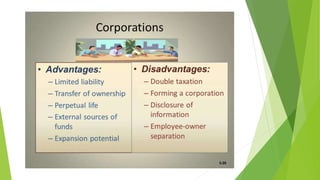
Corporation
•A corporation is legally a separate and distinct entity from its owners. Corporations possess many of the
same legal rights and responsibilities as individuals.
•An important element of a corporation is limited liability, which means that its shareholders are not
personally responsible for the company's debts.
•A corporation may be created by an individual or a group of people with a shared goal. That does not
always involve making a profit.
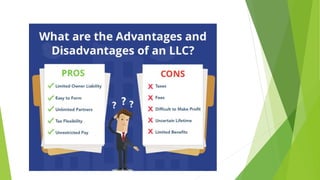
Limited liability company
Limited liability is a business ownership structure that protects shareholders’ personal assets
from losses and debts. The liability is limited to the amount invested in the company. Owners
and partners are not accountable for the firm’s losses and debts.
The Source of Setting Up a Business
1. Salesforce
•Knowledge of customer’s needs
•Knowledge of the industry competition
•Inquiries from customers or prospects
2. Research
•Application of basic research
•Accidental discoveries
•Original or creative thinking
•Testing existing products and performance
records
3. Outside sources
•Inventors
•Stockholders
•Fashion trends of developed countries
•Suppliers or vendors
•Ad agencies
•Prospective consumers suggest observing markets
4. Observation of markets
Utilization of by-products or scrap
Income levels
Market surveys
Future demand
Suggestions from employees
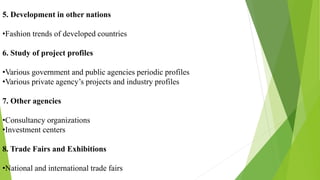
5. Development in other nations
•Fashion trends of developed countries
6. Study of project profiles
•Various government and public agencies periodic profiles
•Various private agency’s projects and industry profiles
7. Other agencies
•Consultancy organizations
•Investment centers
8. Trade Fairs and Exhibitions
•National and international trade fairs
How to Setting up a business
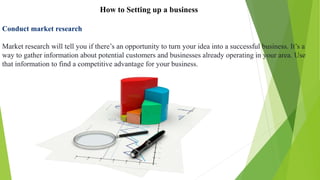
Conduct market research
Market research will tell you if there’s an opportunity to turn your idea into a successful business. It’s a

way to gather information about potential customers and businesses already operating in your area. Use
that information to find a competitive advantage for your business.
Write your business plan
Your business plan is the foundation of your business. It’s a roadmap for how to structure, run, and grow

your new business. You’ll use it to convince people that working with you — or investing in your company

— is a smart choice.
Fund your business
Your business plan will help you figure out how much money you’ll need to start your business.
If you don’t have that amount on hand, you’ll need to either raise or borrow the capital.
Fortunately, there are more ways than ever to find the capital you need.
Pick your business location
Your business location is one of the most important decisions you’ll make. Whether you’re
setting up a brick-and-mortar business or launching an online store, the choices you make
could affect your taxes, legal requirements, and revenue.
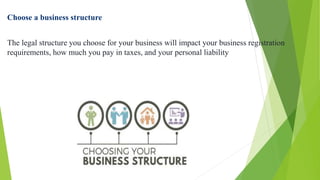
Choose a business structure
The legal structure you choose for your business will impact your business registration
requirements, how much you pay in taxes, and your personal liability
Choose your business name
It’s not easy to pick the perfect name. You’ll want one that reflects your brand and captures
your spirit. You’ll also want to make sure your business name isn’t already being used by
someone else.
Register your business
Once you’ve picked the perfect business name, it’s time to make it legal and protect your brand.
If you’re doing business under a name different than your own, you’ll need to register with the
federal government, and maybe your state government, too.
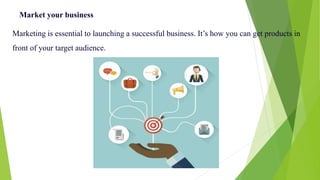
Market your business
Marketing is essential to launching a successful business. It’s how you can get products in

front of your target audience.
Grow your business
Once your business is up and running, consider taking steps to make it grow. New business
owners can take several measures, from seeking additional funding to selling in overseas
markets.
Reference For Innovation management
 Innovation Management by Carolina Machado, J. Paulo Davim
 Innovation Management Perspectives from Strategy, Product, Process and Human
Resources Research by Edited by Vida Škudienė, Jason Li-Ying, Fabian Bernhard
 Innovation Management and New Product Development by Dr Paul Trott
Reference for Setting Up A Business
 Will it fly by PAT FLINN
 Company of one by Paul Jarvis
 Starting a business quick start guide by Ken Colwell

END

Lesson 4.pptx

  • 1.
    2023 Academic Year 2ndBimester ENTREPRENEURIAL INNOVATION (BUST08015)
  • 2.
    SETTING UPA BUSINESS Topicsto be covered: • Meaning and Definition of Business • Objectives of Business • Influence on Business • Forms of Business organization • Why do Business Exist • The Source of Setting Up a Business • Factors That leads to Business Ideas • How to Setting Up a Business
  • 3.
    What is Business A business is usually defined as a commercial enterprise  Some are run by only one person who carry out all of the required functions  Others employ thousands of people and provide goods and services to people all over the world  Each business can be defined or described by its type of ownership, the goods produced or services offered, the types of jobs provided, or the functions it performs in a community
  • 4.
    DEFINITION OF BUSINESS Variousauthors have defined business in different ways. Some of them are quoted below: “Business is the exchange of goods, services, or money for mutual benefit or profit.” – Skinner and Ivancevich “Business may be defined as any form of commercial activity to satisfy the economic wants of people at a profit.” – Keith Davis “Business is any enterprise engaged in production and distribution of goods for sale in a market or rendering services for a price.”- Professor Owen.
  • 5.
    OBJECTIVES OF BUSINESS 1.Economicobjectives 2.Social objectives
  • 6.
    Economic Objectives ofBusiness  Profit Earning  Creation of Customers  Innovation & Utilization of Resources  Increasing Productivity Social Objectives of Business  Providing Goods & Services at Reasonable Prices  Employment Generation  Fair Remuneration to Employees  Community Service
  • 7.
    Influences on Businessfor Setting up Internal and External Influences Marketing Objective s and Strategy Human Resources Production and Operations Managemen t Accounting and Finance External Factors
  • 8.
    Objectives and Strategy LegalStructure • Sole Proprietor • Partnership • Corporation Business Objectives • Mission Statements • Starting Business Stakeholders • Customers • Suppliers • Employees • Communities SWOT Analysis • Strengths, Weaknesses, Opportunities, and Threats
  • 9.
    Human Resources Motivation Recruitment andTraining of Employees Workforce Planning Communication
  • 10.
    Production/Operations Management Efficiency andEffectiveness • Stock and Quality Control • Capacity Utilization Production Methods Economies and Diseconomies of Scale
  • 11.
    Accounting and Finance Profitand Loss Break Even Point Balance Sheet Budgeting Revenue
  • 12.
    External Influences Market Structure •Perfect Competition • Monopoly • Imperfect Competition • Oligopoly The Macro-Economy • Business Cycles • Government Objectives and Policies The Legal Environment (The Law) Social Responsibility Business Ethics
  • 13.
    FORMS OF BUSINESSORGANIZATIONS? The five forms of business organizations include the following: •Partnership •Corporation •Sole proprietorship •Cooperative •Limited liability company
  • 14.
    Sole proprietorship This popularform of business structure is the easiest to set up. Sole proprietorships have one owner who makes all of the business decisions, and there is no distinction between the business and the owner. One man’s business is best in the world if that one man is big enough to manage everything
  • 16.
    Partnership •A partnership isan arrangement between two or more people to oversee business operations and share its profits and liabilities. •In a general partnership company, all members share both profits and liabilities. •Professionals like doctors and lawyers often form a limited liability partnership. •There may be tax benefits to a partnership compared to a corporation.
  • 18.
    Corporation •A corporation islegally a separate and distinct entity from its owners. Corporations possess many of the same legal rights and responsibilities as individuals. •An important element of a corporation is limited liability, which means that its shareholders are not personally responsible for the company's debts. •A corporation may be created by an individual or a group of people with a shared goal. That does not always involve making a profit.
  • 20.
    Limited liability company Limitedliability is a business ownership structure that protects shareholders’ personal assets from losses and debts. The liability is limited to the amount invested in the company. Owners and partners are not accountable for the firm’s losses and debts.
  • 23.
    The Source ofSetting Up a Business 1. Salesforce •Knowledge of customer’s needs •Knowledge of the industry competition •Inquiries from customers or prospects 2. Research •Application of basic research •Accidental discoveries •Original or creative thinking •Testing existing products and performance records 3. Outside sources •Inventors •Stockholders •Fashion trends of developed countries •Suppliers or vendors •Ad agencies •Prospective consumers suggest observing markets 4. Observation of markets Utilization of by-products or scrap Income levels Market surveys Future demand Suggestions from employees
  • 24.
    5. Development inother nations •Fashion trends of developed countries 6. Study of project profiles •Various government and public agencies periodic profiles •Various private agency’s projects and industry profiles 7. Other agencies •Consultancy organizations •Investment centers 8. Trade Fairs and Exhibitions •National and international trade fairs
  • 26.
    How to Settingup a business Conduct market research Market research will tell you if there’s an opportunity to turn your idea into a successful business. It’s a way to gather information about potential customers and businesses already operating in your area. Use that information to find a competitive advantage for your business.

  • 27.
    Write your businessplan Your business plan is the foundation of your business. It’s a roadmap for how to structure, run, and grow your new business. You’ll use it to convince people that working with you — or investing in your company — is a smart choice.
  • 28.
    Fund your business Yourbusiness plan will help you figure out how much money you’ll need to start your business. If you don’t have that amount on hand, you’ll need to either raise or borrow the capital. Fortunately, there are more ways than ever to find the capital you need.
  • 29.
    Pick your businesslocation Your business location is one of the most important decisions you’ll make. Whether you’re setting up a brick-and-mortar business or launching an online store, the choices you make could affect your taxes, legal requirements, and revenue.
  • 30.
    Choose a businessstructure The legal structure you choose for your business will impact your business registration requirements, how much you pay in taxes, and your personal liability
  • 31.
    Choose your businessname It’s not easy to pick the perfect name. You’ll want one that reflects your brand and captures your spirit. You’ll also want to make sure your business name isn’t already being used by someone else.
  • 32.
    Register your business Onceyou’ve picked the perfect business name, it’s time to make it legal and protect your brand. If you’re doing business under a name different than your own, you’ll need to register with the federal government, and maybe your state government, too.
  • 33.
    Market your business Marketingis essential to launching a successful business. It’s how you can get products in front of your target audience.
  • 34.
    Grow your business Onceyour business is up and running, consider taking steps to make it grow. New business owners can take several measures, from seeking additional funding to selling in overseas markets.
  • 35.
    Reference For Innovationmanagement  Innovation Management by Carolina Machado, J. Paulo Davim  Innovation Management Perspectives from Strategy, Product, Process and Human Resources Research by Edited by Vida Škudienė, Jason Li-Ying, Fabian Bernhard  Innovation Management and New Product Development by Dr Paul Trott Reference for Setting Up A Business  Will it fly by PAT FLINN  Company of one by Paul Jarvis  Starting a business quick start guide by Ken Colwell 
  • 36.