Chapter 2
Analyzing Transactions
Accounting, 21st Edition
Warren Reeve Fess
PowerPoint Presentation by Douglas Cloud
Professor Emeritus of Accounting
Pepperdine University
© Copyright 2004 South-Western, a division
of Thomson Learning. All rights reserved.
Task Force Image Gallery clip art included in this
electronic presentation is used with the permission of
NVTech Inc.
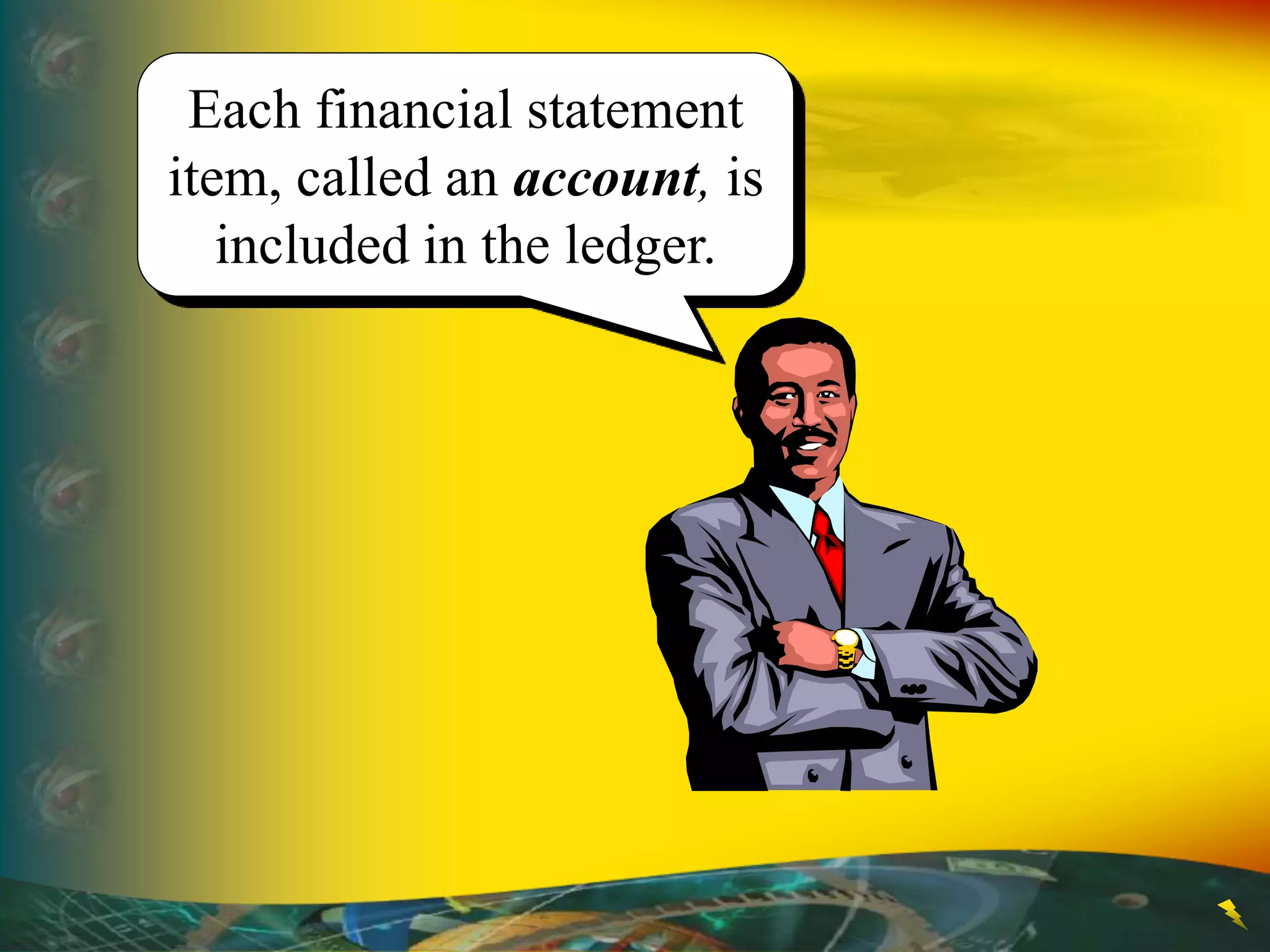
Each financial statement
item, called an account, is
included in the ledger.
A group of
accounts for a
business entity is
called a ledger.
A list of the
accounts in a ledger
is called a chart of
accounts.
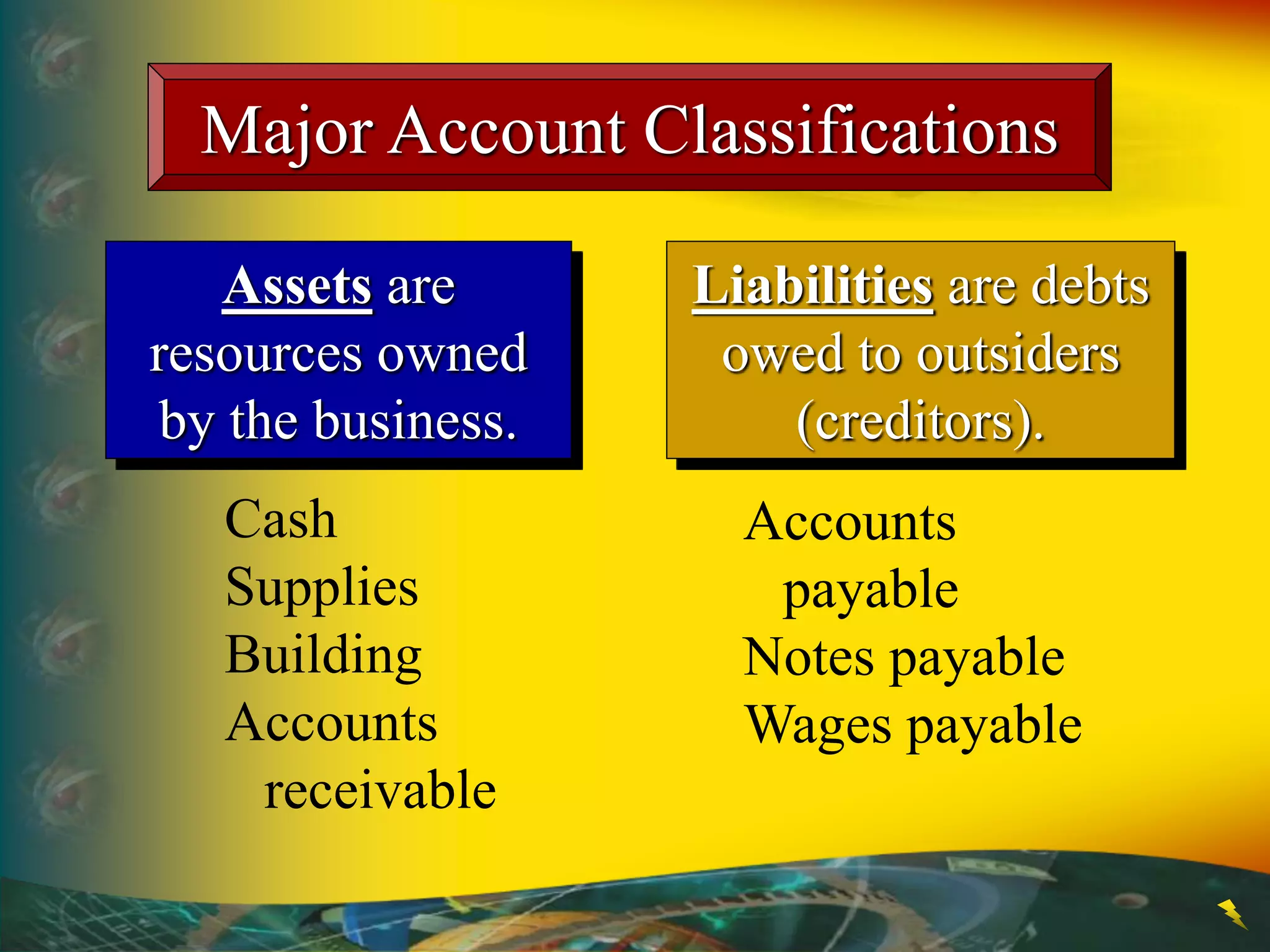
Major Account Classifications
Assets are
resources owned
by the business.
Liabilities are debts
owed to outsiders
(creditors).
Cash
Supplies
Building
Accounts
receivable
Accounts
payable
Notes payable
Wages payable
Major Account Classifications
Liabilities are debts
owed to outsiders
(creditors).
Cash
Supplies
Building
Accounts
receivable
Accounts
payable
Notes payable
Wages payable
Assets are
resources owned
by the business.
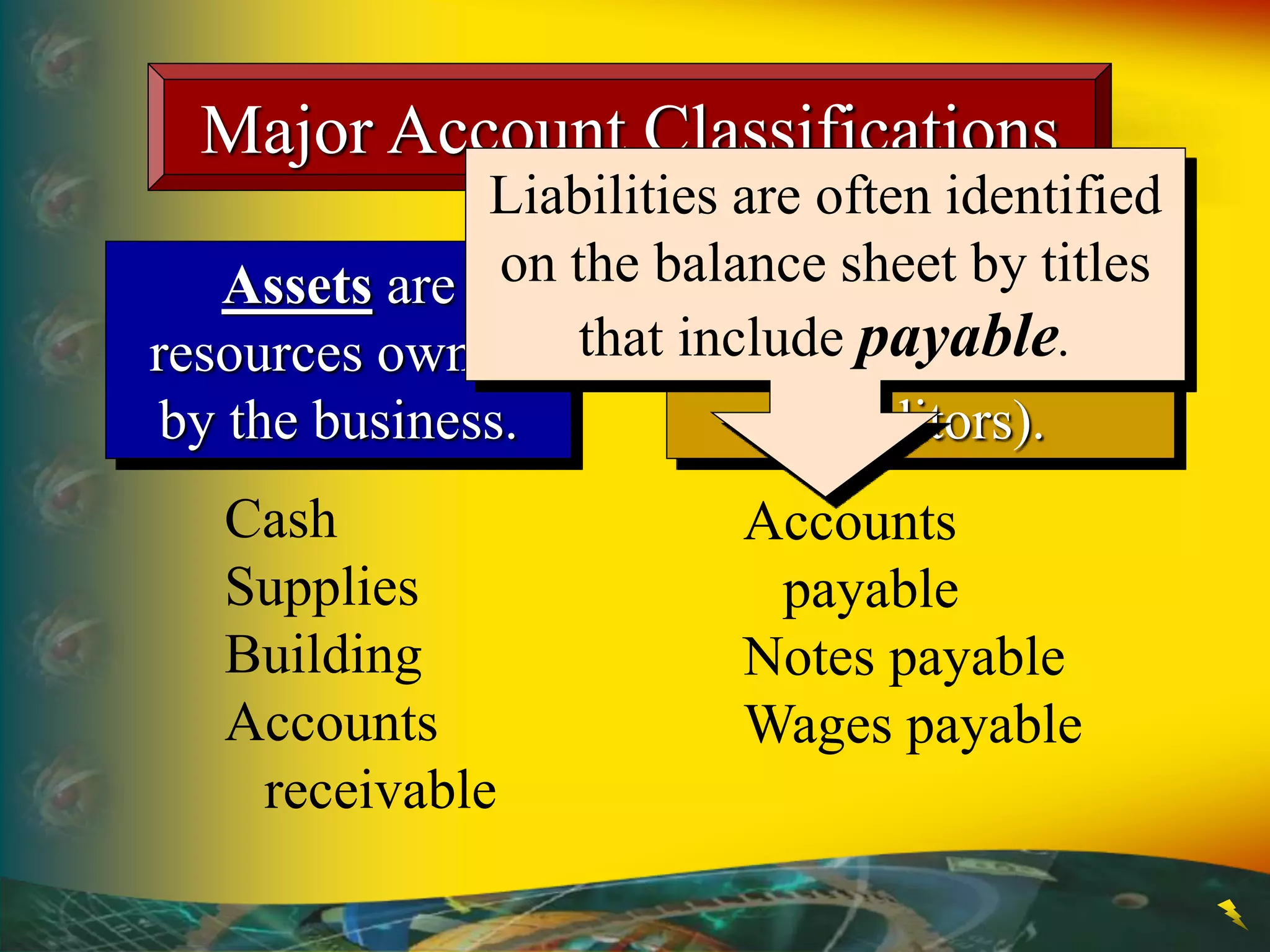
Liabilities are often identified
on the balance sheet by titles
that include payable.
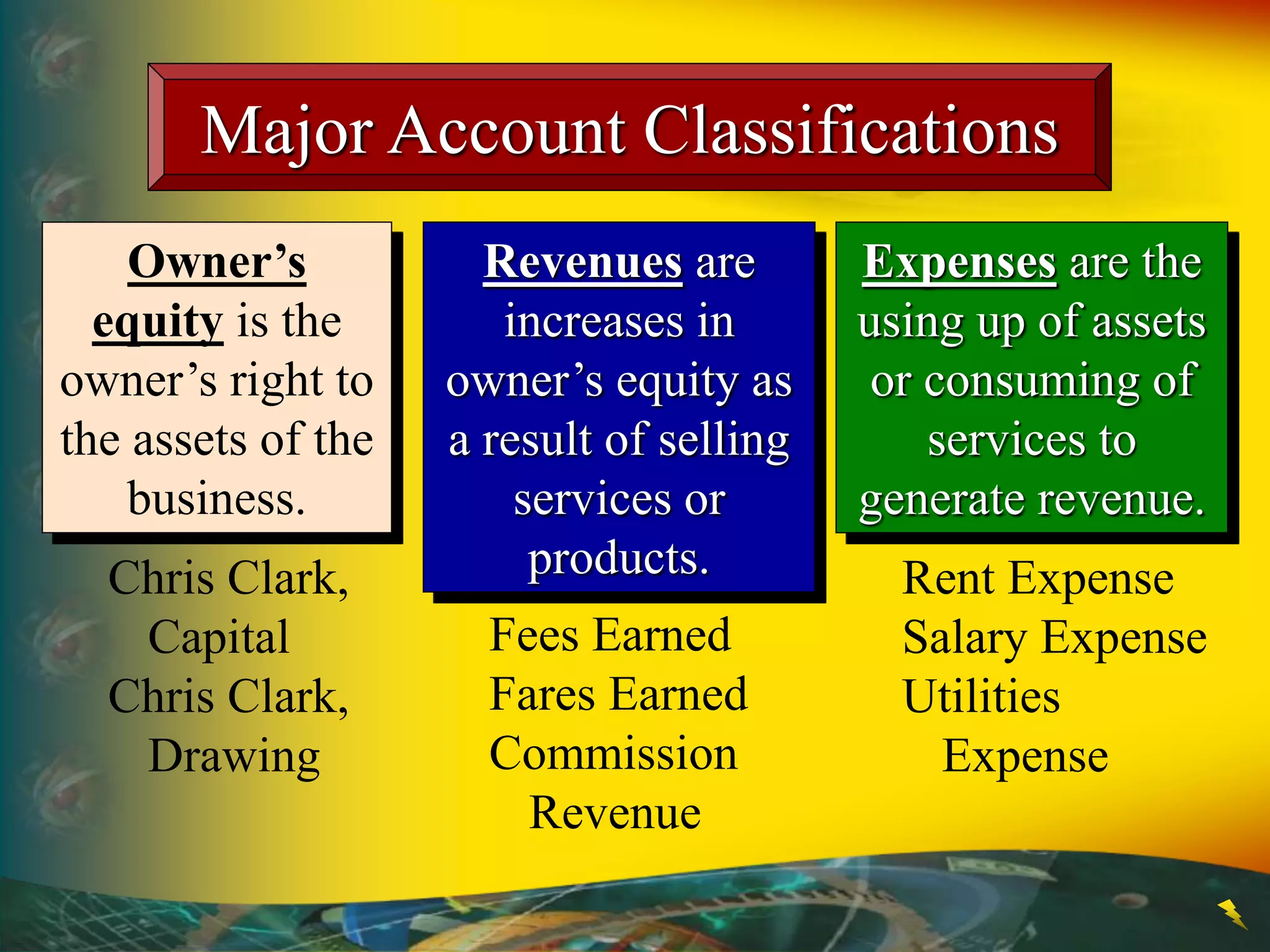
Owner’s
equity is the
owner’s right to
the assets of the
business.
Revenues are
increases in
owner’s equity as
a result of selling
services or
products.
Chris Clark,
Capital
Chris Clark,
Drawing
Fees Earned
Fares Earned
Commission
Revenue
Expenses are the
using up of assets
or consuming of
services to
generate revenue.
Rent Expense
Salary Expense
Utilities
Expense
Major Account Classifications
To assist you in learning,
an account can be drawn
to resemble the letter T.
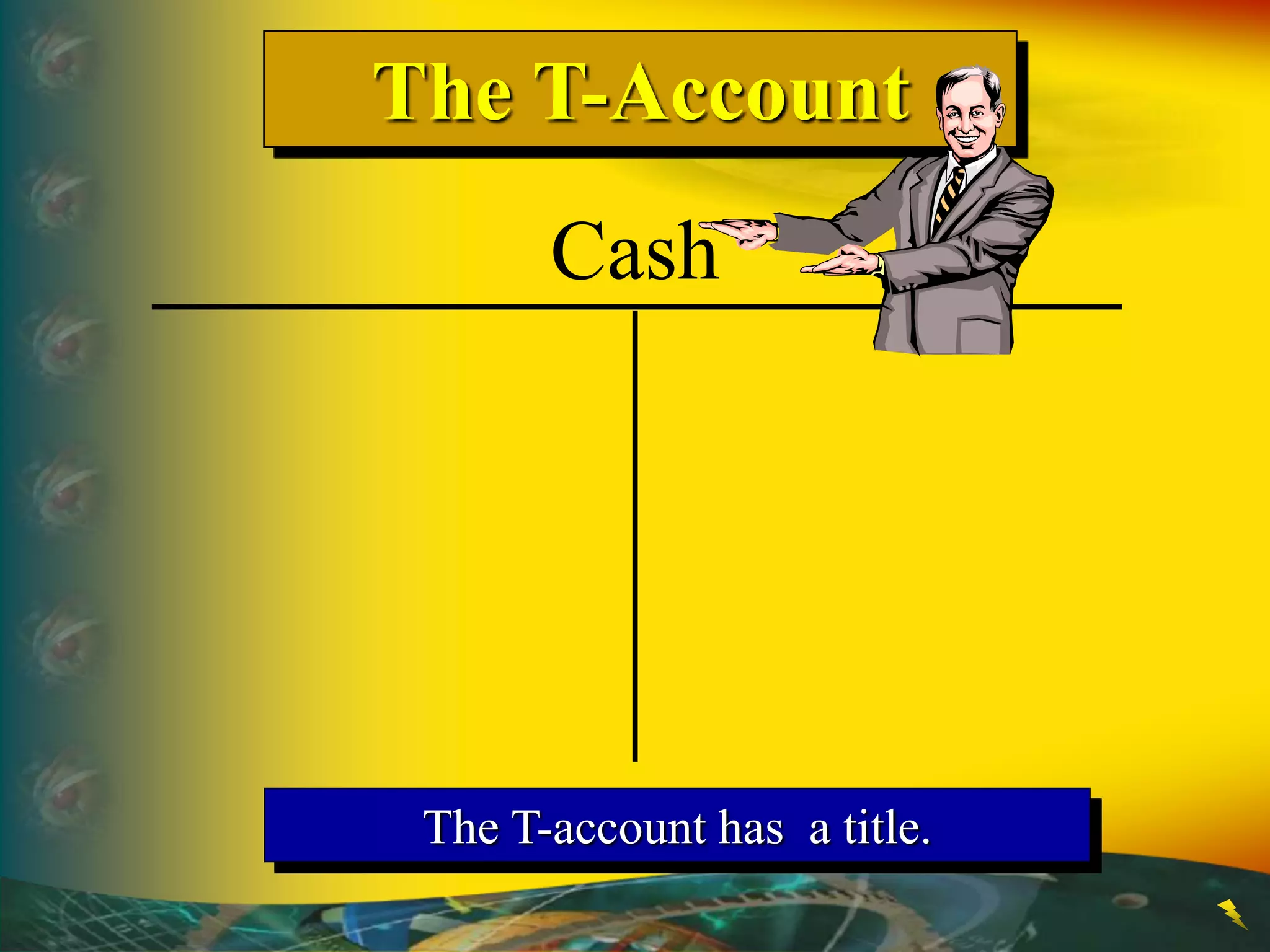
The T-Account
The T-account has a title.
Cash
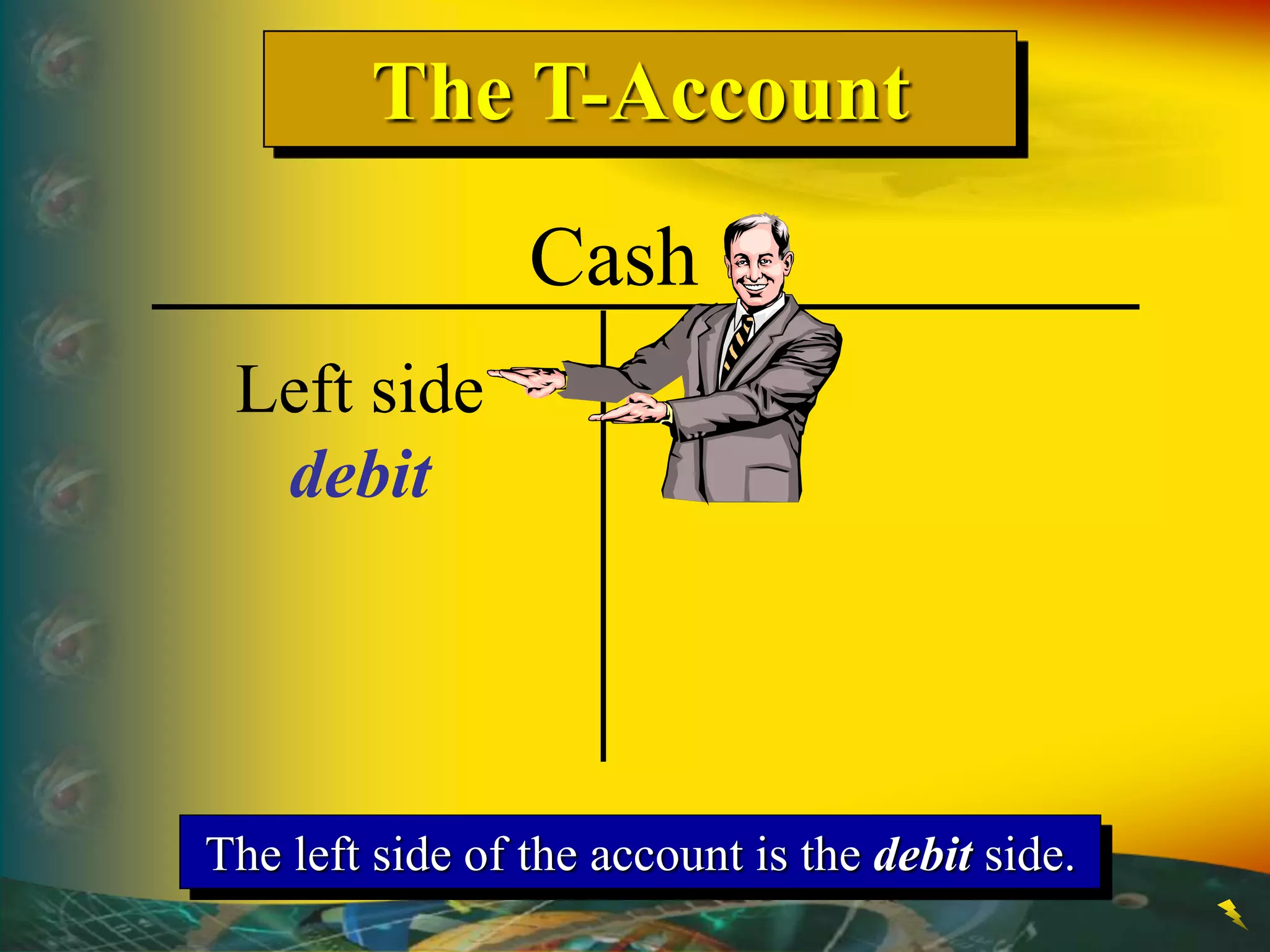
The T-Account
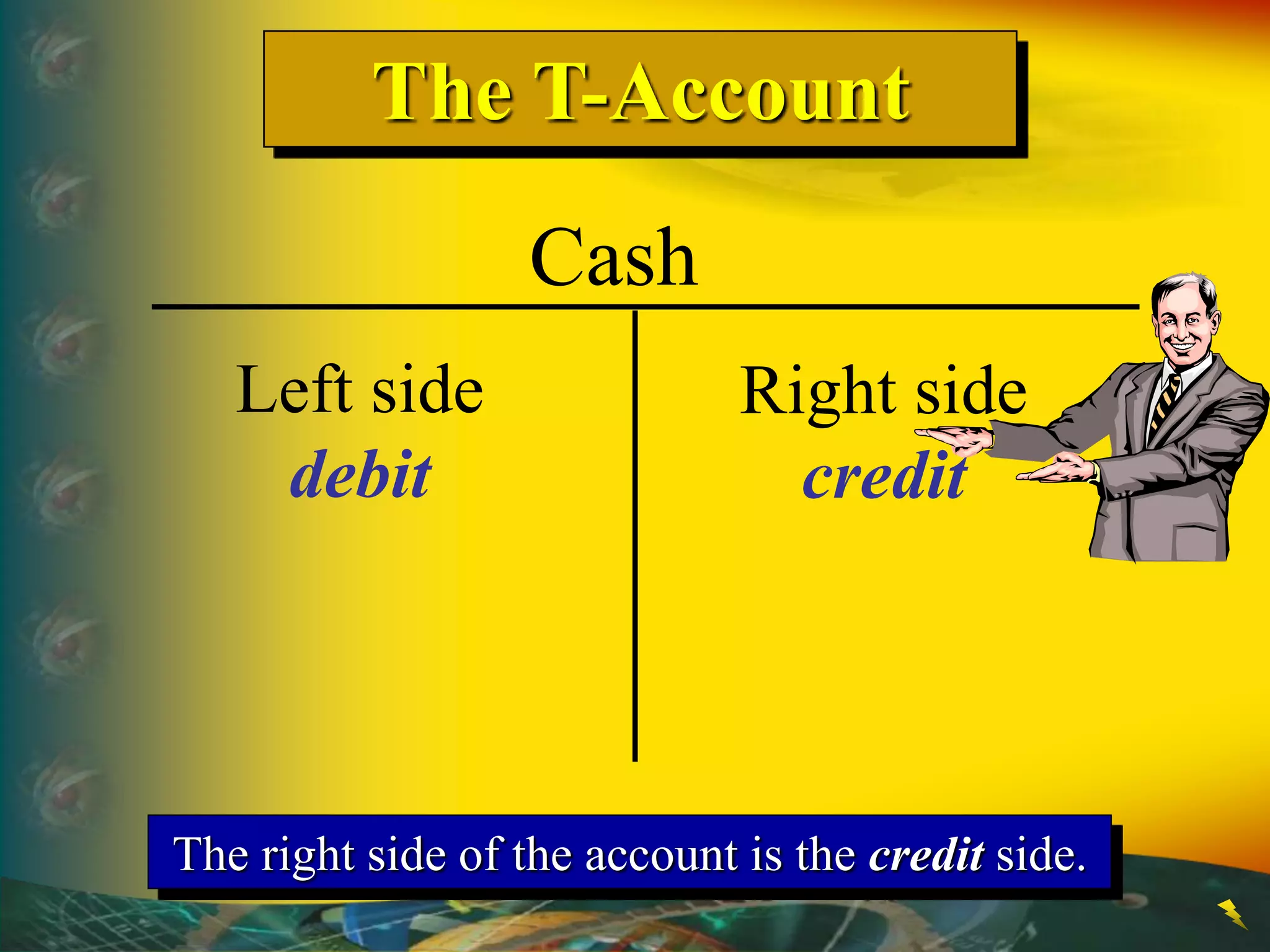
The left side of the account is the debit side.
Cash
Left side
debit
The T-Account
The right side of the account is the credit side.
Cash
Left side
debit
Right side
credit
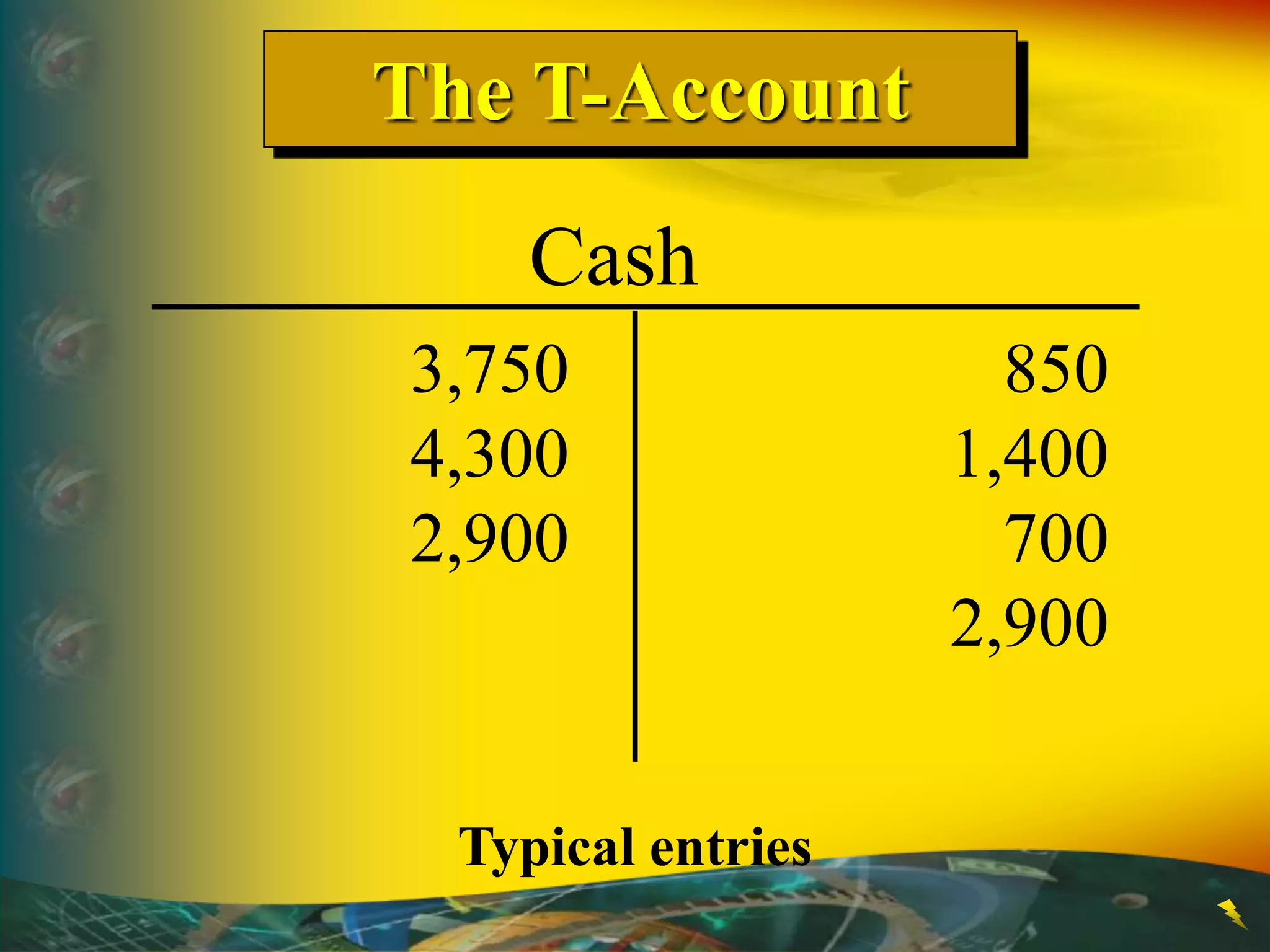
The T-Account
Cash
3,750
4,300
2,900
850
1,400
700
2,900
Typical entries
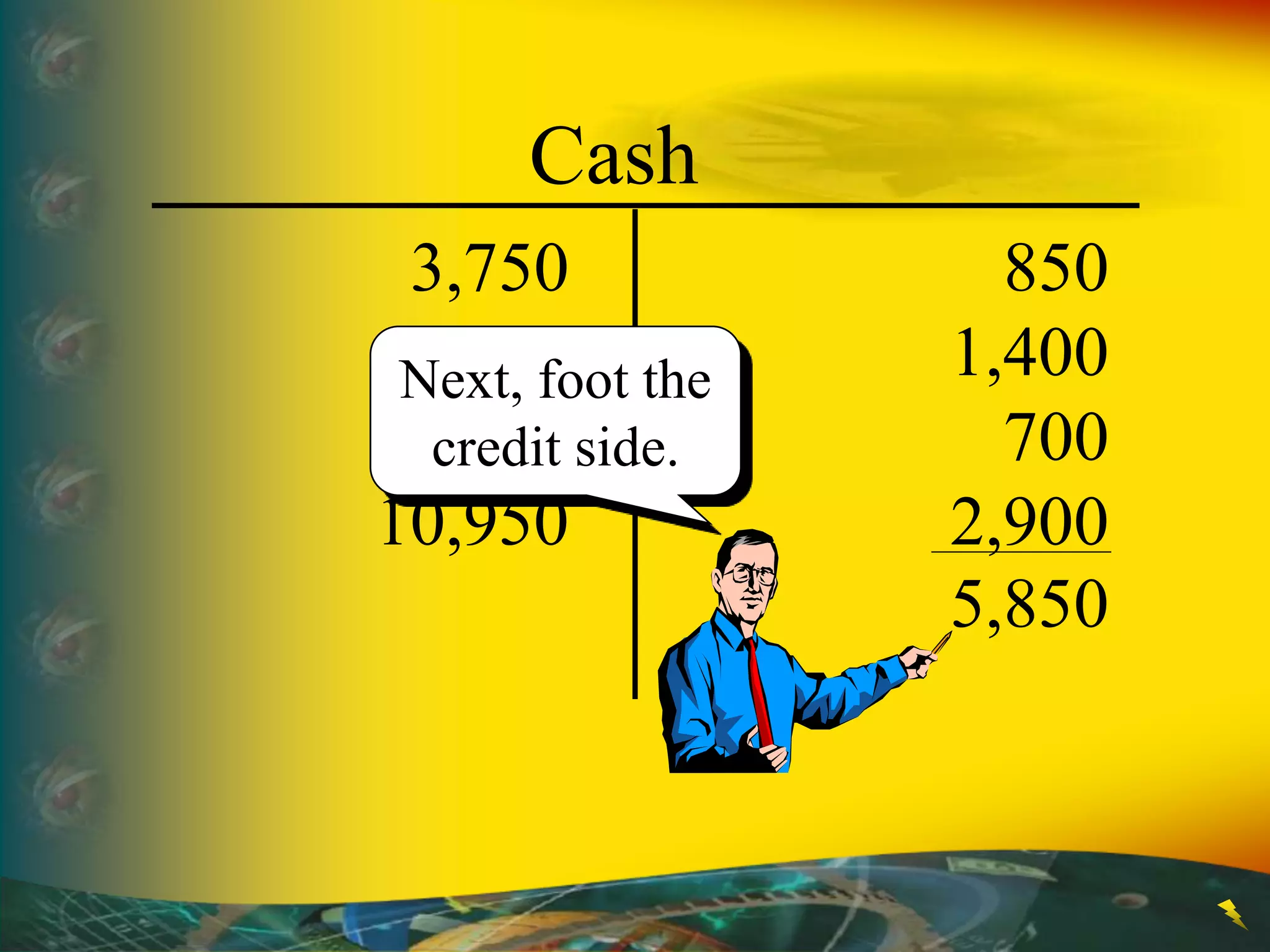
Balancing a T-Account
Cash
3,750
4,300
2,900
850
1,400
700
2,900
10,950
First, foot
the debit
side.
850
1,400
700
2,900
Cash
3,750
4,300
2,900
10,950
5,850
Next, foot the
credit side.
850
1,400
700
2,900
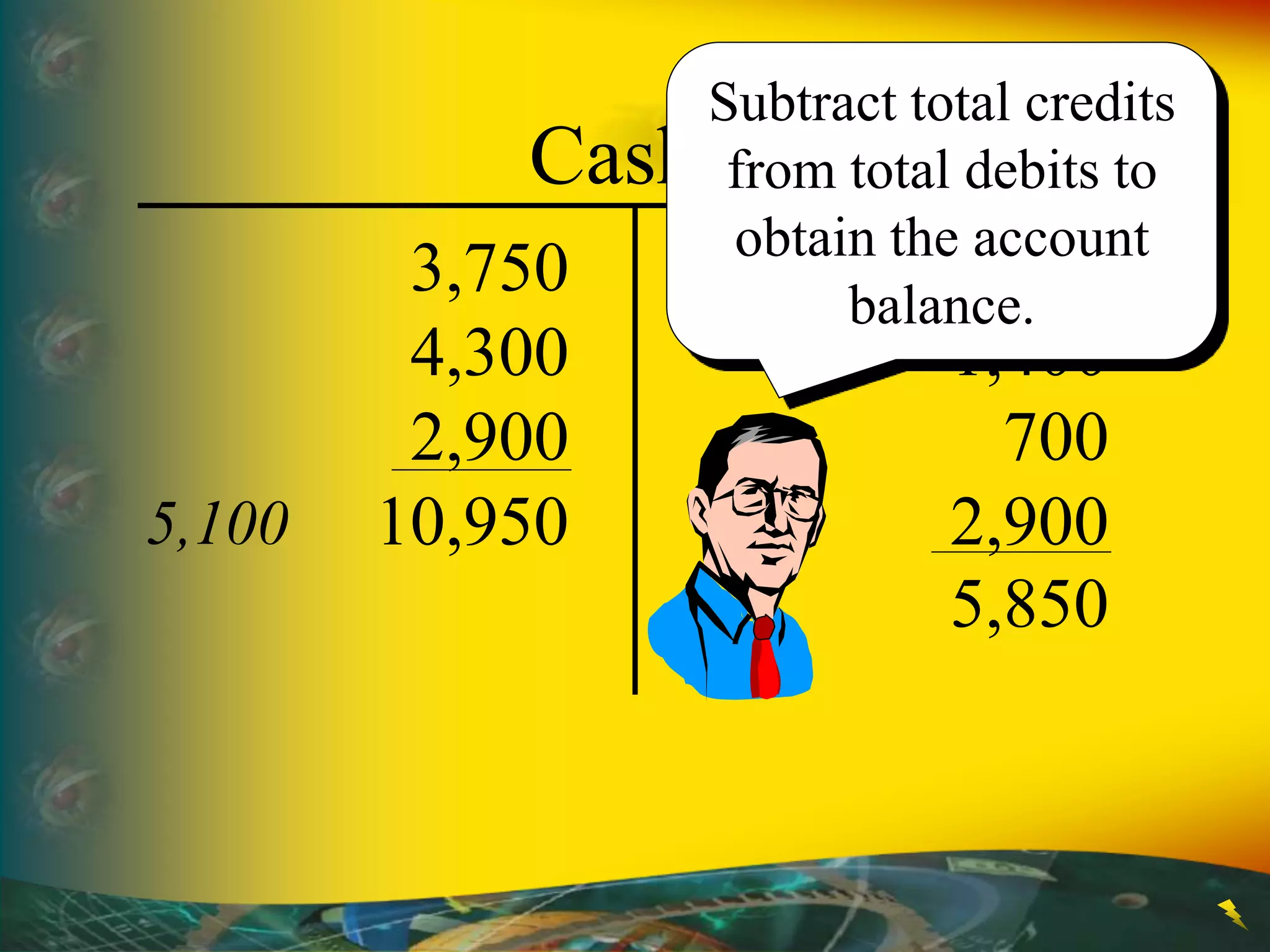
Cash
3,750
4,300
2,900
10,950
5,850
Subtract total credits
from total debits to
obtain the account
balance.
5,100
Transactions and Balance
Sheet Accounts
Post.
Ref.
JOURNAL
Date Description Debit Credit
Page 1
1
2
3
4
Nov. 1
2005
Cash 25 000 00
Chris Clark, Capital 25 000 00
Invested cash in NetSolutions.
(A) On November 1, Chris Clark
deposits $25,000 in a bank account in
the name of NetSolutions.
(A) On November 1, Chris Clark
deposits $25,000 in a bank account in
the name of NetSolutions.
Effects of this entry in the Ledger
Cash
Nov. 1 25,000 Nov. 1 25,000
Chris Clark, Capital
4
5
6
7
8
9
10
5 Land 20 000 00
Cash 20 000 00
Purchased land for building
site.
(B) On November 5,
NetSolutions bought land
for $20,000, paying cash.
Effects of this entry in the Ledger
Cash
Nov. 1 25,000 Nov. 5 20,000
Land
Nov. 5 20,000
(B) On November 5,
NetSolutions bought land
for $20,000, paying cash.
10
11
12
13
14
15
16
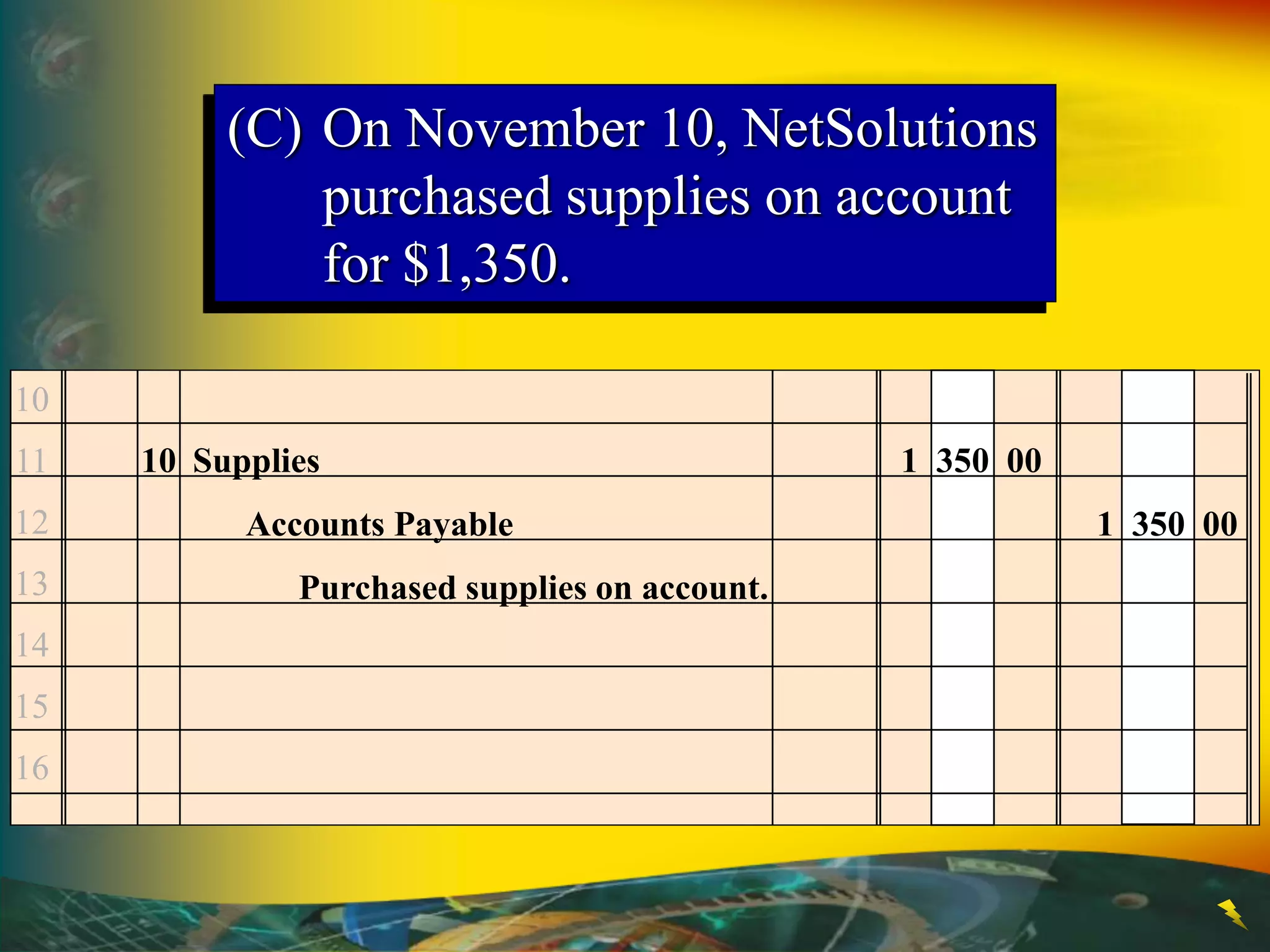
10 Supplies 1 350 00
Accounts Payable 1 350 00
Purchased supplies on account.
(C) On November 10, NetSolutions
purchased supplies on account
for $1,350.
(C) On November 10, NetSolutions
purchased supplies on account
for $1,350.
Effects of this entry in the Ledger
Supplies
Nov. 10 1,350
Accounts Payable
Nov. 10 1,350
30 Accounts Payable 950 00
Cash 950 00
Paid creditors on account.
30
31
32
33
34
35
36
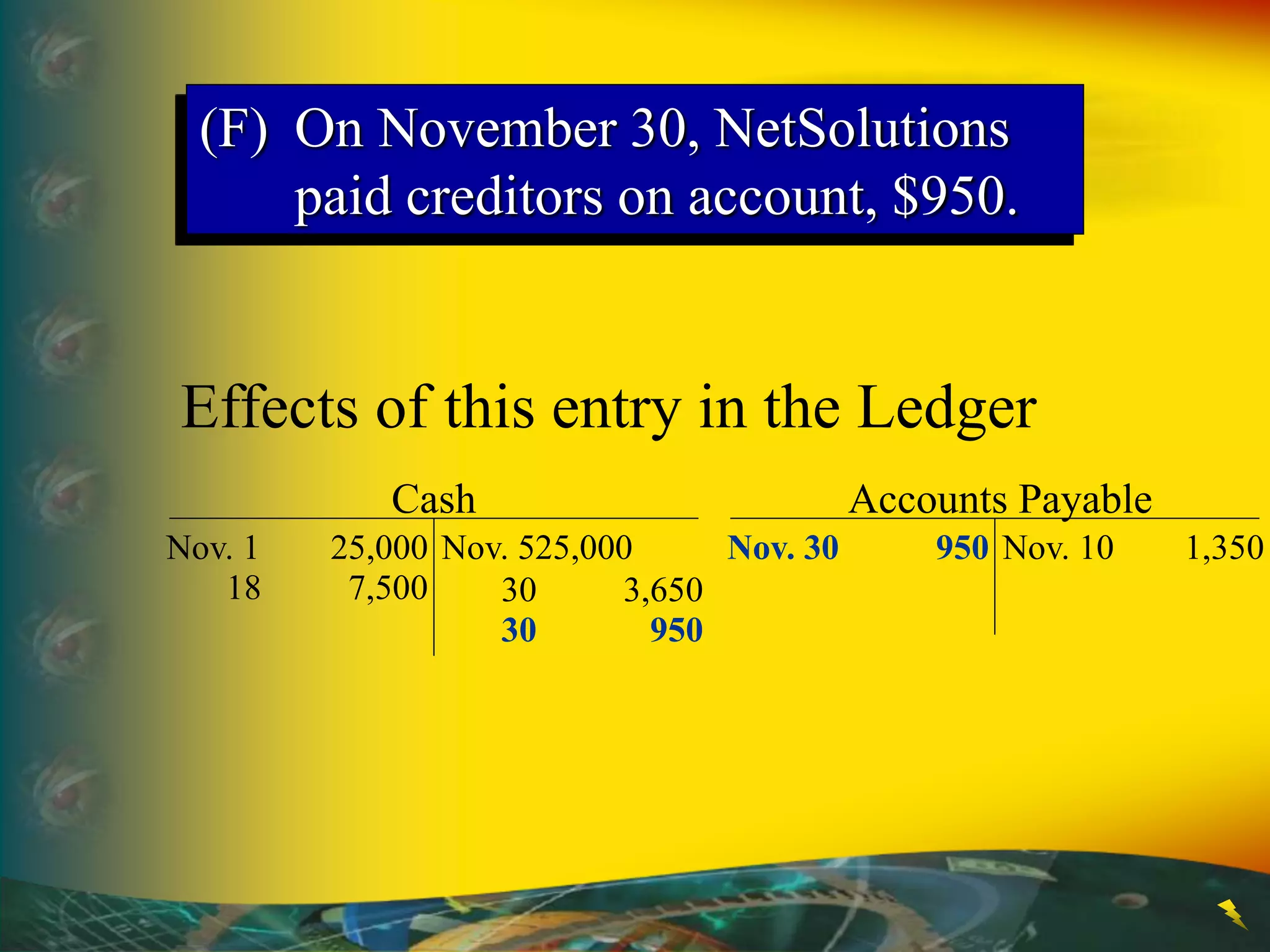
(F) On November 30, NetSolutions
paid creditors on account, $950.
Cash
Nov. 1 25,000 Nov. 525,000
18 7,500 30 3,650
Effects of this entry in the Ledger
Accounts Payable
Nov. 10 1,350
Nov. 30 950
30 950
(F) On November 30, NetSolutions
paid creditors on account, $950.
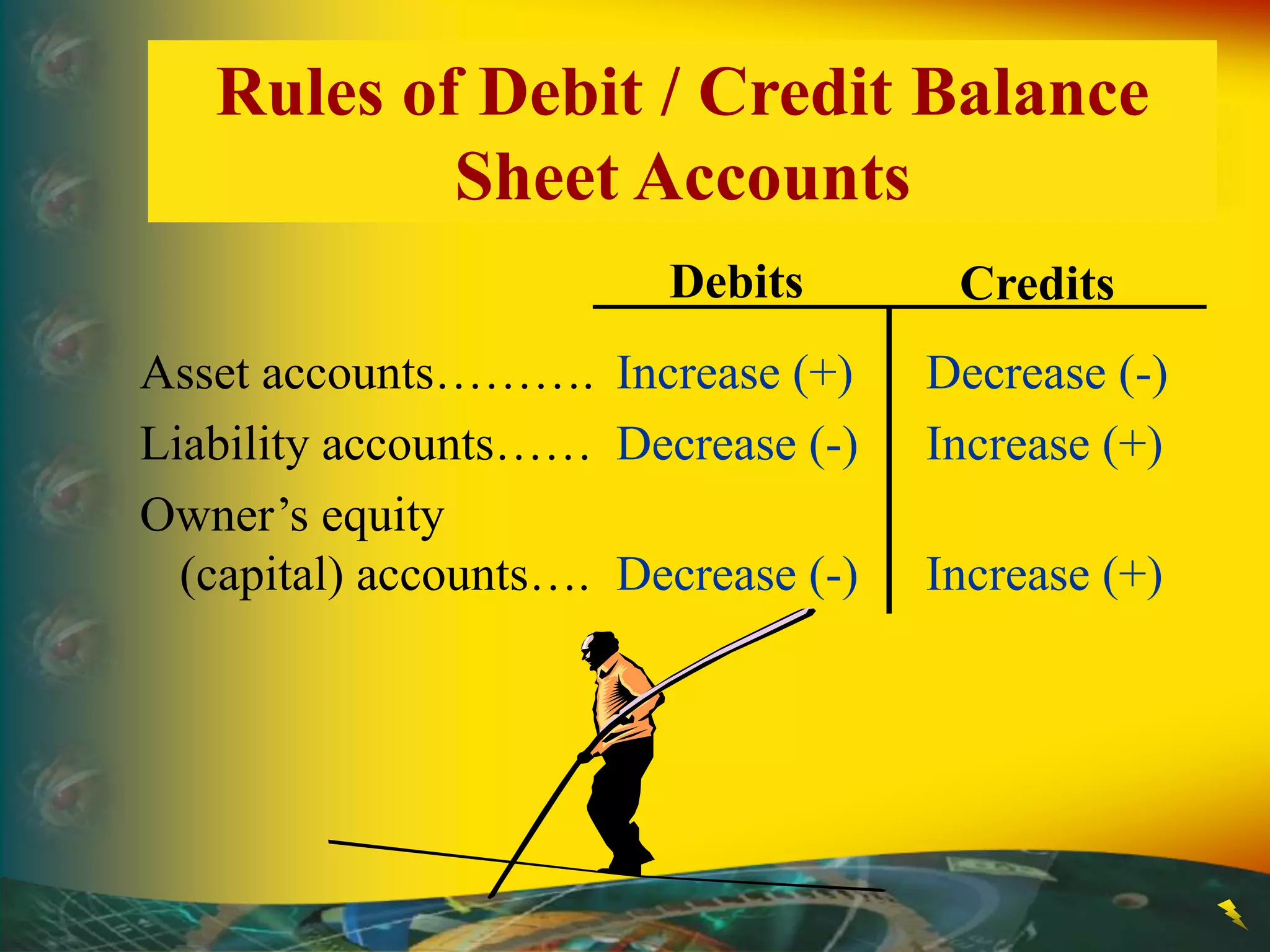
Debits Credits
Asset accounts………. Increase (+) Decrease (-)
Liability accounts…… Decrease (-) Increase (+)
Owner’s equity
(capital) accounts…. Decrease (-) Increase (+)
Rules of Debit / Credit Balance
Sheet Accounts
Credit for
increases
(+)
Credit for
increases
(+)
Credit for
decreases
(-)
Debit for
increases
(+)
Debit for
decreases
(-)
Debit for
decreases
(-)
ASSETS
Asset Accounts
LIABILITIES
Liability Accounts
Owner’s Equity Accounts
OWNER’S EQUITY
Balance Sheet Accounts
(D) On November 18, NetSolutions
received fees of $7,500 from
customers for services provided .
18 Cash 7 500 00
Fees Earned 7 500 00
Received fees from customers.
14
15
16
17
18
19
20
Effects of this entry in the Ledger
Cash
Nov. 1 25,000 Nov. 5 25,000
Fees Earned
Nov. 18 7,500
18 7,500
(D) On November 18, NetSolutions
received fees of $7,500 from
customers for services provided .
(E) Throughout the month, NetSolutions
incurred the following expenses:
wages, $2,125; rent, $800; utilities,
$450; and miscellaneous, $275 .
30 Wages Expense 2 125 00
Rent Expense 800 00
Utilities Expense 450 00
Miscellaneous Expense 275 00
Cash 3 650 00
Paid expenses.
18
19
20
21
22
23
24
Effects of this entry in the Ledger
Cash
Nov. 1 25,000 Nov. 525,000
Wages Expense
Nov. 30 2,125
18 7,500
Rent Expense
Nov. 30 800
Utilities Expense
Nov. 30 450
Miscellaneous Expense
Nov. 30 275
30 3,650
(E) Throughout the month, NetSolutions
incurred the following expenses:
wages, $2,125; rent, $800; utilities,
$450; and miscellaneous, $275 .
In every entry the sum of
the debits always equal
the sum of the credits.
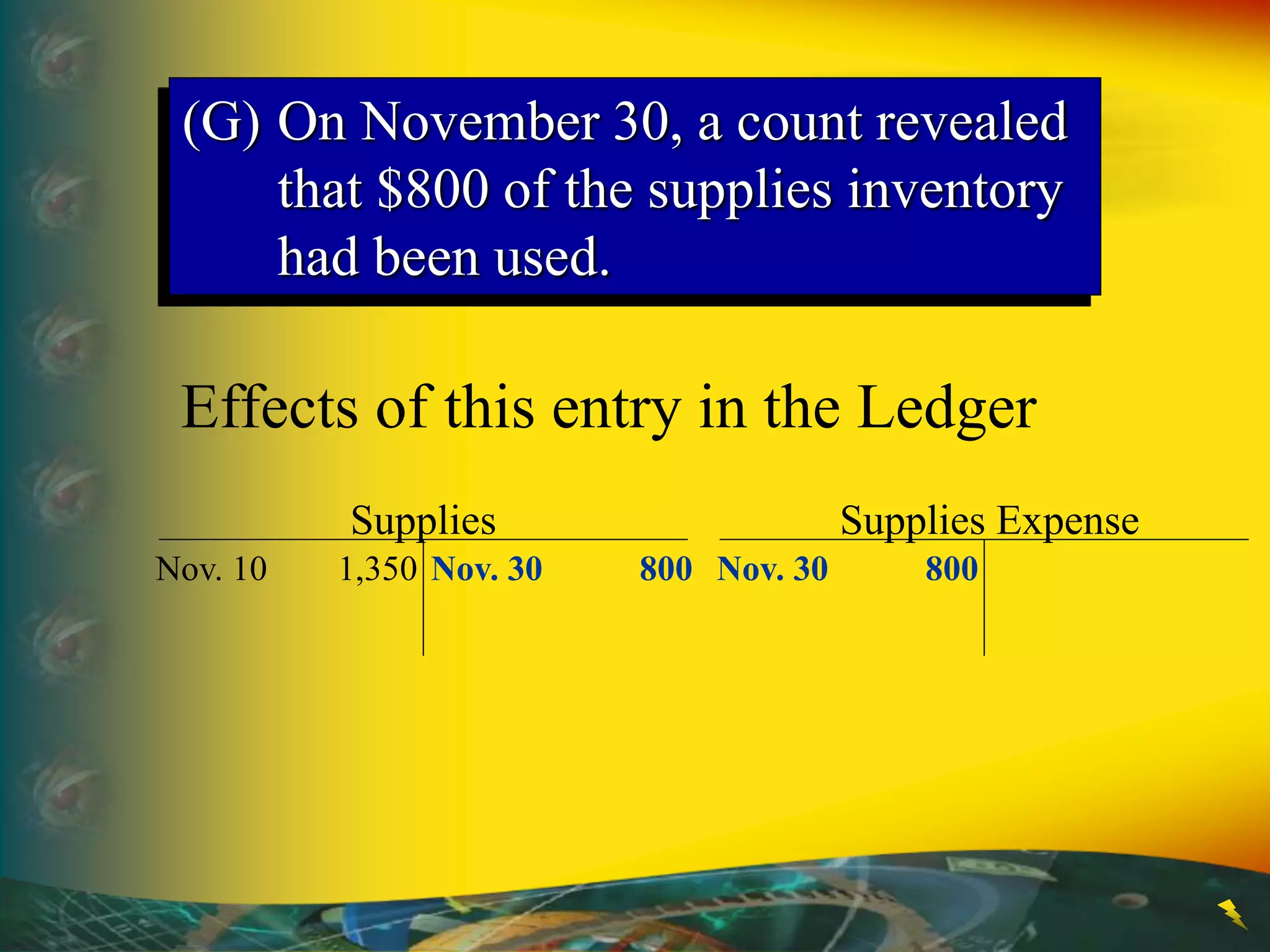
(G) On November 30, a count revealed
that $800 of the supplies inventory
had been used.
30 Supplies Expense 800 00
Supplies 800 00
Supplies used during
November.
25
26
27
28
29
30
31
Effects of this entry in the Ledger
Supplies
Nov. 10 1,350
Supplies Expense
Nov. 30 800
Nov. 30 800
(G) On November 30, a count revealed
that $800 of the supplies inventory
had been used.
Double-Entry Accounting
“ Double-entry accounting is based on a simple
concept: each party in a business transaction
will receive something and give something in
return. In bookkeeping terms, what is received
is a debit and what is given is a credit. The T
account is a representation of a scale or
balance.”
Luca Pacioli
Developer of
Double-Entry
Accounting
Scale or Balance
Receive
DEBIT
Give
CREDIT
T account
Left Side
Receive
DEBIT
Right Side
Give
CREDIT
Credit for
increases
(+)
Credit for
decreases
(-)
Debit for
increases
(+)
Debit for
decreases
(-)
Expense Accounts Revenue Accounts
Rules of Debit / Credit Income
Statement Accounts
Debits Credits
Revenue accounts…… Decrease (-) Increase (+)
Expense accounts…… Increase (+) Decrease (-)
Income Statement Accounts
Withdrawals
by the
Owner
Post.
Ref.
JOURNAL
Date Description Debit Credit
Page 2
1
2
3
4
Nov. 30
2005
Chris Clark, Drawing 2 000 00
Cash 2 000 00
Chris Clark withdrew cash for
personal use.
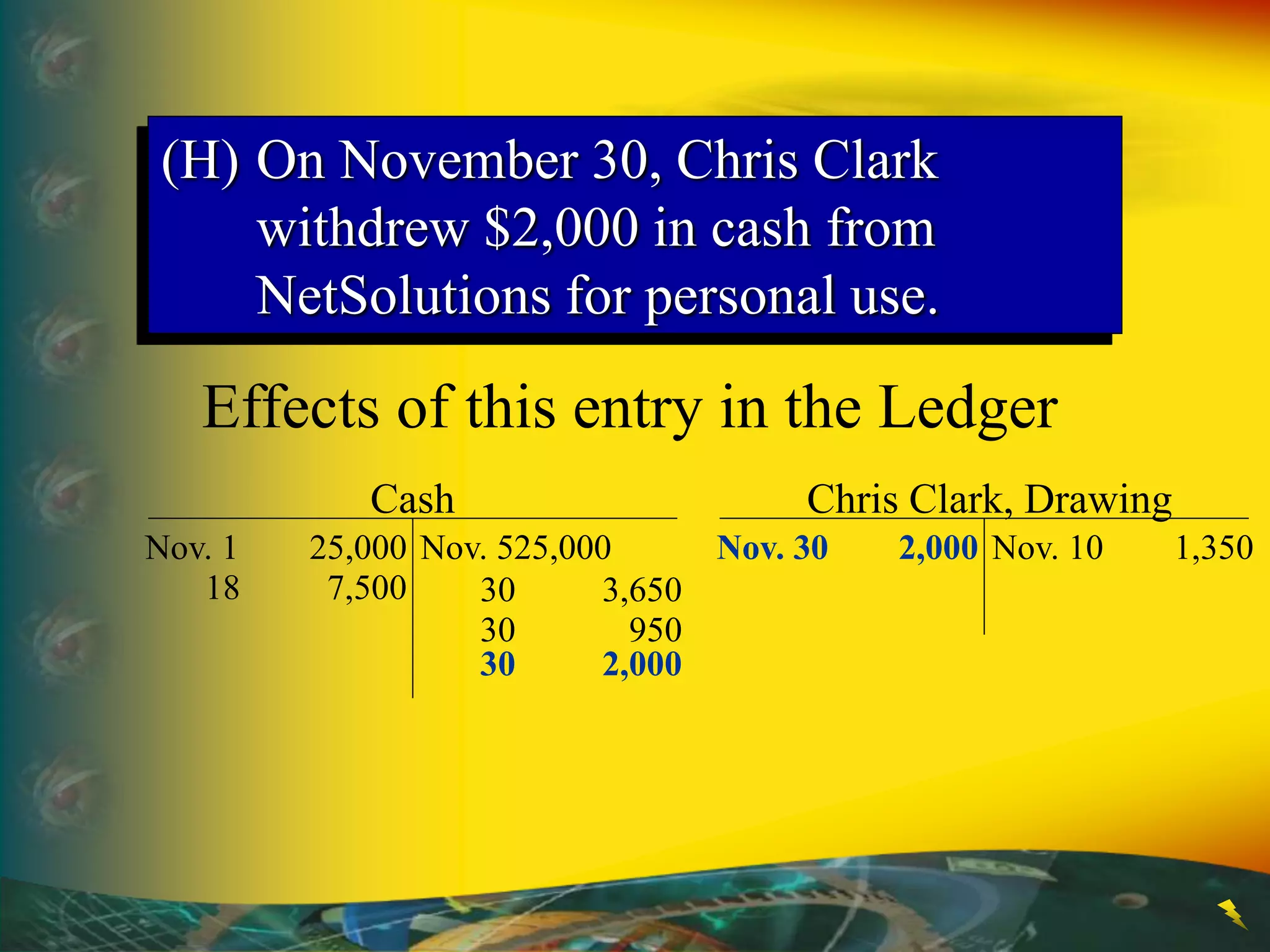
(H) On November 30, Chris Clark
withdrew $2,000 in cash from
NetSolutions for personal use.
30 950
30 2,000
Cash
Nov. 1 25,000 Nov. 525,000
18 7,500 30 3,650
Effects of this entry in the Ledger
Chris Clark, Drawing
Nov. 10 1,350
Nov. 30 2,000
(H) On November 30, Chris Clark
withdrew $2,000 in cash from
NetSolutions for personal use.
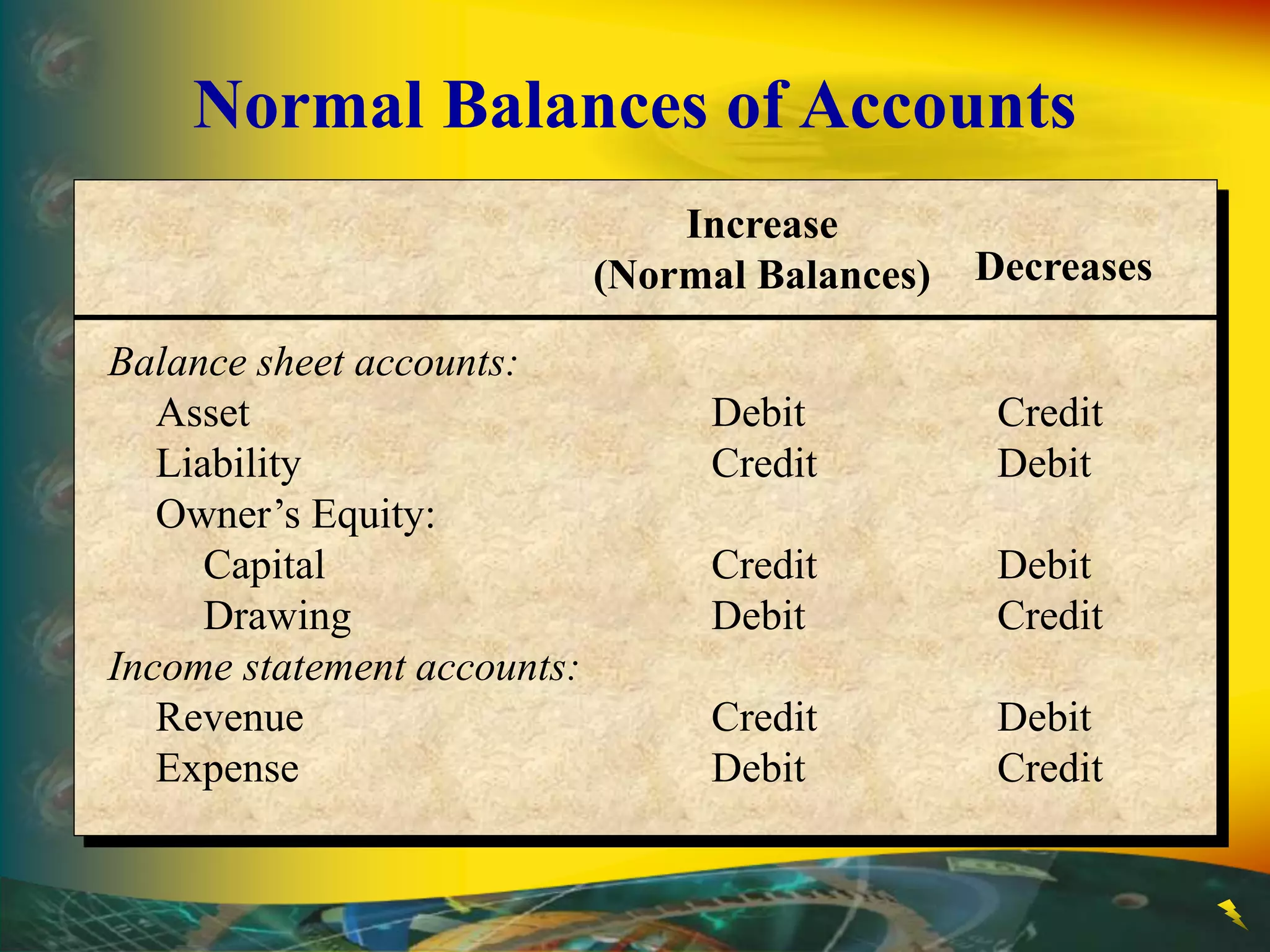
Increase
(Normal Balances) Decreases
Balance sheet accounts:
Asset Debit Credit
Liability Credit Debit
Owner’s Equity:
Capital Credit Debit
Drawing Debit Credit
Income statement accounts:
Revenue Credit Debit
Expense Debit Credit
Normal Balances of Accounts
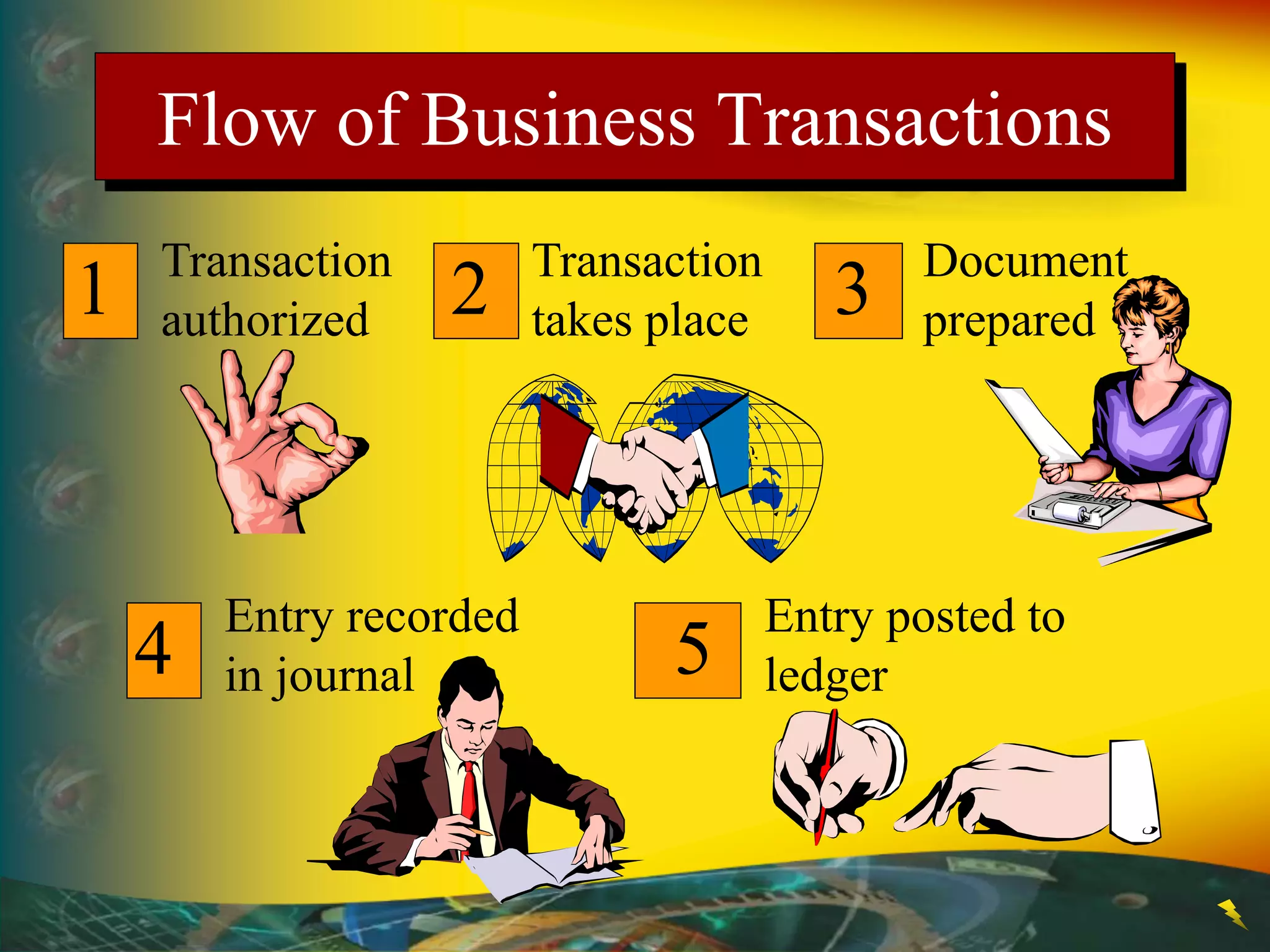
Flow of Business Transactions
1 Transaction
authorized 2 Transaction
takes place 3 Document
prepared
4
Entry recorded
in journal 5
Entry posted to
ledger
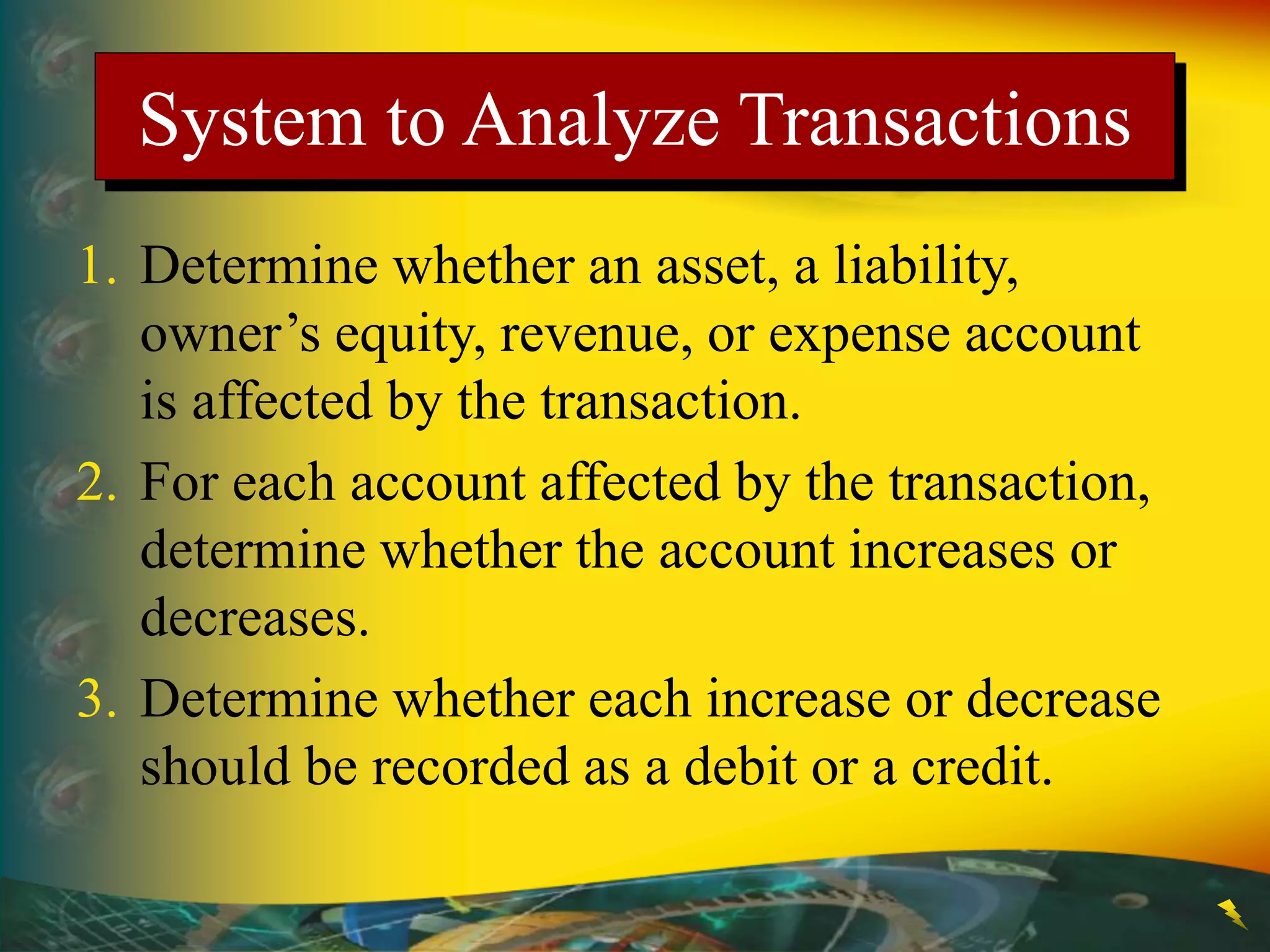
1. Determine whether an asset, a liability,
owner’s equity, revenue, or expense account
is affected by the transaction.
2. For each account affected by the transaction,
determine whether the account increases or
decreases.
3. Determine whether each increase or decrease
should be recorded as a debit or a credit.
System to Analyze Transactions
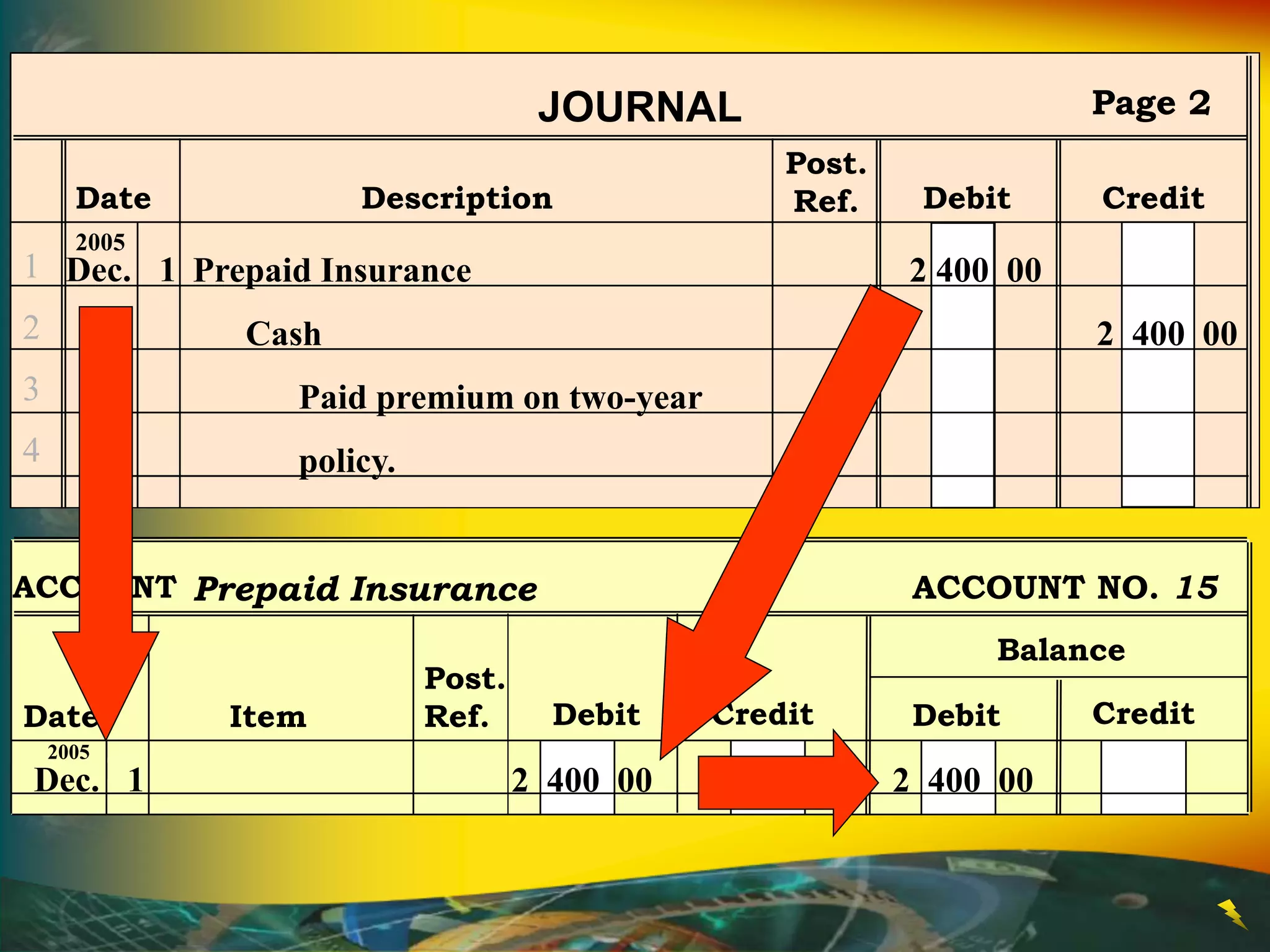
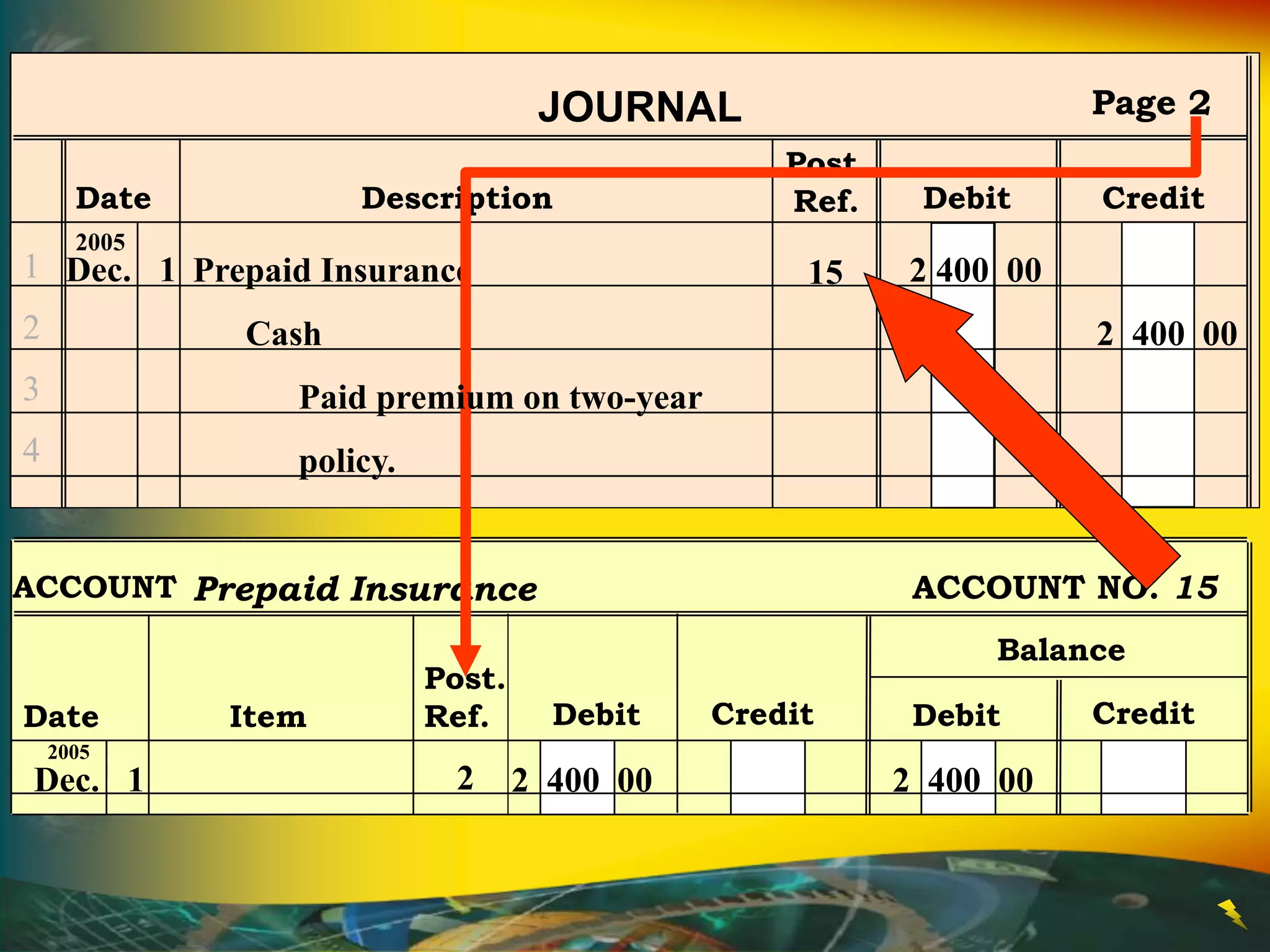
Journalizing
and Posting
Post.
Ref.
JOURNAL
Date Description Debit Credit
Page 2
1
2
3
4
Dec. 31
2005
Prepaid Insurance 2 400 00
Cash 2 400 00
Paid premium on two-year
policy.
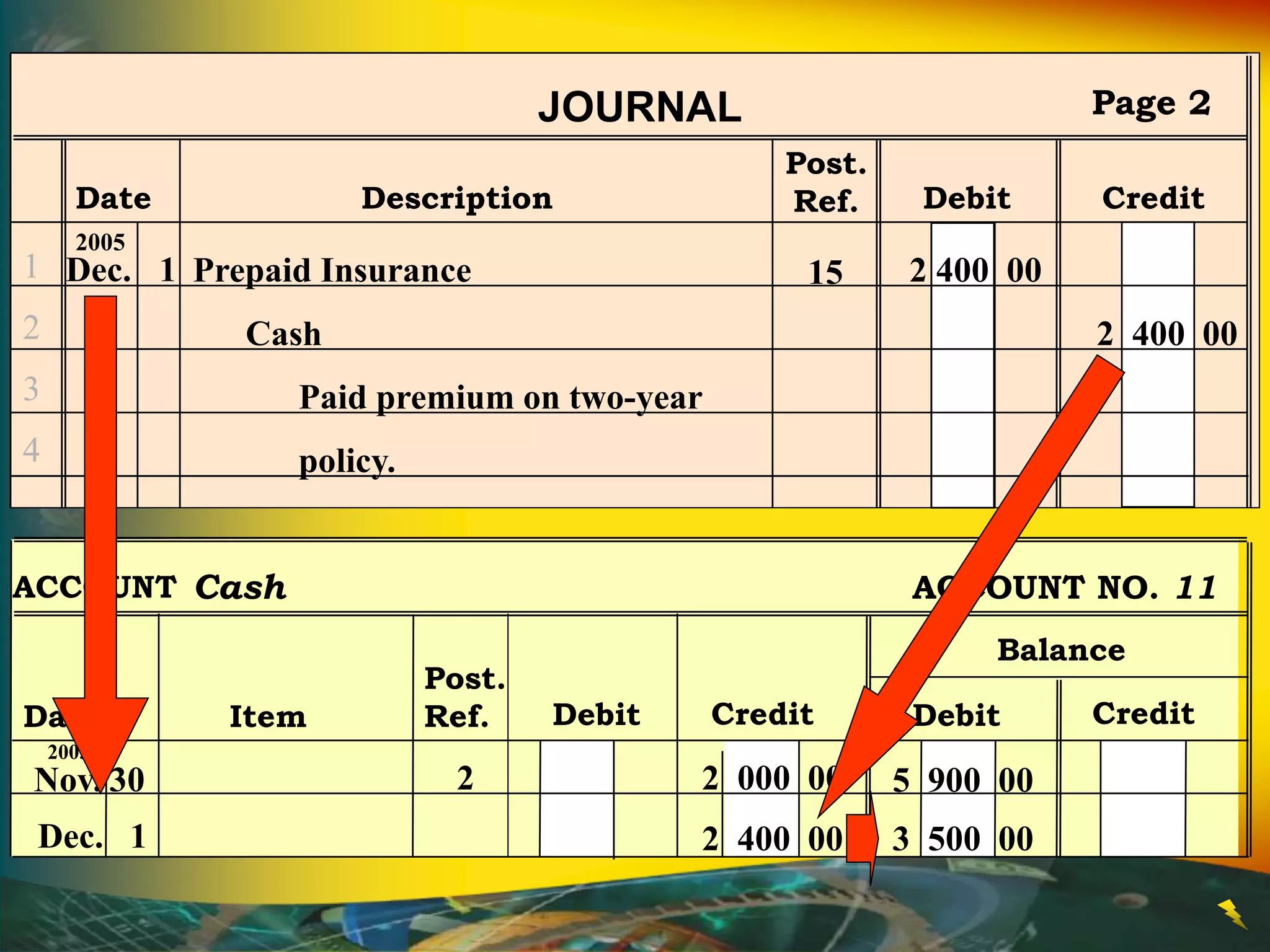
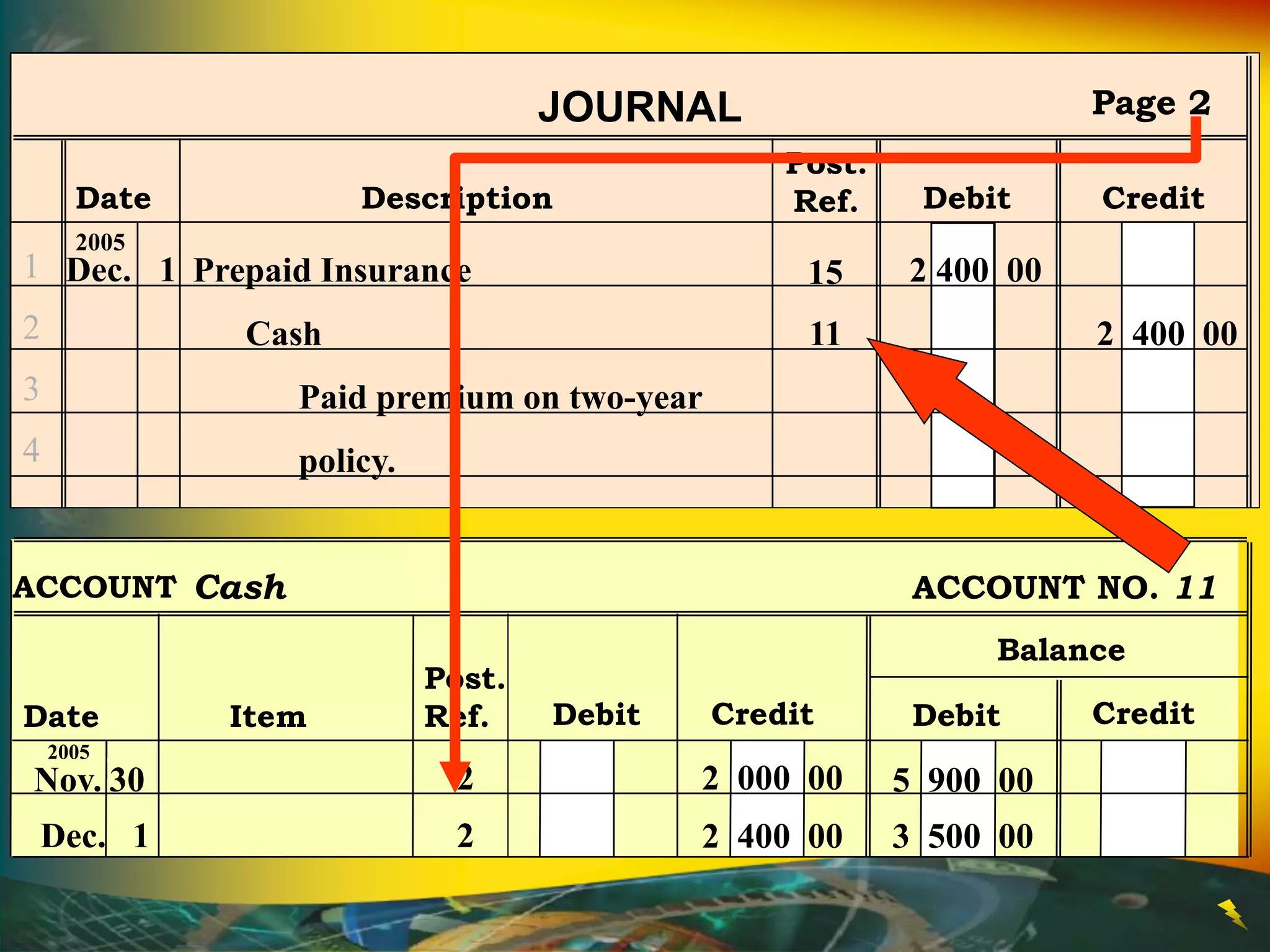
Dec. 1 NetSolutions paid a premium of
$2,400 for a comprehensive insurance
policy covering two years.
Post.
Ref.
JOURNAL
Date Description Debit Credit
Page 2
1
2
3
4
Dec. 1
2005
Prepaid Insurance 2 400 00
Cash 2 400 00
ACCOUNT Prepaid Insurance ACCOUNT NO. 15
Balance
Debit Credit
Date Debit Credit
Item
Post.
Ref.
2 400 00 2 400 00
Dec. 1
2005
Paid premium on two-year
policy.
Post.
Ref.
JOURNAL
Date Description Debit Credit
Page 2
1
2
3
4
Dec. 1
2005
Prepaid Insurance 2 400 00
Cash 2 400 00
ACCOUNT Prepaid Insurance ACCOUNT NO. 15
Balance
Debit Credit
Date Debit Credit
Item
Post.
Ref.
2 400 00 2 400 00
Dec. 1
2005
2
15
Paid premium on two-year
policy.
Post.
Ref.
JOURNAL
Date Description Debit Credit
Page 2
1
2
3
4
Dec. 1
2005
Prepaid Insurance 2 400 00
Cash 2 400 00
Paid premium on two-year
policy.
15
ACCOUNT Cash ACCOUNT NO. 11
Balance
Debit Credit
Date Debit Credit
Item
Post.
Ref.
2 000 00 5 900 00
Nov. 30
2005
2
Dec. 1 2 400 00 3 500 00
Post.
Ref.
JOURNAL
Date Description Debit Credit
Page 2
1
2
3
4
Dec. 1
2005
Prepaid Insurance 2 400 00
Cash 2 400 00
Paid premium on two-year
policy.
15
ACCOUNT Cash ACCOUNT NO. 11
Balance
Debit Credit
Date Debit Credit
Item
Post.
Ref.
2 000 00 5 900 00
Nov. 30
2005
2
2 400 00 3 500 00
Dec. 1
11
2
Trial Balance
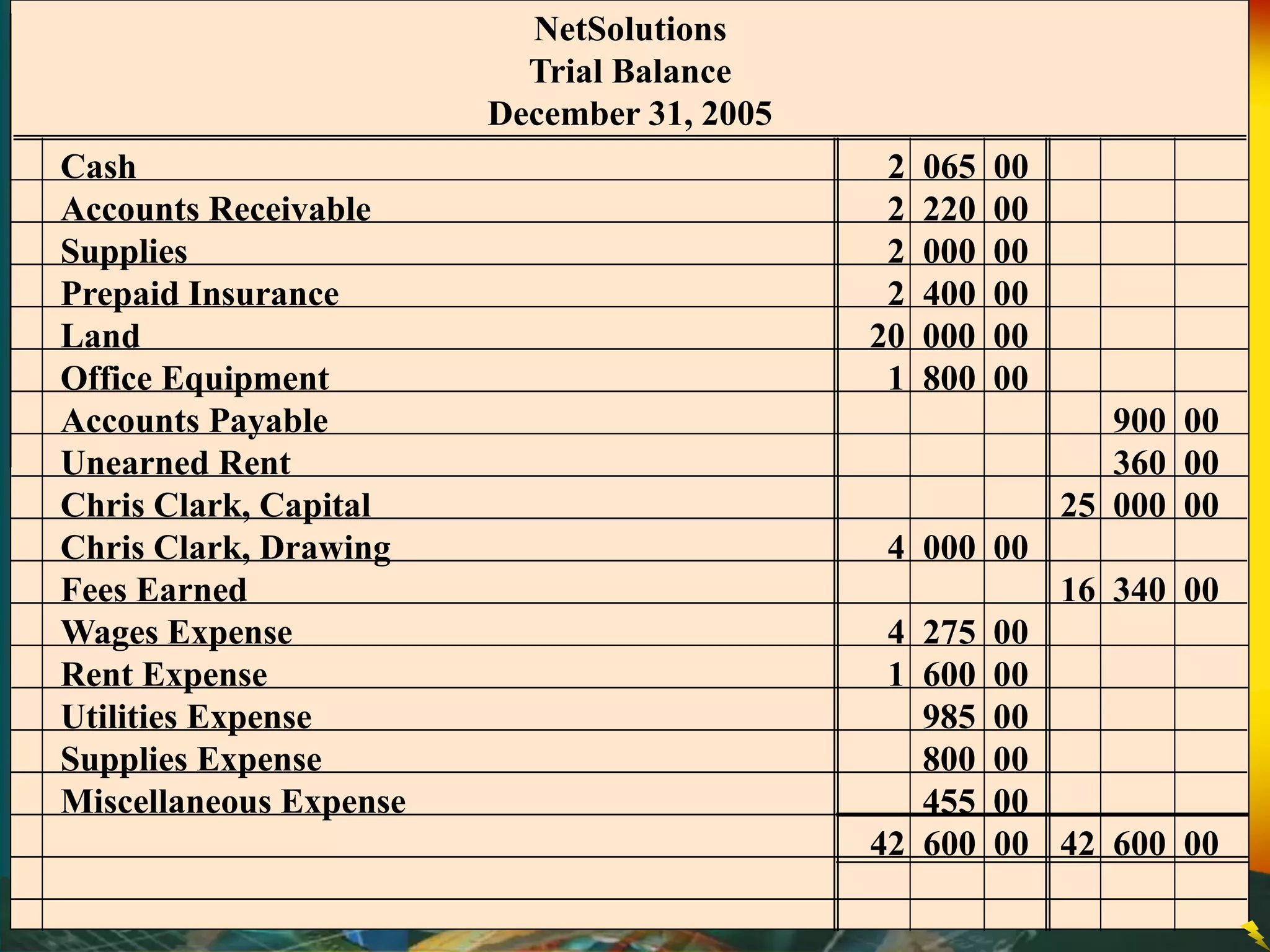
NetSolutions
Trial Balance
December 31, 2005
Cash 2 065 00
Accounts Receivable 2 220 00
Supplies 2 000 00
Prepaid Insurance 2 400 00
Land 20 000 00
Office Equipment 1 800 00
Accounts Payable 900 00
Unearned Rent 360 00
Chris Clark, Capital 25 000 00
Chris Clark, Drawing 4 000 00
Fees Earned 16 340 00
Wages Expense 4 275 00
Rent Expense 1 600 00
Utilities Expense 985 00
Supplies Expense 800 00
Miscellaneous Expense 455 00
42 600 00 42 600 00
NetSolutions
Trial Balance
December 31, 2005
Cash 2 065 00
Accounts Receivable 2 220 00
Supplies 2 000 00
Prepaid Insurance 2 400 00
Land 20 000 00
Office Equipment 1 800 00
Accounts Payable 900 00
Unearned Rent 360 00
Chris Clark, Capital 25 000 00
Chris Clark, Drawing 4 000 00
Fees Earned 16 340 00
Wages Expense 4 275 00
Rent Expense 1 600 00
Utilities Expense 985 00
Supplies Expense 800 00
Miscellaneous Expense 455 00
42 600 00 42 600 00
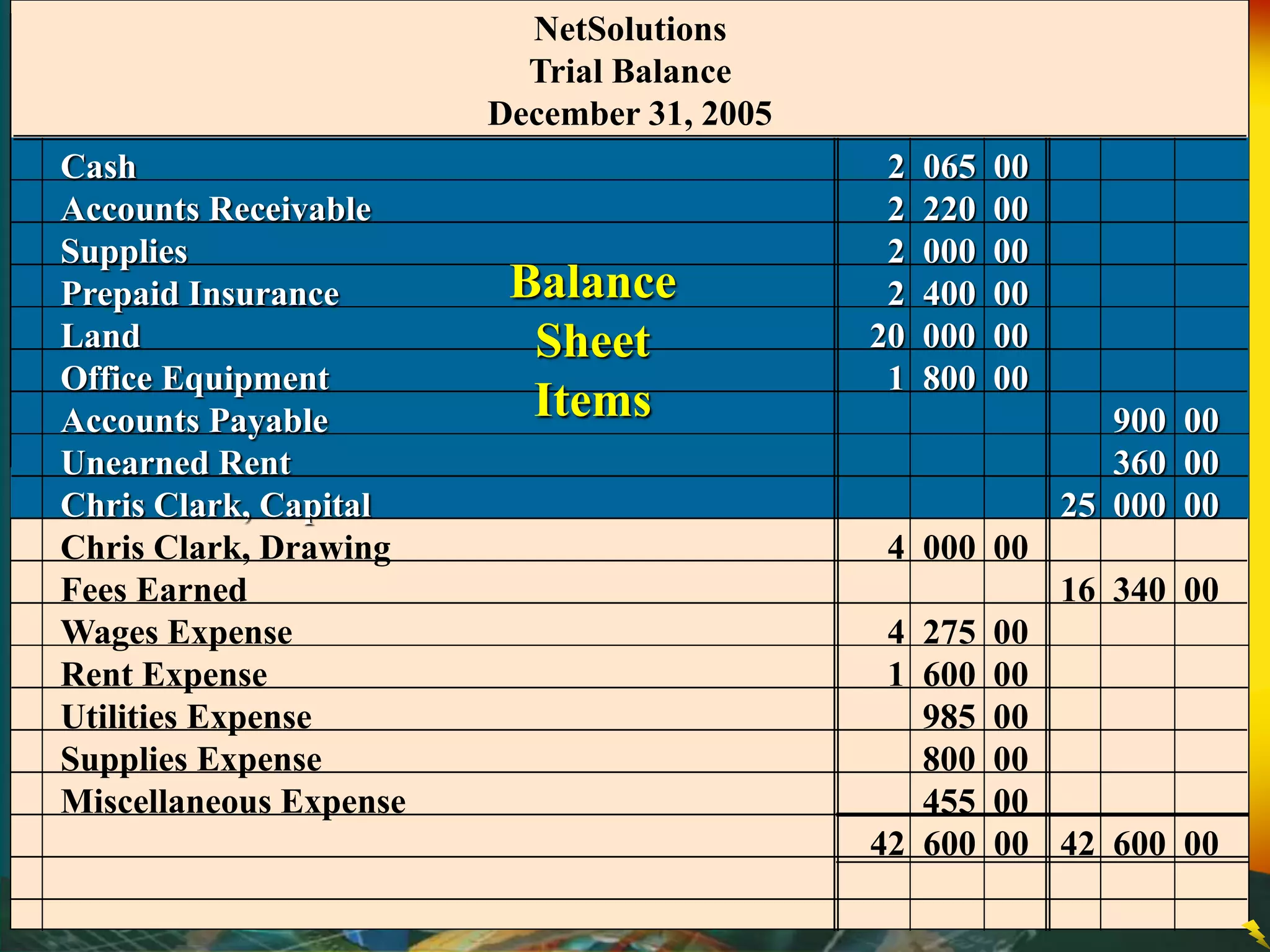
Balance
Sheet
Items
NetSolutions
Trial Balance
December 31, 2005
Cash 2 065 00
Accounts Receivable 2 220 00
Supplies 2 000 00
Prepaid Insurance 2 400 00
Land 20 000 00
Office Equipment 1 800 00
Accounts Payable 900 00
Unearned Rent 360 00
Chris Clark, Capital 25 000 00
Chris Clark, Drawing 4 000 00
Fees Earned 16 340 00
Wages Expense 4 275 00
Rent Expense 1 600 00
Utilities Expense 985 00
Supplies Expense 800 00
Miscellaneous Expense 455 00
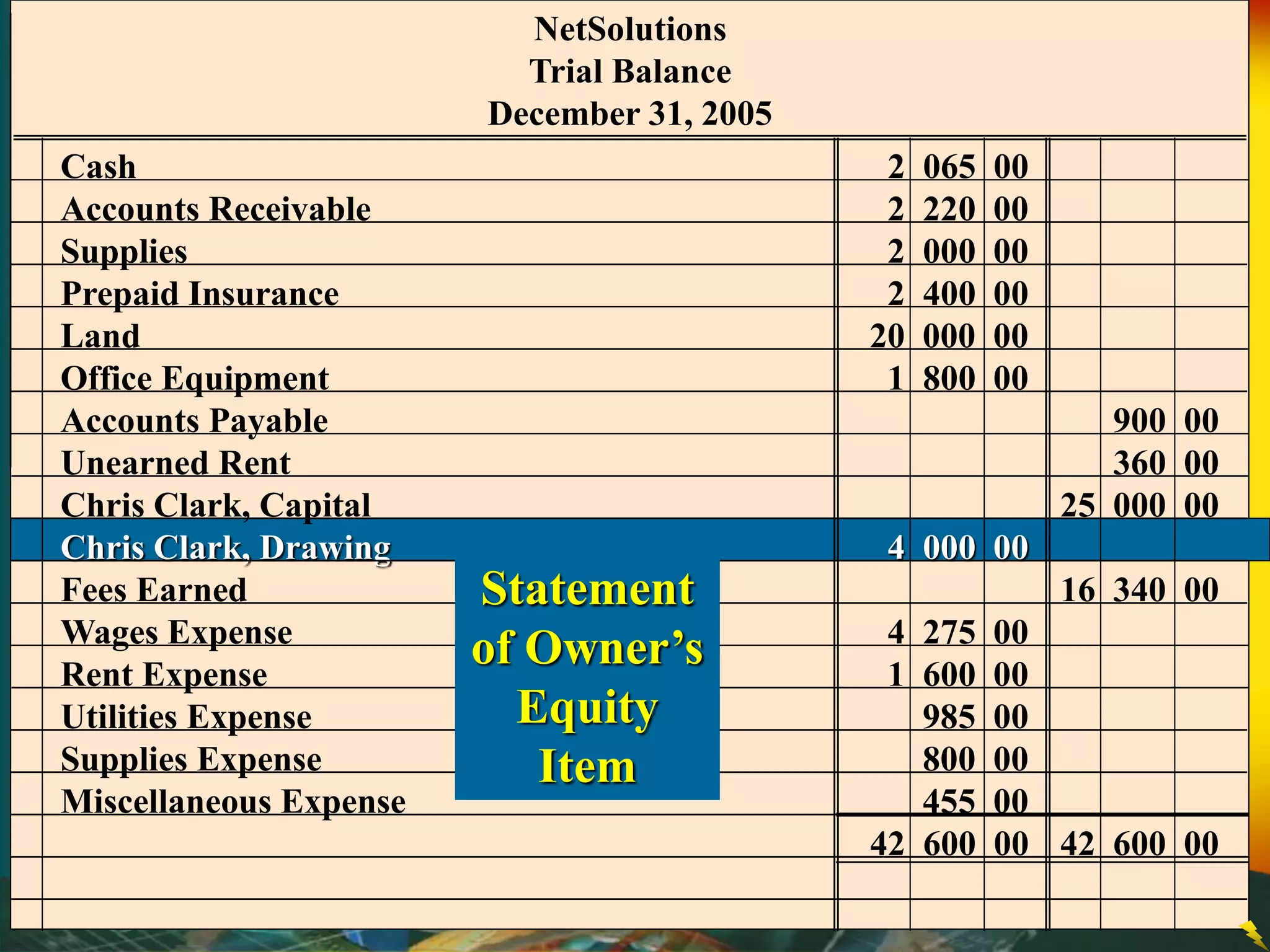
42 600 00 42 600 00
Statement
of Owner’s
Equity
Item
NetSolutions
Trial Balance
December 31, 2005
Cash 2 065 00
Accounts Receivable 2 220 00
Supplies 2 000 00
Prepaid Insurance 2 400 00
Land 20 000 00
Office Equipment 1 800 00
Accounts Payable 900 00
Unearned Rent 360 00
Chris Clark, Capital 25 000 00
Chris Clark, Drawing 4 000 00
Fees Earned 16 340 00
Wages Expense 4 275 00
Rent Expense 1 600 00
Utilities Expense 985 00
Supplies Expense 800 00
Miscellaneous Expense 455 00
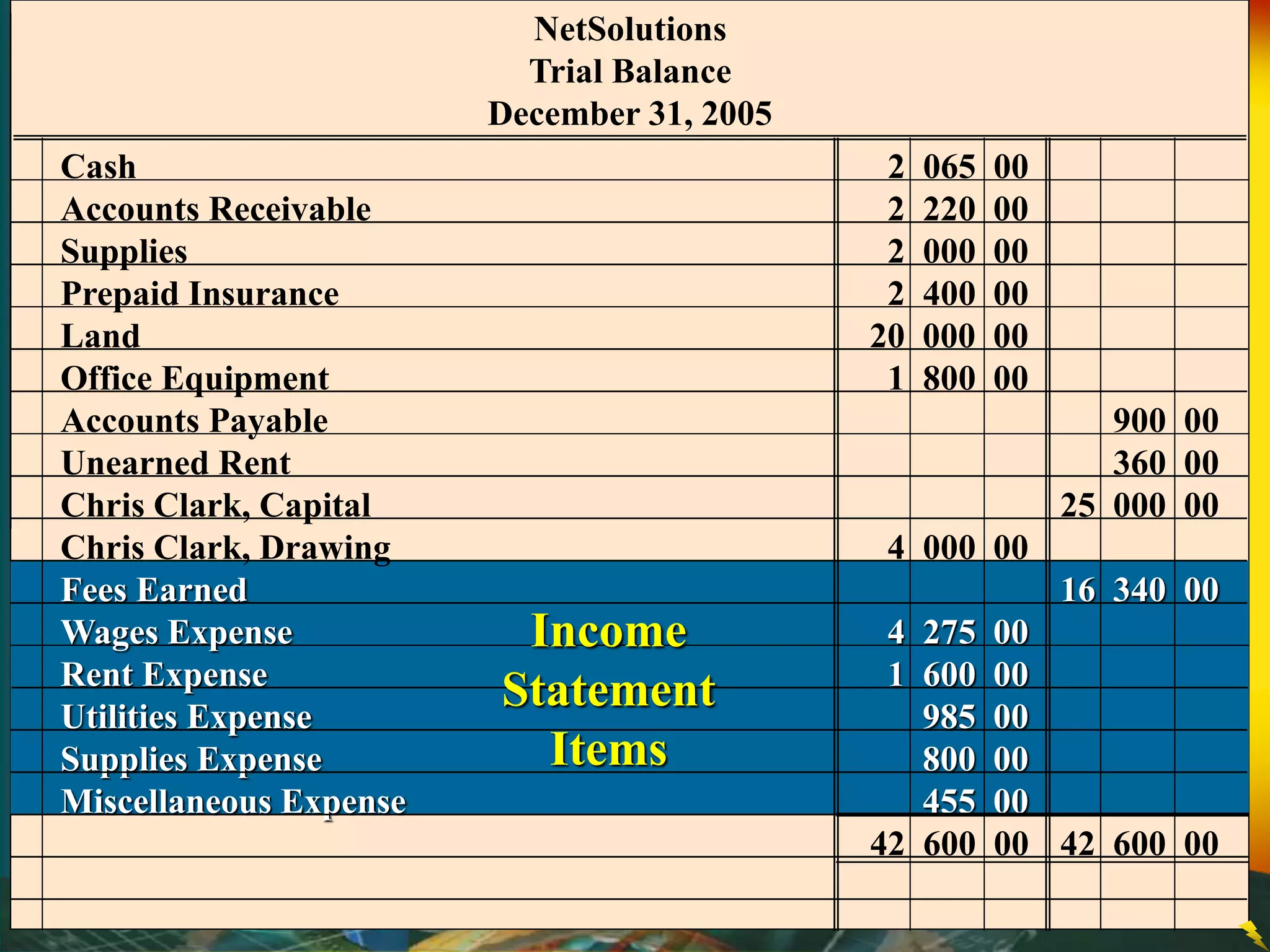
42 600 00 42 600 00
Income
Statement
Items
1. Failure to record a transaction or to post a
transaction.
2. Recording the same erroneous amount
for both the debit and the credit parts of a
transaction.
3. Recording the same transaction more
than once.
4. Posting a part of a transaction correctly
as a debit or credit but to the wrong
account.
Errors that will not cause the
trial balance to be unequal:
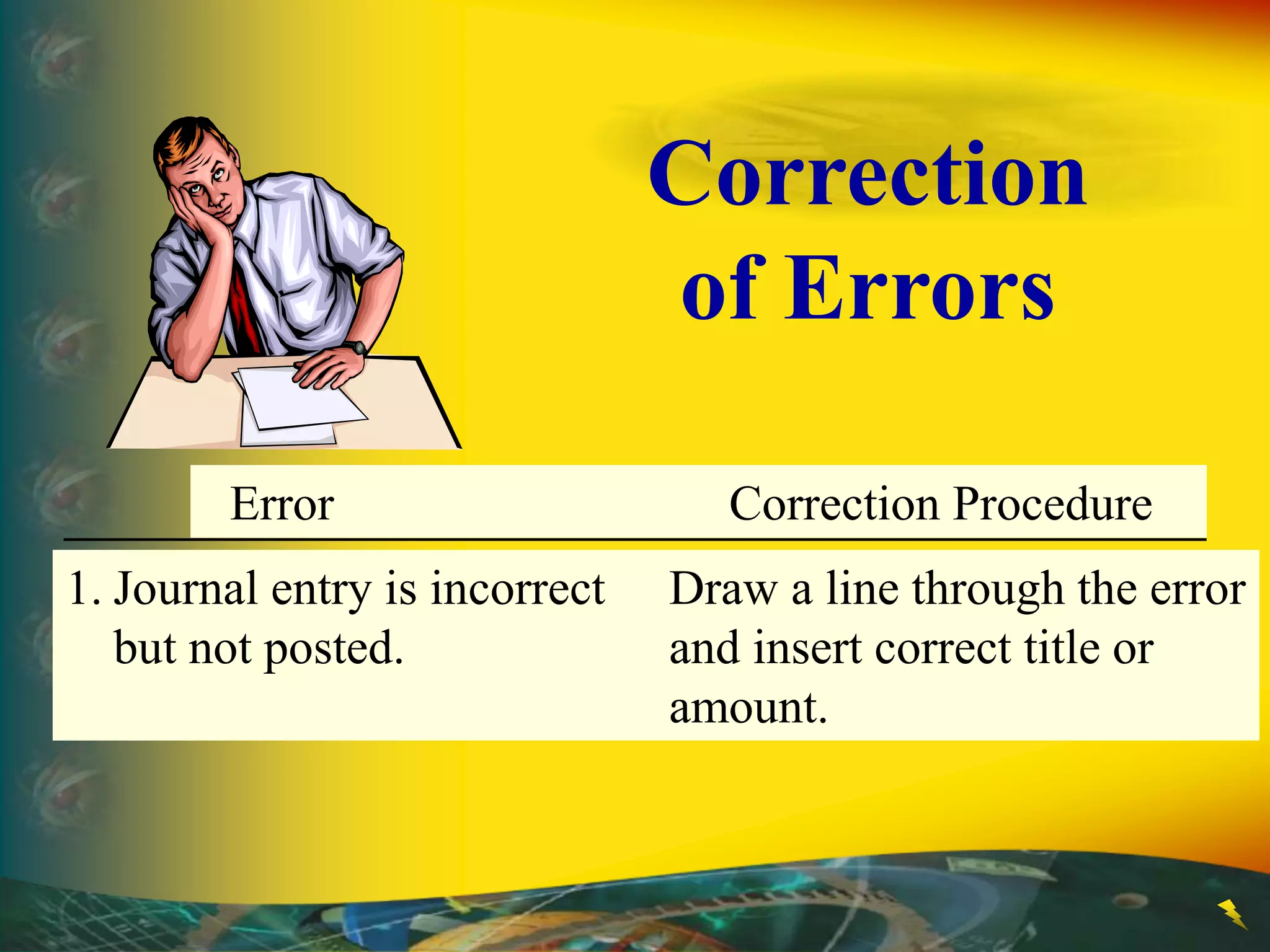
Error Correction Procedure
1. Journal entry is incorrect Draw a line through the error
but not posted. and insert correct title or
amount.
Error Correction Procedure
Correction
of Errors
Error Correction Procedure
1. Journal entry is incorrect Draw a line through the error
but not posted. and insert correct title or
amount.
Error Correction Procedure
2. Journal entry is correct Draw a line through the
but posted incorrectly. posted error and post
correctly.
Correction
of Errors
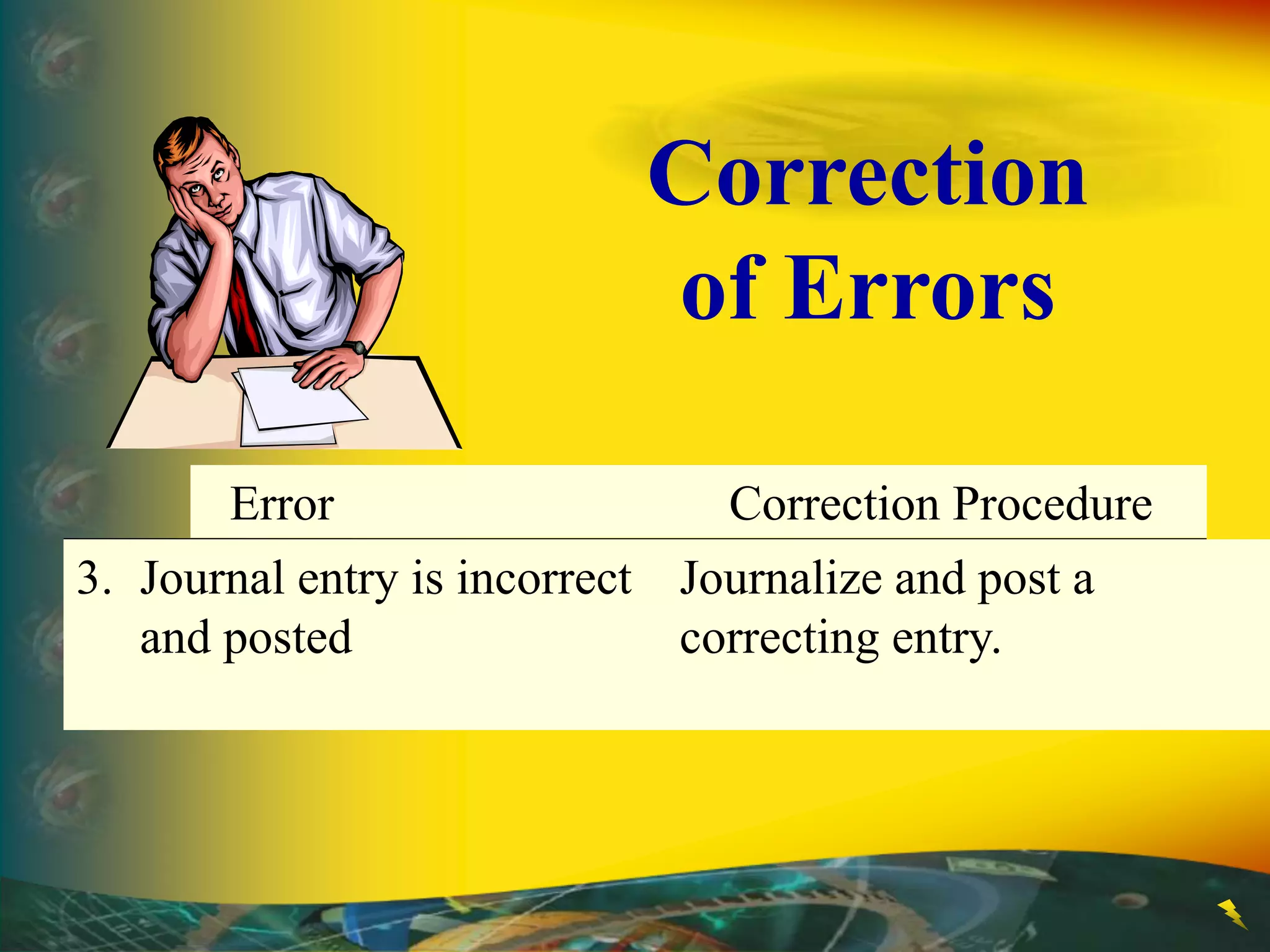
Error Correction Procedure
3. Journal entry is incorrect Journalize and post a
and posted correcting entry.
Correction
of Errors
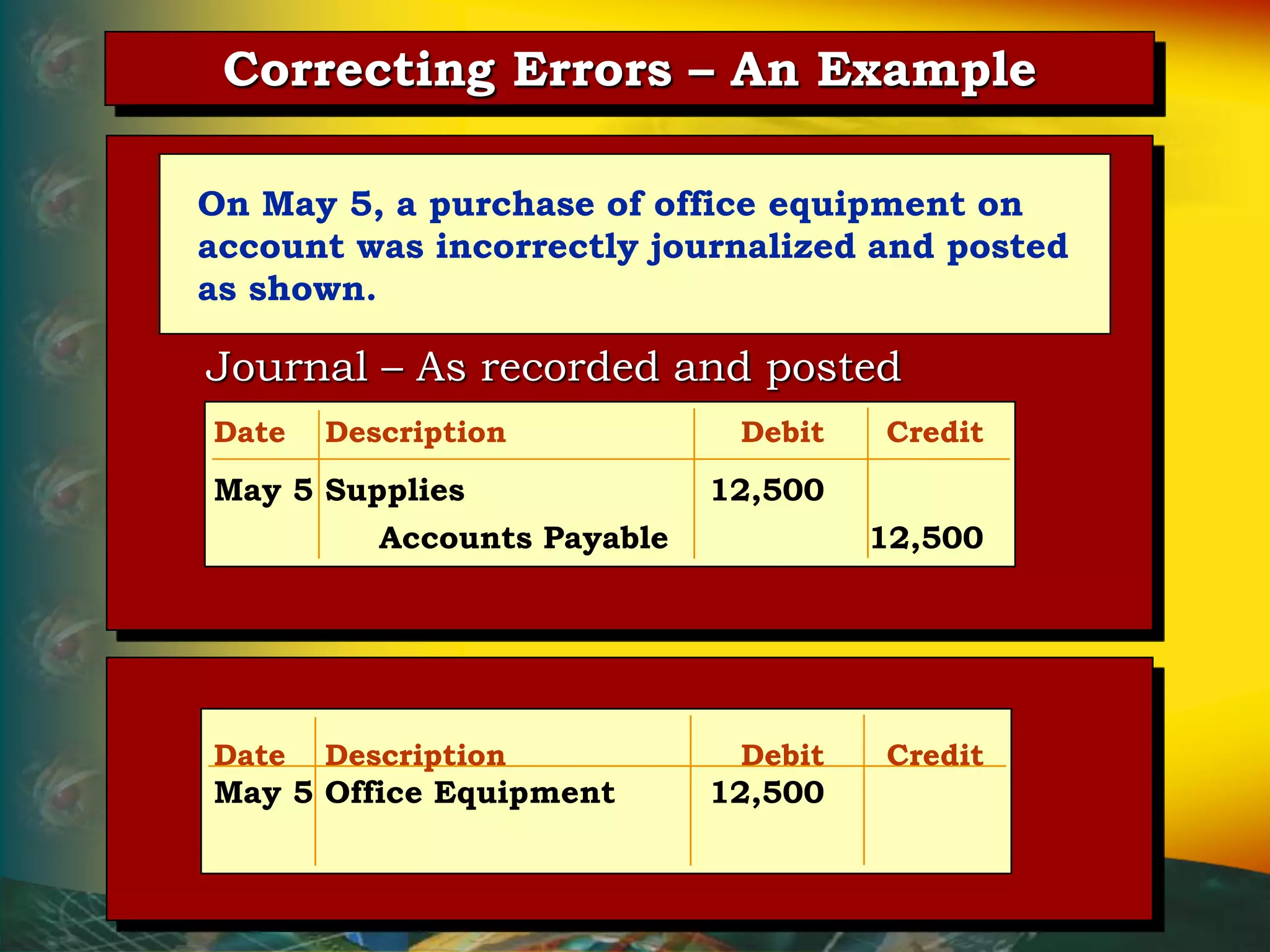
What would be the necessary
correcting entry?
Journal – As recorded and posted
Correcting Errors – An Example
On May 5, a purchase of office equipment on
account was incorrectly journalized and posted
as shown.
Date Description Debit Credit
May 5 Supplies 12,500
Accounts Payable 12,500
Journal – As recorded and posted
Correcting Errors – An Example
On May 5, a purchase of office equipment on
account was incorrectly journalized and posted
as shown.
Date Description Debit Credit
May 5 Supplies 12,500
Accounts Payable 12,500
Date Description Debit Credit
May 5 Office Equipment 12,500
Date Description Debit Credit
May 5 Office Equipment 12,500
Supplies 12,500
Journal – As recorded and posted
Correcting Errors – An Example
On May 5, a purchase of office equipment on
account was incorrectly journalized and posted
as shown.
Date Description Debit Credit
May 5 Supplies 12,500
Accounts Payable 12,500
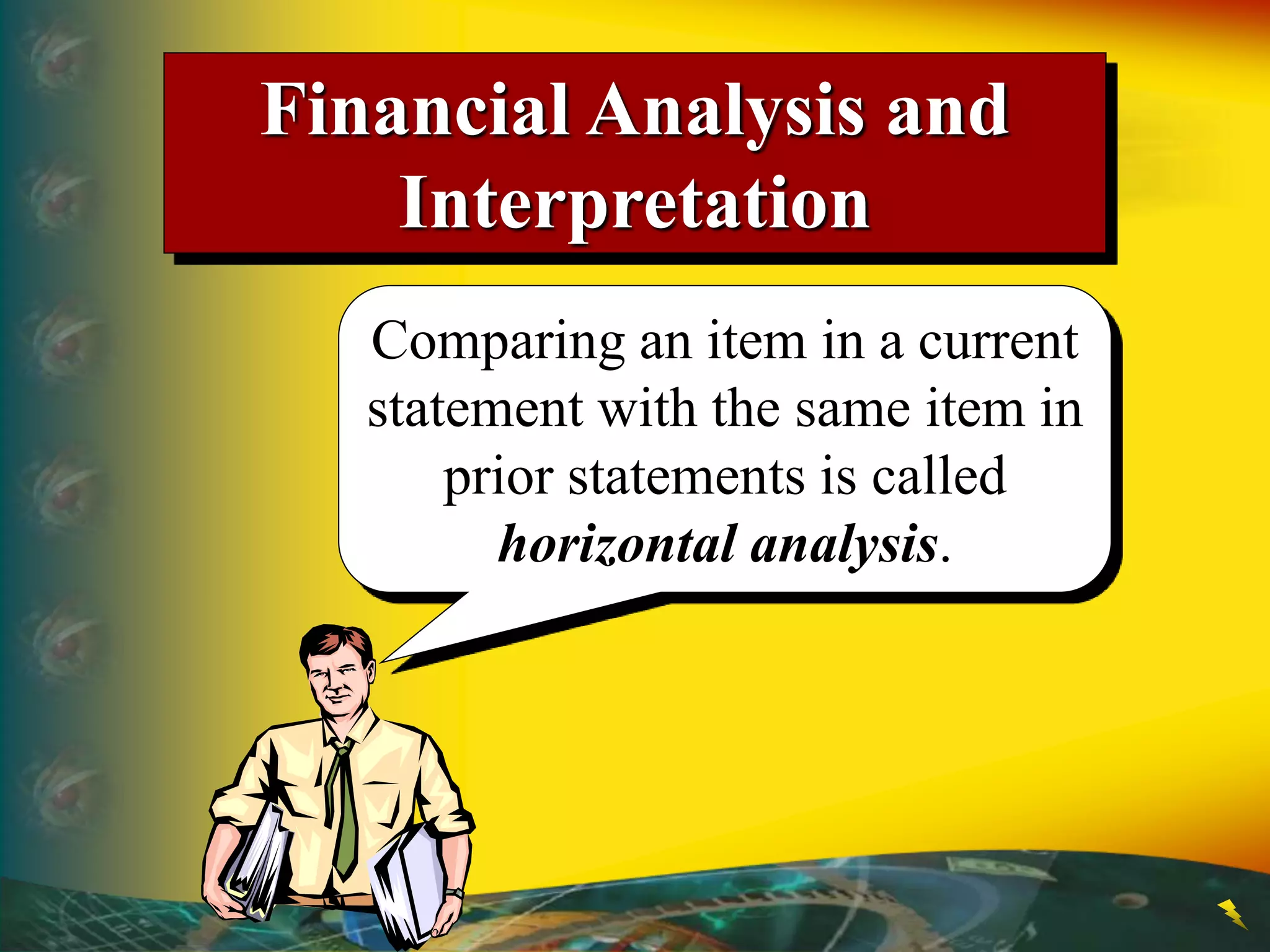
Financial Analysis and
Interpretation
Comparing an item in a current
statement with the same item in
prior statements is called
horizontal analysis.
J Holmes, Attorney-at-Law
Income Statement
For the Year Ended December 31, 2005 and 2006
Increase (Decrease)
2006 2005 Amount Percent
Fees earned $187,500 $150,000 $37,500 25.0%
Operating expenses:
Wages expense $ 60,000 $ 45,000 $15,000 33.3%
Rent expense 15,000 12,000 3,000 25.0%
Utilities expense 12,500 9,000 3,500 38.9%
Supplies expense 2,700 3,000 (300) (10.0)%
Misc. expense 2,300 1,800 500 27.8%
Total operating
expenses $ 92,500 $ 70,800 $21,700 30.6%
Net income $ 95,000 $ 79,200 $15,800 19.9%
The End
Chapter 2

Analysis_Transaction.ppt

  • 1.
    Chapter 2 Analyzing Transactions Accounting,21st Edition Warren Reeve Fess PowerPoint Presentation by Douglas Cloud Professor Emeritus of Accounting Pepperdine University © Copyright 2004 South-Western, a division of Thomson Learning. All rights reserved. Task Force Image Gallery clip art included in this electronic presentation is used with the permission of NVTech Inc.
  • 2.
    Each financial statement item,called an account, is included in the ledger.
  • 3.
    A group of accountsfor a business entity is called a ledger.
  • 4.
    A list ofthe accounts in a ledger is called a chart of accounts.
  • 5.
    Major Account Classifications Assetsare resources owned by the business. Liabilities are debts owed to outsiders (creditors). Cash Supplies Building Accounts receivable Accounts payable Notes payable Wages payable
  • 6.
    Major Account Classifications Liabilitiesare debts owed to outsiders (creditors). Cash Supplies Building Accounts receivable Accounts payable Notes payable Wages payable Assets are resources owned by the business. Liabilities are often identified on the balance sheet by titles that include payable.
  • 7.
    Owner’s equity is the owner’sright to the assets of the business. Revenues are increases in owner’s equity as a result of selling services or products. Chris Clark, Capital Chris Clark, Drawing Fees Earned Fares Earned Commission Revenue Expenses are the using up of assets or consuming of services to generate revenue. Rent Expense Salary Expense Utilities Expense Major Account Classifications
  • 8.
    To assist youin learning, an account can be drawn to resemble the letter T.
  • 9.
    The T-Account The T-accounthas a title. Cash
  • 10.
    The T-Account The leftside of the account is the debit side. Cash Left side debit
  • 11.
    The T-Account The rightside of the account is the credit side. Cash Left side debit Right side credit
  • 12.
  • 13.
  • 14.
  • 15.
  • 16.
  • 17.
  • 18.
    Post. Ref. JOURNAL Date Description DebitCredit Page 1 1 2 3 4 Nov. 1 2005 Cash 25 000 00 Chris Clark, Capital 25 000 00 Invested cash in NetSolutions. (A) On November 1, Chris Clark deposits $25,000 in a bank account in the name of NetSolutions.
  • 19.
    (A) On November1, Chris Clark deposits $25,000 in a bank account in the name of NetSolutions. Effects of this entry in the Ledger Cash Nov. 1 25,000 Nov. 1 25,000 Chris Clark, Capital
  • 20.
    4 5 6 7 8 9 10 5 Land 20000 00 Cash 20 000 00 Purchased land for building site. (B) On November 5, NetSolutions bought land for $20,000, paying cash.
  • 21.
    Effects of thisentry in the Ledger Cash Nov. 1 25,000 Nov. 5 20,000 Land Nov. 5 20,000 (B) On November 5, NetSolutions bought land for $20,000, paying cash.
  • 22.
    10 11 12 13 14 15 16 10 Supplies 1350 00 Accounts Payable 1 350 00 Purchased supplies on account. (C) On November 10, NetSolutions purchased supplies on account for $1,350.
  • 23.
    (C) On November10, NetSolutions purchased supplies on account for $1,350. Effects of this entry in the Ledger Supplies Nov. 10 1,350 Accounts Payable Nov. 10 1,350
  • 24.
    30 Accounts Payable950 00 Cash 950 00 Paid creditors on account. 30 31 32 33 34 35 36 (F) On November 30, NetSolutions paid creditors on account, $950.
  • 25.
    Cash Nov. 1 25,000Nov. 525,000 18 7,500 30 3,650 Effects of this entry in the Ledger Accounts Payable Nov. 10 1,350 Nov. 30 950 30 950 (F) On November 30, NetSolutions paid creditors on account, $950.
  • 26.
    Debits Credits Asset accounts……….Increase (+) Decrease (-) Liability accounts…… Decrease (-) Increase (+) Owner’s equity (capital) accounts…. Decrease (-) Increase (+) Rules of Debit / Credit Balance Sheet Accounts
  • 27.
    Credit for increases (+) Credit for increases (+) Creditfor decreases (-) Debit for increases (+) Debit for decreases (-) Debit for decreases (-) ASSETS Asset Accounts LIABILITIES Liability Accounts Owner’s Equity Accounts OWNER’S EQUITY Balance Sheet Accounts
  • 28.
    (D) On November18, NetSolutions received fees of $7,500 from customers for services provided . 18 Cash 7 500 00 Fees Earned 7 500 00 Received fees from customers. 14 15 16 17 18 19 20
  • 29.
    Effects of thisentry in the Ledger Cash Nov. 1 25,000 Nov. 5 25,000 Fees Earned Nov. 18 7,500 18 7,500 (D) On November 18, NetSolutions received fees of $7,500 from customers for services provided .
  • 30.
    (E) Throughout themonth, NetSolutions incurred the following expenses: wages, $2,125; rent, $800; utilities, $450; and miscellaneous, $275 . 30 Wages Expense 2 125 00 Rent Expense 800 00 Utilities Expense 450 00 Miscellaneous Expense 275 00 Cash 3 650 00 Paid expenses. 18 19 20 21 22 23 24
  • 31.
    Effects of thisentry in the Ledger Cash Nov. 1 25,000 Nov. 525,000 Wages Expense Nov. 30 2,125 18 7,500 Rent Expense Nov. 30 800 Utilities Expense Nov. 30 450 Miscellaneous Expense Nov. 30 275 30 3,650 (E) Throughout the month, NetSolutions incurred the following expenses: wages, $2,125; rent, $800; utilities, $450; and miscellaneous, $275 .
  • 32.
    In every entrythe sum of the debits always equal the sum of the credits.
  • 33.
    (G) On November30, a count revealed that $800 of the supplies inventory had been used. 30 Supplies Expense 800 00 Supplies 800 00 Supplies used during November. 25 26 27 28 29 30 31
  • 34.
    Effects of thisentry in the Ledger Supplies Nov. 10 1,350 Supplies Expense Nov. 30 800 Nov. 30 800 (G) On November 30, a count revealed that $800 of the supplies inventory had been used.
  • 35.
    Double-Entry Accounting “ Double-entryaccounting is based on a simple concept: each party in a business transaction will receive something and give something in return. In bookkeeping terms, what is received is a debit and what is given is a credit. The T account is a representation of a scale or balance.” Luca Pacioli Developer of Double-Entry Accounting Scale or Balance Receive DEBIT Give CREDIT T account Left Side Receive DEBIT Right Side Give CREDIT
  • 36.
    Credit for increases (+) Credit for decreases (-) Debitfor increases (+) Debit for decreases (-) Expense Accounts Revenue Accounts Rules of Debit / Credit Income Statement Accounts
  • 37.
    Debits Credits Revenue accounts……Decrease (-) Increase (+) Expense accounts…… Increase (+) Decrease (-) Income Statement Accounts
  • 38.
  • 39.
    Post. Ref. JOURNAL Date Description DebitCredit Page 2 1 2 3 4 Nov. 30 2005 Chris Clark, Drawing 2 000 00 Cash 2 000 00 Chris Clark withdrew cash for personal use. (H) On November 30, Chris Clark withdrew $2,000 in cash from NetSolutions for personal use.
  • 40.
    30 950 30 2,000 Cash Nov.1 25,000 Nov. 525,000 18 7,500 30 3,650 Effects of this entry in the Ledger Chris Clark, Drawing Nov. 10 1,350 Nov. 30 2,000 (H) On November 30, Chris Clark withdrew $2,000 in cash from NetSolutions for personal use.
  • 41.
    Increase (Normal Balances) Decreases Balancesheet accounts: Asset Debit Credit Liability Credit Debit Owner’s Equity: Capital Credit Debit Drawing Debit Credit Income statement accounts: Revenue Credit Debit Expense Debit Credit Normal Balances of Accounts
  • 42.
    Flow of BusinessTransactions 1 Transaction authorized 2 Transaction takes place 3 Document prepared 4 Entry recorded in journal 5 Entry posted to ledger
  • 43.
    1. Determine whetheran asset, a liability, owner’s equity, revenue, or expense account is affected by the transaction. 2. For each account affected by the transaction, determine whether the account increases or decreases. 3. Determine whether each increase or decrease should be recorded as a debit or a credit. System to Analyze Transactions
  • 44.
  • 45.
    Post. Ref. JOURNAL Date Description DebitCredit Page 2 1 2 3 4 Dec. 31 2005 Prepaid Insurance 2 400 00 Cash 2 400 00 Paid premium on two-year policy. Dec. 1 NetSolutions paid a premium of $2,400 for a comprehensive insurance policy covering two years.
  • 46.
    Post. Ref. JOURNAL Date Description DebitCredit Page 2 1 2 3 4 Dec. 1 2005 Prepaid Insurance 2 400 00 Cash 2 400 00 ACCOUNT Prepaid Insurance ACCOUNT NO. 15 Balance Debit Credit Date Debit Credit Item Post. Ref. 2 400 00 2 400 00 Dec. 1 2005 Paid premium on two-year policy.
  • 47.
    Post. Ref. JOURNAL Date Description DebitCredit Page 2 1 2 3 4 Dec. 1 2005 Prepaid Insurance 2 400 00 Cash 2 400 00 ACCOUNT Prepaid Insurance ACCOUNT NO. 15 Balance Debit Credit Date Debit Credit Item Post. Ref. 2 400 00 2 400 00 Dec. 1 2005 2 15 Paid premium on two-year policy.
  • 48.
    Post. Ref. JOURNAL Date Description DebitCredit Page 2 1 2 3 4 Dec. 1 2005 Prepaid Insurance 2 400 00 Cash 2 400 00 Paid premium on two-year policy. 15 ACCOUNT Cash ACCOUNT NO. 11 Balance Debit Credit Date Debit Credit Item Post. Ref. 2 000 00 5 900 00 Nov. 30 2005 2 Dec. 1 2 400 00 3 500 00
  • 49.
    Post. Ref. JOURNAL Date Description DebitCredit Page 2 1 2 3 4 Dec. 1 2005 Prepaid Insurance 2 400 00 Cash 2 400 00 Paid premium on two-year policy. 15 ACCOUNT Cash ACCOUNT NO. 11 Balance Debit Credit Date Debit Credit Item Post. Ref. 2 000 00 5 900 00 Nov. 30 2005 2 2 400 00 3 500 00 Dec. 1 11 2
  • 50.
  • 51.
    NetSolutions Trial Balance December 31,2005 Cash 2 065 00 Accounts Receivable 2 220 00 Supplies 2 000 00 Prepaid Insurance 2 400 00 Land 20 000 00 Office Equipment 1 800 00 Accounts Payable 900 00 Unearned Rent 360 00 Chris Clark, Capital 25 000 00 Chris Clark, Drawing 4 000 00 Fees Earned 16 340 00 Wages Expense 4 275 00 Rent Expense 1 600 00 Utilities Expense 985 00 Supplies Expense 800 00 Miscellaneous Expense 455 00 42 600 00 42 600 00
  • 52.
    NetSolutions Trial Balance December 31,2005 Cash 2 065 00 Accounts Receivable 2 220 00 Supplies 2 000 00 Prepaid Insurance 2 400 00 Land 20 000 00 Office Equipment 1 800 00 Accounts Payable 900 00 Unearned Rent 360 00 Chris Clark, Capital 25 000 00 Chris Clark, Drawing 4 000 00 Fees Earned 16 340 00 Wages Expense 4 275 00 Rent Expense 1 600 00 Utilities Expense 985 00 Supplies Expense 800 00 Miscellaneous Expense 455 00 42 600 00 42 600 00 Balance Sheet Items
  • 53.
    NetSolutions Trial Balance December 31,2005 Cash 2 065 00 Accounts Receivable 2 220 00 Supplies 2 000 00 Prepaid Insurance 2 400 00 Land 20 000 00 Office Equipment 1 800 00 Accounts Payable 900 00 Unearned Rent 360 00 Chris Clark, Capital 25 000 00 Chris Clark, Drawing 4 000 00 Fees Earned 16 340 00 Wages Expense 4 275 00 Rent Expense 1 600 00 Utilities Expense 985 00 Supplies Expense 800 00 Miscellaneous Expense 455 00 42 600 00 42 600 00 Statement of Owner’s Equity Item
  • 54.
    NetSolutions Trial Balance December 31,2005 Cash 2 065 00 Accounts Receivable 2 220 00 Supplies 2 000 00 Prepaid Insurance 2 400 00 Land 20 000 00 Office Equipment 1 800 00 Accounts Payable 900 00 Unearned Rent 360 00 Chris Clark, Capital 25 000 00 Chris Clark, Drawing 4 000 00 Fees Earned 16 340 00 Wages Expense 4 275 00 Rent Expense 1 600 00 Utilities Expense 985 00 Supplies Expense 800 00 Miscellaneous Expense 455 00 42 600 00 42 600 00 Income Statement Items
  • 56.
    1. Failure torecord a transaction or to post a transaction. 2. Recording the same erroneous amount for both the debit and the credit parts of a transaction. 3. Recording the same transaction more than once. 4. Posting a part of a transaction correctly as a debit or credit but to the wrong account. Errors that will not cause the trial balance to be unequal:
  • 57.
    Error Correction Procedure 1.Journal entry is incorrect Draw a line through the error but not posted. and insert correct title or amount. Error Correction Procedure Correction of Errors
  • 58.
    Error Correction Procedure 1.Journal entry is incorrect Draw a line through the error but not posted. and insert correct title or amount. Error Correction Procedure 2. Journal entry is correct Draw a line through the but posted incorrectly. posted error and post correctly. Correction of Errors
  • 59.
    Error Correction Procedure ErrorCorrection Procedure 3. Journal entry is incorrect Journalize and post a and posted correcting entry. Correction of Errors
  • 60.
    What would bethe necessary correcting entry? Journal – As recorded and posted Correcting Errors – An Example On May 5, a purchase of office equipment on account was incorrectly journalized and posted as shown. Date Description Debit Credit May 5 Supplies 12,500 Accounts Payable 12,500
  • 61.
    Journal – Asrecorded and posted Correcting Errors – An Example On May 5, a purchase of office equipment on account was incorrectly journalized and posted as shown. Date Description Debit Credit May 5 Supplies 12,500 Accounts Payable 12,500 Date Description Debit Credit May 5 Office Equipment 12,500
  • 62.
    Date Description DebitCredit May 5 Office Equipment 12,500 Supplies 12,500 Journal – As recorded and posted Correcting Errors – An Example On May 5, a purchase of office equipment on account was incorrectly journalized and posted as shown. Date Description Debit Credit May 5 Supplies 12,500 Accounts Payable 12,500
  • 63.
    Financial Analysis and Interpretation Comparingan item in a current statement with the same item in prior statements is called horizontal analysis.
  • 64.
    J Holmes, Attorney-at-Law IncomeStatement For the Year Ended December 31, 2005 and 2006 Increase (Decrease) 2006 2005 Amount Percent Fees earned $187,500 $150,000 $37,500 25.0% Operating expenses: Wages expense $ 60,000 $ 45,000 $15,000 33.3% Rent expense 15,000 12,000 3,000 25.0% Utilities expense 12,500 9,000 3,500 38.9% Supplies expense 2,700 3,000 (300) (10.0)% Misc. expense 2,300 1,800 500 27.8% Total operating expenses $ 92,500 $ 70,800 $21,700 30.6% Net income $ 95,000 $ 79,200 $15,800 19.9%
  • 65.