Driving the Electric Revolution
Engage with… Centre for Clean Mobility
06 May 2021
CFCM
• The Centre for Future Clean Mobility at the University of Exeter
is an industry facing research centre -
committed to leading the next generation of clean mobility
• We specialise in developing new zero emissions powertrain technology
for cleaner mobility of humans and goods
• Especially working vehicles and vessels on our streets, in our city
centres, our railways, farms, seas and waterways, and in our armed
forces.
What we do
• Development of new hybrid and electric powertrain technology
for clean mobility of people and things
• AI-enabled design code, off-the-shelf component database,
duty cycle matching, and cost forecasting. Benchmarked vs diesel/benzene
• Industrial innovation. More than 30 companies are working with CFCM,
for accelerated innovation of clean power technology
• Heart of the South West LEP £2M investment to expand test facilities
Knowledge and Expertise
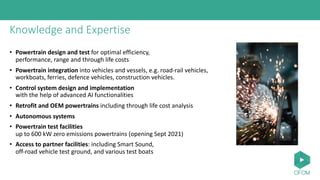
• Powertrain design and test for optimal efficiency,
performance, range and through life costs
• Powertrain integration into vehicles and vessels, e.g. road-rail vehicles,
workboats, ferries, defence vehicles, construction vehicles.
• Control system design and implementation
with the help of advanced AI functionalities
• Retrofit and OEM powertrains including through life cost analysis
• Autonomous systems
• Powertrain test facilities
up to 600 kW zero emissions powertrains (opening Sept 2021)
• Access to partner facilities: including Smart Sound,
off-road vehicle test ground, and various test boats
Who we are
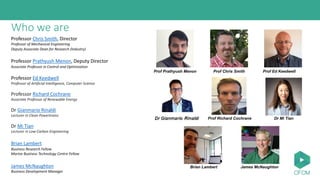
Professor Chris Smith, Director
Professor of Mechanical Engineering
Deputy Associate Dean for Research (Industry)
Professor Prathyush Menon, Deputy Director
Associate Professor in Control and Optimization
Professor Ed Keedwell
Professor of Artificial Intelligence, Computer Science
Professor Richard Cochrane
Associate Professor of Renewable Energy
Dr Gianmario Rinaldi
Lecturer in Clean Powertrains
Dr Mi Tian
Lecturer in Low-Carbon Engineering
Brian Lambert
Business Research Fellow
Marine Business Technology Centre Fellow
James McNaughton
Business Development Manager
Prof Chris Smith
Dr Mi Tian
Brian Lambert James McNaughton
Prof Prathyush Menon Prof Ed Keedwell
Prof Richard Cochrane
Why we are here
• Regulatory and societal pressure on polluting 'dirty' hydrocarbon powertrains, government funding to stimulate
innovation in clean powertrains.
• UK commitment to net zero 2050 is now law.
• End of UK sales of ICE road cars, London Zero Emissions Zone - steady decline in automotive ICE supply chain and
hydrocarbon fuel price uncertainty.
• Emissions targets and legislation globally, incl Europe, China, South Korea, Japan and US - all facing net zero 2050
How we got here
• Track record in innovative design / build / test of hybrid and electrified powertrains
• Strong partnerships with industry and successful funding applications
• UK government support for innovation in clean mobility, electrification and autonomy
• Regional support for economic growth and jobs in clean mobility
Next steps – Centre development and aims
• To continue industry partnership for innovation,
focus on delivery, cost and responsiveness
• To lead internationally on for clean and smart mobility for
off-highway, marine, defence, rail, construction and other sectors.
• To play a leading role in supporting the region’s objective to become a
leader in Clean Growth Innovation
• To help the region to delivery net zero carbon, engaging local,
national and global partners
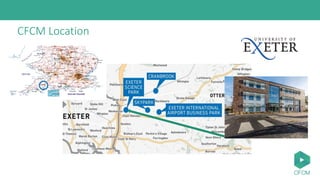
CFCM Location
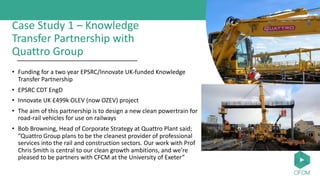
Case Study 1 – Knowledge
Transfer Partnership with
Quattro Group
• Funding for a two year EPSRC/Innovate UK-funded Knowledge
Transfer Partnership
• EPSRC CDT EngD
• Innovate UK £499k OLEV (now OZEV) project
• The aim of this partnership is to design a new clean powertrain for
road-rail vehicles for use on railways
• Bob Browning, Head of Corporate Strategy at Quattro Plant said;
“Quattro Group plans to be the cleanest provider of professional
services into the rail and construction sectors. Our work with Prof
Chris Smith is central to our clean growth ambitions, and we’re
pleased to be partners with CFCM at the University of Exeter”
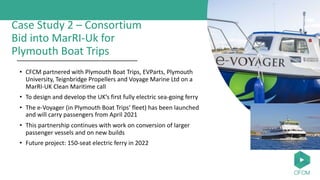
Case Study 2 – Consortium
Bid into MarRI-Uk for
Plymouth Boat Trips
• CFCM partnered with Plymouth Boat Trips, EVParts, Plymouth
University, Teignbridge Propellers and Voyage Marine Ltd on a
MarRI-UK Clean Maritime call
• To design and develop the UK’s first fully electric sea-going ferry
• The e-Voyager (in Plymouth Boat Trips’ fleet) has been launched
and will carry passengers from April 2021
• This partnership continues with work on conversion of larger
passenger vessels and on new builds
• Future project: 150-seat electric ferry in 2022
Case Study 3 – Knowledge
Transfer Partnership (KTP)
with Supacat
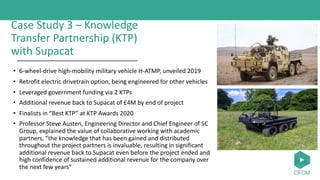
• 6-wheel-drive high-mobility military vehicle H-ATMP, unveiled 2019
• Retrofit electric drivetrain option, being engineered for other vehicles
• Leveraged government funding via 2 KTPs
• Additional revenue back to Supacat of £4M by end of project
• Finalists in “Best KTP” at KTP Awards 2020
• Professor Steve Austen, Engineering Director and Chief Engineer of SC
Group, explained the value of collaborative working with academic
partners, “the knowledge that has been gained and distributed
throughout the project partners is invaluable, resulting in significant
additional revenue back to Supacat even before the project ended and
high confidence of sustained additional revenue for the company over
the next few years”
Current Project – CFCM & EVParts
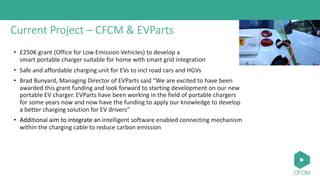
• £250K grant (Office for Low Emission Vehicles) to develop a
smart portable charger suitable for home with smart grid integration
• Safe and affordable charging unit for EVs to incl road cars and HGVs
• Brad Bunyard, Managing Director of EVParts said “We are excited to have been
awarded this grant funding and look forward to starting development on our new
portable EV charger. EVParts have been working in the field of portable chargers
for some years now and now have the funding to apply our knowledge to develop
a better charging solution for EV drivers”
• Additional aim to integrate an intelligent software enabled connecting mechanism
within the charging cable to reduce carbon emission
Current Project – CFCM &
Ecomar Propulsion
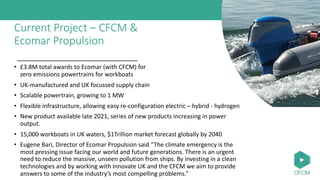
• £3.8M total awards to Ecomar (with CFCM) for
zero emissions powertrains for workboats
• UK-manufactured and UK focussed supply chain
• Scalable powertrain, growing to 1 MW
• Flexible infrastructure, allowing easy re-configuration electric – hybrid - hydrogen
• New product available late 2021, series of new products increasing in power
output.
• 15,000 workboats in UK waters, $1Trillion market forecast globally by 2040
• Eugene Bari, Director of Ecomar Propulsion said “The climate emergency is the
most pressing issue facing our world and future generations. There is an urgent
need to reduce the massive, unseen pollution from ships. By investing in a clean
technologies and by working with Innovate UK and the CFCM we aim to provide
answers to some of the industry’s most compelling problems.”
Current Project – CFCM &
Quattro Group
• £500k innovation grant funded by the Office for Low Emission
Vehicles
• Urban zero emissions zones (London 2025), Infrastructure projects
• Other city and regional governments (e.g. Bath, Glasgow,
Manchester) working towards “Zero Carbon Fleets”
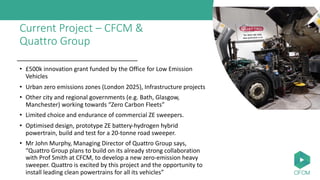
• Limited choice and endurance of commercial ZE sweepers.
• Optimised design, prototype ZE battery-hydrogen hybrid
powertrain, build and test for a 20-tonne road sweeper.
• Mr John Murphy, Managing Director of Quattro Group says,
“Quattro Group plans to build on its already strong collaboration
with Prof Smith at CFCM, to develop a new zero-emission heavy
sweeper. Quattro is excited by this project and the opportunity to
install leading clean powertrains for all its vehicles”
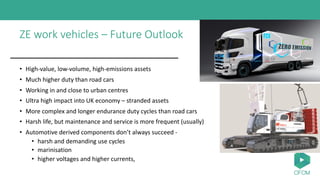
ZE work vehicles – Future Outlook
• High-value, low-volume, high-emissions assets
• Much higher duty than road cars
• Working in and close to urban centres
• Ultra high impact into UK economy – stranded assets
• More complex and longer endurance duty cycles than road cars
• Harsh life, but maintenance and service is more frequent (usually)
• Automotive derived components don’t always succeed -
• harsh and demanding use cycles
• marinisation
• higher voltages and higher currents,
Contact us
www.futurecleanmobility.com
futurecleanmobility@exeter.ac.uk

Engage with...Centre for Future Clean Mobility

  • 1.
    Driving the ElectricRevolution Engage with… Centre for Clean Mobility 06 May 2021
  • 2.
    CFCM • The Centrefor Future Clean Mobility at the University of Exeter is an industry facing research centre - committed to leading the next generation of clean mobility • We specialise in developing new zero emissions powertrain technology for cleaner mobility of humans and goods • Especially working vehicles and vessels on our streets, in our city centres, our railways, farms, seas and waterways, and in our armed forces.
  • 3.
    What we do •Development of new hybrid and electric powertrain technology for clean mobility of people and things • AI-enabled design code, off-the-shelf component database, duty cycle matching, and cost forecasting. Benchmarked vs diesel/benzene • Industrial innovation. More than 30 companies are working with CFCM, for accelerated innovation of clean power technology • Heart of the South West LEP £2M investment to expand test facilities
  • 4.
    Knowledge and Expertise •Powertrain design and test for optimal efficiency, performance, range and through life costs • Powertrain integration into vehicles and vessels, e.g. road-rail vehicles, workboats, ferries, defence vehicles, construction vehicles. • Control system design and implementation with the help of advanced AI functionalities • Retrofit and OEM powertrains including through life cost analysis • Autonomous systems • Powertrain test facilities up to 600 kW zero emissions powertrains (opening Sept 2021) • Access to partner facilities: including Smart Sound, off-road vehicle test ground, and various test boats
  • 5.
    Who we are ProfessorChris Smith, Director Professor of Mechanical Engineering Deputy Associate Dean for Research (Industry) Professor Prathyush Menon, Deputy Director Associate Professor in Control and Optimization Professor Ed Keedwell Professor of Artificial Intelligence, Computer Science Professor Richard Cochrane Associate Professor of Renewable Energy Dr Gianmario Rinaldi Lecturer in Clean Powertrains Dr Mi Tian Lecturer in Low-Carbon Engineering Brian Lambert Business Research Fellow Marine Business Technology Centre Fellow James McNaughton Business Development Manager Prof Chris Smith Dr Mi Tian Brian Lambert James McNaughton Prof Prathyush Menon Prof Ed Keedwell Prof Richard Cochrane
  • 6.
    Why we arehere • Regulatory and societal pressure on polluting 'dirty' hydrocarbon powertrains, government funding to stimulate innovation in clean powertrains. • UK commitment to net zero 2050 is now law. • End of UK sales of ICE road cars, London Zero Emissions Zone - steady decline in automotive ICE supply chain and hydrocarbon fuel price uncertainty. • Emissions targets and legislation globally, incl Europe, China, South Korea, Japan and US - all facing net zero 2050
  • 7.
    How we gothere • Track record in innovative design / build / test of hybrid and electrified powertrains • Strong partnerships with industry and successful funding applications • UK government support for innovation in clean mobility, electrification and autonomy • Regional support for economic growth and jobs in clean mobility
  • 8.
    Next steps –Centre development and aims • To continue industry partnership for innovation, focus on delivery, cost and responsiveness • To lead internationally on for clean and smart mobility for off-highway, marine, defence, rail, construction and other sectors. • To play a leading role in supporting the region’s objective to become a leader in Clean Growth Innovation • To help the region to delivery net zero carbon, engaging local, national and global partners
  • 9.
  • 10.
    Case Study 1– Knowledge Transfer Partnership with Quattro Group • Funding for a two year EPSRC/Innovate UK-funded Knowledge Transfer Partnership • EPSRC CDT EngD • Innovate UK £499k OLEV (now OZEV) project • The aim of this partnership is to design a new clean powertrain for road-rail vehicles for use on railways • Bob Browning, Head of Corporate Strategy at Quattro Plant said; “Quattro Group plans to be the cleanest provider of professional services into the rail and construction sectors. Our work with Prof Chris Smith is central to our clean growth ambitions, and we’re pleased to be partners with CFCM at the University of Exeter”
  • 11.
    Case Study 2– Consortium Bid into MarRI-Uk for Plymouth Boat Trips • CFCM partnered with Plymouth Boat Trips, EVParts, Plymouth University, Teignbridge Propellers and Voyage Marine Ltd on a MarRI-UK Clean Maritime call • To design and develop the UK’s first fully electric sea-going ferry • The e-Voyager (in Plymouth Boat Trips’ fleet) has been launched and will carry passengers from April 2021 • This partnership continues with work on conversion of larger passenger vessels and on new builds • Future project: 150-seat electric ferry in 2022
  • 12.
    Case Study 3– Knowledge Transfer Partnership (KTP) with Supacat • 6-wheel-drive high-mobility military vehicle H-ATMP, unveiled 2019 • Retrofit electric drivetrain option, being engineered for other vehicles • Leveraged government funding via 2 KTPs • Additional revenue back to Supacat of £4M by end of project • Finalists in “Best KTP” at KTP Awards 2020 • Professor Steve Austen, Engineering Director and Chief Engineer of SC Group, explained the value of collaborative working with academic partners, “the knowledge that has been gained and distributed throughout the project partners is invaluable, resulting in significant additional revenue back to Supacat even before the project ended and high confidence of sustained additional revenue for the company over the next few years”
  • 13.
    Current Project –CFCM & EVParts • £250K grant (Office for Low Emission Vehicles) to develop a smart portable charger suitable for home with smart grid integration • Safe and affordable charging unit for EVs to incl road cars and HGVs • Brad Bunyard, Managing Director of EVParts said “We are excited to have been awarded this grant funding and look forward to starting development on our new portable EV charger. EVParts have been working in the field of portable chargers for some years now and now have the funding to apply our knowledge to develop a better charging solution for EV drivers” • Additional aim to integrate an intelligent software enabled connecting mechanism within the charging cable to reduce carbon emission
  • 14.
    Current Project –CFCM & Ecomar Propulsion • £3.8M total awards to Ecomar (with CFCM) for zero emissions powertrains for workboats • UK-manufactured and UK focussed supply chain • Scalable powertrain, growing to 1 MW • Flexible infrastructure, allowing easy re-configuration electric – hybrid - hydrogen • New product available late 2021, series of new products increasing in power output. • 15,000 workboats in UK waters, $1Trillion market forecast globally by 2040 • Eugene Bari, Director of Ecomar Propulsion said “The climate emergency is the most pressing issue facing our world and future generations. There is an urgent need to reduce the massive, unseen pollution from ships. By investing in a clean technologies and by working with Innovate UK and the CFCM we aim to provide answers to some of the industry’s most compelling problems.”
  • 15.
    Current Project –CFCM & Quattro Group • £500k innovation grant funded by the Office for Low Emission Vehicles • Urban zero emissions zones (London 2025), Infrastructure projects • Other city and regional governments (e.g. Bath, Glasgow, Manchester) working towards “Zero Carbon Fleets” • Limited choice and endurance of commercial ZE sweepers. • Optimised design, prototype ZE battery-hydrogen hybrid powertrain, build and test for a 20-tonne road sweeper. • Mr John Murphy, Managing Director of Quattro Group says, “Quattro Group plans to build on its already strong collaboration with Prof Smith at CFCM, to develop a new zero-emission heavy sweeper. Quattro is excited by this project and the opportunity to install leading clean powertrains for all its vehicles”
  • 16.
    ZE work vehicles– Future Outlook • High-value, low-volume, high-emissions assets • Much higher duty than road cars • Working in and close to urban centres • Ultra high impact into UK economy – stranded assets • More complex and longer endurance duty cycles than road cars • Harsh life, but maintenance and service is more frequent (usually) • Automotive derived components don’t always succeed - • harsh and demanding use cycles • marinisation • higher voltages and higher currents,
  • 17.