Knowledge Transfer NetworksPeter Dirken – KTN Programme ManagerUniversity of Dundee9 September 2010
SummaryWho are the Technology Strategy Board?What is a Knowledge Transfer Network?Current portfolioExample – Chemistry InnovationScottish KTN presenceCase studiesLinks with the Research CouncilsQuestions/suggestionsImage by Dan Zen
Technology Strategy BoardUK’s innovation agencySet up in 2007Based in Swindon120 staff mainly from businessWorking with business, academia, governmentBudget of £1b over 3 years (up to 1/4/2011)Key programmes such as SBRI, KTP, KTNs, Innovation Platforms, CR&D.
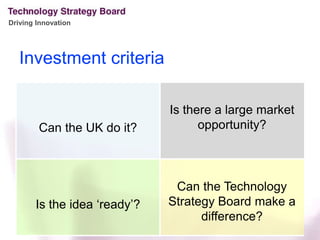
Investment criteria
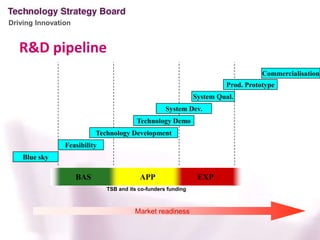
CommercialisationProd. PrototypeSystem Qual.System Dev.Technology DemoTechnology DevelopmentFeasibilityBlue skyR&D pipelineBASAPPEXPTSB and its co-funders fundingMarket readiness
How we deliver
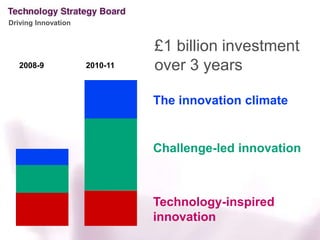
£1 billion investment over 3 years2008-92010-11The innovation climateChallenge-led innovationTechnology-inspiredinnovation
Technology Inspired InnovationWe build capability in the underpinning areas that enable a sure and effective response to market needsAdvanced materialsBioscienceElectronics, photonics and electrical systemsInformation and communication technologies High value manufacturing Nanotechnology
Challenge-led innovationWe aim to understand the needs of the markets and support the most innovative and competitive responsesEnergy generation and supplyEnvironmental sustainabilityBuilt environmentCreative industriesHigh value servicesMedicines and healthcareTransport
InnovationPlatformsWe work with Government as they address societal challenges to give business the future market definition they need to be competitive Intelligent Transport Systems and ServicesNetwork SecurityLow Carbon VehiclesAssisted LivingLow Impact BuildingsDetection and Identification of Infectious AgentsSustainable Agrifood
Example IP Societal Challenges & ResponsesLow Carbon VehiclesChallenge: Transport is 24% of UK CO2. >90% road of which 99% is fossil fuel.Gov Action: Supply & Demand Side IncentivesEU g/km CO2  “fleet average” targets - linked to heavy fines for suppliers that do not complyPublic Procurement Programme (£50M Fleet)Road Tax incentiveCongestion Charge ExemptionsFuture EV subsidy (£2-5k from 2011) etc.
What is a Knowledge Transfer Network?National network in a specific field of technology or business application Aim: stimulation of innovation through 	knowledge sharing and networkingKnowledge sharing:Business to business Science base to businessBetween sectorsInternationalBut: for the ultimate benefit of business and for the purpose of wealth creationThey arethe Connect in ‘Connect & Catalyse’
Knowledge Transfer Networks exist to :give the Technology Strategy Board the reach into the key industries and markets it needs to get the most out of its key programmes and to ensure that especially the innovative SME community is supported.provide the Technology Strategy Board with independent information on key developments and trends in these industries and markets.help make industry make connections, partnerships and collaborations, share knowledge and accelerate the pace of innovation through networkingImage by ShashiBellamkonda
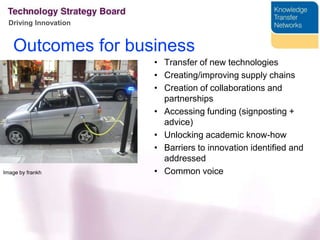
Outcomes for businessTransfer of new technologies
Creating/improving supply chains
Creation of collaborations and partnerships
Accessing funding (signposting + advice)
Unlocking academic know-how
Barriers to innovation identified and addressed
Common voiceImage by frankh
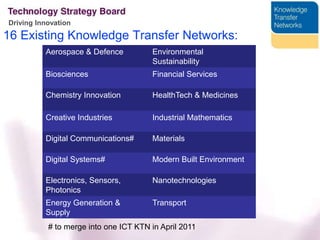
16 Existing Knowledge Transfer Networks:# to merge into one ICT KTN in April 2011
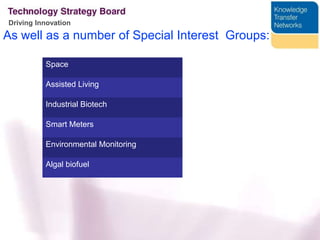
As well as a number of Special Interest  Groups:
Example – Chemistry Innovation KTNDirector, independent chair, technical and project management specialists, industry-led steering boardClear vision and strategic focus (6 sector priority areas that guide all activities within the KTN)Strong links with academia and regions
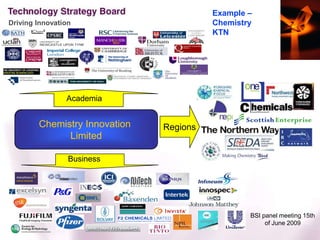
AcademiaRegionsBusinessExample – Chemistry KTNBSI panel meeting 15th of June 2009
Example – Chemistry Innovation KTNVaried events programme and project brokeringKITE - Bringing together of supply chain KTN connector – links with Technology Strategy Board£50M collaborative funding leveraged on behalf of members since inception (2006)
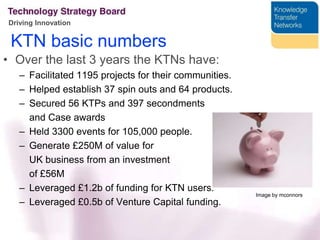
KTN basic numbersOver the last 3 years the KTNs have:Facilitated 1195 projects for their communities.Helped establish 37 spin outs and 64 products.Secured 56 KTPs and 397 secondments and Case awardsHeld 3300 events for 105,000 people.Generate £250M of value for 	UK business from an investment 	of £56MLeveraged £1.2b of funding for KTN users.Leveraged £0.5b of Venture Capital funding.Image by mconnors
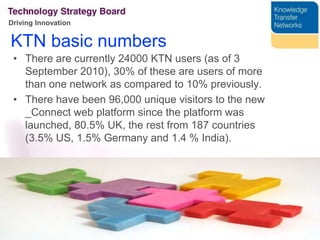
KTN basic numbersThere are currently 24000 KTN users (as of 3 September 2010), 30% of these are users of more than one network as compared to 10% previously.There have been 96,000 unique visitors to the new _Connect web platform since the platform was launched, 80.5% UK, the rest from 187 countries (3.5% US, 1.5% Germany and 1.4 % India).
Close links with the Research CouncilsKTNs provide RCs with latest industry trends, strengths and opportunities.KTNs are delivery agents of EPSRC for Industrial CaseRCs fund a number of Special Interest GroupsRCs provide us with intelligence on where the sources of the best academic know-how are.There is strong representation of academia (individual universities as well as RCs) on KTN boards.
Scottish KTN activitiesBiosciences KTN is Head Quartered in Scotland at RoslinBioCentre, Roslin, Midlothian.  9 of the 16 (56%) staff positions in the KTN are based in Scotland.  Biosciences KTN activity in Scotland in the Animal sector (in which Scottish academia is a world leader) is co-financed by two existing Scottish grants.HealthTech and Medicines KTN has established an office at RoslinBiocentre that houses three core staff and offers hot-desking space.  The KTN has strategic links to BIA Scotland and ABPI Scotland through additional office sharing in central Edinburgh and is well connected to other relevant networks in Scotland such as Nexxus, ISPE Scotland, Scottish Stem Cell Network. There are strong link with Scottish network for medical technologies through new company Medilink Scotland, plus prior links with Targeting Innovation and Scottish Enterprise

Ktn Network

  • 1.
    Knowledge Transfer NetworksPeterDirken – KTN Programme ManagerUniversity of Dundee9 September 2010
  • 2.
    SummaryWho are theTechnology Strategy Board?What is a Knowledge Transfer Network?Current portfolioExample – Chemistry InnovationScottish KTN presenceCase studiesLinks with the Research CouncilsQuestions/suggestionsImage by Dan Zen
  • 3.
    Technology Strategy BoardUK’sinnovation agencySet up in 2007Based in Swindon120 staff mainly from businessWorking with business, academia, governmentBudget of £1b over 3 years (up to 1/4/2011)Key programmes such as SBRI, KTP, KTNs, Innovation Platforms, CR&D.
  • 4.
  • 5.
    CommercialisationProd. PrototypeSystem Qual.SystemDev.Technology DemoTechnology DevelopmentFeasibilityBlue skyR&D pipelineBASAPPEXPTSB and its co-funders fundingMarket readiness
  • 6.
  • 7.
    £1 billion investmentover 3 years2008-92010-11The innovation climateChallenge-led innovationTechnology-inspiredinnovation
  • 8.
    Technology Inspired InnovationWebuild capability in the underpinning areas that enable a sure and effective response to market needsAdvanced materialsBioscienceElectronics, photonics and electrical systemsInformation and communication technologies High value manufacturing Nanotechnology
  • 9.
    Challenge-led innovationWe aimto understand the needs of the markets and support the most innovative and competitive responsesEnergy generation and supplyEnvironmental sustainabilityBuilt environmentCreative industriesHigh value servicesMedicines and healthcareTransport
  • 10.
    InnovationPlatformsWe work withGovernment as they address societal challenges to give business the future market definition they need to be competitive Intelligent Transport Systems and ServicesNetwork SecurityLow Carbon VehiclesAssisted LivingLow Impact BuildingsDetection and Identification of Infectious AgentsSustainable Agrifood
  • 11.
    Example IP SocietalChallenges & ResponsesLow Carbon VehiclesChallenge: Transport is 24% of UK CO2. >90% road of which 99% is fossil fuel.Gov Action: Supply & Demand Side IncentivesEU g/km CO2 “fleet average” targets - linked to heavy fines for suppliers that do not complyPublic Procurement Programme (£50M Fleet)Road Tax incentiveCongestion Charge ExemptionsFuture EV subsidy (£2-5k from 2011) etc.
  • 12.
    What is aKnowledge Transfer Network?National network in a specific field of technology or business application Aim: stimulation of innovation through knowledge sharing and networkingKnowledge sharing:Business to business Science base to businessBetween sectorsInternationalBut: for the ultimate benefit of business and for the purpose of wealth creationThey arethe Connect in ‘Connect & Catalyse’
  • 13.
    Knowledge Transfer Networksexist to :give the Technology Strategy Board the reach into the key industries and markets it needs to get the most out of its key programmes and to ensure that especially the innovative SME community is supported.provide the Technology Strategy Board with independent information on key developments and trends in these industries and markets.help make industry make connections, partnerships and collaborations, share knowledge and accelerate the pace of innovation through networkingImage by ShashiBellamkonda
  • 14.
  • 15.
  • 16.
  • 17.
  • 18.
  • 19.
    Barriers to innovationidentified and addressed
  • 20.
  • 21.
    16 Existing KnowledgeTransfer Networks:# to merge into one ICT KTN in April 2011
  • 22.
    As well asa number of Special Interest Groups:
  • 23.
    Example – ChemistryInnovation KTNDirector, independent chair, technical and project management specialists, industry-led steering boardClear vision and strategic focus (6 sector priority areas that guide all activities within the KTN)Strong links with academia and regions
  • 24.
    AcademiaRegionsBusinessExample – ChemistryKTNBSI panel meeting 15th of June 2009
  • 25.
    Example – ChemistryInnovation KTNVaried events programme and project brokeringKITE - Bringing together of supply chain KTN connector – links with Technology Strategy Board£50M collaborative funding leveraged on behalf of members since inception (2006)
  • 26.
    KTN basic numbersOverthe last 3 years the KTNs have:Facilitated 1195 projects for their communities.Helped establish 37 spin outs and 64 products.Secured 56 KTPs and 397 secondments and Case awardsHeld 3300 events for 105,000 people.Generate £250M of value for UK business from an investment of £56MLeveraged £1.2b of funding for KTN users.Leveraged £0.5b of Venture Capital funding.Image by mconnors
  • 27.
    KTN basic numbersThereare currently 24000 KTN users (as of 3 September 2010), 30% of these are users of more than one network as compared to 10% previously.There have been 96,000 unique visitors to the new _Connect web platform since the platform was launched, 80.5% UK, the rest from 187 countries (3.5% US, 1.5% Germany and 1.4 % India).
  • 28.
    Close links withthe Research CouncilsKTNs provide RCs with latest industry trends, strengths and opportunities.KTNs are delivery agents of EPSRC for Industrial CaseRCs fund a number of Special Interest GroupsRCs provide us with intelligence on where the sources of the best academic know-how are.There is strong representation of academia (individual universities as well as RCs) on KTN boards.
  • 29.
    Scottish KTN activitiesBiosciencesKTN is Head Quartered in Scotland at RoslinBioCentre, Roslin, Midlothian. 9 of the 16 (56%) staff positions in the KTN are based in Scotland.  Biosciences KTN activity in Scotland in the Animal sector (in which Scottish academia is a world leader) is co-financed by two existing Scottish grants.HealthTech and Medicines KTN has established an office at RoslinBiocentre that houses three core staff and offers hot-desking space. The KTN has strategic links to BIA Scotland and ABPI Scotland through additional office sharing in central Edinburgh and is well connected to other relevant networks in Scotland such as Nexxus, ISPE Scotland, Scottish Stem Cell Network. There are strong link with Scottish network for medical technologies through new company Medilink Scotland, plus prior links with Targeting Innovation and Scottish Enterprise

Editor's Notes

  • #6 RC TRL 1-3/4TSB TRL 3/4-7Illustrates position of RCs and TSB and the types of projects that we will support. We support business led projects.We support S2B and B2B.
  • #12 Infectious diseases costs lives, causes reduction in the quality of life but also costs moneyDiagnosis is a small part of the overall health budget but influences what comes next!!