2Copyright © Veeva Systems 2018
Disclaimer
This presentation is for informational purposes only and does not
constitute legal or other professional advice. You should consult your
own legal or compliance team before making a compliance decision.
All information is provided “as is”, with no guarantee of completeness,
accuracy, timeliness or of the results obtained from the use of this
information, and without warranty of any kind, express or implied. In
no event will Veeva be liable to you or anyone else as a result of your
use on this information.
3Copyright © Veeva Systems 2018
John Constantine
ORCHESTRALL
John is a veteran of over 30 years in the life
sciences industry, first at GlaxoSmithKline, then
at Merck as Executive Director, Merck
Polytechnic Institute in 2008, and joining
Orchestrall, Inc. as Senior VP, Learning & Talent
Solutions in 2016. His background includes
Sales, Marketing, Corporate Staffs, Information
Technology, Research and Development, and 25
years in Learning & Development.
VEEVA SYSTEMS
Kent has spent the majority of his career
delivering technology-enabled training solutions
to life sciences, holding leadership positions at
industry leading companies such as AdMed,
ClearPoint (Red Nucleus), UL EduNeering (UL),
and now Veeva Systems.
Kent Malmros
The Perception
of Compliance Training
5Copyright © Veeva Systems 2020
The Perception of Compliance Training
LMS-Driven
Upload Content
Manage Users
Make Assignments
Track Assignments
Qualifications
Assignment Made
Assignment Complete
Overdue or Not
Training Plans
Training Content
Curricula
Learner Roles
The Reality
of Compliance Training
7Copyright © Veeva Systems 2020
YES
Poll Question:
Does your organization have a learning strategy
document that is periodically reviewed with
stakeholders?
NO
8Copyright © Veeva Systems 2020
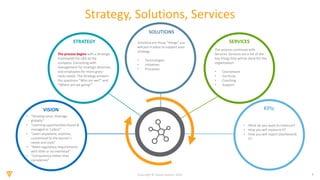
Strategy, Solutions, Services
VISION
STRATEGY
SOLUTIONS
KPIs
SERVICES
• “Develop once, leverage
globally”
• “Learning opportunities found &
managed in 1 place”
• “Learn anywhere, anytime,
customized to the learner’s
needs and style”
• “Meet regulatory requirements
with little or no overhead”
• “Competency rather than
completion”
The process begins with a Strategic
Framework for L&D at the
company. Consulting with
management for strategic direction,
and employees for more grass-
roots needs. The Strategy answers
the questions “Who are we?” and
“Where are we going?”
Solutions are those ”things” you
will put in place to support your
strategy:
• Technologies
• Initiatives
• Processes
The process continues with
Services. Services are a list of the
key things that will be done for the
organization:
• Courseware
• Curricula
• Coaching
• Support
• What do you want to measure?
• How you will measure it?
• How you will report (dashboard)
it?
9Copyright © Veeva Systems 2020
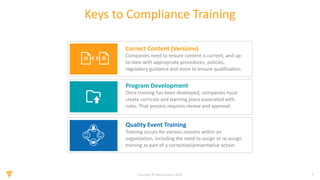
Keys to Compliance Training
Correct Content (Versions)
Companies need to ensure content is current, and up-
to-date with appropriate procedures, policies,
regulatory guidance and more to ensure qualification.
Program Development
Once training has been developed, companies must
create curricula and learning plans associated with
roles. That process requires review and approval.
Quality Event Training
Training occurs for various reasons within an
organization, including the need to assign or re-assign
training as part of a corrective/preventative action.
10Copyright © Veeva Systems 2020
The Value of Unified Training
• Single environment for DMS and LMS
• Assignment automation via document
lifecycle changes
• Assignment unification to QMS workflows
• Curriculum workflow and periodic review
• Training and quality data available in
same reports
Author
Content Creation
Assess
Combined
Data
Align
Assignable
Matrices
Controlled
Content
Assignment
Flexibility
Training
Effectiveness
The Extended Ecosystem
Broken Compliance Loop
12Copyright © Veeva Systems 2020
Broken Compliance Loop
How we think about the training development process
Author
Content
Multimedia
Dev
SME
Approval
Assignment
Tracking
13Copyright © Veeva Systems 2020
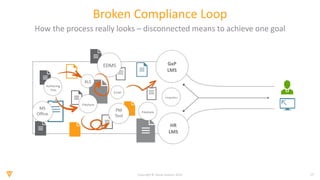
Broken Compliance Loop
How the process really looks – disconnected means to achieve one goal
EDMS GxP
LMS
HR
LMS
Fileshare
Email
MS
Office
XLS
Authoring
Tool
PM
Tool
Fileshare
Integration
14Copyright © Veeva Systems 2020
1
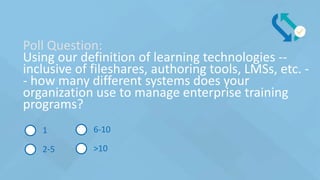
Poll Question:
Using our definition of learning technologies --
inclusive of fileshares, authoring tools, LMSs, etc. -
- how many different systems does your
organization use to manage enterprise training
programs?
2-5
6-10
>10
The Extended Ecosystem
Broken Loop Impacts
16Copyright © Veeva Systems 2020
Broken Loops Impacts
Training
Assignments
Content
Creation
Data and
Reports
Business
Process
Key
Gaps
Closing the Loop
Continuous Improvement
18Copyright © Veeva Systems 2020
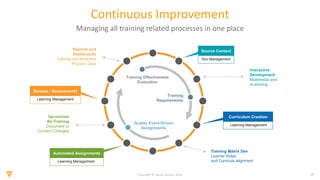
Continuous Improvement
Training Effectiveness
Evaluation
Training
Requirements
Quality Event-Driven
Assignments
Quizzes / Assessments
Learning Management
Automated Assignments
Learning Management
Source Content
Doc Management
Interactive
Development
Multimedia and
eLearning
Curriculum Creation
Learning Management
Training Matrix Dev
Learner Roles
and Curricula alignment
Up-version
Re-Training
Document or
Content Changes
Reports and
Dashboards
Training and Business
Process Data
Managing all training related processes in one place
19Copyright © Veeva Systems 2020
Closing the Loop
Creating Continuous Improvement
20Copyright © Veeva Systems 2020
Training Content Management
WHO:
SMEs, Trainers,
Instructional Designers
WHAT:
Leverage a DMS beyond
just controlled docs
WHY:
The power of version
control and workflow
HOW (IT HELPS):
Traceability and
visibility
21Copyright © Veeva Systems 2020
Training Content Management
WHO:
SMEs, Trainers,
Instructional Designers
WHY:
The power of version
control and workflow
HOW (IT HELPS):
Traceability and
visibilityKEY TAKEAWAY: The DMS is
part of your learning
technology landscape; take
advantage of its power.
WHAT:
Leverage a DMS beyond
just controlled docs
22Copyright © Veeva Systems 2020
Learning Program Development
WHO:
SMEs, Trainers,
Instructional Designers
WHAT:
Leverage workflow for
curriculum review/approval,
including periodic review
WHY:
The power of version
control and workflow
HOW (IT HELPS):
Eliminate email and
spreadsheets; delegate to
departments (or others)
23Copyright © Veeva Systems 2020
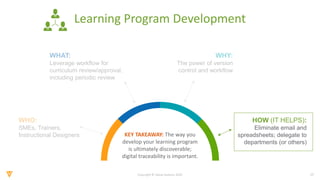
Learning Program Development
WHO:
SMEs, Trainers,
Instructional Designers
WHAT:
Leverage workflow for
curriculum review/approval,
including periodic review
WHY:
The power of version
control and workflow
KEY TAKEAWAY: The way you
develop your learning program
is ultimately discoverable;
digital traceability is important.
HOW (IT HELPS):
Eliminate email and
spreadsheets; delegate to
departments (or others)
24Copyright © Veeva Systems 2020
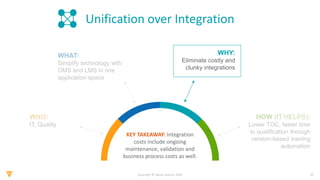
Unification over Integration
WHO:
IT, Quality
WHAT:
Simplify technology with
DMS and LMS in one
application space
WHY:
Eliminate costly and
clunky integrations
HOW (IT HELPS):
Lower TOC, faster time
to qualification through
version-based training
automation
25Copyright © Veeva Systems 2020
Unification over Integration
WHO:
IT, Quality
WHAT:
Simplify technology with
DMS and LMS in one
application space
HOW (IT HELPS):
Lower TOC, faster time
to qualification through
version-based training
automation
KEY TAKEAWAY: Integration
costs include ongoing
maintenance, validation and
business process costs as well.
WHY:
Eliminate costly and
clunky integrations
26Copyright © Veeva Systems 2020
Paper-based process
Poll Question:
What is your organization’s approach to managing
Quality action or event related training?
Corporate LMS, integrated
with Quality Systems
Paper form, request to LMS admin
GXP LMS, integrated with
Quality Systems
27Copyright © Veeva Systems 2020
Quality-Driven Training Events
WHO:
Quality, Training
Admins
WHAT:
Make assignments from
CAPA workflows
WHY:
Eliminate paper forms and
possible training gaps
HOW (IT HELPS):
Direct visibility into
assignment completion as
gate for CAPA progress
28Copyright © Veeva Systems 2020
Quality-Driven Training Events
WHO:
Quality, Training
Admins
WHY:
Eliminate paper forms and
possible training gaps
HOW (IT HELPS):
Direct visibility into
assignment completion as
gate for CAPA progress
KEY TAKEAWAY: Separating
CAPA related training from
your primary GXP LMS can
cause record and process gaps.
WHAT:
Make assignments from
CAPA workflows
29Copyright © Veeva Systems 2020
Related Training Data
WHO:
Department
Heads, Training,
Management
WHAT:
Comprehensive reporting as part of
related business process data
(documents, quality events)
WHY:
Reduce or eliminate data
aggregation and curation
HOW (IT HELPS):
Create a different
paradigm for
training efficacy
30Copyright © Veeva Systems 2020
Related Training Data
WHAT:
Comprehensive reporting as part of
related business process data
(documents, quality events)
WHY:
Reduce or eliminate data
aggregation and curation
HOW (IT HELPS):
Create a different
paradigm for
training efficacyKEY TAKEAWAY: To make
training strategic, it’s critical to
give the right people full
visibility into training outcomes.
WHO:
Department
Heads, Training,
Management
Expanding the Loop
Growing Beyond GXP Training
32Copyright © Veeva Systems 2020
WHO
HR, Commercial
Training
WHAT
One system with both
GXP requirements
and flexibility
WHY
Single master training
record from end-to-
end
HOW
(it helps)
Defragment and
optimize
Growing Beyond GXP Training
Shifting the emphasis beyond GXP and Quality
The Next Step
How to Close the Loop
34Copyright © Veeva Systems 2020
How to Close the Loop
Select a technology that
combines at least two of
the key processes
Harmonize process first,
systems second
Find the weakest point
in your process
John Constantine
john.constantine@orchestrallinc.com
Kent Malmros
kent.malmros@veeva.com
Questions?
How can we help.

Webinar: Enabling Closed-loop Training Compliance for Life Sciences

  • 2.
    2Copyright © VeevaSystems 2018 Disclaimer This presentation is for informational purposes only and does not constitute legal or other professional advice. You should consult your own legal or compliance team before making a compliance decision. All information is provided “as is”, with no guarantee of completeness, accuracy, timeliness or of the results obtained from the use of this information, and without warranty of any kind, express or implied. In no event will Veeva be liable to you or anyone else as a result of your use on this information.
  • 3.
    3Copyright © VeevaSystems 2018 John Constantine ORCHESTRALL John is a veteran of over 30 years in the life sciences industry, first at GlaxoSmithKline, then at Merck as Executive Director, Merck Polytechnic Institute in 2008, and joining Orchestrall, Inc. as Senior VP, Learning & Talent Solutions in 2016. His background includes Sales, Marketing, Corporate Staffs, Information Technology, Research and Development, and 25 years in Learning & Development. VEEVA SYSTEMS Kent has spent the majority of his career delivering technology-enabled training solutions to life sciences, holding leadership positions at industry leading companies such as AdMed, ClearPoint (Red Nucleus), UL EduNeering (UL), and now Veeva Systems. Kent Malmros
  • 4.
  • 5.
    5Copyright © VeevaSystems 2020 The Perception of Compliance Training LMS-Driven Upload Content Manage Users Make Assignments Track Assignments Qualifications Assignment Made Assignment Complete Overdue or Not Training Plans Training Content Curricula Learner Roles
  • 6.
  • 7.
    7Copyright © VeevaSystems 2020 YES Poll Question: Does your organization have a learning strategy document that is periodically reviewed with stakeholders? NO
  • 8.
    8Copyright © VeevaSystems 2020 Strategy, Solutions, Services VISION STRATEGY SOLUTIONS KPIs SERVICES • “Develop once, leverage globally” • “Learning opportunities found & managed in 1 place” • “Learn anywhere, anytime, customized to the learner’s needs and style” • “Meet regulatory requirements with little or no overhead” • “Competency rather than completion” The process begins with a Strategic Framework for L&D at the company. Consulting with management for strategic direction, and employees for more grass- roots needs. The Strategy answers the questions “Who are we?” and “Where are we going?” Solutions are those ”things” you will put in place to support your strategy: • Technologies • Initiatives • Processes The process continues with Services. Services are a list of the key things that will be done for the organization: • Courseware • Curricula • Coaching • Support • What do you want to measure? • How you will measure it? • How you will report (dashboard) it?
  • 9.
    9Copyright © VeevaSystems 2020 Keys to Compliance Training Correct Content (Versions) Companies need to ensure content is current, and up- to-date with appropriate procedures, policies, regulatory guidance and more to ensure qualification. Program Development Once training has been developed, companies must create curricula and learning plans associated with roles. That process requires review and approval. Quality Event Training Training occurs for various reasons within an organization, including the need to assign or re-assign training as part of a corrective/preventative action.
  • 10.
    10Copyright © VeevaSystems 2020 The Value of Unified Training • Single environment for DMS and LMS • Assignment automation via document lifecycle changes • Assignment unification to QMS workflows • Curriculum workflow and periodic review • Training and quality data available in same reports Author Content Creation Assess Combined Data Align Assignable Matrices Controlled Content Assignment Flexibility Training Effectiveness
  • 11.
  • 12.
    12Copyright © VeevaSystems 2020 Broken Compliance Loop How we think about the training development process Author Content Multimedia Dev SME Approval Assignment Tracking
  • 13.
    13Copyright © VeevaSystems 2020 Broken Compliance Loop How the process really looks – disconnected means to achieve one goal EDMS GxP LMS HR LMS Fileshare Email MS Office XLS Authoring Tool PM Tool Fileshare Integration
  • 14.
    14Copyright © VeevaSystems 2020 1 Poll Question: Using our definition of learning technologies -- inclusive of fileshares, authoring tools, LMSs, etc. - - how many different systems does your organization use to manage enterprise training programs? 2-5 6-10 >10
  • 15.
  • 16.
    16Copyright © VeevaSystems 2020 Broken Loops Impacts Training Assignments Content Creation Data and Reports Business Process Key Gaps
  • 17.
  • 18.
    18Copyright © VeevaSystems 2020 Continuous Improvement Training Effectiveness Evaluation Training Requirements Quality Event-Driven Assignments Quizzes / Assessments Learning Management Automated Assignments Learning Management Source Content Doc Management Interactive Development Multimedia and eLearning Curriculum Creation Learning Management Training Matrix Dev Learner Roles and Curricula alignment Up-version Re-Training Document or Content Changes Reports and Dashboards Training and Business Process Data Managing all training related processes in one place
  • 19.
    19Copyright © VeevaSystems 2020 Closing the Loop Creating Continuous Improvement
  • 20.
    20Copyright © VeevaSystems 2020 Training Content Management WHO: SMEs, Trainers, Instructional Designers WHAT: Leverage a DMS beyond just controlled docs WHY: The power of version control and workflow HOW (IT HELPS): Traceability and visibility
  • 21.
    21Copyright © VeevaSystems 2020 Training Content Management WHO: SMEs, Trainers, Instructional Designers WHY: The power of version control and workflow HOW (IT HELPS): Traceability and visibilityKEY TAKEAWAY: The DMS is part of your learning technology landscape; take advantage of its power. WHAT: Leverage a DMS beyond just controlled docs
  • 22.
    22Copyright © VeevaSystems 2020 Learning Program Development WHO: SMEs, Trainers, Instructional Designers WHAT: Leverage workflow for curriculum review/approval, including periodic review WHY: The power of version control and workflow HOW (IT HELPS): Eliminate email and spreadsheets; delegate to departments (or others)
  • 23.
    23Copyright © VeevaSystems 2020 Learning Program Development WHO: SMEs, Trainers, Instructional Designers WHAT: Leverage workflow for curriculum review/approval, including periodic review WHY: The power of version control and workflow KEY TAKEAWAY: The way you develop your learning program is ultimately discoverable; digital traceability is important. HOW (IT HELPS): Eliminate email and spreadsheets; delegate to departments (or others)
  • 24.
    24Copyright © VeevaSystems 2020 Unification over Integration WHO: IT, Quality WHAT: Simplify technology with DMS and LMS in one application space WHY: Eliminate costly and clunky integrations HOW (IT HELPS): Lower TOC, faster time to qualification through version-based training automation
  • 25.
    25Copyright © VeevaSystems 2020 Unification over Integration WHO: IT, Quality WHAT: Simplify technology with DMS and LMS in one application space HOW (IT HELPS): Lower TOC, faster time to qualification through version-based training automation KEY TAKEAWAY: Integration costs include ongoing maintenance, validation and business process costs as well. WHY: Eliminate costly and clunky integrations
  • 26.
    26Copyright © VeevaSystems 2020 Paper-based process Poll Question: What is your organization’s approach to managing Quality action or event related training? Corporate LMS, integrated with Quality Systems Paper form, request to LMS admin GXP LMS, integrated with Quality Systems
  • 27.
    27Copyright © VeevaSystems 2020 Quality-Driven Training Events WHO: Quality, Training Admins WHAT: Make assignments from CAPA workflows WHY: Eliminate paper forms and possible training gaps HOW (IT HELPS): Direct visibility into assignment completion as gate for CAPA progress
  • 28.
    28Copyright © VeevaSystems 2020 Quality-Driven Training Events WHO: Quality, Training Admins WHY: Eliminate paper forms and possible training gaps HOW (IT HELPS): Direct visibility into assignment completion as gate for CAPA progress KEY TAKEAWAY: Separating CAPA related training from your primary GXP LMS can cause record and process gaps. WHAT: Make assignments from CAPA workflows
  • 29.
    29Copyright © VeevaSystems 2020 Related Training Data WHO: Department Heads, Training, Management WHAT: Comprehensive reporting as part of related business process data (documents, quality events) WHY: Reduce or eliminate data aggregation and curation HOW (IT HELPS): Create a different paradigm for training efficacy
  • 30.
    30Copyright © VeevaSystems 2020 Related Training Data WHAT: Comprehensive reporting as part of related business process data (documents, quality events) WHY: Reduce or eliminate data aggregation and curation HOW (IT HELPS): Create a different paradigm for training efficacyKEY TAKEAWAY: To make training strategic, it’s critical to give the right people full visibility into training outcomes. WHO: Department Heads, Training, Management
  • 31.
    Expanding the Loop GrowingBeyond GXP Training
  • 32.
    32Copyright © VeevaSystems 2020 WHO HR, Commercial Training WHAT One system with both GXP requirements and flexibility WHY Single master training record from end-to- end HOW (it helps) Defragment and optimize Growing Beyond GXP Training Shifting the emphasis beyond GXP and Quality
  • 33.
    The Next Step Howto Close the Loop
  • 34.
    34Copyright © VeevaSystems 2020 How to Close the Loop Select a technology that combines at least two of the key processes Harmonize process first, systems second Find the weakest point in your process
  • 35.

Editor's Notes

  • #2 Kent to kick off.
  • #3 Kent
  • #4 Kent to intro himself, throw to John for his intro.
  • #5 Kent
  • #6 Kent The perception of quality, GXP and compliance training is that there are multiple, separated process that all come together in a single technology. On one-hand, it’s critical to manage the development of training content – but that’s done in varying systems. It’s also important to develop critical training plans. That happens using other process. The desire end goal is tracking qualifications. They need to be demonstrable as a data set that can be shown to inspectors or auditors. The perception is that the activities that go into developing compliance training, as a foundation to enterprise training strategy… and the required data that come out of it, converge is ONE core technology… An LMS This is where the content, users, training plans aligned to role-based qualifications all come together so assignments can be made and monitored. But this is a perception, not a reality. All of the efforts that that go into the records that you upload to a an LMS, and all of the data and how you want USE it… coming out of an LMS, are part of a training development loop. If that loop isn’t closed, training compliance suffers, and also, your organization will get stuck in the tactical hand-to-hand combat that limits the ability to invest man hours into making training strategic. Our goal today, is to change the way you think about that loop, give you some tools to try and close it, instead of leaving it broken, and buy time to invest in your enterprise training strategy.
  • #7 Transition to John So, John, let’s break down that reality in a bit more detail… But first, maybe we can get the audience to tell us a little bit about what they are doing today.
  • #8 John / Kent discuss to setup Do you want to define learning strategy for the audience as they answer this question?
  • #9 John
  • #10 John
  • #11 John
  • #12 John transition to Kent
  • #13 Kent So now that understand what goes into the strategy, let’s talk about how the tactics work. Typically, we can think about breaking this up into four discreet buckets of activity. The first step is to create source content. This requires SMEs, and job-level expert, regulatory experts, etc. More advanced organizations include instructional designers in this process. The most often happens in WORD, and the documents have lifecycles, as well as review workflows. The tools required for this are Offfce, Email, Fileshares, Doc Management Systems and sometimes project management tools. Once content is authored, reviewed and approved, it’s factored into various media types. The modality is determined in the learning strategy step outlined by John previously, but can vary from flat files like PDF, to more visual formats like PPT, to multimedia videos, or packaged interactive eLearning content. That requires similar workflow and tools as the first step, but now interactive developers are added to the mix. Various authoring tools, from the Adobe Suite to Articulate Storyline and possibly video production are added to the mix. The third step has a variety of different parts, and is marked by SME approval at differing levels within the organization. You get final content approval. You add the alignment of content to curricula, and then qualification sets, and entire learning plans or training matrices. Now we are adding managers, department heads and others to a round of workflows. Spreadsheets and emails become critical. And this is a final step to deciding the INPUTS for an LMS The final step is configuring an LMS to deliver assignments, and then using it to track them. This is a stand alone system that consumes the inputs described and delivers tracking data back. Often, an LMS admin is another stakeholder that may or may not have been involved in the preceeding steps. Viewed this way… we can think of the training development process as a linear, well-defined progression, with discreet traceable steps. But…
  • #14 Kent That’s not reality. The process can be easily swim diagramed. But when you include the means of enabling those varied processes, it’s anything but linear. The starting point and end points are the same, but the reality of GETTING to that assignment status – did John complete his SOP R/U and GMP eLearning assignments, and were they on-time … are all critical to delivering efficient business process and providing evidence of compliance. And this is where the loop is broken. Let me provide an example. One large pharma company that I worked with outlined their stark reality. On the GXP side, DMS, 4-5 fileshares just for GCP, email and spreadsheet approvals for about 300 participants in the content development process, the resulting plans stored back in fileshares… and pointed links are given to admins for 2 interral LMSs and multiple portals for external training,. Keeping track of two versions of a single eLearning course – required for two different delivery technologies – one piece of content, requires ALL of these methods of tracking. Thes are all learning technologies. All.
  • #15 John / Kent discuss to setup So John, we know large enterprise customers expand to approaching 100 learning technologies, but they are typically counting LMS-like delivery products, when consider everything described, how much bigger to do you estimate that would be? Consider smaller companies as well, we kept these choices low… but…
  • #16 To John
  • #17 John
  • #18 To Kent So, we want to encourage you to look at the learning strategy holistically, and do your best to close the loop. Find a way to connect each part of this disparate processes…
  • #19 Kent & John discussion back and forth Looks something like this… This can be done via integration, if possible. Challenge with multimedia development (it can be OUTSIDE the loop, as along as it’s anchored to the loop)
  • #20 Kent It’s easier if we break down some of the key considerations…
  • #21 Kent Similar concerns about GXP and non-GXP with doc management solutions as there are with LMS solutions No, you don’t want to blindly co-mingle, BUT… every part of the org that creates and manages source documents has training derivatives. You should both have the flexibility to add those to your hierarchy, make them less governed, and create a downstream management of related content so a source doc, can be associated to a storyboard, to media assets, to interactive packages.
  • #22 Kent And then you have version control and a traceability that does NOT exist if you are relaying on email and fileshare. I’ve seen this. In the approval process, it is one extreme or the other. Controlled documents are managed in a DMS, but a correlating ILT session is developed locally. That doesn’t allow for visibility. Or, source content – often in commercial training – is developed locally, all the way through interactive eLearning packages. Then those are routed through a DMS for MLR review, without even being renderable, so a storyboard is relied upon. Even in a closed loop scenario, it’s already been broken.,
  • #23 John
  • #24 John
  • #25 Kent Unification over integration. This isn’t just technology. It’s also a process problem. LMS selection often involves content. And sometimes that leads to secondary or tertiary integrations. It’s not going to be perfect. SO it’s important to ask yourself where the compliance loop is best closed and how that Another specific example… find an LMS that naturally delivers assignments through other business processes – like CAPA
  • #26 Kent
  • #27 John / Kent discuss to setup
  • #28 John
  • #29 John
  • #30 Kent & John discussion
  • #31 Kent & John discussion
  • #32 To John
  • #33 John
  • #34 To Kent
  • #35 Kent