WEBINAR
Decoding Sustainability Reporting
SGS India
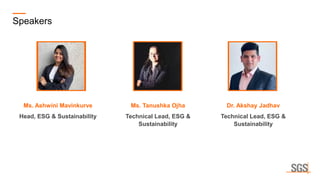
Speakers
Ms. Ashwini Mavinkurve
Head, ESG & Sustainability
Ms. Tanushka Ojha
Technical Lead, ESG &
Sustainability
Dr. Akshay Jadhav
Technical Lead, ESG &
Sustainability
Agenda
• Concepts of Sustainability & ESG
• Navigating the landscape of sustainability reporting
• Sustainability Reporting Frameworks
• Business Responsibility and Sustainability Report
(BRSR)
• Roadmap for effective and impactful report
development
• Q&A
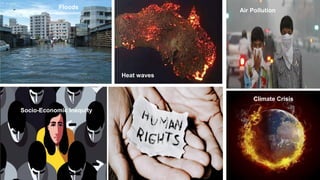
Heat waves
Climate Crisis
Air Pollution
Socio-Economic Inequity
Floods
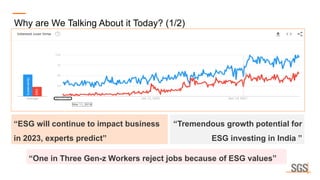
Why are We Talking About it Today? (1/2)
Sustainability
ESG
“ESG will continue to impact business
in 2023, experts predict”
“Tremendous growth potential for
ESG investing in India ”
“One in Three Gen-z Workers reject jobs because of ESG values”
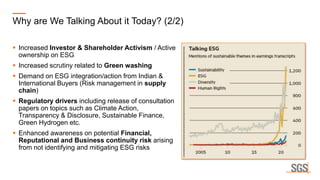
Why are We Talking About it Today? (2/2)
▪ Increased Investor & Shareholder Activism / Active
ownership on ESG
▪ Increased scrutiny related to Green washing
▪ Demand on ESG integration/action from Indian &
International Buyers (Risk management in supply
chain)
▪ Regulatory drivers including release of consultation
papers on topics such as Climate Action,
Transparency & Disclosure, Sustainable Finance,
Green Hydrogen etc.
▪ Enhanced awareness on potential Financial,
Reputational and Business continuity risk arising
from not identifying and mitigating ESG risks
Concepts of
Sustainability &
ESG
What is Sustainability?
“Sustainability in business refers to a company's
strategy and actions to eliminate or minimize the
adverse environmental and social impacts caused
by business operations.” *
Sustainable businesses consider a wide array of
environmental, economic, social factors and stakeholder
expectations when making business decisions. These
organizations monitor the impact of their operations to
ensure that short-term profits don’t turn into long-term
liabilities.
*source: Business insights, HBS
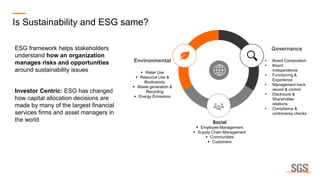
Is Sustainability and ESG same?
ESG framework helps stakeholders
understand how an organization
manages risks and opportunities
around sustainability issues
Investor Centric: ESG has changed
how capital allocation decisions are
made by many of the largest financial
services firms and asset managers in
the world
Environmental
▪ Water Use
▪ Resource Use &
Biodiversity
▪ Waste generation &
Recycling
▪ Energy Emissions
Governance
▪ Board Composition
▪ Board
Independence
▪ Functioning &
Experience
▪ Management track
record & control
▪ Disclosure &
Shareholder
relations
▪ Compliance &
controversy checks
Social
▪ Employee Management
▪ Supply Chain Management
▪ Communities
▪ Customers
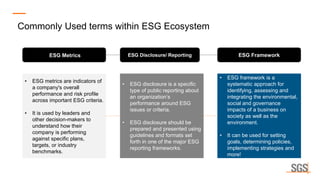
ESG Disclosure/ Reporting
ESG Metrics ESG Framework
• ESG metrics are indicators of
a company's overall
performance and risk profile
across important ESG criteria.
• It is used by leaders and
other decision-makers to
understand how their
company is performing
against specific plans,
targets, or industry
benchmarks.
• ESG disclosure is a specific
type of public reporting about
an organization’s
performance around ESG
issues or criteria.
• ESG disclosure should be
prepared and presented using
guidelines and formats set
forth in one of the major ESG
reporting frameworks.
• ESG framework is a
systematic approach for
identifying, assessing and
integrating the environmental,
social and governance
impacts of a business on
society as well as the
environment.
• It can be used for setting
goals, determining policies,
implementing strategies and
more!
Commonly Used terms within ESG Ecosystem
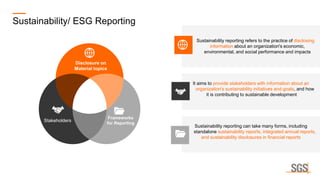
Sustainability reporting can take many forms, including
standalone sustainability reports, integrated annual reports,
and sustainability disclosures in financial reports
It aims to provide stakeholders with information about an
organization's sustainability initiatives and goals, and how
it is contributing to sustainable development
Sustainability reporting refers to the practice of disclosing
information about an organization's economic,
environmental, and social performance and impacts
Sustainability/ ESG Reporting
Disclosure on
Material topics
Stakeholders
Frameworks
for Reporting
Navigating the landscape
of sustainability reporting
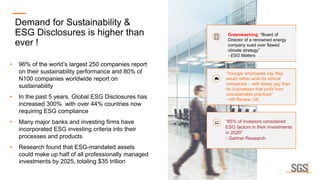
Demand for Sustainability &
ESG Disclosures is higher than
ever !
• 96% of the world’s largest 250 companies report
on their sustainability performance and 80% of
N100 companies worldwide report on
sustainability
• In the past 5 years, Global ESG Disclosures has
increased 300% with over 44% countries now
requiring ESG compliance
• Many major banks and investing firms have
incorporated ESG investing criteria into their
processes and products
• Research found that ESG-mandated assets
could make up half of all professionally managed
investments by 2025, totaling $35 trillion
Greenwashing: “Board of
Director of a renowned energy
company sued over flawed
climate strategy”
- ESG Matters
“Younger employees say they
would rather work for ethical
companies – with lesser pay than
for businesses that profit from
unsustainable practices”
- HR Review, UK
“85% of investors considered
ESG factors in their investments
in 2020”
- Gartner Research
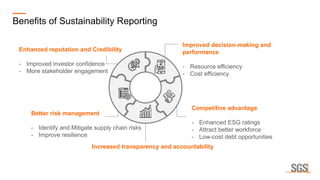
Benefits of Sustainability Reporting
Enhanced reputation and Credibility
- Improved investor confidence
- More stakeholder engagement
Improved decision-making and
performance
- Resource efficiency
- Cost efficiency
Better risk management
- Identify and Mitigate supply chain risks
- Improve resilience
Competitive advantage
- Enhanced ESG ratings
- Attract better workforce
- Low-cost debt opportunities
Increased transparency and accountability
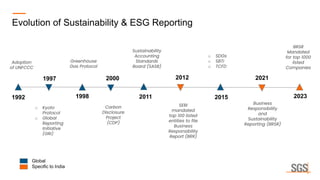
Adoption
of UNFCCC
1997
o Kyoto
Protocol
o Global
Reporting
Initiative
(GRI)
Greenhouse
Gas Protocol
Carbon
Disclosure
Project
(CDP)
Sustainability
Accounting
Standards
Board (SASB)
SEBI
mandated
top 100 listed
entities to file
Business
Responsibility
Report (BRR)
o SDGs
o SBTi
o TCFD
Business
Responsibility
and
Sustainability
Reporting (BRSR)
BRSR
Mandated
for top 1000
listed
Companies
Global
Specific to India
Evolution of Sustainability & ESG Reporting
1998
2000
2011
2012
2015
2021
2023
1992
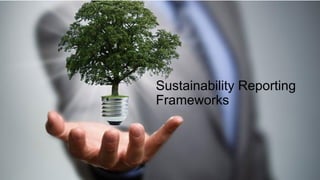
Sustainability Reporting
Frameworks
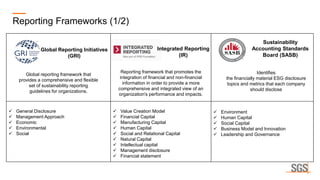
✓ General Disclosure
✓ Management Approach
✓ Economic
✓ Environmental
✓ Social
✓ Value Creation Model
✓ Financial Capital
✓ Manufacturing Capital
✓ Human Capital
✓ Social and Relational Capital
✓ Natural Capital
✓ Intellectual capital
✓ Management disclosure
✓ Financial statement
✓ Environment
✓ Human Capital
✓ Social Capital
✓ Business Model and Innovation
✓ Leadership and Governance
Reporting Frameworks (1/2)
Global Reporting Initiatives
(GRI)
Integrated Reporting
(IR)
Sustainability
Accounting Standards
Board (SASB)
Identifies
the financially material ESG disclosure
topics and metrics that each company
should disclose
Global reporting framework that
provides a comprehensive and flexible
set of sustainability reporting
guidelines for organizations.
Reporting framework that promotes the
integration of financial and non-financial
information in order to provide a more
comprehensive and integrated view of an
organization's performance and impacts.
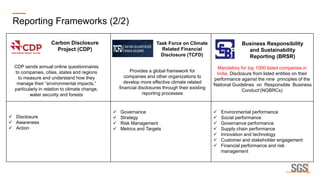
✓ Disclosure
✓ Awareness
✓ Action
✓ Governance
✓ Strategy
✓ Risk Management
✓ Metrics and Targets
✓ Environmental performance
✓ Social performance
✓ Governance performance
✓ Supply chain performance
✓ Innovation and technology
✓ Customer and stakeholder engagement
✓ Financial performance and risk
management
Reporting Frameworks (2/2)
Task Force on Climate
Related Financial
Disclosure (TCFD)
Business Responsibility
and Sustainability
Reporting (BRSR)
Mandatory for top 1000 listed companies in
India. Disclosure from listed entities on their
performance against the nine principles of the
‘National Guidelines on Responsible Business
Conduct’(NGBRCs)
Provides a global framework for
companies and other organizations to
develop more effective climate related
financial disclosures through their existing
reporting processes
Carbon Disclosure
Project (CDP)
CDP sends annual online questionnaires
to companies, cities, states and regions
to measure and understand how they
manage their “environmental impacts,”
particularly in relation to climate change,
water security and forests
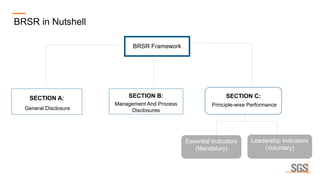
BRSR Framework
BRSR Framework
SECTION A:
General Disclosure
SECTION B:
Management And Process
Disclosures
SECTION C:
Principle-wise Performance
Leadership Indicators
(Voluntary)
Essential Indicators
(Mandatory)
BRSR in Nutshell
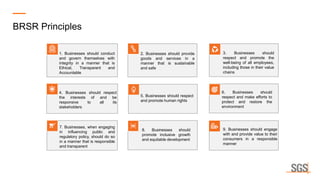
BRSR Principles
1. Businesses should conduct
and govern themselves with
integrity in a manner that is
Ethical, Transparent and
Accountable
6. Businesses should
respect and make efforts to
protect and restore the
environment
8. Businesses should
promote inclusive growth
and equitable development
3. Businesses should
respect and promote the
well-being of all employees,
including those in their value
chains
4. Businesses should respect
the interests of and be
responsive to all its
stakeholders
9. Businesses should engage
with and provide value to their
consumers in a responsible
manner
2. Businesses should provide
goods and services in a
manner that is sustainable
and safe
5. Businesses should respect
and promote human rights
7. Businesses, when engaging
in influencing public and
regulatory policy, should do so
in a manner that is responsible
and transparent
Roadmap for
Effective Reporting
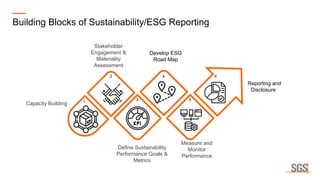
Building Blocks of Sustainability/ESG Reporting
Define Sustainability
Performance Goals &
Metrics
Stakeholder
Engagement &
Materiality
Assessment
Capacity Building
Measure and
Monitor
Performance
Develop ESG
Road Map
Reporting and
Disclosure
1
2 4
3 5
6
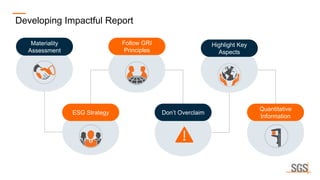
Materiality
Assessment
Follow GRI
Principles
Highlight Key
Aspects
ESG Strategy Don’t Overclaim
Quantitative
Information
Best Practices for ESG Reporting
Developing Impactful Report
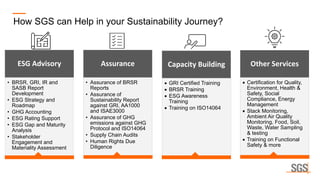
SGS ESG Services
ESG Advisory
• BRSR, GRI, IR and
SASB Report
Development
• ESG Strategy and
Roadmap
• GHG Accounting
• ESG Rating Support
• ESG Gap and Maturity
Analysis
• Stakeholder
Engagement and
Materiality Assessment
Assurance
• Assurance of BRSR
Reports
• Assurance of
Sustainability Report
against GRI, AA1000
and ISAE3000
• Assurance of GHG
emissions against GHG
Protocol and ISO14064
• Supply Chain Audits
• Human Rights Due
Diligence
Capacity Building
• GRI Certified Training
• BRSR Training
• ESG Awareness
Training
• Training on ISO14064
Other Services
• Certification for Quality,
Environment, Health &
Safety, Social
Compliance, Energy
Management
• Stack Monitoring,
Ambient Air Quality
Monitoring, Food, Soil,
Waste, Water Sampling
& testing
• Training on Functional
Safety & more
How SGS can Help in your Sustainability Journey?
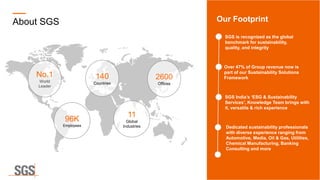
About SGS Our Footprint
SGS is recognized as the global
benchmark for sustainability,
quality, and integrity
Dedicated sustainability professionals
with diverse experience ranging from
Automotive, Media, Oil & Gas, Utilities,
Chemical Manufacturing, Banking
Consulting and more
SGS India’s ‘ESG & Sustainability
Services’, Knowledge Team brings with
it, versatile & rich experience
Over 47% of Group revenue now is
part of our Sustainability Solutions
Framework
No.1
World
Leader
140
Countries
96K
Employees
11
Global
Industries
2600
Offices
Thank you!
Do you have any questions, write to us at
in.esg@sgs.com
soprotection.com

Webinar: Decoding Sustainability Reporting

  • 1.
  • 2.
    Speakers Ms. Ashwini Mavinkurve Head,ESG & Sustainability Ms. Tanushka Ojha Technical Lead, ESG & Sustainability Dr. Akshay Jadhav Technical Lead, ESG & Sustainability
  • 3.
    Agenda • Concepts ofSustainability & ESG • Navigating the landscape of sustainability reporting • Sustainability Reporting Frameworks • Business Responsibility and Sustainability Report (BRSR) • Roadmap for effective and impactful report development • Q&A
  • 4.
    Heat waves Climate Crisis AirPollution Socio-Economic Inequity Floods
  • 5.
    Why are WeTalking About it Today? (1/2) Sustainability ESG “ESG will continue to impact business in 2023, experts predict” “Tremendous growth potential for ESG investing in India ” “One in Three Gen-z Workers reject jobs because of ESG values”
  • 6.
    Why are WeTalking About it Today? (2/2) ▪ Increased Investor & Shareholder Activism / Active ownership on ESG ▪ Increased scrutiny related to Green washing ▪ Demand on ESG integration/action from Indian & International Buyers (Risk management in supply chain) ▪ Regulatory drivers including release of consultation papers on topics such as Climate Action, Transparency & Disclosure, Sustainable Finance, Green Hydrogen etc. ▪ Enhanced awareness on potential Financial, Reputational and Business continuity risk arising from not identifying and mitigating ESG risks
  • 7.
  • 8.
    What is Sustainability? “Sustainabilityin business refers to a company's strategy and actions to eliminate or minimize the adverse environmental and social impacts caused by business operations.” * Sustainable businesses consider a wide array of environmental, economic, social factors and stakeholder expectations when making business decisions. These organizations monitor the impact of their operations to ensure that short-term profits don’t turn into long-term liabilities. *source: Business insights, HBS
  • 9.
    Is Sustainability andESG same? ESG framework helps stakeholders understand how an organization manages risks and opportunities around sustainability issues Investor Centric: ESG has changed how capital allocation decisions are made by many of the largest financial services firms and asset managers in the world Environmental ▪ Water Use ▪ Resource Use & Biodiversity ▪ Waste generation & Recycling ▪ Energy Emissions Governance ▪ Board Composition ▪ Board Independence ▪ Functioning & Experience ▪ Management track record & control ▪ Disclosure & Shareholder relations ▪ Compliance & controversy checks Social ▪ Employee Management ▪ Supply Chain Management ▪ Communities ▪ Customers
  • 10.
    ESG Disclosure/ Reporting ESGMetrics ESG Framework • ESG metrics are indicators of a company's overall performance and risk profile across important ESG criteria. • It is used by leaders and other decision-makers to understand how their company is performing against specific plans, targets, or industry benchmarks. • ESG disclosure is a specific type of public reporting about an organization’s performance around ESG issues or criteria. • ESG disclosure should be prepared and presented using guidelines and formats set forth in one of the major ESG reporting frameworks. • ESG framework is a systematic approach for identifying, assessing and integrating the environmental, social and governance impacts of a business on society as well as the environment. • It can be used for setting goals, determining policies, implementing strategies and more! Commonly Used terms within ESG Ecosystem
  • 11.
    Sustainability reporting cantake many forms, including standalone sustainability reports, integrated annual reports, and sustainability disclosures in financial reports It aims to provide stakeholders with information about an organization's sustainability initiatives and goals, and how it is contributing to sustainable development Sustainability reporting refers to the practice of disclosing information about an organization's economic, environmental, and social performance and impacts Sustainability/ ESG Reporting Disclosure on Material topics Stakeholders Frameworks for Reporting
  • 12.
    Navigating the landscape ofsustainability reporting
  • 13.
    Demand for Sustainability& ESG Disclosures is higher than ever ! • 96% of the world’s largest 250 companies report on their sustainability performance and 80% of N100 companies worldwide report on sustainability • In the past 5 years, Global ESG Disclosures has increased 300% with over 44% countries now requiring ESG compliance • Many major banks and investing firms have incorporated ESG investing criteria into their processes and products • Research found that ESG-mandated assets could make up half of all professionally managed investments by 2025, totaling $35 trillion Greenwashing: “Board of Director of a renowned energy company sued over flawed climate strategy” - ESG Matters “Younger employees say they would rather work for ethical companies – with lesser pay than for businesses that profit from unsustainable practices” - HR Review, UK “85% of investors considered ESG factors in their investments in 2020” - Gartner Research
  • 14.
    Benefits of SustainabilityReporting Enhanced reputation and Credibility - Improved investor confidence - More stakeholder engagement Improved decision-making and performance - Resource efficiency - Cost efficiency Better risk management - Identify and Mitigate supply chain risks - Improve resilience Competitive advantage - Enhanced ESG ratings - Attract better workforce - Low-cost debt opportunities Increased transparency and accountability
  • 15.
    Adoption of UNFCCC 1997 o Kyoto Protocol oGlobal Reporting Initiative (GRI) Greenhouse Gas Protocol Carbon Disclosure Project (CDP) Sustainability Accounting Standards Board (SASB) SEBI mandated top 100 listed entities to file Business Responsibility Report (BRR) o SDGs o SBTi o TCFD Business Responsibility and Sustainability Reporting (BRSR) BRSR Mandated for top 1000 listed Companies Global Specific to India Evolution of Sustainability & ESG Reporting 1998 2000 2011 2012 2015 2021 2023 1992
  • 16.
  • 17.
    ✓ General Disclosure ✓Management Approach ✓ Economic ✓ Environmental ✓ Social ✓ Value Creation Model ✓ Financial Capital ✓ Manufacturing Capital ✓ Human Capital ✓ Social and Relational Capital ✓ Natural Capital ✓ Intellectual capital ✓ Management disclosure ✓ Financial statement ✓ Environment ✓ Human Capital ✓ Social Capital ✓ Business Model and Innovation ✓ Leadership and Governance Reporting Frameworks (1/2) Global Reporting Initiatives (GRI) Integrated Reporting (IR) Sustainability Accounting Standards Board (SASB) Identifies the financially material ESG disclosure topics and metrics that each company should disclose Global reporting framework that provides a comprehensive and flexible set of sustainability reporting guidelines for organizations. Reporting framework that promotes the integration of financial and non-financial information in order to provide a more comprehensive and integrated view of an organization's performance and impacts.
  • 18.
    ✓ Disclosure ✓ Awareness ✓Action ✓ Governance ✓ Strategy ✓ Risk Management ✓ Metrics and Targets ✓ Environmental performance ✓ Social performance ✓ Governance performance ✓ Supply chain performance ✓ Innovation and technology ✓ Customer and stakeholder engagement ✓ Financial performance and risk management Reporting Frameworks (2/2) Task Force on Climate Related Financial Disclosure (TCFD) Business Responsibility and Sustainability Reporting (BRSR) Mandatory for top 1000 listed companies in India. Disclosure from listed entities on their performance against the nine principles of the ‘National Guidelines on Responsible Business Conduct’(NGBRCs) Provides a global framework for companies and other organizations to develop more effective climate related financial disclosures through their existing reporting processes Carbon Disclosure Project (CDP) CDP sends annual online questionnaires to companies, cities, states and regions to measure and understand how they manage their “environmental impacts,” particularly in relation to climate change, water security and forests
  • 19.
    BRSR Framework BRSR Framework SECTIONA: General Disclosure SECTION B: Management And Process Disclosures SECTION C: Principle-wise Performance Leadership Indicators (Voluntary) Essential Indicators (Mandatory) BRSR in Nutshell
  • 20.
    BRSR Principles 1. Businessesshould conduct and govern themselves with integrity in a manner that is Ethical, Transparent and Accountable 6. Businesses should respect and make efforts to protect and restore the environment 8. Businesses should promote inclusive growth and equitable development 3. Businesses should respect and promote the well-being of all employees, including those in their value chains 4. Businesses should respect the interests of and be responsive to all its stakeholders 9. Businesses should engage with and provide value to their consumers in a responsible manner 2. Businesses should provide goods and services in a manner that is sustainable and safe 5. Businesses should respect and promote human rights 7. Businesses, when engaging in influencing public and regulatory policy, should do so in a manner that is responsible and transparent
  • 21.
  • 22.
    Building Blocks ofSustainability/ESG Reporting Define Sustainability Performance Goals & Metrics Stakeholder Engagement & Materiality Assessment Capacity Building Measure and Monitor Performance Develop ESG Road Map Reporting and Disclosure 1 2 4 3 5 6
  • 23.
    Materiality Assessment Follow GRI Principles Highlight Key Aspects ESGStrategy Don’t Overclaim Quantitative Information Best Practices for ESG Reporting Developing Impactful Report
  • 24.
    SGS ESG Services ESGAdvisory • BRSR, GRI, IR and SASB Report Development • ESG Strategy and Roadmap • GHG Accounting • ESG Rating Support • ESG Gap and Maturity Analysis • Stakeholder Engagement and Materiality Assessment Assurance • Assurance of BRSR Reports • Assurance of Sustainability Report against GRI, AA1000 and ISAE3000 • Assurance of GHG emissions against GHG Protocol and ISO14064 • Supply Chain Audits • Human Rights Due Diligence Capacity Building • GRI Certified Training • BRSR Training • ESG Awareness Training • Training on ISO14064 Other Services • Certification for Quality, Environment, Health & Safety, Social Compliance, Energy Management • Stack Monitoring, Ambient Air Quality Monitoring, Food, Soil, Waste, Water Sampling & testing • Training on Functional Safety & more How SGS can Help in your Sustainability Journey?
  • 25.
    About SGS OurFootprint SGS is recognized as the global benchmark for sustainability, quality, and integrity Dedicated sustainability professionals with diverse experience ranging from Automotive, Media, Oil & Gas, Utilities, Chemical Manufacturing, Banking Consulting and more SGS India’s ‘ESG & Sustainability Services’, Knowledge Team brings with it, versatile & rich experience Over 47% of Group revenue now is part of our Sustainability Solutions Framework No.1 World Leader 140 Countries 96K Employees 11 Global Industries 2600 Offices
  • 26.
    Thank you! Do youhave any questions, write to us at in.esg@sgs.com soprotection.com