Road to Sustainability Leadership
Strengthening ESG Integration
Ujjivan Small Finance Bank Limited
Page 2
Contents
1 Executive Summary
2 Key ‘Takeaways’
3 Building the ‘Framework’
4 Way Forward ‘To Do’
Page 3
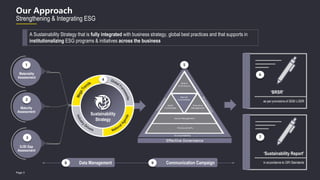
Our Approach
Strengthening & Integrating ESG
Materiality
Assessment
DJSI Gap
Assessment
Maturity
Assessment
Sustainability
Strategy
‘Sustainability Report’
in accordance to GRI Standards
A Sustainability Strategy that is fully integrated with business strategy, global best practices and that supports in
institutionalizing ESG programs & initiatives across the business
‘BRSR’
as per provisions of SEBI LODR
1
2
3
4
6
7
5
Communication Campaign
9
Data Management
8
Page 4
S. No. Activities Status Brief Update
1. Materiality Assessment Completed
• 177 stakeholders engaged i.e., 161 internal and 16 external
• Materiality matrix developed
2. Gap Assessment [ Benchmarking ] Completed
• Benchmarking completed using EY’s SbD criteria
• Four banks i.e. AU, IndusInd, HDFC & Cholamandalam
3. DJSI Assessment Completed
• Gap assessment conducted as per DJSI methodology
• Actions items identified under short, mid and long term
4. ESG Strategy and Roadmap In Progress
• Focus areas identified and ESG framework devised
• Long-term and short-term goals defined across focus areas
• Signoffs to be obtained for respective focus areas
• Implementation plan to be developed
5. Data Management In Progress
• Environment data collection template shared
• ESG dashboard (MIS) to be developed post finalization of goals / targets / implementation plan
6. Effective Governance In Progress
• Policies identified for updation / development
• OHS policy drafted; Sustainability, CoC, HR in progress
• Multi-tier governance to be developed
7. Capacity Building In Progress
• 1 workshop and 1 flyer released
• Other programs scheduled and to be taken subsequently
8. Drafting of BRSR Completed • Maiden BRSR drafted and finalized
9. Drafting of Sustainability Report In Progress • Data collection has been initiated; Draft report to be in place by end of August
Status Overview
Activities and Update
Page 5
Page 5
Key ‘Takeaways’
2
Page 6
Key ‘Takeaways’
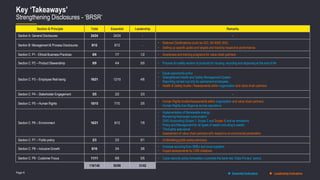
Strengthening Disclosures - ‘BRSR’
Essential Indicators Leadership Indicators
Section & Principle Total Essential Leadership Remarks
Section A: General Disclosures 24/24 24/24 - -
Section B: Management & Process Disclosures 9/12 9/12 -
• Relevant Certifications (such as ISO, SA 8000, BIS)
• Setting up specific goals and targets and tracking respective performance
Section C: P1 - Ethical Business Practices 8/9 7/7 1/2 • Awareness and training programs for value chain partners
Section C: P2 – Product Stewardship 9/9 4/4 5/5 • Process for safely reclaim of products for reusing, recycling and disposing at the end of life
Section C: P3 – Employee Well-being 16/21 12/15 4/6
• Equal opportunity policy
• Strengthened Health and Safety Management System
• Reporting carried out only for permanent employees
• Health & Safety Audits / Assessments within organization and value chain partners
Section C: P4 – Stakeholder Engagement 5/5 2/2 3/3 -
Section C: P5 – Human Rights 10/15 7/10 3/5
• Human Rights Audits/Assessments within organization and value chain partners
• Human Rights due diligence across operations
Section C: P6 – Environment 16/21 9/12 7/9
• Implementation of Renewable energy
• Monitoring freshwater consumption
• GHG Accounting (Scope 1, Scope 2 and Scope 3) and air emissions
• Policy and Management for all types of waste (including e-waste)
• Third party assurance
• Assessment of value chain partners with respect to environmental parameters
Section C: P7 – Public policy 2/3 2/2 0/1 • Undertaking public policy advocacy
Section C: P8 – Inclusive Growth 6/10 3/4 3/6
• Increase sourcing from SMEs and local suppliers
• Impact assessments for CSR initiatives
Section C: P9 - Customer Focus 11/11 6/6 5/5 • Cyber security policy formulation (currently the bank has “Data Privacy” policy)
116/140 85/98 31/42
Page 7
Key ‘Takeaways’
Defining ‘Materiality Assessment’
CV
To identify and prioritize aspects that are of relevance and significance to stakeholder and business
136
Employees
18
Department SPOC’s
5
NGOs
2
Investors
7
Customers
Engaged 170+ Internal & External Stakeholder
through various mediums
7
Leadership & Sr
Mgmt.
2
Suppliers
[CELLRANGE]
[CELLRANGE]
[CELLRANGE]
[CELLRANGE]
[CELLRANGE]
[CELLRANGE]
[CELLRANGE]
[CELLRANGE]
[CELLRANGE]
[CELLRANGE]
[CELLRANGE]
[CELLRANG
E]
[CELLRANGE]
[CELLRANGE]
[CELLRANGE]
[CELLRANGE]
[CELLRANGE]
[CELLRANGE]
[CELLRANGE]
[CELLRANGE]
[CELLRANGE]
[CELLRANGE]
0.80
1.00
1.20
1.40
1.60
1.80
2.00
0.30 0.50 0.70 0.90 1.10 1.30 1.50 1.70 1.90 2.10
STAKEHOLDER
INFLUENCE
IMPACT ON USFB
Materiality Matrix
Responsible
Finance
Sustainable
Operations
Key Themes
Empowering
Communities
Effective
Governance
Governance Social
Environment
Page 8
Key ‘Takeaways’
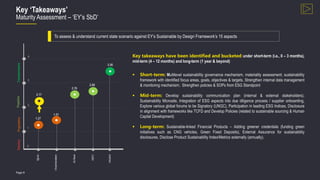
Maturity Assessment – ‘EY’s SbD’
Cholamandalam
HDFC
Reactive
Progressive
Proactive
Transformative
0
1
2
3
4
Ujjivan
IndusInd
AU
Bank
2.89
2.79
3.56
1.51
1.27
To assess & understand current state scenario against EY’s Sustainable by Design Framework’s 15 aspects
Key takeaways have been identified and bucketed under short-term (i.e., 0 – 3 months),
mid-term (4 – 12 months) and long-term (1 year & beyond)
 Short-term: Multilevel sustainability governance mechanism, materiality assessment; sustainability
framework with identified focus areas, goals, objectives & targets, Strengthen internal data management
& monitoring mechanism; Strengthen policies & SOPs from ESG Standpoint
 Mid-term: Develop sustainability communication plan (internal & external stakeholders),
Sustainability Microsite, Integration of ESG aspects into due diligence process / supplier onboarding,
Explore various global forums to be Signatory (UNGC), Participation in leading ESG Indices, Disclosure
in alignment with frameworks like TCFD and Develop Policies (related to sustainable sourcing & Human
Capital Development)
 Long-term: Sustainable-linked Financial Products – Adding greener credentials (funding green
initiatives such as CNG vehicles, Green Fixed Deposits), External Assurance for sustainability
disclosures, Disclose Product Sustainability Index/Metrics externally (annually).
2.17
Page 9
Key ‘Takeaways’
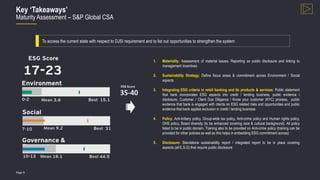
Maturity Assessment – S&P Global CSA
To access the current state with respect to DJSI requirement and to list out opportunities to strengthen the system
1. Materiality: Assessment of material issues, Reporting as public disclosure and linking to
management incentives
2. Sustainability Strategy: Define focus areas & commitment across Environment / Social
aspects
3. Integrating ESG criteria in retail banking and its products & services: Public statement
that bank incorporates ESG aspects into credit / lending business, public evidence /
disclosure, Customer / Client Due Diligence / Know your customer (KYC) process, public
evidence that bank is engaged with clients on ESG related risks and opportunities and public
evidence that bank applies exclusion in credit / lending business
4. Policy: Anti-bribery policy, Group-wide tax policy, Anti-crime policy and Human rights policy,
OHS policy, Board diversity (to be enhanced covering race & cultural background). All policy
listed to be in public domain. Training also to be provided on Anti-crime policy (training can be
provided for other policies as well as this helps in embedding ESG commitment across)
5. Disclosure: Standalone sustainability report / integrated report to be in place covering
aspects (all E,S,G) that require public disclosure
Page 10
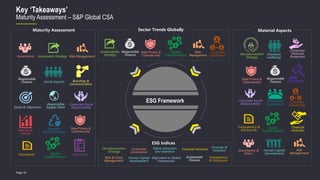
Maturity Assessment Sector Trends Globally Material Aspects
ESG Indices
Responsible
Finance
Risk & Crisis
Management
Talent extraction
and retention
Human Capital
development
Corporate
Governance
Responsible
Finance
Corporate Social
Responsibility
Governance &
Ethics
Decarbonization
Strategy
Alignment to Global
Frameworks
Financial Inclusion
Diversity &
Inclusion
Transparency
& Disclosure
Sustainability
Strategy
Governance Risk Management
Disclosures
Data Privacy &
Cybersecurity
Risk
Management
Sustainable Strategy
Goals & Objectives
Branding &
communication
Responsible
Finance
Responsible
Supply Chain
Social Aspects
Corporate Social
Responsibility
Resource
efficient process
Data Privacy &
Cybersecurity
Digital
Transformation
Assurance
Metrices &
Indices
Digital
Transformation
Customer
Experience
Sustainable
Finance
Decarbonization
Strategy
Employee
wellbeing
Compliance
Human Capital
Development
Responsible
Finance
Data Privacy &
Cybersecurity
Digital
Transformation
Transparency &
Disclosures
Consumer
Financial
Protection
Stakeholder
Engagement
Customer
relationship
Financial
Inclusion
Risk
Management
ESG Framework
Key ‘Takeaways’
Maturity Assessment – S&P Global CSA
Page 11
Page 11
Building the ‘Framework’
3
Page 12
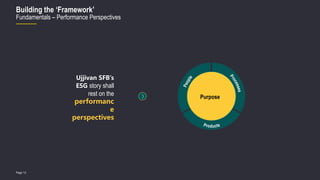
Ujjivan SFB’s
ESG story shall
rest on the
performanc
e
perspectives
Purpose
Building the ‘Framework’
Fundamentals – Performance Perspectives
Page 13
Building the ‘Framework’
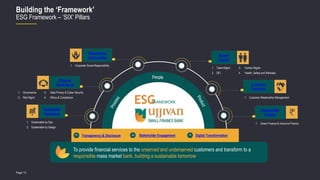
ESG Framework – ‘SIX’ Pillars
ESG
FRAMEWORK
Sustainable
Operations
Empowering
Communities
Responsible
Finance
Customer
Centricity
Human
Capital
To provide financial services to the unserved and underserved customers and transform to a
responsible mass market bank, building a sustainable tomorrow
Digital Transformation
Stakeholder Engagement
Transparency & Disclosure
Effective
Governance
1. Sustainable by Ops.
2. Sustainable by Design
1. Corporate Social Responsibility
1. Talent Mgmt.
2. DEI
3. Human Rights
4. Health, Safety and Wellness
1. Governance
2. Risk Mgmt.
3. Data Privacy & Cyber Security
4. Ethics & Compliance 1. Customer Relationship Management
1. Green Finance & Inclusive Finance
Page 14
Building the ‘Framework’
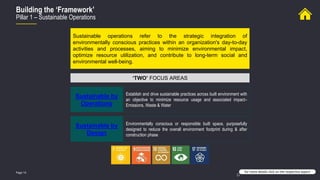
Pillar 1 – Sustainable Operations
for more details click on the respective aspect
‘TWO’ FOCUS AREAS
Sustainable operations refer to the strategic integration of
environmentally conscious practices within an organization's day-to-day
activities and processes, aiming to minimize environmental impact,
optimize resource utilization, and contribute to long-term social and
environmental well-being.
Sustainable by
Operations
Sustainable by
Design
Establish and drive sustainable practices across built environment with
an objective to minimize resource usage and associated impact–
Emissions, Waste & Water
Environmentally conscious or responsible built space, purposefully
designed to reduce the overall environment footprint during & after
construction phase
Page 15
Building the ‘Framework’
Pillar 1 – Sustainable Operations – Sustainable by Operations [ 1 / 2 ]
• Streamline monthly monitoring and establish accounting across environment
KPIs (energy, emissions, waste, water)
• Continue the rigour of data reporting and monitoring
mechanism through automation process
• Identify relevant Scope 3 emissions categories & sources
• Explore the feasibility of Scope 3 emissions accounting in
alignment with GHG Protocol
FY24 FY25 FY 26
Environment
Monitoring
Mechanism
Sustainable by
Operations*
Responsible
Waste
Management
• Identify & categorize the wastes
• Prepare an inventory of the waste
• Handle and dispose in adherence to the laid down regulatory requirements
• Waste handling vendor contracts to be in place
• Guidelines in place on waste handling, storage and disposal
• Continue the rigour of waste management handling across
operations
• Explore and implement waste reduction / reusing options
• Achieve “Zero waste to landfill” status
• Retain Zero waste to landfill status
Energy /
Emissions/
Water
• Explore opportunities for resource optimization (energy & water)
• Renewable energy options to be explored especially for branches where
consumption is minimum
• Conduct Energy audit to identify energy saving opportunities.
• 100% offices to be equipped with Energy efficient lighting systems to
conserve energy
• 100% employees will be provided training on energy and water conservation
practices through awareness campaigns, training programs etc
• SOP to be defined for Resource optimization and renewable
alternatives as default across operations.
• Install Renewable energy (Solar PV) for selected offices
• Implement energy audit findings (applicable ones) across
operations and measure the energy reduction achieved,
• Achieve 5% reduction in power consumption compared to
FY’23
• Achieve 10% reduction in power consumption compared to FY’23
• Explore opportunities to reduce Scope 3 emissions, which are
emission intensive (Ex: Employee commutation, Business travel
etc.)
Goal 2030 20% reduction in Power consumption
Target 2028 15% reduction in Power consumption
Target 2026 10% reduction in Power consumption
*Goals and targets are w.r.t to FY’2023 baseline
Focus Area SPOC
Ms. Almas Fatima,
National Manager
Admin & Infrastructure Dept
Page 16
Building the ‘Framework’
Pillar 1 – Sustainable Operations – Sustainable by Design [ 2 / 2 ]
• Develop guidelines on sustainable green design concepts
such as energy efficient fittings, alternate materials in
accordance with global frameworks
• Define KPIs scoring mechanism
• Address the gaps/opportunity areas basis the pilot
assessment.
• Automation of Internal processes : Moving towards
manual to automated process for processes (Ex: digital
invoices, Digital employee visiting cards, dual printing,
and digital application forms)
• Implement GREEN building guidelines for selected
office and declare it as a “Model Green branch“
• Review and update the guidelines as per the
learning’s from “model Green branch”
• Explore the feasibility of obtaining IGBC certification
(Green building) for selected office location
• 20% automation of Internal process across 100%
offices and reduce paper consumption by 20%
• Certification of select branches in alignment with national
standards - IGBC
• 50% automation of Internal process across 100% offices
and reduce paper consumption by 50%
FY24 FY25 FY 26
Green
Branches /
Offices
Sustainable by
Design
Goal 2030
10% of total office area (Ujjivan offices) to achieve ‘Green
Building’ certification
Target 2028
5% of total office area (Ujjivan offices) to achieve ‘Green Building’
certification
Target 2026 One select office as “GREEN Building” certified
Focus Area SPOC
Ms. Almas Fatima,
National Manager
Admin & Infrastructure Dept
Page 17
Building the ‘Framework’
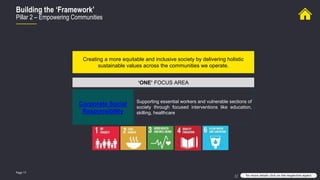
Pillar 2 – Empowering Communities
for more details click on the respective aspect
‘ONE’ FOCUS AREA
Creating a more equitable and inclusive society by delivering holistic
sustainable values across the communities we operate.
Corporate Social
Responsibility
Supporting essential workers and vulnerable sections of
society through focused interventions like education,
skilling, healthcare
Page 18
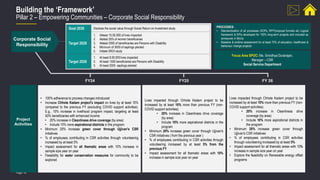
• 100% adherence to process changes introduced
• Increase Chhote Kadam project's impact on lives by at least 10%
compared to the previous FY (excluding COVID support activities).
E.g., 10% increase in livelihood program impact, targeting at least
50% beneficiaries with enhanced income
• 20% increase in Cleanliness drive coverage (by area)
• Include 10% more aspirational districts in the program
• Minimum 20% increase green cover through Ujjivan's CSR
initiatives
• % of employees contributing in CSR activities through volunteering
increased by at least 5%
• Impact assessment for all thematic areas with 10% increase in
sample size year on year
• Feasibility for water conservation measures for community to be
explored
Lives impacted through Chhote Kadam project to be
increased by at least 10% more than previous FY (non-
COVID support activities).
• 20% increase in Cleanliness drive coverage
(by area)
• Include 10% more aspirational districts in the
program
• Minimum 20% increase green cover through Ujjivan's
CSR initiatives ( from the previous year )
• % of employees contributing in CSR activities through
volunteering increased by at least 5% from the
previous FY
• Impact assessment for all thematic areas with 10%
increase in sample size year on year
Lives impacted through Chhote Kadam project to be
increased by at least 10% more than previous FY (non-
COVID support activities).
• 20% increase in Cleanliness drive
coverage (by area)
• Include 10% more aspirational districts in
the program
• Minimum 20% increase green cover through
Ujjivan's CSR initiatives
• % of employees contributing in CSR activities
through volunteering increased by at least 5%
• Impact assessment for all thematic areas with 10%
increase in sample size year on year
• Explore the feasibility on Renewable energy offset
programs
FY24 FY25 FY 26
Project
Activities
Goal 2030 Disclose the social value through Social Return on Investment study
Target 2028
1. Atleast 10,00,000.of lives impacted
2. Atelast 25%.of women beneficiaries
3. Atleast 2000 of beneficiaries are Persons with Disability
4. Minimum of 3000 of saplings planted
5. Initiate SROI study
Target 2026
1. At least 8,00,000 lives impacted
2. At least 1500 beneficiaries are Persons with Disability
3. At least 2000 saplings planted
Corporate Social
Responsibility
PROCESSES:
• Standardization of all processes /SOPs, RFP/proposal formats etc Logical
framework & KPIs developed for 100% long-term projects and included as
annexures in MoUs
• Baseline & endline assessment for at least 70% of education, healthcare &
behaviour change projects
Building the ‘Framework’
Pillar 2 – Empowering Communities – Corporate Social Responsibility
Focus Area SPOC: Ms. Srividhya Durairajan,
Manager – CSR
Social Service Department
Page 19
Building the ‘Framework’
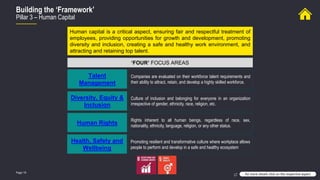
Pillar 3 – Human Capital
for more details click on the respective aspect
‘FOUR’ FOCUS AREAS
Human capital is a critical aspect, ensuring fair and respectful treatment of
employees, providing opportunities for growth and development, promoting
diversity and inclusion, creating a safe and healthy work environment, and
attracting and retaining top talent.
Talent
Management
Diversity, Equity &
Inclusion
Human Rights
Companies are evaluated on their workforce talent requirements and
their ability to attract, retain, and develop a highly skilled workforce.
Culture of inclusion and belonging for everyone in an organization
irrespective of gender, ethnicity, race, religion, etc.
Rights inherent to all human beings, regardless of race, sex,
nationality, ethnicity, language, religion, or any other status.
Health, Safety and
Wellbeing
Promoting resilient and transformative culture where workplace allows
people to perform and develop in a safe and healthy ecosystem
Page 20
Building the ‘Framework’
Pillar 3 – Human Capital – Talent Management [ 1 / 4 ]
• Increase Training Hours per Employee - from 29
Hours to 30.5 Hours
• Creating ESG awareness as part of new employee
orientation
• Increase the participation % through E-learning
modules
• Increase Training Hours per Employee- from 30.5
Hours to 32 Hours
• Enable Global learning platform for self learning
• Increase Training Hours per Employee - from 32
Hours to 34 Hours
• Provide learning grant for individual development
areas
FY24 FY25 FY 26
Learning &
Development
Talent
Management
Talent attraction
and retention
• Achieve talent retention rate through:
o Job Rotation policy for key roles
o Career development programs
o Sabbatical Leave for individuals
o Introduction of work life balance policy
o Ensuring employee avail mandatory leave to
create work life balance across all levels (>60%)
o Disclose total Employee turnover rate with a
breakdown of Age, Gender, Management level
and Race
• Control voluntary employee attrition rate up to 25%
• Achieve talent retention rate through:
o Ensuring eligible employee avail mandatory
leave to create work life balance across all levels
(>70%)
o Implement policies and employee support
programs such as Work from home (WFH)
working options
• Control voluntary employee attrition rate up to 25%
• Achieve talent retention rate through:
o Ensuring eligible employee avail mandatory leave
to create work life balance across all levels (>80%)
o Track the usage of People Analytics for Strategic
Workforce Planning by:
o Identifying current workforce skills gaps
o Identifying flight risks to improve retention
• Control voluntary employee attrition rate up to 25%
Goal 2030 --
Target 2028 --
Target 2026 34 hours per employee training
Focus Area SPOC
Ms. Shini Ashok, National Manager –
Learning & Talent Management
HR Department
Page 21
Building the ‘Framework’
Pillar 3 – Human Capital – Diversity, Equity & Inclusion [ 2 / 4 ]
• Achieve *gender diversity upto 22%.
o Introduction of “Unpause” model to welcome
women with a career break
o Develop Diversity policy and communicate
across the organization
o Conduct training on gender neutrality for
supervisors for facilitating non-discrimination
awareness against married or pregnant women
• Achieve gender diversity upto 24%.
o Identification of “women only” position in
agreement with the HODs to drive women hiring
in their respective departments
o Derive action plan for hiring women/ disabled/
marginalised
o Introduce reward scheme for referring women in
leadership role
• Achieve gender diversity upto 26%.
o Conduct “women only” hiring campaigns
o Recognise teams, managers and leaders for driving
DE&I
FY24 FY25 FY 26
DE&I
Diversity, Equity &
Inclusion
Goal 2030 --
Target 2028 Achieve gender diversity upto 30%
Target 2026 Achieve gender diversity upto 26%
Focus Area SPOC
Manas Satapathy, National Manager
– Talent Acquisition
HR Department
*Gender diversity specified above, refers to women workforce only
Page 22
Building the ‘Framework’
Pillar 3 – Human Capital – Human rights [ 3 / 4 ]
FY24 FY25 FY 26
Human Rights
Goal 2030 -
Target 2028
Completion of the remediation actions of the identified
risk areas.
Target 2026 Complete implementation of the HRDD
• Develop the human rights policy and communicate
across relevant stakeholders
• Develop a human rights due diligence framework and
identification of the potential risks and impact of the
same.
• Conduct due diligence process to proactively identify
potential impacts and risk relating to respecting
human rights
• Report on human rights mitigation and remediation
activities
• Implement processes to mitigate human rights risks
• Number of sites with mitigation plans
• Type of remediation actions taken
Human Rights
Focus Area SPOC
Prasanna Venkatesen, National Manager –
HR operations
HR Department
Page 23
Building the ‘Framework’
Pillar 3 – Human Capital – Health, Safety and Wellbeing [ 4 / 4 ]
• Develop OHS management system
• Program Deployment (e.g., Ergonomics, healthy
lifestyle, health talks by experts, fitness programs,
defensive driving etc.,)
• Conduct accident investigation & preventive action at
Ujjivan office locations
• Conduct electrical safety audit across Ujjivan offices.
• Road safety focused program to be rolled out across
operations focussing more on field staff
• Monitor the accident rate at Ujjivan office locations
• Conduct employee Survey and develop Employee
Wellness Index
FY24 FY25 FY 26
Employee
Overall
Wellness
Initiatives
Health, Safety &
Wellbeing
Goal 2030
Zero Accidents – Ujjivan office locations
Target 2028
Target 2026
Focus Area SPOC
Manjunath V,
Lead – Payroll & Compliance
HR Department
Page 24
Building the ‘Framework’
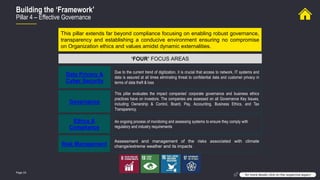
Pillar 4 – Effective Governance
for more details click on the respective aspect
‘FOUR’ FOCUS AREAS
This pillar extends far beyond compliance focusing on enabling robust governance,
transparency and establishing a conducive environment ensuring no compromise
on Organization ethics and values amidst dynamic externalities.
Data Privacy &
Cyber Security
Governance
Ethics &
Compliance
Risk Management
Due to the current trend of digitization, it is crucial that access to network, IT systems and
data is assured at all times eliminating threat to confidential data and customer privacy in
terms of data theft & loss
This pillar evaluates the impact companies' corporate governance and business ethics
practices have on investors. The companies are assessed on all Governance Key Issues,
including Ownership & Control, Board, Pay, Accounting, Business Ethics, and Tax
Transparency.
An ongoing process of monitoring and assessing systems to ensure they comply with
regulatory and industry requirements
Assessment and management of the risks associated with climate
change/extreme weather and its impacts
Page 25
Building the ‘Framework’
Pillar 4 – Effective Governance – Data Privacy and Cyber Security [ 1 / 4 ]
 Align policies and procedures with global standards
like ISO 27001:2022 (inclusive of business
contingency plan, incident response procedures
and periodic testing)
 Obtaining ISO 27001:2022 Certification
 Ensuring Sustenance of ISO 27001:2022
certification
 Implementation of data Privacy Framework as per
Indian Privacy Law
 Assessment in place to ensure alignment with ISO
27001:2022
 Indian Privacy Law Compliance
 Strengthen the security posture of the Bank to continue
to remain Cyber Attack/ Breach Free.
FY24 FY25 FY 26
Privacy and
Information
Security
Management
Data Privacy &
Cyber Security
Goal 2030
Zero Data Security Breaches
Target 2028
Target 2026
Focus Area SPOC
Mr. Shailesh Tiwari,
Cyber Governance Manager
Information Security Risk
Department
Page 26
Building the ‘Framework’
Pillar 4 – Effective Governance – Governance [ 2 / 4 ]
 Design a multi-tier ESG governance structure
 Develop roles and responsibilities for each
position
 Increase the Board Independence further from
the current 66%
 Continuous review and update of governance
structure
 Further increase in board diversity ratio
 To continue to adhere to highest standards of
governance to ensure 100% compliance
FY24 FY25 FY 26
Governance
Structure
Governance
Goal 2030
Robust Governance Structure, beyond compliance
Target 2028
Target 2026
Focus Area SPOC
Kshama Algure, Assistant Company
Secretary
Corporate Secretary Department
Page 27
Building the ‘Framework’
Pillar 4 – Effective Governance – Ethics & Compliance [ 3 / 4 ]
Identify, review and develop areas requiring policy as
per ESG trends/external requirements.
 100% implementation of policies developed in
FY'24
 Regular review and update of policies at set
frequencies
Regularly update policies at set frequencies
FY24 FY25 FY 26
Business Ethics
‘Programs and initiatives identified. However, no Goal / Target defined
for the same’
Ethics &
Compliance
Compliance
Management
 Automation of Contract Management that reduces
turnaround time in execution of contracts and
streamlines the contract management system.
 Implement Litigation Management Software that
eases monitoring of cases involving the Bank.
Digitisation of stamping through external vendor to
avoid storage of physical stamp papers.
Continue advisory in the best interest of Bank and mitigate
legal risks to avoid any fines, penal actions by statutory
authorities against the Bank.
Focus Area SPOC
Kshama Algure, Assistant Company Secretary
Ms. Megha, Manager - Legal
Corporate Secretary Department & Legal
Team
Page 28
Building the ‘Framework’
Pillar 4 – Effective Governance – Risk Management [ 4 / 4 ]
• Risk management education for non-executive
directors
• Enhance disclosure on risk management practices
(risk governance policy, risk training programs)
• Disclosure in accordance with TCFD requirements
• Develop a framework for ESG aspects in
credit/lending business
 Integrating climate related risk in the risk
management process as per global frameworks
• Focused training throughout the organization on
risk management principles
• Inclusion of Risk management criteria in the HR review
process for all employees
• *Due diligence process to identify risk & impact relating
to human rights
• Assessment of potential human rights issues across
business activities
FY24 FY25 FY 26
Risk & Crisis
Management
Risk
Management
Goal 2030 Achieve transformative stage in the risk maturity ladder
Target 2028
-
Target 2026
Focus Area SPOC
Rakesh Kalyanram,
Lead - Risk
Risk Management Team
*This point is included in HR goals as well
Page 29
Building the ‘Framework’
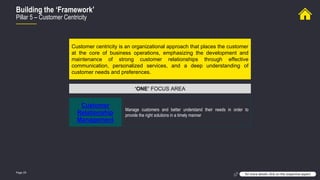
Pillar 5 – Customer Centricity
for more details click on the respective aspect
‘ONE’ FOCUS AREA
Customer centricity is an organizational approach that places the customer
at the core of business operations, emphasizing the development and
maintenance of strong customer relationships through effective
communication, personalized services, and a deep understanding of
customer needs and preferences.
Customer
Relationship
Management
Manage customers and better understand their needs in order to
provide the right solutions in a timely manner
Page 30
Building the ‘Framework’
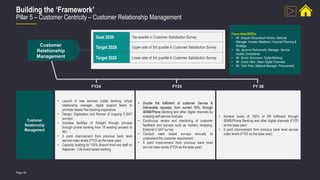
Pillar 5 – Customer Centricity – Customer Relationship Management
• Launch of new services (video banking, virtual
relationship manager, digital support team) to
promote hassle free banking experience
• Design, Digitisation and Review of ongoing C-SAT
surveys
• Increase facilities of Straight through process
through phone banking from 18 existing process to
80+
• 5 point improvement from previous bank level
service index levels (FY23 as the base year)
• Capacity building for 100% Branch front end staff on
Aajeevan - Life event based banking
• Double the fulfilment of customer Service &
Deliverable requests, from current 16%, through
IB/MB/Phone Banking and other digital channels by
enabling self-service modules
• Continuous review and monitoring of customer
feedback and surveys such as mystery shopping,
External C-SAT survey
• Conduct need based surveys annually to
understand the customer requirement.
• 5 point improvement from previous bank level
service index levels (FY24 as the base year)
• Achieve levels of 150% of SR fulfilment through
IB/MB/Phone Banking and other digital channels (FY25
as the base year)
• 5 point improvement from previous bank level service
index levels (FY25 as the base year)
FY24 FY25 FY 26
Customer
Relationship
Management
Customer
Relationship
Management
Goal 2030 Top quartile in Customer Satisfaction Survey
Target 2028 Upper side of 3rd quartile in Customer Satisfaction Survey
Target 2026 Lower side of 3rd quartile in Customer Satisfaction Survey
Focus Area SPOCs
• Mr. Deepak Shivprakash Khetan, National
Manager- Investor Relations, Financial Planning &
Strategy;
• Ms. Apoorva Padmanabh, Manager- Service
Quality Compliance;
• Mr. Sriram Srinivasan- Digital Banking;
• Mr. Zubair Ullah, Head- Digital Channels;
• Mr. Tahir Khan, National Manager- Procurement
Page 31
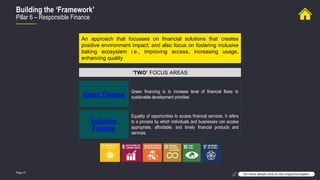
Building the ‘Framework’
Pillar 6 – Responsible Finance
for more details click on the respective aspect
Green Finance
Inclusive
Finance
‘TWO’ FOCUS AREAS
An approach that focusses on financial solutions that creates
positive environment impact; and also focus on fostering inclusive
baking ecosystem i.e., improving access, increasing usage,
enhancing quality
Green financing is to increase level of financial flows to
sustainable development priorities
Equality of opportunities to access financial services. It refers
to a process by which individuals and businesses can access
appropriate, affordable, and timely financial products and
services.
Page 32
Building the ‘Framework’
Pillar 6 – Responsible Finance – Green Finance [ 1 / 2 ]
 Conduct market survey and identify the
requirements of green products
 Develop criteria for Green products/responsible
finance.
 Identify responsible finance products (ex: lending
for rain water harvesting, Biogas plant, EV & CNG
vehicle, Solar water heater, ECO friendly buildings,
Solar PV, composting facility etc).
 Develop KPIs on Green products outreach (e.g. no.
of beneficiaries, GHG emission
reduction, reduction in fresh water withdrawal etc.)
• Roll out the pilot product and monitor the impact
created across defined KPIs.
• Basis the pilot product, relook the criteria.
• Set goals and targets against the KPIs for
evaluation.
• Launch of green products portfolio.
• Measure the KPIs to assess the performance against the
targets.
• Communicate the performance both externally and
internally at fixed intervals (external assurance).
• Explore options releasing Green bonds/green deposits,
Sustainability linked loans.
FY24 FY25 FY 26
Green Finance
Green Finance
Goal 2030 xx% revenue from green product portfolio
Target 2028 xx% revenue from green product portfolio
Target 2026 Devise criteria for Green Finance
Focus Area SPOC
To be nominated
Business Team
Page 33
Building the ‘Framework’
Pillar 6 – Responsible Finance – Inclusive Finance [ 2 / 2 ]
• Simplifying loan application processes making it
easier for small businesses & individuals to access
financing
• Develop Strategy to provide financial services for
aspiring entrepreneurs/ MSME enterprises in rural
areas.
• Explore and define an action plan to expand the
micro-finance portfolio in Tier 2 & Tier 3 cities.
• Digital solutions and literacy programs to streamline
transactions in the micro-finance sector.
• Basis strategy, release financial products in the
market to support entrepreneurs/ MSME
enterprises.
• Collaborate with funds, foundations and development
finance Institutions to support projects in sectors like
agriculture, micro-finance, health care etc.
FY24 FY25 FY 26
Inclusive
Finance
Inclusive Finance
Goal 2030 Expanding reach & impact
Target 2028 -
Target 2026 -
Focus Area SPOC
To be nominated
Business Team
Page 34
Building the ‘Framework’
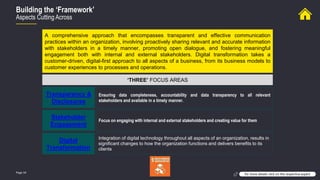
Aspects Cutting Across
for more details click on the respective aspect
‘THREE’ FOCUS AREAS
A comprehensive approach that encompasses transparent and effective communication
practices within an organization, involving proactively sharing relevant and accurate information
with stakeholders in a timely manner, promoting open dialogue, and fostering meaningful
engagement both with internal and external stakeholders. Digital transformation takes a
customer-driven, digital-first approach to all aspects of a business, from its business models to
customer experiences to processes and operations.
Transparency &
Disclosures
Stakeholder
Engagement
Digital
Transformation
Ensuring data completeness, accountability and data transparency to all relevant
stakeholders and available in a timely manner.
Focus on engaging with internal and external stakeholders and creating value for them
Integration of digital technology throughout all aspects of an organization, results in
significant changes to how the organization functions and delivers benefits to its
clients
Page 35
Building the ‘Framework’
Aspects Cutting Across – Transparency & Disclosures [ 1 / 3 ]
• Dedicated webpage on sustainability to display the
activities under ESG domain
• In addition to the Sustainability Report and BRSR,
TCFD two pager to be appended to existing
Sustainability Report
• Continue the rigour on Sustainability Report in
alignment with GRI Standard, BRSR and TCFD
• External assurance as per ISAE 3000 and AA 1000
AS (2008) Standards
• Integrated reporting in alignment with global frameworks
like GRI/TCFD/IIRC
FY24 FY25 FY 26
Reporting
framework
Disclosures
ESG Indices
• Internal assessment and readiness towards S&P
Global CSA (DJSI) to reach ~40 score*
• Maiden S&P Global CSA (DJSI) assessment
• Continue to participate on S&P Global CSA
(DJSI) assessment
Goal 2030 Aspire to reach top quartile on S&P Global CSA (DJSI)
Target 2028 60 score on S&P Global CSA (DJSI)
Target 2026 -
Focus Area SPOC
D Srividhya, Manager, CSR
Kshama Algure, Assistant
Company Secretary
Social Service Department
and
Corporate Secretary Team
*Above is an indicative score as the DJSI questionnaire gets updated annually
Page 36
Building the ‘Framework’
Aspects Cutting Across – Stakeholder Engagement [ 2 / 3 ]
FY24 FY25 FY 26
Stakeholder
Engagement
Goal 2030
100% digital invoices from vendors with spend of Rs. 1 Cr or
higher
Target 2028 -
Target 2026 Top quartile across all stakeholder group satisfaction surveys
 Quarterly engagement with investors - 5 among top 15
 Quarterly engagement with Sell-side analyst (minimum
5 nos.)
 Quarterly engagement with investors - 7 among top 15
 Quarterly engagement with Sell-side analyst (minimum
7 nos.)
 Quarterly engagement with investors - 10 among top 15
 Quarterly engagement with Sell-side analyst (minimum 8
nos.)
Investors
 Develop and incorporate ESG requirements in the
contracts/agreements executed with vendors through
vendor Code of Conduct
 Develop SoP for vendor assessment and capture the
scores as part of the vendor assessment
 Conduct capacity building on vendor code of
conduct and assessment for strategic vendor
partners
 Shift to digital invoices to cover 50% vendors with
spend of Rs. 1 Cr or higher
 Involve and engage with strategic vendors (50%) to
implement eco-friendly initiatives
 Shift to digital invoices to cover 80% vendors with spend of
Rs. 1 Cr or higher
Vendors
Focus Area SPOCs
• Mr. Deepak Shivprakash Khetan, National Manager- Investor
Relations, Financial Planning & Strategy;
• Ms. Apoorva Padmanabh, Manager- Service Quality
Compliance;
• Mr. Sriram Srinivasan- Digital Banking;
• Mr. Zubair Ullah, Head- Digital Channels;
• Mr. Tahir Khan, National Manager- Procurement
Page 37
Building the ‘Framework’
Aspects Cutting Across – Digital Transformation [ 3 / 3 ]
 Implement new digital solutions such as end-to-end
Digital Fixed Deposit, Digital Savings/Current
Account, personalised banking services using video
banking solutions
 Bringing 35 lakhs+ customers into digital banking
space and achieve digital transactions (volume) of
35 crores by including 12 lakh+ new users on any
one of the digital platform
 Bringing 50 lakhs+ customers into digital banking
space and achieve digital transactions (volume) of
50 crores by including 15 lakh+ new users on any
one of the digital platform
 Bringing 65 lakhs+ customers into digital banking space
and achieve digital transactions (volume) of 75 crores by
including 18 lakh+ new users on any one of the digital
platform
 100% digitalisation for Asset & Liability business and
Digital Lending Solutions, thereby moving towards paper
less banking services
FY24 FY25 FY 26
Digital
Transformation
Digital
Transformation
Goal 2030
Bringing 1 crore customers into digital banking space and achieve digital
transactions (volume) of 100 crores.
Target 2028 -
Target 2026
Bringing 65 lakhs+ customers into digital banking space and achieve
digital transactions (volume) of 75 crores.
Focus Area SPOCs
• Mr. Sriram Srinivasan- Digital Banking;
• Mr. Zubair Ullah, Head- Digital Channels;
Digital Banking Dept
Page 38
Building the ‘Framework’
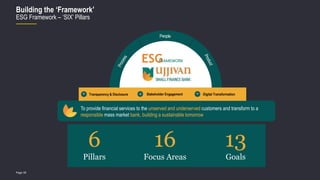
ESG Framework – ‘SIX’ Pillars
ESG
FRAMEWORK
To provide financial services to the unserved and underserved customers and transform to a
responsible mass market bank, building a sustainable tomorrow
Digital Transformation
Stakeholder Engagement
Transparency & Disclosure
6
Pillars
13
Goals
16
Focus Areas
Page 39
Page 39
Way Forward ‘To Do’
4
Page 40
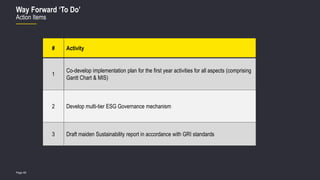
Way Forward ‘To Do’
Action Items
# Activity
1
Co-develop implementation plan for the first year activities for all aspects (comprising
Gantt Chart & MIS)
2 Develop multi-tier ESG Governance mechanism
3 Draft maiden Sustainability report in accordance with GRI standards
Page 41
Thank you
Page 41
Page 42
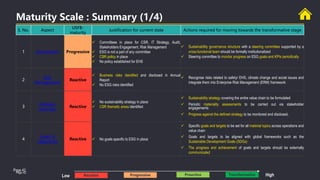
Maturity Scale : Summary (1/4)
Page 42
S. No. Aspect
USFB-
maturity
Justification for current state Actions required for moving towards the transformative stage
1 Governance Progressive
 Committees in place for CSR, IT Strategy, Audit,
Stakeholders Engagement, Risk Management
 ESG is not a part of any committee
 CSR policy in place
 No policy established for EHS
 Sustainability governance structure with a steering committee supported by a
cross-functional team should be formally institutionalized
 Steering committee to monitor progress on ESG goals and KPIs periodically
2
Risk
Management
Reactive
 Business risks identified and disclosed in Annual
Report
 No ESG risks identified
 Recognise risks related to safety/ EHS, climate change and social issues and
integrate them into Enterprise Risk Management (ERM) framework
3
Strategic
Direction
Reactive
 No sustainability strategy in place
 CSR thematic areas identified
 Sustainability strategy covering the entire value chain to be formulated
 Periodic materiality assessments to be carried out via stakeholder
engagements
 Progress against the defined strategy to be monitored and disclosed.
4
Goals &
Objectives
Reactive  No goals specific to ESG in place
 Specific goals and targets to be set for all material topics across operations and
value chain
 Goals and targets to be aligned with global frameworks such as the
Sustainable Development Goals (SDGs)
 The progress and achievement of goals and targets should be externally
communicated
Reactive Progressive Proactive Transformative
Low High
Page 43
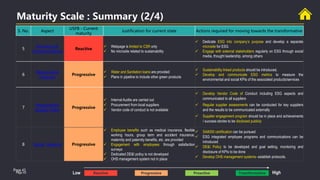
Maturity Scale : Summary (2/4)
Page 43
S. No. Aspect
USFB - Current
maturity
Justification for current state Actions required for moving towards the transformative
5
Branding &
Communication
Reactive
 Webpage is limited to CSR only
 No microsite related to sustainability
 Dedicate ESG into company’s purpose and develop a separate
microsite for ESG
 Engage with external stakeholders regularly on ESG through social
media, thought leadership, among others
6
Responsible
Finance/
Progressive
 Water and Sanitation loans are provided
 Plans in pipeline to include other green products
 Sustainability linked products should be introduced.
 Develop and communicate ESG metrics to measure the
environmental and social KPIs of the associated products/services
7
Responsible
Supply Chain
Progressive
 Internal Audits are carried out
 Procurement from local suppliers
 Vendor code of conduct is not available
 Develop Vendor Code of Conduct including ESG aspects and
communicated to all suppliers
 Regular supplier assessments can be conducted for key suppliers
and the results to be communicated externally
 Supplier engagement program should be in place and achievements
/ success stories to be disclosed publicly
8 Social Aspects Progressive
 Employee benefits such as medical insurance, flexible
working hours, group term and accident insurance,
maternity and paternity benefits, etc. are provided
 Engagement with employees through satisfaction
surveys
 Dedicated DE&I policy is not developed
 OHS management system not in place
 SA8000 certification can be pursued
 ESG integrated employee programs and communications can be
introduced
 DE&I Policy to be developed and goal setting, monitoring and
disclosure of KPIs to be done
 Develop OHS management systems- establish protocols.
Reactive Progressive Proactive Transformative
Low High
Page 44
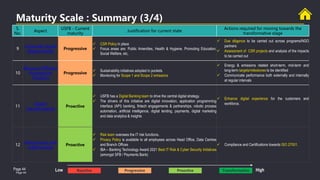
Maturity Scale : Summary (3/4)
Page 44
S.
No.
Aspect
USFB - Current
maturity
Justification for current state
Actions required for moving towards the
transformative stage
9
Corporate Social
Responsibility
Progressive
 CSR Policy in place
 Focus areas are: Public Amenities, Health & Hygiene, Promoting Education,
Social Welfare, etc,
 Due diligence to be carried out across programs/NGO
partners
 Assessment of CSR projects and analysis of the impacts
to be carried out
10
Resource Efficient
Processes &
Practices
Progressive
 Sustainability initiatives adopted in pockets
 Monitoring for Scope 1 and Scope 2 emissions
 Energy & emissions related short-term, mid-term and
long-term targets/milestones to be identified
 Communicate performance both externally and internally
at regular intervals
11
Digital
Transformation
Proactive
 USFB has a Digital Banking team to drive the central digital strategy.
 The drivers of this initiative are digital innovation, application programming
interface (API) banking, fintech engagements & partnerships, robotic process
automation, artificial intelligence, digital lending, payments, digital marketing
and data analytics & insights
 Enhance digital experience for the customers and
workforce.
12
Data privacy and
cybersecurity
Proactive
 Risk team oversees the IT risk functions.
 Privacy Policy is available to all employees across Head Office, Data Centres
and Branch Offices
 IBA – Banking Technology Award 2021 Best IT Risk & Cyber Security Initiatives
(amongst SFB / Payments Bank)
 Compliance and Certifications towards ISO 27001.
Reactive Progressive Proactive Transformative
Low High
Page 45
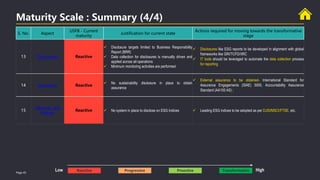
Maturity Scale : Summary (4/4)
S. No. Aspect
USFB - Current
maturity
Justification for current state
Actions required for moving towards the transformative
stage
13 Disclosures Reactive
 Disclosure targets limited to Business Responsibility
Report (BRR)
 Data collection for disclosures is manually driven and
applied across all operations
 Minimum monitoring activities are performed
 Disclosures like ESG reports to be developed in alignment with global
frameworks like GRI/TCFD/IIRC
 IT tools should be leveraged to automate the data collection process
for reporting
14 Assurance Reactive
 No sustainability disclosure in place to obtain
assurance
 External assurance to be obtained- International Standard for
Assurance Engagements (ISAE) 3000, Accountability Assurance
Standard (AA100 AS) ;
15
Metrices and
Indices
Reactive  No system in place to disclose on ESG Indices  Leading ESG indices to be adopted as per DJSI/MSCI/FTSE, etc.
Reactive Progressive Proactive Transformative
Low High
Page 46
46
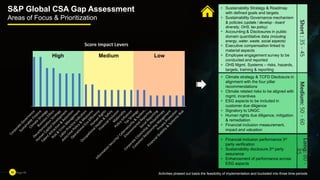
Activities phased out basis the feasibility of implementation and bucketed into three time periods
Long:
80
-
85
Medium:
50
-
60
Short
:
35
-
45
• Sustainability Strategy & Roadmap
with defined goals and targets
• Sustainability Governance mechanism
& policies (update / develop - board
diversity, OHS, tax policy)
• Accounting & Disclosures in public
domain quantitative data (including
energy, water, waste, social aspects)
• Executive compensation linked to
material aspects
• Employee engagement survey to be
conducted and reported
• OHS Mgmt. Systems – risks, hazards,
targets, training & reporting
• Climate strategy & TCFD Disclosure in
alignment with the four pillar
recommendations
• Climate related risks to be aligned with
mgmt. incentives
• ESG aspects to be included in
customer due diligence
• Signatory to UNGC
• Human rights due diligence, mitigation
& remediation
• Financial inclusion measurement,
impact and valuation
• Financial inclusion performance 3rd
party verification
• Sustainability disclosure 3rd party
assurance
• Enhancement of performance across
ESG aspects
High Medium Low
Score Impact Levers
S&P Global CSA Gap Assessment
Areas of Focus & Prioritization
Page 47
Building the ‘Framework’
Pillar 1 – Sustainable Operations – Sustainable by Operations [ 1 / 2 ]
Sustainable by
Operations
Establish and drive sustainable practices across built environment with an objective to minimize resource usage
and also impact associated – Emissions, Waste & Water
Key waste mgmt. measures:
• Introduce digital visiting cards
since FY22
• Replaced single use plastic
bottles with refillable glass
bottles at all offices
• Responsible usage of
compressed wood modulars in
all offices
• E-waste generated disposed only
through authorised entities &
recyclers
• Procure e-devices only from
certified manufacturers that
comply with regulations on
hazardous substances’ disposal
The Govt. notified various rules for Plastic
Waste Management, e-Waste Management,
Construction and Demolition Waste
Management, Metals Recycling etc.
Formed 11 committees, led by the concerned
line ministries & comprising officials from
MoEFCC, NITI Aayog, domain experts,
academics and industry representatives for 11
focus areas
The committees will prepare comprehensive
action plans for transitioning from a linear to a
circular economy in their respective focus areas
India Driving Transition from Linear to
Circular Economy
Page 48
Building the ‘Framework’
Pillar 1 – Sustainable Operations – Sustainable by Design [ 2 / 2 ]
Sustainable by
Design
Environmentally conscious or responsible built space, which is purposefully designed to reduce the overall
environment footprint during & after its construction phase
Key sustainable workspace initiatives:
• Recycle old furniture & utilise only certified green-
wood furnishings
• Afforestation Strategy: Focused on enhancing green
cover in offices & beyond its periphery
• Insulation in offices to reduce heat at workplaces to
reduce energy consumption
• Adopted energy-efficient systems by installing LEDs
in offices, branches & outlets
• Natural ventilation through modern architectural
designs
• Variable Refrigerant Flow (VRF) & Variable
Refrigerant Volume (VRV) systems are integrated &
installed in the ACs in all Offices
• Responsible usage of compressed wood modulars in
AU’s offices which are environmentally benign,
reusable, & recyclable.
LEED Gold certified offices in Mumbai and
Bhubaneswar.
In addition, new buildings in Mohali, Kolkata
Palava and Mumbai (Maharashtra) premises
are being constructed to meet IGBC Gold
certification standards.
Page 49
Corporate Social
Responsibility
Supporting essential workers and vulnerable sections of society
through focused interventions like education, skilling, healthcare
Building the ‘Framework’
Pillar 2 – Empowering Communities – Corporate Social Responsibility [ 1 / 1 ]
Page 50
Building the ‘Framework’
Pillar 3 – Human Capital – Talent Management [ 1 / 4 ]
Talent
Management
Companies are evaluated on their workforce talent requirements and their ability to
attract, retain, and develop a highly skilled workforce.
Page 51
Building the ‘Framework’
Pillar 3 – Human Capital – Diversity, Equity & Inclusion [ 2 / 4 ]
Diversity, Equity &
Inclusion
Culture of inclusion and belonging for everyone in an organization irrespective of
gender, ethnicity, race, religion, etc.
Page 52
Building the ‘Framework’
Pillar 3 – Human Capital – Human Rights [ 3 / 4 ]
Human Rights
Rights inherent to all human beings, regardless of race, sex, nationality, ethnicity,
language, religion, or any other status.
Page 53
Building the ‘Framework’
Pillar 3 – Human Capital – Health, Safety and Wellbeing [ 4 / 4 ]
Health, Safety &
Wellbeing
Promoting resilient and transformative culture where workplace allows people to
perform and develop in a safe and healthy ecosystem
FY2021-22 was again a very
challenging year for the entire
nation and the global economy in
particular, due to repeated waves of
COVID-19 pandemic, global
conflicts & ensuing economic
disruptions.
One of the key focus areas of the
Human Resources function during
the financial year was to enable
employee well-being and also
ensure business continuity for
superior customer service.
Page 54
Building the ‘Framework’
Pillar 4 – Effective Governance – Data Privacy and Cyber Security [ 1 / 4 ]
Data Privacy &
Cyber Security
Due to the current trend of digitization, it is crucial that access to network, IT systems and data is assured at all times eliminating
threat to confidential data and customer privacy in terms of data theft & loss
Data
Privacy &
Cyber
Security
Page 55
Building the ‘Framework’
Pillar 4 – Effective Governance – Governance [ 2 / 4 ]
Governance
This pillar evaluates the impact companies' corporate governance and business ethics practices have on investors.
The companies are assessed on all Governance Key Issues, including Ownership & Control, Board, Pay, Accounting,
Business Ethics, and Tax Transparency.
Page 56
Building the ‘Framework’
Pillar 4 – Effective Governance – Ethics & Compliance [ 3 / 4 ]
Ethics & Compliance An ongoing process of monitoring and assessing systems to ensure they comply with regulatory and industry requirements
UK
• FCA is consulting on corporate disclosure of
climate risks and is focusing on ‘greenwashing’
• TCFD mandated for companies listed on
premium exchange from January 1, 2021 and to
extend to all UK companies by 2025
• Social value legislation and climate legislation for
procurement
• Non-Financial Reporting Directive – expected to
cover 50k entities
• EU Taxonomy for Sustainable Activities
Hong Kong
• The Securities & Futures Commission announced its
Strategic Framework for Green Finance in 2018, with
a focus on climate-related disclosure and the
integration of ESG into investment processes by asset
managers
Germany
• Bafin published guidance in December
2019 on how FS firms should manage
sustainability risks, with a focus on climate
Singapore
• Monetary Authority of Singapore - exploring ways to
incorporate climate-related risks
• SGX introduced sustainability on a “comply-or-
explain” basis to its listing rules.
• SGX is aligning its disclosure requirements in line
with TCFD
Australia
• Australian Securities & Investments
Commission - disclosure provisions to
climate-related risks, reflecting TCFD
recommendations
India
• SEBI introduced Business Responsibility and
Sustainability Reporting (BRSR) regulations.
• It will be mandatory for top 1000 listed
companies (by net-worth) from FY23 (voluntary
from FY22)
United States
• US Senate - ESG Disclosure Simplification Act
of 2021
• SEC Announces Enforcement Task Force
Focused on Climate and ESG Issues
• SEC requests Public input on Climate
Disclosures
Europe Union
• Sustainable Finance Action Plan
• Sustainable Finance Disclosure Regulations
Switzerland
• Mandates Climate Reporting for
public companies, banks and
insurance entities over a
threshold – aligned with TCFD
Page 57
Building the ‘Framework’
Pillar 4 – Effective Governance – Risk Management [ 4 / 4 ]
Risk & Crisis
Management
Assessment and management of the risks associated
with climate change/extreme weather and its impacts
Page 58
Building the ‘Framework’
Pillar 5 – Customer Centricity – Customer Relationship Management [ 1 / 1 ]
Customer Relationship
Management
Manage customers and better understand their needs in order to
provide the right solutions in a timely manner
• Customer-centric approach
• Seamless, easy, fast & transparent service
• Continuous client interaction by using
both digital and non-digital channels
• More than 70% of client requests in March
2022 were raised through digital channels
and overall 95% of the requests got resolved
within one day
Page 59
Building the ‘Framework’
Pillar 6 – Responsible Finance – Green Finance [ 1 / 2 ]
Green Finance Green financing is to increase level of financial flows to sustainable development priorities
• In 2017, the State Bank of India (SBI) launched a green bond worth ₹1,000 crore (US$125 million). The proceeds
from the bond were used to finance renewable energy projects
• In 2018, HDFC Bank launched a green loan scheme worth ₹5,000 crore (US$625 million). The scheme is designed
to finance energy efficiency projects in commercial buildings
• In 2019, ICICI Bank launched a sustainable investment fund worth ₹1,000 crore (US$125 million). The fund invests in
companies that are working to promote sustainable development
Page 60
Building the ‘Framework’
Pillar 6 – Responsible Finance – Inclusive Finance [ 2 / 2 ]
Inclusive
Finance
Availability and equality of opportunities to access financial services. It refers to a process by which individuals and businesses can
access appropriate, affordable, and timely financial products and services.
Improving
Access
Improving
Usage
Enhancing
Quality
Financial
Inclusion
31% branches in
unbanked rural
centres
1,93,000+
customers
provided financial
services under
Jan Dhan Yojana
600+ financial
literacy camps
at rural
branches
Digital
Inclusion
39,000+ AU 0101
registration in
unbanked rural
centres
40,000+ UPI
transacting
customers in
unbanked rural
centres
20,000+
merchants
onboarded on
UPI QR codes
in unbanked
rural centers
Page 61
Building the ‘Framework’
Aspects Cutting Across – Transparency & Disclosures [ 1 / 3 ]
Transparency &
Disclosures
Ensuring data completeness, accountability and data transparency to all
relevant stakeholders and available in a timely manner.
Disclosures- India
BRSR is mandatory for the top
1000 listed entities
ESG investing to tackle the risk
of greenwashing including
mandating ESG schemes to
invest at least 65% of AUM
Core BRSR mandates 49
parameters for ESG reporting
Reasonable assurance made
mandatory under core BRSR
Page 62
Building the ‘Framework’
Aspects Cutting Across – Stakeholder Engagement [ 2 / 3 ]
Stakeholder
Engagement
Focus on engaging with internal and external stakeholders and creating value for them
Page 63
Building the ‘Framework’
Aspects Cutting Across – Digital Transformation [ 3 / 3 ]
Digital
Transformation
Integration of digital technology throughout all aspects of an organization, results in
significant changes to how the organization functions and delivers benefits to its clients

ESG Framework.pptx

  • 1.
    Road to SustainabilityLeadership Strengthening ESG Integration Ujjivan Small Finance Bank Limited
  • 2.
    Page 2 Contents 1 ExecutiveSummary 2 Key ‘Takeaways’ 3 Building the ‘Framework’ 4 Way Forward ‘To Do’
  • 3.
    Page 3 Our Approach Strengthening& Integrating ESG Materiality Assessment DJSI Gap Assessment Maturity Assessment Sustainability Strategy ‘Sustainability Report’ in accordance to GRI Standards A Sustainability Strategy that is fully integrated with business strategy, global best practices and that supports in institutionalizing ESG programs & initiatives across the business ‘BRSR’ as per provisions of SEBI LODR 1 2 3 4 6 7 5 Communication Campaign 9 Data Management 8
  • 4.
    Page 4 S. No.Activities Status Brief Update 1. Materiality Assessment Completed • 177 stakeholders engaged i.e., 161 internal and 16 external • Materiality matrix developed 2. Gap Assessment [ Benchmarking ] Completed • Benchmarking completed using EY’s SbD criteria • Four banks i.e. AU, IndusInd, HDFC & Cholamandalam 3. DJSI Assessment Completed • Gap assessment conducted as per DJSI methodology • Actions items identified under short, mid and long term 4. ESG Strategy and Roadmap In Progress • Focus areas identified and ESG framework devised • Long-term and short-term goals defined across focus areas • Signoffs to be obtained for respective focus areas • Implementation plan to be developed 5. Data Management In Progress • Environment data collection template shared • ESG dashboard (MIS) to be developed post finalization of goals / targets / implementation plan 6. Effective Governance In Progress • Policies identified for updation / development • OHS policy drafted; Sustainability, CoC, HR in progress • Multi-tier governance to be developed 7. Capacity Building In Progress • 1 workshop and 1 flyer released • Other programs scheduled and to be taken subsequently 8. Drafting of BRSR Completed • Maiden BRSR drafted and finalized 9. Drafting of Sustainability Report In Progress • Data collection has been initiated; Draft report to be in place by end of August Status Overview Activities and Update
  • 5.
    Page 5 Page 5 Key‘Takeaways’ 2
  • 6.
    Page 6 Key ‘Takeaways’ StrengtheningDisclosures - ‘BRSR’ Essential Indicators Leadership Indicators Section & Principle Total Essential Leadership Remarks Section A: General Disclosures 24/24 24/24 - - Section B: Management & Process Disclosures 9/12 9/12 - • Relevant Certifications (such as ISO, SA 8000, BIS) • Setting up specific goals and targets and tracking respective performance Section C: P1 - Ethical Business Practices 8/9 7/7 1/2 • Awareness and training programs for value chain partners Section C: P2 – Product Stewardship 9/9 4/4 5/5 • Process for safely reclaim of products for reusing, recycling and disposing at the end of life Section C: P3 – Employee Well-being 16/21 12/15 4/6 • Equal opportunity policy • Strengthened Health and Safety Management System • Reporting carried out only for permanent employees • Health & Safety Audits / Assessments within organization and value chain partners Section C: P4 – Stakeholder Engagement 5/5 2/2 3/3 - Section C: P5 – Human Rights 10/15 7/10 3/5 • Human Rights Audits/Assessments within organization and value chain partners • Human Rights due diligence across operations Section C: P6 – Environment 16/21 9/12 7/9 • Implementation of Renewable energy • Monitoring freshwater consumption • GHG Accounting (Scope 1, Scope 2 and Scope 3) and air emissions • Policy and Management for all types of waste (including e-waste) • Third party assurance • Assessment of value chain partners with respect to environmental parameters Section C: P7 – Public policy 2/3 2/2 0/1 • Undertaking public policy advocacy Section C: P8 – Inclusive Growth 6/10 3/4 3/6 • Increase sourcing from SMEs and local suppliers • Impact assessments for CSR initiatives Section C: P9 - Customer Focus 11/11 6/6 5/5 • Cyber security policy formulation (currently the bank has “Data Privacy” policy) 116/140 85/98 31/42
  • 7.
    Page 7 Key ‘Takeaways’ Defining‘Materiality Assessment’ CV To identify and prioritize aspects that are of relevance and significance to stakeholder and business 136 Employees 18 Department SPOC’s 5 NGOs 2 Investors 7 Customers Engaged 170+ Internal & External Stakeholder through various mediums 7 Leadership & Sr Mgmt. 2 Suppliers [CELLRANGE] [CELLRANGE] [CELLRANGE] [CELLRANGE] [CELLRANGE] [CELLRANGE] [CELLRANGE] [CELLRANGE] [CELLRANGE] [CELLRANGE] [CELLRANGE] [CELLRANG E] [CELLRANGE] [CELLRANGE] [CELLRANGE] [CELLRANGE] [CELLRANGE] [CELLRANGE] [CELLRANGE] [CELLRANGE] [CELLRANGE] [CELLRANGE] 0.80 1.00 1.20 1.40 1.60 1.80 2.00 0.30 0.50 0.70 0.90 1.10 1.30 1.50 1.70 1.90 2.10 STAKEHOLDER INFLUENCE IMPACT ON USFB Materiality Matrix Responsible Finance Sustainable Operations Key Themes Empowering Communities Effective Governance Governance Social Environment
  • 8.
    Page 8 Key ‘Takeaways’ MaturityAssessment – ‘EY’s SbD’ Cholamandalam HDFC Reactive Progressive Proactive Transformative 0 1 2 3 4 Ujjivan IndusInd AU Bank 2.89 2.79 3.56 1.51 1.27 To assess & understand current state scenario against EY’s Sustainable by Design Framework’s 15 aspects Key takeaways have been identified and bucketed under short-term (i.e., 0 – 3 months), mid-term (4 – 12 months) and long-term (1 year & beyond)  Short-term: Multilevel sustainability governance mechanism, materiality assessment; sustainability framework with identified focus areas, goals, objectives & targets, Strengthen internal data management & monitoring mechanism; Strengthen policies & SOPs from ESG Standpoint  Mid-term: Develop sustainability communication plan (internal & external stakeholders), Sustainability Microsite, Integration of ESG aspects into due diligence process / supplier onboarding, Explore various global forums to be Signatory (UNGC), Participation in leading ESG Indices, Disclosure in alignment with frameworks like TCFD and Develop Policies (related to sustainable sourcing & Human Capital Development)  Long-term: Sustainable-linked Financial Products – Adding greener credentials (funding green initiatives such as CNG vehicles, Green Fixed Deposits), External Assurance for sustainability disclosures, Disclose Product Sustainability Index/Metrics externally (annually). 2.17
  • 9.
    Page 9 Key ‘Takeaways’ MaturityAssessment – S&P Global CSA To access the current state with respect to DJSI requirement and to list out opportunities to strengthen the system 1. Materiality: Assessment of material issues, Reporting as public disclosure and linking to management incentives 2. Sustainability Strategy: Define focus areas & commitment across Environment / Social aspects 3. Integrating ESG criteria in retail banking and its products & services: Public statement that bank incorporates ESG aspects into credit / lending business, public evidence / disclosure, Customer / Client Due Diligence / Know your customer (KYC) process, public evidence that bank is engaged with clients on ESG related risks and opportunities and public evidence that bank applies exclusion in credit / lending business 4. Policy: Anti-bribery policy, Group-wide tax policy, Anti-crime policy and Human rights policy, OHS policy, Board diversity (to be enhanced covering race & cultural background). All policy listed to be in public domain. Training also to be provided on Anti-crime policy (training can be provided for other policies as well as this helps in embedding ESG commitment across) 5. Disclosure: Standalone sustainability report / integrated report to be in place covering aspects (all E,S,G) that require public disclosure
  • 10.
    Page 10 Maturity AssessmentSector Trends Globally Material Aspects ESG Indices Responsible Finance Risk & Crisis Management Talent extraction and retention Human Capital development Corporate Governance Responsible Finance Corporate Social Responsibility Governance & Ethics Decarbonization Strategy Alignment to Global Frameworks Financial Inclusion Diversity & Inclusion Transparency & Disclosure Sustainability Strategy Governance Risk Management Disclosures Data Privacy & Cybersecurity Risk Management Sustainable Strategy Goals & Objectives Branding & communication Responsible Finance Responsible Supply Chain Social Aspects Corporate Social Responsibility Resource efficient process Data Privacy & Cybersecurity Digital Transformation Assurance Metrices & Indices Digital Transformation Customer Experience Sustainable Finance Decarbonization Strategy Employee wellbeing Compliance Human Capital Development Responsible Finance Data Privacy & Cybersecurity Digital Transformation Transparency & Disclosures Consumer Financial Protection Stakeholder Engagement Customer relationship Financial Inclusion Risk Management ESG Framework Key ‘Takeaways’ Maturity Assessment – S&P Global CSA
  • 11.
    Page 11 Page 11 Buildingthe ‘Framework’ 3
  • 12.
    Page 12 Ujjivan SFB’s ESGstory shall rest on the performanc e perspectives Purpose Building the ‘Framework’ Fundamentals – Performance Perspectives
  • 13.
    Page 13 Building the‘Framework’ ESG Framework – ‘SIX’ Pillars ESG FRAMEWORK Sustainable Operations Empowering Communities Responsible Finance Customer Centricity Human Capital To provide financial services to the unserved and underserved customers and transform to a responsible mass market bank, building a sustainable tomorrow Digital Transformation Stakeholder Engagement Transparency & Disclosure Effective Governance 1. Sustainable by Ops. 2. Sustainable by Design 1. Corporate Social Responsibility 1. Talent Mgmt. 2. DEI 3. Human Rights 4. Health, Safety and Wellness 1. Governance 2. Risk Mgmt. 3. Data Privacy & Cyber Security 4. Ethics & Compliance 1. Customer Relationship Management 1. Green Finance & Inclusive Finance
  • 14.
    Page 14 Building the‘Framework’ Pillar 1 – Sustainable Operations for more details click on the respective aspect ‘TWO’ FOCUS AREAS Sustainable operations refer to the strategic integration of environmentally conscious practices within an organization's day-to-day activities and processes, aiming to minimize environmental impact, optimize resource utilization, and contribute to long-term social and environmental well-being. Sustainable by Operations Sustainable by Design Establish and drive sustainable practices across built environment with an objective to minimize resource usage and associated impact– Emissions, Waste & Water Environmentally conscious or responsible built space, purposefully designed to reduce the overall environment footprint during & after construction phase
  • 15.
    Page 15 Building the‘Framework’ Pillar 1 – Sustainable Operations – Sustainable by Operations [ 1 / 2 ] • Streamline monthly monitoring and establish accounting across environment KPIs (energy, emissions, waste, water) • Continue the rigour of data reporting and monitoring mechanism through automation process • Identify relevant Scope 3 emissions categories & sources • Explore the feasibility of Scope 3 emissions accounting in alignment with GHG Protocol FY24 FY25 FY 26 Environment Monitoring Mechanism Sustainable by Operations* Responsible Waste Management • Identify & categorize the wastes • Prepare an inventory of the waste • Handle and dispose in adherence to the laid down regulatory requirements • Waste handling vendor contracts to be in place • Guidelines in place on waste handling, storage and disposal • Continue the rigour of waste management handling across operations • Explore and implement waste reduction / reusing options • Achieve “Zero waste to landfill” status • Retain Zero waste to landfill status Energy / Emissions/ Water • Explore opportunities for resource optimization (energy & water) • Renewable energy options to be explored especially for branches where consumption is minimum • Conduct Energy audit to identify energy saving opportunities. • 100% offices to be equipped with Energy efficient lighting systems to conserve energy • 100% employees will be provided training on energy and water conservation practices through awareness campaigns, training programs etc • SOP to be defined for Resource optimization and renewable alternatives as default across operations. • Install Renewable energy (Solar PV) for selected offices • Implement energy audit findings (applicable ones) across operations and measure the energy reduction achieved, • Achieve 5% reduction in power consumption compared to FY’23 • Achieve 10% reduction in power consumption compared to FY’23 • Explore opportunities to reduce Scope 3 emissions, which are emission intensive (Ex: Employee commutation, Business travel etc.) Goal 2030 20% reduction in Power consumption Target 2028 15% reduction in Power consumption Target 2026 10% reduction in Power consumption *Goals and targets are w.r.t to FY’2023 baseline Focus Area SPOC Ms. Almas Fatima, National Manager Admin & Infrastructure Dept
  • 16.
    Page 16 Building the‘Framework’ Pillar 1 – Sustainable Operations – Sustainable by Design [ 2 / 2 ] • Develop guidelines on sustainable green design concepts such as energy efficient fittings, alternate materials in accordance with global frameworks • Define KPIs scoring mechanism • Address the gaps/opportunity areas basis the pilot assessment. • Automation of Internal processes : Moving towards manual to automated process for processes (Ex: digital invoices, Digital employee visiting cards, dual printing, and digital application forms) • Implement GREEN building guidelines for selected office and declare it as a “Model Green branch“ • Review and update the guidelines as per the learning’s from “model Green branch” • Explore the feasibility of obtaining IGBC certification (Green building) for selected office location • 20% automation of Internal process across 100% offices and reduce paper consumption by 20% • Certification of select branches in alignment with national standards - IGBC • 50% automation of Internal process across 100% offices and reduce paper consumption by 50% FY24 FY25 FY 26 Green Branches / Offices Sustainable by Design Goal 2030 10% of total office area (Ujjivan offices) to achieve ‘Green Building’ certification Target 2028 5% of total office area (Ujjivan offices) to achieve ‘Green Building’ certification Target 2026 One select office as “GREEN Building” certified Focus Area SPOC Ms. Almas Fatima, National Manager Admin & Infrastructure Dept
  • 17.
    Page 17 Building the‘Framework’ Pillar 2 – Empowering Communities for more details click on the respective aspect ‘ONE’ FOCUS AREA Creating a more equitable and inclusive society by delivering holistic sustainable values across the communities we operate. Corporate Social Responsibility Supporting essential workers and vulnerable sections of society through focused interventions like education, skilling, healthcare
  • 18.
    Page 18 • 100%adherence to process changes introduced • Increase Chhote Kadam project's impact on lives by at least 10% compared to the previous FY (excluding COVID support activities). E.g., 10% increase in livelihood program impact, targeting at least 50% beneficiaries with enhanced income • 20% increase in Cleanliness drive coverage (by area) • Include 10% more aspirational districts in the program • Minimum 20% increase green cover through Ujjivan's CSR initiatives • % of employees contributing in CSR activities through volunteering increased by at least 5% • Impact assessment for all thematic areas with 10% increase in sample size year on year • Feasibility for water conservation measures for community to be explored Lives impacted through Chhote Kadam project to be increased by at least 10% more than previous FY (non- COVID support activities). • 20% increase in Cleanliness drive coverage (by area) • Include 10% more aspirational districts in the program • Minimum 20% increase green cover through Ujjivan's CSR initiatives ( from the previous year ) • % of employees contributing in CSR activities through volunteering increased by at least 5% from the previous FY • Impact assessment for all thematic areas with 10% increase in sample size year on year Lives impacted through Chhote Kadam project to be increased by at least 10% more than previous FY (non- COVID support activities). • 20% increase in Cleanliness drive coverage (by area) • Include 10% more aspirational districts in the program • Minimum 20% increase green cover through Ujjivan's CSR initiatives • % of employees contributing in CSR activities through volunteering increased by at least 5% • Impact assessment for all thematic areas with 10% increase in sample size year on year • Explore the feasibility on Renewable energy offset programs FY24 FY25 FY 26 Project Activities Goal 2030 Disclose the social value through Social Return on Investment study Target 2028 1. Atleast 10,00,000.of lives impacted 2. Atelast 25%.of women beneficiaries 3. Atleast 2000 of beneficiaries are Persons with Disability 4. Minimum of 3000 of saplings planted 5. Initiate SROI study Target 2026 1. At least 8,00,000 lives impacted 2. At least 1500 beneficiaries are Persons with Disability 3. At least 2000 saplings planted Corporate Social Responsibility PROCESSES: • Standardization of all processes /SOPs, RFP/proposal formats etc Logical framework & KPIs developed for 100% long-term projects and included as annexures in MoUs • Baseline & endline assessment for at least 70% of education, healthcare & behaviour change projects Building the ‘Framework’ Pillar 2 – Empowering Communities – Corporate Social Responsibility Focus Area SPOC: Ms. Srividhya Durairajan, Manager – CSR Social Service Department
  • 19.
    Page 19 Building the‘Framework’ Pillar 3 – Human Capital for more details click on the respective aspect ‘FOUR’ FOCUS AREAS Human capital is a critical aspect, ensuring fair and respectful treatment of employees, providing opportunities for growth and development, promoting diversity and inclusion, creating a safe and healthy work environment, and attracting and retaining top talent. Talent Management Diversity, Equity & Inclusion Human Rights Companies are evaluated on their workforce talent requirements and their ability to attract, retain, and develop a highly skilled workforce. Culture of inclusion and belonging for everyone in an organization irrespective of gender, ethnicity, race, religion, etc. Rights inherent to all human beings, regardless of race, sex, nationality, ethnicity, language, religion, or any other status. Health, Safety and Wellbeing Promoting resilient and transformative culture where workplace allows people to perform and develop in a safe and healthy ecosystem
  • 20.
    Page 20 Building the‘Framework’ Pillar 3 – Human Capital – Talent Management [ 1 / 4 ] • Increase Training Hours per Employee - from 29 Hours to 30.5 Hours • Creating ESG awareness as part of new employee orientation • Increase the participation % through E-learning modules • Increase Training Hours per Employee- from 30.5 Hours to 32 Hours • Enable Global learning platform for self learning • Increase Training Hours per Employee - from 32 Hours to 34 Hours • Provide learning grant for individual development areas FY24 FY25 FY 26 Learning & Development Talent Management Talent attraction and retention • Achieve talent retention rate through: o Job Rotation policy for key roles o Career development programs o Sabbatical Leave for individuals o Introduction of work life balance policy o Ensuring employee avail mandatory leave to create work life balance across all levels (>60%) o Disclose total Employee turnover rate with a breakdown of Age, Gender, Management level and Race • Control voluntary employee attrition rate up to 25% • Achieve talent retention rate through: o Ensuring eligible employee avail mandatory leave to create work life balance across all levels (>70%) o Implement policies and employee support programs such as Work from home (WFH) working options • Control voluntary employee attrition rate up to 25% • Achieve talent retention rate through: o Ensuring eligible employee avail mandatory leave to create work life balance across all levels (>80%) o Track the usage of People Analytics for Strategic Workforce Planning by: o Identifying current workforce skills gaps o Identifying flight risks to improve retention • Control voluntary employee attrition rate up to 25% Goal 2030 -- Target 2028 -- Target 2026 34 hours per employee training Focus Area SPOC Ms. Shini Ashok, National Manager – Learning & Talent Management HR Department
  • 21.
    Page 21 Building the‘Framework’ Pillar 3 – Human Capital – Diversity, Equity & Inclusion [ 2 / 4 ] • Achieve *gender diversity upto 22%. o Introduction of “Unpause” model to welcome women with a career break o Develop Diversity policy and communicate across the organization o Conduct training on gender neutrality for supervisors for facilitating non-discrimination awareness against married or pregnant women • Achieve gender diversity upto 24%. o Identification of “women only” position in agreement with the HODs to drive women hiring in their respective departments o Derive action plan for hiring women/ disabled/ marginalised o Introduce reward scheme for referring women in leadership role • Achieve gender diversity upto 26%. o Conduct “women only” hiring campaigns o Recognise teams, managers and leaders for driving DE&I FY24 FY25 FY 26 DE&I Diversity, Equity & Inclusion Goal 2030 -- Target 2028 Achieve gender diversity upto 30% Target 2026 Achieve gender diversity upto 26% Focus Area SPOC Manas Satapathy, National Manager – Talent Acquisition HR Department *Gender diversity specified above, refers to women workforce only
  • 22.
    Page 22 Building the‘Framework’ Pillar 3 – Human Capital – Human rights [ 3 / 4 ] FY24 FY25 FY 26 Human Rights Goal 2030 - Target 2028 Completion of the remediation actions of the identified risk areas. Target 2026 Complete implementation of the HRDD • Develop the human rights policy and communicate across relevant stakeholders • Develop a human rights due diligence framework and identification of the potential risks and impact of the same. • Conduct due diligence process to proactively identify potential impacts and risk relating to respecting human rights • Report on human rights mitigation and remediation activities • Implement processes to mitigate human rights risks • Number of sites with mitigation plans • Type of remediation actions taken Human Rights Focus Area SPOC Prasanna Venkatesen, National Manager – HR operations HR Department
  • 23.
    Page 23 Building the‘Framework’ Pillar 3 – Human Capital – Health, Safety and Wellbeing [ 4 / 4 ] • Develop OHS management system • Program Deployment (e.g., Ergonomics, healthy lifestyle, health talks by experts, fitness programs, defensive driving etc.,) • Conduct accident investigation & preventive action at Ujjivan office locations • Conduct electrical safety audit across Ujjivan offices. • Road safety focused program to be rolled out across operations focussing more on field staff • Monitor the accident rate at Ujjivan office locations • Conduct employee Survey and develop Employee Wellness Index FY24 FY25 FY 26 Employee Overall Wellness Initiatives Health, Safety & Wellbeing Goal 2030 Zero Accidents – Ujjivan office locations Target 2028 Target 2026 Focus Area SPOC Manjunath V, Lead – Payroll & Compliance HR Department
  • 24.
    Page 24 Building the‘Framework’ Pillar 4 – Effective Governance for more details click on the respective aspect ‘FOUR’ FOCUS AREAS This pillar extends far beyond compliance focusing on enabling robust governance, transparency and establishing a conducive environment ensuring no compromise on Organization ethics and values amidst dynamic externalities. Data Privacy & Cyber Security Governance Ethics & Compliance Risk Management Due to the current trend of digitization, it is crucial that access to network, IT systems and data is assured at all times eliminating threat to confidential data and customer privacy in terms of data theft & loss This pillar evaluates the impact companies' corporate governance and business ethics practices have on investors. The companies are assessed on all Governance Key Issues, including Ownership & Control, Board, Pay, Accounting, Business Ethics, and Tax Transparency. An ongoing process of monitoring and assessing systems to ensure they comply with regulatory and industry requirements Assessment and management of the risks associated with climate change/extreme weather and its impacts
  • 25.
    Page 25 Building the‘Framework’ Pillar 4 – Effective Governance – Data Privacy and Cyber Security [ 1 / 4 ]  Align policies and procedures with global standards like ISO 27001:2022 (inclusive of business contingency plan, incident response procedures and periodic testing)  Obtaining ISO 27001:2022 Certification  Ensuring Sustenance of ISO 27001:2022 certification  Implementation of data Privacy Framework as per Indian Privacy Law  Assessment in place to ensure alignment with ISO 27001:2022  Indian Privacy Law Compliance  Strengthen the security posture of the Bank to continue to remain Cyber Attack/ Breach Free. FY24 FY25 FY 26 Privacy and Information Security Management Data Privacy & Cyber Security Goal 2030 Zero Data Security Breaches Target 2028 Target 2026 Focus Area SPOC Mr. Shailesh Tiwari, Cyber Governance Manager Information Security Risk Department
  • 26.
    Page 26 Building the‘Framework’ Pillar 4 – Effective Governance – Governance [ 2 / 4 ]  Design a multi-tier ESG governance structure  Develop roles and responsibilities for each position  Increase the Board Independence further from the current 66%  Continuous review and update of governance structure  Further increase in board diversity ratio  To continue to adhere to highest standards of governance to ensure 100% compliance FY24 FY25 FY 26 Governance Structure Governance Goal 2030 Robust Governance Structure, beyond compliance Target 2028 Target 2026 Focus Area SPOC Kshama Algure, Assistant Company Secretary Corporate Secretary Department
  • 27.
    Page 27 Building the‘Framework’ Pillar 4 – Effective Governance – Ethics & Compliance [ 3 / 4 ] Identify, review and develop areas requiring policy as per ESG trends/external requirements.  100% implementation of policies developed in FY'24  Regular review and update of policies at set frequencies Regularly update policies at set frequencies FY24 FY25 FY 26 Business Ethics ‘Programs and initiatives identified. However, no Goal / Target defined for the same’ Ethics & Compliance Compliance Management  Automation of Contract Management that reduces turnaround time in execution of contracts and streamlines the contract management system.  Implement Litigation Management Software that eases monitoring of cases involving the Bank. Digitisation of stamping through external vendor to avoid storage of physical stamp papers. Continue advisory in the best interest of Bank and mitigate legal risks to avoid any fines, penal actions by statutory authorities against the Bank. Focus Area SPOC Kshama Algure, Assistant Company Secretary Ms. Megha, Manager - Legal Corporate Secretary Department & Legal Team
  • 28.
    Page 28 Building the‘Framework’ Pillar 4 – Effective Governance – Risk Management [ 4 / 4 ] • Risk management education for non-executive directors • Enhance disclosure on risk management practices (risk governance policy, risk training programs) • Disclosure in accordance with TCFD requirements • Develop a framework for ESG aspects in credit/lending business  Integrating climate related risk in the risk management process as per global frameworks • Focused training throughout the organization on risk management principles • Inclusion of Risk management criteria in the HR review process for all employees • *Due diligence process to identify risk & impact relating to human rights • Assessment of potential human rights issues across business activities FY24 FY25 FY 26 Risk & Crisis Management Risk Management Goal 2030 Achieve transformative stage in the risk maturity ladder Target 2028 - Target 2026 Focus Area SPOC Rakesh Kalyanram, Lead - Risk Risk Management Team *This point is included in HR goals as well
  • 29.
    Page 29 Building the‘Framework’ Pillar 5 – Customer Centricity for more details click on the respective aspect ‘ONE’ FOCUS AREA Customer centricity is an organizational approach that places the customer at the core of business operations, emphasizing the development and maintenance of strong customer relationships through effective communication, personalized services, and a deep understanding of customer needs and preferences. Customer Relationship Management Manage customers and better understand their needs in order to provide the right solutions in a timely manner
  • 30.
    Page 30 Building the‘Framework’ Pillar 5 – Customer Centricity – Customer Relationship Management • Launch of new services (video banking, virtual relationship manager, digital support team) to promote hassle free banking experience • Design, Digitisation and Review of ongoing C-SAT surveys • Increase facilities of Straight through process through phone banking from 18 existing process to 80+ • 5 point improvement from previous bank level service index levels (FY23 as the base year) • Capacity building for 100% Branch front end staff on Aajeevan - Life event based banking • Double the fulfilment of customer Service & Deliverable requests, from current 16%, through IB/MB/Phone Banking and other digital channels by enabling self-service modules • Continuous review and monitoring of customer feedback and surveys such as mystery shopping, External C-SAT survey • Conduct need based surveys annually to understand the customer requirement. • 5 point improvement from previous bank level service index levels (FY24 as the base year) • Achieve levels of 150% of SR fulfilment through IB/MB/Phone Banking and other digital channels (FY25 as the base year) • 5 point improvement from previous bank level service index levels (FY25 as the base year) FY24 FY25 FY 26 Customer Relationship Management Customer Relationship Management Goal 2030 Top quartile in Customer Satisfaction Survey Target 2028 Upper side of 3rd quartile in Customer Satisfaction Survey Target 2026 Lower side of 3rd quartile in Customer Satisfaction Survey Focus Area SPOCs • Mr. Deepak Shivprakash Khetan, National Manager- Investor Relations, Financial Planning & Strategy; • Ms. Apoorva Padmanabh, Manager- Service Quality Compliance; • Mr. Sriram Srinivasan- Digital Banking; • Mr. Zubair Ullah, Head- Digital Channels; • Mr. Tahir Khan, National Manager- Procurement
  • 31.
    Page 31 Building the‘Framework’ Pillar 6 – Responsible Finance for more details click on the respective aspect Green Finance Inclusive Finance ‘TWO’ FOCUS AREAS An approach that focusses on financial solutions that creates positive environment impact; and also focus on fostering inclusive baking ecosystem i.e., improving access, increasing usage, enhancing quality Green financing is to increase level of financial flows to sustainable development priorities Equality of opportunities to access financial services. It refers to a process by which individuals and businesses can access appropriate, affordable, and timely financial products and services.
  • 32.
    Page 32 Building the‘Framework’ Pillar 6 – Responsible Finance – Green Finance [ 1 / 2 ]  Conduct market survey and identify the requirements of green products  Develop criteria for Green products/responsible finance.  Identify responsible finance products (ex: lending for rain water harvesting, Biogas plant, EV & CNG vehicle, Solar water heater, ECO friendly buildings, Solar PV, composting facility etc).  Develop KPIs on Green products outreach (e.g. no. of beneficiaries, GHG emission reduction, reduction in fresh water withdrawal etc.) • Roll out the pilot product and monitor the impact created across defined KPIs. • Basis the pilot product, relook the criteria. • Set goals and targets against the KPIs for evaluation. • Launch of green products portfolio. • Measure the KPIs to assess the performance against the targets. • Communicate the performance both externally and internally at fixed intervals (external assurance). • Explore options releasing Green bonds/green deposits, Sustainability linked loans. FY24 FY25 FY 26 Green Finance Green Finance Goal 2030 xx% revenue from green product portfolio Target 2028 xx% revenue from green product portfolio Target 2026 Devise criteria for Green Finance Focus Area SPOC To be nominated Business Team
  • 33.
    Page 33 Building the‘Framework’ Pillar 6 – Responsible Finance – Inclusive Finance [ 2 / 2 ] • Simplifying loan application processes making it easier for small businesses & individuals to access financing • Develop Strategy to provide financial services for aspiring entrepreneurs/ MSME enterprises in rural areas. • Explore and define an action plan to expand the micro-finance portfolio in Tier 2 & Tier 3 cities. • Digital solutions and literacy programs to streamline transactions in the micro-finance sector. • Basis strategy, release financial products in the market to support entrepreneurs/ MSME enterprises. • Collaborate with funds, foundations and development finance Institutions to support projects in sectors like agriculture, micro-finance, health care etc. FY24 FY25 FY 26 Inclusive Finance Inclusive Finance Goal 2030 Expanding reach & impact Target 2028 - Target 2026 - Focus Area SPOC To be nominated Business Team
  • 34.
    Page 34 Building the‘Framework’ Aspects Cutting Across for more details click on the respective aspect ‘THREE’ FOCUS AREAS A comprehensive approach that encompasses transparent and effective communication practices within an organization, involving proactively sharing relevant and accurate information with stakeholders in a timely manner, promoting open dialogue, and fostering meaningful engagement both with internal and external stakeholders. Digital transformation takes a customer-driven, digital-first approach to all aspects of a business, from its business models to customer experiences to processes and operations. Transparency & Disclosures Stakeholder Engagement Digital Transformation Ensuring data completeness, accountability and data transparency to all relevant stakeholders and available in a timely manner. Focus on engaging with internal and external stakeholders and creating value for them Integration of digital technology throughout all aspects of an organization, results in significant changes to how the organization functions and delivers benefits to its clients
  • 35.
    Page 35 Building the‘Framework’ Aspects Cutting Across – Transparency & Disclosures [ 1 / 3 ] • Dedicated webpage on sustainability to display the activities under ESG domain • In addition to the Sustainability Report and BRSR, TCFD two pager to be appended to existing Sustainability Report • Continue the rigour on Sustainability Report in alignment with GRI Standard, BRSR and TCFD • External assurance as per ISAE 3000 and AA 1000 AS (2008) Standards • Integrated reporting in alignment with global frameworks like GRI/TCFD/IIRC FY24 FY25 FY 26 Reporting framework Disclosures ESG Indices • Internal assessment and readiness towards S&P Global CSA (DJSI) to reach ~40 score* • Maiden S&P Global CSA (DJSI) assessment • Continue to participate on S&P Global CSA (DJSI) assessment Goal 2030 Aspire to reach top quartile on S&P Global CSA (DJSI) Target 2028 60 score on S&P Global CSA (DJSI) Target 2026 - Focus Area SPOC D Srividhya, Manager, CSR Kshama Algure, Assistant Company Secretary Social Service Department and Corporate Secretary Team *Above is an indicative score as the DJSI questionnaire gets updated annually
  • 36.
    Page 36 Building the‘Framework’ Aspects Cutting Across – Stakeholder Engagement [ 2 / 3 ] FY24 FY25 FY 26 Stakeholder Engagement Goal 2030 100% digital invoices from vendors with spend of Rs. 1 Cr or higher Target 2028 - Target 2026 Top quartile across all stakeholder group satisfaction surveys  Quarterly engagement with investors - 5 among top 15  Quarterly engagement with Sell-side analyst (minimum 5 nos.)  Quarterly engagement with investors - 7 among top 15  Quarterly engagement with Sell-side analyst (minimum 7 nos.)  Quarterly engagement with investors - 10 among top 15  Quarterly engagement with Sell-side analyst (minimum 8 nos.) Investors  Develop and incorporate ESG requirements in the contracts/agreements executed with vendors through vendor Code of Conduct  Develop SoP for vendor assessment and capture the scores as part of the vendor assessment  Conduct capacity building on vendor code of conduct and assessment for strategic vendor partners  Shift to digital invoices to cover 50% vendors with spend of Rs. 1 Cr or higher  Involve and engage with strategic vendors (50%) to implement eco-friendly initiatives  Shift to digital invoices to cover 80% vendors with spend of Rs. 1 Cr or higher Vendors Focus Area SPOCs • Mr. Deepak Shivprakash Khetan, National Manager- Investor Relations, Financial Planning & Strategy; • Ms. Apoorva Padmanabh, Manager- Service Quality Compliance; • Mr. Sriram Srinivasan- Digital Banking; • Mr. Zubair Ullah, Head- Digital Channels; • Mr. Tahir Khan, National Manager- Procurement
  • 37.
    Page 37 Building the‘Framework’ Aspects Cutting Across – Digital Transformation [ 3 / 3 ]  Implement new digital solutions such as end-to-end Digital Fixed Deposit, Digital Savings/Current Account, personalised banking services using video banking solutions  Bringing 35 lakhs+ customers into digital banking space and achieve digital transactions (volume) of 35 crores by including 12 lakh+ new users on any one of the digital platform  Bringing 50 lakhs+ customers into digital banking space and achieve digital transactions (volume) of 50 crores by including 15 lakh+ new users on any one of the digital platform  Bringing 65 lakhs+ customers into digital banking space and achieve digital transactions (volume) of 75 crores by including 18 lakh+ new users on any one of the digital platform  100% digitalisation for Asset & Liability business and Digital Lending Solutions, thereby moving towards paper less banking services FY24 FY25 FY 26 Digital Transformation Digital Transformation Goal 2030 Bringing 1 crore customers into digital banking space and achieve digital transactions (volume) of 100 crores. Target 2028 - Target 2026 Bringing 65 lakhs+ customers into digital banking space and achieve digital transactions (volume) of 75 crores. Focus Area SPOCs • Mr. Sriram Srinivasan- Digital Banking; • Mr. Zubair Ullah, Head- Digital Channels; Digital Banking Dept
  • 38.
    Page 38 Building the‘Framework’ ESG Framework – ‘SIX’ Pillars ESG FRAMEWORK To provide financial services to the unserved and underserved customers and transform to a responsible mass market bank, building a sustainable tomorrow Digital Transformation Stakeholder Engagement Transparency & Disclosure 6 Pillars 13 Goals 16 Focus Areas
  • 39.
    Page 39 Page 39 WayForward ‘To Do’ 4
  • 40.
    Page 40 Way Forward‘To Do’ Action Items # Activity 1 Co-develop implementation plan for the first year activities for all aspects (comprising Gantt Chart & MIS) 2 Develop multi-tier ESG Governance mechanism 3 Draft maiden Sustainability report in accordance with GRI standards
  • 41.
  • 42.
    Page 42 Maturity Scale: Summary (1/4) Page 42 S. No. Aspect USFB- maturity Justification for current state Actions required for moving towards the transformative stage 1 Governance Progressive  Committees in place for CSR, IT Strategy, Audit, Stakeholders Engagement, Risk Management  ESG is not a part of any committee  CSR policy in place  No policy established for EHS  Sustainability governance structure with a steering committee supported by a cross-functional team should be formally institutionalized  Steering committee to monitor progress on ESG goals and KPIs periodically 2 Risk Management Reactive  Business risks identified and disclosed in Annual Report  No ESG risks identified  Recognise risks related to safety/ EHS, climate change and social issues and integrate them into Enterprise Risk Management (ERM) framework 3 Strategic Direction Reactive  No sustainability strategy in place  CSR thematic areas identified  Sustainability strategy covering the entire value chain to be formulated  Periodic materiality assessments to be carried out via stakeholder engagements  Progress against the defined strategy to be monitored and disclosed. 4 Goals & Objectives Reactive  No goals specific to ESG in place  Specific goals and targets to be set for all material topics across operations and value chain  Goals and targets to be aligned with global frameworks such as the Sustainable Development Goals (SDGs)  The progress and achievement of goals and targets should be externally communicated Reactive Progressive Proactive Transformative Low High
  • 43.
    Page 43 Maturity Scale: Summary (2/4) Page 43 S. No. Aspect USFB - Current maturity Justification for current state Actions required for moving towards the transformative 5 Branding & Communication Reactive  Webpage is limited to CSR only  No microsite related to sustainability  Dedicate ESG into company’s purpose and develop a separate microsite for ESG  Engage with external stakeholders regularly on ESG through social media, thought leadership, among others 6 Responsible Finance/ Progressive  Water and Sanitation loans are provided  Plans in pipeline to include other green products  Sustainability linked products should be introduced.  Develop and communicate ESG metrics to measure the environmental and social KPIs of the associated products/services 7 Responsible Supply Chain Progressive  Internal Audits are carried out  Procurement from local suppliers  Vendor code of conduct is not available  Develop Vendor Code of Conduct including ESG aspects and communicated to all suppliers  Regular supplier assessments can be conducted for key suppliers and the results to be communicated externally  Supplier engagement program should be in place and achievements / success stories to be disclosed publicly 8 Social Aspects Progressive  Employee benefits such as medical insurance, flexible working hours, group term and accident insurance, maternity and paternity benefits, etc. are provided  Engagement with employees through satisfaction surveys  Dedicated DE&I policy is not developed  OHS management system not in place  SA8000 certification can be pursued  ESG integrated employee programs and communications can be introduced  DE&I Policy to be developed and goal setting, monitoring and disclosure of KPIs to be done  Develop OHS management systems- establish protocols. Reactive Progressive Proactive Transformative Low High
  • 44.
    Page 44 Maturity Scale: Summary (3/4) Page 44 S. No. Aspect USFB - Current maturity Justification for current state Actions required for moving towards the transformative stage 9 Corporate Social Responsibility Progressive  CSR Policy in place  Focus areas are: Public Amenities, Health & Hygiene, Promoting Education, Social Welfare, etc,  Due diligence to be carried out across programs/NGO partners  Assessment of CSR projects and analysis of the impacts to be carried out 10 Resource Efficient Processes & Practices Progressive  Sustainability initiatives adopted in pockets  Monitoring for Scope 1 and Scope 2 emissions  Energy & emissions related short-term, mid-term and long-term targets/milestones to be identified  Communicate performance both externally and internally at regular intervals 11 Digital Transformation Proactive  USFB has a Digital Banking team to drive the central digital strategy.  The drivers of this initiative are digital innovation, application programming interface (API) banking, fintech engagements & partnerships, robotic process automation, artificial intelligence, digital lending, payments, digital marketing and data analytics & insights  Enhance digital experience for the customers and workforce. 12 Data privacy and cybersecurity Proactive  Risk team oversees the IT risk functions.  Privacy Policy is available to all employees across Head Office, Data Centres and Branch Offices  IBA – Banking Technology Award 2021 Best IT Risk & Cyber Security Initiatives (amongst SFB / Payments Bank)  Compliance and Certifications towards ISO 27001. Reactive Progressive Proactive Transformative Low High
  • 45.
    Page 45 Maturity Scale: Summary (4/4) S. No. Aspect USFB - Current maturity Justification for current state Actions required for moving towards the transformative stage 13 Disclosures Reactive  Disclosure targets limited to Business Responsibility Report (BRR)  Data collection for disclosures is manually driven and applied across all operations  Minimum monitoring activities are performed  Disclosures like ESG reports to be developed in alignment with global frameworks like GRI/TCFD/IIRC  IT tools should be leveraged to automate the data collection process for reporting 14 Assurance Reactive  No sustainability disclosure in place to obtain assurance  External assurance to be obtained- International Standard for Assurance Engagements (ISAE) 3000, Accountability Assurance Standard (AA100 AS) ; 15 Metrices and Indices Reactive  No system in place to disclose on ESG Indices  Leading ESG indices to be adopted as per DJSI/MSCI/FTSE, etc. Reactive Progressive Proactive Transformative Low High
  • 46.
    Page 46 46 Activities phasedout basis the feasibility of implementation and bucketed into three time periods Long: 80 - 85 Medium: 50 - 60 Short : 35 - 45 • Sustainability Strategy & Roadmap with defined goals and targets • Sustainability Governance mechanism & policies (update / develop - board diversity, OHS, tax policy) • Accounting & Disclosures in public domain quantitative data (including energy, water, waste, social aspects) • Executive compensation linked to material aspects • Employee engagement survey to be conducted and reported • OHS Mgmt. Systems – risks, hazards, targets, training & reporting • Climate strategy & TCFD Disclosure in alignment with the four pillar recommendations • Climate related risks to be aligned with mgmt. incentives • ESG aspects to be included in customer due diligence • Signatory to UNGC • Human rights due diligence, mitigation & remediation • Financial inclusion measurement, impact and valuation • Financial inclusion performance 3rd party verification • Sustainability disclosure 3rd party assurance • Enhancement of performance across ESG aspects High Medium Low Score Impact Levers S&P Global CSA Gap Assessment Areas of Focus & Prioritization
  • 47.
    Page 47 Building the‘Framework’ Pillar 1 – Sustainable Operations – Sustainable by Operations [ 1 / 2 ] Sustainable by Operations Establish and drive sustainable practices across built environment with an objective to minimize resource usage and also impact associated – Emissions, Waste & Water Key waste mgmt. measures: • Introduce digital visiting cards since FY22 • Replaced single use plastic bottles with refillable glass bottles at all offices • Responsible usage of compressed wood modulars in all offices • E-waste generated disposed only through authorised entities & recyclers • Procure e-devices only from certified manufacturers that comply with regulations on hazardous substances’ disposal The Govt. notified various rules for Plastic Waste Management, e-Waste Management, Construction and Demolition Waste Management, Metals Recycling etc. Formed 11 committees, led by the concerned line ministries & comprising officials from MoEFCC, NITI Aayog, domain experts, academics and industry representatives for 11 focus areas The committees will prepare comprehensive action plans for transitioning from a linear to a circular economy in their respective focus areas India Driving Transition from Linear to Circular Economy
  • 48.
    Page 48 Building the‘Framework’ Pillar 1 – Sustainable Operations – Sustainable by Design [ 2 / 2 ] Sustainable by Design Environmentally conscious or responsible built space, which is purposefully designed to reduce the overall environment footprint during & after its construction phase Key sustainable workspace initiatives: • Recycle old furniture & utilise only certified green- wood furnishings • Afforestation Strategy: Focused on enhancing green cover in offices & beyond its periphery • Insulation in offices to reduce heat at workplaces to reduce energy consumption • Adopted energy-efficient systems by installing LEDs in offices, branches & outlets • Natural ventilation through modern architectural designs • Variable Refrigerant Flow (VRF) & Variable Refrigerant Volume (VRV) systems are integrated & installed in the ACs in all Offices • Responsible usage of compressed wood modulars in AU’s offices which are environmentally benign, reusable, & recyclable. LEED Gold certified offices in Mumbai and Bhubaneswar. In addition, new buildings in Mohali, Kolkata Palava and Mumbai (Maharashtra) premises are being constructed to meet IGBC Gold certification standards.
  • 49.
    Page 49 Corporate Social Responsibility Supportingessential workers and vulnerable sections of society through focused interventions like education, skilling, healthcare Building the ‘Framework’ Pillar 2 – Empowering Communities – Corporate Social Responsibility [ 1 / 1 ]
  • 50.
    Page 50 Building the‘Framework’ Pillar 3 – Human Capital – Talent Management [ 1 / 4 ] Talent Management Companies are evaluated on their workforce talent requirements and their ability to attract, retain, and develop a highly skilled workforce.
  • 51.
    Page 51 Building the‘Framework’ Pillar 3 – Human Capital – Diversity, Equity & Inclusion [ 2 / 4 ] Diversity, Equity & Inclusion Culture of inclusion and belonging for everyone in an organization irrespective of gender, ethnicity, race, religion, etc.
  • 52.
    Page 52 Building the‘Framework’ Pillar 3 – Human Capital – Human Rights [ 3 / 4 ] Human Rights Rights inherent to all human beings, regardless of race, sex, nationality, ethnicity, language, religion, or any other status.
  • 53.
    Page 53 Building the‘Framework’ Pillar 3 – Human Capital – Health, Safety and Wellbeing [ 4 / 4 ] Health, Safety & Wellbeing Promoting resilient and transformative culture where workplace allows people to perform and develop in a safe and healthy ecosystem FY2021-22 was again a very challenging year for the entire nation and the global economy in particular, due to repeated waves of COVID-19 pandemic, global conflicts & ensuing economic disruptions. One of the key focus areas of the Human Resources function during the financial year was to enable employee well-being and also ensure business continuity for superior customer service.
  • 54.
    Page 54 Building the‘Framework’ Pillar 4 – Effective Governance – Data Privacy and Cyber Security [ 1 / 4 ] Data Privacy & Cyber Security Due to the current trend of digitization, it is crucial that access to network, IT systems and data is assured at all times eliminating threat to confidential data and customer privacy in terms of data theft & loss Data Privacy & Cyber Security
  • 55.
    Page 55 Building the‘Framework’ Pillar 4 – Effective Governance – Governance [ 2 / 4 ] Governance This pillar evaluates the impact companies' corporate governance and business ethics practices have on investors. The companies are assessed on all Governance Key Issues, including Ownership & Control, Board, Pay, Accounting, Business Ethics, and Tax Transparency.
  • 56.
    Page 56 Building the‘Framework’ Pillar 4 – Effective Governance – Ethics & Compliance [ 3 / 4 ] Ethics & Compliance An ongoing process of monitoring and assessing systems to ensure they comply with regulatory and industry requirements UK • FCA is consulting on corporate disclosure of climate risks and is focusing on ‘greenwashing’ • TCFD mandated for companies listed on premium exchange from January 1, 2021 and to extend to all UK companies by 2025 • Social value legislation and climate legislation for procurement • Non-Financial Reporting Directive – expected to cover 50k entities • EU Taxonomy for Sustainable Activities Hong Kong • The Securities & Futures Commission announced its Strategic Framework for Green Finance in 2018, with a focus on climate-related disclosure and the integration of ESG into investment processes by asset managers Germany • Bafin published guidance in December 2019 on how FS firms should manage sustainability risks, with a focus on climate Singapore • Monetary Authority of Singapore - exploring ways to incorporate climate-related risks • SGX introduced sustainability on a “comply-or- explain” basis to its listing rules. • SGX is aligning its disclosure requirements in line with TCFD Australia • Australian Securities & Investments Commission - disclosure provisions to climate-related risks, reflecting TCFD recommendations India • SEBI introduced Business Responsibility and Sustainability Reporting (BRSR) regulations. • It will be mandatory for top 1000 listed companies (by net-worth) from FY23 (voluntary from FY22) United States • US Senate - ESG Disclosure Simplification Act of 2021 • SEC Announces Enforcement Task Force Focused on Climate and ESG Issues • SEC requests Public input on Climate Disclosures Europe Union • Sustainable Finance Action Plan • Sustainable Finance Disclosure Regulations Switzerland • Mandates Climate Reporting for public companies, banks and insurance entities over a threshold – aligned with TCFD
  • 57.
    Page 57 Building the‘Framework’ Pillar 4 – Effective Governance – Risk Management [ 4 / 4 ] Risk & Crisis Management Assessment and management of the risks associated with climate change/extreme weather and its impacts
  • 58.
    Page 58 Building the‘Framework’ Pillar 5 – Customer Centricity – Customer Relationship Management [ 1 / 1 ] Customer Relationship Management Manage customers and better understand their needs in order to provide the right solutions in a timely manner • Customer-centric approach • Seamless, easy, fast & transparent service • Continuous client interaction by using both digital and non-digital channels • More than 70% of client requests in March 2022 were raised through digital channels and overall 95% of the requests got resolved within one day
  • 59.
    Page 59 Building the‘Framework’ Pillar 6 – Responsible Finance – Green Finance [ 1 / 2 ] Green Finance Green financing is to increase level of financial flows to sustainable development priorities • In 2017, the State Bank of India (SBI) launched a green bond worth ₹1,000 crore (US$125 million). The proceeds from the bond were used to finance renewable energy projects • In 2018, HDFC Bank launched a green loan scheme worth ₹5,000 crore (US$625 million). The scheme is designed to finance energy efficiency projects in commercial buildings • In 2019, ICICI Bank launched a sustainable investment fund worth ₹1,000 crore (US$125 million). The fund invests in companies that are working to promote sustainable development
  • 60.
    Page 60 Building the‘Framework’ Pillar 6 – Responsible Finance – Inclusive Finance [ 2 / 2 ] Inclusive Finance Availability and equality of opportunities to access financial services. It refers to a process by which individuals and businesses can access appropriate, affordable, and timely financial products and services. Improving Access Improving Usage Enhancing Quality Financial Inclusion 31% branches in unbanked rural centres 1,93,000+ customers provided financial services under Jan Dhan Yojana 600+ financial literacy camps at rural branches Digital Inclusion 39,000+ AU 0101 registration in unbanked rural centres 40,000+ UPI transacting customers in unbanked rural centres 20,000+ merchants onboarded on UPI QR codes in unbanked rural centers
  • 61.
    Page 61 Building the‘Framework’ Aspects Cutting Across – Transparency & Disclosures [ 1 / 3 ] Transparency & Disclosures Ensuring data completeness, accountability and data transparency to all relevant stakeholders and available in a timely manner. Disclosures- India BRSR is mandatory for the top 1000 listed entities ESG investing to tackle the risk of greenwashing including mandating ESG schemes to invest at least 65% of AUM Core BRSR mandates 49 parameters for ESG reporting Reasonable assurance made mandatory under core BRSR
  • 62.
    Page 62 Building the‘Framework’ Aspects Cutting Across – Stakeholder Engagement [ 2 / 3 ] Stakeholder Engagement Focus on engaging with internal and external stakeholders and creating value for them
  • 63.
    Page 63 Building the‘Framework’ Aspects Cutting Across – Digital Transformation [ 3 / 3 ] Digital Transformation Integration of digital technology throughout all aspects of an organization, results in significant changes to how the organization functions and delivers benefits to its clients