SKY IS THE LIMIT
PRESENTATION ON
CONCEPTUAL FRAMEWORK OF ESG
FOR THANE CHAPTER & WIRC OF ICSI
NOVEMBER 5, 2023
By CS A Sekar
a.sekar.cs@gmail.com
Cell : 98202-29134
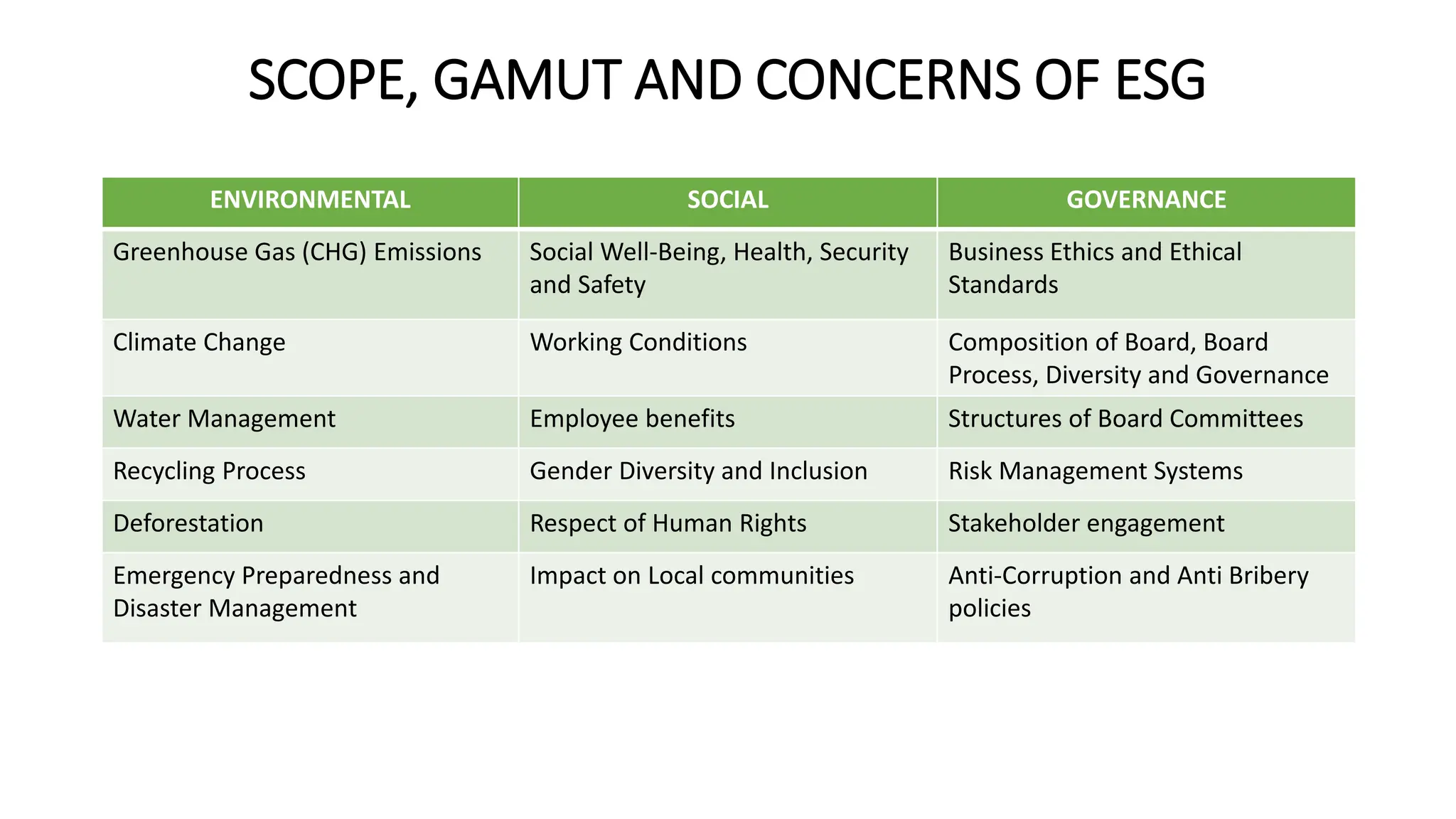
SCOPE, GAMUT AND CONCERNS OF ESG
ENVIRONMENTAL SOCIAL GOVERNANCE
Greenhouse Gas (CHG) Emissions Social Well-Being, Health, Security
and Safety
Business Ethics and Ethical
Standards
Climate Change Working Conditions Composition of Board, Board
Process, Diversity and Governance
Water Management Employee benefits Structures of Board Committees
Recycling Process Gender Diversity and Inclusion Risk Management Systems
Deforestation Respect of Human Rights Stakeholder engagement
Emergency Preparedness and
Disaster Management
Impact on Local communities Anti-Corruption and Anti Bribery
policies
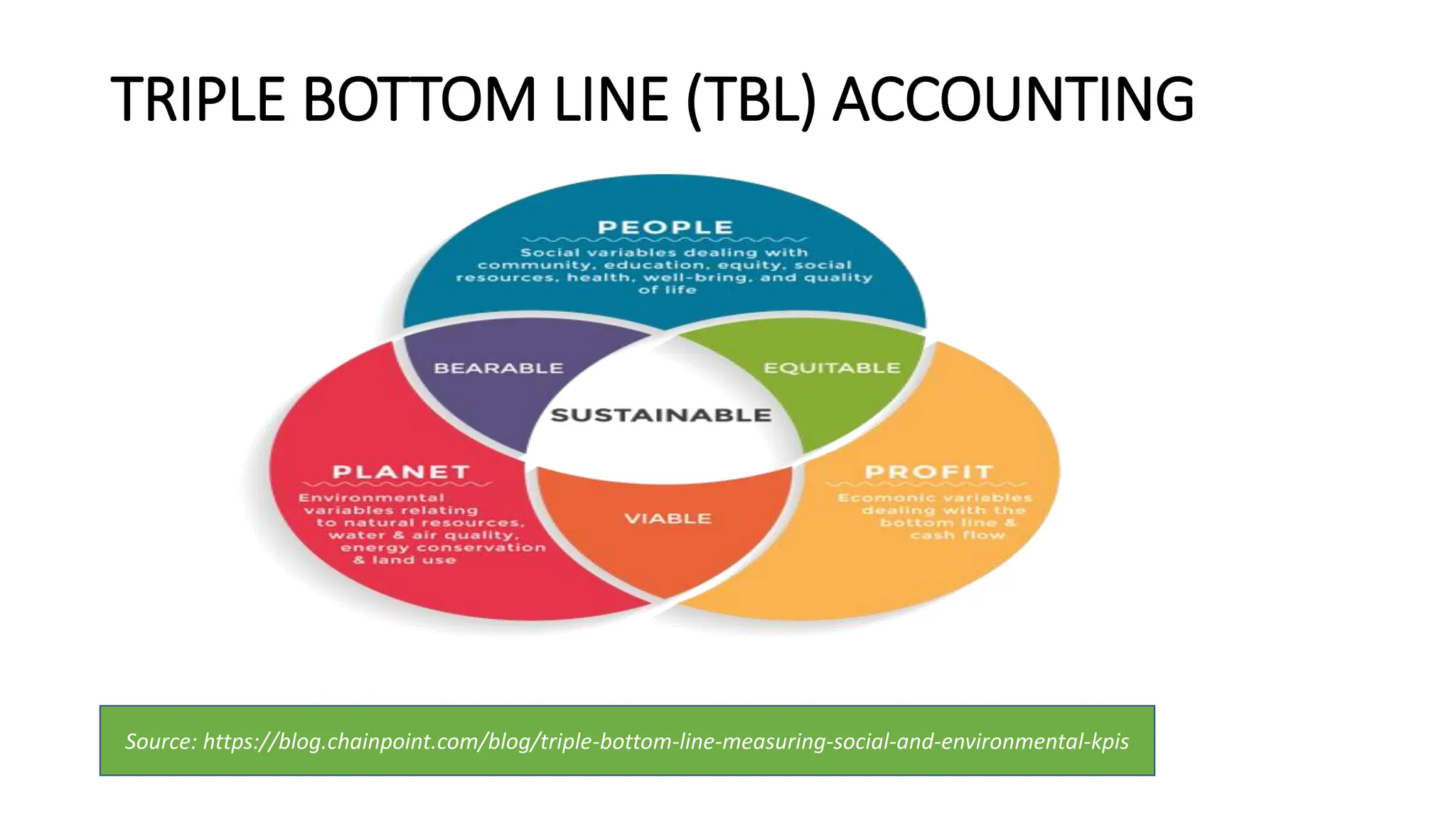
TRIPLE BOTTOM LINE (TBL) ACCOUNTING
Source: https://blog.chainpoint.com/blog/triple-bottom-line-measuring-social-and-environmental-kpis
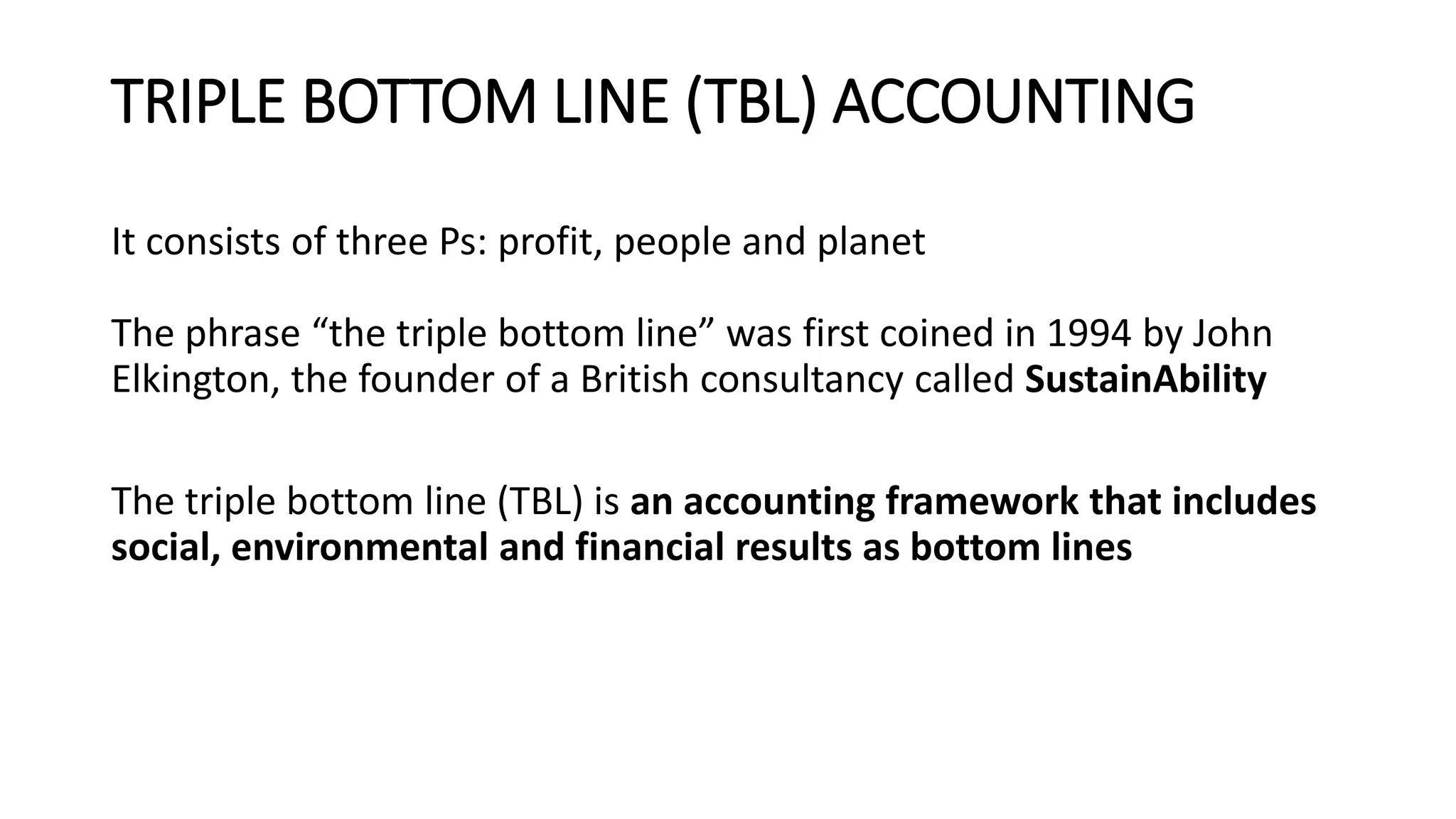
TRIPLE BOTTOM LINE (TBL) ACCOUNTING
It consists of three Ps: profit, people and planet
The phrase “the triple bottom line” was first coined in 1994 by John
Elkington, the founder of a British consultancy called SustainAbility
The triple bottom line (TBL) is an accounting framework that includes
social, environmental and financial results as bottom lines
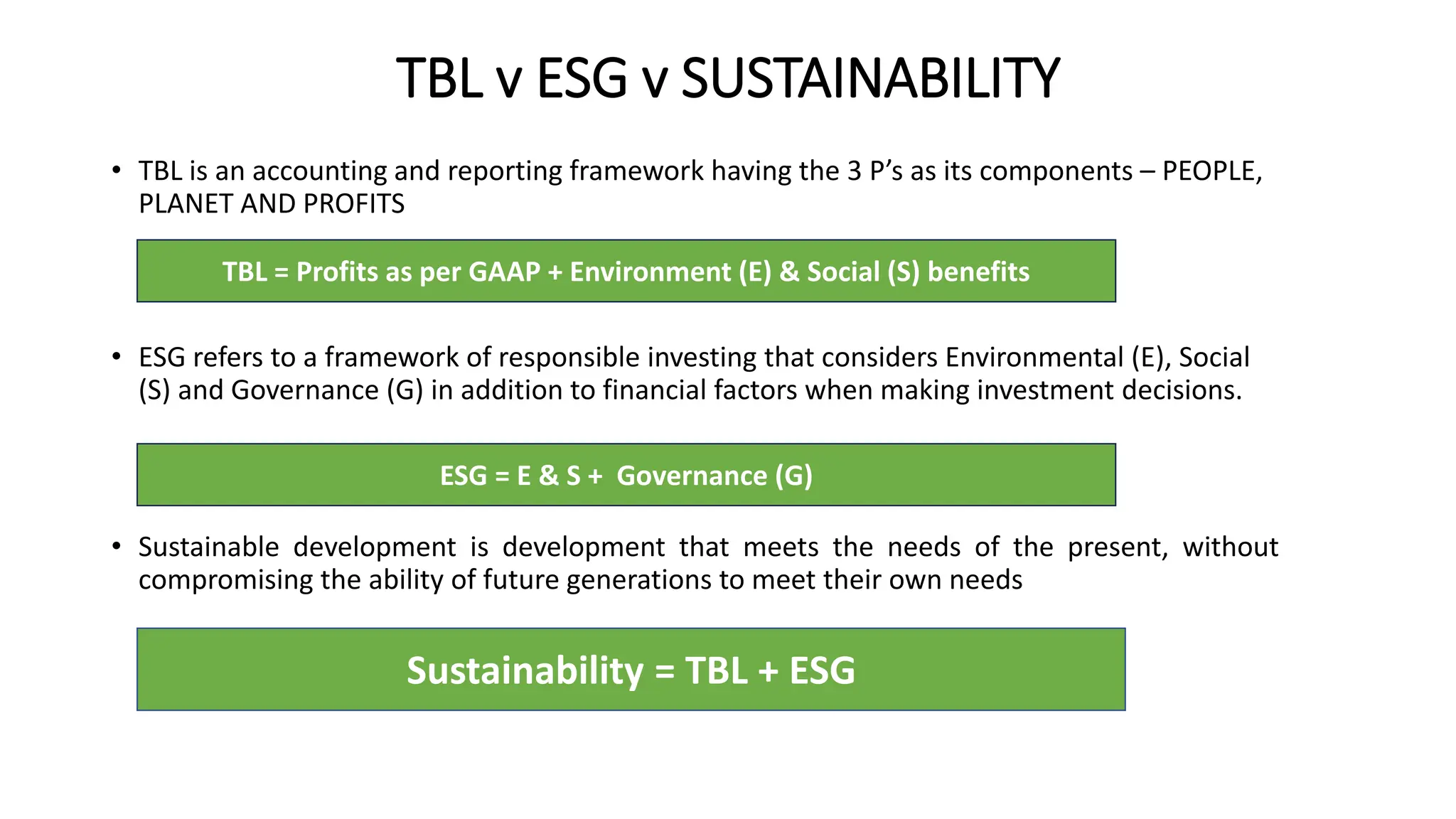
TBL v ESG v SUSTAINABILITY
• TBL is an accounting and reporting framework having the 3 P’s as its components – PEOPLE,
PLANET AND PROFITS
• ESG refers to a framework of responsible investing that considers Environmental (E), Social
(S) and Governance (G) in addition to financial factors when making investment decisions.
• Sustainable development is development that meets the needs of the present, without
compromising the ability of future generations to meet their own needs
Sustainability = TBL + ESG
TBL = Profits as per GAAP + Environment (E) & Social (S) benefits
ESG = E & S + Governance (G)
SUSTAINABILITY CONCEPTS
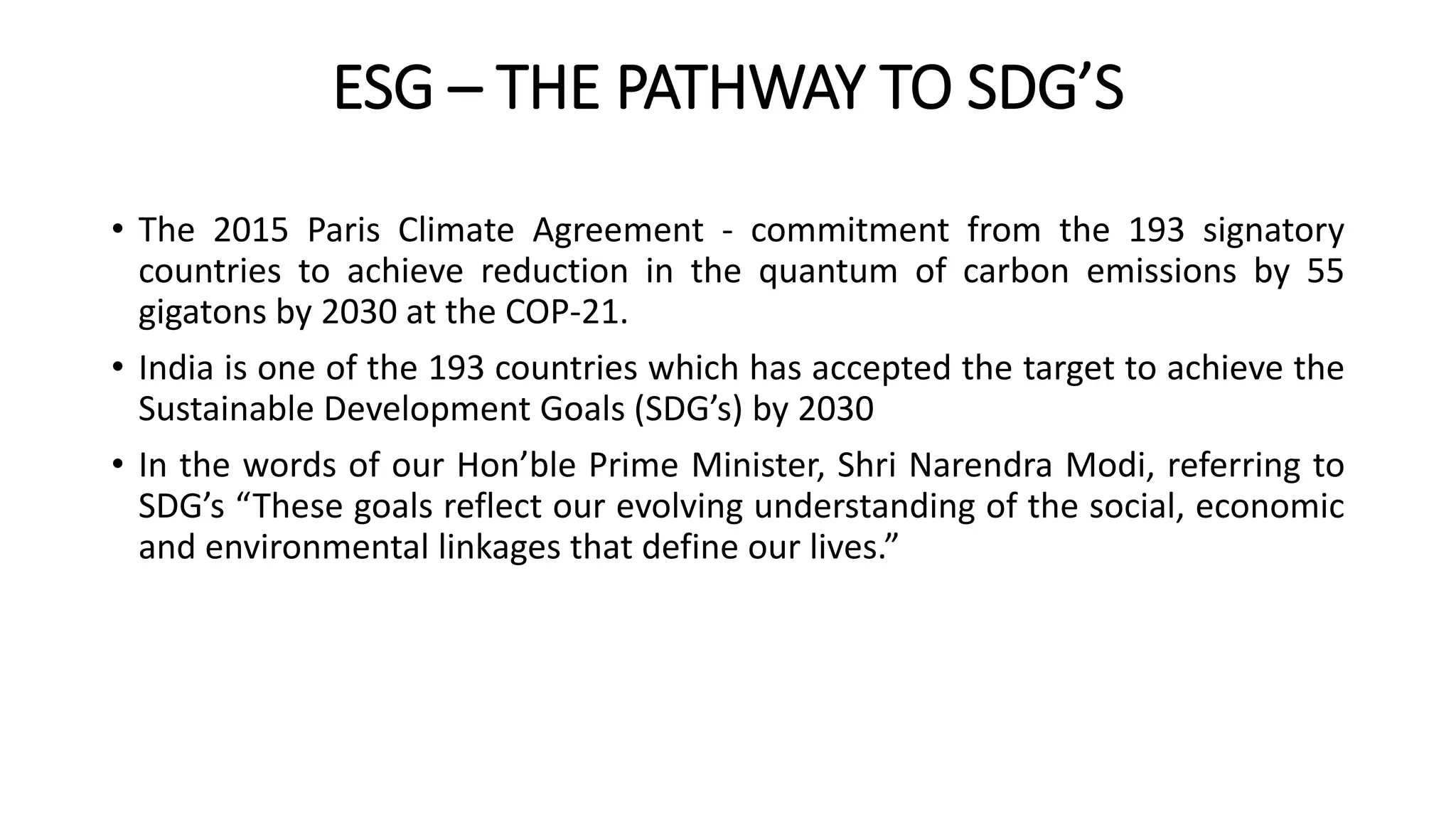
ESG – THE PATHWAY TO SDG’S
• The 2015 Paris Climate Agreement - commitment from the 193 signatory
countries to achieve reduction in the quantum of carbon emissions by 55
gigatons by 2030 at the COP-21.
• India is one of the 193 countries which has accepted the target to achieve the
Sustainable Development Goals (SDG’s) by 2030
• In the words of our Hon’ble Prime Minister, Shri Narendra Modi, referring to
SDG’s “These goals reflect our evolving understanding of the social, economic
and environmental linkages that define our lives.”
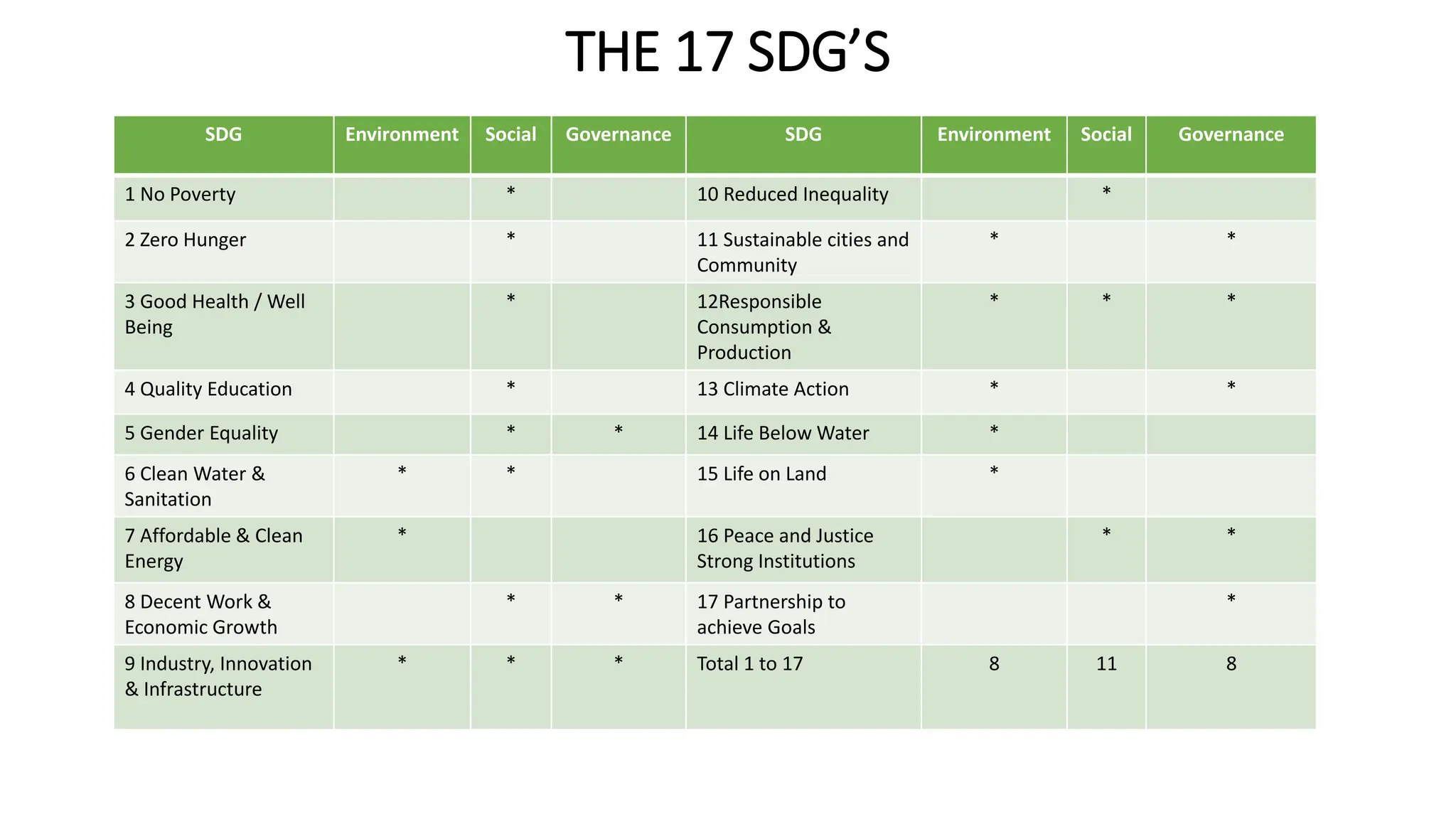
THE 17 SDG’S
SDG Environment Social Governance SDG Environment Social Governance
1 No Poverty * 10 Reduced Inequality *
2 Zero Hunger * 11 Sustainable cities and
Community
* *
3 Good Health / Well
Being
* 12Responsible
Consumption &
Production
* * *
4 Quality Education * 13 Climate Action * *
5 Gender Equality * * 14 Life Below Water *
6 Clean Water &
Sanitation
* * 15 Life on Land *
7 Affordable & Clean
Energy
* 16 Peace and Justice
Strong Institutions
* *
8 Decent Work &
Economic Growth
* * 17 Partnership to
achieve Goals
*
9 Industry, Innovation
& Infrastructure
* * * Total 1 to 17 8 11 8
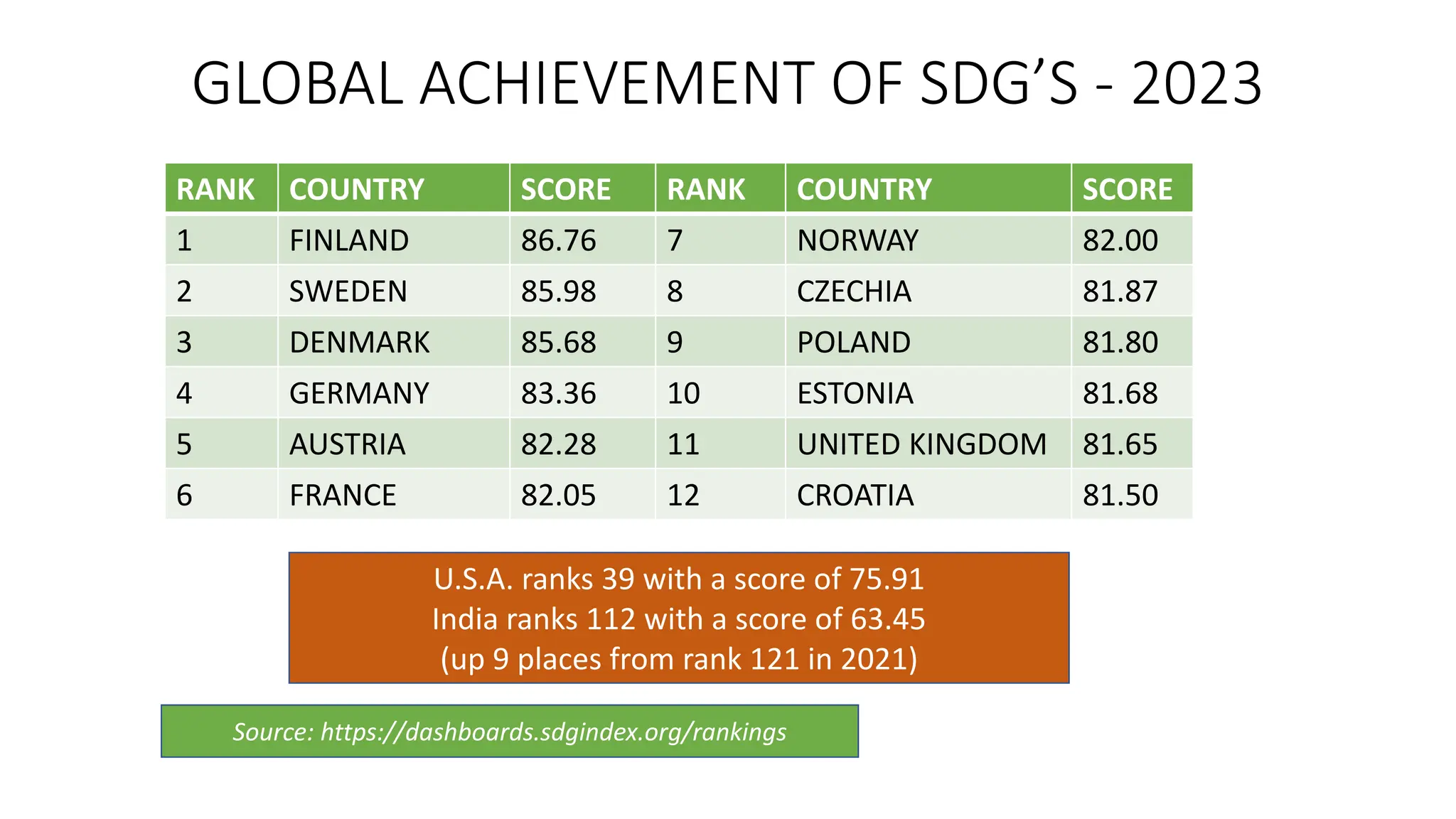
GLOBAL ACHIEVEMENT OF SDG’S - 2023
RANK COUNTRY SCORE RANK COUNTRY SCORE
1 FINLAND 86.76 7 NORWAY 82.00
2 SWEDEN 85.98 8 CZECHIA 81.87
3 DENMARK 85.68 9 POLAND 81.80
4 GERMANY 83.36 10 ESTONIA 81.68
5 AUSTRIA 82.28 11 UNITED KINGDOM 81.65
6 FRANCE 82.05 12 CROATIA 81.50
U.S.A. ranks 39 with a score of 75.91
India ranks 112 with a score of 63.45
(up 9 places from rank 121 in 2021)
Source: https://dashboards.sdgindex.org/rankings
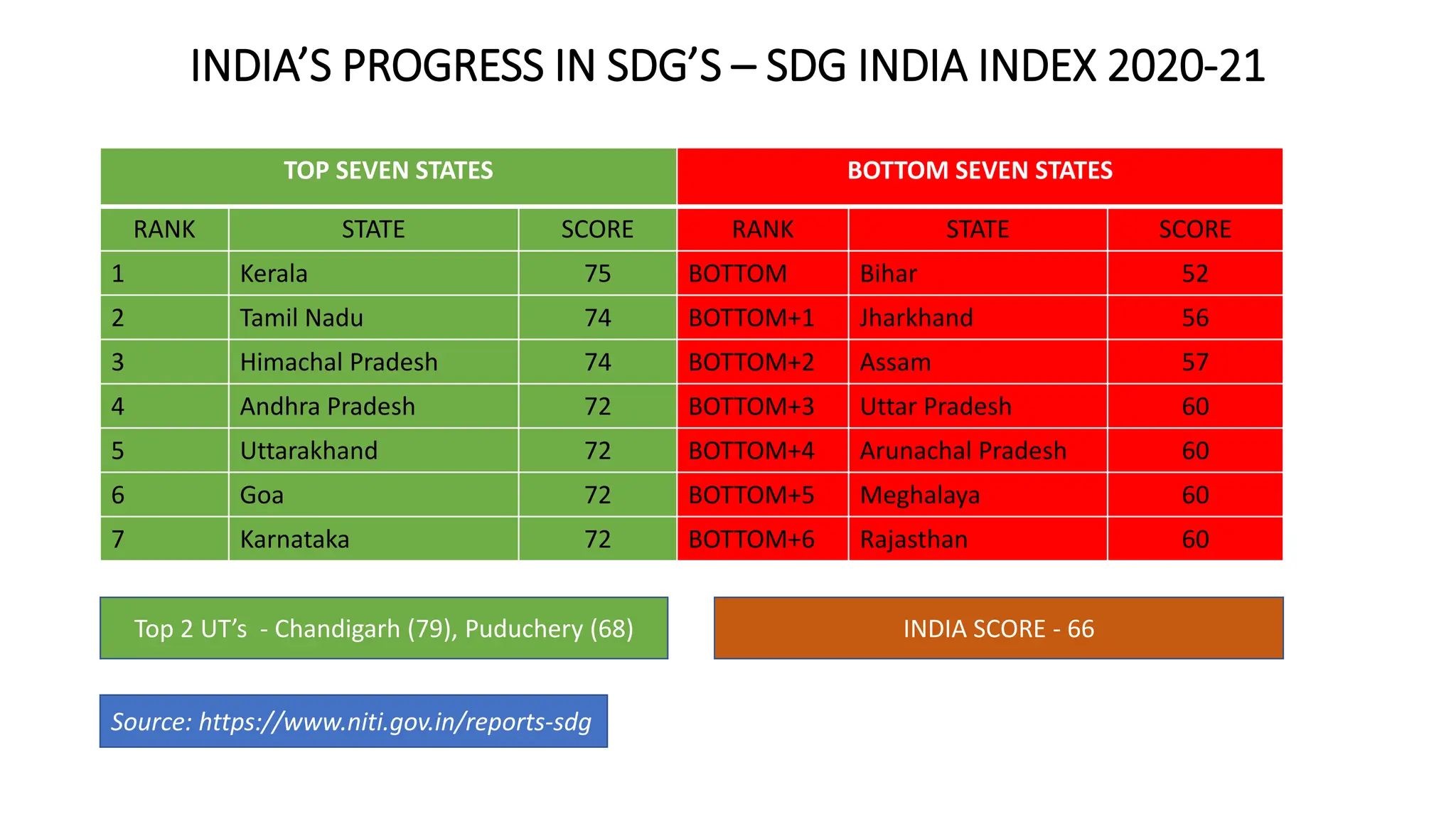
INDIA’S PROGRESS IN SDG’S – SDG INDIA INDEX 2020-21
TOP SEVEN STATES BOTTOM SEVEN STATES
RANK STATE SCORE RANK STATE SCORE
1 Kerala 75 BOTTOM Bihar 52
2 Tamil Nadu 74 BOTTOM+1 Jharkhand 56
3 Himachal Pradesh 74 BOTTOM+2 Assam 57
4 Andhra Pradesh 72 BOTTOM+3 Uttar Pradesh 60
5 Uttarakhand 72 BOTTOM+4 Arunachal Pradesh 60
6 Goa 72 BOTTOM+5 Meghalaya 60
7 Karnataka 72 BOTTOM+6 Rajasthan 60
Top 2 UT’s - Chandigarh (79), Puduchery (68) INDIA SCORE - 66
Source: https://www.niti.gov.in/reports-sdg
Why ESG Risks matter
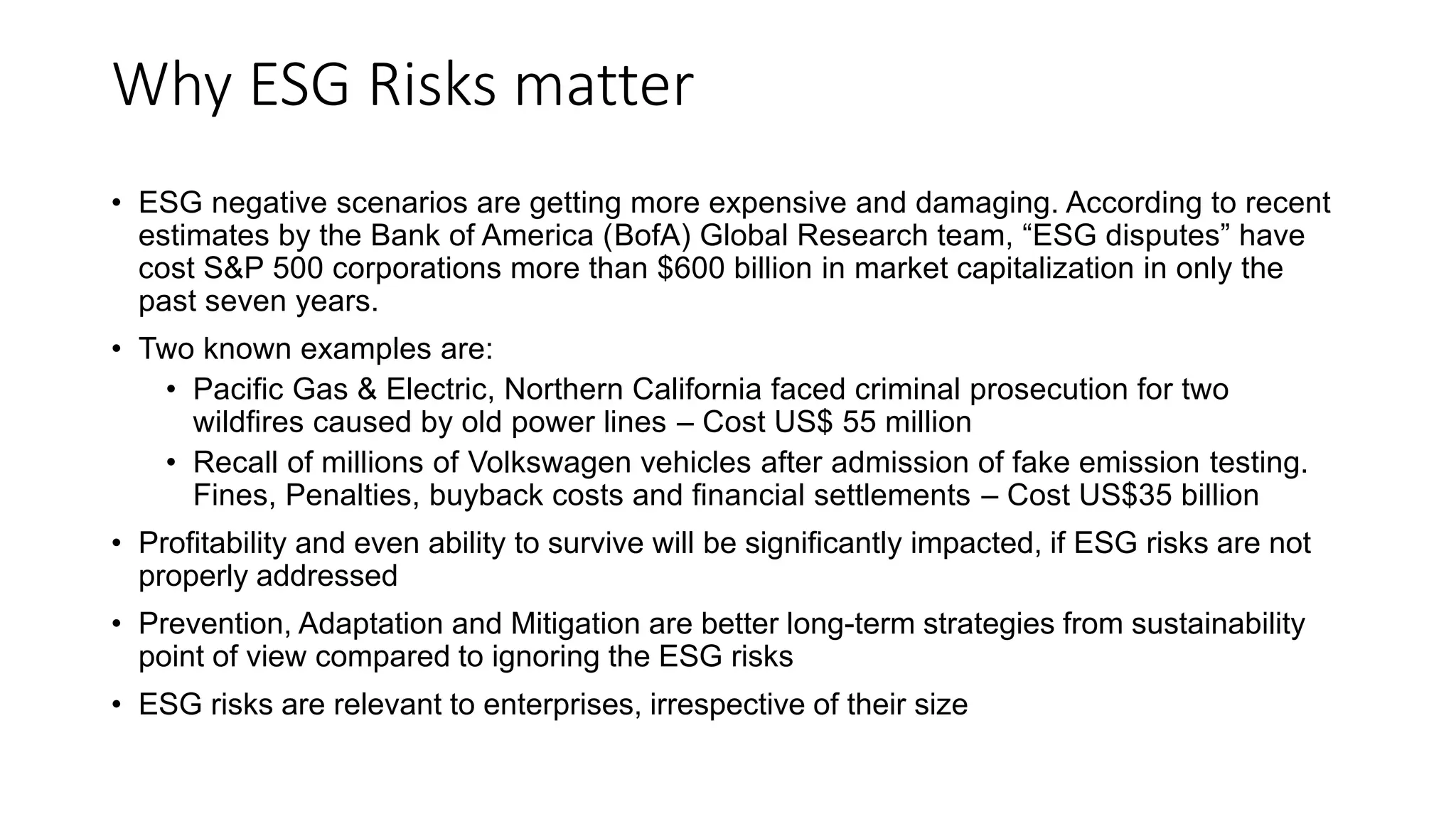
• ESG negative scenarios are getting more expensive and damaging. According to recent
estimates by the Bank of America (BofA) Global Research team, “ESG disputes” have
cost S&P 500 corporations more than $600 billion in market capitalization in only the
past seven years.
• Two known examples are:
• Pacific Gas & Electric, Northern California faced criminal prosecution for two
wildfires caused by old power lines – Cost US$ 55 million
• Recall of millions of Volkswagen vehicles after admission of fake emission testing.
Fines, Penalties, buyback costs and financial settlements – Cost US$35 billion
• Profitability and even ability to survive will be significantly impacted, if ESG risks are not
properly addressed
• Prevention, Adaptation and Mitigation are better long-term strategies from sustainability
point of view compared to ignoring the ESG risks
• ESG risks are relevant to enterprises, irrespective of their size
Possible actions to manage ESG risks
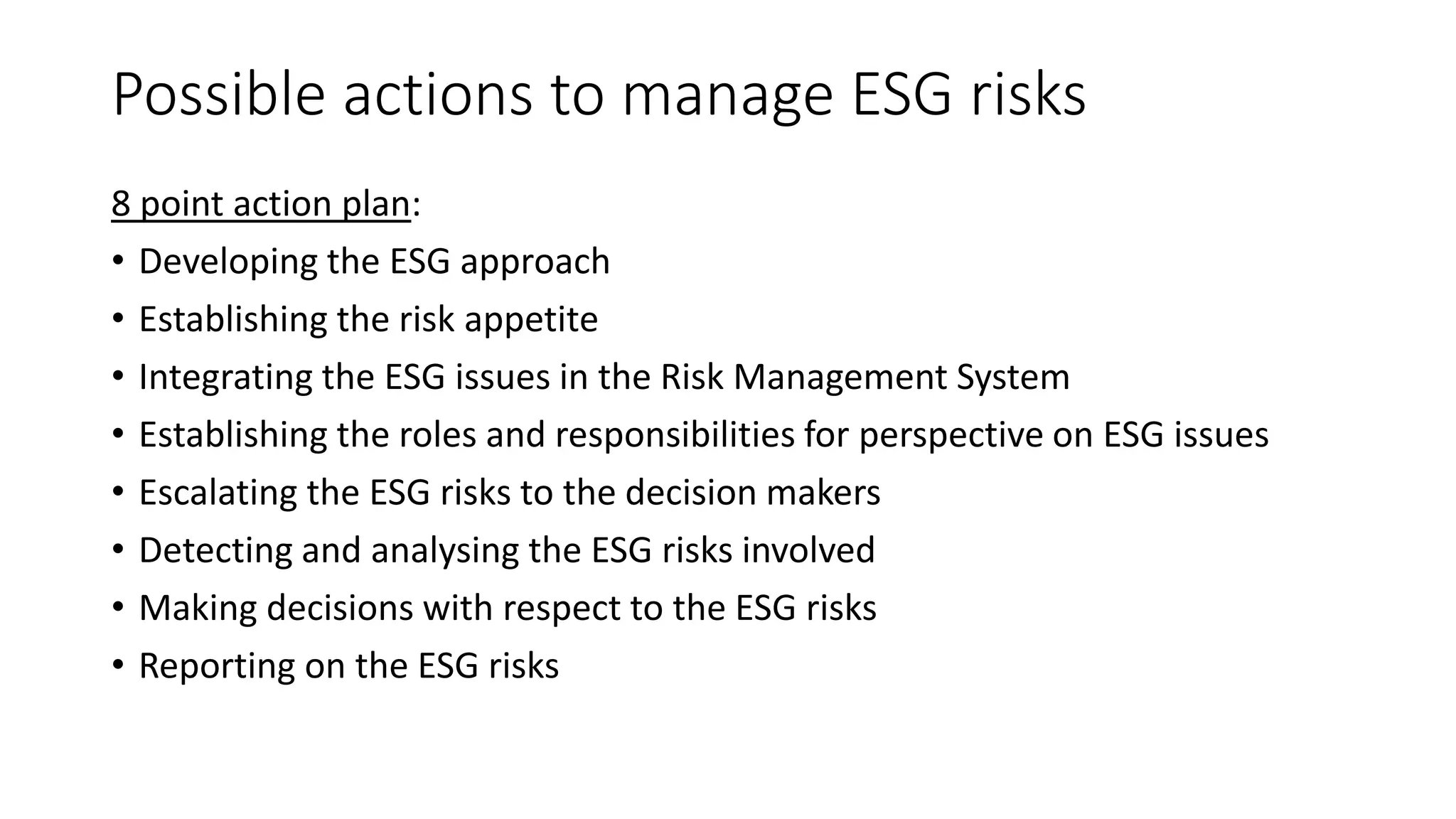
8 point action plan:
• Developing the ESG approach
• Establishing the risk appetite
• Integrating the ESG issues in the Risk Management System
• Establishing the roles and responsibilities for perspective on ESG issues
• Escalating the ESG risks to the decision makers
• Detecting and analysing the ESG risks involved
• Making decisions with respect to the ESG risks
• Reporting on the ESG risks
GLOBAL ESG FRAMEWORK
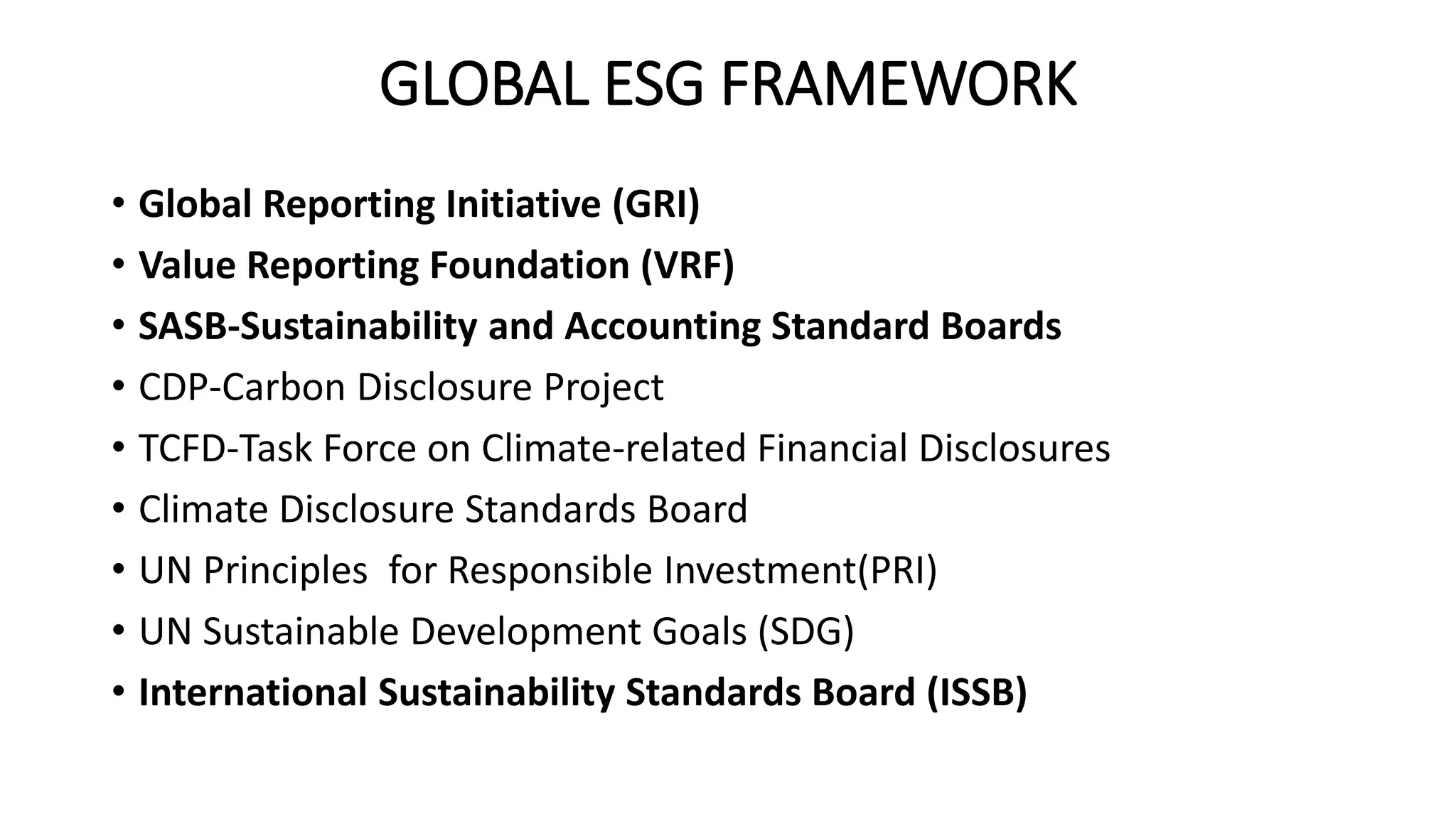
• Global Reporting Initiative (GRI)
• Value Reporting Foundation (VRF)
• SASB-Sustainability and Accounting Standard Boards
• CDP-Carbon Disclosure Project
• TCFD-Task Force on Climate-related Financial Disclosures
• Climate Disclosure Standards Board
• UN Principles for Responsible Investment(PRI)
• UN Sustainable Development Goals (SDG)
• International Sustainability Standards Board (ISSB)
OVERVIEW OF GRI AND
VALUE REPORTING
FOUNDATION (VRF)
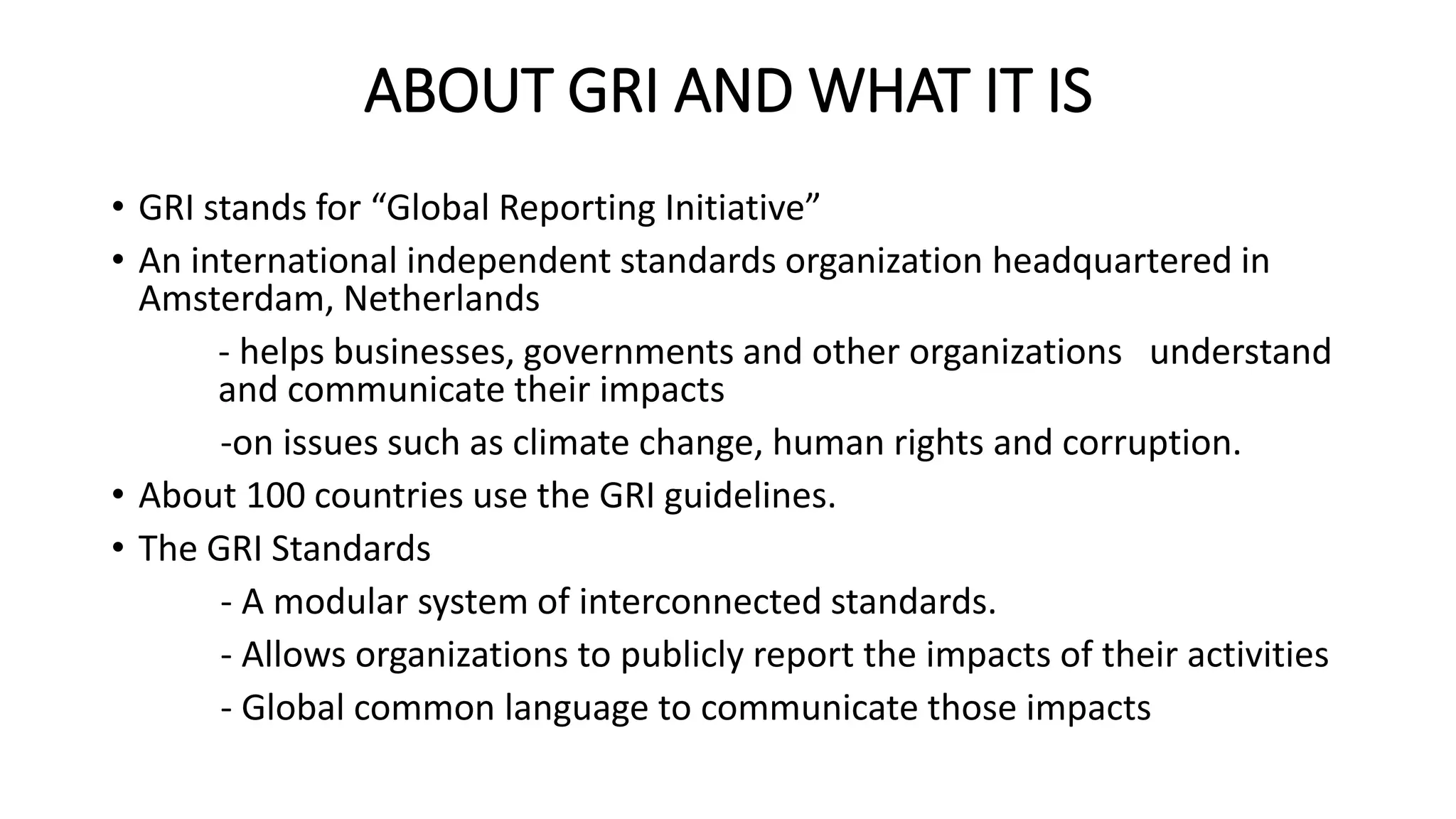
ABOUT GRI AND WHAT IT IS
• GRI stands for “Global Reporting Initiative”
• An international independent standards organization headquartered in
Amsterdam, Netherlands
- helps businesses, governments and other organizations understand
and communicate their impacts
-on issues such as climate change, human rights and corruption.
• About 100 countries use the GRI guidelines.
• The GRI Standards
- A modular system of interconnected standards.
- Allows organizations to publicly report the impacts of their activities
- Global common language to communicate those impacts
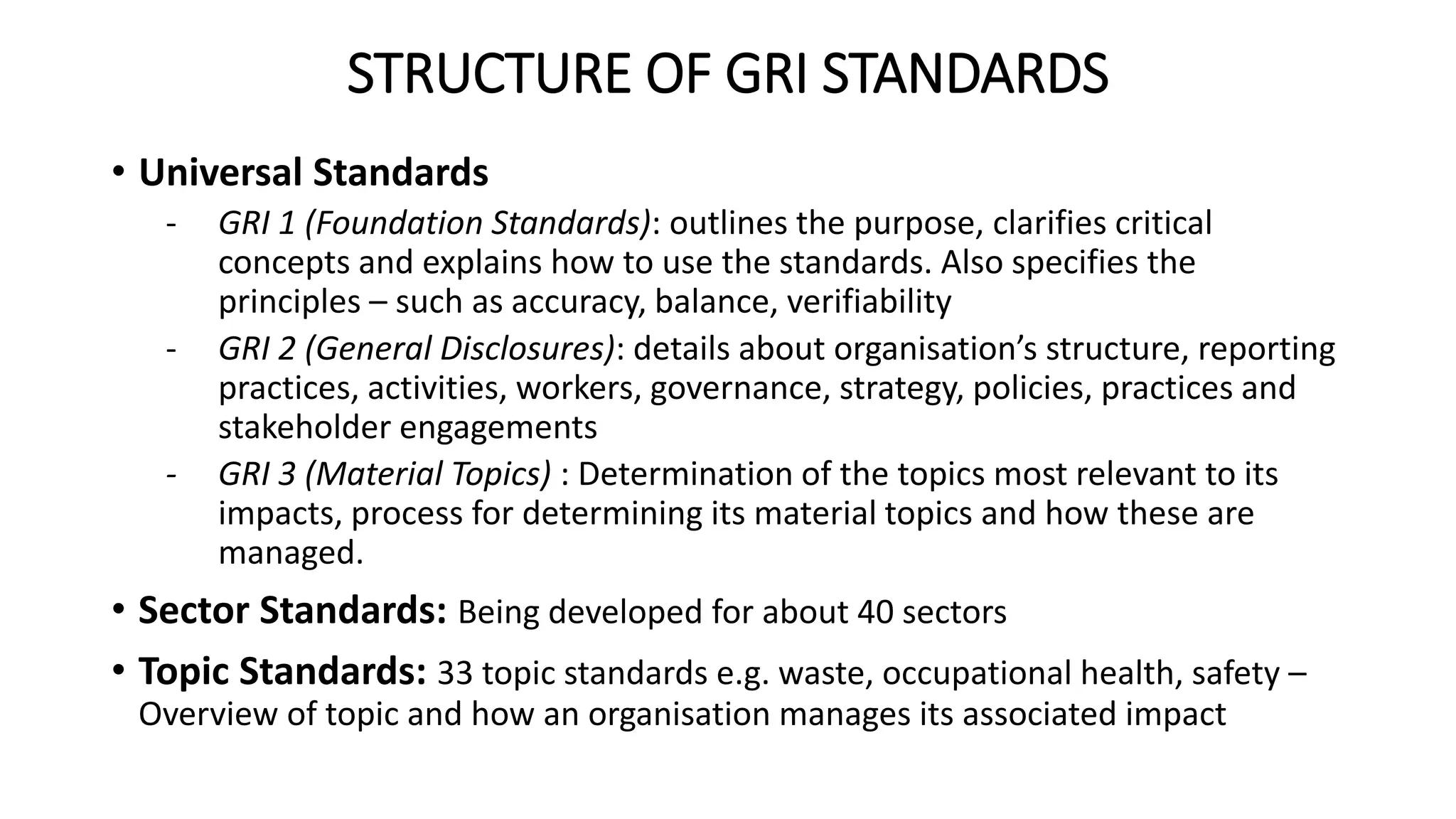
STRUCTURE OF GRI STANDARDS
• Universal Standards
- GRI 1 (Foundation Standards): outlines the purpose, clarifies critical
concepts and explains how to use the standards. Also specifies the
principles – such as accuracy, balance, verifiability
- GRI 2 (General Disclosures): details about organisation’s structure, reporting
practices, activities, workers, governance, strategy, policies, practices and
stakeholder engagements
- GRI 3 (Material Topics) : Determination of the topics most relevant to its
impacts, process for determining its material topics and how these are
managed.
• Sector Standards: Being developed for about 40 sectors
• Topic Standards: 33 topic standards e.g. waste, occupational health, safety –
Overview of topic and how an organisation manages its associated impact
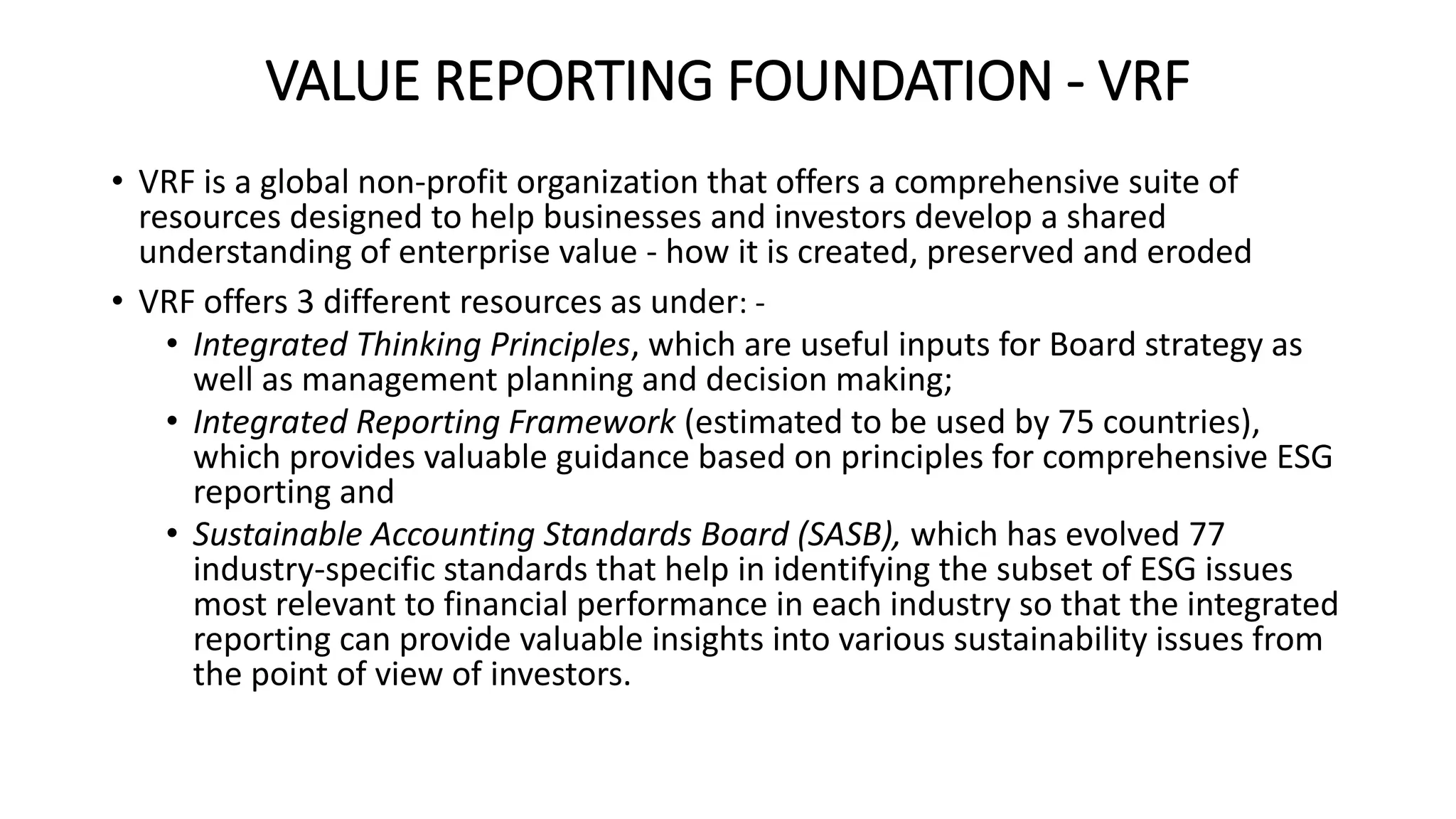
VALUE REPORTING FOUNDATION - VRF
• VRF is a global non-profit organization that offers a comprehensive suite of
resources designed to help businesses and investors develop a shared
understanding of enterprise value - how it is created, preserved and eroded
• VRF offers 3 different resources as under: -
• Integrated Thinking Principles, which are useful inputs for Board strategy as
well as management planning and decision making;
• Integrated Reporting Framework (estimated to be used by 75 countries),
which provides valuable guidance based on principles for comprehensive ESG
reporting and
• Sustainable Accounting Standards Board (SASB), which has evolved 77
industry-specific standards that help in identifying the subset of ESG issues
most relevant to financial performance in each industry so that the integrated
reporting can provide valuable insights into various sustainability issues from
the point of view of investors.
INTERNATIONAL SUSTAINABILITY
STANDARDS BOARD (ISSB)
IFRS S1 AND S2
About ISSB
• The International Sustainability Standards Board (ISSB) is an
independent, private-sector body that develops and approves IFRS
Sustainability Disclosure Standards (IFRS SDS).
• The ISSB operates under the oversight of the IFRS Foundation.
• The ISSB was formed in 2021 following two consultations on
• the demand for global sustainability standards and
• what role the Foundation might play in the development of such
standards
• The ISSB released its first two International Sustainability Disclosure
Standards (IFRS SDS or the Standards) that become effective for
periods beginning on or after 1 January 2024 - IFRS S1 and IFRS
S2
• The ISSB brings together the Climate Disclosure
Standards Board (CDSB) and the Value Reporting Foundation
(VRF)
IRFS S1
• The main objective of this Standard is to require disclosure of all
information about sustainability-related risks and opportunities that could
reasonably be expected to affect a company’s prospects.
• S1 provides the basic requirements for sustainability disclosures which
should be used with S2 and the future standards to be released.
• S1
• Requires disclosure of material information about sustainability related risks and
opportunities;
• Requires Industry specific disclosures with reference to industry-based SASB
standards
• Refers to sources to help companies identify sustainability-related risks and
opportunities and information (other than those in the scope of S2 – climate related
disclosures)
• Requires disclosures that enable investors to understand the connections between
the sustainability-related risks and opportunities and the sustainability-related
financial disclosures and financial statements.
• Is GAAP agnostic
IFRS S2
• IFRS S2 has been developed to capture climate-specific
requirements which includes:
• Strategy disclosures that distinguish between physical and transitional
risks
• Disclosure of their plans to respond to climate-related risks and
opportunities,
• Disclosure of how climate-related targets are set as also any targets it
is required to meet under the prevailing law / regulation
• Details of scenario analysis conducted by the companies to explain
how various climate-related events may impact the business in
the future
• Climate-related metrics and target disclosures dealing with
GHG emissions (Scope 1, Scope 2 and Scope 3)
Industry based metrics relevant to the Company
Company specific metrics considered by the board or management when
LIFE CYCLE ASSESSMENT
&
ESG MATURITY
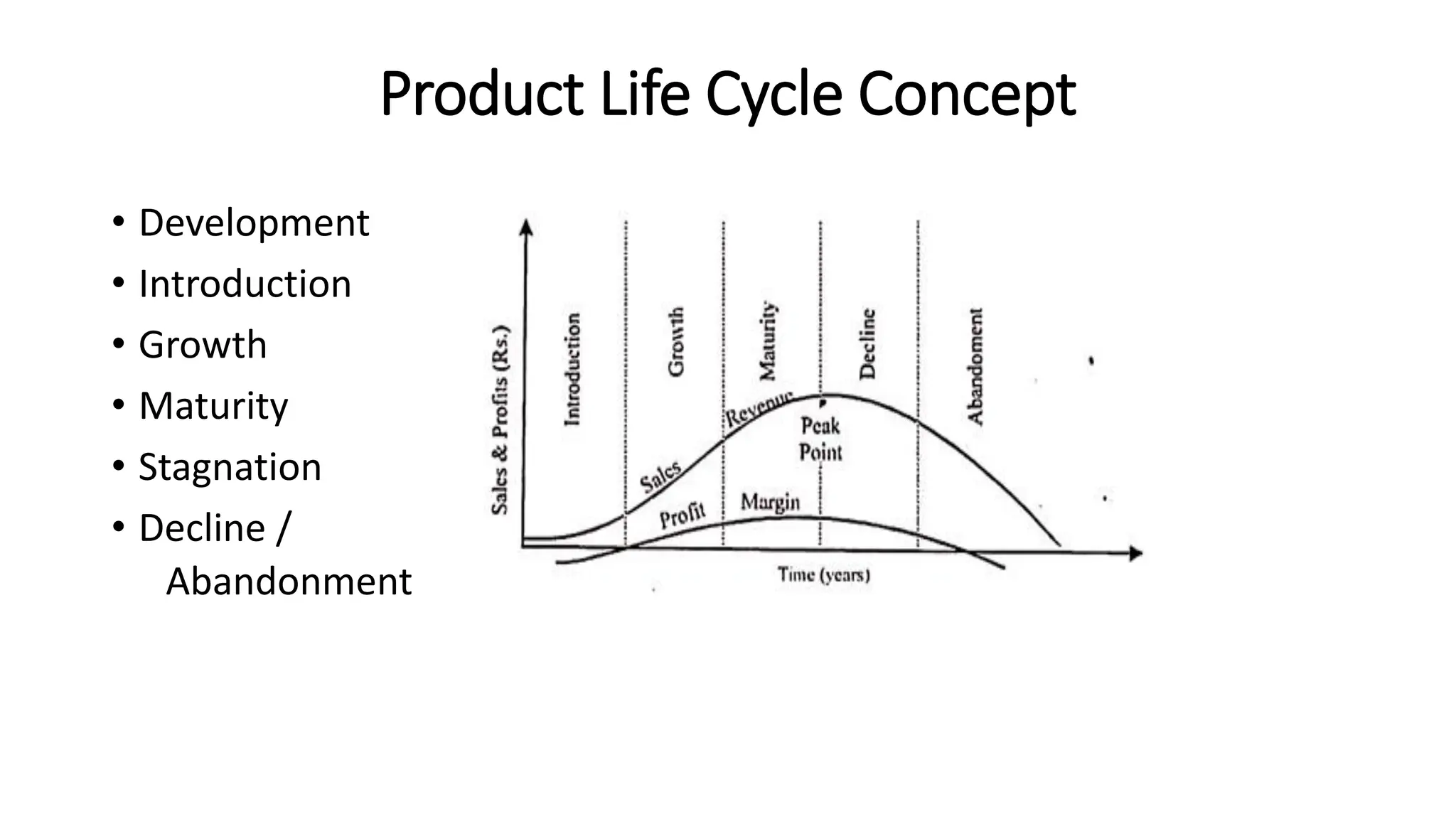
Product Life Cycle Concept
• Development
• Introduction
• Growth
• Maturity
• Stagnation
• Decline /
Abandonment
Life Cycle Assessment – ESG Concept
• Life Cycle Assessment (LCA) is a standardized method to evaluate the
environmental consequences of a product or activity across its entire life.
• Assessing a product’s life cycle includes examining
-human impacts
-energy
-materials
-waste
at each stage of a product’s life cycle from cradle (the inception of the idea, Design) to
the grave (disposal).
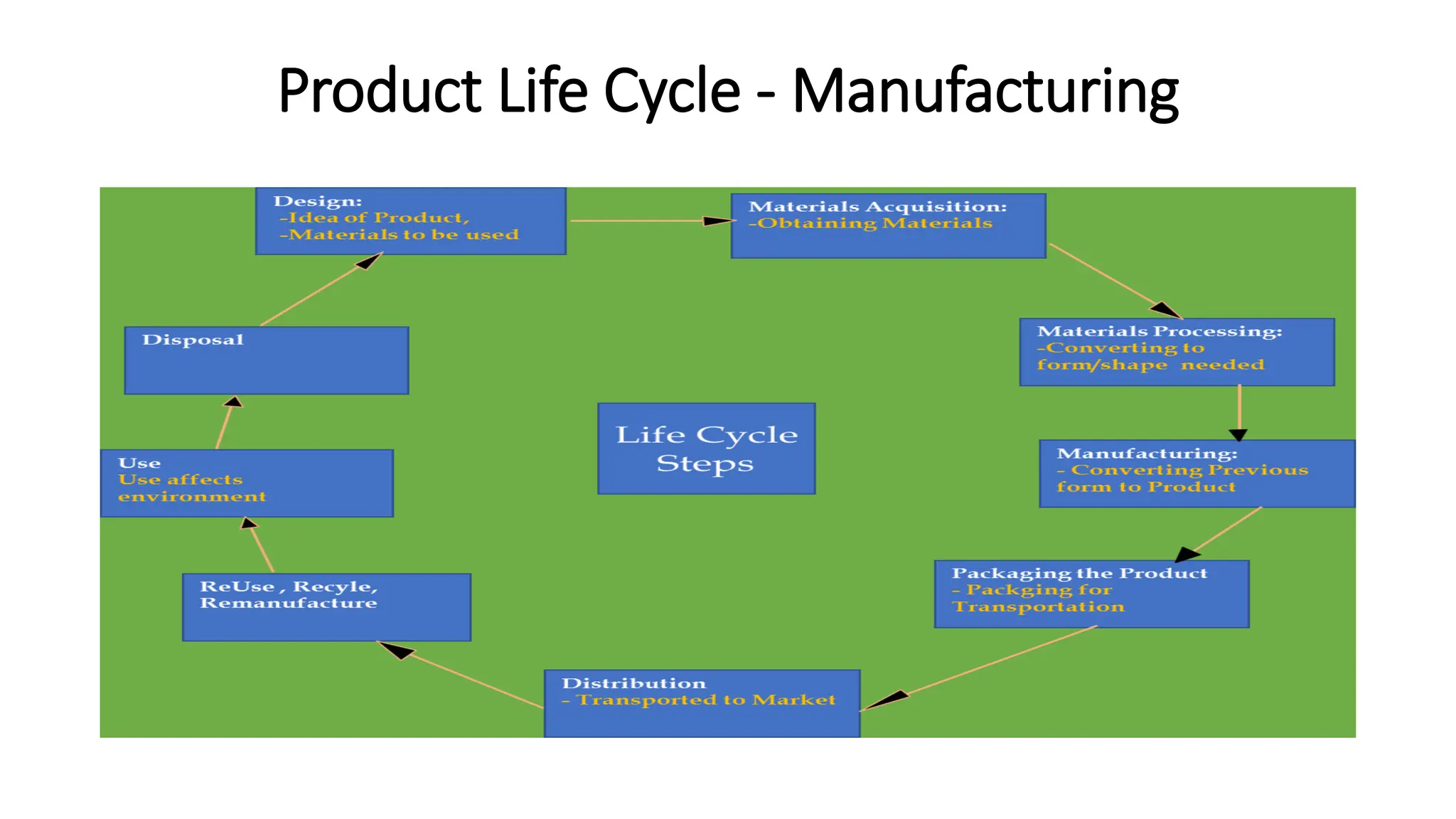
Stages in Product Life Cycle – ESG Perspective
Also called “Cradle to Grave” concept of Product Life Cycle
Five Stages:
• Raw Material Extraction
• Manufacturing & Processing
• Transportation
• Usage & Retail
• Waste Disposal
Product Life Cycle - Manufacturing
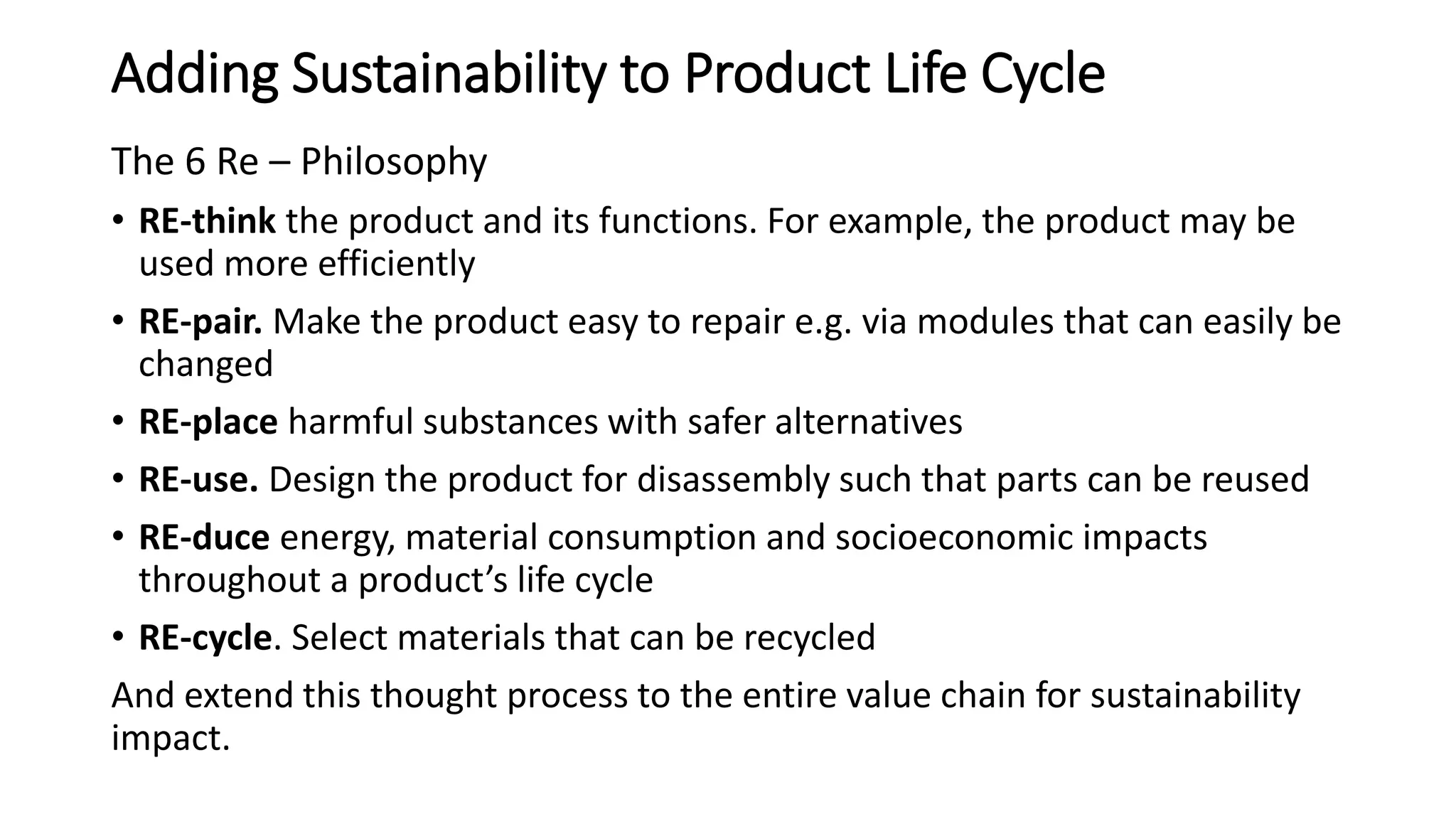
Adding Sustainability to Product Life Cycle
The 6 Re – Philosophy
• RE-think the product and its functions. For example, the product may be
used more efficiently
• RE-pair. Make the product easy to repair e.g. via modules that can easily be
changed
• RE-place harmful substances with safer alternatives
• RE-use. Design the product for disassembly such that parts can be reused
• RE-duce energy, material consumption and socioeconomic impacts
throughout a product’s life cycle
• RE-cycle. Select materials that can be recycled
And extend this thought process to the entire value chain for sustainability
impact.
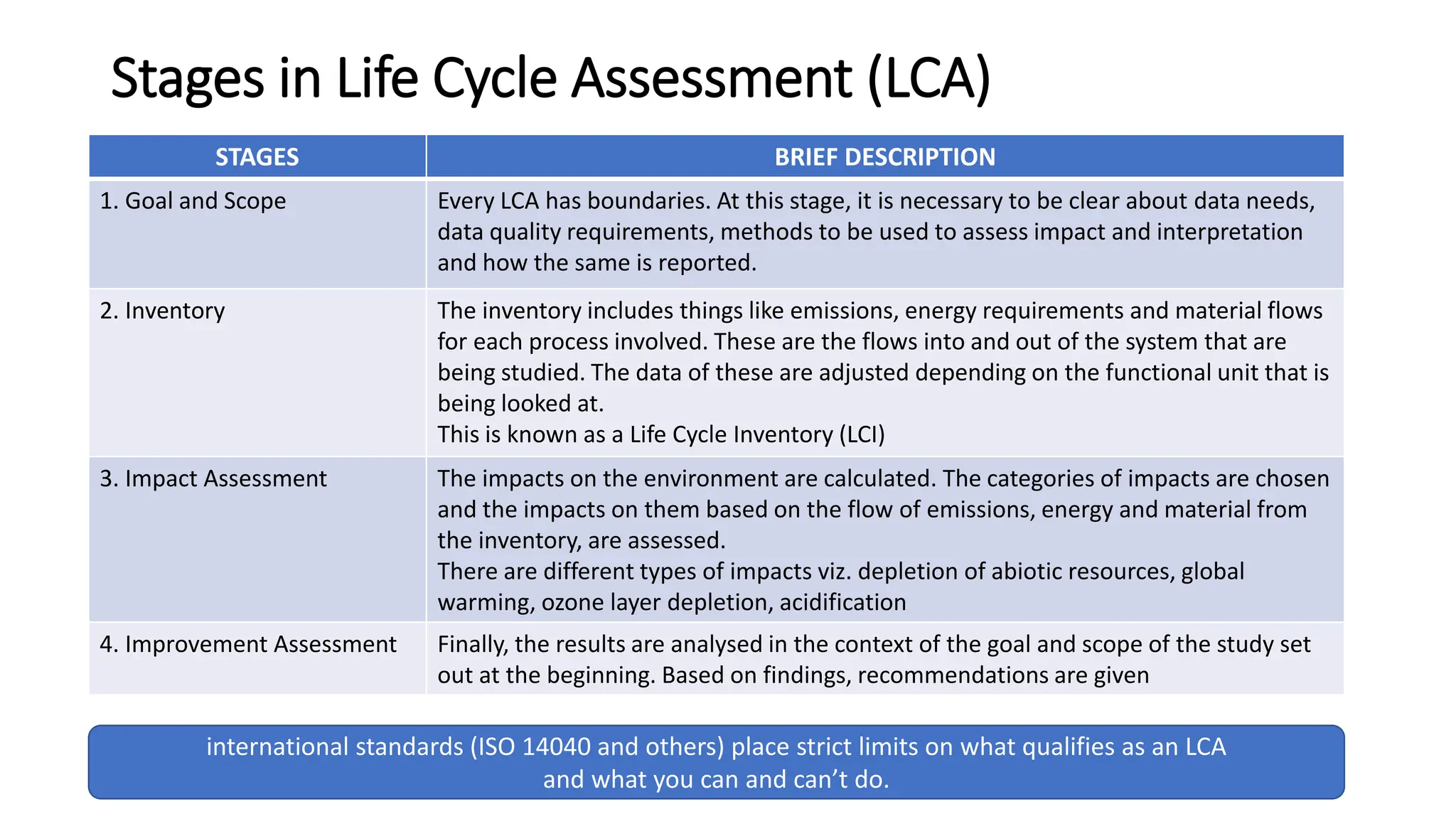
Stages in Life Cycle Assessment (LCA)
STAGES BRIEF DESCRIPTION
1. Goal and Scope Every LCA has boundaries. At this stage, it is necessary to be clear about data needs,
data quality requirements, methods to be used to assess impact and interpretation
and how the same is reported.
2. Inventory The inventory includes things like emissions, energy requirements and material flows
for each process involved. These are the flows into and out of the system that are
being studied. The data of these are adjusted depending on the functional unit that is
being looked at.
This is known as a Life Cycle Inventory (LCI)
3. Impact Assessment The impacts on the environment are calculated. The categories of impacts are chosen
and the impacts on them based on the flow of emissions, energy and material from
the inventory, are assessed.
There are different types of impacts viz. depletion of abiotic resources, global
warming, ozone layer depletion, acidification
4. Improvement Assessment Finally, the results are analysed in the context of the goal and scope of the study set
out at the beginning. Based on findings, recommendations are given
international standards (ISO 14040 and others) place strict limits on what qualifies as an LCA
and what you can and can’t do.
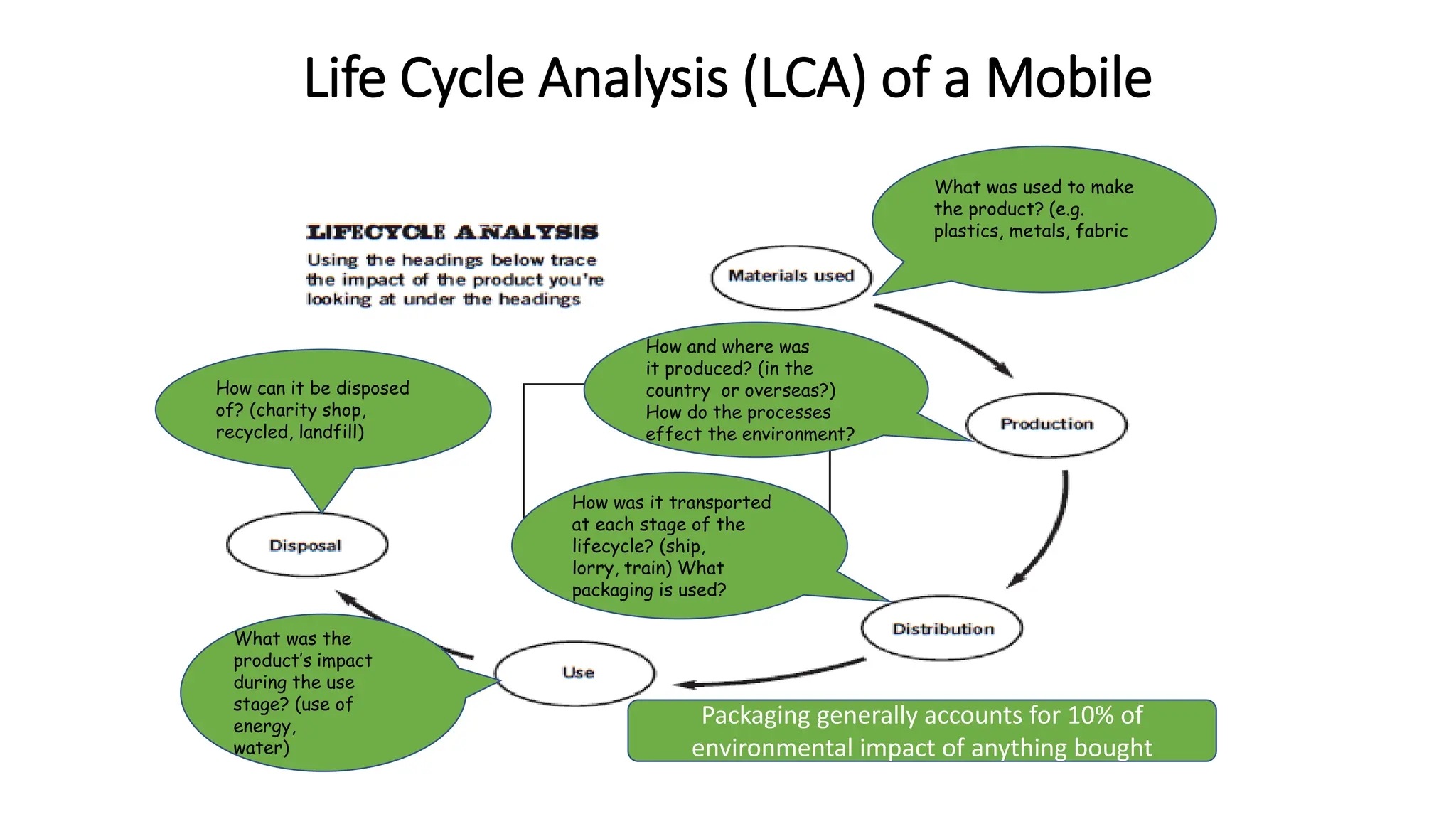
Life Cycle Analysis (LCA) of a Mobile
What was used to make
the product? (e.g.
plastics, metals, fabric
How and where was
it produced? (in the
country or overseas?)
How do the processes
effect the environment?
How was it transported
at each stage of the
lifecycle? (ship,
lorry, train) What
packaging is used?
What was the
product’s impact
during the use
stage? (use of
energy,
water)
How can it be disposed
of? (charity shop,
recycled, landfill)
Packaging generally accounts for 10% of
environmental impact of anything bought
Uses of Life Cycle Assessment (LCA)
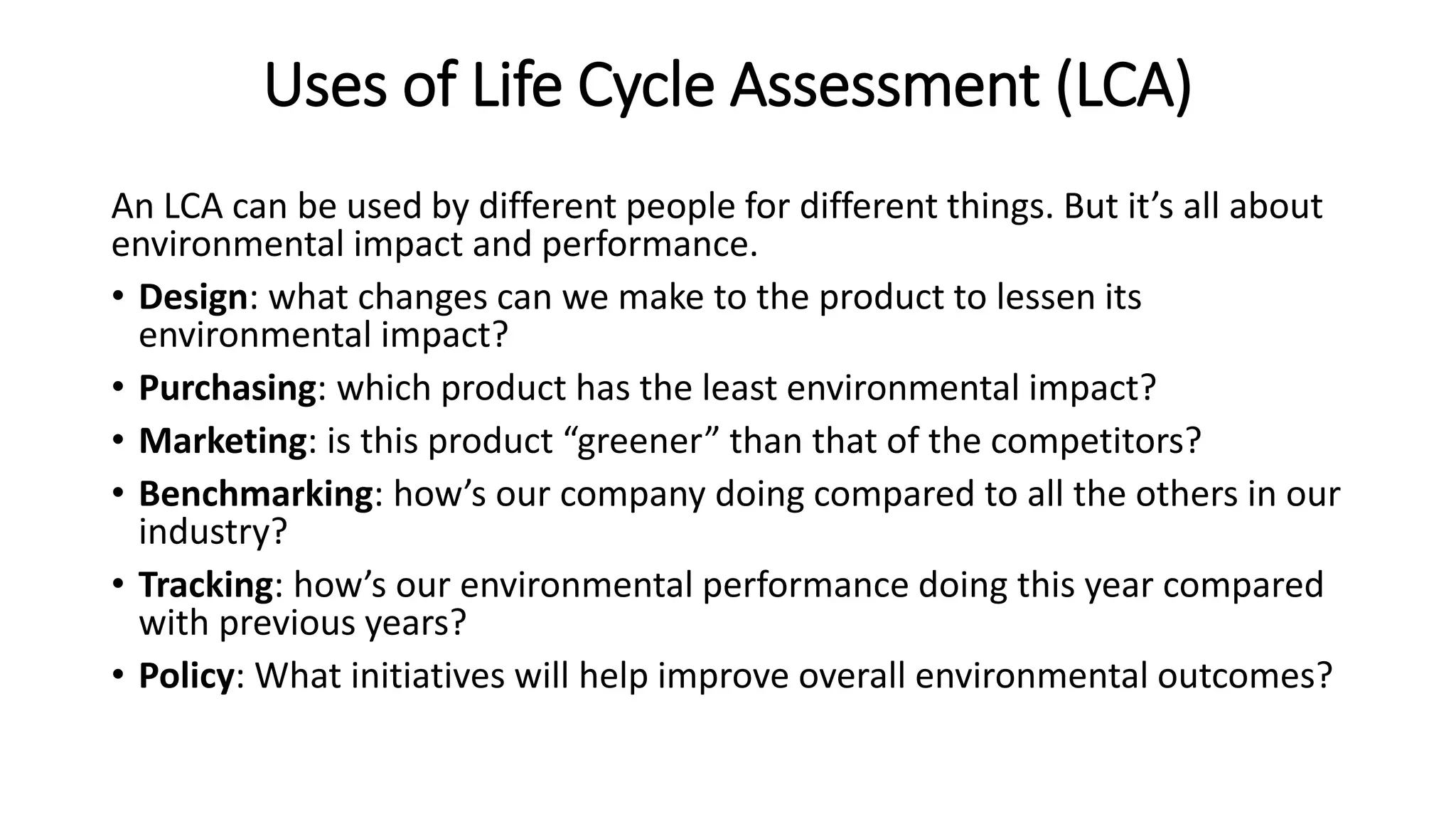
An LCA can be used by different people for different things. But it’s all about
environmental impact and performance.
• Design: what changes can we make to the product to lessen its
environmental impact?
• Purchasing: which product has the least environmental impact?
• Marketing: is this product “greener” than that of the competitors?
• Benchmarking: how’s our company doing compared to all the others in our
industry?
• Tracking: how’s our environmental performance doing this year compared
with previous years?
• Policy: What initiatives will help improve overall environmental outcomes?
ESG MATURITY
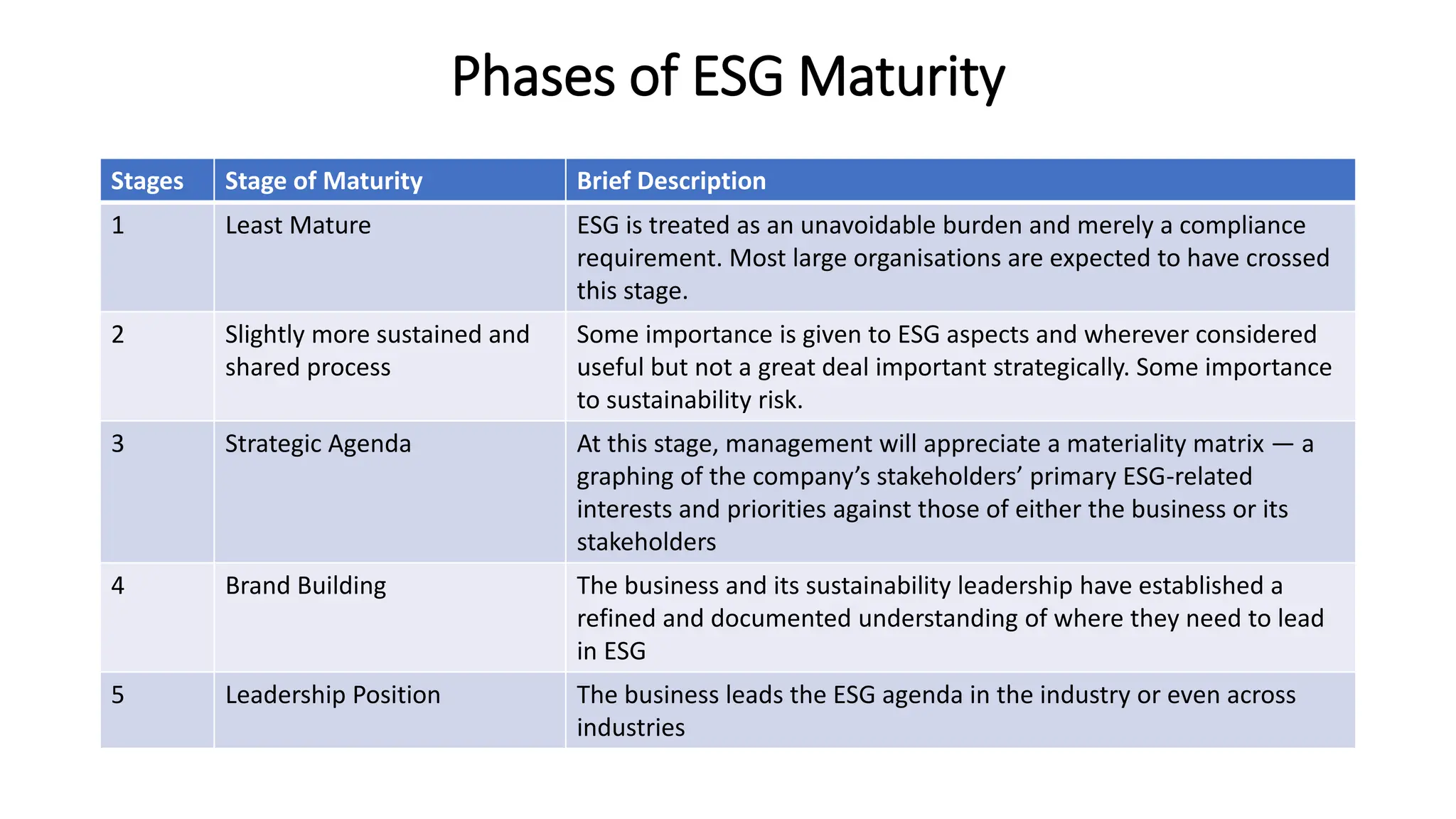
Phases of ESG Maturity
Stages Stage of Maturity Brief Description
1 Least Mature ESG is treated as an unavoidable burden and merely a compliance
requirement. Most large organisations are expected to have crossed
this stage.
2 Slightly more sustained and
shared process
Some importance is given to ESG aspects and wherever considered
useful but not a great deal important strategically. Some importance
to sustainability risk.
3 Strategic Agenda At this stage, management will appreciate a materiality matrix — a
graphing of the company’s stakeholders’ primary ESG-related
interests and priorities against those of either the business or its
stakeholders
4 Brand Building The business and its sustainability leadership have established a
refined and documented understanding of where they need to lead
in ESG
5 Leadership Position The business leads the ESG agenda in the industry or even across
industries
THE NINE BRSR
PRINCIPLES
AND
MAPPING WITH THE SDGs
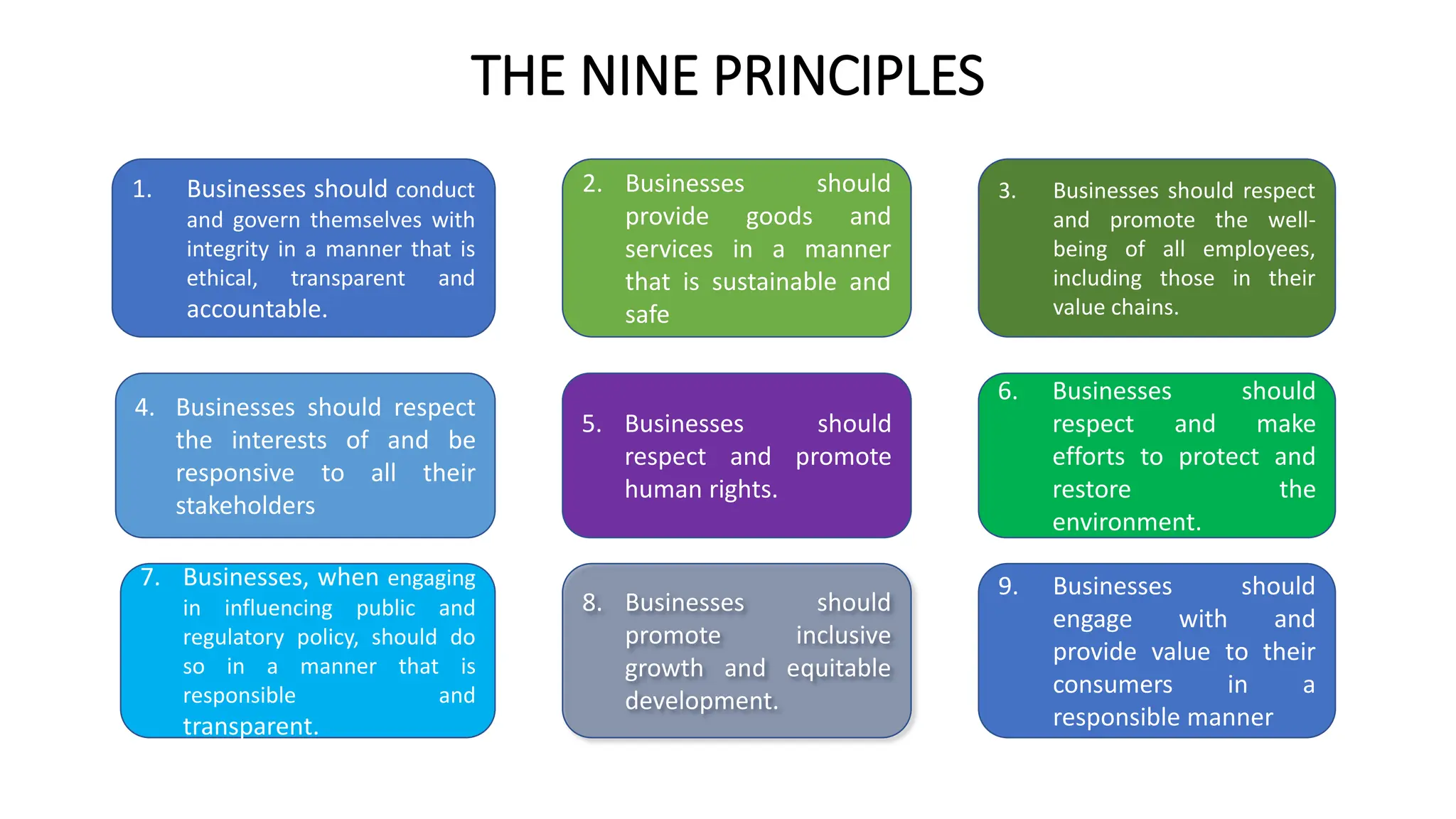
THE NINE PRINCIPLES
1. Businesses should conduct
and govern themselves with
integrity in a manner that is
ethical, transparent and
accountable.
2. Businesses should
provide goods and
services in a manner
that is sustainable and
safe
3. Businesses should respect
and promote the well-
being of all employees,
including those in their
value chains.
4. Businesses should respect
the interests of and be
responsive to all their
stakeholders
5. Businesses should
respect and promote
human rights.
6. Businesses should
respect and make
efforts to protect and
restore the
environment.
7. Businesses, when engaging
in influencing public and
regulatory policy, should do
so in a manner that is
responsible and
transparent.
8. Businesses should
promote inclusive
growth and equitable
development.
9. Businesses should
engage with and
provide value to their
consumers in a
responsible manner
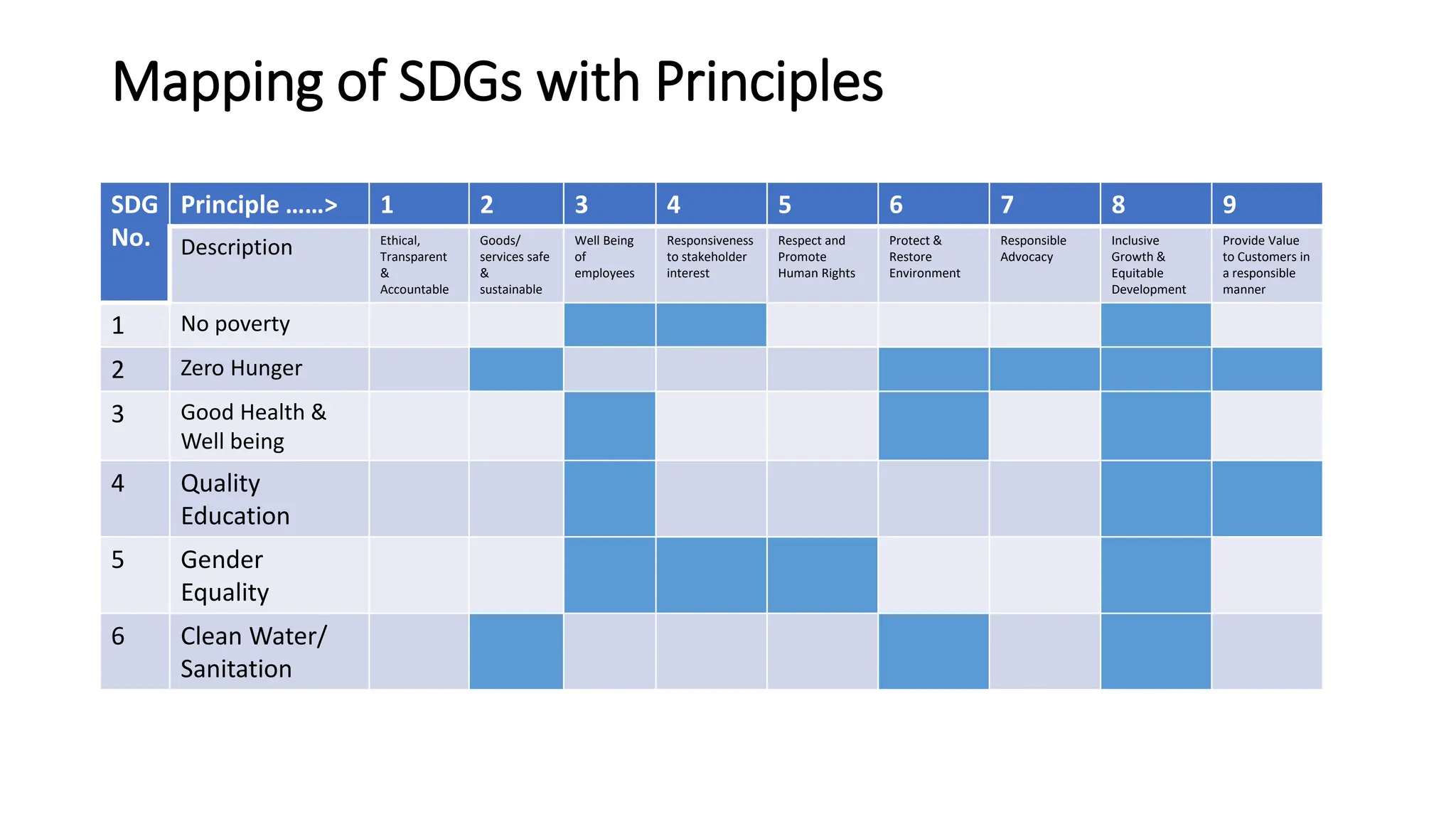
Mapping of SDGs with Principles
SDG
No.
Principle ……> 1 2 3 4 5 6 7 8 9
Description Ethical,
Transparent
&
Accountable
Goods/
services safe
&
sustainable
Well Being
of
employees
Responsiveness
to stakeholder
interest
Respect and
Promote
Human Rights
Protect &
Restore
Environment
Responsible
Advocacy
Inclusive
Growth &
Equitable
Development
Provide Value
to Customers in
a responsible
manner
1 No poverty
2 Zero Hunger
3 Good Health &
Well being
4 Quality
Education
5 Gender
Equality
6 Clean Water/
Sanitation
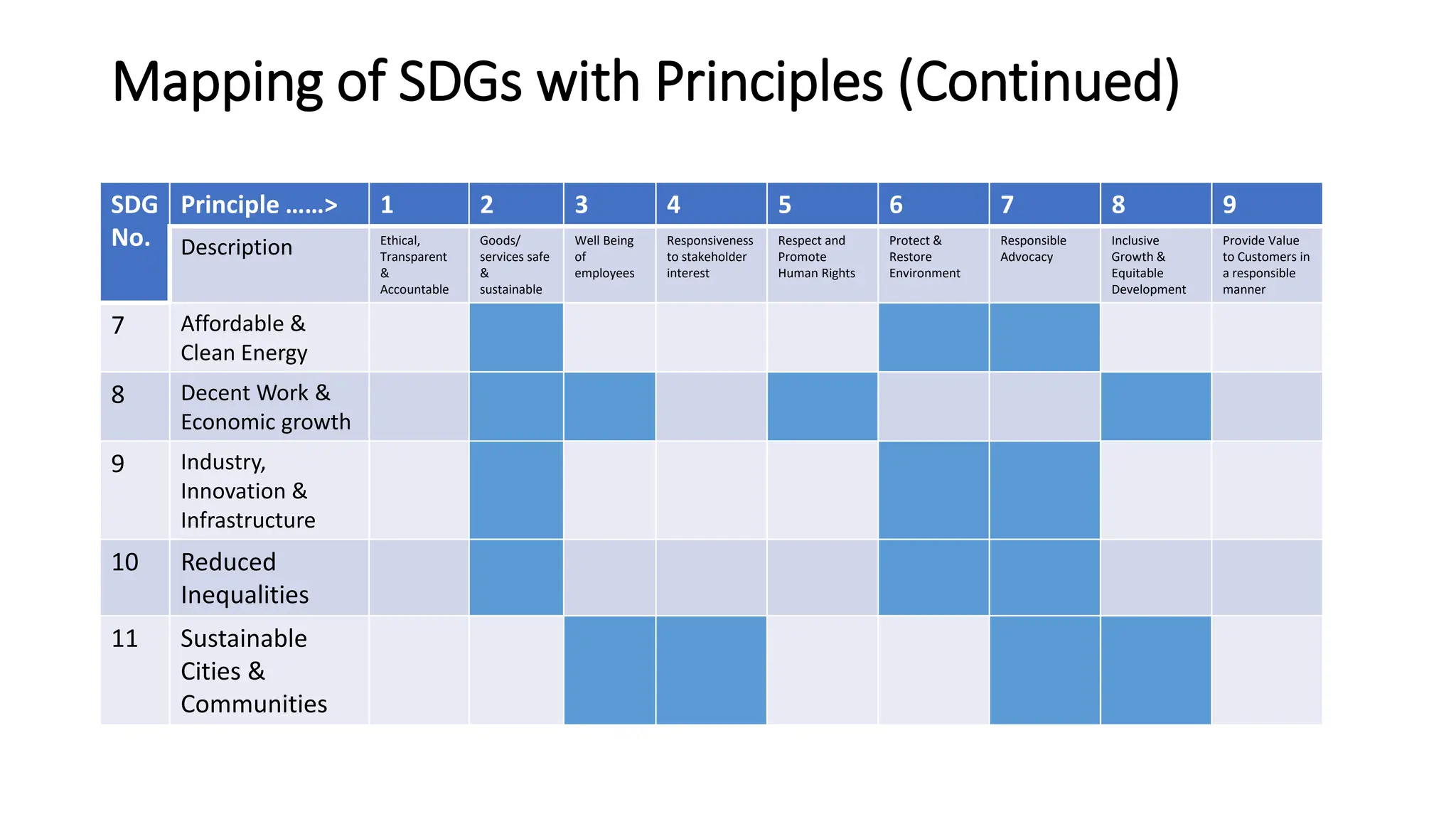
Mapping of SDGs with Principles (Continued)
SDG
No.
Principle ……> 1 2 3 4 5 6 7 8 9
Description Ethical,
Transparent
&
Accountable
Goods/
services safe
&
sustainable
Well Being
of
employees
Responsiveness
to stakeholder
interest
Respect and
Promote
Human Rights
Protect &
Restore
Environment
Responsible
Advocacy
Inclusive
Growth &
Equitable
Development
Provide Value
to Customers in
a responsible
manner
7 Affordable &
Clean Energy
8 Decent Work &
Economic growth
9 Industry,
Innovation &
Infrastructure
10 Reduced
Inequalities
11 Sustainable
Cities &
Communities
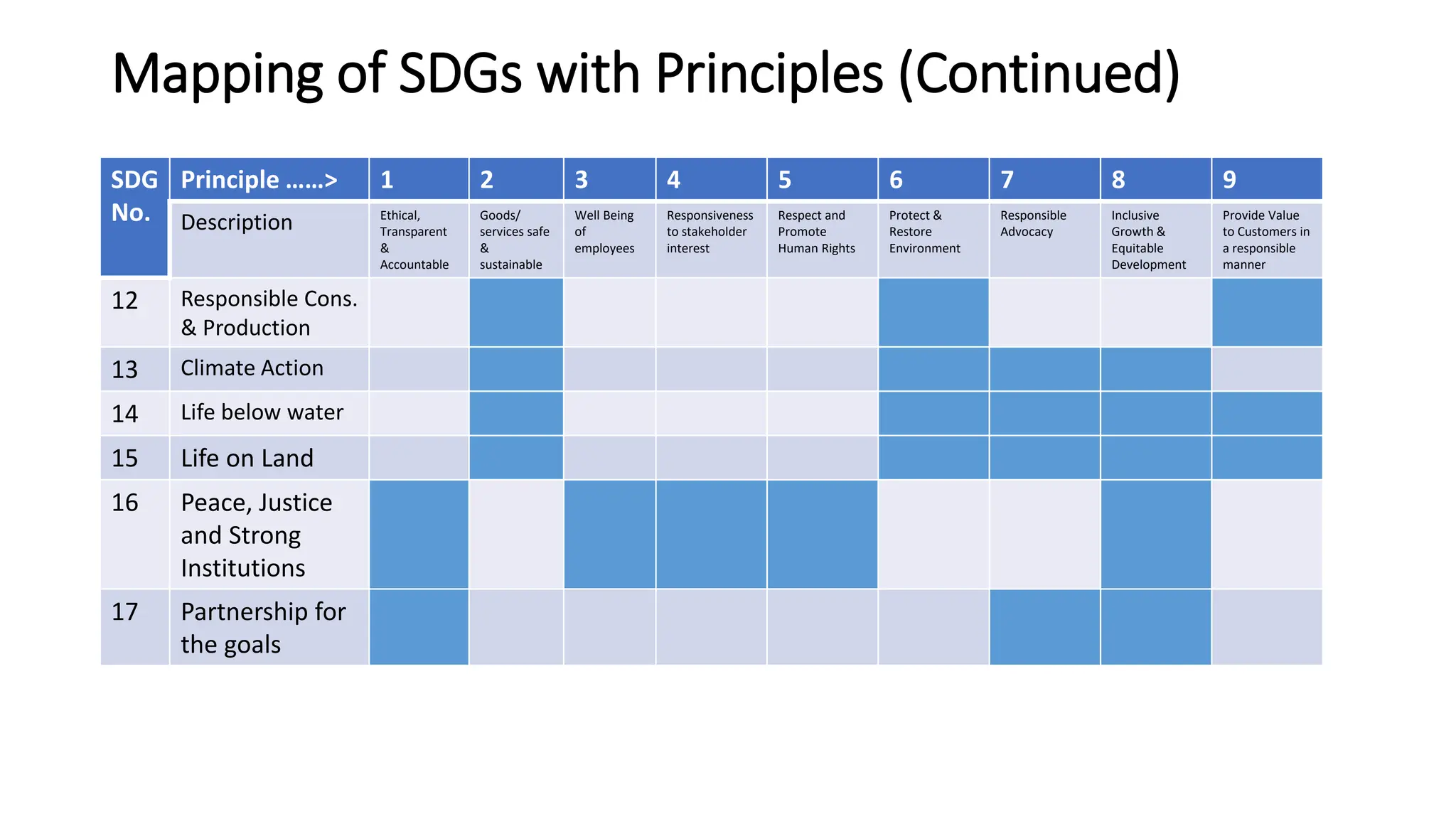
Mapping of SDGs with Principles (Continued)
SDG
No.
Principle ……> 1 2 3 4 5 6 7 8 9
Description Ethical,
Transparent
&
Accountable
Goods/
services safe
&
sustainable
Well Being
of
employees
Responsiveness
to stakeholder
interest
Respect and
Promote
Human Rights
Protect &
Restore
Environment
Responsible
Advocacy
Inclusive
Growth &
Equitable
Development
Provide Value
to Customers in
a responsible
manner
12 Responsible Cons.
& Production
13 Climate Action
14 Life below water
15 Life on Land
16 Peace, Justice
and Strong
Institutions
17 Partnership for
the goals
EMERGING COMPLIANCE
FRAMEWORK
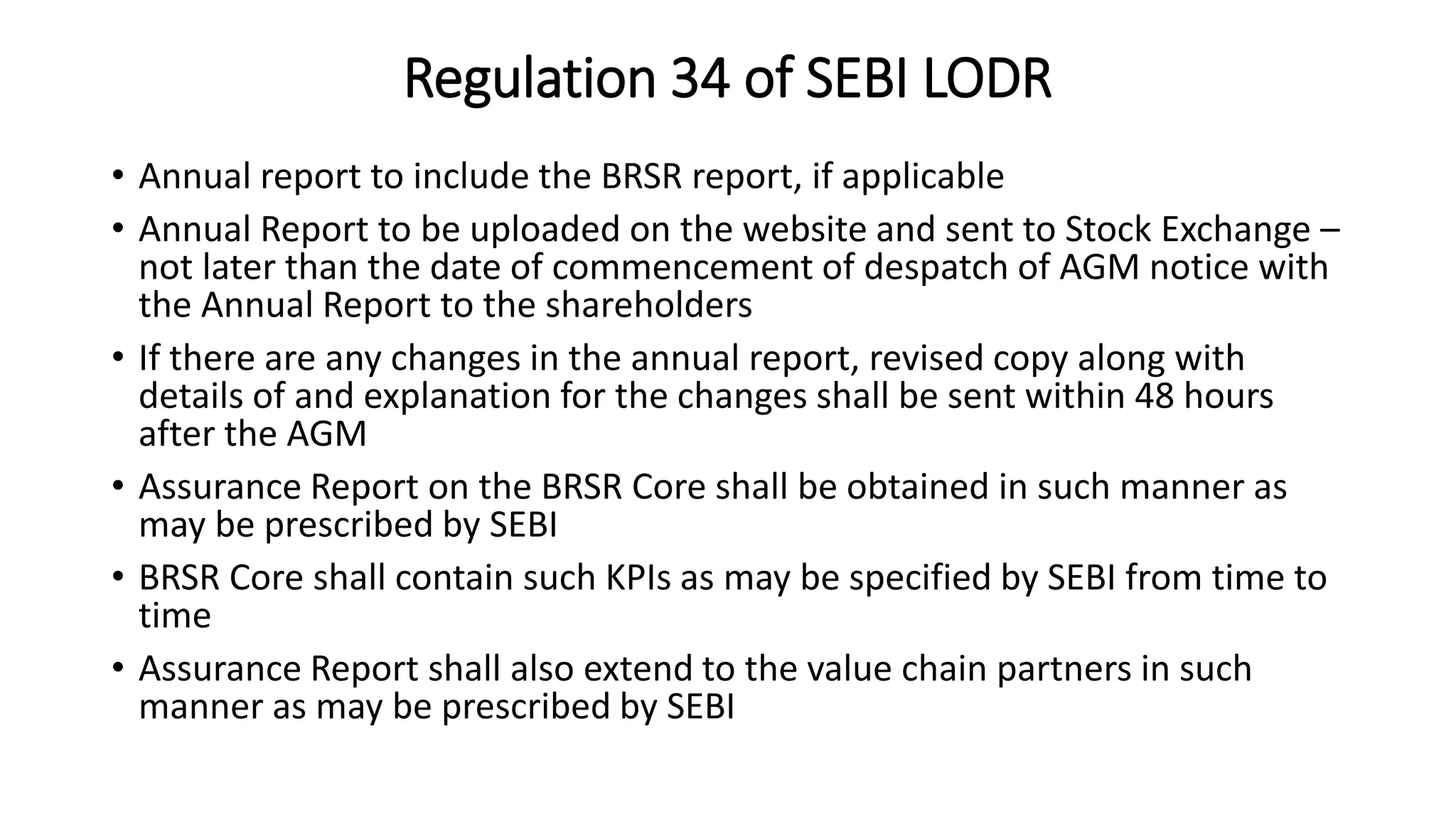
Regulation 34 of SEBI LODR
• Annual report to include the BRSR report, if applicable
• Annual Report to be uploaded on the website and sent to Stock Exchange –
not later than the date of commencement of despatch of AGM notice with
the Annual Report to the shareholders
• If there are any changes in the annual report, revised copy along with
details of and explanation for the changes shall be sent within 48 hours
after the AGM
• Assurance Report on the BRSR Core shall be obtained in such manner as
may be prescribed by SEBI
• BRSR Core shall contain such KPIs as may be specified by SEBI from time to
time
• Assurance Report shall also extend to the value chain partners in such
manner as may be prescribed by SEBI
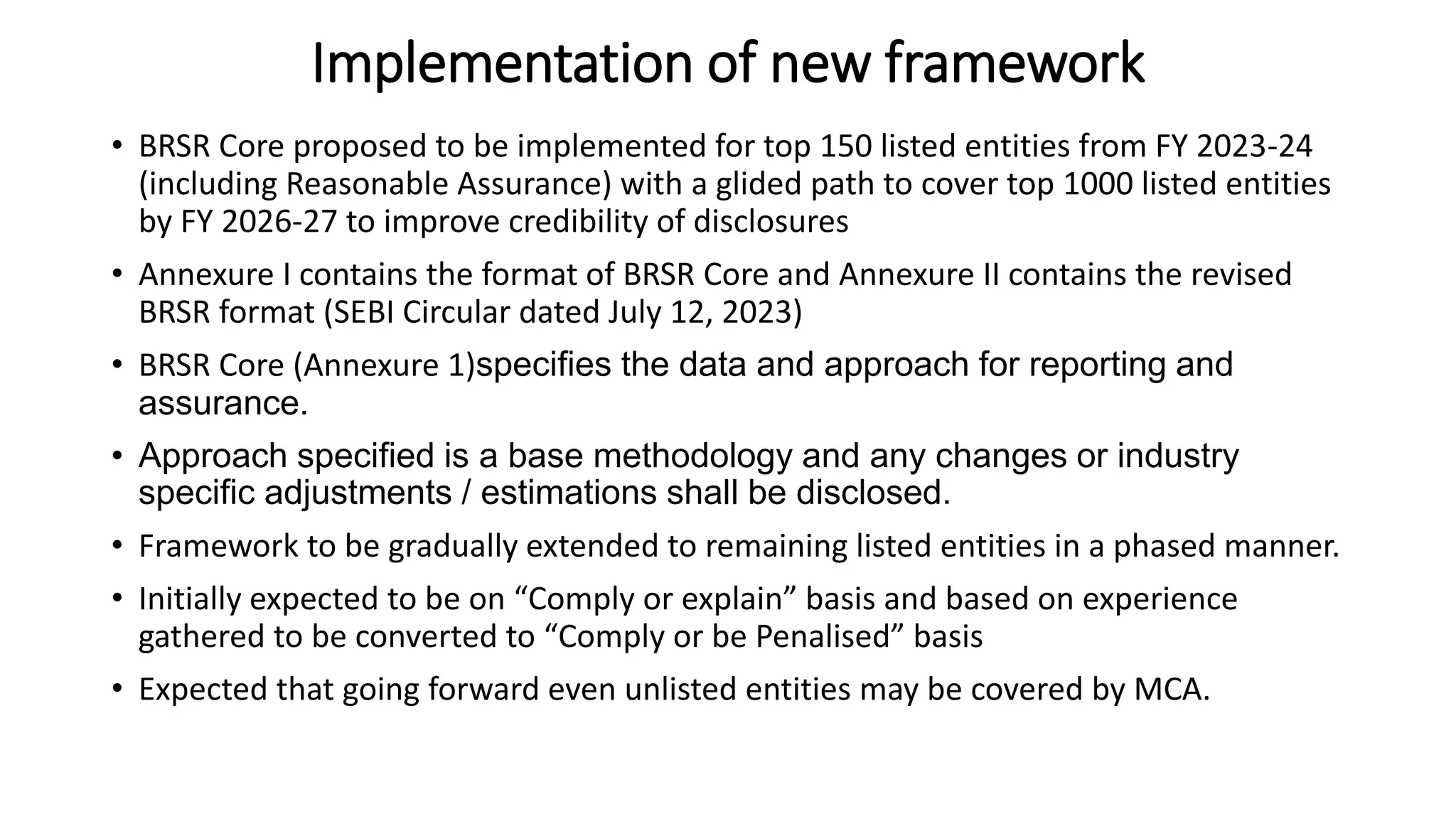
Implementation of new framework
• BRSR Core proposed to be implemented for top 150 listed entities from FY 2023-24
(including Reasonable Assurance) with a glided path to cover top 1000 listed entities
by FY 2026-27 to improve credibility of disclosures
• Annexure I contains the format of BRSR Core and Annexure II contains the revised
BRSR format (SEBI Circular dated July 12, 2023)
• BRSR Core (Annexure 1)specifies the data and approach for reporting and
assurance.
• Approach specified is a base methodology and any changes or industry
specific adjustments / estimations shall be disclosed.
• Framework to be gradually extended to remaining listed entities in a phased manner.
• Initially expected to be on “Comply or explain” basis and based on experience
gathered to be converted to “Comply or be Penalised” basis
• Expected that going forward even unlisted entities may be covered by MCA.
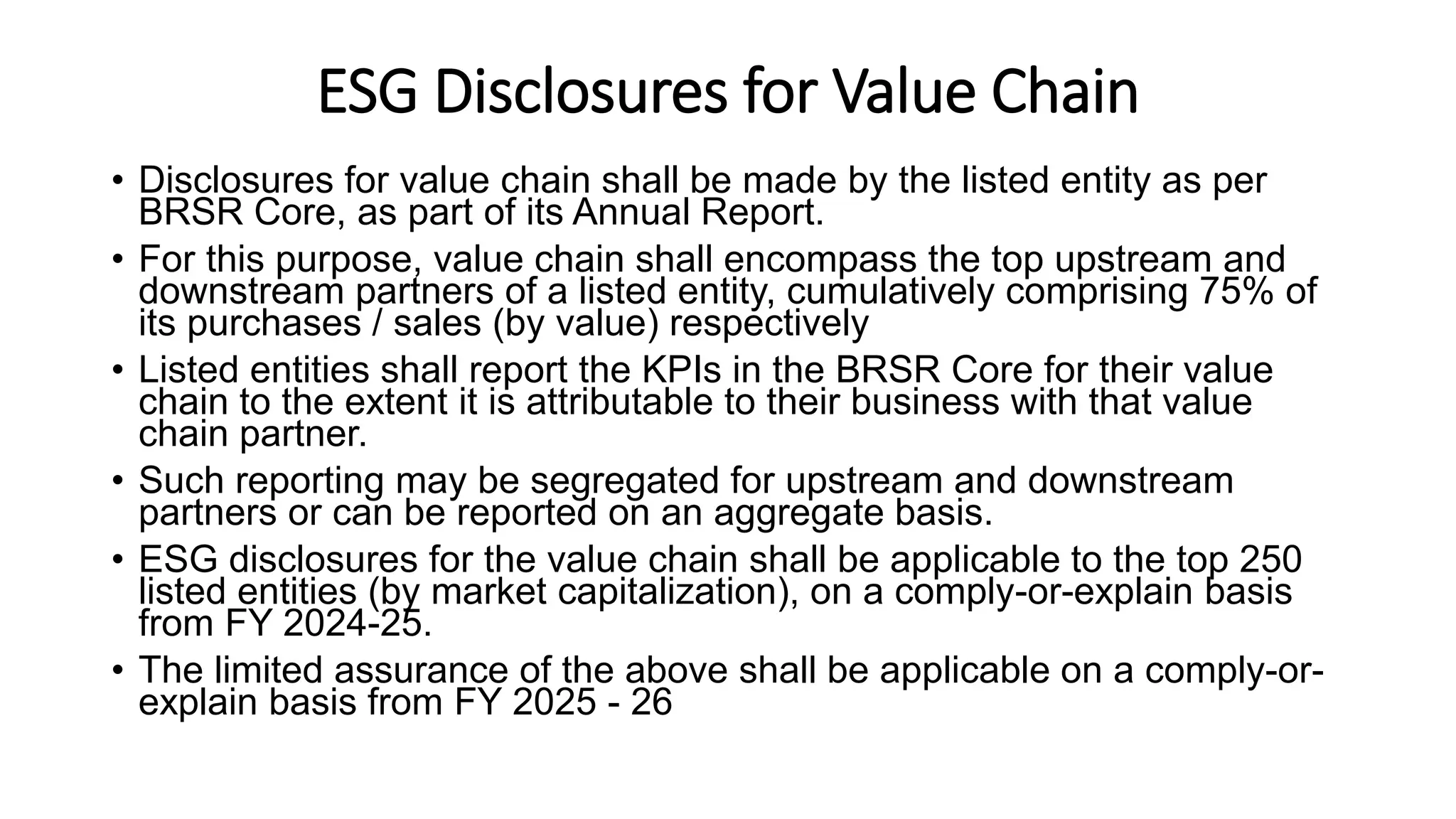
ESG Disclosures for Value Chain
• Disclosures for value chain shall be made by the listed entity as per
BRSR Core, as part of its Annual Report.
• For this purpose, value chain shall encompass the top upstream and
downstream partners of a listed entity, cumulatively comprising 75% of
its purchases / sales (by value) respectively
• Listed entities shall report the KPIs in the BRSR Core for their value
chain to the extent it is attributable to their business with that value
chain partner.
• Such reporting may be segregated for upstream and downstream
partners or can be reported on an aggregate basis.
• ESG disclosures for the value chain shall be applicable to the top 250
listed entities (by market capitalization), on a comply-or-explain basis
from FY 2024-25.
• The limited assurance of the above shall be applicable on a comply-or-
explain basis from FY 2025 - 26
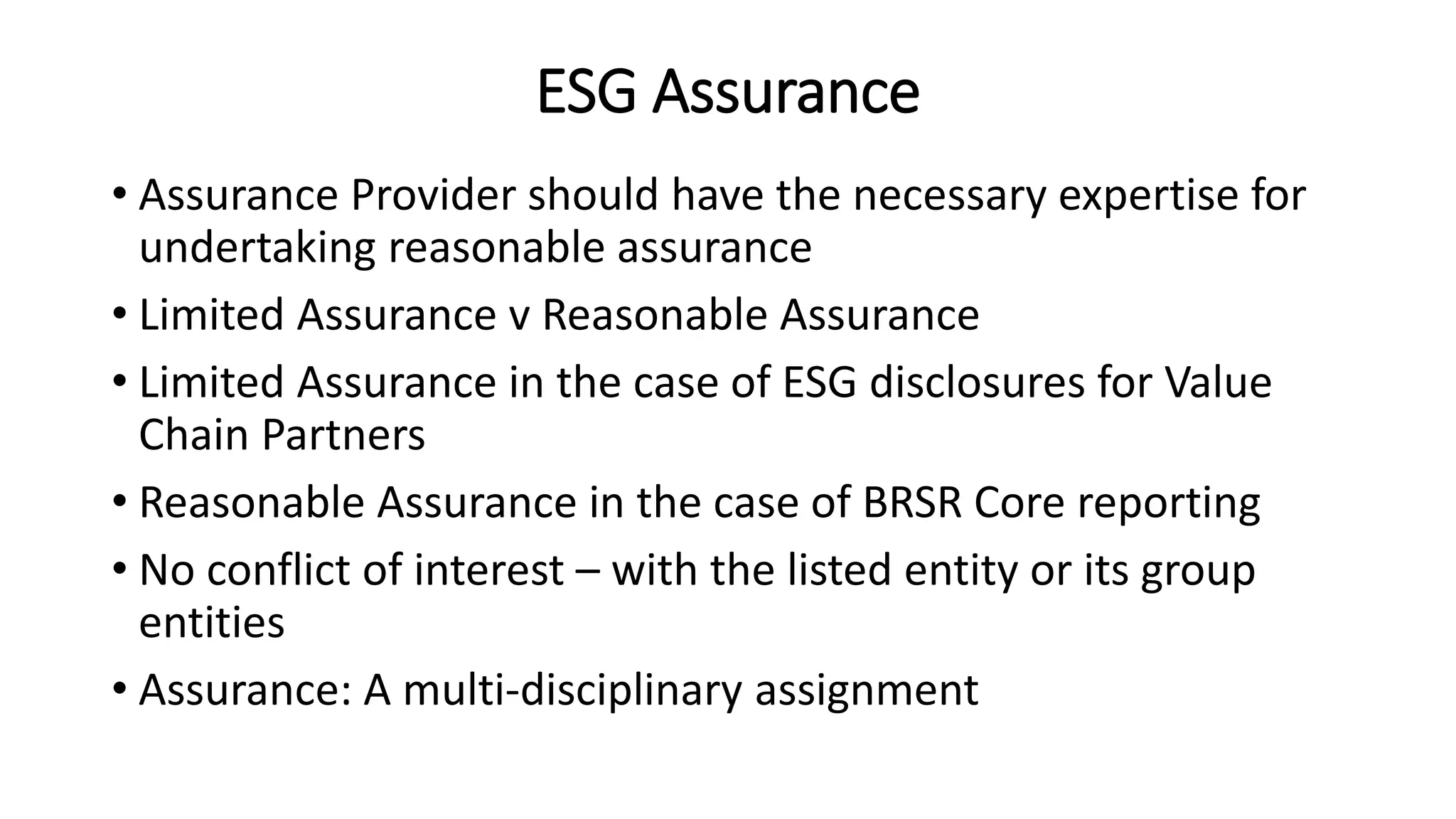
ESG Assurance
• Assurance Provider should have the necessary expertise for
undertaking reasonable assurance
• Limited Assurance v Reasonable Assurance
• Limited Assurance in the case of ESG disclosures for Value
Chain Partners
• Reasonable Assurance in the case of BRSR Core reporting
• No conflict of interest – with the listed entity or its group
entities
• Assurance: A multi-disciplinary assignment
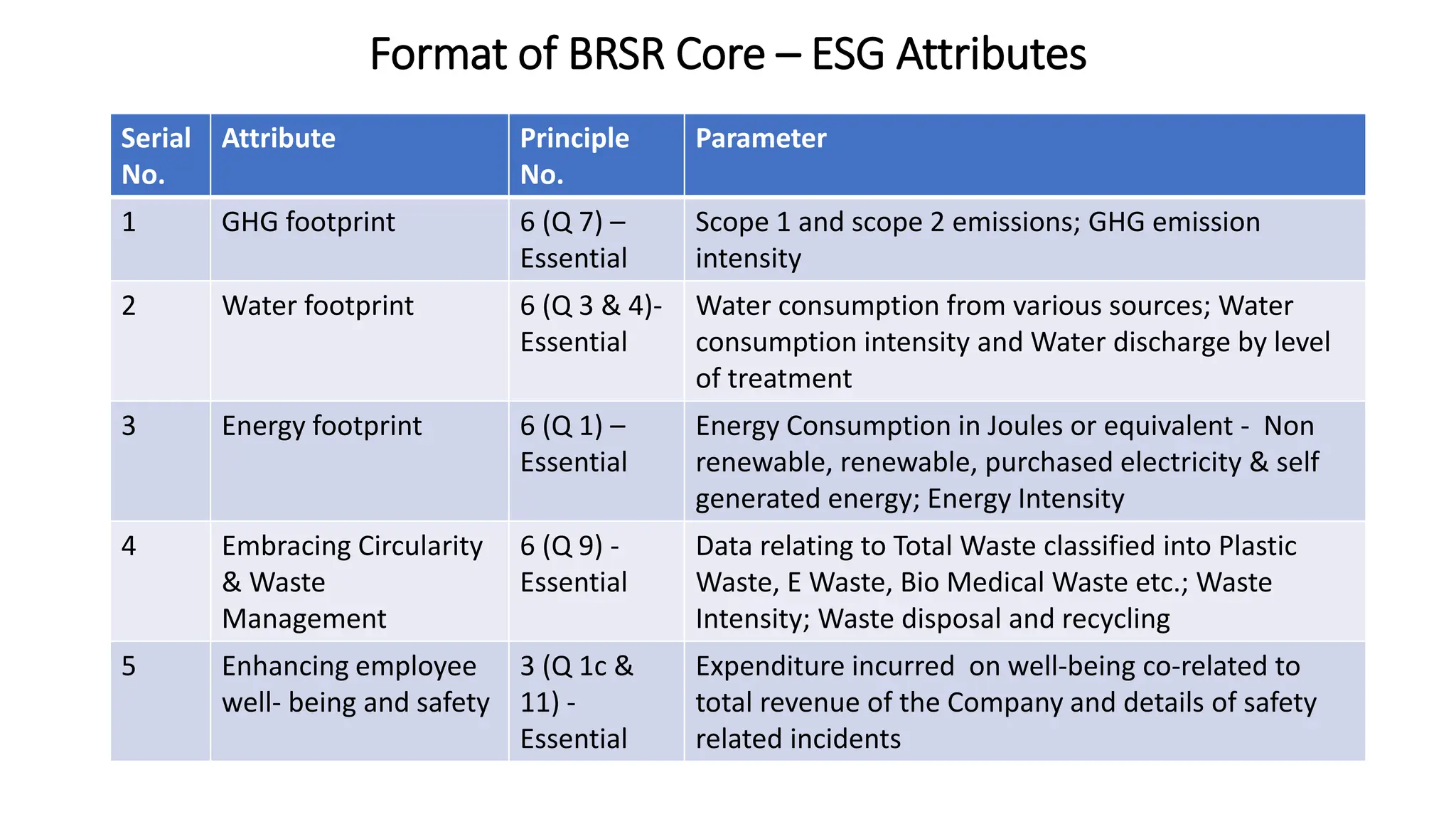
Format of BRSR Core – ESG Attributes
Serial
No.
Attribute Principle
No.
Parameter
1 GHG footprint 6 (Q 7) –
Essential
Scope 1 and scope 2 emissions; GHG emission
intensity
2 Water footprint 6 (Q 3 & 4)-
Essential
Water consumption from various sources; Water
consumption intensity and Water discharge by level
of treatment
3 Energy footprint 6 (Q 1) –
Essential
Energy Consumption in Joules or equivalent - Non
renewable, renewable, purchased electricity & self
generated energy; Energy Intensity
4 Embracing Circularity
& Waste
Management
6 (Q 9) -
Essential
Data relating to Total Waste classified into Plastic
Waste, E Waste, Bio Medical Waste etc.; Waste
Intensity; Waste disposal and recycling
5 Enhancing employee
well- being and safety
3 (Q 1c &
11) -
Essential
Expenditure incurred on well-being co-related to
total revenue of the Company and details of safety
related incidents
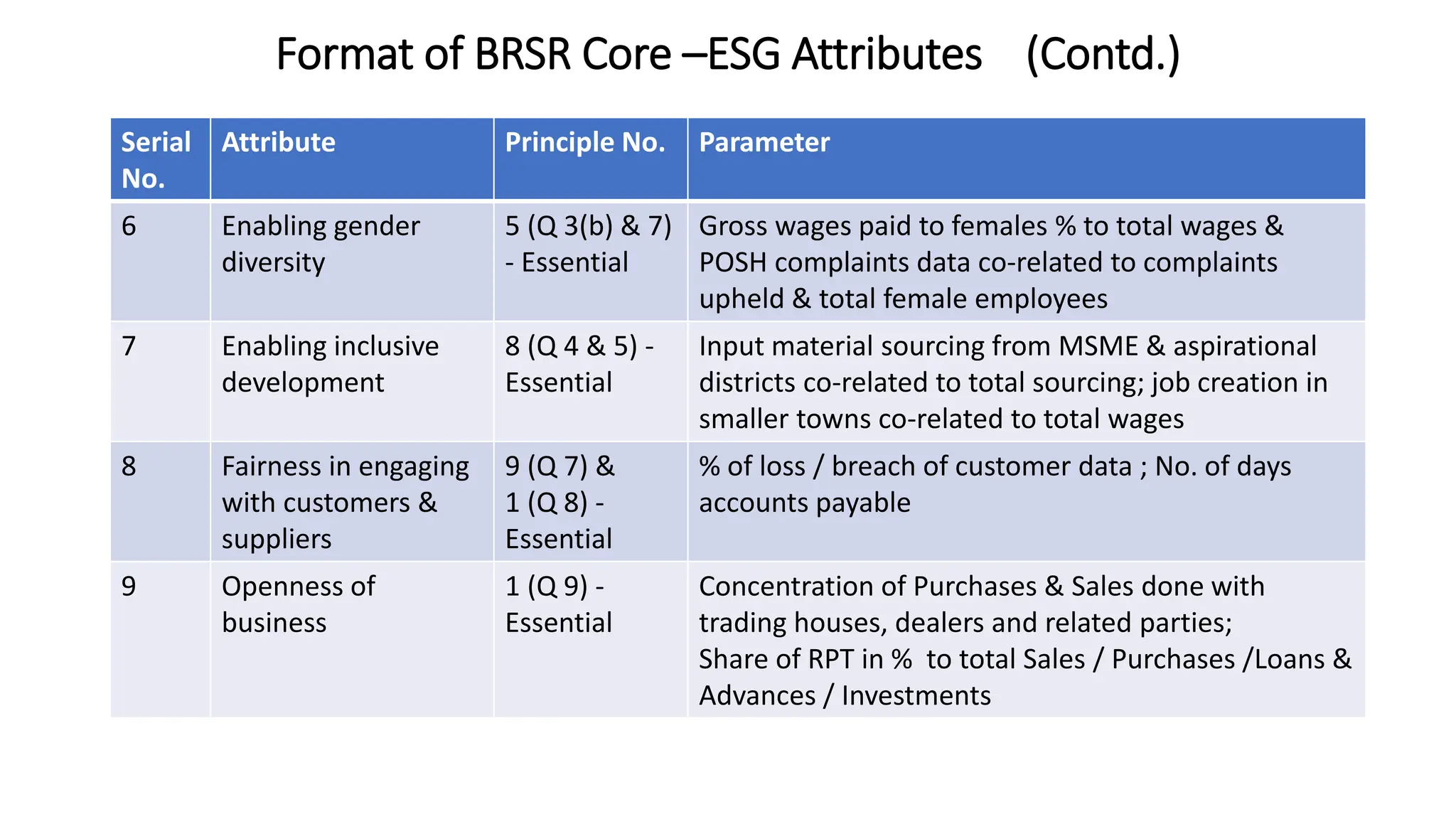
Format of BRSR Core –ESG Attributes (Contd.)
Serial
No.
Attribute Principle No. Parameter
6 Enabling gender
diversity
5 (Q 3(b) & 7)
- Essential
Gross wages paid to females % to total wages &
POSH complaints data co-related to complaints
upheld & total female employees
7 Enabling inclusive
development
8 (Q 4 & 5) -
Essential
Input material sourcing from MSME & aspirational
districts co-related to total sourcing; job creation in
smaller towns co-related to total wages
8 Fairness in engaging
with customers &
suppliers
9 (Q 7) &
1 (Q 8) -
Essential
% of loss / breach of customer data ; No. of days
accounts payable
9 Openness of
business
1 (Q 9) -
Essential
Concentration of Purchases & Sales done with
trading houses, dealers and related parties;
Share of RPT in % to total Sales / Purchases /Loans &
Advances / Investments
ESG RATING PROVIDERS (ERP)
Regulatory Framework for ERP
• SEBI Master Circular Ref SEBI/HO/DDHS/POD2/P/CIR/2023/ 121 dated
July 12, 2023
• The cited Master Circular prescribes the procedural / disclosure requirements
and obligations of the CRAs which is intended to enable the industry and
other users to have access to all the applicable directions to ERPs at one
place
• Securities and Exchange Board of India (Credit Rating Agencies)
Regulations, 1999 (“CRA Regulations” as amended with effect from July 4,
2023) prescribes
• guidelines for registration of ERPs,
• general obligations of ERP,
• Manner of inspection of ERP and
• Code of Conduct applicable to ERP
Types of Ratings
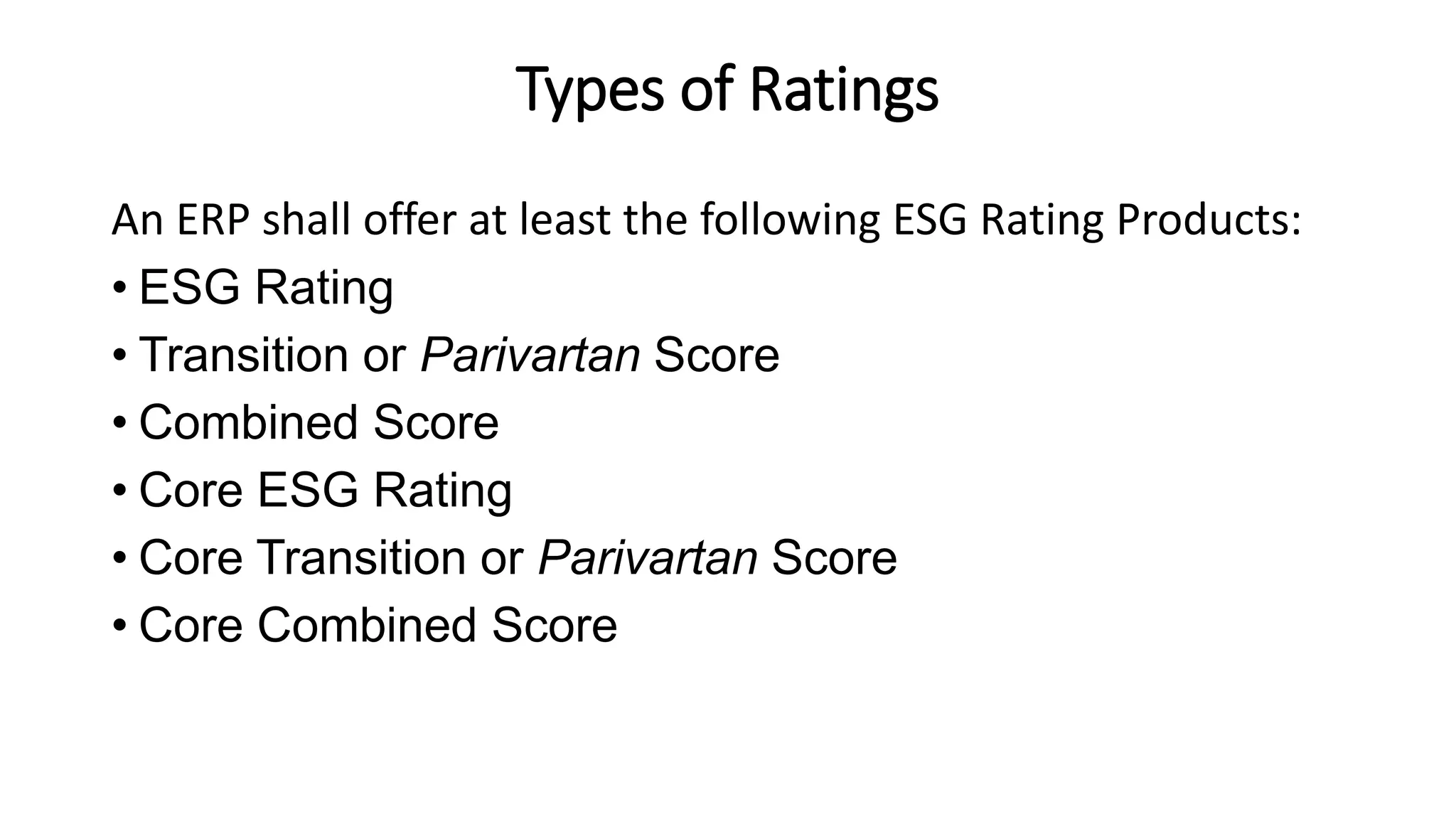
An ERP shall offer at least the following ESG Rating Products:
• ESG Rating
• Transition or Parivartan Score
• Combined Score
• Core ESG Rating
• Core Transition or Parivartan Score
• Core Combined Score
Manner of conducting Internal Audit of ERP
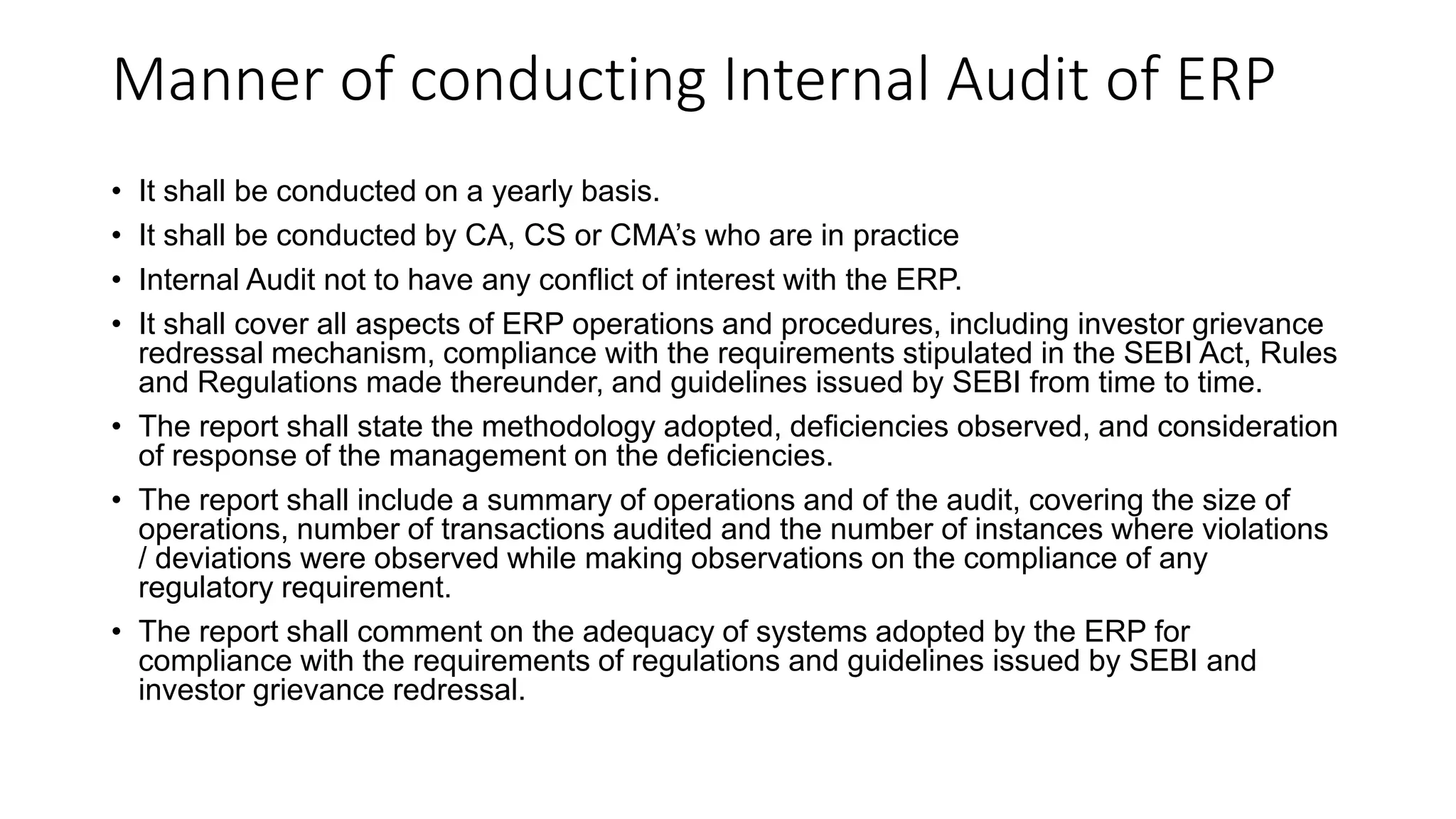
• It shall be conducted on a yearly basis.
• It shall be conducted by CA, CS or CMA’s who are in practice
• Internal Audit not to have any conflict of interest with the ERP.
• It shall cover all aspects of ERP operations and procedures, including investor grievance
redressal mechanism, compliance with the requirements stipulated in the SEBI Act, Rules
and Regulations made thereunder, and guidelines issued by SEBI from time to time.
• The report shall state the methodology adopted, deficiencies observed, and consideration
of response of the management on the deficiencies.
• The report shall include a summary of operations and of the audit, covering the size of
operations, number of transactions audited and the number of instances where violations
/ deviations were observed while making observations on the compliance of any
regulatory requirement.
• The report shall comment on the adequacy of systems adopted by the ERP for
compliance with the requirements of regulations and guidelines issued by SEBI and
investor grievance redressal.
Eligibility for conducting Internal Audit
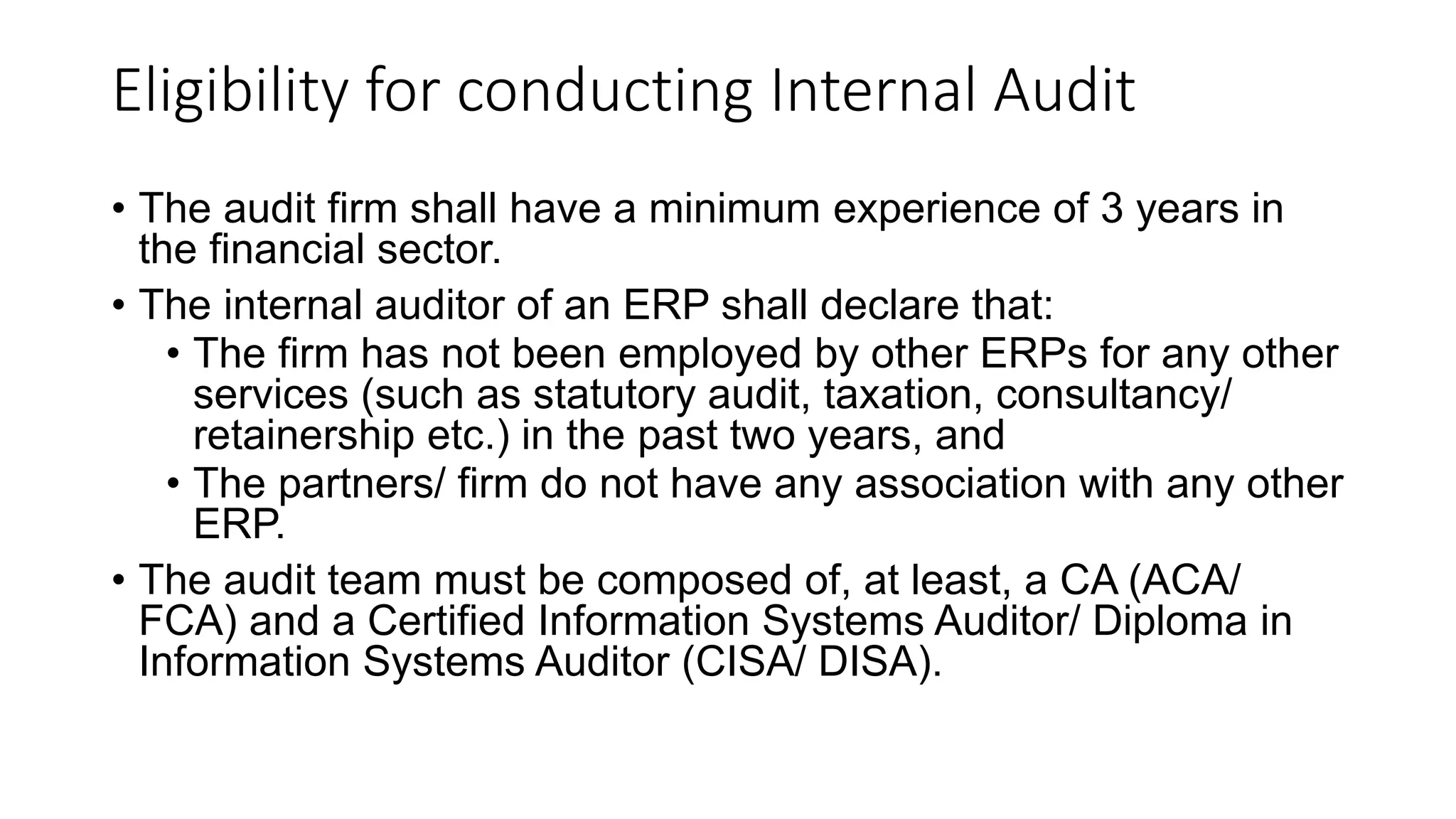
• The audit firm shall have a minimum experience of 3 years in
the financial sector.
• The internal auditor of an ERP shall declare that:
• The firm has not been employed by other ERPs for any other
services (such as statutory audit, taxation, consultancy/
retainership etc.) in the past two years, and
• The partners/ firm do not have any association with any other
ERP.
• The audit team must be composed of, at least, a CA (ACA/
FCA) and a Certified Information Systems Auditor/ Diploma in
Information Systems Auditor (CISA/ DISA).
Scope of Internal Audit
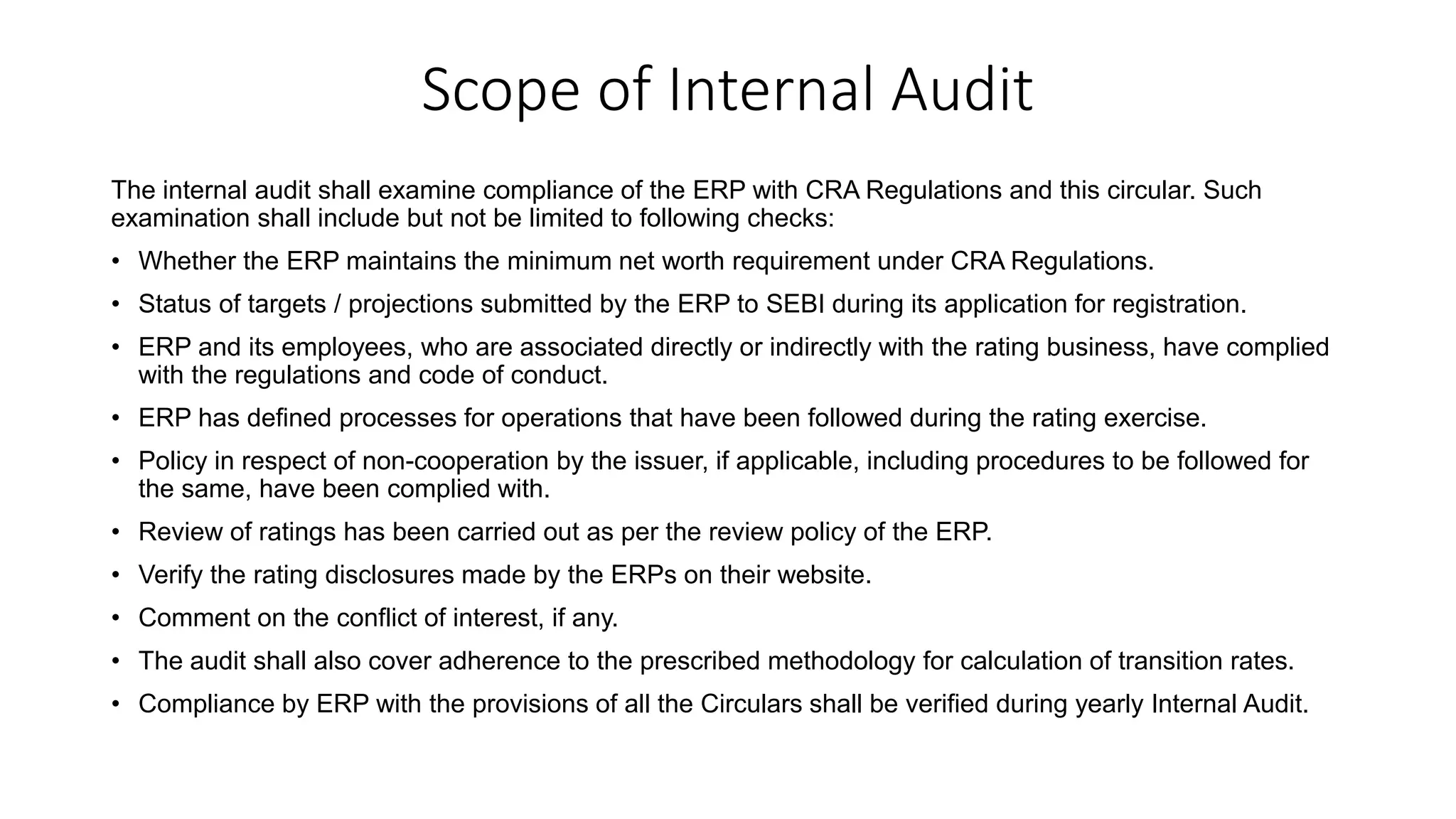
The internal audit shall examine compliance of the ERP with CRA Regulations and this circular. Such
examination shall include but not be limited to following checks:
• Whether the ERP maintains the minimum net worth requirement under CRA Regulations.
• Status of targets / projections submitted by the ERP to SEBI during its application for registration.
• ERP and its employees, who are associated directly or indirectly with the rating business, have complied
with the regulations and code of conduct.
• ERP has defined processes for operations that have been followed during the rating exercise.
• Policy in respect of non-cooperation by the issuer, if applicable, including procedures to be followed for
the same, have been complied with.
• Review of ratings has been carried out as per the review policy of the ERP.
• Verify the rating disclosures made by the ERPs on their website.
• Comment on the conflict of interest, if any.
• The audit shall also cover adherence to the prescribed methodology for calculation of transition rates.
• Compliance by ERP with the provisions of all the Circulars shall be verified during yearly Internal Audit.
THANK YOU

conceptual_framework_of_esg222222222.pdf

  • 1.
    SKY IS THELIMIT PRESENTATION ON CONCEPTUAL FRAMEWORK OF ESG FOR THANE CHAPTER & WIRC OF ICSI NOVEMBER 5, 2023 By CS A Sekar a.sekar.cs@gmail.com Cell : 98202-29134
  • 3.
    SCOPE, GAMUT ANDCONCERNS OF ESG ENVIRONMENTAL SOCIAL GOVERNANCE Greenhouse Gas (CHG) Emissions Social Well-Being, Health, Security and Safety Business Ethics and Ethical Standards Climate Change Working Conditions Composition of Board, Board Process, Diversity and Governance Water Management Employee benefits Structures of Board Committees Recycling Process Gender Diversity and Inclusion Risk Management Systems Deforestation Respect of Human Rights Stakeholder engagement Emergency Preparedness and Disaster Management Impact on Local communities Anti-Corruption and Anti Bribery policies
  • 4.
    TRIPLE BOTTOM LINE(TBL) ACCOUNTING Source: https://blog.chainpoint.com/blog/triple-bottom-line-measuring-social-and-environmental-kpis
  • 5.
    TRIPLE BOTTOM LINE(TBL) ACCOUNTING It consists of three Ps: profit, people and planet The phrase “the triple bottom line” was first coined in 1994 by John Elkington, the founder of a British consultancy called SustainAbility The triple bottom line (TBL) is an accounting framework that includes social, environmental and financial results as bottom lines
  • 6.
    TBL v ESGv SUSTAINABILITY • TBL is an accounting and reporting framework having the 3 P’s as its components – PEOPLE, PLANET AND PROFITS • ESG refers to a framework of responsible investing that considers Environmental (E), Social (S) and Governance (G) in addition to financial factors when making investment decisions. • Sustainable development is development that meets the needs of the present, without compromising the ability of future generations to meet their own needs Sustainability = TBL + ESG TBL = Profits as per GAAP + Environment (E) & Social (S) benefits ESG = E & S + Governance (G)
  • 7.
  • 8.
    ESG – THEPATHWAY TO SDG’S • The 2015 Paris Climate Agreement - commitment from the 193 signatory countries to achieve reduction in the quantum of carbon emissions by 55 gigatons by 2030 at the COP-21. • India is one of the 193 countries which has accepted the target to achieve the Sustainable Development Goals (SDG’s) by 2030 • In the words of our Hon’ble Prime Minister, Shri Narendra Modi, referring to SDG’s “These goals reflect our evolving understanding of the social, economic and environmental linkages that define our lives.”
  • 9.
    THE 17 SDG’S SDGEnvironment Social Governance SDG Environment Social Governance 1 No Poverty * 10 Reduced Inequality * 2 Zero Hunger * 11 Sustainable cities and Community * * 3 Good Health / Well Being * 12Responsible Consumption & Production * * * 4 Quality Education * 13 Climate Action * * 5 Gender Equality * * 14 Life Below Water * 6 Clean Water & Sanitation * * 15 Life on Land * 7 Affordable & Clean Energy * 16 Peace and Justice Strong Institutions * * 8 Decent Work & Economic Growth * * 17 Partnership to achieve Goals * 9 Industry, Innovation & Infrastructure * * * Total 1 to 17 8 11 8
  • 10.
    GLOBAL ACHIEVEMENT OFSDG’S - 2023 RANK COUNTRY SCORE RANK COUNTRY SCORE 1 FINLAND 86.76 7 NORWAY 82.00 2 SWEDEN 85.98 8 CZECHIA 81.87 3 DENMARK 85.68 9 POLAND 81.80 4 GERMANY 83.36 10 ESTONIA 81.68 5 AUSTRIA 82.28 11 UNITED KINGDOM 81.65 6 FRANCE 82.05 12 CROATIA 81.50 U.S.A. ranks 39 with a score of 75.91 India ranks 112 with a score of 63.45 (up 9 places from rank 121 in 2021) Source: https://dashboards.sdgindex.org/rankings
  • 11.
    INDIA’S PROGRESS INSDG’S – SDG INDIA INDEX 2020-21 TOP SEVEN STATES BOTTOM SEVEN STATES RANK STATE SCORE RANK STATE SCORE 1 Kerala 75 BOTTOM Bihar 52 2 Tamil Nadu 74 BOTTOM+1 Jharkhand 56 3 Himachal Pradesh 74 BOTTOM+2 Assam 57 4 Andhra Pradesh 72 BOTTOM+3 Uttar Pradesh 60 5 Uttarakhand 72 BOTTOM+4 Arunachal Pradesh 60 6 Goa 72 BOTTOM+5 Meghalaya 60 7 Karnataka 72 BOTTOM+6 Rajasthan 60 Top 2 UT’s - Chandigarh (79), Puduchery (68) INDIA SCORE - 66 Source: https://www.niti.gov.in/reports-sdg
  • 12.
    Why ESG Risksmatter • ESG negative scenarios are getting more expensive and damaging. According to recent estimates by the Bank of America (BofA) Global Research team, “ESG disputes” have cost S&P 500 corporations more than $600 billion in market capitalization in only the past seven years. • Two known examples are: • Pacific Gas & Electric, Northern California faced criminal prosecution for two wildfires caused by old power lines – Cost US$ 55 million • Recall of millions of Volkswagen vehicles after admission of fake emission testing. Fines, Penalties, buyback costs and financial settlements – Cost US$35 billion • Profitability and even ability to survive will be significantly impacted, if ESG risks are not properly addressed • Prevention, Adaptation and Mitigation are better long-term strategies from sustainability point of view compared to ignoring the ESG risks • ESG risks are relevant to enterprises, irrespective of their size
  • 13.
    Possible actions tomanage ESG risks 8 point action plan: • Developing the ESG approach • Establishing the risk appetite • Integrating the ESG issues in the Risk Management System • Establishing the roles and responsibilities for perspective on ESG issues • Escalating the ESG risks to the decision makers • Detecting and analysing the ESG risks involved • Making decisions with respect to the ESG risks • Reporting on the ESG risks
  • 14.
    GLOBAL ESG FRAMEWORK •Global Reporting Initiative (GRI) • Value Reporting Foundation (VRF) • SASB-Sustainability and Accounting Standard Boards • CDP-Carbon Disclosure Project • TCFD-Task Force on Climate-related Financial Disclosures • Climate Disclosure Standards Board • UN Principles for Responsible Investment(PRI) • UN Sustainable Development Goals (SDG) • International Sustainability Standards Board (ISSB)
  • 15.
    OVERVIEW OF GRIAND VALUE REPORTING FOUNDATION (VRF)
  • 16.
    ABOUT GRI ANDWHAT IT IS • GRI stands for “Global Reporting Initiative” • An international independent standards organization headquartered in Amsterdam, Netherlands - helps businesses, governments and other organizations understand and communicate their impacts -on issues such as climate change, human rights and corruption. • About 100 countries use the GRI guidelines. • The GRI Standards - A modular system of interconnected standards. - Allows organizations to publicly report the impacts of their activities - Global common language to communicate those impacts
  • 17.
    STRUCTURE OF GRISTANDARDS • Universal Standards - GRI 1 (Foundation Standards): outlines the purpose, clarifies critical concepts and explains how to use the standards. Also specifies the principles – such as accuracy, balance, verifiability - GRI 2 (General Disclosures): details about organisation’s structure, reporting practices, activities, workers, governance, strategy, policies, practices and stakeholder engagements - GRI 3 (Material Topics) : Determination of the topics most relevant to its impacts, process for determining its material topics and how these are managed. • Sector Standards: Being developed for about 40 sectors • Topic Standards: 33 topic standards e.g. waste, occupational health, safety – Overview of topic and how an organisation manages its associated impact
  • 18.
    VALUE REPORTING FOUNDATION- VRF • VRF is a global non-profit organization that offers a comprehensive suite of resources designed to help businesses and investors develop a shared understanding of enterprise value - how it is created, preserved and eroded • VRF offers 3 different resources as under: - • Integrated Thinking Principles, which are useful inputs for Board strategy as well as management planning and decision making; • Integrated Reporting Framework (estimated to be used by 75 countries), which provides valuable guidance based on principles for comprehensive ESG reporting and • Sustainable Accounting Standards Board (SASB), which has evolved 77 industry-specific standards that help in identifying the subset of ESG issues most relevant to financial performance in each industry so that the integrated reporting can provide valuable insights into various sustainability issues from the point of view of investors.
  • 19.
  • 20.
    About ISSB • TheInternational Sustainability Standards Board (ISSB) is an independent, private-sector body that develops and approves IFRS Sustainability Disclosure Standards (IFRS SDS). • The ISSB operates under the oversight of the IFRS Foundation. • The ISSB was formed in 2021 following two consultations on • the demand for global sustainability standards and • what role the Foundation might play in the development of such standards • The ISSB released its first two International Sustainability Disclosure Standards (IFRS SDS or the Standards) that become effective for periods beginning on or after 1 January 2024 - IFRS S1 and IFRS S2 • The ISSB brings together the Climate Disclosure Standards Board (CDSB) and the Value Reporting Foundation (VRF)
  • 21.
    IRFS S1 • Themain objective of this Standard is to require disclosure of all information about sustainability-related risks and opportunities that could reasonably be expected to affect a company’s prospects. • S1 provides the basic requirements for sustainability disclosures which should be used with S2 and the future standards to be released. • S1 • Requires disclosure of material information about sustainability related risks and opportunities; • Requires Industry specific disclosures with reference to industry-based SASB standards • Refers to sources to help companies identify sustainability-related risks and opportunities and information (other than those in the scope of S2 – climate related disclosures) • Requires disclosures that enable investors to understand the connections between the sustainability-related risks and opportunities and the sustainability-related financial disclosures and financial statements. • Is GAAP agnostic
  • 22.
    IFRS S2 • IFRSS2 has been developed to capture climate-specific requirements which includes: • Strategy disclosures that distinguish between physical and transitional risks • Disclosure of their plans to respond to climate-related risks and opportunities, • Disclosure of how climate-related targets are set as also any targets it is required to meet under the prevailing law / regulation • Details of scenario analysis conducted by the companies to explain how various climate-related events may impact the business in the future • Climate-related metrics and target disclosures dealing with GHG emissions (Scope 1, Scope 2 and Scope 3) Industry based metrics relevant to the Company Company specific metrics considered by the board or management when
  • 23.
  • 24.
    Product Life CycleConcept • Development • Introduction • Growth • Maturity • Stagnation • Decline / Abandonment
  • 25.
    Life Cycle Assessment– ESG Concept • Life Cycle Assessment (LCA) is a standardized method to evaluate the environmental consequences of a product or activity across its entire life. • Assessing a product’s life cycle includes examining -human impacts -energy -materials -waste at each stage of a product’s life cycle from cradle (the inception of the idea, Design) to the grave (disposal).
  • 26.
    Stages in ProductLife Cycle – ESG Perspective Also called “Cradle to Grave” concept of Product Life Cycle Five Stages: • Raw Material Extraction • Manufacturing & Processing • Transportation • Usage & Retail • Waste Disposal
  • 27.
    Product Life Cycle- Manufacturing
  • 28.
    Adding Sustainability toProduct Life Cycle The 6 Re – Philosophy • RE-think the product and its functions. For example, the product may be used more efficiently • RE-pair. Make the product easy to repair e.g. via modules that can easily be changed • RE-place harmful substances with safer alternatives • RE-use. Design the product for disassembly such that parts can be reused • RE-duce energy, material consumption and socioeconomic impacts throughout a product’s life cycle • RE-cycle. Select materials that can be recycled And extend this thought process to the entire value chain for sustainability impact.
  • 29.
    Stages in LifeCycle Assessment (LCA) STAGES BRIEF DESCRIPTION 1. Goal and Scope Every LCA has boundaries. At this stage, it is necessary to be clear about data needs, data quality requirements, methods to be used to assess impact and interpretation and how the same is reported. 2. Inventory The inventory includes things like emissions, energy requirements and material flows for each process involved. These are the flows into and out of the system that are being studied. The data of these are adjusted depending on the functional unit that is being looked at. This is known as a Life Cycle Inventory (LCI) 3. Impact Assessment The impacts on the environment are calculated. The categories of impacts are chosen and the impacts on them based on the flow of emissions, energy and material from the inventory, are assessed. There are different types of impacts viz. depletion of abiotic resources, global warming, ozone layer depletion, acidification 4. Improvement Assessment Finally, the results are analysed in the context of the goal and scope of the study set out at the beginning. Based on findings, recommendations are given international standards (ISO 14040 and others) place strict limits on what qualifies as an LCA and what you can and can’t do.
  • 30.
    Life Cycle Analysis(LCA) of a Mobile What was used to make the product? (e.g. plastics, metals, fabric How and where was it produced? (in the country or overseas?) How do the processes effect the environment? How was it transported at each stage of the lifecycle? (ship, lorry, train) What packaging is used? What was the product’s impact during the use stage? (use of energy, water) How can it be disposed of? (charity shop, recycled, landfill) Packaging generally accounts for 10% of environmental impact of anything bought
  • 31.
    Uses of LifeCycle Assessment (LCA) An LCA can be used by different people for different things. But it’s all about environmental impact and performance. • Design: what changes can we make to the product to lessen its environmental impact? • Purchasing: which product has the least environmental impact? • Marketing: is this product “greener” than that of the competitors? • Benchmarking: how’s our company doing compared to all the others in our industry? • Tracking: how’s our environmental performance doing this year compared with previous years? • Policy: What initiatives will help improve overall environmental outcomes?
  • 32.
  • 33.
    Phases of ESGMaturity Stages Stage of Maturity Brief Description 1 Least Mature ESG is treated as an unavoidable burden and merely a compliance requirement. Most large organisations are expected to have crossed this stage. 2 Slightly more sustained and shared process Some importance is given to ESG aspects and wherever considered useful but not a great deal important strategically. Some importance to sustainability risk. 3 Strategic Agenda At this stage, management will appreciate a materiality matrix — a graphing of the company’s stakeholders’ primary ESG-related interests and priorities against those of either the business or its stakeholders 4 Brand Building The business and its sustainability leadership have established a refined and documented understanding of where they need to lead in ESG 5 Leadership Position The business leads the ESG agenda in the industry or even across industries
  • 34.
  • 35.
    THE NINE PRINCIPLES 1.Businesses should conduct and govern themselves with integrity in a manner that is ethical, transparent and accountable. 2. Businesses should provide goods and services in a manner that is sustainable and safe 3. Businesses should respect and promote the well- being of all employees, including those in their value chains. 4. Businesses should respect the interests of and be responsive to all their stakeholders 5. Businesses should respect and promote human rights. 6. Businesses should respect and make efforts to protect and restore the environment. 7. Businesses, when engaging in influencing public and regulatory policy, should do so in a manner that is responsible and transparent. 8. Businesses should promote inclusive growth and equitable development. 9. Businesses should engage with and provide value to their consumers in a responsible manner
  • 36.
    Mapping of SDGswith Principles SDG No. Principle ……> 1 2 3 4 5 6 7 8 9 Description Ethical, Transparent & Accountable Goods/ services safe & sustainable Well Being of employees Responsiveness to stakeholder interest Respect and Promote Human Rights Protect & Restore Environment Responsible Advocacy Inclusive Growth & Equitable Development Provide Value to Customers in a responsible manner 1 No poverty 2 Zero Hunger 3 Good Health & Well being 4 Quality Education 5 Gender Equality 6 Clean Water/ Sanitation
  • 37.
    Mapping of SDGswith Principles (Continued) SDG No. Principle ……> 1 2 3 4 5 6 7 8 9 Description Ethical, Transparent & Accountable Goods/ services safe & sustainable Well Being of employees Responsiveness to stakeholder interest Respect and Promote Human Rights Protect & Restore Environment Responsible Advocacy Inclusive Growth & Equitable Development Provide Value to Customers in a responsible manner 7 Affordable & Clean Energy 8 Decent Work & Economic growth 9 Industry, Innovation & Infrastructure 10 Reduced Inequalities 11 Sustainable Cities & Communities
  • 38.
    Mapping of SDGswith Principles (Continued) SDG No. Principle ……> 1 2 3 4 5 6 7 8 9 Description Ethical, Transparent & Accountable Goods/ services safe & sustainable Well Being of employees Responsiveness to stakeholder interest Respect and Promote Human Rights Protect & Restore Environment Responsible Advocacy Inclusive Growth & Equitable Development Provide Value to Customers in a responsible manner 12 Responsible Cons. & Production 13 Climate Action 14 Life below water 15 Life on Land 16 Peace, Justice and Strong Institutions 17 Partnership for the goals
  • 39.
  • 40.
    Regulation 34 ofSEBI LODR • Annual report to include the BRSR report, if applicable • Annual Report to be uploaded on the website and sent to Stock Exchange – not later than the date of commencement of despatch of AGM notice with the Annual Report to the shareholders • If there are any changes in the annual report, revised copy along with details of and explanation for the changes shall be sent within 48 hours after the AGM • Assurance Report on the BRSR Core shall be obtained in such manner as may be prescribed by SEBI • BRSR Core shall contain such KPIs as may be specified by SEBI from time to time • Assurance Report shall also extend to the value chain partners in such manner as may be prescribed by SEBI
  • 41.
    Implementation of newframework • BRSR Core proposed to be implemented for top 150 listed entities from FY 2023-24 (including Reasonable Assurance) with a glided path to cover top 1000 listed entities by FY 2026-27 to improve credibility of disclosures • Annexure I contains the format of BRSR Core and Annexure II contains the revised BRSR format (SEBI Circular dated July 12, 2023) • BRSR Core (Annexure 1)specifies the data and approach for reporting and assurance. • Approach specified is a base methodology and any changes or industry specific adjustments / estimations shall be disclosed. • Framework to be gradually extended to remaining listed entities in a phased manner. • Initially expected to be on “Comply or explain” basis and based on experience gathered to be converted to “Comply or be Penalised” basis • Expected that going forward even unlisted entities may be covered by MCA.
  • 42.
    ESG Disclosures forValue Chain • Disclosures for value chain shall be made by the listed entity as per BRSR Core, as part of its Annual Report. • For this purpose, value chain shall encompass the top upstream and downstream partners of a listed entity, cumulatively comprising 75% of its purchases / sales (by value) respectively • Listed entities shall report the KPIs in the BRSR Core for their value chain to the extent it is attributable to their business with that value chain partner. • Such reporting may be segregated for upstream and downstream partners or can be reported on an aggregate basis. • ESG disclosures for the value chain shall be applicable to the top 250 listed entities (by market capitalization), on a comply-or-explain basis from FY 2024-25. • The limited assurance of the above shall be applicable on a comply-or- explain basis from FY 2025 - 26
  • 43.
    ESG Assurance • AssuranceProvider should have the necessary expertise for undertaking reasonable assurance • Limited Assurance v Reasonable Assurance • Limited Assurance in the case of ESG disclosures for Value Chain Partners • Reasonable Assurance in the case of BRSR Core reporting • No conflict of interest – with the listed entity or its group entities • Assurance: A multi-disciplinary assignment
  • 44.
    Format of BRSRCore – ESG Attributes Serial No. Attribute Principle No. Parameter 1 GHG footprint 6 (Q 7) – Essential Scope 1 and scope 2 emissions; GHG emission intensity 2 Water footprint 6 (Q 3 & 4)- Essential Water consumption from various sources; Water consumption intensity and Water discharge by level of treatment 3 Energy footprint 6 (Q 1) – Essential Energy Consumption in Joules or equivalent - Non renewable, renewable, purchased electricity & self generated energy; Energy Intensity 4 Embracing Circularity & Waste Management 6 (Q 9) - Essential Data relating to Total Waste classified into Plastic Waste, E Waste, Bio Medical Waste etc.; Waste Intensity; Waste disposal and recycling 5 Enhancing employee well- being and safety 3 (Q 1c & 11) - Essential Expenditure incurred on well-being co-related to total revenue of the Company and details of safety related incidents
  • 45.
    Format of BRSRCore –ESG Attributes (Contd.) Serial No. Attribute Principle No. Parameter 6 Enabling gender diversity 5 (Q 3(b) & 7) - Essential Gross wages paid to females % to total wages & POSH complaints data co-related to complaints upheld & total female employees 7 Enabling inclusive development 8 (Q 4 & 5) - Essential Input material sourcing from MSME & aspirational districts co-related to total sourcing; job creation in smaller towns co-related to total wages 8 Fairness in engaging with customers & suppliers 9 (Q 7) & 1 (Q 8) - Essential % of loss / breach of customer data ; No. of days accounts payable 9 Openness of business 1 (Q 9) - Essential Concentration of Purchases & Sales done with trading houses, dealers and related parties; Share of RPT in % to total Sales / Purchases /Loans & Advances / Investments
  • 46.
  • 47.
    Regulatory Framework forERP • SEBI Master Circular Ref SEBI/HO/DDHS/POD2/P/CIR/2023/ 121 dated July 12, 2023 • The cited Master Circular prescribes the procedural / disclosure requirements and obligations of the CRAs which is intended to enable the industry and other users to have access to all the applicable directions to ERPs at one place • Securities and Exchange Board of India (Credit Rating Agencies) Regulations, 1999 (“CRA Regulations” as amended with effect from July 4, 2023) prescribes • guidelines for registration of ERPs, • general obligations of ERP, • Manner of inspection of ERP and • Code of Conduct applicable to ERP
  • 48.
    Types of Ratings AnERP shall offer at least the following ESG Rating Products: • ESG Rating • Transition or Parivartan Score • Combined Score • Core ESG Rating • Core Transition or Parivartan Score • Core Combined Score
  • 49.
    Manner of conductingInternal Audit of ERP • It shall be conducted on a yearly basis. • It shall be conducted by CA, CS or CMA’s who are in practice • Internal Audit not to have any conflict of interest with the ERP. • It shall cover all aspects of ERP operations and procedures, including investor grievance redressal mechanism, compliance with the requirements stipulated in the SEBI Act, Rules and Regulations made thereunder, and guidelines issued by SEBI from time to time. • The report shall state the methodology adopted, deficiencies observed, and consideration of response of the management on the deficiencies. • The report shall include a summary of operations and of the audit, covering the size of operations, number of transactions audited and the number of instances where violations / deviations were observed while making observations on the compliance of any regulatory requirement. • The report shall comment on the adequacy of systems adopted by the ERP for compliance with the requirements of regulations and guidelines issued by SEBI and investor grievance redressal.
  • 50.
    Eligibility for conductingInternal Audit • The audit firm shall have a minimum experience of 3 years in the financial sector. • The internal auditor of an ERP shall declare that: • The firm has not been employed by other ERPs for any other services (such as statutory audit, taxation, consultancy/ retainership etc.) in the past two years, and • The partners/ firm do not have any association with any other ERP. • The audit team must be composed of, at least, a CA (ACA/ FCA) and a Certified Information Systems Auditor/ Diploma in Information Systems Auditor (CISA/ DISA).
  • 51.
    Scope of InternalAudit The internal audit shall examine compliance of the ERP with CRA Regulations and this circular. Such examination shall include but not be limited to following checks: • Whether the ERP maintains the minimum net worth requirement under CRA Regulations. • Status of targets / projections submitted by the ERP to SEBI during its application for registration. • ERP and its employees, who are associated directly or indirectly with the rating business, have complied with the regulations and code of conduct. • ERP has defined processes for operations that have been followed during the rating exercise. • Policy in respect of non-cooperation by the issuer, if applicable, including procedures to be followed for the same, have been complied with. • Review of ratings has been carried out as per the review policy of the ERP. • Verify the rating disclosures made by the ERPs on their website. • Comment on the conflict of interest, if any. • The audit shall also cover adherence to the prescribed methodology for calculation of transition rates. • Compliance by ERP with the provisions of all the Circulars shall be verified during yearly Internal Audit.
  • 52.