Prof. In-Young Ko
March 2016
http://webeng.kaist.ac.kr/
School of Computing
Web Engineering Lab.
Research Areas
• Service computing
– Task-oriented service provision
– Service composition/mashups
– Service-oriented architecture
• Web applications
– Web application testing
– Semantically-based recommendations
– Semantic and mobile Web applications & information privacy
– Web-based information management
• Dynamic and adaptive software engineering
– Adaptive and evolvable software
– Knowledge-based software engineering
– End-user software engineering
March 2016Copyright (c) Korea Advanced Institute of Science and Technology 2
WE are working on software engineering issues of building software
systems that effectively utilize various Web-based resources, are adaptable
to changing needs and conditions in highly dynamic environments, and
allow end users to participate in the evolution of the software.
People at WebEng Lab.
• Professor:
– In-Young Ko
• Ph.D. Researcher
– Hyungmin Koo
• Ph.D. Students:
– Han-Gyu Ko
– Seung-Hyun Kim
– Jeung-Hyun Kwon
– Min-Hyeop Kim
• M.S. Students:
– Jihoon Kim
– Jinseo Lee
March 2016Copyright (c) Korea Advanced Institute of Science and Technology 3
How does the World Wide Web look like?
March 2016Copyright (c) Korea Advanced Institute of Science and Technology 4
http://www.opte.org/
http://blog.econocom.com/en/blog/
smart-city-a-whole-ecosystem/
Web of Physical Things
http://data.dws.informatik.uni-mannheim.de/lodcloud/2014/
Linked Data
Web Layers
March 2016Copyright (c) Korea Advanced Institute of Science and Technology 5
https://courses.candelalearning.com/computerapps/wp-
content/uploads/sites/746/2015/08/WorldWideWebAro
undWikipedia.png
Web of Hypertext
Documents
http://webservices.ufh
ealth.org/services/soci
al-media-consultation/
Web Services
http://thenextweb.com/socialmedi
a/2013/11/24/facebook-
grandparents-need-next-gen-
social-network/
Social Web
The Web: A Platform for Software Engineering
• Provides repositories for searching software services
• Provides a medium for deploying software as services
• Supports protocols to access software services
• Supports an environment to dynamically compose (assemble or
synthesize) applications
March 2016Copyright (c) Korea Advanced Institute of Science and Technology 6
Categories of Web Applications
March 2016Copyright (c) Korea Advanced Institute of Science and Technology 7
[GertiKappeletal.(edt.),WebEngineering–TheDisciplineofSystematicDevelopmentofWebApplications,JohnWiley&Sons,2006.]
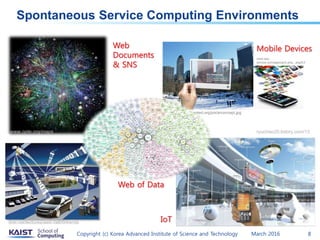
Spontaneous Service Computing Environments
March 2016Copyright (c) Korea Advanced Institute of Science and Technology 8
www.say-
service.com/approach.php...ang%3
Den
http://www.augmented.org/pix/arconcept.jpg
Web of Data
Web
Documents
& SNS
ryuchiso20.tistory.com/13
dret.net/lectures/web-fall09/trends IoT
Mobile Devices
www.opte.org/maps
New Trends
• Web as a Platform
• Mobile Web & “The One Web”
• Internet of Things
– A network of objects
• Internet of Services
– Locating and Accessing Services
– Service Mash-up
– Semantic Web Services
• Urban Computing
• Web 3.0
– Future Internet with its three central pillars "Social Web",
"Semantic Web" and "Service Web" [Christoph Meinel]
March 2016Copyright (c) Korea Advanced Institute of Science and Technology 9
Paradigm Shift in Software Development
March 2016Copyright (c) Korea Advanced Institute of Science and Technology 10
static dynamic
Developer-centric
User-centric
Traditional SE
New SE Paradigm
Main Approaches
• Task-oriented Service Computing
– Enable high-level software design (in multiple abstractions) with
primarily considering user tasks
– Support iterative and gradual development
– Improve reusability
– Enable application adaptability
– Enable service-privacy tradeoff
• Dynamic & Adaptive Software Engineering
– Improve correctness and context awareness
– Improve interoperability
– Support semi-automatic composition
– Enable end-user programming (mash-ups)
March 2016Copyright (c) Korea Advanced Institute of Science and Technology 11
Research Projects
• Spontaneous Service Provision in IoT Environments
(미래부)
• Dynamic and Distributed Service Discovery &
Composition in Tactical Edge Environments (ADD)
• Cloud and Fog Based Service Computing for
Distributed Super Computing Environments (미래부)
• Component Grid: A Knowledge-based Software Reuse
Environment (DAPA/ADD)
• Semantic-Cloud-based Content Recommendations (KT)
• Service-oriented Common Operation Environment for
Unmanned Weapon Systems (Samsung Thales)
March 2016Copyright (c) Korea Advanced Institute of Science and Technology 12
Spontaneous Service Provision in IoT Env.
• Role-based proactive service provision
• On-demand service requirements identification and composition
• Service reconfiguration and optimization based on cognitive resources
March 2016Copyright (c) Korea Advanced Institute of Science and Technology 13
Dynamic and Distributed Service Discovery &
Composition in Tactical Edge Environments
March 2016Copyright (c) Korea Advanced Institute of Science and Technology 14
User-centric Fog Computing for IoT Env.
March 2016Copyright (c) Korea Advanced Institute of Science and Technology 15
IoT 기기
서비스 포그
(사용자 태스크)
웹자원(서비스 및 데이터) 클라우드 서비스
사용자
모바일 기기
Meetings
• Breakfast Meetings – every Monday
morning
• Lab Seminars – every Tuesday evening
– Discussions about research projects
– Full presentations – about the progress on
individual research and projects
– Short presentations – about important
literatures and initial ideas (done by 1st
semester graduate students)
• Individual Meetings – every week
• Lab Gatherings – at least once a month
• M.T.
– Summer – Jeju and/or nice beach and/or
mountain
– Winter – Ski resort and/or mountain
March 2016Copyright (c) Korea Advanced Institute of Science and Technology 16
Conferences
• WWW (World Wide Web)
• ICWS (International Conference on Web
Services)
• ICWE (International Conference on Web
Engineering)
• ICSE (International Conference on Software
Engineering)
• ISWC (International Semantic Web
Conference)
• WI (Web Intelligence)
• COMPSAC (Conference on Computers,
Software, and Applications)
• Ubicomp
• KCSE (Korea Conference on Software
Engineering)
• …
March 2016Copyright (c) Korea Advanced Institute of Science and Technology 17
QUESTIONS?
March 2016Copyright (c) Korea Advanced Institute of Science and Technology 18

Webeng lab i_ko_201603

  • 1.
    Prof. In-Young Ko March2016 http://webeng.kaist.ac.kr/ School of Computing
  • 2.
    Web Engineering Lab. ResearchAreas • Service computing – Task-oriented service provision – Service composition/mashups – Service-oriented architecture • Web applications – Web application testing – Semantically-based recommendations – Semantic and mobile Web applications & information privacy – Web-based information management • Dynamic and adaptive software engineering – Adaptive and evolvable software – Knowledge-based software engineering – End-user software engineering March 2016Copyright (c) Korea Advanced Institute of Science and Technology 2 WE are working on software engineering issues of building software systems that effectively utilize various Web-based resources, are adaptable to changing needs and conditions in highly dynamic environments, and allow end users to participate in the evolution of the software.
  • 3.
    People at WebEngLab. • Professor: – In-Young Ko • Ph.D. Researcher – Hyungmin Koo • Ph.D. Students: – Han-Gyu Ko – Seung-Hyun Kim – Jeung-Hyun Kwon – Min-Hyeop Kim • M.S. Students: – Jihoon Kim – Jinseo Lee March 2016Copyright (c) Korea Advanced Institute of Science and Technology 3
  • 4.
    How does theWorld Wide Web look like? March 2016Copyright (c) Korea Advanced Institute of Science and Technology 4 http://www.opte.org/
  • 5.
    http://blog.econocom.com/en/blog/ smart-city-a-whole-ecosystem/ Web of PhysicalThings http://data.dws.informatik.uni-mannheim.de/lodcloud/2014/ Linked Data Web Layers March 2016Copyright (c) Korea Advanced Institute of Science and Technology 5 https://courses.candelalearning.com/computerapps/wp- content/uploads/sites/746/2015/08/WorldWideWebAro undWikipedia.png Web of Hypertext Documents http://webservices.ufh ealth.org/services/soci al-media-consultation/ Web Services http://thenextweb.com/socialmedi a/2013/11/24/facebook- grandparents-need-next-gen- social-network/ Social Web
  • 6.
    The Web: APlatform for Software Engineering • Provides repositories for searching software services • Provides a medium for deploying software as services • Supports protocols to access software services • Supports an environment to dynamically compose (assemble or synthesize) applications March 2016Copyright (c) Korea Advanced Institute of Science and Technology 6
  • 7.
    Categories of WebApplications March 2016Copyright (c) Korea Advanced Institute of Science and Technology 7 [GertiKappeletal.(edt.),WebEngineering–TheDisciplineofSystematicDevelopmentofWebApplications,JohnWiley&Sons,2006.]
  • 8.
    Spontaneous Service ComputingEnvironments March 2016Copyright (c) Korea Advanced Institute of Science and Technology 8 www.say- service.com/approach.php...ang%3 Den http://www.augmented.org/pix/arconcept.jpg Web of Data Web Documents & SNS ryuchiso20.tistory.com/13 dret.net/lectures/web-fall09/trends IoT Mobile Devices www.opte.org/maps
  • 9.
    New Trends • Webas a Platform • Mobile Web & “The One Web” • Internet of Things – A network of objects • Internet of Services – Locating and Accessing Services – Service Mash-up – Semantic Web Services • Urban Computing • Web 3.0 – Future Internet with its three central pillars "Social Web", "Semantic Web" and "Service Web" [Christoph Meinel] March 2016Copyright (c) Korea Advanced Institute of Science and Technology 9
  • 10.
    Paradigm Shift inSoftware Development March 2016Copyright (c) Korea Advanced Institute of Science and Technology 10 static dynamic Developer-centric User-centric Traditional SE New SE Paradigm
  • 11.
    Main Approaches • Task-orientedService Computing – Enable high-level software design (in multiple abstractions) with primarily considering user tasks – Support iterative and gradual development – Improve reusability – Enable application adaptability – Enable service-privacy tradeoff • Dynamic & Adaptive Software Engineering – Improve correctness and context awareness – Improve interoperability – Support semi-automatic composition – Enable end-user programming (mash-ups) March 2016Copyright (c) Korea Advanced Institute of Science and Technology 11
  • 12.
    Research Projects • SpontaneousService Provision in IoT Environments (미래부) • Dynamic and Distributed Service Discovery & Composition in Tactical Edge Environments (ADD) • Cloud and Fog Based Service Computing for Distributed Super Computing Environments (미래부) • Component Grid: A Knowledge-based Software Reuse Environment (DAPA/ADD) • Semantic-Cloud-based Content Recommendations (KT) • Service-oriented Common Operation Environment for Unmanned Weapon Systems (Samsung Thales) March 2016Copyright (c) Korea Advanced Institute of Science and Technology 12
  • 13.
    Spontaneous Service Provisionin IoT Env. • Role-based proactive service provision • On-demand service requirements identification and composition • Service reconfiguration and optimization based on cognitive resources March 2016Copyright (c) Korea Advanced Institute of Science and Technology 13
  • 14.
    Dynamic and DistributedService Discovery & Composition in Tactical Edge Environments March 2016Copyright (c) Korea Advanced Institute of Science and Technology 14
  • 15.
    User-centric Fog Computingfor IoT Env. March 2016Copyright (c) Korea Advanced Institute of Science and Technology 15 IoT 기기 서비스 포그 (사용자 태스크) 웹자원(서비스 및 데이터) 클라우드 서비스 사용자 모바일 기기
  • 16.
    Meetings • Breakfast Meetings– every Monday morning • Lab Seminars – every Tuesday evening – Discussions about research projects – Full presentations – about the progress on individual research and projects – Short presentations – about important literatures and initial ideas (done by 1st semester graduate students) • Individual Meetings – every week • Lab Gatherings – at least once a month • M.T. – Summer – Jeju and/or nice beach and/or mountain – Winter – Ski resort and/or mountain March 2016Copyright (c) Korea Advanced Institute of Science and Technology 16
  • 17.
    Conferences • WWW (WorldWide Web) • ICWS (International Conference on Web Services) • ICWE (International Conference on Web Engineering) • ICSE (International Conference on Software Engineering) • ISWC (International Semantic Web Conference) • WI (Web Intelligence) • COMPSAC (Conference on Computers, Software, and Applications) • Ubicomp • KCSE (Korea Conference on Software Engineering) • … March 2016Copyright (c) Korea Advanced Institute of Science and Technology 17
  • 18.
    QUESTIONS? March 2016Copyright (c)Korea Advanced Institute of Science and Technology 18