Web Services (NSWI145)
Lecture 04: Web Services Description Language

  Martin Nečaský, Ph.D.
  Faculty of Mathematics and Physics
  Charles University in Prague, Czech Republic


                Winter 2011
WSDL Foundations
   Web Services Description Language
   language for describing web service interfaces
    in machine-readable notation
   XML format
   current version: 2.0
     http://www.w3.org/TR/wsdl20
   currently mostly supported version: 1.1
     http://www.w3.org/TR/wsdl
WSDL Foundations

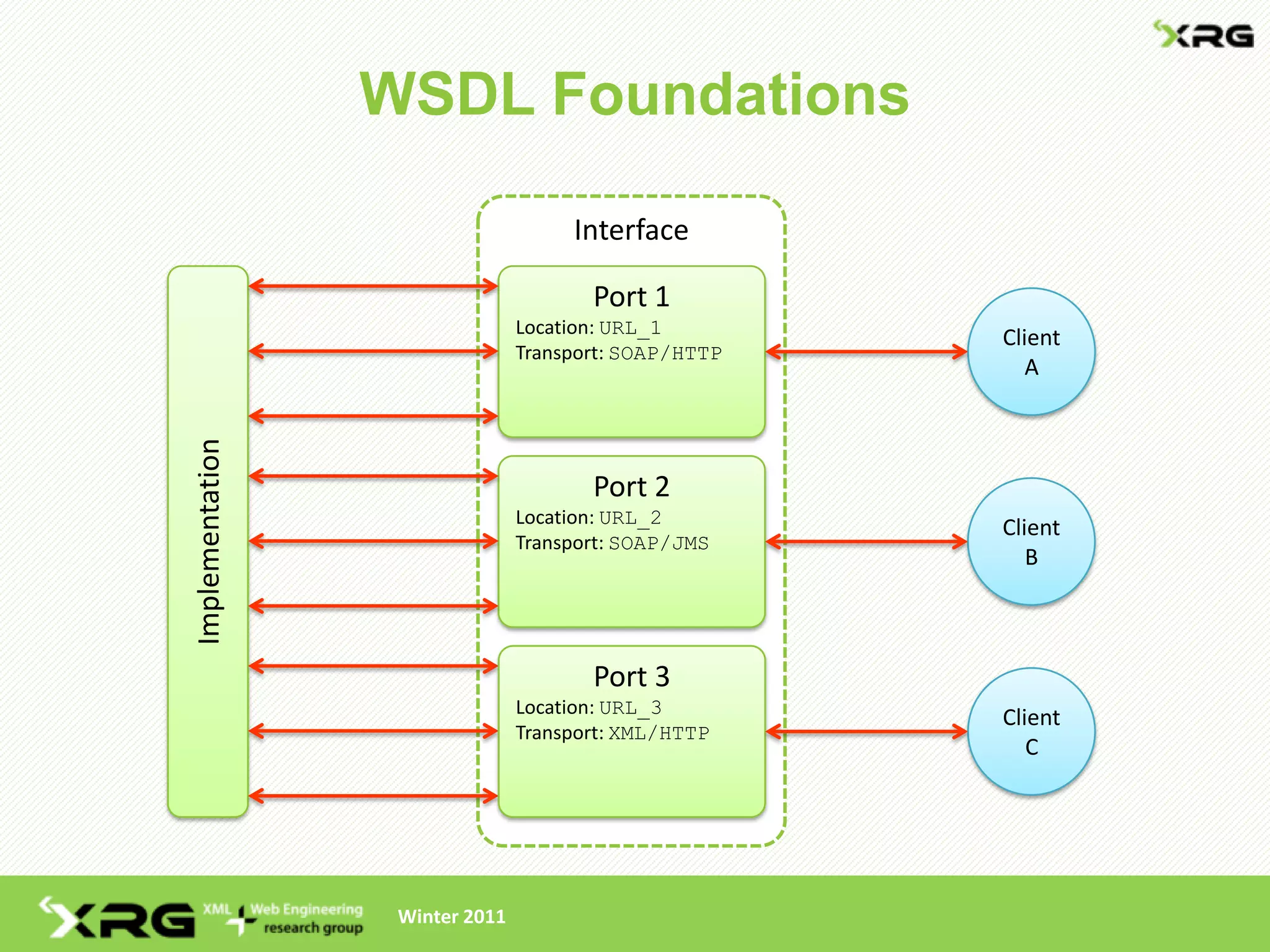
                                     Interface

                                       Port 1
                                Location: URL_1
                                                       Client
                                Transport: SOAP/HTTP
                                                          A
Implementation


                                       Port 2
                                Location: URL_2
                                                       Client
                                Transport: SOAP/JMS
                                                          B


                                       Port 3
                                Location: URL_3
                                                       Client
                                Transport: XML/HTTP
                                                          C


                  Winter 2011
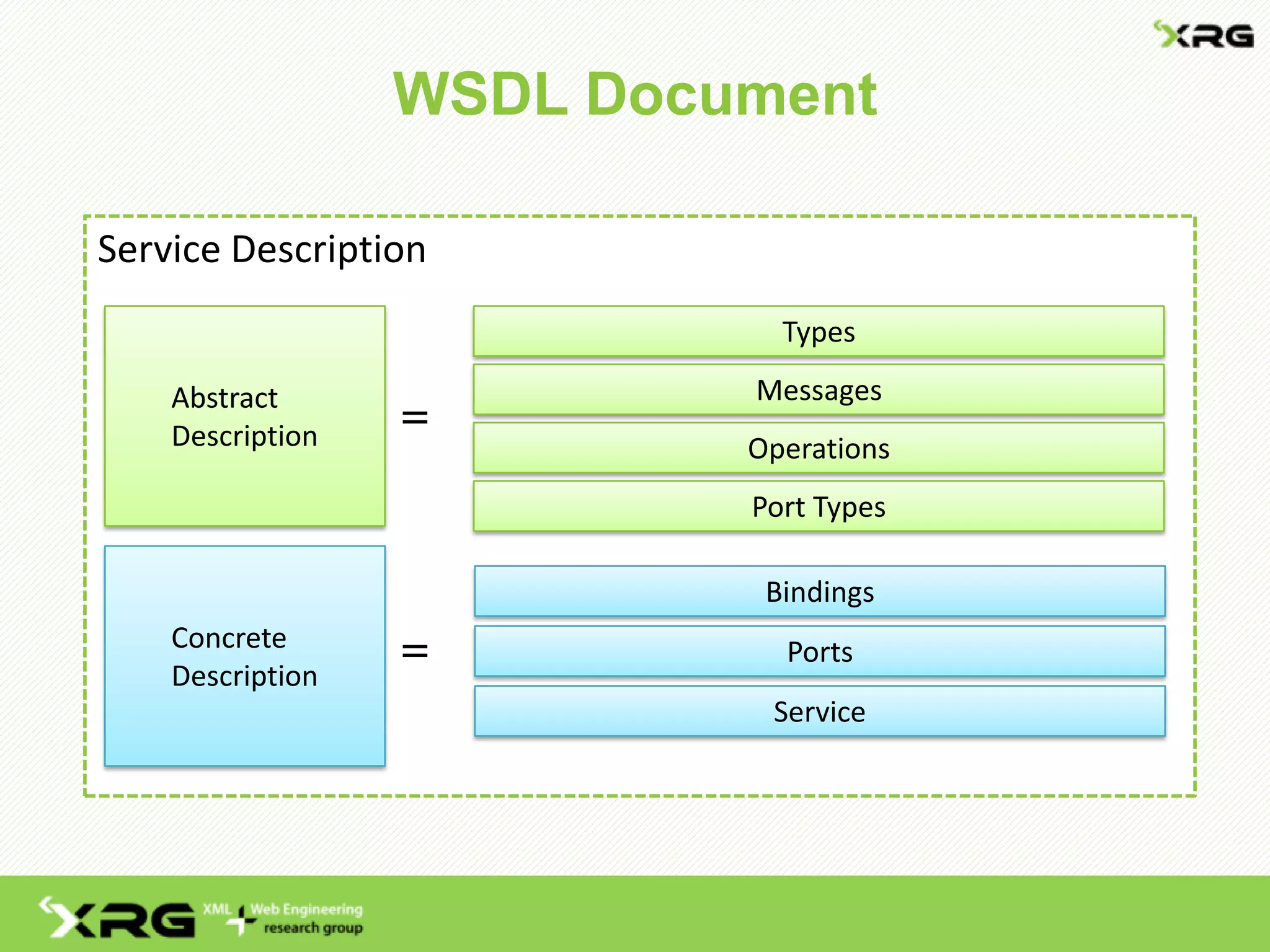
WSDL Document
   types
      XML schema describing XML elements and attributes
   messages
      representation of data exchanged between clients and service
      based on types
   operations
      service capabilities offered to clients
      input and output messages
   port types
      collection of operations
   bindings
      specification of concrete protocol for exchanging messages between service
       and clients which call operations from particular port type
   ports
      single endpoint combining particular binding and network address
   services
      collection of related ports


                         Winter 2011
WSDL Document

Service Description
                             Types

    Abstract               Messages
    Description   =
                           Operations
                           Port Types

                            Bindings
    Concrete
                  =          Ports
    Description
                            Service
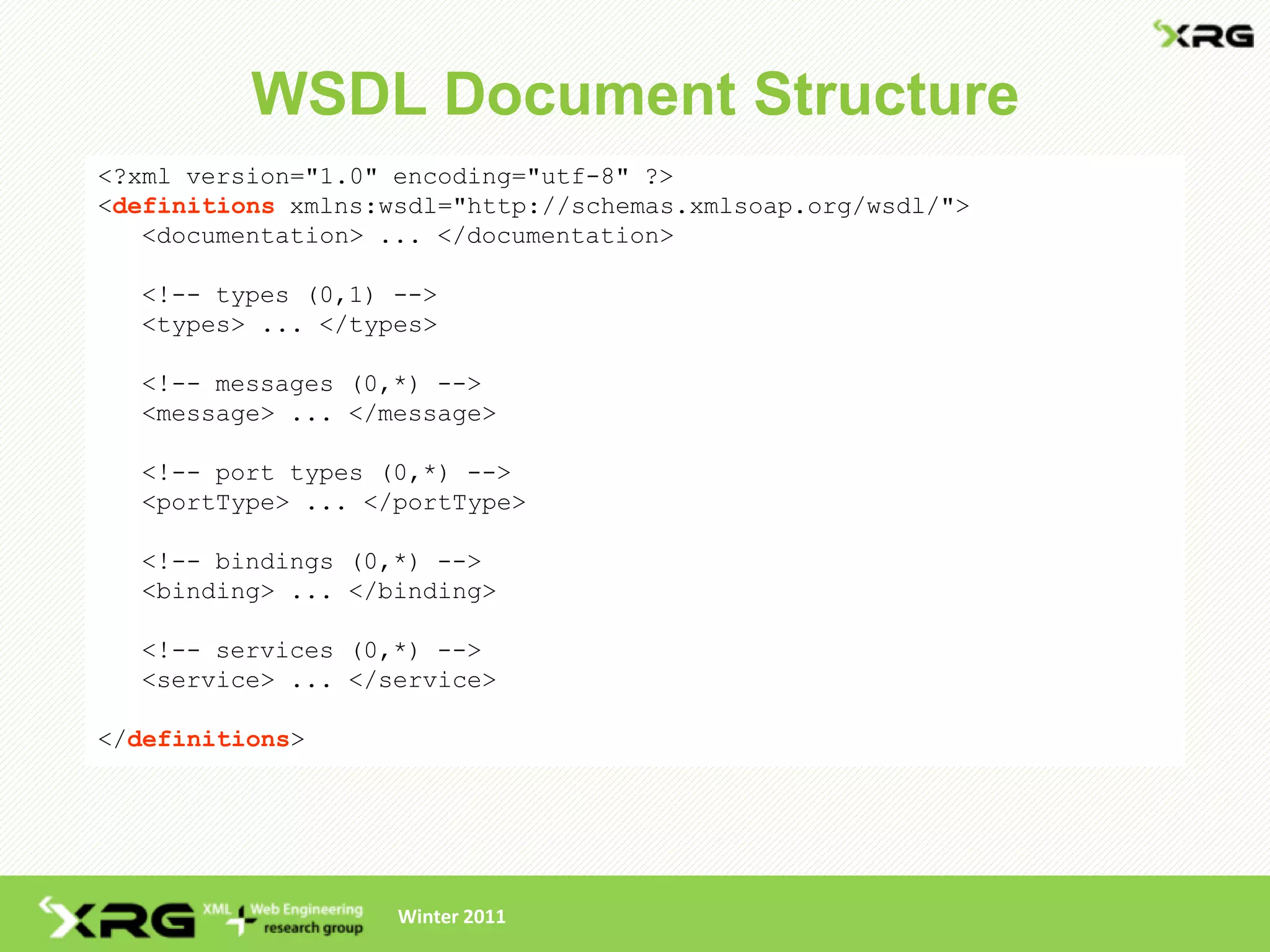
WSDL Document Structure
<?xml version="1.0" encoding="utf-8" ?>
<definitions xmlns:wsdl="http://schemas.xmlsoap.org/wsdl/">
   <documentation> ... </documentation>

  <!-- types (0,1) -->
  <types> ... </types>

  <!-- messages (0,*) -->
  <message> ... </message>

  <!-- port types (0,*) -->
  <portType> ... </portType>

  <!-- bindings (0,*) -->
  <binding> ... </binding>

  <!-- services (0,*) -->
  <service> ... </service>

</definitions>


                    Winter 2011
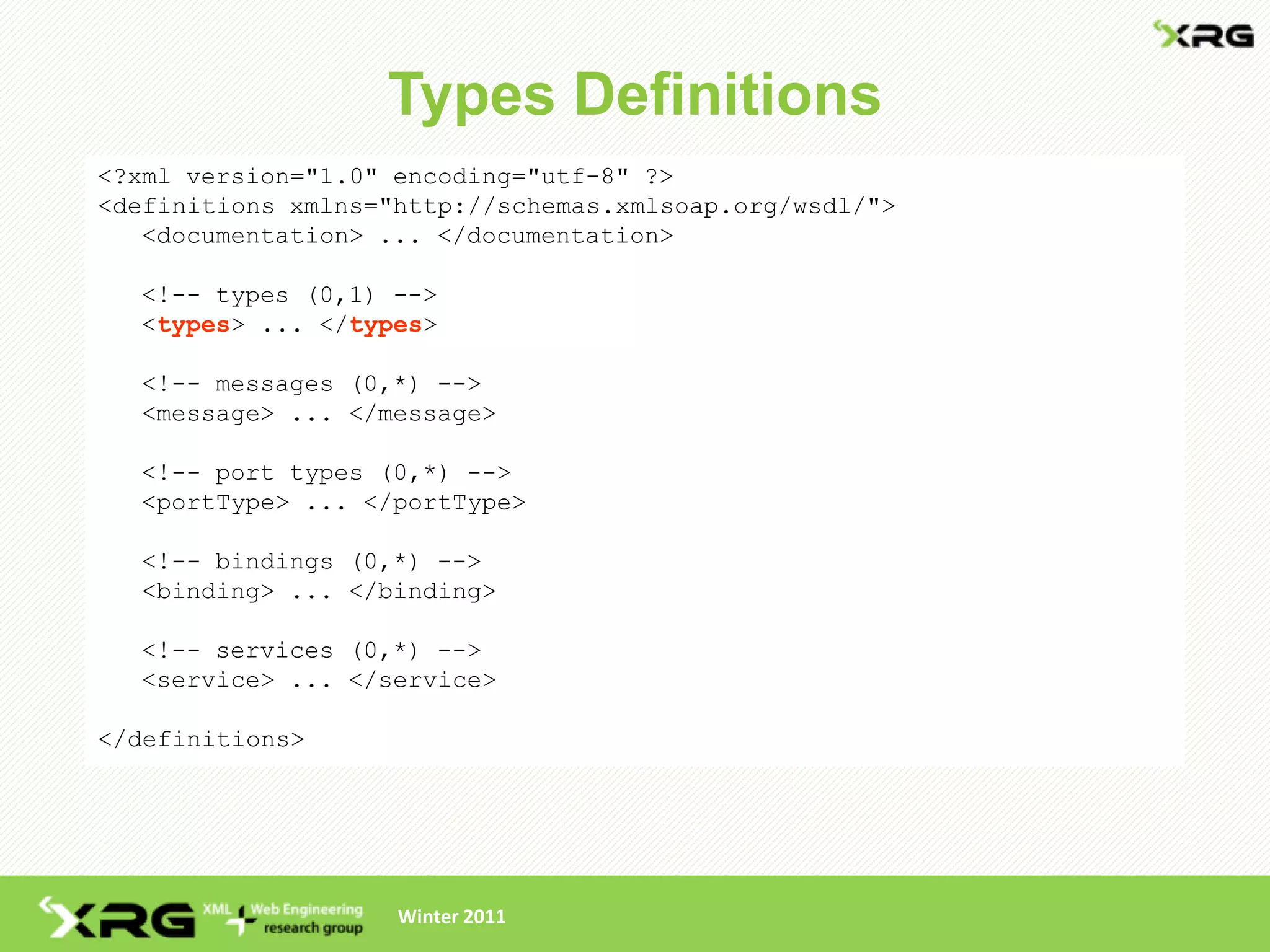
Types Definitions
<?xml version="1.0" encoding="utf-8" ?>
<definitions xmlns="http://schemas.xmlsoap.org/wsdl/">
   <documentation> ... </documentation>

  <!-- types (0,1) -->
  <types> ... </types>

  <!-- messages (0,*) -->
  <message> ... </message>

  <!-- port types (0,*) -->
  <portType> ... </portType>

  <!-- bindings (0,*) -->
  <binding> ... </binding>

  <!-- services (0,*) -->
  <service> ... </service>

</definitions>


                    Winter 2011
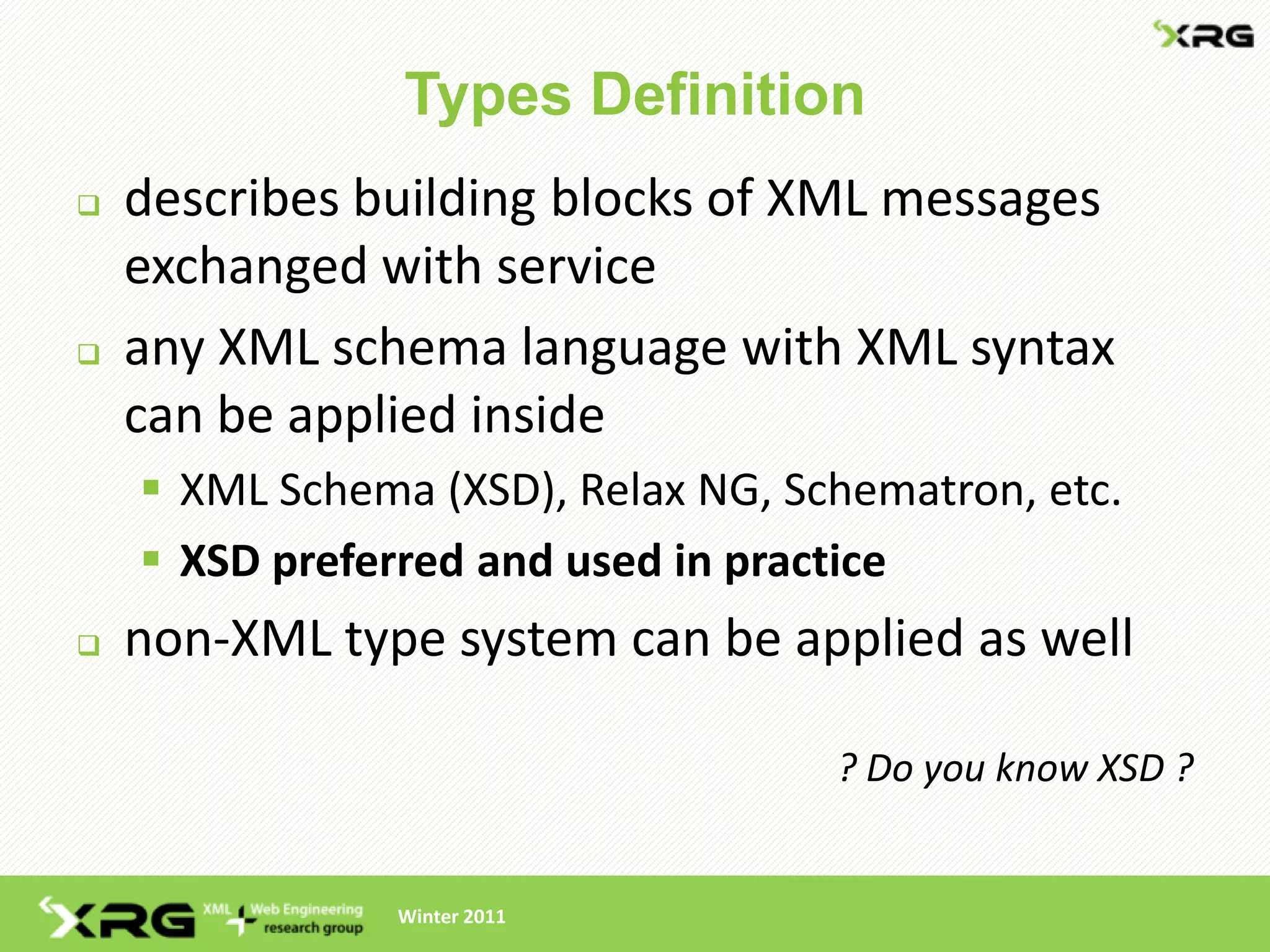
Types Definition
   describes building blocks of XML messages
    exchanged with service
   any XML schema language with XML syntax
    can be applied inside
     XML Schema (XSD), Relax NG, Schematron, etc.
     XSD preferred and used in practice
   non-XML type system can be applied as well

                                    ? Do you know XSD ?


                Winter 2011
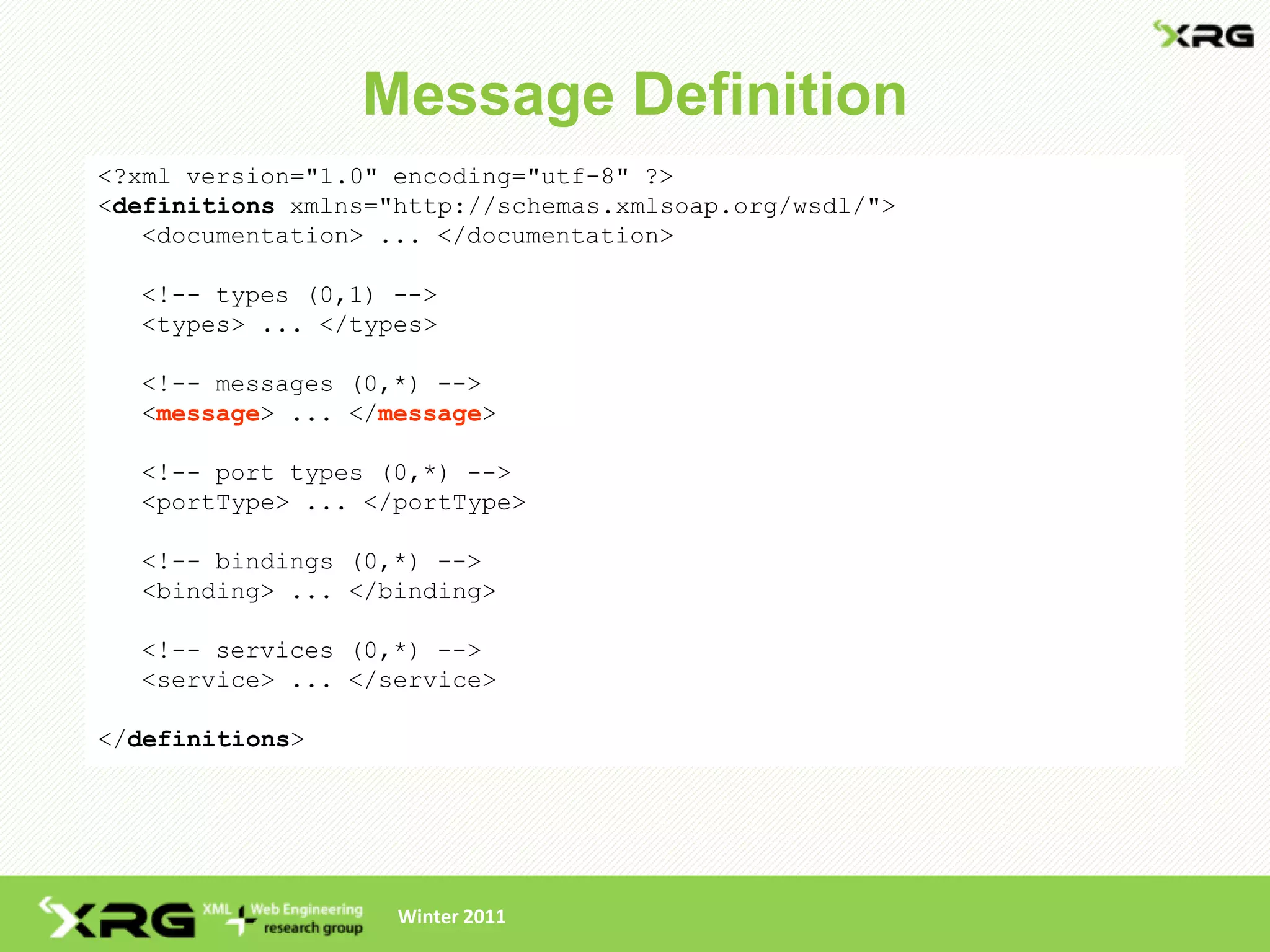
Message Definition
<?xml version="1.0" encoding="utf-8" ?>
<definitions xmlns="http://schemas.xmlsoap.org/wsdl/">
   <documentation> ... </documentation>

  <!-- types (0,1) -->
  <types> ... </types>

  <!-- messages (0,*) -->
  <message> ... </message>

  <!-- port types (0,*) -->
  <portType> ... </portType>

  <!-- bindings (0,*) -->
  <binding> ... </binding>

  <!-- services (0,*) -->
  <service> ... </service>

</definitions>


                    Winter 2011
Message Definition
   zero or more message definitions
   element message
     defines single message type which can be
      exchanged with the service
     has unique name among all message types
       • attribute name

<message name="[name]">

</message>


                    Winter 2011
Message Definition
   message consists of one or more logical units called
    message parts
   element part
      defines single message part
      has unique name among all parts of the same message
         • attribute name
      is associated with element from the types definition ...
         • attribute element
      ... or with simple or complex type from the types definition
         • attribute type

<message name="[name]">

    <!-- message part (1,*) -->
    <part name="[part-name]" element="[element-ref]" type="[type-ref]" />

</message>


                       Winter 2011
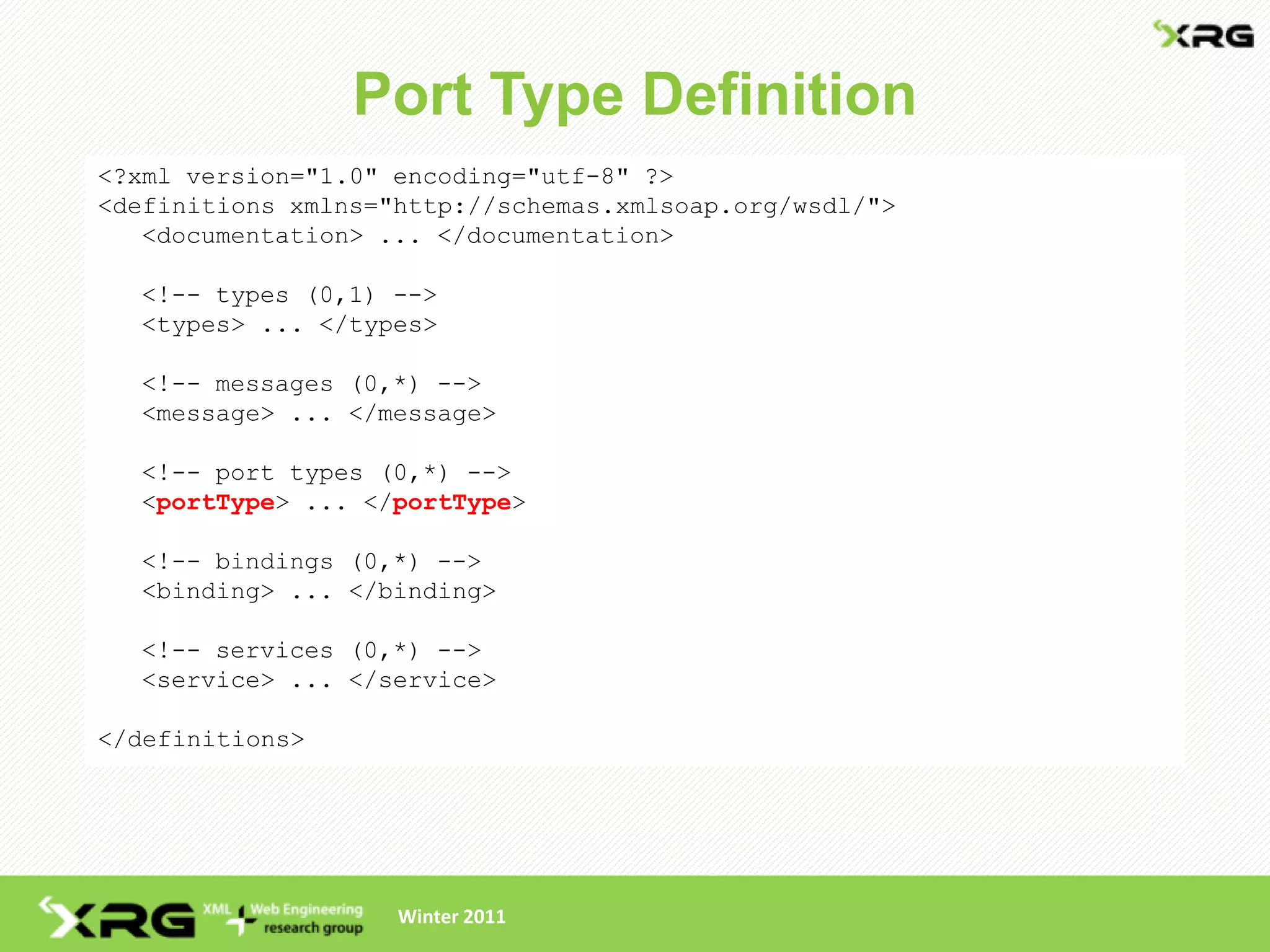
Port Type Definition
<?xml version="1.0" encoding="utf-8" ?>
<definitions xmlns="http://schemas.xmlsoap.org/wsdl/">
   <documentation> ... </documentation>

  <!-- types (0,1) -->
  <types> ... </types>

  <!-- messages (0,*) -->
  <message> ... </message>

  <!-- port types (0,*) -->
  <portType> ... </portType>

  <!-- bindings (0,*) -->
  <binding> ... </binding>

  <!-- services (0,*) -->
  <service> ... </service>

</definitions>


                    Winter 2011
Port Type Definition
   zero or more port type definitions
   port type encapsulates one or more
    operations
   element portType
     defines single port type
     has unique name among all port types types
       • attribute name
<portType name="[name]">

</portType>


                    Winter 2011
Port Type Definition
   element operation
      defines single operation
      has unique name among all operations in the port type
          • attribute name
   operation consumes input message and produces output
    message, four supported message exchange patterns:
        one-way (in)
        request-response (in-out)
        solicit-response (out-in)
        notification (out)
<portType name="[name]">

    <!-- operation (1,*) -->
    <operation name="[operation-name]" />

</portType>


                      Winter 2011
Port Type Definition
    element input (output, fault)
       specifies input (output, fault) message type
       has unique name among all inputs, outputs and faults within the
        operation (attribute name )
       reference to message type definition (attribute message)
                one-way                                notification
<operation name="[operation-name]">      <operation name="[operation-name]">
  <input name="[param-name]"               <output name="[param-name]"
         message="[message-ref]" />               message="[message-ref]" />
</operation>                             </operation>

           request-response                           solicit-response
<operation name="[operation-name]">      <operation name="[operation-name]">
  <input name="[param-name]"               <output name="[param-name]"
         message="[message-ref]" />               message="[message-ref]" />
  <output name="[param-name]"              <input name="[param-name]"
         message="[message-ref]" />               message="[message-ref]" />
  <fault name="[param-name]"               <fault name="[param-name]"
         message="[message-ref]" />               message="[message-ref]" />
</operation>                             </operation>


                       Winter 2011
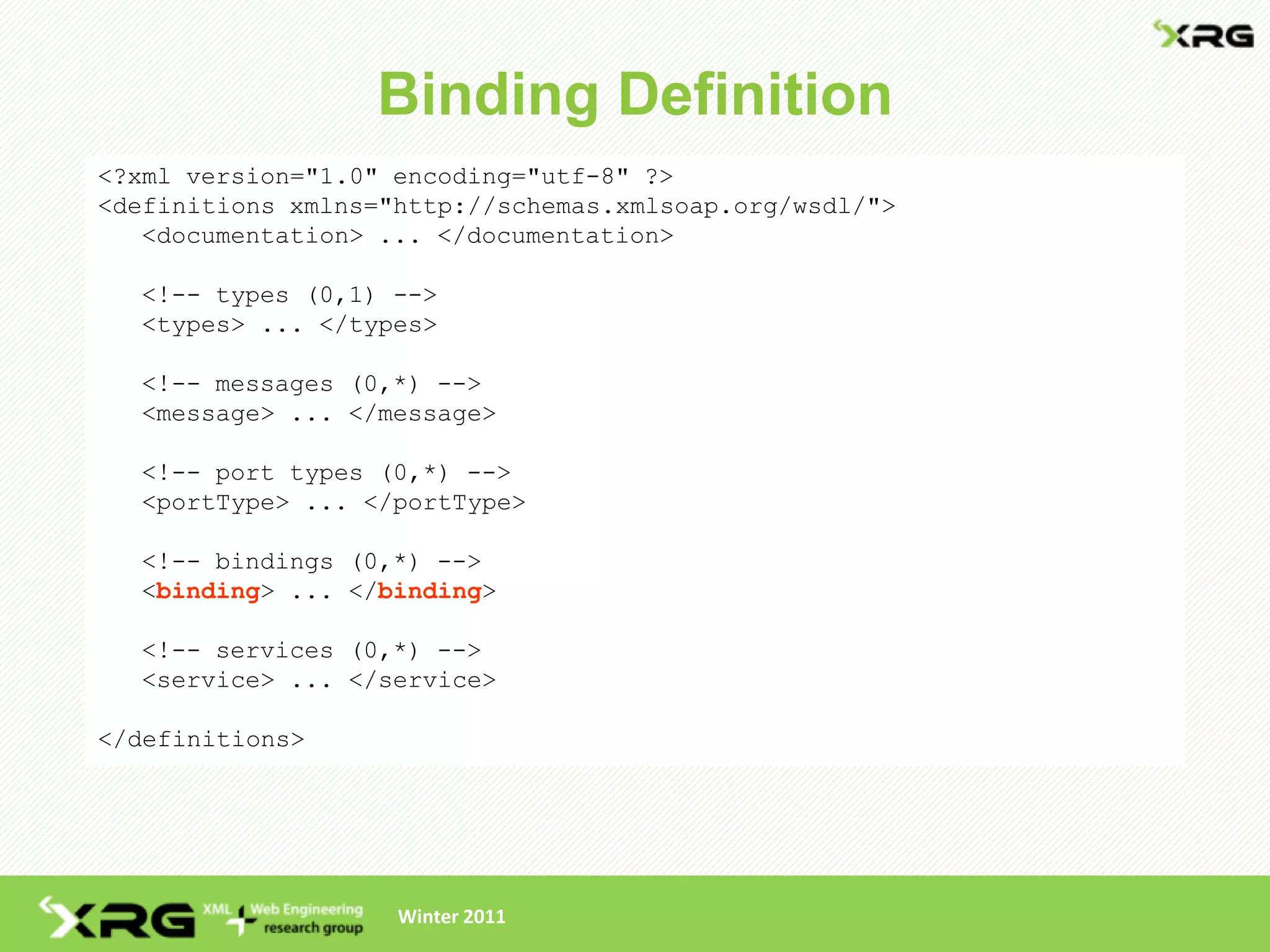
Binding Definition
<?xml version="1.0" encoding="utf-8" ?>
<definitions xmlns="http://schemas.xmlsoap.org/wsdl/">
   <documentation> ... </documentation>

  <!-- types (0,1) -->
  <types> ... </types>

  <!-- messages (0,*) -->
  <message> ... </message>

  <!-- port types (0,*) -->
  <portType> ... </portType>

  <!-- bindings (0,*) -->
  <binding> ... </binding>

  <!-- services (0,*) -->
  <service> ... </service>

</definitions>


                    Winter 2011
Binding Definition
   zero or more binding definitions
   defines message format and protocol details for
    operations and messages in particular port type
   element binding
     defines single binding
     has unique name among all bindings
        • attribute name
     refers to particular port type
        • attribute type

<binding name="[name]" type="[portType-ref]">

</binding>


                    Winter 2011
Binding Definition
   specifies binding for each operation defined in port type
      input and output messages, faults
   element operation
      binding of particular operation
         • referred by attribute name
   element input (output, fault)
      binding of particular input (output, fault) message type
<binding name="[name]" type="[portType-ref]">
  <!-- protocol specific binding information -->

    <operation name="[operation-ref]">
      <!-- protocol specific binding information -->
      <input><!-- protocol specific binding information --></input>
      <output><!-- protocol specific binding information --></output>
      <fault><!-- protocol specific binding information --></fault>
    </operation>

</binding>

                      Winter 2011
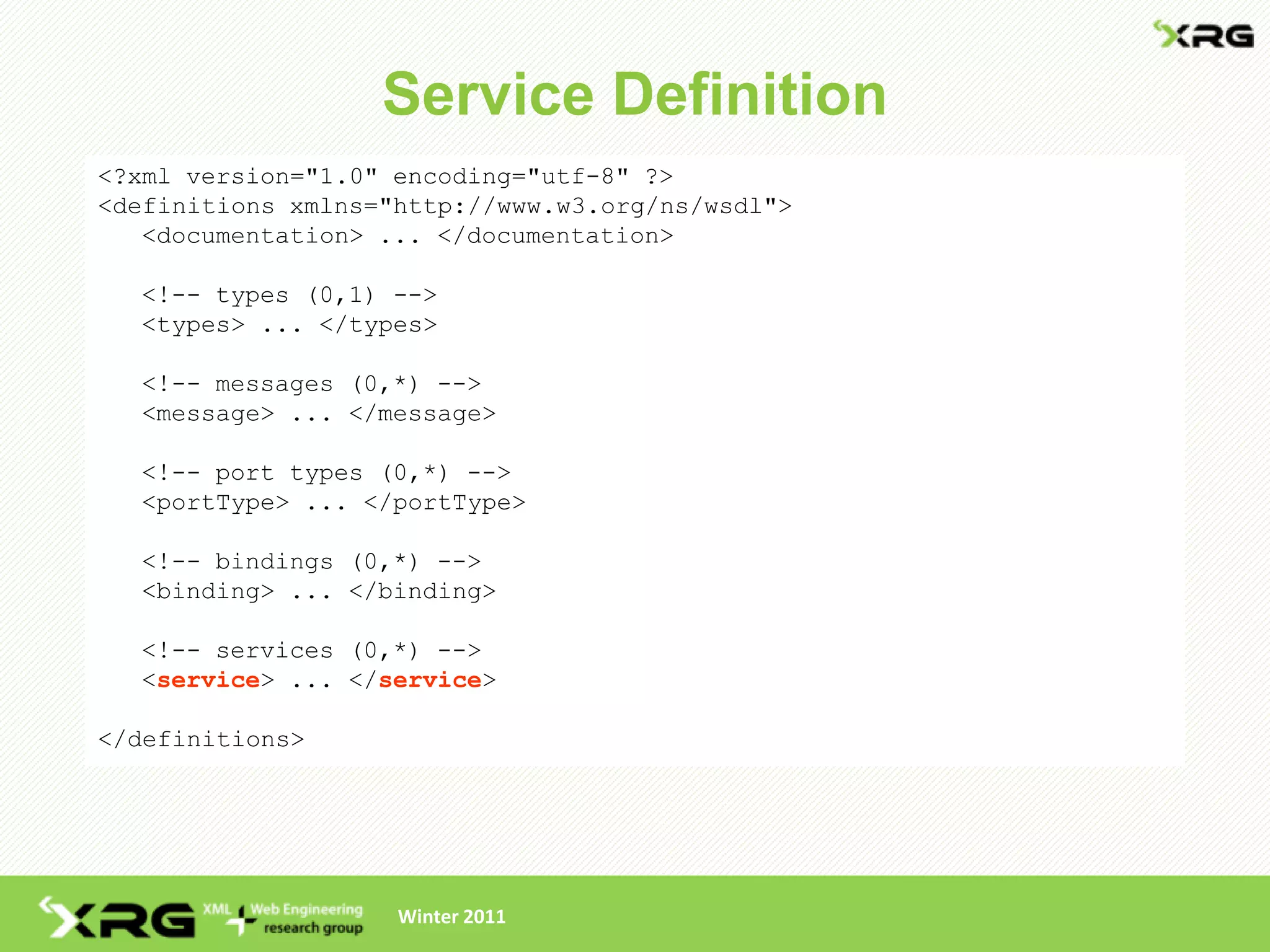
Service Definition
<?xml version="1.0" encoding="utf-8" ?>
<definitions xmlns="http://www.w3.org/ns/wsdl">
   <documentation> ... </documentation>

  <!-- types (0,1) -->
  <types> ... </types>

  <!-- messages (0,*) -->
  <message> ... </message>

  <!-- port types (0,*) -->
  <portType> ... </portType>

  <!-- bindings (0,*) -->
  <binding> ... </binding>

  <!-- services (0,*) -->
  <service> ... </service>

</definitions>


                    Winter 2011
Service Definition
   zero or more service definitions
     i.e. one WSDL document can eventually define more
      interfaces to one or more services
   element service
     defines single service interface + binding to particular
      protocol and physical address
     has unique name among all services
       • attribute name

<service name="[name]">

</service>


                    Winter 2011
Service Definition
   service consists of ports
   element port
      defines service port
      has unique name among all ports of the service
         • attribute name
      refers to particular port type which defines port
       operations and their input and output messages
         • attribute binding
<service name="[name]">

    <port name="[name]" binding="[binding-ref]">
      <!-- protocol specific information -->
    </port>

</service>


                      Winter 2011
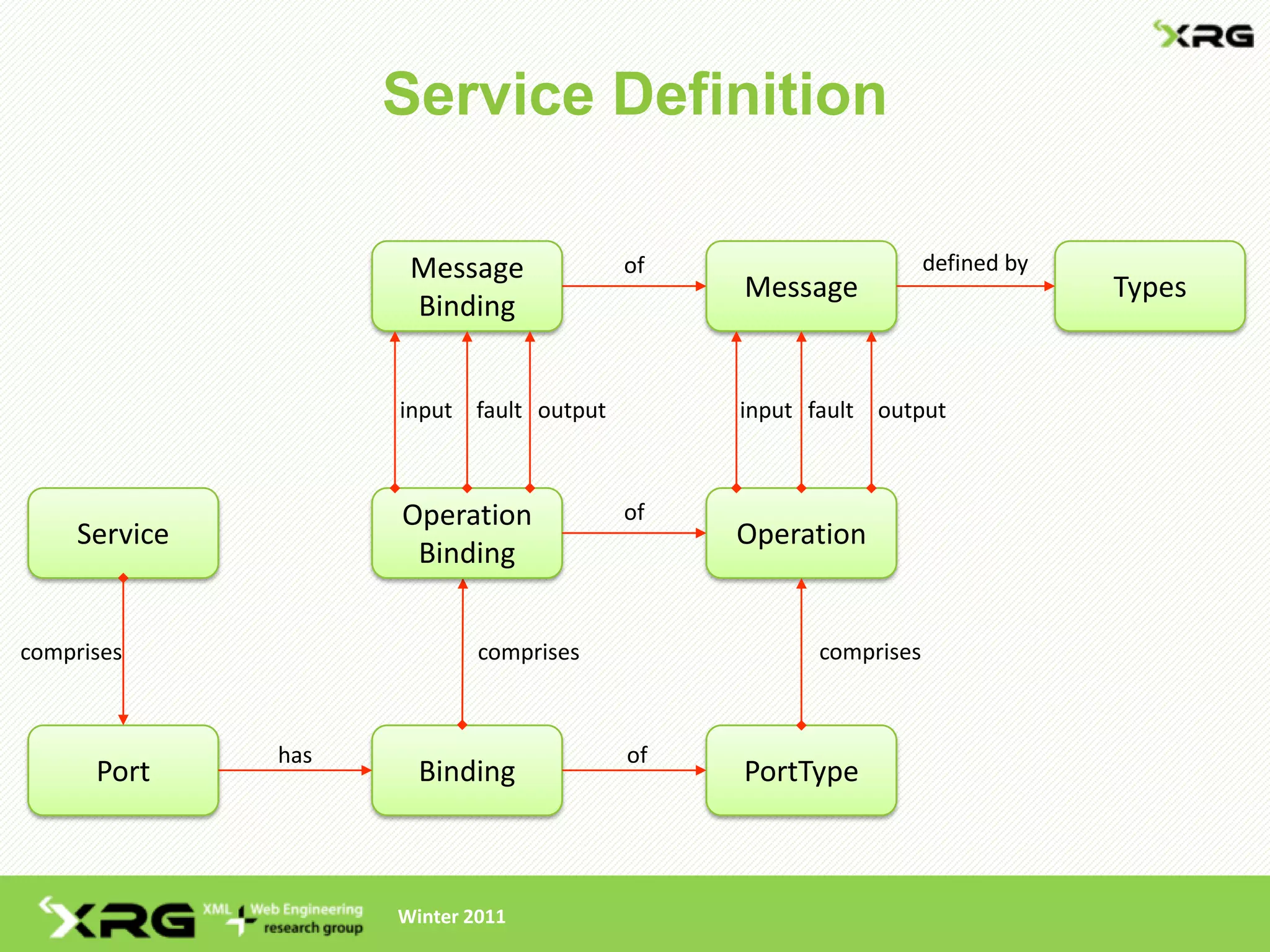
Service Definition

                      Message             of                     defined by
                                               Message                        Types
                      Binding


                     input fault output        input fault output


                     Operation            of
     Service                                   Operation
                      Binding


comprises                    comprises               comprises


               has                        of
      Port             Binding                 PortType


                     Winter 2011
More on Bindings
   HTTP
   SOAP 1.1 over HTTP
   SOAP 1.2 over HTTP
   SOAP 1.1 over Java Messaging Service (JMS)
   SOAP 1.2 over Java Messaging Service (JMS)
   SOAP 1.1 over SMTP
   ...


               Winter 2011
SOAP 1.2 Binding
   namespace with SOAP 1.2 specific binding
    extensions
      http://schemas.xmlsoap.org/wsdl/soap12/
      we will use prefix wsoap12
   binding to SOAP 1.2 must start with element
    wsoap12:binding
<binding name="[name]">

    <wsoap12:binding />

</binding>


                      Winter 2011
SOAP 1.2 Binding
   optional default operation style
      specifies default style of each operation (RPC-oriented or document-
       oriented operations)
      attribute style
         • values rpc or document, respectively
         • document is default
   mandatory transport protocol
      URI of particular protocol
      HTTP has http://schemas.xmlsoap.org/soap/http
      attribute transport

<binding name="[name]">

    <wsoap12:binding style="[style]" transport="[protocol-URI]"/>

</binding>


                       Winter 2011
SOAP 1.2 Binding
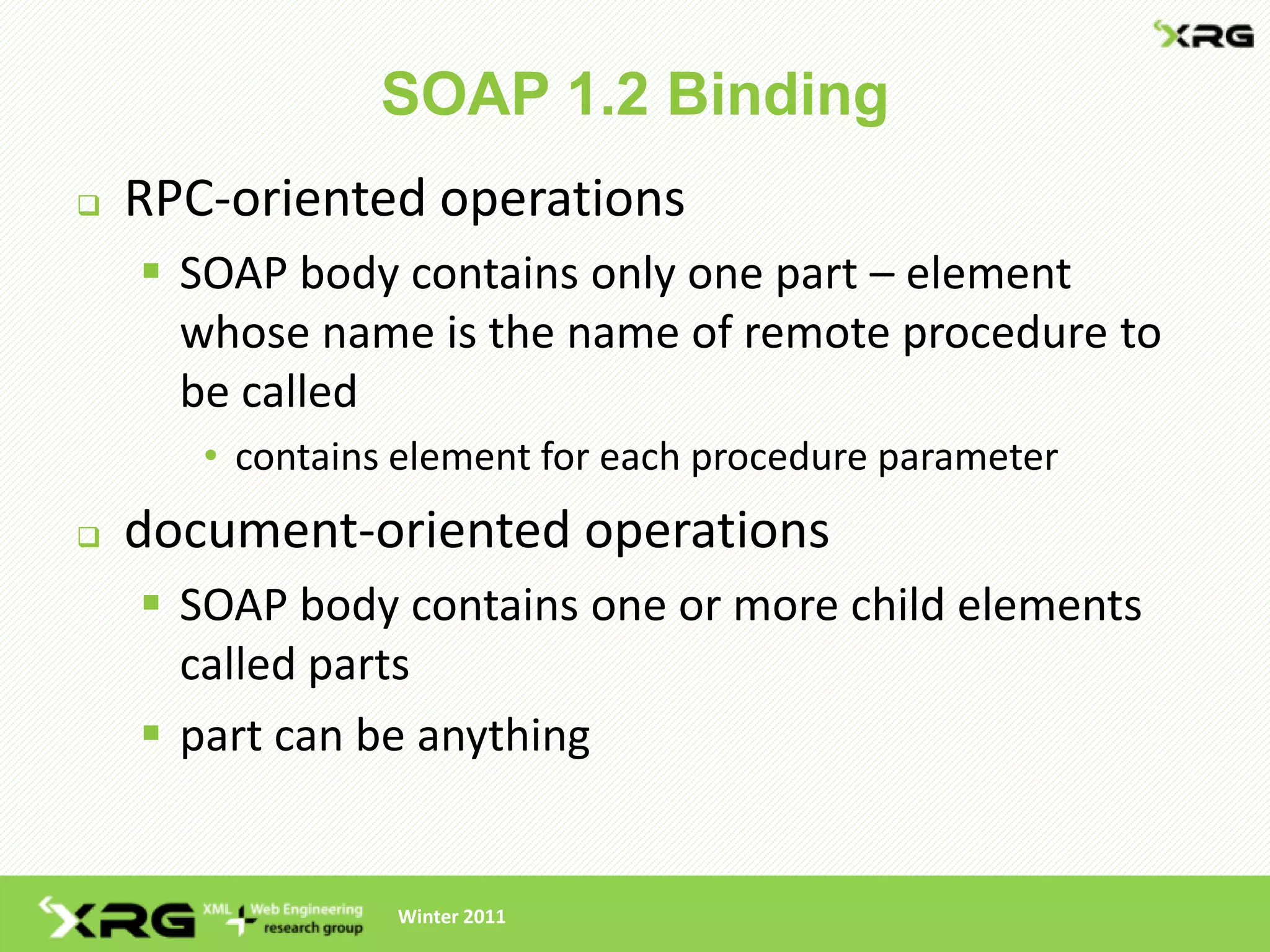
   RPC-oriented operations
     SOAP body contains only one part – element
      whose name is the name of remote procedure to
      be called
       • contains element for each procedure parameter
   document-oriented operations
     SOAP body contains one or more child elements
      called parts
     part can be anything


                 Winter 2011
SOAP 1.2 Binding
   each operation is further specified by wsoap:operation
    element
      may optionally have own style (rpc or document)
         • attribute style
      if the operation is not determined by its request message we can
       determine it by SOAPAction HTTP header
         • the value of the SOAPAction HTTP header for the operation can be specified in
           attribute soapAction
         • if you want SOAPAction HTTP header to be mandatory for this operation, use
           attribute soapActionRequired

<binding name="[name]">

    <operation name="[operation-ref]">
      <wsoap12:operation style="[style]" soapAction="[action-URI]“
                         soapActionRequired="[boolean]" />
    </operation>

</binding>


                        Winter 2011
SOAP 1.2 Binding
   for each operation input/output we map one or more
    message parts to SOAP body
      element wsoap12:body
      message parts specified by attribute parts
      attribute use indicates whether parts specify schema for messages or
       some other encoding of data to messages is used
         • values literal or encoded, respectively

<binding name="[name]">

    <operation name="[operation-ref]">
      <input>
        <wsoap12:body parts="[part-refs-list]" use="[use]" />
      </input>
    </operation>

</binding>


                      Winter 2011
SOAP 1.2 Binding
   for each operation input/output we can map particular
    message part to SOAP header
      element wsoap12:header
      mandatory attribute message
      message part specified by attribute part
      attribute use indicates whether part specifies schema for messages or
       some other encoding of data to messages is used
         • values literal or encoded, respectively
<binding name="[name]">

    <operation name="[operation-ref]">
      <input>
        <wsoap12:header message="[message-ref]" part="[part-ref]"
                        use="[use]" />
      </input>
    </operation>

</binding>


                       Winter 2011
SOAP 1.2 Binding
   for each operation input/output we can map
    particular faults to SOAP fault
     element wsoap12:fault


               Winter 2011
SOAP 1.2 Binding
   port is extended with physical location of
    SOAP 1.2 endpoint
      element wsoap12:address
         • attribute location

<service name="[name]">

    <port name="[operation-ref]">
      <wsoap12:address location="[URI]" />
    </port>

</binding>


                      Winter 2011
Examples
   PublicContractWS.wsdl
   TripleStoreWS.wsdl


              Winter 2011

Web Services - WSDL

  • 1.
    Web Services (NSWI145) Lecture04: Web Services Description Language Martin Nečaský, Ph.D. Faculty of Mathematics and Physics Charles University in Prague, Czech Republic Winter 2011
  • 2.
    WSDL Foundations  Web Services Description Language  language for describing web service interfaces in machine-readable notation  XML format  current version: 2.0  http://www.w3.org/TR/wsdl20  currently mostly supported version: 1.1  http://www.w3.org/TR/wsdl
  • 3.
    WSDL Foundations Interface Port 1 Location: URL_1 Client Transport: SOAP/HTTP A Implementation Port 2 Location: URL_2 Client Transport: SOAP/JMS B Port 3 Location: URL_3 Client Transport: XML/HTTP C Winter 2011
  • 4.
    WSDL Document  types  XML schema describing XML elements and attributes  messages  representation of data exchanged between clients and service  based on types  operations  service capabilities offered to clients  input and output messages  port types  collection of operations  bindings  specification of concrete protocol for exchanging messages between service and clients which call operations from particular port type  ports  single endpoint combining particular binding and network address  services  collection of related ports Winter 2011
  • 5.
    WSDL Document Service Description Types Abstract Messages Description = Operations Port Types Bindings Concrete = Ports Description Service
  • 6.
    WSDL Document Structure <?xmlversion="1.0" encoding="utf-8" ?> <definitions xmlns:wsdl="http://schemas.xmlsoap.org/wsdl/"> <documentation> ... </documentation> <!-- types (0,1) --> <types> ... </types> <!-- messages (0,*) --> <message> ... </message> <!-- port types (0,*) --> <portType> ... </portType> <!-- bindings (0,*) --> <binding> ... </binding> <!-- services (0,*) --> <service> ... </service> </definitions> Winter 2011
  • 7.
    Types Definitions <?xml version="1.0"encoding="utf-8" ?> <definitions xmlns="http://schemas.xmlsoap.org/wsdl/"> <documentation> ... </documentation> <!-- types (0,1) --> <types> ... </types> <!-- messages (0,*) --> <message> ... </message> <!-- port types (0,*) --> <portType> ... </portType> <!-- bindings (0,*) --> <binding> ... </binding> <!-- services (0,*) --> <service> ... </service> </definitions> Winter 2011
  • 8.
    Types Definition  describes building blocks of XML messages exchanged with service  any XML schema language with XML syntax can be applied inside  XML Schema (XSD), Relax NG, Schematron, etc.  XSD preferred and used in practice  non-XML type system can be applied as well ? Do you know XSD ? Winter 2011
  • 9.
    Message Definition <?xml version="1.0"encoding="utf-8" ?> <definitions xmlns="http://schemas.xmlsoap.org/wsdl/"> <documentation> ... </documentation> <!-- types (0,1) --> <types> ... </types> <!-- messages (0,*) --> <message> ... </message> <!-- port types (0,*) --> <portType> ... </portType> <!-- bindings (0,*) --> <binding> ... </binding> <!-- services (0,*) --> <service> ... </service> </definitions> Winter 2011
  • 10.
    Message Definition  zero or more message definitions  element message  defines single message type which can be exchanged with the service  has unique name among all message types • attribute name <message name="[name]"> </message> Winter 2011
  • 11.
    Message Definition  message consists of one or more logical units called message parts  element part  defines single message part  has unique name among all parts of the same message • attribute name  is associated with element from the types definition ... • attribute element  ... or with simple or complex type from the types definition • attribute type <message name="[name]"> <!-- message part (1,*) --> <part name="[part-name]" element="[element-ref]" type="[type-ref]" /> </message> Winter 2011
  • 12.
    Port Type Definition <?xmlversion="1.0" encoding="utf-8" ?> <definitions xmlns="http://schemas.xmlsoap.org/wsdl/"> <documentation> ... </documentation> <!-- types (0,1) --> <types> ... </types> <!-- messages (0,*) --> <message> ... </message> <!-- port types (0,*) --> <portType> ... </portType> <!-- bindings (0,*) --> <binding> ... </binding> <!-- services (0,*) --> <service> ... </service> </definitions> Winter 2011
  • 13.
    Port Type Definition  zero or more port type definitions  port type encapsulates one or more operations  element portType  defines single port type  has unique name among all port types types • attribute name <portType name="[name]"> </portType> Winter 2011
  • 14.
    Port Type Definition  element operation  defines single operation  has unique name among all operations in the port type • attribute name  operation consumes input message and produces output message, four supported message exchange patterns:  one-way (in)  request-response (in-out)  solicit-response (out-in)  notification (out) <portType name="[name]"> <!-- operation (1,*) --> <operation name="[operation-name]" /> </portType> Winter 2011
  • 15.
    Port Type Definition  element input (output, fault)  specifies input (output, fault) message type  has unique name among all inputs, outputs and faults within the operation (attribute name )  reference to message type definition (attribute message) one-way notification <operation name="[operation-name]"> <operation name="[operation-name]"> <input name="[param-name]" <output name="[param-name]" message="[message-ref]" /> message="[message-ref]" /> </operation> </operation> request-response solicit-response <operation name="[operation-name]"> <operation name="[operation-name]"> <input name="[param-name]" <output name="[param-name]" message="[message-ref]" /> message="[message-ref]" /> <output name="[param-name]" <input name="[param-name]" message="[message-ref]" /> message="[message-ref]" /> <fault name="[param-name]" <fault name="[param-name]" message="[message-ref]" /> message="[message-ref]" /> </operation> </operation> Winter 2011
  • 16.
    Binding Definition <?xml version="1.0"encoding="utf-8" ?> <definitions xmlns="http://schemas.xmlsoap.org/wsdl/"> <documentation> ... </documentation> <!-- types (0,1) --> <types> ... </types> <!-- messages (0,*) --> <message> ... </message> <!-- port types (0,*) --> <portType> ... </portType> <!-- bindings (0,*) --> <binding> ... </binding> <!-- services (0,*) --> <service> ... </service> </definitions> Winter 2011
  • 17.
    Binding Definition  zero or more binding definitions  defines message format and protocol details for operations and messages in particular port type  element binding  defines single binding  has unique name among all bindings • attribute name  refers to particular port type • attribute type <binding name="[name]" type="[portType-ref]"> </binding> Winter 2011
  • 18.
    Binding Definition  specifies binding for each operation defined in port type  input and output messages, faults  element operation  binding of particular operation • referred by attribute name  element input (output, fault)  binding of particular input (output, fault) message type <binding name="[name]" type="[portType-ref]"> <!-- protocol specific binding information --> <operation name="[operation-ref]"> <!-- protocol specific binding information --> <input><!-- protocol specific binding information --></input> <output><!-- protocol specific binding information --></output> <fault><!-- protocol specific binding information --></fault> </operation> </binding> Winter 2011
  • 19.
    Service Definition <?xml version="1.0"encoding="utf-8" ?> <definitions xmlns="http://www.w3.org/ns/wsdl"> <documentation> ... </documentation> <!-- types (0,1) --> <types> ... </types> <!-- messages (0,*) --> <message> ... </message> <!-- port types (0,*) --> <portType> ... </portType> <!-- bindings (0,*) --> <binding> ... </binding> <!-- services (0,*) --> <service> ... </service> </definitions> Winter 2011
  • 20.
    Service Definition  zero or more service definitions  i.e. one WSDL document can eventually define more interfaces to one or more services  element service  defines single service interface + binding to particular protocol and physical address  has unique name among all services • attribute name <service name="[name]"> </service> Winter 2011
  • 21.
    Service Definition  service consists of ports  element port  defines service port  has unique name among all ports of the service • attribute name  refers to particular port type which defines port operations and their input and output messages • attribute binding <service name="[name]"> <port name="[name]" binding="[binding-ref]"> <!-- protocol specific information --> </port> </service> Winter 2011
  • 22.
    Service Definition Message of defined by Message Types Binding input fault output input fault output Operation of Service Operation Binding comprises comprises comprises has of Port Binding PortType Winter 2011
  • 23.
    More on Bindings  HTTP  SOAP 1.1 over HTTP  SOAP 1.2 over HTTP  SOAP 1.1 over Java Messaging Service (JMS)  SOAP 1.2 over Java Messaging Service (JMS)  SOAP 1.1 over SMTP  ... Winter 2011
  • 24.
    SOAP 1.2 Binding  namespace with SOAP 1.2 specific binding extensions  http://schemas.xmlsoap.org/wsdl/soap12/  we will use prefix wsoap12  binding to SOAP 1.2 must start with element wsoap12:binding <binding name="[name]"> <wsoap12:binding /> </binding> Winter 2011
  • 25.
    SOAP 1.2 Binding  optional default operation style  specifies default style of each operation (RPC-oriented or document- oriented operations)  attribute style • values rpc or document, respectively • document is default  mandatory transport protocol  URI of particular protocol  HTTP has http://schemas.xmlsoap.org/soap/http  attribute transport <binding name="[name]"> <wsoap12:binding style="[style]" transport="[protocol-URI]"/> </binding> Winter 2011
  • 26.
    SOAP 1.2 Binding  RPC-oriented operations  SOAP body contains only one part – element whose name is the name of remote procedure to be called • contains element for each procedure parameter  document-oriented operations  SOAP body contains one or more child elements called parts  part can be anything Winter 2011
  • 27.
    SOAP 1.2 Binding  each operation is further specified by wsoap:operation element  may optionally have own style (rpc or document) • attribute style  if the operation is not determined by its request message we can determine it by SOAPAction HTTP header • the value of the SOAPAction HTTP header for the operation can be specified in attribute soapAction • if you want SOAPAction HTTP header to be mandatory for this operation, use attribute soapActionRequired <binding name="[name]"> <operation name="[operation-ref]"> <wsoap12:operation style="[style]" soapAction="[action-URI]“ soapActionRequired="[boolean]" /> </operation> </binding> Winter 2011
  • 28.
    SOAP 1.2 Binding  for each operation input/output we map one or more message parts to SOAP body  element wsoap12:body  message parts specified by attribute parts  attribute use indicates whether parts specify schema for messages or some other encoding of data to messages is used • values literal or encoded, respectively <binding name="[name]"> <operation name="[operation-ref]"> <input> <wsoap12:body parts="[part-refs-list]" use="[use]" /> </input> </operation> </binding> Winter 2011
  • 29.
    SOAP 1.2 Binding  for each operation input/output we can map particular message part to SOAP header  element wsoap12:header  mandatory attribute message  message part specified by attribute part  attribute use indicates whether part specifies schema for messages or some other encoding of data to messages is used • values literal or encoded, respectively <binding name="[name]"> <operation name="[operation-ref]"> <input> <wsoap12:header message="[message-ref]" part="[part-ref]" use="[use]" /> </input> </operation> </binding> Winter 2011
  • 30.
    SOAP 1.2 Binding  for each operation input/output we can map particular faults to SOAP fault  element wsoap12:fault Winter 2011
  • 31.
    SOAP 1.2 Binding  port is extended with physical location of SOAP 1.2 endpoint  element wsoap12:address • attribute location <service name="[name]"> <port name="[operation-ref]"> <wsoap12:address location="[URI]" /> </port> </binding> Winter 2011
  • 32.
    Examples  PublicContractWS.wsdl  TripleStoreWS.wsdl Winter 2011