













ASP.NET Performance TipsGettingThings Right on the ClientChris Lovehttp://ProfessionalASPNET.comCopyright Extreme Web Works - http://ProfessionalASPNET.com
ASP.NET Performance Tips on the Server IASP.NET Performance Tips on the Server IIASP.NET Performance Tips on the Client-SideCopyright Extreme Web Works - http://ProfessionalASPNET.com
High Performance Web SitesEssential Knowledge for Front-End EngineersSteve Soudershttp://amzn.to/gwf9pGhttp://amzn.to/gudayQhttp://developer.yahoo.com/performance/rules.htmlCopyright Extreme Web Works - http://ProfessionalASPNET.com
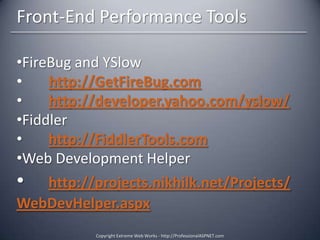
Front-End Performance ToolsFireBug and YSlow
http://GetFireBug.com
http://developer.yahoo.com/yslow/
Fiddler
http://FiddlerTools.com
Web Development Helper
http://projects.nikhilk.net/Projects/WebDevHelper.aspxCopyright Extreme Web Works - http://ProfessionalASPNET.com
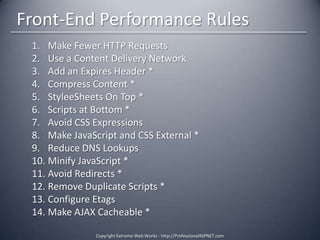
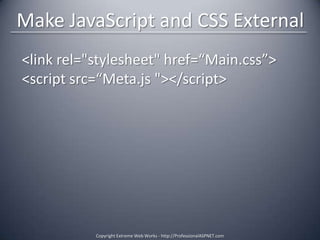
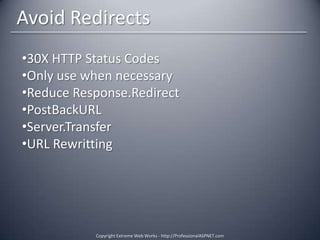
Front-End Performance RulesMake Fewer HTTP RequestsUse a Content Delivery NetworkAdd an Expires Header *Compress Content *StyleeSheets On Top *Scripts at Bottom *Avoid CSS ExpressionsMake JavaScript and CSS External *Reduce DNS LookupsMinify JavaScript *Avoid Redirects *Remove Duplicate Scripts *Configure EtagsMake AJAX Cacheable *Copyright Extreme Web Works - http://ProfessionalASPNET.com
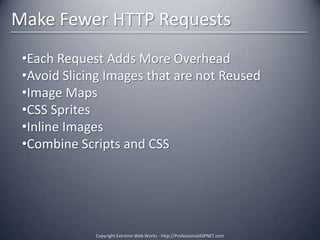
Make Fewer HTTP RequestsEach Request Adds More Overhead
Avoid Slicing Images that are not Reused
Image Maps
CSS Sprites
Inline Images
Combine Scripts and CSSCopyright Extreme Web Works - http://ProfessionalASPNET.com
Use a Content Delivery Network
More Geographically Dispersed

Web Front End Performance

Editor's Notes

  • #9 Entity Tags (ETags) are commonly used in Web applications to effectively leverage the power of using web farms, which is a non-fancy term for HTTP/S load balancing.  In web farms, a common practice is to set what is called ETags as it helps enhance performance in web farm scenarios.  ETags is controlled in IIS by a metabase property (ETAG_CHANGENUMBER) and this value is sent back to clients via response headers as instructed by the HTTP RFC 2616.