



“This One Goes Up To 11”
                           or
     How to write scalable ASP.NET

Phil Pursglove
phil@philippursglove.com
http://diaryofadotnetdeveloper.blogspot.com
http://www.philippursglove.com/ScalableASPNET
I am…
•   Senior .NET Developer
•   MCSD
•   VBUG East Anglia Co-ordinator
•   Used to write for VB Developer and
    SQL Server Pro
Agenda
• Increasing server performance
  – Caching
     •   Output caching
     •   Object caching
     •   Donut caching
     •   Velocity
  – Paging
• Reducing network loads
  – Managing ViewState
  – Compression
• Load Balancing
What is Scalability?
• “The ability to handle growing amounts
  of work in a graceful manner” Wikipedia
• What affects scalability?

• Everything you see this morning
  applies to .NET 2.0 and higher
Increasing Server
  Performance
Why Cache?
• Because there’s a credit crunch!
• Building a page is an expensive
  process
  – Database calls across servers
  – Web Service calls
  – AD lookups

• Returning a stored page from a cache
  is much cheaper!
Caching 1: OutputCache
• Caches the rendered HTML from your
  page
  – Duration is in seconds
  – VaryByParam allows you to cache several
    versions
  – Location means you can cache on the
    web server, client, downstream machines
    or all of these
  – CacheProfiles mean you have fine config-
    based control
Caching 2: Caching API
• Store objects in memory and pull them
  out when you need them

• For data objects, you have to use
  DataSets and DataTables, not
  DataReaders
Caching 2: CacheDependency
• Objects in the cache can be dependent on
  other objects
  – When the dependency changes, the cached item
    is removed
  – Not very useful in .NET 1.1


• .NET 2.0 introduced SqlCacheDependency
  – Cached objects can be dependent on SQL tables
  – Enable using the ASPNET_REGSQL tool
Caching 3: Velocity
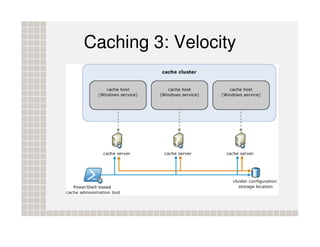
• Velocity
  – Distributed cache
     • One logical cache split across several servers
     • PowerShell management console
  – CTP2 released at PDC

  – Doesn’t have dependencies – yet

  – The future: automatic caching?
Caching 3: Velocity
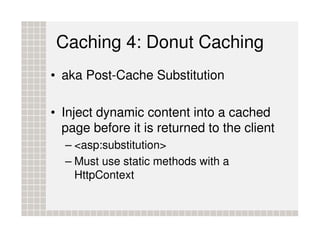
Caching 4: Donut Caching
• aka Post-Cache Substitution

• Inject dynamic content into a cached
  page before it is returned to the client
  – <asp:substitution>
  – Must use static methods with a
    HttpContext
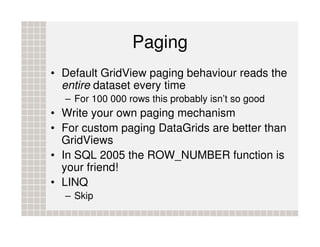
Paging
• Default GridView paging behaviour reads the
  entire dataset every time
  – For 100 000 rows this probably isn’t so good
• Write your own paging mechanism
• For custom paging DataGrids are better than
  GridViews
• In SQL 2005 the ROW_NUMBER function is
  your friend!
• LINQ
  – Skip
Reducing Network Loads
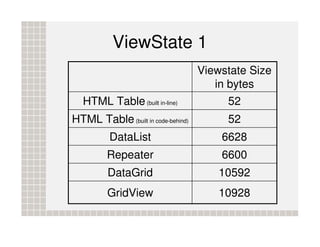
ViewState 1
                                    Viewstate Size
                                       in bytes
   HTML Table (built in-line)            52
HTML Table (built in code-behind)        52
          DataList                      6628
         Repeater                       6600
          DataGrid                      10592
          GridView                      10928
ViewState 2
• Taming Viewstate
  – Can be disabled per-control
  – ZIP it up and put the zipped version on the
    page
  – Keep it on the web server
Compression
• All modern browsers will accept
  compressed content
     – Content is compressed on the server /
       decompressed by the browser
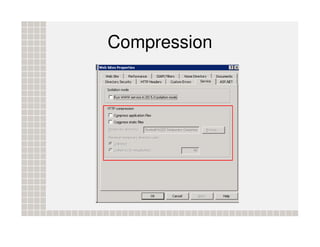
     – Can be enabled in IIS
or
     – Use the HttpCompress library
• JavaScript Compression
     – JSMin (http://tinyurl.com/jscriptmin)
     – jQuery is pre-minified for you
Compression
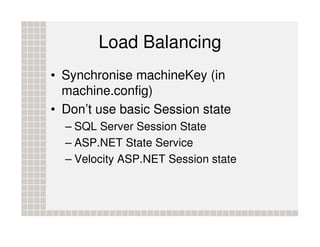
Load Balancing
Load Balancing
• Synchronise machineKey (in
  machine.config)
• Don’t use basic Session state
  – SQL Server Session State
  – ASP.NET State Service
  – Velocity ASP.NET Session state
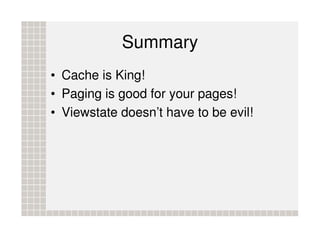
Summary
• Cache is King!
• Paging is good for your pages!
• Viewstate doesn’t have to be evil!
Any Questions?
Enjoy the day!
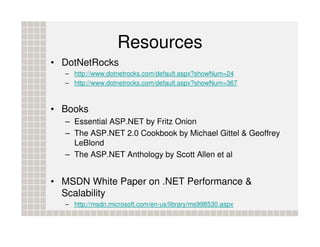
Resources
• DotNetRocks
  – http://www.dotnetrocks.com/default.aspx?showNum=24
  – http://www.dotnetrocks.com/default.aspx?showNum=367


• Books
  – Essential ASP.NET by Fritz Onion
  – The ASP.NET 2.0 Cookbook by Michael Gittel & Geoffrey
    LeBlond
  – The ASP.NET Anthology by Scott Allen et al


• MSDN White Paper on .NET Performance &
  Scalability
  – http://msdn.microsoft.com/en-us/library/ms998530.aspx
Resources
• Velocity
  – http://blogs.msdn.com/velocity
  – http://www.hanselman.com/blog/HanselminutesPodcast116DistributedCac
    hingWithMicrosoftsVelocity.aspx

• Donut Caching
  – http://tinyurl.com/donutcaching


• HttpCompress Library
  –   http://www.blowery.org/code/HttpCompressionModule.html

ASP.NET Scalability - DDD7

  • 1.
    “This One GoesUp To 11” or How to write scalable ASP.NET Phil Pursglove phil@philippursglove.com http://diaryofadotnetdeveloper.blogspot.com http://www.philippursglove.com/ScalableASPNET
  • 2.
    I am… • Senior .NET Developer • MCSD • VBUG East Anglia Co-ordinator • Used to write for VB Developer and SQL Server Pro
  • 3.
    Agenda • Increasing serverperformance – Caching • Output caching • Object caching • Donut caching • Velocity – Paging • Reducing network loads – Managing ViewState – Compression • Load Balancing
  • 4.
    What is Scalability? •“The ability to handle growing amounts of work in a graceful manner” Wikipedia • What affects scalability? • Everything you see this morning applies to .NET 2.0 and higher
  • 5.
    Increasing Server Performance
  • 6.
    Why Cache? • Becausethere’s a credit crunch! • Building a page is an expensive process – Database calls across servers – Web Service calls – AD lookups • Returning a stored page from a cache is much cheaper!
  • 7.
    Caching 1: OutputCache •Caches the rendered HTML from your page – Duration is in seconds – VaryByParam allows you to cache several versions – Location means you can cache on the web server, client, downstream machines or all of these – CacheProfiles mean you have fine config- based control
  • 8.
    Caching 2: CachingAPI • Store objects in memory and pull them out when you need them • For data objects, you have to use DataSets and DataTables, not DataReaders
  • 9.
    Caching 2: CacheDependency •Objects in the cache can be dependent on other objects – When the dependency changes, the cached item is removed – Not very useful in .NET 1.1 • .NET 2.0 introduced SqlCacheDependency – Cached objects can be dependent on SQL tables – Enable using the ASPNET_REGSQL tool
  • 10.
    Caching 3: Velocity •Velocity – Distributed cache • One logical cache split across several servers • PowerShell management console – CTP2 released at PDC – Doesn’t have dependencies – yet – The future: automatic caching?
  • 11.
  • 12.
    Caching 4: DonutCaching • aka Post-Cache Substitution • Inject dynamic content into a cached page before it is returned to the client – <asp:substitution> – Must use static methods with a HttpContext
  • 13.
    Paging • Default GridViewpaging behaviour reads the entire dataset every time – For 100 000 rows this probably isn’t so good • Write your own paging mechanism • For custom paging DataGrids are better than GridViews • In SQL 2005 the ROW_NUMBER function is your friend! • LINQ – Skip
  • 14.
  • 15.
    ViewState 1 Viewstate Size in bytes HTML Table (built in-line) 52 HTML Table (built in code-behind) 52 DataList 6628 Repeater 6600 DataGrid 10592 GridView 10928
  • 16.
    ViewState 2 • TamingViewstate – Can be disabled per-control – ZIP it up and put the zipped version on the page – Keep it on the web server
  • 17.
    Compression • All modernbrowsers will accept compressed content – Content is compressed on the server / decompressed by the browser – Can be enabled in IIS or – Use the HttpCompress library • JavaScript Compression – JSMin (http://tinyurl.com/jscriptmin) – jQuery is pre-minified for you
  • 18.
  • 19.
  • 20.
    Load Balancing • SynchronisemachineKey (in machine.config) • Don’t use basic Session state – SQL Server Session State – ASP.NET State Service – Velocity ASP.NET Session state
  • 21.
    Summary • Cache isKing! • Paging is good for your pages! • Viewstate doesn’t have to be evil!
  • 22.
  • 23.
  • 24.
    Resources • DotNetRocks – http://www.dotnetrocks.com/default.aspx?showNum=24 – http://www.dotnetrocks.com/default.aspx?showNum=367 • Books – Essential ASP.NET by Fritz Onion – The ASP.NET 2.0 Cookbook by Michael Gittel & Geoffrey LeBlond – The ASP.NET Anthology by Scott Allen et al • MSDN White Paper on .NET Performance & Scalability – http://msdn.microsoft.com/en-us/library/ms998530.aspx
  • 25.
    Resources • Velocity – http://blogs.msdn.com/velocity – http://www.hanselman.com/blog/HanselminutesPodcast116DistributedCac hingWithMicrosoftsVelocity.aspx • Donut Caching – http://tinyurl.com/donutcaching • HttpCompress Library – http://www.blowery.org/code/HttpCompressionModule.html