“WEBSITE DEVELOPMENT USING CMS &
WEB OPTIMISATION”
PROJECT ON::
“WEB DEVELOPMENT &
SEO”
USING WORDPRESS AS A
CONTENT MANAGEMENT
SYSTEM
(SITE ONLINE)
WEB DEVELOPMENT & OPTIMIZATION
 Objective
 To design from scratch – a website which ranks
well in major search engines, especially, Google.
 Reduce the cost and complexity of development
 allow the website to be rapidly developed and easily
enhanced.
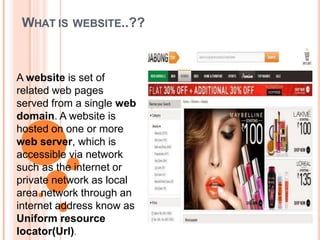
WHAT IS WEBSITE..??
A website is set of
related web pages
served from a single web
domain. A website is
hosted on one or more
web server, which is
accessible via network
such as the internet or
private network as local
area network through an
internet address know as
Uniform resource
locator(Url).
Key Points In Website
Development
Domain
Hosting
Technology
Purpose
Content
Navigation
Optimized
Security
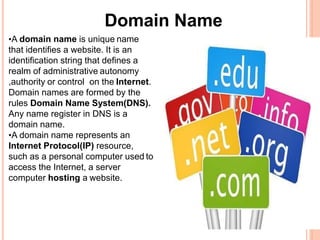
Domain Name
•A domain name is unique name
that identifies a website. It is an
identification string that defines a
realm of administrative autonomy
,authority or control on the Internet.
Domain names are formed by the
rules Domain Name System(DNS).
Any name register in DNS is a
domain name.
•A domain name represents an
Internet Protocol(IP) resource,
such as a personal computer used to
access the Internet, a server
computer hosting a website.
Web Hosting
Hosting a website means making a website
available to public worldwide. When you
create website, it is composed of web pages
having text, images, videos and other content
for people to see them.
 However, people can see your website only
when it is available on the Internet.
To make your website available on the
Internet, you have to store it on a computer
called web server.
When you buy some space on a web server
and store your WebPages there, your website
becomes hosted and can be seen by anyone.
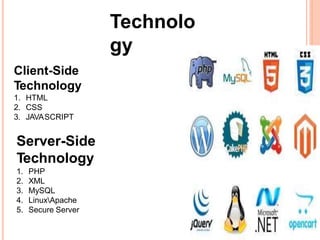
Technolo
gy
Client-Side
Technology
1. HTML
2. CSS
3. JAVASCRIPT
Server-Side
Technology
1. PHP
2. XML
3. MySQL
4. LinuxApache
5. Secure Server
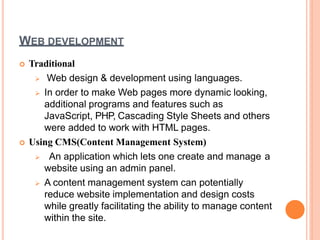
WEB DEVELOPMENT
 Traditional
 Web design & development using languages.
 In order to make Web pages more dynamic looking,
additional programs and features such as
JavaScript, PHP, Cascading Style Sheets and others
were added to work with HTML pages.
 Using CMS(Content Management System)
 An application which lets one create and manage a
website using an admin panel.
 A content management system can potentially
reduce website implementation and design costs
while greatly facilitating the ability to manage content
within the site.
TRADITIONAL WEB DEVELOPMENT
 HTML elements form the building blocks of all
websites.
 It can take longer to design a website using HTML
 Older versions of HTML can become obsolete and
result in diminished SEO over time as the code is
updated
 With HTML, one character out of place can mean
your entire website doesn’t load properly; it is a
much more tedious process
Content – any information published on a
Web site, be it text, HTML, images,
videos…
Management – the workflow and processes
in place to create, share, and control
information during its lifecycle
Systems – an application that enables the
creation, collection, publishing, and
presentation of content
CONTENT MANAGEMENT SYSTEM:
A DEFINITION
CONTENT MANAGEMENT SYSTEM:
A CMS consists of two elements:
The content management application (CMA) element
allows the content manager or author, who may not
know Hypertext Markup Language (HTML), to
manage the creation, modification, and removal of
content from a Web site without needing the expertise
of a Webmaster.
The content delivery application (CDA). element uses
and compiles that information to update the Web site.
The features of a CMS system vary, but most include
Web-based publishing, format management, revision
control, and indexing, search, and retrieval.
CONTENT MANAGEMENT SYSTEM:
CHARACTERISTICS
Content is separate from presentation
WYSIWYG editors
Not software-based, browser-based
Robust user management
Content approval
Easy installation of new features
 Lower technical burden
 Streamlined content creation, approval,
and publishing processes
 Timely, more accurate content
 Content scheduling and expiration
 Consistent templates and branding
 Facilitation of future site-wide changes
CONTENT MANAGEMENT SYSTEM:
BENEFITS
CMS or Content Management Systems are becoming more
and more popular with web design organizations. They have
come to realize that CMS is the future of website development
and may be left behind in the industry if they do not begin
offering CMS services.
CMS certainly saves the company’s time it spends on web
design and allows them to put more efforts into marketing.
CMS gives the company the freedom it needs by providing
them with an ability to update the site when needed, not when
convenient.
CMS also saves the company’s costs by not having to run to
the web designer every time an update is needed.
WEB DESIGN AND CMS
Although there are many open source CMSes
available, the following CMSes are thus PHP-based,
and use a MySQL database. The advantages of using
such a CMS include portability, support and a large
developer base with frequent updates and
improvements.
 Drupal - a free open source content management
system written in PHP and distributed under the
GNU General Public License
 Joomla - an open source content management
system platform for publishing content as a Model–
view–controller (MVC) web application framework
 Wordpress - an open source CMS, often used as a
blog publishing application, and is the most popular
blog software in use today
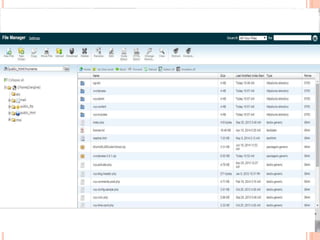
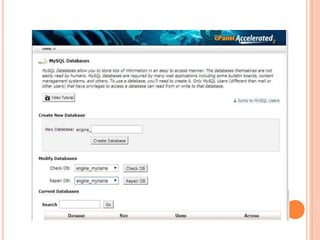
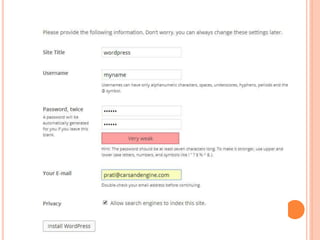
INSTALLATION OF
WORDPRESS
WHAT IS WORDPRESS?
• WordPress is an open source CMS,
powered by PHP and MySQL.
• It is popular among users for its ease of
installation.
• It was first released on May 27, 2003.
WEBSITE
OPTIMIZATION
WHAT IS A SEARCH ENGINE?
 Definition: An internet-based tool that searches an index of documents
for a particular term, phrase or text specified by the user.
 Common Characteristics:
 Spider, Indexer, Database, Algorithm
 Find matching documents and display them according to
relevance
 Frequent updates to documents searched and ranking algorithm
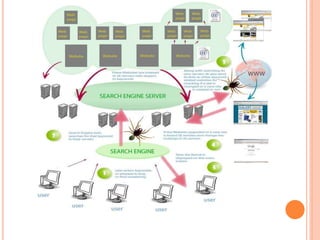
HOW DOES SEARCH ENGINE WORKS?
 Spider “crawls” the web to find new documents (web pages, other
documents) typically by following hyperlinks from websites already in
their database
 Search engines indexes the content (text, code) in these documents by
adding it to their databases and then periodically updates this content
 Search engines search their own databases when a user enters in a
search to find related documents (not searching web pages in real-time)
 Search engines rank the resulting documents using an algorithm
(mathematical formula) by assigning various weights and ranking factors
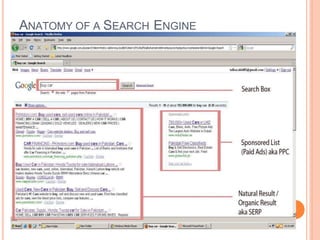
ANATOMY OF A SEARCH ENGINE
WHAT IS SEO
 SEO is an abbreviation for search engine optimization.
 SEO is the process of improving the volume or quality of traffic to a web
site from search engines via search results.
 SEO aims to improve rankings for relevant keywords in search results.
SEO PROCESS
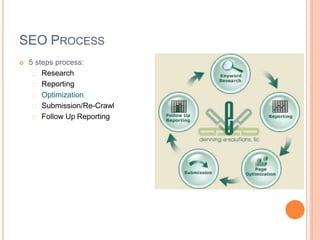
 5 steps process:
Research
Reporting
Optimization
Submission/Re-Crawl
Follow Up Reporting
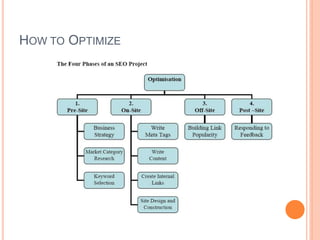
HOW TO OPTIMIZE
HOW TO OPTIMIZE
Skills in the areas of analysis, research, planning, copy writing and
communication.
Pre-site activities
The research and planning activities undertaken before an
existing or new site or page is actually touched or built.
• Understanding your organization's online business strategy
• Researching your market category, customers and competitors
• Keyword research and selection
On-site activities
The activities directly involved in the content and design of web
pages.
HOW TO OPTIMIZE
• Writing the title, description and keyword meta tags
• Writing content – Body copy, titles, image tags, outbound links that
reflect and enhance keywords.
• Building internal links – Helping the search engines navigate the
site
• Site design and construction - Ensuring the web page utilizes
design and code that can be properly crawled and indexed by the
search engines.
Off-site activities
Building a portfolio of quality inbound links to your web site.
Post –site activities
Analyzing and responding to site traffic and user feedback once a
web site has been optimized. Effective SEO is a continuous activity.
HOW TO OPTIMIZE
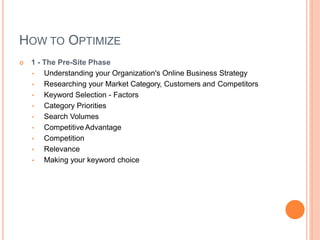
 1 - The Pre-Site Phase
• Understanding your Organization's Online Business Strategy
• Researching your Market Category, Customers and Competitors
• Keyword Selection - Factors
• Category Priorities
• Search Volumes
• Competitive Advantage
• Competition
• Relevance
• Making your keyword choice
HOW TO OPTIMIZE
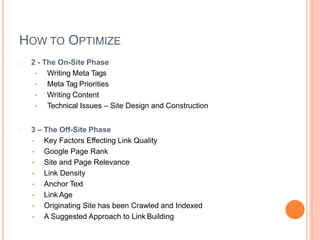
2 - The On-Site Phase
• Writing Meta Tags
• Meta Tag Priorities
• Writing Content
• Technical Issues – Site Design and Construction
3 – The Off-Site Phase
• Key Factors Effecting Link Quality
• Google Page Rank
• Site and Page Relevance
• Link Density
• Anchor Text
• Link Age
• Originating Site has been Crawled and Indexed
• A Suggested Approach to Link Building
HOW TO OPTIMIZE
4- The Post-Site Phase
• Managing and responding to search marketing feedback
• Log Files
• Pay Per Click
• The SEO Cycle
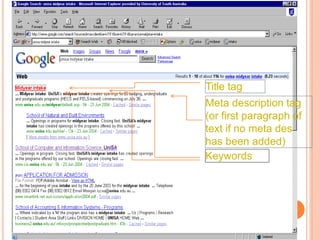
Title tag
Meta description tag
(or first paragraph of
text if no meta des
has been added)
Keywords
ON PAGE OPTIMIZATION
 On-page optimization (on-page SEO) is what can be done on the pages
of a website to maximize its performance in the search engines for target
keywords related to the on-page content.
 On-page optimization stands for all of the techniques and methods used
on your website that is hosted on a server.
 On-page optimization has an effect on your website listing in natural
results .
 On-page factors are controlled by coding on website pages
ON PAGE SEO ELEMENTS
Title tags
Meta tags
ALT tags
Header(H1,H2) tags
URL Structure
Internal Linking
Relevant keywords near your inbound link
Content
Keyword Density
Site maps
Usability
OFF PAGE SEO OPTIMIZATION
 Off-page optimization (off-page SEO) is what can be done off the pages
of a website to maximize its performance in search engines for target
keywords related to the on-page content and keywords in off-page direct
link.
 Off-page optimization is the most important part in search engines
optimization because it gives back links to your sites and it requires a lot
of work on a daily bases.
 It helps to maximize website performance in search engine for target
keywords
OFF PAGE SEO ELEMENTS
 Search engine submission.
 Social Bookmarking submission.
 Article submission.
 Press release submission.
 Blog creation & Posting .
 Forums & comment posting.
 Directory Submission
 Yellow pages and classified
 Profile Mailing
 B2B Submission (Business 2 Business)
 RSS feeds and submission
LINK BUILDING
 What is Link Popularity?
Link Popularity refers to the number of links pointing TO your site
FROM other sites on the Web.
Building links is one of the most important factors in getting top
placements on the major search engines
 Why are links so important?
Now a days, inbound links are the one of most important factors for
getting a high keyword ranking, the most search engines are ranking
their search result based on the link popularity from your site.
Not the quantity of links, but the quality of those links is important.
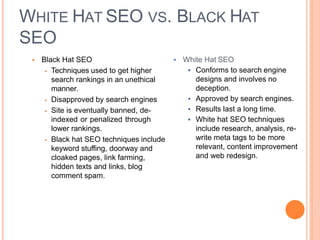
WHITE HAT SEO VS. BLACK HAT
SEO
 Black Hat SEO  White Hat SEO
 Techniques used to get higher
search rankings in an unethical
manner.
 Disapproved by search engines
 Site is eventually banned, de-
indexed or penalized through
lower rankings.
 Black hat SEO techniques include
keyword stuffing, doorway and
cloaked pages, link farming,
hidden texts and links, blog
comment spam.
 Conforms to search engine
designs and involves no
deception.
 Approved by search engines.
 Results last a long time.
 White hat SEO techniques
include research, analysis, re-
write meta tags to be more
relevant, content improvement
and web redesign.
SEO TOOLS
 The 6 tools you need to use to become a highly-profitable SEO expert:
 Search Analytic Tools- establish your marketing goals and establish a
baseline for where you are at right now.
 Keyword Research Tools- discover the keywords your customers are
searching for right now.
 Competitive Research Tools- see what keywords your competitors are
targeting.
 PPC Tools- buy important keywords and track the results to understand
how well they convert, which helps you focus you organic SEO strategy
on the most profitable keywords.
 Link Analysis Tools- start building your link profile and track your
progress compared to competing websites.
 Search Engine Ranking Checkers- determine how effective your
marketing is by watching your search engine rankings improve.
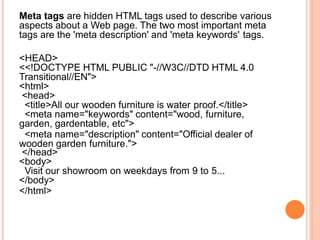
Meta tags are hidden HTML tags used to describe various
aspects about a Web page. The two most important meta
tags are the 'meta description' and 'meta keywords' tags.
<HEAD>
<<!DOCTYPE HTML PUBLIC "-//W3C//DTD HTML 4.0
Transitional//EN">
<html>
<head>
<title>All our wooden furniture is water proof.</title>
<meta name="keywords" content="wood, furniture,
garden, gardentable, etc">
<meta name="description" content="Official dealer of
wooden garden furniture.">
</head>
<body>
Visit our showroom on weekdays from 9 to 5...
</body>
</html>
PROJECT ON::
“WEB DEVELOPMENT &
SEO”
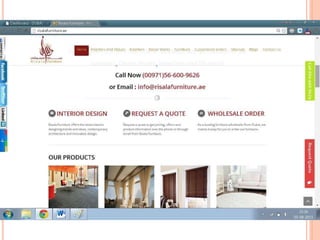
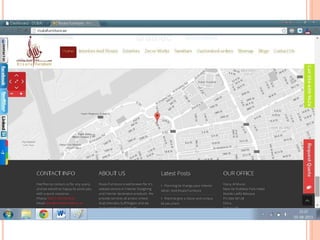
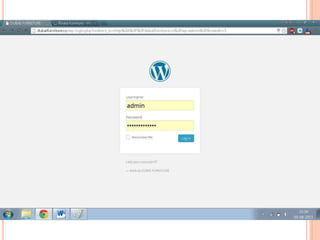
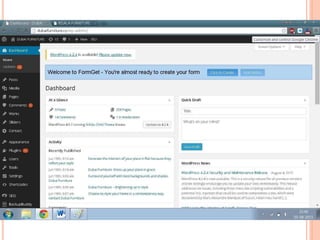
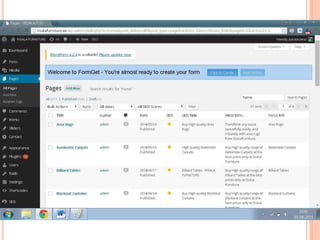
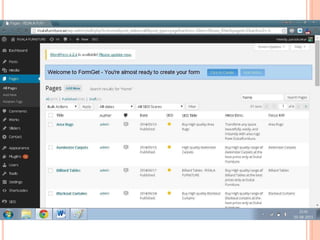
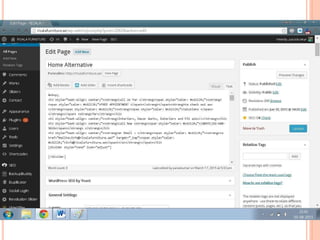
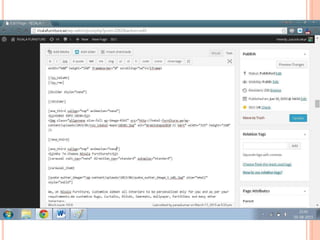
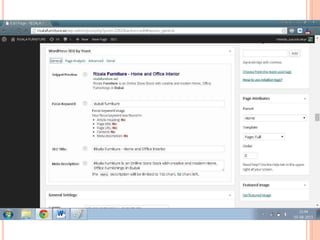
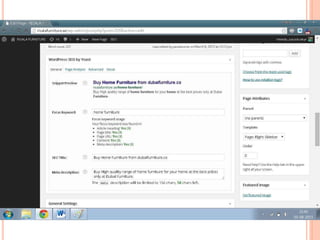
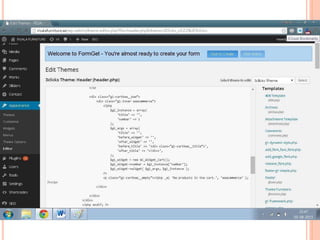
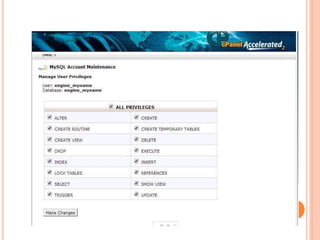
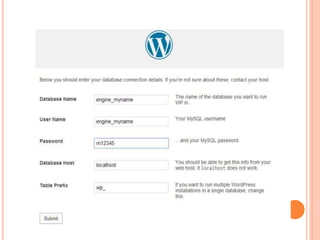
SNAPSHOTS
THANK YOU !!
CONCLUSION
 CMS simplified the process of web development and
maintenance.
 CMS offer in-built functions and by using them website can
be designed and developed using clients custom needs and
requirements.
 Being an open source CMS, there is no need to pay any
kinds of license fee. Thus, it also provides cost effective
solutions to the clients according to their financial budget.
 We applied the technical and creative process to improve the
visibility of a website in search engines, with the aim of driving
more potential customers to the website that we made using
Wordpress as a Content Management System for the project.
GET IN TOUCH WITH US
Office 9212306116,
Cellphone: 8860646116
Info: info@webinfomatrix.com
B-68, 2nd Floor, 40 FT Road
Chanakya Place, C-1 Janakpuri
New Delhi -110059
Visit: https://webinfomatrix.com/
THANK YOU !!

Web development services

  • 1.
    “WEBSITE DEVELOPMENT USINGCMS & WEB OPTIMISATION”
  • 2.
    PROJECT ON:: “WEB DEVELOPMENT& SEO” USING WORDPRESS AS A CONTENT MANAGEMENT SYSTEM (SITE ONLINE)
  • 3.
    WEB DEVELOPMENT &OPTIMIZATION  Objective  To design from scratch – a website which ranks well in major search engines, especially, Google.  Reduce the cost and complexity of development  allow the website to be rapidly developed and easily enhanced.
  • 4.
    WHAT IS WEBSITE..?? Awebsite is set of related web pages served from a single web domain. A website is hosted on one or more web server, which is accessible via network such as the internet or private network as local area network through an internet address know as Uniform resource locator(Url).
  • 5.
    Key Points InWebsite Development Domain Hosting Technology Purpose Content Navigation Optimized Security
  • 6.
    Domain Name •A domainname is unique name that identifies a website. It is an identification string that defines a realm of administrative autonomy ,authority or control on the Internet. Domain names are formed by the rules Domain Name System(DNS). Any name register in DNS is a domain name. •A domain name represents an Internet Protocol(IP) resource, such as a personal computer used to access the Internet, a server computer hosting a website.
  • 7.
    Web Hosting Hosting awebsite means making a website available to public worldwide. When you create website, it is composed of web pages having text, images, videos and other content for people to see them.  However, people can see your website only when it is available on the Internet. To make your website available on the Internet, you have to store it on a computer called web server. When you buy some space on a web server and store your WebPages there, your website becomes hosted and can be seen by anyone.
  • 8.
    Technolo gy Client-Side Technology 1. HTML 2. CSS 3.JAVASCRIPT Server-Side Technology 1. PHP 2. XML 3. MySQL 4. LinuxApache 5. Secure Server
  • 9.
    WEB DEVELOPMENT  Traditional Web design & development using languages.  In order to make Web pages more dynamic looking, additional programs and features such as JavaScript, PHP, Cascading Style Sheets and others were added to work with HTML pages.  Using CMS(Content Management System)  An application which lets one create and manage a website using an admin panel.  A content management system can potentially reduce website implementation and design costs while greatly facilitating the ability to manage content within the site.
  • 10.
    TRADITIONAL WEB DEVELOPMENT HTML elements form the building blocks of all websites.  It can take longer to design a website using HTML  Older versions of HTML can become obsolete and result in diminished SEO over time as the code is updated  With HTML, one character out of place can mean your entire website doesn’t load properly; it is a much more tedious process
  • 11.
    Content – anyinformation published on a Web site, be it text, HTML, images, videos… Management – the workflow and processes in place to create, share, and control information during its lifecycle Systems – an application that enables the creation, collection, publishing, and presentation of content CONTENT MANAGEMENT SYSTEM: A DEFINITION
  • 12.
    CONTENT MANAGEMENT SYSTEM: ACMS consists of two elements: The content management application (CMA) element allows the content manager or author, who may not know Hypertext Markup Language (HTML), to manage the creation, modification, and removal of content from a Web site without needing the expertise of a Webmaster. The content delivery application (CDA). element uses and compiles that information to update the Web site. The features of a CMS system vary, but most include Web-based publishing, format management, revision control, and indexing, search, and retrieval.
  • 13.
    CONTENT MANAGEMENT SYSTEM: CHARACTERISTICS Contentis separate from presentation WYSIWYG editors Not software-based, browser-based Robust user management Content approval Easy installation of new features
  • 14.
     Lower technicalburden  Streamlined content creation, approval, and publishing processes  Timely, more accurate content  Content scheduling and expiration  Consistent templates and branding  Facilitation of future site-wide changes CONTENT MANAGEMENT SYSTEM: BENEFITS
  • 15.
    CMS or ContentManagement Systems are becoming more and more popular with web design organizations. They have come to realize that CMS is the future of website development and may be left behind in the industry if they do not begin offering CMS services. CMS certainly saves the company’s time it spends on web design and allows them to put more efforts into marketing. CMS gives the company the freedom it needs by providing them with an ability to update the site when needed, not when convenient. CMS also saves the company’s costs by not having to run to the web designer every time an update is needed. WEB DESIGN AND CMS
  • 16.
    Although there aremany open source CMSes available, the following CMSes are thus PHP-based, and use a MySQL database. The advantages of using such a CMS include portability, support and a large developer base with frequent updates and improvements.  Drupal - a free open source content management system written in PHP and distributed under the GNU General Public License  Joomla - an open source content management system platform for publishing content as a Model– view–controller (MVC) web application framework  Wordpress - an open source CMS, often used as a blog publishing application, and is the most popular blog software in use today
  • 17.
  • 18.
    WHAT IS WORDPRESS? •WordPress is an open source CMS, powered by PHP and MySQL. • It is popular among users for its ease of installation. • It was first released on May 27, 2003.
  • 27.
  • 28.
    WHAT IS ASEARCH ENGINE?  Definition: An internet-based tool that searches an index of documents for a particular term, phrase or text specified by the user.  Common Characteristics:  Spider, Indexer, Database, Algorithm  Find matching documents and display them according to relevance  Frequent updates to documents searched and ranking algorithm
  • 29.
    HOW DOES SEARCHENGINE WORKS?  Spider “crawls” the web to find new documents (web pages, other documents) typically by following hyperlinks from websites already in their database  Search engines indexes the content (text, code) in these documents by adding it to their databases and then periodically updates this content  Search engines search their own databases when a user enters in a search to find related documents (not searching web pages in real-time)  Search engines rank the resulting documents using an algorithm (mathematical formula) by assigning various weights and ranking factors
  • 31.
    ANATOMY OF ASEARCH ENGINE
  • 32.
    WHAT IS SEO SEO is an abbreviation for search engine optimization.  SEO is the process of improving the volume or quality of traffic to a web site from search engines via search results.  SEO aims to improve rankings for relevant keywords in search results.
  • 33.
    SEO PROCESS  5steps process: Research Reporting Optimization Submission/Re-Crawl Follow Up Reporting
  • 34.
  • 35.
    HOW TO OPTIMIZE Skillsin the areas of analysis, research, planning, copy writing and communication. Pre-site activities The research and planning activities undertaken before an existing or new site or page is actually touched or built. • Understanding your organization's online business strategy • Researching your market category, customers and competitors • Keyword research and selection On-site activities The activities directly involved in the content and design of web pages.
  • 36.
    HOW TO OPTIMIZE •Writing the title, description and keyword meta tags • Writing content – Body copy, titles, image tags, outbound links that reflect and enhance keywords. • Building internal links – Helping the search engines navigate the site • Site design and construction - Ensuring the web page utilizes design and code that can be properly crawled and indexed by the search engines. Off-site activities Building a portfolio of quality inbound links to your web site. Post –site activities Analyzing and responding to site traffic and user feedback once a web site has been optimized. Effective SEO is a continuous activity.
  • 37.
    HOW TO OPTIMIZE 1 - The Pre-Site Phase • Understanding your Organization's Online Business Strategy • Researching your Market Category, Customers and Competitors • Keyword Selection - Factors • Category Priorities • Search Volumes • Competitive Advantage • Competition • Relevance • Making your keyword choice
  • 38.
    HOW TO OPTIMIZE 2- The On-Site Phase • Writing Meta Tags • Meta Tag Priorities • Writing Content • Technical Issues – Site Design and Construction 3 – The Off-Site Phase • Key Factors Effecting Link Quality • Google Page Rank • Site and Page Relevance • Link Density • Anchor Text • Link Age • Originating Site has been Crawled and Indexed • A Suggested Approach to Link Building
  • 39.
    HOW TO OPTIMIZE 4-The Post-Site Phase • Managing and responding to search marketing feedback • Log Files • Pay Per Click • The SEO Cycle
  • 40.
    Title tag Meta descriptiontag (or first paragraph of text if no meta des has been added) Keywords
  • 41.
    ON PAGE OPTIMIZATION On-page optimization (on-page SEO) is what can be done on the pages of a website to maximize its performance in the search engines for target keywords related to the on-page content.  On-page optimization stands for all of the techniques and methods used on your website that is hosted on a server.  On-page optimization has an effect on your website listing in natural results .  On-page factors are controlled by coding on website pages
  • 42.
    ON PAGE SEOELEMENTS Title tags Meta tags ALT tags Header(H1,H2) tags URL Structure Internal Linking Relevant keywords near your inbound link Content Keyword Density Site maps Usability
  • 43.
    OFF PAGE SEOOPTIMIZATION  Off-page optimization (off-page SEO) is what can be done off the pages of a website to maximize its performance in search engines for target keywords related to the on-page content and keywords in off-page direct link.  Off-page optimization is the most important part in search engines optimization because it gives back links to your sites and it requires a lot of work on a daily bases.  It helps to maximize website performance in search engine for target keywords
  • 44.
    OFF PAGE SEOELEMENTS  Search engine submission.  Social Bookmarking submission.  Article submission.  Press release submission.  Blog creation & Posting .  Forums & comment posting.  Directory Submission  Yellow pages and classified  Profile Mailing  B2B Submission (Business 2 Business)  RSS feeds and submission
  • 45.
    LINK BUILDING  Whatis Link Popularity? Link Popularity refers to the number of links pointing TO your site FROM other sites on the Web. Building links is one of the most important factors in getting top placements on the major search engines  Why are links so important? Now a days, inbound links are the one of most important factors for getting a high keyword ranking, the most search engines are ranking their search result based on the link popularity from your site. Not the quantity of links, but the quality of those links is important.
  • 46.
    WHITE HAT SEOVS. BLACK HAT SEO  Black Hat SEO  White Hat SEO  Techniques used to get higher search rankings in an unethical manner.  Disapproved by search engines  Site is eventually banned, de- indexed or penalized through lower rankings.  Black hat SEO techniques include keyword stuffing, doorway and cloaked pages, link farming, hidden texts and links, blog comment spam.  Conforms to search engine designs and involves no deception.  Approved by search engines.  Results last a long time.  White hat SEO techniques include research, analysis, re- write meta tags to be more relevant, content improvement and web redesign.
  • 47.
    SEO TOOLS  The6 tools you need to use to become a highly-profitable SEO expert:  Search Analytic Tools- establish your marketing goals and establish a baseline for where you are at right now.  Keyword Research Tools- discover the keywords your customers are searching for right now.  Competitive Research Tools- see what keywords your competitors are targeting.  PPC Tools- buy important keywords and track the results to understand how well they convert, which helps you focus you organic SEO strategy on the most profitable keywords.  Link Analysis Tools- start building your link profile and track your progress compared to competing websites.  Search Engine Ranking Checkers- determine how effective your marketing is by watching your search engine rankings improve.
  • 48.
    Meta tags arehidden HTML tags used to describe various aspects about a Web page. The two most important meta tags are the 'meta description' and 'meta keywords' tags. <HEAD> <<!DOCTYPE HTML PUBLIC "-//W3C//DTD HTML 4.0 Transitional//EN"> <html> <head> <title>All our wooden furniture is water proof.</title> <meta name="keywords" content="wood, furniture, garden, gardentable, etc"> <meta name="description" content="Official dealer of wooden garden furniture."> </head> <body> Visit our showroom on weekdays from 9 to 5... </body> </html>
  • 49.
  • 50.
  • 62.
    CONCLUSION  CMS simplifiedthe process of web development and maintenance.  CMS offer in-built functions and by using them website can be designed and developed using clients custom needs and requirements.  Being an open source CMS, there is no need to pay any kinds of license fee. Thus, it also provides cost effective solutions to the clients according to their financial budget.  We applied the technical and creative process to improve the visibility of a website in search engines, with the aim of driving more potential customers to the website that we made using Wordpress as a Content Management System for the project.
  • 63.
    GET IN TOUCHWITH US Office 9212306116, Cellphone: 8860646116 Info: info@webinfomatrix.com B-68, 2nd Floor, 40 FT Road Chanakya Place, C-1 Janakpuri New Delhi -110059 Visit: https://webinfomatrix.com/
  • 64.