Search Engine
Optimization
SEO –
Search Engine
Optimization
What is SEO?
Search Engine +
Optimization
What is SEO?
SEO is a process of Improving the search
engine ranking of your web-pages when
people search for your business related
keywords .
It Improves the Quantity and Quality of
Organic Traffic to your website.
4
Why SEO?
▸ 93% All online Experiences begin with a Search Engine
▸ 75% Users Never scroll to Page 2
▸ 70 – 80% User ignore the paid ADS, focus on Organic Search
Results
▸ 82% of smartphone users say they use search to find a local
business.
Why SEO for Business?
▸ Increase visibility of the website
▸ Increase website traffic
▸ High website traffic would lead to higher
conversions
▸ Enhances user trust on the website
Career in SEO
▸ Search Engine Marketer
▸ Content Marketer & Specialist
▸ SEO Manager
▸ Marketing Analyst
▸ Digital Marketer
▸ Business Marketing Consultant
▸ Entrepreneur
“
Types of SEO
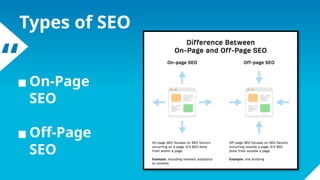
▪ On-Page
SEO
▪ Off-Page
SEO
-Techniques of SEO
-Working of Search Engines
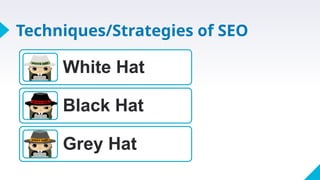
Techniques/Strategies of SEO
White Hat
Black Hat
Grey Hat
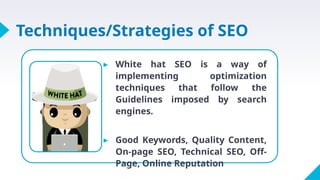
Techniques/Strategies of SEO
▸ White hat SEO is a way of
implementing optimization
techniques that follow the
Guidelines imposed by search
engines.
▸ Good Keywords, Quality Content,
On-page SEO, Technical SEO, Off-
Page, Online Reputation
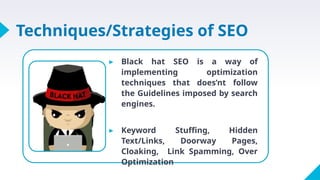
Techniques/Strategies of SEO
▸ Black hat SEO is a way of
implementing optimization
techniques that does’nt follow
the Guidelines imposed by search
engines.
▸ Keyword Stuffing, Hidden
Text/Links, Doorway Pages,
Cloaking, Link Spamming, Over
Optimization
Techniques/Strategies of SEO
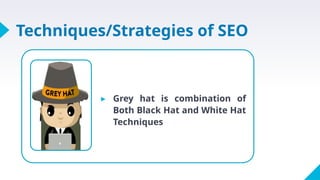
▸ Grey hat is combination of
Both Black Hat and White Hat
Techniques
What is a Search
Engine?
A search engine is a
software system that
is designed to carry
out web searches.
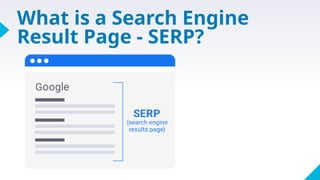
What is a Search Engine
Result Page - SERP?
www.wscubetech.com
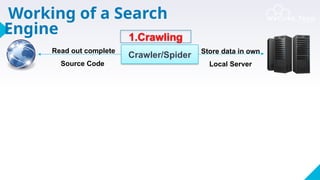
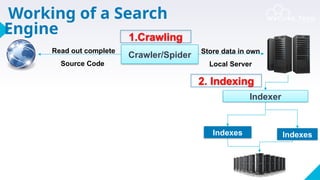
Crawler/Spider
Read out complete
Source Code
Store data in own
Local Server
1.Crawling
Working of a Search
Engine
www.wscubetech.com
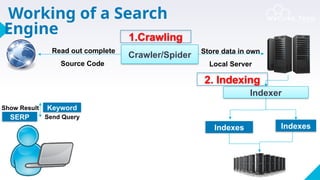
Crawler/Spider
Read out complete
Source Code
Store data in own
Local Server
1.Crawling
Indexes Indexes
Indexer
2. Indexing
Working of a Search
Engine
www.wscubetech.com
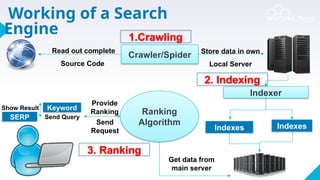
Crawler/Spider
Read out complete
Source Code
Store data in own
Local Server
Send Query
Show Result
1.Crawling
Indexes Indexes
Keyword
SERP
Indexer
2. Indexing
Working of a Search
Engine
www.wscubetech.com
Crawler/Spider
Read out complete
Source Code
Store data in own
Local Server
Send
Request
Get data from
main server
Provide
Ranking
1.Crawling
Indexes Indexes
Ranking
Algorithm
Indexer
2. Indexing
3. Ranking
Working of a Search
Engine
www.wscubetech.com
Send Query
Show Result Keyword
SERP
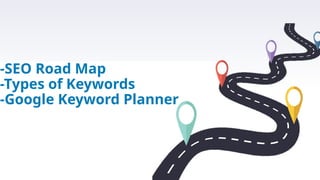
-SEO Road Map
-Types of Keywords
-Google Keyword Planner
SEO Road Map
Website Audit : Website audit is a full
analysis of all the factors that affect
website's visibility in search engines.
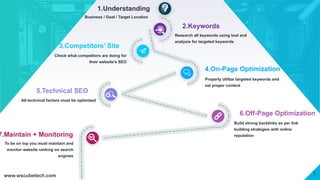
2.Keywords
Research all keywords using tool and
analysis for targeted keywords
4.On-Page Optimization
Properly Utilize targeted keywords and
set proper content
6.Off-Page Optimization
Build strong backlinks as per link
building strategies with online
reputation
3.Competitors’ Site
Check what competitors are doing for
their website’s SEO
5.Technical SEO
All technical factors must be optimized
7.Maintain + Monitoring
To be on top you must maintain and
monitor website ranking on search
engines
1
www.wscubetech.com
1.Understanding
Business / Goal / Target Location
What are Keywords?
Keywords are the terms and phrases
associated with your business that people use
when entering a query into search engines to
find your website.
23
Why Keyword Research is Important?
▪ Knowing your keywords helps you to understand your
brand and your business.
▪ Keyword research can tell you what people are
searching for, rather than what you think they are
searching for.
▪ Search engines can only rank your website if they know
what your business is. Targeting keywords on different
pages of your website means Google can then rank you
24
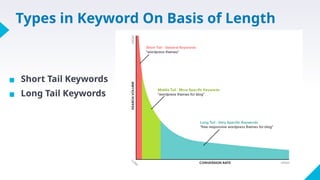
Types in Keyword On Basis of Length
▪ Short Tail Keywords
▪ Long Tail Keywords
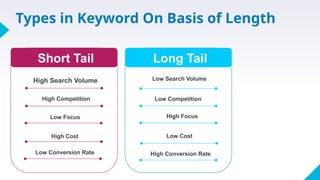
Types in Keyword On Basis of Length
High Search Volume
Short Tail
High Competition
Low Focus
High Cost
Low Conversion Rate
Low Search Volume
Long Tail
Low Competition
High Focus
Low Cost
High Conversion Rate
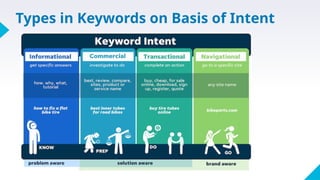
Types in Keywords on Basis of Intent
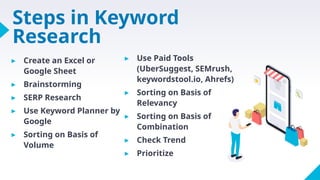
Steps in Keyword
Research
▸ Create an Excel or
Google Sheet
▸ Brainstorming
▸ SERP Research
▸ Use Keyword Planner by
Google
▸ Sorting on Basis of
Volume
▸ Use Paid Tools
(UberSuggest, SEMrush,
keywordstool.io, Ahrefs)
▸ Sorting on Basis of
Relevancy
▸ Sorting on Basis of
Combination
▸ Check Trend
▸ Prioritize
- Brainstorming of KWs
- Google Keyword Planner
- Keyword Research Paid
Tools
- Keyword Trend
- Keyword Research Practice
- Competitors’ Analysis
- What is Niche?
- Niche Selection
A niche is a specialized topic area that you'll
be focusing on when writing content.
- What is Niche?
On Page SEO
Introduction to On Page SEO
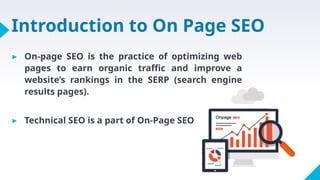
▸ On-page SEO is the practice of optimizing web
pages to earn organic traffic and improve a
website’s rankings in the SERP (search engine
results pages).
▸ Technical SEO is a part of On-Page SEO
On Page SEO Checklist
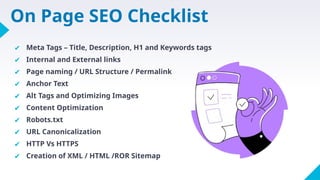
✔ Meta Tags – Title, Description, H1 and Keywords tags
✔ Internal and External links
✔ Page naming / URL Structure / Permalink
✔ Anchor Text
✔ Alt Tags and Optimizing Images
✔ Content Optimization
✔ Robots.txt
✔ URL Canonicalization
✔ HTTP Vs HTTPS
✔ Creation of XML / HTML /ROR Sitemap
On Page SEO Checklist
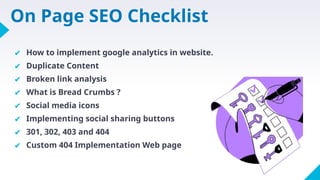
✔ How to implement google analytics in website.
✔ Duplicate Content
✔ Broken link analysis
✔ What is Bread Crumbs ?
✔ Social media icons
✔ Implementing social sharing buttons
✔ 301, 302, 403 and 404
✔ Custom 404 Implementation Web page
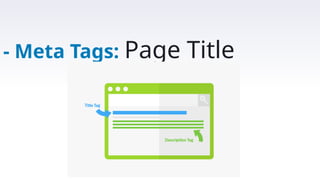
- Meta Tags: Page Title
Meta Tags: Title
It defines title of each webpage.
- Length of meta title is upto 580 pixels.
- Meta Title appears in search engine result page.
- Most Important keyword are placed in meta title.
- Title should focus on keywords of that particular page.
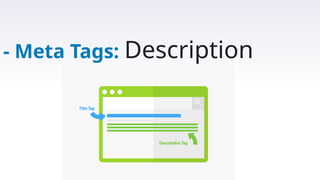
- Meta Tags: Description
Meta Description
It’s a small description or content of page or we can say it’s small
summary of webpage content.
- Length of meta description should be 920 pixels.
- Important and competitive keywords should be placed in meta
description.
- Meta description also appears in SERP along with meta title.
- URL Optimization
- Headings Tag
- Canonicalization
URL Structure / Page Naming /
Permalink
• URL(uniform resource locator)- address of given resource on web
• URL structure :- Should be easy to read
• Avoid use of any special character
• ( _ ) underscore must no be used
• The permalink is the full URL you see – and use – for any given post,
page or other pieces of content on your site. It is a permanent link
Meta Tags: H1 Tag
H1 heading is only used once and it is the title or headline of
that particular page
- H1 is the most important and H6 is the least important
- Important keywords must be place in headings
- H tags enhance readability and visibility
- Heading from 1 to 6 forms a hierarchy, if we jump from 1 to 4
directly, heading structure will break and its not good for SEO..
Canonical Tags
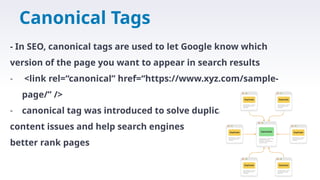
- In SEO, canonical tags are used to let Google know which
version of the page you want to appear in search results
- <link rel=“canonical” href=“https://www.xyz.com/sample-
page/” />
- canonical tag was introduced to solve duplicate
content issues and help search engines
better rank pages
- Internal Links
- External Links
- Anchor Text
Internal link
● Internal Link :- These are the links which goes from one page to
another page in same domain or we can say that internal links
are the links that we have within a website.
● Internal links are important to engage audience or user within a
website.
● They are most commonly used for navigation within website.
● Search engine get to know the depth of content within your own
website.
External link
▪ External Links :- These are the links which goes from one page to
another page in different domain or we can say that external links
are the links that use to link to other website and similarly how
other website link to your content.
● Adding external links to high quality website make a good impact
in eye of search engine
● Search engine forms a trust in your website and this trust helps to
get higher position in search engine result pages.
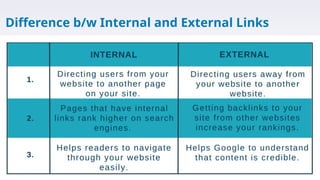
Difference b/w Internal and External Links
Anchor Text
● It refers to the clickable text or words or phrases used to link a one
webpage to another.
● Mostly in blue colour, you can see such type of text, when clicked
land to another webpage of same domain or different domain
● Anchor text can have any colour, but they are visible ( maybe Bold
or underlined )
Content Optimization:
- Keyword density
- Plagiarism
- Grammar
- Keyword prominence &
proximity
- Cannibalization
Content Optimization
● Content plays a very crucial role in ranking of any website, must
be well written to reach the largest possible audience.
● Content should be unique and updated
● Content should be user friendly, must be created match the user
requirement, if user doesn’t engage with your content then it is of
no use.
● Keywords must be used. 4% in 1000 words rule must be follow.
● Meta tags, headings, alt tags, anchor text, visual representation
of content must be there.
Content Optimization
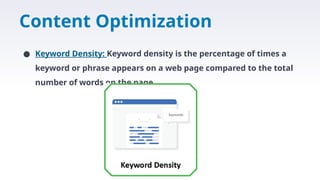
● Keyword Density: Keyword density is the percentage of times a
keyword or phrase appears on a web page compared to the total
number of words on the page.
Content Optimization
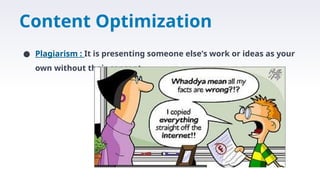
● Plagiarism : It is presenting someone else's work or ideas as your
own without their consent
Content Optimization
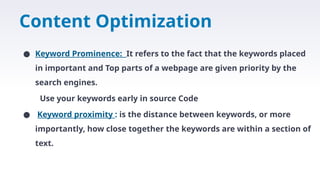
● Keyword Prominence: It refers to the fact that the keywords placed
in important and Top parts of a webpage are given priority by the
search engines.
Use your keywords early in source Code
● Keyword proximity : is the distance between keywords, or more
importantly, how close together the keywords are within a section of
text.
Image
Optimization:
- Alt Tag
- Image Title
Alt tags
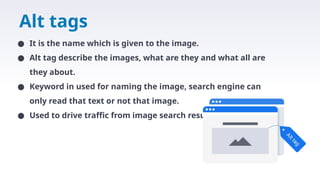
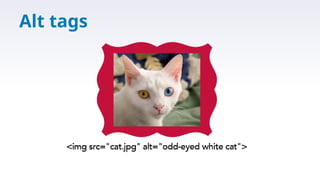
● It is the name which is given to the image.
● Alt tag describe the images, what are they and what all are
they about.
● Keyword in used for naming the image, search engine can
only read that text or not that image.
● Used to drive traffic from image search results
Alt tags
-Important and Latest
Algorithms of Google
-Ranking Factors
Google Ranking Algorithms
• Google search algorithm is a
complex system that allows
Google to find, rank and return
the most relevant pages for a
certain search query.
• The search engine uses a
combination of algorithms and
numerous ranking factors to
deliver webpages ranked by
relevance on its search engine
Panda - 2011
Aimed to improve search
results by penalizing sites that
had repetitive content and
poor user metrics.
Penguin -
2012
Tackled low-quality results by
penalizing pages that use
black-hat link building
techniques.
Medic 2018
Aimed to provide trustworthy results
and advice to people searching for
money or health based terms by
penalizing sites with no Expertise,
Authority, or Trust (E-A-T).
BERT 2019
Another tweak to Google's
understanding of search intent
rewarding well-constructed content.
Medic 2018
Again all about E-A-T signals and put more
weight behind content factors and user
data
E.A.T. =Expertise, Authoritativeness
and Trustworthiness
Google December 2020 core update
Remains slightly ambiguous but
focused on content interpretation and
SERP features.
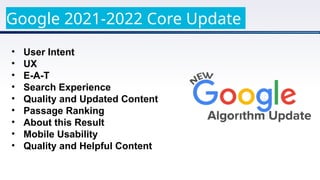
• User Intent
• UX
• E-A-T
• Search Experience
• Quality and Updated Content
• Passage Ranking
• About this Result
• Mobile Usability
• Quality and Helpful Content
Google 2021-2022 Core Update
-Sitemap.XML
-Sitemap.HTML
-Robots.txt
XML Sitemap
● XML stands for extensible mark-up language.
● XML sitemap consists of all URL’s of a particular website.
● XML sitemap is a file which will have all the information of each
URL of a website.
● Used by google to crawl the website more intelligently.
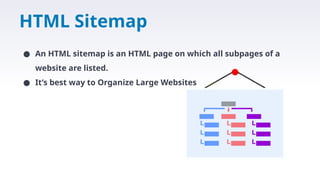
HTML Sitemap
● An HTML sitemap is an HTML page on which all subpages of a
website are listed.
● It’s best way to Organize Large Websites
Robots.txt
● Its act as a door to crawlers, It tells the crawlers what and
what not to crawl on particular website.
● A robots.txt file is a set of instructions for bots. This file is
included in the source files of most websites.
● Google currently enforces a robots.txt file size limit of 500 kibibytes (KiB).
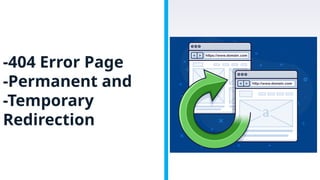
-404 Error Page
-Permanent and
-Temporary
Redirection
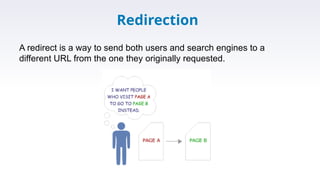
Redirection
A redirect is a way to send both users and search engines to a
different URL from the one they originally requested.
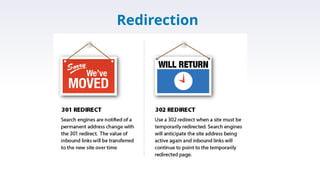
Redirection
404 Error Page
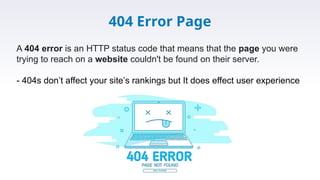
A 404 error is an HTTP status code that means that the page you were
trying to reach on a website couldn't be found on their server.
- 404s don’t affect your site’s rankings but It does effect user experience
Some Common Page Errors
● 403: Web page forbidden (unauthorized response)
● 404: Web page file not found
● 404 Soft : A soft 404 error happens when the server sends a 200 OK
status for the requested page, but Google thinks that the page
should return a 404.
● 500 Error series:- Mostly server Issues
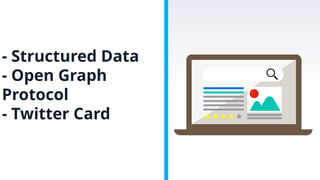
- Structured Data
- Open Graph
Protocol
- Twitter Card
Structured Data
Structured data is a standardized way to provide information about a
web page. It helps search engines like Google to better understand
what your content is about.
How Structured data help your SEO?
-Get rich results
-Get into Google’s Knowledge Graph
-Support semantic search
-Support your E-A-T
Open Graph Protocol
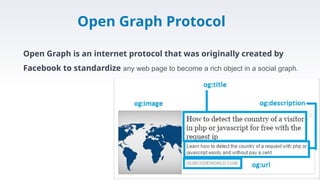
Open Graph is an internet protocol that was originally created by
Facebook to standardize any web page to become a rich object in a social graph.
Twitter Card
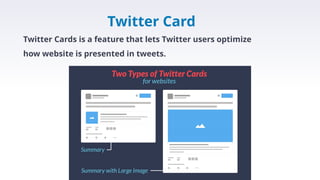
Twitter Cards is a feature that lets Twitter users optimize
how website is presented in tweets.
- Page Speed
Optimization
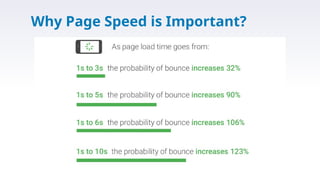
Why Page Speed is Important?
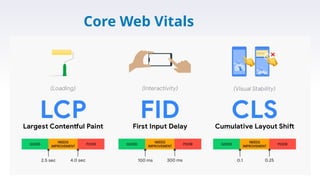
Core Web Vitals
How to Improve Page Speed?
• Compress and optimize your images
• Reduce your redirects
• Enable Browser Caching
• Minify CSS, JavaScript, and HTML
• Defer loading for your CSS and JavaScript files
• Asynchronous loading for your CSS and JavaScript files
• Use a Content Delivery Network (CDN)
• Eliminate unnecessary plugins.
Off-Page SEO
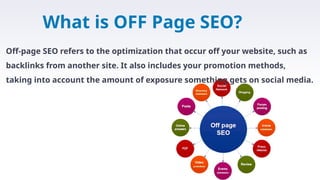
What is OFF Page SEO?
Off-page SEO refers to the optimization that occur off your website, such as
backlinks from another site. It also includes your promotion methods,
taking into account the amount of exposure something gets on social media.
Why it is important and benefits
• As search engine focuses on giving relevant result to the user,
OFF page activities helping in gaining the trust and adding
value to their content.
• It helps is building website recognition and domain authority.
• It gives a great exposure and build trustworthiness.
• It helps in increasing the ranking of the website
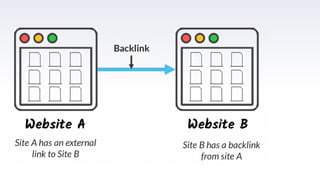
Link Building
• In simple words, link building is the process of promoting your
website on other websites and earning a backlink.
• Backlink :- If someone with website “A” links his website with
website “B”, that incoming or inbound link to website A from B is
called as backlink.
Why Backlinks are Important?
• It helps to build authority of a website.
• There are two types of links :-
1. Do Follow
2. No Follow
• Do Follow :- these type of links pass on the authority or link juice to the linking
website.
• No Follow :- Such links do not pass on authority or link juice to linking website
• No Follow and Do Follow links are basically for crawlers not for
humans, crawlers or spiders or bots get to know about those links
where to follow the page or not.
• Link Juice:- It is the value or authority which passes through
backlink from one webpage to another.
Quality Backlinks
• It helps to build authority of a website.
• There are two types of links :-
1. Do Follow
2. No Follow
• Do Follow :- these type of links pass on the authority or link juice to the linking
website.
• No Follow :- Such links do not pass on authority or link juice to linking website
Backlinks Submission Techniques
✔ Business listing
✔ Classified
✔ Web 2.O
✔ Blog commenting
✔ Article submission
✔ Image submission
✔ Infographic submission
✔ Video submission
- Domain Authority
- Competitors' Backlink
Analysis
• Domain Authority :- Designed by MOZ, give a score to a website from 1 to 100, 1
being the worst and 100 being the best.
• It predicts how likely a website going to rank on search engine result pages
• Domain Authority is not a metric used by Google in determining search rankings
and has no effect on the SERPs.
• Page Authority (PA) is a score developed by Moz that predicts how well a specific
page will rank on search engine result pages (SERP).
• Whereas Page Authority measures the predictive ranking strength of a single
page, Domain Authority measures the strength of entire domains or subdomains.
What is Domain Authority?
-Search Engine Submission
-Free classified submission
-Image/Infographic
submission
Search Engine Submission
• Search engine submission refers to the process of submitting the URL or
domain name of your website, or the pages within it, to search engines so
they know such pages exist.Before submitting your images, check if they
have a proper title, description and tags.
Some website for Search engine submission :-
• Somuch.com
• Entire Web
• Exalead
• 10 SE - Free web Submission
• Exact Seek
Image/Infographic submission
• Share your photos on popular image submission websites.
Before submitting your images please optimize them with
the correct URL and title tag.
• Before submitting your images, check if they have a proper
title, description and tags.
E.g. : Pinterest , flickr.com, instagram.com,, tumblr.com,
imgur.com, mediafire.com
Classified
•Classified are the submission of advertisement for products or services.
•A classified submission is one of Techniques in Seo off page activity which is used for
promote the business in local and global area with the help of classified submission.
•Some of the classifieds submission websites:-
•Locanto
•viewfreeads.com
•freeadstime.org
•tuffclassified.com
- PDF/PPT Submission
- Social Bookmarking
PDF/PPT Submission
PDF/PPT submission is the process of submitting a PDF or
PPT file to various online directories in order to improve
website traffic and brand awareness.
E.g. slideshare.net , issuu.com, scribd.com
Social bookmarking
Social bookmark submission is an off-page optimization activity that
enables you store your links on online bookmarking sites.
Some High PR Bookmarking Websites :-
• Delicious
• Stumbleupon.com
• Digg.com
• Reddit.com
• Slashdot.org
• Diigo.com
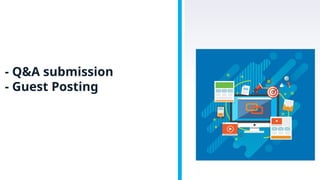
- Q&A submission
- Guest Posting
Question and Answer
Join high PR question and answer sites and search for questions related to your
business, blog or website and give clear answers to these questions. Give a link to your
website which will help in bringing you more visibility.
E.g:
• quora.com
• blurtit.com
• ehow.com
Guest Posting
There are many sites and blogs that will accept to publish your article. Before you
write an article somewhere, make sure that:
• the website or blog is relevant to your topic;
• the article is NOT about how great you are/ your company is;
• you have a focus on quality (well written, professional, and interesting);
• you keep in mind that a poor article can bring bad reputation.
• It’s important that you build links that help your website and not links that can
negatively impact your website’s ranking in search results.
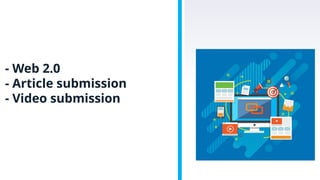
- Web 2.0
- Article submission
- Video submission
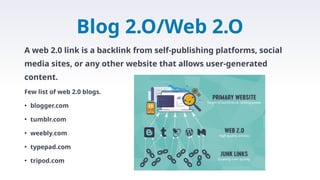
Blog 2.O/Web 2.O
A web 2.0 link is a backlink from self-publishing platforms, social
media sites, or any other website that allows user-generated
content.
Few list of web 2.0 blogs.
• blogger.com
• tumblr.com
• weebly.com
• typepad.com
• tripod.com
Article submission
These types of submissions are usually done to promote and
publish your content on article viewing websites.
Some of the article submission websites are :-
• thefreelibrary.com
• magportal.com
• ezinearticles.com
• hubpages.com
• brighthub.com
• articlebase.com
Video submission
Video submission refers to submitting your distinctive products,
company intro, or publishing any type of service in the submission
sites
Some of the Video submission websites are :-
• YouTube
• Flickr
- Doubt Class
- Website Audit
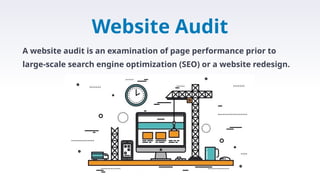
Website Audit
A website audit is an examination of page performance prior to
large-scale search engine optimization (SEO) or a website redesign.
Website Audit Checklist
✔ Responsiveness
✔ Canonical URL Checking
✔ SSL Check
✔ Check For Http And Https
✔ Website Speed (Core Web Vitals)
✔ Map Integration (Physical)
✔ Social Media Integrations
✔ Website Content
✔ (Keyword Density/Plagiarism)
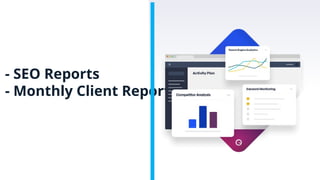
- SEO Reports
- Monthly Client Report
- Set-Up
- Overview
- Settings
Google Search Console
Google Search Console is a web service by Google which
allows webmasters to check indexing status, search queries,
crawling errors and optimize visibility of their websites.
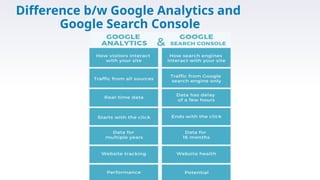
Difference b/w Google Analytics and
Google Search Console
- URL Inspection
- Performance
- Coverage
- Sitemaps
- Experience
- Enhancement
- Security
- Disavow Tool
- Set Up
- Important
Terms
- Overview
- Real-time
Report
Audience and
Acquisition
Report
Behavior and
Conversion
Report
- Important
Settings - GA-4
Setup
- Overview
Final SEO
Performance
Report
Submission

Search Engine Optimization | Digital marketing

  • 1.
  • 2.
  • 3.
    What is SEO? SearchEngine + Optimization
  • 4.
    What is SEO? SEOis a process of Improving the search engine ranking of your web-pages when people search for your business related keywords . It Improves the Quantity and Quality of Organic Traffic to your website. 4
  • 5.
    Why SEO? ▸ 93%All online Experiences begin with a Search Engine ▸ 75% Users Never scroll to Page 2 ▸ 70 – 80% User ignore the paid ADS, focus on Organic Search Results ▸ 82% of smartphone users say they use search to find a local business.
  • 6.
    Why SEO forBusiness? ▸ Increase visibility of the website ▸ Increase website traffic ▸ High website traffic would lead to higher conversions ▸ Enhances user trust on the website
  • 7.
    Career in SEO ▸Search Engine Marketer ▸ Content Marketer & Specialist ▸ SEO Manager ▸ Marketing Analyst ▸ Digital Marketer ▸ Business Marketing Consultant ▸ Entrepreneur
  • 8.
    “ Types of SEO ▪On-Page SEO ▪ Off-Page SEO
  • 9.
    -Techniques of SEO -Workingof Search Engines
  • 10.
    Techniques/Strategies of SEO WhiteHat Black Hat Grey Hat
  • 11.
    Techniques/Strategies of SEO ▸White hat SEO is a way of implementing optimization techniques that follow the Guidelines imposed by search engines. ▸ Good Keywords, Quality Content, On-page SEO, Technical SEO, Off- Page, Online Reputation
  • 12.
    Techniques/Strategies of SEO ▸Black hat SEO is a way of implementing optimization techniques that does’nt follow the Guidelines imposed by search engines. ▸ Keyword Stuffing, Hidden Text/Links, Doorway Pages, Cloaking, Link Spamming, Over Optimization
  • 13.
    Techniques/Strategies of SEO ▸Grey hat is combination of Both Black Hat and White Hat Techniques
  • 14.
    What is aSearch Engine? A search engine is a software system that is designed to carry out web searches.
  • 15.
    What is aSearch Engine Result Page - SERP?
  • 16.
    www.wscubetech.com Crawler/Spider Read out complete SourceCode Store data in own Local Server 1.Crawling Working of a Search Engine
  • 17.
    www.wscubetech.com Crawler/Spider Read out complete SourceCode Store data in own Local Server 1.Crawling Indexes Indexes Indexer 2. Indexing Working of a Search Engine
  • 18.
    www.wscubetech.com Crawler/Spider Read out complete SourceCode Store data in own Local Server Send Query Show Result 1.Crawling Indexes Indexes Keyword SERP Indexer 2. Indexing Working of a Search Engine
  • 19.
    www.wscubetech.com Crawler/Spider Read out complete SourceCode Store data in own Local Server Send Request Get data from main server Provide Ranking 1.Crawling Indexes Indexes Ranking Algorithm Indexer 2. Indexing 3. Ranking Working of a Search Engine www.wscubetech.com Send Query Show Result Keyword SERP
  • 20.
    -SEO Road Map -Typesof Keywords -Google Keyword Planner
  • 21.
    SEO Road Map WebsiteAudit : Website audit is a full analysis of all the factors that affect website's visibility in search engines.
  • 22.
    2.Keywords Research all keywordsusing tool and analysis for targeted keywords 4.On-Page Optimization Properly Utilize targeted keywords and set proper content 6.Off-Page Optimization Build strong backlinks as per link building strategies with online reputation 3.Competitors’ Site Check what competitors are doing for their website’s SEO 5.Technical SEO All technical factors must be optimized 7.Maintain + Monitoring To be on top you must maintain and monitor website ranking on search engines 1 www.wscubetech.com 1.Understanding Business / Goal / Target Location
  • 23.
    What are Keywords? Keywordsare the terms and phrases associated with your business that people use when entering a query into search engines to find your website. 23
  • 24.
    Why Keyword Researchis Important? ▪ Knowing your keywords helps you to understand your brand and your business. ▪ Keyword research can tell you what people are searching for, rather than what you think they are searching for. ▪ Search engines can only rank your website if they know what your business is. Targeting keywords on different pages of your website means Google can then rank you 24
  • 25.
    Types in KeywordOn Basis of Length ▪ Short Tail Keywords ▪ Long Tail Keywords
  • 26.
    Types in KeywordOn Basis of Length High Search Volume Short Tail High Competition Low Focus High Cost Low Conversion Rate Low Search Volume Long Tail Low Competition High Focus Low Cost High Conversion Rate
  • 27.
    Types in Keywordson Basis of Intent
  • 28.
    Steps in Keyword Research ▸Create an Excel or Google Sheet ▸ Brainstorming ▸ SERP Research ▸ Use Keyword Planner by Google ▸ Sorting on Basis of Volume ▸ Use Paid Tools (UberSuggest, SEMrush, keywordstool.io, Ahrefs) ▸ Sorting on Basis of Relevancy ▸ Sorting on Basis of Combination ▸ Check Trend ▸ Prioritize
  • 29.
    - Brainstorming ofKWs - Google Keyword Planner
  • 30.
  • 31.
    - Keyword Trend -Keyword Research Practice
  • 32.
    - Keyword ResearchPractice - Competitors’ Analysis
  • 33.
    - What isNiche? - Niche Selection
  • 34.
    A niche isa specialized topic area that you'll be focusing on when writing content. - What is Niche?
  • 37.
  • 38.
    Introduction to OnPage SEO ▸ On-page SEO is the practice of optimizing web pages to earn organic traffic and improve a website’s rankings in the SERP (search engine results pages). ▸ Technical SEO is a part of On-Page SEO
  • 39.
    On Page SEOChecklist ✔ Meta Tags – Title, Description, H1 and Keywords tags ✔ Internal and External links ✔ Page naming / URL Structure / Permalink ✔ Anchor Text ✔ Alt Tags and Optimizing Images ✔ Content Optimization ✔ Robots.txt ✔ URL Canonicalization ✔ HTTP Vs HTTPS ✔ Creation of XML / HTML /ROR Sitemap
  • 40.
    On Page SEOChecklist ✔ How to implement google analytics in website. ✔ Duplicate Content ✔ Broken link analysis ✔ What is Bread Crumbs ? ✔ Social media icons ✔ Implementing social sharing buttons ✔ 301, 302, 403 and 404 ✔ Custom 404 Implementation Web page
  • 41.
    - Meta Tags:Page Title
  • 42.
    Meta Tags: Title Itdefines title of each webpage. - Length of meta title is upto 580 pixels. - Meta Title appears in search engine result page. - Most Important keyword are placed in meta title. - Title should focus on keywords of that particular page.
  • 43.
    - Meta Tags:Description
  • 44.
    Meta Description It’s asmall description or content of page or we can say it’s small summary of webpage content. - Length of meta description should be 920 pixels. - Important and competitive keywords should be placed in meta description. - Meta description also appears in SERP along with meta title.
  • 45.
    - URL Optimization -Headings Tag - Canonicalization
  • 46.
    URL Structure /Page Naming / Permalink • URL(uniform resource locator)- address of given resource on web • URL structure :- Should be easy to read • Avoid use of any special character • ( _ ) underscore must no be used • The permalink is the full URL you see – and use – for any given post, page or other pieces of content on your site. It is a permanent link
  • 47.
    Meta Tags: H1Tag H1 heading is only used once and it is the title or headline of that particular page - H1 is the most important and H6 is the least important - Important keywords must be place in headings - H tags enhance readability and visibility - Heading from 1 to 6 forms a hierarchy, if we jump from 1 to 4 directly, heading structure will break and its not good for SEO..
  • 48.
    Canonical Tags - InSEO, canonical tags are used to let Google know which version of the page you want to appear in search results - <link rel=“canonical” href=“https://www.xyz.com/sample- page/” /> - canonical tag was introduced to solve duplicate content issues and help search engines better rank pages
  • 49.
    - Internal Links -External Links - Anchor Text
  • 50.
    Internal link ● InternalLink :- These are the links which goes from one page to another page in same domain or we can say that internal links are the links that we have within a website. ● Internal links are important to engage audience or user within a website. ● They are most commonly used for navigation within website. ● Search engine get to know the depth of content within your own website.
  • 51.
    External link ▪ ExternalLinks :- These are the links which goes from one page to another page in different domain or we can say that external links are the links that use to link to other website and similarly how other website link to your content. ● Adding external links to high quality website make a good impact in eye of search engine ● Search engine forms a trust in your website and this trust helps to get higher position in search engine result pages.
  • 52.
    Difference b/w Internaland External Links
  • 53.
    Anchor Text ● Itrefers to the clickable text or words or phrases used to link a one webpage to another. ● Mostly in blue colour, you can see such type of text, when clicked land to another webpage of same domain or different domain ● Anchor text can have any colour, but they are visible ( maybe Bold or underlined )
  • 54.
    Content Optimization: - Keyworddensity - Plagiarism - Grammar - Keyword prominence & proximity - Cannibalization
  • 55.
    Content Optimization ● Contentplays a very crucial role in ranking of any website, must be well written to reach the largest possible audience. ● Content should be unique and updated ● Content should be user friendly, must be created match the user requirement, if user doesn’t engage with your content then it is of no use. ● Keywords must be used. 4% in 1000 words rule must be follow. ● Meta tags, headings, alt tags, anchor text, visual representation of content must be there.
  • 56.
    Content Optimization ● KeywordDensity: Keyword density is the percentage of times a keyword or phrase appears on a web page compared to the total number of words on the page.
  • 57.
    Content Optimization ● Plagiarism: It is presenting someone else's work or ideas as your own without their consent
  • 58.
    Content Optimization ● KeywordProminence: It refers to the fact that the keywords placed in important and Top parts of a webpage are given priority by the search engines. Use your keywords early in source Code ● Keyword proximity : is the distance between keywords, or more importantly, how close together the keywords are within a section of text.
  • 59.
  • 60.
    Alt tags ● Itis the name which is given to the image. ● Alt tag describe the images, what are they and what all are they about. ● Keyword in used for naming the image, search engine can only read that text or not that image. ● Used to drive traffic from image search results
  • 61.
  • 62.
    -Important and Latest Algorithmsof Google -Ranking Factors
  • 63.
    Google Ranking Algorithms •Google search algorithm is a complex system that allows Google to find, rank and return the most relevant pages for a certain search query. • The search engine uses a combination of algorithms and numerous ranking factors to deliver webpages ranked by relevance on its search engine
  • 64.
    Panda - 2011 Aimedto improve search results by penalizing sites that had repetitive content and poor user metrics. Penguin - 2012 Tackled low-quality results by penalizing pages that use black-hat link building techniques.
  • 65.
    Medic 2018 Aimed toprovide trustworthy results and advice to people searching for money or health based terms by penalizing sites with no Expertise, Authority, or Trust (E-A-T). BERT 2019 Another tweak to Google's understanding of search intent rewarding well-constructed content.
  • 66.
    Medic 2018 Again allabout E-A-T signals and put more weight behind content factors and user data E.A.T. =Expertise, Authoritativeness and Trustworthiness Google December 2020 core update Remains slightly ambiguous but focused on content interpretation and SERP features.
  • 67.
    • User Intent •UX • E-A-T • Search Experience • Quality and Updated Content • Passage Ranking • About this Result • Mobile Usability • Quality and Helpful Content Google 2021-2022 Core Update
  • 68.
  • 69.
    XML Sitemap ● XMLstands for extensible mark-up language. ● XML sitemap consists of all URL’s of a particular website. ● XML sitemap is a file which will have all the information of each URL of a website. ● Used by google to crawl the website more intelligently.
  • 70.
    HTML Sitemap ● AnHTML sitemap is an HTML page on which all subpages of a website are listed. ● It’s best way to Organize Large Websites
  • 71.
    Robots.txt ● Its actas a door to crawlers, It tells the crawlers what and what not to crawl on particular website. ● A robots.txt file is a set of instructions for bots. This file is included in the source files of most websites. ● Google currently enforces a robots.txt file size limit of 500 kibibytes (KiB).
  • 72.
    -404 Error Page -Permanentand -Temporary Redirection
  • 73.
    Redirection A redirect isa way to send both users and search engines to a different URL from the one they originally requested.
  • 74.
  • 75.
    404 Error Page A404 error is an HTTP status code that means that the page you were trying to reach on a website couldn't be found on their server. - 404s don’t affect your site’s rankings but It does effect user experience
  • 76.
    Some Common PageErrors ● 403: Web page forbidden (unauthorized response) ● 404: Web page file not found ● 404 Soft : A soft 404 error happens when the server sends a 200 OK status for the requested page, but Google thinks that the page should return a 404. ● 500 Error series:- Mostly server Issues
  • 77.
    - Structured Data -Open Graph Protocol - Twitter Card
  • 78.
    Structured Data Structured datais a standardized way to provide information about a web page. It helps search engines like Google to better understand what your content is about. How Structured data help your SEO? -Get rich results -Get into Google’s Knowledge Graph -Support semantic search -Support your E-A-T
  • 79.
    Open Graph Protocol OpenGraph is an internet protocol that was originally created by Facebook to standardize any web page to become a rich object in a social graph.
  • 80.
    Twitter Card Twitter Cardsis a feature that lets Twitter users optimize how website is presented in tweets.
  • 81.
  • 82.
    Why Page Speedis Important?
  • 83.
  • 84.
    How to ImprovePage Speed? • Compress and optimize your images • Reduce your redirects • Enable Browser Caching • Minify CSS, JavaScript, and HTML • Defer loading for your CSS and JavaScript files • Asynchronous loading for your CSS and JavaScript files • Use a Content Delivery Network (CDN) • Eliminate unnecessary plugins.
  • 85.
  • 86.
    What is OFFPage SEO? Off-page SEO refers to the optimization that occur off your website, such as backlinks from another site. It also includes your promotion methods, taking into account the amount of exposure something gets on social media.
  • 87.
    Why it isimportant and benefits • As search engine focuses on giving relevant result to the user, OFF page activities helping in gaining the trust and adding value to their content. • It helps is building website recognition and domain authority. • It gives a great exposure and build trustworthiness. • It helps in increasing the ranking of the website
  • 88.
    Link Building • Insimple words, link building is the process of promoting your website on other websites and earning a backlink. • Backlink :- If someone with website “A” links his website with website “B”, that incoming or inbound link to website A from B is called as backlink.
  • 90.
    Why Backlinks areImportant? • It helps to build authority of a website. • There are two types of links :- 1. Do Follow 2. No Follow • Do Follow :- these type of links pass on the authority or link juice to the linking website. • No Follow :- Such links do not pass on authority or link juice to linking website
  • 91.
    • No Followand Do Follow links are basically for crawlers not for humans, crawlers or spiders or bots get to know about those links where to follow the page or not. • Link Juice:- It is the value or authority which passes through backlink from one webpage to another.
  • 92.
    Quality Backlinks • Ithelps to build authority of a website. • There are two types of links :- 1. Do Follow 2. No Follow • Do Follow :- these type of links pass on the authority or link juice to the linking website. • No Follow :- Such links do not pass on authority or link juice to linking website
  • 93.
    Backlinks Submission Techniques ✔Business listing ✔ Classified ✔ Web 2.O ✔ Blog commenting ✔ Article submission ✔ Image submission ✔ Infographic submission ✔ Video submission
  • 94.
    - Domain Authority -Competitors' Backlink Analysis
  • 95.
    • Domain Authority:- Designed by MOZ, give a score to a website from 1 to 100, 1 being the worst and 100 being the best. • It predicts how likely a website going to rank on search engine result pages • Domain Authority is not a metric used by Google in determining search rankings and has no effect on the SERPs. • Page Authority (PA) is a score developed by Moz that predicts how well a specific page will rank on search engine result pages (SERP). • Whereas Page Authority measures the predictive ranking strength of a single page, Domain Authority measures the strength of entire domains or subdomains. What is Domain Authority?
  • 96.
    -Search Engine Submission -Freeclassified submission -Image/Infographic submission
  • 97.
    Search Engine Submission •Search engine submission refers to the process of submitting the URL or domain name of your website, or the pages within it, to search engines so they know such pages exist.Before submitting your images, check if they have a proper title, description and tags. Some website for Search engine submission :- • Somuch.com • Entire Web • Exalead • 10 SE - Free web Submission • Exact Seek
  • 98.
    Image/Infographic submission • Shareyour photos on popular image submission websites. Before submitting your images please optimize them with the correct URL and title tag. • Before submitting your images, check if they have a proper title, description and tags. E.g. : Pinterest , flickr.com, instagram.com,, tumblr.com, imgur.com, mediafire.com
  • 99.
    Classified •Classified are thesubmission of advertisement for products or services. •A classified submission is one of Techniques in Seo off page activity which is used for promote the business in local and global area with the help of classified submission. •Some of the classifieds submission websites:- •Locanto •viewfreeads.com •freeadstime.org •tuffclassified.com
  • 100.
    - PDF/PPT Submission -Social Bookmarking
  • 101.
    PDF/PPT Submission PDF/PPT submissionis the process of submitting a PDF or PPT file to various online directories in order to improve website traffic and brand awareness. E.g. slideshare.net , issuu.com, scribd.com
  • 102.
    Social bookmarking Social bookmarksubmission is an off-page optimization activity that enables you store your links on online bookmarking sites. Some High PR Bookmarking Websites :- • Delicious • Stumbleupon.com • Digg.com • Reddit.com • Slashdot.org • Diigo.com
  • 103.
    - Q&A submission -Guest Posting
  • 104.
    Question and Answer Joinhigh PR question and answer sites and search for questions related to your business, blog or website and give clear answers to these questions. Give a link to your website which will help in bringing you more visibility. E.g: • quora.com • blurtit.com • ehow.com
  • 105.
    Guest Posting There aremany sites and blogs that will accept to publish your article. Before you write an article somewhere, make sure that: • the website or blog is relevant to your topic; • the article is NOT about how great you are/ your company is; • you have a focus on quality (well written, professional, and interesting); • you keep in mind that a poor article can bring bad reputation. • It’s important that you build links that help your website and not links that can negatively impact your website’s ranking in search results.
  • 106.
    - Web 2.0 -Article submission - Video submission
  • 107.
    Blog 2.O/Web 2.O Aweb 2.0 link is a backlink from self-publishing platforms, social media sites, or any other website that allows user-generated content. Few list of web 2.0 blogs. • blogger.com • tumblr.com • weebly.com • typepad.com • tripod.com
  • 108.
    Article submission These typesof submissions are usually done to promote and publish your content on article viewing websites. Some of the article submission websites are :- • thefreelibrary.com • magportal.com • ezinearticles.com • hubpages.com • brighthub.com • articlebase.com
  • 109.
    Video submission Video submissionrefers to submitting your distinctive products, company intro, or publishing any type of service in the submission sites Some of the Video submission websites are :- • YouTube • Flickr
  • 110.
  • 111.
  • 112.
    Website Audit A websiteaudit is an examination of page performance prior to large-scale search engine optimization (SEO) or a website redesign.
  • 113.
    Website Audit Checklist ✔Responsiveness ✔ Canonical URL Checking ✔ SSL Check ✔ Check For Http And Https ✔ Website Speed (Core Web Vitals) ✔ Map Integration (Physical) ✔ Social Media Integrations ✔ Website Content ✔ (Keyword Density/Plagiarism)
  • 114.
    - SEO Reports -Monthly Client Report
  • 115.
  • 116.
    Google Search Console GoogleSearch Console is a web service by Google which allows webmasters to check indexing status, search queries, crawling errors and optimize visibility of their websites.
  • 117.
    Difference b/w GoogleAnalytics and Google Search Console
  • 118.
    - URL Inspection -Performance - Coverage - Sitemaps
  • 119.
    - Experience - Enhancement -Security - Disavow Tool
  • 120.
    - Set Up -Important Terms - Overview - Real-time Report
  • 121.
  • 122.
  • 123.
    - Important Settings -GA-4 Setup - Overview
  • 124.