Web Design Trends 2013   Awwwards.com   1
TRE
          NDS
          Project
           EDITOR IN CHIEF and ART DIREC-
           TION: Awwwards Team. 2013
           Awwwards Blog


Web Design Trends 2013        Awwwards.com   2
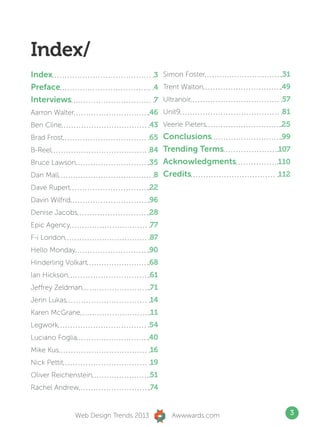
Index/
Index                                     3 Simon Foster       31
Preface                                   4 Trent Walton      49
Interviews                                7 Ultranoir         57
Aarron Walter                            46 Unit9             81
Ben Cline                                43 Veerle Pieters    25
Brad Frost                               65 Conclusions       99


                          Index
B-Reel                                   84 Trending Terms    107
Bruce Lawson                             35 Acknowledgments   110
Dan Mall                                  8 Credits           112
Dave Rupert                              22
Davin Wilfrid                            96
Denise Jacobs                            28
Epic Agency                              77
F-i London                               87
Hello Monday                             90
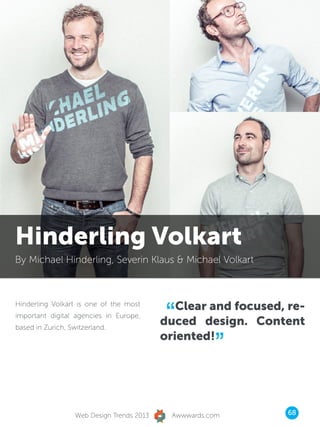
Hinderling Volkart                       68
Ian Hickson                              61
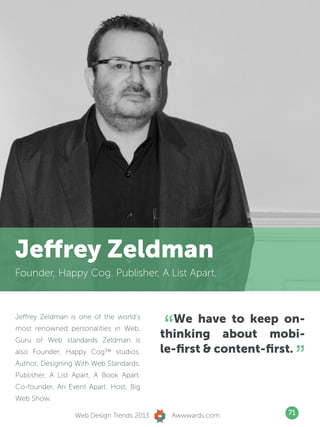
Jeffrey Zeldman                          71
Jenn Lukas                               14
Karen McGrane                            11
Legwork                                  54
Luciano Foglia                       40
Mike Kus                                 16
Nick Pettit                              19
Oliver Reichenstein                      51
Rachel Andrew                            74


                 Web Design Trends 2013         Awwwards.com      3
Preface
           Chapter. 1


Web Design Trends 2013   Awwwards.com   4
Why Trends
The Awwwards community are a faithful audience, always interested in learning
and dedicating their time to acquiring the necessary technical knowledge to
apply in their daily work. With the noble aim of being a useful tool for our
community, at the end of 2012 we decided to gather the opinions of renowned
experts on how the web industry will evolve in the complex times we live in,
in this tower of Babel of technologies and devices that’s rushing towards us.

Of course, nobody can know for sure what might happen in the coming months
and years. In fact, many of the interviewees were hesitant to give an opinion
on trends. Curiously, in the end some very similar ideas emerged to make up,
more than a prediction, a Ten Commandments of needs based firmly on their
own experiences as users.


“ Trends is not only a pre-
diction for 2013. It reflects
a natural interest in how all
                                       Trends is not only a prediction for 2013.
                                       It reflects a natural interest in how all
                                       aspects of web design will evolve over
                                       the next few years. We don’t actually
aspects of web design will             know whether we will need to make a
evolve over the next few               similar publication in 2014; things in this
years.
       ”                               industry change quickly, so it’s possible
that in less than 12 months many of these trends and technologies which now
seem to be blossoming will have disappeared completely.

How is the document structured?


                                           “
The idea was to ask all the participants    The idea was to ask all the
more or less the same questions to get participants more or less the
a kind of “data map” which would help
                                         same questions to get a kind
us visualize “the future of the web”. To
this end, we had the invaluable help of of data map.
                                                            ”
28 renowned experts in different areas of the industry. They are the ones who
have given this project its shape.

The end motivation?

              Web Design Trends 2013        Awwwards.com                         5
Honestly... you’ll see as you read the document, because this is exactly what can
be taken from almost all the contributions...building a more useful, accessible
and efficient web for the user without forgetting that design is a powerful tool
that not everyone is able to use with skill and honesty.


             Web Design Trends 2013        Awwwards.com                         6
Why Trends
The Awwwards community are a faithful audience, always interested in learning
and dedicating their time to acquiring the necessary technical knowledge to
apply in their daily work. With the noble aim of being a useful tool for our
community, at the end of 2012 we decided to gather the opinions of renowned
experts on how the web industry will evolve in the complex times we live in,
in this tower of Babel of technologies and devices that’s rushing towards us.

Of course, nobody can know for sure what might happen in the coming months


          Interviews
and years. In fact, many of the interviewees were hesitant to give an opinion
on trends. Curiously, in the end some very similar ideas emerged to make up,
more than a prediction, a Ten Commandments of needs based firmly on their
own experiences as users.


                         Chapter. 2
Trends is not only a prediction for 2013. It reflects a natural interest in how all
aspects of web design will evolve over the next few years. We don’t actually
know whether we will need to make a similar publication in 2014; things in
this industry change quickly, so it’s possible that in less than 12 months many
of these trends and technologies which now seem to be blossoming will have
disappeared completely.

How is the document structured?
The idea was to ask all the participants more or less the same questions to get
a kind of “data map” which would help us visualize “the future of the web”. To
this end, we had the invaluable help of 28 renowned experts in different areas
of the industry. They are the ones who have given this project its shape.

The end motivation?
Honestly... you’ll see why as you read the document, because this is exactly
what can be taken from almost all the contributions...building a more useful,
accessible and efficient web for the user without forgetting that design is a


              Web Design Trends 2013         Awwwards.com                         7
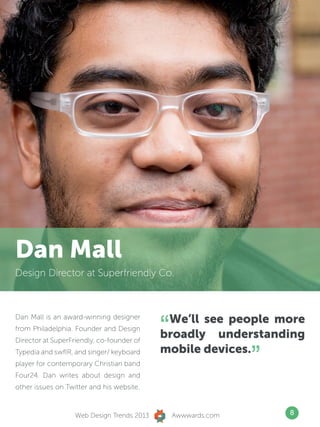
Dan Mall
Design Director at Superfriendly Co.


                                            “We’ll see people more
Dan Mall is an award-winning designer
from Philadelphia. Founder and Design
Director at SuperFriendly, co-founder of
                                            broadly understanding
Typedia and swfIR, and singer/ keyboard
player for contemporary Christian band
Four24. Dan writes about design and
                                            mobile devices.
                                                               ”
other issues on Twitter and his website.


                   Web Design Trends 2013       Awwwards.com       8
W     hat trends do you see coming in the near future in web and mobile
      design?

I’ve never been good at predictions, but I think (hope)? we’ll see people more
broadly understanding mobile devices—computers we can hold in our hands
as opposed to having to sit at a desk to use—as the web, not just an “on-the-
go”, abridged version of the web.

What animation techniques and effects applied to navigation and user in-
teraction will we see? Will we finally move beyond Parallax scroll?
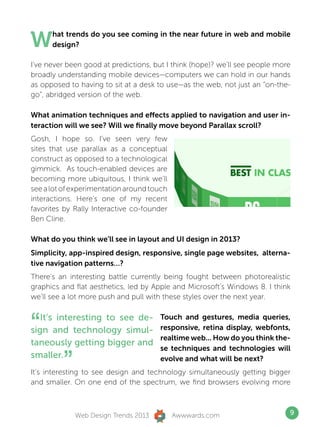
Gosh, I hope so. I’ve seen very few
sites that use parallax as a conceptual
construct as opposed to a technological
gimmick. As touch-enabled devices are
becoming more ubiquitous, I think we’ll
see a lot of experimentation around touch
interactions. Here’s one of my recent
favorites by Rally Interactive co-founder
Ben Cline.

What do you think we’ll see in layout and UI design in 2013?
Simplicity, app-inspired design, responsive, single page websites, alterna-
tive navigation patterns…?
There’s an interesting battle currently being fought between photorealistic
graphics and flat aesthetics, led by Apple and Microsoft’s Windows 8. I think
we’ll see a lot more push and pull with these styles over the next year.


“  It’s interesting to see de-
sign and technology simul-
taneously getting bigger and
                                      Touch and gestures, media queries,
                                      responsive, retina display, webfonts,
                                      realtime web... How do you think the-
                                      se techniques and technologies will
smaller.
         ”                            evolve and what will be next?
It’s interesting to see design and technology simultaneously getting bigger
and smaller. On one end of the spectrum, we find browsers evolving more


             Web Design Trends 2013         Awwwards.com                     9
rapidly than ever, with designers and developers pushing technologies like
WebGL, hardware acceleration, and 3D in the browser without having to rely
on plugins. On the other end, we see mobile access necessitating simpler,
faster sites and heralding the need for optimizing. I’m curious to see how each
evolves.

When looking for potential employees or collaborators what catches your
eye?
Great design taste in a portfolio usually gets my attention, but what keeps it is
hunger and passion for the work. I also try to look for some form of richness;
I like seeing small moments where it’s obvious that he/she pored over the
details.

What technologies are your team training in now? Which disciplines will
you be focusing on in the coming months and years?
Everything! We’re certainly doing the web work we love so much, HTML/CSS/
JS,mobile-first responsive design, WordPress, ExpressionEngine/otherCMS’s—
but are also venturing a bit into Objective-C and OpenFrameworks as we do
more native mobile work. We’re even creating some physical installations that
connect digital and analog. More on that soon!


             Web Design Trends 2013        Awwwards.com                         10
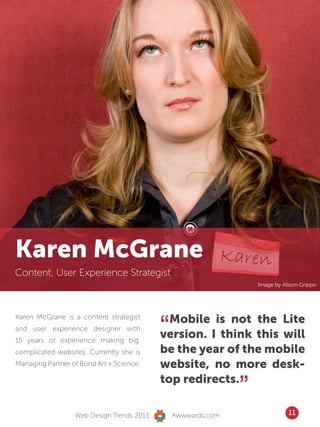
Karen McGrane
Content, User Experience Strategist
                                                                  Image by Alison Grippo


                                           “ Mobile is not the Lite
Karen McGrane is a content strategist
and user experience designer with
15 years of experience making big,
                                           version. I think this will
complicated websites. Currently she is     be the year of the mobile
Managing Partner of Bond Art + Science.    website, no more desk-
                                           top redirects.
                                                              ”
                  Web Design Trends 2013       Awwwards.com                  11
W      hat trends do you see coming in the near future in web and mobile
       design?

Most major organizations are starting to see about 10% of the traffic to their
website coming from mobile devices—which means it’s time to move on
putting a content strategy for mobile in place. I think this will be the year of
the mobile website, no more desktop redirects or bare-bones landing pages.
It’s time to think of the mobile website as every bit as “real” as the desktop
website.


What should be the new design principles for web and mobile design?
I have three big principles that inform my approach to content strategy for
web and mobile.


“  You don’t get to decide
which device people use to
                                         1. You don’t get to decide which device
                                         people use to visit your website. They


                                    ”
                                         do. If you’re sitting around debating
visit your website.They do.              whether “people will want to do that on
mobile,” you’re too late. People are already trying to do it. It’s our mission—and
our responsibility—to deliver a great experience to them, on whatever device
or platform they choose to use.


                                            “
2. Content parity is the goal. Too often,        We fall into the trap of thin-
we fall into the of thinking mobile
                                               king mobile should be the lite
should be the “lite” version, offering a
subset of content and features. Or we version.
                                                        ”
just want it to be different for the sake of being different. For most organizations,
providing a consistent experience across the desktop web and mobile web
should be the foundational goal.

3. It’s not a strategy if you can’t maintain it. Lots of great ideas flop in the
execution, because no one took into consideration what would be required
from the internal web, production, or editorial teams. With digital teams now
juggling lots of different platforms, it’s even more important to focus on the
needs of the people who will maintain the site.


              Web Design Trends 2013          Awwwards.com                          12
What do you think we’ll see predominate in layout and UI design in 2013?


“ Designers have a huge
stake in knowing what the
                                      I expect to see growing recognition
                                      from the design community that the


                     ”
                                      content can’t be “somebody else’s
content will be.                      problem.” Designers have a huge stake
in knowing “what .” What that means is that designers should be asking about
“how the content will be structured.” What are all the chunks, and how big
are they? Instead of treating the content like an afterthought, or something
wholly separate from the rest of the experience, designers will make sure it’s
the centerpiece.

In technological and social terms, how do you think the web will evolve in
the next few years?
The proliferation of platforms isn’t going to stop. We’re going to see increasing
numbers of wildly divergent platforms, some of which we’ve been talking about
for years. Interactive television. In-kitchen devices. In-car audio interfaces.

Someday soon, speech-based interfaces will get good enough—remember
all the years when touchscreens sucked? Once touchscreens reached the
point where they just worked, it launched an entire new wave of innovations
in hardware, software, and interaction models. Speech isn’t there yet, but it will
be.

This means that we have to stop building containers and then creating content
to fit. Our content is going to find its way to places we never even dreamed,
and we don’t have the time, resources, or budget to create new content for
every platform. Instead, all of us need to work together–designers, developers,
and content strategists—to create the right content, structured for reuse, and
then design around it.


              Web Design Trends 2013        Awwwards.com                         13
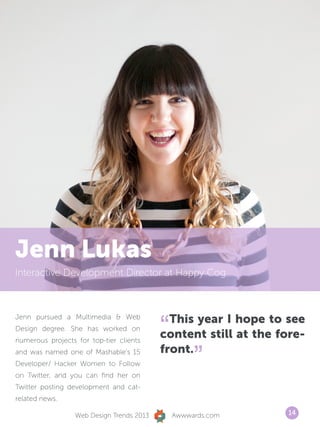
Jenn Lukas
Interactive Development Director at Happy Cog


                                           “ This year I hope to see
Jenn pursued a Multimedia  Web
Design degree. She has worked on
numerous projects for top-tier clients
                                           content still at the fore-
and was named one of Mashable’s 15
Developer/ Hacker Women to Follow
on Twitter, and you can find her on
                                           front.
                                                    ”
Twitter posting development and cat-
related news.

                  Web Design Trends 2013       Awwwards.com      14
W     hat trends do you see coming in the near future in web and mobile
      design?

I just LOVE CSS Transitions, especially when applied to hovers. Adding the
right amount of fade or movement to a link, really adds a helpful amount of
interaction while keeping things classy and not going the way of Flash tweens.
CSS Filters are super neat! With lots of people pushing for designing in the
browser, this is one more step away from an image editor. Filters cut down on
image sprites and image production and let you adjust your images right in the
browser.


“  Filters cut down on image sprites and image production and
let you adjust your images right in the browser.
                                                            ”
What do you think we’ll see in layout and UI design in 2013?
We’ve seen a lot of single column designs and single page websites this
year, allowing a content-first approach. These patterns provided an ease into
responsive design and less pages to load/clicks to make. This year I hope to
see content still at the forefront, but pushing into more complicated designs
and layouts. Flexbox (CSS Flexible Box Layout Module) is sure to help in aiding
interesting layouts on desktop and mobile that aren’t dictated by source order.


             Web Design Trends 2013       Awwwards.com                        15
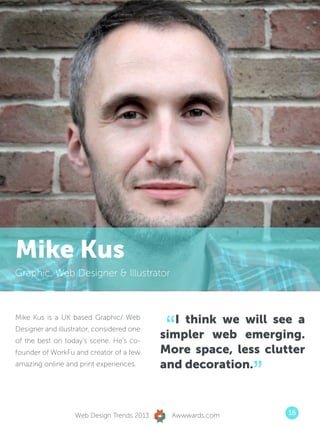
Mike Kus
Graphic, Web Designer  Illustrator


                                            “  I think we will see a
Mike Kus is a UK based Graphic/ Web
Designer and illustrator, considered one
of the best on today’s scene. He’s co-
                                            simpler web emerging.
founder of WorkFu and creator of a few      More space, less clutter
                                            and decoration.
                                                            ”
amazing online and print experiences.


                   Web Design Trends 2013    Awwwards.com        16
W     hat trends do you see coming in the near future in web and mobile
      design?

From a visual standpoint I think we’ll see (are already seeing) a simplification
of Graphic  UI design on both the web and mobile. We’ll see less decoration,
simple, bold and clear layouts and UI design. I think we’ll see less Apple
influenced skeuomorphic design, also.


“ Simplification of Graphic 
UI and mobile design on both
the web and mobile. Less is
                                       What technologies are you training
                                       in now? Which disciplines will you be
                                       focusing on in the coming months


        ”
                                       and years?
More.
                                    In the coming months I want to further
explore the concept of how to best express a brand or personality through
web design and how this can be maintained from the desktop experience
through to a mobile experience.

What should the new design principles be in a future where web and mobi-
le design must be focused on user experience and content?
I don’t think it’s a new thing to suggest that user experience and content are
a central focus when designing for
the web and mobile. It’s always been
                                         “   Make sure the content is
that way as far as I’m concerned. I’ll easily digestible using a sim-


                                                              ”
just carry on applying the same design ple clear layout.
principles I’ve always used, which are
pretty simple: Make sure the content is easily digestible using a simple clear
layout, the text is easy to read, and the site or app is easy to navigate and
understand. Apply these to all devices.

What animation techniques and effects applied to navigation and user in-
teraction will we see? Will we finally move beyond Parallax scroll?
Scrolling triggered animations seem to be hot right now but I’m really not sure
what will come next.

What do you think we’ll see in layout and UI design in 2013?


             Web Design Trends 2013        Awwwards.com                        17
Simplicity, app-inspired design, responsive, single page websites, alterna-
tive navigation patterns...?
Again, I think we’ll see a simplification of UI design. Less is more.

Can we predict an explosion of creativity in interaction and animation now
that the technology is available and becoming more accessible from a web
standards point of view?


“  I don’t think human appe-
tite for clever animated web
                                      I think as long as the browser support is in
                                      place, yes, designers and programmers


                          ”
                                      will be doing some pretty crazy stuff. I
pages will ever die.                  don’t think human appetite for clever
animated web pages will ever die. Clients love that stuff!

Can you pinpoint any visual trends or design elements that might emerge
in 2013, as Letterpress, pictograms, vintage style, lettering, oversizing ele-
ments, Overprinted effects, swiss design etc. have done?
I think we will see a simpler web emerging. More space, less clutter and
decoration. A focus on content, layout, clarity and simplicity.

What role do you think technologies like Canvas or Scalable Vector Gra-
phics (SVG) can play in game and app development?
Well, for one, scalable vector graphics take the pain away when it comes
to designing for different screen resolutions. Creating multiple graphics for
different screen types is a total pain in the ass.

In technological and social terms, how do you think the web will evolve in
the next few years?
I think we’ll see the web further integrated into our everyday lives. Only a few
years ago ‘the web’ was surfing the web from your desktop and email. Now the
web is on your mobile, there’s an app for everything from taking and sharing
your photos to mapping your run to monitoring your car’s performance. This
integration will only become deeper.


              Web Design Trends 2013         Awwwards.com                        18
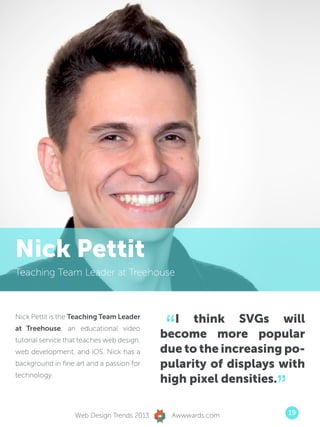
Nick Pettit
Teaching Team Leader at Treehouse


                                             “ I think SVGs will
Nick Pettit is the Teaching Team Leader
at Treehouse, an educational video
tutorial service that teaches web design,
                                            become more popular
web development, and iOS. Nick has a        due to the increasing po-
background in fine art and a passion for    pularity of displays with

                                                                ”
technology.
                                            high pixel densities.

                   Web Design Trends 2013     Awwwards.com          19
W     hat trends do you see coming in the near future in web and mobile
      design/ development?

Screens with high pixel densities like the new iPad and MacBook Pro will
become more prevalent. Responsive Web Design solves part of the puzzle and
forces us to think in terms of proportions, but now design must become even
                                         more pixel agnostic. The best way to

“  Design must become even do this currently is with vector graphics
more pixel agnostic. I think and I think designers will start using
designers will start using an an SVG-first approach when creating

                           ”
                                         graphics for their web pages. Internally
SVG-first approach.
                                         at Treehouse, we’ve taken a note from
Responsive design and have dubbed this idea “Scalable Web Design.” Vectors
are not practical for more complex imagery, particularly photographs, but
they work well in many cases, especially when you go into the design phase
knowing that this will be the driving technology. Additionally, I think the recent
backlash from the skeuomorphic or hyperrealistic sensibilities of Apple are
leading towards an aesthetic that features more flat colors, which is the perfect
use case for SVGs. Internet Explorer has added support for SVGs in recent
releases, so this approach is now far more viable.

What technologies are you training in now? Which disciplines will you be
focusing on in the coming months and years?
I’m personally focused on researching how vectors impact design and UX
decision making. While vector graphics do have a few drawbacks, they have
a tremendous number of advantages that allow for interfaces that are not
practical with raster images alone.

What should a newbie web developer concentrate on learning?
A new web developer should learn to love learning. The best web developers
are very flexible and adaptable to change. They don’t spend all of their time
focusing on just one language, and instead, experiment with all the possibilities.


What will the trends be in web programming? Which languages or fra-
meworks will gain more converts in the near future?


              Web Design Trends 2013        Awwwards.com                         20
I don’t see any ground breaking changes in languages or frameworks in 2013,
although that doesn’t mean there won’t be any. Rather, I think the focus will be
on the toolchain that front-end and back-end developers use to create web
apps. The barrier to entry for new designers and developers is a little bit high,
but projects and tools like HTML5 Boilerplate, Bootstrap, Github, Ruby on Rails,
Heroku, and countless others have continuously systematized the process. I
think this positive momentum will continue, because it allows developers to
focus more on their ideas, rather than the implementation.


“ The fight for web standards is finally in a much better place
than it was in previous years.
                                      ”
How do you think these techniques and technologies will evolve and what
will be next?
Technologically, I think SVGs will become more popular due to the increasing
popularity of displays with high pixel densities. Beyond that, it seems like
the fight for web standards is finally in a much better place than it was in
previous years, and the ongoing refinements to the tools that are available to
developers are a welcome addition to the equation. Furthermore, companies
and individuals care more about design than ever before. Big influencers like
Apple and Microsoft have shaken up the long-standing desktop metaphor with
iOS and Windows 8, and the world didn’t come crashing down around them
as one might expect. I think this gives smaller product companies the comfort
they need to freely experiment with bold new interface ideas.

The current state of development and design is pretty incredible, and while
it will continue to improve, there’s never been a better time to build web
applications. Now is the time to execute.


             Web Design Trends 2013        Awwwards.com                         21
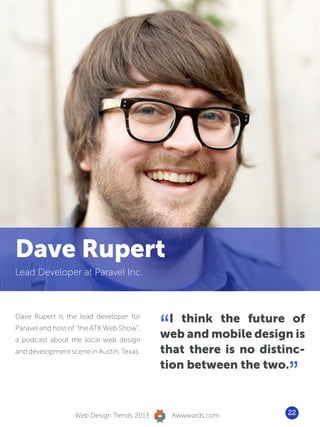
Dave Rupert
Lead Developer at Paravel Inc.


                                           “ I think the future of
Dave Rupert is the lead developer for
Paravel and host of “the ATX Web Show”,
a podcast about the local web design
                                           web and mobile design is
and development scene in Austin, Texas.    that there is no distinc-
                                           tion between the two.
                                                                 ”
                  Web Design Trends 2013       Awwwards.com      22
“                                      W
   The future of web and mo-                hat trends do you see coming
                                            in the near future in web and
bile design is that there is no
                                       mobile design?
distinction between the two.
Mobile first responsive web              For me, I think the future of web
design is probably the trend             and mobile design is that there is
                                         no distinction between the two.
to stick with in the near futu-
                                         Smartphones are becoming the default
re.
    ”                                    computer for most of the world’s youth,
a company in India just announced a $20 tablet, and college classrooms are
glowing with high-end laptops. Mobile first responsive web design is probably
the trend to stick with in the near future.

What technologies are you training in now? Which disciplines will you be
focusing on in the coming months and years?
I’m focusing a lot more on JavaScript and Web Accessibility in the short term.
My knowledge of those two things is decent but could always be better and
more informed. Over the next few months I’ll probably just continue poking
holes in what I think I know so I can get better at my weaknesses.

What should a newbie web developer concentrate on learning?
There’s a saying we have on ShopTalk (a podcast I co-host with Chris Coyier):
“JUST BUILD WEBSITES!” The technologies that you need to be learning will
quickly present themselves in challenges you meet when you pick up a side
project, start a job, etc. Beyond that, gaining more mastery on the three main
building blocks of our industry - HTML, CSS, and JavaScript - couldn’t hurt.


                                          “
What will the trends be in web pro-
                                             Linters,   pre-processors,
gramming? Which languages or fra-
meworks will gain more converts in
                                           builders, and package ma-
the near future?                           nagers will play a major role
I believe automation and better tooling in everyday web develop-
is the next wave (if not already a current ment.
                                                 ”
wave) in web development. This covers everything from pimping your text
editor to improving the building and compiling of our HTML/CSS/JavaScript.


             Web Design Trends 2013        Awwwards.com                        23
Linters, pre-processors, builders, and package managers will play a major role
in everyday web development. There may be a big technical hurdle there to get
everyone on board, but that’s a great opportunity for developers to make GUIs
in order to increase adoption among less command-line-savvy developers and
designers.


“   Touch and gestures will be hugely important.
                                                             ”
Touch and gestures, media queries, responsive, retina display, webfonts,
realtime web... How do you think these techniques and technologies will
evolve and what will be next?
Touch and gestures will be hugely important. Apple’s biggest selling products
are all touch-based. Microsoft’s Windows 8 is a touch-based interface. Chris
Coyier recently tweeted that he saw his mom try to tap her TV. Touch-enabled
devices are now the default stack, so it’s important that our designs have this
in mind. I don’t think we’re far off from where our websites will be expected to
have more advanced gesture-based interactions.


             Web Design Trends 2013        Awwwards.com                        24
Veerle Pieters
Graphic, Web Designer Lead at Fab


                                            “ It’s important to design
Veerle Pieters is a graphic/ web designer
based in Deinze, Belgium. She runs her
own design studio, Duoh!, together
                                            from the content point
with Geert Leyseele. Veerle has been        instead of screen resolu-
                                            tions.
                                                     ”
blogging since 2003 and is considered
number 39 on the list of “NxE’s Fifty
Most Influential Female Bloggers“.


                   Web Design Trends 2013       Awwwards.com      25
I n technological and social terms, how do you think the web will evolve in
  the next few years?


Hard to say, as I’m not a visionary so I can only do some guesswork.
Technologically, it will be moving more and more towards mobile, so that aspect


“
                                         will become even more important than
   Technologically, it will it now already is. I see shopping as
be moving more and more one aspect of that, and I think we will
towards mobile, so that as- eventually move towards 50% being
pect will become even more done on phones or tablets. Of course,
                                         this will not work for every shop, but
important than it now alre- shops like fab.com will get to that point
ady is.
        ”                                quicker than others. Socially, I have no
idea if Twitter or Facebook will still be relevant in 5 years. It all depends on
what those companies do with their product. If they alienate their customers,
and a new kid on the block profits from that, it wouldn’t be the first time.


                                          “
What should the new design prin-
                                              I think it’s important to de-
ciples be in a future where web and
mobile design must be focused on           sign from the content point
user experience and content?               instead of focussing on all
I’m hardly an expert, but I think there is the screen resolutions out
no golden rule that applies to all. Every there.
project is different so that’s why it is so       ”
hard to create the ultimate process/ tool that everyone likes to use and that
works perfectly for every project. I’m not sure if such a thing is even possible.
It’s a collection of best practices and tools based on personal preference that
we have at our disposal today. With the complexity of all the devices out there,
I think it’s important to design from the content point instead of focusing on
all the screen resolutions out there. That’s what I think would qualify as a new
new design principle.

Can you pinpoint any visual trends or design elements that might emerge
in 2013, as Letterpress, pictograms, vintage style, lettering, oversizing ele-
ments, Overprinted effects, swiss design etc. have done?


             Web Design Trends 2013        Awwwards.com                         26
Trends are something I don’t follow or have any interest in. I just do what is
right for the project that I’m doing at that time. If it involves something that
many believe is over-used, so be it, as long as I feel it has a purpose there. I
never look at any website galleries because they usually have a reverse effect
on me, and they block my creativity from the overload I receive. That’s why
I created my own inspiration stream that has nothing to do with web design
at all. I try to see my inspiration in things that have no connection to what I’m
designing. For me personally, that works fine, but other may feel differently.

What techniques are you training in now? Which disciplines will you be fo-
cusing on in the coming months and years?
I’m learning about all the information on responsive web design, retina
resolutions etc. Not an easy task, as we are still very much in the experimental
phase, so nobody knows yet what the best practices of tomorrow will be.
Could be I’m wasting my time on something that won’t be around anymore
in two months. That’s what makes it so interesting, things pop-up quickly but
disappear as fast too. Nobody knows what will be the way in 2015, for example.
We all have to learn as we go.


             Web Design Trends 2013        Awwwards.com                         27
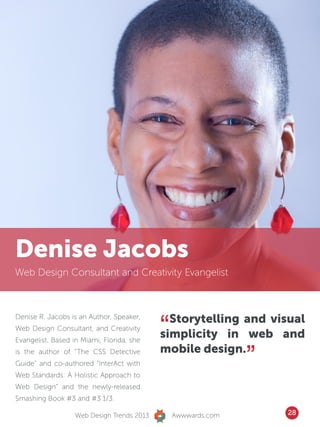
Denise Jacobs
Web Design Consultant and Creativity Evangelist


                                            “ Storytelling and visual
Denise R. Jacobs is an Author, Speaker,
Web Design Consultant, and Creativity
Evangelist. Based in Miami, Florida, she
                                            simplicity in web and
is the author of “The CSS Detective
Guide” and co-authored “InterAct with
Web Standards: A Holistic Approach to
                                            mobile design.
                                                               ”
Web Design” and the newly-released
Smashing Book #3 and #3 1/3.

                   Web Design Trends 2013       Awwwards.com       28
W     hat trends do you see coming in the near future in web and mobile
      design?


“ People are starting to see
the power of storytelling in
web and mobile in reaching
                                      I hope there will continue to be an
                                      increase in storytelling in both web
                                      and mobile design as well as visual
                                      simplicity. People are really starting to
audiences.
             ”                        see the power of storytelling in reaching
audiences and in creating products that resonate with people.

What technologies are you training in now? Which disciplines will you be
focusing on in the coming months and years?
I’m moving away from training in specific technologies and am instead focused
on developing strategies for how to think better under pressure, increase the
creativity, innovation and productivity of individuals and teams, and produce
and execute more great ideas in less time.

What will the trends be in web programming? Which languages or fra-
meworks will gain more converts in the near future?


                                         “
It seems like there will be a continued
                                           It seems like there will be
increase in methods to manage front-
end development better like the scalable a continued increase in me-
and modular CSS architectures, and thods to manage front-end


                                                            ”
also CSS preprocessing languages development.
like LESS, SASS, and COMPASS. I also
anticipate more people challenging well-established front-end development
solutions and devising new ones, especially as the CSS3 specification gets
more solidified.

Touch and gestures, media queries, responsive, retina display, webfonts,
realtime web... How do you think these techniques and technologies will
evolve and what will be next?
All of these technologies are pushing innovation and fresh-thinking forward,
which I love to see. While I don’t know how they will continue to evolve, I do
know that the next several months will be ripe for some fantastic new ways to


             Web Design Trends 2013       Awwwards.com                        29
approach designing with all of the aforementioned combined.

What do you think we’ll see in layout and UI design in 2013? Simplicity,
app-inspired design, responsive, single page websites, alternative naviga-
tion patterns...?
Over the years, we have seen a shift from ridiculously complex interfaces
(think the Flash-based websites of the early 2000’s) to more simple and stark
interfaces. Much like the well-known Antoine de Saint-Exupery quote “Perfection
is achieved, not when there is nothing more to add, but when there is nothing
left to take away”, I am looking forward to more designers who also know
code who understand what is truly necessary, and in striving for perfection,
continue to take away that which is superfluous. Also, I do anticipate more
merging of the website and the app interfaces, where they are both simplified
to the point where there will be little or no difference between the two.


             Web Design Trends 2013       Awwwards.com                        30
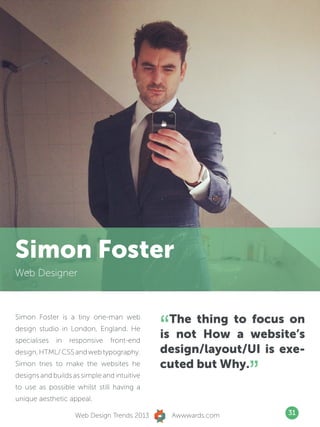
Simon Foster
Web Designer


                                             “ The thing to focus on
Simon Foster is a tiny one-man web
design studio in London, England. He
specialises   in   responsive   front-end
                                             is not How a website’s
design, HTML/ CSS and web typography.        design/layout/UI is exe-
                                             cuted but Why.
                                                                ”
Simon tries to make the websites he
designs and builds as simple and intuitive
to use as possible whilst still having a
unique aesthetic appeal.

                    Web Design Trends 2013       Awwwards.com       31
W     hat tendencies do you see coming in the near future in web and mo-
      bile design?

I think there are still a surprisingly large number of web designers who don’t
take mobile devices into proper consideration. I still see sites that are beautiful
                                           on a desktop or laptop but really

“   Less gimmicks, less tricks, difficult to use on my phone or tablet.
less dependency on javas- That can’t go on forever, so I think

                              ”
                                           we’ll see a lot of designers getting on
cript for a site to work.
                                           board with responsive/adaptive design
or just simplifying the way they design and build sites so even if they aren’t
responsive, they are easier to use on smaller devices. Less gimmicks, less tricks,
less dependency on javascript for a site to work.

What technologies are you training in now? Which disciplines will you be
focusing on in the coming months and years?
Well, even though I do write code as well as design, up until now I’ve only really
gone as far as plain old HTML  CSS. I’ll never be a programmer as it isn’t in my
blood, but I’ve recently started to learn how to use github and I’ll be making a
concerted effort to get to grips with SASS soon as they’re not really as scary


                                            “
as they seem at first. On the other hand
I’m always conscious of not getting
                                              If you haven’t thought
too bogged down in focusing on the about WHY you’re making
“how”. For me the “why” in design will this website it won’t mean


                                                        ”
always be more important. Any type of anything.
code, technology or framework is only
ever a means to an end. You can be the best Ruby on Compass Jekyll, Git via
Haml, Frank Sinatra singing Mongo DB Jerry programmer in the world, but
if you haven’t thought about WHY you’re making this website it won’t mean
anything.


“ I always keep it in mind that no matter how beautiful I make
a website the average user only really wants to spend about
10 seconds on it.
                      ”
              Web Design Trends 2013         Awwwards.com                         32
What should the new design principles be in a future where web and mobi-
le design must be focused on user experience and content?
I think I can see things going back to basics a bit. I love the phrase “Keep it
simple, stupid” (even though it is a little over used). Just let users do what they
came on your site to do quickly and without fuss so they can get on with
doing other things that are more interesting. I always keep it in mind that no
matter how beautiful I make a website the average user only really wants to
spend about 10 seconds on it. So let them do that, cut the crap.

What animation techniques and effects applied to navigation and user in-
teraction will we see? Will we finally move beyond Parallax scroll?
Personally, I hope we don’t see any. I’m not a big fan of things moving all over
the screen, just feels like a gimmick too often for me. When flash websites
died one of the things I was pleased about was that we could get away from
over-bloated sites that needed to load before you could use them and had loads
of unnecessary transitions and animations, but they’re making a comeback
with html5 and canvas/webgm etc.
Of course, I’m not saying NEVER use an animation in a website. When done
with subtlety and in the right context they can be great, but more often than
not I find them annoying. That might just be my taste, others will probably
disagree, which is a good thing.

What do you think we’ll see in layout and UI design in 2013? Simplicity,
app-inspired design, responsive, single page websites, alternative naviga-
tion patterns...?
I think this comes back to “why” and “how” again. The thing to focus on is
not how a website’s design/layout/UI is executed, but why. As long as the


“
                                     way you’ve chosen to build and design
   I think this comes back to your site works for that particular
WHY and HOW again. The project, then great. Whether it’s single-
thing to focus on is not How page, responsive, light, dark, covered
a website’s design/layout/UI in gradients or really minimal doesn’t

                            ”
                                     really matter as long as it works for
is executed but Why.                 that particular client’s site. Trends or
movements in web design are not something that I think a designer should


              Web Design Trends 2013         Awwwards.com                         33
really be trying to emulate or follow when starting a new project. Just because
everyone else is making minimal, responsive, one-page sites that look like apps
with circles for navigation and Futura for body text, doesn’t mean that’s right
for what you’re working on. Do your own thing, ignore trends, start your own
trends if you feel like it, and above all think about what the end user needs
from what you’re creating.


             Web Design Trends 2013       Awwwards.com                        34
Bruce Lawson
Evangelist of Open web standards


                                           “ I think simplicity’s the
Opera    evangelist,   co-author    of
“Introducing HTML5” and web standards
lovegod. Guinness-drinking, kickboxing
                                           point. Mobile stuff needs
poetry freak. Man with MS.                 to be simple, but so does
                                           everything else.
                                                              ”
                  Web Design Trends 2013       Awwwards.com       35
D   o you think the kind of simplicity we see in apps is going to be a big
    thing in design more generally?

Yes. I think simplicity’s the point. I often say to people about mobile, the
usability gurus always point to mobile as being different because people are
                                          time-constrained and task-focused,


“  I think simplicity’s the point. and therefore you should only give
Mobile stuff needs to be sim- them the information they need to
ple, but so does everything
                                          fulfil the task. That’s true, but it’s also
                                          true of everybody all the time. If I go
else.
       ”                                  to a train website, I don’t really want to
see a picture of Richard Branson smiling at me, I don’t want to read the Chief
Exec’s ambitions and life history. All I want to know is what time my train is and
how much it is. And I think, yes, mobile stuff needs to be simple, but so does
everything else. People have been used to making desktop sites that are full of
shite just because they’ve got space for it, and they need to stop.


Do you think web-standards based Apps will end up putting an end to na-
tive Apps?
I doubt standards-based Apps will completely kill native Apps. I think native
Apps are temporarily very important because the web-standards stuff hasn’t
yet got the capability of the native stuff, but the gap’s closing.

What trends do you see coming in the near future in web design?
Access to devices capabilities. So, three years ago, if you wanted to access
GPS geographical information on your phone, you had to have a native app
because you couldn’t do that on the web, and now every browser on every
device is doing that. And then the ability to upload photographs directly from
the web, which we can do now. There’s something called getUserMedia, a
spec I very much like, and that allows a website (with your permission) to
access the videocamera, it might be a webcam or the front-facing camera
on your phone, and then it can access the video stream and film you and
the Javascript on the website accesses the video feed in real time and can
identify where your face is and do facial recognition, and when it determines
where your mouth is it’ll draw a Super Mario Brothers moustache where your


              Web Design Trends 2013          Awwwards.com                          36
mouth is. And this, of course is the zenith of tech. But what this is really for is
in-browser video conferencing, so the website can access your microphone
and your camera and then connect it up to someone else’s website where
they can hear your voice. You’ve effectively got video conferencing with no
third-party app.
I can’t promise anything for Opera, and I certainly can’t promise anything for
anyone else, but I imagine in the next 12 months that’ll be available in the
newest browsers on devices that have that capability, yeah. That’s all part of
web RTC [Real Time Communication] at the moment.

You did a talk on what’s next in Responsive web design, where you mentio-
ned web on TV. Is that what’s next?
The TV manfacturers really want web on TV to work. I think at the moment the
killer app hasn’t been invented. Nobody’s yet come up with the killer product.
TV’s great for some things and it’s rubbish for other things. Nobody is going to
want to put all their social networking stuff up on the telly when your grandma


“
                                          and your kids are in the same room.
    The TV manfacturers rea- There’s things you don’t want in a
lly want web on TV to work. I family space. You’re unlikely to want to
think at the moment the killer type an e-mail on the TV because your

                                   ”
                                          hunting and pecking with the remote
app hasn’t been invented.
                                          for the letters and it’s rubbish. But then
TV’s great for shared viewing, so I could imagine that a killer TV app would
let you look at your Flickr pictures as a slideshow, so instead of the family
gathered round a laptop, the family can be gathered round a big screen and
it’s more sociable. I think that as yet, the technology is there, but we haven’t
yet worked out how to use it best.


                                            “
Nobody wants to write a Word
                                            TV’s great for shared
document on their television, because
a) it’s rubbish as an experience because viewing, so I could imagine
you haven’t got a keyboard, and b) TV’s that a killer TV app would let
leisure, and writing a Word document’s you look at your Flickr pictu-


                                                                     ”
work. I work from home so I make
                                         res as a slideshow.
sure I only work in my office and the
only thing I do in my office is work, so I’ve got differentiation. I think that’s


              Web Design Trends 2013         Awwwards.com                          37
increasingly the case, people want to have that separation, otherwise you just
work all the time.

Have you read anything recently that’s particularly made an impact?
Yes, I read the W3C Pointer Events Specification, which Microsoft wrote,
which is making writing websites that work with a pen or touch or a mouse
much more sane and easy and I think it’s good work by the mighty Microsoft
standardising stuff.

What kind of technologies are you looking at learning? Any new stuff you
want to get into?
I’m not a very good Javascripter, so I’m looking to improve that and I’m
ultimately interested in just improving my general scripting ability, so I’ve got a
book on Python to read on the train. With a degree in English Lit and drama,
I’m not a natural computer person and I’m a bit slower than someone who’s
done a degree in computer science, but I’m interested in learning that kind of
stuff yeah.

For someone who’s starting out, what would you tell them to learn first?


“
                                     Well if they want to learn web stuff, to
  But anyone who tells them learn HTML5 and CSS and then to learn
to just learn Javascript be- Javascript. But anyone who tells them
cause HTML and CSS are to just learn Javascript because HTML

                                   ”
easy, not to listen to them.         and CSS are easy, not to listen to them
                                     because it’s easy to be rubbish at them
and it’s hard to be good at them, to write good, structured code. The best
way is view source. Find good websites that people recommend, and hit view
source, then muck about with it.

You mentioned India and China. How do you think those fast-growing eco-
nomies might affect the web and mobile industries in the future?
They will affect it in ways I can’t guess at, but the effects they’ll have will
be profound. China, particularly. Somebody told me that statistically, most
politicians in the West are politics and philosophy and economics graduates,
and most politicians in China are engineers, and there’s a huge focus and a


              Web Design Trends 2013         Awwwards.com                         38
huge respect for engineering out there. You see some phenomenal code and
dedication to making great stuff coming out of China, and also India. Places
like Bangalore, there’s incredible coding in India.

We’re seeing an extraordinary rise in consumption of the web in those places.
Not so much producing websites, although Chinese social media has just been
credited this week with persuading their government to close down some of
the forced labour camps, so we’re seeing technology enabling people to have
a voice and a say, which warms the cockles of my heart.

I’m going to tell a story this afternoon about a website called Igniter. It was
set up by three Jewish guys in New York and it’s a social network, a dating
agency, for nice, Jewish kids in New York who for cultural reasons didn’t want
to go out on dates one-to-one. So they would organise shared trips to the
theatre or picnics, so groups would go out and if people hit it off they could
subsequently begin dating, but it was culturally a lot less intimidating. It didn’t
take off, they spent lots of money advertising it but they only got 50,000 users.
And then they noticed they were getting loads of hits from India and Pakistan
and places like that, where there’s not a great Jewish community but that
model of shared dating works very well with extended Hindu and Muslim and
Sikh families. They realised that they were getting more signups a week from
India than they had in their first year in the US, so they just relocated it. Those
three guys who had never been out of North America all relocated to Bombay
and they re-branded as India’s premier dating agency and they’re going great
guns there, and that’s the beauty of the World Wide Web. That’s what you lose
if you only think about your own local area. You might think your business is
only focused on your local area but if you deliberately restrict it you’ll never
know whether you have a more global business potential.


              Web Design Trends 2013         Awwwards.com                         39
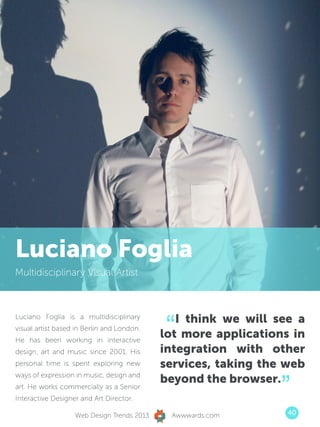
Luciano Foglia
Multidisciplinary Visual Artist


                                            “  I think we will see a
Luciano Foglia is a multidisciplinary
visual artist based in Berlin and London.
He has been working in interactive
                                            lot more applications in
design, art and music since 2001. His       integration with other
personal time is spent exploring new        services, taking the web

                                                                ”
ways of expression in music, design and
                                            beyond the browser.
art. He works commercially as a Senior
Interactive Designer and Art Director.

                   Web Design Trends 2013    Awwwards.com        40
W     hat trends do you see coming in the near future in web and mobile
      design?


“ I see lots of simple and
beautiful interactive design
concepts coming in the fu-
                                       This is a transition moment in the
                                       web design industry. I can see many
                                       interesting possible trends coming
                                       up. Change is always good, and it’s
ture. Expect a focus on typo-          great to see how many designers and
graphy and getting the best            artists are taking on these challenges


                         ”
out of HD displays.                    to experiment with new technologies
                                       and improve the user’s experience on
all platforms. So going back to the question, I see lots of simple and beautiful
interactive design concepts coming in the future. Expect a focus on typography
and getting the best out of HD displays.

What technologies are your team training in now? Which disciplines will
you be focusing on in the coming months and years?
I’m a visual artist and I work as an Art Director and Senior Interactive Designer,
so I don’t only look for means of expression on the web (even if this is my main
channel). I’m also interested in other fields. I mostly use web technologies
for my personal projects because of
their accessibility. What I’m training in
                                           “    WebGL could become a
now is WebGL as a platform to receive very powerful tool for visual
external stimulus as midi signals, sound artists to express ideas throu-


                                                           ”
and moving images. I think it’s a great
technology and still pretty fresh. I believe
                                             gh the web.
it could become an amazing platform for the web, but still like many others
needs a high level of understanding of code. We have seen very interesting
projects done with this technology, but not as many I would like to see. Or
maybe not in the way I would like to see them. I’m blown away every time I see
its potential. It could become a very powerful tool for visual artists to express
ideas through the web. I believe the key is to think outside the box so that we
don’t limit ourselves just to what the technology was made for.

In standards-based web design, what animation techniques and effects
applied to navigation and user interaction will we see? Will we finally move


             Web Design Trends 2013         Awwwards.com                         41
beyond Parallax scroll?
As we overcome some performance limitations we will see more rich expe-
riences to come. For sure the emphasis is on “graphic design with a sense of
depth” at the moment. Because of this, the scroll gained importance like ne-
ver before, not only to browse the content but also to interact with it. I would
like to see how we creatively take better advantage of it in integration with 3D
techniques. Moving beyond Parallax scroll is a matter of time. It will happen as
soon as users start to adopt new ways of navigating the content. Every step
towards providing a more interactive and immersive experience on the web is
a new learning process for the users.


In technological and social terms, how do you think the web will evolve in
the next few years?
I think we will see a lot more applications in integration with other services,
taking the web beyond the browser. This makes life a lot easier for users and
improves productivity. In social terms the internet is playing a very interesting
role, not only on a daily basis but also for long-term social change purposes.
What we saw in Egypt in 2011 was a clear example of how social media can
accelerate a revolution, and we are also seeing it in other parts of the world.
The internet belongs to the people and it can represent unrepresented and
marginalised sectors of society and provide them with a platform to be heard.


             Web Design Trends 2013        Awwwards.com                         42
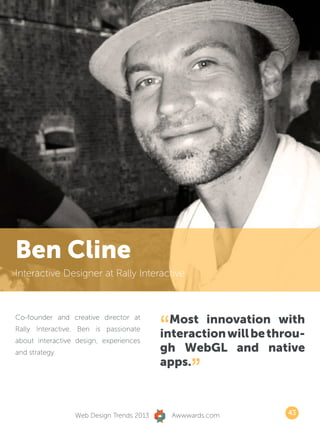
Ben Cline
Interactive Designer at Rally Interactive


                                          “ Most innovation with
Co-founder and creative director at
Rally Interactive. Ben is passionate
about interactive design, experiences
                                          interaction will be throu-
and strategy.                             gh WebGL and native
                                          apps.
                                                  ”
                 Web Design Trends 2013       Awwwards.com      43
W     hat technologies are your team training in now? Which disciplines
      will you be focusing on in the coming months and years?

Rally Interactive is focused on creating engaging and intuitive interfaces. The
technology behind them doesn’t matter. For example, last year we launched
an iOS app for National Geographic - “National Parks by National Geographic”.
What many people don’t realize is while it was only our 2nd encounter designing
and developing on the iOS platform, it was actually the 1st app we’ve ever built
natively in Objective-C. The first iOS app we made, “Canyon Country National
Parks”, was actually built using a non-native iOS framework called Corona.
When it comes to our work, we embrace any technology or platform.

What animation techniques and effects applied to navigation and user in-
teraction will we see? Will we finally move beyond Parallax scroll?
The Parallax effect won’t die any time soon. It has been around for as long as
I can remember (in the early days of Flash and for a long time in film). When it
comes to touch screens, I’ve started to see Parallax animation become popular
as well as gesture based interfaces. I think gesture based apps will continue to
grow as users become more savvy with exploring hidden UI’s. However, many
of us here at Rally believe Web GL has a promising future when it comes to
web design. It will take years but eventually HTML will begin to fade as the
platform of choice for websites because it was never meant to serve up rich
media or interactive experiences in the first place. Most hardcore programmers
will probably agree that HTML and CSS mark-up languages are no longer ideal
                                         to build on.

“  I think 2013 will be a year of
limbo when it comes to [res-
ponsive] websites. They will
                                        What do you think we’ll see in layout
                                        and UI design in 2013?
continue to be wildly popular           I think 2013 will be a year of limbo when
but will lack when it comes to          it comes to [responsive] websites. They


                                 ”
                                        will continue to be wildly popular but
innovation and creativity.              will lack when it comes to innovation
and creativity. Most of this won’t be the fault of creatives or Agencies, rather
website timelines and budgets will be stuck in the pre - fragmented device
era. Most timelines will be eaten up testing and optimizing rather than pushing


             Web Design Trends 2013        Awwwards.com                         44
innovation and creativity. That being said, the native app world is wide open.
Gesture and invisible UI’s will become more popular and more intriguing while
Web GL will [hopefully] start to be supported on mobile browsers, further
pushing browser based layout possibilities.


“  Most innovation with inte-         Can we predict an explosion of crea-
                                      tivity in interaction and animation
raction will be through Web
                                      now that the technology is available
GL and native apps. Unfortu-          and becoming more accessible from
nately, the responsive era of         a web standards point of view?
websites will temporarily sti-         Most innovation with interaction will
fle some creativity.
                       ”               be through Web GL and native apps.
                                       Unfortunately, the responsive era of
websites will temporarily stifle some creativity on the web until all browsers
consistently support the newest technologies. If companies want to push the
boundaries of creativity in responsive design, they will have to commit more
time and budget.


             Web Design Trends 2013       Awwwards.com                       45
Aarron Walter
Author of “Designing for Emotion”


                                             “ We’ll begin to move
Aarron   Walter     has    been   building
websites professionally since 1999, and
has taught interactive design courses
                                             towards an era of flat
at colleges. He enjoys sharing his ideas     design that emphasizes

                                                                    ”
                                             legibility and usability.
about education, findability, and design
at   conferences     and    organizations
around the globe.


                    Web Design Trends 2013       Awwwards.com      46
I n technological and social terms, how do you think the web will evolve in
  the next few years?


“ An ecosystem of connec-
ted services makes building
apps easier, and reduces the
                                       We’re heading towards a Web of loosely
                                       connected services. Instead of building
                                       a web app that needs to do twenty
                                       things for customers, we’re starting to
burden of content input on             focus just on core workflows and rely
the shoulders of users as they         on APIs, integrations, and hopefully
can reuse profiles and con-            web intents in the near future. We stitch


      ”
                                       together our favorite services using If
tent.
                                       This Then That, we pass photo editing
tasks over to Aviary, we let Dropbox hold our stuff then grab it from desktop,
web, and mobile apps. An ecosystem of connected services makes building
apps easier, and reduces the burden of content input on the shoulders of
users as they can reuse profiles and content they’ve created elsewhere.

What trends do you see coming in the
near future in web and mobile design?
What do you think we’ll see in layout
                                          “
                                         The heavy use of lighting
                                       effects in interactive design
                                       will fade, and designers will
and UI design in 2013?                 move towards flat, simple
In the short term future I see a trend designs that no longer try to


                                                                              ”
towards an aesthetic that reflects an
                                       emulate the physical world.
honesty of our materials.
The heavy use of lighting effects in interactive design will fade, and designers
will move towards flat, simple designs that no longer try to emulate the physical
world. We’ll stop shoe-horning interaction design into illustrated physical
objects like books, radios, and calendars, and we’ll begin to move towards an
era of flat design that emphasizes legibility and usability.

What technologies are you training in now? Which disciplines will you be
focusing on in the coming months and years?
I’m not big on fetishizing technology. It empowers us to make things, but what
language, or techniques power a site isn’t what moves people. They’re moved
by the experience we create for them. I’ll be thinking about what makes people


             Web Design Trends 2013        Awwwards.com                         47
tick in the years to come so I can discover ways to create more memorable
experiences for people.


“ In our industry and in life, What should a web design newbie
the only thing that is unchan- concentrate on learning?

                    ”
ging is change.                Learn to prototype quickly. Learn to use
                                         things while you design them. Learn to
not look to trends in your medium for your inspiration, but instead look at the
history of other crafts for insights. Learn to change, because in our industry
and in life, the only thing that is unchanging is change.

What should the new design principles be in a future where web and mobi-
le design must be focused on user experience and content?
I don’t know that they’ll be any different than they ever have been, but I think
we’ll be more aware of principles now that our favorite computers are in our
pockets. The heuristics that have guided software design for years still apply
to mobile design, but with limited space on mobile devices, we’re forced to
really consider the value of all elements and options in a UI.

How do you think fast-growing economies like India or China are going to
influence the web and mobile industry?
I suspect India and China will provide a lot more developers to the web industry,
which are greatly needed right now. It’s really hard to hire skilled developers as
there’s heavy competition for them in the industry.


              Web Design Trends 2013        Awwwards.com                         48
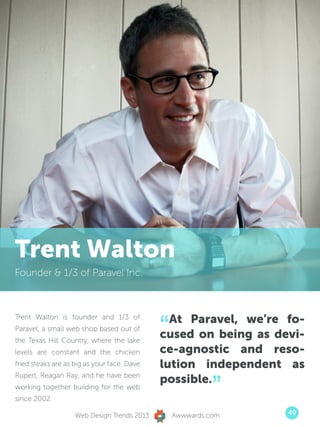
Trent Walton
Founder  1/3 of Paravel Inc.


                                             “ At Paravel, we’re fo-
Trent Walton is founder and 1/3 of
Paravel, a small web shop based out of
the Texas Hill Country, where the lake
                                             cused on being as devi-
levels are constant and the chicken          ce-agnostic and reso-
fried steaks are as big as your face. Dave   lution independent as

                                                           ”
Rupert, Reagan Ray, and he have been
                                             possible.
working together building for the web
since 2002.

                    Web Design Trends 2013       Awwwards.com    49
W     hat trends do you see coming in the near future in web and mobile
      design?


“ The most exciting part of
design is working to unders-
tand all the devices out there
                                         Hopefully, as we progress we’ll stop
                                         thinking about the the web in separate
                                         buckets. Words like tablet and mobile
                                         mean less and less as the lines
so that we can create a sin-             between them and desktop browsing
gle, sensible design that tra-           environments blur. For me, the most
vels across as many of those             exciting part of design is working to


                         ”
                                         understand all the devices out there
devices as possible.                     so that we can create a single, sensible
design that travels across as many of those devices as possible. That includes
things like maintaining hierarchy as well as optimizing for a range of connection
speeds.


                                          “
What technologies are you/ your      We’re building responsi-
team training in now? Which discipli-
                                   ve sites exclusively and are
nes will you be focusing on in the co-
ming months and years?
                                   using things like font icons
                                   and SVG images whenever
At Paravel, we’re focused on being
as device-agnostic and resolution possible.
                                                       ”
independent as possible. We’re building responsive sites exclusively and are
using things like font icons and SVG images whenever possible. There are a
lot of UI patterns that need to be rethought to work in a responsive or multi-
device environment, so that part of the work is particularly exciting to us.


             Web Design Trends 2013        Awwwards.com                         50
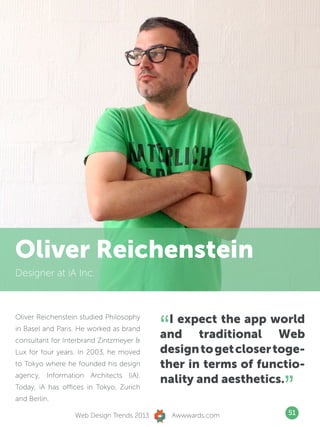
Oliver Reichenstein
Designer at iA Inc.


                                           “ I expect the app world
Oliver Reichenstein studied Philosophy
in Basel and Paris. He worked as brand
consultant for Interbrand Zintzmeyer 
                                           and traditional Web
Lux for four years. In 2003, he moved      design to get closer toge-
to Tokyo where he founded his design       ther in terms of functio-

                                                                 ”
agency, Information Architects (iA).
                                           nality and aesthetics.
Today, iA has offices in Tokyo, Zurich
and Berlin.

                  Web Design Trends 2013       Awwwards.com      51
W     hat trends do you see coming in the near future in web and mobile
      design?

You can already see it happening. Mashable of the The Next Web, polygon.
com and Time.com bet on clean, generous, responsive design with a lot of
                                        typographic care. I bet that a lot of

“  Clean, generous, responsi- corporate and news site are going to
ve design with a lot of typo- follow that trend. The challenge will
graphic care. I bet that a lot be to find a good balance between
                                        cleanness and density. With the advent
of corporate and news si- of responsive design there is an entirely
tes are going to follow that new set of screen typographical
trend.
        ”
                                        challenges waiting for us. After Web 1.0
                                        aka the nineties and Web 2.0 aka the
2000s, we are about to enter a third phase in Web Design. I expect the app
world and traditional Web design to get closer together in terms of functionality
and aesthetics. With mobile platforms gaining more and more market share, it
might be that within a foreseeable future the main screen Web designers will
think about is the mobile phone.

What should the new design principles be in a future where web and mobi-
le design must be focused on user experience and content?
Simplicity. Scalability. Speed. Stop thinking in fixed widths, platforms, browser
versions, download speed standards. Responsive design is not just about
responsive layout grids and clever ways of dealing with big picture formats, it
is also about a new dimension of screen typography.

Can you pinpoint any visual trends or design elements that might emerge
in 2013?
I try to avoid thinking in terms of surface aesthetics. Interface design gets better


“
                                           the less you think in terms of style. But
    There will be another ge- from the technical conditions it seems
neration of further visual clear that also aesthetically, there will
simplicity in UID.
                      ”                    be another generation of furthered
                                           visual simplicity in UID. Microsoft went


              Web Design Trends 2013         Awwwards.com                          52
in that direction and might somewhat turn away from it in further iterations. I
am prepared to see the first traces of I’ve shaping the surface of OSX and iOS,
which will definitely result in a simplified cleaner version of Apple’s surface
design aesthetic. Hopefully, Ive will not just simplify the surface design, but
get to a simpler look and feel through a simpler interaction design. Since every
trend comes with a counter trend, we can also be prepared for more baroque
or playful elements trying to set a counter point.

What technologies are your team training in now? Which disciplines will
you be focusing on in the coming months and years?
We are exploring the new screen typographic territory, we are working on
new interaction patterns for writing and reading on the screen and we are
developing new frame works to deal with the multitudes of screens and
interaction patterns that contemporary interaction designers need to deal
with. Our tools are less and less specific programs or programming languages.
We start with research, wireframes and initial mockups, but we soon move
towards working in prototypes that slowly evolve into the final product.

In technological and social terms, how do you think the web will evolve in
the next few years?
Just as with the new possibilities, Web
                                           “     We witnessed the end of
technology, information architecture, the fixed screen format,the


                                                                 ”
interaction     design    and     screen
typography have become increasingly
                                             end of the pixel.
interesting, they have become increasingly difficult. We have to prepare for
an increasingly challenging technical setup. Right now there is a clear trend
towards a Web that is mostly handled through a small touch screen. I would
not be surprised if, for example, we end up with a tiny device with a form
factor of wrist watch that has a flexibility to fluidly morph into a bigger device.
Thus with a device that in itself has highly variable different screen sizes. We
witnessed the end of the fixed screen format,the end of the pixel, and the end
of design principles geared by the desire for visual control. In the mean time,
the definition of these liquid design principles is far from clear. Things are
going to stay exciting.


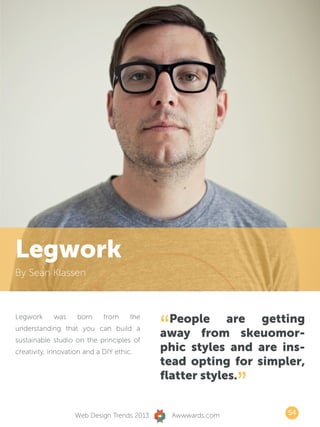
              Web Design Trends 2013         Awwwards.com                         53
Legwork
By Sean Klassen


                                            “ People are getting
Legwork     was     born     from     the
understanding that you can build a
sustainable studio on the principles of
                                            away from skeuomor-
creativity, innovation and a DIY ethic.     phic styles and are ins-
                                            tead opting for simpler,
                                            flatter styles.
                                                               ”
                   Web Design Trends 2013       Awwwards.com       54
W     hat trends do you see coming in the near future in web and mobile
      design?

I think we’re going to start seeing more exploration with 3D and immersive
video. A lot of Flash sites were going in this direction five or six years ago and
then things went back to much more basic layouts after the iPhone came out.
The technology is beginning to catch up though.

As an agency, what kind of profiles do you look for?
Good people are hard to find and in
great demand right now. We’re actively
                                           “We’re actively looking for
looking for developers that have great developers that have great
javascript skills and still have an eye javascript skills and still have


                                                                   ”
for design (if you’re that person, get in
touch!). Since we are a small shop, we
                                          an eye for design.
need people who are well versed in a number of areas and aren’t afraid to jump
around and try new things. Things are constantly changing in this industry, so
the most important trait you can probably have is a passion for learning new
things.

What technologies are your team training in now? Which disciplines will
you be focusing on in the coming months and years?
We want to keep pushing what you can do with Javascript, CSS and HTML.
Additionally, we build most projects in Ruby on Rails these days. I’m curious
about getting more into WebGL and other things like three.js to push the
experience envelope further.

What animation techniques and effects applied to navigation and user in-
teraction will we see? Will we finally move beyond Parallax scroll?


“ I think we’ll start seeing            I pray we move beyond the parallax
                                        scroll. It’s probably the most overused
more and more with 3D.                  (in inappropriate ways) trend I’ve seen
Hopefully people can keep it            in the last ten years. There’s a time and
tasteful.
          ”                             place for it, but I’m so tired of seeing
                                        people do it just because they can. In


              Web Design Trends 2013        Awwwards.com                         55
most cases the implementation and performance is really bad too. You can’t
forget that the way something works and feels is just as critical to the design
as the visual aspect, if not more so.
Anyway, like I said above, I think we’ll start seeing more and more with 3D.
Hopefully people can keep it tasteful. We’ve also been doing a lot with png
sequences to emulate things you used to only be able to do with video, but
with the added bonus of transparency.


“ People are getting away
from skeuomorphic styles
that have dominated the last
                                         What do you think we’ll see in layout
                                         and UI design in 2013?Simplicity,
                                         app-inspired design, responsive, sin-
                                         gle page websites, alternative navi-
few years and are instead
                                         gation patterns...?
opting for simpler, flatter
                                         Single, long scrolling sites will still be
styles.
        ”                                popular. They’re great for telling a
singular story. Responsive sites and mobile targeting will become ever more
important. It’s probably not long until mobile is the dominant form of browsing.
It also seems that people are getting away from skeuomorphic styles that have
dominated the last few years and instead opting for simpler, flatter styles (think
Windows 8, Svpply, etc.)

Can we predict an explosion of creativity in interaction and animation now
that the technology is available and becoming more accessible from a web
standards point of view?
Yes, to a point. IE8 isn’t going anywhere in the near future though and it’s really
just as bad at supporting these new technologies as 7. So, a lot will depend on
the audience you have to target.


              Web Design Trends 2013         Awwwards.com                         56
Ultranoir
Digital Savoir-Faire, most awarded studio on Awwwards


                                            “You will have fast and
Ultranoir is a human-sized studio driven
by passion. Their byword is ‘useful
design’, since they believe that the role
                                            easy access to what
of artwork is to serve the application,     you’re looking for but
its objectives and the end-user - not       with creativity, style and

                                                               ”
the other way around. Ultranoir has
                                            even emotion!
received numerous awards for its online
creations.

                   Web Design Trends 2013       Awwwards.com       57
W     hat trends do you see coming in the near future in web and mobile
      design?

I’m not really into trends but I know what I would love to see in web design!
More experiences, more interactivity, more creativity!
During the last days of Flash, someone said the reason for its ending was
                                             that designers went too much into

“  We have to create some full experience websites, forgetting
new experiences with the efficiency and the end-user... and that
present and future techno- the future of web will be focused on
                                             utility now. That’s not totally wrong,
logy (HTML5, CSS3, JS, Web- I have to admit, but I want utility/
GL..) and devices. This will efficiency AND creativity. This means
be fully possible when 80% that you will have fast and easy access
of people use modern brow- to what you’re looking for in any

      ”
                                             support but with creativity, style and
sers.                                        even emotion! Now I can see HTML5
websites reaching the quality, in terms of interactivity, of Flash websites.
However, we should not recreate what was done in Flash some years ago (we
did this at Ultranoir and I think it’s part of the process). Now, we have to create
some new experiences with the present and future technology (HTML5, CSS3,
JS, WebGL..) and devices. This will be fully possible when 80% of people use
modern browsers. That’s not the case right now.

As an agency, what kind of profiles do you look for?
We are always looking for talented front-end developers with great experience
in producing advanced HTML websites and also with a strong creative approach.
What the market is really missing is more people who mix technology and
creativity.

What technologies are your team training in now? Which disciplines will
you befocusing on in the coming months and years?
We are always improving our skills in the usual trio: HTML5, CSS3 and Javascript.
We are very interested by Adobe’s new CSS properties such as CSS Regions
and Filters. We have to improve our skills on Canvas, SVG, 3D…


              Web Design Trends 2013         Awwwards.com                         58
Of course, Front-end will remain a key discipline in our HR strategy but we’ll also
focus our efforts on UX and content. Better content within a better experience
should be the perfect recipe.

What animation techniques and effects applied to navigation and user in-
teraction willwe see? Will we finally move beyond Parallax scroll?
As I said before, companies like Adobe are working on some great tools to
enhance user interaction. In term of layout design, I think we’ll see more and


“
                                       more websites inspired by print design.
   In terms of layout design, It’s already the case. Personally, I study
I think we’ll see more and print design (magazine, posters) a lot
more websites inspired by and I hope web design will reach this

                ”
print design.                          quality.

About navigation and interaction, we now have to manage various devices with
their own capabilities. On a laptop, you rollover, drag and click and on a tablet
you will slide, touch, turn... So we are trying to bring closer both experiences.
It’s not easy. I saw a great approach on a website done by Hello Monday. We
are on the same thinking.
I have no problem with Parallax scroll if it serves the experience. I think this
system is perfect for storytelling websites. You scroll down like turning the
page of a book. There’s still potential here. What I can’t stand anymore are
some parallax websites using this effect just because they think it’s trendy (it’s
not anymore). Using an effect for the effect is meaningless. But you never
know. One day, a guy will come along with a new concept and it will create
a trend, as Ian Coyle did when he designed the very first parallax web site for
Nike, or When Gabo Mendoza created the first Flash website in the old days.

What do you think we’ll see in layout and UI design in 2013?
In 2013 I think we’ll have more simplicity and this is for two reasons:
-More and more of our clients want to reach the Asian market and in China for
example, IE6 is strong.
-There are too many differences in HTML rendering between all the browsers
/ OS / devices.


              Web Design Trends 2013         Awwwards.com                         59
It’s a bit of a tower of Babel now. That means that we spend a lot of time writing
the same story in many languages so everybody can read it. The impact is that
we have to simplify the experience to limit time spent on HTML integration.

Can we predict an explosion of creativity in interaction and animation now
that the technology is available and becoming more accessible from a web
standards point of view?
Once 80% of Internet users are speaking the same “HTML language”, we’ll see
an explosion of creativity. New tools will be available and web designers in the
starting blocks! But I think we’ll have to wait until 2014. That does not mean we
won’t see masterpieces in 2013 as some clients ask for websites for modern
browsers only. Hopefully! I love to read “for modern browsers only” in a brief!


              Web Design Trends 2013        Awwwards.com                         60
Ian Hickson
HTML5 Specification Editor


                                            “ Mobile is where Desk-
Ian Hickson is the author and maintainer
of the Acid2 and Acid3 tests, and the Web
Applications 1.0/HTML 5 specification.
                                            top was a decade or two
He is known as a proponent of web           ago, in terms of innova-
standards, and has played a crucial role
in the development of specifications
such as CSS. Hickson was a co-editor
                                            tion.
                                                   ”
of the CSS 2.1 specification.

                   Web Design Trends 2013       Awwwards.com     61
W     hat will the trends be in web programming (front- and back-end)?
      Which languages or frameworks will gain more converts in the near
future?

Languages and frameworks pop up, become fashionable, and die out quicker
than I can actually keep up. In practice what matters is using frameworks that do
what you need. Sometimes using the ancient “crufty” languages is a better idea
than using the new hotness, because it’s more reliable. A lot of programmers
                                          these days use scripting languages and


“ “ ”
   Sometimes using the an- languages with automatic memory
cient crufty languages is management, weak typing, and so
a better idea than using the
                                          forth, because they let you get stuff off
                                          the ground quicker than anything else,
new hotness, because it’s but there is often a cost, usually in either

    ”
more reliable.                            performance (the system doing stuff
                                          tends to be expensive in terms of CPU
cycles and memory), maintenance (strongly-typed, more structured languages
can have compilers that catch errors at compile time that are ridiculously
time-consuming to catch at runtime), or support (newer languages might not
survive the next wave of new cool tech, leaving you with legacy code on an
unmaintained toolchain). Often these tradeoffs are the right ones to make -
these languages really do let you get something off the ground way faster, and
that matters (after all, if you don’t ship, it doesn’t matter what language you
used). It’s really something each engineering team has to carefully consider.

What should a newbie web developer concentrate on learning?
Depends what they want to do. There are far more technologies available for
developing Web solutions now than any one person could possibly learn at
this point, so one has to figure out what area one wants to specialise in - user
interface, graphics, back end, networking, storage, computation, etc - and just
work on that.

W3C, WHATWG, Mozilla, Adobe, Google...What have they got in store for
2013?
As far as WHATWG goes, we’ve been expanding to more than just HTML, with


              Web Design Trends 2013         Awwwards.com                         62
new editors working in the WHATWG mailing list rather than elsewhere. You
can see what we’re working on here:
http://www.whatwg.org/specs/

As far as HTML goes, the thing I’m working on right now is Canvas on workers,
but you can see the list of what’s next to be worked on here:
http://www.whatwg.org/issues/

How do you think fast-growing economies like India or China are going to
influence the web and mobile industry?
When working on HTML I try to just look at the world as a single ecosystem,
not on a per-country basis, so this isn’t something I think much about. Having
said that, there are already more people online in Asia than Europe and North
America put together. The real dark horse is Africa.

Do you think standards-based mobile apps will overtake native apps?
I’m not sure I agree with the premise of the question. The Web has trillions
of pages, after all. Having said that, native platforms and the Web have very
different characteristics. The Web is by design radically vendor-neutral, and
(to a lesser extent in practice) device-neutral. This has huge benefits: nobody
can single-handedly kill the Web, for example. If you write a Web page or
application today, and then tomorrow your desktop operating system vendor
or your mobile phone handset vendor goes bankrupt, you can just buy another


“
                                         device and your page still works. If
   Innovation doesn’t happen
                                         you target a proprietary platform -
in multi-vendor discussions. e.g. Amiga, OS/2 - that then loses the
If you have a proprietary pla- support of its vendor, the result is that
tform, it’s easy to add featu- your application is no longer usable.
res to it.
          ”                              The cost of having a system immune
to the whims of a single vendor is that by and large, innovation doesn’t happen
in multi-vendor discussions. If you have a proprietary platform, it’s easy to add
features to it: you just do it. No need to argue with anyone. On the Web, a
feature can only be added if every major implementor agrees it’s worth adding,
and that usually only happens once it’s been proven in a native platform.


              Web Design Trends 2013       Awwwards.com                         63
“
                                        So native platforms have the edge
  So native platforms have              when things are rapidly innovating.
the edge when things are ra-
pidly innovating.                       This is why the mobile world today has
Mobile is where Desktop was             so much focus on native apps. Every
a decade or two ago, in ter-            new generation brings radical new


                      ”
                                        features, and the Web will always be
ms of innovation.                       behind on those. So the cutting edge
                                        is native.

You can see this on desktop: innovation on desktop operating systems has
slowed down dramatically, and as a result the Web has been able to mature
here. The result is that on desktop, Web apps are doing great (so great that it’s
viable to create a desktop OS that does nothing but bring up a Web browser, in
fact). Mobile is where Desktop was a decade or two ago, in terms of innovation.


             Web Design Trends 2013        Awwwards.com                         64
Brad Frost
Mobile Web Strategist and Frontend Designer at R/GA


                                              “2013 will be the Year
Brad Frost is a mobile web strategist and
front-end designer at R/GA and is based
out of beautiful Pittsburgh, PA. He is the
                                             of Performance. People
creator of Mobile Web Best Practices, a      are increasingly intole-
resource site aimed at helping people        rant with slowness in any

                                                              ”
create great mobile and responsive web
                                             experience.
experiences.


                    Web Design Trends 2013     Awwwards.com        65
W     hat trends do you see coming in the near future in web and mobile
      design?

I’m calling it right here right now that 2013 will be the Year of Performance. And
if I’m wrong in that assertion, I’ll slowly eat my words with tears in my eyes then
                                            crawl into a corner until 2014. Why do

“    Performance needs to be I say performance will be a big trend?
everyone’s concern in order People are increasingly intolerant with
to create truly exceptional slowness in any experience (web or
                                            otherwise), so the services that will
multi-device web experien- rise to the top will be the ones that are
ces.
     ”                                      blazingly fast. I’ve been talking about
‘performance as design’ rather than a handful of checkboxes developers need
to concern themselves with. Performance needs to be everyone’s concern in
order to create truly exceptional multi-device web experiences.

What should the new design principles be in a future where web and mobi-
le design must be focused on user experience and content?
I summed up what I feel is crucially important in my “Principles of Adaptive
Design”: ubiquity, flexibility, performance, enhancement, and a general notion
of being future friendly.

As creators for the Web, it’s our
                                            “ Principles of Adaptive De-
responsibility to embrace and preserve sign: ubiquity, flexibility, per-
the ubiquity of the web, which is easily formance,           enhancement,
its biggest asset and easily one of and a general notion of be-


                                                                    ”
humankind’s greatest achievements.
                                           ing future friendly.
We need to continue to return the Web
to its intrinsically fluid state. We need to respect our users’ time and strive
to give them a highly performant, snappy experience. We also need to take
advantage of the plethora of capabilities offered by devices and browsers,
but do so in a way that preserves the other principles of adaptive design. And
lastly, everything we do should be built to stand the test of time and should
be considerate of tomorrow’s landscape in addition to today’s.


              Web Design Trends 2013         Awwwards.com                         66
What technologies are you training in now? Which disciplines will you be
focusing on in the coming months and years?
I’m still very much a front-end designer, meaning that I prefer to focus on the
interface side of web design. I don’t come from a computer science background
and I’d very much like to build up a solid computer science foundation. I feel
it’s the only way to keep myself from feeling like I’m shooting in the dark every
time I program.
My other big priority (dare I say new year’s resolution) is to learn how to
manipulate data. I want to master how to pull in a data set from somewhere,
possibly combine it with another set of data, and do something with it. Right
now I feel I can clumsily fumble through that process, but that’s unacceptable.
Data is going more places than ever before, so having a solid grasp on how to
utilize and manipulate it will prove to be an invaluable skill.


“  Think about how gestu-                What animation techniques and
res, subtle animations and               effects applied to navigation and user
transitions can enhance (not             interaction will we see? Will we fina-
distract from) the user expe-            lly move beyond Parallax scroll?


         ”
rience.                                  I hate parallax. There, I said it. The Nike
                                         Better World site was amazing, but that
doesn’t mean that everyone else should follow the leader. We have a whole
slew of animation tools, gestures and device capabilities at our fingertips, and
we’ll find interactions and animations that are conducive to the environment.
Instead of miming parallax all day, think about how gestures, subtle animations
and transitions can enhance (not distract from) the user experience.

What do you think we’ll see in layout and UI design in 2013?
I think (and hope) we’ll continue seeing interfaces move towards simplicity
and intuitiveness rather than bells and whistles. As more people accept multi-
device web design as reality, we’ll see many responsive patterns evolve and see
others fade away. We’ll continue to experiment and see what sticks. There’s
never been a more exciting time to be a web designer. Here’s to 2013!


              Web Design Trends 2013         Awwwards.com                          67
Hinderling Volkart
By Michael Hinderling, Severin Klaus  Michael Volkart


                                             “ Clear and focused, re-
Hinderling Volkart is one of the most
important digital agencies in Europe,
based in Zurich, Switzerland.
                                            duced design. Content
                                            oriented!
                                                        ”

                   Web Design Trends 2013     Awwwards.com        68
W     hat trends do you see coming in the near future in web and mobile
      design?

Clear and focused, reduced design. Content oriented!

As an agency, what kind of profiles do you look for?
We are looking for people crossing the borders between traditional disciplines.


“
                                       For example: good designers with
   We are looking for people a sense for web programming or
crossing the borders between information architecture, or interaction
traditional disciplines.
                             ”         developers with a sense for animations
                                       and interactions. Also project managers
with a good feeling for design and communications, which is very rare here in
Switzerland.

What technologies are your team training in now? Which disciplines will
you be focusing on in the coming months and years?
We see an ongoing shift towards front-end technologies: more and more
logic, interaction and visual effects are handled dynamically on the client side.
Browsers and devices are becoming
faster and more powerful, opening new
                                           “  We are still extremely exci-
opportunities for innovative interaction ted about the much more in-
design and UX implementations. As tuitive interaction touch de-


                                                                    ”
soon as WebGL arrives on mobile vices can provide.
devices we’ll see a lot more going on
there. We also expect to see a boost in already available ‘native’ stuff like video
(camera), audio (mic) and CSS effects, with old browsers finally losing their
right to exist. We are still extremely excited about the much more intuitive
interaction touch devices can provide.

What technologies will be used for mobile app development?
The best experience is still achieved with native implementations. If the
divergence of mobile operating systems continues, we expect a growth in
cross-device technologies- that technology should be the browser. This
requires a certain common alignment in features, performance and rendering


              Web Design Trends 2013         Awwwards.com                         69
“  It’s important not just          across all browser engines. Chrome
                                    must become standard on Android,
to follow trends, but think         Safari must keep up and allow more
about which design langua-          fun, and if Windows Phone 8 succeeds
ge is appropriate for a speci-      we’ll need IE10+ not to fall back into


                               ”
fic content or message.             old behaviour. But who knows, all of a
                                    sudden we might see Flash enhance
and become important for certain App developments.

Can you pinpoint any visual trends or design elements that might emerge
in 2013?
There are various trends. In our opinion it’s important not just to follow trends,
but think about which design language is appropriate for a specific content or
message.

What animation techniques and
effects applied to navigation and user
interaction will we see? Will we fina-
                                           “ We expect to see inno-
                                           vation with touch and the
                                           exploitation of device sen-

                                                 ”
lly move beyond Parallax scroll?           sors.
There’s an ongoing trend with Parallax scrolling websites, and it’s been taken
beyond reason on many occasions. We still like the scroll interaction per se:
it’s intuitive, understandable and allows responsiveness. But we don’t like
those heavy one pagers that seek effects only, compromising performance
and usability.

We expect to see innovation with multi-touch and the exploitation of device
sensors. And we expect to see this slowly arriving on (mobile) desktop
computers. But hey, there’s still a way to go.

What do you think we’ll see in layout and UI design in 2013?
More app-like websites. Fully responsive. Touch-optimized interfaces and even
touch-optimized websites.


              Web Design Trends 2013        Awwwards.com                         70
Jeffrey Zeldman
Founder, Happy Cog. Publisher, A List Apart.


                                           “  We have to keep on-
Jeffrey Zeldman is one of the world’s
most renowned personalities in Web.
Guru of Web standards Zeldman is
                                           thinking about mobi-
also Founder, Happy Cog™ studios.
Author, Designing With Web Standards.
Publisher, A List Apart, A Book Apart.
                                           le-first  content-first.
                                                                      ”
Co-founder, An Event Apart. Host, Big
Web Show.

                  Web Design Trends 2013     Awwwards.com        71
W     hat trends do you see coming in web design?

I think people are getting our content in different ways, they’re finding it
in different ways and they’re using different devices and, for good or evil,
web-capable TVs are the next thing. So I think we have to keep on thinking
                                      about mobile-first and content-first,


“  I think we have to keep on I think we have to keep on figuring
figuring out what to do with out what to do with tiny devices that
                                      have high-res screens and may have
tiny devices that have hi- fast bandwidth but may have slow
gh-res screens and may have bandwidth. I think there’s a lot of stuff
fast bandwidth but may have to figure out. How do we keep using

                    ”
slow bandwidth.                       standards? How do we develop new
                                      standards? I think given the wide range
of devices and use-cases, one of my favorite imponderable questions is “I have
a screen that wants high-res Retina images, but I’m on 3G”.

What do you send me? And how do you know if I’m on 3G? 50% of the time
people are using their mobile in their home or office, where they have fast
bandwidth. I don’t know, I have no way of knowing what your bandwidth is
so what do I send you? Whatever I send you I’m going to make somebody
unhappy. Is there some other way to go
about it? Can we just carefully choose
                                         “   I think we’re going to see
our images, like, “I’m going to use an end of pages, in a way.
watercolors where even if it’s medium
                                           We’re going to stop focu-
resolution, it still looks cool”. Can we
blur the background so that there’s less sing so much on pages and
bandwidth even if it’s high-def? There’s start focusing on content


                                                   ”
lots of stuff to think about, there’s lots chunks.
of new challenges. I think responding to
all those new challenges now, when we’re moving kind of faster than reason,
that’s a big challenge now.

And then taking better advantage of mobile. Taking better advantage of
geo-location and built-in cameras and all that stuff, whether native or Web
App. Taking better advantage of those things.


             Web Design Trends 2013       Awwwards.com                       72
I think HTML5 is key, because it’s so semantic and has new content semantics
like “article” and “section”. I think it’s made for the way we’re publishing now
and I think we’re going to see big changes in how CMSs are designed to
accommodate mobile and orbital content and I think we’re going to see an
end of pages, in a way. We’re going to stop focusing so much on pages and
start focusing on content chunks, and how we structure them and how we
design them for different use-cases, different devices.

Which technologies are you focusing on right now?
Our front-end developers are using Less and Sass now, not just CSS. Less and
Sass are CSS preprocessors that can speed up development. We’re studying
the problem of Retina images and what to do about that. We’re looking into
and working in native. But mainly we’re using good, structural HTML5.


             Web Design Trends 2013        Awwwards.com                        73
Rachel Andrew
Web Developer and Director of Edge of my Seat


                                           “ We’re going to have
Rachel Andrew is a web developer,
speaker and writer, Managing Director
                                           better ways to deliver
at edgeofmyseat.com and one of the
developers of the really little content
                                           content to different de-
management system, Perch.
                                           vices and different band-
                                           widths.
                                                      ”
                  Web Design Trends 2013       Awwwards.com      74
W     hat do you think are the key trends that will be coming in the near
      future?

I think it’s very interesting that a few years ago we were all expecting that
everyone was going to be on huge screens with high bandwidth, and that’s
what we were all predicting. We were all saying “in a few year’s time we’re
going to have massive screens and all this space and people are going to have
                                         really fast connections” and what’s


“  A few years ago we were all happened is we’ve all ended up on tiny
expecting huge screens with little screens with crappy bandwidth.
                                         I think it’s in that area. What I hope is
high bandwidth and what’s that we’re going to have better ways
happened is we’ve all ended to deliver content to different devices
up on tiny little screens with and different bandwidths. Because at

                        ”
                                         the moment, you know, there’s the
crappy bandwidth.
                                         responsive images problem. How do I
know whether I should be serving a small image, or a retina image, or a giant
image for a posh display? Because it’s not just on screen size, it’s also on
bandwidth. If I’m on my iPad at home, on my Wi-Fi, I want the nice images
so I can see them on the retina display. If I’m on the train somewhere and I’m
going to use 3G, I’d like to have the optimized image. So it’s not just screen
sizes, it’s to do with where you are and that, I think, is the biggest issue with
doing responsive design at the moment. You can’t just make assumptions
based on screen size, you need to be thinking, “Where is this person and what
connection are they on?”


                                           “
The only client work we did this year          You can’t just make as-
was this festival website and a lot of the
                                             sumptions based on screen
traffic while the festival’s on is obviously
mobile traffic. But an awful lot of it is size, you need to be thinking,
also people on laptops, so normal Where is this person and what


                                                                           ”
screens but on mobile broadband, connection are they on?
either tethered to their phone of with
Wi-Fi or whatever. Now, you can’t detect those people easily. So it’s how do
we deal with that issue? There are a lot of people thinking about the responsive
images issue and I think this is part of that. How do we deliver appropriate


              Web Design Trends 2013        Awwwards.com                         75
content, particularly when it comes to images and video as well? And how
do we let people make the choice? Because sometimes you might be on a
crappy connection but you actually do want to get the big image for some
reason. What kind of interfaces allow people to say “Give me the best you’ve
got, not the low quality”. That, to me, is an interesting area. It involves working
right through from browser manufacturers and device manufacturers. It’s not
an easy thing to solve, but I hope that’s something that will be solved. That
would really give us the ability to do truly responsive stuff.


              Web Design Trends 2013         Awwwards.com                         76
Epic Agency
By Karim Maaloul


                                              “ People are looking for
Epic is born from the passion and spirit
of five specialists. They know how to
stand out from the crowd and how to
                                             less content, more focu-
find the perfect creative solution for       sed on a particular sub-
projects. Epic is a unique blend of mixed    ject, easier to read and
experiences but they are all driven by
                                             easier to diffuse. It’s time
the very same passion, the constant
urge for quality and creativity.

                    Web Design Trends 2013
                                             to make the web easy.
                                               Awwwards.com
                                                                     ”
                                                                     77
W     hat trends do you see coming in the near future in web and mobile
      design?

We are living a strange moment today. We just buried skeuomorphism to adopt
                                       a style impregnated with minimalism


“  We just buried skeuomor- and striking colors. Not exactly an
phism to adopt a style im- evolution, but rather a rejection of
                                       anything that might be identified as
pregnated with minimalism a sham. We are having an overdose
and striking colors.
                         ”             of fake objects. Today it seems solid
                                       blocks of color are all it takes to create
UI elements. For how long? This large discrepancy is likely to reduce in the
coming months. Not everything can be colored squares, and we will probably
see designs mixing textures and lights with solid colors. We just hope that the
mixture will not be too unpleasant.


“ Screens today are either
very big or very small and we
need to consider all these si-
                                        What animation techniques and
                                        effects applied to navigation and user
                                        interaction will we see? Will we fina-
zes when designing a websi-             lly move beyond Parallax scroll?
te.
    ”                                 We like it when the animation is used
to make the best use of space and not only as an added effect to any static
element.
Screens today are either very big or very small and we need to consider all
these sizes when designing a website.
Animating the elements that make up the website is sometimes the only way
to make it usable on a smartphone. Like making the content slide to display
a navigation panel behind. Or making UI elements appear and disappear in a
more intuitive way, depending on the behaviour of the user.
Also, these sliding effects that come from mobile devices, applied to the
desktop, help to establish a hierarchy between the elements and different
content.

For us, animation should just make things easier to understand and to use.
Unfortunately, today too many designers are just trying to create the same
effects we already saw in Flash some years ago, with the side effect that the


             Web Design Trends 2013        Awwwards.com                         78
only recognition they get comes from the technical performance achieved
and not the ease of use that these animations should provide to the user.

What do you think we’ll see in layout and UI design in 2013?
We think we will have an explosion of micro blogging pages like checkthis. It’s
probably the most interesting revolution we have seen on the internet for a
while. It will totally change the way that people express themselves, allowing
people who don’t want to run a blog
because they think they don’t have
                                          “  People are looking for less
enough to say to create content on content, more focused on a
the web anyway.                           particular subject, easier to
That means we should learn a new read and easier to diffuse. It’s


                                                                               ”
way to organize the information from time to make the web easy.
this behavior. People are looking for
less content, more focused on a particular subject, easier to read and easier to
diffuse. An example of that is the classic HTML text editor that we can find on
any CMS, so difficult to use for the average person. It’s time to make the web
easy.

Touch and gestures, media queries, responsive, retina display, webfonts,
realtime web... How do you think these techniques and technologies will
evolve and what will be next?
We think we’ll see more and more “mobile-first” websites that will make touch,
responsive etc. a must for new developments, bringing those techniques on
the desktop even further. Then, place/device-shifting will probably boom in
the next few years, not just for video but for every content/app available. You’ll
start a game or task on your desktop, continue on a tablet and finish it on
your phone all totally seamlessly. We’re starting to see some well-executed
examples already today.

What will the trends be in web programming (front- and back-end)? Which
languages or frameworks will gain more converts in the near future?
Rails is here to stay (obviously) and node.js will still gain followers (although
we are still less convinced about it even if there are successful examples out
there). On the front-end, most serious projects will go for either Sass or Less


              Web Design Trends 2013        Awwwards.com                         79
as the complexity of the UI becomes more and more important. Backbone is
gaining a lot of followers these days and will continue in the next few months.
The web is a crowded space for back- and front-end framework, it’s hard to
tell which ones will grow and which ones will lose but it’s great actually. We
get to discover new tools daily and it’s evolving faster than ever making web
development both a challenge and a joy.

Can we expect an explosion of creativity in interaction and animation now
that the technology is available and becoming more accessible from a web
standards point of view?
We are more likely to see one more year of look-at-my-flash-like-website-
made-with-html-5 :)


“ The web will be more focu- To be more optimistic, we have seen
sed on the content and the way this end of the year two or three

                                  ”
we show it to the world.       websites that will really change the
                                            way we think about, design, and
animate a website in 2013. We think the web will be more focused on the
content and the way we show it to the world. Creativity is more a matter of
telling a story to an audience than adding a 3D CSS effect to a block. That being
said, it’s nice that today we can finally add a 3D effect to an HTML element :)

As an agency, what kind of profiles do you look for?
We need people who are able to identify with our clients. Extremely creative
designers are really appreciated, but one condition is their ability to imagine
how the design is perceived by people who do not have their culture or graphics
references. A designer must create a bridge between his own world and his
target.

What technologies are your team training in now? Which disciplines will
you be focusing on in the coming months and years?
We are really excited by the integration of physical objects with digital interfaces.
We think it’s the next big thing in our business.
On a more technical level, our development team is focused on Ruby on rails,
Rubymotion, Mongo DB, but it’s not restrictive. We try to use whatever can


              Web Design Trends 2013          Awwwards.com                          80
serve our cause.


Unit9
By Yates Buckley, Maciej Zasada, Gilles Boisselet


                                              “ Digital communication
Unit9 is a multidisciplinary production
company.      Directors,    writers   and
technologists, working collaboratively
                                              is trying to pay atten-
to create content, advertising, utility and   tion to usability, clarity,
gaming. Outstanding digital experiences       simplicity... back to fun-
across mobile, physical installations and
                                              damental design princi-
the web.


                    Web Design Trends 2013
                                              ples.
                                                     ”
                                                  Awwwards.com       81
W      hat trends do they see coming in the near future in regard to visual
       design and UX and interaction design? What about content strategy?


“ The buzz-word responsive
design is just the beginning
of a process involving a more
                                           The buzz-word “Responsive Design” is
                                           just the beginning of a process involving
                                           a more abstract design process
                                           for applications that span multiple
abstract design process for                platforms. Rather than thinking about a
applications that span multi-              specific layout and target device we will


                   ”
ple platforms.                             more and more have to devise design
                                           systems that allow the development
teams to build for many different devices. Oddly one important player in this
area, I think, will be 3D interface design because it lends itself to being easier to
inform an interface across different devices and use cases of the same device.


                                            “
And in regard to technological trends   The most important trend
related to web development, video
                                     that is emerging is the atten-
games, apps?
                                     tion to simplicity in interac-

                                                    ”
We mainly HTML5 strong consolidation
                                     tion.
around html5 and gaming for
advertising. Apps are still neglected by brands as this market is different, more
comparable to the software market. In apps you need to provide more than a
brochure or an experience to meet an audience.
Two areas to watch are: video based projects without Flash and Android
emerging as a dominant platform.

What do you think has been the most important trend in web design in
2012?
The most important trend that is emerging is the attention to simplicity in
interaction, which is partly seen in scrollable websites but also in the particular
interaction devices that allow swipe and touch interactions. This means that
generally, digital communication is trying to pay attention to usability, clarity,
simplicity... back to fundamental design principles.

What technologies are your team training in now? What kind of profiles do


              Web Design Trends 2013          Awwwards.com                          82
you look for?
We are mainly working to take our Javascript development to the next level.
We don’t have any specific specialist
technology we are looking to bring in
                                          “
                                          We are mainly working to
because we already have dedicated take our Javascript develop-


                                                                         ”
teams that cover many areas: native ment to the next level.
iOS, Android, Unity3d, Python, Cloud
Computing, WebGL, Three.js. However we also never stop looking for talent
in these areas.

Which disciplines will you be focusing on in the coming months and years?
One area we are working with is mobile web because it promises a broad
audience reach and is catching up to support a lot of what we can do on the
desktop browser. We are also focused on technologies that give you a feeling
of immersion - just like being there. For example, we’re looking forward to
the release of hardware like the Oculus Rift and in preparation for this refining
a pipeline for 3D content creation whether delivered to browser or on other
platforms.

An integrated experience across platforms is essential if we want user
engagement. So another important space is the one created by combined
technologies such as mobile enhanced live installations. We see these as
something more than the parts that compose them and a key connection
from the collective to the personal.

But beyond all the technological developments the fundamentals are as
relevant as ever: we need good (interactive!) stories, good UX design and
interface design. The most important work is paradoxically still something we
do with pen and paper.


             Web Design Trends 2013        Awwwards.com                         83
B-Reel
By Roger Pala, Creative Technologist and B-Reel Team


                                            “ We’ll see digital expe-
B-Reel is a hybrid production company
making digital, commercials, content,
products and feature films.
                                            riences merging with
                                            physical objects, the
                                            combination of different
                                            platforms to enrich one

                   Web Design Trends 2013
                                            single experience.
                                                Awwwards.com
                                                               ”   84
W      hat trends do you see coming in the near future in web and mobile
       design?

It’s already here and nothing futuristic, but I think nowadays responsive design
                                          is getting more and more relevant. It’s


“   We’re going to see more important that we think about design
                                          in a different way than we did before.
90s inspired graphics and For the kind of experiences that we do,
what’s been called the cult of it’s usually not as simple as using some
ugly.
      ”                                   CSS media queries. Art Directors and
                                          Designers need to fully understand the
technical possibilities and restrictions of each platform in order to get the best
out of each environment.

Can you pinpoint any visual trends or design elements that might emerge
in 2013?
We’re going to see more 90s inspired graphics and what’s been called the ‘cult
of ugly’, it’s been around for a while but it’s really starting to take hold, I don’t
think we’ll be in the full grip of it until I spot some ‘Raygun-esque’ work out
there.

I think we’ll also see more de-constructed online designed spaces appearing,
as a reaction to the pre-defined, customisable, standardised web pages we
seem to be creating en-masse right now.

What technologies are your team training in now? Which disciplines will
you be focusing on in the coming months and years?


                                             “
At the moment at B-Reel London                 At the moment, we are
we are lucky enough to have a very
rich and varied set of technical skills.
                                             doing lots of HTML5, Javas-
Most importantly, we have people             cript, WebGL, Digital and
talented enough to jump from project         Physical connections with
to project and adapt to the specific         Arduino and Openframewor-

                                                                        ”
technical requirements of that project.
At the moment, we are doing lots of
                                             ks, Processing, etc.


              Web Design Trends 2013          Awwwards.com                          85
HTML5, Javascript, WebGL, Digital and Physical connections with Arduino
and Openframeworks, Processing, etc. We are not focused on any specific
technology or programming platform, we rather use the best one for each
specific experience, not being intimidated but excited by any new emerging
technologies.


“ We think something we
might see pretty soon is the
use of CSS filters and espe-
                                       In standards-based web design, what
                                       animation techniques and effects
                                       applied to navigation and user inte-
                                       raction will we see?
cially custom filters.
                         ”               We think something we might see
pretty soon is the use of CSS filters and especially custom filters. With custom
filters you can basically use your own shaders, so it’s like having custom CSS
3D Transforms. It’s going to be interesting to see how people start to use them
and the pros and cons compared to WebGL.

In technological and social terms, how do you think the web will evolve in
the next few years?
It’s always difficult to foresee what’s next and sometimes may seem too
pretentious to think that we can. However, If we have to imagine something,
it’s probably some kind of evolution of what we are seeing nowadays: digital
experiences merging with physical objects, the combination of different
platforms to enrich one single experience and making the interactions more
and more natural and seamless.


             Web Design Trends 2013        Awwwards.com                        86
F-i London
By Erik Jonsson, Art Director.


                                              “ We can’t really design
Fantasy Interactive (F-i) is one of the
world’s most famous full service digital
agencies. Founded in 1999, it’s a favorite
                                             for a specific platform
of leading brands from Google and            anymore, everything has
Porsche to USA Today. F-i has offices in     to work across platfor-

                                                  ”
London, New York, San Francisco and
                                             ms.
Stockholm. Erik Jonsson is Art Director
in London.

                    Web Design Trends 2013     Awwwards.com        87
W     hat trends do you see coming in the near future in design?

I think the biggest one, which has been going on for the past year and was
cultivated by Dribbble, is Americana, hand-crafted typography where you
basically customize everything. That was a trend that spilled over into everything,
so everything is bespoke now.  For a while we’ve been making bespoke design.
I think that has to do with all the heritage brands that came online, so the
people who made jeans for 120 years but then their family suddenly became
                                      famous when they were bought by a

“   So I think customization bigger company, and they need to keep
in design. Not the interface, the heritage feel so a lot of the things
the interface is going to be we do for them have to be custom. So I
standardized, platforms are think customized designs for everything
going to be standardized, have been really important, and that’s
but the way we deal with definitely going to continue.
branding and the way it’s
customized is probably the I like that because it goes back to where

                       ”
thing to focus on.         advertising was 30 years ago, when
                                       they’d hire a specific illustrator to set a
style for things. That’s always been the case, but it hasn’t been as important for
the past 20 years when things went into a more abstract, Photoshop style. So
illustrators are becoming increasingly important for us again when we need to
set a specific custom style for a client, a very bespoke thing, and I like that. So
I think customization in design. Not the interface, the interface is going to be
standardized, platforms are going to be standardized, but the way we deal with
branding and the way it’s customized is probably the thing to focus on. The
problem is just, you never know. So many people have been trying to predict
trends. Whatever we do now is going to be so lame in 6 months anyway, so
we’re just trying to keep up!


“ We can’t really design for a specific platform anymore. We
can’t make an app for only the iPhone, everything has to work
across platforms.
                       ”
What about in terms of technologies? What do you think we’re going to


              Web Design Trends 2013         Awwwards.com                         88
see emerge there?
I think the fact that so many platforms have come out, and so many tablets
- Microsoft is bringing out the fourth addition to the tablet scene - it’s just
underlining the fact that we can’t really design for a specific platform anymore.
We can’t make an app for only the iPhone, everything has to work across
platforms, which makes the core concept of the idea so much more important
because it has to shine through. It’s really hard to answer that question.


             Web Design Trends 2013        Awwwards.com                         89
Hello Monday
Visual Creative Design Studio


                                            “ 2013 will be the year of
In 2006, two graphic designers and
a web developer gave birth to Hello
Monday in a 350 year-old townhouse
                                            mobile – once again. Or
in Aarhus, Denmark. Today they have         at least, mobile will con-
expanded to additional offices in New       tinue to grow in

                                                               ”
York and Copenhagen. Hello Monday
                                            importance.
create trend-setting digital experiences,
visual identities and graphic design.

                   Web Design Trends 2013       Awwwards.com       90
W      hat trends do you see coming in the near future in design?

Recently, a lot of focus has been on responsive design, and this tendency is
bound to continue,
but perhaps in a way that is more holistically founded. So, responsive might not
only be in terms of design and technology, but also in terms of content and
concept. We may see content become increasingly device specific, or maybe
the context in which it is presented will become so. Either way, content is key.

We may very well see an increase in solutions that combine mobile and desktop
devices in a way that brings users a third experience altogether. a 2 + 2 = 5
type of scenario, if you will.

Short term, though, the tendency will probably be a tablet/mobile first approach,
but this is most likely a transitional
phase.

Add to the above the fact that recently,
                                             “
                                             Mobile will continue to grow
                                             in importance, and with OSs
                                             implementing mobile like in-
more and more smart/connected
devices have reached the market and
                                             terfaces, users will adapt to a
have become accessible to consumers,         more mobile friendly internet
both in terms of price and ease of use.
These devices connect to the internet
                                             easily.
                                                      ”
via phones and/or desktops or on their own. This calls for a complete rethink of
the concept of interfacing with the web. Examples include a variety of personal
tracking devices (Fitbit, Jawbone UP, Nike+ Fuelband), sensors (Twine, Arduino
powered sensors and others) and appliances (home appliances, lightbulbs etc.)

2013 will be the year of mobile – once again. Or at least, mobile will continue
to grow in importance, and with OSs implementing mobile like interfaces,
users will adapt to a more mobile friendly internet easily - even when mobile
first strategies affect desktop versions of sites.

Internet of things. Designers will very quickly need to adapt to the fact that digital
interfaces shift, not only from desktop to mobile, but also from browsers and
apps to entire ecosystems across different digital and social channels online


              Web Design Trends 2013          Awwwards.com                           91
to an array of displays on actual products. Providing a consistent experience
spanning from retina-ready sites to tiny LED displays on physical products will
become an everyday task.

As an agency, what kind of profiles do you look for when searching for new
talent?
We always look for nice people. Nice is often underrated, but it is immensely
important. Nice without skills clearly doesn’t cut it, so we obviously look for
talent. But we also look for people that have a true desire to do digital, and an
innovative take on it, combined with a real sense of craftsmanship. We more
or less built our business on these factors, so they are key when we recruit.

What technologies are your team training in now?
We continuously work and train in pushing the limits of Javascript, HTML, CSS,
Canvas and WebGL.

Also, combining web technologies with anything that isn’t the web - or at
least the web as we know it - is a priority, and this spills over into working with
Arduino development (or similar microcontrollers) development Mobile and
tablet explorations - it’s still brand new - and there is an abundance of things
that are yet to be done with this media, technology-wise and UI-wise.

What technologies will be used for mobile app development?
Of course, native development will still be the main language used for many
apps. But, that being said, we believe that HTML/Javascript solutions (as either
web-apps or native HTML/ Javascript apps (packaged with Phonegap or the
like) have huge potential - since you can create once and deploy everywhere
- and this use will rise dramatically as people figure out how effectively HTML/
Javascript, when used right, can perform on mobile devices.

Flash also has some of the same benefits as the above - but we are excited to
see if this will survive the next few years or not.

Can you pinpoint any visual trends or design elements that might emerge
in 2013?


              Web Design Trends 2013         Awwwards.com                         92
Visual will be the trend of 2013. People are creating and sharing images like
crazy on services like Instagram and Pinterest, and visually-driven services play
an increasingly important role.

This calls for attention to detail in content creation, both in terms of producing
                                           high quality content, but also in thinking

“   We also see traditional ser- through the entire life cycle of said
vices transforming into a more content. Relevant questions in this
visual and image driven direc- connection may well be: Is this image

     ”
                                           or video going to be shared on other
tion.                                      channels than our own? If so, how will
it appear when shared? Can we ensure that the brand identity carries through?
How can we entice users to share content?

We also see traditional services transforming and moving in a more visual and
image driven direction. The new eBay and the new MySpace are great examples
of how really complex websites are taking a more straightforward and visual
approach. This visual tendency is rapidly evolving, and we will definitely see
more websites with larger amounts of images and illustrations.

With OpenType features becoming available in newer browsers through CSS3,
typefaces are finally looking as beautiful on web as they do on printed media.
We no longer have to limit ourselves to the sparse selection of web-safe
typefaces, we can almost pick whatever typeface we want. This will lead to
greater and more advanced typography in digital solutions in the future.

Hopefully, with fewer and fewer technical limitations on creating digital
solutions, the field in which trends and tendencies develop will naturally widen,
and we will experience a more multifaceted landscape of trends. We are no
longer at the point where everybody
does rounded corners (or parallax
                                            “Digital is drawing inspiration
scroll sites) because they can, but from print and vice-versa.
people can bring all sorts of things to                                      ”
the table.

We see more of the classic virtues of graphic design being adapted and used in


              Web Design Trends 2013          Awwwards.com                          93
creating digital solutions. Digital is drawing inspiration from print and vice-versa.

Also, we suspect that an increasing number of digital agencies will assume
the role of lead agencies for clients, creating a ripple effect that spreads the
best ideas from digital design into print and even product design. After all, with
products becoming more and more digital, and more and more companies
becoming de facto software companies, the term ‘interface’ may finally be
recognised as not just what meets the user on the screen of their laptop, tablet
or mobile, but may refer to the entirety of the interaction with a given product
and its surrounding ecosystem - digital or not.

These are all somewhat high level
tendencies, but probably also the most
interesting ones. If we are to look at
                                             “  More contrast in visual de-
                                             sign, minimalistic design with
                                             lots of white space.
concrete tendencies that we feel will
be prevalent in 2013, we are most likely
looking at factors like:                     More geometric and sophis-
                                             ticated design, like art deco
- More contrast in visual design. On
one side of the scale, we will see super     inspired visuals, with geome-
simple minimalistic design with lots of      tric typography and large color
white space, while on the other side we
will see arbitrary color combinations,
                                             surfaces.
                                                         ”
colors that range between real and unreal. Like 90s bright colors in combination
with a dusty 30s color palette.

- More geometric and sophisticated design, like art deco inspired visuals, with
geometric typography and large color surfaces.

                                          What animation techniques and

“  More and more sites are
being developed as Javas-
cript-based web applications.
                                          effects applied to navigation and user
                                          interaction will we see? Will we fina-
                                          lly move beyond Parallax scroll?


”                                       Parallax scroll has become mainstream,
but don’t think we have seen the last of it. It is one of a whole host of tools that
can be applied to increase the experience, and it will most likely continue to


              Web Design Trends 2013          Awwwards.com                          94
be so. However, the days are long gone when it was enough to impress users
in and of itself. As is the case with most tools, by the way.

Animation-wise, we’re starting to see that Javascript is no longer being used
to just add a bit of functionality to an experience, but to create the experience
as a whole. More and more sites are being developed as Javascript-based
web applications. Since the decline of Flash in the browser, Javascript has
been gaining momentum to pick up where Flash left off. We’re finally reaching
a point where Javascript can fully take over this market and create a fully
immersive experience across platforms. So much more is possible now, we’re
just barely scratching the surface.

What do you think we’ll see in layout and UI design in 2013?
As the number of touch devices keeps growing, the necessity of things like


                                          “
larger buttons and touch interface-
inspired navigation is more present.
                                              We have seen a movement
While skeuomorphic design may away from the heavily skeuo-
have been key in assisting users in morphic school particularly re-
transitioning to digital media (if I am presented by Apple, and on to
used to a paper calendar, it gives me
a sense of security that my first digital
                                           a very different and much more
calendar actually looks and feels like a flat and grid-based style as re-
paper calendar), this need is less present presented by Microsoft’s Me-


                                                                           ”
today. So we have seen a movement tro interface, for example.
away from the heavily skeuomorphic
school particularly represented by Apple, and on to a very different and much
more “flat” and grid-based style as represented by Microsoft’s Metro interface,
for example. That may have taken things too far in the other direction, and
it looks as if the lasting tendency is to be found somewhere in between the
two. Google’s take on designing interfaces could be an example of this. An
inherently digital style, but with clear - though subtle - indications of, for
example, navigational elements. A button still needs to look like a button, so
to speak.


             Web Design Trends 2013        Awwwards.com                         95
Davin Wilfrid
Content Delivery Man at Future Insights


                                                 “ When the web is in
Davin Wilfrid is Future Insights’ Product
Director, responsible for content and
“digital caretaking”, yet still finds time to
                                                your car and on your eye-
make ukeleles on the side.                      glasses, we’re no longer
                                                talking about resizing
                                                windows for iPhone or

                     Web Design Trends 2013
                                                Android devices.
                                                  Awwwards.com
                                                                 ”    96
W     hat are your predictions for 2013 and the coming years in web de-
      sign and mobile and web development?

Convergence. Bill Buxton of Microsoft Research gave an amazing talk at
Future of Web Design London this spring about the “social network of
                                     things,” in which the web is a pervasive

“ When the web is in your car connection beyond computers and
and on your eyeglasses, we’re smartphones. When the web is in your
no longer talking about resizing car and on your eyeglasses, we’re no
                                     longer talking about resizing windows
windows for iPhone or Android for iPhone or Android devices - we’re
devices - we’re talking about talking about the need for true flexibility
the need for true flexibility and and responsiveness. But that’s many

                     ”
responsiveness.                      years away. I think the next few years,
                                     we’ll see a far more usable web as
companies like Simple push larger competitors to confront their own onerous
web sites and focus more on UX.

Everyone now knows the famous article by Ethan Marcotte that started
the Responsive movement. Are there any other instances like this that you
think could start a trend?


I’m sure there are, but if I could identify them now I’d start my own firm :)
The critical thing about responsive web design is that it’s not just nifty design
tricks - it’s necessarily the way of the future if we don’t want to have to develop
separate versions of everything for every device. I think Ethan (among others)
has done an amazing job of elucidating that point.

Let’s talk about companies like Apple, Adobe, Mozilla or organizations like
W3C. Who stands out as heading in the right direction for the future of the
web? What involvement do you have with them?


I’m reminded of Tim Berners-Lee’s famous tweet from the Olympics opening
ceremony: “This is for everyone.” It’s going to take all of these organizations


              Web Design Trends 2013         Awwwards.com                         97
(and more) to keep the web strong, open, and safe. And it’s up to the design
community to live up to that promise by creating sites that meet standards for
accessibility and open access. Of course, that’s easier said than done and we’re
                                       now saddled with vendor prefixes in


“  And it’s up to the design our CSS and lots of tug and pull about
community to live up to that what to do with responsive images. But
                                       I’m optimistic that the web is strong
promise by creating sites that enough to survive these things.
meet standards for accessibi-
lity and open access.
                          ”   We work with all of those organizations
                                       and more (Google, Twitter, Facebook,
Microsoft) in one capacity or another. Sometimes they suggest a speaker for
a certain topic. Sometimes they sponsor an event or a party at the event.
I’ve been astounded at the goodwill I’ve seen from just about every speaker
or sponsor at our events. In a very real way, it’s clear that people who care
passionately about the web only want what’s best for it.


             Web Design Trends 2013        Awwwards.com                        98
Conclusions
            Chapter. 3


 Web Design Trends 2013   Awwwards.com   99
Conclusions
Although we’re a pretty self-absorbed group with our heads buried in our
work, the user’s point of view and their experience of using the site and its
content is what is ultimately important

What we’ve put together in these conclusions is a return to common sense,
surely determined by the socio-economic context we’re living in. You have to
get to your target user, wherever they live, whatever device or browser they
                                        use. Though this is what web standards

“  Design should serve a func- evangelists have been shouting from the
tion, especially when we’re rooftops for years, it has now become
talking about the most power- much more generally accepted.
ful marketing tool in existence, Design should serve a function,

          ”
the web.                                especially when we’re talking about
                                        the most powerful marketing tool in
existence, the web. Throughout history, we’ve seen excellent design movements
with fabulous theoretical functions around the execution of an efficient design
that serves the product. G. Dorfles described a functional construction system
as one in which “The use of materials is always in accordance with the
economic and technical requirements, achieving a union of usefulness and
beauty and not just looking for beauty while forgetting about usefulness or
vice versa”.

There are many, many excerpts that could define this publication, but one of
the most notably realistic is this from Bruce Lawson: “If I go to a train website,
I don’t really want to see a picture of Richard Branson smiling at me, I don’t
want to read the Chief Exec’s ambitions and life history. All I want to know
is what time my train is and how much it is.” It seems so obvious, but many
designers have been forgetting about the user’s needs for years.

A more or less realistic little story.
Starting out from this “Data map” taken from the interviews, we’ll tell a short,
more or less fantastical story of what the near future would be if our “individual
visionaries” are on target with their predictions.


              Web Design Trends 2013        Awwwards.com                        100
Content-first Era.


                                            “
Content-first would be the center of         Content-first would be The
the galaxy. “Content” is the most talked-
                                           center of the galaxy Content
about term among our contributors, the
second being “Simplicity”. Content, UX, is the most talked-about term
usability, accessibility and visual design among our contributors, the
must be guided by this new paradigm second being Simplicity.
of simplicity.
This process of simplification will be the only tool we have to make content
                                                                            ”
accessible and legible for the greatest possible number of devices, with the
best user experience.


The Agnostics
It seems clear that the future will also be “Agnostic”, or at least we should all
“pray” (paradoxically) that it will be. Concepts like pixel-agnostic, technology-
agnostic, device-agnostic and resolution-agnostic crop up literally in a significant
proportion of the interviews, while in nearly all of them it’s something that
emanates from the need to create a single cross-platform version adapted to
all devices.

The Multiplatform Abyss and the heaven of Cross-Platform
solutions.


                                            “   How to Integrate apps and
How to Integrate apps and experiences
through multiple devices?                  experiences through multiple

                                                        ”
Another standout trend according to
                                           devices?
our experts will be the unification of
desktop and mobile into a single version. To walk this twisting but essential
path, we’ll have to find solutions to issues like those raised by Karen McGrane
and Jeffrey Zeldman about retina images, optimizing for connection speed,
performance and accessibility or how to display the content to the user.

During the process we’ll find stopgap solutions where another paradigm like
mobile-first will help us in the process of simplification.


              Web Design Trends 2013         Awwwards.com                         101
The question is, will this be possible? Surely not, especially if we take into
account the next step...

“The Internet of Things”
Where we’ll be able to communicate not only with our fridges and televisions,
but even with devices with tiny LED screens. How will we be able to evolve


“
                                     towards a rational unification of all this,
  Maybe in the near future it or at least towards a peaceful co-exis-
will be users who request con- tence?
tent from our systems instead
of receiving the content we su- Maybe Aarron Walter gives us a

                     ”
ppose they need.                clue in his vision of the “Ecosystem
                                        of connected services”          through
something similar to web intents, intuitively connecting APIs .

Who knows, maybe in the near future it will be users who request content
from our systems instead of receiving the content we “suppose” they need. It’s
possible we’ll never again design a web like the one we knew, that interfaces
may be completely standardized or designed for each device, and these devices
connect to our servers to request extraordinarily compartmentalized data.

Maybe one day, a user from a place as remote and mysterious as this will
receive coordinates on his fishing rod to catch a swordfish while contemplating
the horizon from behind a graphene screen that shows him how to prepare a
delicious recipe with the unfortunate animal.

Well, I think this is going too far forward in time, and in our recently launched
careers as clairvoyants. At the moment, we’ll have to deploy the only tool we
have available, “simplification to democratize access to content”.

It’s time to emerge from this improvised fable and continue discussing the
standout themes.

Our experts foresee an evolution in responsive. The trend until now has been
to adapt the content but there are already many voices speaking out for
unification to avoid “deciding for the user at the time of serving data” (Karen


             Web Design Trends 2013        Awwwards.com                        102
McGrane).

We’ll also have to devise new responsive interaction patterns, make the most
of device sensors, experiment widely with touch-enabled interfaces and work
on integration of services and user accounts.

About visual design and design that is not-so-visual.
In this area, the dominant terms are Simplicity, Minimalism, Clear Layouts,
App-style Interfaces, Simplification of UI, Focusing on typography, Less
decoration, Less skeuomorphic interfaces, Flat style, Flat colors...

All the contributors agree on simplification on a visual and interaction level. The
discovery of new interaction patterns brought by mobile apps have shown their
                                         efficiency and quick response to users’

“   Gradually we’ll see the uni- needs. They are patterns for desktop
fication of desktop and mobi- interfaces to emulate. Gradually we’ll
le in one single design. All this see the unification of desktop and
will reinforce the ideal of a uni- mobile in one single design. All this

                                 ”
                                         will reinforce the ideal of a unique
que multiplatform product.
                                         multiplatform product.

Nick Pettit talks brilliantly about Scalable web design and the need to be pixel-
agnostic and resolution independent. Exactly this trend towards simplification
in design and apparently aesthetic questions, such as flat colors, respond to
the need to serve images and scalable elements to retina displays, but also
to mobiles with very inferior provisions from the non-western market and to
devices such as digital readers.

The idea is to serve a single vector graphic that works well in all environments
and has excellent performance on 3G connections. This group also includes
icon fonts and the growing interest in design with scalable typographies which
has given us opentype. Evidently, we won’t be able to substitute all graphics
for SVGs or webfonts, but we can do this for a large proportion of them.

All these visual trends are extremely logical, cut out superfluities and serve a
need.


              Web Design Trends 2013         Awwwards.com                        103
What technologies?
Technology agnostic, of course, is the main idea. In this respect, front-end and
back-end developers must be as responsive and adaptive as their projects.

Looking at the data graphic (Chapter 4 - Trending Terms) we can see that the
HTML/ CSS/ Javascript trio is the “primordial soup”. Then we have lots of CSS
in its various forms, custom filters, CSS Effects, 3d Transforms, Adobe Regions,
                                          etc... Preprocessors, HTML5, WebGL

“   Technology agnostic, of and SVGs also stand out.
course, is the main idea.
HTML/ CSS/ Javascript trio is In server-side languages, the majority

                         ”
the primordial soup.          of interviewees do not have backend
                                     development backgrounds However,
among the agencies the use of Ruby and Python and experimentation with
entelechies such as Node.js are becoming more widespread. The multiplicity
of frameworks, builders and preprocessors will be another constant.

Nothing new or surprising. We should just highlight the growing interest in
WebGL and SVG and the fact that, curiously, nobody mentioned jQuery,
perhaps because it’s taken as read or because they have high expectations
from CSS3.

On the other hand we have the development of native apps for iOS and Android,
where there’s nothing new either, just the intense and continual increase in
demand and the desire to have more suitable cross-platform technologies,
based on web standard technologies or not.

A story from another dimension
Another peculiar situation arises among the digital agencies who work
on important projects. They’re the survivors of a past romanticism. Their
requirements are in the area of promotional productions designed for television
more than the web.

Now the big accounts knock on their doors using terms like “responsive”, “accesi-


             Web Design Trends 2013        Awwwards.com                        104
“
bility”, “performance”, but without        Now the big accounts knock
wanting to renounce classic immer-
                                        on their doors using terms like
sive Flash experiences or accept that
they’re completely different and highly responsive, accesibility, per-
incompatible products. It’s unrealistic formance, but without wanting
to expect to make a website to reinfor- to renounce classic immersive


                                                                   ”
ce a brand image that is responsive Flash experiences.
with retina images and HD videos, and
at the same time has high dissemination among a wide target audience in
China or Bangladesh.

In recent years these digital agencies have urgently needed to find a reliable
substitute for Flash. The final solution, given the performance and productions
costs of CSS3, HTML5 and Javascript, is going to be WebGL, but we’ll have to
wait til this or any other technology with similar performance and accelerated
graphics becomes accessible for the majority of devices.

The path of these big superproductions will diverge from the way of web
standards based applications and its final destination and natural environ-
ment will surely be web TV.

In the coming months and years we’ll see lots of experiments, as is becoming
typical, but it won’t be the dominant trend. As Ben Cline told us, “Unfortunately,
the responsive era of websites will temporarily stifle some creativity on the
web until all browsers consistently support the newest technologies. If
companies want to push the boundaries of creativity in responsive design,
they will have to commit more time and budget. ”


“” Innovation always comes from native. The cutting edge is na-
tive.

Fortunately, these big agencies and professionals will continue to push the
limits of creativity, exploring new ways of interaction, because as Ian Hickson
says, in spite of everything, innovation always comes from native. “The cutting
edge is native”.


              Web Design Trends 2013        Awwwards.com                        105
This is as far as our limited contribution to elucidate what the nearish future
of the web will be goes. It’s just a particular slant on the movements that have
been perceptible for a while now. These conclusions won’t be anything like
the reality, because at this very moment some anonymous genius is probably
giving form to a new technological revolution.


             Web Design Trends 2013        Awwwards.com                       106
But of course, these are the chosen ones of the gods. Those with more human
abilities will be able to join the two worlds with fewer obstacles but with some
generous doses of ingenuity, availing themselves of the laws of simplicity of
form and function. Maybe we have to go through this trance to learn to be
better designers.


Trending Terms
                         Chapter. 4


             Web Design Trends 2013        Awwwards.com                       107
Web Design Trends 2013   Awwwards.com   108
Web Design Trends 2013   Awwwards.com   109
Acknowledg-
   ments
               Thanks!


  Web Design Trends 2013   Awwwards.com   110
TRE
          NDS
          Project
           ACKNOWLEDGMENTS: Our gra-
           titude for the generosity of all the
           participants who have collaborated
           in this project by giving their valua-
           ble opinions: Dan Mall, Karen Mc-
           Grane, Jenn Lukas, Mike Kus, Nick
           Pettit, Dave Rupert, Veerle Pieters,
           Denise Jacobs, Simon Foster, Bruce
           Lawson, Luciano Foglia, Ben Cline,
           Aarron Walter, Trent Walton, Oli-
           ver Reichenstein, Legwork Agency,
           Ultranoir, Ian Hickson, Brad Frost,
           Hinderling Volkart, Jeffrey Zeldman,
           Rachel Andrew, Epic Agency, Unit9,
           B-Reel, Fantasy-Interactive Lon-
           don,Hello Monday and Davin Wil-
           frid.

           EDITOR IN CHIEF and ART DIREC-
           TION: Awwwards Team. 2013
           Awwwards Blog


Web Design Trends 2013            Awwwards.com      111
Credits
Tweet your opinion


Web Design Trends 2013   Awwwards.com   112
THE
          END
          See you soon!
          awwwards.com
           WEB DESIGN AWARDS
           CHIEF EDITOR  ART DIRECTION:
           Awwwards Team. 2013

           And what do you think about the fu-
           ture of web design? Tweet your opi-
           nion!


Web Design Trends 2013          Awwwards.com     113

Web and-mobile-trends-2013

  • 1.
    Web Design Trends2013 Awwwards.com 1
  • 2.
    TRE NDS Project EDITOR IN CHIEF and ART DIREC- TION: Awwwards Team. 2013 Awwwards Blog Web Design Trends 2013 Awwwards.com 2
  • 3.
    Index/ Index 3 Simon Foster 31 Preface 4 Trent Walton 49 Interviews 7 Ultranoir 57 Aarron Walter 46 Unit9 81 Ben Cline 43 Veerle Pieters 25 Brad Frost 65 Conclusions 99 Index B-Reel 84 Trending Terms 107 Bruce Lawson 35 Acknowledgments 110 Dan Mall 8 Credits 112 Dave Rupert 22 Davin Wilfrid 96 Denise Jacobs 28 Epic Agency 77 F-i London 87 Hello Monday 90 Hinderling Volkart 68 Ian Hickson 61 Jeffrey Zeldman 71 Jenn Lukas 14 Karen McGrane 11 Legwork 54 Luciano Foglia 40 Mike Kus 16 Nick Pettit 19 Oliver Reichenstein 51 Rachel Andrew 74 Web Design Trends 2013 Awwwards.com 3
  • 4.
    Preface Chapter. 1 Web Design Trends 2013 Awwwards.com 4
  • 5.
    Why Trends The Awwwardscommunity are a faithful audience, always interested in learning and dedicating their time to acquiring the necessary technical knowledge to apply in their daily work. With the noble aim of being a useful tool for our community, at the end of 2012 we decided to gather the opinions of renowned experts on how the web industry will evolve in the complex times we live in, in this tower of Babel of technologies and devices that’s rushing towards us. Of course, nobody can know for sure what might happen in the coming months and years. In fact, many of the interviewees were hesitant to give an opinion on trends. Curiously, in the end some very similar ideas emerged to make up, more than a prediction, a Ten Commandments of needs based firmly on their own experiences as users. “ Trends is not only a pre- diction for 2013. It reflects a natural interest in how all Trends is not only a prediction for 2013. It reflects a natural interest in how all aspects of web design will evolve over the next few years. We don’t actually aspects of web design will know whether we will need to make a evolve over the next few similar publication in 2014; things in this years. ” industry change quickly, so it’s possible that in less than 12 months many of these trends and technologies which now seem to be blossoming will have disappeared completely. How is the document structured? “ The idea was to ask all the participants The idea was to ask all the more or less the same questions to get participants more or less the a kind of “data map” which would help same questions to get a kind us visualize “the future of the web”. To this end, we had the invaluable help of of data map. ” 28 renowned experts in different areas of the industry. They are the ones who have given this project its shape. The end motivation? Web Design Trends 2013 Awwwards.com 5
  • 6.
    Honestly... you’ll seeas you read the document, because this is exactly what can be taken from almost all the contributions...building a more useful, accessible and efficient web for the user without forgetting that design is a powerful tool that not everyone is able to use with skill and honesty. Web Design Trends 2013 Awwwards.com 6
  • 7.
    Why Trends The Awwwardscommunity are a faithful audience, always interested in learning and dedicating their time to acquiring the necessary technical knowledge to apply in their daily work. With the noble aim of being a useful tool for our community, at the end of 2012 we decided to gather the opinions of renowned experts on how the web industry will evolve in the complex times we live in, in this tower of Babel of technologies and devices that’s rushing towards us. Of course, nobody can know for sure what might happen in the coming months Interviews and years. In fact, many of the interviewees were hesitant to give an opinion on trends. Curiously, in the end some very similar ideas emerged to make up, more than a prediction, a Ten Commandments of needs based firmly on their own experiences as users. Chapter. 2 Trends is not only a prediction for 2013. It reflects a natural interest in how all aspects of web design will evolve over the next few years. We don’t actually know whether we will need to make a similar publication in 2014; things in this industry change quickly, so it’s possible that in less than 12 months many of these trends and technologies which now seem to be blossoming will have disappeared completely. How is the document structured? The idea was to ask all the participants more or less the same questions to get a kind of “data map” which would help us visualize “the future of the web”. To this end, we had the invaluable help of 28 renowned experts in different areas of the industry. They are the ones who have given this project its shape. The end motivation? Honestly... you’ll see why as you read the document, because this is exactly what can be taken from almost all the contributions...building a more useful, accessible and efficient web for the user without forgetting that design is a Web Design Trends 2013 Awwwards.com 7
  • 8.
    Dan Mall Design Directorat Superfriendly Co. “We’ll see people more Dan Mall is an award-winning designer from Philadelphia. Founder and Design Director at SuperFriendly, co-founder of broadly understanding Typedia and swfIR, and singer/ keyboard player for contemporary Christian band Four24. Dan writes about design and mobile devices. ” other issues on Twitter and his website. Web Design Trends 2013 Awwwards.com 8
  • 9.
    W hat trends do you see coming in the near future in web and mobile design? I’ve never been good at predictions, but I think (hope)? we’ll see people more broadly understanding mobile devices—computers we can hold in our hands as opposed to having to sit at a desk to use—as the web, not just an “on-the- go”, abridged version of the web. What animation techniques and effects applied to navigation and user in- teraction will we see? Will we finally move beyond Parallax scroll? Gosh, I hope so. I’ve seen very few sites that use parallax as a conceptual construct as opposed to a technological gimmick. As touch-enabled devices are becoming more ubiquitous, I think we’ll see a lot of experimentation around touch interactions. Here’s one of my recent favorites by Rally Interactive co-founder Ben Cline. What do you think we’ll see in layout and UI design in 2013? Simplicity, app-inspired design, responsive, single page websites, alterna- tive navigation patterns…? There’s an interesting battle currently being fought between photorealistic graphics and flat aesthetics, led by Apple and Microsoft’s Windows 8. I think we’ll see a lot more push and pull with these styles over the next year. “ It’s interesting to see de- sign and technology simul- taneously getting bigger and Touch and gestures, media queries, responsive, retina display, webfonts, realtime web... How do you think the- se techniques and technologies will smaller. ” evolve and what will be next? It’s interesting to see design and technology simultaneously getting bigger and smaller. On one end of the spectrum, we find browsers evolving more Web Design Trends 2013 Awwwards.com 9
  • 10.
    rapidly than ever,with designers and developers pushing technologies like WebGL, hardware acceleration, and 3D in the browser without having to rely on plugins. On the other end, we see mobile access necessitating simpler, faster sites and heralding the need for optimizing. I’m curious to see how each evolves. When looking for potential employees or collaborators what catches your eye? Great design taste in a portfolio usually gets my attention, but what keeps it is hunger and passion for the work. I also try to look for some form of richness; I like seeing small moments where it’s obvious that he/she pored over the details. What technologies are your team training in now? Which disciplines will you be focusing on in the coming months and years? Everything! We’re certainly doing the web work we love so much, HTML/CSS/ JS,mobile-first responsive design, WordPress, ExpressionEngine/otherCMS’s— but are also venturing a bit into Objective-C and OpenFrameworks as we do more native mobile work. We’re even creating some physical installations that connect digital and analog. More on that soon! Web Design Trends 2013 Awwwards.com 10
  • 11.
    Karen McGrane Content, UserExperience Strategist Image by Alison Grippo “ Mobile is not the Lite Karen McGrane is a content strategist and user experience designer with 15 years of experience making big, version. I think this will complicated websites. Currently she is be the year of the mobile Managing Partner of Bond Art + Science. website, no more desk- top redirects. ” Web Design Trends 2013 Awwwards.com 11
  • 12.
    W hat trends do you see coming in the near future in web and mobile design? Most major organizations are starting to see about 10% of the traffic to their website coming from mobile devices—which means it’s time to move on putting a content strategy for mobile in place. I think this will be the year of the mobile website, no more desktop redirects or bare-bones landing pages. It’s time to think of the mobile website as every bit as “real” as the desktop website. What should be the new design principles for web and mobile design? I have three big principles that inform my approach to content strategy for web and mobile. “ You don’t get to decide which device people use to 1. You don’t get to decide which device people use to visit your website. They ” do. If you’re sitting around debating visit your website.They do. whether “people will want to do that on mobile,” you’re too late. People are already trying to do it. It’s our mission—and our responsibility—to deliver a great experience to them, on whatever device or platform they choose to use. “ 2. Content parity is the goal. Too often, We fall into the trap of thin- we fall into the of thinking mobile king mobile should be the lite should be the “lite” version, offering a subset of content and features. Or we version. ” just want it to be different for the sake of being different. For most organizations, providing a consistent experience across the desktop web and mobile web should be the foundational goal. 3. It’s not a strategy if you can’t maintain it. Lots of great ideas flop in the execution, because no one took into consideration what would be required from the internal web, production, or editorial teams. With digital teams now juggling lots of different platforms, it’s even more important to focus on the needs of the people who will maintain the site. Web Design Trends 2013 Awwwards.com 12
  • 13.
    What do youthink we’ll see predominate in layout and UI design in 2013? “ Designers have a huge stake in knowing what the I expect to see growing recognition from the design community that the ” content can’t be “somebody else’s content will be. problem.” Designers have a huge stake in knowing “what .” What that means is that designers should be asking about “how the content will be structured.” What are all the chunks, and how big are they? Instead of treating the content like an afterthought, or something wholly separate from the rest of the experience, designers will make sure it’s the centerpiece. In technological and social terms, how do you think the web will evolve in the next few years? The proliferation of platforms isn’t going to stop. We’re going to see increasing numbers of wildly divergent platforms, some of which we’ve been talking about for years. Interactive television. In-kitchen devices. In-car audio interfaces. Someday soon, speech-based interfaces will get good enough—remember all the years when touchscreens sucked? Once touchscreens reached the point where they just worked, it launched an entire new wave of innovations in hardware, software, and interaction models. Speech isn’t there yet, but it will be. This means that we have to stop building containers and then creating content to fit. Our content is going to find its way to places we never even dreamed, and we don’t have the time, resources, or budget to create new content for every platform. Instead, all of us need to work together–designers, developers, and content strategists—to create the right content, structured for reuse, and then design around it. Web Design Trends 2013 Awwwards.com 13
  • 14.
    Jenn Lukas Interactive DevelopmentDirector at Happy Cog “ This year I hope to see Jenn pursued a Multimedia Web Design degree. She has worked on numerous projects for top-tier clients content still at the fore- and was named one of Mashable’s 15 Developer/ Hacker Women to Follow on Twitter, and you can find her on front. ” Twitter posting development and cat- related news. Web Design Trends 2013 Awwwards.com 14
  • 15.
    W hat trends do you see coming in the near future in web and mobile design? I just LOVE CSS Transitions, especially when applied to hovers. Adding the right amount of fade or movement to a link, really adds a helpful amount of interaction while keeping things classy and not going the way of Flash tweens. CSS Filters are super neat! With lots of people pushing for designing in the browser, this is one more step away from an image editor. Filters cut down on image sprites and image production and let you adjust your images right in the browser. “ Filters cut down on image sprites and image production and let you adjust your images right in the browser. ” What do you think we’ll see in layout and UI design in 2013? We’ve seen a lot of single column designs and single page websites this year, allowing a content-first approach. These patterns provided an ease into responsive design and less pages to load/clicks to make. This year I hope to see content still at the forefront, but pushing into more complicated designs and layouts. Flexbox (CSS Flexible Box Layout Module) is sure to help in aiding interesting layouts on desktop and mobile that aren’t dictated by source order. Web Design Trends 2013 Awwwards.com 15
  • 16.
    Mike Kus Graphic, WebDesigner Illustrator “ I think we will see a Mike Kus is a UK based Graphic/ Web Designer and illustrator, considered one of the best on today’s scene. He’s co- simpler web emerging. founder of WorkFu and creator of a few More space, less clutter and decoration. ” amazing online and print experiences. Web Design Trends 2013 Awwwards.com 16
  • 17.
    W hat trends do you see coming in the near future in web and mobile design? From a visual standpoint I think we’ll see (are already seeing) a simplification of Graphic UI design on both the web and mobile. We’ll see less decoration, simple, bold and clear layouts and UI design. I think we’ll see less Apple influenced skeuomorphic design, also. “ Simplification of Graphic UI and mobile design on both the web and mobile. Less is What technologies are you training in now? Which disciplines will you be focusing on in the coming months ” and years? More. In the coming months I want to further explore the concept of how to best express a brand or personality through web design and how this can be maintained from the desktop experience through to a mobile experience. What should the new design principles be in a future where web and mobi- le design must be focused on user experience and content? I don’t think it’s a new thing to suggest that user experience and content are a central focus when designing for the web and mobile. It’s always been “ Make sure the content is that way as far as I’m concerned. I’ll easily digestible using a sim- ” just carry on applying the same design ple clear layout. principles I’ve always used, which are pretty simple: Make sure the content is easily digestible using a simple clear layout, the text is easy to read, and the site or app is easy to navigate and understand. Apply these to all devices. What animation techniques and effects applied to navigation and user in- teraction will we see? Will we finally move beyond Parallax scroll? Scrolling triggered animations seem to be hot right now but I’m really not sure what will come next. What do you think we’ll see in layout and UI design in 2013? Web Design Trends 2013 Awwwards.com 17
  • 18.
    Simplicity, app-inspired design,responsive, single page websites, alterna- tive navigation patterns...? Again, I think we’ll see a simplification of UI design. Less is more. Can we predict an explosion of creativity in interaction and animation now that the technology is available and becoming more accessible from a web standards point of view? “ I don’t think human appe- tite for clever animated web I think as long as the browser support is in place, yes, designers and programmers ” will be doing some pretty crazy stuff. I pages will ever die. don’t think human appetite for clever animated web pages will ever die. Clients love that stuff! Can you pinpoint any visual trends or design elements that might emerge in 2013, as Letterpress, pictograms, vintage style, lettering, oversizing ele- ments, Overprinted effects, swiss design etc. have done? I think we will see a simpler web emerging. More space, less clutter and decoration. A focus on content, layout, clarity and simplicity. What role do you think technologies like Canvas or Scalable Vector Gra- phics (SVG) can play in game and app development? Well, for one, scalable vector graphics take the pain away when it comes to designing for different screen resolutions. Creating multiple graphics for different screen types is a total pain in the ass. In technological and social terms, how do you think the web will evolve in the next few years? I think we’ll see the web further integrated into our everyday lives. Only a few years ago ‘the web’ was surfing the web from your desktop and email. Now the web is on your mobile, there’s an app for everything from taking and sharing your photos to mapping your run to monitoring your car’s performance. This integration will only become deeper. Web Design Trends 2013 Awwwards.com 18
  • 19.
    Nick Pettit Teaching TeamLeader at Treehouse “ I think SVGs will Nick Pettit is the Teaching Team Leader at Treehouse, an educational video tutorial service that teaches web design, become more popular web development, and iOS. Nick has a due to the increasing po- background in fine art and a passion for pularity of displays with ” technology. high pixel densities. Web Design Trends 2013 Awwwards.com 19
  • 20.
    W hat trends do you see coming in the near future in web and mobile design/ development? Screens with high pixel densities like the new iPad and MacBook Pro will become more prevalent. Responsive Web Design solves part of the puzzle and forces us to think in terms of proportions, but now design must become even more pixel agnostic. The best way to “ Design must become even do this currently is with vector graphics more pixel agnostic. I think and I think designers will start using designers will start using an an SVG-first approach when creating ” graphics for their web pages. Internally SVG-first approach. at Treehouse, we’ve taken a note from Responsive design and have dubbed this idea “Scalable Web Design.” Vectors are not practical for more complex imagery, particularly photographs, but they work well in many cases, especially when you go into the design phase knowing that this will be the driving technology. Additionally, I think the recent backlash from the skeuomorphic or hyperrealistic sensibilities of Apple are leading towards an aesthetic that features more flat colors, which is the perfect use case for SVGs. Internet Explorer has added support for SVGs in recent releases, so this approach is now far more viable. What technologies are you training in now? Which disciplines will you be focusing on in the coming months and years? I’m personally focused on researching how vectors impact design and UX decision making. While vector graphics do have a few drawbacks, they have a tremendous number of advantages that allow for interfaces that are not practical with raster images alone. What should a newbie web developer concentrate on learning? A new web developer should learn to love learning. The best web developers are very flexible and adaptable to change. They don’t spend all of their time focusing on just one language, and instead, experiment with all the possibilities. What will the trends be in web programming? Which languages or fra- meworks will gain more converts in the near future? Web Design Trends 2013 Awwwards.com 20
  • 21.
    I don’t seeany ground breaking changes in languages or frameworks in 2013, although that doesn’t mean there won’t be any. Rather, I think the focus will be on the toolchain that front-end and back-end developers use to create web apps. The barrier to entry for new designers and developers is a little bit high, but projects and tools like HTML5 Boilerplate, Bootstrap, Github, Ruby on Rails, Heroku, and countless others have continuously systematized the process. I think this positive momentum will continue, because it allows developers to focus more on their ideas, rather than the implementation. “ The fight for web standards is finally in a much better place than it was in previous years. ” How do you think these techniques and technologies will evolve and what will be next? Technologically, I think SVGs will become more popular due to the increasing popularity of displays with high pixel densities. Beyond that, it seems like the fight for web standards is finally in a much better place than it was in previous years, and the ongoing refinements to the tools that are available to developers are a welcome addition to the equation. Furthermore, companies and individuals care more about design than ever before. Big influencers like Apple and Microsoft have shaken up the long-standing desktop metaphor with iOS and Windows 8, and the world didn’t come crashing down around them as one might expect. I think this gives smaller product companies the comfort they need to freely experiment with bold new interface ideas. The current state of development and design is pretty incredible, and while it will continue to improve, there’s never been a better time to build web applications. Now is the time to execute. Web Design Trends 2013 Awwwards.com 21
  • 22.
    Dave Rupert Lead Developerat Paravel Inc. “ I think the future of Dave Rupert is the lead developer for Paravel and host of “the ATX Web Show”, a podcast about the local web design web and mobile design is and development scene in Austin, Texas. that there is no distinc- tion between the two. ” Web Design Trends 2013 Awwwards.com 22
  • 23.
    W The future of web and mo- hat trends do you see coming in the near future in web and bile design is that there is no mobile design? distinction between the two. Mobile first responsive web For me, I think the future of web design is probably the trend and mobile design is that there is no distinction between the two. to stick with in the near futu- Smartphones are becoming the default re. ” computer for most of the world’s youth, a company in India just announced a $20 tablet, and college classrooms are glowing with high-end laptops. Mobile first responsive web design is probably the trend to stick with in the near future. What technologies are you training in now? Which disciplines will you be focusing on in the coming months and years? I’m focusing a lot more on JavaScript and Web Accessibility in the short term. My knowledge of those two things is decent but could always be better and more informed. Over the next few months I’ll probably just continue poking holes in what I think I know so I can get better at my weaknesses. What should a newbie web developer concentrate on learning? There’s a saying we have on ShopTalk (a podcast I co-host with Chris Coyier): “JUST BUILD WEBSITES!” The technologies that you need to be learning will quickly present themselves in challenges you meet when you pick up a side project, start a job, etc. Beyond that, gaining more mastery on the three main building blocks of our industry - HTML, CSS, and JavaScript - couldn’t hurt. “ What will the trends be in web pro- Linters, pre-processors, gramming? Which languages or fra- meworks will gain more converts in builders, and package ma- the near future? nagers will play a major role I believe automation and better tooling in everyday web develop- is the next wave (if not already a current ment. ” wave) in web development. This covers everything from pimping your text editor to improving the building and compiling of our HTML/CSS/JavaScript. Web Design Trends 2013 Awwwards.com 23
  • 24.
    Linters, pre-processors, builders,and package managers will play a major role in everyday web development. There may be a big technical hurdle there to get everyone on board, but that’s a great opportunity for developers to make GUIs in order to increase adoption among less command-line-savvy developers and designers. “ Touch and gestures will be hugely important. ” Touch and gestures, media queries, responsive, retina display, webfonts, realtime web... How do you think these techniques and technologies will evolve and what will be next? Touch and gestures will be hugely important. Apple’s biggest selling products are all touch-based. Microsoft’s Windows 8 is a touch-based interface. Chris Coyier recently tweeted that he saw his mom try to tap her TV. Touch-enabled devices are now the default stack, so it’s important that our designs have this in mind. I don’t think we’re far off from where our websites will be expected to have more advanced gesture-based interactions. Web Design Trends 2013 Awwwards.com 24
  • 25.
    Veerle Pieters Graphic, WebDesigner Lead at Fab “ It’s important to design Veerle Pieters is a graphic/ web designer based in Deinze, Belgium. She runs her own design studio, Duoh!, together from the content point with Geert Leyseele. Veerle has been instead of screen resolu- tions. ” blogging since 2003 and is considered number 39 on the list of “NxE’s Fifty Most Influential Female Bloggers“. Web Design Trends 2013 Awwwards.com 25
  • 26.
    I n technologicaland social terms, how do you think the web will evolve in the next few years? Hard to say, as I’m not a visionary so I can only do some guesswork. Technologically, it will be moving more and more towards mobile, so that aspect “ will become even more important than Technologically, it will it now already is. I see shopping as be moving more and more one aspect of that, and I think we will towards mobile, so that as- eventually move towards 50% being pect will become even more done on phones or tablets. Of course, this will not work for every shop, but important than it now alre- shops like fab.com will get to that point ady is. ” quicker than others. Socially, I have no idea if Twitter or Facebook will still be relevant in 5 years. It all depends on what those companies do with their product. If they alienate their customers, and a new kid on the block profits from that, it wouldn’t be the first time. “ What should the new design prin- I think it’s important to de- ciples be in a future where web and mobile design must be focused on sign from the content point user experience and content? instead of focussing on all I’m hardly an expert, but I think there is the screen resolutions out no golden rule that applies to all. Every there. project is different so that’s why it is so ” hard to create the ultimate process/ tool that everyone likes to use and that works perfectly for every project. I’m not sure if such a thing is even possible. It’s a collection of best practices and tools based on personal preference that we have at our disposal today. With the complexity of all the devices out there, I think it’s important to design from the content point instead of focusing on all the screen resolutions out there. That’s what I think would qualify as a new new design principle. Can you pinpoint any visual trends or design elements that might emerge in 2013, as Letterpress, pictograms, vintage style, lettering, oversizing ele- ments, Overprinted effects, swiss design etc. have done? Web Design Trends 2013 Awwwards.com 26
  • 27.
    Trends are somethingI don’t follow or have any interest in. I just do what is right for the project that I’m doing at that time. If it involves something that many believe is over-used, so be it, as long as I feel it has a purpose there. I never look at any website galleries because they usually have a reverse effect on me, and they block my creativity from the overload I receive. That’s why I created my own inspiration stream that has nothing to do with web design at all. I try to see my inspiration in things that have no connection to what I’m designing. For me personally, that works fine, but other may feel differently. What techniques are you training in now? Which disciplines will you be fo- cusing on in the coming months and years? I’m learning about all the information on responsive web design, retina resolutions etc. Not an easy task, as we are still very much in the experimental phase, so nobody knows yet what the best practices of tomorrow will be. Could be I’m wasting my time on something that won’t be around anymore in two months. That’s what makes it so interesting, things pop-up quickly but disappear as fast too. Nobody knows what will be the way in 2015, for example. We all have to learn as we go. Web Design Trends 2013 Awwwards.com 27
  • 28.
    Denise Jacobs Web DesignConsultant and Creativity Evangelist “ Storytelling and visual Denise R. Jacobs is an Author, Speaker, Web Design Consultant, and Creativity Evangelist. Based in Miami, Florida, she simplicity in web and is the author of “The CSS Detective Guide” and co-authored “InterAct with Web Standards: A Holistic Approach to mobile design. ” Web Design” and the newly-released Smashing Book #3 and #3 1/3. Web Design Trends 2013 Awwwards.com 28
  • 29.
    W hat trends do you see coming in the near future in web and mobile design? “ People are starting to see the power of storytelling in web and mobile in reaching I hope there will continue to be an increase in storytelling in both web and mobile design as well as visual simplicity. People are really starting to audiences. ” see the power of storytelling in reaching audiences and in creating products that resonate with people. What technologies are you training in now? Which disciplines will you be focusing on in the coming months and years? I’m moving away from training in specific technologies and am instead focused on developing strategies for how to think better under pressure, increase the creativity, innovation and productivity of individuals and teams, and produce and execute more great ideas in less time. What will the trends be in web programming? Which languages or fra- meworks will gain more converts in the near future? “ It seems like there will be a continued It seems like there will be increase in methods to manage front- end development better like the scalable a continued increase in me- and modular CSS architectures, and thods to manage front-end ” also CSS preprocessing languages development. like LESS, SASS, and COMPASS. I also anticipate more people challenging well-established front-end development solutions and devising new ones, especially as the CSS3 specification gets more solidified. Touch and gestures, media queries, responsive, retina display, webfonts, realtime web... How do you think these techniques and technologies will evolve and what will be next? All of these technologies are pushing innovation and fresh-thinking forward, which I love to see. While I don’t know how they will continue to evolve, I do know that the next several months will be ripe for some fantastic new ways to Web Design Trends 2013 Awwwards.com 29
  • 30.
    approach designing withall of the aforementioned combined. What do you think we’ll see in layout and UI design in 2013? Simplicity, app-inspired design, responsive, single page websites, alternative naviga- tion patterns...? Over the years, we have seen a shift from ridiculously complex interfaces (think the Flash-based websites of the early 2000’s) to more simple and stark interfaces. Much like the well-known Antoine de Saint-Exupery quote “Perfection is achieved, not when there is nothing more to add, but when there is nothing left to take away”, I am looking forward to more designers who also know code who understand what is truly necessary, and in striving for perfection, continue to take away that which is superfluous. Also, I do anticipate more merging of the website and the app interfaces, where they are both simplified to the point where there will be little or no difference between the two. Web Design Trends 2013 Awwwards.com 30
  • 31.
    Simon Foster Web Designer “ The thing to focus on Simon Foster is a tiny one-man web design studio in London, England. He specialises in responsive front-end is not How a website’s design, HTML/ CSS and web typography. design/layout/UI is exe- cuted but Why. ” Simon tries to make the websites he designs and builds as simple and intuitive to use as possible whilst still having a unique aesthetic appeal. Web Design Trends 2013 Awwwards.com 31
  • 32.
    W hat tendencies do you see coming in the near future in web and mo- bile design? I think there are still a surprisingly large number of web designers who don’t take mobile devices into proper consideration. I still see sites that are beautiful on a desktop or laptop but really “ Less gimmicks, less tricks, difficult to use on my phone or tablet. less dependency on javas- That can’t go on forever, so I think ” we’ll see a lot of designers getting on cript for a site to work. board with responsive/adaptive design or just simplifying the way they design and build sites so even if they aren’t responsive, they are easier to use on smaller devices. Less gimmicks, less tricks, less dependency on javascript for a site to work. What technologies are you training in now? Which disciplines will you be focusing on in the coming months and years? Well, even though I do write code as well as design, up until now I’ve only really gone as far as plain old HTML CSS. I’ll never be a programmer as it isn’t in my blood, but I’ve recently started to learn how to use github and I’ll be making a concerted effort to get to grips with SASS soon as they’re not really as scary “ as they seem at first. On the other hand I’m always conscious of not getting If you haven’t thought too bogged down in focusing on the about WHY you’re making “how”. For me the “why” in design will this website it won’t mean ” always be more important. Any type of anything. code, technology or framework is only ever a means to an end. You can be the best Ruby on Compass Jekyll, Git via Haml, Frank Sinatra singing Mongo DB Jerry programmer in the world, but if you haven’t thought about WHY you’re making this website it won’t mean anything. “ I always keep it in mind that no matter how beautiful I make a website the average user only really wants to spend about 10 seconds on it. ” Web Design Trends 2013 Awwwards.com 32
  • 33.
    What should thenew design principles be in a future where web and mobi- le design must be focused on user experience and content? I think I can see things going back to basics a bit. I love the phrase “Keep it simple, stupid” (even though it is a little over used). Just let users do what they came on your site to do quickly and without fuss so they can get on with doing other things that are more interesting. I always keep it in mind that no matter how beautiful I make a website the average user only really wants to spend about 10 seconds on it. So let them do that, cut the crap. What animation techniques and effects applied to navigation and user in- teraction will we see? Will we finally move beyond Parallax scroll? Personally, I hope we don’t see any. I’m not a big fan of things moving all over the screen, just feels like a gimmick too often for me. When flash websites died one of the things I was pleased about was that we could get away from over-bloated sites that needed to load before you could use them and had loads of unnecessary transitions and animations, but they’re making a comeback with html5 and canvas/webgm etc. Of course, I’m not saying NEVER use an animation in a website. When done with subtlety and in the right context they can be great, but more often than not I find them annoying. That might just be my taste, others will probably disagree, which is a good thing. What do you think we’ll see in layout and UI design in 2013? Simplicity, app-inspired design, responsive, single page websites, alternative naviga- tion patterns...? I think this comes back to “why” and “how” again. The thing to focus on is not how a website’s design/layout/UI is executed, but why. As long as the “ way you’ve chosen to build and design I think this comes back to your site works for that particular WHY and HOW again. The project, then great. Whether it’s single- thing to focus on is not How page, responsive, light, dark, covered a website’s design/layout/UI in gradients or really minimal doesn’t ” really matter as long as it works for is executed but Why. that particular client’s site. Trends or movements in web design are not something that I think a designer should Web Design Trends 2013 Awwwards.com 33
  • 34.
    really be tryingto emulate or follow when starting a new project. Just because everyone else is making minimal, responsive, one-page sites that look like apps with circles for navigation and Futura for body text, doesn’t mean that’s right for what you’re working on. Do your own thing, ignore trends, start your own trends if you feel like it, and above all think about what the end user needs from what you’re creating. Web Design Trends 2013 Awwwards.com 34
  • 35.
    Bruce Lawson Evangelist ofOpen web standards “ I think simplicity’s the Opera evangelist, co-author of “Introducing HTML5” and web standards lovegod. Guinness-drinking, kickboxing point. Mobile stuff needs poetry freak. Man with MS. to be simple, but so does everything else. ” Web Design Trends 2013 Awwwards.com 35
  • 36.
    D o you think the kind of simplicity we see in apps is going to be a big thing in design more generally? Yes. I think simplicity’s the point. I often say to people about mobile, the usability gurus always point to mobile as being different because people are time-constrained and task-focused, “ I think simplicity’s the point. and therefore you should only give Mobile stuff needs to be sim- them the information they need to ple, but so does everything fulfil the task. That’s true, but it’s also true of everybody all the time. If I go else. ” to a train website, I don’t really want to see a picture of Richard Branson smiling at me, I don’t want to read the Chief Exec’s ambitions and life history. All I want to know is what time my train is and how much it is. And I think, yes, mobile stuff needs to be simple, but so does everything else. People have been used to making desktop sites that are full of shite just because they’ve got space for it, and they need to stop. Do you think web-standards based Apps will end up putting an end to na- tive Apps? I doubt standards-based Apps will completely kill native Apps. I think native Apps are temporarily very important because the web-standards stuff hasn’t yet got the capability of the native stuff, but the gap’s closing. What trends do you see coming in the near future in web design? Access to devices capabilities. So, three years ago, if you wanted to access GPS geographical information on your phone, you had to have a native app because you couldn’t do that on the web, and now every browser on every device is doing that. And then the ability to upload photographs directly from the web, which we can do now. There’s something called getUserMedia, a spec I very much like, and that allows a website (with your permission) to access the videocamera, it might be a webcam or the front-facing camera on your phone, and then it can access the video stream and film you and the Javascript on the website accesses the video feed in real time and can identify where your face is and do facial recognition, and when it determines where your mouth is it’ll draw a Super Mario Brothers moustache where your Web Design Trends 2013 Awwwards.com 36
  • 37.
    mouth is. Andthis, of course is the zenith of tech. But what this is really for is in-browser video conferencing, so the website can access your microphone and your camera and then connect it up to someone else’s website where they can hear your voice. You’ve effectively got video conferencing with no third-party app. I can’t promise anything for Opera, and I certainly can’t promise anything for anyone else, but I imagine in the next 12 months that’ll be available in the newest browsers on devices that have that capability, yeah. That’s all part of web RTC [Real Time Communication] at the moment. You did a talk on what’s next in Responsive web design, where you mentio- ned web on TV. Is that what’s next? The TV manfacturers really want web on TV to work. I think at the moment the killer app hasn’t been invented. Nobody’s yet come up with the killer product. TV’s great for some things and it’s rubbish for other things. Nobody is going to want to put all their social networking stuff up on the telly when your grandma “ and your kids are in the same room. The TV manfacturers rea- There’s things you don’t want in a lly want web on TV to work. I family space. You’re unlikely to want to think at the moment the killer type an e-mail on the TV because your ” hunting and pecking with the remote app hasn’t been invented. for the letters and it’s rubbish. But then TV’s great for shared viewing, so I could imagine that a killer TV app would let you look at your Flickr pictures as a slideshow, so instead of the family gathered round a laptop, the family can be gathered round a big screen and it’s more sociable. I think that as yet, the technology is there, but we haven’t yet worked out how to use it best. “ Nobody wants to write a Word TV’s great for shared document on their television, because a) it’s rubbish as an experience because viewing, so I could imagine you haven’t got a keyboard, and b) TV’s that a killer TV app would let leisure, and writing a Word document’s you look at your Flickr pictu- ” work. I work from home so I make res as a slideshow. sure I only work in my office and the only thing I do in my office is work, so I’ve got differentiation. I think that’s Web Design Trends 2013 Awwwards.com 37
  • 38.
    increasingly the case,people want to have that separation, otherwise you just work all the time. Have you read anything recently that’s particularly made an impact? Yes, I read the W3C Pointer Events Specification, which Microsoft wrote, which is making writing websites that work with a pen or touch or a mouse much more sane and easy and I think it’s good work by the mighty Microsoft standardising stuff. What kind of technologies are you looking at learning? Any new stuff you want to get into? I’m not a very good Javascripter, so I’m looking to improve that and I’m ultimately interested in just improving my general scripting ability, so I’ve got a book on Python to read on the train. With a degree in English Lit and drama, I’m not a natural computer person and I’m a bit slower than someone who’s done a degree in computer science, but I’m interested in learning that kind of stuff yeah. For someone who’s starting out, what would you tell them to learn first? “ Well if they want to learn web stuff, to But anyone who tells them learn HTML5 and CSS and then to learn to just learn Javascript be- Javascript. But anyone who tells them cause HTML and CSS are to just learn Javascript because HTML ” easy, not to listen to them. and CSS are easy, not to listen to them because it’s easy to be rubbish at them and it’s hard to be good at them, to write good, structured code. The best way is view source. Find good websites that people recommend, and hit view source, then muck about with it. You mentioned India and China. How do you think those fast-growing eco- nomies might affect the web and mobile industries in the future? They will affect it in ways I can’t guess at, but the effects they’ll have will be profound. China, particularly. Somebody told me that statistically, most politicians in the West are politics and philosophy and economics graduates, and most politicians in China are engineers, and there’s a huge focus and a Web Design Trends 2013 Awwwards.com 38
  • 39.
    huge respect forengineering out there. You see some phenomenal code and dedication to making great stuff coming out of China, and also India. Places like Bangalore, there’s incredible coding in India. We’re seeing an extraordinary rise in consumption of the web in those places. Not so much producing websites, although Chinese social media has just been credited this week with persuading their government to close down some of the forced labour camps, so we’re seeing technology enabling people to have a voice and a say, which warms the cockles of my heart. I’m going to tell a story this afternoon about a website called Igniter. It was set up by three Jewish guys in New York and it’s a social network, a dating agency, for nice, Jewish kids in New York who for cultural reasons didn’t want to go out on dates one-to-one. So they would organise shared trips to the theatre or picnics, so groups would go out and if people hit it off they could subsequently begin dating, but it was culturally a lot less intimidating. It didn’t take off, they spent lots of money advertising it but they only got 50,000 users. And then they noticed they were getting loads of hits from India and Pakistan and places like that, where there’s not a great Jewish community but that model of shared dating works very well with extended Hindu and Muslim and Sikh families. They realised that they were getting more signups a week from India than they had in their first year in the US, so they just relocated it. Those three guys who had never been out of North America all relocated to Bombay and they re-branded as India’s premier dating agency and they’re going great guns there, and that’s the beauty of the World Wide Web. That’s what you lose if you only think about your own local area. You might think your business is only focused on your local area but if you deliberately restrict it you’ll never know whether you have a more global business potential. Web Design Trends 2013 Awwwards.com 39
  • 40.
    Luciano Foglia Multidisciplinary VisualArtist “ I think we will see a Luciano Foglia is a multidisciplinary visual artist based in Berlin and London. He has been working in interactive lot more applications in design, art and music since 2001. His integration with other personal time is spent exploring new services, taking the web ” ways of expression in music, design and beyond the browser. art. He works commercially as a Senior Interactive Designer and Art Director. Web Design Trends 2013 Awwwards.com 40
  • 41.
    W hat trends do you see coming in the near future in web and mobile design? “ I see lots of simple and beautiful interactive design concepts coming in the fu- This is a transition moment in the web design industry. I can see many interesting possible trends coming up. Change is always good, and it’s ture. Expect a focus on typo- great to see how many designers and graphy and getting the best artists are taking on these challenges ” out of HD displays. to experiment with new technologies and improve the user’s experience on all platforms. So going back to the question, I see lots of simple and beautiful interactive design concepts coming in the future. Expect a focus on typography and getting the best out of HD displays. What technologies are your team training in now? Which disciplines will you be focusing on in the coming months and years? I’m a visual artist and I work as an Art Director and Senior Interactive Designer, so I don’t only look for means of expression on the web (even if this is my main channel). I’m also interested in other fields. I mostly use web technologies for my personal projects because of their accessibility. What I’m training in “ WebGL could become a now is WebGL as a platform to receive very powerful tool for visual external stimulus as midi signals, sound artists to express ideas throu- ” and moving images. I think it’s a great technology and still pretty fresh. I believe gh the web. it could become an amazing platform for the web, but still like many others needs a high level of understanding of code. We have seen very interesting projects done with this technology, but not as many I would like to see. Or maybe not in the way I would like to see them. I’m blown away every time I see its potential. It could become a very powerful tool for visual artists to express ideas through the web. I believe the key is to think outside the box so that we don’t limit ourselves just to what the technology was made for. In standards-based web design, what animation techniques and effects applied to navigation and user interaction will we see? Will we finally move Web Design Trends 2013 Awwwards.com 41
  • 42.
    beyond Parallax scroll? Aswe overcome some performance limitations we will see more rich expe- riences to come. For sure the emphasis is on “graphic design with a sense of depth” at the moment. Because of this, the scroll gained importance like ne- ver before, not only to browse the content but also to interact with it. I would like to see how we creatively take better advantage of it in integration with 3D techniques. Moving beyond Parallax scroll is a matter of time. It will happen as soon as users start to adopt new ways of navigating the content. Every step towards providing a more interactive and immersive experience on the web is a new learning process for the users. In technological and social terms, how do you think the web will evolve in the next few years? I think we will see a lot more applications in integration with other services, taking the web beyond the browser. This makes life a lot easier for users and improves productivity. In social terms the internet is playing a very interesting role, not only on a daily basis but also for long-term social change purposes. What we saw in Egypt in 2011 was a clear example of how social media can accelerate a revolution, and we are also seeing it in other parts of the world. The internet belongs to the people and it can represent unrepresented and marginalised sectors of society and provide them with a platform to be heard. Web Design Trends 2013 Awwwards.com 42
  • 43.
    Ben Cline Interactive Designerat Rally Interactive “ Most innovation with Co-founder and creative director at Rally Interactive. Ben is passionate about interactive design, experiences interaction will be throu- and strategy. gh WebGL and native apps. ” Web Design Trends 2013 Awwwards.com 43
  • 44.
    W hat technologies are your team training in now? Which disciplines will you be focusing on in the coming months and years? Rally Interactive is focused on creating engaging and intuitive interfaces. The technology behind them doesn’t matter. For example, last year we launched an iOS app for National Geographic - “National Parks by National Geographic”. What many people don’t realize is while it was only our 2nd encounter designing and developing on the iOS platform, it was actually the 1st app we’ve ever built natively in Objective-C. The first iOS app we made, “Canyon Country National Parks”, was actually built using a non-native iOS framework called Corona. When it comes to our work, we embrace any technology or platform. What animation techniques and effects applied to navigation and user in- teraction will we see? Will we finally move beyond Parallax scroll? The Parallax effect won’t die any time soon. It has been around for as long as I can remember (in the early days of Flash and for a long time in film). When it comes to touch screens, I’ve started to see Parallax animation become popular as well as gesture based interfaces. I think gesture based apps will continue to grow as users become more savvy with exploring hidden UI’s. However, many of us here at Rally believe Web GL has a promising future when it comes to web design. It will take years but eventually HTML will begin to fade as the platform of choice for websites because it was never meant to serve up rich media or interactive experiences in the first place. Most hardcore programmers will probably agree that HTML and CSS mark-up languages are no longer ideal to build on. “ I think 2013 will be a year of limbo when it comes to [res- ponsive] websites. They will What do you think we’ll see in layout and UI design in 2013? continue to be wildly popular I think 2013 will be a year of limbo when but will lack when it comes to it comes to [responsive] websites. They ” will continue to be wildly popular but innovation and creativity. will lack when it comes to innovation and creativity. Most of this won’t be the fault of creatives or Agencies, rather website timelines and budgets will be stuck in the pre - fragmented device era. Most timelines will be eaten up testing and optimizing rather than pushing Web Design Trends 2013 Awwwards.com 44
  • 45.
    innovation and creativity.That being said, the native app world is wide open. Gesture and invisible UI’s will become more popular and more intriguing while Web GL will [hopefully] start to be supported on mobile browsers, further pushing browser based layout possibilities. “ Most innovation with inte- Can we predict an explosion of crea- tivity in interaction and animation raction will be through Web now that the technology is available GL and native apps. Unfortu- and becoming more accessible from nately, the responsive era of a web standards point of view? websites will temporarily sti- Most innovation with interaction will fle some creativity. ” be through Web GL and native apps. Unfortunately, the responsive era of websites will temporarily stifle some creativity on the web until all browsers consistently support the newest technologies. If companies want to push the boundaries of creativity in responsive design, they will have to commit more time and budget. Web Design Trends 2013 Awwwards.com 45
  • 46.
    Aarron Walter Author of“Designing for Emotion” “ We’ll begin to move Aarron Walter has been building websites professionally since 1999, and has taught interactive design courses towards an era of flat at colleges. He enjoys sharing his ideas design that emphasizes ” legibility and usability. about education, findability, and design at conferences and organizations around the globe. Web Design Trends 2013 Awwwards.com 46
  • 47.
    I n technologicaland social terms, how do you think the web will evolve in the next few years? “ An ecosystem of connec- ted services makes building apps easier, and reduces the We’re heading towards a Web of loosely connected services. Instead of building a web app that needs to do twenty things for customers, we’re starting to burden of content input on focus just on core workflows and rely the shoulders of users as they on APIs, integrations, and hopefully can reuse profiles and con- web intents in the near future. We stitch ” together our favorite services using If tent. This Then That, we pass photo editing tasks over to Aviary, we let Dropbox hold our stuff then grab it from desktop, web, and mobile apps. An ecosystem of connected services makes building apps easier, and reduces the burden of content input on the shoulders of users as they can reuse profiles and content they’ve created elsewhere. What trends do you see coming in the near future in web and mobile design? What do you think we’ll see in layout “ The heavy use of lighting effects in interactive design will fade, and designers will and UI design in 2013? move towards flat, simple In the short term future I see a trend designs that no longer try to ” towards an aesthetic that reflects an emulate the physical world. honesty of our materials. The heavy use of lighting effects in interactive design will fade, and designers will move towards flat, simple designs that no longer try to emulate the physical world. We’ll stop shoe-horning interaction design into illustrated physical objects like books, radios, and calendars, and we’ll begin to move towards an era of flat design that emphasizes legibility and usability. What technologies are you training in now? Which disciplines will you be focusing on in the coming months and years? I’m not big on fetishizing technology. It empowers us to make things, but what language, or techniques power a site isn’t what moves people. They’re moved by the experience we create for them. I’ll be thinking about what makes people Web Design Trends 2013 Awwwards.com 47
  • 48.
    tick in theyears to come so I can discover ways to create more memorable experiences for people. “ In our industry and in life, What should a web design newbie the only thing that is unchan- concentrate on learning? ” ging is change. Learn to prototype quickly. Learn to use things while you design them. Learn to not look to trends in your medium for your inspiration, but instead look at the history of other crafts for insights. Learn to change, because in our industry and in life, the only thing that is unchanging is change. What should the new design principles be in a future where web and mobi- le design must be focused on user experience and content? I don’t know that they’ll be any different than they ever have been, but I think we’ll be more aware of principles now that our favorite computers are in our pockets. The heuristics that have guided software design for years still apply to mobile design, but with limited space on mobile devices, we’re forced to really consider the value of all elements and options in a UI. How do you think fast-growing economies like India or China are going to influence the web and mobile industry? I suspect India and China will provide a lot more developers to the web industry, which are greatly needed right now. It’s really hard to hire skilled developers as there’s heavy competition for them in the industry. Web Design Trends 2013 Awwwards.com 48
  • 49.
    Trent Walton Founder 1/3 of Paravel Inc. “ At Paravel, we’re fo- Trent Walton is founder and 1/3 of Paravel, a small web shop based out of the Texas Hill Country, where the lake cused on being as devi- levels are constant and the chicken ce-agnostic and reso- fried steaks are as big as your face. Dave lution independent as ” Rupert, Reagan Ray, and he have been possible. working together building for the web since 2002. Web Design Trends 2013 Awwwards.com 49
  • 50.
    W hat trends do you see coming in the near future in web and mobile design? “ The most exciting part of design is working to unders- tand all the devices out there Hopefully, as we progress we’ll stop thinking about the the web in separate buckets. Words like tablet and mobile mean less and less as the lines so that we can create a sin- between them and desktop browsing gle, sensible design that tra- environments blur. For me, the most vels across as many of those exciting part of design is working to ” understand all the devices out there devices as possible. so that we can create a single, sensible design that travels across as many of those devices as possible. That includes things like maintaining hierarchy as well as optimizing for a range of connection speeds. “ What technologies are you/ your We’re building responsi- team training in now? Which discipli- ve sites exclusively and are nes will you be focusing on in the co- ming months and years? using things like font icons and SVG images whenever At Paravel, we’re focused on being as device-agnostic and resolution possible. ” independent as possible. We’re building responsive sites exclusively and are using things like font icons and SVG images whenever possible. There are a lot of UI patterns that need to be rethought to work in a responsive or multi- device environment, so that part of the work is particularly exciting to us. Web Design Trends 2013 Awwwards.com 50
  • 51.
    Oliver Reichenstein Designer atiA Inc. “ I expect the app world Oliver Reichenstein studied Philosophy in Basel and Paris. He worked as brand consultant for Interbrand Zintzmeyer and traditional Web Lux for four years. In 2003, he moved design to get closer toge- to Tokyo where he founded his design ther in terms of functio- ” agency, Information Architects (iA). nality and aesthetics. Today, iA has offices in Tokyo, Zurich and Berlin. Web Design Trends 2013 Awwwards.com 51
  • 52.
    W hat trends do you see coming in the near future in web and mobile design? You can already see it happening. Mashable of the The Next Web, polygon. com and Time.com bet on clean, generous, responsive design with a lot of typographic care. I bet that a lot of “ Clean, generous, responsi- corporate and news site are going to ve design with a lot of typo- follow that trend. The challenge will graphic care. I bet that a lot be to find a good balance between cleanness and density. With the advent of corporate and news si- of responsive design there is an entirely tes are going to follow that new set of screen typographical trend. ” challenges waiting for us. After Web 1.0 aka the nineties and Web 2.0 aka the 2000s, we are about to enter a third phase in Web Design. I expect the app world and traditional Web design to get closer together in terms of functionality and aesthetics. With mobile platforms gaining more and more market share, it might be that within a foreseeable future the main screen Web designers will think about is the mobile phone. What should the new design principles be in a future where web and mobi- le design must be focused on user experience and content? Simplicity. Scalability. Speed. Stop thinking in fixed widths, platforms, browser versions, download speed standards. Responsive design is not just about responsive layout grids and clever ways of dealing with big picture formats, it is also about a new dimension of screen typography. Can you pinpoint any visual trends or design elements that might emerge in 2013? I try to avoid thinking in terms of surface aesthetics. Interface design gets better “ the less you think in terms of style. But There will be another ge- from the technical conditions it seems neration of further visual clear that also aesthetically, there will simplicity in UID. ” be another generation of furthered visual simplicity in UID. Microsoft went Web Design Trends 2013 Awwwards.com 52
  • 53.
    in that directionand might somewhat turn away from it in further iterations. I am prepared to see the first traces of I’ve shaping the surface of OSX and iOS, which will definitely result in a simplified cleaner version of Apple’s surface design aesthetic. Hopefully, Ive will not just simplify the surface design, but get to a simpler look and feel through a simpler interaction design. Since every trend comes with a counter trend, we can also be prepared for more baroque or playful elements trying to set a counter point. What technologies are your team training in now? Which disciplines will you be focusing on in the coming months and years? We are exploring the new screen typographic territory, we are working on new interaction patterns for writing and reading on the screen and we are developing new frame works to deal with the multitudes of screens and interaction patterns that contemporary interaction designers need to deal with. Our tools are less and less specific programs or programming languages. We start with research, wireframes and initial mockups, but we soon move towards working in prototypes that slowly evolve into the final product. In technological and social terms, how do you think the web will evolve in the next few years? Just as with the new possibilities, Web “ We witnessed the end of technology, information architecture, the fixed screen format,the ” interaction design and screen typography have become increasingly end of the pixel. interesting, they have become increasingly difficult. We have to prepare for an increasingly challenging technical setup. Right now there is a clear trend towards a Web that is mostly handled through a small touch screen. I would not be surprised if, for example, we end up with a tiny device with a form factor of wrist watch that has a flexibility to fluidly morph into a bigger device. Thus with a device that in itself has highly variable different screen sizes. We witnessed the end of the fixed screen format,the end of the pixel, and the end of design principles geared by the desire for visual control. In the mean time, the definition of these liquid design principles is far from clear. Things are going to stay exciting. Web Design Trends 2013 Awwwards.com 53
  • 54.
    Legwork By Sean Klassen “ People are getting Legwork was born from the understanding that you can build a sustainable studio on the principles of away from skeuomor- creativity, innovation and a DIY ethic. phic styles and are ins- tead opting for simpler, flatter styles. ” Web Design Trends 2013 Awwwards.com 54
  • 55.
    W hat trends do you see coming in the near future in web and mobile design? I think we’re going to start seeing more exploration with 3D and immersive video. A lot of Flash sites were going in this direction five or six years ago and then things went back to much more basic layouts after the iPhone came out. The technology is beginning to catch up though. As an agency, what kind of profiles do you look for? Good people are hard to find and in great demand right now. We’re actively “We’re actively looking for looking for developers that have great developers that have great javascript skills and still have an eye javascript skills and still have ” for design (if you’re that person, get in touch!). Since we are a small shop, we an eye for design. need people who are well versed in a number of areas and aren’t afraid to jump around and try new things. Things are constantly changing in this industry, so the most important trait you can probably have is a passion for learning new things. What technologies are your team training in now? Which disciplines will you be focusing on in the coming months and years? We want to keep pushing what you can do with Javascript, CSS and HTML. Additionally, we build most projects in Ruby on Rails these days. I’m curious about getting more into WebGL and other things like three.js to push the experience envelope further. What animation techniques and effects applied to navigation and user in- teraction will we see? Will we finally move beyond Parallax scroll? “ I think we’ll start seeing I pray we move beyond the parallax scroll. It’s probably the most overused more and more with 3D. (in inappropriate ways) trend I’ve seen Hopefully people can keep it in the last ten years. There’s a time and tasteful. ” place for it, but I’m so tired of seeing people do it just because they can. In Web Design Trends 2013 Awwwards.com 55
  • 56.
    most cases theimplementation and performance is really bad too. You can’t forget that the way something works and feels is just as critical to the design as the visual aspect, if not more so. Anyway, like I said above, I think we’ll start seeing more and more with 3D. Hopefully people can keep it tasteful. We’ve also been doing a lot with png sequences to emulate things you used to only be able to do with video, but with the added bonus of transparency. “ People are getting away from skeuomorphic styles that have dominated the last What do you think we’ll see in layout and UI design in 2013?Simplicity, app-inspired design, responsive, sin- gle page websites, alternative navi- few years and are instead gation patterns...? opting for simpler, flatter Single, long scrolling sites will still be styles. ” popular. They’re great for telling a singular story. Responsive sites and mobile targeting will become ever more important. It’s probably not long until mobile is the dominant form of browsing. It also seems that people are getting away from skeuomorphic styles that have dominated the last few years and instead opting for simpler, flatter styles (think Windows 8, Svpply, etc.) Can we predict an explosion of creativity in interaction and animation now that the technology is available and becoming more accessible from a web standards point of view? Yes, to a point. IE8 isn’t going anywhere in the near future though and it’s really just as bad at supporting these new technologies as 7. So, a lot will depend on the audience you have to target. Web Design Trends 2013 Awwwards.com 56
  • 57.
    Ultranoir Digital Savoir-Faire, mostawarded studio on Awwwards “You will have fast and Ultranoir is a human-sized studio driven by passion. Their byword is ‘useful design’, since they believe that the role easy access to what of artwork is to serve the application, you’re looking for but its objectives and the end-user - not with creativity, style and ” the other way around. Ultranoir has even emotion! received numerous awards for its online creations. Web Design Trends 2013 Awwwards.com 57
  • 58.
    W hat trends do you see coming in the near future in web and mobile design? I’m not really into trends but I know what I would love to see in web design! More experiences, more interactivity, more creativity! During the last days of Flash, someone said the reason for its ending was that designers went too much into “ We have to create some full experience websites, forgetting new experiences with the efficiency and the end-user... and that present and future techno- the future of web will be focused on utility now. That’s not totally wrong, logy (HTML5, CSS3, JS, Web- I have to admit, but I want utility/ GL..) and devices. This will efficiency AND creativity. This means be fully possible when 80% that you will have fast and easy access of people use modern brow- to what you’re looking for in any ” support but with creativity, style and sers. even emotion! Now I can see HTML5 websites reaching the quality, in terms of interactivity, of Flash websites. However, we should not recreate what was done in Flash some years ago (we did this at Ultranoir and I think it’s part of the process). Now, we have to create some new experiences with the present and future technology (HTML5, CSS3, JS, WebGL..) and devices. This will be fully possible when 80% of people use modern browsers. That’s not the case right now. As an agency, what kind of profiles do you look for? We are always looking for talented front-end developers with great experience in producing advanced HTML websites and also with a strong creative approach. What the market is really missing is more people who mix technology and creativity. What technologies are your team training in now? Which disciplines will you befocusing on in the coming months and years? We are always improving our skills in the usual trio: HTML5, CSS3 and Javascript. We are very interested by Adobe’s new CSS properties such as CSS Regions and Filters. We have to improve our skills on Canvas, SVG, 3D… Web Design Trends 2013 Awwwards.com 58
  • 59.
    Of course, Front-endwill remain a key discipline in our HR strategy but we’ll also focus our efforts on UX and content. Better content within a better experience should be the perfect recipe. What animation techniques and effects applied to navigation and user in- teraction willwe see? Will we finally move beyond Parallax scroll? As I said before, companies like Adobe are working on some great tools to enhance user interaction. In term of layout design, I think we’ll see more and “ more websites inspired by print design. In terms of layout design, It’s already the case. Personally, I study I think we’ll see more and print design (magazine, posters) a lot more websites inspired by and I hope web design will reach this ” print design. quality. About navigation and interaction, we now have to manage various devices with their own capabilities. On a laptop, you rollover, drag and click and on a tablet you will slide, touch, turn... So we are trying to bring closer both experiences. It’s not easy. I saw a great approach on a website done by Hello Monday. We are on the same thinking. I have no problem with Parallax scroll if it serves the experience. I think this system is perfect for storytelling websites. You scroll down like turning the page of a book. There’s still potential here. What I can’t stand anymore are some parallax websites using this effect just because they think it’s trendy (it’s not anymore). Using an effect for the effect is meaningless. But you never know. One day, a guy will come along with a new concept and it will create a trend, as Ian Coyle did when he designed the very first parallax web site for Nike, or When Gabo Mendoza created the first Flash website in the old days. What do you think we’ll see in layout and UI design in 2013? In 2013 I think we’ll have more simplicity and this is for two reasons: -More and more of our clients want to reach the Asian market and in China for example, IE6 is strong. -There are too many differences in HTML rendering between all the browsers / OS / devices. Web Design Trends 2013 Awwwards.com 59
  • 60.
    It’s a bitof a tower of Babel now. That means that we spend a lot of time writing the same story in many languages so everybody can read it. The impact is that we have to simplify the experience to limit time spent on HTML integration. Can we predict an explosion of creativity in interaction and animation now that the technology is available and becoming more accessible from a web standards point of view? Once 80% of Internet users are speaking the same “HTML language”, we’ll see an explosion of creativity. New tools will be available and web designers in the starting blocks! But I think we’ll have to wait until 2014. That does not mean we won’t see masterpieces in 2013 as some clients ask for websites for modern browsers only. Hopefully! I love to read “for modern browsers only” in a brief! Web Design Trends 2013 Awwwards.com 60
  • 61.
    Ian Hickson HTML5 SpecificationEditor “ Mobile is where Desk- Ian Hickson is the author and maintainer of the Acid2 and Acid3 tests, and the Web Applications 1.0/HTML 5 specification. top was a decade or two He is known as a proponent of web ago, in terms of innova- standards, and has played a crucial role in the development of specifications such as CSS. Hickson was a co-editor tion. ” of the CSS 2.1 specification. Web Design Trends 2013 Awwwards.com 61
  • 62.
    W hat will the trends be in web programming (front- and back-end)? Which languages or frameworks will gain more converts in the near future? Languages and frameworks pop up, become fashionable, and die out quicker than I can actually keep up. In practice what matters is using frameworks that do what you need. Sometimes using the ancient “crufty” languages is a better idea than using the new hotness, because it’s more reliable. A lot of programmers these days use scripting languages and “ “ ” Sometimes using the an- languages with automatic memory cient crufty languages is management, weak typing, and so a better idea than using the forth, because they let you get stuff off the ground quicker than anything else, new hotness, because it’s but there is often a cost, usually in either ” more reliable. performance (the system doing stuff tends to be expensive in terms of CPU cycles and memory), maintenance (strongly-typed, more structured languages can have compilers that catch errors at compile time that are ridiculously time-consuming to catch at runtime), or support (newer languages might not survive the next wave of new cool tech, leaving you with legacy code on an unmaintained toolchain). Often these tradeoffs are the right ones to make - these languages really do let you get something off the ground way faster, and that matters (after all, if you don’t ship, it doesn’t matter what language you used). It’s really something each engineering team has to carefully consider. What should a newbie web developer concentrate on learning? Depends what they want to do. There are far more technologies available for developing Web solutions now than any one person could possibly learn at this point, so one has to figure out what area one wants to specialise in - user interface, graphics, back end, networking, storage, computation, etc - and just work on that. W3C, WHATWG, Mozilla, Adobe, Google...What have they got in store for 2013? As far as WHATWG goes, we’ve been expanding to more than just HTML, with Web Design Trends 2013 Awwwards.com 62
  • 63.
    new editors workingin the WHATWG mailing list rather than elsewhere. You can see what we’re working on here: http://www.whatwg.org/specs/ As far as HTML goes, the thing I’m working on right now is Canvas on workers, but you can see the list of what’s next to be worked on here: http://www.whatwg.org/issues/ How do you think fast-growing economies like India or China are going to influence the web and mobile industry? When working on HTML I try to just look at the world as a single ecosystem, not on a per-country basis, so this isn’t something I think much about. Having said that, there are already more people online in Asia than Europe and North America put together. The real dark horse is Africa. Do you think standards-based mobile apps will overtake native apps? I’m not sure I agree with the premise of the question. The Web has trillions of pages, after all. Having said that, native platforms and the Web have very different characteristics. The Web is by design radically vendor-neutral, and (to a lesser extent in practice) device-neutral. This has huge benefits: nobody can single-handedly kill the Web, for example. If you write a Web page or application today, and then tomorrow your desktop operating system vendor or your mobile phone handset vendor goes bankrupt, you can just buy another “ device and your page still works. If Innovation doesn’t happen you target a proprietary platform - in multi-vendor discussions. e.g. Amiga, OS/2 - that then loses the If you have a proprietary pla- support of its vendor, the result is that tform, it’s easy to add featu- your application is no longer usable. res to it. ” The cost of having a system immune to the whims of a single vendor is that by and large, innovation doesn’t happen in multi-vendor discussions. If you have a proprietary platform, it’s easy to add features to it: you just do it. No need to argue with anyone. On the Web, a feature can only be added if every major implementor agrees it’s worth adding, and that usually only happens once it’s been proven in a native platform. Web Design Trends 2013 Awwwards.com 63
  • 64.
    So native platforms have the edge So native platforms have when things are rapidly innovating. the edge when things are ra- pidly innovating. This is why the mobile world today has Mobile is where Desktop was so much focus on native apps. Every a decade or two ago, in ter- new generation brings radical new ” features, and the Web will always be ms of innovation. behind on those. So the cutting edge is native. You can see this on desktop: innovation on desktop operating systems has slowed down dramatically, and as a result the Web has been able to mature here. The result is that on desktop, Web apps are doing great (so great that it’s viable to create a desktop OS that does nothing but bring up a Web browser, in fact). Mobile is where Desktop was a decade or two ago, in terms of innovation. Web Design Trends 2013 Awwwards.com 64
  • 65.
    Brad Frost Mobile WebStrategist and Frontend Designer at R/GA “2013 will be the Year Brad Frost is a mobile web strategist and front-end designer at R/GA and is based out of beautiful Pittsburgh, PA. He is the of Performance. People creator of Mobile Web Best Practices, a are increasingly intole- resource site aimed at helping people rant with slowness in any ” create great mobile and responsive web experience. experiences. Web Design Trends 2013 Awwwards.com 65
  • 66.
    W hat trends do you see coming in the near future in web and mobile design? I’m calling it right here right now that 2013 will be the Year of Performance. And if I’m wrong in that assertion, I’ll slowly eat my words with tears in my eyes then crawl into a corner until 2014. Why do “ Performance needs to be I say performance will be a big trend? everyone’s concern in order People are increasingly intolerant with to create truly exceptional slowness in any experience (web or otherwise), so the services that will multi-device web experien- rise to the top will be the ones that are ces. ” blazingly fast. I’ve been talking about ‘performance as design’ rather than a handful of checkboxes developers need to concern themselves with. Performance needs to be everyone’s concern in order to create truly exceptional multi-device web experiences. What should the new design principles be in a future where web and mobi- le design must be focused on user experience and content? I summed up what I feel is crucially important in my “Principles of Adaptive Design”: ubiquity, flexibility, performance, enhancement, and a general notion of being future friendly. As creators for the Web, it’s our “ Principles of Adaptive De- responsibility to embrace and preserve sign: ubiquity, flexibility, per- the ubiquity of the web, which is easily formance, enhancement, its biggest asset and easily one of and a general notion of be- ” humankind’s greatest achievements. ing future friendly. We need to continue to return the Web to its intrinsically fluid state. We need to respect our users’ time and strive to give them a highly performant, snappy experience. We also need to take advantage of the plethora of capabilities offered by devices and browsers, but do so in a way that preserves the other principles of adaptive design. And lastly, everything we do should be built to stand the test of time and should be considerate of tomorrow’s landscape in addition to today’s. Web Design Trends 2013 Awwwards.com 66
  • 67.
    What technologies areyou training in now? Which disciplines will you be focusing on in the coming months and years? I’m still very much a front-end designer, meaning that I prefer to focus on the interface side of web design. I don’t come from a computer science background and I’d very much like to build up a solid computer science foundation. I feel it’s the only way to keep myself from feeling like I’m shooting in the dark every time I program. My other big priority (dare I say new year’s resolution) is to learn how to manipulate data. I want to master how to pull in a data set from somewhere, possibly combine it with another set of data, and do something with it. Right now I feel I can clumsily fumble through that process, but that’s unacceptable. Data is going more places than ever before, so having a solid grasp on how to utilize and manipulate it will prove to be an invaluable skill. “ Think about how gestu- What animation techniques and res, subtle animations and effects applied to navigation and user transitions can enhance (not interaction will we see? Will we fina- distract from) the user expe- lly move beyond Parallax scroll? ” rience. I hate parallax. There, I said it. The Nike Better World site was amazing, but that doesn’t mean that everyone else should follow the leader. We have a whole slew of animation tools, gestures and device capabilities at our fingertips, and we’ll find interactions and animations that are conducive to the environment. Instead of miming parallax all day, think about how gestures, subtle animations and transitions can enhance (not distract from) the user experience. What do you think we’ll see in layout and UI design in 2013? I think (and hope) we’ll continue seeing interfaces move towards simplicity and intuitiveness rather than bells and whistles. As more people accept multi- device web design as reality, we’ll see many responsive patterns evolve and see others fade away. We’ll continue to experiment and see what sticks. There’s never been a more exciting time to be a web designer. Here’s to 2013! Web Design Trends 2013 Awwwards.com 67
  • 68.
    Hinderling Volkart By MichaelHinderling, Severin Klaus Michael Volkart “ Clear and focused, re- Hinderling Volkart is one of the most important digital agencies in Europe, based in Zurich, Switzerland. duced design. Content oriented! ” Web Design Trends 2013 Awwwards.com 68
  • 69.
    W hat trends do you see coming in the near future in web and mobile design? Clear and focused, reduced design. Content oriented! As an agency, what kind of profiles do you look for? We are looking for people crossing the borders between traditional disciplines. “ For example: good designers with We are looking for people a sense for web programming or crossing the borders between information architecture, or interaction traditional disciplines. ” developers with a sense for animations and interactions. Also project managers with a good feeling for design and communications, which is very rare here in Switzerland. What technologies are your team training in now? Which disciplines will you be focusing on in the coming months and years? We see an ongoing shift towards front-end technologies: more and more logic, interaction and visual effects are handled dynamically on the client side. Browsers and devices are becoming faster and more powerful, opening new “ We are still extremely exci- opportunities for innovative interaction ted about the much more in- design and UX implementations. As tuitive interaction touch de- ” soon as WebGL arrives on mobile vices can provide. devices we’ll see a lot more going on there. We also expect to see a boost in already available ‘native’ stuff like video (camera), audio (mic) and CSS effects, with old browsers finally losing their right to exist. We are still extremely excited about the much more intuitive interaction touch devices can provide. What technologies will be used for mobile app development? The best experience is still achieved with native implementations. If the divergence of mobile operating systems continues, we expect a growth in cross-device technologies- that technology should be the browser. This requires a certain common alignment in features, performance and rendering Web Design Trends 2013 Awwwards.com 69
  • 70.
    “ It’simportant not just across all browser engines. Chrome must become standard on Android, to follow trends, but think Safari must keep up and allow more about which design langua- fun, and if Windows Phone 8 succeeds ge is appropriate for a speci- we’ll need IE10+ not to fall back into ” fic content or message. old behaviour. But who knows, all of a sudden we might see Flash enhance and become important for certain App developments. Can you pinpoint any visual trends or design elements that might emerge in 2013? There are various trends. In our opinion it’s important not just to follow trends, but think about which design language is appropriate for a specific content or message. What animation techniques and effects applied to navigation and user interaction will we see? Will we fina- “ We expect to see inno- vation with touch and the exploitation of device sen- ” lly move beyond Parallax scroll? sors. There’s an ongoing trend with Parallax scrolling websites, and it’s been taken beyond reason on many occasions. We still like the scroll interaction per se: it’s intuitive, understandable and allows responsiveness. But we don’t like those heavy one pagers that seek effects only, compromising performance and usability. We expect to see innovation with multi-touch and the exploitation of device sensors. And we expect to see this slowly arriving on (mobile) desktop computers. But hey, there’s still a way to go. What do you think we’ll see in layout and UI design in 2013? More app-like websites. Fully responsive. Touch-optimized interfaces and even touch-optimized websites. Web Design Trends 2013 Awwwards.com 70
  • 71.
    Jeffrey Zeldman Founder, HappyCog. Publisher, A List Apart. “ We have to keep on- Jeffrey Zeldman is one of the world’s most renowned personalities in Web. Guru of Web standards Zeldman is thinking about mobi- also Founder, Happy Cog™ studios. Author, Designing With Web Standards. Publisher, A List Apart, A Book Apart. le-first content-first. ” Co-founder, An Event Apart. Host, Big Web Show. Web Design Trends 2013 Awwwards.com 71
  • 72.
    W hat trends do you see coming in web design? I think people are getting our content in different ways, they’re finding it in different ways and they’re using different devices and, for good or evil, web-capable TVs are the next thing. So I think we have to keep on thinking about mobile-first and content-first, “ I think we have to keep on I think we have to keep on figuring figuring out what to do with out what to do with tiny devices that have high-res screens and may have tiny devices that have hi- fast bandwidth but may have slow gh-res screens and may have bandwidth. I think there’s a lot of stuff fast bandwidth but may have to figure out. How do we keep using ” slow bandwidth. standards? How do we develop new standards? I think given the wide range of devices and use-cases, one of my favorite imponderable questions is “I have a screen that wants high-res Retina images, but I’m on 3G”. What do you send me? And how do you know if I’m on 3G? 50% of the time people are using their mobile in their home or office, where they have fast bandwidth. I don’t know, I have no way of knowing what your bandwidth is so what do I send you? Whatever I send you I’m going to make somebody unhappy. Is there some other way to go about it? Can we just carefully choose “ I think we’re going to see our images, like, “I’m going to use an end of pages, in a way. watercolors where even if it’s medium We’re going to stop focu- resolution, it still looks cool”. Can we blur the background so that there’s less sing so much on pages and bandwidth even if it’s high-def? There’s start focusing on content ” lots of stuff to think about, there’s lots chunks. of new challenges. I think responding to all those new challenges now, when we’re moving kind of faster than reason, that’s a big challenge now. And then taking better advantage of mobile. Taking better advantage of geo-location and built-in cameras and all that stuff, whether native or Web App. Taking better advantage of those things. Web Design Trends 2013 Awwwards.com 72
  • 73.
    I think HTML5is key, because it’s so semantic and has new content semantics like “article” and “section”. I think it’s made for the way we’re publishing now and I think we’re going to see big changes in how CMSs are designed to accommodate mobile and orbital content and I think we’re going to see an end of pages, in a way. We’re going to stop focusing so much on pages and start focusing on content chunks, and how we structure them and how we design them for different use-cases, different devices. Which technologies are you focusing on right now? Our front-end developers are using Less and Sass now, not just CSS. Less and Sass are CSS preprocessors that can speed up development. We’re studying the problem of Retina images and what to do about that. We’re looking into and working in native. But mainly we’re using good, structural HTML5. Web Design Trends 2013 Awwwards.com 73
  • 74.
    Rachel Andrew Web Developerand Director of Edge of my Seat “ We’re going to have Rachel Andrew is a web developer, speaker and writer, Managing Director better ways to deliver at edgeofmyseat.com and one of the developers of the really little content content to different de- management system, Perch. vices and different band- widths. ” Web Design Trends 2013 Awwwards.com 74
  • 75.
    W hat do you think are the key trends that will be coming in the near future? I think it’s very interesting that a few years ago we were all expecting that everyone was going to be on huge screens with high bandwidth, and that’s what we were all predicting. We were all saying “in a few year’s time we’re going to have massive screens and all this space and people are going to have really fast connections” and what’s “ A few years ago we were all happened is we’ve all ended up on tiny expecting huge screens with little screens with crappy bandwidth. I think it’s in that area. What I hope is high bandwidth and what’s that we’re going to have better ways happened is we’ve all ended to deliver content to different devices up on tiny little screens with and different bandwidths. Because at ” the moment, you know, there’s the crappy bandwidth. responsive images problem. How do I know whether I should be serving a small image, or a retina image, or a giant image for a posh display? Because it’s not just on screen size, it’s also on bandwidth. If I’m on my iPad at home, on my Wi-Fi, I want the nice images so I can see them on the retina display. If I’m on the train somewhere and I’m going to use 3G, I’d like to have the optimized image. So it’s not just screen sizes, it’s to do with where you are and that, I think, is the biggest issue with doing responsive design at the moment. You can’t just make assumptions based on screen size, you need to be thinking, “Where is this person and what connection are they on?” “ The only client work we did this year You can’t just make as- was this festival website and a lot of the sumptions based on screen traffic while the festival’s on is obviously mobile traffic. But an awful lot of it is size, you need to be thinking, also people on laptops, so normal Where is this person and what ” screens but on mobile broadband, connection are they on? either tethered to their phone of with Wi-Fi or whatever. Now, you can’t detect those people easily. So it’s how do we deal with that issue? There are a lot of people thinking about the responsive images issue and I think this is part of that. How do we deliver appropriate Web Design Trends 2013 Awwwards.com 75
  • 76.
    content, particularly whenit comes to images and video as well? And how do we let people make the choice? Because sometimes you might be on a crappy connection but you actually do want to get the big image for some reason. What kind of interfaces allow people to say “Give me the best you’ve got, not the low quality”. That, to me, is an interesting area. It involves working right through from browser manufacturers and device manufacturers. It’s not an easy thing to solve, but I hope that’s something that will be solved. That would really give us the ability to do truly responsive stuff. Web Design Trends 2013 Awwwards.com 76
  • 77.
    Epic Agency By KarimMaaloul “ People are looking for Epic is born from the passion and spirit of five specialists. They know how to stand out from the crowd and how to less content, more focu- find the perfect creative solution for sed on a particular sub- projects. Epic is a unique blend of mixed ject, easier to read and experiences but they are all driven by easier to diffuse. It’s time the very same passion, the constant urge for quality and creativity. Web Design Trends 2013 to make the web easy. Awwwards.com ” 77
  • 78.
    W hat trends do you see coming in the near future in web and mobile design? We are living a strange moment today. We just buried skeuomorphism to adopt a style impregnated with minimalism “ We just buried skeuomor- and striking colors. Not exactly an phism to adopt a style im- evolution, but rather a rejection of anything that might be identified as pregnated with minimalism a sham. We are having an overdose and striking colors. ” of fake objects. Today it seems solid blocks of color are all it takes to create UI elements. For how long? This large discrepancy is likely to reduce in the coming months. Not everything can be colored squares, and we will probably see designs mixing textures and lights with solid colors. We just hope that the mixture will not be too unpleasant. “ Screens today are either very big or very small and we need to consider all these si- What animation techniques and effects applied to navigation and user interaction will we see? Will we fina- zes when designing a websi- lly move beyond Parallax scroll? te. ” We like it when the animation is used to make the best use of space and not only as an added effect to any static element. Screens today are either very big or very small and we need to consider all these sizes when designing a website. Animating the elements that make up the website is sometimes the only way to make it usable on a smartphone. Like making the content slide to display a navigation panel behind. Or making UI elements appear and disappear in a more intuitive way, depending on the behaviour of the user. Also, these sliding effects that come from mobile devices, applied to the desktop, help to establish a hierarchy between the elements and different content. For us, animation should just make things easier to understand and to use. Unfortunately, today too many designers are just trying to create the same effects we already saw in Flash some years ago, with the side effect that the Web Design Trends 2013 Awwwards.com 78
  • 79.
    only recognition theyget comes from the technical performance achieved and not the ease of use that these animations should provide to the user. What do you think we’ll see in layout and UI design in 2013? We think we will have an explosion of micro blogging pages like checkthis. It’s probably the most interesting revolution we have seen on the internet for a while. It will totally change the way that people express themselves, allowing people who don’t want to run a blog because they think they don’t have “ People are looking for less enough to say to create content on content, more focused on a the web anyway. particular subject, easier to That means we should learn a new read and easier to diffuse. It’s ” way to organize the information from time to make the web easy. this behavior. People are looking for less content, more focused on a particular subject, easier to read and easier to diffuse. An example of that is the classic HTML text editor that we can find on any CMS, so difficult to use for the average person. It’s time to make the web easy. Touch and gestures, media queries, responsive, retina display, webfonts, realtime web... How do you think these techniques and technologies will evolve and what will be next? We think we’ll see more and more “mobile-first” websites that will make touch, responsive etc. a must for new developments, bringing those techniques on the desktop even further. Then, place/device-shifting will probably boom in the next few years, not just for video but for every content/app available. You’ll start a game or task on your desktop, continue on a tablet and finish it on your phone all totally seamlessly. We’re starting to see some well-executed examples already today. What will the trends be in web programming (front- and back-end)? Which languages or frameworks will gain more converts in the near future? Rails is here to stay (obviously) and node.js will still gain followers (although we are still less convinced about it even if there are successful examples out there). On the front-end, most serious projects will go for either Sass or Less Web Design Trends 2013 Awwwards.com 79
  • 80.
    as the complexityof the UI becomes more and more important. Backbone is gaining a lot of followers these days and will continue in the next few months. The web is a crowded space for back- and front-end framework, it’s hard to tell which ones will grow and which ones will lose but it’s great actually. We get to discover new tools daily and it’s evolving faster than ever making web development both a challenge and a joy. Can we expect an explosion of creativity in interaction and animation now that the technology is available and becoming more accessible from a web standards point of view? We are more likely to see one more year of look-at-my-flash-like-website- made-with-html-5 :) “ The web will be more focu- To be more optimistic, we have seen sed on the content and the way this end of the year two or three ” we show it to the world. websites that will really change the way we think about, design, and animate a website in 2013. We think the web will be more focused on the content and the way we show it to the world. Creativity is more a matter of telling a story to an audience than adding a 3D CSS effect to a block. That being said, it’s nice that today we can finally add a 3D effect to an HTML element :) As an agency, what kind of profiles do you look for? We need people who are able to identify with our clients. Extremely creative designers are really appreciated, but one condition is their ability to imagine how the design is perceived by people who do not have their culture or graphics references. A designer must create a bridge between his own world and his target. What technologies are your team training in now? Which disciplines will you be focusing on in the coming months and years? We are really excited by the integration of physical objects with digital interfaces. We think it’s the next big thing in our business. On a more technical level, our development team is focused on Ruby on rails, Rubymotion, Mongo DB, but it’s not restrictive. We try to use whatever can Web Design Trends 2013 Awwwards.com 80
  • 81.
    serve our cause. Unit9 ByYates Buckley, Maciej Zasada, Gilles Boisselet “ Digital communication Unit9 is a multidisciplinary production company. Directors, writers and technologists, working collaboratively is trying to pay atten- to create content, advertising, utility and tion to usability, clarity, gaming. Outstanding digital experiences simplicity... back to fun- across mobile, physical installations and damental design princi- the web. Web Design Trends 2013 ples. ” Awwwards.com 81
  • 82.
    W hat trends do they see coming in the near future in regard to visual design and UX and interaction design? What about content strategy? “ The buzz-word responsive design is just the beginning of a process involving a more The buzz-word “Responsive Design” is just the beginning of a process involving a more abstract design process for applications that span multiple abstract design process for platforms. Rather than thinking about a applications that span multi- specific layout and target device we will ” ple platforms. more and more have to devise design systems that allow the development teams to build for many different devices. Oddly one important player in this area, I think, will be 3D interface design because it lends itself to being easier to inform an interface across different devices and use cases of the same device. “ And in regard to technological trends The most important trend related to web development, video that is emerging is the atten- games, apps? tion to simplicity in interac- ” We mainly HTML5 strong consolidation tion. around html5 and gaming for advertising. Apps are still neglected by brands as this market is different, more comparable to the software market. In apps you need to provide more than a brochure or an experience to meet an audience. Two areas to watch are: video based projects without Flash and Android emerging as a dominant platform. What do you think has been the most important trend in web design in 2012? The most important trend that is emerging is the attention to simplicity in interaction, which is partly seen in scrollable websites but also in the particular interaction devices that allow swipe and touch interactions. This means that generally, digital communication is trying to pay attention to usability, clarity, simplicity... back to fundamental design principles. What technologies are your team training in now? What kind of profiles do Web Design Trends 2013 Awwwards.com 82
  • 83.
    you look for? Weare mainly working to take our Javascript development to the next level. We don’t have any specific specialist technology we are looking to bring in “ We are mainly working to because we already have dedicated take our Javascript develop- ” teams that cover many areas: native ment to the next level. iOS, Android, Unity3d, Python, Cloud Computing, WebGL, Three.js. However we also never stop looking for talent in these areas. Which disciplines will you be focusing on in the coming months and years? One area we are working with is mobile web because it promises a broad audience reach and is catching up to support a lot of what we can do on the desktop browser. We are also focused on technologies that give you a feeling of immersion - just like being there. For example, we’re looking forward to the release of hardware like the Oculus Rift and in preparation for this refining a pipeline for 3D content creation whether delivered to browser or on other platforms. An integrated experience across platforms is essential if we want user engagement. So another important space is the one created by combined technologies such as mobile enhanced live installations. We see these as something more than the parts that compose them and a key connection from the collective to the personal. But beyond all the technological developments the fundamentals are as relevant as ever: we need good (interactive!) stories, good UX design and interface design. The most important work is paradoxically still something we do with pen and paper. Web Design Trends 2013 Awwwards.com 83
  • 84.
    B-Reel By Roger Pala,Creative Technologist and B-Reel Team “ We’ll see digital expe- B-Reel is a hybrid production company making digital, commercials, content, products and feature films. riences merging with physical objects, the combination of different platforms to enrich one Web Design Trends 2013 single experience. Awwwards.com ” 84
  • 85.
    W hat trends do you see coming in the near future in web and mobile design? It’s already here and nothing futuristic, but I think nowadays responsive design is getting more and more relevant. It’s “ We’re going to see more important that we think about design in a different way than we did before. 90s inspired graphics and For the kind of experiences that we do, what’s been called the cult of it’s usually not as simple as using some ugly. ” CSS media queries. Art Directors and Designers need to fully understand the technical possibilities and restrictions of each platform in order to get the best out of each environment. Can you pinpoint any visual trends or design elements that might emerge in 2013? We’re going to see more 90s inspired graphics and what’s been called the ‘cult of ugly’, it’s been around for a while but it’s really starting to take hold, I don’t think we’ll be in the full grip of it until I spot some ‘Raygun-esque’ work out there. I think we’ll also see more de-constructed online designed spaces appearing, as a reaction to the pre-defined, customisable, standardised web pages we seem to be creating en-masse right now. What technologies are your team training in now? Which disciplines will you be focusing on in the coming months and years? “ At the moment at B-Reel London At the moment, we are we are lucky enough to have a very rich and varied set of technical skills. doing lots of HTML5, Javas- Most importantly, we have people cript, WebGL, Digital and talented enough to jump from project Physical connections with to project and adapt to the specific Arduino and Openframewor- ” technical requirements of that project. At the moment, we are doing lots of ks, Processing, etc. Web Design Trends 2013 Awwwards.com 85
  • 86.
    HTML5, Javascript, WebGL,Digital and Physical connections with Arduino and Openframeworks, Processing, etc. We are not focused on any specific technology or programming platform, we rather use the best one for each specific experience, not being intimidated but excited by any new emerging technologies. “ We think something we might see pretty soon is the use of CSS filters and espe- In standards-based web design, what animation techniques and effects applied to navigation and user inte- raction will we see? cially custom filters. ” We think something we might see pretty soon is the use of CSS filters and especially custom filters. With custom filters you can basically use your own shaders, so it’s like having custom CSS 3D Transforms. It’s going to be interesting to see how people start to use them and the pros and cons compared to WebGL. In technological and social terms, how do you think the web will evolve in the next few years? It’s always difficult to foresee what’s next and sometimes may seem too pretentious to think that we can. However, If we have to imagine something, it’s probably some kind of evolution of what we are seeing nowadays: digital experiences merging with physical objects, the combination of different platforms to enrich one single experience and making the interactions more and more natural and seamless. Web Design Trends 2013 Awwwards.com 86
  • 87.
    F-i London By ErikJonsson, Art Director. “ We can’t really design Fantasy Interactive (F-i) is one of the world’s most famous full service digital agencies. Founded in 1999, it’s a favorite for a specific platform of leading brands from Google and anymore, everything has Porsche to USA Today. F-i has offices in to work across platfor- ” London, New York, San Francisco and ms. Stockholm. Erik Jonsson is Art Director in London. Web Design Trends 2013 Awwwards.com 87
  • 88.
    W hat trends do you see coming in the near future in design? I think the biggest one, which has been going on for the past year and was cultivated by Dribbble, is Americana, hand-crafted typography where you basically customize everything. That was a trend that spilled over into everything, so everything is bespoke now.  For a while we’ve been making bespoke design. I think that has to do with all the heritage brands that came online, so the people who made jeans for 120 years but then their family suddenly became famous when they were bought by a “ So I think customization bigger company, and they need to keep in design. Not the interface, the heritage feel so a lot of the things the interface is going to be we do for them have to be custom. So I standardized, platforms are think customized designs for everything going to be standardized, have been really important, and that’s but the way we deal with definitely going to continue. branding and the way it’s customized is probably the I like that because it goes back to where ” thing to focus on. advertising was 30 years ago, when they’d hire a specific illustrator to set a style for things. That’s always been the case, but it hasn’t been as important for the past 20 years when things went into a more abstract, Photoshop style. So illustrators are becoming increasingly important for us again when we need to set a specific custom style for a client, a very bespoke thing, and I like that. So I think customization in design. Not the interface, the interface is going to be standardized, platforms are going to be standardized, but the way we deal with branding and the way it’s customized is probably the thing to focus on. The problem is just, you never know. So many people have been trying to predict trends. Whatever we do now is going to be so lame in 6 months anyway, so we’re just trying to keep up! “ We can’t really design for a specific platform anymore. We can’t make an app for only the iPhone, everything has to work across platforms. ” What about in terms of technologies? What do you think we’re going to Web Design Trends 2013 Awwwards.com 88
  • 89.
    see emerge there? Ithink the fact that so many platforms have come out, and so many tablets - Microsoft is bringing out the fourth addition to the tablet scene - it’s just underlining the fact that we can’t really design for a specific platform anymore. We can’t make an app for only the iPhone, everything has to work across platforms, which makes the core concept of the idea so much more important because it has to shine through. It’s really hard to answer that question. Web Design Trends 2013 Awwwards.com 89
  • 90.
    Hello Monday Visual CreativeDesign Studio “ 2013 will be the year of In 2006, two graphic designers and a web developer gave birth to Hello Monday in a 350 year-old townhouse mobile – once again. Or in Aarhus, Denmark. Today they have at least, mobile will con- expanded to additional offices in New tinue to grow in ” York and Copenhagen. Hello Monday importance. create trend-setting digital experiences, visual identities and graphic design. Web Design Trends 2013 Awwwards.com 90
  • 91.
    W hat trends do you see coming in the near future in design? Recently, a lot of focus has been on responsive design, and this tendency is bound to continue, but perhaps in a way that is more holistically founded. So, responsive might not only be in terms of design and technology, but also in terms of content and concept. We may see content become increasingly device specific, or maybe the context in which it is presented will become so. Either way, content is key. We may very well see an increase in solutions that combine mobile and desktop devices in a way that brings users a third experience altogether. a 2 + 2 = 5 type of scenario, if you will. Short term, though, the tendency will probably be a tablet/mobile first approach, but this is most likely a transitional phase. Add to the above the fact that recently, “ Mobile will continue to grow in importance, and with OSs implementing mobile like in- more and more smart/connected devices have reached the market and terfaces, users will adapt to a have become accessible to consumers, more mobile friendly internet both in terms of price and ease of use. These devices connect to the internet easily. ” via phones and/or desktops or on their own. This calls for a complete rethink of the concept of interfacing with the web. Examples include a variety of personal tracking devices (Fitbit, Jawbone UP, Nike+ Fuelband), sensors (Twine, Arduino powered sensors and others) and appliances (home appliances, lightbulbs etc.) 2013 will be the year of mobile – once again. Or at least, mobile will continue to grow in importance, and with OSs implementing mobile like interfaces, users will adapt to a more mobile friendly internet easily - even when mobile first strategies affect desktop versions of sites. Internet of things. Designers will very quickly need to adapt to the fact that digital interfaces shift, not only from desktop to mobile, but also from browsers and apps to entire ecosystems across different digital and social channels online Web Design Trends 2013 Awwwards.com 91
  • 92.
    to an arrayof displays on actual products. Providing a consistent experience spanning from retina-ready sites to tiny LED displays on physical products will become an everyday task. As an agency, what kind of profiles do you look for when searching for new talent? We always look for nice people. Nice is often underrated, but it is immensely important. Nice without skills clearly doesn’t cut it, so we obviously look for talent. But we also look for people that have a true desire to do digital, and an innovative take on it, combined with a real sense of craftsmanship. We more or less built our business on these factors, so they are key when we recruit. What technologies are your team training in now? We continuously work and train in pushing the limits of Javascript, HTML, CSS, Canvas and WebGL. Also, combining web technologies with anything that isn’t the web - or at least the web as we know it - is a priority, and this spills over into working with Arduino development (or similar microcontrollers) development Mobile and tablet explorations - it’s still brand new - and there is an abundance of things that are yet to be done with this media, technology-wise and UI-wise. What technologies will be used for mobile app development? Of course, native development will still be the main language used for many apps. But, that being said, we believe that HTML/Javascript solutions (as either web-apps or native HTML/ Javascript apps (packaged with Phonegap or the like) have huge potential - since you can create once and deploy everywhere - and this use will rise dramatically as people figure out how effectively HTML/ Javascript, when used right, can perform on mobile devices. Flash also has some of the same benefits as the above - but we are excited to see if this will survive the next few years or not. Can you pinpoint any visual trends or design elements that might emerge in 2013? Web Design Trends 2013 Awwwards.com 92
  • 93.
    Visual will bethe trend of 2013. People are creating and sharing images like crazy on services like Instagram and Pinterest, and visually-driven services play an increasingly important role. This calls for attention to detail in content creation, both in terms of producing high quality content, but also in thinking “ We also see traditional ser- through the entire life cycle of said vices transforming into a more content. Relevant questions in this visual and image driven direc- connection may well be: Is this image ” or video going to be shared on other tion. channels than our own? If so, how will it appear when shared? Can we ensure that the brand identity carries through? How can we entice users to share content? We also see traditional services transforming and moving in a more visual and image driven direction. The new eBay and the new MySpace are great examples of how really complex websites are taking a more straightforward and visual approach. This visual tendency is rapidly evolving, and we will definitely see more websites with larger amounts of images and illustrations. With OpenType features becoming available in newer browsers through CSS3, typefaces are finally looking as beautiful on web as they do on printed media. We no longer have to limit ourselves to the sparse selection of web-safe typefaces, we can almost pick whatever typeface we want. This will lead to greater and more advanced typography in digital solutions in the future. Hopefully, with fewer and fewer technical limitations on creating digital solutions, the field in which trends and tendencies develop will naturally widen, and we will experience a more multifaceted landscape of trends. We are no longer at the point where everybody does rounded corners (or parallax “Digital is drawing inspiration scroll sites) because they can, but from print and vice-versa. people can bring all sorts of things to ” the table. We see more of the classic virtues of graphic design being adapted and used in Web Design Trends 2013 Awwwards.com 93
  • 94.
    creating digital solutions.Digital is drawing inspiration from print and vice-versa. Also, we suspect that an increasing number of digital agencies will assume the role of lead agencies for clients, creating a ripple effect that spreads the best ideas from digital design into print and even product design. After all, with products becoming more and more digital, and more and more companies becoming de facto software companies, the term ‘interface’ may finally be recognised as not just what meets the user on the screen of their laptop, tablet or mobile, but may refer to the entirety of the interaction with a given product and its surrounding ecosystem - digital or not. These are all somewhat high level tendencies, but probably also the most interesting ones. If we are to look at “ More contrast in visual de- sign, minimalistic design with lots of white space. concrete tendencies that we feel will be prevalent in 2013, we are most likely looking at factors like: More geometric and sophis- ticated design, like art deco - More contrast in visual design. On one side of the scale, we will see super inspired visuals, with geome- simple minimalistic design with lots of tric typography and large color white space, while on the other side we will see arbitrary color combinations, surfaces. ” colors that range between real and unreal. Like 90s bright colors in combination with a dusty 30s color palette. - More geometric and sophisticated design, like art deco inspired visuals, with geometric typography and large color surfaces. What animation techniques and “ More and more sites are being developed as Javas- cript-based web applications. effects applied to navigation and user interaction will we see? Will we fina- lly move beyond Parallax scroll? ” Parallax scroll has become mainstream, but don’t think we have seen the last of it. It is one of a whole host of tools that can be applied to increase the experience, and it will most likely continue to Web Design Trends 2013 Awwwards.com 94
  • 95.
    be so. However,the days are long gone when it was enough to impress users in and of itself. As is the case with most tools, by the way. Animation-wise, we’re starting to see that Javascript is no longer being used to just add a bit of functionality to an experience, but to create the experience as a whole. More and more sites are being developed as Javascript-based web applications. Since the decline of Flash in the browser, Javascript has been gaining momentum to pick up where Flash left off. We’re finally reaching a point where Javascript can fully take over this market and create a fully immersive experience across platforms. So much more is possible now, we’re just barely scratching the surface. What do you think we’ll see in layout and UI design in 2013? As the number of touch devices keeps growing, the necessity of things like “ larger buttons and touch interface- inspired navigation is more present. We have seen a movement While skeuomorphic design may away from the heavily skeuo- have been key in assisting users in morphic school particularly re- transitioning to digital media (if I am presented by Apple, and on to used to a paper calendar, it gives me a sense of security that my first digital a very different and much more calendar actually looks and feels like a flat and grid-based style as re- paper calendar), this need is less present presented by Microsoft’s Me- ” today. So we have seen a movement tro interface, for example. away from the heavily skeuomorphic school particularly represented by Apple, and on to a very different and much more “flat” and grid-based style as represented by Microsoft’s Metro interface, for example. That may have taken things too far in the other direction, and it looks as if the lasting tendency is to be found somewhere in between the two. Google’s take on designing interfaces could be an example of this. An inherently digital style, but with clear - though subtle - indications of, for example, navigational elements. A button still needs to look like a button, so to speak. Web Design Trends 2013 Awwwards.com 95
  • 96.
    Davin Wilfrid Content DeliveryMan at Future Insights “ When the web is in Davin Wilfrid is Future Insights’ Product Director, responsible for content and “digital caretaking”, yet still finds time to your car and on your eye- make ukeleles on the side. glasses, we’re no longer talking about resizing windows for iPhone or Web Design Trends 2013 Android devices. Awwwards.com ” 96
  • 97.
    W hat are your predictions for 2013 and the coming years in web de- sign and mobile and web development? Convergence. Bill Buxton of Microsoft Research gave an amazing talk at Future of Web Design London this spring about the “social network of things,” in which the web is a pervasive “ When the web is in your car connection beyond computers and and on your eyeglasses, we’re smartphones. When the web is in your no longer talking about resizing car and on your eyeglasses, we’re no longer talking about resizing windows windows for iPhone or Android for iPhone or Android devices - we’re devices - we’re talking about talking about the need for true flexibility the need for true flexibility and and responsiveness. But that’s many ” responsiveness. years away. I think the next few years, we’ll see a far more usable web as companies like Simple push larger competitors to confront their own onerous web sites and focus more on UX. Everyone now knows the famous article by Ethan Marcotte that started the Responsive movement. Are there any other instances like this that you think could start a trend? I’m sure there are, but if I could identify them now I’d start my own firm :) The critical thing about responsive web design is that it’s not just nifty design tricks - it’s necessarily the way of the future if we don’t want to have to develop separate versions of everything for every device. I think Ethan (among others) has done an amazing job of elucidating that point. Let’s talk about companies like Apple, Adobe, Mozilla or organizations like W3C. Who stands out as heading in the right direction for the future of the web? What involvement do you have with them? I’m reminded of Tim Berners-Lee’s famous tweet from the Olympics opening ceremony: “This is for everyone.” It’s going to take all of these organizations Web Design Trends 2013 Awwwards.com 97
  • 98.
    (and more) tokeep the web strong, open, and safe. And it’s up to the design community to live up to that promise by creating sites that meet standards for accessibility and open access. Of course, that’s easier said than done and we’re now saddled with vendor prefixes in “ And it’s up to the design our CSS and lots of tug and pull about community to live up to that what to do with responsive images. But I’m optimistic that the web is strong promise by creating sites that enough to survive these things. meet standards for accessibi- lity and open access. ” We work with all of those organizations and more (Google, Twitter, Facebook, Microsoft) in one capacity or another. Sometimes they suggest a speaker for a certain topic. Sometimes they sponsor an event or a party at the event. I’ve been astounded at the goodwill I’ve seen from just about every speaker or sponsor at our events. In a very real way, it’s clear that people who care passionately about the web only want what’s best for it. Web Design Trends 2013 Awwwards.com 98
  • 99.
    Conclusions Chapter. 3 Web Design Trends 2013 Awwwards.com 99
  • 100.
    Conclusions Although we’re apretty self-absorbed group with our heads buried in our work, the user’s point of view and their experience of using the site and its content is what is ultimately important What we’ve put together in these conclusions is a return to common sense, surely determined by the socio-economic context we’re living in. You have to get to your target user, wherever they live, whatever device or browser they use. Though this is what web standards “ Design should serve a func- evangelists have been shouting from the tion, especially when we’re rooftops for years, it has now become talking about the most power- much more generally accepted. ful marketing tool in existence, Design should serve a function, ” the web. especially when we’re talking about the most powerful marketing tool in existence, the web. Throughout history, we’ve seen excellent design movements with fabulous theoretical functions around the execution of an efficient design that serves the product. G. Dorfles described a functional construction system as one in which “The use of materials is always in accordance with the economic and technical requirements, achieving a union of usefulness and beauty and not just looking for beauty while forgetting about usefulness or vice versa”. There are many, many excerpts that could define this publication, but one of the most notably realistic is this from Bruce Lawson: “If I go to a train website, I don’t really want to see a picture of Richard Branson smiling at me, I don’t want to read the Chief Exec’s ambitions and life history. All I want to know is what time my train is and how much it is.” It seems so obvious, but many designers have been forgetting about the user’s needs for years. A more or less realistic little story. Starting out from this “Data map” taken from the interviews, we’ll tell a short, more or less fantastical story of what the near future would be if our “individual visionaries” are on target with their predictions. Web Design Trends 2013 Awwwards.com 100
  • 101.
    Content-first Era. “ Content-first would be the center of Content-first would be The the galaxy. “Content” is the most talked- center of the galaxy Content about term among our contributors, the second being “Simplicity”. Content, UX, is the most talked-about term usability, accessibility and visual design among our contributors, the must be guided by this new paradigm second being Simplicity. of simplicity. This process of simplification will be the only tool we have to make content ” accessible and legible for the greatest possible number of devices, with the best user experience. The Agnostics It seems clear that the future will also be “Agnostic”, or at least we should all “pray” (paradoxically) that it will be. Concepts like pixel-agnostic, technology- agnostic, device-agnostic and resolution-agnostic crop up literally in a significant proportion of the interviews, while in nearly all of them it’s something that emanates from the need to create a single cross-platform version adapted to all devices. The Multiplatform Abyss and the heaven of Cross-Platform solutions. “ How to Integrate apps and How to Integrate apps and experiences through multiple devices? experiences through multiple ” Another standout trend according to devices? our experts will be the unification of desktop and mobile into a single version. To walk this twisting but essential path, we’ll have to find solutions to issues like those raised by Karen McGrane and Jeffrey Zeldman about retina images, optimizing for connection speed, performance and accessibility or how to display the content to the user. During the process we’ll find stopgap solutions where another paradigm like mobile-first will help us in the process of simplification. Web Design Trends 2013 Awwwards.com 101
  • 102.
    The question is,will this be possible? Surely not, especially if we take into account the next step... “The Internet of Things” Where we’ll be able to communicate not only with our fridges and televisions, but even with devices with tiny LED screens. How will we be able to evolve “ towards a rational unification of all this, Maybe in the near future it or at least towards a peaceful co-exis- will be users who request con- tence? tent from our systems instead of receiving the content we su- Maybe Aarron Walter gives us a ” ppose they need. clue in his vision of the “Ecosystem of connected services” through something similar to web intents, intuitively connecting APIs . Who knows, maybe in the near future it will be users who request content from our systems instead of receiving the content we “suppose” they need. It’s possible we’ll never again design a web like the one we knew, that interfaces may be completely standardized or designed for each device, and these devices connect to our servers to request extraordinarily compartmentalized data. Maybe one day, a user from a place as remote and mysterious as this will receive coordinates on his fishing rod to catch a swordfish while contemplating the horizon from behind a graphene screen that shows him how to prepare a delicious recipe with the unfortunate animal. Well, I think this is going too far forward in time, and in our recently launched careers as clairvoyants. At the moment, we’ll have to deploy the only tool we have available, “simplification to democratize access to content”. It’s time to emerge from this improvised fable and continue discussing the standout themes. Our experts foresee an evolution in responsive. The trend until now has been to adapt the content but there are already many voices speaking out for unification to avoid “deciding for the user at the time of serving data” (Karen Web Design Trends 2013 Awwwards.com 102
  • 103.
    McGrane). We’ll also haveto devise new responsive interaction patterns, make the most of device sensors, experiment widely with touch-enabled interfaces and work on integration of services and user accounts. About visual design and design that is not-so-visual. In this area, the dominant terms are Simplicity, Minimalism, Clear Layouts, App-style Interfaces, Simplification of UI, Focusing on typography, Less decoration, Less skeuomorphic interfaces, Flat style, Flat colors... All the contributors agree on simplification on a visual and interaction level. The discovery of new interaction patterns brought by mobile apps have shown their efficiency and quick response to users’ “ Gradually we’ll see the uni- needs. They are patterns for desktop fication of desktop and mobi- interfaces to emulate. Gradually we’ll le in one single design. All this see the unification of desktop and will reinforce the ideal of a uni- mobile in one single design. All this ” will reinforce the ideal of a unique que multiplatform product. multiplatform product. Nick Pettit talks brilliantly about Scalable web design and the need to be pixel- agnostic and resolution independent. Exactly this trend towards simplification in design and apparently aesthetic questions, such as flat colors, respond to the need to serve images and scalable elements to retina displays, but also to mobiles with very inferior provisions from the non-western market and to devices such as digital readers. The idea is to serve a single vector graphic that works well in all environments and has excellent performance on 3G connections. This group also includes icon fonts and the growing interest in design with scalable typographies which has given us opentype. Evidently, we won’t be able to substitute all graphics for SVGs or webfonts, but we can do this for a large proportion of them. All these visual trends are extremely logical, cut out superfluities and serve a need. Web Design Trends 2013 Awwwards.com 103
  • 104.
    What technologies? Technology agnostic,of course, is the main idea. In this respect, front-end and back-end developers must be as responsive and adaptive as their projects. Looking at the data graphic (Chapter 4 - Trending Terms) we can see that the HTML/ CSS/ Javascript trio is the “primordial soup”. Then we have lots of CSS in its various forms, custom filters, CSS Effects, 3d Transforms, Adobe Regions, etc... Preprocessors, HTML5, WebGL “ Technology agnostic, of and SVGs also stand out. course, is the main idea. HTML/ CSS/ Javascript trio is In server-side languages, the majority ” the primordial soup. of interviewees do not have backend development backgrounds However, among the agencies the use of Ruby and Python and experimentation with entelechies such as Node.js are becoming more widespread. The multiplicity of frameworks, builders and preprocessors will be another constant. Nothing new or surprising. We should just highlight the growing interest in WebGL and SVG and the fact that, curiously, nobody mentioned jQuery, perhaps because it’s taken as read or because they have high expectations from CSS3. On the other hand we have the development of native apps for iOS and Android, where there’s nothing new either, just the intense and continual increase in demand and the desire to have more suitable cross-platform technologies, based on web standard technologies or not. A story from another dimension Another peculiar situation arises among the digital agencies who work on important projects. They’re the survivors of a past romanticism. Their requirements are in the area of promotional productions designed for television more than the web. Now the big accounts knock on their doors using terms like “responsive”, “accesi- Web Design Trends 2013 Awwwards.com 104
  • 105.
    “ bility”, “performance”, butwithout Now the big accounts knock wanting to renounce classic immer- on their doors using terms like sive Flash experiences or accept that they’re completely different and highly responsive, accesibility, per- incompatible products. It’s unrealistic formance, but without wanting to expect to make a website to reinfor- to renounce classic immersive ” ce a brand image that is responsive Flash experiences. with retina images and HD videos, and at the same time has high dissemination among a wide target audience in China or Bangladesh. In recent years these digital agencies have urgently needed to find a reliable substitute for Flash. The final solution, given the performance and productions costs of CSS3, HTML5 and Javascript, is going to be WebGL, but we’ll have to wait til this or any other technology with similar performance and accelerated graphics becomes accessible for the majority of devices. The path of these big superproductions will diverge from the way of web standards based applications and its final destination and natural environ- ment will surely be web TV. In the coming months and years we’ll see lots of experiments, as is becoming typical, but it won’t be the dominant trend. As Ben Cline told us, “Unfortunately, the responsive era of websites will temporarily stifle some creativity on the web until all browsers consistently support the newest technologies. If companies want to push the boundaries of creativity in responsive design, they will have to commit more time and budget. ” “” Innovation always comes from native. The cutting edge is na- tive. Fortunately, these big agencies and professionals will continue to push the limits of creativity, exploring new ways of interaction, because as Ian Hickson says, in spite of everything, innovation always comes from native. “The cutting edge is native”. Web Design Trends 2013 Awwwards.com 105
  • 106.
    This is asfar as our limited contribution to elucidate what the nearish future of the web will be goes. It’s just a particular slant on the movements that have been perceptible for a while now. These conclusions won’t be anything like the reality, because at this very moment some anonymous genius is probably giving form to a new technological revolution. Web Design Trends 2013 Awwwards.com 106
  • 107.
    But of course,these are the chosen ones of the gods. Those with more human abilities will be able to join the two worlds with fewer obstacles but with some generous doses of ingenuity, availing themselves of the laws of simplicity of form and function. Maybe we have to go through this trance to learn to be better designers. Trending Terms Chapter. 4 Web Design Trends 2013 Awwwards.com 107
  • 108.
    Web Design Trends2013 Awwwards.com 108
  • 109.
    Web Design Trends2013 Awwwards.com 109
  • 110.
    Acknowledg- ments Thanks! Web Design Trends 2013 Awwwards.com 110
  • 111.
    TRE NDS Project ACKNOWLEDGMENTS: Our gra- titude for the generosity of all the participants who have collaborated in this project by giving their valua- ble opinions: Dan Mall, Karen Mc- Grane, Jenn Lukas, Mike Kus, Nick Pettit, Dave Rupert, Veerle Pieters, Denise Jacobs, Simon Foster, Bruce Lawson, Luciano Foglia, Ben Cline, Aarron Walter, Trent Walton, Oli- ver Reichenstein, Legwork Agency, Ultranoir, Ian Hickson, Brad Frost, Hinderling Volkart, Jeffrey Zeldman, Rachel Andrew, Epic Agency, Unit9, B-Reel, Fantasy-Interactive Lon- don,Hello Monday and Davin Wil- frid. EDITOR IN CHIEF and ART DIREC- TION: Awwwards Team. 2013 Awwwards Blog Web Design Trends 2013 Awwwards.com 111
  • 112.
    Credits Tweet your opinion WebDesign Trends 2013 Awwwards.com 112
  • 113.
    THE END See you soon! awwwards.com WEB DESIGN AWARDS CHIEF EDITOR ART DIRECTION: Awwwards Team. 2013 And what do you think about the fu- ture of web design? Tweet your opi- nion! Web Design Trends 2013 Awwwards.com 113