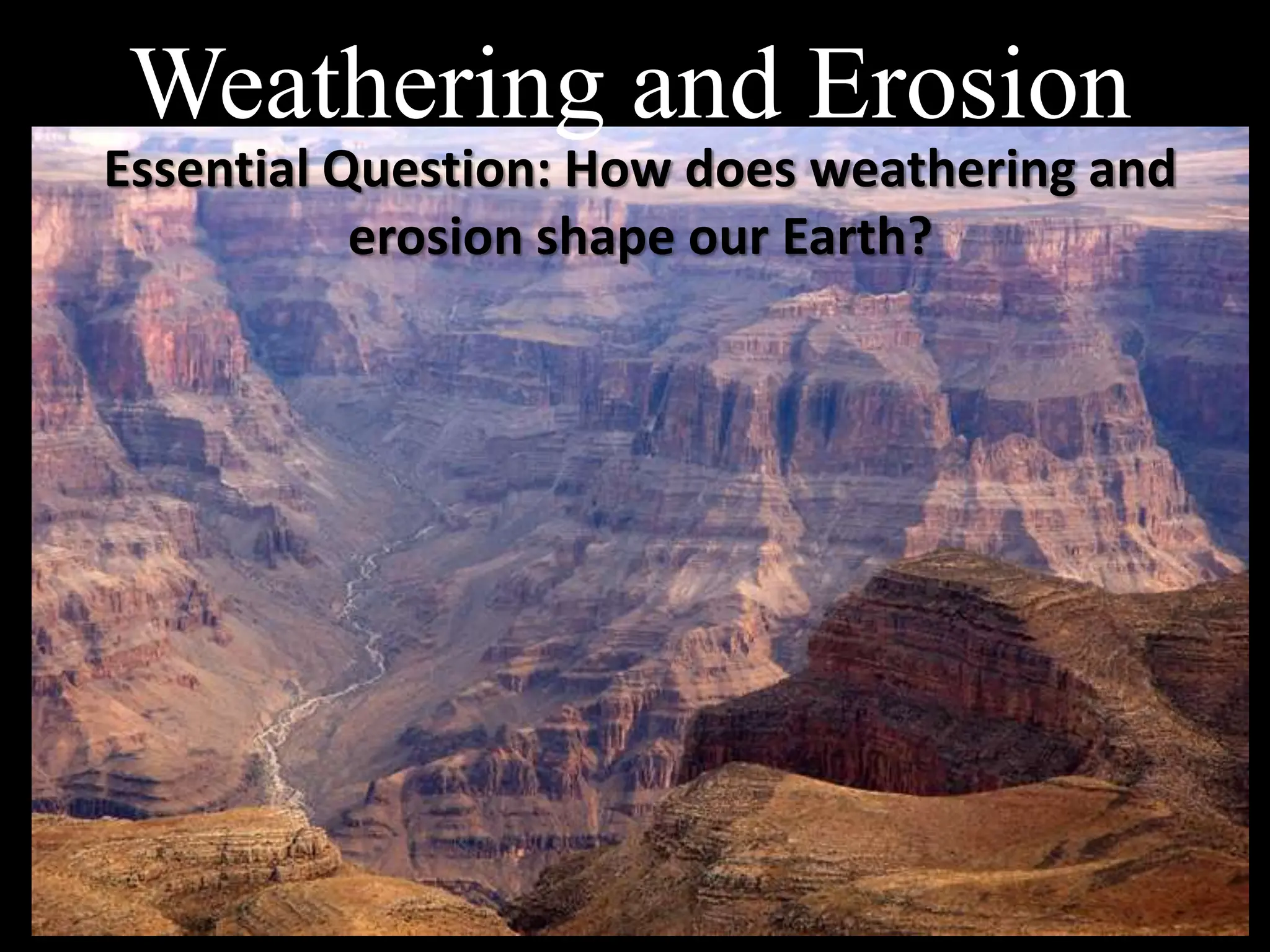
Weathering and Erosion
Essential Question: How does weathering and
erosion shape our Earth?
What is Weathering?
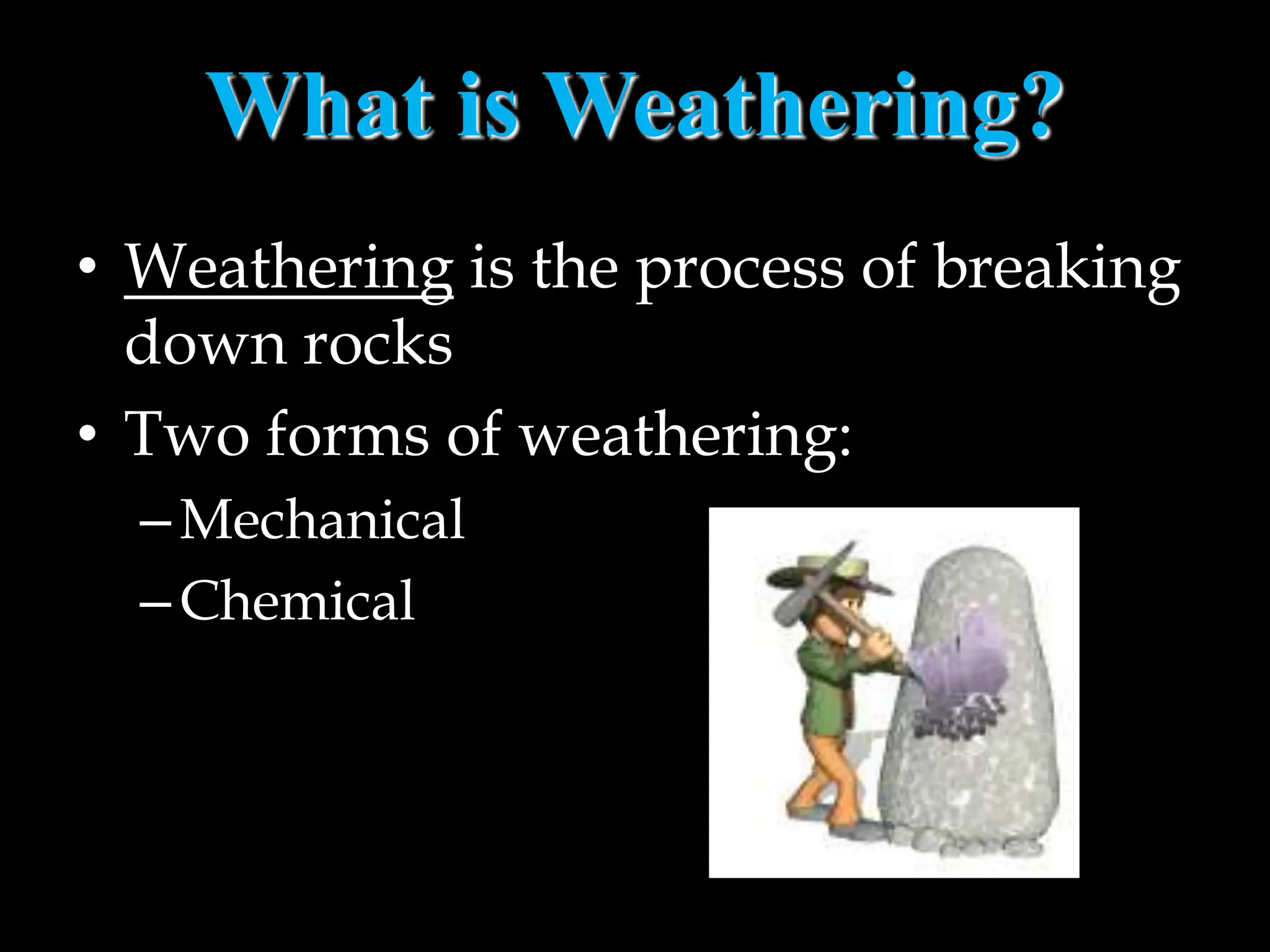
• Weathering is the process of breaking
down rocks
• Two forms of weathering:
–Mechanical
–Chemical
What is Mechanical
Weathering?
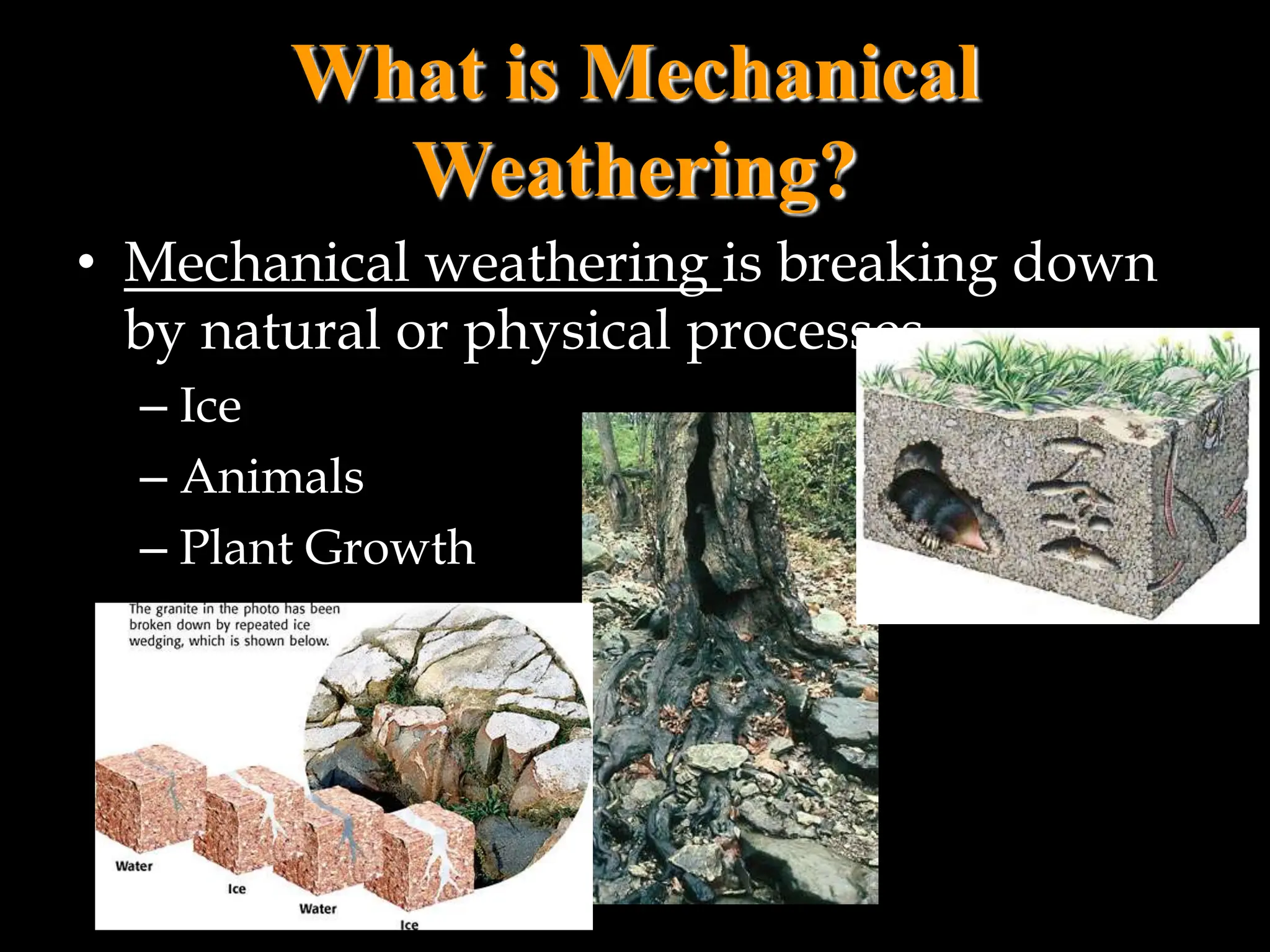
• Mechanical weathering is breaking down
by natural or physical processes
– Ice
– Animals
– Plant Growth
What is Chemical
Weathering?
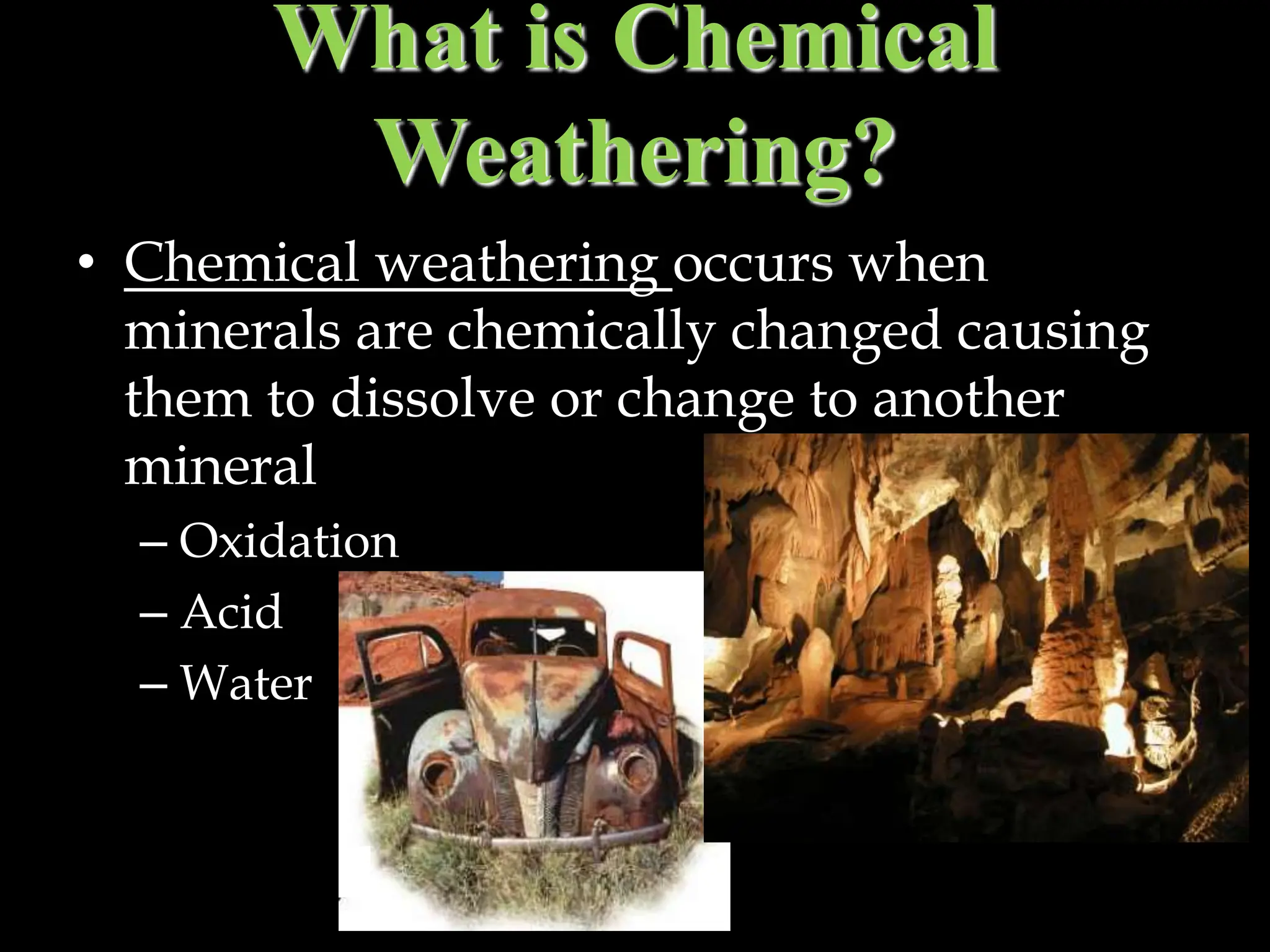
• Chemical weathering occurs when
minerals are chemically changed causing
them to dissolve or change to another
mineral
– Oxidation
– Acid
– Water
What is Erosion?
• Erosion is the removal and transport of
material from one place to another
• Gravity is a huge erosion force
• Agents of erosion are wind, water, and
glaciers
What happens to the sediments?
• When sediments are eroded, they are not
lost from Earth—they are just relocated
• Deposition is when sediments are moved
and deposited or “dropped off”
• Weathering, erosion, and deposition act
together in a cycle that wears down and
builds up Earth’s surface
What are the agents of
Erosion?
• There are 5 agents of erosion:
– Gravity
– Running water
– Glaciers
– Waves
– Wind
How does Gravity cause
Erosion?
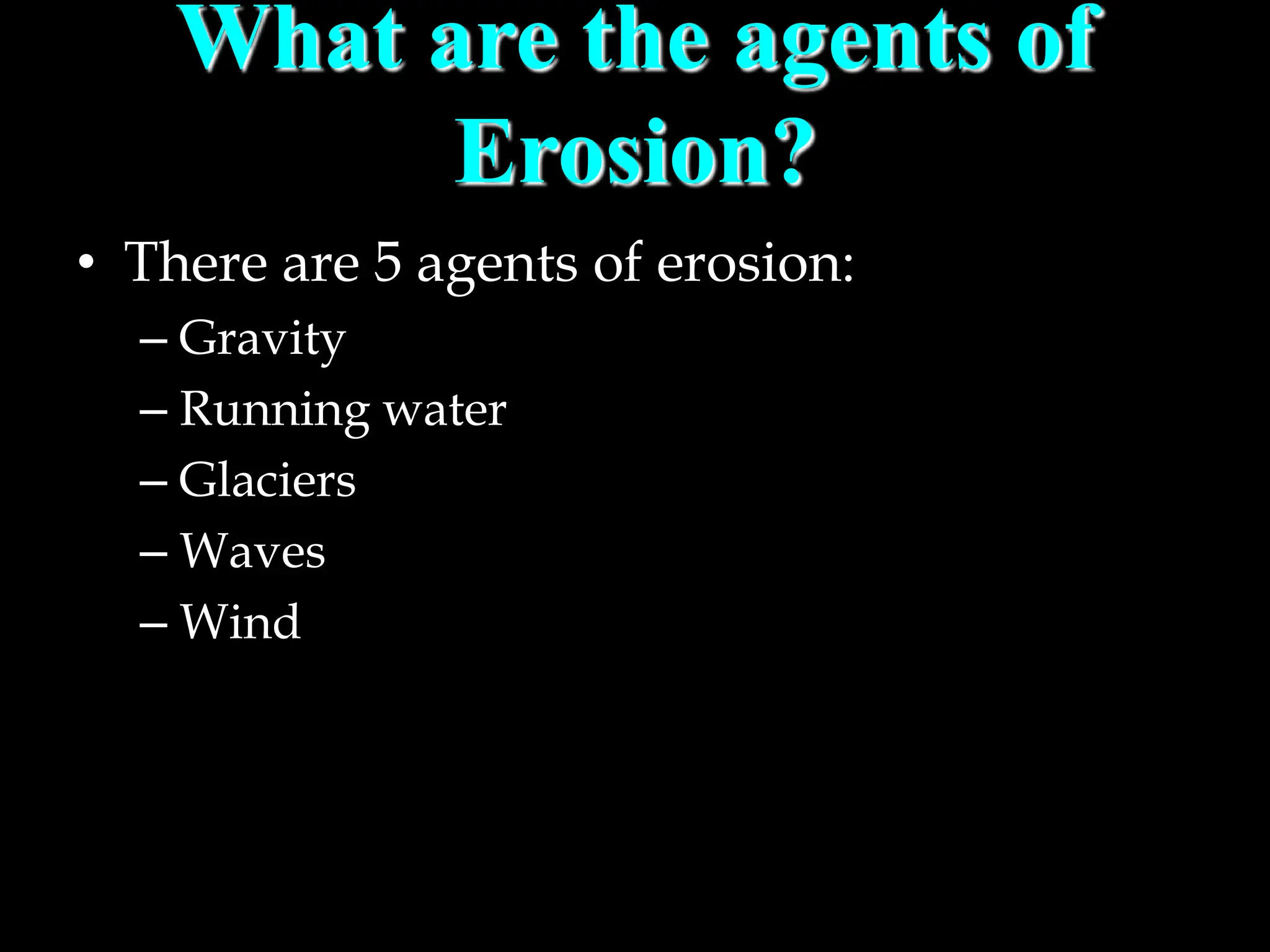
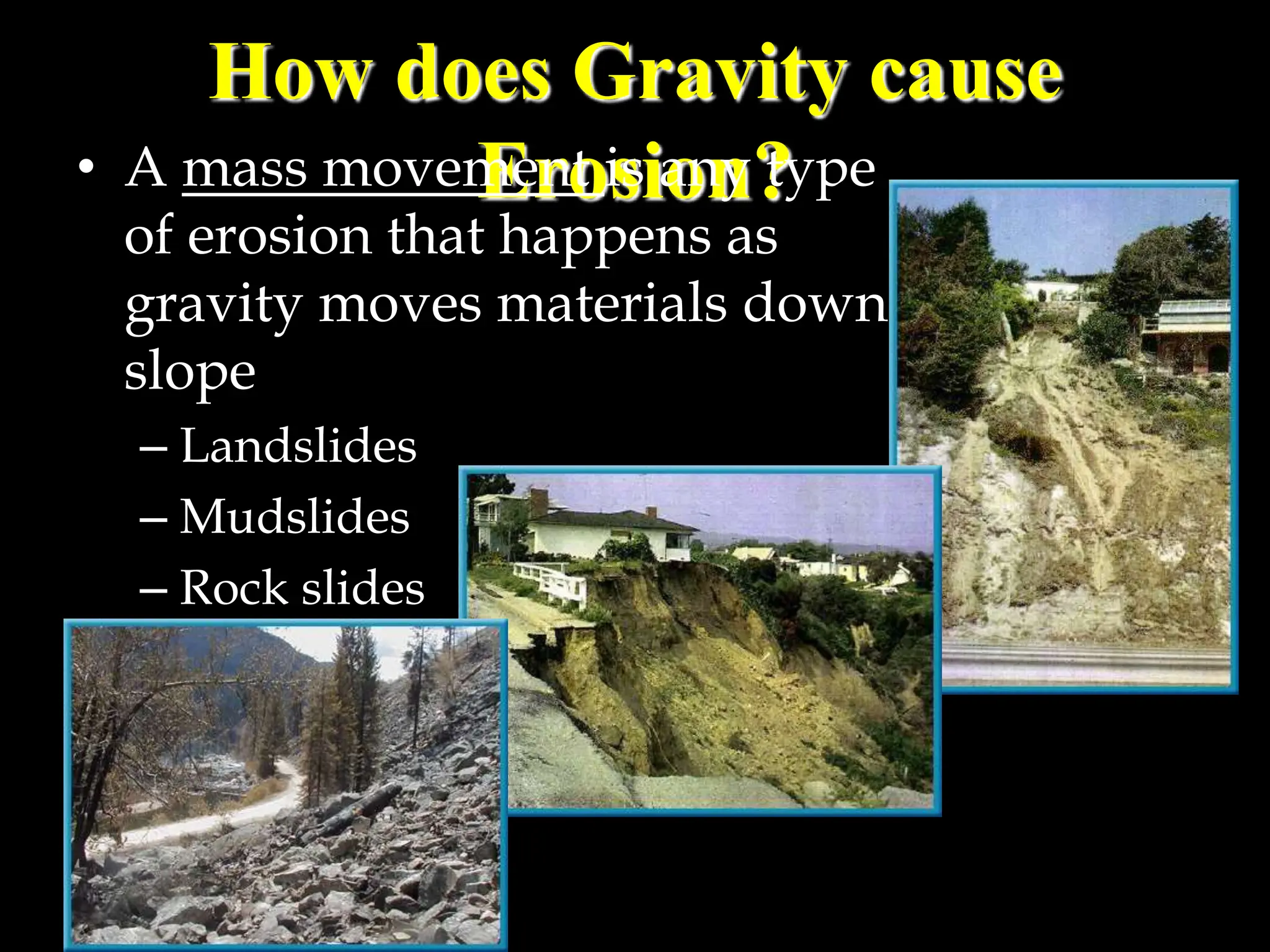
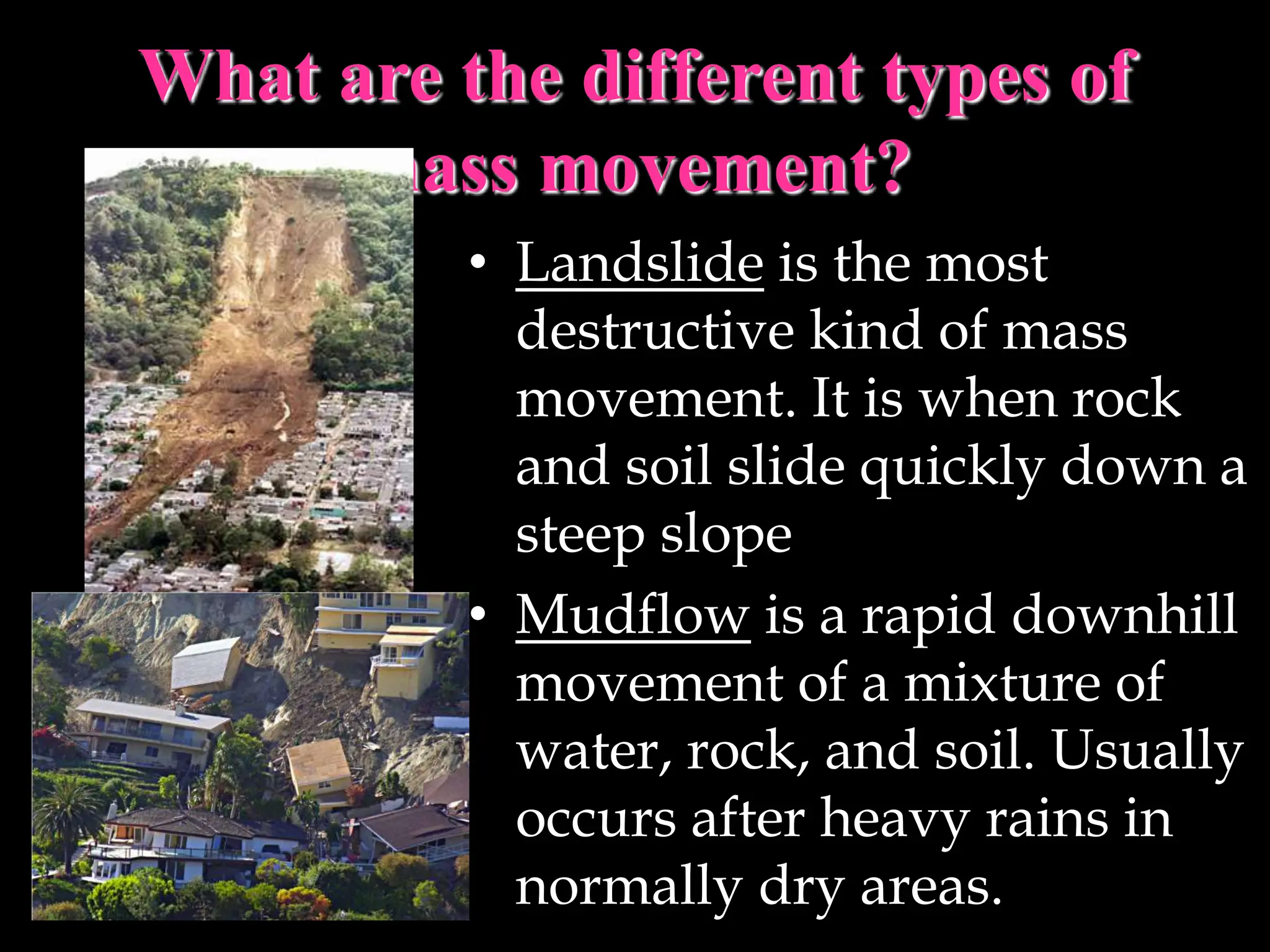
• A mass movement is any type
of erosion that happens as
gravity moves materials down
slope
– Landslides
– Mudslides
– Rock slides
What are the different types of
mass movement?
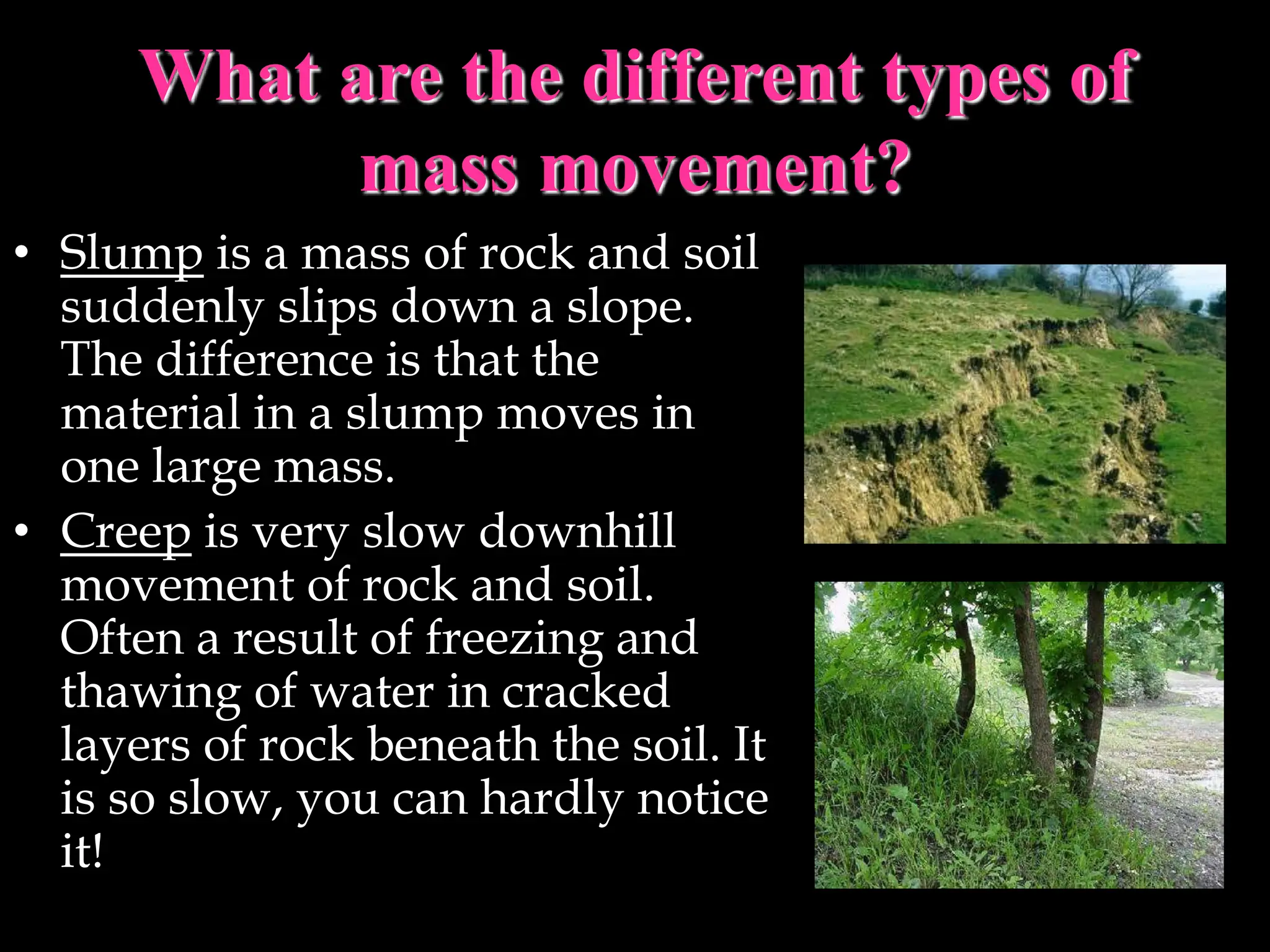
• Landslide is the most
destructive kind of mass
movement. It is when rock
and soil slide quickly down a
steep slope
• Mudflow is a rapid downhill
movement of a mixture of
water, rock, and soil. Usually
occurs after heavy rains in
normally dry areas.
What are the different types of
mass movement?
• Slump is a mass of rock and soil
suddenly slips down a slope.
The difference is that the
material in a slump moves in
one large mass.
• Creep is very slow downhill
movement of rock and soil.
Often a result of freezing and
thawing of water in cracked
layers of rock beneath the soil. It
is so slow, you can hardly notice
it!
1. What is erosion?
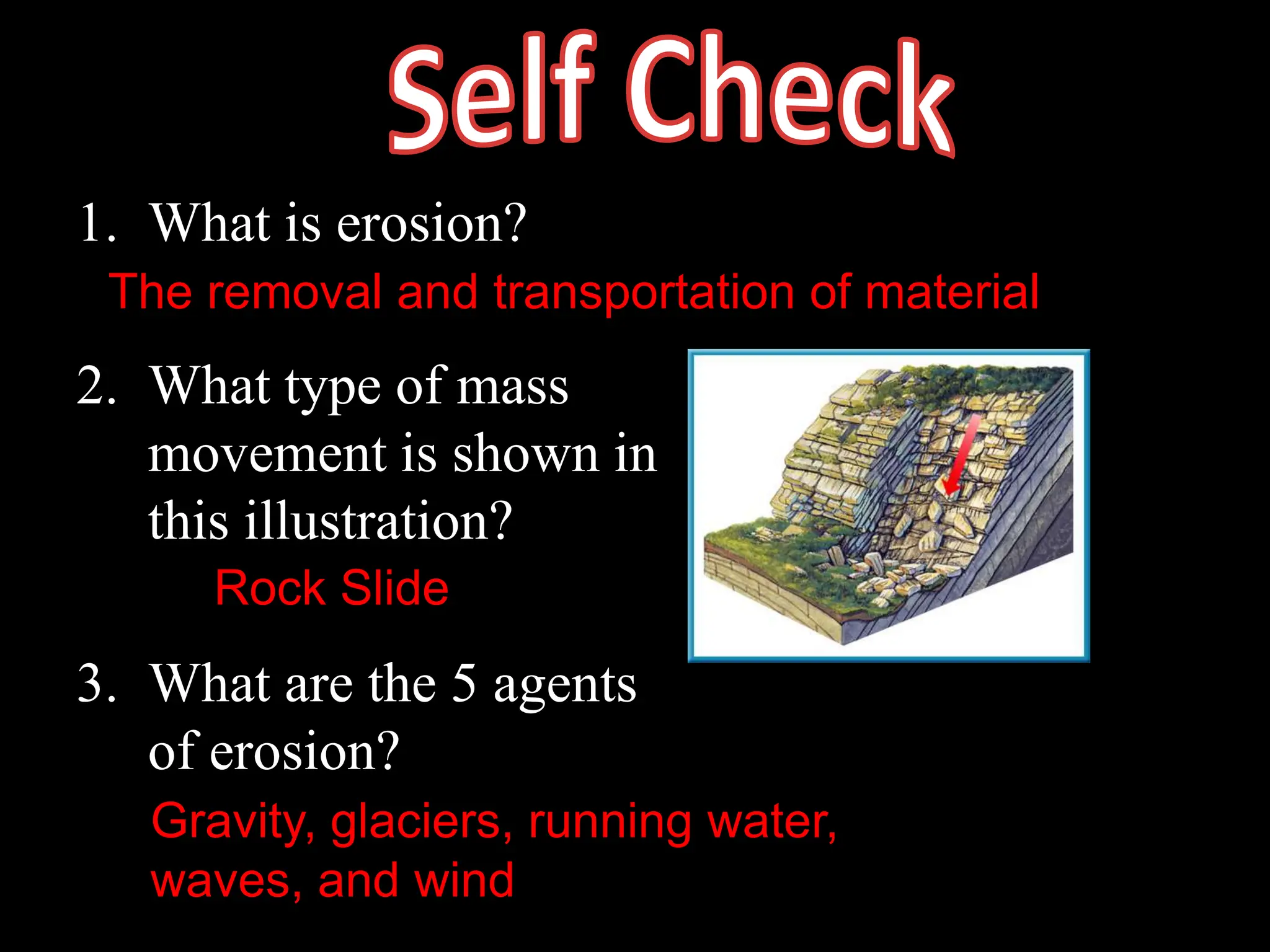
2. What type of mass
movement is shown in
this illustration?
3. What are the 5 agents
of erosion?
Rock Slide
The removal and transportation of material
Gravity, glaciers, running water,
waves, and wind
How do Glaciers cause Erosion?
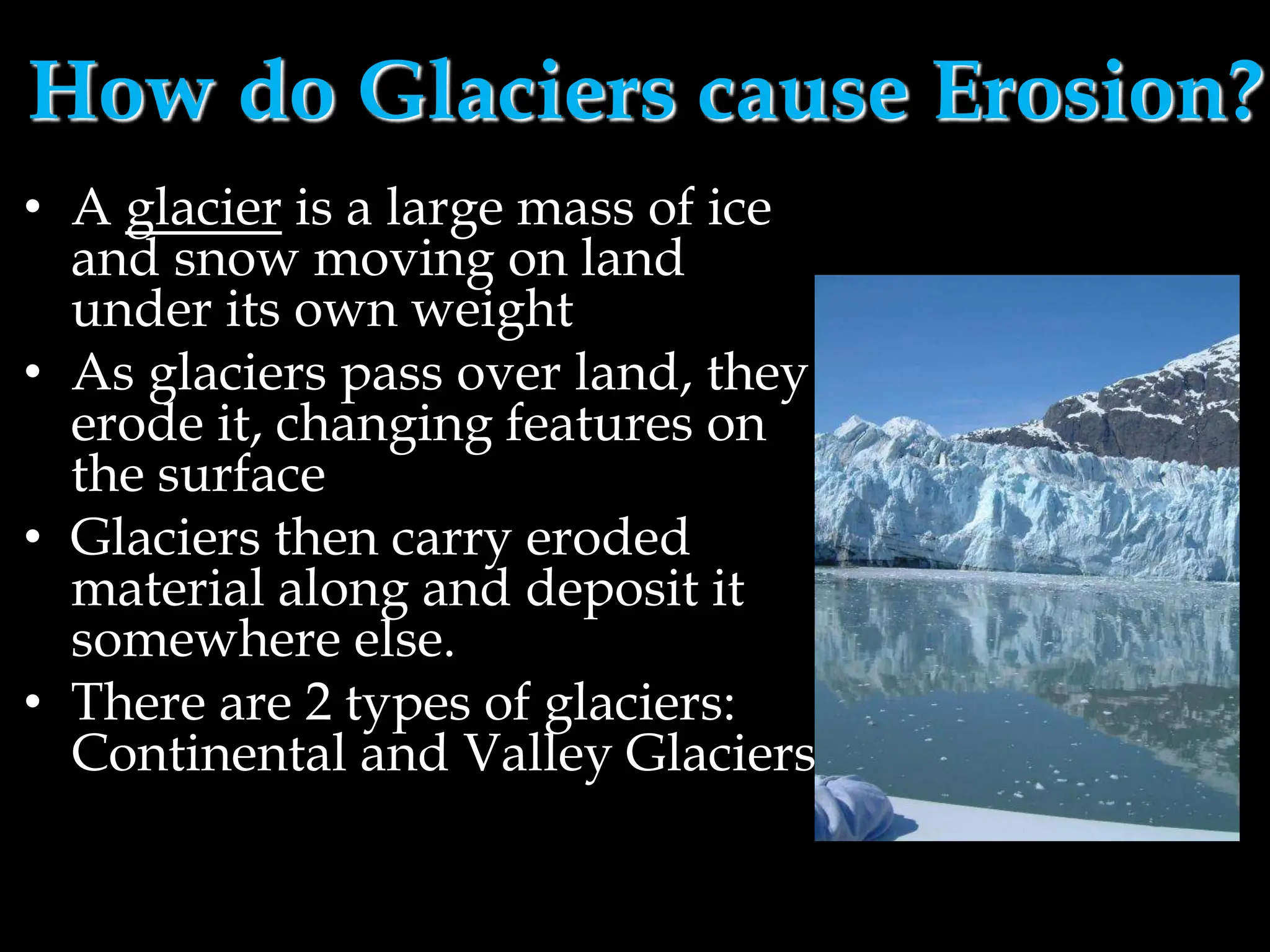
• A glacier is a large mass of ice
and snow moving on land
under its own weight
• As glaciers pass over land, they
erode it, changing features on
the surface
• Glaciers then carry eroded
material along and deposit it
somewhere else.
• There are 2 types of glaciers:
Continental and Valley Glaciers
What are Continental Glaciers?
• Continental Glacier is a glacier that covers
much of a continent or large island
• Today, they cover about 10% of Earth’s land
and cover most of Antarctica and Greenland
• These glaciers can flow out in all directions,
spreading out like pancake batter in a pan
What is a Valley Glacier?
• A Valley Glacier is a long, narrow glacier that forms
when snow and ice build up high in a mountain valley
• The sides of the mountains keep these glaciers from
spreading out in all directions
• Usually these glaciers are smaller than continental
glaciers, but can be kilometers long
How do Glaciers shape the
land?
• The movement of a glacier changes the land
beneath it
• Although glaciers work slowly, they are a major
force of erosion
• The two process by which glaciers erode the land
are plucking and abrasion
How do Glaciers shape the
land?
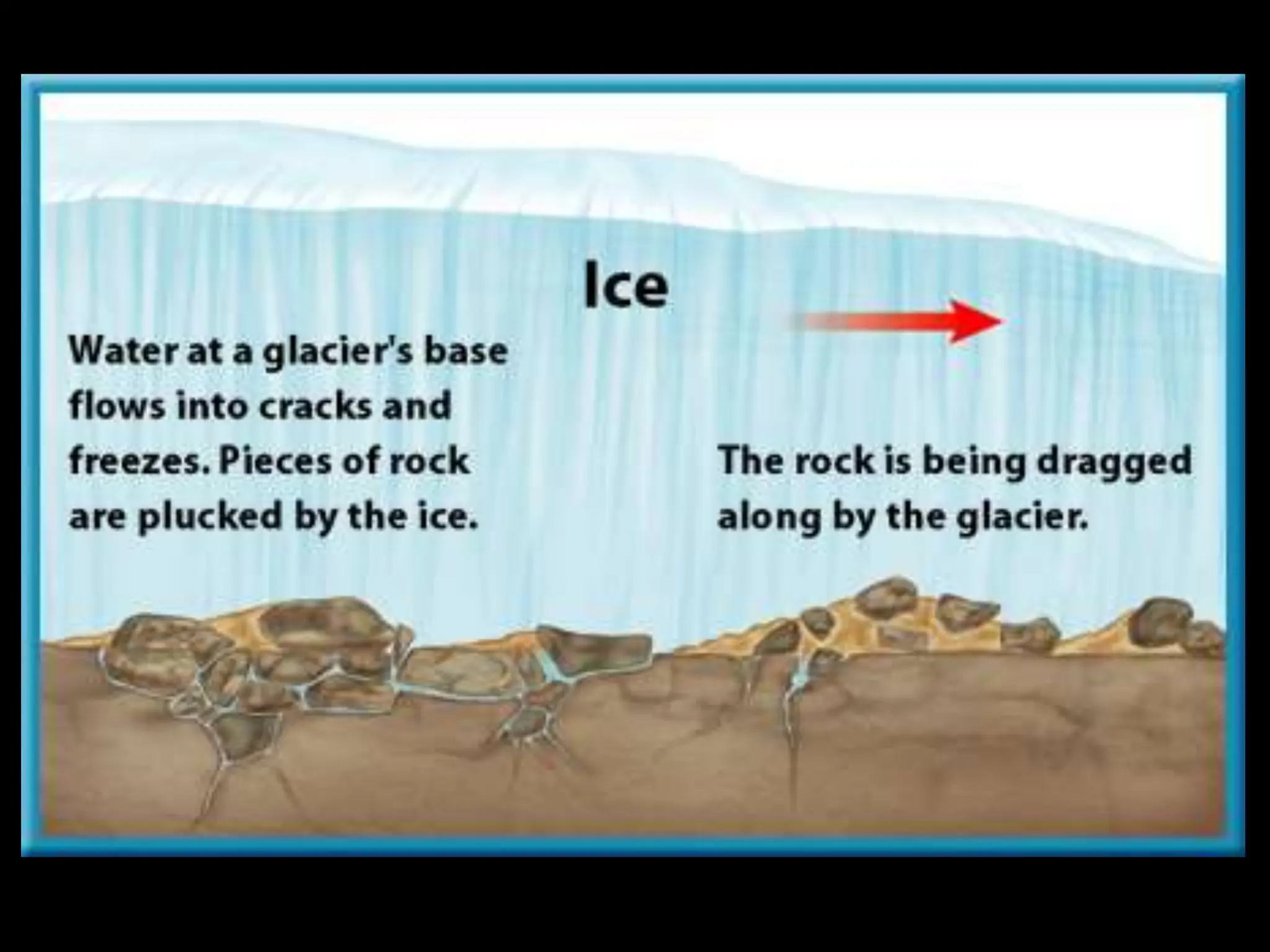
• As a glacier flows over the land, it picks up
rocks in a process called plucking
• Due to the glaciers extreme weight, it can
break rocks apart and then the rocks freeze to
the bottom of the rock carrying it with it when
it moves
• As rocks remain on the bottom of the glacier
and it drags them across the land, abrasion
occurs as it scratches the bedrock
How do Glaciers shape the land?
• A glacier gathers a huge amount of rock and
soil as it erodes the land in its path
• When a glacier melts, it deposits the sediment
it eroded from the land creating various
landforms
A sharp ridge
separating two
cirques
A sharpened peak
A bowl-
shaped hollow
How does wind contribute to erosion?
• Wind by itself is the
weakest agent of erosion,
however, it can be a
powerful force in shaping
the land areas where
there are few plants to
hold the soil in place
• Wind causes erosion by
deflation and abrasion
How does wind contribute to erosion?
• Deflation is the process
where wind blows loose
sediment, removing
small particles
• The stronger the wind
the heavier sediment
that can be moved
• Deflation was one factor
in the loss of soil during
the 1930’s Dust Bowl
How does wind contribute to erosion?
• Abrasion by wind-carried
sand can polish rock, but
causes little erosion
• It was once thought that
the sediment carried by
wind cut the stone shape,
but now more evidence
shows that most
landforms are the result of
weathering and water
erosion
What are some landforms created by
wind erosion?
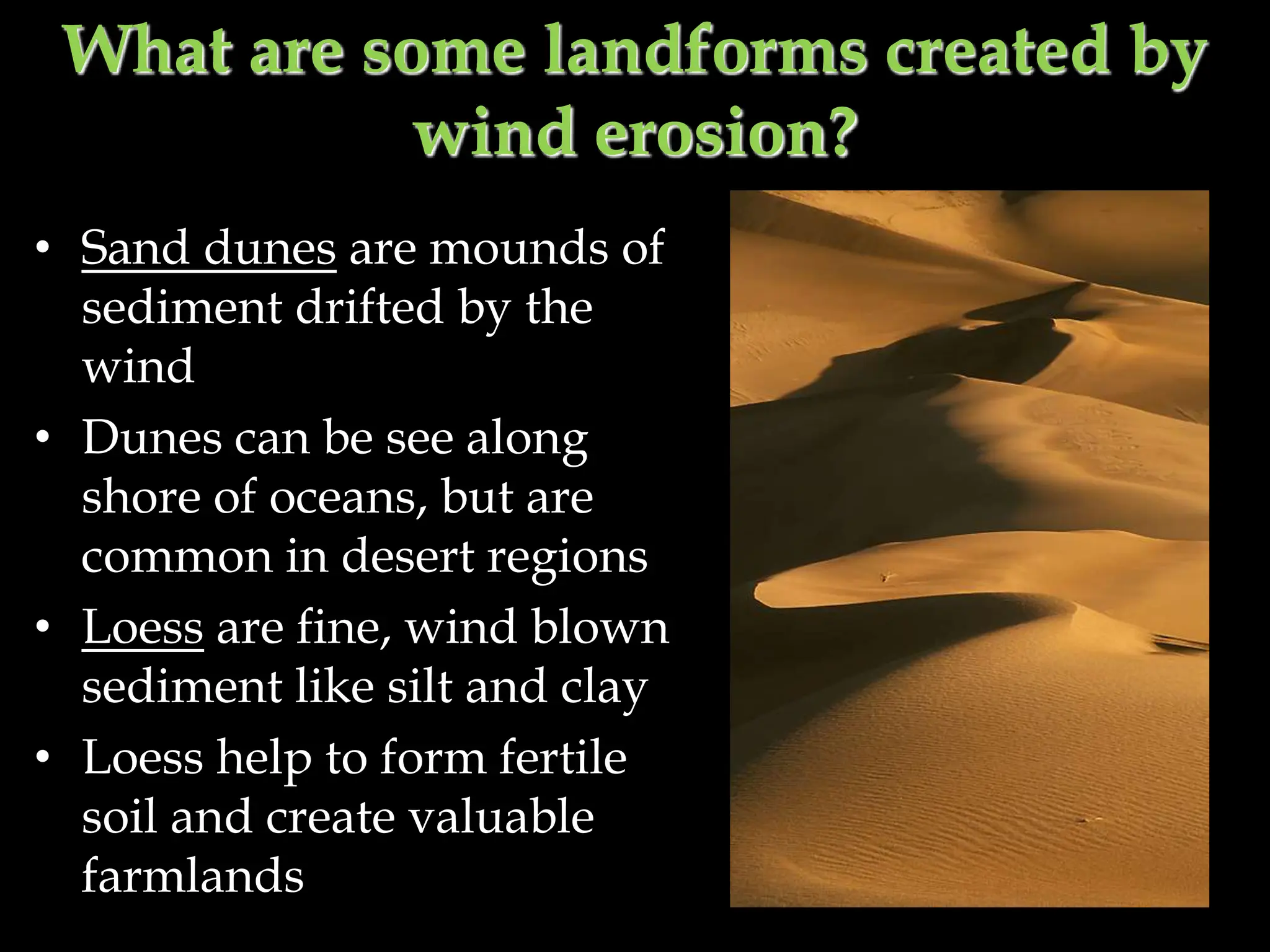
• Sand dunes are mounds of
sediment drifted by the
wind
• Dunes can be see along
shore of oceans, but are
common in desert regions
• Loess are fine, wind blown
sediment like silt and clay
• Loess help to form fertile
soil and create valuable
farmlands
1. What are two ways in which glaciers
erode Earth’s surface?
2. What is the difference between a
continental and a valley glacier?
Plucking and Abrasion
Continental glacier covers much of a
continent or large island, where a valley
glacier is a long, narrow glacier found in
a mountain valley
How is water an agent of Erosion?
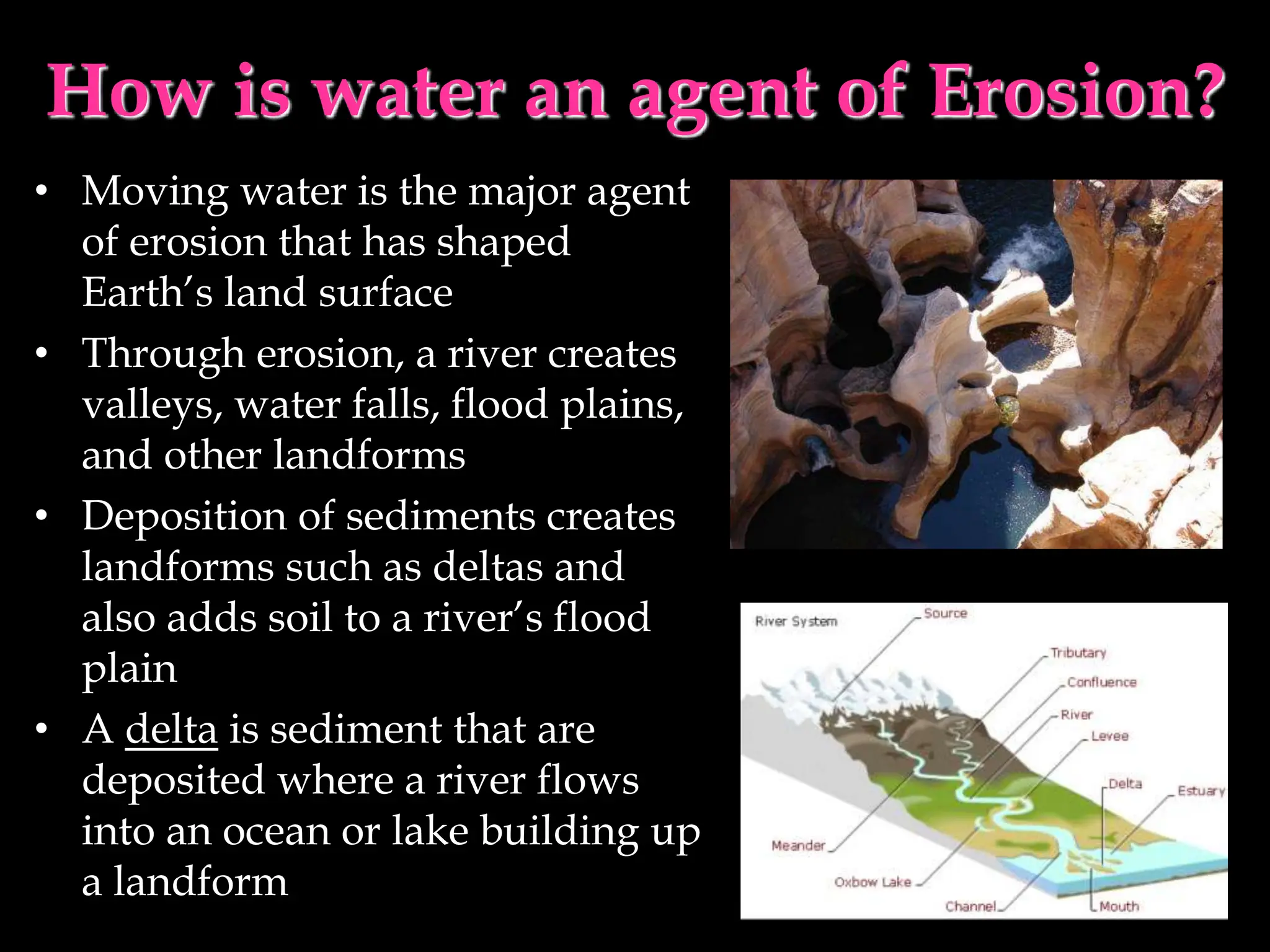
• Moving water is the major agent
of erosion that has shaped
Earth’s land surface
• Through erosion, a river creates
valleys, water falls, flood plains,
and other landforms
• Deposition of sediments creates
landforms such as deltas and
also adds soil to a river’s flood
plain
• A delta is sediment that are
deposited where a river flows
into an ocean or lake building up
a landform
How is water an agent of Erosion?
• Ground water is another agent of erosion through the process
of chemical weathering
• Ground water is water that fills the cracks and spaces in
underground soil and rock layers
• Ground water containing carbonic acid can break down
limestone creating caves or caverns.
• Stalactites and stalagmites are also formed from the deposit of
calcite due to chemical weathering
How do waves contribute to Erosion?
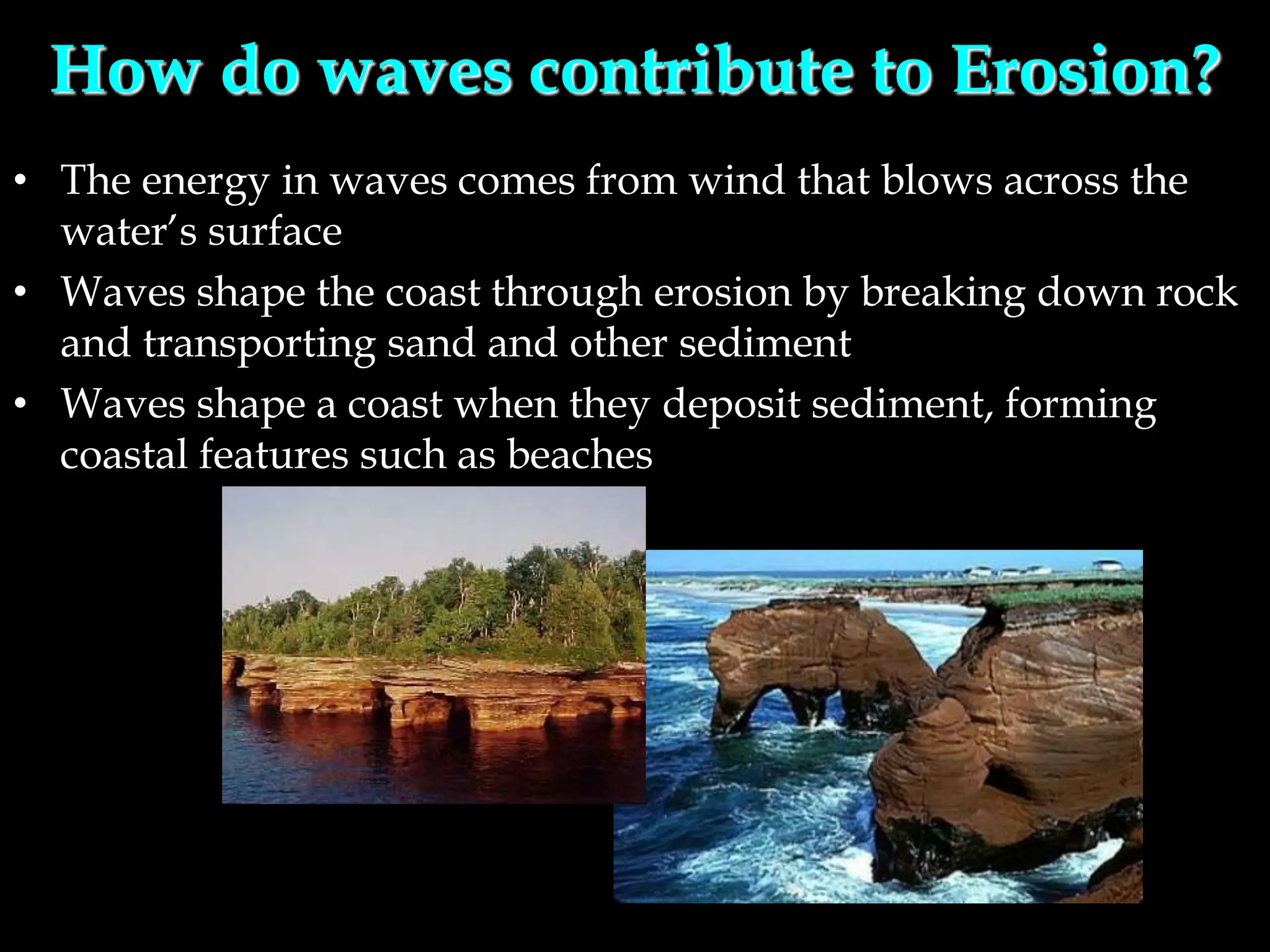
• The energy in waves comes from wind that blows across the
water’s surface
• Waves shape the coast through erosion by breaking down rock
and transporting sand and other sediment
• Waves shape a coast when they deposit sediment, forming
coastal features such as beaches
1. What is the source of the energy in ocean
waves?
2. What process is the cause of ground
water erosion?
Energy is transferred to ocean waves from
wind
Chemical weathering

Weathering and Erosion Powerpoint Presentation

  • 1.
    Weathering and Erosion EssentialQuestion: How does weathering and erosion shape our Earth?
  • 2.
    What is Weathering? •Weathering is the process of breaking down rocks • Two forms of weathering: –Mechanical –Chemical
  • 3.
    What is Mechanical Weathering? •Mechanical weathering is breaking down by natural or physical processes – Ice – Animals – Plant Growth
  • 4.
    What is Chemical Weathering? •Chemical weathering occurs when minerals are chemically changed causing them to dissolve or change to another mineral – Oxidation – Acid – Water
  • 5.
    What is Erosion? •Erosion is the removal and transport of material from one place to another • Gravity is a huge erosion force • Agents of erosion are wind, water, and glaciers
  • 6.
    What happens tothe sediments? • When sediments are eroded, they are not lost from Earth—they are just relocated • Deposition is when sediments are moved and deposited or “dropped off” • Weathering, erosion, and deposition act together in a cycle that wears down and builds up Earth’s surface
  • 7.
    What are theagents of Erosion? • There are 5 agents of erosion: – Gravity – Running water – Glaciers – Waves – Wind
  • 8.
    How does Gravitycause Erosion? • A mass movement is any type of erosion that happens as gravity moves materials down slope – Landslides – Mudslides – Rock slides
  • 9.
    What are thedifferent types of mass movement? • Landslide is the most destructive kind of mass movement. It is when rock and soil slide quickly down a steep slope • Mudflow is a rapid downhill movement of a mixture of water, rock, and soil. Usually occurs after heavy rains in normally dry areas.
  • 10.
    What are thedifferent types of mass movement? • Slump is a mass of rock and soil suddenly slips down a slope. The difference is that the material in a slump moves in one large mass. • Creep is very slow downhill movement of rock and soil. Often a result of freezing and thawing of water in cracked layers of rock beneath the soil. It is so slow, you can hardly notice it!
  • 11.
    1. What iserosion? 2. What type of mass movement is shown in this illustration? 3. What are the 5 agents of erosion? Rock Slide The removal and transportation of material Gravity, glaciers, running water, waves, and wind
  • 12.
    How do Glacierscause Erosion? • A glacier is a large mass of ice and snow moving on land under its own weight • As glaciers pass over land, they erode it, changing features on the surface • Glaciers then carry eroded material along and deposit it somewhere else. • There are 2 types of glaciers: Continental and Valley Glaciers
  • 14.
    What are ContinentalGlaciers? • Continental Glacier is a glacier that covers much of a continent or large island • Today, they cover about 10% of Earth’s land and cover most of Antarctica and Greenland • These glaciers can flow out in all directions, spreading out like pancake batter in a pan
  • 15.
    What is aValley Glacier? • A Valley Glacier is a long, narrow glacier that forms when snow and ice build up high in a mountain valley • The sides of the mountains keep these glaciers from spreading out in all directions • Usually these glaciers are smaller than continental glaciers, but can be kilometers long
  • 16.
    How do Glaciersshape the land? • The movement of a glacier changes the land beneath it • Although glaciers work slowly, they are a major force of erosion • The two process by which glaciers erode the land are plucking and abrasion
  • 17.
    How do Glaciersshape the land? • As a glacier flows over the land, it picks up rocks in a process called plucking • Due to the glaciers extreme weight, it can break rocks apart and then the rocks freeze to the bottom of the rock carrying it with it when it moves • As rocks remain on the bottom of the glacier and it drags them across the land, abrasion occurs as it scratches the bedrock
  • 18.
    How do Glaciersshape the land? • A glacier gathers a huge amount of rock and soil as it erodes the land in its path • When a glacier melts, it deposits the sediment it eroded from the land creating various landforms A sharp ridge separating two cirques A sharpened peak A bowl- shaped hollow
  • 19.
    How does windcontribute to erosion? • Wind by itself is the weakest agent of erosion, however, it can be a powerful force in shaping the land areas where there are few plants to hold the soil in place • Wind causes erosion by deflation and abrasion
  • 20.
    How does windcontribute to erosion? • Deflation is the process where wind blows loose sediment, removing small particles • The stronger the wind the heavier sediment that can be moved • Deflation was one factor in the loss of soil during the 1930’s Dust Bowl
  • 21.
    How does windcontribute to erosion? • Abrasion by wind-carried sand can polish rock, but causes little erosion • It was once thought that the sediment carried by wind cut the stone shape, but now more evidence shows that most landforms are the result of weathering and water erosion
  • 22.
    What are somelandforms created by wind erosion? • Sand dunes are mounds of sediment drifted by the wind • Dunes can be see along shore of oceans, but are common in desert regions • Loess are fine, wind blown sediment like silt and clay • Loess help to form fertile soil and create valuable farmlands
  • 23.
    1. What aretwo ways in which glaciers erode Earth’s surface? 2. What is the difference between a continental and a valley glacier? Plucking and Abrasion Continental glacier covers much of a continent or large island, where a valley glacier is a long, narrow glacier found in a mountain valley
  • 24.
    How is wateran agent of Erosion? • Moving water is the major agent of erosion that has shaped Earth’s land surface • Through erosion, a river creates valleys, water falls, flood plains, and other landforms • Deposition of sediments creates landforms such as deltas and also adds soil to a river’s flood plain • A delta is sediment that are deposited where a river flows into an ocean or lake building up a landform
  • 25.
    How is wateran agent of Erosion? • Ground water is another agent of erosion through the process of chemical weathering • Ground water is water that fills the cracks and spaces in underground soil and rock layers • Ground water containing carbonic acid can break down limestone creating caves or caverns. • Stalactites and stalagmites are also formed from the deposit of calcite due to chemical weathering
  • 26.
    How do wavescontribute to Erosion? • The energy in waves comes from wind that blows across the water’s surface • Waves shape the coast through erosion by breaking down rock and transporting sand and other sediment • Waves shape a coast when they deposit sediment, forming coastal features such as beaches
  • 27.
    1. What isthe source of the energy in ocean waves? 2. What process is the cause of ground water erosion? Energy is transferred to ocean waves from wind Chemical weathering