














Growing wealth – An
engineering approach
S R Srinivasan
srsrinivasan@india.com
Disclaimer
The material mentioned in this presentation reflect the opinions of the author. The
author is not a practicing financial planning professional and has no qualifications
and/or certifications in financial planning. The author takes no responsibility, implied
or express, for the results arising out of use or abuse of the material in the
presentation.
15 June 2015Rev 1.9 Redistribution restricted
Agenda
 Key Wealth concepts
 Financial Freedom
 Power of Compounding
 Asset Classes
 Historical Returns
 Power of Equity
 Returns and Volatility
 Need for a plan
 Engineering approach
 Objectives/Requirements
 Assumptions, Constraints
 Design
 Implementation
 Validation/Maintenance
 Summary/Recap
 Call for Action
15 June 2015Rev 1.9 Redistribution restricted
Agenda - Additional
List of possible investment
avenues/asset types
List of tax saving options
References
Advanced topics
15 June
2015
Rev 1.9 Redistribution restricted
“I always knew I was going to
be rich. I don't think I ever
doubted it for a minute.”
Warren Buffet
Key Wealth Concepts
“Let us start at the very beginning. A very good place to start”
15 June 2015Rev 1.9 Redistribution restricted
Financial Freedom – A Beautiful Concept
 Financial freedom is generally used to describe the state of
having sufficient personal wealth to live, without having to
work actively for basic necessities as well as other life goals
 For financially free people, their assets generate income that is
greater than their expenses
 You can achieve your Financial Freedom at any point of time!
 And this is nothing but ‘Enjoyable Retirement’ (Please note the
lack of reference to ‘early’ retirement)
 For financially free people, their assets generate income that is
greater than their expenses, year over year, as long as they
live
 Current expense – 22,000 pm, Retire in 20 years, live for
another 40 – Corpus required is greater than 1 crore!
15 June 2015Rev 1.9 Redistribution restricted
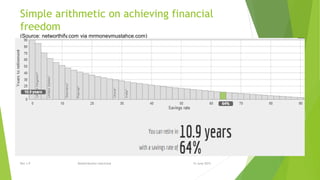
Simple arithmetic on achieving financial
freedom
(Source: networthify.com via mrmoneymustahce.com)
15 June 2015Rev 1.9 Redistribution restricted
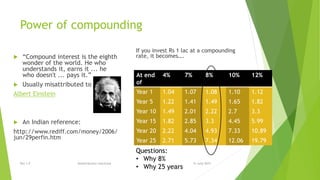
Power of compounding
 “Compound interest is the eighth
wonder of the world. He who
understands it, earns it ... he
who doesn't ... pays it.”
 Usually misattributed to
Albert Einstein
 An Indian reference:
http://www.rediff.com/money/2006/
jun/29perfin.htm
If you invest Rs 1 lac at a compounding
rate, it becomes….
15 June 2015Rev 1.9 Redistribution restricted
Questions:
• Why 8%
• Why 25 years
At end
of
4% 7% 8% 10% 12%
Year 1 1.04 1.07 1.08 1.10 1.12
Year 5 1.22 1.41 1.49 1.65 1.82
Year 10 1.49 2.01 2.22 2.7 3.3
Year 15 1.82 2.85 3.3 4.45 5.99
Year 20 2.22 4.04 4.93 7.33 10.89
Year 25 2.71 5.73 7.34 12.06 19.79
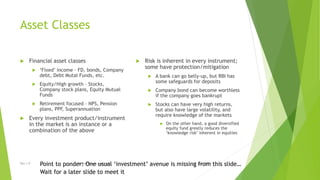
Asset Classes
 Financial asset classes
 ‘Fixed’ income – FD, bonds, Company
debt, Debt Mutal Funds, etc.
 Equity/High growth – Stocks,
Company stock plans, Equity Mutual
Funds
 Retirement focused – NPS, Pension
plans, PPF, Superannuation
 Every investment product/instrument
in the market is an instance or a
combination of the above
 Risk is inherent in every instrument;
some have protection/mitigation
 A bank can go belly-up, but RBI has
some safeguards for deposits
 Company bond can become worthless
if the company goes bankrupt
 Stocks can have very high returns,
but also have large volatility, and
require knowledge of the markets
 On the other hand, a good diversified
equity fund greatly reduces the
‘knowledge risk’ inherent in equities
15 June 2015Rev 1.9 Redistribution restrictedPoint to ponder: One usual ‘investment’ avenue is missing from this slide…
Wait for a later slide to meet it
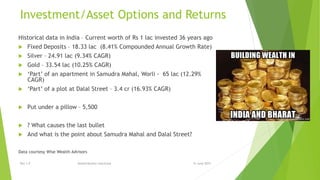
Investment/Asset Options and Returns
Historical data in India – Current worth of Rs 1 lac invested 36 years ago
 Fixed Deposits – 18.33 lac (8.41% Compounded Annual Growth Rate)
 Silver – 24.91 lac (9.34% CAGR)
 Gold – 33.54 lac (10.25% CAGR)
 ‘Part’ of an apartment in Samudra Mahal, Worli - 65 lac (12.29%
CAGR)
 ‘Part’ of a plot at Dalal Street – 3.4 cr (16.93% CAGR)
 Put under a pillow – 5,500
 ? What causes the last bullet
 And what is the point about Samudra Mahal and Dalal Street?
Data courtesy Wise Wealth Advisors
15 June 2015Rev 1.9 Redistribution restricted
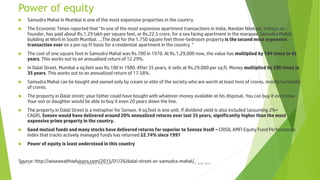
Power of equity
 Samudra Mahal in Mumbai is one of the most expensive properties in the country.
 The Economic Times reported that “In one of the most expensive apartment transactions in India, Nandan Nilekani, Infosys co-
founder, has paid about Rs.1.29 lakh per square feet, or Rs.22.5 crore, for a sea facing apartment in the marquee Samudra Mahal
building at Worli in South Mumbai. …The deal for the 1,750 square feet three-bedroom property is the second most expensive
transaction ever on a per-sq-ft basis for a residential apartment in the country. “
 The cost of one square foot in Samudra Mahal was Rs.700 in 1970. At Rs.1,29,000 now, the value has multiplied by 184 times in 45
years. This works out to an annualised return of 12.29%.
 In Dalal Street, Mumbai a sq.feet was Rs.100 in 1980. After 35 years, it sells at Rs.29,000 per sq.ft. Money multiplied by 290 times in
35 years. This works out to an annualized return of 17.58%.
 Samudra Mahal can be bought and owned only by cream or elite of the society who are worth at least tens of crores, mostly hundreds
of crores.
 The property in Dalal street; your father could have bought with whatever money available at his disposal. You can buy it even now.
Your son or daughter would be able to buy it even 20 years down the line.
 The property in Dalal Street is a metaphor for Sensex. A sq.feet is one unit. If dividend yield is also included (assuming 2%+
CAGR), Sensex would have delivered around 20% annualized returns over last 35 years, significantly higher than the most
expensive prime property in the country.
 Good mutual funds and many stocks have delivered returns far superior to Sensex itself – CRISIL AMFI Equity Fund Performance
Index that tracks actively managed funds has returned 22.74% since 1997
 Power of equity is least understood in this country
Source: http://wisewealthadvisors.com/2015/01/26/dalal-street-or-samudra-mahal/15 June 2015Rev 1.9 Redistribution restricted
Returns, Volatility and such things
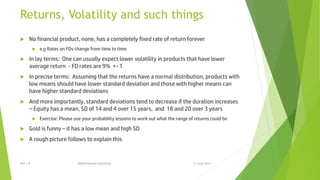
 No financial product, none, has a completely fixed rate of return forever
 e.g Rates on FDs change from time to time
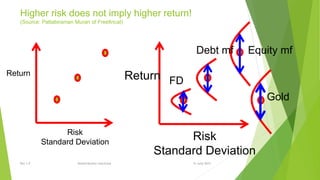
 In lay terms: One can usually expect lower volatility in products that have lower
average return - FD rates are 9% +- 1
 In precise terms: Assuming that the returns have a normal distribution, products with
low means should have lower standard deviation and those with higher means can
have higher standard deviations
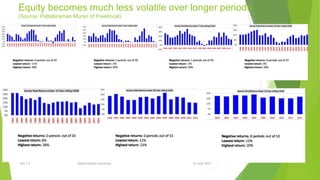
 And more importantly, standard deviations tend to decrease if the duration increases
– Equity has a mean, SD of 14 and 4 over 15 years, and 18 and 20 over 3 years
 Exercise: Please use your probability lessons to work out what the range of returns could be
 Gold is funny – it has a low mean and high SD
 A rough picture follows to explain this
15 June 2015Rev 1.9 Redistribution restricted
Higher risk does not imply higher return!
(Source: Pattabiraman Murari of Freefincal)
Return
Risk
Standard Deviation
Return
Risk
Standard Deviation
FD
Debt mf Equity mf
Gold
15 June 2015Rev 1.9 Redistribution restricted
Equity becomes much less volatile over longer periods
(Source: Pattabiraman Murari of Freefincal)
15 June 2015Rev 1.9 Redistribution restricted
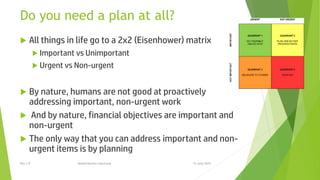
Do you need a plan at all?
 All things in life go to a 2x2 (Eisenhower) matrix
 Important vs Unimportant
 Urgent vs Non-urgent
 By nature, humans are not good at proactively
addressing important, non-urgent work
 And by nature, financial objectives are important and
non-urgent
 The only way that you can address important and non-
urgent items is by planning
15 June 2015Rev 1.9 Redistribution restricted
Your PERSONAL Finance
15 June 2015Rev 1.9 Redistribution restricted
Engineering Approach
Initiate the project
Finalize the requirements
Design the product
Plan for risk
Implement the plan, and
Validate it
And keep validating it
15 June 2015Rev 1.9 Redistribution restricted
Objectives
Project Objective Statement
Scope – who do I want to be like?
Ambani? Buffet? A close relative who
lives a prosperous and contended life?
Schedule – do I want to still work when I
am 40? 50? And God forbid – 60?
Resources - Am I on my own? Should I
plan to marry rich? Do I have a proverbial
rich uncle?
15 June 2015Rev 1.9 Redistribution restricted
Gather the requirements
Post-retirement life
Life events – Marriage, Kids,
Parents, …
Quality of life – car purchase,
home purchase, …
Dreams and desires – honeymoon
in Switzerland, vacation to Bali,
etc.
15 June 2015Rev 1.9 Redistribution restricted
Finalize the requirements
Visualize them as goals, and make them SMART
 3 lakhs by end of 2017 for trip to Bali
 10 lakhs by end of 2019 for downpayment for
home
 ‘Enough’ money to fund child’s education in a
private engineering college
 Become a millionaire by 30, and spend the rest of
the life in beaches
 And so on…
A non-requirement for anybody – Tax savings
15 June 2015Rev 1.9 Redistribution restricted
The Catch - Assumptions, Dependencies,
Constraints
 Money available every month, every year
Remember the equation: Optional Expenses =
Income – Mandatory Expenses –
Savings/Investments
 Inflation
 Investment options available, And their post-tax
returns
This is the most varying aspect of personal finance
 Time to manage all this stuff
 And most importantly, the discipline
15 June 2015Rev 1.9 Redistribution restricted
15 June
2015
Rev 1.9 Redistribution restricted
“Nothing can stop the man with the right
mental attitude from achieving his goal;
nothing on earth can help the man with the
wrong mental attitude.”
Design your plan
 Take each requirement/goal
 Based on the time frame, choose an asset class/avenue
 1-3 years – Fixed income or debt instruments, few ‘low risk’ equities
 View this as ‘savings’, rather than ‘investing’; don’t chase returns
 > 5 years – More equity than debt
 > 10 years – Predominantly equity
 Your mileage may vary!
 Estimate the expected return, and then calculate the monthly investment needed
 The expected return would be a blended return based on the debt:equity mix that you
choose
 Be sure to factor in inflation for the requirements
 Now you can go to implementation
15 June 2015Rev 1.9 Redistribution restricted
Taking professional help - What do you ask the
‘builder’ (advisor)
 Ask the advisor to validate your expectations – time horizon,
expected returns, etc.; make sure that you don’t get bullied
 Never let the advisor to force you into the asset
class/product family (ie mutual fund, pension plan, etc.)
 You can take suggestions, but the decision is yours, and yours
alone
 Why: Remember the saying… “If you have a hammer at hand, all
problems look like nails”
 Ask the advisor to help choose products from a product
family (specific funds, specific bonds, etc.)
 The regulators (mainly SEBI) talk about ‘Independent
Financial Advisors’, but few are really ‘Independent’
15 June 2015Rev 1.9 Redistribution restricted
15 June
2015
Rev 1.9 Redistribution restricted
“Anyone who wants to sell you overnight
success or wealth is not interested in your
success; they are interested in your money.”
Plan for risks - Insurance
 Take each requirement
 Decide if the requirement stands even if you can’t
fund it
 If it does, cover the corpus with a term insurance
plan
 That, and only that, is the life insurance you need
 Etch this in your mind: “Insurance is a cost, not an
investment”
Mitigation for other risks – Health insurance, Critical
illness, Accident; Emergency corpus
15 June 2015Rev 1.9 Redistribution restricted
Implement
 Research, research, research – Use the Resources section in this presentation
as a start (You would have needed this for the design phase too)
 Wherever possible, choose the type that saves tax – NSC instead of FD, ELSS
instead of mutual fund, PPF instead of long-term debt, etc. etc.
 Tip: Look in ‘investment proof’ section in your company ‘tax planner’ for a long list of
options
 A later slide lists some of the options
 For each asset class/product family you have chosen, shortlist the “best-in-
class” products
 Talk to the advisor, talk to the seller of the product, talk to previous buyers,
and go buy it! Just choose 1 or more from your shortlist, and don’t try to
chase the ‘best’
 It helps if the product can be tracked online
 If the product requires periodic purchase (most would) set up an auto
mechanism, or put it in your calendar
15 June 2015Rev 1.9 Redistribution restricted
Validate
 Depending on the requirement, choose the review period
 Once a quarter for a 2-year requirement
 Once a year for > 5 years
 Review the returns, and match against the plan
 For equity, compare the returns with the market or index
 If there is a shortfall in debt portfolio, fill the gap
 If there is a surplus, don’t touch it
 This is also a great time to validate the assumptions that you
have made
 Advanced Concept: ‘Rebalance the portfolio’
 Repeat periodically
Remember – Any project is only as good as its validation
15 June 2015Rev 1.9 Redistribution restricted
Redemption
Enjoying the benefits of the plan – an atypical approach
 Major assumption – You have built up a healthy debt portfolio
 As the goal nears, review the portfolio (and rebalance as needed)
 When goal is at hand, redeem in this order:
 Direct Equities
 Equity mutual funds
 Debt mutual funds
 Other debt instruments – NSC, PPF, FD
 If the market is at a bad patch, redeem from debt first and rebalance later
 This lets your debt portfolio compound uninterrupted, and ‘book profits’ from
equity portfolio
Typical approach
 When the goal nears, shift corpus of that goal to debt portfolio
 When goal is at hand, redeem from debt portfolio
15 June 2015Rev 1.9 Redistribution restricted
Summary of learnings
• Beauty of the goal of ‘Financial
Freedom’
• Compounding is your friend… and
inflation is your unavoidable enemy
• Asset Classes, Historical returns in India
• Returns and volatility have a
relationship
• Power of equity, in spite of its volatility
• Need for planning to achieve goals
• Engineering approach to build wealth …
Recap of the approach
 Define the project parameters
 Specify the requirements
 Gather assumptions, constraints
 Create the plan, including risk plan
 Design your implementation
 Implement
 Validate, repeat, Validate, …
And most importantly
Have fun!
15 June 2015Rev 1.9 Redistribution restricted
Experience Distillation
4 early life mistakes which investors should avoid at any cost
1. Buying products only for “saving tax”
 Tax saving is important and one has to do it, but do it meaningfully
2. Waiting for the “right time” to invest
 Time in market is far more important than ‘timing’ the market
3. Getting high on debt, early in life
 A reasonable guideline - “Limit debt to asset purchases, if at all”
4. Over relying on relatives, friends and parents for your financial decisions
 Take suggestions, but make the decisions yourself
Sourced from: http://www.jagoinvestor.com/2015/07/investors-mistake-in-early-
life.html?utm_source=wysija&utm_medium=email&utm_campaign=newsletters
Enough with don’t s, Now, let us look at something that you *can* do
15 June 2015Rev 1.9 Redistribution restricted
Call for action
Plan, Analyze (7 days)
 List your requirements/goals
and make them SMAART
 You should have at least one
goal – Financial Freedom
 Evaluate your life insurance
requirements
 Evaluate the amount for your
emergency/contingency fund
 Additional plans for health,
accident and critical illness
Do, Act (30 days)
 Start building your contingency
fund (7 days)
 Buy a top-up or super top-up
health insurance policy – 10
days
 Open a PPF account – 15 days
 Start a SIP/periodic investment
for the goal of Financial
Freedom – 15 days
 Start SIPs/periodic investments
for other goals – 30 days
15 June 2015Rev 1.9 Redistribution restricted
Use this checklist: http://freefincal.com/personal-finance-self-
evaluation-checklist/
Some suggested product families
 Fixed income or debt
 Debt mutual funds
 Fixed deposits, Recurring
Deposits
 Post office deposits
 NSC
 Infrastructure bonds
 Public Provident Fund
 Endowment insurance plans
(only if you must!) – use PPF
instead
 Equity
 Diversified equity funds
 Sectoral equity funds
 Stocks (either IPO or
secondary market)
 ULIPs (only if you must!) –
use ELSS instead
 Life Insurance
 Term insurance, and nothing
else!
 More advanced products
exist for experienced
investors – e.g derivatives,
commodities, etc
15 June 2015Rev 1.9 Redistribution restricted
Tax saving options
 Investment for Fixed income
 Sec 80 C – Infrastructure bonds,
NSC, 5 year FD, PO time deposit,
Sukanya Samridhi
 Investment for High growth
 Sec 80 C – ELSS, RGESS
 Investment for ‘Retirement’
 Sec 80 CCC, CCDx – Pension
Fund, NPS
 Sec 80 C – EPF (Company
PF), PPF
 Cost adjustment
(encouragement of good
behaviour)
 80 Dxx – Health insurance
 80 C – Life insurance, Housing
loan principal for self occupied
house, School fees, …
 Sec 24 – Housing loan interest,
Sec 80E - Education loan interest
 Sec 80Gxx - Donations
An excellent resource for details:
http://www.slideshare.net/apnaplan/
tax-saving-guide-for-fy-201516-ay-
201617
15 June 2015Rev 1.9 Redistribution restricted
Tips: a) Look in ‘Investment Proof’ page in your company payroll site for a
complete list of current options b) A tax saving option is not necessarily
better
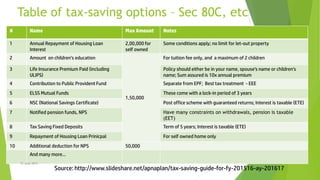
Table of tax-saving options – Sec 80C, etc
# Name Max Amount Notes
1 Annual Repayment of Housing Loan
Interest
2,00,000 for
self owned
Some conditions apply; no limit for let-out property
2 Amount on children’s education
1,50,000
For tuition fee only, and a maximum of 2 children
3 Life Insurance Premium Paid (including
ULIPS)
Policy should either be in your name, spouse’s name or children’s
name; Sum assured is 10x annual premium
4 Contribution to Public Provident Fund Separate from EPF; Best tax treatment - EEE
5 ELSS Mutual Funds These come with a lock-in period of 3 years
6 NSC (National Savings Certificate) Post office scheme with guaranteed returns; Interest is taxable (ETE)
7 Notified pension funds, NPS Have many constraints on withdrawals, pension is taxable
(EET)
8 Tax Saving Fixed Deposits Term of 5 years; Interest is taxable (ETE)
9 Repayment of Housing Loan Prinicpal For self owned home only
10 Additional deduction for NPS 50,000
And many more…
15 June 2015
Source: http://www.slideshare.net/apnaplan/tax-saving-guide-for-fy-201516-ay-201617
Some resources
• Good one, though US focused - http://www.MrMoneyMustache.com
• India-specific, mostly independent site – http://www.JagoInvestor.com
• A comprehensive set of resources from a Professor – http://freefincal.com
• Another ‘non-qualified’, but very good, viewpoint – The New Rules of
Financial Planning in India -
http://www.investta.com/download/file.php?id=69
• Outlook Money magazine
• An youthful take on planning -
https://www.youtube.com/watch?v=vUClil3aNQc
15 June 2015Rev 1.9 Redistribution restricted
Advanced topics
 Complete retirement planning, including bucket
strategy for better returns
 Using a single portfolio for all long term goals
 ‘Safe’ methods to invest in the stock market
 Reducing credit card and personal loans
 Asset diversification – real estate, commodities,
etc.
 For those eligible – ‘operationalizing’ a Hindu
Undivided Family (HUF)
15 June 2015Rev 1.9 Redistribution restricted
An excel sheet to help you
15 June 2015Rev 1.9 Redistribution restricted
15 June
2015
Rev 1.9 Redistribution restricted

Wealth Engineering by S R Srinivasan

  • 1.
    Growing wealth –An engineering approach S R Srinivasan srsrinivasan@india.com
  • 2.
    Disclaimer The material mentionedin this presentation reflect the opinions of the author. The author is not a practicing financial planning professional and has no qualifications and/or certifications in financial planning. The author takes no responsibility, implied or express, for the results arising out of use or abuse of the material in the presentation. 15 June 2015Rev 1.9 Redistribution restricted
  • 3.
    Agenda  Key Wealthconcepts  Financial Freedom  Power of Compounding  Asset Classes  Historical Returns  Power of Equity  Returns and Volatility  Need for a plan  Engineering approach  Objectives/Requirements  Assumptions, Constraints  Design  Implementation  Validation/Maintenance  Summary/Recap  Call for Action 15 June 2015Rev 1.9 Redistribution restricted
  • 4.
    Agenda - Additional Listof possible investment avenues/asset types List of tax saving options References Advanced topics
  • 5.
    15 June 2015 Rev 1.9Redistribution restricted “I always knew I was going to be rich. I don't think I ever doubted it for a minute.” Warren Buffet
  • 6.
    Key Wealth Concepts “Letus start at the very beginning. A very good place to start” 15 June 2015Rev 1.9 Redistribution restricted
  • 7.
    Financial Freedom –A Beautiful Concept  Financial freedom is generally used to describe the state of having sufficient personal wealth to live, without having to work actively for basic necessities as well as other life goals  For financially free people, their assets generate income that is greater than their expenses  You can achieve your Financial Freedom at any point of time!  And this is nothing but ‘Enjoyable Retirement’ (Please note the lack of reference to ‘early’ retirement)  For financially free people, their assets generate income that is greater than their expenses, year over year, as long as they live  Current expense – 22,000 pm, Retire in 20 years, live for another 40 – Corpus required is greater than 1 crore! 15 June 2015Rev 1.9 Redistribution restricted
  • 8.
    Simple arithmetic onachieving financial freedom (Source: networthify.com via mrmoneymustahce.com) 15 June 2015Rev 1.9 Redistribution restricted
  • 9.
    Power of compounding “Compound interest is the eighth wonder of the world. He who understands it, earns it ... he who doesn't ... pays it.”  Usually misattributed to Albert Einstein  An Indian reference: http://www.rediff.com/money/2006/ jun/29perfin.htm If you invest Rs 1 lac at a compounding rate, it becomes…. 15 June 2015Rev 1.9 Redistribution restricted Questions: • Why 8% • Why 25 years At end of 4% 7% 8% 10% 12% Year 1 1.04 1.07 1.08 1.10 1.12 Year 5 1.22 1.41 1.49 1.65 1.82 Year 10 1.49 2.01 2.22 2.7 3.3 Year 15 1.82 2.85 3.3 4.45 5.99 Year 20 2.22 4.04 4.93 7.33 10.89 Year 25 2.71 5.73 7.34 12.06 19.79
  • 10.
    Asset Classes  Financialasset classes  ‘Fixed’ income – FD, bonds, Company debt, Debt Mutal Funds, etc.  Equity/High growth – Stocks, Company stock plans, Equity Mutual Funds  Retirement focused – NPS, Pension plans, PPF, Superannuation  Every investment product/instrument in the market is an instance or a combination of the above  Risk is inherent in every instrument; some have protection/mitigation  A bank can go belly-up, but RBI has some safeguards for deposits  Company bond can become worthless if the company goes bankrupt  Stocks can have very high returns, but also have large volatility, and require knowledge of the markets  On the other hand, a good diversified equity fund greatly reduces the ‘knowledge risk’ inherent in equities 15 June 2015Rev 1.9 Redistribution restrictedPoint to ponder: One usual ‘investment’ avenue is missing from this slide… Wait for a later slide to meet it
  • 11.
    Investment/Asset Options andReturns Historical data in India – Current worth of Rs 1 lac invested 36 years ago  Fixed Deposits – 18.33 lac (8.41% Compounded Annual Growth Rate)  Silver – 24.91 lac (9.34% CAGR)  Gold – 33.54 lac (10.25% CAGR)  ‘Part’ of an apartment in Samudra Mahal, Worli - 65 lac (12.29% CAGR)  ‘Part’ of a plot at Dalal Street – 3.4 cr (16.93% CAGR)  Put under a pillow – 5,500  ? What causes the last bullet  And what is the point about Samudra Mahal and Dalal Street? Data courtesy Wise Wealth Advisors 15 June 2015Rev 1.9 Redistribution restricted
  • 12.
    Power of equity Samudra Mahal in Mumbai is one of the most expensive properties in the country.  The Economic Times reported that “In one of the most expensive apartment transactions in India, Nandan Nilekani, Infosys co- founder, has paid about Rs.1.29 lakh per square feet, or Rs.22.5 crore, for a sea facing apartment in the marquee Samudra Mahal building at Worli in South Mumbai. …The deal for the 1,750 square feet three-bedroom property is the second most expensive transaction ever on a per-sq-ft basis for a residential apartment in the country. “  The cost of one square foot in Samudra Mahal was Rs.700 in 1970. At Rs.1,29,000 now, the value has multiplied by 184 times in 45 years. This works out to an annualised return of 12.29%.  In Dalal Street, Mumbai a sq.feet was Rs.100 in 1980. After 35 years, it sells at Rs.29,000 per sq.ft. Money multiplied by 290 times in 35 years. This works out to an annualized return of 17.58%.  Samudra Mahal can be bought and owned only by cream or elite of the society who are worth at least tens of crores, mostly hundreds of crores.  The property in Dalal street; your father could have bought with whatever money available at his disposal. You can buy it even now. Your son or daughter would be able to buy it even 20 years down the line.  The property in Dalal Street is a metaphor for Sensex. A sq.feet is one unit. If dividend yield is also included (assuming 2%+ CAGR), Sensex would have delivered around 20% annualized returns over last 35 years, significantly higher than the most expensive prime property in the country.  Good mutual funds and many stocks have delivered returns far superior to Sensex itself – CRISIL AMFI Equity Fund Performance Index that tracks actively managed funds has returned 22.74% since 1997  Power of equity is least understood in this country Source: http://wisewealthadvisors.com/2015/01/26/dalal-street-or-samudra-mahal/15 June 2015Rev 1.9 Redistribution restricted
  • 13.
    Returns, Volatility andsuch things  No financial product, none, has a completely fixed rate of return forever  e.g Rates on FDs change from time to time  In lay terms: One can usually expect lower volatility in products that have lower average return - FD rates are 9% +- 1  In precise terms: Assuming that the returns have a normal distribution, products with low means should have lower standard deviation and those with higher means can have higher standard deviations  And more importantly, standard deviations tend to decrease if the duration increases – Equity has a mean, SD of 14 and 4 over 15 years, and 18 and 20 over 3 years  Exercise: Please use your probability lessons to work out what the range of returns could be  Gold is funny – it has a low mean and high SD  A rough picture follows to explain this 15 June 2015Rev 1.9 Redistribution restricted
  • 14.
    Higher risk doesnot imply higher return! (Source: Pattabiraman Murari of Freefincal) Return Risk Standard Deviation Return Risk Standard Deviation FD Debt mf Equity mf Gold 15 June 2015Rev 1.9 Redistribution restricted
  • 15.
    Equity becomes muchless volatile over longer periods (Source: Pattabiraman Murari of Freefincal) 15 June 2015Rev 1.9 Redistribution restricted
  • 16.
    Do you needa plan at all?  All things in life go to a 2x2 (Eisenhower) matrix  Important vs Unimportant  Urgent vs Non-urgent  By nature, humans are not good at proactively addressing important, non-urgent work  And by nature, financial objectives are important and non-urgent  The only way that you can address important and non- urgent items is by planning 15 June 2015Rev 1.9 Redistribution restricted
  • 17.
    Your PERSONAL Finance 15June 2015Rev 1.9 Redistribution restricted
  • 18.
    Engineering Approach Initiate theproject Finalize the requirements Design the product Plan for risk Implement the plan, and Validate it And keep validating it 15 June 2015Rev 1.9 Redistribution restricted
  • 19.
    Objectives Project Objective Statement Scope– who do I want to be like? Ambani? Buffet? A close relative who lives a prosperous and contended life? Schedule – do I want to still work when I am 40? 50? And God forbid – 60? Resources - Am I on my own? Should I plan to marry rich? Do I have a proverbial rich uncle? 15 June 2015Rev 1.9 Redistribution restricted
  • 20.
    Gather the requirements Post-retirementlife Life events – Marriage, Kids, Parents, … Quality of life – car purchase, home purchase, … Dreams and desires – honeymoon in Switzerland, vacation to Bali, etc. 15 June 2015Rev 1.9 Redistribution restricted
  • 21.
    Finalize the requirements Visualizethem as goals, and make them SMART  3 lakhs by end of 2017 for trip to Bali  10 lakhs by end of 2019 for downpayment for home  ‘Enough’ money to fund child’s education in a private engineering college  Become a millionaire by 30, and spend the rest of the life in beaches  And so on… A non-requirement for anybody – Tax savings 15 June 2015Rev 1.9 Redistribution restricted
  • 22.
    The Catch -Assumptions, Dependencies, Constraints  Money available every month, every year Remember the equation: Optional Expenses = Income – Mandatory Expenses – Savings/Investments  Inflation  Investment options available, And their post-tax returns This is the most varying aspect of personal finance  Time to manage all this stuff  And most importantly, the discipline 15 June 2015Rev 1.9 Redistribution restricted
  • 23.
    15 June 2015 Rev 1.9Redistribution restricted “Nothing can stop the man with the right mental attitude from achieving his goal; nothing on earth can help the man with the wrong mental attitude.”
  • 24.
    Design your plan Take each requirement/goal  Based on the time frame, choose an asset class/avenue  1-3 years – Fixed income or debt instruments, few ‘low risk’ equities  View this as ‘savings’, rather than ‘investing’; don’t chase returns  > 5 years – More equity than debt  > 10 years – Predominantly equity  Your mileage may vary!  Estimate the expected return, and then calculate the monthly investment needed  The expected return would be a blended return based on the debt:equity mix that you choose  Be sure to factor in inflation for the requirements  Now you can go to implementation 15 June 2015Rev 1.9 Redistribution restricted
  • 25.
    Taking professional help- What do you ask the ‘builder’ (advisor)  Ask the advisor to validate your expectations – time horizon, expected returns, etc.; make sure that you don’t get bullied  Never let the advisor to force you into the asset class/product family (ie mutual fund, pension plan, etc.)  You can take suggestions, but the decision is yours, and yours alone  Why: Remember the saying… “If you have a hammer at hand, all problems look like nails”  Ask the advisor to help choose products from a product family (specific funds, specific bonds, etc.)  The regulators (mainly SEBI) talk about ‘Independent Financial Advisors’, but few are really ‘Independent’ 15 June 2015Rev 1.9 Redistribution restricted
  • 26.
    15 June 2015 Rev 1.9Redistribution restricted “Anyone who wants to sell you overnight success or wealth is not interested in your success; they are interested in your money.”
  • 27.
    Plan for risks- Insurance  Take each requirement  Decide if the requirement stands even if you can’t fund it  If it does, cover the corpus with a term insurance plan  That, and only that, is the life insurance you need  Etch this in your mind: “Insurance is a cost, not an investment” Mitigation for other risks – Health insurance, Critical illness, Accident; Emergency corpus 15 June 2015Rev 1.9 Redistribution restricted
  • 28.
    Implement  Research, research,research – Use the Resources section in this presentation as a start (You would have needed this for the design phase too)  Wherever possible, choose the type that saves tax – NSC instead of FD, ELSS instead of mutual fund, PPF instead of long-term debt, etc. etc.  Tip: Look in ‘investment proof’ section in your company ‘tax planner’ for a long list of options  A later slide lists some of the options  For each asset class/product family you have chosen, shortlist the “best-in- class” products  Talk to the advisor, talk to the seller of the product, talk to previous buyers, and go buy it! Just choose 1 or more from your shortlist, and don’t try to chase the ‘best’  It helps if the product can be tracked online  If the product requires periodic purchase (most would) set up an auto mechanism, or put it in your calendar 15 June 2015Rev 1.9 Redistribution restricted
  • 29.
    Validate  Depending onthe requirement, choose the review period  Once a quarter for a 2-year requirement  Once a year for > 5 years  Review the returns, and match against the plan  For equity, compare the returns with the market or index  If there is a shortfall in debt portfolio, fill the gap  If there is a surplus, don’t touch it  This is also a great time to validate the assumptions that you have made  Advanced Concept: ‘Rebalance the portfolio’  Repeat periodically Remember – Any project is only as good as its validation 15 June 2015Rev 1.9 Redistribution restricted
  • 30.
    Redemption Enjoying the benefitsof the plan – an atypical approach  Major assumption – You have built up a healthy debt portfolio  As the goal nears, review the portfolio (and rebalance as needed)  When goal is at hand, redeem in this order:  Direct Equities  Equity mutual funds  Debt mutual funds  Other debt instruments – NSC, PPF, FD  If the market is at a bad patch, redeem from debt first and rebalance later  This lets your debt portfolio compound uninterrupted, and ‘book profits’ from equity portfolio Typical approach  When the goal nears, shift corpus of that goal to debt portfolio  When goal is at hand, redeem from debt portfolio 15 June 2015Rev 1.9 Redistribution restricted
  • 31.
    Summary of learnings •Beauty of the goal of ‘Financial Freedom’ • Compounding is your friend… and inflation is your unavoidable enemy • Asset Classes, Historical returns in India • Returns and volatility have a relationship • Power of equity, in spite of its volatility • Need for planning to achieve goals • Engineering approach to build wealth …
  • 32.
    Recap of theapproach  Define the project parameters  Specify the requirements  Gather assumptions, constraints  Create the plan, including risk plan  Design your implementation  Implement  Validate, repeat, Validate, … And most importantly Have fun! 15 June 2015Rev 1.9 Redistribution restricted
  • 33.
    Experience Distillation 4 earlylife mistakes which investors should avoid at any cost 1. Buying products only for “saving tax”  Tax saving is important and one has to do it, but do it meaningfully 2. Waiting for the “right time” to invest  Time in market is far more important than ‘timing’ the market 3. Getting high on debt, early in life  A reasonable guideline - “Limit debt to asset purchases, if at all” 4. Over relying on relatives, friends and parents for your financial decisions  Take suggestions, but make the decisions yourself Sourced from: http://www.jagoinvestor.com/2015/07/investors-mistake-in-early- life.html?utm_source=wysija&utm_medium=email&utm_campaign=newsletters Enough with don’t s, Now, let us look at something that you *can* do 15 June 2015Rev 1.9 Redistribution restricted
  • 34.
    Call for action Plan,Analyze (7 days)  List your requirements/goals and make them SMAART  You should have at least one goal – Financial Freedom  Evaluate your life insurance requirements  Evaluate the amount for your emergency/contingency fund  Additional plans for health, accident and critical illness Do, Act (30 days)  Start building your contingency fund (7 days)  Buy a top-up or super top-up health insurance policy – 10 days  Open a PPF account – 15 days  Start a SIP/periodic investment for the goal of Financial Freedom – 15 days  Start SIPs/periodic investments for other goals – 30 days 15 June 2015Rev 1.9 Redistribution restricted Use this checklist: http://freefincal.com/personal-finance-self- evaluation-checklist/
  • 35.
    Some suggested productfamilies  Fixed income or debt  Debt mutual funds  Fixed deposits, Recurring Deposits  Post office deposits  NSC  Infrastructure bonds  Public Provident Fund  Endowment insurance plans (only if you must!) – use PPF instead  Equity  Diversified equity funds  Sectoral equity funds  Stocks (either IPO or secondary market)  ULIPs (only if you must!) – use ELSS instead  Life Insurance  Term insurance, and nothing else!  More advanced products exist for experienced investors – e.g derivatives, commodities, etc 15 June 2015Rev 1.9 Redistribution restricted
  • 36.
    Tax saving options Investment for Fixed income  Sec 80 C – Infrastructure bonds, NSC, 5 year FD, PO time deposit, Sukanya Samridhi  Investment for High growth  Sec 80 C – ELSS, RGESS  Investment for ‘Retirement’  Sec 80 CCC, CCDx – Pension Fund, NPS  Sec 80 C – EPF (Company PF), PPF  Cost adjustment (encouragement of good behaviour)  80 Dxx – Health insurance  80 C – Life insurance, Housing loan principal for self occupied house, School fees, …  Sec 24 – Housing loan interest, Sec 80E - Education loan interest  Sec 80Gxx - Donations An excellent resource for details: http://www.slideshare.net/apnaplan/ tax-saving-guide-for-fy-201516-ay- 201617 15 June 2015Rev 1.9 Redistribution restricted Tips: a) Look in ‘Investment Proof’ page in your company payroll site for a complete list of current options b) A tax saving option is not necessarily better
  • 37.
    Table of tax-savingoptions – Sec 80C, etc # Name Max Amount Notes 1 Annual Repayment of Housing Loan Interest 2,00,000 for self owned Some conditions apply; no limit for let-out property 2 Amount on children’s education 1,50,000 For tuition fee only, and a maximum of 2 children 3 Life Insurance Premium Paid (including ULIPS) Policy should either be in your name, spouse’s name or children’s name; Sum assured is 10x annual premium 4 Contribution to Public Provident Fund Separate from EPF; Best tax treatment - EEE 5 ELSS Mutual Funds These come with a lock-in period of 3 years 6 NSC (National Savings Certificate) Post office scheme with guaranteed returns; Interest is taxable (ETE) 7 Notified pension funds, NPS Have many constraints on withdrawals, pension is taxable (EET) 8 Tax Saving Fixed Deposits Term of 5 years; Interest is taxable (ETE) 9 Repayment of Housing Loan Prinicpal For self owned home only 10 Additional deduction for NPS 50,000 And many more… 15 June 2015 Source: http://www.slideshare.net/apnaplan/tax-saving-guide-for-fy-201516-ay-201617
  • 38.
    Some resources • Goodone, though US focused - http://www.MrMoneyMustache.com • India-specific, mostly independent site – http://www.JagoInvestor.com • A comprehensive set of resources from a Professor – http://freefincal.com • Another ‘non-qualified’, but very good, viewpoint – The New Rules of Financial Planning in India - http://www.investta.com/download/file.php?id=69 • Outlook Money magazine • An youthful take on planning - https://www.youtube.com/watch?v=vUClil3aNQc 15 June 2015Rev 1.9 Redistribution restricted
  • 39.
    Advanced topics  Completeretirement planning, including bucket strategy for better returns  Using a single portfolio for all long term goals  ‘Safe’ methods to invest in the stock market  Reducing credit card and personal loans  Asset diversification – real estate, commodities, etc.  For those eligible – ‘operationalizing’ a Hindu Undivided Family (HUF) 15 June 2015Rev 1.9 Redistribution restricted
  • 40.
    An excel sheetto help you 15 June 2015Rev 1.9 Redistribution restricted
  • 41.
    15 June 2015 Rev 1.9Redistribution restricted