WE, THE MARATHA !
WHO ARE THE MARATHAS?
 Sturdy, well-built, active,
not very handsome,
hardy and extremely
perseverant.
 The average Maratha
does not focus on pride
and dignity when it
comes to work; but
upon worldly wisdom
and final result.
 A Maratha thinks of
nothing but the result
and cares little for the
means if he can attain
his objective. For this
purpose he will strain his
wits, renounce his
pleasures and endanger
himself; but will never
sacrifice his life or even
his interest for personal
honor.
MARATHA LIFE IS ONLY FOR THE NATION
 The Maratha will gladly sacrifice his life, family
and home for the defense of his Nation. The
difference in attitude for personal gain v/s
sacrifice for the Nation is what makes the
Maratha ‘noble in ordinary life’ yet without any
distinguishing traits of ‘honor for the sake of
name and fame’.
LIVE FOR GOD, NATION AND DHARMA.
NEVER UNDER ESTIMATE THE MARATHA –
IT LEADS ONLY TO DEFEAT.
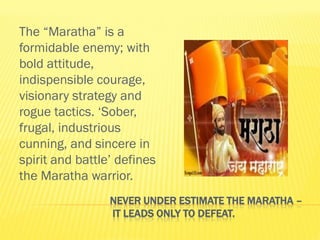
The “Maratha” is a
formidable enemy; with
bold attitude,
indispensible courage,
visionary strategy and
rogue tactics. ‘Sober,
frugal, industrious
cunning, and sincere in
spirit and battle’ defines
the Maratha warrior.
NATURE HAS FOSTERED IN THE MARATHA AN INNATE
LOVE OF INDEPENDENCE THAT MAKES HIM
REBELLIOUS IN SPIRIT.
 The combination of courage, cleverness and
power of endurance; the ability to plan and
execute surprise and unexpected attacks,
the skills to extricate himself from tight
corners or to vary the tactics to the changing
phases of a battle without waiting for
guidance from a superior, defines the
winning mind-set of the Maratha warrior.
SPIRITUALLY STRONG AND POLITICALLY CUNNING – THIS
DEFINES THE MARATHA
Saints like Eknath,
Ramdas, Tukaram
Maharaj and
philosophers like
Waman Pandit,
Moropant,
Amritraya,
Mahipate, and
Raghunath Pandit
strongly influence
the Maratha ethos.
 The average Maratha is
influenced by the religious,
social and literary
movement in Maharashtra;
infusing deeply the spirit of
“equality, fraternity and
spiritual liberty” – thereby
affecting the moral
consciousness, but not the
political thought process.
RELIGIOUS VALUES DEFINES POLITICS
 The Saints and the Philosophers created the
conditions which influenced and ensured the
success of the “Maratha political ideal”. The
teachings of the saints of Maharashtra gave the
Maratha society that mood of moral exaltedness
which was essential to the success of
“Swarajya”. The strong base of religious revival
on which the political movement was designed,
had that moral basis without which the very idea
of Swarajya would have been a mockery.
THE MORAL INFLUENCE OF SAINTS.
 The moral atmosphere created by the saints
made a majority of Marathas of the 17th
century less-selfish and perhaps less-
corrupt. The “Bhakti” movement influenced
the concepts of Nationalism and Democracy
with Equality. The Maratha literature added
its strong influence for national unity.
Devotional songs and moral maxims of the
saints made their way to every home where
Marathi language was read or spoken.
TRAITS OF LEADERSHIP
 Maratha leadership has
always been blessed with
versatile genius, extra-
ordinary energy, sharp
vigilance, un-exhausting
endurance, remarkable
strength of ideals and
wildly daring ideas that
no-one expects till they
are deployed in the
arena.
 Fiery spirits fanned
with latent energy of
National pride and
the ambition to rule
the Nation on basis
of Democracy,
Equality and Pride
are the singular
motivations towards
unending efforts and
toil.
VALUES AND ITS EFFECTS
 Mutual trust among
compatriots, organizing
abilities, self- sacrifice,
leading without fear or
favor and trust in fate
and faith; have always
allowed the Maratha to
perform impossible
feats of courage and
valor.
 Guerilla warfare was
perfected by the
Marathas since it
favored their smaller
army and allowed them
to dominate the battle
against stronger
adversaries. Fast,
precise, flexible and
highly mobile was the
“modus operandi” of
Maratha fighters.
The success of
Marathas depends on
rapidity, enterprise,
energy, courage and
perseverance in every
situation, bravery,
discipline, calm mind,
spiritual vigor and
resourcefulness of
adapting to changing
circumstances.
 "A defeat to the
Marathas is like a
blow given to
water, which offers
no resistance to
the stroke and
retains no
impression of its
effect”.
We, the Maratha !

We, the Maratha !

  • 1.
  • 2.
    WHO ARE THEMARATHAS?  Sturdy, well-built, active, not very handsome, hardy and extremely perseverant.  The average Maratha does not focus on pride and dignity when it comes to work; but upon worldly wisdom and final result.  A Maratha thinks of nothing but the result and cares little for the means if he can attain his objective. For this purpose he will strain his wits, renounce his pleasures and endanger himself; but will never sacrifice his life or even his interest for personal honor.
  • 3.
    MARATHA LIFE ISONLY FOR THE NATION  The Maratha will gladly sacrifice his life, family and home for the defense of his Nation. The difference in attitude for personal gain v/s sacrifice for the Nation is what makes the Maratha ‘noble in ordinary life’ yet without any distinguishing traits of ‘honor for the sake of name and fame’. LIVE FOR GOD, NATION AND DHARMA.
  • 4.
    NEVER UNDER ESTIMATETHE MARATHA – IT LEADS ONLY TO DEFEAT. The “Maratha” is a formidable enemy; with bold attitude, indispensible courage, visionary strategy and rogue tactics. ‘Sober, frugal, industrious cunning, and sincere in spirit and battle’ defines the Maratha warrior.
  • 5.
    NATURE HAS FOSTEREDIN THE MARATHA AN INNATE LOVE OF INDEPENDENCE THAT MAKES HIM REBELLIOUS IN SPIRIT.  The combination of courage, cleverness and power of endurance; the ability to plan and execute surprise and unexpected attacks, the skills to extricate himself from tight corners or to vary the tactics to the changing phases of a battle without waiting for guidance from a superior, defines the winning mind-set of the Maratha warrior.
  • 6.
    SPIRITUALLY STRONG ANDPOLITICALLY CUNNING – THIS DEFINES THE MARATHA Saints like Eknath, Ramdas, Tukaram Maharaj and philosophers like Waman Pandit, Moropant, Amritraya, Mahipate, and Raghunath Pandit strongly influence the Maratha ethos.  The average Maratha is influenced by the religious, social and literary movement in Maharashtra; infusing deeply the spirit of “equality, fraternity and spiritual liberty” – thereby affecting the moral consciousness, but not the political thought process.
  • 7.
    RELIGIOUS VALUES DEFINESPOLITICS  The Saints and the Philosophers created the conditions which influenced and ensured the success of the “Maratha political ideal”. The teachings of the saints of Maharashtra gave the Maratha society that mood of moral exaltedness which was essential to the success of “Swarajya”. The strong base of religious revival on which the political movement was designed, had that moral basis without which the very idea of Swarajya would have been a mockery.
  • 8.
    THE MORAL INFLUENCEOF SAINTS.  The moral atmosphere created by the saints made a majority of Marathas of the 17th century less-selfish and perhaps less- corrupt. The “Bhakti” movement influenced the concepts of Nationalism and Democracy with Equality. The Maratha literature added its strong influence for national unity. Devotional songs and moral maxims of the saints made their way to every home where Marathi language was read or spoken.
  • 9.
    TRAITS OF LEADERSHIP Maratha leadership has always been blessed with versatile genius, extra- ordinary energy, sharp vigilance, un-exhausting endurance, remarkable strength of ideals and wildly daring ideas that no-one expects till they are deployed in the arena.  Fiery spirits fanned with latent energy of National pride and the ambition to rule the Nation on basis of Democracy, Equality and Pride are the singular motivations towards unending efforts and toil.
  • 10.
    VALUES AND ITSEFFECTS  Mutual trust among compatriots, organizing abilities, self- sacrifice, leading without fear or favor and trust in fate and faith; have always allowed the Maratha to perform impossible feats of courage and valor.  Guerilla warfare was perfected by the Marathas since it favored their smaller army and allowed them to dominate the battle against stronger adversaries. Fast, precise, flexible and highly mobile was the “modus operandi” of Maratha fighters.
  • 11.
    The success of Marathasdepends on rapidity, enterprise, energy, courage and perseverance in every situation, bravery, discipline, calm mind, spiritual vigor and resourcefulness of adapting to changing circumstances.  "A defeat to the Marathas is like a blow given to water, which offers no resistance to the stroke and retains no impression of its effect”.