BioOne sees sustainable scholarly publishing as an inherently collaborative enterprise connecting authors, nonprofit publishers, academic institutions, research libraries, and
research funders in the common goal of maximizing access to critical research.
Benthic and planktonic primary production along a nutrient gradient in Green Bay, Lake
Michigan, USA
Author(s): Bryan Althouse, Scott Higgins, and M. Jake Vander Zanden
Source: Freshwater Science, 33(2):487-498.
Published By: The Society for Freshwater Science
URL: http://www.bioone.org/doi/full/10.1086/676314
BioOne (www.bioone.org) is a nonprofit, online aggregation of core research in the biological, ecological, and
environmental sciences. BioOne provides a sustainable online platform for over 170 journals and books published by
nonprofit societies, associations, museums, institutions, and presses.
Your use of this PDF, the BioOne Web site, and all posted and associated content indicates your acceptance of BioOne’s
Terms of Use, available at www.bioone.org/page/terms_of_use.
Usage of BioOne content is strictly limited to personal, educational, and non-commercial use. Commercial inquiries or rights
and permissions requests should be directed to the individual publisher as copyright holder.
LAKE BENTHIC ALGAE
Benthic and planktonic primary production along a
nutrient gradient in Green Bay, Lake Michigan, USA
Bryan Althouse1,2
, Scott Higgins1,3
, and M. Jake Vander Zanden1,4
1
Center for Limnology, University of Wisconsin-Madison, 680 North Park Street, Madison Wisconsin 53706 USA
Abstract: Primary production in lakes occurs in both planktonic (water column) and benthic (bottom) habitats.
How whole-lake primary production is distributed between these 2 habitats—referred to as autotrophic structure—
is a key ecosystem property. Empirical research examining the balance between benthic and planktonic primary
production in lakes is scarce, and how autotrophic structure changes across depth, nutrient, water clarity, and
biological invasion gradients is unclear. Therefore, we are ill equipped to anticipate ecosystem-level responses to
environmental change. We assessed the magnitude of offshore planktonic, nearshore planktonic, and nearshore
benthic gross primary production (GPP) along a gradient of nutrients, water clarity, and Cladophora biomass in
Green Bay, Lake Michigan, USA, during summer 2010, 2011, and 2012. Benthic and planktonic GPP varied
strongly along the trophic gradient. Planktonic GPP increased with nutrients status, whereas benthic GPP de-
creased. From shore to 10 m depth, autotrophic structure shifted from planktonic dominance near the mouth
of the Fox River (95% planktonic) to a mix of benthic and planktonic GPP 35 km from the mouth of the Fox
(∼40% benthic). The steep bathymetry at more-distant sites reduced the relative importance of benthic GPP at
the whole-ecosystem level. Our work highlights the dual-pathway (i.e., benthic and planktonic) nature of lentic
food webs from the perspective of GPP, and shows how both trophic status and bathymetry affect autotrophic
structure.
Key words: benthic primary production, planktonic primary production, autotrophic structure, dreissenids,
Cladophora, eutrophication, nutrients, Lake Michigan, Green Bay, Laurentian Great Lakes
Researchers studying lakes have emphasized measurement
of planktonic primary production and processes (Vade-
boncoeur et al. 2002) with particular emphasis on plank-
tonic primary production in studies of eutrophication (Car-
penter et al. 1998, Correll 1998). However, recognition is
growing that substantial primary production occurs in both
planktonic and benthic habitats. How whole-lake primary
production (planktonic + benthic) is distributed between
these 2 habitats is a poorly understood, but fundamental
ecosystem property referred to as the autotrophic structure
(Higgins et al., in press). Little understanding exists of how
primary production is partitioned between these habitats,
how partitioning varies along environmental gradients, and
the effects of environmental change on autotrophic struc-
ture.
Benthic primary production can be a significant contrib-
utor to littoral zone, and sometimes to whole-lake, primary
production (Vadeboncoeur et al. 2001, 2008, DeNicola et al.
2003, van de Bogert et al. 2007, Sadro et al. 2011). Even in
lakes where benthic habitats are a minor contributor to
whole-lake primary production, top predators generally as-
similate C fixed by both benthic and planktonic autotrophs
(Vander Zanden and Vadeboncoeur 2002, Vander Zanden
et al. 2011), often leading to a disproportionately high impor-
tance of benthic primary production as a source of energy
for higher trophic levels relative to its contribution to whole-
lake primary production (Vander Zanden et al. 2006).
Nearshore benthic habitats in Lake Erie and Lake On-
tario are primary production hotspots, with areal rates of
benthic primary production equal to or exceeding plank-
tonic primary production down to depths of 12 m (De-
Nicola et al. 2003, Davies and Hecky 2005, Malkin et al.
2010). These high rates of primary production are associ-
ated with mats of the filamentous green macroalga Clado-
phora glomerata, which are a widespread problem through-
out coastal areas of the lower Laurentian Great Lakes
(DeNicola et al. 2003, Davies and Hecky 2005, Malkin et al.
2010). In these ecosystems, the growth and biomass accrual
E-mail addresses: 2
balthouse@gmail.com; 3
Present address: Fisheries and Oceans Canada, 501 University Crescent, Winnipeg, Manitoba, Canada R3T
2N6, scott.higgins@dfo-mpo.gc.ca; 4
To whom correspondence should be addressed, mjvanderzand@wisc.edu
DOI: 10.1086/676314. Received 13 August 2013; Accepted 6 November 2013; Published online 27 March 2014.
Freshwater Science. 2014. 33(2):487–498. © 2014 by The Society for Freshwater Science. 487
of Cladophora is controlled primarily by the availability of
hard substratum (e.g., rocky lake bottom) for attachment
of filaments, water clarity, and the supply of bioavailable
P (Higgins et al. 2008). Cladophora blooms were a com-
mon problem in the Great Lakes from the 1950s through
the early 1980s, but successful implementation of strict
P-abatement programs as part of the Canada–USA Great
Lakes Water Quality agreement reduced total P (TP) load-
ing and concentrations to levels that significantly reduced
growth rates and biomass (Higgins et al. 2008). The resur-
gence of widespread Cladophora blooms in the Great
Lakes has been attributed to the arrival of the nonnative
zebra mussel (Dreissena polymorpha) and quagga mussel
(Dreissena rostriformis bugensis) (Hecky et al. 2004, Auer
et al. 2010). Dreissenids have a well described set of effects
on lakes: reduced phytoplankton biomass and primary pro-
duction, increased light penetration, increased bioavail-
ability of P at the sediment–water interface, and increased
biomass and primary production of benthic primary pro-
ducers (Lowe and Pillsbury 1995, Hecky et al. 2004, Hig-
gins et al. 2008, Higgins and Vander Zanden 2010).
Some investigators have measured the balance between
benthic and planktonic primary production in lakes (Mal-
kin et al. 2010, Sadro et al. 2011), but most investiga-
tors have not considered how autotrophic structure varies
along key ecological gradients, such as nutrient status and
water clarity. In the coming decades, nutrient-abatement
efforts paired with global environmental change will alter
nutrient regimes, shift temperature and precipitation pat-
terns, and bring new species invasions (Carpenter et al.
2011). Our limited understanding of lake autotrophic struc-
ture leaves researchers and resource managers ill equipped
to anticipate how lake ecosystems will respond to such
changes.
Green Bay, Lake Michigan, USA, presents a unique op-
portunity to study how autotrophic structure varies across
key gradients (e.g., nutrient levels and water clarity) within
a single ecosystem. Large inputs of nutrients and sediment
from the Fox River lead to nutrient-enriched and turbid
waters within inner Green Bay. However, trophic status de-
creases and water clarity increases with distance from the
Fox River. Differences in basin morphology, which can in-
fluence the available habitat for benthic autotrophs, also
occur with increasing distance from the Fox River. Water
depths are shallow near the mouth of the Fox River but
give way to deeper water and steep slopes in middle and
outer Green Bay. We assessed how autotrophic structure
varies along these gradients in a large lake basin during the
summer stratification period.
METHODS
Study sites
We measured benthic and planktonic gross primary
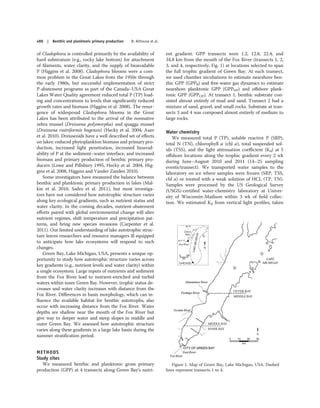
production (GPP) at 4 transects along Green Bay’s nutri-
ent gradient. GPP transects were 1.2, 12.8, 22.4, and
34.8 km from the mouth of the Fox River (transects 1, 2,
3, and 4, respectively; Fig. 1) at locations selected to span
the full trophic gradient of Green Bay. At each transect,
we used chamber incubations to estimate nearshore ben-
thic GPP (GPPB) and free-water gas dynamics to estimate
nearshore planktonic GPP (GPPNP) and offshore plank-
tonic GPP (GPPOP). At transect 1, benthic substrate con-
sisted almost entirely of mud and sand. Transect 2 had a
mixture of sand, gravel, and small rocks. Substrate at tran-
sects 3 and 4 was composed almost entirely of medium to
large rocks.
Water chemistry
We measured total P (TP), soluble reactive P (SRP),
total N (TN), chlorophyll a (chl a), total suspended sol-
ids (TSS), and the light attenuation coefficient (Kd) at 5
offshore locations along the trophic gradient every 2 wk
during June–August 2010 and 2011 (14–25 sampling
events/transect). We transported water samples to the
laboratory on ice where samples were frozen (SRP, TSS,
chl a) or treated with a weak solution of HCL (TP, TN).
Samples were processed by the US Geological Survey
(USGS)-certified water-chemistry laboratory at Univer-
sity of Wisconsin-Madison within 3 wk of field collec-
tion. We estimated Kd from vertical light profiles, taken
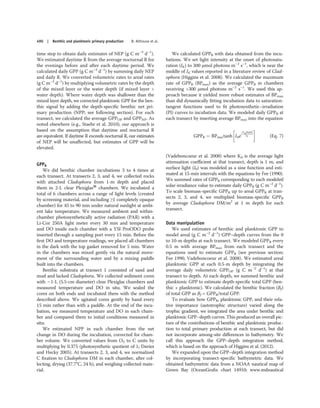
Figure 1. Map of Green Bay, Lake Michigan, USA. Dashed
lines represent transects 1 to 4.
488 | Benthic and planktonic primary production B. Althouse et al.
at 1-m depth intervals with a LI-COR 250A underwater
light meter with a flat-plate (LI-192) sensor (LI-COR,
Lincoln, Nebraska).
Cladophora biomass
We estimated Cladophora % cover at 1-m depth once
a month from late May to late August (with the exception
of transect 1, which lacked Cladophora) with a 0.33-m2
quadrat at 10 locations at each transect. We estimated
Cladophora biomass from an empirical relationship be-
tween Cladophora % cover and biomass (sensu Higgins
et al. 2005) developed by direct comparison of these var-
iables measured at a subset of locations and dates. We es-
timated Cladophora % cover visually within each quadrat,
harvested Cladophora filaments by hand, and transferred
them to a mesh bag. We blotted Cladophora filaments
with a paper towel and weighed them to estimate wet mass
(WM; g). We dried filaments overnight at 60°C and re-
weighed them to estimate dry mass (DM; g). The relation-
ship between % cover and WM was linear: biomass = 0.88
(% cover) (CV = 0.22), with no significant difference in the
multiplier among categories (5, 10, and 100%) of % cover.
We converted estimated WM to DM with our empirically
derived equation: ln(DM) = 0.86ln(WM) – 1.37 (r2
= 0.88,
p < 0.0001, F = 653.9, n = 85, df = 86), and expressed values
as g/m2
. We averaged estimates of DM/m2
for each tran-
sect and used them in subsequent calculations (see GPPB
estimates below).
Planktonic primary production
We estimated GPPOP and GPPNP from June to August
2010, 2011, and 2012 from diurnal fluctuations of O2 and
estimates of air–water gas exchange. At each transect, we
deployed a YSI multiparameter sonde (model 6600 V2-4;
Yellow Springs Instruments, Yellow Springs, Ohio) at 1.5-m
depth in the middle of the Bay (OP) and ∼1 km from shore
(NP). We measured dissolved O2 (DO) and temperature ev-
ery 15 min. We used the bookkeeping method to estimate
GPP from free-water DO (Odum 1956)
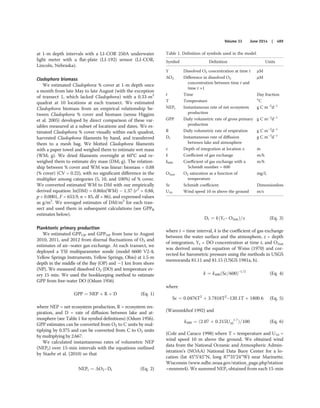
GPP ¼ NEP þ R þ D (Eq. 1)
where NEP = net ecosystem production, R = ecosystem res-
piration, and D = rate of diffusion between lake and at-
mosphere (see Table 1 for symbol definitions) (Odum 1956).
GPP estimates can be converted from O2 to C units by mul-
tiplying by 0.375 and can be converted from C to O2 units
by multiplying by 2.667.
We calculated instantaneous rates of volumetric NEP
(NEPt) over 15-min intervals with the equations outlined
by Staehr et al. (2010) so that
NEPt ¼ ΔO2−Dt (Eq. 2)
Dt ¼ kðYt− O2satÞ=z (Eq. 3)
where t = time interval, k is the coefficient of gas exchange
between the water surface and the atmosphere, z = depth
of integration, Yt = DO concentration at time t, and O2sat
was derived using the equation of Weiss (1970) and cor-
rected for barometric pressure using the methods in USGS
memoranda 81.11 and 81.15 (USGS 1981a, b).
k ¼ k600ðSc=600Þ−1=2
(Eq. 4)
where
Sc ¼ 0:0476T2
þ 3:7818T2
−120:1T þ 1800:6 (Eq. 5)
(Wanninkhof 1992) and
k600 ¼ ð2:07 þ 0:215U 1:7
10 Þ=100 (Eq. 6)
(Cole and Caraco 1998) where T = temperature and U10 =
wind speed 10 m above the ground. We obtained wind
data from the National Oceanic and Atmospheric Admin-
istration’s (NOAA) National Data Buoy Center for a lo-
cation (lat 45°5′45′′N, long 87°35′24′′W) near Marinette,
Wisconsin (www.ndbc.noaa.gov/station_page.php?station
=mnmm4). We summed NEPt obtained from each 15-min
Table 1. Definition of symbols used in the model.
Symbol Definition Units
Y Dissolved O2 concentration at time t μM
ΔO2 Difference in dissolved O2
concentration between time t and
time t +1
μM
t Time Day fraction
T Temperature °C
NEPt Instantaneous rate of net ecosystem
production
g C m–2
d–1
GPP Daily volumetric rate of gross primary
production
g C m–2
d–1
R Daily volumetric rate of respiration g C m–2
d–1
Dt Instantaneous rate of diffusion
between lake and atmosphere
g C m–2
d–1
z Depth of integration at location x m
k Coefficient of gas exchange m/h
k600 Coefficient of gas exchange with a
Schmidt number = 600
m/h
O2sat O2 saturation as a function of
temperature
mg/L
Sc Schmidt coefficient Dimensionless
U10 Wind speed 10 m above the ground m/s
Volume 33 June 2014 | 489
time step to obtain daily estimates of NEP (g C m–3
d–1
).
We estimated daytime R from the average nocturnal R for
the evenings before and after each daytime period. We
calculated daily GPP (g C m–3
d–1
) by summing daily NEP
and daily R. We converted volumetric rates to areal rates
(g C m–2
d–1
) by multiplying volumetric rates by the depth
of the mixed layer or the water depth (if mixed layer >
water depth). Where water depth was shallower than the
mixed layer depth, we corrected planktonic GPP for the ben-
thic signal by adding the depth-specific benthic net pri-
mary production (NPP; see following section). For each
transect, we calculated the average GPPOP and GPPNP. As
noted elsewhere (e.g., Staehr et al. 2010), our approach is
based on the assumption that daytime and nocturnal R
are equivalent. If daytime R exceeds nocturnal R, our estimates
of NEP will be unaffected, but estimates of GPP will be
elevated.
GPPB
We did benthic chamber incubations 3 to 4 times at
each transect. At transects 2, 3, and 4, we collected rocks
with attached Cladophora from 1-m depth and placed
them in 2-L clear Plexiglas® chambers. We incubated a
total of 6 chambers across a range of light levels (created
by screening material, and including ≥1 completely opaque
chamber) for 45 to 90 min under natural sunlight at ambi-
ent lake temperature. We measured ambient and within-
chamber photosynthetically active radiation (PAR) with a
Li-Cor 250A light meter every 30 min and temperature
and DO inside each chamber with a YSI ProODO probe
inserted through a sampling port every 15 min. Before the
first DO and temperature readings, we placed all chambers
in the dark with the top gasket removed for 5 min. Water
in the chambers was mixed gently via the natural move-
ment of the surrounding water and by a mixing paddle
built into the chambers.
Benthic substrata at transect 1 consisted of sand and
mud and lacked Cladophora. We collected sediment cores
with ∼1-L (5.5-cm diameter) clear Plexiglas chambers and
measured temperature and DO in situ. We sealed the
cores on both ends and incubated them with the method
described above. We agitated cores gently by hand every
15 min rather than with a paddle. At the end of the incu-
bation, we measured temperature and DO in each cham-
ber and compared them to initial conditions measured in
situ.
We estimated NPP in each chamber from the net
change in DO during the incubation, corrected for cham-
ber volume. We converted values from O2 to C units by
multiplying by 0.375 (photosynthetic quotient of 1; Davies
and Hecky 2005). At transects 2, 3, and 4, we normalized
C fixation to Cladophora DM in each chamber, after col-
lecting, drying (37.7°C, 24 h), and weighing collected mate-
rial.
We calculated GPPB with data obtained from the incu-
bations. We set light intensity at the onset of photosatu-
ration (IK) to 300 μmol photons m–2
s–1
, which is near the
middle of IK values reported in a literature review of Clad-
ophora (Higgins et al. 2008). We calculated the maximum
rate of GPPB (BPmax) as the average GPPB in chambers
receiving >300 μmol photons m–2
s–1
. We used this ap-
proach because it yielded more robust estimates of BPmax
than did dynamically fitting incubation data to saturation-
tangent functions used to fit photosynthetic–irradiation
(PI) curves to incubation data. We modeled daily GPPB at
each transect by inserting average BPmax into the equation
GPPB ¼ BPmaxtanh

I0e
−Kd½depthŠ
ΙΚ

(Eq. 7)
(Vadeboncoeur et al. 2008) where Kd is the average light
attenuation coefficient at that transect, depth is 1 m, and
surface light (I0) was modeled as a sine function and esti-
mated at 15-min intervals with the equations by Fee (1990).
We summed rates of GPPB corresponding to each modeled
solar-irradiance value to estimate daily GPPB (g C m–2
d–1
).
To scale biomass-specific GPPB up to areal GPPB at tran-
sects 2, 3, and 4, we multiplied biomass-specific GPPB
by average Cladophora DM/m2
at 1 m depth for each
transect.
Data manipulation
We used estimates of benthic and planktonic GPP to
model areal (g C m–2
d–1
) GPP–depth curves from the 0
to 10-m depths at each transect. We modeled GPPB every
0.5 m with average BPmax from each transect and the
equations used to estimate GPPB (see previous section;
Fee 1990, Vadeboncoeur et al. 2008). We estimated areal
planktonic GPP at each 0.5-m depth by integrating the
average daily volumetric GPPOP (g C m–2
d–1
) at that
transect to depth. At each depth, we summed benthic and
planktonic GPP to estimate depth-specific total GPP (ben-
thic + planktonic). We calculated the benthic fraction (Bf)
of total GPP as Bf = GPPB/total GPP.
To evaluate how GPPB, planktonic GPP, and their rela-
tive importance (autotrophic structure) varied along the
trophic gradient, we integrated the area under benthic and
planktonic GPP–depth curves. This produced an overall pic-
ture of the contributions of benthic and planktonic produc-
tion to total primary production at each transect, but did
not incorporate among-site differences in bathymetry. We
call this approach the GPP–depth integration method,
which is based on the approach of Higgins et al. (2012).
We expanded upon the GPP–depth integration method
by incorporating transect-specific bathymetric data. We
obtained bathymetric data from a NOAA nautical map of
Green Bay (OceanGrafix chart 14910; www.mdnautical
490 | Benthic and planktonic primary production B. Althouse et al.
.com). We determined depth every 100 m from shore to
the middle of Green Bay along each transect. We estimated
total transect GPPB, planktonic GPP (g C/d), and Bf by
summing along the transect with the same approach as
the GPP–depth integration method, but with the real
bathymetric data. We did all modeling and statistical anal-
yses in R (version 2.15.0; R Project for Statistical Comput-
ing, Vienna, Austria).
RESULTS
Nutrients, water clarity, and Cladophora
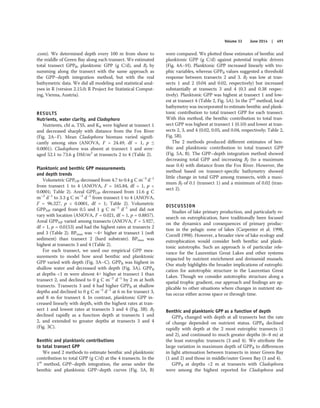
Nutrients, chl a, TSS, and Kd were highest at transect 1
and decreased sharply with distance from the Fox River
(Fig. 2A–F). Mean Cladophora biomass varied signifi-
cantly among sites (ANOVA, F = 24.49, df = 1, p ≤
0.0001). Cladophora was absent at transect 1 and aver-
aged 52.1 to 73.6 g DM/m2
at transects 2 to 4 (Table 2).
Planktonic and benthic GPP measurements
and depth trends
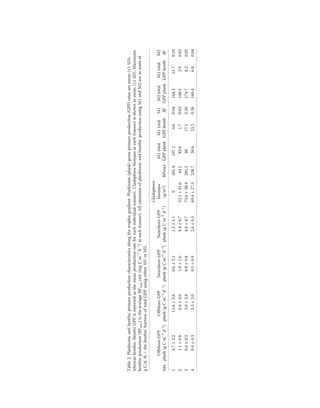
Volumetric GPPOP decreased from 4.7 to 0.4 g C m–3
d–1
from transect 1 to 4 (ANOVA, F = 165.84, df = 1, p 
0.0001; Table 2). Areal GPPOP decreased from 11.6 g C
m–2
d–1
to 3.3 g C m–2
d–1
from transect 1 to 4 (ANOVA,
F = 96.327, p  0.0001, df = 1; Table 2). Volumetric
GPPNP ranged from 0.5 and 1 g C m–3
d–1
and did not
vary with location (ANOVA, F = 0.021, df = 1, p = 0.8857).
Areal GPPNP varied among transects (ANOVA, F = 5.927,
df = 1, p = 0.0153) and had the highest rates at transects 2
and 3 (Table 2). BPmax was ∼4× higher at transect 1 (soft
sediment) than transect 2 (hard substrate). BPmax was
highest at transects 3 and 4 (Table 2).
For each transect, we used our empirical GPP mea-
surements to model how areal benthic and planktonic
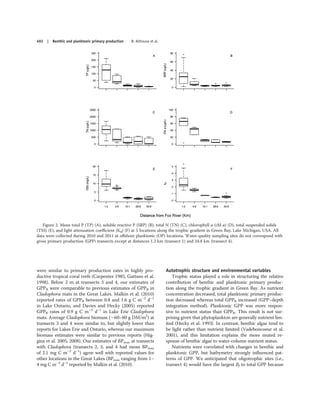
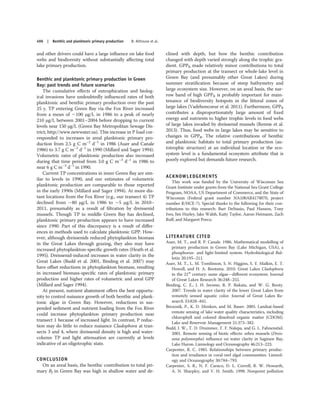
GPP varied with depth (Fig. 3A–C). GPPB was highest in
shallow water and decreased with depth (Fig. 3A). GPPB
at depths 1 m were almost 4× higher at transect 1 than
transect 2, and declined to 0 g C m–2
d–1
by 2 m at both
transects. Transects 3 and 4 had higher GPPB at shallow
depths and declined to 0 g C m–2
d–1
at 6 m for transect 3,
and 8 m for transect 4. In contrast, planktonic GPP in-
creased linearly with depth, with the highest rates at tran-
sect 1 and lowest rates at transects 3 and 4 (Fig. 3B). Bf
declined rapidly as a function depth at transects 1 and
2, and extended to greater depths at transects 3 and 4
(Fig. 3C).
Benthic and planktonic contributions
to total transect GPP
We used 2 methods to estimate benthic and planktonic
contribution to total GPP (g C/d) at the 4 transects. In the
1st
method, GPP–depth integration, the areas under the
benthic and planktonic GPP–depth curves (Fig. 3A, B)
were compared. We plotted these estimates of benthic and
planktonic GPP (g C/d) against potential trophic drivers
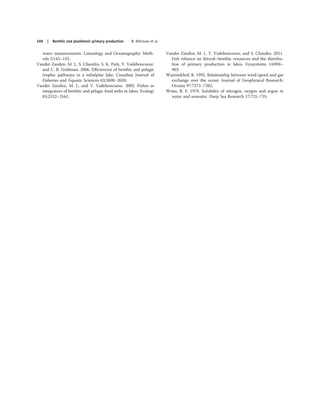
(Fig. 4A–H). Planktonic GPP increased linearly with tro-
phic variables, whereas GPPB values suggested a threshold
response between transects 2 and 3. Bf was low at tran-
sects 1 and 2 (0.04 and 0.02, respectively) but increased
substantially at transects 3 and 4 (0.3 and 0.38 respec-
tively). Planktonic GPP was highest at transect 1 and low-
est at transect 4 (Table 2, Fig. 5A). In the 2nd
method, local
bathymetry was incorporated to estimate benthic and plank-
tonic contribution to total transect GPP for each transect.
With this method, the benthic contribution to total tran-
sect GPP was highest at transect 1 (0.10) and lower at tran-
sects 2, 3, and 4 (0.02, 0.05, and 0.04, respectively; Table 2,
Fig. 5B).
The 2 methods produced different estimates of ben-
thic and planktonic contribution to total transect GPP
(Fig. 5A, B). The GPP–depth integration method showed
decreasing total GPP and increasing Bf (to a maximum
near 0.4) with distance from the Fox River. However, the
method based on transect-specific bathymetry showed
little change in total GPP among transects, with a maxi-
mum Bf of 0.1 (transect 1) and a minimum of 0.02 (tran-
sect 2).
DISCUSSION
Studies of lake primary production, and particularly re-
search on eutrophication, have traditionally been focused
on the dynamics and consequences of primary produc-
tion in the pelagic zone of lakes (Carpenter et al. 1998,
Correll 1998). However, a broader view of lake ecology and
eutrophication would consider both benthic and plank-
tonic autotrophs. Such an approach is of particular rele-
vance for the Laurentian Great Lakes and other systems
impacted by nutrient enrichment and dreissenid mussels.
Our study highlights the broader implications of eutrophi-
cation for autotrophic structure in the Laurentian Great
Lakes. Though we consider autotrophic structure along a
spatial trophic gradient, our approach and findings are ap-
plicable to other situations where changes in nutrient sta-
tus occur either across space or through time.
Benthic and planktonic GPP as a function of depth
GPPB changed with depth at all transects but the rate
of change depended on nutrient status. GPPB declined
rapidly with depth at the 2 most eutrophic transects (1
and 2), and continued to much greater depths (6–8 m) at
the least eutrophic transects (3 and 4). We attribute the
large variation in maximum depth of GPPB to differences
in light attenuation between transects in inner Green Bay
(1 and 2) and those in middle/outer Green Bay (3 and 4).
GPPB at depths 2 m at transects with Cladophora
were among the highest reported for Cladophora and
Volume 33 June 2014 | 491
were similar to primary production rates in highly pro-
ductive tropical coral reefs (Carpenter 1985, Gattuso et al.
1998). Below 2 m at transects 3 and 4, our estimates of
GPPB were comparable to previous estimates of GPPB in
Cladophora mats in the Great Lakes. Malkin et al. (2010)
reported rates of GPPB between 0.8 and 1.6 g C m–2
d–1
in Lake Ontario, and Davies and Hecky (2005) reported
GPPB rates of 0.9 g C m–2
d–1
in Lake Erie Cladophora
mats. Average Cladophora biomass (∼60–80 g DM/m2
) at
transects 3 and 4 were similar to, but slightly lower than
reports for Lakes Erie and Ontario, whereas our maximum
biomass estimates were similar to previous reports (Hig-
gins et al. 2005, 2008). Our estimates of BPmax at transects
with Cladophora (transects 2, 3, and 4 had mean BPmax
of 2.1 mg C m–2
d–1
) agree well with reported values for
other locations in the Great Lakes (BPmax ranging from 1–
4 mg C m–2
d–1
reported by Malkin et al. (2010).
Autotrophic structure and environmental variables
Trophic status played a role in structuring the relative
contribution of benthic and planktonic primary produc-
tion along the trophic gradient in Green Bay. As nutrient
concentration decreased, total planktonic primary produc-
tion decreased whereas total GPPB increased (GPP–depth
integration method). Planktonic GPP was more respon-
sive to nutrient status than GPPB. This result is not sur-
prising given that phytoplankton are generally nutrient lim-
ited (Hecky et al. 1993). In contrast, benthic algae tend to
be light rather than nutrient limited (Vadeboncoeur et al.
2001), and this limitation explains the more muted re-
sponse of benthic algae to water-column nutrient status.
Nutrients were correlated with changes in benthic and
planktonic GPP, but bathymetry strongly influenced pat-
terns of GPP. We anticipated that oligotrophic sites (i.e.,
transect 4) would have the largest Bf to total GPP because
Figure 2. Mean total P (TP) (A), soluble reactive P (SRP) (B), total N (TN) (C), chlorophyll a (chl a) (D), total suspended solids
(TSS) (E), and light attenuation coefficient (Kd) (F) at 5 locations along the trophic gradient in Green Bay, Lake Michigan, USA. All
data were collected during 2010 and 2011 at offshore planktonic (OP) locations. Water-quality sampling sites do not correspond with
gross primary production (GPP) transects except at distances 1.2 km (transect 1) and 34.8 km (transect 4).
492 | Benthic and planktonic primary production B. Althouse et al.
Table2.Planktonicandbenthicprimaryproductioncharacteristicsalongthetrophicgradient.Planktonic(plank)grossprimaryproduction(GPP)ratesaremean(±1SD),
whereasbenthic(benth)GPPisreportedasthemeanproductionrateforeachindividualtransect.Cladophorabiomassateachtransectisshownasmean(±1SD).Maximum
benthicproduction(BPmax)istheaverageBPmaxrate(mgCm–2
h–1
)ateachtransect.AllestimatesofplanktonicandbenthicproductionusingM1andM2areinunitsof
gC/d.Bf=thebenthicfractionoftotalGPPusingeitherM1orM2.
Site
OffshoreGPP
plank(gCm–3
d–1
)
OffshoreGPP
plank(gCm–2
d–1
)
NearshoreGPP
plank(gCm–3
d–1
)
NearshoreGPP
plank(gCm–2
d–1
)
Cladophora
biomass
(g/m2
)BPmax
M1total
GPPplank
M1total
GPPbenth
M1
Bf
M2total
GPPplank
M2total
GPPbenth
M2
Bf
14.7±2.211.6±5.60.6±2.11.5±5.10161.4107.14.60.04144.315.70.10
21.1±0.66.4±4.01.0±1.64.4±6.752.1±41.643.185.61.70.02148.52.90.02
30.6±0.55.0±3.80.8±0.84.8±4.773.6±38.4281.24017.10.30174.78.20.05
40.4±0.33.3±2.00.5±0.92.6±4.569.4±27.5238.738.623.20.38160.46.80.04
of increased water clarity, but we found the opposite to
be true. The most eutrophic location (transect 1), had the
greatest benthic contribution (Bf = 0.1). Thus, despite high
areal rates of GPPB at shallow depths at transect 3 and 4,
the steep bathymetry restricted GPPB to a narrow strip of
the littoral zone. Meanwhile, the high water clarity at these
sites (Fig. 2F) allowed planktonic primary production to
extend to greater depths. Our results indicate that trophic
status may be an important factor in determining the rela-
tive importance of benthic and planktonic primary produc-
tion at fine spatial scales, but bathymetry can be a driving
factor at the ecosystem level in large lakes. Considering that
much of Lake Michigan has even higher ratios of plank-
tonic volume to littoral surface area than transects 3 and
4, benthic habitats are likely to be important contributors
only in nearshore areas, whereas planktonic primary pro-
duction is the dominant contributor of fixed energy and
nutrients at the ecosystem scale.
In addition to nutrient status and bathymetry, biologi-
cal invasion also has the potential to shape autotrophic
structure. Establishment of dreissenid mussels in the Great
Lakes has sharply reduced phytoplankton biomass and light
attenuation (Brezonik et al. 2005, Binding et al. 2007) and
redirected nutrients to nearshore benthic habitats (Hecky
et al. 2004) to yield increased GPPB (Higgins et al. 2008,
Auer et al. 2010). These changes have led to increased reli-
ance on benthic resources in Great Lake food webs (Si-
erszen et al. 2006, Rennie et al. 2009) despite the domi-
nance of planktonic primary production at the whole-lake
level. GPPB may not be a significant contributor to total
ecosystem primary production, but on an areal basis, rates
of GPPB are equivalent to those occurring in coral reefs
(Carpenter 1985, Gattuso et al. 1998). This narrow band of
extremely high productivity may explain why these shallow
littoral areas are also hotspots of biodiversity in large lakes
across the globe (Vadeboncoeur et al. 2011). Furthermore,
Great Lake food webs may rely disproportionately on benthic-
derived C and could be sensitive to changes in rates of GPPB
in nearshore and littoral habitats. For these reasons, changes
in GPPB consequent to eutrophication, dreissenid mussels,
Figure 3. Benthic gross primary production (GPPB) (A), planktonic GPP (B), and the benthic fraction of total GPP (Bf) (C) as a
function of depth at transects 1 to 4. GPPB was derived from chamber estimates, whereas planktonic GPP was derived from free
water O2 dynamics and adjusted for the benthic signal.
494 | Benthic and planktonic primary production B. Althouse et al.
Figure 4. Total daily transect planktonic (A, C, E, G) and benthic (B, D, F, H) gross primary production (GPP) as a function of
soluble reactive P (SRP) (A, B), total P (TP) (C, D), total N (TN) (E, F), and the light attenuation coefficient (Kd) (G, H). Both benthic
and planktonic total transect GPP were calculated as the area under the GPP vs depth curves from the depth–integration method
(Fig. 3A–C). Data points are indicated by transect numbers (1–4).
Figure 5. Total gross primary production (GPP) and benthic contribution to total GPP calculated by the depth–integration
method (A) and using transect-specific bathymetry (B) as a function of distance from the Fox River. Points represent total daily GPP
in each transect, vertical grey lines indicate planktonic contribution to total GPP, and black diagonal lines indicate benthic
contribution to total GPP.
and other drivers could have a large influence on lake food
webs and biodiversity without substantially affecting total
lake primary production.
Benthic and planktonic primary production in Green
Bay: past trends and future scenarios
The cumulative effects of eutrophication and biolog-
ical invasions have undoubtedly influenced rates of both
planktonic and benthic primary production over the past
25 y. TP entering Green Bay via the Fox River increased
from a mean of ∼100 μg/L in 1986 to a peak of nearly
210 μg/L between 2001–2004 before dropping to current
levels near 150 μg/L (Green Bay Metropolitan Sewage Dis-
trict; http://www.newwater.us). This increase in P load cor-
responded to increases in areal planktonic primary pro-
duction from 2.5 g C m–2
d–1
in 1986 (Auer and Canale
1986) to 3.7 g C m–2
d–1
in 1990 (Millard and Sager 1994).
Volumetric rates of planktonic production also increased
during that time period from 3.0 g C m–3
d–1
in 1986 to
near 6 g C m–3
d–1
in 1990.
Current TP concentrations in inner Green Bay are sim-
ilar to levels in 1990, and our estimates of volumetric
planktonic production are comparable to those reported
in the early 1990s (Millard and Sager 1994). At more dis-
tant locations from the Fox River (e.g., our transect 4) TP
declined from ∼80 μg/L in 1986 to ∼5 μg/L in 2010–
2011, presumably as a result of filtration by dreissenid
mussels. Though TP in middle Green Bay has declined,
planktonic primary production appears to have increased
since 1990. Part of this discrepancy is a result of differ-
ences in methods used to calculate planktonic GPP. How-
ever, although dreissenids reduced phytoplankton biomass
in the Great Lakes through grazing, they also may have
increased phytoplankton-specific growth rates (Heath et al.
1995). Dreissenid-induced increases in water clarity in the
Great Lakes (Budd et al. 2001, Binding et al. 2007) may
have offset reductions in phytoplankton biomass, resulting
in increased biomass-specific rates of planktonic primary
production and higher rates of volumetric and areal GPP
(Millard and Sager 1994).
At present, nutrient abatement offers the best opportu-
nity to control nuisance growth of both benthic and plank-
tonic algae in Green Bay. However, reductions in sus-
pended sediment and nutrient loading from the Fox River
could increase phytoplankton primary production near
transect 1 because of increased light. In contrast, P reduc-
tion may do little to reduce nuisance Cladophora at tran-
sects 3 and 4, where dreissenid density is high and water-
column TP and light attenuation are currently at levels
indicative of an oligotrophic state.
CONCLUSION
On an areal basis, the benthic contribution to total pri-
mary Bf in Green Bay was high in shallow water and de-
clined with depth, but how the benthic contribution
changed with depth varied strongly along the trophic gra-
dient. GPPB made relatively minor contributions to total
primary production at the transect or whole-lake level in
Green Bay (and presumably other Great Lakes) during
summer stratification because of steep bathymetry and
large ecosystem size. However, on an areal basis, the nar-
row band of high GPPB is probably important for main-
tenance of biodiversity hotspots in the littoral zones of
large lakes (Vadeboncoeur et al. 2011). Furthermore, GPPB
contributes a disproportionately large amount of fixed
energy and nutrients to higher trophic levels in food webs
of large lakes invaded by dreissenid mussels (Rennie et al.
2013). Thus, food webs in large lakes may be sensitive to
changes in GPPB. The relative contributions of benthic
and planktonic habitats to total primary production (au-
totrophic structure) at an individual location or the eco-
system level is a fundamental ecosystem attribute that is
poorly explored but demands future research.
ACKNOWLEDGEMENTS
This work was funded by the University of Wisconsin Sea
Grant Institute under grants from the National Sea Grant College
Program, NOAA, US Department of Commerce, and the State of
Wisconsin (Federal grant number NA100AR4170070, project
number R/HCE-7). Special thanks to the following for their con-
tributions to this research: Bart DeStasio, Paul Hanson, Tony
Ives, Jim Hurley, Jake Walsh, Kaity Taylor, Aaron Heimann, Zach
Ruff, and Margaret Porco.
LITERATURE CITED
Auer, M. T., and R. P. Canale. 1986. Mathematical modelling of
primary production in Green Bay (Lake Michigan, USA), a
phosphorus- and light-limited system. Hydrobiological Bul-
letin 20:195–211.
Auer, M. T., L. M. Tomlinson, S. N. Higgins, S. Y. Malkin, E. T.
Howell, and H. A. Bootsma. 2010. Great Lakes Cladophora
in the 21st
century: same algae—different ecosystem. Journal
of Great Lakes Research 36:248–255.
Binding, C. E., J. H. Jerome, R. P. Bukata, and W. G. Booty.
2007. Trends in water clarity of the lower Great Lakes from
remotely sensed aquatic color. Journal of Great Lakes Re-
search 33:828–841.
Brezonik, P., K. D. Menken, and M. Bauer. 2005. Landsat-based
remote sensing of lake water quality characteristics, including
chlorophyll and colored dissolved organic matter (CDOM).
Lake and Reservoir Management 21:373–382.
Budd, J. W., T. D. Drummer, T. F. Nalepa, and G. L. Fahnenstiel.
2001. Remote sensing of biotic effects: zebra mussels (Dreis-
sena polymorpha) influence on water clarity in Saginaw Bay,
Lake Huron. Limnology and Oceanography 46:213–223.
Carpenter, R. C. 1985. Relationships between primary produc-
tion and irradiance in coral-reef algal communities. Limnol-
ogy and Oceanography 30:784–793.
Carpenter, S. R., N. F. Caraco, D. L. Correll, R. W. Howarth,
A. N. Sharpley, and V. H. Smith. 1998. Nonpoint pollution
496 | Benthic and planktonic primary production B. Althouse et al.
of surface waters with phosphorus and nitrogen. Ecological
Applications 8:559–568.
Carpenter, S. R., E. H. Stanley, and M. J. Vander Zanden. 2011.
State of the world’s freshwater ecosystems: physical, chemical,
and biological changes. Pages 75–99 in A. Gadgil and D. M.
Liverman (editors). Volume 36. Annual review of environ-
ment and resources. Annual Reviews, Palo Alto, California.
Cole, J. J., and N. F. Caraco. 1998. Atmospheric exchange of car-
bon dioxide in a low-wind oligotrophic lake measured by the
addition of SF6. Limnology and Oceanography 43:647–656.
Correll, D. L. 1998. The role of phosphorus in the eutrophica-
tion of receiving waters: a review. Journal of Environmental
Quality 27:261–266.
Davies, J. M., and R. E. Hecky. 2005. Initial measurements of
benthic photosynthesis and respiration in Lake Erie. Journal
of Great Lakes Research 31:195–207.
DeNicola, D. M., E. De Eyto, A. Wemaere, and K. Irvine. 2003.
Production and respiration of epilithic algal communities in
Irish lakes of different trophic status. Archiv für Hydrobiologie
157:67–87.
Fee, E. J. 1990. Computer programs for calculating in-situ phy-
toplankton photosynthesis. Canadian Technical Report of
Fisheries and Aquatic Sciences No. 1740. Department of
Fisheries and Oceans, Central and Arctic Region, Winnipeg,
Manitoba.
Gattuso, J. P., M. Frankignoulle, and R. Wollast. 1998. Carbon
and carbonate metabolism in coastal aquatic ecosystems. An-
nual Review of Ecology and Systematics 29:405–434.
Heath, R. T., G. L. Fahnenstiel, W. S. Gardner, J. F. Cavaletto, and
S. J. Hwang. 1995. Ecosystem-level effects of zebra mussels
(Dreissena polymorpha): an enclosure experiment in Saginaw
Bay, Lake Huron. Journal of Great Lakes Research 21:501–516.
Hecky, R. E., P. Campbell, and L. L. Hendzel. 1993. The stoi-
chiometry of carbon, nitrogen, and phosphorus in particu-
late matter in lakes and oceans. Limnology and Oceanogra-
phy 38:709–724.
Hecky, R. E., R. E. H. Smith, D. R. Barton, S. J. Guildford, W. D.
Taylor, M. N. Charlton, and T. Howell. 2004. The nearshore
phosphorus shunt: a consequence of ecosystem engineering
by dreissenids in the Laurentian Great Lakes. Canadian Jour-
nal of Fisheries and Aquatic Sciences 61:1285–1293.
Higgins, S. N., B. Althouse, S. P. Devlin, Y. Vadeboncoeur, and
M. J. Vander Zanden. Potential for large-bodied zooplank-
ton and dreissenids to alter the productivity and autotrophic
structure of lakes. Ecology (in press).
Higgins, S. N., R. E. Hecky, and S. J. Guildford. 2005. Modeling
the growth, biomass, and tissue phosphorus concentration
of Cladophora glomerata in eastern Lake Erie: model de-
scription and field testing. Journal of Great Lakes Research
31:439–455.
Higgins, S. N., S. Y. Malkin, E. T. Howell, S. J. Guildford, L.
Campbell, V. Hiriart-Baer, and R. E. Hecky. 2008. An eco-
logical review of Cladophora glomerata (Chlorophyta) in the
Laurentian Great Lakes. Journal of Phycology 44:839–854.
Higgins, S. N., C. M. Pennuto, E. T. Howell, T. W. Lewis, and
J. C. Makarewicz. 2012. Urban influences on Cladophora
blooms in Lake Ontario. Journal of Great Lakes Research 38:
116–123.
Higgins, S. N., and M. J. Vander Zanden. 2010. What a differ-
ence a species makes: a meta-analysis of dreissenid mussel
impacts on freshwater ecosystems. Ecological Monographs
80(2):179–196.
Lowe, R. L., and R. W. Pillsbury. 1995. Shifts in benthic algal
community structure and function following the appearance
of zebra mussels (Dreissena polymorpha) in Saginaw Bay,
Lake Huron. Journal of Great Lakes Research 21:558–566.
Malkin, S. Y., S. A. Bocaniov, R. E. Smith, S. J. Guildford, and
R. E. Hecky. 2010. In situ measurements confirm the seasonal
dominance of benthic algae over phytoplankton in near-
shore primary production of a large lake. Freshwater Biol-
ogy 55:2468–2483.
Millard, E. S., and P. E. Sager. 1994. Comparison of phospho-
rus, light climate, and photosynthesis between two culturally
eutrophied bays—Green Bay, Lake Michigan, and the Bay of
Quinte, Lake Ontario. Canadian Journal of Fisheries and
Aquatic Sciences 51:2579–2590.
Odum, H. T. 1956. Primary production in flowing waters. Lim-
nology and Oceanography 1:102–117.
Rennie, M. D., D. O. Evans, and J. D. Young. 2013. Increased
dependence on nearshore benthic resources in the Lake
Simcoe ecosystem after dreissenid invasion. Inland Waters 3:
297–310.
Rennie, M. D., W. G. Sprules, and T. B. Johnson. 2009. Re-
source switching in fish following a major food web disrup-
tion. Oecologia (Berlin) 159:789–802.
Sadro, S., J. M. Melack, and S. MacIntyre. 2011. Spatial and
temporal variability in the ecosystem metabolism of a high-
elevation lake: integrating benthic and pelagic habitats. Eco-
systems 14:1123–1140.
Sierszen, M. E., G. S. Peterson, and J. V. Scharold. 2006. Depth-
specific patterns in benthic–planktonic food web relationships
in Lake Superior. Canadian Journal of Fisheries and Aquatic
Sciences 63:1496–1503.
Staehr, P. A., D. Bade, M. C. van de Bogert, G. R. Koch, C.
Williamson, P. Hanson, J. J. Cole, and T. Kratz. 2010. Lake
metabolism and the diel oxygen technique: state of the sci-
ence. Limnology and Oceanography: Methods 8:628–644.
USGS (US Geological Survey). 1981a. New tables of dissolved
oxygen saturation values. Water Quality Technical Memo-
randum 81.11. US Geological Survey, Reston, Virginia.
USGS (US Geological Survey). 1981b. New tables of dissolved
oxygen saturation values; amendment of quality of water tech-
nical memorandum no. 81.11. Water Quality Technical Mem-
orandum 81.15. US Geological Survey, Reston, Virginia.
Vadeboncoeur, Y., D. M. Lodge, and S. R. Carpenter. 2001.
Whole-lake fertilization effects on distribution of primary pro-
duction between benthic and pelagic habitats. Ecology 82:
1065–1077.
Vadeboncoeur, Y., P. B. McIntyre, and M. J. Vander Zanden.
2011. Borders of biodiversity: life at the edge of the world’s
large lakes. BioScience 61:526–537.
Vadeboncoeur, Y., G. Peterson, M. J. Vander Zanden, and J.
Kalff. 2008. Benthic algal production across lake size gra-
dients: interactions among morphometry, nutrients, and light.
Ecology 89:2542–2552.
Vadeboncoeur, Y., M. J. Vander Zanden, and D. M. Lodge.
2002. Putting the lake back together: reintegrating benthic
pathways into lake food web models. BioScience 52:44–54.
van de Bogert, M. C., S. R. Carpenter, J. J. Cole, and M. L. Pace.
2007. Assessing pelagic and benthic metabolism using free
Volume 33 June 2014 | 497
water measurements. Limnology and Oceanography: Meth-
ods 5:145–155.
Vander Zanden, M. J., S. Chandra, S. K. Park, Y. Vadeboncoeur,
and C. R. Goldman. 2006. Efficiencies of benthic and pelagic
trophic pathways in a subalpine lake. Canadian Journal of
Fisheries and Aquatic Sciences 63:2608–2620.
Vander Zanden, M. J., and Y. Vadeboncoeur. 2002. Fishes as
integrators of benthic and pelagic food webs in lakes. Ecology
83:2152–2161.
Vander Zanden, M. J., Y. Vadeboncoeur, and S. Chandra. 2011.
Fish reliance on littoral–benthic resources and the distribu-
tion of primary production in lakes. Ecosystems 14:894–
903.
Wanninkhof, R. 1992. Relationship between wind-speed and gas
exchange over the ocean. Journal of Geophysical Research:
Oceans 97:7373–7382.
Weiss, R. F. 1970. Solubility of nitrogen, oxygen and argon in
water and seawater. Deep Sea Research 17:721–735.
498 | Benthic and planktonic primary production B. Althouse et al.

Althouse et al. 2014

  • 1.
    BioOne sees sustainablescholarly publishing as an inherently collaborative enterprise connecting authors, nonprofit publishers, academic institutions, research libraries, and research funders in the common goal of maximizing access to critical research. Benthic and planktonic primary production along a nutrient gradient in Green Bay, Lake Michigan, USA Author(s): Bryan Althouse, Scott Higgins, and M. Jake Vander Zanden Source: Freshwater Science, 33(2):487-498. Published By: The Society for Freshwater Science URL: http://www.bioone.org/doi/full/10.1086/676314 BioOne (www.bioone.org) is a nonprofit, online aggregation of core research in the biological, ecological, and environmental sciences. BioOne provides a sustainable online platform for over 170 journals and books published by nonprofit societies, associations, museums, institutions, and presses. Your use of this PDF, the BioOne Web site, and all posted and associated content indicates your acceptance of BioOne’s Terms of Use, available at www.bioone.org/page/terms_of_use. Usage of BioOne content is strictly limited to personal, educational, and non-commercial use. Commercial inquiries or rights and permissions requests should be directed to the individual publisher as copyright holder.
  • 2.
    LAKE BENTHIC ALGAE Benthicand planktonic primary production along a nutrient gradient in Green Bay, Lake Michigan, USA Bryan Althouse1,2 , Scott Higgins1,3 , and M. Jake Vander Zanden1,4 1 Center for Limnology, University of Wisconsin-Madison, 680 North Park Street, Madison Wisconsin 53706 USA Abstract: Primary production in lakes occurs in both planktonic (water column) and benthic (bottom) habitats. How whole-lake primary production is distributed between these 2 habitats—referred to as autotrophic structure— is a key ecosystem property. Empirical research examining the balance between benthic and planktonic primary production in lakes is scarce, and how autotrophic structure changes across depth, nutrient, water clarity, and biological invasion gradients is unclear. Therefore, we are ill equipped to anticipate ecosystem-level responses to environmental change. We assessed the magnitude of offshore planktonic, nearshore planktonic, and nearshore benthic gross primary production (GPP) along a gradient of nutrients, water clarity, and Cladophora biomass in Green Bay, Lake Michigan, USA, during summer 2010, 2011, and 2012. Benthic and planktonic GPP varied strongly along the trophic gradient. Planktonic GPP increased with nutrients status, whereas benthic GPP de- creased. From shore to 10 m depth, autotrophic structure shifted from planktonic dominance near the mouth of the Fox River (95% planktonic) to a mix of benthic and planktonic GPP 35 km from the mouth of the Fox (∼40% benthic). The steep bathymetry at more-distant sites reduced the relative importance of benthic GPP at the whole-ecosystem level. Our work highlights the dual-pathway (i.e., benthic and planktonic) nature of lentic food webs from the perspective of GPP, and shows how both trophic status and bathymetry affect autotrophic structure. Key words: benthic primary production, planktonic primary production, autotrophic structure, dreissenids, Cladophora, eutrophication, nutrients, Lake Michigan, Green Bay, Laurentian Great Lakes Researchers studying lakes have emphasized measurement of planktonic primary production and processes (Vade- boncoeur et al. 2002) with particular emphasis on plank- tonic primary production in studies of eutrophication (Car- penter et al. 1998, Correll 1998). However, recognition is growing that substantial primary production occurs in both planktonic and benthic habitats. How whole-lake primary production (planktonic + benthic) is distributed between these 2 habitats is a poorly understood, but fundamental ecosystem property referred to as the autotrophic structure (Higgins et al., in press). Little understanding exists of how primary production is partitioned between these habitats, how partitioning varies along environmental gradients, and the effects of environmental change on autotrophic struc- ture. Benthic primary production can be a significant contrib- utor to littoral zone, and sometimes to whole-lake, primary production (Vadeboncoeur et al. 2001, 2008, DeNicola et al. 2003, van de Bogert et al. 2007, Sadro et al. 2011). Even in lakes where benthic habitats are a minor contributor to whole-lake primary production, top predators generally as- similate C fixed by both benthic and planktonic autotrophs (Vander Zanden and Vadeboncoeur 2002, Vander Zanden et al. 2011), often leading to a disproportionately high impor- tance of benthic primary production as a source of energy for higher trophic levels relative to its contribution to whole- lake primary production (Vander Zanden et al. 2006). Nearshore benthic habitats in Lake Erie and Lake On- tario are primary production hotspots, with areal rates of benthic primary production equal to or exceeding plank- tonic primary production down to depths of 12 m (De- Nicola et al. 2003, Davies and Hecky 2005, Malkin et al. 2010). These high rates of primary production are associ- ated with mats of the filamentous green macroalga Clado- phora glomerata, which are a widespread problem through- out coastal areas of the lower Laurentian Great Lakes (DeNicola et al. 2003, Davies and Hecky 2005, Malkin et al. 2010). In these ecosystems, the growth and biomass accrual E-mail addresses: 2 balthouse@gmail.com; 3 Present address: Fisheries and Oceans Canada, 501 University Crescent, Winnipeg, Manitoba, Canada R3T 2N6, scott.higgins@dfo-mpo.gc.ca; 4 To whom correspondence should be addressed, mjvanderzand@wisc.edu DOI: 10.1086/676314. Received 13 August 2013; Accepted 6 November 2013; Published online 27 March 2014. Freshwater Science. 2014. 33(2):487–498. © 2014 by The Society for Freshwater Science. 487
  • 3.
    of Cladophora iscontrolled primarily by the availability of hard substratum (e.g., rocky lake bottom) for attachment of filaments, water clarity, and the supply of bioavailable P (Higgins et al. 2008). Cladophora blooms were a com- mon problem in the Great Lakes from the 1950s through the early 1980s, but successful implementation of strict P-abatement programs as part of the Canada–USA Great Lakes Water Quality agreement reduced total P (TP) load- ing and concentrations to levels that significantly reduced growth rates and biomass (Higgins et al. 2008). The resur- gence of widespread Cladophora blooms in the Great Lakes has been attributed to the arrival of the nonnative zebra mussel (Dreissena polymorpha) and quagga mussel (Dreissena rostriformis bugensis) (Hecky et al. 2004, Auer et al. 2010). Dreissenids have a well described set of effects on lakes: reduced phytoplankton biomass and primary pro- duction, increased light penetration, increased bioavail- ability of P at the sediment–water interface, and increased biomass and primary production of benthic primary pro- ducers (Lowe and Pillsbury 1995, Hecky et al. 2004, Hig- gins et al. 2008, Higgins and Vander Zanden 2010). Some investigators have measured the balance between benthic and planktonic primary production in lakes (Mal- kin et al. 2010, Sadro et al. 2011), but most investiga- tors have not considered how autotrophic structure varies along key ecological gradients, such as nutrient status and water clarity. In the coming decades, nutrient-abatement efforts paired with global environmental change will alter nutrient regimes, shift temperature and precipitation pat- terns, and bring new species invasions (Carpenter et al. 2011). Our limited understanding of lake autotrophic struc- ture leaves researchers and resource managers ill equipped to anticipate how lake ecosystems will respond to such changes. Green Bay, Lake Michigan, USA, presents a unique op- portunity to study how autotrophic structure varies across key gradients (e.g., nutrient levels and water clarity) within a single ecosystem. Large inputs of nutrients and sediment from the Fox River lead to nutrient-enriched and turbid waters within inner Green Bay. However, trophic status de- creases and water clarity increases with distance from the Fox River. Differences in basin morphology, which can in- fluence the available habitat for benthic autotrophs, also occur with increasing distance from the Fox River. Water depths are shallow near the mouth of the Fox River but give way to deeper water and steep slopes in middle and outer Green Bay. We assessed how autotrophic structure varies along these gradients in a large lake basin during the summer stratification period. METHODS Study sites We measured benthic and planktonic gross primary production (GPP) at 4 transects along Green Bay’s nutri- ent gradient. GPP transects were 1.2, 12.8, 22.4, and 34.8 km from the mouth of the Fox River (transects 1, 2, 3, and 4, respectively; Fig. 1) at locations selected to span the full trophic gradient of Green Bay. At each transect, we used chamber incubations to estimate nearshore ben- thic GPP (GPPB) and free-water gas dynamics to estimate nearshore planktonic GPP (GPPNP) and offshore plank- tonic GPP (GPPOP). At transect 1, benthic substrate con- sisted almost entirely of mud and sand. Transect 2 had a mixture of sand, gravel, and small rocks. Substrate at tran- sects 3 and 4 was composed almost entirely of medium to large rocks. Water chemistry We measured total P (TP), soluble reactive P (SRP), total N (TN), chlorophyll a (chl a), total suspended sol- ids (TSS), and the light attenuation coefficient (Kd) at 5 offshore locations along the trophic gradient every 2 wk during June–August 2010 and 2011 (14–25 sampling events/transect). We transported water samples to the laboratory on ice where samples were frozen (SRP, TSS, chl a) or treated with a weak solution of HCL (TP, TN). Samples were processed by the US Geological Survey (USGS)-certified water-chemistry laboratory at Univer- sity of Wisconsin-Madison within 3 wk of field collec- tion. We estimated Kd from vertical light profiles, taken Figure 1. Map of Green Bay, Lake Michigan, USA. Dashed lines represent transects 1 to 4. 488 | Benthic and planktonic primary production B. Althouse et al.
  • 4.
    at 1-m depthintervals with a LI-COR 250A underwater light meter with a flat-plate (LI-192) sensor (LI-COR, Lincoln, Nebraska). Cladophora biomass We estimated Cladophora % cover at 1-m depth once a month from late May to late August (with the exception of transect 1, which lacked Cladophora) with a 0.33-m2 quadrat at 10 locations at each transect. We estimated Cladophora biomass from an empirical relationship be- tween Cladophora % cover and biomass (sensu Higgins et al. 2005) developed by direct comparison of these var- iables measured at a subset of locations and dates. We es- timated Cladophora % cover visually within each quadrat, harvested Cladophora filaments by hand, and transferred them to a mesh bag. We blotted Cladophora filaments with a paper towel and weighed them to estimate wet mass (WM; g). We dried filaments overnight at 60°C and re- weighed them to estimate dry mass (DM; g). The relation- ship between % cover and WM was linear: biomass = 0.88 (% cover) (CV = 0.22), with no significant difference in the multiplier among categories (5, 10, and 100%) of % cover. We converted estimated WM to DM with our empirically derived equation: ln(DM) = 0.86ln(WM) – 1.37 (r2 = 0.88, p < 0.0001, F = 653.9, n = 85, df = 86), and expressed values as g/m2 . We averaged estimates of DM/m2 for each tran- sect and used them in subsequent calculations (see GPPB estimates below). Planktonic primary production We estimated GPPOP and GPPNP from June to August 2010, 2011, and 2012 from diurnal fluctuations of O2 and estimates of air–water gas exchange. At each transect, we deployed a YSI multiparameter sonde (model 6600 V2-4; Yellow Springs Instruments, Yellow Springs, Ohio) at 1.5-m depth in the middle of the Bay (OP) and ∼1 km from shore (NP). We measured dissolved O2 (DO) and temperature ev- ery 15 min. We used the bookkeeping method to estimate GPP from free-water DO (Odum 1956) GPP ¼ NEP þ R þ D (Eq. 1) where NEP = net ecosystem production, R = ecosystem res- piration, and D = rate of diffusion between lake and at- mosphere (see Table 1 for symbol definitions) (Odum 1956). GPP estimates can be converted from O2 to C units by mul- tiplying by 0.375 and can be converted from C to O2 units by multiplying by 2.667. We calculated instantaneous rates of volumetric NEP (NEPt) over 15-min intervals with the equations outlined by Staehr et al. (2010) so that NEPt ¼ ΔO2−Dt (Eq. 2) Dt ¼ kðYt− O2satÞ=z (Eq. 3) where t = time interval, k is the coefficient of gas exchange between the water surface and the atmosphere, z = depth of integration, Yt = DO concentration at time t, and O2sat was derived using the equation of Weiss (1970) and cor- rected for barometric pressure using the methods in USGS memoranda 81.11 and 81.15 (USGS 1981a, b). k ¼ k600ðSc=600Þ−1=2 (Eq. 4) where Sc ¼ 0:0476T2 þ 3:7818T2 −120:1T þ 1800:6 (Eq. 5) (Wanninkhof 1992) and k600 ¼ ð2:07 þ 0:215U 1:7 10 Þ=100 (Eq. 6) (Cole and Caraco 1998) where T = temperature and U10 = wind speed 10 m above the ground. We obtained wind data from the National Oceanic and Atmospheric Admin- istration’s (NOAA) National Data Buoy Center for a lo- cation (lat 45°5′45′′N, long 87°35′24′′W) near Marinette, Wisconsin (www.ndbc.noaa.gov/station_page.php?station =mnmm4). We summed NEPt obtained from each 15-min Table 1. Definition of symbols used in the model. Symbol Definition Units Y Dissolved O2 concentration at time t μM ΔO2 Difference in dissolved O2 concentration between time t and time t +1 μM t Time Day fraction T Temperature °C NEPt Instantaneous rate of net ecosystem production g C m–2 d–1 GPP Daily volumetric rate of gross primary production g C m–2 d–1 R Daily volumetric rate of respiration g C m–2 d–1 Dt Instantaneous rate of diffusion between lake and atmosphere g C m–2 d–1 z Depth of integration at location x m k Coefficient of gas exchange m/h k600 Coefficient of gas exchange with a Schmidt number = 600 m/h O2sat O2 saturation as a function of temperature mg/L Sc Schmidt coefficient Dimensionless U10 Wind speed 10 m above the ground m/s Volume 33 June 2014 | 489
  • 5.
    time step toobtain daily estimates of NEP (g C m–3 d–1 ). We estimated daytime R from the average nocturnal R for the evenings before and after each daytime period. We calculated daily GPP (g C m–3 d–1 ) by summing daily NEP and daily R. We converted volumetric rates to areal rates (g C m–2 d–1 ) by multiplying volumetric rates by the depth of the mixed layer or the water depth (if mixed layer > water depth). Where water depth was shallower than the mixed layer depth, we corrected planktonic GPP for the ben- thic signal by adding the depth-specific benthic net pri- mary production (NPP; see following section). For each transect, we calculated the average GPPOP and GPPNP. As noted elsewhere (e.g., Staehr et al. 2010), our approach is based on the assumption that daytime and nocturnal R are equivalent. If daytime R exceeds nocturnal R, our estimates of NEP will be unaffected, but estimates of GPP will be elevated. GPPB We did benthic chamber incubations 3 to 4 times at each transect. At transects 2, 3, and 4, we collected rocks with attached Cladophora from 1-m depth and placed them in 2-L clear Plexiglas® chambers. We incubated a total of 6 chambers across a range of light levels (created by screening material, and including ≥1 completely opaque chamber) for 45 to 90 min under natural sunlight at ambi- ent lake temperature. We measured ambient and within- chamber photosynthetically active radiation (PAR) with a Li-Cor 250A light meter every 30 min and temperature and DO inside each chamber with a YSI ProODO probe inserted through a sampling port every 15 min. Before the first DO and temperature readings, we placed all chambers in the dark with the top gasket removed for 5 min. Water in the chambers was mixed gently via the natural move- ment of the surrounding water and by a mixing paddle built into the chambers. Benthic substrata at transect 1 consisted of sand and mud and lacked Cladophora. We collected sediment cores with ∼1-L (5.5-cm diameter) clear Plexiglas chambers and measured temperature and DO in situ. We sealed the cores on both ends and incubated them with the method described above. We agitated cores gently by hand every 15 min rather than with a paddle. At the end of the incu- bation, we measured temperature and DO in each cham- ber and compared them to initial conditions measured in situ. We estimated NPP in each chamber from the net change in DO during the incubation, corrected for cham- ber volume. We converted values from O2 to C units by multiplying by 0.375 (photosynthetic quotient of 1; Davies and Hecky 2005). At transects 2, 3, and 4, we normalized C fixation to Cladophora DM in each chamber, after col- lecting, drying (37.7°C, 24 h), and weighing collected mate- rial. We calculated GPPB with data obtained from the incu- bations. We set light intensity at the onset of photosatu- ration (IK) to 300 μmol photons m–2 s–1 , which is near the middle of IK values reported in a literature review of Clad- ophora (Higgins et al. 2008). We calculated the maximum rate of GPPB (BPmax) as the average GPPB in chambers receiving >300 μmol photons m–2 s–1 . We used this ap- proach because it yielded more robust estimates of BPmax than did dynamically fitting incubation data to saturation- tangent functions used to fit photosynthetic–irradiation (PI) curves to incubation data. We modeled daily GPPB at each transect by inserting average BPmax into the equation GPPB ¼ BPmaxtanh I0e −Kd½depthŠ ΙΚ (Eq. 7) (Vadeboncoeur et al. 2008) where Kd is the average light attenuation coefficient at that transect, depth is 1 m, and surface light (I0) was modeled as a sine function and esti- mated at 15-min intervals with the equations by Fee (1990). We summed rates of GPPB corresponding to each modeled solar-irradiance value to estimate daily GPPB (g C m–2 d–1 ). To scale biomass-specific GPPB up to areal GPPB at tran- sects 2, 3, and 4, we multiplied biomass-specific GPPB by average Cladophora DM/m2 at 1 m depth for each transect. Data manipulation We used estimates of benthic and planktonic GPP to model areal (g C m–2 d–1 ) GPP–depth curves from the 0 to 10-m depths at each transect. We modeled GPPB every 0.5 m with average BPmax from each transect and the equations used to estimate GPPB (see previous section; Fee 1990, Vadeboncoeur et al. 2008). We estimated areal planktonic GPP at each 0.5-m depth by integrating the average daily volumetric GPPOP (g C m–2 d–1 ) at that transect to depth. At each depth, we summed benthic and planktonic GPP to estimate depth-specific total GPP (ben- thic + planktonic). We calculated the benthic fraction (Bf) of total GPP as Bf = GPPB/total GPP. To evaluate how GPPB, planktonic GPP, and their rela- tive importance (autotrophic structure) varied along the trophic gradient, we integrated the area under benthic and planktonic GPP–depth curves. This produced an overall pic- ture of the contributions of benthic and planktonic produc- tion to total primary production at each transect, but did not incorporate among-site differences in bathymetry. We call this approach the GPP–depth integration method, which is based on the approach of Higgins et al. (2012). We expanded upon the GPP–depth integration method by incorporating transect-specific bathymetric data. We obtained bathymetric data from a NOAA nautical map of Green Bay (OceanGrafix chart 14910; www.mdnautical 490 | Benthic and planktonic primary production B. Althouse et al.
  • 6.
    .com). We determineddepth every 100 m from shore to the middle of Green Bay along each transect. We estimated total transect GPPB, planktonic GPP (g C/d), and Bf by summing along the transect with the same approach as the GPP–depth integration method, but with the real bathymetric data. We did all modeling and statistical anal- yses in R (version 2.15.0; R Project for Statistical Comput- ing, Vienna, Austria). RESULTS Nutrients, water clarity, and Cladophora Nutrients, chl a, TSS, and Kd were highest at transect 1 and decreased sharply with distance from the Fox River (Fig. 2A–F). Mean Cladophora biomass varied signifi- cantly among sites (ANOVA, F = 24.49, df = 1, p ≤ 0.0001). Cladophora was absent at transect 1 and aver- aged 52.1 to 73.6 g DM/m2 at transects 2 to 4 (Table 2). Planktonic and benthic GPP measurements and depth trends Volumetric GPPOP decreased from 4.7 to 0.4 g C m–3 d–1 from transect 1 to 4 (ANOVA, F = 165.84, df = 1, p 0.0001; Table 2). Areal GPPOP decreased from 11.6 g C m–2 d–1 to 3.3 g C m–2 d–1 from transect 1 to 4 (ANOVA, F = 96.327, p 0.0001, df = 1; Table 2). Volumetric GPPNP ranged from 0.5 and 1 g C m–3 d–1 and did not vary with location (ANOVA, F = 0.021, df = 1, p = 0.8857). Areal GPPNP varied among transects (ANOVA, F = 5.927, df = 1, p = 0.0153) and had the highest rates at transects 2 and 3 (Table 2). BPmax was ∼4× higher at transect 1 (soft sediment) than transect 2 (hard substrate). BPmax was highest at transects 3 and 4 (Table 2). For each transect, we used our empirical GPP mea- surements to model how areal benthic and planktonic GPP varied with depth (Fig. 3A–C). GPPB was highest in shallow water and decreased with depth (Fig. 3A). GPPB at depths 1 m were almost 4× higher at transect 1 than transect 2, and declined to 0 g C m–2 d–1 by 2 m at both transects. Transects 3 and 4 had higher GPPB at shallow depths and declined to 0 g C m–2 d–1 at 6 m for transect 3, and 8 m for transect 4. In contrast, planktonic GPP in- creased linearly with depth, with the highest rates at tran- sect 1 and lowest rates at transects 3 and 4 (Fig. 3B). Bf declined rapidly as a function depth at transects 1 and 2, and extended to greater depths at transects 3 and 4 (Fig. 3C). Benthic and planktonic contributions to total transect GPP We used 2 methods to estimate benthic and planktonic contribution to total GPP (g C/d) at the 4 transects. In the 1st method, GPP–depth integration, the areas under the benthic and planktonic GPP–depth curves (Fig. 3A, B) were compared. We plotted these estimates of benthic and planktonic GPP (g C/d) against potential trophic drivers (Fig. 4A–H). Planktonic GPP increased linearly with tro- phic variables, whereas GPPB values suggested a threshold response between transects 2 and 3. Bf was low at tran- sects 1 and 2 (0.04 and 0.02, respectively) but increased substantially at transects 3 and 4 (0.3 and 0.38 respec- tively). Planktonic GPP was highest at transect 1 and low- est at transect 4 (Table 2, Fig. 5A). In the 2nd method, local bathymetry was incorporated to estimate benthic and plank- tonic contribution to total transect GPP for each transect. With this method, the benthic contribution to total tran- sect GPP was highest at transect 1 (0.10) and lower at tran- sects 2, 3, and 4 (0.02, 0.05, and 0.04, respectively; Table 2, Fig. 5B). The 2 methods produced different estimates of ben- thic and planktonic contribution to total transect GPP (Fig. 5A, B). The GPP–depth integration method showed decreasing total GPP and increasing Bf (to a maximum near 0.4) with distance from the Fox River. However, the method based on transect-specific bathymetry showed little change in total GPP among transects, with a maxi- mum Bf of 0.1 (transect 1) and a minimum of 0.02 (tran- sect 2). DISCUSSION Studies of lake primary production, and particularly re- search on eutrophication, have traditionally been focused on the dynamics and consequences of primary produc- tion in the pelagic zone of lakes (Carpenter et al. 1998, Correll 1998). However, a broader view of lake ecology and eutrophication would consider both benthic and plank- tonic autotrophs. Such an approach is of particular rele- vance for the Laurentian Great Lakes and other systems impacted by nutrient enrichment and dreissenid mussels. Our study highlights the broader implications of eutrophi- cation for autotrophic structure in the Laurentian Great Lakes. Though we consider autotrophic structure along a spatial trophic gradient, our approach and findings are ap- plicable to other situations where changes in nutrient sta- tus occur either across space or through time. Benthic and planktonic GPP as a function of depth GPPB changed with depth at all transects but the rate of change depended on nutrient status. GPPB declined rapidly with depth at the 2 most eutrophic transects (1 and 2), and continued to much greater depths (6–8 m) at the least eutrophic transects (3 and 4). We attribute the large variation in maximum depth of GPPB to differences in light attenuation between transects in inner Green Bay (1 and 2) and those in middle/outer Green Bay (3 and 4). GPPB at depths 2 m at transects with Cladophora were among the highest reported for Cladophora and Volume 33 June 2014 | 491
  • 7.
    were similar toprimary production rates in highly pro- ductive tropical coral reefs (Carpenter 1985, Gattuso et al. 1998). Below 2 m at transects 3 and 4, our estimates of GPPB were comparable to previous estimates of GPPB in Cladophora mats in the Great Lakes. Malkin et al. (2010) reported rates of GPPB between 0.8 and 1.6 g C m–2 d–1 in Lake Ontario, and Davies and Hecky (2005) reported GPPB rates of 0.9 g C m–2 d–1 in Lake Erie Cladophora mats. Average Cladophora biomass (∼60–80 g DM/m2 ) at transects 3 and 4 were similar to, but slightly lower than reports for Lakes Erie and Ontario, whereas our maximum biomass estimates were similar to previous reports (Hig- gins et al. 2005, 2008). Our estimates of BPmax at transects with Cladophora (transects 2, 3, and 4 had mean BPmax of 2.1 mg C m–2 d–1 ) agree well with reported values for other locations in the Great Lakes (BPmax ranging from 1– 4 mg C m–2 d–1 reported by Malkin et al. (2010). Autotrophic structure and environmental variables Trophic status played a role in structuring the relative contribution of benthic and planktonic primary produc- tion along the trophic gradient in Green Bay. As nutrient concentration decreased, total planktonic primary produc- tion decreased whereas total GPPB increased (GPP–depth integration method). Planktonic GPP was more respon- sive to nutrient status than GPPB. This result is not sur- prising given that phytoplankton are generally nutrient lim- ited (Hecky et al. 1993). In contrast, benthic algae tend to be light rather than nutrient limited (Vadeboncoeur et al. 2001), and this limitation explains the more muted re- sponse of benthic algae to water-column nutrient status. Nutrients were correlated with changes in benthic and planktonic GPP, but bathymetry strongly influenced pat- terns of GPP. We anticipated that oligotrophic sites (i.e., transect 4) would have the largest Bf to total GPP because Figure 2. Mean total P (TP) (A), soluble reactive P (SRP) (B), total N (TN) (C), chlorophyll a (chl a) (D), total suspended solids (TSS) (E), and light attenuation coefficient (Kd) (F) at 5 locations along the trophic gradient in Green Bay, Lake Michigan, USA. All data were collected during 2010 and 2011 at offshore planktonic (OP) locations. Water-quality sampling sites do not correspond with gross primary production (GPP) transects except at distances 1.2 km (transect 1) and 34.8 km (transect 4). 492 | Benthic and planktonic primary production B. Althouse et al.
  • 8.
    Table2.Planktonicandbenthicprimaryproductioncharacteristicsalongthetrophicgradient.Planktonic(plank)grossprimaryproduction(GPP)ratesaremean(±1SD), whereasbenthic(benth)GPPisreportedasthemeanproductionrateforeachindividualtransect.Cladophorabiomassateachtransectisshownasmean(±1SD).Maximum benthicproduction(BPmax)istheaverageBPmaxrate(mgCm–2 h–1 )ateachtransect.AllestimatesofplanktonicandbenthicproductionusingM1andM2areinunitsof gC/d.Bf=thebenthicfractionoftotalGPPusingeitherM1orM2. Site OffshoreGPP plank(gCm–3 d–1 ) OffshoreGPP plank(gCm–2 d–1 ) NearshoreGPP plank(gCm–3 d–1 ) NearshoreGPP plank(gCm–2 d–1 ) Cladophora biomass (g/m2 )BPmax M1total GPPplank M1total GPPbenth M1 Bf M2total GPPplank M2total GPPbenth M2 Bf 14.7±2.211.6±5.60.6±2.11.5±5.10161.4107.14.60.04144.315.70.10 21.1±0.66.4±4.01.0±1.64.4±6.752.1±41.643.185.61.70.02148.52.90.02 30.6±0.55.0±3.80.8±0.84.8±4.773.6±38.4281.24017.10.30174.78.20.05 40.4±0.33.3±2.00.5±0.92.6±4.569.4±27.5238.738.623.20.38160.46.80.04
  • 9.
    of increased waterclarity, but we found the opposite to be true. The most eutrophic location (transect 1), had the greatest benthic contribution (Bf = 0.1). Thus, despite high areal rates of GPPB at shallow depths at transect 3 and 4, the steep bathymetry restricted GPPB to a narrow strip of the littoral zone. Meanwhile, the high water clarity at these sites (Fig. 2F) allowed planktonic primary production to extend to greater depths. Our results indicate that trophic status may be an important factor in determining the rela- tive importance of benthic and planktonic primary produc- tion at fine spatial scales, but bathymetry can be a driving factor at the ecosystem level in large lakes. Considering that much of Lake Michigan has even higher ratios of plank- tonic volume to littoral surface area than transects 3 and 4, benthic habitats are likely to be important contributors only in nearshore areas, whereas planktonic primary pro- duction is the dominant contributor of fixed energy and nutrients at the ecosystem scale. In addition to nutrient status and bathymetry, biologi- cal invasion also has the potential to shape autotrophic structure. Establishment of dreissenid mussels in the Great Lakes has sharply reduced phytoplankton biomass and light attenuation (Brezonik et al. 2005, Binding et al. 2007) and redirected nutrients to nearshore benthic habitats (Hecky et al. 2004) to yield increased GPPB (Higgins et al. 2008, Auer et al. 2010). These changes have led to increased reli- ance on benthic resources in Great Lake food webs (Si- erszen et al. 2006, Rennie et al. 2009) despite the domi- nance of planktonic primary production at the whole-lake level. GPPB may not be a significant contributor to total ecosystem primary production, but on an areal basis, rates of GPPB are equivalent to those occurring in coral reefs (Carpenter 1985, Gattuso et al. 1998). This narrow band of extremely high productivity may explain why these shallow littoral areas are also hotspots of biodiversity in large lakes across the globe (Vadeboncoeur et al. 2011). Furthermore, Great Lake food webs may rely disproportionately on benthic- derived C and could be sensitive to changes in rates of GPPB in nearshore and littoral habitats. For these reasons, changes in GPPB consequent to eutrophication, dreissenid mussels, Figure 3. Benthic gross primary production (GPPB) (A), planktonic GPP (B), and the benthic fraction of total GPP (Bf) (C) as a function of depth at transects 1 to 4. GPPB was derived from chamber estimates, whereas planktonic GPP was derived from free water O2 dynamics and adjusted for the benthic signal. 494 | Benthic and planktonic primary production B. Althouse et al.
  • 10.
    Figure 4. Totaldaily transect planktonic (A, C, E, G) and benthic (B, D, F, H) gross primary production (GPP) as a function of soluble reactive P (SRP) (A, B), total P (TP) (C, D), total N (TN) (E, F), and the light attenuation coefficient (Kd) (G, H). Both benthic and planktonic total transect GPP were calculated as the area under the GPP vs depth curves from the depth–integration method (Fig. 3A–C). Data points are indicated by transect numbers (1–4). Figure 5. Total gross primary production (GPP) and benthic contribution to total GPP calculated by the depth–integration method (A) and using transect-specific bathymetry (B) as a function of distance from the Fox River. Points represent total daily GPP in each transect, vertical grey lines indicate planktonic contribution to total GPP, and black diagonal lines indicate benthic contribution to total GPP.
  • 11.
    and other driverscould have a large influence on lake food webs and biodiversity without substantially affecting total lake primary production. Benthic and planktonic primary production in Green Bay: past trends and future scenarios The cumulative effects of eutrophication and biolog- ical invasions have undoubtedly influenced rates of both planktonic and benthic primary production over the past 25 y. TP entering Green Bay via the Fox River increased from a mean of ∼100 μg/L in 1986 to a peak of nearly 210 μg/L between 2001–2004 before dropping to current levels near 150 μg/L (Green Bay Metropolitan Sewage Dis- trict; http://www.newwater.us). This increase in P load cor- responded to increases in areal planktonic primary pro- duction from 2.5 g C m–2 d–1 in 1986 (Auer and Canale 1986) to 3.7 g C m–2 d–1 in 1990 (Millard and Sager 1994). Volumetric rates of planktonic production also increased during that time period from 3.0 g C m–3 d–1 in 1986 to near 6 g C m–3 d–1 in 1990. Current TP concentrations in inner Green Bay are sim- ilar to levels in 1990, and our estimates of volumetric planktonic production are comparable to those reported in the early 1990s (Millard and Sager 1994). At more dis- tant locations from the Fox River (e.g., our transect 4) TP declined from ∼80 μg/L in 1986 to ∼5 μg/L in 2010– 2011, presumably as a result of filtration by dreissenid mussels. Though TP in middle Green Bay has declined, planktonic primary production appears to have increased since 1990. Part of this discrepancy is a result of differ- ences in methods used to calculate planktonic GPP. How- ever, although dreissenids reduced phytoplankton biomass in the Great Lakes through grazing, they also may have increased phytoplankton-specific growth rates (Heath et al. 1995). Dreissenid-induced increases in water clarity in the Great Lakes (Budd et al. 2001, Binding et al. 2007) may have offset reductions in phytoplankton biomass, resulting in increased biomass-specific rates of planktonic primary production and higher rates of volumetric and areal GPP (Millard and Sager 1994). At present, nutrient abatement offers the best opportu- nity to control nuisance growth of both benthic and plank- tonic algae in Green Bay. However, reductions in sus- pended sediment and nutrient loading from the Fox River could increase phytoplankton primary production near transect 1 because of increased light. In contrast, P reduc- tion may do little to reduce nuisance Cladophora at tran- sects 3 and 4, where dreissenid density is high and water- column TP and light attenuation are currently at levels indicative of an oligotrophic state. CONCLUSION On an areal basis, the benthic contribution to total pri- mary Bf in Green Bay was high in shallow water and de- clined with depth, but how the benthic contribution changed with depth varied strongly along the trophic gra- dient. GPPB made relatively minor contributions to total primary production at the transect or whole-lake level in Green Bay (and presumably other Great Lakes) during summer stratification because of steep bathymetry and large ecosystem size. However, on an areal basis, the nar- row band of high GPPB is probably important for main- tenance of biodiversity hotspots in the littoral zones of large lakes (Vadeboncoeur et al. 2011). Furthermore, GPPB contributes a disproportionately large amount of fixed energy and nutrients to higher trophic levels in food webs of large lakes invaded by dreissenid mussels (Rennie et al. 2013). Thus, food webs in large lakes may be sensitive to changes in GPPB. The relative contributions of benthic and planktonic habitats to total primary production (au- totrophic structure) at an individual location or the eco- system level is a fundamental ecosystem attribute that is poorly explored but demands future research. ACKNOWLEDGEMENTS This work was funded by the University of Wisconsin Sea Grant Institute under grants from the National Sea Grant College Program, NOAA, US Department of Commerce, and the State of Wisconsin (Federal grant number NA100AR4170070, project number R/HCE-7). Special thanks to the following for their con- tributions to this research: Bart DeStasio, Paul Hanson, Tony Ives, Jim Hurley, Jake Walsh, Kaity Taylor, Aaron Heimann, Zach Ruff, and Margaret Porco. LITERATURE CITED Auer, M. T., and R. P. Canale. 1986. Mathematical modelling of primary production in Green Bay (Lake Michigan, USA), a phosphorus- and light-limited system. Hydrobiological Bul- letin 20:195–211. Auer, M. T., L. M. Tomlinson, S. N. Higgins, S. Y. Malkin, E. T. Howell, and H. A. Bootsma. 2010. Great Lakes Cladophora in the 21st century: same algae—different ecosystem. Journal of Great Lakes Research 36:248–255. Binding, C. E., J. H. Jerome, R. P. Bukata, and W. G. Booty. 2007. Trends in water clarity of the lower Great Lakes from remotely sensed aquatic color. Journal of Great Lakes Re- search 33:828–841. Brezonik, P., K. D. Menken, and M. Bauer. 2005. Landsat-based remote sensing of lake water quality characteristics, including chlorophyll and colored dissolved organic matter (CDOM). Lake and Reservoir Management 21:373–382. Budd, J. W., T. D. Drummer, T. F. Nalepa, and G. L. Fahnenstiel. 2001. Remote sensing of biotic effects: zebra mussels (Dreis- sena polymorpha) influence on water clarity in Saginaw Bay, Lake Huron. Limnology and Oceanography 46:213–223. Carpenter, R. C. 1985. Relationships between primary produc- tion and irradiance in coral-reef algal communities. Limnol- ogy and Oceanography 30:784–793. Carpenter, S. R., N. F. Caraco, D. L. Correll, R. W. Howarth, A. N. Sharpley, and V. H. Smith. 1998. Nonpoint pollution 496 | Benthic and planktonic primary production B. Althouse et al.
  • 12.
    of surface waterswith phosphorus and nitrogen. Ecological Applications 8:559–568. Carpenter, S. R., E. H. Stanley, and M. J. Vander Zanden. 2011. State of the world’s freshwater ecosystems: physical, chemical, and biological changes. Pages 75–99 in A. Gadgil and D. M. Liverman (editors). Volume 36. Annual review of environ- ment and resources. Annual Reviews, Palo Alto, California. Cole, J. J., and N. F. Caraco. 1998. Atmospheric exchange of car- bon dioxide in a low-wind oligotrophic lake measured by the addition of SF6. Limnology and Oceanography 43:647–656. Correll, D. L. 1998. The role of phosphorus in the eutrophica- tion of receiving waters: a review. Journal of Environmental Quality 27:261–266. Davies, J. M., and R. E. Hecky. 2005. Initial measurements of benthic photosynthesis and respiration in Lake Erie. Journal of Great Lakes Research 31:195–207. DeNicola, D. M., E. De Eyto, A. Wemaere, and K. Irvine. 2003. Production and respiration of epilithic algal communities in Irish lakes of different trophic status. Archiv für Hydrobiologie 157:67–87. Fee, E. J. 1990. Computer programs for calculating in-situ phy- toplankton photosynthesis. Canadian Technical Report of Fisheries and Aquatic Sciences No. 1740. Department of Fisheries and Oceans, Central and Arctic Region, Winnipeg, Manitoba. Gattuso, J. P., M. Frankignoulle, and R. Wollast. 1998. Carbon and carbonate metabolism in coastal aquatic ecosystems. An- nual Review of Ecology and Systematics 29:405–434. Heath, R. T., G. L. Fahnenstiel, W. S. Gardner, J. F. Cavaletto, and S. J. Hwang. 1995. Ecosystem-level effects of zebra mussels (Dreissena polymorpha): an enclosure experiment in Saginaw Bay, Lake Huron. Journal of Great Lakes Research 21:501–516. Hecky, R. E., P. Campbell, and L. L. Hendzel. 1993. The stoi- chiometry of carbon, nitrogen, and phosphorus in particu- late matter in lakes and oceans. Limnology and Oceanogra- phy 38:709–724. Hecky, R. E., R. E. H. Smith, D. R. Barton, S. J. Guildford, W. D. Taylor, M. N. Charlton, and T. Howell. 2004. The nearshore phosphorus shunt: a consequence of ecosystem engineering by dreissenids in the Laurentian Great Lakes. Canadian Jour- nal of Fisheries and Aquatic Sciences 61:1285–1293. Higgins, S. N., B. Althouse, S. P. Devlin, Y. Vadeboncoeur, and M. J. Vander Zanden. Potential for large-bodied zooplank- ton and dreissenids to alter the productivity and autotrophic structure of lakes. Ecology (in press). Higgins, S. N., R. E. Hecky, and S. J. Guildford. 2005. Modeling the growth, biomass, and tissue phosphorus concentration of Cladophora glomerata in eastern Lake Erie: model de- scription and field testing. Journal of Great Lakes Research 31:439–455. Higgins, S. N., S. Y. Malkin, E. T. Howell, S. J. Guildford, L. Campbell, V. Hiriart-Baer, and R. E. Hecky. 2008. An eco- logical review of Cladophora glomerata (Chlorophyta) in the Laurentian Great Lakes. Journal of Phycology 44:839–854. Higgins, S. N., C. M. Pennuto, E. T. Howell, T. W. Lewis, and J. C. Makarewicz. 2012. Urban influences on Cladophora blooms in Lake Ontario. Journal of Great Lakes Research 38: 116–123. Higgins, S. N., and M. J. Vander Zanden. 2010. What a differ- ence a species makes: a meta-analysis of dreissenid mussel impacts on freshwater ecosystems. Ecological Monographs 80(2):179–196. Lowe, R. L., and R. W. Pillsbury. 1995. Shifts in benthic algal community structure and function following the appearance of zebra mussels (Dreissena polymorpha) in Saginaw Bay, Lake Huron. Journal of Great Lakes Research 21:558–566. Malkin, S. Y., S. A. Bocaniov, R. E. Smith, S. J. Guildford, and R. E. Hecky. 2010. In situ measurements confirm the seasonal dominance of benthic algae over phytoplankton in near- shore primary production of a large lake. Freshwater Biol- ogy 55:2468–2483. Millard, E. S., and P. E. Sager. 1994. Comparison of phospho- rus, light climate, and photosynthesis between two culturally eutrophied bays—Green Bay, Lake Michigan, and the Bay of Quinte, Lake Ontario. Canadian Journal of Fisheries and Aquatic Sciences 51:2579–2590. Odum, H. T. 1956. Primary production in flowing waters. Lim- nology and Oceanography 1:102–117. Rennie, M. D., D. O. Evans, and J. D. Young. 2013. Increased dependence on nearshore benthic resources in the Lake Simcoe ecosystem after dreissenid invasion. Inland Waters 3: 297–310. Rennie, M. D., W. G. Sprules, and T. B. Johnson. 2009. Re- source switching in fish following a major food web disrup- tion. Oecologia (Berlin) 159:789–802. Sadro, S., J. M. Melack, and S. MacIntyre. 2011. Spatial and temporal variability in the ecosystem metabolism of a high- elevation lake: integrating benthic and pelagic habitats. Eco- systems 14:1123–1140. Sierszen, M. E., G. S. Peterson, and J. V. Scharold. 2006. Depth- specific patterns in benthic–planktonic food web relationships in Lake Superior. Canadian Journal of Fisheries and Aquatic Sciences 63:1496–1503. Staehr, P. A., D. Bade, M. C. van de Bogert, G. R. Koch, C. Williamson, P. Hanson, J. J. Cole, and T. Kratz. 2010. Lake metabolism and the diel oxygen technique: state of the sci- ence. Limnology and Oceanography: Methods 8:628–644. USGS (US Geological Survey). 1981a. New tables of dissolved oxygen saturation values. Water Quality Technical Memo- randum 81.11. US Geological Survey, Reston, Virginia. USGS (US Geological Survey). 1981b. New tables of dissolved oxygen saturation values; amendment of quality of water tech- nical memorandum no. 81.11. Water Quality Technical Mem- orandum 81.15. US Geological Survey, Reston, Virginia. Vadeboncoeur, Y., D. M. Lodge, and S. R. Carpenter. 2001. Whole-lake fertilization effects on distribution of primary pro- duction between benthic and pelagic habitats. Ecology 82: 1065–1077. Vadeboncoeur, Y., P. B. McIntyre, and M. J. Vander Zanden. 2011. Borders of biodiversity: life at the edge of the world’s large lakes. BioScience 61:526–537. Vadeboncoeur, Y., G. Peterson, M. J. Vander Zanden, and J. Kalff. 2008. Benthic algal production across lake size gra- dients: interactions among morphometry, nutrients, and light. Ecology 89:2542–2552. Vadeboncoeur, Y., M. J. Vander Zanden, and D. M. Lodge. 2002. Putting the lake back together: reintegrating benthic pathways into lake food web models. BioScience 52:44–54. van de Bogert, M. C., S. R. Carpenter, J. J. Cole, and M. L. Pace. 2007. Assessing pelagic and benthic metabolism using free Volume 33 June 2014 | 497
  • 13.
    water measurements. Limnologyand Oceanography: Meth- ods 5:145–155. Vander Zanden, M. J., S. Chandra, S. K. Park, Y. Vadeboncoeur, and C. R. Goldman. 2006. Efficiencies of benthic and pelagic trophic pathways in a subalpine lake. Canadian Journal of Fisheries and Aquatic Sciences 63:2608–2620. Vander Zanden, M. J., and Y. Vadeboncoeur. 2002. Fishes as integrators of benthic and pelagic food webs in lakes. Ecology 83:2152–2161. Vander Zanden, M. J., Y. Vadeboncoeur, and S. Chandra. 2011. Fish reliance on littoral–benthic resources and the distribu- tion of primary production in lakes. Ecosystems 14:894– 903. Wanninkhof, R. 1992. Relationship between wind-speed and gas exchange over the ocean. Journal of Geophysical Research: Oceans 97:7373–7382. Weiss, R. F. 1970. Solubility of nitrogen, oxygen and argon in water and seawater. Deep Sea Research 17:721–735. 498 | Benthic and planktonic primary production B. Althouse et al.