Water Resources Management in
Brantas River Basin
June 5th, 2017
Putika Ashfar Khoiri
putika@civil.eng.osaka-u.ac.jp
Brantas River Basin Overview 1
Principal water usage 2
Irrigation
Consume 20% of annual discharge of the river
and 42 % (907.000 Ha) irrigated land in East
Java is within Brantas Basin
Industry
Use for industrial use and port in Surabaya
Raw water for industry supplies 159 mm3/year
(in 2011)
Domestic water supply
Raw Water for Domestic Supply = 288 mm3/year
Hydroelectric Power Producers
Water Management Issues 3
Land-use
In 2000 the Brantas Basin made up 32% of East Java’s land area
Populations
The main sources of water of 9 regencies and 5
municipalities
Growth of industrial and housing area
All require water supply Citizen in Keputih (Surabaya) buy water from water tank
in drought season
Water Management Issues 4
Floods and drought
• Floods and drought occurs annually due to
lack of adequate infrastructure to regulate
water
• How to save water during rainy season and
release it during dry season
Rungkut area in Surabaya during rainy day January, 12
2017
Problems causes
1. Deforestation and land-use change
2. Inadequate capacities of the river in the middle and lower reach
3. High level of sedimentation impacting the river morphology problem
4. Poor maintenance of infrastructure and lack of funding
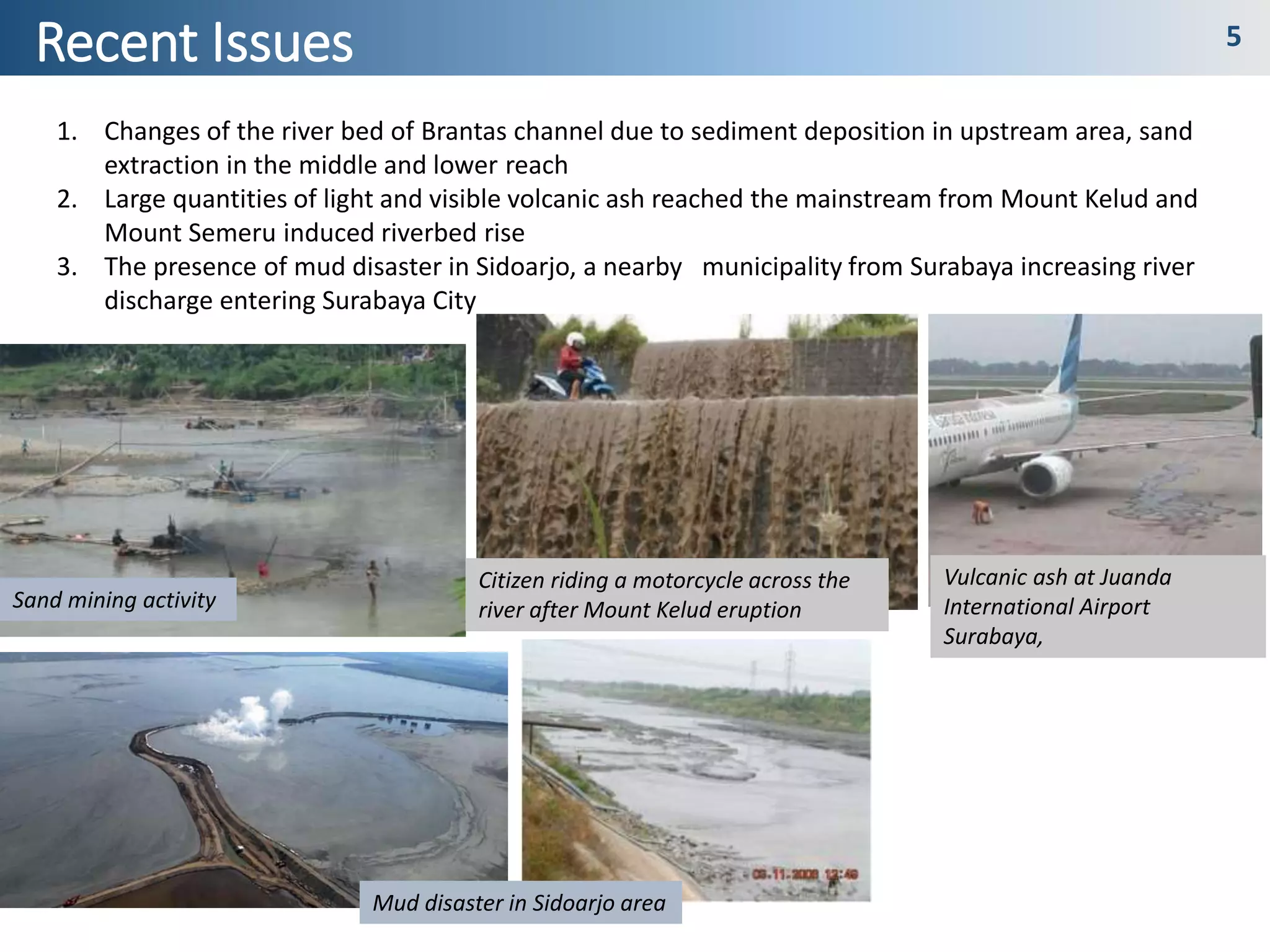
Recent Issues 5
1. Changes of the river bed of Brantas channel due to sediment deposition in upstream area, sand
extraction in the middle and lower reach
2. Large quantities of light and visible volcanic ash reached the mainstream from Mount Kelud and
Mount Semeru induced riverbed rise
3. The presence of mud disaster in Sidoarjo, a nearby municipality from Surabaya increasing river
discharge entering Surabaya City
Sand mining activity
Citizen riding a motorcycle across the
river after Mount Kelud eruption
Vulcanic ash at Juanda
International Airport
Surabaya,
Mud disaster in Sidoarjo area
Development History 6
around the late 1840's
the Dutch colonial day
around the late 1950's
Begin at 1956
Indonesian
government and
Japan
Flood control and water utilization
projects such as the construction
discharge channel and small-scale
hydroelectric power stations. Included
irrigation facilities , roads and bridges.
The structures is dilapidated because of
lack of maintenance, Indonesia's
financial problem after independence
and great floods in 1954-1955
Nejama Diversion Tunnel
(South Tulungagung Drainage)
Asahi Shinbun (August 31, 1960) “
Successfull Reparations Work in Indonesia” .
The tunnel heading was penetrated and
lining using concrete, and it also become
Indonesia's most productive rice growing
region.
The construction cost of US$ 2 million could
be repaid in one year
Development History 7
1945
1961 MASTER PLAN 1 Flood control by constructing
dams in upper reaches
1969-
1994
Change due to President
regime
From fisrt to second president
Rice production self sufficiency
Indonesia’s independence
1973 MASTER PLAN 2 Irrigation developement
1985 MASTER PLAN 3 Industrial and urban
development by emphasis
water supply for domestic and
industrial use
1998 MASTER PLAN 4 Management conservation of
water resources
End of second president
regime2004-now NEW MASTER PLAN ?? Integrated watershed
management
Fund sources : Japanese reparation (JR)
Overseas Economics Cooperation Fund of Japan (OECF)
Government of Indonesia (GOI)
Asian Development Bank (ADB)
International Bank for Reconstruction and Development (IBRD)
(JR, OECF, GOI)
(OECF, GOI, ADB)
(IBRD, GOI, ADB)
(IBRD, GOI, ADB
JR)
Development History 7
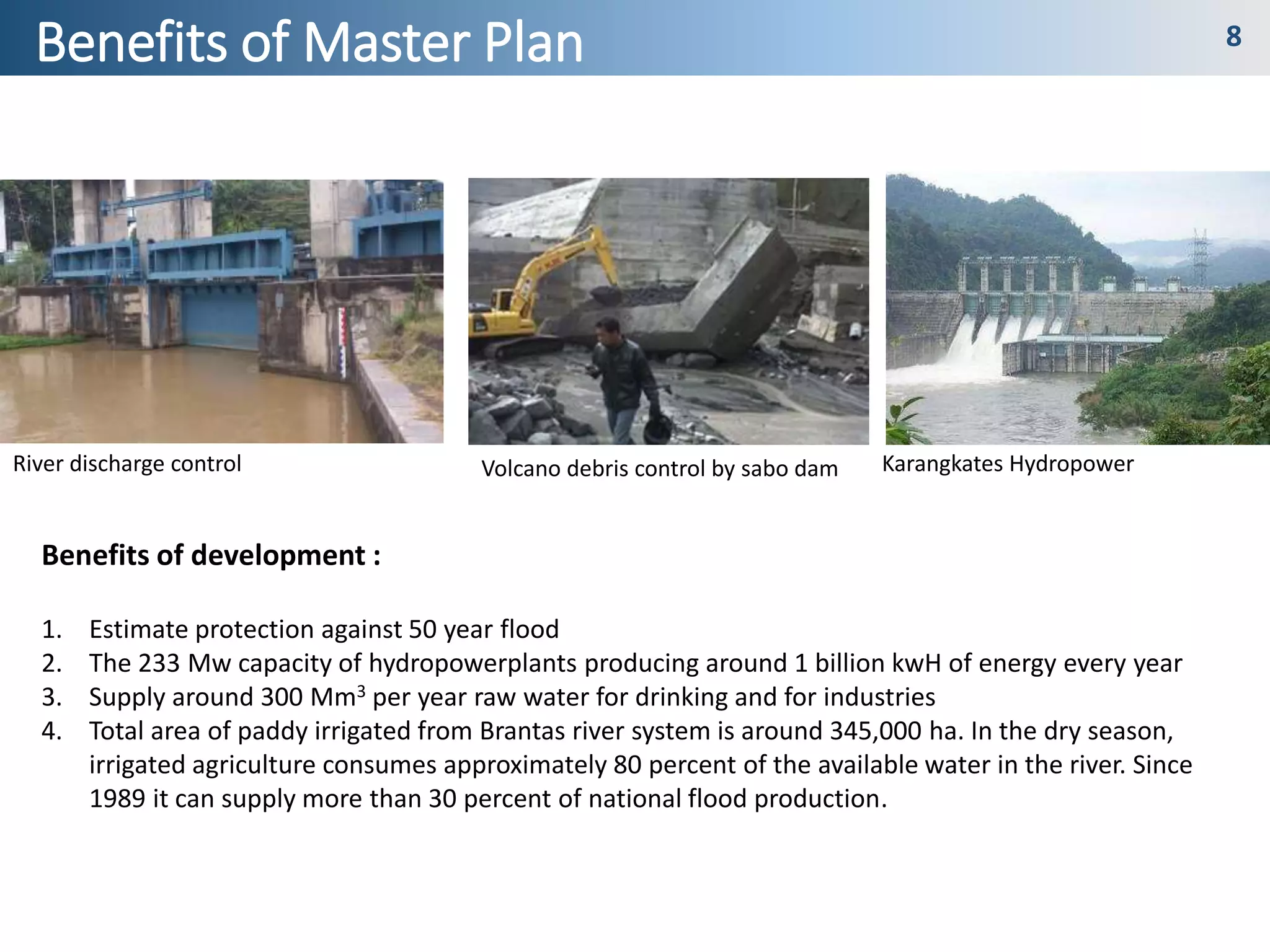
Benefits of Master Plan 8
Benefits of development :
1. Estimate protection against 50 year flood
2. The 233 Mw capacity of hydropowerplants producing around 1 billion kwH of energy every year
3. Supply around 300 Mm3 per year raw water for drinking and for industries
4. Total area of paddy irrigated from Brantas river system is around 345,000 ha. In the dry season,
irrigated agriculture consumes approximately 80 percent of the available water in the river. Since
1989 it can supply more than 30 percent of national flood production.
River discharge control Volcano debris control by sabo dam Karangkates Hydropower
Development History 7
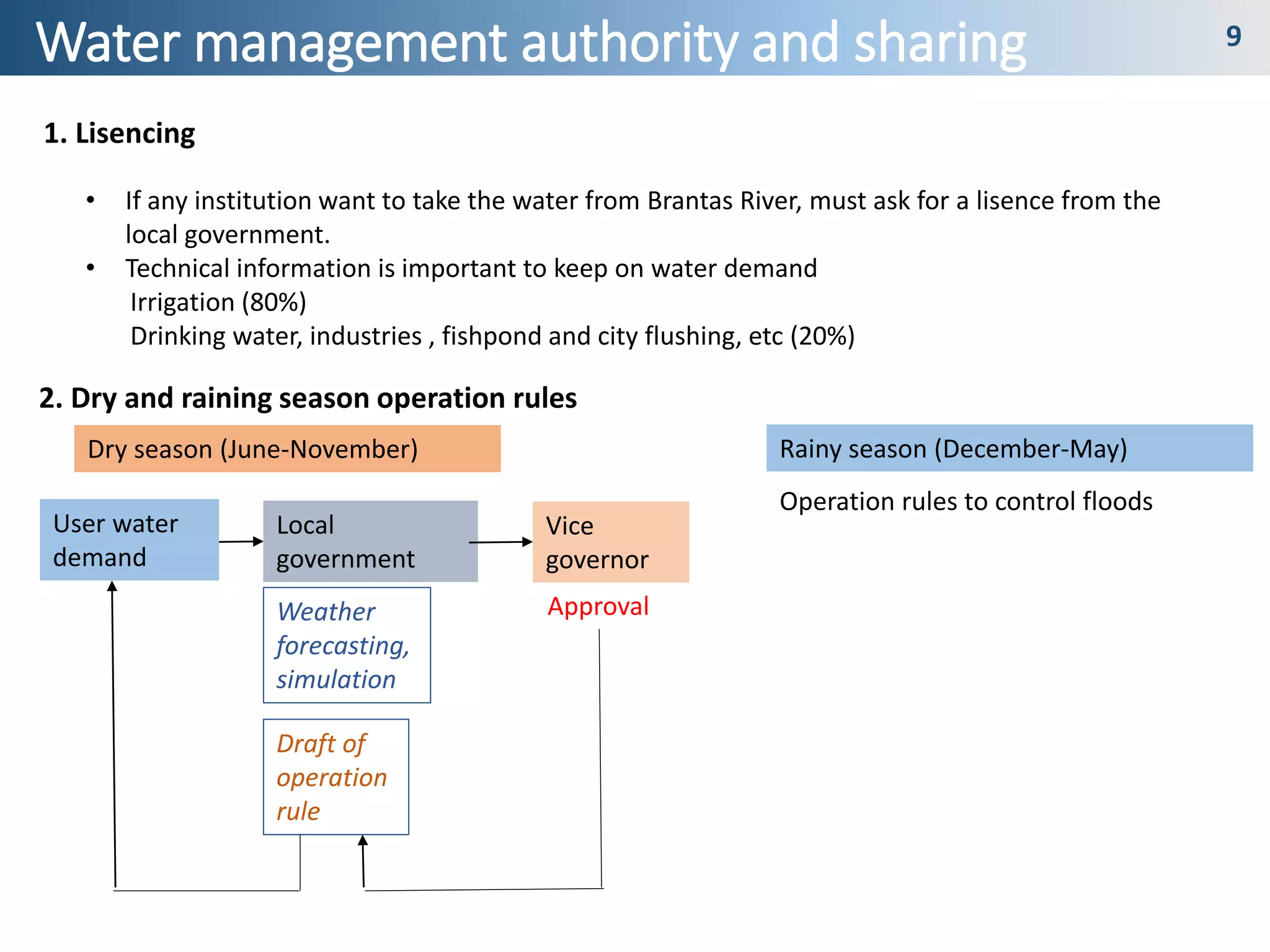
Water management authority and sharing 9
1. Lisencing
2. Dry and raining season operation rules
• If any institution want to take the water from Brantas River, must ask for a lisence from the
local government.
• Technical information is important to keep on water demand
Irrigation (80%)
Drinking water, industries , fishpond and city flushing, etc (20%)
Dry season (June-November)
User water
demand
Local
government
Weather
forecasting,
simulation
Draft of
operation
rule
Vice
governor
Approval
Rainy season (December-May)
Operation rules to control floods
Development History 7
Condition of water facilities and infrastructure 9
Catchment area
Increased sedimentation from reservoirs, more erosion, and a lowering of the water table including
complete exhaustion. Sedimentation occurs because of the damage to the river upstream
Solution : Green belt -> reforestation in river region
Reservoirs
The impaired capacity of the reservoir can affect flood control attempts and can also reduce raw
water supply for the customers.
Solution : Dredging and flushing sediments at reservois
(*) Effective Storage Capacity of the Reservoirs
Development History 7
Condition of water facilities and infrastructure 9
Periodic Dams inspection
DAMS
(*) They conducted an investigation by using GPR (Ground Penetrating Radar) in the effort to discover
and study existing crack lines and to ascertain their depths.
Development History 7
Improvements 10
To support watershed management, regulations about land use conservation must
be implemented to minimize land use conversions from green and open spaces to
built up areas
Examples of method that can be implemented to reduce run-off to the main river are
1. Rehabilitation of forest in catchment areas
2. Construction of sub-channel and drainage wells
3. Reconstruction of riverbank
Development History 7
Improvements 11
Irrigation
Irrigation channel
depth became
shallow because of
sedimentation
river normalization and
irrigation channel
improvements
Flood control
Normalization of
river to enhance the
capacity of the river
and retarding basin
by Ministry of Public
Work
Flood control
and reducing
inundation area
Development History 7
“One river, one plan, one management” 12
Operated by permanent institution
Professional staff and adequate budget
Maintenance of
structures
• Dam
• River
• Tunnel
Upper watershed
management
• Reforestation
• Plot land use
planning
Water quality management
• Water allocation
( agriculture, drinking water
and inductries, electricity,
tourism, fishery,
transportation
• Source of pollutants
• Pollution monitoring
• Public awareness
Flood
Management
• Structure
operation
rules
• Real time
data

Water Resources Management in Brantas River Basin

  • 1.
    Water Resources Managementin Brantas River Basin June 5th, 2017 Putika Ashfar Khoiri putika@civil.eng.osaka-u.ac.jp
  • 2.
  • 3.
    Principal water usage2 Irrigation Consume 20% of annual discharge of the river and 42 % (907.000 Ha) irrigated land in East Java is within Brantas Basin Industry Use for industrial use and port in Surabaya Raw water for industry supplies 159 mm3/year (in 2011) Domestic water supply Raw Water for Domestic Supply = 288 mm3/year Hydroelectric Power Producers
  • 4.
    Water Management Issues3 Land-use In 2000 the Brantas Basin made up 32% of East Java’s land area Populations The main sources of water of 9 regencies and 5 municipalities Growth of industrial and housing area All require water supply Citizen in Keputih (Surabaya) buy water from water tank in drought season
  • 5.
    Water Management Issues4 Floods and drought • Floods and drought occurs annually due to lack of adequate infrastructure to regulate water • How to save water during rainy season and release it during dry season Rungkut area in Surabaya during rainy day January, 12 2017 Problems causes 1. Deforestation and land-use change 2. Inadequate capacities of the river in the middle and lower reach 3. High level of sedimentation impacting the river morphology problem 4. Poor maintenance of infrastructure and lack of funding
  • 6.
    Recent Issues 5 1.Changes of the river bed of Brantas channel due to sediment deposition in upstream area, sand extraction in the middle and lower reach 2. Large quantities of light and visible volcanic ash reached the mainstream from Mount Kelud and Mount Semeru induced riverbed rise 3. The presence of mud disaster in Sidoarjo, a nearby municipality from Surabaya increasing river discharge entering Surabaya City Sand mining activity Citizen riding a motorcycle across the river after Mount Kelud eruption Vulcanic ash at Juanda International Airport Surabaya, Mud disaster in Sidoarjo area
  • 7.
    Development History 6 aroundthe late 1840's the Dutch colonial day around the late 1950's Begin at 1956 Indonesian government and Japan Flood control and water utilization projects such as the construction discharge channel and small-scale hydroelectric power stations. Included irrigation facilities , roads and bridges. The structures is dilapidated because of lack of maintenance, Indonesia's financial problem after independence and great floods in 1954-1955 Nejama Diversion Tunnel (South Tulungagung Drainage) Asahi Shinbun (August 31, 1960) “ Successfull Reparations Work in Indonesia” . The tunnel heading was penetrated and lining using concrete, and it also become Indonesia's most productive rice growing region. The construction cost of US$ 2 million could be repaid in one year
  • 8.
    Development History 7 1945 1961MASTER PLAN 1 Flood control by constructing dams in upper reaches 1969- 1994 Change due to President regime From fisrt to second president Rice production self sufficiency Indonesia’s independence 1973 MASTER PLAN 2 Irrigation developement 1985 MASTER PLAN 3 Industrial and urban development by emphasis water supply for domestic and industrial use 1998 MASTER PLAN 4 Management conservation of water resources End of second president regime2004-now NEW MASTER PLAN ?? Integrated watershed management Fund sources : Japanese reparation (JR) Overseas Economics Cooperation Fund of Japan (OECF) Government of Indonesia (GOI) Asian Development Bank (ADB) International Bank for Reconstruction and Development (IBRD) (JR, OECF, GOI) (OECF, GOI, ADB) (IBRD, GOI, ADB) (IBRD, GOI, ADB JR) Development History 7
  • 9.
    Development History 7 Benefitsof Master Plan 8 Benefits of development : 1. Estimate protection against 50 year flood 2. The 233 Mw capacity of hydropowerplants producing around 1 billion kwH of energy every year 3. Supply around 300 Mm3 per year raw water for drinking and for industries 4. Total area of paddy irrigated from Brantas river system is around 345,000 ha. In the dry season, irrigated agriculture consumes approximately 80 percent of the available water in the river. Since 1989 it can supply more than 30 percent of national flood production. River discharge control Volcano debris control by sabo dam Karangkates Hydropower
  • 10.
    Development History 7 Watermanagement authority and sharing 9 1. Lisencing 2. Dry and raining season operation rules • If any institution want to take the water from Brantas River, must ask for a lisence from the local government. • Technical information is important to keep on water demand Irrigation (80%) Drinking water, industries , fishpond and city flushing, etc (20%) Dry season (June-November) User water demand Local government Weather forecasting, simulation Draft of operation rule Vice governor Approval Rainy season (December-May) Operation rules to control floods
  • 11.
    Development History 7 Conditionof water facilities and infrastructure 9 Catchment area Increased sedimentation from reservoirs, more erosion, and a lowering of the water table including complete exhaustion. Sedimentation occurs because of the damage to the river upstream Solution : Green belt -> reforestation in river region Reservoirs The impaired capacity of the reservoir can affect flood control attempts and can also reduce raw water supply for the customers. Solution : Dredging and flushing sediments at reservois (*) Effective Storage Capacity of the Reservoirs
  • 12.
    Development History 7 Conditionof water facilities and infrastructure 9 Periodic Dams inspection DAMS (*) They conducted an investigation by using GPR (Ground Penetrating Radar) in the effort to discover and study existing crack lines and to ascertain their depths.
  • 13.
    Development History 7 Improvements10 To support watershed management, regulations about land use conservation must be implemented to minimize land use conversions from green and open spaces to built up areas Examples of method that can be implemented to reduce run-off to the main river are 1. Rehabilitation of forest in catchment areas 2. Construction of sub-channel and drainage wells 3. Reconstruction of riverbank
  • 14.
    Development History 7 Improvements11 Irrigation Irrigation channel depth became shallow because of sedimentation river normalization and irrigation channel improvements Flood control Normalization of river to enhance the capacity of the river and retarding basin by Ministry of Public Work Flood control and reducing inundation area
  • 15.
    Development History 7 “Oneriver, one plan, one management” 12 Operated by permanent institution Professional staff and adequate budget Maintenance of structures • Dam • River • Tunnel Upper watershed management • Reforestation • Plot land use planning Water quality management • Water allocation ( agriculture, drinking water and inductries, electricity, tourism, fishery, transportation • Source of pollutants • Pollution monitoring • Public awareness Flood Management • Structure operation rules • Real time data