Welcome to our presentation
WATER JET WEAVING MACHINE
Presented by,
Rokon Uddin(18th intake)
Kamruzzaman(18th intake)
Mozammel Hossain Rana(18th intake)
Lamia Hassan Supti(18th intake)
Introduction
Water jet loom was first developed at 1950s in
Czechoslovakia. After that, it was refined by the
Japanese in the1960s. It should be noted here that,
water jet loom is not used as air jet loom
in weaving factory. Both air jet loom and water jet
loom machines can weave rapidly. It also provides
for laying different colors in the weft direction. It
helps to produce uniform and higher quality fabrics.
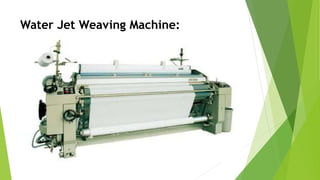
Water Jet Weaving Machine:
Features of Water Jet Loom:
Important features of water jet loom have discussed
in the following:
1.In case of water jet loom, weft yarn package
weight varies 3.6 to 4.1 kg.
2.Here, treated water is used by pump nozzle.
3.It consumes less power than others.
4.Higher number of weft insertion in water jet loom
than air jet loom (normally 600ppm).
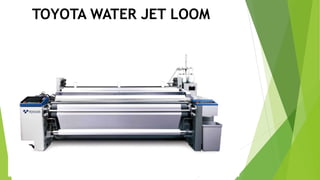
TOYOTA WATER JET LOOM
The New Toyota LWT810 Water Jet
Loom For Today.
The LWT810 Water Jet Loom enhances
the productivity and the quality with the
latest technology advancements that
customers expect from Toyota
while achieving the highest energy
savings to protect our environment.
High Quality and Improved
Productivity
Offering a short stroke and extending weft
insertion time has allowed drastic
improvements to high-speed operation and
enhanced quality while placing minimum strain
on the yarn.
Operability and Support
The new function panel offers the latest in
electronic technology advancements and
troubleshooting including enhanced visibility,
improved machine operation functionality, and
handling.
Factory Management
New factory management system, based on
the Toyota Monitoring System (TMS), offers an
increased management level of productivity
and quality in real-time by displaying
shift reports, actual factory floor layout, and
operation status in various formats.
WATER JET LOOM
Machine Specification:
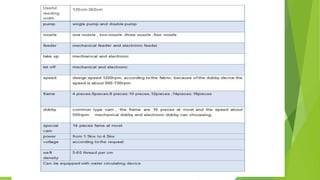
Model : ZWP8100
Production Capacity : 90%
Place of Origin : Shandong, China (Mainland)
Brand Name : Tsudakoma
Weight : 1.8T
Power(W) : 2.2-5.2KW
Certification : international certification
shedding type : cam/dobby
let-off type : machine/electric
take-off type : machine/electric
Reed Width : 130cm-320cm
Export Markets : Southeast Asia
Speed : Designed Maximum 900 RPM
Nozzle : Single double
Machine type : Water Jet Power Loom
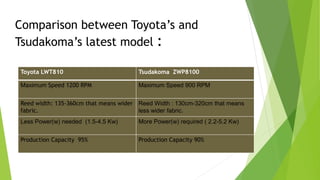
Comparison between Toyota’s and
Tsudakoma’s latest model :
Toyota LWT810 Tsudakoma ZWP8100
Maximum Speed 1200 RPM Maximum Speed 900 RPM
Reed width: 135-360cm that means wider
fabric.
Reed Width : 130cm-320cm that means
less wider fabric.
Less Power(w) needed (1.5-4.5 Kw) More Power(w) required ( 2.2-5.2 Kw)
Production Capacity 95% Production Capacity 90%
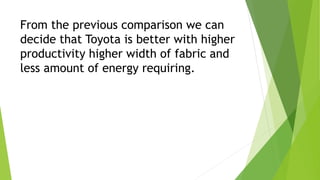
From the previous comparison we can
decide that Toyota is better with higher
productivity higher width of fabric and
less amount of energy requiring.
Reference:
 http://www.toyotatextilemachinery.com/water-jet/
 http://www.xinrunju.com/textile-machinery/water-jet-loom-
manufacturing-in-china.html
 https://www.tsudakoma.co.jp/english/business/textile/product/wat
er_jet_loom/zw8100/index.html
 https://www.indiamart.com/proddetail/tsudakoma-water-jet-loom-
2567636048.html
Thank you

WATER JET WEAVING MACHINE

  • 1.
    Welcome to ourpresentation
  • 2.
    WATER JET WEAVINGMACHINE Presented by, Rokon Uddin(18th intake) Kamruzzaman(18th intake) Mozammel Hossain Rana(18th intake) Lamia Hassan Supti(18th intake)
  • 3.
    Introduction Water jet loomwas first developed at 1950s in Czechoslovakia. After that, it was refined by the Japanese in the1960s. It should be noted here that, water jet loom is not used as air jet loom in weaving factory. Both air jet loom and water jet loom machines can weave rapidly. It also provides for laying different colors in the weft direction. It helps to produce uniform and higher quality fabrics.
  • 4.
  • 5.
    Features of WaterJet Loom: Important features of water jet loom have discussed in the following: 1.In case of water jet loom, weft yarn package weight varies 3.6 to 4.1 kg. 2.Here, treated water is used by pump nozzle. 3.It consumes less power than others. 4.Higher number of weft insertion in water jet loom than air jet loom (normally 600ppm).
  • 6.
  • 8.
    The New ToyotaLWT810 Water Jet Loom For Today. The LWT810 Water Jet Loom enhances the productivity and the quality with the latest technology advancements that customers expect from Toyota while achieving the highest energy savings to protect our environment.
  • 9.
    High Quality andImproved Productivity Offering a short stroke and extending weft insertion time has allowed drastic improvements to high-speed operation and enhanced quality while placing minimum strain on the yarn.
  • 10.
    Operability and Support Thenew function panel offers the latest in electronic technology advancements and troubleshooting including enhanced visibility, improved machine operation functionality, and handling.
  • 11.
    Factory Management New factorymanagement system, based on the Toyota Monitoring System (TMS), offers an increased management level of productivity and quality in real-time by displaying shift reports, actual factory floor layout, and operation status in various formats.
  • 12.
  • 13.
    Machine Specification: Model :ZWP8100 Production Capacity : 90% Place of Origin : Shandong, China (Mainland) Brand Name : Tsudakoma Weight : 1.8T Power(W) : 2.2-5.2KW Certification : international certification shedding type : cam/dobby let-off type : machine/electric take-off type : machine/electric Reed Width : 130cm-320cm Export Markets : Southeast Asia Speed : Designed Maximum 900 RPM Nozzle : Single double Machine type : Water Jet Power Loom
  • 14.
    Comparison between Toyota’sand Tsudakoma’s latest model : Toyota LWT810 Tsudakoma ZWP8100 Maximum Speed 1200 RPM Maximum Speed 900 RPM Reed width: 135-360cm that means wider fabric. Reed Width : 130cm-320cm that means less wider fabric. Less Power(w) needed (1.5-4.5 Kw) More Power(w) required ( 2.2-5.2 Kw) Production Capacity 95% Production Capacity 90%
  • 15.
    From the previouscomparison we can decide that Toyota is better with higher productivity higher width of fabric and less amount of energy requiring.
  • 16.
    Reference:  http://www.toyotatextilemachinery.com/water-jet/  http://www.xinrunju.com/textile-machinery/water-jet-loom- manufacturing-in-china.html https://www.tsudakoma.co.jp/english/business/textile/product/wat er_jet_loom/zw8100/index.html  https://www.indiamart.com/proddetail/tsudakoma-water-jet-loom- 2567636048.html
  • 17.