See	discussions,	stats,	and	author	profiles	for	this	publication	at:	https://www.researchgate.net/publication/299952768
Dive	In!	An	Integrated	Design	Thinking/STEM
Curriculum
Conference	Paper	·	June	2014
CITATIONS
0
READS
35
3	authors,	including:
Some	of	the	authors	of	this	publication	are	also	working	on	these	related	projects:
RED	Lab	View	project
Molly	Bullock	Zielezinski
Stanford	University
14	PUBLICATIONS			7	CITATIONS			
SEE	PROFILE
All	content	following	this	page	was	uploaded	by	Molly	Bullock	Zielezinski	on	08	April	2016.
The	user	has	requested	enhancement	of	the	downloaded	file.
Paper ID #10876
Dive In! An Integrated Design Thinking/STEM Curriculum
Prof. Shelley Goldman, Stanford University
Shelley Goldman is a learning sciences researcher studying how design thinking and technologies can
create better access and success for K-16 learners. Current work includes bringing broadening participa-
tion in STEM inside and outside of school. A professor at the Stanford Graduate School of Education and
by Courtesy, Mechanical Engineering-Design Track, Goldman is on the faculty of the Learning, Design
& Technology master’s program and the Learning Sciences & Technology Design doctoral program.
Dr. Maureen Carroll
Ms. Molly Bullock Zielezinski, Stanford University
Mr. Aaron Loh, Ministry of Education, Singapore
Aaron graduated from Stanford’s Learning, Design and Technology Master’s program in 2012. He is
currently the Principal of Commonwealth Secondary School, an innovative public school in Singapore.
As an educator with more than 10 years of experience as a teacher, policy maker and school leader,
Aaron is interested in redesigning public education through the use of technology and new pedagogical
approaches. In particular, he believes that design thinking has the potential to reconnect students and
educators with authentic and meaningful learning, and can nurture the empathy and creativity that they
need to succeed in the 21st Century. Aaron also holds a bachelor’s degree in English from the University
of Cambridge, and a Masters in English and American literature from Stanford University.
Mr. Eng Seng Ng, Stanford University
Stephanie Bachas-Daunert, Stanford University
c American Society for Engineering Education, 2014
Page24.440.1
For more activities, download our complete curriculum: http://goo.gl/Cjk3t2
Grade Level: 6-8
Authors: Shelley Goldman, Maureen Carroll, Molly B. Zielezinski, Stephanie Bachas-Daunert
Author Contact Information: sgoldman@stanford.edu, mbullock@stanford.edu
Next Generation Science Standards: MS-LS2-5 Ecosystems: Interactions, Energy, and Dynamics
Activity Summary: Introduces students to the concepts of natural and man-made water treatment and purification
as they engage in prototyping working water filters from a variety of natural materials.
1. Build Background Knowledge: Show students one or both of the
following videos. These videos provide context for the experiment. Each
video describes an approach to filtration; together, they offer different
frames in terms of scope & scale of filtration systems.
Water Treatment Plant:http://goo.gl/gfgCn3
Portable Filter: http://goo.gl/w8XZjA
2. Get Organized: Organize class into lab groups of 2-4 students. Give
each team 2-3 pre-cut bottles with 1 coffee filter & 10 cotton balls for
each bottle. Instruct students to layer coffee filter & cotton balls within the
spout of the bottle. This should be the same
for all filters & all groups.
3. Plan the Investigation: Show students the
dirty water & remaining materials. Explain
that each team will be filtering the water by
making thick layers of combinations of
these materials. Ask students to brainstorm
& sketch filter designs, encouraging teams
to hold most layers constant & vary only 1
or 2 variables between their team’s designs.
Ex: “Here are paper filters & materials. You need
to layer materials inside of the filters to create a
water filtration system. Use any combinations of
the materials here & layer/sandwich them with
the goal of creating the system that will trap the most pollutants from the dirty water.”
4. Getting Feedback: Teams submit designs for teacher/peer feedback.
Ensure that teams can articulate which design parameters they are holding
constant & which they are varying between designs. After receiving
feedback, students can improve upon & iterate on their designs, and
collect the materials needed for their filtration systems.
5. Building Prototypes: Each team uses the materials to build prototypes of
their designs. When prototypes are complete, teams should label each
filtration system with team name & the defining characteristic of the bottle
(ex. Team 2, no gravel).
6. Evaluating Prototypes: Pour dirty water into each filtration system.
Compare the outcomes within & between groups by ordering the designs
from least to most clean water (based on the visually observable aspects of
cloudiness & color).
7. Coming to Consensus: Through class discussion, determine the
materials & design of the most effective water filters. Use results to design
1-2 more filtration systems as a whole class. Build, test, evaluate, &
discuss experimental outcome.
8. Reflection: Students reflect in writing on the prompt: “Describe the
process & outcome of building a water filtration system. What 3
recommendations would you make for others doing this for the first time?”
1. Students plan and carry out an
investigation of water purification
using natural materials.
2. Through design, prototyping &
analysis, students identify the
materials and design of effective
water filtration systems.
(10 teams of 2-4 students)
10 Sharpies
10 Cups Sand
10 Cups Fine-grained Gravel (very
small rocks  sand)
10 Cups Rough Gravel (small
rocks, pebbles, and/or marbles)
50 Charcoal Bricks (place bricks
into plastic bag  use a hammer
to break into small chunks)
30 Coffee Filters
20-30 Pre-cut 1 Liter Plastic
Bottles (cut each bottle at the
halfway point  nest the tops
inside of the bottoms, with the
spout down)
100 Cotton Balls
2 Gallons Dirty Water
(contaminated with glitter/confetti,
dirt, oil, or any solid or liquid that
is not extremely soluble in water)
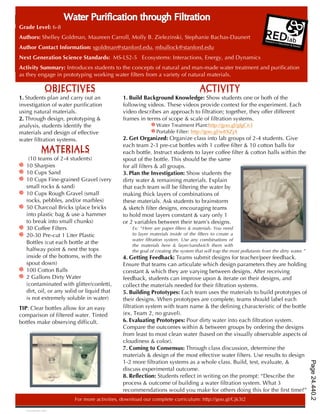
TIP: Clear bottles allow for an easy
comparison of filtered water. Tinted
bottles make observing difficult.
Page24.440.2
View publication statsView publication stats

Water Filtration through Purification Lesson

  • 1.
  • 2.
    Paper ID #10876 DiveIn! An Integrated Design Thinking/STEM Curriculum Prof. Shelley Goldman, Stanford University Shelley Goldman is a learning sciences researcher studying how design thinking and technologies can create better access and success for K-16 learners. Current work includes bringing broadening participa- tion in STEM inside and outside of school. A professor at the Stanford Graduate School of Education and by Courtesy, Mechanical Engineering-Design Track, Goldman is on the faculty of the Learning, Design & Technology master’s program and the Learning Sciences & Technology Design doctoral program. Dr. Maureen Carroll Ms. Molly Bullock Zielezinski, Stanford University Mr. Aaron Loh, Ministry of Education, Singapore Aaron graduated from Stanford’s Learning, Design and Technology Master’s program in 2012. He is currently the Principal of Commonwealth Secondary School, an innovative public school in Singapore. As an educator with more than 10 years of experience as a teacher, policy maker and school leader, Aaron is interested in redesigning public education through the use of technology and new pedagogical approaches. In particular, he believes that design thinking has the potential to reconnect students and educators with authentic and meaningful learning, and can nurture the empathy and creativity that they need to succeed in the 21st Century. Aaron also holds a bachelor’s degree in English from the University of Cambridge, and a Masters in English and American literature from Stanford University. Mr. Eng Seng Ng, Stanford University Stephanie Bachas-Daunert, Stanford University c American Society for Engineering Education, 2014 Page24.440.1
  • 3.
    For more activities,download our complete curriculum: http://goo.gl/Cjk3t2 Grade Level: 6-8 Authors: Shelley Goldman, Maureen Carroll, Molly B. Zielezinski, Stephanie Bachas-Daunert Author Contact Information: sgoldman@stanford.edu, mbullock@stanford.edu Next Generation Science Standards: MS-LS2-5 Ecosystems: Interactions, Energy, and Dynamics Activity Summary: Introduces students to the concepts of natural and man-made water treatment and purification as they engage in prototyping working water filters from a variety of natural materials. 1. Build Background Knowledge: Show students one or both of the following videos. These videos provide context for the experiment. Each video describes an approach to filtration; together, they offer different frames in terms of scope & scale of filtration systems. Water Treatment Plant:http://goo.gl/gfgCn3 Portable Filter: http://goo.gl/w8XZjA 2. Get Organized: Organize class into lab groups of 2-4 students. Give each team 2-3 pre-cut bottles with 1 coffee filter & 10 cotton balls for each bottle. Instruct students to layer coffee filter & cotton balls within the spout of the bottle. This should be the same for all filters & all groups. 3. Plan the Investigation: Show students the dirty water & remaining materials. Explain that each team will be filtering the water by making thick layers of combinations of these materials. Ask students to brainstorm & sketch filter designs, encouraging teams to hold most layers constant & vary only 1 or 2 variables between their team’s designs. Ex: “Here are paper filters & materials. You need to layer materials inside of the filters to create a water filtration system. Use any combinations of the materials here & layer/sandwich them with the goal of creating the system that will trap the most pollutants from the dirty water.” 4. Getting Feedback: Teams submit designs for teacher/peer feedback. Ensure that teams can articulate which design parameters they are holding constant & which they are varying between designs. After receiving feedback, students can improve upon & iterate on their designs, and collect the materials needed for their filtration systems. 5. Building Prototypes: Each team uses the materials to build prototypes of their designs. When prototypes are complete, teams should label each filtration system with team name & the defining characteristic of the bottle (ex. Team 2, no gravel). 6. Evaluating Prototypes: Pour dirty water into each filtration system. Compare the outcomes within & between groups by ordering the designs from least to most clean water (based on the visually observable aspects of cloudiness & color). 7. Coming to Consensus: Through class discussion, determine the materials & design of the most effective water filters. Use results to design 1-2 more filtration systems as a whole class. Build, test, evaluate, & discuss experimental outcome. 8. Reflection: Students reflect in writing on the prompt: “Describe the process & outcome of building a water filtration system. What 3 recommendations would you make for others doing this for the first time?” 1. Students plan and carry out an investigation of water purification using natural materials. 2. Through design, prototyping & analysis, students identify the materials and design of effective water filtration systems. (10 teams of 2-4 students) 10 Sharpies 10 Cups Sand 10 Cups Fine-grained Gravel (very small rocks sand) 10 Cups Rough Gravel (small rocks, pebbles, and/or marbles) 50 Charcoal Bricks (place bricks into plastic bag use a hammer to break into small chunks) 30 Coffee Filters 20-30 Pre-cut 1 Liter Plastic Bottles (cut each bottle at the halfway point nest the tops inside of the bottoms, with the spout down) 100 Cotton Balls 2 Gallons Dirty Water (contaminated with glitter/confetti, dirt, oil, or any solid or liquid that is not extremely soluble in water) TIP: Clear bottles allow for an easy comparison of filtered water. Tinted bottles make observing difficult. Page24.440.2 View publication statsView publication stats